
SUNTIMER - Camera MINOX - Free user manual and instructions
Find the device manual for free SUNTIMER MINOX in PDF.



| Product Type | Portable UV dosimeter |
| Brand | MINOX |
| Model | SUNTIMER |
| Main functions | UV index measurement, calculation of maximum exposure time, UV alarm, stopwatch, clock, alarm |
| Sensor | UV sensor for natural sunlight |
| Display | LCD screen with backlight |
| Power | Battery (type not specified, probably CR2032) |
| Battery life | Not specified, moderate use estimated at several months |
| Dimensions | Approximately 5 x 3 x 1 cm (estimated) |
| Weight | Approximately 20 g (estimated) |
| Material | Plastic, sensor window glass |
| Attachment | Universal attachment for arm, wrist, backpack, stroller |
| Modes | Time, Alarm, Chrono, Exposure-Timer |
| Programming | Skin type (I-IV), sun protection factor (1-50) |
| Alarm | Audible, 2 minutes duration, can be turned off by button |
| Max UV index | 11 (warning SEEK SHADE) |
| UV measurement range | Natural solar UV radiation |
| Maintenance and cleaning | Clean the sensor window regularly, avoid sunscreen |
| Safety | Does not replace sun protection, keep away from children, medical contraindications |
| Warranty | 2 years, under conditions (service card and receipt required) |
Frequently Asked Questions - SUNTIMER MINOX
User questions about SUNTIMER MINOX
0 question about this device. Answer the ones you know or ask your own.
Ask a new question about this device
Download the instructions for your Camera in PDF format for free! Find your manual SUNTIMER - MINOX and take your electronic device back in hand. On this page are published all the documents necessary for the use of your device. SUNTIMER by MINOX.
USER MANUAL SUNTIMER MINOX
text_image
UV INDEX 8 Z^Z HIGH TIME 12:05:08 PMUhrzeit · UV-Index
16 Funktionen
text_image
TEMP 23°[Hz] WTemperatur

text_image
12-25 M Dtext_image
UV INDEX 8 Z' HIGH TIME 12:05:08 PMSet (> 1,5 sec.)
text_image
SET ↓ 12:05:08 Mode ↓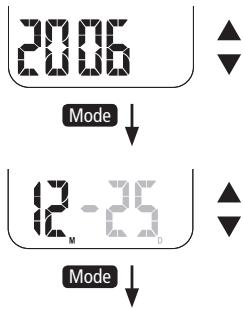
text_image
2006 Mode ↓ 12 - 35 M D Mode ↓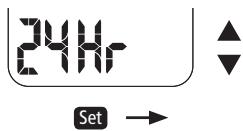
text_image
24H Set →18 Funktionen
text_image
ALARM 7:00(>1,5 sec.)
text_image
SF 4 ↓ SPF 6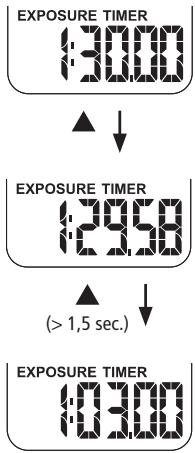
text_image
EXPOSURE TIMER 1:30.00 ↓ EXPOSURE TIMER 1:29.58 (> 1,5 sec.) ↓ EXPOSURE TIMER 1:33.00Congratulations on your purchase of the MINOX SUNTIMER™.
With the SUNTIMERTM from MINOX you have decided for a high precision product and quality. This user manual will help you understand all the functions for an optimal use of this instrument's entire technical features.
Enjoy your MINOX SUNTIMER™!
Content
General information 32
Your personal MINOX-SUNTIMER™ 32
Important Safety Precautions 33
Conditions of Warranty 35
Background Information about Ultraviolet Solar Radiation 37
How to Protect Yourself and Others from Excessive UV Exposure . . . . . . . . . . . . . . . . . . . 37
Functions 42
The various modi 43
TIME-Mode 43
ALARM-Mode 46
CHRONO-Mode 48
EXPOSURE-TIMER-Mode 49
Appendix 52
The effect of natural UV radiation on humans 52
Factors causing variations in exposure to UV radiation 53
The various skin types 55
32 General information
Your personal MINOX SUNTIMER™
The MINOX SUNTIMER™ is very practical in helping your skin not to be exposed to UV radiation for too long, for example sunbathing or other activities in the sun. With its latest sensor model the SUNTIMER™ measures the intensity of the sun's ultraviolet radiation (UV radiation). This radiation is considered harmful to skin and eyes. With the SUNTIMER™ you can adapt your maximum exposure to the sun to your individual skin type. An alarm goes on as soon as the maximum time or UV radiation is attained.
This user manual helps you understand all the functions of the SUNTIMER ^™ . In addition to that you get background information about ultraviolet solar radiation and how to protect against excessive solar exposure.
Please read this manual carefully in order to prevent your skin and eyes against excessive solar radiation.
Important Safety Precautions

The MINOX SUNTIMER™ does not prevent sunburn, wrinkles, skin cancer, eye defects, immune disorder or any other risks caused by exposure to solar radiation. The estimated maximum exposure time may not be appropriate in specific individual cases.
It is not intended to use this instrument as replacement for use of sunscreen or other appropriate measures to help avoiding over-exposure to UV radiation. This instrument is not to be used by children under the age of 14 without adult supervision.
MINOX GmbH shall have no liability to any purchaser or user of this instrument except for liability to replace or repair the instrument in case of malfunction in accordance with the MINOX GmbH limited warranty.
Always keep the sight glass (fig. on page 42) which is located right above the UV sensor, clean. Only then valid measurements are ensured. Even smallest amounts of sunscreen cause less than the actual current UV radiation to be displayed.
When used as directed the SUNTIMER™ is intended to help you estimate the recommended maximum exposure time to UV radiation for a 24-hour period. This is done on government-recognized guidelines for individual skin types and medical research on exposure necessary to induce sunburn. The SUNTIMER™ is supposed to
34 General information
rationally support, but not replace judgment of environmental conditions. At the end of this manual you find a table, listing skin types and their reaction to UV radiation.
The readings may contribute to determine estimating maximum exposure time for you personally as exact as possible, including correct assessment and entry of the skin type, correct understanding of use of sunscreen as well as the correct entry of SPF for sunscreen being used. Furthermore variable weather conditions, reflected UV radiation, use of certain medication, ingestion of alcohol, extreme temperatures and / or humidity and other known and unknown factors do effect the correctness of the reading.
This instrument is designed for measuring UV radiation from natural sun light and should not be used
for monitoring UV radiation from artificial sources (e.g. sun beds).
The skin types are formed according to international radiation protection regulations and they are only guidelines. Still, study these carefully. You know how your skin reacts to exposure. For determination of your skin type you should complete this rating with your own experience.
For exact information about your skin type and of how your skin responds to sun please consult your physician or specialist (e.g. dermatologist) if there is any doubt.
Conditions of Warranty
With the purchase of this MINOX product you have acquired a product which has been manufactured and checked to special quality standards.
For this product the MINOX GmbH provides 24 months warranty. The period commences on the date of purchase from an authorized dealer and the warranty is subject to the following conditions:
1) During the warranty period we shall deal with complaints based on faulty manufacture (free of charge) by repair, replacement of defective parts or replacement by an identical flawless product at our own discretion. Consequential claims, no matter of what kind and of what legal argument in connection with this warranty, cannot be accepted.
2) Claims under warranty are null and void, if the defect has been caused by improper handling – which also can include the use of non-MINOX accessories – if the MINOX product is serviced by unauthorized persons or workshops, or if the serial number has been obliterated.
3) Warranty claims can only be made by submission of the typewritten sales slip of an authorized dealer.
4) When submitting claims under warranty please return the MINOX product together with the typewritten sales slip and a description of the claim to the MINOX GmbH or MINOX agency.
5) Tourists may, if required, make use of the Agency of the country in which they are travelling (within the terms of the Warranty of the MINOX GmbH) by presenting the typewritten sales slip.
36 General information
MINOX GmbH
Technical Service
Walter-Zapp-Str. 4
D-35578 Wetzlar
Phone: +49 (0) 6441 / 917-0
Fax: +49 (0) 6441 / 917-612
eMail: info@minox.com
Internet : www.minox.com
A current listing of all our agencies can be viewed
under: www.minox.de
Background Information about Ultraviolet Solar Radiation
The MINOX SUNTIMER™ is a small measuring instrument that enables you to be aware of the ultraviolet proportion of the sun's radiation. In excessive amounts this radiation is harmful to your health. The SUNTIMER™ measures the "UV-index", an internationally standardized numerical value, indicating the intensity of UV rating. It also estimates the time required to reach the maximum amount of ultraviolet radiation to which you should be exposed in a single day. This estimation is based on accepted medical research on how much solar UV is necessary to cause sunburn, and on government guidelines for rating how susceptible your skin is to sunburn. When the estimated maximum time is reached the SUNTIMER™ sounds an alarm. Thanks to its universal wearing band the MINOX SUNTIMER™ offers various ways of how to fasten it, for example on the upper arm, on the wrist, on a backpack or stroller. The SUNTIMER™ measures UV radiation constantly. When you take the SUNTIMER™ directly into the sun and then indoors or into shade afterwards, the instrument will adjust the maximum permitted UV radiation for that day and readjust correspondingly. For new measuring period the instrument can also be reset so that other individuals can also use it.
How to Protect Yourself and Others from Excessive UV Exposure
Sunscreens and lip-care products
The effectiveness of sunscreens is rated with "Sun Protection Factor" (SPF). This number represents the effectiveness to filter UV rays out of the sunlight. The higher the number, the better the protection.
38 General information
But no chemical sunscreen filters all 100% of incident UV radiation. A SPF 40 sunscreen at most filters 97.5% of incident UVB radiation (UVB is that part of radiation that causes the most skin damage). The SPF factor is a multiplier and multiplies the estimated maximum exposure time to the sun, due to your skin type without UV protection. For example, for your skin type the estimated time to stay in the sun without sunscreen before getting sunburn were be 15 minutes, it then would be 60 minutes with SPF 4 (4 x 15 minutes = 60 minutes).
Important Note: The UV intensity changes through a day. So it steadily increases before noon and then decreases in the afternoon correspondingly. The period of time you can stay in the sun without getting sunburn therefore varies at different times during the day. If, for example, at 9:00 a.m. the SUNTIMER™ determines a maximum exposure time of 30 minutes, depending on skin type and SPF, at 12:00 noon this time period is clearly shorter and in the afternoon increasingly longer. Use the SUNTIMER™ to monitor the radiation throughout the day and let it calculate the recommended time anew. Also, calculations of maximum exposure time are not binding. Your skin may slightly vary from the skin type entered or you were exposed to UV radiation longer than the SUNTIMER™ registered. Please keep an eye on possible skin reddening and your general well-being.
When setting up the SUNTIMER™ please enter the SPF of your sunscreen being used between 1 and 50, where 1 indicates the lowest and 50 indicates the highest sun protection. The SUNTIMER™ then uses this value together with the number of your skin type you have also entered and then calculates the estimated maximum exposure time. You can
always change the value of the SPF factor in case you want to use another sunscreen.
Instruction for using sunscreens and lip-care products
Please refer to the indications for use of the corresponding manufacturer.
Sun Proof Factor
Experts recommend a value of at least 15, for children and sensitive skin a minimum of 30. Apply the sunscreen at least half an hour before going into the sun. After 2 hours in the sun at latest you should apply sunscreen again. Many dermatologists and Departments of Health even recommend reapplication after 30 minutes.
- See to considering resistance to water and perspiration when buying sunscreen.
- Give preference to sunscreens with active ingredients.
- Lip-care products should be applied generously at least every hour.
- For ears and nose you should consider sunscreen on zinc oxide basis.
- Do not use sunscreens on babies younger than 1 month, but possibly protect them totally from direct UV radiation.
In case you are not quite sure which sunscreen to use please contact your physician or a specialist (dermatologist).
Clothing
Clothing can protect from UV radiation but mostly not completely blocks it. Depending on the material the protection varies. Similar to the SPF factor for sunscreens there also is a UV rating for clothing, the
40 General information
UPF (Ultraviolet Protection Factor). So, for example, a simple t-shirt with a UPF of 15 offers very little protection. Other fabrics offer a better UV block and some manufacturers have developed clothing with a UPF higher than 50. For further information ask your textile specialist trader or the manufacturer.
Hats
Hats are a useful sun protection as they offer a good shield of the head and in the neck area. The broader the brim, the better the UV protection. Peaked caps do not sufficiently protect the neck and the ears. Straw hats do not at all block any UV radiation from the scalp.
Sunglasses
Sunglasses protect the eyes from both UV-A and UV-B. Besides, the UV blocking capability is not indicated by color, shade or price. When buying sunglasses, look for labels that specifically state the type and amount of UV radiation blocked. In case you are not sure which sunglasses offer the best protection for your eyes ask a specialist (eye specialist).
Staying out of the sun
The best method to avoid UV radiation is to stay out of the sun. But who does really want that? Avoiding the sun completely or substantially is hardly possible and also impractical and mostly not desirable. For you to enjoy the sun optimal and safely we have developed the SUNTIMER™. Use it purposefully and decide yourself case to case to maybe better stay out of extreme sun. Staying in the shade on days with high UV radiation is the safest decision. You should always watch UV radiation when looking after one or more children spending time in the sun.
42 Functions
The Functions of the MINOX SUNTIMER™
The following section describes all the functions of the MINOX SUNTIMER ^™ and how to use them.
Getting started
At first activate the SUNTIMER™. To conserve the battery the instruments are delivered in "sleep" mode. Press any button on the instrument longer than 1 second to activate it.
Illumination
A short press on the set button activates illumination of the display. To conserve the battery the display illumination goes out automatically after 3 seconds.
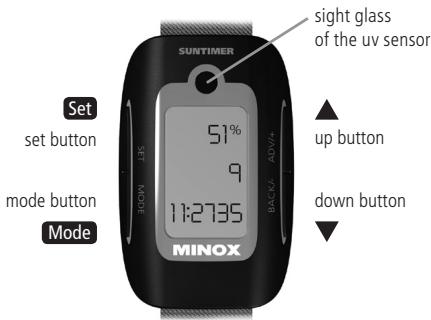
text_image
SUNTIMER sight glass of the uv sensor Set set button mode button Mode SET MODE 51% 9 11:2735 down button MINOXThe various modi
The SUNTIMER ^TM operates in four different modi:
• TIME-mode (time / date)
• ALARM-mode (wake-up function)
- CHRONO-mode (stopwatch)
- EXPOSURE-TIMER-mode (exposure time to the sun)
With a short press onto the mode button you can switch from one mode to the other.
TIME-mode (time / date)
Keep pressing the mode button until "TIME" is displayed. After 1.5 seconds the TIME-mode is displayed.
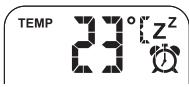
By pressing the down button repeatedly the following information can be viewed:
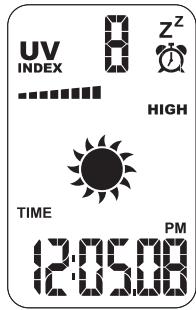
text_image
UV INDEX Z HIGH TIME 12:05:08 PMTime · UV-index
44 Functions
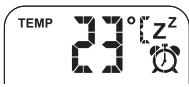
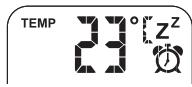
text_image
TEMP 23°[Hz] WTemperature

Setting date and time
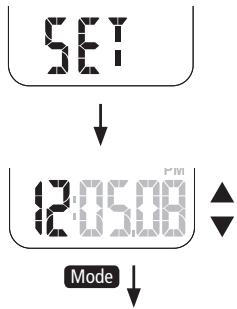
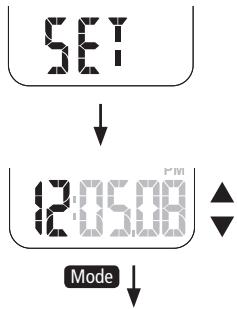
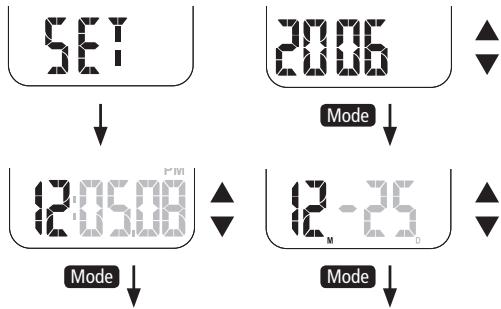
Press the set button and hold for at least 1.5 seconds to change the set time and date. At the bottom of the display window shortly the word "SET" appears and you enter the time setup display.
the seconds, the year, the month and the time format (24 h/12 h) subsequently. For completion of all settings press the set button to confirm your entries and you get back to the TIME-mode.
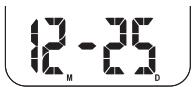
text_image
12-25 M DDate
(in format month – day)

By pressing the up- or down buttons the flashing display of the hours can be set. To confirm your entry press the mode button. This automatically leads you to setting the minutes. Set the minutes in the same procedure like setting the hours and repeat this procedure also for
You can also directly confirm your single entries by pressing the set button which will then get you back into TIME-mode.
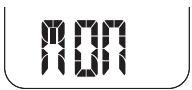
text_image
RONWeekday
(english abbreviation)

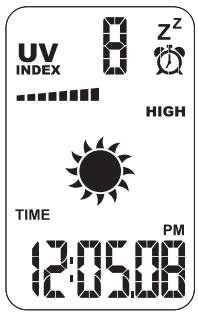
text_image
UV INDEX 8 Z' HIGH TIME 12:05:08 PMSet (>1,5 sec.)
text_image
SET ↓ 12:05:08 Mode ↓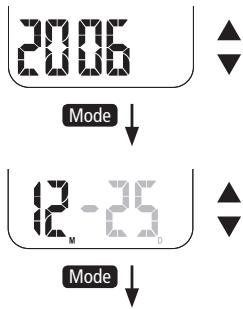
text_image
2006 Mode ↓ 12 - 35 M D Mode ↓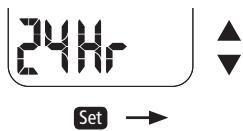
text_image
24H Set →46 Functions
The ALARM-Mode (wake-up function)
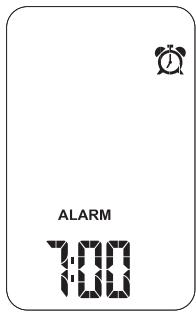
Keep pressing the mode button until "ALARM" is displayed.
An alarm clock symbol appears in the upper third of the display window. The lower third of the display window indicates the current set alarm.
Now the alarm is activated. Press the up button and hold for at least 1.5 seconds to again deactivate the alarm function. The alarm clock symbol disappears from the display window. To activate the wake-up function again press the up button once again and hold.
text_image
ALARM 7:00(>1,5 sec.)
Setting up alarm and UV-alarm
To set up the alarm and the UV-alarm press the set button and hold for at least 1.5 seconds. At the bottom of the display window shortly the word "SET" appears and then the current set alarm.
By pressing the up- or down buttons the flashing display of the hours can be set. To confirm your entry press the mode button. This automatically leads you to setting the minutes. Set the minutes in the same procedure like setting the hours and repeat this procedure. Press the mode
button after confirming your entry and you get to set the UV-alarm. As soon as the set UV-index value is reached the SUNTIMER™ releases a warning sound signal. Pressing the up-and down button sets the requested value of the UV-index. For completion press the set button and confirm your entry.
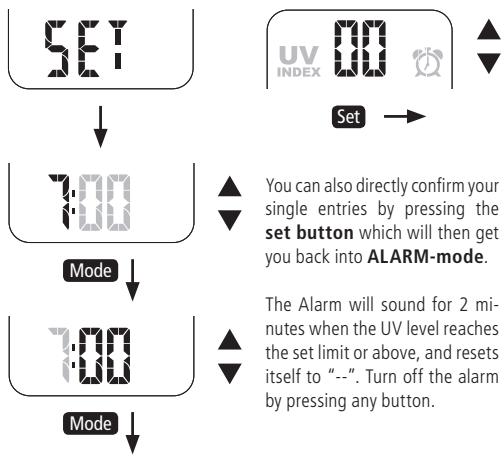
flowchart
graph TD
    A["SET"] --> B["7:00"]
    B --> C["Mode"]
    C --> D["7:00"]
    D --> E["Mode"]
    F["UV INDEX"] --> G["Set"]
    G --> H["You can also directly confirm your single entries by pressing the set button which will then get you back into ALARM-mode."]
    I["The Alarm will sound for 2 minutes when the UV level reaches the set limit or above, and resets itself to "--". Turn off the alarm by pressing any button."] --> J["▲"]
    K["▼"] --> L["▼"]
    M["▲"] --> N["▲"]
You can also directly confirm your single entries by pressing the set button which will then get you back into ALARM-mode.
The Alarm will sound for 2 minutes when the UV level reaches the set limit or above, and resets itself to "--". Turn off the alarm by pressing any button.
48 Functions
The CHRONO-Mode (stopwatch)
Keep pressing the mode button until "CHRONO" is displayed. After 1.5 seconds the CHRONO-mode is displayed automatically. Start time measurement by pressing the up button and stop by repeatedly pressing the up button. To reset the stopwatch press the set button and hold for at least 1.5 seconds until "CLR" (clear) is displayed and you get back to initial display.
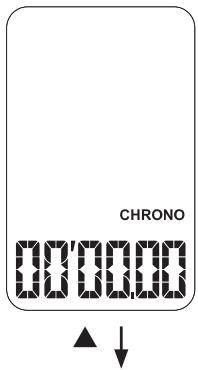
text_image
CHRONO 00199999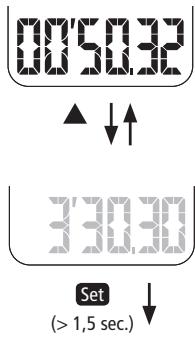
text_image
00:50.32 330.30 Set (>1,5 sec.)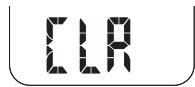
text_image
CLRThe EXPOSURE-TIMER-mode (exposure time to the sun)
This mode allows for displaying and measuring the maximum exposure time to the sun as well as entering all corresponding necessary values.
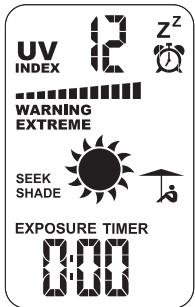
Press the mode button until "EX-TMR" is displayed. The EXPOSURE-TIMER-mode is displayed after 1.5 seconds.
text_image
UV INDEX 12 Z WARNING EXTREME SEEK SHADE EXPOSURE TIMER 0:00Setting up the exposure-timer
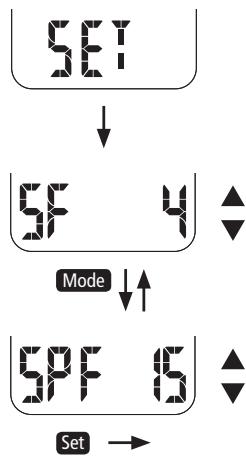
For setting up the exposure timer press the set button and hold for 1.5 seconds. At the bottom of the display window shortly the word "SET" appears and you enter the skin type setup (for further information about your skin type refer to table in the appendix). Pressing the up- and down button sets up the required skin type. Press the mode button to confirm your entry. Now you have entered setup of the SPF (SPF of the sunscreen you are using). Press the up- or down button to set up required SPF. Press the mode
50 Functions
button once again to get back to skin type setup. Press the set button to complete your entry and you get back to initial display of EXPOSURE-TIMER-mode.
flowchart
graph TD
    A["SET"] --> B["5F 4"]
    B --> C["Mode"]
    C --> D["SPF 6"]
    D --> E["Set"]
Activating exposure-timer
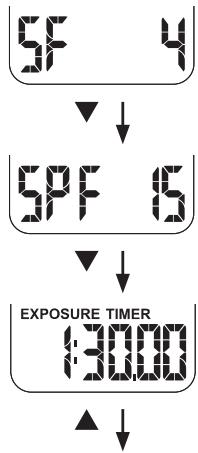
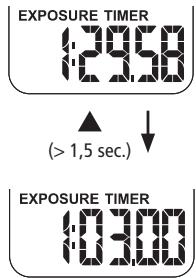
Press the down button to activate the exposure-timer. At first the skin type entered by you is displayed. Pressing the down button again displays the entered SPF. Pressing the down button again displays the exposure-timer and the maximum exposure time to the sun. When pressing the up button the exposure-timer is started. The hours, minutes and seconds of the maximum exposure time to the sun are counted down. After expiry of the maximum exposure time to the sun the SUNTIMER™ releases a warning sound signal.
To stop the exposure-timer, press the up button and hold for 1.5 seconds. This stops the countdown of the maximum exposure time to the sun and you get back to the initial display of the exposure-timer.
Beware of excessive UV radiation
As soon as the UV-index value of 11 is reached the SUNTIMER™ displays a warning call "SEEK SHADE" together with an additional symbol. In this case we highly recommend getting out of the sun and avoiding direct exposure to UV radiation.
flowchart
graph TD
    A["5F 4"] --> B["↓"]
    B --> C["5PF 16"]
    C --> D["↓"]
    D --> E["EXPOSURE TIMER 1:30.00"]
    E --> F["↑"]
text_image
EXPOSURE TIMER 129.58 (> 1,5 sec.) ↓ EXPOSURE TIMER 103.0052 Appendix
Please note the safety precautions at the beginning of this user manual. The MINOX SUNTIMER™ measures the proportionate ultraviolet radiation (UV radiation) of the sun and in addition provides useful information about the intensity of the UV radiation. In conformity with the safety precautions of the ministry of radiation protection and research this instrument calculates the maximum time you should be exposed to the sun per day.
On the other hand there can be influences preventing the instrument from registering your actual dose of ultraviolet radiation. As well your skin might react differently than usual. Using the SUNTIMER™ does not replace your normal feeling and can not guarantee to avoid adverse and harmful impact due to sun radiation.
Background information on the sun's UV radiation and its effects on humans
The nature of ultraviolet radiation, how to measure it but also how it affects us humans and our health can be much diversified. Therefore now we recommend further research to this topic to enhance your use of the SUNTIMER™.
The effect of natural UV radiation on humans
The sun gives out a broad spectrum of radiation. On one hand there are visible rays that we can see, warm rays that are important for us but also ultraviolet radiation, called UV radiation. UV radiation is very shortwave UV light and therefore invisible to us. In this way it can penetrate and change the structure of skin cells. In conformity with the ministry of
radiation protection excessive UV exposure appears to be the most important environmental factor in the development of skin cancer. International Cancer Institutes have therefore placed UV radiation on its list of known carcinogens. In addition to that excessive UV radiation can damage the immune system of the body. Therefore overexposure to the sun is considered one main reason for premature skin aging. UV rays have also been found to be associated with cataracts.
For further information to this subject please visit the website of your country's Department of Health.
Sunlight also has positive effects to our body, too. So it stimulates the production of vitamin D which is important to our immune system. Independently most of us find it pleasing spending time in the sun and would also find it unrealistic to be asked to avoid it.
Therefore it is important for us to be aware that excessive exposure is a risk and that we have to learn how to protect ourselves against over-exposure.
Factors causing variations in exposure to UV radiation
At particular locations, at particular times of the day or seasons, the UV radiation can vary:
Time of day
30% of the daily UV radiation reaches us at noon between 11:00 a.m. and 01:00 p.m., when the sun is the highest.
54 Appendix
Season
UV radiation levels peak in late spring and in early summer. In the winter the peak levels decrease clearly and may be then 50% to 70% lower than peak levels in the summer. This can vary depending on the geographical position.
Weather conditions
Clouds can substantially reduce UV radiation, but do not block them completely. Heat, humidity and wind can intensify the UV radiation effect.
Altitude
The UV intensity increases by approximately 3% to 4% per 300 m (1000 feet) above sea level.
On a mountain which is 3000 m (10,000 feet) high the exposure is 50% higher than at sea level. Winter sport enthusiasts should be aware of the fact that snow reflects UV rays additionally and therefore amplifies the exposure.
Ozone layer
Ozone is a molecule and is found especially in the upper atmosphere. It filters the UV rays out of the sunlight. In some parts of the world this protecting ozone layer is extremely reduced so that a lot more UV radiation hits the earth at these places.
Reflected UV radiation
White sand reflects from 20% up to 50% of the incident UV radiation and snow even up to 90% . Winter sport enthusiasts and others spending time outdoors in snow-covered areas should be especially aware. However, as assumed very often, water reflects a lot less UV radiation so that it is possible to get sunburn a few meters (feet) under water.
Even in wide, open areas like at the beach, reflection of UV radiation is mostly more intense than in areas with trees and buildings. So it is possible for you to get sunburn from this UV re-radiation although you are avoiding direct sunlight.
Please note that the SUNTIMER ^™ perhaps does not completely detect reflected UV radiation when spending time outdoors.
Human beings respond differently to UV radiation
Several factors effect our reaction to UV radiation.
Skin type
Light-skinned people tend to getting sunburn more quickly than those with darker skins. Those different susceptibilities to sunburn are defined in different skin types. In order to have the MINOX SUNTIMERTM calculate your maximum time to be exposed to UV radiation in one day you just enter your skin type which you can see in the guideline table below. For exact information about your skin type or of how your skin responds to sun please consult your physician or specialist (e.g. dermatologist) if there is any doubt.
The various skin types
Skin type I: Is extremely light-skinned with freckles, blue eyes and reddish-blond hair. In the middle of the summer this person gets sunburn within 5 to 10 minutes exposure to the sun; He never tans.
Skin type II: Has blond hair, grey, blue or green eyes. His skin may be red after 10 to 20 minutes,
56 Appendix
if he is not used to the sun but he gets a slight tan after a while.
Skin type III: Has dark-blond hair, grey or brown eyes. He can stay in the sun for 20 to 30 minutes before getting sunburn. Repeated exposure to sunlight progresses tanning.
Skin type IV: His light-brown skin is mostly spared by sunburn. He usually has dark hair and brown eyes. If his skin is not used to the sun, he will redden after 40 minutes at the earliest.
Source: Office for radiation protection
Medication
You should take extra caution when taking medication. Especially conspicuous are strong painkillers, containing ibuprofen as well as various antibiotics. Please read the leaflet enclosed in medication packages or consult a physician or pharmacist to find out, if increased sun sensitivity has a side effect of the medication you are using.
The age
Babies and infants require special protection. Our skin changes as we age and normally becomes lighter. This process generally starts around 45 years of age.
Previous exposure
If you should be exposed to the sun several days in a row, like on weekends or on vacation for example, the skin's sensitivity clearly increases.
58 Mode d'emploi
text_image
UV INDEX Z' HIGH TIME 12:05:08 PMHeure · Index UV
72 Les fonctions
text_image
TEMP 23°(Z^Z)Température

text_image
12 - 25 M Dtext_image
UV INDEX 8 Z' HIGH TIME 12:05:08 PMSet (>1,5 sec.)
text_image
SET 2006 ↓ Mode ↓ 12:05:08 ↓ Mode ↓ 12 - 25 ↓ Mode ↓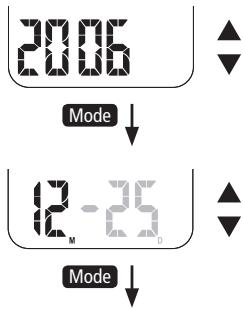
text_image
2006 Mode ↓ 12 - 25 Mode ↓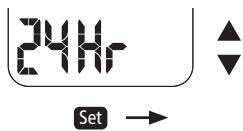
text_image
24H Set →74 Les fonctions
text_image
ALARM 7:00(>1,5 sec.)
text_image
UV INDEX 00 Set →Design subject to alterations without notice.
MINOX is a registered trademark of MINOX GmbH, Wetzlar.
D-35578 Wetzlar, Germany
Tel.: +49 (0) 6441 / 917-0
Fax: +49 (0) 6441 / 917-612
eMail: info@minox.com
www.minox.com
99445


