
FR600RDS - Radio receiver ETON - Free user manual and instructions
Find the device manual for free FR600RDS ETON in PDF.



| Product Type | Radio Receiver |
| Brand | ETON |
| Model | FR600RDS |
| Power Supply | 3 AA batteries, internal rechargeable Ni-MH battery, solar panel, 5V AC adapter (not included), USB cable |
| Reception Bands | FM (87-108 MHz), AM (520-1710 kHz), Shortwave (SW), Weather (WB 162.400-162.550 MHz) |
| Main Functions | RDS, clock, alarm, snooze, NOAA weather alerts, USB phone charger, flashlight, SOS, siren |
| Dimensions (approx) | 200 x 130 x 80 mm |
| Weight (approx) | 500 g |
| Battery Life | Approximately 2 hours with AA batteries at low volume; 5 minutes after 90 seconds of cranking |
| Maintenance and Cleaning | Clean with a dry cloth. Do not use detergents or solvents. |
| Safety | Do not expose to rain or moisture. Unplug during storms. Maintenance by qualified personnel. |
| Warranty | Limited warranty. Registration required at www.etoncorp.com. |
| Spare Parts and Repairability | AC adapter (ref. FR500-ACA-US), USB cable, phone charging cable. Repairs by authorized workshop. |
Frequently Asked Questions - FR600RDS ETON
User questions about FR600RDS ETON
0 question about this device. Answer the ones you know or ask your own.
Ask a new question about this device
Download the instructions for your Radio receiver in PDF format for free! Find your manual FR600RDS - ETON and take your electronic device back in hand. On this page are published all the documents necessary for the use of your device. FR600RDS by ETON.
USER MANUAL FR600RDS ETON
Self-powered Digital AM/FM/Sw/NOAA/S.A.M.E. Weather Radio with Flashlight, Siren, Solar Power and Cell Phone Charger
DO YOU NEED HELP?
If you need help, please contact us, Monday-Friday, 8:00 a.m.-4:30 p.m., North American Pacific Time. 1-800-872-2228 from the U.S; 1-800-637-1648 from Canada; 650-903-3866, worldwide; FAX: 650-903-3867; web site, www.etoncorp.com; Etón Corporation, 1015 Corporation Way, Palo Alto, CA 94303, USA
WARNING
- Do not expose this appliance to rain or moisture.
- Do not submerge or expose for extended period to water.
- Protect from high humidity and rain.
- Unplug immediately if liquid has been spilled or object have fallen into the apparatus.
- Clean only with a dry cloth. Do not use detergents or chemical solvents as this might damage the finish.
- Unplug and disconnect external antennas (not included) during lightning storms.
- Do not remove cover [or back].
Refer servicing to qualified service personnel.
Environment
Disposal
According to the European Directive 2002/96/EC all electrical and electronic products must be collected separately by a local collection system. Please act according to your local rules and do not dispose of your old products with your normal household waste.


Please dispose of all types of batteries per your Government, State or Local rules and/or regulations. If you are unsure, please call the appropriate local authority to find out how to dispose of them safely and help protect the environment.
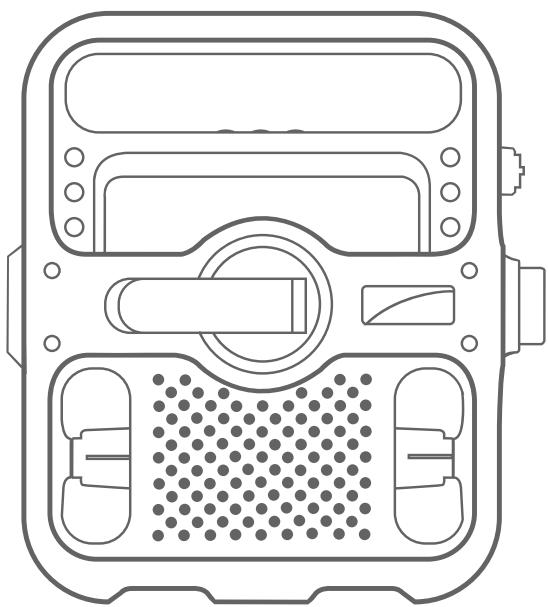
LOCATION OF CONTROLS
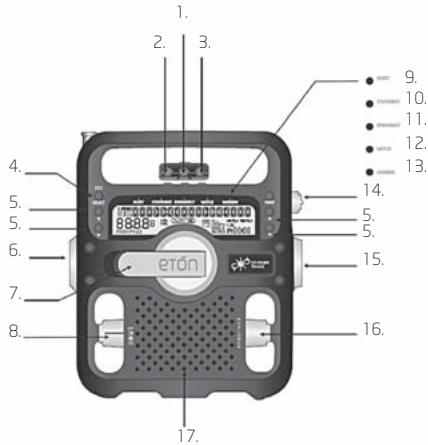
1) Snooze: 5 Min Snooze
2) Alarm ON/OFF: activate/deactivate alarm function
3) ALERT ON/OFF:open/close alert bell
4)RDS/Select Button
5) Direction Buttons
6) Flashlight
7) Hand Crank
8) Multifunctional Knob
9) Alert Indicator Light
10) Statement Indicator Light
11) Emergency Indicator Light
12) Watch Indicator Light
13) Warning Indicator Light
14) Power Supply Knob
15) Band Selecting Knob
16) Volume Adjusting Knob
17) Speaker
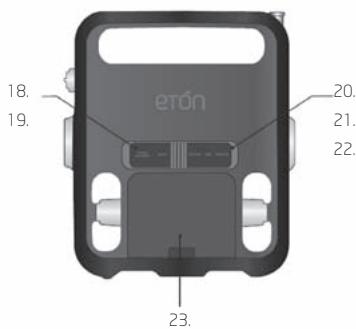
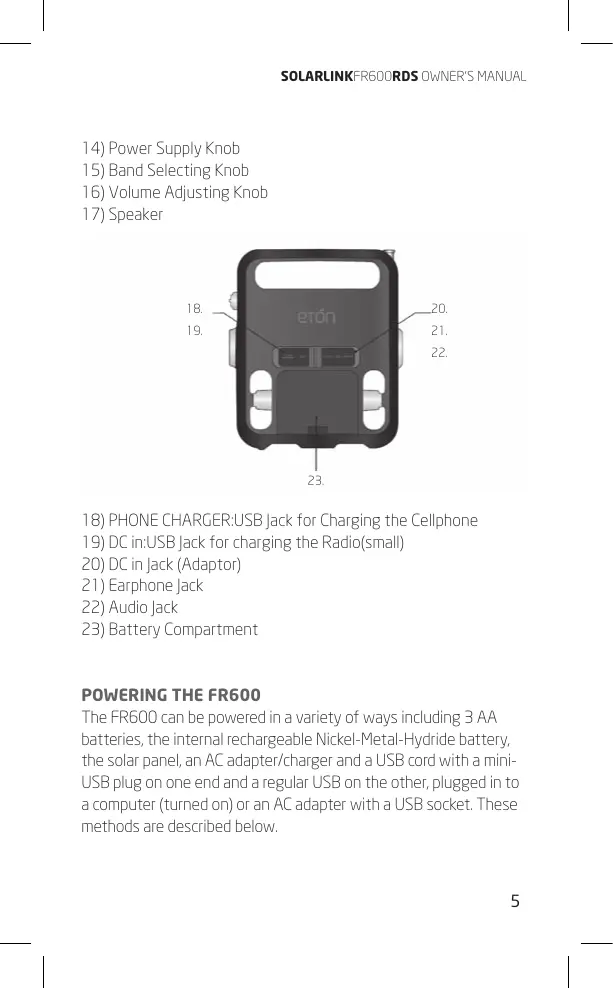
18) PHONE CHARGER:USB Jack for Charging the Cellphone
19) DC in:USB Jack for charging the Radio(small)
20) DC in Jack (Adaptor)
21) Earphone Jack
22) Audio Jack
23) Battery Compartment
POWERING THE FR600
The FR600 can be powered in a variety of ways including 3 AA batteries, the internal rechargeable Nickel-Metal-Hydride battery, the solar panel, an AC adapter/charger and a USB cord with a mini-USB plug on one end and a regular USB on the other, plugged in to a computer (turned on) or an AC adapter with a USB socket. These methods are described below.
Note: The Power Supply Knob and the Band Selecting Knob are on the right side of the radio. The Power Supply Knob is on top and the Band Selecting Knob is on the bottom. The radio is turned OFF with the Band Selecting Knob placed in the OFF position. Turn the radio on by positioning this knob to any band.
USING 3 AA BATTERIES
Install 3 AA alkaline batteries using the polarity diagram inside the battery compartment (on the back of the radio). To turn on the radio using AA batteries, select BATTERY with the Power Supply Knob. It will play for about 4 to 5 hours, at low volume.
USING THE INTERNAL RECHARGABLE Ni-MH BATTERY
The Ni-MH battery comes with the radio. It is in the battery compartment and needs to be plugged into the socket next to it. Once it's plugged in, select the DYNAMO position with the Power Supply Knob. To partially charge the battery, turn OFF the radio with the Band Selecting Knob, select the DYNAMO position with the power selector switch and turn the crank at two turns per second, for 90 seconds; the radio will play at low volume for about 5 minutes, then crank again. Turn the radio on with the Band Selecting Knob.
USING THE SOLAR PANEL TO RECHARGE THE Ni-MH BATTERY
Charging with solar charges the Ni-MH rechargeable battery. Turn the radio OFF with the Band Selecting Knob. Select SOLAR with the Power Supply Knob. Place the radio in direct sunlight (not through a window or in the shade), with the sun shining directly on the solar panel. After a few minutes of charging you may be able to play the radio while it's charging by turning it on with the Band selection Knob; if not, give it a little more time to 3 charge. Leave it in direct
sunlight for 8 to 10 hours to get a full charge. After charging, if you take it out of the sunlight, be sure to select DYNAMO with the Power Supply Knob.
USING AN AC ADAPTER/CHARGER OR USB CORD TO PLAY THE RADIO OR TO RECHARGE THE Ni-MH BATTERY
To purchase an AC adapter/charger (not included), order part# FR500-ACA-US by calling 1-800-793-6542. Generically it has an output of 5 to 6 Volts DC, positive polarity and no more than 300mA current capability.
Turn OFF the radio with the Band Selecting Knob. Plug the AC adapter/charger (not included) into the left socket, labeled 'DC IN 5V', under the right rubber cover on the back of the radio. Select the DYNAMO position with the Power Supply Knob. Turn on the radio by selecting a band with the Band Selecting Knob. The red light above the crank should turn on, noting that the AC adapter is plugged in. If your rechargeable Ni-MH battery is plugged in, it starts charging as long as you select DYNAMO. To get a full charge, charge it for about 8 hours.
If an AC adapter is plugged in with the rechargeable battery connected and DYNAMO selected, if there is an AC power failure, the radio will automatically play using the rechargeable battery. If the AC adapter is plugged in and BATTERY is selected, the rechargeable Ni-MH battery doesn't charge. If both types of batteries are disconnected, the AC adapter will play the radio with DYNAMO or BATTERY selected.
Purchase a USB cord with a mini-USB plug on one end and a regular USB plug on the other end, from a local electronics store or on the Internet. If using a USB cord, plug one end into the mini-USB socket under the left rubber cover on the back of the radio, and
the other end into a computer's USB socket (with the computer turned on) or an AC adapter with a USB socket. Operating from a USB cord has the same characteristics as an AC adapter, with the following exceptions.
If the USB cord is plugged in with the rechargeable battery and/or AA batteries connected, if there is a failure of the USB power source, power will be taken from the rechargeable battery if DY-NAMO is selected or from the AA batteries if BATTERY is selected.
VOLUME CONTROL
Turning the Volume Adjusting Knob (located on the lower right of the radio) clockwise turns up the volume; counterclockwise turns down the volume. Always turn down the volume before using earphones.
CHARGING CELL PHONES (cell phone charging cord not included) If you revolve the Power Supply Knob to the OFF/PHONE CHARGER position the radio will charge cell phones. Plug the cell phone charging cord into the USB PHONE CHARGER jack at the rear of the radio. Plug the cell phone charging adapter tip into the other end of the cord and then into the jack of the cell phone. Then put the radio in the sun or revolve the hand crank to charge the cell phone. About 10 minutes of cranking results in one or two short emergency calls.
To order a cell phone charging cord and tip for your cell phone, please contact www.igo.com on the web and order a cell phone charging cable and a cell phone charging tip for your brand and model of cell phone.
NOTE: When charging a cell phone via the USB cell phone charger, it is important to turn the crank at least 2 revolutions per second, or until you see the green or orange LED above the crank handle turn on. This is an indication that the phone is receiving enough power from
the radio. Continue to crank at this rate until you are satisfied that an appropriate level of charge has been received by your cell phone. If you decide to stop cranking for whatever reason, please wait at least 5 seconds before beginning to crank again. Not following these instructions may cause damage to your cell phone for which Eton disclaims any liability and will not be held liable for any actual or consequential damages related to this matter.
SETTING THE DATE
- Revolve the
to the "OFF" position. - With the radio turned off press the
- Press <> or <> shortly to select "SET UP--DATE" option.
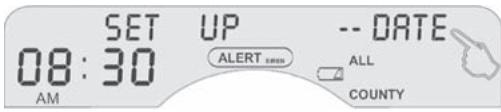
- Press SELECT shortly once to enter the date setting mode.
- Press <> or <> shortly to select "MONTH--DAY--YEAR" option.
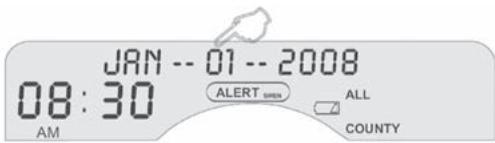
- Press < > or < > shortly to set "MONTH--DAY--YEAR" option.
- After setting, press SELECT> shortly to save.
SETTING THE CLOCK
- Revolve the
to the "OFF" position. - With the radio turned off press the
- Press <> or <> shortly to select "SET UP---TIME" option.
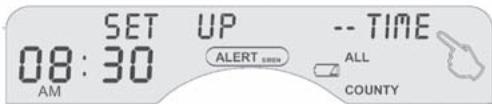
- Press SELECT> shortly once to enter the time setting mode.
- Press <> or <> shortly to select "HOUR:MINUTE" option.
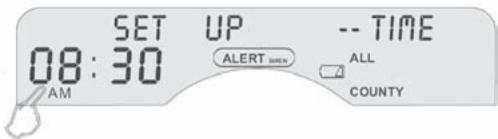
- Press < > or < > shortly to set "HOUR:MINUTE" option.
- After setting, press SELECT> shortly to save.
Note: The clock is a 12-hour clock, showing "AM" in the display in the morning, and showing "PM" in the display starting at noon.
SETTING THE BEEPER ALARM
This radio's alarm beeps when it activates.
1. SETTING THE ALARM TIME
- Revolve the
to the "OFF" position. - With the radio turned off press the
- Press <> or <> shortly to select "SET UP ALARM--ALM" option.
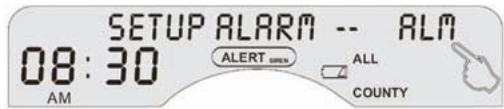
- Press
- Press <> or <> shortly to select "HOUR:MINUTE" option.
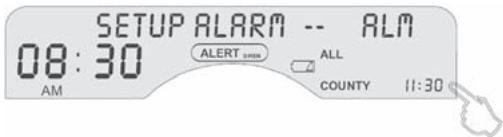
6) Press < > or < > shortly to set "HOUR:MINUTE" option.
7) After setting, press SELECT shortly to save.
2. ACTIVATING AND DEACTIVATING THE ALARM
Press
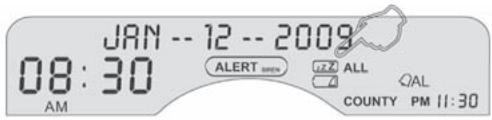
If the alarm function is activated, the alarm symbol "AL" and alarm time will appear in the display. When the alarm time is reached, the unit will beep.
If the alarm function is deactivated, the alarm symbol "AL" and alarm time will disappear from the display.

3.SNOOZE BUTTON
When the alarm activates, pressing the
BROADCAST RECEPTION
- Select the power supply mode.
- Select the band:
FM Band: Revolve the
AM Band: Revolve the
SW Band: Revolve the
- Adjust the volume: Revolve
to adjust the volume level. - Tuning in stations:
Manual Tuning: Press < > or < > shortly to tune.
Auto Tuning: Press and hold < > or < > to tune.
Note: When listening to FM, pull up the telescopic antenna all the way. When tuning AM stations the telescopic antenna is not needed and can be lowered.
- Save stations: While receiving the approving station, press
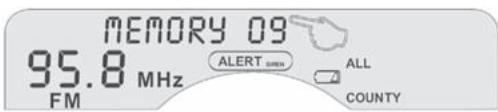
- Recall stations: When listening to the radio, press <> or <> shortly.
- Turn off: Revolve the
to "OFF" position.
FM RDS (Radio Data System) FUNCTION
When listening to FM stations press/release the RDS button sequentially (front, upper left corner of radio) to see RDS text messages in the display, if your station sends them. This radio supports TEXT, PTY (Program Type), PS (Program Service) and DATE. Many FM stations do not support all of these, may only support some of them or do not support any of them. RDS appears in the upper left corner of the display when it's turned on. If your FR600 lacks this feature, please ignore this section of the instructions.
SHORTWAVE LISTENING
To learn about shortwave we recommend the two publications below, published yearly and available from major booksellers. Additionally, the Internet is a great resource for learning about shortwave. Type 'shortwave reception' into your favorite search engine.
PASSPORT TO WORLD BAND RADIO Published by International Broadcasting Services (IBS); IBS North America, Box 300, Penn's Park PA 18943. Phone: (215) 598-9018. www.passband.com.
WORLD RADIO TV HANDBOOK Published in the USA by Watson-Guptill Publications, 770 Broadway, 7th Floor, New York, NY 10003-9595. www.watsonguptill.com.
OPTIMIZING SHORTWAVE RECEPTION
Shortwave enables listening to broadcasts over vast distances including other countries and continents. The following information will help you get the best results.
- During the day, frequencies above 13 MHz are usually best.
- At night, frequencies below 13 MHz are usually best.
- Around sunset and sunrise, the entire shortwave range may be good.
- Getting very close to a window and holding the radio improves shortwave reception.
Use the frequency ranges (Bands) below for shortwave broadcast reception:
| BANDE | MEGAHERTZ (MHz) | KILOHERTZ (KHz) |
| 120 m | 2.300-2.495 MHz | 2300- 2495 KHz |
| 90 m | 3.20-3.40 MHz | 3200- 3400 KHz |
| 75 m | 3.90-4.05 MHz | 3900- 4050 KHz |
| 60 m | 4.750-5.1 MHz | 4750- 5100 KHz |
| 49 m | 5.8-6.2 MHz | 5730- 6300 KHz |
| 41 m | 7.1-7.60 MHz | 6890-7600 KHz |
| 31 m | 9.4-10 MHz | 9250-9995 KHz |
| 25 m | 11.5-12.2 MHz | 11500-12200 KHz |
| 22 m | 13.57-13.87 MHz | 13570-13870 KHz |
| 19 m | 15.000-15.800 MHz | 15005-15825 KHz |
| 16 m | 17.55-18 MHz | 17480-17900 KHz |
| 15 m | 18.9-19.02 MHz | 18900-19020 KHz |
| 13 m | 21.45-21.85 MHz | 21450-21850 KHz |
RECEPTION OF WEATHER FREQUENCIES
To hear your local weather station, pull up the antenna, turn on the radio and select WB with the band selector. Turn up the volume and press the buttons to hear all 7 weather channels. You'll probably only hear one channel, but if you hear a weather broadcast on more than one, select the strongest. The strongest one will usually be your local weather station. Below are the frequencies that correspond to the radio's channels:
Channel 1 162.400 MHz
Channel 2 162.425 MHz
Channel 3 162.450 MHz
Channel 4 162.475 MHz
Channel 5 162.500 MHz
Channel 6 162.525 MHz
Channel 7 162.550 MHz
SETTING TO RECEIVE WEATHER ALERTS
Weather alerts are received in three ways:
- Alert indicator light is on.
- Alert forecast appears in the display.
- Alert bell rings.
To set the channel for receiving alerts, use the method below and set it to your strongest channel.
1) Revolve the
2) Press
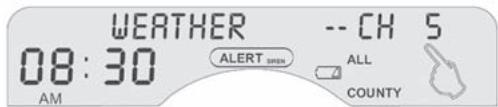
4) Press SELECT> shortly once to enter the weather setting mode.
5) Press <> or <> shortly to select the strongest weather channel (CH1~7).
6) After setting, press
SETTING ALERT MODE
1) Revolve the
2) Press
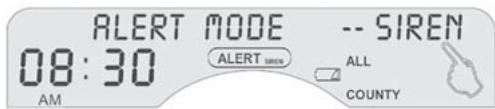
4) Press
Note: The selected alert mode will appear in the display.
6) After setting, press SELECT> shortly to save.
SETTING COUNTY CODES (CLC CODES IN CANADA) County code setting is described below.
A county code instructs the radio only to receive an ALERT when the code is programmed in. Look up a United States county code at the following web site:
http://www.nws.noaa.gov/nwr/indexnwb.htm#sametable
Look up a Canadian CLC code at:
http://www.msc-smc.ec.gc.ca/msb/weatherradio/transmitter/index_e.cfsm
Your radio can be set for one (SINGL) to 23 (MULTI) codes, or can be set to receive ALL coded information sent from any transmitter, if your within range. When you set codes, it will only pick up alerts when you're in that county or within reception distance of the signal. To set codes:
1) Revolve the
2) Press the
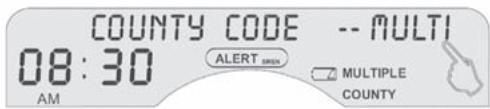
4) Press
RECEPTION OF EVENT CODES
Your radio can receive 'event code' information during weather alerts. These codes are identified at http://www.nws.noaa.gov/os/eas_codes.shtml.
Canadian Weather Alerts are addressed at: http://www.msc-smc.ec.gc.ca/cd/brochures/warning_e.cfm#top.
SELECTING DISABLE/ENABLE
Alert modes can be selected to not appear by selecting DISABLE or to appear by selecting ENABLE.
1) Revolve the
2) Press
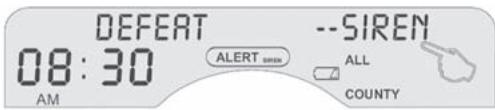
4) Press
ALERT
Before using the ALERT function, set the radio to the strongest weather band station. After setting, revolve the
OPEN / CLOSE THE ALERT BELL
While the alert bell is ringing, you can press the
MULTIFUNCTION KNOB
The function switch has four positions. The top position is the OFF position, then the FLASHLIGHT, SOS and SIREN position. All positions except OFF are labeled with an icon.
The OFF position turns the function switch off.
The FLASHLIGHT position " " turns the white lights on (left side of radio) with the radio on or off.
The SOS position "s0s" turns the red flashing light on. Can be used with the radio on or off.
The SIREN position "3" turns on the siren. Can be used with the radio on or off.
WARRANTY REGISTRATION
To ensure full warranty coverage or product updates, registration of your product should be completed as soon as possible after purchase or receipt. You may use one of the following options to register your product:
- By visiting our website at http://www.etoncorp.com.
- Mail in enclosed warranty card.
- Mail your registration card or information to following address; include your name, full mailing address, phone number, email address, model purchased, date purchased, retail vendor name:
Etón Corporation
1015 Corporation Way
Palo Alto, CA 94303 USA
LIMITED WARRANTY
Retain the warranty information from your warranty card with your proof of purchase or the Limited Warranty information can also be viewed at www.etoncorp.com.
SERVICE FOR YOUR PRODUCT
To obtain service for your product, we recommend first contacting an Etón service representative at 1-800-872-2228 US, 1-800-637-1648 Canada, (650) 903-3866 US, customersvc@etoncorp.com or your respective country distributor in Europe (see enclosed list) for problem determination and troubleshooting. If further service is required, the technical staff will instruct how to proceed based on whether the radio is still under warranty or needs non-warranty service.
WARRANTY - If your product is still in warranty and the Etón service representative determines warranty service is needed, a return authorization will be issued and instructions will be given. DO NOT ship your radio back without obtaining the return authorization.
NON-WARRANTY - If your product is no longer under warranty and requires service, the Etón service representative will refer you to the nearest repair facility that will best handle the repair.
For service outside North America, please refer to the distributor information included at time of purchase/receipt.
AVEZ-VOUS BESOIN D'AIDE?
http://www.msc-smc.ec.gc.ca/msb/weatherradio/transmitter/
index_e.cfm
http://www.msc-smc.ec.gc.ca/msb/weatherradio/transmitter/index_e.cfsm