
SM81 - Microphone SHURE - Free user manual and instructions
Find the device manual for free SM81 SHURE in PDF.

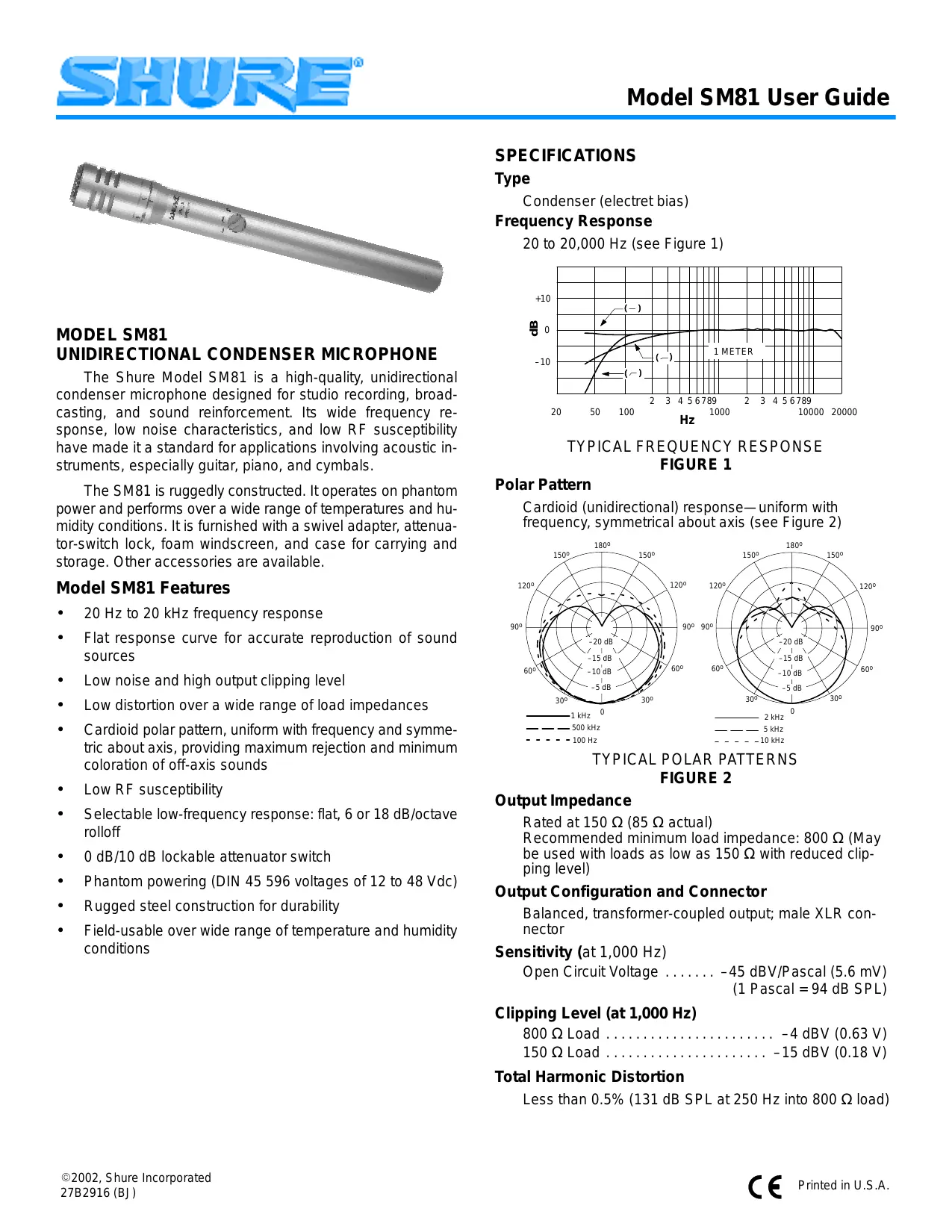


| Product type | Electret condenser microphone |
| Polar pattern | Cardioid (unidirectional) |
| Frequency response | 20 Hz to 20,000 Hz |
| Output impedance | 150 ohms nominal (85 Ω actual) |
| Output level (at 1 kHz) | -45 dBV/Pascal (5.6 mV) at 94 dB SPL |
| Self-noise | 16 dB typical A-weighted |
| Signal-to-noise ratio | 78 dB (IEC 651) at 94 dB SPL |
| Power requirement | Phantom power, 11 to 52 V DC |
| Current consumption | 1.2 mA max. |
| Low-cut filter | 3 positions: flat, -6 dB/octave (100 Hz), -18 dB/octave (80 Hz) |
| Attenuator | 0 or -10 dB lockable |
| Output connector | XLR male, transformer-balanced |
| Dimensions (L x diameter) | 212 mm x 23.5 mm |
| Net weight | 230 grams |
| Housing material | Steel with vinyl metallic paint finish |
| Grille | Stainless steel |
| Operating temperature | -6.7°C to 49°C |
| Humidity | Wide range (not specified) |
| Included accessories | A57F swivel adapter, attenuator lock, foam windscreen, A81G anti-noise filter grille, A81WS heavy-duty windscreen, carrying case |
| Care and cleaning | Clean the grille with a soft, dry cloth; use the windscreen to protect from dust. |
| Safety | Use only with compatible phantom power; avoid short circuits and ground loops. |
| Spare parts and repairability | R104 capsule and grille assembly available; user repair not recommended, contact Shure support. |
Frequently Asked Questions - SM81 SHURE
User questions about SM81 SHURE
0 question about this device. Answer the ones you know or ask your own.
Ask a new question about this device
Download the instructions for your Microphone in PDF format for free! Find your manual SM81 - SHURE and take your electronic device back in hand. On this page are published all the documents necessary for the use of your device. SM81 by SHURE.
USER MANUAL SM81 SHURE
The Shure Model SM81 is a high-quality, unidirectional condenser microphone designed for studio recording, broadcasting, and sound reinforcement. Its wide frequency response, low noise characteristics, and low RF susceptibility have made it a standard for applications involving acoustic instruments, especially guitar, piano, and cymbals.
The SM81 is ruggedly constructed. It operates on phantom power and performs over a wide range of temperatures and humidity conditions. It is furnished with a swivel adapter, attenuator-switch lock, foam windscreen, and case for carrying and storage. Other accessories are available.
Model SM81 Features
20 Hz to 20 kHz frequency response
- Flat response curve for accurate reproduction of sound sources
Low noise and high output clipping level
- Low distortion over a wide range of load impedances
Cardioid polar pattern, uniform with frequency and symmetric about axis, providing maximum rejection and minimum coloration of off-axis sounds
Low RF susceptibility
- Selectable low-frequency response: flat, 6 or 18 dB/octave rolloff
- 0 dB/10 dB lockable attenuator switch
- Phantom powering (DIN 45596 voltages of 12 to 48 Vdc)
Rugged steel construction for durability
- Field-usable over wide range of temperature and humidity conditions
SPECIFICATIONS
Type
Condenser (electret bias)
Frequency Response
20 to 20,000 Hz (see Figure 1)
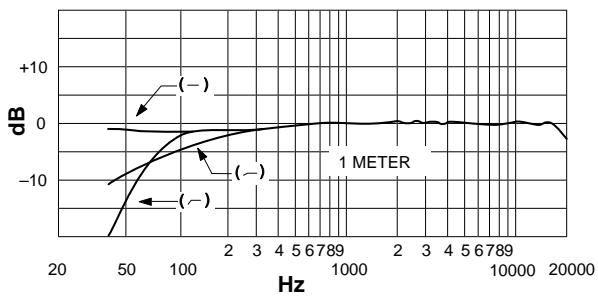
TYPICAL FREQUENCY RESPONSE FIGURE 1
Polar Pattern
Cardioid (unidirectional) response—uniform with frequency, symmetrical about axis (see Figure 2)
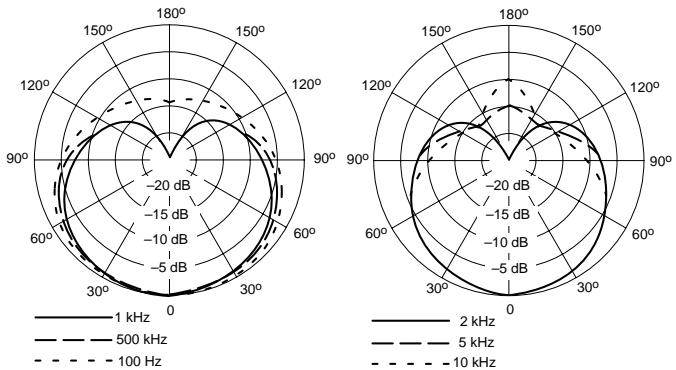
TYPICAL POLAR PATTERNS FIGURE 2
Output Impedance
Rated at 150 Ω (85 Ω actual)
Recommended minimum load impedance: 800 (May be used with loads as low as 150 with reduced clipping level)
Output Configuration and Connector
Balanced, transformer-coupled output; male XLR connector
Sensitivity (at 1,000 Hz)
Open Circuit Voltage . . . . . . . . . . . . . . . . . . . . . . . . . . . . . . . . . . . . . . . . . . . . . . . . . . . . . . . . . . . . . . . . . . . . . . . . . . . . . . . . (1 Pascal = 94 dB SPL)
Clipping Level (at 1,000 Hz)
800Ω Load -4 dBV (0.63 V)
150Ω Load -15 dBV (0.18 V)
Total Harmonic Distortion
Less than 0.5% (131 dB SPL at 250 Hz into 800 Ω load)
Maximum SPL (at 1,000 Hz)
800Ω load 136 dB (attenuator at 0)
146 dB (attenuator at -10)
150Ω load 128 dB (attenuator at 0)
138 dB (attenuator at -10)
Hum Pickup
-3 dB equivalent SPL in a 1 mOe field (60 Hz)
Self-Noise (equivalent sound pressure levels; measured with true rms voltmeter)
16 dB typical, A-weighted
19 dB typical, weighted per DIN 45 405
Signal-to-Noise Ratio
78 dB (IEC 651)* at 94 dB SPL
^*S / N ratio is difference between microphone output at 94 dB SPL and microphone self-noise A-weighted.
Overvoltage and Reverse Polarity Protection
Max. external voltage applied to pins 2 and 3 with respect to pin 1 +52 Vdc
Reverse polarity protection 200 mA max. (diode-clamped)
Polarity
Positive pressure on diaphragm produces positive voltage on pin 2 relative to pin 3
Cartridge Capacitance
54 pF
Low Frequency Response Switch Positions
Flat; -6 dB/octave below 100 Hz; -18 dB/octave below 80 Hz
Attenuator Switch Positions (Lockable)
0 or -10 dB
Power
Supply Voltage 11 to 52 Vdc, positive, pins 2 and 3
Current Drain 1.2 mA max.
Environmental Conditions
Temperature:
Storage -29to 74^
(-20^ to 165^)
Operating -6.7o to 49^
(20° to 120° F)
Humidity:
Storage 0-95% relative humidity at room
temperature (72° to 80° F, 22° to 27° C)
Case
Steel construction with vinyl metallic paint finish and stainless steel screens
Dimensions
See Figure 3
Weight
Net 230 grams (8 oz)
Packaged 740 grams (1 lb 10 oz)
Certification
Eligible to bear CE marking. Conforms to European EMC Directive 89/336/EEC. Meets applicable tests and performance criteria in European EMC Standard EN 55103 (1996) parts 1 and 2 for residential (E1) and light industrial (E2) environments.
OPERATION
Power
The SM81 requires phantom power. This may be supplied to the microphone by a mixer, preamplifier or console with built-in phantom power or from an external power supply (such as the Shure model PS1A). Phantom power sources providing between 11 and 52 Vdc are suitable.
Use only high-quality cables because intermittent shorts between broken shield wires and balanced conductors will cause extremely large noise transients in the system. Avoid ground loops due to grounded connector shells or the microphone case touching other grounded metal objects. Follow generally accepted audio grounding practices.
Impedance
A minimum load impedance of 800 or greater should be used for maximum signal handling and minimum distortion. The load may be as low as 150 , but a reduction in output clipping level will result. It should be noted that the power supply itself may add loading (3300 in the Shure PS1A power supply) to the microphones.
PS1A Power Supply
When using the Shure PS1A to phantom power the SM81, connect the microphone cable to the SM81 and to the MICROPHONE connector of the power supply. The power supply uses the balanced audio cable pair to carry the supply current to the microphone and the cable shield as a ground return.
Connect the OUTPUT connector of the power supply to a low-impedance microphone input of a mixer, audio console or tape recorder. A second SM81 may be connected to the remaining power supply channel in a similar manner.

OVERALL DIMENSIONS
FIGURE 3
Low-Frequency Response Filter
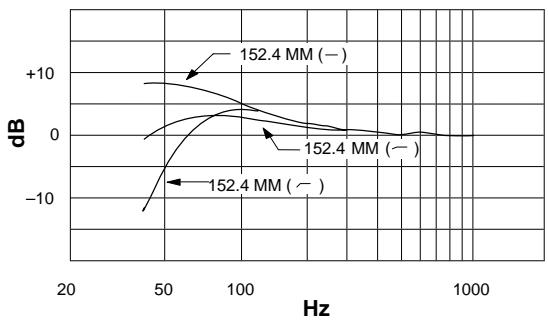
The SM81 has a three-position low-frequency response filter controlled by a switch located on its handle. The switch is recessed to avoid accidental movement, but may be easily moved with fingertips. The user may select either flat response, low-frequency rolloff of 6 dB per octave below 100Hz , or low-frequency cutoff of 18 dB per octave below 80Hz (see Figure 1). When close-miking instruments or vocalists, an increase in low-frequency response (proximity effect) takes place. Figure 4 illustrates this effect with the switch in each of the three positions. Note that the low-frequency response filter may be used to compensate for proximity effect or reduce low-frequency noise from stage traffic and other sources.
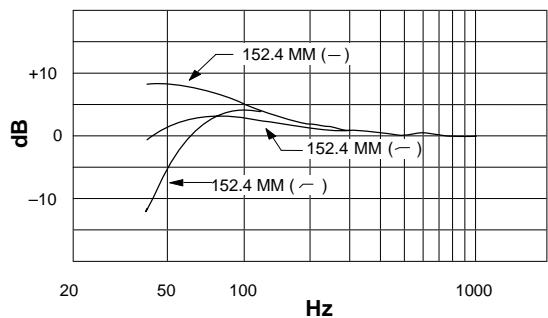
PROXIMITY EFFECT AND COMPENSATION FIGURE 4
Attenuator Switch
The SM81 has a switchable 10 dB capacitive attenuator to prevent high sound pressure levels from overloading its internal electronics. The attenuator is engaged by rotating the actuator ring, located directly below the grille assembly, until it reaches the “-10” position. This reduces the output of the microphone by 10 dB and increases the maximum sound pressure level at clipping by 10 dB. There are no intermediate levels of attenuation available.
The attenuator ring may be locked in either the "0" or "−10" position as follows. Unscrew the grille and cartridge assembly by unscrewing counter-clockwise from the top. Turn the actuator ring to the "0" or "−10" position as desired. Insert the actuator ring lock (small clear piece of plastic) in the area behind the actuator ring between the pin and the edge of the slot. This will prevent the ring from turning. Replace the grill and cartridge assembly.
Mixer Overload
The SM81's output is about 15 dB higher than most dynamic microphones. At moderate to high SPLs, this additional out
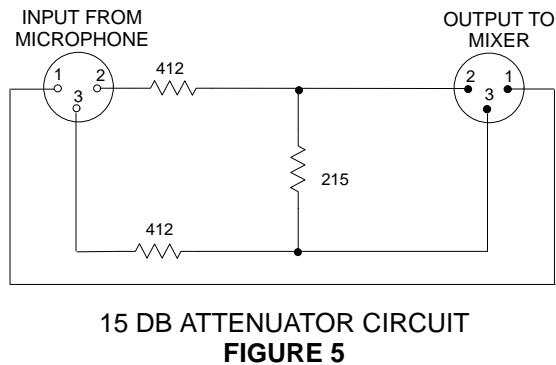
put may require attenuation (or padding). If no attenuation is available on the preamplifier, mixer or console being used, a resistive attenuator can be inserted between the microphone and the input. The Shure Model A15AS Attenuator (15, 20, or 25 dB switch-selectable) is specially designed for use with condenser microphones such as the SM81. Alternately, the attenuator design shown in Figure 5 may be used. The resistors shown are 1/2-watt, 1% tolerance, and the circuit may be packaged in a Switchcraft S3FM adapter housing. The circuit will provide 15 dB of attenuation and can be used between the SM81 and the PS1A (or other power supply), or between the PS1A and the mixer. Two of these circuits may be used in series to provide 30 dB of attenuation. (Note that, due to excessive loading, commercially available 150 Ω attenuators, such as the Shure Model A15AS, are not recommended when two are used in series.)
Wind Noise
The wide frequency response of the SM81 makes it sensitive to wind, breath, and air currents from heating, ventilation and cooling (HVAC) systems. The foam windscreen included with the SM81 can be used to reduce wind and breath noise, while the low-frequency response filter can be used to reduce low-frequency room noise caused by HVAC systems.
The Model A81G Pop Filter Grille attenuates breath popping sounds when the microphone is close-talked, and permits its use outdoors with minimal pickup of rushing and rumbling sounds. To install the A81G, slip it over the SM81 until the inside of the A81G touches the top of the microphone. Tighten the A81G by rotating the knurled collar clockwise from the bottom. (Note: When removing the A81G, first loosen the knurled collar. Otherwise the cartridge will unscrew with the A81G.)
For outdoor use under very windy conditions, use the Model A81WS large foam windscreen.
CIRCUIT DESCRIPTION
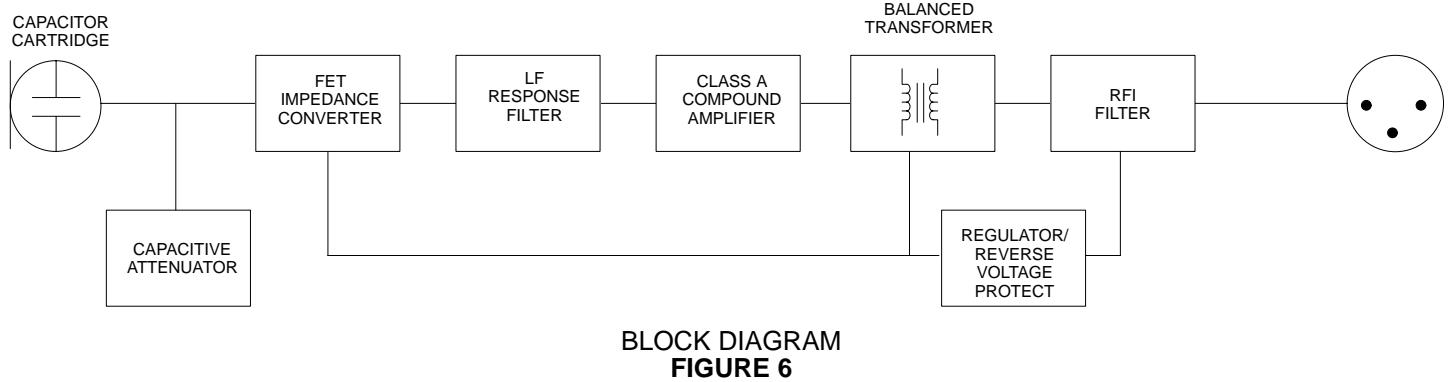
A block diagram of the SM81 is shown in Figure 6. The capacitor cartridge is followed by a switch-controlled capacitive attenuator stage which provides for 10dB attenuation at the cartridge output. The signal is fed to a field-effect transistor (FET) impedance conversion stage. The FET output drives an active low-frequency response (high-pass) filter controlled by a three-position switch. The filter output from a compound transistor, Class A, emitter-follower amplifier is transformer-coupled, providing a balanced output to the RFI protection filter at the microphone connector. An active, constant-current power supply circuit regulates the phantom voltage, allowing the SM81 to operate over a very wide range of voltages. A reverse voltage protection diode guards against miswired cables and equipment.
TROUBLESHOOTING
If the SM81 fails to operate properly, verify that the microphone is powered properly.
- Check the power supply output voltage to the microphone. For the Shure PS1A, this should be 21.5 ± 1.5 Vdc open circuit.
- Check the voltage on microphone connector pins 2 and 3 (at back of connector; cable connector disassembled from shell but connected to microphone). The voltage at pins 2 and 3 with reference to pin 1 should be between 11 and 52 Vdc.
Due to its high packing density and circuit complexity, disassembly of the SM81 is not recommended. Contact Shure's Service Department if problems persist.
ARCHITECTS' SPECIFICATION
The microphone shall be a condenser microphone with a frequency response of 20 to 20,000Hz . It shall have a unidirectional pickup characteristic, with cancellation at the sides of 6 dB and a minimum cancellation at the rear of 15 dB at 1kHz . The microphone shall have a rated output impedance of 150 for connection to microphone inputs of 150 ohms or higher. The open circuit voltage shall be -65dB (0.56 mV) (0 dB equals 1 volt per microbar).
The microphone shall contain a three-position low-frequency response switch and a lockable 10 dB attenuator pad.
The overall dimensions shall be 212mm (8-11/32 in.) in length by 23.5mm (15/16 in.) in diameter. The handle diameter shall be 20.1mm (25/32 in.). The weight shall be 230 grams (8 oz).
The microphone shall be capable of being powered by a phantom power supply with an output of 11 to 52 Vdc, or by a mixer, audio console or tape recorder capable of supplying 11 to 52 Vdc.
The microphone shall be a Shure Model SM81.
FURNISHED ACCESSORIES
Swivel Adapter A57F
10 dB Attenuator Lock 34A830
Carrying/Storage Case 65A1797
Windscreen 49A111
OPTIONAL ACCESSORIES
Pop-FilterGrille A81G
Heavy-Duty Windscreen A81WS
Tripod Microphone Stand (4.3 m [14 ft]) S15A
Stereo Microphone Adapter A27M
Cable (7.6m [25ft]) C25F
Phantom Power Supply PS1A
REPLACEMENT PARTS
Cartridge and Grille Assembly R104
MODELE SM81
MICROPHONE ÉLECTROSTATIQUE UNIDIRECTIONNEL
Stockage relative 0-95% (72° to 80°F; 22° to 27°C)
Corps

DIMENSIONS HORS TOUT FIGURE 3
EFFET DE PROXIMATE ET COMPENSATION FIGURE 4
ACCESSIONS EN OPTION
SPL max. (a 1000 Hz)
800Ω de energia: 136 dB (atenuador en 0)
$$ 1 4 6 \mathrm {d B} (\text {a t e n u a d o r e n - 1 0}) $$
150 Ω de entrega: 128 dB (atenuador en 0)
$$ 1 3 8 \mathrm {d B} (\text {a t e n u a d o r e n - 1 0}) $$
78 dB (IEC 651)* a 94 dB SPL
Antivento "Heavy-Duty" A81WS
Treppiede da 4,3 m (14 piedi) S15A
SHURE Incorporated Web Address: http://www.shure.com 5800 W. Touhy Avenue, Niles, IL 60714-4608, U.S.A.
Phone: 800-257-4873 Fax: 847-866-2279
In Europe, Phone: 49-7131-72140 Fax: 49-7131-721414
In Asia, Phone: 852-2893-4290 Fax: 852-2893-4055
Elsewhere, Phone: 847-866-2200 Fax: 847-866-2585
- Model SM81 Features
- SPECIFICATIONS
- Frequency Response
- Polar Pattern
- Output Impedance
- Output Configuration and Connector
- Sensitivity (at 1,000 Hz)
- Clipping Level (at 1,000 Hz)
- Total Harmonic Distortion
- Maximum SPL (at 1,000 Hz)
- Hum Pickup
- Signal-to-Noise Ratio
- Overvoltage and Reverse Polarity Protection
- Polarity
- Cartridge Capacitance
- Low Frequency Response Switch Positions
- Attenuator Switch Positions (Lockable)
- Power
- Environmental Conditions
- Case
- Dimensions
- Weight
- Certification
- OPERATION
- Impedance
- PS1A Power Supply
- Low-Frequency Response Filter
- Attenuator Switch
- Mixer Overload
- Wind Noise
- CIRCUIT DESCRIPTION
- TROUBLESHOOTING
- ARCHITECTS' SPECIFICATION
- FURNISHED ACCESSORIES
- OPTIONAL ACCESSORIES
- REPLACEMENT PARTS
- MODELE SM81
- MICROPHONE ÉLECTROSTATIQUE UNIDIRECTIONNEL
- Corps
- ACCESSIONS EN OPTION
- SPL max. (a 1000 Hz)
Brand : SHURE
Model : SM81
Category : Microphone