HOME GENERATOR SYSTEMS 7000 WATT - Home Generator Systems GENERAL ELECTRIC - Free user manual and instructions
Find the device manual for free HOME GENERATOR SYSTEMS 7000 WATT GENERAL ELECTRIC in PDF.



| Product Type | Residential Standby Generator |
| Brand | General Electric |
| Model | HOME GENERATOR SYSTEMS 7000 WATT |
| Rated Power | 7000 watts (7 kW) |
| Rated AC Voltage | 240 volts |
| Rated Frequency | 60 Hz |
| Phase | Single-phase |
| Fuel Type | Natural gas or liquid propane (LP) |
| Maximum Current (at 240 V, LP) | 29.2 amperes |
| Shipping Weight | 155 kg (340 lb) |
| Recommended Engine Oil | Synthetic API SJ/CF 5W-30 |
| Starting Battery | 12 V (not supplied) |
| Control Fuse | 15 A ATO |
| Output Circuit Breaker | Yes |
| Automatic Operation | Yes |
| Weekly Exercise Cycle | Yes, adjustable |
| Fault Detection System | Yes (codes FC_1 to FC_8) |
| Warranty (residential use) | 4 years or 1,200 hours |
| Operating Ambient Temperature | Up to 25 °C (77 °F) for maximum load |
| Installation Required | By a qualified professional |
Frequently Asked Questions - HOME GENERATOR SYSTEMS 7000 WATT GENERAL ELECTRIC
User questions about HOME GENERATOR SYSTEMS 7000 WATT GENERAL ELECTRIC
0 question about this device. Answer the ones you know or ask your own.
Ask a new question about this device
Download the instructions for your Home Generator Systems in PDF format for free! Find your manual HOME GENERATOR SYSTEMS 7000 WATT - GENERAL ELECTRIC and take your electronic device back in hand. On this page are published all the documents necessary for the use of your device. HOME GENERATOR SYSTEMS 7000 WATT by GENERAL ELECTRIC.
USER MANUAL HOME GENERATOR SYSTEMS 7000 WATT GENERAL ELECTRIC
GE Home Generator Systems
7,000 Watt
Home Generator System
Operator's Manual
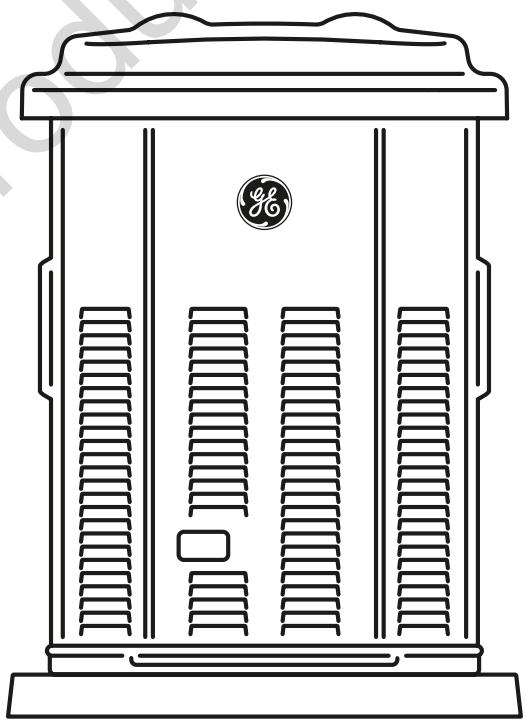
Thank you for purchasing this quality-built GE home generator. We're pleased that you've placed your confidence in the GE brand. When operated and maintained according to the instructions in this manual, your home generator will provide many years of dependable service.
This manual contains safety information to make you aware of the hazards and risks associated with home standby generators and how to avoid them. Because we do not necessarily know all the applications this equipment could be used for, it is important that you read and understand these instructions thoroughly before attempting to start or operate this equipment. Save these instructions for future reference.
This home standby generator requires professional installation before use. Refer to the separate installation manual for full information. Your installer should follow the instructions completely.
Where to Find Us
You never have to look far to find GE support and service for your generator. For quick service when you need it, keep your original receipt with this manual. You may contact Customer Service at 888 575-8226 or click on Find a Dealer at BRIGGSandSTRATTON.COM, which provides a list of authorized dealers.
Generator and engine model and serial numbers should be recorded in the installation manual.
Table of Contents
Important Safety Instructions 4
Installation 7
For the Home Owner. 7
For the Installing Dealer/Contractor. 7
Owner Orientation. 8
Fuel Factors. 8
Generator Location 9
Delivery Inspection 10
Controls 11
Operation. 14
Automatic Operation 14
Setting Exercise Timer 15
Maintenance 16
Fault Detection System 16
Generator Maintenance 18
Engine Oil. 18
Battery 19
Storage. 21
Troubleshooting 22
Warranty 23
Product Specifications 25
Safety Rules
Important Safety Instructions
SAVE THESE INSTRUCTIONS - This manual contains important instructions that should be followed during installation and maintenance of the generator and batteries.
Safety Symbols and Meanings

Explosion

Fire

Electrical Shock

Toxic Fumes

Rotating Parts

Hot Surface

Auto Start

Explosive Pressure

Chemical Burn

Lift Hazard

Read Manual
The safety alert symbol indicates a potential personal injury hazard. A signal word (DANGER, WARNING, or CAUTION) is used with the alert symbol to designate a degree or level of hazard seriousness. A safety symbol may be used to represent the type of hazard. The signal word NOTICE is used to address practices not related to personal injury.
DANGER indicates a hazard which, if not avoided, will result in death or serious injury.
WARNING indicates a hazard which, if not avoided, could result in death or serious injury.
CAUTION indicates a hazard which, if not avoided, could result in minor or moderate injury.
NOTICE addresses practices not related to personal injury.
The manufacturer cannot possibly anticipate every possible circumstance that might involve a hazard. The warnings in this manual, and the tags and decals affixed to the unit are, therefore, not all-inclusive. If you use a procedure, work method or operating technique that the manufacturer does not specifically recommend, you must satisfy yourself that it is safe for you and others. You must also make sure that the procedure, work method or operating technique that you choose does not render the generator system unsafe.

WARNING Running engine gives off carbon monoxide, an odorless, colorless, poison gas.
Breathing carbon monoxide could result in death, serious injury, headache, fatigue, dizziness, vomiting, confusion, seizures, nausea or fainting.
- Operate this product ONLY outdoors.
Install a battery operated carbon monoxide alarm near the bedrooms. - Keep exhaust gas from entering a confined area through windows, doors, ventilation intakes, or other openings.
WARNING The engine exhaust from this product contains chemicals known to the State of California to cause cancer, birth defects, or other reproductive harm.
WARNING Certain components in this product and related accessories contain chemicals known to the State of California to cause cancer, birth defects, or other reproductive harm. Wash hands after handling.
WARNING Storage batteries give off explosive hydrogen gas during recharging. Slightest spark will ignite hydrogen and cause explosion, resulting in death, serious injury and/or property damage. Battery electrolyte fluid contains acid and is
extremely caustic.
Contact with battery contents could cause severe chemical burns. A battery presents a risk of electrical shock and high short circuit current.
- DO NOT dispose of battery in a fire. Recycle battery.
- DO NOT allow any open flame, spark, heat, or lit cigarette during and for several minutes after charging a battery.
- DO NOT open or mutilate the battery.
- Wear protective goggles, rubber apron, rubber boots and rubber gloves.
- Remove watches, rings, or other metal objects.
- Use tools having insulated handles.
WARNING Propane and Natural Gas are extremely flammable and explosive, which could cause burns, fire or explosion resulting in death, serious injury and/or property damage.
- Install the fuel supply system according to NFPA 37 and other applicable fuel-gas codes.
- Before placing the generator into service, the fuel system lines must be properly purged and leak tested.
- After the generator is installed, you should inspect the fuel system periodically.
- NO leakage is permitted.
- DO NOT operate engine if smell of fuel is present or other explosive conditions exist.
- DO NOT smoke around the generator. Wipe up any oil spills immediately. Ensure that no combustible materials are left in the generator compartment. Keep the area near the generator clean and free of debris.
WARNING Generator produces hazardous voltage.
Failure to properly ground generator could result in electrocution.
Failure to isolate generator from utility power could result in death or serious injury to electric utility workers due to backfeed of electrical energy.
- When using generator for backup power, notify utility company.
- DO NOT touch bare wires or bare receptacles.
- DO NOT use generator with electrical cords which are worn, frayed, bare or otherwise damaged.
- DO NOT handle generator or electrical cords while standing in water, while barefoot, or while hands or feet are wet.
- If you must work around a unit while it is operating, stand on an insulated dry surface to reduce the risk of a shock hazard.
- DO NOT allow unqualified persons or children to operate or service generator.
- In case of an accident caused by electrical shock, immediately shut down the source of electrical power and contact the local authorities. Avoid direct contact with the victim.
- Despite the safe design of the residential generator, operating this equipment imprudently, neglecting its maintenance or being careless could cause possible injury or death.
- Remain alert at all times while working on this equipment. Never work on the equipment when you are physically or mentally fatigued.
- Before performing any maintenance on the generator, disconnect the battery cable indicated by a NEGATIVE, NEG or (-) first. When finished, reconnect that cable last.
- After your system is installed, the generator may crank and start without warning any time there is a power failure. To prevent possible injury, always set the generator's system switch to OFF, remove the service disconnect from the disconnect box AND remove the 15 Amp fuse BEFORE working on the equipment.
WARNING Exhaust heat/gases could ignite combustibles or structures resulting in death, serious injury and/or property damage. Contact with muffler area could cause burns resulting in serious injury.
- DO NOT touch hot parts and AVOID hot exhaust gases.
- Allow equipment to cool before touching.
- DO NOT install the generator closer than 5 feet (1.5m) from any combustibles or structures with combustible walls having a fire resistance rating of less than 1 hour.
- Keep at least minimum distances shown in General Location Guidelines to insure for proper generator cooling and maintenance clearances.
- It is a violation of California Public Resource Code, Section 4442, to use or operate the engine on any forest-covered, brush-covered, or grass-covered land unless the exhaust system is equipped with a spark arrester, as defined in Section 4442, maintained in effective working order. Other states or federal jurisdictions may have similar laws. Contact the original equipment manufacturer, retailer, or dealer to obtain a spark arrester designed for the exhaust system installed on this engine.
- Replacement parts must be the same and installed in the same position as the original parts.
WARNING Starter and other rotating parts could entangle hands, hair, clothing, or accessories resulting in serious injury.
- NEVER operate generator without protective housings, covers, or guards in place.
- DO NOT wear loose clothing, jewelry or anything that could be caught in the starter or other rotating parts.
- Tie up long hair and remove jewelry.
- Before servicing, remove 15 Amp fuse from control panel and disconnect Negative (NEG or -) battery cable.
CAUTION Installing the 15A fuse could cause the engine to start at any time without warning resulting in minor or moderate injury.
- Observe that the 15 Amp fuse has been removed from the control panel for shipping.
- DO NOT install this fuse until all plumbing and wiring has been completed and inspected.
CAUTION Excessively high operating speeds could result in minor injury and/or equipment damage. Excessively low speeds impose a heavy load on generator.
- DO NOT tamper with governed speed. Generator supplies correct rated frequency and voltage when running at governed speed.
- DO NOT modify generator in any way.
NOTICE Exceeding generators wattage/amperage capacity could damage generator and/or electrical devices connected to it.
- Start generator and let engine stabilize before connecting electrical loads.
NOTICE Improper treatment of generator could damage it and shorten its life.
- Use generator only for intended uses.
- If you have questions about intended use, contact your authorized dealer.
- Operate generator only on level surfaces.
- Adequate, unobstructed flow of cooling and ventilating air is critical to correct generator operation.
- The access panels/door must be installed whenever the unit is running.
DO NOT expose generator to excessive moisture, dust, dirt, or corrosive vapors. - Remain alert at all times while working on this equipment. Never work on the equipment when you are physically or mentally fatigued.
- DO NOT start engine with air cleaner or air cleaner cover removed.
- DO NOT insert any objects through cooling slots.
- DO NOT use the generator or any of its parts as a step. Stepping on the unit could cause stress and break parts. This may result in dangerous operating conditions from leaking exhaust gases, fuel leakage, oil leakage, etc.
- If connected devices overheat, turn them off and disconnect them from generator.
- Shut off generator if:
- electrical output is lost;
- equipment sparks, smokes, or emits flames;
- unit vibrates excessively.
Installation
We sincerely appreciate your patronage. For this reason, we have made every effort to provide for a safe, streamlined and cost-effective installation. Because each installation is unique, it is impossible to know of and advise the trade of all conceivable procedures and methods by which installation might be achieved. Neither could we know of possible hazards and/or the results of each method or procedure. For these reasons,
- Only current licensed electrical and plumbing contractors should attempt home generator system installations. Installations must strictly comply with all applicable codes, industry standards and regulations.
Your home generator is supplied with this "Operator's Manual" and a separate "Installation Manual". These are important documents and should be retained by the owner after the installation has been completed.
For the Home Owner
To help you make informed choices and communicate effectively with your installation contractor(s),
Read and understand Owner Orientation in this manual before contracting or starting your home generator installation.
To arrange for proper installation, contact the store at which you purchased your home generator, your dealer, a licensed electrician or your utility power provider.
The home generator warranty is Void unless the system is installed by licensed electrical and plumbing professionals.
Every effort has been made to ensure that information in this manual is accurate and current. However, we reserve the right to change, alter, or otherwise improve the product and this document at any time without prior notice.
The Emission Control System for this generator is warranted for standards set by the U.S. Environmental Protection Agency and by the California Air Resources Board (CARB).
For the Installing Dealer/Contractor
For most applications, the installation manual contains all the information required to properly install and start the home generator. This operator's manual describes routine operation and owner maintenance procedures.
If you need more information in this matter, please call 888 575-8226 between 8:00 AM and 5:00 PM CT.
This section provides home generator owners with the information necessary to achieve the most satisfactory and cost effective installation possible.
The illustrations are for typical circumstances and are meant to familiarize you with the installation options available with your home generator. A thorough understanding of these options will provide fundamental control over the cost of your installation, as well as ensure your final satisfaction and security.
Federal and local codes, appearance, noise levels, fuel types, and distances are the factors that must be considered when negotiating with an installation professional. Remember that as the distance from the existing electrical service and
gaseous fuel supply increases, and the number of 90 degree bends in the fuel supply increases; compensations in piping and wiring materials must be made. This is necessary to comply with local codes and overcome electrical voltage drops and gaseous fuel pressure drops.
The factors mentioned above will have a direct effect on the overall price of your home generator installation.
In some areas you may need to acquire electrical permits for installing the home generator, building permits for installing gas lines, and permits for noise allowances. Your installer should check your local codes AND obtain the permits before installing the system.
Fuel Factors
An important consideration affecting the entire installation is the type of fuel used by your home generator. The system was factory tested and adjusted using either natural gas or liquid propane (LP vapor). For proper engine function, factors that are inherent to each of these fuels, your location and the duration of possible utility interruptions are important considerations in the following fuel guidelines:
- Use clean, dry fuel, free of moisture or any particulate material. Using fuels outside the following recommended values may cause performance problems.
- In engines set up to run on propane (LP), commercial grade HD5 propane with a minimum fuel energy of 2500 BTUs/ft3 with maximum propylene content of 5% and butane and heavier gas content of 2.5% and minimum propane content of 90% .
Natural gas rating will depend on specific fuel but typical derates are between 10 to 20% off the LP gas rating.
Propane and Natural Gas are extremely flammable and explosive, which could cause burns, fire or explosion resulting in death, serious injury and/or property damage.
- The residential generator is equipped with an automatic safety gas "fuel shut-off" valve.
- DO NOT operate the equipment if the "fuel shut-off" valve is missing or inoperative.
Power Decrease at High Altitude or High Temperature
Air density is less at high altitudes, resulting in less available engine power. Specifically, engine power will decrease 3.5% for each 1,000 feet (300 meters) above sea level and 1% for each 10^ ( 5.6^ ) above 77^ ( 25^ ). Make sure you and your installer consider these factors when determining total generator load.
The actual physical location of your home generator has a direct affect on:
- The amount of plumbing required to fuel your generator.
- The amount of wiring required to control and connect your generator.
Specific location guidelines are discussed in the installation manual. Acquaint yourself with that information and confer with your installer. Be sure to ask how your site might affect installation costs and compliance with local codes and standards.
The generator must be installed outdoors. DO NOT install generator where exhaust gas could accumulate and enter inside or be drawn into a potentially occupied building. Ensure exhaust gas is kept away from any windows, doors, ventilation intakes or other openings that can allow exhaust gas to collect in a confined area. Prevailing winds and air currents should be taken into consideration when positioning generator. See the installation manual for full details on safe generator location.
WARNING Running engine gives off carbon monoxide, an odorless, colorless, poison gas.
Breathing carbon monoxide could result in death, serious injury, headache, fatigue, dizziness, vomiting, confusion, seizures, nausea or fainting.
- Operate this product ONLY outdoors.
- Install a battery operated carbon monoxide alarm near the bedrooms.
- Keep exhaust gas from entering a confined area through windows, doors, ventilation intakes, or other openings.
WARNING Exhaust heat/gases could ignite combustibles or structures resulting in death, serious injury and/or property damage.
- DO NOT install the generator closer than 5 feet (1.5m) from any combustibles or structures with combustible walls having a fire resistance rating of less than 1 hour.
Carefully inspect the home generator for any damage that may have occurred during shipment.
If loss or damage is noted at time of delivery, have the person(s) making delivery note all damage on the freight bill and affix his signature under the consignor's memo of loss or damage. If loss or damage is noted after delivery, separate the damaged materials and contact the carrier and your installer for claim procedures. Missing or damaged parts are not warranted.
The home generator system is supplied with:
- Pre-attached mounting pad
Fully-serviced oil/lubricating system - Flexible fuel hook-up hose
Installation and start-up manual
Operator's manual - Engine operator's manual
- Installation checklist
- Spare access door keys
- Spare 15A fuse
- Two pole control panel connector
- Ten pole control panel connector
- Touch up paint
Oil drain tray
Roof hardware - Fuel conversion kit
Not included:
Starting battery
- Connecting wire and conduit
- Fuel supply valves/plumbing
- Various specialty tools/equipment
Controls
Home Generator

Read this operator's manual and Important Safety Instructions before operating your generator. Compare the illustration with your generator to familiarize yourself with the locations of various controls and adjustments. Save this manual for future reference.
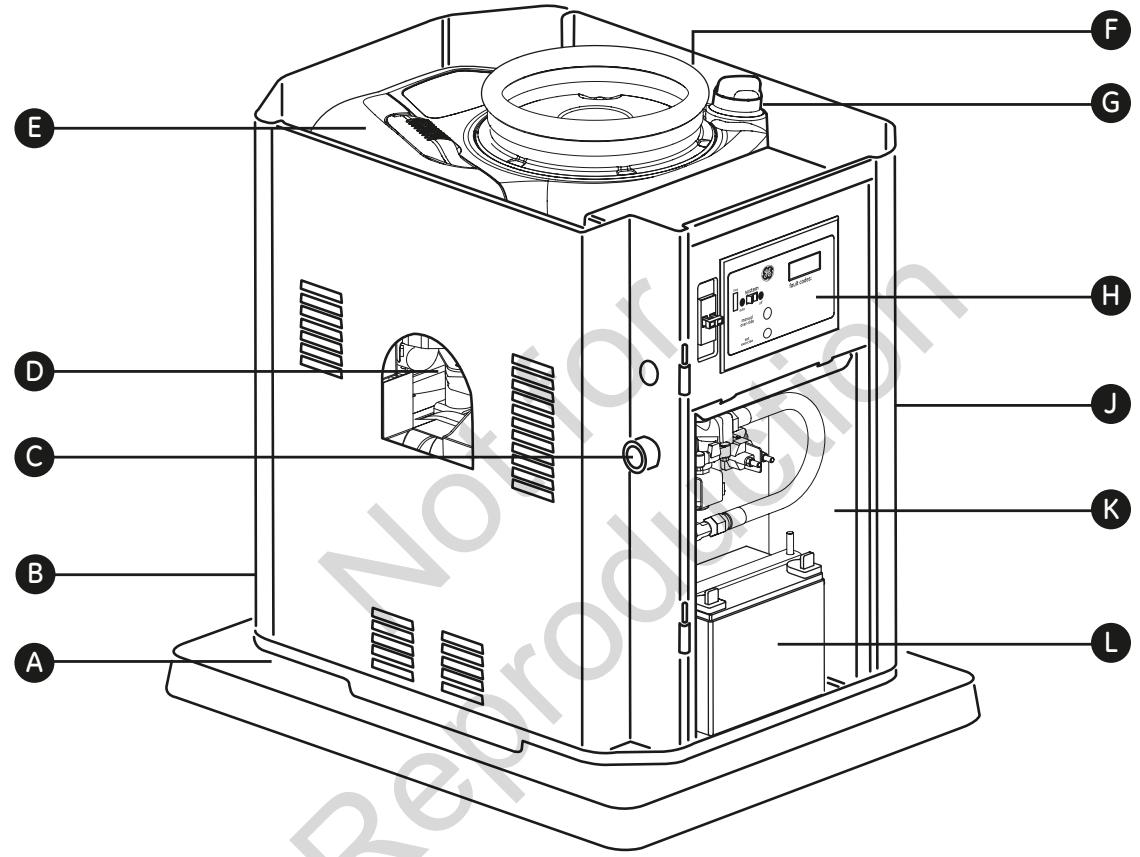
Generator is shown with roof and access covers removed for clarity.
A - Lifting Pocket - Provided at each corner for lifting generator.
B - Exhaust Port — High-performance muffler lowers engine noise to comply with most residential codes.
C - Fuel Inlet - Attach appropriate fuel supply to generator here.
D - Oil Filter — Filters engine oil to prolong generator life.
E - Air Cleaner - Uses a dry type filter element and foam precleaner to protect engine by filtering dust and debris out of intake air.
F - Engine Label - Identifies engine model and type.
G - Oil Fill Cap/Dipstick — Check and fill engine with recommended oil here.
H - Control Panel - Used for various test, operation and maintenance functions. See System Control Panel.
J - Oil Drain Hose — Located inside access cover on side panel. Provided to facilitate oil changing.
K - Unit Identification Label - Identifies unit by serial number.
L - Battery (installer supplied) — 12 Volt DC, sealed battery provides power to start the engine.
Compare this control panel illustration with your generator to familiarize yourself with the location of these important controls:
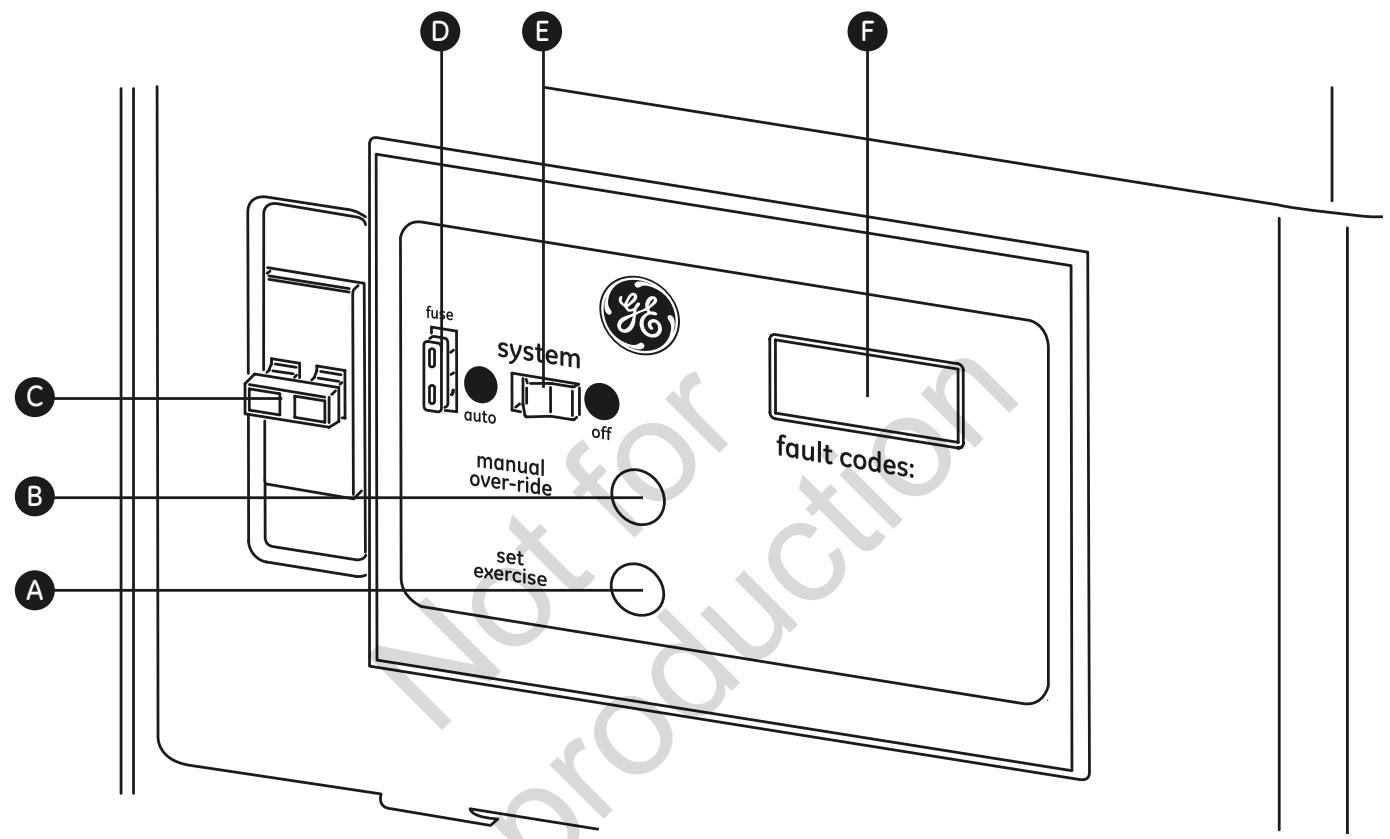
A - Set Exercise— Used to set the exercise cycle start time and day-of-the-week. Exercise cycle only occurs in AUTO mode.
B - MANUAL OVER-RIDE—With system switch in AUTO position, push the manual over-ride switch to start the generator. To turn off the generator, push and hold the manual over-ride switch again until engine stops.
C - Circuit Breaker — Protects the generator from shorts and other over-current conditions. Must be ON to supply power to the automatic transfer switch.
D - 15 Amp Fuse — Protects the home generator DC control circuits. If the fuse has 'blown' (melted open) or was removed, the engine cannot crank or start. Replace the fuse using only an identical ATO 15A fuse.
E - System Switch — This two-position switch is the most important control on the system and is used as follows:
- "AUTO" position is the normal operating position. If a utility power outage is sensed, the system will start the generator. When utility power is restored, AUTO lets the engine stabilize internal temperatures, shuts off the generator, and waits for the next utility power outage.
- "OFF" position turns off running generator, prevents unit from starting and resets any detected faults.
F - Digital Display — Displays the total number of hours the generator has been running and fault codes. Used to schedule maintenance tasks and for troubleshooting operational problems with the residential generator. A constant number displayed indicates the total hours of operation. Fault conditions will flash "FC" followed by a fault code number. All fault conditions are described in Fault Detection System.
Access Ports
The home generator is equipped with several access openings and a removable roof to permit simple oil and filter servicing.
To remove roof:
Remove the four screws and lift off. Replace roof in reverse order.
To remove access cover:
Remove the two screws, tilt cover out, and lift cover off panel. Replace cover in reverse order.
To remove side panel (if necessary):
- Remove roof.
- Remove screw(s) attaching side panel.

WARNING Contact with muffler area could cause burns

- DO NOT touch hot parts and AVOID hot exhaust gases.
-
Allow equipment to cool before touching.
-
Pull panel outward (away) from unit while pulling panel upward and out of base.
To install side panel:
- Guide bottom of side into base.
- Push panel until it is flush with sides.
- Replace panel screw(s).
- Replace roof and screws.
Each home generator is supplied with a set of identical keys. These keys fit the locks that secure the access door.
To open access door:
- Insert key into lock of access door and turn key one quarter turn counterclockwise.
- Grasp door's handle and turn one quarter turn counterclockwise to open. Remove key.
To close access door:
- Close door and turn doors handle one quarter turn clockwise.
- Insert key into lock of access door and turn key one quarter turn clockwise. Remove key.
Operation
Important Owner's Considerations
Engine Oil
NOTICE Any attempt to crank or start the engine before it has been properly serviced with the recommended oil will result in equipment failure.
- Refer to Maintenance in the operator's manual and engine manual for oil fill information.
- Damage to equipment resulting from failure to follow this instruction will void engine and generator warranty.
This engine is shipped from the factory pre-run and filled with synthetic oil (API SJ/CF 5W-30). This allows for system operation in a wide range of temperature and climate conditions. Before starting the engine, check oil level as described in the engine manual.
Battery
The installer must supply a valve-regulated, rechargeable 12 volt DC starting battery. See Battery in Final Installation Considerations in the installation manual.
WARNING Battery posts, terminals and related accessories contain lead and lead compounds, chemicals known to the State of California to cause cancer and reproductive harm. Wash hands after handling.
With the battery installed, all wiring to transfer switch and home generator completed, utility power supplied to the automatic transfer switch, and the unit in AUTO mode, the battery receives a trickle charge while the engine is not running. The trickle charge cannot be used to recharge a battery that is completely discharged.
15 Amp Fuse
The generator's 15 Amp fuse is critical to correct system operation. The 15 Amp fuse was removed at the factory to prevent the unit from starting during shipping. Your installer will ensure the fuse is properly installed upon completion of the installation.
Automatic Operation
To select automatic operation, do the following:
- Confirm 15 Amp fuse is installed in control panel.
- Set the main distribution panel circuit breaker that sends utility voltage to the transfer switch to ON.
- Set the generator's circuit breaker to its ON position.
- Set the control panel system switch to AUTO.
CAUTION With the system switch set to AUTO, the engine could crank and start at any time without warning, resulting in minor or moderate injury.
- To prevent possible injury that could be caused by such sudden starts, always set the system switch to OFF if performing maintenance on the system.
- Remove the 15 Amp fuse before working on or around the generator or transfer switch.
Checking Automatic Operation
To check the system for proper automatic operation, proceed as follows:
- Turn OFF the service disconnect or main distribution panel circuit breaker sending power to the automatic transfer switch.
When utility voltage is lost and the sensor has timed out, the engine will crank and start. Let the system go through its entire automatic operation sequence.
-
With generator output supplying its loads, turn ON the service disconnect or main distribution panel circuit breaker that supplies utility power to the automatic transfer switch.
-
The automatic transfer switch will transfer loads back to utility power after a 5 minute minimum run time and utility power is available.
- The generator will run for one additional minute for engine cool down, then will shut down.
If utility is restored and generator does not shut down after 10 minutes, set system switch to OFF and contact your installer or local service center.
This completes the test procedures for automatic operation. The home generator will now start automatically and will supply power to the transfer switch when utility power is lost.
Setting Exercise Timer
The home generator is equipped with an exercise timer that will start and exercise the system once every seven days. During this exercise period, the unit runs for approximately 20 minutes and then shuts down. Electrical load transfer DOES NOT occur during the exercise cycle (unless an utility power outage occurs during the cycle).
A button on the control panel is labeled "SET EXERCISE" (see System Control Panel). The specific day and the specific time of day this button is pressed is programmed into the control board memory. This date and time is then used to automatically initiate the system exercise cycle. The "SET EXERCISE" legend on the control panel will flash until the set exercise cycle is set.
To perform the Set Exercise procedure:
- Choose the day and time you want your home generator to exercise.
- On that day and time, press and hold "SET EXERCISE" for three seconds.
"SET EXERCISE" will flash until the button is pressed for three seconds, then "SET EXERCISE" will illuminate for 5 seconds, and finally turn off.
- The unit will then start and run it's 20 minute exercise cycle.
For example, if you press SET EXERCISE on Sunday morning at 10:00 AM, the unit will run an immediate exercise cycle and an exercise cycle every following Sunday at 10:00 AM (+/- 1/2 hour).
"Set Exercise" will only work if the unit is in the AUTO mode and this exact procedure is followed. The exerciser will need to be re-set if the 15 Amp fuse is removed or changed, or if the starting battery is disconnected.
If you want to change the day and time the unit exercises, simply perform the "Set Exercise" procedure at the exact weekday and time you want it to take place.
Maintenance
Servicing the System
Before performing any generator maintenance, always perform the following steps:
- Set generator's circuit breaker to its OFF position.
- Set control panel system switch to OFF.
-
Remove 15 Amp fuse from control panel.
-
Utility voltage is present at generator control panel. Disconnect power before servicing control panel by removing the fuses from the transfer switch.
- After all servicing has been completed, replace fuses in transfer switch, replace 15 Amp fuse in control panel, set system switch and circuit breaker ON and reset exercise timer. See Setting Exercise Timer in Operation.
Fault Detection System
The generator may have to run for long periods of time with no operator present. For that reason, the system is equipped with sensors that automatically shut down the generator in the event of potentially damaging conditions, such as low oil pressure, high temperature, over speed, and other conditions.
The generator's control panel has a digital display that shows fault codes, like "FC_1". The table below lists the detected fault, the fault code as displayed on the control panel.
| Fault Description | Fault Codes |
| Low battery voltage | FC_1 |
| Low oil pressure | FC_2 |
| Low voltage | FC_3 |
| Engine fails to start | FC_4 |
| Low frequency | FC_5 |
| Engine overspeed | FC_6 |
| High temperature | FC_7 |
| Transfer switch fault | FC_8 |
Reset Fault Detection System
The operator must reset the fault detection system each time it activates. To do so, place the control panel System switch in the OFF position for 30 seconds or more. Remedy the fault condition, then return the home generator to service by placing the system switch in the AUTO position, installing the 15 Amp fuse, and resetting the exercise timer. See Setting Exercise Timer in Operation.
Low Battery Voltage (FC_1)
This fault is indicated by fault code FC_1.. This condition occurs if the generator cannot start because the starting battery output power is below that needed to crank the engine. Causes for this problem may be a faulty battery or battery charge circuit.
Remove the 15 Amp fuse and disconnect the battery from the generator. Take the battery to a local battery store for analysis. Or contact your local service center for assistance.
Reinstall the battery (replace if necessary - see Battery in Final Installation Considerations in the installation manual).
Then reset the fault detection system, as described earlier.
Low Oil Pressure (FC_2)
This fault is indicated by fault code FC_2. The unit is equipped with an oil pressure switch that uses normally closed contacts held open by engine oil pressure during operation. Should oil pressure drop below the 8 psi range, switch contacts close and the engine is shut down.
To remedy the low oil pressure condition, add the recommended oil to the FULL mark on the dipstick.
If the low oil pressure condition still exists, the engine will start, then shut down again. The fault code will appear and the LED will flash. In this case, contact an authorized dealer.
Low Voltage (Generator, FC_3)
This fault is indicated by fault code FC_3. This condition is caused by a restriction in the fuel flow, a broken or disconnected signal lead, a failed alternator winding, the control panel circuit breaker is open, or the generator is overloaded.
To remedy the problem, contact your installer or an authorized dealer.
Engine Does Not Start (FC_4)
This fault is indicated by fault code FC_4. This feature prevents the generator from damaging itself if it continually attempts to start in spite of another problem, such as no fuel supply. Each time the system is directed to start, the unit will crank for 10 seconds, pause for 10 seconds, and repeat. If the system does not begin producing electricity after approximately 2 minutes, the unit will stop cranking and the LED will blink.
Check to make sure the generator's circuit breaker is in the ON position in order for the sensing leads to verify that the unit is running.
The most likely cause of this problem is no fuel supply. Check the internal and external fuel shut off valves to ensure they are fully open. Other causes could be failed spark plug(s), failed engine ignition, or the engine air filter is clogged. You may need to contact your installer for assistance if you can't remedy these problems.
Low Frequency (FC_5)
This fault is indicated by fault code FC_5. This feature protects devices connected to the transfer switch by shutting the generator down if the engine runs slower than 55Hz for three seconds.
This condition is caused by a failed engine component or by excessive loads on the generator. To remedy the problem, contact your installer or an authorized dealer.
Engine Overspeed (FC_6)
This fault is indicated by fault code FC_6. This feature protects devices connected to the transfer switch by shutting the generator down if the engine happens to run faster than the preset limit.
The overspeed fault is detected as follows:
- If the generator output frequency is 65 - 70Hz , after three seconds, the generator will shut down.
- If the generator output frequency is greater than 70 ~Hz , the generator will shut down immediately.
This condition is caused by a failed engine component. To remedy the problem, contact your installer or an authorized dealer.
High Temperature (FC_7)
This fault is indicated by fault code FC_7. The contacts of the temperature switch are normally open. If the engine temperature exceeds approximately 149^ ( 300^ ), the fault is detected and the engine shuts down.
Common causes for this condition include running the unit with access panels removed, obstructed air inlet or exhaust port, low oil level, or debris in the engine cylinder cooling fins. To resolve the problem, let the engine cool down and remove any accumulated debris and obstructions. Ensure that all access panels are installed whenever the unit is running.
Transfer Switch Fault (FC_8)
This fault is indicated by fault code FC_8 (if transfer switch is equipped with fault detection).
The most likely cause of this fault is a blown fuse in the transfer switch. To remedy the problem, contact your installer or an authorized dealer.
The generator warranty does not cover items that have been subjected to operator abuse or neglect. To receive full value from the warranty, the operator must maintain the system as instructed in the engine operator's manual.
All adjustments should be made at least once each season. Follow the requirements in the engine operator's manual.
Generator maintenance consists of keeping the unit clean. Operate the unit in an environment where it will not be exposed to excessive dust, dirt, moisture or any corrosive vapors. Cooling air louvers on the enclosure must not become clogged with snow, leaves, or any other
foreign material. To prevent generator damage caused by overheating, keep the enclosure cooling inlets and outlets clean and unobstructed at all times.
Check the cleanliness of the unit frequently and clean when dust, dirt, oil, moisture or other foreign substances are visible on its exterior/interior surface. Inspect the air inlet and outlet openings inside and outside the enclosure to ensure air flow is not blocked.
DO NOT use direct spray from a garden hose to clean generator. Water can enter the engine and generator and cause problems.
Engine Oil
The engine is filled with synthetic oil (API SJ/CF 5W-30).
This allows for system operation in the widest range of temperature and climate conditions.
The use of synthetic oil does not alter the required oil change intervals described in the engine operator's manual.
Changing Engine Oil and Oil Filter
Remove the two screws from each access cover and remove both access covers from the generator enclosure.
Changing Engine Oil
CAUTION Avoid prolonged or repeated skin contact with used motor oil.
- Used motor oil has been shown to cause skin cancer in certain laboratory animals.
- Thoroughly wash exposed areas with soap and water.

KEEP OUT OF REACH OF CHILDREN. DON'T POLLUTE. CONSERVE RESOURCES. RETURN USED OIL TO COLLECTION CENTERS.
- Set control board system switch to OFF.
- Remove 15 Amp fuse from control panel.
- Place oil drain hose into an approved container.
- Remove brass fitting from end of drain hose.
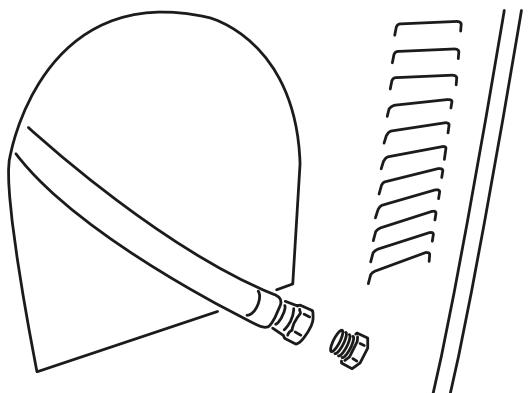
Change oil while the engine is still warm from running, as described in the engine operator's manual.
- When oil has drained, replace brass fitting on hose.
- Add oil if not changing oil filter. See next section.
Changing Oil Filter
- Place oil drain tray over tubing and slide it under oil filter.
- Follow instructions given in engine operator's manual for changing oil filter.
- Remove oil drain tray from under oil filter and clean up any spilled oil.
To fill your engine with oil:
Follow the synthetic oil grade recommendation and oil fill instructions given in the engine operator's manual.
If all engine servicing is complete, replace 15 Amp fuse in control panel and reset exercise timer. See Setting Exercise Timer in Operation.
NOTICE Any attempt to crank or start the engine before it has been properly serviced with the recommended oil will result in equipment failure.
- Refer to Maintenance in the operator's manual and engine manual for oil fill information.
- Damage to equipment resulting from failure to follow this instruction will void engine and generator warranty.
Battery
Servicing of batteries is to be performed or supervised by personnel knowledgeable of batteries and the required precautions. Keep unauthorized personnel away from batteries.
Servicing the Battery
If it is necessary to service the battery, proceed as follows:
- Set control board system switch to OFF.
- Remove 15 Amp fuse from control panel.
- Service or replace battery as required. See Battery in Final Installation Considerations in the installation manual for specific battery needed.
- Connect red battery cable to battery positive terminal (indicated by POSITIVE, POS, or (+) ).
WARNING Battery posts, terminals and related accessories contain lead and lead compounds, chemicals known to the State of California to cause cancer and reproductive harm. Wash hands after handling.
- Connect black negative battery cable to negative battery terminal (indicated by NEGATIVE, NEG, or (-)).
- Ensure hardware on both positive and negative battery terminals is secure.
- Reinstall 15 Amp fuse in control panel.
- Set generator's system switch to AUTO.
- Reset exercise timer. See Setting Exercise Timer.

DON'T POLLUTE. CONSERVE RESOURCES, RETURN USED BATTERY TO RECYCLING COLLECTION CENTER.
Charging the Battery
If it is necessary to charge the battery, proceed as follows:
- Set control board system switch to OFF.
- Remove 15 Amp fuse from control panel.
- Disconnect negative battery cable from negative battery terminal (indicated by NEGATIVE, NEG, or (-)).
NOTICE Failure to disconnect negative battery cable will result in equipment failure.
- DO NOT attempt to jump start the generator.
-
Damage to equipment resulting from failure to follow this instruction will void engine and generator warranty.
-
Charge battery with battery charger at 2 Amps until battery holds 12 Volts. DO NOT exceed 13.7 volts when charging.
-
Connect negative battery cable to negative battery terminal (indicated by NEGATIVE, NEG, or (-) ).
- Ensure hardware on both positive and negative battery terminals is secure.
- Reinstall 15 Amp fuse in control panel.

CAUTION With the system switch set to AUTO, the engine could crank and start at any time without warning, resulting in minor or moderate injury.
- To prevent possible injury that could be caused by such sudden starts, always set the system switch to OFF if performing maintenance on the system.
- Remove the 15 Amp fuse before working on or around the generator or transfer switch.
WARNING Storage batteries give off explosive hydrogen gas during recharging. Slightest spark will ignite hydrogen and cause explosion, resulting in death, serious injury and/or property damage.
Battery electrolyte fluid contains acid and is extremely caustic. Contact with battery contents could cause severe chemical burns. A battery presents a risk of electrical shock and high short circuit current.
- DO NOT dispose of battery in a fire. Recycle battery.
- DO NOT allow any open flame, spark, heat, or lit cigarette during and for several minutes after charging a battery.
- DO NOT open or mutilate the battery.
- Wear protective goggles, rubber apron, rubber boots and rubber gloves.
- Remove watches, rings, or other metal objects.
-
Use tools having insulated handles.
-
Set generator's system switch to AUTO.
- Reset exercise timer. See Setting Exercise Timer.
Cleaning the Generator
NOTICE Improper treatment of generator can damage it and shorten its life.
- DO NOT expose generator to excessive moisture, dust, dirt, or corrosive vapors.
-
DO NOT insert any objects through cooling slots.
-
Set control board system switch to OFF.
-
Remove 15 Amp fuse from control panel.
-
Clean generator as desired.
- Use a damp cloth to wipe exterior surfaces clean.
- Use a soft, bristle brush to loosen caked on dirt, etc.
- Use a vacuum cleaner to pick up loose dirt and debris.
- Use low pressure air (not to exceed 25 psi) to blow away dirt. Inspect cooling air slots and openings on the generator. These openings must be kept clean and unobstructed.
- Reinstall 15 Amp fuse in control panel.
- Set generator's system switch to AUTO.
- Reset exercise timer. See Setting Exercise Timer.
You must have the following information at hand if it is necessary to contact a local service center regarding service or repair of this unit:
- Obtain the unit Model Number and Serial Number from the unit ID label. See Controls for location of the label or refer to the information recorded on the inside front cover of the installation manual.
- Obtain the engine identification numbers from the engine label. See the engine operator's manual for location of this information. Please note that several different engines are described in the engine manual, so your engine may vary from that shown.
Storage
The home generator system is designed for long term service as a backup generator. There is no need to take any storage precautions. However, if it becomes necessary to take the system out of service for an extended period, call Technical Services at 888 575-8226, between 8:00 AM and 5:00 PM CT for specific recommendations. Refer to the engine operator's manual for additional information.
Troubleshooting
| Problem | Cause | Correction |
| Engine is running, but no AC output is available. | 1. Circuit breaker open or defective. | 1. Reset or replace circuit breaker. |
| 2. Fault in generator control panel. | 2. Contact local service facility. | |
| 3. Poor wiring connections or defective transfer switch. | 3. Check and repair or contact local service facility. | |
| Engine runs good at no-load but “bogs down” when loads are connected. | 1. Short circuit in a connected load. | 1. Disconnect shorted electrical load. |
| 2. Generator is overloaded. | 2. Turn off one or more loads. | |
| 3. Shorted generator circuit. | 3. Contact local service facility. | |
| 4. Fuel pressure or mixture is incorrect. | 4. See Gaseous Fuel System in the installation manual. | |
| 5. Kinked fuel line between regulator and engine.. | 5. Remove kink. Replace if necessary. | |
| Engine will not start; or starts and runs rough. | 1. 15 Amp fuse missing or blown. | 1. Install (new) 15 Amp fuse. |
| 2. Fuel supply turned off or depleted. | See System Control Panel. | |
| 3. Failed battery. | 2. Open fuel valve(s); check propane tank. | |
| 4. Clogged air filter | 3. Replace battery. | |
| 4. Clean or replace air filter. | ||
| Engine shuts down during operation. | 1. Fuel supply turned off or depleted. | 1. Check fuel valves, fill propane tank. |
| 2. Fault indicator blinking. | 2. Count blinks and refer to Fault Detection System. | |
| Loss of power on circuits. | 1. Generator circuit breaker is open. | 1. Reset circuit breaker. |
| 2. Transfer switch problems. | 2. See transfer switch manual. |
Warranty
Limited Warranty
Briggs & Stratton Power Products Group, LLC will repair or replace, free of charge, any part(s) of the equipment that is defective in material or workmanship or both. Travel expenses are reimbursed as specified under the Briggs & Stratton Warranty Guidelines document to authorized Briggs & Stratton dealers for performing applicable warranty repair work. This warranty is effective for the time periods and subject to the conditions stated below. For all warranty service, find the nearest Authorized Service Dealer in our dealer locator map at BRIGGSandSTRATTON.com.
THERE IS NO OTHER EXPRESS WARRANTY. IMPLIED WARRANTIES, INCLUDING THOSE OF MERCHANTABILITY AND
FITNESS FOR A PARTICULAR PURPOSE, ARE LIMITED TO ONE YEAR FROM PURCHASE, OR TO THE EXTENT PERMITTED BY LAW. ANY AND ALL IMPLIED WARRANTY ARE EXCLUDING. LIABILITY FOR INCIDENTAL OR CONSEQUENTIAL DAMAGES IS EXCLOSED TO THE EXTENT EXCLUSION IS PERMITTED BY LAW. Some states or countries do not allow limitations on how long an implied warranty lasts, and some states or countries do not allow the exclusion or limitation of incidental or consequential damages, so the above limitation and exclusion may not apply to you. This warranty gives you specific legal rights and you may also have other rights which vary from state to state or country to country.
Warranty Period
Consumer Use
4 years or 1,200 hours, whichever comes first
Commercial Use
None
The warranty period begins on the date of purchase by the first retail consumer or commercial end user, and continues for the period of time stated in the table above. "Consumer" means personal residential household use by a retail consumer. "Commercial" means all other uses, including use for commercial, income producing or rental purposes. Once equipment has experienced commercial use, it shall thereafter be considered as commercial use for purposes of this warranty.
Warranty Terms continue on next page
NO WARRANTY REGISTRATION IS NECESSARY TO OBTAIN WARRANTY ON BRIGGS & STRATTON PRODUCTS. SAVE YOUR PROOF OF PURCHASE RECEIPT. IF YOU DO NOT PROVIDE PROOF OF THE INITIAL PURCHASE DATE AT THE TIME WARRANTY SERVICE IS REQUESTED, THE MANUFACTURING DATE OF THE PRODUCT WILL BE USED TO DETERMINE THE WARRANTY PERIOD.
We welcome warranty repair and apologize to you for being inconvenienceed. Any Authorized Service Dealer may perform warranty repairs. Most warranty repairs are handled routinely, but sometimes requests for warranty service may not be appropriate. For example, warranty service would not apply if equipment damage occurred because of misuse, lack of routine maintenance, shipping, handling, warehousing or improper installation. Similarly, the warranty is void if the manufacturing date or the serial number on the equipment has been removed or the equipment has been altered or modified. During the warranty period, the Authorized Service Dealer, at its option, will repair or replace any part that, upon examination, is found to be defective under normal use and service. This warranty will not cover the following repairs and equipment:
- Normal Wear: Outdoor Power Equipment and engines, like all mechanical devices, needs periodic parts and service to perform well. This warranty does not cover repair when normal use has exhausted the life of a part or the equipment.
-
Installation and Maintenance: This warranty does not apply to equipment or parts that have been subjected to improper or unauthorized installation or alteration and modification, misuse, negligence, accident, overloading, overspeeding, improper maintenance, repair or storage so as, in our judgment, to adversely affect its performance and reliability. This warranty also does not cover normal maintenance such as adjustments, fuel system cleaning and obstruction (due to chemical, dirt, carbon, lime, and so forth).
-
Other Exclusions: This warranty excludes starting battery, accessory parts, wear items such as oil gauges, o-rings, filters, fuses, or spark plugs, etc., or damage or malfunctions resulting from accidents, abuse, modifications, alterations, or improper servicing or freezing or chemical deterioration. This warranty excludes failures due to acts of God and other force majeure events beyond the manufacturers control. And this warranty excludes used, reconditioned, and demonstration equipment; equipment used for prime power in place of utility power, equipment used in mobile or rental applications, and equipment used in life support applications.
Enclosure is warranted against surface rust and corrosion for the first year of the warranty period.
Surface rust and corrosion is defined as any rust or corrosion that has penetrated the paint but has not penetrated through the metal substructure.
Enclosure is warranted against rust-through for the first two years of the warranty period.
Rust-through is defined as rust or corrosion that has penetrated completely through the paint and metal substructure.
Enclosure is not warranted for surface rust or corrosion or complete rust-through that may result due to improper installation, damage to painted surfaces that compromise the paint's corrosion prevention properties, or if the unit is installed in environments that expose the generator to high levels of corrosive agents.
Warranty terms effective November 1, 2009 - replaces all undated Warranties and
Warranties dated before November 1, 2009. 209452E, Rev. D, 2 November 2009
Product Specifications
Rated Maximum Load Current* (at 25^ / 77^, LP):
at 240 Volts
29.2 Amps
Rated AC Voltage
240 Volts
Phase
Single phase
Rated Frequency
60 Hertz
Normal Operating Range
-10°F (-23.3°C) to 104°F (40°C)
Output Sound Level
81 dB(A) at 23 ft. (7 m)
at full load
Shipping Weight
340 lb (155 kg)
- Natural gas rating will depend on specific fuel but typical derates are between 10 to 20% off the LP gas rating.
GE Home Generator Systems
7,000 vaitos
sistema generator dométrico
Manual del operario
Nunca tendrá que buscar muito para poder obterner soporte y servicios专业技术o para su equipo generator dereshva. Consulte las páginas amarillas. Hay manyos distribuidores de service autorizados de GE que ofrecen service de calidad. Internacionalmente, como el sector de operación del GESecuidad de Operaciones, es fundamental para ser able a optimizar el operation of the operation of the operation of the operation of the operation of the operation of the operation of the operation of the operation of the operation of the operation of the operation of the operation of the operation of the operation of the operation of the operation of the operation of the operation of the operation of the operation of the operation of the operation of the operation of the operation of the operation of the operation of the operation of the operation of the operation of the operation of the operation of the operation of the operation of the
Los关键时刻 of the coronavirus outbreak in China, including the first case of COVID-19, was announced on 24 March 2020.
NO ES NECESARIO 登記RAR LA GARANTÍA PARA OBTENER SERVICIO DE BRIGGS & STRATTON PRODUCTS. GUARDE SU RECIBO DE COMPRA. SI NO APORTA LA PRUEBA DE LA FECHA DE COMPRA INICIAL, SE UTILIZARÁ LA FECHA DE FABRICAL DEL PRODUCTO PARA DETERMINAR EL PERÍODO DE GARANTÍA.
-10°F (-23.3°C) to 40°C (104°F)
Nivel de ruido
81 dB(A) at 7 m (23 pies)
con cargo completa
Basse tension (FC_3)
-10°F (-23.3°C) to 40°C (104°F)
81 dB(A) at 7 m (23 ft.)
à pleine charge

- Operator's Manual
- Where to Find Us
- Table of Contents
- Safety Rules
- Important Safety Instructions
- Safety Symbols and Meanings
- Installation
- For the Home Owner
- Read and understand Owner Orientation in this manual before contracting or starting your home generator installation.
- For the Installing Dealer/Contractor
- The factors mentioned above will have a direct effect on the overall price of your home generator installation.
- Fuel Factors
- Power Decrease at High Altitude or High Temperature
- The home generator system is supplied with:
- Not included:
- Controls
- Home Generator
- Access Ports
- To remove roof:
- To remove access cover:
- To remove side panel (if necessary):
- To install side panel:
- To open access door:
- To close access door:
- Operation
- Important Owner's Considerations
- Engine Oil
- Battery
- Amp Fuse
- Automatic Operation
- Checking Automatic Operation
- To check the system for proper automatic operation, proceed as follows:
- Setting Exercise Timer
- To perform the Set Exercise procedure:
- Maintenance
- Servicing the System
- Fault Detection System
- Reset Fault Detection System
- Low Battery Voltage (FC_1)
- Low Oil Pressure (FC_2)
- Low Voltage (Generator, FC_3)
- Engine Does Not Start (FC_4)
- Low Frequency (FC_5)
- Engine Overspeed (FC_6)
- High Temperature (FC_7)
- Transfer Switch Fault (FC_8)
- Changing Engine Oil and Oil Filter
- Changing Engine Oil
- Changing Oil Filter
- To fill your engine with oil:
- Servicing the Battery
- Charging the Battery
- Cleaning the Generator
- Storage
- Troubleshooting
- Warranty
- Limited Warranty
- Warranty Period
- Product Specifications
- Manual del operario
- Basse tension (FC_3)
Brand : GENERAL ELECTRIC
Model : HOME GENERATOR SYSTEMS 7000 WATT
Category : Home Generator Systems