
300000 - Internal combustion engine GENERAL ELECTRIC - Free user manual and instructions
Find the device manual for free 300000 GENERAL ELECTRIC in PDF.



| Product type | Internal combustion engine |
| Brand | GENERAL ELECTRIC |
| Model | 300000 |
| Displacement | 479 cm³ (29.23 ci) |
| Bore x Stroke | 68 x 66 mm |
| Engine oil capacity | 1.36 - 1.42 L |
| Fuel | LPG / Natural gas (Gaseous) |
| Cooling | Air |
| Starting | Recoil starter or electric (depending on version) |
| Spark plug gap | 0.51 mm |
| Spark plug torque | 20 Nm |
| Intake valve clearance | 0.10 - 0.15 mm |
| Exhaust valve clearance | 0.18 - 0.23 mm |
| Air filter | With pre-cleaner (ref. 394018 or 841359 depending on model) |
| Oil filter | Optional (ref. 492932 or 491056) |
| Oil change interval | Every 100 hours or 1 year |
| Spark plug replacement interval | Every 100 hours or 1 year |
| Engine warranty (private use) | 3 years (Vanguard) |
| Emissions system warranty | 3 years |
| Spark arrester | Available as an option |
| Emissions certification | EPA Phase 2, CARB |
Frequently Asked Questions - 300000 GENERAL ELECTRIC
User questions about 300000 GENERAL ELECTRIC
0 question about this device. Answer the ones you know or ask your own.
Ask a new question about this device
Download the instructions for your Internal combustion engine in PDF format for free! Find your manual 300000 - GENERAL ELECTRIC and take your electronic device back in hand. On this page are published all the documents necessary for the use of your device. 300000 by GENERAL ELECTRIC.
USER MANUAL 300000 GENERAL ELECTRIC
This manual contains safety information to make you aware of the hazards and risks associated with engines and how to avoid them. It also contains instructions for the proper use and care of the engine. Because Briggs & Stratton Corporation does not necessarily know what equipment this engine will power, it is important that you read and understand these instructions and the instructions for the equipment. Save these original instructions for future reference.
For replacement parts or technical assistance, record below the engine model, type, and code numbers along with the date of purchase. These numbers are located on your engine (see the Features and Controls page).
Date of purchase:
MM/DD/YYYY
Engine model:
Model:
Type:
Code:
Engine Power Rating Information
The gross power rating for individual gas engine models is labeled in accordance with SAE (Society of Automotive Engineers) code J1940 (Small Engine Power & Torque Rating Procedure), and rating performance has been obtained and corrected in accordance with SAE J1995 (Revision 2002-05). Torque values are derived at 3060 RPM; horsepower values are derived at 3600 RPM. Actual gross engine power will be lower and is affected by, among other things, ambient operating conditions and engine-to-engine variability. Given both the wide array of products on which engines are placed and the variety of environmental issues applicable to operating the equipment, the gas engine will not develop the rated gross power when used in a given piece of power equipment (actual "on-site" or net power). This difference is due to a variety of factors including, but not limited to, accessories (air cleaner, exhaust, charging, cooling, carburetor, fuel pump, etc.), application limitations, ambient operating conditions (temperature, humidity, altitude), and engine-to-engine variability. Due to manufacturing and capacity limitations, Briggs & Stratton may substitute an engine of higher rated power for this Series engine.
Operator Safety
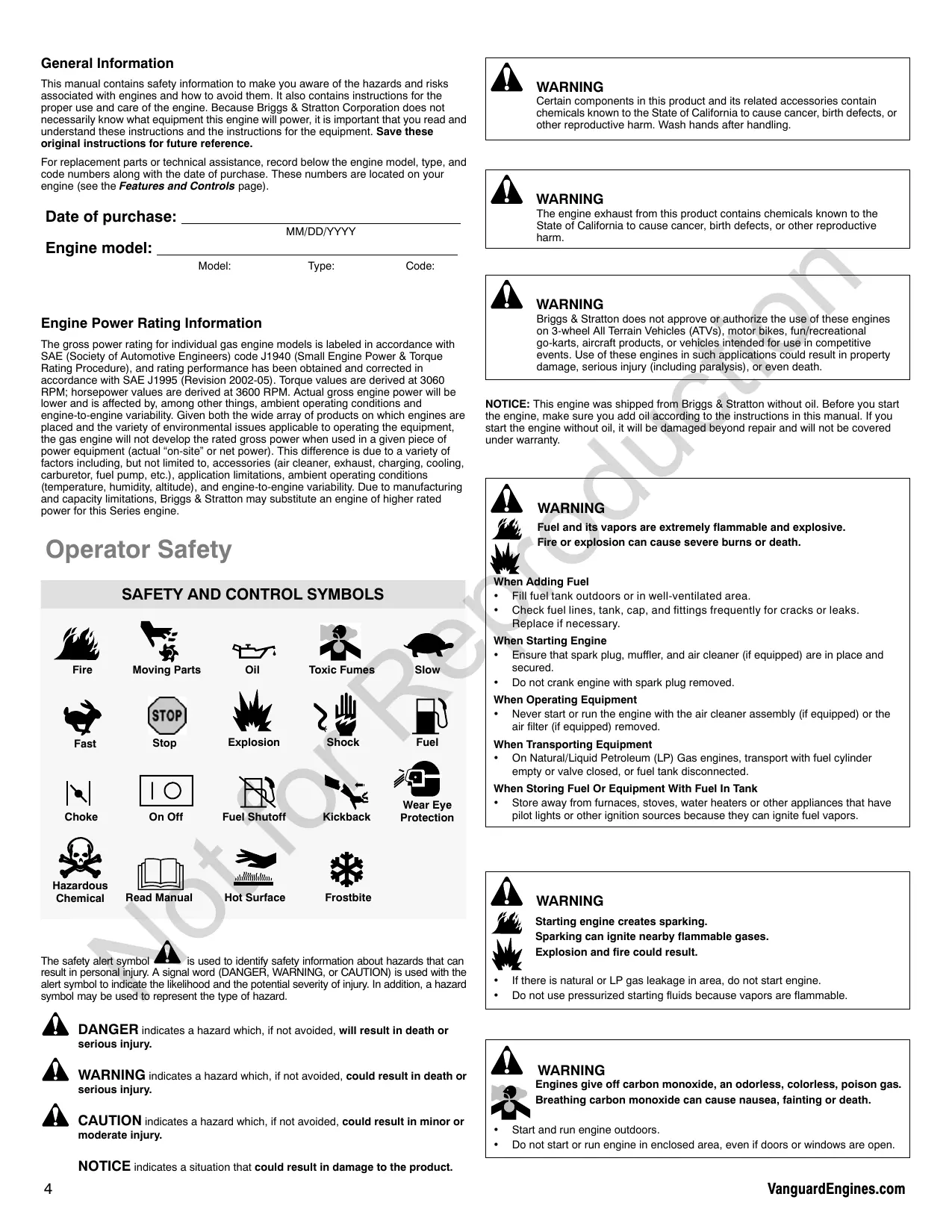
SAFETY AND CONTROL SYMBOLS

Fire

Moving Parts

Oil

Toxic Fumes

Slow

Fast

Stop

Explosion

Shock

Fuel

Choke

On Off

Fuel Shutoff

Kickback

Wear Eye Protection

Hazardous Chemical

Read Manual


Hot Surface

Frostbite
The safety alert symbol is used to identify safety information about hazards that can result in personal injury. A signal word (DANGER, WARNING, or CAUTION) is used with the alert symbol to indicate the likelihood and the potential severity of injury. In addition, a hazard symbol may be used to represent the type of hazard.

DANGER indicates a hazard which, if not avoided, will result in death or serious injury.

WARNING indicates a hazard which, if not avoided, could result in death or serious injury.

CAUTION indicates a hazard which, if not avoided, could result in minor or moderate injury.
NOTICE indicates a situation that could result in damage to the product.

WARNING
Certain components in this product and its related accessories contain chemicals known to the State of California to cause cancer, birth defects, or other reproductive harm. Wash hands after handling.

WARNING
The engine exhaust from this product contains chemicals known to the State of California to cause cancer, birth defects, or other reproductive harm.

WARNING
Briggs & Stratton does not approve or authorize the use of these engines on 3-wheel All Terrain Vehicles (ATVs), motor bikes, fun/recreational go-karts, aircraft products, or vehicles intended for use in competitive events. Use of these engines in such applications could result in property damage, serious injury (including paralysis), or even death.
NOTICE: This engine was shipped from Briggs & Stratton without oil. Before you start the engine, make sure you add oil according to the instructions in this manual. If you start the engine without oil, it will be damaged beyond repair and will not be covered under warranty.

WARNING
Fuel and its vapors are extremely flammable and explosive.
Fire or explosion can cause severe burns or death.

When Adding Fuel
- Fill fuel tank outdoors or in well-ventilated area.
- Check fuel lines, tank, cap, and fittings frequently for cracks or leaks. Replace if necessary.
When Starting Engine
- Ensure that spark plug, muffler, and air cleaner (if equipped) are in place and secured.
- Do not crank engine with spark plug removed.
When Operating Equipment
- Never start or run the engine with the air cleaner assembly (if equipped) or the air filter (if equipped) removed.
When Transporting Equipment
- On Natural/Liquid Petroleum (LP) Gas engines, transport with fuel cylinder empty or valve closed, or fuel tank disconnected.
When Storing Fuel Or Equipment With Fuel In Tank
- Store away from furnaces, stoves, water heaters or other appliances that have pilot lights or other ignition sources because they can ignite fuel vapors.

WARNING

Starting engine creates sparking.
Sparking can ignite nearby flammable gases.
Explosion and fire could result.
If there is natural or LP gas leakage in area, do not start engine.
- Do not use pressurized starting fluids because vapors are flammable.

WARNING
Engines give off carbon monoxide, an odorless, colorless, poison gas.
Breathing carbon monoxide can cause nausea, fainting or death.

- Start and run engine outdoors.
-
Do not start or run engine in enclosed area, even if doors or windows are open.
-
When starting engine, pull the starter cord slowly until resistance is felt and then pull rapidly to avoid kickback.
- Remove all external equipment/engine loads before starting engine.
- Direct-coupled equipment components such as, but not limited to, blades, impellers, pulleys, sprockets, etc., must be securely attached.

WARNING

Rotating parts can contact or entangle hands, feet, hair, clothing, or accessories.
Traumatic amputation or severe laceration can result.
- Operate equipment with guards in place.
- Keep hands and feet away from rotating parts.
- Tie up long hair and remove jewelry.
- Do not wear loose-fitting clothing, dangling drawstrings or items that could become caught.

WARNING

Running engines produce heat. Engine parts, especially muffler, become extremely hot.
Severe thermal burns can occur on contact.
Combustible debris, such as leaves, grass, brush, etc. can catch fire.
- Allow muffler, engine cylinder and fins to cool before touching.
- Remove accumulated debris from muffler area and cylinder area.
- It is a violation of California Public Resource Code, Section 4442, to use or operate the engine on any forest-covered, brush-covered, or grass-covered land unless the exhaust system is equipped with a spark arrester, as defined in Section 4442, maintained in effective working order. Other states or federal jurisdictions may have similar laws. Contact the original equipment manufacturer, retailer, or dealer to obtain a spark arrester designed for the exhaust system installed on this engine.

WARNING
Unintentional sparking can result in fire or electric shock.
Unintentional start-up can result in entanglement, traumatic amputation, or laceration.
Fire hazard

Before performing adjustments or repairs:
- Disconnect the spark plug wire and keep it away from the spark plug.
- Disconnect battery at negative terminal (only engines with electric start.)
Use only correct tools. - Do not tamper with governor spring, links or other parts to increase engine speed.
- Replacement parts must be of the same design and installed in the same position as the original parts. Other parts may not perform as well, may damage the unit, and may result in injury.
- Do not strike the flywheel with a hammer or hard object because the flywheel may later shatter during operation.
When testing for spark:
Use approved spark plug tester.
- Do not check for spark with spark plug removed.

WARNING
Gaseous fuels are extremely flammable and readily form explosive air-vapor mixtures at ambient temperatures.
- Do not start the engine.
- Do not actuate any electrical switches.
- Do not use a phone in the vicinity.
Evacuate the area. - Contact the gas supplier or fire department.

WARNING
Wear eye protection when doing repair work. Frostbite can result from skin/eye contact with leaking LP liquid.
- Installation, adjustment and repair work should be done by a qualified technician.
- Regularly check flexible supply line. Make sure they are in good condition. Replace damaged or leaking components.

WARNING
Missing or inoperative "fuel lock-off" valve can cause a fire or explosion.

- Do not operate the equipment if the "fuel lock-off" valve is missing or inoperative.
Features and Controls
Compare the illustration with your engine to familiarize yourself with the location of various features and controls.
A. Engine Identification Model Type Code
B. Spark Plug
C. Air Cleaner
D. Dipstick
E. Oil Filter (optional)
F. Oil Drain Plug
G. Oil Pressure Sensor
H. Finger Guard
I. Electric Starter
J. Rewind Starter (optional)
K. LPG/NG Mixer
L. Exhaust Manifold
M. Muffler (optional)
N. Oil cooler (optional)
Operation
Oil capacity (see the Specifications section)
Oil Recommendations
We recommend the use of Briggs & Stratton Warranty Certified oils for best performance. Other high-quality detergent oils are acceptable if classified for service SF, SG, SH, SJ or higher. Do not use special additives.
Outdoor temperatures determine the proper oil viscosity for the engine. Use the chart to select the best viscosity for the outdoor temperature range expected.
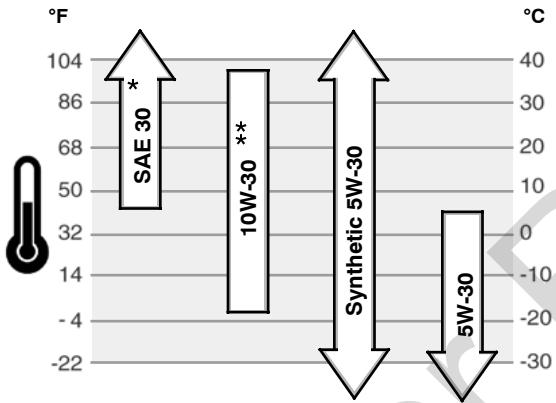
* Below 40^ (4^) the use of SAE 30 will result in hard starting.
** Above 80^ ( 27^ ) the use of 10W-30 may cause increased oil consumption. Check oil level more frequently.
How To Check/Add Oil - Figure ②
Before adding or checking the oil
- Place engine level.
Clean the oil fill area of any debris. - Remove the dipstick (A) and wipe with a clean cloth (Figure 2).
- Fully insert the dipstick.
- Remove the dipstick and check the oil level. It should be at the top of the full indicator (B) on the dipstick.
- If low, add oil slowly into the engine oil fill (C). Do not overfill. After adding oil, wait one minute and then recheck the oil level.
- Fully insert the dipstick.
Oil Pressure
If the oil pressure is too low, a pressure switch (if equipped) will either stop the engine or activate a warning device on the equipment. If this occurs, stop the engine and check the oil level with the dipstick.
If the oil level is below the ADD mark, add oil until it reaches the FULL mark. Start the engine and check for proper pressure before continuing to operate.
If the oil level is between the ADD and FULL marks, do not start the engine. Contact an Authorized Briggs & Stratton Dealer to have the oil pressure problem corrected.
Fuel Recommendations

WARNING
Missing or inoperative "fuel lock-off" valve can cause a fire or explosion.
- Do not operate the equipment if the "fuel lock-off" valve is missing or inoperative.
Fuel must meet these requirements:
- Use clean, dry fuel, free of moisture or any particulate material. Using fuels outside the following recommended values may cause performance problems.
- In engines set up to run on LPG, commercial grade HD5 LPG is recommended. Recommended fuel composition is fuel with a minimum fuel energy of 2500 BTU's/t ^3 with maximum propylene content of 5% and butane and heavier gas content of 2.5% and minimum propane content of 90% .
NG or LPG engines are certified to operate on natural or liquid propane gas. The emissions control system for this engine is EM (Engine Modifications).

WARNING: The equipment on which this engine is mounted is equipped
with an automatic safety gas "fuel lock-off" valve. Do not operate the equipment if the "fuel lock-off" valve is missing or inoperative.
How To Add Fuel

WARNING
Fuel and its vapors are extremely flammable and explosive. Fire or explosion can cause severe burns or death.
When Adding Fuel
- Fill fuel tank outdoors or in well-ventilated area.
- Check fuel lines, tank, cap, and fittings frequently for cracks or leaks. Replace if necessary.
For information on refueling natural or LP gas engines, read the operating instructions supplied by the equipment manufacturer.
How To Start The Engine - Figure 3

WARNING

Rapid retraction of starter cord (kickback) will pull hand and arm toward engine faster than you can let go.
Broken bones, fractures, bruises or sprains could result.
- When starting engine, pull the starter cord slowly until resistance is felt and then pull rapidly to avoid kickback.
- Remove all external equipment/engine loads before starting engine.
- Direct-coupled equipment components such as, but not limited to, blades, impellers, pulleys, sprockets, etc., must be securely attached.

WARNING
Fuel and its vapors are extremely flammable and explosive. Fire or explosion can cause severe burns or death.
When Starting Engine
- Ensure that spark plug, muffler, and air cleaner (if equipped) are in place and secured.
- Do not crank engine with spark plug removed.

WARNING
Engines give off carbon monoxide, an odorless, colorless, poison gas. Breathing carbon monoxide can cause nausea, fainting or death.
Start and run engine outdoors.
- Do not start or run engine in enclosed area, even if doors or windows are open.
NOTICE: This engine was shipped from Briggs & Stratton without oil. Before you start the engine, make sure you add oil according to the instructions in this manual. If you start the engine without oil, it will be damaged beyond repair and will not be covered under warranty.
Note: Some engines and equipment have remote controls. See the equipment manual for location and operation of remote controls.
- Check the oil level. See the How To Check/Add Oil section.
- Make sure equipment drive controls, if equipped, are disengaged.
- Turn the fuel shut-off valve (A), if equipped, to the on position (Figure 3).
-
Push the stop switch (F) , if equipped, to the on position.
-
Move the throttle control (B) to the fast position. Operate the engine in the fast

position.
- Rewind Start: Turn the key switch (D), if equipped, to the run position.
- Rewind Start: Firmly hold the starter cord handle (E). Pull the starter cord handle slowly until resistance is felt, then pull rapidly.
Note: If the engine does not start after repeated attempts, go to VanguardEngines.com or call 1-800-999-9333 (in USA).

WARNING: Rapid retraction of the starter cord (kickback) will pull your end arm toward the engine faster than you can let go. Broken bones, fractures, or sprains could result. When starting engine, pull the starter cord slowly until once is felt and then pull rapidly to avoid kickback.
- Electric Start: Turn the electric start switch (D) to the on/start position.
Note: If the engine does not start after repeated attempts, go to
VanguardEngines.com or call 1-800-999-9333 (in USA).
NOTICE: To extend the life of the starter, use short starting cycles (five seconds maximum). Wait one minute between starting cycles.
How To Stop The Engine - Figure

- With the throttle control (B) in the slow position, turn the key switch (D) to the off position (Figure 3). Remove the key and keep in a safe place out of the reach of children.
- Push the stop switch (F) to the off position.
- After the engine stops, turn the fuel shut-off valve (A), if equipped, to the closed position.
Maintenance
We recommend that you see any Briggs & Stratton Authorized Dealer for all maintenance and service of the engine and engine parts.
NOTICE: All the components used to build this engine must remain in place for proper operation.
Emissions Control
Maintenance, replacement, or repair of the emissions control devices and systems may be performed by any non-road engine repair establishment or individual.
However, to obtain "no charge" emissions control service, the work must be performed by a factory authorized dealer. See the Emissions Warranty.

WARNING
Unintentional sparking can result in fire or electric shock.
Unintentional start-up can result in entanglement, traumatic amputation, or laceration.
Fire hazard
Before performing adjustments or repairs:
- Disconnect the spark plug wire and keep it away from the spark plug.
- Disconnect battery at negative terminal (only engines with electric start.)
Use only correct tools. - Do not tamper with governor spring, links or other parts to increase engine speed.
- Replacement parts must be of the same design and installed in the same position as the original parts. Other parts may not perform as well, may damage the unit, and may result in injury.
- Do not strike the flywheel with a hammer or hard object because the flywheel may later shatter during operation.
When testing for spark:
Use approved spark plug tester.
- Do not check for spark with spark plug removed.
Maintenance Chart
First 5 Hours
Change oil
Every 8 Hours or Daily
Check engine oil level
Clean area around muffler and controls
Every 100 Hours or Annually
- Clean or change air filter *
- Change engine oil and filter
- Replace spark plug
- Check muffler and spark arrester
Every 250 Hours or Annually
- Check valve clearance. Adjust if necessary.
Every 400 Hours or Annually
-
Clean air cooling system *
Clean oil cooler fins * -
In dusty conditions or when airborne debris is present, clean more often.
How To Replace The Spark Plug - Figure

Check the gap (A, Figure 4) with a wire gauge (B). If necessary, reset the gap. Install and tighten the spark plug to the recommended torque. For gap setting or torque, see the Specifications section.
Note: In some areas, local law requires using a resistor spark plug to suppress ignition signals. If this engine was originally equipped with a resistor spark plug, use the same type for replacement.


WARNING
Running engines produce heat. Engine parts, especially muffler, become extremely hot.
Severe thermal burns can occur on contact.
Combustible debris, such as leaves, grass, brush, etc. can catch fire.
- Allow muffler, engine cylinder and fins to cool before touching.
- Remove accumulated debris from muffler area and cylinder area.
- It is a violation of California Public Resource Code, Section 4442, to use or operate the engine on any forest-covered, brush-covered, or grass-covered land unless the exhaust system is equipped with a spark arrester, as defined in Section 4442, maintained in effective working order. Other states or federal jurisdictions may have similar laws. Contact the original equipment manufacturer, retailer, or dealer to obtain a spark arrester designed for the exhaust system installed on this engine.
Remove accumulated debris from muffler area and cylinder area. Inspect the muffler (A, Figure 5) for cracks, corrosion, or other damage. Remove the spark arrester (B), if equipped, and inspect for damage or carbon blockage. If damage is found, install replacement parts before operating.

WARNING: Replacement parts must be of the same design and installed
in the same position as the original parts. Other parts may not perform as well, may damage the unit, and may result in injury.
How To Change The Oil - Figure


Used oil is a hazardous waste product and must be disposed of properly. Do not discard with household waste. Check with your local authorities, service center, or dealer for safe disposal/recycling facilities.
Remove Oil
- With engine off but still warm, disconnect the spark plug wire (A) and keep it away from the spark plug (Figure 8).
- Remove the oil drain plug (B, Figure 9). Drain the oil into an approved container.
- After the oil has drained, install and tighten the oil drain plug.
Change The Oil Filter (if equipped)
Some models are equipped with oil filter. For replacement intervals, see the Maintenance chart.
- Drain the oil from the engine. See Remove Oil section.
- Remove the oil filter (C) and dispose of properly. See Figure 10.
- Before you install the new oil filter, lightly lubricate the oil filter gasket with fresh, clean oil.
- Install the oil filter by hand until the gasket contacts the oil filter adapter, then tighten the oil filter 1/2 to 3/4 turns.
- Add oil. See Add Oil section.
- Start and run the engine. As the engine warms up, check for oil leaks.
- Stop the engine and check the oil level. It should be at the top of the full indicator (F) on the dipstick.
Add Oil
- Place engine level.
Clean the oil fill area of any debris.
See the Specifications section for oil capacity. - Remove the dipstick (D) and wipe with a clean cloth (Figure 11).
- Pour the oil slowly into the engine oil fill (E). Do not overfill. After adding oil, wait one minute and then check the oil level.
- Install and tighten the dipstick.
- Remove the dipstick and check the oil level. It should be at the top of the full indicator (F) on the dipstick.
- Install and tighten the dipstick.

WARNING
Fuel and its vapors are extremely flammable and explosive.
Fire or explosion can cause severe burns or death.

- Never start or run the engine with the air cleaner assembly (if equipped) or the air filter (if equipped) removed.
NOTICE: Do not use pressurized air or solvents to clean the filter. Pressurized air can damage the filter and solvents will dissolve the filter.
See the Maintenance Chart for service requirements.
- Open the latches (A) and remove the cover (B). See Figure 6.
- Remove the nut (D) and the retainer (E)..
- Remove the air filter (F).
- Remove the pre-cleaner (G), if equipped, from the air filter.
- To loosen debris, gently tap the air filter on a hard surface. If the air filter is excessively dirty, replace with a new air filter.
- Wash the pre-cleaner in liquid detergent and water. Then allow it to thoroughly air dry. Do not oil the pre-cleaner.
- Assemble the dry pre-cleaner to the air filter.
- Install the air filter and secure with retainer and nut.
- Install and secure the cover.
How To Clean The Air Cooling System - Figure


WARNING

Running engines produce heat. Engine parts, especially muffler, become extremely hot.
Severe thermal burns can occur on contact.
Combustible debris, such as leaves, grass, brush, etc. can catch fire.
- Allow muffler, engine cylinder and fins to cool before touching.
- Remove accumulated debris from muffler area and cylinder area.
NOTICE: Do not use water to clean the engine. Water could contaminate the fuel system. Use a brush or dry cloth to clean the engine.
This is an air cooled engine. Dirt or debris can restrict air flow and cause the engine to overheat, resulting in poor performance and reduced engine life.
Use a brush or dry cloth to remove debris from the finger guard (A). Keep linkage, springs and controls (B) clean. Keep the area around and behind the muffler (C) free of any combustible debris (Figure 7). Make sure that the oil cooler fins (D) are free of dirt and debris.
Storage

WARNING
Fuel and its vapors are extremely flammable and explosive.
Fire or explosion can cause severe burns or death.
When Storing Fuel Or Equipment With Fuel In Tank
Store away from furnaces, stoves, water heaters or other appliances that have pilot lights or other ignition sources because they can ignite fuel vapors.
Engine Oil
While the engine is still warm, change the engine oil.
Troubleshooting
Need Assistance? Go to VanguardEngines.com or call 1-800-999-9333.
Specifications
| Engine Specifications | |
| Model | 290000 |
| Displacement | 29.23 ci (479 cc) |
| Bore | 2.677 in (68 mm) |
| Stroke | 2.598 in (66 mm) |
| Oil Capacity | 46 - 48 oz (1.36 - 1.42 L) |
| Engine Specifications | |
| Model | 300000 |
| Displacement | 29.23 ci (479 cc) |
| Bore | 2.677 in (68 mm) |
| Stroke | 2.598 in (66 mm) |
| Oil Capacity | 46 - 48 oz (1.36 - 1.42 L) |
| Engine Specifications | |
| Model | 350000 |
| Displacement | 34.78 ci (570 cc) |
| Bore | 2.835 in (72 mm) |
| Stroke | 2.756 in (70 mm) |
| Oil Capacity | 46 - 48 oz (1.36 - 1.42 L) |
| Engine Specifications | |
| Model | 380000 |
| Displacement | 38.26 ci (627 cc) |
| Bore | 2.972 in (75.5 mm) |
| Stroke | 2.756 in (70 mm) |
| Oil Capacity | 46 - 48 oz (1.36 - 1.42 L) |
| Tune-up Specifications * | |
| Model | 290000, 300000 |
| Spark Plug Gap | 0.020 in (0.51 mm) |
| Spark Plug Torque | 180 lb-in (20 Nm) |
| Armature Air Gap | 0.008 - 0.012 in (0.20 - 0.30 mm) |
| Intake Valve Clearance | 0.004 - 0.006 in (0.10 - 0.15 mm) |
| Exhaust Valve Clearance | 0.007 - 0.009 in (0.18 - 0.23 mm) |
| Tune-up Specifications * | |
| Model | 350000, 380000 |
| Spark Plug Gap | 0.020 in (0.51 mm) |
| Spark Plug Torque | 180 lb-in (20 Nm) |
| Armature Air Gap | 0.008 - 0.012 in (0.20 - 0.30 mm) |
| Intake Valve Clearance | 0.004 - 0.006 in (0.10 - 0.15 mm) |
| Exhaust Valve Clearance | 0.007 - 0.009 in (0.18 - 0.23 mm) |
- Engine power will decrease 3.5% for each 1,000 feet (300 meters) above sea level and 1% for each 10^ F( 5.6^ C) above 77^ F( 25^ C) . The engine will operate satisfactorily at an angle up to 15^ . Refer to the equipment operator's manual for safe allowable operating limits on slopes.
| Common Set | |
| Service Part | Part Number |
| Air Filter - model 290000, 300000 | 394018 |
| Air Filter - model 350000, 380000 | 841359 |
| Air Filter Pre-cleaner | 272490 |
| Oil - SAE 30 | 100028 |
| Oil Filter - 6 cm long | 492932 |
| Service Parts | |
| Service Part | Part Number |
| Oil Filter - 9 cm long | 491056 |
| Resistor Spark Plug | 491055 |
| Long Life Platinum Spark Plug | 5066 |
| Spark Plug Wrench | 19374 |
| Spark Tester | 19368 |
We recommend that you see any Briggs & Stratton Authorized Dealer for all maintenance and service of the engine and engine parts.
LIMITED WARRANTY
Brigs & Stratton Corporation will repair or replace, free of charge, any part(s) of the engine that is defective in material or workmanship or both. Transportation charges on product submitted for repair or replacement under this warranty must be borne by purchaser. This warranty is effective for and is subject to the time periods and conditions stated below. For warranty service, find the nearest Authorized Service Dealer in our dealer locator map at BRIGGSandSTRATTON.COM, or by calling 1-800-233-3723, or as listed in the 'Yellow Pages'.
There is no other expressed warranty. Implied warranties, including those of merchantability and fitness for a particular purpose, are limited to one year from purchase, or to the extent permitted by law. All other implied warranties are excluded. Liability for incidental or consequential damages are excluded to the extent exclusion is permitted by law. Some states or countries do not allow limitations on how long an implied warranty lasts, and some states or countries do not allow the exclusion or limitation of incidental or consequential damages, so the above limitation and exclusion may not apply to you. This warranty gives you specific legal rights and you may also have other rights which vary from state to state and country to country.
STANDARD WARRANTY TERMS ▲
| Brand/Product Type | Consumer Use | Commercial Use |
| Vanguard™ | 3 years | 3 years |
| Extended Life Series™; I/C®; Intek™ I/C®; Intek™ Pro; Commercial Turf Series™ Professional Series™ with Dura-Bore™ Cast Iron Sleeve; 850 Series™ with Dura-Bore™ Cast Iron Sleeve; Snow Series MAX™ with Dura-Bore™ Cast Iron Sleeve All Other Briggs & Stratton Engines Featuring Dura-Bore™ Cast Iron Sleeve | 2 years | 1 year |
| All Other Briggs & Stratton Engines | 2 years | 90 days |
- These are our standard warranty terms, but occasionally there may be additional warranty coverage that was not determined at time of publication. For a listing of current warranty terms for your engine, go to BRIGGSandSTRATTON.COM or contact your Authorized Briggs & Stratton Service Dealer.
Home Standby Generator applications: 2 years consumer warranty only. No commercial warranty. This warranty does not apply to engines on equipment used for prime power in place of a utility. Engines used in competitive racing or on commercial or rental tracks are not warranted.
Vanguard installed on standby generators: 2 years consumer use, no warranty commercial use. Vanguard installed on utility vehicles: 2 years consumer use, 2 years commercial use. Vanguard 3-cylinder liquid cooled: see Briggs & Stratton 3/LC Engine Owner Warranty Policy.
The warranty period begins on the date of purchase by the first retail consumer or commercial end user, and continues for the period of time stated in the table above. "Consumer use" means personal residential household use by a retail consumer. "Commercial use" means all other uses, including use for commercial, income producing or rental purposes. Once an engine has experienced commercial use, it shall thereafter be considered as a commercial use engine for purposes of this warranty.
No warranty registration is necessary to obtain warranty on Briggs & Stratton Products. Save your proof of purchase receipt. If you do not provide proof of the initial purchase date at the time warranty service is requested, the manufacturing date of the product will be used to determine the warranty period.
About Your Warranty
Briggs & Stratton welcomes warranty repair and apologizes to you for being inconvenienceed. Any Authorized Service Dealer may perform warranty repairs. Most warranty repairs are handled routinely, but sometimes requests for warranty service may not be appropriate.
If a customer differs with the decision of the Service Dealer, an investigation will be made to determine whether the warranty applies. Ask the Service Dealer to submit all supporting facts to his Distributor or the Factory for review. If the Distributor or the Factory decides that the claim is justified, the customer will be fully reimbursed for those items that are defective. To avoid misunderstanding which might occur between the customer and the Dealer, listed below are some of the causes of engine failure that the warranty does not cover.
Normal wear: Engines, like all mechanical devices, need periodic parts service and replacement to perform well. Warranty will not cover repair when normal use has exhausted the life of a part or an engine. Warranty would not apply if engine damage occurred because of misuse, lack of routine maintenance, shipping, handling, warehousing or improper installation. Similarly, warranty is void if the serial number of the engine has been removed or the engine has been altered or modified.
Improper maintenance: The life of an engine depends upon the conditions under which it operates, and the care it receives. Some applications, such as tillers, pumps and rotary mowers, are very often used in dusty or dirty conditions, which can cause what appears to be premature wear. Such wear, when caused by dirt, dust, spark plug cleaning grit, or other abrasive material that has entered the engine because of improper maintenance, is not covered by warranty.
This warranty covers engine related defective material and/or workmanship only, and not replacement or refund of the equipment to which the engine may be mounted. Nor does the warranty extend to repairs required because of:
1 Problems caused by parts that are not original Briggs & Stratton parts.
2 Equipment controls or installations that prevent starting, cause unsatisfactory engine performance, or shorten engine life. (Contact equipment manufacturer.)
3 Leaking carburetors, clogged fuel pipes, sticking valves, or other damage, caused by using contaminated or stale fuel.
4 Parts which are scored or broken because an engine was operated with insufficient or contaminated lubricating oil, or an incorrect grade of lubricating oil (check and refill when necessary, and change at recommended intervals). OIL GARD may not shut down running engine. Engine damage may occur if oil level is not properly maintained.
5 Repair or adjustment of associated parts or assemblies such as clutches, transmissions, remote controls, etc., which are not manufactured by Briggs & Stratton.
6 Damage or wear to parts caused by dirt, which entered the engine because of improper air cleaner maintenance, re-assembly, or use of a non-original air cleaner element or cartridge. At recommended intervals, clean and/or replace the filter as stated in the Operator's Manual.
7 Parts damaged by over-speeding, or overheating caused by grass, debris, or dirt, which plugs or clogs the cooling fins, or flywheel area, or damage caused by operating the engine in a confined area without sufficient ventilation. Clean engine debris at recommended intervals as stated in the Operator's Manual.
8 Engine or equipment parts broken by excessive vibration caused by a loose engine mounting, loose cutter blades, unbalanced blades or loose or unbalanced impellers, improper attachment of equipment to engine crankshaft, over-speeding or other abuse in operation.
9 A bent or broken crankshaft, caused by striking a solid object with the cutter blade of a rotary lawn mower, or excessive v-belt tightness.
10 Routine tune-up or adjustment of the engine.
Warranty service is available only through authorized service dealers by Briggs & Stratton Corporation. Locate your nearest Authorized Service Dealer in our dealer locator map on BRIGGSandSTRATTON.COM or by calling 1-800-233-3723, or as listed in the 'Yellow Pages'.
The California Air Resources Board, U.S. EPA, and Briggs & Stratton (B&S) are pleased to explain the emissions control system warranty on your Model Year 2011 and later engine/equipment. In California, new small off-road engines and large spark ignited engines less than or equal to 1.0 liter must be designed, built, and equipped to meet the State's stringent anti-smog standards. B&S must warrant the emissions control system on your engine/equipment for the periods of time listed below provided there has been no abuse, neglect, or improper maintenance of your engine or equipment.
Your emissions control system may include parts such as the carburetor or fuel injection system, fuel tank, ignition system, and catalytic converter. Also included may be hoses, belts, connectors, sensors, and other emissions-related assemblies.
Where a warrantable condition exists, B&S will repair your engine/equipment at no cost to you including diagnosis, parts, and labor.
Manufacturer's Warranty Coverage:
Small off-road engines and large spark ignited engines less than or equal to 1.0 liter are warranted for three years. If any emissions-related part on your engine/equipment is defective, the part will be repaired or replaced by B&S.
Owner's Warranty Responsibilities:
- As the engine/equipment owner, you are responsible for the performance of the required maintenance listed in your owner's manual. B&S recommends that you retain all receipts covering maintenance on your engine/equipment, but B&S cannot deny warranty solely for the lack of receipts or your failure to ensure the performance of all scheduled maintenance.
- As the engine/equipment owner, you should however be aware that B&S may deny you warranty coverage if your engine/equipment or a part has failed due to abuse, neglect, improper maintenance, or unapproved modifications.
- You are responsible for presenting your engine/equipment to a B&S distribution center, servicing dealer, or other equivalent entity, as applicable, as soon as a problem exists. The warranty repairs should be completed in a reasonable amount of time, not to exceed 30 days. If you have any questions regarding your warranty rights and responsibilities, you should contact B&S at (414) 259-5262.
Briggs & Stratton Emissions Control Warranty Provisions
The following are specific provisions relative to your Emissions Control Warranty Coverage. It is in addition to the B&S engine warranty for non-regulated engines found in the Operator's Manual.
- Warranted Emissions Parts
Coverage under this warranty extends only to the parts listed below (the emissions control systems parts) to the extent these parts were present on the engine purchased.
a. Fuel Metering System
Cold start enrichment system (soft choke)
- Carburetor and internal parts
- Fuel pump
Fuel line, fuel line fittings, clamps
- Fuel tank, cap and tether
- Carbon canister
b. Air Induction System
Air cleaner
- Intake manifold
- Purge and vent line
c. Ignition System
Spark plug(s)
- Magneto ignition system
d. Catalyst System
Catalytic converter
- Exhaust manifold
Air injection system or pulse valve
e. Miscellaneous Items Used in Above Systems
Vacuum, temperature, position, time sensitive valves and switches
- Connectors and assemblies
- Length of Coverage
For a period of three years from date of original purchase, B&S warrants to the original purchaser and each subsequent purchaser that the engine is designed, built, and equipped so as to conform with all applicable regulations adopted by the Air Resources Board; that it is free from defects in material and workmanship that could cause the failure of a warranted part; and that it is identical in all material respects to the engine described in the manufacturer's application for certification. The warranty period begins on the date the engine is originally purchased.
The warranty on emissions-related parts is as follows:
- Any warranted part that is not scheduled for replacement as required maintenance in the owner's manual supplied, is warranted for the warranty period stated above. If any such part fails during the period of warranty coverage, the part will be repaired or replaced by B&S at no charge to the owner. Any such part repaired or replaced under the warranty will be warranted for the remaining warranty period.
- Any warranted part that is scheduled only for regular inspection in the owner's manual supplied, is warranted for the warranty period stated above. Any such part repaired or replaced under warranty will be warranted for the remaining warranty period.
- Any warranted part that is scheduled for replacement as required maintenance in the owner's manual supplied, is warranted for the period of time prior to the first scheduled replacement point for that part. If the part fails prior to the first scheduled replacement, the part will be repaired or replaced by B&S at no charge to the owner. Any such part repaired or replaced under warranty will be warranted for the remainder of the period prior to the first scheduled replacement point for the part.
-
Add on or modified parts that are not exempted by the Air Resources Board may not be used. The use of any non exempted add on or modified parts by the owner will be grounds for disallowing a warranty claim. The manufacturer will not be liable to warrant failures of warranted parts caused by the use of a non exempted add on or modified part.
-
Consequential Coverage
Coverage shall extend to the failure of any engine components caused by the failure of any warranted emissions parts.
- Claims and Coverage Exclusions
Warranty claims shall be filed according to the provisions of the B&S engine warranty policy. Warranty coverage does not apply to failures of emissions parts that are not original equipment B&S parts or to parts that fail due to abuse, neglect, or improper maintenance as set forth in the B&S engine warranty policy. B&S is not liable for warranty coverage of failures of emissions parts caused by the use of add-on or modified parts.
Look For Relevant Emissions Durability Period and Air Index Information On Your Small Off-Road Engine Emissions Label
Engines that are certified to meet the California Air Resources Board (CARB) small off-road Emissions Standard must display information regarding the Emissions Durability Period and the Air Index. Briggs & Stratton makes this information available to the consumer on our emissions labels. The engine emissions label will indicate certification information.
The Emissions Durability Period describes the number of hours of actual running time for which the engine is certified to be emissions compliant, assuming proper maintenance in accordance with the Operating & Maintenance Instructions. The following categories are used:
Moderate:
Engine is certified to be emissions compliant for 125 hours of actual engine running time. Intermediate:
Engine is certified to be emissions compliant for 250 hours of actual engine running time. Extended:
Engine is certified to be emissions compliant for 500 hours of actual engine running time. For example, a typical walk-behind lawn mower is used 20 to 25 hours per year.
Therefore, the Emissions Durability Period of an engine with an intermediate rating would equate to 10 to 12 years.
Briggs & Stratton engines are certified to meet the United States Environmental Protection Agency (USEPA) Phase 2 emissions standards. For Phase 2 certified engines, the Emissions Compliance Period referred to on the Emissions Compliance label indicates the number of operating hours for which the engine has been shown to meet Federal emissions requirements.
For engines less than 225 cc displacement.
Category C = 125 hours, Category B = 250 hours, Category A = 500 hours
For engines of 225 cc or more displacement.
Category C = 250 hours, Category B = 500 hours, Category A = 1000 hours
Información General
- Engine Power Rating Information
- Operator Safety
- SAFETY AND CONTROL SYMBOLS
- WARNING
- When Adding Fuel
- When Starting Engine
- When Operating Equipment
- When Transporting Equipment
- When Storing Fuel Or Equipment With Fuel In Tank
- Before performing adjustments or repairs:
- When testing for spark:
- Features and Controls
- Operation
- Oil Recommendations
- How To Check/Add Oil - Figure ②
- Before adding or checking the oil
- Oil Pressure
- Fuel Recommendations
- Fuel must meet these requirements:
- How To Add Fuel
- How To Start The Engine - Figure 3
- How To Stop The Engine - Figure
- Maintenance
- Emissions Control
- Maintenance Chart
- First 5 Hours
- Every 8 Hours or Daily
- Every 100 Hours or Annually
- Every 250 Hours or Annually
- Every 400 Hours or Annually
- How To Replace The Spark Plug - Figure
- How To Change The Oil - Figure
- Remove Oil
- Change The Oil Filter (if equipped)
- Add Oil
- How To Clean The Air Cooling System - Figure
- Storage
- Engine Oil
- Troubleshooting
- Specifications
- LIMITED WARRANTY
- About Your Warranty
- Manufacturer's Warranty Coverage:
- Owner's Warranty Responsibilities:
- Briggs & Stratton Emissions Control Warranty Provisions
- Look For Relevant Emissions Durability Period and Air Index Information On Your Small Off-Road Engine Emissions Label
- Información General
Brand : GENERAL ELECTRIC
Model : 300000
Category : Internal combustion engine