COVERDESIGNER 2 - Graphic design software NERO - Free user manual and instructions
Find the device manual for free COVERDESIGNER 2 NERO in PDF.


User questions about COVERDESIGNER 2 NERO
0 question about this device. Answer the ones you know or ask your own.
Ask a new question about this device
Download the instructions for your Graphic design software in PDF format for free! Find your manual COVERDESIGNER 2 - NERO and take your electronic device back in hand. On this page are published all the documents necessary for the use of your device. COVERDESIGNER 2 by NERO.
USER MANUAL COVERDESIGNER 2 NERO
Copyright and Trademark Information
The Nero CoverDesigner manual and all its contents are protected by copyright and are the property of Nero AG. All rights are reserved. This manual contains materials which are protected by internationally recognized copyright laws. This manual may not - in whole or in part - be copied, transmitted, or otherwise reproduced without the express written permission of Nero AG.
All trade names and trademarks are the property of their respective owners.
Nero rejects any claims that transcend the clauses of the guarantee rights. Nero AG does not undertake any liability for the correctness of the content of the Nero CoverDesigner manual. The contents of the software supplied, as well as of the Nero CoverDesigner manual, may be changed without prior warning.
The trademarks mentioned here are listed only for information purposes.
© 2007 Nero
REV 1.0, SW: 2.5.100.0
Contents
1 General information 6
1.1 About the manual 6
1.2 About Nero CoverDesigner 6
1.3 Versions of Nero CoverDesigner 6
2 System requirements 7
3 Supported formats 8
4 Launching the program 9
4.1 Starting Nero CoverDesigner via Nero StartSmart 9
4.2 Starting Nero CoverDesigner directly 9
5 Main screen 10
5.1 Menu bar 10
5.2 Toolbars 11
5.3 Drawing area 13
5.4 Objects 14
5.4.1 Dynamic objects 14
6 Basic steps 15
7 New Document window 16
7.1 Document type 17
7.1.1 LightScribe document type 17
7.1.2 LabelFlash document type 18
7.1.3 Standard document type 18
7.1.4 DVD case document type 19
7.1.5 Multi box document type 19
7.1.6 Maxi document type 20
7.1.7 Slim pack document type 20
7.1.8 Mini CD document type 20
7.1.9 Biz card document type 20
7.1.10 Rectangularbizcarddocumenttype 21
7.1.11 Biz card envelope document type 21
8 Creating a new document 22
8.1 Creating a new document or image document 22
8.2 Creating a Nero DigitalTM document 23
9 Editing documents 24
9.1 Adding a cover element 24
9.2 Modifying a template 24
9.3 Assigning a paper stock 25
10 Saving documents 26
11 Document data window 27
11.1 Document 28
11.2 Disk 28
11.3 Data type 29
11.3.1 Audio/chapter data 29
11.3.2 File system 29
11.3.3 Video/picture data 29
11.4 Data entry 30
11.4.1 Track/Chapter 30
11.4.2 File Information 30
11.4.3 Image 30
12 Properties and Background Properties window 31
12.1 Pen tab 32
12.2 Brush tab 33
12.3 Text tab 34
12.4 Text Box tab 35
12.5 Bend tab 35
12.6 Image tab 35
12.6.1 Image effects 36
12.7 Import Picture tab 38
12.8 Tracks and Folder tabs 38
12.9 Field tab 40
13 Geometry window 41
13.1 Geometry window for bent objects 42
14 Align Elements window 43
15 Inserting and editing objects 44
15.1 Inserting object 44
15.2 Modifying size, shape, and position 46
15.3 Converting artistic text 47
15.4 Applying image effects 48
15.5 Specifying default settings for objects 49
16 Inserting and editing backgrounds 50
17 Design tools 51
17.1 Grid 51
17.2 Guidelines 51
18 Creating and modifying templates 52
18.1 Creating a template 52
18.2 Modifying a template 53
19 Saving covers in Nero DigitalTM files 54
20 Printing LightScribe® labels 55
20.1 LightScribe Print Properties window 56
21 Printing LabelflashTM labels 57
21.1 LabelFlashTM Print Properties window 58
22 Print window 60
22.1 Properties tab 60
22.2 Elements tab 61
22.3 Printing documents 62
23 Print settings and paper stocks 63
23.1 Page Setup window 63
23.2 Printer calibration 64
23.3 Paper Stocks window 64
23.4 Creating paper stock profiles 66
23.5 Default paper stock settings 67
24 Program settings 68
24.1 Application Preferences window 68
25 List of figures 69
26 Index 70
27 Contact 74
1 General information
1.1 About the manual
This manual is intended for all users who want to find out how to use Nero CoverDesigner. It is therefore structured according to operations and provides step-by-step instructions for what you want to do.
In order to make best use of this manual, please note the following conventions:
| Symbol | Meaning |
| ○ | Indicates warnings, preconditions or instructions that have to be followed strictly. |
| ○ | Indicates additional information or advice. |
| 1. Start ... | A number at the beginning of a line indicates a request for action. Carry out these actions in the order specified. |
| → | Indicates an intermediate result. |
| → | Indicates a result. |
| OK | Indicates text passages or buttons that appear in the program interface. They are shown in bold print. |
| Chapter | Indicates references to other chapters. They are executed as links and are shown in red and underlined. |
| [...] | Indicates keyboard shortcuts for entering commands. |
1.2 About Nero CoverDesigner
Nero CoverDesigner is a powerful application for creating custom cover elements such as booklets, inlays, and labels. Nero CoverDesigner supports cover elements for a wide range of disc types, such as CD jewel cases, DVD cases, multi-boxes, maxi CDs, slim packs, business cards, and more.
Nero CoverDesigner supports LightScribe® and LabelFlash™ recorders, which you can use to print labels directly on compatible media.
1.3 Versions of Nero CoverDesigner
Nero CoverDesigner is available in two versions:
Nero CoverDesigner Retail and Nero CoverDesigner Essentials.
Both versions offer the full range of functions.
2 System requirements
Nero CoverDesigner is installed together with Nero Suite and its system requirements are the same. You can find more detailed information on the system requirements in the Nero QuickStart Guide. The following additional requirements also apply:
Additional: Printer
Optional: LightScribe® recorder and LightScribe® disc

Using LightScribe® Direct Disc Labeling
Your computer requires the latest LightScribe® System Software if you are using a CD/DVD drive which supports LightScribe®.
Please install the LightScribe® System Software separately if you have installed a newer version of Nero 7 from the Nero website. You can find the latest version under www.nero.com/link.php?topic_id=93.
LabelFlash™ recorder and disc
Scanner

Installation of the latest WHQL certified device drivers is recommended. WHQL stands for Windows® Hardware Quality Labs and means that the device driver certified by Microsoft® is compatible with Microsoft® Windows® and the respective hardware.
3 Supported formats
Nero CoverDesigner supports the following formats:
| Image formats | Other formats |
| ■ BMP | ■ Nero Digital™ (MP4) |
| ■ DIB | ■ CDC |
| ■ GIF | |
| ■ JPEG | |
| ■ PBM | |
| ■ PCX | |
| ■ PNG | |
| ■ PPM | |
| ■ TGA | |
| ■ TIFF | |
| ■ WMA/WMF | |
| ■ WPG |

Nero Digital™ is an MPEG-4 standard storage format for audio and video files that was developed by Nero AG. Nero Digital™ files can store additional information such as album covers. With Nero CoverDesigner, it is possible to store a created album cover in a Nero Digital™ file and read a stored album cover from a Nero Digital™ file as well.
4 Launching the program
4.1 Starting Nero CoverDesigner via Nero StartSmart
To start Nero CoverDesigner via Nero StartSmart, proceed as follows:
- Click on the Nero StartSmart icon.
The Nero StartSmart window is opened.
- Click the arrow button in the left margin of the window.
The extended dialog box is opened.
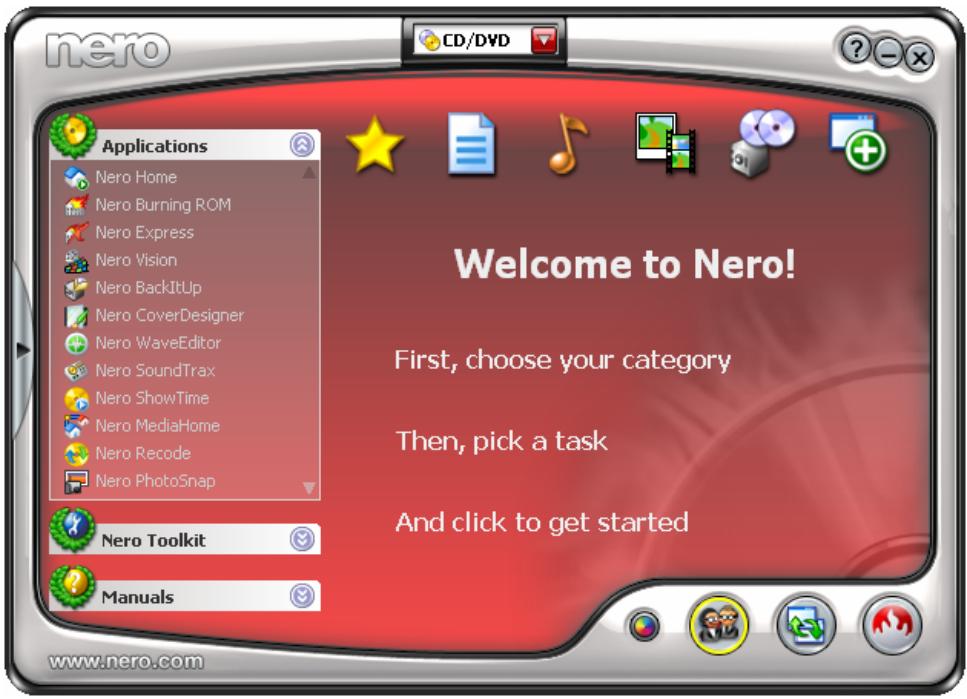
Fig. 1: Nero StartSmart
- Select the Nero CoverDesigner entry from the Applications selection list.
Nero CoverDesigner is opened with the New Document window.
You have started Nero CoverDesigner via Nero StartSmart.
4.2 Starting Nero CoverDesigner directly
To start Nero CoverDesigner directly, proceed as follows:
- If you are using the Windows® XP Start menu, click Start > All Programs > Nero 7 (Premium) > Labels > Nero CoverDesigner. If you are using the classic Start menu, click Start > Programs > Nero 7 (Premium) > Label > Nero CoverDesigner.
Nero CoverDesigner is opened with the New Document window.
You have started Nero CoverDesigner.
5 Main screen
The main screen of Nero CoverDesigner is the starting point for all of the actions that you can perform with Nero CoverDesigner. The screen consists of a menu bar, several toolbars, and the drawing area.
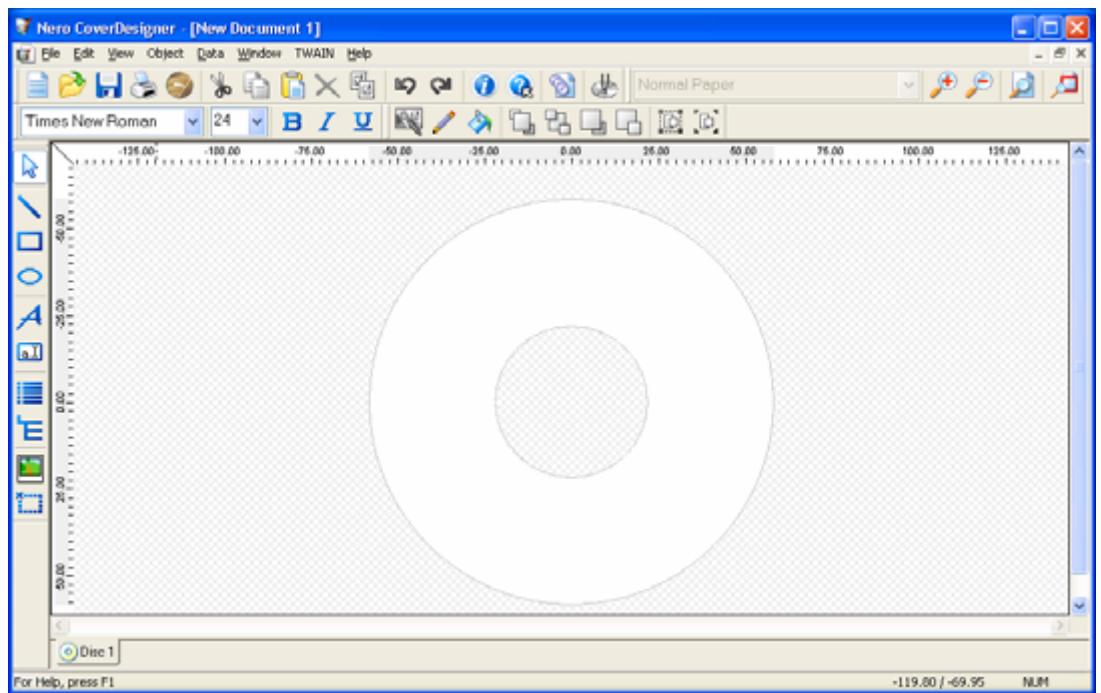
Fig. 2: Main screen of Nero CoverDesigner
5.1 Menu bar
The menu bar includes the following menus:
| File | Opens the File menu, which provides file-related functions such as open, save, and close. In addition, you can save files as templates, configure your printer and paper stock, make program-specific settings, as well as import and export information from and to Nero Digital™ files. |
| Edit | Opens the Edit menu, which provides editing functions such as cut, paste, duplicate, and delete. In addition, you can copy properties, change the applied template, change the backgrounds of the cover elements as well as add or delete cover elements as desired. |
| View | Opens the View menu, which allows you to hide and display screen and cover elements. In addition, you can display and use grid and guide lines as well as display objects in the editable area only. |
| Object | Opens the Object menu, which you can use for editing the individual objects of your drawing: You can insert objects, change their shape and position, group objects, as well as open the Properties window where you can edit the properties of objects. In addition, you can insert a background and set default settings for objects. |
| Data | Opens the Data menu with the Document Data entry, which allows you to enter document-specific data such as the disc name or track entries (see Document data window). |
| Window | Opens the Window menu, which allows you to change the position and arrangement of multiple open documents on the main screen (drawing area). You can also close all open documents as well. |
| TWAIN | Opens the TWAIN menu, which allows you to scan images if a scanner is attached. |
| Help | Opens the Help menu, which displays the online help for specific tasks. |
5.2 Toolbars
The following toolbars are available in Nero CoverDesigner:
| Standard | Provides standard functions for the document and objects. |
| View | Allows you to zoom in or out of the drawing area. In addition, you can select a paper stock for the current document. |
| Text | Allows you to format text. In addition, you can choose the font and size of the text. |
| Modify Objects | Provides functions for modifying and editing objects. |
| Tools | Provides various tools which you can use for inserting or selecting objects in the drawing area. |
The following icons are available in the toolbars:
| Standard toolbar | |
| Opens the New Document window where you can select the document type and template for a new document. | |
| Opens an existing Nero CoverDesigner document or Nero CoverDesigner template. | |
| Saves the current Nero CoverDesigner document. | |
| Prints the current Nero CoverDesigner document. | |
| Opens the LightScribe Print Properties window, where you can configure the printing options for LightScribe® and print a LightScribe® label. This icon is only available if a LightScribe® recorder is attached. | |
| Cuts a selected object out and stores it in the clipboard. | |
| Copies a selected object to the clipboard. | |
| Pastes an object from the clipboard. | |
| × | Deletes a selected object. |
| Applies the properties of one object to another. | |
| Undoes the last editing step. | |
| Restores an edit that has been undone. | |
| Opens the About Nero CoverDesigner window, where you can view the version number, for example. | |
| Opens the integrated online help. | |
| Opens the Document Data window, where you can enter data such as the disc title and tracks for the document (see Document data window). | |
| Opens the LabelFlash Print Properties window, where you can configure the printing options for LabelFlash™ and print a LabelFlash™ label. This icon is only available if a LabelFlash™ recorder is attached. | |
| View toolbar | |
| Magnifies the current view of the drawing area. | |
| Reduces the current view of the drawing area. | |
| Restores the standard view of the drawing area. | |
| Magnifies a selected area of the drawing area. | |
| Text toolbar | |
| B | Changes the selected text to bold. |
| I | Changes the selected text to italics. |
| U | Underlines the selected text. |
| Modify Objects toolbar | |
| Opens the Properties window for a selected object (see Properties and Back-ground Properties window). | |
| Applies a margin color to the selected object. | |
| Applies a fill color to the selected object. | |
| Positions the selected object in front of all the others. | |
| Moves the selected object behind all the others. | |
| Moves the selected object one position towards the top. | |
| Moves the selected object one position towards the back. | |
| Groups multiple selected objects. | |
| Ungroups objects. | |
| Tools toolbar | |
| Activates the selection tool, which you can use to select objects. | |
| Activates the line tool, which you can use to insert a line. | |
| Activates the rectangle tool, which you can use to insert a rectangle. | |
| Activates the ellipse tool, which you can use to insert an ellipse. | |
| A | Activates the text tool, which you can use to insert an artistic test. |
| a. | Activates the text box tool, which you can use to insert a text box. |
| Activates the track list tool, which you can use to insert a track list. A track list is a list of audio files (tracks). | |
| E | Activates the folder tool, which you can use to insert a folder. The folder refers to data files. |
| Activates the image tool, which you can use to insert an image. | |
| Activates the field tool, which you can use to insert different fields. | |

Track lists, folders, and fields are dynamic objects. The contents that are entered in the document data are entered here. You can modify this data as well. Dynamic objects are particularly useful for creating templates.
When you select a dynamic object and leave the cursor over the object, a floating toolbar appears after a brief interval. The following icons are available:
| Opens the Properties window (see Properties and Background Properties window). | |
| Opens the Document Data window (see Document data window). |
5.3 Drawing area
You lay out the cover elements in the drawing area. The drawing area consists of tabs for the different cover elements that belong to the selected document type or that you have added to a user-defined type, as well as the rulers at the top and on the left.
You can use the tabs in the drawing area to switch between the individual cover elements. If you want to view multiple cover elements at the same time, you can select the cover elements that should be visible from the View menu: The drawing area will then be divided into subwindows.
On the tabs you will find
- an editable, non-crosshatched area the size and shape of the selected cover element where the cover element is laid out, and
a crosshatched, non-editable area.

The gray line in the editable area is the edge of the cover element. The white outer margin represents the bleed area which you can configure in the Printing tab of the Application Preferences window (see Application Preferences window).

Bleeding means that your design is printed beyond the margin of the cover element so that it overlaps with it. Bleeding is useful to avoid "blank streaks" that can appear when the printout has shifted or the cover element is not trimmed precisely.
You should not place any text or important information in the bleed areas, of course. The design, however, should be expanded to fill the bleed area in order to ensure that the design is printed completely and no blank spots appear.
5.4 Objects
An object in Nero CoverDesigner is a design element that can be placed in the drawing area. Objects can be inserted, duplicated, moved, their size, shape, and appearance modified, and edited. The following objects are available in Nero CoverDesigner:
Geometric objects: line, rectangle, ellipse
Artistic text
Text box
Image
Dynamic objects: track list, folder, and fields
5.4.1 Dynamic objects
The track list, folder, and fields are dynamic objects.
These objects take the majority of their contents from the document data. Therefore, you cannot enter text in the objects; you must enter the contents in the document data instead (see Document data window).
- The track list takes its contents from the document data that contains the audio/chapter data for the tracks/chapters of an audio CD. Sample contents might be an automatically assigned sequential track number or information about the artist and/or title.
- The folder takes its contents from the document data about the files from the file system of a data CD. Sample contents might be an automatically assigned sequential number, the path and/or file name.
Fields take their contents primarily from the document data, for example, information about the title, artist, disc title, and/or release data. In addition, information about the save or print date and a user-defined text entry can be displayed as well.
6 Basic steps
In order to create a cover with Nero CoverDesigner, you have to create a new document first (see Creating a new document). If the document contains or should contain a track list, folder and/or fields, enter the document data (see Document data window).
You can now lay out the document as desired. You can:
- add cover elements if desired (see Adding a cover element),
■ assign another template (see Modifying a template),
insert and edit objects such as text and images on the tabs (see Inserting and editing objects), and
lay out the background (see Inserting and editing backgrounds).
Before the document is printed, you can set the print options (see Print window).

With a LightScribe® recorder and Nero CoverDesigner, you can print labels directly on LightScribe® discs (see Printing LightScribe® labels).

With a LabelFlash™ recorder and Nero CoverDesigner, you can print labels directly on LabelFlash™ discs (see Printing Labelflash™ labels).
7 New Document window
When you start Nero CoverDesigner, the New Document window is automatically opened along with the main screen. This window is your starting point for creating a new document. You can also open the window with the icon on the toolbar in the main screen.
The New Document window consists of two selection lists, a preview window, and setting options.
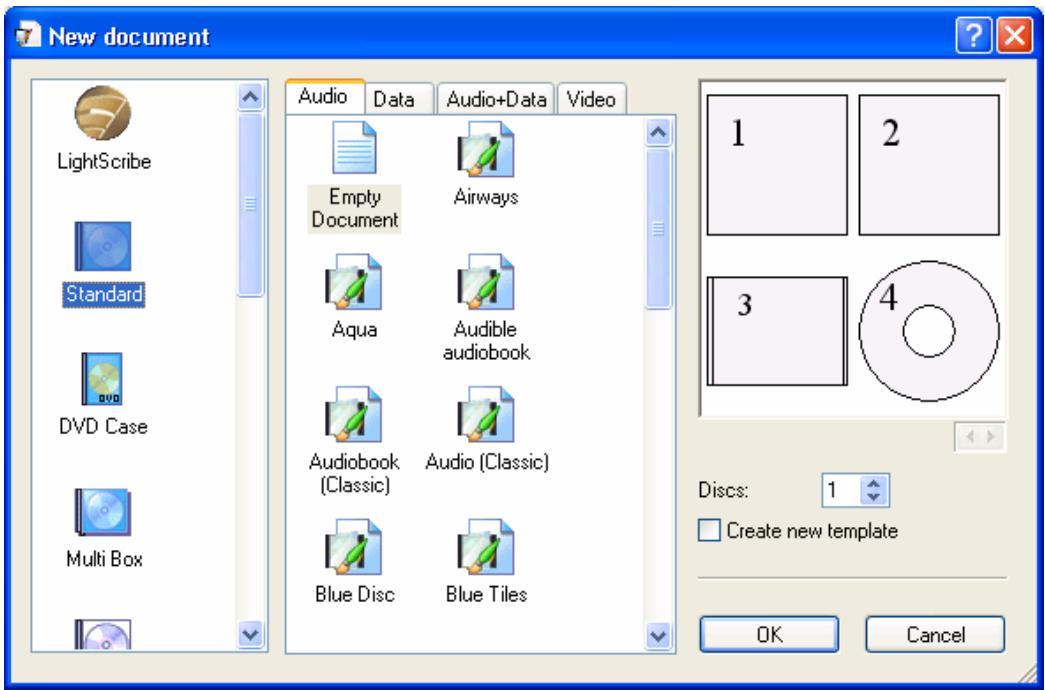
Fig. 3: New Document window
The document types are displayed in the left selection list (see Document type).
Templates for the selected document type are displayed in the right selection list, and there are four tabs available:
Audio for audio CD discs
Data for data discs
Audio+Data for audio and data discs
Video for video discs
The tabs contain templates for each disc type. The template can contain relevant fields like the playing time, or a track list for audio CDs. The disc type is automatically correctly set in the document data of a template.
The cover elements can be displayed with the template design in the preview window.
The following setting options are available in the New Document window:
| Setting option | Meaning |
| Discs | Sets the number of the Disk cover element in the document. Up to four discs can be added to the document. |
| Create new template | Creates a template, i.e., the document is saved in the *.nct format and listed in the templates list. |
| OK | Creates a new document and closes the window. |
| Cancel | Cancels the process and closes the window. |
7.1 Document type
With Nero CoverDesigner, you can select different document types. Each document type contains predefined cover elements that you can lay out. These are:
| Cover Element | Meaning |
| Booklet | Insert in the interior of the CD or DVD case as a booklet or individual sheet. Visible from the front in CD cases made from clear plastic. Normally it contains additional information about the disc, such as the track titles for audio CDs. |
| Inlay | Insert in the back of the CD case. For DVD cases, a continuous sheet that is inserted into the outer case of the DVD. The inlay is visible from the outside. |
| Disk | Label in the form of a disc. |
| Mini-Disc/ (Re-tangular) Biz Card | Label in Mini-Disc/business card/rectangular business card form. |
| Biz Card Enve-lope | Envelope for business card. |

When you select a document type, predefined cover elements that you can lay out are automatically added to the document.

If you would like to choose the cover elements yourself, select the Custom document type. Here you can insert any cover element you wish into the current document with the Edit > Insert New Page menu item.

The Full Template document type makes all the cover elements available.

Up to four discs can be added as cover elements to the Standard, DVD Case, Multi Box, Maxi, Slim Pack and Custom document types by adding an additional disc to the document data (see Document data window).
7.1.1 LightScribe document type
If you have a LightScribe® recorder, you can print the label side of a LightScribe® CD/DVD with Nero CoverDesigner. The label side of the disc has a special color or thermal layer that is heated by the laser in the recorder so that images and text are printed.

This function is only available in recorders that support LightScribe® technology.
The following element can be designed with Nero CoverDesigner:
| Symbol | Cover Element |
| ◎ | Disk |
7.1.2 LabelFlash document type
If you have a LabelFlash™ recorder, you can print the label and/or data side of a LabelFlash™ DVD with Nero CoverDesigner. A LabelFlash™ DVD has a special layer between the top and bottom layers; this layer can be heated by the laser in the recorder so that images and text can be printed on the DVD.

This function is only available with a LabelFlash™ recorder.
The following element can be designed with Nero CoverDesigner:
| Symbol | Cover Element |
| ○ | Disk |
7.1.3 Standard document type
The Standard document type corresponds to the customary jewel case for CDs. Jewel case packaging is usually made from clear plastic. The front and the back are joined by a hinge. There is space for the booklet behind the front piece. The tray holds the CD inside. The tray can be removed. There is room for the inlay under the tray.
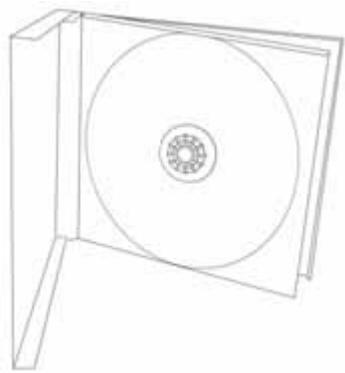
Fig. 4: Jewel case
The following elements can be designed with Nero CoverDesigner:
| Symbol | Cover Element |
| □ | Booklet (Front) |
| □ | Booklet (Rear) |
| □ | Inlay |
| ◎ | Disk |
7.1.4 DVD case document type
A DVD case is type of packaging for DVDs. The packaging is larger than a normal CD case and has a fold in the middle. The booklet is placed inside. The inlay is inserted between the plastic film and the exterior.
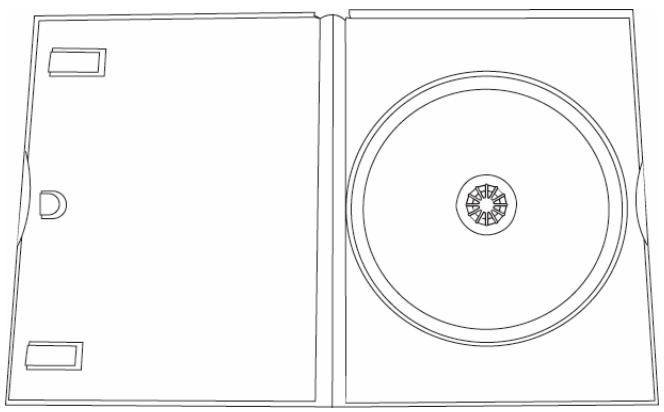
Fig. 5: DVD case
The following elements can be designed with Nero CoverDesigner:
| Symbol | Cover Element |
| □ | DVD Booklet for Interior |
| □□ | Inlay/DVD Supplement for Case |
| ◎ | Disk |
7.1.5 Multi box document type
A multi box is a type of packaging for multiple CDs and can usually be opened on two sides.
The following elements can be designed with Nero CoverDesigner:
| Symbol | Cover Element |
| □ | Booklet (Front) |
| □ | Booklet (Rear) |
| □ | Inlay (Front) |
| □ | Inlay (Rear) |
| ○ | Disk 1 |
| ○ | Disk 2 |
7.1.6 Maxi document type
The maxi format was developed for single CDs, i.e., CDs that contain one track instead of an entire album. A maxi case is thinner than a CD jewel case. Instead of a booklet it includes a sheet that has been folded twice on the right side so that it has a legible spine. The tray that contains the CD is integrated in the case and cannot be removed.
The following elements can be designed with Nero CoverDesigner:
| Symbol | Cover Element |
| □ | Maxi Inlay |
| ◎ | Disk |
7.1.7 Slim pack document type
A slim pack is thinner than a maxi CD. It is designed for single CDs and data discs created at home. Instead of a booklet it includes a single sheet that is not folded.
The following elements can be designed with Nero CoverDesigner:
| Symbol | Cover Element |
| □ | Booklet (Front) |
| □ | Booklet (Rear) |
| ◎ | Disk |
7.1.8 Mini CD document type
A mini CD is a CD with a diameter of 8 cm. Most drives have a recessed portion in the tray for mini CDs.
The following elements can be designed with Nero CoverDesigner:
| Symbol | Cover Element |
| □ | Mini Inlay (Front) |
| □ | Mini Inlay (Rear) |
| ◎ | Mini-Disc |
7.1.9 Biz card document type
The oval biz card is also known as a business card CD and is often used for advertising purposes.
The following element can be designed with Nero CoverDesigner:
| Symbol | Cover Element |
| = | Biz Card |
7.1.10 Rectangular biz card document type
The rectangular biz card has the same format as a standard business card.
The following element can be designed with Nero CoverDesigner:
| Symbol | Cover Element |
| ∞ | Rectangular Biz Card |
7.1.11 Biz card envelope document type
The biz card envelope is a cover for oval or rectangular biz cards.
The following element can be designed with Nero CoverDesigner:
| Symbol | Cover Element |
| Biz Card Envelope |
8 Creating a new document
There are three types of documents in Nero CoverDesigner. The distinguishing feature is how the background of the cover elements is created:
Standard Document: The background is created by the user or taken from the template as desired
Image Document: A selected image is used for all backgrounds
- Nero Digital™ Document: Cover art stored in the Nero Digital™ file is used for all backgrounds
8.1 Creating a new document or image document
To create new document or image document, proceed as follows:
- To create a new document, click the icon in the toolbar.
The New Document window is opened. - To create a new image document:
- Select File > New Cover from Picture from the menu.
The Open window appears. - Select the desired image file and then click on the Open button.
The New Document window is opened. - Select a document type from the left selection list (see Document type).
The right selection list displays the templates for the selected document type; the Audio tab is selected by default. - Click on one of the tabs in the right selection list to select a disc type.
The selection list displays the templates for the selected document and disc type. - Select an already designed template or the Empty Document template from the selection list on the right.
The selected template is displayed in the preview area. - If applicable, enter the number of discs that the document should contain.

You can increase the number of discs in the document afterwards as well by adding a disc to the document data.
- Click on the OK button.
The New Document window is closed. If you selected a template that contains dynamic objects, the Document Data window is displayed.
- If the Document Data was displayed, enter the document data (see Document data window), and then click OK.
The document data is applied and the Document Data window is closed. In the drawing area, the cover elements of the selected document type are displayed on tabs. If you have created an image document, the selected image is inserted as the background image of all the cover elements.
You have created a new document and can now finish the design (see, e.g., Inserting and editing objects and Inserting and editing backgrounds).
8.2 Creating a Nero Digital™ document
With Nero CoverDesigner, an album cover that has been stored in a Nero Digital™ file can be extracted and then used as a basis for a Nero CoverDesigner document.

Nero Digital™ is an MPEG-4 storage format for audio and video files that was developed by Nero AG. Nero Digital™ files can store additional information such as album covers as well.
To create a Nero Digital™ document, proceed as follows:
- Select File > New Cover from Nero Digital from the menu.
The Open window appears. - Select a Nero Digital™ file that contains a cover and then click the Open button.
The New Document window is opened; the Custom document type is selected. - To design a cover for Nero Digital™ audio, click on the Audio tab. To design a cover for Nero Digital™ video, click on the Video tab.
- Select the Nero Digital Cover template.
- Click on the OK button.
The New Document window is closed. In the drawing area, the cover elements that were stored in the Nero Digital™ file are displayed. The cover is used as the background image.
You have created a new Nero Digital™document and can now finish the design (see, e.g., Inserting and editing objects and Inserting and editing backgrounds).
9 Editing documents
9.1 Adding a cover element
If you selected the Custom document type, only the cover element for the disc label is initially available on the Disk 1 tab. You can add new cover elements to the document, however. To do so, proceed as follows:
- In the main screen, select Edit > Insert New Page from the menu.
The Insert Page window is opened. - Select the cover element that you want to add to the current document.
- Click on the Insert button.
The window is closed. The corresponding tab with the new cover element is added to the document.

You can remove cover elements with the Edit > Remove Current Page menu item. A document must contain at least one cover element, however.
9.2 Modifying a template
You can modify the template used for a document in order to select another design afterwards.

The document data of the original document remains intact but not necessarily all the inserted objects. Inserted objects are only retained if you select a template with the same document and disc type.
To modify a template, proceed as follows:
- In the main screen, select Edit > Change Template from the menu.
The Choose New Template window appears.
- Select a new template from the selection list on the right.
The Choose New Template window is closed.
The document appears with the design of the selected template.
9.3 Assigning a paper stock
You can assign a paper stock to every cover element. The dimensions of the cover element may change when you do so. Assigning a paper stock usually means that you want to print on special stock, from a particular manufacturer, for example.

If you change the size of a cover element, objects may end up outside the drawing area: Objects are positioned absolutely in relation to the ruler, i.e., the page dimensions, and not relative to the cover element itself.
To assign a paper stock to a cover element, proceed as follows:
- Click on the tab that contains the desired cover element.
The cover element is displayed.
- Click on the combo box in the View toolbar.
The combo box opens.
- Select a paper stock.
The combo box is closed and the selected paper stock is assigned to the cover element. The size, dimensions, and/or position of the cover element may change.
10 Saving documents
You can save a document that you have created in Nero CoverDesigner. This saves all of the document's cover elements and any document data that you have entered. You can save the document in compressed or uncompressed form. Compressing a document primarily compresses the images in the document.
To save a document, proceed as follows:
- To save the document as a compressed file, select File > Quick Save from the menu. To save the document without compression, select File > Save from the menu.

Saving the document in compressed form may be a good idea if it contains many images. The size of the document file will be smaller. Compression can reduce the image quality in some cases, however.
If you attempt to save a document with images that total more than 5 MB without compression, a dialog window is displayed asking you whether you want to save the file with or without compression.
The Save As window is then displayed.
- Enter the file name and path to save the file under.
- Click the Save button.
The Save As window is closed and the document is saved.
11 Document data window
You can view and/or enter document data in the Document Data window. Document data determines the content of the track list, folder, and fields dynamic objects that can be applied when designing a cover or label. You can enter the contents, name, etc., of the disc for which you want to create a cover or label.

When you launch Nero CoverDesigner from Nero Burning ROM, the document data is automatically filled in with the information from the compilation.

You can import data from a Nero Digital™ file into the document data by selecting File > Import from Nero Digital.
By default, the document data contains at least the Document, Disk 1 and a data type. You can add additional entries yourself.
Select Data > Document Data from the menu to open the window.

Fig. 6: Document Data window
The window consists of two areas: In the area on the left, the document data elements are displayed in a tree structure; in the area on the right, the input options for the currently selected element are displayed.
The tree structure of the document data can have up to four levels and represents the project or disc structure. You can enter information that can then be used by the dynamic objects on each level.
The top, or first level always contains the Document element, which refers to the entire project.
The next level, the second one, contains the discs that are contained in the project. You can add up to four discs to the Document element. You can specify a disc type for each disc; this entry affects the third and fourth levels. There are four disc types you can choose from:
Audio for audio CD disc types
Data for data discs
Audio+Data for audio and data discs
Video for video discs
By default, the disc type that you selected when you created the document in the New Document window is used for the discs.
The third level contains the data type or types that that are contained on the disc of the selected type. An audio CD, for example, contains audio files – in other words, the data type Audio/Chapter Data. A data disc contains pure data – in other words, the data type File System.
The fourth level contains the contents of the disc under its corresponding data type. Audio files (tracks), for example, are listed under Audio/Chapter Data, and data files under the File System data type.
11.1 Document
For the Document element, the following input options are available in the Document area on the right:
| Title | Specifies the title of the document. By the default, the document title is applied to the Subtitle input field for the disc as well. This information is used for the Title field type. |
| Year of release | Specifies the release year. This information is used for the Year field type. |
| Artist/Publisher | Specifies the artist or publisher. This information is used for the Artist field type. |
| Apply to all subitems | Applies the artist or publisher entry to the corresponding input fields Artist/Publisher for the Disc and Artist for the Tracks. |
| Add Disc | Adds a disc to the document data. Up to four discs can be added. The corresponding tabs from Disc 1 to Disc 4 with the new cover element for the disc label are added to the document. |
11.2 Disk
For the Disk element, the following input options are available in the Disk area on the right:
| Subtitle | Specifies the title of the disc. By default, the document title is applied to the input field. This information is used for the Disc Title field type. |
| Type | Specifies the disc type. Four types are available: Audio, Data, Audio+Data and Video. Depending on the selected disc type, the disc will contain different data types on the next level. This information is used for the Disc Type field. |
| Artist/Publisher | Specifies the artist or publisher of the disc. This information is used for the Disc Artist field type. |
| Apply to all subitems | Applies the artist or publisher entry to the Artist input field for the tracks. |
| Delete | Deletes the disc from the document data and its corresponding tab from the document. |
| Import Data | Opens the Read In An Import File window that you can use to select a CDC file. |

A CDC file is a text file that can contain information about discs such as the track titles. A number of programs exist that can generate a CDC file.
11.3 Data type
11.3.1 Audio/chapter data
Audio/Chapter Data appears as an entry for Audio, Audio+Data and Video disc types. Information about the track number and total playing time is displayed in the Audio/Chapter Data area on the right. The following buttons are available:
| Add Track | Adds a track entry to the data. |
| Delete All | Deletes all tracks from the data. |
11.3.2 File system
File System appears as an entry for Data, Audio+Data and Video disc types. Information about the number of entries and the total size is displayed in the File System area on the right. The following buttons are available:
| Add Files | Opens the Select the Files You Want to Add to the Disc window so that you can select a file. A new entry is added to the data and the file information is automatically applied. |
| Delete All | Deletes all file entries from the data. |
| Add Folder | Opens the Browse for Folder window so that you can select a folder. The folder is added to the data as a file entry. |
11.3.3 Video/picture data
Video/Picture Data appears as an entry for the Video disc type. The number of images is displayed in the Video/Screenshot Data area on the right. The following buttons are available:
| Add Picture | Displays the Open window so that you can select an image. A new entry is added to the data and the file information is automatically applied; the image is stored in the Nero CoverDesigner document. |
| Delete All | Deletes all file entries from the data. |

When you add an entry to the data, the information from the entry is applied to the document data and data structure is expanded accordingly.
If you add an image, the image is stored in the document as well. Tracks, folders, and data files are not stored in the document.
11.4 Data entry
11.4.1 Track/Chapter
For the Track/Chapter data entry, the following input options are available in the Audio Track area on the right:
| Title | Specifies the title of the track. |
| Artist | Specifies the artist of the track. |
| Playing Time | Specifies the playing time of the track. |
| Extended info | Provides additional information about the track. |
| Delete | Deletes the track entry. |
11.4.2 File Information
For the File Information data entry, the size and path of the file are displayed in the Audio Track area on the right. The following input options are available:
| Title | Specifies the title of the file. |
| Delete | Deletes the file entry. |
11.4.3 Image
For the Picture File data entry, the following input options are available in the area on the right:
| Title | Specifies the title of the image. |
| Delete | Deletes the image entry. |
12 Properties and Background Properties window
The Properties or Background Properties window offers numerous setting options for objects and the background. Different tabs are available depending on the currently selected object.
The Properties window for a selected object can be opened with the icon. You can edit the object by modifying the setting options in the window (see Inserting and editing objects).
The Background Properties window can be opened for all backgrounds by selecting Edit > Change All Backgrounds or for the background of the current cover element by selecting Object > Background Properties from the menu. You can insert and edit the background with the setting options in the window (see Inserting and editing backgrounds).
The following tabs are available:
| Tab | Explanation |
| Pen | Specifies whether the object has an outline. You can set the width and color as well (see Pen tab).This tab is available for all objects. |
| Brush | Specifies whether or not the object is filled and with what color. You can set the style and color as well (see Brush tab).This tab is available for the rectangle, ellipse, artistic text, text box, track list, folder, and field objects as well as the background. |
| Text | Determines the content and options for the text (see Text tab).This tab is available for the text and field objects. |
| Font | Determines the font, style, and size of the text. In addition, you can choose whether the text should be displayed in strikeout, underline and/or small caps. A preview window displays your changes.This tab is available for the text and field objects. |
| Text Box | Allows you to enter and format text (see Text Box tab).This tab is available for the text box object. |
| Bend | Bends the object (see Bend tab).This tab is available for the text box, track list, and folder objects. |
| Image | Allows you to select and edit an image (see Image tab).This tab is available for the image, text box, track list, and folder objects as well as the background. |
| Import Image | Provides import functions for images (see Import Picture tab). This feature is particularly useful for creating templates.For example, here you can determine whether a preview image is automatically displayed when you start Nero CoverDesigner from Nero Burning ROM and have created a compilation with the Audio Book CD disc format.This tab is available for the image object. |
| Import Text | Allows you to import a commentary.This function is only performed when you start Nero CoverDesigner from Nero Burning ROM and have created a compilation with the Audio Book CD disc format.This feature is particularly useful for creating templates for Audio Book CDs.This tab is available for the text box object. |
| Tracks | Provides options for the contents and appearance of the track list (see Tracks and Folder tabs). |
| Folder | Provides options for the contents and appearance of the folder (see Tracks and Folder tabs). |
| Field | Provides options for the contents and appearance of fields (see Field tab). |
12.1 Pen tab
The Pen tab provides settings for the object outline. The following setting options are available:
| X | Activates the outline. |
| Width | Determines the width of the outline. |
| Color | Shows the color of the outline. You can set the color with the color circle, brightness slider, or the input fields in the Select Color area. |
| Color Circle | Determines the color of the outline. You can move the small square in the middle of the color circle. This determines the color. You can see which color has been selected in the Color display field. |
| Brightness Slider | Determines the brightness of the outline color. You set the desired value with the slider. You can see the brightness that has been selected in the Color display field. |
| Hue | Sets the hue. You can enter a value between 0 and 255. The square moves around the radius of the color circle counterclockwise beginning on the right with the value 0 = red. |
| Saturation | Defines the saturation of the color. You can enter a value between 0 and 255. The square moves across the color circle in a straight line towards the exterior. A saturation of 255 means that one color component has a value of 255 and the other two both have a value of 0. |
| Brightness | Determines the brightness of the outline color. You can enter a value between 0 and 255. The brightness slider moves up or down. 255 means maximum brightness. |
| Red | Defines the red component of the color. You can enter a value between 0 and 255. The maximum red value is 255. |
| Green | Defines the green component of the color. You can enter a value between 0 and 255. The maximum green value is 255. |
| Blue | Defines the blue component of the color. You can enter a value between 0 and 255. The maximum blue value is 255. |

If the red, green, and blue components are equal, then the outline color is black (brightness 0), white (brightness 255), or gray (brightness value between 0 and 255).
12.2 Brush tab
The Brush tab provides fill setting options.
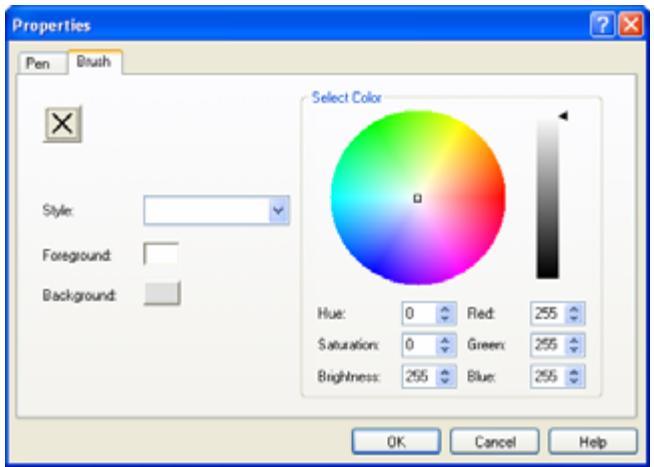
Fig. 7: Properties window, Brush tab
The following setting options are available:
| X | Activates the fill. When the brush option is deactivated, the background of the object is transparent. |
| Style | Selects a style. A style is always a mixture of two colors: the foreground and background color. No style is selected by default. |
| Foreground | Displays the foreground color. Click on the button to change the foreground color, i.e., apply any changes you make in the Select Colour area to the foreground color. The button displays the fill color if no style has been selected. |
| Background | Displays the background color. Click on the button to change the background color, i.e., apply any changes you make in the Select Colour area to the background color. The button is grayed out if no style has been selected. |
| Color Circle | Determines the fill color. You can move the small square in the middle of the color circle. This determines the color. You can see which color has been selected in the Color display field. |
| Brightness Slider | Determines the brightness of the fill color. You set the desired value with the slider. You can see the brightness that has been selected in the Color display field. |
| Hue | Sets the hue. You can enter a value between 0 and 255. The square moves around the radius of the color circle counterclock-wise beginning on the right with the value 0 = red. |
| Saturation | Defines the saturation of the color. You can enter a value between 0 and 255. The square moves across the color circle in a straight line towards the exterior. A saturation of 255 means that one color component has a value of 255 and the other two both have a value of 0. |
| Brightness | Determines the brightness of the color. You can enter a value between 0 and 255. The brightness slider moves up or down. 255 means maximum brightness. |
| Red | Defines the red component of the color. You can enter a value between 0 and 255. The maximum red value is 255. |
| Green | Defines the green component of the color. You can enter a value between 0 and 255. The maximum green value is 255. |
| Blue | Defines the blue component of the color. You can enter a value between 0 and 255. The maximum blue value is 255. |
12.3 Text tab
The Text tab provides setting options and determines the content of text and field objects. The following setting options are available:
| Read-Only | If the input field in the Content area is grayed out, the text can no longer be modified. This option is particularly useful when you are creating templates (see Creating and modifying templates). |
| Bent | Bends the text with the lower edge around a midpoint. |
| Rotate the text by 180 degrees | Rotates the text by 180 degrees, i.e., the text is rotated with its top edge around the midpoint. This option is only available if the Bent check box is selected. |
| Content | Defines the contents of the text. For field objects, this option is grayed out because the contents are dynamically generated from the document data (see Document data window). |
12.4 Text Box tab
You enter the contents of the text box on the Text Box tab. Unlike artistic text, a line break is possible in a text box. The usual text editing options are available: font and size selection, bold face, italics, underline, align, color, copy, and paste. The following check boxes are available:
| Fit to shape | Displays the text in the editable area only, even if the text box lies partially outside. The font size is not changed. |
| Read-only | Grays out the contents of the tab so that the text can no longer be modified. This option is particularly useful when you are creating templates (see Creating and modifying templates). |
12.5 Bend tab
The following check boxes are available on the Bend tab:
| Bend object | Bends the text with the lower edge around a midpoint. |
| Rotate the text by 180 degrees | Rotates the text by 180 degrees, i.e., the text is rotated with its top edge around the midpoint. This option is only available if the Bend object check box is se- lected. |
12.6 Image tab
On the Image tab, you can select an image and edit it if you wish. A preview of the image is displayed in the Image area. The Name field displays the name of the file.
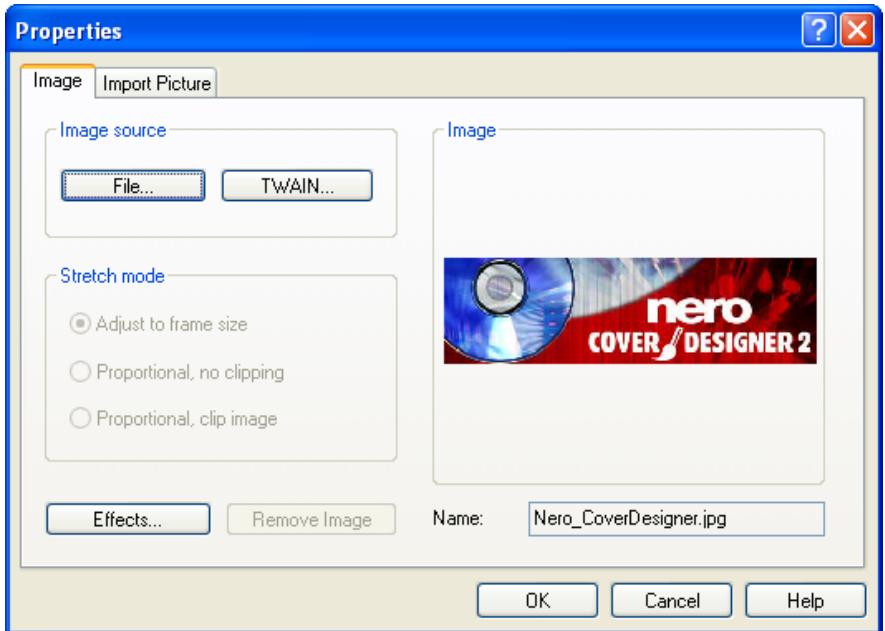
Fig. 8: Properties window, Image tab
The following setting options are available:
| Effects | Opens a menu where you can select different effects to apply to the image (see Image effects). |
| Remove Image | Removes the image. |
| Image Source Area | |
| File | Displays the Open browser window so that you can select an image file. |
| TWAIN | Scans an image. This feature is only listed if you have a scanner installed. |
| Stretch Mode Area This area is available for the background and images that were imported on the Import Picture tab. | |
| Adjust to frame size | Adjusts the image to match the background or frame size. If the background or frame is larger or smaller than the image, the image is expanded or reduced in size accordingly. This means that the width and/or length of the image may be distorted. |
| Proportional, no clipping | Adjusts the image proportionally to the background or frame size; the ratio of the width and length of the image (aspect ratio) remains the same. If the background or frame is larger or smaller than the image, blank areas may appear above/below or on the left/right of the image. The longest side determines how the image is resized. |
| Proportional, clip image | Adjusts the image proportionally to the background or frame size; the ratio of the width and length of the image (aspect ratio) remains the same. If the background or frame is larger or smaller than the image, areas may be clipped above/below or on the left/right of the image. The shortest side determines how the image is resized. |
12.6.1 Image effects
Nero CoverDesigner offers a variety of effects for images: The following effects are available:
| Color adjustment | |
| Brightness | Opens the Brightness window with before and after views of the image. Move the Brightness slider left or right to darken or lighten the image. |
| Contrast | Opens the Contrast window with before and after views of the image. Move the Contrast slider left or right to increase or decrease the contrast of the image. |
| Gamma . | Opens the Gamma window with before and after views of the image. Move the Gamma slider left or right to darken or lighten the midtones of the image. |
| Equalize | Applies the Equalize effect to an image. This effect distributes the brightness values of the colors equally. This effect is appropriate for adjusting an image that is too light or dark. It is also useful for making objects in the shadows more visible. |
| Filter | |
| Emboss | Creates an embossed version of the image. |
| Erode | Generates a watercolor version of the image, making the image softer and coarser. |
| Mosaic | Opens the Mosaic window with before and after views of the image. Move the Mosaic slider to the right to make the image coarser, creating a mosaic effect. |
| Outline | Draws the edges of the surfaces in the image, generating an out-line effect. |
| Parabolic > Concave | Generates a concave view. |
| Parabolic > Convex | Generates a convex view. |
| Posterize | Opens the Posterize window with before and after views of the image. Move the Posterize slider right or left to create an oil painting effect. |
| Sharpen | Opens the Sharpen window with before and after views of the image. Move the Sharpness slider to the right to make the image sharper and harder. |
| Soften | Opens the Soften window with before and after views of the image. Move the Soften slider to the right to make the image softer and less focused. In doing so, areas are merged together. |
| Solarize | Opens the Solarize window with before and after views of the image. Move the Solarize slider to the left to strengthen the light-ing effect. Move the slider completely to the left to invert the values and create a negative. |
| Flip | |
| Horizontal | Flips the image horizontally, the image appears as a mirrored image. |
| Vertical | Flips the image vertically, the image appears upside down. |
| Negative | Creates a negative of the image. |
| Pinch | Opens the Pinch window with before and after views of the image. Move the Pinch slider right or left to pinch or bloat the image in the middle. |
| Swirl | Opens the Swirl window with before and after views of the image. Move the Swirl slider right or left to swirl the image to the right or left. |
| Rotate | Opens the Rotate window with before and after views of the image. Move the Rotate slider to the right to rotate the image 90°, 180° or 270°. |
12.7 Import Picture tab
The Import Picture tab provides the following setting options:
| Import picture, if possible | Activates the Picture to import combo box. |
| Picture to import | Selects the image that should be imported. The following entries are available:Nothing: No image is imported.Thumbail: Imports a preview image when you start Nero CoverDesigner from Nero Burning ROM and have created a compilation with the Audio Book CD disc format. This feature is particularly useful for creating templates for Audio Book CDs Video Picture: Imports an image that you have added to the Video/Picture Data entry in the document data. You can deter-mine which image is imported with the Disc Number and Picture Number fieldsCOVER Art: Imports an image from a Nero DigitalTM file (if it is technically possible). |
| Import Original Picture | Imports the specified image. If the image has been modified, you can use this button to import the original image again. |
12.8 Tracks and Folder tabs
In the Tracks and Folder tabs, you can determine the appearance of the track list or folder and select which contents are displayed. The track list contains information from audio files, the folder contains information from data files. You cannot enter text in the track list/folder yourself – the contents are taken from the document data.
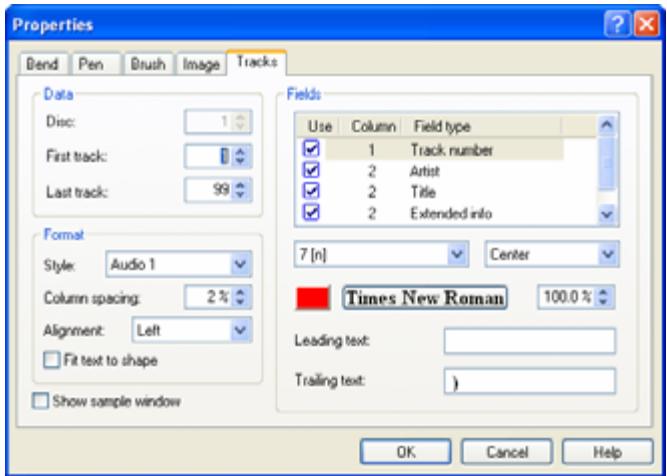
Fig. 9: Properties window, Tracks tab
Three areas and one check box are available:
| Show sample window | Opens the Sample preview window. |
| Data Area | |
| Disc | Species the disc that the information should be taken from. |
| First Track/Entry | Specifies the audio/data file from which the track list/folder should begin. |
| Last Track/Entry | Specifies the audio/data file at which the track list/folder should end. |
| Format Area | |
| Style | Selects a predefined style with which to display the track list/folder. The style can be modified in the Fields area. |
| Column Spacing | Sets the column spacing in percent. |
| Alignment | Specifies the alignment of the text. |
| Fit text to shape | Displays the text in the editable area only, even if the track list/folder lies partially outside. The font size is adjusted if necessary. |
| Fields Area | |
| Selection List | Displays the fields that are available in the selected style, such as track number or file path. The meaning of each column is as follows:Use: The field is visible in the track list/folder. If the check box is not selected, the field is not visible in the track list/folder.Column: Displays the column that the field will be displayed in.Field Type: Displays the field type, e.g., track number or title. |
| Left Combo Box | Selects a format for the selected field.Text can be displayed in normal, uppercase, lowercase, or reverse.Numbers can be displayed as single, double digits, or in Roman numerals.Playing times can be displayed in different formats, e.g., in seconds, M:SS, H:MM:SS, etc.File sizes can be displayed in bytes, KB or MB. |
| Right Combo Box | Selects an alignment for the selected field. The alignment always refers to the full column that the field is in. |
| Color Button | Opens the Choose Color window so that you can define a color for the selected field. The window is the same as the one for the Select Color area on the Pen and Brush tabs (see Pen tab).The button shows the currently selected color. |
| Font ButtonTimes New Roman | Opens the Font window so that you can choose a font, style, and effects for the selected field. You can also specify the character set to use in the Script combo box. A preview of the text is displayed in the Sample area.The button displays the currently selected font. |
| Input Field | Specifies a relative font size in percent for the selected field. |
| Leading Text | Specifies the text that appears in front of the selected field in the track list/folder. |
| Trailing Text | Specifies the text that appears after the selected field in the track list/folder. |
12.9 Field tab
The Field tab provides setting options for fields. Fields take their content from the document data for the most part. The Field tab consists of the Field Type selection list, the Options area, and a check box.
All of the field types are listed in the Field Type selection list. The Options area refers to the selected field type. Not all setting options are available for each field type. The following setting options are generally available:
| Field Type Area | Specifies the field type. The following field types are available: Title, Artist, Disc Type, Year, Disc Title, Disc Artist, Number of Tracks, Total Playing Time, Total Size of Files, Last Save Date, Print Date, and Custom Text. |
| Fixed Size | Specifies that the text has a fixed height even if the size of the frame is modified. The text height is based on the font size that is specified on the Font tab. If the check box is not selected, the text size is adjusted to match the frame size and vice versa. This feature is not available for bent text. |
| Options Area | |
| Alignment | Specifies the alignment of the selected field type in the frame. |
| Disc | Specifies which disc the selected field type refers to. |
| Time Format | Specifies the format for the playing time. |
| Size Format | Specifies the format for the file size. |
| Date Format | Specifies the format for the date. |
| Custom Text | Specifies the text for the Custom Text field type. |
| Leading Text | Specifies the text that appears in front of the selected field type. |
| Trailing Text | Specifies the text that appears after the selected field type. |

The field type that you select in the Field Type selection list is applied to the inserted field even if you assigned a different field type beforehand.
13 Geometry window
The position, size, and rotation of an object are determined in the Geometry window. To open the window, select Object > Geometry from the menu.
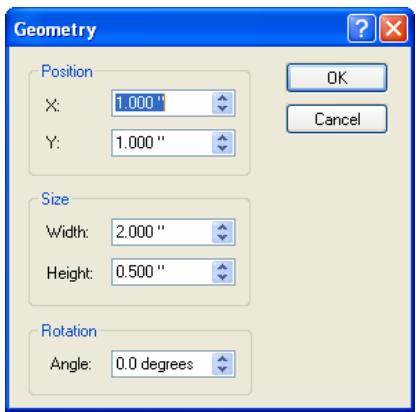
Fig. 10: Geometry window
The window contains the following fields:
| Position Area | |
| X | Specifies the X coordinate of the top left point of the frame. |
| Y | Specifies the Y coordinate of the top left point of the frame. |
| Size Area | |
| Width | Specifies the width of the object in mm. |
| Height | Specifies the height of the object in mm. |
| Rotation Area | |
| Angle | Specifies the angle of rotation. |
13.1 Geometry window for bent objects
For bent objects, the position of the center and the position of the object in terms of the center are specified in the Geometry window. To open the window, select Object > Geometry from the menu.
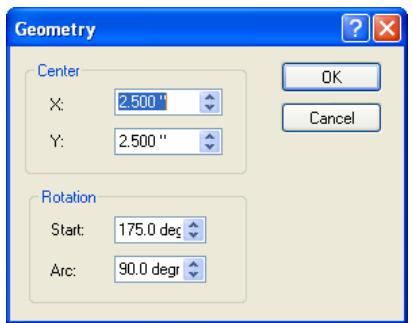
Fig. 11: Geometry window for bent objects
The window contains the following fields:
| Center Area | |
| X | Specifies the X coordinate of the center point (which the object is rotated around). |
| Y | Specifies the Y coordinate of the center point (which the object is rotated around). |
| Rotation Area | |
| Start | Specifies the position of the text in relation to the center point. The starting point of the text is the left edge of the first character. The division into degrees is the one commonly used in mathematics: 0 degrees is on the right at the height of the midpoint and the units progress in a counterclockwise direction. |
| Arc | Specifies the arc to apply to the text. Selecting 180 degrees, for example, bends the text in a semicircle. |
14 Align Elements window
The Align Elements window aligns objects relative to the page, i.e., the editable drawing area, or another object. To open the window, select Object > Align from the menu.

This feature is not available for bent objects.
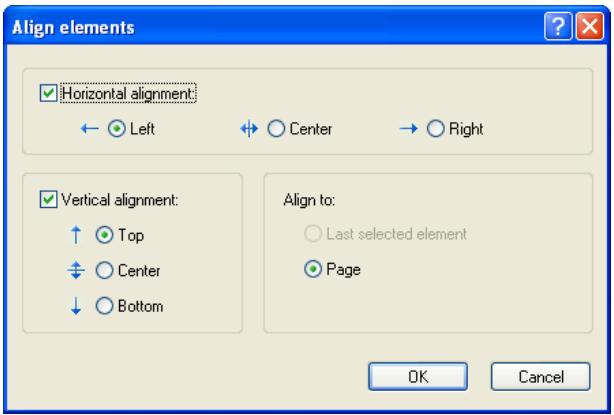
Fig. 12: Align Elements window
The window contains the following check boxes and option buttons:
| Horizontal Alignment | Specifies the horizontal alignment. There are three option buttons: Left: Aligns the object along the left edge. Center: Centers the object. Right: Aligns the object along the right edge. |
| Vertical Alignment | Specifies the vertical alignment. There are three option buttons: Top: Aligns the object along the top edge. Center: Centers the object. Bottom: Aligns the object along the bottom edge. |
| Align To | |
| Last Selected Element | Aligns the object with another. In order to use this feature, two objects must be selected; the object that was selected last will be aligned in relation to the first. This feature is useful for positioning two objects on top of one another, e.g., text on an image. |
| Page | Aligns the object to the page, i.e., to the editable area. |
15 Inserting and editing objects
In Nero CoverDesigner, you can insert objects in order to design cover elements for a document. An inserted object is automatically selected and can be edited.
15.1 Inserting object
To design a cover element, you can insert objects in the drawing area. To do so, proceed as follows:
-
To insert a line:
-
Click the icon on the toolbar.
The cursor changes to a crosshair with a line symbol.
- Click in the drawing area and drag the cursor.
The line is inserted.
To insert a rectangle:
- Click the icon on the toolbar.
The cursor changes to a crosshair with a rectangle symbol.
- Click in the drawing area and drag the cursor.
The rectangle is inserted.
-
To insert an ellipse:
-
Click the icon on the toolbar.
The cursor changes to a crosshair with an ellipse symbol.
- Click in the drawing area and drag the cursor.
The ellipse is inserted.
-
To insert artistic text:
-
Click the A icon on the toolbar.
The cursor changes to a crosshair with an A.
- Click in the drawing area.
A vertical line is inserted.
- Enter the text directly in the drawing area.

You cannot enter artistic text with a line break. To enter longer text with line breaks, use the text box object.
-
Press the Enter key.
-
To insert a text box:
-
Click the aI icon on the toolbar.
The cursor changes to a crosshair with "Abc".
- Click in the drawing area and drag the cursor.
The Properties window is opened at the Text Box tab (see Text Box tab).
- Enter the text in the input area.
- Specify the text options.
-
Click on the OK button.
The text box is inserted with the text that you entered. -
To insert a track list or folder:
-
Click the or E icon on the toolbar.
The cursor changes to a crosshair with a track list or folder symbol. -
Click in the drawing area and drag the cursor.
The track list or folder is inserted. If you have completed the document data, the corresponding contents are displayed (see Document data window). -
To insert an image:
-
Click the icon on the toolbar.
The Open browser window is displayed. - Select an image file and then click on the Open button.
The Open window is closed. The cursor changes to a crosshair with a camera symbol, and the frame of the selected image is displayed around the pointer.
-
Click in the drawing area.
The selected image is inserted. -
To insert a field:
-
Click the icon on the toolbar.
The extended dialog box is opened and displays the field types. -
Select a field type.
The cursor changes to a crosshair and an outline of the selected field is displayed in the background. - Click in the drawing area.
The field is inserted. If you have completed the document data, the corresponding contents are displayed (see Document data window). If the document data is empty, the field type name is displayed in angled brackets.

The inserted object is automatically selected and displays a frame with the anchor points of the frame and a rotation arrow.
You have successfully inserted an object. Now you can edit it and continue designing the cover.
15.2 Modifying size, shape, and position
You can edit an inserted object with Nero CoverDesigner. You can modify the size, shape, position, and, if desired, color. There are always two ways to modify the size, shape, and position of an object:
- Precision changes, in which the settings are made in the Geometry, Align Elements and/or Properties window.
- Manual changes, in which objects are moved, transformed, and rotated using their frames, anchor points, and a rotation arrow.
To edit an object, proceed as follows:
- Click the 品 icon (selection tool) on the toolbar.
- Select the object that you want to edit.
A frame with anchor points and a rotation arrow are displayed around the object.
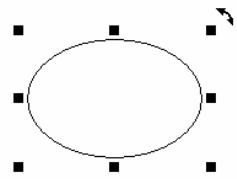
Fig. 13: Selected object
-
To change the position, size, and/or rotation of an object precisely:
-
Select Object -> Geometry from the menu.
The Geometry window appears. - Enter the desired position, size, and rotation (see Geometry window).
-
Click on the OK button.
The window is closed and the object is modified according to your new entries. -
To align an object precisely in the drawing area:
-
Select Object -> Align from the menu.
The Align Elements window is displayed. - Set the desired options (see Align Elements window).
-
Click on the OK button.
The window is closed and the object is positioned according to your new entries. -
To change the position of an object manually, hold down the mouse button and move the object.

With bent objects, you can use this technique to change the position and bend in relation to the midpoint.
-
To change the position of the midpoint of a bent text:
-
Click on the midpoint.
The cursor changes to a crosshair.
- Move the midpoint while holding down the mouse button.
The position of the midpoint is modified.
-
To change the size or shape of an object manually:
-
Move the cursor over an anchor point on the frame.
The cursor changes to a double arrow that shows you the direction in which you can pull the object.
- Click on the anchor point and pull it in the desired direction.
The object becomes larger or smaller.

With bent objects, you can use this technique to change the arc that the text follows.
-
To change the rotation of an object manually:
-
Move the cursor over the rotation arrow of the frame.
The cursor changes to a rotation arrow.
- Click on the rotation arrow and rotate the object in the desired direction.
The rotation of the object is changed.
-
To change properties such as the pen, brush, font, etc.:
-
Click on the icon.
The Properties window is displayed. The tabs in the window can vary depending on the currently selected object.
-
Specify the properties in the tabs (see Properties and Background Properties window).
-
Click on the OK button.
The window is closed and the object is modified to match your new entries.
-
To change the contents of artistic text:
-
Click the A icon on the toolbar.
The cursor changes to a crosshair with an A.
-
Click on the artistic text and change the content as desired.
-
Press the Enter key.
You have edited the object.
15.3 Converting artistic text
With Nero CoverDesigner, you can convert artistic text to a graphic element. The text properties can no longer be edited after the conversion. To convert artistic text, proceed as follows:
-
Click the icon (selection tool) on the toolbar.
-
Select the artistic text that you want to convert.
A frame with anchor points and a rotation arrow are displayed around the text.
- Select Convert to Curves in the context menu.
A dialog window is displayed that informs you that the text will be converted to a graphic element and that you will no longer be able to edit the text properties.
- Click on the OK button.
The dialog window is closed, and the artistic text is converted.
You have successfully converted artistic text to a graphic element. The Pen and Brush tabs are available in the Properties window.
15.4 Applying image effects
In Nero CoverDesigner, you can apply a wide range of effects to images. To do so, proceed as follows:
- Click the 品 icon (selection tool) on the toolbar.
-
Select the image that you want to edit.
A frame with anchor points and a rotation arrow are displayed around the text. -
Click on the icon.
The Properties window is displayed.
- Click on the Effects button.
A menu is displayed. - Choose the desired effect (see Image effects).
The corresponding effect window with before and after views of the image is displayed.

For some effects, no window is displayed; the effect is applied immediately instead, like with Negative, for example.
- Select the desired value with the slider.
- Click on the OK button.
The window is closed.
The Image area displays the current view of the image.
- Add additional effects if you wish.
- Click on the OK button.
The Properties window is closed.
The image in the drawing area is modified to match your new entries.

If you are not satisfied with the effect(s), you can undo your last action(s) with the icon on the toolbar.
The number of actions that you can undo depends on the value that was entered in the Application Preferences. You can change this value in the Application Preferences window (see Application Preferences window).
15.5 Specifying default settings for objects
In Nero CoverDesigner, you can specify default settings for objects. The default settings determine the entries in the tabs of the Properties window for an object (see Properties and Background Properties window).

Default settings cannot be specified for images.
To specify default settings for objects, proceed as follows:
-
To specify default settings for geometric objects:
-
Select Object > Default Graphic Properties from the menu.
The Default Properties window with the Pen and Brush tabs is displayed.
-
Specify the desired properties in the tabs (see Properties and Background Properties window).
-
Click on the OK button.
The window is closed. Geometric objects will now be inserted with the selected properties by default.
-
To specify default settings for artistic text and fields:
-
Select Object > Default Artistic Text Properties from the menu.
The Default Properties window with the Pen, Brush, Font, and Field tabs is displayed.
-
Specify the desired properties in the tabs (see Properties and Background Properties window).
-
Click on the OK button.
The window is closed. Artistic text and fields will now be inserted with the selected properties by default.
-
To specify default settings for text boxes, track lists, and folder:
-
Select Object > Default Text Box Properties from the menu.
The Default Properties window with the Pen, Brush, Folder, and Tracks tabs is displayed.
-
Specify the desired properties in the tabs (see Properties and Background Properties window).
-
Click on the OK button.
The window is closed. Text boxes, track lists, and folders will now be inserted with the selected properties by default.

Some of the changes that you make in the tabs may not apply to all objects under some circumstances.
You have successfully configured the default settings for objects.
16 Inserting and editing backgrounds
In Nero CoverDesigner, you can insert and edit a background. You can insert or edit the backgrounds for all the cover elements of a document at the same time or insert or edit the background of a cover element separately.
To insert a background and edit its properties, proceed as follows:
- To insert or edit the background for the current cover element, select Object > Background Properties from the menu.
To insert or edit the background for all the cover elements of the document, select Edit > Change All Backgrounds from the menu.
The Background Properties window is displayed.
-
To create a colored background:
-
Click on the Brush tab.
-
Select a color and a style, if desired (see Brush tab).
-
To insert a background image:
-
Click on the Image tab.
- Select an image file in the Image Source area.
The image is displayed in the Image preview area. The Stretch Mode area is active.
- In the Stretch Mode area, specify how the background image is scaled (see Image tab).
-
Apply any desired effects to the image (see Image effects).
-
Click on the OK button.
The background is displayed according to your settings.
17 Design tools
17.1 Grid
A grid can be used to position objects. In Nero CoverDesigner, the grid is displayed as a series of dots with equal horizontal and vertical spacing. The following options are available in the View menu of Nero CoverDesigner:
| Show Grid | Displays the grid. |
| Snap to Grid | Aligns objects to the grid. Objects are snapped to the grid points when they are moved or drawn near them. |
| Grid Setup | Displays the Grid Setup window where you can specify the horizontal and vertical spacing of the grid points. |
17.2 Guidelines
Guidelines are lines that can be used to help position objects. In Nero CoverDesigner, guidelines are displayed as dashed blue lines. The following options are available in the View menu of Nero CoverDesigner:
| Show Guidelines | Displays the guidelines. |
| Snap To Guidelines | Aligns objects along the guidelines. Objects are snapped to the guidelines when they are moved or drawn near them. |
| Guidelines | Displays the Guidelines window where you can create horizontal and/or vertical guidelines. |

You can also create guidelines manually by clicking on the horizontal or vertical ruler and dragging a guideline onto the drawing area.
18 Creating and modifying templates
18.1 Creating a template
With Nero CoverDesigner, you can create your own templates. To do so, proceed as follows:

Document data is not saved when the document is saved as a template.
- Click the icon on the toolbar.
The New Document window appears.
- Select the document type and an empty or predesigned template.
- Select the Create New Template check box.
- Click on the OK button.
The New Document window is closed and the predefined cover elements for the selected document type are displayed in the drawing area.

If you selected the Custom document type, you can add new cover elements by selecting Edit > Insert New Page from the menu.
- Lay out the document as desired (see Inserting and editing objects and Inserting and editing backgrounds, for example).
- To save the template as a compressed file, select File > Quick Save from the menu. To save the template without compression, select File > Save from the menu.
If you attempt to save a template with images that total more than 5 MB without compression, a dialog window is displayed asking you whether you want to save the file with or without compression. The Save As window is then displayed.

Saving the template in compressed form may be a good idea if it contains a large number of images. The size of the template file will be smaller. Compression can reduce the image quality in some cases, however.
- If the My Documents folder is displayed, select the Nero CoverDesigner Templates folder from the Save In combo box.
- Enter a file name and click on the Save button.
The template file is saved under the selected name. It will now be available in the template list of the New Document window under the document and disc type that you selected when you created it or whose cover elements are contained in the template file.

Even if you did not select the Create New Template check box at the beginning, you can still create a template. In this case, simply select Save as Template from the File menu. Make certain that you save the template file in the Nero CoverDesigner Templates folder so that it appears in the template list.
18.2 Modifying a template
You can also modify a template in Nero CoverDesigner. To do so, proceed as follows:
- Select File > Open from the menu.
A browser window is displayed.
- Select the desired Nero CoverDesigner template file (.nct) from the Nero CoverDesigner Templates folder and then click on the Open button.
The browser window is closed. A dialog window is displayed that asks you whether you want to edit the template.
- Click on the Yes button.
The template document is opened.
-
Edit the document as desired (see Inserting and editing objects and Inserting and editing backgrounds, for example).
-
Click on the button.
The changes to the template are saved. You can now close the template and use it to create a new document.
19 Saving covers in Nero Digital™ files
With Nero CoverDesigner, you can save an album cover in a Nero Digital™ file. Nero Digital™ is an MPEG-4 storage format for audio and video files that was developed by Nero AG. The designed cover element is stored in the file as cover art. This means that an image of your final cover element design is created and saved as a background image.

Any existing cover elements of the same type (e.g., a booklet) in the Nero Digital™ file are overwritten. We recommend that you create a Nero Digital™ document beforehand (see Creating a Nero Digital™ document) to see whether any cover art has been stored in the Nero Digital™ file already.
The following requirement must be met:
- You have created a document complete with designed cover elements.
To save a cover in a Nero Digital™ file, proceed as follows:
- Select File > Export to Nero Digital from the menu.
The Save As window is displayed.
-
Select the Nero Digital™ file in which you want to save the cover.
-
Click on the Save button.
The cover elements are saved in the Nero Digital™ file. You can now use the Nero Digital™ file to create a Nero Digital™ document that contains the stored cover elements (see Creating a Nero Digital™ document).
20 Printing LightScribe® labels
If you have a LightScribe® recorder, you can also print the label side of a LightScribe® CD/DVD with Nero CoverDesigner. The label side of the disc has a special color or thermal layer that is heated by the laser in the recorder so that images and text are printed.

This feature is only available for LightScribe® recorders.
Using LightScribe® Direct Disc Labeling
Your computer requires the latest LightScribe® System Software if you are using a CD/DVD drive which supports LightScribe®.
Please install the LightScribe® System Software separately if you have installed a newer version of Nero 7 from the Nero website. You can find the latest version under www.nero.com/link.php?topic_id=93.
To print a LightScribe® label, proceed as follows:
- Create a new document with the LightScribe document type (see Creating a new document).
The document contains a Disk 1 tab with the cover element for the disc label. - Edit the disc label as desired (see Inserting and editing objects and Inserting and editing backgrounds, for example).
- Click the icon on the toolbar.
The LightScribe Print Properties window is displayed. - Set the desired print options (see LightScribe Print Properties window).
- Insert a blank LightScribe® disc into the LightScribe® recorder with the label side facing down.
- Click on the Print button.
The printing process begins. You can monitor the process status with the progress bar. As soon as the printing is finished, the Nero - LightScribe dialog window appears and displays a message about the result of the printing process. - Click on the OK button.
You have successfully created and printed a custom LightScribe® label.
20.1 LightScribe Print Properties window
You can customize the print properties of your LightScribe® label to suit your requirements in the LightScribe Print Properties window.
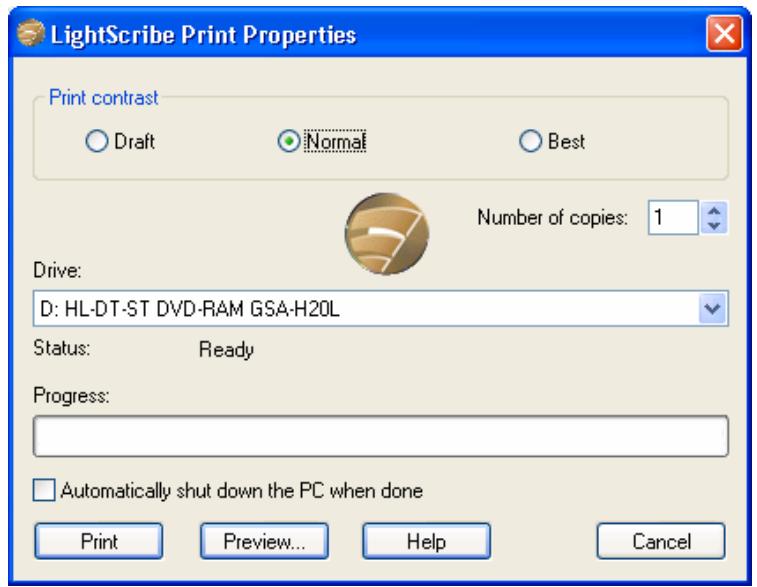
Fig. 14: LightScribe Print Properties window
The following text boxes and buttons are available:
| Print contrast | Adjusts the desired print quality. This option button is set to Normal by default. |
| Number of copies | Specifies the number of copies to make. |
| Drive | Specifies the recorder to use. Available only if multiple LightScribe® recorders are available. |
| Automatically shut down the PC when done | Shuts down the computer after the label has been printed (if possible). |
| Starts printing the label. | |
| Preview | Opens the LightScribe Print Preview dialog window. A print preview of the label is displayed here. |
21 Printing Labelflash™ labels
If you have a LabelFlash™ recorder, you can also print the label on the label side and/or data side of a LabelFlash™ DVD with Nero CoverDesigner.
A LabelFlash™ DVD has a special layer between the top and bottom layers; this layer can be heated by the laser in the recorder so that images and text can be printed on the DVD. LabelFlash™ is technology that allows you to print on both the label as well as the data side of DVDs in the recorder. If the data side is printed on, the process is referred to as DiscT@2™.

This feature is only available with a LabelFlash™ recorder.

The same procedure is used for creating and printing on the label and data sides. You can print the label side of the DVD at any time.
Print the data side only after you have finished burning your compilation. It is no longer possible to burn data once the data side has been printed.
To print a LabelFlash™ label on the label side or a DiskT@2 on the data side of your DVD, proceed as follows:
- Create a new document with the LabelFlash document type (see Creating a new document or image document).
The document contains a Disk 1 tab with the cover element for the disc label.
-
Edit the disc label as desired (see Inserting and editing objects and Inserting and editing backgrounds, for example).
-
Click the icon on the toolbar.
The LabelFlash Print Properties window is displayed.
-
Set the desired print options (see LabelFlash™ Print Properties window).
-
Select the side that you want to print on.
The logo in the bottom left corner displays the corresponding LabelFlash™ or DiskT@2™ logo.
-
If you want to print a LabelFlash™ label on the label side, insert a blank LabelFlash™ disc in the recorder with the label side facing down. To print a DiskT@2 on the data side, insert a blank LabelFlash™ disc in the recorder with the data side facing down.
-
Click on the OK button.
The LabelFlash™ Print or DiskT@2™ Print window is displayed and the print process starts. You can monitor the process status with the progress bar. As soon as printing is finished, a dialog window appears and displays a message about the result of the printing process.
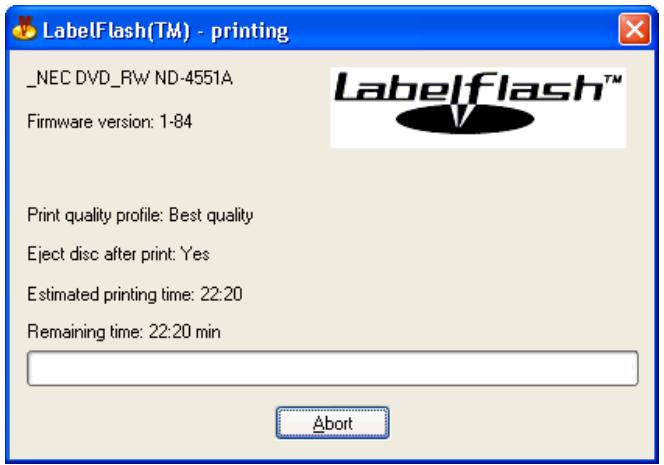
Fig. 15: LabelFlash™ Print window
- Click on the OK button.
You have successfully created and printed a custom LabelFlash™ label or DiskT@2™.
21.1 LabelFlash™ Print Properties window
You can customize the print properties of your LabelFlash™ label to suit your requirements in the LabelFlash Print Properties window.
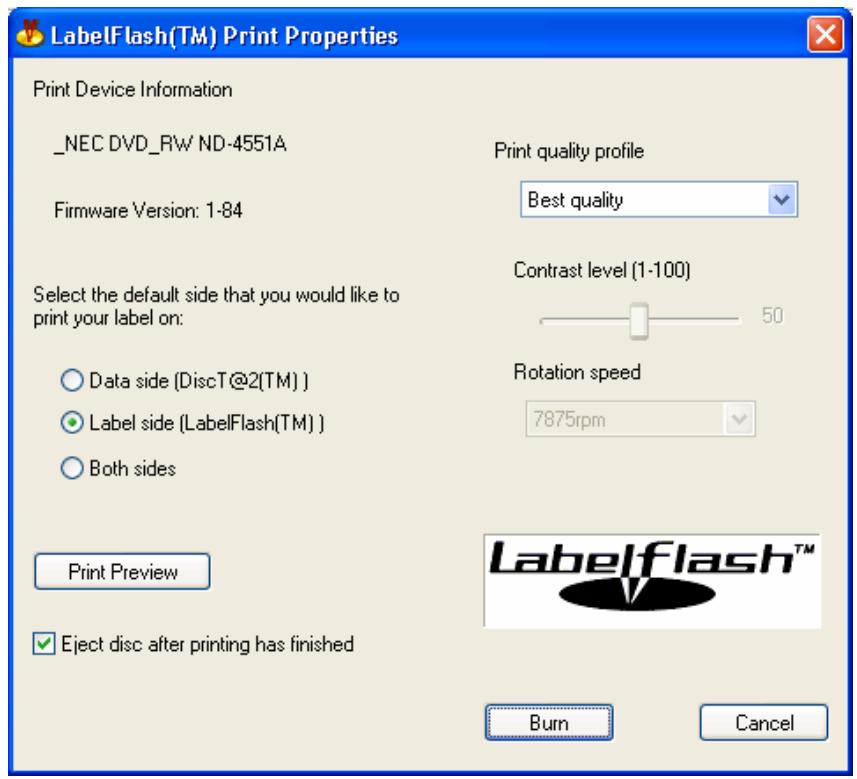
Fig. 16: LabelFlash™ Print Properties window
The following text boxes and buttons are available:
| Profile for | Adjusts the desired print quality. Select Custom to change the contrast level and rotation speed. |
| Contrast level | Specifies the contrast level for printing. |
| Rotation speed | Specifies the rotation speed of the DVD. |
| Data Side | Specifies that the data side should be printed on by default. |
| Label Side | Specifies that the label side should be printed on by default. |
| Both | Specifies that both sides should be printed on by default. |
| Print preview | Opens the Print Preview window that shows how the label will look on the LabelFlash™ DVD approximately. |
| Eject disc after print | Ejects the disc after printing is complete. |
| Burn | Starts the printing process. |
22 Print window
You set the print options for the document in the Print window prior to printing. The window consists of three tabs:
| General | Allows you to select a printer. |
| Properties | Provides setting options for printing paper borders and crop marks as well as for bleeding. |
| Elements | Selects the cover elements for printing. |

Paper borders indicate the borders and folds of the cover element with solid lines.
Crop marks indicate the borders and folds of the cover element with markings outside the cover element.

Bleeding means that your design is printed beyond the margin of the cover element so that it overlaps with it. Bleeding is useful to avoid "blank streaks" that can appear when the printout has shifted or the cover element is not trimmed precisely.
22.1 Properties tab
The Properties tab contains three areas: Print Borders, Print Crop Marks and Miscellaneous.
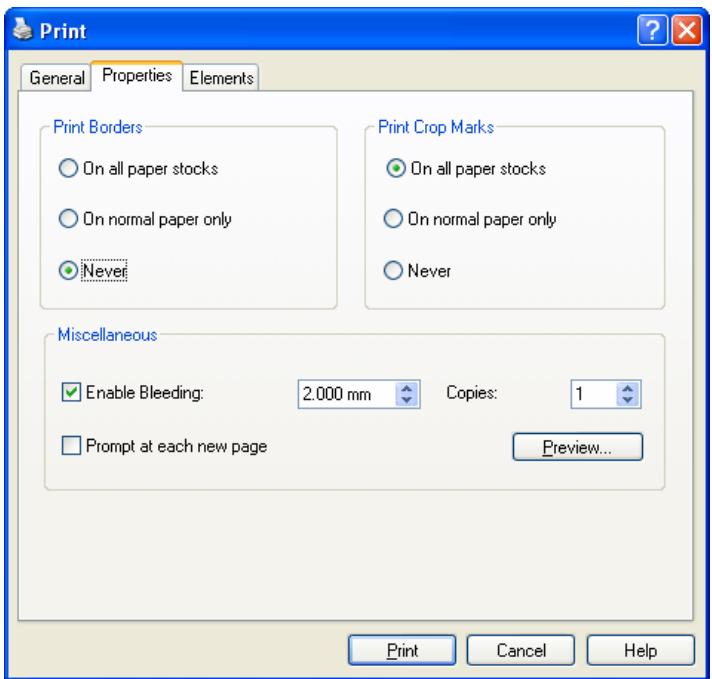
Fig. 17: Print window, Properties tab
The General tab provides the following setting options:
| Print Borders Area | |
| On all paper stocks | Prints borders for all paper stocks. |
| On normal paper only | Prints borders on normal paper stock only. |
| Never | Never prints paper borders. |
| Print Crop Marks Area | |
| On all paper stocks | Prints crop marks for all paper stocks. |
| On normal paper only | Prints crop marks on normal paper stock only. |
| Never | Never prints crop marks. |
| Miscellaneous Area | |
| Enable Bleeding | Enables bleeding and specifies how far beyond the edge of the cover element will be printed. |
| Prompt at each new page | Specifies that printing must be confirmed for each new page. |
| Copies | Specifies how many times the document should be printed. |
| Preview | Opens the Print Preview window. |
22.2 Elements tab
The Elements tab contains a selection list, a preview area, as well as setting options.
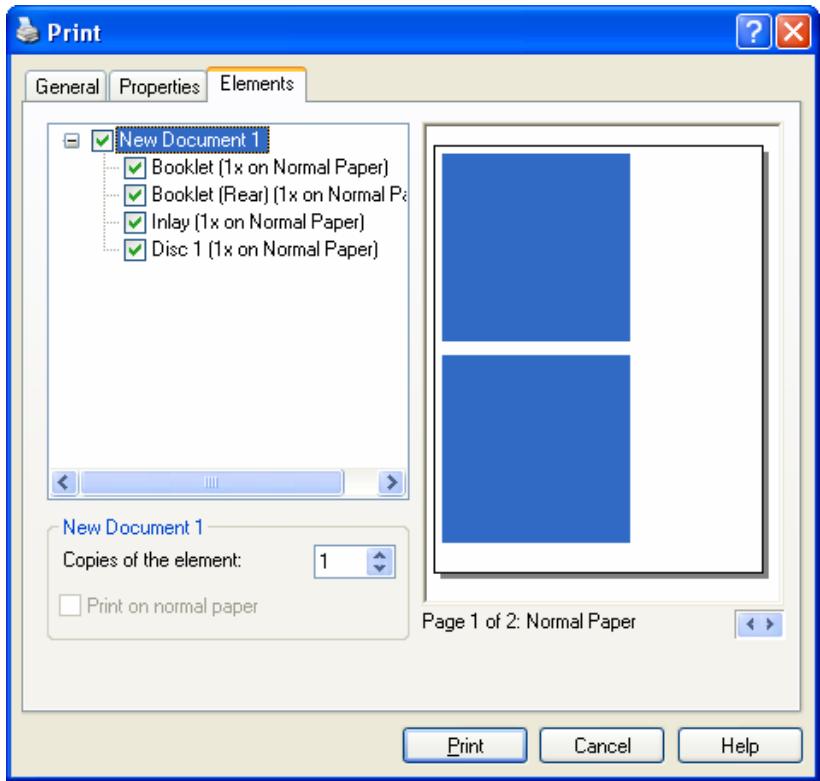
Fig. 18: Print window, Elements tab
You can select the cover elements to print in the selection list.
The preview area shows how the cover elements that are to be printed will appear on the page. The paper stock that the currently displayed cover elements will be printed on is displayed below the preview area. Cover elements that will be printed are displayed in blue - cover elements that will not be printed are displayed in gray.
The following setting options are available:
| Copies of the Element | Specifies how many times the selected cover element should be printed. |
| Print on normal paper | Prints the selected cover element on normal paper. This check box is only available if the normal paper stock has not been assigned to the cover element. |
22.3 Printing documents
The following requirement must be met:
You have already opened a document.
To print a document or part of it, proceed as follows:
- Select File > Print from the menu.
The Print window is displayed. - Select a printer on the General tab.
- Select the desired options on the Properties tab (see Properties tab).
- On the Elements tab, select the cover elements that should be printed (see Elements tab).
- If you have assigned different paper stocks to the cover elements, check below the preview area to see in which order the paper stock will be printed. Insert the paper/media in the printer in the correct order.
- Click on the OK button.
The document or selected cover elements are printed.
23 Print settings and paper stocks
In Nero CoverDesigner, you can specify the print and paper stock settings.
23.1 Page Setup window
You set the default print settings in the Page Setup window. To open the window, select File > Page Setup from the menu.
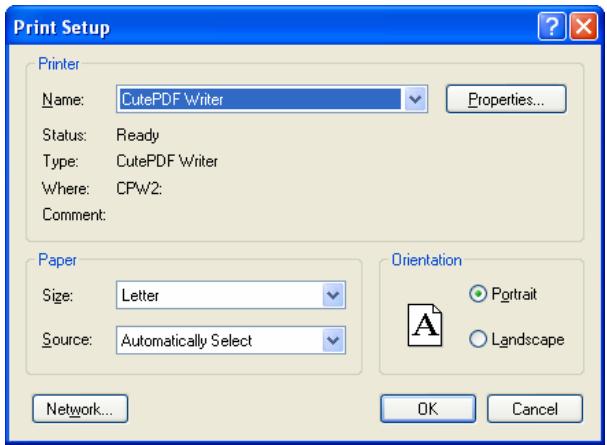
Fig. 19: Page Setup window
The following setting options are available:
| Network | Opens the Connect to Printer window so that you can create a connection to a networked printer. |
| Printer Area | |
| Name | Specifies a printer as the default printer. |
| Properties | Opens the Properties window where you can specify additional print options. The available print options depend on the selected printer. |
| Paper Area | |
| Size | Specifies a paper size as the default size. |
| Source | Specifies a paper source as the default source. |
| Orientation Area | |
| Portrait | Specifies portrait mode as the default format. |
| Landscape | Specifies landscape mode as the default format. |
23.2 Printer calibration
With Nero CoverDesigner, you can calibrate your printer to ensure precise print alignments. We recommend that you calibrate your printer once after you have selected the paper stock and printer.
To calibrate you printer, proceed as follows:
- Prior to calibration, select the desired paper stock and the printer.
- Select File > Preferences from the menu.
The Application Preferences window is displayed.
- Click on the Printing tab.
-
Click the Print Calibration Sheet button.
The calibration sheet is printed. -
Fold the calibration sheet in the middle horizontally and vertically.
- Unfold the calibration sheet and read the values at which both fold lines cross the axis.
- If the fold lines do not cross in the middle of the axis, enter the horizontal and vertical values from the calibration sheet in the Horizontal/Vertical Printing Offset fields on the Printing tab.
- Repeat steps 4 to 6 to check the new entries. If the fold lines cross in the middle of the axis, proceed to the next step. Otherwise repeat the previous step.
- Click on the OK button.
The Application Preferences window is closed.
The calibration settings are saved; your printer is now calibrated.
23.3 Paper Stocks window
In the Paper Stocks window you can view predefined paper stocks or create your own custom ones. To open the window, select File > Paper Stocks from the menu.
User-defined paper stocks are useful for modifying the size and depiction of a cover element.
Predefined paper stocks have been set to match the manufacturer's specifications for labels and papers. For example, some special papers can require a specific placement and position of the cover element. Or labels may have different sizes.
You can select the paper stocks that are listed here or that you create in the main screen area and assign them to the current cover element.
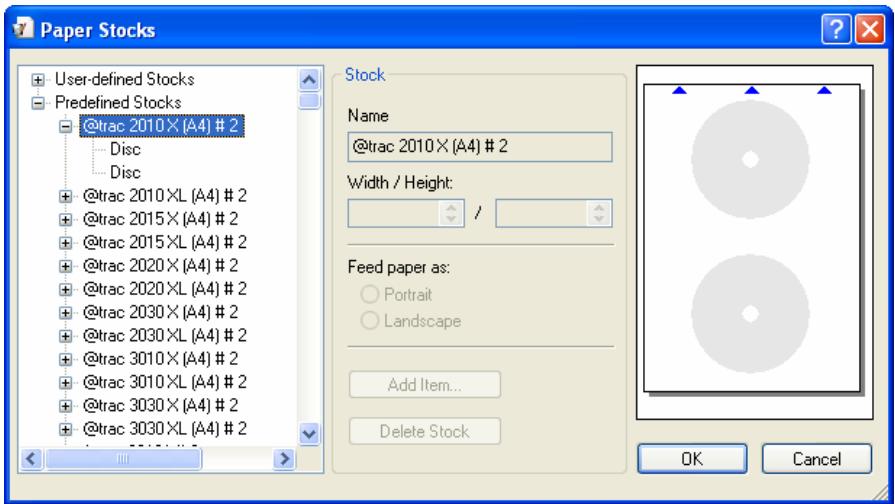
Fig. 20: Paper Stocks window
The window consists of three areas. User-defined and predefined paper stocks are displayed in a selection list in the area on the left. Each stock can contain one or more labels. These labels correspond to the cover elements in Nero CoverDesigner.
Setting options for the user-defined paper stocks are displayed in the middle area. These setting options are grayed out for the predefined paper stocks.
The size and position of the cover elements are displayed in the preview area on the right.
The following setting options are available:
| User-defined Stock Entry | |
| Add Stock | Adds a new paper stock. |
| Import | Imports a definition file in the *.dat format for paper stocks. New paper stocks are added to the user-defined paper stocks. |
| Export | Exports a definition file in the *.dat format for paper stocks. All user-defined paper stocks are exported. |
| Paper Stock Entry | |
| Name | Specifies the name of the paper stock. |
| Width/Height | Specifies the width and height. |
| Portrait | Specifies that the paper is printed in portrait mode. |
| Landscape | Specifies that the paper is printed in landscape mode. |
| Add Item | Displays a selection list that you can use to select a cover element. The selected cover element is added to the paper stock. |
| Delete Stock | Deletes the current paper stock. |
| Label/Cover Element Entry | |
| Width/Height | Specifies the width and height. |
| Spine Width | Specifies the width of the spine, i.e., the middle part of the inlay. This field is available for the DVD cover inlay (DVD booklet), inlay, maxi inlay, front and rear inlay (mini CD) cover elements. |
| Rear Width | Specifies the width of the rear portion, i.e., the part that is folded around. This field is available for the maxi inlay and rear inlay (mini CD) cover elements. |
| Indentation Radius | Specifies the radius of the flap. This field is available for the business card envelope cover element. |
| Fold Width | Specifies the width of the folded seam. This field is available for the business card envelope cover element. |
| Radius of Outer Boundary | Specifies the outer radius and therefore the size of the printable area (disc edge). This field is available for the business card cover element. |
| Center Hole Radius | Specifies the inner radius and therefore the size of the unprint-able area. This field is available for the business card and rectangular busi-ness card cover elements. |
| Bounding Rectangle | Specifies the size of the rectangle and therefore the oval form of the business card. This field is available for the business card cover element. |
| Rounded Corners(X/Y) | Specifies the radius of the rounded corners on the disc. This field is available for the rectangular business card cover element. |
| Outer Radius | Specifies the outer radius and therefore the size of the printable area (disc edge). This field is available for the disc and mini CD cover elements. |
| Inner Radius | Specifies the inner radius and therefore the size of the unprint-able area (disc hole). This field is available for the disc and mini CD cover elements. |
| Position X/Y | Specifies the position of the cover element on the paper that was defined in the paper stock profile. |
23.4 Creating paper stock profiles
In Nero CoverDesigner, you can create your own custom paper stocks. User-defined paper stocks are available in the combo box of the main screen area for cover elements that have been added as labels to the paper stock.

The creation of user-defined paper stocks is useful for designing covers and labels whose dimensions vary from standard measurements.
To create a paper stock, proceed as follows:
- In the main screen, select File > Paper Stocks from the menu.
The Paper Stocks window is displayed (see Paper Stocks window). - Select the User-defined Stocks entry in the selection list.
-
In the Paper Stocks area, click the Add Stock button.
A Stock 1 subentry is added to the User-defined Stocks entry. -
Select the Stock 1 subentry.
The Stock area is displayed.
-
In the Stock area, enter the name and dimensions of the paper stock.
-
Click the Add Item button.
A selection list of cover elements is displayed.
- Select the cover element that you want to add to the paper stock.
The selected cover element is added to the paper stock.
-
Select the inserted cover element.
-
In the area in the middle, specify the desired dimensions such as the height/width and position of the cover element on the paper.
-
Repeat the four previous steps for each cover element that you want to add to the paper stock.
-
Click on the OK button.
The Paper Stocks window is closed.
The paper stock is saved and is now available for the selected cover elements in the combo box of the View toolbar.
23.5 Default paper stock settings
On the Paper Stocks tab of the Application Preferences window (see Application Preferences window), you can set the default settings for paper stocks. The following setting options are available:
| Combo Box | Specifies a default paper stock for the selected cover element. |
| Print elements by default | Selects all cover elements of a document for printing by default. If you clear this check box, you must select the cover elements in the Print window manually before you print. |
| Show default label metrics | Displays the normal disc size when you assign a paper stock with a radius that deviates from the standard value to a cover element. |
24 Program settings
24.1 Application Preferences window
You can make settings that determine the general appearance and behavior of Nero CoverDesigner in the Application Preferences window. To open the window, select File > Preferences from the menu.
The window contains the following tabs:
| General | Provides general setting options for Nero CoverDesigner such as dis- playing info messages, and country-specific measurement units. |
| Folders | Specifies the path for documents, templates, and imported files. |
| Paper Stocks | Provides setting options for paper stocks (see Default paper stock set- tings). |
| Specifies the bleed area and allows you to calibrate your printer (see Printer calibration ). | |
| Undo | Provides options for undoing operations. You can specify the maximum reserved memory, the number of possible undo steps, or unlimited undo steps here. |
| LightScribe | Allows you to specify setting options for LightScribe® recorders such as the print quality, default drive (if multiple LightScribe® recorders are in- stalled), default label template, and print resolution. These setting options are only used if a LightScribe® recorder is avail- able. |

Bleeding means that your design is printed beyond the margin of the cover element so that it overlaps with it. Bleeding is useful to avoid "blank streaks" that can appear when the printout has shifted or the cover element is not trimmed precisely.
25 List of figures
Fig. 1: Nero StartSmart. 9
Fig. 2: Main screen of Nero CoverDesigner 10
Fig. 3: New Document window 16
Fig. 4: Jewel case. 18
Fig. 5: DVD case 19
Fig. 6: Document Data window 27
Fig. 7: Properties window, Brush tab 33
Fig. 8: Properties window, Image tab 35
Fig. 9: Properties window, Tracks tab 38
Fig. 10: Geometry window 41
Fig. 11: Geometry window for bent objects 42
Fig. 12: Align Elements window 43
Fig. 13: Selected object 46
Fig. 14: LightScribe Print Properties window.. 56
Fig. 15: LabelFlash™ Print window. 58
Fig. 16: LabelFlash™ Print Properties window .58
Fig. 17: Print window, Properties tab .60
Fig. 18: Print window, Elements tab .61
Fig. 19: Page Setup window 63
Fig. 20: Paper Stocks window. 65
26 Index
A
Angle of rotation 41
Aquarell 37
Artistic text Converting 47
Editing 47
Audiobook CD 31, 38
B
Background properties 31
Bend 31
Bent text Editing 46
Bleeding 13,60,68 Enabling .61
Specifying size 61, 68
Booklet 17
Brightness 36
Brightness values equal distribution 36
Brush 31
Business card 20
Business card CD. 20
C
Calibration sheet Printing 64
CD case. 18
Color Selecting. 32, 33
Color adjustment 36
Compressing 26
Concave view 37
Configuration 49,63,68
Contact 74
Contrast. 36
Conventions. 6
Convex view 37
Cover art. 54
Cover element Adding. 17
Adding. 24
Changing size 64
Deleting. 24
Crop marks 60
D
Data 10
Default settings For paper stock 67
Defining default setting for objects. 49
Design element. 14
Directory 14
Disc Adding. 17, 22, 28
Disc type. 16, 28
DiscT@2TM 57
Document Compressing 26
Creating 22
Editing. 24
Printing. 62
Saving. 26
Document data 27
Entering 27
Filling in automatically. 27
Using. 14
Drawing area 13
Duplicate. 10
DVD case. 19
Dynamic object 14
E
Edit 10
Effect. 36
Ellipse 12
Inserting 44
Emboss. 37
Entry
Adding 29
Equalizing 36
F
Field 13, 14, 32
Inserting. 45
Field type 40
Artist 28
Disc artist. 28
Disc title. 28
Disc type. 28
Title. 28
Year. 28
File. 10
Filter 37
Flip. 37
Folder 13, 32
Inserting. 45
Font 31
Formats
Supported. 8
G
Gamma 36
Geometric object 14
Geometry 41
H
Horizontal
Flip 37
Horizontal alignment 43
1
Image 13, 31
Editing 36
Inserting. 45
Rotating 37
Scaling. 36
Selecting 35
Image document
Creating. 22
Image effects 36
Image formats. 8
Importing image 31
Importing Text 31
Inlay 17
Installation. 7
J
Jewel case. 18
L
LabelFlashTM 7,18
Printing label 57
LightScribe 7,17
Printing label 55
Line 12
Inserting 44
Line break. 44
M
Main screen 10
Maxi 20
Menu bar. 10
Midtones 36
Mini CD. 20
Mirrored image 37
Mosaic 37
Multi box 19
N
Negative. 37
Nero CoverDesigner
Launching from Nero Burning ROM 27
Start directly. 9
Start over Nero StartSmart 9
Nero DigitalTM 8
Creating document 23
Reading out cover 23
Saving cover. 54
0
Object 10, 14
Applying properties 11
Copying 11
Cutting out 11
Deleting 11
Grouping. 12
Inserting. 44
Modifying 46
Pasting 11
Specifying default settings. 49
Specifying size 41, 43
Object properties 31
Objekt
Bending 31
Oil painting effect 37
Outline 31, 37
P
Paper profile 63
Paper stock. 60
Assigning. 25
Specifying default settings. 66, 67
Paper stocks. 64
Pen
Drawing 37
Pinch/bloat 37
Position. 41
Posterization 37
Print settings 63
Printer
Calibrating 64
Defining default values 63
Printing 62
Printing crop marks 61
Printing options 60
Program start 9
Property
Viewing. 31
Propertyt
Applying. 11
R
Rectangle. 12
Inserting 44
Rotating 37
S
Saving 26
Scanning. 36
Sharpen 37
Size. 41
Slimpack. 20
Soften 37
Solarization 37
Special paper. 64
Standard settings
For printing. 63
Swirl 37
System requirements. 7
T
Template
Creating 16, 52
Modifying 24
Saving. 52
Selecting 16,22
Text. 12, 31
Inserting 44
Protecting. 34
Rotating 34
Text box. 13, 31
Inserting 44
Protecting. 35
Rotating 35
Text break. 44
Track list 13, 14
Inserting 45
Tracks 32
TWAIN 11
U
Undo 11,48
Undo action Operations 68
V
Vertical
Flip 37
Vertical alignment 43
View. 10
W
WHQL-certified driver 7
Window 11
Work steps. 15
27 Contact
Nero CoverDesigner is a product of Nero AG.
nero
COVER/DESIGNER 2
Nero AG