
T10S - Mobile Phone ERICSSON - Free user manual and instructions
Find the device manual for free T10S ERICSSON in PDF.


| Product Type | GSM Mobile Phone |
| Brand | ERICSSON |
| Model | T10S |
| Dimensions (approx.) | 130 x 49 x 23 mm |
| Weight (approx.) | 130 g |
| Battery | Rechargeable Nickel-Metal Hydride (NiMH) |
| Standby Time (approx.) | Up to 100 hours |
| Talk Time (approx.) | Up to 240 minutes |
| Display | Monochrome graphic display with icons |
| Main Functions | Calls, SMS, Phonebook (99 numbers in phone memory + SIM memory), Call forwarding, Call list, Key lock, Vibrator, Call cost calculation, Alarm |
| Security | PIN code, PIN2 code, PUK code, SIM lock, Key lock |
| Maintenance and Cleaning | Clean with a soft, dry cloth. Avoid any liquids. |
| Spare Parts and Repairability | Removable battery, accessible SIM card, external charger. Use only original Ericsson accessories. |
| General Information | GSM 900/1800 compatibility (not specified but typical), hands-free kit connector, integrated antenna |
Frequently Asked Questions - T10S ERICSSON
User questions about T10S ERICSSON
0 question about this device. Answer the ones you know or ask your own.
Ask a new question about this device
Download the instructions for your Mobile Phone in PDF format for free! Find your manual T10S - ERICSSON and take your electronic device back in hand. On this page are published all the documents necessary for the use of your device. T10S by ERICSSON.
USER MANUAL T10S ERICSSON
Visit us on our website
http://mobile.ericsson.com
User's Guide
Mobile Phone
T10s
Contents at a Glance
Getting Started 3
Preparing Your Phone for Use 4
Turning Your Phone On and Off 9
Display Information and Key Functions 11
Making and Receiving Calls 13
During a Call 16
Functions and Settings 19
Using the Menu System 20
Your Personal Phone Book 22
Using the Call List 28
Your Voice Mail Service 30
Personalizing Your Phone 31
Sending and Receiving Text Messages (SMS) 36
Diverting Incoming Calls 44
Security for Your Phone and Subscription 46
Handling More than One Call Simultaneously 53
Setting Network Preferences 58
Knowing the Call Time/Call Cost 61
Using Two Voice Lines 63
Calling from Your Car 64
Calling Card or Credit Card Calls 66
Sending and Receiving Faxes and Data 68
Some Useful Functions 69
Additional Information 73
Troubleshooting 74
Quick Keys 76
Technical Data 77
Glossary 78
Guidelines for Safe and Efficient Use 83
Warranty 87
Declaration of Conformity 89
Index 91
Ericsson T10s
Second edition (October 1999)
This manual is published by Ericsson
Mobile Communications AB, without any
warranty. Improvements and changes to
this manual necessitated by typographical
errors, inaccuracies of current information,
Improvements to programs and/or instrument, may be made by Ericsson.
Mobile Communications AB at any time
and without notice. Such changes will,
however, be incorporated into new editions.
of this manual.
All rights reserved.
Ericsson Mobile Communications AB,
1999
Publication number: EN/LZT 108 2699 R1B
INNOVATRON PATENTS
Please note!
Some of the services in this manual are not supported by all networks. This also applies to the GSM International Emergency Number 112.
Please contact your network operator or service provider if you are in doubt whether you can use a particular service or not.
The CE symbol on our products signifies that they have been certified according to the EMC directive 89/336/EEC, the Telecommunications directive 91/263/EEC, and the Low Voltage directive 73/23/EEC when applicable. The products fulfil the requirements according to the following standards:
Cellular Phones and Accessories in Combination:
ETS 300 342-1 EMC for European digital cellular telecommunications.
Accessories Without Direct Connection to a Cellular Phone:
EN 50081 Electromagnetic compatibility, Generic Emission Standard, and EN 50082 Electromagnetic compatibility, Generic Immunity Standard.
GETTING STARTED
Preparing Your Phone for Use 4
Turning Your Phone On and Off 9
Display Information and Key Functions 11
Making and Receiving Calls 13
During a Call 16
Preparing Your Phone for Use
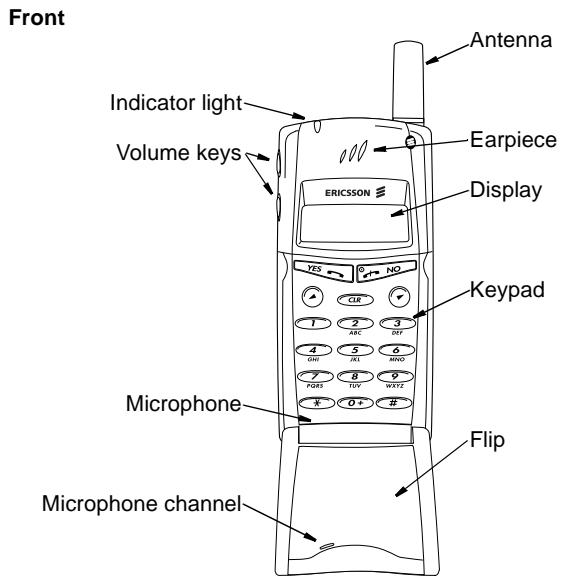
Overview
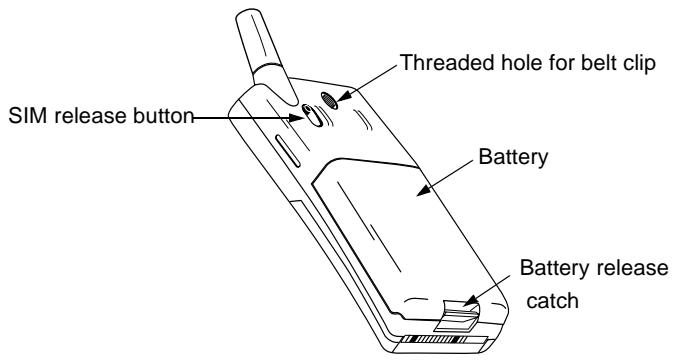
Back

Assembly
You need to do the following to use your phone:
- insert the SIM card
- attach the battery to the phone
- charge the battery
The SIM Card
When you register as a subscriber with a network operator, you get a SIM (Subscriber Identity Module) card. The SIM card contains a computer chip that keeps track of your phone number, the services included in your subscription, and your Phone Book information, among other things.
SIM cards come in two sizes. One is the size of a credit card, and the other is smaller. Your phone uses the smaller card. Many credit card-sized SIM cards have a perforated smaller card that you can take out easily. Before you can use your phone, you must insert the SIM card as shown below.
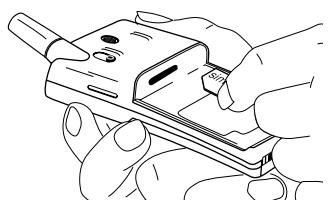
Inserting the SIM Card
- Remove the battery (if attached).
- Slide the SIM card into the SIM card slot with the golden con
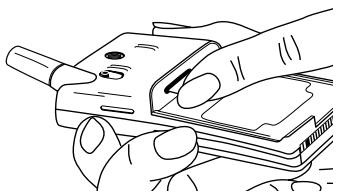
nectors facing down and the cut corner turned to the left.
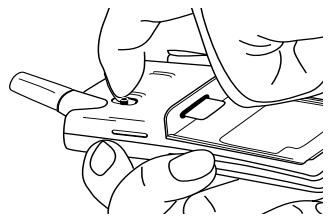
Removing the SIM Card
- Remove the battery (if attached).
- Slide the SIM release button towards you.
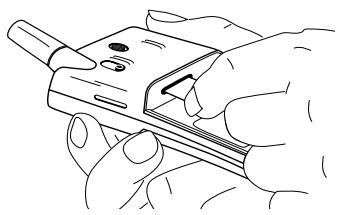
- Pull out the SIM card.
The PIN
Most SIM cards are supplied with a security code or PIN (Personal Identity Number), which you need to access the network. Every time you turn on your phone, it prompts you to enter your PIN. You will find your PIN in the information from your operator.
Some operators may have services that require a second PIN, your PIN2.
You should be careful with your PIN, since it is your protection against unauthorized use of your subscription.
If your PIN is entered incorrectly three times in a row, the SIM card is blocked. If this happens, you can unlock it by using your PUK (Personal Unblocking Key code), which you also get from your operator.
The Battery
Your phone comes with a nickel metal hydride (NiMH) battery. The battery is not charged when you buy your phone, but there may be enough power to turn the phone on. We recommend that you charge the battery before you use the phone for the first time.
Attaching the Battery to Your Phone
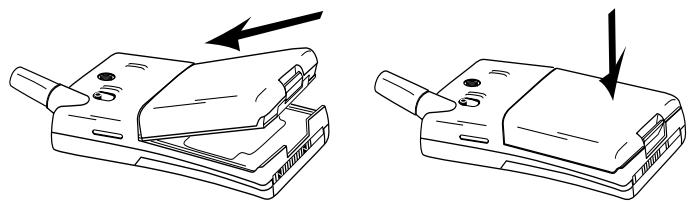
- Place the battery on the back of the phone and push until you hear a click.
When to Charge the Battery
The nickel metal hydride battery that comes with your phone can be charged whenever you wish without affecting its performance. This is not the case with the cheaper nickel cadmium type batteries, often sold as accessories by other suppliers. For the best talk and standby time in the long run, we recommend that you use only Ericsson original batteries with your phone.
To remind you that you will soon need to charge the battery or replace it with a charged one:
- an alarm signal (a long beep) sounds and the message Battery low appears for ten seconds in the display. The signal is repeated several times.

- the indicator light on the top of the phone starts flashing red.
Note! The phone turns itself off when the battery can no longer power it satisfactorily.
Charging the Battery
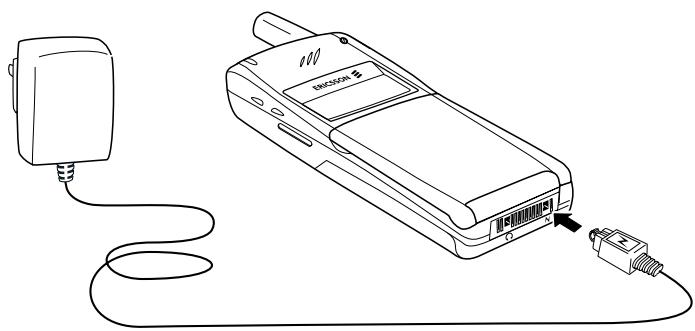
- Make sure that the battery is attached to the phone.
-
Connect the charger to the mains.
-
Connect the charger to the phone as shown in the picture. The flash symbol on the plug must face upwards.
To indicate charging:
the battery meter in the display pulses continuously.
- the indicator on the top of the phone shows a steady red light (or green, if the phone is turned on).
When the battery is fully charged, the battery meter in the display is full and the indicator on the top of the phone shows a steady green light.
Tip! You can use the phone while the battery is being charged. However, this increases the charging time.
Disconnecting the Charger
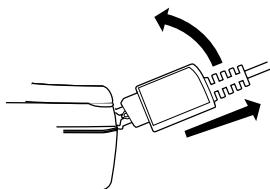
- Bend the plug connected to the phone upwards and pull it out.
Removing the Battery
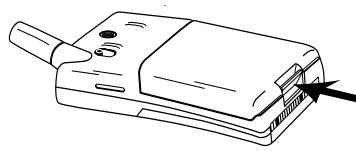
- Turn off the phone.
- Press the catch on the bottom of the battery.
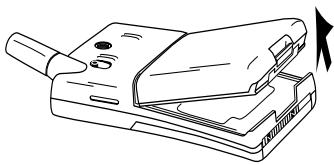
- Lift the battery up and away from the phone.
Turning Your Phone On and Off
Turning Your Phone On
Press and hold the NO (ON/OFF) key until you hear a click.
If "Enter PIN" Appears in Display
Some SIM cards are protected with a PIN code. If Enter PIN appears in the display after you have turned on the phone, do this:
- Enter your PIN. If you make a mistake while entering your PIN, erase the wrong digit by pressing the CLR key.
- Press YES.
Note! If your PIN is entered incorrectly three times in a row, the SIM card is blocked. You can unblock it by using your PUK, see "Security for Your Phone and Subscription" on page 46.
Network Search
After you have turned on the phone (and entered your PIN), the Ericsson logo appears in the display and the phone searches for a network.
When a network is found, the phone beeps three times. The indicator light on the top of the phone flashes green once every second and your network operator's name (in most cases abbreviated) appears in the display.
This is called standby mode. You can now make and receive calls.
Initial Settings
The first time you turn on your phone, you may want to change the language in the display, choose the ring signal type and set the clock. For more information about these settings, see "Personalizing Your Phone" on page 31.
Display Language
Most modern SIM cards automatically set the display language to the language of the country where you bought your SIM card. If this is not the case, the default language is English. To change the display language, see "Display Language" on page 34.
Enter PIN
Enter PIN ★★★

NETWORK 00:00
NETWORK 16:21
112 only 16:21
No network 06:01
If your phone displays a language you do not understand, you can change it to English.
To change the display language to English
- Press the CLR key.
- Press the LEFT arrow key.
- Enter 0000
- Press the RIGHT arrow key.
Network
Normally, the name of a network appears in the display after you have turned your phone on, but sometimes there is no network that you can use. The display then shows one of the following:
112 only
If the message 112 only is displayed, you are within range of a network, but you are not allowed to use it. However, in an emergency, some operators allow you to call the international emergency number 112. See "Making Emergency Calls" on page 14.
No network
If the message No network is displayed, there is no network within range or the received signal is too weak. You have to move to get a stronger signal.
Turning Your Phone Off
- In standby mode, press and hold the NO (ON/OFF) key until you hear a click.
Display Information and Key Functions
Display Information
Your phone display will help you to:
- verify that you are dialling correctly
- check your signal strength and service availability
find out if you have received messages - check which line is in use if you have the Alternate Line Service (ALS)
- check battery level
Icons in the Display
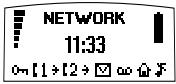
Icons are displayed when specific functions are active or if you have received a message. The figure in the margin shows an overview of all the possible icons and where they appear.
The table below shows every icon separately and also gives you an explanation.
| Icon/Indicator: | Name: | Description: |
| Signal strength meter | The strength of the received signal is indicated in steps. Six steps indicate the strongest signal. | |
| Battery meter | Indicates the current state of the battery. The fuller the icon, the more power there is. | |
| Keypad lock indicator | The keypad is locked. | |
| Divert indicator | An arrow means that the Divert all function is active. | |
| Silent ring signal | A crossed note means that no sound can be heard when you receive a call. | |
| SMS indicator | The envelope icon means that you have received a text message (SMS). | |
| Voice mail indicator | The tape loops mean that you have received a voice message. Will not appear on all networks. |
| Icon/Indicator: | Name: | Description: |
| Line indicator | Tells you which line is in use if you have the Alternate Line Service. | |
| Home zone indicator | The house icon indicates that the phone is within the home zone. Will not appear on all networks. |
Key Functions
The keys have other functions when you access the menu system "Using the Menu System" on page 20.
| Key: | Use: |
| YES | To make calls and answer calls. |
| NO | To turn the phone on or off. Press and hold the key. To end a call. |
| LEFT and RIGHT arrow keys | To access and navigate (scroll through) the menu system. |
| CLR (Clear) | To erase digits from the display. Press and hold the key to erase all digits. To mute the microphone during a call. Press and hold the key. To turn the ring signal on/off in standby mode. Erase all digits from the display. Then press and hold the key. The symbol for silent ring signal is shown in the display when the ring signal is turned off. To silence the ring signal when you receive a call. Press the key briefly |
| Number keys | To enter the digits 0-9. The 0 key enters the international prefix (+) if held down. |
| Star | To enter a star (*) character. If held down it enters a p (pause). |
| Hash | To enter#. To terminate the input of PIN and security codes. If held down it enters the phone icon. |
| Volume keys | To increase or decrease the volume of the earpiece or handsfree loudspeaker during a call. |
| UP and DOWN | To show today's date in the display during standby. To reject a call, double-click a volume key. |
Making and Receiving Calls
In this chapter, we assume that you have turned on your phone and that you are within range of a network. If you are abroad, you may use other networks, provided your home network has an agreement that allows you to do this (see also "Setting Network Preferences" on page 58).
Making a Call
- Enter the area code and phone number.
- Press YES.
While a call is in progress, a time counter automatically starts and you can see how long you have been on the phone. If you have activated the Call Cost option (see "Knowing the Call Time/Call Cost" on page 61) and your network and SIM card supports it, you see the price of the call in the display.
Ending a Call
Press NO to end the call.
Re-dialling a Previously Called Number
- Clear the display using CLR.
- Press YES.
- Press an arrow key until the number (and name) you want to call appears.
- Press YES to make the call.
Automatic Re-dialling
If the display shows Retry? you can re-dial the number by pressing YES. Your phone automatically re-dials (up to 10 times)
- until the call is answered. When the call is answered, you hear a beep followed by a ring signal.
- until you press a key or receive a call.
NETWORK
0123456789
01:06
Julia
+3456789012

Answer?

Busy tone
Tommy
+2345678901
Answer?
Janina
+234343556
Making International Calls
- Press and hold the 0 key until a + sign appears.
- Enter the country code, area code (without any leading zero) and phone number.
- Press YES.
Making Emergency Calls
- Enter 112 (the international emergency number).
- Press YES.
The international emergency number 112 can be used in most countries, with or without a SIM card inserted, if a GSM network is within range.
Note! Some network operators may require that a SIM card is inserted, and in some cases that the PIN code has been entered, as well.
Some networks may not use the international emergency number, 112.
In a number of countries, the emergency number is 999 instead.
If you are unsure of what emergency number is used in your country, please contact your network operator or service provider.
What Happens when I Receive a Call?
The phone rings and the indicator light on the top of the phone flashes green rapidly. The display shows Answer?
Tip! The phone has an in-built vibrating unit which allows you to receive calls discretely. See "Vibrating unit" on page 33.
Answering a Call
Press YES.
Rejecting a Call
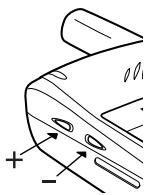
- Double-click one of the volume keys on the side of the phone, or press NO.
The caller hears a busy tone if the function is supported by the caller's network. If Divert on Busy is activated, the call is diverted to the number you have specified. See, "Diverting Incoming Calls" on page 44.
Calling Line Identification (CLI)
If your subscription includes the Calling Line Identification service and the caller's network sends the number, you see the caller's number at the bottom of the display when you receive a call. If the number is stored with a name in the phone book, the name is also shown in the display.
Ciphering
Ciphering is a built-in feature that scrambles your calls and messages to provide additional privacy.
An exclamation (!) mark, shown next to the handset icon in the display during a call, indicates that ciphering is currently not being provided by the network.

During a Call
Your phone has several functions which you might find helpful while a call is in progress.
Changing the Earpiece Volume
To change the earpiece volume during a call
- Press the volume keys (UP or DOWN) on the side of the phone. Pressing UP increases the volume. Pressing DOWN decreases the volume.
Muting the Microphone
To turn the microphone off temporarily during a call
- Press and hold the CLR key.
Mute appears in the display. - To continue your conversation, release the CLR key.
Tip! Instead of pressing and holding the CLR key, you can put the call on hold.
To put the call on hold
- Press YES. 1 on hold appears in the display
- To continue your conversation, press YES again.
Scratch Pad Function
If you need to make a note of a phone number during a call, you can use the Scratch Pad.
To use the scratch pad
- Use the number keys to enter the number.
When you end the call, the number remains in the display. You can now call the number by pressing YES, or save it in the Phone Book (see "Your Personal Phone Book" on page 22).
Sending Tone Signals
To use telephone banking services or to control an answering machine, you need to use codes. These codes are sent as tone signals (also known as DTMF tones or touch tones).
- Press the appropriate keys (0-9, * and #).
Tip! You can also save a code together with a phone number in the Phone Book. See "Your Personal Phone Book" on page 22.
Checking Duration/Cost of Call
During a call, the display shows the duration in minutes and seconds. If you prefer, you can have the call cost displayed, provided your network and your SIM card support this feature. See "Knowing the Call Time/Call Cost" on page 61 on how to use this feature.
More than One Call Simultaneously
Your phone is capable of handling more than one call simultaneously. You can put the current call on hold, and then make or answer a second call. You can also set up a conference call with up to five people. See "Handling More than One Call Simultaneously" on page 53 on how to use this feature.
FUNCTIONS AND SETTINGS
Using the Menu System 20
Your Personal Phone Book 22
Using the Call List 28
Your Voice Mail Service 30
Personalizing Your Phone 31
Sending and Receiving Text Messages (SMS) 36
Diverting Incoming Calls 44
Security for Your Phone and Subscription 46
Handling More than One Call Simultaneously 53
Setting Network Preferences 58
Knowing the Call Time/Call Cost 61
Using Two Voice Lines 63
Calling from Your Car 64
Calling Card or Credit Card Calls 66
Sending and Receiving Faxes and Data 68
Some Useful Functions 69
Using the Menu System
You can find all your phone functions in the menu system. You use the menu system every time you want to change a setting in your phone, such as the ring signal. You also use the menus to get the most out of your phone: to set the alarm clock, send text messages, store important phone numbers, etc.
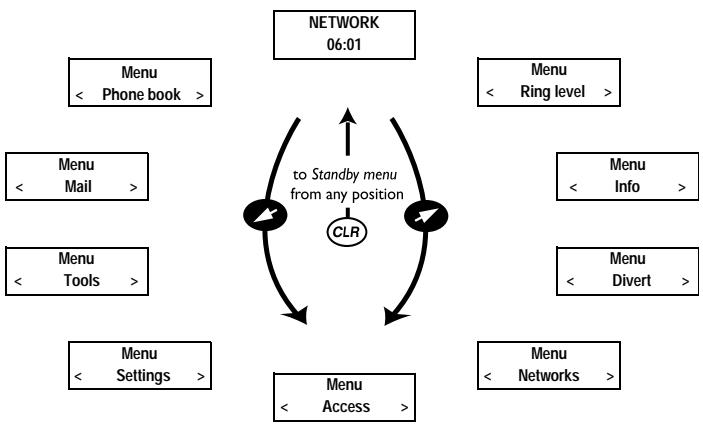
The menus are arranged in a continuous loop, which you move (scroll) through with the RIGHT and LEFT arrow keys. Each menu contains a list of options. Some menus have sub-menus with additional options.
Moving Through the Menu System
Press... to...
RIGHT scroll clockwise through menus or functions.
LEFT scroll anti-clockwise through menus or functions.
YES select a menu or function, enter a submenu.
NO go back one level in the menu system and/or leave a setting unchanged.
CLR go back to the standby display.
Instead of pressing the RIGHT or LEFT key repeatedly, you can press and hold it down until you reach the menu or submenu you want.
Note! If you enter the menu system, but do not press a key within 60 seconds, the phone returns to standby mode.
Scrolling and Selecting
- Use the arrow keys to scroll from menu to menu. Press the LEFT or RIGHT arrow keys until you reach the menu or function that you need.
- Press the YES key to select a menu or function.
Interpreting the Instructions in the Manual
Example:
- Scroll to Mail, YES, Send message, YES.
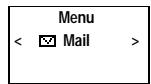
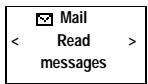
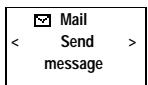
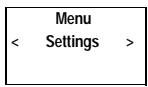
Interpret this instruction as follows:
- From the standby mode, use the LEFT or RIGHT arrow keys to scroll to the Mail menu. The arrows on either side of the word Mail mean that you can scroll to another menu.
- Press YES to select the menu. Now you are in the Mail menu. The name of the menu that you have chosen is shown at the top of the display (Mail). Use the LEFT or RIGHT arrow keys to scroll to the Send message function.
- Press YES to select the function.
Display Text and Symbols
When you move through the menu system, the display changes. The following hints can help you:
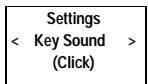
- When arrows are displayed next to the name of a menu or function, there are more options you can scroll through with the RIGHT/LEFT (arrow) keys.
- Text in brackets shows the current setting of the function shown in the display.
In this manual, we have chosen to exclude some of the details above in the pictures of the displays. This is so that it will be easier for you understand the display texts in the margins.
Below is an overview of the default menus.
Your Personal Phone Book
You can create a personal phone book by storing phone numbers and accompanying names on the SIM card (SIM memory) and in the phone (phone memory). You use the Phone Book menu for storing and recalling all the phone numbers in your personal phone book.
If you intend to use your phone abroad, you should store all the phone numbers as international numbers, that is with the (+) sign - which automatically will be replaced by the international dialling prefix for the country you are calling from - followed by the country code, then the area code and the phone number.
Every phone number that you store includes a position number, shown in brackets.
You can store the phone numbers together with a name tag to make it easier for you to keep track of your phone numbers. If the position number has a phone icon next to it, this means that you are storing the phone number in the phone memory and cannot take it with you if you change phones. The phone memory can hold up to 99 phone numbers.
Note! In the Phone book menu, press # to enter the phone icon. Outside the Phone book menu, you must press and hold # to enter it.
Jenny Andersson (4) +461234567890
Janina Huss (d4) +451234567890

Entering Letters
You can only enter letters when you are using the phone book and when you are composing a short message (SMS), see "Sending and Receiving Text Messages (SMS)" on page 36.
Press the appropriate key, 1-9, 0 or #, repeatedly until the character you want appears in the display.
Press... to get...
| 1 | Space - ? !, . . ;" < = > ( ) 1 |
| 2 | A B C Å Å A E à C 2 Γ |
| 3 | D E F è É 3 Δ Φ |
| 4 | G H I I 4 |
| 5 | J K L 5 Λ |
| 6 | M N O N ñ û ò ù 6 |
| 7 | P Q R S β 7 Π Σ |
| 8 | T U V Ü ù 8 |
| 9 | W X Y Z 9 |
| 0 | + & @ / % £ ¥ i 0 Θ Ξ Ψ Ω |
| # | # * |
For example
To enter an A, press 2 once.
To enter a B, press 2 twice.
To enter small letters
- Enter the letter, for example an A, and then press *. An a appears. Small letters now appear until you press * again.
To enter digits
- Press and hold the number key.
Storing a Number Together with a Name
- Enter the area code and phone number you wish to store.
- Scroll to Phone book, YES, Store, YES.
The first free memory position is suggested.
- Enter the name tag that you want to associate with the number.
- Press YES to store the name and number.
Storing in a Different Position than Suggested
After you have entered a name and phone number to be stored, you can choose what position to store the number in.
Store 12
Name: Jenny +1234567
Store 15
Name: Bank +123467890p2345
Store 15 Used Overwrite?
To store in a position of your choice in the SIM memory:
- Press RIGHT (repeatedly) until the suggested position number disappears. Then enter a position number of your choice. Press YES to store.
To store in the first empty position in the phone memory:
- Press RIGHT (repeatedly) until the suggested position number disappears. Then press # twice, followed by YES.
To store in a position of your choice in the phone memory:
- Press RIGHT (repeatedly) until the suggested position number disappears. Press # once. Enter the position number, followed by YES.
Telephone Banking Services
If you use telephone banking services, you can store the phone number of your banking service together with your personal code(s). You must insert a p (pause) between the phone number and the code(s). You insert a p by pressing and holding the * key. Usually, a # (hash) is required after each code. Talk to your bank if you are in doubt about how to use # and p.
Note! It may be a risk to store your codes in case the phone is stolen.
To store a phone number together with code(s)
- Scroll to Phone book, YES, Store, YES.
- Enter the name that you want associated with the phone number and code(s).
- Press YES.
- Enter the phone number, followed by p and the code(s).
Press YES to store.
Overwrite Protection
If you try to store a phone number in a position which already contains a phone number, the message Used Overwrite? appears in the display.
Then do one of the following:
To store in the selected position
- Press YES to replace the number with the new one.
To store in a different position
- Press NO.
- Enter the new position number.
- Press YES.
When a Memory is Full
If you try to store a phone number and the memory you want to store it in is full, the phone suggests a position number in the memory that is not full.
When Both Memories are Full
If both memories are full, the phone does not suggest a storage position. If you still want to store the number, you have to erase an old number by entering a position that is already occupied and press YES.
Erasing a Storage Position from the SIM Memory
1.Scroll to Phone book, YES,Erase,YES.
2. Enter, or scroll to, the position number you want to erase.
3. Press YES.
Erasing a Storage Position from the Phone Memory
- Scroll to Phone book, YES, Erase, YES.
- Press #. The phone icon appears.
- Enter, or scroll to, the position number you want to erase.
- Press YES.
Note! If you choose Erase all from phone, all phone numbers that are stored with the phone icon are lost.
Using the Phone Book
There are two ways of using the phone book: you can either call a number by using the name tag stored with it; or you can call the number by using the memory position that the number is stored in.
Calling Using the Name
- Clear the display.
- Scroll to Phone book, YES, Name recall, YES.
- Enter the name of the person you want to call, or scroll with the arrow keys until you find it.
- Press YES to call the number.
Shortcut to Name Recall
The digit keys 2-9 correspond to the first names that start with A, D, G, J. M, P, T and W respectively. For example, press and hold down the 4 key to find the first name that starts with a G. Then you can scroll with the arrow keys to find the name you are looking for. If there is no name stored under G, the first name under H is displayed, and so on.
Name recall Name:Embla
Position recall Position: 10

Edit 12
Name:Alfrd +1234567_
Edit 12
Name:Alfre_d +1234567
Calling Using the Position
- Clear the display.
- Scroll to Phone book, YES, Position recall, YES.
- Enter the position number you want to call, or scroll with the arrow keys until you find it.
- Press YES to call the number.
Speed Dialling (Memory Positions 1 - 9)
Note! Speed dialling can only be used when the phone is in standby.
- Clear the display.
- Enter the position number, 1-9, and press YES.
Keeping the Phone Book Up to Date
Sometimes people change their names, their phone number or even both. To get the best use out of your phone book, you want the names and numbers to be correct. They are easily changed with the Edit Phone Book feature. If someone has changed both name and number, it might be easier to overwrite the old storage position with the new one, instead of changing both name and number separately.
Changing a Phone Number in Your Phone Book
- Clear the display.
- Scroll to Phone book, YES, Edit, YES, Find name.
- Enter the name and press YES.
- Press RIGHT once to move the cursor to the row with the phone number.
- Move the cursor with the arrow keys to where you want to change the number.
- Enter the new number or clear the display with CLR.
- Press YES.
Changing a Name in Your Phone Book
- Clear the display.
- Scroll to Phone book, YES, Edit, YES, Find name.
- Enter the name and press YES.
- Press LEFT to move the cursor between the rows.
- Change the name by entering or erasing letters.
- Press YES.
Copying Phone Numbers between Memories
If you want to change SIM card or phone, it is a good idea to copy your phone book from the SIM card to the phone memory or vice versa. Then you can
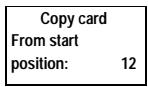
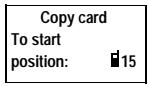
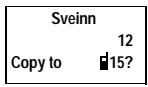
easily copy the phone book back to the memory of your choice. Also, as you fill up the phone book memories, you might want to move entries from one memory to another.
Copying a Number from SIM Memory to Phone Memory
- Scroll to Phone book, YES, Copy, YES, Card≠Phone, YES.
- Enter the number of the first memory position in the SIM memory you want to copy to the phone memory and press YES.
- Enter the number of the first memory position in the phone memory you want to copy to and press YES.
- Press YES to copy.
The next position in the SIM memory is displayed and the first empty position in the phone memory is suggested.
-
To continue copying, press one of the following:
-
YES to copy.
- NO to go to the next position in the SIM memory.
- CLR to copy to another position in the phone memory. Enter the number of the position and press YES.
- Arrow keys to move between positions in the SIM memory.
Interrupting Copying
Press CLR twice.
Copying a Number from Phone Memory to SIM Memory
Follow the instructions in "Copying a Number from SIM Memory to Phone Memory", but chose the Phone Card option in the Phone book menu instead of Card Phone.
Copying All Numbers from SIM Memory to Phone Memory
- Scroll to Phone book, YES, Copy all, YES, CardPhone, YES.
- Enter the number of the first position in the SIM memory you wish to copy to the phone memory and press YES.
- Enter the number of the first position in the phone memory you wish to copy to and press YES.
- Press YES to start copying.
Copying All Numbers from Phone Memory to SIM Memory
Follow the instructions in "Copying All Numbers from SIM Memory to Phone Memory", but choose the Phone Card option in the Phone book menu instead of Card Phone .
Using the Call List
The Call List
This chapter describes the Call List function, which is a type of telephone number log or a memory that stores information (time, date, phone number and name) about the last 30 incoming and outgoing calls. Once your list exceeds 30 calls, the oldest one is deleted. You need to activate the Call List function before any calls are stored in the list.
The numbers that you have dialled are always stored in the Call List.
If your subscription includes the Calling Line Identification (CLI) service and the caller's network sends the number, you will find the number (together with a name if stored in your phone book) of an incoming call in the Call List.
You can call any of the stored numbers.
The following icons appear in the display together with the name and number.
The Call List stores:

Answered calls icon appears next to the date or time of answered calls

Missed calls icon appears next to the date or time of missed calls

Dialled numbers icon appears next to the date or time of a dialled number
All the calls are stored together in a chronological order. If the same number is called more than once, the latest call replaces earlier ones. If you check a call within 24 hours, the time of the call is displayed. Otherwise, the time is replaced by the date. You can toggle between date and time by pressing *.
If no information about the caller's number was received, the display shows Unknown, which means that no information was available, your subscription does not support CLI, or the caller does not allow the number to be shown.
Note! If you change SIM cards or deactivate the Call List, it is cleared.
Dialled numbers remain in the SIM card memory though.
26-Dec-93
Janina
+234343554
03-Jan-97
<Unknown:1

NETWORK Calls:1
Turning the Call List Off
- Scroll to Settings, YES, Call List, YES, On, YES.
Calling a Number from the Call List
1.Scroll to Info, YES, Call List, YES.
2. Scroll to the number that you want to call.
3. Press YES to make the call.
Missed Calls
If you have missed a call, the phone shows Calls: 1, where the number 1 indicates the number of unanswered/missed calls.
- Press YES to go directly to the call list.
Erasing a Number from the Call List
- When information about a call appears, press CLR. Erase? appears.
- Press YES.
Shortcut to the Call List
- Press YES when the phone is in standby mode.
You can now scroll within the list and make a call by pressing YES.
Turning the Call List Off
- Scroll to Settings, YES, Call List, YES, Off, YES.
Note! If you turn the Call List off, all stored entries are erased.

NETWORK Check?

Your Voice Mail Service
Note! Not all operators have this service. The service also depends on your subscription.
The answering service of your network allows callers to leave a voice message when you cannot answer your calls. When you receive a voice message, you hear a signal and the message Check? appears in the display, together with the voice mail indicator. The indicator light on the top of the phone flashes green. If you have entered the number of your voice mail service, see below, or the SIM card contains the number, you can press YES to listen to the voice message. To read the message later, Press NO.
Note! All network do not inform you of a voice mail in the way described above. Instead, they send a text message (SMS) asking you to call their answering service.
Entering the Number of Your Voice Mail Service
- Scroll to Mail, YES, Options, YES, Set voice M., YES, New number, YES.
- Enter the number of your voice mail service and press YES to store it.
Note! If the SIM card already contains the number of your operator's voice mail service, you do not have to enter it.
Turning Your Voice Mail Function On
- Scroll to Mail, YES, Options, YES, Set voice M., YES, On, YES.
Calling Your Voice Mail Number
Scroll to Mail, YES, Voice mail, YES
- or press and hold down the 1 key when the phone is in standby.
Changing Your Voice Mail Number
- Scroll to Mail, YES, Options, YES, Set voice M., YES, New number, YES.
- Enter your new voice mail number and press YES.
Turning Your Voice Mail Function Off
- Scroll to Mail, YES, Options, YES, Set voice M., YES, Off, YES.
Personalizing Your Phone
Your phone includes a number of functions which let you adapt your phone to your own personal needs in different situations. Note that some of the functions allow you to have one setting when the phone is handheld and another when it is connected to handsfree equipment. See "Calling from Your Car" on page 64.
Ring Signal Volume
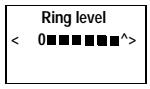
You can set the volume in six steps. The first step means that two clicks will be heard when you receive a call. You can also turn the ring signal off (0), or choose a ring signal that rises in steps from the softest volume to the loudest.
To set the ring signal volume
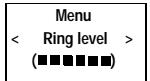
- Scroll to Ring level, YES.
The ring signal volume appears in the display.
- Use RIGHT to increase the volume, LEFT to decrease it.
The phone rings once with the actual setting as you increase the volume, except for the Step () setting.
- Press YES to save the setting.
Tip! Use the volume keys on the side of the phone to change the volume of the ring signal silently.
Ring Signal Type
You can choose the type of ring signal from a list of different sounds and melodies. You can also compose two melodies of your own by entering notes with the keypad (see "Your Own Ring Signals" on page 32).
To choose one of the ring signal types
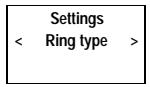
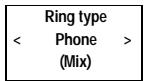
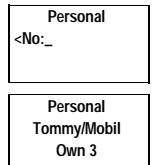
- Scroll to Settings, YES, Ring type, YES, Phone, YES.
- Scroll until you find the ring signal type that you want.
If you do not wish to disturb other people, use the volume keys on the side of the phone to scroll silently.
- When you reach the ring type you want, select it by pressing YES.

Different Ring Signals for Line 1 and Line 2
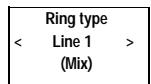
If you subscribe to the Alternate Line Service (ALS), L1 or L2, depending on the line in use, is displayed instead of Phone. This means that you can set different ring signals for the two lines.
Different Ring Signals for Speech, Data and Fax Calls
If you have turned the Data menus on (see "Sending and Receiving Faxes and Data" on page 68), you can set different ring signals for speech (the display shows Phone, L1 or L2), fax and data calls respectively.
Personal Ring Signals
If your subscription includes the Calling Line Identification (CLI) service, you can assign a personal ring signal to up to ten callers. In other words, you can have one ring signal that corresponds to your home phone number, one to your office, etc.
If the last seven digits of a caller's number correspond to a number you have specified, then that caller's ring signal is used.
You can include Question marks (?) in a phone number. For example, 012345??? means that calls from phone numbers between 012345000 and 012345999 will have the same personal ring signal. To enter a?, press #:
To specify a caller's number and the accompanying ring signal
- Scroll to Settings, YES, Ring type, YES, Personal, YES, Add new?, YES.
- Enter the caller's number and then press YES.
If a phone number is stored in the phone book, press LEFT to recall the number.
- Scroll to ring signal type you want and then press YES.
To erase a caller's number
- Scroll to Settings, YES, Ring type, YES, Personal, YES, Erase?, YES.
- Scroll to the number you wish to erase and then press YES.
Your Own Ring Signals
You can compose two ring signals.
To compose a ring signal
- Scroll to Settings, YES, Edit melody, YES.
- Select Own 1 or Own 2.
- Press and hold CLR to clear the display.
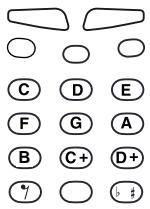
- Use the keypad to enter notes.
The keyboard now works as a keyboard (see figure in margin):
- Press and hold a key to enter a long note.
-
Press 0 to raise the note one octave.
-
To listen to your melody, press YES.
- Press YES again to save it or press NO to continue editing.
Vibrating unit
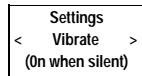
You can set the phone's vibrating unit to Off, On all the time, or On when the ring signal is turned off.
To set the vibrating unit
- Scroll to Settings, YES, Vibrate, YES.
- Select the desired setting.
Minute Minder
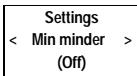
If you turn on the minute minder, you hear a beep once every minute during a call.
To turn the minute minder on/off
- Scroll to Settings, YES, Min minder, YES.
- Select On or Off.
Message Signal
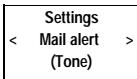
You can choose whether to hear clicks, tones or nothing (silent) when you receive a text (SMS) or voice message.
To set the message signal
- Scroll to Settings, YES, Mail alert, YES.
- Select the sound you wish to hear.
Key Sound
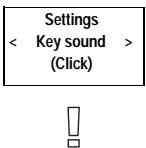
You can choose whether to hear clicks, tones or nothing (silent) when you press the keys.
To set the key sound
- Scroll to Settings, YES, Key sound, YES.
- Select the key sound you want.
Note! The sound of the volume keys on the side of the phone is also affected. However, the only sound that is available is the click sound.
Display Light
You can set the display light to automatic, off or on. In automatic mode, the display light is turned off automatically 10 seconds after you pressed the last
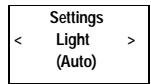

key. It comes on again when you press a key, or when you receive a call or message
To set the display light
1.Scroll to Settings, YES, Light, YES.
2. Select the display light setting you want.
Display Language
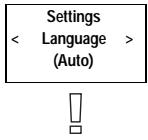
Most modern SIM cards automatically set the display language to the language of the country where you bought your SIM card. If this is not the case, the default language is English.
To change the display language
- Scroll to Settings, YES, Language, YES.
- Select the language you want.
Note! If by accident you end up with your phone displaying a language you do not understand, you can return to English by pressing CLR, LEFT, 0000, RIGHT.
Phone Number Display
This function lets you check your phone number. If the number cannot be retrieved from your SIM card, you can enter it yourself.
To enter your phone number
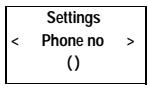
- Scroll to Settings, YES, Phone no, YES, Phone no, YES.
- Enter the number and then press YES.
Tip! If your SIM card allows it, you can also enter your fax and/or data number. Scroll to Settings, YES, Phone no, YES. Then scroll to Fax no or Data no, YES. Enter the number and then press YES.
Time
The time is always displayed when the phone is in standby mode.
To set the time format
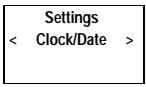
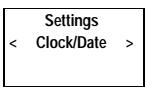
- Scroll to Settings, YES, Clock/Date, YES, Set clock, YES.
- Select the 24-hour or 12-hour (am/pm) clock.
To set the clock
- Enter the time in hours and minutes.
If you selected the 12-hour clock, you can alternate between am and pm by pressing #. - Press YES.
Date
When the phone is in standby mode, you can press a volume key to see today's date.
To set the date format
1.Scroll to Settings, YES, Clock/Date, YES, Set date, YES.
2. Select the date format you want.
To set the date
- Enter the year (two digits) and then press YES.
- Enter the month and day in the same way.
Auto Store
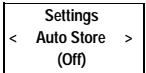
You can choose to let the phone ask you if you want to store a called or incoming phone number that is not stored in your phone book. The phone then asks Store? when the call ended.
To turn the function on /off
1.Scroll to Settings, YES, Auto Store, YES.
2. Select On or Off.
Reset
You can reset some settings to their default values. If you do so, the following settings are affected:
- all settings in the Settings menu, except your own ring signal melodies,
the ring signal volume,
the earpiece volume and the handsfree speaker volume,
the alarm function in the Tools menu is turned off, - the Area info in the Mail menu is turned off.
To reset the phone
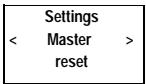
- Scroll to Settings, YES, Master reset, YES.
- Enter the phone lock code (the default code is 0000) and press YES.
Sending and Receiving Text Messages (SMS)
The Short Message Service (SMS) allows you to send and receive text messages consisting of up to 160 characters.
You can receive text messages when the phone is in standby mode, during a call or when incoming calls are diverted to another phone number.
If your SIM card does not contain the phone number to your network service centre, you must specify the number yourself. Otherwise you cannot reply to messages received or send your own messages. See "Enabling the Phone to Send SMS" on page 37.
Note! The Short Message Service may not be available on all networks. Some network operators may only allow SMS to be sent within their own network.
Receiving a Message
When you receive a message, you hear a signal and the display indicates that you have a new message. The indicator light on the top of the phone rapidly flashes green.
Note! All networks do not send an audible signal.
To read the message now
- Press YES when you see the Read now? prompt.
The display shows the status of the message (New) and when it was received. If your network supports Calling Line Identification, the sender's number is displayed. If the sender's number and name is stored in the phone book, his or her name is shown instead.
- Press YES and scroll through the message using the arrow keys. RIGHT takes you forwards and LEFT takes you backwards through the message. To go to the end of the message, press and hold RIGHT.
The prompt Reply? appears after the last line of the message. If the sender wants you to reply, the displayed message will read Requested reply Reply? provided that your network supports this. See "Replying to a Message" on page 37

New 12:15 rom:123456
Options Serv cent 1234567
New
To read the message later
- Press NO when you see the Read now? prompt. The message is stored in the message memory as New and the envelope icon appears at the bottom of the standby display.
Reading a Stored Message
- Scroll to Mail, YES, Read messages, YES.
-
Scroll to the message you are looking for. New means an unread message. Old means a read message. Sent means a message that you have sent yourself. To Send means a message you have written, but not sent If a message is stored on the SIM card, it is identified by a SIM Card icon.
-
Press YES.
- Read the message as described in "Receiving a Message" on page 36.
To call a phone number found in a message
- Press YES when the number is displayed.
Enabling the Phone to Send SMS
If you want to send or reply to a message, you need to make sure that the service centre number is set. Most modern SIM cards already contain this information at the time of purchase. You can obtain the service centre address from your network operator.
To set the service centre address
- Scroll to Mail, YES, Options, YES, Serv cent, YES.
- If no number appears in the display, enter the number of the service centre, including the international prefix, and press YES.
- Press CLR to return to standby mode. Your phone is now ready to send text messages.
Replying to a Message
- Scroll to the end of the message. The Reply? prompt appears.
- Press YES. Your display now looks like the picture in the margin.
- Press YES and proceed as described in "Composing a Text Message" on page 40.
If you do not want to reply
- Press NO at the Reply? prompt.

Network
12:15
Erasing a Message
- Scroll to the end of the message.
The Reply? prompt appears.
- Press NO.
The message Erase? appears.
- To erase the message from the message memory, press YES.
The next message automatically appears in the message list.
Tip! You can press and hold CLR anywhere within the menu that handles your message to erase it. When Erase? appears, press YES.
Storing Incoming Messages
If you do not want to read an incoming message at once, it is automatically stored in the message memory in the phone. This allows you to read it later. If there are any unread messages in the message memory, the envelope icon appears at the bottom of the standby display. The message is stored in the message memory as New.
The message memory can hold up to 10 messages. When all memory positions are full, the oldest read message is overwritten when a new message is received.
If the message memory becomes full with unread messages, new messages are automatically stored in the SIM card memory.
Messages remain in the message memory until you erase them (see "Erasing a Message" on page 38), until you insert a different SIM card, or until the telephone needs the memory space to store new messages.
The SIM Card Memory
You can store important messages in a memory on your SIM card. This means that you can find them no matter which phone you use. Messages that are saved in the SIM card memory remain there until you erase them. The maximum number that you can store depends on your SIM card.
If the SIM card memory becomes full, the envelope icon starts flashing. The text Not stored Mem full appears. You will have to erase one or more messages, before you can store any new messages in the SIM card memory.
Stored on card 3(15)

Storing a received message in the SIM card memory
- Scroll to the end of the message.
The Reply? prompt appears.
- Press NO.
The Erase? prompt appears.
- Press NO.
The Store? prompt appears.
- Press YES.
The message automatically moves from the message memory to the SIM card memory.
The display now shows the position of the message. For example, if it is the third of fifteen that the phone can store.
Tip! You can also store messages you have composed yourself on the SIM card. See "Own Messages" on page 41.
Enhancing Your Text Messages
Before you send your message, you can set the type of message, the duration of repetitions, and if you want to have a reply to your messages.
Message Type
Your phone can send other types of messages. Your network operator's service centre may offer the facility to convert a text message into a format (e-mail, fax, telex, etc.) that suits the equipment that is going to receive the message. Check with your network operator to find out which message types you can use and how.
To change message types
- Scroll to Mail, YES, Options, YES, Msg type, YES.
- Scroll to the format that you want and press YES.
Repetition of Message
If your message cannot be delivered because the receiver is not within reach of a network, you can instruct your Service Centre to repeat the message for a certain length of time.
To set repetition of a message
- Scroll to Mail, YES, Options, YES, Valid per, YES.
- Scroll to the time span that you want and press YES.
Reply to Messages
Sometimes you may want the receiver of your message to reply. If so, you need to set the Reply requested.
Options Reply Rec (Off)
To set the Reply requested
- Scroll to Mail, YES, Options, YES, Reply Req, YES.
Composing a Text Message
For more information on how to enter text, see "Your Personal Phone Book" on page 22.
Checking the First Characters You Have Entered
- Press LEFT until you reach the characters you want to view.
Editing the Written Text
- Scroll through the message text with the arrow keys and erase characters to the left of the cursor using CLR, or insert characters above the cursor.
Press 1 to insert a space. - To go to the end of the message, press and hold RIGHT.
Note! If there is a pause of more than 120 seconds between entering characters, the message is stored and the phone returns to the standby menu.
Sending a New Text Message
- Scroll to Mail, YES, Send message, YES, New, YES. An empty display appears.
- Enter your message. (See "Composing a Text Message" on page 40).
- When you have completed your message, press YES. You are now prompted to enter the receiver's phone number.
To send the message immediately
- Enter the receiver's phone number or recall it from the phone book. To access the Phone book menu, press LEFT. Scroll through the phone book using the RIGHT and LEFT key.
- Press YES.
To store the message for later use
Instead of entering a phone number, press NO. The message is now stored in the message memory. The message is labelled To send instead of Sent.
Note! The same procedure is used with all types of messages, for example e-mail or fax. Check with your network operator to find out which message types you can use. You have to change the message type first.ed

Send message Own Messages
□
Sending a Stored Message
- Scroll to Mail, YES, Send message, YES.
- Scroll to the stored message you wish to send and press YES.
- Now you can edit your message. When you are finished, press YES.
- Enter the receiver's phone number (or recall it from the phone book).
- To send the message, press YES.
Own Messages
You can store up to ten standard messages, to be re-used whenever you want. The messages must not exceed 30 characters.
Creating an Own Message
- Scroll to Mail, YES, Send message, YES, Own messages, YES.
- Scroll to the end of the message list. The phone prompts: New.
- Press YES.
- Enter the message, see "Composing a Text Message" on page 40, and press YES. The phone prompts Store?
- Press YES.
Sending an Own Message
- Scroll to Mail, YES, Send message, YES, Own messages, YES.
- Scroll to the message you wish to send and press YES.
- Press YES to send the message, see "Sending a New Text Message" on page 40.
Deleting an Own Message
- Scroll to the message you wish to delete, then press and hold CLR. The phone asks Delete Own 1?
- Press YES.
Area Information
The ordinary Short Message Service is a personal service that carries your private messages. Area Information (AI) is a text message which is broadcast to all subscribers in a certain network cell at the same time. For example, the information may be a local road report or a local taxi phone number.
Note! This feature may not be available on all networks.
Turning Area Information On
- Scroll to Mail, YES, Options, YES, Area info, YES, On, YES.
Turning Area Information Off
- Scroll to Mail, YES, Options, YES, Area info, YES, Off, YES.
Area Information Message Types
Each type of Area Information message is identified by a three-digit code. At present, the following message types exist:
| Code: | AI Message Type: |
| 000 | Index |
| 010 | News flashes |
| 020 | Hospitals |
| 022 | Doctors |
| 024 | Pharmacy |
| 030 | Long-distance road reports |
| 032 | Local road reports |
| 034 | Taxis |
| 040 | Weather |
| 050 | District (base station identity) |
| 052 | Network information |
| 054 | Operator services |
| 056 | Directory enquiries (national) |
| 057 | Directory enquiries (international) |
| 058 | Customer care (national) |
| 059 | Customer care (international) |
Note! These codes are operator dependent. For information about the AI services you can use, please refer to the information supplied by your network operator.
Area Information Message List
You can decide which types of area information messages you wish to receive. The number of area codes that can be stored depends on the size of the SIM card's Area Info list. If the SIM card does not have an area info list, the phone itself will store up to 32 codes.
To insert an area information code
- Scroll to Mail, YES, Options, YES, Area info, YES, Edit list, YES.
The number to the left indicates the position in the list. You can scroll forwards and backwards through the list with the arrow keys. - To insert a code, scroll to the first empty position, using the arrow keys and press YES.
- Enter the new code. (You only need to enter 40 for 040, since the phone adds the leading zero automatically.)
To erase or replace a code
- Scroll to Mail, YES, Options, YES, Area info, YES, Edit list, YES.
- Scroll to the code you wish to erase/replace and press YES.
- To erase, scroll to Erase? and press YES.
To replace, scroll to Chg code? and press YES. Enter the new code and press YES.
Receiving an Area Message
When you receive Area information, the message is stored in the phone memory. Provided Area info is turned on, you can read the messages via the Area messages function in the Mail menu.
To read an area message
- Scroll to Mail, YES, Area messages, YES.
- Scroll from one message to another.
- To select a message, press YES.
Note! The phone only stores one message per code. This means that the message stored previously in a specific code will be overwritten.



Diverting Incoming Calls
If you want to make certain that your incoming calls are correctly handled when you are unable to answer them, you can use the Call Divert service to divert them to another phone number.
Note! The Call Divert service may not be available on all networks.
The Call Divert service lets you:
- divert calls if you are already on the phone, On busy.
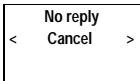
- divert calls that you do not answer within a specified time limit (operator dependent), No reply.
- divert calls if your phone is turned off or if you are unreachable, Unreachable.
You may use any combination of the above.
You may also:
- divert all incoming calls, All calls. A divert indicator in the shape of an arrow is shown in the display. If you activate the All calls divert, all other diverts become temporarily inactive. They are activated again when you cancel the All calls divert.
Tip! If you subscribe to the Alternate Line Service (ALS), you can set different Call Diverts for the two lines, i.e. Line 1 and Line 2.
Activating Call Diverts
1.Scroll to Divert, YES.
2. Select the divert you want (All calls, On busy, No reply or Unreachable).
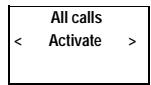
3. Select Activate.
4. Enter the phone number, including the area code, to which you want your calls to be diverted and then press YES.
Tip! If the phone number is stored in the phone book, you do not need to enter it. Press LEFT and then recall the number.
Checking the Divert Status
To check the status of a certain call divert
- Scroll to Divert, YES.
- Select the divert you want.
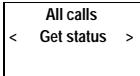
- Select Get status.
The message Please wait appears, followed by a message which informs you whether the call divert is activated or not.
To check the status of all call diverts
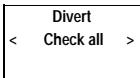
Scroll to Divert, YES, Check all, YES.
The message Please wait appears, followed by information about all call diverts, i.e. whether they are activated or not.
Cancelling Call Diverts
To cancel a certain call divert
- Scroll to Divert, YES.
- Select the divert you want.
- Select Cancel.
The message Please wait appears, followed by a message which informs you that the call divert has been cancelled.
To cancel all call diverts
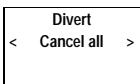
- Scroll to Divert, YES, Cancel all, YES.
The message Please wait appears, followed by a message which informs you that all call diverts have been cancelled.
Diverting Fax Calls
If you have turned the Data menus on (see "Activating the Data Menu" on page 70), you can set call diverts for your phone calls and fax calls individually.
For fax numbers, there are only two divert alternatives:
All calls
- Unanswered (includes On busy, No reply and Unreachable).


Security for Your Phone and Subscription
There are several ways to protect your phone and subscription from unauthorized use. Anything from a simple keypad lock to full phone number control.
Keypad Lock
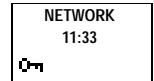
The Keypad Lock helps you to avoid accidental dialling, which can happen if you keep your phone in your pocket. An icon in the shape of a key in the display informs you that the keypad is locked.
The keypad lock is automatic. This means that if you do not press a key within 25 seconds, the keypad is locked.
Note! Calls to the international emergency number 112 can be made when the keypad is locked. If the phone alarm rings, you can turn it off by pressing any key.
The keypad remains locked until you:
answer an incoming call
- replace the battery
- unlock the keypad
Note! The keylock is always disabled if the phone is connected to vehicle handsfree equipment.
To activate the automatic keylock
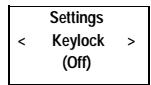
- Scroll to Settings, YES, Keylock, YES, Auto, YES.
To cancel the automatic keylock - Scroll to Settings, YES, Keylock, YES, Off, YES.
Unlocking the keypad
Press LEFT followed by YES.
The SIM Card Lock
The SIM card lock only protects your subscription and not your phone itself from unauthorized use. If you change SIM card, the phone still works with the new SIM card.