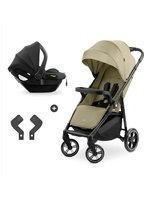
DENVER 6 - Stroller HAUCK - Free user manual and instructions
Find the device manual for free DENVER 6 HAUCK in PDF.



User questions about DENVER 6 HAUCK
0 question about this device. Answer the ones you know or ask your own.
Ask a new question about this device
Download the instructions for your Stroller in PDF format for free! Find your manual DENVER 6 - HAUCK and take your electronic device back in hand. On this page are published all the documents necessary for the use of your device. DENVER 6 by HAUCK.
USER MANUAL DENVER 6 HAUCK
Read these instructions carefully before use and keep them for future reference. Your child's safety may be affected if you do not follow these instructions.
- The vehicle is intended for children from 0 and up to 15kg ; when used in combination with a car seat or a pram body, the maximum weight as indicated on the car seat or prambody applies.
- Do not use the stroller as a pushchair, until your child is able to sit unassisted and is not younger than 6 months.
- Never leave your child unattended in or with the stroller.
- Keep plastic packaging materials out of reach of children to avoid the danger of asphyxiation.
- Prior to each use make sure that all locks on the frame are anchored (frame lock, seat on frame, wheels, bumper bar, and hood).
Always strap your child in with the safety belts, always use the crotch strap in combination with lap and shoulder belts. - When parking always use the parking brake.
- Avoid situations of extreme use that decrease your control over the child and the stroller. When using the stroller for your child, your speed should be limited to a walking speed, so no running, jogging, or skating. Do not use escalators or stairs and be careful when using the elevators while your child is in the stroller.
- Loads or baskets attached to the push bar negatively influence the stability and the durability of the stroller. Only use the indicated storage spaces and do not exceed the maximum permitted weight.
- Check, clean and oil this stroller regularly. Use non-aggressive cleansing agents and lubricants.
The stroller may only be used for the transportation of one child. -
No accessories may be used on the stroller unless they have been explicitly permitted by asahi for the stroller.
-
Make sure that the child's hands stay out of range of possible pinching areas when the stroller or parts thereof are being folded, unfolded, or otherwise changed.
WARNING: Bear in mind that small parts, such as the valve caps on the wheels, can be swallowed by your child, and may cause your child to choke.
- The handbrake is for assisting the braking process. Abrupt braking should be avoided for safety reasons
The basket is designed to carry a max. weight of 3kg
Please use only original hauck accessories and original hauck spare parts.
THIS PRODUCT CONFORMS TO THE STANDARD:
DIN EN 1888: 2003-6
Instructions for use
Scope of supply (fig. 1)
- Chassis with pushchair superstructure
Snug nest - Leg cover
1. Assembly
Release the transport safeguard. Erect the pushchair by moving the slide until you can see and hear that
the locking mechanisms on both sides have engaged.
2. Mounting the wheels (fig. 2)
Fit a wheel on the front axle until you hear it click and the metal clip has engaged in the axle groove. Check that it fits firmly. Push the axle through the two plastic guides at the ends of the frame and fit the other wheel. Here again, check that it fits firmly. Proceed accordingly with the rear axle.
3. Brakes
To lock the foot brake, press the brake bar down with your foot. To release it again, lift the brake bar with your foot.
Caution! Always lock the brakes when parking the pushchair.
4. Mounting the hood (fig. 3)
Push the hood in the corresponding openings to the left and right of the pushchair superstructure.
5. Swivelling the push bar (fig. 4a, 4b, 4c, 4d)
The push bar can be swivelled to use the pushchair with snug nest. To do so, pull the upper adjusting lever on the push bar and move it over to the other side at the same time. Check that it has engaged correctly.
6. Adjusting the height of the push bar (fig. 5)
Press the adjusting buttons underneath the handle on both sides and adjust the required height. After adjusting the required height, the buttons pop out again.
7. Adjusting the back rest (fig. 6)
To adjust the back rest, pull the metal handle at the back of the rest up and move the back rest back.
The sitting position is achieved by pushing the back rest up until the locking mechanism engages.
8. Adjusting the leg rest (fig. 7)
Bring the leg rest to the required position and hook the metal supports in position under the leg rest.
9. Adjusting the front strap (fig. 8)
Press the adjusting buttons on both sides and adjust the required position. After adjusting the required position, the buttons pop out again.
10. Safety belt
Fit the belt between the legs and around the hips. Adjust the width of the belt to fit your child.
Caution! To avoid any injuries, you should always secure your child with the safety belt.
11. Collapsing (fig. 9)
Pull the lower unlocking levers on both sides of the push bar upwards and push the pushchair down to collapse. Tip: Before collapsing the pushchair, adjust it to the lying position.
Care and washing instructions
To clean the seat of your pram, remove the screws and plastic clips and wash the seat by hand using lukewarm soapy water. Do not put the seat in the tumble dryer as the seat contains plastic struts. Only attach the seat again when it is completely dry. To wash the removable cover (if your pram has one of these) we recommend hand laundry.
PLEASE DO NOT USE BLEACH! Please check from time to time whether there are any loose screws, broken plastic parts or torn parts in your pram. Replace broken or worn parts immediately. Do not continue to use your pram if it is damaged. To clean the frame of your pram, please only use lukewarm water with a mild detergent! If your pram is exposed to excessive sunshine, the plastic parts and material covers can fade.
IMPORTANT- KEEP IT FOR LATER READING
CONSERVER CE MODE D'EMPLOI POUR UN USAGE ULTERIEUR ET LE LIRE ATTENTIVEMENT
BELANGRIJK - BEWAAR ALS NASLAGWERK
CONSERVARE PER UNA CONSULTAZIONE SUCESSIVA

hauck GmbH & Co KG
Tel. : +49 (0)9562 / 986-0
Frohnlacher Str. 8
Fax. : +49 (0)9562 / 6272
D-96242 Sonnefeld
Email : info@hauck.de
Germany
Internet: http://www.hauck.de