PRESTIGE 2002 - Router ZYXEL - Free user manual and instructions
Find the device manual for free PRESTIGE 2002 ZYXEL in PDF.


User questions about PRESTIGE 2002 ZYXEL
0 question about this device. Answer the ones you know or ask your own.
Ask a new question about this device
Download the instructions for your Router in PDF format for free! Find your manual PRESTIGE 2002 - ZYXEL and take your electronic device back in hand. On this page are published all the documents necessary for the use of your device. PRESTIGE 2002 by ZYXEL.
USER MANUAL PRESTIGE 2002 ZYXEL
Prestige 2002 Series
VoIP Analog Telephone Adaptor
User's Guide
Version 3.60
5/2005
ZyXEL
Copyright
Copyright © 2005 by ZyXEL Communications Corporation.
The contents of this publication may not be reproduced in any part or as a whole, transcribed, stored in a retrieval system, translated into any language, or transmitted in any form or by any means, electronic, mechanical, magnetic, optical, chemical, photocopying, manual, or otherwise, without the prior written permission of ZyXEL Communications Corporation.
Published by ZyXEL Communications Corporation. All rights reserved.
Disclaimer
ZyXEL does not assume any liability arising out of the application or use of any products, or software described herein. Neither does it convey any license under its patent rights nor the patent rights of others. ZyXEL further reserves the right to make changes in any products described herein without notice. This publication is subject to change without notice.
Trademarks
ZyNOS (ZyXEL Network Operating System) is a registered trademark of ZyXEL Communications, Inc. Other trademarks mentioned in this publication are used for identification purposes only and may be properties of their respective owners.
Federal Communications Commission (FCC) Interference Statement
This device complies with Part 15 of FCC rules. Operation is subject to the following two conditions:
- This device may not cause harmful interference.
- This device must accept any interference received, including interference that may cause undesired operations.
This equipment has been tested and found to comply with the limits for a Class B digital device pursuant to Part 15 of the FCC Rules. These limits are designed to provide reasonable protection against harmful interference in a commercial environment. This equipment generates, uses, and can radiate radio frequency energy, and if not installed and used in accordance with the instructions, may cause harmful interference to radio communications.
If this equipment does cause harmful interference to radio/television reception, which can be determined by turning the equipment off and on, the user is encouraged to try to correct the interference by one or more of the following measures:
- Reorient or relocate the receiving antenna.
- Increase the separation between the equipment and the receiver.
- Connect the equipment into an outlet on a circuit different from that to which the receiver is connected.
- Consult the dealer or an experienced radio/TV technician for help.
Notice 1
Changes or modifications not expressly approved by the party responsible for compliance could void the user's authority to operate the equipment.
This Class B digital apparatus complies with Canadian ICES-003.
1 Select your product from the drop-down list box on the ZyXEL home page to go to that product's page.
2 Select the certification you wish to view from this page.

SafetyWarnings
For your safety, be sure to read and follow all warning notices and instructions.
- To reduce the risk of fire, use only No. 26 AWG (American Wire Gauge) or larger telecommunication line cord.
- Do NOT open the device or unit. Opening or removing covers can expose you to dangerous high voltage points or other risks. ONLY qualified service personnel can service the device. Please contact your vendor for further information.
- Use ONLY the dedicated power supply for your device. Connect the power cord or power adaptor to the right supply voltage (110V AC in North America or 230V AC in Europe).
- Do NOT use the device if the power supply is damaged as it might cause electrocution.
- If the power supply is damaged, remove it from the power outlet.
- Do NOT attempt to repair the power supply. Contact your local vendor to order a new power supply.
- Place cables carefully so that no one will step on them or stumble over them. Do NOT allow anything to rest on the power cord and do NOT locate the product where anyone can walk on the power cord.
- Do NOT install nor use your device during a thunderstorm. There may be a remote risk of electric shock from lightning.
- Do NOT expose your device to dampness, dust or corrosive liquids.
- Do NOT use this product near water, for example, in a wet basement or near a swimming pool.
- Do NOT obstruct the device ventilation slots, as insufficient airflow may harm your device.
- Do NOT store things on the device.
- Connect ONLY suitable accessories to the device.
ZyXEL Limited Warranty
ZyXEL warrants to the original end user (purchaser) that this product is free from any defects in materials or workmanship for a period of up to two years from the date of purchase. During the warranty period, and upon proof of purchase, should the product have indications of failure due to faulty workmanship and/or materials, ZyXEL will, at its discretion, repair or replace the defective products or components without charge for either parts or labor, and to whatever extent it shall deem necessary to restore the product or components to proper operating condition. Any replacement will consist of a new or re-manufactured functionally equivalent product of equal value, and will be solely at the discretion of ZyXEL. This warranty shall not apply if the product is modified, misused, tampered with, damaged by an act of God, or subjected to abnormal working conditions.
Note
Repair or replacement, as provided under this warranty, is the exclusive remedy of the purchaser. This warranty is in lieu of all other warranties, express or implied, including any implied warranty of merchantability or fitness for a particular use or purpose. ZyXEL shall in no event be held liable for indirect or consequential damages of any kind of character to the purchaser.
To obtain the services of this warranty, contact ZyXEL's Service Center for your Return Material Authorization number (RMA). Products must be returned Postage Prepaid. It is recommended that the unit be insured when shipped. Any returned products without proof of purchase or those with an out-dated warranty will be repaired or replaced (at the discretion of ZyXEL) and the customer will be billed for parts and labor. All repaired or replaced products will be shipped by ZyXEL to the corresponding return address, Postage Paid. This warranty gives you specific legal rights, and you may also have other rights that vary from country to country.
Customer Support
Please have the following information ready when you contact customer support.
Product model and serial number.
- Warranty Information.
- Date that you received your device.
- Brief description of the problem and the steps you took to solve it.
| METHOD LOCATION | SUPPORT E-MAIL | TELEPHONE^ | WEB SITE | REGULAR MAIL |
| SALES E-MAIL | FAX | FTP SITE | ||
| CORPORATE HEADQUARTERS (WORLDWIDE) | support@zyxel.com.tw | +886-3-578-3942 | www.zyxel.com www.europe.zyxel.com | ZyXEL Communications Corp. 6 Innovation Road II Science Park Hsinchu 300 Taiwan |
| sales@zyxel.com.tw | +886-3-578-2439 | ftp.zyxel.com ftp.europe.zyxel.com | ||
| CZECH REPUBLIC | info@cz.zyxel.com | +420 241 091 350 | www.zyxel.cz | ZyXEL Communications Czech s.r.o. Modranská 621 143 01 Praha 4 - Modraney Ceská Republika |
| info@cz.zyxel.com | +420 241 091 359 | |||
| DENMARK | support@zyxel.dk | +45 39 55 07 00 | www.zyxel.dk | ZyXEL CommunicationsA/S Columbusvej 5 2860 Soeborg Denmark |
| sales@zyxel.dk | +45 39 55 07 07 | |||
| FINLAND | support@zyxel.fi | +358-9-4780-8411 | www.zyxel.fi | ZyXEL Communications Oy Malminkaari 10 00700 Helsinki Finland |
| sales@zyxel.fi | +358-9-4780 8448 | |||
| FRANCE | info@zyxel.fr | +33 (0)4 72 52 97 97 | www.zyxel.fr | ZyXEL France 1 rue des Vergers Bat. 1/C 69760 Limonest France |
| +33 (0)4 72 52 19 20 | ||||
| GERMANY | support@zyxel.de | +49-2405-6909-0 | www.zyxel.de | ZyXEL Deutschland GmbH. Adenauerstr. 20/A2 D-52146 Wuerselen Germany |
| sales@zyxel.de | +49-2405-6909-99 | |||
| NORTH AMERICA | support@zyxel.com | +1-800-255-4101 | www.us.zyxel.com | ZyXEL Communications Inc. 1130 N. Miller St. Anaheim CA 92806-2001 U.S.A. |
| +1-714-632-0882 | ||||
| sales@zyxel.com | +1-714-632-0858 | ftp.us.zyxel.com | ||
| NORWAY | support@zyxel.no | +47 22 80 61 80 | www.zyxel.no | ZyXEL CommunicationsA/S Nils Hansens vei 13 0667 Oslo Norway |
| sales@zyxel.no | +47 22 80 61 81 | |||
| SPAIN | support@zyxel.es | +34 902 195 420 | www.zyxel.es | ZyXEL Communications Alejandro Villegas 33 1°,28043Madrid Spain |
| sales@zyxel.es | +34 913 005 345 | |||
| SWEDEN | support@zyxel.se | +46 31 744 7700 | www.zyxel.se | ZyXEL Communications A/S Sjöporten 4, 41764 Göteborg Sweden |
| sales@zyxel.se | +46 31 744 7701 | |||
| METHOD LOCATION | SUPPORT E-MAIL | TELEPHONEA | WEB SITE | REGULAR MAIL |
| SALES E-MAIL | FAX | FTP SITE | ||
| UNITED KINGDOM | support@zyxel.co.uk | +44 (0) 8702 909090 | www.zyxel.co.uk | ZyxEL Communications UK Ltd.,11 The Courtyard, Eastern Road, Bracknell, Berkshire, RG12 2XB, United Kingdom (UK) |
| sales@zyxel.co.uk | +44 (0) 8702 909091 0906 7370001(UK only) | ftp.zyxel.co.uk |
a. “+” is the (prefix) number you enter to make an international telephone call.
Table of Contents
Copyright 3
Federal Communications Commission (FCC) Interference Statement 4
SafetyWarnings 6
ZyXEL Limited Warranty 7
Customer Support 8
List of Figures 17
List of Tables 19
Preface 21
Chapter 1 Introducing the Prestige 23
1.1 Prestige VoIP Analog Telephone Adaptor Overview 23
1.2 Prestige 2002L VoIP Analog Telephone Adaptor with Lifeline 23
1.3 Features 23
1.4 LEDs 25
1.5 Applications 26
1.5.1 Make Calls via Internet Telephony Service Provider 26
1.5.2 Make Calls via IP-PBX 27
1.5.3 Make Peer-to-peer Calls 27
Chapter 2 Introducing the Web Configurator 29
2.1 Web Configurator Overview 29
2.2 Accessing the Prestige Web Configurator 29
2.3 Resetting the Prestige 31
2.3.1 Procedure To Use The Reset Button 31
2.4 Navigating the Prestige Web Configurator 31
2.5 Common Screen Command Buttons 33
Chapter 3 System Screens 35
3.1 System Overview 35
3.2 General Setup 35
3.2.1 Domain Name 35
3.3 General Setup Configuration 35
3.4 Configuring Password 36
3.5 Pre-defined NTP Time Servers List 37
3.6 Configuring Time Setting 37
Chapter 4
Ethernet Screens 41
4.1 ETHERNET Overview 41
4.1.1 IP Address and Subnet Mask 41
4.1.2 DNS Server Address Assignment 41
4.1.3 PPPoE Encapsulation 42
4.2 Configuring Ethernet 42
4.3 Configuring the Ethernet Management Port 44
Chapter 5
Introduction to VoIP 45
5.1 Introduction to VoIP 45
5.2 Introduction to SIP 45
5.2.1 SIP Identities 45
5.2.1.1 SIP Number 45
5.2.1.2 SIP Service Domain 45
5.2.2 SIP Call Progression 46
5.2.3 SIP Servers 46
5.2.3.1 SIP User Agent 46
5.2.3.2 SIP Proxy Server 47
5.2.3.3 SIP Redirect Server 47
5.2.3.4 SIP Register Server 48
5.2.4 RTP 48
5.3 NAT 48
5.3.1 NAT Example 49
5.3.2 NAT Types 49
5.3.2.1 Full Cone NAT 50
5.3.2.2 Restricted Cone NAT 51
5.3.2.3 Port Restricted Cone NAT 52
5.3.2.4 Symmetric NAT 52
5.4 NAT and SIP 53
5.4.1 SIP ALG 53
5.4.2 Use NAT Address on SIP and RTP 53
5.4.3 STUN 54
5.4.4 Outbound Proxy 54
5.5 Pulse Code Modulation 54
5.6 Voice Coding 54
5.6.1 G.711 55
5.6.2 G.729 55
5.7 PSTN Call Setup Signaling 55
5.8 MWI (Message Waiting Indication) 55
Chapter 6
VoIP Screens 57
6.1 VoIP Introduction 57
6.2 VoIP Configuration 57
6.3 Advanced VoIP Settings Configuration 59
6.4 Quality of Service (QoS) 63
6.4.1 Type Of Service (ToS) 63
6.4.2 DiffServ 63
6.4.2.1 DSCP and Per-Hop Behavior 63
6.4.3 VLAN 63
6.5 QoS Configuration 64
Chapter 7
Phone 65
7.1 Phone Introduction 65
7.1.1 Voice Activity Detection/Silence Suppression 65
7.1.2 Comfort Noise Generation 65
7.1.3 Echo Cancellation 65
7.2 Phone Port Configuration 65
7.3 Supplementary Phone Services Overview 67
7.3.1 The Flash Key 67
7.3.2 Europe Type Supplementary Phone Services 67
7.3.2.1 European Call Hold 68
7.3.2.2 European Call Waiting 68
7.3.2.3 European Call Transfer 69
7.3.2.4 European Three-Way Conference 69
7.3.3 USA Type Supplementary Services 69
7.3.3.1 USA Call Hold 69
7.3.3.2 USA Call Waiting 70
7.3.3.3 USA Call Transfer 70
7.3.3.4 USA Three-Way Conference 70
7.4 Common Phone Configuration 70
Chapter 8
Phone Book 73
8.1 Phone Book Introduction 73
8.1.1 Speed Dial 73
8.1.1.1 Peer-to-Peer Calls 73
8.1.2 Lifeline (Prestige 2002L) 73
8.2 Speed Dial Configuration 73
8.3 Call Forward 75
8.4 Lifeline Configuration (Prestige 2002L) 78
Chapter 9
Logs 81
9.1 Viewing Logs 81
9.2 Log Message Descriptions 82
Chapter 10
Maintenance 85
10.1 Maintenance Overview 85
10.2 Status Screen 85
10.3 F/W Upload Screen 87
10.4 Configuration Screen 89
10.4.1 Backup Configuration 90
10.4.2 Restore Configuration 90
10.4.3 Back to Factory Defaults 91
10.5 Restart Screen 92
Chapter 11
Phone Usage 93
11.1 Dialing a Telephone Number 93
11.2 Using Speed Dial to Dial a Telephone Number 93
11.3 Internal Calls 93
11.4 Checking the Prestige's IP Address 93
11.5 Auto Firmware Upgrade 94
Chapter 12
Troubleshooting 95
12.1 Problems Starting Up the Prestige 95
12.2 Problems with the LAN or PC LED 95
12.3 Problems with the LAN Interface 96
12.4 Problems with Internet Access 96
12.5 Problems with the Web Configurator 97
12.6 Problems with the Password 97
12.7 Problems with Telephone or Telephone Port 98
12.8 Problems with Voice Service 98
12.9 Pop-up Windows, JavaScripts and Java Permissions 99
12.9.1 Internet Explorer Pop-up Blockers 99
12.9.1.1 Disable Pop-up Blockers 99
12.9.1.2 Enable Pop-up Blockers with Exceptions 100
12.9.2 JavaScripts 102
12.9.3 Java Permissions 104
12.9.3.1 JAVA (Sun) 105
Appendix A
Product Specifications 107
Appendix B
Setting up Your Computer's IP Address 111
Appendix C
IP Subsetting 123
Appendix D
PPPoE 131
Appendix E
Internal SPTGEN 133
Index 161
List of Figures
Figure 1 LEDs 26
Figure 2 Internet Telephony Service Provider Application 27
Figure 3 IP-PBX Application 27
Figure 4 Peer-to-peer Calling 28
Figure 5 Web Configurator IP Address 30
Figure 6 Enter Password 30
Figure 7 Change Password 30
Figure 8 Web Configurator 32
Figure 9 System General 36
Figure 10 Password 36
Figure 11 Time Setting 38
Figure 12 ETHERNET 43
Figure 13 ETHERNET Mgmt Port 44
Figure 14 SIP User Agent 47
Figure 15 SIP Proxy Server 47
Figure 16 SIP Redirect Server 48
Figure 17 NAT:Outgoing 49
Figure 18 NAT: Incoming 49
Figure 19 Full Cone NAT Example 51
Figure 20 Restricted Cone NAT Example 51
Figure 21 Port Restricted Cone NAT Example 52
Figure 22 Symmetric NAT 53
Figure 23 STUN 54
Figure 24 VoIP 58
Figure 25 VoIP Advanced 60
Figure 26 DiffServ: Differentiated Service Field 63
Figure 27 QoS 64
Figure 28 Phone Port 66
Figure 29 Phone Common 71
Figure 30 Speed Dial 74
Figure 31 Call Forward 76
Figure 32 Lifeline 79
Figure 33 View Log 81
Figure 34 System Status 86
Figure 35 Firmware Upload 87
Figure 36 Firmware Upload In Process 88
Figure 37 Network Temporarily Disconnected 88
Figure 38 Firmware Upload Error 89
Figure 39 Configuration 90
Figure 40 Configuration Upload Successful 91
Figure 41 Network Temporarily Disconnected 91
Figure 42 Reset Warning Message 92
Figure 43 Restart Screen 92
Figure 44 Pop-up Blocker 99
Figure 45 Internet Options 100
Figure 46 Internet Options 101
Figure 47 Pop-up Blocker Settings 102
Figure 48 Internet Options 103
Figure 49 Security Settings - Java Scripting 104
Figure 50 Security Settings - Java 105
Figure 51 Java (Sun) 106
Figure 52 Windows 95/98/Me: Network: Configuration 112
Figure 53 Windows 95/98/Me: TCP/IP Properties: IP Address 113
Figure 54 Windows 95/98/Me: TCP/IP Properties: DNS Configuration 114
Figure 55 Windows XP: Start Menu 115
Figure 56 Windows XP: Control Panel 115
Figure 57 Windows XP: Control Panel: Network Connections: Properties 116
Figure 58 Windows XP: Local Area Connection Properties 116
Figure 59 Windows XP: Internet Protocol (TCP/IP) Properties 117
Figure 60 Windows XP: Advanced TCP/IP Properties 118
Figure 61 Windows XP: Internet Protocol (TCP/IP) Properties 119
Figure 62 Macintosh OS 8/9: Apple Menu 120
Figure 63 Macintosh OS 8/9: TCP/IP 120
Figure 64 Macintosh OS X: Apple Menu 121
Figure 65 Macintosh OS X: Network 122
Figure 66 Single-Computer per Router Hardware Configuration 132
Figure 67 Prestige as a PPPoE Client 132
Figure 68 Configuration Text File Format: Column Descriptions 133
Figure 69 Invalid Parameter Entered: Command Line Example 134
Figure 70 Valid Parameter Entered: Command Line Example 134
Figure 71 Internal SPTGEN FTP Download Example 135
Figure 72 Internal SPTGEN FTP Upload Example 135
List of Tables
Table 1 LED Descriptions 26
Table 2 Web Configurator Screens Summary 32
Table 3 Common Screen Command Buttons 33
Table 4 System General 36
Table 5 Password 37
Table 6 Pre-defined NTP Time Servers 37
Table 7 Time Setting 38
Table 8 ETHERNET 43
Table 9 ETHERNET Mgmt Port 44
Table 10 SIP Call Progression 46
Table 11 NAT Types 50
Table 12 VoIP 58
Table 13 VoIP Advanced 61
Table 14 QoS 64
Table 15 Phone Port 66
Table 16 European Flash Key Commands 68
Table 17 USA Flash Key Commands 69
Table 18 Phone Common 71
Table 19 Speed Dial 74
Table 20 Call Forward 77
Table 21 Lifeline 79
Table 22 View Log 81
Table 23 System Error Logs 82
Table 24 System Maintenance Logs 82
Table 25 SIP Logs 83
Table 26 RTP Logs 83
Table 27 FSM Logs: Caller Side 84
Table 28 FSM Logs: Callee Side 84
Table 29 Lifeline Logs 84
Table 30 System Status 86
Table 31 Firmware Upload 87
Table 32 Restore Configuration 90
Table 33 Troubleshooting the Start-Up of Your Prestige 95
Table 34 Troubleshooting the LAN or PC LED 95
Table 35 Troubleshooting the LAN Interface 96
Table 36 Troubleshooting Internet Access 96
Table 37 Troubleshooting the Web Configurator 97
Table 38 Troubleshooting the Password 97
Table 39 Troubleshooting Telephone 98
Table 40 Troubleshooting Voice Service 98
Table 41 Device Specifications 107
Table 42 Feature Specifications 108
Table 43 Power Adaptor Specifications 108
Table 44 Classes of IP Addresses 123
Table 45 Allowed IP Address Range By Class 124
Table 46 "Natural" Masks 124
Table 47 Alternative Subnet Mask Notation 125
Table 48 Two Subnets Example 125
Table 49 Subnet 1 126
Table 50 Subnet 2 126
Table 51 Subnet 1 127
Table 52 Subnet 2 127
Table 53 Subnet 3 127
Table 54 Subnet 4 128
Table 55 Eight Subnets 128
Table 56 Class C Subnet Planning 128
Table 57 Class B Subnet Planning 129
Table 58 Abbreviations Used in the Example Internal SPTGEN Screens Table ... 136
Table 59 Menu 1 General Setup 136
Table 60 Menu 4 Internet Access Setup 136
Table 61 Menu 12 138
Table 62 Menu 15 SUA Server Setup 140
Table 63 Menu 21.1 Filter Set #1 142
Table 64 Menu 21.1 Filer Set #2 145
Table 65 Menu 23 System Menus 149
Table 66 Menu 24.10 Time and Date Setting 150
Table 67 Menu 24.11 Remote Management Control 150
Table 68 Menu 98 VoIP and Auto Upgrade Menus 151
Preface
Congratulations on your purchase of the Prestige 2002 Series VoIP Analog Telephone Adaptor.
Note: Register your product online to receive e-mail notices of firmware upgrades and information at www.zyxel.com for global products, or at www.us.zyxel.com for North American products.
Your Prestige is easy to install and configure.
About This User's Guide
This manual is designed to guide you through the configuration of your Prestige for its various applications and provide background information on the Prestige's features.
Note: Use the web configurator to configure your Prestige.
Related Documentation
Supporting Disk
Refer to the included CD for support documents.
- Quick Start Guide
The Quick Start Guide is designed to help you get up and running right away. It contains a detailed easy-to-follow connection diagram, default settings, handy checklists and information on setting up your network and configuring for Internet access.
Web Configurator Online Help
Embedded web help for descriptions of individual screens and supplementary information.
ZyXEL Glossary and Web Site
Please refer to www.zyxel.com for an online glossary of networking terms and additional support documentation.
User Guide Feedback
Help us help you. E-mail all User Guide-related comments, questions or suggestions for improvement to techwriters@zyxel.com.tw or send regular mail to The Technical Writing Team, ZyXEL Communications Corp., 6 Innovation Road II, Science-Based Industrial Park, Hsinchu, 300, Taiwan. Thank you.
Syntax Conventions
-
"Enter" means for you to type one or more characters. "Select" or "Choose" means for you to use one predefined choices.
-
Mouse action sequences are denoted using a comma. For example, "click the Apple icon, Control Panels and then Modem" means first click the Apple icon, then point your mouse pointer to Control Panels and then click Modem.
- For brevity's sake, we will use "e.g.," as a shorthand for "for instance", and "i.e.," for "that is" or "in other words" throughout this manual.
- The Prestige 2002 series may be referred to as the Prestige or the device in this user's guide.
Graphics Icons Key
| Prestige | Computer | Notebook computer |
| Server | Switch | Router |
| Telephone |
CHAPTER 1 Introducing the Prestige
This chapter introduces the main features and applications of the Prestige.
1.1 Prestige VoIP Analog Telephone Adaptor Overview
The Prestige is a SIP-based VoIP analog telephone adaptor (ATA). Sending voice signals over the Internet is called Voice over IP or VoIP. Session Initiated Protocol (SIP) is an internationally recognized standard for implementing VoIP.
The Prestige allows you to use a traditional analog telephone to make and receive Voice over IP calls. You can call any landline or mobile telephone as well as IP telephones. You don't need to know if the recipient's connection type is an IP, cellular or landline based service. Calls received from IP telephones work exactly as you would expect from the traditional telephone service.
The Prestige's two Ethernet ports allow you to connect the Prestige to your LAN and connect your computer to the Prestige. This way your computer can still access the LAN without adding an extra Ethernet switch.
The Prestige's web configurator allows easy management and configuration.
1.2 Prestige 2002L VoIP Analog Telephone Adaptor with Lifeline
The Prestige 2002L has all of the features of the Prestige 2002 and adds the PSTN (Public Switched Telephone Network) lifeline feature. PSTN lifeline lets you have VoIP phone service and PSTN phone service at the same time.
1.3 Features
Your Prestige is packed with a number of features that make it flexible and easy to use.
10/100Mbps Auto-negotiating Fast Ethernet Interfaces
The auto-negotiation feature allows the Prestige to detect the speed of incoming transmissions and adjust appropriately without manual intervention. It allows data transfer of either 10 Mbps or 100 Mbps in either half-duplex or full-duplex mode depending on your Ethernet network.
Auto-crossover 10/100 Mbps Ethernet Interfaces
The Ethernet interfaces automatically adjust to either a crossover or straight-through Ethernet cable.
PSTN Lifeline
The Prestige 2002L has a LINE port for connecting a PSTN line. You can receive incoming PSTN phone calls even while someone else connected to the Prestige is making VoIP phone calls. You can dial a (prefix) number to make an outgoing PSTN call. You can still make PSTN phone calls if the Prestige 2002L loses power.
REN
A Ringer Equivalence Number is used to determine the number of devices that may be connected to the telephone line. The Prestige can support three devices per telephone port.
Dynamic Jitter Buffer
The Prestige has a built-in adaptive, buffer that helps to smooth out the variations in delay (jitter) for voice traffic. This helps ensure good voice quality for your conversations.
Multiple SIP Accounts
The Prestige allows you to simultaneously use multiple voice (SIP) accounts and assign them to one or both telephone ports.
STUN
Simple Traversal of User Datagram Protocol (UDP) through Network Address Translators (STUN) allows SIP to pass through NAT routers.
Multiple Voice Channels
The Prestige can simultaneously handle multiple voice channels (telephone calls).
Additionally you can answer an incoming phone call on a VoIP account, even while someone else is using the account for a phone call.
Voice Coding
The Prestige can use the following voice CODECs (coder/decoders).
G711
G729
Voice Activity Detection/Silence Suppression
Voice Activity Detection (VAD) reduces the bandwidth that a call uses by not transmitting when you are not speaking.
Comfort Noise Generation
The Prestige generates background noise to fill moments of silence when the other device in a call stops transmitting because the other party is not speaking (as total silence could easily be mistaken for a lost connection).
Echo Cancellation
The Prestige supports G.168, an ITU-T standard for eliminating the echo caused by the sound of your voice reverberating in the telephone receiver while you talk.
QoS (Quality of Service)
Quality of Service (QoS) mechanisms help to provide better service on a per-flow basis. The Prestige supports Type of Service (ToS) tagging and Differentiated Services (DiffServ) tagging. This allows the Prestige to tag voice frames so they can be prioritized over the network.
Fax Tone Detection and Pass-through
The Prestige automatically detects fax messages and sends them over PCM G.711.
Auto-provisioning
Your voice service provider can automatically update your Prestige's configuration via an auto-provisioning server.
Auto Firmware Upgrade
The Prestige gives you the option to upgrade to a newer firmware version if it finds one during auto-provisioning. Your voice service provider must have an auto-provisioning server and a server set up with firmware in order for this feature to work.
Manual Firmware Upgrades
Use the web configurator to upload updated firmware to your Prestige.
Ease of Installation
Your Prestige is designed for quick, intuitive and easy installation. Physically, its compact size and lightness make it easy to position anywhere in your busy office.
1.4 LEDs
The following graphic displays the labels of the LEDs.
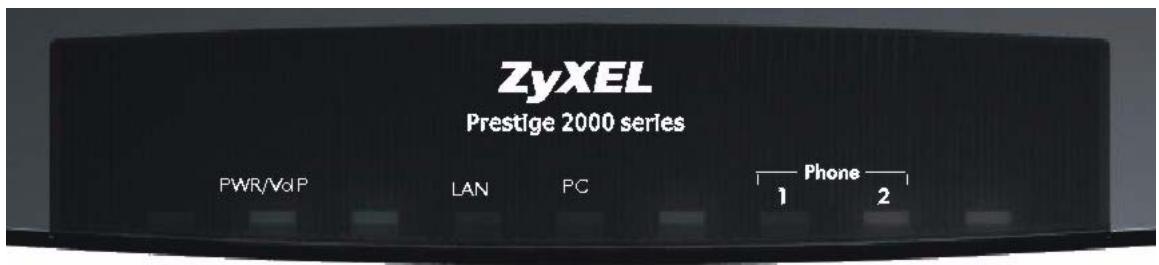
Figure 1 LEDs
Table 1 LED Descriptions
| LED | COLOR | STATUS | DESCRIPTION |
| PWR/VoIP | Green | On | The Prestige is receiving power. |
| Blinking | The Prestige is self-testing. | ||
| Orange | On | The VoIP SIP registration was successful. | |
| Off | The Prestige is not receiving power. | ||
| LAN | Green | On | The Prestige has an Ethernet connection with the cable/DSL modem. |
| Blinking | The Prestige is sending/receiving data to/from the cable/DSL modem. | ||
| Off | The Prestige doesn't have an Ethernet connection with the cable/DSL modem. | ||
| PC | Green | On | The Prestige has an Ethernet connection with a computer. |
| Blinking | The Prestige is sending/receiving data to /from the computer. | ||
| Off | The Prestige does not have an Ethernet connection with a computer. | ||
| Phone 1-2 | Green | On | The telephone(s) connected to this port is (are) in use. |
| Blinking | The telephone(s) connected to this port is (are) ringing. | ||
| Off | The telephone(s) connected to this port is (are) not in use. |
1.5 Applications
Here are some examples of how you can use your Prestige.
1.5.1 Make Calls via Internet Telephony Service Provider
In a home or small office environment, you can use the Prestige to make and receive VoIP telephone calls through an Internet Telephony Service Provider (ITSP).
The following figure shows a basic example of how you would make a VoIP call through an ITSP. You use your analog phone (A in the figure) and the Prestige (B) changes the call into VoIP. The Prestige then sends your call through your modem or router (C) to the Internet and the ITSP's SIP server. The VoIP call server forwards calls to PSTN phones (F) through a trunking gateway (E) to the PSTN network. The VoIP call server forwards calls to IP phones (G) through the Internet.
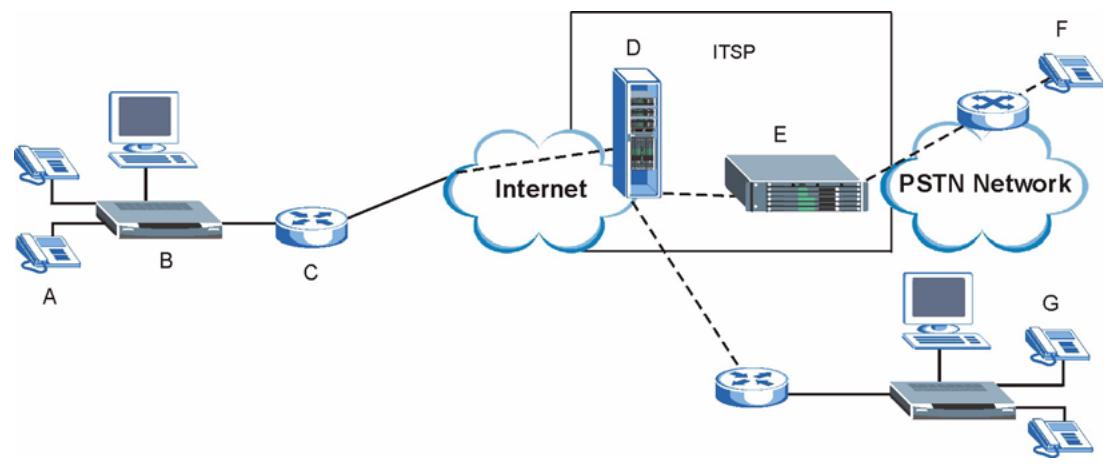
Figure 2 Internet Telephony Service Provider Application
1.5.2 Make Calls via IP-PBX
If your company has an IP-PBX (Internet Protocol Private Branch Exchange), you can use the Prestige to make and receive VoIP telephone calls through it.
In this example, you use your analog phone (A in the figure) and the Prestige (B) changes the call into VoIP and sends it to the IP-PBX. The IP-PBX forwards calls to PSTN phones (C) to the PSTN network. The IP-PBX forwards calls to IP phones (D) through an IP network (this could include the Internet).
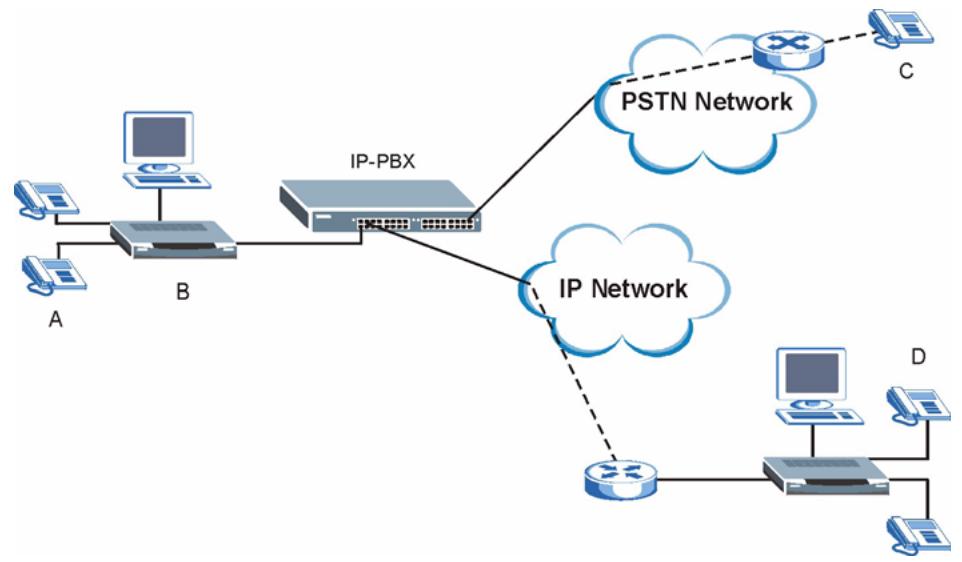
Figure 3 IP-PBX Application
1.5.3 Make Peer-to-peer Calls
Use the Prestige to make a call to the recipient's IP address without using a SIP proxy server Peer-to-peer calls are also called "Point to Point" or "IP-to-IP" calls. You must know the peer's IP address in order to do this.
The following figure shows a basic example of how you would make a peer-to-peer VoIP call. You use your analog phone (A in the figure) and the Prestige (B) changes the call into VoIP. The Prestige then sends your call through your modem or router (C) and the Internet to the peer VoIP device (D).
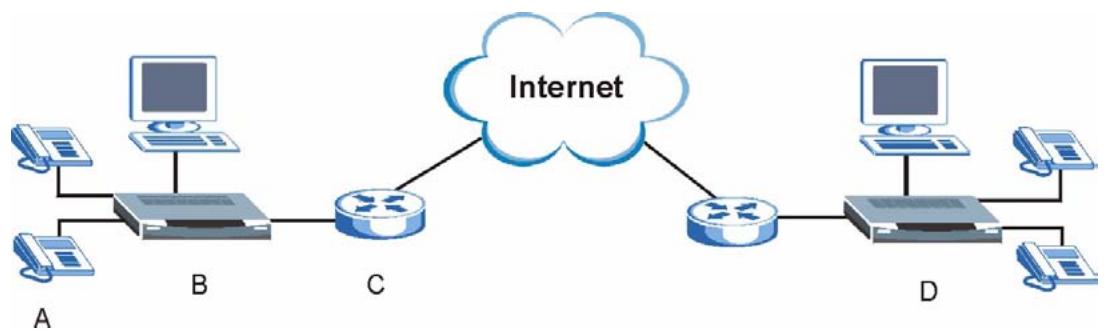
Figure 4 Peer-to-peer Calling
CHAPTER 2
Introducing the Web
Configurator
This chapter describes how to access the Prestige web configurator and provides an overview of its screens.
2.1 Web Configurator Overview
The web configurator is an HTML-based management interface that allows easy Prestige setup and management via Internet browser. Use Internet Explorer 6.0 and later or Netscape Navigator 7.0 and later versions. The recommended screen resolution is 1024 by 768 pixels.
In order to use the web configurator you need to allow:
- Web browser pop-up windows from your device. Web pop-up blocking is enabled by default in Windows XP SP (Service Pack) 2.
- JavaScripts (enabled by default).
- Java permissions (enabled by default).
See the Troubleshooting chapter if you want to make sure these functions are allowed in Internet Explorer or Netscape Navigator.
2.2 Accessing the Prestige Web Configurator
Note: If your LAN has multiple Prestige 2002s, you may need to disconnect your Prestige's LAN port to avoid accessing the wrong Prestige. Reconnect the LAN port after the Login screen displays.
1 Make sure your Prestige hardware is properly connected and prepare your computer/computer network to connect to the Prestige (refer to the Quick Start Guide).
2 Launch your web browser.
3 Enter the Prestige's management IP address (default 192.168.5.1) or IP address. The Prestige 2002 has a management IP address since by default the Prestige is set to receive a dynamically assigned IP address and thus has no default IP address. Use the Prestige's management IP address or its IP address (after it receives one). If your computer is directly connected to the Prestige, make sure your computer's IP address is in the same subnet as the Prestige's IP address or management IP address that you want to access.

Figure 5 Web Configurator IP Address
4 Type "1234" (default) as the password and click Login. In some versions, the default password appears automatically - if this is the case, click Login.
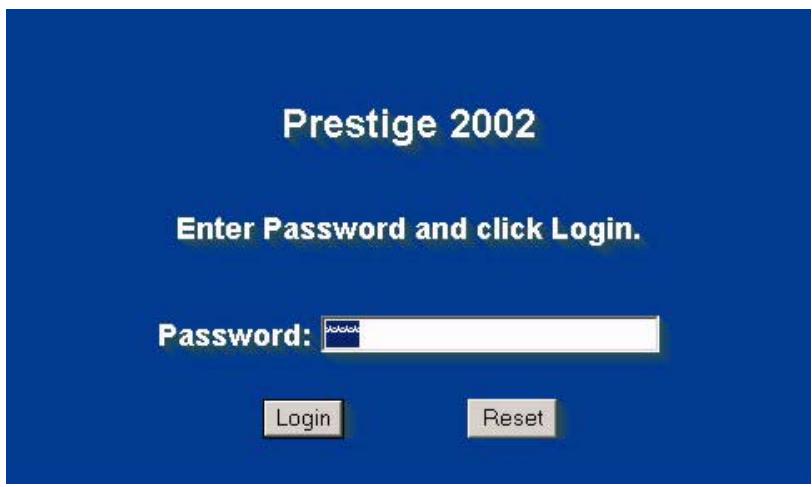
Figure 6 Enter Password
5 You should see a screen asking you to change your password (highly recommended) as shown next. Type a new password (and retype it to confirm) and click Apply or click Ignore.
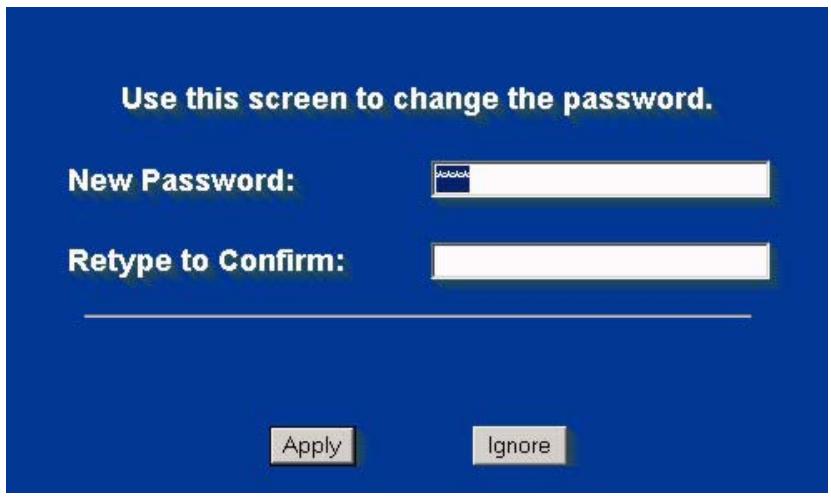
Figure 7 Change Password
6 You should now see the web configurator MAIN MENU screen (see Figure 8 on page 32).
Note: The Prestige automatically logs you out if the management session is idle for five minutes. Simply log back in if this happens to you.
2.3 Resetting the Prestige
If you forget your password or cannot access the web configurator, you will need to reload the factory-default configuration file or use the RESET button on the back of the Prestige. Uploading this configuration file replaces the current configuration file with the factory-default configuration file. This means that you will lose all configurations that you had previously. The password will also be reset to "1234".
2.3.1 Procedure To Use The Reset Button
Make sure the PWR/VoIP LED is on (not blinking) before you begin this procedure.
1 Press the RESET button for five to ten seconds (release it when the PWR/VoIP LED begins to blink). When the PWR/VoIP LED starts blinking, the defaults have been restored and the Prestige restarts. Otherwise, go to step 2.
2 Disconnect and reconnect the Prestige's power.
3 Wait for the PWR LED to stop blinking and stay on steady.
4 Press the RESET button for five to ten seconds (release it when the PWR/VoIP LED begins to blink). When the PWR/VoIP LED starts blinking, the defaults have been restored and the Prestige restarts. Otherwise, go to step 2.
2.4 Navigating the Prestige Web Configurator
The following summarizes how to navigate the web configurator from the MAIN MENU screen.
Note: Click the Help icon (located in the top right corner of most screens) to view online help.
Click a link under ADVANCED to configure Prestige features.
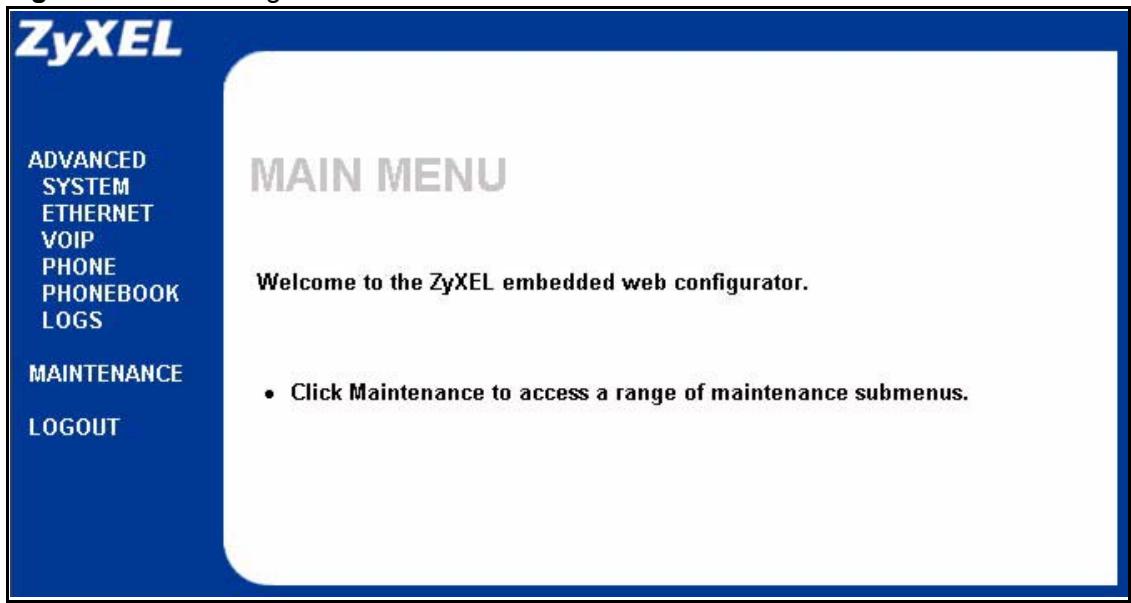
Figure 8 Web Configurator
The following table describes the navigation panel and sub-menus.
Table 2 Web Configurator Screens Summary
| LINK | TAB | FUNCTION |
| SYSTEM | General | Use this screen to configure general system settings. |
| Password | Use this screen to change your password. | |
| Time Setting | Use this screen to change your Prestige's time and date. | |
| ETHERNET | Ethernet | Use this screen to configure your Prestige's Ethernet interface settings. |
| MGNT | Use this screen to configure your Prestige's management IP address. | |
| VOIP | VoIP | Use this screen to configure your Prestige's Voice over IP settings. |
| QoS | Use this screen to configure your Prestige's Quality of Service settings. | |
| PHONE | Phone Port | Use this screen to configure your Prestige's phone settings. |
| PHONE BOOK | Speed Dial | Use this screen to configure speed dial for SIP phone numbers that you call often. |
| Lifeline | Use this screen to configure your Prestige's settings for PSTN calls (Prestige 2002L only). | |
| Call Forward | Use this screen to configure your Prestige to block or redirect calls. | |
| LOGS | View Log | Use this screen to view the logs. |
| MAINTENANCE | Status | This screen contains administrative and system-related information. |
| F/W Upload | Use this screen to upload firmware to your Prestige. | |
| Configuration | Use this screen to backup and restore the configuration or reset the factory defaults to your Prestige. | |
| Restart | This screen allows you to reboot the Prestige without turning the power off. | |
| LOGOUT | Click this label to exit the web configurator. |
2.5 Common Screen Command Buttons
The following table shows common command buttons found on many web configurator screens.
Table 3 Common Screen Command Buttons
| Apply | Click Apply to save your changes back to the Prestige. |
| Reset/Cancel | Click Reset or Cancel to begin configuring this screen afresh. |
CHAPTER 3
System Screens
This chapter provides information on the System screens.
3.1 System Overview
This chapter describes the SYSTEM screens.
3.2 General Setup
General Setup contains administrative and system-related information. System Name is for identification purposes. However, because some ISPs check this name you should enter your computer's "Computer Name".
- In Windows 95/98 click Start, Settings, Control Panel, Network. Click the Identification tab, note the entry for the Computer Name field and enter it as the System Name.
- In Windows 2000, click Start, Settings and Control Panel and then double-click System. Click the Network Identification tab and then the Properties button. Note the entry for the Computer name field and enter it as the System Name.
- In Windows XP, click Start, My Computer, View system information and then click the Computer Name tab. Note the entry in the Full computer name field and enter it as the Prestige System Name.
3.2.1 Domain Name
The Domain Name entry is what is propagated to the DHCP clients on the LAN. If you leave this blank, the domain name obtained by DHCP from the ISP is used. While you must enter the host name (System Name) on each individual computer, the domain name can be assigned from the Prestige via DHCP.
3.3 General Setup Configuration
Click SYSTEM in the navigation panel and then General Setup to display the following screen.
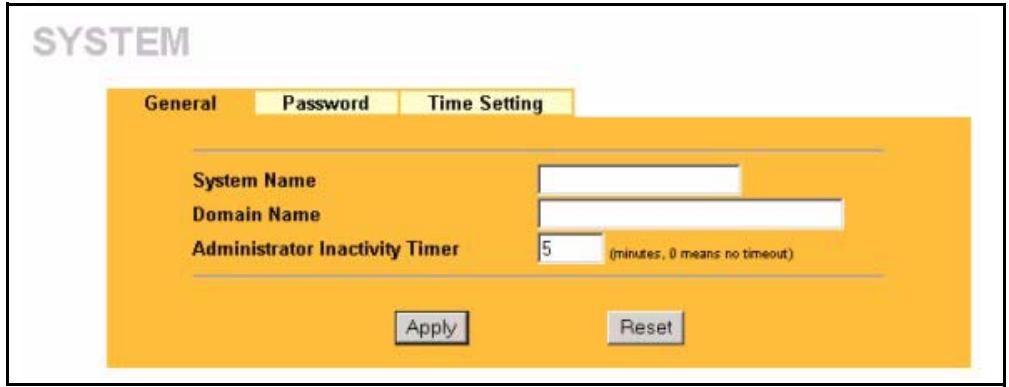
Figure 9 System General
Table 4 System General
| LABEL | DESCRIPTION |
| System Name | This is for identification purposes. Enter your computer's "Computer Name". |
| Domain Name | The Domain Name entry is what is propagated to the DHCP clients on the LAN. If you leave this blank, the domain name obtained by DHCP from the ISP is used. |
| Administrator Inactivity Timer | Type how many minutes a management session can be left idle before the session times out. The default is 5 minutes. After it times out you have to log in with your password again. Very long idle timeouts may have security risks. A value of "0" means a management session never times out, no matter how long it has been left idle (not recommended). |
| Apply | Click Apply to save your changes back to the Prestige. |
| Reset | Click Reset to begin configuring this screen afresh. |
3.4 Configuring Password
To change your Prestige's password (recommended), click SYSTEM in the navigation panel, and then the Password tab. The screen appears as shown. This screen allows you to change the Prestige's password.
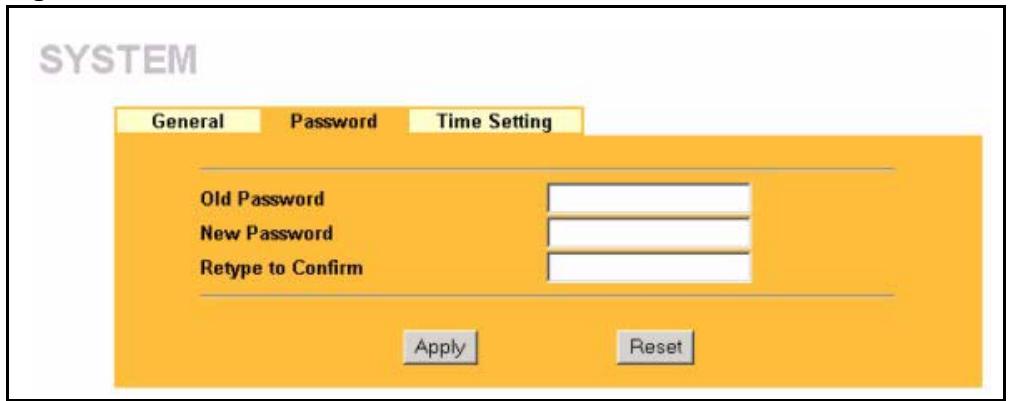
Figure 10 Password
The following table describes the labels in this screen.
Table 5 Password
| LABEL | DESCRIPTION |
| Old Password | Type the default password or the existing password you use to access the system in this field. Use up to 32 ASCII characters. |
| New Password | Type the new password in this field. |
| Retype to Confirm | Type the new password again in this field. |
| Apply | Click Apply to save your changes back to the Prestige. |
| Reset | Click Reset to begin configuring this screen afresh. |
3.5 Pre-defined NTP Time Servers List
The Prestige uses the following pre-defined list of NTP time servers if you do not specify a time server or it cannot synchronize with the time server you specified.
Note: The Prestige can use this pre-defined list of time servers regardless of the Time Protocol you select.
When the Prestige uses the pre-defined list of NTP time servers, it randomly selects one server and tries to synchronize with it. If the synchronization fails, then the Prestige goes through the rest of the list in order from the first one tried until either it is successful or all the pre-defined NTP time servers have been tried.
Table 6 Pre-defined NTP Time Servers
| ntp1.cs.wisc.edu |
| ntp1.gbg.netnod.se |
| ntp2.cs.wisc.edu |
| tock.usno.navy.mil |
| ntp3.cs.wisc.edu |
| ntp.cs.strath.ac.uk |
| ntp1.sp.se |
| time1.stupi.se |
| tick.stdttime.gov.tw |
| tock.stdttime.gov.tw |
| time.stdttime.gov.tw |
3.6 Configuring Time Setting
To change your Prestige's time and date, click SYSTEM in the navigation panel, then the Time Setting tab. The screen appears as shown. Use this screen to configure the Prestige's time based on your local time zone.
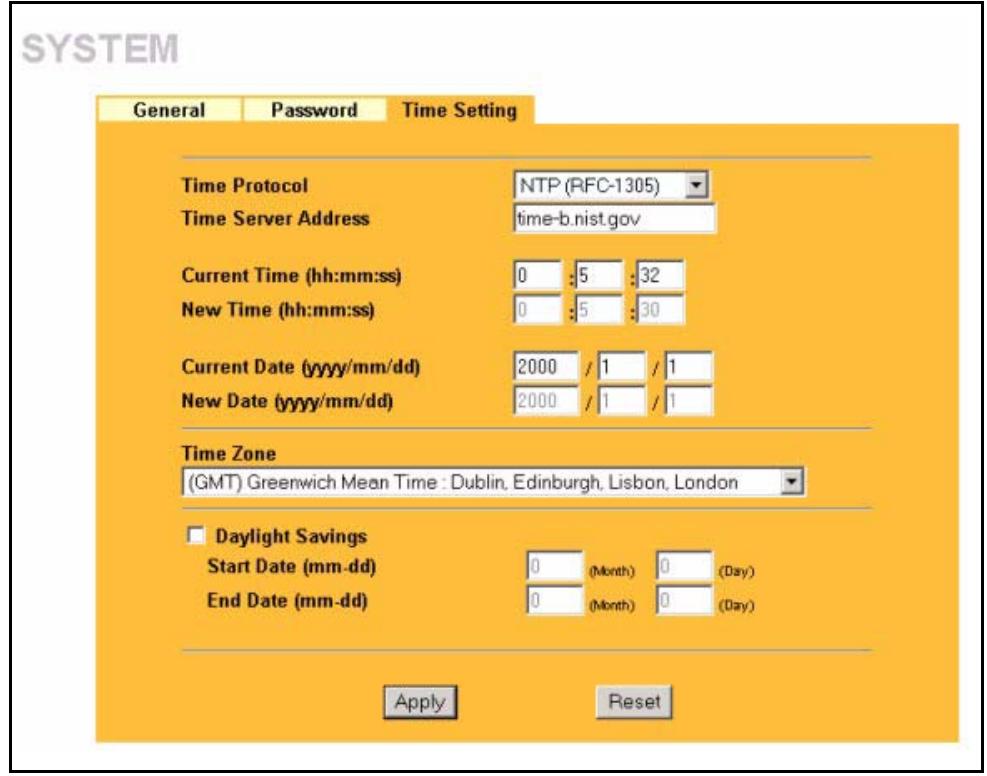
Figure 11 Time Setting
The following table describes the labels in this screen.
Table 7 Time Setting
| LABEL | DESCRIPTION |
| Time Protocol | Select the time service protocol that your time server sends when you turn on the Prestige. Not all time servers support all protocols, so you may have to check with your ISP/network administrator or use trial and error to find a protocol that works. The main difference between them is the format.Daytime (RFC 867) format is day/month/year/time zone of the server.Time (RFC 868) format displays a 4-byte integer giving the total number of seconds since 1970/1/1 at 0:0:0.The default, NTP (RFC 1305), is similar to Time (RFC 868).Select None to enter the time and date manually. |
| Time Server Address | Enter the IP address or URL of your time server. Check with your ISP or network administrator if you are unsure of this information. |
| Current Time | This field displays the time of your Prestige.Each time you reload this page, the Prestige synchronizes the time with the time server. |
| New Time | This field displays the last updated time from the time server.When you select None in the Time Protocol field, enter the new time in this field and then click Apply. |
| Current Date | This field displays the date of your Prestige.Each time you reload this page, the Prestige synchronizes the time with the time server. |
| New Date | This field displays the last updated date from the time server.When you select None in the Time Protocol field, enter the new date in this field and then click Apply. |
| Time Zone | Choose the Time Zone of your location. This will set the time difference between your time zone and Greenwich Mean Time (GMT). |
| Daylight Savings | Select this option if you use daylight savings time. Daylight saving is a period from late spring to early fall when many countries set their clocks ahead of normal local time by one hour to give more daytime light in the evening. |
| Start Date | Enter the month and day that your daylight-savings time starts on if you selected Daylight Savings. |
| End Date | Enter the month and day that your daylight-savings time ends on if you selected Daylight Savings. |
| Apply | Click Apply to save your changes back to the Prestige. |
| Reset | Click Reset to begin configuring this screen afresh. |
CHAPTER 4
Ethernet Screens
This chapter describes how to configure the Prestige's Ethernet and management IP addresses settings.
4.1 ETHERNET Overview
The Prestige has two Ethernet ports. Connect the LAN Ethernet port to a cable/DSL modem or router or an Ethernet LAN switch, which in turn connects you to the Internet or your company's IP-PBX. Connect the PC Ethernet port to your computer. The Prestige bridges network traffic between the two Ethernet ports so your computer can still access the Internet or the company LAN. Both Ethernet ports use the same IP address and subnet mask.
4.1.1 IP Address and Subnet Mask
Similar to the way houses on a street share a common street name, so too do computers on a LAN share one common network number.
Where you obtain your network number depends on your particular situation. If the ISP or your network administrator assigns you a block of registered IP addresses, follow their instructions in selecting the IP addresses and the subnet mask.
If the ISP did not explicitly give you an IP network number, then the ISP should assign you a dynamic IP address when the connection is established.
Once you have decided on the network number, pick an IP address that is easy to remember, for instance, 192.168.1.20, for your Prestige, but make sure that no other device on your network is using that IP address.
The subnet mask specifies the network number portion of an IP address.
4.1.2 DNS Server Address Assignment
Use DNS (Domain Name System) to map a domain name to its corresponding IP address and vice versa, for instance, the IP address of www.zyxel.com is 204.217.0.2. The DNS server is extremely important because without it, you must know the IP address of a computer before you can access it.
The Prestige can get the DNS server addresses in the following ways.
- The ISP tells you the DNS server addresses, usually in the form of an information sheet, when you sign up. If your ISP gives you DNS server addresses, enter them in the DNS Server fields.
- If the ISP did not give you DNS server information, leave the DNS Server fields set to 0.0.0.0 for the ISP to dynamically assign the DNS server IP addresses.
4.1.3 PPPoE Encapsulation
Point-to-Point Protocol over Ethernet (PPPoE) functions as a dial-up connection. PPPoE is an IETF (Internet Engineering Task Force) draft standard specifying how a host personal computer interacts with a broadband modem (for example DSL, cable, wireless, etc.) to achieve access to high-speed data networks. It preserves the existing Microsoft Dial-Up Networking experience and requires no new learning or procedures.
For the service provider, PPPoE offers an access and authentication method that works with existing access control systems (for instance, Radius). For the user, PPPoE provides a login and authentication method that the existing Microsoft Dial-Up Networking software can activate, and therefore requires no new learning or procedures for Windows users.
One of the benefits of PPPoE is the ability to let end users access one of multiple network services, a function known as dynamic service selection. This enables the service provider to easily create and offer new IP services for specific users.
Operationally, PPPoE saves significant effort for both the subscriber and the ISP/carrier, as it requires no specific configuration of the broadband modem at the subscriber's site.
For more information on PPPoE, see Appendix D on page 131.
4.2 Configuring Ethernet
Click ETHERNET in the navigation panel to display the ETHERNET screen. Use the ETHERNET Ethernet screen to configure the Prestige's Ethernet interfaces with Internet account information from your ISP. Your ISP may have already configured some of the fields for you.
You can manage the Prestige through the Ethernet IP address, but you may not always know the Prestige's IP address (especially if the IP address is dynamic). Use the Mgmt Port screen (see Figure 13 on page 44) to configure a static IP address that you use to access the Prestige for management.
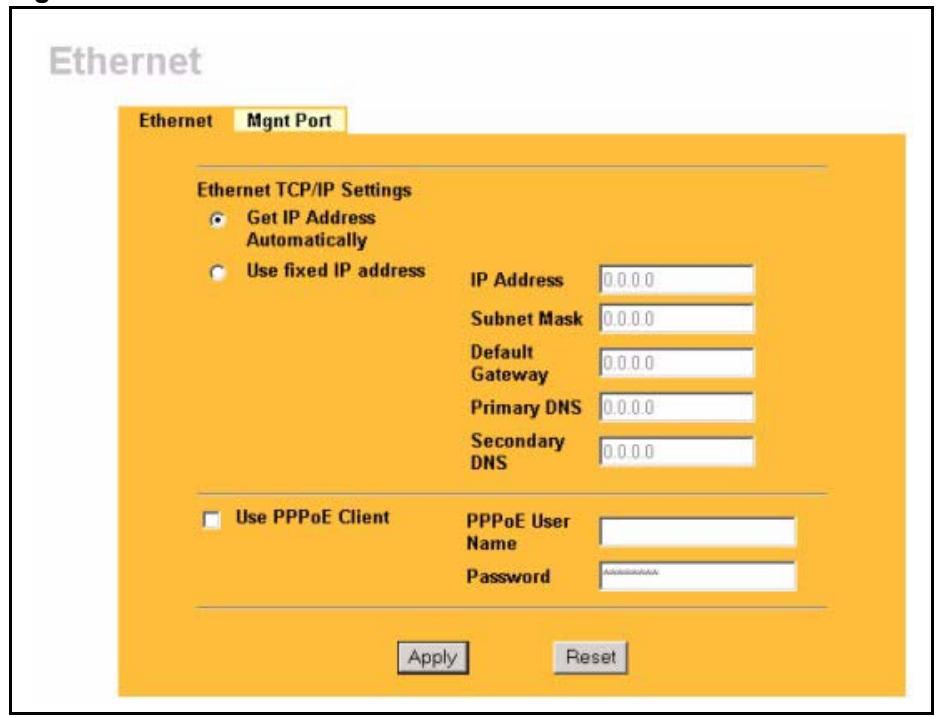
Figure 12 ETHERNET
Table 8 ETHERNET
| LABEL | DESCRIPTION |
| Get IP Address Automatically | Select this option if you have a dynamic IP address. |
| Use Fixed IP Address | Select this option if the ISP assigned you a static IP address. |
| IP Address | Type the (static) IP address assigned to you by your ISP. |
| Subnet Mask | Type the subnet mask assigned to you by your ISP (if given). |
| Default Gateway | Enter the gateway IP address assigned to you by your ISP (if given). |
| Primary/Secondary DNS | DNS (Domain Name System) is for mapping a domain name to its corresponding IP address and vice versa. The DNS servers are extremely important because without them, you must know the IP address of a computer before you can access it. Specify the DNS servers. |
| Use PPPoE Client | Select Use PPPoE Client if your ISP provides a PPPoE user name and password. |
| PPPoE User Name | Enter the user name exactly as your ISP assigned it (maximum 72 characters). |
| Password | Enter the password exactly as your ISP assigned it. |
| Apply | Click Apply to save your changes back to the Prestige. |
| Reset | Click Reset to begin configuring this screen afresh. |
4.3 Configuring the Ethernet Management Port
Click ETHERNET in the navigation panel and then Mgmt Port to open the following screen. Use the ETHERNET Mgmt Port screen to configure a static IP address through which you can manage the Prestige.
Note: The management port is a separate logical Ethernet interface that you can access from a computer connected to either of the Prestige's physical Ethernet interfaces.
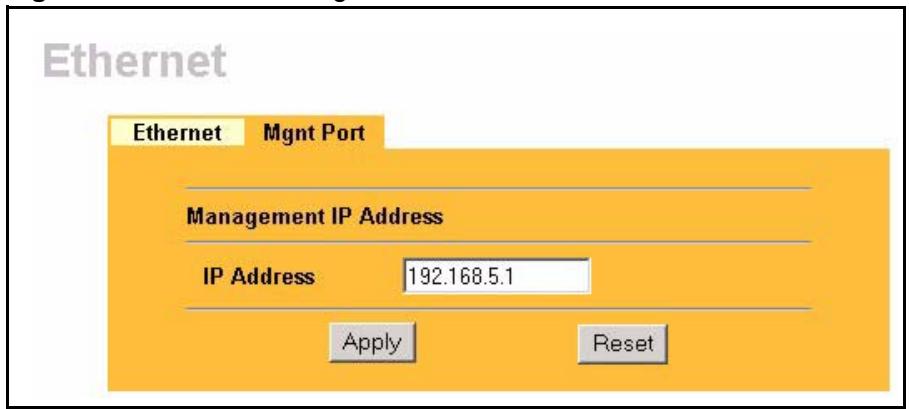
Figure 13 ETHERNET Mgmt Port
The following table describes the labels in this screen.
Note: The management port's subnet mask is fixed at 255.255.255.0.
Table 9 ETHERNET Mgmt Port
| LABEL | DESCRIPTION |
| IP Address | Type the (static) IP address through which to manage the Prestige. This management IP address can be on a different subnet from the Ethernet port's IP address, but the computer you use for management must be on the same subnet as this management IP address. |
| Apply | Click Apply to save your changes back to the Prestige. |
| Reset | Click Reset to begin configuring this screen afresh. |
CHAPTER 5 Introduction to VoIP
This chapter provides background information on VoIP and SIP.
5.1 Introduction to VoIP
VoIP is the sending of voice signals over the Internet Protocol. This allows you to make phone calls and send faxes over the Internet at a fraction of the cost of using the traditional circuit-switched telephone network. You can also use servers to run telephone service applications like PBX services and voice mail. Internet Telephony Service Provider (ITSP) companies provide VoIP service. A company could alternatively set up an IP-PBX and provide it's own VoIP service.
Circuit-switched telephone networks require 64 kilobits per second (kbps) in each direction to handle a telephone call. VoIP can use advanced voice coding techniques with compression to reduce the required bandwidth.
5.2 Introduction to SIP
The Session Initiation Protocol (SIP) is an application-layer control (signaling) protocol that handles the setting up, altering and tearing down of voice and multimedia sessions over the Internet.
SIP signaling is separate from the media for which it handles sessions. The media that is exchanged during the session can use a different path from that of the signaling. SIP handles telephone calls and can interface with traditional circuit-switched telephone networks.
5.2.1 SIP Identities
A SIP account uses an identity (sometimes referred to as a SIP address). A complete SIP identity is called a SIP URI (Uniform Resource Identifier). A SIP account's URI identifies the SIP account in a way similar to the way an e-mail address identifies an e-mail account. The format of a SIP identity is SIP-Number@SIP-Service-Domain.
5.2.1.1 SIP Number
The SIP number is the part of the SIP URI that comes before the "@” symbol. A SIP number can use letters like in an e-mail address (johndoe@your-ITSP.com for example) or numbers like a telephone number (1122334455@VoIP-provider.com for example).
5.2.1.2 SIP Service Domain
The SIP service domain of the VoIP service provider is the domain name in a SIP URI. For example, if the SIP address is 1122334455@VoIP-provider.com, then “VoIP-provider.com” is the SIP service domain.
5.2.2 SIP Call Progression
The following figure displays the basic steps in the setup and tear down of a SIP call. A calls B.
Table 10 SIP Call Progression
| A | B | |
| 1. INVITE | ||
| 2. Ringing | ||
| 3. OK | ||
| 4. ACK | ||
| 5.Dialogue (voice traffic) | ||
| 6. BYE | ||
| 7. OK |
1 A sends a SIP INVITE request to B. This message is an invitation for B to participate in a SIP telephone call.
2 B sends a response indicating that the telephone is ringing.
3 B sends an OK response after the call is answered.
4 A then sends an ACK message to acknowledge that B has answered the call.
5 Now A and B exchange voice media (talk).
6 After talking, A hangs up and sends a BYE request.
7 B replies with an OK response confirming receipt of the BYE request and the call is terminated.
5.2.3 SIP Servers
SIP is a client-server protocol. A SIP client is an application program or device that sends SIP requests. A SIP server responds to the SIP requests.
When you use SIP to make a VoIP call, it originates at a client and terminates at a server. A SIP client could be a computer or a SIP phone. One device can act as both a SIP client and a SIP server.
5.2.3.1 SIP User Agent
A SIP user agent can make and receive VoIP telephone calls. This means that SIP can be used for peer-to-peer communications even though it is a client-server protocol. In the following figure, either A or B can act as a SIP user agent client to initiate a call. A and B can also both act as a SIP user agent server to receive the call.

Figure 14 SIP User Agent
5.2.3.2 SIP Proxy Server
A SIP proxy server receives requests from clients and forwards them to another server. In the following example, you want to use client device A to call someone who is using client device C.
1 The client device (A in the figure) sends a call invitation to the SIP proxy server (B).
2 The SIP proxy server forwards the call invitation to C.
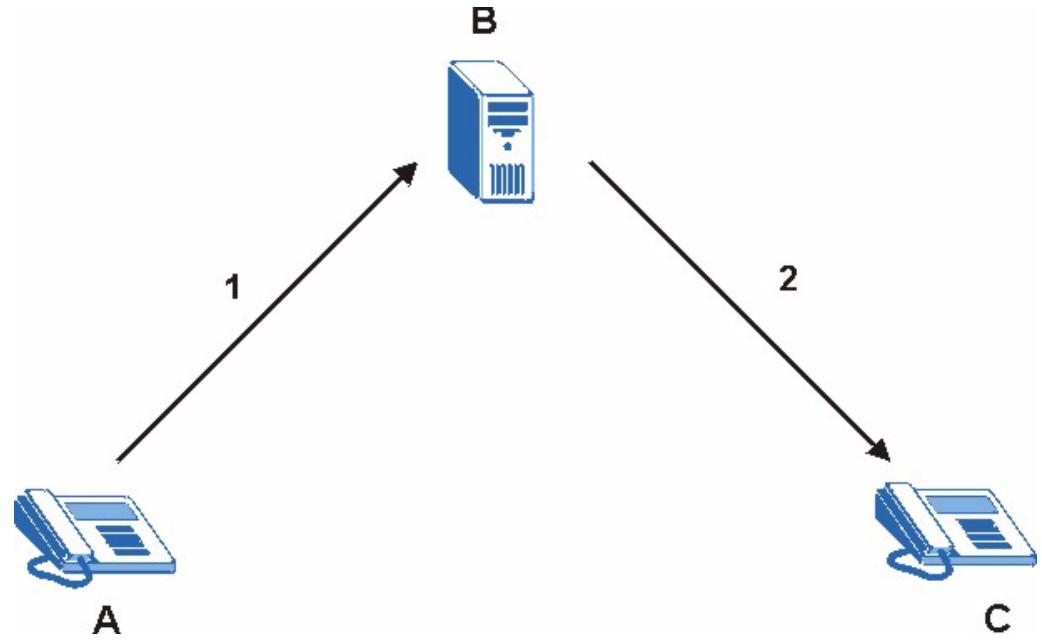
Figure 15 SIP Proxy Server
5.2.3.3 SIP Redirect Server
A SIP redirect server accepts SIP requests, translates the destination address to an IP address and sends the translated IP address back to the device that sent the request. Then the client device that originally sent the request can send requests to the IP address that it received back from the redirect server. Redirect servers do not initiate SIP requests.
In the following example, you want to use client device A to call someone who is using client device C.
1 Client device A sends a call invitation for C to the SIP redirect server (B).
2 The SIP redirect server sends the invitation back to A with C's IP address (or domain name).
3 Client device A then sends the call invitation to client device C.
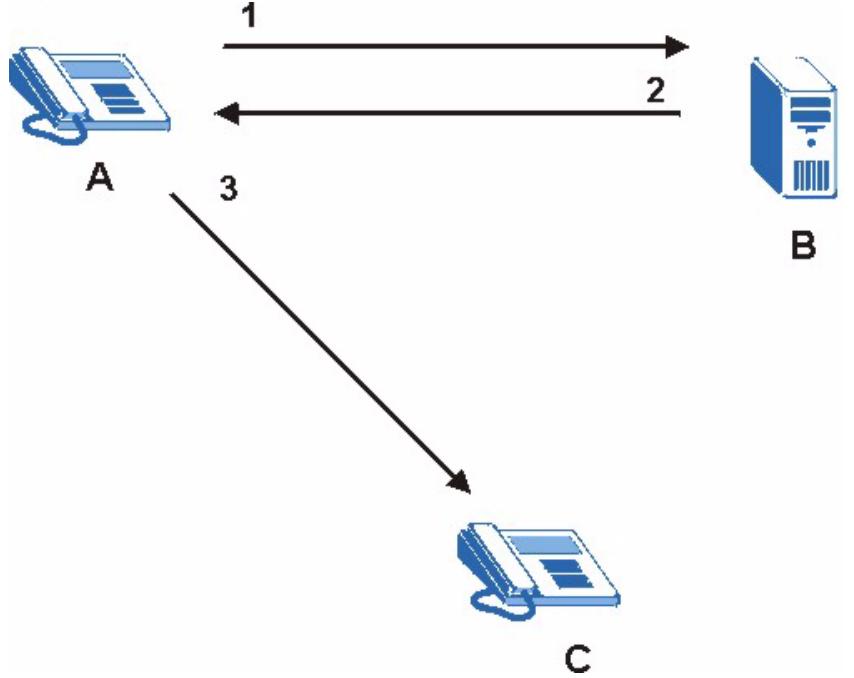
Figure 16 SIP Redirect Server
5.2.3.4 SIP Register Server
A SIP register server maintains a database of SIP identity-to-IP address (or domain name) mapping. The register server checks your user name and password when you register.
5.2.4 RTP
When you make a VoIP call using SIP, the RTP (Real time Transport Protocol) is used to handle voice data transfer. See RFC 1889 for details on RTP.
5.3 NAT
NAT (Network Address Translation - NAT, RFC 1631) is the translation of the IP address of a host in a packet. For example, the source address of an outgoing packet, used within one network is changed to a different IP address known within another network.
In the simplest form, NAT changes the source IP address of a packet received from a device to another IP address before forwarding the packet towards the destination. When the response comes back, NAT translates the destination address back to the device's IP address and forwards it to the device.
NAT routers are commonly used to translate private (or internal) IP addresses in packet headers to public (or external) IP addresses and vice versa. A NAT router maps a private IP address and port pair to a public IP address and port, and whenever the NAT router receives a packet with that public IP address and port, it knows how to reroute the packet back to the private IP address and port.
NAT may be implemented on a device that is between your Prestige and the Internet.
5.3.1 NAT Example
See the following figure. The Prestige (X) sends packets to the Internet. The Prestige's IP address is 10.0.0.3. This is a private or internal IP address. The NAT router maps the private source IP address to a public source IP address (a.b.c.d). The public source IP address is also known as the external IP address.
Note: The NAT figures in this chapter use lower-case letters (like a.b.c.d for example) to represent public IP addresses.
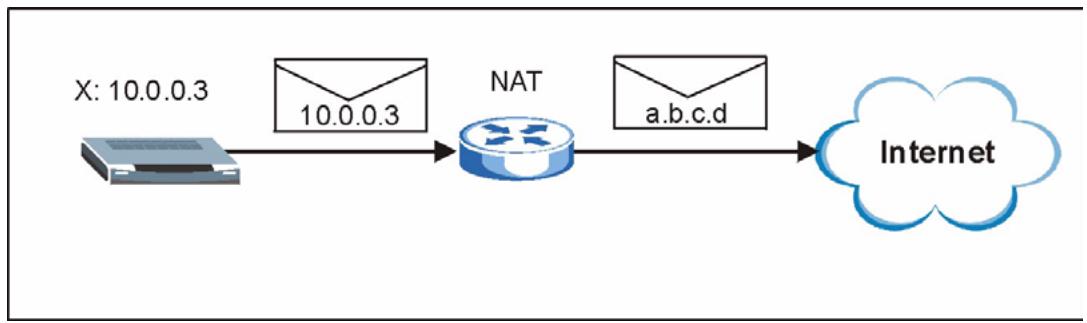
Figure 17 NAT:Outgoing
When the NAT router receives packets with destination address IP address a.b.c.d, the NAT router changes a.b.c.d back to the private IP address 10.0.0.3 and sends it to the Prestige.
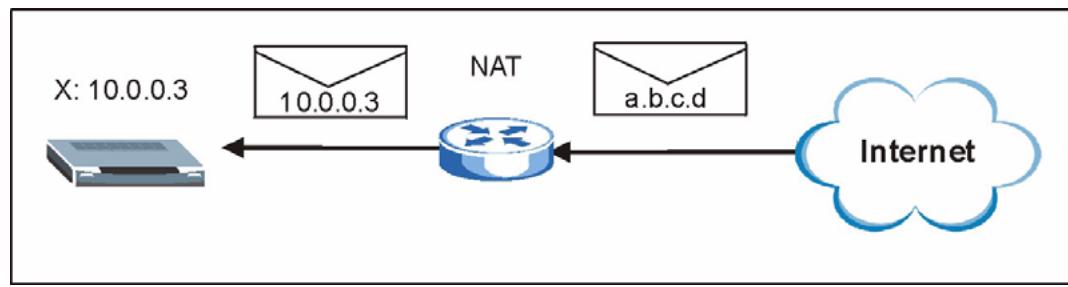
Figure 18 NAT: Incoming
5.3.2 NAT Types
This section discusses the following NAT types that may be implemented on a router in front of the Prestige.
Full Cone
- Restricted Cone
- Port Restricted Cone
- Symmetric
The following table summarizes how these NAT types handle outgoing and incoming packets. Read the following sections for more details and examples.
Table 11 NAT Types
| FULL CONE | RESTRICTED CONE | PORT RESTRICTED CONE | SYMMETRIC | |
| Incoming Packets | Any external host can send packets to the mapped external IP address and port. | Only external hosts with an IP address to which the internal host has already sent a packet can send packets to the mapped external IP address and port. | Only external hosts with an IP address and port to which the internal host has already sent a packet can send packets to the mapped external IP address and port. | A host on the external network can only send packets to the specific mapped external IP address and port that the NAT router used in sending a packet to the external host's IP address and port. |
| Outgoing Packets | The NAT router maps the internal IP address and port of all outgoing packets to a single IP address and port on the external network. | The NAT router maps the internal IP address and port of each outgoing packet to a different external IP address and port for each different destination IP address and port. | ||
The examples in these NAT type sections describe NAT translation between internal (private) and external (public) IP addresses.
5.3.2.1 Full Cone NAT
In full cone NAT, the NAT router maps all outgoing packets from an internal IP address and port to a single IP address and port on the external network. The NAT router also maps packets coming to that external IP address and port to the internal IP address and port.
In the following example, the NAT router maps the source address of all packets sent from the Prestige's internal IP address 1 and port A to IP address 2 and port B on the external network. The NAT router also performs NAT on all incoming packets sent to IP address 2 and port B and sends them to IP address 1, port A.
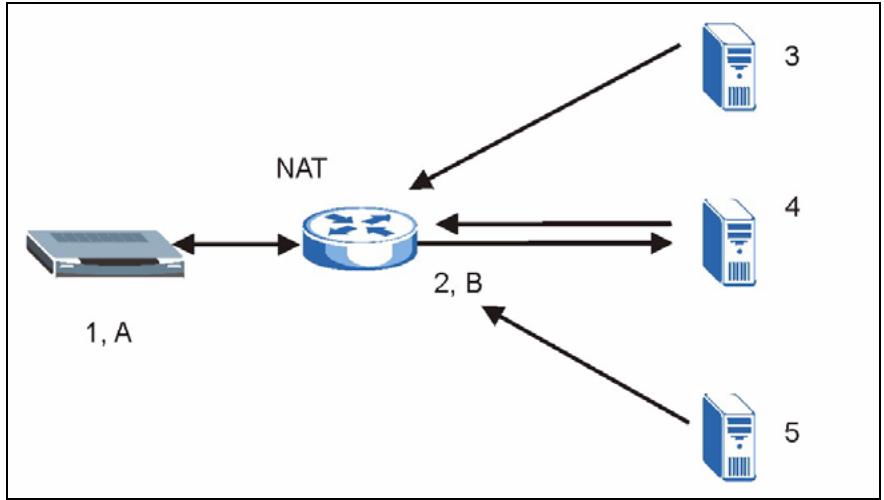
Figure 19 Full Cone NAT Example
5.3.2.2 Restricted Cone NAT
As in full cone NAT, a restricted cone NAT router maps all outgoing packets from an internal IP address and port to a single IP address and port on the external network. In the following example, the NAT router maps the source address of all packets sent from internal IP address 1 and port A to IP address 2 and port B on the external network.
The difference from full cone NAT is in how the restricted cone NAT router handles packets coming in from the external network. A host on the external network (IP address 3 or IP address 4 for example) can only send packets to the internal host if the internal host has already sent a packet to the external host's IP address.
A Prestige with IP address 1 and port A sends packets to IP address 3 and IP address 4. The NAT router changes the Prestige's IP address to 2 and port to B.
Both 4, D and 4, E can send packets to 2, B since 1, A has already sent packets to 4. The NAT router will perform NAT on the packets from 4, D and 4, E and send them to the Prestige at IP address 1, port A. Packets have not been sent from 1, A to 3 or 5, so 3 and 5 cannot send packets to 1, A.
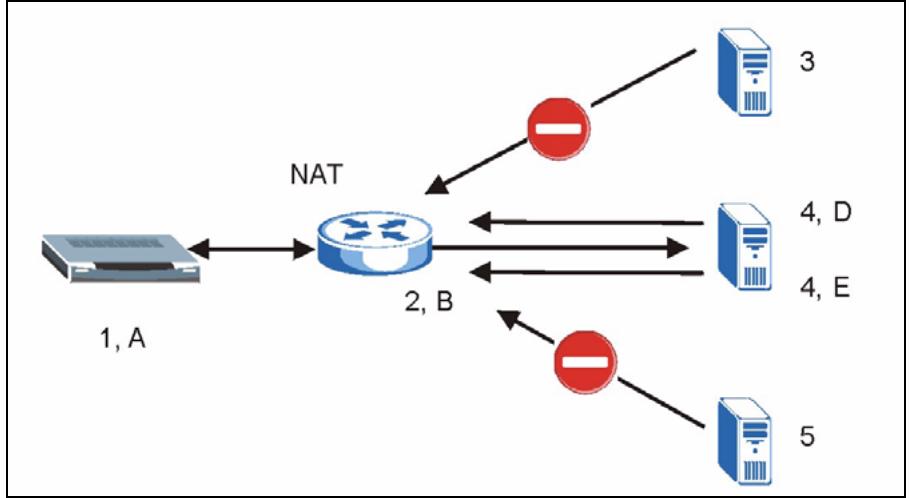
Figure 20 Restricted Cone NAT Example
5.3.2.3 Port Restricted Cone NAT
As in full cone NAT, a port restricted cone NAT router maps all outgoing packets from an internal IP address and port to a single IP address and port on the external network. In the following example, the NAT router maps the source address of all packets sent from internal IP address 1 and port A to IP address 2 and port B on the external network.
The difference from full cone and restricted cone NAT is in how the port restricted cone NAT router handles packets coming in from the external network. A host on the external network (IP address 3 and Port C for example) can only send packets to the internal host if the internal host has already sent a packet to the external host's IP address and port.
A Prestige with IP address 1 and port A sends packets to IP address 3, port C and IP address 4, port D. The NAT router changes the Prestige's IP address to 2 and port to B.
Since 1, A has already sent packets to 3, C and 4, D, they can send packets back to 2, B and the NAT router will perform NAT on them and send them to the Prestige at IP address 1, port A.
Packets have not been sent from 1, A to 4, E or 5, so they cannot send packets to 1, A.
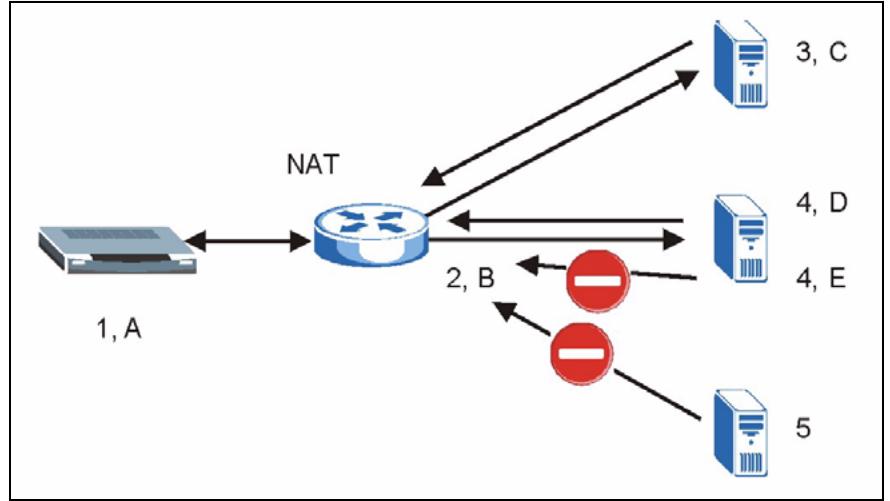
Figure 21 Port Restricted Cone NAT Example
5.3.2.4 Symmetric NAT
The full, restricted and port restricted cone NAT types use the same mapping for an outgoing packet's source address regardless of the destination IP address and port. In symmetric NAT, the mapping of an outgoing packet's source address to a source address in another network is different for each different destination IP address and port.
In the following example, the NAT router maps the Prestige's source address IP address 1 and port A to IP address 2 and port B on the external network for packets sent to IP address 3 and port B. The NAT router uses a different mapping (IP address 2 and port M) when the Prestige sends packets to IP address 4 and port D.
A host on the external network (IP address 3 and port C for example) can only send packets to the internal host via the external IP address and port that the NAT router used in sending a packet to the external host's IP address and port. So in the example, only 3, C is allowed to send packets to 2, B and only 4, D is allowed to send packets to 2, M.
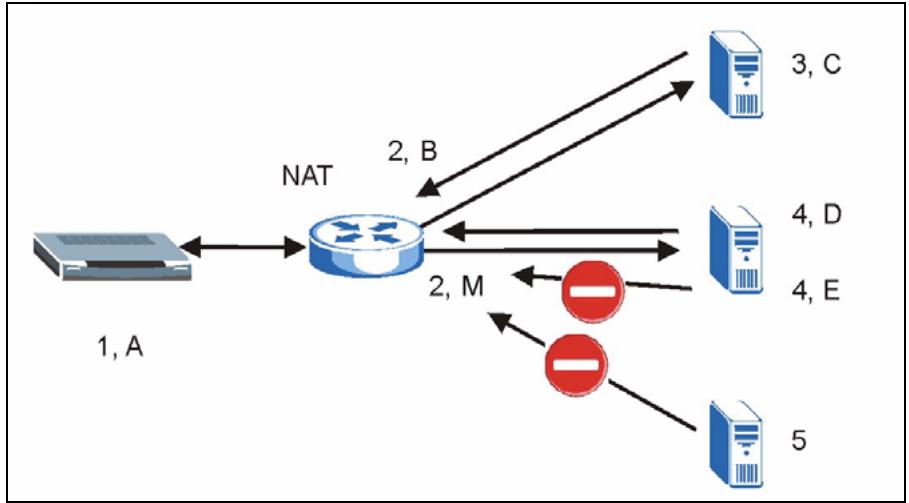
Figure 22 Symmetric NAT
5.4 NAT and SIP
Some NAT routers are not SIP-friendly and will stop your voice sessions.
The Prestige must register its public IP address with a SIP register server. If there is a NAT router between the Prestige and the SIP register server, the Prestige probably has a private IP address. The Prestige lists its IP address in the SIP message that it sends to the SIP register server. NAT does not translate this IP address in the SIP message. The SIP register server gets the Prestige's IP address from inside the SIP message and maps it to your SIP identity. If the Prestige has a private IP address listed in the SIP message, the SIP server cannot map it to your SIP identity.
A SIP ALG (Application Layer Gateway), the fake WAN address on SIP and RTP, STUN, or outbound proxy features allow the Prestige to use its public IP address in the SIP messages.
5.4.1 SIP ALG
Some NAT routers may include a SIP Application Layer Gateway (ALG). A SIP ALG allows SIP calls to pass through NAT by examining and translating IP addresses embedded in the data stream. When the Prestige registers with the SIP register server, the SIP ALG translates the Prestige's private IP address inside the SIP data stream to a public IP address. You do not need to use STUN or an outbound proxy if your Prestige is behind a SIP ALG.
5.4.2 Use NAT Address on SIP and RTP
If you know the NAT router's public IP address and SIP port number, you can use the Use NAT feature to manually configure the Prestige to use a them in the SIP messages. This eliminates the need for STUN or a SIP ALG.
You must also configure the NAT router to forward traffic with the SIP port number to the Prestige.
5.4.3 STUN
STUN (Simple Traversal of User Datagram Protocol (UDP) through Network Address Translators) allows the Prestige to find the presence and types of NAT routers and/or firewalls between it and the public Internet. STUN also allows the Prestige to find the public IP address that NAT assigned, so the Prestige can embed it in the SIP data stream. STUN does not work with symmetric NAT routers (see Section 5.3.2.4 on page 52) or firewalls. See RFC 3489 for details on STUN.
The following figure shows how STUN works.
1 The Prestige (A) sends SIP packets to the STUN server.
2 The STUN server finds the public IP address and port number that the NAT router used on the Prestige's SIP packets and sends them to the Prestige.
3 The Prestige uses the public IP address and port number in the SIP packets that it sends to the SIP server.
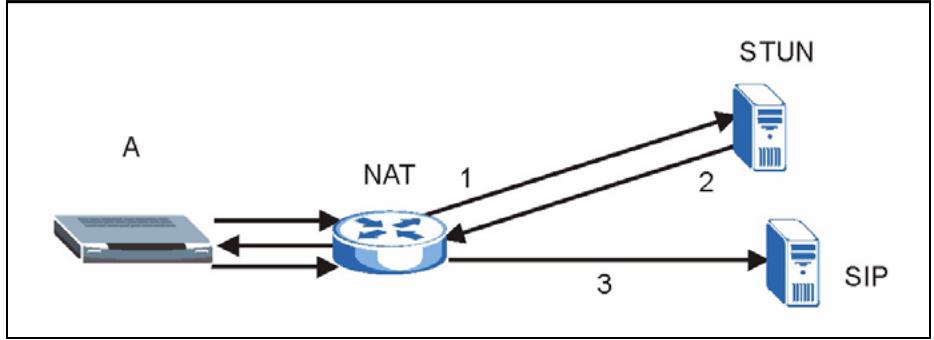
Figure 23 STUN
5.4.4 Outbound Proxy
Your VoIP service provider may host a SIP outbound proxy server to handle all of the Prestige's VoIP traffic. This allows the Prestige to work with any type of NAT router and eliminates the need for STUN or a SIP ALG. Turn off a SIP ALG on a NAT router in front of the Prestige to keep it from retranslating the IP address (since this is already handled by the outbound proxy server).
5.5 Pulse Code Modulation
Pulse Code Modulation (PCM) measures analog signal amplitudes at regular time intervals and converts them into bits.
5.6 Voice Coding
A codec (coder/decoder) codes analog voice signals into digital signals and decodes the digital signals back into voice signals. The Prestige supports the following codecs.
5.6.1 G.711
G.711 is a Pulse Code Modulation (PCM) waveform codec. G.711 provides very good sound quality but requires 64kbps of bandwidth.
5.6.2 G.729
G.729 is an Analysis-by-Synthesis (AbS) hybrid waveform codec that uses a filter based on information about how the human vocal tract produces sounds. G.729 provides good sound quality and reduces the required bandwidth to 8kbps.
5.7 PSTN Call Setup Signaling
Dual-Tone MultiFrequency (DTMF) signaling uses pairs of frequencies (one lower frequency and one higher frequency) to set up calls. It is also known as Touch Tone®. Each of the keys on a DTMF telephone corresponds to a different pair of frequencies.
Pulse dialing sends a series of clicks to the local phone office in order to dial numbers.1
5.8 MWI (Message Waiting Indication)
Enable Message Waiting Indication (MWI) enables your phone to give you a message—waiting (beeping) dial tone when you have a voice message(s). Your voice service provider must have a messaging system that sends message waiting status SIP packets as defined in RFC 3842.
CHAPTER 6 VoIP Screens
This chapter describes how to configure advanced VoIP and QoS settings.
6.1 VoIP Introduction
VoIP is the sending of voice signals over the Internet Protocol. This chapter covers the configuration of the VoIP screens.
6.2 VoIP Configuration
Click VoIP in the navigation panel to display the following screen. Use this screen to configure the Prestige's VoIP settings. You should have a voice account already set up and have VoIP information from your VoIP service provider.
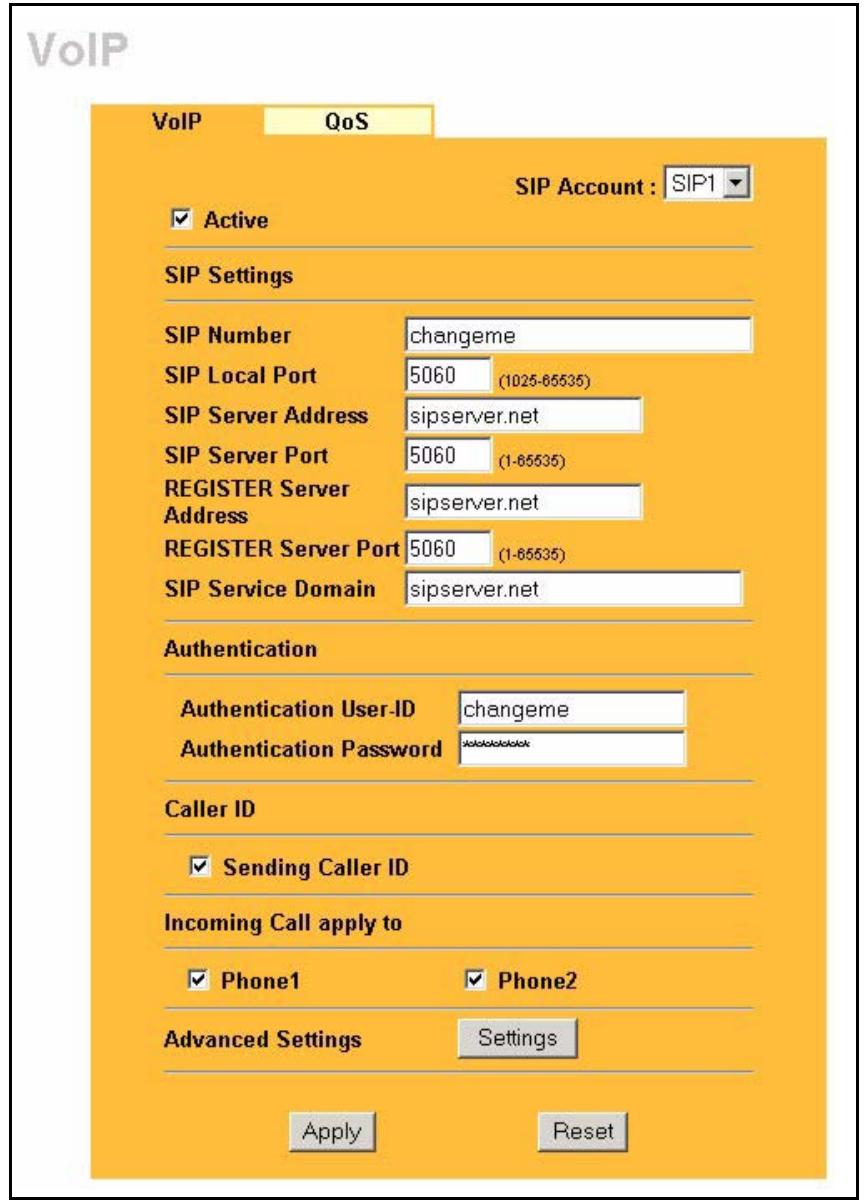
Figure 24 VoIP
Table 12 VoIP
| LABEL | DESCRIPTION |
| SIP Account | You can configure the Prestige to use multiple SIP accounts. Select one to configure its settings on the Prestige. |
| Active | Select this check box to have the Prestige use this SIP account. Clear the check box to have the Prestige not use this SIP account. |
| SIP Number | Enter your SIP number in this field (use the number or text that comes before the @ symbol in a full SIP URI). You can use up to 127 ASCII characters. |
| SIP Local Port | Use this field to configure the Prestige's listening port for SIP. Leave this field set to the default if you were not given a local port number for SIP. |
| SIP Server Address | Type the IP address of the SIP server in this field. It doesn't matter whether the SIP server is a proxy, redirect or register server. |
| SIP Server Port | Enter the SIP server's listening port for SIP in this field. Leave this field set to the default if your VoIP service provider did not give you a server port number for SIP. |
| REGISTER Server Address | Enter the SIP register server's address in this field. If you were not given a register server address, then enter the address from the SIP Server Address field again here. |
| REGISTER Server Port | Enter the SIP register server's listening port for SIP in this field. If you were not given a register server port, then enter the port from the SIP Server Port field again here. |
| SIP Service Domain | Enter the SIP service domain name in this field (the domain name that comes after the @ symbol in a full SIP URI). You can use up to 127 ASCII Extended set characters. |
| Authentication User ID | This is the user name for registering this SIP account with the SIP register server. Type the user name exactly as it was given to you. You can use up to 95 ASCII characters. |
| Authentication Password | Type the password associated with the user name above. You can use up to 95 ASCII Extended set characters. |
| Sending Caller ID | Select this check box to show identification information when you make VoIP phone calls. Clear the check box to not show identification information when you make VoIP phone calls. |
| Incoming Call apply to | Phone 1 and Phone 2 correspond to the Prestige's physical PHONE 1 and 2 ports, respectively. Select whether you want to receive calls for this SIP account on Phone 1, Phone 2 or both. If you select both, you will not know which SIP account a call is coming in on. |
| Advanced Settings | Click Settings to open a screen where you can configure the Prestige's advanced VoIP settings like SIP server settings, the RTP port range and the coding type. |
| Apply | Click Apply to save your changes back to the Prestige. |
| Reset | Click Reset to begin configuring this screen afresh. |
6.3 Advanced VoIP Settings Configuration
Click VoIP in the navigation panel, select a SIP account and then click Settings to display the following screen.
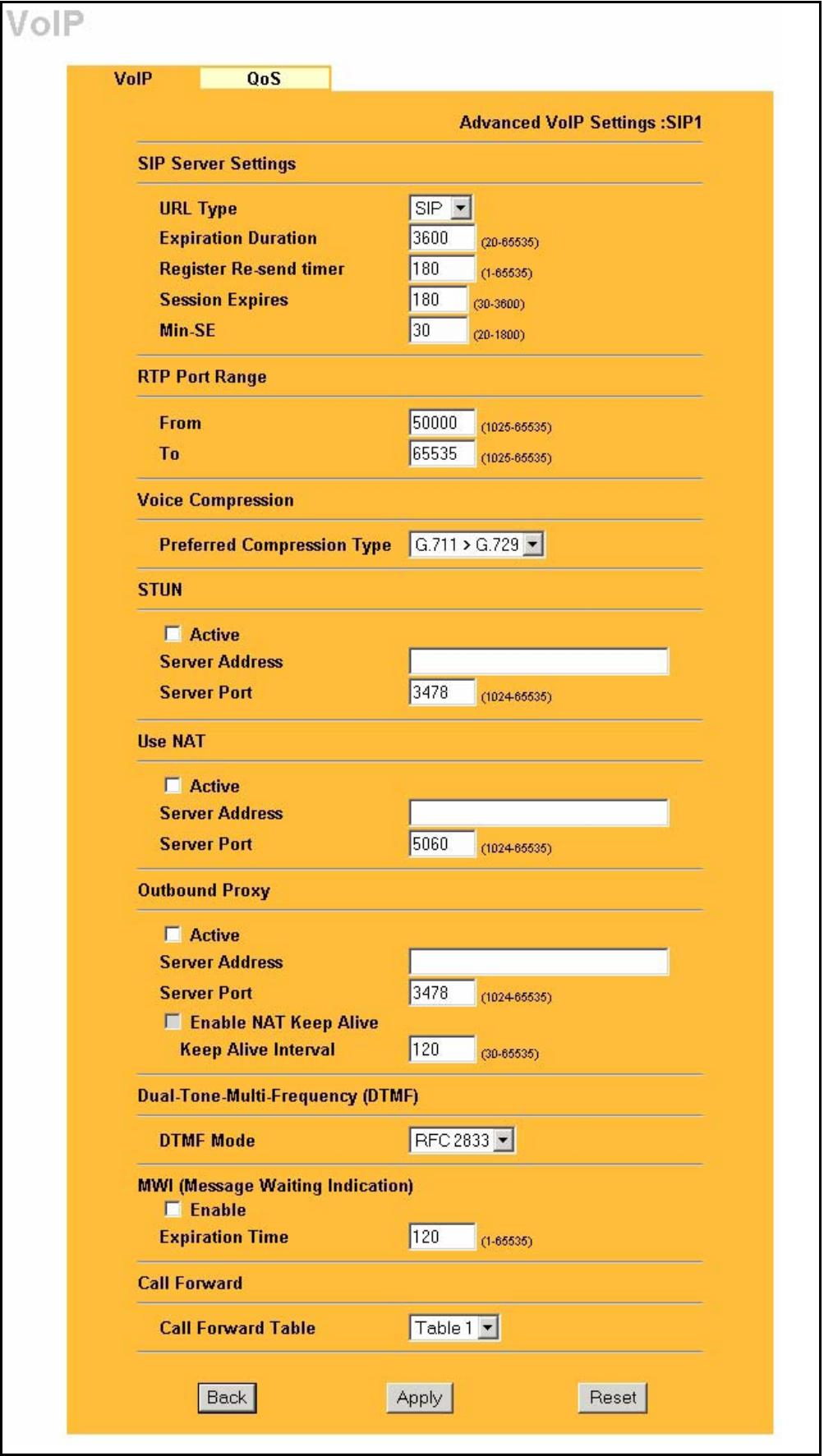
Figure 25 VoIP Advanced
The following table describes the labels in this screen.
Table 13 VoIP Advanced
| LABEL | DESCRIPTION |
| Advanced VoIP Settings | This read-only field displays the number of the SIP account that you are configuring. The changes that you save in this page affect the Prestige's settings with the SIP account displayed here. |
| SIP Server Settings | |
| URL Type | Select SIP to have the Prestige include the domain name with the SIP number in the SIP messages that it sends. Select TEL to have the Prestige use the SIP number without a domain name in the SIP messages that it sends. |
| Expiration Duration | This field sets how long an entry remains registered with the SIP register server. After this time period expires, the SIP register server deletes the Prestige's entry from the database of registered SIP numbers. The register server can use a different time period. The Prestige sends another registration request after half of this configured time period has expired. |
| Register Re-send Timer | Use this field to set how long the Prestige waits before sending a repeat registration request if a registration attempt fails or there is no response from the registration server. |
| Session Expires | Use this field to set the longest time that the Prestige will allow a SIP session to remain idle (without traffic) before dropping it. |
| Min-SE | When two SIP devices negotiate a SIP session, they must negotiate a common expiration time for idle SIP sessions. This field sets the shortest expiration time that the Prestige will accept. The Prestige checks the session expiration values of incoming SIP INVITE requests against the minimum session expiration value that you configure here. If the session expiration of an incoming INVITE request is less than the value you configure here, the Prestige negotiates with the other SIP device to increase the session expiration value to match the Prestige's minimum session expiration value. |
| RTP Port Range | Real time Transport Protocol is used to handle voice data transfer. Use this field to configure the Prestige's listening port range for RTP traffic. Leave these fields set to the defaults if you were not given a range of RTP ports to use. |
| Preferred Compression Type | Use this field to select the type of voice coder/decoder (codec) that you want the Prestige to use. G.711 provides higher voice quality than G.729 but requires 64kbps of bandwidth while G.729 only requires 8kbps. Select G.711>G.729 if you want the Prestige to first attempt to use the G.711 codec and then the G.729 codec if the peer is not set up to use G.711. Select G.711 only if you want the Prestige to only use the G.711 codec when making VoIP calls. You will not be able to connect to a peer that is not set up to use G.711. Select G.729>G.711 if you want the Prestige to first attempt to use the G.729 codec and then the G.711 codec if the peer is not set up to use G.729. Select G.729 only if you want the Prestige to only use the G.729 codec when making VoIP calls. You will not be able to connect to a peer that is not set up to use G.729. |
| STUN | Use STUN if there is a NAT router between the Prestige and the voice service provider's SIP server. You do not need to use STUN if the NAT router is also a SIP ALG. |
| Server Address | Your VoIP service provider must host a STUN server in order for you to use STUN. Type the IP address of the STUN server in this field. |
| Server Port | Enter the STUN server's listening port for STUN requests in this field. Leave this field set to the default if your VoIP service provider did not give you a server port number for STUN. |
| Use NAT | Enable this feature to use a NAT router's public IP address and SIP port number in the Prestige's SIP messages.You must also configure the NAT router to forward traffic with this port number to the Prestige.This eliminates the need for STUN or a SIP ALG. |
| IP Address | Enter the NAT router's public IP address or domain name (up to 127 ASCII characters) in this field. |
| Port | Enter the port number that your SIP sessions use with the public IP address of the NAT router. |
| Outbound Proxy | Enable this feature if your VoIP service provider has a SIP outbound server to handle voice calls. This allows the Prestige to work with any type of NAT router and eliminates the need for STUN or a SIP ALG. Turn off a SIP ALG on a NAT router in front of the Prestige to keep it from retranslating the IP address (since this is already handled by the outbound proxy server). |
| Server Address | Enter the IP address or domain name (up to 127 ASCII characters) of the SIP outbound proxy server in this field. |
| Server Port | Enter the SIP outbound proxy server's listening port for SIP outbound proxy requests in this field. Leave this field set to the default if your VoIP service provider did not give you a server port number for the SIP outbound proxy server. |
| Enable NAT Keep Alive | You must have outbound proxy enabled to use NAT keep alive.Encase NAT keep alive to have the Prestige send SIP notify messages to the SIP server.Use this to keep a NAT router located between the Prestige and the SIP server from timing out and dropping your Prestige's SIP NAT sessions. |
| Keep Alive Interval | Set how often (in seconds) the Prestige should send SIP notify messages to the SIP server. |
| DTMF Mode | The Dual Tone Multi-Frequency (DTMF) mode sets how the Prestige handles the tones that your telephone makes when you push its buttons. It is recommended that you use the same mode that your VoIP service provider uses.Select RFC 2833 to send the DTMF tones in RTP packets.Select PCM (Pulse Code Modulation) to include the DTMF tones in the voice data stream. This method works best when you are using a codec that does not use compression (like G.711).Codes that use compression (like G.729) could distort the tones SELECT SIP INFO to send the DTMF tones in SIP messages. |
| MWI (Message Waiting Indication) | Enable Message Waiting Indication (MWI) to have your phone give you a message-waiting (beeping) dial tone when you have a voice message(s). Your voice service provider must have a messaging system that supports this feature. |
| Expiration Time | Set how long (in seconds) the message-waiting dial tone should last if you don't retrieve the waiting voice message(s). |
| Call Forward Table | Select which call forwarding table you want the Prestige to use to block or redirect calls. You can use a different call forwarding table for each SIP account or use the same call forwarding table for both. |
| Back | Click Back to return to the VoIP screen without saving configuration changes. |
| Apply | Click Apply to save your changes back to the Prestige. |
| Reset | Click Reset to begin configuring this screen afresh. |
6.4 Quality of Service (QoS)
Quality of Service (QoS) refers to both a network's ability to deliver data with minimum delay, and the networking methods used to provide bandwidth for real-time multimedia applications.
6.4.1 Type Of Service (ToS)
Network traffic can be classified by setting the ToS (Type Of Service) values at the data source (for example, at the Prestige) so a server can decide the best method of delivery, that is the least cost, fastest route and so on.
6.4.2 DiffServ
DiffServ is a class of service (CoS) model that marks packets so that they receive specific per-hop treatment at DiffServ-compliant network devices along the route based on the application types and traffic flow. Packets are marked with DiffServ Code Points (DSCPs) indicating the level of service desired. This allows the intermediary DiffServ-compliant network devices to handle the packets differently depending on the code points without the need to negotiate paths or remember state information for every flow. In addition, applications do not have to request a particular service or give advanced notice of where the traffic is going.1
6.4.2.1 DSCP and Per-Hop Behavior
DiffServ defines a new DS (Differentiated Services) field to replace the Type of Service (TOS) field in the IP header. The DS field contains a 2-bit unused field and a 6-bit DSCP field which can define up to 64 service levels. The following figure illustrates the DS field.
DSCP is backward compatible with the three precedence bits in the ToS octet so that non-DiffServ compliant, ToS-enabled network device will not conflict with the DSCP mapping.
Figure 26 DiffServ: Differentiated Service Field
| DSCP (6-bit) | Unused (2-bit) |
The DSCP value determines the forwarding behavior, the PHB (Per-Hop Behavior), that each packet gets across the DiffServ network. Based on the marking rule, different kinds of traffic can be marked for different priorities of forwarding. Resources can then be allocated according to the DSCP values and the configured policies.
6.4.3 VLAN
Virtual Local Area Network (VLAN) allows a physical network to be partitioned into multiple logical networks. Only stations within the same group can communicate with each other.
Your Prestige can add IEEE 802.1Q VLAN ID tags to voice frames that it sends to the network. This allows the Prestige to communicate with a SIP server that is a member of the same VLAN group. Some ISPs use the VLAN tag to identify voice traffic and give it priority over other traffic.
6.5 QoS Configuration
Click VoIP in the navigation panel and then QoS to display the following screen.
Figure 27 QoS
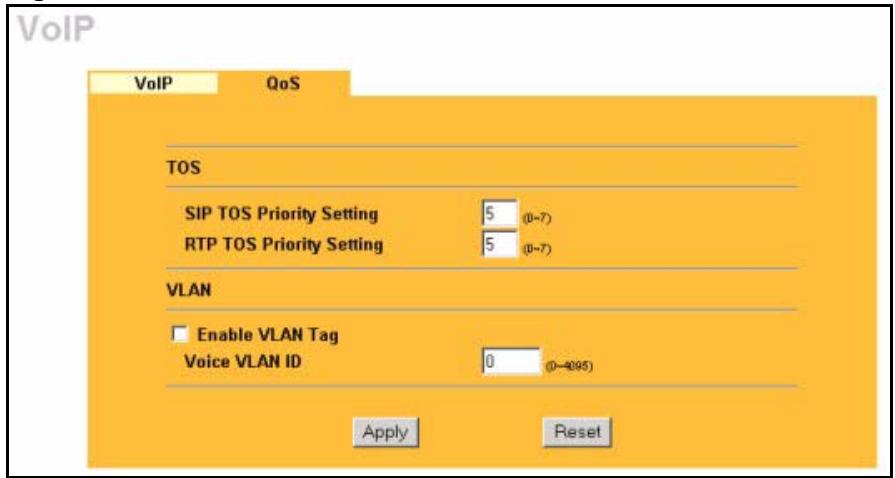
The following table describes the labels in this screen.
Table 14 QoS
| LABEL | DESCRIPTION |
| SIP TOS Priority | Type a priority for voice transmissions. The Prestige applies Type of Service priority tags with this priority to voice traffic that it transmits. |
| RTP TOS Priority | Type a priority for voice transmissions. The Prestige applies Type of Service priority tags with this priority to RTP traffic that it transmits. Priorities 6 and 7 are reserved for network control traffic. It is recommended that you use priority 5 for RTP. |
| Enable VLAN Tag | Enable VLAN tagging if the Prestige needs to be a member of a VLAN group in order to communicate with the SIP server. Your LAN and gateway must also be set up to use VLAN tags. Some switches also give priority to voice traffic based on its VLAN tag. Disable VLAN tagging if the Prestige does not need to be a member of a VLAN group to communicate with the SIP server. |
| Voice VLAN ID | Type the VLAN ID (VID) from 0 to 4095 for the Prestige to add to voice Ethernet frames that it sends out to the network. |
| Apply | Click Apply to save your changes back to the Prestige. |
| Reset | Click Reset to begin configuring this screen afresh. |
CHAPTER 7 Phone
This chapter covers how to adjust the Prestige's phone settings.
7.1 Phone Introduction
You can configure the volume, echo cancellation and VAD settings for each individual phone port on the Prestige. You can also select which SIP account to use for making outgoing calls.
7.1.1 Voice Activity Detection/Silence Suppression
Voice Activity Detection (VAD) detects whether or not speech is present. This lets the Prestige reduce the bandwidth that a call uses by not transmitting "silent packets" when you are not speaking.
7.1.2 Comfort Noise Generation
When using VAD, the Prestige generates and sends comfort noise when the other party is not speaking. Comfort noise uses the lowest possible transmission bandwidth to match the background noise. The comfort noise lets you know that the line is still connected as total silence could easily be mistaken for a lost connection.
7.1.3 Echo Cancellation
G.168 is an ITU-T standard for eliminating the echo caused by the sound of your voice reverberating in the telephone receiver while you talk.
7.2 Phone Port Configuration
Click PHONE in the navigation panel to display the following screen. Use this screen to configure phone port settings that are specific to an individual phone port.
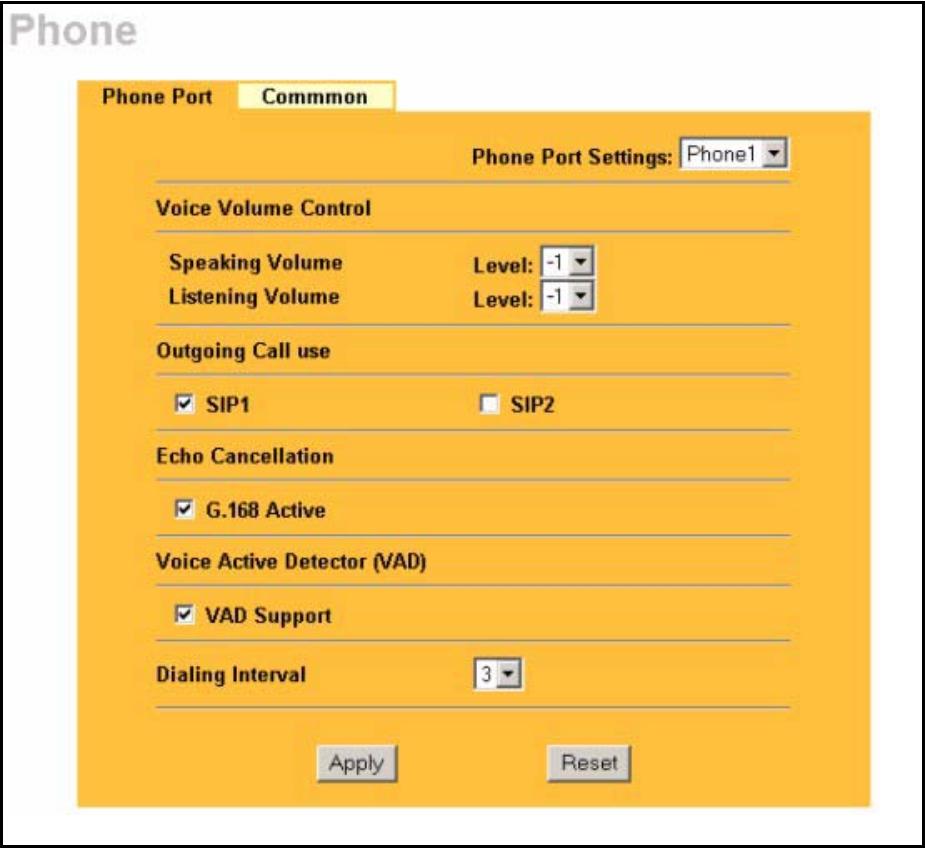
Figure 28 Phone Port
The following table describes the labels in this screen.
Table 15 Phone Port
| LABEL | DESCRIPTION |
| Phone Port Settings | Use this field to select the phone port that you want to configure. |
| Speaking Volume | Use this field to set the loudness that the Prestige uses for the speech signal that it sends to the peer device. -1 is the quietest and 1 is the loudest. |
| Listening Volume | Use this field to set the loudness that the Prestige uses for the speech signal that it receives from the peer device and sends to your phone. -1 is the quietest and 1 is the loudest. |
| Outgoing Call use | SIP 1 and SIP 2 correspond to the Prestige's SIP accounts. Select whether you want the phone(s) attached to this phone port to use SIP account 1, 2 or both when you make a call. If you select both SIP accounts, the Prestige will first try to use SIP account 2 and then SIP account 1 when you make a call. |
| G.168 Active | Select this check box to cancel the echo caused by the sound of your voice reverberating in the telephone receiver while you talk. |
| VAD Support | Select this check box to use Voice Activity Detection (VAD).VAD reduces the bandwidth that a call uses by not transmitting when you are not speaking. |
| Dialing Interval | When you are dialing a telephone number the Prestige waits this long after you stop pressing the buttons before initiating the call. Select how many seconds you want the Prestige to wait after the last input on the telephone's keypad before dialing (making) a call. |
| Apply | Click Apply to save your changes back to the Prestige. |
| Reset | Click Reset to begin configuring this screen afresh. |
7.3 Supplementary Phone Services Overview
Supplementary services such as call hold, call waiting, call transfer, ... are generally available from your voice service provider. The Prestige supports the following services:
Call Hold
- Call Waiting
Making a Second Call
Call Transfer
- Call Forwarding (see Section 8.3 on page 75)
Three-Way Conference
- Internal Calls (see Section 11.3 on page 93)
Note: To take full advantage of the supplementary phone services available though the Prestige's phone ports, you may need to subscribe to the services from your voice service provider.
7.3.1 The Flash Key
Flashing means to press the hook for a short period of time (a few hundred milliseconds) before releasing it. On newer telephones, there should be a "flash" key (button) that generates the signal electronically. If the flash key is not available, you can tap (press and immediately release) the hook by hand to achieve the same effect. However, using the flash key is preferred since the timing is much more precise. With manual tapping, if the duration is too long, it may be interpreted as hanging up by the Prestige.
You can invoke all the supplementary services by using the flash key.
7.3.2 Europe Type Supplementary Phone Services
This section describes how to use supplementary phone services with the Europe Type Call Service Mode. Commands for supplementary services are listed in the table below.
After pressing the flash key, if you do not issue the sub-command before the default sub-command timeout (2 seconds) expires or issue an invalid sub-command, the current operation will be aborted.
Table 16 European Flash Key Commands
| COMMAND | SUB-COMMAND | DESCRIPTION |
| Flash | Put a current call on hold to place a second call. Switch back to the call (if there is no second call). | |
| Flash | 0 | Drop the call presently on hold or reject an incoming call which is waiting for answer. |
| Flash | 1 | Disconnect the current phone connection and answer the incoming call or resume with caller presently on hold. |
| Flash | 2 | 1. Switch back and forth between two calls. 2. Put a current call on hold to answer an incoming call. 3. Separate the current three-way conference call into two individual calls (one is on-line, the other is on hold). |
| Flash | 3 | Create three-way conference connection. |
| Flash | *98# | Transfer the call to another phone. |
7.3.2.1 European Call Hold
Call hold allows you to put a call (A) on hold by pressing the flash key.
If you have another call, press the flash key and then "2" to switch back and forth between caller A and B by putting either one on hold.
Press the flash key and then "0" to disconnect the call presently on hold and keep the current call on line.
Press the flash key and then "1" to disconnect the current call and resume the call on hold.
If you hang up the phone but a caller is still on hold, there will be a remind ring.
7.3.2.2 European Call Waiting
This allows you to place a call on hold while you answer another incoming call on the same telephone (directory) number.
If there is a second call to a telephone number, you will hear a call waiting tone. Take one of the following actions.
- Reject the second call.
Press the flash key and then press "0".
- Disconnect the first call and answer the second call.
Either press the flash key and press "1", or just hang up the phone and then answer the phone after it rings.
- Put the first call on hold and answer the second call.
Press the flash key and then "2".
7.3.2.3 European Call Transfer
Do the following to transfer an incoming call (that you have answered) to another phone.
1 Press the flash key to put the caller on hold.
2 When you hear the dial tone, dial “*98#” followed by the number to which you want to transfer the call. to operate the Intercom.
3 After you hear the ring signal or the second party answers it, hang up the phone.
7.3.2.4 European Three-Way Conference
Use the following steps to make three-way conference calls.
1 When you are on the phone talking to someone, place the flash key to put the caller on hold and get a dial tone.
2 Dial a phone number directly to make another call.
3 When the second call is answered, press the flash key and press "3" to create a three-way conversation.
4 Hang up the phone to drop the connection.
5 If you want to separate the activated three-way conference into two individual connections (one is on-line, the other is on hold), press the flash key and press “2”.
7.3.3 USA Type Supplementary Services
This section describes how to use supplementary phone services with the USA Type Call Service Mode. Commands for supplementary services are listed in the table below.
After pressing the flash key, if you do not issue the sub-command before the default sub-command timeout (2 seconds) expires or issue an invalid sub-command, the current operation will be aborted.
Table 17 USA Flash Key Commands
| COMMAND | SUB-COMMAND | DESCRIPTION |
| Flash | Put a current call on hold to place a second call. After the second call is successful, press the flash key again to have a three-way conference call. Put a current call on hold to answer an incoming call. | |
| Flash | *98# | Transfer the call to another phone. |
7.3.3.1 USA Call Hold
Call hold allows you to put a call (A) on hold by pressing the flash key.
If you have another call, press the flash key to switch back and forth between caller A and B by putting either one on hold.
If you hang up the phone but a caller is still on hold, there will be a remind ring.
7.3.3.2 USA Call Waiting
This allows you to place a call on hold while you answer another incoming call on the same telephone (directory) number.
If there is a second call to your telephone number, you will hear a call waiting tone.
Press the flash key to put the first call on hold and answer the second call.
7.3.3.3 USA Call Transfer
Do the following to transfer an incoming call (that you have answered) to another phone.
1 Press the flash key to put the caller on hold.
2 When you hear the dial tone, dial “*98#” followed by the number to which you want to transfer the call. to operate the Intercom.
3 After you hear the ring signal or the second party answers it, hang up the phone.
7.3.3.4 USA Three-Way Conference
Use the following steps to make three-way conference calls.
1 When you are on the phone talking to someone, place the flash key to put the caller on hold and get a dial tone.
2 Dial a phone number directly to make another call.
3 When the second call is answered, press the flash key, wait for the sub-command tone and press "3" to create a three-way conversation.
4 Hang up the phone to drop the connection.
5 If you want to separate the activated three-way conference into two individual connections (one is on-line, the other is on hold), press the flash key, wait for the sub-command tone and press "2".
7.4 Common Phone Configuration
Click PHONE in the navigation panel and then Common to display the following screen. Use this screen to configure general phone settings.
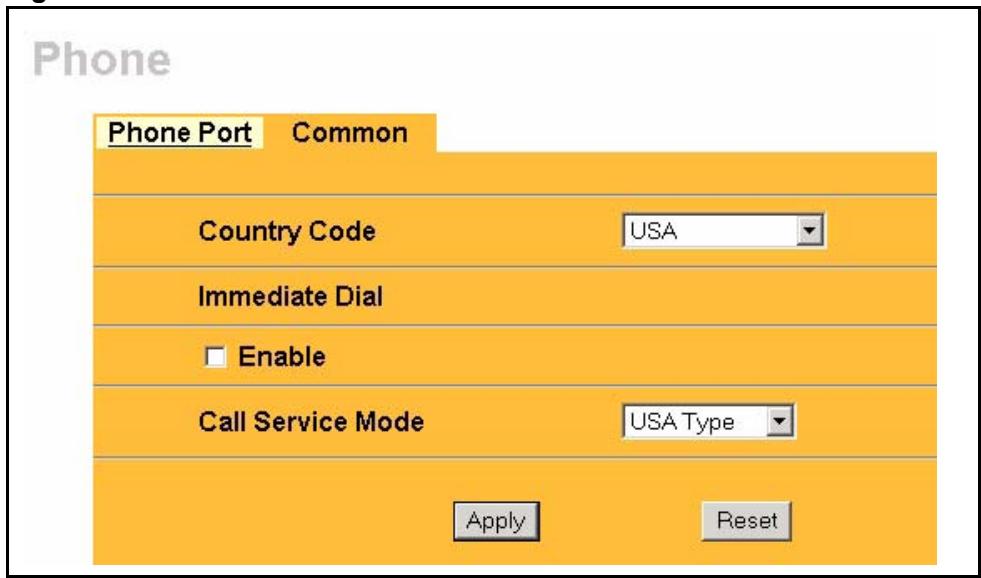
Figure 29 Phone Common
The following table describes the labels in this screen.
Table 18 Phone Common
| LABEL | DESCRIPTION |
| Country Code | Use the drop-down list box to select the country where your Prestige is located. |
| Immediate Dial | Use immediate dial to have the Prestige make calls right away instead of waiting for the dialing interval (the time period it waits to make sure you are done pressing the keys).In order to use immediate dial, enable it here. Then press the pound (#) key on your telephone's keypad after dialing a phone number (this has the Prestige make the call right away). |
| Call Service Mode | Use this field to set how the Prestige handles supplementary phone services (call hold, call waiting, call transfer and three-way conference calls). Select the mode that your voice service provider supports.Select Europe Type to use the supplementary phone services in European mode.Select USA Type to use the supplementary phone services American mode.Note: To take full advantage of the supplementary phone services available though the Prestige's phone ports, you may need to subscribe to the services from your voice service provider. |
| Apply | Click Apply to save your changes back to the Prestige. |
| Reset | Click Reset to begin configuring this screen afresh. |
CHAPTER 8 Phone Book
This chapter covers how to configure the Prestige's phone book.
8.1 Phone Book Introduction
You can use the phone book feature to configure speed dial entries, call forwarding tables and the lifeline settings.
8.1.1 Speed Dial
Speed dial provides shortcuts for dialing frequently used (VoIP) phone numbers.
8.1.1.1 Peer-to-Peer Calls
You can call another VoIP device directly without going through a SIP server. You must set up a speed dial entry in the phone book in order to do this. Select Non-Proxy (Use IP or URL) in the Type column and enter the callee's IP address or domain name. The Prestige sends SIP INVITE requests to the peer VoIP device when you use the speed dial entry.
You do not need to configure a SIP account on the Prestige 2002 in order to make a peer-to-peer VoIP call. You must still configure a SIP account on the Prestige 2002L in order to make a peer-to-peer VoIP call.
8.1.2 Lifeline (Prestige 2002L)
With lifeline you can make and receive regular phone calls. Use a prefix number to make a regular call. When the Prestige 2002L does not have power, you can make regular calls without dialing a prefix number.
You can also specify phone numbers that should always use the regular phone service (without having to dial a prefix number). Do this for emergency numbers (like those for contacting police, fire or emergency medical services).
8.2 Speed Dial Configuration
Click PHONEBOOK in the navigation panel and then Speed Dial to display the following screen.
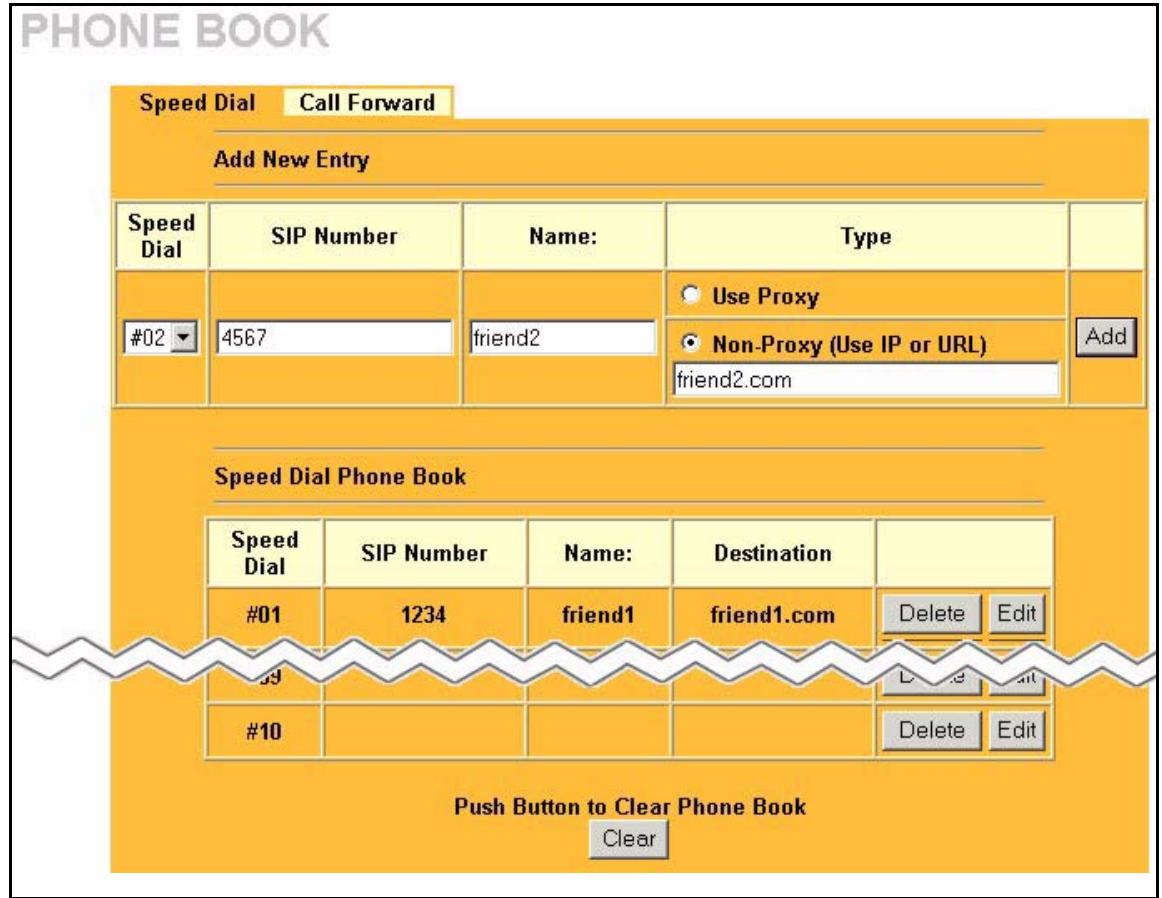
Figure 30 Speed Dial
The following table describes the labels in this screen.
Table 19 Speed Dial
| LABEL | DESCRIPTION |
| Add New Entry | Use this section of the screen to edit and save new or existing speed dial phone book entries. |
| Speed Dial | Select a speed dial key combination from the drop-down list box. After configuring the speed dial entry and adding it to the phonebook, dial this speed dial key combination to use the speed dial entry to make a call. |
| SIP Number | Enter the SIP number of the party that you will call (use the number or text that comes before the @ symbol in a full SIP URI). You can use up to 127 ASCII characters. |
| Name | Enter a descriptive name to identify the party that you will use this entry to call. You can use up to 127 ASCII characters. |
| Type | Select Use Proxy if calls to this party use your SIP account configured in the VoIP screen. Select Non-Proxy (Use IP or URI) if calls to this party use a different SIP server or go directly to the callee's VoIP phone (peer-to-peer). Enter the SIP server's or the party's IP address or domain name (up to 127 ASCII Extended set characters). |
| Add | Click this button to save the entry in the speed dial phone book. The speed dial entry displays in the Speed Dial Phone Book section of the screen. |
| Speed Dial Phone Book | This section of the screen displays the currently saved speed dial entries. You can configure up to 10 entries and use them to make calls. |
| Speed Dial | This is the entry's speed dial key combination. Press this key combination on a telephone attached to the Prestige in order to call the party named in this entry. |
| Name | This is the descriptive name of the party that you will use this speed dial entry to call. |
| SIP Number | This is the SIP number of the party that you will call. |
| Type | This field displays Use Proxy if calls to this party use one of your SIP accounts. This field displays the SIP server's or the party's IP address or domain name if calls to this party do not use one of your SIP accounts. |
| Delete | Click this button to remove an entry from the speed dial phone book. |
| Edit | Click this button to change the speed dial entry. The speed dial entry displays in the Add New Entry section of the screen where you can edit it. |
| Clear | Click this button to remove all of the entries from the speed dial phone book. |
8.3 Call Forward
Click PHONEBOOK in the navigation panel and then Call Forward to display the following screen.
Use this screen to configure the Prestige to block or redirect calls. You can configure a different call forwarding table for each SIP account or use the same call forwarding table for both.
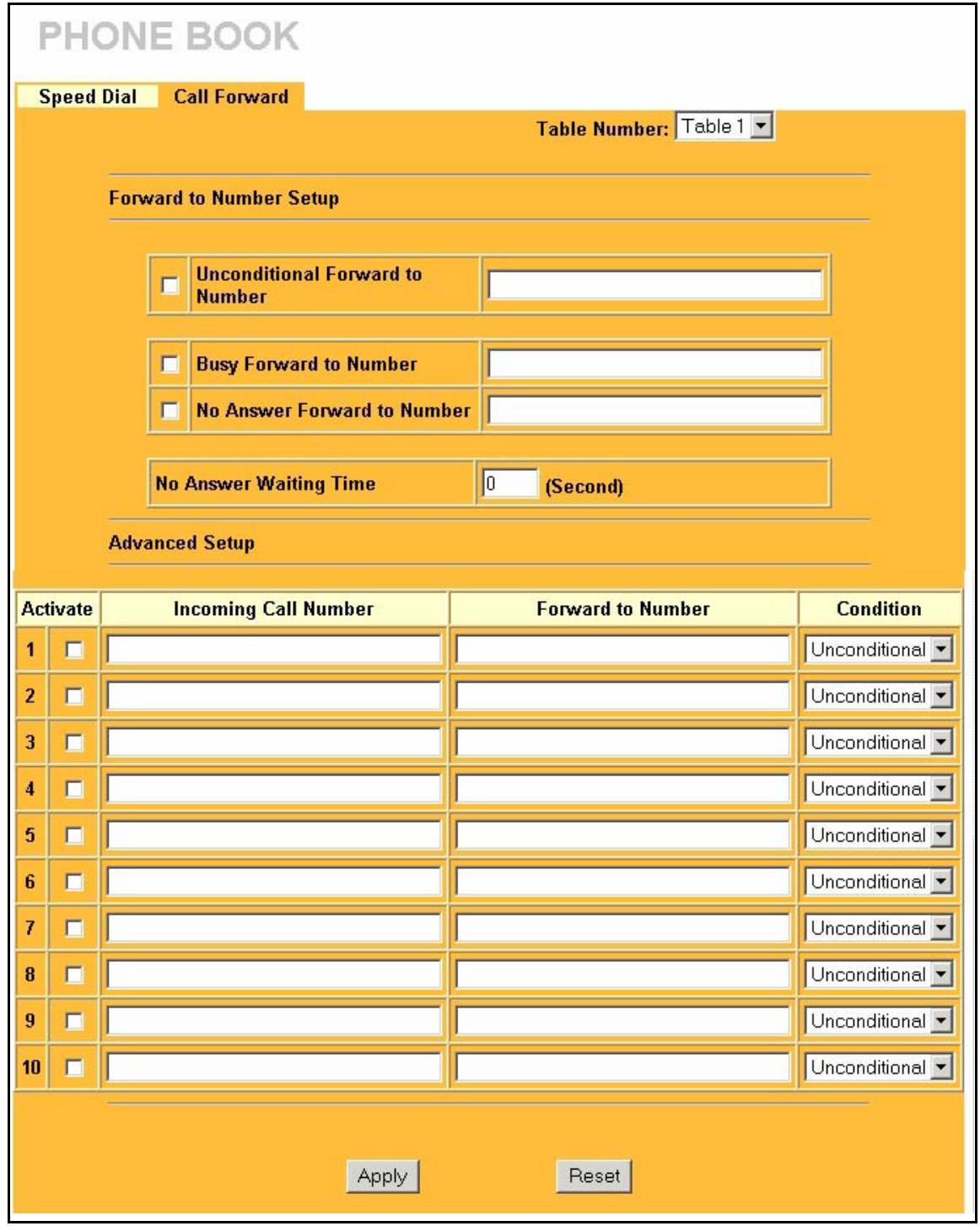
Figure 31 Call Forward
The following table describes the labels in this screen.
Table 20 Call Forward
| LABEL | DESCRIPTION |
| Table Number | Select which call forwarding table you want to configure. You can configure a different call forwarding table for each SIP account or use the same call forwarding table for both. |
| The following applies to the number fields in this screen. • You can use up to 127 ASCII characters. • The number can be a SIP number or a regular phone number (as long as your voice service provider supports calling between SIP and PSTN). • When entering a regular phone number, be sure to use any prefix numbers that are required by your voice service provider's dialing plan. • For a SIP number, use the number or text that comes before the @ symbol in a full SIP URI. | |
| Forward to Number Setup | These are the global call forwarding settings that define the default action to take on incoming calls that do not match any of the Advanced Setup call forwarding entries. |
| Unconditional Forward to Number | Enable this feature to have the Prestige forward incoming calls to the number that you configure. |
| Busy Forward to Number | Enable this feature to have the Prestige forward incoming calls to the number that you configure when your SIP account has a call connected. |
| No Answer Forward to Number | Enable this feature to have the Prestige forward incoming calls to the number that you configure whenever you do not answer the call after a specific time period. |
| No Answer Waiting Time | Set how long the Prestige should let a call ring before considering the call unanswered. |
| Advanced Setup | Configure Advanced Setup call forwarding entries to have the Prestige perform specific actions on calls from specific numbers. If a caller's number does not match the Incoming Call Number of any of these entries, the Prestige performs the default action configured in the Forward to Number Setup section. |
| Activate | Select this check box to turn on an call forwarding entry. |
| Incoming Call Number | You can set the Prestige to take a particular action on incoming calls from a number that you specify here. |
| Forward to Number | You can set the Prestige to forward incoming calls to a number that you specify here. |
| Condition | Select under what circumstances you want the Prestige to use this call forwarding entry. Select Unconditional to have the Prestige immediately forward any calls from the number specified in the Incoming Call Number field to the number in the Forward to Number field. Select Busy to have the Prestige forward any calls from the number specified in the Incoming Call Number field to the number in the Forward to Number field when your SIP account has a call connected. Select No Answer to have the Prestige forward any calls from the number specified in the Incoming Call Number field to the number in the Forward to Number field when the No Answer Waiting Time period expires (whether or not the no answer feature is enabled in the Forward to Number Setup section). Select Block to have the Prestige reject calls from the number specified in the call forwarding entry. Select Accept to have the Prestige allow calls from the number specified in the Incoming Call Number field. |
| Apply | Click Apply to save your changes back to the Prestige. |
| Reset | Click Reset to begin configuring this screen afresh. |
8.4 Lifeline Configuration (Prestige 2002L)
Click PHONEBOOK in the navigation panel and then Lifeline to display the following screen.
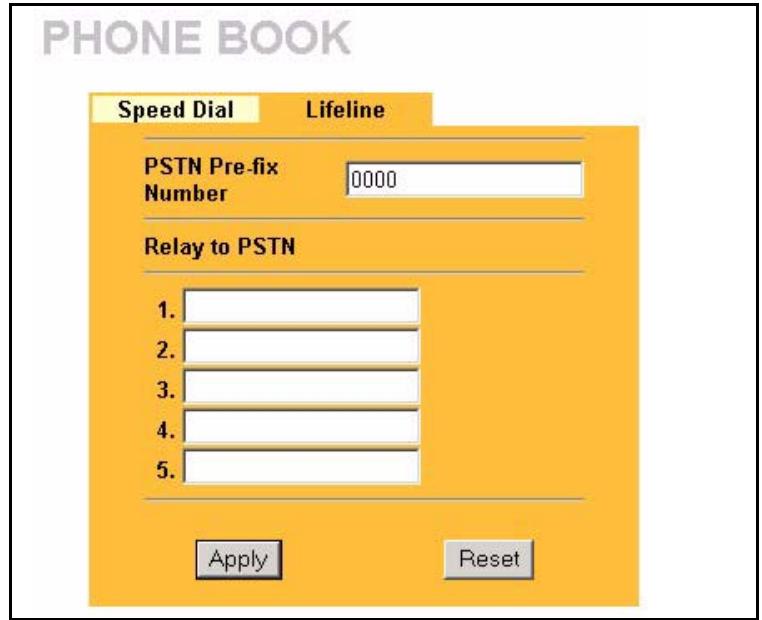
Figure 32 Lifeline
The following table describes the labels in this screen.
Table 21 Lifeline
| LABEL | DESCRIPTION |
| PSTN Pre-fix Number | Specify the prefix number for dialing regular calls. |
| Relay to PSTN | Use these fields to specify phone numbers to which the Prestige will always send calls through the regular phone service without the need of dialing a prefix number. These numbers must be for phones on the PSTN (not VoIP phones). |
| Apply | Click Apply to save your changes back to the Prestige. |
| Reset | Click Reset to begin configuring this screen afresh. |
CHAPTER 9 Logs
This chapter contains information about the Prestige's Logs screen. Refer to the Appendices for example log message explanations.
9.1 Viewing Logs
The web configurator allows you to look at all of the Prestige's logs in one location.
Click LOGS in the navigation panel to open the View Log screen. Use the View Log screen to display the Prestige's logs.
Log entries in red indicate system error logs. Once the log table is full, old logs are deleted as new logs are created. Click a column heading to sort the entries. A triangle indicates ascending or descending sort order.
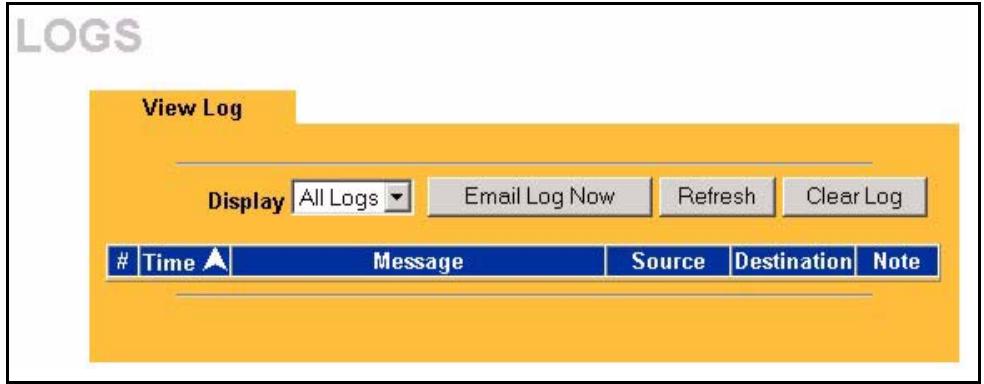
Figure 33 View Log
The following table describes the labels in this screen.
Table 22 View Log
| LABEL | DESCRIPTION |
| Display | Select All Logs to view all of the Prestige's logs. Select System Maintenance to view the Prestige's maintenance logs. Select System Error to view the Prestige's error logs. Select SIP to view Session Initiation Protocol logs. Select RTP to view Real time Transport Protocol logs. Select FSM to view Finite State Machine logs. These logs record phone actions. |
| Refresh | Click Refresh to renew the log screen. |
| Clear Log | Click Clear Log to delete all the logs. |
| Time | This field displays the time the log was recorded. To configure the Prestige's time and date, see Chapter 3 on page 35. |
| Message | This field states the reason for the log. |
| Source | This field lists the source IP address and the port number of the incoming packet. |
| Destination | This field lists the destination IP address and the port number of the incoming packet. |
| Note | This field displays additional information about the log entry. |
9.2 Log Message Descriptions
The following tables provide descriptions of example log messages.
Table 23 System Error Logs
| LOGMESSAGE | DESCRIPTION |
| WAN connection is down. | A WAN connection is down. You cannot access the network through this interface. |
Table 24 System Maintenance Logs
| LOGMESSAGE | DESCRIPTION |
| Time calibration is successful | The device has adjusted its time based on information from the time server. |
| Time calibration failed | The device failed to get information from the time server. |
| WAN interface gets IP:%s | A WAN interface got a new IP address from the DHCP, PPPoE, PPTP or dial-up server. |
| DHCP client IP expired | A DHCP client's IP address has expired. |
| Successful WEB login | Someone has logged on to the device's web configurator interface. |
| WEB login failed | Someone has failed to log on to the device's web configurator interface. |
| Successful FTP login | Someone has logged on to the device via ftp. |
| FTP login failed | Someone has failed to log on to the device via ftp. |
| Time initialized by Daytime Server | The device got the time and date from the Daytime server. |
| Time initialized by Time server | The device got the time and date from the time server. |
| Time initialized by NTP server | The device got the time and date from the NTP server. |
| Connect to Daytime server fail | The device was not able to connect to the Daytime server. |
| Connect to Time server fail | The device was not able to connect to the Time server. |
| Connect to NTP server fail | The device was not able to connect to the NTP server. |
| Too large ICMP packet has been dropped | The device dropped an ICMP packet that was too large. |
| Configuration Change: PC = 0x%x, Task ID = 0x%x | The device is saving configuration changes. |
Table 25 SIP Logs
| LOGMESSAGE | DESCRIPTION |
| SIP Registration Success by SIP:SIP Phone Number | The listed SIP account was successfully registered with a SIP register server. |
| SIP Registration Fail by SIP:SIP Phone Number | An attempt to register the listed SIP account with a SIP register server was not successful. |
| SIP UnRegistration Success by SIP:SIP Phone Number | The listed SIP account's registration was deleted from the SIP register server. |
| SIP UnRegistration Fail by SIP:SIP Phone Number | An attempt to delete the listed SIP account's registration from the SIP register server failed. |
Table 26 RTP Logs
| LOGMESSAGE | DESCRIPTION |
| Error, RTP init fail | The initialization of an RTP session failed. |
| Error, Call fail: RTP connect fail | A VoIP phone call failed because the RTP session could not be established. |
| Error, RTP connection cannot close | The termination of an RTP session failed. |
Table 27 FSM Logs: Caller Side
| LOGMESSAGE | DESCRIPTION |
| VoIP Call Start Ph[Phone Port Number]<-Outgoing Call Number | Someone used a phone connected to the listed phone port to initiate a VoIP call to the listed destination. |
| VoIP Call Established Ph[Phone Port] ->Outgoing Call Number | Someone used a phone connected to the listed phone port to make a VoIP call to the listed destination. |
| VoIP Call End Phone[Phone Port] | A VoIP phone call made from a phone connected to the listed phone port has terminated. |
Table 28 FSM Logs: Callee Side
| LOGMESSAGE | DESCRIPTION |
| VoIP Call Start from SIP[SIP Port Number] | A VoIP phone call came to the Prestige from the listed SIP number. |
| VoIP Call Established Ph[Phone Port]<-Outgoing Call Number | A VoIP phone call was set up from the listed SIP number to the Prestige. |
| VoIP Call End Phone[Phone Port] | A VoIP phone call that came into the Prestige has terminated. |
Table 29 Lifeline Logs
| LOGMESSAGE | DESCRIPTION |
| PSTN Call Start | A PSTN call has been initiated. |
| PSTN Call End | A PSTN call has terminated. |
| PSTN Call Established | A PSTN call has been set up. |
CHAPTER 10 Maintenance
This chapter displays system information such as ZyNOS firmware, port IP addresses and port traffic statistics.
10.1 Maintenance Overview
The maintenance screens can help you view system information, upload new firmware, manage configuration and restart your Prestige.
10.2 Status Screen
Click MAINTENANCE in the navigation panel to open the Status screen, where you can use to monitor your Prestige. Note that these fields are READ-ONLY and are meant to be used for diagnostic purposes.
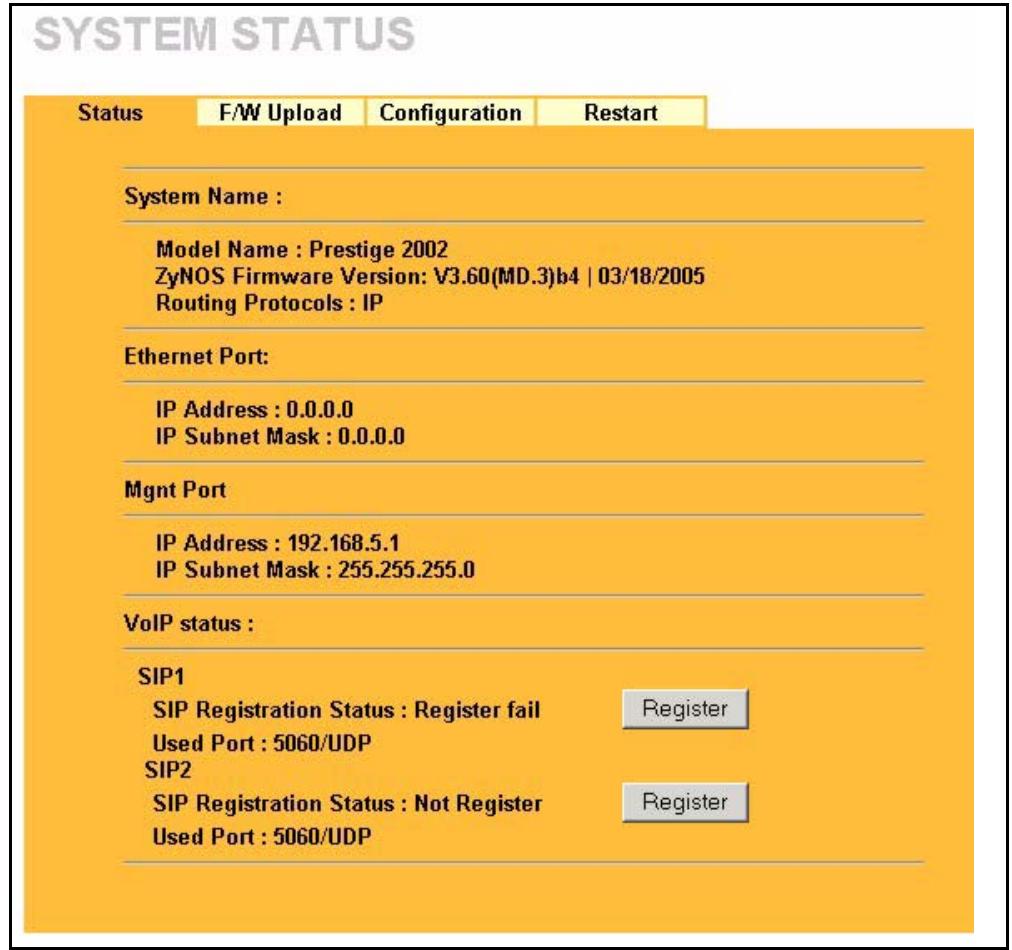
Figure 34 System Status
The following table describes the labels in this screen.
Table 30 System Status
| LABEL | DESCRIPTION |
| System Name | This is the System Name you chose in the SYSTEM General screen. It is for identification purposes |
| Model Name | The model name identifies your device type. The model name should also be on a sticker on your device. If you are uploading firmware, be sure to upload firmware for this exact model name. |
| ZyNOS Firmware Version: | This is the ZyNOS firmware version and the date the firmware was created. ZyNOS is ZyXEL's proprietary Network Operating System. |
| Ethernet Port | |
| IP Address | This is the Prestige's IP address. This applies to both of the Prestige's Ethernet ports. |
| IP Subnet Mask | This is the Prestige's subnet mask. This applies to both of the Prestige's Ethernet ports. |
| MGNT Port | |
| IP Address | This is the static IP address of the Prestige's logical Ethernet interface for management. |
| IP Subnet Mask | This is the subnet mask of the Prestige's logical Ethernet interface for management. |
| VoIP Status | |
| SIP1/SIP 2 | This is the SIP account configured on the Prestige |
| SIP Registration Status | This is the SIP registration status of the SIP account. This field displays Registered when the Prestige has successfully registered the SIP account with the SIP register server. This field displays Not Registered when the Prestige has not successfully registered the SIP account with the SIP register server. |
| Register/Unregister | Click Register to have the Prestige attempt to register the SIP account with the SIP register server. Click Unregister to delete the SIP account's registration on the SIP register server. This removes the SIP registration server's SIP identity-to-IP address (or domain name) mapping for this SIP account, it does not cancel your SIP account. |
| Used Port | This field displays the Prestige's listening port for SIP traffic on this SIP account. |
10.3 F/W Upload Screen
Find firmware at www.zyxel.com in a file that (usually) uses the system model name with a "(.*.bin" extension, e.g., "Prestige.bin". The upload process uses HTTP (Hypertext Transfer Protocol) and may take up to two minutes. After a successful upload, the system will reboot.
Click MAINTENANCE in the navigation panel and then the F/W UPGLOAD tab. Follow the instructions in this screen to upload firmware to your Prestige.
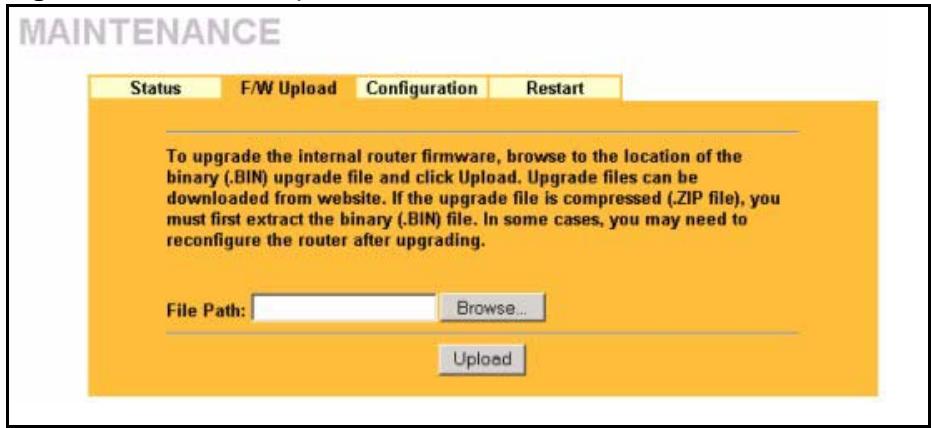
Figure 35 Firmware Upload
The following table describes the labels in this screen.
Table 31 Firmware Upload
| LABEL | DESCRIPTION |
| File Path | Type in the location of the file you want to upload in this field or click Browse... to find it. |
| Browse... | Click Browse... to find the .bin file you want to upload. Remember that you must decompress compressed (.zip) files before you can upload them. |
| Upload | Click Upload to begin the upload process. This process may take up to two minutes. |
Note: Do not turn off the device while firmware upload is in progress!
After you see the Firmware Upload in Process screen, wait two minutes before logging into the device again.
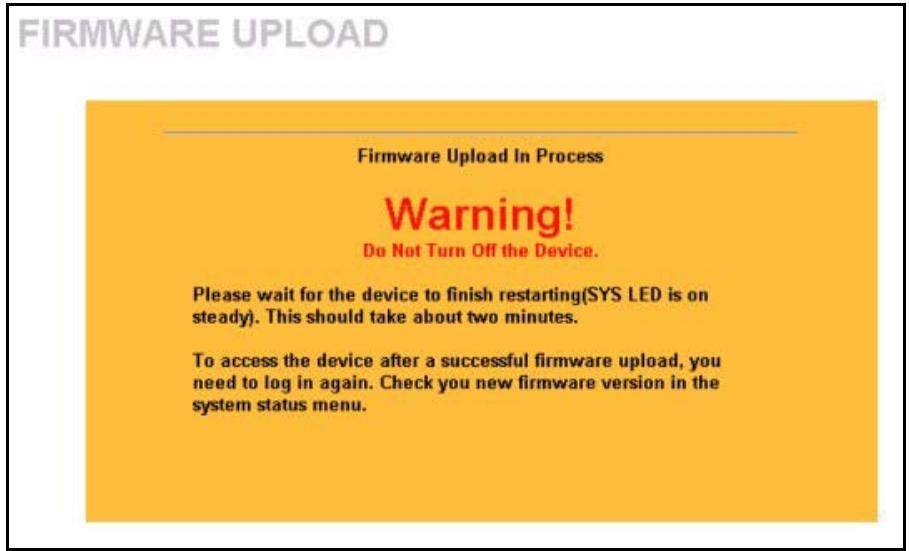
Figure 36 Firmware Upload In Process
The device automatically restarts in this time causing a temporary network disconnect. In some operating systems, you may see the following icon on your desktop.
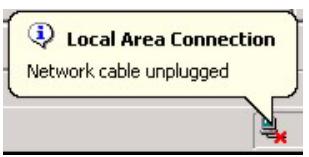
Figure 37 Network Temporarily Disconnected
After two minutes, log in again and check your new firmware version in the System Status screen.
If the upload was not successful, the following screen will appear. Click Return to go back to the F/W Upload screen.
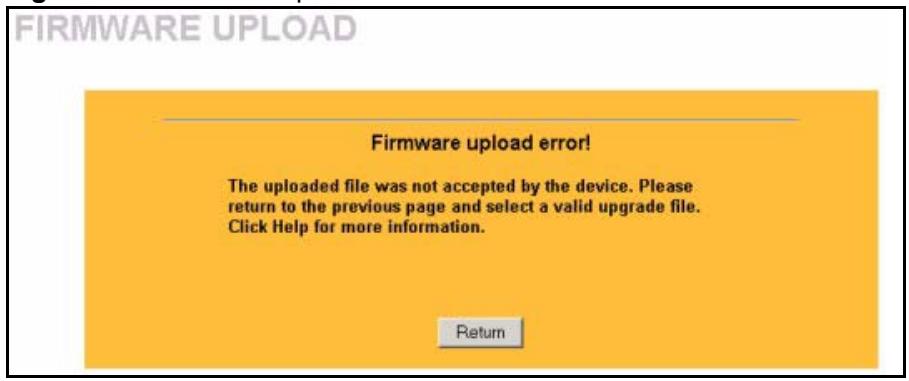
Figure 38 Firmware Upload Error
10.4 Configuration Screen
Click MAINTENANCE in the navigation panel and then the Configuration tab. Information related to factory defaults, backup configuration, and restoring configuration appears as shown next.
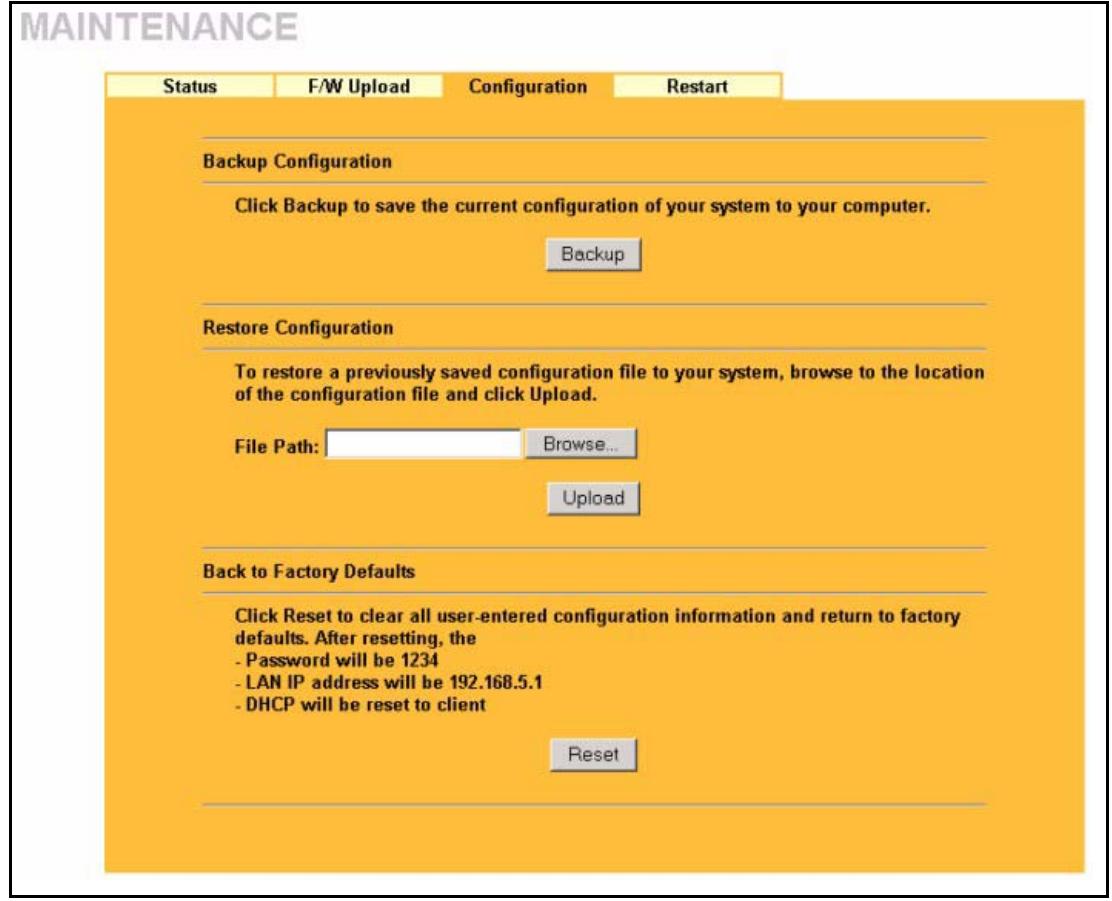
Figure 39 Configuration
10.4.1 Backup Configuration
Backup Configuration allows you to back up (save) the device's current configuration to a file on your computer. Once your device is configured and functioning properly, it is highly recommended that you back up your configuration file before making configuration changes. The backup configuration file will be useful in case you need to return to your previous settings.
Click Backup to save the device's current configuration to your computer.
10.4.2 Restore Configuration
Restore Configuration allows you to upload a new or previously saved configuration file from your computer to your Prestige.
Table 32 Restore Configuration
| LABEL | DESCRIPTION |
| File Path | Type in the location of the file you want to upload in this field or click Browse... to find it. |
| Browse... | Click Browse... to find the file you want to upload. Remember that you must decompress compressed (.ZIP) files before you can upload them. |
| Upload | Click Upload to begin the upload process. |
Note: Do not turn off the device while configuration file upload is in progress.
After you see a "configuration upload successful" screen, you must then wait one minute before logging into the device again.
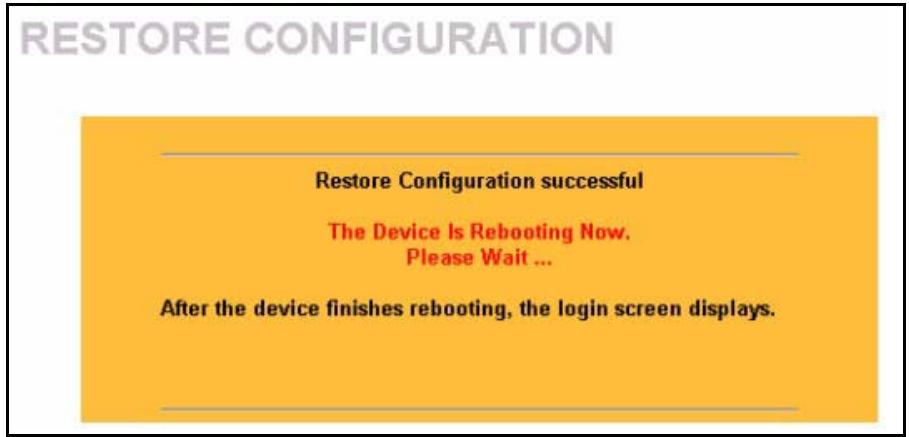
Figure 40 Configuration Upload Successful
The device automatically restarts in this time causing a temporary network disconnect. In some operating systems, you may see the following icon on your desktop.
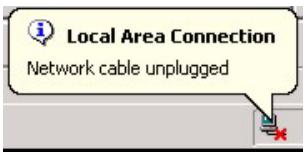
Figure 41 Network Temporarily Disconnected
If you uploaded the default configuration file you may need to change the IP address of your computer to be in the same subnet as that of the default management IP address (192.168.5.1). See your Quick Start Guide or the appendices for details on how to set up your computer's IP address.
If the upload was not successful, a Configuration Upload Error screen will appear. Click Return to go back to the Configuration screen.
10.4.3 Back to Factory Defaults
Clicking the Reset button in this section clears all user-entered configuration information and returns the Prestige to its factory defaults as shown on the screen. The following warning screen will appear.
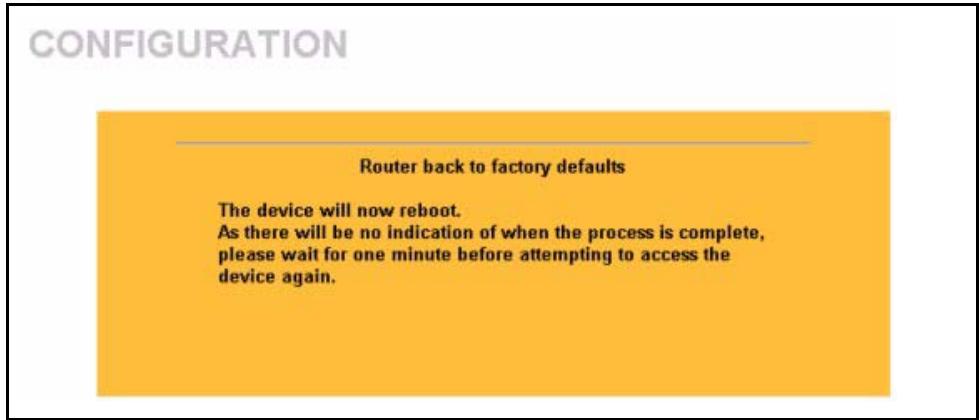
Figure 42 Reset Warning Message
You can also press the RESET button on the rear panel to reset the factory defaults of your Prestige. For more information on the RESET button, see Section 2.3 on page 31.
10.5 Restart Screen
System restart allows you to reboot the Prestige without turning the power off.
Click MAINTENANCE in the navigation panel and then Restart. Click Restart to have the Prestige reboot. This does not affect the Prestige's configuration.
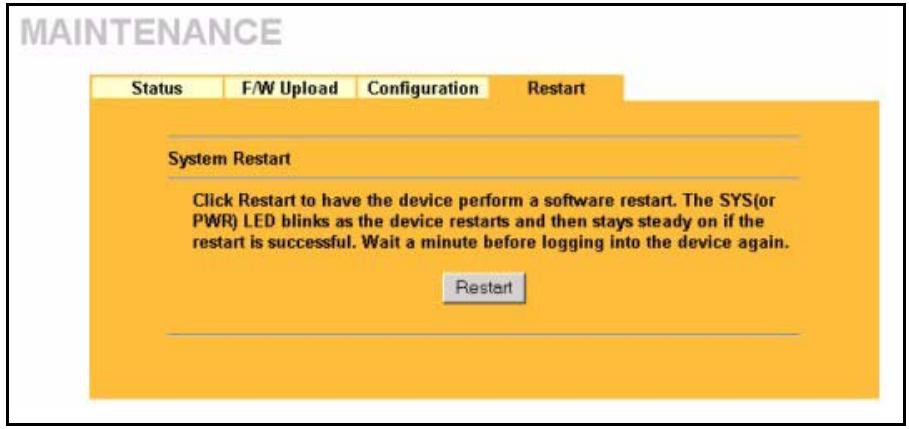
Figure 43 Restart Screen
CHAPTER 11 Phone Usage
This chapter describes how to use a phone connected to your Prestige for basic tasks.
11.1 Dialog a Telephone Number
The VoIP/PWR LED turns orange when your SIP account is registered. Dial a SIP number like "12345" on your phone's keypad.
Use speed dial entries (see Section 8.2 on page 73) for peer-to-peer calls or SIP numbers that use letters. Dial the speed dial entry on your telephone's keypad.
Use your voice service provider's dialing plan to call regular telephone numbers.
11.2 Using Speed Dial to Dial a Telephone Number
After configuring the speed dial entry and adding it to the phonebook, press the speed dial entry's key combination on your phone's keypad.
11.3 Internal Calls
Press "########" on your phone's keypad to call the Prestige's other phone port.
11.4 Checking the Prestige's IP Address
Do the following to listen to the Prestige's IP current address.
1 Pick up your phone's receiver.
2 Press "**" on your phone's keypad and wait for the message that says you are in the configuration menu.
3 Press "5" followed by the # key.
4 Listen to the IP address and make a note of it.
5 Hang up the receiver.
11.5 Auto Firmware Upgrade
During auto-provisioning, the Prestige checks to see if there is a newer firmware version. If newer firmware is available, the Prestige plays a recording when you pick up your phone's handset.
Press " 99# " to upgrade the Prestige's firmware.
Press "#99#" to not upgrade the Prestige's firmware.
CHAPTER 12 Troubleshooting
This chapter covers potential problems and the corresponding remedies.
12.1 Problems Starting Up the Prestige
Table 33 Troubleshooting the Start-Up of Your Prestige
| PROBLEM | CORRECTIVE ACTION |
| None of the LEDs turn on when I turn on the Prestige. | Make sure that the Prestige's power adaptor is connected to the Prestige and an appropriate power source. Check that the power source is turned on. Disconnect the Prestige's power and reconnect it. If the error persists, you may have a hardware problem. In this case, you should contact your vendor. |
12.2 Problems with the LAN or PC LED
Table 34 Troubleshooting the LAN or PC LED
| PROBLEM | CORRECTIVE ACTION |
| The LAN or PC LED does not turn on. | Check your Ethernet cable connections and type (refer to the Quick Start Guide for details). Check for faulty Ethernet cables. |
| Make sure your computer's Ethernet card is working properly. |
12.3 Problems with the LAN Interface
Table 35 Troubleshooting the LAN Interface
| PROBLEM | CORRECTIVE ACTION |
| I cannot access the Prestige from the LAN. | If the LAN or PC LED is off, see Table 34 on page 95. Make sure that the IP address and the subnet mask of the Prestige and your computer(s) are on the same subnet. |
| I cannot ping any computer on the LAN. | If the LAN and PC LEDs are both off, see Table 34 on page 95. Make sure that the IP address and the subnet mask of the Prestige and the computers are on the same subnet. |
| The Prestige cannot get an IP address from the ISP. | The ISP provides the IP address after authenticating you. Authentication may be through the user name and password, the MAC address or the host name. The username and password apply to PPPoE and PPPoA encapsulation only. Make sure that you have entered the correct Service Type, User Name and Password (be sure to use the correct casing). Verify your Ethernet settings, see Chapter 4 on page 41. |
12.4 Problems with Internet Access
Table 36 Troubleshooting Internet Access
| PROBLEM | CORRECTIVE ACTION |
| I cannot access the Internet. | Make sure the Prestige is turned on and connected to the network. Verify your Ethernet settings, see Chapter 4 on page 41. Make sure you entered the correct user name and password. |
| Internet connection disconnects. | Contact your ISP. |
12.5 Problems with the Web Configurator
Table 37 Troubleshooting the Web Configurator
| PROBLEM | CORRECTIVE ACTION |
| I cannot access the web configurator. | If the Prestige's Ethernet IP address or management IP address has changed, then enter the new one as the URL. Your computer's IP address must be on the same subnet as the Prestige's Ethernet IP address or management IP address (whichever you use to access the Prestige). See Section 12.9 on page 99 to check that pop-up windows, JavaScripts and Java permissions are allowed. Ping the Prestige. In the computer, click Start, (All) Programs, Accessories and then Command Prompt. In the Command Prompt window, type "ping" followed by the Prestige's IP address (192.168.5.1 is the default management IP address) and then press [ENTER]. The Prestige should reply. Otherwise, make sure your computer's Ethernet adapter is installed and functioning properly. You may also need to clear your Internet browser's cache. In Internet Explorer, click Tools and then Internet Options to open the Internet Options screen. In the General tab, click Delete Files. In the pop-up window, select the Delete all offline content check box and click OK. Click OK in the Internet Options screen to close it. If you disconnect your computer from one device and connect it to another device that has the same IP address, your computer's ARP (Address Resolution Protocol) table may contain an entry that maps the management IP address to the previous device's MAC address). In Windows, use arp -d at the command prompt to delete all entries in your computer's ARP table. |
| I access the wrong Prestige 2002 when using the management IP address for access. | This problem may occur if you have more than one Prestige 2002 on the same LAN. Disconnect your Prestige 2002 from the network and connect directly through the Prestige 2002's PC port. You may also need to delete your computer's ARP table entry for the Prestige 2002's IP address (see above). |
12.6 Problems with the Password
Table 38 Troubleshooting the Password
| PROBLEM | CORRECTIVE ACTION |
| I cannot access the Prestige. | The username is admin. The default password is 1234. The Password andUsername fields are case-sensitive. Make sure that you enter the correctpassword and username using the proper casing.If you have changed the password and have now forgotten it, you will need to restore the default configuration file (see Section 2.3 on page 31). This restoresall of the factory defaults including the password. |
12.7 Problems with Telephone or Telephone Port
Table 39 Troubleshooting Telephone
| PROBLEM | CORRECTIVE ACTION |
| There is no dial tone or I can't make or receive calls. or There is beeping instead of the dial tone. | Check the telephone connections and telephone wire. Beeping means that there is not a SIP account registered for the phone to use. You can check the Prestige's IP addresses and VoIP status in the Maintenance Status screen. Make sure you have the VoIP screen properly configured. If you configured a SIP account to receive calls on only one of the phone ports, make sure your phone is connected to that port. Make sure you have the Phone Port screen properly configured. If you configured a phone port to only use one of the SIP accounts for outgoing calls, make sure that SIP account is properly configured and active (see the VoIP and Maintenance Status screens). |
| There is a beep before the dial tone. | A single beep before the dial tone indicates that there is a voice message for SIP account 1. Two beeps before the dial tone indicate that there is a voice message for SIP account 2. Use your voice service provider's instructions to check your voice messages. |
12.8 Problems with Voice Service
Table 40 Troubleshooting Voice Service
| PROBLEM | CORRECTIVE ACTION |
| After the VoIP is configured and working, others are unable to call you or you lose your connection during a call. There is a NAT router between the Prestige and the SIP server. | This could be caused by a short NAT UDP session timeout on the NAT router. When the SIP session's entry in the NAT table times out, the NAT router does not have any record to use for forwarding VoIP traffic to the Prestige. If possible, set the NAT router to use a longer NAT UDP session timeout. Otherwise, try one of the following: • Shorten the registration expiration period (see the Expiration Duration field in the VoIP Advanced screen) in order to cause the Prestige to re-register with the SIP register server more frequently. Note that this will not help if the SIP register server enforces a long registration expiration period (since the Prestige will also use the period set by the SIP register server). • Use STUN. If your VoIP service provider does not have a STUN server, you can still enable STUN and enter the IP address and port number of the SIP server in the STUN server fields. This causes the Prestige to send STUN requests to the SIP server. While this will not make STUN work (since there won't be any responses to the STUN requests), it should keep the NAT UDP session in the NAT router. |
12.9 Pop-up Windows, JavaScripts and Java Permissions
In order to use the web configurator you need to allow:
- Web browser pop-up windows from your device.
- JavaScripts (enabled by default).
- Java permissions (enabled by default).
Note: Internet Explorer 6 screens are used here. Screens for other Internet Explorer versions may vary.
12.9.1 Internet Explorer Pop-up Blockers
You may have to disable pop-up blocking to log into your device.
Either disable pop-up blocking (enabled by default in Windows XP SP (Service Pack) 2) or allow pop-up blocking and create an exception for your device's IP address.
12.9.1.1 Disable Pop-up Blockers
1 In Internet Explorer, select Tools, Pop-up Blocker and then select Turn Off Pop-up Blocker.
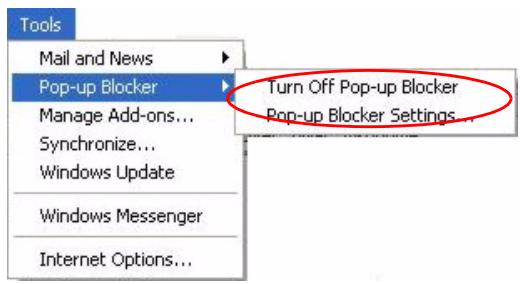
Figure 44 Pop-up Blocker
You can also check if pop-up blocking is disabled in the Pop-up Blocker section in the Privacy tab.
1 In Internet Explorer, select Tools, Internet Options, Privacy.
2 Clear the Block pop-ups check box in the Pop-up Blocker section of the screen. This disables any web pop-up blockers you may have enabled.
Figure 45 Internet Options
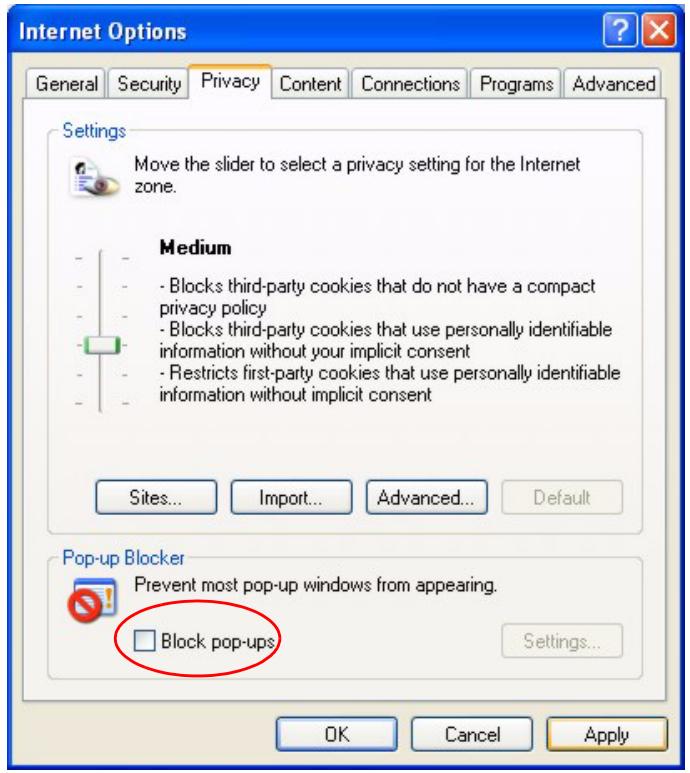
3 Click Apply to save this setting.
12.9.1.2 Enable Pop-up Blockers with Exceptions
Alternatively, if you only want to allow pop-up windows from your device, see the following steps.
1 In Internet Explorer, select Tools, Internet Options and then the Privacy tab.
2 Select Settings...to open the Pop-up Blocker Settings screen.
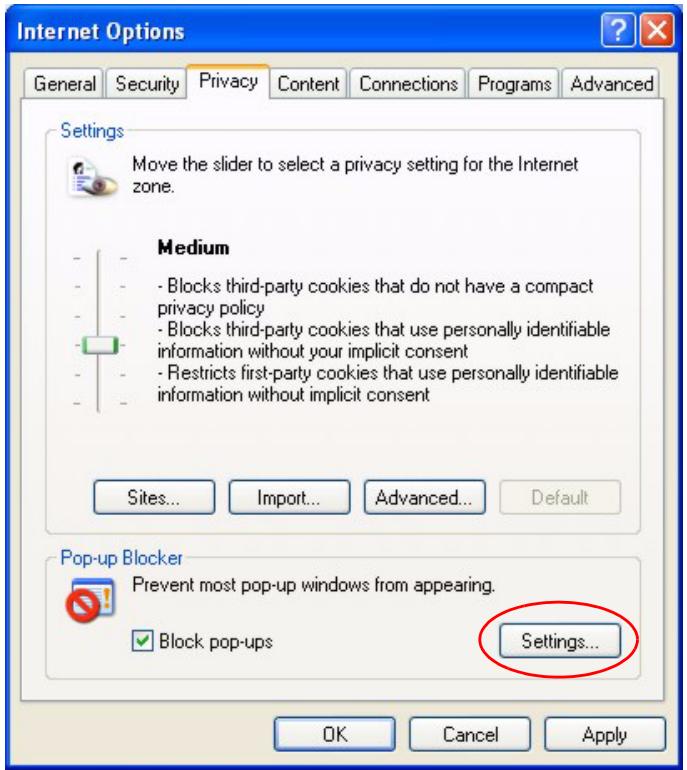
Figure 46 Internet Options
3 Type the IP address of your device (the web page that you do not want to have blocked) with the prefix "http://". For example, http://192.168.1.1.
4 Click Add to move the IP address to the list of Allowed sites.
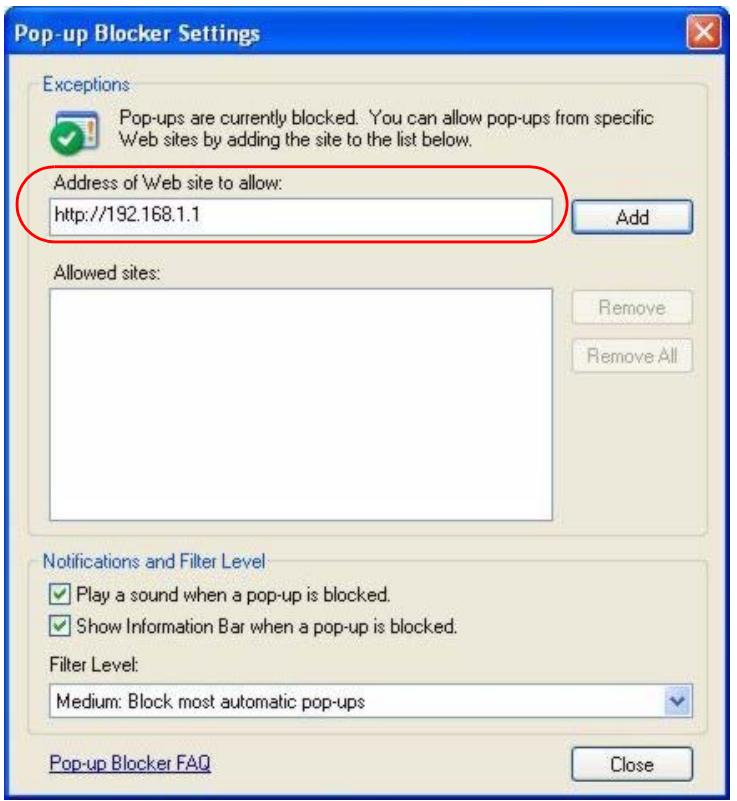
Figure 47 Pop-up Blocker Settings
5 Click Close to return to the Privacy screen.
6 Click Apply to save this setting.
12.9.2 JavaScripts
If pages of the web configurator do not display properly in Internet Explorer, check that JavaScripts are allowed.
1 In Internet Explorer, click Tools, Internet Options and then the Security tab.
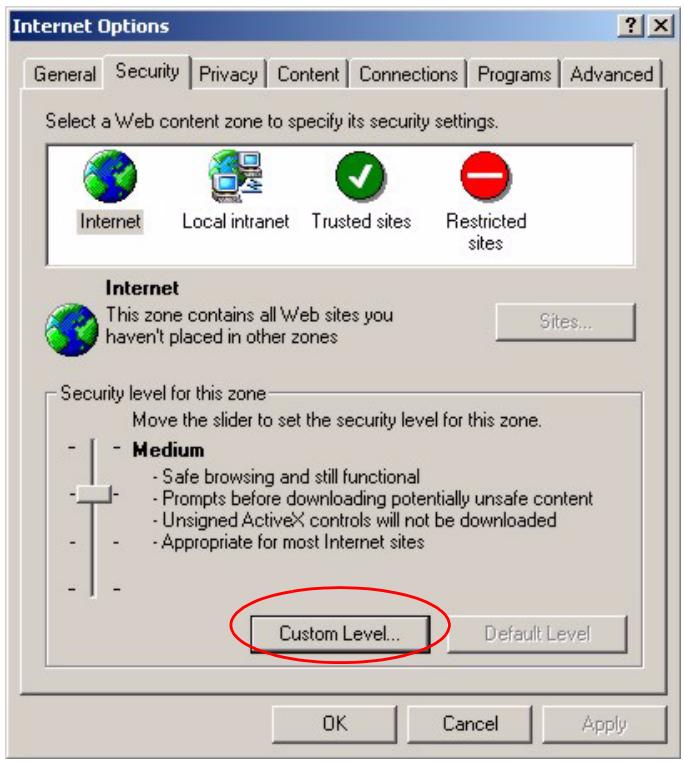
Figure 48 Internet Options
2 Click the Custom Level... button.
3 Scroll down to Scripting.
4 Under Active scripting make sure that Enable is selected (the default).
5 Under Scripting of Java applets make sure that Enable is selected (the default).
6 Click OK to close the window.
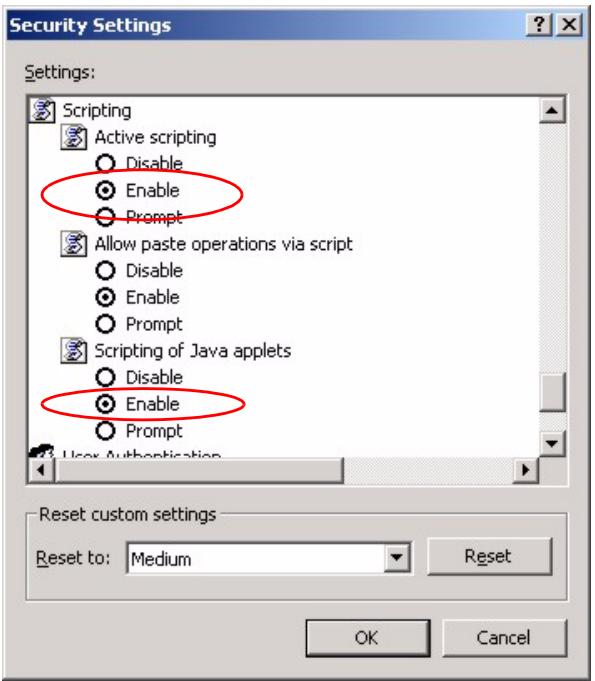
Figure 49 Security Settings - Java Scripting
12.9.3 Java Permissions
1 From Internet Explorer, click Tools, Internet Options and then the Security tab.
2 Click the Custom Level... button.
3 Scroll down to Microsoft VM.
4 Under Java permissions make sure that a safety level is selected.
5 Click OK to close the window.
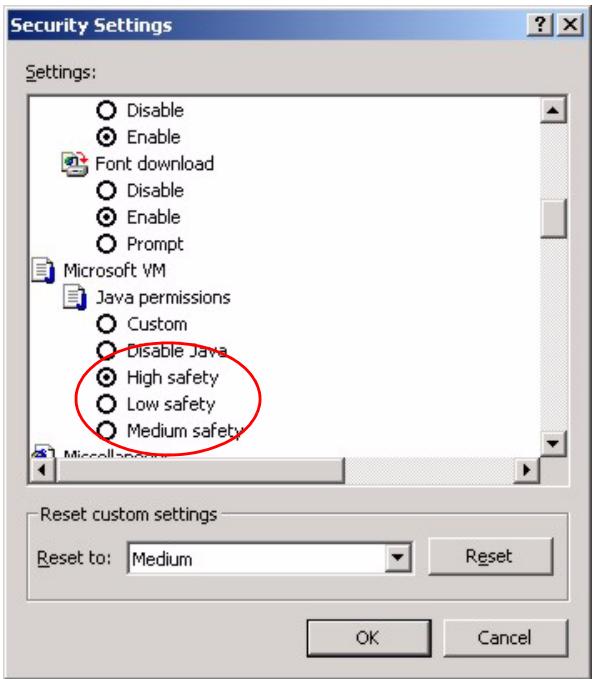
Figure 50 Security Settings - Java
12.9.3.1 JAVA (Sun)
1 From Internet Explorer, click Tools, Internet Options and then the Advanced tab.
2 make sure that Use Java 2 for
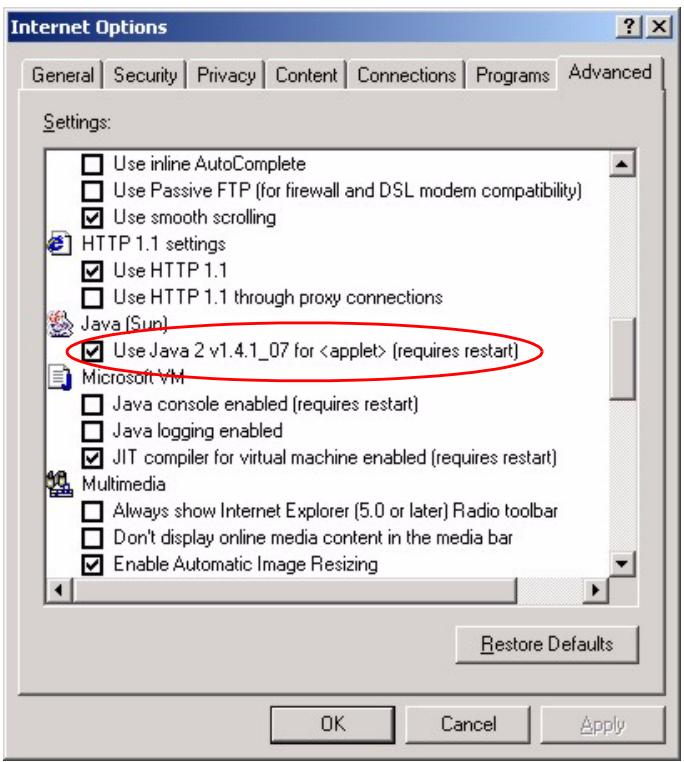
Figure 51 Java (Sun)
APPENDIX A
Product Specifications
See also the introduction chapter for a general overview of the key features.
Specification Tables
Table 41 Device Specifications
| Default Management IP Address | 192.168.5.1 |
| Default Management Subnet Mask | 255.255.255.0 (24 bits) |
| Default Password | 1234 |
| Dimensions | 109 (Wide) x 105 (Deep) x 22 (High) mm |
| Weight | 312 g |
| Ethernet Ports | Two auto-negotiating, auto MDI/MDI-X 10/100 Mbps RJ-45 Ethernet ports |
| Phone Ports | 2 FXS (Foreign Exchange Station) POTS ports |
| Feeding Voltage | On hook: -48V; Minimum Voltage: -20V Off hook: -24V |
| Ringing Voltage | 40V RMS at 3 REN |
| Line Ports (P2002L Only) | 1 FXO (Foreign Exchange Office) port |
| Operation Temperature | 0° C ~ 40° C |
| Storage Temperature | 0° ~ 60° C |
| Operation Humidity | 10% ~ 85% RH |
| Storage Humidity | 10% ~ 90% RH |
Table 42 Feature Specifications
| Voice Functions | SIP (RFC 3261) version 2 SDP (RFC 2327) RTP (RFC 1889) RTCP (RFC 1890) G.168 Echo Cancellation VAD (Voice Activity Detection) Silence Suppression CNG (Comfort Noise Generation) QoS Supports TOS and Diffserv Tagging Compression: G.711 (PCM), G.729 (ADPCM) Loop Start Signaling Support Modem and Fax Tone Detection and Pass Through DTMF Detection Point to Point Calling (Direct IP to IP Calling) Speed Dial Phonebook Lifeline Support (Prestige 2002L) Support NAT Traversal / RFC3489- IETF Simple Traversal of UDP Through NAT (STUN) Caller ID Dialing Type: Tone, Pulse (Auto detection) Ring cadence frequency can be tuned by firmware Tip/ring polarity reversal |
| Protocol Support | PPP over Ethernet (RFC 2516) Transparent bridging for unsupported network layer protocols. DHCP Client |
| Management | Embedded Web Configurator CLI (Command Line Interpreter) Remote Management via Telnet or Web SNMP manageable FTP/TFTP for firmware downloading, configuration backup and restoration Syslog Built-in Diagnostic Tools for FLASH memory, RAM and LAN port |
| Static Routes | 16 IP and 4 Bridge |
| Other Features | Internal SPTGEN DNS Proxy |
Power Adaptor Specifications
Table 43 Power Adaptor Specifications
| NORTH AMERICAN PLUG STANDARDS | |
| AC Power Adapter Model | DV-1215A |
| Input Power | AC120Volts/60Hz/30W |
| Output Power | AC12Volts/1.25A |
| Power Consumption | 14 W |
| Safety Standards | UL, CUL, CSA (UL 1310, CSA C22.2 No.223) |
| NORTH AMERICAN PLUG STANDARDS | |
| AC Power Adapter Model | AA-121A25 |
| Input Power | AC120Volts/60Hz/19W |
| Output Power | AC 12Volts/ 1.25A |
| Power Consumption | 14W |
| Safety Standards | UL, CUL (UL 1310, CSA C22.2 No.223) |
| EUROPEAN PLUG STANDARDS | |
| AC Power Adapter Model | AA-121A3BN |
| Input Power | AC230Volts/50Hz/140mA |
| Output Power | AC12Volts/1.3A |
| Power Consumption | 14W |
| Safety Standards | ITS-GS, CE (EN 60950) |
| UNITED KINGDOM PLUG STANDARDS (P2002L ONLY) | |
| AC Power Adapter Model | AA-121A3D |
| Input Power | AC230Volts/50Hz/140mA |
| Output Power | AC12Volts/1.3A |
| Power Consumption | 14W |
| Safety Standards | ITS-GS, CE (EN 60950) |
APPENDIX B
Setting up Your Computer's IP Address
All computers must have a 10M or 100M Ethernet adapter card and TCP/IP installed.
Windows 95/98/Me/NT/2000/XP, Macintosh OS 7 and later operating systems and all versions of UNIX/LINUX include the software components you need to install and use TCP/IP on your computer. Windows 3.1 requires the purchase of a third-party TCP/IP application package.
TCP/IP should already be installed on computers using Windows NT/2000/XP, Macintosh OS 7 and later operating systems.
After the appropriate TCP/IP components are installed, configure the TCP/IP settings in order to "communicate" with your network.
If you manually assign IP information instead of using dynamic assignment, make sure that your computers have IP addresses that place them in the same subnet as the Prestige's LAN port.
Windows 95/98/Me
Click Start, Settings, Control Panel and double-click the Network icon to open the Network window.
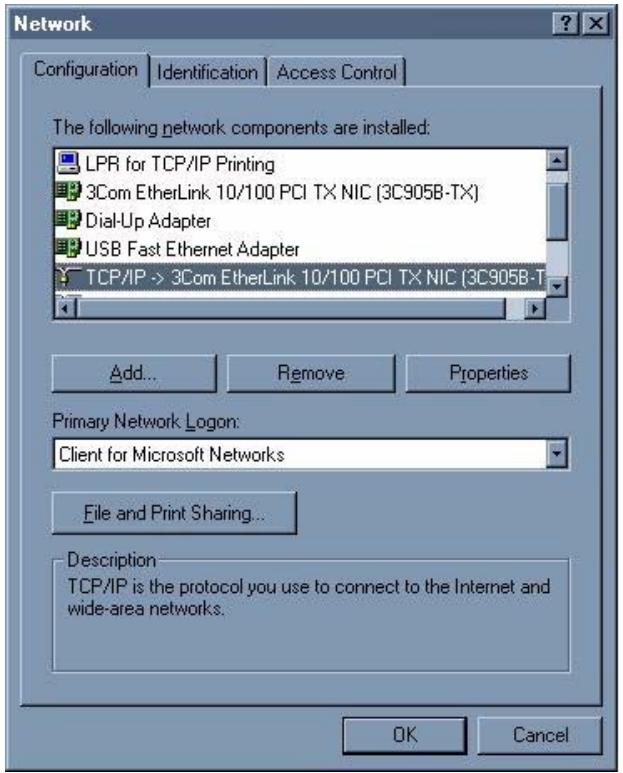
Figure 52 Windows 95/98/Me: Network: Configuration
Installing Components
The Network window Configuration tab displays a list of installed components. You need a network adapter, the TCP/IP protocol and Client for Microsoft Networks.
If you need the adapter:
1 In the Network window, click Add.
2 Select Adapter and then click Add.
3 Select the manufacturer and model of your network adapter and then click OK.
If you need TCP/IP:
1 In the Network window, click Add.
2 Select Protocol and then click Add.
3 Select Microsoft from the list of manufacturers.
4 Select TCP/IP from the list of network protocols and then click OK.
If you need Client for Microsoft Networks:
1 Click Add.
2 Select Client and then click Add.
3 Select Microsoft from the list of manufacturers.
4 Select Client for Microsoft Networks from the list of network clients and then click OK.
5 Restart your computer so the changes you made take effect.
Configuring
1 In the Network window Configuration tab, select your network adapter's TCP/IP entry and click Properties
2 Click the IP Address tab.
- If your IP address is dynamic, select Obtain an IP address automatically.
- If you have a static IP address, select Specify an IP address and type your information into the IP Address and Subnet Mask fields.
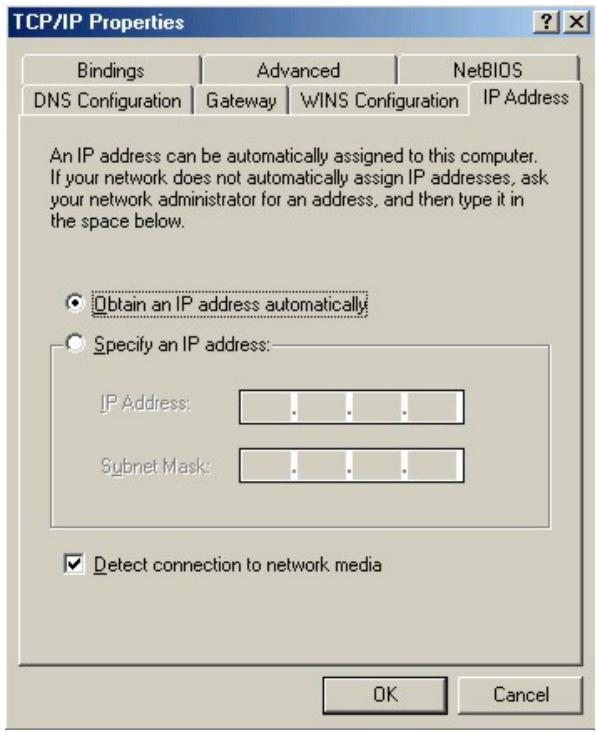
Figure 53 Windows 95/98/Me: TCP/IP Properties: IP Address
3 Click the DNS Configuration tab.
- If you do not know your DNS information, select Disable DNS.
- If you know your DNS information, select Enable DNS and type the information in the fields below (you may not need to fill them all in).
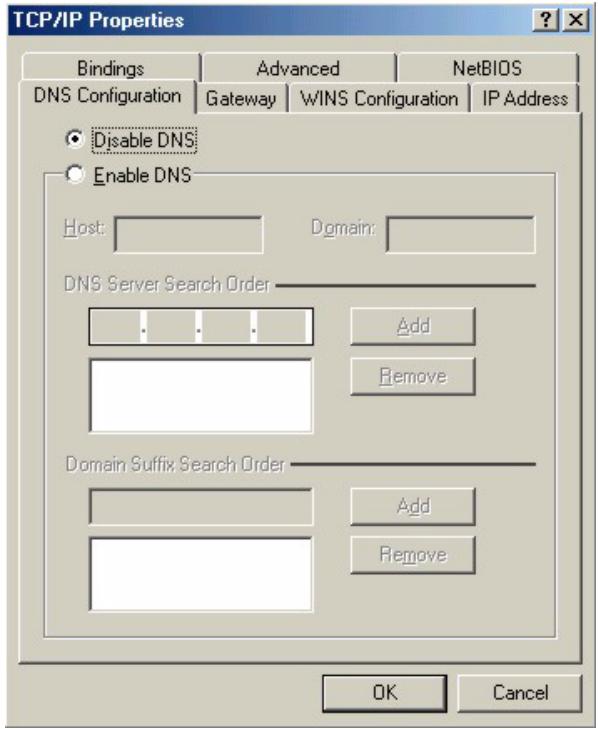
Figure 54 Windows 95/98/Me: TCP/IP Properties: DNS Configuration
4 Click the Gateway tab.
If you do not know your gateway's IP address, remove previously installed gateways.
- If you have a gateway IP address, type it in the New gateway field and click Add.
5 Click OK to save and close the TCP/IP Properties window.
6 Click OK to close the Network window. Insert the Windows CD if prompted.
7 Turn on your Prestige and restart your computer when prompted.
Verifying Settings
1 Click Start and then Run.
2 In the Run window, type "winipcfg" and then click OK to open the IP Configuration window.
3 Select your network adapter. You should see your computer's IP address, subnet mask and default gateway.
Windows 2000/NT/XP
The following example figures use the default Windows XP GUI theme.
1 Click start (Start in Windows 2000/NT), Settings, Control Panel.
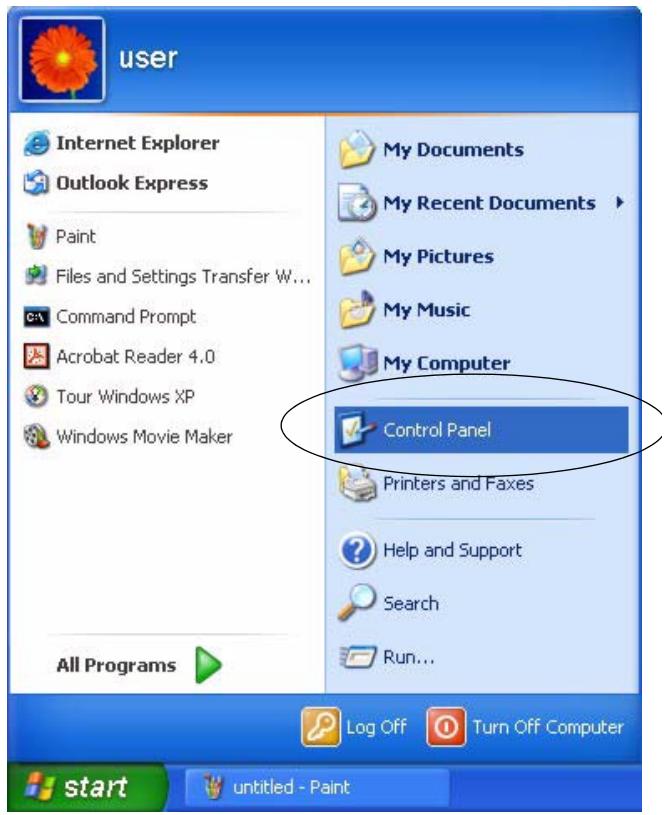
Figure 55 Windows XP: Start Menu
2 In the Control Panel, double-click Network Connections (Network and Dial-up Connections in Windows 2000/NT).
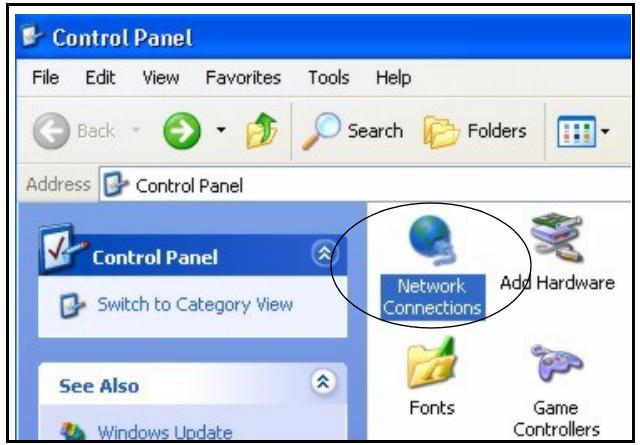
Figure 56 Windows XP: Control Panel
3 Right-click Local Area Connection and then click Properties.
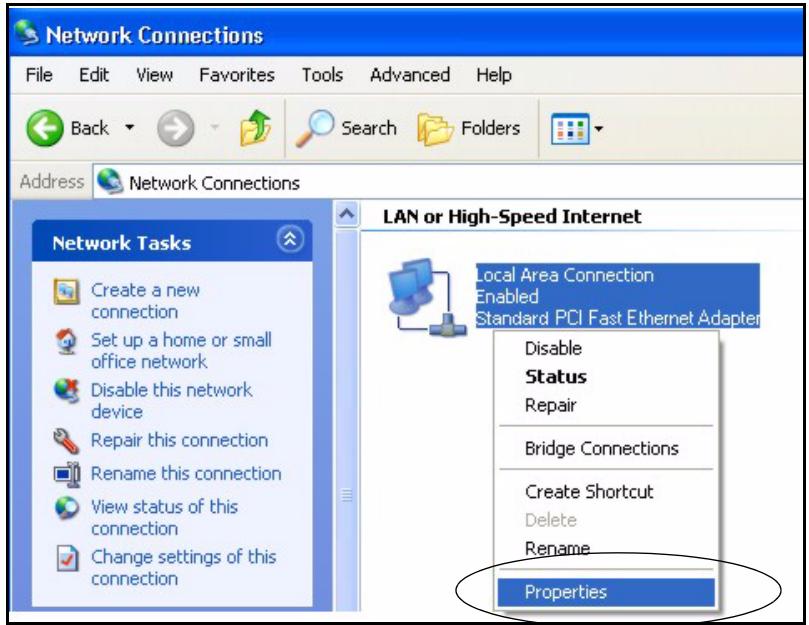
Figure 57 Windows XP: Control Panel: Network Connections: Properties
4 Select Internet Protocol (TCP/IP) (under the General tab in Win XP) and then click Properties.
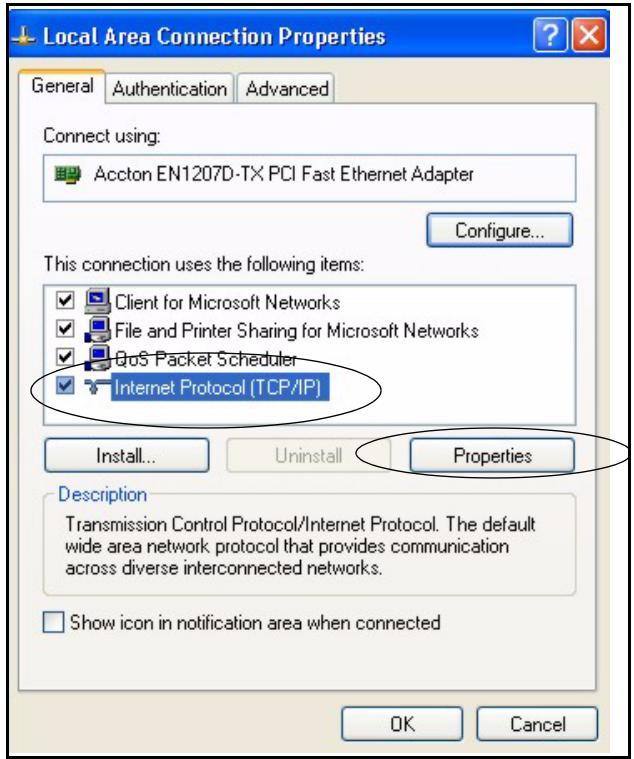
Figure 58 Windows XP: Local Area Connection Properties
5 The Internet Protocol TCP/IP Properties window opens (the General tab in Windows XP).
If you have a dynamic IP address click Obtain an IP address automatically.
- If you have a static IP address click Use the following IP Address and fill in the IP address, Subnet mask, and Default gateway fields.
- Click Advanced.
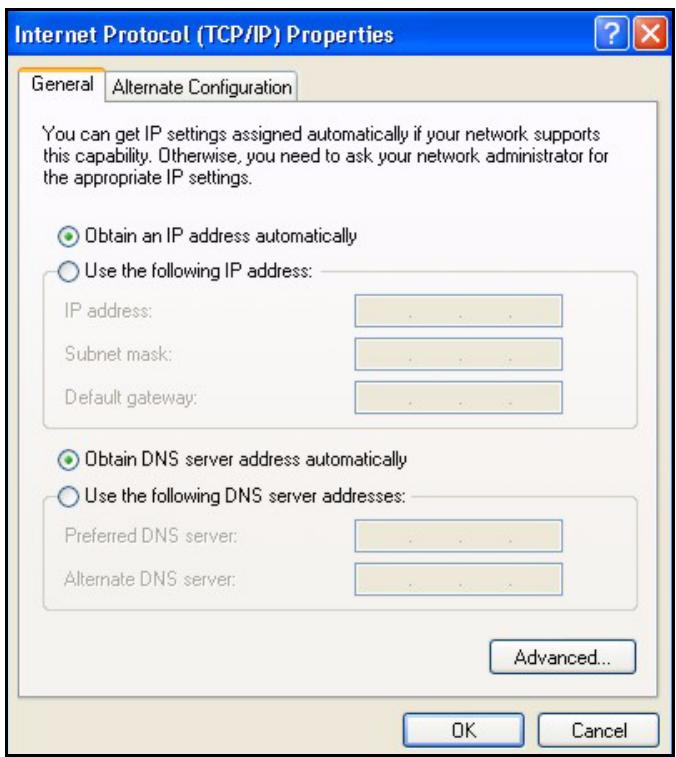
Figure 59 Windows XP: Internet Protocol (TCP/IP) Properties
6 If you do not know your gateway's IP address, remove any previously installed gateways in the IP Settings tab and click OK.
Do one or more of the following if you want to configure additional IP addresses:
In the IP Settings tab, in IP addresses, click Add.
- In TCP/IP Address, type an IP address in IP address and a subnet mask in Subnet mask, and then click Add.
- Repeat the above two steps for each IP address you want to add.
- Configure additional default gateways in the IP Settings tab by clicking Add in Default gateways.
- In TCP/IP Gateway Address, type the IP address of the default gateway in Gateway. To manually configure a default metric (the number of transmission hops), clear the Automatic metric check box and type a metric in Metric.
- Click Add.
- Repeat the previous three steps for each default gateway you want to add.
- Click OK when finished.
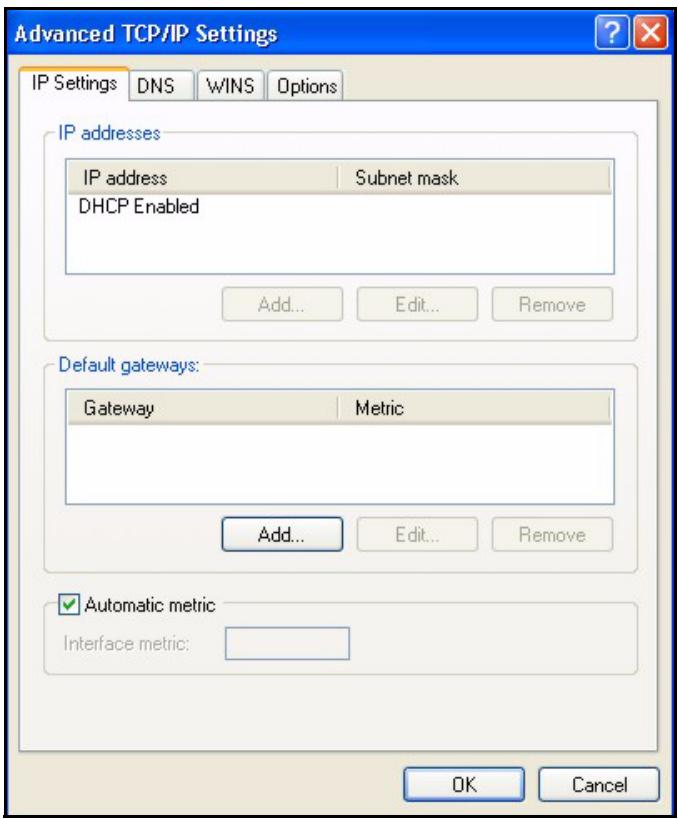
Figure 60 Windows XP: Advanced TCP/IP Properties
7 In the Internet Protocol TCP/IP Properties window (the General tab in Windows XP):
- Click Obtain DNS server address automatically if you do not know your DNS server IP address(es).
- If you know your DNS server IP address(es), click Use the following DNS server addresses, and type them in the Preferred DNS server and Alternate DNS server fields.
If you have previously configured DNS servers, click Advanced and then the DNS tab to order them.
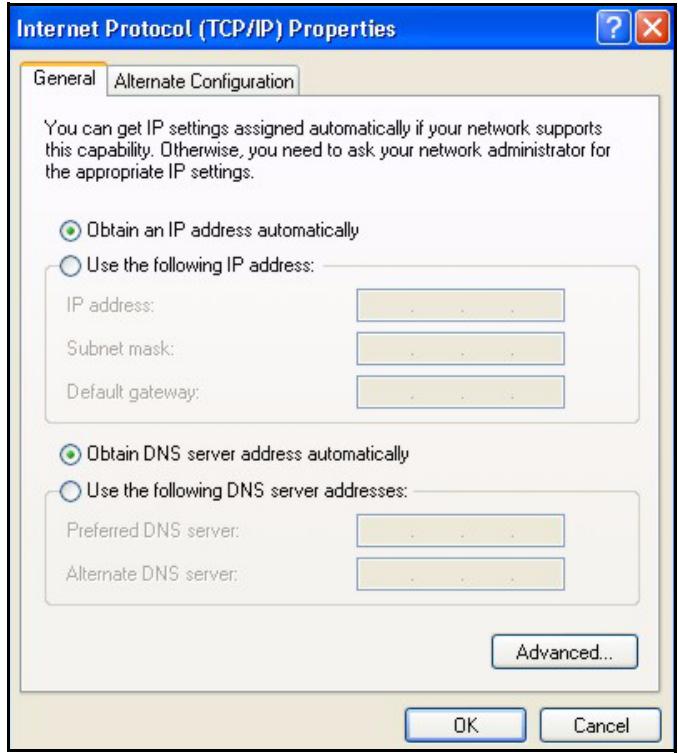
Figure 61 Windows XP: Internet Protocol (TCP/IP) Properties
8 Click OK to close the Internet Protocol (TCP/IP) Properties window.
9 Click Close (OK in Windows 2000/NT) to close the Local Area Connection Properties window.
10 Close the Network Connections window (Network and Dial-up Connections in Windows 2000/NT).
11Turn on your Prestige and restart your computer (if prompted).
Verifying Settings
1 Click Start, All Programs, Accessories and then Command Prompt.
2 In the Command Prompt window, type "ipconfig" and then press [ENTER]. You can also open Network Connections, right-click a network connection, click Status and then click the Support tab.
Macintosh OS 8/9
1 Click the Apple menu, Control Panel and double-click TCP/IP to open the TCP/IP Control Panel.
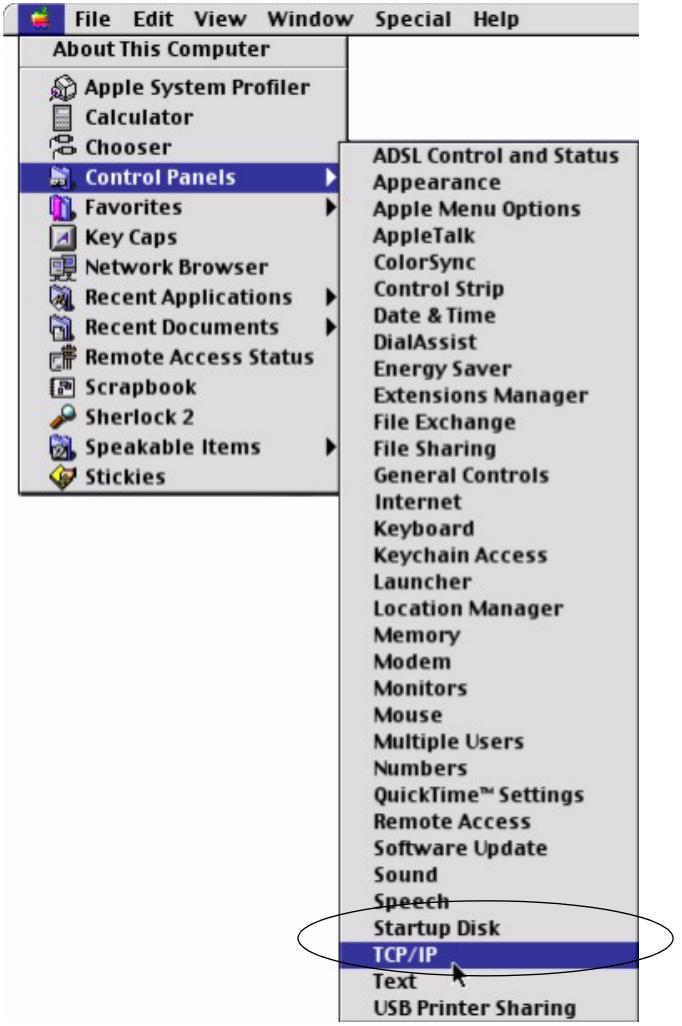
Figure 62 Macintosh OS 8/9: Apple Menu
2 Select Ethernet built-in from the Connect via list.
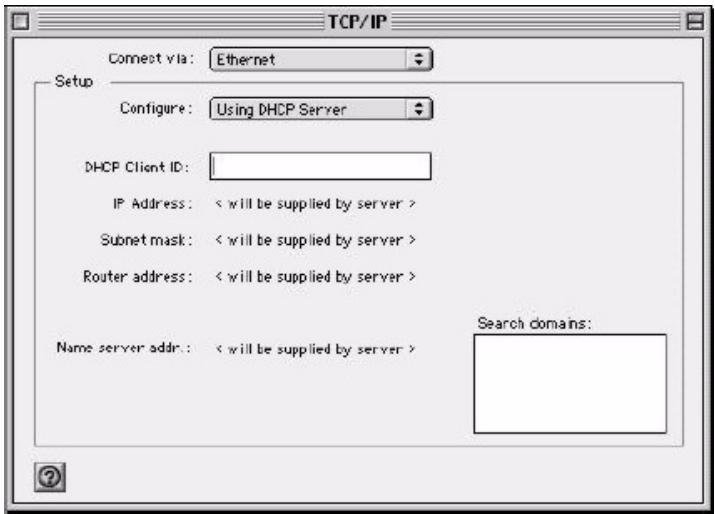
Figure 63 Macintosh OS 8/9: TCP/IP
3 For dynamically assigned settings, select Using DHCP Server from the Configure: list.
4 For statically assigned settings, do the following:
From the Configure box, select Manually.
Type your IP address in the IP Address box.
- Type your subnet mask in the Subnet mask box.
- Type the IP address of your Prestige in the Router address box.
5 Close the TCP/IP Control Panel.
6 Click Save if prompted, to save changes to your configuration.
7 Turn on your Prestige and restart your computer (if prompted).
Verifying Settings
Check your TCP/IP properties in the TCP/IP Control Panel window.
Macintosh OS X
1 Click the Apple menu, and click System Preferences to open the System Preferences window.
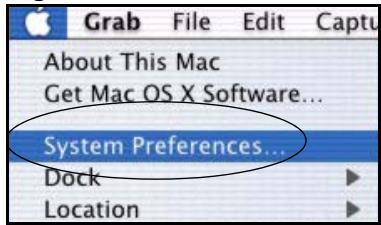
Figure 64 Macintosh OS X:Apple Menu
2 Click Network in the icon bar.
- Select Automatic from the Location list.
- Select Built-in Ethernet from the Show list.
- Click the TCP/IP tab.
3 For dynamically assigned settings, select Using DHCP from the Configure list.
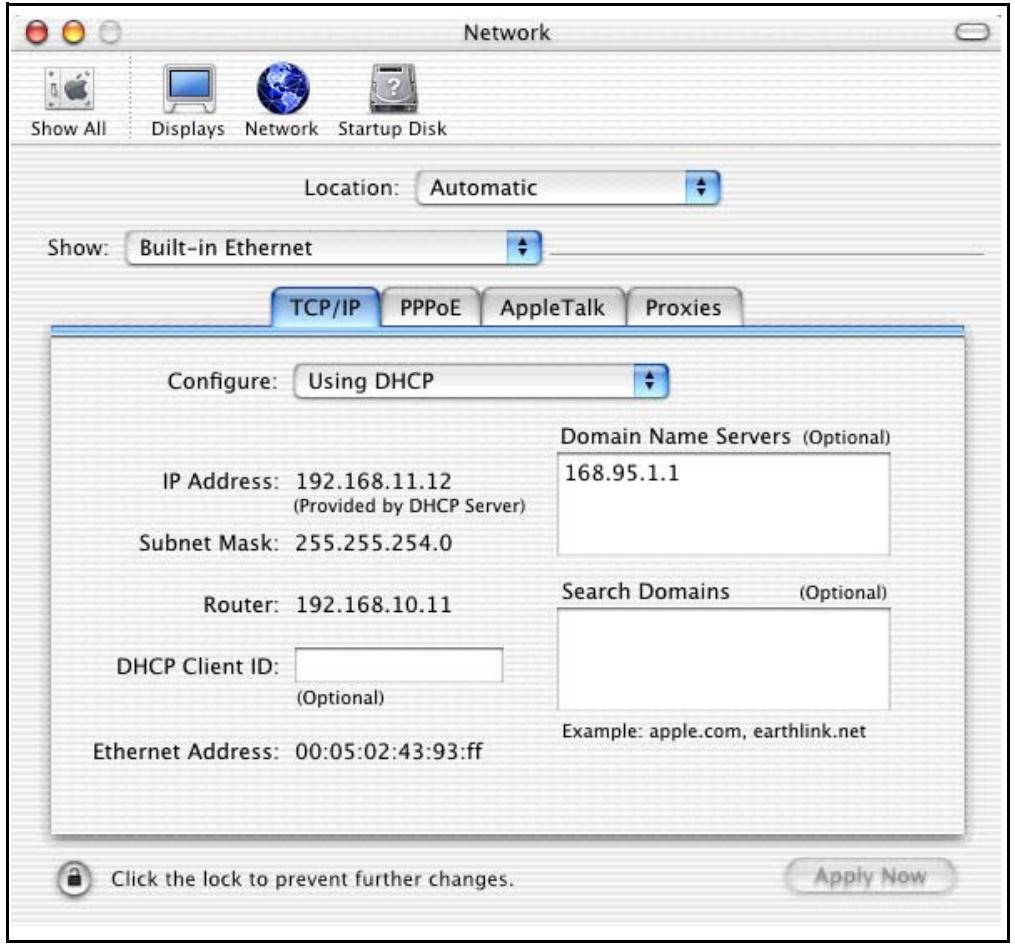
Figure 65 Macintosh OS X: Network
4 For statically assigned settings, do the following:
From the Configure box, select Manually.
- Type your IP address in the IP Address box.
- Type your subnet mask in the Subnet mask box.
- Type the IP address of your Prestige in the Router address box.
5 Click Apply Now and close the window.
6 Turn on your Prestige and restart your computer (if prompted).
Verifying Settings
Check your TCP/IP properties in the Network window.
APPENDIX C IP Subnetting
IP Addressing
Routers "route" based on the network number. The router that delivers the data packet to the correct destination host uses the host ID.
IP Classes
An IP address is made up of four octets (eight bits), written in dotted decimal notation, for example, 192.168.1.1. IP addresses are categorized into different classes. The class of an address depends on the value of its first octet.
- Class "A" addresses have a 0 in the left most bit. In a class "A" address the first octet is the network number and the remaining three octets make up the host ID.
- Class "B" addresses have a 1 in the left most bit and a 0 in the next left most bit. In a class "B" address the first two octets make up the network number and the two remaining octets make up the host ID.
Class "C" addresses begin (starting from the left) with 1 1 0. In a class "C" address the first three octets make up the network number and the last octet is the host ID. - Class "D" addresses begin with 1 1 1 0. Class "D" addresses are used for multicasting. (There is also a class "E" address. It is reserved for future use.)
Table 44 Classes of IP Addresses
| IP ADDRESS: | OCTET 1 | OCTET 2 | OCTET 3 | OCTET 4 | |
| Class A | 0 | Network number | Host ID | Host ID | Host ID |
| Class B | 10 | Network number | Network number | Host ID | Host ID |
| Class C | 110 | Network number | Network number | Network number | Host ID |
Note: Host IDs of all zeros or all ones are not allowed.
Therefore:
A class "C" network (8 host bits) can have 2^8 - 2 or 254 hosts.
A class "B" address (16 host bits) can have 2^16 - 2 or 65534 hosts.
A class "A" address (24 host bits) can have 2^24 - 2 hosts (approximately 16 million hosts).
Since the first octet of a class "A" IP address must contain a "0", the first octet of a class "A" address can have a value of 0 to 127.
Similarly the first octet of a class "B" must begin with "10", therefore the first octet of a class "B" address has a valid range of 128 to 191. The first octet of a class "C" address begins with "110", and therefore has a range of 192 to 223.
Table 45 Allowed IP Address Range By Class
| CLASS | ALLOWED RANGE OF FIRST OCTET (BINARY) | ALLOWED RANGE OF FIRST OCTET (DECIMAL) |
| Class A | 00000000 to 01111111 | 0 to 127 |
| Class B | 10000000 to 10111111 | 128 to 191 |
| Class C | 11000000 to 11011111 | 192 to 223 |
| Class D | 11100000 to 11101111 | 224 to 239 |
Subnet Masks
A subnet mask is used to determine which bits are part of the network number, and which bits are part of the host ID (using a logical AND operation). A subnet mask has 32 is a “1” then the corresponding bit in the IP address is part of the network number. If a bit in the subnet mask is “0” then the corresponding bit in the IP address is part of the host ID.
Subnet masks are expressed in dotted decimal notation just as IP addresses are. The "natural" masks for class A, B and C IP addresses are as follows.
Table 46 "Natural" Masks
| CLASS | NATURAL MASK |
| A | 255.0.0.0 |
| B | 255.255.0.0 |
| C | 255.255.255.0 |
Subnetting
With subnetting, the class arrangement of an IP address is ignored. For example, a class C address no longer has to have 24 bits of network number and 8 bits of host ID. With subnetting, some of the host ID bits are converted into network number bits. By convention, subnet masks always consist of a continuous sequence of ones beginning from the left most bit of the mask, followed by a continuous sequence of zeros, for a total number of 32 bits.
Since the mask is always a continuous number of ones beginning from the left, followed by a continuous number of zeros for the remainder of the 32 bit mask, you can simply specify the number of ones instead of writing the value of each octet. This is usually specified by writing a “/” followed by the number of bits in the mask after the address.
For example, 192.1.1.0 /25 is equivalent to saying 192.1.1.0 with mask 255.255.255.128.
The following table shows all possible subnet masks for a class "C" address using both notations.
Table 47 Alternative Subnet Mask Notation
| SUBNET MASK | SUBNET MASK “1” BITS | LAST OCTET BIT VALUE |
| 255.255.255.0 | /24 | 0000 0000 |
| 255.255.255.128 | /25 | 1000 0000 |
| 255.255.255.192 | /26 | 1100 0000 |
| 255.255.255.224 | /27 | 1110 0000 |
| 255.255.255.240 | /28 | 1111 0000 |
| 255.255.255.248 | /29 | 1111 1000 |
| 255.255.255.252 | /30 | 1111 1100 |
The first mask shown is the class "C" natural mask. Normally if no mask is specified it is understood that the natural mask is being used.
Example: Two Subnets
As an example, you have a class "C" address 192.168.1.0 with subnet mask of 255.255.255.0.
Table 48 Two Subnets Example
| IP/SUBNET MASK | NETWORK NUMBER | HOST ID |
| IP Address | 192.168.1. | 0 |
| IP Address (Binary) | 11000000.10101000.00000001. | 00000000 |
| Subnet Mask | 255.255.255. | 0 |
| Subnet Mask (Binary) | 11111111.11111111.11111111. | 00000000 |
The first three octets of the address make up the network number (class "C"). You want to have two separate networks.
Divide the network 192.168.1.0 into two separate subnets by converting one of the host ID bits of the IP address to a network number bit. The "borrowed" host ID bit can be either "0" or "1" thus giving two subnets; 192.168.1.0 with mask 255.255.255.128 and 192.168.1.128 with mask 255.255.255.128.
Note: In the following charts, shaded/bolded last octet bit values indicate host ID bits "borrowed" to form network ID bits. The number of "borrowed" host ID bits determines the number of subnets you can have. The remaining number of host ID bits (after "borrowing") determines the number of hosts you can have on each subnet.
Table 49 Subnet 1
| IP/SUBNET MASK | NETWORK NUMBER | LAST OCTET BIT VALUE |
| IP Address | 192.168.1. | 0 |
| IP Address (Binary) | 11000000.10101000.00000001. | 00000000 |
| Subnet Mask | 255.255.255. | 128 |
| Subnet Mask (Binary) | 11111111.11111111.11111111. | 10000000 |
| Subnet Address: 192.168.1.0 | Lowest Host ID: 192.168.1.1 | |
| Broadcast Address: 192.168.1.127 | Highest Host ID: 192.168.1.126 | |
Table 50 Subnet 2
| IP/SUBNET MASK | NETWORK NUMBER | LAST OCTET BIT VALUE |
| IP Address | 192.168.1. | 128 |
| IP Address (Binary) | 11000000.10101000.00000001. | 10000000 |
| Subnet Mask | 255.255.255. | 128 |
| Subnet Mask (Binary) | 11111111.11111111.11111111. | 10000000 |
| Subnet Address: 192.168.1.128 | Lowest Host ID: 192.168.1.129 | |
| Broadcast Address: 192.168.1.255 | Highest Host ID: 192.168.1.254 | |
The remaining 7 bits determine the number of hosts each subnet can have. Host IDs of all zeros represent the subnet itself and host IDs of all ones are the broadcast address for that subnet, so the actual number of hosts available on each subnet in the example above is 2^7 - 2 or 126 hosts for each subnet.
192.168.1.0 with mask 255.255.255.128 is the subnet itself, and 192.168.1.127 with mask 255.255.255.128 is the directed broadcast address for the first subnet. Therefore, the lowest IP address that can be assigned to an actual host for the first subnet is 192.168.1.1 and the highest is 192.168.1.126. Similarly the host ID range for the second subnet is 192.168.1.129 to 192.168.1.254.
Example: Four Subnets
The above example illustrated using a 25-bit subnet mask to divide a class "C" address space into two subnets. Similarly to divide a class "C" address into four subnets, you need to "borrow" two host ID bits to give four possible combinations of 00, 01, 10 and 11. The subnet mask is 26 bits (1111111.11111111.1111111.11000000) or 255.255.255.192. Each subnet contains 6 host ID bits, giving 2^6-2 or 62 hosts for each subnet (all 0's is the subnet itself, all 1's is the broadcast address on the subnet).
Table 51 Subnet 1
| IP/SUBNET MASK | NETWORK NUMBER | LAST OCTET BIT VALUE |
| IP Address | 192.168.1. | 0 |
| IP Address (Binary) | 11000000.10101000.00000001. | 00000000 |
| Subnet Mask (Binary) | 11111111.11111111.11111111. | 11000000 |
| Subnet Address: 192.168.1.0 | Lowest Host ID: 192.168.1.1 | |
| Broadcast Address: 192.168.1.63 | Highest Host ID: 192.168.1.62 | |
Table 52 Subnet 2
| IP/SUBNET MASK | NETWORK NUMBER | LAST OCTET BIT VALUE |
| IP Address | 192.168.1. | 64 |
| IP Address (Binary) | 11000000.10101000.00000001. | 01000000 |
| Subnet Mask (Binary) | 11111111.11111111.11111111. | 11000000 |
| Subnet Address: 192.168.1.64 | Lowest Host ID: 192.168.1.65 | |
| Broadcast Address: 192.168.1.127 | Highest Host ID: 192.168.1.126 | |
Table 53 Subnet 3
| IP/SUBNET MASK | NETWORK NUMBER | LAST OCTET BIT VALUE |
| IP Address | 192.168.1. | 128 |
| IP Address (Binary) | 11000000.10101000.00000001. | 10000000 |
| Subnet Mask (Binary) | 11111111.11111111.11111111. | 11000000 |
| Subnet Address: 192.168.1.128 | Lowest Host ID: 192.168.1.129 | |
| Broadcast Address: 192.168.1.191 | Highest Host ID: 192.168.1.190 | |
Table 54 Subnet 4
| IP/SUBNET MASK | NETWORK NUMBER | LAST OCTET BIT VALUE |
| IP Address | 192.168.1. | 192 |
| IP Address (Binary) | 11000000.10101000.00000001. | 11000000 |
| Subnet Mask (Binary) | 11111111.11111111.11111111. | 11000000 |
| Subnet Address: 192.168.1.192 | Lowest Host ID: 192.168.1.193 | |
| Broadcast Address: 192.168.1.255 | Highest Host ID: 192.168.1.254 | |
Example Eight Subnets
Similarly use a 27-bit mask to create 8 subnets (001, 010, 011, 100, 101, 110).
The following table shows class C IP address last octet values for each subnet.
Table 55 Eight Subnets
| SUBNET | SUBNET ADDRESS | FIRST ADDRESS | LAST ADDRESS | BROADCAST ADDRESS |
| 1 | 0 | 1 | 30 | 31 |
| 2 | 32 | 33 | 62 | 63 |
| 3 | 64 | 65 | 94 | 95 |
| 4 | 96 | 97 | 126 | 127 |
| 5 | 128 | 129 | 158 | 159 |
| 6 | 160 | 161 | 190 | 191 |
| 7 | 192 | 193 | 222 | 223 |
| 8 | 224 | 225 | 254 | 255 |
The following table is a summary for class "C" subnet planning.
Table 56 Class C Subnet Planning
| NO. “BORROWED” HOST BITS | SUBNET MASK | NO. SUBNETS | NO. HOSTS PER SUBNET |
| 1 | 255.255.255.128 (/25) | 2 | 126 |
| 2 | 255.255.255.192 (/26) | 4 | 62 |
| 3 | 255.255.255.224 (/27) | 8 | 30 |
| 4 | 255.255.255.240 (/28) | 16 | 14 |
| 5 | 255.255.255.248 (/29) | 32 | 6 |
| 6 | 255.255.255.252 (/30) | 64 | 2 |
| 7 | 255.255.255.254 (/31) | 128 | 1 |
Subnetting With Class A and Class B Networks.
For class "A" and class "B" addresses the subnet mask also determines which bits are part of the network number and which are part of the host ID.
A class “B” address has two host ID octets available for subnetting and a class “A” address has three host ID octets (see Table 44 on page 123) available for subnetting.
The following table is a summary for class "B" subnet planning.
Table 57 Class B Subnet Planning
| NO. “BORROWED” HOST BITS | SUBNET MASK | NO. SUBNETS | NO. HOSTS PER SUBNET |
| 1 | 255.255.128.0 (/17) | 2 | 32766 |
| 2 | 255.255.192.0 (/18) | 4 | 16382 |
| 3 | 255.255.224.0 (/19) | 8 | 8190 |
| 4 | 255.255.240.0 (/20) | 16 | 4094 |
| 5 | 255.255.248.0 (/21) | 32 | 2046 |
| 6 | 255.255.252.0 (/22) | 64 | 1022 |
| 7 | 255.255.254.0 (/23) | 128 | 510 |
| 8 | 255.255.255.0 (/24) | 256 | 254 |
| 9 | 255.255.255.128 (/25) | 512 | 126 |
| 10 | 255.255.255.192 (/26) | 1024 | 62 |
| 11 | 255.255.255.224 (/27) | 2048 | 30 |
| 12 | 255.255.255.240 (/28) | 4096 | 14 |
| 13 | 255.255.255.248 (/29) | 8192 | 6 |
| 14 | 255.255.255.252 (/30) | 16384 | 2 |
| 15 | 255.255.255.254 (/31) | 32768 | 1 |
APPENDIX D
PPPoE
PPPoE in Action
An ADSL modem bridges a PPP session over Ethernet (PPP over Ethernet, RFC 2516) from your computer to an ATM PVC (Permanent Virtual Circuit) which connects to a DSL Access Concentrator where the PPP session terminates (see Figure 66 on page 132). One PVC can support any number of PPP sessions from your LAN. PPPoE provides access control and billing functionality in a manner similar to dial-up services using PPP.
Benefits of PPPoE
PPPoE offers the following benefits:
It provides you with a familiar dial-up networking (DUN) user interface.
It lessens the burden on the carriers of provisioning virtual circuits all the way to the ISP on multiple switches for thousands of users. For GSTN (PSTN and ISDN), the switching fabric is already in place.
It allows the ISP to use the existing dial-up model to authenticate and (optionally) to provide differentiated services.
Traditional Dial-up Scenario
The following diagram depicts a typical hardware configuration where the computers use traditional dial-up networking.
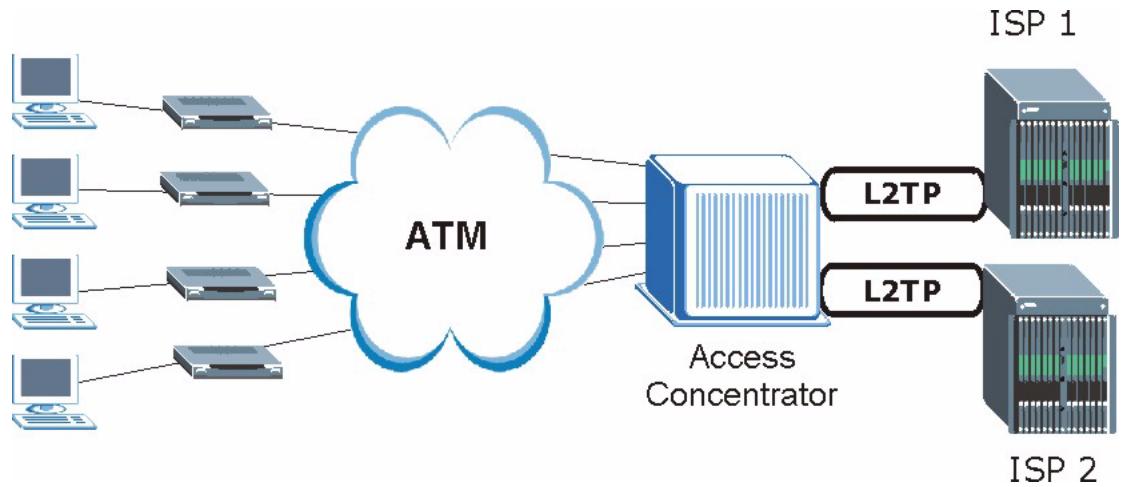
Figure 66 Single-Computer per Router Hardware Configuration
How PPPoE Works
The PPPoE driver makes the Ethernet appear as a serial link to the computer and the computer runs PPP over it, while the modem bridges the Ethernet frames to the Access Concentrator (AC). Between the AC and an ISP, the AC is acting as a L2TP (Layer 2 Tunneling Protocol) LAC (L2TP Access Concentrator) and tunnels the PPP frames to the ISP. The L2TP tunnel is capable of carrying multiple PPP sessions.
With PPPoE, the VC (Virtual Circuit) is equivalent to the dial-up connection and is between the modem and the AC, as opposed to all the way to the ISP. However, the PPP negotiation is between the computer and the ISP.
Prestige as a PPPoE Client
When using the Prestige as a PPPoE client, the computers on the LAN see only Ethernet and are not aware of PPPoE. This alleviates the administrator from having to manage the PPPoE clients on the individual computers.
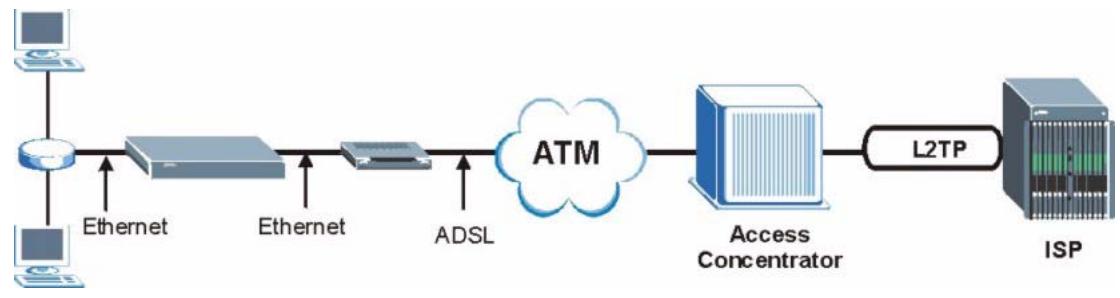
Figure 67 Prestige as a PPPoE Client
APPENDIX E Internal SPTGEN
Internal SPTGEN Overview
Internal SPTGEN (System Parameter Table Generator) is a configuration text file useful for efficient configuration of multiple Prestiges. Internal SPTGEN lets you configure, save and upload multiple menus at the same time using just one configuration text file – eliminating the need to configure each Prestige.
The Configuration Text File Format
All Internal SPTGEN text files conform to the following format:
<field identification number = field name = parameter values allowed = input>,
where (<\mathrm{input}>) is your input conforming to (<\mathrm{parameter}> values allowed>.
The figure shown next is an example of an Internal SPTGEN text file.
Figure 68 Configuration Text File Format: Column Descriptions
/Menu1General Setup
10000000 = Configured <0 (No) | 1 (Yes)> = 1
10000001 = System Name
10000002 = Location
10000005 = Route IPX <0 (No) | 1 (Yes)> = 0
10000006 = Bridge
Note: DO NOT alter or delete any field except parameters in the Input column.
Internal SPTGEN File Modification - Important Points to Remember
Each parameter you enter must be preceded by one “=” sign and one space.
Some parameters are dependent on others. For example, if you disable the Configured field in menu 1 (see Figure 68 on page 133), then you disable every field in this menu.
If you enter a parameter that is invalid in the Input column, the Prestige will not save the configuration and the command line will display the Field Identification Number. Figure 69 on page 134, shown next, is an example of what the Prestige displays if you enter a value other than “0” or “1” in the Input column of Field Identification Number 1000000 (refer to Figure 68 on page 133).
Figure 69 Invalid Parameter Entered: Command Line Example
field value is not legal error:-1
ROM-t is not saved, error Line ID:10000000
reboot to get the original configuration
Bootbase Version: V2.02 | 2/22/2001 13:33:11
RAM: Size = 8192 Kbytes
FLASH: Intel 8M *2
The Prestige will display the following if you enter parameter(s) that are valid.
Figure 70 Valid Parameter Entered: Command Line Example
Please wait for the system to write SPT text file(ROM-t)... Bootbase Version: V2.02 | 2/22/2001 13:33:11 RAM: Size = 8192 Kbytes FLASH: Intel 8M *2
Internal SPTGEN FTP Download Example
1 Launch your FTP application.
2 Enter "bin". The command "bin" sets the transfer mode to binary.
3 Get "rom-t" file. The command "get" transfers files from the Prestige to your computer. The name "rom-t" is the configuration filename on the Prestige.
4 Edit the "rom-t" file using a text editor (do not use a word processor). You must leave this FTP screen to edit.
Figure 71 Internal SPTGEN FTP Download Example
c:\ftp 192.168.1.1
220 PPP FTP version 1.0 ready at Sat Jan 1 03:22:12 2000
User (192.168.1.1:(none)):
331 Enter PASS command
Password:
230 Logged in
ftp>bin
200 Type I OK
ftp> get rom-t
ftp>bye
c:\edit rom-t
edit the rom-t text file by a text editor and save it)
Note: You can rename your "rom-t" file when you save it to your computer but it must be named "rom-t" when you upload it to your Prestige.
Internal SPTGEN FTP Upload Example
1 Launch your FTP application.
2 Enter "bin". The command "bin" sets the transfer mode to binary.
3 Upload your “rom-t” file from your computer to the Prestige using the “put” command. computer to the Prestige.
4 Exit this FTP application.
Figure 72 Internal SPTGEN FTP Upload Example
c:\ftp 192.168.1.1
220 PPP FTP version 1.0 ready at Sat Jan 1 03:22:12 2000
User (192.168.1.1:(none)):
331 Enter PASS command
Password:
230 Logged in
ftp>bin
200 Type I OK
ftp> put rom-t
ftp>bye
Example Internal SPTGEN Screens
This appendix introduces Internal SPTGEN. All menus shown in this appendix are example menus meant to show Internal SPTGEN usage. Actual menus for your product may differ.
Table 58 Abbreviations Used in the Example Internal SPTGEN Screens Table
| ABBREVIATION | MEANING |
| FIN | Field Identification Number (not seen in SMT screens) |
| FN | Field Name |
| PVA | Parameter Values Allowed |
| INPUT | An example of what you may enter |
| * | Applies to the Prestige. |
The following are Internal SPTGEN screens associated with the SMT screens of your Prestige.
Table 59 Menu 1 General Setup
| / Menu 1 General Setup | |||
| FIN | FN | PVA | INPUT |
| 10000000 = | Configured | <0 (No) | 1 (Yes)> | = 0 |
| 10000001 = | System Name | = Prestige | |
| 10000002 = | Location | = | |
| 10000003 = | Contact Person's Name | = | |
| 10000004 = | Route IP | <0 (No) | 1 (Yes)> | = 1 |
| 10000006 = | Bridge | <0 (No) | 1 (Yes)> | = 0 |
| 10000007 = | First System DNS Server Type | <0 (From ISP) | 1 (User Defined) | 2 (None)> | = 0 |
| 10000008 = | First System DNS Server IP address | = 0.0.0.0 | |
| 10000009 = | Second System DNS Server Type | <0 (From ISP) | 1 (User Defined) | 2 (None)> | = 0 |
| 10000010 = | Second System DNS Server IP address | = 0.0.0.0 | |
| 10000011 = | Third System DNS Server Type | <0 (From ISP) | 1 (User Defined) | 2 (None)> | = 0 |
| 10000012 = | Third System DNS Server IP address | = 0.0.0.0 | |
Table 60 Menu 4 Internet Access Setup
| / Menu 4 Internet Access Setup | |||
| FIN | FN | PVA | INPUT |
| 40000000 = | Configured | <0 (No) | 1 (Yes) > | = 1 |
| 40000001 = | ISP | <0 (No) | 1 (Yes) > | = 1 |
| 40000002 = | Active | <0 (No) |1 (Yes)> | = 1 |
| 40000003 = | ISP's Name | = ChangeMe | |
| 40000004 = | Encapsulation | <2 (PPPOE) |3 (RFC 1483) |4 (PPPoA) |5 (ENET ENCAP)> | = 2 |
| 40000008 = | Service Name | = any | |
| 40000009 = | My Login | = test@pqa | |
| 40000010 = | My Password | = 1234 | |
| 40000011 = | Single User Account | <0 (No) |1 (Yes)> | = 1 |
| 40000012 = | IP Address Assignment | <0 (Static) |1 (Dynamic)> | = 1 |
| 40000013 = | IP Address | = 0.0.0.0 | |
| 40000014 = | Remote IP address | = 0.0.0.0 | |
| 40000015 = | Remote IP subnet mask | = 0 | |
| 40000016 = | ISP incoming protocol filter set 1 | = 6 | |
| 40000017 = | ISP incoming protocol filter set 2 | = 256 | |
| 40000018 = | ISP incoming protocol filter set 3 | = 256 | |
| 40000019 = | ISP incoming protocol filter set 4 | = 256 | |
| 40000020 = | ISP outgoing protocol filter set 1 | = 256 | |
| 40000021 = | ISP outgoing protocol filter set 2 | = 256 | |
| 40000022 = | ISP outgoing protocol filter set 3 | = 256 | |
| 40000023 = | ISP outgoing protocol filter set 4 | = 256 | |
| 40000024 = | ISP PPPoE idle timeout | = 0 | |
| 40000025 = | Route IP | <0 (No) |1 (Yes)> | = 1 |
| 40000031= | RIP Direction | <0 (None) |1 (Both) | 2 (In Only) | 3 (Out Only)> | = 0 |
| 40000032= | RIP Version | <0 (Rip-1) |1 (Rip-2B) |2 (Rip-2M)> | = 0 |
| 40000033= | Nailed-up Connection | <0 (No) |1 (Yes)> | = 0 |
| 40000034= | LAN IP Address | = 0.0.0.0 | |
| 40000035= | LAN IP subnet mask Bits | = 0 | |
| 40000036= | LAN Gateway | = 0.0.0.0 | |
Table 61 Menu 12
| / Menu 12.1.1 IP Static Route Setup | |||
| FIN | FN | PVA | INPUT |
| 120101001 = | IP Static Route set #1, Name | = | |
| 120101002 = | IP Static Route set #1, Active | <0 (No) |1 (Yes)> | = 0 |
| 120101003 = | IP Static Route set #1, DestinationIP address | = 0.0.0.0 | |
| 120101004 = | IP Static Route set #1, DestinationIP subnetmask | = 0 | |
| 120101005 = | IP Static Route set #1, Gateway | = 0.0.0.0 | |
| 120101006 = | IP Static Route set #1, Metric | = 0 | |
| 120101007 = | IP Static Route set #1, Private | <0 (No) |1 (Yes)> | = 0 |
| / Menu 12.1.2 IP Static Route Setup | |||
| FIN | FN | PVA | INPUT |
| 120102001 = | IP Static Route set #2, Name | = | |
| 120102002 = | IP Static Route set #2, Active | <0 (No) |1 (Yes)> | = 0 |
| 120102003 = | IP Static Route set #2, DestinationIP address | = 0.0.0.0 | |
| 120102004 = | IP Static Route set #2, DestinationIP subnetmask | = 0 | |
| 120102005 = | IP Static Route set #2, Gateway | = 0.0.0.0 | |
| 120102006 = | IP Static Route set #2, Metric | = 0 | |
| 120102007 = | IP Static Route set #2, Private | <0 (No) |1 (Yes)> | = 0 |
| / Menu 12.1.3 IP Static Route Setup | |||
| FIN | FN | PVA | INPUT |
| 120103001 = | IP Static Route set #3, Name | = | |
| 120103002 = | IP Static Route set #3, Active | <0 (No) |1 (Yes)> | = 0 |
| 120103003 = | IP Static Route set #3, DestinationIP address | = 0.0.0.0 | |
| 120103004 = | IP Static Route set #3, DestinationIP subnetmask | = 0 | |
| 120103005 = | IP Static Route set #3, Gateway | = 0.0.0.0 | |
| 120103006 = | IP Static Route set #3, Metric | = 0 | |
| 120103007 = | IP Static Route set #3, Private | <0 (No) |1 (Yes)> | = 0 |
| / Menu 12.1.4 IP Static Route Setup | |||
| FIN | FN | PVA | INPUT |
| 120104001 = | IP Static Route set #4, Name | = | |
| 120104002 = | IP Static Route set #4, Active | <0 (No) |1 (Yes)> | = 0 |
| 120104003 = | IP Static Route set #4, DestinationIP address | = 0.0.0.0 | |
| 120104004 = | IP Static Route set #4, Destination IP subnetmask | = 0 | |
| 120104005 = | IP Static Route set #4, Gateway | = 0.0.0.0 | |
| 120104006 = | IP Static Route set #4, Metric | = 0 | |
| 120104007 = | IP Static Route set #4, Private | <0 (No) |1 (Yes)> | = 0 |
| / Menu 12.1.5 IP Static Route Setup | |||
| FIN | FN | PVA | INPUT |
| 120105001 = | IP Static Route set #5, Name | = | |
| 120105002 = | IP Static Route set #5, Active | <0 (No) |1 (Yes)> | = 0 |
| 120105003 = | IP Static Route set #5, Destination IP address | = 0.0.0.0 | |
| 120105004 = | IP Static Route set #5, Destination IP subnetmask | = 0 | |
| 120105005 = | IP Static Route set #5, Gateway | = 0.0.0.0 | |
| 120105006 = | IP Static Route set #5, Metric | = 0 | |
| 120105007 = | IP Static Route set #5, Private | <0 (No) |1 (Yes)> | = 0 |
| / Menu 12.1.6 IP Static Route Setup | |||
| FIN | FN | PVA | INPUT |
| 120106001 = | IP Static Route set #6, Name | = | |
| 120106002 = | IP Static Route set #6, Active | <0 (No) |1 (Yes)> | = 0 |
| 120106003 = | IP Static Route set #6, Destination IP address | = 0.0.0.0 | |
| 120106004 = | IP Static Route set #6, Destination IP subnetmask | = 0 | |
| 120106005 = | IP Static Route set #6, Gateway | = 0.0.0.0 | |
| 120106006 = | IP Static Route set #6, Metric | = 0 | |
| 120106007 = | IP Static Route set #6, Private | <0 (No) |1 (Yes)> | = 0 |
| / Menu 12.1.7 IP Static Route Setup | |||
| FIN | FN | PVA | INPUT |
| 120107001 = | IP Static Route set #7, Name | = | |
| 120107002 = | IP Static Route set #7, Active | <0 (No) |1 (Yes)> | = 0 |
| 120107003 = | IP Static Route set #7, Destination IP address | = 0.0.0.0 | |
| 120107004 = | IP Static Route set #7, Destination IP subnetmask | = 0 | |
| 120107005 = | IP Static Route set #7, Gateway | = 0.0.0.0 | |
| 120107006 = | IP Static Route set #7, Metric | = 0 | |
| 120107007 = | IP Static Route set #7, Private | <0 (No) |1 (Yes)> | = 0 |
| / Menu 12.1.8 IP Static Route Setup | |||
| FIN | FN | PVA | INPUT |
| 120108001 = | IP Static Route set #8, Name | = | |
| 120108002 = | IP Static Route set #8, Active | <0 (No) |1 (Yes)> | = 0 |
| 120108003 = | IP Static Route set #8, Destination IP address | = 0.0.0.0 | |
| 120108004 = | IP Static Route set #8, Destination IP subnetmask | = 0 | |
| 120108005 = | IP Static Route set #8, Gateway | = 0.0.0.0 | |
| 120108006 = | IP Static Route set #8, Metric | = 0 | |
| 120108007 = | IP Static Route set #8, Private | <0 (No) |1 (Yes)> | = 0 |
Table 62 Menu 15 SUA Server Setup
| / Menu 15 SUA Server Setup | |||
| FIN | FN | PVA | INPUT |
| 150000001 = | SUA Server IP address for default port | = 0.0.0.0 | |
| 150000002 = | SUA Server #2 Active | <0 (No) | 1 (Yes)> | = 0 |
| 150000003 = | SUA Server #2 Protocol | <0 (All) | 6 (TCP) | 17 (UDP)> | = 0 |
| 150000004 = | SUA Server #2 Port Start | = 0 | |
| 150000005 = | SUA Server #2 Port End | = 0 | |
| 150000006 = | SUA Server #2 Local IP address | = 0.0.0.0 | |
| 150000007 = | SUA Server #3 Active | <0 (No) | 1 (Yes)> | = 0 |
| 150000008 = | SUA Server #3 Protocol | <0 (All) | 6 (TCP) | 17 (UDP)> | = 0 |
| 150000009 = | SUA Server #3 Port Start | = 0 | |
| 150000010 = | SUA Server #3 Port End | = 0 | |
| 150000011 = | SUA Server #3 Local IP address | = 0.0.0.0 | |
| 150000012 = | SUA Server #4 Active | <0 (No) | 1 (Yes)> | = 0 |
| 150000013 = | SUA Server #4 Protocol | <0 (All) | 6 (TCP) | 17 (UDP)> | = 0 |
| 150000014 = | SUA Server #4 Port Start | = 0 | |
| 150000015 = | SUA Server #4 Port End | = 0 | |
| 150000016 = | SUA Server #4 Local IP address | = 0.0.0.0 | |
| 150000017 = | SUA Server #5 Active | <0 (No) | 1 (Yes)> | = 0 |
| 150000018 = | SUA Server #5 Protocol | <0 (All) | 6 (TCP) | 17 (UDP)> | = 0 |
| 150000019 = | SUA Server #5 Port Start | = 0 | |
| 150000020 = | SUA Server #5 Port End | = 0 | |
| 150000021 = | SUA Server #5 Local IP address | = 0.0.0.0 | |
| 150000022 = | SUA Server #6 Active | <0 (No) | 1 (Yes)> = 0 | = 0 |
| 150000023 = | SUA Server #6 Protocol | <0 (All) | 6 (TCP) | 17 (UDP)> | = 0 |
| 150000024 = | SUA Server #6 Port Start | = 0 | |
| 150000025 = | SUA Server #6 Port End | = 0 | |
| 150000026 = | SUA Server #6 Local IP address | = 0.0.0.0 | |
| 150000027 = | SUA Server #7 Active | <0 (No) | 1 (Yes)> | = 0 |
| 150000028 = | SUA Server #7 Protocol | <0 (All) | 6 (TCP) | 17 (UDP)> | = 0.0.0.0 |
| 150000029 = | SUA Server #7 Port Start | = 0 | |
| 150000030 = | SUA Server #7 Port End | = 0 | |
| 150000031 = | SUA Server #7 Local IP address | = 0.0.0.0 | |
| 150000032 = | SUA Server #8 Active | <0 (No) | 1 (Yes)> | = 0 |
| 150000033 = | SUA Server #8 Protocol | <0 (All) | 6 (TCP) | 17 (UDP)> | = 0 |
| 150000034 = | SUA Server #8 Port Start | = 0 | |
| 150000035 = | SUA Server #8 Port End | = 0 | |
| 150000036 = | SUA Server #8 Local IP address | = 0.0.0.0 | |
| 150000037 = | SUA Server #9 Active | <0 (No) | 1 (Yes)> | = 0 |
| 150000038 = | SUA Server #9 Protocol | <0 (All) | 6 (TCP) | 17 (UDP)> | = 0 |
| 150000039 = | SUA Server #9 Port Start | = 0 | |
| 150000040 = | SUA Server #9 Port End | = 0 | |
| 150000041 = | SUA Server #9 Local IP address | = 0.0.0.0 | |
| 150000042 = | SUA Server #10 Active | <0 (No) | 1 (Yes)> | = 0 |
| 150000043 = | SUA Server #10 Protocol | <0 (All) | 6 (TCP) | 17 (UDP)> | = 0 |
| 150000044 = | SUA Server #10 Port Start | = 0 | |
| 150000045 = | SUA Server #10 Port End | = 0 | |
| 150000046 = | SUA Server #10 Local IP address | = 0.0.0.0 | |
| 150000047 = | SUA Server #11 Active | <0 (No) | 1 (Yes)> | = 0 |
| 150000048 = | SUA Server #11 Protocol | <0 (All) | 6 (TCP) | 17 (UDP)> | = 0 |
| 150000049 = | SUA Server #11 Port Start | = 0 | |
| 150000050 = | SUA Server #11 Port End | = 0 | |
| 150000051 = | SUA Server #11 Local IP address | = 0.0.0.0 | |
| 150000052 = | SUA Server #12 Active | <0 (No) | 1 (Yes)> | = 0 |
| 150000053 = | SUA Server #12 Protocol | <0 (All) | 6 (TCP) | 17 (UDP)> | = 0 |
| 150000054 = | SUA Server #12 Port Start | = 0 | |
| 150000055 = | SUA Server #12 Port End | = 0 | |
| 150000056 = | SUA Server #12 Local IP address | = 0.0.0.0 | |
Table 63 Menu 21.1 Filter Set #1
| / Menu 21 Filter set #1 | |||
| FIN | FN | PVA | INPUT |
| 210100001 = | Filter Set 1, Name | ||
| / Menu 21.1.1.1 set #1, rule #1 | |||
| FIN | FN | PVA | INPUT |
| 210101001 = | IP Filter Set 1, Rule 1 Type | <2 (TCP/IP)> | = 2 |
| 210101002 = | IP Filter Set 1, Rule 1 Active | <0 (No) | 1 (Yes)> | = 1 |
| 210101003 = | IP Filter Set 1, Rule 1 Protocol | = 6 | |
| 210101004 = | IP Filter Set 1, Rule 1 Dest IP address | = 0.0.0.0 | |
| 210101005 = | IP Filter Set 1, Rule 1 Dest Subnet Mask | = 0 | |
| 210101006 = | IP Filter Set 1, Rule 1 Dest Port | = 137 | |
| 210101007 = | IP Filter Set 1, Rule 1 Dest Port Comp | <0 (none) | 1 (equal) | 2 (not equal) | 3 (less) | 4 (greater)> | = 1 |
| 210101008 = | IP Filter Set 1, Rule 1 Src IP address | = 0.0.0.0 | |
| 210101009 = | IP Filter Set 1, Rule 1 Src Subnet Mask | = 0 | |
| 210101010 = | IP Filter Set 1, Rule 1 Src Port | = 0 | |
| 210101011 = | IP Filter Set 1, Rule 1 Src Port Comp | <0 (none) | 1 (equal) | 2 (not equal) | 3 (less) | 4 (greater)> | = 0 |
| 210101013 = | IP Filter Set 1, Rule 1 Act Match | <1 (check next) | 2 (forward) | 3 (drop)> | = 3 |
| 210101014 = | IP Filter Set 1, Rule 1 Act Not Match | <1 (check next) | 2 (forward) | 3 (drop)> | = 1 |
| / Menu 21.1.1.2 set #1, rule #2 | |||
| FIN | FN | PVA | INPUT |
| 210102001 = | IP Filter Set 1, Rule 2 Type | <2 (TCP/IP)> | = 2 |
| 210102002 = | IP Filter Set 1, Rule 2 Active | <0 (No) | 1 (Yes)> | = 1 |
| 210102003 = | IP Filter Set 1, Rule 2 Protocol | = 6 | |
| 210102004 = | IP Filter Set 1, Rule 2 Dest IP address | = 0.0.0.0 | |
| 210102005 = | IP Filter Set 1, Rule 2 Dest Subnet Mask | = 0 | |
| 210102006 = | IP Filter Set 1, Rule 2 Dest Port | = 138 | |
| 210102007 = | IP Filter Set 1, Rule 2 Dest Port Comp | <0 (none) | 1 (equal) | 2 (not equal) | 3 (less) | 4 (greater)> | = 1 |
| 210102008 = | IP Filter Set 1, Rule 2 Src IP address | = 0.0.0.0 | |
| 210102009 = | IP Filter Set 1,Rule 2 Src Subnet Mask | = 0 | |
| 210102010 = | IP Filter Set 1,Rule 2 Src Port | = 0 | |
| 210102011 = | IP Filter Set 1,Rule 2 Src Port Comp | <0 (none) | 1 (equal) | 2 (not equal) | 3 (less) | 4 (greater)> | = 0 |
| 210102013 = | IP Filter Set 1,Rule 2 Act Match | <1 (check next) | 2 (forward) | 3 (drop)> | = 3 |
| 210102014 = | IP Filter Set 1,Rule 2 Act Not Match | <1 (check next) | 2 (forward) | 3 (drop)> | = 1 |
| / Menu 21.1.1.3 set #1, rule #3 | |||
| FIN | FN | PVA | INPUT |
| 210103001 = | IP Filter Set 1,Rule 3 Type | <2 (TCP/IP)> | = 2 |
| 210103002 = | IP Filter Set 1,Rule 3 Active | <0 (No) | 1 (Yes)> | = 1 |
| 210103003 = | IP Filter Set 1,Rule 3 Protocol | = 6 | |
| 210103004 = | IP Filter Set 1,Rule 3 Dest IP address | = 0.0.0.0 | |
| 210103005 = | IP Filter Set 1,Rule 3 Dest Subnet Mask | = 0 | |
| 210103006 = | IP Filter Set 1,Rule 3 Dest Port | = 139 | |
| 210103007 = | IP Filter Set 1,Rule 3 Dest Port Comp | <0 (none) | 1 (equal) | 2 (not equal) | 3 (less) | 4 (greater)> | = 1 |
| 210103008 = | IP Filter Set 1,Rule 3 Src IP address | = 0.0.0.0 | |
| 210103009 = | IP Filter Set 1,Rule 3 Src Subnet Mask | = 0 | |
| 210103010 = | IP Filter Set 1,Rule 3 Src Port | = 0 | |
| 210103011 = | IP Filter Set 1,Rule 3 Src Port Comp | <0 (none) | 1 (equal) | 2 (not equal) | 3 (less) | 4 (greater)> | = 0 |
| 210103013 = | IP Filter Set 1,Rule 3 Act Match | <1 (check next) | 2 (forward) | 3 (drop) | = 3 |
| 210103014 = | IP Filter Set 1,Rule 3 Act Not Match | <1 (check next) | 2 (forward) | 3 (drop) | = 1 |
| / Menu 21.1.1.4 set #1, rule #4 | |||
| FIN | FN | PVA | INPUT |
| 210104001 = | IP Filter Set 1,Rule 4 Type | <2 (TCP/IP)> | = 2 |
| 210104002 = | IP Filter Set 1,Rule 4 Active | <0 (No) | 1 (Yes)> | = 1 |
| 210104003 = | IP Filter Set 1,Rule 4 Protocol | = 17 | |
| 210104004 = | IP Filter Set 1,Rule 4 Dest IP address | = 0.0.0.0 | |
| 210104005 = | IP Filter Set 1,Rule 4 Dest Subnet Mask | = 0 | |
| 210104006 = | IP Filter Set 1,Rule 4 Dest Port | = 137 | |
| 210104007 = | IP Filter Set 1,Rule 4 Dest Port Comp | <0 (none) | 1 (equal) | 2 (not equal) | 3 (less) | 4 (greater)> | = 1 |
| 210104008 = | IP Filter Set 1,Rule 4 Src IP address | = 0.0.0.0 | |
| 210104009 = | IP Filter Set 1,Rule 4 Src Subnet Mask | = 0 | |
| 210104010 = | IP Filter Set 1,Rule 4 Src Port | = 0 | |
| 210104011 = | IP Filter Set 1,Rule 4 Src Port Comp | <0 (none) | 1 (equal) | 2 (not equal) | 3 (less) | 4 (greater)> | = 0 |
| 210104013 = | IP Filter Set 1,Rule 4 Act Match | <1 (check next) | 2 (forward) | 3 (drop) | = 3 |
| 210104014 = | IP Filter Set 1,Rule 4 Act Not Match | <1 (check next) | 2 (forward) | 3 (drop) | = 1 |
| / Menu 21.1.1.5 set #1, rule #5 | |||
| FIN | FN | PVA | INPUT |
| 210105001 = | IP Filter Set 1,Rule 5 Type | <2 (TCP/IP)> | = 2 |
| 210105002 = | IP Filter Set 1,Rule 5 Active | <0 (No) | 1 (Yes)> | = 1 |
| 210105003 = | IP Filter Set 1,Rule 5 Protocol | = 17 | |
| 210105004 = | IP Filter Set 1,Rule 5 Dest IP address | = 0.0.0.0 | |
| 210105005 = | IP Filter Set 1,Rule 5 Dest Subnet Mask | = 0 | |
| 210105006 = | IP Filter Set 1,Rule 5 Dest Port | = 138 | |
| 210105007 = | IP Filter Set 1,Rule 5 Dest Port Comp | <0 (none) | 1 (equal) | 2 (not equal) | 3 (less) | 4 (greater)> | = 1 |
| 210105008 = | IP Filter Set 1,Rule 5 Src IP Address | = 0.0.0.0 | |
| 210105009 = | IP Filter Set 1,Rule 5 Src Subnet Mask | = 0 | |
| 210105010 = | IP Filter Set 1,Rule 5 Src Port | = 0 | |
| 210105011 = | IP Filter Set 1,Rule 5 Src Port Comp | <0 (none) | 1 (equal) | 2 (not equal) | 3 (less) | 4 (greater)> | = 0 |
| 210105013 = | IP Filter Set 1,Rule 5 Act Match | <1 (check next) | 2 (forward) | 3 (drop)> | = 3 |
| 210105014 = | IP Filter Set 1,Rule 5 Act Not Match | <1 (Check Next) | 2 (Forward) | 3 (Dro p)> | = 1 |
| / Menu 21.1.1.6 set #1, rule #6 | |||
| FIN | FN | PVA | INPUT |
| 210106001 = | IP Filter Set 1,Rule 6 Type | <2 (TCP/IP)> | = 2 |
| 210106002 = | IP Filter Set 1,Rule 6 Active | <0 (No) | 1 (Yes)> | = 1 |
| 210106003 = | IP Filter Set 1,Rule 6 Protocol | = 17 | |
| 210106004 = | IP Filter Set 1,Rule 6 Dest IP address | = 0.0.0.0 | |
| 210106005 = | IP Filter Set 1,Rule 6 Dest Subnet Mask | = 0 | |
| 210106006 = | IP Filter Set 1,Rule 6 Dest Port | = 139 | |
| 210106007 = | IP Filter Set 1,Rule 6 Dest Port Comp | <0 (none) | 1 (equal) | 2 (not equal) | 3 (less) | 4 (greater)> | = 1 |
| 210106008 = | IP Filter Set 1,Rule 6 Src IP address | = 0.0.0.0 | |
| 210106009 = | IP Filter Set 1,Rule 6 Src Subnet Mask | = 0 | |
| 210106010 = | IP Filter Set 1,Rule 6 Src Port | = 0 | |
| 210106011 = | IP Filter Set 1,Rule 6 Src Port Comp | <0 (none) | 1 (equal) | 2 (not equal) | 3 (less) | 4 (greater)> | = 0 |
| 210106013 = | IP Filter Set 1,Rule 6 Act Match | <1 (check next) | 2 (forward) | 3 (drop)> | = 3 |
| 210106014 = | IP Filter Set 1,Rule 6 Act Not Match | <1 (check next) | 2 (forward) | 3 (drop)> | = 2 |
Table 64 Menu 21.1 Filer Set #2
| / Menu 21.1 Filter set #2 | |||
| FIN | FN | PVA | INPUT |
| 210200001 = | Filter Set 2, Name | <Str> | = NetBIOS_WAN |
| / Menu 21.1.2.1 Filter set #2, rule #1 | |||
| FIN | FN | PVA | INPUT |
| 210201001 = | IP Filter Set 2, Rule 1 Type | <0 (none) | 2 (TCP/IP)> | = 2 |
| 210201002 = | IP Filter Set 2, Rule 1 Active | <0 (No) | 1 (Yes)> | = 1 |
| 210201003 = | IP Filter Set 2, Rule 1 Protocol | = 6 | |
| 210201004 = | IP Filter Set 2, Rule 1 Dest IP address | = 0.0.0.0 | |
| 210201005 = | IP Filter Set 2, Rule 1 Dest Subnet Mask | = 0 | |
| 210201006 = | IP Filter Set 2, Rule 1 Dest Port | = 137 | |
| 210201007 = | IP Filter Set 2, Rule 1 Dest Port Comp | <0 (none) | 1 (equal) | 2 (not equal) | 3 (less) | 4 (greater) > | = 1 |
| 210201008 = | IP Filter Set 2, Rule 1 Src IP address | = 0.0.0.0 | |
| 210201009 = | IP Filter Set 2, Rule 1 Src Subnet Mask | = 0 | |
| 210201010 = | IP Filter Set 2, Rule 1 Src Port | = 0 | |
| 210201011 = | IP Filter Set 2, Rule 1 Src Port Comp | <0 (none) | 1 (equal) | 2 (not equal) | 3 (less) | 4 (greater) > | = 0 |
| 210201013 = | IP Filter Set 2, Rule 1 Act Match | <1 (check next) | 2 (forward) | 3 (drop) > | = 3 |
| 210201014 = | IP Filter Set 2, Rule 1 Act Not Match | <1 (check next) | 2 (forward) | 3 (drop) > | = 1 |
| / Menu 21.1.2.2 Filter set #2, rule #2 | |||
| FIN | FN | PVA | INPUT |
| 210202001 = | IP Filter Set 2, Rule 2 Type | <0 (none) | 2 (TCP/IP) > | = 2 |
| 210202002 = | IP Filter Set 2, Rule 2 Active | <0 (No) | 1 (Yes) > | = 1 |
| 210202003 = | IP Filter Set 2, Rule 2 Protocol | = 6 | |
| 210202004 = | IP Filter Set 2, Rule 2 Dest IP address | = 0.0.0.0 | |
| 210202005 = | IP Filter Set 2, Rule 2 Dest Subnet Mask | = 0 | |
| 210202006 = | IP Filter Set 2, Rule 2 Dest Port | = 138 | |
| 210202007 = | IP Filter Set 2, Rule 2 Dest Port Comp | <0 (none) | 1 (equal) | 2 (not equal) | 3 (less) | 4 (greater) > | = 1 |
| 210202008 = | IP Filter Set 2, Rule 2 Src IP address | = 0.0.0.0 | |
| 210202009 = | IP Filter Set 2, Rule 2 Src Subnet Mask | = 0 | |
| 210202010 = | IP Filter Set 2,Rule 2 Src Port | = 0 | |
| 210202011 = | IP Filter Set 2, Rule 2 Src Port Comp | <0 (none) | 1 (equal) | 2 (not equal) | 3 (less) | 4 (greater) > | = 0 |
| 210202013 = | IP Filter Set 2, Rule 2 Act Match | <1 (check next) | 2 (forward) | 3 (drop) > | = 3 |
| 210202014 = | IP Filter Set 2, Rule 2 Act Not Match | <1(check next) | 2 (forward) | 3 (drop)> | = 1 |
| / Menu 21.1.2.3 Filter set #2, rule #3 | |||
| FIN | FN | PVA | INPUT |
| 210203001 = | IP Filter Set 2, Rule 3 Type | <0 (none) | 2 (TCP/IP)> | = 2 |
| 210203002 = | IP Filter Set 2, Rule 3 Active | <0 (No) | 1 (Yes)> | = 1 |
| 210203003 = | IP Filter Set 2, Rule 3 Protocol | = 6 | |
| 210203004 = | IP Filter Set 2, Rule 3 Dest IP address | = 0.0.0.0 | |
| 210203005 = | IP Filter Set 2, Rule 3 Dest Subnet Mask | = 0 | |
| 210203006 = | IP Filter Set 2, Rule 3 Dest Port | = 139 | |
| 210203007 = | IP Filter Set 2, Rule 3 Dest Port Comp | <0 (none) | 1 (equal) | 2 (not equal) | 3 (less) | 4 (greater)> | = 1 |
| 210203008 = | IP Filter Set 2, Rule 3 Src IP address | = 0.0.0.0 | |
| 210203009 = | IP Filter Set 2,Rule 3 Src Subnet Mask | = 0 | |
| 210203010 = | IP Filter Set 2, Rule 3 Src Port | = 0 | |
| 210203011 = | IP Filter Set 2, Rule 3 Src Port Comp | <0 (none) | 1 (equal) | 2 (not equal) | 3 (less) | 4 (greater)> | = 0 |
| 210203013 = | IP Filter Set 2, Rule 3 Act Match | <1 (check next) | 2 (forward) | 3 (drop)> | = 3 |
| 210203014 = | IP Filter Set 2, Rule 3 Act Not Match | <1 (check next) | 2 (forward) | 3 (drop)> | = 1 |
| / Menu 21.1.2.4 Filter set #2, rule #4 | |||
| FIN | FN | PVA | INPUT |
| 210204001 = | IP Filter Set 2, Rule 4 Type | <0 (none) | 2 (TCP/IP)> | = 2 |
| 210204002 = | IP Filter Set 2, Rule 4 Active | <0 (No) | 1 (Yes)> = 1 | |
| 210204003 = | IP Filter Set 2, Rule 4 Protocol | = 17 | |
| 210204004 = | IP Filter Set 2, Rule 4 Dest IP address | = 0.0.0.0 | |
| 210204005 = | IP Filter Set 2, Rule 4 Dest Subnet Mask | = 0 | |
| 210204006 = | IP Filter Set 2, Rule 4 Dest Port | = 137 | |
| 210204007 = | IP Filter Set 2, Rule 4 Dest Port Comp | <0 (none) | 1 (equal) | 2 (not equal) | 3 (less) | 4 (greater) > | = 1 |
| 210204008 = | IP Filter Set 2, Rule 4 Src IP address | = 0.0.0.0 | |
| 210204009 = | IP Filter Set 2, Rule 4 Src Subnet Mask | = 0 | |
| 210204010 = | IP Filter Set 2, Rule 4 Src Port | = 0 | |
| 210204011 = | IP Filter Set 2, Rule 4 Src Port Comp | <0 (none) | 1 (equal) | 2 (not equal) | 3 (less) | 4 (greater) > | = 0 |
| 210204013 = | IP Filter Set 2, Rule 4 Act Match | <1 (check next) | 2 (forward) | 3 (drop) > | = 3 |
| 210204014 = | IP Filter Set 2, Rule 4 Act Not Match | <1 (check next) | 2 (forward) | 3 (drop) > | = 1 |
| / Menu 21.1.2.5 Filter set #2, rule #5 | |||
| FIN | FN | PVA | INPUT |
| 210205001 = | IP Filter Set 2, Rule 5 Type | <0 (none) | 2 (TCP/IP) > | = 2 |
| 210205002 = | IP Filter Set 2, Rule 5 Active | <0 (No) | 1 (Yes) > | = 1 |
| 210205003 = | IP Filter Set 2,Rule 5 Protocol | = 17 | |
| 210205004 = | IP Filter Set 2, Rule 5 Dest IP address | = 0.0.0.0 | |
| 210205005 = | IP Filter Set 2, Rule 5 Dest Subnet Mask | = 0 | |
| 210205006 = | IP Filter Set 2, Rule 5 Dest Port | = 138 | |
| 210205007 = | IP Filter Set 2, Rule 5 Dest Port Comp | <0 (none) | 1 (equal) | 2 (not equal) | 3 (less) | 4 (greater) > | = 1 |
| 210205008 = | IP Filter Set 2, Rule 5 Src IP address | = 0.0.0.0 | |
| 210205009 = | IP Filter Set 2, Rule 5 Src Subnet Mask | = 0 | |
| 210205010 = | IP Filter Set 2, Rule 5 Src Port | = 0 | |
| 210205011 = | IP Filter Set 2, Rule 5 Src Port Comp | <0 (none) | 1 (equal) | 2 (not equal) | 3 (less) | 4 (greater) > | = 0 |
| 210205013 = | IP Filter Set 2, Rule 5 Act Match | <1 (check next) | 2 (forward) | 3 (drop) > | = 3 |
| 210205014 = | IP Filter Set 2, Rule 5 Act Not Match | <1 (check next) | 2 (forward) | 3 (drop)> | = 1 |
| / Menu 21.1.2.6 Filter set #2, rule #6 | |||
| FIN | FN | PVA | INPUT |
| 210206001 = | IP Filter Set 2, Rule 6 Type | <0 (none) | 2 (TCP/IP)> | = 2 |
| 210206002 = | IP Filter Set 2, Rule 6 Active | <0 (No) | 1 (Yes)> | = 1 |
| 210206003 = | IP Filter Set 2, Rule 6 Protocol | = 17 | |
| 210206004 = | IP Filter Set 2, Rule 6 Dest IP address | = 0.0.0.0 | |
| 210206005 = | IP Filter Set 2, Rule 6 Dest Subnet Mask | = 0 | |
| 210206006 = | IP Filter Set 2, Rule 6 Dest Port | = 139 | |
| 210206007 = | IP Filter Set 2, Rule 6 Dest Port Comp | <0 (none) | 1 (equal) | 2 (not equal) | 3 (less) | 4 (greater)> | = 1 |
| 210206008 = | IP Filter Set 2, Rule 6 Src IP address | = 0.0.0.0 | |
| 210206009 = | IP Filter Set 2, Rule 6 Src Subnet Mask | = 0 | |
| 210206010 = | IP Filter Set 2, Rule 6 Src Port | = 0 | |
| 210206011 = | IP Filter Set 2, Rule 6 Src Port Comp | <0 (none) | 1 (equal) | 2 (not equal) | 3 (less) | 4 (greater)> | = 0 |
| 210206013 = | IP Filter Set 2,Rule 6 Act Match | <1 (check next) | 2 (forward) | 3 (drop)> | = 3 |
| 210206014 = | IP Filter Set 2,Rule 6 Act Not Match | <1 (check next) | 2 (forward) | 3 (drop)> | = 2 |
| 241100005 = | FTP Server Access | <0 (all) | 1 (none) | 2 (Lan) | 3 (Wan)> | = 0 |
| 241100006 = | FTP Server Secured IP address | = 0.0.0.0 | |
| 241100007 = | WEB Server Port | = 80 | |
| 241100008 = | WEB Server Access | <0 (all) | 1 (none) | 2 (Lan) | 3 (Wan)> | = 0 |
| 241100009 = | WEB Server Secured IP address | = 0.0.0.0 | |
| FIN | FN | PVA | INPUT |
| 230000000 = System Password | = 1234 | ||
Table 66 Menu 24.10 Time and Date Setting
| / Menu 24.10 Time and Date Setting | |||
| FIN | FN | PVA | INPUT |
| 241000001 = | Time Protocol | = 0 | |
| 241000002 = | Time Server Address | = | |
| 241000003 = | Time Zone | = 12 | |
| 241000004 = | Daylight Saving | <0 (No) | 1 (Yes)> | = 0 |
| 241000005 = | Start Date (month) | = 1 | |
| 241000006 = | Start Date (day) | = 0 | |
| 241000007 = | End Date (month) | = 1 | |
| 241000008 = | End Date (day) | = 0 | |
Table 67 Menu 24.11 Remote Management Control
| / Menu 24.11 Remote Management Control | |||
| FIN | FN | PVA | INPUT |
| 241100001 = | TELNET Server Port | = 23 | |
| 241100002 = | TELNET Server Access | <0 (all) | 1 (none) | 2 (Lan) | 3 (Wan)> | = 0 |
| 241100003 = | TELNET Server Secured IP address | = 0.0.0.0 | |
| 241100004 = | FTP Server Port | = 21 | |
| 241100005 = | FTP Server Access | <0 (all) | 1 (none) | 2 (Lan) | 3 (Wan)> | = 0 |
| 241100006 = | FTP Server Secured IP address | = 0.0.0.0 | |
| 241100007 = | WEB Server Port | = 80 | |
| 241100008 = | WEB Server Access | <0 (all) | 1 (none) | 2 (Lan) | 3 (Wan)> | = 0 |
| 241100009 = | WEB Server Secured IP address | = 0.0.0.0 | |
| 241100010 = | SNMP Service Port | = 161 | |
| 241100011 = | SNMP Service Access | <0 (all) | 1 (none) | 2 (Lan) | 3 (Wan)> | = 0 |
| 241100012 = | SNMP Service Secured IP address | = 0.0.0.0 | |
| 241100013 = | DNS Service Port | = 53 | |
| 241100014 = | DNS Service Access | <0 (all) | 1 (none) | 2 (Lan) | 3 (Wan)> | = 0 |
| 241100015 = | DNS Service Secured IP address | = 0.0.0.0 | |
Table 68 Menu 98 VoIP and Auto Upgrade Menus
| / Menu 98.1.1 VoIP SIP #1 Setup | |||
| FIN | FN | PVA | INPUT |
| 980101001 = | SIP #1 Active | <0 (No) | 1 (Yes)> | = 1 |
| 980101002 = | SIP #1 Server Address | =sipserver.net | |
| 980101003 = | SIP #1 Server Port | <1024~65535> | = 5060 |
| 980101004 = | SIP #1 Registration Server IP | =sipserver.net | |
| 980101005 = | SIP #1 Registration Server Port | <1024~65535> | = 5060 |
| 980101006 = | SIP #1 Registration Expiration Time | <2~65535> | = 3600 |
| 980101007 = | SIP #1 Register ReSend Time | <1~65535> | = 180 |
| 980101008 = | SIP #1 Session Expire Time | <30~3600> | = 180 |
| 980101009 = | SIP #1 Local signaling Port | <1024~65535> | = 5060 |
| 980101010 = | SIP #1 RTP Port Range Start | <1024~65535> | = 50000 |
| 980101011 = | SIP #1 RTP Port Range End <1024~65535> | = 65535 | |
| 980101012 = | SIP #1UserId | = changeme | |
| 980101013 = | SIP #1 Password | = changeme | |
| 980101014 = | SIP #1 Phone Number | = changeme | |
| 980101015 = | SIP #1 Minimun Session Expire Time | <20~1800> | = 30 |
| 980101017 = | SIP #1 Domain Name | =sipserver.net | |
| 980101018 = | SIP #1 Mapping to POTS Phone1 | <0 (No) | 1 (Yes)> | = 1 |
| 980101019 = | SIP #1 Mapping to POTS Phone2 | <0 (No) | 1 (Yes)> | = 1 |
| 980101020 = | SIP #1 CODEC Type 1 | <0 (G711mu) | 8 (G711A) | 18 (G729)> | = 18 |
| 980101021 = | SIP #1 CODEC Type 2 | <0 (G711mu) | 8 (G711A) | 18 (G729)> | = 0 |
| 980101022 = | SIP #1 DTMF Key Type | <0 (RFC_2833) | 1 (PCM) | 2 (SIP_INFO) | 3 (RFC_2833_LIKE_SIP_INFO)> | = 0 |
| 980101023 = | SIP #1 Transport Type | <0 (UDP) | 1 (TCP)> | = 0 |
| 980101024 = | SIP #1 Hide Caller ID | <0 (No) | 1 (Yes)> | = 0 |
| 980101025 = | SIP #1 Auto Redial | <0 (No) | 1 (Yes)> | = 0 |
| 980101026 = | SIP #1 STUN Server Active | <0 (No) | 1 (Yes)> | = 0 |
| 980101027 = | SIP #1 STUN Server Address | = | |
| 980101028 = | SIP #1 STUN Server Port | <1024~65535> | = 0 |
| 980101029 = | SIP #1 Call Forward Index | <1~2> | = 1 |
| 980101030 = | SIP #1 Outbound Proxy Active | <0 (No) | 1 (Yes)> | = 0 |
| 980101031 = | SIP #1 Outbound Proxy Address | = | |
| 980101032 = | SIP #1 Outbound Proxy Port | <1024~65535> | = 0 |
| 980101033 = | SIP #1 Outbound Proxy KA Active | <0 (No) | 1 (Yes)> | = 0 |
| 980101034 = | SIP #1 Outbound Proxy KA Interval | = 0 | |
| 980101035 = | SIP #1 Session Timer Active | <0 (No) | 1 (Yes)> | = 0 |
| / Menu 98.1.2 VoIP SIP #2 Setup | |||
| FIN | FN | PVA | INPUT |
| 980102001 = | SIP #2 Active | <0 (No) | 1 (Yes)> | = 1 |
| 980102002 = | SIP #2 Server Address | =sipserver.net | |
| 980102003 = | SIP #2 Server Port | <1024~65535> | = 5060 |
| 980102004 = | SIP #2 Registration Server IP | =sipserver.net | |
| 980102005 = | SIP #2 Registration Server Port | <1024~65535> | = 5060 |
| 980102006 = | SIP #2 Registration Expiration Time | <2~65535> | = 3600 |
| 980102007 = | SIP #2 Register ReSend Time | <1~65535> | = 180 |
| 980102008 = | SIP #2 Session Expire Time | <30~3600> | = 180 |
| 980102009 = | SIP #2 Local signaling Port | <1024~65535> | = 5060 |
| 980102010 = | SIP #2 RTP Port Range Start | <1024~65535> | = 50000 |
| 980102011 = | SIP #2 RTP Port Range End <1024~65535> | = 65535 | |
| 980102012 = | SIP #2UserId | = changeme | |
| 980102013 = | SIP #2 Password | = changeme | |
| 980102014 = | SIP #2 Phone Number | = changeme | |
| 980102015 = | SIP #2 Minimum Session Expire Time | <20~1800> | = 30 |
| 980102017 = | SIP #2 Domain Name | =sipserver.net | |
| 980102018 = | SIP #2 Mapping to POTS Phone1 | <0 (No) | 1 (Yes)> | = 1 |
| 980102019 = | SIP #2 Mapping to POTS Phone2 | <0 (No) | 1 (Yes)> | = 1 |
| 980102020 = | SIP #2 CODEC Type 1 | <0 (G711mu) | 8 (G711A) | 18 (G729)> | = 18 |
| 980102021 = | SIP #2 CODEC Type 2 | <0 (G711mu) | 8 (G711A) | 18 (G729)> | = 0 |
| 980102022 = | SIP #2 DTMF Key Type | <0 (RFC_2833) | 1 (PCM) | 2 (SIP_INFO) | 3 (RFC_2833_LIKE_SIP_INFO)> | = 0 |
| 980102023 = | SIP #2 Transport Type | <0 (UDP) | 1 (TCP)> | = 0 |
| 980102024 = | SIP #2 Hide Caller ID | <0 (No) | 1 (Yes)> | = 0 |
| 980102025 = | SIP #2 Auto Redial | <0 (No) | 1 (Yes)> | = 0 |
| 980102026 = | SIP #2 STUN Server Active | <0 (No) | 1 (Yes)> | = 0 |
| 980102027 = | SIP #2 STUN Server Address | = | |
| 980102028 = | SIP #2 STUN Server Port | <1024~65535> | = 0 |
| 980102029 = | SIP #2 Call Forward Index | <1~2> | = 1 |
| 980102030 = | SIP #2 Outbound Proxy Active | <0 (No) | 1 (Yes)> | = 0 |
| 980102031 = | SIP #2 Outbound Proxy Address | = | |
| 980102032 = | SIP #2 Outbound Proxy Port | <1024~65535> | = 0 |
| 980102033 = | SIP #2 Outbound Proxy KA Active | <0 (No) | 1 (Yes)> | = 0 |
| 980102034 = | SIP #2 Outbound Proxy KA Interval | = 0 | |
| 980102035 = | SIP #2 Session Timer Active | <0 (No) | 1 (Yes)> | = 0 |
/Menu98.2VoIPQoSSetup
| FIN | FN | PVA | INPUT |
| 980200001 = | SIP TOS Priority Setting | <0~7> | = 5 |
| 980200002 = | RTP TOS Priority Setting | <0~7> | = 5 |
| 980200003 = | VLAN Taging | <0 (No) |1 (Active)> | = 0 |
| 980200004 = | Voice VLAN ID | <0~4095> | = 0 |
/Menu98.3.1Phone#1 Setup
| FIN | FN | PVA | INPUT |
| 980301001 = | Phone #1 Speaking Volume | <-14~14> | = 0 |
| 980301002 = | Phone #1 Listening Volume | <-14~14> | = 0 |
| 980301003 = | Phone #1 Outgoing Call use SIP #1 | <0 (No) |1 (Yes)> | = 1 |
| 980301004 = | Phone #1 Outgoing Call use SIP #2 | <0 (No) |1 (Yes)> | = 1 |
| 980301005 = | Phone #1 G.168 Echo Cancellation | <0 (No) |1 (Yes)> | = 1 |
| 980301006 = | Phone #1 Voice Active Detection Support | <0 (No) |1 (Yes)> | = 0 |
| 980301007 = | Phone #1 Dialing Short Interval | = 3 | |
| 980301008 = | Phone #1 Dialing Long Interval | = 8 | |
| 980301009 = | Phone #1 Flash Max Interval | = 1000 | |
| 980301010 = | Phone #1 Flash Min Interval | = 100 |
/Menu98.3.2Phone#2 Setup
| FIN | FN | PVA | INPUT |
| 980302001 = | Phone #2 Speaking Volume | <-14~14> | = 0 |
| 980302002 = | Phone #2 Listening Volume | <-14~14> | = 0 |
| 980302003 = | Phone #2 Outgoing Call use SIP #1 | <0 (No) |1 (Yes)> | = 1 |
| 980302004 = | Phone #2 Outgoing Call use SIP #2 | <0 (No) |1 (Yes)> | = 1 |
| 980302005 = | Phone #2 G.168 Echo Cancellation | <0 (No) |1 (Yes)> | = 1 |
| 980302006 = | Phone #2 Voice Active Detection Support | <0 (No) |1 (Yes)> | = 0 |
| 980302007 = | Phone #2 Dialing Short Interval | = 3 | |
| 980302008 = | Phone #2 Dialing Long Interval | = 8 | |
| 980302009 = | Phone #2 Flash Max Interval | = 1000 | |
| 980302010 = | Phone #2 Flash Min Interval | = 100 |
/ Menu 98.5 VoIP RTP Setup
| FIN | FN | PVA | INPUT |
| 980500001 = | Sort Buffer Size ms | <0 (0ms) | 1 (10ms) | 2 (20ms)> | = 1 |
| 980500002 = | RTCP Interval ms | = 40 | |
| 980500004 = | G711 voice Packet Length ms | <0 (10ms) | 1 (20ms) | 2 (30ms)> | = 1 |
| 980500005 = | G729 voice Packet Length ms | <0 (10ms) | 1 (20ms) | 2 (30ms) .. | 7 (80ms)> | = 1 |
/ Menu 98.6 Auto Provision Setup
| FIN | FN | PVA | INPUT |
| 980600001 = | Auto Provision Active | <0 (No) |1 (Yes)> | = 0 |
| 980600002 = | Auto Provision Server Address | = autopreserve.r.net | |
| 980600003 = | Auto Provision Expire Time(Second) | <1~2600000> | = 180 |
| 980600004 = | Auto Provision Retry Expire Time(Second) | <180~65535> | = 180 |
| 980600005 = | Auto Provision Protocol | <0 (TFTP) | 1 (HTTP) |2 (HTTPS)> | = 0 |
| 980600006 = | Auto Provision Method | <0 (Common) |1 (Bluewin)> | = 0 |
| / Menu 98.7.1 Phone Book (Speed Dial) #1 Setup | |||
| FIN | FN | PVA | INPUT |
| 980701001 = | Phone Book #1 Active | <0 (No) |1 (Yes)> | = 0 |
| 980701002 = | Phone Book #1 SIP Number | = | |
| 980701003 = | Phone Book #1 SIP IP/URL | = | |
| 980701004 = | Phone Book #1 Name | = | |
| 980701005 = | Phone Book #1 Type | <0 (Proxy) |1 (Non-Proxy)> | = 0 |
| 980701006 = | Phone Book #1 Speed Number | = | |
/Menu98.7.2PhoneBook(SpeedDial)#2 Setup
| FIN | FN | PVA | INPUT |
| 980702001 = | Phone Book #2 Active | <0 (No) |1 (Yes)> | = 0 |
| 980702002 = | Phone Book #2 SIP Number | = | |
| 980702003 = | Phone Book #2 SIP IP/URL | = | |
| 980702004 = | Phone Book #2 Name | = | |
| 980702005 = | Phone Book #2 Type | <0 (Proxy) |1 (Non-Proxy)> | = 0 |
| 980702006 = | Phone Book #2 Speed Number | = |
/Menu98.7.3PhoneBook(SpeedDial)#3Setup
| FIN | FN | PVA | INPUT |
| 980703001 = | Phone Book #3 Active | <0 (No) |1 (Yes)> | = 0 |
| 980703002 = | Phone Book #3 SIP Number | = | |
| 980703003 = | Phone Book #3 SIP IP/URL | = | |
| 980703004 = | Phone Book #3 Name | = | |
| 980703005 = | Phone Book #3 Type | <0 (Proxy) |1 (Non-Proxy)> | = 0 |
| 980703006 = | Phone Book #3 Speed Number | = |
/Menu98.7.4PhoneBook(SpeedDial)#4 Setup
| FIN | FN | PVA | INPUT |
| 980704001 = | Phone Book #4 Active | <0 (No) |1 (Yes)> | = 0 |
| 980704002 = | Phone Book #4 SIP Number | = | |
| 980704003 = | Phone Book #4 SIP IP/URL | = | |
| 980704004 = | Phone Book #4 Name | = | |
| 980704005 = | Phone Book #4 Type | <0 (Proxy) |1 (Non-Proxy)> | = 0 |
| 980704006 = | Phone Book #4 Speed Number | = |
/Menu98.7.5PhoneBook(SpeedDial)#5Setup
| FIN | FN | PVA | INPUT |
| 980705001 = | Phone Book #5 Active | <0 (No) |1 (Yes)> | = 0 |
| 980705002 = | Phone Book #5 SIP Number | = | |
| 980705003 = | Phone Book #5 SIP IP/URL | = | |
| 980705004 = | Phone Book #5 Name | = | |
| 980705005 = | Phone Book #5 Type | <0 (Proxy) |1 (Non-Proxy)> | = 0 |
| 980705006 = | Phone Book #5 Speed Number | = |
/Menu98.7.6PhoneBook(SpeedDial)#6Setup
| FIN | FN | PVA | INPUT |
| 980706001 = | Phone Book #6 Active | <0 (No) |1 (Yes)> | = 0 |
| 980706002 = | Phone Book #6 SIP Number | = | |
| 980706003 = | Phone Book #6 SIP IP/URL | = | |
| 980706004 = | Phone Book #6 Name | = | |
| 980706005 = | Phone Book #6 Type | <0 (Proxy) |1 (Non-Proxy)> | = 0 |
| 980706006 = | Phone Book #6 Speed Number | = |
/Menu98.7.7PhoneBook(SpeedDial)#7Setup
| FIN | FN | PVA | INPUT |
| 980707001 = | Phone Book #7 Active | <0 (No) |1 (Yes)> | = 0 |
| 980707002 = | Phone Book #7 SIP Number | = | |
| 980707003 = | Phone Book #7 SIP IP/URL | = | |
| 980707004 = | Phone Book #7 Name | = | |
| 980707005 = | Phone Book #7 Type | <0 (Proxy) |1 (Non-Proxy)> | = 0 |
| 980707006 = | Phone Book #7 Speed Number | = |
/Menu98.7.8PhoneBook(SpeedDial)#8Setup
| FIN | FN | PVA | INPUT |
| 980708001 = | Phone Book #8 Active | <0 (No) |1 (Yes)> | = 0 |
| 980708002 = | Phone Book #8 SIP Number | = | |
| 980708003 = | Phone Book #8 SIP IP/URL | = | |
| 980708004 = | Phone Book #8 Name | = | |
| 980708005 = | Phone Book #8 Type | <0 (Proxy) |1 (Non-Proxy)> | = 0 |
| 980708006 = | Phone Book #8 Speed Number | = |
/Menu98.7.9PhoneBook(SpeedDial)#9Setup
| FIN | FN | PVA | INPUT |
| 980709001 = | Phone Book #9 Active | <0 (No) |1 (Yes)> | = 0 |
| 980709002 = | Phone Book #9 SIP Number | = | |
| 980709003 = | Phone Book #9 SIP IP/URL | = | |
| 980709004 = | Phone Book #9 Name | = | |
| 980709005 = | Phone Book #9 Type | <0 (Proxy) |1 (Non-Proxy)> | = 0 |
| 980709006 = | Phone Book #9 Speed Number | = | |
| / Menu 98.7.10 Phone Book (Speed Dial) #10 Setup | |||
| FIN | FN | PVA | INPUT |
| 980710001 = | Phone Book #10 Active | <0 (No) |1 (Yes)> | = 0 |
| 980710002 = | Phone Book #10 SIP Number | = | |
| 980710003 = | Phone Book #10 SIP IP/URL | = | |
| 980710004 = | Phone Book #10 Name | = | |
| 980710005 = | Phone Book #10 Type | <0 (Proxy) |1 (Non-Proxy)> | = 0 |
| 980710006 = | Phone Book #10 Speed Number | = | |
| / Menu 98.8 VoIP Common Setup | |||
| FIN | FN | PVA | INPUT |
| 980800001 = | VoIP Country Code | = 0 | |
| 980800002 = | VoIP Immediate Dial Active | <0 (No) |1 (Yes)> | = 0 |
| 980800003 = | PSTN Back | <0 (No) |1 (Force SIP if PSTN unplugged)> | = 0 |
| 980800004 = | VoIP RTP send after receive ACK | <0 (No) |1 (Yes)> | = 0 |
| 980800005 = | VoIP Follow RFC3265 | <0 (No) |1 (Yes)> | = 0 |
| 980800006 = | SIP Back | <0 (No) |1 (Force FXO LifeLine if SIP failed)> | = 0 |
| / Menu 98.9 Auto Upgrade Common Setup | |||
| FIN | FN | PVA | INPUT |
| 980900001 = | Target_Firmware_Version | = 360md3b5 | |
| 980900002 = | FirmwareDownload_Addr | = ftp://firmwareserver.net/ | |
| 980900003 = | Fw_Notify_Voice_Type | = de | |
| 980900004 = | Target_Firmware_Usename | = | |
| 980900005 = | Target_Firmware_Password | = | |
| / Menu 98.11.1 Call Forwarding #1 Setup | |||
| FIN | FN | PVA | INPUT |
| 981101001 = | Call Forward #1 for unconditional | = | |
| 981101002 = | Call Forward #1 for busy | = | |
| 981101003 = | Call Forward #1 for no answer | = | |
| 981101004 = | Call Forward #1 for no answer time | <5~179> | = 0 |
| 981101005 = | Call Forward #1 Table[1] caller | = | |
| 981101006 = | Call Forward #1 Table[1] dest | = | |
| 981101007 = | Call Forward #1 Table[1] flag | = 0 | |
| 981101008 = | Call Forward #1 Table[2] caller | = | |
| 981101009 = | Call Forward #1 Table[2] dest | = | |
| 981101010 = | Call Forward #1 Table[2] flag | = 0 | |
| 981101011 = | Call Forward #1 Table[3] caller | = | |
| 981101012 = | Call Forward #1 Table[3] dest | = | |
| 981101013 = | Call Forward #1 Table[3] flag | = 0 | |
| 981101014 = | Call Forward #1 Table[4] caller | = | |
| 981101015 = | Call Forward #1 Table[4] dest | = | |
| 981101016 = | Call Forward #1 Table[4] flag | = 0 | |
| 981101017 = | Call Forward #1 Table[5] caller | = | |
| 981101018 = | Call Forward #1 Table[5] dest | = | |
| 981101019 = | Call Forward #1 Table[5] flag | = 0 | |
| 981101020 = | Call Forward #1 Table[6] caller | = | |
| 981101021 = | Call Forward #1 Table[6] dest | = | |
| 981101022 = | Call Forward #1 Table[6] flag | = 0 | |
| 981101023 = | Call Forward #1 Table[7] caller | = | |
| 981101024 = | Call Forward #1 Table[7] dest | = | |
| 981101025 = | Call Forward #1 Table[7] flag | = 0 | |
| 981101026 = | Call Forward #1 Table[8] caller | = | |
| 981101027 = | Call Forward #1 Table[8] dest | = | |
| 981101028 = | Call Forward #1 Table[8] flag | = 0 | |
| 981101029 = | Call Forward #1 Table[9] caller | = | |
| 981101030 = | Call Forward #1 Table[9] dest | = | |
| 981101031 = | Call Forward #1 Table[9] flag | = 0 | |
| 981101032 = | Call Forward #1 Table[10] caller | = | |
| 981101033 = | Call Forward #1 Table[10] dest | = | |
| 981101034 = | Call Forward #1 Table[10] flag | = 0 | |
/Menu98.11.2CallForwarding#2Setup
| FIN | FN | PVA | INPUT |
| 981102001 = | Call Forward #2 for unconditional | = | |
| 981102002 = | Call Forward #2 for busy | = | |
| 981102003 = | Call Forward #2 for no answer | = | |
| 981102004 = | Call Forward #2 for no answer time | <5~179> | = 0 |
| 981102005 = | Call Forward #2 Table[1] caller | = | |
| 981102006 = | Call Forward #2 Table[1] dest | = | |
| 981102007 = | Call Forward #2 Table[1] flag | = 0 | |
| 981102008 = | Call Forward #2 Table[2] caller | = | |
| 981102009 = | Call Forward #2 Table[2] dest | = | |
| 981102010 = | Call Forward #2 Table[2] flag | = 0 | |
| 981102011 = | Call Forward #2 Table[3] caller | = | |
| 981102012 = | Call Forward #2 Table[3] dest | = | |
| 981102013 = | Call Forward #2 Table[3] flag | = 0 | |
| 981102014 = | Call Forward #2 Table[4] caller | = | |
| 981102015 = | Call Forward #2 Table[4] dest | = | |
| 981102016 = | Call Forward #2 Table[4] flag | = 0 | |
| 981102017 = | Call Forward #2 Table[5] caller | = | |
| 981102018 = | Call Forward #2 Table[5] dest | = | |
| 981102019 = | Call Forward #2 Table[5] flag | = 0 | |
| 981102020 = | Call Forward #2 Table[6] caller | = | |
| 981102021 = | Call Forward #2 Table[6] dest | = | |
| 981102022 = | Call Forward #2 Table[6] flag | = 0 | |
| 981102023 = | Call Forward #2 Table[7] caller | = | |
| 981102024 = | Call Forward #2 Table[7] dest | = | |
| 981102025 = | Call Forward #2 Table[7] flag | = 0 | |
| 981102026 = | Call Forward #2 Table[8] caller | = | |
| 981102027 = | Call Forward #2 Table[8] dest | = | |
| 981102028 = | Call Forward #2 Table[8] flag | = 0 | |
| 981102029 = | Call Forward #2 Table[9] caller | = | |
| 981102030 = | Call Forward #2 Table[9] dest | = | |
| 981102031 = | Call Forward #2 Table[9] flag | = 0 | |
| 981102032 = | Call Forward #2 Table[10] caller | = | |
| 981102033 = | Call Forward #2 Table[10] dest | = | |
| 981102034 = | Call Forward #2 Table[10] flag | = 0 |
Index
Numerics
110V AC 6
230V AC 6
64kbps 61
8kbps 61
A
Abnormal Working Conditions 7
AbS 55
AC 6
Accept 78
Accessories 6
ACK Message 46
Acts of God 7
Administrator Inactivity Timer 36
ADPCM 108
Advanced Setup Call Forwarding 77
Airflow 6
ALG 53
Alternative Subnet Mask Notation 125
American Wire Gauge 6
Analog Telephone Adaptor 23
Analysis-by-Synthesis 55
Application Layer Gateway 53
ATA 23
Authentication Password 59
Authentication User ID 59
Authority 4
Auto Firmware Upgrade 25, 94
Auto MDI/MDI-X 107
Auto-crossover 24
Auto-crossover 10/100 Mbps Ethernet LAN 24
Auto-negotiating 23, 107
Auto-provisioning 25, 94
AWG 6
B
Backup Configuration 90
Basement 6
Block 78
Busy 78
Busy Forward to Number 77
BYE Request 46
C
Cables, Connecting 6
Call Forward 75
Call Forward Table 62
Call Hold 68, 69
Call Service Mode 67, 69, 71
Call Transfer 69, 70
Call Waiting 68, 70
Caller ID 59, 108
Certifications 4
Changes or Modifications 4
Charge 7
Checking the Prestige's IP Address 93
Circuit 4
Class B 4
Class of Service 63
Class of Service (CoS) 63
Client-server Protocol 46
CNG 108
Codec 54, 61
Codes 24
Coder/Decoder 54, 61
Comfort Noise Generation 25, 65, 108
Communications 4
Compliance, FCC 4
Components 7
Compression 108
Computer Name 35
Condition 7, 78
Configuration Screen 89
Configuration Upload Successful 91
Connecting Cables 6
Consequential Damages 7
Contact Information 8
Contacting Customer Support 8
Copyright 3
Correcting Interference 4
Corrosive Liquids 6
CoS 63
Covers 6
Customer Support 8
DTMF 55
DTMF Detection 108
DTMF Mode 62
Dual Tone Multi-Frequency 62
Dual-Tone MultiFrequency 55
Dust 6
Dynamic Jitter Buffer 24
D
Damage 6
Dampness 6
Danger 6
Date 38
Daylight Savings 39
Dealer 4
Deep 107
Default Management IP Address 107
Default Management Subnet Mask 107
Default Password 30, 107
Defective 7
Denmark, Contact Information 8
DHCP 35
DHCP Client 108
DHCP Clients 35
Diagnostic Tools 108
Dialing Interval 66
Dialing Type 108
Differentiated Services 63
DiffServ 63
Diffserv 108
DiffServ Code Point (DSCP) 63
DiffServ Code Points 63
DiffServ marking rule 63
Dimensions 107
Disclaimer 3
Discretion 7
DNS 41, 43
DNS Proxy 108
DNS Server Address Assignment 41
DNS Servers 43
Domain Name 35, 36, 41
Domain Name System 43
DS Field 63
DS field 63
DSCPs 63
E
Echo Cancellation 25, 65
Electric Shock 6
Electrocution 6
Embedded Web Configurator 108
Emergency Numbers 73
Equal Value 7
Ethernet 41, 108
EthernetPorts107
ETHERNET Screen 42
Europe 6
Europe Type 71
Europe Type Call Service Mode 67
European Plug Standards 109
Expiration Duration 61
Exposure 6
External IP Addresses 48
F
F/W Upload Screen 87
Factory Defaults 91
Failure 7
Fax 25
Fax Pass Through 108
Fax Tone Detection 108
FCC4
Compliance 4
Rules, Part 15 4
FCC Rules 4
Federal Communications Commission 4
Feeding Voltage 107
Finland, Contact Information 8
Firmware 87
Firmware Upgrades 25
Firmware Upload Error 89
Firmware Upload In Process 88
Fitness 7
Flash Key 67
Flashing 67
Foreign Exchange Office 107
Foreign Exchange Station 107
Forward to Number 77
Forward to Number Setup 77
France, Contact Information 8
FSM Logs 84
FTP 108
Full Cone NAT 50
Functionally Equivalent 7
FXO 107
FXS 107
G
G.168 65
G.168 Active 66
G.168 Echo Cancellation 108
G.711 24,55,61,108
G.729 24,55,61,108
General Setup 35
Germany, Contact Information 8
Get IP Address Automatically 43
God, Acts of 7
H
Harmful Interference 4
High 107
High Voltage Points 6
Host 37
Host IDs 123
HTTP 87
Hypertext Transfer Protocol 87
1
ICES-003 4
IEEE 802.1Q VLAN 64
IETF 42
Immediate Dial 71
Incoming Call Apply to 59
Incoming Call Number 77
Indirect Damages 7
Insurance 7
Interference 4
Interference Correction Measures 4
Interference Statement 4
Internal Calls 93
Internal IP Addresses 48
Internal SPTGEN 108, 133
FTP Upload Example 135
Points to Remember 133
Text File 133
Internet Access Setup 96
Internet Engineering Task Force 42
Internet Explorer 29
Internet Explorer Pop-up Blockers 99
Internet Protocol Private Branch Exchange 27
Internet Telephony Service Provider 26
IP Address 29, 41
IP Addressing 123
IP Classes 123
IP to IP Calling 108
IP to IP Calls 27
IP-PBX 27
ITSP 26
ITU-T 65
J
JAVA 105
Java Permissions 29, 99, 104
JavaScripts 29, 99, 102
Jitter Buffer 24
K
Keep Alive Interval 62
L
Labor 7
LAN Ethernet Port 41
LANLED95
LEDS 25
Legal Rights 7
Liability 3
License 3
Lifeline 23, 24, 73, 108
Lifeline Logs 84
Lifeline Screen 79
Lightning 6
LINE Port 24
Line Ports 107
Liquids, Corrosive 6
Listening Port 58, 62
Listening Volume 66
Log Message Descriptions 82
Logs 81
Loop Start Signaling 108
M
Maintenance 85
Management 108
Management IP Address 29
Management IP Address, Default 107
Management Subnet Mask, Default 107
Manual Firmware Upgrades 25
Materials 7
Merchantability 7
Message Waiting Indication 55, 62
MGNT Port 86
Mgmt Port Screen 44
Min-SE 61
Model 86
Model Name 86
Modem 108
Modifications 4
Multimedia 45
Multiple Prestige 2002s 29
Multiple SIP Accounts 24
Multiple Voice Channels 24
MWI 55,62
N
NAT 48
Full Cone 50
Symmetric 52
NAT Keep Alive 62
NAT Routers 54
NAT Traversal 108
NAT Types 49
NAT, Incoming 49
NAT,Outgoing 49
Navigation Panel 32
Netscape Navigator 29
Network Address Translation 48
Network Address Translators 54
Network Temporarily Disconnected 88, 91
New 7
NMB-003 4
No Answer 78
No Answer Forward to Number 77
No Answer Waiting Time 77
Non-Proxy 74
North America 6
North America Contact Information 8
North American Plug Standards 108
Norway, Contact Information 8
NTP Time Servers 37
0
OK Response 46
Opening 6
Operating Condition 7
Operation Humidity 107
Operation Temperature 107
Outbound Proxy 53, 54, 62
Outbound Proxy Server 54
Outbound Proxy, SIP 54
Out-dated Warranty 7
Outgoing Call use 66
Outlet 4
P
Parts 7
Password 30, 36, 107
Patent 3
PC Ethernet Port 41
PC LED 95
PCM 54, 55, 108
Peer to Peer Calls 27
Peer-to-peer Calls 27
Per-Hop Behavior 63
Permission 3
PHB (Per-Hop Behavior) 63
PHONE 1 and 2 Ports 59
Phone Book 73
Phone Common Screen 71
Phone Port Screen 66
Phone Port Settings 66, 71
Phone Ports 107
Phone Settings. 65
Photocopying 3
Point to Point Calling 108
Point to Point Calls 27
Point-to-Point Protocol over Ethernet 42
Polarity Reversal 108
Pool 6
Pop-up Blockers 99
Pop-up Blocking 29
Pop-up Windows 99
Port 48
Port Restricted Cone NAT 52
Postage Prepaid. 7
Power Adaptor 6
Power Adaptor Specifications 108
Power Cord 6
Power Outlet 6
Power Supply 6
Power Supply, repair 6
PPPoE 42,131
PPPoE User Name 43
PPTP 42
Pre-defined NTP Time Servers List 37
Preferred Codec 61
Private IP Addresses 48
Product Model 8
Product Page 4
Product Serial Number 8
Products 7
Proof of Purchase 7
Proper Operating Condition 7
Protocol Support 108
PSTN 23
PSTN Call Setup Signaling 55
PSTN Lifeline 24
PSTN Pre-fix Number 79
Public IP Addresses 48
Public Switched Telephone Network 23
Pulse Code Modulation 54, 55
Purchase, Proof of 7
Purchaser 7

QoS 25,63,64,108
Qualified Service Personnel 6
Quality of Service 25, 63
Quality of Service (QOS) 25
Quick Start Guide 29

Radio Communications 4
Radio Frequency Energy 4
Radio Interference 4
Radio Reception 4
Radio Technician 4
Real time Transport Protocol 48, 61
Receiving Antenna 4
Register 87
Register Resend Timer 61
REGISTER Server Address 59
REGISTER Server Port 59
Registered 3
Registered Trademark 3
Regular Mail 8
Related Documentation 21
Relay to PSTN 79
Relocate 4
Re-manufactured 7
Remote Management 108
Removing 6
REN 24
Reorient 4
Repair 6, 7
Replace 7
Replacement 7
Reproduction 3
RESET Button 31
Reset button 91
Reset Warning Message 92
Restart Screen 92
Restore 7
Restore Configuration 90
Restricted Cone NAT 51
Return Material Authorization (RMA) Number 7
Returned Products 7
Returns 7
RFC 1305 38
RFC 1889 48, 108
RFC 1890 108
RFC 2327 108
RFC 2516 108
RFC 3261 108
RFC 3489 54
RFC 3842 55
RFC 867 38
RFC 868 38
RFC3489 108
Rights 3
Rights, Legal 7
Ringer Equivalence Number 24
Ringing Voltage 107
Risk 6
Risks 6
RJ-45 107
RMA7
RTCP (RFC 1890) 108
RTP 48
RTP (RFC 1889) 108
RTP Logs 83
RTP Port Range 61
s
SafetyWarnings 6
SDP (RFC 2327) 108
Separation Between Equipment and Receiver 4
Serial Number 8
Server 38
Server, Outbound Proxy 54
Service 6, 7
Service Pack 2 99
Service Personnel 6
Service Type 96
Session Expires 61
Session Initiation Protocol 45
Shipping 7
Shock, Electric 6
Silence Suppression 24, 65, 108
SIP 45
SIP (RFC 3261) version 2 108
SIP Account 45, 58
SIP ALG 53
SIP Application Layer Gateway 53
SIP Call Progression 46
SIP Client 46
SIP Identities 45
SIP INVITE Request 46
SIP Local Port 58
SIP Logs 83
SIP Number 45, 58, 74
SIP Outbound Proxy 54
SIP Proxy Server 47
SIP Redirect Server 47
SIP Register Server 48
SIP Registration Status 87
SIP Server Address 58
SIP Server Port 59
SIP Server Settings 61
SIP Servers 46
SIP Service Domain 45, 59
SIP URI 45, 74, 77
SIP User Agent Server 46
SNMP 108
Spain, Contact Information 8
Speaking Volume 66
Speed Dial 73, 74, 93
Speed Dial Phonebook 108
Speed Dial Screen 73
Static Routes 108
Status Screen 85
Storage Humidity 107
Storage Temperature 107
STUN 24, 53, 54, 61, 108
Subnet Mask 41
Subnet Masks 124
Subnetting 124
Sun 105
Supplementary Phone Services 67
Supplementary Services 67
Supply Voltage 6
Support E-mail 8
Supporting Disk 21
Sweden, Contact Information 8
Swimming Pool 6
Symmetric NAT 52
Symmetric NAT, Outgoing 53
Syntax Conventions 21
Syslog 108
System Error Logs 82
System General 36
System Maintenance Logs 82
System Name 35, 36, 86
System Parameter Table Generator 133
SYSTEM Screens 35
T
Table Number 77
Tampering 7
Telecommunication Line Cord. 6
Telephone 8
Television Interference 4
Television Reception 4
Telnet 108
Text File Format 133
TFTP 108
Three-Way Conference 69, 70
Thunderstorm 6
Time 37
Time Protocol 38
Time Server 38
Time Zone 37, 39
Tip/ring Polarity Reversal 108
TOS 108
ToS 63
Trademark 3
Trademark Owners 3
Trademarks 3
Translation 3
Troubleshooting 95
TV Technician 4
Type Of Service 63
Type of Service 64
U
Unconditional 78
Unconditional Forward to Number 77
Undesired Operations 4
Uniform Resource Identifier 45
United Kingdom Plug Standards 109
Unregister 87
URL Type 61
USA Type 71
USA Type Call Service Mode 69
Use Fixed IP Address 43
Use NAT 62
Use NAT Address SIP and RTP 53
Use PPPoE Client 43
Use Proxy 74
Used Port 87
Using Speed Dial 93
V
VAD 24,65,66,108
Value 7
Vendor 6
Ventilation Slots 6
VID 64
View Log Screen 81
Viewing Certifications 4
Virtual Local Area Network 63
VLAN 63
VLAN Group 64
VLAN ID 64
VLAN ID Tags 64
VLAN Tag 64
Voice Activity Detection 24, 65, 66, 108
Voice Activity Detection/Silence Suppression 24
Voice Coding 24, 54
Voice Functions 108
Voice Priority 64
Voice VLAN ID 64
VoIP 45
VoIP Advanced Screen 60
VoIP Screen 57
VoIP Status 87
Voltage 107
Voltage Supply 6
Voltage, High 6
W
Warnings 6
Warranty 7
Warranty Information 8
Warranty Period 7
Water 6
Web Configurator 29, 31
Web Site 8
Weight 107
Wet Basement 6
Wide 107
Windows XP 99
Workmanship 7
Worldwide Contact Information 8
Written Permission 3
Z
ZyNOS 3
ZyNOS Firmware Version 86
ZyXEL Communications Corporation 3
ZyXEL Home Page 4
ZyXEL Limited Warranty
Note 7
ZyXEL Network Operating System 3