
T-BIRD - Laptop FUJITSU SIEMENS - Free user manual and instructions
Find the device manual for free T-BIRD FUJITSU SIEMENS in PDF.



User questions about T-BIRD FUJITSU SIEMENS
0 question about this device. Answer the ones you know or ask your own.
Ask a new question about this device
Download the instructions for your Laptop in PDF format for free! Find your manual T-BIRD - FUJITSU SIEMENS and take your electronic device back in hand. On this page are published all the documents necessary for the use of your device. T-BIRD by FUJITSU SIEMENS.
USER MANUAL T-BIRD FUJITSU SIEMENS
... any technical problems or other questions you need clarified?
Please contact:
- your sales partner
- your sales outlet
The latest information and updates (e.g. BIOS update) on our mainboards can be found on the Internet under: http://www.fujitsu-siemens.com/mainboards
Vous avez ...
This manual has been printed on recycled paper.
Printed in the Federal Republic of Germany
AG 0303 03/03

A26361-D1555-Z121-1-6319
Mainboard D1555
Intel, Pentium and Celeron are registered trademarks of Intel Corporation, USA.
Microsoft, MS, MS-DOS and Windows are registered trademarks of Microsoft Corporation.
PS/2 and OS/2 Warp are registered trademarks of International Business Machines, Inc.
All other trademarks referenced are trademarks or registered trademarks of their respective owners, whose protected rights are acknowledged.
All rights, including rights of translation, reproduction by printing, copying or similar methods, even of parts are reserved.
Offenders will be liable for damages.
All rights, including rights created by patent grant or registration of a utility model or design, are reserved. Delivery subject to availability.
Right of technical modification reserved.
This manual was produced by cognitas. Gesellschaft für Technik-Dokumentation mbH www.cognitas.de
Externe Anschlüsse / External connectors
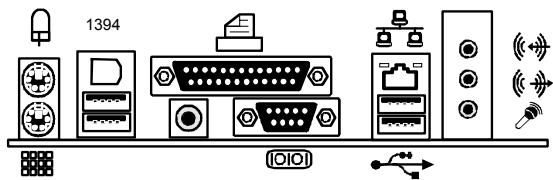
| Umschaltbar durch Treiber / Switchable via driver | ||
| Standard | 6-channel | |
| Line In (blau/blue) | Rear | |
| Line Out (grün/green) | Front | |
| Mic In (rot/red) | Center / Low | |
Bedienfeld / Front panel
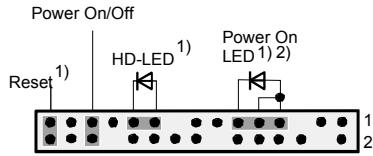
1) Cable is not included in the delivery scope.
2) 2-pin or 3-pin connector possible
Inhalt
Ubersicht/Overview Mainboard D1555
Mainboard D1555 1
External Audioanschlüsse verwenden
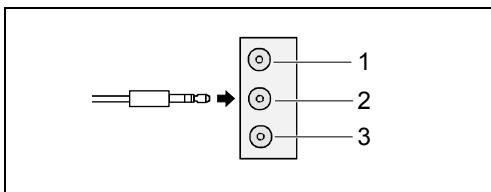
Bedienfeld / Front panel
Audio-Bedienfeld / Audio front panel
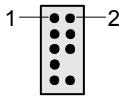
| Pin | Signal | Pin | Signal |
| 1 | Micro input | 2 | Analog GND |
| 3 | Micro bias | 4 | Analog VCC |
| 5 | Right line output | 6 | Right line return |
| 7 | Not connected | 8 | Key |
| 9 | Left line output | 10 | Left line return |
(internal or external via special cable)
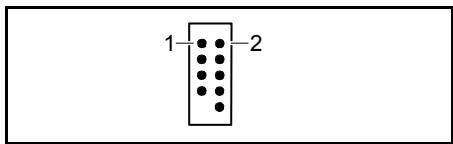
| Pin | Signal | Pin | Signal |
| 1 | VCC C | 2 | VCC D |
| 3 | Data negative C | 4 | Data negative D |
| 5 | Data positive C | 6 | Data positive D |
| 7 | GND | 8 | GND |
| 9 | Key | 10 | Not connected |
Lüfter 1 / Fan 1
processor fan - only for 3 pin fans)
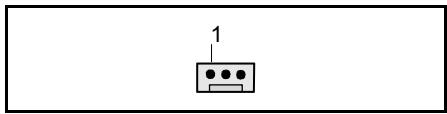
| Pin | Signal |
| 1 | GND |
| 2 | Fix Fan voltage (+12 V, max. 1 A) |
| 3 | Fan sense |
Lüfter 2 / Fan 2
(system fan - only for 3 pin fans)
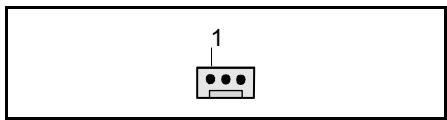
| Pin | Signal |
| 1 | GND |
| 2 | Fix Fan voltage (+12 V, max. 1 A) |
| 3 | Fan sense |
Stromversorgung ATX / Power supply ATX
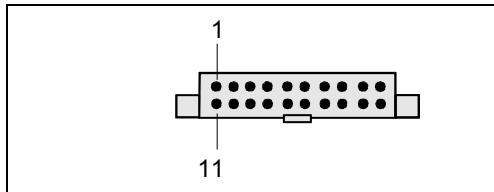
| Pin | Signal | Pin | Signal |
| 1 | +3.3V(P2V2P) | 11 | +3.3V(P2V2P) |
| 2 | +3.3V(P2V2P) | 12 | -12V (P12VN) |
| 3 | GND | 13 | GND |
| 4 | +5V (VCC) | 14 | PS on (low asserted) |
| 5 | GND | 15 | GND |
| 6 | +5V (VCC) | 16 | GND |
| 7 | GND | 17 | GND |
| 8 | Powergood (high asserted) | 18 | -5V (5PVN) |
| 9 | +5V Auxiliary (VCC Aux) | 19 | +5V (VCC) |
| 10 | +12V (P12VP) | 20 | +5V (VCC) |
Stromversorgung ATX12 V / Power supply ATX12 V
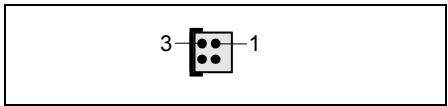
| Pin | Signal | Pin | Signal |
| 1 | GND | 2 | GND |
| 3 | +12 V | 4 | +12 V |
Patch for installed CPU not loaded. Please run the bios flash update diskette.
Available CPUs do not support the same bus frequency - System halted! Memory type mixing detected
Non Fujitsu Siemens Memory Module detected - Warranty voidThere are more than 32 RDRAM devices in the system
BIOS update for installed CPU failed
Check date and time settings
CPU mismatch detected
DMA test failed
EISA CMOS not writable
Extended RAM Failed at offset: nnnn
Extended RAM Failed at address line: nnnn
Failing Bits: nnnn
Fail-Safe Timer NMI failed
Multiple-bit ECC error occurred
Memory decreased in size
Memory size found by POST differed from EISA CMOS
Single-bit ECC error occurred
Software NMI failed
System memory exceeds the CPU's caching limit
System RAM Failed at offset: nnnn
Shadow RAM Failed at offset: nnnn
Incorrect Drive A - run SETUP Incorrect Drive B - run SETUP
Invalid System Configuration Data - run configuration utility Press F1 to resume, F2 to Setup
Monitor type does not match CMOS - RUN SETUP
On Board PCI VGA not configured for Bus Master
One or more RDRAM devices are not used
One or more RDRAM devices have bad architecture/timing
One or more RDRAM devices are disabled
Operating system not found
Service Processor not properly installed
Storage Extension Group = xy
Configuration error, x Storage Extensions(s) found, configured are y SE(s).
Device List: k1, k2 ...
System battery is dead - Replace and run SETUP
System Management Configuration changed or Problem occurred
Verify CPU frequency selection in Setup
| ACPI | Advanced Configuration and Power Management Interface |
| AC'97 | Audio Codec '97 |
| AGP | Accelerated Graphics Port |
| AMR | Audio Modem Riser |
| AOL | Alert On LAN |
| APM | Advanced Power Management |
| ASF | Alert Standard Format |
| ATA | Advanced Technology Attachment |
| BIOS | Basic Input Output System |
| BMC | Baseboard Management Controller |
| CAN | Controller Area Network |
| CPU | Central Processing Unit |
| CNR | Communication Network Riser |
| C-RIMM | Continuity Rambus Inline Memory Module |
| DIMM | Dual Inline Memory Module |
| ECC | Error Correcting Code |
| EEPROM | Electrical Erasable Programmable Read Only Memory |
| FDC | Floppy Disk Controller |
| FIFO | First-In First-Out |
| FSB | Front Side Bus |
| FWH | Firmware Hub |
| GMCH | Graphics and Memory Controller Hub |
| GPA | Graphics Performance Accelerator |
| I²C | Inter Integrated Circuit |
| IAPC | Instantly Available Power Managed Desktop PC Design |
| ICH | I/O Controller Hub |
| IDE | Intelligent Drive Electronics |
| IPSEC | Internet Protocol Security |
| ISA | Industrial Standard Architecture |
| LAN | Local Area Network |
| LSA | LAN Desk Service Agent |
| MCH | Memory Controller Hub |
| MMX | MultiMedia eXtension |
| P64H | PCI64 Hub |
| PCI | Peripheral Component Interconnect |
| PSB | Processor System Bus |
| PXE | Preboot eXecution Environment |
| RAM | Random Access Memory |
| RAMDAC | Random Access Memory Digital Analog Converter |
| RDRAM | Rambus Dynamic Random Access Memory |
| RIMM | Rambus Inline Memory Module |
| RTC | Real-Time Clock |
| SB | Soundblaster |
| SDRAM | Synchronous Dynamic Random Access Memory |
| SGRAM | Synchronous Graphic Random Access Memory |
| SIMD | Streaming Mode Instruction (Single Instruction Multiple Data) |
| SMBus | System Management Bus |
| SVGA | Super Video Graphic Adapter |
| USB | Universal Serial Bus |
| VGA | Video Graphic Adapter |
| WOL | Wake On LAN |
answers
... any technical problems or other questions you need clarified?
Please contact:
- your sales partner
- your sales outlet
The latest information and updates (e.g. BIOS update) on our mainboards can be found on the Internet under: http://www.fujitsu-siemens.com/mainboards
Vous avez ...
This manual has been printed on recycled paper.
Printed in the Federal Republic of Germany
AG 0303 03/03

A26361-D1555-Z121-1-6319
Mainboard D1555
Intel, Pentium and Celeron are registered trademarks of Intel Corporation, USA.
Microsoft, MS, MS-DOS and Windows are registered trademarks of Microsoft Corporation.
PS/2 and OS/2 Warp are registered trademarks of International Business Machines, Inc.
All other trademarks referenced are trademarks or registered trademarks of their respective owners, whose protected rights are acknowledged.
All rights, including rights of translation, reproduction by printing, copying or similar methods, even of parts are reserved.
Offenders will be liable for damages.
All rights, including rights created by patent grant or registration of a utility model or design, are reserved. Delivery subject to availability.
Right of technical modification reserved.
This manual was produced by cognitas. Gesellschaft für Technik-Dokumentation mbH www.cognitas.de
Externe Anschlüsse / External connectors
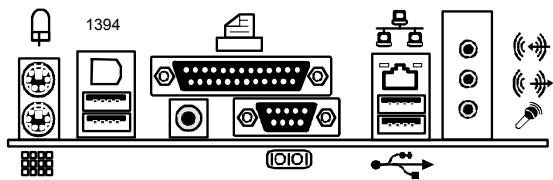
| Umschaltbar durch Treiber / Switchable via driver | ||
| Standard | 6-channel | |
| Line In (blau/blue) | Rear | |
| Line Out (grün/green) | Front | |
| Mic In (rot/red) | Center / Low | |
Bedienfeld / Front panel
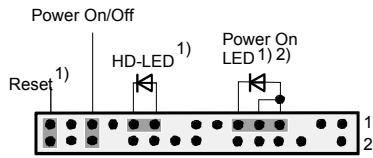
1) Cable is not included in the delivery scope.
2) 2-pin or 3-pin connector possible
Contents
Notational conventions 1
Important notes. 2
Information about boards 2
List of features 3
Special features 4
Brief instructions on installing mainboard 5
Prior to installation 5
Interfaces and connectors 7
External ports 7
LAN connector 7
2, 4 or 6-channel audio mode 7
Internal ports and connectors 9
Hard disk connection 9
Pin assignment of internal ports. 9
Settings with switches and jumpers 14
Add-on modules / Upgrading 15
Replacing processor 15
Removing and installing processors 15
Upgrading main memory 17
Upgrading AGP screen controllers. 18
Adding PCI cards. 18
PCI bus interrupts - Selecting correct PCI slot 18
Replacing the lithium battery. 20
BIOS update 21
BIOS Recovery - Recovering System BIOS 21
Microcode Update 22
Drivers 23
Annex 24
Electrical Properties 24
APM and ACPI system status, energy-saving modes 25
Mainboard Revision and BIOS Version 26
Error messages 27
Glossary 31
Mainboard D1555
Your mainboard is available in different configuration levels. Depending on the configuration chosen, some of the hardware components described may not be available on your mainboard.
Additional information
Information on the BIOS Setup and additional descriptions of the drivers are contained:
in the readme files on your hard disk
on the driver floppy disks included
on the CD "Drivers & Utilities Collection" or "Drivers & Utilities" or "ServerStart".

The programme Acrobot Reader must be installed to be able to open the manuals. You may find the programme on the CD-ROM directory: utils/acrobot.
For more details please read the accordingREADME.txt files.
Notational conventions
The meanings of the symbols and fonts used in this manual are as follows:

indicates information which is important for your health or for preventing physical damage.

indicates additional information which is required to use the system properly.
Text which follows this symbol describes activities that must be performed in the order shown.
This symbol indicates that you must enter a blank space (press the Space Bar) at this point.
This symbol indicates that you must press the Enter key.
Text in this typeface indicates screen outputs.
Text in this bold typeface indicates the entries you make via the keyboard.
Text in italics indicates commands or menu items.
"Quotation marks" indicate names of chapters or terms.
Important notes
With the mainboard installed you must open the system to access the mainboard. How to dismantle and reassemble the system is described in the operating manual accompanying the system.
Connecting cables for peripherals must be adequately shielded to avoid interference.

Observe the safety notes in the operating manual of your system.
Incorrect replacement of the lithium battery may lead to a risk of explosion. It is therefore essential to observe the instructions in the "Add-on modules / Upgrading" - "Replacing the lithium battery" section.
Components can become very hot during operation. Ensure you do not touch components when making extensions to the mainboard. There is a danger of burns!

The shipped version of this board complies with the requirements of the EEC directive 89/336/EEC "Electromagnetic compatibility".
Compliance was tested in a typical PC configuration.
When installing the board, refer to the specific installation information in the manual for the receiving device.

The warranty is invalidated if the system is damaged during the installation or replacement of expansions. Information on which expansions you can use is available from your sales outlet or the customer service centre.
Information about boards
To prevent damage to the mainboard, the components and conductors on it, please take great care when you insert or remove boards. Take great care to ensure that extension boards are slotted in straight, without damaging components or conductors on the mainboard, or any other components, for example EMI spring contacts.
Remove the plug from the mains outlet so that system and mainboard are totally disconnected from the mains voltage.
Be careful with the locking mechanisms (catches, centring pins etc.) when you replace the mainboard or components on it, for example memory modules or processors.
Never use sharp objects (screwdrivers) for leverage.

Boards with electrostatic sensitive devices (ESD) are identifiable by the label shown.
When you handle boards fitted with ESDs, you must, under all circumstances, observe the following:
- You must always discharge static build up (e.g. by touching a grounded object) before working.
The equipment and tools you use must be free of static charges. - Remove the power plug from the mains supply before inserting or removing boards containing ESDs.
Always hold boards with ESDs by their edges. - Never touch pins or conductors on boards fitted with ESDs.
List of features
D1555-C
Onboard features
| Chipset | SiS 648 / 963 |
| Board size | ATX |
| VGA | - |
| Audio / 6-channel / S/PDIF 5.1 | ✓ / ✓ / ✓ |
| Buzzer / int. Speaker Support | ✓ / - |
| LAN / with Alert-on-LAN | ✓ / - |
| RAID | - |
| FireWire™ | ✓ |
| HI-SPEED USB 2.0 | ✓ |
| SmartCard Reader Support (USB / serial) | - / - |
| Temperature monitoring | - |
| System Monitoring | - |
| Fujitsu Siemens Computers Keyboard Power Button Support | - |
Internal ports
| DIMM slots (DDR 333 SDRAM / DDR 266 SDRAM) | 2 / 3 |
| AGP Slot (4/8x, 32 bit, 66 MHz, 1.5 V) | 1 |
| PCI slot (32 bit, 33 MHz, 5 V and 3.3 V) | 5 |
| CNR Slot (Type A, AC'97 only) | 1 |
| IDE RAID interface (RAID 1,2 / IDE 3,4) | - |
| IDE Interface (Ultra DMA/133) | 2 |
| Floppy Interface (up to 2.88 Mbyte) | 1 |
| S/PDIF* (digital audio) | - |
| CD / AUX audio input | 1 / 1 |
| Front panel Audio (headphone, microphone) | 1 |
| Wake On LAN | - |
| IEEE 1394 connector* (FireWire™) | 1 |
| USB Ports* (2.0, ~480 MB/s) | 2 or 4 |
| Serial Ports* (FIFO, 16550 compatible) | - |
| Fan Connectors PSU** / CPU / AUX1 / AUX2 | - / 1 / 1 / - |
| SMBus Connector* (Case Temperature) | - |
| Intrusion Connector* (Case Open) | - |
| Power Connectors ATX / ATX12V / AGP PRO | 1 / 1 / - |
External ports
| VGA | - |
| Audio Mic In / Line in / Line out or Rear / Front / Center, Low (with driver) | 1 / 1 / 1 |
| Game/MIDI | - |
| S/PDIF 5.1 (cinch) | 1 |
| LAN (RJ-45) | 1 |
| PS/2 mouse/keyboard | 1 / 1 |
| 1394 port (FireWire) | 1 |
| USB Ports (2.0, ~480 MB/s) | 4 |
| Serial Ports (FIFO, 16550 compatible) | 1 |
| Parallel Port (EPP/ECP) | 1 |
- for use with internal devices or optional Front or Rear panel
** not supported by standard power supplies
Special features
Your mainboard is available in different configuration levels. Depending on the configuration, your mainboard is equipped with or supports the features described in the following.
DeskView/DeskViewOEM
The network-capable manageability software DeskView/DeskViewOEM* mainly consists of three modules:
- DeskInfo shows the most important device data of the PCs in a network (local and/or on an administrator PC).
- DeskAlert monitors the operability of all major components and triggers alarms if necessary depending on the mainboard variant.
- DeskFlash carries out a BIOS update under Windows.
Recovery BIOS
If an error occurs during a BIOS update (e.g. due to a power failure), the system BIOS will be destroyed. All Fujitsu Siemens Computers mainboards are equipped with a recovery BIOS. With it a destroyed BIOS can easily be restored. Exact instructions are provided in the chapter "BIOS Recovery - Recovering System BIOS".
IA-PC
Instantly Available PC ensures fast availability of the PC from an energy-saving mode. Within just a few seconds the PC is in exactly the same state it was in when it was switched off without time-consuming booting. Depending on the operating system, the PC can be switched into an energy-saving mode with applications open by pressing the ON/OFF switch.
Brief instructions on installing mainboard
If you have purchased a separate mainboard, you can install the mainboard in your system in accordance with the following brief instructions.
The activities described here assume a basic knowledge of PCs and cannot be carried out by a layperson. If you are not sure whether you have the necessary specialised knowledge, then leave this work to an expert.
The illustrations of the system show examples of possible cases.
Prior to installation
Please take note of the safety information in the "Important notes" chapter.
Check whether the processor, memory modules and power supply are suitable for this mainboard:
- processor (see "Replacing processor" chapter).
memory modules (see "Upgrading main memory" chapter).
power supply (see "Electrical Properties" chapter).
Make sure the current requirement of the fans (processor, case) does not exceed the loadability of the fan connections (see chapter entitled "Electrical Properties").
- First only install the components absolutely necessary (graphics card, processor and heat sink, one memory module) and only connect the required connections (power supply unit, case connections such as ATX on/off switch, hard disk or floppy disk drive). You should not install additional cards and devices until this minimum configuration successfully boots (see chapter entitled "Add-on modules / Upgrading").
Installation
Equip the mainboard with the processor, heat sink and memory modules before installation if possible. Further information can be found in "Replacing processor" chapter.
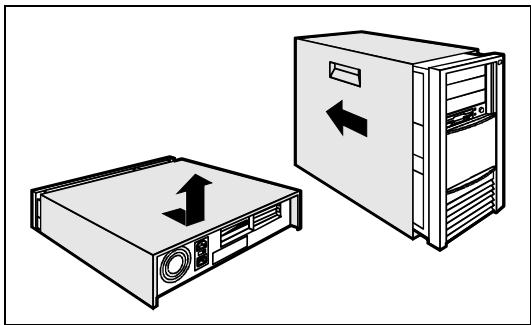
Open the casing as described in the operating manual.
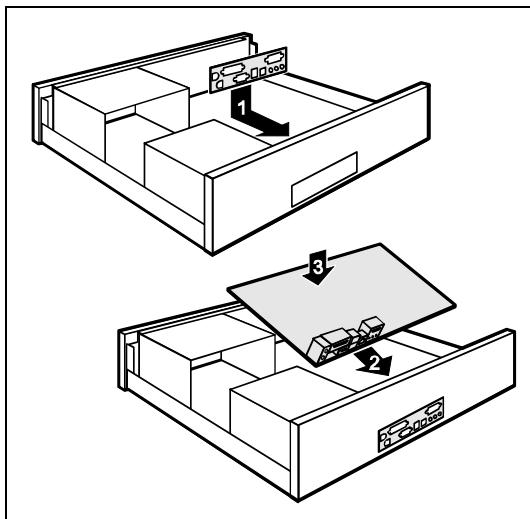
Should no suitable connection field be provided in the case, then you must install the connection field (1) provided.
Ensure the plate is aligned properly so that the connections are suitable for the mainboard later.
Set the mainboard on the edge on which the connection field is located (2) and then insert the board in the case (3).
Make sure that spacers in the housing are only mounted at points at which there are mounting holes in the mainboard.
Fasten the mainboard with the screws.
Connect the plugs for the power supply, control panel and drives to the corresponding connections on the mainboard.
Driver installation
Install the drivers for the chipset. You may find the driver on the "Drivers & Utilities" CD. Please refer to chapter "Drivers" for a description of installing drivers.
Interfaces and connectors
The positions of the interfaces and connectors are shown on page "Cover".
The components and connectors marked are not necessarily present on the mainboard.
External ports
The positions of the external ports are shown on page "Cover".
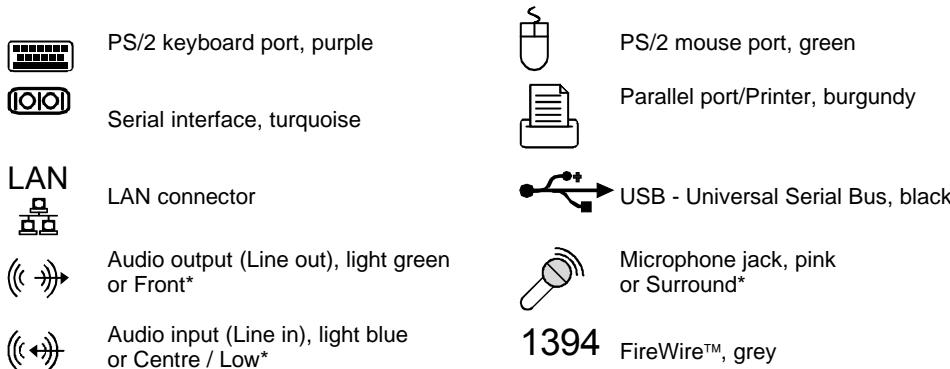
* Switching over to 6-channel audio is carried out using a driver.
LAN connector
This mainboard has an ADMtek AN983B LAN controller. The LAN controller is equipped with a 2 KB transmission and receiving buffer (FIFO) and supports WOL function through Magic Packet™.
The LAN RJ45 connector has two LEDs (light emitting diodes).

1 = A connection exists (e.g. to a hub).
2 = Link Mode: the LAN connection is active.
WOL mode: a Magic Packet™ is being received.
2, 4 or 6-channel audio mode
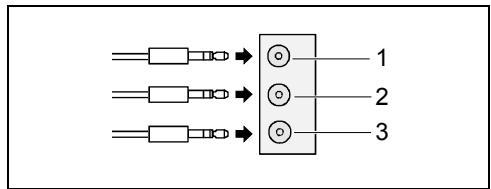
The mainboard supports a 6-channel audio output (2 Front, 2 Rear, 1 Centre and 1 Subwoofer channel). This makes it possible to connect 4 or 6 loudspeakers, and therefore to achieve a better surround-sound effect.
Drivers
A corresponding driver must be installed for the 2, 4 or 6-channel audio mode. If the drive is not installed yet, proceed as described in the chapter "Add-on modules / Upgrading", in the section "Drivers".
Connecting loudspeakers
The number of loudspeakers connected should match the number of audio channels you select in the driver software.
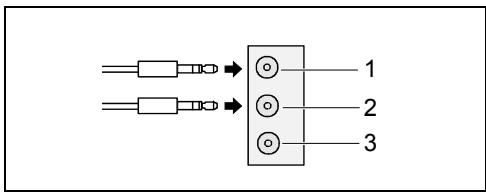
Using external audio connections
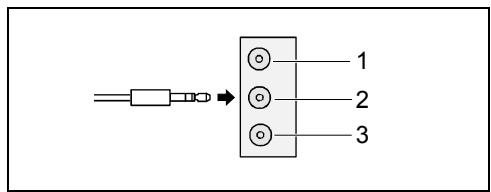
Analogue 2-channel audio output
With the 2-channel configuration the functions Line-Out, Line-In and MIC are available.
1 = Line-In (blue)
2 = Line-Out (front channels, green)
3 = MIC (red)
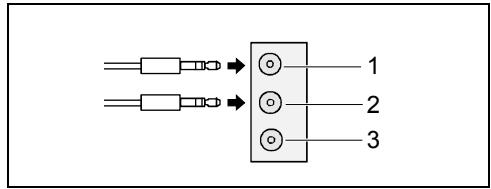
Analogue 4-channel audio output
Line-In is converted into the Rear-Out function with the 4-channel configuration.
1 = Line-In (rear channels, blue)
2 = Line-Out (front channels, green)
3 = MIC (red)
Analogue 6-channel audio output
Line-In and MIC are converted into the function Line-Out with the 6-channel configuration.
1 = Line-In (rear channels, blue)
2 = Line-Out (front channels, green)
3 = MIC (centre and subwoofer channel, red)

Depending on driver version and operating system the functions may differ from this presentation. If necessary, further information is provided in the respective help system of drivers and software.
Selecting settings for 2, 4 or 6-channel audio mode
Depending on the driver for the audio mode and from the operating system used, you can configure the audio properties, e.g. with Windows 2000 under Start - Settings - Control Panel - Sounds and Multimedia.
Internal ports and connectors
The positions of the internal ports and connectors are shown on the Cover. Additional information on some ports is also provided here.
Hard disk connection
An ultra ATA/66, ultra ATA/100 or ultra ATA/133 hard disk must be connected with a cable especially designed for the ultra ATA/66, ultra ATA/100 or ultra ATA/133 mode.
Connect the end of the cable marked with blue to the mainboard.
Pin assignment of internal ports
The pin assignment of some internal connections is shown in English in the following.

Some of the following connectors may be optional!
Front panel
Watch the poling of the LEDs. The positive pole of the connection cables is often indicated with a coloured wire.
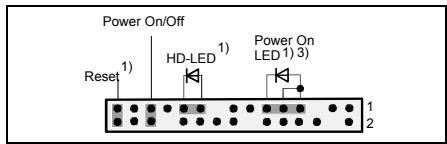
| Connection | Note |
| Reset | |
| Power On/Off | |
| HD LED | |
| Power On LED | Indicates the system state APM or ACPI (see chapter "APM and ACPI system status, energy-saving modes"). |
Audio S/PDIF
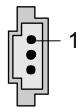
| Pin | Signal |
| 1 | VCC |
| 2 | SPDIF out |
| 3 | GND |
AUX audio in
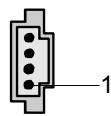
| Pin | Signal |
| 1 | Left AUX audio input |
| 2 | Analogue GND |
| 3 | Analogue GND |
| 4 | Right AUX audio input |
CD-ROM audio in
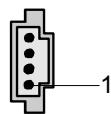
| Pin | Signal |
| 1 | Left CD audio input |
| 2 | CD GND |
| 3 | CD GND |
| 4 | Right CD audio input |
Audio front panel
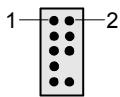
| Pin | Signal | Pin | Signal |
| 1 | Micro input | 2 | Analogue GND |
| 3 | Micro bias | 4 | Analog VCC |
| 5 | Right line output | 6 | Right line return |
| 7 | not connected | 8 | Key |
| 9 | Left line output | 10 | Left line return |
If the audio front panel is not used, you must plug jumpers on pin pairs 5/6 and 9/10.
FireWire / IEEE 1394
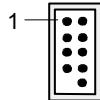
| Pin | Signal | Pin | Signal |
| 1 | TPA+ | 2 | TPA- |
| 3 | GND | 4 | GND |
| 5 | TPB+ | 6 | TPB- |
| 7 | +12 V | 8 | +12 V |
| 9 | Key | 10 | GND |
USB C/D - dual channel E/F - dual channel
(internal or external via special cable)
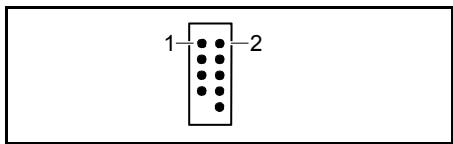
| Pin | Signal | Pin | Signal |
| 1 | VCC C | 2 | VCC D |
| 3 | Data negative C | 4 | Data negative D |
| 5 | Data positive C | 6 | Data positive D |
| 7 | GND | 8 | GND |
| 9 | Key | 10 | not connected |
Fan 1
processor fan - only for 3 pin fans)
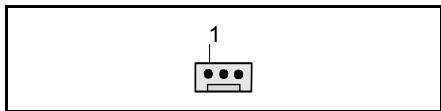
| Pin | Signal |
| 1 | GND |
| 2 | Fix Fan voltage (+12 V, max. 1 A) |
| 3 | Fan sense |
Fan 2
(system fan - only for 3 pin fans)
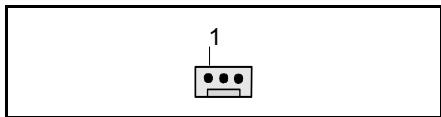
| Pin | Signal |
| 1 | GND |
| 2 | Fix Fan voltage (+12 V, max. 1 A) |
| 3 | Fan sense |
Power supply ATX
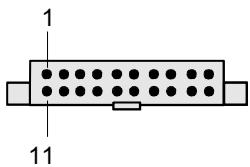
| Pin | Signal | Pin | Signal |
| 1 | +3.3V(P2V2P) | 11 | +3.3V(P2V2P) |
| 2 | +3.3V(P2V2P) | 12 | -12V (P12VN) |
| 3 | GND | 13 | GND |
| 4 | +5V (VCC) | 14 | PS on (low asserted) |
| 5 | GND | 15 | GND |
| 6 | +5V (VCC) | 16 | GND |
| 7 | GND | 17 | GND |
| 8 | Powergood (high asserted) | 18 | -5V (5PVN) |
| 9 | +5V Auxiliary (VCC Aux) | 19 | +5V (VCC) |
| 10 | +12V (P12VP) | 20 | +5V (VCC) |
Power supply ATX12 V
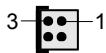
| Pin | Signal | Pin | Signal |
| 1 | GND | 2 | GND |
| 3 | +12 V | 4 | +12 V |
Settings with switches and jumpers
Your mainboard is equipped with switches or jumpers. The positions of the switches or jumpers are shown on page "Cover".
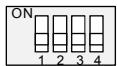
Switch 1 = Skipping system and BIOS Setup password
Switch 2 = System BIOS recovery
Switch 3 = must be set to off
Switch 4 = must be set to off
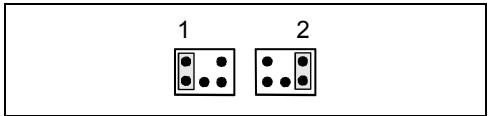
Pin pair 1 inserted =
Skipping system and BIOS Setup password
Pin pair 2 inserted =
System BIOS recovery
Any other setting =
State of supply; jumper has no function

The clock frequency of the processor is set automatically.
Skipping system and BIOS Setup password - switch 1 / pin pair 1
Switch 1 / pin pair 1 enables skipping the system and BIOS Setup password.
On System and BIOS Setup password are skipped when the device is switched on and may be changed.
Off System and BIOS Setup password must be entered when the device is switched on.
Recovering System BIOS - switch 2 / pin pair 2
Switch 2 / pin pair 2 enables recovery of the old system BIOS after an attempt to update has failed. To restore the old BIOS you need a Flash BIOS Diskette (see "BIOS update" chapter).
On The System BIOS executes from floppy drive A: and the inserted "Flash-BIOS- Diskette" restores the System BIOS on the mainboard.
Off Normal operation (default setting).
Reserved - switch 3 and switch 4 (if present)
Switch 3 and 4 are reserved. The position of the switch doesn't matter.
Add-on modules / Upgrading

Exit energy-saving mode, switch off the system and remove the power plug from the mains outlet, before carrying out any of the procedures described in this chapter! Even when you have switched off the device, parts (e.g. memory modules, AGP and PCI extension boards) are still supplied with power.
Replacing processor
Technical data
- Pentium 4 with 400/533 MHz Processor System Bus (PSB) in the mPGA478 design.
- Celeron with 400 MHz Processor System Bus in the mPGA478 design
A current list of the processors supported by this mainboard is available on the Internet at: www.fujitsu-siemens.com/mainboards.
Removing and installing processors
Remove the fan that there may be and the heat sink.
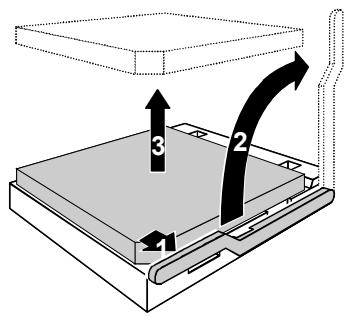
Pull the lever in the direction of the arrow (1) and lift it as far as it will go (2).
Remove the old processor from the socket (3).
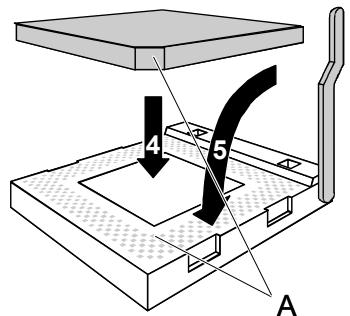
Insert the new processor in the socket so that the angled corner of the processor matches the coding on the socket (A) with regard to the position (4).

The angled corner of the processor can also be at a different location than shown in the illustration.
Push the lever back down until it clicks into place (5).
Mounting heat sink
Be sure to use heat conducting material between the processor and the heat sink. If a heat conducting pad (rubber-like foil) is already applied to the heat sink, then use it. Otherwise you must apply a very thin layer of heat conducting paste.
Heat conducting pads can only be used once. If you remove the heat sink, you must clean it and apply new heat conducting paste before you remount it.
Please note that, depending on the heat sink used, different heat sink mounts are required on the mainboard.

If a counter-plate is mounted on the underside of the mainboard for reinforcement, no heat sinks of the type "Intel Boxed" may be used. Otherwise the retaining clips of the heat sink will be damaged.
When using an "Intel Boxed" heat sink, the mainboard must be converted. This conversion set is either included with the mainboard or is available separately.
If no counter-plate is mounted, you can use both "Intel Boxed" heat sinks and standard heat sinks. If you use the "Intel Boxed" heat sink, the mainboard will bend due to the high pressure of the retaining clips. This behaviour is specified by Intel.
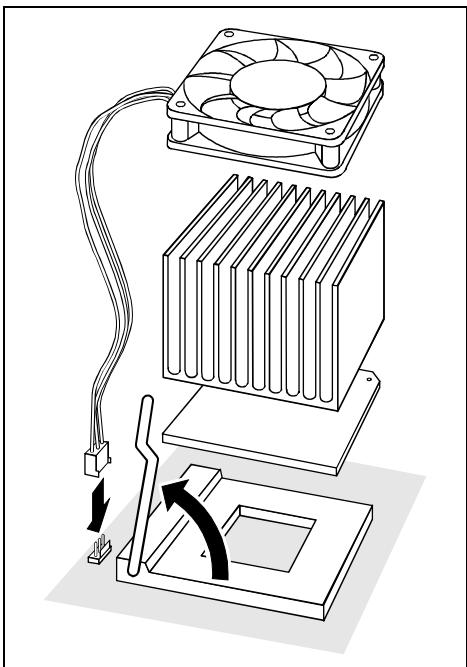
Depending on the configuration variant, you must pull a protective foil off the heat sink or coat the heat sink with heat conducting paste before fitting it.
Depending on the processor variant, clips may also be supplied for mounting the heat sink that fix it in place.
When you have mounted the optional fan, connect the fan plug to the corresponding connection on the mainboard.
Upgrading main memory
Technical data
Technology: DDR 266 or DDR 333 unbuffered DIMM modules 184-Pin; 2.5 V; 64 Bit, no ECC
Size: 32 Mbytes to 3 Gbyte DDR 266 SDRAM 32 Mbytes to 2 Gbyte DDR 333 SDRAM
Granularity: 32, 64, 128, 256, 512 or 1024 Mbyte for one socket
A current list of the memory modules recommended for this mainboard is available on the Internet at: www.fujitsu-siemens.com/mainboards.
At least one memory module must be installed. You may only use three double-sided memory modules for DDR 266 modules. You may only use up to two double-sided, three single-sided memory modules or one double-sided with two single-sided memory modules for DDR 333.
Memory modules with different memory capacities can be combined.

You may only use unbuffered 2.5 V memory modules. Buffered memory modules are not supported.
DDR-DIMM memory modules must meet the PC2100 or PC2700 specification.
Memory clock pulse speed
The memory clock pulse speed is affected by the processor chipset and system bus. The table shows the memory speed in dependence on the Processor System Bus.
| Processor System Bus (MHz) | DDR333 (MHz) | DDR266 (MHz) |
| 533 | 333 | 266 |
| 400 | 333 | 266 |
Installing a memory module
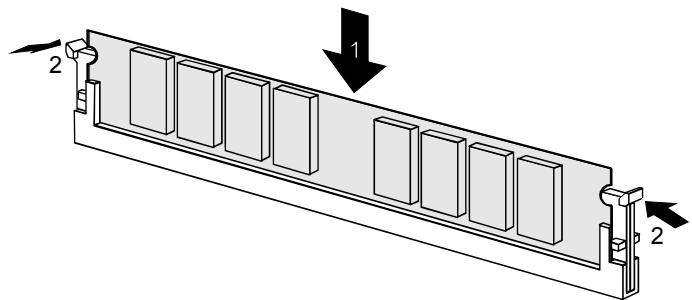
Push the holders on each side of the memory slot outwards.
Insert the memory module into the location (1).
At the same time flip the lateral holders upwards until the memory module snaps in place (2).
Removing a memory module
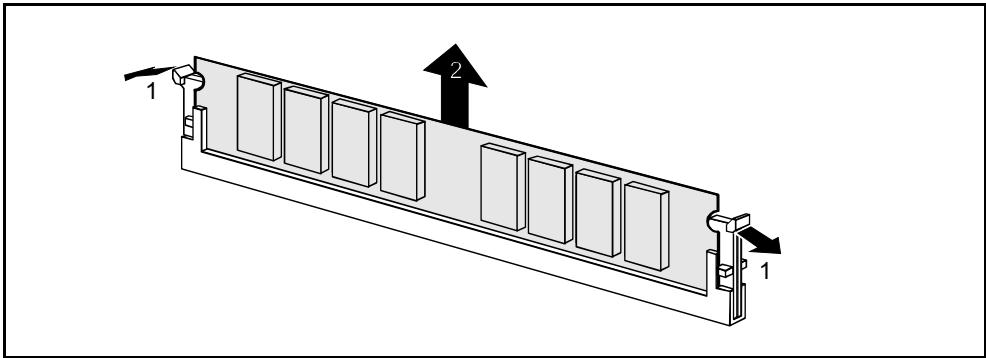
Push the clips on the right and left of the memory slot outward (1).
Pull the memory module out of the memory slot (2).
Upgrading AGP screen controllers
Technical data:
The AGP slot supports the modes 4x/8x with 32 bits and 66 MHz. Only 1.5 V AGP graphics cards are supported.

Some older 3.3 V AGP graphics cards are coded like 1.5 V AGP graphics cards. The installation of such 3.3 V AGP graphics cards can cause serious damage to the mainboard and the AGP graphics cards.
Adding PCI cards
Technical data:
32 bit / 33 MHz PCI slots
5 V and 3.3 V supply voltage
3.3 V auxiliary voltage
PCI bus interrupts - Selecting correct PCI slot

To achieve optimum stability, performance and compatibility, avoid the multiple use of ISA IRQs or PCI IRQ Lines (IRQ sharing). Should IRQ sharing be unavoidable, then all involved devices and their drivers must support IRQ sharing.
PCI IRQ Lines connect AGP slots, PCI slots and onboard components to the interrupt controller.
PCI IRQ Lines are permanently wired on the mainboard.
Which ISA IRQs are assigned to the PCI IRQ Lines is normally automatically specified by the BIOS (see description in "BIOS Setup").
Monofunctional expansions cards:
Standard AGP and PCI expansion cards require a maximum of one interrupt, which is called the PCI interrupt INT A. Expansion cards that do not require an interrupt can be installed in any desired slot.
Multifunctional expansion cards or expansion cards with integrated PCI-PCI bridge:
These expansion cards require up to four PCI interrupts: INT A, INT B, INT C, INT D. How many and which of these interrupts are used is specified in the documentation provided with the card.
The assignment of the PCI interrupts to the PCI IRQ Lines is shown in the following table:
| PCI Interrupt Line | Onboard Controller | PCI slot | ||||||||||||
| USB 1.1 | SMBus | AC97 | LAN | AGP | 1 | 2 | 3 | 4 | 5 | |||||
| 1st | 2nd | 3rd | Audio | Modem | ||||||||||
| 1 (A) | - | - | - | - | - | - | - | A | C | B | A | D | C | |
| 2 (B) | - | - | - | B | - | - | - | B | D | C | B | A | D | |
| 3 (C) | - | - | - | - | C | - | - | - | A | D | C | B | A | |
| 4 (D) | - | - | - | - | - | - | D | - | B | A | D | C | B | |
| 5 (E) | E | - | - | - | - | - | - | - | - | - | - | - | - | |
| 6 (F) | - | F | - | - | - | - | - | - | - | - | - | - | - | |
| 7 (G) | - | - | G | - | - | - | - | - | - | - | - | - | - | |
| 8 (H) | - | - | - | H | - | - | - | - | - | - | - | - | - | |
Use the first PCI slots that have a single PCI IRQ Line (no IRQ sharing). If you must use another PCI slot with IRQ sharing, check whether the expansion card properly supports IRQ sharing with the other devices on this PCI IRQ Line. The drivers of all cards and components on this PCI IRQ Line must also support IRQ sharing.
Replacing the lithium battery
In order to permanently save the system information, a lithium battery is installed to provide the CMOS-memory with a current. A corresponding error message notifies the user when the charge is too low or the battery is empty. The lithium battery must then be replaced.

Incorrect replacement of the lithium battery may lead to a risk of explosion!
The lithium battery may be replaced only with an identical battery or with a type recommended by the manufacturer.
Do not throw lithium batteries into the household waste. They must be disposed of in accordance with local regulations concerning special waste.
Make sure that you insert the battery the right way round. The plus pole must be on the top!
The lithium battery holder exists in different designs that function in the same way.
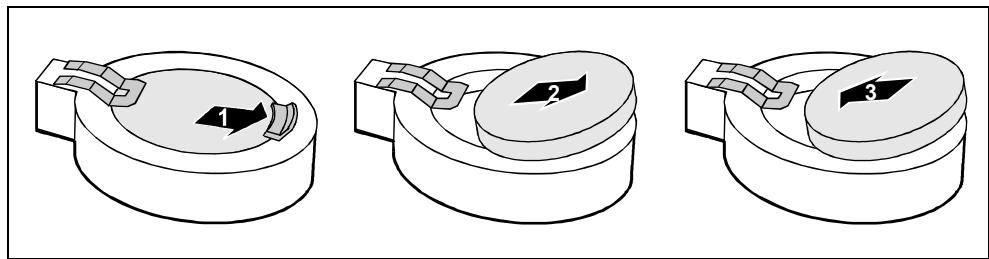
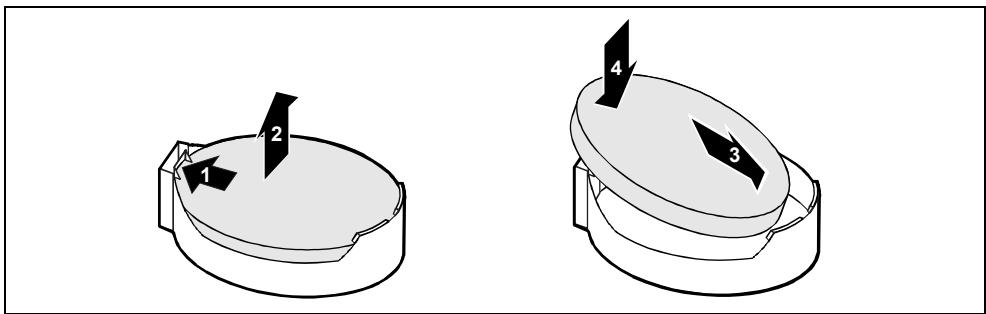
Press the locking lug in the direction of the arrow; the battery jumps somewhat out of the holder (1).
Remove the battery (2).
Push the new lithium battery of the identical type into the holder (3) and press it downward until it engages (4).
BIOS update
When should a BIOS update be carried out?
Fujitsu Siemens Computers makes new BIOS versions available to ensure compatibility to new operating systems, new software or new hardware. In addition, new BIOS functions can also be integrated.
A BIOS update should always also be carried out when a problem exists that cannot be solved with new drivers or new software.
Where can I obtain BIOS updates?
The BIOS updates are available on the Internet at www.fujitsu-siemens.de/mainboards.
How does a BIOS update work?
You have two ways of doing this:
- BIOS update under DOS with bootable BIOS update floppy disk - brief description
Download the update file from out website to your PC.
Insert an empty floppy disk (1.44 MB).
Run the update file (e.g. 1522103.EXE).
A bootable update floppy disk is created. Leave this floppy disk in the drive.
Restart the PC.
Follow the instructions on screen.

Detailed information on the BIOS update under DOS is provided in the manual on "BIOS Setup" ("Drivers & Utilities" CD).
- BIOS update under Windows with DeskFlash utility
A BIOS update can also be carried out directly under Windows with the DeskFlash utility. DeskFlash is located on the "Drivers & Utilities" CD (from CD version 2001.05 with DeskView ^OEM V5.0). In the Readme file in the subfolder DeskFlash you will find the installation instructions for DeskFlash. Further information on DeskFlash is provided in the file DeskView.PDF and in the DeskView ^OEM online help.
BIOS Recovery - Recovering System BIOS

All BIOS settings are reset to the default values.
Open the casing as described in the operating manual.
Set the switch for "Restore system BIOS" to ON.
Close the casing as described in the operating manual.
Insert a BIOS update floppy disk and start the PC.
Note the signals issued from the loudspeaker. You have successfully restored the BIOS if you hear the signal sequence "short-short- long- long- long" and the diskette access indicator is dark. This can take a few minutes.
Open the casing as described in the operating manual.
Set the switch for "Restore system BIOS" to OFF.
Close the casing as described in the operating manual.
Remove the floppy disk from the drive.
Start the PC and invoke BIOS Setup.
Select the menu item Reset Configuration in the menu Advanced and change the setting to Yes.
Save the change and terminate BIOS Setup.
The BIOS recovery has now been completed. The system restarts.

Detailed information on the BIOS recovery is contained in the manual "BIOS Setup" ("Drivers & Utilities" CD).
Microcode Update
What is a microcode update?
As there are no drivers for processors, Intel offers the possibility from the P6 family (Pentium Pro) on to update the command set (microcode) of the processor. This enables minor errors to be corrected and the performance to be increased.
To guarantee the best possible performance and error-free operation, Intel recommends updating the microcode for every new processor. Intel refers to the use of the processor without microcode updates as operation outside the specifications.
Safety for processor on Fujitsu Siemens Computers mainboards
If the processor uses an old or incorrect microcode, error-free operation cannot be ensured. Fujitsu Siemens Computers has therefore implemented a function on its mainboards that interrupts the booting process if no suitable microcode is available for the installed processor. The output error message is:
Patch for installed CPU not loaded. Please run the bios flash update diskette.
This message appears until the microcode update has been carried out. If the computer is nevertheless operated without a microcode update, error-free operation is not ensured.
When should a microcode update be carried out?
A microcode update should be carried out after the installation of a new processor.
In contrast to the BIOS update, only an updated version of the processor command set is stored.
The system BIOS remains unaffected by this.
Microcode update under DOS with bootable microcode update floppy disk - brief description
Download the update file from out website to your PC.
Insert an empty floppy disk (1.44 MB).
Run the update file under DOS (e.g. 1495101.EXE).
A bootable update floppy disk is created. Leave the floppy disk in the drive.
Restart the PC.
Follow the instructions on screen.
To determine whether the latest microcode update has been loaded, the so-called Patch-ID of the processor can be read out.
Press the [F1] key in the BIOS Setup.
The entry CPU/ Patch ID is shown on the displayed information page.
A list with the current processors and the related Patch-IDs is available on the Internet.

If the processor is not recognised, you also require the microcode update tool for processors of the P6 family.
Drivers
Only when no drivers are installed on your system, or you want to update these, proceed as follows:
Insert the CD "Drivers & Utilities Collection" into the CD-ROM drive.
If the CD does not start automatically, run the START.EXE programme in the main directory of the CD.
Select DeskUpdate-Fully automatic installation.
Follow the screen instructions.
Annex
Electrical Properties
Loadability for connections and fuses

Make sure that the connected devices do not overload the connections.
| Fuse No. | Fuse | Connection | Maximum loadability |
| - | - | Fan1, Fan2 | 1000 mA each |
| 1 | 750 mA | Keyboard | Not specified |
| Mouse | Not specified | ||
| VGA port | Minimum 50 mA | ||
| 2 | 2000 mA | USB port A | 500 mA |
| USB port B | |||
| USB port C | |||
| USB port D | |||
| 3 | 2000 mA | USB port E | 500 mA |
| USB port F |
The fuses on this mainboard can be used several times (polyfuses). Shortly after the error state has been eliminated, the fuses reset to the original state.
Mainboard current requirement
You require a Pentium4 power supply nit as per the ATX12V specification for this mainboard. If you do not have a PC from Fujitsu Siemens Computer, make sure that the power supply unit provides the required amperages.
| Source | Voltage | Maximum difference | Maximum current |
| ATX12V power supply | +12 V | ±5 % | 12 A |
| ATX12V power supply | -12 V | ±10 % | 0.05 A |
| ATX12V power supply | +5.0 V | ±5 % | 19.5 A |
| ATX12V power supply | +3.3 V | ±5 % | 3.7 A |
| Standby voltage of power supply unit | +5.0 V SB | ±5 % | 2 A |
The specifications apply to the onboard components and represent the least favourable case. In addition, at least 350mA is required for PCI on 3.3V , and 500mA per connected device for USB on 5V .
APM and ACPI system status, energy-saving modes
| System status | ACPI Status* | APM Status | Power LED | Power consumption | Wake-up time | |
| Normal operation | G0 | S0 | On | On | Normal | |
| Simple energy-saving mode | G1 | S1 | Standby | flashin g | Almost like normal | Almost immediately |
| Maximum energy-saving mode ** "Save to DRAM" | S3 | RAM, wake-up components | ca. 5s | |||
| Maximum energy-saving mode ** "Save To Disk" | S4 | Off | Wake-up components | ca. 20s | ||
| "Soft Off" | G2 | S5 | Soft Off | Nearly zero | Full boot time | |
| Mechanically Off | G3 | Off | Zero | Full boot time | ||
- G = Global status; S = System status
** The power supply unit must provide sufficiently loadable 5 V standby voltage.
To use the WOL functionality the power supply must provide a 5 V auxiliary voltage (5V SB) of at least 1 A.
Mainboard Revision and BIOS Version
The compatibility, e.g. with new processors, can be independent of the BIOS version or the revision status of the mainboard used. The CPU and BIOS compatibility lists are available on the Internet at www.fujitsu-siemens.de/mainboards.
Mainboard Revision
The revision status of the mainboard exactly identifies which mainboard you have. It is indicated on a sticker on the edge of the mainboard:
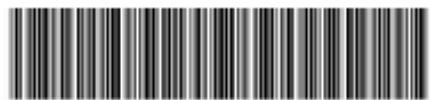
D1555-C12 GS 1
05618476
Example Mainboard-Revision
BIOS version
The BIOS version can be displayed in the BIOS Setup.
Press [F2] during booting to open the BIOS Setup.
Press F1.
The BIOS version is specified on the displayed information page under the entry BIOS Release.
Error messages
This chapter contains error messages generated by the mainboard.
Available CPUs do not support the same bus frequency - System halted! Memory type mixing detected
Non Fujitsu Siemens Memory Module detected - Warranty voidThere are more than 32 RDRAM devices in the system
Check whether the system configuration has changed. If necessary, correct the settings.
BIOS update for installed CPU failed
This message appears if the microcode update required for the connected processor is not contained in the system BIOS.
Boot the system with the inserted Flash BIOS floppy disk.
Abort the normal Flash BIOS update by answering the question about whether you want to perform the update with
n
To carry out the Flash BIOS update for the processor, enter:
flashbio/.p6
Check date and time settings
The system date and time are invalid. Set the current date and time in the Main menu of the BIOS Setup.
CPU ID 0x failed
Switch the server off and on again. If the message is still displayed, go into the BIOS setup and set the corresponding processor to Disabled in the Server - CPU Status menu; please contact your sales outlet or customer service centre.
CPU mismatch detected
You have replaced the processor or changed the frequency setting. As a result, the characteristic data of the processor have changed. Confirm this change by running the BIOS Setup and exiting it again.
Diskette drive A error
Diskette drive B error
Check the entry for the diskette drive in the Main menu of the BIOS Setup. Check the connections to the diskette drive.
DMA test failed
EISA CMOS not writable
Extended RAM Failed at offset: nnnn
Extended RAM Failed at address line: nnnn
Failing Bits: nnnn
Fail-Safe Timer NMI failed
Multiple-bit ECC error occurred
Memory decreased in size
Memory size found by POST differed from EISA CMOS
Single-bit ECC error occurred
Software NMI failed
System memory exceeds the CPU's caching limit
System RAM Failed at offset: nnnn
Shadow RAM Failed at offset: nnnn
Switch the device off and on again. If the message is still displayed, please contact your sales outlet or customer service centre.
Failure Fixed Disk 0
Failure Fixed Disk 1
Fixed Disk Controller Failure
Check the entry for the hard disk drive in the Main menu and the entry for the IDE drive controller in the Advanced - Peripheral Configuration menu of the BIOS Setup. Check the hard disk drive's connections and jumpers.
Incorrect Drive A - run SETUP Incorrect Drive B - run SETUP
Correct the entry for the diskette drive in the Main menu of the BIOS Setup.
Invalid NVRAM media type
Switch the device off and on again. If the message is still displayed, please contact your sales outlet or customer service centre.
Invalid System Configuration Data
In the Advanced menu of the BIOS Setup set the entry Reset Configuration Data to Yes.
Invalid System Configuration Data - run configuration utility Press F1 to resume, F2 to Setup
This error message may be displayed if the machine was switched off during system start-up.
Call BIOS Setup and switch to the Advanced menu. Select the menu item Reset Configuration Data and change the setting to Yes. Save the change and terminate BIOS Setup. Reboot the device.
Keyboard controller error
Connect another keyboard or another mouse. If the message is still displayed, please contact your sales outlet or customer service centre.
Keyboard error
Check that the keyboard is connected properly.
Keyboard error nnn Stuck Key
Release the key on the keyboard (nn is the hexadecimal code for the key).
Missing or invalid NVRAM token
Switch the device off and on again. If the message is still displayed, please contact your sales outlet or customer service centre.
Monitor type does not match CMOS - RUN SETUP
Correct the entry for the monitor type in the Main menu of the BIOS Setup.
On Board PCI VGA not configured for Bus Master
In the BIOS Setup, in the Advanced menu, submenu PCI Configuration, set the Shared PCI Master Assignment entry to VGA.
One or more RDRAM devices are not used
One or more RDRAM devices have bad architecture/timing
One or more RDRAM devices are disabled
Contact your system administrator or contact our customer service centre.
Operating system not found
Check the entries for the hard disk drive and the floppy disk drive in the Main menu and the entries for Boot Sequence submenu of the BIOS Setup.
Parity Check 1
Parity Check 2
Switch the device off and on again. If the message is still displayed, please contact your sales outlet or customer service centre.
Previous boot incomplete - Default configuration used
By pressing function key [F2] you can check and correct the settings in BIOS Setup. By pressing function key [F1] the system starts with incomplete system configuration. If the message is still displayed, please contact your sales outlet or customer service centre.
Real time clock error
Call the BIOS Setup and enter the correct time in the Main menu. If the message is still displayed, please contact your sales outlet or customer service centre.
Service Processor not properly installed
The server management controller has not been correctly installed. If the message is still displayed, please contact your sales outlet or customer service centre.
Storage Extension Group = xy
Configuration error, x Storage Extensions(s) found, configured are y SE(s).
Device List: k1, k2 ...
The specified number of storage expansion units (SEs) in the BIOS Setup menu Server - Storage Extensions - Number of connected SE is incorrect. Check how many SEs within the group are connected at the server and change the setting in BIOS Setup. Check whether you have assigned the same device ID twice.
xy = Group number
= Number of SEs found on the communication bus
y = Number of SEs entered in Number of connected SE
k1, k2 ... = Device ID of the storage extensions found
System battery is dead - Replace and run SETUP
Replace the lithium battery on the mainboard and redo the settings in the BIOS Setup.
System Cache Error - Cache disabled
Switch the device off and on again. If the message is still displayed, please contact your sales outlet or customer service centre.
System CMOS checksum bad - - Default configuration used
Call the BIOS Setup and correct the previously made entries or set the default entries.
System Management Configuration changed or Problem occurred
A system fan or system sensor has failed. Check the hardware operation.
System timer error
Switch the device off and on again. If the message is still displayed, please contact your sales outlet or customer service centre.
Uncorrectable ECC DRAM error
DRAM Parity error
Unknown PCI error
Switch the device off and on again. If the message is still displayed, please contact your sales outlet or customer service centre.
Verify CPU frequency selection in Setup
The frequency setting for the processor is invalid. Correct the BIOS Setup and the setting.
Glossary
The technical terms and abbreviations given below represent only a selection of the full list of common technical terms and abbreviations.
Not all technical terms and abbreviations listed here are valid for the described mainboard.
| ACPI | Advanced Configuration and Power Management Interface |
| AC'97 | Audio Codec '97 |
| AGP | Accelerated Graphics Port |
| AMR | Audio Modem Riser |
| AOL | Alert On LAN |
| APM | Advanced Power Management |
| ASF | Alert Standard Format |
| ATA | Advanced Technology Attachment |
| BIOS | Basic Input Output System |
| BMC | Baseboard management controller |
| CAN | Controller Area Network |
| CPU | Central Processing Unit |
| CNR | Communication Network Riser |
| C-RIMM | Continuity Rambus Inline Memory Module |
| DIMM | Dual Inline Memory Module |
| ECC | Error Correcting Code |
| EEPROM | Electrical Erasable Programmable Read Only Memory |
| FDC | Floppy disk controller |
| FIFO | First-In First-Out |
| FSB | Front Side Bus |
| FWH | Firmware Hub |
| GMCH | Graphics and Memory Controller Hub |
| GPA | Graphics Performance Accelerator |
| I²C | Inter Integrated Circuit |
| IAPC | Instantly Available Power Managed Desktop PC Design |
| ICH | I/O Controller Hub |
| IDE | Intelligent Drive Electronics |
| IPSEC | Internet Protocol Security |
| ISA | Industrial Standard Architecture |
| LAN | Local Area Network |
| LSA | LAN Desk Service Agent |
| MCH | Memory Controller Hub |
| MMX | MultiMedia eXtension |
| P64H | PCI64 Hub |
| PCI | Peripheral Component Interconnect |
| PSB | Processor System Bus |
| PXE | Preboot eXecution Environment |
| RAM | Random Access Memory |
| RAMDAC | Random Access Memory Digital Analogue Converter |
| RDRAM | Rambus Dynamic Random Access Memory |
| RIMM | Rambus Inline Memory Module |
| RTC | Real Time Clock |
| SB | Soundblaster |
| SDRAM | Synchronous Dynamic Random Access Memory |
| SGRAM | Synchronous Graphic Random Access Memory |
| SIMD | Streaming Mode Instruction (Single Instruction Multiple Data) |
| SMBus | System Management Bus |
| SVGA | Super Video Graphic Adapter |
| USB | Universal Serial Bus |
| VGA | Video Graphic Adapter |
| WOL | Wake On LAN |
Sommaire
Mainboard D1555 1
Symboles 1
Remarques importantes 2
Remarques relatives aux cartes 2
1 = Line-In (bleu)
2 = Line-Out (caNAux frontaux, vert)
3 = MIC (rouge)
USB C/D - dual channel E/F - dual channel
(internal or external via special cable)
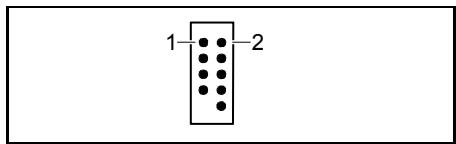
| Code PIN | Signal | Code PIN | Signal |
| 1 | VCC C | 2 | VCC D |
| 3 | Data negative C | 4 | Data negative D |
| 5 | Data positive C | 6 | Data positive D |
| 7 | GND | 8 | GND |
| 9 | Key | 10 | Not connected |
Patch for installed CPU not loaded. Please run the bios flash update diskette.
Available CPUs do not support the same bus frequency - System halted! Memory type mixing detected
Non Fujitsu Siemens Memory Module detected - Warranty void
There are more than 32 RDRAM devices in the system
BIOS update for installed CPU failed
Check date and time settings
CPU mismatch detected
DMA test failed
EISA CMOS not writable
Extended RAM Failed at offset: nnnn
Extended RAM Failed at address line: nnnn
Failing Bits: nnnn
Fail-Safe Timer NMI failed
Multiple-bit ECC error occurred
Memory decreased in size
Memory size found by POST differed from EISA CMOS
Single-bit ECC error occurred
Software NMI failed
System memory exceeds the CPU's caching limit
System RAM Failed at offset: nnnn
Shadow RAM Failed at offset: nnnn
Incorrect Drive A - run SETUP Incorrect Drive B - run SETUP
Invalid System Configuration Data - run configuration utility Press F1 to resume, F2 to Setup
Monitor type does not match CMOS - RUN SETUP
On Board PCI VGA not configured for Bus Master
One or more RDRAM devices are not used
One or more RDRAM devices have bad architecture/timing
One or more RDRAM devices are disabled
Operating system not found
Service Processor not properly installed
Storage Extension Group = xy
Configuration error, x Storage Extensions(s) found, configured are y SE(s).
Device List: k1, k2 ...
System battery is dead - Replace and run SETUP
System Management Configuration changed or Problem occurred
Verify CPU frequency selection in Setup
| ACPI | Advanced Configuration and Power Interface |
| AC'97 | Audio Codec '97 |
| AGP | Accelerated Graphics Port |
| AMR | Audio Modem Riser |
| AOL | Alert On LAN |
| APM | Advanced Power Management |
| ASF | Alert Standard Format |
| ATA | Advanced Technology Attachment |
| BIOS | Basic Input Output System |
| BMC | Baseboard Management Controller |
| CAN | Controller Area Network |
| Unité centrale | Central Processing Unit |
| CNR | Communication Network Riser |
| C-RIMM | Continuity Rambus Inline Memory Module |
| DIMM | Dual Inline Memory Module |
| ECC | Error Correcting Code |
| EEPROM | Electrical Erasable Programmable Read Only Memory |
| FDC | Floppy Disk Controller |
| FIFO | First-In First-Out |
| FSB | Front Side Bus |
| FWH | Firmware Hub |
| GMCH | Graphics and Memory Controller Hub |
| GPA | Graphics Performance Accelerator |
| I²C | Inter Integrated Circuit |
| IAPC | Instantly Available Power Managed Desktop PC Design |
| ICH | I/O Controller Hub |
| IDE | Intelligent Drive Electronics |
| IPSEC | Internet Protocol Security |
| ISA | Industrial Standard Architecture |
| LAN | Local Area Network |
| LSA | LAN Desk Service Agent |
| MCH | Memory Controller Hub |
| MMX | MultiMedia eXtension |
| P64H | PCI64 Hub |
| PCI | Peripheral Component Interconnect |
| PSB | Processor System Bus |
| PXE | Preboot eXecution Environment |
| RAM | Random Access Memory |
| RAMDAC | Random Access Memory Digital Analog Converter |
| RDRAM | Rambus Dynamic Random Access Memory |
| RIMM | Rambus Inline Memory Module |
| RTC | Real-Time Clock |
| SB | Soundblaster |
| SDRAM | Synchronous Dynamic Random Access Memory |
| SGRAM | Synchronous Graphic Random Access Memory |
| SIMD | Streaming Mode Instruction (Single Instruction Multiple Data) |
| SMBus | System Management Bus |
| SVGA | Super Video Graphic Adapter |
| USB | Universal Serial Bus |
| VGA | Video Graphic Adapter |
| WOL | Wake On LAN |