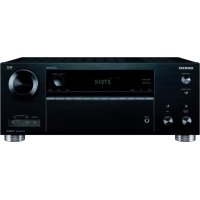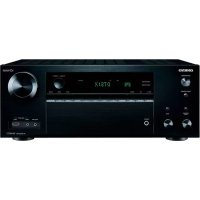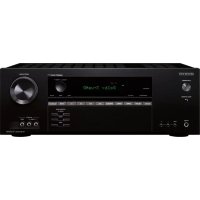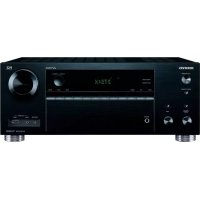
TX-SR573 - AV receiver ONKYO - Free user manual and instructions
Find the device manual for free TX-SR573 ONKYO in PDF.


User questions about TX-SR573 ONKYO
0 question about this device. Answer the ones you know or ask your own.
Ask a new question about this device
Download the instructions for your AV receiver in PDF format for free! Find your manual TX-SR573 - ONKYO and take your electronic device back in hand. On this page are published all the documents necessary for the use of your device. TX-SR573 by ONKYO.
USER MANUAL TX-SR573 ONKYO
Thank you for purchasing an Onkyo AV receiver. Please read this manual thoroughly before making connections and plugging in the unit.
Following the instructions in this manual will enable you to obtain optimum performance and listening enjoyment from your new AV receiver.
Please retain this manual for future reference.
Contents
Introduction 2
Connections 15
Turning On & First Time Setup.... 30
Basic Operation
Playing your AV components.....34
Listening to AM/FM Stations..... 36
Listening to XM Satellite Radio.... 37
Using the Listening Modes 44
Advanced Operation 50
Troubleshooting 59
WARNING:
TO REDUCE THE RISK OF FIRE OR ELECTRIC SHOCK, DO NOT EXPOSE THIS APPARATUS TO RAIN OR MOISTURE.
CAUTION:
TO REDUCE THE RISK OF ELECTRIC SHOCK, DO NOT REMOVE COVER (OR BACK). NO USER-SERVICEABLE PARTS INSIDE. REFER SERVICING TO QUALIFIED SERVICE PERSONNEL.

WARNING
RISK OF ELECTRIC SHOCK
DO NOT OPEN
AVIS
BISQUE DE CHOC ELECTRQUE
NE PAS OUVB

The lightning flash with arrowhead symbol, within an equilateral triangle, is intended to alert the user to the presence of uninsulated "dangerous voltage" within the product's enclosure that may be of sufficient magnitude to constitute a risk of electric shock to persons.

The exclamation point within an equilateral triangle is intended to alert the user to the presence of important operating and maintenance (servicing) instructions in the literature accompanying the appliance.
Important Safety Instructions
-
Read these instructions.
-
Keep these instructions.
-
Heed all warnings.
-
Follow all instructions.
-
Do not use this apparatus near water.
-
Clean only with dry cloth.
-
Do not block any ventilation openings. Install in accordance with the manufacturer's instructions.
-
Do not install near any heat sources such as radiators, heat registers, stoves, or other apparatus (including amplifiers) that produce heat.
-
Do not defeat the safety purpose of the polarized or grounding-type plug. A polarized plug has two blades with one wider than the other. A grounding type plug has two blades and a third grounding prong. The wide blade or the third prong are provided for your safety. If the provided plug does not fit into your outlet, consult an electrician for replacement of the obsolete outlet.
-
Protect the power cord from being walked on or pinched particularly at plugs, convenience receptacles, and the point where they exit from the apparatus.
-
Only use attachments/accessories specified by the manufacturer.
-
Use only with the cart, stand, tripod, bracket, or table specified by the manufacturer, or sold with the apparatus. When a cart is used, use caution when moving the cart/ apparatus combination to avoid injury from tip-over.
PORTABLE CART WARNING

S3125A
-
Unplug this apparatus during lightning storms or when unused for long periods of time.
-
Refer all servicing to qualified service personnel. Servicing is required when the apparatus has been damaged in any way, such as power-supply cord or plug is damaged, liquid has been spilled or objects have fallen into the apparatus, the apparatus has been exposed to rain or moisture, does not operate normally, or has been dropped.
-
Damage Requiring Service
Unplug the apparatus from the wall outlet and refer servicing to qualified service personnel under the following conditions:
A. When the power-supply cord or plug is damaged,
B. If liquid has been spilled, or objects have fallen into the apparatus,
C. If the apparatus has been exposed to rain or water,
D. If the apparatus does not operate normally by following the operating instructions. Adjust only those controls that are covered by the operating instructions as an improper adjustment of other controls may result in damage and will often require extensive work by a qualified technician to restore the apparatus to its normal operation,
E. If the apparatus has been dropped or damaged in any way, and
F. When the apparatus exhibits a distinct change in performance this indicates a need for service.
- Object and Liquid Entry
Never push objects of any kind into the apparatus through openings as they may touch dangerous voltage points or short-out parts that could result in a fire or electric shock.
The apparatus shall not be exposed to dripping or splashing and no objects filled with liquids, such as vases shall be placed on the apparatus.
Don't put candles or other burning objects on top of this unit.
- Batteries
Always consider the environmental issues and follow local regulations when disposing of batteries.
- If you install the apparatus in a built-in installation, such as a bookcase or rack, ensure that there is adequate ventilation.
Leave 20cm (8") of free space at the top and sides and 10cm (4") at the rear. The rear edge of the shelf or board above the apparatus shall be set 10cm (4") away from the rear panel or wall, creating a flue-like gap for warm air to escape.
Precautions
-
Recording Copyright—Unless it's for personal use only, recording copyrighted material is illegal without the permission of the copyright holder.
-
AC Fuse—The AC fuse inside the unit is not user-serviceable. If you cannot turn on the unit, contact your Onkyo dealer.
-
Care—Occasionally you should dust the unit all over with a soft cloth. For stubborn stains, use a soft cloth dampened with a weak solution of mild detergent and water. Dry the unit immediately afterwards with a clean cloth. Don't use abrasive cloths, thinners, alcohol, or other chemical solvents, because they may damage the finish or remove the panel lettering.
4. Power
WARNING
BEFORE PLUGGING IN THE UNIT FOR THE FIRST TIME, READ THE FOLLOWING SECTION CAREFULLY.
AC outlet voltages vary from country to country. Make sure that the voltage in your area meets the voltage requirements printed on the unit's rear panel (e.g., AC 120 V, 60 Hz).
Setting the [STANDBY/ON] switch to STANDBY does not fully shutdown the unit. If you do not intend to use the unit for an extended period, remove the power cord from the AC outlet.
- Never Touch this Unit with Wet Hands—Never handle this unit or its power cord while your hands are wet or damp. If water or any other liquid gets inside this unit, have it checked by your Onkyo dealer.
6. Handling Notes
- If you need to transport this unit, use the original packaging to pack it how it was when you originally bought it.
- Do not leave rubber or plastic items on this unit for a long time, because they may leave marks on the case.
- This unit's top and rear panels may get warm after prolonged use. This is normal.
- If you do not use this unit for a long time, it may not work properly the next time you turn it on, so be sure to use it occasionally.
Memory Backup
The AV receiver uses a battery-less memory backup system in order to retain radio presets and other settings when it's unplugged or in the case of a power failure. Although no batteries are required, the AV receiver must be plugged into an AC outlet in order to charge the backup system. Once it has been charged, the AV receiver will retain the settings for several weeks, although this depends on the environment and will be shorter in humid climates.
For U.S. models
FCC Information for User
CAUTION:
The user changes or modifications not expressly approved by the party responsible for compliance could void the user's authority to operate the equipment.
NOTE:
This equipment has been tested and found to comply with the limits for a Class B digital device, pursuant to Part 15 of the FCC Rules. These limits are designed to provide reasonable protection against harmful interference in a residential installation.
This equipment generates, uses and can radiate radio frequency energy and, if not installed and used in accordance with the instructions, may cause harmful interference to radio communications. However, there is no guarantee that interference will not occur in a particular installation. If this equipment does cause harmful interference to radio or television reception, which can be determined by turning the equipment off and on, the user is encouraged to try to correct the interference by one or more of the following measures:
Reorient or relocate the receiving antenna.
- Increase the separation between the equipment and receiver.
- Connect the equipment into an outlet on a circuit different from that to which the receiver is connected.
- Consult the dealer or an experienced radio/TV technician for help.
For Canadian Models
NOTE: THIS CLASS B DIGITAL APPARATUS COMPLIES WITH CANADIAN ICES-003.
For models having a power cord with a polarized plug: CAUTION: TO PREVENT ELECTRIC SHOCK, MATCH WIDE BLADE OF PLUG TO WIDE SLOT, FULLY INSERT.
Modèle canadien
REMARQUE: CET APPAREIL NUMÉRIQUE DE LA CLASSE B EST CONFORME À LA NORME NMB-003 DU CANADA.
Supplied Accessories
Make sure you have the following accessories:

Remote controller & three batteries (AA/R6)

Indoor FM antenna

AM loop antenna

Speaker cable labels
- In catalogs and on packaging, the letter at the end of the product name indicates the color. Specifications and operation are the same regardless of color.
Features
Amp
7-channel amplifier
- 75 watts per channel min. RMS at 8 , 2 channels driven from 20Hz to 20kHz with no more than 0.08% total harmonic distortion
- WRAT (Wide Range Amplifier Technology)
- Optimum gain volume circuitry
Processing
- Dolby* Digital EX and Dolby Pro Logic IIx
- DTS, DTS-ES Matrix/Discrete, DTS Neo:6, and DTS 96/24 processing*2
- CinemaFILTER function
- Linear PCM 192 kHz/24-bit D/A converters on all channels
- Powerful and highly accurate 32-bit DSP Processing
Audio/Video
- Adjustable crossover (60, 80, 100, 120, 150 Hz)
- HDTV-capable component video (3 inputs, 1 output)
3 S-Video inputs, 2 outputs - 4 assignable digital inputs (3 optical, 1 coaxial)
- Subwoofer pre out
Color-coded multichannel input for use with Super Audio CD and DVD-Audio
A/B speaker drive
Color-coded speaker terminal posts
Tuner
- XM Satellite Radio ^*3 (XM Connect-and-Play antenna accessory required; sold separately)
- 30 AM/FM/XM preset
AM/FM auto tuning
Remote Controller
- Preprogrammed for use with other AV components
- Learning function
Macro function
1. Manufactured under license from Dolby Laboratories. "Dolby", "Pro Logic" and the double-D symbol are registered trademarks of Dolby Laboratories.
2. "DTS," "DTS 96/24," "DTS-ES," and "Neo:6" are trademarks of Digital Theater Systems, Inc.
*3. XM Connect & Play™, XM Ready®, XM Public Radio™ are trademarks of XM Satellite Radio Inc. ©2005 XM Satellite Radio Inc. All rights reserved. All other trademarks are the property of their respective owners.

Apple and iPod are trademarks of Apple Computer, Inc., registered in the U.S. and other countries.
Contents
Introduction
Important Safety Instructions 2
Precautions 3
Supplied Accessories. 4
Features 4
Front & Rear Panels.. 6
Remote Controller. 9
Connection
Connecting Your Speakers 15
Connecting Antenna 18
Connecting Your Components 20
About AV Connections 20
Connecting Audio & Video Signals to the AV Receiver 21
Which Connections Should I Use? 21
TV or Projector 22
DVD player 23
VCR or DVD Recorder for Playback.....24
VCR or DVD Recorder for Recording.....25
Camcorder, Games Console, or Other Device 25
Satellite, Cable, Set-top Box, or Other Video Source. 26
CD Player or Turntable. 27
Cassette, CDR, MiniDisc, or DAT Recorder 28
Connecting Another Component's Power Cord 28
Connecting RI-capable Onkyo Components 29
Connecting the Power Cord 29
Turning On & First Time Setup
Turning On the AV Receiver 30
Turning On & Standby. 30
First Time Setup. 31
Assigning Digital Inputs to Sources 31
Changing the Input Display 31
Speaker Configuration 32
Basic Operation
Playing Your AV Components 34
Basic AV Receiver Operation 34
Using the Multichannel DVD Input 35
Displaying Source Information 35
Listening to the Radio. 36
Listening to AM/FM Stations 36
Listening to XM Satellite Radio 37
Presetting AM/FM Stations & XM Channels 41
Common Functions 42
Setting the Display Brightness 42
Adjusting the Bass & Treble. 42
Muting the AV Receiver 42
Using the Sleep Timer 43
Using Headphones 43
Adjusting Speaker Levels 43
Using the Listening Modes
Using the Listening Modes. 44
Selecting the Listening Modes 44
About the Listening Modes 46
Using the Late Night Function. 48
Using the CinemaFILTER 48
Using the Audio Adjust Settings. 48
Advanced Operation
Recording 50
Recording the Input Source 50
Recording from Different Sources. 50
Advanced Setup 51
Advanced Speaker Settings. 51
Digital Signal Formats. 53
Controlling Other Components. 54
Entering Remote Control Codes. 54
Resetting the Remote Controller. 55
Learning Commands from Other Remote Controllers 57
Using Macros 58
Troubleshooting 59
Specification 62
Front & Rear Panels
Front Panel

The actual front panel has various logos printed on it. They are not shown here for clarity. For detailed information, see the pages in parentheses
① STANDBY/ON button (30)
This button is used to set the AV receiver to On or Standby.
② STANDBY indicator (30)
This indicator lights up when the AV receiver is in Standby mode, and it flashes while a signal is being received from the remote controller.
③ Remote-control sensor (9)
This sensor receives control signals from the remote controller.
④ STEREO button (44)
This button is used to select the Stereo listening mode.
⑤ LISTENING MODE [<]/[▶] buttons (44)
These buttons are used to select the listening modes.
⑥ Display
See "Display" on page 7.
⑦ DISPLAY button (35)
This button is used to display various information about the currently selected input source.
⑧ DIGITAL INPUT button (31)
This button is used to assign the digital inputs and specify the format of digital input signals.
DIMMER button (42)
This button is used to adjust the display brightness.
⑩ MEMORY button (41)
This button is used when storing or deleting radio presets.
TUNING MODE button (36)
This button is used to select the Auto or Manual tuning mode for AM and FM radio.
^12 Arrow/TUNING/PRESET & ENTER buttons
When AM, FM, or XM is selected, the TUNING [▲] [▼] buttons are used to tune the tuner, and the PRESET [▲] [▼] buttons are used to select radio presets (see page 41). When the setup menus are used, they work as arrow buttons and are used to select and set items. The ENTER button is also used with the setup menus.
13 MASTER VOLUME control (34)
This control is used to set the volume of the AV receiver to MIN, 1 through 79, or MAX.
14 PHONES jack (43)
This 1/4-inch phone jack is for connecting a standard pair of stereo headphones for private listening.
15 SPEAKER A & B buttons (34)
These buttons are used to turn speaker sets A and B on or off.
16 TONE, [-] & [+] buttons (42)
These buttons are used to adjust the bass and treble.
17 Input selector buttons (34)
These buttons are used to select the following input sources: MULTI CH, DVD, VIDEO 1,VIDEO 2,VIDEO 3, TAPE, TUNER, or CD.
The [MULTI CH] button selects the multichannel DVD input.
RETURN button
This button is used to return to the previously displayed setup menu.
19 SETUP button
This button is used to access various settings.
20VIDEO3INPUT(25,50)
This input can be used to connect a camcorder, games console, and so on. There are jacks for composite video and analog audio.
Front & Rear Panels—Continued
Display

For detailed information, see the pages in parentheses.
A & B speaker indicators (34)
Indicator A lights up when speaker set A is on. Indicator B lights up when speaker set B is on.
2 MUTING indicator (42)
This indicator flashes when the AV receiver is muted.
3 Source/listening mode indicators (46)
These indicators show the currently selected listening mode and digital audio format.
4 Tuning indicators (36)
TUNED (36): This indicator lights up when the AV receiver is tuned to a radio station or channel.
AUTO (36): For AM and FM radio, this indicator lights up when Auto Tuning is selected, and disappears when Manual Tuning is selected.
MEMORY (41): This indicator lights up when pre-setting radio stations.
FM STEREO (36): This indicator lights up when the AV receiver is tuned to a stereo FM station.
SLEEP indicator (43)
This indicator lights up when the Sleep function has been set.
6 Message area
This area of the display shows various information about the currently selected source.
Front & Rear Panels—Continued
Rear Panel

① DIGITAL IN OPTICAL 1, 2, 3 & COAXIAL
These optical and coaxial jacks can be used to connect a CD or DVD player and other components with digital audio outputs.
(2) COMPONENTVIDEO
A DVD player, TV, or other component that supports component video can be connected here.
③ AM ANTENNA
These push terminals are for connecting an AM antenna.
④ FM ANTENNA
This jack is for connecting an FM antenna.
⑤ MONITOR OUT
The S-Video or composite video output should be connected to a video input on your TV or projector.
⑥ XM ANTENNA
This jack is for connecting an XM antenna, sold separately (see page 37).
⑦ FRONT SPEAKERS B
These push terminals are for connecting speaker set B.
⑧ RI
This RI (Remote Interactive) jack can be connected to the RI jack on another Onkyo component. To use RI, you must make an analog audio connection (RCA) between the AV receiver and the other component, even if they are connected digitally.
Note:
RI can only be used with Onkyo components.
⑨ CD IN
These analog inputs can be used to connect a CD player with analog outputs.
10 TAPE IN/OUT
These analog inputs and outputs can be used to connect a cassette recorder, MiniDisc recorder, or other recorder with analog inputs and outputs.
The VIDEO 1 S-Video, composite video, and audio inputs and outputs can be used to connect a VCR.
The VIDEO 2 S-Video, composite video, and audio inputs can be used to connect another video source (e.g., cable TV, satellite TV, or a set-top box).
DVD IN/MULTI CH INPUT
The FRONT, SURROUND, CENTER, and SUB-WOOFER jacks can be used to connect a component with an analog multichannel audio output, such as a DVD player with a 5.1-channel analog output. The S-Video or composite video input should be connected to a video output on the DVD player.
13 SUBWOOFER PRE OUT
A powered subwoofer can be connected here.
These terminal posts are for connecting speaker set A.
15 AC OUTLET
This switched AC outlet can be used to supply power to another component. The connector type depends on the country in which you purchased your AV receiver.
See pages 15-29 for hookup information.
Remote Controller
Installing the Batteries
1 To open the battery compartment, press the small hollow and slide open the cover.

2 Insert the three supplied batteries (AA/R6) in accordance with the polarity diagram inside the battery compartment.

3 Slide the cover shut.

Notes:
- If the remote controller doesn't work reliably, try replacing the batteries.
- Don't mix new and old batteries or different types of batteries.
- If you intend not to use the remote controller for a long time, remove the batteries to prevent damage from leakage or corrosion.
- Expired batteries should be removed as soon as possible to prevent damage from leakage or corrosion.
Using the Remote Controller
To use the remote controller, point it at the AV receiver's remote control sensor, as shown below.

Notes:
- The remote controller may not work reliably if the AV receiver is subjected to bright light, such as direct sunlight or inverter-type fluorescent lights. Keep this in mind when installing.
- If another remote controller of the same type is used in the same room, or the AV receiver is installed close to equipment that uses infrared rays, the remote controller may not work reliably.
- Don't put anything on top of the remote controller, such as a book or magazine, because a button may be pressed continuously, thereby draining the batteries.
- The remote controller may not work reliably if the AV receiver is installed in a rack behind colored glass doors. Keep this in mind when installing.
- The remote controller will not work if there's an obstacle between it and the AV receiver's remote control sensor.
Remote Controller—Continued
About the Remote Controller Modes
Including the AV receiver, the remote controller can be used to control up to nine different components. The remote controller has a specific operating mode for use with each type of component. Modes are selected by using the eight REMOTE MODE buttons.
RECEIVER/TAPE Mode
In RECEIVER/TAPE mode, you can control the AV receiver and an Onkyo cassette recorder connected via RI.
DVD Mode
By default, you can control an Onkyo DVD player in this mode. By entering the appropriate remote control code, you can control components made by other manufacturers (see page 54).
CD Mode
By default, you can control an Onkyo CD player in this mode. By entering the appropriate remote control code, you can control a CD player, MD player, or CD recorder made by another manufacturer (see page 54).
HDD Mode
This mode is for controlling Onkyo's next generation HDD-compatible components via RI.
TV & VCR Modes
With these modes, you can control a TV and VCR. You must enter the appropriate remote control code first (see page 54).
CABLE/CDR & SAT/MD Modes
In CABLE/CDR mode, you can control an Onkyo CD recorder, or a cable TV receiver. In SAT/MD mode, you can control an Onkyo MD recorder, or a satellite TV receiver. You must enter the appropriate remote control code first (see page 54).
1 Use the REMOTE MODE buttons to select a mode.
2 Use the buttons supported by that mode to control the component.
RECEIVER/TAPE mode: see page 10
DVD mode: see page 12
CD/MD/CDR modes: see page 13
HDD mode: see page 14
TV/VCR/SAT/CABLE modes: see page 56
Note:
Some of the remote controller operations described in this manual may not work as expected with other components.
RECEIVER/TAPE Mode
RECEIVER/TAPE mode is used to control the AV receiver. It can also be used to control an Onkyo cassette recorder connected via RI.
To set the remote controller to RECEIVER/TAPE mode, press the [RECEIVER] REMOTE MODE button.

Remote Controller—Continued
For detailed information, see the pages in parentheses.
① STANDBY button (30)
This button is used to set the AV receiver to Standby.
② ON button (30)
This button is used to turn on the AV receiver.
③ INPUT SELECTOR buttons (34)
These buttons are used to select the input sources.
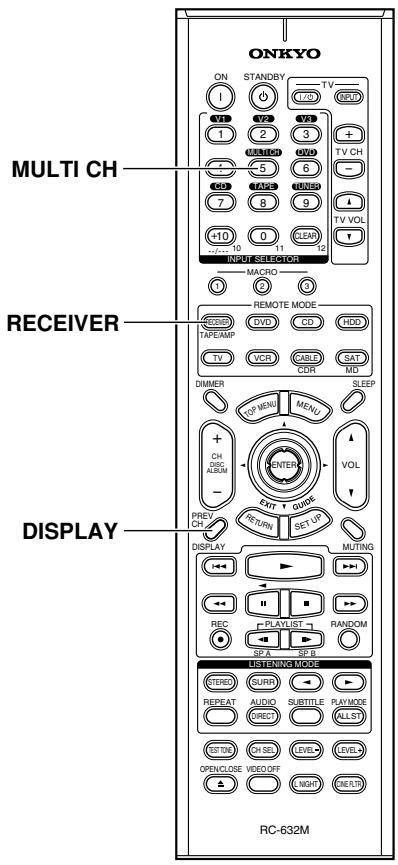
④ MULTI CH button (35)
This button is used to select the multichannel DVD input.
⑤ DIMMER button (42)
This button is used to adjust the display brightness.
⑥ Arrow [▲]/[▼]/[←]/[▶] & ENTER buttons
These buttons are used to select and adjust settings.
⑦ CH +/- button (41)
This button is used to select radio presets.
(8) RETURN button
This button is used to return to the previous display when changing settings.
⑨ DISPLAY button (35)
This button is used to display various information about the currently selected input source.
⑩ LISTENING MODE buttons (44)
These buttons are used to select the listening modes. The [STEREO], [SURR], and LISTENING MODE [] / [] buttons can be used regardless of the currently selected remote controller mode.
STEREO button
This button selects the Stereo listening mode.
SURR button
This button selects the Dolby and DTS listening modes.
LISTENING MODE [▲]按钮
These buttons are used to select the listening modes.
DIRECT button
This button selects the Direct listening mode.
ALL ST button
This button selects the All Channel Stereo listening mode.
TEST TONE, CH SEL, LEVEL- & LEVEL+ buttons (33)
These buttons are used to adjust the level of each speaker.
⑫ MACRO buttons (58)
These buttons are used with the Macro function.
⑬ REMOTE MODE buttons (10)
These buttons are used to select the remote controller modes. When you press a button on the remote controller, the REMOTE MODE button for the currently selected mode lights up.
⑭ SLEEP button (43)
This button is used to set the Sleep function.
15 MENU button (38)
This button is used to select the search mode for XM Satellite Radio.
16 VOL [▲]/[▼] button (34)
This button can be used to adjust the volume of the AV receiver regardless of the currently selected remote controller mode.
⑰ SETUP button
This button is used to access various settings.
18 MUTING button (42)
This button is used to mute the AV receiver.
SP A & SP B buttons (34)
These buttons are used to turn speaker sets A and B on or off.
CINE FLTR button (48)
This button is used to set the CinemaFILTER function.
L NIGHT button (48)
This button is used to set the Late Night function.
TAPE mode
For twin cassette decks, only Deck B can be controlled.
Previous & Next [H<] [/▶] buttons
The Previous [ ] button is used to select the previous track. During playback it selects the beginning of the current track. The Next [ ] button is used to select the next track.
Depending on how it was recorded, the Previous and Next [山 ] / [ ] buttons may not work properly with some cassette tapes.
Play [▶] button
This button is used to start playback.
Rewind & FF [←]/[→] buttons
The Rewind [] button is used to start rewind. The FF [ ] button is used to start fast forward.
Reverse Play [ ] button
This button is used to start reverse playback.
Stop [■] button
This button is used to stop playback.
REC [●] button
This button is used to start recording.
Eject [▲] button
This button is used to eject the cassette tape.
Remote Controller—Continued
DVD Mode
To set the remote controller to DVD mode, press the [DVD] REMOTE MODE button.

① STANDBY button
This button sets the DVD player to Standby.
② ON button
This button is used to turn on the DVD player.
③ Number buttons
These buttons are used to enter title, chapter, and track numbers and to enter times for locating specific points in time.
④ TOP MENU button
This button is used to select a DVD's top menu.
⑤ Arrow [▲]/[▼]/[▲]/[▶] & ENTER buttons
These buttons are used to navigate DVD menus and the DVD player's onscreen setup menus.
⑥ DISC +/- button
This button selects discs on a DVD changer.
⑦ RETURN button
This button is used to exit the DVD player's onscreen setup menu and to restart menu playback.
⑧ DISPLAY button
This button is used to display information about the current disc, title, chapter, or track on the DVD player's display, including the elapsed time, remaining time, total time, and so on.
⑨ Playback buttons
From left to right: Previous, Play, Next, Fast Reverse, Pause, Stop, Fast Forward, Slow Reverse, and Slow Forward.
10 REPEAT button
This button is used to set the repeat playback functions.
⑪ AUDIO button
This button selects foreign language soundtracks and audio formats (e.g., Dolby Digital or DTS).
⑫ OPEN/CLOSE [▲] button
This button is used to open and close the disc tray.
13 CLEAR button
This button is used to cancel functions and to clear entered numbers.
(14) MENU button
This button is used to display a DVD's menu.
15 SETUP button
This button is used to access the DVD player's onscreen setup menus.
16 RANDOM button
This button is used with the random playback function.
⑰ PLAY MODE button
This button is used to select play modes on a component with selectable play modes.
SUBTITLE button
This button is used to select subtitles.
⑲VIDEO OFF button
This button is used to turn off the internal video circuitry, eliminating any possibility of interference.
Remote Controller—Continued
CD, MD & CDR Modes
To control an Onkyo CD player, or a CD/MD recorder made by another manufacturer, press the [CD] REMOTE MODE button to select the CD remote controller mode.
To control an Onkyo MD recorder or CD recorder, press the [MD] or [CDR] REMOTE MODE button to select the MD or CDR remote controller mode.
To control an Onkyo MD recorder or CD recorder, or a component made by another manufacturer, you must first enter the appropriate remote control code (see page 54).

① STANDBY button
This button sets the CD player or MD/CD recorder to Standby.
② ON button
This button is used to set the CD player or MD/CD recorder to On or Standby.
③ Number buttons
These buttons are used to enter track numbers and to enter times for locating specific points in time.
④ Arrow [▲]/[▼]/[▲]/[▶] & ENTER buttons
These buttons can be used with some components.
⑤ DISC +/− button
This button selects discs on a CD changer.
⑥ DISPLAY button
This button is used to display information about the current disc or track on the CD player or MD/CD recorder's display, including the elapsed time, remaining time, total time, and so on.
⑦ Playback buttons
From left to right: Previous, Play, Next, Fast Reverse, Pause, Stop, and Fast Forward.
⑧ REC [●] button
This button is used to start recording on an MD or CD recorder.
⑨ REPEAT button
This button is used to set the repeat playback functions.
10 OPEN/CLOSE [▲] button
This button is used to open and close the disc tray, or eject the MiniDisc.
11 CLEAR button
This button is used to cancel functions and to clear entered numbers.
12 RETURN button
This button can be used with some components.
13 RANDOM button
This button is used with the random playback function.
14 PLAY MODE button
This button is used to select play modes on a component with selectable play modes.
Remote Controller—Continued
HDD Mode
HDD mode is for controlling Onkyo's next generation HDD-compatible components. As of 2005, it can be used with the Onkyo DS-A1 Remote Interactive Dock and Apple iPod connected via RI.
When Using the DS-A1:
- Connect the DS-A1 to the TAPE IN or VIDEO 2 IN jacks.
- Set the DS-A1's RI MODE switch to HDD.
- Set the AV receiver's input display to HDD (see page 31).
Refer to the DS-A1's instruction manual.

① STANDBY button
This button turns off the HDD-compatible component.
② ON button*
This button turns on the HDD-compatible component.
③ Arrow [▲]/[▼] and ENTER buttons*
These buttons are used to navigate menus on the HDD-compatible component.
④ ALBUM + / - button\*
This button selects the next or previous album on the HDD-compatible component.
⑤ DISPLAY button*
This button turns on the backlight for 30 seconds on the HDD-compatible component.
(6) Previous [▶] button
This button restarts the current song on the HDD-compatible component. Press it twice to select the previous song.
⑦ Pause [I] button
This button pauses playback on the HDD-compatible component. (With 3rd generation iPods, it works as a Play/Pause button.)
⑧ Rewind [←] button
Press and hold to rewind the HDD-compatible component.
⑨ PLAYLIST[]buttons\*
These buttons select the previous or next playlist on the HDD-compatible component.
10 REPEAT button*
This button sets the Repeat function to One, All, or Off on the HDD-compatible component.
11 MENU button*
This button is used to navigate menus on the HDD-compatible component.
⑫ Play [▶] button
This button starts playback on the HDD-compatible component. If the component is off, it will turn on automatically. (With 3rd generation iPods, this button works as a Play/Pause button.)
⑬ Next [▶▶] button
This button selects the next song on the HDD-compatible component.
14 Stop [■] button
This button stops playback and displays the menu on the HDD-compatible component.
15 Fast Forward [▶] button
Press and hold to fast forward the HDD-compatible component.
16 RANDOM button*
This button sets the Shuffle function to Songs, Albums, or Off on the HDD-compatible component.
Connecting Your Speakers
About Speakers
You can use two sets of speakers with the AV receiver: speaker set A and speaker set B .
Speaker set A should be installed in your main listening room, and can be used with Dolby Digital and DTS sources. To get the best surround sound experience, each speaker must be positioned at a specific location within the room, as shown in the following illustration. Note that while speaker set B is on, speaker set A is reduced to 5.1-channel playback.
Speaker set B can be installed in another room and positioned like normal stereo speakers or however you like. Speaker set B only outputs sources that are connected to an analog input.
Front left and right speakers
These output the overall sound. Their role in a home theater is to provide a solid anchor for the sound image. They should be positioned facing the listener at about ear level, and equally spaced from the TV. Angle them inward slightly so as to create a triangle, with the listener at the apex.
Center speaker
This speaker enhances the front left and right speakers, making sound movements distinct and providing a full sound image. For movies, it's used mainly for dialog.
Position it close to your TV (preferably on top) facing forward at about ear level, or at the same height as the front left and right speakers.
Subwoofer
The subwoofer handles the bass sounds of the LFE (Low-Frequency Effects) channel. The volume and quality of the bass output from your subwoofer will depend on its position, the shape of your listening room, and
your listening position. In general, a good bass sound can be obtained by installing the subwoofer in a front corner, or at one-third the way along the wall, as shown.

Surround back left and right speakers
These speakers further enhance the realism of surround sound and improve sound localization behind the listener. They are essential to enjoy certain listening modes (i.e., Dolby Digital EX and DTS-ES). Position them behind the listener about 2-3 feet (60 - 100cm) above ear level. Make sure that the listening position is within the range of the speakers.
Surround left and right speakers
These speakers are used for precise sound positioning and to add realistic ambience. Position them at the sides of the listener, or slightly behind, about 2-3 feet (60-100 cm) above ear level. Ideally, they should be equally spaced from the listener.

Connecting Your Speakers—Continued
How Many Speakers?
For the best surround-sound experience, you should connect seven speakers and a powered subwoofer.
The following table shows which channels you should use based on the number of speakers that you have.
| Number of speakers: | 2 | 3 | 4 | 5 | 6 | 7 |
| Front left | ✓ | ✓ | ✓ | ✓ | ✓ | ✓ |
| Front right | ✓ | ✓ | ✓ | ✓ | ✓ | ✓ |
| Center | ✓ | ✓ | ✓ | ✓ | ||
| Surround left | ✓ | ✓ | ✓ | ✓ | ||
| Surround right | ✓ | ✓ | ✓ | ✓ | ||
| Surround back* | ✓ | |||||
| Surround back left | ✓ | |||||
| Surround back right | ✓ |
*If you're using only one surround back speaker, connect it to the left (L) SURROUND BACK SPEAKERS terminals.
No matter how many speakers you use, a powered subwoofer is recommended for a really powerful and solid bass.
Before using the AV receiver, you must specify which speakers are connected and their sizes (see page 32).
To get the very best from your surround-sound system, you should also specify the distance between the listener and each speaker so that the sound from each speaker arrives at the listener's ears at the same time (see page 52). In addition, you should set the volume level of each speaker so that all speakers can be heard equally at the listening position (see page 52.)
Attaching the Speaker Labels
The AV receiver's positive (+) speaker terminals are color-coded for ease of identification. (The negative (-) speaker terminals are all black.)
| Speaker terminal | Color |
| Front left | White |
| Front right | Red |
| Center | Green |
| Surround left | Blue |
| Surround right | Gray |
| Surround back left | Brown |
| Surround back right | Tan |
The supplied speaker labels are also color-coded and you should attach them to the positive (+) side of each speaker cable in accordance with the above table. All you need to do then is to match the color of each label to the corresponding speaker terminal.

Speaker Connection Precautions
Read the following before connecting your speakers:
- You can connect speakers with an impedance of 6 ohms or higher. If you use speakers with a lower impedance, and use the amplifier at high volume levels for a long period of time, the built-in amp-protection circuit may be activated.
- Disconnect the power cord from the wall outlet before making any connections.
- Read the instructions supplied with your speakers.
- Pay close attention to speaker wiring polarity. In other words, connect positive (+) terminals to only positive (+) terminals, and negative (-) terminals to only negative (-) terminals. If you get them the wrong way around, the sound will be out of phase and will sound unnatural.
- Unnecessarily long, or very thin speaker cables may affect the sound quality and should be avoided.
- Be careful not to short the positive and negative wires. Doing so may damage the AV receiver.
- Don't connect more than one cable to each speaker terminal. Doing so may damage the AV receiver.
- Don't connect a speaker to several terminals.


Connecting Your Speakers—Continued
Connecting Speaker Set A
1
Strip 5 / 8'' (15 mm) of insulation from the ends of the speaker cables, and twist the bare wires tightly, as shown.

2
Unscrew the terminal. Fully insert the bare wires. Make sure that the bare wire is touching the inside of the pole. Screw the terminal tight.

Connecting a Powered Subwoofer
Using a suitable cable, connect the AV receiver's SUB-WOOFER PRE OUT to the input on your powered subwoofer. If your subwoofer is unpowered and you're using an external amplifier, connect the SUBWOOFER PRE OUT to the amp's input.
Note:
Make sure the plugs are pushed in all the way.
Connecting Speaker Set B
1
Strip 3/8'' (10 mm) of insulation from the ends of the speaker cables, and twist the bare wires tightly, as shown.

2
While pressing the lever, insert the wire into the hole, and then release the lever.
Make sure that the terminals are gripping the bare wires, not the insulation.

Note:
While speaker set B is on, speaker set A is reduced to 5.1-channel playback.
This hookup diagram shows which speaker should be connected to each pair of terminals.
If you're using only one surround back speaker, connect it to the left (L) SURROUND BACK SPEAKERS terminals.


Connecting Antenna
This section explains how to connect the supplied indoor FM antenna and AM loop antenna, and how to connect commercially available outdoor FM and AM antennas. The AV receiver won't pick up any radio signals without any antenna connected, so you must connect the antenna to use the tuner.

Connecting the Indoor FM Antenna
The supplied indoor FM antenna is for indoor use only.
1

Attach the FM antenna, as shown.
Once your AV receiver is ready for use, you'll need to tune into an FM radio station and adjust the position of the FM antenna to achieve the best possible reception.
2

Use thumbtacks or something similar to fix the FM antenna into position.
Caution: Be careful that you don't injure yourself when using thumbtacks.
If you cannot achieve good reception with the supplied indoor FM antenna, try a commercially available outdoor FM antenna instead (see page 19).
Connecting the AM Loop Antenna
The supplied indoor AM loop antenna is for indoor use only.
1
Assemble the AM loop antenna, inserting the tabs into the base, as shown.

2
Connect both wires of the AM loop antenna to the AM push terminals, as shown.
(The antenna's wires are not polarity sensitive, so they can be connected either way around).
Make sure that the wires are attached securely and that the push terminals are gripping the bare wires, not the insulation.

Once your AV receiver is ready for use, you'll need to tune into an AM radio station and adjust the position of the AM antenna to achieve the best possible reception.
Keep the antenna as far away as possible from your AV receiver, TV, speaker cables, and power cords.
If you cannot achieve good reception with the supplied indoor AM loop antenna, try using it with a commercially available outdoor AM antenna (see page 19).
Connecting Antenna—Continued
Connecting an Outdoor FM Antenna
If you cannot achieve good reception with the supplied indoor FM antenna, try a commercially available outdoor FM antenna instead.

Notes:
- Outdoor FM antennas work best outside, but usable results can sometimes be obtained when installed in an attic or loft.
- For best results, install the outdoor FM antenna well away from tall buildings, preferably with a clear line of sight to your local FM transmitter.
- Outdoor antenna should be located away from possible noise sources, such as neon signs, busy roads, etc.
- For safety reasons, outdoor antenna should be situated well away from power lines and other high-voltage equipment.
- Outdoor antenna must be grounded in accordance with local regulations to prevent electrical shock hazards.
Using a TV/FM Antenna Splitter
It's best not to use the same antenna for both FM and TV reception, as this can cause interference problems. If circumstances demand it, use a TV/FM antenna splitter, as shown.

Connecting an Outdoor AM Antenna
If good reception cannot be achieved using the supplied AM loop antenna, an outdoor AM antenna can be used in addition to the loop antenna, as shown.

Outdoor AM antennas work best when installed horizontally outside, but good results can sometimes be obtained indoors by mounting horizontally above a window. Note that the AM loop antenna should be left connected.
Outdoor antenna must be grounded in accordance with local regulations to prevent electrical shock hazards.
Connecting Your Components
About AV Connections
- Before making any AV connections, read the manuals supplied with your other AV components.
- Don't connect the power cord until you've completed and double-checked all AV connections.
Optical Digital Jacks
The AV receiver's optical digital jacks have shutter-type covers that open when an optical plug is inserted and close when it's removed. Push plugs in all the way.
Caution: To prevent shutter damage, hold the optical plug straight when inserting and removing.
AV Connection Color Coding
RCA-type AV connections are usually color coded: red, white, and yellow. Use red plugs to connect right-channel audio inputs and outputs (typically labeled “R”). Use white plugs to connect left-channel audio inputs and outputs (typically labeled “L”). And use yellow plugs to connect composite video inputs and outputs.

- Push plugs in all the way to make good connections (loose connections can cause noise or malfunctions).
- To prevent interference, keep audio and video cables away from power cords and speaker cables.

AV Cables & Jacks
Video
| Cable | Jack | Description | |
| Component video cable | Y Y P B PR | Y P B PR | Component video separates the luminance (Y) and color difference signals (PR, PB), providing the best picture quality. (Some TV manufacturers label their component video jacks slightly differently.) |
| S-Video cable | S S | S | S-Video separates the luminance and color signals and provides better picture quality than composite video. |
| Composite video cable | S S | S | Composite video is commonly used on TVs, VCRs, and other video equipment. Use only dedicated composite video cables. |
Audio
| Cable | Jack | Description | |
| Optical digital audio cable | OPTICAL | This offers the best sound quality and allows you to enjoy Dolby Digital and DTS. The audio quality is the same as for coaxial. | |
| Coaxial digital audio cable | COAXIAL | This offers the best sound quality and allows you to enjoy Dolby Digital and DTS. The audio quality is the same as for optical. | |
| Analog audio cable (RCA) | L R | This cable carries analog audio. It's the most common connection format for analog audio and can be found on virtually all AV components. | |
| Multichannel analog audio cable (RCA) | FRONT SURROUND CENTER DVD SUB WOOPER | This cable carries multichannel analog audio and is typically used to connect DVD players with a 5.1-channel analog audio output. Several standard analog audio cables can be used instead of a multichannel cable. | |
Connecting Your Components—Continued
Connecting Audio & Video Signals to the AV Receiver
By connecting both the audio and video outputs of your DVD player and other AV components to the AV receiver, you can switch the audio and video signals simultaneously simply by changing the input source on the AV receiver.

Which Connections Should I Use?
The AV receiver supports several connection formats for compatibility with a wide range of AV equipment. The format you choose will depend on the formats supported by your other components. Use the following sections as a guide. For video components, such as a DVD player, you must make an audio connection and a video connection.
Video Connection Formats
Video equipment can be connected to the AV receiver using one of the following video connection formats: composite video, S-Video, or component video, the latter offering the best picture quality.
When choosing a connection format, bear in mind that the AV receiver doesn't convert between formats, so only outputs of the same format as the input will output the signal.
For example, if you connect your DVD player to the S-VIDEO DVD IN, a video signal will be output by the S-VIDEO MONITOR OUT (for your TV) and the S-VIDEO VIDEO 1 OUT (for your VCR), but not by any composite video or component video outputs.

Video Signal Flow Chart
Audio Connection Formats
Audio equipment can be connected to the AV receiver using the following audio connection formats: analog, optical, coaxial, and multichannel.
When choosing a connection format, bear in mind that the AV receiver doesn't convert between formats.
For example, audio signals connected to an OPTICAL or COAXIAL digital input are not output by the analog TAPE OUT, so if you want to record from, for example, your CD player, in addition to connecting it to a digital input, you must also connect it to the analog CD IN.

Audio Signal Flow Chart for Recording
Note:
Speaker set A outputs all input sources. Speaker set B only outputs sources that are connected to an analog input.
Connecting Your Components—Continued
Connecting a TV or Projector
Step 1: Video Connection
Choose a connection that matches your TV (A, B, or C), and then make the connection.

| Connection | AV receiver | Signal flow | TV | Picture quality |
| A | COMPONENT Video OUT | → | Component video input | Best |
| B | MONITOR OUT S | → | S-Video input | Better |
| C | MONITOR OUT V | → | Composite video input | Standard |
Step 2: Audio Connection
Choose a connection that matches your TV (a, b, or c), and then make the connection.

- With connection a, you can listen to and record audio from your TV and listen via speaker set B.
- To enjoy Dolby and DTS listening modes, use connection b or c. (For recording, use a and b, or a and c.)
| Connection | AV receiver | Signal flow | TV |
| a | VIDEO 2 IN L/R | ← | Analog audio L/R output |
| b | DIGITAL IN COAXIAL | ← | Digital coaxial output |
| c | DIGITAL IN OPTICAL 2 | ← | Digital optical output |
Hint!
If your TV has no audio outputs, connect an audio output from your VCR to the AV receiver and use its tuner to listen to TV programs through the AV receiver.
Connecting Your Components—Continued
Connecting a DVD player
Step 1: Video Connection
Choose a connection that matches your DVD player (A, B, or C), and then make the connection.

Your TV must be connected to the AV receiver via the same type of connection.
| Connection | AV receiver | Signal flow | DVD player | Picture quality |
| A | COMPONENT Video DVD IN | ← | Component video output | Best |
| B | DVD IN S | ← | S-Video output | Better |
| C | DVD IN V | ← | Composite video output | Standard |
Step 2: Audio Connection
Choose a connection that matches your DVD player (a, b, c, or d), and then make the connection.

- With connection a, you can listen to and record audio from a DVD and listen via speaker set B.
- To enjoy Dolby and DTS listening modes, use connection b or c. (For recording, use a and b, or a and c.)
- To enjoy DVD-Audio or SACD playback with a compatible player, use connection d.
| Connection | AV receiver | Signal flow | DVD player |
| a | DVD IN FRONT | ← | Analog audio L/R output |
| b | DIGITAL IN COAXIAL | ← | Digital coaxial output |
| c | DIGITAL IN OPTICAL 1 | ← | Digital optical output |
| d | DVD IN FRONT, SURROUND, CENTER, and SUBWOOFER | ← | Analog multichannel output |
- If your DVD player has stereo left and right outputs and multichannel left and right outputs, be sure to use the stereo left and right outputs for connection a.
Connecting Your Components—Continued
Connecting a VCR or DVD Recorder for Playback
In addition to video playback, with this hookup example, you can use your VCR's tuner to listen to your favorite TV programs via the AV receiver. This is useful if your TV has no audio outputs.
Step 1: Video Connection
Choose a connection that matches your VCR or DVD recorder (A, B, or C), and then make the connection. Your TV must be connected to the AV receiver via the same type of connection.

| Connection | AV receiver | Signal flow | VCR or DVD recorder | Picture quality |
| A | COMPONENT VIDEOVIDEO 1 IN | ← | Component video output | Best |
| B | VIDEO 1 IN S | ← | S-Video output | Better |
| C | VIDEO 1 IN V | ← | Composite video output | Standard |
Step 2: Audio Connection
Choose a connection (a,b or c) , and then make the connection.

- With connection a, you can listen to the VCR or DVD recorder, including via speaker set B.
- To enjoy Dolby and DTS listening modes, use connection b or c. (To listen via speaker set B, use a and b, or a and c.)
| Connection | AV receiver | Signal flow | VCR/DVD recorder |
| a | VIDEO 1 IN L/R | ← | Analog audio L/R output |
| b | DIGITAL IN COAXIAL | ← | Digital coaxial output |
| c | DIGITAL IN OPTICAL 2 | ← | Digital optical output |
Connecting Your Components—Continued
Connecting a VCR or DVD Recorder for Recording
Step 1: Choose a video connection that matches your VCR or DVD recorder (A or B), and make the connection. The video source that you want to record must be connected to the AV receiver via the same type of connection.
Step 2: Make audio connection a

| Connection | AV receiver | Signal flow | VCR/DVD recorder | Picture quality |
| A | VIDEO 1 OUT S | → | S-Video input | Better |
| B | VIDEO 1 OUT V | → | Composite video input | Standard |
| a | VIDEO 1 OUT L/R | → | Audio L/R input | — |
Connecting a Camcorder, Games Console, or Other Device
Step 1: Make video connection A
Step 2: Make audio connection a

Camcorder, games console, etc.
| Connection | AV receiver | Signal flow | Camcorder/console |
| A | VIDEO 3 INPUT | ← | Composite video output |
| a | VIDEO 3 INPUT L/R | ← | Analog audio L/R output |
Connecting Your Components—Continued
Connecting a Satellite, Cable, Set-top Box, or Other Video Source
Step 1: Video Connection
Choose a connection that matches the video source (A, B, or C), and then make the connection.

Your TV must be connected to the AV receiver via the same type of connection.
| Connection | AV receiver | Signal flow | Video source | Picture quality |
| A | COMPONENT VIDEOVIDEO 2 IN | ← | Component video output | Best |
| B | VIDEO 2 IN S | ← | S-Video output | Better |
| C | VIDEO 2 IN V | ← | Composite video output | Standard |
Step 2: Audio Connection
Choose a connection that matches the video source (a, b, or c), and then make the connection.

- With connection a, you can listen to and record audio from the video source and listen via speaker set B.
- To enjoy Dolby and DTS listening modes, use connection b or c. (For recording, use a and b, or a and c.)
| Connection | AV receiver | Signal flow | Video source |
| a | VIDEO 2 IN L/R | ← | Analog audio L/R output |
| b | DIGITAL IN COAXIAL | ← | Digital coaxial output |
| c | DIGITAL IN OPTICAL 2 | ← | Digital optical output |
Connecting Your Components—Continued
Connecting a CD Player or Turntable
CD Player or Turntable with Built-in Phono Preamp
Step 1:
Choose a connection that matches your CD player (a, b, or c), and then make the connection. Use connection a for a turntable with a built-in phono preamp.

- With connection a, you can listen to and record from your CD player or turntable and listen via speaker set B.
- To connect the CD player digitally, use connection b or c. (For recording, use a and b, or a and c.)
| Connection | AV receiver | Signal flow | CD or turntable |
| a | CD IN L/R | ← | Analog audio L/R output |
| b | DIGITAL IN COAXIAL | ← | Digital coaxial output |
| c | DIGITAL IN OPTICAL 1 | ← | Digital optical output |
Turntable with no Phono Preamp Built-in
A phono preamp is necessary to connect a turntable that doesn't have a phono preamp built-in.

Turntable with an MC (Moving Coil) Cartridge
An MC head amp and phono preamp are necessary to connect a turntable with an MC (Moving Coil) cartridge.

Connecting Your Components—Continued
Connecting a Cassette, CDR, MiniDisc, or DAT Recorder
Step 1:
Choose a connection that matches the recorder (a, b, or c), and then make the connection.

- With connection a, you can play and record with the recorder and listen via speaker set B.
- To connect the recorder digitally (playback only), use connections a and b, or a and c.
| Connection | AV receiver | Signal flow | Cassette/CDR/MD/DAT recorder |
| a | TAPE IN L/R | ← | Analog audio L/R output |
| TAPE OUT L/R | → | Analog audio L/R input | |
| b | DIGITAL IN COAXIAL | ← | Digital coaxial output |
| c | DIGITAL IN OPTICAL 3 | ← | Digital optical output |
Connecting Another Component's Power Cord
The AV receiver has an AC outlet on its rear panel for connecting the power cord of another AV component. The other component's power switch can then be left in the ON position so that it turns on or off when the AV receiver is set to On or Standby.
Caution:
- Make sure that the capacity of the component that you connect to the AC OUTLET does not exceed the stated capacity (e.g., 120 W).
Note:
- Onkyo components connected via RI should be connected directly to a wall outlet, not the AV receiver's AC OUTLET.

Connecting Your Components—Continued
Connecting R1-capable Onkyo Components
Step 1: Make sure that the Onkyo component is connected to the AV receiver with an analog audio cable (RCA).
Step 2: Make the RI connection.
With RI (Remote Interactive) you can use the following special RI functions:
Auto Power On/Standby
When you start playback on a component connected via RI, if the AV receiver is on Standby, it will automatically turn on and select that component as the input source. Similarly, when the AV receiver is set to Standby, all components connected via RI will also go on Standby. This function will not work with components whose power cord is connected to the AV receiver's AC OUTLET.
Direct Change
When playback is started on a component connected via R1, the AV receiver automatically selects that component as the input source. If your DVD player is connected to the AV receiver's multichannel DVD input, you'll need to press the [MULTI CH] button to hear all channels (page 35), as the Direct Change function only selects the FRONT jacks.
Remote Control
You can use the AV receiver's remote controller to control your other R1-capable Onkyo components, pointing the remote controller at the AV receiver's remote control sensor instead of the component. You must enter the appropriate remote control code first (page 55).
Notes:
- Use only RI cables for RI connections. RI cables are supplied with Onkyo players (DVD, CD, etc.).
- Some components have two RI jacks, you can connect either one to the AV receiver. The other jack is for connecting additional RI-capable components.
- Connect the AV receiver's RI jack only to Onkyo components. Connecting to other manufacturer's components may cause them to malfunction.
- Some components may not support all R1 functions. Refer to the manuals supplied with your other Onkyo components.
- If you connect an Onkyo MD recorder, CD recorder, or next generation HDD-compatible component, you must change the input display (see page 31).

Connecting the Power Cord
- Before connecting the power cord, connect all of your speakers and AV components.
- Connect the AV receiver's power cord to a suitable wall outlet.
- Turning on the AV receiver may cause a momentary power surge that might interfere with other electrical equipment on the same circuit. If this is a problem, plug the AV receiver into a different branch circuit.
Turning On the AV Receiver


Turning On & Standby

AV receiver
Remote controller
or

Press the [STANDBY/ON] button.
Alternatively, press the remote controller's [RECEIVER] button, followed by the [ON] button.
The AV receiver comes on, the display lights up, and the STANDBY indicator goes off.
To turn the AV receiver off, press its [STANDBY/ON] button, or press the remote controller's [STANDBY] button. The AV receiver will enter Standby mode. To prevent any loud surprises when you next turn on the AV receiver, always turn down the volume before you turn it off.
Note:
Pressing the remote controller's [ON] button once will turn on the AV receiver. Pressing it again will turn on any components connected via RI.
Smooth Operation in a Few Easy Steps
To ensure smooth operation, here's a few easy steps to help you configure the AV receiver before you use it for the very first time. These settings only need to be made once.
Have you connected a component to a digital audio input?
If you have, see "Assigning Digital Inputs to Sources" on page 31.

■ Have you connected an Onkyo MD recorder, CD recorder, or next generation HDD-compatible component?
If you have, see "Changing the Input Display" on page 31.

Do the speaker configuration—this is essential!
See "Speaker Configuration" on page 32.

First Time Setup
Assigning Digital Inputs to Sources

To enjoy Dolby Digital and DTS sources, you must connect your DVD player to the AV receiver digitally (coaxial or optical).
With this function, you can assign digital inputs to input sources. If, for example, you connect your DVD player to the DIGITAL IN OPTICAL 1 input (OPT1), you'll need to assign it to the DVD input source, as follows.
Note:
Make sure that components connected digitally are configured to output digital audio. Refer to the relevant manuals.

Press the input selector button for the input source that you want to assign.
(Digital inputs cannot be assigned to the TUNER input source.)

Press the [DIGITAL INPUT] button.
The current assignment appears.


Press the [DIGITAL INPUT] button repeatedly to select COAX, OPT1, OPT2, OPT3, or “- - - - ” (analog).

Changing the Input Display
If you connect an RI-capable Onkyo MiniDisc recorder, CD recorder, or next generation HDD-compatible component to the TAPE IN/OUT or VIDEO 2 IN jacks, for RI to work properly, you must change this setting.
This setting can only be changed on the AV receiver.

iPod photo: If you're using an iPod photo with the DS-A1 Remote Interactive Dock, connect the DS-A1 to the VIDEO 2 IN jackets.

Press the [TAPE] or [VIDEO 2] input selector button so that "TAPE" or "VIDEO 2" appears on the display.
1
VIDEO 2

Press and hold down the [TAPE] or [VIDEO 2] input selector button (about 3 seconds) to change the setting.
Repeat this step to select MD, CDR, or HDD.
For the TAPE input selector, the setting changes in this order:
TAPE MD CDR HDD

For the VIDEO 2 input selector, the setting changes in this order:
VIDEO 2 HDD
Note:
HDD can be selected for the TAPE input selector or VIDEO 2 input selector, but not both at the same time.
First Time Setup—Continued

Speaker Configuration
This section explains how to specify your speaker configuration.
For speakers with a cone diameter larger than 6-1/2 inches (16 cm), specify Large. For those with a smaller diameter, specify Small.

Cone diameter
1

Press the [RECEIVER] button, followed by the [SETUP] button.
2

Use the Up and Down [ ] / [ ] buttons to select "1. Speaker Config," and then press the [ENTER] button.
- SpeakerContig
3

While the "Subwoofer" setting is selected, use the Left and Right [<] [/>] buttons to select Yes or No.
Yes: Select if a subwoofer is connected.
No: Select if no subwoofer is connected.
4

Use the Down [▼] button to select "Front," and then use the Left and Right [▲]/[▶] buttons to select Small or Large.
Small: Select if the front speakers are small.
Large: Select if the front speakers are large.
Note:
- If the Subwoofer setting in step 3 is set to No, this setting is fixed at Large and does not appear.
5

Use the Down [▼] button to select "Center," and then use the Left and Right [▲]/[▶] buttons to select Small, Large, or None.
Small: Select if the center speaker is small.
Large: Select if the center speaker is large.
None: Select if no center speaker is connected.
Note:
- If the Front setting in step 4 is set to Small, the Large option cannot be selected.
First Time Setup—Continued

Use the Down [▼] button to select "Surround," and then use the Left and Right [▲]/[▶] buttons to select Small, Large, or None.
Small: Select if the surround speakers are small.
Large: Select if the surround speakers are large.
None: Select if no surround speakers are connected.
Note:
- If the Front setting in step 4 is set to Small, the Large option cannot be selected.

Use the Down [▼] button to select "Surr Back," and use the Left and Right [▲]/[▶] buttons to select Small, Large, or None.
Small: Select if the surround back speakers are small.
Large: Select if the surround back speakers are large.
None: Select if no surround back speakers are connected.
Notes:
- If the Surround setting in step 6 is set to None, this setting does not appear.
- If the Surround setting in step 6 is set to Small, the Large option cannot be selected.

Use the Down [▼] button to select "Surr Back Ch," and use the Left and Right [▲]/[▶] buttons to select 2ch or 1ch.
2ch: Select if two (left and right) surround back speakers are connected.
1ch: Select if one surround back speaker is connected.
Note:
- If the Surround and Surr Back settings in steps 6 and 7 are set to None, this setting does not appear.

Press the [SETUP] button.
Speaker configuration is complete.
Testing the Speakers
To make sure that all of the speakers are working properly, press the remote controller's [TEST TONE] button. A test tone will be output by each speaker in turn and the name of each speaker will appear on the display. To turn off the test tone, press the [TEST TONE] button again.
- If the test tone is not produced by a speaker, or it's produced by a speaker other than the one shown on the display, you may have wired it incorrectly and should check your connections (see page 17).
- If the test tone is not produced by a speaker, and its name does not appear on the display, check the speaker configuration (see page 32).
Playing Your AV Components
Basic AV Receiver Operation


| 1 AV receiver Remote controller RECEIVER VIDEO 1 VCR TAPES TUNER 1 2 3 VIDEOS 6 7 8 9 On the remote controller, the [V1], [V2], and [V3] buttons select the VIDEO 1, VIDEO 2, and VIDEO 3 input sources respectively. | Use the AV receiver's input selector buttons to select the input source. To select the input source with the remote controller, press the [RECEIVER] REMOTE MODE button, and then use the INPUT SELECTOR buttons. On the remote controller, the [V1], [V2], and [V3] buttons select the VIDEO 1, VIDEO 2, and VIDEO 3 input sources respectively. | |
| 2 AV receiver Remote controller A SPEAKERS B SP A SP B To turn the speakers on or off, use the AV receiver's SPEAKERS [A] and [B] buttons, or use the remote controller's [SP A] and [SP B] buttons. The A and B speaker indicators show whether each speaker set is on or off. Note that while speaker set B is on, speaker set A is reduced to 5.1-channel playback. | A B Indicators | |
| 3 Start playback on the source component. To watch a DVD or other video source, on your TV, select the video input that's con- nected to the AV receiver's MONITOR OUT jack. | ||
| 4 AV receiver Remote controller MASTER VOLUME VOL To adjust the volume, use the MASTER VOLUME control, or the remote controller's [VOL] button. The volume can be set to MIN, 1 through 79, or MAX. Since the AV receiver is designed for home theaters, it has a wide volume range for precise adjustment. | ||
| 5 Select a listening mode and enjoy! See “Using the Listening Modes” on page 44. | ||
Playing Your AV Components—Continued
Using the Multichannel DVD Input
The multichannel DVD input is for connecting a component with a 5.1-channel analog audio output, such as a DVD-Audio or SACD-capable DVD player, or an MPEG decoder. See page 23 for hookup information.

Press the [RECEIVER] REMOTE MODE button, followed by the [MULTI CH] button.
The MULTI CH indicator appears on the display.
![ONKYO TX-SR573 - Press the [RECEIVER] REMOTE MODE button, followed by the [MULTI CH] button. - 1](/content/2025/01/151845/images/c4f79d8d8f3db11083a4cac3f544f544a7c37052978a0aedaf30ce4b95aaca9d.jpg)
Audio from the multichannel DVD input will now be used for the DVD input source.
Note:
- While the multichannel DVD input is selected, the Speaker Configuration settings on page 32 are ignored, and signals from the multichannel DVD input are fed to the front left, front right, center, surround left, and surround right speakers, and subwoofer as they are.
Displaying Source Information
You can display various information about the current input source as follows.

Press the [RECEIVER] REMOTE MODE button, and then press the [DISPLAY] button repeatedly to cycle through the available information.
The following information can typically be displayed:

*If the input signal is analog, no format information is displayed. If the input signal is PCM, the sampling frequency is displayed. If the input signal is digital but not PCM, the signal format is displayed. Information is displayed for about 3 seconds, then the previous display reappears.
Interpreting Surround Channel Information
$$ \begin{array}{c c c} \hline \text {三} & \text {二} & \text {二} \ \hline A & B & C \end{array} $$
A: The number of front channels (front left, front right, and center).
B: The number of surround channels (surround left and surround right). If there's surround back channel information, this number will be 3.
C: LFE channel for subwoofer (1 means yes).

Listening to the Radio
Listening to AM/FM Stations

With the built-in tuner, you can enjoy AM and FM radio stations, and store your favorite stations as presets for easy selection.
1

Use the [TUNER] input selector button to select AM or FM.
In this example, FM has been selected.

Band
Frequency
(Actual display depends on country.)
Tuning into AM/FM Radio Stations
Auto Tuning Mode
1
UNING MODE

Press the [TUNING MODE] button so that the AUTO indicator appears on the display.
2

Press the TUNING Up or Down [] / [] button.
Searching stops when a station is found.
When tuned into a station, the TUNED indicator appears. When tuned into a stereo FM station, the FM STEREO indicator also appears.

Manual Tuning Mode
1
NING MODE

Press the [TUNING MODE] button so that the AUTO indicator disappears from the display.
2

Press and hold the TUNING Up or Down [] / [] button.
The frequency stops changing when you release the button.
Press the buttons repeatedly to change the frequency one step at a time.
The American model changes FM frequency in 0.2MHz steps, 10kHz steps for AM.
In Manual Tuning mode, FM stations will be in mono.
Tuning into Weak FM Stereo Stations
If the signal from a stereo FM station is weak, it may be impossible to get good reception. In this case, switch to Manual Tuning mode and listen to the station in mono.
Displaying AM/FM Radio Information


Press the [DISPLAY] button repeatedly to cycle through the available information.
Band, frequency, and preset #

Listening mode


Listening to the Radio—Continued
Listening to XM Satellite Radio®
What's XM Satellite Radio?
There is a world beyond AM and FM. It is XM Satellite Radio. XM offers more than 150 digital channels of audio entertainment, including 100% commercial-free music channels, in the top markets in the U.S.
Note: An XM Connect-and-PlayTM antenna and monthly subscription are required to receive XM Satellite Radio. Visit www.xmradio.com for details.
Note:
Hardware and required basic monthly subscription sold separately. Premium Channels available at additional monthly cost. Installation costs and other fees and taxes, including a one-time activation fee may apply. Subscription fee is consumer only. All fees and programming subject to change. Channels with frequent explicit language are indicated with an XL. Channel blocking is available for XM radio receivers by calling 1-800-XMRADIO. Subscriptions subject to Customer Agreement available at xmradio.com. Only available in the 48 contiguous United States.
A warning against reverse engineering:
It is prohibited to copy, decompile, disassemble, reverse engineer, or manipulate any technology incorporated in receivers compatible with the XM Satellite Radio system. Furthermore, the AMBE® voice compression software included in this product is protected by intellectual property rights including patent rights, copyrights, and trade secrets of Digital Voice Systems, Inc. The user of this or any other software contained in an XM Radio is explicitly prohibited from attempting to copy, decompile, reverse engineer, or disassemble the object code, or in any other way convert the object code into human-readable form. The software is licensed solely for use within this product.
Connecting the XM Antenna
The XM antenna is sold separately. You can purchase the XM Connect-and-Play antenna from the XM Web site at: http://www.xmradio.com
Connect the Connect-and-Play antenna to the XM antenna jack on the rear panel.

Put the XM antenna by a southerly facing window, with nothing obstructing its path to the sky.
Signing Up for XM Satellite Radio
Before you can use XM Satellite Radio, you must first sign up for an account. You'll need a major credit card and your XM Satellite Radio ID, which you can get from the AV receiver, as explained below, or from the Connect-and-Play package and itself.


Press the [TUNER] input selector button repeatedly to select XM.
If "CHECK ANTENNA" appears on the display, make sure the XM antenna is connected properly.

Use the TUNING Up and Down [▲]/[▼] buttons to select channel 0.
Your XM Satellite Radio ID number is displayed. Write it below.
ID
3
To sign up, go to:
http://activate.xmradio.com
Or call: 1-800-967-2346
Notes:
- Channel 0 cannot be selected in Category Search mode. You must select Channel Search mode (see page 38).
The following letters are not used in XM Satellite Radio IDs: I, O, S, F.
Listening to the Radio—Continued
Selecting XM Radio Channels
There are two modes for selecting XM radio channels: Channel Search mode, which allows you to select any channel.
Category Search mode, which allows you to select channels by category.

■ Channel Search Mode

Press the [RECEIVER] REMOTE MODE button, and then press the [TUNER] INPUT SELECTOR button repeatedly to select XM.
If "CHECK ANTENNA" appears on the display, make sure the XM antenna is connected properly.

Press the [MENU] button to select "Channel Search" mode.
Channel Search

Use the Up and Down [▲]/[▼] buttons to select a channel.
050 The Left Channel number Channe
You can also use the Left and Right [] / [] buttons to select a category.
Note:
Channels cannot be selected while the indicator is flashing, as tuning is in progress.
Category Search Mode

Press the [RECEIVER] REMOTE MODE button, and then press the [TUNER] INPUT SELECTOR button repeatedly to select XM.
If "CHECK ANTENNA" appears on the display, make sure the XM antenna is connected properly.

Press the [MENU] button to select "Category Search" mode.
Cteeg

Use the Left and Right [] / [] buttons to select a category, and use the Up and Down [] / [] buttons to select a channel in that category.
Note:
Channels cannot be selected while the indicator is flashing, as tuning is in progress.
Selecting the Previous Channel:
To listen to the previously selected XM channel.

Press the [RECEIVER] REMOTE MODE button, followed by the [RETURN] button.
You can also use the AV receiver's [RETURN] button.
Listening to the Radio—Continued

Selecting XM Channels from the Front Panel:
| 1 TUNER | Press the [TUNER] input selector button repeatedly to select XM. If “CHECK ANTENNA” appears on the display, make sure the XM antenna is connected properly. |
| 2 TUNING: PRESET | Use the TUNING Up and Down [▲]/[▼] buttons to select a channel. In Channel Search mode, you can select any channel. In Category Search mode, you can only select channels from the currently selected category. |
Displaying XM Radio Information
| 1 AV receiver DISPLAY Remote controller (RECEIVER) ↓ DISPLAY | On the AV receiver, press the [DISPLAY] button repeatedly to cycle through the available information. |
| On the remote controller, press the [RECEIVER] REMOTE MODE button, and then press the [DISPLAY] button repeatedly. |

The following information can be displayed:
| Channel name | XM The Loft |
| Channel number & preset number | XM 050 5 |
| Category | CAT >Rock |
| Artist | NAME>Goldenplay |
| Song title | TITLE>Clocks |
| Listening mode | XM Stereo |
Note:
If the category, artist, or song title is not available, "---" will be displayed instead.
Listening to the Radio—Continued

Positioning the XM Antenna
You can check the signal strength of the XM radio signal and adjust the position of the XM antenna accordingly.
| 1 | On the AV receiver, press the [SETUP] button. |
| 2 | Use the Up and Down [▲]/[▼] buttons to select “5. XM Setup,” and then press the [ENTER] but- ton. |
| 5. XM Setup | |
| 3 | Adjust the position of the XM antenna so that the signal strength is at least 70%. |
| Signal 100% The signal level range is 0% to 100%. |
Note:
If the signal level is 0% , make sure that the XM antenna is connected properly.
XM Radio Messages
The following messages may appear while using XM radio.
CHECK ANTENNA
The XM antenna is not connected properly. Check the antenna.
UPDATING
The XM user encryption code is being updated. Please wait.
NO SIGNAL
The signal is too weak. Check the antenna connection and reposition it for the best reception.
LOADING
The AV receiver is tuning or decoding audio or text data. Please wait.
OFF HIER
The XM channel you selected is not currently broadcasting. Select another channel.
Listening to the Radio—Continued

Presetting AM/FM Stations & XM Channels
You can store a combination of up to 30 of your favorite AM/FM radio stations and XM channels as presets.
| 1 | Tune into the AM/FM station or XM channel that you want to store as a preset. |
| 2 | Press the [MEMORY] button. The MEMORY indicator appears and the preset number flashes. |
| 3 | While the MEMORY indicator is displayed (about 8 seconds), use the PRESET [▲]/[►] buttons to select a preset from 1 through 30. |
| 4 | Press the [MEMORY] button again to store the station or channel. The station or channel is stored and the preset number stops flashing. Repeat this procedure for all of your favorite AM/FM radio stations and XM channels. |

Selecting Presets


Deleting Presets
| 1 | Select the preset that you want to delete. See the previous section. |
| 2 MEMORY TUNING MODE | While holding down the [MEM-ORY] button, press the [TUNING MODE] button. The preset is deleted and its number disappears from the display. |
Common Functions
This chapter explains functions that can be used with any input source.


Setting the Display Brightness
You can adjust the brightness of the display.

Press the remote controller's [DIMMER] button repeatedly to select: dim, dimmer, or normal brightness.
Alternatively, you can use the AV receiver's [DIMMER] button.
Adjusting the Bass & Treble
You can adjust the bass and treble for the front speakers (except when the Direct listening mode is selected).

Press the AV receiver's [TONE] button repeatedly to select either Bass or Treble.

Use the TONE [-]/[+] buttons to adjust.
Bass
You can boost or cut low-frequency sounds output by the front speakers from -10dB to +10dB in 2 dB steps.
Treble
You can boost or cut high-frequency sounds output by the front speakers from -10dB to +10dB in 2 dB steps.
Note:
- To bypass the bass and treble tone circuits, select the Direct listening mode.
Muting the AV Receiver
You can temporarily mute the output of the AV receiver.

Press the remote controller's [MUTING] button.
The output is muted and the MUTING indicator flashes on the display.

To unmute the AV receiver, press the remote controller's [MUTING] button again, or adjust the volume. The output is unmuted and the MUTING indicator goes off. Muting is cancelled when the AV receiver is set to Standby.
Common Functions—Continued
Using the Sleep Timer
With the sleep timer, you can set the AV receiver so that it turns off automatically after a specified period.

Press the remote controller's [SLEEP] button repeatedly to select the required sleep time.
You can set the sleep time from 90 to 10 minutes in 10 minute steps.
The SLEEP indicator appears on the display when the sleep timer has been set, as shown. The specified sleep time appears on the display for about 5 seconds, then the previous display reappears.
SLEEP indicator
![ONKYO TX-SR573 - Press the remote controller's [SLEEP] button repeatedly to select the required sleep time. - 1](/content/2025/01/151845/images/4c9ec05a806bb8c918e0c04daddc9cc5e7c6a1754c4307a7730d04d30c4dd383.jpg)
To cancel the sleep timer, press the [SLEEP] button repeatedly until the SLEEP indicator disappears.
To check the remaining sleep time, press the [SLEEP] button. Note that if you press the [SLEEP] button while the sleep time is being displayed, you'll shorten the sleep time by 10 minutes.
Using Headphones
For private listening, you can connect a pair of stereo headphones (1/4-inch phone plug) to the AV receiver's PHONES jack.

Notes:
- Always turn down the volume before connecting your headphones.
- Speaker sets A and B are turned off while the headphones plug is inserted in the PHONES jack.
- When you connect a pair of headphones, the listening mode is set to Stereo, unless it was set to Mono, Stereo, or Direct, in which case it stays the same.
- When the multichannel DVD input is selected, only the front left and front right channels can be heard in the headphones.
Adjusting Speaker Levels
You can adjust the volume of each speaker in speaker set A. These temporary adjustments are cancelled when the AV receiver is set to Standby.

Use the remote controller's [CH SEL] button to select each speaker, and use the [LEVEL-] and [LEVEL+] buttons to adjust the volume.
You can adjust the volume of each speaker from -12dB to +12dB (-15dB to +12dB for the subwoofer).

Notes:
- You cannot use this function while the AV receiver is muted.
- Speakers that are set to No or None in the Speaker Configuration cannot be adjusted.
Speaker Set B
While speaker set B is on, you can adjust the volume of the left and right speakers, from -12dB to +12dB .
- These settings are stored when the AV receiver is set to Standby.
While speaker set B is on, you cannot adjust the levels of speaker set A's surround back speakers.
Headphones
While a pair of headphones is connected, you can adjust the volume of each headphone speaker, from -12dB to +12dB each.

- These settings are stored when the AV receiver is set to Standby.
Multichannel DVD Input
While the multichannel DVD input is selected, you can adjust the level of each channel, from -12dB to +12dB (-30 to +12dB for the subwoofer.)
- These settings are stored when the AV receiver is set to Standby.
- Individual speaker levels can also be adjusted in "3. MultiLevel" (see page 53).
Using the Listening Modes
Selecting the Listening Modes
For a description of each listening mode, see "About the Listening Modes" on page 46.
- The Dolby Digital and DTS listening modes can only be selected if your DVD player is connected to the AV receiver with a digital audio connection (coaxial or optical).
- Listening mode availability depends on the format of the current input signal.
- While a pair of headphones is connected, you can only select the Mono, Direct, or Stereo listening mode.

Selecting on the AV receiver
[STEREO] button
This button selects the Stereo listening mode.
■ LISTENING MODE [<]按钮
Pressing these buttons repeatedly cycles through all of the listening modes that can be used with the current input source.

Selecting with the Remote Controller
[SURR] button
This button selects the Dolby Digital and DTS listening modes.
[STEREO] button
This button selects the Stereo listening mode.
[DIRECT] button
This button selects the Direct listening mode.
LISTENING MODE [<]按钮
Pressing these buttons repeatedly cycles through all of the listening modes that can be used with the current input source.
[ALL ST] button
This button selects the All Channel Stereo listening mode.
Using the Listening Modes—Continued
The following table shows which listening modes can be used with each input signal format.
| Source Format Listening mode | Analog, PCM*1 | Dolby D | DTS/DTS 96/24*2 | Multich | ||||||
| 3/2.1 2/2.1 | 2/0 (Stereo) | 1/0,1+1 | Other | 3/2.1 | 2/0 (Stereo) | DTS-ES | ||||
| Discrete | Matrix | |||||||||
| CD, TV, VHS, MD, turntable, radio, cassette, DTV, etc. | DVD, DTV, etc. | DVD, CD, etc. | DVD | |||||||
| Direct | ✓ | ✓ | ✓ | ✓ | ✓ | ✓ | ✓ | ✓ | ✓ | |
| Stereo Mono | ✓ | ✓ | ✓ | ✓ | ✓ | ✓ | ✓ | ✓ | ||
| Multich | ✓ | |||||||||
| PLIIx Movie/Music/Game *3 Neo:6 Cinema Neo:6 Music *4 | ✓ | ✓ | ✓ | |||||||
| Dolby | Dolby D | ✓ | ✓ | |||||||
| Dolby D EX Dolby D+PLIIx Music | ✓ | |||||||||
| Dolby D+PLIIx Movie | ✓ | |||||||||
| DTS | DTS, DTS 96/24 | ✓ | ✓*5 | |||||||
| DTS-ES Discrete | ✓ | |||||||||
| DTS-ES Matrix | ✓ | |||||||||
| DTS+Neo:6 DTS+Dolby EX DTS+PLIIx Music | ✓ | |||||||||
| DTS+PLIIx Movie | ✓ | |||||||||
| Onkyo Original DSP | Mono Movie Orchestra Unplugged Studio-Mix TV Logic All Ch Stereo Full Mono | ✓ | ✓ | ✓ | ✓ | ✓ | ✓ | ✓ | ✓ | |
1. In the Direct listening mode, PCM signals at 32kHz,44.1kHz ,and 48kHz are processed at 64kHz,88.2kHz ,and 96kHz respectively. For listening modes other than Direct and Stereo, 96kHz signals are processed at 48kHz .
2. In the Direct, Stereo, and DTS 96/24 listening modes, signals are processed as DTS 96/24. Everything else is processed as DTS.
3. If the Surr Back parameter is set to None, or speaker set B is on, PLII is used.
4. Available only when Surround speakers are connected.
*5. If the Surr Back setting is set to None, or speaker set B is on, DTS is used.
: Not available when the Surr Back parameter is set to None, or while speaker set B is on.
: Not available when the Surr Back parameter is set to None or 1ch, or while speaker set B is on.
Tip: To check the format of the digital input signal, see "Displaying Source Information" on page 35.
Using the Listening Modes—Continued
About the Listening Modes
With its surround-sound decoders and DSP modes, the AV receiver can transform your home listening room into a movie theater or concert hall.
The AV receiver's surround indicators show which speakers are active in each listening mode.
Front left
left Center
Front right


Surround
nd Surround
1

surround
right
Direct
In this mode, the input source is output as it is, with minimal processing for a faithful sound. The bass and treble functions are bypassed.
Stereo

In this mode, the input source is output by the front left and right speakers and subwoofer.
Mono

Use this mode when watching an old movie with a mono soundtrack, or to select the foreign language soundtracks recorded in the left and right channels of some movies. It can also be used with DVDs or other sources containing multiplexed audio, such as karaoke DVDs.
Dolby Pro Logic II Movie

Use this mode with DVDs and videos that bear the Dolby Surround

logo, or TV shows that feature Dolby Surround. You can also use it to create 5.1 surround from stereo movies and TV shows.
Dolby Pro Logic II Music

Use this mode to create 5.1 surround from stereo music sources, such as CDs and DVDs.
Dolby Pro Logic IIx

If you've connected surround back speakers to the AV receiver, Dolby Pro Logic IIx can create 7.1 surround from stereo music or 5.1 movies. Dolby Pro Logic IIx offers a well defined, natural multichannel surround-sound experience, putting the listener in a seamless envelope of sound. The added drama and natural sound enhances the listening experience with music, movies, and games.
Dolby Pro Logic IIx has three modes of operation: Movie mode for watching movies, Music mode for listening to music, and Game mode for playing games on a games console with stereo outputs.
Dolby Digital

With Dolby Digital, you can experience the same thrilling sound that you get at a movie theater or concert hall. Use this mo that bear the Dolby Digital logo.

DIGITAL
Dolby Digital EX

Dolby Digital EX includes a surroundback channel, for 6.1 surround. It offers a heightened sense of space, and added real

DIGITAL
ism with moving sounds, especially those that move 360 degrees or fly overhead. Dolby Digital EX can also be enjoyed on a 5.1 system, in which case the surroundback channel sound is split between the surround left and surround right speakers. Use this mode with DVDs that feature 5.1 and bear the Dolby Digital logo.
DTS

This format offers a surround sound experience with exceptional fidelity. It offers six discrete channels for 5.1 surround, and uses less compression for a truly faithful sound.

You'll need a DTS-capable DVD player to enjoy DTS material. Use this mode with DVDs and CDs that bear the DTS logo.
DTS 96/24
This mode offers very high audio quality. Use it with CDs and DVDs that bear the DTS 96/24 logo.

DTS-ES Discrete

This is DTS with an added surround back channel for 6.1 surround. With the addi

tional surround back channel, it offers seven independent digital channels, providing a real sense of movement and space. Use it with CDs and DVDs that feature DTS 6.1 and bear the DTS-ES logo.
DTS-ES Matrix

This is DTS with a surround back channel for 6.1 surround. Use it to create 6.1 sur

round from DTS 5.1 material. Since DTS 5.1 material already contains surround back channel information, the back channel can be reconstructed for real 6.1 surround. Use this mode with CDs and DVDs that bear the DTS-ES.
Neo:6

This mode creates 6.1 surround from stereo sources. It offers six full-bandwidth channels and excellent separation. There are two modes of operation: Cinema mode for watching movies, and Music mode for listening to music.
Cinema mode simulates the realistic sense of movement that you get with 6.1 surround. Use it with videos, DVDs, and TV shows that feature stereo sound.
Music mode uses the surround channels to simulate a natural sound field, something that cannot be done with conventional stereo. Use it with stereo sources and music CDs.
Using the Listening Modes—Continued
Onkyo Original DSP Modes
Mono Movie

Suitable for old movies and other mono sources. The center speaker outputs the sound as it is, while reverb is applied to the sound output by the other speakers, providing presence.
Orchestra

Suitable for classical or operatic music. The surround channels are emphasized in order to widen the stereo image. In addition, it simulates the natural reverberation of a large hall.
Unplugged

Suitable for acoustic instrument sounds, vocals, and jazz music. By emphasizing the front stereo image, it simulates the experience of being right in front of the stage.
Studio-Mix

Suitable for rock and pop music. Listening to music in this mode creates a lively sound field with a powerful acoustic image, like being at a club or rock concert.
TV Logic

Adds realistic acoustics to TV shows produced in a TV studio. In addition, it adds surround effects to the entire sound and adds clarity to voices.
All Ch Stereo

Ideal for background music. The front, surround, and surround back channels create a stereo image that fills the entire listening area.
Full Mono

All speakers output mono audio, so the music sounds the same regardless of where you are.
Using the Listening Modes—Continued

Using the Late Night Function (Dolby Digital only)
With the Late Night function, you can reduce the dynamic range of Dolby Digital material so that you can still hear quiet parts even when listening at low volume levels—ideal for watching movies late at night when you don't want to disturb anyone.

1
Press the [RECEIVER] REMOTE MODE button, and then press the [L NIGHT] button repeatedly to select:
Off: Late Night function off.
Low: Small reduction in dynamic range.
High: Big reduction in dynamic range.
Notes:
- The effect of the Late Night function depends on the Dolby Digital material that you are playing, and with some material there will be little or no effect.
- The Late Night function is set to Off when the AV receiver is set to Standby.
Using the CinemaFILTER
With the CinemaFILTER, you can soften overly bright movie soundtracks, which are typically mixed for reproduction in a movie theater.
CinemaFILTER can be used with the following listening modes: Dolby Digital, Dolby Digital EX, Dolby Pro Logic II Movie, Dolby Pro Logic IIx Movie, DTS, DTS-ES, DTS Neo:6 Cinema, DTS 96/24, DTS+Neo:6, and DTS+Dolby EX.

Press the [RECEIVER] REMOTE MODE button, and then press the [CINE FLTR] button repeatedly to select:
On: CinemaFILTER on.
Off: CinemaFILTER off.
Using the Audio Adjust Settings
The Audio Adjust settings only affect speaker set A.

Press the [RECEIVER] REMOTE MODE button, followed by the [SETUP] button.

Use the Up and Down [ ] / [ ] buttons to select "4. Audio Adjust," and then press the [ENTER] button.
- Hulick O. Halldus t
Using the Listening Modes—Continued

Use the Left and Right [] / [] buttons to change the setting. Press the Down [▼] button to select the next setting.
4
Repeat step 3 for the other settings.

Press the [SETUP] button. Setup closes.
The Audio Adjust settings are explained below.
Input Channel Settings
Multiplex
This setting determines which channel is output from a stereo multiplex source. Use it to select audio channels or languages with multiplex sources, multilingual TV broadcasts, and so on.
Main: The main channel is output (default).
Sub: The sub channel is output.
M/S: Both the main and sub channels are output.
Mono (2ch)
This setting determines which channel is output when the Mono listening mode is used with a stereo source.
L + R : Both the left and right channels are output (default).
L: Only the left channel is output.
R: Only the right channel is output.
PL II & PL IIx Music Mode Settings
These settings apply to only 2-channel (stereo) sources.
Panorama
With this setting, you can broaden the width of the front stereo image when using the Pro Logic II Music or Pro Logic IIx Music listening mode.
On: Panorama function on.
Off: Panorama function off (default).
Dimension
With this setting, you can move the sound field forward or backward when using the Pro Logic II Music or Pro Logic IIx Music listening mode. The default value is 3.
Higher settings move the sound field forward. Lower settings move it backward.
If the stereo image feels too wide, or there's too much surround sound, move the sound field forward to improve the balance. Conversely, if the stereo image feels like it's in mono, or there's not enough surround sound, move it backward.
Center Width
With this setting, you can adjust the width of the sound from the center speaker when using the Pro Logic II Music or Pro Logic IIx Music listening mode. Normally, the center channel sound is output by only the center speaker. (If you're not using a center speaker, the center channel sound will be distributed to the front left and right speakers to create a phantom center.) This setting adjusts the front left, right, and center mix, allowing you to adjust the weight of the center channel sound. It can be adjusted from 0 to 7 (default value is 3).
DTS Neo:6 Music Mode Setting
Center Image
The DTS Neo:6 Music listening mode creates 6-channel surround sound from 2-channel (stereo) sources. With this setting, you can specify by how much the front left and right channel output is attenuated in order to create the center channel. It can be adjusted from 0 to 5 (default value is 3). This setting is unavailable if no surround speakers are connected.
When set to 0, the front left and right channel output is attenuated by half (-6dB) , giving the impression that the sound is located centrally. This setting works well when the listening position is considerably off center. When set to 5, the front left and right channels are not attenuated, maintaining the original stereo balance.
Dolby Digital EX Input Signal Setting
Dolby D EX
This setting determines how Dolby Digital EX signals are handled. This setting is unavailable if no surround back speakers are connected or speaker set B is on.
Auto: If the source signal contains a Dolby Digital EX flag, the Dolby Digital EX listening mode is used (default).
Manual: You can select Pro Logic IIx Movie, Pro Logic IIx Music, Dolby Digital, or Dolby Digital EX.
Recording
This section explains how to record the selected input source to a component with recording capability, and how to record audio and video from different sources.
Recording the Input Source
You can only record to a component that is connected to the TAPE OUT or VIDEO 1 OUT jacks.
See pages 20-29 for information on connecting your AV components.
| 1 DVD VIDEO 1 VCR VIDEO 2 TAPE TURER Remote controller 1 2 3 DVD 6 7 8 9 | Use the input selector buttons to select the component that you want to record. Audio signals from the selected input source are output by the TAPE OUT and VIDEO 1 OUT jacks. You can listen to the source while recording. The AV receiver's VOL-UME control has no effect on recording. |
| 2 | On your recorder, start recording. |
| 3 | Start playback on the source component. |
Notes:
- You cannot record from a component that's connected to a digital input. Only analog inputs can be recorded.
- The surround sound effects provided by the listening modes cannot be recorded.
- You cannot record from an component that is connected to the multichannel DVD input.
- If you select another input source while recording, that input source will be recorded instead.
Recording from Different Sources
You can overdub audio onto your video recordings by recording from different audio and video sources. This is possible because only the audio source is changed when an audio-only input source, such as TAPE, TUNER, or CD is selected. The video source is unchanged. For example, if you select the VIDEO 3 input source, followed by the CD input source, you can watch video from the VIDEO 3 input and listen to audio from the CD input.
In the following example, audio from the CD player connected to the CD IN jacks, and video from the camcorder connected to the VIDEO 3 INPUT VIDEO jack are recorded by the VCR connected to the VIDEO 1 OUT jacks.

: video signal
:audio signal

- Prepare the camcorder and CD player for playback.
- Prepare the VCR for recording.
- Press the [VIDEO 3] input selector button.
- Press the [CD] input selector button.
This selects the CD player as the audio source, but leaves the camcorder as the video source.
- Start recording on the VCR, then start playback on the camcorder and CD player.
Video from the camcorder and audio from the CD player are recorded by the VCR.
Advanced Setup
Advanced Speaker Settings
The advanced speaker settings cannot be changed while headphones are connected, speaker set B is on, or the multichannel DVD input is selected.
Crossover Frequency
To get the best bass performance from your speaker system, you need to set the crossover frequency according to the size and frequency response of your subwoofer and other speakers.

Press the [RECEIVER] REMOTE MODE button, followed by the [SETUP] button.

Use the Up and Down [▲]/[▼] buttons to select "1. Speaker Config," and then press the [ENTER] button.
- Speaker Contact

Use the Down [▼] button to select "Crossover," and then use the Left and Right [▲]/[▶] buttons to select a crossover frequency.
Choose a crossover frequency suitable for your setup.
If you're using a subwoofer, choose a crossover frequency based on the diameter of your front speakers.
If you're not using a subwoofer, use the diameter of the first speaker that you specified as Small in steps 4 through 7 of the Speaker Configuration on page 32.
| Speaker cone diameter | Crossover frequency |
| Over 8 in. (20 cm) | 60Hz |
| 6-1/2 to 8 in. (16–20 cm) | 80Hz |
| 5-1/4 to 6-1/2 in. (13–16 cm) | 100Hz (default) |
| 3-1/2 to 5-1/4 in. (9–13 cm) | 120Hz |
| Under 3-1/2 in. (9 cm) | 150Hz |
Continue with step 4, "Double Bass."
Note:
- For a more accurate setting, look up the frequency response in the manuals supplied with your speakers and set accordingly. In addition, listen to some music that you know well and choose a higher crossover frequency if you think there's not enough sound coming from the subwoofer; a lower setting if you think there's too much.
Double Bass
With the Double Bass function, you can boost bass output by feeding bass sounds from the front left and right channels to the subwoofer. This function can only be set if in the Speaker Configuration on page 32, the Subwoofer setting is set to Yes (step 3), and the Front setting is set to Large (step 4).

Use the Down [▼] button to select "Double Bass," and then use the Left and Right [▲]/[▶] buttons to select:
On: Double Bass function on. Bass from the front left and right channels is also fed to the subwoofer (default).
Off: Double Bass function off.

Press the [SETUP] button. Setup closes.
Advanced Setup—Continued
Speaker Distance
To get the best from surround sound, it's important that the sound from each speaker reaches the listener at the same time. To achieve this, you need to specify the distance from each speaker to the listening position.
| 1 | Measure and make a note of the distance from each speaker to the listening position. |
| 2 | Press the [RECEIVER] REMOTE MODE button, followed by the [SETUP] button. |
| 3 | Use the Up and Down [▲]/[▼] buttons to select “2. Sp Dis-tance,” and then press the [ENTER] button. |
| 2. Sp Distance | |
| 4 | While “Unit” is displayed, use the Left and Right [▲]/[▼] buttons to select “feet” or “meters”. feet: Distances can be set in feet. Range: 1 to 30 feet in 1-foot steps. meters: Distances can be set in meters. Range: 0.3 to 9 meters in 0.3-meter steps. |
| 5 | Use the Down [▼] button to select a speaker, and use the Left and Right [▲]/[▼] buttons to specify the distance. |
| 6 | Repeat step 5 for all speakers. Note: Speakers that you set to No or None in the Speaker Configuration (page 32) cannot be selected. |
| 7 | Press the [SETUP] button. Setup closes. |
Notes:
- The Center and Subwoofer distances can be set up to 5 ft. (1.5 m) more or less than the Front distance. For example, if the Front distance is set to 20 ft. (6 m), the Center and Subwoofer distances can be set between 15 and 25 ft. (4.5 and 7.5 m).
- The Surround and Surround Back distances can be set up to 5 ft. (1.5 m) more or 15 ft. (4.5 m) less than the Front distance. For example, if the Front distance is set to 20 ft. (6 m), the SurrRight, Surr Left, Surr Back R, and Surr Back L distances can be set between 5 and 25 ft. (1.5 and 7.5 m).
Speaker Levels
You can set the volume level of each speaker so that all speakers can be heard equally at the listening position.
Speaker levels cannot be adjusted while the AV receiver is muted.
| 1 | Press the [RECEIVER] REMOTE MODE button, followed by the [SETUP] button. |
| 2 | Use the Up and Down [▲]/[▼] buttons to select “3. Level Cal,” and then press the [ENTER] but- ton. A pink noise test tone is output by the front left speaker. 3. Level Cal |
| 3 | Turn up the volume so that you can hear the test tone suffi-ciently. As each speaker outputs the test tone, its name appears on the display. Left # OdB |
Advanced Setup—Continued

Use the Left and Right [▲]/[▶] buttons to adjust the speaker level, and use the Down [▼] button to select the next speaker.
The levels can be adjusted from -12 to +12dB in 1 dB steps (-15 to +12dB for the subwoofer).
5 Repeat step 4 so that the level of the test tone coming from each speaker is the same.
Speakers that you set to No or None in the Speaker Configuration (page 32) do not output the test tone.
6 Press the [SETUP] button.
Setup closes.
Don't forget to turn down the volume if you turned it up while setting the levels.
Notes:
- A quick way to adjust the speaker levels is to press the remote controller's [TEST TONE] button to turn on the test tone. Use the [LEVEL-] and [LEVEL+] buttons to adjust the levels, and use the [CH SEL] button to select the speakers.
- If the multichannel DVD input is selected (page 35), in step 2, "3. MultiLevel" appears instead of "3. Level Cal," and you can adjust the level of each channel of the multichannel DVD input. These level settings are independent of the Speaker Configuration settings on page 32.
Digital Signal Formats
The following table shows the display indicator for each digital signal format.
| Format | Display |
| Dolby Digital | D D |
| DTS | D T S |
| PCM | PCM |
Normally, the AV receiver detects the signal format automatically. However, if you experience either of the following issues when playing PCM or DTS material, you can specify the signal format as either PCM or DTS:
- If the beginnings of tracks from a PCM source are cut off, try the PCM setting.
- If noise is produced when fast forwarding or reversing a DTS CD, try the DTS setting.

Press and hold the AV receiver's [DIGITAL INPUT] button for about 3 seconds.
2 While "Auto" is displayed (about 3 seconds), press the [DIGITAL INPUT] button repeatedly to select: PCM, DTS, or Auto.
PCM: The PCM indicator flashes, and only input signals in PCM format will be output.
DTS: The DTS indicator flashes, and only input signals in DTS format will be output.
Auto (default): The format is detected automatically. If no digital input signal is present, the corresponding analog input is used instead.
Controlling Other Components
You can use the AV receiver's remote controller (RC-632M) to control your other AV components, including those made by other manufacturers.
This section explains how to:
- Enter the remote control code for a component that you want to control (e.g., DVD, TV, VCR).
- Learn commands directly from another component's remote controller (see page 57).
- Program the MACRO buttons to perform a sequence of up to eight actions (see page 58).
Entering Remote Control Codes
Entering a remote control code for a REMOTE MODE button allows you to control an other component with the remote controller. You'll need to enter a code for each component that you want to control.

1
Look up the appropriate remote control code in the Remote Control Codes list.
The codes are organized by category.
2
REMOTE MODE


3


4
While holding down the REMOTE MODE button that you want to set, press the [STANDBY] button.
The Remote indicator lights up.
Within 30 seconds, use the number buttons to enter the 4-digit remote control code.
The Remote indicator flashes twice.
Press the REMOTE MODE button again to select the remote controller mode, point the remote controller at the component, and operate it.
If the remote controller doesn't work as expected, and several remote codes are listed, try each one in turn and use the one that works best.
Notes:
- Remote control codes cannot be entered for the [RECEIVER] and [HDD] REMOTE MODE buttons.
-
The remote control codes provided are correct at the time of printing, but are subject to change.
-
The HDD remote mode can only be used with the Onkyo DS-A1 Remote Interactive Dock at this time.
- The [DVD] and [CD] REMOTE MODE buttons are preprogrammed for use with Onkyo DVD players and CD players respectively.
- To control another manufacturer's CD recorder or MD recorder, enter the appropriate control code to the [CD] REMOTE MODE button.
Controlling Other Components—Continued
Remote Control Codes for Onkyo Components Connected via RI
Onkyo components that are connected via are controlled by pointing the remote controller at the AV receiver, not the component. This allows you to control components that are out of view, in a rack, for example.
1 Make sure the Onkyo component is connected with an R1 cable and an analog audio cable (RCA).
See page 29 for details.
2 Enter the appropriate remote control code for the REMOTE MODE button.
- [DVD] REMOTE MODE button 5002: Onkyo DVD player with
- [CD] REMOTE MODE button 6002: Onkyo CD player with R1
- [MD] REMOTE MODE button 6008: Onkyo MD recorder with RI
- [CDR] REMOTE MODE button 6006: Onkyo CD recorder with R
See the previous page for how to enter remote control codes.
3 Press the REMOTE MODE button, point the remote controller at the AV receiver, and operate the component.
If you want to control an Onkyo component by pointing the remote controller directly at it, or you want to control an Onkyo component that's not connected via RI, use the following remote control codes:
- [DVD] REMOTE MODE button 5001: Onkyo DVD player without R1 (default)
- [CD] REMOTE MODE button 6001: Onkyo CD player without RL (default)
- [MD] REMOTE MODE button 6007: Onkyo MD recorder without RI
- [CDR] REMOTE MODE button 6005: Onkyo CD recorder without RI
Note:
If you connect an RI-capable Onkyo MiniDisc or CD recorder to the TAPE IN/OUT jacks, for remote operation to work properly, you must set the display to MD or CDR (see page 31).
Resetting the REMOTE MODE Buttons
You can reset a REMOTE MODE button to its default remote control code.
1
REMOTE MODE

DVD

VCR


V


While holding down the REMOTE MODE button that you want to reset, press the TV [1/0] button.
The Remote indicator flashes three times.
Press the REMOTE MODE button again.
The Remote indicator flashes twice, indicating that the button has been reset.
The [DVD] and [CD] REMOTE MODE buttons are preprogrammed with remote control codes for controlling Onkyo DVD players and CD players respectively. When these buttons are reset, the preprogrammed code is restored.
REMOTE MODE

DVD

VCR

SAT

MD


Resetting the Remote Controller
You can reset the remote controller to its default settings.
1

STANDBY

While holding down the [RECEIVER] REMOTE MODE button, press the [STANDBY] button.
The Remote indicator flashes five times.


Press the [RECEIVER] REMOTE MODE button again.
The Remote indicator flashes twice, indicating that the remote controller has been reset.
Controlling Other Components—Continued
To control another component, point the remote controller at it and use the buttons explained below. (You must select the appropriate remote control mode first.) With some AV components, certain buttons may not work as expected, and some may not work at all.
Controlling a TV

Controlling a VCR

Controlling a Satellite or Cable Receiver

Press [SAT] or [CABLE] first
① [ON], [STANDBY], TV [O/I] Sets the TV to On or Standby.
② Number buttons Enter numbers.
③ [CH + / - ] ,TV CH [+] / [-]^ Selects channels on the TV.
(4) [PREV CH] Selects the previous channel.
[TV INPUT] Selects the TV's external inputs.
⑥ TV VOL [▲]/[▼] Adjusts the TV's volume.
(7) [MUTING] Mutes the TV.
[▲]/[▼]/[▲]/[▶]/[MENU]/[ENTER]/[RETURN] Navigate menus on the TV.
- Buttons marked with an asterisk (*) are exclusively for controlling a TV and can be used at any time regardless of the current remote controller mode.
① [ON], [STANDBY] Sets the VCR to On or Standby.
② Number buttons Select channels.
(3) [CLEAR] Cancels functions.
(4) [CH +/-] Selects channels on the VCR.
(5) [PREV CH] Selects the previous channel.
⑥ REC [●]
Starts recording.
⑦ Eject [△] Ejects the videocassette.
[ ], [ ] , [ ] , [ ] Play, Pause, Stop, Rewind, and Fast forward.
[▲]/[▼]/[▲]/[▶]/[MENU]/[ENTER]/[RETURN] Navigate menus on the VCR.
① [ON], [STANDBY] Sets the satellite/cable receiver to On or Standby.
② Number buttons Enter numbers.
(3) [CLEAR] Cancels functions.
(4) [CH +/-] Selects satellite/cable channels.
(5) [PREV CH] Selects the previous channel.
⑥ [GUIDE] Displays the program guide.
⑦ [←], [→] Rewind, and Fast forward.
[▲]/[▼]/[▲]/[▶]/[MENU]/[ENTER]/[RETURN] Navigate menus on the satellite/cable receiver.
Controlling Other Components—Continued
Learning Commands from Other Remote Controllers
The AV receiver's remote controller can receive and learn commands from other remote controllers. By transmitting, for example, the Play command from your CD player's remote controller, the remote controller can learn it and then transmit the exact same command when its Play [▶] button is pressed in CD mode.
You can also use this function to learn individual commands after entering a remote controller code (page 54).

1
REMOTE MODE


2
While holding down the REMOTE MODE button for the mode in which you want to use the command, press the [ON] button.
The Remote indicator lights up.
On the AV receiver's remote controller, press the button you want to learn the new command.
3
Point the remote controllers at each other, about 2 to 6 inches (5-15 cm) apart, and then press and hold the button whose command you want to learn until the Remote indicator flashes.
If the command is learned successfully, the Remote indicator flashes twice.

4
To learn more commands, repeat steps 2 and 3.
Press any REMOTE MODE button when you've finished.
Notes:
- The following buttons cannot learn new commands: REMOTE MODE, MACRO [1], [2], [3], TV [I/∅], TV CH [+]/[-, [TV INPUT], TV VOL [▲]/[▼].
- The AV receiver's remote controller can learn approximately 70–90 commands, although, this will be reduced by commands that use a lot of memory.
- Remote controller buttons such as Play, Stop, Pause, and so on are preprogrammed with commands for controlling Onkyo CD players, cassette decks, and DVD players. However, they can learn new commands, and you can restore the preprogrammed commands by resetting the remote controller (page 55).
- To overwrite a previously learned command, repeat this procedure.
- Only commands from infrared remote controllers can be learned.
- When the remote controller's batteries expire, all learned commands will be lost and will have to be learned all over again, so don't discard your other remote controllers.
Controlling Other Components—Continued
Using Macros
You can program the remote controller's MACRO buttons to perform a sequence of actions.
Example:
To play a CD, you typically need to perform the following actions:
- Press the [RECEIVER] REMOTE MODE button to select Receiver mode.
- Press the [ON] button to turn on the AV receiver.
- Press the [CD] INPUT SELECTOR button to select the CD input source.
- Press the REMOTE MODE [CD] button to select the CD remote controller mode.
- Press the Play [▶] button to start playback on the CD player.
You can program a MACRO button to perform all five actions.
Making Macros
You can make one macro for each MACRO button, and each macro can perform up to eight actions.

1
REMOTE MODE


While holding down the REMOTE MODE button for the mode you want to start with, press MACRO button [1], [2], or [3].
The Remote indicator lights up.
For the CD example in the left column, you'd press and hold the [RECEIVER] REMOTE MODE button, and then press MACRO button [1], [2], or [3].
2
On the remote controller, press the buttons whose actions you want to program into the macro in the order you want them performed.
For the CD example in the left column, you'd press the following buttons: [ON], INPUT SELECTOR [CD], REMOTE MODE [CD], Play [▶].
3
When you've finished, press the MACRO button again.
The Remote indicator flashes twice. If you enter all eight actions, the process will finish automatically.
Notes:
- If one or more of the buttons you used to make the macro are taught new commands, the macro will no longer work properly and will have to be made again.
Running Macros
1 Press the MACRO [1], [2], or [3] button.
The actions in the macro are performed in the order in which they were programmed. Keep the remote controller pointed at the AV receiver until all of the commands have been transmitted.
Macros can be run at anytime regardless of the current remote controller mode.
Deleting Macros
1 While holding down the [RECEIVER] REMOTE MODE button, press the MACRO button whose macro you want to delete.
2 Press the MACRO button again.
Troubleshooting
If you have any trouble using the AV receiver, look for a solution in this section. If you can't resolve the issue yourself, contact your Onkyo dealer.
Power
Can't turn on the AV receiver
- Make sure that the power cord is plugged into the wall outlet properly.
- Unplug the power cord from the wall outlet, wait 5 seconds or more, then plug it in again.
The AV receiver turns off as soon as it's turned on
- The amp protection circuit has been activated. Remove the power cord from the wall outlet immediately. Disconnect all speaker cables and input sources, and leave the AV receiver with its power cord disconnected for 1 hour. After that, reconnect the power cord and set the volume to maximum. If the AV receiver stays on, set the volume to minimum, disconnect the power cord, and reconnect your speakers and input sources. If the AV receiver turns off when you set the volume to maximum, disconnect the power cord, and contact your Onkyo dealer.
Audio
There's no sound or it's very quiet.
- Make sure that the digital input source is selected properly (page 31). Press the [DIGITAL INPUT] button repeatedly.
- Make sure that all audio connecting plugs are pushed in all the way (page 20).
- Make sure that the polarity of the speaker cables is correct, and that the bare wire is in contact with metal part of each speaker terminal (page 17)
- Make sure that the speaker cables are not shorting.
- Check the volume. It can be set to MIN, 1 through 79, or MAX (page 34). The AV receiver is designed for home theater enjoyment and has a wide volume range for precise adjustment.
- If the MUTING indicator is shown on the display, press the remote controller's [MUTING] button to unmute the AV receiver (page 42).
- While a pair of headphones is connected to the PHONES jack, no sound is output by the speakers (page 43).
- Check the digital audio output settings on the connected device. On some games consoles, such as those that can play DVDs, the default setting is off.
- With some DVD-Video discs, you need to select an audio format from a menu.
- If your turntable doesn't have a phono preamp built-in, you must connect one between it and the AV receiver.
If your turntable uses an MC cartridge, you must connect an MC head amp, or an MC transformer and phono preamp.
- Specify the speaker distances and adjust the individual speaker levels (pages 52, 53).
- The input signal format is set to PCM or DTS. Set it to Auto (page 53).
Only the front speakers produce sound
- When the Stereo or Mono listening mode is selected, only the front speakers and subwoofer produce sound.
- Make sure the speakers are configured correctly (page 32).
Only the center speaker produces sound
- If you use the Pro Logic IIx Movie or Pro Logic IIx Music listening mode with a mono source, such as an AM radio station or mono TV program, the sound is concentrated in the center speaker.
- Make sure the speakers are configured correctly (page 32).
The surround speakers produce no sound
- When the Stereo or Mono listening mode is selected, the surround speakers produce no sound (page 44).
- Depending on the source and current listening mode, not much sound may be produced by the surround speakers. Try selecting another listening mode.
- Make sure the speakers are configured correctly (page 32).
The center speaker produces no sound
- When the Stereo or Mono listening mode is selected, the center speaker produces no sound (page 44).
- Make sure the speakers are configured correctly (page 32).
The surround back speakers produce no sound
- The surround back speakers are not used with all listening modes. Select another listening mode (page 44).
- Not much sound may be produced by the surround back speakers with some sources.
- Make sure the speakers are configured correctly (page 32).
- While speaker set B is on, speaker set A is reduced to 5.1-channel playback and the surround back speakers produce no sound.
Troubleshooting—Continued
The subwoofer produces no sound
- The subwoofer outputs no sound while only speaker set B is on. Turn on speaker set A.
- When you play source material that contains no information in the LFE channel, the subwoofer produces no sound.
- Make sure the speakers are configured correctly (page 32).
Speaker set B produces no sound
- Speaker set B only outputs sources that are connected to an analog input. Make sure that the analog audio cables are connected properly.
There's no sound with a certain signal format
- Check the digital audio output setting on the connected device. On some games consoles, such as those that can play DVDs, the default setting is off.
- With some DVD-Video discs, you need to select an audio output format from a menu.
Can't get 6.1- or 7.1-channel playback
- While speaker B is on, speaker set A is reduced to 5.1-channel playback.
The volume cannot be set to 79
- When the volume level of each speaker has been adjusted (pages 43, 52), the maximum possible volume setting may be reduced.
Noise can be heard
- Using cable ties to bundle audio cables with power cords, speaker cables, and so on may degrade the audio performance, so don't do it.
- An audio cable may be picking up interference. Try repositioning your cables.
The Late Night function doesn't work
- Make sure the source material is Dolby Digital (page 48).
The multichannel DVD input doesn't work
- Check the multichannel DVD input connections (page 23).
- To select the multichannel DVD input, press the [MULTI CH] input selector button.
- Check the audio output settings on your DVD player.
About DTS signals
-
When DTS program material ends and the DTS bitstream stops, the AV receiver remains in DTS listening mode and the DTS indicator remains on. This is to prevent noise when you use the pause, fast forward, or fast reverse function on your player. If you switch your player from DTS to PCM, because the AV receiver does not switch formats immediately, you may not hear any sound, in which case you should stop your player for about 3 seconds, and then resume playback.
-
With some CD players, you won't be able to playback DTS material properly even though your player is connected to a digital input on the AV receiver. This is usually because the DTS bitstream has been processed (e.g., output level, sampling rate, or frequency response changed) and the AV receiver doesn't recognize it as a genuine DTS signal. In such cases, you may hear noise.
- When playing DTS program material, using the pause, fast forward, or fast reverse function on your player may produce a short audible noise. This is not a malfunction.
Video
There's no picture
- Make sure that all video connecting plugs are pushed in all the way (page 20).
- Make sure that each video component is properly connected.
- The AV receiver does not convert between formats, so if a video source component is connected to a component video input, your TV must be connected to the component video output (page 21).
- On your TV, make sure that the video input to which the AV receiver is connected is selected.
Tuner
Reception is noisy, stereo FM reception suffers from hiss, or the FM STEREO indicator doesn't appear
- Relocate your antenna.
- Move the AV receiver away from your TV or computer.
- Listen to the station in mono (page 36).
- When listening to an AM station, operating the remote controller may cause noise.
Passing cars and airplanes can cause interference.
Concrete walls weaken radio signals. - If nothing improves the reception, install an outdoor antenna.
Can't select XM radio channels
- Channels cannot be selected while the indicator is flashing, as tuning is in progress.
Troubleshooting—Continued
Remote Controller
The remote controller doesn't work
- Make sure that the batteries are installed with the correct polarity (page 9).
- Make sure that the remote controller is not too far away from the AV receiver, and that there's no obstruction between the remote controller and the AV receiver's remote control sensor (page 9).
- Make sure you've selected the correct remote controller mode (page 10).
- Make sure you've entered the correct remote control code (page 54).
Can't control other components
- Make sure you've selected the correct remote controller mode (page 10).
- If you've connected an RI -capable Onkyo MD recorder, CD recorder, or next generation HDD-compatible component to the TAPE IN/OUT jacks, or a DS-A1 Remote Interactive Dock to the VIDEO 2 IN jacks, for the remote controller to work properly, you must set the display to MD, CDR, or HDD (see page 31).
- The wrong remote control code has been entered.
- The entered remote control code may not be correct. If more than one code is listed, try each one.
- With some AV components, certain buttons may not work as expected, and some may not work at all.
- To control an Onkyo component that's connected via RI, point the remote controller at the AV receiver. Be sure to enter the appropriate remote control code first (see page 55).
- To control an Onkyo component that's not connected via RI, or another manufacturer's component, point the remote controller at the component. Be sure to enter the appropriate remote control code first (see page 54).
- When learning commands, make sure that the transmitting ends of both remote controllers are pointing at each other.
- Are you trying to learn from a remote controller that cannot be used for learning? Some commands cannot be learned, especially those that contain several instructions.
Recording
Can't record
- On your recorder, make sure the correct input is selected.
- To prevent signal loops and damage to the AV receiver, input signals are not fed through to outputs with the same name (e.g., TAPE IN to TAPE OUT, or VIDEO 1 IN to VIDEO 1 OUT).
Others
The sound changes when I connect my headphones
- When a pair of headphones is connected, the listening mode is set to Stereo, unless it's already set to Stereo, Mono, or Direct, in which case, it stays the same.
How do I change the language of a multiplex source
- Use the Multiplex setting in "4. Audio Adjust" to select Main or Sub (page 49).
The RI functions don't work
- To use RI, you must make an RI connection and an analog audio connection (RCA) between the component and AV receiver, even if they are connected digitally (page 29).
The AV receiver contains a microcomputer for signal processing and control functions. In very rare situations, severe interference, noise from an external source, or static electricity may cause it to lockup. In the unlikely event that this happens, unplug the power cord from the wall outlet, wait at least 5 seconds, and then plug it back in again.
Onkyo is not responsible for damages (such as CD rental fees) due to unsuccessful recordings caused by the unit's malfunction. Before you record important data, make sure that the material will be recorded correctly.
To reset the AV receiver to its factory defaults, turn it on and, while holding down the [VIDEO 1] button, press the [STANDBY/ON] button. "Clear" will appear on the display and the AV receiver will enter Standby mode.
Before disconnecting the power cord from the wall outlet, set the AV receiver to Standby.
Specification
Amplifier Section
Power Output
2 channels driven:
75W + 75W (8 ,20Hz - 20kHz,FTC)
100W + 100W (6Ω, 1 kHz, FTC)
180 W + 180 W (3Ω, Front)
140W + 140W (4Ω, Front)
95 W + 95 W (8Ω, Front)
THD (Total Harmonic
Distortion)
Damping Factor
Input Sensitivity and
Impedance
Output Level and
Impedance
Frequency Response
Tone Control
Signal to Noise Ratio
Speaker Impedance
0.08% (Power Rated)
60 (Front, 1 kHz, 8Ω)
200 mV/ 47 kΩ (LINE)
200 mV/ 470 Ω (REC OUT)
10Hz - 100kHz / + 1 dB, -3 dB (Direct
mode)
± 10 dB, 50Hz (BASS)
± 10 dB, 20kHz (TREBLE)
100 dB (LINE, IHF-A)
6Ω-
Video Section
Input Sensitivity/Output
Level and Impedance
1 Vp-p /75Ω (Component and S-Video Y)
0.7 Vp-p /75Ω (Component Pb/Cb, Pr/Cr)
0.28 Vp-p /75Ω (S-Video C)
1 Vp-p /75Ω (Composite)
Component Video
Frequency Response
5Hz - 50MHz
Tuner Section
FM
Tuning Frequency
Range
Usable Sensitivity
87.5 MHz- 107.9 MHz
Stereo: 22.2 dBf (75Ω IHF)
Mono: 15.2 dBf (75Ω IHF)
Signal to Noise Ratio
THD
Frequency Response
Stereo Separation
Stereo: 0.5% (1 kHz)
Mono: 0.3% (1kHz)
30Hz - 15kHz / ± 1 dB
40 dB (1 kHz)
■ AM
Tuning Frequency
Range
Usable Sensitivity
Signal to Noise Ratio
THD
530kHz - 1710kHz
300 V / m
40 dB
0.70%
General
Power Supply
Power Consumption
Standby Power
Consumption
Dimensions
(W× H× D) 17-1/8"×5-7/8"×14-3/4"
435 × 150 × 374 mm
Weight
9.5 kg
AC 120V 60Hz
6.2 A
0.1 W
17-1/8" × 5-7/8" × 14-3/4"
435× 150× 374mm
20.9 lbs.
9.5 kg
Video Inputs
Component
S-Video
Composite
DVD,VIDEO1,VIDEO2
DVD,VIDEO1,VIDEO2
SPA (L, R, C, SL, SR, SBL, SBR)
SP B (L, R)
Specifications and features are subject to change without notice.
Memo
ONKYO CORPORATION
Sales & Product Planning Div.: 2-1, Nisshin-cho, Neyagawa-shi, OSAKA 572-8540, JAPAN
Tel: 072-831-8023 Fax: 072-831-8124
18 Park Way, Upper Saddle River, N.J. 07458, U.S.A.
Tel: 201-785-2600 Fax: 201-785-2650 http://www.us.onkyo.com/
ONKYO EUROPE ELECTRONICS GmbH
Liegnitzerstrasse 6, 82194 Groebenzell, GERMANY
Tel: +49-8142-4401-0 Fax: +49-8142-4401-555 http://www.eu.onkyo.com/
ONKYO EUROPE UK Office
Suite 1, Gregories Court, Gregories Road, Beaconsfield, Buckinghamshire, HP9 1HQ
UNITED KINGDOM Tel: +44-(0)1494-681515 Fax: +44(0)-1494-680452
ONKYO CHINA LIMITED
Units 2102-2107, Metroplaza Tower I, 223 Hing Fong Road, Kwai Chung,
N.T., HONG KONG Tel: 852-2429-3118 Fax: 852-2428-9039
http://www.ch.onkyo.com/

10508-1