EasyManual
HWR18VC5 - Air-conditioner HAIER - Free user manual and instructions
Find the device manual for free HWR18VC5 HAIER in PDF.


User questions about HWR18VC5 HAIER
0 question about this device. Answer the ones you know or ask your own.
Ask a new question about this device
Download the instructions for your Air-conditioner in PDF format for free! Find your manual HWR18VC5 - HAIER and take your electronic device back in hand. On this page are published all the documents necessary for the use of your device. HWR18VC5 by HAIER.
USER MANUAL HWR18VC5 HAIER
What The World Comes Home To
Room Air Conditioner
Electronic Control
Read instructions before installing.
Call 1-877-337-3639 for questions on parts and services
Thank You for buying a dependable, energy saving and easy to operate HAIER room air conditioner. This manual contains useful information for you to maintain, operate, install and safely use your room air conditioner. Your air conditioner cleans, cools and dehumidifies the air in your room to provide you with the ultimate level of comfort.
Please read instructions carefully before using the product. Also, do not forget to fill out and mail the Product Registration Card.
Product Registration
Record Your Model and Serial Number.
For all your service calls during the warranty period the following information will be needed. Attach the sales receipt to this guide and keep for future reference. This information can be obtained from the serial plate, which is on your air conditioner. This is either on the cabinet (side or back) or you may have to remove the front grille to locate it.
Model Number:
Serial Number:
Date of Purchase:
Dealer's Name:
Dealer's Address:
Dealer's Phone Number:
| TABLE | |||||
| RECEPTACLE AND FUSE TYPES | |||||
| RATED VOLTS | 125/60 | 250/60 | |||
| AMPS | 15 | 20 | 15 | 20 | 30 |
| WALL OUTLET | |||||
| FUSE SIZE | 15 | 20* | 15 | 20* | 30 |
| TIME DELAY FUSE (or circuit braker) | Plug | Plug | Plug | ||
SAFETY PRECAUTIONS
WARNING: Following these basic precautions will reduce the

risk of fire, electrical shock, injury or death when using your air conditioner.
1) Air conditioner must be connected to proper electrical outlet with the correct electrical supply. (see table)
2) Proper grounding must be ensured to reduce the risk of shock and fire. DO NOT CUT OR REMOVE THE GROUNDING PRONG. If you do not have a three-prong electric receptacle outlet in the wall, have a certified electrician install the proper receptacle. The wall receptacle MUST be properly grounded.
3) Do not use if power cord is frayed or otherwise damaged. Also avoid using it if there are cracks or abrasion damage along the length, plug or connector.
4) DO NOT USE AN ADAPTER OR AN EXTENSION CORD.
5) When installing your air conditioner in a window, make sure the window is strong enough to hold the weight of the air conditioner. You also want to secure and correctly install your air conditioner properly to prevent it from falling. Extra brackets and or support may be required depending on your window.
6) Do not block airflow inside or outside the air conditioner with blinds, drapes, protective covers, shrubs or bushes.
7) Be careful of sharp edges on the front and rear fins of the unit that could cut and cause serious injury.
8) Be careful when lifting the air conditioner to install or remove the unit. Always use two or more people for this.
9) Always unplug the air conditioner before servicing it or moving it.
Table Of Contents
PAGE
A Word From Haier 1
Product Registration 1
Safety Precautions 2
Warnings 4
Electrical Safety 4
Tips 5
Energy Saving Guide 5
Features 6-7
Operating Guide 8-12
Normal Operating Sounds 8
Operating Instructions 8-12
Installations 13-20
Parts 14
Tools 14
Installing Unit into A Window 15-20
Clean and Care Guide 21-22
Troubleshooting 22-23
Warranty Information 24
WARNING

Following the safety messages is very important.
These messages can save you from being injured or killed.
Warning symbols alert you to be careful and means Danger. Always follow instructions to be safe and reduce chances of injury or death.
Warning and Danger signs will precede safety messages.
Electrical Safety

Grounding: This room air conditioner must be grounded.
Grounding reduces the risk of electric shock by providing an escape wire for the electric current.
The power cord has a grounding wire with a grounding plug. Plug it into an outlet that is properly installed and grounded.
WARNING: Improper use of the grounding
plug can result in a risk of electric shock.
Call a qualified electrician if you don't understand
the grounding instructions or if you are not
sure if the air conditioner is properly grounded.
If the wall outlet is not grounded, please contact an electrician to have it replaced with a properly grounded outlet.
Do not, under any circumstances, cut or remove the third (ground) prong from the power cord.
Adapter Plug: We strongly advise against using an adapter plug.
Important: Test power plug before each use:
- Press i reset i button.
- Press i test i button, unit should trip.
- Press i reseti button again for use .
Do not use if above test fail.
In the event this device trips , the cause of the malfunction
be corrected before further use of the device .
Tips
- Air Conditioners are designed for use in a double hung window or through the wall installation only. (As applicable in your model)
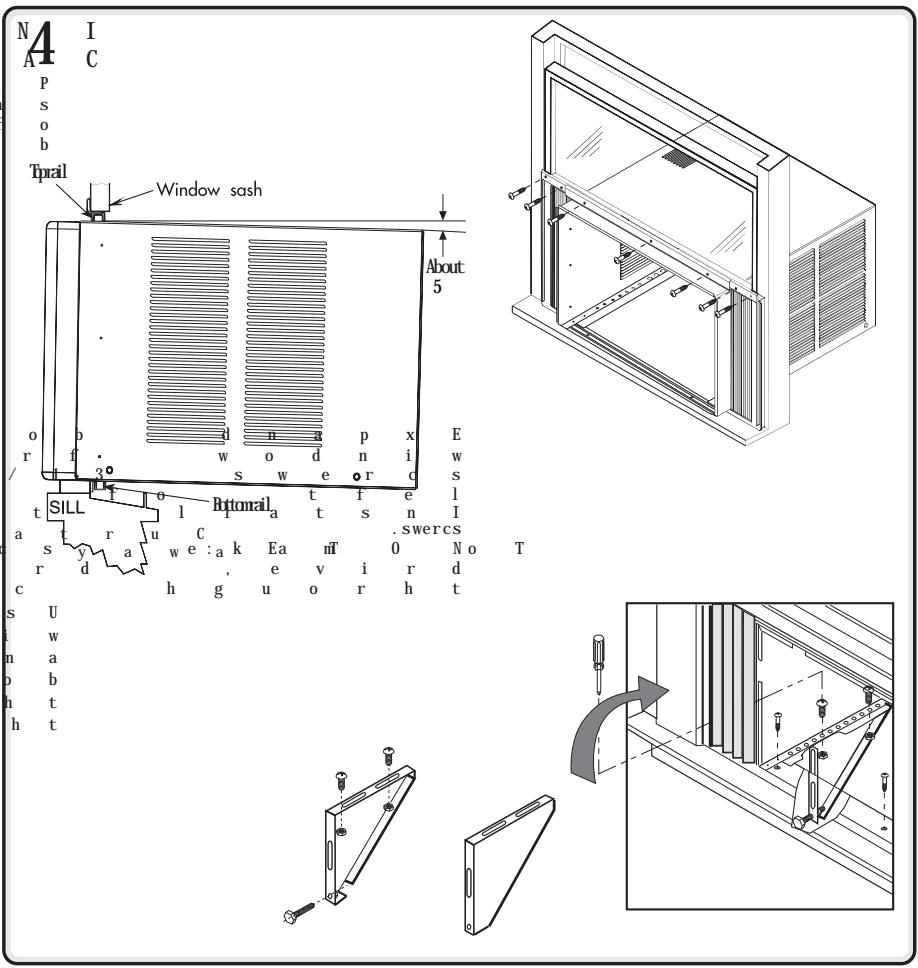
- While installing unit be sure to tilt air conditioner 5 degree outward to have the water drip outside the house.
A. Install the unit on the north side as normally that is the shaded side. This will enhance the operation of your unit.
- Window has to be strong for installation. Extra brackets and or support may be required depending on your window.
- Measure the window before installing, if the window is too big for the unit you may require professional installation.
Use correct electric voltage and proper ampere for the unit to run effectively.
- Only let a certified electrician do any modifications to your electrical outlet.
Energy Saving Guide
- When installing your air conditioner make sure to seal all areas where there is a possibility of air leakage.
- Airflow should not be blocked inside either by curtains, drapes or furniture or outside by shrubs or bushes.
- Do not needlessly use an electrical light or other appliances that produce heat.
- Keep the vent closed on the air conditioner when in the cooling function.
- Keep the blinds and the drapes drawn on all the other windows.
- While cooking use an exhaust fan in the kitchen to remove the excess heat produced.
- Always use the correct BTU size air conditioner to cool the room to attain optimum efficiency.
Features
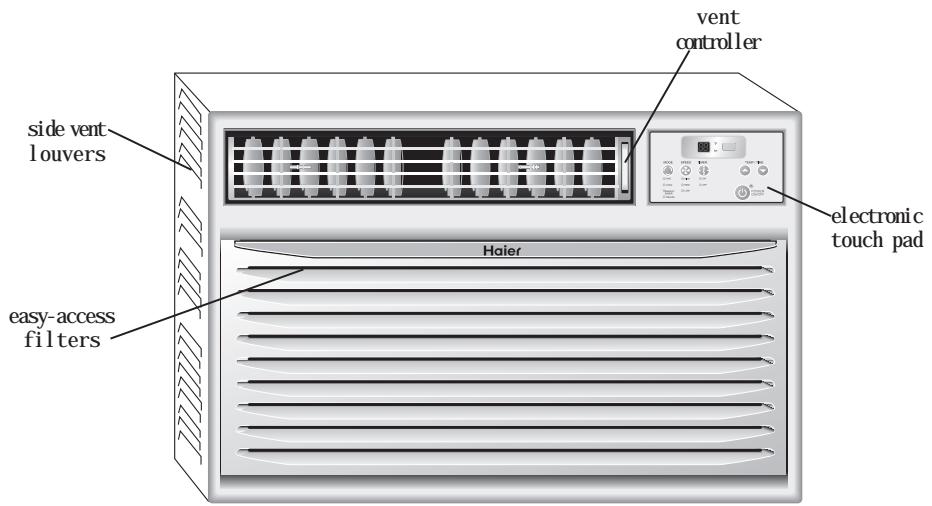
1. Thermostat
This allows you to adjust the temperature of the air. The lower the setting the cooler the air temperature. With this you can set the temperature to your desired comfort level. You can set the temperature between 61^ F and 86^ F
2. Fan Speed
With this you can control the fan speed as well as the A/C (cooling) speed.
You have 3 levels of A/C Speed for you to set at your desired level. LO will circulate air at the lowest velocity, MED at medium velocity and HIGH will circulate at the maximum.
You have 3 levels of Fan Speed to set at your desired comfort level. HIGH, MED and LOW
3. Function.
Your air conditioner has 3 Functions.
a) A/C.
Here the air conditioner will operate the compressor and the desired fan speed set to give you chilled cold air for your comfort.
b) Dehumid.
This enables your air conditioner to operate as a dehumidifier as well. It will remove the excess moisture from the air to keep your room at a
comfortable dry stage. You can use this feature alone in case you do not desire to use the air conditioner.
c) Fan Only
You can run the fan only on not so hot days. The fan can be set to run at 3 speeds (HIGH fan, MED fan, LOW fan) as desired by you.
4. Energy Saver
When this feature is "On" the fan will shut off three minutes after the compressor cycles off. This will reduce energy consumption and noise. When the compressor turn back on the fan will turn on at the same time. In the "Off" position the fan will not shut off when the compressor cycles off.
5. Timer
Your air conditioner can be set to go on or off at your desire. This can be done up to 24 hours in advance.
6.4 Way Air Flow
These air directional louver let you control the direction of the airflow in your required direction. The airflow can be directed
up-down-rightside-leftside.
7. Vent
The Fresh Air Vent allows the air conditioner torecirculate insideair, drawfreshair into theromand exhaust stale air to the outside .
8. Slide Out Chassis
Your Air Conditioner becomes more versatile with this feature. You have the option to install the unit in a window or the wall.
9. Window Install Kit
Enables you to install the air conditioner in a double hung window. Extra brackets or support may be needed depending on your window.
10. Remote Control
This full functional wireless remote allows you to operate your air conditioner from a distance. You need not have to get up to change the settings, the functions or to turn the unit on or off.
11. LED Display Electronic Control Panel
The 4 function LED displays Room Temperature, Temperature Setting, Timer Setting and Time Remaining to Stop / Start the unit. Electronic Control Panel lets you set the temperature to the Exact Temperature you desire.
- Electrostatic Filter (not all models) Being constructed of high efficiency purifying substance, active carbon fabric, electrostatic fabric, electrostatic active carbon net and other materials it purifies the air effectively. Its way structure increases the capability to filter dust and smoke effectively. Due to the retention of the active carbon it has a high purifying speed capable of strong airflow.
13. How The Unit Drains
On humid days with the air conditioner in use, moisture may collect on the pan or bottom of the air conditioner. If the unit is position properly the moisture will gather towards the back of the unit. This will not effect the operation of the unit and the moisture will evaporate in time. Occasional the moisture will flow over the back of the pan but this will not effect the operation of the unit. Never drill holes in the pan under any condition.
Operating Guide
Normal Operating Sounds
The following sounds are normally heard during the operation of an air conditioner.
Cool airflow movement as dictated by the set fan speed.
- Water sounds. This is normal as your air conditioner acts as a dehumidifier also. Thus you will hear water sounds from water drops falling on the condenser.
- As the refrigerant flows through the inner sealed tubing a rushing noise may be heard.
- Rattling or vibrating noises may be heard due to poor wall or window installation.
- High pitch compressor sound may be heard.
Operating Instructions
Following are the operating instructions of your electronic air conditioner.
Remote control and control panel operations
After installing your air conditioner plug it in to the proper electrical outlet in the wall. Keep the vent in the closed position. Now set the air conditioner at your comfort level. This full functional wireless remote allows you to operate your air conditioner without having to get up and go to the unit. The full function feature allows you to change the settings and turn the unit on or off from the remote itself. This control pad works the same as the control pad on the air conditioner.
(See Fig. # 1)
Fig. # 1
Remote Control
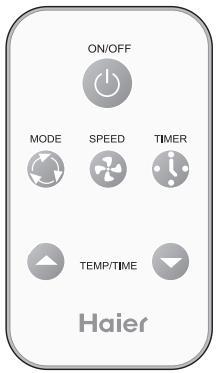
After you plug in the unit it will perform a self test. All the display lights will turn on for 3 seconds. The LED display will read "88". If any display light fails to turn on you may need service on the unit. After the 3 seconds self test the unit will automatically go to the stand by mode. Now all lights will be off and you will have to turn "ON" by pressing the On/Off key. After pressing "On/Off", the unit starts to work and enters the status of "Fan" with low setting.
You will have to press the () or () key on the Temp/Time to set the temperature at your desired comfort. You can choose between 61^ and 86^ . Once the temperature is set you can raise or lower it by pressing the () or () keys. (Only when the unit is cooling, energy saver or dehumidifying, can the temperature setting be adjusted.) (See Fig. # 2) Having set the temperature you will set the function of the air conditioner:
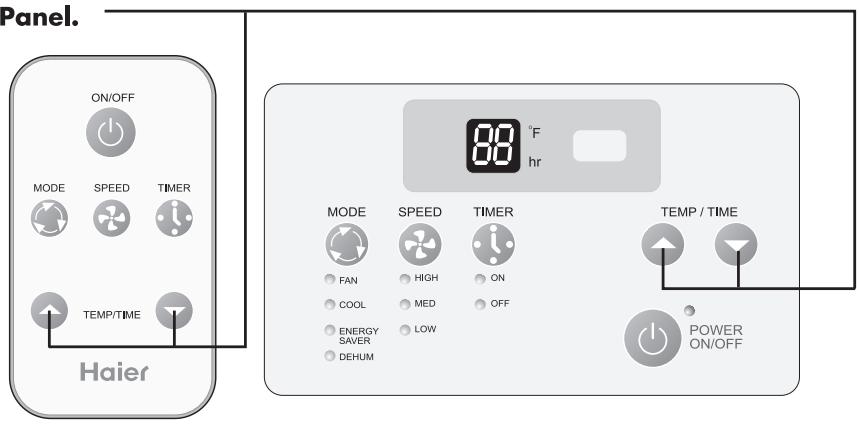
Fig. # 2
Control Panel.
Every time you press the MODE button, it will change between FAN, COOL, ENERGY Saver and DEHUM (See Fig. # 3)
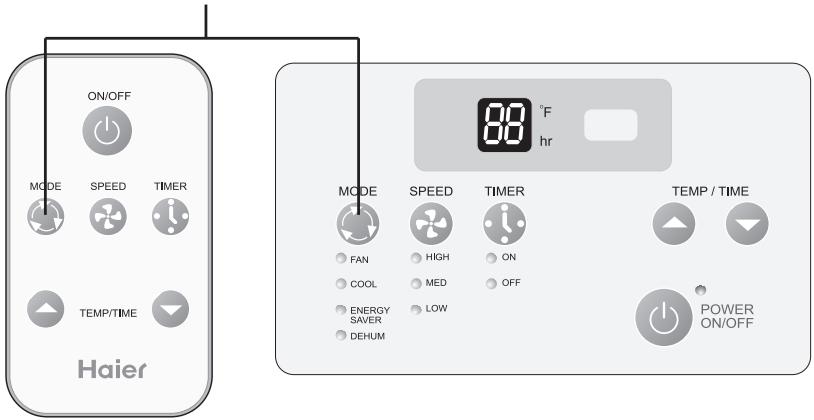
Fig.#3 Control Panel.
Once the function mode is decided you will have to set the fan speed. (See fig. #4) Every time you press the SPEED button, fan speed will change between LOW HIGH, MED.
1) If you choose the COOL mode you can run the fan in one of the 3 speeds HIGH, MED, LOW
2) For cool days you may want to run the "FAN" function. The fan can be set to run at 3 speeds (HIGH fan, MED fan, LOW fan) as desired by you.
$$ \leqslant \leqslant $$
4) Energy Saver : The unit runs the same as COOL setting in the ENERGY SAVER mode. But the fan will be off 3 minutes after the compressor cycle off.
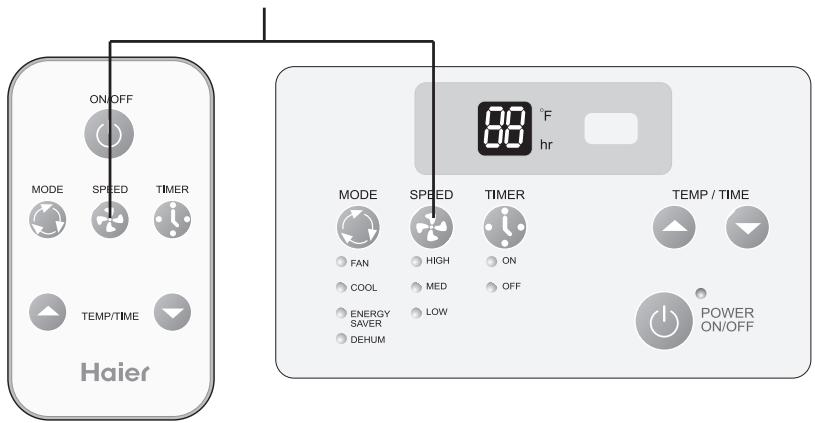
Fig. # 4
Control Panel.
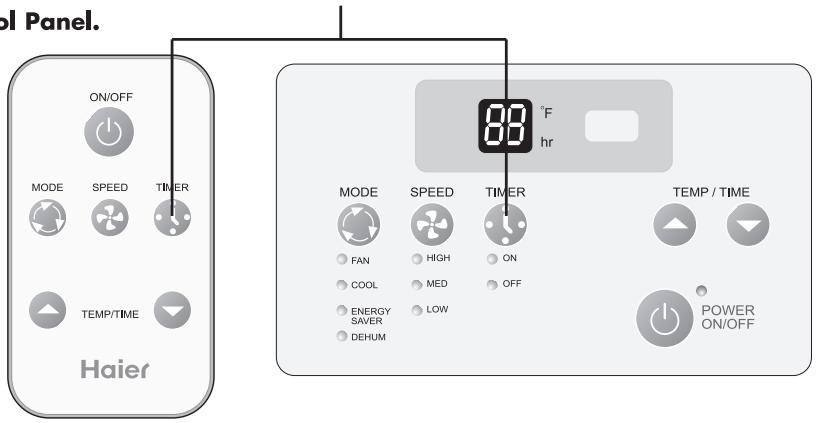
Fig. # 5 Control Panel.
Adjusting the Air Flow Direction
Airflow can be adjusted by changing the direction of the air conditioner's louvers. This can also increase the cooling efficiency of the air conditioner.
Adjusting Horizontal Air Flow Direction
Adjusting the vertical louvers left and right will change horizontal airflow
Adjusting Vertical Air Flow Direction Adjusting the Horizontal vane up and down will change vertical airflow. The vane can be adjusted by nudging the back or up and down of the vane.
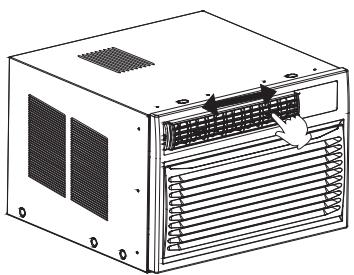
Adjusting Horizontal Air Flow
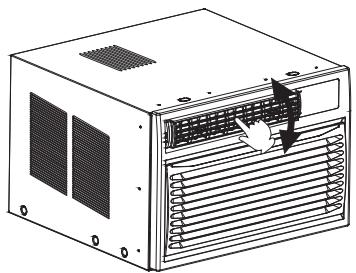
Adjusting Vertical Air Flow
Recommended orientation of louvers
Adjust louvers to face upwards when cooling to maximize cooling efficiency.
Installations
Before you install your air conditioner check the following:
1) The unit is free of all obstructions inside and outside the room e.g. drapes, curtains, furniture, plants, shrubs, bushes, trees, other structures like building, garage etc. Air conditioner must have clear unobstructed airflow through the condenser to remove the heat.
2) The window is strong enough to hold the weight of the air conditioner. Extra brackets or supports may be needed depending on your windows.
3) The window sill and track are strong enough to hold the weight of the air conditioner.
4) The wall is strong enough to hold the unit. Extra brackets or supports may be needed depending on the wall.
5) There is adequate and proper power supply near the air conditioner.
6) DO NOT use adapter plugs.
7) DO NOT use extension cords.
8) DO NOT cut or remove the ground prong.
9) DO NOT modify the plug or the electrical wall outlet in any way. If plug does not fit the electrical outlet have a certified electrician do the necessary change.
10) DO NOT connect electrical power to the unit before installation.
11) DO NOT use if power cord is worn out, frayed or otherwise damaged. Avoid using if there are cracks or abrasion damage along the length, plug or connection.
12) Be careful of exposed sharp edges of the cabinet and sharp coils (fins) on the back of the unit that could cut and cause serious injury.
Parts
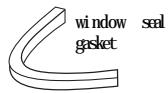
Parts Supplied
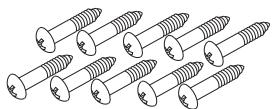
wood screws 31/32"
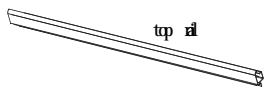
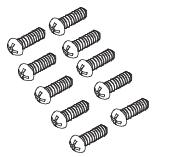
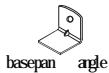
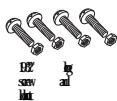
2a had 1dnt
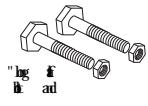
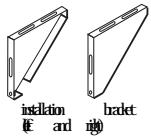
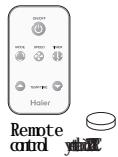
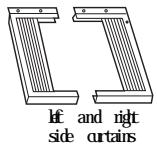
HVR18VC5, HVR24VC5, ESA3156, ESAX3186, ESA3245, ESA3185
Tools
You will need to have the following tools to help you in the installation of your air conditioner.
- Scissors
- Phillips Screwdriver
Standard Screwdriver - Pliers
Wrench - Drill and Drill Bits
-Tape Measure
Gloves - Level
- Sockets
Installing Unit into A Window
Window Opening Requirements
The air conditioner is designed to fit into double or single hung sash type windows. Each of the units comes with an installation kit that provides adjustable mounting louvers, to fill the gaps between the sides of the unit, and the window frame. The chart below reflects the dimensions of the units with, and without installation kits. Measure your window opening width and compare it to the chart below to ensure that it meets the minimum and maximum window width requirements.
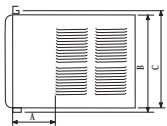
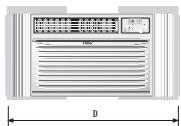
HVR18VC5, HVR24VC5, ESA3156, ESAX3186, ESA3245, ESA3185
| Model Dimension | HVR18VC5, HVR24VC5, ESA3156, ESA3186, ESA3245, ESA3185 |
| A(inch) | 11 2/5" |
| B(inch) | 18 3/5" |
| C(inch) | 18 3/5" |
| D(inch) Max | 42 5/6" |
| D(inch) Min | 30 1/8" |
| Case High | 18 2/3" |
| Case Width | 26 9/6" |
| Case Depth | 24 2/3" |
1 PREPARE UNIT FOR INSTALLATION
Updatifomotoinsolation location.
Remove two front attachment screws
Sparate theoreafefront the front with atypylifeatheatdaptins designated by the arrows.
Remove the two screws top of the outer case.
Usingtheuspanlure,slowlyand eelypildissisotfumonterae
Note: Cover putty knife blade with
melingtateogardappinstdage of the unit finish.
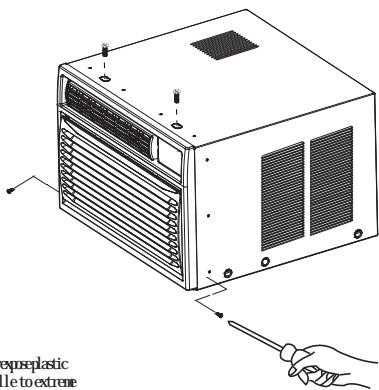
Gation Neoplastic front or gille to extreme temperatures.
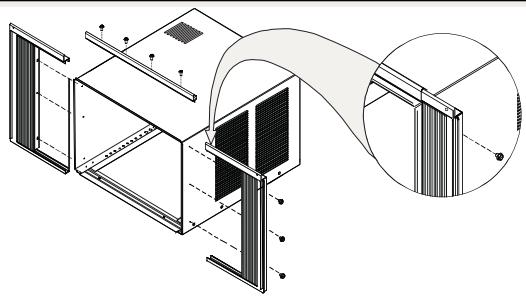
2 ASSEMBLE CURTAINS/TOP RAIL
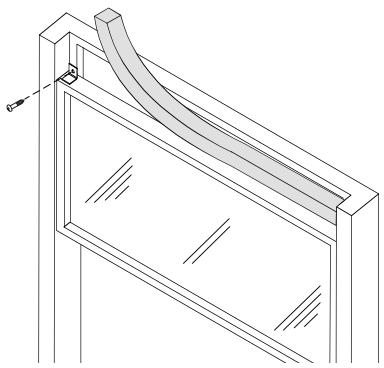
List at top with for 13/32" screws
Slide 1f thandar an assembly into f tend 6 top and bottom sides Repeart for right hand or tan assembly. Fasten or tan at aier step sb sides of outer case with s4x3/32" sows
3 PREPARE WINDOW FOR INSTALLATION
Inspect window task cash and for dis ability to support the weight of a conditioner
Measure width between window holdings o ensure list at Mount f window frame list at Mount models are designed for windows wide (the dital see page 15)
Storm window installation
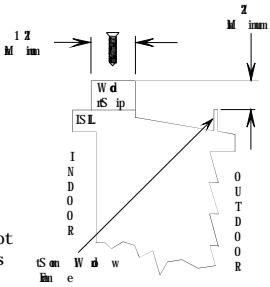
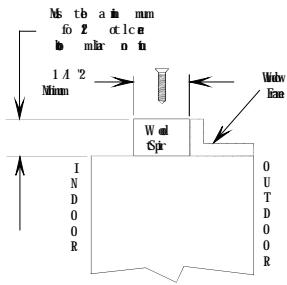
if storm window frame does not allow adequate clearance below 1/2" required, remove storm window frame or create clearance by adding a wood strip at least 1/2" wide along either width 6" fasten wood strip to with a last three countersink wood screws (not supplied with this provides a smooth sr face for mounting a conditioner.
Mobile home window installation
Add wood strip at least 1 1/2" wide) along entire width h of window
Thickness of wood strip should match height of foot on window frame.
Fasten wood strip with a minimum three countersunk wood screws (at applied with this provides a smooth surface for mounting a conditioner
lst at Mount it applied with uit
$ designed for mounting in most
double-hung windows without
storm windows. For list allation in
window frame with storm window,
nurify by adding wood strip s(not
include) to inner and outer sits. This
mises uit and eliminates inter fence
of storm window frame
5 I &
n I w i w i s r f m I d A l A u f C e s n i iiffe
6 RETURN CHASSIS TO OUTER CASE
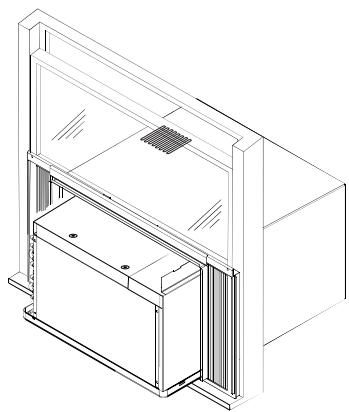
Find someone to help you replace chassis in outer case. Replace front panel, and grille.
Caution: Forsecuritypurpose,reinstall snowstatchint'sids,remed in step one.
IMPORTANT: Because window sash helps keep unit in window, make certain window sash contacts outer case before reinstalling chassis.
Wall Installations: slide-out chassis only
Note: Remove the 2 shipping screws on the top of the air conditioner that hold the chassis to the outer sheOncaesengved, these do not have to be re-installed. To ensure that your air conditioner is properly installed in the wall, it is recommended that it be installed by a certified technician who is familiar with through the wall installations.
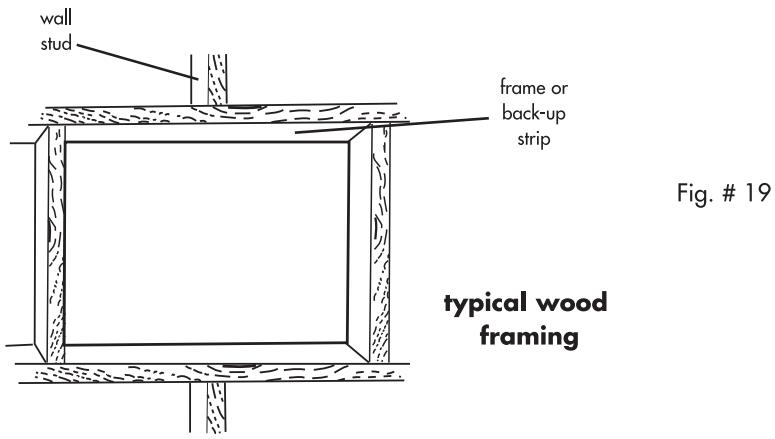
1) Using wood, 1" or more in thickness, build a wooden frame to fit the casing/cabinet dimensions of the unit which you have purchased.
2) Measure the outside width and the height of the frame to determine the cutout dimensions necessary for the opening in the wall. The depth of the frame will depend on the depth of the wall. The finished frame must be set in the inside wall. The frame has to be squared and leveled. Remember the frame has to be nailed securely to the wall studs. (See Fig. # 19)
3) Now to install, insert the casing into the wall opening. (Remove the chassis out first following steps 1 - 6 in Slide-out chassis section).
Make sure that the cabinet is at least 1/2'' inch inside the room. Also the side louvers should not be blocked. This is to have proper air circulation in and around the compressor. (See Fig. # 20)
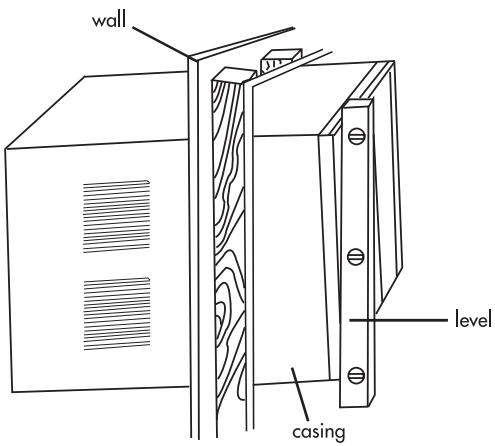
Fig.#20
typical casing outward tip
4) The casing should be tilted 1/4'' outside so as to drain the excess dehumidified water.
5) Properly insulate any opening between the casing and the frame.
6) Using the screw holes on the sides of the unit, which are for the window mounting kit and the screw holes in the top mounting kit rail, attach the casing to the wood frame.
7) With the help of another person lift and put the chassis of the air conditioner in to the casing.
8) Screw the security screw into place and snap on the grille.
9) If the filter was removed during this process, reinsert the filter.
Care and Cleaning Guide
- Always unplug your air conditioner before cleaning.
- The air filter behind the inlet grille should be checked and cleaned at once every 2 weeks (or as necessary) to maintain optimal performance of the air conditioner.
How to remove the air filter
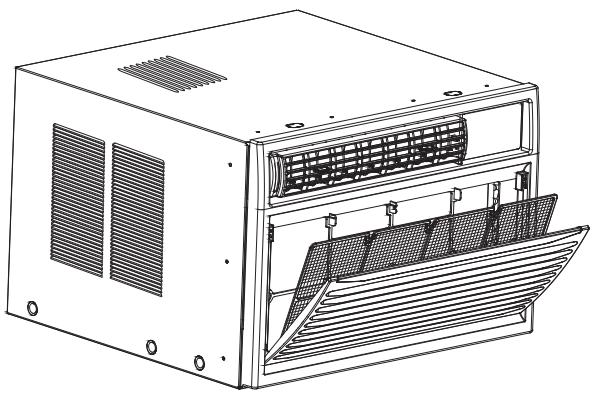
- The grille may be opened from the top for easy maintenance after instal
- Open the inlet grille by pulling off the exposed door on the top of unit (based on the installation).
- Pull the tab slightly to release the filter. Pull the filter in the same way as the opening.
- Clean the filter with warm, soapy water. The water should be below 40^(104^) .
-
Rinse off and gently shake off excess water from the filter. Let it dry, replacing it.
DO NOT use your air conditioner without the air filter in place. -
To clean the front panels or the cabinet DO NOT use harsh chemicals, abrasives, ammonia, chlorine, bleach, concentrated detergents, solvents or metal scouring pads. Some of these chemicals may dissolve, damage and/or discolor your air conditioner.
- Always use a soft cloth dampened with water or mild soap and water solution to wipe the front if the cabinet.
Wipe dry with a soft cloth.
-
To store your air conditioner, after the season, remove the unit from the window as per the installation guide. Repack the unit in its original box and store away. If your unit is installed in a wall or you do not intend to remove it from the window then cover the outside with a winter cover. This can be purchased from the retailer where you purchased your air conditioner or from your local hardware store.
-
Before putting away your unit make sure any water left in the pan is removed and drained away. Water left in the pan could lead to Rusting or damage to the electrical connections.
Trouble-Shooting
If air conditioner does not operate:
- Check if unit is plugged in. The plug may have come loose.
- Check if the unit is in "Off" mode.
Air from air conditioner is warm:
- The A/C setting may need to be raised.
Ice formation on cooling coils:
- Outside temperature too cold. Set the unit on fan only setting to defrost ice.
- Lower temperature setting. Temperature setting may be too cold.
- Unit BTU may be too high for the room.
Air conditioner working but room not cooling:
- Room may have appliances that produce heat. Use an exhaust fan to remove excess heat.
- Redirect the airflow. Remove any obstacles.
- All doors and windows need to be closed so cool air does not escape the room.
Air filter may need cleaning. - Unit BTU may be too low for the required cooling area.
- On extreme hot & humid days air conditioners may take a little longer to cool.
- Vent may be in the open position. Vent has to be closed for optimum cooling.
Air conditioner is making noise when cooling:
You may hear sounds of air movement, water, compressor clicking on and off or window vibrations. Read Operating Guide - Normal Operating Sounds. (See page 8)
Water in the air conditioner cabinet:
This is normal as your air conditioner not only cools but also dehumidifies the air. If there is water dripping inside the room, check the installation of the unit. The unit may need to be reinstalled. (See page 17)
Limited Warranty
What is covered and for how long?
This warranty covers all defects in workmanship or materials for a period of:
12 months for labor
12 months for parts (Functional Parts Only)
5 years for sealed system
The warranty commences on the date of item purchase. Customer shall provide Haier with proof of the date of purchase, brand, model and serial number for verification prior to any warranty service being provided.
EXCEPTIONS: Commercial or Rental Use warranty
90 days for labor
90 days for parts
No other warranty applies
What is covered/Not covered?
- The mechanical and electrical parts of the appliance which serve the functional purpose of this appliance are covered for a period of
12 months. This includes all parts except finish and trim. - Manufacturing defects to the components of the sealed system (e.g. hermetic compressor, condenser and evaporator) are covered for a period of 5 years from the date of purchase. Any damages to such components caused by mechanical abuse, improper handling or shipping will not be covered.
- The limited warranty does not cover any credit or refund for any loss or injury caused by the product or defects to the product including but not limited to incidental or consequential damages.
What will be done?
- Any mechanical or electrical part that proves to be defective in normal usage during the specified warranty period will be repaired or replaced at Haier's discretion.
A&E factory service is the authorized service provider for Haier.
If it is determined that repair is not appropriate or replacement part is unavailable for repair, Haier will exchange the product with a refurbished or new product the same or similar to the original at its discretion. - There will be no charge to the purchaser for functional replacement parts and labor on any covered items during the initial 12- month period. Beyond this period, only the components of the sealed system are covered, labor is not provided and must be paid for by the customer.
- To have your product serviced, please contact Haier customer service 1-877-337-3639.
THIS WARRANTY COVERS APPLIANCES WITHIN THE CONTINENTAL UNITED STATES, PUERTO RICO AND CANADA. IT DOES NOT COVER
THE FOLLOWING:
Damages from improper installation. Damages incurred during shipping. Defects other than manufacturing.
Damage from misuse, abuse, accident, alteration, lack of proper care and maintenance or incorrect current or voltage.
Damage from other than household use.
Damage from service by other than an authorized dealer or service center.
Decorative trims or replaceable light bulbs.
Transportation and shipping.
Labor (after the initial 12 months).
Credit or Refund for products over 30 days past date of purchase
Food loss for food spoiled as a direct result of mechanical failure of the product or of any delay in providing service, repair, replacement.
This limited warranty doesn't apply to refurbished product or unit purchased as/like new or second-hand.
THIS LIMITED WARRANTY IS GIVEN IN LIEU OF ALL OTHER WARRANTYES, EXPRESSED OR INCLUDING THE WARRANTYES OF MERCHANTABILITY AND FITNESS FOR A PARTICULAR PURPOSE
The remedy provided in this warranty is exclusive and is granted in lieu of all other remedies.
This warranty does not cover incidental or consequential damages, so the above limitations may not apply to you. Some states do not allow limitations on how long an implied warranty lasts, so the above limitations may not apply to you.
This warranty gives you specific legal rights, and you may have other rights, which vary from state to state.
Haier America Trading L.L.C.
New York, NY 10018.
1-877-337-3639