FlexFit 2U18MS2HDA - Air-conditioner HAIER - Free user manual and instructions
Find the device manual for free FlexFit 2U18MS2HDA HAIER in PDF.



| Product Type | Ductless multizone air conditioner (split system) |
| Brand | Haier |
| Model | FlexFit 2U18MS2HDA |
| Category | Air conditioner |
| Power supply | 208/230 V, 60 Hz, 1 phase |
| Refrigerant | R-410A |
| Operating range (cooling) | 14 °F to 115 °F (-10 °C to 46 °C) |
| Operating range (heating) | -4 °F to 75 °F (-20 °C to 24 °C) |
| Compatible indoor units | 7K, 9K, 12K, 18K (max 2 zones) |
| Maximum piping length | 98 ft (29.9 m) per system |
| Factory refrigerant charge | 60 oz (1.7 kg) |
| Additional charge rule | 0.2 oz/ft for length > 25 ft |
| Parts warranty (registered) | 10 years |
| Parts warranty (standard) | 5 years |
| Remote control warranty | 1 year |
| Main functions | Cooling, heating, dehumidification, ventilation |
| Maintenance and cleaning | Regular cleaning of air filters, coils; condensate drainage |
| Safety | Mandatory grounding, ground fault circuit interrupter, overcurrent protection |
| Spare parts and repairability | Replaceable mechanical and electrical parts by certified technician; compressor under warranty |
| General information | Installation at least 0.8 km from coasts; multizone systems with matrix compatibility |
Frequently Asked Questions - FlexFit 2U18MS2HDA HAIER
User questions about FlexFit 2U18MS2HDA HAIER
0 question about this device. Answer the ones you know or ask your own.
Ask a new question about this device
Download the instructions for your Air-conditioner in PDF format for free! Find your manual FlexFit 2U18MS2HDA - HAIER and take your electronic device back in hand. On this page are published all the documents necessary for the use of your device. FlexFit 2U18MS2HDA by HAIER.
USER MANUAL FlexFit 2U18MS2HDA HAIER
Duct less Multi Zone
natural_image
Technical line drawing of a Haier air conditioner unit with internal grid pattern (no text or symbols)
natural_image
Line drawing of a Haier air conditioner unit with grid pattern and door (no text or symbols on the device itself)Design may vary by model number.
This installation manual is only printed in English. For French or Spanish version, please visit
GEAppliancesairandwater.com
This manual contains installation instructions for multi outdoor and highwall indoor units.
TABLE OF CONTENTS
IMPORTANT SAFETY INFORMATION 6
INSTALLATION INSTRUCTIONS 8
Preparation....15
Installation of the Indoor Unit 16
Installation of the Outdoor Unit 20
Final Check 27
LIMITED WARRANTY 29
RECORD KEEPING
Thank you for purchasing this Haier product. This installation manual will help you get the best performance from your new heat pump.
For future reference, record the model and serial number located on the label on the side of your air conditioner/heat pump, and the date of purchase.
Staple your proof of purchase to this manual to aid in obtaining warranty service if needed.
To register your new Haier Duct Free system go to http://www.haierductless.com/product-registration and input the model/serial number information on this page. To receive a 10-year compressor and parts warranty, registration is required within 60 days of installation.
Model number
Serial number
Date of purchase

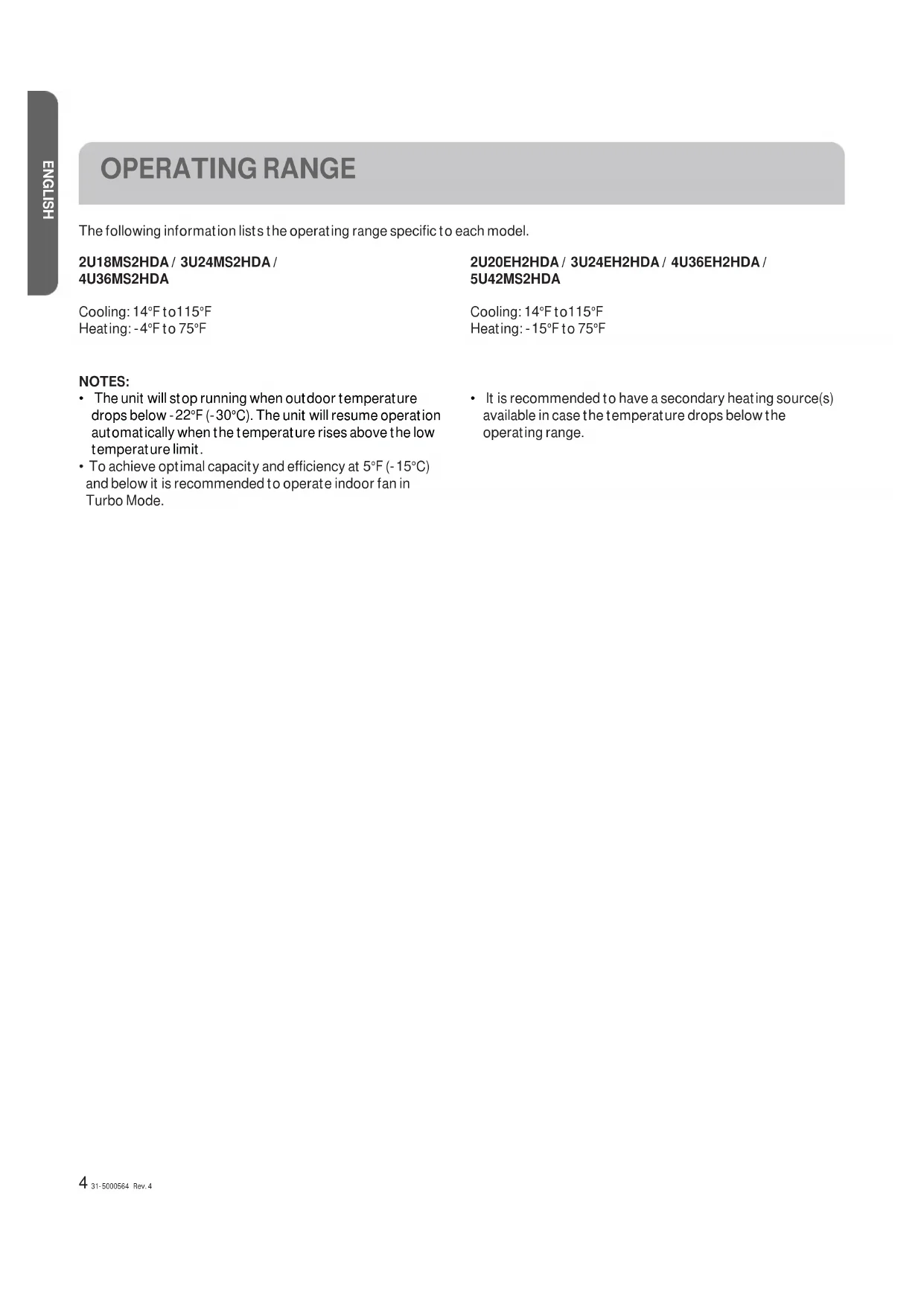
OPERATING RANGE
The following information lists the operating range specific to each model.
2U18MS2HDA / 3U24MS2HDA / 4U36MS2HDA
Cooling: 14°F to 115°F
Heating: -4°F to 75°F
2U20EH2HDA / 3U24EH2HDA / 4U36EH2HDA / 5U42MS2HDA
Cooling: 14°F to 115°F
Heating: -15°F to 75°F
NOTES:
- The unit will stop running when outdoor temperature drops below -22^ (-30°C). The unit will resume operation automatically when the temperature rises above the low temperature limit.
- To achieve optimal capacity and efficiency at 5^(-15^) and below it is recommended to operate indoor fan in Turbo Mode.
- It is recommended to have a secondary heating source(s) available in case the temperature drops below the operating range.
PREPROGRAMMED SYSTEM CHECK
Please note system will NOT run normally unless one of the following procedures is completed.
When the system is first powered up, the indoor and outdoor LED display will display "CC". Please note that this is NOT an error code. This is an indicator that the system is ready to run the "Preprogrammed System Test".
The installer can choose one of the two following options:
- Option 1 (Preprogrammed System Test):
- Set the indoor mode to "Heat" or "Cool" and then set the indoor temperature to 77°F (25°C). The preprogrammed system test will start within five seconds.
- The indoor display will flash "Fn" and "N1"; the outdoor display will flash "N1".
- The test will continue to run for 18\~25 mins, including heating test (display "N2") and cooling test (display "N3") depending on outdoor conditions. For sequence of operation, refer to Installation Manual Section "Energy Star Models (Installation Capabilities)".
- Upon completion and passing of all tests, the indoor and outdoor display will show "PS". User can press any button to exit the test mode. The system can now be used normally.
- Option 2 (bypass “Preprogrammed System Test”): set the indoor mode to “Dry” mode first and then set the indoor temperature to 68°F (20°C).
- The indoor display will flash "BP" for five seconds and shut down automatically.
- The system can now be used normally.
Note: The automatic tests can also be by-passed by setting the indoor mode to dry and then setting the temperature to 68^ F ( 20^ C) while the unit is flashing CC after initial power has been applied to the unit. The indoor display should read BP for 5 seconds then go into stand-by mode. The unit can then be used normally. If installation test mode has been started, it will not be able to by-pass the test unless the power has been recycled prior to finishing the installation tests.
Note: If the outdoor temperature is exceeding normal operation range, (eg. below -4^ ( -20^ ) or above 115^(46^) ), running pre-programmable test may result in error code. Manufacturer suggests to by-pass the test during the severe weather and go back to the jobsite and run the test when outdoor temperature permits.
Note: If there is a need to run the pre-programmed installation tests again after successfully completing them initially, set the remote controller to cool, high fan speed, 60^ F ( 16^ C), and then press the sleep button 4 times continuously. After hearing 5 beeps on the indoor unit, power cycle.
Note: In order to achieve maximum performance at low ambient conditions it is recommend to set fan speed to turbo.
IMPORTANT SAFETY INFORMATION
WARNING
For your safety, the information in this manual must be followed to minimize the risk of fire, electric
shock, or personal injury.
- Use this equipment only for its intended purpose as described in this manual.
- This heat pump must be properly installed in accordance with these instructions before it is used.
- All wiring should be rated for the amperage value listed on the rating plate. Use only copper wiring.
- All electrical work must be completed by a qualified electrician and completed in accordance with local and national building codes.
- Any servicing must be performed by a qualified individual.
For any service which requires entry into the refrigerant sealed system, Federal regulations require that the work is performed by a technician having a Class II or Universal certification.
- All air conditioners contain refrigerants, which under federal law must be removed prior to product disposal. If you are getting rid of an old product with refrigerants, check with the company handling disposal.
- These R-410A heat pumps systems require that contractors and technicians use tools, equipment and safety standards approved for use with this refrigerant. DO NOT use equipment certified for R22 refrigerant only.
WARNING
RISK OF ELECTRIC SHOCK. Could cause injury or death.
- An adequate ground is essential before connecting the power supply.
- Disconnect all connected electric power supplies before servicing.
- Repair or replace immediately all electrical wiring that has become frayed or otherwise damaged. Do not use wiring that shows cracks or abrasion damage along its length or at either end.
WARNING
RISK OF FIRE. Could cause injury or death.
- Do not store or use combustible materials, gasoline or other flammable vapors or liquids in the vicinity of this or any other appliance.
WARNING
This appliance is not intended for use by persons (including children) with reduced physical, sensory or mental capabilities, or lack of experience and knowledge, unless they have been given supervision or instruction concerning use of the appliance by a person responsible for their safety. Children should be supervised to ensure that they do not play with the appliance.
To avoid danger of suffocation, keep the plastic bag or thin film used as the packaging material away from young children.
Be sure not to allow foreign materials (oil, water, etc) entering the refrigerant piping. Seal the ends of refrigerant piping before storage.
For installation purposes, be sure to use the parts supplied by the manufacturer or other prescribed parts. The use of non-prescribed parts can cause serious accidents such as the unit falling, water leakage, electric shock, or fire.
The rated power supply of this product is 208/230 VAC/60hz/1PH. Verify the voltage is within 187\~253 range before turning the equipment on.
Supply power to the heat pump should be from a dedicated circuit that meets branch circuit ampacity requirements.
Use a special branch circuit breaker and receptacle matched to the power circuit capacity of the heat pump. (Install in accordance with local technical standard for electrical equipment.)
Do not extend the power cord.
Perform wiring work in accordance with standards so that the air conditioner can be operated safely and positively.
Install a leakage special branch circuit breaker in accordance with the related laws and regulations and electric company standards.
IMPORTANT SAFETY INFORMATION
CAUTION
It is highly recommended that you do not open or close the stop valves when the outdoor temperature is below -5°F (-21°C) as this may cause refrigerant leakage.
Make sure power is turned on for at least 12 hours after periods of being powered down in an 32^ F ( 0^ C) environment or lower.
Do not touch the fins of the coil. Touching the coil fins could result in damage to the fins or personal injury such as skin rupture.
Ensure the power circuit capacity is adequate for all loads connected to the electrical service panel. Increase the conductor and panel capacity if the total electrical loads exceed the power source capacity.
Contact the power utility if the power provided is below equipment rating plate requirements.
Be sure to install a breaker of the specified capacity.
Regulation of cables and breaker differs from each locality, refer in accordance with local rules.
Do not use existing refrigerant lines.
Use refrigerant tubing that is clean and free of any contamination which may cause damage to the system including sulfur, copper oxide, dust, metal chips, powder, oil or water.
Avoid brazing lines together. Use a continuous length of copper tubing as oxides formed during improper brazing techniques can damage the equipment.
Do not use copper pipes that have a collapsed, deformed, or discolored portion (especially on the interior surface). Otherwise, the expansion valve or capillary tube may become blocked with contaminants.
Improper line sizing will degrade performance. Peak pressure of R410A is much higher than R22. Use copper tubing with adequate wall thickness.
To prevent breaking of the pipe, avoid sharp bends. Bend the pipe with a radius of curvature of 4 in. (100 mm) or more.
If the pipe is bent repeatedly at the same place, it will break.
READ AND SAVE THESE INSTRUCTIONS
FOR MORE HELP, VISIT HAIERAPPLIANCES.COM OR CALL THE CONSUMER HELP LINE AT 877-337-3639.
BEFORE YOU BEGIN
Read these instructions completely and carefully.
- IMPORTANT — Save these instructions for local inspector's use.
- IMPORTANT — Observe all governing codes and ordinances.
- Note to installer – Be sure to leave these instructions with the Consumer.
- Note to consumer – Keep these instructions for future reference.
- Skill level – A licensed certified technician (to handle refrigerant R-410A, recovery, etc) and a qualified electrician are required for installation and service of this split heat pump system.
- Proper installation is the responsibility of the installer.
- Product failure due to improper installation is not covered under the limited warranty.
- For personal safety, this system must be properly grounded.
- Protective devices (fuses or circuit breakers) acceptable for installation are specified on the nameplate of each unit.
- Make sure to avoid wiring or plumbing inside the wall when installing.
CAUTION
- Aluminum electrical wiring may present special problems - consult a qualified electrician.
- The supply voltage remains live on the unit even though the controls are switched off.
INSTALLATION INSTRUCTIONS
Required Tools for Installation
• 14/4 AWG stranded wire
- 5/8" (16mm), 7/8" (22mm), 1" (25mm) or Adjustable Wrench
• R-410A Refrigerant*
- Adhesive tape*
- Conduit cable clamp 1/2"*
- Copper line set (refer to indoor specification for line set size)
- #2 phillips screwdriver
- Drill
• R-410A flaring tool
- Hex wrench
- Hole saw 2 1/4"
- Insulation*
- Refrigerant scale
- Level
- Manifold gauge set
- Measuring tape
- Micron gauge
- Mini-split adapter (5/16"F to 1/4"M)
- Nitrogen*
- Pipe cutter
- PVC pipe
- Razor knife
- Reamer
- Saddle clamp (L.S.) w/ screws
- Sealant, non-expanding (for lineset hole)
- Soap/water solution* or gas leakage detector
- Stud finder
- Torque wrench
- Vacuum pump
- Wire strippers
- All usual and customary HVAC hand and power tools, meters, and testing devices
* consumable
INSTALLATION INSTRUCTIONS
COMPATIBILITY MATRIX FOR MULTI ZONE DUCTLESS SYSYTEM
| 2U18MS2HDA / 2U20EH2HDA COMBINATIONS | ||
| PORT A PORT B | ||
| Port Size 1/4" X 3/8" 1/4" X 3/8" | ||
| Adapter No adapter required No adapter required | ||
| TWO ZONE | 7k 7k | |
| 7k 9k | ||
| 9k 9k | ||
| 7k 12k | ||
| 9k 12k | ||
| 12k 12k | ||
| 3U24MS2HDA / 3U24EH2HDA | COMBINATIONS | ||||
| PORT A | PORT B | PORT C | |||
| Port Size | 1/4" X 3/8" | 1/4" X 3/8" | MS: 1/4" X 3/8" | ||
| EH: 1/4" X 1/2" | |||||
| Adapter | No adapter required | No adapter required | Port C Required Adapter | ||
| MS | EH | ||||
| TWO ZONE | - | 7k | 7k | - | E |
| - | 7k | 9k | - | E | |
| - | 9k | 9k | - | E | |
| - | 7k | 12k | - | E | |
| - | 9k | 12k | - | E | |
| - | 12k | 12k | - | E | |
| - | 7k | 18k | D | - | |
| - | 9k | 18k | D | - | |
| - | 12k | 18k | D | - | |
| THREE ZONE | 7k | 7k 7k | - | E | |
| 7k | 7k 9k | - | E | ||
| 7k | 9k 9k | - | E | ||
| 7k | 7k | 12k | - | E | |
| 9k | 9k 9k | - | E | ||
| 7k | 9k | 12k | - | E | |
| 9k | 9k | 12k | - | E | |
| 7k | 12k | 12k | - | E | |
| 7k | 7k | 18k | D | - | |
| 9k | 12k | 12k | - | E | |
| ADAPTERS | GEA PART# | |
| A | 1/4" to 3/8"flare Adapter | WJ01X23925 |
| B | 3/8" to 5/8"flare Adapter | WJ01X23924 |
| C | 1/2" to 5/8"flare Adapter | WJ01X23932 |
| D | 3/8" to 1/2"flare Adapter | WJ01X26853 |
| E | 1/2" to 3/8"flare Adapter | WJ01X26854 |
| Models that may require adapters | ||||
| *1 - These 24K models require 3/8" liquid and 5/8" vapor linesets | ||||
| AW24LP2VHA | USYM24UCDSA | USYL24UCDSA | AL24LP2VHA | AM24LP2VHA |
| *2 - These 24K models require 1/4" liquid and 1/2" vapor linesets | ||||
| AW24TC2HDA | ||||
| All 18K models require 1/4" liquid and 1/2" vapor linesets | ||||
| All 7K, 9K, and 12K models require 1/4" liquid and 3/8" vapor linesets | ||||
INSTALLATION INSTRUCTIONS
| 4U36MS2HDA / 4U36EH2HDA Combinations | ||||||||
| PORT A PORT | B PORT C PORT D | |||||||
| Port Size 1/4" X 3/8" 1/4" X 3/8" 1/4" X 1/2" | ||||||||
| Adapter | No adapter required | No adapter required | Adapters vary by 24K Model. See Notes 1 and 2 | No adapter required | Adapters vary by 24K Model. See Notes 1 and 2 | No adapter required | ||
| TWO ZONE | -- 9k - 18k | - | ||||||
| -- | 12k - 18k | - | ||||||
| -- 7k - 24k | A C | '1 | --'2 | |||||
| -- 9k - 24k | A C | '1 | --'2 | |||||
| -- | 12k - 24k | A, C | '1 | --'2 | ||||
| -- | 18k | D | 18k | - | ||||
| -- | 24k | A, B | '1 | D'2 | 18k | - | ||
| -- | 24k | A, B | '1 | D'2 | 24k | A, C'1 | --'2 | |
| THREE ZONE | - | 9k | 9k - | 9k E | ||||
| - | 7k | 9k - 12k E | ||||||
| - | 9k | 9k - 12k E | ||||||
| - | 7k | 12k - 12k E | ||||||
| - | 7k | 7k - 18k - | ||||||
| - | 9k | 12k - 12k E | ||||||
| - | 7k | 9k - 18k - | ||||||
| - | 9k | 9k - 18k - | ||||||
| - | 12k | 12k - 12k E | ||||||
| - | 7k | 12k - 18k - | ||||||
| - | 7k | 7k - 24k | A, C | '1 | --'2 | |||
| - | 7k | 9k - 24k | A, C | '1 | --'2 | |||
| - | 9k | 9k - 24k | A, C | '1 | --'2 | |||
| - | 12k | 12k - 18k - | ||||||
| - | 7k | 12k - 24k | A, C | '1 | --'2 | |||
| - | 9k | 12k - 24k | A, C | '1 | --'2 | |||
| - | 12k | 12k - 24k | A, C | '1 | --'2 | |||
| - | 12k | 18k | D | - | 18k | - | ||
| FOUR ZONE | 7k | 7k | 7k - | 7k E | ||||
| 7k | 7k | 7k - | 9k E | |||||
| 7k | 7k | 9k - | 9k E | |||||
| 7k | 7k | 7k - 12k E | ||||||
| 7k | 9k | 9k - | 9k E | |||||
| 7k | 7k | 9k - 12k E | ||||||
| 9k | 9k | 9k - | 9k E | |||||
| 7k | 9k | 9k - 12k E | ||||||
| 7k | 7k | 12k | - | 12k | E | |||
| 9k | 9k | 9k - 12k E | ||||||
| 7k | 7k | 7k - 18k - | ||||||
| 7k | 9k | 12k | - | 12k | E | |||
| 7k | 7k | 9k | - | 18k | - | |||
| 9k | 9k | 12k - 12k E | ||||||
| 7k | 12k | 12k | - | 12k | E | |||
| 7k | 9k | 9k | - | 18k | - | |||
| 7k | 7k | 12k - 18k - | ||||||
| 7k | 7k | 7k | - | 24k | A, C'1 | --'2 | ||
| 9k | 12k | 12k - | 12k E | |||||
| 7k | 7k | 9k | - | 24k | A, C'1 | --'2 | ||
| 12k | 12k | 12k - | 12k E | |||||
| 9k | 9k | 12k - 18k - | ||||||
INSTALLATION INSTRUCTIONS
| 5U42MS2HDA COMBINATIONS | ||||||||
| PORT A PORT B PORT C | PORT D PORT E | |||||||
| Port Size 1/4" X 3/8" 1/4" X 3/8" 1/4" X 3/8" 1/4" X 1/2" 1/4" X 1/2" | ||||||||
| Adapter | No Adapter Required | No Adapter Required | Port C Required Adapter | Adapters vary by 24K Model. See Notes 1 and 2 | Port D Required Adapter | Adapters vary by 24K Model. See Notes 1 and 2 | Port E Required Adapter | |
| TWO ZONE | - | - | 7k | - | - | - | 24k | A, C *1| ---2 |
| - | - | 9k | - | - | - | 18k | - | |
| - | - | 9k | - | - | - | 24k | A, C *1| ---2 | |
| - | - | 12k | - | - | - | 18k | - | |
| - | - | 12k | - | - | - | 24k | A, C *1| ---2 | |
| - | - | - | - | 18k | - | 18k | - | |
| - | - | - | - | 18k | - | 24k | A, C *1| ---2 | |
| - | - | - | - | 24k | A, C *1| ---2 | 24k | A, C *1| ---2 | |
| THREE ZONE | - | 7k | 7k | - | - | - | 18k | - |
| - | 7k | 7k | - | - | - | 24k | A, C *1| ---2 | |
| - | 7k | 9k | - | - | - | 12k | E | |
| - | 7k | 9k | - | - | - | 18k | - | |
| - | 7k | 9k | - | - | - | 24k | A, C *1| ---2 | |
| - | 7k | 12k | - | - | - | 12k | E | |
| - | 7k | 12k | - | - | - | 18k | - | |
| - | 7k | 12k | - | - | - | 24k | A, C *1| ---2 | |
| - | - | 7k | - | 18k | - | 18k | - | |
| - | - | 7k | - | 18k | - | 24k | A, C *1| ---2 | |
| - | 9k | 9k | - | - | - | 9k | E | |
| - | 9k | 9k | - | - | - | 12k | E | |
| - | 9k | 9k | - | - | - | 18k | - | |
| - | 9k | 9k | - | - | - | 24k | A, C *1| ---2 | |
| - | 9k | 12k | - | - | - | 12k | E | |
| - | 9k | 12k | - | - | - | 18k | - | |
| - | 9k | 12k | - | - | - | 24k | A, C *1| ---2 | |
| - | - | 9k | - | 18k | - | 18k | - | |
| - | - | 9k | - | 18k | - | 24k | A, C *1| ---2 | |
| - | - | 12k | - | 12k | E | 12k | E | |
| - | - | 12k | - | 12k | E | 18k | - | |
| - | - | 12k | - | 12k | E | 24k | A, C *1| ---2 | |
| - | - | 12k | - | 18k | - | 18k | - | |
| - | - | 12k | - | 18k | - | 24k | A, C *1| ---2 | |
| - | - | 18k | D | 18k | - | 18k | - | |
INSTALLATION INSTRUCTIONS
| 5U42MS2HDA COMBINATIONS | ||||||||
| PORT A PORT B PORT C | PORT D PORT E | |||||||
| Port Size 1/4" | X 3/8" 1/4" X 3/8" 1/4" X 1/2" 1/4" X 1/2" | |||||||
| Adapter | No Adapter Required | No Adapter Required | Port C Required Adapter | Adapters vary by 24K Model. See Notes 1 and 2 | Port D Required Adapter | Adapters vary by 24K Model. See Notes 1 and 2 | Port E Required Adapter | |
| FOUR ZONE | 7k | 7k | 7k | - | - | - | 7k | E |
| 7k | 7k | 7k | - | - | - | 9k | E | |
| 7k | 7k | 7k | - | - | - | 12k | E | |
| 7k | 7k | 7k | - | - | - | 18k | - | |
| 7k | 7k | 7k | - | - | - | 24k | A, C *1| ---2 | |
| 7k | 7k | 9k | - | - | - | 9k | E | |
| 7k | 7k | 9k | - | - | - | 12k | E | |
| 7k | 7k | 9k | - | - | - | 18k | - | |
| 7k | 7k | 9k | - | - | - | 24k | A, C *1| ---2 | |
| 7k | 7k | 12k | - | - | - | 12k | E | |
| 7k | 7k | 12k | - | - | - | 18k | - | |
| 7k | 7k | 12k | - | - | - | 24k | A, C *1| ---2 | |
| - | 7k | 7k | - | 18k | - | 18k | - | |
| - | 7k | 7k | - | 18k | - | 24k | A, C | |
| 7k | 9k | 9k | - | - | - | 9k | E | |
| 7k | 9k | 9k | - | - | - | 12k | E | |
| 7k | 9k | 9k | - | - | - | 18k | - | |
| 7k | 9k | 9k | - | - | - | 24k | A, C *1| ---2 | |
| 7k | 9k | 12k | - | - | - | 12k | - | |
| 7k | 9k | 12k | - | - | - | 18k | - | |
| 7k | 9k | 12k | - | - | - | 24k | A, C *1| ---2 | |
| - | 7k | 9k | - | 18k | - | 18k | - | |
| 7k | 12k | 12k | - | - | - | 12k | E | |
| 7k | 12k | 12k | - | - | - | 18k | - | |
| 7k | 12k | 12k | - | - | - | 24k | A, C *1| ---2 | |
| - | 7k | 12k | - | 18k | - | 18k | - | |
| 9k | 9k | 9k | - | - | - | 9k | E | |
| 9k | 9k | 9k | - | - | - | 12k | E | |
| 9k | 9k | 9k | - | - | - | 18k | - | |
| 9k | 9k | 9k | - | - | - | 24k | A, C *1| ---2 | |
| 9k | 9k | 12k | - | - | - | 12k | E | |
| 9k | 9k | 12k | - | - | - | 18k | - | |
| 9k | 9k | 12k | - | - | - | 24k | A, C *1| ---2 | |
| - | 9k | 9k | - | 18k | - | 18k | - | |
| 9k | 12k | 12k | - | - | - | 12k | E | |
| 9k | 12k | 12k | - | - | - | 18k | - | |
| 12k | 12k | 12k | - | - | - | 12k | E | |
| 12k | 12k | 12k | - | - | - | 18k | - | |
| - | 9k | 12k | - | 18k | - | 18k | - | |
INSTALLATION INSTRUCTIONS
| 5U42MS2HDA COMBINATIONS | |||||||
| PORT A PC | RT B PORT C | PORT D PORT E | |||||
| Port Size 1/4" X 3/8" 1/4" X | 3/8" 1/4" X 3/8" | 1/4" X 1/2" 1/4" | X 1/2" | ||||
| Adapter | No Adapter Required | No Adapter Required | No Adapter Required | Adapters vary by 24K Model. See Notes 1 and 2 | Port D Required Adapter | Adapters vary by 24K Model. See Notes 1 and 2 | Port E Required Adapter |
| FIVE ZONE | 7k | 7k | 7k | 7k | E | 7k | E |
| 7k | 7k | 7k | 7k | E | 9k | E | |
| 7k | 7k | 7k | 7k | E | 12k | E | |
| 7k | 7k | 7k | 7k | E | 18k | - | |
| 7k | 7k | 7k | 9k | E | 9k | E | |
| 7k | 7k | 7k | 9k | E | 12k | E | |
| 7k | 7k | 7k | 9k | E | 18k | - | |
| 7k | 7k | 7k | 7k | E | 24k | A, C^*1 --- ^2 | |
| 7k | 7k | 7k | 9k | E | 24k | A, C^*1 --- ^2 | |
| 7k | 7k | 9k | 9k | E | 24k | A, C^*1 --- ^2 | |
| 7k | 9k | 9k | 9k | E | 24k | A, C^*1 --- ^2 | |
| 9k | 9k | 9k | 9k | E | 24k | A, C^*1 --- ^2 | |
| 7k | 7k | 7k | 12k | E | 24k | A, C^*1 --- ^2 | |
| 7k | 7k | 9k | 12k | E | 24k | A, C^*1 --- ^2 | |
| 7k | 7k | 7k | 12k | E | 12k | E | |
| 7k | 7k | 7k | 12k | E | 18k | - | |
| 7k | 7k | 9k | 9k | E | 9k | E | |
| 7k | 7k | 9k | 9k | E | 12k | E | |
| 7k | 7k | 9k | 9k | E | 18k | - | |
| 7k | 7k | 9k | 12k | E | 12k | E | |
| 7k | 9k | 9k | 9k | E | 9k | E | |
| 7k | 9k | 9k | 9k | E | 12k | E | |
| 7k | 9k | 9k | 9k | E | 18k | - | |
| 7k | 9k | 9k | 12k | E | 12k | E | |
| 7k | 9k | 9k | 12k | E | 18k | - | |
| 7k | 9k | 12k | 12k | E | 18k | - | |
| 7k | 9k | 12k | 12k | E | 12k | E | |
| 9k | 9k | 9k | 9k | E | 9k | E | |
| 9k | 9k | 9k | 9k | E | 12k | E | |
| 9k | 9k | 9k | 9k | E | 18k | - | |
| 9k | 9k | 9k | 12k | E | 12k | E | |
| 9k | 9k | 9k | 12k | E | 18k | - | |
| 9k | 9k | 12k | 12k | E | 12k | E | |
| 9k | 9k | 12k | 12k | E | 18k | - | |
| 9k | 9k | 12k | 12k | E | 12k | E | |
| 9k | 9k | 12k | 12k | E | 18k | - | |
| 9k | 9k | 12k | 12k | E | 12k | E | |
INSTALLATION INSTRUCTIONS
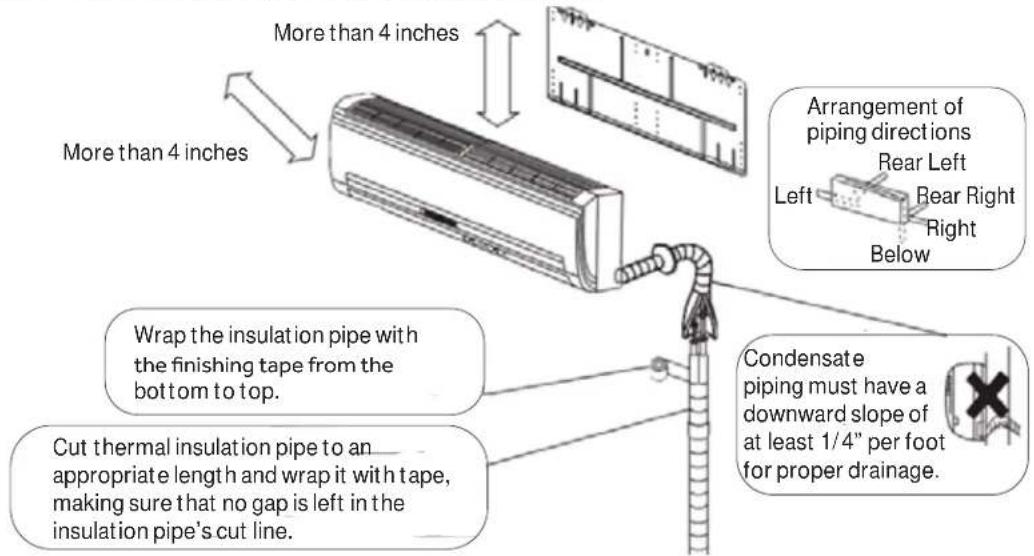
INDOOR CLEARANCES
(Appearance may vary)
This picture is for reference only. Your product may look different.
text_image
More than 4 inches More than 4 inches Arrangement of piping directions Rear Left Left Rear Right Right Below Wrap the insulation pipe with the finishing tape from the bottom to top. Cut thermal insulation pipe to an appropriate length and wrap it with tape, making sure that no gap is left in the insulation pipe's cut line. Condensate piping must have a downward slope of at least 1/4" per foot for proper drainage.SALTWATER COAST INSTALL
- The outdoor unit should be installed at least 12 mile away from the salt water, including seacoasts and inland waterways. Please follow the installation instruction below if the unit installed from 12 mile to 5 miles away from the salt water, including seacoasts and inland waterways.
- Install the outdoor unit in a place (such as near buildings etc.) where it can be protected from sea breeze which can damage the outdoor unit.
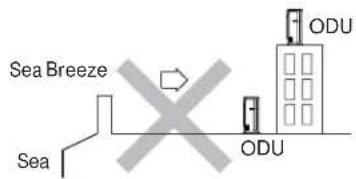
flowchart
graph TD
    A["Sea Breeze"] --> B["ODU"]
    C["Sea"] --> B
    B --> D["ODU"]
    style A fill:#f9f,stroke:#333
    style C fill:#f9f,stroke:#333
    style D fill:#ccf,stroke:#333
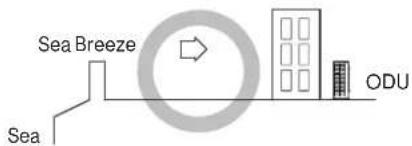
flowchart
graph LR
    A["Sea"] --> B["Sea Breeze"]
    B --> C["Process Step"]
    C --> D["ODU"]
- Construct a protection wall around it to block the sea breeze if you cannot avoid installing the outdoor unit by the seashore.
- A protection wall should be constructed with a solid material to block the sea breeze. The height and the width of the wall should be 1.5 times larger than the size of the outdoor unit. Also, allow at least 28" (700mm) between the protection wall and the outdoor unit for air circulation to ventilate.
• Install the outdoor unit in a place where water can drain. - Contact Haier Ductless for assistance if the above conditions cannot be met.
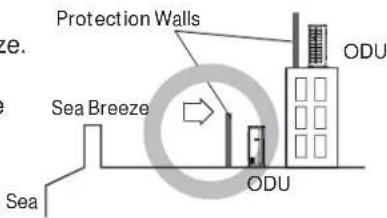
text_image
Protection Walls Sea Breeze ODU Sea ODULOW AMBIENT INSTALL
- If the outdoor unit is installed in a region that is affected by strong wind or snow accumulation, it is recommended to install wind baffle or/and snow hood accessories. Corresponding snow hood and wind baffle model number can be found in product catalog. The installation instructions can be found in the manual shipped with each accessory or on-line at GEAppliancesairandwater.com.
Step 1 - Preparation
Outdoor Unit Clearances
NOTE: Fix the unit by inserting bolts, wire or other foundation options if there is danger that the unit will fall or turn over.
NOTE: Place the unit on a level mounting base (or a plastic pedestal) for proper drainage.
NOTE: Install the outdoor unit in a level position. Failure to do so may result in water leakage or accumulation.
NOTE: Heat pump models will generate condensate water on the outdoor unit. Stacking the units without managing condensate water may create failure on the lower unit.
(3) Installation and maintenance space
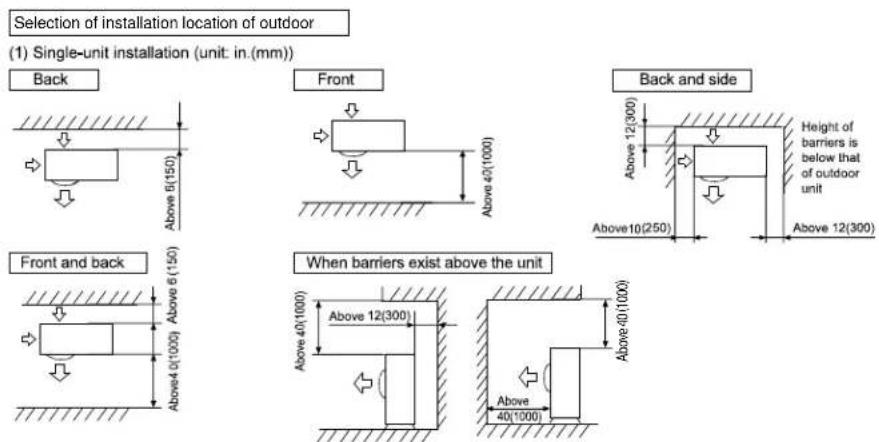
text_image
Selection of installation location of outdoor (1) Single-unit installation (unit: in.(mm)) Back Front Back and side Height of barriers is below that of outdoor unit Above 12(300) Above 10(250) Above 40(1000) Above 6(150) Above 4(1000) Above 8(1000) Above 12(300) Above 40(1000) Above 6(150) Above 8(1000) Above 12(300) Above 40(1000) Above 6(150) Above 8(1000) Above 12(300) Above 40(1000)The top and two side surfaces must be exposed to open space, and barriers on at least one side of the front and back shall be lower than the outdoor unit.
(2) Multi-unit installation (unit: in.(mm))
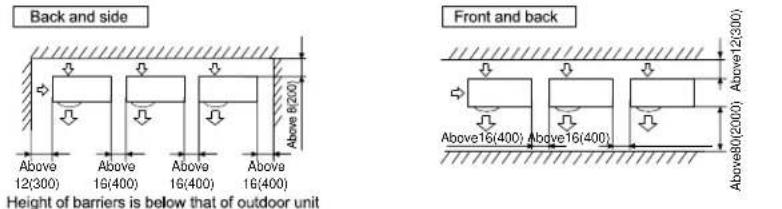
text_image
Back and side Above 12(300) Above 16(400) Above 16(400) Above 16(400) Height of barriers is below that of outdoor unit Front and back Above16(400) Above16(400) Above90(2000)(3) Multi-unit installation in front and back (unit: in.(mm))
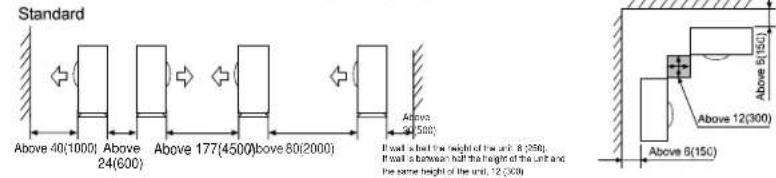
text_image
Standard Above 40(1000) Above 24(600) Above 177(4500)above 80(2000) Above 9(500) I wait is between the height of the unit, 8 (296). It wait is between half the height of the unit and the same height of the unit, 12 (300) Above 6(150) Above 12(300)Select the Outdoor location:
- Choose a level place solid enough to bear the weight and vibration of the OD unit and where the operation noise will not be amplified.
- Choose a location where the hot air discharge and/or noise will not create a nuisance for neighbors.
- Ensure there is sufficient space to maneuver the OD unit into place.
-
Ensure there is sufficient space and no obstructions for the air inlet and outlet.
-
Install the unit's power/communication wiring at least 10 feet away from television and radio sets to prevent interference.
- Ensure any moisture sensitive items are kept away from the condensate drain path of the OD unit.
- Choose a location not affected by heavy snowfall or wind.
• Install a wind baffle to prevent wind exposure.
INSTALLATION INSTRUCTIONS
Step 1 - Preparation Cont.
NOTES:
- OD unit cannot hang from a ceiling or be stacked.
- Ensure that accumulated snow, debris, etc... will not block the air inlet or the coil exchanger if installing the OD unit with a fence or rail guard around it.
- Ensure ventilation in case of refrigerant leakage. R-410A is a safe, nontoxic, and nonflammable refrigerant.
- Avoid installing the OD unit where corrosive gases, such as sulfur oxides, ammonia, and sulfurous gas are produced. If unavoidable, consult with an installation specialist about using a corrosion-proof or anti-rust additive to protect the unit coils.
- Do not install the outdoor unit near the edge of a balcony. Otherwise, children may climb onto the outdoor unit and fall off of the balcony.
- Do not install the outdoor unit in the following areas: Areas heavily laden with oil or greasy vapors such as kitchens. Oils and grease will create sticky layer on the coil and also cause drainage problems, thus degrade unit performance.
- Corrosive areas that can potentially have combustible gas leaks, contain suspended fibers or flammable dust, or flammables such as paint thinner or gasoline can cause fires.
- Areas that contain small animals, rodents, reptiles or insects that can infiltrate the equipment and cause damage to internal components.
- Area where animals may urinate on the unit or ammonia may be generated.
- Install as necessary a protective fence or the like to prevent their access if the outdoor unit must be installed in an area within easy reach of the general public.
• Take appropriate measures to protect it from those
elements If the outdoor unit is installed in a cold region that is affected by snow accumulation, snow fall, or freezing. To ensure a stable operating, install inlet and outlet ducts.
- Make sure the outdoor unit is installed level and is stable. Install snow protection hood as necessary.
- Avoid salty places such as the seaside for installation where air conditioner trouble is liable to occur.
- Install the outdoor unit in a location that is away from exhaust or the vent ports that discharge vapor, soot, dust, or debris.
- Install the unit where it will not be tilted by more than 3^ . However, do not install the unit with it tilted towards the side containing the compressor.
- When installing the outdoor unit where it may exposed to strong wind, fasten it securely.
- It is recommended that unit be installed under a canopy or elevated on a high stand.
- Protect the drain line from freezing in areas where temperature drops to 32^ (0^) or lower.
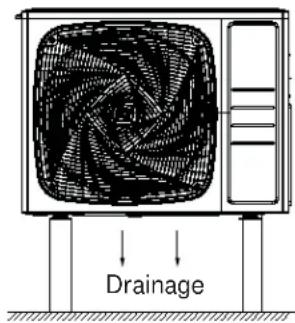
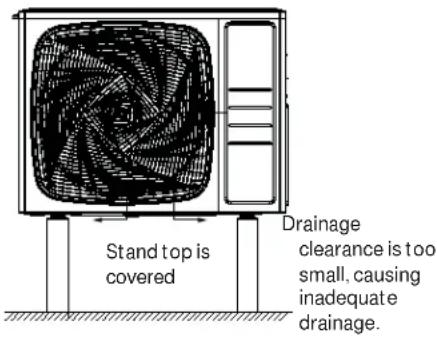
- Please set up the outdoor unit in a high place and please do not arrange the frame of installed stand under the drain port, because the water dropped from the drain port repeats freezing and accumulating, and may block the drain port.
- Do not use mineral oils on flared parts. Prevent mineral oil from entering the refrigerant system. Introduction of mineral oil may reduce the system life.
- Be sure to use an inert gas such as nitrogen while brazing any refrigerant lines to prevent any oxidation
- Be sure not to exceed refrigerant tubing length limits for different models to ensure smooth operation of the unit. Otherwise the equipment life cannot be guaranteed.
Step 2 - Installation of the Indoor Unit
A. Select the Indoor location:
- Do not expose the unit to unusual heat sources or steam outlets.
- Select a location where there are no obstacles in front of the unit.
- Make sure that condensate drainage can be conveniently routed away.
- Do not install near a doorway.
- Ensure that the space around the left and right of the unit is more than 4". The unit should be installed as high on the wall as possible but allow a minimum of 4" from the ceiling.
- Use a stud finder to locate and mark stud locations for mounting and to prevent unnecessary damage to the wall.
• Install in a location that is strong enough to withstand the full weight and vibration of the unit. - Leave enough space to allow access for routine maintenance.
- Select a location that gives easy access to removing and cleaning air filters.
• Install in a location that is 3 ft. or more away from other electrical appliances, such as televisions and audio devices.
Step 2 - Installation of the Indoor Unit (Cont.)
B. Install the Mounting Plate
- Remove plastic bag, tape, and mounting plate from the back of the indoor unit.
- Place the mounting plate on the wall in the desired location taking into account the minimum clearances necessary for proper operation.
- Using a level, verify that the mounting plate is horizontal and mark the screw locations.
- Attach the mounting plate to the wall with the supplied screws.
- Wall anchors are supplied if not able to align all screw holes with studs.
- Be sure that the mounting plate has been attached firmly and that applied weight is evenly distributed by each screw. (At least one screw in wall stud, others can use wall anchors.)
- The piping for the indoor unit may be routed to and from the unit in one of several directions: left, left rear, right, right rear, or right below.
C. Install the Tubing
- Always use new clean copper tubing. Never reuse tubing if replacing an existing system.
- Measure and mark the location where the piping hole is to be drilled.
- Follow these steps to move the drain pipe if pipe location will be on the left side of the unit.
- Remove the stopper in the left drain hole and knockout the molded plug inside the port.
- Transfer the corrugate drain hose from the right side to the left side.
- Insert stopper into right side drain port. Using soap as a lubricant and a small screwdriver will allow for easier seating of the stopper.
- Drill the lineset hole using a 2 1/4" hole saw. Angle the drill with a downward pitch to the outside wall so that the outside wall hole will be at least a 1/4" lower than the inside hole. This allows for proper drainage of condensate.
- Install the lineset hole flange at the hole opening on the inside wall.
NOTE: The flange is prescored. It may be necessary to modify the flange to fit properly behind the wall unit housing.
D. Electrical Connections for the Indoor Unit
NOTE: Be certain all wiring complies with local building codes and NEC and that the supply voltage for this system is correct.
- Place the indoor unit on a solid work surface before making electrical connections.
- To make the electrical connections for the indoor unit, both the outer plastic and inner galvanized steel cover plate must be removed.
- Raise the front cover to access the screws for removing these covers.
- Route the 14/4 AWG stranded wiring through the slot in the back of the unit and into the front access panel.
- Using a wire stripper, remove the insulation and separate the 4 wires.
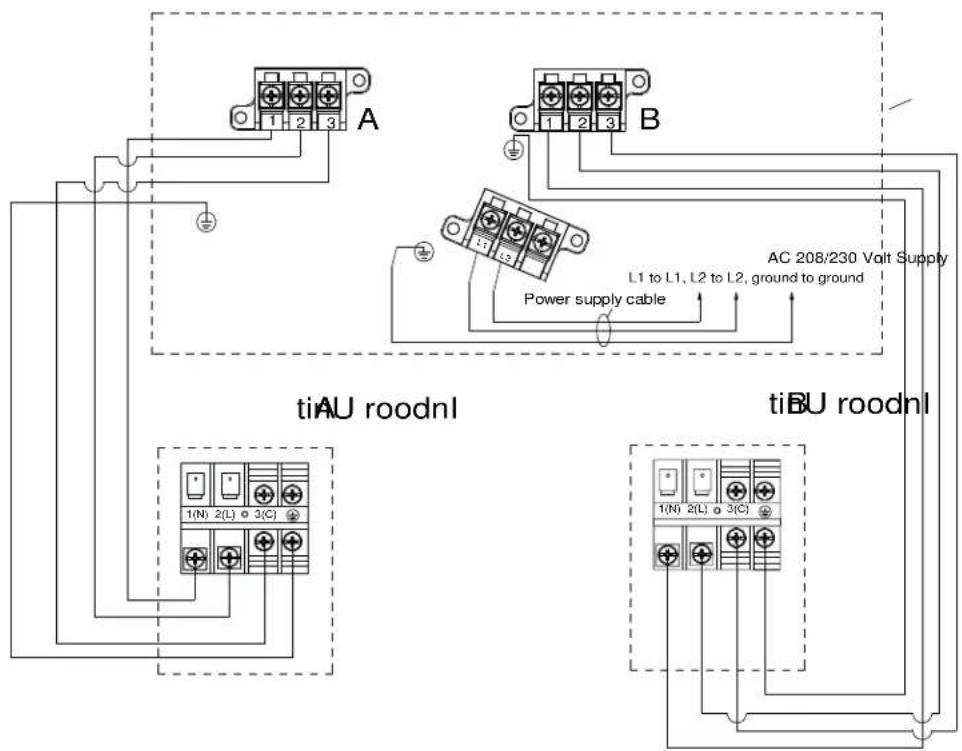
- Make wiring connections at each terminal according to wiring diagram. (Take note of the color of the wire at each terminal and ensure the wires are connected to the outdoor unit accordingly.)
- Ensure each wire is under the screw terminal plate and the plate is tightened.
- Ensure the 14/4 cable is secured under the strain relief bracket.
- Replace both cover plates and lower the front casing after the terminal block wiring is completed.
INSTALLATION INSTRUCTIONS
Step 2 - Installation of the Indoor Unit (Cont.)
E. Mount Indoor Unit to Mounting Plate
- Bundle the refrigerant piping, drain piping, and wiring with tape and carefully route the bundle through the piping hole.
- With the top of the indoor unit closer to the wall, hang the indoor unit on the upper hooks of the mounting plate. Slide the unit slightly side to side to verify proper placement.
- Rotate the lower portion of the indoor unit to the mounting plate, pushing the unit up slightly, rotate the lower part of the unit fully against the wall, then pull down do the lower hooks engage the brackets. (see illustration)
- Verify the unit is secured and flush to the wall.
- Indoor Unit installation is finished at this time.
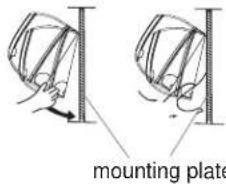
text_image
mounting plateF. Condensate Drainage Pipe
- Verify the condensate drain line has a constant pitch downward for proper water flow. There should be no kinks or rises in the tubing which may cause a trapping effect of the water (see illustration).
Optional: Can use PVC pipe by connecting a 1" ID PVC pipe to the drain line coming out of the wall and running to desired location.
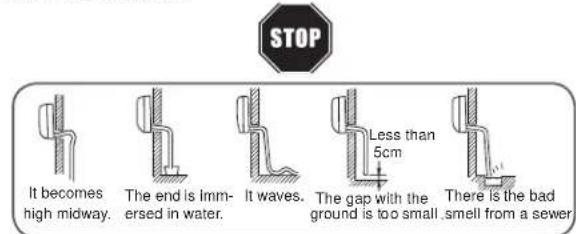
text_image
STOP It becomes high midway. The end is immersed in water. It waves. The gap with the ground is too small. There is the bad smell from a sewer.G. To Remove the Indoor Unit
- Slightly raise the entire unit.
- Pull the lower portion of the unit off the lower hooks and pull slightly away from the wall.
- Lift the upper portion of the unit off the upper hooks.
text_image
tiAU roodnl tiBU roodnl AC 208/230 Volt Supply L1 to L1, L2 to L2, ground to ground Power supply cabletinU roodtuC
Note: Above diagram only demonstrates the wiring connection between outdoor & indoor for dual zone as an example.
INSTALLATION INSTRUCTIONS
Wall Brackets
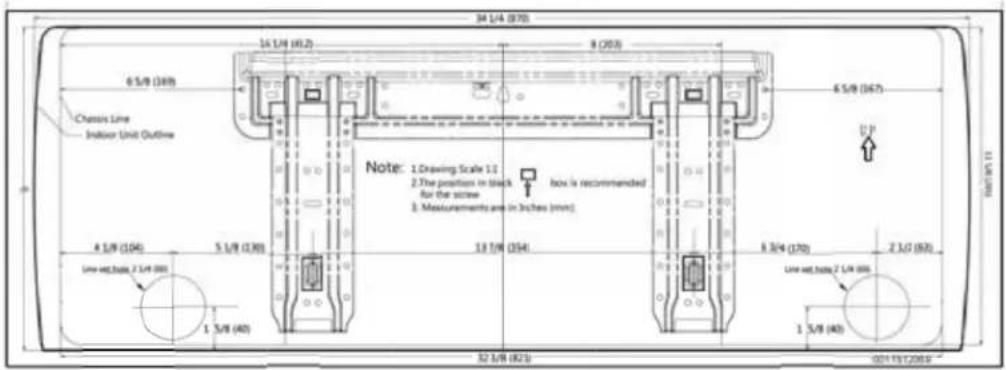
A cardboard template for the mounting plate is included with many of the indoor units. It serves as an easier way of determining where to mount the wall bracket and where to cut the hole for piping.
NOTE: Some models may not have a cardboard template, in this case, a manual measurement is needed to determine the piping hole location.
When mounting the unit, use a stud finder to secure the upper-most holes to the structure of the building. Use load rated anchors to attach other portions of the bracket to the wall.
EXAMPLE
text_image
34 L/4 (870) 6.5/9 (189) Chassis Line Indoor Unit Outline Note: 1. Drawing Scale 1:1 2. The position in block for the side 3. Measurements are in inches (mm) 4.5/9 (104) 5.5/9 (130) 13.5/9 (254) 8.5/9 (167) 8.5/9 (170) 2.3/2 (80) Line wt, hate 2.5/9 (80) 1.5/9 (40) 32.5/9 (873) Q01 15:1,20:0INSTALLATION INSTRUCTIONS
Step 3 - Installation of the Outdoor Unit
A. Prepare the Outdoor Unit for Installation
- Remove all packaging.
- Place supplied vibration pads onto outdoor unit's feet.
- Use team lift to place the unit on a solid foundation, 8" above the average snowfall.
Correct
Installation
text_image
DrainageIncorrect
Installation
text_image
Stand top is covered Drainage clearance is too small, causing inadequate drainage.Correct
Installation
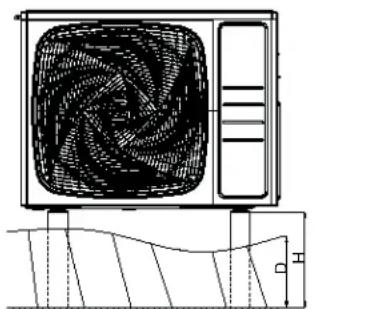
natural_image
Technical diagram of a mechanical or electrical component with internal spiral pattern and labeled dimensions (no readable text or symbols)Incorrect
Installation
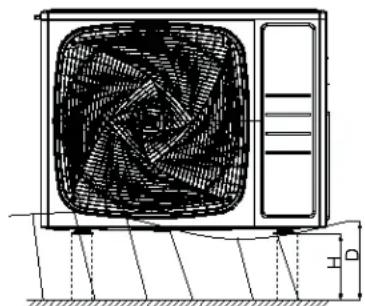
natural_image
Technical line drawing of a mechanical fan or air conditioning unit with internal blades and mounting base (no text or symbols)Minimum height(H) should be higher than the highest snowfall depth(D)(H=D+8")
Unit may become covered in snow if the stand height is insufficient.
INSTALLATION INSTRUCTIONS
Step 3 - Installation of the Outdoor Unit (Cont.)
B Attaching Drain Elbow to Outdoor Unit
- Attach the supplied drain elbow to the outdoor unit, if required. Connect extension piping as needed (not supplied). (see illustration)
NOTE: The drain elbow is designed with an air gap and will not sit flush to bottom of the outdoor unit.
NOTE:2U20EH2HDA, 3U24EH2HDA, 4U36EH2HDA, 4U36MS2HDA, & 5U42MS2HDA models will not use a drain elbow. A 3rd party pan is needed, if condensate management is required by code.
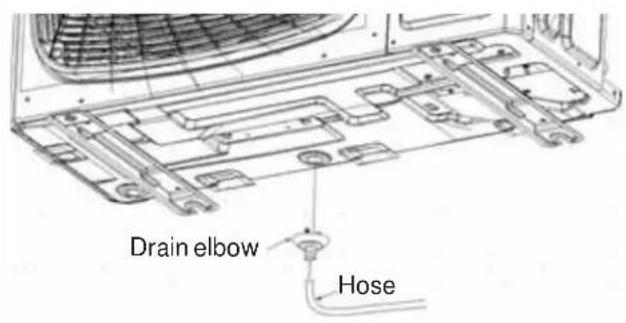
text_image
Drain elbow HoseC. Electrical Connections for the Outdoor Unit
WARNING
RISK OF ELECTRIC SHOCK.
Could cause injury or death.
Make sure power is off before touching wires.
NOTE: Be certain all wiring complies with local building codes and NEC and that the supply voltage for this system is correct.
- Connect the wiring for both the power source and the indoor wiring using a conduit cable bracket on the side of the outdoor unit
- Using a wire stripper, remove the insulation and separate the wires.
- Verify that the wiring connections match the indoor connections wire for wire.
- Ensure each wire is under the screw terminal plate and the plate is tightened.
- Ensure the 14/4 stranded wire cable is secured under the strain relief bracket.
- Verify that all connections are secured
NOTE: Failure to follow the wiring guidelines can result in control board damage and communication issues (E7 error code). This includes improper wire size, use of solid core wire, midline splicing and poor terminal connections.
INSTALLATION INSTRUCTIONS
Step 3 - Installation of the Outdoor Unit (Cont.)
| Model:2U18MS2HDA3U24MS2HDA | 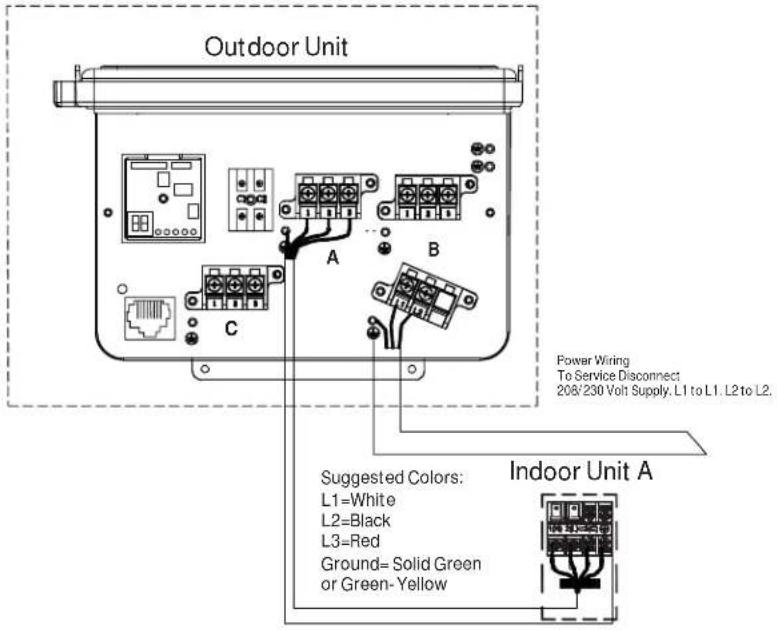 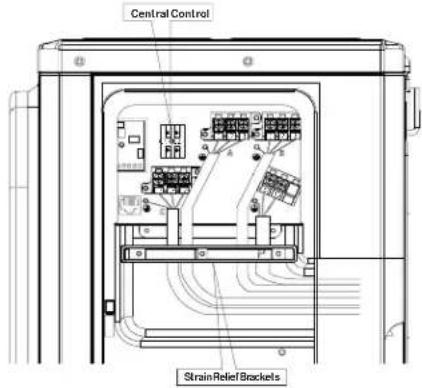 |
| Model:2U20EH2HDA3U24EH2HDA4U36MS2HDA | 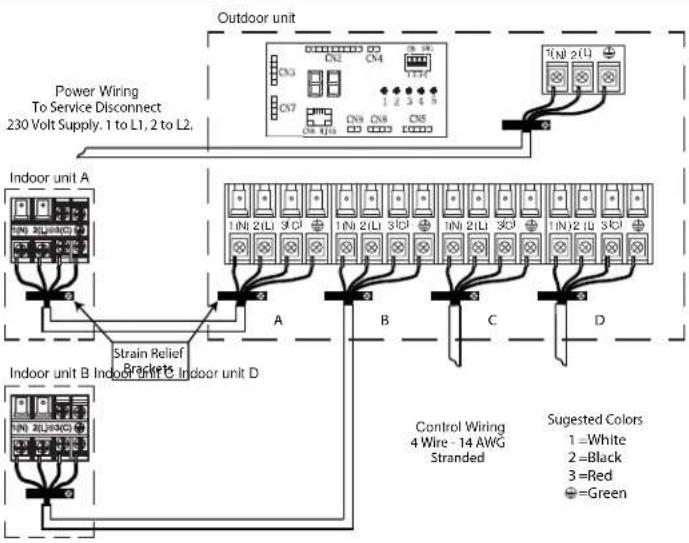 |
INSTALLATION INSTRUCTIONS
Step 3 - Installation of the Outdoor Unit (Cont.)
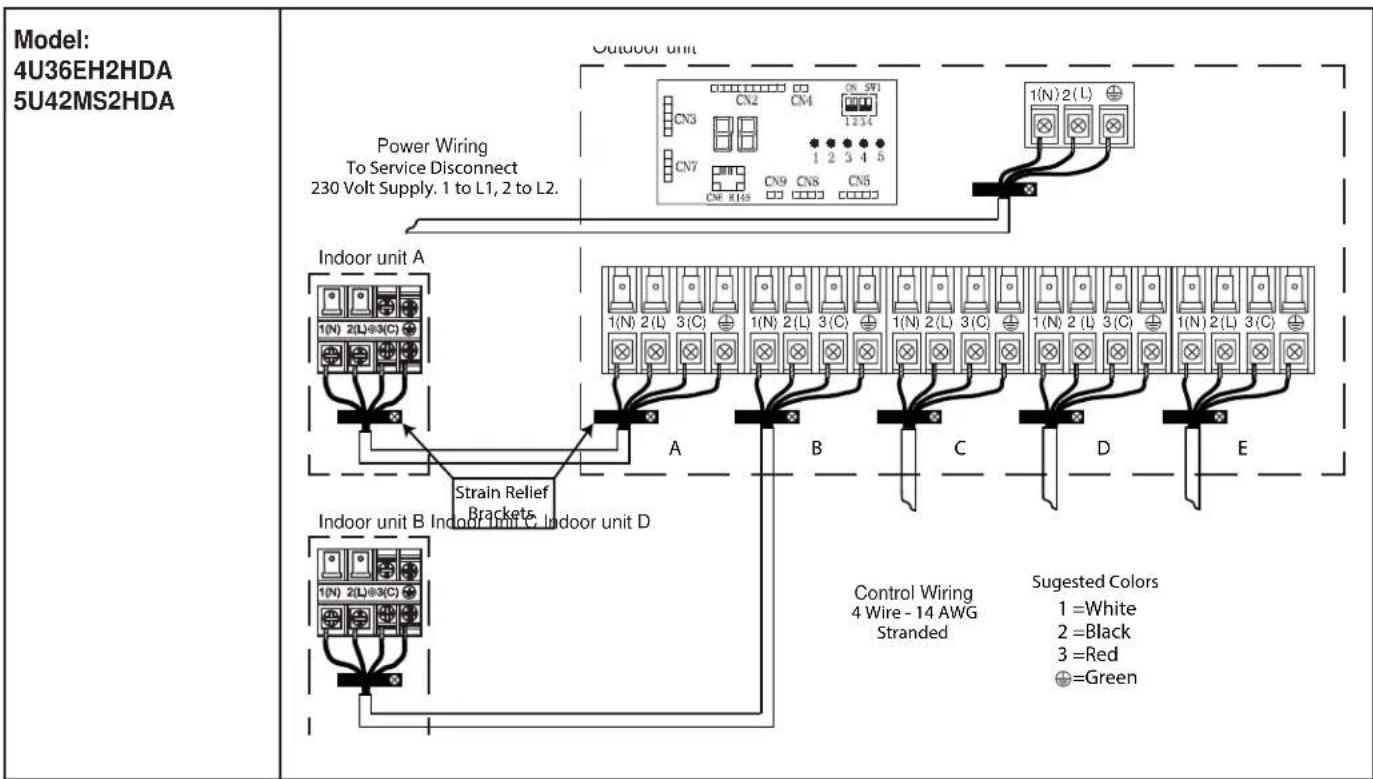
text_image
Model: 4U36EH2HDA 5U42MS2HDA Power Wiring To Service Disconnect 230 Volt Supply. 1 to L1, 2 to L2. Indoor unit A Strain Relief Brackets Indoor unit B Indoor unit C Indoor unit D Outdoor unit Control Wiring 4 Wire - 14 AWG Stranded Sugested Colors 1 =White 2 =Black 3 =Red =GreenINSTALLATION INSTRUCTIONS
Step 3 - Installation of the Outdoor Unit (Cont.)
Refrigerant Charge and Pipe Length Information
| Model Number F | Factory Charge | Total Pipe Length of factory charge | Additional charge rule | Branch Maximum pipe length | System Maximum pipe length | Minimum pipe length |
| Unit oz ft oz/ft ft ft ft | ||||||
| 2U18MS2HDA | 60 | 50 | 820.282 | 65 | 98 | 10' per indoor |
| 3U24MS2HDA | 67 100 | 197 | ||||
| 4U36MS2HDA | 90 13 | 230 | ||||
| 2U20EH2HDA | 69 | 66 | 82 | 165 | ||
| 3U24EH2HDA | 82 100 | 197 | ||||
| 4U36EH2HDA | 102 | 131 | 82 | 230 | ||
| 5U42MS2HDA | 113 | 164 | 82 | 262 |
D. Install Copper Lineset
- Line set sizes are determined by the indoor unit. See indoor spec for information. The outdoor unit ships with port adapters to reduce or enlarge the flare port sizes when needed. If connecting to 24K models with 3/8" & 5/8" ports, adapters must be ordered separately.
- Cut the line set to length.
- Place nut over the pipe and then flare with the R-410A flaring tool.
NOTE: Follow standard practices for creating pipe flares. When cutting and reaming the tubing, use caution to prevent dirt or debris from entering the tubing. Remember to place nut over the tubing before flaring. - To join the line set, directly align the tubing flare to the fitting on the other pipe. Slide the nut onto the fitting and hand tighten.
- Torque the fittings according to the specifications shown in the torque chart below.
| Forced fastening without careful centering will damage the threads and cause a refrigerant leak. | |
| Pipe Diameter (ø) Fastening torque | |
| 1/4” 18N.m/13.3Ft.lbs | |
| 3/8” 42N.m/30.1Ft.lbs | |
| 1/2” 55N.m/40.6Ft.lbs | |
| 5/8” 60 N.m/44.3Ft.lbs |
- Two wrenches are required to join the flare connection; one standard wrench and one torque wrench adjusted to the proper settings.
- Repeat the process for attaching the other end of the line set.
CAUTION
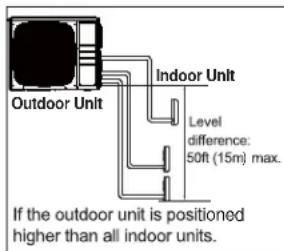
text_image
Outdoor Unit Indoor Unit Level difference: 50ft (15m) max. If the outdoor unit is positioned higher than all indoor units.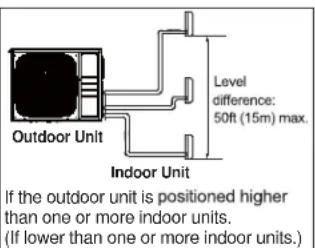
text_image
Outdoor Unit Level difference: 50ft (15m) max. Indoor Unit If the outdoor unit is positioned higher than one or more indoor units. (If lower than one or more indoor units.)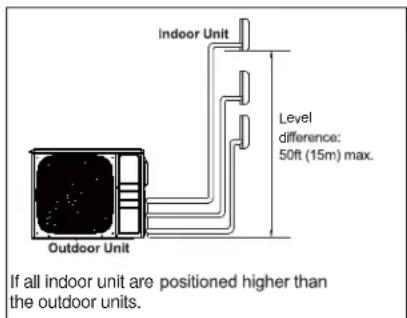
text_image
Indoor Unit Level difference: 50ft (15m) max. Outdoor Unit If all indoor unit are positioned higher than the outdoor units.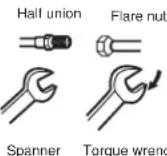
Step 3 - Installation of the Outdoor Unit (Cont.)
E. Leak Test
Perform the following steps for EACH line set. The primary service valve has a 5/16 port, an adapter may be necessary.
- Remove the cap on the service valve.
- Using a tank of dry nitrogen and approved regulator, charge the system with 150 psig of dry nitrogen using mini-split adapter to connect the valve.
- Check for leaks at the flare fittings using soap bubbles or another detection device. If a leak is detected, make repairs to the fittings and recheck. Proceed if no leaks are detected within 3 minutes.
- Using the same tank/regulator, charge the system to 300 psig.
- Check for leaks as earlier. Proceed if no leaks are detected within 3 minutes.
- Using the same tank/regulator, charge the system to 500 psig.
- Check for leaks as earlier. Keep system pressurized for at least 20 minutes.
WARNING
Do not use acetylene, oxygen or compressed air or mixtures containing air, oxygen, or combustible gases for pressure testing. Do not use mixtures of hydrogen containing refrigerant and air above
atmospheric pressure for pressure testing as they may become flammable and could result in an explosion. Refrigerant, when used as a trace gas, should only be mixed with dry nitrogen for pressurizing units. Failure to follow these recommendations could result in death or serious injury as well as equipment or property damage.
F. System Evacuation
NOTE- Do not open service valve.
- Remove the suction line cap and attach a micron gauge and vacuum pump. The port is 5/16", an adapter may be needed.
• Evacuate the system to at least 350 microns. - Close the vacuum pump valve and check the micron gauge. If the gauge rises above 150 microns in 60 seconds, the evacuation is incomplete or there is a leak in the system. If the gauge does not rise above 150 microns in 60 seconds, the evacuation is complete.
- Once evacuation is complete, remove the adapter and hose connection from the suction line port and replaced the cap.
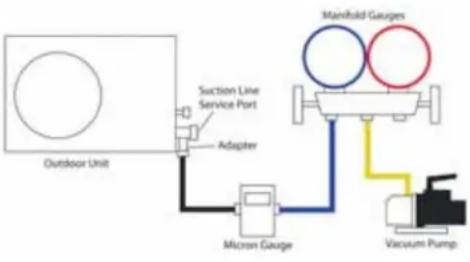
flowchart
graph LR
    A["Outdoor Unit"] --> B["Suction Line Service Port"]
    B --> C["Adapter"]
    C --> D["Micron Gauge"]
    D --> E["Manifold Gauges"]
    E --> F["Vacuum Pump"]
INSTALLATION INSTRUCTIONS
Step 3 - Installation of the Outdoor Unit (Cont.)
G. Refrigerant Charging
- Add any additional refrigerant after evacuation using a digital scale.
NOTE: Charge liquid only.
- Fill out the refrigerant charge label using indelible ink.
- Place the factory refrigerant charge found on the outdoor nameplate in box number 1.
- Place the amount of additional refrigerant added in box number 2.
- Add boxes 1 and 2 together and place the value in the sum box (D).
- Adhere the filled out label in the proximity of the product charging port and under the outside unit valve cover.
- Write amounts on outdoor unit with permanent marker above the charging port, if no sticker found.
- Remove the cap from the liquid line valve. Using a hex wrench, open the valve, then replace and tighten the cap securely to avoid leaks.
- Remove the cap from the suction line valve. Using a hex wrench, open the valve, then replace and tighten the cap securely to avoid leaks.
- Wrap the line set, drain line, and 14/4 AWG wiring starting at the bottom of the bundle with an overlap type wrap until you reach the piping hole.
- Use a sealant to seal the piping hole opening on both sides of the wall in order to prevent drafts, weather, or pests from entering the building.
This product contains fluorinated greenhouse gases covered by the Kyoto Protocol. Do not vent into the atmosphere.
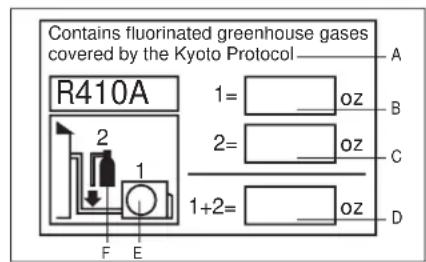
text_image
Contains fluorinated greenhouse gases covered by the Kyoto Protocol R410A 1= 2= 1+2= oz B C D F ERefrigerant type: R-410A
GWP* value: 2088
GWP = global warming potential
INSTALLATION INSTRUCTIONS
Step 4 - Final Check
Wiring Check Test
Turn off power at the disconnect. Move all dip switches in the SW1 bank to ON. When power is turned on, the LED display will alternate the compressor frequency and CH (check). The system will run through each unit (A, B, C, D, and E), cycling each EEV while testing the wiring. A successful test will be indicated by the corresponding LED displaying a constant green (1=A, 2=B, 3=C, 4=D, 5=E). Mis-wired units will generate an EC on the display, with the corresponding L flashing green.
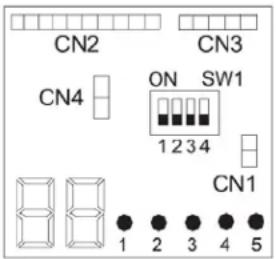
text_image
CN2 CN3 CN4 ON SW1 1 2 3 4 CN1 1 2 3 4 5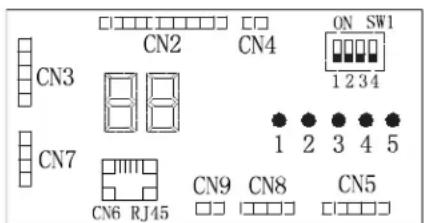
text_image
CN2 CN4 ON SW1 1 2 3 4 CN3 CN7 1 2 3 4 5 CN6 RJ45 CN9 CN8 CN5| Green LEDs | |||||
| Display 1 (Port A) | 2 (Port B) | 3 (Port C) | 4 (Port D) | 5 (Port E) | Message |
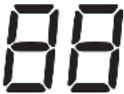 Shows Compressor Speed.Flashing numbers are current faults Shows Compressor Speed.Flashing numbers are current faults | OFF No power to unit. | ||||
| ON/OFF | Unit is recently powered on and communication started. | ||||
| When LED is ON, that indoor unit has built a communication path and will operate.When LED is OFF, there is no indoor unit installed or there is bad communication. | |||||
System Test
Please explain to the customer how to operate the system by using the Owner's Manual found with the indoor unit.
Explaining Operation To the End User
- Using the User Manual, explain to the user how to use the air conditioner/heat pump, (the remote controller, adding/removing the air filters, placing or removing the remote controller from the remote control holder, cleaning methods, precautions for operation, etc.)
- Review precautions for operation.
- Recommend that the user read the Operating Instructions carefully.
Check Items for Test Run
☐ No gas leak from linesets?
Are the linesets insulated properly?
☐ Are the connecting wirings of indoor and outdoor firmly inserted to the terminal block?
□ Is the connecting wiring of indoor and outdoor fixed?
□ Is condensate draining correctly?
Is the ground wire securely connected? Is the indoor unit securely fixed?
☐ Is power source voltage correct according to local code?
□ Is there any odd noise?
☐ Does the cooling temperature drop between 20-30°F?
☐ Does the heating temperature raise between 35-40°F?
□ Is the room temperature display accurate?
NOTES
LIMITED WARRANTY
For the product models listed on Attachment 1 (the "Product"), this Standard Base Limited Warranty is provided to the Original Owner of the Product:
| For The Period Of: Haier Will Replace: | |
| 5 year limited parts warrantyFrom the date of the original purchase | This Standard Base. Limited Warranty covers all defects in workmanship or material for the mechanical and electrical parts (including the compressor) contained in the Product (“Defective Parts”) for a period of 5 years from the Date of Purchase. GE Appliances will provide new or refurbished parts, or a replacement for all or part of the unit, at its sole discretion, to your licensed HVAC technician installer. This warranty also covers all defects in workmanship or material for the unit controller for a period of 1 year. The remote controller is covered by 1-year accessory warranty. The ductless system is covered by Standard Base Limited Warranty. GE Appliances will provide a new or refurbished controller, at its sole discretion. |
EXCLUDED COMPONENTS
The following components are not covered by this warranty: cabinets, cabinet pieces, air filters, driers, refrigerant, refrigerant line sets, belts, wiring, fuses, oil nozzles, unit accessories and any parts not affecting unit operation.
WHAT IS THE DATE OF PURCHASE
The “Date of Purchase” is the date that the original installation is complete and all product start-up procedures have been properly completed and verified by the installer’s invoice. Registration is strongly recommended. If the installation date cannot be verified, then the Date of Purchase will be sixty (60) days after the manufacture date, as determined by the Product’s serial number. You should keep and be able to provide your original sales receipt from the installer as proof of the Date of Purchase. For new construction, the Date of Purchase will be the date of purchase of the residence by the Owner from the builder.
WHO IS COVERED
Owner occupied: The “Original Owner” of this product means the original owner (and his or her spouse) of the residence where the Product was originally installed. Non-owner occupied: The “Original Owner” of the Product means the original owner of the building where the Product was originally installed, and for new construction, the purchaser of the building from the builder. “Non-owner occupied” is defined as a a) single family or multi-family non-owner-occupied residential building, or b) non-industrial commercial application, (such as office buildings, retail establishments, hotels/motels), but for non-owner-occupied Original Owners, this limited warranty requires that the product be installed and maintained annually by a licensed HVAC technician (proof of annual maintenance is required). Subject to the law of the state or province where the Product is installed, the remainder of this Standard Base Warranty is transferable to subsequent owners of the residence or building.
HOW CAN YOU GET SERVICE
Contact your licensed HVAC technician installer. All installation and service must be performed by a licensed HVAC technician. Failure to use a licensed HVAC technician for installation of this Product voids all warranty on this Product.
THIS WARRANTY DOES NOT COVER
- Damage from improper service or installation.
- Damage in shipping.
- Defects other than manufacturing defects (i.e., other than workmanship or materials).
- Damage from misuse, abuse, accident, alteration, lack of proper care and/or regular maintenance, or incorrect electrical voltage or current.
- Damage resulting from floods, fires, wind, lightning, accidents or similar conditions.
- Product that was not installed or serviced by a licensed HVAC technician.
• Labor and related services for repair or installation of the Product. - A product purchased from an unauthorized online retailer.
-
Damage as a result of subjecting Product to an atmosphere with corrosives or high levels of particulates (such as soot, aerosols, fumes, grease).
-
A Product sold and/or installed outside of the 50 United States, the District of Columbia, or Canada.
- Batteries for the controller and other accessories provided with the Product for installation (e.g., plastic hose).
- Normal maintenance, such as cleaning of coils, cleaning filters, and lubrication.
- For Product installed in non-owner occupied applications, Product that has not been maintained annually by a licensed HVAC technician (proof required).
- Damage caused by a used or unapproved component or part by GE Appliances, a Haier company (e.g., a used and/or unapproved condenser / air handler).
- Component or parts are not provided by GE Appliances, a Haier Company
- Product that has been moved from its original installation to a new residence or building.
LIMITED WARRANTY
10 YEAR STANDARD REGISTERED LIMITED WARRANTY
All “Indoor and Outdoor Products,” identified in Attachment 1, registered by the installer or the Original Owner within 60 days of the Date of Purchase shall receive a Standard Registered Limited Warranty, which shall be identical to the Standard Base Warranty, except that the Limited Parts Warranty shall be for a term of 10 Years. All Product not registered within 60 days of the Date of Purchase shall be subject to the Standard Base Warranty. Some states and provinces do not allow warranty terms to be subject to registration; in those states and provinces the longer terms for Limited Parts Warranty apply. Except in Texas or where otherwise required by law, this Standard Registered Limited Warranty is not transferable to a subsequent purchaser (other than the purchaser of a new building), but subsequent purchases will receive the remainder of the Standard Base Warranty.
THIS LIMITED WARRANTY IS GIVEN IN LIEU OF ALL OTHER WARRANTIES, EXPRESS OR IMPLIED, INCLUDING THE WARRANTIES OF MERCHANTABILITY AND FITNESS FOR A PARTICULAR PURPOSE.
The remedy provided in this warranty is exclusive and is granted in lieu of all other remedies. This warranty does not cover incidental or consequential damages. Some states and provinces do not allow the exclusion of incidental or consequential damages, so this limitation may not apply to you. Some states and provinces do not allow limitations on how long an implied warranty lasts, so this limitation may not apply to you. This warranty gives you specific legal rights and you may also have other rights which vary by state and province. This warranty covers units within the 50 United States, the District of Columbia and Canada. This warranty it provided by GE Appliances a Haier company, Louisville, KY 40225.
ATTACHMENT 1
The “Product” is defined as Haier brand and GE Appliances brand Ductless Split Units and Side-discharge Units. The “Product” contains 2 sub-categories of goods: “Indoor and Outdoor Products” and “Selected Installation Products,” which are further defined below: “Indoor and Outdoor Products” can further be identified by the following model number descriptions: 1U*, 2U*, 3U*, 4U*, 5U*, AB*, AD*, AL*, AM*, AW*, AF*, ASY*, USY*, ASH*, AUH*, UUC*, UUY*, “Selected Installation Products”, identified by the following model number descriptions: PB-*, PAD-*.
TABLE DES MATIÈRES
CONSIGNES DE SÉCURITÉ IMPORTANTES 34
INSTRUCTIONS D'INSTALLATION....36
Préparation....43
| Adaptateurs | GEA PART# | |
| A | 1/4" to 3/8" Adaptateur conique | WJ01X23925 |
| B | 3/8" to 5/8" Adaptateur conique | WJ01X23924 |
| C | 1/2" to 5/8" Adaptateur conique | WJ01X23932 |
| D | 3/8" to 1/2" Adaptateur conique | WJ01X26853 |
| E | 1/2" to 3/8" Adaptateur conique | WJ01X26854 |
text_image
Outdoor Unit A B L1 to L2 AC 208/230 Volt Supply L1 to L1, L2 to L2, ground to ground Power supply cable Indoor Unit A Indoor Unit B 1(N) 2(L) 3(C)text_image
34 L/4 (370) 6.5/9 (389) Chassis Line Indoor Unit Outline Note: 1. Drawing Scale 1:1 2. The position in block for the screw box is recommended 3. Measurements are in inches (mm) 4.5/9 (104) 5.5/9 (3.80) 12.5/4 (254) 8 (205) 4.5/9 (167) UP Line end, table 2 5/9 (60) 2.5/2 (60) 1 5/8 (40) 32.5/8 (823) 00/11/12/2019natural_image
Technical line drawing of a mechanical component with internal spiral pattern and dimension label (no readable text or symbols)natural_image
Technical line drawing of a mechanical component with internal spiral pattern (no text or symbols)text_image
Model: 4U36EH2HDA 5U42MS2HDA Power Wiring To Service Disconnect 230 Volt Supply. 1 to L1, 2 to L2. Indoor unit A Strain Relief Brackets Indoor unit B Indoor Unit C Indoor unit D Outdoor unit Control Wiring 4 Wire - 14 AWG Stranded Sugested Colors 1 =White 2 =Black 3 =Red =Greentext_image
Outdoor Unit Indoor Unit Level difference: 50ft (15m) max. If the outdoor unit is positioned higher than all indoor units.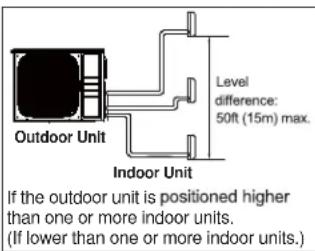
text_image
Outdoor Unit Level difference: 50ft (15m) max. Indoor Unit If the outdoor unit is positioned higher than one or more indoor units. (If lower than one or more indoor units.)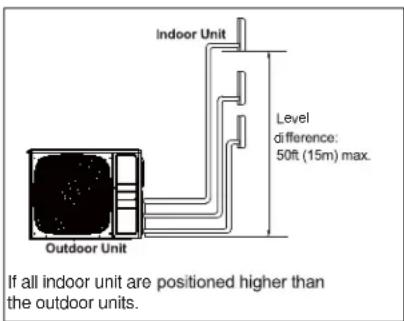
text_image
Indoor Unit Level difference: 50ft (15m) max. Outdoor Unit If all indoor unit are positioned higher than the outdoor units.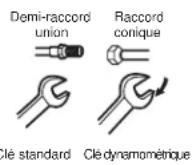
| Adaptador | GEA PART# | |
| A | 1/4" to 3/8"flare Adapter | WJ01X23925 |
| B | 3/8" to 5/8"flare Adapter | WJ01X23924 |
| C | 1/2" to 5/8"flare Adapter | WJ01X23932 |
| D | 3/8" to 1/2"flare Adapter | WJ01X26853 |
| E | 1/2" to 3/8"flare Adapter | WJ01X26854 |
NOTA: Heat pump models will generate condensate water on the outdoor unit. Stacking the units without managing condensate water may create failure on the lower unit.
text_image
Outdoor Unit A B AC 208/230 Volt Supply L1 to L1, L2 to L2, ground to ground Power supply cable Indoor Unit A Indoor Unit B 1(N) 2(L) 3(C)text_image
34 1/4 (870) 6 5/8 (269) Chassis Line Indoor Unit Outline Note: 1. Drawing Scale 1:1 2. The position in block for the screw 3. Measurements are in inches (mm) 14 5/9 (254) 6 5/8 (267) U.P. 4 1/8 (104) Line width, 2 1/4 (40) 1 5/8 (40) 32 1/4 (823) 2 1/2 (60) Line width, 2 1/4 (60) 1 5/8 (80) 00/11/12/2007natural_image
Technical diagram of a wind turbine fan installation with hatched pattern and ground level indicator (no text or symbols)natural_image
Technical line drawing of a mechanical HVAC unit with internal fan structure and height dimension (no text or symbols)text_image
Model: 4U36EH2HDA 5U42MS2HDA Power Wiring To Service Disconnect 230 Volt Supply. 1 to L1, 2 to L2. Outdoor unit Indoor unit A Strain Relief Brackets Indoor unit B Indoor unit C Indoor unit D Control Wiring 4 Wire - 14 AWG Stranded Sugested Colors 1 =White 2 =Black 3 =Red =Greentext_image
Outdoor Unit Indoor Unit Level difference: 50ft (15m) max. If the outdoor unit is positioned higher than all indoor units.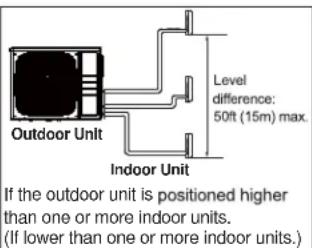
text_image
Outdoor Unit Level difference: 50ft (15m) max. Indoor Unit If the outdoor unit is positioned higher than one or more indoor units. (If lower than one or more indoor units.)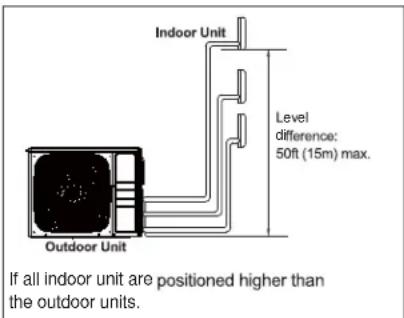
text_image
Indoor Unit Level difference: 50ft (15m) max. Outdoor Unit If all indoor unit are positioned higher than the outdoor units.If you have a problem with this product, please call 1-877-337-3639 for the name and telephone number of the nearest authorized service center.
DATED PROOF OF PURCHASE REQUIRED FOR WARRANTY SERVICE