
CTR44 - Electronic board DUCATI - Free user manual and instructions
Find the device manual for free CTR44 DUCATI in PDF.


| Product type | Electronic board for sliding gate automation |
| Brand | DUCATI |
| Model | CTR44 |
| Dimensions (L × W × H) | 100 × 105 × 45 mm |
| Weight | 0.55 kg |
| General power supply | 230 VAC ± 10% |
| Standby power consumption | 0.5 W |
| Single-phase motor power supply | 230 VAC, 1 HP max |
| Flashing light power supply | 230 VAC, 40 W max |
| Accessory power supply | 24 VAC, 2 W max |
| Motor working time adjustment | 0 to 60 seconds |
| Pause time adjustment | 0 to 250 seconds |
| Integrated radio receiver | Up to 12 codes, self-learning |
| Operating modes | Step-by-step, automatic, condominium |
| Connectors | J1: motor and flashing light (5 poles); J2: power regulator (4 poles); J3: antenna (2 poles); J4: controls and safety (8 poles); J5: mains power supply (2 poles) |
| Compatible safety devices | Photocell, photostop, end stops |
| Operating temperature | 0 °C to +60 °C |
| Regular maintenance | Every 6 months by a qualified technician |
| Repairability | Entrust to the manufacturer or an authorized laboratory |
| Installation | By qualified personnel, in a suitable enclosure, at a height of ≥ 1.5 m |
Frequently Asked Questions - CTR44 DUCATI
User questions about CTR44 DUCATI
0 question about this device. Answer the ones you know or ask your own.
Ask a new question about this device
Download the instructions for your Electronic board in PDF format for free! Find your manual CTR44 - DUCATI and take your electronic device back in hand. On this page are published all the documents necessary for the use of your device. CTR44 by DUCATI.
USER MANUAL CTR44 DUCATI
The manufacturer reserves the right to modify or improve the product without prior notice. Any inaccuracies or errors found in this manual will be corrected in the next edition.
A) - Scope of the device
Electronic board controlling 1 230Vac single-phase asynchronous motor for the automation of a sliding gate.
B) - Limits to use
Caution : Before operating the electronic unit make sure the following operations have been carried out.
Note 1 - Read carefully the whole technical documentation supplied.
Note 2 - The electronic unit must be installed by qualified personnel only.
Note 3 - The mains power supply supplied to the unit must be 230Vac + / - 10%
Note 4 - The neutral (N) pole of the mains power supply must be equipotential to the ground.
Note 5 - All security norms for the installation of electric and electronic devices must be respected.
Note 6 - The mains power must be supplied with an efficient differential switch tested and calibrated in conformity with the applicable rules.
Note 7 - Before installing the electronic unit check the motor to which it will be connected. When the motor is connected to the mains power the torque it apply to the gate must respect the applicable rules and, in any case, it must be such that in case of collision no damage will be caused to persons, animals or objects.
Note 8 - The unit must be applied for the intended use only (see point A). All other use is to be considered improper and dangerous.
Note 9 - Before acceding to the electronic unit's box for any intervention check that the mains power has been cut off.
Note 10 - Do not access the unit with wet/damp hand or feet.
Note 11 - Do not expose the unit to weather (rain, snow, etc.)
Note 12 - Do not allow any children or unqualified persons to touch the unit.
Note 13 - The electronic unit must be placed in the box supplied.
Note 14 - The plastic material used for the box is not self-extinguishing. Therefore it must be installed in an well aired place far from any objects or elements that can cause fire.
Note 15 - The ordinary maintenance of electronic unit must be executed by qualified personnel every 6 months.
Caution: Failure to respect the above listed norms can cause damage to persons, animals or objects. The manufacturer can in no way be held responsible for such damage.
ENGLISH
C) - Installation
1) Open the cover and check that the electronic unit is in good order. In case of doubt do not install the unit and ask for the intervention of qualified personnel. The container's accessories (screws, round seal, cable glands) must not be left within the reach of children since they are a potential danger.
2) Check that the electronic unit is properly fixed to its box. If not, tighten all screws or provide the missing screws.
3) Place the unit near the gate so that the system connection wires' length is reduced to the minimum.
Caution: For the unit's correct operation the wires connected to it must not be longer than 10 metres.
4) For increased weather protection we recommend to place the unit under a roof or, even better, in an enclosure having two side walls.
Wherever possible, it is advisable to install the unit at a minimum 1,5 mt level above the ground to keep it out of the reach of children.
5) Before proceeding to assembly place the container so that the side fitted with the cable glands is directed towards the ground.
Caution: Do not assemble the container on wood surfaces.
6) Lift the mobile portion of the connector and proceed to connect the unit wires as described in the following chapters.
D) - General characteristics
Power regulator
The electronic unit is pre-set for the optional connection of an accessory card called "power regulator". By means of this card the power supplied to the motor can be reduced.
Caution: In case failure or anomaly of the power regulator card the motor may operate at their maximum power value. This is why n° 7 note in the previous chapter "limits to use" must absolutely be put into practice.
Start up to maximum power
When the motor starts the unit supplies the maximum power value for approx. 1 sec. Subsequently the unit's power regulator card, if present, operates. This particular feature allows to overcome the high negative torque at the motor start.
Radio-receiver
The electronic unit contains a radio-receiver allowing remote control of the gate by means of the radio transmitter. The radio receiver operates with a self-learning logic and can store up to 12 different codes from the radio-commands. The memory contents is preserved in absence of power supply. The memory contents may be erased (total cancellation).
Blinker
The electronic card supplies an on/off control (flashing light) to the lamp. The logic of the blinking allows displaying the gate's operating.
Quick flashing light : it signals the opening phase
Slow flashing light : it signals the closing phase
Immediate closing
This procedure can be enabled or excluded. It is usually employed when the gate must close as soon as the vehicle has passed the optical barrier (photo-cell) placed along the way.
Caution: This procedure must be excluded when the gate opening is controlled by a clock.
ENGLISH
Work time
The motor work time is controlled by an digital timer. For the automation system to work properly the operating time value to be set must be slightly (min. 2 sec.) above the gate's actual work time. If any command interrupts the gate's travel before its end, the Timer stops and the elapsed time is stored in memory. Therefore the unit can determine, with a fair approximation, the partial working time necessary to the gate to end its travel. Thanks to this feature it is possible to avoid that the motor works for a long time after the end of the gate's travel, thus reducing overheating to the minimum.
Warning : In case of absence of power supply the stored position will be lost.
E) Operation modes
The unit can operate in three modes :
- Step by step
- Automatic
- Condominium
The Condominium mode is the priority operation mode. If more than one modes are selected the priority mode will be enabled.
Notice: The operation logic setting (dip switch), the work time programming and the pause time programming must be carried out only if the cycle is concluded or before it starts (with closed gate).
"Step-by-step" mode - Jumper JP1 not inserted
After the power is supplied to the electronic card the first start command determines an opening cycle. At the end of the motor work time, the gate stops. The operating cycle is completed (blinker off) and the system waits for a new start command to determine the closing cycle. If a start command is supplied when the end of travel has not been reached yet the gate stops. A new start command will cause the reversal of the motion.
"Automatic" mode - JP1 inserted, program the pause time through P3-P2 (see chapter "Setting the pause time")
After the power is supplied to the electronic card the first start command determines an opening cycle. At the end of the motor work time, the gate stops. The pause period starts (blinker OFF). At the end of the pause period the gate closes automatically. The operating cycle is complete only when the closing motion has ended. If a start command is supplied before the end of travel is reached the gate stops. A new start command will cause the gate to reverse its motion. If a start command is supplied during the pause period the operating cycle is interrupted (blinker off) and the gate does not close automatically. A further start command will determine a closing cycle.
"Condominium" mode - JP1 inserted, program the pause time through P3-P3 (see chapter "Setting the pause time")
After the power is supplied to the electronic card the first start command determines an opening cycle. At the end of the motor work time, the gate closes. The pause period starts (blinker OFF). At the end of the pause period the gate closes automatically. The operating cycle is complete only when the closing motion has ended. If a start command is supplied while the gate opens, the command will have no effect. If a start command is supplied while the gate closes, the gate will stop and reverse its motion after approx. 1.5 sec. If a start command is supplied during the pause period, the period will be reset and the automatic closure will start later.
Important : If the gate opening is controlled by a clock the “condominium” mode must be enabled.
ENGLISH
In any operation mode, the safety devices causes the following effects :
Photo-cell - Jumper JP2 not inserted : This device has effect only during the closure phase or in the pause period. If an obstacle covers the photo-cell during the closure phase, the gate stops and reverses its motion after approx. 1,5 sec. If an obstacle covers the photo-cell during the pause period this last one is reset and the automatic closure is therefore delayed.
Photostop - Jumper JP2 inserted : If an obstacle covers the photo-cell during the gate's motion (opening or closure), or during the period preceding the operating cycle's start, then the gate is temporarily stopped, until the obstacle is not removed. The blinker will light with a fixed light to signal the irregular condition. When the obstacle is removed and the photocell is freed, an opening cycle will start. If an obstacle covers the photostop during the pause period this last one is reset and the automatic closure is therefore delayed.
F) Electrical and mechanical characteristics
Dimensions of electronic card : 100 x 105 x 45 mm
Weight of electronic card : 0,55 Kg
Mains power supply:230Vac+/-10%
Stand-by power consumption : approx. 0,5 W
Operating temperature range: 0 to +60^ C
Single-phase motor power supply : 230Vac 1 HP max
Blinker power supply : 230Vac 40 W max
Accessories power supply : 24Vac 2 W max
Motor's work time : programmable, 1 to 120 sec.
Pause time : programmable, 1 to 250 sec.
Caution : The unit must be not switched on if the connected loads or the power supply exceed the a.m. limits. Failure to observe this precaution can result in damage to persons, animals or objects for which the manufacturer cannot be held responsible.
G) Electric connections
5 electric connectors are fitted to the card :
a) J1 5-pole Terminal board for the connection of the devices operating with 230Vac mains power supply (motor, blinker)
b) J2 4-pole connector for the optional connection of a power regulator card
c) J3 2-pole Terminal board for the connection of the aerial cable
d) J4 8-pole Terminal board for the connection of the devices operating at low voltage (commands, safety devices, 24Vac power supply)
e) J5 2-pole Terminal board for the connection of the 230Vac mains power cable
ENGLISH
Terminal board J1
Terminal 1 - 230 Vac motor M1 power supply neutral (common)
Terminal 2 - 230 Vac motor M1 power supply phase (opening)
Terminal 3 - 230 Vac motor M1 power supply phase (closure)
Note: connect the capacitor of the motor M1 between terminals 2 and 3.
Terminal 4 - 230 Vac blinker power supply phase
Terminal 5 - 230 Vac blinker power supply neutral (common)
Connector J2
Terminal 1 - 230 Vac motor M1 power supply common
Terminal 2 - 230 Vac mains power supply neutral
Terminal 3 - 230 Vac mains power supply neutral
Terminal 4 - 230 Vac mains power supply neutral
Important : If the power regulator card is not connected the J2 connector's terminals 1 and 2 must be bridged with 4mm insulated Faston terminal.
Terminal board J3
Terminal 1 - Aerial cable connection (signal)
Terminal 2 - Aerial cable connection (shield)
Terminal board J4
Terminal 1 - 24Vac power supply for photo-cells or other devices
Terminal 2 - 24Vac power supply for photo-cells or other devices (Common)
Terminal 3 - Opening Start push-button's normally open electric contact
Terminal 4 - Photo-cell's normally closed electric contact
Terminal 5 - Common terminal for all electric contacts of Start and photo-cell
Terminal 6 - Opening limit switch's normally closed electric contact
Terminal 7 - Closing limit switch's normally closed electric contact
Terminal 8 - Common terminal for all electric contacts of limit switches
Important : The normally closed inputs not in use must be fitted with jumpers
Terminal board J5
Terminal 1 - 230 Vac mains power supply phase
Terminal 2 - 230 Vac mains power supply neutral
Warning : The power supply voltage polarities must be carefully observed.
ENGLISH
Connection of the devices
230Vac mains power supply cable - Terminals 1 and 2 on J5
Warning : The cable's ground pole must be connected to a good ground reference in the gate's nearby area.
Motor 1 - Terminals 1, 2 and 3 on J1
Blinker - Terminals 4 and 5 on J1
Photo-cells power supply - Terminals 1 and 2 on J4
NO start push-button - Terminals 3 and 5 on J4
NC photo-cell contact - Terminals 4 and 5 on J4
NC opening limit switch - Terminals 6 and 8 on J4
NC closing limit switch - Terminals 7 and 8 on J4
Aerial - Terminals 1 and 2 on J3
Important : Before starting the gate check all connections to the electronic card. Check also the electric contacts’ switching.
H) MAINTENANCE
Warning : The maintenance of the device must be effected only and exclusively by a specialized technician authorized from the Manufacturer.
Any operation of maintenance or control of the device must be effected in absence of power supply.
Ordinary maintenance: Every time that it is necessary and however every 6 months is recommended to verify the device operation.
Extraordinary maintenance: In case of failure, remove the device and send it for repair to the manufacturer laboratory or to authorized laboratory.
The Manufacturer is not responsible for missing observance of rules above described.
I) CONFORMITY DECLARATION (To EMC directive EN45014 and ISO guide 22)
Description of the appliance : Electronic board for the control of a 230Vac single-phase asynchronous motor for gate automation.
Model: CTR44
Reference rules applied: EN 50081-1, EN 50082-1, EN 55014
Basic rules applied: EN 61000-3-2, EN 61000-3-3, EN 61000-4-4, EN 61000-4-2, ENV 50140
Test laboratory: Computec
Outcome:Positive
The manufacturer declares that the above listed products comply to the norms on electromagnetic compatibility provided for by directives 89/336/EEC, 92/31/EEC, 93/68/EEC.
Casalmoro, 20-01-2004
ENGLISH
L) Programming the card
Step-by-step logic
JP3 JP2 JP1
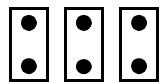
JP1 - jumper not inserted
JP2 - no effect
JP3-no effect
Automatic closing logic
JP3 JP2 JP1
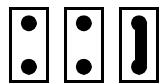
JP1 - jumper inserted
JP2 - no effect
JP3 - no effect
Immediate closing logic
JP3 JP2 JP1
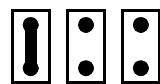
JP1 - no effect
JP2 - no effect
JP3 - jumper inserted
Photo-stop logic
JP3 JP2 JP1
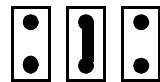
JP1 - no effect
JP2 - jumper inserted
JP3 - no effect
Remote controls codes self-learning
Press the P1 push-button once to insert a Start code. Each time the push-button is pressed, the led DL1 flashes in acknowledgement. When the led is lit with a fixed light transmit the code to be learn by means of the radio-command.
Erasing all stored codes
Press push-button P1 until the led LD1 goes off (about 10 seconds).
Setting the pause time
Press push-button P3 until the led DL1 lights. Let the desired pause time pass, then press push-button P3 again (the led goes off).
Setting the work time
Press push-button P2 until the gate starts opening. The opening limit switch stops the gate when it is completely opened. If no opening limit switch is connected to the motor, it will be necessary to press the P2 key again to stop the motion. After about 1 Second of pause the gate starts closing automatically until it will reach the closing limit switch. If no closing limit switch is connected to the motor, it will be necessary to press the P2 key again to stop the motion.
ENGLISH
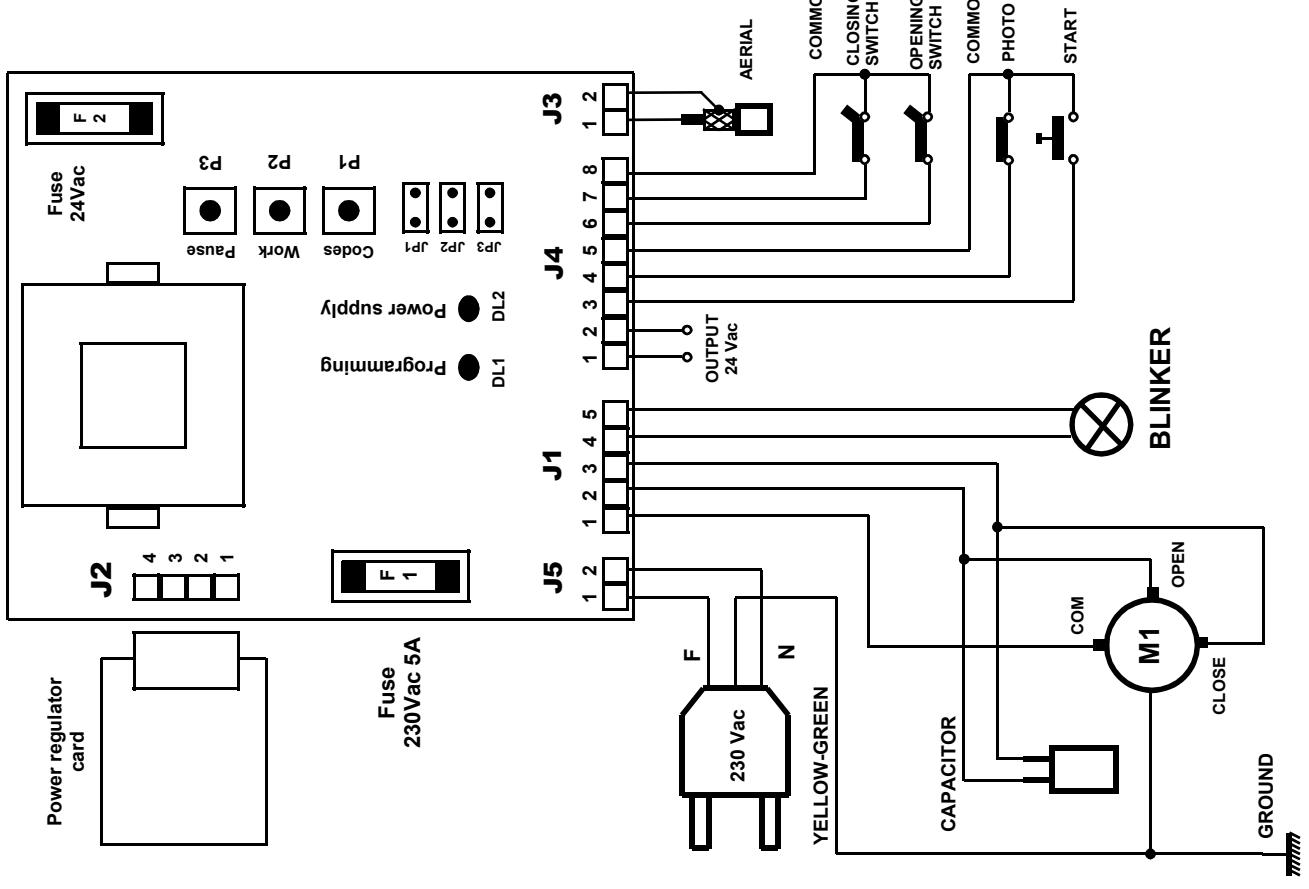
M) General diagram