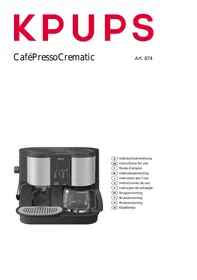
USER MANUAL 874 KRUPS
Carefully read through these instructions before using the appliance. Connect the appliance only to an earthed mains supply socket. The voltage rating stated on the rating plate of the appliance must correspond with that of the mains supply. Do not place or use the appliance on hot surfaces, such as a stove hotplate, or in the vicinity of a naked gas flame. Do not remove the filter carrier filled with ground coffee whilst the liquid is running through, as the appliance is at this time under pressure. Do not refill the coffee-appliance whilst it is still hot; it takes about ten minutes to cool down. Do not pour hot water into the water reservoirs. The mains plug must be pulled out if anything untoward occurs during the brewing operation, as also before every time the appliance is cleaned. Do not remove the mains plug by pulling on the flex and do not place or hang the flex over edges or corners. Do not allow yourself or the mains flex to come into contact with hot parts of the appliance, such as the filter carrier, warming plate or steam nozzle. Never dip the appliance into water. The glass jug is not suitable for use in microwaves, above open fire or on stove plates. Keep the appliance away from children. Do not let the mains flex hang down. Do not use the appliance if either the mains flex or the appliance itself is damaged. Observe the instructions for descending. If the mains flex of this appliance becomes damaged, it must be repaired only by the KRUPS customer service
department or by a similarly qualified individual, in order to avoid any danger to the person.
Espresso is much stronger and more aromatic than normal coffee and is drunk out of small cups called espresso cups. It is prepared by forcing hot water under pressure through ground coffee. This produces the delightful black coffee with the stimulating effect.
Apart from its characteristic flavour, the hallmark of espresso is the typical formation of a splendid froth, called crema. This requires a high pressure and the use of genuine, properly roasted espresso coffee beans which have been correctly ground.
If you do not purchase ready-ground espresso coffee, grind the coffee beans in a coffee mill with the setting medium to fine.
Preparing the appliance
- Open the lid and remove the water container (1). Fill the water container with water (2). Replace the water container, pressing it down firmly so that the base valve will open. Close the lid (3).
Before first use
Before using the appliance for the first time, as well as if it has not been used for a lengthy period, you should allow several cups of water to run through the system without using espresso coffee meal, in order to rinse out the system.
Place one of the two filter sieves in the filter carrier and push the sieve holder back.
Locate the filter carrier on the left at the mark on the housing of the brewing head and turn it tightly to the right (4).
Place the largest convenient receptacle beneath the filter carrier.
Switch on the appliance by moving the espresso switch to the I position (5).
The operating indicator lamp will glow red and the heating indicator lamp will glow yellow.
Move the espresso switch to the P position, whereby the pump will be switched on (6).
If the heating system is empty, such as upon first use, the system will first fill with water, accompanied by an audible pumping noise, before water runs out of the filter carrier.
As soon as water runs out, move the espresso switch to the I position and allow the appliance to heat up.
A little water may run out of the brewing head during the heating phase.
When the yellow heating control indicator ceases to glow, move the espresso switch back to the P position (7).
Allow 2-3 cups of water to run through the system. To empty the receptacle in-between times, the flow can be interrupted by turning the espresso switch back to the I position.
To clean through the steam pipe, place a receptacle under the steam pipe and turn the valve knob to the ≈ ≈ position and the espresso switch to the □ position. Then allow 1-2 cups to run through.
Finally return the espresso switch to the I position and the valve knob to the 0 position and empty the receptacle.
Filling the heating system with water
Before working with the appliance, make sure that the heating system is filled with water by moving the espresso switch to the P position, whereby water should run out of the brewing head.
If the heating system should become empty whilst generating steam, which then ceases
to issue from the steam pipe, then the heating system must be refilled.
Place a receptacle under the brewing head and set the valve knob to ○ and the espresso switch to the P position. When water runs out of the brewing head, move the espresso switch back to the I position.
Then continue with steam generation by turning the valve knob to the position again.
Preparation of espresso
Fill the water container (1) (2) (3). Move the espresso switch to the P position and check that water runs from the brewing head (6).
Move the espresso switch to the I position.
The yellow heating indicator lamp will cease to glow when the necessary temperature has been reached.
Prewarm the espresso cups by putting the filter carrier in place without espresso coffee meal and then placing the cups under the filter carrier.
Move the espresso switch to the position (8).
Fill the cups with hot water and return the espresso switch to the I position. Then remove the filter carrier.
Insert the desired filter sieve for 1 cup or 2 into the filter carrier (9). Fill with 1 or 2 level measuring spoonfuls of espresso coffee meal (10). So that the coffee meal is evenly distributed in the filter sieve, it should be lightly pressed down with the measuring spoon (11). Clean any coffee grains from the edge of the filter sieve (12). Insert the filter carrier and turn it firmly to the right (13).
Place one or two prewarmed espresso cups beneath the filter carrier.
Prepare espresso by moving the espresso switch to the P position (14).
After the required espresso has run through, return the espresso switch to the I position, remove the filter carrier and knock out the spent coffee meal (15).
The next lot of espresso can be prepared after the sieve has been replenished with espresso meal.
Generation of steam
Steam can be used both for frothing up milk for cappuccino and for the heating of liquids.
Since a higher temperature is necessary for the generation of steam than that required for preparing espresso, the espresso should always be prepared first, as the coffee meal might otherwise become burnt.
Due to the nature of the system, a little water, which can be collected in a separate vessel, will issue from the steam pipe before the steam appears.
Frothing up milk for cappuccino
After you have prepared the espresso, froth up the milk for the cappuccino.
To obtain the best possible results, you should make use of the separate frothing aid.
Push the frothing aid onto the steam nozzle (16).

N.B. THE FROTHING AID IS TO BE USED ONLY FOR THE FROTHING UP OF MILK.
Pour about 100 ml of low fat milk into a small narrow jug of maximum 0.5 liter capacity, which must fit conveniently below the steam/hot water nozzle of the machine.
The milk should be well cooled. You should also use a cold jug, so do not wash it out first with warm water.
As soon as the yellow control lamp ceases to glow, hold a separate vessel beneath the steam pipe and turn the knob to position. Allow water to run into the vessel until steam appears. Then turn the knob to position \(\bigcirc\).
Now commence the milk frothing operation. Hold the jug under the frothing aid in such a way that the nozzle dips completely into the milk.
Turn the valve knob to the position. Hold the jug steady during the frothing operation (17).
The nozzle should not touch the bottom of the jug so as not to impede the flow of steam.
After the frothing operation, turn the valve knob to the \(0\) position and remove the jug.
Now turn the valve knob to the steam position for a moment to blow out any residual milk from the steam/hot water nozzle, putting an empty receptacle below to catch the drops.
Clean the frothing aid and also the steam/hot water nozzle with a moist cloth immediately after the frothing operation.
Heating liquids
Swing out the steam/hot water nozzle.
Pull off the frothing aid.
Switch on the appliance.
Make sure that the heating system is full of water by moving the espresso switch to the P position to see that water runs through (6).
Then return the espresso switch to the I position.
Due to the nature of the system, water and steam will issue from the brewing head during the heating operation.
As soon as the yellow control lamp ceases to glow, hold a separate vessel beneath the steam pipe and turn the knob to position. Allow water to run into the vessel until steam appears. Then turn the knob to position O.
So position the vessel beneath the steam pipe that the jet dips into the liquid.
Turn the valve knob to the 3 position (18).
When the liquid is sufficiently heated, turn the valve knob back to the 0 position and remove the vessel.
Now turn the valve knob to the steam position for a moment to blow out any residues from the steam/hot water nozzle, putting an empty receptacle below to catch the drops.
After the heating of liquids, clean the steam/hot water nozzle immediately with a moist cloth.
NOTE:
If you want to make espresso straight away after generating steam, the espresso machine MUST first be allowed to cool down to the coffee-making temperature.
Place a receptacle beneath the filter carrier and move the espresso switch to the position.
Allow water to run through until the yellow heating indicator lamp begins to glow.
Return the espresso switch to the I position.
Now prepare espresso in the usual fashion.
Preparation of hot water
With this appliance, you can prepare hot water for making instant drinks.
Make sure that the heating system is full of water by moving the espresso switch to the position to see that water runs through (6).
Then return the espresso switch to the I position.
Start with the preparation of hot water as soon as the yellow heating indicator lamp ceases to glow.
Swing out the steam/hot water nozzle and place the tallest possible cup beneath it.
Turn the valve knob to the ≈ position and move the espresso switch to the position (19).
When the preparation of hot water is complete, return the espresso switch to the I position and the valve knob to the position. Then remove the vessel.

N.B. THE STEAM/HOT WATER NOZZLE BECOMES VERY HOT. BE CAREFUL NOT TO BURN OR SCALD YOURSELF.
Cleaning
Always pull out the mains plug before every cleaning operation and allow the appliance to cool down. Wipe down the casing with a moist cloth only.
The water container is to be emptied after use.
Remove the cup grid and clean it (20).
Empty the drip tray and clean it.
The brewing head, filter carrier and filter sieves should all be cleaned after each time the appliance is used. Wipe down the brewing head with a moist cloth only. Rinse all loose parts under running water.
If the brewing sieve becomes very dirty, screw it out of the brewing head with the aid of a coin and then clean it. Wipe down the brewing head with a moist cloth and then screw the sieve firmly back into position (21).
Important!
Do not put the filter carrier or the cup grid into the dish-washer.
Clean the steam/hot water nozzle immediately after frothing up milk by allowing the appliance to produce steam for 1 or 2 seconds, thus blowing out any residue. Wipe down the nozzle with a moist cloth. If the nozzle becomes clogged, free it by using a needle.
If necessary, the steam/hot water nozzle can be screwed off in an anticlockwise direction using the hexagonal key on the measuring spoon and then thoroughly cleaned (22).
N.B. DANGER OF BURNING OR SCALDING WITH THE STEAM/HOT WATER NOZZLE, SO DO NOT DISMANTLE OR ASSEMBLE IT WHILST HOT.
Screw the cleaned nozzle back into position and tighten it lightly using the hexagonal key.
The frothing aid can be disassembled in order to clean it thoroughly, as follows:
Pull the two parts A + C from the small metal tube B (23).
Wash out all three parts in warm water. If the small suction orifice in part A is clogged, it can be freed by poking a fine needle through the blockage.
If the appliance is not to be used for a lengthy period, do not insert the filter carrier into the brewing head, as this causes the sealing ring to be compressed unnecessarily long and can thus impair its useful life.
The measuring spoon and one filter sieve can be stored in the depressions under the lid.
Before a lengthy period of non-usage, the heating system can be cleared of water by driving it off as steam. Put a vessel under the steam/hot water nozzle. Move the espresso switch to the I position and turn the valve knob to the 3 position. As soon as no more steam is generated, turn the valve knob to the O position and move the espresso switch to the O position.
Removal of limescale
The machine must have limescale removed regularly. For an average usage of 4 cups daily and hard water, we recommend descending the appliance every 3 months.
Before descending, the brewing sieve on the brewing head MUST first be screwed off.
- Remove all lime and coffee residues from the brewing sieve and the brewing head.
- Pull off the frothing aid.
- Dissolve 2 tablespoonfuls of tartaric acid or citric acid (both obtainable from chemists and drugstores) in 1/2 litre of lukewarm water and pour it into the water container. Put one receptacle under the brewing head and another under the steam nozzle.
- Set the espresso switch to the I position. After the heating lamp ceases to glow, move the espresso switch to the P position. Make sure that the valve knob points to the O position.
- Allow the descending solution to pass through until about half has run out of the brewing head.
- Return the espresso switch to the I position.
- Turn the valve knob to the >> position and move the espresso switch to the square position. Allow 1 cup of descending solution to run through. Then return the espresso switch to I and the valve knob to the O position.
Now leave the rest of descending solution to work for 10-15 minutes.
- Move the espresso switch to the P position and allow the remainder of the descaling solution to run through.
- Return the espresso switch to the I position.
Following this, allow 2 water containerfuls of clear water to run through with the espresso switch at the P position.
After that is done, fill the water container again.
Move the espresso switch to the P position and the valve knob to the ≈ ≈ position and allow the water run through.
Switch off the appliance by moving the espresso switch to the O position and turning the valve knob to the O position.
Allow the appliance to cool down.
Insert the brewing sieve into the brewing head again and push the frothing aid onto the steam/hot water nozzle.
Problems and Possible Causes
PROBLEM:
Espresso leaking from the filter carrier.
CAUSE:
Filter holder not correctly inserted. Filter holder has been left in the hot water spout too long; clean the seal well. No elasticity in the seal, it must be replaced.
PROBLEM:
Pump makes a loud noise.
CAUSE:
No water in the water container. Water container not inserted correctly. Old or very dry coffee being used so that the pump cannot build up sufficient pressure.
PROBLEM:
Coffee does not come out.
CAUSE:
No water in the water container. Water container not inserted correctly. Filter blocked because the coffee mixture is too fine or has been pressed down too hard. Brewing sieve clogged up: Check by setting espresso switch on the P position, whereby water must run out of the brewing head. If it does not, unscrew the sieve and clean it. Then screw it back on. Unit scaled up (see descaling). Boiler not filled with water.
PROBLEM:
Old or dried-out coffee. Too little ground espresso coffee in the filter sieve. Ground coffee not pressed down sufficiently.
PROBLEM:
The coffee runs out too quickly.
CAUSE:
Ground coffee mixture is too coarse. Ground coffee not pressed down sufficiently.
PROBLEM:
Not enough froth when frothing up milk.
CAUSE:
Boiler not filled with water.
Steam nozzle is blocked. Old milk. Milk too warm (should have been stored in a refrigerator). Vessel not suitable (preferably milk jug or jar). Type of milk not suitable (select milk with a different fat content).
PROBLEM:
Coffee too cold.
CAUSE:
- Appliance has not heated up for long enough.
- Espresso cups not sufficiently prewarmed.
Preparing coffee
Before the first preparation of coffee, carry out 1 or 2 runs without coffee meal and then swill out the glass jug and the filter with hot water.
Raise the hinged lid (24). Pour in the desired quantity of water (25). Do not fill beyond the MAX mark on the water container. The divisions on the glass jug and the water level indicator represent the quantity of fresh water (26). The eventual amount of coffee is less, because the coffee meal absorbs some of the water. Close the lid and swing out the filter to the right (27).
Put in a filter paper:
- Fold over the crinkly edge of a format 4 (1x4) filter paper and so place it in the filter that the edge points towards the handle. Then press it down lightly with the hand (28). Put in the coffee meal (29). A coffee measure can be used to determine the quantity. One measuring spoonful (6-7 gram) should suffice for a cup of medium-strong coffee.
The quantity of coffee can be varied to suit your own personal taste.
Swing back the swivel filter until it engages firmly (30). Relocate the glass jug and its lid on the appliance. Switch on the appliance.
Set the switch to 1-3 for 1-3 cups or to 4-10 for 4-10 cups (31).
N.B.
NEVER SWING OUT THE FILTER DURING THE BREWING OPERATION. REMOVE THE GLASS JUG WHEN FILTERING IS FINISHED; AN AUTOMATIC FILTER CLOSURE THEN PREVENTS ANY DRIPPING.
Return the glass jug to the warming plate to keep it hot. The heating system remains in operation as long as the appliance is switched on.
Cleaning and limescale removal
Always pull out the mains plug before any cleaning operation. Take out the filter as follows:
Hold the filter by the bottom third and swing it out about 120 degrees, just about far enough to put in a filter paper. Press the filter upwards a little and then tip it out sideways and upwards (32).
The glass jug and lid are suitable for the dishwasher (upper basket, away from the heating source). The filter is NOT to be put in the dishwasher and must be washed by hand. Insert the filter:
Hold the grip on the bottom third of the filter and engage the drill-hole on the upper edge of the filter with the peg on the appliance. Tip the filter sideways and downwards and engage it in the guide.
The filter should then swing in easily (33).
Wipe down the appliance with a moist cloth only.
To guarantee good coffee-making results over a long period, the coffee machine must have limescale removed from time to time.
Recognisable indications that descaling is necessary are:
- increased noise during boiling
- longer preparation time.
If usage is frequent, descending should be carried out as follows:
with soft water
7 °dH (0 - 1.24 mol/m³)
once a year
with medium hard water
7.14 °dH (1.24 - 2.5 mol/m³)
every quarter
with hard water over
14 °dH (2.5 - 3.75 mol/m³)
once a month
If in doubt regarding the water hardness, enquire at the local water works.
For ecological and health reasons, we recommend the exclusive use of biological materials such as citric acid and tartaric acid, both of which may be obtained from chemists and drugstores.
Dissolve 2 tablespoons in half a litre of water and pour into the water container. Run this through 2 or 3 times as if making coffee, but using no coffee meal. Finally do the same twice using clear water.
Cord storage
Any unnecessary length of main supply cord can be stored in the special recess at the back of the appliance (34).
Disposal

The packaging comprises exclusively environmentally-friendly materials which should be disposed of according to the local recycling arrangements.
Disposal methods for the appliance itself can be found by enquiry at the appropriate department of the local authority.