
CY-12R - Electronic drum ROLAND - Free user manual and instructions
Find the device manual for free CY-12R ROLAND in PDF.


| Product Type | Electronic drum cymbal pad |
| Brand | Roland |
| Model | CY-12R |
| Diameter | 12 inches (30.5 cm) |
| Weight | Approximately 1.2 kg |
| Surface Material | Molded rubber with piezoelectric sensors |
| Number of Zones | 2 (bow and edge) with choke function |
| Connector | 6.35 mm TRS stereo jack |
| Power Supply | Powered by the drum module via the jack cable (phantom power) |
| Mounting | Standard cymbal rod (6.35 mm diameter) with tightening nut |
| Module Compatibility | Roland TD-4, TD-6, TD-9, TD-11, TD-12, TD-15, TD-17, TD-20, TD-25, TD-27, TD-30, TD-50 and V-Drums compatible |
| Polyphony | Up to 2 simultaneous voices (bow and edge) |
| Velocity Detection | Yes, on both zones |
| Choke Function | Yes, by grabbing the edge of the cymbal |
| Noise Level | Silent (electronic playing) |
| Maintenance and Cleaning | Clean with a soft, dry cloth. Avoid solvents and excessive moisture. |
| Safety | Do not expose to violent shocks or extreme temperatures. Use only with compatible modules. |
| Spare Parts and Repairability | Spare parts available from authorized Roland dealers. Repair by a qualified technician recommended. |
| Included Accessories | Stereo jack cable (1.5 m), tightening nut, tuning key |
| Warranty | 2 years (according to applicable law) |
Frequently Asked Questions - CY-12R ROLAND
User questions about CY-12R ROLAND
0 question about this device. Answer the ones you know or ask your own.
Ask a new question about this device
Download the instructions for your Electronic drum in PDF format for free! Find your manual CY-12R - ROLAND and take your electronic device back in hand. On this page are published all the documents necessary for the use of your device. CY-12R by ROLAND.
USER MANUAL CY-12R ROLAND
Thank you, and congratulations on your choice of the Roland CY-12R/C V-Cymbal.
Before using this unit, carefully read the sections entitled: "USING THE UNIT SAFELY" (p. 3-4) and "IMPORTANT NOTES" (p. 4). These sections provide important information concerning the proper operation of the unit. Additionally, in order to feel assured that you have gained a good grasp of every feature provided by your new unit, Owner's manual should be read in its entirety. The manual should be saved and kept on hand as a convenient reference.
Before using the CY-12R/C, you need to make the settings for the percussion sound module (p. 2).
Contents of the Package
CY-12R/C (V-Cymbal unit)
Connection Cable
Cable Tie

Owner's Manual (this manual)
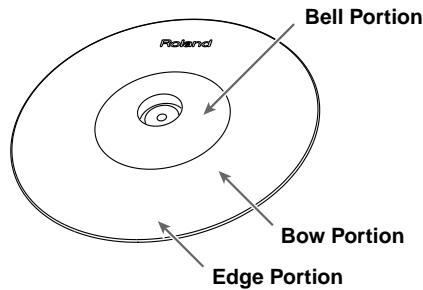
Names of the Components
Wing Nut

Felt Washer

Stopper

Features
- Similar touch and feel as with acoustic cymbals
The superior design has taken into account not only the shape of the cymbal, but also the bounce of the stick, and even the movement caused by playing. It can be used as a ride, crash, or splash cymbal. - They're quiet!
- Separate tones in bow and edge, or bow and bell; choking possible
When the CY-12R/C is used as a ride cymbal, you can play bell shots (p. 6); edge shots (p. 6) can be played when using it as a crash cymbal.
You can also use choking techniques, whereby you stop the sound by grasping the cymbal edge with your hand (p. 7).
- Compatible with all Roland percussion sound modules (p. 2)
- Three way triggering and positional sensing are possible (When using the TD-10 + TDW-1 with V-Cymbal Control) (p. 6)
Recommended Settings for the Percussion Sound Module
Recommended settings for the trigger parameters when using the CY-12R/C with various percussion sound modules.
- Bow shots, edge shots, bell shots and choking techniques are possible with the CY-12R/C (p. 6).
- If you find it difficult to get bell shots to sound, try adjusting the "Scan Time."
- The trigger parameters should be adjusted as necessary to match the actual state of your configuration, and the environment in which it is being used.
TD-10 (TDW-1 V-Cymbal Control)
| Trigger Type | RdA | |
| Sensitivity | 8 | |
| Threshold | 4 | |
| Curve | Linear | |
| Scan Time | (*1) | 1.0 |
| Retrigger Cancel | (*1) | 10 |
| Mask Time | (*1) | 8 |
| Xtalk Cancel | (*1) | 50 |
| Mount Type | (*1) | CymMount |
TD-10 (TDW-1)
| Trigger Type | P7B | |
| Sensitivity | 8 | |
| Threshold | 4 | |
| Curve | Linear | |
| Scan Time | (*1) | 1.8 |
| Retrigger Cancel | (*1) | 5 |
| Mask Time | (*1) | 8 |
| Xtalk Cancel | (*1) | 40 |
| Mount Type | (*1) | CymMount |
TD-10 (Non expanded)
| Trigger Type | Pd7 | |
| Sensitivity | 5 | |
| Threshold | 3 | |
| Curve | Linear | |
| Scan Time | (*1) | 1.5 |
| Retrigger Cancel | (*1) | 5 |
| Mask Time | (*1) | 8 |
| Xtalk Cancel | (*1) | 40 |
TD-8 (*2)
| TRIGGER TYPE | CY1/PD7 | |
| SENSITIVITY | (*1) | 10 |
| THRESHOLD | (*1) | 4 |
| CURVE | (*1) | LINEAR |
| SCAN TIME | (*1) | 2.5 |
| RETRIG CANCEL | (*1) | 8 |
| MASK TIME | (*1) | 8 |
| XTALK CANCEL | (*1) | 50 |
TD-6
| TrigType | CY Type | |
| Sensitivity | (*1) | 10 |
| Threshold | (*1) | 4 |
| TrigCurve | (*1) | LINEAR |
| Xtalk Cancel | (*1) | 50 |
| Scan Time | (*1) | 2.5ms |
| Retrig Cancel | (*1) | 8 |
| Mask Time | (*1) | 8ms |
TD-7 (3, 4)
| Cross Talk Group | 1 |
| Velocity Curve | Norm3 |
| Choke | Off |
| Max Dyna | 5 |
| Mln Dyna | 1 |
| Min Velo | 1 |
| Mask Time | 0 |
| Threshold | 1 |
TD-5
| Trigger Type | P1 |
| Sensitivity | 8 |
| Threshold | 2 |
| Curve | Lnr |
| Scan Time | 2.5 |
| Retrigger Cancel | 3 |
| Mask Time | 8 |
| Crosstalk Cancel | 50 |
SPD-20
| Trig Sens | 10 |
| Trig Threshold | 0 |
| Trig Type | Pd7 |
| Trig Curve | 0 |
| Scan Time | 2.5 |
| Retrig Cancel | 3 |
| Mask Time | 8 |
| Crosstalk Cancel | 30 |
HPD-15 (*4)
| Input Mode | HD/RM |
| Trig Type | PD-9 |
| Trig Sens | 10 |
| Curve | Linear |
| Threshold | 2 |
| Scan Time | 1ms |
| Retrig Cancel | 2 |
| Mask Time | 4ms |
| X-Talk Rate | 40% |
*1: You need to set each trigger parameter after setting the trigger type.
*2: Notice Regarding TD-8 Upgrade
As of October 2001, "CY1" has been added as a trigger type selection. Selecting "CY1" automatically sets the other trigger parameters to the recommended values, allowing you to make the settings for the CY-12R/C simply and easily. You can use the CY-12R/C even with previous TD-8 versions by selecting "PD7," then manually setting the other trigger parameters to the recommended values (as shown in the above list). For more information about the TD-8 upgrade, consult with your retailer, the nearest Roland Service Center, or an authorized Roland distributor, as listed on the "Information" page.
3: Each trigger parameter can be set independently for the "head-side" and "rim-side." Set to the same value for the head and rim. Trigger parameters can be set individually for each patch.
4: The TD-7 and the HPD-15 support the use of edge shots with the CY-12R/C, but they do not support choking techniques.
USING THE UNIT SAFELY
INSTRUCTIONS FOR THE PREVENTION OF FIRE, ELECTRIC SHOCK, OR INJURY TO PERSONS
About WARNING and CAUTION Notices
| ▲WARNING | Used for instructions intended to alert the user to the risk of death or severe injury should the unit be used improperly. |
| ▲CAUTION | Used for instructions intended to alert the user to the risk of injury or material damage should the unit be used improperly. * Material damage refers to damage or other adverse effects caused with respect to the home and all its furnishings, as well to domestic animals or pets. |
About the Symbols
| ▲ | The △ symbol alerts the user to important instructions or warnings. The specific meaning of the symbol is determined by the design contained within the triangle. In the case of the symbol at left, it is used for general cautions, warnings, or alerts to danger. |
| ◎ | The ⊙ symbol alerts the user to items that must never be carried out (are forbidden). The specific thing that must not be done is indicated by the design contained within the circle. In the case of the symbol at left, it means that the unit must never be disassembled. |
| ◆ | The ● symbol alerts the user to things that must be carried out. The specific thing that must be done is indicated by the design contained within the circle. In the case of the symbol at left, it means that the power-cord plug must be unplugged from the outlet. |
ALWAYS OBSERVE THE FOLLOWING
WARNING
- Before using this unit, make sure to read the instructions below, and the Owner's Manual.

- Do not open or perform any internal modifications on the unit.

- Do not attempt to repair the unit, or replace parts within it (except when this manual provides specific instructions directing you to do so). Refer all servicing to your retailer, the nearest Roland Service Center, or an authorized Roland distributor, as listed on the "Information" page.

- Never use or store the unit in places that are:

- Subject to temperature extremes (e.g., direct sunlight in an enclosed vehicle, near a heating duct, on top of heat-generating equipment); or are

- Damp (e.g., baths, washrooms, on wet floors); or are
- Humid; or are
- Exposed to rain; or are
- Dusty; or are
-
Subject to high levels of vibration.
-
This unit should be used only with a rack or stand that is recommended by Roland.

WARNING
- When using the unit with a rack or stand recommended by Roland, the rack or stand must be carefully placed so it is level and sure to remain stable. If not using a rack or stand, you still need to make sure that any location you choose for placing the unit provides a level surface that will properly support the unit, and keep it from wobbling

- Do not allow any objects (e.g., flammable material, coins, pins); or liquids of any kind (water, soft drinks, etc.) to penetrate the unit.


- In households with small children, an adult should provide supervision until the child is capable of following all the rules essential for the safe operation of the unit.

- Do not drop the unit!


CAUTION
- Try to prevent cords and cables from becoming entangled. Also, all cords and cables should be placed so they are out of the reach of children.

- Never climb on top of, nor place heavy objects on the unit.


CAUTION

- Should you remove wing nut, washers, or stopper bolt, make sure to put them in a safe place out of children's reach, so there is no chance of them being swallowed accidentally.
IMPORTANT NOTES
In addition to the items listed under "USING THE UNIT SAFELY" on page 3-4, please read and observe the following:
Placement
- Do not expose the unit to direct sunlight, place it near devices that radiate heat, leave it inside an enclosed vehicle, or otherwise subject it to temperature extremes. Also, do not allow lighting devices that normally are used while their light source is very close to the unit (such as a piano light), or powerful spotlights to shine upon the same area of the unit for extended periods of time. Excessive heat can deform or discolor the unit.
- To avoid possible breakdown, do not use the unit in a wet area, such as an area exposed to rain or other moisture.
- Do not allow rubber, vinyl, or similar materials to remain on the unit for long periods of time. Such objects can discolor or otherwise harmfully affect the finish.
- Do not put anything that contains water (e.g., flower vases) on the unit. Also, avoid the use of insecticides, perfumes, alcohol, nail polish, spray cans, etc., near the unit. Swiftly wipe away any liquid that spills on the unit using a dry, soft cloth.
Maintenance
- For everyday cleaning wipe the unit with a soft, dry cloth or one that has been slightly dampened with water. To remove stubborn dirt, use a cloth impregnated with a mild, non-abrasive detergent. Afterwards, be sure to wipe the unit thoroughly with a soft, dry cloth.
- Never use benzine, thinners, alcohol or solvents of any kind, to avoid the possibility of discoloration and/or deformation.
Additional Precautions
- Use a reasonable amount of care when using its jacks and connectors. Rough handling can lead to malfunctions.
- When connecting / disconnecting all cables, grasp the connector itself—never pull on the cable. This way you will avoid causing shorts, or damage to the cable's internal elements.
- This instrument is designed to minimize the extraneous sounds produced when it's played. However, since sound vibrations can be transmitted through floors and walls to a greater degree than expected, take care not to allow these sounds to become a nuisance to neighbors, especially when performing at night and when using headphones.
- When you need to transport the unit, package it in the box (including padding) that it came in, if possible. Otherwise, you will need to use equivalent packaging materials.
-
Use a provided cable or a cable from Roland to make the connection. If using some other make of connection cable, please note the following precautions.
-
Some connection cables contain resistors. Do not use cables that incorporate resistors for connecting to this unit. The use of such cables can cause the sound level to be extremely low, or impossible to hear. For information on cable specifications, contact the manufacturer of the cable.
Attaching to a Stand
Attach the CY-12R/C with the optional cymbal mount (MDY series), or drum stand cymbal mount (MDS series).
1. Use a commercially available drum key to tighten the stopper bolt.
The stopper keeps the CY-12R/C from turning, and prevents the cables from catching or getting tangled on the stand.
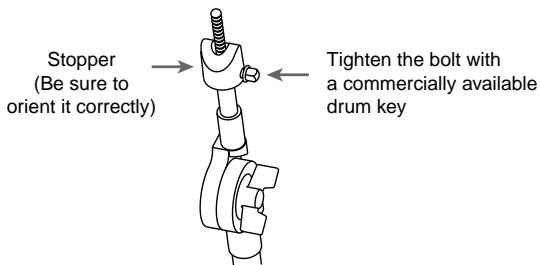
- Attach the CY-12R/C so the unit is oriented as shown in the diagram (bolt should be opposite the output jacks).
- Tighten the wing nut to obtain the desired movement.
Use the included felt washer and the wing nut.
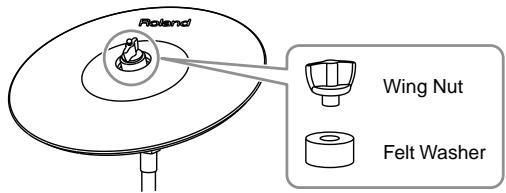

- Double sounding may occur if the wing nut is loose.
- Do not use the washer or felt included with the cymbal mount (MDY series).
Connecting to a Percussion Sound Module (TD-6, TD-8, TD-10, etc.)
About the Output Jacks
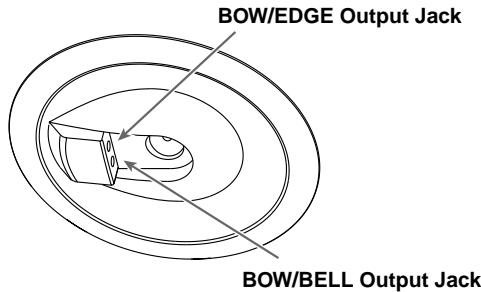
The CY-12R/C features two different output jacks, BOW/BELL and BOW/EDGE.
Use the BOW/BELL output jack when you want to play the bow and the bell sounds; use the BOW/EDGE output jack when you want to play the bow and the edge sounds.

Use either the BOW/BELL or BOW/EGDE output jack, but not both at the same time (except for the TD-10 + TDW-1 with V-Cymbal Control).
Connecting both jacks results in two separate trigger inputs playing simultaneously.
| Output Jack | Corresponding Play Methods | Tones Sounded |
| BOW/BELL | Bow Shot (p. 6) | Head |
| Bell Shot (p. 6) | Rim | |
| Choke (p. 7) | - | |
| BOW/EDGE | Bow Shot (p. 6) | Head |
| Edge Shot (p. 6) | Rim | |
| Choke (p. 7) | - |

If you are using the TD-10 + TDW-1 with V-Cymbal Control, you can use both the BOW/BELL and BOW/EGDE output jacks at the same time (Three Way Triggering). For more details, refer to "If Using TD-10 + TDW-1 with V-Cymbal Control" (p. 6).
Making the Connections

To prevent malfunction and/or damage to speakers or other devices, always turn down the volume, and turn off the power on all devices before making any connections.
- Use the included cable to connect one of the CY-12R/C's output jacks (either one, but not both, EXCEPT when using with the TD-10 + TDW-1 with V-Cymbal Control installed) to the drum sound module's trigger input jack.
Connect the L-shaped plug of the included cable to the CY-12R/C. This will prevent strain from being applied to the CY-12R/C.

To make use of edge shot and choking play techniques, you'll need to connect to a trigger input jack on the percussion sound module that accommodates rim shots. The TD-8's "1/2 (KICK 1/2)" and "11/12 (AUX 1/2)" do not support rim shots.
2. Secure the cable with cable ties.
Leave enough slack so that the cable is not pulled by any shaking or vibration of the cymbal when it is struck.
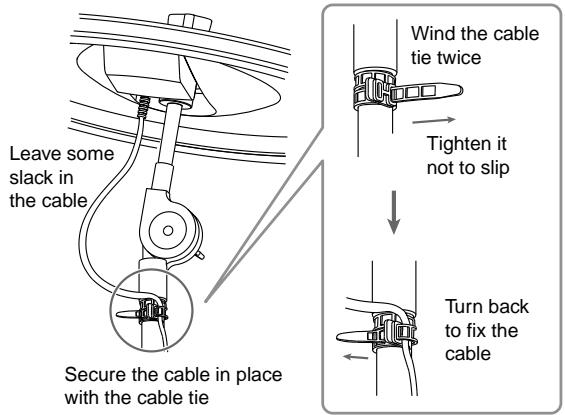

Take care to ensure that the cable does not come into contact with the cymbal or stand. Contact between the cable and the cymbal or stand can result in problems,
such as double sounding.
3. Make the trigger settings for the percussion sound module. For the recommended values, refer to p. 2.

Should you neglect to make the appropriate settings for the percussion sound module.
- Sometimes it does not sound (uneven volume)
- The volume is too low (reduced sensitivity)
- Double sounding may occur

For information on how to change the parameters for a percussion sound module, refer to its owner's manual.
If Using TD-10 + TDW-1 with V-Cymbal Control
When you use the TD-10 + TDW-1 V-Cymbal Control, three way triggering is possible.
- Three Way Triggering is not available with the TD-8.
About Three Way Triggering
By using two cables to connect the CY-12R/C and a TD-10, you can then perform using three different tones: bow, bell, and edge.

TDW-1 specifications allow the Three Way Triggering function to be used with only one V-Cymbal. For example, if you use the Three Way Triggering function with one CY-15R, you would not be able to use Three Way Triggering if you added another CY-12R/C.
Connections/Examples of Settings
| CY-12R/C Output | TD-10 Trigger Input | TD-10 Trigger Type |
| BOW/BELL | 10/RIDE | RdA |
| BOW/EDGE | 11/AUX1 | CTR |

If you connect a pad or a V-Cymbal ONLY to the trigger input for which trigger type is set to the "CTR"(11/AUX 1), it will not work.
Correspondences Between Playing Methods and Trigger Input
| Playing Methods | TD-10 Trigger Input |
| Bow Shot | 10/RIDE Head |
| Bell Shot | 10/RIDE Rim |
| Edge Shot | 11/AUX 1 Rim |
- Head-side tones for the trigger input 11/AUX 1 cannot be sounded.

For more details on the settings for Three Way Triggering, refer to the TDW-1 with V-Cymbal Control Owner's Manual.
MEMO
The TDW-1 with V-Cymbal Control Owner's Manual contains an explanation of how the CY-15R is used with Three Way Triggering. Substitute "CY-12R/C" for "CY-15R" as you read through the text.
Playing Methods
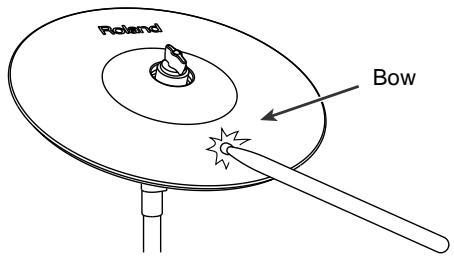
Bow Shot
This is the most common playing method, playing the pad face of the cymbal. It corresponds to the sound of the "head-side" of the connected trigger input.
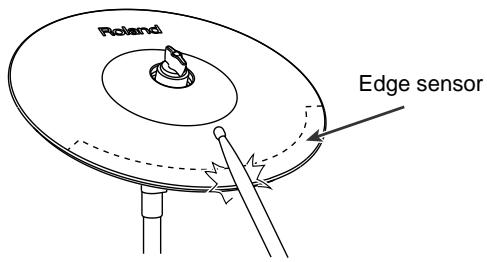
Edge Shot
This playing method involves striking the edge with the shoulder of the stick. It corresponds to the sound of the "rimside" of the connected trigger input.

To make use of edge shot, you'll need to connect to a trigger input jack on the percussion sound module that accommodates rim shots.
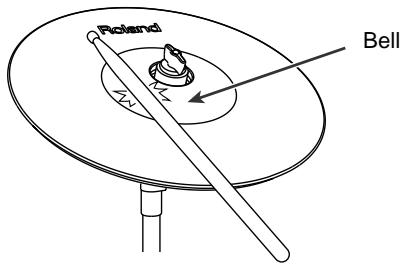
Bell Shot
This playing method involves striking the bell. It corresponds to the sound of the "rim-side" of the connected trigger input.

- To make use of bell shot, you'll need to connect to a trigger input jack on the percussion sound module that accommodates rim shots.
- Use the shoulder of the stick when playing bell shots.
Choking
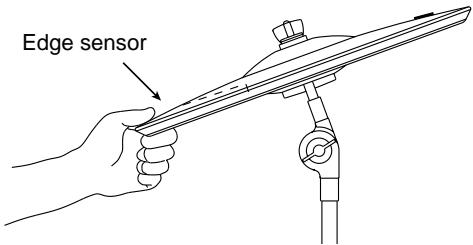
Choking (pinching) the cymbal's edge with the hand immediately after hitting the cymbal makes the sound stop.

To make use of choking play techniques, you'll need to connect to a trigger input jack on the percussion sound module that accommodates rim shots.
Troubleshooting
Issues Affecting The Overall System
Check these first
Is the trigger type set correctly?
Make the trigger parameter settings for your percussion sound module (p. 2).
Is a monaural cable being used?
When a monaural cable is used, the sound does not change when an edge shot or a bell shot is made. Choke play is not possible, either. Use stereo cable.
The sound does not change when an edge shot is made
Is the cable connected to the BOW/EDGE output?
Make the connection to the BOW/EDGE output to enable the CY-12R/C to support edge shots (p. 5).
- Are you striking the cymbal in the area with the edge sensors?
Edge sensors are embedded only in the part of the CY-12R/C directly in front (p. 6).
The sound does not change when a bell shot is made
- Is the cable connected to the BOW/BELL output?
Make the connection to the BOW/BELL output to enable the CY-12R/C to support bell shots (p. 5). - Use the shoulder of the stick when playing bell shots (p. 6).
- Adjust the "Scan Time."
Choke play is not possible
- Are you choking the cymbal in the area with the edge sensors?
Edge sensors are embedded only in the part of the CY-12R/C directly in front (p. 7).
Ride cymbal sounds odd
(Other cymbal sound is heard simultaneously)
- If using a sound module other than the TD-10 furnished with the TDW-1 with V-Cymbal Control, connect either the CY-12R/C's BOW/BELL output or the BOW/EDGE output (p. 5).
Double sounding
- Are any cables touching the CY-12R/C?
Secure the cables in place with the cable ties so that they do not touch the units. Also, be careful to make sure that the cables are not pulled by the movement of a cymbal when struck (p. 5).
- Are the stopper, felt washer, and wing nut attached correctly?
Double triggering may occur if the stopper and/or wing nut is loose. Use a tuning key (drum key) to tighten properly.
- If double triggering still occurs, try adjusting trigger parameters, such as Retrigger Cancel, on the sound module you are using (TD-6, TD-8, TD-10, etc.)
The volume level is too low
- If the cymbal is struck while power to the drum module (such as the TD-6, TD-8, or TD-10) is turned on, the response to light hits will be poor. Do not strike pads or cymbals while turning on the power.
When using the TD-10 + TDW-1 with V-Cymbal Control
No sound is heard
Is the trigger type set to "CTR"?
Tones from inputs for which the trigger type is set to "CTR" do not sound (p. 6).
The sound does not vary when the striking position changes
-
The CY-12R/C is capable of the positional detection feature. Positional detection is possible when plugged into the specified input on a Roland sound module with this feature.
-
For more on tones that can change according to the part of the cymbal struck, refer to the tone list in the Owner's Manual that came with your drum module.
- With trigger types "RdB" and "CrB," positional sensing is not possible. Use "RdA" or "CrA."
Specifications
CY-12R/C: V-Cymbal Ride/Crash
Pad Size: 12 inches
Trigger: 3 (Bow/Bell/Edge)
Dimensions: 300 (W) x 300 (D) x 51 (H) 11-13/16 (W) x 11-13/16 (W) x 2-1/16 (H)
Weight: 1.1 kg 2 lbs 7 oz
Accessories: Owner's Manual, Connection Cable, Wing Nut, Felt Washer, Stopper, Cable Tie
Options: Cymbal Mount (MDY-10U) Stand (MDS-6, MDS-8, MDS-10)
- In the interest of product improvement, the specifications and/or appearance of this unit are subject to change without prior notice.
Information
When you need repair service, call your nearest Roland Service Center or authorized Roland distributor in your country as shown below.
AFRICA
EGYPT
Al Fanny Trading Office
P.O.Box 2904
El Horrieh Heliopolos, Cairo, EGYPT
TEL: (02) 4185531
REUNION
That Other Music Shop (PTY) Ltd.
11 Melle St., Braamfontein, Johannesburg
Republic of SOUTH AFRICA
P.O.Box 32918, Braamfontein 2017
Republic of SOUTH AFRICA
TEL: (011) 403 4105
Paul Bothner (PTY) Ltd.
17 Werdmuller Centre Claremont 7700
Republic of SOUTH AFRICA
P.O.Box 23032
Claremont, Cape Town
SOUTH AFRICA, 7735
TEL: (021) 674 4030
ASIA
CHINA
Beijing Xinghai Musical Instruments Co., Ltd.
6 Huangmuchang Chao Yang District, Beijing, CHINA
TEL: (010) 6774 7491
Shanghai Xingtong Acoustics Equipment CO.Ltd.
Rm.1108, No.2240 Pudong South Road Shanghai, CHINA
TEL: (021) 6873 4123
HONG KONG
Tom Lee Music Co., Ltd.
Service Division
22-32 Pun Shan Street, Tsuen
Wan, New Territories,
HONG KONG
TEL: 2415 0911
INDIA
Rivera Digitec (India) Pvt. Ltd.
409, Nirman Kendra Mahalaxmi Flats Compound Off. Dr. Edwin Moses Road, Mumbai-400011, INDIA
TEL: (022) 4983079
INDONESIA
PT Citra IntiRama
J1. Cideng Timur No. 15J-150
Jakarta Pusat
INDONESIA
TEL: (021) 6324170
KOREA
Cosmos Corporation
1461-9, Seocho-Dong.
Seocho Ku, Seoul, KOREA
TEL: (02) 3486-8855
MALAYSIA
G.A. Yupangco & Co. Inc.
339 Gil J. Puyat Avenue
Makati, Metro Manila 1200,
PHILIPPINES
TEL: (02) 899 9801
SINGAPORE
Swee Lee Company
150 Sims Drive
SINGAPORE 387381
TEL:846-3676
CRISTOFORI MUSIC PTE LTD
Blk 3014, Bedok Industrial Park E, #02-2148, SINGAPORE 489980
TEL: 243 9555
TAIWAN
ROLAND TAIWAN
ENTERPRISE CO.,LTD
Room 5, 9fL, No. 112 Chung Shar N. Road Sec.2, Taipei, TAIWAN, R.O.C.
TEL: (02) 2561 3339
THAILAND
Theera Music Co., Ltd.
330 Verng NakornKasem, Soi 2,
Bangkok 10100, THAILAND
TEL: (02) 2248821
VIETNAM
Saigon Music
138 Tran Quang Khai St.,
District 1
Ho Chi Minh City
VIETNAM
TEL: (08) 844-4068
AUSTRALIA/ NEW ZEALAND
AUSTRALIA
Roland Corporation
Australia Pty., Ltd.
38 Campbell Avenue
Dee Why West. NSW 2099
AUSTRALIA
TEL: (02) 9982 8266
NEW ZEALAND
Roland Corporation Ltd.
32 Shaddock Street, Mount Eden,
Auckland, NEW ZEALAND
TEL: (09) 3098 715
CENTRAL/LATINAMERICA
ARGENTINA
Instrumentos Musicales S.A.
Florida 656 2nd Floor
Office Number 206A
Buenos Aires
ARGENTINA, CP1005
TEL: (54-11) 4-393-6057
BRAZIL
Roland Brasil Ltda
Rua San Jose, 780 Sala B
Parque Industrial San Jose
Cotia - Sao Paulo - SP, BRAZIL
TEL: (011) 4615 5666
COSTA RICA
JUAN Bansbach
Instrumentos Musicales
Boulevard Andrews, Albrook,
Panama City,
REP. DE PANAMA
TEL: (507) 315-0101
PARAGUAY
Distribuidora De
Instrumentos Musicales
J.E. Olear y ESQ. Manch
Music Sound Light 155. New National Road
26422 Patras, GREECE
TEL:061-435400
HUNGARY
Intermusica Ltd.
Warehouse Area DEPO'Pf.83
H-2046 Torokbalint, HUNGARY
TEL: (23) 511011
IRELAND
Roland Ireland
Audio House, Belmont Court,
Donnybrook, Dublin 4.
Republic of IRELAND
TEL: (01) 2603501
ITALY
Roland Italy S. p. A.
Danvik Center 28, 2 tr.
S-131 30 Nacka SWEDEN
TEL: (08) 702 0020
SWITZERLAND
Roland (Switzerland) AG
Musitronic AG
Atlantic Close, Swansea
Enterprise Park, SWANSEA 51026
SA79F1
UNITED KINGDOM
TEL: (01792) 700139
MIDDLE EAST
BAHRAIN
Moon Stores
Bab Al Bahrain Road,
P.O.Box 20077
State of BAHRAIN
TEL: 211 005
CYPRUS
Radex Sound Equipment Ltd.
17 Diagorou St., P.O. Box 2046,
Nicosia CYPRUS
TEL: (02) 453 426
IRAN
MOCO, INC.
No.41 Nike St.Dr.Shariyati Ave.
Roberoye Cerahe Mirdamad
Tehran, IRAN
TEL:2854169
ISRAEL
Halilit P. Greenspoon &
Sons Ltd.
8 Retzif Ha'aliya Hashnya St.
Tel-Aviv-Yafo ISRAEL
TEL: (03) 6823666
JORDAN
AMMAN Trading Agency
Prince Mohammed St. P.O.Box
825 Amman 11118 JORDAN
TEL: (06) 4641200
KUWAIT
Easa Husain Al-Yousifi
Abdullah Salem Street,
Safat KUWAIT
TEL: 5719499
LEBANON
A. Chahine & Fils
P.O. Box 16-5857 Gergi Zeidan St.
Chahine Building, Achrafieh
Beirut,LEBANON
TEL: (01) 335799
QATAR
Al Emadi Co. (Badie Studio
& Stores)
P.O.Box 62
DOHA QATAR
TEL:4423-554
SAUDI ARABIA
aDaw利亚h Universal
Electronics APL
Corniche Road, Aldossary Bldg.
1st Floor
SAUDI ARABIA
P.O.Box 2154, Alkhobar 31952
SAUDI ARABIA
TEL: (03) 898 2081
SYRIA
Technical Light & Sound
Center
Khaled Ibn Al Walid St.
P.O.Box 13520
Damascus - SYRIA
TEL: (011) 2235 384
TURKEY
Barkat muzik aleteri ithalat
ve ihracat Ltd Sti
Siraseltivercad.Guney is hani 84
86/6, Taksim. Istanbul. TURKEY
TEL: (0212) 2499324
U.A.E.
Zak Electronics & Musical
Instruments Co. L.L.C.
Zabeel Road, Al Sherooq Bldg.
No. 14, Grand Floor DUBAI
U.A.E.
TEL: (04) 3360715
NORTH AMERICA
CANADA
Roland Canada Music Ltd.
(Head Office)
5480 Parkwood Way Richmond
B.C., V6V 2M4 CANADA
TEL: (0604) 270 6626
Roland Canada Music Ltd.
(Toronto Office)
Unit 2, 109 Woodbine Downs
Blvd, Etbicoke, ON
M9W 6Y1 CANADA
TEL: (0416) 213 9707
U.S.A.
Roland Corporation U.S.
5100 S. Eastern Avenue
Los Angeles, CA 90040-2938
U.S.A.
TEL: (323) 890 3700