TD-4SX - Electronic drum ROLAND - Free user manual and instructions
Find the device manual for free TD-4SX ROLAND in PDF.


User questions about TD-4SX ROLAND
0 question about this device. Answer the ones you know or ask your own.
Ask a new question about this device
Download the instructions for your Electronic drum in PDF format for free! Find your manual TD-4SX - ROLAND and take your electronic device back in hand. On this page are published all the documents necessary for the use of your device. TD-4SX by ROLAND.
USER MANUAL TD-4SX ROLAND
natural_image
Technical line drawing of a multi-stage electronic device with multiple components including a CD, drum, and control panel (no text or labels)For the U.K.
IMPORTANT: THE WIRES IN THIS MAINS LEAD ARE COLOURED IN ACCORDANCE WITH THE FOLLOWING CODE.
BLUE: NEUTRAL
BROWN: LIVE
As the colours of the wires in the mains lead of this apparatus may not correspond with the coloured markings identifying the terminals in your plug, proceed as follows:
The wire which is coloured BLUE must be connected to the terminal which is marked with the letter N or coloured BLACK.
The wire which is coloured BROWN must be connected to the terminal which is marked with the letter L or coloured RED.
Under no circumstances must either of the above wires be connected to the earth terminal of a three pin plug.

For EU Countries
This product complies with the requirements of EMC Directive 2004/108/EC.
For the USA
FEDERAL COMMUNICATIONS COMMISSION RADIO FREQUENCY INTERFERENCE STATEMENT
This equipment has been tested and found to comply with the limits for a Class B digital device, pursuant to Part 15 of the FCC Rules. These limits are designed to provide reasonable protection against harmful interference in a residential installation. This equipment generates, uses, and can radiate radio frequency energy and, if not installed and used in accordance with the instructions, may cause harmful interference to radio communications. However, there is no guarantee that interference will not occur in a particular installation. If this equipment does cause harmful interference to radio or television reception, which can be determined by turning the equipment off and on, the user is encouraged to try to correct the interference by one or more of the following measures:
- Reorient or relocate the receiving antenna.
— Increase the separation between the equipment and receiver. - Connect the equipment into an outlet on a circuit different from that to which the receiver is connected.
- Consult the dealer or an experienced radio/TV technician for help.
This device complies with Part 15 of the FCC Rules. Operation is subject to the following two conditions:
(1) this device may not cause harmful interference, and
(2) this device must accept any interference received, including interference that may cause undesired operation.
Unauthorized changes or modification to this system can void the users authority to operate this equipment.
This equipment requires shielded interface cables in order to meet FCC class B Limit.
For Canada
NOTICE
This Class B digital apparatus meets all requirements of the Canadian Interference-Causing Equipment Regulations.
AVIS
This product contains chemicals known to cause cancer, birth defects and other reproductive harm, including lead.
Roland®

TD-4 Owner's Manual
Thank you, and congratulations on your choice of the Roland Percussion Sound Module TD-4.
Before using this unit, carefully read the sections entitled: "USING THE UNIT SAFELY" and "IMPORTANT NOTES" (Owner's manual p. 2–3; p. 4). These sections provide important information concerning the proper operation of the unit. Additionally, in order to feel assured that you have gained a good grasp of every feature provided by your new unit, Owner's manual should be read in its entirety.
The manual should be saved and kept on hand as a convenient reference.
Copyright ©2009 ROLAND CORPORATION
All rights reserved. No part of this publication may be reproduced in any form without the written permission of ROLAND CORPORATION.
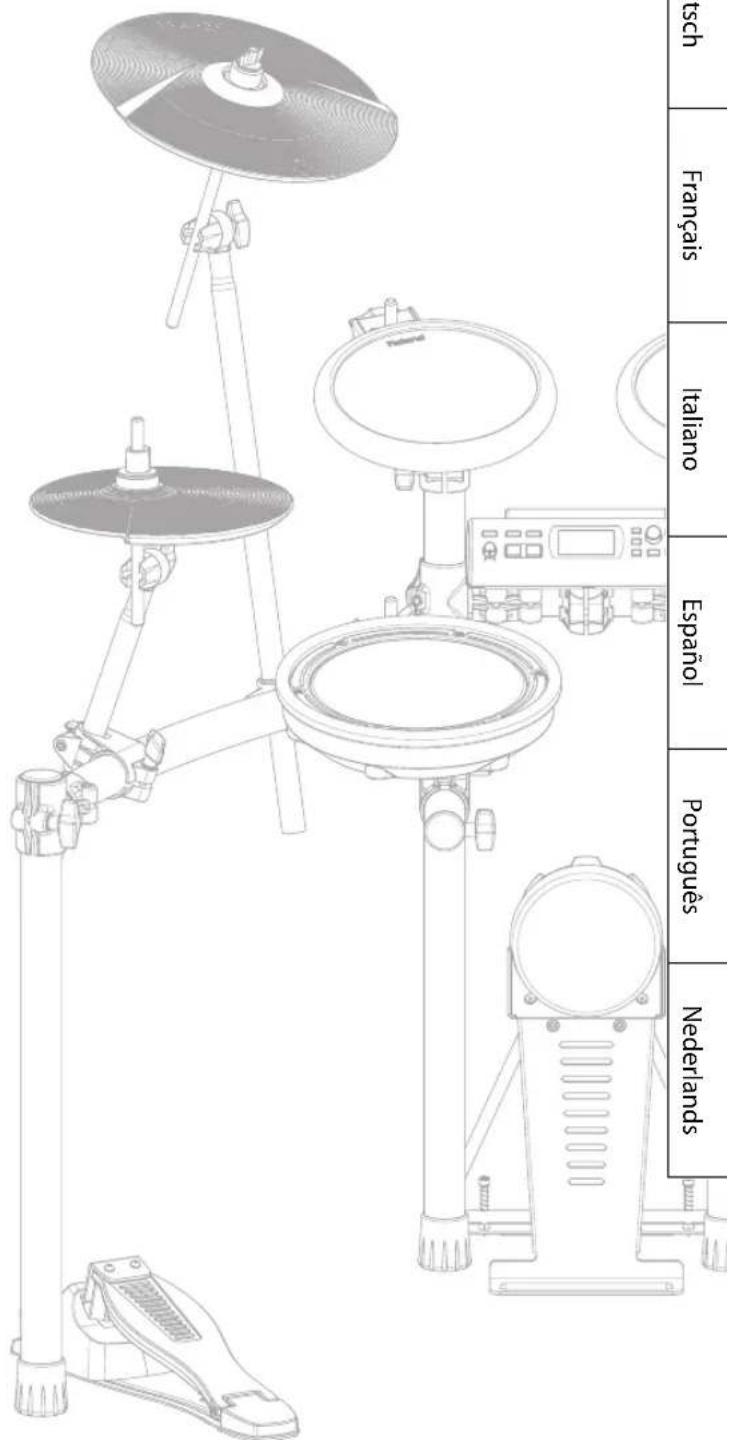
text_image
utsch Français Italiano Español Português NederlandsUSING THE UNIT SAFELY
INSTRUCTIONS FOR THE PREVENTION OF FIRE, ELECTRIC SHOCK, OR INJURY TO PERSONS
About ⚠ WARNING and ⚠ CAUTION Notices
| [DOCZ] WARNING | Used for instructions intended to alert the user to the risk of death or severe injury should the unit be used improperly. |
| [KTOB] CAUTION | Used for instructions intended to alert the user to the risk of injury or material damage should the unit be used improperly.* Material damage refers to damage or other adverse effects caused with respect to the home and all its furnishings, as well to domestic animals or pets. |
About the Symbols
| [WHO2] | The △ symbol alerts the user to important instructions or warnings. The specific meaning of the symbol is determined by the design contained within the triangle. In the case of the symbol at left, it is used for general cautions, warnings, or alerts to danger. |
| [BSZT] | The ⊗ symbol alerts the user to items that must never be carried out (are forbidden). The specific thing that must not be done is indicated by the design contained within the circle. In the case of the symbol at left, it means that the unit must never be disassembled. |
| [A8BT] | The ● symbol alerts the user to things that must be carried out. The specific thing that must be done is indicated by the design contained within the circle. In the case of the symbol at left, it means that the power-cord plug must be unplugged from the outlet. |
ALWAYS OBSERVE THE FOLLOWING
WARNING
- Do not open (or modify in any way) the unit or its AC adaptor.

- Do not attempt to repair the unit, or replace parts within it (except when this manual provides specific instructions directing you to do so). Refer all servicing to your retailer, the nearest Roland Service Center, or an authorized Roland distributor, as listed on the "Information" page.

- Never install the unit in any of the following locations.


- Subject to temperature extremes (e.g., direct sunlight in an enclosed vehicle, near a heating duct, on top of heat-generating equipment); or are
• Damp (e.g., baths, washrooms, on wet floors); or are - Exposed to steam or smoke; or are
- Subject to salt exposure; or are
- Humid; or are
- Exposed to rain; or are
• Dusty or sandy; or are - Subject to high levels of vibration and shakiness.
- This unit should be used only with a stand that is recommended by Roland.

- When using the unit with a stand recommended by Roland, the stand must be carefully placed so it is level and sure to remain stable. If not using a stand, you still need to make sure that any location you choose for placing the unit provides a level surface that will properly support the unit, and keep it from wobbling.

WARNING
- Be sure to use only the AC adaptor supplied with the unit. Also, make sure the line voltage at the installation matches the input voltage specified on the AC adaptor's body. Other AC adaptors may use a different polarity, or be designed for a different voltage, so their use could result in damage, malfunction, or electric shock.

- Use only the attached power-supply cord. Also, the supplied power cord must not be used with any other device.

- Do not excessively twist or bend the power cord, nor place heavy objects on it. Doing so can damage the cord, producing severed elements and short circuits. Damaged cords are fire and shock hazards!

- This unit, either alone or in combination with an amplifier and headphones or speakers, may be capable of producing sound levels that could cause permanent hearing loss. Do not operate for a long period of time at a high volume level, or at a level that is uncomfortable. If you experience any hearing loss or ringing in the ears, you should immediately stop using the unit, and consult an audiologist.

- Do not allow any objects (e.g., flammable material, coins, pins); or liquids of any kind (water, soft drinks, etc.) to penetrate the unit.


WARNING
- Immediately turn the power off, remove the AC adaptor from the outlet, and request servicing by your retailer, the nearest Roland Service Center, or an authorized Roland distributor, as listed on the "Information" page when:

- The AC adaptor, the power-supply cord, or the plug has been damaged; or
• If smoke or unusual odor occurs - Objects have fallen into, or liquid has been spilled onto the unit; or
- The unit has been exposed to rain (or otherwise has become wet); or
- The unit does not appear to operate normally or exhibits a marked change in performance.
• In households with small children, an adult should provide supervision until the child is capable of following all the rules essential for the safe operation of the unit.

- Protect the unit from strong impact. (Do not drop it!)

- Do not force the unit's power-supply cord to share an outlet with an unreasonable number of other devices. Be especially careful when using extension cords—the total power used by all devices you have connected to the extension cord's outlet must never exceed the power rating (watts/amperes) for the extension cord. Excessive loads can cause the insulation on the cord to heat up and eventually melt through.

- Before using the unit in a foreign country, consult with your retailer, the nearest Roland Service Center, or an authorized Roland distributor, as listed on the "Information" page.

CAUTION
- The unit and the AC adaptor should be located so their location or position does not interfere with their proper ventilation.

- This (TD-4) for use only with Roland stand MDS series. Use with other stands is capable of resulting in instability causing possible injury.

CAUTION
- Please be sure to read and adhere to the cautionary notices contained in the instructions that came with this product. Please note that, depending on the manner in which keyboard performances are carried out, you may encounter situations where the keyboard falls off the stand or the stand topples over, even though you have followed all of the instructions and advice contained within the product's manual. For this reason, you should always perform a safety check each time you use the stand.

• Always grasp only the plug on the AC adaptor cord when plugging into, or unplugging from, an outlet or this unit.

- At regular intervals, you should unplug the AC adaptor and clean it by using a dry cloth to wipe all dust and other accumulations away from its prongs. Also, disconnect the power plug from the power outlet whenever the unit is to remain unused for an extended period of time. Any accumulation of dust between the power plug and the power outlet can result in poor insulation and lead to fire.

- Try to prevent cords and cables from becoming entangled. Also, all cords and cables should be placed so they are out of the reach of children.

- Never climb on top of, nor place heavy objects on the unit.

- Never handle the AC adaptor or its plugs with wet hands when plugging into, or unplugging from, an outlet or this unit.

- Before moving the unit, disconnect the AC adaptor and all cords coming from external devices.

- Before cleaning the unit, turn off the power and unplug the AC adaptor from the outlet.

- Whenever you suspect the possibility of lightning in your area, disconnect the AC adaptor from the outlet.

- Keep any caps and wing bolts you may remove in a safe place out of children's reach, so there is no chance of them being swallowed accidentally.

Power Supply
- Do not connect this unit to same electrical outlet that is being used by an electrical appliance that is controlled by an inverter (such as a refrigerator, washing machine, microwave oven, or air conditioner), or that contains a motor. Depending on the way in which the electrical appliance is used, power supply noise may cause this unit to malfunction or may produce audible noise. If it is not practical to use a separate electrical outlet, connect a power supply noise filter between this unit and the electrical outlet.
- The AC adaptor will begin to generate heat after long hours of consecutive use. This is normal, and is not a cause for concern.
- Before connecting this unit to other devices, turn off the power to all units. This will help prevent malfunctions and/or damage to speakers or other devices.
Placement
- Using the unit near power amplifiers (or other equipment containing large power transformers) may induce hum. To alleviate the problem, change the orientation of this unit; or move it farther away from the source of interference.
- This device may interfere with radio and television reception. Do not use this device in the vicinity of such receivers.
- Noise may be produced if wireless communications devices, such as cell phones, are operated in the vicinity of this unit. Such noise could occur when receiving or initiating a call, or while conversing. Should you experience such problems, you should relocate such wireless devices so they are at a greater distance from this unit, or switch them off.
- Do not expose the unit to direct sunlight, place it near devices that radiate heat, leave it inside an enclosed vehicle, or otherwise subject it to temperature extremes. Excessive heat can deform or discolor the unit.
- When moved from one location to another where the temperature and/or humidity is very different, water droplets (condensation) may form inside the unit. Damage or malfunction may result if you attempt to use the unit in this condition. Therefore, before using the unit, you must allow it to stand for several hours, until the condensation has completely evaporated.
Maintenance
- For everyday cleaning wipe the unit with a soft, dry cloth or one that has been slightly dampened with water. To remove stubborn dirt, use a cloth impregnated with a mild, non-abrasive detergent. Afterwards, be sure to wipe the unit thoroughly with a soft, dry cloth.
- Never use benzine, thinners, alcohol or solvents of any kind, to avoid the possibility of discoloration and/or deformation.
Repairs and Data
- Please be aware that all data contained in the unit's memory may be lost when the unit is sent for repairs. Important data should always be written down on paper (when possible). During repairs, due care is taken to avoid the loss of data. However, in certain cases (such as when circuitry related to memory itself is out of order), we regret that it may not be possible to restore the data, and Roland assumes no liability concerning such loss of data.
Additional Precautions
- Use a reasonable amount of care when using the unit's buttons, sliders, or other controls; and when using its jacks and connectors. Rough handling can lead to malfunctions.
- Never strike or apply strong pressure to the display.
- When connecting / disconnecting all cables, grasp the connector itself—never pull on the cable. This way you will avoid causing shorts, or damage to the cable's internal elements.
- To avoid disturbing your neighbors, try to keep the unit's volume at reasonable levels. You may prefer to use headphones, so you do not need to be concerned about those around you (especially when it is late at night).
- Since sound vibrations can be transmitted through floors and walls to a greater degree than expected, take care not to allow such sound to become a nuisance to neighbors, especially at night and when using headphones. Although the drum pads and pedals are designed so there is a minimal amount of extraneous sound produced when they're struck, rubber heads tend to produce louder sounds compared to mesh heads. You can effectively reduce much of the unwanted sound from the pads by switching to mesh heads.
- When you need to transport the unit, package it in the box (including padding) that it came in, if possible. Otherwise, you will need to use equivalent packaging materials.
- Some connection cables contain resistors. Do not use cables that incorporate resistors for connecting to this unit. The use of such cables can cause the sound level to be extremely low, or impossible to hear. For information on cable specifications, contact the manufacturer of the cable.
- The explanations in this manual include illustrations that depict what should typically be shown by the display. Note, however, that your unit may incorporate a newer, enhanced version of the system (e.g., includes newer sounds), so what you actually see in the display may not always match what appears in the manual.
- If there is a danger that you might accidentally strike the unit during performance, adjust the locations at which Tom 1 (T1) and Tom 2 (T2) are attached to the stand, to reduce the gap between the pads.
USING THE UNIT SAFELY....2
IMPORTANT NOTES...... 4
Panel Descriptions ...... 6
Front Panel 6
Side Panel 7
Rear Panel 7
Bottom Panel....7
Getting Ready to Play 8
Mounting the TD-4 on the Stand 8
Connecting Your Audio Equipment....9
Turning the Power On/Off....10
Saving Your Settings.... 10
Tensioning the Head of a Mesh Pad (PDX-8) .....11
Playing....12
Hearing What the Kits Sound Like 12
Selecting a Drum Kit ....12
About the "DRUM KIT" screen....12
Performance Techniques 13
Pads (e.g., PDX-8, PD-8).... 13
Cymbals (e.g., CY-8, CY-12R/C).... 13
Hi-Hat (CY-5)....14
Hi-Hat Control Pedal FD-8....14
Quickly Tuning or Muffling....15
TUNING....15
MUFFLING 15
Playing Along with a Portable Audio Player .....16
Practicing 17
Playing with the Metronome....17
Quick Recording and Playback (QUICK REC)......17
Recording....17
Playback....18
Using Time Check to Check Your Recorded Performance . 18
Practicing in Coach Mode.... 19
Selecting a Practice Menu.... 19
<1> WARM UPS.... 20
<2>
Correctly Playing in Time with the Beat (TIME CHECK)..... 22
<3>
Continuing to play at a steady tempo (TEMPO CHECK)..... 23
<4>
Developing Internal Timing Sense (QUIET COUNT).... 24
<5>
Gradually raising and lowering the tempo (AUTO UP/DOWN) ..... 26
Creating a Drum Kit ......27
Selecting the Parameters.... 27
Editing Instrument Parameters (INSTRUMENT) ... 28
Adjusting the volume of the pads or drum kit (MIXER).... 29
Using the Onboard Effects (AMBIENCE) 30
Naming a Drum Kit (KIT NAME).... 30
Copying a Drum Kit (COPY).... 31
Exchanging Drum Kits (EXCHANGE) 32
Restoring a Drum Kit (RESTORE).... 33
System Settings......34
Specifying How the Metronome will Sound (METRONOME) 34
Editing the pad settings (PAD SETTINGS) ...... 35
Specifying the Type of Pad ....35
Setting the Pad Sensitivity ....35
Specifying How the CR2 Trigger Cable will be Used ....36
Other Settings (OPTIONS).... 36
Adjusting the Display Contrast (LCD Contrast) 37
Adjusting the Brightness of the Backlight (LCD Bright) .....37
Adjusting the Button Operating Sound (Keypad Sound)...37
Allowing the Head and Rim Settings to be Edited Separately (Head/Rim Link) 37
Restoring the Factory Settings (Factory Reset)....37
Expanding your drum set....38
Adding a CRASH 2 cymbal.... 38
Using a CY-12R/C or CY-15R instead of the CY-8 cymbal 38
Using the VH-11 V Hi-hat.... 39
Connecting the VH-11 and Making Settings on the TD-4.....39
Other Settings 41
MIDI Settings 41
MIDI-related Settings....41
Detailed Settings for Trigger Parameters......42
Protecting Modified Kits and Settings (Edit Lock) 45
Troubleshooting 46
Error Messages ....48
Drum Kit/Instrument List ....49
MIDI Implementation Chart ....51
Specifications ....52
Index 53
Front Panel
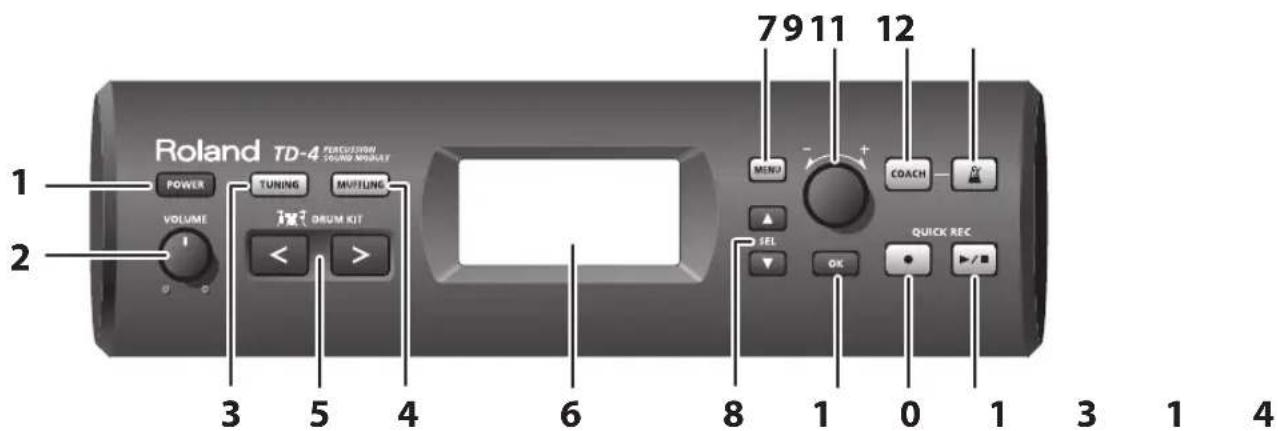
text_image
1 2 3 5 4 6 8 1 0 1 3 1 4 79 11 12 POWER TUNING MUTUNG VOLUME DRUM KIT MENJ COACH SEL OK QUICK REC1. [POWER] button
Turns the power on/off (p. 10).
2. [VOLUME] knob
Adjusts the volume from the OUTPUT and PHONES jacks (p. 10).
3. [TUNING] button
Use this when you want to tune each instrumental sound (p. 15).
4. [MUFFLING] button
Use this when you want to muffle (mute) each instrumental sound (p. 15).
5. DRUM KIT [<] [>] buttons
Use these to switch drum kits (p. 12). You'll also use these buttons to return to the drum kit screen from other screens (except during recording/playback).
6. Display
During performance, this shows the drum kit name and other information. During editing, this shows the contents of the settings.
MEMO
The backlight will automatically dim when no panel operations have been performed for a certain period of time.
7. [MENU] button
Use this when you want to make various settings for the TD-4, such as editing the settings of a drum kit or adjusting the pads.
8. SEL [ ] [ ] button
Use this to select a menu item when using the Coach function, or to select parameters when making various settings for the TD-4.
9. [-/+] dial
Use this dial to edit a value.
Use this to adjust a value. Turning the dial toward "+" will increase the value, and turning it toward "-" will decrease the value.
10. [OK] button
Use this to confirm a menu item to use with the Coach function, or to confirm a value you've edited.
11. [COACH] button
Press this when you want to use the Coach function (p. 19).
12. [ ] Metronome) button
This turns the metronome on (sounding) or off (silent) (p. 17).
13. QUICK REC [] (Rec) button
Use this to record your playing (p. 17).
14. QUICK REC [] (PlayStop) button
Play back what you recorded (p. 18).
With some buttons, a sound is produced when you press them.
If you want, you can turn off this sound (p. 37).
Side Panel
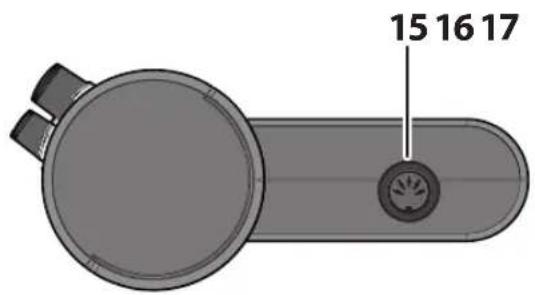
text_image
15 16 1715. MIDI OUT connector
Use this when you want to use the pads to play external MIDI sound sources or for recording with sequencers (p. 41).
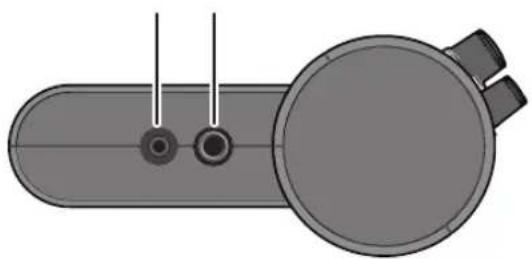
natural_image
Diagram of a mechanical component with two circular ports and connecting rods (no text or symbols)16. MIX IN jack
For connecting an external audio source such as MP3 or CD players (p. 16). All sound input here is also sent from the OUTPUT and PHONES jacks.
* To adjust the volume, use the controls of the external device connected to MIX IN.
17. PHONES jack
For connecting stereo headphones (p. 9). Using the headphone jack will not mute the main OUTPUT jacks.
Rear Panel
text_image
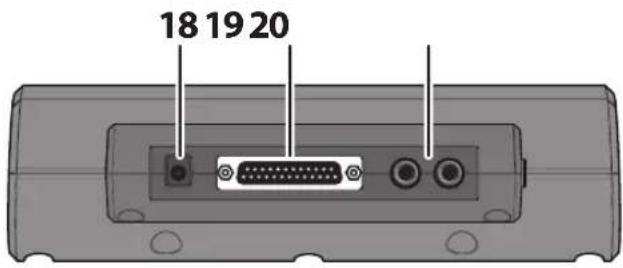
18 19 2018. DC IN jack
Connect the included AC adaptor here (p. 9).
19. TRIGGER INPUT connector
Connecting the special cable connects the pads and pedals to the TD-4 (p. 8).
20. OUTPUT jacks (L/MONO, R)
All sounds of the TD-4 are output here. Use for connecting to an amp or other external audio equipment.
If you're working in mono, only use the L/MONO jack.
Bottom Panel
text_image
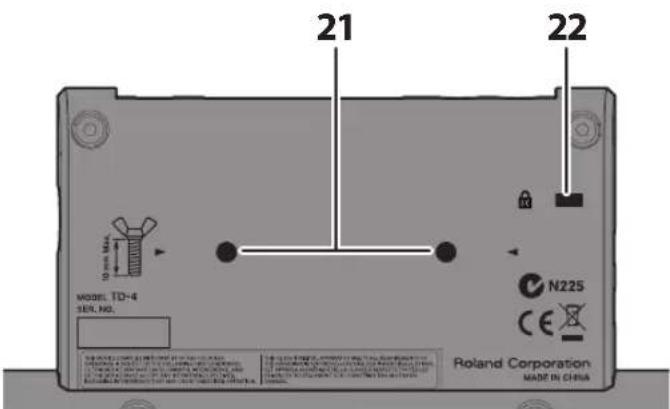
21 22 MODEL: TD-4 SEN, NO. N225 CE Roland Corporation MADE IN CHINA21. Sound module mounting plate attachment holes
Attach the included sound module mounting plate here so that you can attach the TD-4 to your drum stand.
22. Security Slot ( )

http://www.kensington.com/
Mounting the TD-4 on the Stand
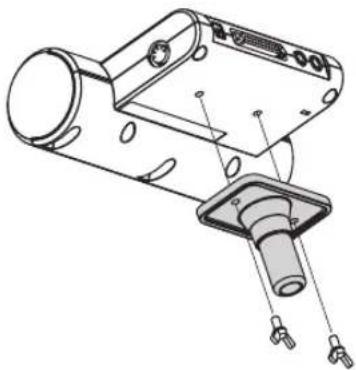
1. Attach the included sound module mounting plate to the TD-4.
Use the included wing bolts to attach the plate as shown in the illustration.
* Use only the included wing bolts. Using any other nuts may cause malfunction.
* You must use the TD-4 with the sound module mounting plate installed.
natural_image
Technical line drawing of a mechanical assembly with no visible text or symbolsNOTE
- When turning the unit upside-down, get a bunch of newspapers or magazines, and place them under the four corners or at both ends to prevent damage to the buttons and controls. Also, you should try to orient the unit so no buttons or controls get damaged.
- When turning the unit upside-down, handle with care to avoid dropping it, or allowing it to fall or tip over.
2. Attach the TD-4 (with the sound module mounting plate installed) to your drum stand (such as the MDS-4; available separately).
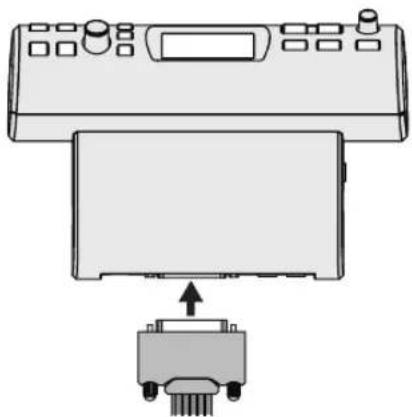
3. Connect the included cable to the TD-4's TRIGGER INPUT connector, and connect your pads and pedals.
natural_image
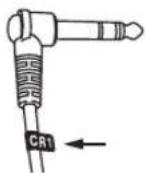
Diagram of a printer with an attached device showing internal components (no text or symbols)Labels indicating the pad to be connected are attached to the cable.
Connect the pads and pedals as shown in the illustration.

flowchart
graph TD
    CR2 --> T3
    T3 --> RD
    RD --> T2
    T2 --> TD-4
    TD-4 --> T1
    T1 --> SNR
    SNR --> CR1
    CR1 --> HH
    HH --> HHC
    CR2 -.-> KIK
    KIK --> TD-4
NOTE
- If you don't connect a pad to each of the cables, make the following settings for unconnected pads in order to prevent malfunction.
- Turn the Pad Type setting OFF (p. 35).
- If you're not using the CR2, leave the CR2 cable cap attached, and fasten the cable to the stand so that it does not interfere with your playing.
- The included connection cables are the optimal length for when they're attached to the MDS-4. If you're using a different stand, you'll need to provide extension cables.
Connecting Your Audio Equipment
flowchart
graph TD
    A["MIDI Sound Module"] --> B["AC Adaptor"]
    C["Portable Audio Player"] --> D["Stereo miniature plug"]
    D --> E["Stereo 1/4" phone plug"]
    E --> F["Audio Set, etc"]
    G["Power Cord"] --> H["AC Adaptor"]
    I["To AC Outlet"] --> J["AC Adaptor"]
    K["MIDI IN"] --> L["AC Adaptor"]
    M["Powered Amp, etc"] --> N["AC Adaptor"]
    O["Audio Set, etc"] --> P["AC Adaptor"]
    Q["Stereo Headphones"] --> R["Audio Set, etc"]
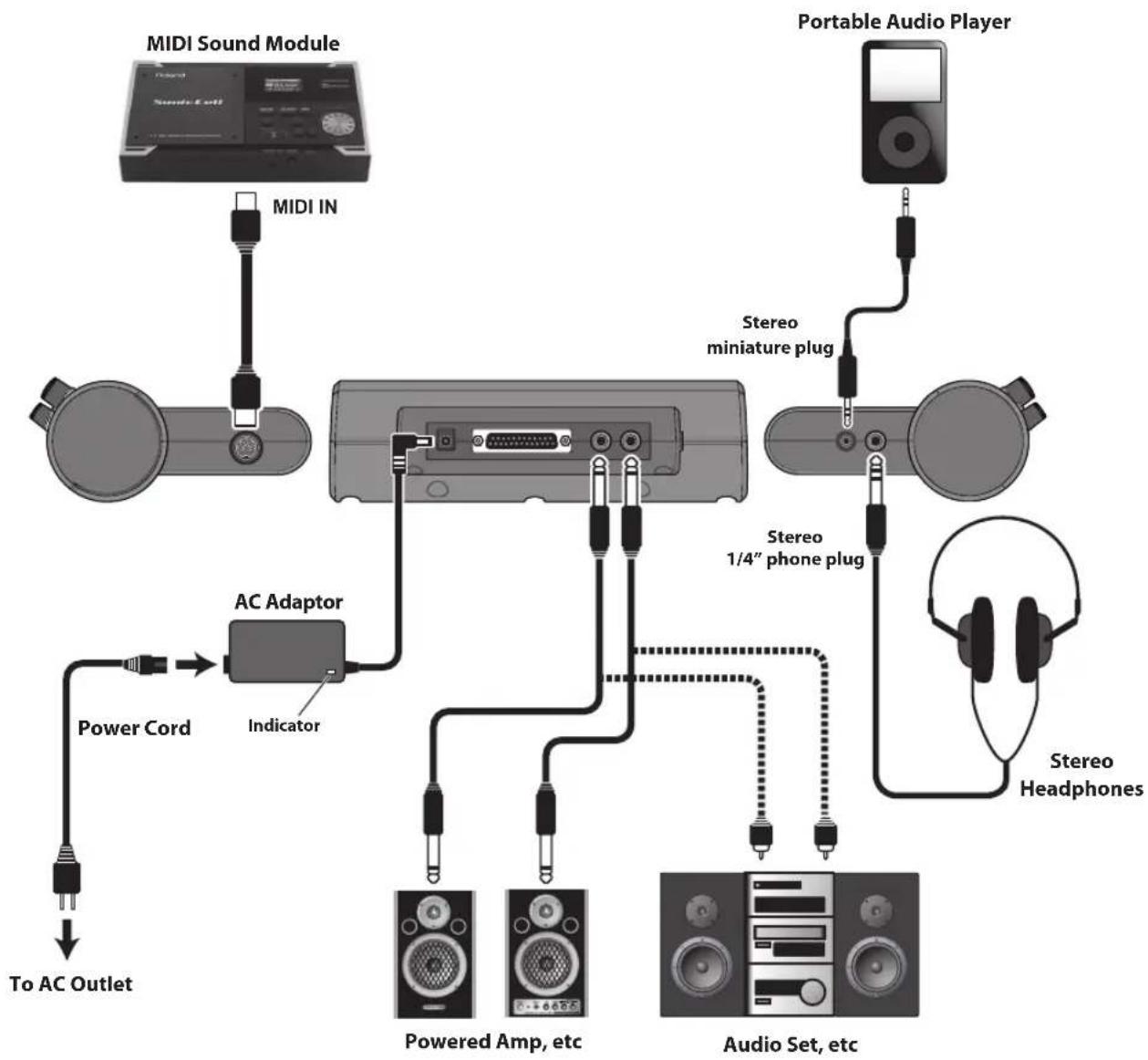
1. Power-off all equipment before making connections.
NOTE
To prevent malfunction and/or damage to speakers or other devices, always turn down the volume, and turn off the power on all devices before making connections.
2. Connect the OUTPUT jacks (L/MONO, R) to your audio system or amp.
* If you're using headphones, connect them to the PHONES jack.
3. Connect the included AC adaptor to the DC IN jack.
Place the AC adaptor so the side with the indicator (see illustration) faces upwards and the side with written information faces downwards.
* The indicator will light when you plug the AC adaptor into an AC outlet.
MEMO
Using the MIX IN jack allows playing along with music from a portable audio player or other external sources (p. 16).
Turning the Power On/Off
* Once connections have been made (p. 9), turn on the power to the connected equipment in the order specified. Doing it in the wrong order raises the risk of damage/malfunction to that equipment.
text_image
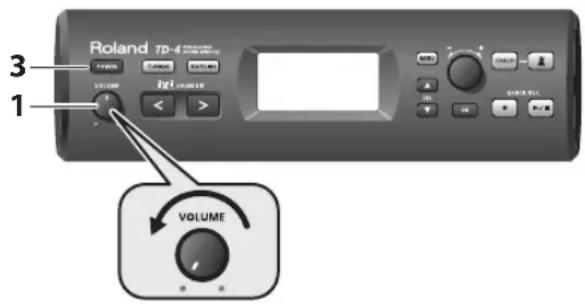
3 1 VOLUME VOLUME VOLUME VOLUME- Turn the [VOLUME] knob all the way to the left.
- Minimize the volume of the connected amp or audio system.
- Press the [POWER] button.
* Even with the volume all the way down, you may still hear some sound when the power is switched on, but this is normal, and does not indicate a malfunction.
* The TD-4 is equipped with a protection circuit and requires a brief interval a few seconds) after powering before it will operate normally.
Caution when Turning On the Power
After you turn on the power, do NOT touch any pads or pedals until the drum kit name (the illustration below) has appeared in the display. Doing so can cause various problems.

text_image
PAD DRUM KIT U-Compact- Power-on the connected amp or audio system.
- While hitting a pad, gradually turn the [VOLUME] knob toward the right to adjust the volume.
Adjust the volume of the connected amp/ audio system to the desired level.
If you don't hear any sound
Check the following points.
Pad and Pedal Connections
- Is the cable correctly connected to the TRIGGER INPUT connector?
- Are the cables correctly connected to each pad or pedal?
When Using an Amp or Audio System
- Are the TD-4's OUTPUT jacks connected correctly to the input jacks of your amp/audio system?
- Are the input selections and volume settings correct on that amp/audio system?
- Possible problem with the connection cables themselves?
- Isn't the [VOLUME] knob turned all the way to the left?
- Have the input select settings of your audio system or amp been made correctly?
- Is the amp or audio system volume setting correct?
When using headphones
- Are your headphones plugged into PHONES jack?
- Isn't the [VOLUME] knob turned all the way to the left?
Turning the Power Off
- Turn the volume down on the TD-4 and any connected equipment.
- Power-off the connected equipment.
- Hold down the [POWER] button until the display indicates "See you!"
Saving Your Settings
The TD-4 does not have a specific "operation" for saving your settings. Any changes you've made will be saved when you turn off the power.
* You must turn off the power by pressing the [POWER] button.
Tensioning the Head of a Mesh Pad (PDX-8)
BEFORE using the PDX-8 mesh pads you must adjust the tension.
You can tension mesh heads the same way you do with acoustic drums.
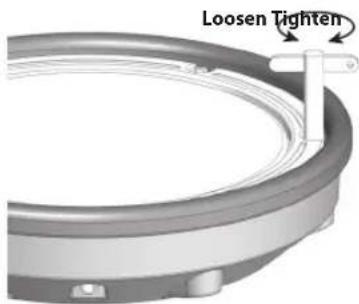
* Use a drum key to make adjustments.
MEMO
Adjusting the tension of the PDX-8 head is only for playing response and will not affect the pitch as on an acoustic drum.
1. Use the included drum key to tighten the tuning bolts.
Strike the head to check the feel and response.
text_image
Loosen TightenNOTE
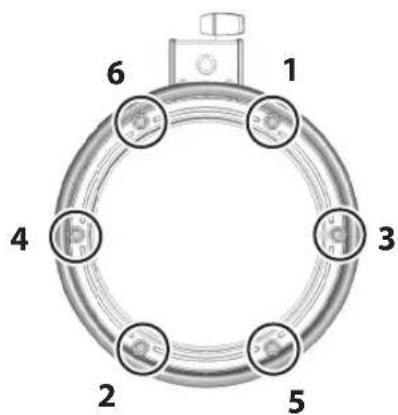
Tighten the tuning bolts in the numerical order shown in the following illustration. If you firmly tighten a tuning bolt at one location all at once, it will be impossible to stretch the head evenly, and this may cause triggering response problems.
text_image
1 2 3 4 5 62. Tension the head evenly as you test the playing feel, just as you would with an acoustic drum.
MEMO
Head tension may slacken with the passage of time. Readjust the tension as needed.
Hearing What the Kits Sound Like
After turning the power on, you can play the demo patterns. Here's how you can listen to the sounds by switching drum kits while playing the demo patterns.
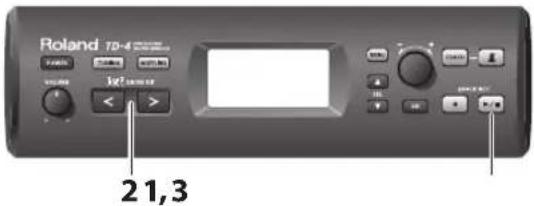
text_image
Roland 10-4 21,3* All rights reserved. Unauthorized use of this material for purposes other than private, personal enjoyment is a violation of applicable laws.
* No data for the demo patterns that is played will be output from MIDI OUT.
- Press the [ ] (Play/Stop) button. The demo patterns will play.
- Press the DRUM KIT [<] [>] buttons to select drum kit.
- To stop demo pattern playback, press the [ ] button once again.
MEMO
When you press the [ ]Rec) button to start recording your performance (p. 17), the demo patterns will temporarily be erased. The next time you turn on the power, you will again be able to play the demo patterns.
Selecting a Drum Kit
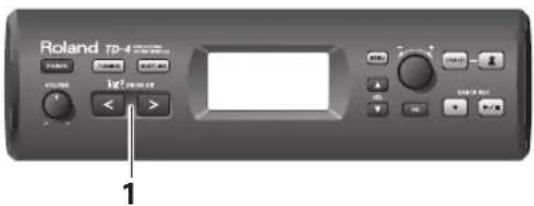
A drum kit is a combination of the sounds & settings for each pad and pedal, as well as ambience.
text_image
Roland 10-4 1- Press the DRUM KIT [<] [>] buttons to select drum kit.
text_image
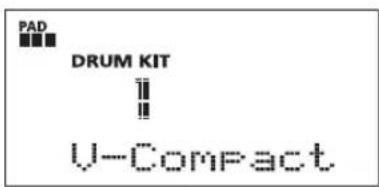
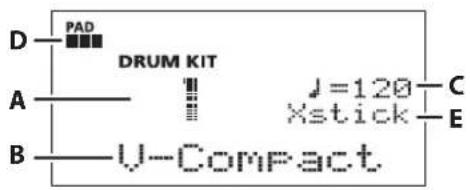
PAD DRUM KIT U-CompactAbout the "DRUM KIT" screen
This is the TD-4's basic screen.
text_image
D PAD DRUM KIT A J=120 Xstick B U-Compact C E| A Drum | kit number |
| B Drum | kit name |
| C This shows the metronome tempo (p. 17). | |
| D Strength of the pad strike displayed in 6 levels. | |
| E | This is shown if the cross-stick technique can be used with the snare (p. 29).(When Xstick Volume is anything other than OFF) |
MEMO
Regardless of the screen that is displayed, pressing the DRUM KIT [<] [>] buttons will access the "DRUM KIT" screen (except during recording/playback).
Performance Techniques
Pads (e.g., PDX-8, PD-8)
Head Shot
Hit only the head of the pad.

text_image
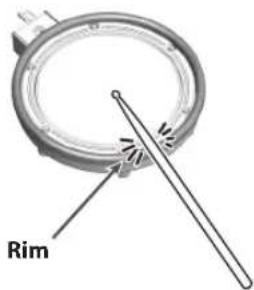
HeadOpen Rim Shot
Strike the rim of the pad.
text_image
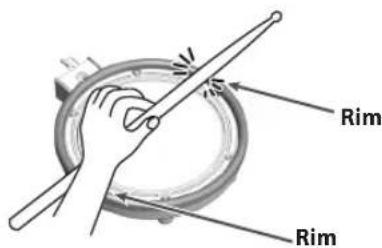
RimCross Stick
Only strike the rim of the pad.
Velocity switching "snare rim" sound, played softly produces a cross stick sound, and when played harder, produces a open rim shot sound (p. 29).
text_image
Rim Rim* To play the cross stick, be sure that you only strike the rim of the pad. Place your hand on the head gently, otherwise this may prevent the cross stick function from working properly.
MEMO
When playing cross stick, set "Xstick Volume" (p. 29) to anything other than "OFF."
Cymbals (e.g., CY-8, CY-12R/C)
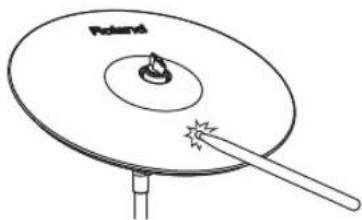
Bow Shot
The most common method, playing the middle area of the cymbal.
natural_image
Simple line drawing of a circular object with a stick and a label 'Poland' on its top, no text or symbols present.Edge Shot
When striking the edge with the shoulder of the stick (as shown in the figure).
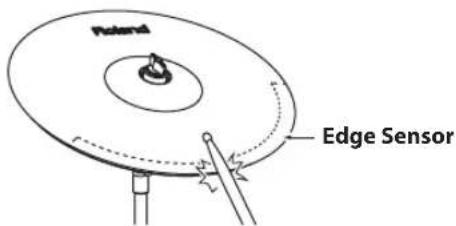
text_image
Poland Edge SensorBell Shot (CY-12R/C, CY-15R)
This playing method involves striking the bell of the cymbal.
* Set the Crash 2 Usage setting (p. 36) to "RIDE BELL."
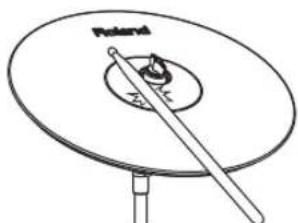
natural_image
Simple line drawing of a circular object with a central rod and a label 'Poland' (no other text or symbols)* Strike the bell somewhat strongly with the shoulder of the stick.
Choking a Cymbal
Choking (pinching) the cymbal's edge with the hand immediately after hitting the cymbal will mute or choke the sound, just like with a real cymbal. The Choke function only works when you grasp in the area (where the edge sensor is) as shown in the figure. If you do otherwise, it will not work.
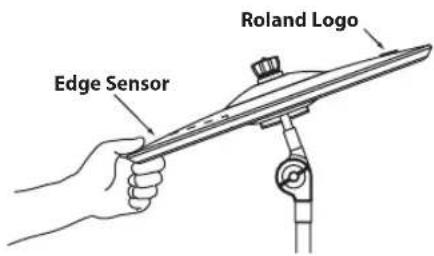
text_image
Edge Sensor Roland LogoHi-Hat (CY-5)
Open/Closed
The hi-hat sound will change smoothly between open and closed depending on pressure applied to the hi-hat control pedal. Foot closed and foot splash sounds are possible.
Bow Shot
Playing the middle area of the hi-hat pad.
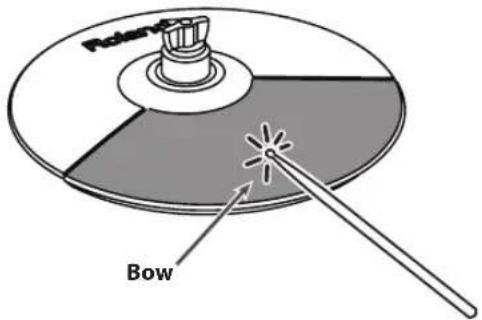
text_image
Polar BowEdge Shot
Playing the edge of the hi-hat pad with the shoulder of the stick (as shown in the figure).
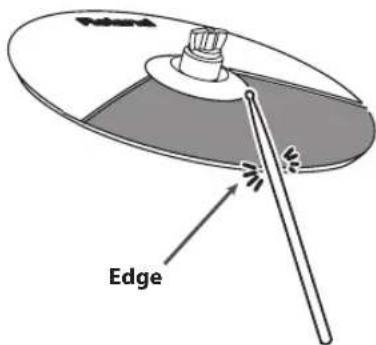
text_image
EdgeHi-Hat Control Pedal FD-8
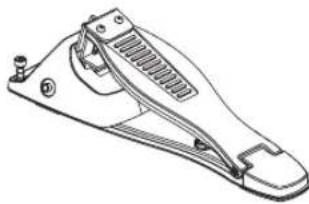
natural_image
Line drawing of a mechanical clamp or lever component (no text or symbols)Open Hi-Hat
Strike the hi-hat without pressing the pedal.
Half Open Hi-Hat
Strike the hi-hat with the pedal pressed half-way.
Closed Hi-Hat
Strike the hi-hat with the pedal pressed.
Foot Closed
Completely press down the pedal.
Foot Splash
Quickly hitting the hi-hat pedal (with heel or toes) and instantly releasing it.
* Connect the FD-8 to the TD-4 before turning on the power.
Quickly Tuning or Muffling
You can use dedicated buttons to quickly tune or muffle the sound. When you press the button, the sound you selected will be heard.
NOTE
You cannot make tuning or muffling settings for pads to which an instrument (p. 28) in the cymbal-type instrument group (HIHAT, CRASH, RIDE) is assigned. For such pads, the display will indicate “---.”
TUNING
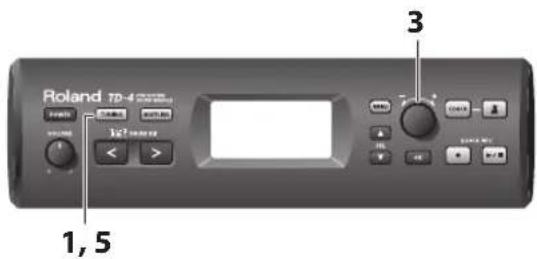
text_image
Roland 7D-4 1, 5 31. Press the [TUNING] button so it's lit.
The TUNING screen appears.
The selected pad will sound at this time.
![ROLAND TD-4SX - Press the [TUNING] button so it's lit. - 1](/content/2026/06/1205964/images/d55215be5a5fd9e237732b807e35353223717da9f150507002b8964e3a66c99d.jpg)
text_image
PAD KICK DRUM KIT < TUNING > - - - - + 02. Strike the pad that you want to tune.
The pad you struck will blink in the screen.

text_image
PAD SNARE DRUM < TUNING > - + ①3. While striking the pad to hear the sound, turn the [-/+] dial to adjust the tuning.
Value: -600-0-+600
A negative (-) value will lower the pitch, and a positive (+) value will raise the pitch.
4. Repeat steps 2–3 to adjust the tuning of each pad.
5. When you've finished tuning, press the [TUNING] button to turn it off.
MUFFLING
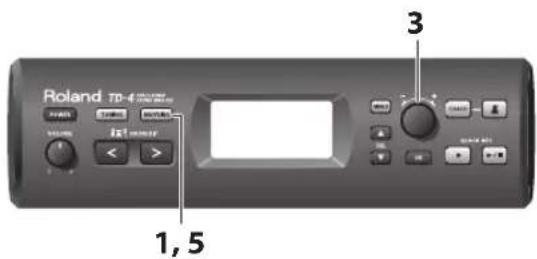
text_image
Roland T0-4 1, 5 31. Press the [MUFFLING] button so it's lit.
The MUFFLING screen appears.
The selected pad will sound at this time.
![ROLAND TD-4SX - Press the [MUFFLING] button so it's lit. - 1](/content/2026/06/1205964/images/f0f11757c9af7b7794a1ee54a357985ba1afa7d830843372c2576da36772e178.jpg)
text_image
PAD KICK DRUM KIT2. Strike the pad that you want to muffle.
The pad you struck will blink in the screen.
text_image
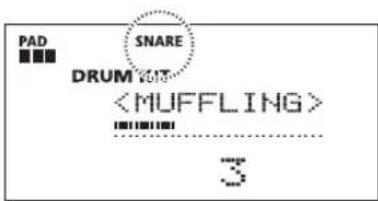
PAD SNARE DRUM OUT3. While striking the pad to hear the sound, turn the [-/+] dial to adjust the muffling.
Value: 0–10
Raising this value reduces the resonance and decay (length) of the sound.
4. Repeat steps 2–3 to adjust the muffling of each pad.
5. When you've finished adjusting the muffling, press the [MUFFLING] button to turn it off.
Playing
If Head/Rim Link (p. 37) is "ON," both the HEAD and the RIM settings will be edited simultaneously.
In some cases, you may see an “*” in the right side of the screen; this indicates that the tuning/muffling values specified for the HEAD and the RIM are different.
Playing Along with a Portable Audio Player
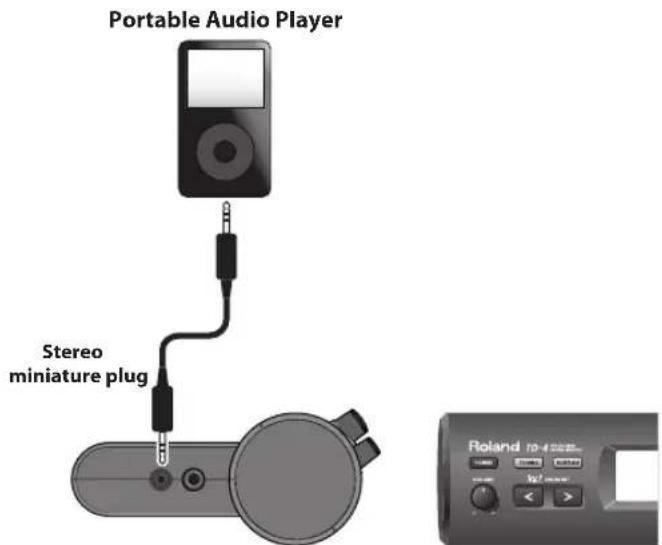
By connecting a portable audio/CD player to the MIX IN jack you can play the TD-4 with your favorite songs.
MEMO
You can connect other audio devices as well.
Connections
Lower the volume of the TD-4 and your audio player before making connections.
text_image
Portable Audio Player Stereo miniature plug Roland 10-42225* If a connection cable has built-in resistors, the volume level of the source connected to the TD-4 (MIX IN) may be too low. If this occurs, use connection cables that do not contain resistors.
Playback
- Start the music on your portable audio player.
For details on how to use your audio player, refer to its owner's manual.
- Then adjust the volume of your portable audio player.
Sounds received at the MIX IN jack are output from the OUTPUT and PHONES jacks.
* Adjust the volume on the audio player to get the right balance between it and the TD-4.
- Adjust the volume of the TD-4.
Playing with the Metronome
text_image
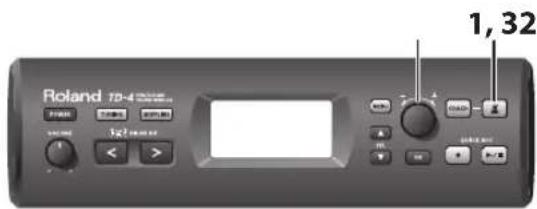
Roland 18-4 1,321. Press the [] button.
The metronome starts and the screen will indicate the tempo. The button will blink in time with the metronome.
![ROLAND TD-4SX - Press the [] button. - 1](/content/2026/06/1205964/images/c000c8a08dc050bae30e08c5f43e09a3f69a968779a497bb3dda074481d4266e.jpg)
text_image
PAD DRUM KIT J=120 U-Compact2. Turn the [-/+] dial to adjust the tempo.
Value: 40–260
3. To turn off the metronome, press the [] button to turn it off.
MEMO
Even without pressing the [] Button, you can change the tempo by turning the [-/+] dial in the Drum Kit screen.
MEMO
You can change the way that the metronome sounds (p. 34).
Quick Recording and Playback (QUICK REC)
The TD-4 provides a Quick Rec function that lets you easily record your own performance. This is a very useful practice tool, recording and then checking your drumming.
NOTE
Whenever you turn on the power, the TD-4 is prepared for the playback of its demo patterns.
After you've made a recording, if you turn off the power, the data for the recording will be erased. Then, the next time the power is switched on, the demo patterns will once again be loaded in from internal memory.
NOTE
A signal input via the MIX IN jack won't be recorded.
Recording
text_image
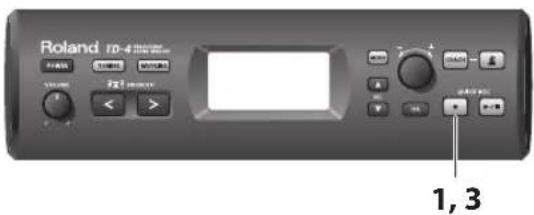
Roland 10-4 1,3* First: Please select the drum kit that you want to use for recording.
1. Press the [ ] (Rec) button.
The button will blink, and the TD-4 will enter recording-standby mode.
![ROLAND TD-4SX - Press the [ ] (Rec) button. - 1](/content/2026/06/1205964/images/29c8e9df8830fd50db219451e606b0c352d26deb9063f0bccbea9eaad5cdcedd.jpg)
text_image
PAD DRUM KIT• To record along with the metronome, press the [] button to turn the metronome on, and use the [-/+] dial to adjust the tempo.
Practicing
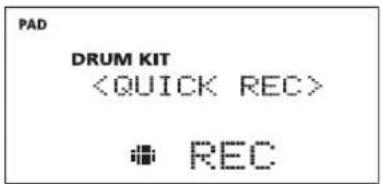
2. Hit any pad/pedal and recording begins.
The following screen appears.
text_image
PAD DRUM KIT3. To stop recording, press the [ ] (Rec) button and the button goes dark.
* If you exceed the maximum recording time, recording stops automatically.
![ROLAND TD-4SX - To stop recording, press the [ ] (Rec) button and the button goes dark. - 1](/content/2026/06/1205964/images/d3af34844fc66ade9488b405b40771bcc14f853f6244c2b3e46fc842a42fdc8c.jpg)
text_image
PAD DRUM KITMemory Full
[OK]Playback
text_image
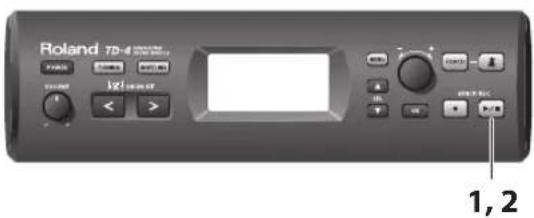
Roland 7D-4 1,21. Press the [ ] (Play/Stop) button so it's lit.
The following screen appears, and playback begins.
![ROLAND TD-4SX - Press the [ ] (Play/Stop) button so it's lit. - 1](/content/2026/06/1205964/images/d3ee4be6327a9ee7cd04c68622605ea19b387191768d6e9fb642c4929f48d04f.jpg)
text_image
DRUM KIT U-Compact PLAY* The recorded performance data is not transmitted from MIDI OUT.
MEMO
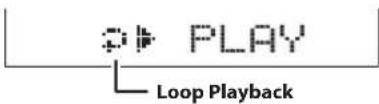
By holding down the [ ] (Play/stop) button for about one second, you can select loop playback; the recorded performance will play repeatedly.
text_image
PLAY Loop Playback2. To stop playback, press the [ ] (Play/■op) button and the button goes dark.
When playback has finished, the [ ] (PlayStop) button automatically goes dark.
Using Time Check to Check Your Recorded Performance
You can use Coach mode's "TIME CHECK" function to check whether your recorded performance was played with accurate timing.
NOTE
You must play along with the metronome when recording.
1. Press the [ ] (Play/Stop) button so it's lit; the recorded performance will play.
2. Press the [COACH] button.
The following screen appears.
![ROLAND TD-4SX - Press the [COACH] button. - 1](/content/2026/06/1205964/images/bce387ccafea8a95addfbafcf223adfea460f18392a4a67b5e2aefd44cae90f5.jpg)
text_image
DRUM KIT 47% J=120 S.................f PLAYDuring playback, you can change the playback tempo by turning the [-/+] dial. When you stop playback, the tempo will revert to the setting at which it was recorded.
* Loop playback will automatically be selected and the metronome will turn on.
3. To stop playback, press the [ ] (Play/■op) button and the button goes dark.
Practicing in Coach Mode
The TD-4's Coach mode is a unique set of exercises specifically designed to help build speed, accuracy and stamina, as well as develop better timing skills.
Throughout the Coach modes, you will discover that some of them have programmable parameters, allowing you to adapt the functions to your specific needs.
Selecting a Practice Menu
text_image
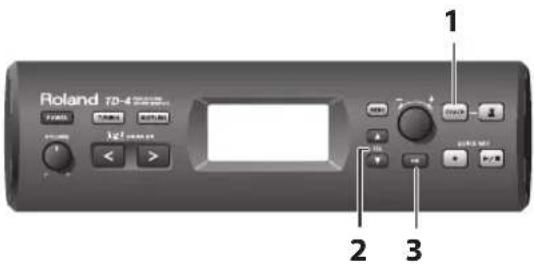
Roland 70-4 1 2 31. Press the [COACH] button so it's lit.
The Coach mode menu screen will appear.
![ROLAND TD-4SX - Press the [COACH] button so it's lit. - 1](/content/2026/06/1205964/images/749f603de0628766a69e78caa405ccd169bbb0df79342f6d1024081590e05dfe.jpg)
text_image
PAD COACH SEL : **** Practice ****: ▼ 1 WARM UPS2. Use the SEL [ ] [ ] buttons to select the desired practice menu item (shown at right).
3. When you've selected a practice menu item, press the [OK] button.
You'll proceed to the start screen of the selected practice menu item.
MEMO
Or you can just press the [] button to immediately start practicing without calling up the start screen.
MEMO
In the start screen of the Practice menu, you can press the [MENU] button and make settings for each menu item.
| Menu Explanation | |
| PADCOACHSEL : : : : Practice : : : : :1 WARM UPS | Warm Upsp. 20When you want to getwarmed up before youbegin practicing. |
| PADCOACH▲ : : : : : Practice : : : : :2 TIME CHECK | Time Checkp. 22Strengthens yourability to play accuraterhythms. |
| PADCOACH▲ : : : : : Practice : : : : :3 TEMPO CHECK | Tempo Checkp. 23Strengthens yourability to play at aconsistent speed. |
| PADCOACH▲ : : : : : Practice : : : : :4 QUIET COUNT | Quiet Countp. 24Strengthens yourability to maintain thetempo internally. |
| PADCOACH▲ : : : : : Practice : : : : :5 AUTO UP/DOWN | Auto Up/Downp. 26Strengthens yourendurance. |
<1> WARM UPS
In this mode you'll successively practice steps 1–3, be graded on your performance at each step, and then receive a final evaluation. You can choose one of three courses, ranging from easy to difficult. You can also adjust the tempo according to your level of skill.
Start practicing
text_image
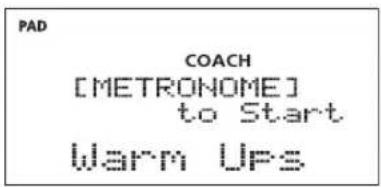
PAD COACH [METRONOME] to Start Warm UpsIn the WARM UPS start screen, press the [ ] button to start practicing.
MEMO
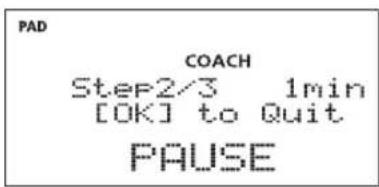
After you've started WARM UPS, you can press the [ ] button to pause the WARM UPS.
text_image
PAD COACH Step2/3 1min [OK] to Quit PAUSETo resume practicing, press the []Button once again. If you're finished with WARM UPS, press the [OK] button. Here you can press the SEL []Button to move to the previous step, or press the SEL []Button to move to the next step.
MEMO
You can turn the [-/+] dial to adjust the tempo even while practicing.
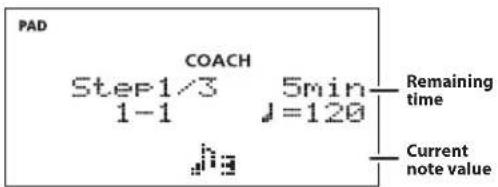
Step 1: Change-up
In this step, the rhythm type will change every two measures. Starting from half notes, the note values will gradually become shorter, and will then return to half notes; this change in rhythms will be repeated.
text_image
PAD COACH Step1/3 5min 1-1 J=120 Remaining time Current note valueStep 2: AutoUpDown
The tempo will gradually be raised and lowered.
The tempo will increase by 1BPM (beat-per-minute) for each beat until the metronome reaches the upper limit; then the tempo will continue slowing down by 1BPM until it reaches the initial tempo.
* AutoUpDown will be executed if Duration (p. 21) is 10 MINS or 15 MINS.

text_image
PAD COACH Step2/3 5min 1-1 J=120 120→176 Tempo lower limit Tempo upper limit* The current tempo value will be the lower tempo limit.
MEMO
While practicing, you can press the SEL [] button to specify the current tempo as the upper limit; if you press the SEL [] button, the upper tempo limit will return to 260.
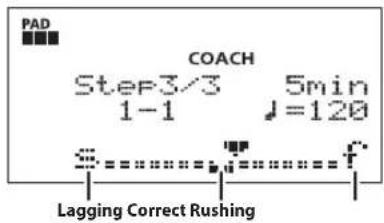
Step 3: TimeCheck
At this step, the accuracy of your playing will be checked against the metronome. You can see in the screen if you are ahead, behind or on the beat.
text_image
PAD COACH Step3/3 5min 1-1 =120 Lagging Correct RushingOverall evaluation
This grades your performance at each step, and displays the overall evaluation.

text_image
PAD COACHEvaluation (display)
EXCELLENT!, VERY GOOD!, GOOD, AVERAGE, START OVER
When you've finished practicing
Press the [OK] button to return to the Coach mode menu screen.
Select a course and make settings
- From the WARM UPS start screen, press the [MENU] button so it's lit.

text_image
PAD COACH SEL- Use the SEL [ ][ ] buttons to select a parameter.
- Turn the [-/+] dial to edit the value.
- Press the [MENU] button to return to the WARM UPS start screen.
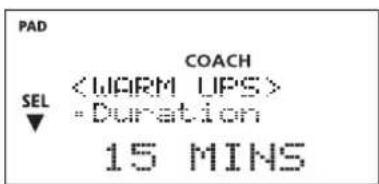
Duration (time selection):
text_image
PAD COACH SEL| Value Explanation | |
| 5 MINS | Time required: 5 minutesChange-up: 2 minutes, TimeCheck: 3 minutes |
| 10 MINS | Time required: 10 minutesChange-up: 3 minutes, AutoUpDown: 3 minutes, TimeCheck: 4 minutes |
| 15 MINS | Time required: 15 minutesChange-up: 5 minutes, AutoUpDown: 5 minutes, TimeCheck: 5 minutes |
Grade:
This selects how strictly you will be graded and how TimeCheck will evaluate your accuracy.

text_image
PAD COACH ▲| Value Explanation |
| EASY Normal setting |
| HARD Grading (evaluation) will be stricter. |
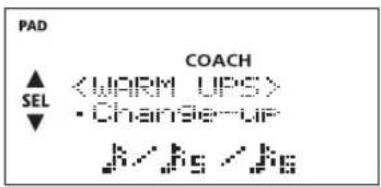
Change-up:
Step 1: Selects the pattern by which the rhythm will vary during Change-up.
text_image
PAD COACH ▲| Value Explanation | |
MaxTempo:
Step 2: Specifies the upper tempo limit during step 2: AutoUpDown.

text_image
PAD COACH ▲| Value Explanation | |
| 40–260 | * You can also use Tap input (p. 34) to specify the tempo. |
Tempo:
This specifies the tempo.

text_image
PAD COACH ▲| Value Explanation | |
| 40–260 | * You can also use Tap input (p. 34) to specify the tempo. |
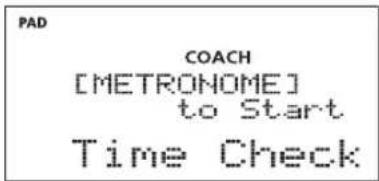
<2> Correctly Playing in Time with the Beat (TIME CHECK)
This mode lets you practice playing accurately along with the metronome.
Start practicing
text_image
PAD COACH [METRONOME] to Start Time Check1. In the TIME CHECK start screen, press the [] button to start practicing.
![ROLAND TD-4SX - In the TIME CHECK start screen, press the [] button to start practicing. - 1](/content/2026/06/1205964/images/eb9827aa1e020bbd19af4621e4cd0b12eeeedfc66a3ad0f7e2851c5bb7689431.jpg)
MEMO
You can use the [-/+] dial to adjust the tempo even while you practice.
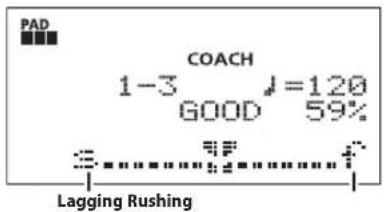
2. Strike the pad in time with the metronome.
text_image
PAD COACH 1-3 J=120 GOOD 59% Lagging Rushing- The screen will indicate whether your pad strikes match the beat sounded by the metronome.
- The percentage of your strikes that were played with accurate timing is displayed as a “%” value.
Scoring
If Score (shown at right) is "ON," the Time Check will automatically end when you've finished practicing the specified number of measures. Then your performance will be scored, and the results will appear in the screen.

text_image
PAD COACHWhen you've finished practicing
3. Press the [OK] button to return to the Coach mode menu screen.
Settings
1. In the TIME CHECK start screen, press the [MENU] button so it's lit.
![ROLAND TD-4SX - In the TIME CHECK start screen, press the [MENU] button so it's lit. - 1](/content/2026/06/1205964/images/3296ee084ffffd76da5f9cd803cf8030c07ee4255c9b7f52c7eca530e419081c.jpg)
text_image
PAD COACH2. Use the SEL[] [buttons to select a parameter.
3. Use the [-/+] dial to edit the value.
4. Press the [MENU] button to return to the TIME CHECK start screen.
Score:
Specifies whether the score will be shown in the screen.

text_image
PAD COACH| Value Explanation | |
| OFF | Your performance will not be scored.Only the timing will be checked. |
| ON(4, 8, 16, 32 meas) | The score will be shown in the screen.You can also specify the number of measures you'll practice before being scored. |
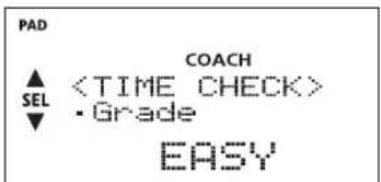
Grade:
Specifies the strictness of scoring.
text_image
PAD COACH ▲| Value Explanation | |
| EASY Normal | |
| HARD Timing | will be checked more strictly. |
Tempo:
Specifies the tempo.

text_image
PAD COACH ▲| Value Explanation | |
| 40–260 | * You can also set the tempo by using Tap input (p. 34). |
<3> Continuing to play at a steady tempo (TEMPO CHECK)
This mode lets you practice playing at a steady tempo without relying on the tempo sounded by the metronome.
Start practicing
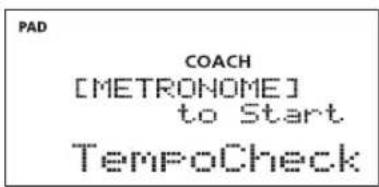
text_image
PAD COACH [METRONOME] to Start TempoCheck- In the TEMPO CHECK start screen, press the [] button to start practicing.
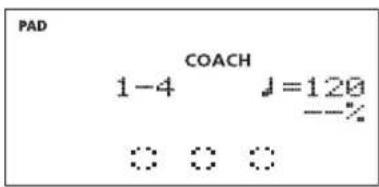
text_image
PAD COACH 1-4 J=120 --%MEMO
You can turn the [-/+] dial to adjust the tempo even while you're practicing.
- Strike the pads in time with the metronome.
Strike the pads at a constant tempo.
- The more your tempo becomes accurate, the softer the metronome volume will become.
- The metronome volume will increase if the tempo of your pad strikes begins to drift. The more your tempo drifts, the louder the metronome will become. Strike the pads with an accurate timing that matches the tempo of the metronome.
NOTE
If the tempo of your strikes is significantly inaccurate, it may be impossible to precisely determine the amount of inaccuracy.
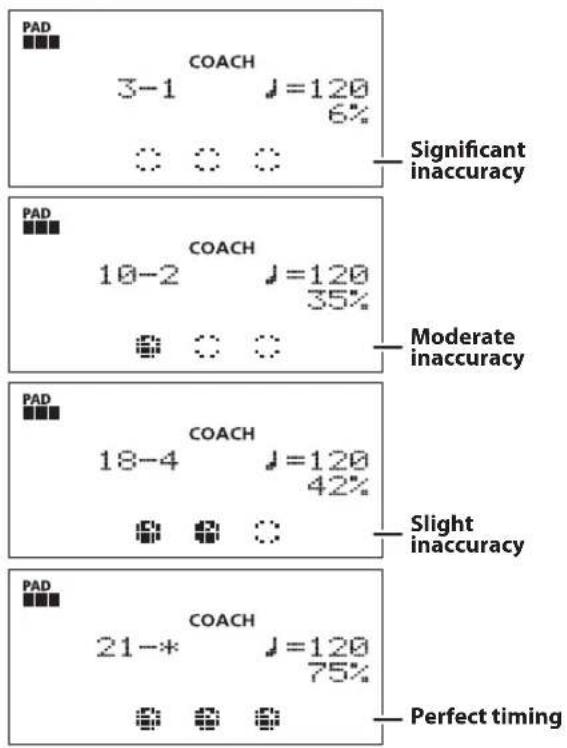
text_image
PAD COACH 3-1 J=120 6% Significant inaccuracy PAD COACH 10-2 J=120 35% Moderate inaccuracy PAD COACH 18-4 J=120 42% Slight inaccuracy PAD COACH 21-* J=120 75% Perfect timing- The accuracy of your striking tempo is shown as a “%” value.
When you've finished practicing
- Press the [OK] button to return to the Coach mode menu screen.
Settings
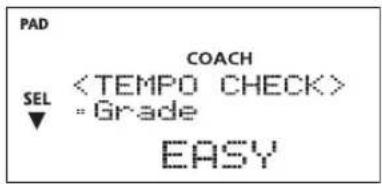
- In the TEMPO CHECK start screen, press the [MENU] button so it's lit.
text_image
PAD COACH SEL- Use the SEL[ ] [ ] buttons to select a parameter.
- Use the [-/+] dial to edit the value.
- Press the [MENU] button to return to the TEMPO CHECK start screen.
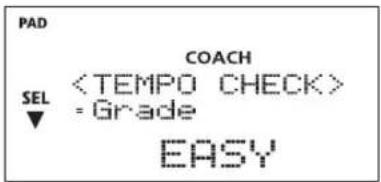
Grade:
Specifies the strictness with which your tempo will be graded.
text_image
PAD COACH| Value Explanation | |
| EASY Normal | |
| HARD Your tempo will be graded more strictly. |
Tempo:
Specifies the tempo.

text_image
PAD COACH ▲| Value Explanation | |
| 40–260 | * You can also set the tempo by using Tap input (p. 34). |
<4> Developing Internal Timing Sense (QUIET COUNT)
This mode will help you develop a good sense of time/tempo.
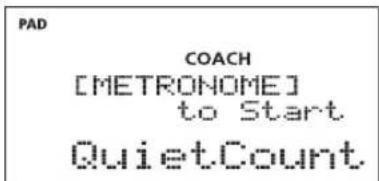
The metronome will alternate between "sounding and quiet" at selected intervals (see p. 25).
The selected cycle will repeat until you press the []Button to stop.
Start practicing
text_image
PAD COACH [METRONOME] to Start QuietCount- In the QUIET COUNT start screen, press the [] button to start practicing.
- Strike the pads in time with the metronome.
MEMO
You can turn the [-/+] dial to adjust the tempo even while you're practicing.
- The metronome will sound during the first few measures. When you reach the last measure during which the metronome will sound, the screen will indicate "Ready."

text_image
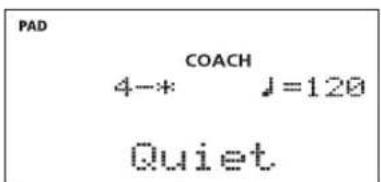
PAD COACH 3-1 j=120 Ready- When the metronome stops sounding, the screen indication will change to "Quiet." Continue striking the pads during this time.
text_image
PAD COACH 4-: J=120 Quiet- The “%” value indicates the percentage by which you played at an accurate tempo during the “Quiet” indication.

text_image
PAD COACH 5-1 J=120 58%- Repeat step 2 to continue practicing.
When you've finished practicing
- Press the [OK] button to return to the Coach mode menu screen.
Settings
- In the QUIET COUNT start screen, press the [MENU] button so it's lit.

text_image
PAD COACH SEL- Use the SEL[] [ ] buttons to select a parameter.
- Use the [-/+] dial to edit the value.
- Press the [MENU] button to return to the QUIET COUNT start screen.
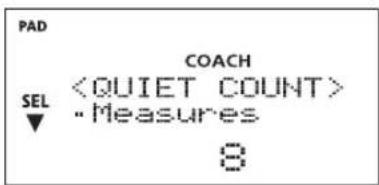
Measures:
Specify the length (measures) of the interval for which the metronome will alternate between "sounding" and "quiet."
text_image
PAD COACH SELValue
2, 4, 8, 16 (Measures)
Quiet:
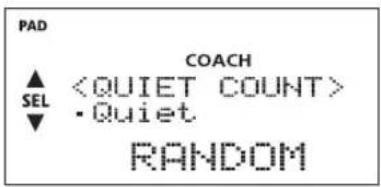
Of the measures specified by "Meas," this setting specifies the length of the measures that will be "Quiet."
text_image
PAD COACH ▲| Value Explanation | |
| RANDOM | The length of the Quiet interval will randomly change each time. |
| 1, 2, 4 | Specifies the length (number of measures) of the Quiet interval.* This setting cannot be longer than half of the Measures value. |
Tempo:
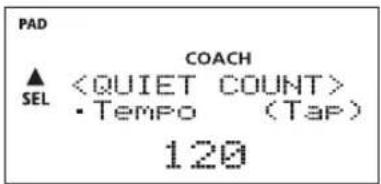
Specifies the tempo.
text_image
PAD COACH ▲| Value Explanation | |
| 40–260 | * You can also set the tempo by using Tap input (p. 34). |
<5> Gradually raising and lowering the tempo (AUTO UP/DOWN)
The metronome increases and decreases tempo over time, to help develop stamina and endurance.
Start practicing

text_image
PAD COACH [METRONOME] to Start AutoUpDown1. In the AUTO UP/DOWN start screen, press the [] button to start practicing.
![ROLAND TD-4SX - In the AUTO UP/DOWN start screen, press the [] button to start practicing. - 1](/content/2026/06/1205964/images/bd89c5c52a714894e35dfe88936bc46e99599b40d99fb2b94b444b4f23366116.jpg)
text_image
PAD COACH 1-3 J=121 48% 120÷176 Tempo lower limit Tempo upper limit2. Play the pads in time with the metronome.
- Starting at the lower tempo limit, the metronome speed will increase in steps according to the "rate" you have selected. When the metronome reaches the upper limit; then the tempo will slow down at the same rate. This cycle will be repeated.
- While practicing, you can press the SEL [] button to specify the current tempo as the upper limit; if you press the SEL [] button, the upper tempo limit will return to 260.
When you've finished practicing
3. Press the [OK] button to return to the Coach mode menu screen.
Settings
1. In the AUTO UP/DOWN start screen, press the [MENU] button so it's lit.
![ROLAND TD-4SX - In the AUTO UP/DOWN start screen, press the [MENU] button so it's lit. - 1](/content/2026/06/1205964/images/b4dcee27f450415a5228624ea00752f1e37c165913c9670b4005d5f4c22a1d87.jpg)
text_image
PAD COACH SEL2. Use the SEL[] [ ] buttons to select a parameter.
- Use the [-/+] dial to edit the value.
- Press the [MENU] button to return to the AUTO UP/DOWN start screen.
Rate:
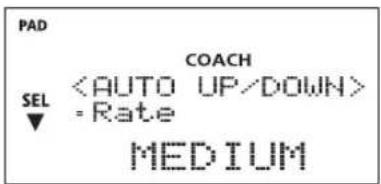
Specifies the speed at which the metronome tempo will increase (decrease).
text_image
PAD COACH| Value Explanation | |
| SLOW | The tempo will increment (decrement) by one BPM every four beats. |
| MEDIUM | The tempo will increment (decrement) by one BPM every two beats. |
| FAST | The tempo will increment (decrement) by one BPM every beat. |
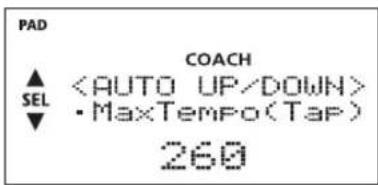
MaxTempo:
Specifies the upper tempo limit.
text_image
PAD COACH ▲| Value Explanation | |
| 40-260 | * You can also use Tap input (p. 34) to specify the tempo.* This cannot be set lower than MinTempo. |
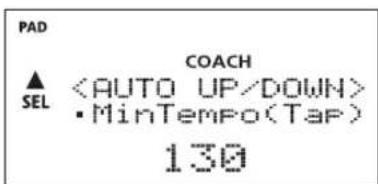
MinTempo:
Specifies the lower tempo limit.
text_image
PAD COACH ▲ SEL| Value Explanation | |
| 40–259 | * You can also use Tap input (p. 34) to specify the tempo. |
All sounds assigned to a drum kit can be edited for your specific purposes.
Selecting the Parameters

text_image
Roland 7p-4 1 2 3 4- Use the DRUM KIT [<] [>] buttons to select the drum kit that you want to edit.
- Press the [MENU] button so it's lit.
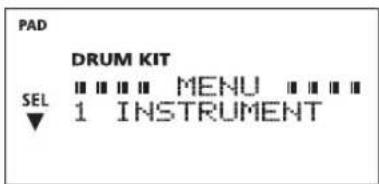
The drum kit settings menu screen will appear.
text_image
PAD DRUM KIT MENU SEL 1 INSTRUMENT- Use the SEL[] [ ] buttons to select the desired menu (shown at right).
- When you've selected the desired menu, press the [OK] button.
You'll move to the edit screen for the selected menu.
MEMO
You can turn the [-/+] dial to select the pad whose settings you want to edit.
- When you've finished making settings, press the [MENU] button to turn off its illumination; you'll return to the DRUM KIT screen.
| Menu Parameter | |
| PADDRUM KITSEL1 INSTRUMENT | p. 28• Instrument• Tuning• Muffling |
| PADDRUM KITSEL2 MIXER | p. 29• Volume of each pad• Pan position of each pad• Volume of the entire drum kit• Cross stick volume |
| PADDRUM KITSEL3 AMBIENCE | p. 30• Ambience Type• Depth of ambient |
| PADDRUM KITSEL4 KIT NAME | p. 30• Naming a drum kit |
| PADDRUM KITSEL5 KIT COPY | • Kit Copy (p. 3• Kit Exchange• Kit Restore (p. 33) |
Editing Instrument Parameters (INSTRUMENT)
On the TD-4, each of the instruments in the drum kit (e.g., kick drum or snare drum) are called an "instrument (INST)."
1. In the menu screen, choose "1 INSTRUMENT" and press the [OK] button.
The "Instrument" screen will appear.
![ROLAND TD-4SX - In the menu screen, choose "1 INSTRUMENT" and press the [OK] button. - 1](/content/2026/06/1205964/images/f382764580bd12290a85c5e0c7444a3c83605897eb35ea985916acb3796959c3.jpg)
text_image
PAD CRASH 2 DRUM KIT Instrument (CRASH:045) Instrument Number SEL Instrument Group Dark 18" Instrument-
Use the SEL[] [buttons to select a parameter.
-
Strike a pad to select the pad whose settings you want to edit.
The pad you struck will blink in the screen.
-
Use the [-/+] dial to edit the setting.
-
Press the [OK] button to return to the "MENU" screen.
| Screen Parameter Value Explanation | |||
| PAD CRASH 2DRUM KITInstrument[CRASH:04]Dark 18" | Instrument group | See Drum Kit/Instrument List(p. 49) | Instrument type |
| Instrument Instrument of the selected pad | |||
| PAD SNAREDRUM KITInstrument·Tuning+120 | Tuning -600-0-+600 | Head Tuning* The tuning can edited only for pads to which an instrument from the KICK, SNARE, TOM, or PERC instrument groups has been assigned. | |
| PAD SNAREDRUM KITInstrument-Muffling2 | Muffling 0-10 | Muffling (Mute)* Muffling can be edited only for pads to which an instrument from the KICK, SNARE, TOM, or PERC instrument groups has been assigned. | |
MEMO
- Tuning and Muffling can also be adjusted by pressing the [TUNING] button or [MUFFLING] button in the Drum Kit screen.
- If Head/Rim Link (p. 37) is "ON," Head and Rim (or for a cymbal, the bow and edge) settings will be edited simultaneously for SNARE, HH, CRASH, and RIDE.
If the instrumental sounds assigned to the HEAD and RIM differ from the recommended combination specified at the factory, an “*” will appear at the right side of the screen.
- If Head/Rim Link (p. 37) is ON and the instruments assigned to the head and rim (or for a cymbal, the bow and edge) differ from the recommended combination, an “*” will appear at the right side of the screen.
- If the Head/Rim Link setting (p. 37) is on, an “*” will appear in the right side of the screen if different tuning or muffling values are specified for the head and rim (or in the case of a cymbal, the bow and the edge).
Adjusting the volume of the pads or drum kit (MIXER)
Adjusting the volume and pan (stereo position) of individual pads/pedals.
1. In the menu screen, choose "2 MIXER" and press the [OK] button.
The "Mixer" screen will appear.
![ROLAND TD-4SX - In the menu screen, choose "2 MIXER" and press the [OK] button. - 1](/content/2026/06/1205964/images/23544717ff9029ee3f57ed5759a30d2bf6a663e83ed3fcef392f3e2a452ff3b4.jpg)
text_image
PAD SNARE DRUM KIT Mixer SEL "Pad Volume 100-
Use the SEL[] [buttons to select a parameter.
-
If the parameter is "Pad Volume" or "Pan," strike a pad to select the pad whose setting you want to edit.
The pad you struck will blink in the screen.
-
Use the [-/+] dial to edit the setting.
-
Press the [OK] button to return to the "MENU" screen.
| Screen Parameter Value Explanation | |||
| PAD SNAREDRUM KITMixerSEL - Pad Volume100 | Pad Volume 0-100 | Volume of each pad* Use the HH Pedal Sens setting (p. 36) to adjust the sensitivity of the hi-hat pedal. | |
| PAD SNAREDRUM KITMixerSEL · PanL 1 | Pan | L10-CENTER-10R | Pan position of each pad |
| PADDRUM KITMixerSEL - Kit Volume90 | Kit Volume | 0-10 | Volume of the entire drum kit |
| PADDRUM KITMixerSEL - Xstick Volume2 | Xstick Volume | OFF, 1-3 | Cross stick volumeRaising this value will increase the volume of the cross stick.For a value of 1-3, the Drum Kit screen will indicate "Xstick."When set to "OFF," playing cross stick will produce the open rim shot sound.* Use the Xstick Adjust setting (p. 36) to adjust the level of the striking force at which the switch between the cross stick sound and the open rim shot sound will be made. |
MEMO
- If Head/Rim Link (p. 37) is ON, the Pad Volume and Pan settings of the Head and Rim (or for a cymbal, the bow and edge) will be edited simultaneously for SNARE, HH, CRASH, and RIDE. The screen will indicate the value of the setting for the head (or for a cymbal, the bow). If Head/Rim Link is OFF, strike the pad's head or rim (or for a cymbal, the bow or edge) to select the setting you want to edit.
- If Head/Rim Link (p. 37) is ON, and the Pad Volume and Pan of the head and rim (or for a cymbal, the bow and edge) have different values, an “*” will appear at the right side of the screen.
Using the Onboard Effects (AMBIENCE)
"Ambience" refers to resonance of the room in which you're playing the drums.
Changing the ambience settings lets you play in different sounding rooms.
1. In the menu screen, choose "3 AMBIENCE" and press the [OK] button.
The "Ambience" screen will appear.
![ROLAND TD-4SX - In the menu screen, choose "3 AMBIENCE" and press the [OK] button. - 1](/content/2026/06/1205964/images/73645e9266fe38b7d680fae339b480f0071f028345e91a60b9d3f850b54e00df.jpg)
text_image
PAD DRUM KIT Ambience SEL "Type" ▼ DANCEFLOOR- Use the SEL[] [buttons to select a parameter.
- Use the [-/+] dial to edit the setting.
- Press the [OK] button to return to the "MENU" screen.
| Screen Parameter Value Explanation | |||
| PADDRUM KITAmbience" TypeDANCEFLOOR | Type | OFF, ROOM, ROCK CLUB,HALL S, HALL L, ARENA,DANCEFLOOR, STUDIO,RECORDING, ISOLATOR | Ambience TypeIf you turn this "OFF," ambience will not be applied. |
| PADDRUM KITAmbience" Depth2 | Depth 0-5 | Depth of ambience.If you turn this "0," ambience will not be applied. |
Naming a Drum Kit (KIT NAME)
You can create a name of up to ten characters for each kit.
1. In the menu screen, choose "4 KIT NAME" and press the [OK] button.
The "Kit Name" screen will appear.
![ROLAND TD-4SX - In the menu screen, choose "4 KIT NAME" and press the [OK] button. - 1](/content/2026/06/1205964/images/050b4e4da4ea23e6836422ed9498eb53a8949c6298116e01bdba069f96218549.jpg)
text_image
PAD DRUM KIT Kit Name Cursor=[■][■] oated Kit- SEL[ ][ ]button to move the cursor to the character that you want to edit.
- Use the [+/-] dial to change the character.
* You can use the following buttons to edit the name efficiently.
| Button Explanation | |
| [●] | Deletes the character at the cursor location, and moves subsequent characters one place to the left. |
| [▶/■] | Inserts a space at the cursor location, and moves subsequent characters one place to the right. |
| [COACH] | Switches the type of character at the cursor location between uppercase, lowercase, and/or numbers and symbols. |
- Press the [OK] button to return to the "MENU" screen.
Copying a Drum Kit (COPY)
You can copy drum kits.
NOTE
The copy-destination settings will be lost when you execute the Copy operation. Use this operation with care.
1. In the menu screen, choose "5 KIT COPY" and press the [OK] button.
The "Kit Copy" screen will appear.
![ROLAND TD-4SX - In the menu screen, choose "5 KIT COPY" and press the [OK] button. - 1](/content/2026/06/1205964/images/5e71b047855263780dbaa0a23e94eba570b4335a45370cab59e32a06b8521c3d.jpg)
text_image
PAD DRUM KIT Kit Copy "Function NEXT COPY2. Use the [-/+] dial to select COPY.
3. Press the SEL [] button.
![ROLAND TD-4SX - Press the SEL [] button. - 1](/content/2026/06/1205964/images/b6eba9e7657729883ad9218ad1e6dffc851dc96cd8d35785d9992eb36a262efa.jpg)
text_image
PAD DRUM KIT ▲ Kit Copy ▼ -Source: 1 NEXT U-Compact4. Use the [-/+] dial to select the source drum kit for the Copy operation.
* At this time you can strike the pads to audition the drum kit you've selected.
5. Press the SEL [] button.
![ROLAND TD-4SX - Press the SEL [] button. - 1](/content/2026/06/1205964/images/d31796f1ada7658d06391c37d142a19030c996e30ed0798aa77233cf7487ce88.jpg)
text_image
PAD DRUM KIT ▲ Kit Copy ▼ "Dest: 19 NEXT Techno6. Use the [-/+] dial to select the destination drum kit for the Copy operation.
7. Press the SEL [] button.
A confirmation message will blink.
![ROLAND TD-4SX - Press the SEL [] button. - 1](/content/2026/06/1205964/images/f7b050da9b613b4a67286c830f02abeedf5f559649706fc008593c42a42fcc1b.jpg)
text_image
PAD DRUM KIT ▲ Kit Copy, OK? Cancel=[MENU] [OK]* You can cancel by pressing the [MENU] button.
8. To execute the Copy operation, press the [OK] button.
The operation will be executed.
When the operation is completed, the following message will appear and you'll be returned to the drum kit screen.
![ROLAND TD-4SX - To execute the Copy operation, press the [OK] button. - 1](/content/2026/06/1205964/images/882b540f2cd46225ca48ce49be56629382c30b4a42cdfcf29d2f3ab99a54b06d.jpg)
text_image
PAD Kit Copy Completed!Exchanging Drum Kits (EXCHANGE)
You can exchange drum kits.
1. In the menu screen, choose "5 KIT COPY" and press the [OK] button.
The "Kit Copy" screen will appear.
![ROLAND TD-4SX - In the menu screen, choose "5 KIT COPY" and press the [OK] button. - 1](/content/2026/06/1205964/images/14576f5b57ceaa1fcc2b98b546e6da1c47c1a92cb587e9a1d2ac6a4f62e5ad6c.jpg)
text_image
PAD DRUM KIT Kit Copy -Function NEXT COPY2. Use the [-/+] dial to select EXCHANGE.
![ROLAND TD-4SX - Use the [-/+] dial to select EXCHANGE. - 1](/content/2026/06/1205964/images/7b2ac1302bffbf5e63c9e32090f030200d6c83463f8e99aca9a160bb9979d087.jpg)
text_image
PAD DRUM KIT Kit Copy "Function NEXT EXCHANGE3. Press the SEL [] button.
![ROLAND TD-4SX - Press the SEL [] button. - 1](/content/2026/06/1205964/images/05f9d85835c94b270f3cb6d044bb0b7517ad3829a49b22859ee19b5ce4210d30.jpg)
text_image
PAD DRUM KIT ▲ Kit Exchange ▼ -Source: 1 NEXT U-Compact4. Use the [-/+] dial to select the source drum kit for the Exchange operation.
* At this time you can strike the pads to audition the drum kit you've selected.
5. Press the SEL [] button.
![ROLAND TD-4SX - Press the SEL [] button. - 1](/content/2026/06/1205964/images/7c42e3b5e9e862af7dca2f163efc2761681823a239bb580f23ce284f2a83b788.jpg)
text_image
PAD DRUM KIT ▲ Kit Exchange ▼ "Dest: 19 NEXT Techno6. Use the [-/+] dial to select the destination drum kit for the Exchange operation.
7. Press the SEL [] button.
A confirmation message will blink.
![ROLAND TD-4SX - Press the SEL [] button. - 1](/content/2026/06/1205964/images/ac45d7cddabfe90bb989ec5926820446fe5f15624fc5c1aa85166d30c236b4fd.jpg)
text_image
PAD DRUM KIT Exchange, OK? Cancel=[MENU] [OK]* You can cancel by pressing the [MENU] button.
8. To execute the Exchange operation, press the [OK] button.
The operation will be executed.
When the operation is completed, the following message will appear and you'll be returned to the drum kit screen.
![ROLAND TD-4SX - To execute the Exchange operation, press the [OK] button. - 1](/content/2026/06/1205964/images/4e010d8bfbf0ff7b814738d5fdc0ffc907e7da23d5180df70a8c475e06ae4507.jpg)
text_image
PAD Kit Exchange Completed!Restoring a Drum Kit (RESTORE)
You can rewrite (restore) a specified drum kit's settings to the factory settings (preset).
NOTE
The restore-destination settings will be lost when you execute the Restore operation. Use this operation with care.
1. In the menu screen, choose "5 KIT COPY" and press the [OK] button.
The "Kit Copy" screen will appear.
![ROLAND TD-4SX - In the menu screen, choose "5 KIT COPY" and press the [OK] button. - 1](/content/2026/06/1205964/images/b420788da1b694dbdefb950c884e3e42b1c2cd296d1e1ac5d8e383f26a4093d2.jpg)
text_image
PAD DRUM KIT Kit Copy =Function NEXT COPY2. Use the [-/+] dial to select RESTORE.
![ROLAND TD-4SX - Use the [-/+] dial to select RESTORE. - 1](/content/2026/06/1205964/images/3950a97a1ced2155718f019ef408c2cd853b7ae33081e4a70f6fc0af1d0a767c.jpg)
text_image
PAD DRUM KIT Kit Copy "Function" NEXT RESTORE3. Press the SEL [] button.
![ROLAND TD-4SX - Press the SEL [] button. - 1](/content/2026/06/1205964/images/e153cd8a7c4a55f8e278256b30c41835f4aa1303d79c7195ab0363dc0db93c0e.jpg)
text_image
PAD DRUM KIT ▲ Kit Restore ▼ "Source: P 1 NEXT U-Compact4. Use the [-/+] dial to select the source drum kit for the Restore operation.
* If you select RESTORE, a number from P1 through P25 will be shown. "P" indicates a preset drum kit.
* At this time you can strike the pads to audition the drum kit you've selected.
5. Press the SEL [] button.
![ROLAND TD-4SX - Press the SEL [] button. - 1](/content/2026/06/1205964/images/15f82603eba673232cbc17e2739a671aa34f93c8df545b54cea8377630103ed5.jpg)
text_image
PAD DRUM KIT ▲ Kit Restore ▼ ·Dest: 19 NEXT Techno6. Use the [-/+] dial to select the destination drum kit for the Restore operation.
7. Press the SEL [] button.
A confirmation message will blink.
![ROLAND TD-4SX - Press the SEL [] button. - 1](/content/2026/06/1205964/images/544c12df1dc16130cc15fa47347adfbe39f981b3d76d9cfccf0dccb7decca3c8.jpg)
text_image
PAD DRUM KIT ▲ Restore, OK? Cancel=[MENU] [OK]* You can cancel by pressing the [MENU] button.
8. To execute the Restore operation, press the [OK] button.
The operation will be executed.
When the operation is completed, the following message will appear and you'll be returned to the drum kit screen.
![ROLAND TD-4SX - To execute the Restore operation, press the [OK] button. - 1](/content/2026/06/1205964/images/2646348ca99e346bc6112d9ba0a71f0888d4560a66efbbd2b4de943e9a0a3deb.jpg)
text_image
PAD Kit Restore Completed!Here you can edit the "System parameters," which affect the overall operation of the TD-4.
Specifying How the Metronome will Sound (METRONOME)
1. Press the [MENU] button so it's lit.
The MENU screen appears.
![ROLAND TD-4SX - Press the [MENU] button so it's lit. - 1](/content/2026/06/1205964/images/2e79145b15f4d26beaac7f1b942b9f3e21065f406d95b34234f57ffb46c6e795.jpg)
text_image
PAD DRUM KIT MENU SEL 1 INSTRUMENT- Use the SEL[ ] [ ] buttons to choose "7 METRONOME," and press the [OK] button.
The Metronome screen appears.
![ROLAND TD-4SX - Press the [MENU] button so it's lit. - 2](/content/2026/06/1205964/images/e7ab252315890d8a14f8c0cd95f49397ca20db5c9dde3cb2a8d04705b9084725.jpg)
text_image
PAD SYSTEM SEL Metronome (Tap) Tempo 120-
Use the SEL[] [ ] buttons to select the parameter that you want to edit.
-
Use the [-/+] dial to edit the value.
-
Press the [OK] button to return to the "MENU" screen.
| Screen Parameter Value Explanation | |||
| Tempo (Tap) 40-260 | Specifies the tempo of the metronome.* You can specify the tempo by striking a pad four or more times at the desired interval (Tap Tempo). | ||
| Beat 1-9 Specifies the time signature of the metronome. | |||
| Rhythm Type | listed at right | Specifies the note value that will be sounded by the metronome.Whole notes, quarter notes, eighth notes, eighth note triplets, sixteenth notes | |
| Volume 0-10 | Specifies the volume of the metronome. | ||
| Sound listed at right | Specifies the sound of the metronome.ELECTRONIC, BEEP, TRADITION, CLICK, COWBELL, WOODBLOCK, SHAKER, TRIANGLE | ||
Editing the pad settings (PAD SETTINGS)
1. Press the [MENU] button so it's lit.
The MENU screen appears.
![ROLAND TD-4SX - Press the [MENU] button so it's lit. - 1](/content/2026/06/1205964/images/1626d384dc4ee97073cc15a286cf826e75be2ea5c864f7877521c4c7948e3f3f.jpg)
text_image
PAD DRUM KIT SEL 1 MENU 1 INSTRUMENT- Use the SEL[ ] [ ] buttons to choose "8 PAD SETTINGS," and press the [OK] button. The Pad Settings screen appears.
![ROLAND TD-4SX - Press the [MENU] button so it's lit. - 2](/content/2026/06/1205964/images/ac1dec00abbb09f715aba18a8968a7e4bd907c1589217c8d1a1b90808a0ab315.jpg)
text_image
PAD HH BOW SYSTEM ▲ Pad Settings SEL -Pad Type CY-5-
Use the SEL[] [ ] buttons to select the parameter that you want to edit.
-
Use the [-/+] dial to edit the value.
-
Press the [OK] button to return to the "MENU" screen.
Specifying the Type of Pad
| Screen Parameter/Value Explanation | ||
 | Pad TypeFor each Pad, you can select the type of pad you're using (the pad type) so the TD-4 will accurately receive the signal from the pad.Pad Type:KD-8, KD-85, KD-120, PD-8, PD-85, PD-105, PD-125, PDX-8, CY-5, CY-8, CY-14C, CY-12R/C,CY-15R, VH-11, OFF | |
The "Pad Type" is a collection of settings for various pad-related parameters; it sets these parameters to the appropriate values for each type of pad.
Simply select the pad type that's appropriate for the pad you've connected. Each parameter will be set to the appropriate value, allowing you perform optimally.
If the pad does not respond as expected even though you've selected the correct pad type, you can make fine adjustments to each parameter as appropriate for your pad.
* If you've turned this OFF for a pad, and would like to change that pad's setting to something other than OFF, you'll need to re-select the pad by turning the [-/+] dial in the MENU screen (p. 27).
Setting the Pad Sensitivity
When you specify the pad type, the following settings are automatically set to the values appropriate for each pad, meaning that you will normally not need to adjust them. If you wish to make detailed adjustments, you can edit the following parameters.
| Screen Parameter/Value Explanation | ||
| Sensitivity1-32 | You can adjust the sensitivity of the pads to accommodate your personal playing style.This allows you to have more dynamic control over the sound volume, based on how hard you play.Higher sensitivity allows the pad to produce a loud volume even when played softly.Lower sensitivity will keep the pad producing a low volume even when played forcefully. |
System Settings
| Screen Parameter/Value Explanation | ||
 | HH Pedal Sens-5--+5 | Adjusts the sensitivity of the “foot close” or “foot splash” sound. Positive (+) values will produce a louder sound even when you press the pedal lightly. |
 | Xstick Adjust-9--+9 | Specifies the striking force at which the cross stick and open rim shot sounds are switched. Positive (+) values will play the cross stick sound even for stronger strikes. |
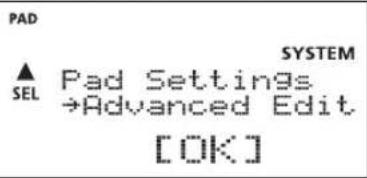 | Advanced Edit | Here you can adjust the pad parameters in greater detail. Refer to p. 42. |
Specifying How the CR2 Trigger Cable will be Used
| Screen Parameter/value Explanation | ||
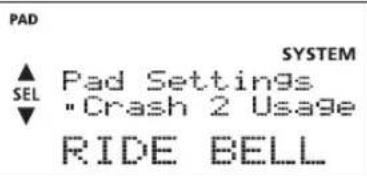 | Crash 2 UsageRIDE BELL:The CR2 trigger cable will be used for RIDE BELL (p. 38).CRASH 2:The CR2 trigger cable will be used for CRASH2. | |
Other Settings (OPTIONS)
1. Press the [MENU] button so it's lit.
The MENU screen appears.
![ROLAND TD-4SX - Press the [MENU] button so it's lit. - 1](/content/2026/06/1205964/images/d3ab3d80e61639683cb8f10cc4f5504b192ebd7021562c6d7e20aa43a869d573.jpg)
text_image
PAD DRUM KIT MENU SEL 1 INSTRUMENT2. Use the SEL [ ] [ ] buttons to choose "9 OPTIONS," and press the [OK] button.
The Options screen appears.
![ROLAND TD-4SX - Use the SEL [ ] [ ] buttons to choose "9 OPTIONS," and press the [OK] button. - 1](/content/2026/06/1205964/images/9f9a73dfb278847c870cf15ef4d9a2d6b7f31cc8b243245b374365e8c2d63fa8.jpg)
text_image
PAD SYSTEM SEL Options "LCD Contrast 5- Use the SEL [ ][ ] buttons to select the parameter that you want to edit.
- Use the [-/+] dial to edit the value.
- Press the [OK] button to return to the "MENU" screen.
Adjusting the Display Contrast (LCD Contrast)
![ROLAND TD-4SX - Use the SEL [ ] [ ] buttons to choose "9 OPTIONS," and press the [OK] button. - 2](/content/2026/06/1205964/images/f4a0fbe152f1fa7087e6183a13d788efad2c19f646e88941e409a37396db4dc3.jpg)
text_image
PAD SYSTEM SEL Options =LCD Contrast 5| Value |
| 1-10 |
Adjusting the Brightness of the Backlight (LCD Bright)
4.10 (6:00-2:00)
![ROLAND TD-4SX - Use the SEL [ ] [ ] buttons to choose "9 OPTIONS," and press the [OK] button. - 3](/content/2026/06/1205964/images/4811376586427d7a6b99629173cd587a3e695b60f8ae20b8b108cfab98259355.jpg)
text_image
PAD SYSTEM ▲ Options SEL =LCD Brightnes 10| Value |
| 1-10 |
Adjusting the Button Operating Sound (Keypad Sound)
The image is too blurry to recognize any text content.
![ROLAND TD-4SX - Use the SEL [ ] [ ] buttons to choose "9 OPTIONS," and press the [OK] button. - 4](/content/2026/06/1205964/images/fc6b472581a83255bb58bc523be25356b153bcfb5b49eb16f7ee7fd9548ebcc8.jpg)
text_image
PAD SYSTEM ▲ Options SEL "Keypad Sound 2| Value Explanation | |
| OFF | The buttons will not produce an operating sound. |
| 1-3 Specifies the volume of the operating sound. | |
Allowing the Head and Rim Settings to be Edited Separately (Head/Rim Link)
图 3-10
![ROLAND TD-4SX - Use the SEL [ ] [ ] buttons to choose "9 OPTIONS," and press the [OK] button. - 5](/content/2026/06/1205964/images/a27e02b461c5569ff05c74c9ed357ab7d525707e911761da78b6d824700eba12.jpg)
text_image
PAD ▲ Options SEL "Head/Rim Link ON SYSTEM| Value Explanation | |
| ON | Head and rim (or for a cymbal, the bow and edge) settings (Instrument/Tuning/Muffling/Pad Volume/Pan) will be edited simultaneously for SNARE, HH, CRASH, and RIDE.* If Crash 2 Usage is set to RIDE BELL, the RIDE's BELL will also be edited simultaneously. |
| OFF | Head and rim settings will be edited separately for SNARE, HH, CRASH, and RIDE. |
Restoring the Factory Settings (Factory Reset)
The "Factory Reset" operation returns all settings of all pads and drum kits stored in the TD-4 to their factory-set condition.
* If you want to return an individual kit to its factory settings, execute the drum kit "Restore" operation (p. 33).
NOTE
The settings stored in the TD-4 will be lost when you execute a factory reset.
- In the "Options" screen, press the SEL [] button a number of times to choose "Factory Reset," and press the [OK] button.
text_image
PAD SYSTEM Factory Reset "Target NEXT PADS- Use the [-/+] dial to select the settings for which you want to execute a factory reset.
| Value Explanation | |
| PADS PAD SETTINGS parameter | |
| SYSTEM | System Parameter(OPTIONS and PAD SETTINGS parameter) |
| ALL KITS All Drum kit | |
| ALL All of the TD-4's data | |
- Press the SEL [] button.
A confirmation message appears.

text_image
PAD ▲ Reset Pads OK? Cancel=[MENU] [OK]* If you decide to cancel, press the [MENU] button.
- Press the [OK] button.
The factory reset will be executed. When the factory reset is finished, the following message will appear and you will return to the DRUM KIT screen.

text_image
PAD Reset Pads Completed!Adding a CRASH 2 cymbal
Here's an example of adding a separately sold cymbal (CY-8) to the TD-4K as "Crash Cymbal 2" (CRASH 2).
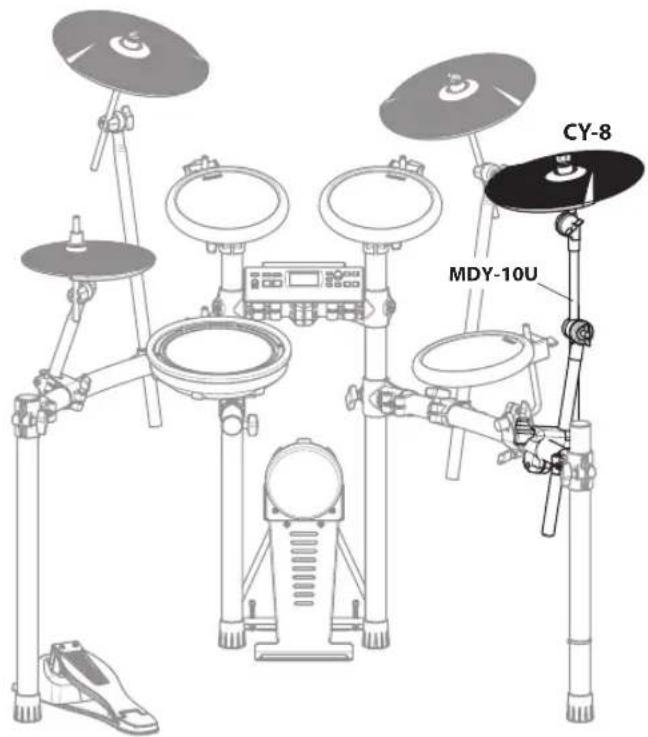
text_image
CY-8 MDY-10UCRASH 2 (CY-8) settings
- Connect the "CR2" trigger cable.
- Set the Crash 2 Usage parameter to "CRASH 2" (p. 36).
- As the pad type (Pad Type), select "CY-8" (p. 35).
Using a CY-12R/C or CY-15R instead of the CY-8 cymbal
Here's an example of replacing the RIDE cymbal (CY-8) with a separately sold CY-12R/C or CY-15R.
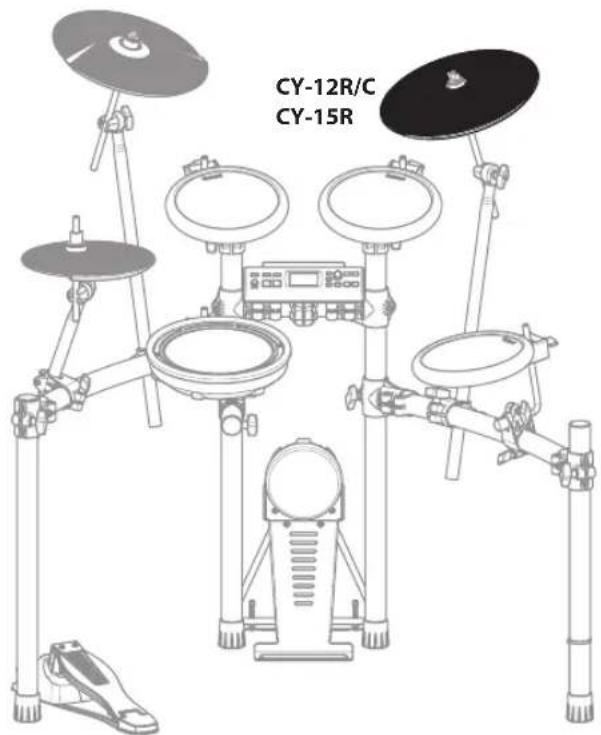
text_image
CY-12R/C CY-15RRIDE (CY-12R/C, CY-15R) settings
* In this case, the Crash 2 pad cannot be connected.
- Connect the "RD" trigger cable to the BOW/EDGE output jack.
- Connect the "CR2" trigger cable to the BOW/BELL output jack.
- Set the Crash 2 Usage parameter to "RIDE BELL" (p. 36).
- As the pad type (Pad Type), select "CY-12/15R" (p. 35).
- If you select an instrument whose name is not followed by "/B" in the instrument settings (p. 28), the sound won't switch to the bell sound even if you strongly strike the bow.
Using the VH-11 V Hi-hat
Here's an example of using the VH-11 (sold separately) as the hi-hat.
NOTE
The VH-12 is not supported.
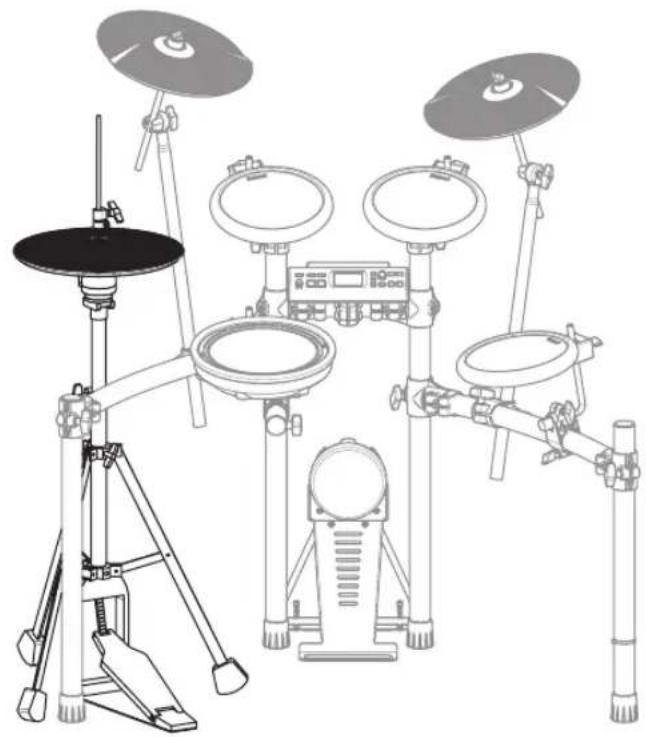
natural_image
Line drawing of a set of six different electronic drums and control platforms (no text or symbols)MEMO
You could also use the leftover CY-5 as CRASH 2.
Connecting the VH-11 and Making Settings on the TD-4
Connections

text_image
Clutch Screw Motion Sensor Unit CONTROL OUT Jack Connect the HHC cable TRIGGER OUT Jack Connect the HH cable- Connect the "HH" trigger cable to the TRIGGER OUT jack.
- Connect the "HHC" trigger cable to the CONTROL OUT jack.
* For details on installing the VH-11 to the hi-hat stand, refer to the "VH-11 Owner's Manual."
Settings
- Make sure that the VH-11 is correctly connected to the TD-4.
- Set up the hi-hat, take your foot off the pedal, and power-on the TD-4.
* It will be impossible to make the adjustment correctly if the hi-hat is touching the motion sensor when you turn on the power.
- Loosen the clutch screw, and allow the hi-hat to rest naturally on top of the motion sensor unit.
- Press the [MENU] button so it's lit.
Expanding your drum set
5. Use the SEL [ ] [ ] buttons to choose "8 PAD SETTINGS," and press the [OK] button.
The Pad Type screen will appear.
![ROLAND TD-4SX - Use the SEL [ ] [ ] buttons to choose "8 PAD SETTINGS," and press the [OK] button. - 1](/content/2026/06/1205964/images/0df8a5c48e39a0c4634edf3770f22369624b479a44e17388b4b01388d1b04345.jpg)
text_image
PAD HH ROW SYSTEM ▲ Pad Settings SEL "Pad Type CY-56. Lightly strike the hi-hat; the screen will indicate "HH."
7. Use the [-/+] dial to select the VH-11.
![ROLAND TD-4SX - Use the [-/+] dial to select the VH-11. - 1](/content/2026/06/1205964/images/0640f518d53f764dd2d0486cb0c7add63037123364a7fe1c1dd573c42009f0a1.jpg)
text_image
PAD HH BOW SYSTEM ▲ Pad Settings SEL "Pad Type VH-118. Press the SEL [ ] button to select "HH Pedal Sens."
![ROLAND TD-4SX - Press the SEL [ ] button to select "HH Pedal Sens." - 1](/content/2026/06/1205964/images/f7a8f418ebb076457d141fee2b9c8bda92433e693c20a85e4f1af6ffeb63bafc.jpg)
text_image
PAD SYSTEM ▲ Pad Settings SEL = HH Pedal Sens ↓ i-i +59. While you watch the meter that's shown in the lower part of the screen, turn the VH-11's VH offset adjustment screw to adjust it.
Adjust the screw so that the meter indicates "

text_image
Correct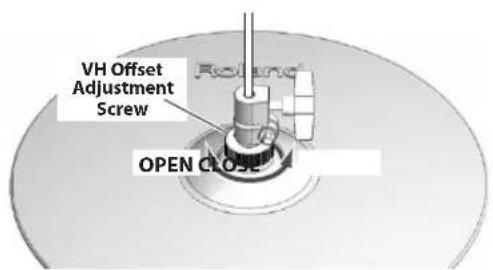
text_image
VH Offset Adjustment Screw OPEN CLOSEVH Offset Adjustment Points
If the closed hi-hat sound is difficult to attain, rotate the VH offset adjustment screw towards "CLOSE."
If the open hi-hat sound is difficult to attain, rotate the screw towards "OPEN."
NOTE
If the sound cuts off when you strike the hi-hat forcefully, rotate the VH Offset adjustment screw towards "OPEN."
10. Adjust other parameters as needed.
NOTE
If you don't set up the VH-11 correctly, it may not operate correctly. For details, refer to the VH-11 owner's manual.
MIDI Settings
About MIDI
MIDI (Musical Instrument Digital Interface) is a standard that allows performance data and other information to be exchanged among electronic musical instruments and computers. On the TD-4 you can use MIDI in the following ways.
Use the pads to play external instruments
You can layer sounds on the TD-4 as well as play sounds from MIDI sound modules and samplers.
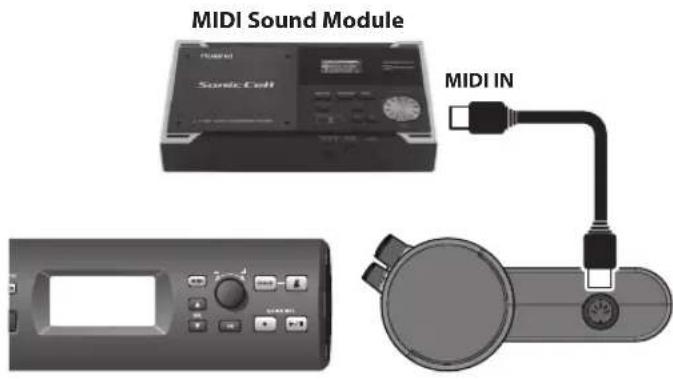
text_image
MIDI Sound Module Sound Cell MIDI INMIDI-related Settings
- Press the [MENU] button so it's lit. The MENU screen appears.
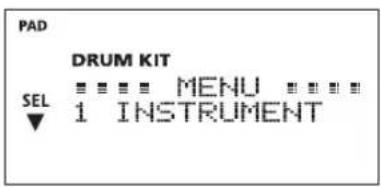
text_image
PAD DRUM KIT ≡≡≡ MENU ≡≡≡= SEL 1 INSTRUMENT- Use the SEL [ ] [ ] buttons to choose "6 MIDI," and press the [OK] button. The MIDI screen appears.
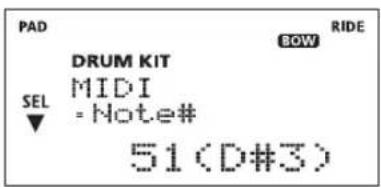
text_image
PAD DRUM KIT MIDI SEL = Note# 51(D#3)- Use the SEL [ ] [ ] buttons to choose the parameter that you want to edit.
- Use the [-/+] dial to edit the value.
- Press the [OK] button to return to the "screen.
| Display Parameter Value Explanation | |||
| Note# | 0 (C-)–127 (G9), OFF | Specifies the MIDI note numbers transmitted by the pads. To select the pad whose setting you want to edit, strike that pad. If you specify “OFF” that pad will not transmit a note message.Each kit has an individual note number settings. |
- The note number for Xstick will be the SNARE RIM note number minus 3.
- Selecting HH will specify the HH BOW/EDGE OPEN note number.
• The HH BOW/EDGE CLOSE and HH FOOT CLOSE note numbers will be as follows.
• HH BOW CLOSE: HH BOW OPEN note number minus 4 - HH EDGE CLOSE: HH EDGE OPEN note number minus 4
• HH FOOT CLOSE: HH BOW OPEN note number minus 2
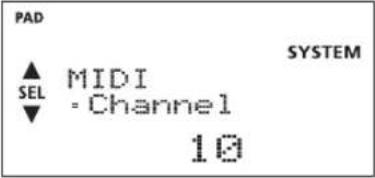 | Channel OFF, 1-16 | Specifies the channel on which the MIDI message will be transmitted.If you specify “OFF,” MIDI messages will not be transmitted. |
Other Settings
| Display Parameter Value Explanation | |||
| ProgramChgTx | OFF, ON | Specifies whether program change messages will be transmitted to an external MIDI device (ON) or not trans-mitted (OFF).With the “ON” setting, a program number correspond-ing to the selected drum kit will be transmitted when you switch drum kits on the TD-4.* The program number for each drum kit is the same as the drum kit number. |
Detailed Settings for Trigger Parameters
Normally, you will not need to edit these settings, since they are automatically set to the appropriate values for the pad when you specify the pad type. You can edit these parameters if the pad does not respond as you wish.
1. In the "Pad Settings" screen, press the SEL [] ▼ button a number of times to choose "Advanced Edit," and press the [OK] button.
The "Pad Advanced" screen appears.
![ROLAND TD-4SX - In the "Pad Settings" screen, press the SEL [] ▼ button a number of times to choose "Advanced Edit," and press the [OK] button. - 1](/content/2026/06/1205964/images/69abbcc79b6f6711a1256dba01ea48423452a510e11d092e72b5d74a8c0bafac.jpg)
text_image
PAD ROW RIDE SYSTEM SEL Pad Advanced "Threshold 3- Use the SEL [ ] [ ] buttons to select the parameter that you want to edit.
- Use the [- / + ] dial to edit the value.
- Press the [OK] button to return to the "MENU" screen.
| Display/Parameter Parameter/Value Explanation | ||
| PAD BOW RIDE SYSTEMPad Advanced Threshold3 | Threshold0-16 | This setting allows a trigger signal to be received only when the pad is above a determined dynamic level (velocity). This can be used to prevent a pad from sounding because of vibrations from other pads. |
In the following example, B will sound but A and C will not sound.
When set to a higher value, no sound is produced when the pad is struck lightly. Gradually raise the "Threshold" value while striking the pad.
Check this and adjust accordingly. Repeat this process until you get the perfect setting for your playing style.
![ROLAND TD-4SX - In the "Pad Settings" screen, press the SEL [] ▼ button a number of times to choose "Advanced Edit," and press the [OK] button. - 2](/content/2026/06/1205964/images/b4db9edd285e922b16c24ba3d7b18ac5cf7dea33aedf0faf322548570fe35597.jpg)
text_image
Threshold A B C| PAD BOW SYSTEM Pad Advanced Sel = Curve LINEAR | RIDE | This setting allows you to control the relation between playing velocity (striking force) and changes in volume. Adjust this curve until the response feels as natural as possible. |
LINEAR
The standard setting. This produces the most natural correspondence between playing dynamics and volume change.
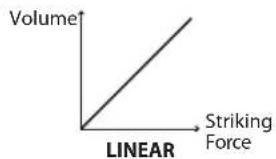
text_image
Volume STRIKING FORCE LINEAREXP1, EXP2
Compared to LINEAR, strong dynamics produce a greater change.
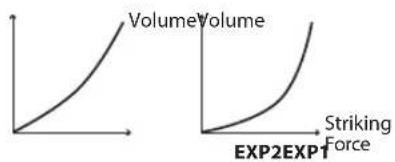
text_image
Volume Volume Striking Force EXP2EXP1Display/Parameter Parameter/Value Explanation
LOG1, LOG2
Compared to LINEAR, a soft playing produces a greater change.
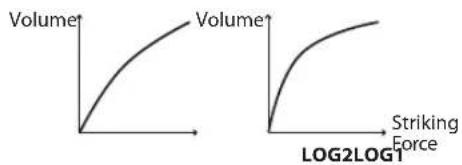
line
| Striking Force | Volume | | -------------- | ------ | | LOG2LOG1 | Volume |SPLINE
Extreme changes are made in response to playing dynamics.

line
| Striking Force | Volume | | -------------- | ------ | | 0 | 0 | | 1 | Low | | 2 | Medium | | 3 | High |LOUD1, LOUD2
Very little dynamic response, making it easy to maintain strong volume levels. If using drum triggers, these settings help maintain stable levels.
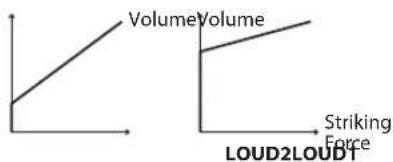
text_image
Volume Volume Striking Force LOUD2LOUDTDisplay/Parameter Parameter/Value Explanation
| PAD | |
| BOW | |
| SYSTEM | |
| ▲ SEL | Pad Advanced |
| ▼ | = Scan Time |
| 1.6ms | |
Scan Time 0.4–4.0 (ms)
Specifies the detection time for the trigger signal. Since the rise time of the trigger signal waveform may differ slightly depending on the characteristics of each pad or acoustic drum trigger (drum pickup), you may notice that identical hits (velocity) may produce sound at different volumes. If this occurs, you can adjust the "Scan Time" so that your way of playing can be detected more precisely.
While repeatedly hitting the pad at a constant force, gradually raise the Scan Time value from 0.4 msec, until the resulting volume stabilizes at the loudest level. At this setting, try both soft and loud strikes, and make sure that the volume changes appropriately.
* As the value is set higher, the time it takes for the sound to be played increases. Set this to the lowest value possible.

text_image
Scan Time Time
text_image
PAD ROW RIDE SYSTEM ▲ Pad Advanced ▼ · Retrig Cancel 4Retrig Cancel 1–16
This setting prevents spurious re-triggering. Important if you are using acoustic drum triggers. Such triggers can produce altered waveforms, which may also cause inadvertent sounding at Point A in the figure (Re-trigger). This occurs in particular at the decaying edge of the waveform. Retrig Cancel detects such distortion in and prevents re-triggering from occurring.
While repeatedly striking the pad, raise the "Retrig Cancel" value until re-triggering no longer occurs.
* Although setting this to a high value prevents retriggering, it then becomes easy for sounds to be omitted when the drums played fast (roll etc.). Set this to the lowest value possible while still ensuring that there is no retriggering.
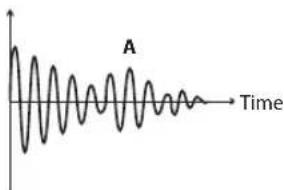
text_image
A TimeMEMO
You can also eliminate this problem of re-triggering with the Mask Time setting. Mask Time does not detect trigger signals if they occur within the specified amount of time after the previous trigger signal was received. Re-trigger Cancel detects the attenuation of the trigger signal level, and triggers the sound after internally determining which trigger signals were actually generated when the head was struck, while weeding out the other false trigger signals that need not trigger a sound.
Other Settings
| Display/Parameter Parameter/Value Explanation | ||
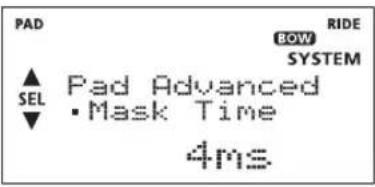 | Mask Time0–64 ms | This setting prevents double triggering.When playing a kick trigger, the beater can bounce back and hit the head a second time immediately after the intended note—with acoustic drums sometimes the beater stays against the head—is causes a single hit to “double trigger” (two sounds instead of one).The Mask Time setting helps to prevent this. Once a pad has been hit, any additional trigger signals occurring within the specified “Mask Time” (0–64 msec) will be ignored.Adjust the “Mask Time” value while playing the pad. |
When using a kick trigger, try to let the beater bounce back and hit the head very quickly, then raise the "Mask Time" value until there are no more sounds made by the beater rebound.
* When set to a high value, it will be difficult to play very quickly. Set this to as low a value as you can.
MEMO
If two or more sounds are being produced when you strike the head just once, then adjust Retrig Cancel.

text_image
Mask Time Sound not produced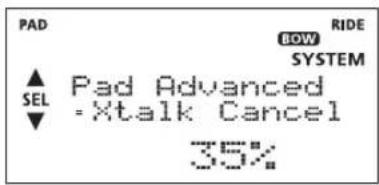
text_image
PAD BOW RIDE SYSTEM SEL Pad Advanced - Xtalk Cancel 35%Xtalk Cancel 0–80%
This setting cancels "crosstalk," which means that when you play one pad you hear a sound coming from another pad. This can happen when two pads are installed on the same stand. In some cases you can prevent crosstalk by increasing the distance between the two mounted pads.
TIP
In some cases you can prevent crosstalk by increasing the distance between the two mounted pads.
Crosstalk Example: If you hit the snare pad and the tom 1 also sounds
Raise the "Xtalk Cancel" for the pad being used for tom 1. The tom 1 pad will be less prone to receive crosstalk from other pads.
* If the value is set too high, and two pads are played simultaneously, the one that is struck less forcefully may not sound. Be careful and set this parameter to the minimum value required to prevent crosstalk.
| PAD BOW RIDE SYSTEM▲ Pad AdvancedSEL · Rim Gain0.8 | Rim Gain0-8.0 | When a PD-125/105/85, PDX-8, PD-9/8/7, CY series pad, VH-11, or RT-10S is connected, you can adjust the relation between your playing velocity (force) on the rim/edge and the resulting volume level.Higher value allows the rim/edge to produce a loud volume even when played softly. Lower value will keep the rim/edge producing a low volume even when played forcefully. |
| PAD BOW RIDE SYSTEM▲ Pad AdvancedSEL · Rim Adjust1.4 | Rim Adjust0-8.0 | When a PD-125/105/85, PDX-8, or RT-10S is connected, you can adjust the sensitivity of the rim response.There are some cases that you have a rim sound unexpectedly when you hit the head strongly. You can improve this situation with decreasing the value of “RimShot Adjust.” When you set the value too small, it might be difficult to play the rim sound. |
Protecting Modified Kits and Settings (Edit Lock)
When this function is turned on, editing of the kits remains possible. However, any changes made will be ignored once the power is turned off.
This is especially useful for in-store purposes and/or music shows. Or let's imagine that you have modified many kits, and some friends come over to your place, and start playing your TD-4. Using this Edit Lock function allows you to protect your kits in case someone accidentally changes some of the settings.
MEMO
Once you make this setting, it will be remembered even when the power is turned off.
Turning on Edit Lock
With the power off, hold down the button and SEL [ ▼ ] button, press the [POWER] button.
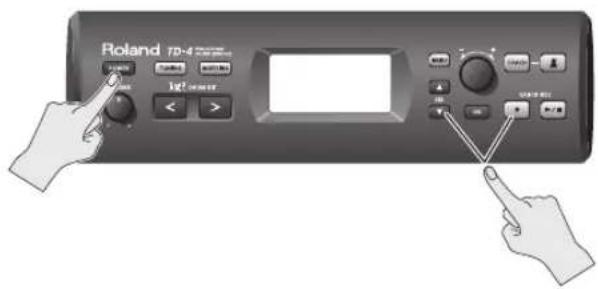
When the Edit Lock setting is turned on, a "symbol will appear in the screen that appears immediately after you press the [POWER] button.
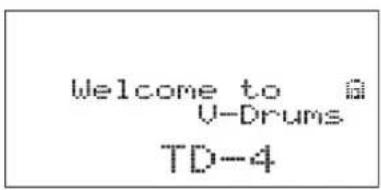
text_image
Welcome to U-Drums TD-4The "symbol will also appear in the Options screen where you select Factory Reset, and subsequent Factory Reset operations will not be possible.
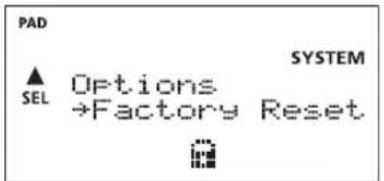
text_image
PAD ▲ Options SEL →Factory Reset SYSTEMTurning off Edit Lock
With the power off, hold down the [ ] Rec) button and SEL [ ▲ ] button, press the [POWER] button.
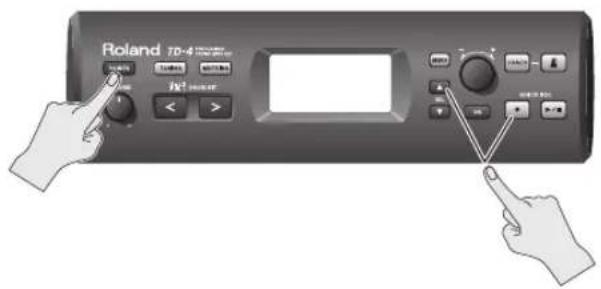
text_image
Roland 70-4 + - + - + - + -This section outlines points to check if you experience problems, and what to do about them.
Demo patterns won't play
□Could you be recording?
→ If you press the [●] (Rec) button to record your performance (p. 17), the demo patterns will temporarily be erased, but you will again be able to hear the demo patterns after you turn the power off, then on again.
Recorded data has disappeared
□Could you have turned off the power?
→When you turn off the power after recording, the recorded data will be erased; the next time you turn on the power, the demo patterns will be recalled from internal memory.
No Sound from One or More Pads
□Is the volume level of an instrument lowered?
→In the drum kit settings, adjust the mixer Pad Volume (p. 29).
□Is the pad connected correctly?
→Make sure that pad/input connections are correct. Use only the provided cables to connect the pads (p. 8).
□Is the instrument set to OFF?
→OFF is the setting for producing no sound. Select an instrumentnumbered other than "OFF" (p. 49).
☐Could the pad type be "OFF"?
Make the correct Pad Type setting (p. 35).
Pad Not Playing Correctly
□Is the pad type setting correct?
→Set the Pad Type (p. 35).
□Is the pad's sensitivity setting correct?
→Set the Sensitivity (p. 35).
* For fullest expression in performance, we recommend the exclusive use of Roland pads.
□Is the pad's mesh head tensioned evenly?
Refer to the owner's manual for the pad you are using, then adjust the mesh head tension. This is very important for proper triggering.
□Can't play the bell sound even though CY-12R/C or CY-15R is connected
Check the settings as described in RIDE (CY-12R/C, CY-15R) settings (p. 38).
□Crash2 sound won't play
Check the settings as described in CRASH2 (CY-8) settings (p. 38).
□When you strike a pad, you hear a pad you didn't strike
→Adjust the Xtalk Cancel setting (p. 44).
→ If there is a pad you're not using, turn that pad's Pad Type "OFF" (p. 35).
Cannot Play Rim Shots/Edge Shots
□Are you playing the rim shot correctly?
→For a rim shot, use the stick's shoulder to strike the rim of the pad (p. 13).
□Is the Rim Adjust set to "0"?
→Set this to anything other than "0" (p. 44). You need to set the "Rim Adjust" when using the PD-85, PD-105, or PD-125 to play rim shots.
Cross Stick Does Not Work
□Are you playing the cross stick correctly?
Playing cross stick on electronic drums is a bit different. Be sure your hand or stick does not strike the head also (p. 13).
□Is the Xstick Volume set to "OFF"?
Set the Xstick Volume to a value other than "OFF" (p. 29).
No Metronome Sound
□Is the metronome volume level set to "0"?
Set the metronome Volume to a value other than "0" (p. 34).
No Ambience Applied
□Is the Ambience set to "OFF"?
→Set the Ambience to a value other than "OFF" (p. 30).
□Is the Ambience Depth set to "0"?
→ Set the Ambience Depth to a value other than "0" (p. 30).
Sound in Headphones Distorted
□Sometimes, setting the output too high certain tones can the sound seem distorted.
→Turn down the [VOLUME] knob. This will reduce the distortion.
Output Sound is Distorted
☐Depending on the instrument settings, some slight distortion may occur in the sound.
→In the drum kit settings, adjust the mixer Pad Volume (p. 29).
→ You can suppress distortion by setting the pan near the center. In the drum kit settings, adjust the mixer pan setting (p. 29).
No Sound/Low Volume from Source Connected to the MIX IN Jack
□Could you be using a connection cable that contains a resistor?
Use a connection cable that does not contain a resistor.
☐Check the volume level of the connected audio source.
→See the owner's manual for the device if there's a problem. To adjust the volume of the device connected to the MIX IN jack, use the controls of the connected device.
Can't play the sound module connected to the MIDI OUT connector
□Is the MIDI cable connected correctly?
- Connect the cable to the MIDI IN connector of the external MIDI sound module.
□Is the MIDI channel set correctly?
→In order to transmit MIDI messages to an external MIDI sound module, both devices need to be set to the same MIDI channel (p. 41).
□Have you specified the correct note number for the pad?
→Set the pad's note number to a value other than "OFF" (p. 41).
→ Make sure that the pad is set to the same note number as the sound on your external MIDI sound module.
The note numbers can be specified independently for each kit.
Others
□Settings are not saved
There is no "Save Settings" operation on the TD-4 itself. The settings you modify are saved when you turn off the power. Be sure to turn off the power by pressing the [POWER] button.
□Screen display is difficult to read
→ After you've turned on the power, press the [MENU] button → SEL ▲ ] button > [OK] button in that order, and use the [-/+] dial to adjust the contrast (p. 37).
| Display Meaning Action | ||
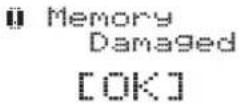 | Data in the TD-4's memory is corrupted. | Press the [OK] button.A factory reset will be executed. (doing so will erase any changes you have made).If this does not resolve the problem, consult your Roland dealer or nearest Roland Service Center. |
 | A problem has occurred with the internal system. | Contact your dealer or a nearby Roland service center. |
Preset Drum Kits
| No. Name | |
| 1 | V-Compact |
| 2 | Coated |
| 3 | Power |
| 4 | Light |
| 5 | Heavy |
| 6 | Vintage |
| 7 | Fiber |
| 8 | Short Tail |
| 9 | HALL |
| 10 | Brushes |
| 11 | Studio |
| 12 | Tight |
| 13 | ARENA |
| 14 | Oldies |
| 15 | Reggae |
| 16 | Percussion |
| 17 | ISOLATOR |
| 18 | HipHop |
| 19 | Techno |
| 20 | Drum'nBass |
| 21 | House |
| 22 | Abstract |
| 23 | Electronic |
| 24 | TR-808 |
| 25 | TR-909 |
Instruments
| No. Name | |
| Kick | |
| 1 Maple | |
| 2 Deep | |
| 3 Fiber | |
| 4 Compact | |
| 5 Dark | |
| 6 Vintage | |
| 7 Tight | |
| 8 HardAttack | |
| 9 Solid | |
| 10 Nu-Hip | |
| 11 Elec 1 | |
| 12 Elec 2 | |
| 13 TR808 | |
| 14 TR909 | |
| Snare | |
| 1 | Maple 1 |
| Maple 1 R | |
| 2 | Maple 2 |
| Maple 2 R | |
| 3 | Steel |
| Steel R | |
| 4 | Brass |
| Brass R | |
| 5 | Lite |
| Lite R | |
| 6 | Deep |
| Deep R | |
| 7 | Open |
| Open R | |
| 8 | Brush |
| Brush R | |
| 9 | Box |
| Box R | |
| 10 | Whack |
| Whack R | |
| 11 | Barrel |
| Barrel R | |
| 12 | Club |
| Club R | |
| 13 | Clip |
| Clip R | |
| No. Name | |
| 14 | Elec |
| Elec R | |
| 15 | TR808 |
| TR808 R | |
| 16 | TR909 |
| TR909 R | |
| Tom | |
| 1 Wood | 12" |
| 2 Wood | 13" |
| 3 Wood | 16" |
| 4 Clear | 12" |
| 5 Clear | 14" |
| 6 Clear | 16" |
| 7 Fiber | 12" |
| 8 Fiber | 13" |
| 9 Fiber | 16" |
| 10 Coated | 12" |
| 11 Coated | 13" |
| 12 Coated | 16" |
| 13 TR808_1 | |
| 14 TR808_2 | |
| 15 TR808_3 | |
| 16 TR909_1 | |
| 17 TR909_2 | |
| 18 TR909_3 | |
| 19 Elec_1 | |
| 20 Elec_2 | |
| 21 Elec_3 | |
| Hi-Hat | |
| 1 | Bright |
| Bright E | |
| 2 | Lite |
| Lite E | |
| 3 | Club |
| Club E | |
| 4 | TR808 |
| TR808 E | |
| 5 | TR909 |
| TR909 E | |
Drum Kit/Instrument List
| No. Name | |
| Crash | |
| 1 | Medium 16" |
| Medium 16"E | |
| 2 | Medium 18" |
| Medium 18"E | |
| 3 | Dark 16" |
| Dark 16" E | |
| 4 | Dark 18" |
| Dark 18" E | |
| 5 | Splash |
| Splash E | |
| 6 | China |
| China E | |
| 7 | TR808 |
| TR808 E | |
| 8 | Elec |
| Elec E | |
| Ride | |
| 1 | Heavy /B |
| Heavy | |
| Heavy E | |
| Heavy B | |
| 2 | Lite /B |
| Lite | |
| Lite E | |
| Lite B | |
| 3 | Elec /B |
| Elec | |
| Elec E | |
| Elec B | |
| Percussion | |
| 1 Bongo | Hi *1 |
| 2 Bongo | Lo |
| 3 Conga | Hi *1 |
| 4 Conga | Lo |
| 5 Timbale | Hi *2 |
| 6 Timbale | Lo |
| 7 Cajon | *1 |
| 8 Cajon | Bass |
| 9 Claves | |
| 10 Shaker | |
| 11 Tambourine | |
| 12 Cowbell | 1 |
| 13 Cowbell | 2 |
| 14 WoodBlockH | |
| 15 WoodBlockL | |
| No. Name | |
| 16 TriangleOp | |
| 17 TriangleCI | |
| 18 SleighBell | |
| 19 TreeChimes | |
| OFF | |
| Off | |
*1 Switches to the slap sound when struck forcefully.
*2 Switches to the rim sound when struck forcefully.
About the instruments (sounds)
The last letter of each instrument name refers to the following definitions.
R: rim sound of snare
E: edge sound of cymbal
B: bell sound of cymbal
/B: Switches to the bell sound when struck forcefully.
Copyright
When you purchase the TD-4 percussion sound module from an authorized Roland dealer, the included sounds are licensed, not sold, to you by Roland Corporation, for commercial use in music production, public performance, broadcast, etc.
You may use any of the included sounds in a commercial or non-commercial recording without paying any additional license fees. However, you must strictly adhere to the following crediting guidelines on any music recording that utilize material from TD-4.
Reproduction or duplication of any of the sound contained in the TD-4, either as they exist on this sound module or by any means of reformatting, mixing, filtering, re-synthesizing, processing or otherwise editing for use in another product or for re-sale, is strictly prohibited without the express written consent of Roland. All unauthorized giving, trading, lending, renting, re-issue, redistribution or re-sale of the sounds included in the TD-4 are expressly prohibited.
In Plain English: Be creative in your application of the TD-4 sounds, and keep this sounds for your use only. DO NOT COPY IT.
| Function... | Transmitted Recognized | Remarks | ||
| Basic Channel | Default Changed | 1-16, OFF1-16, OFF | XX | Memorized |
| Mode | Default Messages Altered | Mode 3 *3X********** | XX********** | |
| Note Number: True Voice | 0-127, OFF********** | XX | Memorized | |
| Velocity | Note On Note Off | O 9nH, v = 1-127O 8nH, v = 64 | XX | |
| After Touch | Key's Channel's | O X | XX | |
| Pitch Bend | X | X | ||
| Control Change | 4 | O | X | Foot Controller *1 |
| Program Change : True Number | O 0-24 *2********** | XX | Program No. 1-25 (fixed) | |
| System Exclusive | X | X | ||
| System Common : Song Position : Song Select : Tune Request | XXX | XXX | ||
| System Real Time : Commands | XX | XX | ||
| Aux Messages : All Sound Off : Reset All Controllers : Local On/Off : All Notes Off : Active Sensing : System Reset | XXXXXX | XXXXXX | ||
| Notes | *1 Transmits the position of the hi-hat pedal.*2 O X is selectable.*3 Xstick: SNARE RIM note number minus 3HH BOW CLOSE: HH BOW OPEN note number minus 4HH EDGE CLOSE: HH EDGE OPEN note number minus 4HH FOOT CLOSE: HH BOW OPEN note number minus 2 | |||
TD-4: Percussion Sound Module
Instruments
Drum Instruments: 125
●Drum Kits
25
●Instrument Parameters
KICK, SNARE, TOM, PERC, Tuning, Muffling
●Mixer Parameters
Pad Volume, Pan, Kit Volume, Cross Stick Volume
●Ambience Types
9
●Rhythm Coach Functions
Warm Ups
Time Check
Tempo Check
Quiet Count
Auto Up/Down
●Quick Rec
Resolution: 96 ticks per quarter note
Recording Method: Real-time
Maximum Note Storage: approx. 9,000 Notes
●Display
Custom (backlit LCD)
Connectors
Trigger Input connector (DB-25 type)
(Kick, Snare, Tom1, Tom2, Tom3, Hi-Hat, Crash1, Crash2, Ride, Hi-Hat Control)
Output Jacks (L (MONO), R) (Stereo 1/4 inch phone type)
Phones Jack (Stereo 1/4 inch phone type)
Mix in Jack (stereo miniature phone type)
MIDI OUT Connector
●Output Impedance
1.0 k ohms
●Power Supply
AC Adaptor (DC 9 V)
●Current Draw
500 mA
●Dimensions
224.0 (W) x 151.1 (D) x 65.1 (H) mm
8-7/8 (W) x 6 (D) x 2-9/16 (H) inches
●Weight
477 g / 1 lb 1 oz (excluding AC Adaptor)
●Accessories
Owner's Manual
AC Adaptor (PSB-1U)
Special Connection Cable
Wing Bolt (M5 x 10) x 2
Sound Module Mounting Plate
Options
Pads (PD-8, PDX-8, PD-85, PD-105, PD-125)
Cymbals (CY-5, CY-8, CY-12R/C, CY-14C, CY-15R)
Kick Triggers (KD-8, KD-85, KD-120)
Hi-Hats (VH-11)
Hi-Hat Control Pedal (FD-8)
Stand (MDS-4)
Cymbal Mount (MDY-10U)
Pad Mount (MDH-10U)
Acoustic Drum Trigger (RT-10K, RT-10S, RT-10T)
Personal Drum Monitor: PM-10, PM-30
V-Drums Accessory Package: DAP-3
V-Drums Mat (TDM-20/TDM-10)
* In the interest of product improvement, the specifications and/or appearance of this unit are subject to change without prior notice.
Symbols
iii 45
6,17
A
Advanced Edit 36
AMBIENCE 30
AUTO UP/DOWN 26
AutoUpDown 20
B
Beat 34
Bell Shot 13
Bow Shot 13–14
C
Change-up 20-21
Channel 41
Choking a Cymbal 13
Closed Hi-Hat 14
COACH 6
Coach Mode 19
Copy 31
Crash 2 Usage 36
Cross Stick 13
Curve 42
CY-12R/C 13,38
CY-15R 38
CY-5 14
CY-8 13
D
DC IN 7
Demo Pattern 12
Depth 30
DRUM KIT 6,12,27
Copy 31
Exchange 32
Name 30
Restore 33
Duration 21
E
Edge Shot 13–14
Edit Lock 45
EXP1, 2 42
F
Factory Reset 37
FD-8 14
Foot Closed 14
Foot Splash 14
G
Grade 21–22, 24
H
Half Open Hi-Hat 14
Head Shot 13
Head/Rim Link 16,37
HH Pedal Sens 36
Hi-Hat Control Pedal 14
|
Instrument 28
Instrument group 28
K
Keypad Sound 37
KIT NAME 30
Kit Volume 29
L
LCD Bright 37
LCD Contrast 37
LINEAR 42
LOG1, 2 43
LOUD1,2 43
M
Mask Time 44
MaxTempo 21,26
Measures 25
MENU 6
Metronome 17,34
MIDI 41
MIDI OUT 7
MinTempo 26
MIX IN 7,16
MIXER 29
MUFFLING 6
Muffling 15,28
N
Note# 41
0
OK 6
Open Hi-Hat 14
Open Rim Shot 13
Open/Closed 14
OPTIONS 36
OUTPUT 7
P
PAD SETTINGS 35
Pad Type 35
Pad Volume 29
Pan 29
PD-8 13
PDX-8 11,13
PHONES 7
Playback 18
Portable Audio Player 16
POWER 6,10
ProgramChg Tx 42
Q
QUICK REC 6,17
Quiet 25
R
Rate 26
Recording 17
Retrig Cancel 43
Rhythm Type 34
Rim Adjust 44
Rim Gain 44
S
Scan Time 43
Score 22
SEL 6
Sensitivity 35
Sound 34
SPLINE 43
T
Tempo 21, 23–25, 34
TEMPO CHECK 23
Threshold 42
TIME CHECK 22
TimeCheck 20
TRIGGER INPUT 7
TUNING 6
Tuning 15,28
Type 30
V
V Hi-hat 39
VH-11 39
VOLUME 6,10
Volume 34
W
WARM UPS 20
X
Xstick Adjust 36
Xstick Volume 29
Xtalk Cancel 44

AFRICA
EGYPT
Al Fanny Trading Office 9, EBN Hagar Al Askalany Street, ARD E1 Golf, Heliopolis, Cairo 11341, EGYPT TEL: (022)-418-5531
REUNION
Maison FO - YAM Marcel 25 Rue Jules Hermann, Chaudron - BP79 97 491 Ste Clotilde Cedex, REUNION ISLAND TEL: (0262) 218-429
SOUTH AFRICA
T.O.M.S. Sound & Music (Pty) Ltd. 2 ASTRON ROAD DENVER JOHANNESBURG ZA 2195, SOUTH AFRICA TEL: (011)417 3400
Paul Bothner(PTY)Ltd. Royal Cape Park, Unit 24 Londonderry Road, Ottery 7800 Cape Town, SOUTH AFRICA TEL: (021) 799 4900
ASIA
CHINA
Roland Shanghai Electronics
Co., Ltd.
5F. No.1500 Pingliang Road
Shanghai 200090, CHINA
TEL: (021) 5580-0800
Roland Shanghai Electronics
Co., Ltd.
(BEIJING OFFICE)
10F. No.18 3 Section Anhuaxili
Chaoyang District Beijing 100011
CHINA
TEL:(010)6426-5050
HONG KONG
Tom Lee Music Co., Ltd. Service
Division
22-32 Pun Shan Street, Tsuen
Wan, New Territories,
HONG KONG
TEL: 2415 0911
Parsons Music Ltd.
8th Floor, Railway Plaza, 39
Chatham Road South, T.S.T,
Kowloon, HONG KONG
TEL:23331863
INDIA
Rivera Digitec (India) Pvt. Ltd.
411, Nirman Kendra Mahalaxml
Flats Compound Off. Dr. Edwin
Moses Road, Mumbai-400011,
INDIA
TEL:(022) 2493 9051
INDONESIA
PT Citra IntiRama
JI. Cideng Timur No. 15J-150
Jakarta Pusat
INDONESIA
TEL:(021)6324170
KOREA
Cosmos Corporation
1461-9, Seocho-Dong,
Seocho Ku, Seoul, KOREA
TEL:(02)3486-8855
MALAYSIA
Roland Asia Pacific Sdn. Bhd.
45-1, Block C2, Jalan PJU 1/39,
Dataran Prima, 47301 Petaling
Jaya, Selangor, MALAYSIA
TEL: (03) 7805-3263
VIET NAM
Suol Nhac Company, Ltd
370 Cach Mang Thang Tam St.
Dist.3, Ho Chi Minh City,
VIET NAM
TEL: 9316540
PHILIPPINES
G.A. Yupangco & Co. Inc.
339 Gil J. Puyat Avenue
Makati, Metro Manila 1200,
PHILIPPINES
TEL:(02) 899 9801
SINGAPORE
Theera Music Co., Ltd.
100-108 Soi Vernq Nakornkasem.
New Road, Sumpantawongse,
Bangkok 10100 THAILAND
TEL: (02) 224-8821
AUSTRALIA/ NEW ZEALAND
AUSTRALIA/
NEW ZEALAND
Roland Corporation
Australia Pty., Ltd.
38 Campbell Avenue
Dee Why West. NSW 2099
AUSTRALIA
For Australia
Tel: (02) 9982 8266
For New Zealand
Tel: (09) 3098 715
CENTRAL/LATIN AMERICA
ARGENTINA
Instrumentos Musicales S.A.
Av.Santa Fe 2055
(1123) Buenos Aires
ARGENTINA
TEL:(011)4508-2700
BARBADOS
A&B Music Supplies LTD
12 Webster Industrial Park
Wildey, St. Michael, Barbados
TEL:(246)430-1100
BRAZIL
Roland Brasil Ltda.
Rua San Jose, 780 Sala B
Parque Industrial San Jose
Cotia - Sao Paulo - SP, BRAZIL
TEL: (011) 4615 5666
CHILE
Comercial Fancy II S.A.
Rut.: 96.919.420-1
Nataniel Cox #739, 4th Floor
Santiago - Centro, CHILE
TEL:(02)688-9540
COLOMBIA
Centro Musical Ltda.
Cra 43 B No 25 A 41 Bododega 9
Medellin, Colombia
TEL:(574)3812529
COSTA RICA
JUAN Bansbach Instrumentos
Musicales
Ave.1. Calle 11, Apartado 10237,
San Jose, COSTA RICA
TEL: 258-0211
[Non-Text]
[Non-Text]
[Non-Text]
Maritime Plaza
Barataria Trinidad W.I.
TEL:(868)638 6385
CURACAO
Zeelandia Music Center Inc.
Orionweg 30
Curacao, Netherland Antilles
TEL:(305)5926866
DOMINICAN REPUBLIC
Instrumentos Fernando Giraldez
Boulevard Andrews, Albrook,
Panama City, REP. DE PANAMA
TEL: 315-0101
PARAGUAY
155, New National Road
Patras 26442, GREECE
TEL: 2016-45
HUNGARY
Roland East Europe Ltd.
Warehouse Area 'DEPO' PI.83
H-2046 Torokbalint, HUNGARY
TEL: (23) 511011
IRELAND
Roland Ireland
G2 Calmount Park, Calmount
Avenue, Dublin 12
Republic of IRELAND
TEL:(01)4294444
ITALY
Roland Italy S. p. A.
UK This symbol indicates that in EU countries, this product must be collected separately from household waste, as defined in each region. Products bearing this symbol must not be discarded together with household waste.
natural_image
Technical line drawing of a mechanical device with a CD and lever assembly (no text or symbols)