
BR-600 - Multitrack recorder ROLAND - Free user manual and instructions
Find the device manual for free BR-600 ROLAND in PDF.


User questions about BR-600 ROLAND
0 question about this device. Answer the ones you know or ask your own.
Ask a new question about this device
Download the instructions for your Multitrack recorder in PDF format for free! Find your manual BR-600 - ROLAND and take your electronic device back in hand. On this page are published all the documents necessary for the use of your device. BR-600 by ROLAND.
USER MANUAL BR-600 ROLAND
Thank you, and congratulations on your choice of the BOSS BR-600 Digital Recorder.
Before using this unit, carefully read the sections entitled:
- USING THE UNIT SAFELY (page 2-3)
- IMPORTANT NOTES (page 4-5)
These sections provide important information concerning the proper operation of the unit.
Additionally, in order to feel assured that you have gained a good grasp of every feature provided by your new unit, Owner's manual should be read in its entirety. The manual should be saved and kept on hand as a convenient reference.
■ Printing Conventions in This Manual
- Text or numerals enclosed in square brackets [ ] indicate buttons.
[PLAY] PLAY button
[REC] REC button
- Reference such as (p. **) indicate pages in this manual to which you can refer.
Copyright © 2005 BOSS CORPORATION
All rights reserved. No part of this publication may be reproduced in any form without the written permission of BOSS CORPORATION.
USING THE UNIT SAFELY
INSTRUCTIONS FOR THE PREVENTION OF FIRE, ELECTRIC SHOCK, OR INJURY TO PERSONS
About WARNING and CAUTION Notices
| ▲WARNING | Used for instructions intended to alert the user to the risk of death or severe injury should the unit be used improperly. |
| ▲CAUTION | Used for instructions intended to alert the user to the risk of injury or material damage should the unit be used improperly. * Material damage refers to damage or other adverse effects caused with respect to the home and all its furnishings, as well to domestic animals or pets. |
About the Symbols
| Δ | The Δ symbol alerts the user to important instructions or warnings. The specific meaning of the symbol is determined by the design contained within the triangle. In the case of the symbol at left, it is used for general cautions, warnings, or alerts to danger. |
| ∅ | The ⊙ symbol alerts the user to items that must never be carried out (are forbidden). The specific thing that must not be done is indicated by the design contained within the circle. In the case of the symbol at left, it means that the unit must never be disassembled. |
| ● | The ● symbol alerts the user to things that must be carried out. The specific thing that must be done is indicated by the design contained within the circle. In the case of the symbol at left, it means that the power-cord plug must be unplugged from the outlet. |
ALWAYS OBSERVE THE FOLLOWING
WARNING
Before using this unit, make sure to read the instructions below, and the Owner's Manual.

- Do not open (or modify in any way) the unit or its AC adaptor.

- Do not attempt to repair the unit, or replace parts within it (except when this manual provides specific instructions directing you to do so). Refer all servicing to your retailer, the nearest Roland Service Center, or an authorized Roland distributor, as listed on the "Information" page.

- Never use or store the unit in places that are:

- Subject to temperature extremes (e.g., direct sunlight in an enclosed vehicle, near a heating duct, on top of heat-generating equipment); or are

- Damp (e.g., baths, washrooms, on wet floors); or are
- Humid; or are
- Exposed to rain; or are
- Dusty; or are
-
Subject to high levels of vibration.
-
Make sure you always have the unit placed so it is level and sure to remain stable. Never place it on stands that could wobble, or on inclined surfaces.

- Use only the specified AC adaptor (PSA series), and make sure the line voltage at the installation
matches the input voltage specified on the AC adaptor's body. Other AC adaptors may use a different polarity, or be designed for a different voltage, so their use could result in damage, malfunction, or electric shock.

WARNING
- Do not excessively twist or bend the power cord, nor place heavy objects on it. Doing so can damage the cord, producing severed elements and short circuits. Damaged cords are fire and slip hazards!

-
This unit, either alone or in combination with an amplifier and headphones or speakers, may be capable of producing sound levels that could cause permanent hearing loss. Do not operate for a long period of time at a high volume level, or at a level that is uncomfortable. If you experience any hearing loss or ringing in the ears, you should immediately stop using the unit, and consult an audiologist.
-
Do not allow any objects (e.g., flammable material, coins, pins); or liquids of any kind (water, soft drinks, etc.) to penetrate the unit.


-
Immediately turn the power off, remove the AC adaptor from the outlet, and request servicing by your retailer, the nearest Roland Service Center, or an authorized Roland distributor, as listed on the "Information" sheet when:
-
The AC adaptor or the power-supply cord has been damaged; or
- If smoke or unusual odor occurs
- Objects have fallen into, or liquid has been spilled onto the unit; or
- The unit has been exposed to rain (or otherwise has become wet); or
- The unit does not appear to operate normally or exhibits a marked change in performance.
WARNING
- In households with small children, an adult should provide supervision until the child is
capable of following all the rules essential for the safe operation of the unit.

- Protect the unit from strong impact. (Do not drop it!)

- Do not force the unit's power-supply cord to share an outlet with an unreasonable number of other devices. Be especially careful when using
extension cords—the total power used by all devices you have connected to the extension cord's outlet must never exceed the power rating (watts/amperes) for the extension cord. Excessive loads can cause the insulation on the cord to heat up and eventually melt through.

Before using the unit in a foreign country, consult with your retailer, the nearest Roland
Service Center, or an authorized Roland distributor, as listed on the "Information" sheet.

- Batteries must never be recharged, heated, taken apart, or thrown into fire or water.


CAUTION
- The unit and the AC adaptor should be located so their location or position does not interfere with their proper ventilation.

Always grasp only the output plug or the body of the AC adaptor when plugging into, or unplugging from, this unit or an outlet.

- At regular intervals, you should unplug the AC adaptor and clean it by using a dry cloth to wipe all dust and other accumulations away from its
prongs. Also, disconnect the power plug from the power outlet whenever the unit is to remain unused for an extended period of time. Any accumulation of dust between the power plug and the power outlet can result in poor insulation and lead to fire.

- Try to prevent cords and cables from becoming entangled. Also, all cords and cables should be placed so they are out of the reach of children.

- Never climb on top of, nor place heavy objects on the unit.

- Never handle the AC adaptor body, or its output plugs, with wet hands when plugging into, or unplugging from, an outlet or this unit.

CAUTION


- Before moving the unit, disconnect the AC adaptor and all cords coming from external devices.
Before cleaning the unit, turn off the power and unplug the AC adaptor from the outlet. - Whenever you suspect the possibility of lightning in your area, disconnect the AC adaptor from the outlet.
- If used improperly, batteries may explode or leak and cause damage or injury. In the interest of safety, please read and observe the following precautions (p.24).
- Carefully follow the installation instructions for batteries, and make sure you observe the correct polarity.
- Avoid using new batteries together with used ones. In addition, avoid mixing different types of batteries.
- Remove the batteries whenever the unit is to remain unused for an extended period of time.
- If a battery has leaked, use a soft piece of cloth or paper towel to wipe all remnants of the discharge from the battery compartment. Then install new batteries. To avoid inflammation of the skin, make sure that none of the battery discharge gets onto your hands or skin. Exercise the utmost caution so that none of the discharge gets near your eyes. Immediately rinse the affected area with running water if any of the discharge has entered the eyes.
-
Never keep batteries together with metallic objects such as ballpoint pens, necklaces, hairpins, etc.
-
Used batteries must be disposed of in compliance with whatever regulations for their safe disposal that may be observed in the region in which you live.

- Keep any screws you may remove and the included cover in a safe place out of children's reach, so there is no chance of them being swallowed accidentally.

In addition to the items listed under "USING THE UNIT SAFELY" on page 2-3, please read and observe the following:
Power Supply: Use of Batteries
- Do not connect this unit to same electrical outlet that is being used by an electrical appliance that is controlled by an inverter (such as a refrigerator, washing machine, microwave oven, or air conditioner), or that contains a motor. Depending on the way in which the electrical appliance is used, power supply noise may cause this unit to malfunction or may produce audible noise. If it is not practical to use a separate electrical outlet, connect a power supply noise filter between this unit and the electrical outlet.
- The AC adaptor will begin to generate heat after long hours of consecutive use. This is normal, and is not a cause for concern.
- The use of an AC adaptor is recommended as the unit's power consumption is relatively high. Should you prefer to use batteries, please use the alkaline type.
- When installing or replacing batteries, always turn off the power on this unit and disconnect any other devices you may have connected. This way, you can prevent malfunction and/or damage to speakers or other devices.
- Batteries are supplied with the unit. The life of these batteries may be limited, however, since their primary purpose was to enable testing.
- Before connecting this unit to other devices, turn off the power to all units. This will help prevent malfunctions and/or damage to speakers or other devices.
Placement
- Using the unit near power amplifiers (or other equipment containing large power transformers) may induce hum. To alleviate the problem, change the orientation of this unit; or move it farther away from the source of interference.
- This device may interfere with radio and television reception. Do not use this device in the vicinity of such receivers.
- Noise may be produced if wireless communications devices, such as cell phones, are operated in the vicinity of this unit. Such noise could occur when receiving or initiating a call, or while conversing. Should you experience such problems, you should relocate such wireless devices so they are at a greater distance from this unit, or switch them off.
-
Do not expose the unit to direct sunlight, place it near devices that radiate heat, leave it inside an enclosed vehicle, or otherwise subject it to temperature extremes. Excessive heat can deform or discolor the unit.
-
When moved from one location to another where the temperature and/or humidity is very different, water droplets (condensation) may form inside the unit. Damage or malfunction may result if you attempt to use the unit in this condition. Therefore, before using the unit, you must allow it to stand for several hours, until the condensation has completely evaporated.
Maintenance
- For everyday cleaning wipe the unit with a soft, dry cloth or one that has been slightly dampened with water. To remove stubborn dirt, use a cloth impregnated with a mild, non-abrasive detergent. Afterwards, be sure to wipe the unit thoroughly with a soft, dry cloth.
- Never use benzine, thinners, alcohol or solvents of any kind, to avoid the possibility of discoloration and/or deformation.
Repairs and Data
- Please be aware that all data contained in the unit's memory may be lost when the unit is sent for repairs. Important data should always be backed up on a memory card/computer, or written down on paper (when possible). During repairs, due care is taken to avoid the loss of data. However, in certain cases (such as when circuitry related to memory itself is out of order), we regret that it may not be possible to restore the data, and Roland assumes no liability concerning such loss of data.
Additional Precautions
- Please be aware that the contents of memory can be irretrievably lost as a result of a malfunction, or the improper operation of the unit. To protect yourself against the risk of loosing important data, we recommend that you periodically save a backup copy of important data you have stored in the unit's memory on a memory card/computer.
- Unfortunately, it may be impossible to restore the contents of data that was stored in the unit's memory or a memory card once it has been lost. Roland Corporation assumes no liability concerning such loss of data.
- Use a reasonable amount of care when using the unit's buttons, dials, or other controls; and when using its jacks and connectors. Rough handling can lead to malfunctions.
-
Never strike or apply strong pressure to the display.
-
When connecting / disconnecting all cables, grasp the connector itself—never pull on the cable. This way you will avoid causing shorts, or damage to the cable's internal elements.
- To avoid disturbing your neighbors, try to keep the unit's volume at reasonable levels. You may prefer to use headphones, so you do not need to be concerned about those around you (especially when it is late at night).
- When you need to transport the unit, package it in the box (including padding) that it came in, if possible. Otherwise, you will need to use equivalent packaging materials.
- Use only the specified expression pedal (EV-5, FV-500L, FV-500H; sold separately). By connecting any other expression pedals, you risk causing malfunction and/or damage to the unit.
-
Use a cable from Roland to make the connection. If using some other make of connection cable, please note the following precautions.
-
Some connection cables contain resistors. Do not use cables that incorporate resistors for connecting to this unit. The use of such cables can cause the sound level to be extremely low, or impossible to hear. For information on cable specifications, contact the manufacturer of the cable.
Before Using Cards (CompactFlash) Using Memory Cards
- Carefully insert the Memory card all the way in—until it is firmly in place.
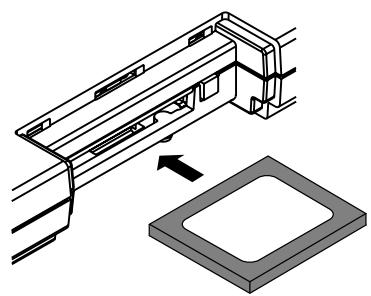
- Never touch the terminals of the Memory card. Also, avoid getting the terminals dirty.
- This unit's memory card slot accepts CompactFlash memory cards. Microdrive storage media are not compatible.
-
CompactFlash cards are constructed using precision components; handle the cards carefully, paying particular note to the following.
-
To prevent damage to the cards from static electricity, be sure to discharge any static electricity from your own body before handling the cards.
- Do not touch or allow metal to come into contact with the contact portion of the cards.
- Do not bend, drop, or subject cards to strong shock or vibration.
- Do not keep cards in direct sunlight, in closed vehicles, or other such locations (storage temperature: -25 to 85^ C).
- Do not allow cards to become wet.
- Do not disassemble or modify the cards.
Copyright
- Unauthorized recording, distribution, sale, lending, public performance, broadcasting, or the like, in whole or in part, of a work (musical composition, video, broadcast, public performance, or the like) whose copyright is held by a third party is prohibited by law.
-
Do not use this unit for purposes that could infringe on a copyright held by a third party. We assume no responsibility whatsoever with regard to any infringements of third-party copyrights arising through your use of this unit.
-
Microsoft and Windows are registered trademarks of Microsoft Corporation.
- Screen shots in this documents are reprinted with permission from Microsoft Corporation.
- Windows® is known officially as: "Microsoft® Windows® operating system."
- Apple and Macintosh are registered trademarks of Apple Computer, Inc.
- MacOS is a trademark of Apple Computer, Inc.
- All product names mentioned in this document are trademarks or registered trademarks of their respective owners.
IMPORTANT NOTES. 4
Introduction to the BR-600 12
Features 12
Memory Cards Supported by Your BR-600.....15
Formatting the memory card (CompactFlash)……15
How to remove the card cover 15
Panel Descriptions 16
Top Panel. 16
Rear Panel. 22
Front Panel 23
Inserting Batteries 24
About the Play Screen 25
Quick Start 27
Connecting Peripheral Devices 28
How to Use the Cord Hook. 29
Using a Mic Converter Cable 30
Inserting the Memory Card. 30
Turning On / Off the BR-600............31
Turning On the Power. 31
Turning Off the Power 31
Listening to a Demo Song 32
Selecting a demo song (Song Select) 32
Playing back a demo song 32
Moving the current position 33
Fast Forwarding and Rewinding. 33
Moving to the start of a play 33
Moving to the end of a play 33
Moving through a song using hours, minutes, seconds, frames, or sub frames. 33
Moving through a song in measures or beats.....33
Connecting Instruments. 34
Choose which jack you will use to connect your instrument. 34
Preparing Songs For Recording.....35
Recording a new song (Song New) 35
Selecting the Input 36
Turning on the onboard stereo microphone. 36
Adjusting the input sensitivity. 36
Adjusting the recording level. 37
Displaying the Level Meter 37
Using Insert Effects 38
Switch effect patches. 38
Recording without insert effects. 39
Using the Rhythm 40
What is the Rhythm? 40
Patterns and Arrangements. 40
Pattern Mode and Arrangement Mode 40
Playing Arrangements 41
Playing Patterns 41
Changing arrangements. 42
Changing patterns. 42
Changing the tempo of the arrangements or patterns. 43
Tapping to change the tempo of the arrangements or patterns. 43
Recording 44
Selecting the recording track. 44
About the recording (REC) modes. 45
Procedure 46
Playing Back Recorded Music........47
Silencing the sound of specific tracks (Track Mute) 47
Recording an additional performance while listening to an existing performance (Over dubbing). 48
Putting multiple tracks together (Bounce) 49
Adjusting the Sound for Each Track 49
Adjusting the Perception of Stereo for the Sound (Pan) 49
Adjusting the tone (Track EQ) 50
Adding Richness and Breadth to the Sound (Loop Effect) 50
Bouncing. 52
Section 1 Recording and Playback.....53
Recording 54
Creating Songs for Recording 54
About data types. 54
Selecting the Recording Track. 55
Changing V-Tracks 56
Adjusting the Perception of Stereo in the Input Sounds (Pan) 56
Recording Operations 57
Repeating Playback (Repeat) 58
Setting the Repeat Portion with Accurate Timing. 59
Re-recording Only a Mistake (Punch-in/out) 60
Manually Punching In/Out 60
Manually punching in and out using [REC].....60
Manually punching in and out using a foot switch ....61
Auto Punching In and Out 61
Specifying the area for auto punching in/out.....61
Erasing a registered auto punch in/out location...62
How to record 62
Repeatedly Recording Over the Same Location (Loop Recording). 63
Setting the portion to be repeated 63
How to record 63
Canceling an Operation (Undo/Redo) ...64
Reversing the Last Operation (Undo) 64
Canceling the Undo (Redo) 64
Putting Multiple Tracks Together (Bounce) 65
Loading Songs Created with the BR-900CD/BR-864/BR-532............67
Loading Songs Created with the BR-900CD/BR-864 67
Loading Songs Created with the BR-532......68
Displaying the Song Information......69
Displaying the Remaining Available Recording Time 69
Displaying the Memory Card Usage 69
Section 2 Editing....71
Registering Time (Locator) 72
Registering a Locator Point. 72
Moving to the Locator Point. 72
Deleting a Locator Point. 72
Search for the Music's Start and End (Scrub/Preview) 73
Scrubbing to Find the Music Starting/ Ending Point 73
Changing the Scrub Points. 74
Enabling Use of the Preview Function with [REW] and [FF]. 74
Editing the Performance on a Track (Track Edit) 75
Copying Data (Track Copy) 75
Copying by specifying the time (TME/MES)......75
Copying the repeated portion (AB). 77
Copying a complete track (ALL) 78
Moving Data (Track Move) 79
Moving by specifying the time (TME/MES) ....79
Moving the repeated portion (AB) 80
Moving a complete track (ALL) 81
Erasing Data (Track Erase) 82
Erasing by specifying the time (TME/MES)......82
Erasing the repeated portion (AB) 83
Erasing a complete track (ALL) 84
Exchanging Data (Track Exchange)......85
Organizing the Songs You've Recorded.86
Copying a Song (Song Copy) 86
Erasing Songs (Song Erase) 86
Saving Memory on the Memory Card (Song Optimize) 87
Naming a Song (Song Name) 88
Protecting a Song (Song Protect) 88
Saving the Current Settings to the Song (Song Save) 89
Creating a Master Tape/ Disc............90
Section 3 Using Effects ....... 91
Using the Insert Effects 92
Effect Patches and Banks. 92
Editing Insert Effect Settings. 93
Saving Insert Effects Settings (Write) 94
Changing the destination Insert Effects are
Connected 95
Insert Effect Parameter Functions .......96
Algorithm List 96
BANK: GUITAR 96
1.COSM GTR AMP. 96
2.ACOUSTIC SIM 96
3.BASS SIM 97
4.COSM COMP GTR. 97
5.ACOUSTIC GTR. 97
6.BASS MULTI 97
7.COSMBASSAMP 98
8.COSM COMP BSS 98
BANK:MIC 98
9.VOCAL MULTI. 98
10. VOICE TRANS 98
11.COSM COMP VCL 99
BANK:LINE 99
12.STEREOMULTI 99
13. LO-FI BOX 99
BANK: SIMUL. 100
- VO+GT AMP 100
15.VO+AC.SIM. 100 - VO+ACOUSTIC 100
Parameter List. 101
AcousticGuitar Simulator 101
Acoustic Processor. 101
Bass Simulator 101
Chorus 102
Compressor. 102
COSM Comp (compressor)/Limiter. 102
De-esser 103
Defretter 103
Delay. 103
Doubling 103
Enhancer 104
Equalizer 104
Flanger 104
Foot Volume 104
Lo-Fi Box 105
Noise Suppressor 106
Octave 106
Phaser 106
Pitch Shifter 106
Preamp 107
Ring Modulator 108
Slow Attack 108
Speaker Simulator 108
Tremolo/Pan 109
Voice Transformer 109
Wah 110
Mastering 111
Mastering. 111
Editing the Mastering Tool Kit Settings.....113
Saving the Mastering Tool Kit Settings (Write) 114
Mastering Tool Kit Parameter Functions 115
Algorithm 115
Parameter List. 115
Equalizer 115
Bass Cut Filter 116
Enhancer 116
Input 116
Expander 116
Compressor 117
Mixer 117
Limiter 117
Output 117
Using the Loop Effects 118
Selecting the Loop Effect. 118
Adjusting How the Loop Effect is Applied....119
Loop Effect Parameter Functions.....120
Parameter List. 120
CHORUS/DELAY/DBLN (Doubling) 120
REVERB. 120
Using the Track EQ 121
Setting the Track EQ. 121
Track EQ Parameter Functions. 122
Parameter List. 122
Fixing the Pitch of Vocals (Pitch Correction). 123
The Pitch Correction. 123
Makeup of the Pitch Correction. 123
Pitch Correction Patches 123
Precautions for Pitch Correction Usage....123
Using the Pitch Correction. 124
Setting the Correction Method for Vocal Pitch (Pitch Correction Edit) 126
Saving the Pitch Correction Settings (Write) 127
Making Detailed Settings for Pitch Correction (Correction Event Map) 128
Section 4 Using The Rhythm 131
About Rhythms. 132
About the Drum Pads. 132
About the Drum Sounds (Drum Kits)......132
What Are Patterns and Arrangements?....133
What is a Pattern? 133
What is an Arrangement? 134
About Pattern Mode and Arrangement Mode. 134
Playing the Drum Sounds. 135
Changing the Drum Sound (Drum Kits) 136
Selecting Drum Kits 136
Creating Original Drum Kits (Tone Load) 138
Loading Drum Sounds from Audio Tracks. 138
Copying drum sounds from other drum kits. 140
Erasing drum sounds 141
Changing the position (pan) of the drum sounds. 141
Playing Rhythm Patterns. 142
Changing the Tempo of a Pattern. 142
Using the TAP Button to Change the Tempo of a Pattern 142
Playing Rhythm Arrangements 143
Changing the Tempo of an Arrangement...143
Using the TAP Button to Change the Tempo of an Arrangement 143
Creating Original Patterns 144
Creating Patterns by Tapping the Drum Pads (Realtime Recording). 144
Inputting Drum Sounds One by One While Confirming the Input Visually (Step Recording) 144
Importing SMFs. 144
Creating Patterns by Tapping the Drum Pads (Realtime Recording) 145
Rehearsing Recordings. 146
Deleting Unneeded Drum Sounds 147
Changing the Metronome Volume. 147
Inputting Sounds One by One While Confirming the Input Visually (Step Recording) 148
Naming Patterns 151
Copying Patterns 152
Erasing Patterns 153
Creating Original Arrangements .... 154
Inserting Steps 156
Erasing Steps. 156
Naming Arrangements 157
Copying Arrangements 158
Erasing Arrangements 159
Section 5 Using USB .........161
Before Using USB (Overview) 162
How USB Can Be Used 162
Compatible OS. 162
Composition of Data on Memory Cards....162
Connecting a Computer 163
Notes on Using USB. 163
With Windows 164
Saving BR-600 Data to Computers (Backup). 164
Reading backup data back into the BR-600 from PC (Recover) 165
Saving BR-600 Track Data in WAV/AIFF Format (WAV/AIFF Export) 167
Resolving insufficient memory issues when exporting WAV/AIFF 169
Loading WAV/AIFF Files in BR-600 Tracks (WAV/AIFF Import) 170
Importing SMFs and Creating Patterns.....172
Loading Drum Sounds from WAV/AIFF Files (Tone Load) 174
Using the BR-900CD/BR-864/ BR-532's Data 176
With Macintosh. 178
Saving BR-600 Data to Computers (Backup) 178
Reading backup data back into the BR-600 from PC (Recover) 179
Saving BR-600 Track Data in WAV/AIFF Format
(WAV/AIFF Export)............180
Resolving insufficient memory issues When exporting WAV/AIFF 181
Loading WAV/AIFF Files in BR-600 Tracks (WAV/AIFF Import) 182
Importing SMFs and Creating Patterns ....184
Loading Drum Sounds from WAV/AIFF Files (Tone Load) 186
Using the BR-900CD / BR-864 / BR-532's Data 188
Section 6 Other Convenient Functions.. 189
Adjusting the Display Contrast 190 Using a Foot Switch or Expression Pedal 191
When Using an Expression Pedal. 191
When Using a Foot Switch. 191
Tuning an Instrument (Tuner) 192 Changing to the Tuner 192
Explanation of the indications that appear while tuning. 192
Tuning. 192
Setting the Reference Pitch of the Tuner....193
Mixing the Output from an External Audio Device with the Output from Your BR-600 (Audio Sub Mix) 194
Practicing Difficult Phrases (Phrase Trainer) 195
Slowing Down the Speed (Time Stretch).....195
Canceling the Center Sound (Center Cancel) 196
Initializing the BR-600's Settings.....197
Initializing All the BR-600's Settings.....197
Initializing the System Settings. 197
Initializing the Effect Settings 198
Initializing the Rhythm Arrangements/ Patterns/Drum Kits. 198
Initializing the Memory Card. 199
Conserving Battery Power (Power Save) 200
Deactivating the power save function. 200
Utility Parameter List 201
About the System Parameters. 201
About the Sync Parameters 202
About the Scrub Parameters. 202
Section 7 Appendices .........203
Effect Patch List. 204
Mastering Tool Kit Patch List 207
Pitch Correction Patch List 207
Arrangement / Pattern List 208
Preset Arrangement List 208
Preset Pattern List 209
Parameter List 210
Troubleshooting 213
Problems with the Sound. 213
Problems with the Memory Card 214
Problems with USB 214
Error Messages. 215
Specifications. 218
Index 220
Features
Simple operation
The BR-600 digital multitrack recorder has been designed to provide the intuitive feel of a conventional music recorder, making it simple to operate, even for beginners.
No matter what your experience, the BR-600 brings you the excitement of digital recording, from recording of the performance to the final mixdown, right from the day you take it home.
■ Slender shape for easy portability
With portability a priority in its design, the BR-600 features a smaller than Letter size (183 x 257 mm (10-1/8 x 7-1/4 inches)) and is only 27 mm (1-1/8 inches) thick. It can also run on six AA-size batteries(alkaline batteries recommended), meaning you can put it into a guitar case pocket and take it with you, enabling you to record wherever you go.
Digital audio workstation
All processes are fully digital
In addition to a digital mixer and digital recorder, the BR-600 contains five digital effects processors.
It is possible to perform all steps needed for recording, including editing, bouncing tracks, using effects, and mixing down, entirely within the digital realm, so there is no deterioration in the signal quality.
Using the USB connector also allows you to save the song data you create to a computer.
Rhythm function
The "Rhythm function" makes it easy to capture phrases or musical ideas that come to mind. Simply select an appropriate Rhythm pattern, and set the tempo.
In addition to the internal preset Rhythm patterns already provided, you can also create your own original Rhythm patterns. By recording using the Rhythm function, editing one measure at a time is greatly simplified.

"Section 4 Using The Rhythm" (p. 131)
Equipped with V-Tracks
The BR-600 has eight audio recording tracks, which provides for simultaneous recording on two tracks, or simultaneous playback from eight tracks.
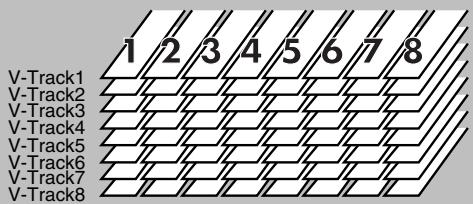
Moreover, each track incorporates eight virtual tracks, called "V-Tracks," for a total recording capability of 8 × 8 = 64 tracks! This increased versatility allows you to do things such as record numerous takes of a guitar solo, which you can later choose from when putting it all together.
Also, while playing back eight tracks, you can use the bounce mode to bounce to a V-Track and perform stereo bouncing without needing to erase any data.

What are V-Tracks?
Each track consists of eight virtual tracks, and you can choose any one of these tracks for recording or playback. This means that you can record to up to a maximum of 64 tracks, and then select any eight of them to play back. These virtual tracks that make up the actual tracks are called "V-Tracks."
HINT
A "Track Sheet" is provided at the rear of this manual (p. 226), which you make copies of, and fill in when recording music to V-Tracks.
Versatile digital effects processors
The BR-600 comes with five different types of effects processors. These systems, including recording effects (Insert effects), send/return (Loop Effects), tone adjustment (Track EQ), vocal pitch correction (Pitch Correction), and mastering effects (Mastering Tool Kit) can be used independently for each application as needed. This enables high-quality song production in a single device, with no need to connect any external effects.
The BR-600 has many built-in simulations and effects, including amp modeling with COSM for a wide variety of insert effects. Many effects for vocal, keyboard, and guitar tracks are also included for a vast array of applications.
The loop effects include spatial effects such as chorus and reverb, which are vital for proper stereo mixdown.
The Track EQ is a built-in, two-band EQ whose utility is most fully exhibited in making tone adjustments during mixdown.
The Pitch Correction feature allows you to freely adjust the pitch of vocals, assuring that you can obtain reliable, high-quality performances.
The Mastering Tool Kit allows you add compression to songs that have been mixed down and provides a variety of other effects.

"Using the Insert Effects" (p. 92)
"Using the Loop Effects" (p. 118)
"Using the Track EQ" (p. 121)
"Fixing the Pitch of Vocals (Pitch Correction)" (p. 123)
"Mastering"(p.111)

What is COSM (Composite Object Sound Modeling)?
Technology that virtually reconstructs an actually existing structure or material using a different means is called "modeling" technology. COSM is proprietary Roland technology that creates new sounds by combining various sound modeling technologies.
Editing functions
With the BR-600, you can copy, move, and erase audio, and perform many other editing operations that are only possible with digital recorders. This means operations such as copying and repeating a multiple-bar phrase, moving a multiple-bar phrase to another track, and erasing the data of a track, whole or in part, can be performed with ease.
Non-destructive editing
Being a digital recorder, the BR-600 offers non-destructive editing. With non-destructive editing, after performing any editing and recording operations, you can still return your data to its previous state (undo and redo functions).

"Canceling an Operation (Undo/Redo)" (p. 64)
Quick movement to a point
You can assign a marker to any point in a track that you wish (locator function). If you assign markers to locations such as the end of the opening or the beginning of a solo, you will be able to move instantly to the point where you wish to begin listening.

"Registering Time (Locator)" (p. 72)
Equipped with chromatic tuner (C1 to B6 sound range)
Your BR-600 is also equipped with a chromatic tuner so that you can tune your guitar or bass while it is still connected to the BR-600.

"Tuning an Instrument (Tuner)" (p. 192)
■ Phrase Trainer function
When you play back a song you have recorded from the CD player, you can slow down the tempo without changing the pitch. Also, you can remove the sound you hear at the center (such as vocals and guitar solo) from the song.

"Practicing Difficult Phrases (Phrase
Trainer)(p. 195)
Includes USB port
Connecting your computer here allows you to exchange data between the BR-600 and a computer.
Full complement of input connectors (jacks)
Your BR-600 is equipped with the input jacks shown below.
GUITAR/BASS :
This high-impedance input jack allows you to directly connect your guitar or bass (accepts 1/4'' phone plugs).
MIC1:
This jack allows a mic to be connected. This is TRS-type microphone input connector. Connect your mic here if recording vocals or narration.
MIC2:
This jack allows a mic to be connected. This is TRS-type microphone input connector. If recording using two mics, with one mic connected to the MIC 1 input, connect the second mic here.
LINE IN :
These jacks accept stereo input from keyboards, CD players, and other devices at line level (Stereo miniature phone type).
■ Onboard stereo mic
The BR-600 features an onboard stereo microphone, perfect for situations such as when you want to quickly make an impromptu recording of something your band is practicing.
- Connecting an external mic disables the onboard mic (p. 36).
- This mic is not a speaker. If you want to listen to sounds from the BR-600, use headphones or connect LINE OUT to an appropriate audio device.
Two-way power supply allows you to record anywhere
You can use the BR-600 powered by batteries (six size AA dry cells × 6 , alkaline batteries recommended) or with the AC adaptor.
And, thanks to its an onboard stereo microphone, you can make recordings anywhere and anytime you desire.
Memory Cards Supported by Your BR-600
The BR-600 uses CompactFlash cards as the storage media for recording and playback.
The BR-600 uses 32 MB to 1 GB CompactFlash cards with a 3.3 V power supply.
For more on supported memory cards (CompactFlash) for the BR-600, refer to "About Memory Cards" (separate sheet).
- Formatting the memory card (CompactFlash)
CompactFlash cards bought at a computer shop, or ones previously used with a digital camera cannot be used as is with the BR-600.
These CompactFlash cards must first be initialized for use with the BR-600.
For more details regarding initializing, see p. 199.
How to remove the card cover
To prevent theft of the memory card (CompactFlash), the BR-600 is shipped from the factory with a card cover.
To remove the card cover, use the following procedure.
1 Turn over the BR-600.
2 Use a Phillips head screwdriver to remove the screws on the bottom panel.
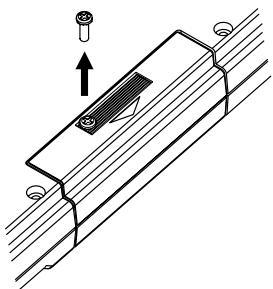
3
Grasp the top and bottom of the card cover with your fingers and pull the cover off in the direction indicated in the figure.
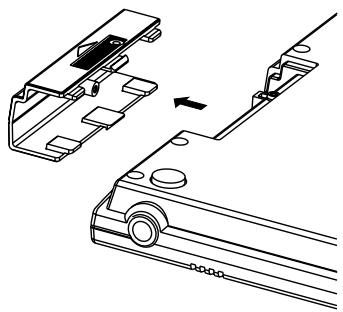
4
Attach the previously removed screws in the positions shown in the figure to prevent loss.
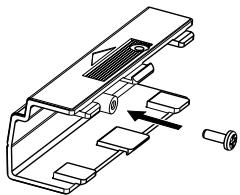
5
Turn the BR-600 over, so it's in its normal position.
NOTE
- CompactFlash Type II cards are not compatible.
- CompactFlash cards are available at your nearest computer or digital camera shop.
- When turning the unit upside-down, get a bunch of newspapers or magazines, and place them under the four corners or at both ends to prevent damage to the buttons and controls. Also, you should try to orient the unit so no buttons or controls get damaged.
- When turning the unit upside-down, handle with care to avoid dropping it, or allowing it to fall or tip over.
- Should you remove the screws, make sure to put them in a safe place out of children's reach, so there is no chance of them being swallowed accidentally.
- CompactFlash and _TM are trademarks of SanDisk Corporation and licensed by CompactFlash association.
BOSS Corporation is an authorized licensee of the CompactFlash™ and CF logo (®) trademarks.
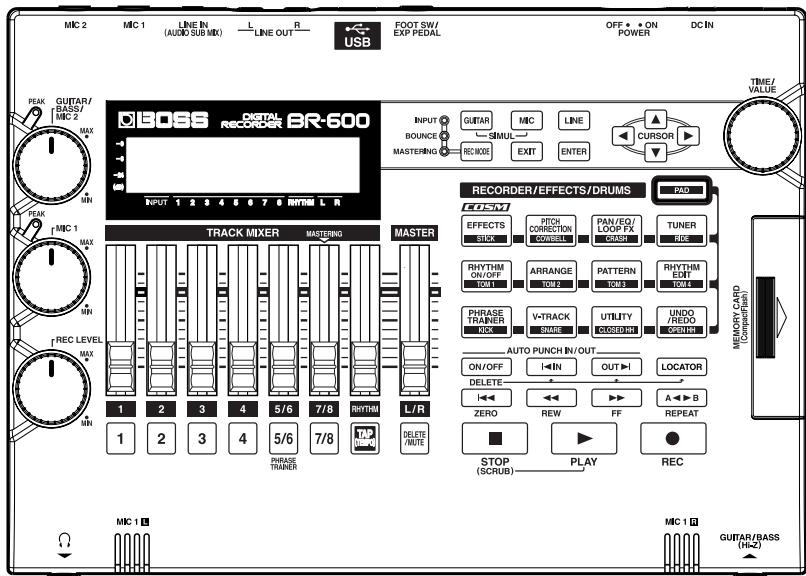
Top Panel
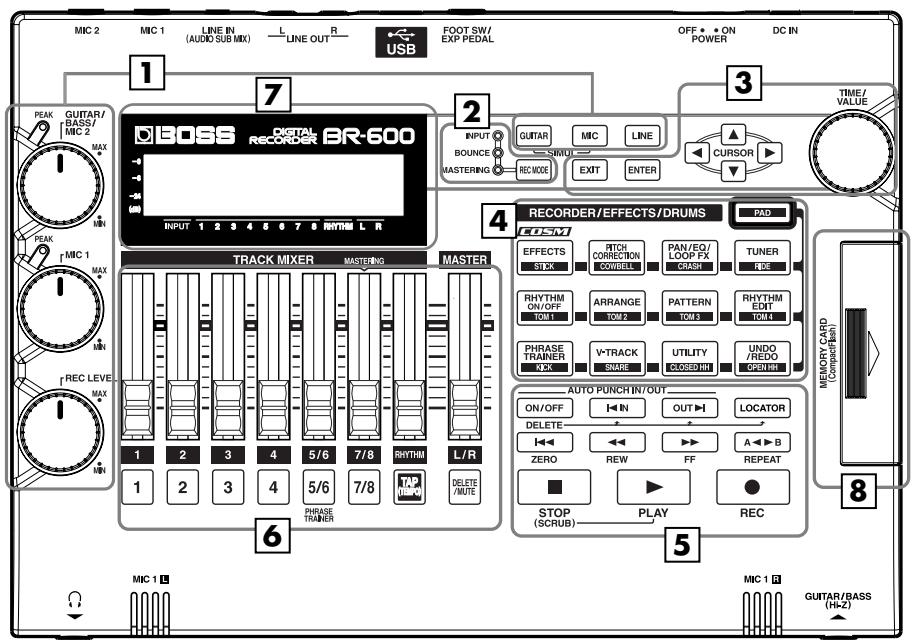
Input section
GUITAR/BASS/MIC2 dial
This dial adjusts the input sensitivity for the GUITAR/ BASS and MIC2 inputs.
MIC1 dial
This dial adjusts the sensitivity for MIC1 and the onboard stereo mic.
PEAK indicator
This indicator shows how strong the input level is at the various input jacks (e.g., GUITAR/BASS, MIC2, and MIC1).
This indicator lights at a level -6 dB lower than where sound distortion occurs. Adjust the input sensitivity with the GUITAR/BASS/MIC2 dial so that this indicator lights only occasionally, at those moments when you play your guitar (or other instrument) at its loudest.

"Adjusting the input sensitivity" (p. 36)
REC LEVEL (Recording Level) dial
Use this dial to adjust the volume of the input source for recording.
- If you use the REC LEVEL dial to turn down the volume of the input source during recording, the sound will be recorded in the audio track at a low volume, so that noise will be more apparent when you raise the volume of the audio track for playback.
If you want to lower the sound of the input source that you are monitoring, lower the volume with the MASTER fader. To change the volume of the music being played back, use the TRACK fader for the respective tracks.

"Adjusting the recording level" (p. 37)
MEMO
Try to record at the highest volume possible before the sound begins to distort. This works to improve the quality of the sound and reduce noise. When you want to lower the volume used while checking the sound, use the MASTER fader to lower the volume.
INPUT SELECT buttons
Use these buttons to select the input source (input jack) that you wish to record. The selected button will light. You can mute (silence) the input sound by pressing a button that is lit.

"Selecting the Input" (p. 36)
[GUITAR]
For selecting either guitar or bass use of the GUITAR/BASS jack, or the MIC2 jack.
[MIC]
This is used to select the MIC1 jack, used for external mics, or the onboard stereo mic.
Connecting a mic to the MIC1 jack or MIC2 jack switches off the onboard stereo mic.
[LINE]
This selects the LINE IN jack, used for CD players or other portable audio players or other line-level devices.
SIMUL
By pressing [GUITAR] and [MIC] simultaneously, you can record from both inputs at the same time.
- If the INPUT SELECT setting is changed, the insert effect bank (p. 92) changes automatically.

[REC MODE (Recording Mode)]
This button is used for selecting the recording mode.
![ROLAND BR-600 - [REC MODE (Recording Mode)] - 1](/content/2025/01/130576/images/10e74033a1ac2dec1c187dc71edb6c45d16ee03d5b94e34fc53cc0d2a698558c.jpg)
"Recording" (p. 44, p. 54)
"Putting multiple tracks together (Bounce)" (p. 49, p. 65)
"Mastering"(p.111)
![ROLAND BR-600 - [REC MODE (Recording Mode)] - 2](/content/2025/01/130576/images/5cd7a4db475c1b44b69d1b4a9d72584d07f9d83d0b1d854907d514137ba85f8f.jpg)
[EXIT]
Press this button to return to the previous screen or cancel the last entry.
[ENTER]
Press this button to confirm a selection or a value being entered.
CURSOR buttons
Press these buttons to move the cursor within the screen.
TIME/VALUE dial
You can use this dial to shift the current position within a song (e.g., fast forwarding and rewinding). It is also used to change the values of the various function settings.

[PAD]
This enables the buttons used for playing the drum sounds (the drum pads).
![ROLAND BR-600 - [PAD] - 1](/content/2025/01/130576/images/75a2a854246a85af8482e90ee36477e646610fe313af14fd19a5d2fc6b1bbad8.jpg)
"Section 4 Using The Rhythm" (p. 131)
[EFFECTS]
Use this button to turn on and off the insert effects (p. 92) or call up the screen for editing the various settings.
This button is used to make settings for the Mastering Tool Kit.
[PITCH CORRECTION]
Use this button to turn on and off the Pitch Correction. This function adjusts the pitch of recorded vocals.
![ROLAND BR-600 - [PITCH CORRECTION] - 1](/content/2025/01/130576/images/ff1b2d8830f5e1e5b23c35ba5a0cc45a80e3bc3154204150f4342675aadd7ef6.jpg)
"Fixing the Pitch of Vocals (Pitch Correction)" (p. 123)
[PAN/EQ/LOOP FX]
PAN
This calls up the screen for setting the panning (position) of the sounds to be played back in each track and the input sounds.(p. 49, p. 56)
EQ
This calls up the screen for editing the tone (low/high) for each track (equalizer).(p. 50)
LOOP FX
This calls up the screen for setting the send level of each track respective to the loop effects (p. 50, p. 118), setting the various parameters, and more.(p. 120)

"Using the Loop Effects" (p. 118)
"Using the Track EQ" (p. 121)
[TUNER]
Use this button to turn on and off the tuner.
![ROLAND BR-600 - [TUNER] - 1](/content/2025/01/130576/images/4e1ecca4d2b2fa887a35cd969ddcee8fed24b0d22b2f6ec8fc2505b4a39d4a4d.jpg)
"Tuning an Instrument (Tuner)" (p. 192)
[RHYTHM ON/OFF]
This switches the Rhythm function on and off.
[ARRANGE]
This switches the Rhythm function to Arrange mode.
![ROLAND BR-600 - [ARRANGE] - 1](/content/2025/01/130576/images/7e2f16dc0785f6b169902a527e4485b38dc86448b6ce2fa650d74f6e8e82524e.jpg)
"Playing Rhythm Arrangements" (p. 143)
"Creating Original Arrangements" (p. 154)
[PATTERN]
This switches the Rhythm function to Pattern mode.
![ROLAND BR-600 - [PATTERN] - 1](/content/2025/01/130576/images/cef08bffc0cd0035f7bcdd812d413d0dee32c11e5582cede5b09790966e77e8b.jpg)
"Playing Rhythm Patterns" (p. 142)
"Creating Original Patterns" (p. 144)
[RHYTHM EDIT]
This calls up the screen for programming arrangements and patterns.
![ROLAND BR-600 - [RHYTHM EDIT] - 1](/content/2025/01/130576/images/518c35d6a220ec75aa5856308876dfeaa78a3f85ea3eb7945e85e82451da8a6a.jpg)
"Creating Patterns by Tapping the Drum Pads
(Realtime Recording)" (p. 145)
"Inputting Sounds One by One While
Confirming the Input Visually (Step
Use this button to perform the settings for the phrase trainer function.
When using the phrase trainer, you can turn on or off the center cancel function (for removing vocals at the center), or the time stretch function (for slowing down playback).
![ROLAND BR-600 - [RHYTHM EDIT] - 2](/content/2025/01/130576/images/2f6a28080036db47b93311c9b841fc26e00c42725e03b7b72ab667a21495bbea.jpg)
"Slowing Down the Speed (Time Stretch)" (p. 195)
"Canceling the Center Sound (Center Cancel)"
(p. 196)
[V-TRACK]
Use this button to call up the screen for selecting a V-Track.
![ROLAND BR-600 - [V-TRACK] - 1](/content/2025/01/130576/images/45c18d7aa943a89b7322cb894b8fe676cb7b0d138ab3958bd807c1b83f6e5a2d.jpg)
"What are V-Tracks?" (p. 12)
"Changing V-Tracks" (p. 56)
[UTILITY]
This button calls up various functions offered by your BR-600, such as track editing, song management, and memory card operations.
[UNDO/REDO]
For undoing the last-performed recording or editing operation and returning the data to its previous state. By pressing this button once again, you can bring back the canceled recording or re-execute the editing operation.
![ROLAND BR-600 - [UNDO/REDO] - 1](/content/2025/01/130576/images/4df3e0e1b0bb7f3fa51bb856085ba7152df5484fbcc00e6dfcb30b2ef9772ecd.jpg)
"Canceling an Operation (Undo/Redo)" (p. 64).
5 REC/PLAY section
AUTO PUNCH
This button is used to make settings for the automatic punch in/out function.
[ON/OFF]
This turns the auto punch-in/out function on/off. When this is on, the button will light.
![ROLAND BR-600 - [ON/OFF] - 1](/content/2025/01/130576/images/2f79b12b6e7b37e2c148592e9c04c0d348b65a83ccc7e753a0a8480eaa4d21b0.jpg)
"Specifying the area for auto punching in/out" (p. 61)
[IN]
For setting the auto punch-in location. Press this button to set the punch-in point. When set, the button will light. After the punch-in location is set, you can press this button to automatically move to the punch-in location.
- Press this button while holding down [ON/OFF] to clear the set punch-in location.
![ROLAND BR-600 - [IN] - 1](/content/2025/01/130576/images/4d83e88dc06a8b67327732b5a7ce6b9ee56770af08d9dd7305ef793ce6296e83.jpg)
"Erasing a registered auto punch in/out location" (p. 62)
[OUT]
For setting the auto punch-out location. Press this button to set the punch-out location at the current location in the track. When set, the button will light. After the punch-out location is set, you can press this button to automatically move to the punch-out location.
- Press this button while holding down [ON/OFF] to clear the set punch-out location.
![ROLAND BR-600 - [OUT] - 1](/content/2025/01/130576/images/06b0bc3c1d6d2e218b40a7d791bdb9edcff3208005b6e998aae4eb7aa2d654b7.jpg)
"Erasing a registered auto punch in/out location" (p. 62)
[LOCATOR]
Use this button to store any location that you desire. Then, by pressing this button, you can automatically move to that location. When a location is set, the button will light and you will jump to the location each time this button is pressed.
- Press this button while holding down AUTO PUNCH [ON/ OFF] to clear the set location.
![ROLAND BR-600 - [LOCATOR] - 1](/content/2025/01/130576/images/2dd30aa1383f395bb011e4802a1ff49d8185cf6e31576a705646c9f4aded1471.jpg)
"Registering Time (Locator)" (p. 72)
[ZERO]
Moves you to the time location 00:00:00-00.0.
![ROLAND BR-600 - [ZERO] - 1](/content/2025/01/130576/images/9a169ce550792d87dc983f03562fa3bea3af8e2a5d3262a5a82ab92d5e47f247.jpg)
"Moving the current position" (p. 33)
[REW]
The song will rewind while you hold down the button.
![ROLAND BR-600 - [REW] - 1](/content/2025/01/130576/images/e9e259d5b926fac89ff74f06b451cc7b74fb2cf380a33bb57357275a13bccbd7.jpg)
"Moving the current position" (p. 33)
[FF]
The song will fast-forward while you hold down the button.
![ROLAND BR-600 - [FF] - 1](/content/2025/01/130576/images/2aac20d44c919b3bb61f293dee2946561a2cf9581f67192318b932f30f9be887.jpg)
"Moving the current position" (p. 33)
[REPEAT]
You can specify a region that you wish to hear, and hear it repeatedly
This is convenient for making recordings involving repeated punches and punch-outs(p. 60) and for practicing and copying phrases.
![ROLAND BR-600 - [REPEAT] - 1](/content/2025/01/130576/images/5d99fc7fdcd8095fa8b8d09a5425137025fb352be159fcd3ac44317f3328bf62.jpg)
"Repeating Playback (Repeat)" (p. 58)
[STOP]
Stops recording or playback of the song.
![ROLAND BR-600 - [STOP] - 1](/content/2025/01/130576/images/1ca5021f1d449b87538c285f0dd852d95a37e637046e5b99c8b1b26be7c643e9.jpg)
"Recording Operations" (p. 57)
[PLAY]
Plays back songs. When [REC] is pressed and flashing, press [PLAY] to start recording. During recording or playback, the indicator on the button lights in green.
![ROLAND BR-600 - [PLAY] - 1](/content/2025/01/130576/images/4821480901e4a25837fc4b2a756ade6ba207832a1fa7e53b80569752c35c598f.jpg)
"Listening to a Demo Song" (p. 32)
"Recording Operations" (p. 57)
[REC (Recording)]
This is the Recording button. In addition to the Recording operation, it is also used for manual punch-in/out. While in recording standby, the button flashes in red, and during recording, it lights in red.
![ROLAND BR-600 - [REC (Recording)] - 1](/content/2025/01/130576/images/6f9fc85a4f31886826f0bbce3909aa1b3384bd1366226b9d0693d63c4eeef828.jpg)
"Recording Operations" (p. 57)
"Manually Punching In/Out" (p. 60)
6 Track/Fader section
TRACK MIXER fader 1-4, 5/6-7/8
For controlling the volumes of each track during playback.
RHYTHM fader
Adjusts the volume of the Rhythm.

"Playing Arrangements" (p. 41)
"Playing Patterns" (p. 41)
MASTER fader
Controls the overall volume of the BR-600.

"Listening to a Demo Song" (p. 32)
REC TRACK (Recording Track) buttons 1-4, 5/6-7/8
Use these buttons to select to which track you will record. The button of the track selected will flash in red and then light in red when recording begins. When recording is finished, the button of the selected track will light alternately in orange and green.
The relationship between the indicator and the track conditions is given below.
Off :
This track contains no recorded data.
Green :
An audio track that contains recorded data.
Flashing in red :
The track is selected as the recording destination, and is in recording standby.
Red :
This track currently being recorded.
Lighting alternately in orange and green :
This track contains recorded data and is selected for recording.

"Recording" (p. 54)
[TAP (TEMPO)]
By tapping this button, you can set the tempo for the Rhythm.
![ROLAND BR-600 - [TAP (TEMPO)] - 1](/content/2025/01/130576/images/7ea6d65a408444bff425b91885f8a5311fcda4003c70506b25cfd18f50d7a602.jpg)
"Tapping to change the tempo of the arrangements or patterns" (p. 43)
[DELETE/MUTE]
You can mute the sound on a track by holding down this button and pressing the REC TRACK button for that track. Performing this same operation again cancels the mute.
While the sound is muted, the REC TRACK button for the track flashes orange or green.
- If a recording track was muted, muting will be defeated when recording ends.
![ROLAND BR-600 - [DELETE/MUTE] - 1](/content/2025/01/130576/images/9cdadbec27cd5c8d2d61bb35d4e185293b60525f2c38d1d1555e67f05e6363cf.jpg)
"Silencing the sound of specific tracks (Track Mute)" (p. 47)
During creation of Rhythm patterns, you can delete rhythm sounds you have input by holding down this button and pressing the Drum Pads.
![ROLAND BR-600 - [DELETE/MUTE] - 2](/content/2025/01/130576/images/20eceb24e733a054fbc622b65c1499c93a096d16fc304e55ef1775c7318f28ea.jpg)
"Deleting Unneeded Drum Sounds" (p. 147)
![ROLAND BR-600 - [DELETE/MUTE] - 3](/content/2025/01/130576/images/a269aef8c37bd33029eab2ac65912e6a0854a620c56cec05969312a5c161453b.jpg)
7 Display
Information about items for which settings are available in volume level and menu screens, parameter settings screens, and other screens are displayed here.
If the screen is difficult to view, see "Adjusting the Display Contrast" (p. 190).
1. MEASURE
Displays the current position within the song. Indicated from left to right are the measure, beat, and clock.
2. TEMPO
The Rhythm tempo is indicated here.
3. TIME
Displays the time of the current position of the song (hours-minutes-seconds).
4. FRAME
This indicates the frame number showing the current position in the song.
This is set to 30 frames per second (non-drop). This is one type of what is called MTC (MIDI Time Codes).

The explanations in this manual include illustrations that depict what should typically be shown by the display. Note, however, that your unit may incorporate a newer, enhanced version of the system (e.g., includes newer sounds), so what you actually see in the display may not always match what appears in the manual.
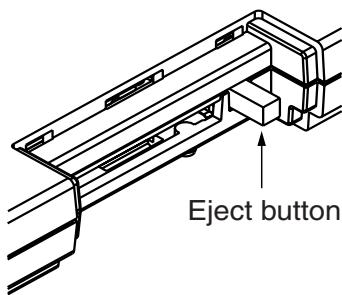
8 MEMORY CARD slot
This slot is where memory cards (CompactFlash) are inserted when you want to save data. You cannot record unless you have a memory card inserted here.
Eject button
Press this button to eject the memory card.

"Inserting the Memory Card" (p. 30)
Rear Panel
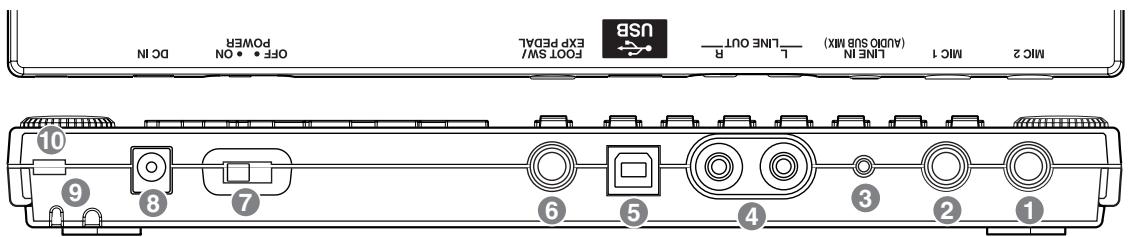
1. MIC2 jack (TRS 1/4" phone type)
These jack allows a mic to be connected (p. 34).
- If the connection has been made to the GUITAR/BASS and the MIC2 jacks, the MIC2 jack is given priority.
- Connecting a mic to MIC2 switches off the onboard stereo mic.
2. MIC1 jack (TRS 1/4" phone type)
These jacks allow a mic to be connected (p. 34).
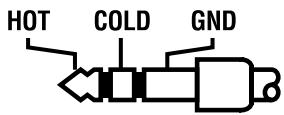
- Connecting a mic to MIC1 switches off the onboard stereo mic. The pin assignment for the MIC1 and the MIC2 jack is as shown below.
This input jack accepts analog audio signals (p. 34). Connect the output of CD players or other portable audio players or other audio equipment.
4. LINE OUT jack (RCA Pin type)
These jacks output analog audio signals. You can connect external audio equipment (e.g. a stereo amp) to this jack, or connect an CD recorder or other such device to this jack for analog recording of the BR-600's output (p. 90).
5. USB connector
This is the connector for connecting your computer to the BR-600 with a USB cable (p. 162).
6. FOOT SW/EXP PEDAL jack
This is an input jack for connecting a separately sold foot switch (BOSS FS-5U, Roland DP-2) or expression pedal (Roland EV-5, BOSS FV-500L/FV-500H).
- When the foot switch is used, you can start/stop playback, punch in/out, and more.
- When an expression pedal is used, you can control the depth of insert effects with your foot.

"Using a Foot Switch or Expression Pedal" (p. 191)
7. POWER switch
This is the power switch. It turns the power of the BR-600 on/off (p. 31).
8. DC IN (AC Adaptor) jack
Connect an AC adaptor (PSA series; sold separately) to this jack.
You must use only the PSA series AC adaptor (p. 28).
You can purchase a PSA adaptor at musical instrument retailers.
9. Cord Hook
Wrap the cable around this hook so that the AC adaptor cable is not pulled out accidentally (p. 29).

- You must use only the PSA series AC adaptor. Use of any other adaptor may cause overheating or malfunctions.
- If the AC adaptor is disconnected during operation, your important recorded data may be lost.
10. Security Slot ( K )
http://www.kensington.com/
Front Panel


1. GUITAR / BASS jack
High-impedance input jack to directly connect your guitar or bass.(p. 34)
2. MIC1 L / R (onboard stereo microphone L / R)
This microphone can be used for recording with the BR-600.

"Selecting the Input" (p. 36)
"Turning on the onboard stereo microphone" (p. 36)
- This mic is not a speaker. If you want to listen to sounds from the BR-600, use headphones or connect LINE OUT to an appropriate audio device.
3. Headphones jack
Headphones (sold separately) are connected here. When headphones are connected, the same output as that from LINE OUT can be heard from the headphones.

The headphone volume is adjusted with the MASTER fader.
Inserting Batteries
1
Make sure that the power of the BR-600 is turned off.
2
Turn over the BR-600.
3
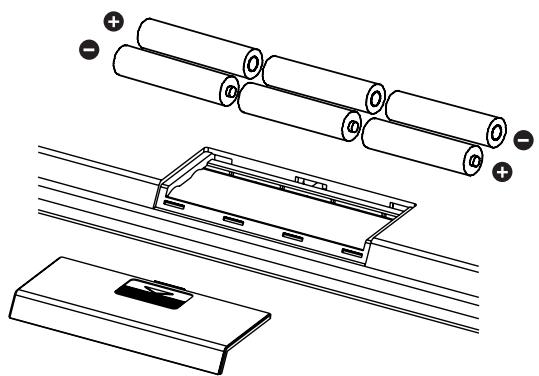
Slide the battery cover in the direction indicated by the arrow and remove.
4
Being careful not to reverse the polarity (+/-) , insert six AA dry-cell batteries into the battery compartment.
5
Replace the battery cover.
NOTE
- When turning the unit upside-down, get a bunch of newspapers or magazines, and place them under the four corners or at both ends to prevent damage to the buttons and controls. Also, you should try to orient the unit so no buttons or controls get damaged.
- When turning the unit upside-down, handle with care to avoid dropping it, or allowing it to fall or tip over.
- BOSS recommends using longer-life alkaline batteries.
- Do not mix new batteries with partially used batteries, and do not mix batteries of differing types.
- Do not use rechargeable batteries.
- When the battery power becomes low, "Battery Low!" appears in the display. When this message appears, replace the existing batteries with new ones as soon as possible.
- Continuous battery life varies according to usage conditions and the type of battery used. It is also affected by the CompactFlash type and capacity.
About the Play Screen
The Play screen is the most fundamental screen of the BR-600, and is the first screen that appears when the BR-600 is turned on (see below).
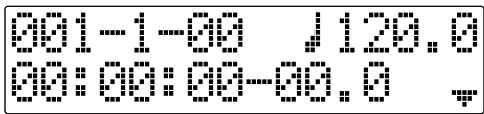
Play Screen
Unless special note is made otherwise, the screen content referred to in the procedures described in this manual is that of the Play screen.
MEMO
Quick Start
Connecting Peripheral Devices
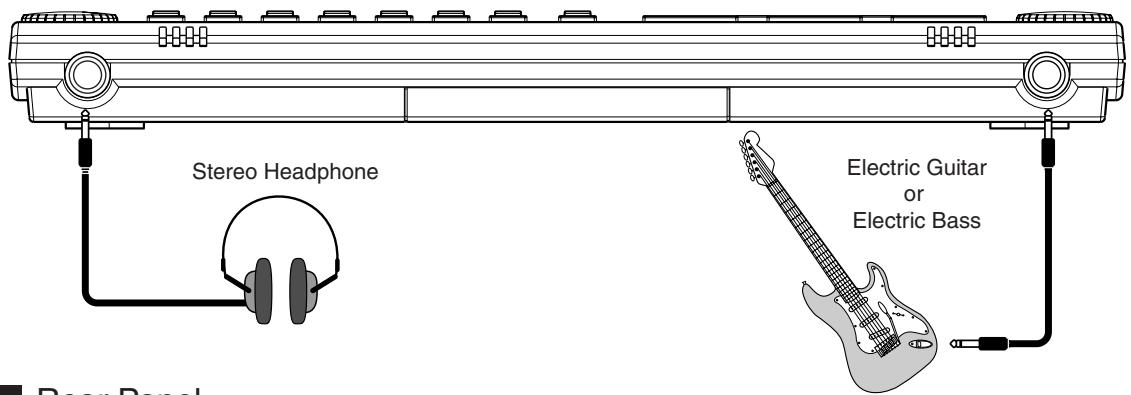
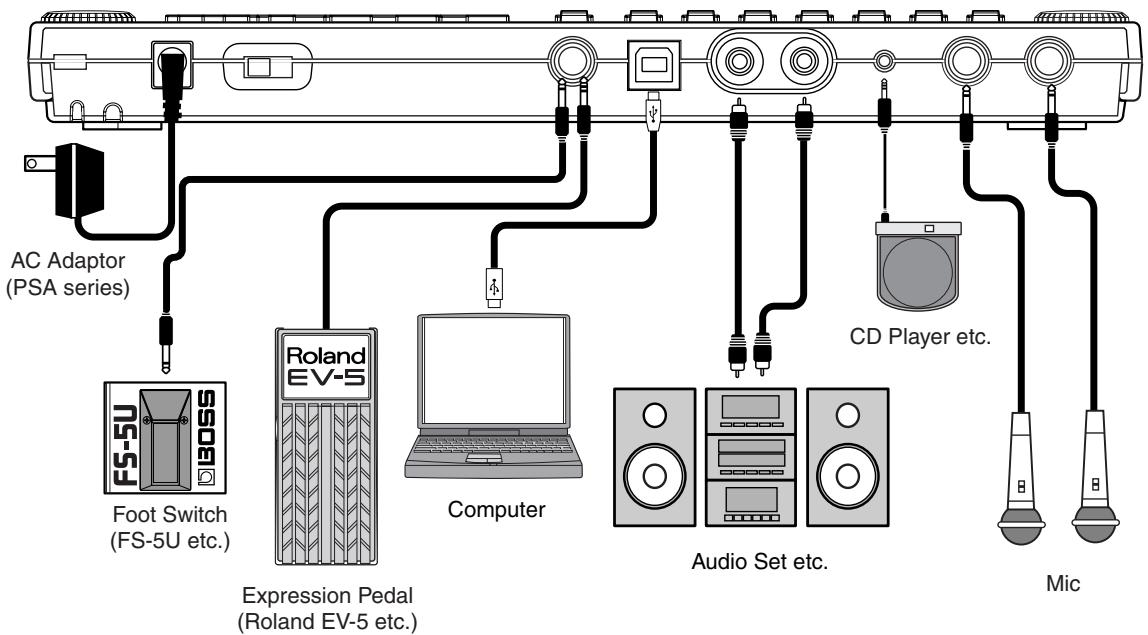
Make connections as shown in the diagram below. When making any connections, make sure that all devices are turned off.

Front Panel
Rear Panel

NOTE
- To prevent malfunction and/or damage to speakers or other devices, always turn down the volume, and turn off the power on all devices before making any connections.
-
Feedback could be produced depending on the location of microphones relative to speakers. This can be remedied by:
-
Changing the orientation of the microphone(s).
- Relocating microphone(s) at a greater distance from speakers.
-
Lower the volume.
-
The MIC1 and MIC2 jack are TRS phone type jacks that are compatible with balanced input. The pin assignment for the MIC1 and MIC2 jack are as shown below. Before making any connections, make sure that this pin assignment is compatible with that of all your other devices.
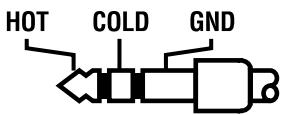
- When using the FS-5U foot switch (sold separately), set the polarity switch as shown below. If the polarity switch is not set correctly, the foot switch may not operate properly.
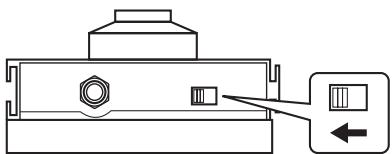
Polarity Switch
- You can also use an FS-6 (sold separately) for the foot switch. If using an FS-6, connect to only one of the FS-6's jacks, either the A or B jack. Additionally, set the polarity switch to "FS-5U." The A&B jack cannot be used.
- If using an expression pedal (Roland EV-5, BOSS FV-500L/FV-500H), set the MIN volume level to "0."
How to Use the Cord Hook
The bottom of the BR-600 features a groove (cord hook) for securing the AC adaptor (PSA series) cord.
To prevent the inadvertent disruption of power to your unit (should the plug be pulled out accidentally), and to avoid applying undue stress to the AC adaptor jack, anchor the power cord using the cord hook.
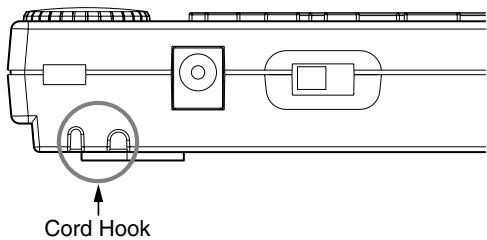
Cord thickness and shape may differ according to the AC adaptor used.
Set the cord as shown in Figure A or B below to secure the cord.
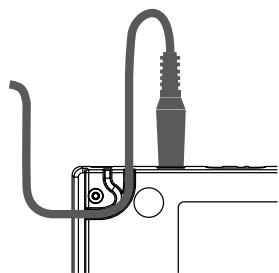
A)
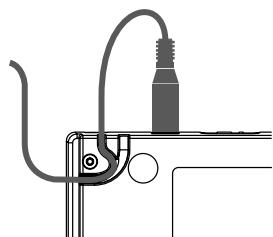
B)
NOTE
- Do not use undue force to insert the cord in the groove. Doing so may cause the cord to break.
- Turning the BR-600 over upon a desktop or table may cause scratching of the BR-600 or the surface of the desk or table. Be sure to carry out this procedure on a soft surface or with a cloth or other soft material laid on top of the desk or table.
Using a Mic Converter Cable
If your mic cable has an XLR connector, you can connect the mic using the converter cable included with the BR-600. The following describes how to connect the mic using this cable.
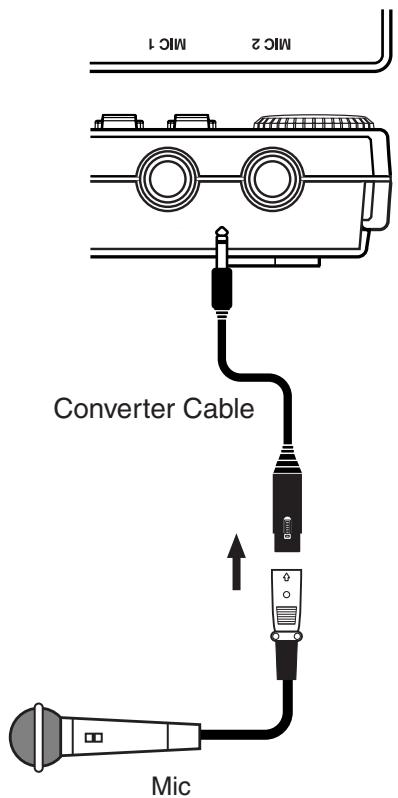

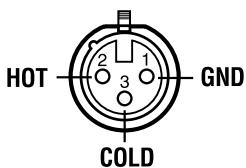
- The pin assignment for the XLR connector is shown below. Before making any connections, make sure that this pin assignment is compatible with that of all your other devices.
- As the BR-600 does not feature any phantom power supply, note that no sound will be produced with condenser mics and other mics requiring phantom power.
Inserting the Memory Card
Insert the memory card (CompactFlash) with the card label facing upward.
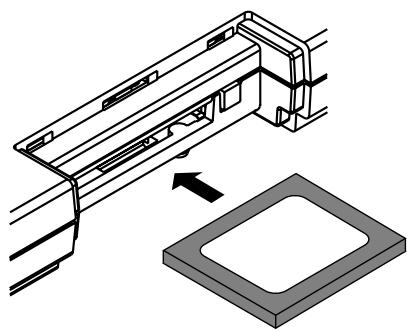

- Carefully insert the memory card all the way in—until it is firmly in place. Also, do not use undue force to insert the memory card.
- Do not touch the contacts of the memory card or allow them to become dirty.
- Before inserting the memory card, be sure to first turn off the BR-600. If a memory card is inserted when the power is turned on, the data in the memory card may be destroyed, or the memory card may become unusable.
Turning On the Power
Be sure to use the following steps to turn on the power. Making a mistake in this procedure may result in malfunction or cause damage to your speakers.
1
Before you turn the power on, make sure of the following points.
■ Are all external devices connected properly?
■ Is the volume on the BR-600 and all other devices completely lowered?
■ Is the memory card inserted?
2
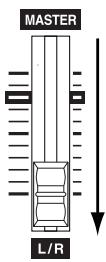
Lower the MASTER fader on the BR-600.
3
Turn on the devices connected to the input jacks (i.e., GUITAR/BASS, MIC 1, MIC 2, or LINE IN).
4
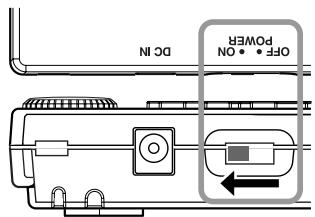
Turn on the POWER switch located on the rear panel.
5
Turn on the device connected to the output jack (i.e., LINE OUT).
Turning Off the Power
1
Make sure that playback of the song is stopped.
2
Turn off the power to each device in the reverse order used for powering up.
3
Confirm that "Keep power on!" is not indicated in the display.
4
Turn the BR-600's POWER switch off.
NOTE
- Always make sure that the recorder is stopped before turning off the power to the BR-600. Turning off the power while recording or playback is in progress may result in the deletion of (song) data, mixer settings, and/or effect patch data.
- If you are using the AC adaptor, make sure that the AC adaptor does not become unplugged during operation.
If the AC adaptor becomes unplugged accidentally, the recorded data may become damaged. - Turning off the power while the message "Keep power on!" is displayed may result in corruption of the data. Be careful not to turn off the power while this message is displayed.
- This unit is equipped with a protection circuit. A brief interval (a few seconds) after power up is required before the unit will operate normally.
- The BR-600 is shipped with a memory card already inserted in the slot.
- Always make sure to have the volume level turned down before switching on power. Even with the volume all the way down, you may still hear some sound when the power is switched on, but this is normal, and does not indicate a malfunction.
Selecting a demo song (Song Select)
Upon power-up, the song that was selected before the power was turned off is selected, and the data of that song is loaded. As soon as the data has been loaded, the Play screen appears in the display.
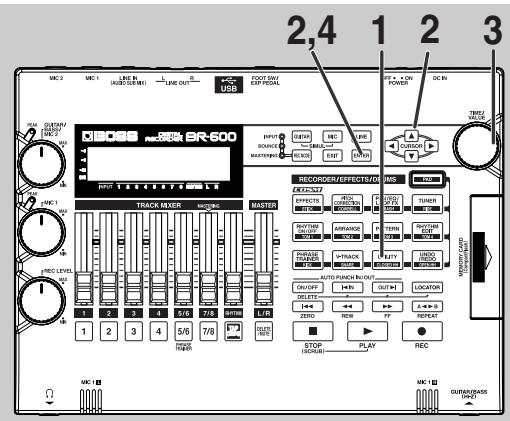
1
Confirm that [PAD] is not lit, then press [UTILITY].
2
Press CURSOR [ ] [ ] to move the cursor to "SEL," and press [ENTER].
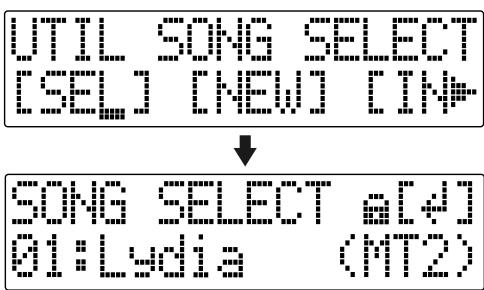
The Song Select screen appears in the display.
3
Turn the TIME/VALUE dial to select "01: Lydia".
4
Press [ENTER].
Playing back a demo song
1
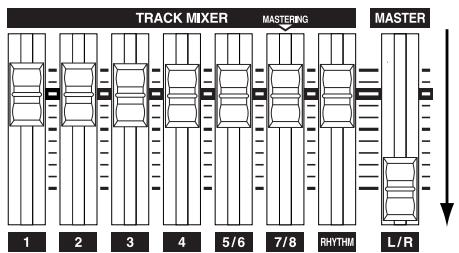
Move the TRACK faders 1-4, 5/6, 7/8 and the RHYTHM fader to the positions shown in the figure below, and lower the MASTER fader.
2
Press [PLAY].
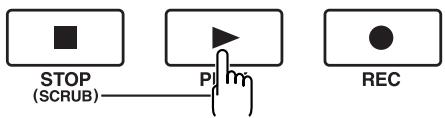
The song starts. Slowly increase the MASTER fader and adjust the volume to the desired level.
3
Slide the TRACK faders to adjust the volume of each track to the desired level.

- The BR-600 comes programmed with one demo song. When the power is first turned on, the demo song is automatically selected, and the data required for playback is loaded.
- Use of the demo song supplied with this product for any purpose other than private, personal enjoyment without the permission of the copyright holder is prohibited by law. Additionally, this data must not be copied, nor used in a secondary copyrighted work without the permission of the copyright holder.
| Title | Twisted Lydia |
| Composer | Robert Marcello |
| Copyright | © Robert Marcello 2005 |
- Only "Lydia" appears in the display.
You can use the following method to move the current position.
Fast Forwarding and Rewinding
The song fast forwards as long as the [FF] is held down, and rewrites (reverses) while the [REW] button is held down.
■ Moving to the start of a play
To move to the time where the first sound of a song is recorded, press and hold [STOP] and press [REW].
Each V-Track of the selected track is checked and you move to the time of the first recorded sound for the song.
Press [ZERO] to move to the time location 00:00:00-00.0.
■ Moving to the end of a play
To move to the time where the last sound of a song is recorded, press and hold [STOP] and press [FF].
Each V-Track of the selected track is checked and you move to the time of the last recorded sound for the song.
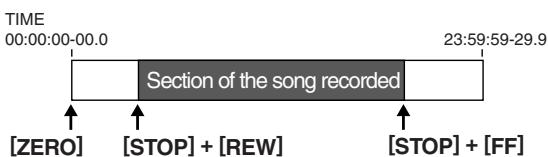
- Moving through a song using hours, minutes, seconds, frames, or sub frames
Press [ ] [ ] to move the cursor to hours, minutes, seconds, frames, or sub-frames display, and turn the TIME/ VALUE dial to change the current time in the song.
■ Moving through a song in measures or beats
The current position in the song is indicated at the left of the upper row as "measure-beat-clock."
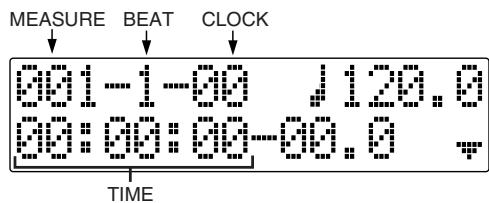
- For the demo songs, an Arrangement (p. 134) has already been created and it is set so that measure, beat, clock, and song is properly synchronized.
Press [ ] [ ] to move the cursor to "measure" or "beat" display, and turn the TIME/VALUE dial to change the current measure or beat in the song.
- You cannot move the cursor to Clock (cannot be altered).
Memo Elapsed time display
The current time shown in the lower row of the display is in MTC (MIDI time codes), indicated as "hours-minutes-seconds-frames-sub frames."
Choose which jack you will use to connect your instrument
Your BR-600 is equipped with a number of input jacks to match the type of instrument that you will connect. Select an instrument appropriate for your purposes.
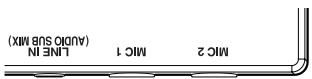
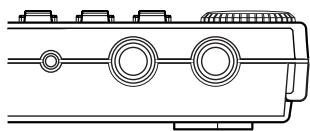
GUITAR/BASS :
An electric guitar or bass can be connected to this jack. Since this is a high-impedance input, a guitar or bass can be connected directly.
MIC1:
This jack allows a mic to be connected. TRS jack is provided.
MIC2:
This jack allows a mic to be connected. TRS jack is provided.
LINE IN :
This is an input jack used for connecting the output from CD players or other portable audio players or other audio equipment.
NOTE
- If you are recording an electric acoustic guitar using a shielded connection, use the GUITAR/ BASS jack.
- If the connection has been made to the GUITAR/ BASS and the MIC2 jacks, the MIC2 jack is given priority.
Preparing Songs For Recording
When the memory card contains more than one song, the song that was recorded last is automatically selected.
To record a new song, follow the procedure given below.
Recording a new song (Song New)
1
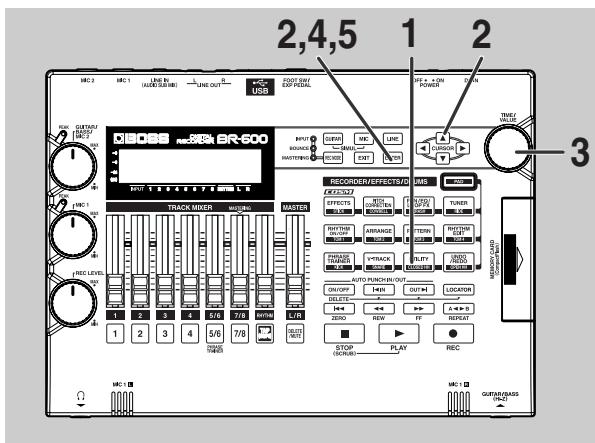
Confirm that [PAD] is not lit, then press [UTILITY].
2
Press CURSOR [ ] [ ] to move the cursor to "NEW," and press [ENTER].
"Type" appears in the display.
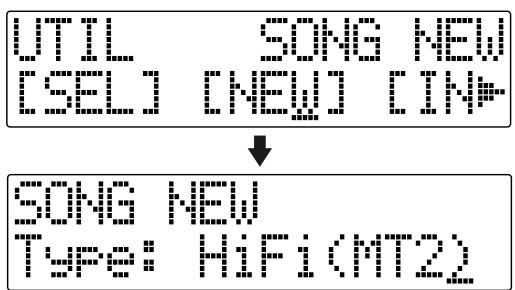
3
Turn the TIME/VALUE dial to select the desired data type.
Ordinarily, you should select the data type that meets your needs for a particular recording situation, while considering the desired quality and recording time.
However, for our purposes here, you can select HiFi (MT2).

For more about data types, refer to "Recording" (p. 54).
4
Press [ENTER].
"Are you sure?" appears in the display.
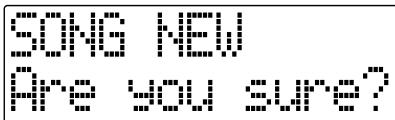
5
Press [ENTER].
When the new song is ready, you are returned to the Play screen.
- During updating, "Keep power on!" appears in the upper line of the display, while the lower line shows what is being processed.

The BR-600 uses a sample rate of 44.1kHz . It is not possible to change the sample rate.
MEMO
You can create up to a maximum of 99 songs with the BR-600.
Select the input source to record. The selected button will light.
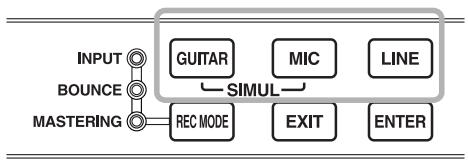
[GUITAR]
Select to record the instrument connected to the GUITAR/ BASS jack or the MIC 2 jack.
[MIC]
Select to record the signal from a microphone connected to the MIC1 jack and the MIC2 jack or from the onboard stereo microphone.
[LINE IN]
This is an input jack used for connecting the output from CD players or other portable audio players or other audio equipment.
SIMUL :
To record the vocal and guitar at the same time, press [GUITAR] and [MIC] simultaneously. Both buttons light, telling you that simultaneous recording is now possible.
When two recording tracks are selected, the GUITAR/ BASS/MIC2 is recorded to Track 1,3,5,7,and the MIC1 is recorded to Track 2,4,6,8.
When one recording track is selected, the GUITAR/BASS/MIC2 and MIC1 are mixed and then recorded.

The onboard stereo mic is switched off when a mic is connected to the MIC1 jack or MIC2 jack. If you want to use the onboard stereo mic, disconnect any mic connected to the MIC1 jack or MIC2 jack (refer to the following section).
- Turning on the onboard stereo microphone
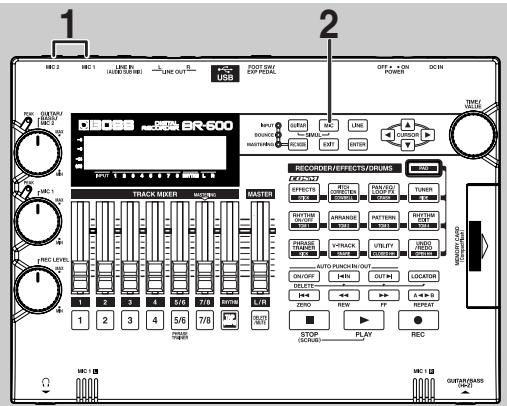
1
Disconnect MIC if connecting a mic to the MIC1 jack or MIC2 jack.
2
In the Play screen, press the [MIC] INPUT SELECT button. [MIC] lights up, and the onboard stereo mic is switched on.
Adjusting the input sensitivity
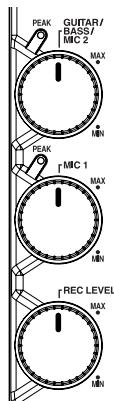
When GUITAR/BASS/MIC2, MIC1, or the onboard stereo mic is selected, the input sensitivity is adjusted with the corresponding dial.
If selecting LINE IN, adjust the volume level of the connected external device.
HINT
In order to record at a good sound level, you should adjust the input levels so that the PEAK indicator lights momentarily when a guitar is strummed strongly or vocals are sung loudly.
Adjusting the recording level
Adjust the volume of the input source for recording.
Lower the MASTER fader.
2 Turn the REC LEVEL dial to its center position and then slowly increase the MASTER fader.
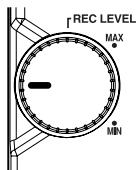
3 Adjust the recording level with the REC LEVEL dial. You should adjust the level so that the INPUT level meter fluctuates within the range from -12 (between -24 and -6) to 0 dB. Setting the level too high can cause distortion, while setting it too low may result in noise or reduced sound quality.
4 Use the MASTER fader to adjust the volume to the appropriate level for monitoring.

When connection cables with resistors are used, the volume level of equipment connected to the inputs (GUITAR/BASS jack, LINE IN jack) may be low. If this happens, use connection cables that do not contain resistors, such as those from the Roland PCS series.
Displaying the Level Meter
This meter indicates the level for each track.
1 In the Play screen, press CURSOR [ ].
- To return to the Play screen, press CURSOR [▲].
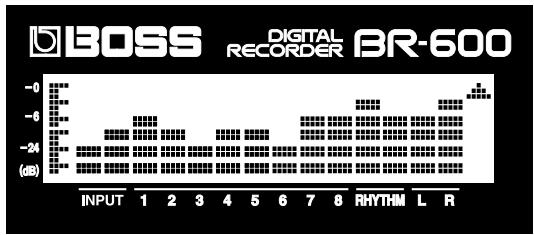
INPUT:
The level meter shows the input from INPUT.
1-8:
The level meter shows the output of Tracks 1-8.
RHYTHM :
The level meter shows the output of Rhythm.
LR:
The Level meter shows the post-MASTER fader output level. When monitoring the sound with headphones, use the MASTER fader to adjust the volume to the level you desire.
The BR-600 comes with five onboard effects processors: an insert effect, loop effects, track EQ, pitch correction and mastering tool kit. Below is an explanation of the operations related to the insert effects.
MEMO What is an insert effect?
An effect added directly to a specific signal (with the BR-600, this refers to the instrumental sounds from an INPUT jack) is called an "insert effect." The effect pedals that a guitarist connects between his guitar and amp are a type of insert effect.
Loop effects, on the other hand, are effects connected to the send/return jack of mixers and other similar devices. (refer to p. 118)
MEMO What is an effect patch?
The BR-600 provides numerous effects for vocals, guitar, etc., and two or more of these effects can be used simultaneously. Such a combination of effects (i.e., the types of the effects used and the order in which they are connected) is called an "algorithm."
Each effect in an algorithm offers a certain number of parameters, which allow the sound to be altered (similar to tweaking the knobs on a stomp pedal). The algorithm and its parameter settings are bundled into units called "effect patches."
By changing the effect patch, you can simultaneously change the stored effect combinations, their on/off status, and the parameter settings, and completely change the sound.
Switch effect patches
1 Confirm that [PAD] is not lit, then press [EFFECTS] to display the currently selected effect patch.
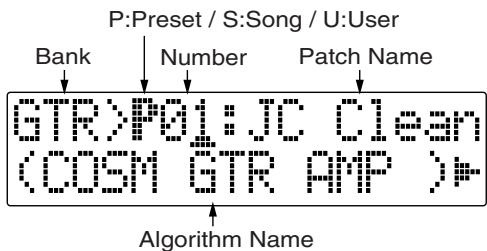
Your BR-600 allows you to automatically select the most suitable "banks" by pressing an INPUT SELECT button.
For example, pressing the [GUITAR] INPUT SELECT button changes you to a guitar bank patch, and pressing [LINE] changes you to a line bank patch.
Banks are a collection of effect patches.
GTR (GUITAR) :
Effect patches for use with guitars.
MIC:
Effect patches for use on the sound from the MIC input (i.e., vocals).
LIN (LINE) :
Effect patches for use on the sound from CDs and other external devices from the LINE input.
SML (SIMUL) :
Effect patches for recording vocals and a guitar together.

"Effect Patches and Banks" (p. 92)

When INPUT SELECT is set to MIC, if either MIC1 or MIC2 is used, the MIC bank is selected. With both are connected, or neither of them is connected and the onboard stereo mic switched on, the LINE Bank is selected.
2
Press CURSOR[ ] [ ] to align the cursor up with the effect patch, and turn the TIME/VALUE dial to change the effect patch.
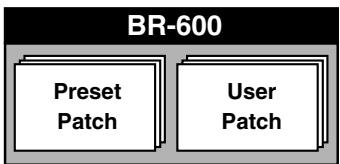
Preset patches (P)
The preset patches contain preset data. Their settings can be changed, but you cannot create a new preset patch.
User patches (U)
User patches can be rewritten, and are stored in internal memory. If you have created a patch that you would like to use for other songs as well, it is convenient to store it as a user patch.
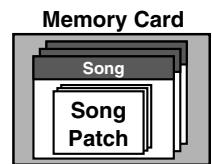
Song patches (S)
Like user patches, song patches can be written; however, the data for song patches are stored along with the song data to the memory card. This is convenient when you have created a patch for a specific recorded performance, and would like to store that patch together with the song.
3
Press CURSOR [ ] [ ] to align the cursor up with the patch number, and turn the TIME/VALUE dial to change the patch number.
4
Press [EXIT] to return to the Play screen.

For more details regarding the use of insert effects, refer to "Using the Insert Effects" (p. 92).
Recording without insert effects
1
Confirm that [PAD] is not lit, then press [EFFECTS] to display the currently selected effect patch.
The BR-600 is set to output sound without the insert effects applied, allowing you to record sounds without the insert effects.
Selecting "INPUT

"Changing the destination Insert Effects are Connected" (p. 95)
MEMO
Some effect patches are particularly effective for stereo recording.
For recording in stereo, refer to "Selecting the Recording Track" (p. 55).

"Effect Patch List" (p. 204) "Algorithm List" (p. 96)
What is the Rhythm?
The "Rhythm" is a dedicated Rhythm track that can not only play back Rhythm sounds as a guide during recording, you can also use it to play internal Rhythm patterns and original user-created Rhythm patterns and to play and record these patterns as your own Rhythm part performances.
Recording in time with the Rhythm allows you to edit individual measures and use other convenient functions. For more details, refer to "Editing the Performance on a Track (Track Edit)" (p. 75).
You can also change the tempo or Rhythm pattern during a song.
For more details, refer to "Section 4 Using The Rhythm" (p. 131).
Patterns and Arrangements
The Rhythm features two modes, "Pattern" and "Arrangement."
Pattern
These are drum performance phrases from one to several measures in length.
Internal patterns (preset patterns) include prepared patterns for intros, verses, fill-ins, and endings.
Arrangement
Patterns arranged in the order they are performed (for example, intro, verse, fill-in, verse, and ending) and played at the selected tempo comprise a song.
| Intro | Verse | Fill | Verse | Ending |
MEMO
The Rhythm is preset with a wide variety of arrangements. For more details regarding the preset arrangements, refer to "Arrangement / Pattern List" (p. 208).
■ Pattern Mode and Arrangement Mode
Switching to "Pattern mode" may be necessary in order to play patterns. Likewise, you may need to switch to "Arrangement mode" to play arrangements.
Pattern Mode
This mode is used to play a single pattern repeatedly. You can also create and edit patterns in this mode.
Arrangement Mode
This mode is used to play arrangements.
You can also create and edit arrangements in this mode.
Playing Arrangements
1
Confirm that [PAD] is not lit, then press [ARRANGE] so that the button lights up (indicating the BR-600 is in Arrangement mode).
[RHYTHM ON/OFF] simultaneously lights, confirm that the rhythms are enabled.
2
Press [PLAY].
The arrangement plays with the start of playback or recording.
The arrangement automatically stops when [STOP] is pressed to stop playback or recording.
- When you adjust the volume of the arrangement, use the Rhythm fader.
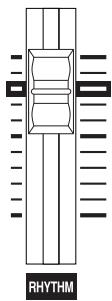
Playing Patterns
1
Confirm that [PAD] is not lit, then press [PATTERN] so that the button lights up (indicating the BR-600 is in Pattern mode).

[RHYTHM ON/OFF] simultaneously lights, confirm that the rhythms are enabled.
2
Press [PLAY].
The pattern plays with the start of playback or recording.
When [STOP] is pressed to stop playback or recording, the pattern also stops automatically.
The pattern does not play when set to "BREAK" (p. 209).
- When you adjust the volume of the pattern, use the Rhythm fader.
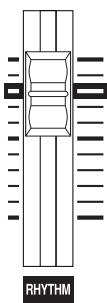
Changing arrangements
1
Confirm that [PAD] is not lit, then press [ARRANGE] so that the button lights up.
[RHYTHM ON/OFF] simultaneously lights, confirm that the rhythms are enabled.
2
Select an arrangement.
Use CURSOR[ ] and the TIME/VALUE dial to select the Preset/Song and number.
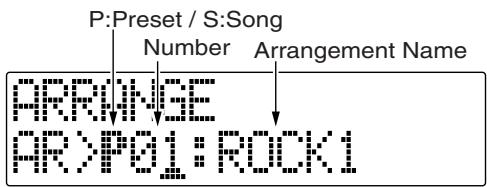
Preset Arrangements (P)
The preset arrangements contain preset data.
Their settings cannot be changed, and you cannot create a new preset arrangement.
Song Arrangements (S)
Song arrangements can be written; however, the data for song arrangements are stored along with the song data to the memory card.
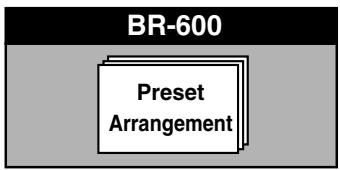
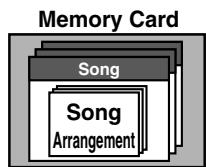
3
Press [EXIT] to return to the Play screen.
Changing patterns
1
Confirm that [PAD] is not lit, then press [PATTERN] so that the button lights up.

[RHYTHM ON/OFF] simultaneously lights, confirm that the rhythms are enabled.
2
Select a pattern.
Use CURSOR[ ] [ ] and the TIME/VALUE dial to select the Preset/Song and number.
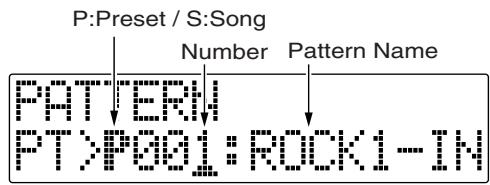
Preset Patterns (P)
The preset patterns contain preset data.
Their settings cannot be changed, and you cannot create a new preset pattern.
Song Patterns (S)
Song patterns can be written; however, the data for song patterns are stored along with the song data to the memory card.
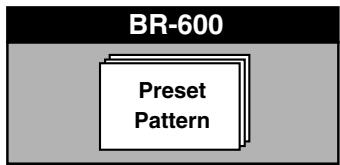
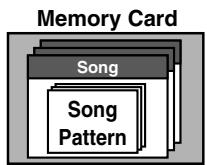
3
Press [EXIT] to return to the Play screen.
Changing the tempo of the arrangements or patterns
You can temporarily change the tempo of the arrangement or pattern being played by carrying out the following procedure while the Play screen is displayed.
1
Use [CURSOR] and align the cursor up with "TEMPO" in the display.
2
Rotate the VALUE dial to adjust the tempo.
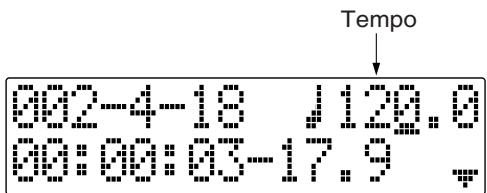
Tapping to change the tempo of the arrangements or patterns
You can temporarily change the tempo of the arrangement or pattern by the timing with which you press [TAP].
Tap on [TAP] four or more times to change the tempo of the arrangement or pattern. The tempo becomes that in which you tapped.
RHYTHM

NOTE
- The arrangement's tempo setting is temporarily disabled.
- The change in tempo is only temporary. If you want to change the arrangement's actual tempo, refer to "Changing the Tempo of an Arrangement" (p. 143).
- Tempos cannot be saved to patterns.
Selecting the recording track

Press either [1]-[7/8] at REC TRACK to select the recording track.
If the button flashes in red, that track is ready for recording.
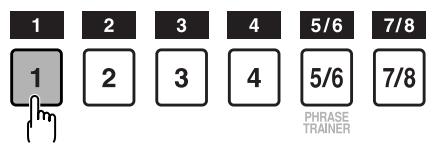
The status of each track can be determined from the indicator on the button.
Off: No recorded data exists on the track.
Green: Recorded data exists on the track.
Red : The track is selected for recording.
If a track with existing data is selected for recording, the indicator will light alternately in orange and green.
If INPUT SELECT [GUITAR] is lit
![ROLAND BR-600 - If INPUT SELECT [GUITAR] is lit - 1](/content/2025/01/130576/images/3850fc126abc59bab30cd1ed386b595697099284ded46f8cb3c697cf6f8d9605.jpg)
Since the input is mono, the recording is normally performed as a mono recording onto one track. Press one of TRACK [1]-[4] at REC TRACK to select the one track to which to record.
However, if you want to record in stereo to increase the effect of insert effects, you can simultaneously press the [1] and [2], [3] and [4] REC TRACK buttons for stereo recording onto two tracks.
![ROLAND BR-600 - If INPUT SELECT [GUITAR] is lit - 2](/content/2025/01/130576/images/da4a602a217a63f3e5a5b494bf2a5a301f4a9dc8879993a29636260af727809f.jpg)
(Recording Mono)
![ROLAND BR-600 - If INPUT SELECT [GUITAR] is lit - 3](/content/2025/01/130576/images/dcf4dcea5a35ba3d5db0462953e9fe4204210cc82cb24fee5c021ad586354bb5.jpg)
(Recording Stereo)
In addition, Tracks 5/6 and 7/8 are stereo tracks, so they always produce stereo recordings.
If INPUT SELECT [MIC] is lit
![ROLAND BR-600 - If INPUT SELECT [MIC] is lit - 1](/content/2025/01/130576/images/9bd9ed11392fa29d1f1f92d1103917c57712e0c564d5724196236b7f104ee7f5.jpg)
If a mic is connected either to the MIC1 or MIC2 jack (not both), the input will be mono, and you can select tracks using the same procedure as that described in "If INPUT SELECT [GUITAR] is Lit."
If you have mics connected to both the MIC1 and MIC2 jacks, or if nothing is connected to either of these jacks and the internal stereo mic is switched on, you can select tracks using the same procedure as that described in "If INPUT SELECT [LINE] or [SIMUL] are Lit."
- When mics are connected to both the MIC1 and MIC2 jacks, Track 1 is selected as the recording destination for MIC1, and Track 2 is selected as the recording destination for MIC2.
If INPUT SELECT [LINE] or [SIMUL] are lit
![ROLAND BR-600 - If INPUT SELECT [LINE] or [SIMUL] are lit - 1](/content/2025/01/130576/images/001f493a65a72d2413bfc8d8d2af4042a7e5b38cb3531fe679aa4744eff7e929.jpg)
![ROLAND BR-600 - If INPUT SELECT [LINE] or [SIMUL] are lit - 2](/content/2025/01/130576/images/1f186ae28b744a25a935f06e45d786842dfb30c4d800cb199ed2a0b0bd6e245b.jpg)
Since the input is stereo, the recording is normally performed on two tracks. Press either REC TRACK [1] or [2] to select tracks 1 and 2, or [3] or [4] to select tracks 3 and 4.
However, if you want to mix together the left and right channels being input onto one track, with tracks 1 and 2 selected, press REC TRACK [1] again to select track 1. Using the same procedure, you can select any track 1 to 4 to be the track to which to record.
In addition, Tracks 5/6 and 7/8 are stereo tracks, so they always produce stereo recordings.
About the recording (REC) modes
Recording on the BR-600 is separated into three main modes.
Use whichever mode is suitable in the course of bringing your song to completion.
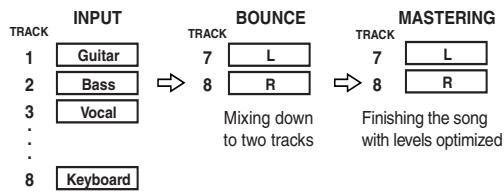
INPUT:
Only the instrument sounds or other input sources are recorded to the tracks. Sounds played back from other tracks are not recorded.
BOUNCE :
As the sounds on different tracks are played back, they are recorded together onto another track. In Bounce mode, you can play back eight tracks simultaneously and record them all to a single, separate V-Track.
When the input source is selected with INPUT SELECT, you can also include those sounds in the recording.
You can further include the sounds from the Rhythm in the recording as well.
MASTERING:
Here, you apply the "Mastering Tool Kit" to the two tracks to which other tracks have been bounced to finish up with a song with levels (volume) optimized.
The Rhythm cannot be used in this mode.
MEMO What is a Mastering Tool Kit?
When creating an audio CD from your recorded songs, or recording to a similar media, the overall volume needs to be restrained, so that even the loudest portions of the songs are handled appropriately on the CD. However, this often results in an overall lowering of the volume, resulting in a CD that lacks excitement and impact.
Moreover, in the low-frequency range, to which the human ear is not very sensitive, the sound actually produced might be perceived as being somewhat low in volume, even though the meter shows that it's at the maximum level. This also makes it difficult to create powerful sounds.
With the "Mastering Tool Kit," however, you can smooth out the differences in volume that occur over the course of a song, while also correcting the balance in the low end.
We recommend mastering with the Mastering Tool Kit in the final stage of creating songs.

"Mastering"(p.111)
"Mastering Tool Kit Patch List" (p. 207)
Procedure
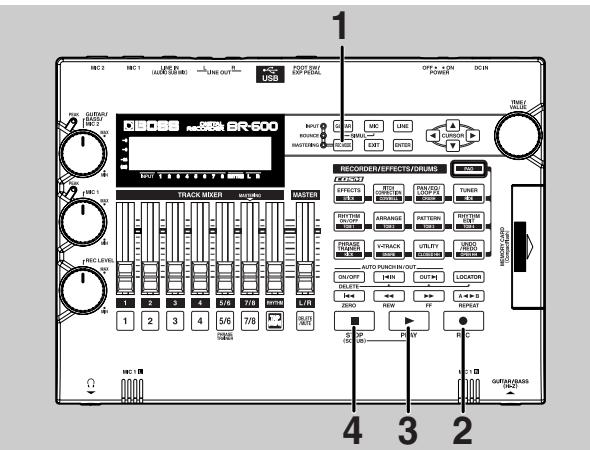
1
Press [REC MODE] repeatedly until INPUT is indicated for REC MODE at the left of the screen. The BR-600 will now enter Input mode.
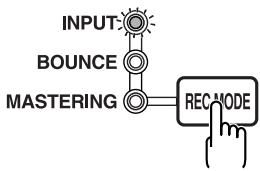
2
Press [REC].
[REC] flashes in red and the BR-600 enters the recording standby state.
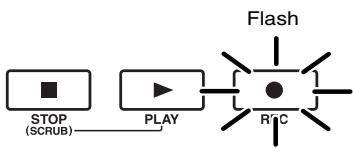
3
Press [PLAY].
[PLAY] lights in green, the [REC] and REC TRACK buttons now light solidly instead of flashing in red, and recording begins.
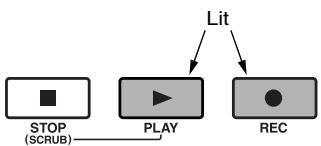
4
When you finish recording, press [STOP].
The REC TRACK button lights alternately in orange and green, indicating that track contains recorded data.
- During updating, "Keep power on!" appears in the upper line of the display, while the lower line shows what is being processed.

You cannot play back sounds recorded for less than one second.
MEMO
How the Tracks Are Organized
The BR-600 features eight audio tracks that can be used for recording and playback.
Tracks 1-4 are independent mono tracks. Tracks 5/6 and 7/8 are linked as stereo tracks.
Tracks 5/6 and 7/8 are fixed as left/right tracks, respectively, while fader movements, Loop Effects, and other processes are applied in common to both tracks. These two tracks thus make a convenient bounce destination (p. 65). Tracks 7/8 can also be used for mastering (p. 111).
In addition to, and separate from the audio tracks, the BR-600 also includes dedicated stereo tracks for playback of the internal rhythms (p. 132).
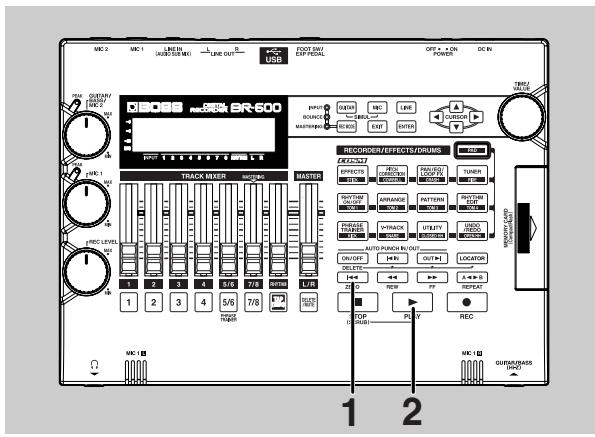
1
Press [ZERO] to move to the time location 00:00:00-00.0.
2
Press [PLAY].
[PLAY] lights in green, and playback begins.
Use the TRACK faders to adjust the volume separately for each track.
Silencing the sound of specific tracks (Track Mute)
During playback, hold down [DELETE/MUTE] and press a REC TRACK button that is lit in green and orange alternating or green.
The REC TRACK button will change to blinking in orange or green, and the sound of that track will be muted (silenced).
If you repeat the same operation, the button will return to its previous lit state and the sound of that track will once again be heard.
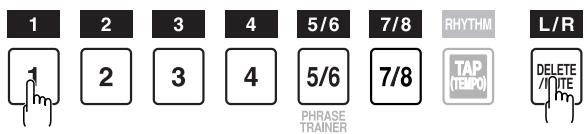
The tracks for which the REC TRACK button is lit in green (or alternately in orange and green) are tracks that already have data recorded on them.
The process of listening to a previously recorded performance while you record additional material on another track is called "over dubbing." By recording the bass, guitar, and vocals on different tracks, you can then adjust the volumes of each instrument with respect to one another, change the left-right sound balance, exchange data, and perform other operations.
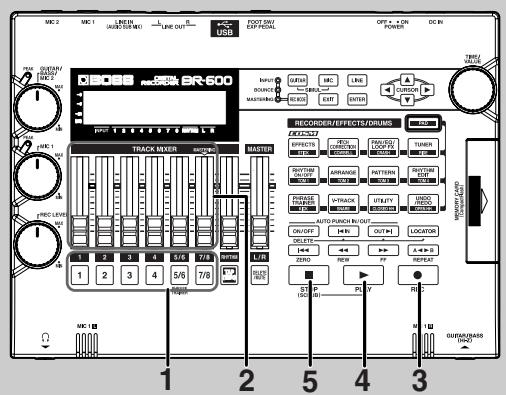
1
Press one of REC TRACK [1]-[7/8] to select the track to which to record.
The status of each track can be determined from the indicator on the button.
Off: No recorded data exists on the track.
Green: Recorded data exists on the track.
Red : The track is selected for recording.
If a track with existing data is selected for recording, the indicator will light alternately in orange and green.
2
Adjust the faders so the tracks being played back are at a suitable level.
3
Press [REC].
[REC] flashes in red and the BR-600 enters the recording standby state.
4
Press [PLAY].
The [REC] and REC TRACK button indicators change from flashing in red to being continually lit and recording begins. [PLAY] lights up.
Only what you are currently playing is recorded to the new track. The music that is being played back is not recorded.
- If you use the REC LEVEL dial to turn down the volume of the input source during recording, the sound will be recorded in the audio track at a low volume, so that noise will be more apparent when you raise the volume of the audio track for playback.
If you want to lower the sound of the input source that you are monitoring, lower the volume with the MASTER fader. To change the volume of the music being played back, use the TRACK fader for the respective tracks.
5
When you finish recording, press [STOP].
NOTE
- Note that recording sounds to a track that already contains recorded material erases the previous recording.
- You cannot play back sounds recorded for less than one second.
HINT
Some tips for overdubbing
When you record new material while listening to a recorded performance, your playing may tend to be buried in the existing performances, making it difficult for you to play. In this case, you can slightly lower the faders of the playback tracks, or pan the playback tracks to left (or right) and the sound you are playing to right (or left) to make it easier to hear yourself.

"Adjusting the Perception of Stereo in the Input Sounds (Pan)" (p. 56)
Adjusting the Sound for Each Track
You can adjust the tone, panning, and volume balance for each track individually.
Adjusting the Perception of Stereo for the Sound (Pan)
1
Confirm that [PAD] is not lit, then press [PAN/EQ/LOOP FX].
2
Press CURSOR [ ] [ ] to move the cursor to "PAN," and press [ENTER].
The Pan settings screen appears in the display.
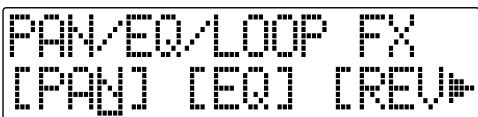
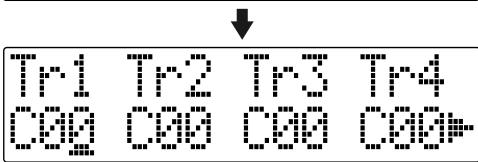
3
Press CURSOR [ ] [ ] and turn the TIME/ VALUE dial to change each track pan settings.
- Pressing a REC TRACK button moves the cursor to the track corresponding to the button pressed.
- Pressing [ENTER] sets this to "C00" (Center).
4
Press [EXIT] (or [PAN/EQ/LOOP FX]) to return to the Play screen.

Tracks 5/6 and 7/8 are stereo tracks, and any pan settings that are made apply to both of the tracks as a pair.
When set to C00: Track 5 (7) is panned left, and Track 6 (8) is panned right.
When set to L50: Both Track 5 (7) and Track 6 (8) are panned left.
When set to R50: Both Track 5 (7) and Track 6 (8) are panned right.
Adjusting the tone (Track EQ)
"Track EQ" is an independent two-band equalizer featured on each track that allows you to adjust the high- and low-frequency tonal qualities separately.
These are just like the tone control on a stereo.
1
Confirm that [PAD] is not lit, then press [PAN/EQ/LOOP FX].
2
Press CURSOR [ ] [ ] to move the cursor to "EQ," and press [ENTER].
The EQ settings screen appears in the display.
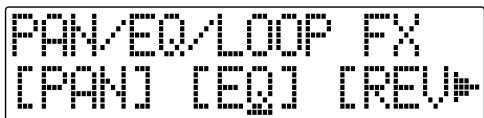
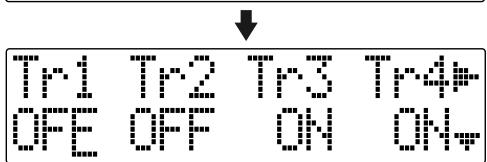
3
Press CURSOR [ ] [ ] and turn the TIME/ VALUE dial to turn each Track EQ on or off.
- Pressing a REC TRACK button moves the cursor to the track corresponding to the button pressed.
4
When changing the EQ settings, press CURSOR [ ] repeatedly to display the parameter screen, then use the [CURSOR] and the TIME/VALUE dial to change the setting's value.
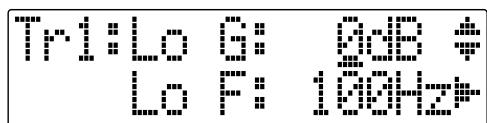

For more on the settings content, refer to "Track EQ Parameter Functions" (p. 122).
5
When you have finished making the settings, press [EXIT] (or [PAN/EQ/LOOP FX]) to return to the Play screen.

Adding Richness and Breadth to the Sound (Loop Effect)
The BR-600 features chorus, delay, and doubling (any one of these three can be selected at any one time) as loop effects, and includes reverb as well. Effective use of these allows you to add greater breadth to the sound.
MEMO
What is a loop effect?
Effects connected to the send and return of mixer effects are called "loop effects." You can adjust the depth of the effect by changing the send level of each mixer channel (equivalent to the tracks of the BR-600).
Since the send levels for each track are separate, you can change the depth individually. This allows you to, for example, have a deep reverb on the vocals and slight reverb on the drums, or any such combination.
Opposed to insert effects (p. 92), which are applied to specific sounds, loop effects are applied to the complete track.
1
Confirm that [PAD] is not lit, then press [PAN/EQ/LOOP FX].

2
Press CURSOR [ ] [ ] to move the cursor to "CHO/DLY" or "REV," and press [ENTER].
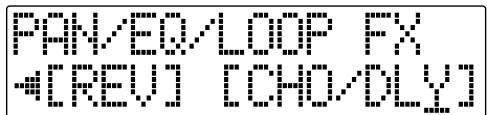
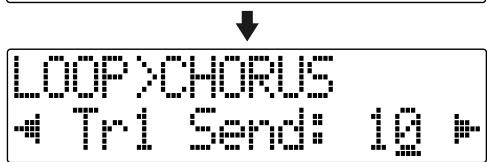
3
Press CURSOR[ ] [ ] until "FX Type" or "Type" is displayed, then turn the TIME/VALUE dial to select the loop effect.
When using CHO/DLY
Select from "CHORUS," "DELAY," or "DBLN" (doubling).
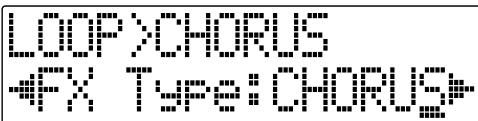
When using REV
Select from "HALL" or "ROOM."
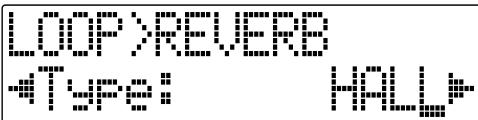

You cannot use chorus, delay, and doubling simultaneously. Any one may be selected while loop effects are in use.
4
If you want to change the settings for the selected effect, press CURSOR [ ] [ ] to select the parameter, then change the setting's value with the TIME/VALUE dial.
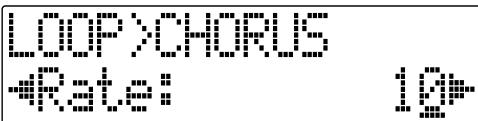

For more on the settings content, refer to "Loop Effect Parameter Functions" (p. 120).
5
Press CURSOR [ ] [ ] to display the Send Level settings screen.
When using CHO/DLY
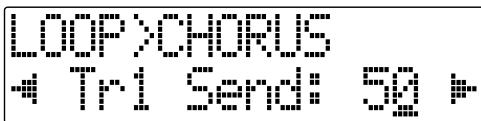
When using REV
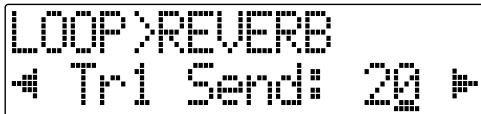
6
Press CURSOR[ ] [ ] and the TIME/VALUE dial to adjust each track's send level.
- Pressing a REC TRACK button moves the cursor to the track corresponding to the button pressed.
7
After you have completed adjusting the send level, press [EXIT] repeatedly to return to the Play screen

The "send level" is the volume level of the signal sent from each respective track to each effect, and you can change the amount of effect applied by adjusting the send level.
Bouncing
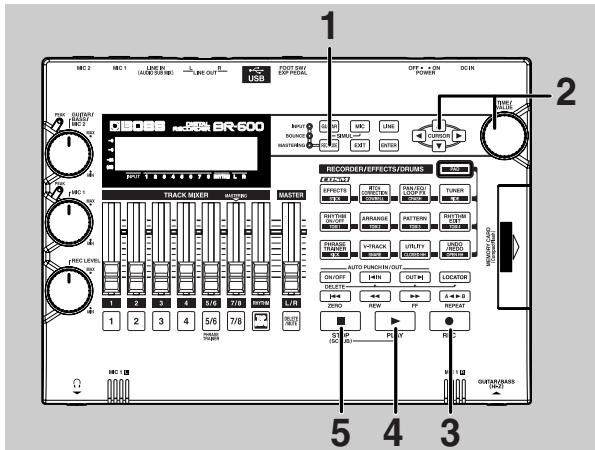
1
Press [REC MODE] repeatedly until "BOUNCE" is indicated for REC MODE at the left of the screen.
The BR-600 will now enter BOUNCE mode.
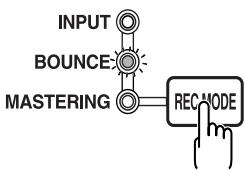
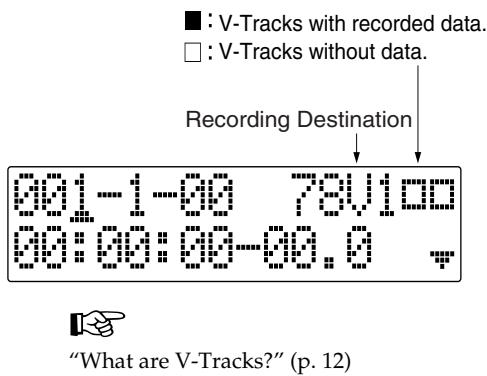
2
Use CURSOR [ ] [ ] and the TIME/VALUE dial to select the track/V-track to which you want to record.
3
Press [REC].
[REC] flashes in red and the BR-600 enters the recording standby state.
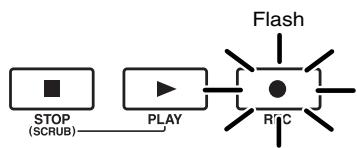
4
Press [PLAY].
[PLAY] lights in green, the [REC] and REC TRACK buttons now light solidly instead of flashing in red, and recording begins.
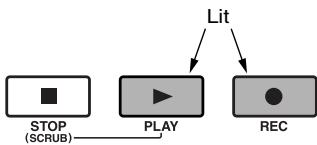
5
When you finish recording, press [STOP].
- During updating, "Keep power on!" appears in the upper line of the display, while the lower line shows what is being processed.
MEMO
- To prepare for further recording after the bouncing has been completed, the BR-600 automatically switches to an empty V-Track at the bounce destination.
After bouncing down to two tracks, you can use the "Mastering Tool Kit" to eliminate discrepancies in volume levels through out the song and to achieve the proper low-end balance. Refer to "Mastering" (p. 111).
Section 1 Recording and Playback
Creating Songs for Recording
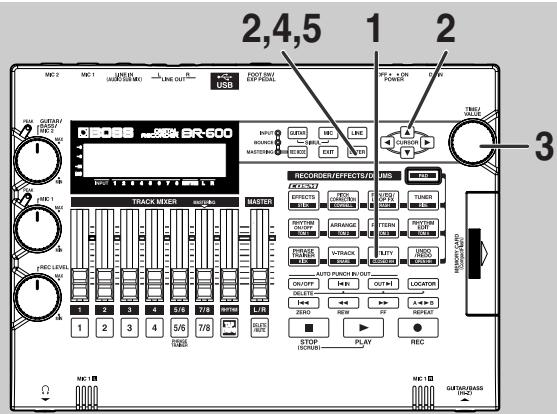
1
Confirm that [PAD] is not lit, then press [UTILITY].
2
Press CURSOR [ ] to move the cursor to
"NEW," and press [ENTER].
"Type" appears in the display.
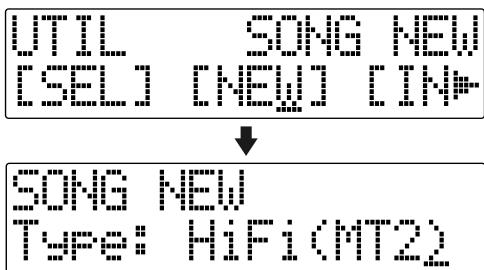
3
Rotate the TIME/VALUE dial to select the data type.
4
Press [ENTER].
"Are you sure?" appears in the display.
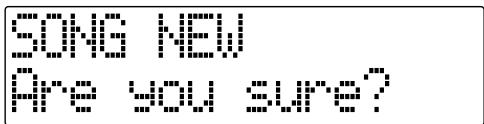
5
Press [ENTER]. When the new song is ready, the Play screen returns to the display.
- During updating, "Keep power on!" appears in the upper line of the display, while the lower line shows what is being processed.
About data types
When you record a new song, the BR-600 allows you to set the data type. This enables you to select the combination of audio quality and recording time that is most suitable for the material you are recording.
The following data types can be selected.
HiFi (MT2) (multitrack 2):
For high-quality recordings. This data type is recommended when you will be doing a lot of track bouncing. Normally you should select this type. Use this type for most of your recordings.
STD (LV1) (live 1):
For recordings that will take longer than what can be provided with the MT2 data type. This is the most suitable setting for recording live performances.
LONG (LV2) (live 2):
Of the three data types, this provides the longest recording time.
This is convenient when the card has little recording capacity.
Recording time
The recording times possible for each data type on one memory card are given below (when recording one track).
- The sampling rate is set to 44.1kHz , regardless of the data type. You cannot change the sampling rate.
NOTE
- The data type of a song cannot be changed after it is created.
- The recording times shown above are approximate. Depending on the number of songs, the allowable recording time may decrease.
- The recording times shown above are for when only one track is used. For example, if you record on all eight tracks, the recording time for each track will be 1/8th of the time shown above.
- The CompactFlash memory cards supported by your BR-600 are 32 MB to 1 GB CompactFlash cards for use with a 3.3V power supply voltage.
Selecting the Recording Track
1
Press either [1]-[7/8] at REC TRACK to select the recording track.
If the button flashes in red, that track is ready for recording.
The status of each track can be determined from the indicator on the button.
Off: No recorded data exists on the track.
Green: Recorded data exists on track.
Red : The track is selected for recording.
If a track with existing data is selected for recording, the indicator will light alternately in orange and green.
If INPUT SELECT [GUITAR] is lit
![ROLAND BR-600 - If INPUT SELECT [GUITAR] is lit - 1](/content/2025/01/130576/images/91e1a62dfc94189c185de4feb0760f2dd1078aaac93e0a95ba6d3c7105a98511.jpg)
Since the input is mono, the recording is normally performed as a mono recording onto one track. Press one of TRACK [1]-[4] at REC TRACK to select the one track to which to record.
However, if you want to record in stereo to increase the effect of insert effects, you can simultaneously press the [1] and [2] or [3] and [4], REC TRACK buttons for stereo recording onto two tracks.
![ROLAND BR-600 - If INPUT SELECT [GUITAR] is lit - 2](/content/2025/01/130576/images/4ffdaae7e2690364a6722459bf6f0e7d82c58ad5dfcd7d0ce789f6814d449fd6.jpg)
(Recording Mono)
![ROLAND BR-600 - If INPUT SELECT [GUITAR] is lit - 3](/content/2025/01/130576/images/a0e3021744f5b110d80be626a09e7cf1023c6387f084a0366221cd74975fe770.jpg)
(Recording Stereo)
In addition, Tracks 5/6 and 7/8 are stereo tracks, so they always produce stereo recordings.
If INPUT SELECT [MIC] is lit
![ROLAND BR-600 - If INPUT SELECT [MIC] is lit - 1](/content/2025/01/130576/images/e2f6edeb1cb37f16c443309832f5b4cf8d270c6a98f7226dcc7cea4ab16577f7.jpg)
If a mic is connected either to the MIC1 or MIC2 jack (not both), the input will be mono, and you can select tracks using the same procedure as that described in "If INPUT SELECT [GUITAR] is Lit."
If you have mics connected to both the MIC1 and MIC2 jacks, or if nothing is connected to either of these jacks and the internal stereo mic is switched on, you can select tracks using the same procedure as that described in "If INPUT SELECT [LINE] or [SIMUL] are Lit."
- When mics are connected to both the MIC1 and MIC2 jacks, Track 1 is selected as the recording destination for MIC1, and Track 2 is selected as the recording destination for MIC2.
If INPUT SELECT [LINE] or [SIMUL] are lit
![ROLAND BR-600 - If INPUT SELECT [LINE] or [SIMUL] are lit - 1](/content/2025/01/130576/images/95d12e73b94236ac3e09d18a8e2c5054f182047494e0b140eb7e3b7d94b8c53c.jpg)
![ROLAND BR-600 - If INPUT SELECT [LINE] or [SIMUL] are lit - 2](/content/2025/01/130576/images/f4a8a410619c61290a8e7e8db509609bcd26777bc39f7804bcb692ea5c3bf218.jpg)
Since the input is stereo, the recording is normally performed on two tracks. Press either REC TRACK [1] or [2] to select tracks 1 and 2, or [3] or [4] to select tracks 3 and 4.
However, if you want to mix together the left and right channels being input onto one track, with tracks 1 and 2 selected, press REC TRACK [1] again to select track 1. Using the same procedure, you can select any track 1 to 4 to be the track to which to record.
In addition, Tracks 5/6 and 7/8 are stereo tracks, so they always produce stereo recordings.
Changing V-Tracks
The BR-600 is a eight-track multitrack recorder, and each track consists of eight V-Tracks. You can select any one of these V-Tracks for recording or playback.
This allows a wide range of uses, such as recording one take of a guitar solo or vocal, and then recording another take without having to erase the first one. You can also then take just the portions of the V-Tracks that you like and put them together onto one track.

"Editing the Performance on a Track (Track Edit)" (p. 75)
1
Confirm that [PAD] is not lit, then press [V-TRACK].
The V-Track Selection screen appears in the display. This screen shows the numbers of the selected V-Tracks for each track.
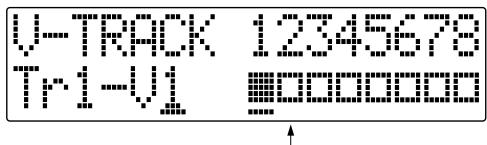
: V-Tracks with recorded data.
□ : V-Tracks without data.
2
Use the REC TRACK [1]-[7/8] to select the track to be altered.
- You can also select tracks with CURSOR [ ] [ ].
3
Turn the TIME/VALUE dial and change the V-Track.
4
After you finish changing the V-Track, press [V-TRACK] (or [EXIT]) to return to the Play screen.
Adjusting the Perception of Stereo in the Input Sounds (Pan)
To change the stereophonic sense of the instrument sounds being input (pan), use the following procedure.
1
Confirm that [PAD] is not lit, then press [PAN/EQ/LOOP FX].
2
Press CURSOR [ ] [ ] to move the cursor to "PAN," and press [ENTER].
The PAN settings screen appears in the display.
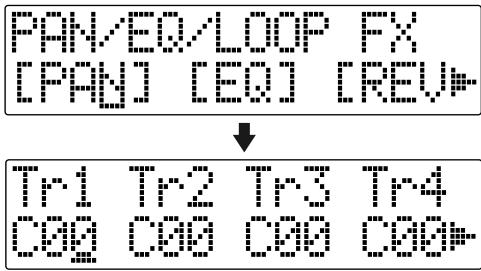
3
Press CURSOR [ ] to display "IN."

4
Turn the TIME/VALUE dial to change the pan settings. The pan settings made here are automatically applied to the track that you are recording to, so that after recording is complete, you can listen to the track with the same pan as that when it was recorded.
5
Press [PAN/EQ/LOOP FX] (or [EXIT]) to return to the Play screen.
MEMO
When you record new material while listening to a recorded performance, your playing may tend to be buried in the existing performances, making it difficult for you to play. If this is the case, you can change the positioning (or panning) of the INPUT and record it so that it is not buried underneath the other sounds.
Pan the playback tracks to left (or right) and the sound you are playing to right (or left) to make it easier to hear yourself.
Recording Operations
1
Press [REC MODE] repeatedly until INPUT indicator lights up.
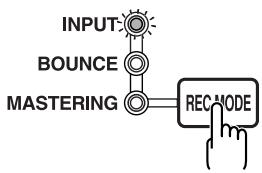
2
Press [REC].
[REC] flashes in red and the BR-600 enters the recording standby state.
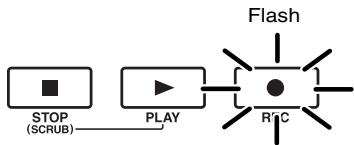
3
Press [PLAY].
[PLAY] lights in green, the [REC] and REC TRACK buttons now light solidly instead of flashing in red, and recording begins.
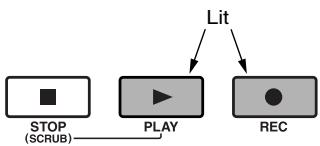
4
When you finish recording, press [STOP].
The REC TRACK button lights alternately in orange and green, indicating that track contains recorded data.
- During updating, "Keep power on!" appears in the upper line of the display, while the lower line shows what is being processed.
NOTE
- You cannot play back sounds recorded for less than one second.
-
The following operations cannot be used, or are disabled, while the recorder is in use (during recording and playback).
-
Recording patterns
- Editing arrangements
- Selecting drum kits
- Switching to the USB screen
- Switching to the Tone Load screen
- Switching to the Song Selection screen
- Switching to the Song New screen
- Switching to the Song Information screen
- Switching to the Edit Song screen
Track Editing - Switching to the Initialize screen
Tuner
Repeating Playback (Repeat)
By using the "Repeat function" you can repeatedly play back a specified part. Repeating playback allows you to check the mixing balance or perform loop recordings (p. 63) with the punch in/out functions.
Playback repeats in the portion set with Repeat as shown below.
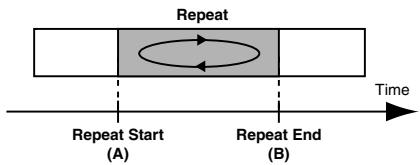
1
Press [REPEAT] at the point where you want the repeat to begin (A).


The [REPEAT] begins to flash, telling you that the repeat start point (A) has been registered.
2
Press [REPEAT] at the point where you want the repeat to end (B).


The [REPEAT] lights up, indicating that the repeat portion has been registered.
3
If you want to cancel the repeat, press [REPEAT] once more.
The repeat is cancelled, and the [REPEAT] goes out.
4
If you want to save the registration for this repeating segment, save the song.

"Saving the Current Settings to the Song (Song Save)" (p. 89)
NOTE
- There must be at least one second between repeat start point (A) and repeat end point (B). It is not possible to set the end point less than one second away from the start point.
- If you press [REPEAT] at a position before the repeat start point (A), that earlier position is then set as the repeat start point (A).
Setting the Repeat Portion with Accurate Timing
Normally, the repeat start and end points are registered at the exact position where [REPEAT] is pressed. This may make it difficult for you to set the repeat portion exactly as you desire.
If this is the case, you can use the quantize function to have the time [REPEAT] is pressed be adjusted to the timing of the song. The quantize function allows you to set the timing in one-measure units.
Perform the procedure given below to use the quantize function.
1 Confirm that [PAD] is not lit, then press [UTILITY].
2 Press CURSOR [ ] [ ] to move the cursor to "SYS," and press [ENTER].
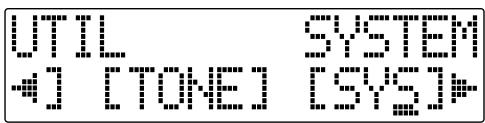
3 Press CURSOR [ ] [ ] to select "AB Qtz," and turn the TIME/VALUE dial to turn the setting on. When off, the quantize function will not work.
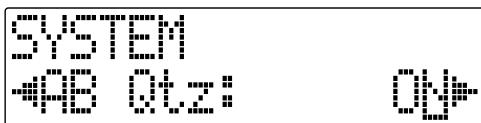
Press [UTILITY] (or press [EXIT] repeatedly) to return to the Play screen.
- During updating, "Keep power on!" appears in the upper line of the display, while the lower line shows what is being processed.

Changing the tempo after having made the quantize function settings in a repeated portion will result in timing discrepancies between the repeat start and end points and the beginnings and ends of measures.
HINT
- You can set the repeat portion to one measure by pressing [REPEAT] twice at the same position.
-
When the repeat portion is set, you can use the following functions to edit your recorded track data.
-
"Copying the repeated portion (AB)" (p. 77)
- "Moving the repeated portion (AB)" (p. 80)
- "Erasing the repeated portion (AB)" (p. 83) Before using these functions, you can use the quantize function to set the repeat portion with accurate timing.
Re-recording Only a Mistake (Punch-in/out)
You may occasionally make a mistake while recording, or the performance may not turn out as you expect. In this case, you can punch in/out to re-record only the portion that is mistaken.
Changing to recording during the playback of a song is referred to as punching in, and changing from recording to playback is referred to as punching out.
Therefore, punch in at the location where you want to begin the re-recording, and punch out at the location where you want the re-recording to end.
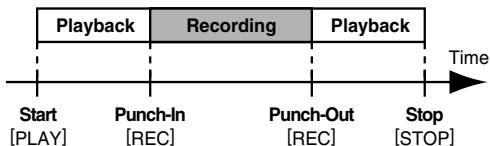
With your BR-600, you can choose from manual or automatic punching in/out.
Manually Punching In/Out
You can use the [REC] or a foot switch to punch in or out.
- When using manual punch-in/out, you need to allow for an interval of at least one second between the punch-in and punch-out points.
Manually punching in and out using [REC]
As an example of use, the explanation below assumes you are manually punching in and out to re-record a portion of track 1, which is a track to which you have already recorded.
1 Press REC TRACK [1].
REC TRACK [1] lights alternately in orange and green.
2 Place the fader for track 1 at the location shown below.
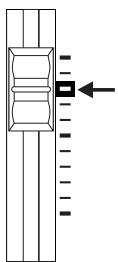
3 Start playback and adjust the volume of the input source using the REC LEVEL dial.
Listen to the track you will be re-recording and the input source and adjust the volume of the input source using the REC LEVEL dial so that it is the same level as the track.
4 Move to a position before where you want to start re-recording and press [PLAY] to start playback.
Press [REC] to punch in at the location where you want to start recording.
The BR-600 starts recording.
6 To punch out, press [REC] (or [PLAY]) again.
Each time you press [REC], you punch in and punch out, so if there is another location that you want to redo, then you can punch in again at that location using the same procedure.
7 Press [STOP] to stop recording.
- During updating, "Keep power on!" appears in the upper line of the display, while the lower line shows what is being processed.
8 Listen to the re-recorded results.
Return the song to a point earlier than you re-recorded, and play it back.
Adjust the volume of track 1 using the TRACK fader.

- You can use the Undo function (p. 64) to revert to the condition before re-recording.
- The data prior to punch-in/out will remain on the memory card without being erased. If this data is no longer needed, in order to use the memory card effectively, use the song optimize function (p. 87) to delete unneeded data from the memory card.
Manually punching in and out using a foot switch
It can be difficult sometimes to punch in and out with the [REC] button when both playing an instrument and recording by yourself. In such situations, you may find it convenient to connect a sold separately foot switch (such as a BOSS FS-5U or Roland DP-2) and use the foot switch to punch in and out.
In order to use a foot switch
When you are using a sold separately foot switch to punch in and out, connect the foot switch to the FOOT SW jack on the BR-600 and change the function of the FOOT SW jack by following the procedure given below.
1 Confirm that [PAD] is not lit, then press [UTILITY].
2 Press CURSOR [ ] [ ] to move the cursor to "SYS," and press [ENTER].
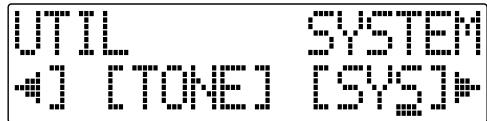
3 Press CURSOR[ ] [ ] and select "Foot SW."
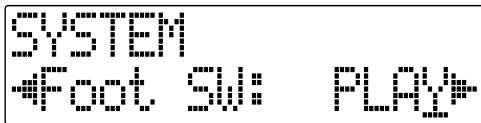
4 Turn the TIME/VALUE dial and select "PUNCH" (PUNCH IN/OUT).
Press [UTILITY] (or press [EXIT] repeatedly) to return to the Play screen.
- During updating, "Keep power on!" appears in the upper line of the display, while the lower line shows what is being processed.
MEMO
In operating the foot switch during playback of a song (manual patch in and out), press the foot switch once to punch in, then press it again to punch out.
Auto Punching In and Out
Automatically punching in and out at predetermined locations (or times) in the song is referred to as "auto punching in/out."
When you want to punch in and out at accurate times or when you want to concentrate on playing rather than punching in and out manually, the auto punch in/out function is very useful.
- When using auto punch-in/out, you need to allow for an interval of at least one second between the punch-in and punch-out points.
■ Specifying the area for auto punching in/out
Before you begin recording, you must register the locations at which punch-in and punch-out will occur automatically.
1 Register the location where you want to punch in. Move the location where you want to punch in and press AUTO PUNCH [IN] to register that location for automatic punch in.
At this time, the AUTO PUNCH [IN] lights, telling you that the punch-in position is registered.
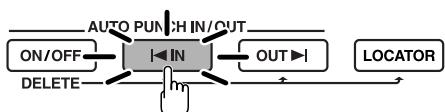
- If the AUTO PUNCH [IN] is lit, you will automatically move to the registered punch-in time when this button is pressed.
2 Register the location where you want to punch out. Move the location where you want to punch out and press AUTO PUNCH [OUT] to register that location for automatic punch out.
At this time, the AUTO PUNCH [OUT] lights, telling you that the punch-out position is registered.
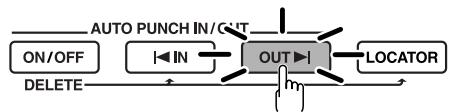
- If the AUTO PUNCH [OUT] is lit, you will automatically move to the registered punch-out time when this button is pressed.
MEMO
If you want to punch in/out at a previously set locator point, press [LOCATOR] to move to the locator point (p. 72), and press AUTO PUNCH [IN] or AUTO PUNCH [OUT].
Erasing a registered auto punch in/out location
- To erase an auto punch-in location, press and hold AUTO PUNCH [ON/OFF] and then press [IN].
- To erase an auto punch-out location, press and hold AUTO PUNCH [ON/OFF] and then press [OUT].
When the settings are erased, the AUTO PUNCH [ON/OFF], [IN], and [OUT] go out.
If you want to save the auto punch in/out settings in the currently selected song, hold down [STOP], and press [REC].
- During updating, "Keep power on!" appears in the upper line of the display, while the lower line shows what is being processed.
How to record
As an example of use, the explanation below assumes you are using the auto punch in/out to re-record a portion of track 1, which is a track to which you have already recorded.
1 Press REC TRACK [1].
REC TRACK [1] lights alternately in orange and green.
2 Place the fader for track 1 at the location shown below.
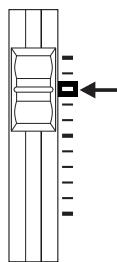
3 Start playback and adjust the volume of the input source using the REC LEVEL dial.
Listen to the track you will be re-recording and the input source and adjust the volume of the input source using the REC LEVEL dial so that it is the same level as the track.
4 Move to a position before where you want to start rerecording and press AUTO PUNCH [ON/OFF].
The button lights up, showing that the auto punch in and out have been set.
Press [REC] to place the BR-600 in recording standby and then press [PLAY].
Recording automatically starts at the auto punch-in location, so start playing what you want to record.
At the point you specified for punch-out, the track will automatically change back to play mode.
6 Press [STOP] to stop recording.
- During updating, "Keep power on!" appears in the upper line of the display, while the lower line shows what is being processed.
7 Listen to the re-recorded results.
Return the song to a point earlier than you re-recorded, and play it back.
Adjust the volume of track 1 using the TRACK fader.
Repeatedly Recording Over the Same Location (Loop Recording)
The repeat function (p. 58) allows you to play a certain portion of a song (the loop portion) over and over again.
If you used auto punch in/out together with the repeat function, the portion will be repeated so the result of the recording can be heard right away.
If the recording did not sound as you wished, simply press [REC] and redo the recording.
Using the repeat function and auto punch in/out together in this manner to repeatedly perform recording is known as "loop recording."
- For details on how to set the portion where recording will occur (the portion between the punch-in and punch-out positions), refer to "Auto punching in and out" above.
Setting the portion to be repeated
Before you begin recording, you will need to set the starting and ending position of the portion to be repeated.
- The portion to be repeated should contain the portion that you wish to re-record (the portion between the punch-in and punch-out points).
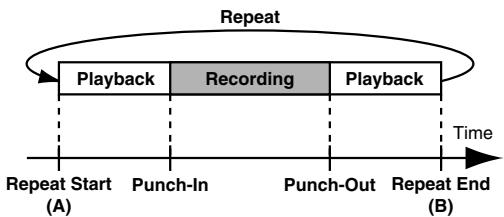
If the portion to be re-recorded is not fully contained in the repeat portion, the recording may not start or end as desired.
How to record
As an example of use, the explanation below assumes you are using the auto punch in/out to re-record a portion of track 1, which is a track to which you have already recorded.
1 Press REC TRACK [1].
REC TRACK [1] lights alternately in orange and green.
Place the fader for track 1 at the location shown below.
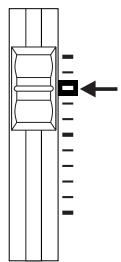
3 Use the repeat function (p. 58) to repeat the playback of the song and adjust the volume of the input source using the REC LEVEL dial.
Listen to the track you will be re-recording and the input source and adjust the volume of the input source so that it is the same level as the track.
4 Press [STOP].
Press AUTO PUNCH [ON/OFF].
The button lights, showing that the auto punch in and out have been set.
6 When you are ready to record, press [REC], then press [PLAY] to begin recording.
After you press [PLAY], you can record from the time the first punch-in is reached until the time the punchout is reached. Re-record the portion as desired.
When the song is repeated, you can check the result of what you just recorded. If the recording is not satisfactory, press [REC] and perform the recording again.
7 Press [STOP] to stop recording.
- During updating, "Keep power on!" appears in the upper line of the display, while the lower line shows what is being processed.
Press [REPEAT] to make the button go dark.
9 Press AUTO PUNCH [ON/OFF] to make the button go dark.
Canceling an Operation (Undo/Redo)
Occasionally when the recording you make may not turn out as you wish, or the settings you make for an editing operation are incorrect, and you want to reverse what you have done. At these times, you can use the "Undo function."
The Undo function reverses the action you have just performed and returns you to the status you were in beforehand. To reverse an Undo, you must use the "Redo function."
For example, suppose you are punching in to loop record and record over the same location twice. To undo the recording you just performed and return to the first recording, you would use the Undo function.
To then reverse the Undo and return to the condition that you were in immediately after the second recording, you would use the Redo function.

- After you have performed an Undo, you can only perform a Redo (you cannot perform an Undo again).
- If you record something, or carry out Track Edit after performing an Undo, it will no longer be possible to perform a Redo.
- The Undo applies to audio data recorded to the tracks.
- Keep in mind that the history of all operations you've carried out with respect to the recorded data will be cleared as soon as you carry out a Song Optimize (p. 87). This means that once you execute Song Optimize, you'll no longer be able to perform an undo.
Reversing the Last Operation (Undo)
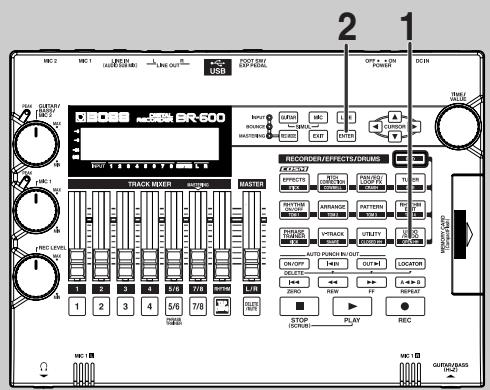
1
Confirm that [PAD] is not lit, then press [UNDO/ REDO].
"UNDO?" appears in the display.
2
To execute Undo, press [ENTER].
Press [ENTER] to reverse the last performed recording or editing operation.
If you decide not to Undo, press [EXIT].
Canceling the Undo (Redo)
To reverse the Undo you just executed, perform a Redo.
1
Confirm that [PAD] is not lit, then press [UNDO/ REDO].
"REDO?" appears in the display.
2
To execute Redo, press [ENTER].
The Undo you just performed is reversed.
If you decide not to Redo, press [EXIT].
Putting Multiple Tracks Together (Bounce)
Although the BR-600 allows the simultaneous playback of eight tracks, when you run out of tracks, the BR-600 also lets you copy the recordings of multiple tracks together onto one track (V-Track). This is called "bounce" (also known as bounce recording or ping-pong recording).
By combining multiple tracks in this way, you can free up other tracks in order to record additional performances.
HINT
In bounce mode, you can play back eight tracks simultaneously and record them all to a single, separate V-Track.
When input sources are selected with INPUT SELECT, you can have those sounds recorded together.
Furthermore, you can include the sounds from the Rhythm in the recording.
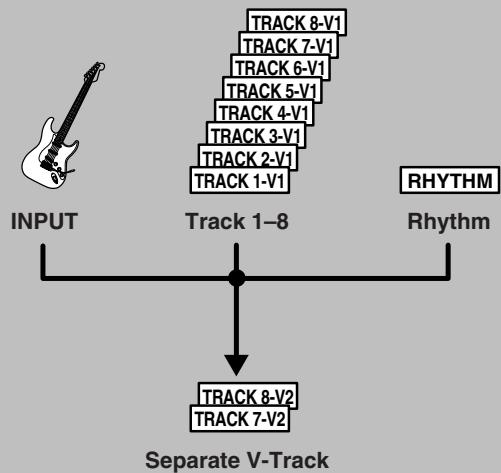
The explanation below uses an example of mixing the monaural recording on tracks 1 and 2 and the stereo recording on tracks 3 and 4, and bouncing them to V-Track 2 of tracks 7/8.
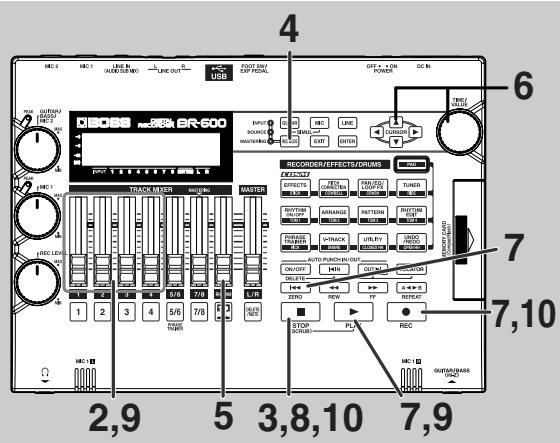
1
Set the pan for tracks 1 and 2 to the locations you desire, set the pan for track 3 all the way to the left (L50), and the pan for track 4 all the way to the right (R50).

"Adjusting the Perception of Stereo for the Sound (Pan)" (p. 49)
2
Play back the song and adjust the volumes for the tracks 1 to 4 using the REC TRACK faders.
The overall volume is adjusted by the MASTER fader. At this time, raise the volume as high as possible without allowing the sound to distort.
Lower the faders for the tracks that you do not want to mix.
3
Press [STOP].
4
Press [REC MODE] repeatedly until "BOUNCE" indicator lights up.
The input source is automatically muted. This prevents the input source from being mixed in and recorded during bounce recording.
5
If you want to mix in the sound of the Rhythm as well, increase the Rhythm fader.
If you do not want to record the Rhythm, lower the fader.
6
Use CURSOR [ ][▶] and the TIME/VALUE dial to select the recording-destination track/V-Track.
Here, set this to "78V2" (V-Track 2 of Tracks 7/8).
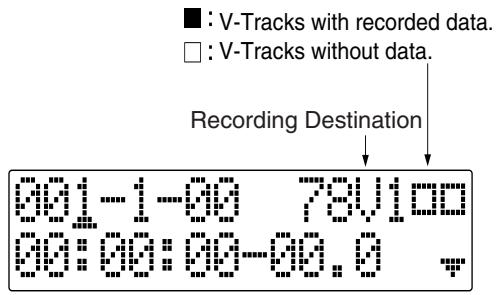
(When bouncing while recording in mono)
If you turn the TIME/VALUE dial at this time, the screen for specifying the track for mono recording is displayed.
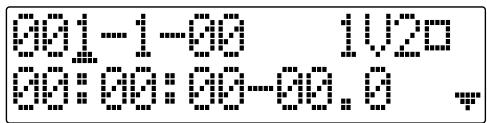
7
After pressing [ZERO] to return to the time location 00:00:00-00.0, press [REC] and then press [PLAY] to start bounce recording.
8
When you are finished recording, press [STOP].
- During updating, "Keep power on!" appears in the upper line of the display, while the lower line shows what is being processed.
9
Lower all TRACK faders except those for Tracks 7 and 8, press [PLAY], and then check the sounds bounced to Tracks 7 and 8.
- The pan for tracks 7 and 8, where the music was bounced, is set all the way to the left and right respectively.
10
If you want to save the settings in the currently selected song, hold down [STOP], and press [REC].
- During updating, "Keep power on!" appears in the upper line of the display, while the lower line shows what is being processed.
MEMO
- When using bounce recording, you can record the sounds with insert effects (p. 92), loop effects (p. 118), Track EQ (p. 121), or Pitch Correction (p. 123) applied. When using the insert effects, refer to "Changing the destination Insert Effects are Connected" (p. 95).
- If you wish to mix an input source as part of the bounce recording, press [INPUT SELECT] to select the desired input source. At this time, you can apply loop effects (p. 118) to the sound of the input source.
You can load songs created with the BR-900CD, BR-864, or BR-532 into the BR-600 via memory cards.
Loading Songs Created with the BR-900CD/BR-864
First, save the song data created with the BR-900CD or BR-864 to a memory card, then insert the memory card into the BR-600.
1 Confirm that [PAD] is not lit, then press [UTILITY].
2 Press CURSOR [ ] [ ] to move the cursor to "SEL," and press [ENTER].
The Song Select screen is appeared.
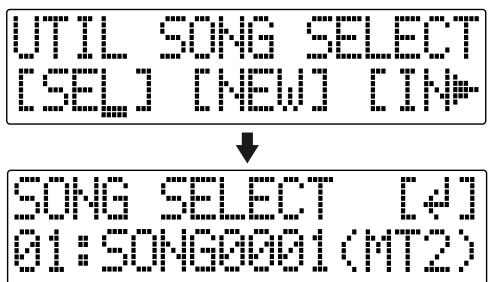
3 Rotate the TIME/VALUE dial to select the song to be loaded.
Press [ENTER]. The song data is loaded. The song protect icon ( ) is indicated for the BR-900CD/BR-864 songs.
NOTE
- Once you record, edit, or set parameters for imported BR-864 song data, that particular song data can no longer be used by the BR-864. (The data can be used with the BR-900CD.) To protect against accidental recording or editing, song protect (p. 88) is automatically switched on for imported BR-864 song data.
If you can accept the fact that you will no longer be able to use the song data with the BR-864, you can switch song protect off, then carry out recording or editing.
When you turn off song protect, "Overwrite OK?" appears in the display; press [ENTER] (YES). Song protect is switched off, and the data is simultaneously converted to BR-600 format.
- When the "Guitar Synth" algorithm is used with the BR-864, an asterisk ("*") is added before the patch name, and the patch's algorithm and parameter values will be the same as those in "P01: JC Clean" in the GUITAR bank.
In addition, if "Harmonist" is used for the effect, the "Flanger" effect is substituted for it. The patch name is not changed.
Loading Songs Created with the BR-532
When copying song data created with the BR-532 from SmartMedia to a BR-600 memory card, you can load the data as a BR-600 song.
Fist, insert the memory card containing the copy of the desired data into the BR-600.
1
Confirm that [PAD] is not lit, then press [UTILITY].
2
Press CURSOR [ ] [ ] to move the cursor to "SEL," and press [ENTER].
The Song Select screen is appeared.
3
Rotate the TIME/VALUE dial to select the song to be loaded.
4
Press [ENTER].
The song data is loaded.
The song protect icon ( ) is indicated for the BR-532 songs.

- Reading BR-532 data requires a PC with a SmartMedia reader and CompactFlash writer connected.
First, copy the data on the BR-532 memory card (SmartMedia) to the PC with the SmartMedia reader, and use the CompactFlash writer to copy that data from the PC to a BR-600 memory card.
- The data remains in BR-532 format immediately after loading. Once the loaded song is saved, the data is converted (p. 89) to BR-600 format.
Displaying the Remaining Available Recording Time
Follow the procedure below to either display the elapsed recording time in the recording standby and recording screens.
1
Confirm that [PAD] is not lit, then press [UTILITY].
2
Press CURSOR [ ] [ ] to move the cursor to "SYS," and press [ENTER].
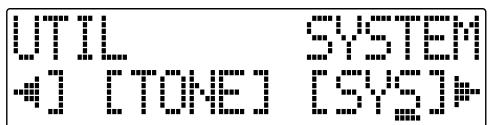
3
Press CURSOR [ ] [ ] to select "Remain Inf," and turn the TIME/VALUE dial to select "ON."
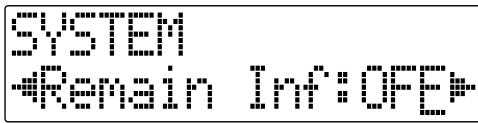
ON: Displays the remaining available recording time in "minutes: seconds."
OFF: Doesn't display the remaining available recording time.
4
Press [UTILITY] (or press [EXIT] repeatedly) to return to the Play screen.
- During updating, "Keep power on!" appears in the upper line of the display, while the lower line shows what is being processed.
- When [REC] is pressed in the Play screen, putting the BR-600 into record standby ([REC] flashes), the remaining recording time is displayed in the TIME area.
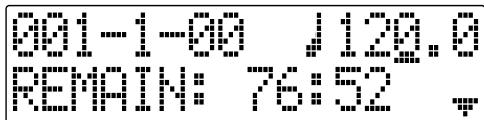
Displaying the Memory Card Usage
Follow the procedure below to display the current condition of the memory card being used.
1
Confirm that [PAD] is not lit, then press [UTILITY].
2
Press CURSOR [ ] [ ] to move the cursor to "INF," and press [ENTER].
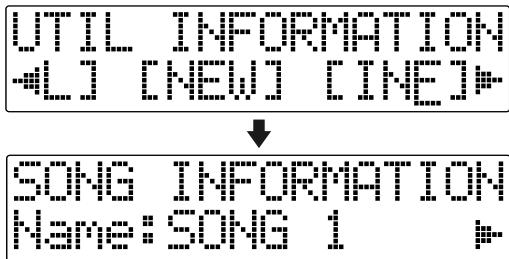
3
Press CURSOR [ ] [ ] to select the parameter to be displayed.
Name of the currently selected song
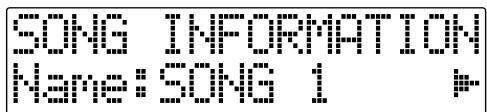
Song's data type and memory used (Size: MB)
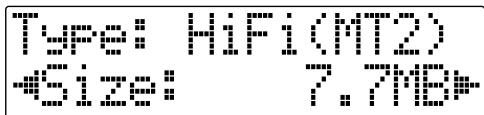
Data Type
HiFi (MT2) High-quality recording type
STD (LV1) Standard recording type
LONG (LV2) Long recording type
Remaining memory
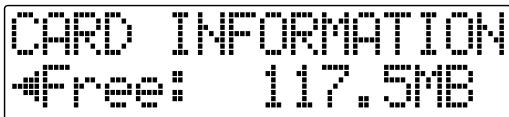
- The song sizes are displayed in units of 1MB = 1,048,576 bytes. The size displayed is an approximation.
4
Press [UTILITY] (or press [EXIT] repeatedly) to return to the Play screen.
MEMO
Section 2 Editing
Registering Time (Locator)
Using the locator function, you can register any desired time in a song as a "locator point" so that you can jump to that point later with just the press of a button.
This function is quite useful during editing.
Registering a Locator Point
1
At the Play screen, move to the location where you want to register the locator point.
2
Press [LOCATOR].
When the [LOCATOR] lights up, registration is complete.
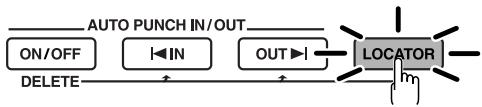
Moving to the Locator Point
1
Press [LOCATOR].
This moves you to the time in the song registered as a locator point.
Deleting a Locator Point
1
Press and hold AUTO PUNCH [ON/OFF], then press [LOCATOR].
The locator point is deleted.
Scrub function
When editing a sound, some times you need to know exactly where the sound starts, or exactly where the recording with an auto punch in starts.
To enable you to find these points accurately, the BR-600 is equipped with the Scrub function.
When you use the Scrub function during playback (called "scrubbing"), the portion from your before or after the current position (approximately 45 msec) is played back and repeated.
Preview function
With the Preview function, you can playback the one-second portion of the song before or after your current position.
By using this together with the Scrub function, at the same time slowly moving your current position in the song, it becomes easy to find the exact transition point from one phrase to the next.
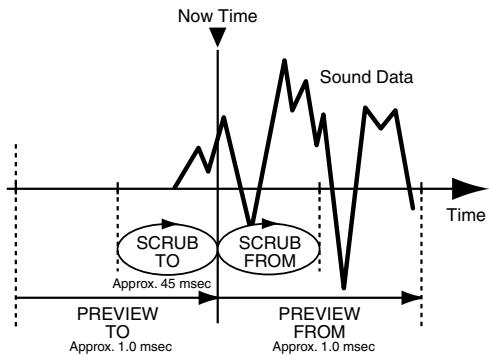
Scrubbing to Find the Music Starting/Ending Point
1 Hold down [STOP] and press [PLAY].
The [PLAY] begins flashing and scrubbing starts.
The “ ” (SCRUB FROM) and “ · ” (SCRUB TO) displayed at the TEMPO position in the screen are the scrub points with respect to the current position.
When the cursor is set under the scrub point, it is possible to change scrub point by TIME/VALUE dial.
![ROLAND BR-600 - Hold down [STOP] and press [PLAY]. - 1](/content/2025/01/130576/images/ab5a389c27a562b915dbbe6721d1de6ece4c661856a6d461529689361f2db495.jpg)
2 Slowly turn the TIME/VALUE dial to move the current position and search for the starting point of the phrase (e.g., where sound is first emitted).
3 After you find the exact point where the music starts, press [STOP] to stop scrubbing.
MEMO
- You can press [PLAY] to preview the material to or from the currently selected scrub point.
PREVIEW FROM
PREVIEW TO
- To mute the sound of a particular track, hold down [DELETE/MUTE] and press the relevant REC TRACK button so it starts blinking.
- You can now press [LOCATOR] to register a locator point so that you can find the point easily later.
Changing the Scrub Points
Besides switching the scrub point in the Play screen (p. 73), you can also use the following method to switch the scrub point.
1
Confirm that [PAD] is not lit, then press [UTILITY].
2
Press CURSOR [ ] [ ] to move the cursor to "SCR," and press [ENTER].
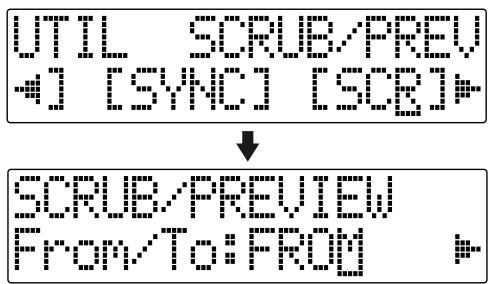
3
Press CURSOR[ ] [ ] to select "FROM/TO," and turn the TIME/VALUE dial to change scrub points.
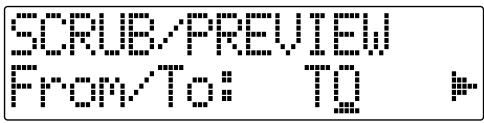
TO: Scrubs to your current position.
FROM: Scrubs from your current position.
4
After completing the setting, press [UTILITY] (or press [EXIT] repeatedly) to return to the Play screen.
Enabling Use of the Preview Function with [REW] and [FF]
Besides using [PLAY] for the Preview function (p. 73), you can also set the unit so that [REW] and [FF] can be used with the Preview function.
1
Confirm that [PAD] is not lit, then press [UTILITY].
2
Press CURSOR [ ] [ ] to move the cursor to "SCR," and press [ENTER].
![ROLAND BR-600 - Enabling Use of the Preview Function with [REW] and [FF] - 1](/content/2025/01/130576/images/f3e1d739139b456a1af1ed11915fc1dabf4223e5ca664a0016b54fd2473f1730.jpg)
3
Press CURSOR [▶] to select "Preview SW," and turn the TIME/VALUE dial to set "ON."
![ROLAND BR-600 - Enabling Use of the Preview Function with [REW] and [FF] - 2](/content/2025/01/130576/images/811089e2a4d362f1457831c5b10dfe558f1a82f7b1e727ed4a9a10700a3df13e.jpg)
This enables use of the Preview function.
4
Press [UTILITY] (or press [EXIT] repeatedly) to return to the Play screen.
MEMO
You can temporarily switch to Preview during scrub with the following operations.
Press [REW]: PREVIEW TO
Press [FF]: PREVIEW FROM
The BR-600 allows you to edit your songs by performing editing functions such as copying and moving data recorded on the tracks.
About the Measure/ Time Specification screen
Measures and time are specified in the "S" (Start), "E" (End), and "T" (To) screens in Track Edit as shown below.
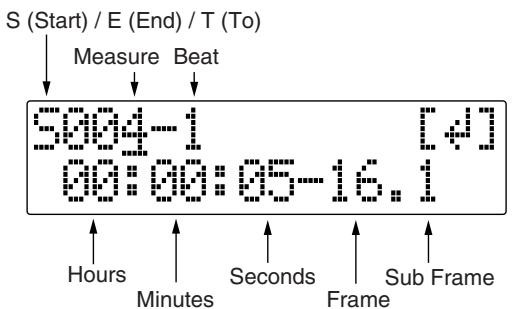
(Ex.)
MEMO
- The material edited with Track Edit is saved to the song when you return to the Play screen. The message "Keep power on!" appears in the lower row of the display while the data is being updated.
- To copy, move, or erase repeated portions, you first need to set the portion to be repeated, using the procedure described on p. 58.
Copying Data (Track Copy)
Track Copy allows you to copy a specific part of data and then place it in a different location.
You can perform editing operations such as copying the data on a track all at once, or copying the data from a specified part as many times as you wish.
If, for example, you want to use a phrase from a certain track, or have the same phrase repeated again and again, the copy function will help save you time.
NOTE
- If data exists at the position being copied to, that data will be overwritten.
- The portion being copied must be longer than 1.0 seconds long. If the copied portion is 1.0 seconds or less, no sound will be heard even if the copy is carried out.
■ Copying by specifying the time (TME/MES)
Perform the procedure given below to copy the portion between specific times.
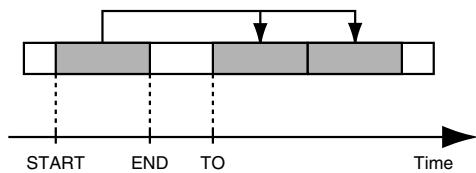
Ex. 1 : Copying twice to the same track
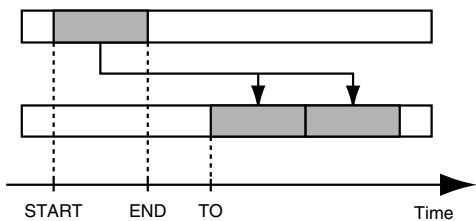
Ex. 2 : Copying twice to another track
1 Confirm that [PAD] is not lit, then press [UTILITY].
2 Press CURSOR [ ] [ ] to move the cursor to "TRK," and press [ENTER].
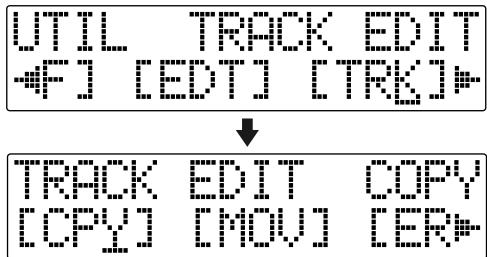
3 Press CURSOR [ ] [ ] to move the cursor to "CPY," and press [ENTER].
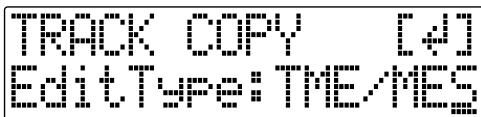
4 Turn the TIME/VALUE dial to select "TME/MES" and press [ENTER].
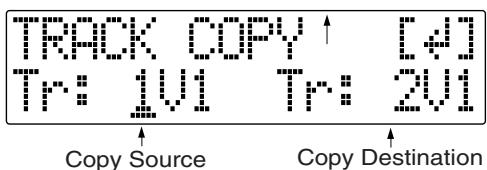
5 Use CURSOR [ ][ ] and the TIME/VALUE dial to select the track/V-Track to copy from, and track/V-Track to copy to.
6 Press [ENTER].
7 Use [CURSOR] and the TIME/VALUE dial to specify the beginning of the portion "S" (Start) of data you want to copy.
8 Press [ENTER].
9 Use [CURSOR] and the TIME/VALUE dial to specify the ending of the portion "E" (End) of data you want to copy.
10 Press [ENTER].
11 Use [CURSOR] and the TIME/VALUE dial to specify the time of the beginning of the location "T" (To) where you want the copied data to be placed.
12 Press [ENTER].
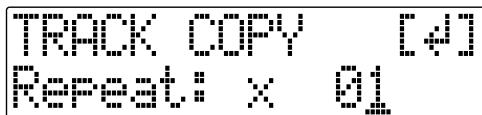
13 Turn the TIME/VALUE dial to select the number of copies you want to be placed.
14 When you are ready to execute the copy, press [ENTER]. The display will ask "Are you sure?", so that you can confirm the operation.
15 Press [ENTER]. The copy is exec
16 Press [UTILITY] (or press [EXIT] repeatedly) to return to the Play screen.
- During updating, "Keep power on!" appears in the upper line of the display, while the lower line shows what is being processed.
MEMO
After specifying the time in the procedure above, a "+" may appear to show that there is a discrepancy between the actual current position and the position displayed. If you specify the locations using measures, specify the locations at each screen using the TIME/VALUE dial to eliminate the discrepancy.
HINT
You can also enter the time using [LOCATOR], [ZERO], [STOP] + [REW], [STOP] + [FF], and AUTO PUNCH [IN/OUT].
- Copying the repeated portion (AB)
Perform the procedure given below to copy the portion from the repeat start (A) to the repeat end (B).
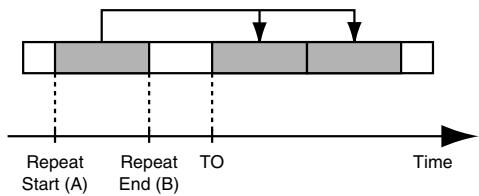
Ex. 1 : Copying twice to the same track
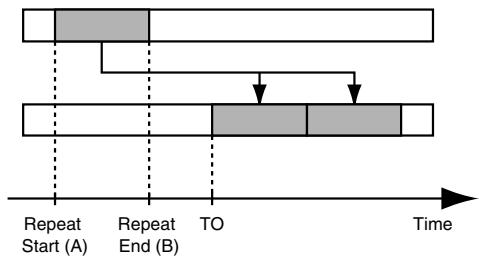
Ex. 2 : Copying twice to another track
1
Confirm that [PAD] is not lit, then press [UTILITY].
2
Press CURSOR [ ] [ ] to move the cursor to "TRK," and press [ENTER].
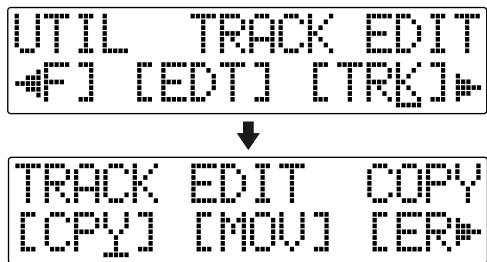
3
Press CURSOR [ ] [ ] to move the cursor to "CPY," and press [ENTER].
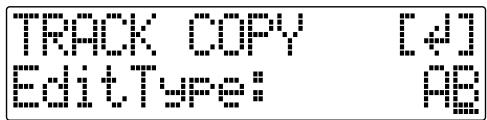
4
Turn the TIME/VALUE dial to select "AB" and press [ENTER].
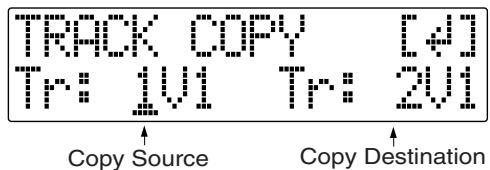
5
Use CURSOR [ ] and the TIME/VALUE dial to select the track/V-Track to copy from, and track/V-Track to copy to.
6
Press [ENTER].
7
Use [CURSOR] and turn the TIME/VALUE dial to specify the time of the beginning of the location "T" (To) where you want the copied data to be placed.
8 Press [ENTER].
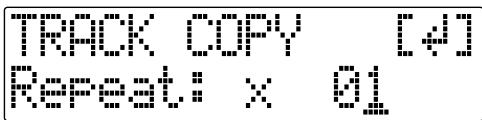
9 Turn the TIME/VALUE dial to select the number of copies you want to be placed.
10 When you are ready to execute the copy, press [ENTER].
The display will ask "Are you sure?", so that you can confirm the operation.
11 Press [ENTER]
The copy is executed.
12 Press [UTILITY] (or press [EXIT] repeatedly) to return to the Play screen.
- During updating, "Keep power on!" appears in the upper line of the display, while the lower line shows what is being processed.
- Copying a complete track (ALL)
Perform the procedure given below to copy the complete recorded data from one track to another.
1 Confirm that [PAD] is not lit, then press [UTILITY].
2 Press CURSOR [ ] [ ] to move the cursor to "TRK," and press [ENTER].
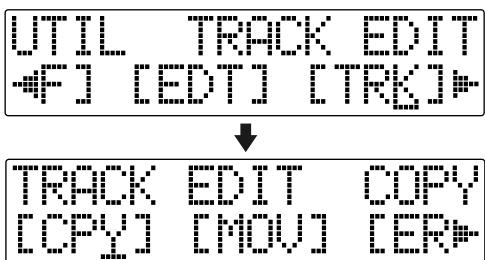
3 Press CURSOR [ ] [ ] to move the cursor to "CPY," and press [ENTER].
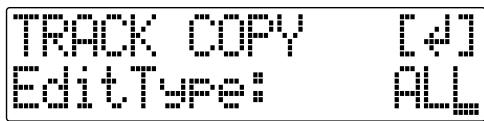
4 Turn the TIME/VALUE dial to select "ALL" and press [ENTER].
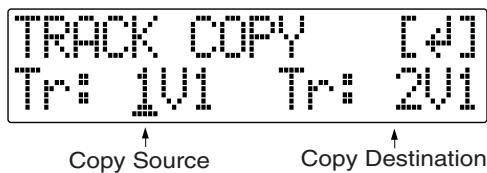
5 Use CURSOR [ ] and the TIME/VALUE dial to select the track/V-Track to copy from, and track/V-Track to copy to.
6 When you are ready to execute the copy, press [ENTER].
The display will ask "Are you sure?", so that you can confirm the operation.
7 Press [ENTER].
The copy is executed.
Press [UTILITY] (or press [EXIT] repeatedly) to return to the Play screen.
- During updating, "Keep power on!" appears in the upper line of the display, while the lower line shows what is being processed.
Moving Data (Track Move)
Track Move allows you to move a specific portion of data to a different location.

After the data is moved, the location it was in will be left empty.
■ Moving by specifying the time (TME/MES)
Perform the procedure given below to move the portion between specific times.
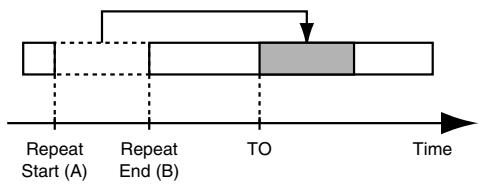
Ex. 1: Moving to the same track
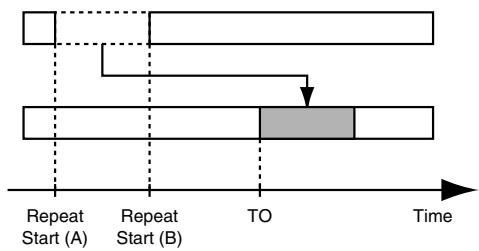
Ex. 2 : Moving to another track
1 Confirm that [PAD] is not lit, then press [UTILITY].
2 Press CURSOR [ ] [ ] to move the cursor to "TRK," and press [ENTER].
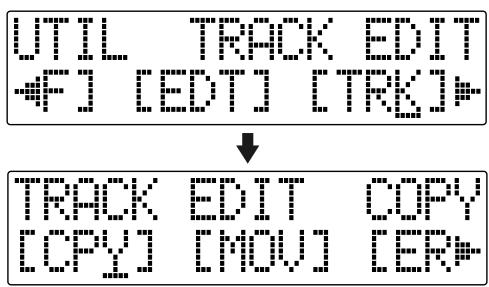
3 Press CURSOR [ ] [ ] to move the cursor to "MOV," and press [ENTER].
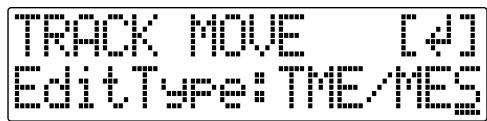
4 Turn the TIME/VALUE dial to select "TME/MES" and press [ENTER].
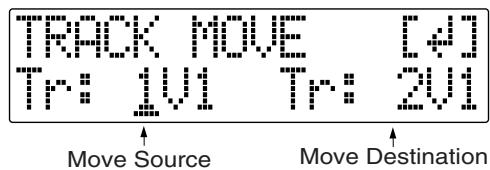
5 Use CURSOR [ ] and the TIME/VALUE dial to select the track/V-Track to move from, and track/V-Track to move to.
6 Press [ENTER].
7 Use [CURSOR] and the TIME/VALUE dial to specify the beginning of the portion "S" (Start) of data you want to move.
8 Press [ENTER].
9 Use [CURSOR] and the TIME/VALUE dial to specify the ending of the portion "E" (End) of data you want to move.
10 Press [ENTER].
11 Use [CURSOR] and the TIME/VALUE dial to specify the time of the beginning of the location "T" (To) where you want the data moved.
12 When you are ready to execute the move, press [ENTER].
The display will ask "Are you sure?", so that you can confirm the operation.
13 Press [ENTER].
Move Event is executed.
14 Press [UTILITY] (or press [EXIT] repeatedly) to return to the Play screen.
- During updating, "Keep power on!" appears in the upper line of the display, while the lower line shows what is being processed.
MEMO
After specifying the time in the procedure above, a "+" may appear to show that there is a discrepancy between the actual current position and the position displayed. If you specify the locations using measures, specify the locations at each screen using the TIME/VALUE dial to eliminate the discrepancy.

You can also enter the time using [LOCATOR], [ZERO], [STOP] + [REW], [STOP] + [FF], and AUTO PUNCH [IN/OUT].
■ Moving the repeated portion (AB)
Perform the procedure given below to move the portion from the repeat start (A) to the repeat end (B).
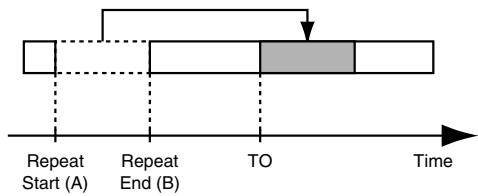
Ex. 1 : Moving to the same track
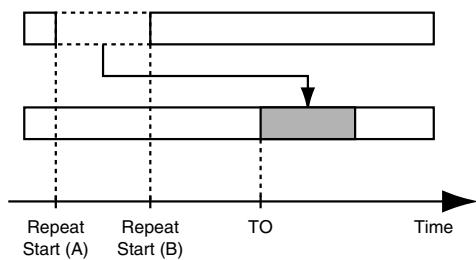
Ex. 2 : Moving to another track
1 Confirm that [PAD] is not lit, then press [UTILITY].
2 Press CURSOR [ ] [ ] to move the cursor to "TRK," and press [ENTER].
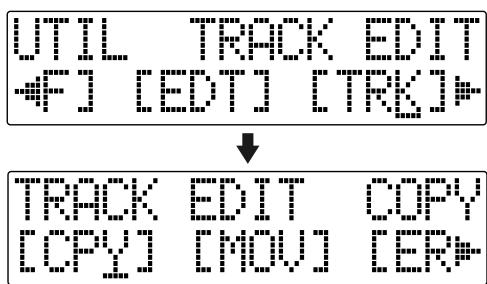
3 Press CURSOR [ ] [ ] to move the cursor to "MOV," and press [ENTER].
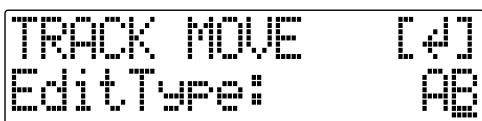
4
Turn the TIME/VALUE dial to select "AB" and press [ENTER].
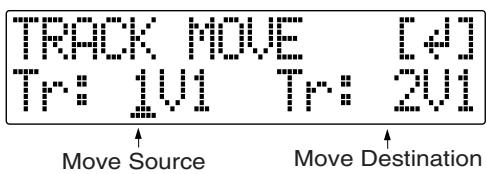
5
Use CURSOR [ ] and the TIME/VALUE dial to select the track/V-Track to move from, and track/V-Track to move to.
6
Press [ENTER].
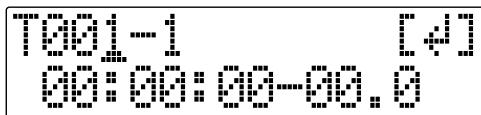
7
Use CURSOR [ ] [ ] and the TIME/VALUE dial to specify the time of the beginning of the location "T" (To) where you want the data to be moved.
8
When you are ready to execute the move, press [ENTER].
The display will ask "Are you sure?", so that you can confirm the operation.
9
Press [ENTER].
Move Event is executed.
10
Press [UTILITY] (or press [EXIT] repeatedly) to return to the Play screen.
- During updating, "Keep power on!" appears in the upper line of the display, while the lower line shows what is being processed.
#
Moving a complete track (ALL)
Perform the procedure given below to move the complete data from one track to another.
1
Confirm that [PAD] is not lit, then press [UTILITY].
2
Press CURSOR [ ] [ ] to move the cursor to "TRK," and press [ENTER].
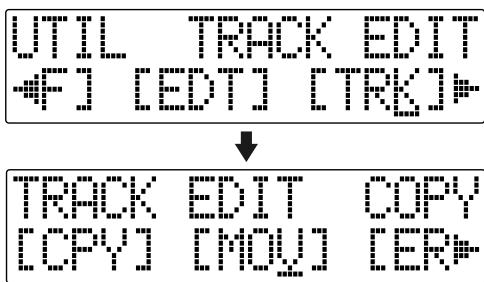
3
Press CURSOR [ ] [ ] to move the cursor to "MOV," and press [ENTER].
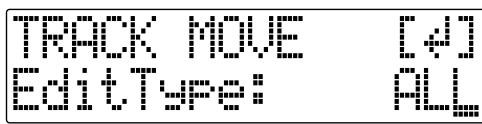
4
"Turn the TIME/VALUE dial to select "ALL" and press [ENTER].
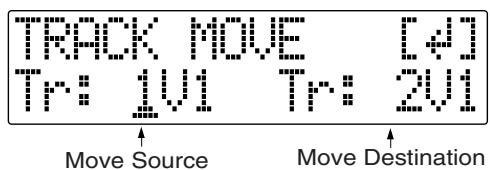
5
Press CURSOR[ ] and the TIME/VALUE dial to select the track/V-Track to move from, and track/V-Track to move to.
6 Press [ENTER].
![ROLAND BR-600 - Press [ENTER]. - 1](/content/2025/01/130576/images/89e719818f2b171015aba1fcaed06b056188f6bd2d9aff67ee393e6800eb27ac.jpg)
7 Use [CURSOR] and the TIME/VALUE dial to specify the time of the beginning of the location "T" (To) where you want the data to be moved.
8 When you are ready to execute the move, press [ENTER].
The display will ask "Are you sure?", so that you can confirm the operation.
9 Press [ENTER].
Move Event is executed.
10 Press [UTILITY] (or press [EXIT] repeatedly) to return to the Play screen.
- During updating, "Keep power on!" appears in the upper line of the display, while the lower line shows what is being processed.
Erasing Data (Track Erase)
Track Erase allows you to erase a specific part of data. Even if data exists after the specified part, it will not be moved forward to fill the gap left by the erasure. Like a normal tape recorder, erasing can be considered covering unwanted data by recording emptiness.

Do not leave a portion of less than 1.0 seconds in length after the erased portion. If a portion that short does remain, it will end up being silent.
Erasing by specifying the time (TME/MES)
Perform the procedure given below to erase the portion between specific times.
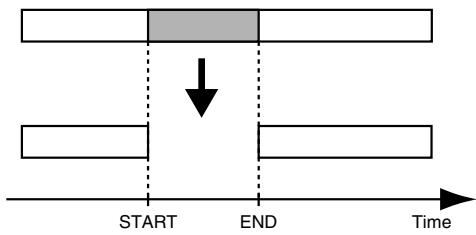
1 Confirm that [PAD] is not lit, then press [UTILITY].
2 Press CURSOR [ ] [ ] to move the cursor to "TRK," and press [ENTER].
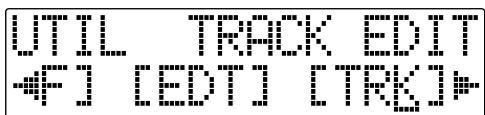
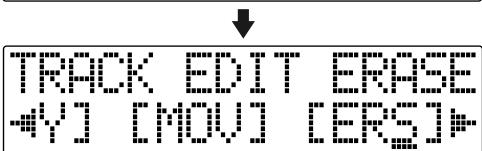
3
Press CURSOR [ ] [ ] to move the cursor to "ERS," and press [ENTER].
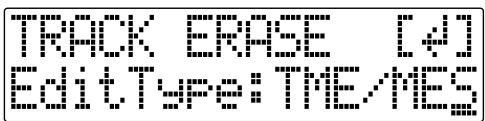
4
Turn the TIME/VALUE dial to select "TME/MES" and press [ENTER].
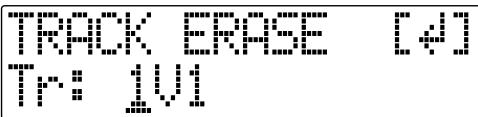
5
Use CURSOR [ ] [ ] and the TIME/VALUE dial to select the track/V-Track to erase from.
6
Press [ENTER].
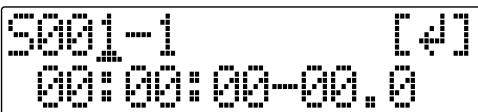
7
Use [CURSOR] and the TIME/VALUE dial to specify the beginning of the portion "S" (Start) of data you want to erase.
8
Press [ENTER].
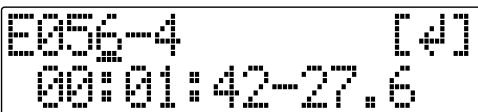
9
Use [CURSOR] and the TIME/VALUE dial to specify the ending of the portion "E" (End) of data you want to erase.
10
When you are ready to execute the erasure, press [ENTER]. The display will ask "Are you sure?", so that you can confirm the operation.
11
Press [ENTER]. The erasure is executed.
12
Press [UTILITY] (or press [EXIT] repeatedly) to return to the Play screen.
- During updating, "Keep power on!" appears in the upper line of the display, while the lower line shows what is being processed.
MEMO
After specifying the time in the procedure above, a "+" may appear to show that there is a discrepancy between the actual current position and the position displayed. If you specify the locations using measures, specify the locations at each screen using the TIME/VALUE dial to eliminate the discrepancy.
HINT
You can also enter the time using [LOCATOR], [ZERO], [STOP] + [REW], [STOP] + [FF], and AUTO PUNCH [IN/OUT].
#
Erasing the repeated portion (AB)
Perform the procedure given below to erase the portion from the repeat start (A) to the repeat end (B).
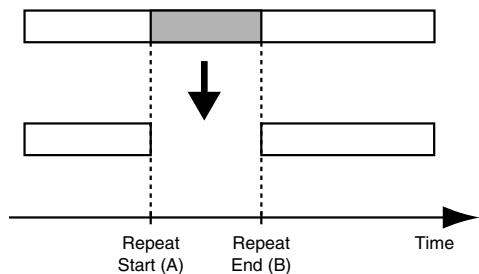
1
Confirm that [PAD] is not lit, then press [UTILITY].
2
Press CURSOR [ ] [ ] to move the cursor to "TRK," and press [ENTER].
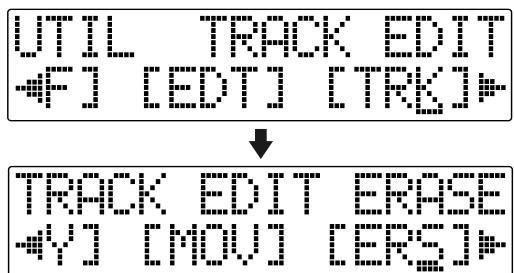
3
Press CURSOR [ ] [ ] to move the cursor to "ERS," and press [ENTER].
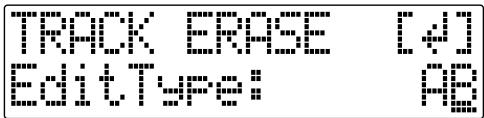
4
Turn the TIME/VALUE dial to select "AB" and press [ENTER].
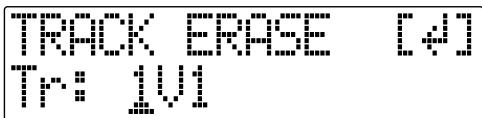
5
Use CURSOR [ ] [ ] and the TIME/VALUE dial to select the track/V-Track to erase from.
6
When you are ready to execute the erasure, press [ENTER].
The display will ask "Are you sure?", so that you can confirm the operation.
7
Press [ENTER].
The erasure is executed.
8
Press [UTILITY] (or press [EXIT] repeatedly) to return to the Play screen.
- During updating, "Keep power on!" appears in the upper line of the display, while the lower line shows what is being processed.
Erasing a complete track (ALL)
1
Confirm that [PAD] is not lit, then press [UTILITY].
2
Press CURSOR [ ] [ ] to move the cursor to "TRK," and press [ENTER].
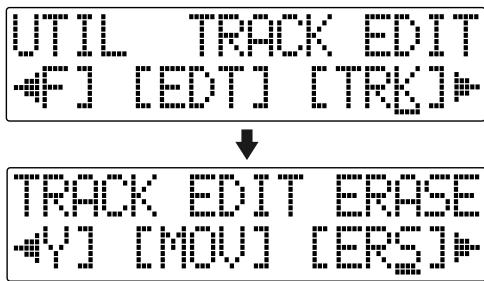
3
Press CURSOR [ ] [ ] to move the cursor to "ERS," and press [ENTER].
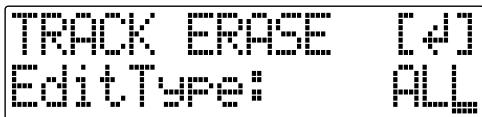
4
Turn the TIME/VALUE dial to select "ALL" and press [ENTER].
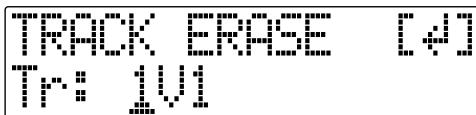
5
Use CURSOR [ ] [ ] and the TIME/VALUE dial to select the track/V-Track to erase.
6
When you are ready to execute the erasure, press [ENTER].
The display will ask "Are you sure?", so that you can confirm the operation.
7
Press [ENTER].
The erasure is executed.
8
Press [UTILITY] (or press [EXIT] repeatedly) to return to the Play screen.
- During updating, "Keep power on!" appears in the upper line of the display, while the lower line shows what is being processed.
Exchanging Data (Track Exchange)
Perform the procedure given below to exchange the data between two tracks.
Ex.: exchanging all the data on track 1 with all the data on track 2
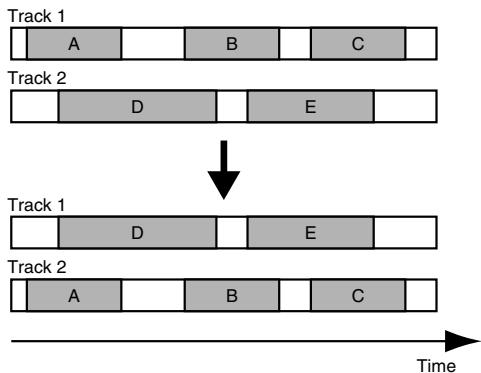
1 Confirm that [PAD] is not lit, then press [UTILITY].
2 Press CURSOR [ ] [ ] to move the cursor to "TRK," and press [ENTER].
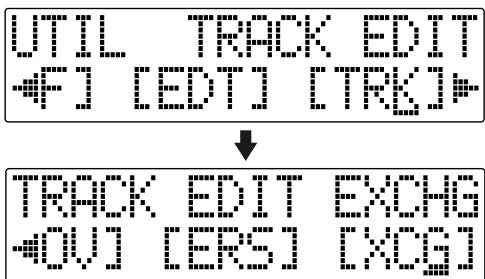
3 Press CURSOR [ ] [ ] to move the cursor to "XCG," and press [ENTER].
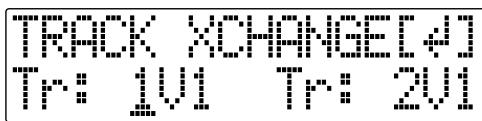
4 Use CURSOR [ ] and the TIME/VALUE dial to select the two tracks/V-Tracks to exchange data.
5 When you are ready to execute the exchange, press [ENTER]. The display will ask "Are you sure?," so that you can confirm the operation.
6 Press [ENTER]. The exchange is executed.
7 Press [UTILITY] (or press [EXIT] repeatedly) to return to the Play screen.
* During updating, "Keep power on!" appears in the upper line of the display, while the lower line shows what is being processed.
Copying a Song (Song Copy)
Follow the procedure below to copy the currently selected song.
1 Confirm that [PAD] is not lit, then press [UTILITY].
2 Press CURSOR [ ] [ ] to move the cursor to "EDT," and press [ENTER].
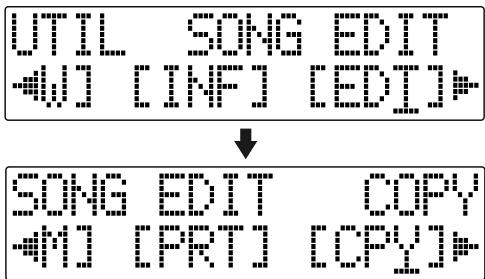
3 Press CURSOR [ ] [ ] to move the cursor to "CPY," and press [ENTER]. The Copy Song screen appears in the display.
Press [ENTER]. The copy is executed. When the copy has been completed, "Completed!" appears in the display, and you are returned to the Play screen.

If "Card Full!" appears
If this message appears before the copy, it means that there is insufficient space on the memory card to complete the copy. Delete any unnecessary recording from the memory card.
Erasing Songs (Song Erase)
Follow the procedure below to erase a song from the memory card.
1 Confirm that [PAD] is not lit, then press [UTILITY].
2 Press CURSOR [ ] [ ] to move the cursor to "EDT," and press [ENTER].
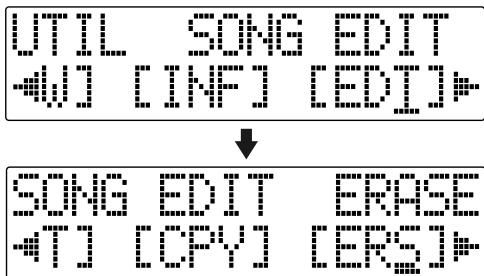
3 Press CURSOR [ ] [ ] to move the cursor to "ERS," and press [ENTER]. The Erase Song screen appears in the display.
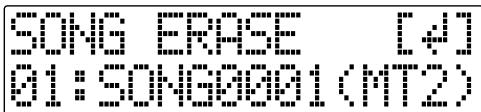
4 Turn the TIME/VALUE dial and select the song to be erased.
5 After selecting the song to erase, press [ENTER]. "Are you sure?" appears in the display.
6 To continue with the erasure, press [ENTER]. To cancel the operation press the [EXIT] (or [UTILITY]).
7 Press [UTILITY] (or press [EXIT] repeatedly) repeatedly to return to the Play screen.

If you erase a song currently being used, the song on the memory card with the lowest number is selected. If there are no other songs on the card, a new song is created.
Saving Memory on the Memory Card (Song Optimize)
When you perform overdubbing or punch-in/out, the data that you rewrite (replace) actually remains on the memory card. In some cases, this unwanted data may occupy a significant amount of space on the memory card. This will cause the time available for recording to be less than it should be.
By performing a "Song Optimize", you can have the BR-600 erase any unnecessary data on the memory card and increase the unused space.
1 Confirm that [PAD] is not lit, then press [UTILITY].
2 Press CURSOR [ ] [ ] to move the cursor to "EDT," and press [ENTER].
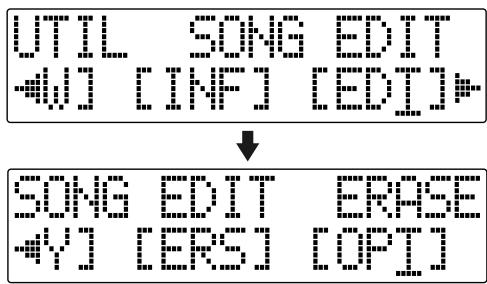
3 Press CURSOR [ ] [ ] to move the cursor to "OPT," and press [ENTER]. "Are you sure?" appears in the display.
4 To continue with the optimization, press [ENTER]. The Song Optimize function is carried out. When completed, "Completed!" appears in the display, and you are returned to the Play screen. To cancel the operation press the [EXIT] (or [UTILITY]).
NOTE
- Depending on the situation, an appreciable length of time may be required for Optimize to be completed. This is not a malfunction. Do not turn off the power until Optimize has completed.
- After you execute Optimize, it is not possible to undo/redo to revert to the state before executing Optimize.
Naming a Song (Song Name)
When a new song is created, it is automatically given a name such as "SONG 0001." With your 600, you can use "Song Name" to give each song a name, which helps you manage and organize your songs.
1
Confirm that [PAD] is not lit, then press [UTILITY].
2
Press CURSOR [ ] [ ] to move the cursor to "EDT," and press [ENTER].
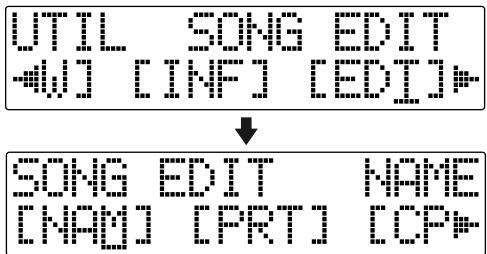
3
Press CURSOR [ ] [ ] to move the cursor to "NAM," and press [ENTER].
The name of the song (Song Name) appears in the display.
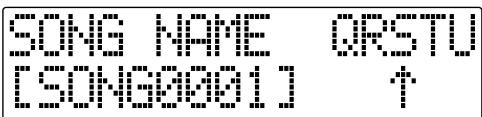
4
Press CURSOR [ ] [ ] to move the cursor to the character you want to change.
5
Rotate TIME/VALUE dial to select the character.
- You can switch between upper case and lower case characters by pressing [ENTER].
6
After the name is properly entered, press [UTILITY] (or press [EXIT] repeatedly) to return to the Play screen.
Protecting a Song (Song Protect)
You can imagine situations where, after taking care to create a song, you accidentally overwrite it with a recording, deleting the performance itself.
To prevent such accidents, you can protect song data so that it cannot be rewritten accidentally (Song Protect).
-
The following operations are not available when a song is protected.
-
Recording
Track Edit - Editing a song name
Erasing a song
Song Optimize - Initializing and Editing the Rhythm (arrangements/patterns/drum kits)
- Initializing effects (song patches)
- Initialize All
- Tone Load
- Importing SMFs
- USB Import
- Writing effects to song patches
- Undo/Redo
1
Confirm that [PAD] is not lit, then press [UTILITY].
2
Press CURSOR[ ] [ ] to move the cursor to "EDT," and press [ENTER].
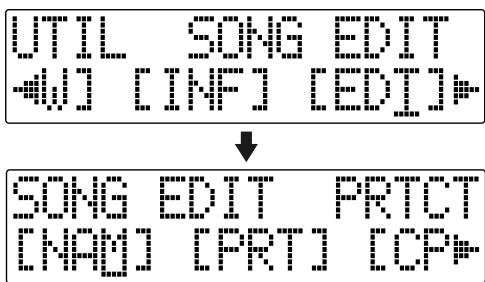
3
Press CURSOR [ ] [ ] to move the cursor to "PRT," and press [ENTER].
The Song Protect screen appears in the display.
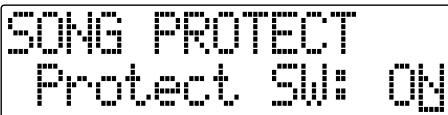
4
Rotate TIME/VALUE dial to select the "ON."
5
Press [UTILITY] (or press [EXIT] repeatedly) to return to the Play screen.
When a song is protected, the display will show the song protect symbol.
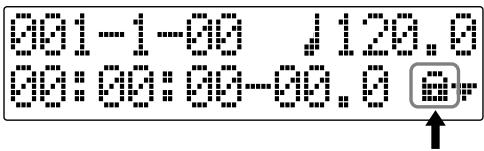
Saving the Current Settings to the Song (Song Save)
The BR-600 can save the following contents as song data.
- Recorded data
- Mixer settings (Pan, Track EQ, etc.)
- Insert Effect song patches
- Mastering Tool Kit song patches
Pitch Correction Song Patches and Correction Event Maps - Rhythm Arrangements / Rhythm Patterns
- Loop Effects
- Tones from the Song Kit and imported with Tone Load
- Utility (For a detailed explanation, refer to "Parameter List" (p. 210).)
These recorded data or mixer settings are not saved immediately after recording, but are saved when songs are saved, and when the screens are switched.
Ordinarily, if a situation calls for it, a message appears in the display prompting you to confirm that you want to save the data, so you need not pay particular attention to this, but if you want to save the settings to the song in its current state, use the following procedure.
1
Hold down [STOP] and press [REC].
Creating a Master Tape/ Disc
This process involves recording the finished song to your recorder (cassette tape recorder, CD recorder, etc.) and making a master tape or a master disc.
1
Connect the BR-600 LINE OUT jacks to the cassette tape recorder's input jacks.
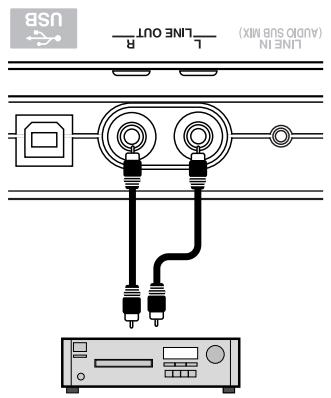
CD Recorder etc.
2
Put the cassette tape recorder in record mode.
3
Press [PLAY] on the BR-600 and start the playback of the recorded data.
4
When playback is finished, stop recording with the recorder and then press [STOP] on the BR-600.
Section 3 Using Effects
Using the Insert Effects
The BR-600 comes with five effects processors: an insert effects, loop effects, Track EQ, Pitch Correction, and Mastering Tool Kit.
An insert effects, loop effects, and Track EQ can be used simultaneously, and you can make settings for each effect as desired.
Here is an explanation of how to change the various parameters for the insert effects and how to then save those changes.

"Insert Effect Parameter Functions" (p. 96)
"Loop Effect Parameter Functions" (p. 120)
"Track EQ Parameter Functions" (p. 122)

Insert effects are applied during recording, in addition they are applied during the mixing of the various tracks as well.
For more details, refer to "Changing the destination Insert Effects are Connected" (p. 95).
Effect Patches and Banks
The effects used by insert effects and the parameters of each effect are changed by calling up "effect patches."
Your BR-600 comes equipped with a number of preset effect patches for use with vocals and instruments. These are grouped according to different input sources and each group is called a "bank."
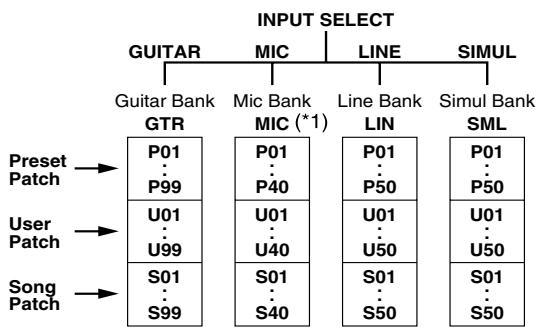
(*1) When either MIC1 or MIC2 is used, the MIC bank is selected. With both are connected, or neither of them is connected and the onboard stereo mic switched on, the LINE Bank is selected.
Your BR-600 allows you to automatically change banks.
For example, pressing the [GUITAR] INPUT SELECT button changes you to a guitar bank patch, and pressing [LINE] changes you to a line bank patch.
Also, within each bank, effect patches are further grouped as shown below.
Preset patches (P)
The preset patches contain preset data. Their settings can be changed, but you cannot create a new preset patch.
User patches (U)
User patches can be rewritten, and are stored in internal memory. If you have created a patch that you would like to use for other songs as well, it is convenient to store it as a user patch.
Song patches (S)
Like user patches, song patches can be written; however, the data for song patches are stored along with the song data to the memory card.
This is convenient when you have created a patch for a specific recorded performance, and would like to store that patch together with the song.
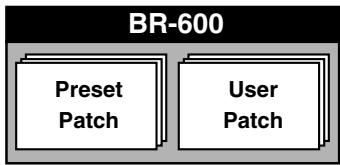
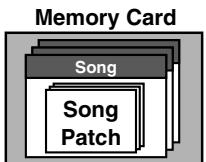

Song patches (S) cannot be selected unless a memory card is inserted.

Your BR-600 is shipped with the user patches (U) and song patches (S) containing the same patches as the preset patches (P).
Editing Insert Effect Settings
If you wish to create a new effect sound, you should first select an existing patch that is closest to the sound you want, and then edit its settings. If you wish to save the effect settings that you edited, save them as a user patch or song patch.
1
Confirm that [PAD] is not lit, then press [EFFECTS].
The Effect screen appears in the display.
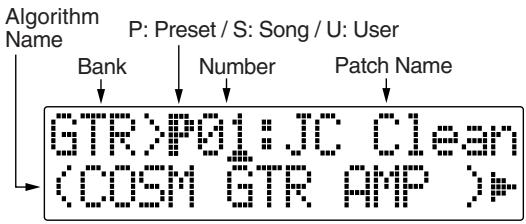
2
Select an effect patch.
Use CURSOR [ ] [ ] and the TIME/VALUE dial to select the bank, Preset/Song/User, and patch number.
3
Press CURSOR [ ] to move the cursor to "EDIT," and press [ENTER].
The Edit Effect screen appears and the algorithm (the connection sequence for the effects being used) is displayed.
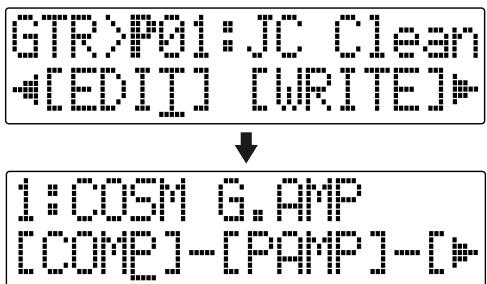
■ When effect patches in the SIMUL bank are selected, "GTR" and "MIC" appear.
Move the cursor to "GTR" to modify a guitar-use effect, or to "MIC" to modify an effect for use with a mic, then press [ENTER].
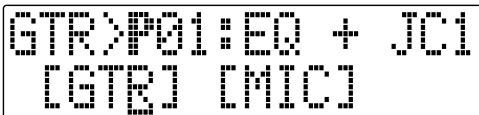
HINT
By pressing [ENTER] while the cursor is at a Bank-Number, you can display the Edit Effect screen directly.
4
Press CURSOR[ ] [ ] to move the cursor to each effect and turn the TIME/VALUE dial to turn each effect on or off.
Blocks that are turned on are shown in uppercase letters, while blocks that are turned off are shown in lowercase letters. Turn on the effects that you want to use.
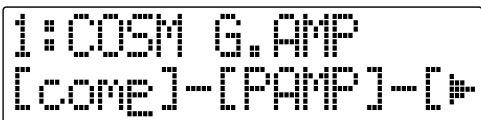
5
Press CURSOR [ ] [ ] to move the cursor to the effect with the parameter that you want to change and press [ENTER].
The Parameter Setting screen for each effect appears in the display.
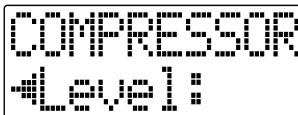

6
Use CURSOR [ ] to select a parameter, and turn the TIME/VALUE dial to edit the value.
7
If you would like to edit another effect, press [EXIT] to return to the previous screen, and repeat steps 5-6.
8
If you wish to save the current effect settings, perform the procedure described in "Saving insert effect settings," next.
NOTE
Edited effect settings are temporary. If you exit the Edit Effect screen without saving the effect patch you changed, "TMP" appears next to the indication of the bank. Be aware that if you select a new effect patch while "TMP" is displayed, the altered effect patch is returned to its original settings and the changes are lost.
Saving Insert Effects Settings (Write)
Follow the procedure below to enter a name (patch name) for an effect that you've modified, and save it as a new effect patch.
- If you do not need to change the patch name, go to Step 4 after entering the Effect screen.
1
At the Effect screen, press CURSOR [▶] to move the cursor to "NAME," and press [ENTER].
The Patch Name Setting screen appears in the display.
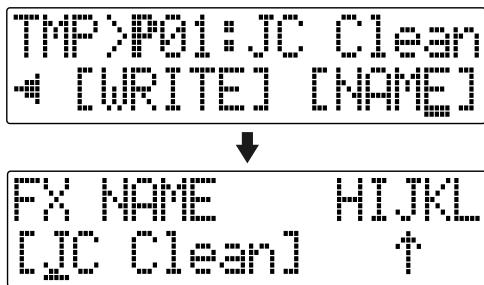
2
Use CURSOR [ ][▶] and the TIME/VALUE dial to enter the patch name.
- Press [ENTER] to switch between uppercase and lowercase.
3
After you have completed entering the effect settings and patch name as desired, press [EXIT] to return to the Effect screen.
4
Press CURSOR [ ] [ ] to move the cursor to "WRITE," and press [ENTER].
The Write screen appears in the display.
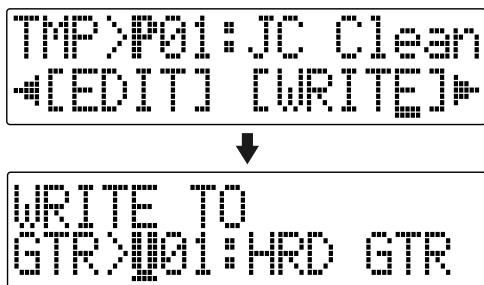
5
Turn the TIME/VALUE dial to select the number to which to write the new effect patch.
6
After you've selected the destination, press [ENTER]. After the save has been completed, you are returned to the Effect screen.
- During updating, "Keep power on!" appears in the upper line of the display, while the lower line shows what is being processed.

You cannot save an effect patch during the recording or playback of a song.
Changing the destination Insert Effects are Connected
By default, the insert effect is inserted immediately after the input source. The reason for this is to allow for the effects-processed (wet) sound to be recorded and monitored. However, sometimes you want to change the connection order.
On the BR-600, you can accommodate a wide variety of situations by changing the point to which the insert effects are connected.
Follow the procedure below to change where insert effects are connected.
1 Confirm that [PAD] is not lit, then press [EFFECTS].
2 Press CURSOR [ ] [ ] to move the cursor to "LOCAT," and press [ENTER].
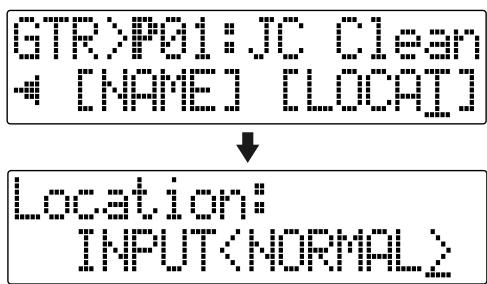
3 Turn the TIME/VALUE dial to switch the point to which the insert effects are connected.
INPUT :
The sound is monitored and recorded after it passes through the insert effect. Normally you will use the BR-600 with this setting.
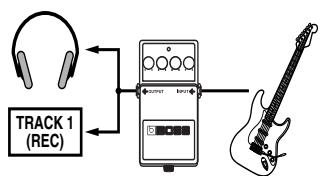
INPUT :
The sound is monitored through the insert effect but is recorded without the effect (dry). Use this when you wish to try out various effects after recording.
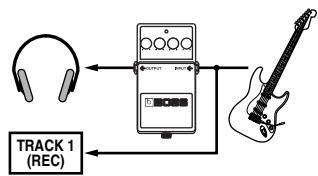
■ TRACK 1-8, 1 2, 3 4, 5 6, 7 8 :
The insert effect can be applied to the playback of a track (or pair of tracks). Use this when you wish to try out effects after recording the dry sound, or when you wish to apply effects only to a specific track.
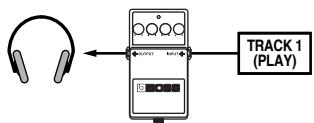
RHYTHM :
The insert effect can be applied to the playback of a Rhythm.
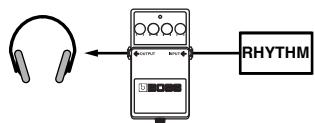
MASTER:
Use this when you wish to apply effects to the entire song, such as when adjusting the tone or applying a special effect during mixdown.
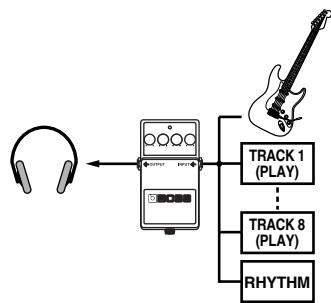
Press [EXIT] to return to the Play screen.
- During updating, "Keep power on!" appears in the upper line of the display, while the lower line shows what is being processed.
Algorithm List
The algorithms (the available effects and their connection order) that can be used as an insert effect are shown below.
The algorithms that can be selected will differ for each bank. To select the algorithm that you wish to use, first select the effect bank that includes that algorithm, and then refer to the "Effect Patch List" (p. 204) and select a patch that uses the desired algorithm.
The line or lines connecting the algorithm indicate whether the effect features mono output (single line) or stereo output (two lines).
(Ex.)
Output: Mono
Output: Stereo
-[COMP]-[PAMP]-
- [MOD] = [DLY] =
BANK : GUITAR
1. COSM GTR AMP
This is a multi-effect designed for electric guitar. This provides an amp sound using a preamp and speaker simulator.
- In case of "Phaser," output will become monaural.
-[COMP]-[PAMP]-[SP]-[EQ/WAH] -
[NS]-[FV]-[MOD]=[DLY]=
Compressor
Preamp
Speaker Simulator
4Band Equalizer/Wah
- 4Band Equalizer
-Wah
Noise Suppressor
Foot Volume
Modulation
-
Flanger
-
Chorus
-Phaser
-
Pitch Shifter
-
Doubling
Tremolo/Pan
- Slow Attack
Delay
2. ACOUSTIC SIM
This is a multi-effect designed for electric guitar. It allows you to use an electric guitar to produce sounds similar to those of an acoustic guitar.
-[ASIM]-[COMP]-[EQ]-[NS]
[ [FV] - [MOD] = [DLY] = ]
Acoustic Guitar Simulator
Compressor
4Band Equalizer
Noise Suppressor
Foot Volume
Modulation
- Flanger
- Chorus
-Phaser - Pitch Shifter
- Doubling
- Tremolo/Pan
Delay
3. BASS SIM
Simulates the sound of a bass guitar. Obtain the sound of a bass guitar while playing an electric guitar.
- You should avoid playing chords when using the Bass Simulator.
-[BSIM]-[COMP/DEF]-[NS]-[FV]-[MOD]=
Bass Simulator
Compressor/Defretter
- Compressor
- Defretter
Noise Suppressor
Foot Volume
Modulation
- Flanger
- Chorus
-Phaser - Pitch Shifter
- Doubling
Tremolo/Pan
4. COSM COMP GTR
This is a multi-effect designed for electric guitar. In addition to a COSM compressor/limiter, it uses a preamp and speaker simulator for a characteristic amp sound.
- [COMP]-[PAMP]-[SP]-[EQ/WAH]
L[NS]-[FV]-[DLY]=
COSM Comp/Limiter
Preamp
Speaker Simulator
4Band Equalizer/Wah
- 4Band Equalizer
-Wah
Noise Suppressor
Foot Volume
Delay
5. ACOUSTIC GTR
This is a multi-effect designed for acoustic guitar. Even when an electric-acoustic is connected at line level, this provides a warm sound similar to what is obtained through a microphone.
- [ACP] = [COMP] = [EQ] = [NS] = [DLY] =
Acoustic Processor
Compressor
4Band Equalizer
Noise Suppressor
Delay
6. BASS MULTI
This is a multi-effect designed for bass guitar. Appropriate for creating standard bass sound.
-[COMP/DEF]-[OCT]-[ENH]-[EQ/WAH]
· [NS] - [FV] - [MOD] = [DLY] =
Compressor/Defretter
- Compressor
- Defretter
Octave
Enhancer
4Band Equalizer/Wah
- 4Band Equalizer
-Wah
Noise Suppressor
Foot Volume
Modulation
- Flanger
- Chorus
-Phaser - Pitch Shifter
- Doubling
Tremolo/Pan
Delay
7. COSM BASS AMP
This is a multi-effect designed for bass guitar. This features an amp sound that uses a preamp and speaker simulator.
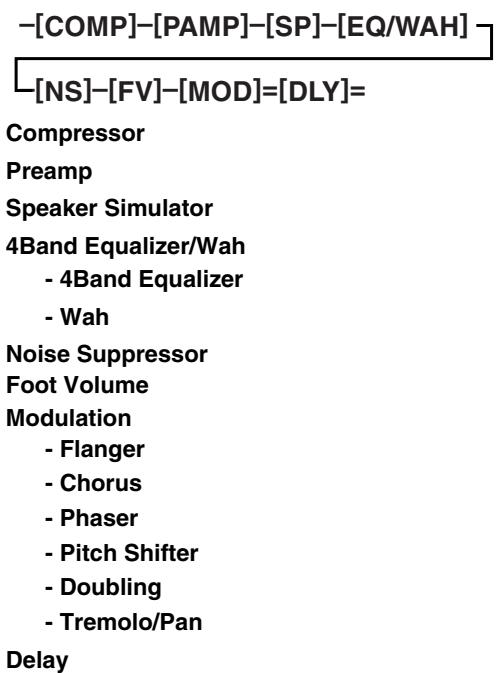
8. COSM COMP BSS
This is a multi-effect designed for bass guitar.
In addition to a COSM compressor/limiter, it uses a preamp and speaker simulator for a characteristic amp sound.
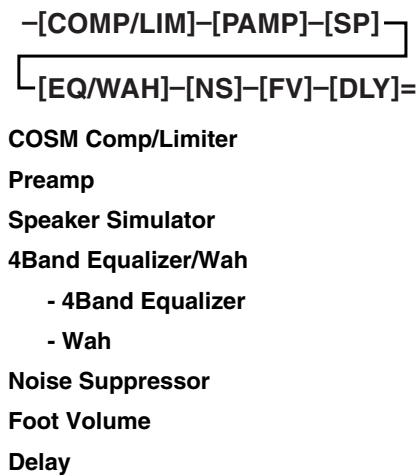
BANK:MIC
9. VOCAL MULTI
This is a multi-effect designed for vocals.
It provides the basic effects needed for vocals.
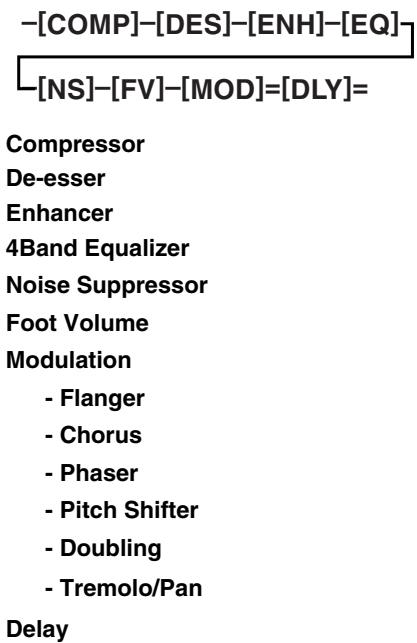
10. VOICE TRANS
This is a multi-effect designed for vocals.
This allows you to produce a unique effect using a voice transformer.
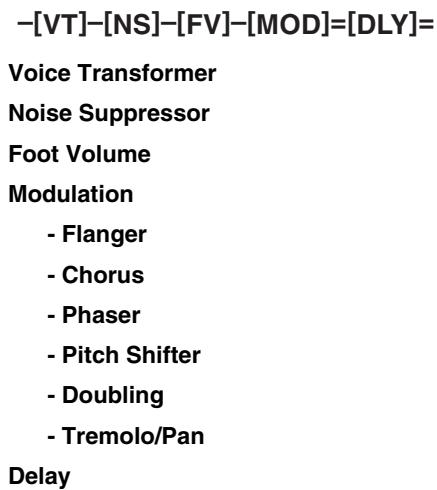
11. COSM COMP VCL
This is a multi-effect designed for vocals.
The COSM compressor/limiter is perfect for creating a basic sound.
-[COMP/LIM]-[DES]-[ENH] [EQ]-[NS]-[FV]-[DLY]=
COSM Comp/Limiter
De-esser
Enhancer
4Band Equalizer
Noise Suppressor
Foot Volume
Delay
BANK : LINE
12. STEREO MULTI
This algorithm connects seven types of effect, all in full stereo.
[ = [\text{COMP}] = [\text{RNG}] = [\text{EQ/WAH}]]
[ = [\text{NS}] = [\text{FV}] = [\text{MOD}] = [\text{DLY}] = ]
Compressor
Ring Modulator
4Band Equalizer/Wah
- 4Band Equalizer
-Wah
Noise Suppressor
Foot Volume
Modulation
- Flanger
- Chorus
-Phaser - Pitch Shifter
- Doubling
Tremolo/Pan
Delay
13. LO-FI BOX
This allows you to simulate sounds that appear to be playing on an AM radio, the sounds of old records played on an old-fashioned gramophone, and even extreme deformations of the sound produced by a Lo-Fi Digital.
$$ = [ \text {L O F I} ] = [ \text {N S} ] = $$
Lo-Fi Box
Noise Suppressor
BANK : SIMUL
14. VO+GT AMP
This algorithm is for use when simultaneously recording a vocal and electric guitar.
For the guitar, you can produce an amp sound using a preamp and speaker simulator.
(GUITAR)
-[COMP]-[PAMP]-[SP]-[NS]-[DLY]-
(MIC)
-[COMP]-[EQ]-[NS]-[DLY]-
(GUITAR)
Compressor
PreAmp
Speaker Simulator
Noise Suppressor
Delay
(MIC)
Compressor
4Band Equalizer
Noise Suppressor
Delay
15. VO+AC.SIM
This algorithm is for use when simultaneously recording a vocal and electric guitar.
For the guitar, you can make the electric guitar sound like an acoustic guitar.
(GUITAR)
-[ASIM]-[COMP]-[NS]-[DLY]-
(MIC)
-[COMP]-[EQ]-[NS]-[DLY]-
(GUITAR)
Acoustic Guitar Simulator
Compressor
Noise Suppressor
Delay
(MIC)
Compressor
4Band Equalizer
Noise Suppressor
Delay
16. VO+ACOUSTIC
This algorithm is for use when simultaneously recording a vocal and acoustic guitar.
For the guitar, you can produce a warm sound as though a mic were being used, even when an electric-acoustic is connected by a direct line.
(GUITAR)
-[ACP]-[COMP]-[NS]
(MIC)
-[COMP]-[NS]
(GUITAR)
Acoustic Processor
Compressor
Noise Suppressor
(MIC)
Compressor
Noise Suppressor
Parameter List
The trademarks listed in this document are trademarks of their respective owners, which are separate companies from BOSS. Those companies are not affiliated with BOSS and have not licensed or authorized BOSS's BR-600. Their marks are used solely to identify the equipment whose sound is simulated by BOSS's BR-600.
Acoustic Guitar Simulator
This simulates the sound of an acoustic guitar. It allows you to use an electric guitar to produce sounds similar to those of an acoustic guitar.
- If you set the pickup selector of your guitar to the front position, the desired effect will be easier to achieve.
On/Off
OFF, ON
This parameter turns the acoustic guitar simulator effect on/off.
PickUp
SINGLE, HUMBUCK
Set this to the type of pickup on the connected guitar.
Charct
This selects one of the four types of sounds.
STD (standard) :
This is a normal acoustic guitar.
JUMBO :
This is an acoustic guitar with a body that is bigger than STANDARD. The bass sound is powerful.
ENHANCE :
This is an acoustic guitar that with a more responsive attack, so the guitar will retain more of its prominence in almost any situation.
PIEZO :
This simulates the sound you would get from a pickup installed on an electric-acoustic guitar.
During the attack, a certain amount of compression will be applied.
Top-Hi
-100 - +100
Adjust the level of the direct sound from the strings. That is, it adjusts the harmonic contents.
Top-Mid
-100 - +100
This adjusts the interference to the strings made by the top plate. That is, it adjusts the attack sense.
Body
-100 - +100
This adjusts the resonance of the sound caused by the body. That is, it adjusts the softness and fatness of the sound which is the typical characteristics of acoustic guitars.
Level
0-100
This adjusts the volume of the acoustic guitar simulator.
- If Top-Hi, Top-Mid, and Body are all set to “-100,” there will be no sound.
Acoustic Processor
With this feature, you can change the sound from a pickup on an electric-acoustic guitar into a richer sound, similar to that obtained by a microphone placed near a guitar. Best results will be achieved when stereo recording.
On/Off
OFF, ON
This parameter turns the acoustic processor effect on/off.
Body
0-100
This adjusts the resonance of the sound caused by the body. That is, it adjusts the softness and fatness of the sound which is the typical characteristics of acoustic guitars.
Mic Dist
0-100
This simulates the distance between the microphone capturing the sound of an acoustic guitar and the guitar itself.
Level
0-100
This adjusts the volume of the acoustic processor.
Bass Simulator
Simulates the sound of a bass guitar. Obtain the sound of a bass guitar while playing an electric guitar.
You should avoid playing chords when using the Bass Simulator.
On/Off
OFF, ON
This parameter turns the bass simulator effect on/off.
Charct
LOOSE, TIGHT
Bass tone characteristic is set. When "LOOSE" is selected, as if the string gauge was getting thicker.
Level
0-100
This adjusts the volume of the bass simulator.
Chorus
A sound with a subtly shifted pitch is added to the direct sound, making the final output sound thicker and broader. Best results will be achieved when stereo recording.
- This effect can be used when the MODULATION "Type" parameter is set to "CHORUS."
On/Off OFF, ON
This parameter turns the chorus effect on/off.
Rate 0-100
Adjusts the rate of the Chorus effect.
Depth 0-100
Adjusts the depth of the Chorus effect.
Pre Dly 0.5 - 50.0 ms
Adjusts the time needed for the effect sound to be output after the direct sound has been output.
E.Level 0-100
Adjusts the volume of the effect sound.
Compressor
This corrects differences in input to create a steadier, more even volume balance. This is used to extend the sustain of input sounds and, conversely, to shorten sustain and emphasize the attack portion of sounds.
Another use of compression is as a "limiter," which prevents distortion by suppressing only volume peaks.
On/Off OFF, ON
This parameter turns the compressor effect on/off.
Sustain 0-100
This adjusts the depth of the effect. Higher settings values result in longer sustain times. Set this to a lower value when using compression for the limiter effect.
Attack 0-100
Adjusts the strength of the attack. Larger values will result in a sharper attack, creating a more clearly defined sound.
Level 0 - 100
Adjusts the volume.
The compressor corrects differences in input to create a steadier, more even volume balance. It is used to extend the sustain of input sounds and, conversely, to shorten sustain and emphasize the attack portion of sounds.
The limiter is an effect that prevents distortion by suppressing input signals that exceed a set value (threshold). You can get the same effect achieved with the compressor by setting the threshold at a low value.
The BR-600 uses COSM technology to model four types of compressor/limiter in which the compressor and limiter functions are combined.
On/Off OFF, ON
Sets the compressor/limiter to ON or OFF.
Type
Selects the compressor/limiter type.
BOSS-Cmp: Models the BOSS CS-3 compact effects processor.
D-Comp : Models the MXR dyna comp.
Rack160: Models the dbx 160.
VtgRack: Models the UREI 1178.
Attack (with BOSS-Cmp, D-Comp) 0 - 100
Adjusts the strength of the picking attack when the strings are played. Larger values will result in a sharper attack, creating a more clearly defined sound.
Sustain (with BOSS-Cmp, D-Comp) 0 - 100
Boosts low-level signals, adjusting the time over which sounds are sustained. Higher values deepen the effect, resulting in a longer sustain.
Threshold (with Rack160) 0 - 100
Adjust this as appropriate for the input signal from your bass. The compression effect is applied to input above the level set here. The smaller the value set here, the lower the level at which the limiter effect kicks in.
Input (with VtgRack) 0 - 100
Controls the input level. Increasing the value will produce a deeper effect.
Ratio (with Rack160) 1:1 - 20:1, INF:1
(with VtgRack) 4:1 - 20:1
Adjusts the limiter compression ratio. Higher ratio create a stronger compression effect.
Attack Time (with VtgRack) 0 - 100
This adjusts the amount of time it takes for the compression ratio set in Ratio to be reached once compression begins, as the input level exceeds the set threshold level. The larger the value set here, the more rapidly compression is applied.
Release Time (with VtgRack) 0 - 100
This adjusts the time from when the signal level drops below the threshold until when the compression is removed. The lower the values set, the more rapidly the compression is released, and the more clearly the sound from the next string played is heard.
Tone (with BOSS-Cmp) -50 +50
Adjusts the tone. The higher the value set, the more the high frequencies are boosted, resulting in a harder sound.
Level 0 - 100
Adjusts the volume.
De-esser
Useful for reducing 'sibilant' or 'S' sounds produced by a vocalist.
On/Off OFF, ON
This parameter turns the de-esser effect on/off.
Sibilant 0-100
Adjusts the sensitivity relative to the input volume, which controls how the effect is applied.
Level 0-100
Adjusts the volume.
Defreter
This simulates a fretless bass.
On/Off OFF, ON
This parameter turns the defretter effect on/off.
Sens 0-100
This controls the input sensitivity of the Defretter. It should be adjusted for the bass guitar you have until you get the harmonic changes to sound natural.
Attack 0-100
This controls the attack of the Defretter. Increasing the value will cause the harmonics to change more slowly, thus producing a relatively attack-less sound, similar to a fretless bass.
Depth 0-100
This controls the ratio of harmonics. Increasing the value will increase the harmonic content and therefore will create a more unusual sound.
Level 0 - 100
Adjusts the volume of the defretter sound.
Delay
This creates a thicker sound by applying a delayed sound to the direct sound.
On/Off OFF, ON
This parameter turns the delay effect on/off.
Type
This Parameter selects the type of delay.
- This parameter cannot be selected with the "VO+GT AMP" and "VO+AC.SIM" algorithms.
SINGLE :
This is a simple delay.
TAP :
The delayed sound is panned across the left and right channels. This will be effective when stereo recording.
Dly Tme
SINGLE : 1 - 1400 ms, TAP : 1 - 700 ms
This parameter adjusts the delay time (i.e., the interval for which sound is delayed).
Feedback 0-100
This parameter adjusts the amount of feedback. Changing the amount of feedback causes the number of time the delayed sound is repeated to change as well.
E.Level 0-120
Adjusts the volume of the delay sound.
Doubling
By adding a slightly time-delayed sound to the direct sound, this produces the impression that multiple sources are sounding together (a "doubling" effect). Best results will be achieved when stereo recording.
- This effect can be used when the MODULATION "Type" parameter is set to "DOUBLING."
On/Off OFF, ON
This parameter turns the doubling effect on/off.
Dly Tme 0.5 - 50.0 ms
This parameter adjusts the delay time (i.e., the interval for which sound is delayed).
Separation -50-+50
Adjusts the diffusion. The panning of the direct sound and effect sound can be spread to left and right.
- This effect is obtained with stereo recording (using two tracks).
E.Level 0-120
This adjusts the volume of the delay sound.
Enhancer
By adding sounds which are out-of-phase with the direct sound, this effect enhances the definition of the sound, and pushes it to the forefront.
On/Off
OFF, ON
This parameter turns the enhancer effect on/off.
Sens
0-100
Adjusts the manner in which the enhancer will be applied relative to the input signals.
Freq
1.0 - 10.0 kHz
Adjusts the frequency at which the enhancer effect will begin to be applied. The effect will be made apparent in the frequencies above the frequency set here.
Mix Level
0-100
Adjusts the amount of phase-shifted sound of the range set by "Frequency" that is to be mixed with the input.
Lo Mix Lvl
0-100
Adjusts the amount of phase-shifted sound of the lower range that is to be mixed with the input. The frequency range in which the effect is applied is fixed.
Level
0-100
Adjusts the volume of the enhanced sound.
Equalizer
A 4-band equalizer.
- You can use this effect with the following algorithms when "4BAND EQ" is selected for the 4BAND EQ/WAH "Type" setting.
COSM GTR AMP
COSM BASS AMP
COSM COMP GTR
COSM COMP BSS
BASS MULTI
STEREO MULTI
On/Off
OFF, ON
This parameter turns the equalizer effect on/off.
Low Gain
-20 +20 dB
This parameter sets the gain (amount of boost or cut) for the bass equalizer.
Lo-M Gin
-20 +20 dB
This parameter sets the gain (amount of boost or cut) for the low-midrange equalizer.
Lo-M F
100 Hz - 10.0 kHz
This parameter sets the central frequency for the low-midrange equalizer.
Lo-M Q
0.5-16
This parameter sets the range of change in gain for the frequency set by "Lo-M F." A larger value results in a narrower range of change.
Hi-M Gin
-20 +20 dB
This parameter sets the gain (amount of boost or cut) for the high-midrange equalizer.
Hi-M F
100 Hz - 10.0 kHz
This parameter sets the central frequency for the high-midrange equalizer.
Hi-M Q
0.5-16
This parameter sets the range of change in gain for the frequency set by "Hi-M F." A larger value results in a narrower range of change.
Hi Gain
-20 +20 dB
This parameter sets the gain (amount of boost or cut) for the treble equalizer.
Level
-20 +20 dB
This parameter adjusts the volume after the equalizer stage.
Flanger
This produces a flanging effect that gives a sort of "twisting" character to the sound.
- This effect can be used when the MODULATION "Type" parameter is set to "FLANGER."
On/Off
OFF, ON
This parameter turns the flanger effect on/off.
Rate
0-100
Determines the rate of the flanging effect.
Depth
0-100
Determines the depth of the flanging effect.
Manual
0-100
Adjusts the center frequency at which to apply the effect.
Resonance
0-100
Determines the amount of resonance (feedback). Increasing the value will emphasize the effect, creating a more unusual sound.
Separation
0-100
Adjusts the diffusion. The diffusion increases as the value increases. This will be effective when stereo output is used.
- This effect is obtained with stereo recording (using two tracks).
Foot Volume
This is a volume control effect.
By using an expression pedal to control the foot volume, you can smoothly change the volume of the output sound. For a detailed explanation, see "When Using an Expression Pedal" (p. 191).
On/Off
OFF, ON
Switches the foot volume on/off.
Lo-Fi Box
Produces a lo-fi sound.
On/Off
OFF, ON
This parameter turns the lo-fi box effect on/off.
Type
Select the mode of the lo-fi box.
RADIO :
The sound will appear to be heard from an AM radio.
- By adjusting "Tuning," you can simulate the sounds that occur when you adjust the tuning frequency of the radio.
PLAYER :
The sound will appear to be heard from a gramophone. The noise caused by scratches and dust on the record are is simulated.
DIGITAL :
This allows you to create a "lo-fi" sound by lowering the sample rate and/or decreasing the number of bits. Realtime modify filters connected in series allow you to reshape the sound freely.
When "RADIO" or "PLAYER" is selected
Tuning
0-100
This is a parameter for "RADIO." It simulates the sounds that occur when you adjust the tuning frequency of an AM radio.
Wow Flt
0-100
This is a parameter for "PLAYER." It simulates the wow and flutter which occur when the speed of the turntable is not constant.
Noise
0-100
This simulates noise.
Filter
0-100
Adjusts the filter.
D:E
100:0 - 0:100
This adjusts the volume balance of the direct and effect sounds.
When "DIGITAL" is selected
Pre Filter
OFF, ON
This filter decreases digital distortion. When turned off, you can create an intense lo-fi sound incorporating digital distortion.
Smpl Rate
OFF, 1/2 - 1/32
Modify the sample rate.
Bit
OFF, 15 - 1
Modify the number of data bits. If this is turned off, the number of data bits will be unchanged. If an extremely low number of bits is selected, loud noise may appear even when there is no sound, depending on the input source. In such cases, raise the threshold of the noise suppressor.
Post Fltr
OFF, ON
This filter decreases the digital distortion produced by lo-fi. By turning this off, you can create an extremely lo-fi sound.
Fx Level
0-100
Adjust the volume of the lo-fi sound.
Dir Level
0-100
Adjusts the volume of the direct sound.
Modify Fil
This is a filter featuring a wide range of possible settings (modifiable filter). Select different types to get a variety of different filter effects.
OFF:
The modify filter will not be used.
LPF :
The effect will function as a low pass filter.
BPF:
The effect will function as a band pass filter.
HPF :
The effect will function as a high pass filter.
Cutoff F
0-100
Adjust the cutoff frequency.
Resonance
0-100
Adjust the resonance.
Gain
0-24dB
Adjust the volume level of the sound that has passed through the modify filter.
Noise Suppressor
This effect reduces the noise and hum. Since it suppresses the noise in synchronization with the envelope of the sound (the way in which the sound decays over time), it has very little effect on the sound, and does not harm the natural character of the sound.
On/Off
OFF, ON
This parameter turns the noise suppressor effect on/off.
Threshold
0-100
Adjust this parameter as appropriate for the volume of the noise. If the noise level is high, a higher setting is appropriate. If the noise level is low, a lower setting is appropriate. Adjust this value until the decay of the sound is as natural as possible.
- High settings for the Threshold parameter may result in there being no sound when you play with your instruments volume turned down.
Release
0-100
Adjusts the time from when the noise suppressor begins to function until volume reaches "0."
Octave
This adds a note one octave lower, creating a richer sound.
On/Off
OFF, ON
This parameter turns the octave effect on/off.
Oct Level
0-100
This adjusts the volume of the sound one octave below.
Dir Level
0-100
Adjusts the volume of the direct sound.
Phaser
By adding varied-phase portions to the direct sound, the phaser effect gives a whooshing, swirling character to the sound.
- This effect can be used when the MODULATION "Type" parameter is set to "PHASER."
On/Off
OFF, ON
This parameter turns the phaser effect on/off.
Rate
0-100
This sets the rate of the Phaser effect.
Depth
0-100
Determines the depth of the Phaser effect.
Manual
0-100
Adjusts the center frequency of the phaser effect.
Resonance
0-100
Determines the amount of resonance (feedback). Increasing the value will emphasize the effect, creating a more unusual sound.
Pitch Shifter
This effect changes the pitch of the original sound (up or down) within a range of two octaves.
- This effect can be used when the MODULATION "Type" parameter is set to "PITCH SFT."
On/Off
OFF, ON
This parameter turns the pitch shifter effect on/off.
Type
Selects either manual pitch shifter "MANUAL" or pedal pitch shifter "PEDAL."
MANUAL :
This is a simple pitch shifter.
PEDAL :
The effect will function as a pedal pitch shifter. The effect of the wah pedal can be obtained by operating the Expression pedal.
For a detailed explanation, see "When Using an Expression Pedal" (p. 191).
Pitch
-24 - DETUNE - +24
Adjusts the amount of pitch shift (the amount of pitch change) in semitone steps. By selecting "DETUNE," you can add a slightly pitch-shifted sound to the input sound, producing a detune effect.
- This effect can be used when the "P.Shift Type" parameter is set to "MANUAL."
D:E
100:0 - 0:100
This adjusts the volume balance of the direct and effect sounds.
Separation
-50 + 50
Adjusts the diffusion. The panning of the direct sound and effect sound can be spread to left and right. This will be effective when stereo output is used.
- This effect is obtained with stereo recording (using two tracks).
Preamp
Adjust the distortion and tone of the guitar sound.
- When all Bass, Middle and Treble are set to "0," no sound may be produced depending on the "Type" setting.
On/Off
OFF, ON
Turns the preamp effect on/off.
Type
This sets the type of the preamp. The distortion and tone characteristics of each amp are as shown below:
■ With "COSM GTR AMP," "COSM COMP GTR," or "VO+GT AMP" algorithms
| JC-120 | The sound of the Roland "JC-120," a favorite of pro musicians around the world. |
| CLEAN | The sound of a conventional built-in tube amp. |
| CRUNCH | Allows you to obtain a crunch effect that creates a natural distortion. |
| MATCH | A simulation of the latest tube amp widely used in styles from blues and rock. |
| VO DRV | Allows you to obtain the Liverpool sound of the 60's. |
| BLUES | A lead sound with a rich middle ideal for Blues. |
| BG LEAD | The sound of a tube amp typical of the late '70s to '80s, characterized by a distinctive mid-range. |
| MS (1, 2, 1+2) | The sound of a large tube amp stack that was indispensable to the British hard rock of the 70's, and is used to this day by many hard rock guitar-ists. |
| 1 | A trebly sound created by using in-put I of the guitar amp. |
| 2 | A mild sound created by using in-put II of the guitar amp. |
| 1 + 2 | The sound of connecting inputs I and II of the guitar amp in parallel, creating a sound with a stronger low end than I. |
| SLDN | A tube amp sound with versatile distortion, usable in a wide range of styles. |
| METAL | The sound of a large tube amp, suitable for heavy metal. |
| METAL D | A high gain and powerful metal sound. |
■ With "COSM BASS AMP" or "COSM COMP BSS" algorithms
| AC | It produces the vintage sound of an early transistor amp. |
| AMG | It produces the sound of a large double-stack vacuum tube amp with ultra-lows and a crisp edge. |
Volume
0-100
Adjusts the volume and distortion of the amp.
Bass GUITAR AMP: 0 - 100, BASS AMP:-100 +100
Adjusts the tone for the low frequency range.
Middle GUITAR AMP: 0 - 100, BASS AMP:-100 - +100
Adjusts the tone for the middle frequency range.
- If you have selected "MATCH" or "VO DRV" as the type, the middle control will have no effect.
Treble GUITAR AMP: 0 - 100, BASS AMP: -100 - +100
Adjusts the tone for the high frequency range.
Presence
0-100
This can be selected in the "COSM GTR AMP," "COSM COMP GTR," or the "VO+GT.AMP" algorithm.
Adjusts the tone for the ultra high frequency range.
- If you have selected "MATCH" or "VO DRV" as the type, raising presence will cut the high range (the value will change from "0" to "-100").
Master
0-100
Adjusts the volume of the entire preamp.
Bright
OFF, ON
(with JC-120, CLEAN, CRUNCH, BLUES, BG LEAD, AC, AMG)
Turns the bright setting on/off.
OFF:
Bright is not used.
ON:
Bright is switched on to create a lighter and crisper tone.
Gain
LOW, MIDDLE, HIGH
Adjusts the distortion of the amp. Distortion will successively increase for settings of "LOW," "MIDDLE" and "HIGH."
- The sound of each Type is created on the basis that the Gain is set to "MIDDLE." So, normally set it to "MIDDLE."
Ring Modulator
This creates a bell-like sound by ring-modulating the guitar sound with the signal from the internal oscillator. The sound will be unmusical and lack distinctive pitches.
On/Off
OFF, ON
This parameter turns the ring modulator effect on/off.
Frequency
0-100
This adjusts the frequency of the internal oscillator.
Fx Level
0-100
Adjusts the volume of the effect sound.
Dir Level
0-100
Adjust the volume of the direct sound.
Slow Attack
This produces a volume-swell effect ("violin-like" sound).
- This effect can be used in the "COSM GTR AMP" algorithm when the MODULATION "Type" parameter is set to "SLOW ATCK."
On/Off
OFF, ON
This parameter turns the slow attack effect on/off.
RiseTme
10 - 2000 ms
This adjusts the time needed for the volume to reach its maximum from the moment you begin picking.
Level
0-100
Adjust the volume of the slow attack sound.
Speaker Simulator
This simulates the characteristics of various types of speakers. When the output of the BR-600 is connected directly to a mixer, etc., this can be used to create the sound of your favorite speakers system.
On/Off
OFF, ON
This parameter turns the speaker simulator effect on/off.
Type
Selects the type of speaker that will be simulated.
"On Mic" simulates the sound when a dynamic microphone is used, and "Off Mic" simulates the sound when a condenser microphone is used.
■ With "COSM GTR AMP," "COSM COMP GTR," or "VO+GT AMP" algorithms
| SP Simulator Type | Cabinet | Speaker Unit | Microphone Setting | Comments |
| SMALL | Small open-back enclosure | 10 inch | On Mic | |
| MIDDLE | Open-back enclosure | 12 inch | On Mic | |
| JC-120 | Open-back enclosure | 12 inch (two units) | On Mic | Roland JC-120 Simulation |
| TWIN | Open-back enclosure | 12 inch (two units) | On Mic | A setting suitable for CLEAN |
| twin | Open-back enclosure | 12 inch (two units) | Off Mic | A setting suitable for CLEAN |
| MATCH | Open-back enclosure | 12 inch (two units) | On Mic | A setting suitable for MATCH |
| match | Open-back enclosure | 12 inch (two units) | Off Mic | A setting suitable for MATCH |
| VO DRV | Open-back enclosure | 12 inch (two units) | On Mic | A setting suitable for VO DRV |
| vo DRV | Open-back enclosure | 12 inch (two units) | Off Mic | A setting suitable for VO DRV |
| BG STK | Large Sealed enclosure | 12 inch (two units) | OnMic | A setting suitable for BG LEAD |
| bgstk | Large sealed enclosure | 12 inch (two units) | Off Mic | A setting suitable for BG LEAD |
| MS STK | Large sealed enclosure | 12 inch (four units) | On Mic | A setting suitable for MS |
| msstk | Large sealed enclosure | 12 inch (four units) | Off Mic | A setting suitable for MS |
| METAL | Large dual stack | 12 inch (four units) | Off Mic |
■ With "COSM BASS AMP" or "COSM COMP BSS" algorithms
| SP Simulator Type | Cabinet | Speaker Unit | Microphone Setting | Comments |
| AC | Large sealed enclosure | 15 inch (two units) | On Mic | A setting suitable for AC |
| ac | Large sealed enclosure | 15 inch (two units) | Off Mic | A setting suitable for AC |
| AMG | Large sealed enclosure | 10 inch (eight units) | On Mic | A setting suitable for AMG |
| amg | Large sealed enclosure | 10 inch (eight units) | Off Mic | A setting suitable for AMG |
Mic Set
CENTER, 1 - 10 cm
This simulates the microphone position. "CENTER" simulates the condition that the microphone is set in the middle of the speaker cone. "1-10 cm" means that the microphone is moved away from the center of the speaker cone.
Mic Level
0-100
Adjusts the volume of the microphone.
Dir Level
0-100
Adjust the volume of the direct sound.
Tremolo/Pan
Tremolo is an effect that creates a cyclic change in volume. Pan cyclically moves the stereo position between left and right (when stereo output is used).
- This effect can be used when the MODULATION "Type" parameter is set to "TRM/PAN."
On/Off
OFF, ON
This parameter turns the tremolo/ pan effect on/off.
Mode
Selects tremolo or pan; also selects how the effect is applied
TRM-TRI :
The volume will change cyclically. Smooth change will be produced.
TRM-SQR :
The volume will change cyclically. Abrupt change will be produced.
PAN-TRI :
The sound will be moved cyclically between left and right. Smooth change will be produced.
PAN-SQR :
The sound will be moved cyclically between left and right. Abrupt change will be produced.
- "PAN-TRI" and "PAN-SQR" are obtained with stereo recording (using two tracks).
Rate
0-100
Adjust the rate at which the effect will operate.
Depth
0-100
Adjusts the depth of the effect.
Voice Transformer
This controls the formants, allowing a variety of voice characters to be created.
This adds two voice characters with differing formants to the direct sound.
On/Off
OFF, ON
This parameter turns the voice transformer effect on/off.
Formant1
-100 - +100
Adjust the formant of the voice character 1.
Formant2
-100 - +100
Adjust the formant of the voice character 2.
FX1 Level
0-100
Adjust the volume of the voice character 1.
FX2 Level
0-100
Adjust the volume of the voice character 2.
Dir Level
0-100
Adjust the volume of the direct sound.
Wah
The wah effect creates a unique tone by changing the frequency response characteristics of a filter.
Touch wah creates an automatic wah by changing the filter in response to the volume of the input. Pedal wah lets you use an Expression pedal or the like to obtain real-time control of the wah effect.
- You can use this effect with the following algorithms when "WAH" is selected for the 4BAND EQ/WAH "Type" setting.
COSM GTR AMP COSM BASS AMP
COSM COMP GTR COSM COMP BSS
BASS MULTI STEREOMULTI
On/Off
OFF, ON
Turns the touch wah/pedal wah effect on/off.
Type
Selects either touch wah "TOUCH" or pedal wah "PEDAL."
TOUCH :
The effect will function as a touch wah.
PEDAL :
The effect will function as a pedal wah.
When "TOUCH" is selected
Polarity
Selection for the direction in which the filter will change in response to the input.
UP :
The frequency of the filter will rise.
DOWN :
The frequency of the filter will fall.
Sens
0-100
This adjusts the sensitivity at which the filter will change in the direction determined by the polarity setting. Higher values will result in a stronger response. With a setting of "0," the strength of picking will have no effect.
Frequency
0-100
This adjusts the center frequency of the Wah effect.
Peak
0-100
This adjusts the amount of wah effect applied. Lower values provide a mild wah effect, while higher values result in a sharper wah sound.
With a value of "50" a standard wah sound will be produced.
Level
0-100
Adjusts the volume.
When "PEDAL" is selected
The effect of the wah pedal can be obtained by operating the Expression pedal.
For a detailed explanation, refer to "When Using an Expression Pedal" (p. 191).
Peak
0-100
This adjusts the amount of wah effect applied. Lower values provide a mild wah effect, while higher values result in a sharper wah sound.
With a value of "50" a standard wah sound will be produced.
Level
0-100
Adjusts the volume.
Use the "Mastering Tool Kit" to produce a two-track master of the bounce tracks with the levels optimized.
What is Mastering Tool Kit?
When creating an audio CD from your recorded songs, or recording to a similar media, the overall volume needs to be restrained, so that even the loudest portions of the songs are handled appropriately on the CD. However, this often results in an overall lowering of the volume, resulting in a CD that lacks excitement and impact.
Moreover, in the low-frequency range, to which the human ear is not very sensitive, the sound actually produced might be perceived as being somewhat low in volume, even though the meter shows that it's at the maximum level. This also makes it difficult to create powerful sounds.
With the "Mastering Tool Kit," however, you can smooth out the differences in volume that occur over the course of a song, while also correcting the balance in the low end.
We recommend mastering with the Mastering Tool Kit in the final stage of creating songs.
- The Mastering Tool Kit features 19 pre-programmed "Preset Patches" (P01-P19), 19 rewrites "User Patches" (U01-U19), and 19 "Song Patches," which are stored individually for each song (S01-S19).
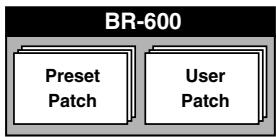
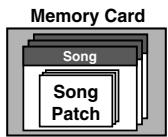

"Mastering Tool Kit Patch List" (p. 207)

In Mastering mode, the following buttons are disabled.
[GIUTAR],[MIC],[LINE],[PAD],[PITCH CORRECTION],
[PAN/EQ/LOOP FX],[TUNER],
[RHYTHM ON/OFF],[ARRANGE],[PATTERN], [RHYTHM EDIT],[PHRASE TRAINER],[V-TRACK], [DELETE/MUTE]
Mastering
- Mastering can be performed only on Tracks 7 and 8. Record any song you want to master to Tracks 7 and 8 before you begin the mastering process.
Press [REC MODE] several times until MASTERING is indicated for REC MODE at the left of the screen.
2 Turn the TIME/VALUE dial to select the recording source V-Track, and then press [ENTER]. The Mastering screen appears in the display.
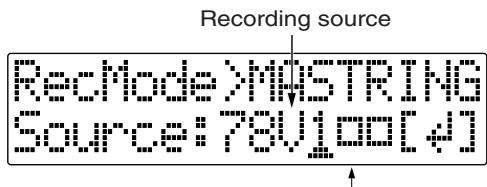
: V-Tracks with recorded data.
□ : V-Tracks without data.
3 Press CURSOR [ ] [ ] to move the cursor to the recording-destination V-track and turn the TIME/ VALUE dial to select the V-Track.
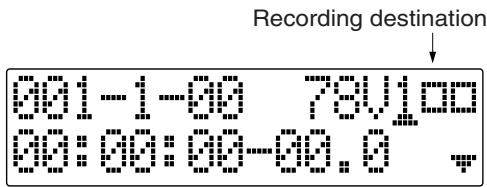
4 Press [EFFECTS].
The Mastering Tool Kit selection screen appears in the display.
- At this point, the Mastering Tool Kit is automatically selected as the effect.
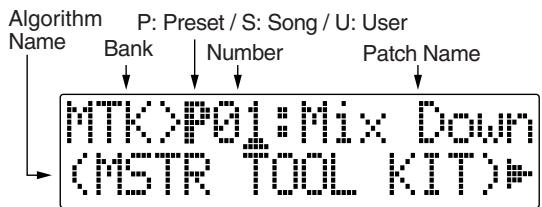
5 Select the Mastering Tool Kit.
Use the TIME/VALUE dial to select the Preset/Song/ User patch and number for the Mastering Tool Kit.

"Mastering Tool Kit Patch List" (p. 207)
6 Press [EXIT] to return to the Play screen.
The overall volume is adjusted by the MASTER fader. At this time, raise the volume as high as possible without allowing the sound to distort.
7 Press [REC].
[REC] flashes in red and the BR-600 enters the recording standby state.
![ROLAND BR-600 - Press [REC]. - 1](/content/2025/01/130576/images/c3d65bd40871d60ad6a43b9024d577184a299db461d32b14e539b9e8f6a90467.jpg)
8 Press [PLAY].
[PLAY] lights in green, the [REC] and REC TRACK buttons now light solidly instead of flashing in red, and recording begins.
![ROLAND BR-600 - Press [PLAY]. - 1](/content/2025/01/130576/images/c55a0c78e232ff839f86fb12b7d0258ebfc54a3dbefa703334c6b28cb4e6a42e.jpg)
9 When you finish mastering, press [STOP].
- During updating, "Keep power on!" appears in the upper line of the display, while the lower line shows what is being processed.
Editing the Mastering Tool Kit Settings
To create a new patch, select the patch that most closely resembles the sound you have in mind from the effects patches already stored in the unit, then edit its settings.
If you wish to save the effect settings that you edited, save them as a user patch or song patch.
1
Carry out Steps 1-3 from p. 111, and switch to Mastering mode.
2
Press [EFFECTS] (MASTERING TOOL KIT).
The Mastering Tool Kit selection screen appears in the display.
3
Use the TIME/VALUE dial to select the Preset/Song/ User and number.
4
Press CURSOR [▶] to move the cursor to "EDIT," and press [ENTER].
The display switches to the Mastering Tool Kit Edit screen, which shows the algorithm (the effects used, shown in the sequence they are connected).
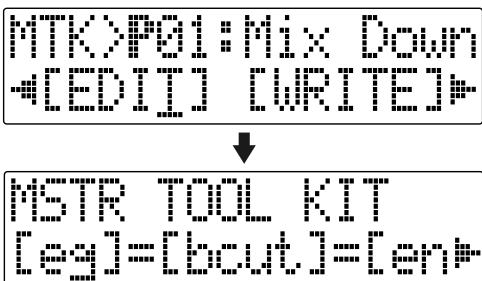
HINT
You can also display this screen directly by pressing [ENTER] while the cursor is positioned at the Preset/ Song/User or number.
5
Press CURSOR [ ] [ ] to move the cursor to each effect and turn the TIME/VALUE dial to turn each effect on or off.
Blocks that are turned on are shown in uppercase letters, while blocks that are turned off are shown in lowercase letters. Turn on the effects that you want to use.
6
Press CURSOR [ ] [ ] to move the cursor to the effect with the parameter that you want to change and press [ENTER].
The Parameter Setting screen for each effect appears in the display.
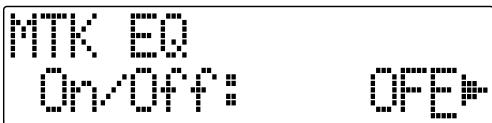
7
Use CURSOR [ ] to select a parameter, and turn the TIME/VALUE dial to edit the value.
8
If you would like to edit another effect, press [EXIT] to return to the previous screen, and repeat steps 5-6.
9
If you wish to save the current effect settings, perform the procedure described in "Saving Mastering Tool Kit Settings," below.
NOTE
Edited effect settings are temporary. If you exit the Edit Effect screen without saving the effect patch you changed, "TMP" appears next to the indication of the bank. Be aware that if you select a new effect patch while "TMP" is displayed, the altered effect patch is returned to its original settings and the changes are lost.
Saving the Mastering Tool Kit Settings (Write)
This assigns a name (patch name) to the edited patch settings and saves the settings.
- If you do not need to change the patch name, go to Step 4 after entering the Mastering Tool Kit selection screen.
1
At the Mastering Tool Kit selection screen, press CURSOR [▶] to move the cursor to "NAME," and press [ENTER].
The Patch Name Setting screen appears in the display.
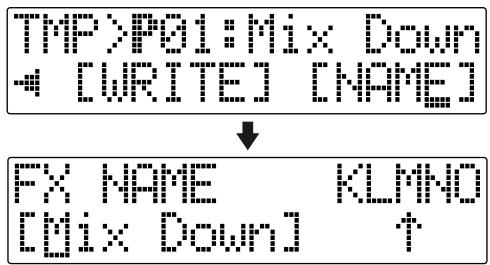
2
Use CURSOR [ ][ ] and the TIME/VALUE dial to enter the patch name.
- Press [ENTER] to switch between uppercase and lowercase.
3
After you have completed entering the effect settings and patch name as desired, press [EXIT] to return to the Kit Selection screen.
4
Press CURSOR [ ] [ ] to move the cursor to "WRITE," and press [ENTER].
The Write screen appears in the display.
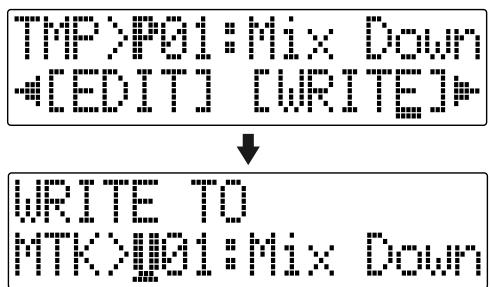
5
Turn the TIME/VALUE dial to select the patch number to which to write the new patch.
6
After you've selected the destination, press [ENTER]. After the save has been completed, you are returned to the Mastering Tool Kit selection screen.
- During updating, "Keep power on!" appears in the upper line of the display, while the lower line shows what is being processed.

You cannot write patches while songs are being recorded or played back.
Mastering Tool Kit Parameter Functions
Algorithm
The Mastering Tool Kit's algorithms are composed from the following effects.
$$ = [ E Q ] = [ B C U T ] = [ E N H ] = [ I N ] = [ E X P ] $$
[COMP]=[MIX]=[LIM]=[OUT]
Equalizer
Bass Cut Filter
Enhancer
Input
Expander
Compressor
Mixer
Limiter
Output
Parameter List
Equalizer
On/Off
OFF, ON
This parameter turns the equalizer effect on/off.
Input Gain
$$ - 2 4 - + 1 2 \mathrm {d B} $$
Sets the overall volume before passing through the equalizer.
Low Type
SHELVG, PEAK
Sets the equalizer type (shelving, peaking) for the lower range.
Low Gain
$$ - 1 2 - + 1 2 \mathrm {d B} $$
Sets the amount of boost or cut in the lower range.
Low Freq
20 Hz - 2.0 kHz
Sets the center frequency for the lower range.
Low Q
$$ 0. 3 - 1 6. 0 $$
Sets the steepness of the frequency response curve for the lower range's center frequency. (*1)
Low Mid Gain
$$ - 1 2 - + 1 2 \mathrm {d B} $$
Sets the amount of boost or cut in the mid-low range.
Low Mid Freq
20 Hz - 8.0 kHz
Sets the center frequency for the mid-low range.
Low Mid Q
$$ 0. 3 - 1 6. 0 $$
Sets the steepness of the frequency response curve for the mid-low range's center frequency.
High Mid Gain
$$ - 1 2 - + 1 2 \mathrm {d B} $$
Sets the amount of boost or cut in the upper-low range.
High Mid Freq
20 Hz - 8.0 kHz
Sets the center frequency for the upper-midrange.
High Mid Q
$$ 0. 3 - 1 6. 0 $$
Sets the steepness of the frequency response curve for the upper-low range's center frequency.
High Type
SHELVG, PEAK
Sets the equalizer type (shelving, peaking) for the upper range.
High Gain
$$ - 1 2 - + 1 2 \mathrm {d B} $$
Sets the amount of boost or cut in the upper range.
High Freq
$$ 1. 4 - 2 0. 0 \mathrm {k H z} $$
Sets the center frequency for the upper range.
High Q
$$ 0. 3 - 1 6. 0 $$
Sets the frequency response curve steepness for the upper range's center frequency. (*1)
Output Gain
$$ - 2 4 - + 1 2 \mathrm {d B} $$
Sets the overall volume level after equalization.
(*1)The Low Q/Hi Q setting is disabled when "SHELVG" (shelving type equalization) is selected for the Low Type or High Type.
Bass Cut Filter
This is a filter that cuts unwanted low range noise, such as pops.
On/Off
OFF, ON
This setting turns the Bass Cut Filter on/off.
Freq
20 Hz - 2.0 kHz
This sets the frequency containing popping or other undesirable lower-range noises that you want to cut.
Enhancer
This adds more liveliness to the sound, putting sounds at the forefront.
On/Off
OFF, ON
This parameter turns the enhancer effect on/off.
Sens
0-100
This sets the amount of Enhancer that is applied.
Freq
1.0 - 10.0 kHz
Sets the frequency at which the enhancer effect will begin to be applied.
Mix Lvl
-24 +12 dB
Sets the volume of the effect sound.
Input
This divides the original sound into three frequency ranges: low, mid, and high.
Gain
-24 +12 dB
Sets the overall volume level before the signal passes through the expander/compressor.
Dly Time
0-10 ms
This sets the amount of time by which the source input sound is delayed.
SplitL
20 - 800 Hz
This sets the frequency (in the lower range) at which the source sound is split into three separate ranges.
SplitH
1.6 - 16.0 kHz
This sets the frequency (in the upper range) at which the source sound is split into three separate ranges.
Expander
This expands the dynamic range at a fixed ratio.
On/Off
OFF, ON
This setting turns the expander on/off.
Lo Thres
-80 - 0 dB
This sets the volume level at which the lower-range expander goes into effect.
Lo Ratio
1:1.00 - 1:16.0, 1:INF
This sets the ratio of increase in output of the lower range when the input level falls below the Lo threshold level.
Lo Attack
0 - 100 ms
This sets the time it takes for the lower-range expander to go into effect once the input level falls below the Lo threshold level.
Lo Release
50 - 5000 ms
This sets the time it takes for the lower-range expander effect to stop once the input level exceeds the Lo threshold level.
Mid Thres
-80 - 0 dB
This sets the volume level at which the midrange expander goes into effect.
Mid Ratio
1:1.00 - 1:16.0, 1:INF
This sets the ratio of increase in output of the midrange when the input level falls below the Middle threshold level.
Mid Attack
0 - 100 ms
This sets the time it takes for the midrange expander to go into effect once the input level falls below the Middle threshold level.
Mid Release
50 - 5000 ms
This sets the time it takes for the midrange expander effect to stop once the input level exceeds the Middle threshold level.
Hi Thres
-80 - 0 dB
This sets the volume level at which the upper-range expander goes into effect.
Hi Ratio
1:1.00 - 1:16.0, 1:INF
This sets the ratio of increase in output of the upper range when the input level falls below the Hi threshold level.
Hi Attack
0 - 100 ms
This sets the time it takes for the upper-range expander to go into effect once the input level falls below the Hi threshold level.
Hi Release
50 - 5000 ms
This sets the time it takes for the upper-range expander effect to stop once the input level exceeds the Hi threshold level.
Compressor
This compresses the overall output signal when the input volume level exceeds a set value.
On/Off
OFF, ON
This parameter turns the compressor effect on/off.
Lo Thres
-24 - 0 dB
This sets the volume level at which the lower-range compressor goes into effect.
Lo Ratio
1:1.00 - 1:16.0, 1:INF
This sets the ratio of suppression of the lower-range output when the input level exceeds the Lo threshold level.
Lo Attack
0 - 100 ms
This sets the time it takes for the lower-range compressor to go into effect once the input level exceeds the Lo threshold level.
Lo Release
50 - 5000 ms
This sets the time it takes for the lower-range compressor effect to stop once the input level falls below the Lo threshold level.
Mid Thres
-24 - 0 dB
This sets the volume level at which the midrange compressor goes into effect.
Mid Ratio
1:1.00 - 1:16.0, 1:INF
This sets the ratio of suppression of the midrange output when the input level exceeds the Middle threshold level.
Mid Attack
0 - 100 ms
This sets the time it takes for the midrange compressor to go into effect once the input level exceeds the Middle threshold level.
Mid Release
50 - 5000 ms
This sets the time it takes for the midrange compressor effect to stop once the input level falls below the Middle threshold level.
Hi Thres
-24 - 0 dB
This sets the volume level at which the upper-range compressor goes into effect.
Hi Ratio
1:1.00 - 1:16.0, 1:INF
This sets the ratio of suppression of the upper-range output when the input level exceeds the Hi threshold level.
Hi Attack
0 - 100 ms
This sets the time it takes for the upper-range compressor to go into effect once the input level exceeds the Hi threshold level.
Hi Release
50 - 5000 ms
This sets the time it takes for the upper-range compressor effect to stop once the input level falls below the Hi threshold level.
- With the compressor, the level is automatically adjusted to the optimum setting according to the threshold (Thres) and ratio (Ratio) settings. In addition, since lengthening the attack (Attack) setting may result in distortion, a buffer (margin) of -6 dB is provided. Adjust the Mixer level as needed.
Mixer
Adjusts the volume of each frequency band.
Lo Level
-80-+6dB
Sets the volume level of the lower range after the signal passes through the expander and compressor.
Mid Level
-80 +6 dB
Sets the volume level of the midrange after the signal passes through the expander and compressor.
Hi Level
-80 +6 dB
Sets the volume level of the upper range after the signal passes through the expander and compressor.
Limiter
This suppresses high-level signals to prevent distortion.
On/Off
OFF, ON
Sets the limiter to ON or OFF.
Thres
-24 - 0 dB
Adjust this as appropriate for the input signal from your bass.
Attack
0 - 100 ms
This sets the time it takes for the limiter to go into effect once the input level exceeds the threshold level.
Release
50 - 5000 ms
Adjusts the time until when the limiter will turn off after the input level falls below the threshold level.
Output
This makes settings that affect the overall output.
Level
-80 +6 dB
Sets the volume level of the overall sound after the signal passes through the limiter.
Soft Clip
OFF, ON
This suppresses noticeable distortion occurring with heavy use of the compressor/limiter effect.
Dither
OFF, 24 - 8 BIT
This prevents the action of muting sounds from being too noticeable.
Using the Loop Effects
Here is an explanation of how to change the various parameters for the loop effects (chorus/delay/doubling/reverb).

For an explanation of loop effects, refer to "Loop Effect Parameter Functions" (p. 120).
Selecting the Loop Effect
1
Confirm that [PAD] is not lit, then press [PAN/EQ/LOOP FX].
2
Press CURSOR [ ] [ ] to move the cursor to "CHO/DLY" or "REV," and press [ENTER].
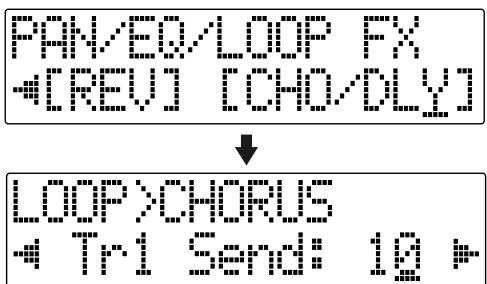
3
Press CURSOR[ ][ ] until "FX Type" or "Type" is displayed, then turn the TIME/VALUE dial to select the loop effect.
When using CHO/DLY
Select from "CHORUS," "DELAY," or "DBLN" (doubling).
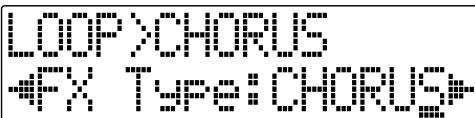
When using REV
Select either "HALL" or "ROOM."
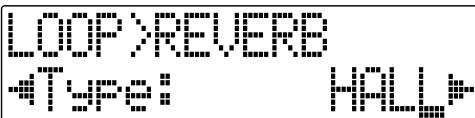
4
To change the settings for the selected effect, press CURSOR [ ] to select the parameter and turn the TIME/VALUE dial to change the set value.
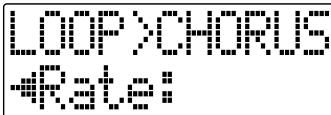


For a description of the parameters for each effect, refer to "Loop Effect Parameter Functions" (p. 120).
5
When you finish making settings, press [EXIT] repeatedly to return to the PLAY screen.
Doubling
When you want to spread out the guitar backing sound to the left and right, record the same guitar backing separately to two tracks, then pan the sounds to the left and right. This is known as "doubling."
By using the "DBLN" loop effect, you can produce a doubling effect even from a single-track (mono) recording, allowing you to make more efficient use of the tracks.
- If you want to emphasize the doubling effect, pan the track completely to the right or to the left and increase the doubling effect level. In addition, use the following procedure to raise the send level.

You cannot use the chorus, delay, and doubling effects together. You must choose only one.

Loop effects do not have "patches."
Loop effect settings are saved along with the song data. If you want to save the settings in the currently selected song, hold down [STOP], and press [REC].
Adjusting How the Loop Effect is Applied
The following explains how you can alter the volume of the signals sent by each track to the loop effects (the send level), and control the degree to which the loop effects are applied.
1
Confirm that [PAD] is not lit, then press [PAN/EQ/LOOP FX].
2
Press CURSOR [ ] [ ] to move the cursor to "CHO/DLY" or "REV," and press [ENTER].
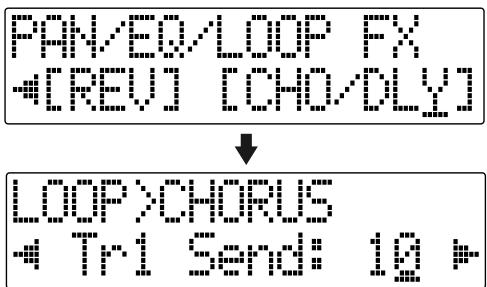
3
Press CURSOR [ ] [ ] to select the screen for setting the send level of each track appears in the display.
When using CHO/DLY
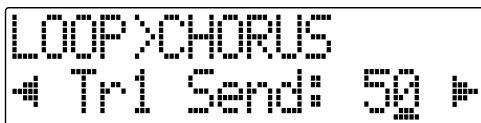
When using REV
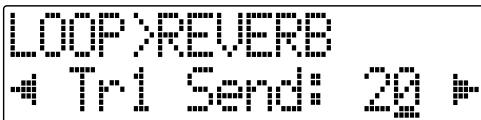
4
Use CURSOR [ ][ ] and the TIME/VALUE dial to adjust the send level for each track.
- Pressing a REC TRACK button moves the cursor to the track corresponding to the button pressed.
If you then press CURSOR [ ], the screen for setting the input-source send level appears in the display; if you press CURSOR [ ], the one for setting the Rhythm send level is displayed.
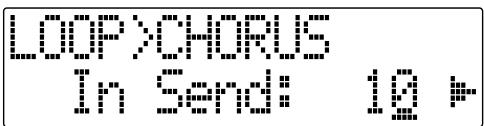
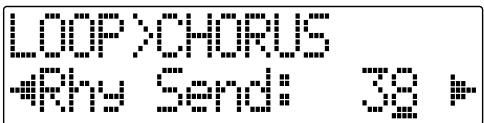
To adjust the send level for the input source, move the cursor to "In Send." To adjust the send level for the Rhythm, move the cursor to "Rhy Send." The setting is adjusted by turning the TIME/VALUE dial to the desired value.
5
After you have completed adjusting the send level, press [EXIT] repeatedly to return to the Play screen
Loop Effect Parameter Functions
Parameter List
CHORUS/DELAY/DBLN (Doubling)
This selects the chorus, delay, or doubling effect.
FX Type
This sets the type of the effect.
CHORUS :
A sound with a subtly shifted pitch is added to the direct sound, making the final output sound thicker and broader.
DELAY :
This creates a thicker sound by applying a delayed sound to the direct sound.
DBLN :
By adding a slightly time-delayed sound to the direct sound, this produces the impression that multiple sources are sounding together (a "doubling" effect). The delayed sound will be output from the side opposite to which the playback track has been panned.
When "CHORUS" is selected
Rate 0-100
Adjusts the rate of the Chorus effect.
Depth 0-100
Adjusts the depth of the Chorus effect.
Pre Dly 0.5 - 50.0 ms
Adjusts the time needed for the effect sound to be output after the direct sound has been output.
E.Level 0-100
Adjusts the volume of the effect sound.
When "DELAY" is selected
Dly Tme 10 - 1000 ms
This parameter adjusts the delay time (i.e., the interval for which sound is delayed).
Feedback 0-100
This parameter adjusts the amount of feedback. Changing the amount of feedback causes the number of time the delayed sound is repeated to change as well.
E.Level 0-100
This adjusts the volume of the delay sound.
Rev Send 0-100
Adjust the volume of the reverb that is applied to the delayed sound.
When "DBLN" is selected
Dly Tme 0.5 - 50.0 ms
This parameter adjusts the delay time (i.e., the interval for which sound is delayed).
E.Level 0-100
This adjusts the volume of the delay sound.
REVERB
Reverberation (or reverb) is the effect caused by sound waves decaying in an acoustic space, or a digital simulation thereof. This decay occurs because sound waves bounce off many walls, ceilings, objects, etc. in a very complex way.
These reflections, coupled with absorption by various objects, dissipate the acoustic energy over a certain period of time (called the decay time). The ear perceives this phenomenon as a continuous wash of sound.
Type
This selects the Reverb Type.
ROOM :
Simulates the reverberation in a small room.
HALL :
Simulates the reverberation in a concert hall.
Rev Time 0.1 - 10.0
This parameter adjusts the duration (time) of the reverb.
Tone -12-+12
Adjusts the tone.
E.Level 0-100
This adjusts the volume of the reverb sound.
Setting the Track EQ
This section explains how to edit the Track EQ settings (parameters).

For a fuller description of Track EQ, refer to "Track EQ Parameter Functions" (p. 122).
1
Confirm that [PAD] is not lit, then press [PAN/EQ/LOOP FX].
2
Press CURSOR [ ] [ ] to move the cursor to "EQ," and press [ENTER].
The EQ Setting screen appears in the display.
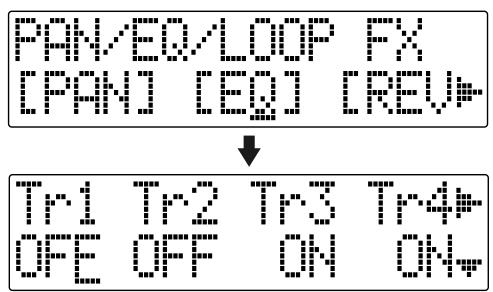
3
Use CURSOR [ ] [ ] and the TIME/VALUE dial to set the EQ On/Off for each track.
- Pressing a REC TRACK button moves the cursor to the track corresponding to the button pressed.
4
To change the EQ settings, press CURSOR [▲] [▼] repeatedly to display the parameter screen, then turn the TIME/VALUE dial to change the settings value.
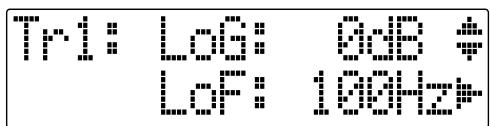
5
After you have completed the setting, press [EXIT] repeatedly to return to the Play screen
MEMO
Track EQ do not have "patches." Loop effect settings are saved along with the song data.
If you want to save the settings in the currently selected song, hold down [STOP], and press [REC].
Parameter List
This is a two-band equalizer that is independent for each track.
On/Off OFF, ON
This parameter turns the equalizer effect on/off.
LoG -12-+12 dB
This sets the gain (-12 to +12 dB) for the low-range equalizer (shelving type).
LoF 40 Hz - 1.5 kHz
This sets the center frequency (40Hz to 1.5 kHz) for the low-range equalizer (shelving type).
HiG -12-+12 dB
This sets the gain (-12 to +12 dB) for the high-range equalizer (shelving type).
HiF 500 Hz - 18 kHz
This sets the center frequency (500 Hz to 18 kHz) for the high-range equalizer (shelving type).

If you adjust the equalizer while listening to the sound, you may notice a clicking noise. This is not a malfunction. If the noise is objectionable, make adjustments while the sound is not playing.
Fixing the Pitch of Vocals (Pitch Correction)
The Pitch Correction
The term Pitch Correction is used to describe a group of effects that are used on recorded vocal tracks to fix incorrect pitches.
When compared with guitars, pianos, and other musical instruments, the human voice generally produces a relatively unstable tone. And when recording unprepared vocalists, this can often lead to considerable difficulties in the form of notes sung out of tune and poor sound quality.
When properly used, the BR-600's Pitch Correction will help to ensure that your vocal tracks will always sound great.
Makeup of the Pitch Correction
This effect is intended for use with the playback of recorded audio tracks and cannot be used on input sources. The Pitch Correction and audio tracks are connected as shown below.
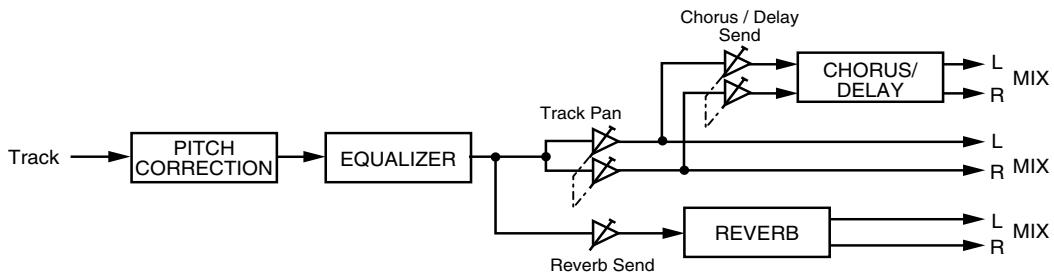
Pitch Correction Patches
In the case of pitch correction, you can set up the way in which the effect is to be applied and can then save these settings. A group of such settings is referred to as a Patch.
In addition to the Preset Patches, you can also store five rewritable "User Patches" in the BR-600. And on memory cards, you can store five "Song Patches," which are patches that can be used on an individual song basis.
Precautions for Pitch Correction Usage
- When you are using the Pitch Correction, you will not be able to use insert effects, the Mastering Tool Kit, or the loop effects (REVERB, CHORUS/DELAY).
- The Pitch Correction is intended for use with recorded vocal tracks and it cannot be applied to input sources or the Master output.
- These effects will function when applied to solo performances other than vocals; however, the fundamental differences between the character of the human voice and that of musical instruments makes it highly unlikely that the desired result will be achieved.
-
In the following situations, the Pitch Correction may not be able to accurately detect the pitch, and normal operation will not be possible.
-
When other sounds are mixed in with the solo vocal part.
- When the volume of the vocal part is excessively loud or quiet.
- When the vocal part contains a lot of sibilance or is very breathy (such as a singer that whispers, or one with a husky voice).
- When the vocal part contains an excessive number of different pitches (such as fast, deep vibrato or fast speech).
-
When the part is sung with a very low voice containing a lot of harmonics.
-
If the BR-600 is frequently incorrect when detecting the pitch, either change the "Type" setting for the pitch correction function. In certain cases, this will reduce the number of incorrect detections.
Using the Pitch Correction
Let's now use the BR-600's pitch correction feature to clean up some mistakes in a solo vocal part.
Using this feature, we will be able to correct pitches in real time and in semitone units.
1
Before using pitch correction, record a solo vocal track to work with.
2
Press [REC MODE] several times until the BOUNCE indicator lights up.
The BR-600 will now enter Bounce mode.
3
Confirm that [PAD] is not lit, then press [PITCH CORRECTION].
This button will light up to indicate that the Pitch Correction is turned on.
The Pitch Correction patch selection screen will appear.
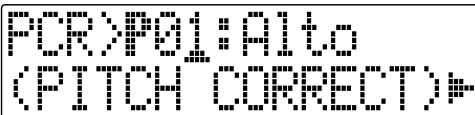
4
Press CURSOR [ ] [ ] to move the cursor to "LOCAT," and press [ENTER].
5
Use TIME/VALUE dial to select the track containing the solo vocal recording.
The following tracks can be selected at this time:
Tracks 1-8, Tracks 12-78
6
Start playback on the BR-600.
Pitches will be corrected in the solo vocal part as it is played.
Listen to the part to confirm that it is now completely in tune, and if necessary, adjust the volume of the part using the corresponding track fader.
Press [STOP] to end playback.
7
Press [EXIT] to return to the patch selection screen.
8
Use [CURSOR] to move the cursor to the patch number and select a patch using the TIME/VALUE dial.

"Pitch Correction Patch List" (p. 207)
9
Press [EXIT].
10
Use [CURSOR] and the TIME/VALUE dial to select the track or V-track to which the edited result is to be recorded.
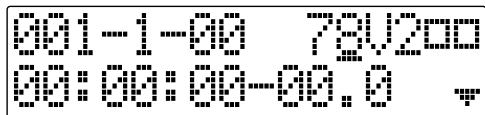
The button for the selected track flashes in red, indicating that the track has been selected as the REC track.
- The track button alternately lights orange and green when a track or V-track to which material has already been recorded is selected as the recording destination.
11
Move the faders for all tracks except the track containing the solo vocal recording all the way down. Note that this also applies to the Rhythm fader.
12
Press [ZERO] to jump to the start of the song and then press [REC].
[REC] will turn red and start to flash, indicating that the BR-600 is now ready for recording.
13
Press [PLAY].
Both [PLAY] and [REC] will light up and recording will start.
The solo part will be played and any incorrect pitches will be fixed. At the same time, the corrected part will be recorded on the selected track.
14
Press [STOP] at the point where you want to stop recording. The BR-600 will stop playback.
15
Press [ZERO] to jump to the start of the song once again and then start playback of the recorded track. Move the fader for the track containing the original vocal part all the way down, and raise the fader for the track containing the corrected vocal part to an appropriate point. As you listen to the corrected part, confirm whether or not you are happy with the corrections.
MEMO
If you do not like the way the vocal part was corrected, use Undo (p. 64) to cancel the recording.
Setting the Correction Method for Vocal Pitch (Pitch Correction Edit)
Each of the preset patches 1-5 uses a slightly different method for correcting pitches. Normally, it will be sufficient to select the patch that gives the results you like best; however, if you cannot achieve favorable results using any of these patches, you can change the Pitch Correction settings to create a patch of your own.
1
Select a preset patch to base your new patch on.
2
Press CURSOR [ ] [ ] to move the cursor to "EDIT," and press [ENTER].
The Pitch Correction edit screen will appear.
3
Use [CURSOR] to move the cursor to the setting you want to change and select a new value using the TIME/VALUE dial.
Type
LO.MALE, HI.MALE, LO.FEML, HI.FEML
Set this parameter to match the type of voice in the original vocal part. If this parameter is not set correctly, problems will be more likely to occur in pitch detection and correction.
LO.MALE (Low Male)
Select this setting for a low-pitched, male voice.
HI.MALE (High Male)
Select this setting for a high-pitched, male voice.
LO.FEML (Low Female)
Select this setting for a low-pitched, female voice.
HI.FEML (High Female)
Select this setting for a high-pitched, female voice.
- If the BR-600 is frequently incorrect when detecting the pitch, either change the type setting. In certain cases, this will reduce the number of incorrect detections.
Smooth
0-100
This setting determines how quickly pitch correction will react to changes of pitch in the original vocal part. Large values result in a longer time before correction is applied; consequently, changes in pitch will be more gradual. Small values produce rapid changes in pitch.
Corrections that are made too rapidly seem robotic. However, if the correction is too smooth, in some cases it may appear as if no correction has been applied. For natural sounding pitch corrections, set the value in a range between 20 and 40.
4
Press [EXIT].
The Pitch Correction's patch selection screen will appear.
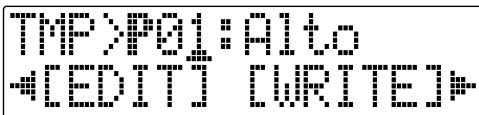
5
"To save your modified settings, carry out the procedure described in "Saving the Pitch Correction Settings (Write)."
Saving the Pitch Correction Settings (Write)
Modified Pitch Correction settings are saved by writing them together under a new patch name.
- If you do not need to change the patch name, go to Step 4 after entering the Pitch Correction patch selection screen.
1
At the Pitch Correction patch selection screen, press CURSOR [▶] to move the cursor to "NAME," and press [ENTER].
The Patch Name Setting screen appears in the display.
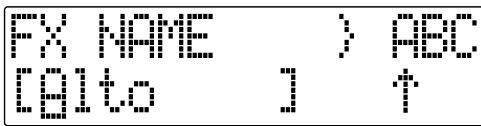
2
Use CURSOR [ ] and the TIME/VALUE dial to enter the patch name.
- Press [ENTER] to switch between uppercase and lowercase.
3
After you have completed entering the patch name as desired, press [EXIT] to return to the Patch selection screen.
4
Press CURSOR [ ] [ ] to move the cursor to "WRITE," and press [ENTER].
The Write screen appears in the display.
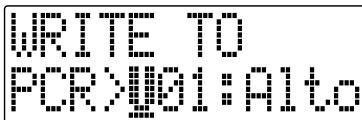
5
Turn the TIME/VALUE dial to select the patch number to which to write the new patch.
6
After you've selected the destination, press [ENTER]. "Are you sure?" appears in the display.
7
Press [ENTER]. (To cancel the operation press [EXIT].)
The Pitch Correction patch will be written.
After the save has been completed, you are returned to the Pitch Correction patch selection screen.
- During updating, "Keep power on!" appears in the upper line of the display, while the lower line shows what is being processed.

You cannot write patches while songs are being recorded or played back.
Making Detailed Settings for Pitch Correction (Correction Event Map)
In the procedures described thus far, what has been explained is how to correct the overall pitch for the entire song, from start to finish, in semitone increments.
In actual practice, however, there may be situations where you want to correct only a certain section or adjust the pitch differently. In such instances, use the following procedure.
1
Start by switching to BOUNCE mode and selecting the patch to which pitch correction is to be applied.
2
Use [CURSOR] to move the cursor to "P.MAP" in the Pitch Correction patch selection screen and press [ENTER].
The Correction Event Map screen appears in the display.
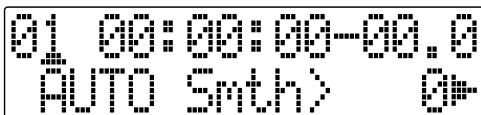
In the Correction Event Map screen, you can input the time at which you want the pitch correction to start as well as the pitch.
Taken together, this timing and pitch data is referred to as a "correction event."
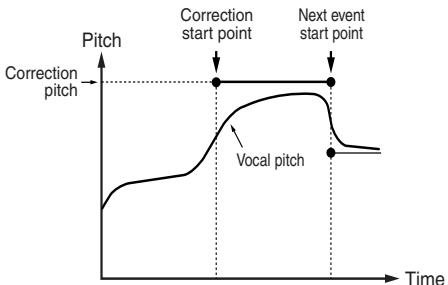
You can make corrections freely at the desired points in the song by arranging correction events in the sequence they occur.
The sequence of correction events with the information they contain is called a "correction event map".
Initially, only one correction event, "AUTO" is input at the beginning of the correction event map.
AUTO :
After the specified point in the song, all pitches are corrected in semitone increments.
3
Use [CURSOR] to move the cursor to "INSERT" and press [ENTER].
A new correction event is inserted.
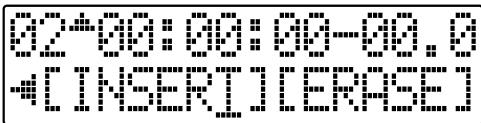
4
Use [CURSOR] to move the cursor to "Time" and specify the time at which you want the correction to start with the TIME/VALUE dial.
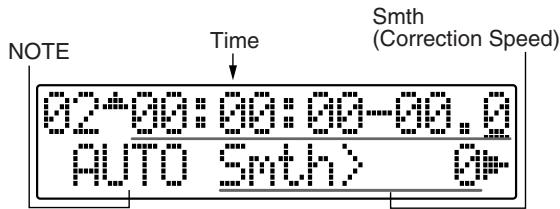
NOTE
You cannot change the time of the correction event at the start of the song.
5
Use [CURSOR] to move the cursor to "NOTE" and specify the pitch you want to correct with the TIME/ VALUE dial.
NOTE :
OFF
No correction is made after the specified point in the song. The song is played using the original pitch.
AUTO
After the specified point in the song, all pitches are corrected in semitone increments.
C,C#, -A#, B
The performance after the specified point in the song is adjusted to the specified pitch.
MEMO
The reference pitch for NOTE is determined by the tuner's reference pitch. See "Setting the Reference Pitch of the Tuner" (p. 193).
6
Use [CURSOR] to move the cursor to "Smith" and specify the correction speed.
Smith (Smooth)
-100 - +100
The value set here is added to the value for the "Smooth" patch parameter (p. 127).
When set to 0, the correction proceeds at the rate set in the patch's "Smooth" parameter.
The correction is performed more rapidly the lower the value is compared to the value set for the patch, while the correction is carried out more smoothly as the value increases relative to the patch's value.
- Set the value so that the sum of the values is in a range from 0 to 100. The pitch correction produces no effect when the value is set below 0 or over 100.
7
Use [CURSOR] to move the cursor to "INSERT" and press [ENTER].
Another new correction event is inserted.
8
Use [CURSOR] to move the cursor to "TIME" and specify the time at which you want the correction to end with the TIME/VALUE dial.
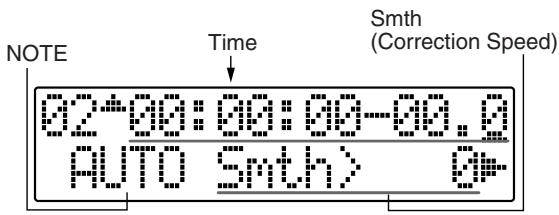
9
Use [CURSOR] to move the cursor to "NOTE" and specify "OFF."
10
Have the Recorder play the song from the beginning. The correction is first applied at the point in the song specified in Step 4, with the correction ending at the point specified in Step 8.
11
To delete the currently selected correction event, use [CURSOR] to move the cursor to "ERASE" and press [ENTER].
The correction event is deleted.
12
Repeat Steps 3-11 as needed to specify the edited range.
13
After you have completed entering the settings, press [EXIT] repeatedly to return to the Play screen.
NOTE
- You cannot delete the correction event at the beginning of the song. If this correction event is unneeded, rather than deleting it, just set the function to "OFF."
- You can only save a Correction Event Map to a single song. Even if you switch the patch with the pitch correction, the Correction Event Map remains unchanged.
MEMO
Section 4 Using The Rhythm
With the BR-600, you can use the panel buttons (drum pads) to play the drum sounds any way you like.
The BR-600 features nine pre-programmed collections of drum sounds designed for use in different musical genres (drum kits); select the drum kit suited to the type of music you are playing.
In addition, you can use the dedicated rhythm track to have rhythms played automatically (rhythm patterns, rhythm arrangements).
About the Drum Pads
The buttons arranged on the BR-600's panel, such as [KICK], [SNARE], [OPEN HH], [CLOSED HH], and so forth are called "drum pads." By tapping the drum pads, you can play the drum tones assigned to the different drum pads.
The drum pads double as screen selection buttons, and you can use [PAD] to switch functions. To use the drum pads, press [PAD] so the button is lit.
When the [PAD] button's light is off, the button functions as a screen select button. [PAD] alternately lights or goes off each time it is pressed.
For more details about the drum pads, refer to "Playing the Drum Sounds" (p. 135).
About the Drum Sounds (Drum Kits)
In general, before playing drums, you need to select a drum set (a collection of kick, snare, and other percussive instrument sounds) that is suitable for the type of music (genre) you intend to perform.
The BR-600 includes such kinds of percussion sounds, programmed as internal tone waveforms, that allow you to combine sounds for a particular musical genre. These combinations are called "drum kits."
The BR-600 features nine pre-programmed drum kits, all of which you can freely select for your performances.
You can also select your preferred combinations of drum tone waveforms to create up to five customized drum kits ("Selecting Drum Kits" (p. 136)).
In addition, if the prepared drum kits do not contain the drum tone waveforms you want, you can import preferred drum tone waveforms from computers ("Loading Drum Sounds from WAV/AIFF Files (Tone Load)" (p. 174, p. 186)). You can use the drum pads to play the selected drum kits (p. 135).
You can also have patterns and arrangements be played back automatically (p. 143, p. 142).
What Are Patterns and Arrangements?
The BR-600's rhythms are composed of performance data of two main types called "patterns" and "arrangements."
What is a Pattern?
When bands and other groups play, the drums usually repeat a predetermined pattern lasting about one or two measures. On the BR-600, this basic, repeating performance data is referred to as a "pattern."
Example of pattern
In a four-beat rhythm, the following sort of performance is played repeatedly.
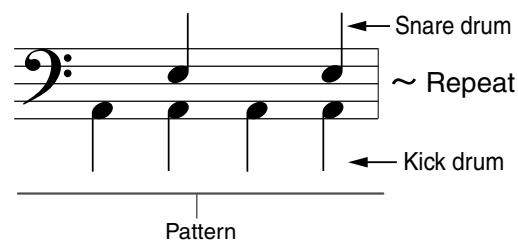
Song patterns (S001 - S100)
These are patterns whose data is rewrites, and up to 100 different patterns for each song can be stored on memory cards.
Preset patterns (P001 - P327)
The BR-600 comes with 327 different "preset patterns" (P001 - P327) specially created for use with rock, jazz, and other musical genres.
MEMO
Preset patterns include prepared patterns for intros, verses, fill-ins, and endings (you can confirm the type by looking at the characters at the end of the pattern name).
(Ex.)
ROCK1-IN (Intro) ROCK1-V2 (Verse2)
ROCK1-V1 (Verse 1) ROCK1-F2 (Fill 2)
ROCK1-F1 (Fill 1) ROCK1-E (Ending)

"Preset Pattern List" (p. 209)
IN (Intro)
Music patterns to be placed at the beginning of a song.
V (Verse) 1 and 2
Music patterns to make up the main part of the song. "1" are basic patterns and "2" are more advanced versions of "1."
F (Fill) 1 and 2
Music patterns to be used as phrases to connect different sections of a song. You can select either "1" or "2" depending on the form that will follow the fill.
E (Ending)
Music patterns to be placed at the ending of a song.
- You cannot change and overwrite Preset pattern data.

For more detailed instructions on playing patterns, refer to "Playing Rhythm Patterns" (p. 142).
For more detailed instructions on creating and changing patterns, refer to "Creating Original Patterns" (p. 144) and the following material.
What is an Arrangement?
Although you can play a pattern by itself as a guide for practice, like a metronome, the rhythm in that case continues from the start of the song to the end without changing. When creating songs that include musical changes, a number of different patterns need to be arranged sequentially; for example, an intro followed by the chorus, bridge, and ending.
This sequencing of data, with patterns lined up in the order performed, is called an "arrangement."
| Intro Tempo: 120.0 | Verse Tempo: 110.0 | Fill Tempo: 130.0 | ••• |
Preset arrangements(P01 - P50)
The BR-600 comes with 50 different internal "preset arrangements" (P01 - P50) specially created for use with rock, jazz, and other musical genres.
- You cannot change or overwrite data in the preset arrangements.
With the preset arrangements (except for Metro 4/4), the E (ending) is followed by a three-measure BREAK (rest), after which the performance repeats from V1 (Verse 1).

"Arrangement / Pattern List" (p. 208)
Song arrangements (S01 - S05)
These are arrangements whose data is rewritten, and up to 5 different arrangements for each song can be stored on memory cards.

To play arrangements, you need to put the BR-600 in Arrangement mode.
For more information about this procedure, refer to "Playing Rhythm Arrangements" (p. 143)
About Pattern Mode and Arrangement Mode
The BR-600 features two modes for performing rhythms, "Pattern mode" and "Arrangement mode."
Pattern Mode
This mode is used for performing patterns. The selected pattern is played repeatedly from the beginning of the song to the end. You cannot have patterns switch automatically during the song.
To play a pattern, press [PATTERN], causing the indicator to light and switching the BR-600 to Pattern mode.
Arrangement Mode
This mode is used for performing arrangements. The patterns are switched during the song according to the order in which they are arranged.
To play an arrangement, press [ARRANGE], causing the indicator to light and switching the BR-600 to Arrangement mode.
Playing the Drum Sounds
Now try playing the drum sounds using free hand movements to play the pads.
1
With the Play screen active, press [PAD] so that the button lights.
You do not need to press [PAD] if the indicator is already lit.
2
Move the RHYTHM fader and MASTER fader to the positions shown in the figure.
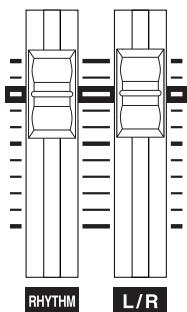
- Note that raising the faders too far can produce excessive volume levels and possibly cause injury to listeners' ears. On the other hand, lowering the faders too much can make the drum sounds inaudible.
3
Tap a drum pad.
The sound corresponding to the tapped drum pad plays. The volume of the drum sound changes in accordance with how strongly the pads are hit.
NOTE
- Note that when multiple drum pads are played simultaneously, the volume of all pads may be at the same level. This is due to circuitry to detect the force used in playing the pads.
- When the GUITAR/BASS/MIC2 dial or the MIC1 dial sensitivity is increased, or when a patch that makes heavy use of drive or distortion in the insert effects is selected, the sound of the pad being tapped may shake the internal electronic circuits, which may cause noise in sounds sent to the headphones or LINE OUT.
If this occurs, adjust the dial to lower the sensitivity or turn off the insert effects.
MEMO
The volume of a drum sound is determined by the force used in tapping the drum pads, with the volume divided into five levels.
Maximum : Sounds are played at maximum volume. (MIDI velocity value of 127)
Strong : Sounds are played at high volume. (MIDI velocity value of 100)
Medium : Sounds are played at normal volume. (MIDI velocity value of 70)
Weak : Sounds are played at low volume. (MIDI velocity value of 40)
Minimum : Sounds are played at minimum volume. (MIDI velocity value of 20)
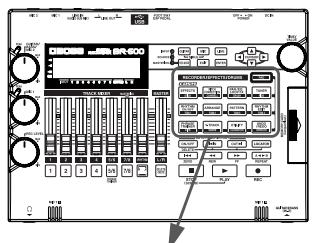
Correspondence Between Drum Pads and Drum Sounds
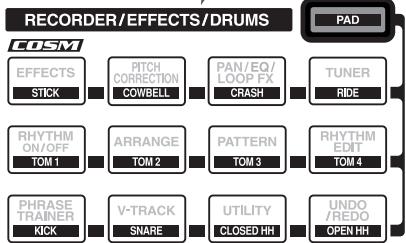
| PAD Name | Drum Sound Name |
| [KICK] | Kick drum |
| [SNARE] | Snare drum |
| [CLOSED HH] | Closed hi-hat |
| [OPEN HH] | Open hi-hat |
| [TOM1] | High tom |
| [TOM2] | Mid tom |
| [TOM3] | Low tom |
| [TOM4] | Floor tom |
| [STICK] | Cross stick |
| [COWBELL] | Cowbell |
| [CRASH] | Crash cymbal |
| [RIDE] | Ride cymbal |
Selecting Drum Kits
A drum kit consists of a collection of various rhythm instrument sounds organized as one set. The BR-600 is programmed with nine internal "preset drum kits."
Also included are five original "song drum kits." Song drum kits are saved to each song individually memory cards.
The drum kits' instrument sounds are used in performing arrangements and patterns.
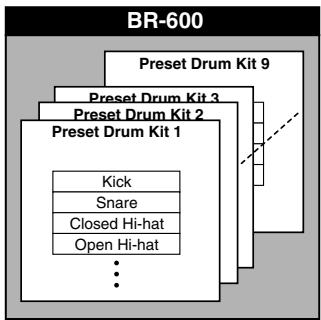
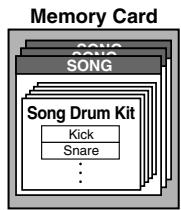

- Drum kits are stored to each individual arrangement separately.
- Switching kits in Pattern mode simultaneously switches the kits in Arrangement mode.
- Even if you switch kits in a preset arrangement selected in Arrangement mode, the change is only temporary. If you want to save the change, first copy the preset arrangement to a song arrangement, then switch to the song arrangement to change the kit.
Select drum kits as described below.
1
While performance of the song is stopped, check to confirm that [PAD] is not lit, then press [PATTERN] or [ARRANGE].
When Pattern mode is selected
[PATTERN] and [RHYTHM ON/OFF] light.
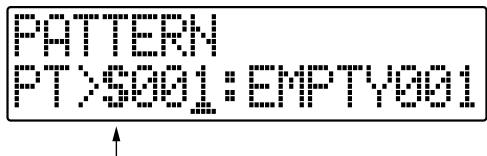
P: Preset / S: Song
When Arrangement mode is selected
[ARRANGE] and [RHYTHM ON/OFF] light.
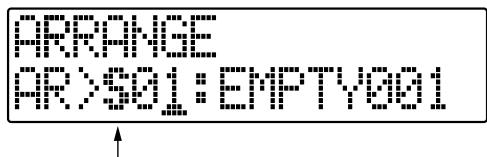
P: Preset / S: Song
2
Press [RHYTHM EDIT].
3
Press CURSOR [ ] [ ] to move the cursor to "KIT," and press [ENTER].
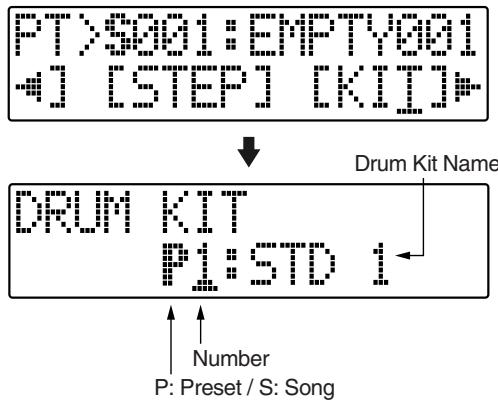
When using pattern mode
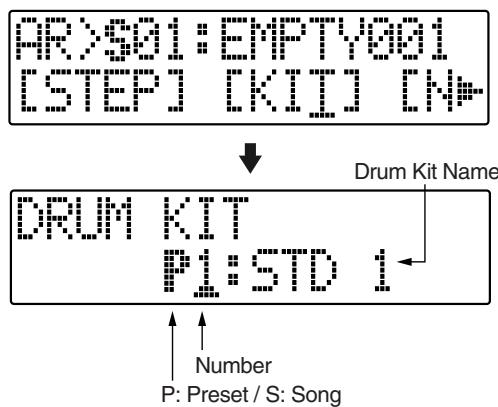
When using arrangement mode
4
Use CURSOR [ ] and the TIME/VALUE dial to select drum kits by switching the preset/song and number.
(P1-9)
STD1,2: Standard sets
ROOM: Set with moderate ambience applied
HARD: Set appropriate for hard rock
JAZZ: Set appropriate for jazz
HIP-HOP : Set appropriate for dance
HOUSE : Set appropriate for dance
REGGAE: Set appropriate for reggae
808: Set based on the renowned "Roland TR-808" rhythm machine
(S1-5)
SongKit 1-5: Original drum kits assigned to each song.
5
Press [EXIT] repeatedly to return to the Play screen.
Creating Original Drum Kits (Tone Load)
With the BR-600, you can create original drum kits not only with the internal drum sounds, but by loading drum sounds from external sources as well (Tone Load).
There are three ways to load drum tones.
- Loading from the tracks
- Loading from other drum kits
- Loading from WAV/AIFF files (p. 174, p. 186)

Wave data in the following formats can be imported. You cannot import wave data in other formats.
WAV or AIFF format
- Mono or Stereo
8-bit or 16-bit
- Sampling Rate: 44.1kHz
- Compressed WAV files or AIFF files cannot be loaded.
- Extremely short waveform data (less than approximately 100ms ) cannot be loaded.
- The loop point settings within an AIFF file will be ignored.
For the files to be imported, add the extension "WAV" to WAV files and the extension "AIF" to AIFF files. - You can load drum sounds of up to 13 seconds for a single drum kit. (Example)
Kick: 3 seconds, snare: 3 seconds, crash cymbal: 7 seconds Total 13 seconds
- Stereo WAV and AIFF files imported with Tone Load are loaded as "mono" sounds with the left and right sides mixed.
Loading Drum Sounds from Audio Tracks
This procedure cuts out a portion of the data recorded to the audio tracks and imports it as a drum sound.
1
Confirm that [PAD] is not lit, then press [UTILITY].
2
Press CURSOR [ ] [ ] to move the cursor to "TONE," and press [ENTER].
The Tone Load menu screen appears in the display.
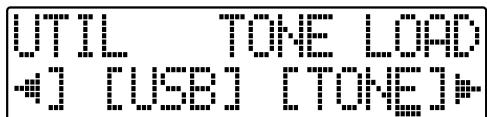
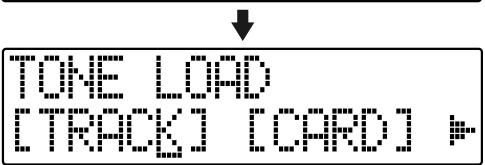
3
Press CURSOR [ ] [ ] to move the cursor to "TRACK," and press [ENTER].
The screen for loading sounds with Tone Load from the audio tracks appears in the display.
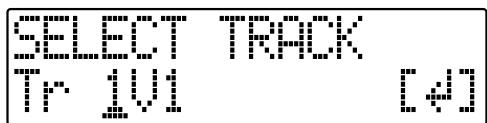
4
Use CURSOR [ ] [ ] and the TIME/VALUE dial to select the track/V-Track to load, and press [ENTER].
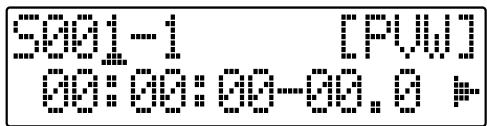
5
Use CURSOR [ ] [ ] and the TIME/VALUE dial to specify the range (start and end points) of drum sounds to be loaded in terms of measures or time locations.
Start Point (^ ^ )
Specify the measure or location to be used as the start point for loading the drum sounds.
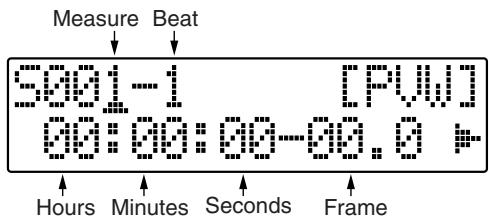
End Point ("E")
Specify the measure or location to be used as the end point for loading the drum sounds.
From the screen for setting the start point, press
CURSOR [ ] repeatedly to display the screen for setting the end point.
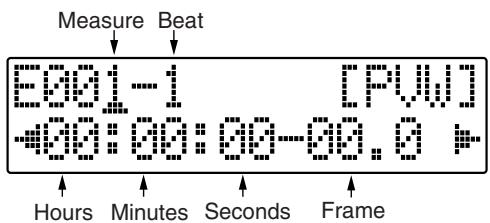
MEMO
- You can press [ENTER] to switch between the start point and end point settings screens.
- You can preview the drum sounds in the specified range by moving the cursor to "PVW" and pressing [ENTER]. Determine the sounds to load while setting the start and end points and the length, and repeating the preview.
- You can press [PLAY] to preview the sounds, and press [STOP] to stop the sounds.
6
When you have finished setting the start and end points, use CURSOR [ ] to move the cursor to "LOAD" and press [ENTER].
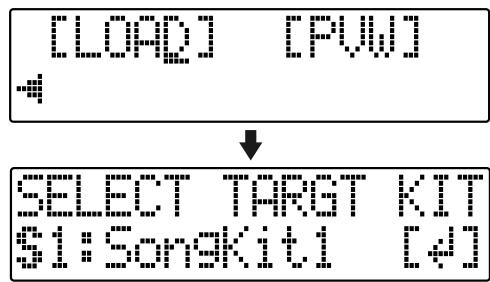
7
Specify the load-destination song drum kit with the TIME/VALUE dial, then press [ENTER].
S1-5:Song Drum Kit 1-5
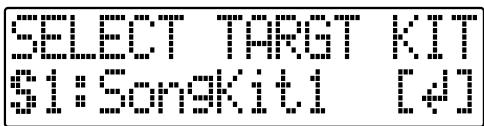
8
Specify the load-destination drum sound with the TIME/VALUE dial, then press [ENTER].
Loading is executed. To cancel, press [EXIT].
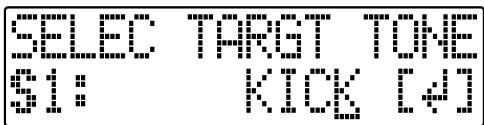
MEMO
You may find it convenient to use the "scrub," "punch in," and "locator" functions to set the range containing the drum sounds you want to load beforehand.
You can use the scrub function to repeat playback and locate the point from which loading is to start (the start point) and press AUTO PUNCH [IN], then after determining the point at which loading is to finish (the end point), press [LOCATOR] to register the range to be loaded. Using this technique of setting the start point with AUTO PUNCH [IN] and the end point with [LOCATOR] allows you to set the range to be loaded very rapidly.
NOTE
- You cannot specify an interval between the start and end points or a length of time in less than 100 ms or excess of 13 seconds.
- When specifying measures, the result is reflected in the time display, and vice versa.
Copying drum sounds from other drum kits
1 Confirm that [PAD] is not lit, then press [UTILITY].
2 Press CURSOR[ ]to move the cursor to "TONE," and press [ENTER].
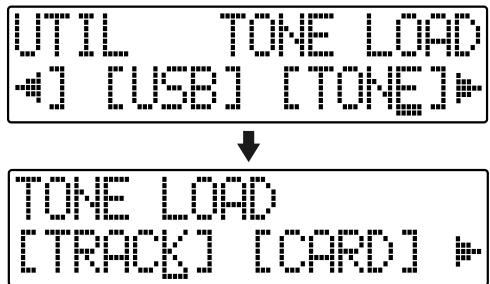
3 Press CURSOR [ ] [ ] to move the cursor to "COPY," and press [ENTER].
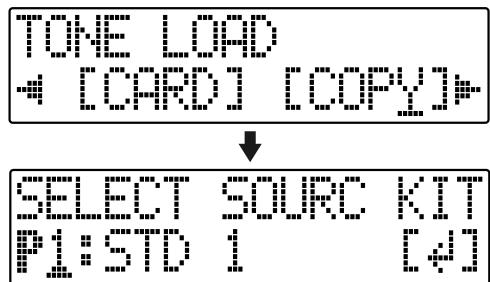
4 Turn the TIME/VALUE dial to specify the copy-destination drum kit, then press [ENTER].
P1-9: Preset Drum Kit 1-9
S1-5:Song Drum Kit 1-5
5 Turn the TIME/VALUE dial to specify the copy-destination drum sound, then press [ENTER].
- Select "ALL" if you want to copy all of the drum sounds in the kit.
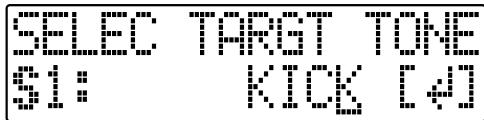
6 Turn the TIME/VALUE dial to specify the copy-destination drum kit, then press [ENTER].
7 Turn the TIME/VALUE dial to select the copy-destination song drum sound, then press [ENTER]. Copying is executed. To cancel, press [EXIT].
* During updating, "Keep power on!" appears in the upper line of the display, while the lower line shows what is being processed.
Press [EXIT] to return to the Play screen.
Erasing drum sounds
1 Confirm that [PAD] is not lit, then press [UTILITY].
2 Press CURSOR [ ] [ ] to move the cursor to "TONE," and press [ENTER].
3 Press CURSOR [ ] [ ] to move the cursor to "ERASE," and press [ENTER].
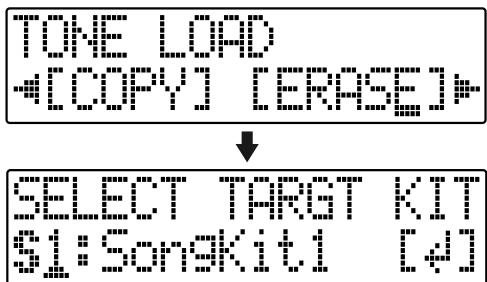
4 Turn the TIME/VALUE dial to specify the erase drum kit, then press [ENTER].
S1-5:Song Drum Kit 1-5
5 Turn the TIME/VALUE dial to specify the erase drum sound, then press [ENTER].
- Select "ALL" if you want to erase all of the drum sounds in the kit.
"Are you sure?" appears in the display.
6 Press [ENTER] (YES) to erase the drum sound. To cancel, press [EXIT] (NO).
7 Press [EXIT] to return to the Play screen.
Changing the position (pan) of the drum sounds
1 Confirm that [PAD] is not lit, then press [UTILITY].
2 Press CURSOR [ ] [ ] to move the cursor to "TONE," and press [ENTER].
3 Press CURSOR [▶] to move the cursor to "PAN," and press [ENTER].
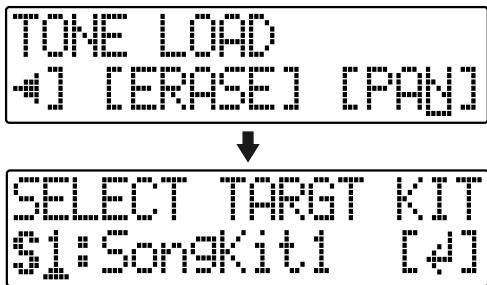
4 Turn the TIME/VALUE dial to specify the drum kit whose panning you want to change, then press [ENTER].
S1-5:Song Drum Kit 1-5
5 Use CURSOR [ ] and the TIME/VALUE dial to specify the drum sound whose panning is being changed and the pan setting.
- When you press [PAD], causing the button to light, you can then set the drum sounds by tapping the drum pads.
- Pressing [ENTER] sets this to "C00" (Center).
6 Press [EXIT] to return to the Play screen.
Now try selecting a pattern you like from the internal rhythm patterns and then have that pattern play back repeatedly.
1
Confirm that [PAD] is not lit, then press [PATTERN] so that the button lights.
The BR-600 switches to Pattern mode, enabling patterns to be played.
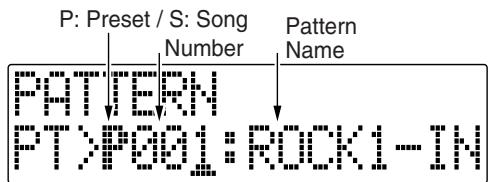
[RHYTHM ON/OFF] simultaneously lights, confirm that the rhythms are enabled.
2
Use CURSOR [ ][ ] and the TIME/VALUE dial to select the pattern you want to play.
P001-P327:Preset patterns 1-327
S001 - S100 : Song patterns 1 - 100
At this point, you can use the [PLAY] and [STOP] buttons to check the selected pattern.
3
Press [EXIT].
Return to the Play screen.
4
Press [PLAY].
When the recorder's playback begins, the rhythm begins playing.
5
Adjust the RHYTHM fader and MASTER fader to appropriate levels
6
Press [STOP] to stop the performance.
NOTE
- When the BR-600 is shipped from the factory, the song patterns (S001 - S100) contain no data, thus no patterns are played even when selected.
- The pattern "P327: BREAK" consists only of a rest. No sound plays when this is selected.
Changing the Tempo of a Pattern
You can temporarily change the tempo of the pattern being played by carrying out the following procedure while the Play screen is displayed.
1
Use CURSOR[ ] to position the cursor at the indication of the tempo in the display.
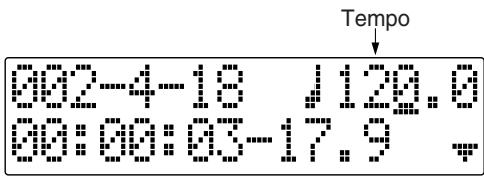
2
Turn the TIME/VALUE dial to adjust the tempo.
The tempo at which the pattern plays is changed.
Using the TAP Button to Change the Tempo of a Pattern
You can temporarily change the tempo of the pattern by the timing with which you press [TAP(TEMPO)].
Tap on [TAP(TEMPO)] four or more times to change the tempo of the pattern. The tempo becomes that in which you tapped.

RHYTHM
NOTE
- The change in tempo is only temporary.
- Tempos cannot be saved to patterns.
- The tempo is applied to all patterns. You cannot make separate tempo settings for individual patterns.
- The tempo can be set to any value from 25.0 to 250.0.
Playing Rhythm Arrangements
Now try selecting an arrangement you like from the internal arrangements and then have that arrangement play back.
1
Confirm that [PAD] is not lit, then press [ARRANGE] so that the button lights.
The BR-600 switches to Arrangement mode, enabling arrangements to be played.
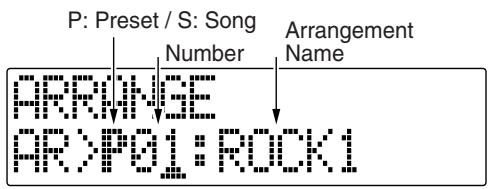
[RHYTHM ON/OFF] simultaneously lights, confirm that the rhythms are enabled.
2
Use CURSOR [ ][▶] and the TIME/VALUE dial to select the arrangement you want to play.
P01-P50: Preset arrangements 1-50
S01-S05: Song arrangements 1-5
3
Press [EXIT].
Return to the Play screen.
4
Press [ZERO].
Return to the beginning of the song.
5
Press [PLAY].
When the recorder's playback begins, the selected arrangement begins playing.
6
Adjust the RHYTHM fader and MASTER fader to appropriate levels.
7
Press [STOP] to stop the performance.

When the BR-600 is shipped from the factory, the song arrangements (S01 - S05) contain no data, thus no arrangements are played even when selected.
Changing the Tempo of an Arrangement
You can temporarily change the tempo of the arrangement being played by carrying out the following procedure while the Play screen is displayed.
1
Use CURSOR[ ] to position the cursor at the indication of the tempo in the display.
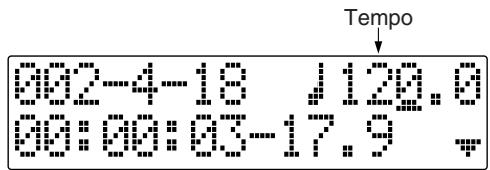
2
Turn the TIME/VALUE dial to adjust the tempo.
Using the TAP Button to Change the Tempo of an Arrangement
You can temporarily change the tempo of the arrangement by the timing with which you press [TAP(TEMPO)].
Tap on [TAP(TEMPO)] four or more times to change the tempo of the arrangement. The tempo becomes that in which you tapped.

RHYTHM
NOTE
- The arrangement's tempo setting is temporarily disabled.
- The change in tempo is only temporary. If you want to save the change in the arrangement's tempo, refer to "Creating Original Arrangements" (p. 154)
- The tempo can be set to any value from 25.0 to 250.0.
With the BR-600 you can create your own original patterns and then save these as song patterns. This is convenient when, for example, you cannot find just the pattern you want from the preset patterns.
There are three ways to create patterns.
Creating Patterns by Tapping the Drum Pads (Realtime Recording)
You can use this method to create patterns by tapping the drum pads in real time along with the metronome. Patterns are recorded exactly as played, making this a convenient way to create patterns featuring a natural, human syncopation.

"Creating Patterns by Tapping the Drum Pads (Realtime Recording)" (p. 145)
■ Inputting Drum Sounds One by One While Confirming the Input Visually (Step Recording)
With this method, you program the drum sounds one at a time while visually confirming the performance data in the pattern on a detailed one-measure graphic display.

"Inputting Sounds One by One While Confirming the Input Visually (Step Recording)" (p. 148)
■ Importing SMFs
With this method, patterns are created by loading (importing) SMF files (Standard MIDI Files) as song data.

"Importing SMFs and Creating Patterns" (p. 172)
NOTE Note concerning creation of patterns
- Maximum polyphony for patterns is five voices. This means you can play up to five drum sounds with the same timing.
- Even if six or more drum sounds are input at the same time, only five of the drum sounds will be sounded.
- You cannot play the CLOSED HH and OPEN HH sounds at the same time.
- When using cymbals and other sounds that have lengthy decay times, if other sounds totalling five voices are input before the previous sound has completely vanished, sounds started previously may be cut off before they finish playing.
- You cannot switch to other screens while recording patterns (except for the pattern record standby screen).
- The message "Drive Busy!" may appear when data-intensive patterns are played at rapid tempos. If this occurs, reduce the amount of data in the pattern or lower the tempo.
Creating Patterns by Tapping the Drum Pads (Realtime Recording)
1 Confirm that [PAD] is not lit, then press [PATTERN]. [PATTERN] and [RHYTHM ON/OFF] light.
Press [RHYTHM EDIT].
[PAD] lights up, indicating that the drum pads are enabled for use.
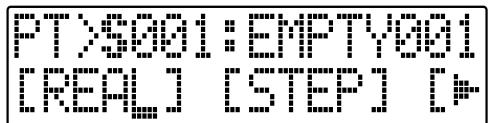
3 Use CURSOR [ ] and the TIME/VALUE dial to select a song pattern (S001 - 100).
- You cannot record to the preset patterns.
4 Press CURSOR [ ] [ ] to move the cursor to "REAL," and press [ENTER].
The Recording Standby screen appears in the display.
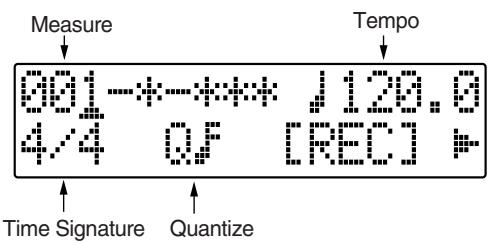
5 Use CURSOR [ ] and the TIME/VALUE dial to set the measure, beat, and click from which to start recording of the pattern.
Measure
This sets the number of measures in the pattern to be recorded.
Valid Settings: 1-999
Tempo
When recording, this sets the tempo for confirming the pattern.
Valid Settings: 25.0 - 250.0
- The tempo setting here is exclusively for confirmation of the pattern recording. This tempo is not stored in the pattern (you cannot make any individual tempo settings for the patterns themselves).
Time Signature
This sets the time signature (i.e., the beat) for the pattern to be recorded.
Valid Settings: 1/1 - 8/1, 1/2 - 8/2, 1/4 - 8/4, 1/8 - 8/8
Quantize
This sets the recording quantization.
Setting Quantize lets you to have the sounds being input conform to preset note lengths, thus eliminating discrepancies in the input timing.
- Press "HI" you want to keep the timing used to input the sounds.
Valid Settings :
Quarter note Sixteenth-note triplet
Quarter-note triplet Thirty-second note
Eighth note Thirty-second-note triplet
Eighth-note triplet HI Sixteenth note
6
Press CURSOR [ ] [ ] to select "REC," and press [ENTER].
A one-measure count-in is played, and then Realtime Recording starts.
- You can also start Realtime Recording by pressing the [REC] button.
7
Input the drum sounds by tapping the drum pads at the desired timing.
8
Readjust the tempo and/or Quantize settings as necessary.
9
When you have finished inputting the data, press [EXIT].
- You can press [STOP] instead.
Rehearsing Recordings
You can practice (rehearse) your performances along with the metronome before carrying out Realtime Recording. During rehearsals, the drum sounds are only played, not recorded to the pattern, when you press the drum pads.
1
Confirm that [PAD] is not lit, then press [PATTERN]. [PATTERN] and [RHYTHM ON/OFF] light.
2
Press [RHYTHM EDIT].
[PAD] lights up, indicating that the drum pads are enabled for use.
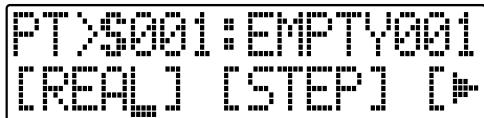
3
Press CURSOR [ ] [ ] to move the cursor to "REAL," and press [ENTER]. The Recording Standby screen appears in the display.
4
Press CURSOR [ ] repeatedly to move the cursor to "RHR," and press [ENTER]. The BR-600 is put into Rehearsal mode.
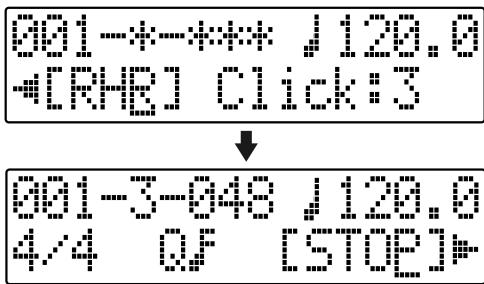
5
Tap the drum pads to practice the performance. The drum sounds are played but not recorded to the pattern.
6
When you have finished rehearsing, move the cursor to "[STOP]," and press [ENTER].
- You can press [STOP] instead.
Deleting Unneeded Drum Sounds
During Realtime Recording, you can delete any drum
sounds you do not need by holding down [DELETE/
MUTE] and pressing the drum pad for the drum sound you want to delete.

Hold down [DELETE/MUTE] and press the drum pad for the drum sound you want to delete.
The corresponding drum sound is deleted for as long as the drum pad is pressed.
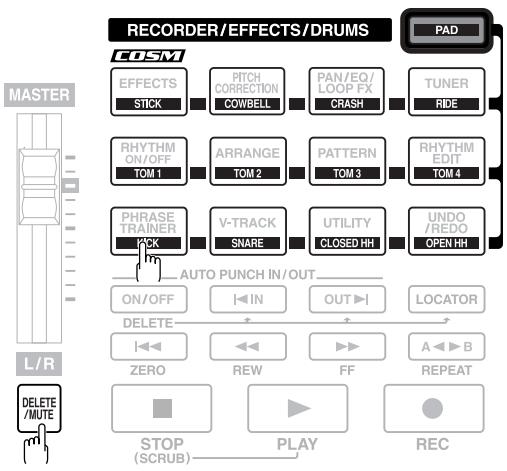
Changing the Metronome Volume

In the Recording Standby screen in Realtime Recording, press CURSOR [▶] to move the cursor to "Click."

Turn the TIME/VALUE dial to adjust the metronome volume.
Valid Settings: 0-3
Inputting Sounds One by One While Confirming the Input Visually (Step Recording)
When inputting patterns, you can add drum sounds one at a time and confirm the input visually in the display. This is convenient for inputting patterns that are difficult to perform using the drum pads.
1
Confirm that [PAD] is not lit, then press [PATTERN].
[PATTERN] and [RHYTHM ON/OFF] light.
2
Press [RHYTHM EDIT].
3
Use CURSOR [ ][▶] and the TIME/VALUE dial to select a song pattern (S001-100).
- You cannot record to the preset patterns.
4
Press CURSOR [ ] [ ] to move the cursor to "STEP," and press [ENTER].
The Recording Standby screen appears.
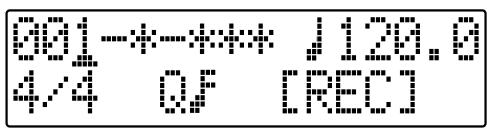
5
Use CURSOR [ ] [ ] and the TIME/VALUE dial to set the measure, beat, and quantize from which to start recording of the pattern.
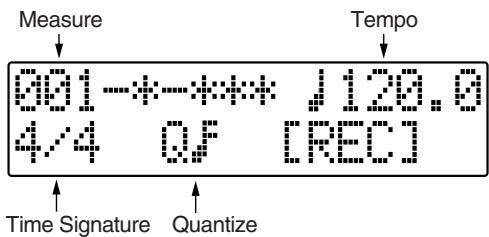
Measure
This sets the number of measures in the pattern to be recorded.
Valid Settings: 1-999
Tempo
When recording, this sets the tempo for confirming the pattern.
Valid Settings: 25.0 - 250.0
- The tempo setting here is exclusively for confirmation of the pattern recording. This tempo is not stored in the pattern (you cannot make any individual tempo settings for the patterns themselves).
Time Signature
This sets the time signature (i.e., the beat) for the pattern to be recorded.
Valid Settings: 1 / 1 - 8 / 1,1 / 2 - 8 / 2,1 / 4 - 8 / 4,1 / 8 - 8 / 8
Quantize
This sets the resolution for the steps being input.
Valid Settings :
Quarter note (96) 3 Sixteenth-note triplet
3 Quarter-note triplet (64) Thirty-second note (12)
Eighth note (48) 3 Thirty-second-note triplet (8)
3 Eighth-note triplet (32) HI (1)
Sixteenth note (24)
Numerals in parentheses indicate the clock. The lower the value set, the finer the resolution each beat becomes.
(Ex.) : Here you can input sounds in eighth-note lengths.
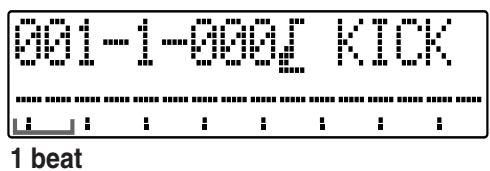
(Ex.) : Here you can input sounds in sixteenth-note lengths.
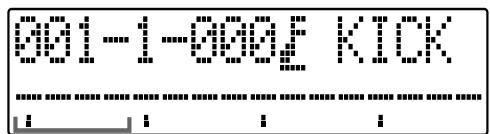
1 beat
MEMO About the pattern display
You can confirm the timing lat which each drum sound is played in the pattern display.
The "■" indicates the beat timing.
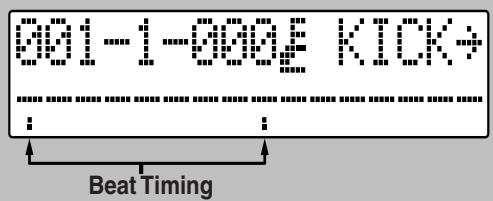
- When a coarse Quantize setting is used, the "■" may indicate half-note or quarter-note timing.
When using high-resolution Quantize settings, you may be unable to view the entire pattern, from start to finish, in the display at one time.
At this point, " " appears in the display. You can use CURSOR [ ] to display the next page. You can also press [REW] or [FF] to move among the pages.
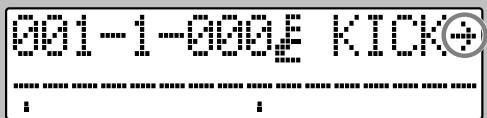
6
Press CURSOR [ ] [ ] to select "REC," and press [ENTER].
Recording begins.
- You can also start recording by pressing [REC].
7
Use CURSOR [ ] to move the cursor to the position where the drum sound currently enabled for input is displayed.
8
Set the drum sound using the TIME/VALUE dial.
9
Use CURSOR [▼] to move the cursor to the lower row, then turn the TIME/VALUE dial to the right (clockwise) one turn to move the cursor to the position where the sound is to be entered.
The drum sound is input, and "■" is displayed.
10
Set the volume of the drum sound using the TIME/ VALUE dial.
The size of "■" in the display changes according to the volume setting.

High (Velocity:127)

Medium (Velocity :100)

Low (Velocity:70)
You can press [PLAY] to play back the drum sounds that have been input so far. Press [STOP] to stop playback.
-
You can use TRACK Fader 1 to make even more precise volume settings. The indication for the volume (velocity) changes depending on the level. "High" is shown for values from 101 to 127. "Medium" is shown for values from 71 to 100. "Low" appears when set to 70 or below.
-
The following method is an alternative to inputting with the TIME/VALUE dial.
-
Press [ENTER].
- Press the Rhythm pad.
If the drum sound currently displayed is the same as the input drum sound, the sound is then input directly. If the drum sounds are not the same, first switch the drum sound in the display so that the sound for the pad being pressed is indicated, then press the pad once more to input the sound.
*When inputting with the method described above, the volume is set to the value set with TRACK Fader 1.
MEMO
About the drum sound " : : " display
If you input drum sounds using a fine Quantize setting and then change the quantization to a setting that is less precise, the BR-600 won't be able to show all of the drum sounds in a cell.
If more than one drum sound is present in the same cell, this is indicated by " : : " in the display.
(Ex.) When drum sounds are input using a quantization of "F" and the quantization is afterwards changed to "F".
11
If you mistakenly input the wrong drum sound, delete that sound.
You can use the following procedure to delete drum sounds.
Move the cursor to the position of the drum sound you want to delete, then carry out the following.
- Rotate the TIME/VALUE dial completely to the right.
- Press [ENTER].
- Switch the display to indicate the drum sound you want to delete, then hold down [DELETE/MUTE] and press the drum pad for the drum sound to be deleted.
12
Readjust the tempo and/or Quantize settings as necessary.
13
Repeat Steps 7-12 as needed, or press [STOP] to stop the process.
14
When you have finished inputting the data, press [EXIT].
- You can press [STOP] instead.
15
Press [EXIT] repeatedly until the Play screen returns to the display.
- "Keep Power On!" appears in the display, and the input patterns are saved.
Song patterns can be given a name (pattern name) that consists of up to eight characters.
1 Confirm that [PAD] is not lit, then press [PATTERN]. [PATTERN] and [RHYTHM ON/OFF] light.
Press [RHYTHM EDIT]. The Pattern Edit screen appears in the display.
3 Use CURSOR [ ] and the TIME/VALUE dial to select a song pattern (S001 - 100).
4 Press CURSOR [ ] [ ] to move the cursor to "NAME," and press [ENTER]. The Change Pattern Name screen appears in the display.
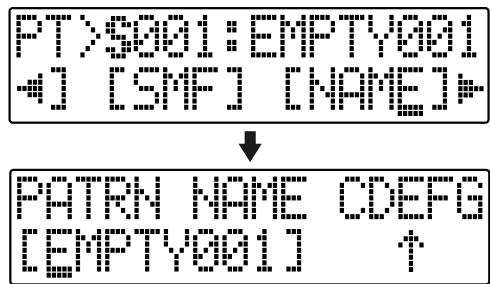
5 Use CURSOR [ ] and the TIME/VALUE dial to change the characters.
After moving the cursor to a letter, you can switch between uppercase and lowercase by pressing [ENTER].
6 Press [EXIT] repeatedly to return to the Play screen. "Keep power on!" appears in the display, and the changed pattern name is saved.
NOTE You cannot change the names of the preset patterns.
When you want to change a preset pattern slightly to create a desired pattern, you can copy the preset pattern to a song pattern, after which you have complete freedom to change the performance data.
1 Confirm that [PAD] is not lit, then press [PATTERN]. [PATTERN] and [RHYTHM ON/OFF] light.
Press [RHYTHM EDIT].
The Pattern Edit screen appears in the display.
3 Use CURSOR [ ] and the TIME/VALUE dial to select the copy-source pattern.
4 Press CURSOR [ ] [ ] to move the cursor to "COPY," and press [ENTER].
The Pattern Copy screen appears in the display.
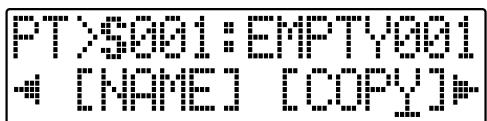
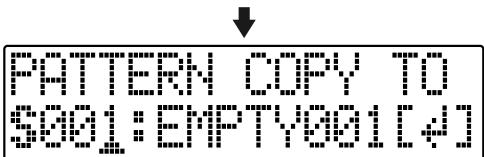
5 Use CURSOR [ ] and the TIME/VALUE dial to select the copy-destination pattern (S001-S100).
6 Press [ENTER]. The screen for confirming the copy appears in the display.
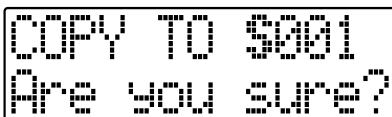
7 Press [ENTER] again.
"Keep power on!" appears in the display, and the copy is executed.
Press [EXIT] repeatedly to return to the Play screen.

You cannot copy to the preset patterns.
1 Confirm that [PAD] is not lit, then press [PATTERN]. [PATTERN] and [RHYTHM ON/OFF] light.
Press [RHYTHM EDIT]. The Pattern Edit screen appears in the display.
3 Press CURSOR [ ] [ ] to move the cursor to "ERASE," and press [ENTER].
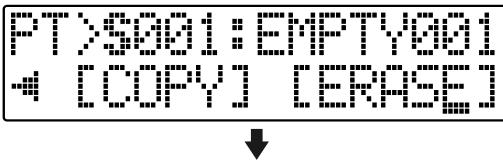
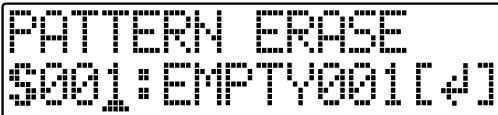
4 Turn the TIME/VALUE dial to select the song pattern (S001-S100)
Press [ENTER]. The screen for confirming the deletion appears in the display.
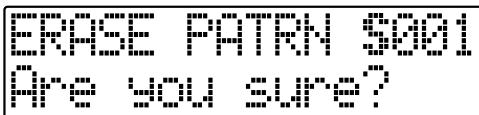
6 If you do want to delete the pattern, press [ENTER]. To cancel, press [EXIT].
- "Keep power on!" appears in the display, and the content of the pattern is erased.
7 Press [EXIT] to return to the Play screen.

You cannot erase the preset patterns.
Creating Original Arrangements
With the BR-600, you can arrange patterns in whatever sequence you like, giving you freedom to compose songs, from intro to ending, the way you want. You can then save these arranged patterns as song arrangements.
You can create song arrangements of up to 999 measures.

About Steps
Actually, creating a song arrangement is accomplished by arranging "steps." A step is the data combining a pattern number and the measure at which that pattern is to start.
Example,
| Section of Composition | Measure Length | Pattern |
| Intro | 2 Measures ↓ | Pattern P001 |
| Melody A | 16 Measures ↓ | Pattern S002 |
| Melody B | 8 Measures ↓ | Pattern S003 |
| Bridge | 8 Measures ↓ | Pattern S099 |
| Ending | 2 Measures | Pattern P006 |
When a song is composed using the patterns arranged as above, the arrangement will then consist of the following sequence of steps.
| Step Number | Starting Pattern | Measure Number |
| Step 1 | 1 | P001: ROCK-1 IN |
| ↓ | ||
| Step 2 | 3 | S002: Original A |
| ↓ | ||
| Step 3 | 19 | S003: Original B |
| ↓ | ||
| Step 4 | 27 | S099: Original C |
| ↓ | ||
| Step 5 | 35 | P006: ROCK-1 E |
| ↓ | ||
| Step 6 | 37 | P327: BREAK |
In other words, since even lengthy songs are sequences of these compositional units, or steps, these songs can be finished with less steps.
With the BR-600, you can arrange sequences of up to 50 steps.
Now try actually creating an arrangement.
1
Confirm that [PAD] is not lit, then press [ARRANGE].
[ARRANGE] and [RHYTHM ON/OFF] light.
2
Use CURSOR [ ] and the TIME/VALUE dial to select the number for the song arrangement you want to create.
- If you select a preset pattern here, you will not be able to perform any further operations on the pattern.
3
Press [RHYTHM EDIT].
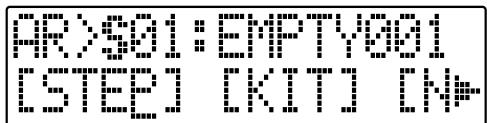
4
Press CURSOR [ ] [ ] to move the cursor to "STEP," and press [ENTER].
The Recording Standby screen appears in the display.
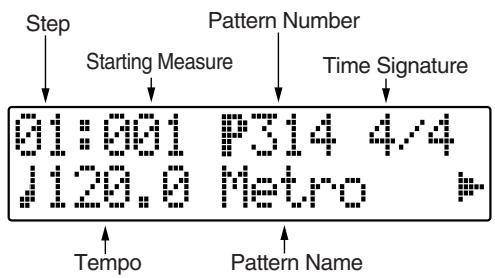
5
Press CURSOR[ ] [ ] to move the cursor to "STEP," then turn the TIME/VALUE dial to select the step to be edited.
You can press [REW] to move to the immediately preceding step, or press [FF] to move to the next step.
6
Press CURSOR [ ] [ ] to move the cursor to the parameter you want to change, then turn the TIME/ VALUE dial to change the setting's value.
You can press [PLAY] to play the sound of the pattern in the currently selected step.
Starting Measure
This sets the measure from which the performance of the pattern selected for the current step is to start.
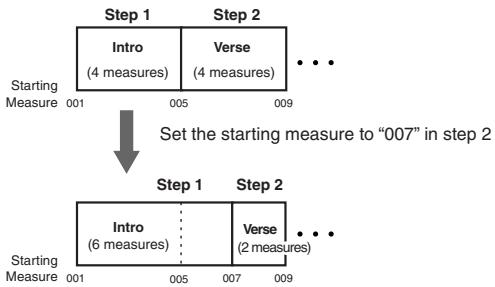
Pattern Number
This selects the pattern. Patterns are selected for each step as shown in the following figure.
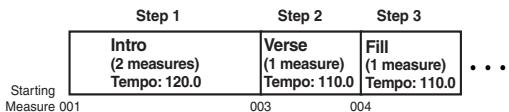
Beat
This indicates the beat for the pattern selected in the current step.
Tempo
This sets the tempo at which the pattern selected for the current step is to be performed.
Valid Settings: 25.0 - 250.0
7
When you have finished creating the arrangement, press [EXIT] a number of times.
The Play screen returns to the display, and the newly created arrangement is saved.
- While the data is being updated, the message "Keep power on!" appears in the upper part of the display, while the processing status is indicated in the lower part.
NOTE
- The starting measure for step 1 is always set to "001." This cannot be changed.
- You cannot set a measure in one step that is also set in the previous step or earlier.
- You cannot set any measures beyond the starting measure of the subsequent step.
- When an arrangement is played from within the Play screen, the arrangement plays all the way to the end, and then the performance of the pattern set in the last step is repeated.
Thus, by setting the preset pattern "P327: BREAK" for the last step, you can have a rest be played repeatedly, which makes it seem as if the performance of the arrangement has stopped.
| Step 1 | Step 2 | Step ** | Step ** |
| Intro | Verse | Ending | P327 BREAK |
Inserting Steps
Perform the procedure below to insert a new step at the current step.
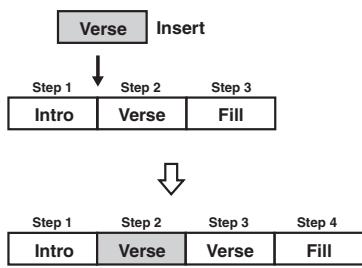
1 Confirm that [PAD] is not lit, then press [ARRANGE] so that the button lights.
[ARRANGE] and [RHYTHM ON/OFF] light.
2 Press [RHYTHM EDIT].
The Arrangement Edit screen appears in the display.
3 Press CURSOR [ ] [ ] to move the cursor to "STEP," and press [ENTER].
The arrangement's Step Recording screen is displayed.
4 Use CURSOR [ ] and the TIME/VALUE dial to set the location (step number) where the data is to be inserted.
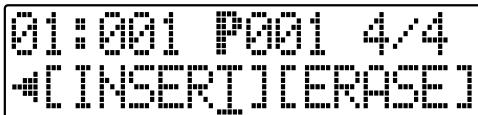
5 Press CURSOR [ ] [ ] to move the cursor to "INSERT," and press [ENTER].
"Insert!" appears in the display, indicating the selected step has been copied and inserted. When this is completed, the Step Recording screen automatically returns to the display.
- To cancel the operation, press CURSOR [ ] [ ] to return to the Arrangement Edit screen.
Erasing Steps
This erases the content of the currently selected step. The content of the following steps are brought forward to fill the erased step.
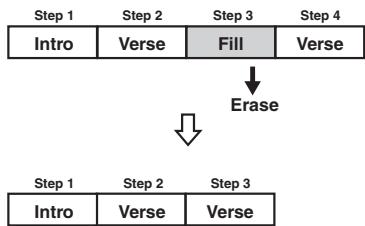
1 Confirm that [PAD] is not lit, then press [ARRANGE] so that the button lights.
[ARRANGE] and [RHYTHM ON/OFF] light.
2 Press [RHYTHM EDIT].
The Arrangement Edit screen appears in the display.
3 Press CURSOR [ ] [ ] to move the cursor to "STEP," and press [ENTER].
The arrangement's Step Recording screen is displayed.
4 Use CURSOR [ ] and the TIME/VALUE dial to set the step you want to erase.
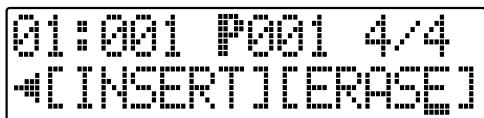
Press CURSOR [ ] [ ] to move the cursor to "ERASE," and press [ENTER].
"Erase!" appears in the display, and the Step Recording screen returns to the display.
- No further data can be deleted when only Step 1 remains. To cancel the operation, press CURSOR [ ][ ] to return to the Arrangement Edit screen.
Naming Arrangements
Song arrangements can be given a name (arrangement name) of your choice that consists of up to eight characters.
1
Confirm that [PAD] is not lit, then press [ARRANGE].
[ARRANGE] and [RHYTHM ON/OFF] light.
2
Press [RHYTHM EDIT].
The Arrangement Edit screen appears in the display.
3
Use CURSOR [ ][▶] and the TIME/VALUE dial to select a song arrangement (S01-05).
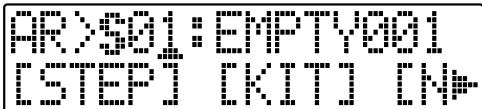
4
Press CURSOR [ ] [ ] to move the cursor to "NAME," and press [ENTER].
The Change Arrangement Name screen appears in the display.
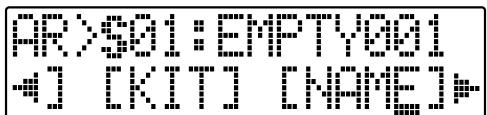
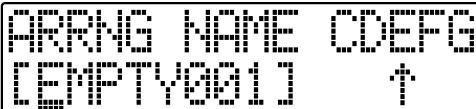
5
Use CURSOR [ ] and the TIME/VALUE dial to change the characters.
After moving the cursor to a letter, you can switch between uppercase and lowercase by pressing [ENTER].
6
Press [EXIT] repeatedly to return to the Play screen.
"Keep power on!" appears in the display, and the changed arrangement name is saved.

The Preset Arrangement names are permanently assigned when the BR-600 is shipped; these names cannot be changed.
Copying Arrangements
When you want to change a preset arrangement slightly to create a desired arrangement or create a variation of a source arrangement, you can copy the preset arrangement as a song arrangement, after which you can change it freely.
1
Confirm that [PAD] is not lit, then press [ARRANGE].
[ARRANGE] and [RHYTHM ON/OFF] light.
2
Press [RHYTHM EDIT].
3
Use CURSOR [ ] [ ] and the TIME/VALUE dial to select the copy-source arrangement.
4
Press CURSOR [ ] [ ] to move the cursor to "COPY," and press [ENTER].
The Copy Arrangement screen appears in the display.
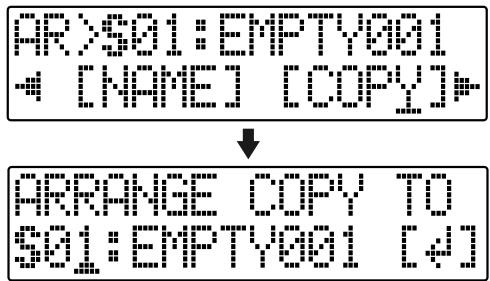
5
Use the TIME/VALUE dial to select the copy-destination song arrangement (S01 - S05).
6
Press [ENTER]. The screen for confirming the copy appears in the display.
7
Press [ENTER] again.
"Keep power on!" appears in the display, and the copy is executed.
8
Press [EXIT] repeatedly to return to the Play screen.

You cannot copy to the preset arrangements.
Erasing Arrangements
This erases Step 2 and all subsequent steps in the currently selected song arrangement.
Step 1 cannot be erased, but instead remains with the step set to "Metro" (Metronome).
1
Confirm that [PAD] is not lit, then press
[ARRANGE].
[ARRANGE] and [RHYTHM ON/OFF] light.
2
Press [RHYTHM EDIT].
3
Press CURSOR[ ] [ ] to move the cursor to
"ERASE," and press [ENTER].
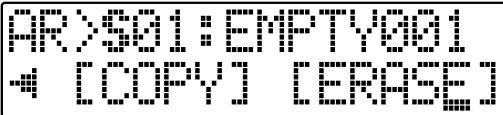

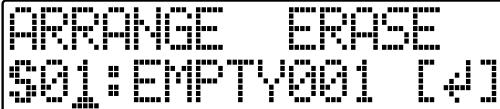
4
Turn the TIME/VALUE dial to select the song arrangement (S01 - 05)
5
Press [ENTER].
The screen for confirming the deletion appears.
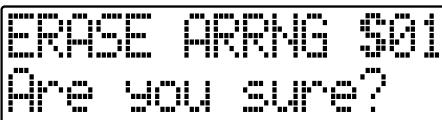
6
If you do want to delete the arrangement, press [ENTER]. To cancel, press [EXIT].
- "Keep power on!" appears in the display, and the content of the arrangement is erased.
7
Press [EXIT] to return to the Play screen.

You cannot erase the preset arrangements.
MEMO
Section 5 Using USB
How USB Can Be Used
The BR-600 is equipped with a USB port for connecting the BR-600 directly to computers, allowing you to carry out the following operations.
- Backing up the BR-600's data
- Saving BR-600 track data in WAV/AIFF format (WAV/AIFF Export)
- Loading WAV/AIFF files in BR-600 tracks (WAV/AIFF Import)
- Importing SMFs and creating patterns
- Loading drum sounds from WAV/AIFF files
MEMO What is USB?
USB, short for "Universal Serial Bus," is a type of interface for connecting computers with a variety of peripheral devices. Using USB allows you to connect different peripherals using a single USB cable, and also provides rapid data transmission.
What's more, you can connect and disconnect peripherals with the power on, and the computer can automatically recognize when devices are connected (you may need to make settings when connecting certain devices).

Realtime audio signals and MIDI messages cannot be handled via the BR-600's USB connector.
Compatible OS
Windows
Windows Me / 2000 / XP
Macintosh
Mac OS 9.1.x / 9.2.x
Mac OS X
Driver
The BR-600 uses a standard DRIVER that is found on OS. The DRIVER will be installed automatically once connected with Computer via USB.
Composition of Data on Memory Cards
The folders and files created are as shown below.
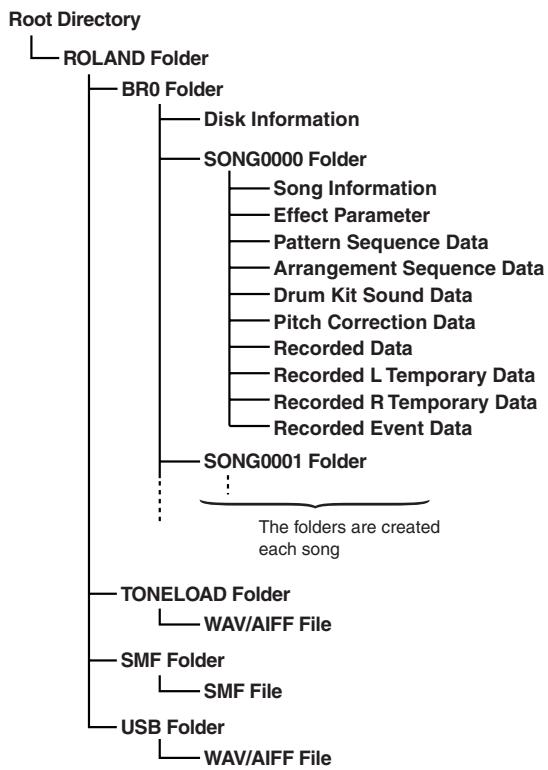
ROLAND Folder
The structure of the files and folders on the BR-600 is as follows.
BRO Folder
Song data (recording data, song arrangements/patterns/ drum kits, effect song patches, and song information) are saved to each song folder.
TONELOAD Folder
WAV and AIFF files loaded for use as drum sounds will be saved here (p. 174, p. 186).
SMF Folder
SMF files loaded for use in song patterns will be saved here (p. 172, p. 184).
USB Folder
WAV and AIFF files loaded to the BR-600's tracks, and WAV and AIFF files saved on computers (track data converted to WAV and AIFF format) will be saved here (p. 167, p. 170, p. 180, p. 182).
- Folders and files created on memory cards are displayed on the computer screen.
When you continue with an operation, the "BOSS_BR-600" icon is added in the computer screen.
- With certain versions of Windows OS, the "Removable disk (*)" icon may be displayed.
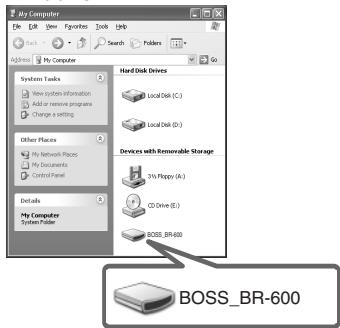
(Ex.) Windows XP

(Ex.) Windows 2000
Removable Disk (^*):
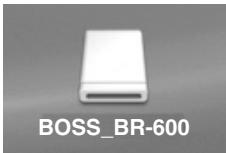
(Ex.) Macintosh
When you click the "BOSS_BR-600" icon (or the "Removable disk (*):" icon), or double-click the "BOSS_BR-600" icon on the Macintosh, the "ROLAND" folder is displayed.
Open this folder to show the "BR0" folder, the "TONELOAD" folder, the "SMF" folder, and the "USB" folder.
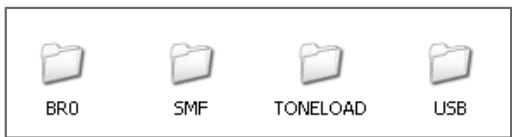
(Ex.)
Connecting a Computer
Use the USB cable to connect the BR-600 to your computer.
- Purchase USB cables at computer stores or other retailers.
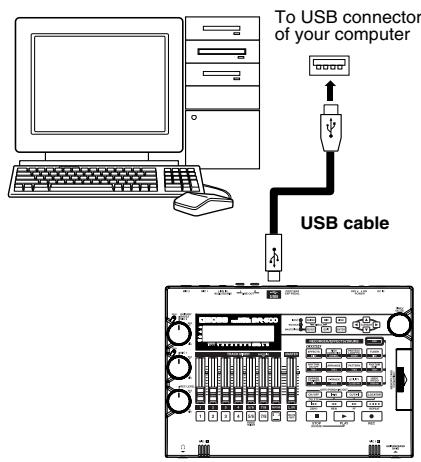
Notes on Using USB
Do not perform any of the following actions while the BR-600 is connected via USB.
These operations may result in your computer not responding to the data.
Data on memory cards may also be corrupted.
Do not:
- Disconnect the USB cable
- Eject the memory card
- Put the computer in suspended (standby) mode or hibernation, restart, or quit
- Turn off the BR-600's power
When Using Windows XP/2000
If using Windows XP/2000, log on to Windows as one of the following users:
- Administrator or other user with the privileges of the Administrators group
- A user whose account type is Computer Administrator
Note that you will not be able to properly quit the USB connection if the user name is not one of those described above.
For more details, consult the system administrator for the computer you are using.
Saving BR-600 Data to Computers (Backup)
When a memory card is full or when you want to save important data to a computer, you can carry out a backup. We recommend making frequent backups to minimize the risk of losing data if a memory card becomes damaged.
MEMO
The following types of song data are backed up.
- Recorded data
- Mixer status (pan, track EQ, etc.)
- Insert effect song patches
- Mastering Tool Kit song patches
- Pitch Correction Song Patches and Correction Event Maps
- Rhythm Arrangements/Rhythm Patterns
- Loop Effects
- Tones from the Song Kit or imported with Tone Load
- Utility (For a detailed explanation, refer to "Parameter List" (p. 210).)
1
Connect your computer and the BR-600 with a USB cable.
2
Confirm that [PAD] is not lit, and with the recorder stopped, press [UTILITY].
3
Press CURSOR [ ] [ ] to move the cursor to "USB," and press [ENTER].
The USB screen appears in the display.
4
Select "BACKUP" with the TIME/VALUE dial, then press [ENTER].
The Idling screen appears in the display.
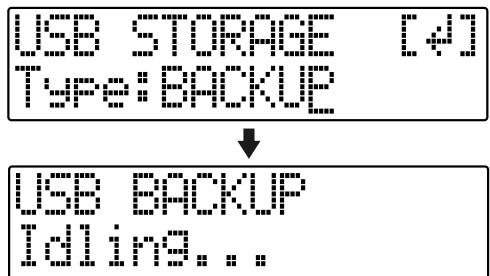
- You cannot carry out the following procedure unless the Idling screen is displayed. Refer to p. 214 for instructions on resolving this problem.
The "BOSS_BR-600" (or "Removable disk (*):") icon is added to the computer.
(Ex.)

BOSS_BR-600

Removable Disk (^*:
5
Back up the data.
1) Click the "BOSS_BR-600" (or "Removable disk (*:)" icon.
2) Drag the "ROLAND" folder to the computer's folder and drop it in the folder.
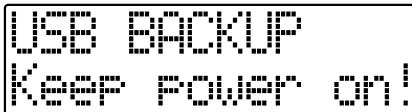
When you have finished backing up the data, the Idling screen returns to the display.
6
Quit the connection to the computer.
With Windows XP
In My Computer, right-click on the "BOSS_BR-600" icon (or "Removable disk (*):" icon) to "Eject" the disk.
- If this procedure fails to eject the disk, use the procedure below.
1) Click the icon in the task tray, then click the "Stop USB Disk-drive (*):" message displayed there.
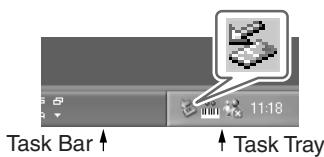
2) Click [OK] in the "Safe To Remove Hardware" dialog box that appears.
With Windows 2000/Me
1) In My Computer, right-click on the "BOSS_BR-600" icon (or "Removable disk ():") icon to "Eject" the disk.
2) Click the icon in the task tray, then click the "Stop USB Disk-drive ():" message displayed there.
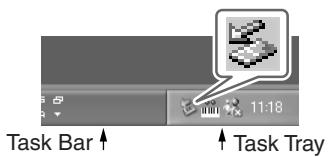
3) Click [OK] in the "Safe To Remove Hardware" dialog box that appears.
7 Press [EXIT].
The USB screen returns to the display.
- If you press [EXIT] without quitting the connection to the computer, the following screens appear.
In this case, pressing [ENTER] returns the USB screen to the display.
![ROLAND BR-600 - Press [EXIT]. - 1](/content/2025/01/130576/images/62bd2f82be7918e882f4b30169231ec2db82122f534510f0e226aa944dd49757.jpg)
8
When backup of the data is complete, press [EXIT] to return to the Play screen.
At this point, you can safely disconnect the USB cable from the BR-600 and the computer.
Reading backup data back into the BR-600 from PC (Recover)

When the BR-600 performs Recover, the data on memory cards will be overwritten.
1
Connect your computer and the BR-600 with a USB cable.
2
Confirm that [PAD] is not lit, and with the recorder stopped, press [UTILITY].
3
Press CURSOR [ ] [ ] to move the cursor to "USB," and press [ENTER].
The USB screen appears in the display.
4
"Select "BACKUP" with the TIME/VALUE dial, then press [ENTER].
The Idling screen appears in the display.
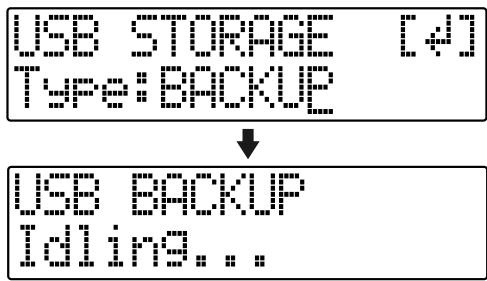
- You cannot carry out the following procedure unless the Idling screen is displayed. Refer to p. 214 for instructions on resolving this problem.
The "BOSS_BR-600" (or "Removable disk (*):") icon is added to the computer.
(Ex.)

BOSS_BR-600

Removable Disk (^*:
5
When restoring data backed up on a computer to the BR-600, drag the "ROLAND" folder to the "BOSS_BR-600" icon (or the "Removable disk (*):" icon) and drop it there (overwriting it).
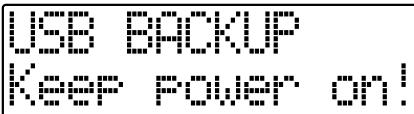
When you have finished recovering the data, the Idling screen returns to the display.
NOTE
- During the recovery operation you may encounter messages asking whether it is all right to overwrite certain files-you should select "YES" in every instance. If "NO" is selected even once, the recovery operation will be incomplete, and this may prevent the BR-600 from operating correctly.
- When the BR-600 performs Recover, the data on memory cards will be overwrited.
6
Quit the connection to the computer.
With Windows XP
In My Computer, right-click on the "BOSS_BR-600" icon (or "Removable disk (*):" icon) to "Eject" the disk.
- If this procedure fails to eject the disk, use the procedure below.
1) Click the icon in the task tray, then click the "Stop USB Disk-drive (*):" message displayed there.
2) Click [OK] in the "Safe To Remove Hardware" dialog box that appears.
With Windows 2000/Me
1) In My Computer, right-click on the "BOSS_BR-600" icon (or "Removable disk (*):") icon) to "Eject" the disk.
2) Click the icon in the task tray, then click the "Stop USB Disk-drive (*:)" message displayed there.
3) Click [OK] in the "Safe To Remove Hardware" dialog box that appears.
1
ss [EXIT].
The USB screen returns to the display.
- If you press [EXIT] without quitting the connection to the computer, the following screens appear. In this case, pressing [ENTER] returns the USB screen to the display.
![ROLAND BR-600 - ss [EXIT]. - 1](/content/2025/01/130576/images/3bd4462ec38f9a6460b088126941b7b739d27fc2abeb3ba11e67ea5b31501b48.jpg)
1
When recover of the data is complete, press [EXIT] to return to the Play screen.
At this point, you can safely disconnect the USB cable from the BR-600 and the computer.
Saving BR-600 Track Data in WAV/AIFF Format (WAV/AIFF Export)
You can convert the BR-600's track data into WAV or AIFF files and save these on your computer.
After converting your mastered tracks to WAV or AIFF files, you can easily use your computer to create audio CDs with the data, as well as load the data into audio applications.
1
Connect your computer and the BR-600 with a USB cable.
2
Confirm that [PAD] is not lit, and with the recorder stopped, press [UTILITY].
3
Press CURSOR [ ] [ ] to move the cursor to "USB," and press [ENTER].
The USB screen appears in the display.
4
Select "EXPORT" with the TIME/VALUE dial, then press [ENTER].
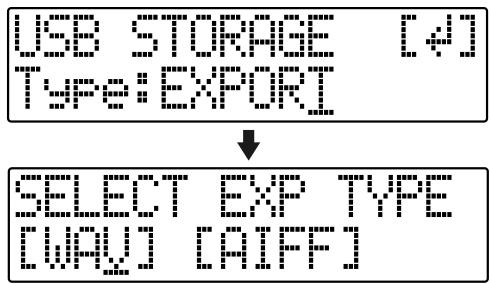
5
Press CURSOR [ ] [ ] to select the file format, then press [ENTER].
WAV: This is an audio format used primarily with Windows.
AIFF : This audio format is used primarily with Macintosh.
6
Use CURSOR [ ][ ] and the TIME/VALUE dial to select the track/V-track to be saved.
When saving in mono
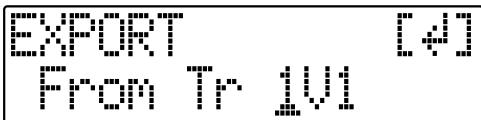
When saving in stereo
- Select the track combination 1/2, 3/4, 5/6, or 7/8.
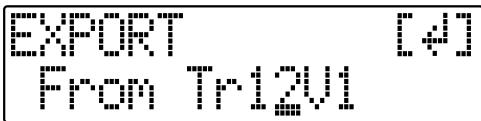
7
Press [ENTER].
Conversion of the WAV or AIFF file begins. Files names are converted as shown below.
(Mono) (Stereo)
Track 1, V-Track 1 Track 1/2, V-Track 1
TR01__1.WAV or TR0102_1.WAV or
TR01__1.AIF TR0102_1.AIF
Track 1, V-Track 2 Track 1/2, V-Track 2
TR01__2.WAV or TR0102_2.WAV or
TR01__2.AIF TR0102_2.AIF
Track 6, V-Track 7 Track 7/8, V-Track 7 TR06_7.WAV or TR0708_7.WAV or TR06_7.AIF TR0708_7.AIF
Track 6, V-Track 8 Track 7/8, V-Track 8 TR06_8.WAV or TR0708_8.WAV or TR06_8.AIF TR0708_8.AIF
- Converting songs takes approximately the same amount of time (twice as long in stereo) to complete as it does to play the source song data.
When the conversion is complete, the "BOSS_BR-600" (or "Removable disk (*):") icon is added to the computer.
(Ex.)

BOSS_BR-600

Removable Disk (^*)
8
Export the WAV or AIFF file to the computer.
1) Click the "BOSS_BR-600" (or "Removable disk (*:)" icon.
2) Drag the WAV or AIFF file in the "USB" folder in the "ROLAND" folder to the computer's folder and drop it in the folder.
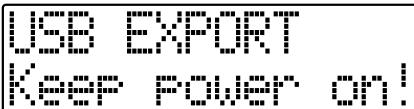
When you have finished exporting the data, the Idling screen returns to the display.
9
Quit the connection to the computer.
With Windows XP
In My Computer, right-click on the "BOSS_BR-600" icon (or "Removable disk ():" icon) to "Eject" the disk.
If this procedure fails to eject the disk, use the procedure below.
1) Click the icon in the task tray, then click the "Stop USB Disk-drive (*):" message displayed there.
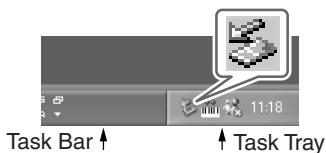
2) Click [OK] in the "Safe To Remove Hardware" dialog box that appears.
With Windows 2000/Me
1) In My Computer, right-click on the "BOSS_BR-600" icon (or "Removable disk ():") icon) to "Eject" the disk.
2) Click the icon in the task tray, then click the "Stop USB Disk-drive ():" message displayed there.
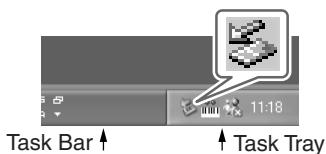
3) Click [OK] in the "Safe To Remove Hardware" dialog box that appears.
10
Press [EXIT].
The file format selection screen returns to the display. The contents of the "USB" folder are automatically deleted the instant the [EXIT] button is pressed.
- If you press [EXIT] without quitting the connection to the computer, the following screens appear.
In this case, pressing [ENTER] returns the file format selection screen to the display.
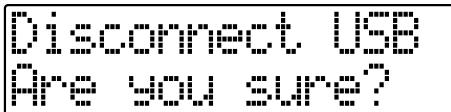
At this point, you can safely disconnect the USB cable from the BR-600 and the computer.
11
Repeat Steps 5-9 as needed.
12
When you have finished exporting the WAV or AIFF file(s), press [EXIT] several times to return to the Play screen.
■ Resolving insufficient memory issues when exporting WAV/AIFF
When exporting WAV or AIFF files, a memory card needs to have the following amounts of storage space remaining:
When exporting in "mono":
approximately 5.1 MB per track per minute
When exporting in "stereo":
approximately 10.1 MB per stereo track (two tracks) per minute
If there isn't enough storage space, and you get the "Card Full!" error message, try the following two methods to secure the necessary memory.
1. Deleting unneeded data from the memory card
1
Back up the data on the card (see p. 164).
2
Erase unneeded songs (Song Erase) (see p. 86).
3
Also erase track data other than that for the tracks you want to export (Track Erase) (see p. 82).
4
Carry out Song Optimize (seep. 87).
5
Export the data.
6
Recover the data (see p. 165).
2.Using a high-capacity memory card
For more on supported memory cards (CompactFlash) for the BR-600, refer to the separate sheet "About Memory Cards."
1
Back up the data on the card (see p. 164).
2
Insert the high-capacity memory card in the BR-600, then initialize the card (see p.199).
3
Recover the data (see p. 165).
Loading WAV/AIFF Files in BR-600 Tracks (WAV/AIFF Import)
You can take WAV or AIFF files on your computer, such as files created with audio software applications, and load them to the BR-600's tracks.
NOTE
- Wave data in the following formats can be imported.
You cannot import wave data in other formats.
WAV or AIFF format
- Mono or Stereo
- 8-bit or 16-bit
- Sampling Rate: 44.1 kHz
- Compressed WAV files or AIFF files cannot be loaded.
- Extremely short waveform data (less than approximately 1 sec) cannot be loaded.
- The loop point settings within an AIFF file will be ignored.
- Add the extension "WAV" to imported WAV files and the extension "AIF" to imported AIFF files.
- If the unit is in the Arrange mode at the time of the import, it takes place in accord with the timing of the Arrange mode. On the other hand, if the unit is in the Pattern mode at the time of the import, it takes place in accord with the timing of the Pattern mode.
1
Connect your computer and the BR-600 with a USB cable.
2
Confirm that [PAD] is not lit, and with the recorder stopped, press [UTILITY].
3
Press CURSOR [ ] [ ] to move the cursor to "USB," and press [ENTER].
The USB screen appears in the display.
4
Select "IMPORT" with the TIME/VALUE dial, then press [ENTER].
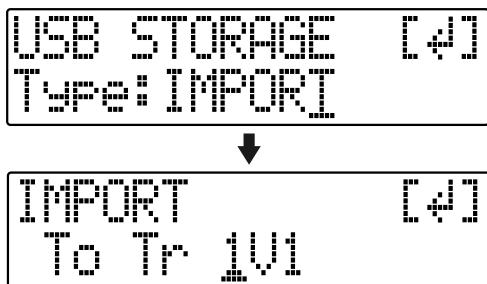
5
Use CURSOR [ ] and the TIME/VALUE dial to select the track and V-track to be loaded, then press [ENTER].
When loading to the tracks in mono
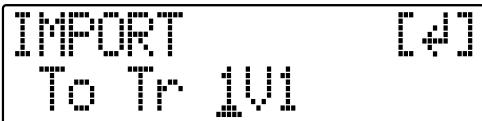
When loading to the tracks in stereo
- Select the track combination 1/2, 3/4, 5/6, or 7/8.
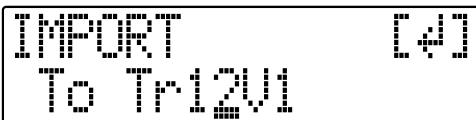
6
Use [CURSOR] and the TIME/VALUE dial to specify the measure or position in the track from which loading is to start, then press [ENTER].
The "BOSS_BR-600" (or "Removable disk (\cdot)") icon is added to the computer.
(Ex.)
BOSS_BR-600

Removable Disk (^*:
7 Copy the WAV or AIFF files you want to import.
1) Click the "BOSS_BR-600" (or "Removable disk ():") icon.
2) Drag the imported WAV or AIFF file to the "USB" folder in the "ROLAND" folder.
Only one file can be imported at a time in each import operation. Do not drag and drop more than one file at a time.
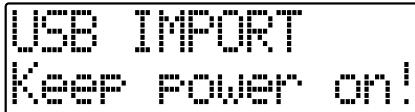
When you have finished Copying the data, the Idling screen returns to the display.
8 Quit the connection to the computer.
With Windows XP
In My Computer, right-click on the "BOSS_BR-600" icon (or "Removable disk (*):" icon) to "Eject" the disk.
- If this procedure fails to eject the disk, use the procedure below.
1) Click the icon in the task tray, then click the "Stop USB Disk-drive (*):" message displayed there.
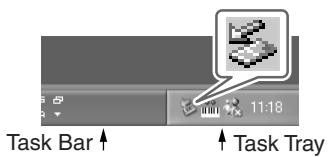
2) Click [OK] in the "Safe To Remove Hardware" dialog box that appears.
With Windows 2000/Me
1) In My Computer, right-click on the "BOSS_BR-600" icon (or "Removable disk ():") icon) to "Eject" the disk.
2) Click the icon in the task tray, then click the "Stop USB Disk-drive ():" message displayed there.
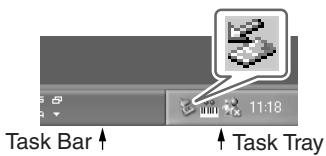
3) Click [OK] in the "Safe To Remove Hardware" dialog box that appears.
9
The WAV or AIFF file is imported.
The contents of the "USB" folder are automatically deleted at the time the import is finished.
- If you press [EXIT] without quitting the connection to the computer, the following screens appear. In this case, pressing [ENTER] imports the WAV or AIFF file.
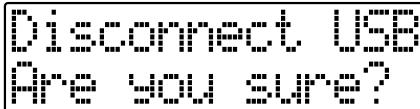
Once the import is complete, you are returned to the screen for specifying the import-source track/V-Track.
At this point, you can safely disconnect the USB cable from the BR-600 and the computer.
10 Repeat Steps 4-9 as needed.
When you have finished importing the WAV or AIFF file(s), press [EXIT] repeatedly to return to the Play screen.
Importing SMFs and Creating Patterns
You can import SMFs (Standard MIDI Files) stored on memory cards as song patterns.
You can easily increase your collection of song patterns by creating SMFs on your computer or other device and copying them to memory cards.
NOTE
- You cannot import SMFs containing more than 999 measures.
- Add the extension "MID" to SMFs you are importing.
- Use file names containing eight alphanumeric characters.
1 Connect your computer and the BR-600 with a USB cable.
2 Confirm that [PAD] is not lit, and with the recorder stopped, press [UTILITY].
3 Press CURSOR [ ] [ ] to move the cursor to "USB," and press [ENTER]. The USB screen appears in the display.
4 Select "BACKUP" with the TIME/VALUE dial, then press [ENTER]. The Idling screen appears in the display.
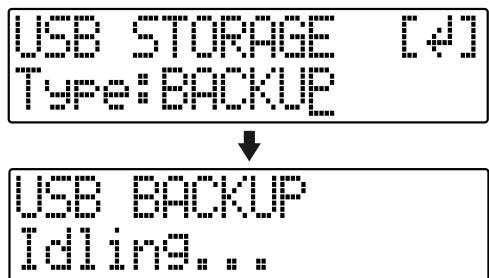
- You cannot carry out the following procedure unless the Idling screen is displayed. Refer to p. 214 for instructions on resolving this problem.
The "BOSS_BR-600" (or "Removable disk (*:)"') icon is added to the computer.
(Ex.)

BOSS_BR-600

Removable Disk (*):
5
Copy the SMF.
1) Click the "BOSS_BR-600" (or "Removable disk (*:)" icon.
2) Drag the imported SMF to the "SMF" folder in the "ROLAND" folder.
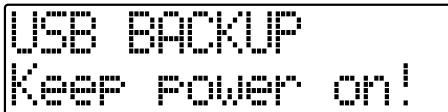
When you have finished copying the SMF, the Idling screen returns to the display.
6
Quit the connection to the computer.
With Windows XP
In My Computer, right-click on the "BOSS_BR-600" icon (or "Removable disk (*):" icon) to "Eject" the disk.
- If this procedure fails to eject the disk, use the procedure below.
1) Click the icon in the task tray, then click the "Stop USB Disk-drive (*):" message displayed there.
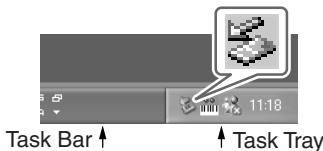
2) Click [OK] in the "Safe To Remove Hardware" dialog box that appears.
With Windows 2000/Me
1) In My Computer, right-click on the "BOSS_BR-600" icon (or "Removable disk (*):") icon) to "Eject" the disk.
2) Click the icon in the task tray, then click the "Stop USB Disk-drive (*:)" message displayed there.
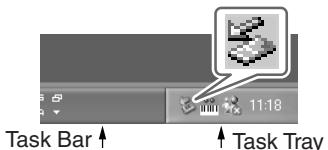
3) Click [OK] in the "Safe To Remove Hardware" dialog box that appears.
7
Press [EXIT] repeatedly to return to the Play screen.
- If you press [EXIT] without quitting the connection to the computer, the following screens appear. In this case, pressing [ENTER] and then [EXIT] returns the Play screen to the display.
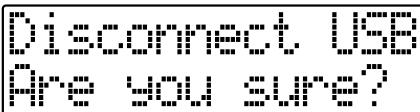
At this point, you can safely disconnect the USB cable from the BR-600 and the computer.
8
Press [PATTERN] so that the button lights up.
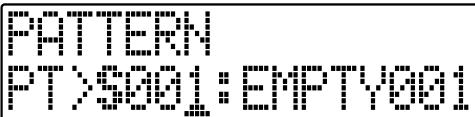
9
Press [RHYTHM EDIT].
10
Press [CURSOR] to move the cursor to "SMF," and press [ENTER].
The names of the SMFs on the memory card are displayed.
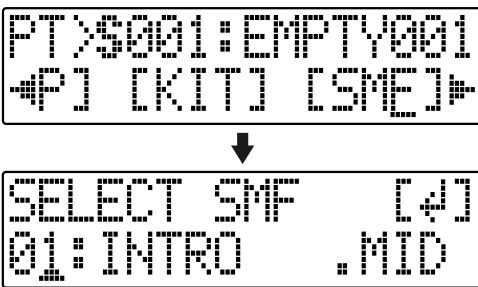
11
Turn the TIME/VALUE dial to select the SMF to be imported, then press [ENTER].
12
Turn the TIME/VALUE dial to select the import-destination song pattern, then press [ENTER].
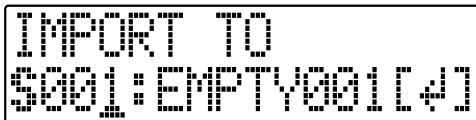
The import is executed.
- During updating, "Keep power on!" appears in the upper line of the display, while the lower line shows what is being processed.
NOTE
With some SMF files, a considerable amount of time may be required to finish importing the file.
MEMO
GM/GS/XG-compatible SMF files generally have rhythm performance data assigned to MIDI Channel 10. For this reason, the BR-600 imports only the data extracted from MIDI Channel 10. Note that data assigned to other channels is disregarded.
Loading Drum Sounds from WAV/AlFF Files (Tone Load)
You can import WAV and AIFF files on your computer and load these as drum sounds (TONE LOAD).

- Wave data in the following formats can be imported.
You cannot import wave data in other formats.
WAV or AIFF format
Mono or Stereo
8-bit or 16-bit
- Sampling Rate: 44.1kHz
- Compressed WAV files or AIFF files cannot be loaded.
- Extremely short waveform data (less than approximately 100ms ) cannot be loaded.
- The loop point settings within an AIFF file will be ignored.
For the files to be imported, add the extension "WAV" to WAV files and the extension "AIF" to AIFF files. - You can load drum sounds of up to 13 seconds for a single drum kit.
(Example)
Kick: 3 seconds, snare: 3 seconds, crash cymbal: 7 seconds Total 13 seconds
- Stereo WAV and AIFF files imported with Tone Load are loaded as "mono" sounds with the left and right sides mixed.
1 Connect your computer and the BR-600 with a USB cable.
2 Confirm that [PAD] is not lit, and with the recorder stopped, press [UTILITY].
3 Press CURSOR [ ] [ ] to move the cursor to "USB," and press [ENTER].
The USB screen appears in the display.
4 Select "BACKUP" with the TIME/VALUE dial, then press [ENTER].
The Idling screen appears in the display.
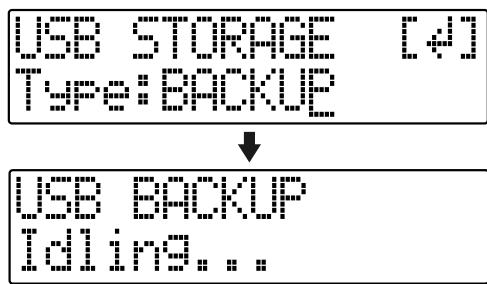
- You cannot carry out the following procedure unless the Idling screen is displayed. Refer to p. 214 for instructions on resolving this problem.
The "BOSS_BR-600" (or "Removable disk (*:)"') icon is added to the computer.
(Ex.)

BOSS_BR-600

Removable Disk (^*:
5 Import the WAV or AIFF file.
1) Click the "BOSS_BR-600" (or "Removable disk (*):") icon.
2) Drag the imported WAV or AIFF file to the "TONELOAD" folder in the "ROLAND" folder.
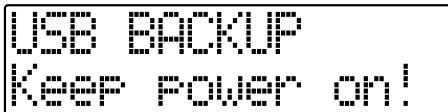
When you have finished importing the WAV or AIFF files, the Idling screen returns to the display.
6
Quit the connection to the computer.
With Windows XP
In My Computer, right-click on the "BOSS_BR-600" icon (or "Removable disk (*):" icon) to "Eject" the disk.
- If this procedure fails to eject the disk, use the procedure below.
1) Click the icon in the task tray, then click the "Stop USB Disk-drive (*):" message displayed there.
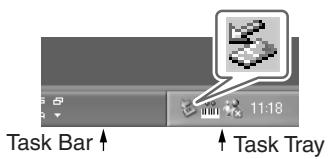
2) Click [OK] in the "Safe To Remove Hardware" dialog box that appears.
With Windows 2000/Me
1) In My Computer, right-click on the "BOSS_BR-600" icon (or "Removable disk (*):") icon) to "Eject" the disk.
2) Click the icon in the task tray, then click the "Stop USB Disk-drive (*):" message displayed there.
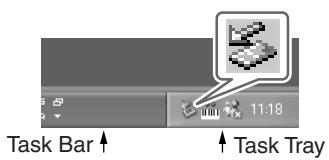
3) Click [OK] in the "Safe To Remove Hardware" dialog box that appears.
7
[EXIT] repeatedly to return to the Play screen.
- If you press [EXIT] without quitting the connection to the computer, the following screens appear. In this case, pressing [ENTER] and then [EXIT] returns the Play screen to the display.
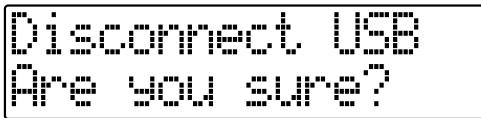
At this point, you can safely disconnect the USB cable from the BR-600 and the computer.
8
Press [UTILITY].
9
Press CURSOR [ ] [ ] to move the cursor to "TONE," and press [ENTER].
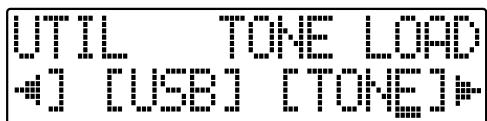
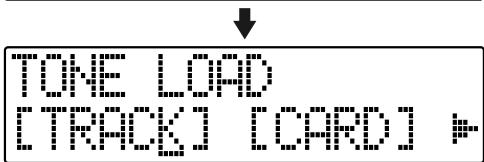
10
Press CURSOR [ ] [ ] to move the cursor to "CARD," and press [ENTER].
The names of the WAV and AIFF files on the memory card are displayed.
- WAV files are indicated by the symbol ".W"; ".A" indicates AIFF files.
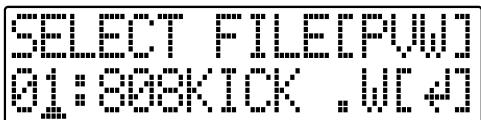
11
Use the TIME/VALUE dial to select the WAV or AIFF file you want to load as the drum sound, then press [ENTER].
MEMO
You can preview the sound of the WAV or AIFF file to be loaded by moving the cursor to "PVW" and pressing [ENTER].
12
Turn the TIME/VALUE dial to specify the load-destination song drum kit.
S1-5: Song Drum Kit 1-5
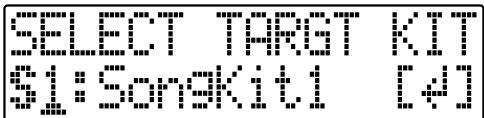
13
Turn the TIME/VALUE dial to select the load-destination song drum sound, then press [ENTER]. The load is executed. To cancel, press [EXIT].
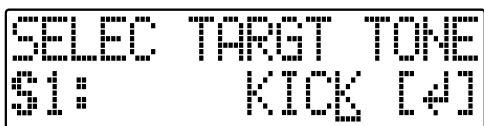
- During updating, "Keep power on!" appears in the upper line of the display, while the lower line shows what is being processed.
NOTE
WAV and AIFF files in the TONELOAD folder are retained without being deleted even after this procedure is completed.
If these files are no longer needed, connect the BR-600 to your computer via USB and use the computer to delete the files. Any files that are retained will use the required amount of memory on the memory card.
Using the BR-900CD/BR-864/ BR-532's Data
You can use the BR-600 to play BR-900CD, BR-864, or BR-532 data.
- First be sure to back up the BR-900CD / BR-864 / BR-532's "ROLAND" folder to the computer.
1
Initializing the memory card on the BR-600 (p. 199).
2
Connect your computer and the BR-600 with a USB cable.
3
Confirm that [PAD] is not lit, and with the recorder stopped, press [UTILITY].
4
Press CURSOR [ ] [ ] to move the cursor to "USB," and press [ENTER].
The USB screen appears in the display.
5
"Select "BACKUP" with the TIME/VALUE dial, then press [ENTER].
The Idling screen appears in the display.
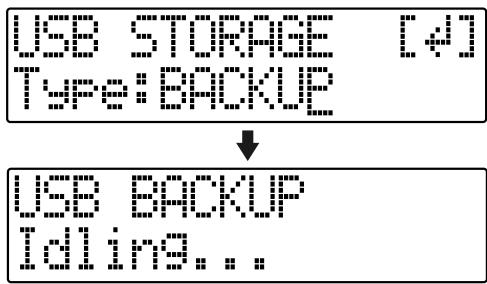
- You cannot carry out the following procedure unless the Idling screen is displayed. Refer to p. 214 for instructions on resolving this problem.
The "BOSS_BR-600" (or "Removable disk (*:)"') icon is added to the computer.
(Ex.)
BOSS_BR-600

Removable Disk (^*:
6 Delete the BR-600 "ROLAND" folder.
1) Click the "BOSS_BR-600" (or "Removable disk (*):") icon, and delete the "ROLAND" folder.
7 Drag the previously backed up BR-900CD / BR-864 / BR-532 "ROLAND" folder to the "BOSS_BR-600" (or "Removable disk (*):") icon and drop it there.
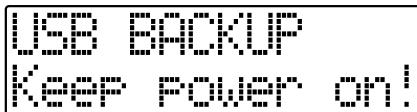
When you have finished backing up the data, the Idling screen returns to the display.
8 Quit the connection to the computer.
With Windows XP
In My Computer, right-click on the "BOSS_BR-600" icon (or "Removable disk (*):" icon) to "Eject" the disk.
- If this procedure fails to eject the disk, use the procedure below.
1) Click the icon in the task tray, then click the "Stop USB Disk-drive (*):" message displayed there.
2) Click [OK] in the "Safe To Remove Hardware" dialog box that appears.
With Windows 2000/Me
1) In My Computer, right-click on the "BOSS_BR-600" icon (or "Removable disk (*):") icon) to "Eject" the disk.
2) Click the icon in the task tray, then click the "Stop USB Disk-drive (*:)" message displayed there.
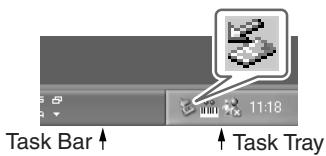
3) Click [OK] in the "Safe To Remove Hardware" dialog box that appears.
9 Press [EXIT].
The USB screen returns to the display.
- If you press [EXIT] without quitting the connection to the computer, the following screens appear. In this case, pressing [ENTER] returns the USB screen to the display.
![ROLAND BR-600 - Press [EXIT]. - 1](/content/2025/01/130576/images/8a9b22ebaf0fdec7fb7b3ec4abf2be8d740b3ce8a0ec9ea8a9624737f39290f7.jpg)
10 When backup of the data is complete, press [EXIT] to return to the Play screen.
At this point, you can safely disconnect the USB cable from the BR-600 and the computer.
Saving BR-600 Data to Computers (Backup)
When a memory card is full or when you want to save important data to a computer, you can carry out a backup. We recommend making frequent backups to minimize the risk of losing data if a memory card becomes damaged.
MEMO
The following types of song data are backed up.
- Recorded data
- Mixer status (pan, track EQ, etc.)
- Insert effect song patches
- Mastering Tool Kit song patches
- Pitch Correction Song Patches and Correction Event Maps
- Rhythm Arrangements/Rhythm Patterns
- Loop Effects
- Tones from the Song Kit or imported with Tone Load
- Utility (For a detailed explanation, refer to "Parameter List" (p. 210).)
1 Connect your computer and the BR-600 with a USB cable.
2 Confirm that [PAD] is not lit, and with the recorder stopped, press [UTILITY].
3 Press CURSOR [ ] [ ] to move the cursor to "USB," and press [ENTER].
The USB screen appears in the display.
4 Select "BACKUP" with the TIME/VALUE dial, then press [ENTER].
The Idling screen appears in the display.
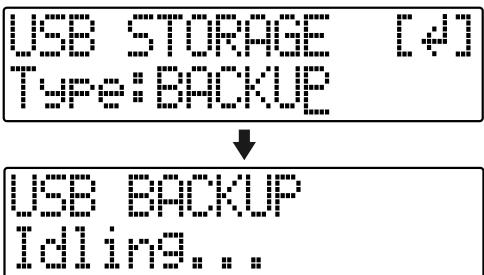
- You cannot carry out the following procedure unless the Idling screen is displayed. Refer to p. 214 for instructions on resolving this problem.
The "BOSS_BR-600" icon is added to the computer.
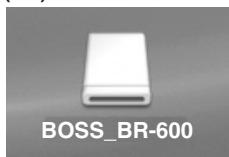
(Ex.)
5 Back up the data.
1) Double-click the "BOSS_BR-600" icon.
2) Drag the "ROLAND" folder to the computer's folder and drop it in the folder.
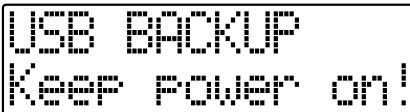
When you have finished backing up the data, the Idling screen returns to the display.
6 Quit the connection to the computer.
1) Drag the "BOSS_BR-600" icon into the trash.
7 Press [EXIT].
The USB screen returns to the display.
- If you press [EXIT] without quitting the connection to the computer, the following screens appear. In this case, pressing [ENTER] returns the USB screen to the display.
![ROLAND BR-600 - Press [EXIT]. - 1](/content/2025/01/130576/images/5fa0da22901b23f91e105fa989fbaa4fe2ac9c72160bbc3efff683307d4f9835.jpg)
8 When backup of the data is complete, press [EXIT] to return to the Play screen.
At this point, you can safely disconnect the USB cable from the BR-600 and the computer.
Reading backup data back into the BR-600 from PC (Recover)

When the BR-600 performs Recover, the data on memory cards will be overwrited.
1
Connect your computer and the BR-600 with a USB cable.
2
Confirm that [PAD] is not lit, and with the recorder stopped, press [UTILITY].
3
Press CURSOR [ ] [ ] to move the cursor to "USB," and press [ENTER].
The USB screen appears in the display.
4
"Select "BACKUP" with the TIME/VALUE dial, then press [ENTER].
The Idling screen appears in the display.
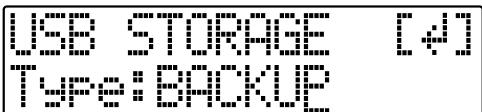

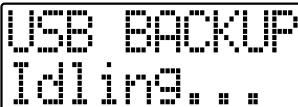
- You cannot carry out the following procedure unless the Idling screen is displayed. Refer to p. 214 for instructions on resolving this problem.
The "BOSS_BR-600" icon is added to the computer.
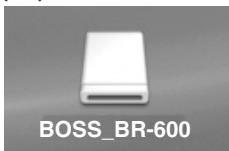
(Ex.)
5
When restoring data backed up on a computer to the BR-600, drag the "ROLAND" folder to the "BOSS_BR-600" icon and drop it there (overwriting it).
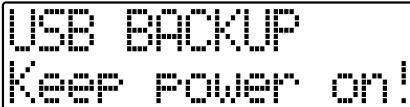
When you have finished recovering the data, the Idling screen returns to the display.
NOTE
- During the recovery operation you may encounter messages asking whether it is all right to overwrite certain files-you should select "YES" in every instance. If "NO" is selected even once, the recovery operation will be incomplete, and this may prevent the BR-600 from operating correctly.
- When the BR-600 performs Recover, the data on memory cards will be overwrited.
6
Quit the connection to the computer.
1) Drag the "BOSS_BR-600" icon into the trash.
7
Press [EXIT].
The USB screen returns to the display.
- If you press [EXIT] without quitting the connection to the computer, the following screens appear. In this case, pressing [ENTER] returns the USB screen to the display.
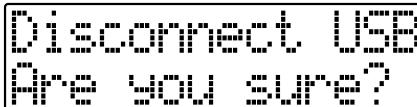
8
When recover of the data is complete, press [EXIT] to return to the Play screen.
At this point, you can safely disconnect the USB cable from the BR-600 and the computer.
Saving BR-600 Track Data in WAV/AIFF Format (WAV/AIFF Export)
You can convert the BR-600's track data into WAV or AIFF files and save these on your computer.
After converting your mastered tracks to WAV or AIFF files, you can easily use your computer to create audio CDs with the data, as well as load the data into audio applications.
1
Connect your computer and the BR-600 with a USB cable.
2
Confirm that [PAD] is not lit, and with the recorder stopped, press [UTILITY].
3
Press CURSOR [ ] [ ] to move the cursor to "USB," and press [ENTER].
The USB screen appears in the display.
4
"Select "EXPORT" with the TIME/VALUE dial, then press [ENTER].
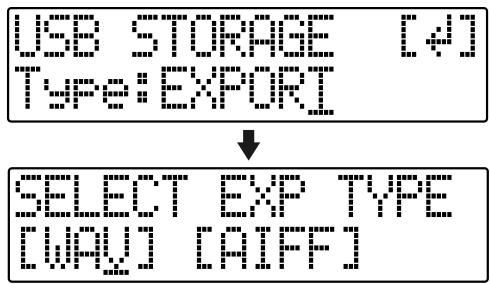
5
Press CURSOR [ ] [ ] to select the file format, then press [ENTER].
WAV: This is an audio format used primarily with Windows.
AIFF : This audio format is used primarily with Macintosh.
6
Use CURSOR [ ] [ ] and the TIME/VALUE dial to select the track/V-track to be saved.
When saving in mono
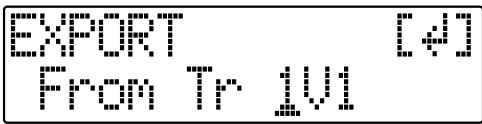
When saving in stereo
- Select the track combination 1/2, 3/4, 5/6, or 7/8.
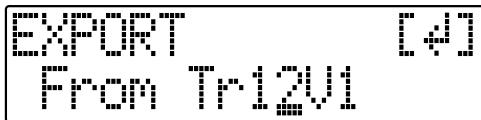
7
Press [ENTER].
Conversion of the WAV or AIFF file begins. Files names are converted as shown below.
(Mono) (Stereo)
Track 1, V-Track 1 Track 1/2, V-Track 1
TR01__1.WAV or TR0102_1.WAV or
TR01__1.AIF TR0102_1.AIF
Track 1, V-Track 2 Track 1/2, V-Track 2
TR01__2.WAV or TR0102_2.WAV or
TR01__2.AIF TR0102_2.AIF
Track 6, V-Track 7 Track 7/8, V-Track 7 TR06_7.WAV or TR0708_7.WAV or TR06_7.AIF TR0708_7.AIF
Track 6, V-Track 8 Track 7/8, V-Track 8 TR06_8.WAV or TR0708_8.WAV or TR06_8.AIF TR0708_8.AIF
- Converting songs takes approximately the same amount of time (twice as long in stereo) to complete as it does to play the source song data.
When the conversion is complete, the "BOSS_BR-600" (or "Removable disk (*):") icon is added to the computer.
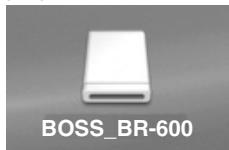
(Ex.)
8
Export the WAV or AIFF file to the computer.
1) Double-click the "BOSS_BR-600" icon.
2) Drag the WAV or AIFF file in the "USB" folder in the "ROLAND" folder to the computer's folder and drop it in the folder.
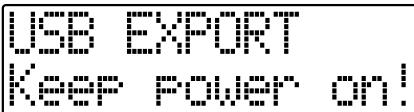
When you have finished exporting the data, the Idling screen returns to the display.
9
Quit the connection to the computer.
1) Drag the "BOSS_BR-600" icon into the trash.
10
Press [EXIT].
The file format selection screen returns to the display. The contents of the "USB" folder are automatically deleted the instant the [EXIT] button is pressed.
- If you press [EXIT] without quitting the connection to the computer, the following screens appear. In this case, pressing [ENTER] returns the file format selection screen to the display.
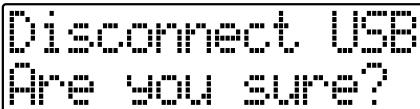
At this point, you can safely disconnect the USB cable from the BR-600 and the computer.
11
Repeat Steps 5-9 as needed.
12
When you have finished exporting the WAV or AIFF file(s), press [EXIT] several times to return to the Play screen.
■ Resolving insufficient memory issues When exporting WAV/AIFF
When exporting WAV or AIFF files, a memory card needs to have the following amounts of storage space remaining:
When exporting in "mono":
approximately 5.1 MB per track per minute
When exporting in "stereo":
approximately 10.1 MB per stereo track (two tracks) per minute
If there isn't enough storage space, and you get the "Card Full!" error message, try the following two methods to secure the necessary memory.
1. Deleting unneeded data from the memory card
1
Back up the data on the card (see p. 178).
2
Erase unneeded songs (Song Erase) (see p. 86).
3
Also erase track data other than that for the tracks you want to export (Track Erase) (see p. 82).
4
Carry out Song Optimize (see p. 87).
5
Export the data.
6
Recover the data (see p. 179).
2.Using a high-capacity memory card
For more on supported memory cards (CompactFlash) for the BR-600, refer to the separate sheet "About Memory Cards."
1
Back up the data on the card (see p. 178).
2
Insert the high-capacity memory card in the BR-600, then initialize the card (see p.199).
3
Recover the data (see p. 179).
Loading WAV/AIFF Files in BR-600 Tracks (WAV/AIFF Import)
You can take WAV or AIFF files on your computer, such as files created with audio software applications, and load them to the BR-600's tracks.
NOTE
- Wave data in the following formats can be imported. You cannot import wave data in other formats.
WAV or AIFF format
- Mono or Stereo
- 8-bit or 16-bit
- Sampling Rate: 44.1 kHz
- Compressed WAV files or AIFF files cannot be loaded.
- Extremely short waveform data (less than approximately 1 sec) cannot be loaded.
- The loop point settings within an AIFF file will be ignored.
- Add the extension "WAV" to imported WAV files and the extension "AIF" to imported AIFF files.
- If the unit is in the Arrange mode at the time of the import, it takes place in accord with the timing of the Arrange mode. On the other hand, if the unit is in the Pattern mode at the time of the import, it takes place in accord with the timing of the Pattern mode.
1
Connect your computer and the BR-600 with a USB cable.
2
Confirm that [PAD] is not lit, and with the recorder stopped, press [UTILITY].
3
Press CURSOR [ ] [ ] to move the cursor to "USB," and press [ENTER].
The USB screen appears in the display.
4
Select "IMPORT" with the TIME/VALUE dial, then press [ENTER].
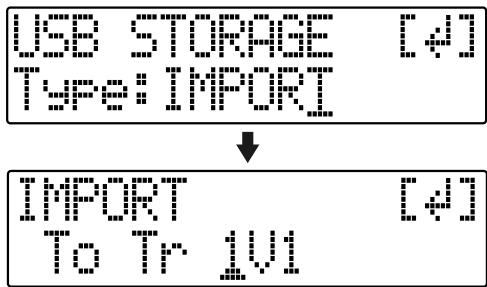
5
Use CURSOR [ ][▶] and the TIME/VALUE dial to select the track/V-Track to be loaded, then press [ENTER].
When loading to the tracks in mono
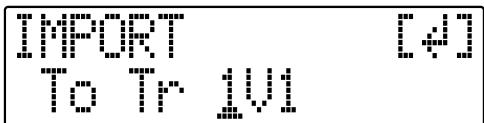
When loading to the tracks in stereo
- Select the track combination 1/2, 3/4, 5/6, or 7/8.
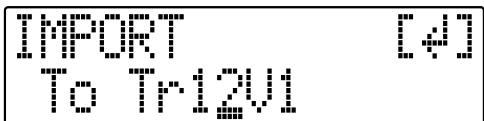
6
Use [CURSOR] and the TIME/VALUE dial to specify the measure or position in the track from which loading is to start, then press [ENTER].
The "BOSS_BR-600" icon is added to the computer.
(Ex.)
7
Copy the WAV or AIFF files you want to import.
1) Double-click the "BOSS_BR-600" icon.
2) Drag the imported WAV or AIFF file to the "USB" folder in the "ROLAND" folder.
* Only one file can be imported at a time in each import operation. Do not drag and drop more than one file at a time.
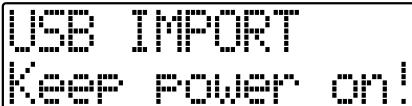
When you have finished copying the data, the Idling screen returns to the display.
8
Quit the connection to the computer.
1) Drag the "BOSS_BR-600" icon into the trash.
9
Press [EXIT].
The WAV or AIFF file is imported.
The contents of the "USB" folder are automatically deleted at the time the import is finished.
- If you press [EXIT] without quitting the connection to the computer, the following screens appear. In this case, pressing [ENTER] imports the WAV or AIFF file.
![ROLAND BR-600 - Press [EXIT]. - 1](/content/2025/01/130576/images/c281139d7597d6316026b5e530e98533f9b5b5b998b3b542c0c94e86d68ba67e.jpg)
Once the import is complete, you are returned to the screen for specifying the import-source track/V-Track. At this point, you can safely disconnect the USB cable from the BR-600 and the computer.
10
Repeat Steps 4-9 as needed.
11
When you have finished importing the WAV or AIFF file(s), press [EXIT] repeatedly to return to the Play screen.
Importing SMFs and Creating Patterns
You can import SMFs (Standard MIDI Files) stored on memory cards as song patterns.
You can easily increase your collection of song patterns by creating SMFs on your computer or other device and copying them to memory cards.
NOTE
- You cannot import SMFs containing more than 999 measures.
- Add the extension "MID" to SMFs you are importing.
- Use file names containing eight alphanumeric characters.
1 Connect your computer and the BR-600 with a USB cable.
2 Confirm that [PAD] is not lit, and with the recorder stopped, press [UTILITY].
3 Press CURSOR [ ] [ ] to move the cursor to "USB," and press [ENTER].
The USB screen appears in the display.
4 Select "BACKUP" with the TIME/VALUE dial, then press [ENTER].
The Idling screen appears in the display.
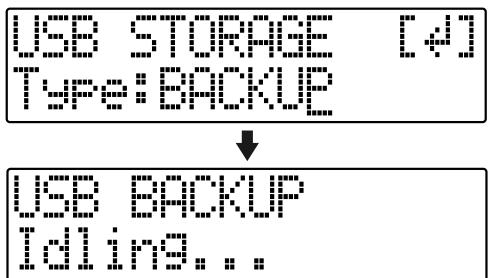
- You cannot carry out the following procedure unless the Idling screen is displayed. Refer to p. 214 for instructions on resolving this problem.
The "BOSS_BR-600" icon is added to the computer.
5
Copy the SMF.
1) Double-click the "BOSS_BR-600" icon.
2) Drag the imported SMF to the "SMF" folder in the "ROLAND" folder.
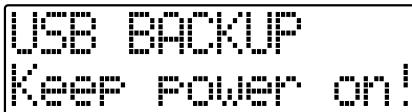
When you have finished copying the SMF, the Idling screen returns to the display.
6
Quit the connection to the computer.
1) Drag the "BOSS_BR-600" icon into the trash.
7
Press [EXIT] repeatedly to return to the Play screen.
- If you press [EXIT] without quitting the connection to the computer, the following screens appear. In this case, pressing [ENTER] and then [EXIT] returns the Play screen to the display.
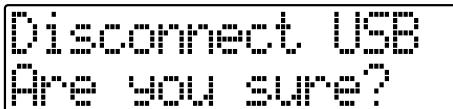
At this point, you can safely disconnect the USB cable from the BR-600 and the computer.
8
Press [PATTERN] so that the button lights up.
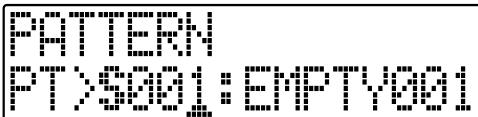
9
Press [RHYTHM EDIT].
10
Press [CURSOR] to move the cursor to "SMF," and press [ENTER].
The names of the SMFs on the memory card are displayed.
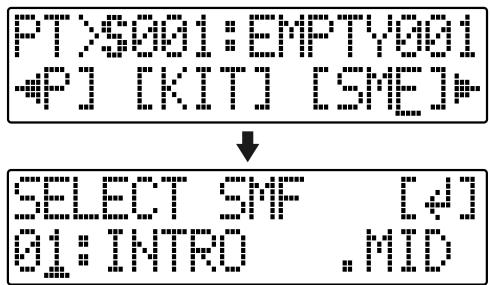
11
Turn the TIME/VALUE dial to select the SMF to be imported, then press [ENTER].
12
Turn the TIME/VALUE dial to select the import-destination song pattern, then press [ENTER].
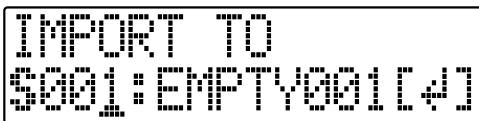
The import is executed.
- During updating, "Keep power on!" appears in the upper line of the display, while the lower line shows what is being processed.
NOTE
With some SMF files, a considerable amount of time may be required to finish importing the file.
MEMO
GM/GS/XG-compatible SMF files generally have rhythm performance data assigned to MIDI Channel 10. For this reason, the BR-600 imports only the data extracted from MIDI Channel 10. Note that data assigned to other channels is disregarded.
Loading Drum Sounds from WAV/AlFF Files (Tone Load)
You can import WAV and AIFF files on your computer and load these as drum sounds (TONE LOAD).

- Wave data in the following formats can be imported.
You cannot import wave data in other formats.
WAV or AIFF format
- Mono or Stereo
- 8-bit or 16-bit
- Sampling Rate: 44.1kHz
- Compressed WAV files or AIFF files cannot be loaded.
- Extremely short waveform data (less than approximately 100ms ) cannot be loaded.
- The loop point settings within an AIFF file will be ignored.
For the files to be imported, add the extension "WAV" to WAV files and the extension "AIF" to AIFF files. - You can load drum sounds of up to 13 seconds for a single drum kit.
(Example)
Kick: 3 seconds, snare: 3 seconds, crash cymbal: 7 seconds Total 13 seconds
- Stereo WAV and AIFF files imported with Tone Load are loaded as "mono" sounds with the left and right sides mixed.

Connect your computer and the BR-600 with a USB cable.

Confirm that [PAD] is not lit, and with the recorder stopped, press [UTILITY].

Press CURSOR [ ] [ ] to move the cursor to "USB," and press [ENTER].
The USB screen appears in the display.

Select "BACKUP" with the TIME/VALUE dial, then press [ENTER].
The Idling screen appears in the display.
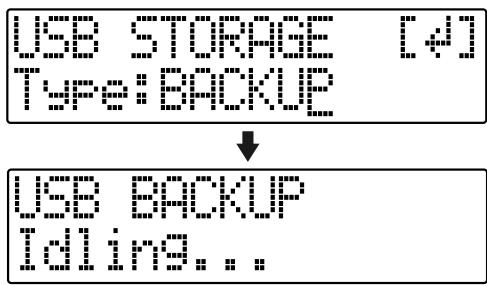
- You cannot carry out the following procedure unless the Idling screen is displayed. Refer to p. 214 for instructions on resolving this problem.
The "BOSS_BR-600" icon is added to the computer.
(Ex.)

Import the WAV or AIFF file.
1) Click the "BOSS_BR-600" icon.
2) Drag the imported WAV or AIFF file to the "TONELOAD" folder in the "ROLAND" folder.
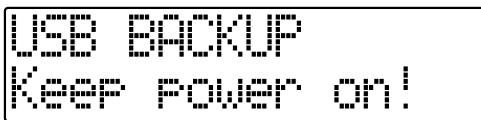
When you have finished importing the WAV or AIFF files, the Idling screen returns to the display.
6
Quit the connection to the computer.
1) Drag the "BOSS_BR-600" icon into the trash.
7
Press [EXIT] repeatedly to return to the Play screen.
- If you press [EXIT] without quitting the connection to the computer, the following screens appear. In this case, pressing [ENTER] and then [EXIT] returns the Play screen to the display.
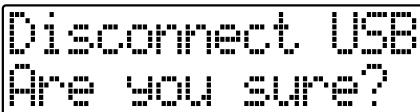
At this point, you can safely disconnect the USB cable from the BR-600 and the computer.
8
Press [UTILITY].
9
Press CURSOR [ ] [ ] to move the cursor to "TONE," and press [ENTER].
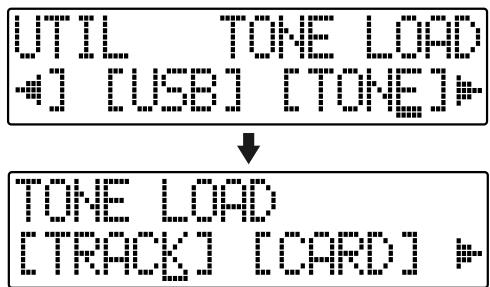
10
Press CURSOR [ ] [ ] to move the cursor to "CARD," and press [ENTER].
The names of the WAV and AIFF files on the memory card are displayed.
- WAV files are indicated by the symbol ".W"; ".A" indicates AIFF files.
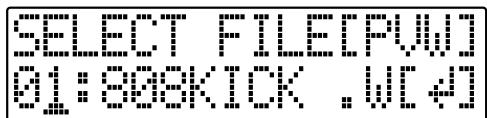
11
Use the TIME/VALUE dial to select the WAV or AIFF file you want to load as the drum sound, then press [ENTER].
MEMO
You can preview the sound of the WAV or AIFF file to be loaded by moving the cursor to "PVW" and pressing [ENTER].
12
Turn the TIME/VALUE dial to specify the load-destination song drum kit.
S1-5: Song Drum Kit 1-5
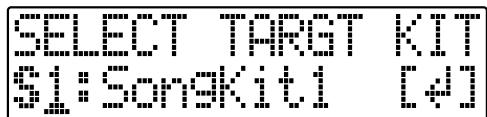
13
Turn the TIME/VALUE dial to select the load-destination song drum sound, then press [ENTER]. The load is executed.
To cancel, press [EXIT].
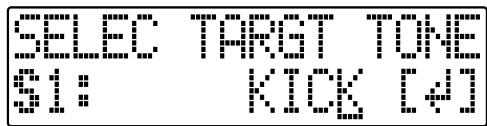
- During updating, "Keep power on!" appears in the upper line of the display, while the lower line shows what is being processed.
NOTE
WAV and AIFF files in the TONELOAD folder are retained without being deleted even after this procedure is completed.
If these files are no longer needed, connect the BR-600 to your computer via USB and use the computer to delete the files. Any files that are retained will use the required amount of memory on the memory card.
Using the BR-900CD / BR-864 / BR-532's Data
You can use the BR-600 to play BR-900CD / BR-864 / BR-532 data.
- First be sure to back up the BR-900CD / BR-864 / BR-532's "ROLAND" folder to the computer.
1 Initializing the memory card on the BR-600 (p. 199).
2 Connect your computer and the BR-600 with a USB cable.
3 Confirm that [PAD] is not lit, and with the recorder stopped, press [UTILITY].
4 Press CURSOR [ ] [ ] to move the cursor to "USB," and press [ENTER].
The USB screen appears in the display.
5 Select "BACKUP" with the TIME/VALUE dial, then press [ENTER].
The Idling screen appears in the display.
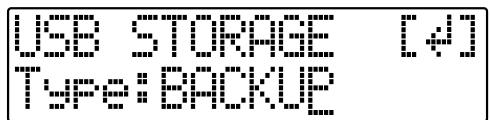
- You cannot carry out the following procedure unless the Idling screen is displayed. Refer to p. 214 for instructions on resolving this problem.
The "BOSS_BR-600" icon is added to the computer.
(Ex.)
6 Delete the BR-600 "ROLAND" folder.
1) Double-click the "BOSS_BR-600" icon, and delete the "ROLAND" folder.
7 Drag the previously backed up BR-900CD / BR-864 / BR-532 "ROLAND" folder to the "BOSS_BR-600" icon and drop it there.
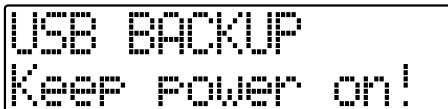
When you have finished backing up the data, the Idling screen returns to the display.
8 Quit the connection to the computer.
1) Drag the "BOSS_BR-600" icon into the trash.
9 Press [EXIT].
The USB screen returns to the display.
- If you press [EXIT] without quitting the connection to the computer, the following screens appear.
In this case, pressing [ENTER] returns the USB screen to the display.
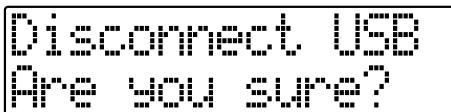
10 When backup of the data is complete, press [EXIT] to return to the Play screen.
At this point, you can safely disconnect the USB cable from the BR-600 and the computer.
Section 6 Other Convenient Functions
Adjusting the Display Contrast
Depending on where the BR-600 is situated, the display contents may be difficult to read. If this is the case, perform the procedure given below to adjust the contrast (1 to 17).
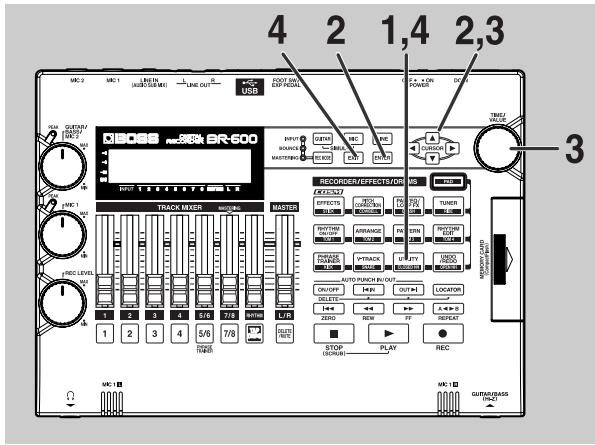
1 Confirm that [PAD] is not lit, then press [UTILITY].
2 Press CURSOR [ ] [ ] to move the cursor to "SYS," and press [ENTER].
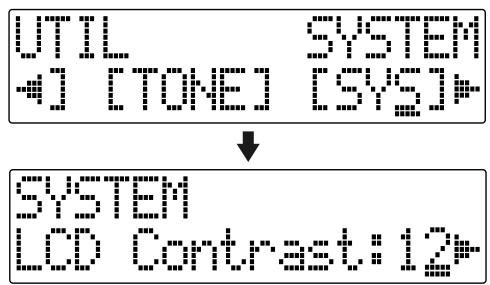
3 Press CURSOR [ ] [ ] to select "LCD Contrast," and adjust the contrast with the TIME/VALUE dial.
4 After completing the adjustment, press [UTILITY] (or press [EXIT] repeatedly) to return to the Play screen.
- During updating, "Keep power on!" appears in the upper line of the display, while the lower line shows what is being processed.
HINT
If you press and hold [UTILITY] while turning the TIME/VALUE dial, you will be able to change the contrast in real time. Choose the method that best suits the BR-600's setup.
Using a Foot Switch or Expression Pedal
You can connect a sold separately foot switch (such as the BOSS FS-5U or Roland DP-2) or expression pedal (such as the Roland EV-5 or BOSS FV-500L/FV-500H) to the FOOT SW/EXP PEDAL jack on the rear panel, allowing you to use your foot to control a number of functions.
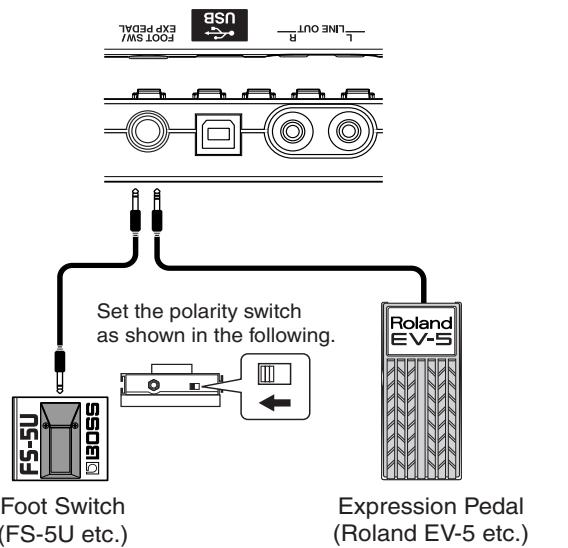
NOTE
- Use only the specified expression pedal (Roland EV-5,BOSS FV-500L/FV-500H; sold separately). By connecting any other expression pedals, you risk causing malfunction and/or damage to the unit.
- With the EV-5 and FV-500L, FV-500H set the MIN volume to 0.
- You can also use an FS-6 (sold separately) for the foot switch. If using an FS-6, connect to only one of the FS-6's jacks, either the A or B jack. Additionally, set the polarity switch to "FS-5U." The A&B jack cannot be used.
When Using an Expression Pedal
The expression pedal functions according to the effect settings, as shown below.
- Functions as a wah pedal when the Type for Wah (p. 110) is set to "PEDAL."
- Functions as a volume pedal when Foot Volume (p. 104) is set to "ON."
- The expression pedal functions as a pitch shifter pedal when Type for the Pitch Shifter (p. 106) is set to"PEDAL."
When Using a Foot Switch
Use the following procedure to set the foot switch function.
1 Confirm that [PAD] is not lit, then press [UTILITY].
2 Press CURSOR [ ] [ ] to move the cursor to "SYS," and press [ENTER].
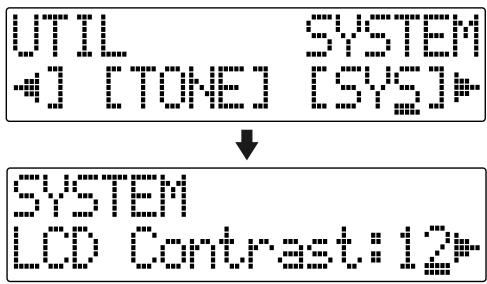
3 Press CURSOR[ ] [ ] and select "Foot SW."
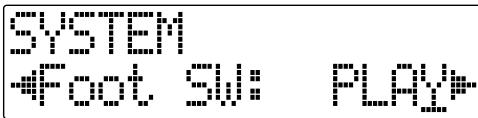
4 Turn the TIME/VALUE dial and select the foot switch function.
PLAY: The song will alternate between play and stop each time you press the foot switch.
PUNCH: Switches punch in and out alternately each time you press the foot switch.
FX : The insert effect will alternate between on and off each time you press the foot switch.
- Not operational while Pitch Correction is in use.
Press [UTILITY] (or press [EXIT] repeatedly) to return to the Play screen.
- During updating, "Keep power on!" appears in the upper line of the display, while the lower line shows what is being processed.
Tuning an Instrument (Tuner)
The BR-600 has a built-in "chromatic tuner function" that allows you to tune your instrument quickly.
The built-in tuner supports both guitar and bass guitar.
As an example here, we will explain how to use the tuner to tune your guitar.
- It is not possible to play back or record while using the tuner.
Check the following points before you begin.
- That your guitar is connected to the GUITAR/BASS jack.
- That [GUITAR] indicator on the INPUT SELECT button is lit.
- Adjust the GUITAR/BASS/MIC2 dial to correct the input sensitivity (p. 36).
If [GUITAR] indicator is off, press [GUITAR] to turn it on.
Changing to the Tuner
1
Confirm that [PAD] is not lit, then press [TUNER] to display the Tuner screen.
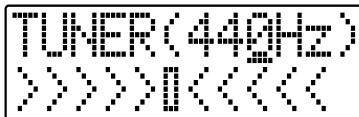
2
To exit the tuner, press [TUNER] once again (or press [EXIT]) to return to the Play screen.
NOTE
You cannot switch from the Tuner screen to other screens (except the Play screen).
MEMO
If you do not want to output the tuning sounds, either turn down the MASTER fader.
Explanation of the indications that appear while tuning
When the built-in tuner of the BR-600 is used, the reference pitch is shown in the upper left of the display, and the note name in the right. The lower part will display a tuning guide to indicate the difference between the input sound and the displayed note.
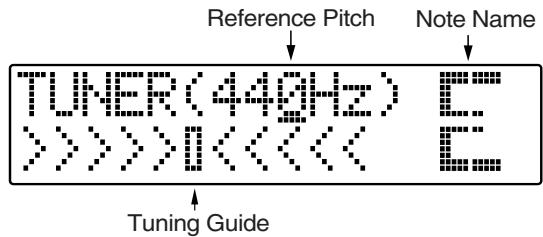
If the difference between the input pitch and the correct pitch is less than +/-50 cents, the tuning guide will indicate the amount of the difference.
While viewing the tuning guide, adjust the tuning so that " 串 " is positioned midway " ^串 " between the two sides.
Tuning
1
Play a note using the string you are tuning.
The screen will indicate the note name that is closest to the pitch of the string you played.
- Cleanly play a single note only on the string you wish to tune.
2
Continue tuning until the pitch name of the string you are tuning appears in the display.
Normal tuning
| 7th string | 6th string | 5th string | 4th string | 3rd string | 2nd string | 1st string | |
| Guitar | B | E | A | D | G | B | E |
| Bass | B | E | A | D | G |
3
While viewing the tuning guide, adjust the tuning so that " 串 " is positioned midway " 串 " between the two sides.
If the pitch of the string is within + / - 50 cents of the correct pitch, the tuning guide will indicate the discrepancy between the actual and the correct pitches.
Your instrument is tuned above the displayed note
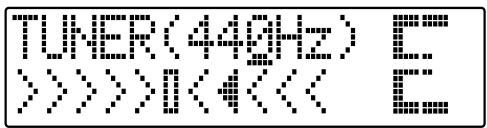
Your instrument is tuned the displayed note
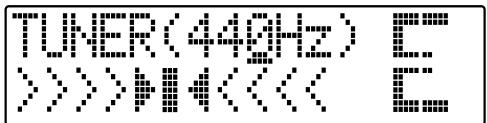
Your instrument is tuned below the displayed note
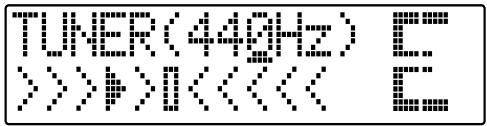
4
Repeat steps 1-3 to tune each of the strings.

If you are tuning a guitar that has a vibrato arm, tuning one string may cause other strings to drift. In this case, you should first tune the strings approximately so that the correct note name is displayed, and then re-tune each string.
Setting the Reference Pitch of the Tuner
The reference pitch refers to the frequency of the A4 key (i.e., the "A" key at the center of a piano keyboard) from the instrument that serves as the reference pitch during performances (e.g., piano).
On the BR-600, you can set the reference pitch of the tuner to any value between 435 and 445Hz
- This was set to 440Hz when the unit was shipped from the factory.
1
Confirm that [PAD] is not lit, then press [TUNER] to display the Tuner screen.
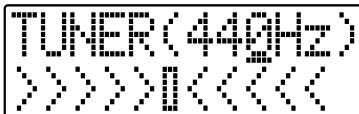
2
Turn the TIME/VALUE dial to change the reference pitch.
Reference pitch: 435 - 445Hz
3
To exit the tuner, press [TUNER] once again (or press [EXIT]) to return to the Play screen.
MEMO
The reference pitch set here is used as the reference pitch for Pitch Correction (p. 123).
Mixing the Output from an External Audio Device with the Output from Your BR-600 (Audio Sub Mix)
The Audio Sub Mix function allows you to mix the signal input from LINE IN with the signal output to LINE OUT.
Using "Audio Sub Mix," you can mix sounds from an external audio device with the output of the BR-600-all within the BR-600, with no external mixer needed.
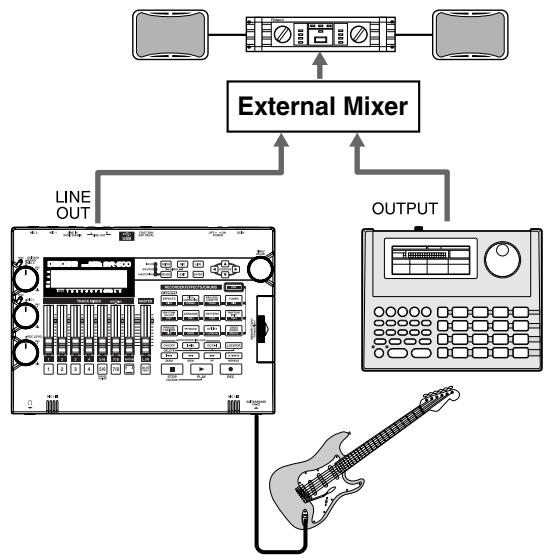
Sub Mixer : OFF
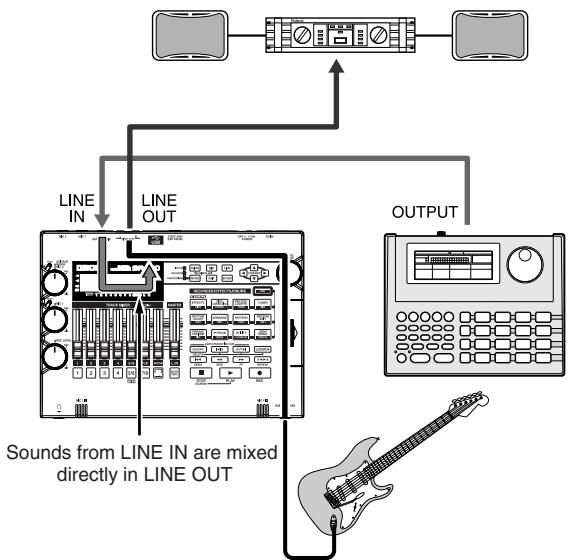
Sub Mixer : ON
Enable use of Audio Sub Mix with the following procedure.
1 Confirm that [PAD] is not lit, then press [UTILITY].
2 Press CURSOR [ ] [ ] to move the cursor to "SYS," and press [ENTER].
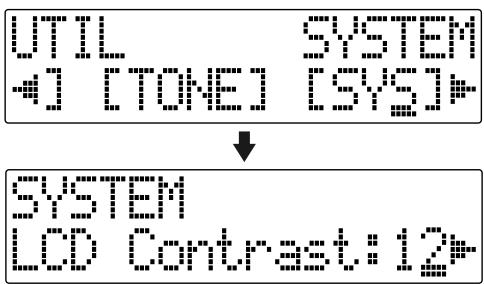
3 Press CURSOR [ ] [ ] to select "Sub Mixer," and turn the TIME/VALUE dial to turn the setting "ON."
OFF: Audio Sub Mix is not used
ON: Audio Sub Mix is used
Press [UTILITY] (or press [EXIT] repeatedly) to return to the Play screen.

If INPUT SELECT [LINE] are lit, even when the Sub Mixer is turned on, the Audio Sub Mix will not work.
Practicing Difficult Phrases (Phrase Trainer)
Your BR-600 features a built-in "Phrase Trainer."
You can also slow down (Time Stretch) the playback to aid in practicing difficult phrases or remove the guitar solo sound (Center Cancel) to play along with only the backing instruments as a practice aid.
- The Phrase Trainer can be used with only tracks 5/6.
Slowing Down the Speed (Time Stretch)
The Time Stretch function allows you to slow down the speed of playback to a half of the normal speed without changing the pitch.
- The Time Stretch can be used with only tracks 5/6.
1
Record the phrase you want to practice onto tracks 5/6.
2
Confirm that [PAD] is not lit, then press [PHRASE TRAINER].
3
Press CURSOR[ ] [ ] to select "TimeStretch," and turn the TIME/VALUE dial to set "ON."
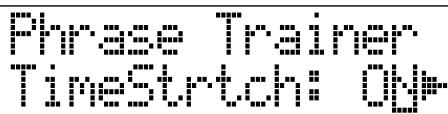
ON: Slows down playback to one-half without changing the pitch.
OFF: Pitch and playback speed are not changed.
4
Press [PLAY].
Phrases recorded to Tracks 5/6 are played back at half the normal speed.

- You cannot perform recording while you are using the Phrase Trainer (Time Stretch or Center Cancel).
- The following buttons are disabled while the Phrase Trainer is in use.
[Pan/EQ/LOOP FX], [PAD] - The Rhythm does not sound when Phrase Trainer is on.
Canceling the Center Sound (Center Cancel)
The Center Cancel function allows you to remove the central sound of the playback (e.g., vocals or guitar solos). This is helpful if you want to practice playing along with the backing instruments.
- The Center Cancel can be used with only tracks 5/6.
1
Confirm that [PAD] is not lit, then press [PHRASE TRAINER].
2
Press CURSOR[ ] [ ] to select "CentrCncel," and turn the TIME/VALUE dial to set it to "ON."
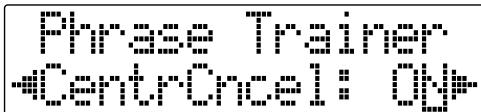
ON: Removes central sound (e.g., vocals or guitar solos).
OFF: Normal playback.
Perform the procedure below if the central sound is not removed as you desire or if you want to emphasize the bass sound.
- When CentrCncel is set to "OFF," subsequent operations are disabled.
3
To emphasize the bass sound, press CURSOR [ ] [ ] to select "Low Boost," and turn the TIME/ VALUE dial and adjust the value so that the bass sound is more easily heard.
4
Press CURSOR [ ] to select "C-adjust," and turn the TIME/VALUE dial and adjust the value of the sound that you want to remove to decrease its volume.
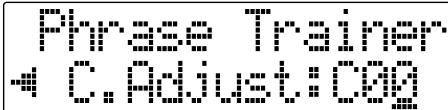
5
Press [EXIT] to return to the Play screen.
NOTE
- Depending on how the phrase was recorded, it may not be possible to completely remove the central sound.
- Sounds are played back in mono.
MEMO
You can turn on both the Time Stretch and Center Cancel functions to use them together.
Initializing All the BR-600's Settings
The following settings are initialized together at one time.
- System Settings
- Effects (User Patches/Song Patches)
- Rhythm (Arrangements/Patterns/Drum Kits)
1 Confirm that [PAD] is not lit, then press [UTILITY].
2 Press CURSOR [ ] [ ] to move the cursor to "INI," and press [ENTER].
![ROLAND BR-600 - Press CURSOR [ ] [ ] to move the cursor to "INI," and press [ENTER]. - 1](/content/2025/01/130576/images/d3ad3b81ffdaf136b538f60d2953523fdc7fad1a0eb733b598878eb1ee16e5bf.jpg)
3 Press PARAMETER CURSOR[ ] [ ] to move the cursor to "ALL," and press [ENTER].
The confirmation message "Are you sure?" appears in the display.
![ROLAND BR-600 - Press PARAMETER CURSOR[ ] [ ] to move the cursor to "ALL," and press [ENTER]. - 1](/content/2025/01/130576/images/5552843695a8a7d3b0b4ad16d5007f0b78e4e9ae71d2218d7b1f67a0e2d6802b.jpg)
4 To continue the initialization, press [ENTER]. To cancel, press [EXIT] (or [UTILITY]).
When [ENTER] is pressed, initialization begins. After the initialization has been completed, you are returned to the Play screen.
MEMO
You can perform the same initialization with "INIT ALL," by holding down INPUT SELECT [GUITAR], [MIC], and [LINE] while turning the POWER switch ON, then pressing [ENTER].
However, the initialization cannot be carried out unless a memory card is inserted in the BR-600 and the song protect function is switched off.
Initializing the System Settings
Follow the procedure below to initialize the system parameters.
A list of the initial settings for each parameter is given in the "Parameter List" (p. 210).
1 Confirm that [PAD] is not lit, then press [UTILITY].
2 Press CURSOR [ ] [ ] to move the cursor to "INI," and press [ENTER].
![ROLAND BR-600 - Press CURSOR [ ] [ ] to move the cursor to "INI," and press [ENTER]. - 1](/content/2025/01/130576/images/4d78acd7d7333cca0e328e13c9aceccbf6fdfa1c6e6ee5efc7fbdbfae4afd8af.jpg)
3 Press CURSOR [ ] [ ] to move the cursor to "SYS," and press [ENTER].
The confirmation message "Are you sure?" appears in the display.
![ROLAND BR-600 - Press CURSOR [ ] [ ] to move the cursor to "SYS," and press [ENTER]. - 1](/content/2025/01/130576/images/2496dffc3f656b270259012065afdbbee9c3f16d090ad53892baa08f8ac5253d.jpg)
4 To continue the initialization, press [ENTER]. To cancel, press [EXIT] (or [UTILITY]).
When [ENTER] is pressed, initialization begins. After the initialization has been completed, you are returned to the Play screen.
Initializing the Effect Settings
Follow the procedure below to initialize the user effect patches or song effect patches.
- The same content as that in the Preset patches is copied.
1
Confirm that [PAD] is not lit, then press [UTILITY].
2
Press CURSOR [ ] [ ] to move the cursor to "INI," and press [ENTER].
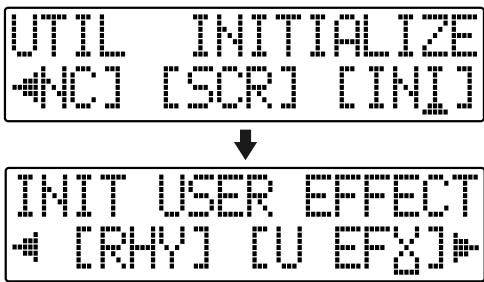
3
Press CURSOR [ ] [ ] to move the cursor to "U EFX" (user patch) or "S EFX" (song patch), and press [ENTER].
The confirmation message "Are you sure?" appears in the display.
(Ex.) when you select "U EFX"
4
To continue the initialization, press [ENTER]. To cancel, press EXIT.
When [ENTER] is pressed, initialization begins. After the initialization has been completed, you are returned to the Play screen.
Initializing the Rhythm Arrangements/Patterns/Drum Kits
This initializes the Rhythm Arrangements, Patterns, and Drum Kits.
- In Song Arrangement, Step 1 is set to the metronome.
- In song patterns and song drum kits, the step is empty.
1
Confirm that [PAD] is not lit, then press [UTILITY].
2
Press CURSOR [ ] [ ] to move the cursor to "INI," and press [ENTER].
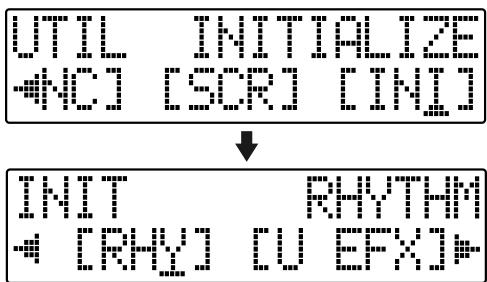
3
Press CURSOR [ ] [ ] to move the cursor to "RHY," and press [ENTER].
The confirmation message "Are you sure?" appears in the display.
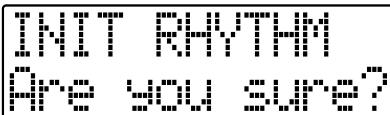
4
To continue the initialization, press [ENTER]. To cancel, press [EXIT] (or [UTILITY]).
When [ENTER] is pressed, initialization begins. After the initialization has been completed, you are returned to the Play screen.
Initializing the Memory Card
NOTE
- Be aware that when initialized, any existing data on the card will be erased.
- If you initialize the memory card supplied with the BR-600, the demo songs on the card will be lost.
- Before you insert or remove a memory card, always turn off the BR-600 first.
If a memory card is inserted when the power is turned on, the data in the memory card may be destroyed, or the memory card may become unusable.
- Depending on the capacity of the memory card, initializing may take more than ten minutes to complete. This is not a malfunction. The progress of the initializing is shown in the display. Do not turn off the BR-600 until the initializing has been completed.
- Do not remove the memory card or turn off the BR-600 while the display shows "Keep power on!" Doing so can destroy the data on the memory card and/or render the memory card itself unusable.
1
Confirm that [PAD] is not lit, then press [UTILITY].
2
Press CURSOR[ ] [ ] to move the cursor to "INI," and press [ENTER].
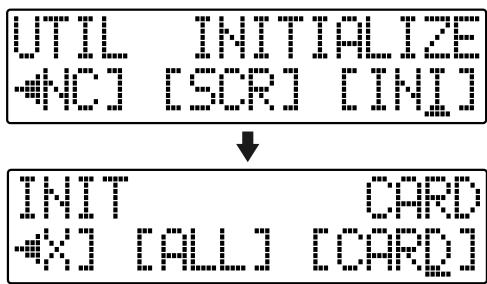
3
Press CURSOR [ ] [ ] to move the cursor to "CARD," and press [ENTER].
The confirmation message "Are you sure?" appears in the display.
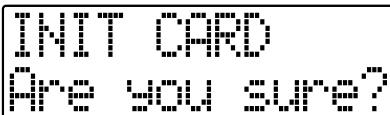
4
To continue the initialization, press [ENTER]. To cancel, press [EXIT] (or [UTILITY]).
When [ENTER] is pressed, initialization begins.
When the initializing has been completed, "Completed!" appears in the display.
"Keep power on! Song creating..." then appears in the display, and a new song is automatically created. In this case, the data type selected is HiFi (MT2). When creation of the song is finished, the play screen returns to the display.
Conserving Battery Power (Power Save)
Your BR-600 is equipped with a power save function that limits the current dissipation during use.
When the power save function is activated, if no button, or TIME/VALUE dial on the BR-600 is used for a certain amount of time, the BR-600 will enter the standby state and turn off the display backlight and button indicators.
Also, when in the standby state, the display will appear as shown below.

Perform the procedure given below to activate the power save function.
1 Confirm that [PAD] is not lit, then press [UTILITY].
2 Press CURSOR [ ] [ ] to move the cursor to "SYS," and press [ENTER].
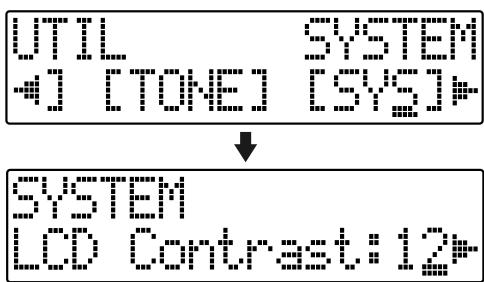
3 Press CURSOR [ ] [ ] to select "PowerSave," and turn the TIME/VALUE dial to set the time until the Power Save function is activated.
4 Press [UTILITY] (or press [EXIT] repeatedly) to return to the Play screen.
- During updating, "Keep power on!" appears in the upper line of the display, while the lower line shows what is being processed.
Deactivating the power save function
Press any of the panel buttons to deactivate power save.

- The power save function is not activated during recording and playback of songs, even when no button or TIME/VALUE dial is used for the set amount of time.
- The power save function is especially helpful when the BR-600 is running on battery power.
- After the power save function is deactivated, the Play screen appears.
Utilities include the following :
- "System parameters" for setting functions affecting the entire BR-600
- "Sync parameters" for setting synchronized performance functions
- "Scrub parameters" for setting scrub functions
About the System Parameters
This section describes the System parameters.
1
Confirm that [PAD] is not lit, then press [UTILITY].
2
Press CURSOR [ ] [ ] to move the cursor to "SYS," and press [ENTER].
3
Using CURSOR[ ][ ], select the System parameter, then make the setting with the VALUE/ TIME dial.
LCD Contrast
Valid Settings : 1-17 (Initial value : 12)
This sets the display contrast.
Pad Sens
Valid Settings : HEAVY,MID,LIGHT,FIX (Initial value : MID)
This sets the sensitivity of the drum pads.
HEAVY: Sensitivity is reduced. Although sounds cannot be played at a high volume without tapping the pads forcefully, it is easier to play sounds with small differences in volume.
MID: Normal sensitivity setting.
LIGHT: A high sensitivity setting is used. Although this permits sounds to be played at high volume even when the pads are tapped only lightly, it does not allow minor changes in volume.
FIX: Sounds play at a uniform volume (MIDI velocity value of 100), regardless of how hard the pads are tapped.
Foot Switch Assign (Foot SW) Valid Settings : PLAY, PUNCH, FX (Initial value : PLAY)
This sets the function for the foot switch (FS-5U or DP-2; sold separately) connected to the FOOT SW/EXP PEDAL jack.
PLAY: Controls the recorder's PLAY and STOP functions.
PUNCH: Controls Punch In/Out.
FX: Controls the insert effects On/Off.
Audio Sub Mix Switch (Sub Mixer) Valid Settings : ON, OFF (Initial value : OFF)
This setting turns the Audio Sub Mix function (output mix of the external inputs from LINE IN) on and off.
AB Quantize (AB Qtz)
Valid Settings : ON, OFF (Initial value : OFF)
This setting turns the "Quantize function" on and off. "Quantize" is a function that enables you to set the start and end points in measure units when making the settings for repeat playback (the repeated portion).
Remain Information (Remain Inf) Valid Settings : ON, OFF (Initial value : OFF)
This indicates the remaining amount of recording time available in the display during recording standby or while recording is in progress.
Power Save Mode (PowerSave) Valid Settings : OFF, 1, 3, 5, 10 (min) (Initial value : OFF)
This setting turns the "Power Save function" on and off.
"Power Save" is a function that reduces power consumption through such power-saving measures as switching off the display's illumination if no operation is performed for a set period of time (for one, three, five, or ten minutes). This is effective in preventing excess battery drain.
About the Sync Parameters
1 Confirm that [PAD] is not lit, then press [UTILITY].
2 Press CURSOR [ ] [ ] to move the cursor to "SYNC," and press [ENTER].
3 Make the settings with the TIME/VALUE dial
Offset Valid Settings : 00:00:00-00.0-23:59:59-29.9 (Initial value : 00:00:00-00.0)
This function allows audio tracks to be played back with rhythm arrangements offset only by the set time.
For example, if you want to play rhythm arrangements when the time of an audio track is "00h00m30s00," set the offset to "00h00m30s00" if you want the rhythm arrangements played at "00h01m00s00," set the offset to "00h01m00s00."
MEMO
The Offset is stored to each song individually.
About the Scrub Parameters
1 Confirm that [PAD] is not lit, then press [UTILITY].
2 Press CURSOR [ ] [ ] to move the cursor to "SCR," and press [ENTER].
3 Using CURSOR [ ][ ], select the Scrub parameter, then make the setting with the TIME/ VALUE dial.
Scrub Mode From/To Valid Settings : FROM, TO (Initial value : FROM)
This sets the "Scrub function" mode.
"Scrub" is a function for repeatedly playing back material of an extremely short duration (approximately 45 msec). You can get scrub playback by holding down [STOP] and pressing [PLAY].
FROM: Provides about 45 milliseconds of scrub playback starting from the current position.
TO : Provides about 45 milliseconds of scrub playback ending up at the current position.
Preview Switch (Preview SW) Valid Settings : ON, OFF (Initial value : OFF)
This setting turns the "Preview function" on and off.
When the Preview switch is set to ON, pressing [REW] during scrub playback provides one second of playback time starting from the current position, while pressing [FF] provides one second of playback time ending up at the current position.
Section 7 Appendices
GTR (GUITAR/BASS)
| No. | Patch Name | Algorithm |
| 01 | JC Clean | COSM GTR AMP |
| 02 | HiGainLd | COSM GTR AMP |
| 03 | Over Drv | COSM GTR AMP |
| 04 | Phased | COSM GTR AMP |
| 05 | Crunch | COSM GTR AMP |
| 06 | MS Strgt | COSM GTR AMP |
| 07 | St WACK | COSM GTR AMP |
| 08 | Ambient | COSM GTR AMP |
| 09 | Voxy! | COSM GTR AMP |
| 10 | St Metal | COSM GTR AMP |
| 11 | TREM'TWN | COSM GTR AMP |
| 12 | StdAmp F | COSM GTR AMP |
| 13 | StdAmp M | COSM COMP GTR |
| 14 | St Flang | COSM GTR AMP |
| 15 | TEXAS | COSM GTR AMP |
| 16 | HiGainMS | COSM GTR AMP |
| 17 | StThrush | COSM GTR AMP |
| 18 | SWEET LD | COSM GTR AMP |
| 19 | BIG COMP | COSM GTR AMP |
| 20 | PowChord | COSM GTR AMP |
| 21 | Uni-Wah | COSM GTR AMP |
| 22 | Gt Pad | COSM GTR AMP |
| 23 | D-CompLd | COSM COMP GTR |
| 24 | DrivenLd | COSM GTR AMP |
| 25 | RockLead | COSM GTR AMP |
| 26 | RAGE! | COSM GTR AMP |
| 27 | ClearSky | COSM GTR AMP |
| 28 | 60s UK | COSM COMP GTR |
| 29 | TubeStck | COSM GTR AMP |
| 30 | StSustin | COSM GTR AMP |
| 31 | Country | COSM COMP GTR |
| 32 | ClapLead | COSM GTR AMP |
| 33 | TURND211 | COSM GTR AMP |
| 34 | 80'sHard | COSM GTR AMP |
| 35 | 90'sMetl | COSM GTR AMP |
| 36 | Bubbling | COSM GTR AMP |
| 37 | BIG FUNK | COSM COMP GTR |
| 38 | Dirty | COSM GTR AMP |
| 39 | MatchDrv | COSM GTR AMP |
| 40 | St AltLd | COSM GTR AMP |
| 41 | PhatPhas | COSM GTR AMP |
| 42 | SocrFld | COSM GTR AMP |
| 43 | UK Gtr | COSM COMP GTR |
| 44 | DOWN 2 D | COSM GTR AMP |
| 45 | CmpBilly | COSM COMP GTR |
| 46 | JC Metal | COSM GTR AMP |
| 47 | LATE70's | COSM GTR AMP |
| 48 | EARY70's | COSM GTR AMP |
| 49 | American | COSM GTR AMP |
| 50 | Heavy | COSM GTR AMP |
| No. | Patch Name | Algorithm |
| 51 | Hard Drv | COSM GTR AMP |
| 52 | HyperMtl | COSM GTR AMP |
| 53 | Metal Ld | COSM GTR AMP |
| 54 | ResoLead | COSM GTR AMP |
| 55 | ARPEGGIO | COSM GTR AMP |
| 56 | SmallAmp | COSM GTR AMP |
| 57 | CleanLd | COSM COMP GTR |
| 58 | BluesyLd | COSM GTR AMP |
| 59 | Delayed | COSM GTR AMP |
| 60 | Wah Lead | COSM GTR AMP |
| 61 | FatClean | COSM COMP GTR |
| 62 | ClnTubes | COSM GTR AMP |
| 63 | Std MkII | COSM GTR AMP |
| 64 | Crunchy | COSM GTR AMP |
| 65 | Aussie | COSM GTR AMP |
| 66 | Darfblus | COSM GTR AMP |
| 67 | HeadinWM | COSM GTR AMP |
| 68 | BG Lead | COSM GTR AMP |
| 69 | FixedWah | COSM GTR AMP |
| 70 | BIG 3RDS | COSM GTR AMP |
| 71 | ACOUSTY | ACOUSTIC SIM |
| 72 | BrightAc | ACOUSTIC SIM |
| 73 | ACO w/PZ | ACOUSTIC SIM |
| 74 | AC4Slide | ACOUSTIC SIM |
| 75 | Dream Ac | ACOUSTIC SIM |
| 76 | TigtBass | BASS SIM |
| 77 | LoosBass | BASS SIM |
| 78 | B.SIM+Ch | BASS SIM |
| 79 | UprtPhsd | BASS SIM |
| 80 | G>FRTLES | BASS SIM |
| 81 | Natural | ACOUSTIC GTR |
| 82 | AcstSolo | ACOUSTIC GTR |
| 83 | MIC'D AC | ACOUSTIC GTR |
| 84 | NICE ACS | ACOUSTIC GTR |
| 85 | WIDE ACS | ACOUSTIC GTR |
| 86 | SLAPnPPOP | BASS MULTI |
| 87 | PhasBass | BASS MULTI |
| 88 | FLIPTOP | COSM BASS AMP |
| 89 | SquezBas | COSM COMP BSS |
| 90 | StdoBass | COSM COMP BSS |
| 91 | BassTube | COSM BASS AMP |
| 92 | PunkBass | COSM BASS AMP |
| 93 | SUSTAIN | COSM COMP BSS |
| 94 | Big8-Stg | BASS MULTI |
| 95 | FRETLESS | BASS MULTI |
| 96 | STADIUM | COSM COMP BSS |
| 97 | OCTAVE | BASS MULTI |
| 98 | NO FRET | BASS MULTI |
| 99 | DRV BASS | COSM BASS AMP |
MIC
No. Patch Name Algorithm
| 01 | Vo Comp1 | COSM COMP VCL |
| 02 | Vo Comp2 | COSM COMP VCL |
| 03 | Kick Cmp | COSM COMP VCL |
| 04 | SnareCmp | COSM COMP VCL |
| 05 | BrassCmp | COSM COMP VCL |
| 06 | VocalFx1 | VOCAL MULTI |
| 07 | VocalFx2 | VOCAL MULTI |
| 08 | VocalFx3 | VOCAL MULTI |
| 09 | VocalFx4 | VOCAL MULTI |
| 10 | NARRATOR | VOCAL MULTI |
| 11 | VOX DOUB | VOCAL MULTI |
| 12 | VOX DETN | VOCAL MULTI |
| 13 | KARAOKE | VOCAL MULTI |
| 14 | UNISON | VOICE TRANS |
| 15 | STUTTER | VOICE TRANS |
| 16 | D.VADER | VOICE TRANS |
| 17 | ALIEN | VOICE TRANS |
| 18 | BullHorn | VOCAL MULTI |
| 19 | SEAGULLS | VOICE TRANS |
| 20 | SO DEEP! | VOICE TRANS |
| 21 | BrightCh | VOCAL MULTI |
| 22 | FatBrass | VOCAL MULTI |
| 23 | Dark EQ | VOCAL MULTI |
| 24 | Vocal EQ | VOCAL MULTI |
| 25 | BrightEQ | VOCAL MULTI |
| 26 | Enh+BCut | VOCAL MULTI |
| 27 | ST.PAN | VOCAL MULTI |
| 28 | SLOW FLG | VOCAL MULTI |
| 29 | FAST FLG | VOCAL MULTI |
| 30 | SLOW CHO | VOCAL MULTI |
| 31 | SLAPBACK | VOCAL MULTI |
| 32 | BigEQ+DL | VOCAL MULTI |
| 33 | BalladFx | VOCAL MULTI |
| 34 | PTCH-1/2 | VOCAL MULTI |
| 35 | PTCH+1/2 | VOCAL MULTI |
| 36 | CM+DS+EH | VOCAL MULTI |
| 37 | CM+EH+EQ | VOCAL MULTI |
| 38 | CM+DS+EQ | VOCAL MULTI |
| 39 | CM+EQ+DB | VOCAL MULTI |
| 40 | CM+EQ+DT | VOCAL MULTI |
LIN (LINE)
No. Patch Name Algorithm
| 01 | CM+FatEQ | STEREO MULTI |
| 02 | CM+ThnEQ | STEREO MULTI |
| 03 | Tight EQ | STEREO MULTI |
| 04 | CM+BigEQ | STEREO MULTI |
| 05 | SMALL EQ | STEREO MULTI |
| 06 | TWAH UP | STEREO MULTI |
| 07 | TWAH DW | STEREO MULTI |
| 08 | R.MOD:LO | STEREO MULTI |
| 09 | R.MOD:HI | STEREO MULTI |
| 10 | TotalMod | STEREO MULTI |
| 11 | DEEP FLG | STEREO MULTI |
| 12 | LO&SLOW | STEREO MULTI |
| 13 | LO&FAST | STEREO MULTI |
| 14 | HI&SLOW | STEREO MULTI |
| 15 | HI&FAST | STEREO MULTI |
| 16 | StChorus | STEREO MULTI |
| 17 | SlowChrs | STEREO MULTI |
| 18 | FastChrs | STEREO MULTI |
| 19 | PRE-DLY | STEREO MULTI |
| 20 | VntgPhas | STEREO MULTI |
| 21 | MdrnPhas | STEREO MULTI |
| 22 | DeepPhas | STEREO MULTI |
| 23 | PhatPhas | STEREO MULTI |
| 24 | PS:DETUN | STEREO MULTI |
| 25 | PS:-1OCT | STEREO MULTI |
| 26 | PS:+1OCT | STEREO MULTI |
| 27 | ST DOUBL | STEREO MULTI |
| 28 | MONO>>ST | STEREO MULTI |
| 29 | SLOW PAN | STEREO MULTI |
| 30 | FAST PAN | STEREO MULTI |
| 31 | CHRS+DLY | STEREO MULTI |
| 32 | CHRS+TAP | STEREO MULTI |
| 33 | PH+SLPBK | STEREO MULTI |
| 34 | FLNG+TAP | STEREO MULTI |
| 35 | LoCmbFlt | STEREO MULTI |
| 36 | HiCmbFlt | STEREO MULTI |
| 37 | 120 RMOD | STEREO MULTI |
| 38 | PAN+DLY | STEREO MULTI |
| 39 | ST TREM | STEREO MULTI |
| 40 | 120 SLIC | STEREO MULTI |
| 41 | 20sRadio | LO-FI BOX |
| 42 | 40sRadio | LO-FI BOX |
| 43 | 60sRadio | LO-FI BOX |
| 44 | PHONGRPH | LO-FI BOX |
| 45 | Vntg45's | LO-FI BOX |
| 46 | CLASC LP | LO-FI BOX |
| 47 | VntgSmpl | LO-FI BOX |
| 48 | 1985Smpl | LO-FI BOX |
| 49 | R-ModSmp | LO-FI BOX |
| 50 | 2-BIT DS | LO-FI BOX |
SML (SIMUL)
| No. | Patch Name | Algorithm |
| 01 | EQ + JC | VO+GT AMP |
| 02 | DELAY+JC | VO+GT AMP |
| 03 | CMP+TWIN | VO+GT AMP |
| 04 | EQ+twin | VO+GT AMP |
| 05 | CMP+SMAL | VO+GT AMP |
| 06 | EQ+CRNCH | VO+GT AMP |
| 07 | EQ+MATCH | VO+GT AMP |
| 08 | DL+match | VO+GT AMP |
| 09 | EQ+VO | VO+GT AMP |
| 10 | COMP+vo | VO+GT AMP |
| 11 | CMP+BLUS | VO+GT AMP |
| 12 | CMP+BG | VO+GT AMP |
| 13 | DELAY+bg | VO+GT AMP |
| 14 | DL+MS(1) | VO+GT AMP |
| 15 | DL+ms(1) | VO+GT AMP |
| 16 | DL+MS1+2 | VO+GT AMP |
| 17 | CM&EQ+ms | VO+GT AMP |
| 18 | DLY+SLDN | VO+GT AMP |
| 19 | CMP+METL | VO+GT AMP |
| 20 | EQ+METAL | VO+GT AMP |
| 21 | DI+H-STD | VO+AC.SIM |
| 22 | EQ+S-STD | VO+AC.SIM |
| 23 | CM+H-JUM | VO+AC.SIM |
| 24 | CM+S-JUM | VO+AC.SIM |
| 25 | DL+H-ENH | VO+AC.SIM |
| 26 | CM+S-ENH | VO+AC.SIM |
| 27 | EQ+H-PZO | VO+AC.SIM |
| 28 | DL+S-PZO | VO+AC.SIM |
| 29 | CMP+PZO1 | VO+AC.SIM |
| 30 | DL+PZO2 | VO+AC.SIM |
| 31 | DIR+SIM1 | VO+AC.SIM |
| 32 | CMP+SIM2 | VO+AC.SIM |
| 33 | EQ+SIM3 | VO+AC.SIM |
| 34 | DL+SIM4 | VO+AC.SIM |
| 35 | CMP+SIM5 | VO+AC.SIM |
| 36 | COMP+AC | VO+ACOSTIC |
| 37 | COMP+CLS | VO+ACOSTIC |
| 38 | COMP+DIS | VO+ACOSTIC |
| 39 | COMP+FAR | VO+ACOSTIC |
| 40 | COMP+DYN | VO+ACOSTIC |
| 41 | COMP+MIC | VO+ACOSTIC |
| 42 | COMP+DIR | VO+ACOSTIC |
| 43 | NS+VNTG | VO+ACOSTIC |
| 44 | CMP+CMP1 | VO+ACOSTIC |
| 45 | DI+COMP2 | VO+ACOSTIC |
| 46 | CMP+CMP3 | VO+ACOSTIC |
| 47 | NS+COMP4 | VO+ACOSTIC |
| 48 | CMP+CMP5 | VO+ACOSTIC |
| 49 | COMP+SML | VO+ACOSTIC |
| 50 | COMP+LRG | VO+ACOSTIC |
Mastering Tool Kit Patch List
MTK (MASTERING TOOL KIT)
No. Patch Name
| 01 | Mix Down |
| 02 | PreMastr |
| 03 | Live Mix |
| 04 | Pop Mix |
| 05 | DanceMix |
| 06 | JinglMix |
| 07 | HardComp |
| 08 | SoftComp |
| 09 | CleanCmp |
| 10 | DanceCmp |
| 11 | OrchComp |
| 12 | VocalCmp |
| 13 | Acoustic |
| 14 | RockBand |
| 15 | Orchestr |
| 16 | LowBoost |
| 17 | Brighten |
| 18 | DJVoice |
| 19 | PhoneVox |
Pitch Correction Patch List
PCR (PITCH CORRECTION)
No. Patch Name
| P01 | Alto |
| P02 | Soprano |
| P03 | Tenor |
| P04 | Baritone |
| P05 | Machine |
Preset Arrangement List
Each of the preset Arrangement (except Metro4/4) is set so that a three-measure BREAK, followed by V1 (verse) comes after the E (ending).
| No. | Arrangement Name | Initial Tempo | Beat | Starting measure | BREAK | V1 | Drum Kit | ||||||
| IN | V1 | F1 | V2 | F2 | V2 | END | |||||||
| P01 | ROCK1 | 130 | 4/4 | 1 | 2 | 4 | 6 | 8 | 10 | 12 | 16 | 19 | ROOM |
| P02 | ROCK2 | 130 | 4/4 | 1 | 3 | 5 | 7 | 9 | 11 | 13 | 17 | 20 | ROOM |
| P03 | ROCK3 | 118 | 4/4 | 1 | 3 | 6 | 7 | 10 | 11 | 15 | 17 | 20 | ROOM |
| P04 | ROCK4 | 118 | 4/4 | 1 | 5 | 8 | 9 | 12 | 13 | 15 | 19 | 22 | ROOM |
| P05 | ROCK5 | 104 | 4/4 | 1 | 5 | 8 | 9 | 12 | 13 | 15 | 17 | 20 | ROOM |
| P06 | ROCK6 | 86 | 4/4 | 1 | 2 | 9 | 10 | 17 | 18 | 22 | 24 | 27 | STD 2 |
| P07 | HdRck1 | 130 | 4/4 | 1 | 5 | 8 | 9 | 12 | 13 | 15 | 18 | 21 | ROOM |
| P08 | HdRck2 | 98 | 4/4 | 1 | 3 | 10 | 11 | 18 | 19 | 23 | 25 | 28 | HARD |
| P09 | HdRck3 | 126 | 4/4 | 1 | 5 | 8 | 9 | 12 | 13 | 15 | 20 | 23 | ROOM |
| P10 | HdRck4 | 120 | 4/4 | 1 | 4 | 7 | 8 | 11 | 12 | 15 | 18 | 21 | ROOM |
| P11 | HdRck5 | 118 | 4/4 | 1 | 2 | 5 | 6 | 9 | 10 | 12 | 13 | 16 | ROOM |
| P12 | HEAVY1 | 210 | 4/4 | 1 | 5 | 11 | 13 | 19 | 21 | 25 | 29 | 32 | HARD |
| P13 | HEAVY2 | 120 | 4/4 | 1 | 3 | 9 | 11 | 17 | 19 | 21 | 23 | 26 | HARD |
| P14 | HEAVY3 | 120 | 4/4 | 1 | 3 | 9 | 11 | 17 | 19 | 21 | 24 | 27 | HARD |
| P15 | HEAVY4 | 162 | 4/4 | 1 | 3 | 9 | 11 | 17 | 19 | 21 | 24 | 27 | ROOM |
| P16 | HEAVY5 | 109 | 4/4 | 1 | 5 | 8 | 9 | 12 | 13 | 15 | 16 | 19 | ROOM |
| P17 | POP1 | 118 | 4/4 | 1 | 3 | 6 | 7 | 10 | 11 | 13 | 17 | 20 | ROOM |
| P18 | POP2 | 118 | 4/4 | 1 | 3 | 6 | 7 | 10 | 11 | 13 | 15 | 18 | STD1 |
| P19 | POP3 | 118 | 4/4 | 1 | 3 | 6 | 7 | 10 | 11 | 13 | 15 | 18 | ROOM |
| P20 | POP4 | 118 | 4/4 | 1 | 3 | 6 | 7 | 10 | 11 | 13 | 17 | 20 | ROOM |
| P21 | POP5 | 140 | 4/4 | 1 | 3 | 6 | 7 | 10 | 11 | 13 | 15 | 18 | ROOM |
| P22 | POP6 | 96 | 4/4 | 1 | 3 | 6 | 7 | 10 | 11 | 13 | 15 | 18 | STD 1 |
| P23 | POP7 | 66 | 4/4 | 1 | 4 | 7 | 8 | 11 | 12 | 14 | 16 | 19 | STD 2 |
| P24 | POP8 | 151 | 4/4 | 1 | 5 | 8 | 9 | 16 | 17 | 21 | 24 | 27 | STD 1 |
| P25 | BALLAD1 | 70 | 4/4 | 1 | 5 | 8 | 9 | 12 | 13 | 15 | 18 | 21 | ROOM |
| P26 | BALLAD2 | 89 | 4/4 | 1 | 2 | 5 | 6 | 9 | 10 | 12 | 14 | 17 | STD 2 |
| P27 | BLUES1 | 124 | 4/4 | 1 | 2 | 5 | 6 | 9 | 10 | 13 | 16 | 19 | STD 2 |
| P28 | BLUES2 | 192 | 4/4 | 1 | 5 | 12 | 13 | 20 | 21 | 25 | 29 | 32 | STD 1 |
| P29 | BLUES3 | 124 | 4/4 | 1 | 3 | 10 | 11 | 18 | 19 | 23 | 26 | 29 | STD 2 |
| P30 | BLUES4 | 148 | 4/4 | 1 | 5 | 8 | 9 | 12 | 13 | 15 | 17 | 20 | STD 1 |
| P31 | R&B1 | 110 | 4/4 | 1 | 5 | 8 | 9 | 12 | 13 | 15 | 18 | 21 | STD 1 |
| P32 | R&B2 | 154 | 4/4 | 1 | 3 | 6 | 7 | 10 | 11 | 13 | 18 | 21 | STD 1 |
| P33 | R&B3 | 108 | 4/4 | 1 | 5 | 8 | 9 | 12 | 13 | 15 | 18 | 21 | STD 2 |
| P34 | R&B4 | 96 | 4/4 | 1 | 5 | 12 | 13 | 20 | 21 | 25 | 26 | 29 | STD 1 |
| P35 | R&B5 | 94 | 4/4 | 1 | 5 | 8 | 9 | 12 | 13 | 15 | 19 | 22 | STD 1 |
| P36 | JAZZ1 | 140 | 4/4 | 1 | 3 | 5 | 7 | 9 | 11 | 13 | 15 | 18 | JAZZ |
| P37 | JAZZ2 | 140 | 4/4 | 1 | 5 | 7 | 9 | 11 | 13 | 15 | 17 | 20 | JAZZ |
| P38 | JAZZ3 | 140 | 4/4 | 1 | 5 | 12 | 13 | 20 | 21 | 25 | 30 | 33 | JAZZ |
| P39 | FUSION1 | 120 | 4/4 | 1 | 5 | 12 | 13 | 20 | 21 | 25 | 29 | 32 | STD2 |
| P40 | FUSION2 | 118 | 4/4 | 1 | 2 | 5 | 6 | 9 | 10 | 12 | 15 | 18 | ROOM |
| P41 | HipHop1 | 93 | 4/4 | 1 | 2 | 9 | 10 | 17 | 18 | 22 | 23 | 26 | HIP-HOP |
| P42 | HipHop2 | 102 | 4/4 | 1 | 3 | 10 | 11 | 18 | 19 | 23 | 25 | 28 | 808 |
| P43 | FUNK | 110 | 4/4 | 1 | 2 | 4 | 6 | 8 | 10 | 12 | 13 | 16 | HIP-HOP |
| P44 | HOUSE | 114 | 4/4 | 1 | 3 | 6 | 7 | 10 | 11 | 13 | 15 | 18 | HOUSE |
| P45 | Cntry1 | 118 | 4/4 | 1 | 3 | 6 | 7 | 10 | 11 | 13 | 14 | 17 | JAZZ |
| P46 | Cntry2 | 118 | 4/4 | 1 | 2 | 5 | 6 | 9 | 10 | 12 | 14 | 17 | JAZZ |
| P47 | Other1 | 96 | 4/4 | 1 | 2 | 9 | 10 | 17 | 18 | 22 | 24 | 27 | REGGAE |
| P48 | Other2 | 118 | 4/4 | 1 | 5 | 7 | 9 | 11 | 13 | 15 | 19 | 22 | STD 2 |
| P49 | Other3 | 125 | 4/4 | 1 | 2 | 5 | 6 | 9 | 10 | 12 | 14 | 17 | ROOM |
| P50 | Metro4/4 | 120 | 4/4 | 1 | - | - | - | - | - | - | - | - | STD 1 |
Preset Pattern List
| Pattern Name (Abbreviation shown in display) | Initial Tempo | Beat | Measure | |||||
| IN | V1 | F1 | V2 | F2 | E | |||
| ROCK1 | 130 | 4/4 | 1 | 2 | 2 | 2 | 2 | 4 |
| ROCK2 | 130 | 4/4 | 2 | 2 | 2 | 2 | 2 | 4 |
| ROCK3 | 118 | 4/4 | 2 | 2 | 1 | 2 | 1 | 2 |
| ROCK4 | 118 | 4/4 | 4 | 2 | 1 | 2 | 1 | 4 |
| ROCK5 | 104 | 4/4 | 4 | 2 | 1 | 2 | 1 | 2 |
| ROCK6 | 86 | 4/4 | 1 | 4 | 1 | 4 | 1 | 2 |
| Hard Rock 1(HdRc1) | 130 | 4/4 | 4 | 2 | 1 | 2 | 1 | 3 |
| Hard Rock 1(HdRc2) | 98 | 4/4 | 2 | 4 | 1 | 4 | 1 | 2 |
| Hard Rock 1(HdRc3) | 126 | 4/4 | 4 | 2 | 1 | 2 | 1 | 5 |
| Hard Rock 1(HdRc4) | 120 | 4/4 | 3 | 2 | 1 | 2 | 1 | 3 |
| Hard Rock 1(HdRc5) | 118 | 4/4 | 1 | 1 | 1 | 1 | 1 | 1 |
| HEAVY1 (HEVY1) | 210 | 4/4 | 4 | 4 | 2 | 4 | 2 | 4 |
| HEAVY2 (HEVY2) | 120 | 4/4 | 2 | 2 | 2 | 2 | 2 | 2 |
| HEAVY3 (HEVY3) | 120 | 4/4 | 2 | 2 | 2 | 2 | 2 | 3 |
| HEAVY4 (HEVY4) | 162 | 4/4 | 2 | 2 | 2 | 2 | 2 | 3 |
| HEAVY5 (HEVY5) | 109 | 4/4 | 4 | 2 | 1 | 2 | 1 | 1 |
| POP1 | 118 | 4/4 | 2 | 2 | 1 | 2 | 1 | 4 |
| POP2 | 118 | 4/4 | 2 | 2 | 1 | 2 | 1 | 2 |
| POP3 | 118 | 4/4 | 2 | 2 | 1 | 2 | 1 | 2 |
| POP4 | 118 | 4/4 | 2 | 1 | 1 | 1 | 1 | 4 |
| POP5 | 140 | 4/4 | 2 | 1 | 1 | 1 | 1 | 2 |
| POP6 | 96 | 4/4 | 2 | 2 | 1 | 2 | 1 | 2 |
| POP7 | 66 | 4/4 | 3 | 2 | 1 | 2 | 1 | 2 |
| POP8 | 151 | 4/4 | 4 | 2 | 1 | 4 | 1 | 3 |
| BALLAD1 (BALD1) | 70 | 4/4 | 4 | 2 | 1 | 2 | 1 | 3 |
| BALLAD2 (BALD2) | 89 | 4/4 | 1 | 2 | 1 | 2 | 1 | 2 |
| BLUES1 (BLUS1) | 124 | 4/4 | 1 | 4 | 1 | 4 | 1 | 3 |
| BLUES2 (BLUS2) | 192 | 4/4 | 4 | 4 | 1 | 4 | 1 | 4 |
| BLUES3 (BLUS3) | 124 | 4/4 | 2 | 2 | 1 | 2 | 1 | 3 |
| BLUES4 (BLUS4) | 148 | 4/4 | 4 | 2 | 1 | 2 | 1 | 2 |
| R&B1 | 110 | 4/4 | 4 | 2 | 1 | 2 | 1 | 3 |
| R&B2 | 154 | 4/4 | 2 | 2 | 1 | 2 | 1 | 5 |
| R&B3 | 108 | 4/4 | 4 | 2 | 1 | 2 | 1 | 3 |
| R&B4 | 96 | 4/4 | 4 | 4 | 1 | 4 | 1 | 1 |
| R&B5 | 94 | 4/4 | 4 | 2 | 1 | 2 | 1 | 4 |
| JAZZ1 | 140 | 4/4 | 2 | 2 | 2 | 2 | 2 | 2 |
| JAZZ2 | 140 | 4/4 | 4 | 2 | 2 | 2 | 2 | 2 |
| JAZZ3 | 140 | 4/4 | 4 | 4 | 1 | 4 | 1 | 5 |
| FUSION1 (FUSN1) | 120 | 4/4 | 4 | 4 | 1 | 4 | 1 | 4 |
| FUSION2 (FUSN2) | 118 | 4/4 | 1 | 2 | 1 | 2 | 1 | 3 |
| HipHop1 (H.Hp1) | 93 | 4/4 | 1 | 4 | 1 | 4 | 1 | 1 |
| HipHop2 (H.Hp2) | 102 | 4/4 | 2 | 4 | 1 | 4 | 1 | 2 |
| FUNK | 110 | 4/4 | 1 | 2 | 2 | 2 | 2 | 1 |
| HOUSE | 114 | 4/4 | 2 | 2 | 1 | 2 | 1 | 2 |
| Cntry1 (Cnty1) | 118 | 4/4 | 2 | 1 | 1 | 1 | 1 | 1 |
| Cntry2 (Cnty2) | 118 | 4/4 | 1 | 2 | 1 | 2 | 1 | 2 |
| OTHER1 (Othr1) | 96 | 4/4 | 1 | 4 | 1 | 2 | 1 | 2 |
| OTHER2 (Othr1) | 118 | 4/4 | 4 | 2 | 2 | 2 | 2 | 4 |
| OTHER3 (Othr1) | 125 | 4/4 | 1 | 2 | 1 | 2 | 1 | 2 |
| Metro | - | - | - | - | - | - | - | - |
| BREAK | - | - | - | - | - | - | - | - |
(^1) If you want to save the settings as the currently selected song data, hold down [STOP] and press [REC].
(^2) Stored in the BR-600.
(^*3) Not Stored.
Mixer Parameter (*1)
| Parameter Name | Display | Initial Value | Valid Settings |
| Input Select | - | GUITAR | GUITAR, MIC, LINE, SIMUL |
| Recording Mode | REC MODE | INPUT | INPUT, BOUNCE, MASTERING (*3) |
| PAN | PAN | C00 | L50-C00-R50 |
Insert Effects
| Parameter Name | Display | Initial Value | Valid Settings |
| Location | Location | INPUT<NORMAL> | INPUT<NORMAL>,INPUT<RECDRY>, TRACK 1-8, TRACK 1 2-7 8, RHYTHM, MASTER |
Chorus / Delay / Doubling
| Parameter Name | Display | Initial Value | Valid Settings |
| Effect Type | FX Type | CHORUS | CHORUS, DELAY, DBLN |
| Chorus/Delay/Doubling | Send | In,Tr1-Tr4,Tr56, Tr78: 0, Rhy: 0 | 0–100 |
| Send Level |
Chorus
| Rate | Rate | 10 | 0–100 |
| Depth | Depth | 10 | 0–100 |
| Pre Delay | Pre Dly | 10.0 ms | 0.5–50.0 ms |
| Effect level | E.Level | 100 | 0–100 |
Delay
| Delay Time | Dly Tme | 370 ms | 10–1000 ms |
| Feedback | Feedback | 30 | 0–100 |
| Effect Level | E.Level | 30 | 0–100 |
| Reverb Send | Rev Send | 50 | 0–100 |
Doubling
| Delay Time | Dly Tme | 20.0 ms | 0.5–50.0 ms |
| Effect level | E.Level | 100 | 0–100 |
Reverb
| Parameter Name | Display | Initial Value | Valid Settings |
| Reverb Send level | Send | In,Tr1-Tr4,Tr56, Tr78: 10, Rhy: 10 | 0–100 |
| Reverb Type | Type | HALL | HALL, ROOM |
| Reverb Time | Rev Time | 2.0 s | 0.1–10.0 s |
| Tone | Tone | 0 | -12–0–+12 |
| Effect Level | E.Level | 50 | 0–100 |
Pitch Correction
| Parameter Name | Display | Initial Value | Valid Settings |
| Location | Location | TRACK 1 | TRACK 1-8, TRACK 1 2-7 8 |
Track EQ
| Parameter Name | Display | Initial Value | Valid Settings |
| Equalizer On/Off | EQ | Tr1-Tr4,Tr5/6, Tr7/8: OFF | OFF, ON |
| Equalizer Low Gain | Lo G | Tr1-Tr4,Tr5/6, Tr7/8: 0 dB | -12-0-+12 dB |
| Equalizer Low Frequency | Lo F | Tr1-Tr4,Tr5/6, Tr7/8: 100 Hz | 40 Hz-1.5 kHz |
| Equalizer High Gain | Hi G | Tr1-Tr4,Tr5/6, Tr7/8: 0 dB | -12-0-+12 dB |
| Equalizer High Frequency | Hi F | Tr1-Tr4,Tr5/6, Tr7/8: 1.0 kHz | 500 Hz-18 kHz |
■ Recorder Parameter (*1)
| Parameter Name | Display | Initial Value | Valid Settings |
| Recording Track | - | - | Track 1–4, Track 1/2–7/8 |
| V-Track | V-TRACK | 1 | 1–8 |
| Auto Punch On/Off | - | OFF | OFF, ON |
| Auto Punch In/Out | - | - | Any time |
| Locator | - | - | Any time |
| Repeat | - | - | Any time |
Song Parameter (*1)
| Parameter Name | Display | Initial Value | Valid Settings |
| Song Name | SONG NAME | SONG0000 | 8 characters |
| Data Type | Type | HiFi (MT2) | HiFi (MT2), STD (LV1), LONG (LV2) |
| Song Protect | Protect SW | OFF | OFF, ON |
Phrase Trainer
| Time Stretch | Time Stretch | OFF | OFF, ON (*3) |
| Center Cancel | CentrCncel | OFF | OFF, ON (*3) |
| Center cancel Low Boost | Low Boost | 0 | 0-12 |
| Center cancel Adjust | CientsAdjust | C00 | L10-C00-R10 |
System Parameter (^*2)
| Parameter Name | Display | Initial Value | Valid Settings |
| LCD Contrast | LCD Contrast | 12 | 1-17 |
| Pad Sens | Pad Sens | MID | HEAVY, MID, LIGHT, FIX |
| Foot Switch Assign | Foot SW | PLAY | PLAY, PUNCH, FX |
| Audio Sub Mix Switch | Sub Mixer | OFF | OFF, ON |
| AB Quantize | AB Qtz | OFF | OFF, ON |
| Remain Information | Remain Inf | OFF | OFF, ON |
| Power Save Mode | PowerSave | OFF | OFF, 1, 3, 5, 10 (min) |
| Tuner Reference Pitch | - | 440 | 435-445 (Hz) |
Sync Parameter (*1)
| Parameter Name | Display | Initial Value | Valid Settings |
| Sync Offset | Offset | 00:00:00-00.0 | 00:00:00-00.0-23:59:59-29.9 |
Scrub Parameter (^*3)
| Parameter Name | Display | Initial Value | Valid Settings |
| Scrub From/To Mode | From/To | FROM | FROM, TO |
| Preview Switch | Preview SW | OFF | OFF, ON |
Rhythm Parameter (*1)
| Parameter Name | Display | Initial Value | Valid Settings |
| Rhythm On / Off | - | OFF | OFF, ON |
| Arrangement | - | OFF | OFF, ON |
| Pattern | - | OFF | OFF, ON |
| Arrangement Mode | Arrangement Name P01 | P01–50, S01–05 | |
| Pattern Mode | Pattern Name | P001 | P001–327, S001–100 |
| Pad | - | OFF | OFF, ON (*3) |
Arrangement Parameter (*1)
| Parameter Name | Display | Initial Value | Valid Settings |
| Step | current setting | 1 | 1-50 |
| Tempo | current setting | - | 25.0-250.0 |
| Starting Measure | current setting | 001 | 001-999 |
| Pattern | current setting | - | P001-327, S001-100 |
| Drum Kit | Drum Kit | - | STD1, STD2, ROOM, HARD, JAZZ, HIP-HOP, HOUSE, REGGAE, 808, SongKit1-5 |
Pattern Parameter
| Parameter Name | Display | Initial Value | Valid Settings |
| Measure | current setting | 1 | 1-999 (*1) |
| Time Signature | current setting | 4/4 | 1/1-8/1, 1/2-8/2, 1/4-8/4, 1/8-8/8 (*1) |
| Tempo | current setting | - | 25.0-250.0 (*3) |
| Quantize | current setting | \(\S\) | \(\downarrow\),\(\uparrow\),\(\downarrow\),\(\uparrow\),\(\downarrow\),\(\uparrow\),\(\downarrow\),\(\uparrow\),HI (*3) |
| Click | Click | 3 | 0-3 (*3) |
If the BR-600 does not function as you expect, please check the following points before assuming that a malfunction has occurred.
If this does not resolve the problem, contact a nearby Roland service center or your dealer.
Problems with the Sound
No sound
Is the power of the BR-600 and of the connected equipment turned on?
Are the audio cables connected correctly?
Are any audio cables broken?
Has the volume of the connected amp or mixer been lowered?
- Has the MASTER fader or headphone volume of the BR-600 been lowered?
Is a memory card inserted?
Has the wrong card been inserted?
You can use commercially available CompactFlash cards as memory cards for the BR-600; The 3.3 V type with the capacities of 32 MB to 1 GB can be used.
Are you attempting to play back a short phrase of less than 1.0 seconds?
Phrases of 1.0 seconds or less cannot be played.
The volume level of the instrument connected to GUITAR/BASS jack or LINE IN jacks is too low
Could you be using a connection cable that contains a resistor?
Use a connection cable that does not contain a resistor.
A specific track cannot be heard
Has the track volume been lowered?
Is the V-Track setting for a different V-Track?
Has the track been muted?
The input source cannot be heard
Did you adjust GUITAR/BASS/MIC2, MIC1, and REC LEVEL?
Has INPUT SELECT been muted? (The INPUT SELECT indicator will be dark.)
Has the REC LEVEL dial been set to "MIN"?
If you are using the onboard stereo microphone, is "Mic" under UTILITY set to "ONBRD+EXT"?
Cannot record
Is a song protected?
Is a memory card inserted?
Does the memory card have insufficient remaining capacity?
Has the recording mode (REC MODE) been selected correctly?
- Has the Phrase Trainer or Scrub Playback function been turned on?
The recorded sound contains noise or distortion
Is the input sensitivity set appropriately?
If the input sensitivity is too high, the recorded sound will be distorted. If it is too low, the input sound will be buried in noise. Adjust the REC LEVEL dial so that the level meter moves as much as possible without causing the PEAK indicator to light.
- Set it so the "0" is not indicated in the level meter.
Are the track output levels appropriate?
If you hear noise or distortion after bouncing tracks, the output level of the tracks was too high.
Is a mic with high output impedance connected directly to the BR-600?
The BR-600 is designed with a wide margin of headroom. Also, since the MIC 1 and MIC 2 jacks are low
impedance inputs, the recording level may be too low, depending on the response of some mics. In such cases, connect the mic via a mic preamp to the LINE IN jacks on the BR-600 before recording.
Problems with the Memory Card
"Unsupported Card!" is displayed
Do you have a compatible (CompactFlash) memory card inserted in the BR-600?
Is the memory card fully and securely inserted?
Memory card data was damaged
If memory card data has been damaged, the following causes are possible. Please initialize the card once again (p. 199).
Was the power turned off while the recorder was operating?
Was a strong physical shock applied to the memory card?
Could the power have been turned off while the memory card was being accessed?
Was the card initialized on a PC or digital camera?
Problems with USB
ldling screen not displayed
Is the USB cable properly connected?
Is your computer's operating system compatible with the BR-600?
Windows: Windows Me/2000/XP
Macintosh: Mac OS 9.1.x / 9.2.x or OS X
If you attempt an incorrect operation or if an operation could not be executed, the display will indicate an error message.
Refer to this list and take the appropriate action.
Battery Low!
Cause: The batteries are depleted (6 x AA Alkaline dry cell batteries).
Solution: Replace the batteries as soon as possible (p. 24).
Cannot Edit! Quantize is Low!
Cause: During Step Recording of a pattern, the Quantize setting is too coarse, so multiple entries are appearing at the same point in the matrix.
Solution: Use a finer Quantize setting (p. 148).
Cannot Edit! This is a Preset
Cause: Preset data is selected; you cannot edit this data.
Solution: Copy the song data and then edit that.
Cannot Erase!
Cause: No further steps can be erased.
Solution : The Pitch Correction Map must contain a minimum of one step.
Cannot Insert!
Cause: No further steps can be inserted.
Solution : The Pitch Correction Map can contain a maximum of 99 steps.
Cannot Program! Rhythm Off.
Cause: The Rhythm is switched off, so you cannot program it.
Solution: Press [RHYTHM ON/OFF] to select Arrange mode or Pattern mode.
Card Full!
Cause: It is not possible to record or copy due to small memory capacity.
Solution1: Back up the data you need to your computer (p. 164, p. 178), and delete unneeded data.
Solution2: Perform the Song Optimize operation (p. 87).
Card Read Error!
Cause: Memory card data cannot be loaded correctly.
Solution 1: Turn off the BR-600, properly insert the memory card, then turn the BR-600 back on.
Solution 2: Initialize the card (p. 199).
- If the same message appears after you have taken the above steps, it is possible that the memory card is malfunctioning.
Card Write Error!
Cause: An error occurred while writing data to the memory card.
Solution : The memory card must be initialized (p. 199). Also, the song data you had been attempting to save will be lost.
Data Too Short!
Cause: You have attempted to import a WAV/AIFF file shorter than one second or to load a WAV/AIFF file shorter than 0.1 seconds using the Tone Load function.
Solution : Make sure the WAV/AIFF file to be loaded is at least one second in length, or if using the Tone Load function, select a WAV/AIFF file that is at least 0.1 seconds in length.
Drive Busy!
Cause: If this message appears after you have been using the memory card with the BR-600, the data on the card has become fragmented, causing delays in reading and writing data.
Or, you could be using memory card with a slow processing speed.
- In cases of unfavorable disc access conditions, such as when track editing, punch-in/out recording, etc. is used to connect phrases (musical data) of several seconds.
Solution 1: Reduce the number of tracks that are played back simultaneously. Use track bouncing etc. to combine tracks, or erase data from tracks which you do not need to playback, and then try the playback again.
Solution 2: Reduce the number of tracks that are being recorded simultaneously.
Solution 3: Reduce the Data Type (STD (LV1) or LONG (LV2)), and then try creating the song again.
Event Full!
Cause: The BR-600 has used up all the events that can be handled by one song.
Solution: Perform the Song Optimize operation (p. 87).
MEMO What is an event?
The smallest unit of memory used by the BR-600 to store recorded results on a memory card is the event. A newly created song provides approximately 2,000 events per song.
For each track, one recording pass uses two events. Operations such as punch-in/out or track copy also use up events.
The number of events that are used up will fluctuate in a complex way.
Even if there is capacity remaining on the memory card, further recording or track editing will not be possible if all of the events are used up. In such cases, an error message such as "Event Full" will appear.
Turn Off Pitch Correction!
Cause: You cannot use the loop effects or phrase trainer while Pitch Correction is on.
Solution: Press [PITCH CORRECTION] to turn it off, and try the operation once again.
Memory Full!
Cause: The total time of the drum sounds loaded with tone load has exceeded 13 seconds.
Solution: Make sure the drum sounds being loaded by means of tone load do not exceed a total of 13 seconds (p. 138, p. 174, p. 186).
Cause: No rhythm pattern memory remaining.
Solution 1: Delete any unneeded rhythm patterns (p. 153).
Solution 2: Delete any unneeded drum sounds in the rhythm patterns (p. 141, p. 147).
Cause: You have attempted to import an SMF that exceeds the available memory for imported files.
Solution: Delete any unneeded rhythm patterns (p. 153).
No Card!
Cause: You have tried to operate the recorder, or access the memory while the memory card (CompactFlash) is not inserted, or is not inserted properly.
Cause: The memory card has been removed after selection of data on that memory card.
Solution: Turn off the BR-600, properly insert the memory card, then turn the BR-600 back on.
No File!
Cause: The file you are trying to import with WAV/AIFF/SMF import or Tone Load was not found.
Solution : Have the file you want to import ready.
No Song!
Cause : There are no songs on the memory card.
Solution : Create a new song (p. 54).
Cause: Incorrect data is in the song folder, or the necessary data is not present.
Solution: Restore the data backed up on the computer to the BR-600. In this case, restore each "ROLAND" folder to the BR-600 (p. 165, p. 179).
Not Available in Mastering Mode!
Cause: You cannot carry out this operation with "MASTERING" selected as the recording mode.
Solution: First press the [REC MODE] button to switch the recording mode to "INPUT" or "BOUNCE," then proceed with the operation.
Power Down!
Cause: Internal power source voltage is below than guaranteed workable range.
Solution: In case of using PSA adaptor: Cable might be broken or adaptor itself might be malfunctioning. Please contact Roland Service or Roland authorized dealers. In case of using batteries: Please replace with new batteries (p. 24).
Protected!
Cause: You are attempting to write data to a song that has protection switched on.
Solution: To write data to the song, switch Protect to OFF (p. 88).
Set the Repeat!
Cause: Repeat A (Starting Point) and B (Ending Point) is not set.
Solution: Set the Repeat A and B (p. 58).
Stop P.Trainer!
Cause: The operation you attempted cannot be done while the Phrase Trainer (p. 195) is operating.
Solution: Press [PHRASE TRAINER] to turn off the Phrase Trainer.
Stop Recorder!
Cause: The operation you attempted cannot be done while the recorder is running (playing or recording).
Solution: Press [STOP] to stop playback or recording.
Too Many Songs!
Cause: You are attempting to create more than 100 songs.
Solution : Erase unneeded songs (p. 86).
Unformatted!
Cause: The Memory card is not formatted by DOS.
Solution 1: Turn off the BR-600, properly insert the memory card, then turn the BR-600BR-600 back on.
Solution 2: Initialize the card (p. 199).
Unsupported Card!
Cause: The memory card (CompactFlash) or MicroDrive inserted is not compatible with the BR-600.
Solution: Use a memory card compatible with the BR-600 (32 MB to 1 GB CompactFlash with a power-source voltage of 3.3V ).
Unsupported Format!
Cause 1: The BR-600 cannot recognize or use the format of the inserted memory card.
Solution 1: Insert a memory card initialized for use with the BR-600 (p. 199).
Cause 2: You have attempted to load an incompatible WAV or AIFF file or SMF to the BR-600.
Solution 2: Check the format of the WAV or AIFF file or SMF.
BR-600 : Digital Recorder
- Tracks
Track:8
V-Track: 64 (8 V-Tracks per each Track)
- Up to 2 tracks can be recorded simultaneously, and up to 8 tracks can be played back simultaneously.
Useful Capacity
CompactFlash : 32 M-1 G bytes
Data Type
HiFi (MT2)
STANDARD (LV1)
LONG (LV2)
Signal Processing
AD Conversion: 24 bit, Modulation + AF-AD (Guitar/Bass)
24 bit, Modulation + AF-AD (Mic 1/2)
24 bit, Modulation (Line)
24 bit, Modulation (Simul)
DA Conversion: 24 bit, Modulation
Internal Processing :24 bit (digital mixer section)
* AF method (Adaptive Focus method)
Adaptive Focus is a unique Roland/BOSS technology that allows the signal noise (S/N) ratios of AD and DA converters to be vastly improved.
Sample Rate
44.1 kHz
Frequency Response
20Hz to 20kHz(+1 / - 3dBu)
Recording Time (conversion in one track)
- The above-listed recording times are approximate. Times may be slightly shorter depending on the number of songs that were created.
- The above number is the total for all the tracks that are used. If each of the eight tracks contains an equal amount of data, the length of the resulting song will be approximately 1/8 of the above.
- Nominal Input Level (Variable)
GUITAR/BASS jack: -20 dBu
MIC 1/2 jack : -40 dBu
LINE IN jack : -10 dBu
- Input Impedance
GUITAR/BASS jack: 1 MΩ
MIC 1/2 jack: 2k (HOT-COLD)
LINE IN jack : 30k
- Nominal Output Level
LINE OUT jack : -10 dBu
Output Impedance
LINE OUT jack: 2k
Headphone jack: 140Ω
Recommended Load Impedance
LINE OUT jack: 20k or greater
Headphone jack : 32-100 Ω
Residual Noise Level
LINE OUT jack: -85 dBu or less
(INPUT SELECT : GUITAR/MIC, input terminated with 1 k Ω, INPUT SENS : CENTER, IHF-A, typ., EFFECT : OFF)
- 0 dBu = 0.775Vrms
- Interface
USB Connector
Display
16 Characters x 2 Lines (Backlit LCD)
- Connectors
GUITAR/BASS jack (1/4 inch phone type)
MIC 1 jacks (TRS balanced 1/4 inch phone type)
MIC 2 jacks (TRS balanced 1/4 inch phone type)
LINE IN jack (Stereo miniature phone type)
LINE OUT jack (RCA Phono type)
FOOT SW/EXP PEDAL jack (1/4 inch phone type)
PHONES jack (Stereo 1/4 inch phone type)
USB connector
Power Supply
DC 9 V: Supply AC Adaptor (PSA series)/ Size AA Dry battery x 6 (alkaline batteries recommended)
Current Draw
200mA
Alkaline dry cell batteries Approximately 5 hours (with continuous playback of 8 tracks)
- May vary according to usage conditions, batteries used, and type of CompactFlash used.
- Dimensions
257.0 (W) x 183.0 (D) x 27.1 (H) mm
10-1/8 (W) x 7-1/4 (D) x 1-1/8 (H) inches
Weight
700g / 1 lb 9 oz (excluding batteries)
- Accessories
Soft Case
Size AA alkaline dry cell batteries (6)
TRS-XLR converter cable
Demo Card (Already inserted when the BR-600 is shipped)
Owner's Manual
Separate sheet ("About Memory Cards")
Roland Service (information sheet)
- Options
AC Adaptor: PSA series
Foot Switch: FS-5U
Pedal Switch: DP-2 (Roland)
Expression Pedal: EV-5 (Roland), FV-500L/FV-500H

In the interest of product improvement, the specifications and/or appearance of this unit are subject to change without prior notice.
Numerics
4Band Equalizer 96-100
4Band Equalizer/Wah 96-99
808 137
A
AB 77,80-81,83-84
AB Qtz 201
AC 107
ACOUSTIC GTR 97
AcousticGuitar Simulator 96,100-101
Acoustic Processor 97, 101
ACOUSTIC SIM 96
Algorithm 38
ALL 78, 81, 84
AMG 107
Arrange
Create 154
Erase 156, 159
Insert 156
Name 157
Play 143
Tempo 143
Arrangement 40-43, 134
Arrangement Mode 40, 134
Attack 102-103, 117
Attack Time 103
Audio Sub Mix 194
AUTO 128
Auto Punching In 61
Auto Punching Out 61
B
BACKUP 164, 178
Bank 92
Bass 107
Bass Cut Filter 116
BASS MULTI 97
BASS SIM 97
Bass Simulator 97, 101
Beat 33
BG LEAD 107
Bit 105
BLUES 107
Body 101
BOSS-Cmp 102
BOUNCE 45, 52, 65
Bounce 65
Bounce Mode 45,65
Bouncing 52
BPF 105
BR-532 67-68,176,188
BR-864 67,176,188
BR-900CD 67,176,188
Bright 107
Button
Flashing in red 20
Green 20,44,48,55
Lighting alternately in orange and green 20
Off 20,44,48,55
Red 20,44,48,55
C
C. Adjust 196
CARD 175, 199
Card Full 86
Center Cancel 196
Charct 101
CHO/DLY 51,118-119
CHORUS 120
Chorus 96-99, 102
CLEAN 107
Clock 33
CompactFlash 15,30
Compressor 96-100, 102, 117
Compressor/Defretter 97
Contrast 190
Converter Cable 30
COPY 140, 152
Correction Event 128
Correction Event Map 128
COSM 13
COSM BASS AMP 98
COSM COMP BSS 98
COSM COMP GTR 97
COSM COMP VCL 99
COSM Comp/Limiter 97, 99, 102
COSM GTR AMP 96
CPY 76-78,86
CRUNCH 107
Cutoff F 105
D
D:E 105-106
Data Type 54,69
DBLN 120
D-Comp 102
De-esser 98-99, 103
Defretter 97
DELAY 120
Delay 96-100, 103
DELETE/MUTE 47
Demo Song 32
Depth 102-104, 106, 109, 120
DIGITAL 105
Dir Level 105-106, 108-109
Display 190
Dither 117
Dly Time 116
Dly Tme 103, 120
Doubling 96-99, 118
DOWN 110
Driver 162
Drum Kit 132, 136
Copy 140
Create 138
Erase 141
Pan 141
Drum Pad 132
DrumSound 138
E
E 133
E.Level 102-103, 120
Effect Patch 38, 92
Save 94
Write 94
EFFECTS 93
ENHANCE 101
Enhancer 97-98, 104, 116
ENTER 114
EQ 121
Equalizer 104, 115
ERASE 141, 156, 159
ERS 83-84, 86
Expander 116
EXPORT 167, 180
Expression Pedal 191
F
F 133
Feedback 103, 120
Filter 105
Flanger 96-99, 104
Foot SW 191, 201
FOOT SW/EXP PEDAL 22
Foot Switch 191
FootVolume 96-99,104
Formant1 109
Formant2 109
Freq 104, 116
Frequency 108, 110
FROM 74,202
From/To 202
FX 191
Fx Level 105, 108
FX Type 51, 118, 120
FX1 Level 109
FX2 Level 109
G
Gain 105, 107, 116
GTR 38
GUITAR 36
GUITAR/BASS 14,34
GUITAR/BASS/MIC2 16
H
HALL 120
HARD 137
Hi Attack 116-117
Hi Gain 104
Hi Level 117
Hi Ratio 116-117
Hi Release 116-117
Hi Thres 116-117
HI.FEML 126
HI.MALE 126
HiF 122
HiFi (MT2) 54,69
HiG 122
High Freq 115
High Gain 115
High Mid Freq 115
High Mid Gain 115
High Mid Q 115
High Q 115
High Type 115
Hi-MF 104
Hi-M Gin 104
Hi-MQ 104
HIP-HOP 137
HOUSE 137
HPF 105
1
IMPORT 170, 182
IN 133
Initialize
All Setting 197
Effect 198
Memory Card 199
Rhythm 198
System 197
INPUT 37,45,57,95
Input 102, 116
Input Gain 115
INPUT SELECT 55
Input Sensitivity 36
INSERT 156
Insert Effect 38, 92
J
JAZZ 137
JC-120 107
JUMBO 101
K
Keep power on! 31
L
LR 37
LCD Contrast 201
Level 101-104, 108, 110, 117
Level Meter 37
Limiter 117
LIN 38,205
LINE 44,55
LINE IN 14,34,36
Lo Attack 116-117
Lo Level 117
Lo Mix Lvl 104
Lo Ratio 116-117
Lo Release 116-117
Lo Thres 116-117
LO.FEML 126
LO.MALE 126
LOCAT 95
LOCATOR 72
Locator 72
Locator Point 72
LoF 122
LO-FI BOX 99
Lo-Fi Box 99, 105
LoG 122
Lo-MF 104
Lo-MGin 104
Lo-MQ 104
LONG (LV2) 54,69
Loop Effect 50, 118
Loop Recording 63
Low Freq 115
Low Gain 104, 115
Low Mid Freq 115
Low Mid Gain 115
Low Mid Q 115
Low Q 115
Low Type 115
LPF 105
M
Macintosh 162, 178
MANUAL 106
Manual 104, 106
Manually Punching In 61
Manually Punching Out 61
MASTER 95
Master 107
MASTERING 45,111
Mastering 111
Mastering Tool Kit 45,111,113
Name 114
Save 114
MATCH 107
Measure 33
Memory Card 15,30,69
METAL 107
METALD 107
MIC 36, 38, 98, 205
Mic Dist 101
Mic Level 108
Mic Set 108
MIC1 14, 16, 34
MIC2 14,34
Mid Attack 116-117
Mid Level 117
Mid Ratio 116-117
Mid Release 116-117
Mid Thres 116-117
Middle 107
Mix Level 104
Mix Lvl 116
Mixer 117
Mode 109
Modify Fil 105
Modulation 96-99
Mono Track 46
MOV 79-81
MS 107
MTK 207
N
NAM 88
NAME 114, 127, 151, 157
NEW 35
Noise 105
Noise Suppressor 96-100, 106
NOTE 128
0
Oct Level 106
Octave 97, 106
OFF 105, 107, 128
Offset 202
ON 107
Onboard Stereo Microphone 36
Optimize 87
OS 162
Output 117
Output Gain 115
Overdubbing 48
P
Pad Sens 201
Pan 49,56
PAN-SQR 109
PAN-TRI 109
Patch Name 94, 114
Pattern 40-43,133
Copy 152
Create 144
Delete Drum Sound 147
Erase 153
Metronome Volume 147
Name 151
Play 142
REAL 145
Realtime Recording 144-145
Rehearse 146
SMF Import 144
Step Recording 144, 148
Tempo 142
Pattern Mode 40, 134
PCR 207
Peak 110
PEAK indicator 16
PEDAL 106, 110
Perception Of Stereo 49
Phaser 96-99,106
PHRASE TRAINER 195-196
PhraseTrainer 195
PickUp 101
PIEZO 101
Pitch 106
PITCH CORRECTION 124
Pitch Correction 123-124
Name 127
Save 127
Pitch Shifter 96-99, 106
PLAY 191
Playback 47
PLAYER 105
Polarity 110
Post Fltr 105
Power Save 200-201
Pre Dly 102, 120
PreFilter 105
PreAmp 100
Preamp 96-98
Presence 107
Preset Arrangement 42, 134, 208
Preset Patch 39, 92, 111, 123, 126
Preset Pattern 42, 133
Preview 73-74
Preview SW 202
Protect 88
PRT 89
PUNCH 191
Punching In 60
Punching Out 60
Q
Quantize 59
R
Rack160 102
RADIO 105
Rate 102, 104, 106, 109, 120
Ratio 102
REC LEVEL 16
Recording 44,54
Recording Level 37
Recording Mode 45
Recording Time 54, 69
Recover 165, 179
Redo 64
Reference Pitch 193
REGGAE 137
Release 106, 117
Release Time 103
Remain Inf 201
Remaining memory 69
REPEAT 58-59
Repeat 58
RepeatingPlayback 58
Resonance 104-106
REV 51, 118-119
Rev Send 120
Rev Time 120
REVERB 120
RHR 146
RHY 198
RHYTHM 37,95
Rhythm 40
Ring Modulator 99, 108
RiseTme 108
ROLAND Folder 162
ROOM 120, 137
s
SEFX 198
Saving Memory 87
Scrub 73
Scrub Point 74
Send Level 50-51, 119
Sens 103-104, 110, 116
Separation 103-104, 106
Sibilant 103
silenced 47
SIMUL 36,44,55
SINGLE 103
SLDN 107
Slow Attack 96
SMF 173
import 184
SMF Folder 162
SMF Import 172
SML 38,206
Smooth 126
Smpl Rate 105
Smith 129
SoftClip 117
So
Copy 86
End 33
Erase 86
Frame 33
Name 88
Protect 88
Save 89
Start 33
Sub-Frame 33
Song Arrangement 42, 134
Song Name 88
Song New 35
Song Patch 39, 92, 111, 123
Song Pattern 42, 133
SongKit 137
Speaker Simulator 96-98, 100, 108
SplitH 116
SplitL 116
STD 101, 137
STD (LV1) 54, 69
STEP 148
Step 154
STEREO MULTI 99
Stereo Track 46
Stereophonic Sense 56
Sub Mixer 201
Sustain 102
SYS 197
T
TAP 103
TAP(TEMPO) 142-143
Thres 117
Threshold 102, 106
Time Stretch 195
TME/MES 75-76,79,82-83
TO 74,202
TONE 175
Tone 50,103,120
Tone Load 138, 174, 186
TONELOAD Folder 162
Top-Hi 101
Top-Mid 101
TOUCH 110
TRACK 95
Track
Copy 75, 77-78
Erase 82-84
Exchange 85
Move 79-81
Track EQ 50,121
TrackMute 47
Treble 107
Tremolo/Pan 96-99,109
TRM-SQR 109
TRM-TRI 109
Tuning 105, 192
Type 51, 102-103, 105-108, 110, 118, 120, 126
U
U EFX 198
Undo 64
UNDO/REDO 64
UP 110
USB 162
USB Folder 163
User Patch 39, 92, 111
V
V 133
VO DRV 107
VO+AC.SIM 100
VO+ACOUSTIC 100
VO+GT AMP 100
VOCAL MULTI 98
VOICE TRANS 98
Voice Transformer 98, 109
Volume 107
VtgRack 102
V-Track 12,56
W
Wah 96-99
WAV/AIFF Export 167, 180
WAV/AIFF Import 170, 182
Windows 162, 164
Wow Flt 105
WRITE 94,127
BR-600
Date
Track Sheet
| V.Track↓ | TRACK 1 | TRACK 2 | TRACK 3 | TRACK 4 | TRACK 5/6 | TRACK7/8 | RHYTHM |
| 1 | ARRANGETempo: | ||||||
| 2 | |||||||
| 3 | PATTERNTempo: | ||||||
| 4 | |||||||
| 5 | |||||||
| 6 | |||||||
| 7 | |||||||
| 8 | |||||||
| PAN | PAN | PAN | PAN | PAN | PAN | ||
| EQ Low | EQ Low | EQ Low | EQ Low | EQ Low | EQ Low | ||
| EQ High | EQ High | EQ High | EQ High | EQ High | EQ High | ||
| CHO/DLY Send | CHO/DLY Send | CHO/DLY Send | CHO/DLY Send | CHO/DLY Send | CHO/DLY Send | CHO/DLY Send | |
| REV Send | REV Send | REV Send | REV Send | REV Send | REV Send | REV Send |
COMMENTS
EFFECTS
| COMMENTS | |
For the U.K.
IMPORTANT: THE WIRES IN THIS MAINS LEAD ARE COLOURED IN ACCORDANCE WITH THE FOLLOWING CODE.
BLUE: NEUTRAL
BROWN: LIVE
As the colours of the wires in the mains lead of this apparatus may not correspond with the coloured markings identifying the terminals in your plug, proceed as follows:
The wire which is coloured BLUE must be connected to the terminal which is marked with the letter N or coloured BLACK.
The wire which is coloured BROWN must be connected to the terminal which is marked with the letter L or coloured RED.
Under no circumstances must either of the above wires be connected to the earth terminal of a three pin plug.

This product complies with the requirements of European Directive 89/336/EEC.
For EU Countries
FEDERAL COMMUNICATIONS COMMISSION RADIO FREQUENCY INTERFERENCE STATEMENT
-For the USA
This equipment has been tested and found to comply with the limits for a Class B digital device, pursuant to Part 15 of the FCC Rules. These limits are designed to provide reasonable protection against harmful interference in a residential installation. This equipment generates, uses, and can radiate radio frequency energy and, if not installed and used in accordance with the instructions, may cause harmful interference to radio communications. However, there is no guarantee that interference will not occur in a particular installation. If this equipment does cause harmful interference to radio or television reception, which can be determined by turning the equipment off and on, the user is encouraged to try to correct the interference by one or more of the following measures:
Reorient or relocate the receiving antenna.
- Increase the separation between the equipment and receiver.
- Connect the equipment into an outlet on a circuit different from that to which the receiver is connected.
- Consult the dealer or an experienced radio/TV technician for help.
This device complies with Part 15 of the FCC Rules. Operation is subject to the following two conditions:
(1) This device may not cause harmful interference, and
(2) This device must accept any interference received, including interference that may cause undesired operation.
Unauthorized changes or modification to this system can void the users authority to operate this equipment.
This equipment requires shielded interface cables in order to meet FCC class B Limit.
For Canada
NOTICE
This Class B digital apparatus meets all requirements of the Canadian Interference-Causing Equipment Regulations.
AVIS
DECLARATION OF CONFORMITY Compliance Information Statement
Model Name: BR-600
Type of Equipment : Digital Recorder
Responsible Party : Roland Corporation U.S.
Address: 5100 S.Eastern Avenue, Los Angeles, CA 90040-2938
Telephone: (323) 890-3700