
HR2833 - Food Processor PHILIPS - Free user manual and instructions
Find the device manual for free HR2833 PHILIPS in PDF.



| Product Type | Food Processor |
| Brand | Philips |
| Model | HR2833 |
| Motor Power | 700 W |
| Bowl Capacity | 2 L |
| Speed Settings | 2 speeds + pulse |
| Main Functions | Chopping, slicing, shredding, mixing, dough kneading, blending (with accessory) |
| Included Attachments | Stainless steel chopping blade, slicing disc, shredding disc, dough blade, spatula |
| Material | Plastic housing, stainless steel blades |
| Dimensions (H x W x D) | 40 x 25 x 25 cm |
| Weight | 3.5 kg |
| Power Supply | 220-240 V, 50-60 Hz |
| Cord Length | 1.2 m |
| Safety Features | Safety lock system, non-slip feet, overload protection |
| Dishwasher Safe Parts | Bowl, lid, pusher, discs (except motor base) |
| Cleaning Instructions | Hand wash or dishwasher; wipe motor base with damp cloth |
| Storage | Cord wrap under base; accessory storage box included |
| Spare Parts Availability | Yes, through Philips service centers and online |
| Repair Index (France) | 8.5 / 10 |
| Warranty | 2 years |
Frequently Asked Questions - HR2833 PHILIPS
User questions about HR2833 PHILIPS
0 question about this device. Answer the ones you know or ask your own.
Ask a new question about this device
Download the instructions for your Food Processor in PDF format for free! Find your manual HR2833 - PHILIPS and take your electronic device back in hand. On this page are published all the documents necessary for the use of your device. HR2833 by PHILIPS.
USER MANUAL HR2833 PHILIPS
Keep page 3 open when reading these operating instructions.
Danish Page 18
J K L P Q R S T
J K L P Q R S T
[Non-Text]
[Non-Text]
[Non-Text]
[Non-Text]
[Non-Text]
[Non-Text]
-
[Non-Text]
[Non-Text]
[Non-Text]
[Non-Text]
[Non-Text]
[Non-Text]
[Non-Text]
J K L P Q R S T
[Non-Text]
[Non-Text]
[Non-Text]
[Non-Text]
[Non-Text]
[Non-Text]
[Non-Text]
[Non-Text]
[Non-Text]
The image is too blurry to recognize any text content.
[Non-Text]
[Non-Text]
[Non-Text]
[Non-Text]
[Non-Text]
[Non-Text]
[Non-Text]
[Non-Text]
J K L P Q R S T
[Non-Text]
[Non-Text]
[Non-Text]
[Non-Text]
[Non-Text]
[Non-Text]
[Non-Text]
[Non-Text]
[Non-Text]
English
Important
- Read the instructions in conjunction with the illustrations before using the appliance.
- Do not allow children to operate the appliance.
- Care must be taken when handling the metal blade and the inserts as these are very sharp. Always remove the protective cap from the metal blade before use. Always click it back into place after cleaning.
- Let the rotating parts come to a complete stop before opening the cover.
- Never put your fingers in the food chute, nor use forks, knives, spatulas, spoons etc. Only the provided pusher is suited for this purpose.
- Remove the mains plug from the wall socket after use.
- If the mains cord of this appliance is damaged, it must only be replaced by Philips or their service representative, as special tools and/or parts are required.
- Prior to initial use, wash all the parts which come into contact with food.
- Do not place the bowl into a microwave oven.
- Never immerse the motor unit in water or any other liquid. Do not rinse either.
- Please note that 0.75 litre is the maximum quantity for mixing or blending fluids.
- Do not exceed the maximum quantities and processing times indicated in the table and the recipes.
- Keep these instructions for future reference.
General description (fig. 1)
A M ("Moment") button
Press: motor runs.
Release: motor stops.
B Control ring
for removing and placing the lid.
The lid release buttons (D) are now retracted
O/M for "Off" position and "Moment" position for pulse operation.
I....5 for continuous operation.
(1 = minimum speed; 5 = maximum speed.)
©Motor unit
D Lid release buttons
E Pusher
Filling opening
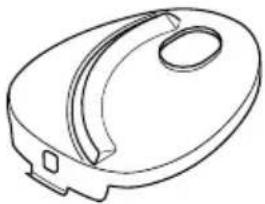
G Lid
H Coupler
Bowl
J Cord clip (service no. 4822 290 40369)
K Metal blade 9 (service no. 4822 690 40232)
Insert holder disc (service no. 4203 065 61521)
M Slicing insert medium (service no. 4203 065 61540)
N Shredding insert fine (service no. 4203 065 61550)
Shredding insert medium (service no. 4203 065 61560)
P Gear box for kneading hook and whisk
Kneading tube (service no. 4203 065 60011)
R Whisk (service no. 4822 690 10115)
S Kneading hook (service no. 4822 690 10116)
T Spatula (service no. 4822 690 40212)
Automatic Safety Shut-Off (resettable)
Please read these instructions carefully before using the appliance.
To prevent the hazard of damage due to overheating, your appliance is equipped with an automatic safety device which will automatically shut off the mains power if necessary.
If the instructions below are followed strictly, you can safely switch on again after a one-hour cooling-down period.
If the appliance suddenly stops:
1. First remove the mains plug from the wall socket. 2. Secondly set the control ring to position O/M. 3. Allow a cooling-down period of min. one hour.
Contact your Philips dealer or an authorised Philips service centre if the safety shut-off is activated repeatedly.
Mounting and unmounting the motor unit and cover



- Ensure that the control ring is set to position (fig. 2). Please note: Damage may occur if the control ring is not in this position while opening or closing.
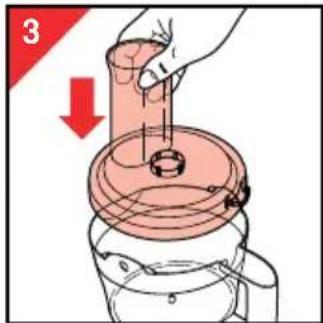
- Place the lid on the bowl (fig. 3).
- Place the motor unit on the cover (fig. 4).
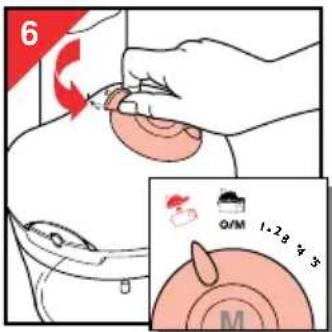

- Turn the control ring to position O/M (fig. 5).
- To release the motor unit and lid turn the control ring to position (fig. 6, 7).
Food chute and pusher
- Use the pusher to feed ingredients through the food chute (fig. 8).
- You can keep the pusher in the food chute to serve as a stopper while operating. This will prevent splashing and making dust.
- During operation you may remove the pusher from the filling opening to add ingredients.


- At the bottom side of the pusher you will find an indication where you can pierce a small opening, using a pointed object (fig. 9). Through this opening you can from time to time add small quantities of liquid (e.g oil while making mayonnaise) (fig. 10).
- There are level indications (ml) on the pushing guide for measuring liquids.
Chopping, mixing, blending and puréeing with the metal blade
• Take care: the cutting edges are very sharp!

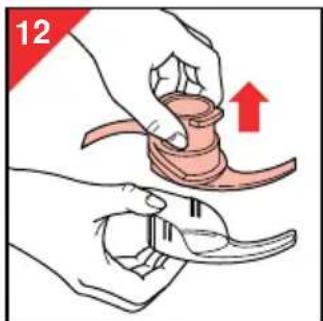
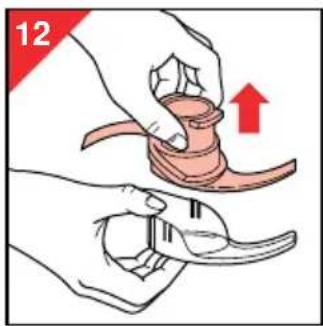
- Remove the protective cap from the metal blade before use (fig. 11, 12). Always hold the unprotected metal blade by its handle.


- First position the coupler (fig. 13) and the metal blade (fig. 14).

- Then put the ingredients into the bowl (fig. 15).
- Place the lid and the motor unit (fig. 3-4).
- Put the pusher into the food chute.
- Switch on by pressing the "Moment" button (fig. 16) or by selecting the required speed (fig. 17).


Tips - chopping
- Pre-cut large pieces into cubes of about 3 x 3 x 3 cm.
- Avoid overprocessing due to excessive operation.
- If food should get caught around the metal blade, or when particles of food should stick to the inside of the bowl:
- first switch the appliance off,
- Take the cover (with motor unit) from the bowl.
- Remove the food from the metal blade or from the bowl using the spatula.
- Do not chop very hard ingredients, such as coffee beans, nutmeg, grains, hard dried herbs (e.g., turmeric, cardamom) and ice cubes: these would blunt the metal blade.
- Process large quantities of dry parsley. Ensure that the bowl is also dry.
- If you wish to chop just a few cloves of garlic, drop these through the funnel on the rotating metal blade. Ensure that the garlic and the bowl are dry.
- Ensure that hard cheese (e.g., matured gouda, parmesan, pecorino) is at room temperature. Take care not to keep the motor running too long: then the cheese could get warm and turn lumpy.
- Ensure that half-hard cheese (e.g., new and semi-matured gouda, emmenthaler, gruyère) is as cold as possible.
- Put sticky candied and dried fruit (e.g., dates, figs, prunes) into the deep freezer for at least 15 minutes. Add a teaspoon of flour before chopping.
Tips - mixing / blending
- When mixing or blending fluids always start with speed 2 or 3. Later you can switch over to speed 4 or 5.
- Do not mix or blend too long to avoid excessive foam.
- Do not mix or blend more fluid than 0.75 litre.
- Do not mix or blend fluids hotter than 80°C.
- When making dough for shortbread or for puff pastry use as little liquid as possible. This will make the dough easier to roll out. First put the flour into the bowl and then the other ingredients. Always use cold hard butter or margarine.
Tips - puréeing
- Vegetables and fruits can be puréed without additional liquid. With some extra liquid, however, the results will be finer.
- First purée hard and tenacious ingredients. Then add the soft ingredients.
Slicing or shredding with the insert holder disc and changeable inserts
• Take care: the cutting edges are very sharp!


- Place the desired insert in the insert holder disc ("Click!") (fig. 18).
- Position the coupler and the insert holder disc (fig. 19).
- Place the cover and the motor unit (fig. 3-4).
- Lift the pusher out of the food chute.


- Feed the ingredients into the food chute (fig. 20).
- Put the pusher on top of the food and press lightly (fig. 21).
- Switch on by selecting the correct speed (fig. 22).
- Press the ingredients downwards using the pusher. Apply steady and moderate pressure.
• Pre-cut large pieces to make them feed into the chute.
- Fill the food chute evenly for the best results.
• Empty the bowl every now and then when processing large amounts.

Tips - slicing
- Fill the opening completely while the motor is standing still. Press with the pusher and switch on. In this manner you prevent the ingredients from turning over while slicing.
- Use a medium speed (2 or 3) for optimal slicing results.
Tips - shredding
- Before shredding cheese, pre-cut it into small cubes (approx. 2 cm). Apply light but steady pressure on to the pusher. It cannot be helped that the last piece of cheese will remain between the cover and the disc.
- Ensure that hard cheese (e.g. matured gouda, parmesan, pecorino) is at room temperature.
- Ensure that half hard cheese (e.g. new and semi matured gouda, emmenthaler, gruyère) is as cold as possible.
- For shredding gouda cheese, only use the medium shredding insert.
- If you wish long strings, place the ingredients horizontally into the filling opening.
- Use speed 5 for optimal shredding results.
Whipping and whisking egg or double cream with the whisk
- The whisk is suitable for whisking whole eggs, egg whites, dessert toppings, instant pudding, and double cream.
Please note: Do not use the whisk for making heavy batter or dough!


- If required: Pull the kneading hook out of the gear box (fig. 23) and firmly insert the whisk (fig. 24). This may require some strength.
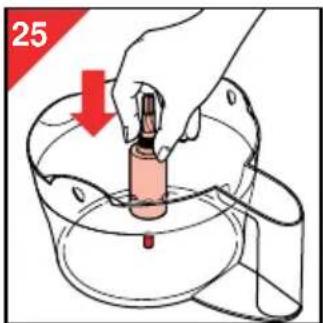
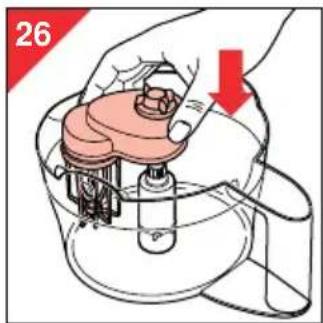
- First place the coupler (fig. 25), then place the whisk unit (fig. 26). After that, put the ingredients into the bowl.
- Place the cover and the motor unit (fig. 3-4). Put the pusher into the food chute to shut it off.
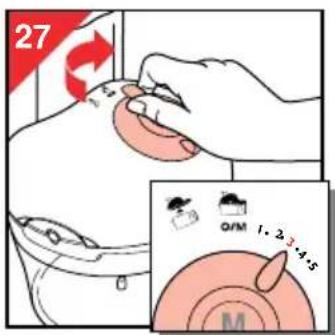

- Set the control ring to speed 3 for double cream (fig. 27), or to speed 5 for egg whites (fig. 28).
Tips - whisking and whipping
- For the best results with whipping double cream, ensure that the cream, the bowl, and the whisk are really cold.
Place the bowl and the whisk into the refrigerator at least half an hour before whipping. Leave the cream in the refrigerator for at least one day.
Do not add the sugar until the cream has become viscous.
The whipping time depends on the type of cream.
- For whisking egg whites, the bowl and the whisk must be absolutely free from grease and dry. You will obtain the best results when the eggs are at room temperature (approx. 21°C).
Kneading dough
with the metal kneading hook
- Please note: always use the kneading tube during kneading.
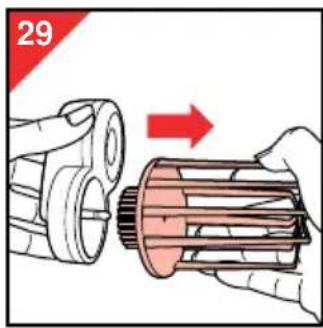

- If required: Pull the whisk out of the gear box (fig. 29) and firmly insert the kneading hook (fig. 30).


- First place the coupler and the kneading tube (figs. 31 and 32).


- Place the kneading hook on the coupler (fig. 33).
- Finally, put the ingredients into the bowl.
- Place the cover and the motor unit (fig. 3-4). Put the pusher into the food chute to shut it off.
- Set the control ring to speed 5 (fig. 34).
Tips - kneading
- Never exceed the maximum quantity indicated for flour.
- For bread dough and yeast dough first put the water, yeast and sugar into the bowl. Later add the other ingredients. The kneading time depends on the type of bread dough but will be between three and four minutes.
- Never forget to disassemble and clean the gear box after kneading.
After use
- To release the motor unit and lid turn the control ring to position 📄 (fig. 6, 7).


- Lift the accessory and the coupler from the bowl (fig. 35).
After that, you can empty the bowl.
- After slicing or shredding: release the insert from the insert disc holder (fig. 36). Make sure the insert is not pointing toward you while doing so. Take care: the cutting edges are very sharp!
Cleaning and storage
• Always remove the mains plug from the wall socket before cleaning the motor unit. - The motor unit may be wiped with a damp cloth. Never immerse the motor unit in water. Never pour water over it. - Wash the items which have been in contact with the food in warm soapy water immediately after use. • Take care when cleaning the metal blade and slicing and shredding inserts: the cutting edges are very sharp! These items can also be cleaned in a dishwasher. - Ensure that the cutting edges do not come into contact with hard objects as this might make them blunt.
- Place the protective cap back on to the metal blade after cleaning (fig. 37).


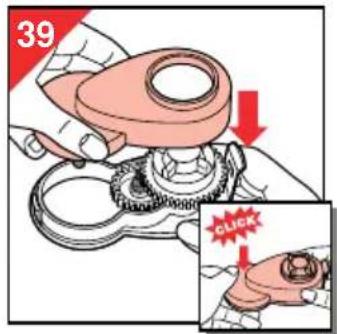
- The gear box for the whisk and the kneading hook can be easily disassembled to enable thorough cleaning (figs. 38-39).
• After cleaning, you can store the accessories in the bowl. Place the lid and wind the cord as illustrated in fig. 40, using the cord clip.

Extra accessories
- The following accessories are also available as optional extras*):
- Slicing insert fine for fine slicing. (service n°. 4203 065 61530)
- Slicing insert medium Ⓞ for thick slicing. (service n°. 4203 065 61540)
- Shredding insert fine 📐 for preparing raw vegetables, fruits and potato fritters. (service n°. 4203 065 61550)
- Shredding insert medium ⚙ for medium shredding. (service n°. 4203 065 61560)
- Shredding insert coarse for grating potatoes. (service n°. 4203 065 62310)
- Granulating insert Ⓞ for granulating Parmesan, horse radish and potatoes. (service n°. 4203 065 61570).
*) You can ask your dealer if these accessories are available in your country.

4203 065 61530

4203 065 61540
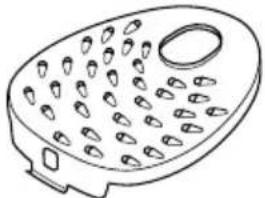
4203 065 61550

4203 065 61560

4203 065 62310

4203 065 61570
Recipes
Hummus bi Tahini
(chick pea- sesame puree)
- 250 g chick peas • 80 g tahini (sesame paste)
- approx. 50 ml lemon juice
- approx. 50 ml water
- 2 cloves garlic • 1 level tbsp olive or corn oil • 1/2 tsp cayenne pepper
- fresh parsley leaves
- Soak the chick peas overnight in plenty of water to which some salt has been added. • Cook the peas for approx. 2 hours.
- Put all the ingredients, except the parsley leaves, the cayenne pepper and the oil, in the bowl of the food processor.
- Puree the ingredients at speed 5 to get a smooth paste.
- Turn the mixture out into a bowl and garnish with the parsley leaves, cayenne pepper and oil.
- Serve with flatbread (e.g. pitta bread).
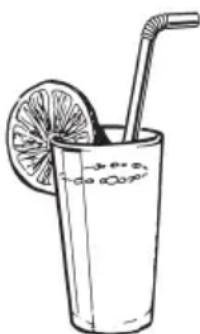
Milkshake
(for 2-3 milkshakes)
• 200 g fresh fruit (e.g. strawberries, raspberries, bananas) - I tsp lemon juice - sugar or honey to taste - 200 ml cold milk • 2 scoops vanilla ice cream
- Puree the fruit with the lemon juice and the sugar or honey, using the blade.
- Add the milk and the ice cream and mix at speed 5 until the mixture is frothy.
Tips:
- Instead of fresh fruit, use 2 level tbsp strong coffee and 2 tbsp cocoa. Substitute mocha or chocolate ice cream for the vanilla ice cream.
- Substitute 6 level tbsp fruit jam for the fresh fruit, the lemon juice and the sugar.
Chicken liver pate
(serves 4 people)
- 25 g butter • 250 g chicken livers, well cleaned • 1 small onion, chopped • 1 clove garlic, crushed
- 5 tbsp heavy cream
- 2 tbsp tomato paste • 2 tsp brandy
- salt and pepper
- sprigs of parsley • crusty bread or crackers, to serve
- Melt the butter in a pan and fry the chicken livers, onion and garlic for approx. 8 minutes until the chicken livers are cooked.
- Cool the mixture, put it in the bowl of the food processor.
- Add the cream, the tomato paste and the brandy, and season to taste.
- Run the appliance at speed 5 until the mixture is smooth and creamy.
- Turn the pate out onto a dish and garnish it with parsley.
- Serve chilled with crusty bread or crackers.
Guacamole
(Mexican avocado dip; serves 2 to 3 people)
• 2 medium-sized, ripe avocados • 2 medium tomatoes, peeled • 1 small onion, cut into pieces • 3 to 4 sprigs of fresh parsley • 1 green chilli, seeded and cut - salt and pepper • wholemeal toast or corn chips, to serve - Peel and stone the avocados, cut the flesh into chunks and place them into the bowl of the food processor. - Mix to a smooth puree at speed 5. • Halve the tomatoes and remove the seeds. - Add tomatoes, onion, parsley and chilli to the avocado. Puree and blend until smooth. - Season to taste with salt and pepper and serve with wholemeal toast or corn chips.
Meringue nests with strawberries
(8 meringue nests)
For the meringue nests:
- 2 egg whites • 100 g sugar
- 1 tbsp corn flour
- pinch salt
- 8 disposable moulds (aluminium foil)
- greaseproof paper
For the filling:
• 250 ml whipping cream - 2 tbsp sugar • 2 sachets vanilla sugar - 400 g strawberries
Meringue nests:
- Whisk the egg whites with salt at speed 4 until stiff. Mix sugar and corn flour with a spoon. Add this mixture to the egg whites spoon by spoon and whisk after each addition.
- Put the disposable aluminium moulds upside down on a baking tray lined with greaseproof paper.
Pipe the meringue in swirls onto the overturned moulds, starting at the top and using a piping bag with a plain nozzle (nozzle size no. 4). Slide the baking tray into the preheated oven and bake the meringue nests at 100°C for 60 to 90 minutes until they are dry.
Leave the meringues to cool in the oven. Remove the disposable moulds.
The filling:
Whip the cream with the sugar and the vanilla sugar at speed 2 until stiff.
Halve the strawberries.
Fill the meringue nests with whipped cream and garnish them with the strawberries.
Apricot meringue pie
For the pastry base:
100 g butter
150 g flour
50 g sugar
pinch salt
dried baking beans
- greaseproof paper or aluminium foil
• 20 cm spring-release tin
For the filling:
• 250 g dried apricots
- 75 g preserving sugar
- juice from one lemon
For the meringue:
- 2 egg whites
• 100 g sugar
- pinch salt
- Put the blade in the bowl.
- Dice the cold butter.
- Put flour, sugar, salt and butter in the bowl and add a dash of ice-cold water and use the blade to mix the ingredients to create a consistent dough at speed 5.
- Wrap the dough in plastic foil and put it in the refrigerator for at least one hour.
• To prevent the apricots from sticking to each other, put the apricots in the freezer (or freezer compartment) for 15 minutes and add 2 tsp of flour before chopping.
- Chop the apricots medium-fine, using the pulse setting (button M).
- Put the chopped apricots in a pan, add lemon juice and preserving sugar and boil softly for 4 minutes. Then let the apricot mixture cool down.
- Roll out the dough on a floured worktop.
• Line the greased spring-release tin with the rolled-out pastry, creating a raised edge of approx. 3 cm.
- Put a piece of greaseproof paper or aluminium foil on the pastry and put the dried beans on top. Bake the pastry blind in a preheated oven at 180 °C for 30 minutes. Then take the spring-release tin out of the oven and

remove the foil or paper with the beans. Raise the temperature of the oven to 200 °C.
- Spoon the apricot compote into the pastry base.
- Whisk the egg whites with salt at speed 4 until stiff and gradually add the sugar.
- Pipe the egg whites onto the apricot compote with a coarsely fluted nozzle.
- Put the pie in the oven for 15 to 20 minutes until the meringue is dry and slightly brown.
6 Salmon mousse
(serves 3 to 4 people)
• 1 tin of salmon (220 g) • 2 sheets of gelatine - a few stalks of chives - pinch salt - pinch cayenne pepper - ½ tbsp lemon juice • 125 ml whipping cream - 1 small onion • watercress for garnishing
- Soak the gelatine in plenty of water.
- Chop the chives and onion in the food processor using the pulse setting (button M).
- Remove the bones and skin from the salmon.
- Add salt, cayenne pepper, lemon juice, the salmon and the liquid from the salmon tin to the chopped chives and onion and puree the ingredients at speed 5.
- Put the puree in a bowl.
- Boil a small quantity of water and dissolve the gelatine in it. Stir the gelatine solution through the salmon puree.
- Put the whisk in the bowl and whip the cream at speed 2 until stiff.
- Fold the whipped cream into the salmon puree with a wooden spoon.
- Turn the mousse out onto a dish, cover it and chill it in the refrigerator for a few hours. Garnish the mousse with some watercress.
White bread
- 350 g white flour, 10 g soft butter or margarine, 18 g fresh baker's yeast or
- 14 g dried yeast, 200 ml water (depending on the type of flour)
- 1 tsp salt
- 1 1/2 tsp sugar, 25-28 cm loaf tin
- Mount the kneading hook in the bowl
- Put water, yeast and sugar in the bowl and mix for approx. 15 seconds at speed 3. Then add flour, butter or margarine and salt. Mix the dough for 3 to 4 minutes at speed 5.

- Put the dough in a large bowl. Cover this bowl with a damp cloth and leave the dough to rise in a warm place for 30 minutes. After rising, flatten the dough and roll it up.
- Put the dough in a greased loaf tin and allow it to rise for another 45 minutes.
- Then bake the bread in the lower part of the preheated oven at 225°C for about 10 minutes.
Tips:
- This method can also be used to get the best results with a packet mix.
- The dough can also be used for making rolls. The above amount is enough to make 8 to 10 rolls.
- Cut the dough into egg-sized pieces. Flatten these pieces and shape them into rolls.
- Place the rolls on a greased baking tray.
- Brush the rolls with some water and sprinkle them with sesame or cumin seeds before putting them in the oven.
9 Yeast dough for plaited bread
- 30 g roasted hazelnuts • 300 g sieved plain white flour

• 40 g sugar - pinch salt - 1 medium-sized egg - approx. 150 ml milk (35 °C) • 80 g soft margarine or butter • 40 g fresh yeast or 1 sachet of dried yeast - baking tray
- Put the metal blade in the bowl and chop the hazelnuts medium-fine by briefly pressing the pulse (M) button. Remove the chopped hazelnuts from the bowl.
- Replace the blade with the kneading hook.
- Put the milk with the yeast and the sugar in the bowl. Mix the ingredients for approx. 15 seconds at speed 3.
- Add the flour, the salt, the margarine (or butter) and the egg. Knead the ingredients at speed 5 for approx. 3 minutes. Add the chopped hazelnuts almost at the end of the process.
- Remove the dough from the food processor bowl and put it in a larger bowl. Cover this bowl with a damp cloth. Allow the dough to rise for 30 minutes.
- Divide the dough into three parts and shape these parts into 30 cm long rolls. Place these rolls side by side and pinch the ends together. Plait the rolls and then pinch the other ends together.
- Put the plaited dough on a greased baking tray. Let the dough rise for another 20 minutes.
- Glaze the dough with some melted butter.
- Place the baking tray in the centre of a preheated oven and bake at 190°C for 30 to 35 minutes.
9 Cake
- 150 g soft butter
- 150 g sugar • 1 sachet vanilla sugar
- pinch salt • 30 ml milk • 3 eggs • 150 g self-raising flour
- 25 cm cake tin
- butter to grease the cake tin
- Heat the oven to 160°C.
- Dice the butter and put butter, sugar, vanilla sugar and salt in the bowl and mix the ingredients at speed 5.
- Pour lukewarm milk in small quantities through the chute while the appliance is running. Keep beating till the mixture is pale and creamy. If necessary, use a spatula to move mixture sticking to the side of the bowl to the middle.
- Add the eggs one by one. Do not mix longer than is necessary to beat each egg in.
- Divide the flour into three portions and add them one by one (using speed 2 or 3).
- Spoon the cake mixture into the greased and floured tin and bake for about 1 hour and 15 minutes.
- Allow the cake to cool a few minutes before turning it out of the tin. Turn it onto a wire rack and leave it to cool.
Tip:
To make a marbled cake, transfer one half of the cake mixture to another bowl and stir 1 level tbsp sieved cocoa powder through it. Put the chocolate cake mixture in the tin and spoon the plain mixture onto it. Use a fork or spoon to swirl through the mixture to create the marbled effect.
Pizza
(for 2 round pizzas)
- 15 g fresh baker's yeast or 1 sachet dry yeast
- 1 tsp sugar
- approx. 150 ml warm water (approx. 35 °C)
- 300 g plain flour • 1/2 tsp salt • 2 level tbsp olive oil
- baking tray
For the topping:
- 1 onion
- 1 clove garlic • 2 level tbsp olive oil
• 300 ml sieved tomatoes (tinned) • 1 tsp mixed Italian herbs (dried or fresh) - salt and pepper - sugar - ingredients to be spread on the sauce: olives, salami, artichokes, mushrooms, anchovies, Mozzarella cheese, peppers, grated mature cheese and olive oil according to taste.
- Mount the kneading hook in the bowl.
- Put water, yeast and sugar in the bowl and mix the ingredients at speed 3 for approx. 15 seconds.
- Add flour, oil and salt and mix the dough at speed 5 for approx. 3 minutes.
- Knead the dough into a ball and put it in a bowl. Cover the bowl with a damp cloth and leave the dough to rise in a warm place for about 45 minutes.
- Use the metal blade to chop the onion and the garlic and fry them until transparent.
- Add the sieved tomatoes and the herbs and simmer the sauce for about 10 minutes.
- Season to taste with salt, pepper and sugar.
- Allow the sauce to cool. • Heat the oven to 250 °C.
- Roll the dough out on a floured worktop and make two round shapes.
- Place the dough on a greased baking tray.
- Spread the topping on the pizzas, leaving the edges free.
- Spread with the desired ingredients, scatter some grated cheese over the pizzas and drip some olive oil over them. • Bake for 12 to 15 minutes
Brioche
Important: Use exclusively the metal blade for making dough for brioche. The kneading hook is not suitable for this purpose.
• 250 g flour • 30 g granulated sugar - 20 g fresh baker's yeast or l sachet dried yeast - 100 g butter - 50 ml milk (40 °C) • I tsp salt • 4 eggs • brioche mould (or deep round cake tin)
- Mount the metal blade.
- Put the yeast, water and sugar into the bowl. Mix at speed 4 for 15 sec.
- Put flour, salt and eggs into the bowl and mix at speed 5 for approx. 4 minutes.
- Cover the bowl with a damp cloth and allow the dough to rise in a warm place for one hour.
- Melt the butter. Put the lid with the motor unit back on. Switch the appliance on and add the melted butter. Mix until homogeneous.
- Grease the brioche mould with butter. Put the dough into the mould and let it rise for another 45 minutes.
- Place the mould into the oven on a low position and bake at 220°C for 30 minutes.
Tzatziki
(cucumber salad; serves 2 to 3 people)
- 1 cucumber • 200 ml yoghurt • 1 tbsp olive oil
- 2 cloves garlic
- pinch salt • 1 tsp finely chopped dill
- a few mint leaves
- Peel the cucumber and shred it at speed 4 or 5.
- Put the shredded cucumber in a colander and let it drain properly.
- Mix the other ingredients, except for the mint leaves, through the cucumber.
- Chill the salad by putting it in a covered bowl in the refrigerator for one hour.
- Sprinkle mint leaves on top before serving.
Coleslaw
• 2 cloves garlic - 2 apples • 2 pickled gherkins - 1 banana • 3 tbsp mayonnaise • 3 tbsp yoghurt • 1/2 tbsp cream • 2 tsp curry powder - salt and pepper • 1 small white cabbage
- Put the blade in the bowl and chop the garlic.
- Peel the apples, cut into quarters and remove the core.
- Add the apples and gherkins and chop them fine.
- Add pieces of banana, mayonnaise, yoghurt, curry powder, cream, salt and pepper and mix the ingredients at pulse setting (button M). Replace the blade with the insert holder disc (slicing insert medium). You may leave the dressing in the bowl. Cut the cabbage and slice it at speed 3. Turn the ingredients into a dish and mix them with a spoon. Cover the dish with a lid or a piece of plastic foil and allow the dressing to soak in.
Potato-courgette gratin
(serves 3 to 4 people)
- 750 g potatoes
- pinch salt • 2 courgettes (approx. 500 g) • 2 cloves garlic, crushed • 2-3 tsp Italian or Provençal herbs • 3 eggs • 150 ml whipping cream
- 150 ml milk
- pepper • 100 g semi-matured cheese
- approx. 75 g butter + butter to grease the oven dish
- Peel and wash the potatoes.
- Put the insert holder disc (slicing insert medium) in the bowl and slice the potatoes and the courgettes at speed 5.
- Boil the potato slices in boiling water with a pinch of salt until they are almost done.
- Put the slices in a colander and drain them properly.
- Put half of the butter in a frying pan and fry half of the courgette slices for 3 minutes, while turning them frequently. Sprinkle the slices with half of the herbs. Fry the other half of the courgette slices in the same way and sprinkle them with the rest of the herbs.
- Allow the fried courgette slices to drain on kitchen paper.
- Grease a large, low-sided oven dish and put the courgette and potato slices in the dish, alternating them and arranging them in such a way that they partly overlap like roof tiles.
- Whisk the eggs with the cream and the milk at speed 4. Add salt and pepper according to taste and pour the mixture over the potato and courgette slices in the dish.
- Replace the slicing insert with the shredding insert medium, shred the cheese at speed 5 and sprinkle it over the dish.
- Put the dish in the centre of a hot oven (200 °C) and brown it in about 10 minutes.
Mayonnaise
• 1 large egg or 2 small eggs • 2 tsp mustard - 1 tsp salt - pepper • 3 tbsp lemon juice - 250 ml oil (The quantity of oil depends on the thickness required)
The ingredients must be at room temperature.
- Put the egg yolks or egg, mustard, salt, pepper and lemon juice in the bowl.
- Mix with the blade at speed 4 or 5 until the salt is dissolved and then pour the oil gradually through the food chute onto the rotating blade.
Tips:
- For tartare sauce: add parsley, gherkins and hard-boiled eggs.
- For cocktail sauce: add 50 ml creme fraiche, a dash of whisky, 3 tsp tomato paste and a dash of ginger syrup to 100 ml mayonnaise.
6 Fruit cake
- 250 g white flour
- 110 g butter • 110 g sugar
- 7 g baking powder
- 60 g raisins
- 170 g candied fruit
- 2 eggs
- 25 cm cake tin
- Soak the candied fruits and raisins in fruit tea (approx. 1 hour).
- Put the blade in the bowl. • Dice the butter with a knife.
- Put flour, sugar, baking powder, diced butter and eggs in the bowl. Add the raisins and the candied fruit. Mix the ingredients at speed 5 for max. 15 seconds.
- Pour the mixture into a greased cake tin and bake in the centre of the oven at a temperature of approx. 170 °C until firm to the touch (approx. 75 minutes).
| Ingredients | Max. quantity | Switch-on & speed | Accessory | Procedure Applications | |
| Baby/infant/diet food- puréeing | 300 g | M/4-5 | Coarse: add a little liquid.Fine: if necessary add some extra liquid for the smoothest results. | Infant food.Baby food. | |
| Batter (biscuit)- stirring | 3 eggs | 4-2 | Ingredients at room temperature. Stir mixture of eggs and sugar at speed 4 until stiff. Then add the sifted flour.Continue stirring carefully at speed 2. | Cakes, Swiss Roll, Pastry. | |
| Batter (cake)- stirring | 150 g flour | 5 | Ingredients at room temperature.See recipe on page 12 | Cakes, etc. | |
| Batter (light)- stirring | 400 ml liquid | 3-4 | First put liquid into the bowl. Then add the dry ingredients. | Pancakes, wafers, crepe, fritters. | |
| Breadcrumbs- chopping | 100 g | M/5 | Use dry, crisp bread | Food coated with breadcrumbs, gratinated dishes. | |
| Cheese- chopping- shredding | 200 g | M/55 | Use rindless cheese (e.g. Parmezan), pre-cut in cubes of 2 cm. Select pos. M for coarse results and speed 5 for fine powder.Press carefully with the pusher. | Garnishing, au gratin, soups, sauces, croquettes.Sauces, fondue, pizza, au gratin dishes. | |
| Chocolate- chopping | 200 g | M/5 | Use hard, pure chocolate. Break into cubes of 2 cm. The first few times use pos. M. Then speed 5 for a fine chop. | Garnishing, sauces pastry, mousse, pudding. | |
| Creams | 250 g | 5 | Use soft butter for airy results. | Pastry, desserts, toppings. | |
| Dough (tart, pie, dumplings) | 250 g flour | 5 | Use cold butter/margarine and cold water. Put flour into the bowl.Top with 2 cm large pieces of butter/margarine. Mix on speed 5 until mixture resembles bread crumbs. Then add cold water while mixing. Stop as soon as dough forms into a ball (about 15 sec.). Cool dough before further processing. | Fruit tarts, apple dumplings, pies, quiche. | |
| Dough (for bread) | 350 g flour (bread) | 5 | Please refer to the recipe on page 11. | Bread. | |
| Dough (for pizza) | 300 g | 5 | Please refer to the recipe on page 12. | Pizza, tart. | |
| Dough (yeast dough) | 300 g | 5 | Please refer to the recipe on page 12. | Luxury bread. | |
| Dough(shortbread) | 250 gflour | 5 | § | Use cold butter or margarine, cut into 2 cms pieces. Put all ingre-dients into bowl simultaneously.Mix until mixture forms into a ball (after approx. 30 secs.). Cool the dough before further processing. | Apple pie, sweet biscuits, open fruit flans. |
| Eggs- whisking(egg white) | 4 eggs | 4 | 7 | Use eggs on room temperature.(Note: Use at least two eggs.) | Pudding, soufflé,meringues, garnishing. |
| Fruit (general)-chopping -puréeing | 400 g500 g | M/55 | §§ | Tip: use a little lemon juice to prevent discolouring.Use raw, firm, seedless fruit.Use cooked or soft fruit. | Salads, jam, cakes.Sauces, jam,pudding, baby food. |
| Herbs- chopping | min. 30 g | M/5 | § | Wash and dry herbs. | Sauces, soup,garnishing,seasoned butter. |
| Leek- slicing | M/4-5 | ⓧ | Insert into the food chute heads upwards. When processing thin leek,fill the opening completely. | Soups, cooked leek,quiche. | |
| Mayonnaise | 3 eggs | 4-5 | § | Use ingredients at room temperature. See the recipe on page 14.(Note: Use at least one large egg or two small eggs.) | For French fries,salads, cocktails,fondue andbarbecue sauces. |
| Meat, fish,poultry- chopping(lean beef)- chopping(streaky meat) | 300 g200 g | M/5M/5 | §§ | First remove sinews, bones, including fishbones.Pre-cut into cubes of about 3 cm.Chop at position M for coarser results. | Steak tartare,hamburgers.Minced meat. |
| Milkshake | 350 mlliquid | M/5 | § | Please refer to recipe on page 10. | |
| Nuts- chopping | 250 g | M/5 | § | Use pos. M for coarse chopping or speed 5 for a fine result. | Salads, garnishing,bread, pastry,pudding. |
| Potatoes(cooked)- puréeing | 500 g | 4-5 | § | Have the potatoes not overcooked.The quantity of milk depends on the kind of potato. Use warm milk (max.80 °C). Add the milk slowly while the metal blade is rotating. | Oven dishes, purée. |
| Pulses- puréeing | 400 g | 5 | § | Use cooked beans or peas.You may add some liquid for a better consistency. | Purées, soups. |
| Soup | 500 ml liquid | 4-5 | § | Use cooked vegetables. | Soup. |
| Vegetables (general) - chopping - puréeing | 400 g 500 g | M/5 5 | § | Pre-cut into cubes of 3 cm. | Salads, raw food, soup. Vegetable purée, soups. |
| Whipped cream - whipping | 400 ml | 3 | 7 | Use cream which has been cooled to refrigerator temperature. Process at least 125 ml. | Garnishing, cream, ice-cream mixtures, pastry. |
Important.


Extra accessories
Tips:

Cake
Brioche


Additional equipment
4203 065 61530
4203 065 61540

4203 065 61550

4203 065 61560

4203 065 62310

4203 065 61570
Recipes
$ Hummus bi Tahini
(peas - sesame puree)
• 250 g peas
• 80 g tahini (sesame paste)
• approx. 50 ml lemon juice
• approx. 50 ml water
• 2 cloves garlic
• 1 level tbsp olive oil (corn oil)
• 1/2 tsp cayenne pepper
- fresh parsley leaves
Tip:
- Place the knife in the bowl.
• Cut the butter into cubes.
• 40 g sugar
- a little salt
• 1 egg
Brioche
A M ("Moment") button
Press: the motor starts.


Extra accessories
4203 065 61530

4203 065 61540

4203 065 61550

4203 065 61560

4203 065 62310

4203 065 61570
Recipe
Chickpea sesame paste
(Hummus bi Tahini)
• 250 g chickpeas • 80 g sesame paste = tahini - about 1/2 dl lemon juice - about 1/2 dl water • 2 garlic cloves • 1 tbsp olive or corn oil • 1/2 tsp cayenne pepper • parsley
Tip:
makes 2 round pizzas
Brioche


Accessories
Chicken liver pâté
4 - 6 servings
- Instead of fresh fruit, use 2 level tbsp strong coffee and 2 tbsp cocoa. Substitute mocha or chocolate ice cream for the vanilla ice cream.
- Substitute 6 level tbsp fruit jam for the fresh fruit, the lemon juice and the sugar.
§Guacamole - Mexican dip sauce
2 - 3 servings
Base


Yeast dough

Brioche


- DANISH PAGE
- ENGLISH
- IMPORTANT
- GENERAL DESCRIPTION (FIG. 1)
- AUTOMATIC SAFETY SHUT-OFF (RESETTABLE)
- IF THE APPLIANCE SUDDENLY STOPS
- MOUNTING AND UNMOUNTING THE MOTOR UNIT AND COVER
- FOOD CHUTE AND PUSHER
- CHOPPING, MIXING, BLENDING AND PURÉEING WITH THE METAL BLADE
- TIPS - CHOPPING
- TIPS - MIXING / BLENDING
- TIPS - PURÉEING
- SLICING OR SHREDDING WITH THE INSERT HOLDER DISC AND CHANGEABLE INSERTS
- TAKE CARE: THE CUTTING EDGES ARE VERY SHARP
- TIPS - SLICING
- TIPS - SHREDDING
- WHIPPING AND WHISKING EGG OR DOUBLE CREAM WITH THE WHISK
- PLEASE NOTE: DO NOT USE THE WHISK FOR MAKING HEAVY BATTER OR DOUGH
- TIPS - WHISKING AND WHIPPING
- KNEADING DOUGH
- WITH THE METAL KNEADING HOOK
- TIPS - KNEADING
- AFTER USE
- CLEANING AND STORAGE
- EXTRA ACCESSORIES
- RECIPES
- HUMMUS BI TAHINI
- MILKSHAKE
- TIPS
- CHICKEN LIVER PATE
- GUACAMOLE
- MERINGUE NESTS WITH STRAWBERRIES
- THE FILLING
- APRICOT MERINGUE PIE
- SALMON MOUSSE
- WHITE BREAD
- YEAST DOUGH FOR PLAITED BREAD
- CAKE
- TIP
- PIZZA
- FOR THE TOPPING
- BRIOCHE
- TZATZIKI
- COLESLAW
- POTATO-COURGETTE GRATIN
- MAYONNAISE
- FRUIT CAKE
- ADDITIONAL EQUIPMENT
- RECIPE
- CHICKPEA SESAME PASTE
- ACCESSORIES
- CHICKEN LIVER PÂTÉ
- §GUACAMOLE - MEXICAN DIP SAUCE
- BASE
- YEAST DOUGH
Brand : PHILIPS
Model : HR2833
Category : Food Processor