ManualGo.com
 RZ 1047 W EU - Fridge HOTPOINT - Free user manual and instructions
Find the device manual for free RZ 1047 W EU HOTPOINT in PDF.
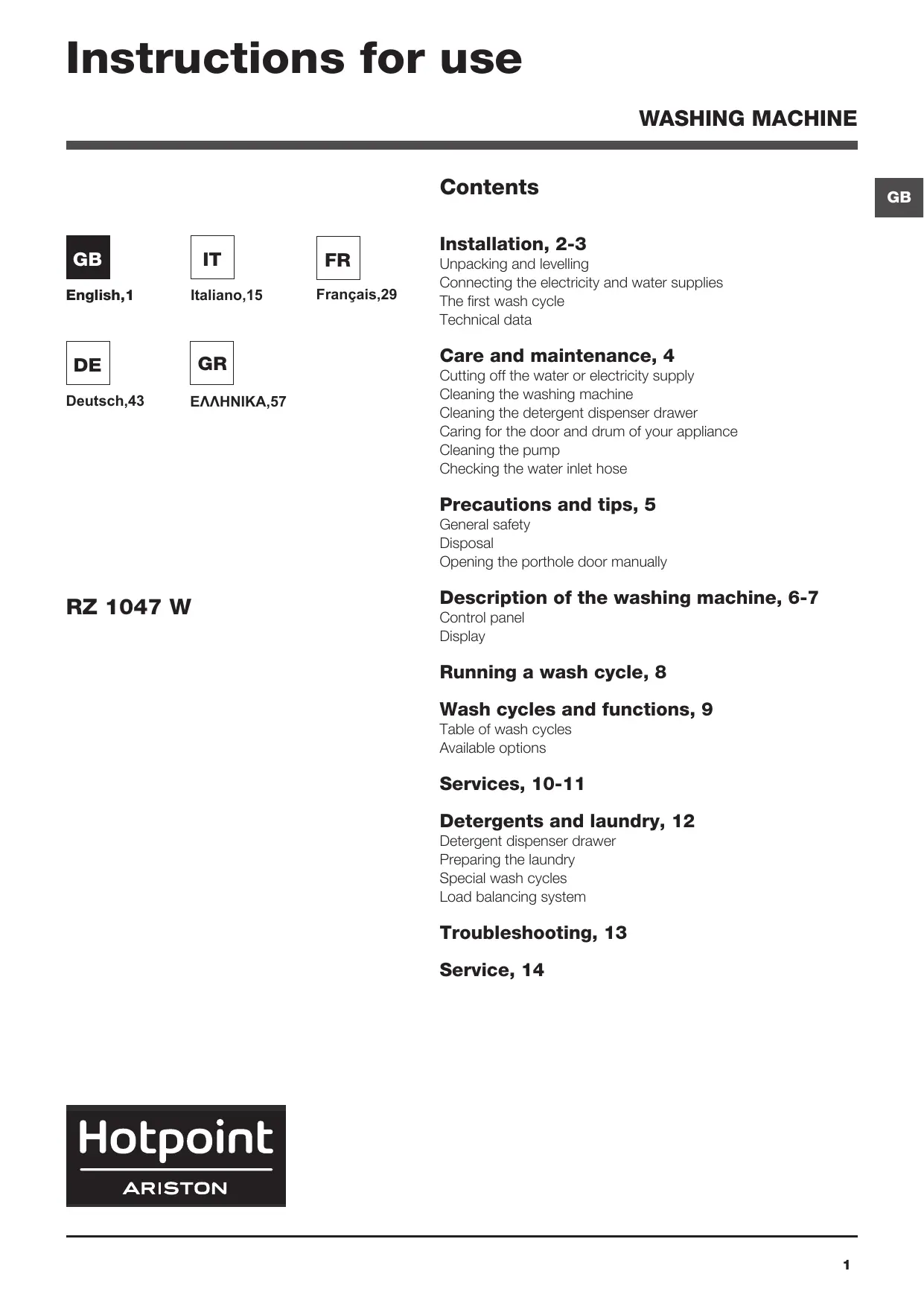


Download the instructions for your Fridge in PDF format for free! Find your manual RZ 1047 W EU - HOTPOINT and take your electronic device back in hand. On this page are published all the documents necessary for the use of your device. RZ 1047 W EU by HOTPOINT.
USER MANUAL RZ 1047 W EU HOTPOINT
GB Installation, 2-3 Unpacking and levelling Connecting the electricity and water supplies The first wash cycle Technical data
Care and maintenance, 4 Cutting off the water or electricity supply Cleaning the washing machine Cleaning the detergent dispenser drawer Caring for the door and drum of your appliance Cleaning the pump Checking the water inlet hose
Precautions and tips, 5 General safety Disposal Opening the porthole door manually
RZ 1047 W Description of the washing machine, 6-7 Control panel Display
Running a wash cycle, 8 Wash cycles and functions, 9 Table of wash cycles Available options
Services, 10-11 Detergents and laundry, 12 Detergent dispenser drawer Preparing the laundry Special wash cycles Load balancing system
Troubleshooting, 13 Service, 14
! Read these instructions carefully: they contain vital information relating to the safe installation and operation of the appliance.
venness by tightening or loosening the adjustable front feet (see figure); the angle of inclination, measured in relation to the worktop, must not exceed 2°. Levelling the machine correctly will provide it with stability, help to avoid vibrations and excessive noise and prevent it from shifting while it is operating. If it is placed on carpet or a rug, adjust the feet in such a way as to allow a sufficient ventilation space underneath the washing machine.
Unpacking and levelling
Connecting the electricity and water supplies
! This instruction manual should be kept in a safe place for future reference. If the washing machine is sold, transferred or moved, make sure that the instruction manual remains with the machine so that the new owner is able to familiarise himself/herself with its operation and features.
Connecting the water inlet hose
1. Remove the washing machine from its packaging. 2. Make sure that the washing machine has not been damaged during the transportation process. If it has been damaged, contact the retailer and do not proceed any further with the installation process. 3. Remove the 4 protective screws (used during transportation) and the rubber washer with the corresponding spacer, located on the rear part of the appliance (see figure). 4. Close off the holes using the plastic plugs provided. 5. Keep all the parts in a safe place: you will need them again if the washing machine needs to be moved to another location. ! Packaging materials should not be used as toys for children. Levelling 1. Install the washing machine on a flat sturdy floor, without resting it up against walls, furniture cabinets or anything else. 2. If the floor is not perfectly level, compensate for any une2
1. Connect the inlet hose by screwing it to a cold water tap using a 3/4 gas threaded connection (see figure). Before performing the connection, allow the water to run freely until it is perfectly clear. 2. Connect the inlet hose to the washing machine by screwing it onto the corresponding water inlet of the appliance, which is situated on the top right-hand side of the rear part of the appliance (see figure). 3. Make sure that the hose is not folded over or bent. ! The water pressure at the tap must fall within the range of values indicated in the Technical data table (see next page). ! If the inlet hose is not long enough, contact a specialised shop or an authorised technician. ! Never use second-hand hoses. ! Use the ones supplied with the machine.
Connecting the drain hose
Connect the drain hose, without bending it, to a drain duct or a wall drain situated between 65 and 100 cm from the floor;
Warning! The company shall not be held responsible in the event that these standards are not observed.
The first wash cycle
Once the appliance has been installed, and before you use it for the first time, run a wash cycle with detergent and no laundry, using wash cycle Auto-Clean (see “Care and maintenance”).
Technical data alternatively, placed it over the edge of a basin, sink or tub, fastening the duct supplied to the tap (see figure). The free end of the hose should not be underwater. ! We advise against the use of hose extensions; if it is absolutely necessary, the extension must have the same diameter as the original hose and must not exceed 150 cm in length.
Electrical connections Before plugging the appliance into the electricity socket, make sure that: • the socket is earthed and complies with all applicable laws; • the socket is able to withstand the maximum power load of the appliance as indicated in the Technical data table (see opposite); • the power supply voltage falls within the values indicated in the Technical data table (see opposite); • the socket is compatible with the plug of the washing machine. If this is not the case, replace the socket or the plug. ! The washing machine must not be installed outdoors, even in covered areas. It is extremely dangerous to leave the appliance exposed to rain, storms and other weather conditions. ! When the washing machine has been installed, the electricity socket must remain within easy reach. ! Do not use extension cords or multiple sockets. ! The cable should not be bent or compressed. ! The power supply cable must only be replaced by authorised technicians.
RZ 1047 W width 59.5 cm Dimensions height 85 cm depth 60,5 cm Capacity from 1 to 10 kg please refer to the technical Electrical connections data plate fixed to the machine maximum pressure 1 MPa (10 bar) Water conminimum pressure nections 0.05 MPa (0.5 bar) drum capacity 71 litres Spin speed up to 1400 rotations per minute Test wash cycles in accordance Eco Cotton 60°C. with reEco Cotton 40°C. gulations 1061/2010 1015/2010 Model
This appliance conforms to the following EC Directives: - 2004/108/EC (Electromagnetic Compatibility) - 2006/95/EC (Low Voltage) - 2012/19/EU (WEEE)
GB Care and maintenance
GB Cutting off the water and electricity supplies
• Turn off the water tap after every wash cycle. This will limit wear on the hydraulic system inside the washing machine and help to prevent leaks.
The washing machine is fitted with a auto-clean pump which does not require any maintenance. Sometimes, small items (such as coins or buttons) may fall into the pre-chamber which protects the pump, situated in its bottom part.
• Unplug the washing machine when cleaning it and during all maintenance work.
! Make sure the wash cycle has finished and unplug the appliance.
Cleaning the washing machine
To access the pre-chamber:
• The outer parts and rubber components of the appliance can be cleaned using a soft cloth soaked in lukewarm soapy water. Do not use solvents or abrasives. • The washing machine has a Auto-Clean programme for its internal parts that must be run with no load in the drum. To help the wash cycle you may want to use either the detergent (i.e. a quantity 10% the quantity specified for lightly-soiled garments) or special additives to clean the washing machine. We recommend running a cleaning programme every 40 wash cycles. It can be activated in the following two ways: - press the button on the control panel then press the SELECTOR twice. - turn the SELECTOR until it is on the icon of the SERVICES menu, press it to enter the sub-menu, then turn it until it is on the icon and press it two times.
Cleaning the detergent dispenser drawer Remove the dispenser by raising it and pulling it out (see figure). Wash it under running water; this operation should be repeated frequently.
Caring for the door and drum of your appliance • Always leave the porthole door ajar in order to prevent unpleasant odours from forming.
1. using a screwdriver, remove the cover panel on the lower front part of the washing machine (see figure);
2. unscrew the lid by rotating it anticlockwise (see figure): a little water may trickle out. This is perfectly normal;
3. clean the inside thoroughly; 4. screw the lid back on; 5. reposition the panel, making sure the hooks are securely in place before you push it onto the appliance.
Checking the water inlet hose Check the inlet hose at least once a year. If there are any cracks, it should be replaced immediately: during the wash cycles, water pressure is very strong and a cracked hose could easily split open. ! Never use second-hand hoses.
Precautions and tips ! This washing machine was designed and constructed in accordance with international safety regulations. The following information is provided for safety reasons and must therefore be read carefully.
General safety • This appliance was designed for domestic use only. • This appliance can be used by children aged
from 8 years and above and persons with reduced physical, sensory or mental capabilities or lack of experience and knowledge if they have been given supervision or instruction concerning use of the appliance in a safe way and understand the hazards involved. Children shall not play with the appliance. Cleaning and user maintenance shall not be made by children without supervision.
• Do not touch the machine when barefoot or with wet or damp hands or feet. • Do not pull on the power supply cable when unplugging the appliance from the electricity socket. Hold the plug and pull. • Do not open the detergent dispenser drawer while the machine is in operation. • Do not touch the drained water as it may reach extremely high temperatures. • Never force the porthole door. This could damage the safety lock mechanism designed to prevent accidental opening. • If the appliance breaks down, do not under any circumstances access the internal mechanisms in an attempt to repair it yourself. • Always keep children well away from the appliance while it is operating. • The door can become quite hot during the wash cycle. • If the appliance has to be moved, work in a group of two or three people and handle it with the utmost care. Never try to do this alone, because the appliance is very heavy. • Before loading laundry into the washing machine, make sure the drum is empty.
Disposal • Disposing of the packaging materials: observe local regulations so that the packaging may be re-used. • The European Directive 2012/19/EU on Waste Electrical and Electronic Equipment, requires that old household electrical appliances must not be disposed of in the normal unsorted municipal waste stream. Old appliances must be collected separately in order to optimise the recovery and recycling of the materials they contain and reduce the impact on human health and the environment. The crossed out “wheeled bin” symbol on the product reminds you of your obligation, that when you dispose of the appliance it must be separately collected. Consumers should contact their local authority or retailer for information concerning the correct disposal of their old appliance.
Opening the porthole door manually In the event that it is not possible to open the porthole door due to a powercut, and if you wish to remove the laundry, proceed as follows: 1. remove the plug from the electrical socket. 2. make sure the water level inside the machine is lower than the door opening; if it is not, remove excess water using the drain hose, collecting it in a bucket as indicated in the figure. 20
3. using a screwdriver, remove the cover panel on the lower front part of the washing machine (see figure).
4. pull outwards using the tab as indicated in the figure, until the plastic tie-rod is freed from its stop position; pull downwards and open the door at the same time. 5. reposition the panel, making sure the hooks are securely in place before you push it onto the appliance.
GB Description of the washing machine
Detergent dispenser drawer: used to dispense detergents and washing additives (see “Detergents and laundry”). ON/OFF button : press this briefly to switch the machine on or off. To switch off the washing machine during the wash cycle, press and hold the button for approximately 3 seconds; if the button is pressed briefly or accidentally the machine will not switch off. If the machine is switched off during a wash cycle, this wash cycle will be cancelled. SELECTOR: turn right or left to browse the different menu items on the display and select the wash cycles and services/functions desired; press to confirm the selection. BACK button: returns you to the previous browsing level. DRIVE ME: allows you to access the cycle guided selection section. STATISTICS button: allows you to access the statistics section. AUTO-CLEAN button: press to clean the machine’s internal parts (see “Care and maintenance”). DIRECT INJECTION button: press to select the DIRECT INJECTION option. START/PAUSE button with indicator light: when the green indicator light flashes slowly, press the button to start a wash cycle. Once the cycle has started the indicator light will remain lit in a fixed manner. To pause the wash cycle, press the button again; the indicator light will flash in an orange colour. If the symbol is not illuminated, the door may be opened. To start the wash cycle from the point at which it was interrupted, press the button again.
button with indicator light
Standby mode This washing machine, in compliance with new energy saving regulations, is fitted with an automatic standby system which is enabled after about 30 minutes if no activity is detected. Press the ON-OFF button briefly and wait for the machine to start up again. Antimicrobial seal The seal around the porthole door is made from a special mixture ensuring antimicrobial protection, thus reducing bacterial proliferation up to 99.99%. The seal contains zinc pyrithione, a biocidal substance which reduces the proliferation of harmful microbes (*) such as batteries and mould prone to causing stains, unpleasant odours and product deterioration. (*) According to tests performed by the University of Perugia, Italy on: Staphylococcus aureus, Escherichia coll, Pseudomonas aeruginosa, Candida albicans, Aspergillus niger, Penicillium digitatum. In rare cases an allergic reaction may be caused by prolonged contact between seal and skin.
GB You can display all information and access all functions on the display. There are three icons on the main menu, which you can select by rotating the SELECTOR to the right or to the left. A string is displayed with the name of the icon selected.
relates to the CYCLE SELECTION option.
If you select it by pressing the SELECTOR, a sub-menu is displayed with the available wash cycles icons:
The icon relates to SERVICES and if you select it by pressing the SELECTOR, a sub-menu is displayed with the following icons: POWER CONSUMPTION: to display the instantaneous power absorbed by the washing machine. STATISTICS: to display the main statistics on use and energy and water consumption of the washing machine. You can also access this using the STATISTICS button on the control panel. DRIVE ME: to start the cycle guided selection process (see paragraph “Running a wash cycle”). AUTO-CLEAN: to start the drum auto-clean cycle (see chapter on “Care and maintenance). Consult the chapter SERVICES for more information.
Identify the cycle desired and confirm using the SELECTOR. Another sub-menu is displayed which you can use to customise the program by changing the Temperature and Spin Cycle values and selecting one or more wash options. You can also delay the program start time by up to 24h. Click on the first icon to access the list of the last wash cycles performed, for which the type and adjustments/ options selected have been stored (excluding any delayed start set). If you select one of these last cycles, it is possible to start a wash cycle directly with the adjustments/options normally used and already set, without any further adjustments.
The icon relates to the SETTINGS and if you select it by pressing the SELECTOR, a sub-menu is displayed with the following icons: BRIGHTNESS: to set the display brightness. AUTOMATED KEY LOCK: There are four options to exclude or set the waiting time of the control panel automatic lock: 30’’- 1’ - 2’ - 5’. LANGUAGE: to set the language in which all the display strings are displayed. The first time the machine is switched on, you will be asked to select the language and the display will automatically show the language selection menu. To select the language desired, turn the SELECTOR until it is highlighted, then press the SELECTOR. PRODUCT INFO: to display the washing machine serial number and code.
The following icons appear on the lower section of the display: • Door lock: displayed when the door is locked. • Button lock: displayed when the button lock is enabled. • DRIVE ME cycle: displayed on the recommended cycle screens and selected from DRIVE ME.
Running a wash cycle
GB Traditional programming. 1. SWITCH THE MACHINE ON. Press the ON/OFF button. The word “HOTPOINT-ARISTON” appears on the display. 2. LOAD THE LAUNDRY. Open the washing machine door. Load the laundry while making sure not to exceed the maximum load quantity indicated in the programme table. 3. MEASURE OUT THE DETERGENT. Pull out the detergent dispenser drawer and pour the detergent into the relevant compartments as described in “Detergents and laundry”. 4. CLOSE THE DOOR. 5. SELECT THE WASH CYCLE. Use the SELECTOR to select the icon and press to access the submenu of the available wash cycles. After selecting and confirming the desired cycle with the SELECTOR, a sub-menu is displayed which you can use to customise the cycle by changing the Temperature and Spin Cycle values and/or selecting one or more options. The START/PAUSE light flashes slowly. 6. START THE WASH CYCLE. The wash cycle cannot start if you are in the options setting screen. If necessary, press the “BACK” button to return to the cycle setting screen, from which it is possible to start the cycle by pressing the START/PAUSE button. The relevant indicator light will turn on and the door will lock (the DOOR LOCKED symbol is lit). During the wash cycle, the name of the phase in progress will appear on the display. To change a wash cycle while it is in progress, pause the washing machine using the START/PAUSE button (the START/PAUSE indicator light will flash slowly in an orange colour); then select the desired cycle and press the START/PAUSE button again. To open the door while a cycle is in progress, press the START/PAUSE button; if the DOOR LOCKED symbol is switched off the door may be opened. Press the START/PAUSE button again to restart the wash cycle from the point at which it was stopped. 7. END OF THE PROGRAMME This will be indicated by the text “CYCLE END” on the display; when the DOOR LOCKED symbol switches off the door may be opened. Open the door, unload the laundry and switch off the machine. ! If you wish to cancel a cycle which has already begun, press and hold the ON/OFF button. The cycle will be stopped and the machine will switch off. DRIVE ME assisted programme 1. SWITCH THE MACHINE ON. Press the ON/OFF button. The word “HOTPOINT-ARISTON” appears on the display. 2. LOAD THE LAUNDRY. Open the washing machine door. Load the laundry while making sure not to exceed the maximum load quantity indicated in the programme table.
3. MEASURE OUT THE DETERGENT. Pull out the detergent dispenser drawer and pour the detergent into the relevant compartments as described in “Detergents and laundry”. 4. CLOSE THE DOOR. 5. Access the DRIVE ME programme using the specific button on the control panel or using the SERVICES menu. The sub-menus will be displayed, in which you must choose the following: Colour, Item/Fabric, Type of dirt, Type of detergent. Once the machine has identified the optimum cycle for the choices made, you can only change the rinse type and set the delayed start if desired. The START/PAUSE light flashes slowly. 6. START THE WASH CYCLE. The wash cycle cannot start if you are in the options setting screen. If necessary, press the “BACK” button to return to the cycle setting screen, from which it is possible to start the cycle by pressing the START/PAUSE button. The relevant indicator light will turn on and the door will lock (the DOOR LOCKED symbol is lit). During the wash cycle, the name of the phase in progress will appear on the display. To change a wash cycle while it is in progress, pause the washing machine using the START/PAUSE button (the START/PAUSE indicator light will flash slowly in an orange colour); then select the desired cycle and press the START/PAUSE button again. To open the door while a cycle is in progress, press the START/PAUSE button; if the DOOR LOCKED symbol is switched off the door may be opened. Press the START/PAUSE button again to restart the wash cycle from the point at which it was stopped. 7. END OF THE PROGRAMME This will be indicated by the text “CYCLE END” on the display; when the DOOR LOCKED symbol switches off the door may be opened. Open the door, unload the laundry and switch off the machine. ! If you wish to cancel a cycle which has already begun, press and hold the ON/OFF button. The cycle will be stopped and the machine will switch off. Delayed start In the options window the delayed start option is available, which allows for setting the delay time (with 1-hour intervals) before the cycle starts.
Wash cycles and functions Table of wash cycles Max. speed (rpm)
Cotton 20°C: lightly soiled resistant and delicate colours.
Cotton: lightly soiled resistant and delicate colours.
Synthetics: heavily soiled resistant colours.
Synthetics (4): lightly soiled resistant colours.
Wool: for wool, cashmere, etc.
Eco Cotton (1): heavily soiled whites and resistant colours.
Eco Cotton (2): lightly soiled resistant and delicate colours.
Eco Cotton (3): lightly soiled resistant and delicate colours.
Duvets: for down-stuffed garments.
Residual dampness% Energy consumptionkWh Total water lt
* The duration of the wash cycle can be checked on the display. The length of cycle shown on the display or in this booklet is an estimation only and is calculated assuming standard working conditions. The actual duration can vary according to factors such as water temperature and pressure, the amount of detergent used, the amount and type of load inserted, load balancing and any wash options selected. 1) Test wash cycle in compliance with regulations 1061/2010: set wash cycle ECO COTTON with a temperature of 60°C. This cycle is designed for cotton loads with a normal soil level and is the most efficient in terms of both electricity and water consumption; it should be used for garments which can be washed at 60°C . The actual washing temperature may differ from the indicated value. 2) Test wash cycle in compliance with regulations 1061/2010: set wash cycle ECO COTTON with a temperature of 40°C. This cycle is designed for cotton loads with a normal soil level and is the most efficient in terms of both electricity and water consumption; it should be used for garments which can be washed at 40°C . The actual washing temperature may differ from the indicated value. For all Test Institutes: 3) Long wash cycle for cottons: set the ECO COTTON programme at temperature 40°C and select the DIRECT INJECTION option using “Power” mode. 4) Long wash cycle for synthetics: set wash cycle SYNTHETICS with a temperature of 40°C.
Available options ! Only the options enabled for the programme chosen can be selected.
Direct Injection The washing machine is equipped with the innovative technology «Direct Injection» which pre-mixes water and detergent, thus immediately activating the detergent’s cleaning principles. This active emulsion is directly introduced into the drum of the washing machine and penetrates the fibres with more efficacy in cleaning even heavily soiled garments at low temperatures, fully preserving colours and fabrics. The mode «Power» ensures the best cleaning performance and the mode «Eco Energy» allows more energy saving. Rinse This option makes it possible to select the desired rinse type to protect sensitive skin. The first level relates to the “Normal Rinse”. The second level is used to set the “Extra Rinse” level, which makes it possible to select an additional rinse to the standard cycle rinses, to eliminate all traces of detergent. The third level relates to the “Sensitive Skin” level, which makes it possible to select two additional rinses to the standard cycle rinses; it is recommended for very sensitive skin. The last level is the
“Anti Allergy” level, which makes it possible to select three additional rinses to the standard cycle rinses. The option - started with cycles at a temperature of 40°C - makes it possible to remove major allergens such as pollen, cat and dog hair. With cycles at a temperature higher than 40° a very good level of anti-allergic protection is achieved. Pre-wash If this option is selected, the pre-wash cycle will run; this is useful for removing stubborn stains. N.B.: Put the detergent in the relevant compartment. Soak This option allows you to soak extremely dirty laundry. Easy Iron By selecting this option, the wash and spin cycles will be modified in order to reduce the formation of creases. At the end of the cycle the washing machine will perform slow rotations of the drum. To end the cycle, press the START/ PAUSE button. Post Care At the end of the cycle the washing machine will perform slow rotations of the drum. To end the cycle, press the START/PAUSE button. 9
GB You can access the SERVICES section from all product statuses except OFF, STANDBY and END. Access by turning the SELECTOR until the SERVICES icon is highlighted, then select the area by pressing it.
The SERVICES section contains the following items:
1. POWER CONSUMPTION: the instantaneous power absorbed by the washing machine is displayed (kW). 2. STATISTICS: the main statistics of the washing machine are displayed. You can also access this directly using the button on the control panel. 3. DRIVE ME is a kind of Tutor which guides you in washing laundry. You select the parameters and the washing machine automatically identifies the most suitable cycle. You can also access this directly using the button on the control panel (see chapter “Running a wash cycle”). 4. AUTO-CLEAN to start the drum auto-clean cycle (see chapter on “Care and maintenance”).
2. STATISTICS You can access the STATISTICS section either by choosing the item on the SERVICES menu or by pressing the button on the control panel, for direct access to the section.
COUNTERS GB Select the COUNTERS item to display: • • •
KWh: total kWh consumed (up to the last cycle). Litres: total litres of water consumed (up to the last cycle). N° cycles run (up to the last cycle).
AVERAGE CONSUMPTION No. of cycles 2.1 SERVICES menu screen with the average consumption item highlighted.
2.4 Counters screen There are two types of the above 3 counters: • •
TOTAL: these are calculated from when the product is installed. PARTIAL: these are calculated when the counters have been zeroed using the “RESET” button.
2.2 SERVICES menu screen with the counters item highlighted. There are two types of statistics: average consumption and counters. Both consider completed cycles only. AVERAGE CONSUMPTION Select AVERAGE CONSUMPTION to display the average consumption of electricity (kWh) and water (litres) for the last 20 cycles run. The trend of the average compared with the previously reported averages is displayed alongside the average value, to indicate whether consumption is increasing or decreasing: an upwards red arrow indicates that average consumption is increasing and a downwards green arrow indicates that average consumption is decreasing (this indication will start after the 20th cycle).
2.3 Average consumption screen.
Detergents and laundry
GB Detergent dispenser drawer Good washing results also depend on the correct dose of detergent: adding too much detergent will not necessarily result in a more efficient wash, and may in fact cause a build up on the inside of your appliance and contribute to environmental pollution. ! Use powder detergent for white cotton garments, for prewashing, and for washing at temperatures over 60°C. ! Follow the instructions given on the detergent packaging. ! Do not use hand washing detergents because these create too much foam.
A B Open the detergent dispenser drawer and pour in the detergent or washing additive, as follows.
Compartment 1: Detergent for the prewash 3 cycle (powder) Compartment 2: Detergent for the wash cycle (powder or liquid) If liquid detergent is used, it is recommended that the removable plastic partition A (supplied) be used for proper dosage. If powder detergent is used, place the partition into slot B. Compartment 3: Additives (fabric softeners, etc.) The fabric softener should not overflow the grid. 1
by The Woolmark Company for the washing of wool garments labelled as “hand wash” provided that the products are washed according to the instructions on the garment label and those issued by the manufacturer of this washing machine. (M1135)
Shirts: use the special wash cycle to wash shirts in different fabrics and colours to guarantee they receive the best possible care. Jeans: turn garments inside-out before washing and use a liquid detergent. Use programme “Jeans”. Duvets: to wash double or single duvets (the weight of which should not exceed 3,5 kg), cushions or clothes padded with goose down such as puffa jackets, use the special “Duvets” wash cycle. We recommend that duvets are placed in the drum with their edges folded inwards (see figure) and that no more than ¾ of the total volume of the drum is used. To achieve the best results, we recommend that a liquid detergent is used and placed inside the detergent dispenser drawer.
Preparing the laundry • Divide the laundry according to: - the type of fabric/the symbol on the label - the colours: separate coloured garments from whites. • Empty all garment pockets and check the buttons. • Do not exceed the listed values, which refer to the weight of the laundry when dry: see “Table of wash cycles”. How much does your laundry weigh?
1 sheet 400-500 g 1 pillow case 150-200 g 1 tablecloth 400-500 g 1 bathrobe 900-1200 g 1 towel 150-250 g
Special wash cycles Anti-Stain Power 20°C: this programme ensures maximum stain removal capacity with no need for pre-treatment at low temperatures, preserving fabrics and colours. Anti-Stain Turbo 45’: this cycle ensures excellent stain removal capacity even at 20°C in just 45 minutes. The temperature of this cycle can be increased up to 40°C. Cotton 20°C: this programme is ideal for lightly soiled cotton loads. The effective performance levels achieved at cold temperatures, which are comparable to washing at 40°, are guaranteed by a mechanical action which operates at varying speed, with repeated and frequent peaks. Wool - Woolmark Apparel Care - Green: the wool wash cycle of this machine has been approved 12
Lingerie: for undergarments in any fabric and of any colour. Ultra Delicates: use programme “Ultra Delicates” to wash very delicate garments having strasses or sequins. We recommend turning the garments inside out before washing and placing small items into the special bag for washing delicates. Use liquid detergent on delicate garments for best results. Bed & Bath 7 days: use programme “Bed & Bath 7 days” to wash bed linen and towels in one single cycle: it optimises detergent performance and helps you save time and energy. We recommend the use of powder detergent
Load balancing system Before every spin cycle, to avoid excessive vibrations and to distribute the load in a uniform manner, the drum rotates continuously at a speed which is slightly greater than the washing rotation speed. If, after several attempts, the load is not balanced correctly, the machine spins at a reduced spin speed. If the load is excessively unbalanced, the washing machine performs the distribution process instead of spinning. To encourage improved load distribution and balance, we recommend small and large garments are mixed in the load.
Troubleshooting Your washing machine could fail to work. Before contacting the Technical Assistance Centre (see “Assistance”), make sure that the problem cannot be solved easily using the following list.
Possible causes / Solutions:
The washing machine does not switch on.
• The appliance is not plugged into the socket fully, or is not making contact. • There is no power in the house.
The wash cycle does not start.
The washing machine door is not closed properly. The ON/OFF button has not been pressed. The START/PAUSE button has not been pressed. The water tap has not been opened. A delayed start has been set.
The washing machine does not take in water (the text “No Water, turn on the tap” appears on the display).
The water inlet hose is not connected to the tap. The hose is bent. The water tap has not been opened. There is no water supply in the house. The pressure is too low. The START/PAUSE button has not been pressed.
The washing machine continuously takes in and drains water.
• The drain hose is not fitted at a height between 65 and 100 cm from the floor (see “Installation”). • The free end of the hose is under water (see “Installation”). • The wall drainage system is not fitted with a breather pipe. If the problem persists even after these checks, turn off the water tap, switch the appliance off and contact the Assistance Service. If the dwelling is on one of the upper floors of a building, there may be problems relating to water drainage, causing the washing machine to fill with water and drain continuously. Special anti-draining valves are available in shops and help to avoid this inconvenience.
The washing machine does not drain or spin.
• The wash cycle does not include draining: some wash cycles require the drain phase to be started manually. • The EASY IRON option has been activated: To complete the wash cycle, press the START/PAUSE button (see “Available options”). • The drain hose is bent (see “Installation”). • The drainage duct is clogged.
The washing machine vibrates a lot during the spin cycle.
• The drum was not unlocked correctly during installation (see “Installation”). • The washing machine is not level (see “Installation”). • The washing machine is trapped between cabinets and walls (see “Installation”).
The washing machine leaks.
• The water inlet hose is not screwed on properly (see “Installation”). • The detergent dispenser drawer is blocked (for cleaning instructions, see “Care and maintenance”). • The drain hose is not fixed properly (see “Installation”).
The machine is locked and the display indicating an error code (e.g. F-01, F-..).
• Switch off the machine and unplug it, wait for approximately 1 minute and then switch it back on again. If the problem persists, contact the Technical Assistance Service.
There is too much foam.
• The detergent is not suitable for machine washing (it should display the text “for washing machines” or “hand and machine wash”, or the like). • Too much detergent was used.
GB Before calling for Assistance: • Check whether you can solve the problem alone (see “Troubleshooting”); • Restart the programme to check whether the problem has been solved; • If this is not the case, contact an authorised Technical Assistance Centre using the telephone number provided on the guarantee certificate.
! Always request the assistance of authorised technicians. Have the following information to hand: • the type of problem; • the appliance model (Mod.); • the serial number (S/N). This information can be found on the data plate applied to the rear of the washing machine, and can also be found on the front of the appliance by opening the door.