AW 149 - Washing machine HOTPOINT - Free user manual and instructions
Find the device manual for free AW 149 HOTPOINT in PDF.


User questions about AW 149 HOTPOINT
0 question about this device. Answer the ones you know or ask your own.
Ask a new question about this device
Download the instructions for your Washing machine in PDF format for free! Find your manual AW 149 - HOTPOINT and take your electronic device back in hand. On this page are published all the documents necessary for the use of your device. AW 149 by HOTPOINT.
USER MANUAL AW 149 HOTPOINT
Important Safety Instructions, 3-4
Your safety and that of your family
Warnings about installation
Technical details
Unpacking, Installation, 5-6-7-8-9
Unpacking and levelling
Remove the shipping bolts
Water and Electric connections
Final Checklist
Washing Machine Description and Option Modifiers, 10-11
Control panel
Washing Options
Variable spin
Variable temperature
Programs, 12
Program table
Detergent Dispenser and Tips, 13
Detergent dispenser
Before washing
Starting a Wash Program and Washcare Tips, 14-15-16-17-18
Laundry preparation
Typical wash loads and laundry preparation
Washcare tips and understanding fabric care labels (symbols)
Woolmark Cashmere Platinum
Operating the washing machine
Stain removal chart
Care and Maintenance, 19
Switching off the water or electricity supply
Cleaning the machine
Cleaning the door bowl
Checking the water inlet hose
Drum maintenance
Cleaning the detergent dispenser drawer
Troubleshooting, 20-21
Service, 22
Before calling for Assistance
Warranties, 23
Ariston Statement of Warranties
NA
NA
text_image
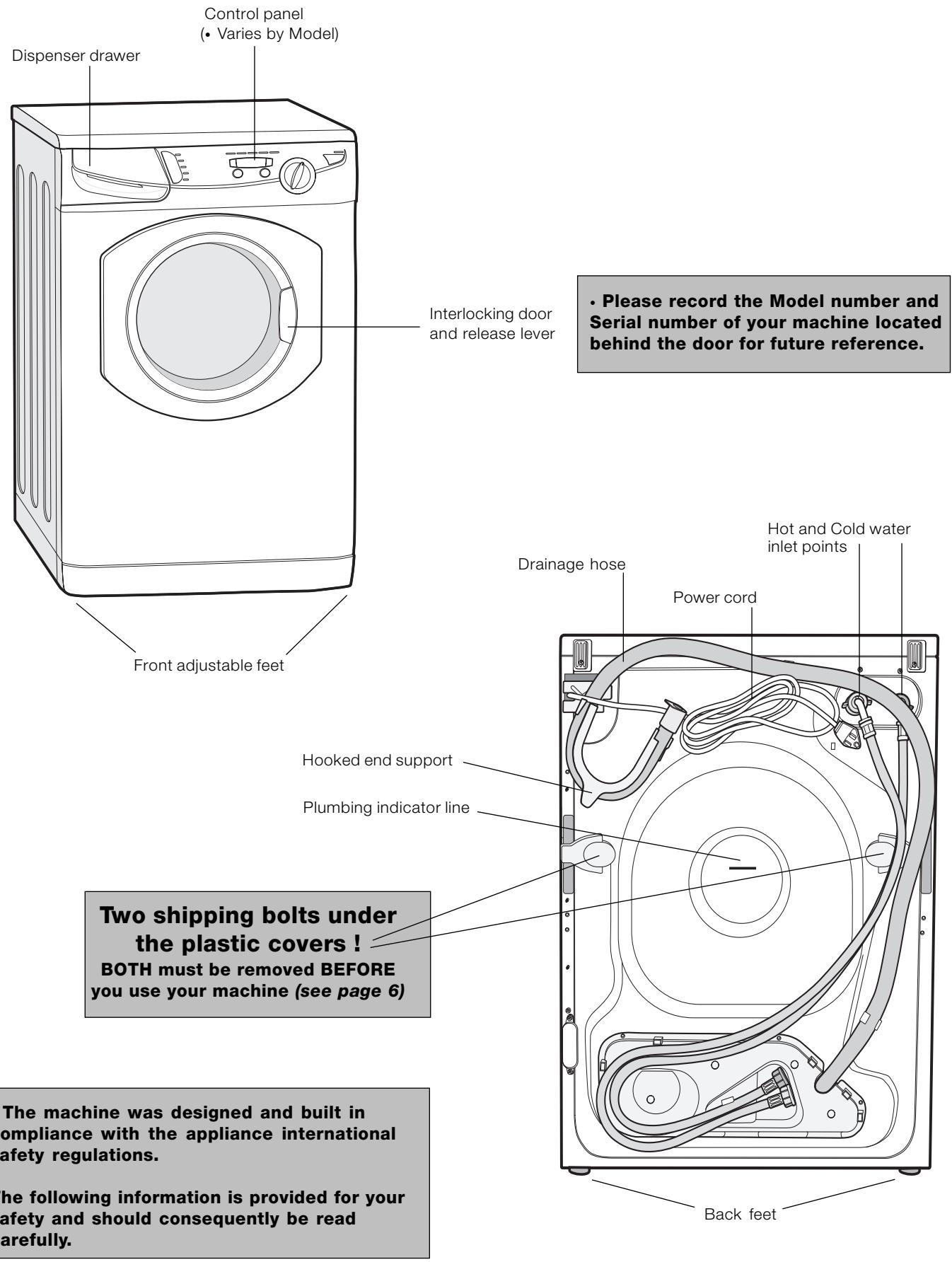
Control panel (• Varies by Model) Dispenser drawer Interlocking door and release lever Front adjustable feet Drainage hose Hot and Cold water inlet points Power cord Hooked end support Plumbing indicator line Two shipping bolts under the plastic covers ! BOTH must be removed BEFORE you use your machine (see page 6) Back feet • Please record the Model number and Serial number of your machine located behind the door for future reference. The machine was designed and built in compliance with the appliance international safety regulations. The following information is provided for your safety and should consequently be read arefully.INTRODUCTION
Congratulations on your new Ariston washing machine. This is a highly sophisticated engineered product that will give you many years of satisfaction. Please spend a few moments reading the Owner Manual. This will show you ways to best utilize your valuable purchase
Save these instructions
Your washing machine has been built in compliance with the strictest international safety regulations, to protect you and all your family
WARNING
To reduce the risk of fire, electrical shock, or injury to persons when using your appliance, follow basic precautions, including the following:
- Read all instructions before using the appliance.
- Install and level the clothes washer on a floor that can support the weight.
-
This appliance must be properly grounded. Never plug the appliance cord into a receptable which is not grounded adequately and in accordance with local and national codes. See installation instructions for grounding this appliance.
-
To avoid the possibility of fire or explosion:
-
Do not wash articles that have been previously cleaned in, washed in, soaked in, or spotted with gasoline, dry cleaning solvents, other flammable, or explosive substances as they give off vapors that could ignite or explode.
- Do not add gasoline, dry cleaning solvents, or other flammable or explosive substances to the wash water. These substances give off vapors that could ignite or explode.
- Under certain conditions hydrogen gas may be produced in a hot water system that has not been used for 2 weeks or more. HYDROGEN GAS IS EXPLOSIVE. If the hot water system has not been used for such a period, before using a washing machine, turn on all hot water faucets and let the water flow from each for several minutes. This will release any accumulated hydrogen gas. As the gas is flammable do not smoke or use an open flame during this time.
- To reduce the risk of fire, clothes, cleaning rags, mop heads and the like which have traces of any flammable substances, such as vegetable oil, petroleum based oils or distillates, waxes, fats, etc. must not be placed in the washing machine. These items may contain some flammable substances after laundering, which may smoke or catch fire by itself.
-
Always be sure to unplug the washing machine from the electrical supply before attempting any service.
-
Do not insert/pull out the mains plug with wet hands.
-
Do not pull out the mains plug by tugging the cable.
To reduce the risk of fire or electrical shock, DO NOT use an extension cord or an adapter to connect the washing machine to the electrical power supply. - Caution when draining hot water.
- The washing machine must only be used for its intended purpose.
- Make sure that all water connections to the washing machine have shut-off valve(s) and that they are readily accessible. Close the washing machine shut-off valve(s) at the end of each wash day.
Check the fill hose connections on a regular basis to assure that they are tight and not leaking. - Do not allow children to play on or in the appliance. Close supervision of children is necessary when the appliance is used near children.
- Before the appliance is removed from service or discarded, remove the door.
- Do not reach into the appliance if the tub or drum is moving.
- Do not install or store this appliance where it will be exposed to the weather.
- Do not tamper with controls.
- Do not repair or replace any part of the appliance or attempt any servicing unless specifically recommended in the user-maintenance instructions or in published user-repair instructions that you understand and have the skills to carry out.
- Do not use fabric softeners or products to reduce static unless recommended by the manufacturers of the fabric softener product.
- Do not machine wash fiberglass materials. Small particles can stick to fabrics washed in following loads and cause skin irritation.
- Inlet hoses are subject to damage and deterioraton over time. Check the hoses periodically for bulges, kinks, cuts, wear or leaks and replace them every five years.
| Technical details | |
| Model | AW 149 |
| Dimensions | 23.4" (59.5 cm) wide33.4" (85 cm) high23.6" (60 cm) deep |
| Capacity | from 2 to 15 Lbs (7 kg) |
| Electric connections | voltage 120 Volts 60 Hz |
| Water connections | maximum pressure 100 psi (689.6 kPa)minimum pressure 20 psi (137.9 kPa)drum capacity 54 litres |
| Spin speed | up to 1400 rpm |
| C US LISTED | This appliance was tested by UL and conforms with both Canadian and U.S. UL safety requirements and displays their Mark |
| Indesit Company offer their customers products with the ENERGY STAR Label | |
As a result of technological progress, the manufacturer reserves the right to make any improvements to its appliances without giving prior notice to its clientele.
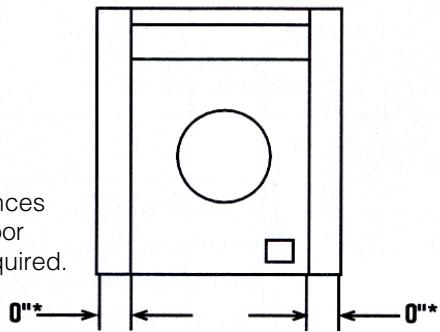
RECESSED, CLOSET AND ALCOVE INSTALLATION (Instructions)
The machine may be installed in a recessed area, closet or alcove.
The installation spacing is in inches and is the minimum acceptable.
Additional spacing should be considered for easy installation, servicing and in compliance with local codes or ordinances.
Other installation must use the minimum dimensions indicated.
Minimum installation spacing
* Additional clearances for wall, door and floor moldings maybe required.
text_image
ces or uired. 0""*Recessed front view
! Keep this instruction book on hand in order to refer to it when necessary. Take it you when you move, and should you sell this appliance or pass it on to an other party, make sure that this booklet is supplied along with the appliance so that the new owner may be informed about warnings and suggestions on how the works.
Unpacking
natural_image
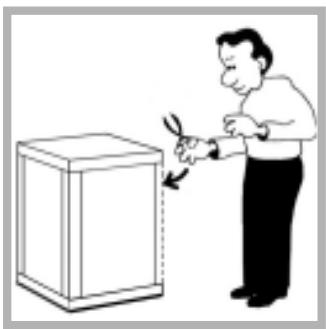
Illustration of a person cutting a box with scissors, no text or symbols present- Using scissors, cut carefully along one corner post to remove the film.
natural_image
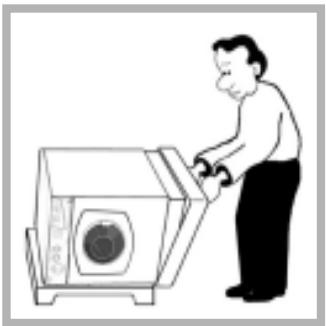
Illustration of a person operating a washing machine (no text or symbols visible)- Remove the polystyrene base.
natural_image
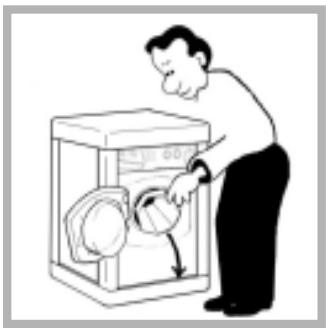
Illustration of a person washing a washing machine with a hand tool (no text or symbols)- Open the door, check inside the drum and remove the accessories bags.
natural_image
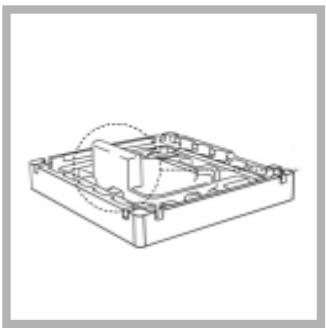
Technical line drawing of a mechanical housing or enclosure with internal components (no text or symbols)! IMPORTANT check when unpacking your machine:
! This is the part of the polystyrene base and should have stayed intact when you removed the base. If it has broken off and is still in the machine... remove it... while the machine is still laying on its side on the top cap.
natural_image
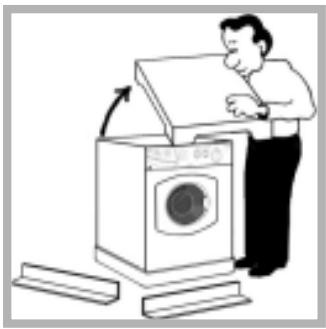
Illustration of a person washing a washing machine with books nearby (no text or symbols)- Lift of the polystyrene top cap and remove the four corner posts.
natural_image
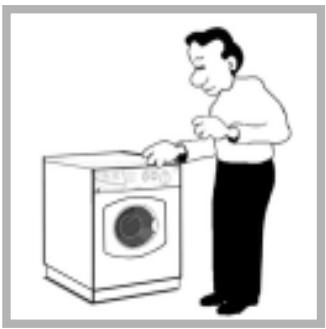
Illustration of a person washing a washing machine (no text or symbols present)- Stand the machine upright.
natural_image
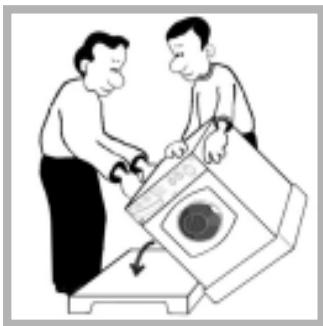
Illustration of two people assembling a washing machine with a circular vent (no text or symbols)- Carefully lay the left side of the machine down onto the top cap.

natural_image
Cartoon illustration of a person reading a document (no text or symbols present)Protect the environment
Please dispose of the packaging material carefully and considerably.
! Continue to read the rest of these instructions carefully; the following pages contain important information on installation and troubleshooting.
Remove the Shipping Bolts
IMPORTANT: Read these instructions to remove the 2
natural_image
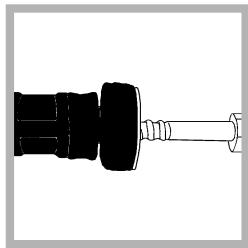
Diagram of a mechanical component with a threaded shaft and flange (no text or symbols)shipping bolts (see Description for location). Situated on one either side of the rear panel,
BOTH shipping bolts MUST be removed before use.
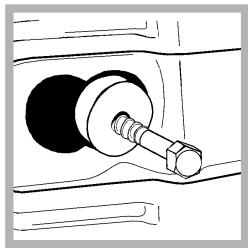
! Failure to do so may cause damage to your machine. It is important the transit bolt and spacer (see pic) come out intact.
natural_image
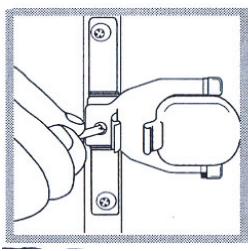
Illustration of a hand securing a wall-mounted device into a bracket (no text or symbols)- Use a crosshead screwdriver to remove the yellow plastic covers.
natural_image
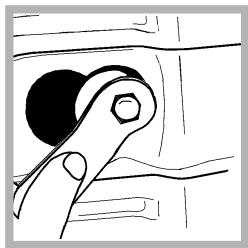
Pure mechanical diagram showing a lever mechanism without any text, numbers, or symbols- Unscrew the bolt using a 13 mm wrench.
natural_image
Technical line drawing of a mechanical component with a bolt and shaft (no text or symbols)- STOP when 3 threads can be seen.
natural_image
Hand holding a small mechanical component, no visible text or symbols-
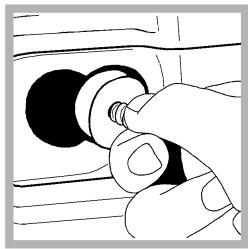
Hold, slide sideways and pull to remove.
-
For safety, replace both yellow plastic covers over the holes left by removing the two bolts.
Did you know?
Location
Where you install your machine will affect its performance:
! For your safety and to comply with electrical regulations, seek professional advice if you want to install your machine in a bath or shower room.
- Make sure that the electrical socket and water taps are easily accessible. You should switch off the machine's electrical and water supplies when you are not using it for extended periods.
- Make sure that you allow enough space for the machine. Select a space at least 23.6" (60 cm) wide, 23.6" (60 cm) deep and 33.4" (85 cm) high. Also leave enough space to open the door fully, so that you can load and unload it easily.
- Where possible, the machine should be positioned on a solid floor to minimise vibration.
Take care when you move the machine not to rip any floor coverings. The weight of the machine may cause indentations in some floor coverings.
Levelling
Your machine will be noisy if the two front feet are not adjusted so that the machine stands firm and level.
! The machine should be levelled from side to side and from front to back.
- Move your machine into its final location.
- Take care not to trap or kink the hoses.
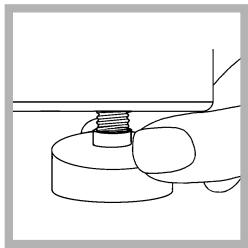
- Turn one or both front feet counter-clockwise by hand until the feet cannot be turned any more. When adjusting the feet, use a spirit level to check the machine stands level, from side to side and from front to back.
natural_image
Line drawing of a hand holding a threaded bolt (no text or symbols)The spring on each foot will stop them coming loose.
! If it is placed on a fitted or loose carpet, adjust the feet in such a way as to allow enough room for ventilation beneath the machine.
! Packaging materials are not children's toys.
• ...the shipping bolts are fitted to ensure that your machine is undamaged during delivery.
- ...both of the shipping bolts must be removed before using the machine, not doing so will lead to excessive vibration, movement of the machine and could eventually lead to internal damage.
- ...the majority of problems with noisy machines are due to the shipping bolts not being removed, closely followed by the feet not being adjusted correctly to level the machine.
- ...you will be charged for a service engineers visit if a problem with your machine is caused by incorrect installation or misuse.
Water Connection
Caution
- The washing machine must only be operated with cold and hot (max. 140^ F//60°C) tap water. Do not connect the appliance to the mixer tap of an unpressured hot-water boiler.
- To prevent water damage, the hot and cold water valves should be accessible when the washer is in place and should always be turned off when the washer is not in use.
! Remember: please use the new hoses supplied, fitted to the machine. Old hoses may cause leaks due to worn out washers or may be split due to water pressure.
Connecting the water inlet hoses
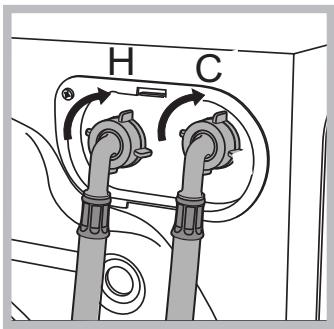
Included in the accessories supplied with the machine are 2 inlet hoses and 4 rubber washers. The straight end of these hoses should be connected to the supply.
The 90^ angled end of these hoses should be connected to the inlet valves on the back of the machine to make a water tight seal on each connection (see below figure).
The couplings should be tightened by hand, a tool should only be used if a leak occurs. Do not use excessive force.
Repair or replacement of a part should be made only by a qualified service technician to prevent personal injury or damage to the machine. Inlet valves are color coded:
Red = Hot / White = Cold
Connection.
text_image
H C- Screw the cold water fill hose (C blue connector) onto the cold water supply until tight.
- Turn on the cold water supply and check for leaks, tighten if necessary.
- Screw the hot water fill hose (H red connector)
onto the hot water supply until tight.
- Turn on the hot water supply and check for leaks, tighten if necessary.
Drainage Connection
Standpipe Diameter/Capacity. Needs a 1 1/4 minimum diameter standpipe with a minimum carry-away capacity of 7 gallons per minute.
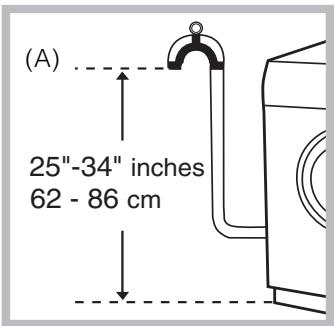
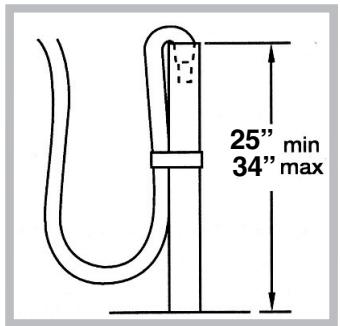
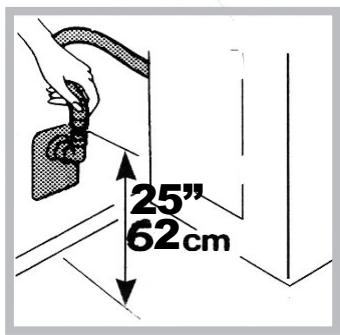
Top of Standpipe. Must be between 25" - 34" inches (62-86 cm) high measured from the bottom of the machine.
Outlet End of Drain Hose (provided with the unit).
Must be at least 20" above the bottom of the washer. An air break must be available at the standpipe to avoid siphoning. No more than 6" of the drain hose should be inserted into the drain pipe to prevent siphoning.
! Although you may need to move the hooked end support along the grey drainage hose,, DO NOT remove it.
! Whichever draining method you use, make sure that the hooked end support is fixed level to, or above the 'Plumbing Indicator Line'.
You should carefully position the drain hose to avoid kinks and ensure proper drainage of the water.
The outlet end of the drain hose must be at least 25" (62 cm) above the base machine. At this point it's possible for the water to be discharged into a sink or drain pipe, but an air break must be available at this 24" height to prevent the machine from syphoning (see figures page 8).
No more than 6" of the drain hose should be inserted in the drain pipe.
Important.
- Make sure that the drain hose is not kinked and the water flow has not been restricted.
- The machine must rest solid on a sturdy floor for optimum performance and minimum vibration.
Hints and tips
! Make sure there are no kinks or bends in the hose.
! The water pressure at the supply tap must be within the values indicated in the Technical details table (see table on page 4).
! Always use a new inlet hose.
! Check the water inlet hose at least once a year, replace if cracked as worn hoses could split under water pressure.
! Do not overtighten. The couplings should be tightened by hand; a tool should only be used if a leak occurs. Do not use excessive force.
Floor Standpipe Drain
text_image
(A) 25"-34" inches 62 - 86 cmTop of standpipe must be at least 25 inches (62 cm) high and no higher than 34 inches (86 cm) from the bottom of the washer (A).
text_image
25" min 34" maxWall Standpipe Drain
text_image
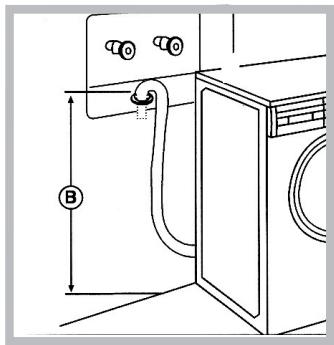
Technical diagram of a washing machine with labeled components and dimension line BTop of standpipe must be at least 25 inches (62 cm) min.; 34 inches (86 cm) max from end of drain hose to bottom of washer (B) (See figures aside and below).
text_image
25" 62cmSink Drainpipe Method
natural_image
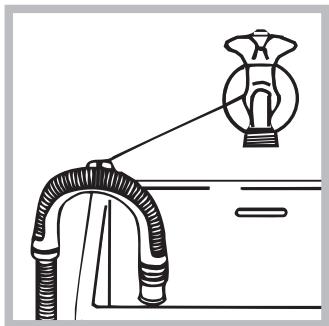
Diagram of a pipe connection with a magnified view of a device (no text or symbols)Entry into the sink drain system must be above the trap (see fig. aside). When routing the drain hose through cabinets or walls use a protective material such as electrical duct tape to cover sharp edges that could damage the drain hose. Use a suitable clamp to secure the drain hose to the "Y" branch or
the disposer. With a sink drainpipe system (see figures aside and below), you may connect directly:
1) to a disposer by following the manufacturers attachment method.
2) directly to a "Y" branch tail piece (Available at most hardware stores).
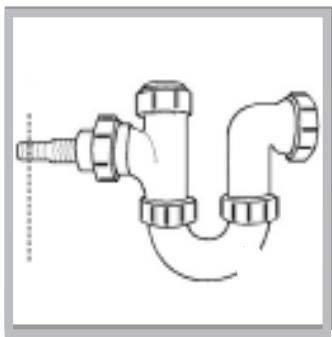
3) through the floor to a separate trap. The trap must be vented to prevent siphoning. To provide proper venting, install an Air Gap Kit (available at most hardware stores).
4) To the faucet using a Faucet Adapter Kit (available separately). It will supply water from your faucet and discharge water directly into your sink drain.
Under Sink Method
natural_image
Pure mechanical pipe diagram without any text, numbers, or symbols- Cut the blocked end of the under sink drainage unit.

text_image
Hose clamp minimum: 620 mm from floor-
Fix the hooked end supporta minimum of 620 mm from the floor.
-
Use a hose clip clamp to securely attach the grey drainage hose end to the under sink drainage unit using a hose. clamp
Electrical connection
Machine Voltage/Amperage - 120V, 60 Hz, 11 Amp.
Connection - 3-prong plug with 6' cord is provided with the machine.
Circuit/Protector - 3-wire single phase, 120V, 60 Hz, AC, on a separate 15 Amp circuit.
GROUNDING INSTRUCTIONS
This appliance must be grounded. In the event of malfunction, or beakdown, grounding will reduce the risk of electric shock by providing a path for electric current. This appliance is equipped with a cord having an equipment grounding conductor and grounding plug. Plug into an appropriate outlet that is properly installed and grounded in accordance with all local codes and ordances. DO NOT modify the plug provided with the appliance. If it will not fit the outlet, have a proper outlet installed by a qualified electrician.
WARNING: Improper connection of the equipment-grounding

conductor can result in a risk of electric shock. Check with a qualified electrician or serviceman if you are in doubt as to whether the appliance is properly grounded.

Attention !

For your own protection and to prevent accidents, injury and fire, please read the following carefully before installing the washer.
- Installation and grounding must be done in accordance with local codes and by a qualified installer. Installation instructions provided in this booklet are for the installer's reference.
- Washer MUST be installed on a strong, level floor and in a protected dry and well-ventilated area close to a power supply and drain outlet of sufficient capacity. DO NOT install on carpet.

Important :
Installation on carpet floors will cause the machine to vibrate and may result in excessive machine vibration during the spin cycles and loss of performance.
- The washer should be plugged into a properly grounded (3) prong electrical outlet capable of 120 Volt, 60 Hz, and 11 Amp. It shouldn't be controlled by a wall switch or pull cord which could be turned off accidentally. For your safety, the third or round grounding prong must never be removed. DO NOT USE AN EXTENSION CORD.
- DO NOT install or store this appliance where it will be exposed to weather or in an area where gasoline or other flammables are stored.
Final installation checklist
- Instructions and Installation Kit have been removed from the tub.
- Shipping straps have been removed.
- Washer is plugged into electrical outlet and is properly grounded.
- Water hoses are connected to the faucets with inlet screens and washers
- Water is turned on and checked for leaks at faucet and water valve connections.
- Drain hose is properly located into drain facility and is not collapsed or damaged.
- Washer has been leveled.
- Test for proper operation by running the washer through a complete cycle at max temperature.
- Shipping bolts removed.
Control panel AW 149 (NA)
Warning: To reduce the risk of fire, electric shock, or injury, read the IMPORTANT SAFETY INSTRUCTIONS, before operating this appliance.
text_image
Program listing OPTION SUMOS INDICATOR PROGRAM selector dial START/ CANCEL ON-OFF Button OFF COTTON 1 SANITARY 2 HEAVY 3 REGULAR 4 LIGHT PERMANENT PRESS 5 HEAVY 6 REGULAR 7 LIGHT DELICATES 8 DELICATE 9 SILK 10 WOOL 11 DALY SUPER WASH PREWASH EASY IRON TIME DELAY SOAKING LOCK PREWASH WASH RINSE SPIN Display 1 COLD 2 WARM 3 HOT 4 SANITARY TEMP. SPIN START ON/OFF Super Shint Detergent dispenser VARIABLE TEMPERATURE Button VARIABLE SPIN SPEED Button WECOMARK PLATINUM CARE AW149Control panel features
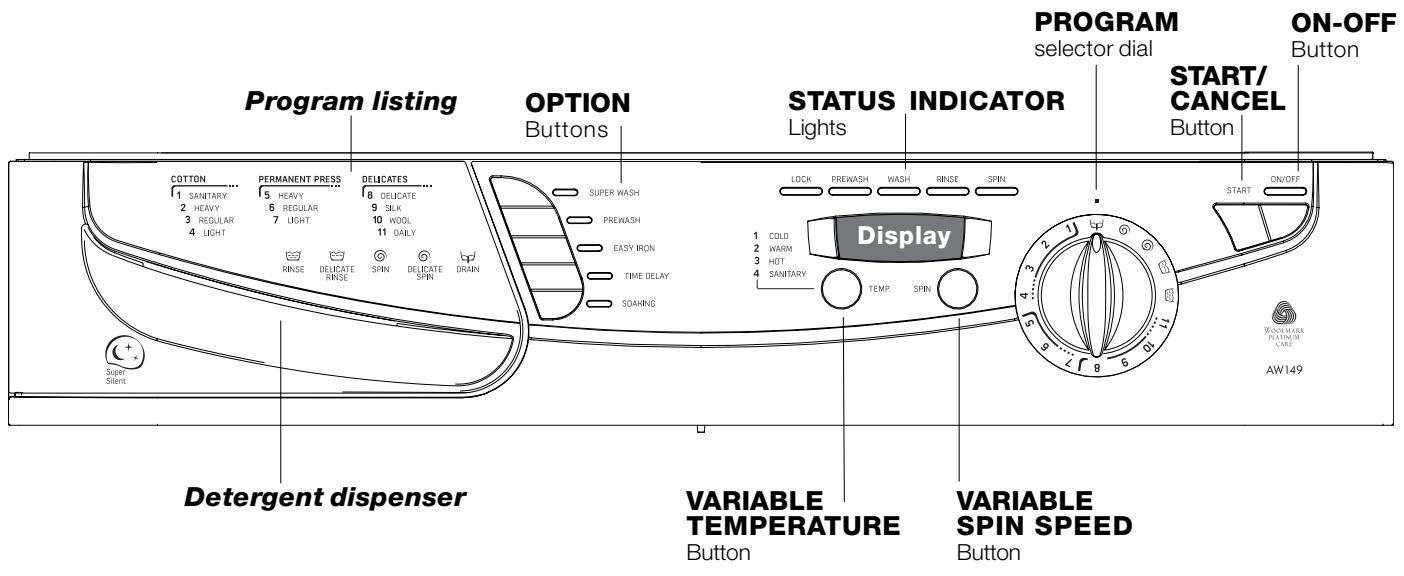
Program listing: To consult a straightforward chart of the different programs available.
Display to program the washing machine and follow the wash cycle progress (see opposite page).
Option buttons: To select the options available (see Program Table and Option Modifiers).
Variable Temperature button: Use this option to reduce the wash temperature below the maximum for the program you have chosen.
Variable Spin Speed button: To reduce the spin speed or exclude the spin cycle completely *.
On/Off button: To turn the washing machine on and off.
Start/Cancel button: To start the program or to cancel it, if incorrect settings were selected.
Program selector dial: to select the wash programs. The knob stays still during the cycle.
Status Indicator lights: Shows if the door is locked (when lit, the door cannot be opened) and the stage of the program that the machine has reached (wash, rinse or spin).
*
When you select a program and your you wish to change the spin speed, the machine will accept it only if the speed is compatible with the program.
Option modifiers
Superwash:
Use this option to select a more intensive wash and time program for the cotton (Sanitary, Heavy cotton, Regular cotton, Heavy synthetics) and synthetics-permanent press (Heavy synthetics, Regular Synthetics).
Pre-wash Button:
For heavily soiled loads, push this button to adf an extra wash to any wash program (except the 4-7-10-11 programs).
Easy Iron Button (Rinse Hold):
This option reduces the amount of creasing on fabrics, making them easier to iron.
Selecting this option the washing machine will reduce wash action and spin speed (max 600 rpm) for programs 5-6-7 and the machine will stop on the last rinse.
For the Silk program the Easy iron (stop with water) option is automatically carried out also if the button Easy iron is not pressed: the washer will pause the cycle in the final rinse with laundry soaked.
The machine will stay in this state until either the Start/Cancel button is pressed or the Easy iron is pressed again to finish the cycle.
Time Delay up to 24 hours:
Use this option to delay the program start by up to 24 hours. The display will show the delay chosen. Each press of the button increases the Time delay in increments of 1 hour. If you press the button again after 24 shows in the display the machine will reset the Time Delay and show “OFF” in the display, pressing the button after this start the Time Delay selection from 1 hour. Once the countdown reaches zero the program will start.
Soaking:
This option allows you to leave your washing to soak for one hour during the wash cycle.
During this time your washing machine tumbles every 2 minutes for 6 seconds (excepts 7, 8, 9, 10, 11 programs).
Variable Spin Speed:
Use this option to reduce the spin speed below the maximum for the program you have chosen.
Each press of the button will reduce the spin speed. The new spin speed will be shown in the display.
If you press again after “OFF” has been displayed, the machine will revert to the original higher spin speed.
N.B.: The washing machine will automatically prevent you from selecting a spin speed higher than the maximum speed for each program.
Variable Temperature:
Use this option to reduce the wash temperature below the maximum for the program you have chosen.
The allowed selections are: 1: Cold (cold wash/cold rinse)
2: Warm (warm wash/cold rinse)
3: Hot (hot wash/cold rinse)
4: Sanitary
The cycle “Sanitary” is the one in which the heater element works.
Warning: • If you select an option unsuitable to the chosen program the corresponding LED will blink for some seconds and then will go out.
If the option selected is suitable to the chosen program the button LED will stay on.
- In the event of an anomaly, an error code will appear, such as F-01, which should be communicated to the Service Centre (see page 22)
Program and Options Modifiers
AW 149 (NA)
NA
| Type of fabric and degree of soil | Program | Dial | Max Load Lbs | Pre-wash (Option) | Detergent for wash | Fabric softener | Options | Length of the cycle (min.) without Options | Description of wash cycle |
| TIME DELAY | |||||||||
| From 1 to 24 hour delay | Start is delayed by 1 to 24 hours | ||||||||
| COTTON HEAVY DUTY | |||||||||
| White Colourfast items (safely deep-cleaning cotton items) | 1 | Sanitary | 15 | ◆ | ◆ | ◆ | Soaking Pre-Wash Super Wash | 170 | Wash cycle, three rinse cycles, intermediate and final spin cycles |
| Exceptionally soiled whites (sheets, tablecloths, etc.) | 2 | Heavy | 15 | ◆ | ◆ | ◆ | Soaking Pre-Wash Super Wash | 92 | Wash cycle, three rinse cycles, intermediate and final spin cycles |
| Regular (Heavily soiled whites and fast colors) | 3 | Regular | 15 | ◆ | ◆ | ◆ | Soaking Pre-Wash Super Wash | 82 | Wash cycle, three rinse cycles, intermediate and final spin cycles |
| Light - Slightly soiled whites and delicate colors (shirts, jumpers, etc.) | 4 | Light | 15 | ◆ | ◆ | Soaking | 59 | Wash cycle, three rinse cycles, intermediate and final spin cycles | |
| PERMANENT PRESS | |||||||||
| Heavily soiled fast color synthetics (baby linen, etc.) | 5 | Heavy | 7.5 | ◆ | ◆ | ◆ | Soaking Pre-wash Easy Iron Super Wash | 75 | Wash cycle, three rinse cycles, delicate spin cycle Easy Iron (*) |
| Delicate color synthetics (all types of slightly soiled garments) | 6 | Regular | 7.5 | ◆ | ◆ | ◆ | Soaking Pre-wash Easy Iron Super Wash | 69 | Wash cycle, three rinse cycles, delicate spin cycle Easy Iron (*) |
| Delicate color synthetics (all types of slightly soiled garments) | 7 | Light | 7.5 | ◆ | ◆ | Easy Iron | 63 | Wash cycle, three rinse cycles and delicate spin cycle Easy Iron (*) | |
| DELICATES | |||||||||
| Delicates | 8 | Light | 6.5 | ◆ | ◆ | ◆ | Pre-wash | 64 | Delicates, three rinse cycles, delicate spin |
| Silk, particularly delicate garments and fabrics (curtains, silk, viscose, etc.) | 9 | Silk | 6.5 | ◆ | ◆ | ◆ | Pre-wash | 39 | Wash cycle, three rinse cycles, Draining (*) |
| Wool | 10 | Wool | 3.5 | ◆ | ◆ | 52 | Wash cycle, four rinse cycles and delicate spin cycle (600 rpm) | ||
| Daily - Mixed (Very short refresh for lightly soiled mixed fabrics) | 11 | Daily | 7.5 | ◆ | ◆ | 30 | Wash cycle, two rinse cycles and delicate spin cycle (800 rpm) | ||
| SPECIAL PROGRAMS | |||||||||
| Rinse cycles | ◆ | Rinse cycles and spin cycle | |||||||
| Delicate Rinse cycles | ◆ | Rinse cycles, anti-crease or draining | |||||||
| Spin cycle | Draining and heavy duty spin cycle | ||||||||
| Delicate Spin cycle | Draining and delicate spin cycle | ||||||||
| Drain | Draining | ||||||||
Sanitary Special Program 1:
The Sanitary cycle is recommended for safely deep-cleaning stained cotton colorfast items. The high temperature (167°F-75°C) eliminates harmful bacteria.
Important:
To cancel the wash program you have just press start button for at least 5 seconds.
(*) For finishing the program press the button start.
Detergent dispenser
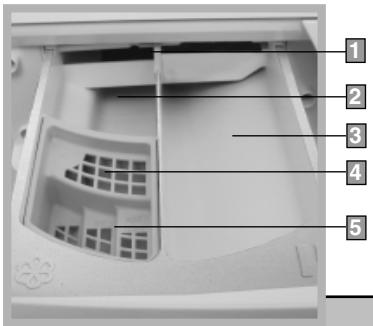
! Do not put any items into the drawer, other than detergents designed to be released from the drawer, as they may cause damage or blockage.
text_image
Diagram of a computer case with numbered parts labeled 1 to 5, showing internal components and ventilation slots.1 Drawer release catch.
2 Pre-wash detergent compartment: Maximum 200 ml powder or 100 ml liquid
3 Main wash detergent compartment:
Maximum 400 ml powder or
200 ml liquid
4 Grate
5 Fabric conditioner compartment: Maximum 120 ml
Dispensing powder detergent
To achieve the best wash results the manufacturer's recommended amount of detergent should be measured and added to the main detergent compartment.
Adding fabric conditioner
Pour the recommended amount of fabric conditioner into the compartrrent. Do not exceed the maximum fill line.
Pre-wash
When selecting prewash, add detergent to both the pre-wash and the main wash compartments.
Fabric softener
All fabrics, particularly towels, benefit from the use of fabric conditioners in the final rinse. Items of laundry feel softer, are more easily ironed and the clinging affect of synthetics is considerably reduced.
Pour the softener into “Additives” compartment of the detergent dispenser to the level indicated on the syphon. Under no circumstances overfill, as the softener will immediately syphon into the machine and in so doing, impair the wash results.
Detergent tips
Dispense a correct amount of detergent so to get better washings

Warning

AVOID RISK OF POISONING KEEPING DETERGENTS AND ADDITIVES OUT OF THE REACH OF CHILDREN!
We suggest you to measure out the quantity of detergent (powder or liquid) according to:
- The water hardness. This piece of information you will get it from your local water authority.
- The quantity of laundry.
- The degree of soiling (see Programs on page 12).
- The specifications of the detergent manufacturer.
Measuring the correct amount of detergent ensures optimum washing results and contributes to get a better environment.
We recommend HE (high Efficiency) detergents because they are particularly designed to deliver optimum performance from your front-loading washer. Not using HE detergent could cause problems such as oversuding (mess on your floor) and/or a decrease in wash performances.
Too little detergent:
The laundry is not cleaned properly and will eventually become gray and stiff. Grayish brown spots (fat globules) may appear on the laundry. The heater may calcify.
Too much detergent:
Not environmentally friendly, excessive suds reduce wash agitation producing poor washing, poor rinsing results or may prevent proper spinning.
Adjust the amount for heavily or lightly soiled loads. Use more if water is extremely hard, use less in soft water. If garments have been pretreated, you will not need as much (or any) detergent at all.
Laundry preparation
Sorting
Clothes should be sorted from separate items which could damage other garments. Sort items into loads according to similar colors, fabrics, garment construction and degrees of soil.
Color
Separate clothes into three groups: Whites and pastels, medium and bright colors, Dark colors. Items which bleed color should be washed alone.
Type of fabrics
Delicate items should be separated from sturdier items. Fabrics that shed lint should be separated from the ones which shed none or attract lint.
Garments constructions
Garments that may fray easily or that have unusual trim require gentle care. These garments may be washed in the loader using the knit cycle. If garments are fragile and delicare, hand washing may be desirable.
Degree of soil
Heavily sopiled items should be separated from the rest of the wash to prevent transfer of soil in the wash water.
Inspection
While sorting clothes into wash-loads, also inspect each garments to see if it requires special care (see table fabric care on page 15).
Pretreating
Remove stains, while they are fresh and easy to get out. Try cold water first to remove unknown stains. Hot water sets stains containing protein such as blood, egg, meat and milk. To remove difficult stains, refer to the removal Chart on page 17.
Preatreat heavily soiled areas, such as collars, cuffs, and centers of pillowcases.
Mend rips and tears, before washing, so further damage is not done to garments.
Empty pockets.
Objects left in pockets such as crayon, pens or markers, or tobacco crumbs may stain an entire wash load. Paper issues will shred leaving bits on each item in the washer. Remove coins and other foreign object to prevent damage to the machine.
Fasten all hooks, zippers and buttons.
Turn knit garments wrong side
out to reduce the tendency of knits to “pill”. Fabric “pills” are balls of fibers on the surface of the garments and cause damage by wear or friction.
Remove loose dirt and sand.
Brush dirt from trouser cuffs; shake or vacuum rugs to remove loose surface soil.
If buckle is washable,
place a scrap of material securely around the ornament before washing and drying to prevent scratching and damage to the machine. Remove non-washable trims, buckles, buttons and belts.
Tie strings
belts and apron sashes into bows to avoid tangling during washing.
Before loading the washer,
make sure the drum is empty.
Prewash
Prewash excessively soiled clothes, such as work or children's clothes.
They often get very soiled. Prewashing with detergent will help loosen the soil
Useful tips
Never use your washing machine to wash... torn, fraying or non-hemmed linen. If it is absolutely necessary, place it in a bag for protection. Do not wash colored linen with whites.
Watch the weights!
For best results, do not exceed the weight limits stated below (figures show weight of dry garments):
- Resistant fabrics (heavy - regular-light cotton):
15 lbs (7 kg) maximum
- Synthetic fabrics (heavy-regular-light):
7.5 lbs (3.4 kg) maximum
- Delicate fabrics
6.5 lbs (3 kg) maximum
Denim Alert.
Some overalls have straps with hooks that can damage the drum of your washing machine or other garments during the wash. To minimize the risk, place hooks in the pocket and fasten with safety pins.
- Pure new wool
3.5 lbs (1,8 kg) maximum
- Bathrobe 6.5 lbs (3 kg) maximum
For more delicate garments: protect underwear, tights and stockings and delicate items by placing them in a linen bag
How much does it weigh?
1 sheet 11/4 lb (400-550 gr.)
1 pillow case 4 oz. (120 gr.)
1 tablecloth 1 lb (450 gr.)
1 bathrobe 2-3 lbs (900-1,300 gr.)
1 towel 5oz/1 lb (150-500 gr.)
Colored T-shirts, printed ones and shirts last longer if turned inside out before washing.
Printed T-shirts and sweatshirts should always be ironed inside out.
Wool cycle
Cashmere Platinum
As gentle as a hand wash.

WOOLMARK
PLATINUM
CARE
Ariston is the only washing machine to have obtained the prestigious Woolmark Platinum Care mark of recognition (M.0303) from The Woolmark
Company, which certifies the machine washing of
all woollen garments, even those whose label states "hand wash only".

The "Wool" program therefore offers you complete peace of mind when washing all woollen
garments, with great performance guaranteed every time.
For best results, we recommend you use very little detergent, taking care not to wash more than 3.5 lbs (1,8 Kg) of laundry.
Vacations: unplug the appliance.
It is recommended that you should unplug the machine from the socket and turn off the water supply. Leave the door ajar to allow air circulation to the draw and the door gasket area.
This will prevent unpleasant odours.
Understanding Fabric Care Labels
The symbols on labels of your garments will help you in choosing suitable wash program, the right temperature, wash cycles and ironing methods. Don't forget to give a glance to these useful indications!
| Machine Wash Cycle |  Normal/Cotton Heavy Duty Normal/Cotton Heavy Duty |  Permanent Press/wrinkle resistant Permanent Press/wrinkle resistant |  Delicate/Gentle Delicate/Gentle | [50W0]Hand wash |  Do not wash Do not wash |  Do not wring Do not wring |
| Water Temp. | ● ● ●Hot(50°C/120°F) | ● ●Warm(40°C/105°F) | ●Cold/Cool(30°C/85°F) | |||
| Tumble Dry | Dry Normal/Cotton Heavy Duty | Permt Press/wrinkle resistant | Delicate/Gentle | Do not tumble dry | Do not dry | |
| Special Instructions | Line dry/hang to dry | Drip dry | Dry flat | In the shade | ||
| Bleach Symbols | Any bleach (when needed) | Only non-chlorine bleach (when needed) | Do not bleach | |||
On-Off / Selecting a program
- Switch the machine on by pressing the On/Off button.
- Load your laundry into the machine and shut the door.
- Add the detergent and any fabric softener.
- Turn the program selector knob to the required program.
- Select any options you require (see Option Modifiers).
- Press the Start/Cancel button to start the program.
- To stop or change a program:
- Press the Start/Cancel button for 5 seconds.
- Select 'Pump out' on the program selector knob.
- When the machine has finished emptying, turn the program selector knob to the new program required. You may need to add detergent.
- Press the start button to start the program.
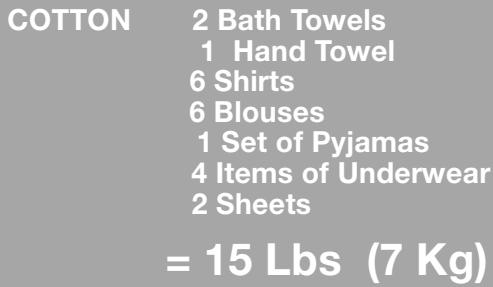
A typical wash load
Two wexampes of maximum load for different types of fabric:
text_image
COTTON 2 Bath Towels 1 Hand Towel 6 Shirts 6 Blouses 1 Set of Pyjamas 4 Items of Underwear 2 Sheets = 15 Lbs (7 Kg)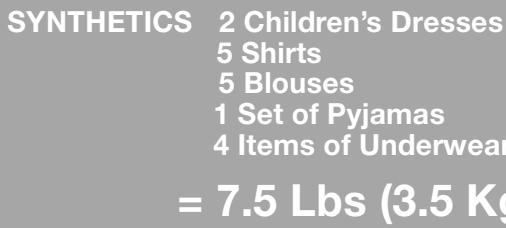
text_image
SYNTHETICS 2 Children's Dresses 5 Shirts 5 Blouses 1 Set of Pyjamas 4 Items of Underwear = 7.5 Lbs (3.5 KgBefore washing, you can do a great deal to ensure better results. Divide your garments according to fabric and color. Read the labels, follow their guidelines
Automatic feature
Unbalance load detection
The washing machine has an inbuilt feature to prevent it from spinning to fast with an unbalanced load.
When an unbalanced load is detected, the washing machine will attempt to redistribute the load in order to balance it evenly to achieve full spin speed.
If this is not possible and an unbalanced load remains the spin speed will be reduced, depending on the amount of unbalanced detected. This is to prevent the machine from damaging itself or its surroundings and to prevent excessive noise from the washing machine.
If the spin result is unsatisfactory following a reduced spin speed attempt to rectify the unbalanced load, then on completion of the program the load can be redistributed evenly in the drum by hand. Select a spin cycle.
Note: Do not attempt to spin heavy or absorbent single items as the machine cannot distribute these evenly. If you need to wash a single item you will need to add some other items as ballast to allow the machine to distribute the load evenly throughout the drum.
Stain Removal Chart
NA
Blood
Rinse or soak fresh stain in cold water. Work detergent into any remaining stain. Rinse. If stain persists, put a few drops of ammonia on stain and repeat detergent treatment. Rinse. If necessary bleach.
Candle Wax
Scrape off excess. Place stain between clean white blotters or several layers of facial tissues. Press with warm iron. Sponge with detergent. If dye spot remains, bleach.
Ketchup
Scrape of excess. Soak in cold water 30 minutes. Pretreat with a detergent paste. Launder.
Chewing Gum
Rub with ice to harden. Scrape off excess with dull blade. Sponge with cleaning fluid.
Chocolate or Cocoa
Soak 15 minutes in cold water. Rub detergent paste into stain, then rinse thoroughly. Launder in hottest water safe for fabric. If colored stain remains, sponge with hydrogen peroxide, rinse and launder.
Coffee or Tea (Black)
Soak fresh stains immediately in cold water. Then use bleach treatment with hottest water safe for fabric. Or if safe for the fabric pour boiling water through spot from a height of 1 to 3 feet. Launder.
Coffee or Tea (With Cream)
Rinse or soak in cold water. Work detergent into stain. Rinse. Dry. If grease stain remains, sponge with cleaning fluid. Repeat, if necessary. If stain remains, bleach.
Cosmetics: eye shadow, lipstick, liquid make-up, mascara, powder, pancake make-up or rouge
Apply undiluted liquid detergent to stain, or dampen stain and rub in soap or detergent paste until thick suds are formed. Work in until stain is gone, rinse well. Repeat if necessary. If color remains, bleach if safe for fabrics.
Cream, Ice Cream or Milk
Sponge stain with cool water or soak stain in cool water for 30 minutes or longer. If stain remains, work a detergent into spot then rinse. Bleach if necessary.
Deodorants and Antiperspirants
Wash or sponge stain thoroughly with warm water and detergent; rinse. If stain remains, bleach with hot sudsy water. Launder. You may be able to restore fabric color by sponging with ammonia. Rinse thoroughly.
Egg or Meat Juice
Rinse in cold water. If stain remains, sprinkle with meat tenderizer, let stand 15-20 minutes. If stain still remains, sponge with cleaning fluid or diluted bleach. Launder in hot water. The use of hot water first may set stain.
Dye
Rinse or soak in cold water. Work detergent into stain. Rinse. If necessary, bleach. Stain is not always possible to remove. A commercial color remover may also be used.
Fabric Softener Stain
Rub with bar soap until stain has lightened. Rinse thoroughly. Launder. Rubbing alcohol is sometimes effective if the color of the garment can take it. Launder. If desired, dry cleaning can be used.
Felt tip pen
Spray spot with cleaners suitable to this purpose. Sponge stain thoroughly. Rinse with cold water. Reapply cleaner if necessary.
Fruit, Wine
Soak fresh stains immediately with cool water. Then use bleach treatment with hottest water safe for fabrics, pour boiling water through spot from a height of 1 to 3 feet. Launder.
Grass
Work detergent into stain. Sponge with denatured alcohol. Bleach, if necessary.
Grease or Oil
Scrape away excess. Rub detergent paste or a general purpose liquid household cleaner into stain, rinse with hot water. If stain remains, sponge thoroughly with a grease solvent. Dry. Repeat if necessary. To remove yellow stain, use a chlorine or oxygen bleach.
Ink
Some ball-point inks are set by water. First test a scrap of cloth. Sponge stain repeatedly with acetone, or rubbing alcohol. Hair spray is effective. Launder. Bleach if necessary. Use amyl acetate on triacetate, arnel, dynel and verel. Use acetone on other fabrics.
NOTE: Some inks cannot be removed.
Mildew
Brush off surface growth to keep mold spores from spreading. Dip article into solution of 1/2 cup bleach per 1 gallon of cool sudsy water for 5 to 10 minutes. Rinse well. Launder.
Mud
Let stain dry; then brush well. Rinse repeatedly in cool water until mud comes out. Launder. (Hot soaps suds set a red or yellow clay stain).
Mustard
Soak in hot detergent water for several hours. If stain remains, bleach.
Nail Polish
Treat while fresh, scraping or wiping off as much as possible, before it dries. Place stain face down on white paper towels. Sponge back of stain acetone (nail polish remover) or sponge with denatured alcohol and a few drops of household ammonia. Sponge stain frequently. Launder with water at temperature suitable for fabric.
Do not use acetone on acetate, arnel, dynel or rayon.
Paint
Sponge or soak in turpentine or solvent recommended as a thinner on label. Launder.
Perfume
Rinse in cold water. Rub undiluted liquid detergent or a detergent paste into stain. Rinse. If stain remains, bleach.
Perspiration
Wash or sponge stain thoroughly with warm water and detergent paste. If perspiration has changed the color of the fabric, restore it by treating with ammonia or vinegar. Apply ammonia to fresh stains; rinse with water. Apply vinegar to old stains; rinse with water.
Rust and Iron
Apply commercial rust remover, according to manufacturer's directions. Rinse. Or, if safe for fabric, boil stained article in solution of 4 teaspoons of cream of tartar to 1 pint water.
Scotch
Rinse or soak in cold water. Work detergent into stain. Rinse. Bleach, if necessary. Stain may be impossible to re move.
Urine
Soak in cool water. If stain is dry, work a detergent paste into the spot then rinse. If necessary, bleach.
Shoe
Polish Scrape off as much as possible. Pretreat with a detergent paste; rinse. If stain persists, sponge with rubbing alcohol (1 part to 2 parts water) or turpentine. Remove turpentine by sponging again with warm detergent solution or with alcohol. Bleach if necessary.
Soft Drinks
Sponge with cold water, some stains are invisible when they have dried, but turn brown when heated and may be impossible to remove.
Tar and Asphalt
Act quickly before stain is dry. Sponge with grease solvent or turpentine. Launder.
Switching off the water and electricity supplies
- Turn off the water tap after every wash. This limits wear and tear on the machine's water supply and prevents leaks.
Disconnect the appliance from the electricity supply before cleaning it and before performing any maintenance work on it

To avoid risk of explosion
Never use flammable solvents to clean the appliance

Cleaning the machine
The exterior of the appliance and all rubber parts may be cleaned using a cloth soaked in warm soapy water. Do not use solvents or abrasive products.
Cleaning the door bowl
Clean the internal surface of the door bowl regularly with a soft cloth. A build up of soap powder and water hardness residue may result in water leaking from the door. Always leave the appliance dor ajar to prevent unpleasant odors from forming
Checking the water inlet hose
Check the water fill hose once a year. If you see any cracks, replace it immediately: during the wash cycles, high water pressure cold cause a cracked hose to split open.
! Never use hoses hat have already been used.
Drum maintenance
- Always leave the porthole door ajar to prevent unpleasant odours from forming.
Cleaning
Cleaning the exterior
Use a damp cloth or silicon polish to clean the exterior surfaces of the appliance.
Cleaning the dispenser drawer and compartments It is advisable to clean the dispenser drawer regularly. Do not try to clean any part of the dispenser drawer while the machine is running.
natural_image
Close-up of a hand inserting a small electronic device into a white panel (no visible text or symbols)-
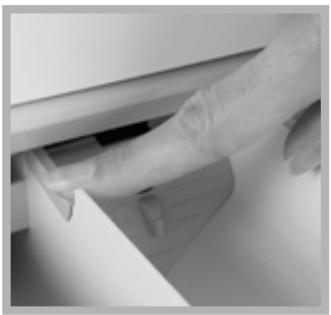
Pull out the drawer until it reaches its stop.
-
Press the drawer release button to remove the dispenser drawer (see picture).
natural_image
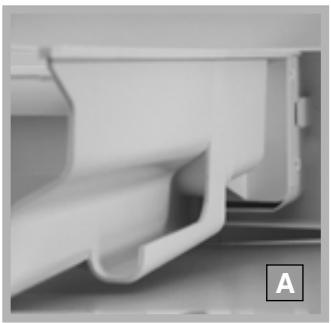
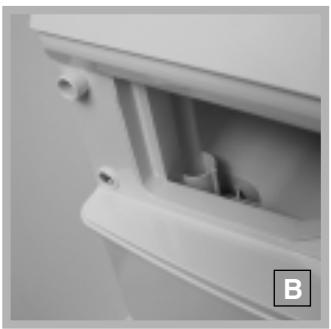
Close-up of a white plastic mechanical component with a curved cutaway view and labeled section A (no text or symbols on the main subject)- Clean and dry the dispenser drawer, syphons, grate and fabric conditioner exit channel (A), ensuring any build up of detergent and fabric conditioner fully removed. Failure to do so may lead to the machine leaking from the dispenser drawer. Also regularly clean the outlet pipe area (B).
natural_image
Close-up of a white plastic door or cabinet with internal compartments and mounting holes (no visible text or symbols)- Relocate the disponser drawer and push it firmly back into place.
! Do not clean any part of the machine with abrasive cleaners, scouring agents, acids, any bleach or metal polish as they may cause damage.
From time to time your machine may not operate as it should. Before calling for Assistance (see "Service-Assistance"), make sure that the problem cannot be resolved easily using the following list.
Malfunction:
Possible causes / Solutions:
The washing machine will not switch on.
The wash cycle does not begin.
The washing machines fails to fill with water.
The machine continuously fills and drains water.
The machine does not drain or spin.
The washing machine vibrates too much during the spin cycle.
The washing machine leaks.
The machine is locked and the display flashes, indicating an error code (e.g. F-01, F- ...).
- The plug has not been inserted into the electrical socket, or it has not been inserted far enough to make contact.
• There is no power in the house.
• The porthole door has not been shut properly.
• The START/RESET button has not been pressed.
• The water tap has not been turned on.
• The water inlet hose is not connected to the tap.
• The hose is kinked.
• The water tap has not been turned on.
• There is no water in the house.
• The water pressure is insufficient.
• The START/RESET button has not been pressed.
- The end of the outlet hose has not been fitted at a height between 25" - 34" inches (62 and 86 cm) from the floor (see "Installation").
- The free end of the hose is underwater (see "Installation").
- If the dwelling is on one of the upper floors of a building, there may be problems relating to water drainage, causing the washing machine to load and drain water continuously. Special anti-draining valves are available in shops and help to avoid this inconvenience.
- The water drainage system is not fitted with a breather pipe.
- The programme does not include a draining phase: some programs require manual draining (see "Programmes and options").
- The Easy Iron option is enabled: to complete the program, press the START/RESET button (see "Programs and options").
• The outlet hose is bent (see "Installation").
• The drainage duct is clogged.
- The drum was not unlocked properly when the appliance was installed. Remove shipping bolts (see "Installation").
- The washing machine is not level (see "Installation").
- The washing machine is trapped between cabinets and a wall (see "Installation").
- The load is not balanced properly (see "Operating the washing machine").
- The water inlet hose is not screwed on to the tap correctly (see "Installation").
- The detergent dispenser drawer is blocked (for instructions on how to clean it, see "Care and maintenance").
- The outlet hose has not been secured properly (see "Installation").
- Switch off the machine and unplug the appliance; wait for approximately 1 minute then switch it on again. If the problem persists, contact Assistance.
There is too much foam.
- The detergent is not designed for machine washing (the packaging should state that the product is “for washing by machine”, “for washing by hand or machine” or similar).
• Too much detergent was used.
The washing machine door remains locked
- Wait for the LED to switch itself off before you open the appliance door.
! If the problem persists after the above checks have been carried out, shut off the water tap, switch off the machine and contact Assistance
Before calling for Assistance:
- Check whether you can solve the problem on your own (see page 20);
- Restart the programme to check whether the problem has been solved;
- If this is not the case, contact an authorised Technical Service Centre on the telephone number provided on the guarantee certificate.
! If the machine has been installed or used incorrectly, you may be charged for the maintenance callout service.
! Always request the assistance of authorised servicemen.
Notify the operator of:
- the type of problem;
• the appliance model (Mod.);
• the serial number (S/N);
This information can be found on the data plate situated on the rear of the door of the washing machine.
CUSTOMER CARE, SERVICE & PARTS : phone (888) 426-0825
STATEMENT OF WARRANTIES ARISTON Clothes Washers
The warranties provided by (Ariston) in this statement of warranties apply only to Ariston clothes washer sold to the first using purchaser by Ariston or its authorized distributors, dealers, retailers or service centers in the United States or Canada. The warranties provided herein are not transferable.
Length of Warranty
2 Years Full Limited Warranty from the date of installation\*
Ariston will repair or replace, free of charge, any component part that proves defective in conditions of normal home use. Shipping and labor costs included. Waranty repair service must be performed by an authorized Ariston service center.
3rd - 5th Year Limited Warranty on Electronics from the date of installation\*
Ariston will repair or replace free of charge, any microprocessor or circuit board that proves defective under conditions of normal home use 3rd year through 5th year from the date of original installation, labor charges excluded.
3rd - 5th Year Limited Warranty on Motor from the date of installation\*
Ariston will repair or replace free of charge, any motor or component part of the motor that proves defective under conditions of normal home use, 3rdyear through 5th year, from the date of original installation, labor charges excluded.
Lifetime Limited Warranty against Stainless Steel Rust Through from the date of installation\*
Ariston will replace your clothes washer, free of charge, with the same model or a current model that is equivalent or better in functionality if the washer drum should rust though under conditions of normal home use, labor, shipping, and installation charges excluded.
10 day warranty after purchase on cosmetic damages detected
Ariston will replace any cosmetic parts, free of charge - including labor, which are detected damaged with in 10 days after purchase. Any damages deemed caused by improper handling, shipping, or installation will not be covered under this clause.
* Date of installation shall refer to the earlier of the date the clothes washer is installed or ten business days after delivery date.
Exclusions:
This warranty does not cover repair or service calls to correct the installation, to provide instructions on the use of your product, to replace house fuses or correct plumbing or the electric wiring in your home. In addition any repair to the products that's use was in a manner other than what is normal for home use is void of any warranty claim. The warranties exclude any defects or damage arising from accident, alteration, misuse, abuse, improper installation, unauthorized service work, or external forces beyond Ariston control, such as fire, flood, and other acts of God, or installation not in accordance with local electric or plumbing codes. Labor, shipping, and installation charges incurred in the repair or replacement of any product after a period of one year from the date of installation shall not be covered by this warranty. Any and all replaced or repaired parts shall assume the identity of the original for the purposes of the applicable warranty period. To the extent permitted by law, this warranty is in lieu of all other express and implied warranties, including the implied warranties of merchantability and fitness for a particular purpose. Ariston does not assume any responsibility for incidental or consequential damages.
To obtain warranty services call 1-888-426-0825, or write to:
Ultra 8 International, 2505 Anthem Village Drive, Suite E - PO BOX 562, Henderson Nevada 89052
Be sure to provide: model number, serial number, purchase date, and the sellers name and address.

Español
AW 149
Índice
Descripción, 26
text_image
0" Recessed front view 0"natural_image
Illustration of a person cutting down a box with scissors, no text or symbols presentnatural_image
Illustration of a person operating a washing machine (no text or symbols visible)- Quite la base de poliestireno.
natural_image
Illustration of a person using a washing machine to clean or adjust equipment (no text or symbols visible)natural_image
Technical line drawing of a mechanical housing or enclosure component (no text or symbols)- ! Al desembalar la máquina es IMPORTANTE controlar:
natural_image
Illustration of a person standing beside a washing machine with books nearby (no text or symbols)natural_image
Illustration of a person washing a washing machine (no text or symbols present)natural_image
Illustration of two people operating a washing machine with a circular vent (no text or symbols)natural_image
Cartoon illustration of a person reading a document (no text or symbols present)natural_image
Pure mechanical component diagram without any text, numbers, or symbolsnatural_image
Line drawing of a hand securing a wall-mounted lock (no text or symbols)natural_image
Technical line drawing of a mechanical component with a bolt and shaft (no text or symbols)natural_image
Hand holding a button on a surface, no text or symbols visiblenatural_image
Simple line drawing of a vehicle or road with an oval object on the side (no text or symbols)natural_image
Line drawing of a hand holding a cylindrical object with a threaded rod (no text or symbols)text_image
Technical diagram of a washing machine with labeled component B and directional arrownatural_image
Diagram of a pipe connection with a magnified inset showing a connector or fixture (no text or symbols present)natural_image
Pure line drawing of a U-shaped pipe fitting with no text or symbolstext_image
Hose clamp minimum: 620 mm from floortext_image
Diagram of a computer case with numbered parts labeled 1 to 5, showing internal components and ventilation slots.$$ = 1 5 \mathrm{Lbs(7Kg)} $$
SINTÉTICOS
2 Prendas de niño
5 Camisas
5 Blusas
1 Pijama
4 Prendas interiores
$$ = 7. 5 \mathrm{Lbs} (3. 5 \mathrm{Kg}) $$