
Crowns - Board game Schmidt - Free user manual and instructions
Find the device manual for free Crowns Schmidt in PDF.


| Product type | Board game |
| Brand | Schmidt |
| Model | Crowns |
| Number of players | 2 to 4 players |
| Recommended age | From 8 years old |
| Game duration | Approximately 30 to 60 minutes |
| Box dimensions | 30 x 30 x 5 cm |
| Weight | Approximately 800 g |
| Power supply | None (board game) |
| Material | Cardboard, plastic |
| Game language | French (depending on version) |
| Care and cleaning | Clean with a dry or slightly damp cloth for plastic parts. Avoid liquids. |
| Safety | Not suitable for children under 3 years (small parts). |
| Spare parts and repairability | Spare parts may be available on request from the manufacturer. Repair not intended (consumable game). |
| General information | Strategic board game Schmidt Crowns. Instructions included. |
Frequently Asked Questions - Crowns Schmidt
User questions about Crowns Schmidt
0 question about this device. Answer the ones you know or ask your own.
Ask a new question about this device
Download the instructions for your Board game in PDF format for free! Find your manual Crowns - Schmidt and take your electronic device back in hand. On this page are published all the documents necessary for the use of your device. Crowns by Schmidt.
USER MANUAL Crowns Schmidt
CROWNS


A game of dice for 1-6 players from the age of eight by Benjamin Schwer
Game materials
■ 6 game boards
6 dice
■ 108 chips (18 per colour)
Objective of the game
The players throw the dice and try to collect as many points as possible on their game boards. They place chips on the relevant numbers on the game board. In order to also reach more difficult fields, higher dice scores can also be turned over to their lower numerical values. Only those rows fully covered by chips are included in the score. Here, each chip counts one point for each crown it covers. However, you only get points for rows completely covered with chips and for individual chips on the 11 dark coloured boundary fields. The game ends as soon as a player has placed all his 18 chips on his game board. The player with the most points wins the game.
Preparing to play
Each player receives one game board and 18 chips in the matching colour, which he then places next to his game board. The six dice are ready to be played.
The youngest player starts the game. It is then the turn of the player next to him in a clockwise direction.
How to play
When it is his turn, the player throws all six dice once. Then the player may put between 0 and 6 of his chips – depending on the score on the dice – on the fields of his game board achieved by throwing the dice.
The following rules apply:
1.) There may only ever be 1 chip on one field.
2.) A number on the dice which has been thrown once can be covered with a chip on the relevant field in column "1x".
3.) A number on the dice which has been thrown several times can be covered with a chip on the relevant field in the relevant column. If, for instance, three 5 have been thrown, the player can put a chip on the 5 field in the column "3x". It is up to the player to decide how many of his scores he uses.
EXAMPLE:
A player has thrown the following:


In column "2x", the player now puts one chip on each of the fields in the column of the result and. In addition, he puts one chip in column "1x" on the field in the row. The player does not want to occupy the field in the row in the column "1x". The player has now finished his turn, and he gives the six dice to the player next to him in a clockwise direction.
4.) A player may adjust down to a lower value the thrown number of one or more dice provided at least one other die shows the desired score.
EXAMPLE:
A player has thrown the following:

This throw can not only be used as in the example above – rather, there is the option of adjusting down several scores before placing the chips:
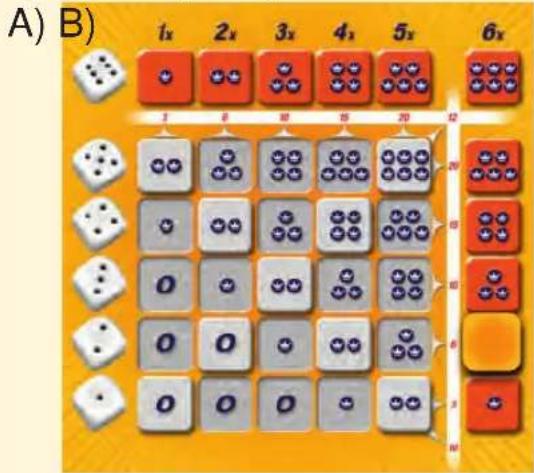

A) The player can change five of his dice to a ☐, so that in total six dice have the score ☐. This is a good way of receiving two points at the end of the game, since you always get points for chips on the boundary fields.
B) The player can change the four high throws into 4 x ☐, so that in total five dice have the score ☐. The die with the ☐ remains unchanged, since it cannot be adjusted upwards. In a complete row, the field with 5 x ☐ can earn four points later on, making it very valuable.
C)

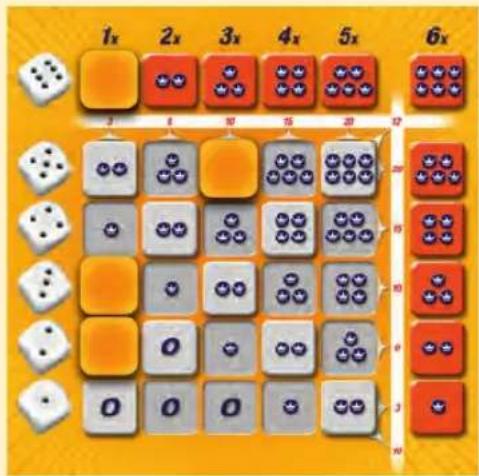
C) The player can change the two dice with the into 2x so that in total four dice have the score. Additionally, the player can change the into a , so that in total two dice have the score
D) The player can also use a combination of the aforementioned options, or use as many dice unchanged as he likes.
The player decides to use a 📄 unchanged. He changes a further 📄 to a 📄, so that he has 3x 📄. He also uses the dice with the .and the unchanged, and places the corresponding chips onto his game board.
End of game
The game comes to an end as soon as a player has put all his 18 chips onto his game board. The round is continued until the player to the right of the first player to start has had a turn and, hence, all players have had the same number of turns. The scores are then added up.
How to work out the score
First of all, all those chips that do not belong to a complete horizontal, vertical or diagonal row of five chips are removed. Watch out: individual chips which have been put on the 11 dark coloured boundary fields stay put. The crowns on the occupied fields indicate the number of points. One crown counts as one point. Individual fields which belong to several rows are also counted several times.
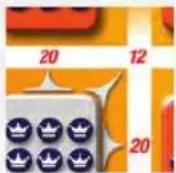
The points for complete rows (horizontal, vertical and diagonal) are also illustrated and indicated by arrows.
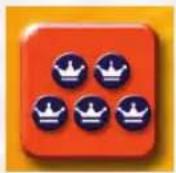
The dark coloured boundary fields are never part of a row of five or diagonal rows. Boundary fields occupied by chips always score points and must not be occupied as part of rows.
The players count up their crowns (points). The player with the most points wins the game.
EXAMPLE:
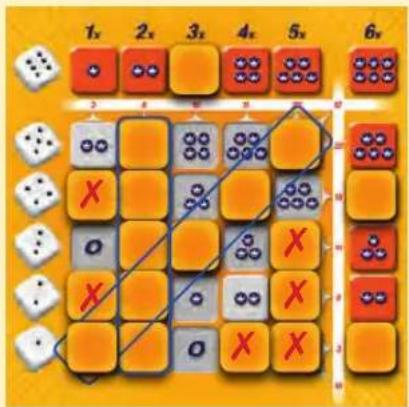
At the end of the game, the player is awarded points for each of the three chips positioned on the dark coloured boundary fields (3 + 4 + 1 = 8 points) .
The player is also awarded points for each of the chips highlighted with a blue edge since the chips are positioned on five consecutive fields (6 + 12 = 18 points).
The player isn't awarded any points for any of the other chips since they are not part of a complete row of five.
The player has a total of 26 points.
Advice and tips
1) A player is not obliged to play any chips during his go. If the score is unsuitable, it can sometimes be a good move to not put down any chips in one round.
2) It is better to concentrate on a maximum of 2-3 rows. It is difficult to complete more than three rows by the end of the game.
3) Also pay attention to how many chips the other players have left. One round can go by quickly.
Solo game
If there is nobody to play with, the game is easy to play on your own. The objective of the solo game is also to score as many points as possible.
The rules remain the same except that, each round; the player must combine the dice such that he can put down at least one chip. If this is not possible, the player must remove one of his chips that have not been placed on the game board yet.
For a trickier game, make it such that you have to put down at least two chips every round (if possible).
Points Score
40 and more Genius
36-40 Professional
31-35 Expert
26-30 Advanced player
21-25 Good try for a beginner
below 20 Pity – simply play another game!
Author: Benjamin Schwer, Graphics: MaschmannFautzHuff, Editors: Matthias Karl and Thorsten Gimmler


crowns
Schmidt Spiele GmbH
Postfach 470437
D-12313 Berlin


Brand : Schmidt
Model : Crowns
Category : Board game