
DA 5341 D - INSTALLATION - Basket MIELE - Free user manual and instructions
Find the device manual for free DA 5341 D - INSTALLATION MIELE in PDF.


User questions about DA 5341 D - INSTALLATION MIELE
0 question about this device. Answer the ones you know or ask your own.
Ask a new question about this device
Download the instructions for your Basket in PDF format for free! Find your manual DA 5341 D - INSTALLATION - MIELE and take your electronic device back in hand. On this page are published all the documents necessary for the use of your device. DA 5341 D - INSTALLATION by MIELE.
USER MANUAL DA 5341 D - INSTALLATION MIELE
Operating and Installation Instructions
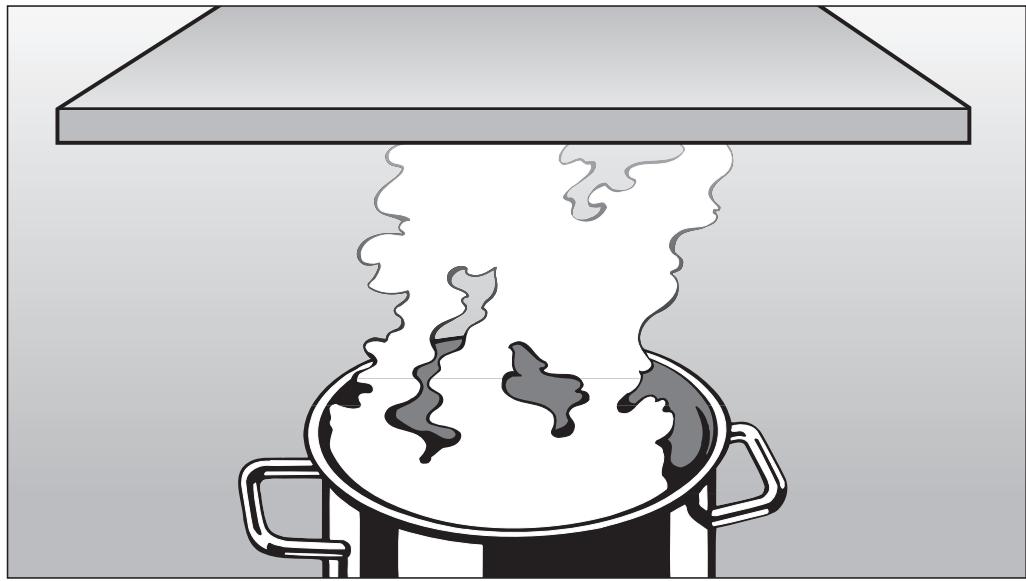
Ventilation System DA 5341 D
To prevent accidents –
and appliance damage,
read these instructions
before
installation or use.
en - US, CA
M.-Nr.07838180
IMPORTANT SAFETY INSTRUCTIONS 3
Functional description 7
Guide to the Ventilation System 8
Operation 10
Selecting the power level. 10
Delayed Shut Down 12
Turning the lighting on/off 13
Dimming the lighting 13
Grease filter timer 14
Cleaning and care 16
Cleaning the casing. 16
Grease filters 17
Changing the light bulbs 19
After Sales Service 20
Installation instructions 21
Caring for the environment 23
Appliance dimensions 24
Structural support 26
Installation 27
Air extraction 28
Electrical connection 30
Technical data 31
READ AND SAVE THESE INSTRUCTIONS
Keep these instructions in a safe place and pass them on to any future user.
Read these instructions carefully before installing or using the Ventilation System.
This appliance is intended for residential use only. Use the appliance only for its intended purpose.
This appliance complies with current safety requirements. Improper use of the appliance can lead to personal injury and material damage.
CAUTION For General Ventilating Use Only. Do Not Use To Exhaust Hazardous Or Explosive Materials And Vapors.
This appliance is designed to vent cooking smoke and odors only.
This appliance is suitable for installation above gas or electric cooking surfaces.
This appliance is not designed for maritime use or for use in mobile installations such as recreational vehicles or aircraft. However, under certain conditions installation in these applications may be possible. Please contact your Miele dealer or the Miele Technical Service Department with specific requirements.
WARNING TO REDUCE THE RISK OF FIRE, ELECTRIC SHOCK, OR INJURY TO PERSONS, OBSERVE THE FOLLOWING:
a) Use this appliance only in the manner intended by the manufacturer. If you have questions, contact Miele.
b) Before servicing or cleaning the appliance, switch power off at the service panel and lock the service disconnecting means to prevent power from being switched on accidentally. If the service disconnecting means cannot be locked, securely fasten a prominent warning device, such as a tag, to the service panel.
c) Be certain your appliance is properly installed and grounded by a qualified technician.
To guarantee the electrical safety of this appliance, continuity must exist between the appliance and an effective grounding system. It is imperative that this basic safety requirement be met. If there is any doubt, have the electrical system of the house checked by a qualified electrician.
d) Before connecting the appliance to the power supply make sure that the voltage and frequency listed on the data plate correspond with the household electrical supply.
This data must correspond to prevent appliance damage. If in doubt consult a qualified electrician.
e) Installation work and repairs should only be performed by a qualified technician in accordance with all applicable codes and standards. Repairs and other work by unqualified persons could be dangerous.
f) Only open the housing as described in the enclosed "Installation diagram" and in the "Cleaning and care" section of this manual. Under no circumstances should any other parts of the housing be opened. Tampering with electrical connections or components and mechanical parts is highly dangerous to the user and can cause operation faults.
g) Before discarding an old appliance, disconnect it from the power supply and remove the power cord to prevent hazards.
Use
WARNING TO REDUCE THE RISK OF A COOKTOP GREASE FIRE:
a) Never leave surface units unattended at high settings. Boilovers cause smoking and greasy spillovers may ignite. Heat oils slowly on low or medium settings.
b) Always turn the hood on when cooking at a high heat.
c) Clean the ventilation hood frequently. Grease should not be allowed to accumulate on the fan or filter.
d) Use the proper pan size. Always use cookware appropriate for the size of the cooking area.
e) Do not flambe or grill with an open flame beneath the hood. Flames could be drawn up into the hood by the suction and the grease filters may catch fire.
WARNING TO REDUCE THE RISK OF INJURY TO PERSONS IN THE EVENT OF A COOKTOP GREASE FIRE, OBSERVE THE FOLLOWING*:
a) SMOTHER FLAMES with a close fitting lid, cookie sheet, or metal tray then turn off the burner.
BE CAREFUL TO PREVENT BURNS. If the flames do not go out immediately, EVACUATE AND CALL THE FIRE DEPARTMENT.
b) NEVER PICK UP A FLAMING PAN - You may be burned.
c) DO NOT USE WATER, including wet dishcloths or towels - a violent steam explosion will result.
d) Use a fire extinguisher ONLY if:
1) You have a class ABC extinguisher, and you know how to operate it.
2) The fire is small and contained in the area where it started.
3) The fire department is being called.
4) You can fight the fire with your back to an exit.
- Based on "Kitchen Firesafety Tips" published by NAFTA
Do not allow children to play with or operate the appliance or its controls. Supervise its use by the elderly or infirm.
Always turn on the hood when using the cooktop to prevent damage from condensation.
Never operate gas burners without cookware. Turn the burner off when not in use. Adjust the burner so that the flames do not extend beneath the cookware. Do not overheat the cookware, e.g. when using a wok. The hood can be damaged due to excessive heat from the burners and the cookware.
Do not use the hood without the grease filters in place.
Do not use a steam cleaner to clean the hood. Steam could penetrate electrical components and cause a short circuit.
Installation
WARNING TO REDUCE THE RISK OF FIRE, ELECTRIC SHOCK, OR INJURY TO PERSONS, OBSERVE THE FOLLOWING:
a) Installation work and electrical wiring must be done by qualified person(s) in accordance with all applicable codes and standards, including fire-rated construction.
b) Sufficient air is needed for combustion and exhausting of gases through the flue (chimney of fuel burning equipment to prevent back drafting. Follow the heating equipment manufacturer's guideline and safety standards such as those published by the National Fire Protection Association (NFPA) and the American Society for Heating, Refrigeration and Air Conditioning Engineers (ASHRAE), and the local code authorities.
c) When cutting or drilling into the wall or ceiling, do not damage electrical wiring and other hidden utilities.
d) Ducted hoods must always be vented to the outdoors.
e) Do not use this hood with any solid-state speed control device.
f) Do not use an extension cord to connect the appliance to electricity. Extension cords do not guarantee the required safety of the appliance, (e.g. danger of overheating).
g) Do not install this hood over cooktops that burn solid fuel.
h) Provided a larger distance is not given by the manufacturer of the cooktop, follow the minimum safety distances between a cooktop and the bottom of the hood given in the "Appliance dimensions" section of this manual.
If local building codes require a greater safety distance, follow their requirement.
If there is more than one appliance beneath the hood and they have different minimum safety distances always select the greater distance.
i) Never connect an exhaust hood to an active chimney, dryer vent, vent flue, or room ventilating ductwork.
j) Seek professional advice before connecting an exhaust hood vent to an existing, inactive chimney or vent flue.
k) Any fittings, sealant, or materials used to install the ductwork must be made of approved non-flammable materials.
WARNING TO REDUCE THE RISK OF FIRE USE ONLY METAL DUCTWORK.
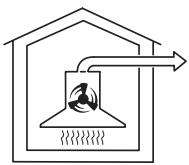
The ventilation hood works by air extraction. The air is drawn in and cleaned by the grease filter and directed outside.
The hood comes equipped with a non-return flap in each chimney. This flap automatically closes when the hood is turned off so that no exchange of outside air and room air can occur. When the hood is turned on, the air pressure of the exhaust fan automatically opens the flap blowing the inside air and cooking odors outside.
aee
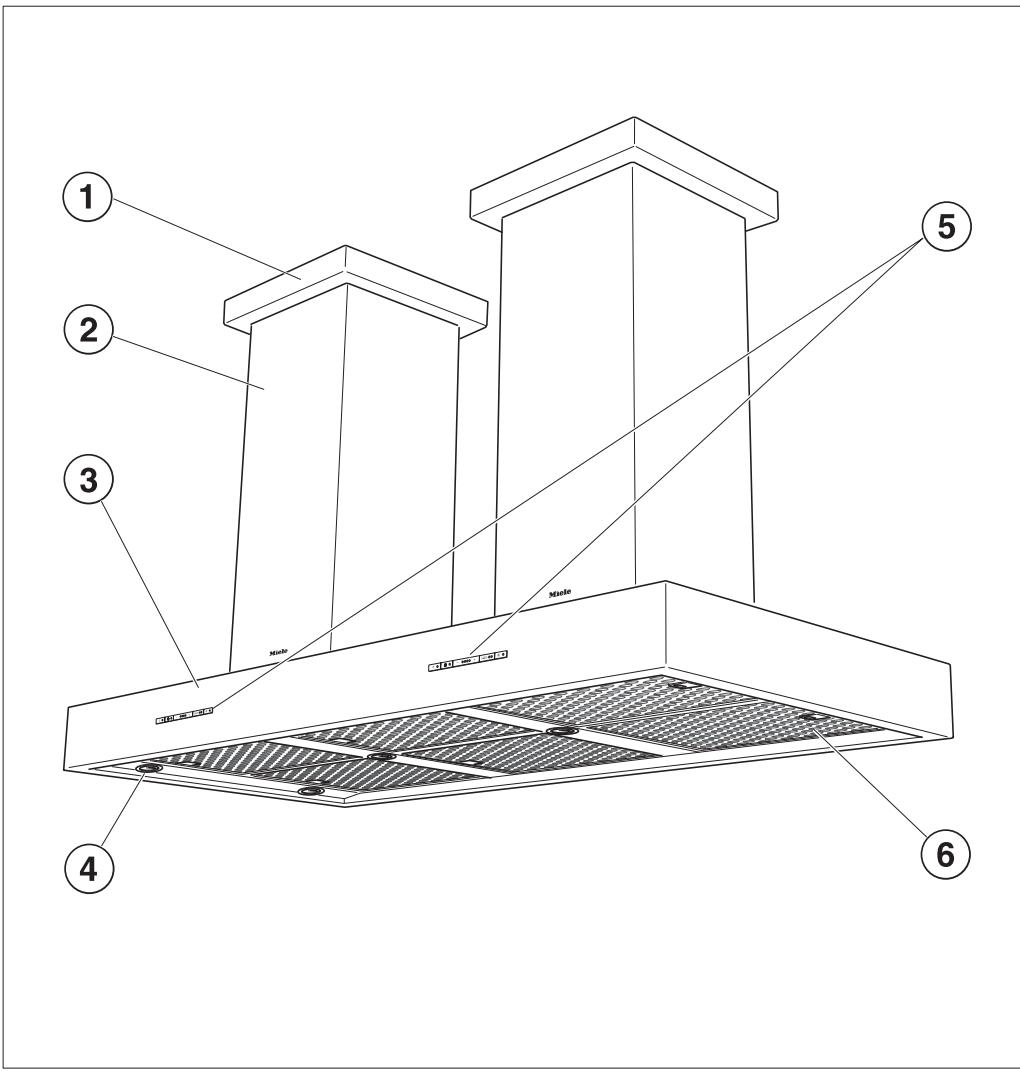
① Cover frame
② Chimney
③ Canopy
(4) Overhead lighting
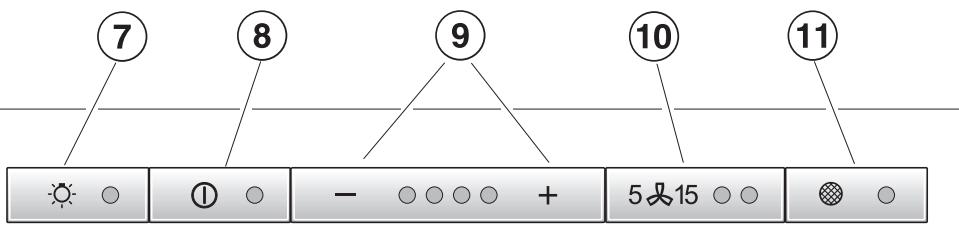
Control panel
The two sides of the hood can be operated independently of one another.
⑥ Grease filters
Light button
This button turns the light on and off and also dims the light.
The lighting can be used independently of the fan.
⑧ On/Off button
9 Fan power level buttons
Four fan speed selection.
⑩ Delayed Shut Down
This button activates the Delayed Shut Down feature. The fan can be set to turn off automatically after either 5 or 15 minutes.
Grease filter button
The indicator next to the grease filter button lights when the grease filter needs to be cleaned.
This button is also used:
- to reset the grease filter timer after cleaning the grease filter (see "Cleaning and Care").
- to show how long the grease filter has been in use (see "Operation / Grease filter timer").
- to change the number of hours counted by the grease filter timer (see "Operation / Reprogramming the grease filter timer").
The two sides of the hood can be operated independently of one another.
Turning on the fan

Press the On/Off button.
The hood turns on level 2 and the indicator lights.
Selecting the power level

Use the - / + ^ " controls to select the desired power level.
- = increases the fan speed
- = decreases the fan speed
Levels "1" to "3" (green indicators) are usually sufficient for normal cooking.
Intensive setting
Level "4" (yellow indicator) should be used for a short period when frying or cooking food with a strong aroma.
Automatically switching back the intensive power level
The intensive level "4" can be programmed to automatically switch back to level "3" after 10 minutes.
Turn the fan and the lights off.

Press and hold the "Delay Shut down" button for 10 secs. The first indicator lights.
Press the following buttons one after another,

- light

- the "-" button, and

- the light button again.

If the power level indicators "1" and "4" flash, the automatic switch back is not activated.
To activate the automatic switch back press the "+" button.
The power level indicators "1" and "4" light continuously.
To deactivate press the "-" button.
5 15
To save the setting press the "Delay Shut Down" button.
If the procedure is not stored within 4 minutes of programming, the hood will automatically default to the "old" data.
Fan performance
The maximum air flow capacity of the dual blower system is 1250 cfm (625 x 2 cfm). Factors such as narrow duct diameter and bends will affect this value.
- Level 1 operates at 40% capacity
- Level 2 operates at 60% capacity
- Level 3 operates at 80% capacity
- Level 4 operates at 100% capacity
Delayed Shut Down
If odors or smoke remain in the kitchen after cooking has been completed, the Delayed Shut Down feature can be selected to allow the hood to continue running for either 5 or 15 minutes. After that period of time the fan turns off automatically.

Press the Delayed Shut Down button while the fan is still running.
Press once = 5 minute delay (left indicator lights)
Press twice = 15 minute delay (right indicator lights)
To cancel the feature press the Delayed Shut Down button again. The fan will not turn off automatically.
Turning off the fan

Press the On/Off button to turn the fan off.
The indicator goes out.
Automatic Safety Shut Off
The fan will turn off automatically 10 hours after the last button was activated. The lighting however will remain on.
Press the On/Off button to turn the fan back on again.
Turning the lighting on/off
The overhead lighting can be turned on and off independently of the fan.

Press the light button briefly to turn on the lighting.
The light button indicator illuminates.
Press the light button briefly again to turn off the lighting.
The light button indicator will go out.
Dimming the lighting
The brightness of the lighting can be adjusted.
While the lighting is turned on, press and hold the light button.
The lighting will dim until the button is released.
If the button is pressed again, the lighting will brighten until the button is released.
If the button is pressed continuously, the light will cycle between bright and dark.
Press the light button again to turn off the lighting.
Grease filter timer
A timer monitors the hours of fan operation. The indicator for the grease filter will light after 30 hours of operation or the preselected time. The grease filters must then be cleaned. See "Cleaning and care / Grease Filter".
After the grease filters have been cleaned and put back in place, the grease filter timer must be reset.

To do this, press the grease filter button for about 3 seconds while the fan is running.
The indicator will go out.
Checking the grease filter timer
To check the percentage of time already used:

Press the On/Off button to turn the fan on.

Press the grease filter button.
The indicator lights.

The number of flashing - / + indicators show the percentage of programmed hours that have been used.
1 indicator = 25 %
2 indicators = 50 %
3 indicators = 75 %
4 indicators = 100 %
This information will remain stored in memory in the event of a power failure.
Reprogramming the grease filter timer
The grease filter timer is preset to 30 hours. This time can be lengthened or shortened to 20, 30, 40 or 50 hours.
- A time of 20 hours should be programmed in kitchens with frequent pan or deep frying.
- A time of 20 hours should also be programmed if the kitchen is only used occasionally to prevent grease which has accumulated over a long period of time from hardening on the filter, making cleaning more difficult.

Press the On/Off button to turn off the fan.

Press the Delayed Shut Down and grease filter button at the same time.
The indicator for the grease filter timer and one of the "-/+" indicators will flash.

The lit "-/+" indicator shows the programmed time:
1st indicator from the left = 20 hours
2nd indicator from the left = 30 hours
3rd indicator from the left = 40 hours
4th indicator from the left – = 50 hours
Use the - / + " button to select the desired time.

Store the selection by pressing the grease filter button.
If the procedure is not stored within 4 minutes of programming the hood will automatically default to the "old" data.
WARNING
TO REDUCE THE RISK OF FIRE, ELECTRIC SHOCK, OR INJURY TO PERSONS, OBSERVE THE FOLLOWING:
Before cleaning or servicing the hood, disconnect it from the power supply, see "Important Safety Instructions".
Cleaning the casing
Never use abrasive cleaners, scouring pads, steel wool or caustic (oven) cleaners on the hood. They will damage the surface.
- The exterior surfaces and controls can be cleaned with a mild solution of warm water and liquid dish soap applied with a soft sponge.
Wipe dry using a soft cloth.
Do not use too much water when cleaning the controls. Water could penetrate the electronics and cause damage.
Glass surfaces can be cleaned using glass cleaner.
Avoid:
- cleaning agents containing soda, acids or chlorides,
- abrasive cleaning agents e.g. powder or cream cleansers,
- abrasive sponges, e.g. pot scourers or sponges which have been previously used with abrasive cleaning agents.
These will damage the surface.
The following instructions for cleaning "Stainless steel" surfaces and "Stainless steel colored controls" should be followed in addition to the general "Cleaning the casing" instructions.
Stainless steel
Stainless steel surfaces can be cleaned using a non-abrasive stainless steel cleaner.
To help prevent resoiling, a conditioner for stainless steel can also be used. Apply sparingly with even pressure.
Stainless steel colored controls
These controls may become discolored or damaged if not cleaned regularly.
Do not use a stainless steel cleaner on these controls.
Grease filters
The reusable metal grease filters remove solid particles from the vented kitchen air (grease, dust, etc).

The grease filters should be cleaned every 3 - 4 weeks or whenever the grease filter indicator lights.
A dirty filter is a fire hazard.
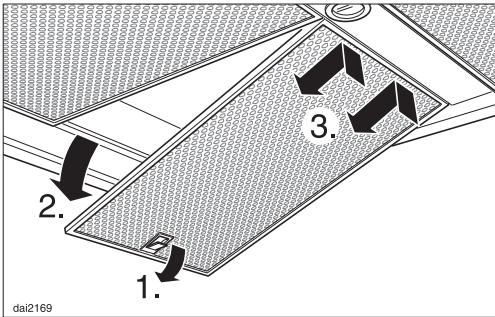
Removing the grease filter
To remove the grease filters pull the locking clip forward. Lower the filter 45^ unhook it at the rear and take it out. Support the grease filter so that it does not fall onto the cooktop.
Cleaning the grease filters
- By hand: use a scrub brush with a solution of warm water and mild detergent. Do not use the pure detergent, aggressive all purpose cleaners, oven sprays, abrasive cleaning agents or limescale removers. They could destroy the filter.
In a dishwasher: place the filter vertically in the lower basket, making sure that the spray arm is not blocked. Use a hot temperature program, e.g. "Heavy Soil" or "Pots and pans". Use the recommended amount of dishwasher detergent. Overuse could destroy the filter.
Depending on the detergent, cleaning the grease filter in a dishwasher may cause permanent discoloration of the filter surface. Performance of the filter will not be affected by this discoloration.
After cleaning, the filters can be placed on a towel to air dry.
■ While the filters are removed, clean any dirt or grease from the interior casing to prevent the risk of fire.
- When putting the grease filter back make sure that the locking clip is facing the cooking surface.
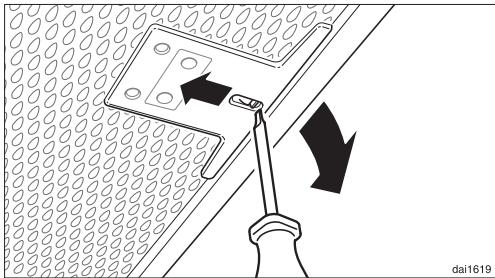
If the filter is incorrectly installed, insert a small screwdriver into the slit along its edge to disengage it from the casing.

After cleaning and returning the grease filters the timer must be reset.
While the fan is on, press and hold the grease filter control until only the first - / + ^ " indicator is flashing.
The second grease filters must also be reset in the same way, even if the timer has not yet reached its maximum.
Changing the light bulbs
WARNING TO REDUCE THE RISK OF FIRE, ELECTRIC SHOCK, OR INJURY TO PERSONS, OBSERVE THE FOLLOWING:
Before changing the light bulbs, disconnect the hood from the power supply, see "Important Safety Instructions".
Note: The appliance has 2 electrical connections, each must be disconnected from the main power supply.
When in use halogen bulbs become extremely hot, and can burn your hands. Do not attempt to change the bulbs until they have had sufficient time to cool.
Do not touch the bulb surface. Fingerprints or body oils deposited on the bulb will decrease its life. Please follow the manufacturer's instructions.
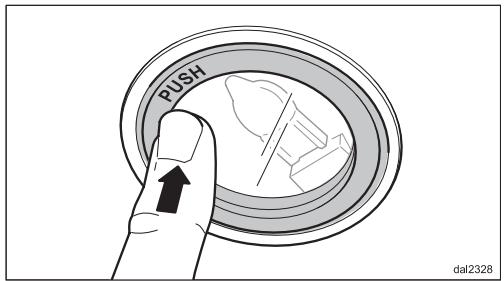
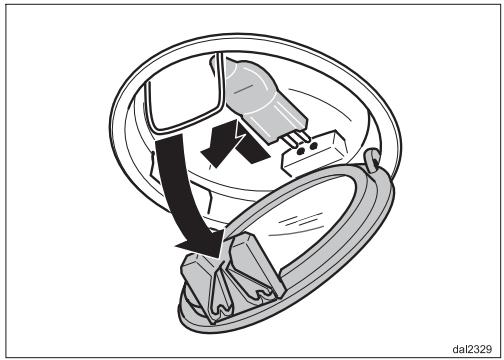
To change the halogen bulb, first gently press the light cover. The cover will open and can now be flipped down.
Pull the halogen bulb from its socket, then insert a new bulb.
- Flip the light cover back up, making sure it clicks into place.
Repairs
In the event of a fault which you cannot easily fix yourself, please contact the Miele Technical Service Department.
- When contacting the Technical Service Department, please quote the model and serial number of your appliance.
These are shown on the data plate which is visible when the grease filters are removed.
MieleCare
(USA only)
MieleCare, our Extended Service Contract program, gives you the assurance of knowing that your appliance investment is covered by 5 years of worry free ownership.
MieleCare is the only Extended Service Contract in the industry that guarantees repairs by a Miele Authorized Service Provider using genuine Miele parts. Only genuine Miele parts installed by factory trained professionals can guarantee the safety, reliability, and longevity of your Miele appliance.
Please note that unless expressly approved in writing by Miele's Service department, Extended Service Contracts offered by other providers for Miele products will not be recognized by Miele. Our goal is to prevent unauthorized (and untrained) service personnel from working on your Miele products, possibly doing further damage to them, you and/or your home.
To learn more about MieleCare Extended Service Contracts, please contact your appliance dealer or visit us online at:
http://miele.com/mielecare
Installation Instructions
Read these instructions and the "Important Safety Instructions" before installing this hood.
The installation steps are described in the enclosed "Installation Diagram".
Leave these instructions with the appliance for the consumer/user.
Information is subject to change. Please refer to our website to obtain the most current product specification, technical & warranty information.
Disposal of packing material
The cardboard box and packing materials protect the appliance during shipping. They have been designed to be biodegradable and recyclable. Please recycle.
DANGER
Ensure that any plastic wrappings, bags, etc., are disposed of safely and kept out of the reach of babies and young children. Danger of suffocation!
Disposal of an old appliance
Old appliances may contain materials that can be recycled. Please contact your local recycling center about the possibility of recycling these materials.
Before discarding an old appliance, disconnect it from the electrical supply and cut off the power cord to prevent it from becoming a hazard.
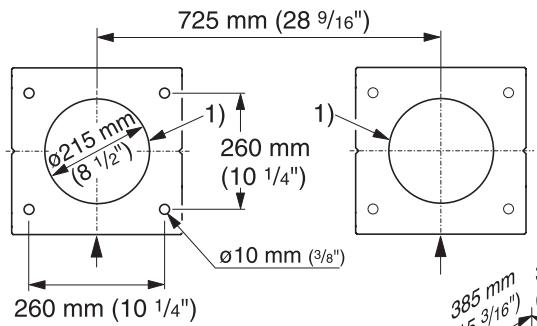
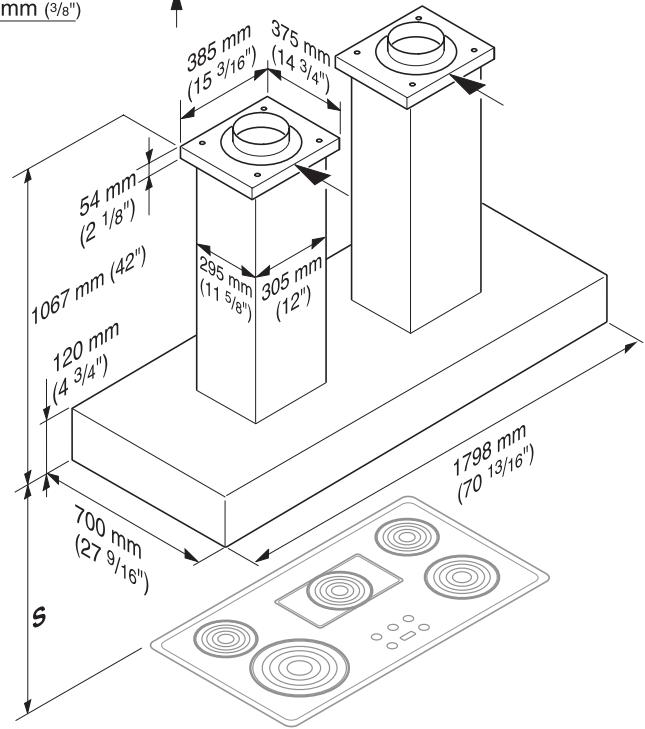
dai2273us
Exhaust connection 2 × 6" ( 2 × 150 ~mm ) diameter
1) Opening for ductwork and power cord
Distance between cooktop and hood (S)
Do not install this exhaust hood over cooktops burning solid fuel.
Provided a larger distance is not given by the manufacturer of the cooktop, follow the minimum safety distances between a cooktop and the bottom of the hood:
| Miele Cooktops | Non-Miele Cooktops | |
| Electric Cooktops | 24" (610 mm) | |
| Electric Barbeques and Fryers | 26" (660 mm) | |
| Multiburner Gas cooktops ≤ 43,000 BTU (12.6 KW) and no burner > 15,000 BTU (4.5 KW) | 26" (660 mm) | 30" (760 mm) |
| Single burner (Wok) ≤ 20,500 BTU (6 KW) | 26" (660 mm) | 30" (760 mm) |
| All other gas cooktops | 30" (760 mm) | |
- If several gas surfaces are installed under the hood, the total output must be considered when determining the minimum safety distance.
- Be sure to follow the minimum safety distances given by the gas cooktop manufacturer to easily flammable materials e.g. upper cabinets.
- If local building codes require a greater safety distance, follow their requirement.
- If there is more than one appliance beneath the hood and they have different minimum safety distances always select the greater distance.
See "Important Safety Instructions" for further information.
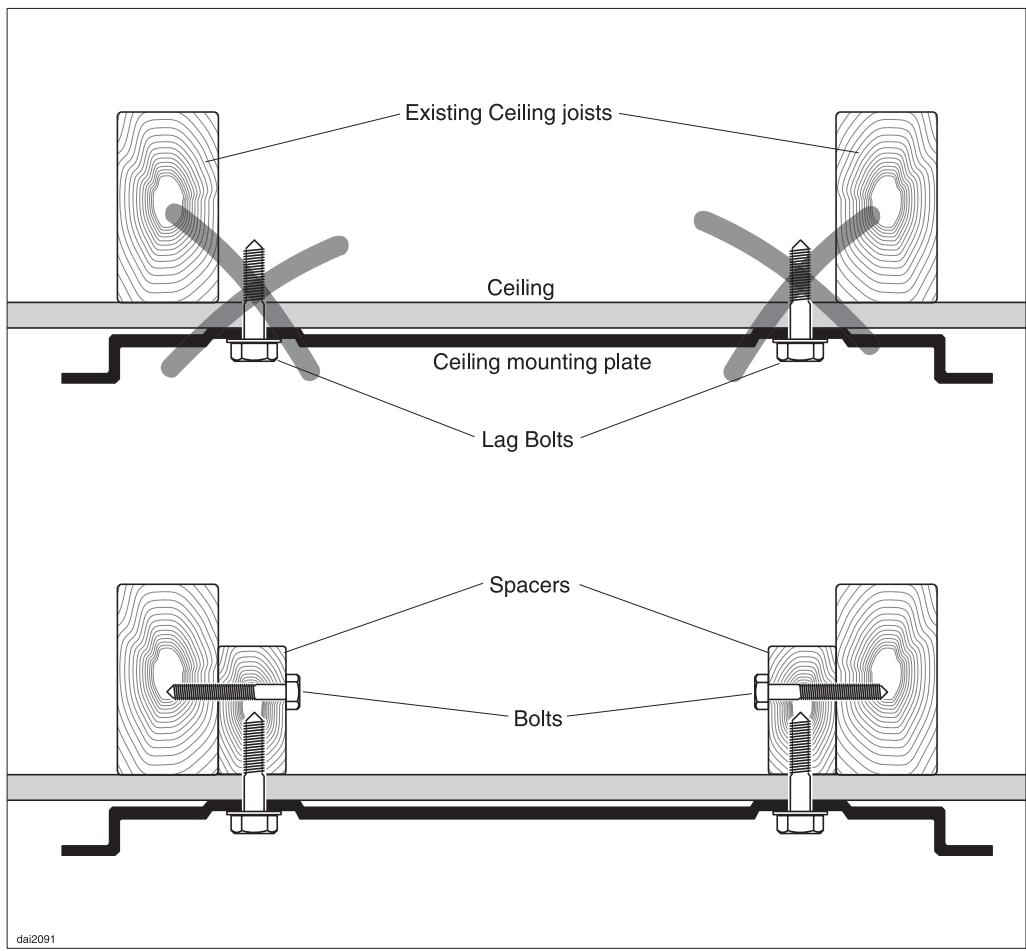
The ceiling mounting plate will support the weight of the hood. This ceiling plate must be attached to rigid structural framing that is supported in its entirety by the ceiling joists, or to the ceiling joists directly. Do not attach the plate directly to the ceiling with anchors, toggle bolts, etc.
CAUTION
When cutting or drilling into the wall or ceiling, do not damage electrical wiring and other hidden utilities.
Protective film
The casing is covered with a protective film to prevent scratching during transport.
Peel off the film before installing the casing parts.

CAUTION
To avoid risk of hand or other injury, avoid contact with sharp edges during the assembly and installation process.
Installation accessories
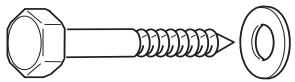
8 Screws 8 x 60 mm with 8 Washers
for securing the ceiling plate.
(S8 wall anchors included in the packaging are not for use in USA)

4 Screws M 4 x 8 mm
for adjusting the chimney.
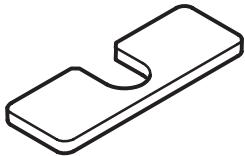
8 leveling plates
for correcting an uneven ceiling.
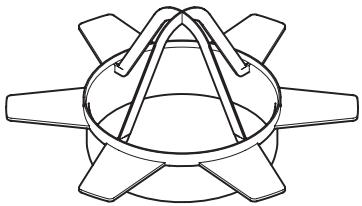
2 exhaust connectors
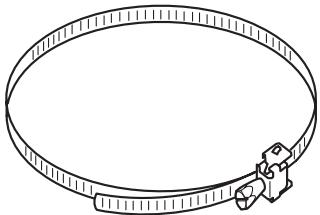
2 hose clips for securing the ducting.

WARNING
Danger of toxic fumes.
Gas cooking appliances release carbon monoxide that can be harmful or fatal if inhaled. To reduce the risk of fire and to properly exhaust air, the exhaust gases extracted by the hood should be vented outside of the building only.
Do not vent exhaust air into spaces within walls or ceilings or in attics, crawl spaces, or garages
To reduce the risk of fire, only use metal ductwork.
Please read and follow the
"IMPORTANT SAFETY
INSTRUCTIONS" to reduce the risk of personal injury. Follow all local building codes when installing the hood.
Exhaust ducting and connections
- The ducting should be as short and straight as possible, and the number of sharp bends should be minimized.
- For most efficient air extraction, the diameter of the ductwork should not be less than 6'' (150 mm). Use of flat ducts also reduces the air extraction efficiency.
- Noise levels of the hood will increase if flat ducts or round ducts of less than 6'' (150 mm) in diameter are used.
- Use smooth or flexible pipes made from approved non-flammable materials for exhaust ducting.
- Where the ductwork is horizontal, it must slope away from the hood at least 1/8 per foot (1 cm per meter) to prevent condensation dripping into the appliance.
- If the exhaust is ducted through an outside wall, a Telescopic Wall Vent is recommended.
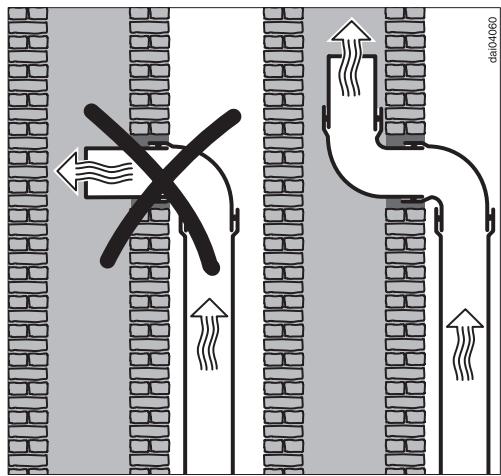
- If the exhaust is ducted into an inactive flue, the air must be expelled parallel to the flow direction of the flue.
Never connect an exhaust hood to an active chimney, dryer vent, flue, or room venting ductwork. Seek professional advice before connecting an exhaust hood vent to an existing, inactive chimney or vent flue.
Important
If the ductwork runs through rooms, ceilings, garages, etc. where temperature variations exist, it may need to be insulated to reduce condensation.
Condensate trap
optional accessory
In some cases, a 2 condensate traps may be required to collect and evaporate any condensation which may develop. This optional accessory is available for ducts 5'' (125 mm) and 6'' (150 mm) in diameter.
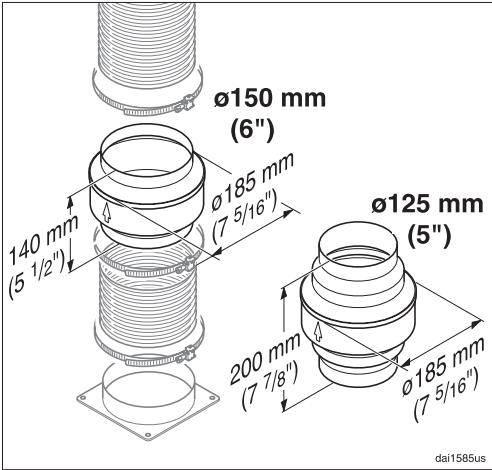
- When installing the condensate traps, ensure that they are positioned vertically and if possible directly above the exhaust outlet.
WARNING
TO REDUCE THE RISK OF FIRE, ELECTRIC SHOCK, OR INJURY TO PERSONS, OBSERVE THE FOLLOWING:
All electrical work should be performed by a qualified electrician in strict accordance with national regulations (for USA: ANSI-NFPA 70) and local safety regulations.
Installation, repairs and other work by unqualified persons could be dangerous.
Ensure that power to the appliance is off while installation or repair work is performed.
Verify that the voltage, load and circuit rating information found on the data plate (located behind the grease filter), match the household electrical supply before installing the hood.
This appliance requires two electrical mains cables. Each one must be connected via a suitable isolator which complies with local and national safety regulations. Their on/off switches must be easily accessible after the appliance has been built in.
If there is any question concerning the electrical connection of this appliance to your power supply, please consult a licensed electrician or contact Miele's Technical Service Department.
USA
1-800-999-1360
CDN
1-800-565-6435
WARNING:
THIS APPLIANCE MUST BE GROUNDED
Important
To increase security before the machine is installed, it is recommended to install a protective switch (30 mA).
Important
The hood must be hard wired accordingly:
Black/Red wire: . . . . connect to L1 (live)
White wire: . . . . . connect to N (neutral)
Green wire: . . connect to GND (ground)
Maximum load. 820 W
Fan. 2 x 350 W
Lighting . 6 x 20 W
Voltage 120V
Frequency 60 Hz
Circuit rating. 15 A
Weight. 187 lb (85 kg)
U.S.A. Miele, Inc.
National Headquarters
9 Independence Way
Princeton, NJ 08540
Phone: 800-843-7231
609-419-9898
Fax: 609-419-4298
www.mieleusa.com
Technical Service & Support Nationwide
Phone: 800-999-1360
Fax: 888-586-8056
TechnicalService@mieleusa.com
Germany
Miele & Cie. KG
Canada Miele Limited
Headquarters and Showroom
161 Four Valley Drive
Vaughan, ON L4K 4V8
Phone: 800-643-5381
905-660-9936
Fax: 905-532-2290
www.miele.ca
professional@miele.ca
(commercial enquiries)
MieleCare National Service
Phone: 800-565-6435
905-532-2272
Fax: 905-532-2292
customercare@miele.ca
(general and technical enquiries)