
KAC-X810D - Car amplifier KENWOOD - Free user manual and instructions
Find the device manual for free KAC-X810D KENWOOD in PDF.



| Product Type | Car Amplifier |
| Brand | KENWOOD |
| Model | KAC-X810D |
| Maximum Output Power | 1600 W x 1 (4 Ω) |
| Rated Output Power (4 Ω, 14.4 V) | 400 W x 1 |
| Rated Output Power (2 Ω, 14.4 V) | 800 W x 1 |
| Rated Output Power (1 Ω, 14.4 V) | 1000 W x 1 |
| Frequency Response | 5 Hz - 200 Hz (+0, -3 dB) |
| Total Harmonic Distortion | 0.2 % (100 Hz) |
| Signal-to-Noise Ratio | 100 dB |
| Input Sensitivity | 0.2 V - 5.0 V |
| Input Impedance | 10 kΩ |
| Low-Pass Filter | 50 - 200 Hz (24 dB/octave) |
| Subsonic Filter | Off / 15 Hz / 25 Hz (24 dB/octave) |
| Band Reject Filter | 40 - 100 Hz (variable) |
| B.M.S. (Bass Amplifier) | Off / +6 / +12 / +18 dB (40 - 100 Hz) |
| Power Supply Voltage | 14.4 V (11 - 16 V) |
| Current Consumption | 51 A (at 4 Ω, 12 V, 10% THD) |
| Dimensions (W x H x D) | 283 x 58 x 350 mm |
| Fuse | 25 A x 3 |
| Amplifier Type | Class D |
| Variable Color | Yes (7 colors + variable mode) |
| Protection Function | Color LED indicator (short circuit, overheating, etc.) |
| Supplied Accessories | Screws, covers, hex key, mounting brackets |
Frequently Asked Questions - KAC-X810D KENWOOD
User questions about KAC-X810D KENWOOD
0 question about this device. Answer the ones you know or ask your own.
Ask a new question about this device
Download the instructions for your Car amplifier in PDF format for free! Find your manual KAC-X810D - KENWOOD and take your electronic device back in hand. On this page are published all the documents necessary for the use of your device. KAC-X810D by KENWOOD.
USER MANUAL KAC-X810D KENWOOD
Take the time to read through this instruction manual.
Familiarity with installation and operation procedures will help you obtain the best performance from your new power amplifier.
For your records
Record the serial number, found on the back of the unit, in the spaces designated on the warranty card, and in the space provided below.
Refer to the model and serial numbers whenever you call upon your KENWOOD dealer for information or service on the product.
Model KAC-X810D/PS810D Serial number
WARNING
To prevent injury or fire, take the following precautions:
- When extending the ignition, battery, or ground wires, make sure to use automotive-grade wires or other wires with a 14mm^2 (AWG6) or more to prevent wire deterioration and damage to the wire coating.
- To prevent a short circuit, never put or leave any metallic objects (such as coins or metal tools) inside the unit.
- If the unit starts to emit smoke or strange smells, turn off the power immediately and consult your Kenwood dealer.
- Do not touch the unit during use because the surface of the unit becomes hot and may cause burns if touched.
CAUTION
To prevent damage to the machine, take the following precautions:
- Be sure the unit is connected to a 12V DC power supply with a negative ground connection.
- Do not open the top or bottom covers of the unit.
- Do not install the unit in a spot exposed to direct sunlight or excessive heat or humidity. Also avoid places with too much dust or the possibility of water splashing.
- When replacing a fuse, only use a new one with the prescribed rating. Using a fuse with the wrong rating may cause your unit to malfunction.
- To prevent a short circuit when replacing a fuse, first disconnect the wiring harness.
NOTE
If you experience problems during installation, consult your Kenwood dealer.
- If the unit does not seem to be working right, consult your Kenwood dealer.
FCC WARNING
This equipment may generate or use radio frequency energy. Changes or modifications to this equipment may cause harmful interference unless the modifications are expressly approved in the instruction manual. The user could lose the authority to operate this equipment if an unauthorized change or modification is made.
NOTE
This Class B digital apparatus complies with Canadian ICES-003.
Cleaning the unit
If the front panel gets dirty, turn off the power and wipe the panel with a dry silicon cloth or soft cloth.
CAUTION
Do not wipe the panel with a hard cloth or a cloth dampened by volatile solvents such as paint thinner and alcohol. They can scratch the surface of the panel and/or cause the indicator letters to peel off.
To prevent batter rise
When the unit is used in the ACC ON position without turning the engine ON, it depletes the battery. Use it after starting the engine.
Protection function
There is a Protection function installed in the unit to protect the unit and speakers from various problems. When Protection operates, the indicator informs you of the condition. (Refer to page 5)
Accessories
| Part name | External View | Number of Items |
| Self-tapping screws (ø5 × 18 mm) | 4 | |
| Terminal caver | 2 | |
| Mounting Hardware | 4 | |
| Hexagon socket head cap screw (M3 × 8 mm) | 4 | |
| Self-tapping screws (ø3 × 8 mm) | 4 | |
| Hexagon Wrench | 1 |
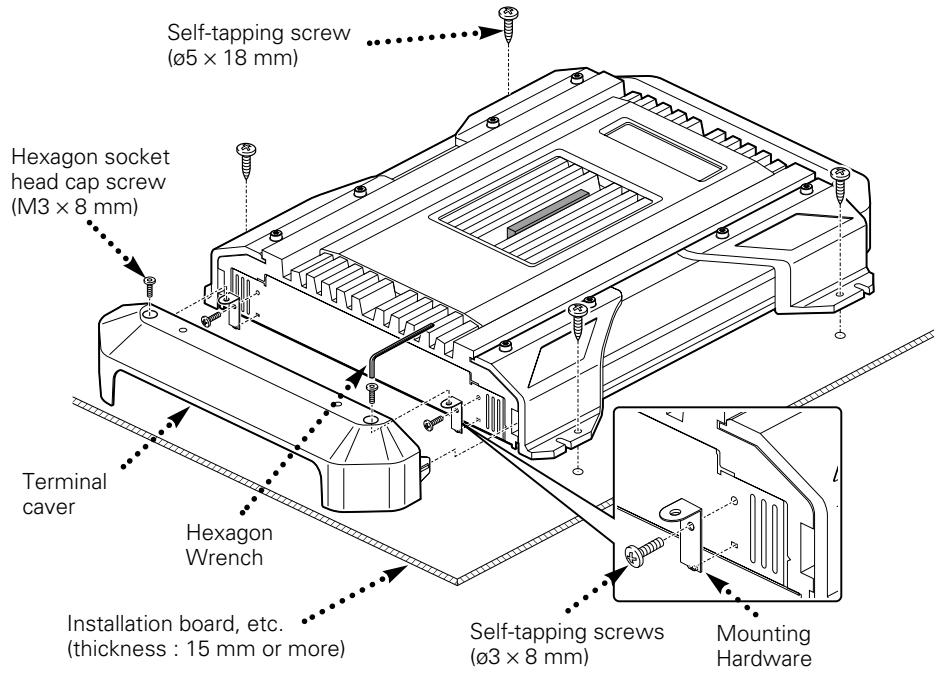
- Install the installation fittings in the unit.
- Attach the unit.
3.Install the terminal cover.
CAUTION
- Do not install in the below locations;
(Unstable location, In a location that interferes with driving, In a location that gets wet, In a dusty location, In a place that gets hot, In a place that gets direct sunlight, In a location that gets hit by hot air)
- Do not install the unit under the carpet. Otherwise heat build-up occurs and the unit may be damaged.
- Install this unit in a location which allows heat to easily dissipate.
Once installed, do not place any object on top of the unit.
- The surface temperature of the amplifier will become hot during use. Install the amplifier in a place where people, resins, and other substances that are sensitive to heat will not come into contact with it.
- When making a hole under a seat, inside the trunk, or somewhere else in the vehicle, check that there is nothing hazardous on the opposite side such as a gasoline tank, brake pipe, or wiring harness, and be careful not to cause scratches or other damage.
- Do not install near the dashboard, rear tray, or air bag safety parts.
- The installation to the vehicle should securely fasten the unit to a place in which it will not obstruct driving. If the unit comes off due to a shock and hits a person or safety part, it may cause injury or an accident.
- After installing the unit, check to make sure that electrical equipment such as the brake lamps, turn signal lamps and windshield wipers operate normally.
About D-class
A D-class amplifier uses an inaudible frequency as a switching pulse to change the pulse width to represent the music signal. (Pulse Width Modulation: P.W.M.)
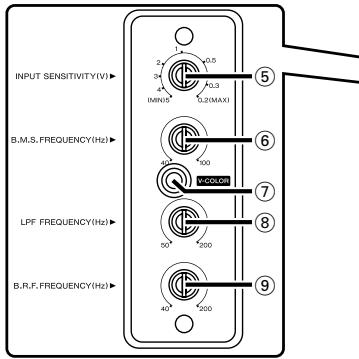
⑤ INPUT SENSITIVITY control
Adjust this control according to the pre-out level of the center unit connected to this amplifier.
NOTE
Refer to "Specifications" on the center unit's instruction manual about the pre-out level.
LPF(Low-Pass Filter) FREQUENCY control
This control adjusts the frequency band output from this unit.
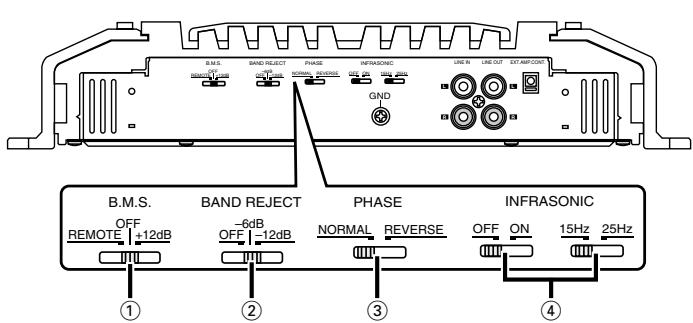
② BAND REJECT filter switch
When this switch is set to "-6dB"/-12dB", frequencies in the band set with the B.R.F. FREQUENCY control are rejected and eliminated. The band rejection allows to reduce resonance inside the vehicle compartment and standing waves. (page 6)
B.R.F. FREQUENCY control
Sets the rejection frequency when the BAND REJECT switch is set to "-6dB"/-12dB". (page 6)
4 INFRASONIC switch (OFF/ON)
When this switch is set to "ON", the inaudible, ultralow frequencies below the frequency set with the 15Hz/25Hz switch are cut off. This improves the reproduction performance of the speakers by eliminating unnecessary oscillations which will not become sound.
(15Hz/25Hz)
Switches the cutoff frequency when the OFF/ON switch is set to "ON".
(3) PHASE switch
When this switch is set "REVERSE" (Reverse: 180^ ) the speaker output phase is reversed.
① B.M.S.(Bass management system) switch
Bass boost centered on the frequency set by the B.M.S. FREQUENCY control.
+12 position:
Bass boost +12 dB
OFF position: Bass boost OFF
- REMOTE position: Controls the B.M.S. from the Kenwood center unit. (Refer to page 5)
⑥ B.M.S. FREQUENCY control
When the B.M.S. switch is set on +12dB /"REMOTE" the emphasized center frequency is adjusted.
⑦ V-COLOR (Variable color) button
Select the ON color for the indicator. Every time the button is pressed, 7 fixed colors and the variable color change. The color can't be set when the indicator is blinking.
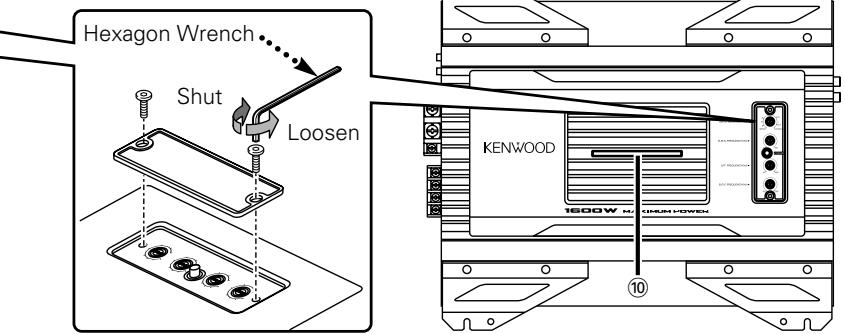
Removing the cover
Controlling the B.M.S. from the Kenwood center unit
(B.M.S.: Bass management system)
When the B.M.S. switch is set in the remote position, the bass boost amount and frequency offset can be controlled from the center unit.
- Bass boost
| Center unit display | Setting |
| "Flat"/"OFF"/"1" | Bass boost OFF (Flat) |
| "+6"/"1"/"2" | Bass boost +6 dB |
| "+12"/"2"/"3" | Bass boost +12 dB |
| "+18"/"3"/"4" | Bass boost +18 dB |
Frequency offset
| Center unit display | Setting |
| "Normal" | It is the B.M.S. FREQUENCY control adjustment value. |
| "Low" | The central frequency is 20-30% low. |
NOTE
For the center unit control method and setting display, refer to the Instruction Manual for the center unit.
There may be cases when the center unit can't set the "Bass boost +18dB" or
"Frequency Offset".
Indicator 10
You are notified of the unit's condition and malfunction (Protection function) by the indicator.
- ON or color change in order.
When operation is normal
NOTE
The color you want can be selected with the variable color button.
The color blinks blue
- When during operation
- When the center unit/B.M.S. switch controls the B.M.S.
The color blinks yellow
When the power voltage is less than 11V.
NOTE
The cause may be one of the below times.
- When the vehicle battery is weak.
- When the battery capacity is low.
- When the battery cord is worn.
- When the battery wire is too small or too long and can't supply enough current.
The color blinks purple
When the unit has failed and direct current voltage is generated to the speaker's output.
NOTE
Turn the power OFF and release the protection. If the indicator doesn't quit blinking, contact your Kenwood dealer.
The color blinks red
When the inside of the unit is overheating.
The color blinks green
- When the speaker cord is shorted.
- When the speaker output is in contact with the vehicle ground.
The acoustic properties of vehicle compartment tend to cause oscillation due to resonance or unclearness of sound due to standing waves at certain frequencies. The band reject filter can solve the problems of resonance or unclear sound with minimum influence on the sound quality because it eliminates only the frequencies causing resonance or standing waves.
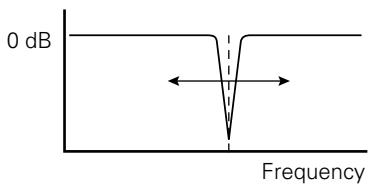
■ Adjustment method:
The band reject filter cuts only the limited frequencies to minimize influence on the sound quality. Therefore, its effect cannot be obtained unless the cutoff frequencies are set accurately to the frequencies causing resonance and standing waves. The band reject filter can be adjusted according to what you feel through your ears, but we recommend the use of a signal generator or a spectrum analyzer with a fine frequency measurement capability for the adjustment.
- Adjustment using a signal generator:
Output a sine wave, vary its frequency to find the frequencies at which the vehicle compartment resonates or volume increases (standing waves occur), and set the B.R.F. FREQUENCY control to the position with which the resonance and standing waves disappear.
- Adjustment using a spectrum analyzer:
Output white noise (sound in which all frequencies are at a certain level), find the peak frequency observed on the spectrum analyzer, and set the B.R.F. FREQUENCY control to the position with which the peak observed on the spectrum analyzer disappears.
Connection
Installation procedure
Since there are large variety of settings and connections possible according to applications, read the instruction manual well to select the proper setting and connection.
- Remove the ignition key and disconnect the negative terminal of the battery to prevent short circuits.
- Set the unit according to the intended usage.
- Connect the input and output wires of the units.
- Connect the speaker wires.
- Connect the power wire, power control wire and grounding wire following this order.
- Install the unit in the car.
- Connect the negative terminal of the battery.
CAUTION
- If sound is not output normally, immediately turn power off and check connections.
- Be sure to turn the power off before changing the setting of any switch.
- If the fuse blows, check wires for shorts, then replace the fuse with one of the same rating.
- Check that no unconnected wires or connectors are touching the car body. Do not remove caps from unconnected wires or connectors to prevent short circuits.
- Connect the speaker wires to appropriate speaker connectors separately. Sharing the negative wire of the speaker or grounding speaker wires to the metal body of the car can cause this unit to fail.
- After installation, check that the brake lamps, winkers, and wipers work properly.
Terminal names
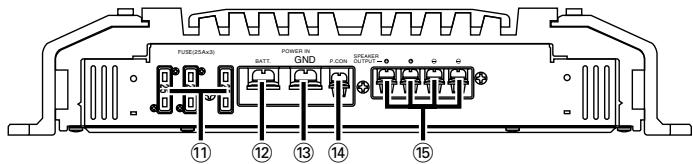
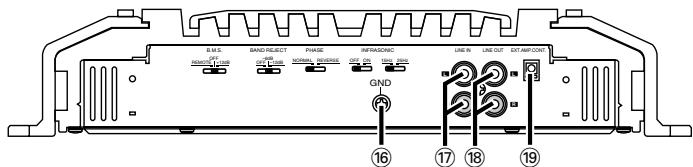
⑪ Fuse (25 A × 3)
② Battery terminal
Ground terminal
15 Speaker output terminals
As this unit accepts speakers with a minimum impedance of 1 ohm, connect speakers with 1-ohm or higher impedance to these terminals.
CAUTION
The rated input of the speakers should be no less than the maximum output of the amplifier. Otherwise malfunction may result.
16 RCA cable ground lead terminal
When using an RCA cable with a ground lead attached, connect the ground lead to this terminal.
LINE IN terminal
18 LINE OUT terminal
The signal that's input from the line input terminal is output.
14 Power control terminal
Controls the unit ON/OFF.
NOTE
Controls the unit power. Be sure to connect it with all the systems.
19 EXT.AMP.CONT. (external amplifier control) terminal
Controls the B.M.S. Only Kenwood center unit models sold in 1999 or later with a "EXT.CONT."/"EXT.AMP.CONT." wire attached can be used.
Also, a maximum of 3 power amplifiers can be operated at the same time.
NOTE
There are cases when operation may not be possible due to wiring wire type and length.
Power wire connection
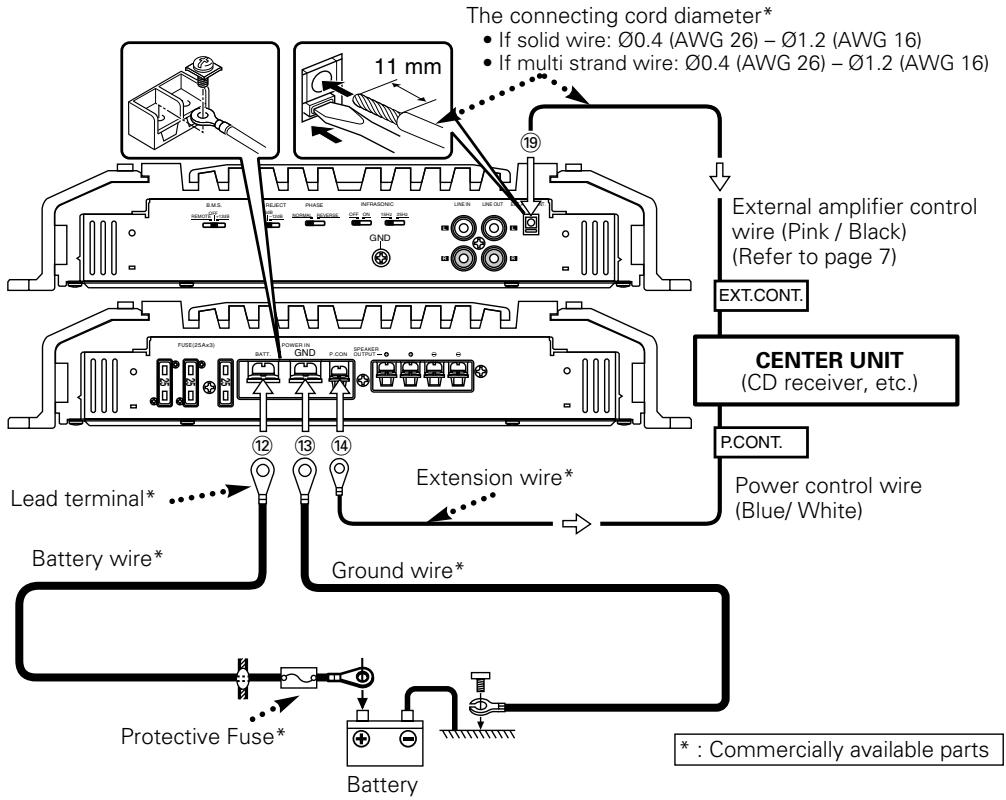
WARNING
To prevent fire caused by a short in the wiring, connect a fusible link or breaker nearby the battery's positive terminal.
Wiring
- Take the battery wire for this unit directly from the battery. If it's connected to the vehicle's wiring harness, it can cause blown fuses etc.
- If a buzzing noise is heard from the speakers when the engine is running, connect a line noise filter (optional) to each of the battery wire.
- Do not allow the wire to directly contact the edge of the iron plate by using Grommets.
- Connect the ground wire to a metal part of the car chassis that acts as an electrical ground passing electricity to the battery's negative terminal. Do not turn the power on if the ground wire is not connected.
- Be sure to install a protective fuse in the power cord near the battery. The protective fuse should be the same capacity as the unit's fuse capacity or somewhat larger.
- For the power cord and ground, use a vehicle type (fireproof) power wiring cord with a current capacity greater than the unit's fuse capacity. (Use a power wiring cord with a diameter of 14 mm² (AWG 6) or greater.)
- When more than one power amplifier are going to be used, use a power supply wiring wire and protective fuse of greater current-handling capacity than the total maximum current drawn by each amplifier.
EXT.AMP.CONT. (external amplifier control) terminal 19
- Peel the cladding of wire for a length of 11mm from the end.
- While pressing the lock release button with a slotted screwdriver, insert the wire.
RCA cable and speaker wire connection
*: Commercially available parts
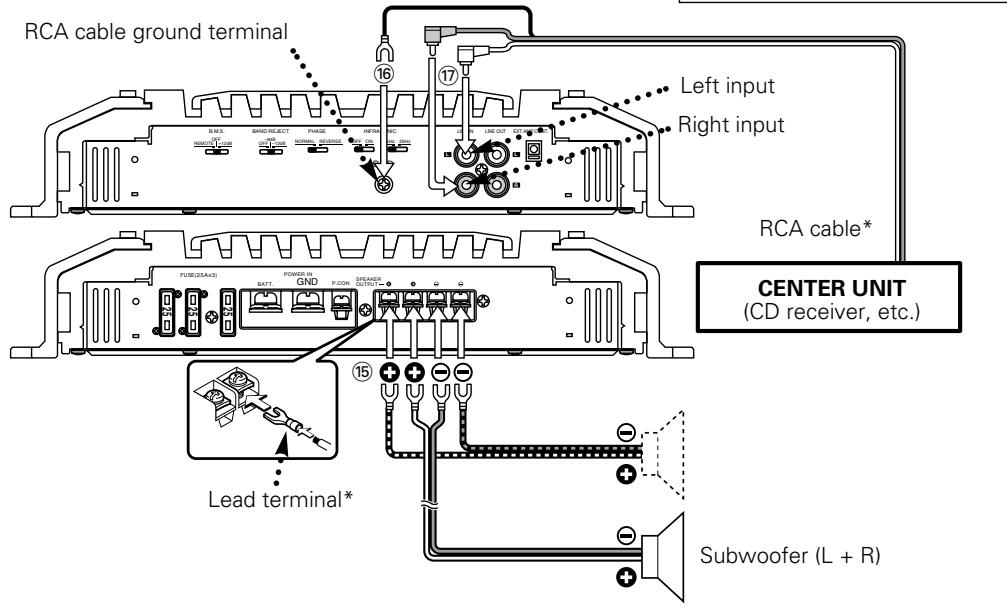
■ Speaker Selection
- The rated input power of the speakers that are going to be connected should be greater than the maximum output power (in Watts) of the amplifier. Use of speakers having input power ratings that are less than the output power of the amplifier will cause smoke to be emitted as well as damage.
- Use speakers that have an impedance of 1 or greater. When more than one set of speakers are going to be used, calculate the combined impedance of the speakers and then connect suitable speakers to the amplifier.
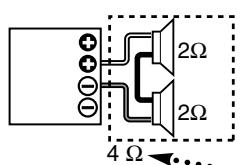
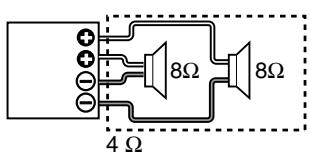
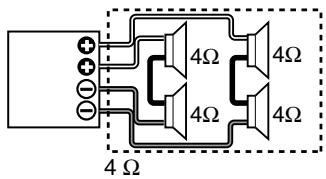
Combined impedance
Troubleshooting Guide
What might appear to be a malfunction in your unit may just be the result of slight misoperation or miswiring. Before calling service, first check the following table for possible problems.
| PROBLEM | POSSIBLE CAUSE | SOLUTION |
| No sound. (No sound from one side.) | · Input (or output) cables are disconnected. · Protection circuit may be activated. · Volume is too high. · The speaker cord is shorted. | · Connect the input (or output) cables. · Check connections by referring to "Indicator". · Replace the fuse and use lower volume. · After check the speaker cord and fixing the cause of the short, replace the fuse. |
| (Blown fuse.) | ||
| The output level is too small (or too large). | The input sensitivity adjusting control is not set to the correct position. | Adjust the control correctly referring to "Controls". |
| The sound quality is bad. (The sound is distorted.) | · The speakers wire are connected with wrong ± / - polarity. · A speaker wire is pinched by a screw in the car body. · The switches may be set improperly. | · Connect them properly checking the ± / - of the terminals and wires well. · Connect the speaker wire again so that it is not pinched by anything. · Set switches properly by referring to "Controls". |
| The external amplifier controller (B.M.S.) will not work. | · The B.M.S. switch setting is incorrect. · The external amplifier control wire has come loose. | · The B.M.S. switch is set to "REMOTE". · Check that the external amplifier control wire is properly connected. |
Specifications subject to change without notice.
Audio Section
Max Power Output (4 Ω) 1600 W × 1
Rated Power Output (+B = 12.0V)
(4Ω) 300 W × 1 (20 Hz - 200 Hz, 0.5 % THD)
(2Ω) 600 W × 1 (100 Hz, 0.5 % THD)
Rated Power Output (+B = 14.4V)
(4Ω) 400 W × 1 (20 Hz - 200 Hz, 0.5 % THD)
(4Ω) 400 W × 1 (DIN45324, +B = 14.4 V)
(2Ω) .800 W × 1 (100 Hz, 0.5 % THD)
(1Ω) 1000 W × 1 (100 Hz, 1.0 % THD)
Frequency Response (+ 0, -3 dB) .5 Hz - 200 Hz
Total Harmonic Distortion (Rated power)* .0.2% (100 Hz)
Sensitivity (rated output) (MAX.) 0.2 V
(MIN.) 5.0 V
Signal to Noise Ratio 100 dB
Input Impedance 10 kΩ
Low Pass Filter Frequency (24 dB/oct.) 50 - 200 Hz (variable)
Infrasonic Filter Frequency (24 dB/oct.) OFF / 15 / 25 Hz
Band Reject Filter Frequency 40 - 200 Hz (variable)
B.M.S. (40 - 100 Hz : variable) OFF / +6 / +12 / +18 dB
Sensitivity = MIN., Through LPF (30 kHz)
General
Operating Voltage 14.4 V (11 - 16 V allowable)
Current Consumption (+B = 12.0V,4 ,10% THD) .51 A
Dimensions (W× H× D) 283x58x350mm
11-1/3 × 2-5/16 × 13-3/4 inch
Weight 5.7 kg (12.5 lbs)
AVERAGEMENT
- Position REMOTE():
11-1/3 x 2-5/16 x 13-3/4 inch
Poids 5,7 kg (12,5 lbs)
ADVERTENCIA
11-1/3 x 2-5/16 x 13-3/4 inch