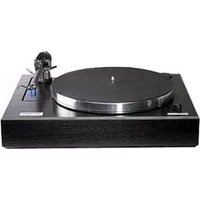
TD 350 - Turntable THORENS - Free user manual and instructions
Find the device manual for free TD 350 THORENS in PDF.


| Product Type | Belt-drive turntable |
| Model | Thorens TD 350 |
| Drive System | Precision-ground belt drive |
| Motor | Electronically controlled AC synchronous motor |
| Speeds | 33 1/3 and 45 rpm |
| Speed Selection | Electronic lever |
| Platter | 300 mm, 4.5 kg, non-magnetic |
| Tonearm | Thorens TP 250 |
| Anti-skating | Magnetic |
| VTA Adjustment | Yes, via clamp mechanism |
| Azimuth Adjustment | Not adjustable on TP 250 |
| Overhang Setting | Recommended 17 mm |
| Tracking Force Range | 10 to 25 mN (1.0 to 2.5 pond) |
| Power Supply | External transformer, 230/115 V, 50/60 Hz |
| Power Consumption | Not specified |
| Output Level | Phono (requires RIAA preamp) |
| Capacity of Leads | 140 pF |
| Dimensions (W x D x H) | 440 x 346 x 160 mm |
| Weight | 10 kg |
| Finish | Black ash, red ash, natural maple |
| Included Accessories | Power cord, transformer, RCA cables, platter, felt mat, counterweight, drive belt, 45 rpm adaptor, acrylic dustcover, tonearm gauge, spirit level, Allen wrench |
| Maintenance | Wipe with moist cloth; avoid dry cloth; replace belt every 2 years; lubricate bearing after 5 years |
| Cartridge Compatibility | Standard 1/2-inch mount |
| Warranty | 24 months for tonearm; turntable covered by legal warranty |
| Country of Manufacture | Germany |
Frequently Asked Questions - TD 350 THORENS
User questions about TD 350 THORENS
0 question about this device. Answer the ones you know or ask your own.
Ask a new question about this device
Download the instructions for your Turntable in PDF format for free! Find your manual TD 350 - THORENS and take your electronic device back in hand. On this page are published all the documents necessary for the use of your device. TD 350 by THORENS.
USER MANUAL TD 350 THORENS
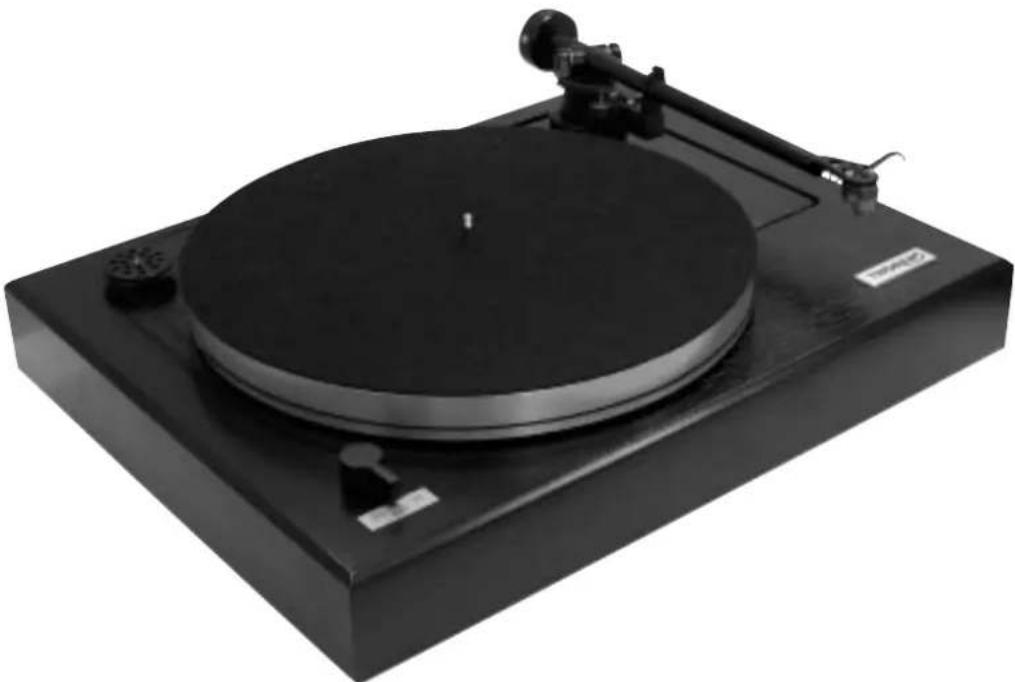
TD 350


English Version starts at page 12
Abbildung1
English Table of Contents:
Setup, Placement 14
Tonearm, Azimuth 16
General Hints 18
Warranty 20
Techn. Specifications 21
Please check if each of the following items have been supplied:
1 x THORENS record player TD 350
1 x Power cord
1 x Mains transformer unit
1 x RCA interconnect
1 x Platter
1 x Felt mat
1 x Tonearm counterweight
1 x Drive belt
1 x Adaptor for single records
1 x Acrylic dustcover
1 x Tonearm gauge
1 x Spirit-level
1 x Allen wrench
Declaration of Conformity
This is to certify that the device, to which this instruction manual belongs and by the time this manual was printed, has been manufactured in accordance to valid EC regulations in order to obtain the CE-label. All required examinations and tests have successfully been carried out.
Dear THORENS customer:
Thank you very much for your confidence in our product, the record player TD 350. With the purchase of this device you have acquired a precision instrument for the purpose of playing back analogue records. This appliance however requires your attention with respect to set-up, placement and handling in order to achieve a flawless operation. The TD 350 has been designed and assembled completely in Germany which will guarantee you the highest quality to be maintained for years to come. Understandably, you want to listen to your beloved records right away but we strongly advise that you read these instructions attentively before proceeding with the set-up, simply to ensure long-lasting listening pleasure. We have spared no efforts to pack all necessary information and comprehensive guidance into this manual, yet in the event that you have any further queries regarding your new record player please do not hesitate to ask your THORENS dealer for further assistance.
Sincerely yours,
THORENS TEAM
1. General
The TD 350 is a subchassis record player of latest generation. It unites the advantages of subchassis players with those of mass turntables in an ideal way. The built-in electronic steering device decouples the motor completely from inevitable mains fluctuations.
This leads to incredibly low values of rumble and wow/flutter which go far beyond the values ever achieved by older constructions. To get the full sound quality please follow the set-up steps carefully.
2. Placement, set-up and connecting the TD 350
Put the TD 350 onto a horizontal support close to your audio amplifier. Check the unit's level position with the help of the supplied bubble. If necessary you may have to adjust the support accordingly.
Now remove the factory-installed transport retaining screws for the sub-chassis. The sub-chassis should then be moving freely up and down. We highly recommend to keep these screws for any future transport of the TD 350 for which the sub-chassis should be arrested again.
Take the platter and very carefully insert its spindle into the bearing. While doing this do not apply any force. To avoid that the hardened steel spindle can damage the bushings just have the spindle gliding smoothly into the bearing. After the platter has set, you may turn it to see if it moves freely and without noise. Take the belt from its package and loop it around the outer rim of the platter and the motor pulley in the left rear corner of the plinth (see picture 1). Turn platter to make sure that the belt is not twisted, but runs flat. Put felt mat onto platter. This soft mat is to protect
you precious vinyl records from wear during playback.
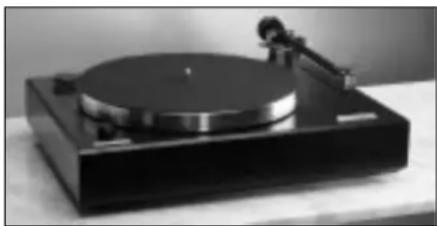
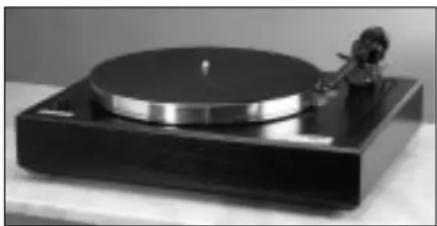
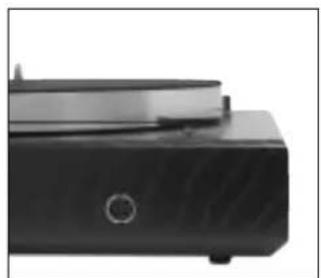
For the next step take the transformer unit and IEC power cord from the carton (see pictures 2 and 3). Connect the transformer lead with the designated voltage supply sokket at the rear side of the plinth (see picture

picture1
4) and the IEC power cord with a mains socket (230V). You may now check the function of the motor by turning the speed selector lever (see picture 5) to 331/3 and then to 45 rpm. The TD 350 incorporates an intelligent control circuitry which within the first two seconds is reducing the start-up speed to half its value while at the same time providing the platter with a doubled torque. Thus the heavy platter is reaching its nominal speed much earlier and, if
required, is safely starting up from 45 rpm also. Switch motor off (speed lever in middle position) and connect the supplied RCA leads (or one of your choice) with the RCA signal output jacks located at the rear panel on the left (see picture 6).
Please note: nearly all vinyl records have been made according to RIAA standards which means that their playback requires a special phono amplification stage in your amplifier which incorporates an electronic RIAA equalisation and step-up circuitry for the very low signal levels coming from

picture 6 picture 4

picture 2 picture 3

the pickup cartridge. Connecting the TD 350 to a so-called high-level input (e.g. AUX, CD, etc.) at your amplifier will result in a faint and distorted rendition. In the event that your amplifier does not feature a phono stage or one of lesser quality, we would like to recommend you to acquire the specially designed THORENS TEP 302 phono preamplifier. This separate unit features DIL switches for the optimal match of nearly any pickup cartridge.

picture 5
Lastly, remove the acrylic dustcover from the carton and carefully attach it to the hinges at the rear edge of the plinth. Make sure that the cover can be smoothly tilted up and down.
When mounting a heavier or lighter arm than our TP 250 it might be necessary to re-adjust the subchassis springs. If so please remove the platter, take up the covers of the spring adjusting screws and turn them into the corresponding direction till the subchassis with the platter is levelled out horizontal.
3. Mounting the pickup cartridge
Mount the pick-up cartridge to the slots in the headshell. While doing this basic work it is recommended to leave the stylus-guard attached in order to avoid that the delicate stylus and cantilever are damaged while mounting the cartridge.
You can mount any pick-up cartridge with standard 1/2-inch fixing holes using the respective hardware supplied. Carefully and with the help of tweezers, attach the pins of the cartridge to the tonearm's internal wiring as follows:
red right channel (R)
green ground of right channel (RG)
white left channel (L)
blue ground of left channel (LG)
For the time being do not tighten the headshell screws. One should be able to gradually slide the cartridge smoothly back and forth along the headshell slots. Fine-adjusting and fixing the cartridge is done after having determined the final tone arm height.
Please note: if pick-up cartridges from GRADO are going to be employed we recommend to fix the cartridge with the supplied screws "upside down". This means that the screw is inserted from underneath through the holes of cartridge and headshell whereby the nuts fix the screws on top of the headshell. This may perhaps look not very elegant, yet it saves you a lot of fumbling for the nuts and trying to get them onto the screws. It's because the nuts supplied with GRADO cartridges are simply a tad too large to fit neatly between cartridge body and screws.
4. Tonearm height adjustment (VTA)
If you have acquired your TD 350 with a factory-installed pickup cartridge you can disregard this chapter and proceed to chapter 7.
If not you should now continue with adjusting the tone-arm height. Put a record on the platter and lower the stylus. After the cartridge is in playing position view it from the side and check if the tonearm is aligned parallel to the record. If this is not the case the tone arm height needs to be re-adjusted.
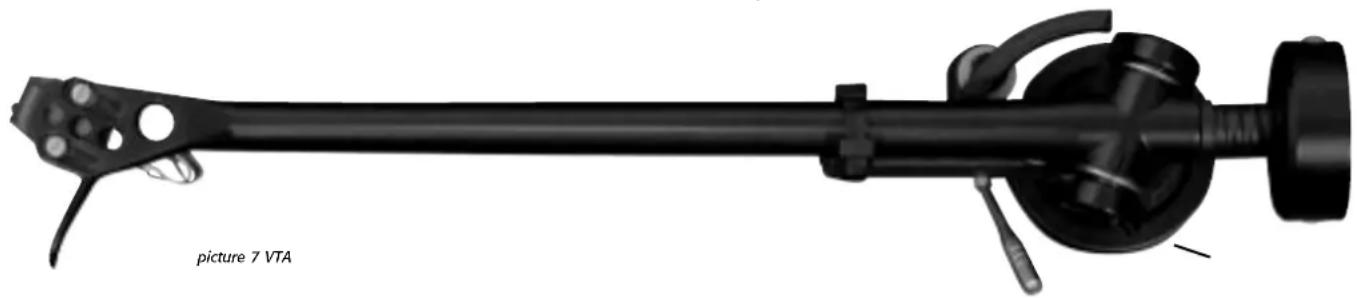
VTA is the abbreviation for vertical tracking angle. The VTA facility is used for an easy alignment of the tonearm parallel to the record, irrespective of the size of the pick-up cartridge. It's a known fact that the tonearm should always be parallel to the record after the stylus has set in the groove. However, owing to the often different dimensions or heights of pick-up cartridges among each other this goal can hardly be achieved every time. The VTA alignment facility developed by THORENS uses a clamp mechanism which surrounds the tonearm's main post at its base (picture 7). This provides a secure and very stable attachment
of the tonearm. Adjustments are made by simply loosening the clamp screw and carefully sliding the entire tonearm up or down. After the correct position for the VTA has been found the clamp screw is tightened again and, well, that's all.
5. Azimuth adjustment
Azimuth means the exact perpendicular position of the stylus in the record groove when viewed from the front. It should be exactly 90° if the stylus has been meticulously mounted onto the cantilever because otherwise it cannot precisely track the records. As azimuth cannot be adjusted with the TP 250 it is highly recommended to acquire only a quality pick-up cartridge with precisely mounted stylus and cantilever.
6. Adjusting overhang and offset angle
Offset is the angle embracing the longitudinal axis of both tonearm and cartridge. With all pivoted tonearms (like the ones from THORENS) the optimum offset angle is to be found between 21° and 24°. We recommend an offset angle of 23°.
Overhang is the distance between stylus tip and centre of the platter spindle. Usually, the overhang is defined between 12 and 20 mm yet should be adjusted to 17 mm. For this somewhat tricky work we advise to employ a special pick-up alignment gauge. As there are still many varieties commercially of such gauges available your THORENS dealer may have some recommendations.
After finishing the cartridge set-up you should now tighten the headshell screws to fix the cartridge in the correct position.
7. Adjustments of tracking force and anti-skating
Remove stylus-guard from cartridge. By turning the counterweight clock-wise (when viewed from behind) you can now apply the tracking force according to the recommendations or instructions supplied by the manufacturer of the cartridge.
One full turn of the counterweight is equivalent to a tracking force of 20 mN (2 pond) and half a turn equivalent to 10 mN (1 pond). A tracking force between 10 and 25 mN (1.0 to 2.5 pond) is quite usual.
Tracking force should not be set too low because the cartridge may not track correctly. Experience has it that a value closer to the maximum of the manufacturer's recommendation is usually better for the cartridge's tracking ability and the musical results as well.
Unlock the tonearm from its rest and move it slightly towards the platter. Anti-skating force can now be applied by means of the anti-skating (bias) button on the tonearm bench and the scale next to it. The value of the anti-skating force is usually equal to the value of the tracking force applied, yet some listening tests have revealed that a slightly lesser anti-skating force may sound better. The tonearm TP 250 is covered by a warranty of 24 months provided it has been used and handled with care according to its designated functions. Any modification of the internal signal leads or manipulations at the bearings will however void this warranty.
8. Playing records
Open the dustcover and put a record onto the platter. You should never play them without the protective felt mat. For the playback of single records we have supplied a suitable adaptor.
Before playing the record now we recommend to remove the surface dust by the use of a carbon-fibre brush or an antistatic cloth. In case of a heavy pollution it might be recommendable to use a long-play record washing-machine. Please ask your local dealer concerning this issue.
Switch on motor (by the speed selector lever), unlock tone-arm and move it over the desired groove to be played. Slowly lower tonearm by the lift lever. You may want to have the dustcover closed during playback, yet again experience has it that the "trapped" air cushion beneath the cover gets excited by the sound waves and is to interfere with the tonearm-cartridge interface. This process can deteriorate the sonic performance.
When lifting the tonearm up by the lift lever do this slowly in order to avoid the tonearm bouncing about the record. For sonic reasons the TD 350 has not been equipped with an automatic end-of-record shut-off facility. So if the stylus has reached the lead-out groove, simply operate the lift and switch off motor.
9. Maintenance
Your record player needs no particular maintenance. If over the time dust has collected on the plinth you can wipe it off with a moistened cloth. To be on the safe side you should disconnect the record player from the mains before doing this. Avoid using a dry cloth for cleaning because this will in any case generate static charges which in turn are attracting even more dust and are increasing the risk of static discharges during playback. Treating the dustcover regularly with an antistatic agent will prevent that unwanted static charges are building up over the time. If the record player is not in use for a longer time, it is advisable to remove the rubber belt from the
platter to prevent a premature ageing under tension. We also recommend to have the belt exchanged at least every other year. After about 5 years the bearing assembly should be examined and its lubrication refreshed if necessary. Further information regarding this procedure may be obtained from your THORENS dealer.
10. Possible operating errors and failures
THORENS record players are manufactured with the highest precision while the manufacturing processes are subject to regular quality controls. However, as far as technical devices are concerned failures or malfunctions cannot be completely excluded, yet they are not always due to faulty materials or craftsmanship. Very often failures or malfunctions can be blamed on operating errors or other circumstances. In the chapter to follow we have therefore listed some of the most common failures which can usually be attributed to operating errors.
Malfunction:
The platter does not turn although the unit has been switched on.
Possible cause:
- the record player/power supply is not connected to mains.
- no mains voltage available.
- the belt is not correctly looped around platter and pulley, or it may have dropped off.
• there is too much slack in the belt. - the motor or its electronic control circuitry may be defective
Malfunction:
No signal in one or both channels.
Possible cause:
- the connection between record player and amplifier is interrupted.
- the input selector of the amplifier is in the wrong position, respectively has no contact at one or both channels.
- the amplifier has not been switched on. The amplifier or the speakers may be defective.
- there is no contact at the cartridge pins or the connectors, respectively the jacks at the amplifier or speakers have no contact.
Malfunction:
There is an audible wow and flutter.
Possible cause:
- the bearing is defective
If a malfunction or failure could not be remedied in spite of having thoroughly examined the possible causes, please contact your THORENS dealer.
WARRANTY
Legal warranty directives and regulations are to be applied here. In case a failure or malfunction occurs in your record player during the warranty period please inform your THORENS dealer or general representative and describe the malfunction that has occurred. If the malfunction cannot be remedied on site by sending you the respective user-serviceable spare part, you are kindly requested to send the unit in its original shipping box to the THORENS representative in your country. If the original shipping box is no longer in your possession your THORENS representative will be in the position to supply a new one for a small charge. Shipping costs to THORENS or to an authorized service centre must be prepaid because otherwise the parcel will be rejected upon arrival. After repair or service the unit will be returned to you free of charge.
Any damage or malfunction caused by failure to observe the instructions contained in this manual as well as damages occurred in transport or shipping are not covered by this warranty. This warranty only covers the turntable and motor including power supply and mains transformer. The tonearm and pick-up cartridge are covered by the warranty of the respective manufacturer thereof.
In the event that you have further queries or need assistance please do not hesitate to contact your authorised THORENS service.
Technical Specifications:

TD 350
Drive system: belt drive (precision-ground belt)
Motor: electronically controlled AC synchronous motor
Speed: 33 1/3 and 45 rpm
Speed selection: electronically
Platter: 300 mm / 4.5 kg, non-magnetic
Tonearm: THORENS TP 250
Anti-skating: magnetic
Automatic functions: none
Automatic shut-off: none
Capacity of leads: 140 pF
Voltage/Power supply: 230/115 V, 50/60 Hz, electronic control
system for AC synchronous motor
Dimensions: (WxDxH): 440 x 346 x 160 mm
Weight: 10 kg
Finish: black ash, red ash, natural maple
Notizen/Notes
Notizen/Notes
Info@thorens.ch · www.thorens.com · www.thorens.ch



- ENGLISH VERSION STARTS AT PAGE 12
- ENGLISH TABLE OF CONTENTS
- PLEASE CHECK IF EACH OF THE FOLLOWING ITEMS HAVE BEEN SUPPLIED
- DECLARATION OF CONFORMITY
- DEAR THORENS CUSTOMER
- GENERAL
- PLACEMENT, SET-UP AND CONNECTING THE TD 350
- MOUNTING THE PICKUP CARTRIDGE
- TONEARM HEIGHT ADJUSTMENT (VTA)
- AZIMUTH ADJUSTMENT
- ADJUSTING OVERHANG AND OFFSET ANGLE
- ADJUSTMENTS OF TRACKING FORCE AND ANTI-SKATING
- PLAYING RECORDS
- MAINTENANCE
- POSSIBLE OPERATING ERRORS AND FAILURES
- MALFUNCTION
- POSSIBLE CAUSE
- WARRANTY
- TECHNICAL SPECIFICATIONS
- TD 350
Brand : THORENS
Model : TD 350
Category : Turntable