BMVE 8100/PT - Oven BAUKNECHT - Free user manual and instructions
Find the device manual for free BMVE 8100/PT BAUKNECHT in PDF.


User questions about BMVE 8100/PT BAUKNECHT
0 question about this device. Answer the ones you know or ask your own.
Ask a new question about this device
Download the instructions for your Oven in PDF format for free! Find your manual BMVE 8100/PT - BAUKNECHT and take your electronic device back in hand. On this page are published all the documents necessary for the use of your device. BMVE 8100/PT by BAUKNECHT.
USER MANUAL BMVE 8100/PT BAUKNECHT
natural_image
Line drawing of a simple kitchen oven with handle and top panel (no text or symbols)DE Benutzer- und Wartungshandbuch
GB User and maintenance manual
FR Manuel d'utilisation et d'entretien
NL Handleiding voor gebruik en onderhoud
natural_image
Mechanical assembly diagram showing a bracket with a rotating arrow (no text or symbols)Abb. 1
natural_image
Mechanical assembly diagram showing a clamping mechanism with rotating arrow (no text or symbols)Abb.
text_image
Diagram showing a person using a mechanical device with labeled parts B and C, indicating a rotation or assembly process.2

natural_image
Line drawing of a door with a ladder and ventilation system (no text or symbols)Abb.
natural_image
Illustration of a hand touching a wooden wall with two small inset images showing hand positioning (no text or symbols)3

text_image
Technical diagram showing a hand installing or adjusting a ladder-like structure with numbered components and directional arrowsAbb.
4
Abb.
5
ABSENKEN DES OBEREN GRILLELEMENTS (NUR BEI EINIGEN MODELLEN)
natural_image
Hand holding a device with a circular sensor icon and directional arrows (no text or symbols)Abb.

natural_image
Illustration of a hand connecting cables to a computer monitor (no text or symbols visible)6
Abb.
7
AUSWECHSELN DER GLÜHLAMPE
natural_image
Line drawing of a hand inserting a component into a wall, with an arrow indicating rotation (no text or symbols)Abb.
natural_image
Line drawing of a hand holding a small object with an arrow indicating rotation (no text or symbols)8

natural_image
Line drawing of a hand installing or adjusting an electrical outlet (no text or symbols)Abb.
natural_image
Line drawing of a hand holding a smartphone (no text or symbols)9
Abb.
10
Ab
ANMERKUNG:
text_image
Labeled diagram of an oven with numbered parts for identificationnatural_image
Line drawing of a rectangular grid structure with no text or symbols
Abb. A Abb. B
natural_image
Illustration of hands installing a grater inside an oven (no text or symbols visible)Abb. 1
natural_image
Technical line drawing of a mechanical component with labeled part B (no text or symbols beyond label)Abb.

natural_image
Technical line drawing of a mechanical component with no visible text or symbols2
Abb.
3
text_image
A I H G F 288°C AUTO E BCDtext_image
Control panel interface showing digital timer reading of 200°C with buttons and a close-up of a rotary knob labeled -1+text_image
PRE=200° 器-1+text_image
HOT ISS° → 12:00IMPORTANT SAFETY INSTRUCTIONS
YOUR SAFETY AND THAT OF OTHERS IS PARAMOUNT
This manual and the appliance itself provide important safety warnings, to be read and observed at all times.

This is the danger symbol, pertaining to safety, which alerts users to potential risks to themselves and others.
All safety warnings are preceded by the danger symbol and the following terms:

DANGER
Indicates a hazardous situation which, if not avoided, will cause serious injury.

WARNING
Indicates a hazardous situation which, if not avoided, could cause serious injury.
All safety warnings give specific details of the potential risk present and indicate how to reduce risk of injury, damage and electric shock resulting from improper use of the appliance. Carefully observe the following instructions:
- The appliance must be disconnected from the power supply before carrying out any installation work.
- Installation and maintenance must be carried out by a qualified technician, in compliance with the manufacturer's instructions and local safety regulations. Do not repair or replace any part of the appliance unless specifically stated in the user manual.
- Regulations require that the appliance is earthed.
- The power cable must be long enough for connecting the appliance, once fitted in its housing, to the power supply socket.
- For installation to comply with current safety regulations, an all-pole disconnect switch with minimum contact gap of 3 mm must be utilized.
- Do not use multiple plug adapters or extension leads.
- Do not pull the power supply cable in order to unplug the appliance.
- The electrical components must not be accessible to the user after installation.
- Do not touch the appliance with any wet part of the body and do not operate it when barefoot.
- This appliance is designed solely for use as a domestic appliance for cooking food. No other type of use is permitted (e.g. heating rooms). The Manufacturer declines any liability for improper use or incorrect setting of the controls.
- The appliance is not intended for use by persons (including children) with any physical, sensory or mental impairment, or without experience and knowledge of the appliance, unless supervised or previously instructed in its use by those responsible for their safety.
- The accessible parts of the appliance may become very hot during use. Young children should be kept away from the appliance and supervised to ensure that they do not play with it.
- During and after use, do not touch the heating elements or interior surfaces of the appliance - risk of burns. Do not allow the appliance to come into contact with cloths or other flammable materials until all the components have cooled sufficiently.
- At the end of cooking, exercise caution when opening the appliance door, letting the hot air or steam exit gradually before accessing the oven. When the appliance door is shut, hot air is vented from the aperture above the control panel. Do not obstruct the vent apertures.
- Use oven gloves to remove pans and accessories, taking care not to touch the heating elements.
- Do not place flammable materials in or near the appliance: a fire may break out if the appliance is inadvertently switched on.
- Do not heat or cook sealed jars or containers in the appliance. The pressure that builds up inside might cause the jar to explode, damaging the appliance.
- Do not use containers made of synthetic materials.
- Overheated oils and fats catch fire easily. Always remain vigilant when cooking foods rich in fat and oil.
- Never leave the appliance unattended during food drying.
- If alcoholic beverages are added when roasting or cooking cakes and sweets (for example, rum, cognac, wine), remember that alcohol evaporates at high temperatures. As a result, there is a risk that vapours released by the alcohol may catch fire upon coming into contact with the electrical heating element.
Scrapping of household appliances
- This appliance is manufactured with recyclable or reusable materials. Scrap the appliance in accordance with local regulations on waste disposal. Before scrapping, cut off the power cords so that the appliances cannot be connected to the mains.
- For further information on the treatment, recovery and recycling of household electrical appliances, contact your competent local authority, the collection service for household waste or the store where you purchased the appliance.
INSTALLATION
Unpack the oven and make sure that the oven has not been damaged during transport and that the oven door closes properly. In the event of problems, contact the dealer or your nearest After-sales Service. To prevent any damage, only remove the oven from its polystyrene foam base at the time of installation.
PREPARING THE HOUSING UNIT
- Kitchen units in contact with the oven must be heat resistant (min 90^ ).
- Carry out all cabinet cutting work before fitting the oven in the housing and carefully remove all wood chips and sawdust.
• After installation, the bottom of the oven must no longer be accessible. - For correct appliance operation, do not obstruct the minimum gap between the worktop and the upper edge of the oven.
ELECTRICAL CONNECTION
Make sure the power voltage specified on the appliance dataplate is the same as the mains voltage. The dataplate is on the front edge of the oven (visible when the door is open).
- Power cable replacement (type H05 RR-F 3 x 1.5 mm ^2 ) must be carried out by a qualified electrician. Contact an authorized service centre.
GENERAL RECOMMENDATIONS
Before use:
- Remove cardboard protection pieces, protective film and adhesive labels from accessories.
- Remove the accessories from the oven and heat it 200°C for about an hour to eliminate the smell of the protective grease and insulating materials.
During use:
- Do not place heavy objects on the door as they could damage it.
- Do not cling to the door or hang anything from the handle.
- Do not cover the inside of the oven with aluminium foil.
- Do not pour water into the inside of a hot oven; this could damage the enamel coating.
- Never drag pots or pans across the bottom of the oven as this could damage the enamel coating.
- Make sure that the electrical cables of other appliances do not touch hot parts of the oven or become trapped in the door.
- Never expose the oven to atmospheric agents.
SAFEGUARDING THE ENVIRONMENT
Disposal of packaging materials
The packing material is 100% recyclable and is marked with the recycle symbol (☐). The various parts of the packing must therefore be disposed of responsibly and in full compliance with local authority regulations governing waste disposal.
Scrapping the product
- This appliance is marked in compliance with European Directive 2002/96/EC, Waste Electrical and Electronic Equipment (WEEE).
- By ensuring this product is disposed of correctly, you will help prevent potential negative consequences for the environment and human health, which could otherwise be caused by inappropriate waste handling of this product.
- The symbol ☒ on the product or on the accompanying documentation indicates that it should not be treated as domestic waste but must be taken to an appropriate collection centre for the recycling of electrical and electronic equipment.
Energy saving
- Only pre-heat the oven if specified in the cooking table or your recipe.
- Use dark lacquered or enamelled baking moulds as they absorb heat far better.
- Switch the oven off 10/15 minutes before the set cooking time. Food requiring prolonged cooking will continue to cook even once the oven is switched off.
DECLARATION OF CONFORMITY (€)
- This oven, which is intended to come into contact with foodstuffs, complies with European Regulation (€ €) n. 1935/2004 and has been designed, manufactured and sold in conformity with the safety requirements of the "Low Voltage" directive 2006/95/CE (which replaces 73/23/CEE and subsequent amendments), the protection requirements of "EMC" 2004/108/CE.
TROUBLESHOOTING GUIDE
Oven not working:
• Check for the presence of mains electrical power and if the oven is connected to the electrical supply.
- Turn off the oven and restart it to see if the fault persists.
The electronic programmer does not work:
- If the display shows the letter "F" followed by a number, contact your nearest After-sales Service. Specify in this case the number after the letter "F".
AFTER-SALES SERVICE
Before calling the After-Sales Service:
- See if you can solve the problem yourself with the help of the suggestions given in the "Troubleshooting guide".
- Switch the appliance off and then on again it to see if the problem has been eliminated.
If the fault persists after the above checks, contact the nearest After-sales Service.
Always specify:
- a brief description of the fault;
• the type and exact model of the oven; - the service number (number after the word Service on the rating plate), located on the right hand edge of the oven cavity (visible when the oven door is open). The service number is also indicated on the guarantee booklet;
- your full address;
- your telephone number.
SERVICE
0000 000 00000

If any repairs are required, contact an authorised After-sales Technical Service (to guarantee the use of original spare parts and correct repair).
CLEANING

WARNING
- Do not use steam cleaners.
- Only clean the oven when it is cool to the touch.
- Disconnect the appliance from the power supply.
Exterior of the oven
IMPORTANT: do not use corrosive or abrasive detergents. If any of these products accidentally comes into contact with the appliance, clean immediately with a damp cloth.
- Clean the surfaces with a damp cloth. If it is very dirty, add a few drops of washing up detergent to the water. Finish off with a dry cloth.
Oven interior
IMPORTANT: do not use abrasive sponges or metallic scrapers or scourers. Over time, these can ruin enamelled surfaces and the oven door glass.
• After every use, allow the oven to cool then clean it preferably while it is still warm in order to remove built-up dirt and stains caused by food residues (e.g. food with a high sugar content.
- Use proprietary oven detergents and follow the manufacturer's instructions to the letter.
- Clean the door glass with a suitable liquid detergent. The oven door can be removed to facilitate cleaning (see MAINTENANCE).
- The top heating element of the grill (see MAINTENANCE) can be lowered (some models only) to clean the roof of the oven.
N.B: during prolonged cooking of foods with a high water content (e.g. pizza, vegetables, etc.) condensation may form on the inside of the door and around the seal. When the oven is cold, dry the inside of the door with a cloth or sponge.
Accessories:
- Soak the accessories in water with washing up detergent immediately after use, handling them with oven gloves if still hot.
• Food residues can be easily removed using a brush or sponge.
Cleaning the rear wall and catalytic side panels of the oven (if present):
IMPORTANT: do not use corrosive or abrasive detergents, coarse brushes, pot scourers or oven sprays which could damage the catalytic surface and ruin its self-cleaning properties.
- Operate the oven empty with the fan-assisted function at 200°C for about one hour.
• Next, leave the appliance to cool down before removing any food residue with a sponge.
MAINTENANCE

WARNING
- Use protective gloves.
- Ensure the oven is cold before carrying out the following operations.
- Disconnect the appliance from the power supply.
REMOVING THE DOOR
To remove the door:
- Open the door fully.
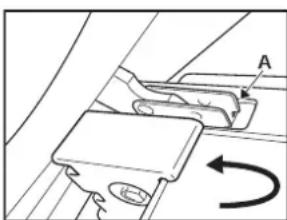
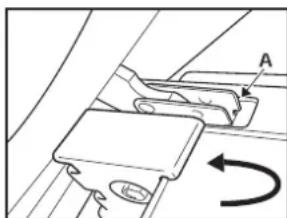
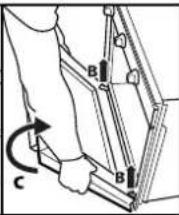
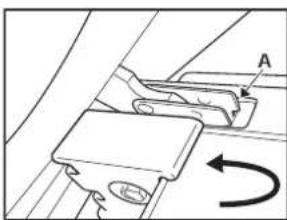
- Lift the catches and push them forwards as far as they will go (Fig. 1).
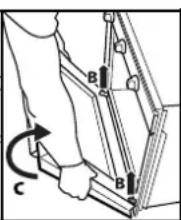
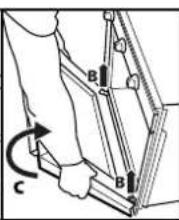
- Close the door as far as it will go (A), lift it up (B) and turn it (C) until it is released (D) (Fig. 2).
To refit the door:
- Insert the hinges in their seats.
- Open the door fully.
- Lower the two catches.
- Close the door.

natural_image
Mechanical assembly diagram showing a bracket with a rotating arrow indicating motion (no text or symbols)Fig.
natural_image
Mechanical assembly diagram showing a clamping mechanism with rotating arrow (no text or symbols)Fig.

text_image
A B C B2

TO REMOVE THE SIDE GRILLES
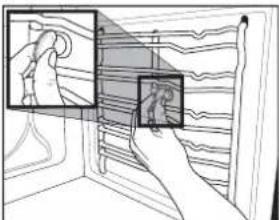
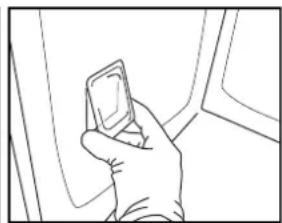
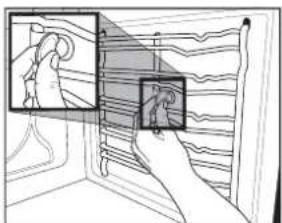
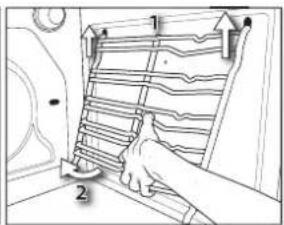
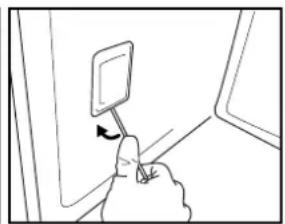
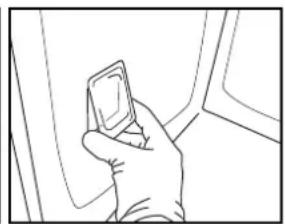
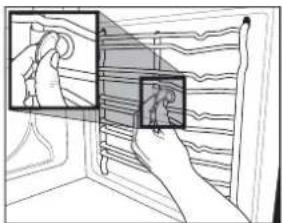
In some models, the side accessory holder grilles are equipped with fixing screws (Fig. 3) for optimum stability.
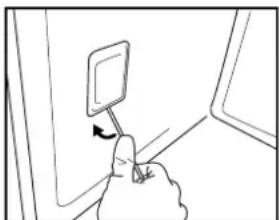
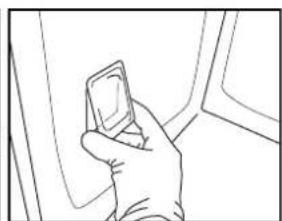
- Remove the screws and relative plates on the right and left with the aid of a coin or tool (Fig. 4).
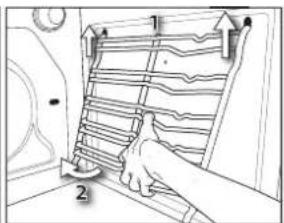
- To remove the grilles, lift the up (1) and turn them (2) as shown in Fig. 5.

natural_image
Line drawing of a door with a ventilation grille and a directional arrow (no text or symbols)Fig.
natural_image
Illustration of a hand holding a wall-mounted device with a magnified inset showing a hand holding a small object (no text or symbols present)3

text_image
Diagram showing hand using a tool to clean or install a ladder-like structure with numbered partsFig.
Fig.
5
MOVING THE TOP HEATING ELEMENT (SOME MODELS ONLY)
- Remove the side accessory holder grilles.
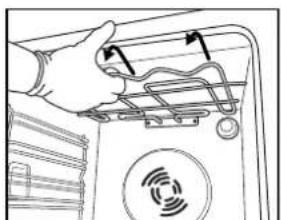
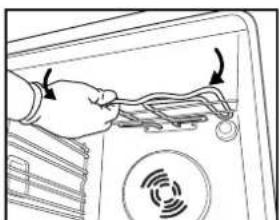
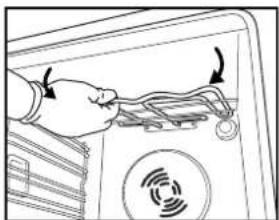
- Pull the heating element out a little (Fig. 6) and lower it (Fig. 7).
- To reposition the heating element, lift it up, pulling it slightly towards you, making sure it comes to rest on the lateral supports.
natural_image
Line drawing of a hand pressing down on a device with a sensor icon (no text or symbols)Fig.
natural_image
Illustration of a person inserting cables into a device panel with a circular sensor icon (no text or symbols)6
Fig.
7
REPLACING THE OVEN LAMP
To replace the rear lamp (if present):
- Disconnect the oven from the power supply.
- Unscrew the lamp cover (Fig. 8), replace the lamp (see note for lamp type) and screw the lamp cover back on.
- Reconnect the oven to the power supply.
To replace the side lamp (if present):
- Disconnect the oven from the power supply.
- Remove the side accessory holder grilles, if present.
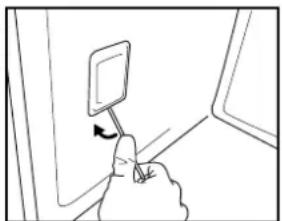
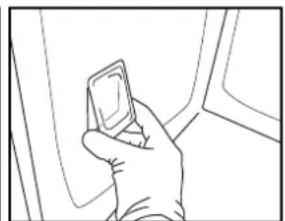
- Use a screwdriver to prise off the lamp cover.
- Replace the lamp (see note for lamp type).
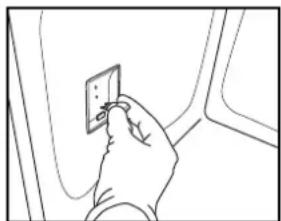
- Refit the lamp cover, pushing it on firmly until it clicks into place.
- Refit the side accessory holder grilles.
- Reconnect the oven to the power supply.

natural_image
Line drawing of a hand gripping a ceiling fixture with an arrow indicating rotation (no text or symbols)Fig.

natural_image
Line drawing of a hand holding a small object with an arrow indicating rotation (no text or symbols)8

natural_image
Line drawing of a hand inserting a small electrical outlet into a wall (no text or symbols)Fig.
natural_image
Line drawing of a hand holding a small object, possibly a device or tool, against a plain background (no text or symbols)9
Fig.
10
N.B:
- Only use 25-40W/230V type E-14, T300°C incandescent lamps, or 20-40W/230 V type G9, T300°C halogen lamps.
- Lamps are available from our After-sales Service.
IMPORTANT:
- If using halogen lamps, do not handle with bare hands since fingerprints can damage them.
- Do not use the oven until the lamp cover has been repositioned.
INSTRUCTIONS FOR OVEN USE FOR ELECTRICAL CONNECTION, SEE THE PARAGRAPH ON INSTALLATION

text_image
Labeled diagram of an oven with numbered parts for identification- Control panel
- Upper heating element/grill
- Cooling fan (not visible)
- Dataplate (not to be removed)
- Light
- Circular heating element (not visible)
- Fan
- Turnspit (if present)
-
Bottom heating element (not visible)
-
Door
-
Position of shelves (the number of shelves is indicated on the front of the oven)
- Rear wall
N.B.:
- During cooking, the cooling fan may switch on at intervals in order to minimise energy consumption.
- At the end of cooking, after the oven is switched off, the cooling fan may continue to run for a while.
ACCESSORIES SUPPLIED
natural_image
Two technical illustrations of rectangular metal grates or trays, one with ribbed top and the other with a flat base (no text or symbols)Fig. A Fig. B
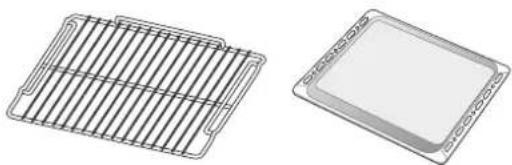
A. WIRE SHELF (1): the wire shelf can be used to grill food or as a support for pans, cake tins and other ovenproof cooking receptacles.
B. BAKING TRAY (1): the baking tray can be used to cook bread and pastry products, as well as roast meat, fish en papillote, etc.
ACCESSORIES NOT SUPPLIED
Other accessories can be purchased separately from the After-sales Service.
INSERTING WIRE SHELVES AND OTHER ACCESSORIES IN THE OVEN
The wire shelf and other accessories are provided with a locking mechanism to prevent their accidental removal.

natural_image
Illustration of hands installing a grating into an oven with a label 'A' (no text or symbols on the diagram itself)Fig. 1
- Insert the wire shelf horizontally, with the raised part "A" upwards (Fig. 1).
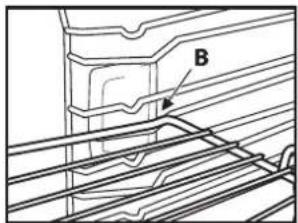
- Angle the wire shelf when it reaches the locking position "B" (Fig. 2).
natural_image
Technical line drawing of a mechanical component with labeled part B (no text or symbols beyond label)Fig.
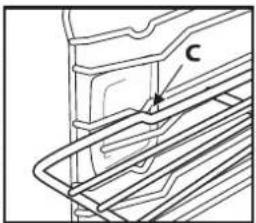
natural_image
Technical line drawing of a mechanical component with labeled part 'C' (no text or symbols beyond label)2
Fig.
3
- Return the wire shelf to the horizontal position and push it in fully to "C" (Fig. 3).
- To remove the wire shelf proceed in reverse order.
The other accessories, like the drip tray and baking tray, are inserted in exactly the same way. The protrusion on the flat surface enables the accessories to lock in place.
CONTROL PANEL DESCRIPTION
ELECTRONIC PROGRAMMER

text_image
1234 << 00:58 200°C 500° DISPLAY OK +/-- FUNCTION SELECTOR KNOB: On/off and function selector knob
- BROWSE KNOB: for browsing the menu and adjusting pre-set values
N.B.: the two knobs are retractable. Press the knobs in the middle and they pop up.
- BUTTON to return to the previous screen
- BUTTON OK: to select and confirm settings
N.B.: the display shows √ for indications regarding the button OK select.
LIST OF FUNCTIONS
Turn the "Functions" knob to any position and the oven switches on: the display shows the functions or the associated submenus.
The submenus are available and selectable by turning the knob to the functions GRILL, SPECIALS, SETTINGS, BREAD/PIZZA.
N.B.: for the list and description of functions, see the specific table at page 33.
DESCRIPTION OF DISPLAY
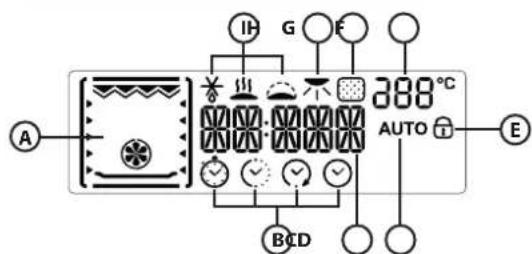
text_image
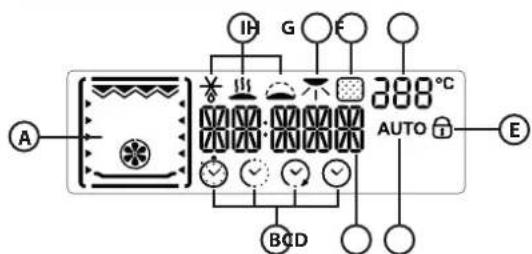
A G E 288°C AUTO E BCDA. Display of heating elements activated during the various cooking functions
B. Time management symbols: timer, cooking time, end of cooking time, time
C. Information regarding selected functions
D. Automatic BREAD/PIZZA function selected
E. Indication of door locked during automatic cleaning cycle (not available on these models)
F. Internal oven temperature
G. Pyrolisis function (not available on these models)
H. Browning
I. Special functions: Defrost, Keep Warm, Rising
STARTING THE OVEN - SETTING THE TIME
flowchart
graph TD
    A["Control Panel"] --> B{Status Change}
    B -->|Yes| C["OK"]
    B -->|No| D["+/-"]
    C --> E["Timer Display"]
    D --> F["Timer Display"]
    G["Device Icon"] --> H["05:00"]
    H --> I["05:29"]
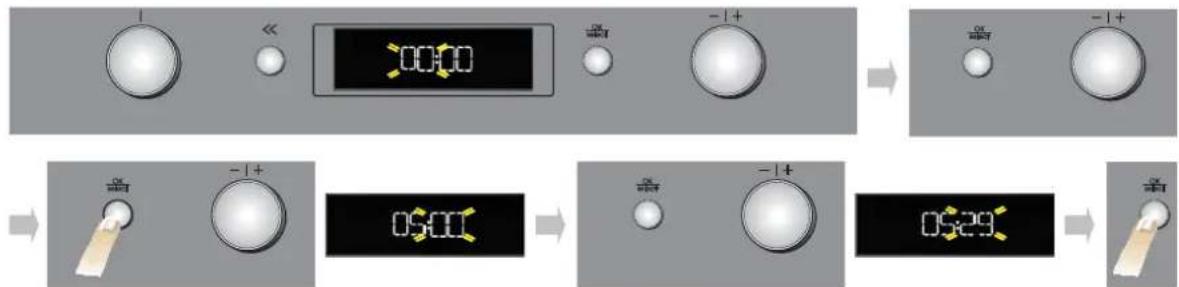
After connecting the oven to the mains power, the time must be set on the clock. The two hour digits flash on the display.
- Turn the "Browse" knob to display the correct hour.
- Press the button OK select to confirm; the two minute digits flash on the display.
- Turn the "Browse" knob to display the correct minutes.
- Press button to confirm.
To change the time, for example following a power cut, see the next paragraph (SETTINGS).
SELECTING COOKING FUNCTIONS

text_image
Control panel interface showing digital timer display and brightness adjustment with Chinese labels- Turn the "Functions" knob to the desired function: the cooking settings are shown on the display.
- If the values shown are those desired, press OK select. To change them, proceed as indicated below.
SETTING THE TEMPERATURE/OUTPUT OF THE GRILL
To change the temperature or output of the grill, proceed as follows:

text_image
200°C 0:00 - + 220°C 0:00 - +- Turn the "Browse" knob to display the desired value.
- Press button to confirm.
The oven automatically confirms your selection 10 seconds after the last operation.
FAST PREHEATING

text_image
PRE=200° 器 -1+- Turn the "Functions" knob to the symbol to select the fast preheating function.
- Confirm by pressing : the settings are shown on the display.
- If the proposed temperature is that desired, press button OK select. To change the temperature, proceed as described in previous paragraphs. The message PRE appears on the display. When the set temperature is reached, the corresponding value (e.g. 200°) and an acoustic signal will sound. At the end of preheating, the oven automatically selects the conventional function ☐ At this point food can be placed in the oven for cooking.
- If you wish to set a different cooking function, turn the "Functions" knob and select the desired function.
SETTING COOKING TIME
This function can be used to cook food for a set length of time, from a minimum of 1 minute to the maximum time allowed by the selected function, after which the oven switches off automatically.

text_image
220°C 0:00 - -1+ 0:30 220°C - -1+- Once the temperature is confirmed, the symbol flashes.
- Turn the adjustment knob to display the desired cooking time.
- To confirm the cooking time, press button . OK select
The oven automatically confirms your selection 10 seconds after the last operation.
SETTING END OF COOKING TIME/START DELAYED
IMPORTANT: the start delayed setting is not available for the following functions: FAST PREHEATING, BREAD/PIZZA, GENTLE CONVECTION BAKE.
N.B.: with this setting, the selected temperature is reached in a more gradual way, so cooking times will be slightly longer than stated in the cooking table.
The end of cooking time can be set, delaying the start of cooking by up to a maximum of 23 hours and 59 minutes. This can only be done once cooking time has been set.
After setting cooking time, the display shows the end of cooking time (for example 15:45) and the symbol flashes.

text_image
1545 220°C -1+ 16:00 220°C -1+To delay the end of cooking time, and thus also the cooking start time, proceed as follows:
- Turn the "Browse" knob to display the time you wish cooking to end (for example 16:00).
- Confirm the selected value by pressing button OK select: the two dots of end of cooking time flash, indicating that the setting has been made correctly.
- The oven will automatically delay the start of cooking so as to finish cooking at the set time.
At any time, however, set values (temperature, grill setting, cooking time) can be changed using button << to go back, followed by the "Browse" knob to change values and button OK select to confirm.
INDICATION OF THE RESIDUAL HEAT INSIDE THE OVEN

text_image
HOT 155°C 12:00If at the end of cooking, or when the oven is switched off, the temperature inside the oven is over 50^ C, the display shows the word HOT and the current temperature. When the residual heat reaches 50^ C, the display shows the current time again.
TIMER

text_image
0:9 -1+ -1+This function can be used only with the oven switched off and is useful, for example, for monitoring the cooking time of pasta. The maximum time which can be set is 23 hours and 59 minutes.
- With the "Functions" knob at zero, turn the "Browse" knob to display the desired time.
- Press button OK select to start the countdown. When the set time has elapsed, the display will show "00:00:00" and an acoustic signal will sound. To mute the acoustic signal, press button OK select (the time of day appears on the display).
KEY-LOCK
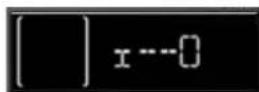
This function can be used to lock the buttons and knobs on the control panel.
To activate it, press << and OK select at the same time for at least 3 seconds. When activated, the functions associated with the buttons are locked and the display shows a key symbol. This function can also be activated during cooking. To deactivate it, repeat the above procedure. When the key-lock function is activated, the oven can be switched off by turning the knob to 0 (zero). In this case, however, the previously selected function will have to be set again.
SELECTING SPECIAL FUNCTIONS
Turn the "Functions" knob indicator to the symbol 🏠️ to access a submenu containing three special functions.
To browse, select and start one of these functions, proceed as follows:

flowchart
graph LR
    A["DEFRO"] --> B[" Magnifying Glass Icon"]
    B --> C["WARM Display"]
    C --> D[" RI SIN Display"]
- Turn the "Functions" knob to symbol ⚙: the display shows "DEFROST" along with this function's corresponding symbol.
- Turn the "Browse" knob to scroll the list of functions; the function names are in English: DEFROST, KEEP WARM, RISING.
- Press button to confirm.
BROWNING
At the end of cooking, with certain functions, the display indicates the possibility of browning. This function can only be used when cooking time has been set.

text_image
PRESS 180°C ON + - -1+ 005 180°CAt the end of cooking time, the display shows: "PRESS √ TO BROWN". Press button OK select, and the oven starts a 5 minute browning cycle. This function can be selected consecutively a maximum of twice.
BREAD/PIZZA FUNCTION SELECTION
Turn the "Functions" knob indicator to the symbol 🔒 to access a submenu containing two automatic cooking functions for "bread" and "pizza".
Bread

flowchart
graph LR
    A["BREAD AUTO"] --> B["OK W/CH"]
    B --> C["0:00 AUTO 200"]
    C --> D["-1+"]
    D --> E["0:30 AUTO 220"]
-
Turn the "Functions" knob to symbol : the display shows "BREAD" and AUTO at the side.
-
Press to select the function.
-
Turn the "Browse" knob to set the required temperature (between 180^ C and 220^ C ) and confirm with button .
-
Turn the "Browse" knob to set the required cooking duration and press to start cooking.
Pizza

flowchart
graph LR
    A["PIZZA AUTO"] --> B["OK 200 AUTO"]
    B --> C["-1+"]
    C --> D["0-30 AUTO 220"]
-
Turn the Functions knob to symbol ⚙: the display shows "BREAD". To select the "PIZZA" function, proceed as follows:
-
Turn the "Browse" knob: "PIZZA" appears on the display.
-
Press to select the function.
-
Turn the "Browse" knob to set the required temperature (between 220^ C and 250^ C ) and confirm with button OK select.
-
Turn the "Browse" knob to set the required cooking duration and press to start cooking.
SETTING
Turn the "Functions" knob indicator to the symbol 🎨 to access a submenu containing four display settings which can be changed.
Clock
Turn the "Functions" knob to the symbol 🔍: the word CLOCK appears on the display. To change the time of day, see the previous paragraph (SETTING THE TIME).
Eco
With the ECO mode selected (ON), the display switches off when the oven is on standby or 5 minutes after the end of cooking. To view information on the display, simply press a button or turn a knob.
-
Turn the "Browse" knob to display "ECO."
-
Press to access the setting (ON/OFF).
-
Turn the "Browse" knob to select the desired setting and confirm by pressing button OK select.
Acoustic signal
To activate or deactivate the acoustic signal, proceed as follows:
-
Turn the "Browse" knob to display "SOUND."
-
Press to access the setting (ON/OFF).
-
Turn the "Browse" knob to select the desired setting and confirm by pressing button OK select.
Brightness
To change the display brightness, proceed as follows:
-
Turn the "Browse" knob to display "BRIGHTNESS."
-
Press button : number 1 appears on the display.
-
Turn the "Browse" knob to increase or decrease brightness and confirm by pressing OK select.
FUNCTION DESCRIPTION TABLE
| FUNCTION SELECTOR KNOB | |||
| 0 | OFF To stop cooking and switch off the oven. | ||
 | LAMP To switch the oven interior light on/off. | ||
| SPECIALS |  DEFROST DEFROST | To speed up defrosting of food. Place food on the middle shelf. Leave food in its packaging in order to prevent it from drying out on the outside. | |
 KEEP WARM KEEP WARM | For keeping just-cooked food hot and crisp (e.g: meat, fried food or flans). Place food on the middle shelf. The function will not activate if the temperature in the oven is above 65°. | ||
 | For optimal rising of sweet or savoury dough. To safeguard the quality of proving, the function will not activate if the temperature in the oven is above 40°C. Place the dough on the 2nd shelf. The oven does not have to be preheated. | ||
| [SLOW COOKING MEAT] | For slow cooking of meat at 90°C. This function offers slow cooking which ensures the food remains tender and succulent. For roast joints, brown in the pan first in order to seal in the meat's natural juices. Cooking times range from 4 hours for 1 Kg joints to 6-7 hours for 3 kg joints. For optimum results, avoid opening the oven door during cooking and use a cooking thermometer to check the core temperature of the meat. | ||
 SLOW COOKING FISH SLOW COOKING FISH | To cook fish gently at 85°C. This function offers slow cooking which ensures the food remains tender and succulent. Thanks to the low temperature, the food does not brown on the outside and the end result is similar to steam cooking. Cooking times range from 2 hours for 300 g. fish to 4-5 hours for 3 kg fish. For optimum results, keep oven door openings to a minimum during cooking in order to avoid heat dispersion. | ||
| CONVENTIONAL | To cook any kind of dish on one shelf only. Use the 3rd shelf. To cook pizza, savoury pies and sweets with liquid fillings, use the 1st or 2nd shelf. Preheat the oven before placing food inside. | ||
| CONVECTION BAKE | For baking cakes with liquid filling (sweet or savoury) on a single shelf. This function can also be used for cooking on two shelves. Switch the position of the dishes to cook food more evenly. Use the 3rd shelf to cook on one shelf only, and the 1st and 4th to cook on two shelves. Preheat the oven before cooking. | ||
| GENTLE CONVECTION BAKE - GENTLE FAN | For cooking meat, filled pies (cheesecake, strudel, fruit pies) and stuffed vegetables on one level only. This function uses discontinuous, delicate fan assistance, which prevents excessive drying of foods. It is advisable to use 2nd level. Preheat the oven before cooking. | ||
| FUNCTION SELECTOR KNOB (Continued) | |||
 | GRILL | To grill steak, kebabs and sausages; to cook vegetables au gratin and toast bread. Place food on the 4th or 5th shelf. When grilling meat, use the drip tray to collect the cooking juices. Position it on the 3rd/4th shelf, adding approx. half a litre of water. The oven does not have to be preheated. During cooking the oven door must remain closed. | |
| TURBO GRILL | To roast large joints of meat (legs, roast beef, chickens). Position the food on the middle shelves. Use the drip tray to collect the cooking juices. Position it on the 1st/2nd shelf, adding approx. half a litre of water. The oven does not have to be preheated. During cooking the oven door must remain closed. With this function you can also use the turnspit, if provided. | ||
 | SETTINGS To set | the display (time, brightness, buzzer volume, energy saving). | |
 | BREAD/PIZZA | To bake different types and sizes of pizza and bread. This function contains two programmes with predefined settings. Simply indicate the values required (temperature and time) and the oven will manage the cooking cycle automatically. Place the dough on the 2nd shelf after preheating the oven. | |
 | FAST PREHEATING | To preheat the oven rapidly. | |
COOKING TABLE
| Recipe Function Pre- | heating | Shelf (from bottom) | Temp. (°C) | Time (min) | Accessories and notes | |
| Leavened cakes |  | Yes | 2/3 | 160-180 | 30-90 | Cake tin on wire shelf |
 | Yes 1-4 | 160-180 30-90 | Level 4: pan on grill (switch levels halfway through cooking) | |||
| Shelf 1: cake tin on wire shelf | ||||||
| Filled pies (cheese-cake, strudel, apple pie) |  GENTLE GENTLE | Yes 2 1 | 60-200 30-85 | Drip-tray / baking tray or cake tin on wire shelf | ||
 | Yes 1-4 | 160-200 35-90 | Shelf 4: cake tin on wire shelf (switch levels halfway through cooking) | |||
| Shelf 1: cake tin on wire shelf | ||||||
| Biscuits / Tartlets |  | Yes | 3 | 170-180 | 15-45 | Drip-tray / baking tray |
 | Yes 1-4 | 160-170 20-45 | Level 4: pan on grill (switch levels halfway through cooking) | |||
| Shelf 1: drip-tray / baking tray | ||||||
| Choux pastry |  | Yes | 3 | 180-200 | 30-40 | Drip-tray / baking tray |
 | Yes 1-4 | 180-190 35-45 | Level 4: pan on grill (switch levels halfway through cooking) | |||
| Shelf 1: drip-tray / baking tray | ||||||
| Meringues |  | Yes | 3 | 90 | 110-150 | Drip-tray / baking tray |
 | Yes | 1-4 | 90 | 130-150 | Level 4: pan on grill (switch levels halfway through cooking) | |
| Shelf 1: drip-tray / baking tray | ||||||
| Bread / Pizza / Focaccia |  | Yes | 1/2 | 190-250 | 15-50 | Drip-tray / baking tray |
 | Yes 1-4 | 190-250 25-50 | Shelf 4: pan on wire shelf (switch levels halfway through cooking) | |||
| Shelf 1: drip-tray / baking tray | ||||||
| Bread |   | Yes 2 1 | 80-220 30-50 | Drip-tray / baking tray or wire shelf | ||
| Pizza |   | Yes | 2 | 220-250 | 15-30 | Drip-tray / baking tray |
| Recipe | Function | Pre-heating | Shelf (from bottom) | Temp. (°C) | Time (min) | Accessories and notes |
| Frozen pizzas |  | Yes 3 | 50 10-15 | Shelf 3: drip-tray / baking tray or wire shelf | ||
 | Yes 1-4 | 250 10-20 | Shelf 4: pan on wire shelf (switch levels halfway through cooking) | |||
| Shelf 1: drip-tray / baking tray | ||||||
| Meat & potato pies (vegetable pie, quiche lorraine) |  | Yes | 3 | 180-190 | 40-55 | Cake tin on wire shelf |
 | Yes 1-4 | 180-190 40-55 | Shelf 4: cake tin on wire shelf (switch levels halfway through cooking) | |||
| Shelf 1: cake tin on wire shelf | ||||||
| Vols-au-vent / Puff pastry crackers |  | Yes | 3 | 190-200 | 20-30 | Drip-tray / baking tray |
 | Yes 1-4 | 180-190 15-40 | Level 4: pan on grill (switch levels halfway through cooking) | |||
| Shelf 1: drip-tray / baking tray | ||||||
| Lasagne / Baked pasta / Cannelloni / Flans |  | Yes | 3 | 190-200 | 45-55 | Pan on wire shelf |
| Lamb / Veal / Beef / Pork 1 kg |  GENTLE GENTLE | Yes 2 | 180-190 80-110 | Drip-tray or pan on wire shelf | ||
| Chicken / Rabbit / Duck 1 kg |  GENTLE GENTLE | Yes 3 | 200-220 50-100 | Drip-tray or pan on wire shelf | ||
| Turkey / Goose 3 kg |  | Yes | 2 | 190-200 | 80-130 | Drip-tray or pan on wire shelf |
| Baked fish / en papillote (fillet, whole) |  | Yes 3 | 180-200 40-60 | Drip-tray or pan on wire shelf | ||
| Stuffed vegetables (tomatoes, courgettes, aubergines) |  GENTLE GENTLE | Yes | 2 | 170-190 | 30-60 | Pan on wire shelf |
| Toast |  | - | 5 | 3 (High) | 3-6 | Wire shelf |
| Fish fillets / steaks |  | - | 4 | 2 (Medium) | 20-30 | Shelf 4: wire shelf (turn food halfway through cooking) |
| Shelf 3: drip-tray with water | ||||||
| Sausages / Kebabs / Spare ribs / Hamburgers |  | - | 5 | 2-3 (Medium-High) | 15-30 | Shelf 5: wire shelf (turn food halfway through cooking) |
| Shelf 4: drip-tray with water | ||||||
| Roast chicken 1-1.3 kg |  | - | 2 | 2 (Medium) | 55-70 | Shelf 2: wire shelf (turn food two thirds of the way through cooking) |
| Shelf 1: drip-tray with water | ||||||
| - | 2 | 3 (High) | 80-110 | Shelf 2: turnspit (if present) | ||
| Shelf 1: drip-tray with water | ||||||
| Roast Beef rare 1 kg |  | - | 3 | 2 (Medium) | 35-45 | Pan on wire shelf (if necessary, turn food two thirds of the way through cooking) |
| Leg of lamb / Knuckle |  | -32 | (Medium) 60-90 | Drip-tray or pan on wire shelf (if necessary, turn food two thirds of the way through cooking) | ||
| Roast potatoes |  | - | 3 | 2 (Medium) | 45-55 | Drip-tray / baking tray (if necessary, turn food two thirds of the way through cooking) |
| Gratinated vegetables |  | -33 | (High) 10-15 | Pan on wire shelf | ||
| Lasagna & Meat |  | Yes | 1-4 | 200 | 50-100* | Shelf 4: pan on wire shelf (if necessary, turn food two thirds of the way through cooking) |
| Shelf 1: drip-tray or pan on wire shelf | ||||||
| Carne & Potatoes |  | Yes | 1-4 | 200 | 45-100* | Shelf 4: pan on wire shelf (if necessary, turn food two thirds of the way through cooking) |
| Shelf 1: drip-tray or pan on wire shelf | ||||||
| Fish & Vegetables |  | Yes | 1-4 | 180 | 30-50* | Level 4: pan on grill (switch levels halfway through cooking) |
| Shelf 1: drip-tray or pan on wire shelf |
* Cooking time is approximate. Food can be removed from the oven at different times depending on personal preference.
TESTED RECIPES (in compliance with IEC 50304/60350:2009-03 and DIN 3360-12:07:07)
| Recipe Function Pre- | heating | Shelf (from bottom) | Temp. (°C) | Time (min) | Accessories and notes | |
| IEC 60350:2009-03 § 8.4.1 | ||||||
| Shortbread |  | Yes 3 | 170 15-25 Drip tray / baking tray | |||
 | Yes 1-4 | 160 25-35 | Shelf 4: baking tray | |||
| Shelf 1: drip tray | ||||||
| IEC 60350:2009-03 § 8.4.2 | ||||||
| Small cakes |  | Yes 3 | 170 20-30 Drip tray / baking tray | |||
 | Yes 1-4 | 160 25-35 | Shelf 4: baking tray | |||
| Shelf 1: drip tray | ||||||
| IEC 60350:2009-03 § 8.5.1 | ||||||
| Fatless sponge cake Yes 2 | 17  -40 -40 | Cake tin | on wire shelf | |||
| IEC 60350:2009-03 § 8.5.2 | ||||||
| Two apple pies |  | Yes 2/3 | 185 | 55-75 Cake tin on wire shelf | ||
 | Yes 1-4 | 175 75-95 | Shelf 4: cake tin on wire shelf | |||
| Shelf 1: cake tin on wire shelf | ||||||
| IEC 60350:2009-03 § 9.1.1 | ||||||
| Toast** |  | - | 5 | 3 (High) | 3-6 | Wire shelf |
| IEC 60350:2009-03 § 9.2.1 | ||||||
| Burgers** |  | - | 5 | 3 (High) | 18-30 | Shelf 5: wire tray (turn food halfway through cooking) |
| Shelf 4: drip tray with water | ||||||
| DIN 3360-12:07 § 6.5.2.3 | ||||||
| Apple cake, yeast tray cake | [W2TS] | Yes 3 | 180 30-40 Drip tray / baking tray | |||
 | Yes 1-4 | 160 50-60 | Shelf 4: baking tray | |||
| Shelf 1: drip tray | ||||||
| DIN 3360-12:07 § 6.6 | ||||||
| Roast pork |  | - | 3 190 | 150-170 | Shelf 3: wire shelf | |
| Shelf 2: drip tray with water (top up when necessary) | ||||||
| DIN 3360-12:07 annex C | ||||||
| Flat cake |  | Yes 3 | 170 35-45 Drip tray / baking tray | |||
 | Yes 1-4 | 160 40-50 | Shelf 4: baking tray | |||
| Shelf 1: drip tray | ||||||
The cooking table suggests the functions and ideal temperatures for obtaining best results with any type of recipe. For hot air cooking on a single level, it is advisable to use the third shelf and the same temperature suggested for “CONVECTION BAKE” cooking on several levels.
** When grilling, it is advisable to leave 3-4 cm free from the front edge of the grill to facilitate removal.
The indications given in the table are intended without the use of the sliding runners.
Energy efficiency class (in accordance with EN 50304)
Use the relevant table to carry out the tests.
How to read the cooking table
The table indicates the best function to use for any given food, to be cooked on one or more shelves at the same time. Cooking times start from the moment food is placed in the oven, excluding pre-heating (where required). Cooking temperatures and times are purely for guidance and will depend on the amount of food and type of accessory used. Use the lowest recommended values to begin with and, if the food is not cooked enough, then move on to higher values. Use the accessories supplied and preferably dark coloured metal cake tins and oven trays. You can also use pans and accessories in pyrex or stoneware, but bear in mind that cooking times will be slightly longer. To obtain best results, carefully follow the advice given in the cooking table for the choice of accessories (supplied) to be placed on the various shelves.
Cooking different foods at the same time
Using the "CONVECTION BAKE" function, you can cook different foods which require the same cooking temperature at the same time (for example: fish and vegetables), using different shelves. Remove the food which requires less cooking time and leave food which requires longer cooking time in the oven.
Desserts
- Cook delicate desserts with the conventional function on one shelf only. Use dark coloured metal cake tins and always position them on the wire shelf supplied. To cook on more than one shelf, select the forced air function and stagger the position of the cake tins on the shelves, aiding optimum circulation of the hot air.
- To check whether a raising cake is cooked, insert a wooden toothpick into the centre of the cake. If the toothpick comes out clean, the cake is ready.
- If using non-stick cake tins, do not butter the edges as the cake may not rise evenly around the edges.
- If the cake "sinks" during cooking, set a lower temperature the next time, perhaps reducing the amount of liquid in the mixture and mixing more gently.
- For sweets with moist fillings (cheesecake or fruit pies) use the "CONVECTION BAKE" function. If the base of the cake is soggy, lower the shelf and sprinkle the bottom of the cake with breadcrumbs or biscuit crumbs before adding the filling.
Meat
- Use any kind of oven tray or pyrex dish suited to the size of the piece of meat being cooked. For roast joints, it is best to add some stock to the bottom of the dish, basting the meat during cooking for added flavour. When the roast is ready, let it rest in the oven for another 10-15 minutes, or wrap it in aluminium foil.
- When you want to grill meat, choose cuts with an even thickness all over in order to achieve uniform cooking results. Very thick pieces of meat require longer cooking times. To prevent the meat from burning on the outside, lower the position of the wire shelf, keeping the food farther away from the grill. Turn the meat two thirds of the way through cooking.
To collect the cooking juices it is advisable to place a drip-tray with half a litre of water directly under the grill on which the meat is placed. Top-up when necessary.
Turnspit (only in some models)
Use this accessory to evenly roast large pieces of meat and poultry. Place the meat on the turnspit rod, tying it with string if chicken, and check that it is secure before inserting the rod in the seat located on the front wall of the oven and resting it on the respective support. To prevent smoke and to collect cooking juices, it is advisable to place a drip-tray with half a litre of water on the first level. The rod has a plastic handle which must be removed before starting to cook, and used at the end of cooking to avoid burns when taking the food out of the oven.
Pizza
Lightly grease the trays to ensure the pizza has a crispy base. Scatter the mozzarella over the pizza two thirds of the way through cooking.
Rising function (only in some models)
It is always best to cover the dough with a damp cloth before placing it in the oven. Dough proving time with this function is reduced by approximately one third compared to proving at room temperature (20-25°C). Proving time for a 1 Kg batch of pizza dough is around one hour.
INSTRUCTIONS IMPORTANTES SUR LA SÉCURITÉ VOTRE SÉCURITÉ AINSI QUE CELLE D'AUTRUI EST PARTICULIÈREMENT IMPORTANTE
natural_image
Mechanical assembly diagram showing a bracket with a rotating arrow indicating motion (no text or symbols)Fig. 1

natural_image
Mechanical assembly diagram showing a clamping mechanism with labeled component A and rotational motion arrow (no text or symbols beyond labels)Fig.
2

DÉPOSE DES GRILLES LATÉRALES
natural_image
Line drawing of a door with a wavy window and a hanging knob (no text or symbols)Fig. 3

natural_image
Illustration of a hand holding two small framed objects, one with a curved line and the other with a question mark, against a wooden wall background (no text or symbols)Fig.
text_image
Diagram showing a hand using a tool to adjust or install a ladder-like structure with labeled parts 1 and 2.4
Fig. 5
DÉPLACEMENT DE LA RÉSISTANCE SUPÉRIEURE (UNIQUEMENT SUR CERTAINS MODÈLES)
natural_image
Line drawing of a hand inserting a spring into a device with a circular sensor icon (no text or symbols)Fig. 6

natural_image
Illustration of a hand connecting cables to a device panel with a circular sensor icon (no text or symbols)Fig.
7
REMPLACEMENT DE L'AMPOULE
natural_image
Line drawing of a hand inserting a component into a wall, showing a curved arrow (no text or symbols)Fig.
natural_image
Line drawing of a hand holding a small object with an arrow indicating rotation (no text or symbols)8

natural_image
Line drawing of a hand inserting an electrical outlet into a wall (no text or symbols)Fig.
natural_image
Line drawing of a hand holding a small object, possibly a device or tool, against a plain background (no text or symbols)9
Fig.
10
REMARQUE :
text_image
Labeled diagram of an oven with numbered parts for identificationnatural_image
Line drawing of a rectangular grid structure with no text or symbols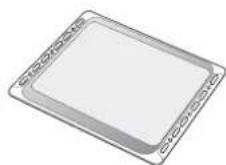
Fig. A Fig. B
ACCESSOIRES NON FOURNIS
natural_image
Illustration of hands installing a grating into an oven with a label 'A' (no text or symbols on the diagram itself)Fig. 1
natural_image
Technical line drawing of a mechanical component with labeled part 'C' (no text or symbols beyond label)2
Fig.
3
text_image
A IH G E 388°C AUTO E BCDtext_image
Control panel interface showing digital display with 200°C and buttons labeled -1+ and -2, alongside a close-up of a device with '2' and '-1+' labels.text_image
PRE=200 → -1+ -1+text_image
HOT ISS → 12:00text_image
0:9 OK OFF -1+ → OK OFF -1+natural_image
Mechanical assembly diagram showing a bracket with an arrow indicating rotation (no text or symbols)Fig. 1
natural_image
Mechanical assembly diagram showing a clamping mechanism with labeled component A and rotational motion arrow (no text or symbols beyond labels)Fig.
text_image
B B C2

natural_image
Line drawing of a door with a ladder and ventilation system (no text or symbols)Fig. 3
natural_image
Illustration of a hand holding two small framed images, one showing a hand holding a circular object, against a wooden wall background (no text or symbols)Fig.
text_image
Diagram showing a hand using a tool to clean or install a ladder-like structure with labeled parts 1 and 2.4
Fig. 5
OMLAAGBRENGEN VAN HET BOVENSTE VERWARMINGSELEMENT (ALLEEN BIJ BEPAALDE MODELLEN)
natural_image
Illustration of a hand pressing down on a device with a sensor icon (no text or symbols)Fig. 6
natural_image
Illustration of a hand connecting cables to a device panel with a circular sensor icon (no text or symbols)Fig.
7
VERVANGEN VAN HET LAMPJE
natural_image
Line drawing of a hand inserting a component into a ceiling structure (no text or symbols)Fig.
natural_image
Line drawing of a hand holding a small object with an arrow indicating rotation (no text or symbols)8
natural_image
Line drawing of a hand inserting an electrical outlet into a door (no text or symbols)Fig.
natural_image
Line drawing of a hand holding a small object, possibly a device or tool, against a plain background (no text or symbols)9
Fig.
10
OPMERKING:
text_image
Labeled diagram of an oven with numbered parts for identificationnatural_image
Line drawing of a rectangular grid structure with no text or symbols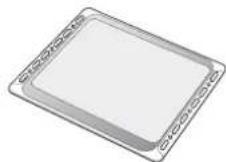
Fig. A Fig. B
natural_image
Illustration of hands installing a grating into an oven with a label 'A' (no text or symbols on the grating itself)Fig. 1
natural_image
Technical line drawing of a mechanical component with labeled part 'C' (no text or symbols beyond label)2
Fig.
3
text_image
1234 << 00:59 200° 500s DISPLAY -1+BESCHRIJVING DISPLAY
text_image
A IH G E 388°C AUTO E BCDtext_image
Control panel interface showing digital timer display and buttons with temperature settingstext_image
PRE=200 → ±5 -1+text_image
HOT ISS → 12:00text_image
0:9 OK OFF -1+ OR OFF -1+TOETSENBLOKKERING (KEY-LOCK)

Copyright Whirlpool Europe s.r.l. 2010. All rights reserved
