HMP3000 - Media player PHILIPS - Free user manual and instructions
Find the device manual for free HMP3000 PHILIPS in PDF.


User questions about HMP3000 PHILIPS
0 question about this device. Answer the ones you know or ask your own.
Ask a new question about this device
Download the instructions for your Media player in PDF format for free! Find your manual HMP3000 - PHILIPS and take your electronic device back in hand. On this page are published all the documents necessary for the use of your device. HMP3000 by PHILIPS.
USER MANUAL HMP3000 PHILIPS
Register your product and get support at www.philips.com/welcome
HMP3000
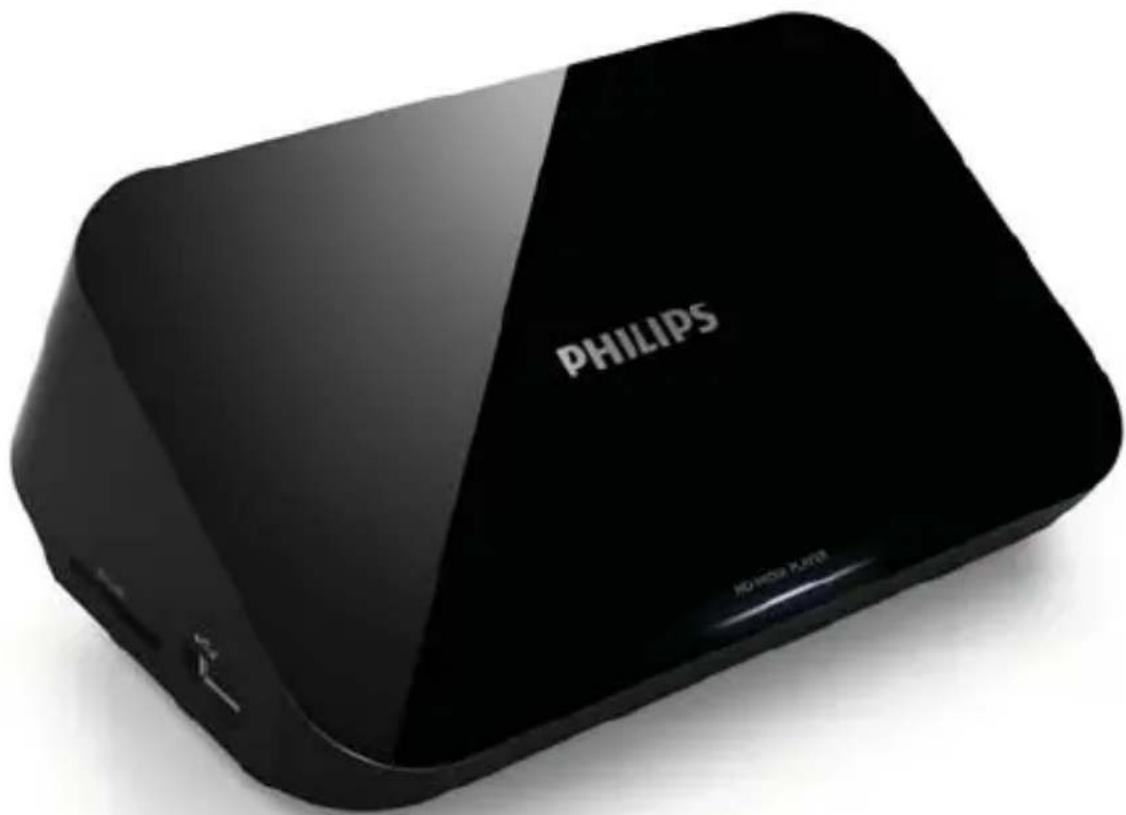
natural_image
Black Philips VR headset with visible branding and control buttons (no text beyond branding)SV Användarhandbok
HDMI, the HDMI logo, and High-Definition Multimedia Interface are trademarks or registered trademarks of HDMI licensing LLC in the United States and other countries.

Manufactured under license from Dolby Laboratories. Dolby and the double-D symbol are trademarks of Dolby Laboratories.
ABOUT DIVX VIDEO: DivX ^® is a digital video format created by DivX, Inc. This is an official DivX Certified ^® device that plays DivX video. Visit divx.com for more information and software tools to convert your files into DivX video.
ABOUT DIVX VIDEO-ON-DEMAND: This DivX Certified® device must be registered in order to play purchased DivX Video-on-Demand (VOD) movies. To obtain your registration code, locate the DivX VOD section in your device setup menu. Go to vod.divx.com for more information on how to complete your registration.
DivX ^® , DivX Certified ^® , DivX Plus ^™ HD and associated logos are registered trademarks of DivX, Inc. and are used under license.
DivX Certified ^® to play DivX ^® and DivX Plus ^™ HD (H.264/MKV) video up to 1080p HD including premium content.
Real RMVB logo is a trademark or a registered trademark of RealNetworks, Inc.

Windows Media and the Windows logo are trademarks, or registered trademarks of Microsoft Corporation in the United States and/or other countries.


2.0+Digital Out
Manufactured under license under U.S. Patent Nos: 5,956,674; 5,974,380; 6,487,535 & other U.S. and worldwide patents issued & pending. DTS, the Symbol, & DTS and the Symbol together are registered trademarks & DTS 2.0+Digital Out is a trademark of DTS, Inc. Product includes software. © DTS, Inc. All Rights Reserved.
2 Anslut och spela

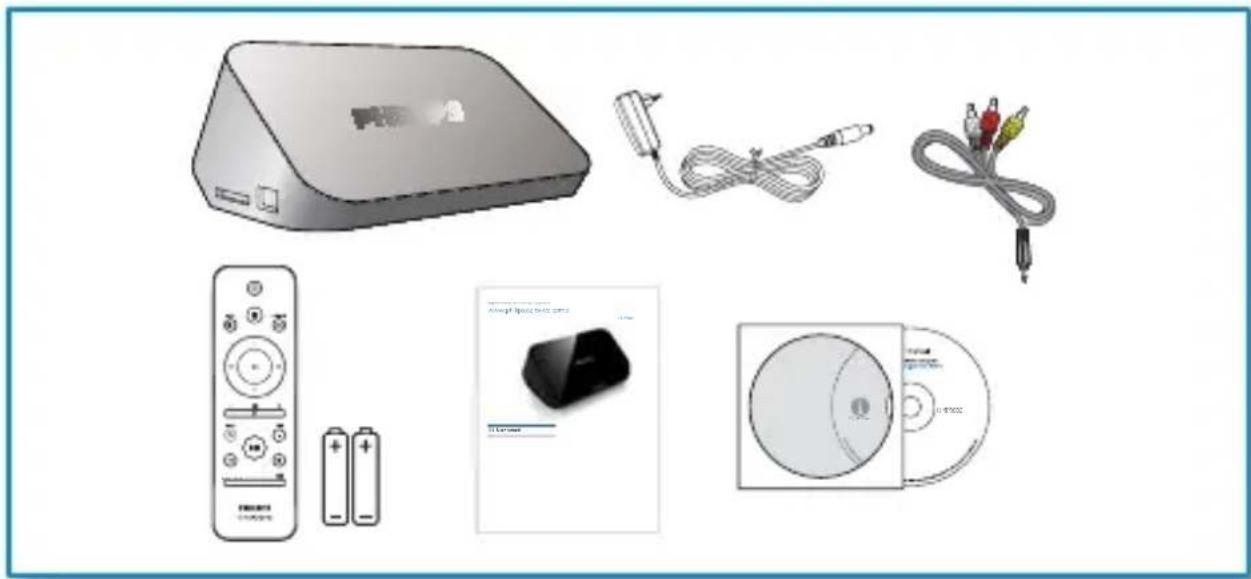
natural_image
Illustration of various electronic devices including a remote, power cord, cable, and CD (no text or symbols visible)1

text_image
Diagram showing connections between a device and six labeled components: TV, AV, HDMI, Optical, and a plus button.2
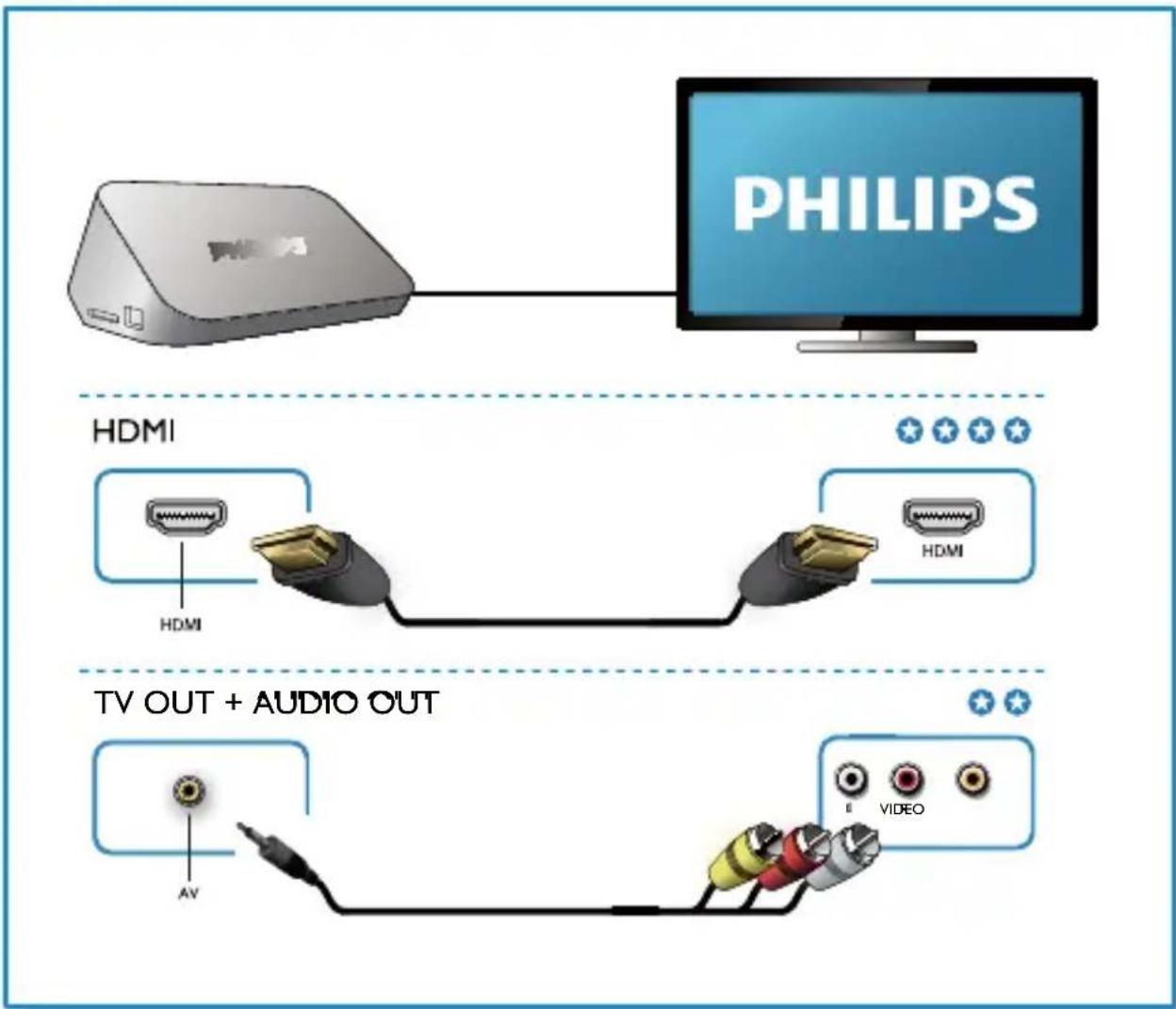
text_image
PHILIPS HDMI HDMI HDMI TV OUT + AUDIO OUT AV VIDEO3
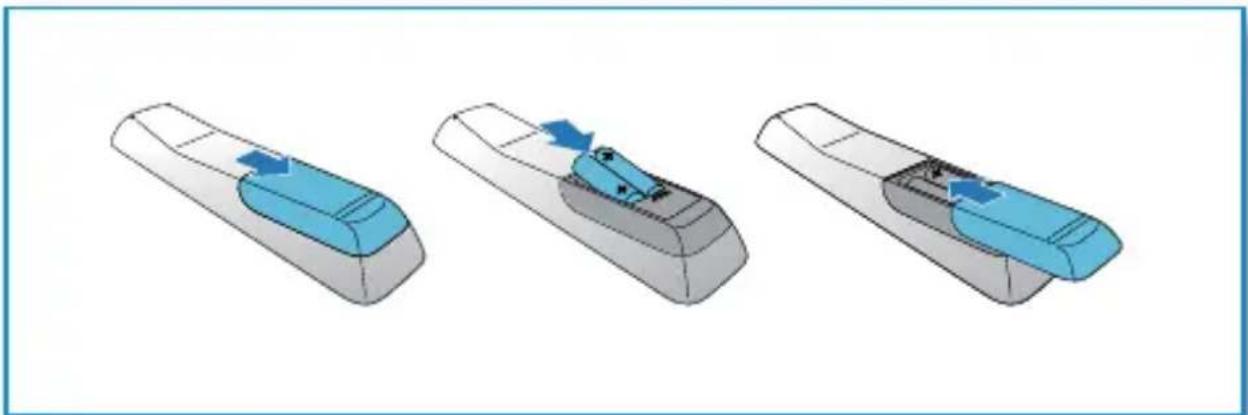
natural_image
Three-step illustration of a remote control device with blue and gray casing, showing internal movement (no text or symbols)4
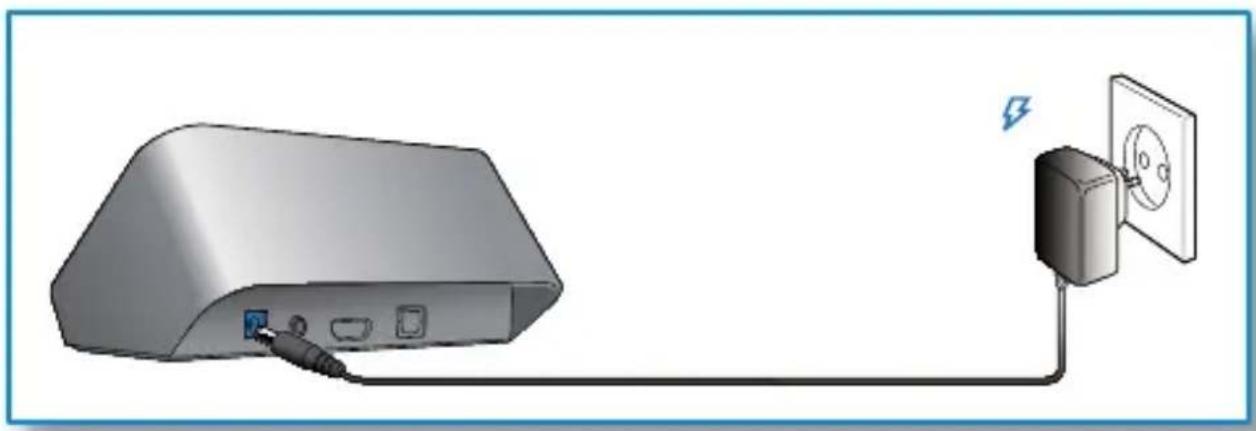
natural_image
Illustration of a connected device with a power outlet and cable, no text or symbols present5

flowchart
graph LR
    A["SOURCE"] --> B["TV"]
    B --> C["AV / HDMI"]
6
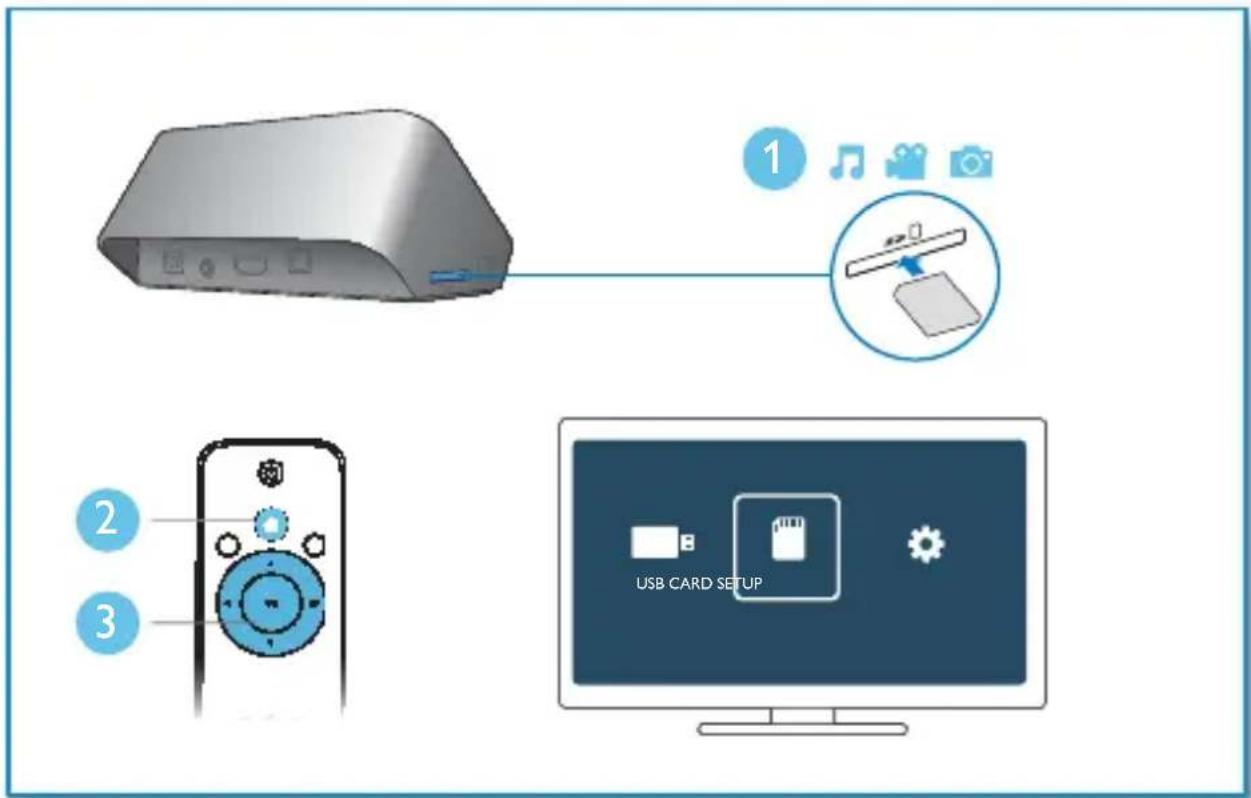
text_image
1 2 3 USB CARD SETUP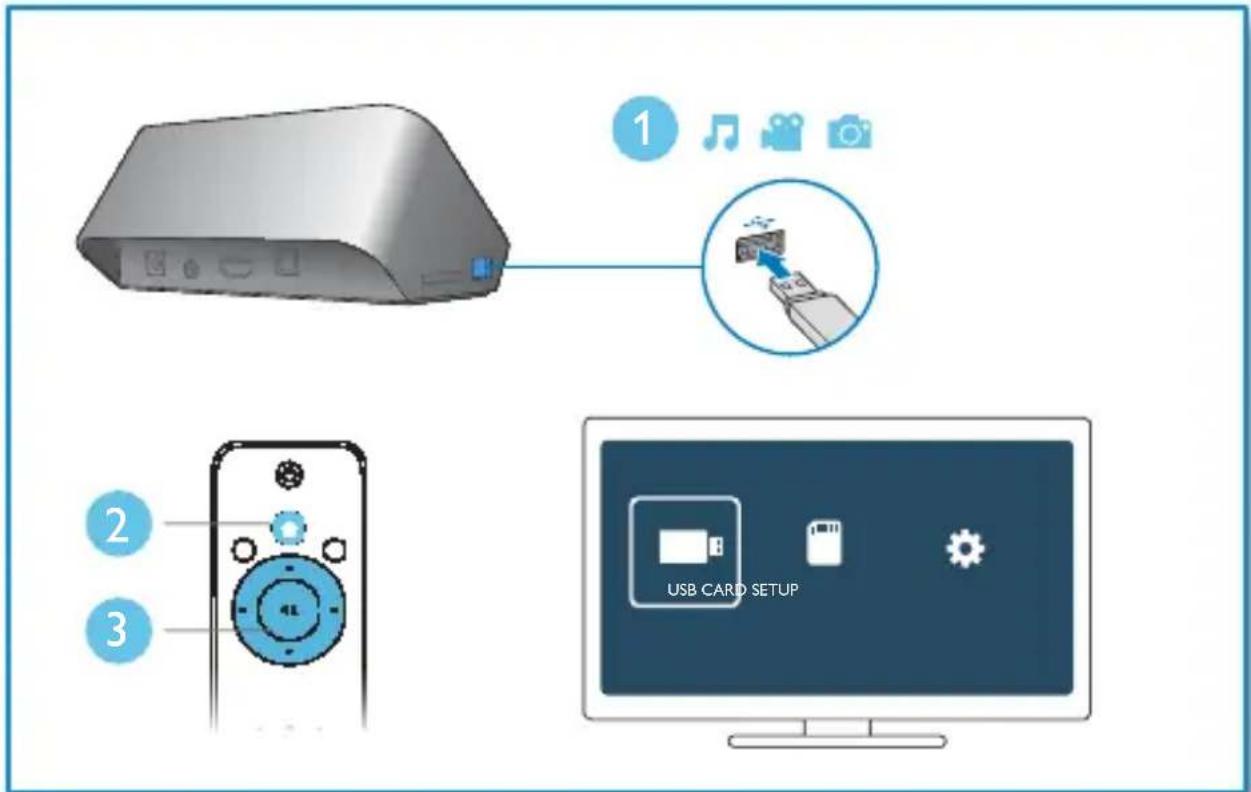
text_image
1 2 3 USB CARD SETUPtext_image
① ② ③ OK USB CARD SETUP System Audio Video EasyLink MISC1 Tryck p ^a .
2010/10/26 V3 (add APE)
2010/10/26 V3.1 (add USB PTP)
2010/10/27 V4 (add Yamon)
2011/1/31 V5 (add Freetype)
- VMLinux
- Uclibc
- FAT
- Gdb
- Binutils
- Dosfstools
- Hotplug
- Mtdtool
- Ntfstool
- Nand write
- Flash-erase
- Mkyaff2image
- Mk.jffs2
- Squanshfs
- Samba
- Coreutils
- Freetype
- WPA Supplicant
GNU GENERAL PUBLIC LICENSE
Version 2, June 1991
Copyright (C) 1989, 1991 Free Software Foundation, Inc.
675 Mass Ave, Cambridge, MA 02139, USA
Everyone is permitted to copy and distribute verbatim copies of this license document, but changing it is not allowed.
Preamble
The licenses for most software are designed to take away your freedom to share and change it. By contrast, the GNU General Public License is intended to guarantee your freedom to share and change free software--to make sure the software is free for all its users. This General Public License applies to most of the Free Software Foundation's software and to any other program whose authors commit to using it. (Some other Free Software Foundation software is covered by the GNU Library General Public License instead.) You can apply it to your programs, too.
When we speak of free software, we are referring to freedom, not price. Our General Public Licenses are designed to make sure that you have the freedom to distribute copies of free software (and charge for this service if you wish), that you receive source code or can get it if you want it, that you can change the software or use pieces of it in new free programs; and that you know you can do these things.
To protect your rights, we need to make restrictions that forbid anyone to deny you these rights or to ask you to surrender the rights. These restrictions translate to certain responsibilities for you if you distribute copies of the software, or if you modify it.
For example, if you distribute copies of such a program, whether gratis or for a fee, you must give the recipients all the rights that you have. You must make sure that they, too, receive or can get the source code. And you must show them these terms so they know their rights.
We protect your rights with two steps: (1) copyright the software, and (2) offer you this license which gives you legal permission to copy, distribute and/or modify the software.
Also, for each author's protection and ours, we want to make certain that everyone understands that there is no warranty for this free software. If the software is modified by someone else and passed on, we want its recipients to know that what they have is not the original, so that any problems introduced by others will not reflect on the original authors' reputations.
Finally, any free program is threatened constantly by software patents. We wish to avoid the danger that redistributors of a free program will individually obtain patent licenses, in effect making the program proprietary. To prevent this, we have made it clear that any patent must be licensed for everyone's free use or not licensed at all.
The precise terms and conditions for copying, distribution and modification follow.
GNU GENERAL PUBLIC LICENSE
TERMS AND CONDITIONS FOR COPYING, DISTRIBUTION AND MODIFICATION
- This License applies to any program or other work which contains a notice placed by the copyright holder saying it may be distributed under the terms of this General Public License. The “Program”, below, refers to any such program or work, and a
“work based on the Program” means either the Program or any derivative work under copyright law: that is to say, a work containing the Program or a portion of it, either verbatim or with modifications and/or translated into another language. (Hereinafter, translation is included without limitation in the term “modification”). Each licensee is addressed as “you”.
Activities other than copying, distribution and modification are not covered by this License; they are outside its scope. The act of running the Program is not restricted, and the output from the Program is covered only if its contents constitute a work based on the Program (independent of having been made by running the Program). Whether that is true depends on what the Program does.
- You may copy and distribute verbatim copies of the Program's source code as you receive it, in any medium, provided that you conspicuously and appropriately publish on each copy an appropriate copyright notice and disclaimer of warranty; keep intact all the notices that refer to this License and to the absence of any warranty; and give any other recipients of the Program a copy of this License along with the Program.
You may charge a fee for the physical act of transferring a copy, and you may at your option offer warranty protection in exchange for a fee.
- You may modify your copy or copies of the Program or any portion of it, thus forming a work based on the Program, and copy and distribute such modifications or work under the terms of Section 1 above, provided that you also meet all of these conditions:
a) You must cause the modified files to carry prominent notices stating that you changed the files and the date of any change.
b) You must cause any work that you distribute or publish, that in whole or in part contains or is derived from the Program or any part thereof, to be licensed as a whole at no charge to all third parties under the terms of this License.
c) If the modified program normally reads commands interactively when run, you must cause it, when started running for such interactive use in the most ordinary way, to print or display an announcement including an appropriate copyright notice and a notice that there is no warranty (or else, saying that you provide a warranty) and that users may redistribute the program under these conditions, and telling the user how to view a copy of this License. (Exception: if the Program itself is interactive but does not normally print such an announcement, your work based on the Program is not required to print an announcement.)
These requirements apply to the modified work as a whole. If identifiable sections of that work are not derived from the Program, and can be reasonably considered independent and separate works in themselves, then this License, and its terms, do not apply to those sections when you distribute them as separate works. But when you distribute the same sections as part of a whole which is a work based on the Program, the distribution of the whole must be on the terms of this License, whose permissions for other licensees extend to the entire whole, and thus to each and every part regardless of who wrote it.
Thus, it is not the intent of this section to claim rights or contest your rights to work written entirely by you; rather, the intent is to exercise the right to control the distribution of derivative or collective works based on the Program.
In addition, mere aggregation of another work not based on the Program with the Program (or with a work based on the Program) on a volume of a storage or distribution medium does not bring the other work under the scope of this License.
- You may copy and distribute the Program (or a work based on it, under Section 2) in object code or executable form under the terms of Sections 1 and 2 above provided that you also do one of the following:
a) Accompany it with the complete corresponding machine-readable source code, which must be distributed under the terms of Sections 1 and 2 above on a medium customarily used for software interchange; or,
b) Accompany it with a written offer, valid for at least three years, to give any third party, for a charge no more than your cost of physically performing source distribution, a complete machine-readable copy of the corresponding source code, to be distributed under the terms of Sections 1 and 2 above on a medium customarily used for software interchange; or,
c) Accompany it with the information you received as to the offer to distribute corresponding source code. (This alternative is allowed only for noncommercial distribution and only if you received the program in object code or executable form with such an offer, in accord with Subsection b above.)
The source code for a work means the preferred form of the work for making modifications to it. For an executable work, complete source code means all the source code for all modules it contains, plus any associated interface definition files, plus the scripts used to control compilation and installation of the executable. However, as a special exception, the source code distributed need not include anything that is normally distributed (in either source or binary form) with the major components (compiler, kernel, and so on) of the operating system on which the executable runs, unless that component itself accompanies the executable.
If distribution of executable or object code is made by offering access to copy from a designated place, then offering equivalent access to copy the source code from the same place counts as distribution of the source code, even though third parties are not compelled to copy the source along with the object code.
-
You may not copy, modify, sublicense, or distribute the Program except as expressly provided under this License. Any attempt otherwise to copy, modify, sublicense or distribute the Program is void, and will automatically terminate your rights under this License. However, parties who have received copies, or rights, from you under this License will not have their licenses terminated so long as such parties remain in full compliance.
-
You are not required to accept this License, since you have not signed it. However, nothing else grants you permission to modify or distribute the Program or its derivative works. These actions are prohibited by law if you do not accept this License. Therefore, by modifying or distributing the Program (or any work based on the
Program), you indicate your acceptance of this License to do so, and all its terms and conditions for copying, distributing or modifying the Program or works based on it.
-
Each time you redistribute the Program (or any work based on the Program), the recipient automatically receives a license from the original licensor to copy, distribute or modify the Program subject to these terms and conditions. You may not impose any further restrictions on the recipients' exercise of the rights granted herein. You are not responsible for enforcing compliance by third parties to this License.
-
If, as a consequence of a court judgment or allegation of patent infringement or for any other reason (not limited to patent issues), conditions are imposed on you (whether by court order, agreement or otherwise) that contradict the conditions of this License, they do not excuse you from the conditions of this License. If you cannot distribute so as to satisfy simultaneously your obligations under this License and any other pertinent obligations, then as a consequence you may not distribute the Program at all. For example, if a patent license would not permit royalty-free redistribution of the Program by all those who receive copies directly or indirectly through you, then the only way you could satisfy both it and this License would be to refrain entirely from distribution of the Program.
If any portion of this section is held invalid or unenforceable under any particular circumstance, the balance of the section is intended to apply and the section as a whole is intended to apply in other circumstances.
It is not the purpose of this section to induce you to infringe any patents or other property right claims or to contest validity of any such claims; this section has the sole purpose of protecting the integrity of the free software distribution system, which is implemented by public license practices. Many people have made generous contributions to the wide range of software distributed through that system in reliance on consistent application of that system; it is up to the author/donor to decide if he or she is willing to distribute software through any other system and a licensee cannot impose that choice.
This section is intended to make thoroughly clear what is believed to be a consequence of the rest of this License.
-
If the distribution and/or use of the Program is restricted in certain countries either by patents or by copyrighted interfaces, the original copyright holder who places the Program under this License may add an explicit geographical distribution limitation excluding those countries, so that distribution is permitted only in or among countries not thus excluded. In such case, this License incorporates the limitation as if written in the body of this License.
-
The Free Software Foundation may publish revised and/or new versions of the General Public License from time to time. Such new versions will be similar in spirit to the present version, but may differ in detail to address new problems or concerns.
Each version is given a distinguishing version number. If the Program specifies a version number of this License which applies to it and “any later version”, you have the option of following the terms and conditions either of that version or of any later version published by the Free Software Foundation. If the Program does not specify
a version number of this License, you may choose any version ever published by the Free Software Foundation.
- If you wish to incorporate parts of the Program into other free programs whose distribution conditions are different, write to the author to ask for permission. For software which is copyrighted by the Free Software Foundation, write to the Free Software Foundation; we sometimes make exceptions for this. Our decision will be guided by the two goals of preserving the free status of all derivatives of our free software and of promoting the sharing and reuse of software generally.
NO WARRANTY
-
BECAUSE THE PROGRAM IS LICENSED FREE OF CHARGE, THERE IS NO WARRANTY FOR THE PROGRAM, TO THE EXTENT PERMITTED BY APPLICABLE LAW. EXCEPT WHEN OTHERWISE STATED IN WRITING THE COPYRIGHT HOLDERS AND/OR OTHER PARTIES PROVIDE THE PROGRAM "AS IS" WITHOUT WARRANTY OF ANY KIND, EITHER EXPRESSED OR IMPLIED, INCLUDING, BUT NOT LIMITED TO, THE IMPLIED WARRANTIES OF MERCHANTABILITY AND FITNESS FOR A PARTICULAR PURPOSE. THE ENTIRE RISK AS TO THE QUALITY AND PERFORMANCE OF THE PROGRAM IS WITH YOU. SHOULD THE PROGRAM PROVE DEFECTIVE, YOU ASSUME THE COST OF ALL NECESSARY SERVICING, REPAIR OR CORRECTION.
-
IN NO EVENT UNLESS REQUIRED BY APPLICABLE LAW OR AGREED TO IN WRITING WILL ANY COPYRIGHT HOLDER, OR ANY OTHER PARTY WHO MAY MODIFY AND/OR REDISTRIBUTE THE PROGRAM AS PERMITTED ABOVE, BE LIABLE TO YOU FOR DAMAGES, INCLUDING ANY GENERAL, SPECIAL, INCIDENTAL OR CONSEQUENTIAL DAMAGES ARISING OUT OF THE USE OR INABILITY TO USE THE PROGRAM (INCLUDING BUT NOT LIMITED TO LOSS OF DATA OR DATA BEING RENDERED INACCURATE OR LOSSES SUSTAINED BY YOU OR THIRD PARTIES OR A FAILURE OF THE PROGRAM TO OPERATE WITH ANY OTHER PROGRAMS), EVEN IF SUCH HOLDER OR OTHER PARTY HAS BEEN ADVISED OF THE POSSIBILITY OF SUCH DAMAGES.
END OF TERMS AND CONDITIONS
How to Apply These Terms to Your New Programs
If you develop a new program, and you want it to be of the greatest possible use to the public, the best way to achieve this is to make it free software which everyone can redistribute and change under these terms.
To do so, attach the following notices to the program. It is safest to attach them to the start of each source file to most effectively convey the exclusion of warranty; and each file should have at least the “copyright” line and a pointer to where the full notice is found.
Copyright (C) 19yy
This program is free software; you can redistribute it and/or modify it under the terms of the GNU General Public License as published by the Free Software Foundation; either version 2 of the License, or (at your option) any later version.
This program is distributed in the hope that it will be useful, but WITHOUT ANY WARRANTY; without even the implied warranty of MERCHANTABILITY or FITNESS FOR A PARTICULAR PURPOSE. See the GNU General Public License for more details.
You should have received a copy of the GNU General Public License along with this program; if not, write to the Free Software Foundation, Inc., 675 Mass Ave, Cambridge, MA 02139, USA.
Also add information on how to contact you by electronic and paper mail.
If the program is interactive, make it output a short notice like this when it starts in an interactive mode:
Gnomovision version 69, Copyright (C) 19yy name of author
Gnomovision comes with ABSOLUTELY NO WARRANTY; for details type `show w'.
This is free software, and you are welcome to redistribute it under certain conditions; type `show c' for details.
The hypothetical commands `show w' and `show c' should show the appropriate parts of the General Public License. Of course, the commands you use may be called something other than `show w' and `show c'; they could even be mouse-clicks or menu items--whatever suits your program.
You should also get your employer (if you work as a programmer) or your school, if any, to sign a “copyright disclaimer” for the program, if necessary. Here is a sample; alter the names:
Yoyodyne, Inc., hereby disclaims all copyright interest in the program `Gnomovision' (which makes passes at compilers) written by James Hacker.
Ty Coon, President of Vice
This General Public License does not permit incorporating your program into proprietary programs. If your program is a subroutine library, you may consider it more useful to permit linking proprietary applications with the library. If this is what you want to do, use the GNU Library General Public License instead of this License.
19. Busybox
BusyBox is licensed under the GNU General Public License, version 2
BusyBox is licensed under the GNU General Public License version 2, which is often abbreviated as GPLv2. (This is the same license the Linux kernel is under, so you may be somewhat familiar with it by now.)
A complete copy of the license text is included in the file LICENSE in the BusyBox source code.
Anyone thinking of shipping BusyBox as part of a product should be familiar with the licensing terms under which they are allowed to use and distribute BusyBox. Read the
full text of the GPL (either through the above link, or in the file LICENSE in the BusyBox tarball), and also read the Frequently Asked Questions about the GPL.
If you distribute GPL-licensed software the license requires that you also distribute the source code to that GPL-licensed software. If you distribute BusyBox without making the source code to the version you distribute available, you violate the license terms, and thus infringe on the copyrights of BusyBox. This requirement applies whether or not you modified BusyBox; either way the license terms still apply to you.
License enforcement
BusyBox's copyrights are enforced by the Software Freedom Law Center (you can contact them at gpl@busybox.net), which “accepts primary responsibility for enforcement of US copyrights on the software... and coordinates international copyright enforcement efforts for such works as necessary.” If you distribute BusyBox in a way that doesn't comply with the terms of the license BusyBox is distributed under, expect to hear from these guys. Their entire reason for existing is to do pro-bono legal work for free/open source software projects. We used to list people who violate the BusyBox license in The Hall of Shame, but these days we find it much more effective to hand them over to the lawyers.
Our enforcement efforts are aimed at bringing people into compliance with the BusyBox license. Open source software is under a different license from proprietary software, but if you violate that license you're still a software pirate and the law gives the vendor (us) some big sticks to play with. We don't want monetary awards, injunctions, or to generate bad PR for a company, unless that's the only way to get somebody that repeatedly ignores us to comply with the license on our code.
My company wants to include BusyBox into a product. What do we need to do in order to comply with BusyBox's license?
First: DON'T PANIC. Complying with BusyBox's license is easy. Complying with BusyBox's license doesn't cost any money. If, after reading the license and this document something is not clear to you, please send emails with your questions to the BusyBox mailing lists. We will expand this document to cover them.
If you are distributing the BusyBox binary, you also have to distribute the corresponding source code. If you modified the source, you have to distribute the modified source.
The text of the license obliges you to provide source code for binaries you distribute, and gives you exactly three options for providing source code. These options are spelled out in section 3 of the LICENSE file in the BusyBox source tarball:
3A) bundle the complete corresponding source with the binary.
3B) bundle a written offer good for three years to provide source upon request (these days this is often a URL).
3C) point you users at the upstream source (i.e. pass along somebody else's 3B offer).
Using option 3A, that is, putting exact BusyBox source and .config file you used to build the binary on the same medium which you use to ship the binary, is the most bullet-proof approach to license compliance. If you do that, you can stop reading, your license obligations have been satisfied.
Option 3B makes sense if you do not distribute BusyBox binaries on a medium like CD-ROM, but instead ship them in a device's firmware. Storing the source there might be an unacceptable waste of space. In this case, add a note to the device's documentation that it uses open-source components and that their source can be downloaded from the company's website. Give exact URL to the page where it can be downloaded.
Regardless of whether you use option 3A or 3B, please make sure you distribute the exact same source tree you used to build the binary. It doesn't have to be a single archive. Indeed, most people distribute modified sources in the form of unmodified busybox-N.N.N.tar.bz2 archive and a set of patches which add features or fix problems.
If you added an applet, or an option to one of the applets in BusyBox, or fixed a bug, and the source tree lacks this addition or fix, then you are not fulfilling GPLv2 requirements.
You can avoid having to distribute source by taking option 3C. However, option 3C has some restrictions, and if your company wants to be paranoid and be 100% sure everything is crystal clear about complying with the license, perhaps it should use options 3A or 3B.
Option 3C: using unmodified source
Option 3C is what most open source people use, and it's so lenient lots of developers don't even think about it. Technically 3C is also full of restrictions (it's “allowed only for noncommercial distribution”, and it only applies if you're redistributing a binary you didn't build yourself) intended to push people to use 3A or 3B, but the BusyBox project has generally let those restrictions slide (as has most of the rest of the open source world) when dealing with people who are acting in good faith.
Using option 3C means identifying the specific version of the public source you used, where to get it from, and confirming that your binary was built from unmodified “vanilla” sources.
So if you built an unmodified BusyBox release and you point people at the URL to the SPECIFIC source tarball on busybox.net you built it from and truthfully say “that’s it, no patches”, we’ve accepted that as compliance even from commercial companies. (We’re not really interested in forcing random strangers to mirror stuff we’ve already got. OSUOSL provides very nice high bandwidth hosting for us, and if they didn’t there’s always sourceforge and savannah and ibiblio and kernel.org and...)
Note that you must do all three parts: what version did you use, where can we get it from, and explicitly state that you did not modify it. Don't skip steps.
If you don't specify your version, we can't tell if you used some random git snapshot out of the development branch that was close to a release version but not quite.
If you don't explicitly say you didn't modify it, we could spend weeks combing through an assembly dump of your binary, or trying to find the exact cross-compiler version you used to produce a byte-for-byte identical file, but the license says we shouldn't have to. Proving a negative is a lot of work, and making us do this work would be shirking your obligations under GPLv2.
Even if you just backported changes out of the development branch, that's not a vanilla unmodified release. The component parts may already be public, but you have to give us enough information to understand what you did, and the opportunity to produce an equivalent binary from that source, or you're not complying with 3C.
The above is a fairly lenient interpretation of GPLv2 that works a bit like the BSD license's “advertising clause”: that one required you to thank the University of California, this one requires you to identify the specific source code of the GPL binaries you distributed. The GPL actually allows us to be more draconian than this (for starters, clause 3C doesn’t have to apply to commercial companies at all), but as long as everybody’s acting in good faith most projects seem happy with just identifying the specific source for binaries built from an unmodified upstream version.
Most open source developers are lenient in this way because we actually prefer a good 3C compliance to a bad 3A compliance. We’ve all received tarballs of who knows what old version, with who knows what changes, and wasted an afternoon proving that “this is basically source control commit number BLAH, plus backports of commits blah, blah, blah, blah, and blah, plus they commented out these five lines, changed two default values that they could have overridden from the command line anyway, and added some debug statements.” I.E. we just wasted three hours confirming there’s nothing remotely interesting here that we didn’t already know.
Obviously if you did modify the source to the binary you distributed, and you don't think you need to at least provide us a patch, you've missed the point of GPLv2 entirely. This is another incentive to get your patch merged, so you can ship a vanilla upstream version and not have to host your patch on your own website for 3 years after you stop distributing your product.
The next paragraph right after 3C essentially says you're supposed to give us your .config file as well, and sometimes we've asked for that as long as we're contacting people anyway. But to be honest, if we don't need to contact you to get the other stuff anyway, we seldom bother. (We can generally figure that one out for ourselves. I note that Linux kernel .configs are harder to reverse engineer, for that you'll probably need to provide a .config for to make the developers happy, but they put in a /proc/config.gz option to make it easy. :)
My company was distributing BusyBox binary without the source. We are contacted by users asking for the source, and we don't have it. Are we in trouble?
Not yet. But please stop doing that, and start distributing the source.
The above is what happens when people are acting in good faith. I note that the GPL imposes upon you the obligation to provide source code when you distribute. Whether you're using 3A, 3B, or 3C, they all start “Accompany it with”, meaning source goes with binary at time of distribution. So if we get the binary from you and there's no mention of source code, your distribution of that binary didn't comply with the terms of the license. At that point, you're already in breach of the license terms, and it's now about fixing it. So if we have to approach you after the fact to get this information, we have the option to be really nasty about it.
We're not required to be nasty, and we prefer not to. An honest mistake that a company is willing to fix is understandable, and as far as I know we've always started out with "excuse me, could you fix this please" and not made a fuss. Most of the time, it doesn't go beyond that, we get back an email "oh, sorry, it's version blah, and here's the three line patch we used to change a default value", and we're happy.
And some companies are disorganized but honest about it, and go “um, we lost track of this information and the guy who did it left the company, can you give us some time to dig it out of the archives?” And if they’re making an honest effort, we’re polite about that too.
My company was distributing BusyBox binary without the source. We are contacted by your lawyers. Are we in trouble?
Yes, but it is not too bad yet. Stop being disorganized and fix your licensing situation before it gets really nasty. As I already mentioned, DON'T PANIC. Complying with BusyBox's license is easy. Get your act together, fight with internal inertia inside your company and it will be okay. If you do not understand something, please send emails with your questions to the BusyBox mailing lists, or privately to maintainers if you want to keep it private. We will expand this document to cover them.
However, you really cannot afford to be careless about complying with the license anymore.
Some companies ignore the polite requests entirely, and go all deer in the headlights on us, or maybe hope that if they ignore us long enough we'll go away. Those are the ones that the SFLC sends impolite requests to, asking for far more than the original request did back when they were being nice.
For starters, if the SFLC has to actually sue someone to get their attention, they bill them for expenses. (They have an office in New York City, you really don't want to go there). Also, they usually make the company appoint an “open source compliance officer” and deliver quarterly reports. And make them try to contact the old customers they shipped product to without source and let them know where the source is. All this is the lawyerly equivalent of “raising your voice to be heard”. I’ve only seem them take the gloves off once. They’ve only needed to once.
Some companies get in trouble because although they use an upstream vanilla source tarball, they don't say what version it was, or they don't explicitly say it wasn't modified. Then when we approach them for more information, they don't understand what we could possibly want, and panic. (Panicing bad. Please don't panic, this is actually pretty easy to get right. Ignoring repeated polite requests is not going to end well. Please be polite back. Ask for clarification if you don't understand something, it's not an admission of weakness. If you ignore us until we stop knocking, these days it may mean we're getting the battering ram. This is not an improvement for anyone concerned.)
Another common failure mode is companies that redistribute some vendor board support package they bought, and when we ask them they brush us off with “we got it from a vendor, go bug our vendor, not our problem”. Dude, you’re copying and distributing GPL code too. If the license is the only thing that gives you permission to do that, then that license applies to you too. Really. If your vendor complied with the license terms but you didn’t, you’re not off the hook. This is not a scavenger hunt, nor is it the episode of M*A*S*H about getting tomato juice to Colonel Potter. We asked you, and you have an obligation to provide this information. If you don’t even know what it is when we ask, something is wrong. If you’d reprinted somebody else’s documentation and stripped out BSD advertising clause notices, do you think you could then say “but the original PDF we got from our vendor had the notice in it, so we’re ok, don’t bother us”? Or would going “oops, here’s one with the right data” be your responsibility? Fixing
this is not our job. “We ask, you answer” is us being lenient, the license technically says we shouldn’t have had to ask in the first place, you were supposed to provide this info when you shipped. And even if we’re letting you delegate the implementation, you can’t delegate the responsibility. Don’t make me look up how to spell “fiduciary”. (And delegating it to nobody really isn’t a solution. Asking us to track down an ex-employee of a defunct Taiwanese company where nobody spoke English just doesn’t go over well...)
Sorry about that. Scars from the “hall of shame” days. We have lawyers now. They're very nice. Where was I?
A company that wants to be legally paranoid will make a source CD for the GPL portions of their entire product (build scripts, cross compiler toolchains, and all), and either include the CD in the box with the product (clause 3A) or put the ISO up on the web and mention the URL to it in their product's documentation (clause 3B). They don't need our say-so to be satisfied with that, even a strict reading of GPLv2 says that complies with the license terms. (You can probably even email the SFLC guys about what exactly should go on the CD, gpl@busybox.net) This is the “make it go away” preemptive nuclear strike approach, and probably a good idea for Fortune 500 companies that have their own legal department to do anyway.
A Good Example
These days, Linksys is doing a good job at complying with the GPL, they get to be an example of how to do things right. Please take a moment and check out what they do with distributing the firmware for their WRT54G Router. Following their example would be a fine way to ensure that you have also fulfilled your licensing obligations.
Add yourself to the Products page
We (BusyBox developers) would be happy to add the information about your product which uses BusyBox to our Products page. In order to be added there, post a message to the BusyBox mailing list when the product ships. While at it, the following information would cover the GPL licensing questions about the product:
A) a description of the product (including the build environment: processor type, libc version, kernel version).
B) identify the specific version of BusyBox it uses.
C) identify any modifications made to that version (either by linking to a nicely broken up series of “diff -u” patches on the web, or attaching the patches to the message, or explicitly saying it isn't modified).
D) attach (or give URL to) the .config file you used to build the BusyBox binary.
E) A link to your website.
This is the “being nice to the developers” approach, which acts as a sort of free advertising within the developer community.
You really can't go wrong with either approach: you can obey the letter of the license according to a strict reading, or you can make the developers as happy as possible so they not only have no reason to make trouble, but actually like you. (Heck, we won't complain if you do both. :)
Developer's note: GPL versions
Version 2 of the GPL is the only version of the GPL which current versions of BusyBox may be distributed under. New code added to the tree is licensed GPL version 2, and the project's license is GPL version 2.
If you are a developer and you want to use a small part of BusyBox source code in your project, please check the header comments of the source file(s) you are taking code from. Even though BusyBox code, as a whole, can only be used under GPL version 2, some individual files may have more permissive licenses: “GPL version 2 or later” - meaning that you can also reuse the code from this source file for a project which is distributed under GPLv3, and “Public domain” - the code in these files have no licensing restrictions whatsoever.
Historical details:
Older versions of BusyBox (versions 1.2.2 and earlier, up through about svn 16112) included variants of the recommended “GPL version 2 or (at your option) later versions” boilerplate permission grant. Ancient versions of BusyBox (before svn 49) did not specify any version at all, and section 9 of GPLv2 (the most recent version at that time) says those old versions may be redistributed under any version of GPL (including the obsolete V1). This was conceptually similar to a dual license, except that the different licenses were different versions of the GPL.
However, BusyBox has apparently always contained chunks of code that were licensed under GPL version 2 only. Examples include applets written by Linus Torvalds (util-linux/mkfs_minix.c and util_linux/mkswap.c) which stated they “may be redistributed as per the Linux copyright” (which Linus clarified in the 2.4.0-pre8 release announcement in 2000 was GPLv2 only), and Linux kernel code copied into libbb/loop.c (after Linus’s announcement). There are probably more, because all we used to check was that the code was GPL, not which version. (Before the GPLv3 draft proceedings in 2006, it was a purely theoretical issue that didn’t come up much.)
To summarize: every version of BusyBox may be distributed under the terms of GPL version 2. New versions (after 1.2.2), as a whole, may only be distributed under GPLv2, not under other versions of the GPL. Older versions of BusyBox might (or might not) be distributable under other versions of the GPL. If you want to use a GPL version other than 2, you should start with one of the old versions such as release 1.2.2 or svn 16112, and do your own homework to identify and remove any code that can't be licensed under the GPL version you want to use. New development is all GPLv2.
20. Izma
License
LZMA SDK is placed in the public domain.
21. WPA Supplicant
Copyright (c) 2003-2010, Jouni Malinen j@w1.fi and contributors All Rights Reserved.
This program is dual-licensed under both the GPL version 2 and BSD license. Either license may be used at your option.
License
GPL v2:
This program is free software; you can redistribute it and/or modify it under the terms of the GNU General Public License version 2 as published by the Free Software Foundation.
This program is distributed in the hope that it will be useful, but WITHOUT ANY WARRANTY; without even the implied warranty of MERCHANTABILITY or FITNESS FOR A PARTICULAR PURPOSE. See the GNU General Public License for more details.
You should have received a copy of the GNU General Public License along with this program; if not, write to the Free Software Foundation, Inc., 51 Franklin St, Fifth Floor, Boston, MA 02110-1301 USA
(this copy of the license is in COPYING file)
Alternatively, this software may be distributed, used, and modified under the terms of BSD license:
Redistribution and use in source and binary forms, with or without modification, are permitted provided that the following conditions are met:
- Redistributions of source code must retain the above copyright notice, this list of conditions and the following disclaimer.
-
Redistributions in binary form must reproduce the above copyright notice, this list of conditions and the following disclaimer in the documentation and/or other materials provided with the distribution.
-
Neither the name(s) of the above-listed copyright holder(s) nor the names of its contributors may be used to endorse or promote products derived from this software without specific prior written permission.
THIS SOFTWARE IS PROVIDED BY THE COPYRIGHT HOLDERS AND CONTRIBUTORS “AS IS” AND ANY EXPRESS OR IMPLIED WARRANTIES, INCLUDING, BUT NOT LIMITED TO, THE IMPLIED WARRANTIES OF MERCHANTABILITY AND FITNESS FOR A PARTICULAR PURPOSE ARE DISCLAIMED. IN NO EVENT SHALL THE COPYRIGHT OWNER OR CONTRIBUTORS BE LIABLE FOR ANY DIRECT, INDIRECT, INCIDENTAL, SPECIAL, EXEMPLARY, OR CONSEQUENTIAL DAMAGES (INCLUDING, BUT NOT LIMITED TO, PROCUREMENT OF SUBSTITUTE GOODS OR SERVICES; LOSS OF USE, DATA, OR PROFITS; OR BUSINESS INTERRUPTION) HOWEVER CAUSED AND ON ANY THEORY OF LIABILITY, WHETHER IN CONTRACT, STRICT LIABILITY, OR TORT (INCLUDING NEGLIGENCE OR OTHERWISE) ARISING IN ANY WAY OUT OF THE USE OF THIS SOFTWARE, EVEN IF ADVISED OF THE POSSIBILITY OF SUCH DAMAGE.
- Libexif
- Ebase
- Mp3info
- Libotf
- fribidi
GNU LESSER GENERAL PUBLIC LICENSE
Version 2.1, February 1999
Copyright (C) 1991, 1999 Free Software Foundation, Inc. 51 Franklin Street, Fifth Floor, Boston, MA 02110-1301 USA Everyone is permitted to copy and distribute verbatim copies of this license document, but changing it is not allowed. [This is the first released version of the Lesser GPL. It also counts as the successor of the GNU Library Public License, version 2, hence the version number 2.1.]
Preamble
The licenses for most software are designed to take away your freedom to share and change it. By contrast, the GNU General Public Licenses are intended to guarantee your freedom to share and change free software--to make sure the software is free for all its users.
This license, the Lesser General Public License, applies to some specially designated software packages--typically libraries--of the Free Software Foundation and other authors who decide to use it. You can use it too, but we suggest you first think carefully about whether this license or the ordinary General Public License is the better strategy to use in any particular case, based on the explanations below.
When we speak of free software, we are referring to freedom of use, not price. Our General Public Licenses are designed to make sure that you have the freedom to distribute copies of free software (and charge for this service if you wish); that you receive source code or can get it if you want it; that you can change the software and use pieces of it in new free programs; and that you are informed that you can do these things.
To protect your rights, we need to make restrictions that forbid distributors to deny you these rights or to ask you to surrender these rights. These restrictions translate to certain responsibilities for you if you distribute copies of the library or if you modify it.
For example, if you distribute copies of the library, whether gratis or for a fee, you must give the recipients all the rights that we gave you. You must make sure that they, too, receive or can get the source code. If you link other code with the library, you must provide complete object files to the recipients, so that they can relink them with the library after making changes to the library and recompiling it. And you must show them these terms so they know their rights.
We protect your rights with a two-step method: (1) we copyright the library, and (2) we offer you this license, which gives you legal permission to copy, distribute and/or modify the library.
To protect each distributor, we want to make it very clear that there is no warranty for the free library. Also, if the library is modified by someone else and passed on, the recipients should know that what they have is not the original version, so that the original author's reputation will not be affected by problems that might be introduced by others.
Finally, software patents pose a constant threat to the existence of any free program. We wish to make sure that a company cannot effectively restrict the users of a free program by obtaining a restrictive license from a patent holder. Therefore, we insist that any patent license obtained for a version of the library must be consistent with the full freedom of use specified in this license.
Most GNU software, including some libraries, is covered by the ordinary GNU General Public License. This license, the GNU Lesser General Public License, applies to certain designated libraries, and is quite different from the ordinary General Public License. We use this license for certain libraries in order to permit linking those libraries into non-free programs.
When a program is linked with a library, whether statically or using a shared library, the combination of the two is legally speaking a combined work, a derivative of the original library. The ordinary General Public License therefore permits such linking only if the entire combination fits its criteria of freedom. The Lesser General Public License permits more lax criteria for linking other code with the library.
We call this license the “Lesser” General Public License because it does Less to protect the user’s freedom than the ordinary General Public License. It also provides other free software developers Less of an advantage over competing non-free programs. These disadvantages are the reason we use the ordinary General Public License for many libraries. However, the Lesser license provides advantages in certain special circumstances.
For example, on rare occasions, there may be a special need to encourage the widest possible use of a certain library, so that it becomes a de-facto standard. To achieve this, non-free programs must be allowed to use the library. A more frequent case is that a free library does the same job as widely used non-free libraries. In this case, there is little to gain by limiting the free library to free software only, so we use the Lesser General Public License.
In other cases, permission to use a particular library in non-free programs enables a greater number of people to use a large body of free software. For example, permission to use the GNU C Library in non-free programs enables many more people to use the whole GNU operating system, as well as its variant, the GNU/Linux operating system.
Although the Lesser General Public License is Less protective of the users' freedom, it does ensure that the user of a program that is linked with the Library has the freedom and the wherewithal to run that program using a modified version of the Library.
The precise terms and conditions for copying, distribution and modification follow. Pay close attention to the difference between a “work based on the library” and a “work that uses the library”. The former contains code derived from the library, whereas the latter must be combined with the library in order to run.
TERMS AND CONDITIONS FOR COPYING, DISTRIBUTION AND MODIFICATION
- This License Agreement applies to any software library or other program which contains a notice placed by the copyright holder or other authorized party saying it may be distributed under the terms of this Lesser General Public License (also called “this License”). Each licensee is addressed as “you”.
A “library” means a collection of software functions and/or data prepared so as to be conveniently linked with application programs (which use some of those functions and data) to form executables.
The “Library”, below, refers to any such software library or work which has been distributed under these terms. A “work based on the Library” means either the Library or any derivative work under copyright law: that is to say, a work containing the Library or a portion of it, either verbatim or with modifications and/or translated straightforwardly into another language. (Hereinafter, translation is included without limitation in the term “modification”.)
"Source code" for a work means the preferred form of the work for making modifications to it. For a library, complete source code means all the source code for all modules it contains, plus any associated interface definition files, plus the scripts used to control compilation and installation of the library.
Activities other than copying, distribution and modification are not covered by this License; they are outside its scope. The act of running a program using the Library is not restricted, and output from such a program is covered only if its contents constitute a work based on the Library (independent of the use of the Library in a tool for writing it). Whether that is true depends on what the Library does and what the program that uses the Library does.
- You may copy and distribute verbatim copies of the Library's complete source code as you receive it, in any medium, provided that you conspicuously and appropriately publish on each copy an appropriate copyright notice and disclaimer of warranty; keep intact all the notices that refer to this License and to the absence of any warranty; and distribute a copy of this License along with the Library.
You may charge a fee for the physical act of transferring a copy, and you may at your option offer warranty protection in exchange for a fee.
- You may modify your copy or copies of the Library or any portion of it, thus forming a work based on the Library, and copy and distribute such modifications or work under the terms of Section 1 above, provided that you also meet all of these conditions:
• a) The modified work must itself be a software library.
- b) You must cause the files modified to carry prominent notices stating that you changed the files and the date of any change.
• c) You must cause the whole of the work to be licensed at no charge to all third parties under the terms of this License.
- d) If a facility in the modified Library refers to a function or a table of data to be supplied by an application program that uses the facility, other than as an argument passed when the facility is invoked, then you must make a good faith effort to ensure that, in the event an application does not supply such function or table, the facility still operates, and performs whatever part of its purpose remains meaningful.
(For example, a function in a library to compute square roots has a purpose that is entirely well-defined independent of the application. Therefore, Subsection 2d requires that any application-supplied function or table used by this function must be optional: if the application does not supply it, the square root function must still compute square roots.)
These requirements apply to the modified work as a whole. If identifiable sections of that work are not derived from the Library, and can be reasonably considered independent and separate works in themselves, then this License, and its terms, do not apply to those sections when you distribute them as separate works. But when you distribute the same sections as part of a whole which is a work based on the Library, the distribution of the whole must be on the terms of this License, whose permissions for other licensees extend to the entire whole, and thus to each and every part regardless of who wrote it.
Thus, it is not the intent of this section to claim rights or contest your rights to work written entirely by you; rather, the intent is to exercise the right to control the distribution of derivative or collective works based on the Library.
In addition, mere aggregation of another work not based on the Library with the Library (or with a work based on the Library) on a volume of a storage or distribution medium does not bring the other work under the scope of this License.
- You may opt to apply the terms of the ordinary GNU General Public License instead of this License to a given copy of the Library. To do this, you must alter all the notices that refer to this License, so that they refer to the ordinary GNU General Public
License, version 2, instead of to this License. (If a newer version than version 2 of the ordinary GNU General Public License has appeared, then you can specify that version instead if you wish.) Do not make any other change in these notices.
Once this change is made in a given copy, it is irreversible for that copy, so the ordinary GNU General Public License applies to all subsequent copies and derivative works made from that copy.
This option is useful when you wish to copy part of the code of the Library into a program that is not a library.
- You may copy and distribute the Library (or a portion or derivative of it, under Section 2) in object code or executable form under the terms of Sections 1 and 2 above provided that you accompany it with the complete corresponding machine-readable source code, which must be distributed under the terms of Sections 1 and 2 above on a medium customarily used for software interchange.
If distribution of object code is made by offering access to copy from a designated place, then offering equivalent access to copy the source code from the same place satisfies the requirement to distribute the source code, even though third parties are not compelled to copy the source along with the object code.
- A program that contains no derivative of any portion of the Library, but is designed to work with the Library by being compiled or linked with it, is called a “work that uses the Library”. Such a work, in isolation, is not a derivative work of the Library, and therefore falls outside the scope of this License.
However, linking a “work that uses the Library” with the Library creates an executable that is a derivative of the Library (because it contains portions of the Library), rather than a “work that uses the library”. The executable is therefore covered by this License. Section 6 states terms for distribution of such executables.
When a “work that uses the Library” uses material from a header file that is part of the Library, the object code for the work may be a derivative work of the Library even though the source code is not. Whether this is true is especially significant if the work can be linked without the Library, or if the work is itself a library. The threshold for this to be true is not precisely defined by law.
If such an object file uses only numerical parameters, data structure layouts and accessors, and small macros and small inline functions (ten lines or less in length), then the use of the object file is unrestricted, regardless of whether it is legally a derivative work. (Executables containing this object code plus portions of the Library will still fall under Section 6.)
Otherwise, if the work is a derivative of the Library, you may distribute the object code for the work under the terms of Section 6. Any executables containing that work also fall under Section 6, whether or not they are linked directly with the Library itself.
- As an exception to the Sections above, you may also combine or link a “work that uses the Library” with the Library to produce a work containing portions of the Library, and distribute that work under terms of your choice, provided that the
terms permit modification of the work for the customer's own use and reverse engineering for debugging such modifications.
You must give prominent notice with each copy of the work that the Library is used in it and that the Library and its use are covered by this License. You must supply a copy of this License. If the work during execution displays copyright notices, you must include the copyright notice for the Library among them, as well as a reference directing the user to the copy of this License. Also, you must do one of these things:
- a) Accompany the work with the complete corresponding machine-readable source code for the Library including whatever changes were used in the work (which must be distributed under Sections 1 and 2 above); and, if the work is an executable linked with the Library, with the complete machine-readable “work that uses the Library”, as object code and/or source code, so that the user can modify the Library and then relink to produce a modified executable containing the modified Library. (It is understood that the user who changes the contents of definitions files in the Library will not necessarily be able to recompile the application to use the modified definitions.)
- b) Use a suitable shared library mechanism for linking with the Library. A suitable mechanism is one that (1) uses at run time a copy of the library already present on the user's computer system, rather than copying library functions into the executable, and (2) will operate properly with a modified version of the library, if the user installs one, as long as the modified version is interface-compatible with the version that the work was made with.
- c) Accompany the work with a written offer, valid for at least three years, to give the same user the materials specified in Subsection 6a, above, for a charge no more than the cost of performing this distribution.
- d) If distribution of the work is made by offering access to copy from a designated place, offer equivalent access to copy the above specified materials from the same place.
- e) Verify that the user has already received a copy of these materials or that you have already sent this user a copy.
For an executable, the required form of the “work that uses the Library” must include any data and utility programs needed for reproducing the executable from it. However, as a special exception, the materials to be distributed need not include anything that is normally distributed (in either source or binary form) with the major components (compiler, kernel, and so on) of the operating system on which the executable runs, unless that component itself accompanies the executable.
It may happen that this requirement contradicts the license restrictions of other proprietary libraries that do not normally accompany the operating system. Such a contradiction means you cannot use both them and the Library together in an executable that you distribute.
- You may place library facilities that are a work based on the Library side-by-side in a single library together with other library facilities not covered by this License, and distribute such a combined library, provided that the separate distribution of the
work based on the Library and of the other library facilities is otherwise permitted, and provided that you do these two things:
- a) Accompany the combined library with a copy of the same work based on the Library, uncombined with any other library facilities. This must be distributed under the terms of the Sections above.
-
b) Give prominent notice with the combined library of the fact that part of it is a work based on the Library, and explaining where to find the accompanying uncombined form of the same work.
-
You may not copy, modify, sublicense, link with, or distribute the Library except as expressly provided under this License. Any attempt otherwise to copy, modify, sublicense, link with, or distribute the Library is void, and will automatically terminate your rights under this License. However, parties who have received copies, or rights, from you under this License will not have their licenses terminated so long as such parties remain in full compliance.
-
You are not required to accept this License, since you have not signed it. However, nothing else grants you permission to modify or distribute the Library or its derivative works. These actions are prohibited by law if you do not accept this License. Therefore, by modifying or distributing the Library (or any work based on the Library), you indicate your acceptance of this License to do so, and all its terms and conditions for copying, distributing or modifying the Library or works based on it.
-
Each time you redistribute the Library (or any work based on the Library), the recipient automatically receives a license from the original licensor to copy, distribute, link with or modify the Library subject to these terms and conditions. You may not impose any further restrictions on the recipients' exercise of the rights granted herein. You are not responsible for enforcing compliance by third parties with this License.
-
If, as a consequence of a court judgment or allegation of patent infringement or for any other reason (not limited to patent issues), conditions are imposed on you (whether by court order, agreement or otherwise) that contradict the conditions of this License, they do not excuse you from the conditions of this License. If you cannot distribute so as to satisfy simultaneously your obligations under this License and any other pertinent obligations, then as a consequence you may not distribute the Library at all. For example, if a patent license would not permit royalty-free redistribution of the Library by all those who receive copies directly or indirectly through you, then the only way you could satisfy both it and this License would be to refrain entirely from distribution of the Library.
If any portion of this section is held invalid or unenforceable under any particular circumstance, the balance of the section is intended to apply, and the section as a whole is intended to apply in other circumstances.
It is not the purpose of this section to induce you to infringe any patents or other property right claims or to contest validity of any such claims; this section has the sole purpose of protecting the integrity of the free software distribution system which is implemented by public license practices. Many people have made generous
contributions to the wide range of software distributed through that system in reliance on consistent application of that system; it is up to the author/donor to decide if he or she is willing to distribute software through any other system and a licensee cannot impose that choice.
This section is intended to make thoroughly clear what is believed to be a consequence of the rest of this License.
-
If the distribution and/or use of the Library is restricted in certain countries either by patents or by copyrighted interfaces, the original copyright holder who places the Library under this License may add an explicit geographical distribution limitation excluding those countries, so that distribution is permitted only in or among countries not thus excluded. In such case, this License incorporates the limitation as if written in the body of this License.
-
The Free Software Foundation may publish revised and/or new versions of the Lesser General Public License from time to time. Such new versions will be similar in spirit to the present version, but may differ in detail to address new problems or concerns.
Each version is given a distinguishing version number. If the Library specifies a version number of this License which applies to it and “any later version”, you have the option of following the terms and conditions either of that version or of any later version published by the Free Software Foundation. If the Library does not specify a license version number, you may choose any version ever published by the Free Software Foundation.
- If you wish to incorporate parts of the Library into other free programs whose distribution conditions are incompatible with these, write to the author to ask for permission. For software which is copyrighted by the Free Software Foundation, write to the Free Software Foundation; we sometimes make exceptions for this. Our decision will be guided by the two goals of preserving the free status of all derivatives of our free software and of promoting the sharing and reuse of software generally.
NO WARRANTY
-
BECAUSE THE LIBRARY IS LICENSED FREE OF CHARGE, THERE IS NO WARRANTY FOR THE LIBRARY, TO THE EXTENT PERMITTED BY APPLICABLE LAW. EXCEPT WHEN OTHERWISE STATED IN WRITING THE COPYRIGHT HOLDERS AND/OR OTHER PARTIES PROVIDE THE LIBRARY "AS IS" WITHOUT WARRANTY OF ANY KIND, EITHER EXPRESSED OR IMPLIED, INCLUDING, BUT NOT LIMITED TO, THE IMPLIED WARRANTIES OF MERCHANTABILITY AND FITNESS FOR A PARTICULAR PURPOSE. THE ENTIRE RISK AS TO THE QUALITY AND PERFORMANCE OF THE LIBRARY IS WITH YOU. SHOULD THE LIBRARY PROVE DEFECTIVE, YOU ASSUME THE COST OF ALL NECESSARY SERVICING, REPAIR OR CORRECTION.
-
IN NO EVENT UNLESS REQUIRED BY APPLICABLE LAW OR AGREED TO IN WRITING WILL ANY COPYRIGHT HOLDER, OR ANY OTHER PARTY WHO MAY MODIFY AND/OR REDISTRIBUTE THE LIBRARY AS PERMITTED ABOVE, BE LIABLE TO YOU FOR DAMAGES, INCLUDING ANY GENERAL, SPECIAL,
INCIDENTAL OR CONSEQUENTIAL DAMAGES ARISING OUT OF THE USE OR INABILITY TO USE THE LIBRARY (INCLUDING BUT NOT LIMITED TO LOSS OF DATA OR DATA BEING RENDERED INACCURATE OR LOSSES SUSTAINED BY YOU OR THIRD PARTIES OR A FAILURE OF THE LIBRARY TO OPERATE WITH ANY OTHER SOFTWARE), EVEN IF SUCH HOLDER OR OTHER PARTY HAS BEEN ADVISED OF THE POSSIBILITY OF SUCH DAMAGES.
END OF TERMS AND CONDITIONS
How to Apply These Terms to Your New Libraries
If you develop a new library, and you want it to be of the greatest possible use to the public, we recommend making it free software that everyone can redistribute and change. You can do so by permitting redistribution under these terms (or, alternatively, under the terms of the ordinary General Public License).
To apply these terms, attach the following notices to the library. It is safest to attach them to the start of each source file to most effectively convey the exclusion of warranty; and each file should have at least the “copyright” line and a pointer to where the full notice is found.
one line to give the library's name and an idea of what it does. Copyright (C) year name of author This library is free software; you can redistribute it and/or modify it under the terms of the GNU Lesser General Public License as published by the Free Software Foundation; either version 2.1 of the License, or (at your option) any later version. This library is distributed in the hope that it will be useful, but WITHOUT ANY WARRANTY; without even the implied warranty of MERCHANTABILITY or FITNESS FOR A PARTICULAR PURPOSE. See the GNU Lesser General Public License for more details. You should have received a copy of the GNU Lesser General Public License along with this library; if not, write to the Free Software Foundation, Inc., 51 Franklin Street, Fifth Floor, Boston, MA 02110-1301 USA
Also add information on how to contact you by electronic and paper mail.
You should also get your employer (if you work as a programmer) or your school, if any, to sign a “copyright disclaimer” for the library, if necessary. Here is a sample; alter the names:
Yoyodyne, Inc., hereby disclaims all copyright interest in the library 'Frob' (a library for tweaking knobs) written by James Random Hacker. signature of Ty Coon, 1 April 1990 Ty Coon, President of Vice
That's all there is to it!
27. sqlite
SQLite Copyright
All of the deliverable code in SQLite has been dedicated to the public domain by the authors. All code authors, and representatives of the companies they work for, have signed affidavits dedicating their contributions to the public domain and originals of those signed affidavits are stored in a firesafe at the main offices of Hwaci. Anyone is free to
copy, modify, publish, use, compile, sell, or distribute the original SQLite code, either in source code form or as a compiled binary, for any purpose, commercial or non-commercial, and by any means.
The previous paragraph applies to the deliverable code in SQLite - those parts of the SQLite library that you actually bundle and ship with a larger application. Portions of the documentation and some code used as part of the build process might fall under other licenses. The details here are unclear. We do not worry about the licensing of the documentation and build code so much because none of these things are part of the core deliverable SQLite library.
All of the deliverable code in SQLite has been written from scratch. No code has been taken from other projects or from the open internet. Every line of code can be traced back to its original author, and all of those authors have public domain dedications on file. So the SQLite code base is clean and is uncontaminated with licensed code from other projects.
Obtaining An Explicit License To Use SQLite
Even though SQLite is in the public domain and does not require a license, some users want to obtain a license anyway. Some reasons for obtaining a license include:
- You are using SQLite in a jurisdiction that does not recognize the public domain.
- You are using SQLite in a jurisdiction that does not recognize the right of an author to dedicate their work to the public domain.
- You want to hold a tangible legal document as evidence that you have the legal right to use and distribute SQLite.
- Your legal department tells you that you have to purchase a license.
If you feel like you really have to purchase a license for SQLite, Hwaci, the company that employs the architect and principal developers of SQLite, will sell you one.
Contributed Code
In order to keep SQLite completely free and unencumbered by copyright, all new contributors to the SQLite code base are asked to dedicate their contributions to the public domain. If you want to send a patch or enhancement for possible inclusion in the SQLite source tree, please accompany the patch with the following statement:
The author or authors of this code dedicate any and all copyright interest in this code to the public domain. We make this dedication for the benefit of the public at large and to the detriment of our heirs and successors. We intend this dedication to be an overt act of relinquishment in perpetuity of all present and future rights to this code under copyright law.
We are not able to accept patches or changes to SQLite that are not accompanied by a statement such as the above. In addition, if you make changes or enhancements as an employee, then a simple statement such as the above is insufficient. You must also send by surface mail a copyright release signed by a company officer. A signed original of the copyright release should be mailed to:
Hwaci
6200 Maple Cove Lane
A template copyright release is available in PDF or HTML. You can use this release to make future changes.
28. Libpng
The PNG Reference Library is supplied “AS IS”. The Contributing Authors and Group 42, Inc. disclaim all warranties, expressed or implied, including, without limitation, the warranties of merchantability and of fitness for any purpose. The Contributing Authors and Group 42, Inc. assume no liability for direct, indirect, incidental, special, exemplary, or consequential damages, which may result from the use of the PNG Reference Library, even if advised of the possibility of such damage.
Permission is hereby granted to use, copy, modify, and distribute this source code, or portions hereof, for any purpose, without fee, subject to the following restrictions:
- The origin of this source code must not be misrepresented.
- Altered versions must be plainly marked as such and must not be misrepresented as being the original source.
- This Copyright notice may not be removed or altered from any source or altered source distribution.
The Contributing Authors and Group 42, Inc. specifically permit, without fee, and encourage the use of this source code as a component to supporting the PNG file format in commercial products. If you use this source code in a product, acknowledgment is not required but would be appreciated.
29. APE
License Agreement
- The Monkey's Audio SDK and source code can be freely used to add APE format playback, encoding, or tagging support to any product, free or commercial. Use of the code for proprietary efforts that don't support the official APE format require written consent of the author.
- Monkey's Audio source can be included in GPL and open-source software, although Monkey's Audio itself will not be subjected to external licensing requirements or other viral source restrictions.
- Code changes and improvements must be contributed back to the Monkey's Audio project free from restrictions or royalties, unless exempted by express written consent of the author.
- Any source code, ideas, or libraries used must be plainly acknowledged in the software using the code.
-
Although the software has been tested thoroughly, the author is in no way responsible for damages due to bugs or misuse.
-
If you do not completely agree with all of the previous stipulations, you must cease using this source code and remove it from your storage device.
30. USB/PTP
GNU GENERAL PUBLIC LICENSE
Version 1, February 1989
Copyright (C) 1989 Free Software Foundation, Inc.
51 Franklin St, Fifth Floor, Boston, MA 02110-1301 USA
Everyone is permitted to copy and distribute verbatim copies of this license document, but changing it is not allowed.
Preamble
The license agreements of most software companies try to keep users at the mercy of those companies. By contrast, our General Public License is intended to guarantee your freedom to share and change free software--to make sure the software is free for all its users. The General Public License applies to the Free Software Foundation's software and to any other program whose authors commit to using it. You can use it for your programs, too.
When we speak of free software, we are referring to freedom, not price. Specifically, the General Public License is designed to make sure that you have the freedom to give away or sell copies of free software, that you receive source code or can get it if you want it, that you can change the software or use pieces of it in new free programs; and that you know you can do these things.
To protect your rights, we need to make restrictions that forbid anyone to deny you these rights or to ask you to surrender the rights. These restrictions translate to certain responsibilities for you if you distribute copies of the software, or if you modify it.
For example, if you distribute copies of a such a program, whether gratis or for a fee, you must give the recipients all the rights that you have. You must make sure that they, too, receive or can get the source code. And you must tell them their rights.
We protect your rights with two steps: (1) copyright the software, and (2) offer you this license which gives you legal permission to copy, distribute and/or modify the software.
Also, for each author's protection and ours, we want to make certain that everyone understands that there is no warranty for this free software. If the software is modified by someone else and passed on, we want its recipients to know that what they have is not the original, so that any problems introduced by others will not reflect on the original authors' reputations.
The precise terms and conditions for copying, distribution and modification follow.
GNU GENERAL PUBLIC LICENSE TERMS AND CONDITIONS FOR COPYING, DISTRIBUTION AND MODIFICATION
- This License Agreement applies to any program or other work which contains a notice placed by the copyright holder saying it may be distributed under the terms of this General Public License. The “Program”, below, refers to any such program or work, and a “work based on the Program” means either the Program or any work
containing the Program or a portion of it, either verbatim or with modifications. Each licensee is addressed as "you".
-
You may copy and distribute verbatim copies of the Program's source code as you receive it, in any medium, provided that you conspicuously and appropriately publish on each copy an appropriate copyright notice and disclaimer of warranty; keep intact all the notices that refer to this General Public License and to the absence of any warranty; and give any other recipients of the Program a copy of this General Public License along with the Program. You may charge a fee for the physical act of transferring a copy.
-
You may modify your copy or copies of the Program or any portion of it, and copy and distribute such modifications under the terms of Paragraph 1 above, provided that you also do the following:
a) cause the modified files to carry prominent notices stating that you changed the files and the date of any change; and
b) cause the whole of any work that you distribute or publish, that in whole or in part contains the Program or any part thereof, either with or without modifications, to be licensed at no charge to all third parties under the terms of this General Public License (except that you may choose to grant warranty protection to some or all third parties, at your option).
c) If the modified program normally reads commands interactively when run, you must cause it, when started running for such interactive use in the simplest and most usual way, to print or display an announcement including an appropriate copyright notice and a notice that there is no warranty (or else, saying that you provide a warranty) and that users may redistribute the program under these conditions, and telling the user how to view a copy of this General Public License.
d) You may charge a fee for the physical act of transferring a copy, and you may at your option offer warranty protection in exchange for a fee.
Mere aggregation of another independent work with the Program (or its derivative) on a volume of a storage or distribution medium does not bring the other work under the scope of these terms.
- You may copy and distribute the Program (or a portion or derivative of it, under Paragraph 2) in object code or executable form under the terms of Paragraphs 1 and 2 above provided that you also do one of the following:
a) accompany it with the complete corresponding machine-readable source code, which must be distributed under the terms of Paragraphs 1 and 2 above; or,
b) accompany it with a written offer, valid for at least three years, to give any third party free (except for a nominal charge for the cost of distribution) a complete machine-readable copy of the corresponding source code, to be distributed under the terms of Paragraphs 1 and 2 above; or,
c) accompany it with the information you received as to where the corresponding source code may be obtained. (This alternative is allowed only for noncommercial distribution and only if you received the program in object code or executable form alone.)
Source code for a work means the preferred form of the work for making modifications to it. For an executable file, complete source code means all the source code for all modules it contains; but, as a special exception, it need not include source code for modules which are standard libraries that accompany the operating system on which the executable file runs, or for standard header files or definitions files that accompany that operating system.
- You may not copy, modify, sublicense, distribute or transfer the Program except as expressly provided under this General Public License. Any attempt otherwise to copy, modify, sublicense, distribute or transfer the Program is void, and will automatically terminate your rights to use the Program under this License. However, parties who have received copies, or rights to use copies, from you under this General Public License will not have their licenses terminated so long as such parties remain in full compliance.
- By copying, distributing or modifying the Program (or any work based on the Program) you indicate your acceptance of this license to do so, and all its terms and conditions.
- Each time you redistribute the Program (or any work based on the Program), the recipient automatically receives a license from the original licensor to copy, distribute or modify the Program subject to these terms and conditions. You may not impose any further restrictions on the recipients' exercise of the rights granted herein.
- The Free Software Foundation may publish revised and/or new versions of the General Public License from time to time. Such new versions will be similar in spirit to the present version, but may differ in detail to address new problems or concerns.
Each version is given a distinguishing version number. If the Program specifies a version number of the license which applies to it and “any later version”, you have the option of following the terms and conditions either of that version or of any later version published by the Free Software Foundation. If the Program does not specify a version number of the license, you may choose any version ever published by the Free Software Foundation.
- If you wish to incorporate parts of the Program into other free programs whose distribution conditions are different, write to the author to ask for permission. For software which is copyrighted by the Free Software Foundation, write to the Free Software Foundation; we sometimes make exceptions for this. Our decision will be guided by the two goals of preserving the free status of all derivatives of our free software and of promoting the sharing and reuse of software generally.
NO WARRANTY
- BECAUSE THE PROGRAM IS LICENSED FREE OF CHARGE, THERE IS NO WARRANTY FOR THE PROGRAM, TO THE EXTENT PERMITTED BY APPLICABLE LAW. EXCEPT WHEN OTHERWISE STATED IN WRITING THE COPYRIGHT HOLDERS AND/OR OTHER PARTIES PROVIDE THE PROGRAM "AS IS" WITHOUT WARRANTY OF ANY KIND, EITHER EXPRESSED OR IMPLIED, INCLUDING, BUT NOT LIMITED TO, THE IMPLIED WARRANTIES OF MERCHANTABILITY AND FITNESS FOR A PARTICULAR PURPOSE. THE ENTIRE RISK AS TO THE QUALITY AND PERFORMANCE OF THE PROGRAM
IS WITH YOU. SHOULD THE PROGRAM PROVE DEFECTIVE, YOU ASSUME THE COST OF ALL NECESSARY SERVICING, REPAIR OR CORRECTION.
- IN NO EVENT UNLESS REQUIRED BY APPLICABLE LAW OR AGREED TO IN WRITING WILL ANY COPYRIGHT HOLDER, OR ANY OTHER PARTY WHO MAY MODIFY AND/OR REDISTRIBUTE THE PROGRAM AS PERMITTED ABOVE, BE LIABLE TO YOU FOR DAMAGES, INCLUDING ANY GENERAL, SPECIAL, INCIDENTAL OR CONSEQUENTIAL DAMAGES ARISING OUT OF THE USE OR INABILITY TO USE THE PROGRAM (INCLUDING BUT NOT LIMITED TO LOSS OF DATA OR DATA BEING RENDERED INACCURATE OR LOSSES SUSTAINED BY YOU OR THIRD PARTIES OR A FAILURE OF THE PROGRAM TO OPERATE WITH ANY OTHER PROGRAMS), EVEN IF SUCH HOLDER OR OTHER PARTY HAS BEEN ADVISED OF THE POSSIBILITY OF SUCH DAMAGES.
END OF TERMS AND CONDITIONS
Appendix: How to Apply These Terms to Your New Programs
If you develop a new program, and you want it to be of the greatest possible use to humanity, the best way to achieve this is to make it free software which everyone can redistribute and change under these terms.
To do so, attach the following notices to the program. It is safest to attach them to the start of each source file to most effectively convey the exclusion of warranty; and each file should have at least the “copyright” line and a pointer to where the full notice is found.
This program is free software; you can redistribute it and/or modify it under the terms of the GNU General Public License as published by the Free Software Foundation; either version 1, or (at your option) any later version.
This program is distributed in the hope that it will be useful, but WITHOUT ANY WARRANTY; without even the implied warranty of MERCHANTABILITY or FITNESS FOR A PARTICULAR PURPOSE. See the GNU General Public License for more details.
You should have received a copy of the GNU General Public License along with this program; if not, write to the Free Software Foundation, Inc., 51 Franklin Street, Fifth Floor, Boston MA 02110-1301 USA
Also add information on how to contact you by electronic and paper mail.
If the program is interactive, make it output a short notice like this when it starts in an interactive mode:
Gnomovision version 69, Copyright (C) 19xx name of author Gnomovision comes with ABSOLUTELY NO WARRANTY; for details type `show w'. This is free software, and you are welcome to redistribute it under certain conditions; type `show c' for details.
The hypothetical commands `show w' and `show c' should show the appropriate parts of the General Public License. Of course, the commands you use may be called something
other than `show w' and `show c'; they could even be mouse-clicks or menu items--whatever suits your program.
You should also get your employer (if you work as a programmer) or your school, if any, to sign a “copyright disclaimer” for the program, if necessary. Here a sample; alter the names:
Yoyodyne, Inc., hereby disclaims all copyright interest in the program `Gnomovision' (a program to direct compilers to make passes at assemblers) written by James Hacker.
Ty Coon, President of Vice
That's all there is to it!
31. Yamon
YAMON™ SOFTWARE LICENSE AGREEMENT ("Agreement")
IMPORTANT- This Agreement legally binds you (either an individual or an entity), the end user (“Licensee”), and MIPS Technologies, Inc. (“MIPS”) whose street address and fax information is 1225 Charleston Road, Mountain View, California 94043, Fax Number (650) 567-5154.
- DEFINITIONS-The following definitions apply to this Agreement:
“Authorized Product” shall mean a product developed by MIPS or under a license that was granted by MIPS.
“Documentation” shall mean documents (including any updates provided or made available by MIPS solely at its discretion), and any information, whether in written, magnetic media, electronic or other format, provided to Licensee describing the Software, its operation and matters relating to its use.
“GPL Materials” shall mean any source or object code provided by MIPS to Licensee under the terms of the GNU General Public License, Version 2, June 1991 or later (“GNU GPL”).
“IP Rights” shall mean intellectual property rights including, but not limited to, patent, copyright, trade secret and mask work rights.
“Licensee Code Modifications” shall mean any modifications to YAMON Code and/or other code provided to Licensee by MIPS, made by or on behalf of Licensee.
"MIPS Code Modifications" shall mean modifications to YAMON Code and/or other code provided to Licensee by MIPS or any third party licensed by MIPS, wherein such third party grants back to MIPS a license under such code modifications with the rights to sublicense and grant further sublicenses.
"MIPS Deliverables" shall mean the Software, Documentation and any other information or materials provided by MIPS to Licensee pursuant to this Agreement except for GPL Materials.
“Software” shall mean software containing YAMON Code, any other source and/or object code provided by MIPS at its sole discretion, and any Documentation contained in such software at MIPS’ sole discretion.
"YAMON Code" shall mean source and/or object code for the YAMON monitor software, Ver. 1.01, or later (including any updates provided or made available by MIPS solely at its discretion).
2. MIPS LICENSE GRANTS
(a) Subject to Licensee's compliance with the terms and conditions of this Agreement and payment of any fees owed to MIPS, MIPS grants to Licensee a non-exclusive, worldwide, non-transferable, royalty-free, fully-paid limited right and license to:
(i) use the MIPS Deliverables at Licensee's facilities solely for Licensee's internal evaluation and development purposes (and to use, copy and reproduce and have reproduced Documentation solely to facilitate those uses of MIPS Deliverables that are allowed hereunder), and to sublicense Licensee's rights granted in this Subsection 2(a)(i) to Licensee's consultants for their use of the MIPS Deliverables at their facilities for their internal evaluation and development purposes;
(ii) make, use, import, copy, reproduce, have reproduced, modify, create derivative works from YAMON Code only in conjunction with making, using, importing, offering for sale and selling or otherwise distributing Authorized Product and only for use exclusively with such Authorized Product, and to sublicense its rights granted in this Subsection 2(a)(ii), including the right to grant further sublicenses, provided that with respect to any sublicensee, (A) any IP Rights arising in any modification or derivative work created by such sublicensee shall be licensed back to MIPS together with the right by MIPS to sublicense such rights and grant further sublicenses, and (B) the obligations of Subsection 2(c) below shall apply equally to any YAMON Code modified and/or sublicensed by such sublicensee. These obligations shall be deemed to have been satisfied by Licensee's delivery of a copy of this Agreement to its sublicensee(s).
(b) MIPS further grants to Licensee a non-exclusive, worldwide, non-transferable, royalty-free, fully-paid limited right and license under MIPS' IP Rights in any MIPS Code Modifications in existence now or at any time during the term of this Agreement (including those IP Rights assigned to MIPS or licensed to MIPS with sufficient sublicensing rights to satisfy the license grant in this Subsection 2(b)) to the limited extent that Licensee may make, use and import such MIPS Code Modifications only in conjunction with making, using, importing, offering for sale and selling or otherwise distributing Authorized Product and only for use exclusively with such Authorized Product, and sublicense its rights granted in this Subsection 2(b), including the right to grant further sublicenses under the preconditions set forth in Subsection 2(a)(ii) above. Licensee acknowledges and agrees that MIPS (or any third party) is under no obligation to deliver MIPS Code Modifications; rather, this license right is intended solely to provide a freedom to use such modifications when created independently by Licensee or any sublicensee thereof.
(c) Any YAMON Code modified and/or sublicensed pursuant to this Agreement must (i) contain all copyright and other notices contained in the original YAMON Code provided by MIPS to Licensee, (ii) cause modified files to carry prominent notices stating that Licensee (or any sublicensee) changed the files and the date of any change, and (iii) be sublicensed under terms that disclaim all warranties from MIPS and limit all liability of MIPS pursuant to Sections 8, 9, 11 and 12 herein.
(d) All other rights to the MIPS Deliverables not stated in this Section 2 are reserved to MIPS. Except as set out in this Section 2, Licensee shall not rent, lease, sell, sublicense, assign, loan, or otherwise transfer or convey the MIPS Deliverables to any third party. These license grants are effective as of the Effective Date. No license is granted for any other purpose.
(e) To the extent MIPS provides any GPL Materials to Licensee, use of such materials shall, notwithstanding any provision of this Agreement to the contrary, be governed by the GNU GPL.
3. LICENSEE CODE MODIFICATIONS
In partial consideration for the rights and licenses granted under Section 2 herein, Licensee agrees to grant and does hereby grant to MIPS a perpetual, irrevocable, non-exclusive worldwide, royalty-free, fully-paid limited right and license under Licensee's IP Rights in any Licensee Code Modifications (including those IP Rights assigned to Licensee or licensed to Licensee with sufficient sublicensing right to satisfy the license grant in this Section 3) to the extent that MIPS may make, use and import such Licensee Code Modifications only in conjunction with making, using, importing, offering for sale and selling or otherwise distributing Authorized Product and only for use exclusively with such Authorized Product, and sublicense its rights granted in this Section 3, including the right to grant further sublicenses. MIPS acknowledges and agrees that Licensee (or any third party) is under no obligation to deliver Licensee Code Modifications; rather, this license right is intended solely to provide a freedom to use such modifications when created independently by MIPS or any sublicensee thereof.
4. OWNERSHIP AND PREVENTION OF MISUSE OF MIPS DELIVERABLES
(a) This Agreement does not confer any rights of ownership in or to the MIPS Deliverables to Licensee; Licensee does not acquire any rights, express or implied, in the MIPS Deliverables other than those specified in Section 2 above. Licensee agrees that all title and IP Rights in the MIPS Deliverables remain in MIPS (subject only, if and to the extent applicable, to the rights of a MIPS supplier with respect to a particular MIPS Deliverable(s)). Licensee agrees that it shall take all reasonable steps to prevent unauthorized copying of the MIPS Deliverables.
(b) MIPS owns all right, title and interest in the YAMON Code and other MIPS Deliverables (subject only, if and to the extent applicable, to the rights of a MIPS supplier with respect to a particular MIPS Deliverable(s)). Licensee shall own all right, title and interest in the modifications and derivative works of the YAMON Code created by Licensee, subject to MIPS' rights in the underlying original YAMON Code as provided under this Agreement.
(c) Licensee agrees to provide reasonable feedback to MIPS including, but not limited to, usability of the MIPS Deliverables. All feedback made by Licensee shall be the property of MIPS and may be used by MIPS for any purpose.
(d) Licensee shall make all reasonable efforts to discontinue distribution, copying and use of any MIPS Deliverables that are replaced by a new, upgraded or updated version of any such MIPS Deliverables, including distribution to any sublicensee of such new, upgraded or updated versions.
(e) Licensee shall not make any statement of any kind or in any format, that any MIPS Deliverable is certified, or that its performance in connection with any product is warranted, indemnified or guaranteed in any way by MIPS or any party on MIPS' behalf.
(f) Neither YAMON, MIPS nor any other trademark owned or licensed in by MIPS may be used by Licensee, any sublicensee thereof or any party on their behalf without prior written consent by MIPS, including at MIPS' sole discretion a trademark license agreement preapproved by MIPS.
5. ASSIGNMENT
Licensee may not assign or otherwise transfer any of its rights or obligations under this Agreement to any third party without MIPS' prior written consent, and any attempt to do so will be null and void. This prohibition against Licensee's assignment shall apply even in the event of merger, re-organization, or when a third party purchases all or substantially all of Licensee's assets. Subject to the foregoing, this Agreement will be binding upon and will inure to the benefit of the parties and their respective permitted successors and assigns.
6. LIMITATIONS OF MIPS' SUPPORT-RELATED OBLIGATIONS
This Agreement does not entitle Licensee to hard-copy documentation or to support, training or maintenance of any kind from MIPS, including documentary, technical, or telephone assistance.
7. TERM AND TERMINATION
(a) This Agreement shall commence on the Effective Date. If Licensee fails to perform or violates any obligation under this Agreement, then upon thirty (30) days written notice to Licensee specifying such default (the “Default Notice”), MIPS may terminate this Agreement without liability, unless the breach specified in the Default Notice has been cured within the thirty (30) day period. This 30-day period may be extended upon mutual, written consent between the parties.
(b) Upon the termination of this Agreement due to Licensee's material breach hereof, Licensee shall (1) immediately discontinue use of the MIPS Deliverables, (2) promptly return all MIPS Deliverables to MIPS, (3) destroy all copies of MIPS Deliverables made by Licensee, and (4) destroy all copies of derivative works of MIPS Deliverables made by Licensee while in breach of this Agreement. All licenses granted hereunder shall terminate as of the effective date of termination.
(c) The rights and obligations under this Agreement which by their nature should survive termination, including but not limited to Sections 3 - 16, will remain in effect after expiration or termination hereof. Subject to Licensee's compliance with the surviving sections of this Agreement identified herein, any sublicenses rightfully granted and derivative works rightfully developed pursuant to Section 2 shall survive the termination of this Agreement.
8. DISCLAIMER OF WARRANTIES
THE MIPS DELIVERABLES ARE PROVIDED "AS IS". MIPS MAKES NO WARRANTIES WITH REGARD TO ANY OF THE MIPS DELIVERABLES, AND EXPRESSLY DISCLAIMS ALL WARRANTIES, WHETHER EXPRESS, IMPLIED, STATUTORY OR OTHERWISE, INCLUDING, BUT NOT LIMITED TO, THE IMPLIED WARRANTIES OF
TITLE, MERCHANTABILITY, FITNESS FOR A PARTICULAR PURPOSE AND NON-INFRINGEMENT OF THIRD PARTY RIGHTS.
9. LIMITATION OF LIABILITY AND REMEDY
(a) Licensee acknowledges the MIPS Deliverables are provided to Licensee only for the purpose set forth in Section 2. Licensee shall hold harmless and indemnify MIPS from any and all actual or threatened liabilities, claims or defenses based on the sublicensing, use, copying, installation, demonstration and/or modification of any of the MIPS Deliverables by Licensee, any sublicensee of Licensee or any party on their behalf. Licensee shall have sole responsibility for adequate protection and backup of any data and/or equipment used with the MIPS Deliverables, and Licensee shall hold harmless and indemnify MIPS from any and all actual or threatened liabilities, claims and defenses for lost data, re-run time, inaccurate output, work delays or lost profits resulting from use and/or modification of the MIPS Deliverables, or any portion thereof, under this Agreement. Licensee expressly acknowledges and agrees that any research or development performed with respect to the MIPS Deliverables is done entirely at Licensee's own risk.
(b) NEITHER PARTY SHALL BE LIABLE TO THE OTHER PARTY OR TO ANY THIRD PARTY FOR ANY DAMAGES INCLUDING, BUT NOT LIMITED TO, SPECIAL, CONSEQUENTIAL, PUNITIVE, INDIRECT, EXEMPLARY OR INCIDENTAL DAMAGES, WHETHER SUCH DAMAGES ARISE UNDER A TORT, CONTRACT OR OTHER CLAIM, OR DAMAGES TO SYSTEMS, DATA OR SOFTWARE, EVEN IF SUCH PARTY HAS BEEN INFORMED OF THE POSSIBILITY OF SUCH DAMAGES. THIS LIMITATION ON LIABILITY SHALL SURVIVE EVEN IF THE LIMITED REMEDY PROVIDED HEREIN FAILS OF ITS ESSENTIAL PURPOSE. IN NO CASE WILL MIPS' LIABILITY FOR DAMAGES UNDER THIS AGREEMENT EXCEED THE AMOUNTS RECEIVED BY MIPS AS FEES UNDER THIS AGREEMENT.
10. WAIVER; MODIFICATION
Any waiver of any right or default hereunder will be effective only in the instance given and will not operate as or imply a waiver of any other or similar right or default on any subsequent occasion. No waiver or modification of this Agreement or of any provision hereof will be effective unless in writing and signed by the party against whom such waiver or modification is sought to be enforced.
11. HAZARDOUS APPLICATIONS
The MIPS Deliverables are not intended for use in any nuclear, aviation, mass transit, medical, or other inherently dangerous application. MIPS EXPRESSLY DISCLAIMS ANY EXPRESS OR IMPLIED WARRANTY OF FITNESS FOR SUCH USE. LICENSEE REPRESENTS AND WARRANTS THAT IT WILL NOT USE THE MIPS DELIVERABLES FOR SUCH PURPOSES.
12. SEVERABILITY
In the event any provision of this Agreement (or portion thereof) is determined to be invalid, illegal or otherwise unenforceable, then such provision will, to the extent permitted, not be voided but will instead be construed to give effect to its intent to the maximum extent permissible under applicable law and the remainder of this Agreement will remain in full force and effect according to its terms. IN THE EVENT THAT ANY
REMEDY HEREUNDER IS DETERMINED TO HAVE FAILED OF ITS ESSENTIAL PURPOSE, ALL LIMITATIONS OF LIABILITY AND EXCLUSIONS OF DAMAGES SHALL REMAIN IN EFFECT.
13. RIGHTS IN DATA
Licensee acknowledges that all software and software related items licensed by MIPS to Licensee pursuant to this Agreement are “Commercial Computer Software” or “Commercial Computer Software Documentation” as defined in FAR 12.212 for civilian agencies and DFARS 227.7202 for military agencies, and that in the event that Licensee is permitted under this Agreement to provide such items to the U.S. government, such items shall be provided under terms at least as restrictive as the terms of this Agreement.
14. MISCELLANEOUS
(a) The MIPS Deliverables and GPL Materials may be subject to U.S. export or import control laws and export or import regulations of other countries. Licensee agrees to comply strictly with all such laws and regulations and acknowledges that it has the responsibility to obtain such licenses to export, re-export, or import as may be required after delivery to Licensee. Licensee shall indemnify, defend and hold MIPS harmless from any damages, fees, costs, fines, expenses, charges and any actual or threatened civil and/or criminal claims or defenses arising from any failure of Licensee and/or its customers to comply with any obligations arising under this Section 14(a).
(b) Any notice required or permitted by this Agreement must be in writing and must be sent by email, by facsimile, by recognized commercial overnight courier, or mailed by United States registered mail, effective only upon receipt, to the legal departments of MIPS or Licensee (if Licensee has no legal department, then to an officer of Licensee, a contact person specified by Licensee or Licensee's place of business).
(c) The headings contained herein are for the convenience of reference only and are not intended to define, limit, expand or describe the scope or intent of any clause or provision of this Agreement.
(d) The parties hereto are independent contractors, and nothing herein shall be construed to create an agency, joint venture, partnership or other form of business association between the parties hereto.
(e) Licensee acknowledges that, in providing Licensee with the MIPS Deliverables, MIPS has relied upon Licensee's agreement to be bound by the terms of this Agreement. Licensee further acknowledges that it has read, understood, and agreed to be bound by the terms of this Agreement, and hereby reaffirms its acceptance of those terms.
15. GOVERNING LAW AND JURISDICTION
This Agreement shall be governed by the laws of the State of California, excluding California's choice of law rules. With the exception of MIPS' rights to enforce its intellectual property rights in the MIPS Deliverables, all disputes arising out of this Agreement shall be subject to the exclusive jurisdiction and venue of the state and federal courts located in Santa Clara County, California, and the parties consent to the personal and exclusive jurisdiction and venue of these courts. The parties expressly disclaim the application of the United Nations Convention on the International Sale of Goods to this Agreement.
16. ENTIRE AGREEMENT
This Agreement and the GNU GPL constitute the entire agreement between MIPS and Licensee regarding the MIPS Deliverables and GPL Materials provided to Licensee hereunder, and shall supersede and control over any other prior or contemporaneous shrinkwrap and/or clickwrap agreements regarding the same. Any additions or modifications must be made in a subsequent, written agreement signed by both parties.
32. Freetype license
The FreeType Project LICENSE
2006-Jan-27
Copyright 1996-2002, 2006 by
David Turner, Robert Wilhelm, and Werner Lemberg
Introduction
[EMPTY]
The FreeType Project is distributed in several archive packages; some of them may contain, in addition to the FreeType font engine, various tools and contributions which rely on, or relate to, the FreeType Project.
This license applies to all files found in such packages, and which do not fall under their own explicit license. The license affects thus the FreeType font engine, the test programs, documentation and makefiles, at the very least.
This license was inspired by the BSD, Artistic, and IJG (Independent JPEG Group) licenses, which all encourage inclusion and use of free software in commercial and freeware products alike. As a consequence, its main points are that:
o We don't promise that this software works. However, we will be interested in any kind of bug reports. ('as is' distribution)
o You can use this software for whatever you want, in parts or full form, without having to pay us. ('royalty-free' usage)
o You may not pretend that you wrote this software. If you use it, or only parts of it, in a program, you must acknowledge somewhere in your documentation that you have used the FreeType code. ('credits')
We specifically permit and encourage the inclusion of this software, with or without modifications, in commercial products.
We disclaim all warranties covering The FreeType Project and assume no liability related to The FreeType Project.
Finally, many people asked us for a preferred form for a credit/disclaimer to use in compliance with this license. We thus encourage you to use the following text:
Portions of this software are copyright
Project (www.freetype.org). All rights reserved.
[1]
Please replace
Legal Terms
- Definitions
Throughout this license, the terms `package', `FreeType Project', and `FreeType archive' refer to the set of files originally distributed by the authors (David Turner, Robert Wilhelm, and Werner Lemberg) as the `FreeType Project', be they named as alpha, beta or final release.
'You' refers to the licensee, or person using the project, where `using' is a generic term including compiling the project's source code as well as linking it to form a `program' or `executable'.
This program is referred to as `a program using the FreeType engine'.
This license applies to all files distributed in the original FreeType Project, including all source code, binaries and documentation, unless otherwise stated in the file in its original, unmodified form as distributed in the original archive. If you are unsure whether or not a particular file is covered by this license, you must contact us to verify this.
The FreeType Project is copyright (C) 1996-2000 by David Turner, Robert Wilhelm, and Werner Lemberg. All rights reserved except as specified below.
- No Warranty
THE FREETYPE PROJECT IS PROVIDED 'AS IS' WITHOUT WARRANTY OF ANY KIND, EITHER EXPRESS OR IMPLIED, INCLUDING, BUT NOT LIMITED TO, WARRANTIES OF MERCHANTABILITY AND FITNESS FOR A PARTICULAR PURPOSE. IN NO EVENT WILL ANY OF THE AUTHORS OR COPYRIGHT HOLDERS BE LIABLE FOR ANY DAMAGES CAUSED BY THE USE OR THE INABILITY TO USE, OF THE FREETYPE PROJECT.
2. Redistribution
This license grants a worldwide, royalty-free, perpetual and irrevocable right and license to use, execute, perform, compile, display, copy, create derivative works of, distribute and sublicense the FreeType Project (in both source and object code forms) and derivative works thereof for any purpose; and to authorize others to exercise some or all of the rights granted herein, subject to the following conditions:
o Redistribution of source code must retain this license file ('FTL.TXT') unaltered; any additions, deletions or changes to the original files must be clearly indicated in accompanying documentation. The copyright notices of the unaltered, original files must be preserved in all copies of source files.
o Redistribution in binary form must provide a disclaimer that states that the software is based in part of the work of the FreeType Team, in the distribution documentation. We also encourage you to put an URL to the FreeType web page in your documentation, though this isn't mandatory.
These conditions apply to any software derived from or based on the FreeType Project, not just the unmodified files. If you use our work, you must acknowledge us. However, no fee need be paid to us.
3. Advertising
Neither the FreeType authors and contributors nor you shall use the name of the other for commercial, advertising, or promotional purposes without specific prior written permission.
We suggest, but do not require, that you use one or more of the following phrases to refer to this software in your documentation or advertising materials: `FreeType Project', `FreeType Engine', `FreeType library', or `FreeType Distribution'.
As you have not signed this license, you are not required to accept it. However, as the FreeType Project is copyrighted material, only this license, or another one contracted with the authors, grants you the right to use, distribute, and modify it.
Therefore, by using, distributing, or modifying the FreeType Project, you indicate that you understand and accept all the terms of this license.
4. Contacts
There are two mailing lists related to FreeType:
o freetype@nongnu.org
Discusses general use and applications of FreeType, as well as future and wanted additions to the library and distribution. If you are looking for support, start in this list if you haven't found anything to help you in the documentation.
o freetype-devel@nongnu.org
Discusses bugs, as well as engine internals, design issues, specific licenses, porting, etc.
Our home page can be found at
http://www.freetype.org
--- end of FTL.TXT ---

text_image
PHILIPSAll rights reserved.
HMP3000_12_UM_V1.0