DVP3028 - Media player PHILIPS - Free user manual and instructions
Find the device manual for free DVP3028 PHILIPS in PDF.


User questions about DVP3028 PHILIPS
0 question about this device. Answer the ones you know or ask your own.
Ask a new question about this device
Download the instructions for your Media player in PDF format for free! Find your manual DVP3028 - PHILIPS and take your electronic device back in hand. On this page are published all the documents necessary for the use of your device. DVP3028 by PHILIPS.
USER MANUAL DVP3028 PHILIPS
Thank you for choosing Philips.
Need help fast?
Read your User's Manual first for quick tips that make using your Philips product more enjoyable.
If you have read your instructions and still need assistance, you may access our online help at www.philips.com/support

text_image
PHILIPS UNIVERSAL DRUG POWER PHILIPSPHILIPS
General Information
Environmental Information
All unnecessary packaging has been omitted. The packaging has been made easy to separate into three materials: cardboard (box), polystyrene foam (buffer) and polyethylene (bags, protective foam sheet).
Your DVD player consists of materials which can be recycled and reused if disassembled by a specialised company. Please observe the local regulations regarding the disposal of packaging materials, exhausted batteries and old equipment.
Windows Media and the Windows logo are trademarks, or registered trademarks of Microsoft Corporation in the United States and/or other countries.
Laser safety
This unit employs a laser. Due to possible eye injury, only a qualified service person should remove the cover or attempt to service this device.
NOTE: PICTURES SHOWN MAYBE DIFFERENT BETWEEN COUNTRIES.
CAUTION (WARNING LOCATION: ON THE BACKPLATE OF THE SET)
NEVER MAKE OR CHANGE CONNECTIONS WITH THE POWER SWITCHED ON.
Important Note: Due to the numerous versions of new CD-Audio copy protection or enhanced CD-Audio protection recently available on certain discs, Philips is unable to guarantee that this DVD Player is fully compatible with such new discs. Should you have difficulty playing any such CD-Audio discs, kindly refer them to your CD-Audio disc retailer.
Index
English 6
English
This product incorporates copyright protection technology that is protected by method claims of certain U.S. patents and other intellectual property rights owned by Macrovision Corporation and other rights owners. Use of this copyright protection technology must be authorized by Macrovision Corporation, and is intended for home and other limited viewing uses only unless otherwise authorized by Macrovision Corporation. Reverse engineering or disassembly is prohibited.
Manufactured under license from Dolby Laboratories "Dolby", "Pro Logic", "Pro Logic II" and the double-D symbol are trademarks of Dolby Laboratories.
Due to the inconsistency of disc formats provided by various disc manufacturers, your DVD system may require a playability enhancement or upgrade. As DVD technology advances, these enhancements will become common and will be easy to complete. Go to www.philips.com/support for software upgrade.
The apparatus shall not be exposed to dripping or splashing and no objects filled with liquids, such as vases, shall be placed on apparatus.
Specifications are subject to change without notice. Trademarks are the property of Koninklijke Philips Electronics N.V. or their respective owners.
For Customer Use:
Read carefully the information located at the rear of your DVD VIDEO player and enter below the Serial No. Retain this information for future reference.
Model No. DVP 3028
Serial No. ____
LASER
Type Semiconductor laser
GaAlAs
Wave length 650 nm (DVD)
780 nm (VCD/CD)
Output Power 7 mW (DVD)
10 mW (VCD/CD)
Beam divergence 60 degree
Language Code
| Abkhazian 6566 | Inupiaq | 7375 | Pushto | 8083 | |
| Afar 6565 | Irish | 7165 | Russian | 8285 | |
| Afrikaans 6570 | Íslenska | 7383 | Quechua | 8185 | |
| Amharic 6577 | Italiano | 7384 | Raeto-Romance | 8277 | |
| Arabic 6582 | Ivrit | 7269 | Romanian | 8279 | |
| Armenian 7289 | Japanese | 7465 | Rundi | 8278 | |
| Assamese 6583 | Javanese | 7486 | Samoan | 8377 | |
| Avestan 6569 | Kalaallisut | 7576 | Sango | 8371 | |
| Aymara 6589 | Kannada | 7578 | Sanskrit | 8365 | |
| Azerhaijani 6590 | Kashmiri | 7583 | Sardinian | 8367 | |
| Bahasa Melayu 7783 | Kazakh | 7575 | Serbian | 8382 | |
| Bashkir 6665 | Kernewek | 7587 | Shona | 8378 | |
| Belarusian 6669 | Khmer | 7577 | Shqip | 8381 | |
| Bengali 6678 | Kinyarwanda | 8287 | Sindhi | 8368 | |
| Bihari 6672 | Kirghiz | 7589 | Sinhalese | 8373 | |
| Bislama 6673 | Komi | 7586 | Slovensky | 8373 | |
| Bokmål, Norwegian 7866 | Korean | 7579 | Slovenian | 8376 | |
| Bosanski 6683 | Kuanyama; Kwanyama 7574 | Somali | 8379 | ||
| Brezhoneg 6682 | Kurdish | 7585 | Sotho; Southern | 8384 | |
| Bulgarian 6671 | Lao | 7679 | South Ndebele | 7882 | |
| Burmese 7789 | Latina | 7665 | Sundanese | 8385 | |
| Castellano, Español 6983 | Latvian | 7686 | Suomi | 7073 | |
| Catalán 6765 | Letzeburgesch; | 7666 | Swahili | 8387 | |
| Chamorro 6772 | Limburgan; Limburger 7673 | Swati | 8383 | ||
| Chechen 6769 | Lingala | 7678 | Svenska | 8386 | |
| Chewa; Chichewa; Nyanja 7889 | Lithuanian 7684 | Tagalog | 8476 | ||
| 中文 9072 | Luxembourgish; | 7666 | Tahitian | 8489 | |
| Chuang; Zhuang 9065 | Macedonian 7775 | Tajik | 8471 | ||
| Church Slavic; Slavonic 6785 | Malagasy | 7771 | Tamil | 8465 | |
| Chuvash 6786 | Magyar | 7285 | Tatar | 8484 | |
| Corsican 6779 | Malayalam | 7776 | Telugu | 8469 | |
| Česky 6783 | Maltese | 7784 | Thai | 8472 | |
| Dansk 6865 | Manx | 7186 | Tibetan | 6679 | |
| Deutsch 6869 | Maori | 7773 | Tigrinya | 8473 | |
| Dzongkha 6890 | Marathi | 7782 | Tonga (Tonga Islands) 8479 | ||
| English 6978 | Marshallese | 7772 | Tsonga | 8483 | |
| Esperanto 6979 | Moldavian | 7779 | Tswana | 8478 | |
| Estonian 6984 | Mongolian 7778 | Türkçe | 8482 | ||
| Euskara 6985 | Nauru | 7865 | Turkmen | 8475 | |
| Ελληνικά 6976 | Navaho; Navajo 7886 | Twi | 8487 | ||
| Faroese 7079 | Ndebele, North | 7868 | Uighur | 8571 | |
| Français 7082 | Ndebele, South | 7882 | Ukrainian | 8575 | |
| Frysk 7089 | Ndonga | 7871 | Urdu | 8582 | |
| Fijian 7074 | Nederlands | 7876 | Uzbek | 8590 | |
| Gaelic; Scottish Gaelic 7168 | Nepali | 7869 | Vietnamese | 8673 | |
| Gallegan 7176 | Norsk | 7879 | Volapuk | 8679 | |
| Georgian 7565 | Northern Sami | 8369 | Walloon | 8765 | |
| Gikuyu; Kikuyu 7573 | North Ndebele | 7868 | Welsh | 6789 | |
| Guarani 7178 | Norwegian Nynorsk; | 7878 | Wolof | 8779 | |
| Gujarati 7185 | Occitan; Provencal | 7967 | Xhosa | 8872 | |
| Hausa 7265 | Old Bulgarian; Old Slavonic 6785 | Yiddish | 8973 | ||
| Herero 7290 | Oriya | 7982 | Yoruba | 8979 | |
| Hindi 7273 | Oromo | 7977 | Zulu | 9085 | |
| Hiri Motu 7279 | Ossetian; Ossetic 7983 | ||||
| Hrwatski 6779 | Pali | 8073 | |||
| Ido 7379 | Panjabi | 8065 | |||
| Interlingua (International) 7365 | Persian | 7065 | |||
| Interlingue 7365 | Polski | 8076 | |||
| Inuktitut 7385 | Português | 8084 |
Contents
English
Language 5
Introduction
Supplied accessories 8
Cleaning discs 8
Setup 8
Connections
Connecting TV 9-10
Using Composite Video jacks (CVBS) ..... 9
Using Component Video jacks (Pr Pb Y) ... 9
Using an accessory RF modulator ..... 10
Connecting the power cord.... 10
Optional: Connecting to a Multi-channel
Receiver 11
Receiver has a Dolby Digital decoder ..... 11
Optional: Connecting to a Stereo System ..
11
Stereo system has Dolby Pro Logic or Right
/ Left Audio In jack 11
Optional: Connecting Digital AV Receiver ...
12
Receiver has a PCM, Dolby Digital, or
MPEG2 decoder 12
Functional Overview
Front and Rear Panels 13
Remote Control 14
Getting Started
Step 1: Inserting batteries into the
Remote Control 15
Using the Remote Control to operate the
Player 15
Step 2: Setting up the TV 15-17
Setting up Progressive Scan feature (for
Progressive Scan TV only) 16
Selecting the colour system that
corresponds to your TV 17
Step 3: Setting language preference ..... 18
Setting the OSD Language 18
Setting the Audio, Subtitle and Disc menu
language 18
Disc Operations
Playable Discs 19
Region Codes 19
Playing discs 20
Basic playback controls 20
Selecting various repeat/shuffle functions 21
Repeat play mode 21
Repeating a section within a chapter/track.
21
Operations for video playback 22
Using the Disc Menu.... 22
Zooming in 22
Resuming playback from the last stopped
point 22
Slow motion.... 22
Forward / Reverse Searching 22
OSD (On-Screen Display) (DVD/VCD/
SVCD) 23-24
Using the OSD menu 23
Title/Chapter/Track selection 23
Time Search 23
Audio/Subtitle 24
Angle 24
Preview Function 24
Special DVD features 24
Playing a Title 24
Changing the Audio Language 24
Subtitles 24
Special VCD & SVCD Features 25
Playback Control (PBC) 25
Playing MP3/WMA/JPEG/Kodak Picture CD
26
General Operation 26
Playback selection 26
Zoom picture (JPEG) 26
Playback with multi-angles (JPEG) ...... 26
Preview Function (JPEG) 26
Contents
DVD Setup Menu Options
General Setup menu 27-28
Locking/Unlocking the disc for viewing ... 27
Dimming player's display panel 27
Programming disc tracks 27-28
OSD Language 28
Sleep 28
Volume 28
Audio Setup Menu 29-31
Analogue output 29
Digital Audio Setup.... 29-30
Pro Logic II 30
Sound Mode 30
Speaker Setup 30
Night Mode - turning on/off 31
Video Setup Menu 31-33
TV Type 31
Setting the TV Display 32
Progressive - turning on/off 32
Picture Setting 33
Preference Page 34-36
Audio, Subtitle, Disc Menu 34
Restricting playback by Parental Control .....
34-35
PBC 35
MP3/JPEG Menu - turning on/off 35
Changing the Password 36
Restoring to original settings 36
Sound and Volume Controls ..... 37
Setting the speakers' channels 37
Troubleshooting 38-39
Specifications 40
Glossary 41
Introduction

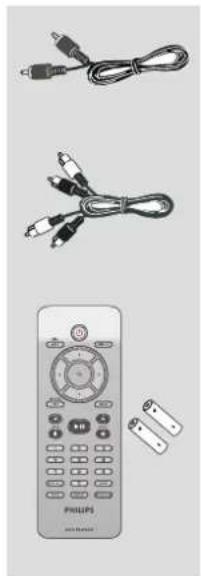
Supplied accessories
Composite video cable (yellow)
Audio cable (white, red)
Remote Control and two AAA batteries
natural_image
Illustration of a Philips remote control with three cables and two batteries (no text or symbols visible)Cleaning discs
To clean a disc, use a micro fibre cleaning cloth and wipe the disc from the center to the edge in a straight line.
CAUTION!
Do not use solvents such as benzene, thinner, commercially available cleaners, or anti-static sprays intended for discs.
Since the optical unit (laser) of the DVD system operates at a higher power than regular DVD or CD players, cleaning CDs intended for DVD or CD players may damage the optical unit (laser). Therefore, refrain from using a cleaning CD.
Setup
Finding a suitable location
- Place the set on a flat, hard and stable surface. Do not place the set on a carpet.
- Do not position the set on top of other equipment that might heat it up (e.g., receiver or amplifier).
- Do not put anything under the set (e.g., CDs, magazines).
- Install this system near the AC outlet and where the AC power plug can be reached easily.
Space for ventilation
- Place the apparatus in a location with adequate ventilation to prevent internal heat build up. Allow at least 10 cm (4.0") clearance from the rear and the top of the set and 5cm (2.0") from the left and right to prevent overheating.

text_image
10cm (4.0") 5cm (2.0") 10cm (4.0') 5cm (2.0')Avoid high temperatures, moisture, water and dust
- Apparatus shall not be exposed to dripping or splashing.
- Do not place any sources of danger on the apparatus (e.g., liquid filled objects, lighted candles).
Connections
Connecting TV

text_image
Diagram showing connections between an audio device and a network interface with labeled components and wiring paths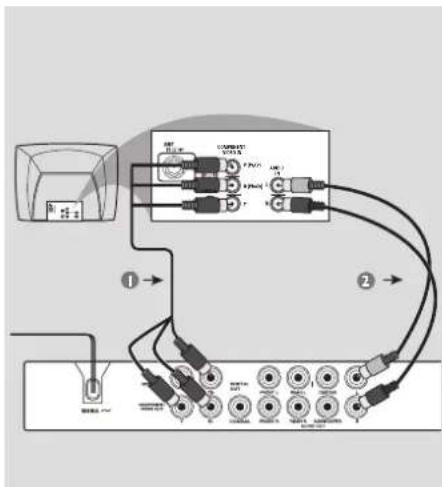
text_image
Diagram showing connections between a device, audio equipment, and multiple audio/video cables with labeled components.English
IMPORTANT!
- You only need to make one video connection from the following options, depending on the capabilities of your TV system. - Connect the DVD system directly to the TV.
Using Composite Video jacks (CVBS)
Use the composite video cable (yellow) to connect the DVD Player's CVBS (VIDEO) jack to the video input jack (or labeled as A/V In, Video In, Composite or Baseband) on the TV (cable supplied).
2 To hear the sound of this DVD Player through your TV, use the audio cables (white/red) to connect [AUDIO OUT (L/R)] jacks of the DVD Player to the corresponding AUDIO IN jacks on the TV (cable supplied).
IMPORTANT!
- The progressive scan video quality is only possible when using Y Pb Pr and a progressive scan TV is required.
Using Component Video jacks (Y Pb Pr)
Use the component video cables (red/blue/green) to connect the DVD system's Y Pb Pr jacks to the corresponding Component video input jacks (or labeled as Y Pb Pr) on the TV (cable not supplied).
2 To hear the sound of this DVD Player through your TV, use the audio cables (white/red) to connect [AUDIO OUT (L/R)] jacks of the DVD Player to the corresponding AUDIO IN jacks on the TV (cable supplied).
3 Proceed to page 16 for detailed Progressive Scan set up.
Connections
English
text_image
RF coaxial cable to TV Back of RF Modulator (example only) Antenna or Cable TV signal 1Connecting the power cord
text_image
MAIN VIDEO OUT COMPONENT HOLD OUT T P1 DIABAL OUT PROCT. RCA T P2 COAMAL FRONT 5 RCAIMPORTANT!
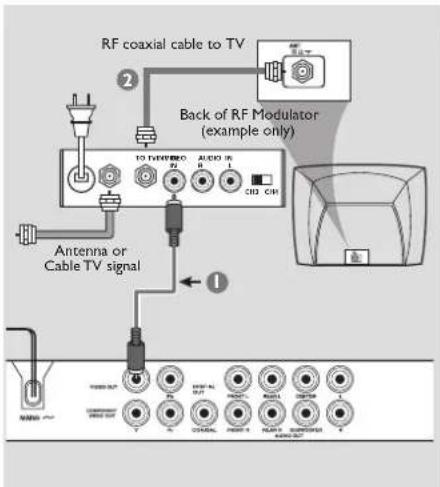
- If your TV only has a single Antenna In jack (or labeled as 75 ohm or RF In,) you will need an RF modulator in order to view the DVD playback on the TV. See your electronics retailer or contact Philips for details on RF modulator availability and operations.
Using an accessory RF modulator
Use the composite video cable (yellow) to connect the DVD player's CVBS (VIDEO OUT) jack to the video input jack on the RF modulator.
② Use the RF coaxial cable (not supplied) to connect the RF modulator to your TV's RF jack.
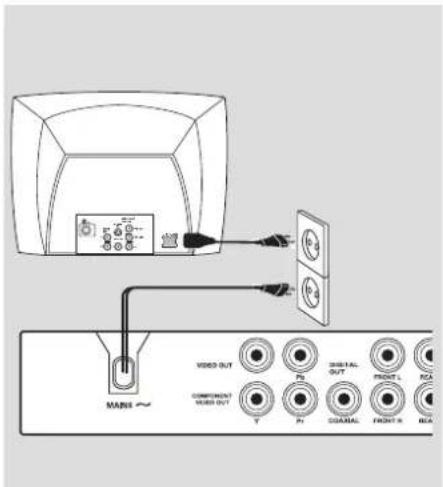
After everything is connected properly, plug in the AC power cord to the power outlet.
Never make or change any connections with the power switched on.
When no disc is loaded, press STANDBY ON on the DVD Player front panel, "NO DISC" may appear on the display panel.

text_image
NO DISCConnections
Optional: Connecting to a Multi-channel Receiver
text_image
AV Receiver 000 M245/16/17 M245/16/18 M245/16/19 M245/16/20 M245/16/21 M245/16/22 M245/16/23 M245/16/24 M245/16/25 M245/16/26 M245/16/27 M245/16/28 M245/16/29 M245/16/30 M245/16/31 M245/16/32 M245/16/33 M245/16/34 M245/16/35 M245/16/36 M245/16/37 M245/16/38 M245/16/39 M245/16/40 M245/16/41 M245/16/42 M245/16/43 M245/16/44 M245/16/45 M245/16/46 M245/16/47 M245/16/48 M245/16/49 M245/16/50 M245/16/51 M245/16/52 M245/16/53 M245/16/54 M245/16/55 M245/16/56 M245/16/57 M245/16/58 M245/16/59 M245/16/60 M245/16/61 M245/16/62 M245/16/63 M245/16/64 M245/16/65 M245/16/66 M245/16/67 M245/16/68 M245/16/69 M245/16/70 M245/16/71 M245/16/72 M245/16/73 M245/16/74 M245/16/75 M245/16/76 M245/16/77 M245/16/78 M245/16/79 M245/16/80 M245/16/81 M245/16/82 M245/16/83 M245/16/84 M245/16/85 M245/16/86 M245/16/87 M245/16/88 M245/16/89 M245/16/90 M245/16/91 M245/16/92 M245/16/93 M245/16/94 M245/16/95 M245/16/96 M245/16/97 M245/16/98 M245/16/99 M245 000 000 000 000 000 000 000 000 000 000 000 000 000 000 000 000 000 000 000 000 000 000 000 000 000 00Optional: Connecting to a Stereo System

text_image
STEREO 100 V 100 V 100 V 100 V 100 V 100 V 100 V 100 V 100 V 100 V 100 V 100 V 100 V 100 V 100 V 100 V 100 V 100 V 100 V 100 V 100 100 100 100 100 100 100 100 100 100 100 100 100 100 100 100 100 100 100 100 100 100 100 100 100 105 105 105 105 105 105 105 105 105 105 105 105 105 105 105 105 105 105 125 125 125 125 125 125 125 125 125 125 125 125 125 125 125Receiver has a Dolby Digital decoder
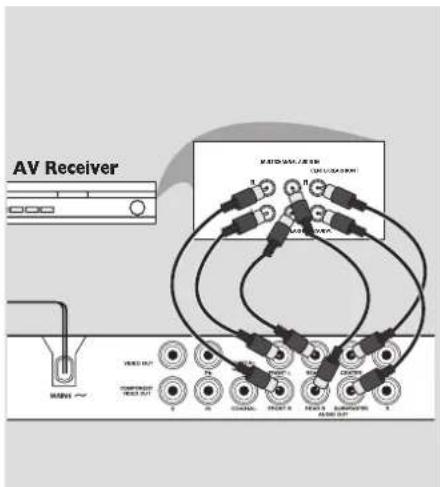
Select one of the video connections (CVBS VIDEO IN or COMPONENT VIDEO IN) depending on the options available on your TV.
2 Connect the Audio Out Left and Right jack for Front and Rear speakers to the corresponding input sockets on your Receiver (cable not supplied).
3 Connect the Audio Out for Center speaker and Subwoofer to the corresponding inputs on your Receiver (cable not supplied).
4 Set the DVD Player's Analog Output to 'Multichannel' to enable playback of DVDs recorded in Multi-channel. (see page 29 "Setting the analogue output").
Helpful Hint:
- If the subwoofer is equipped with its own amplifier, the Subwoofer connection should be connected directly to the subwoofer.
Stereo system has Dolby Pro Logic or Right / Left Audio In jack
1 Select one of the video connections (CVBS VIDEO IN or COMPONENT VIDEO IN) depending on the options available on your TV.
② Use the audio cables (white/red) to connect [AUDIO OUT (L/R)] jacks of the DVD Player to the corresponding AUDIO IN jacks on the stereo system (cable supplied).
Connections
English
Optional: Connecting Digital AV Receiver
text_image
AV ReceiverReceiver has a PCM, Dolby Digital, or MPEG2 decoder
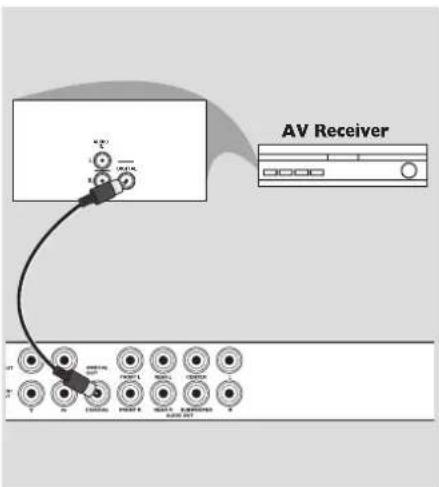
Select one of the video connections (CVBS VIDEO IN or COMPONENT VIDEO IN) depending on the options available on your TV.
2 Connect the COAXIAL jack of the DVD player to the corresponding Digital Audio In jack on your Receiver (cable not supplied).
3 Set the DVD player's Digital Output to PCM-ONLY or ALL depending on the capabilities of your Receiver (see page 29 "Digital Output").
Helpful Hint: - If the audio format of the Digital Output does not match the capabilities of your receiver, the receiver will produce a strong, distorted sound or no sound at all.
Functional Overview
Front and Rear Panels
English

text_image
STANDBY-ON ⏻ - Turns the player on or switches it to standby mode ■ STOP - Stops playback Disc tray OPEN/CLOSE ▲ - Opens or closes the disc tray ▶II PLAY/PAUSE - Starts or pauses playback Display - Shows the information about the current status of the DVD Player - Point the remote control towards this sensor IR Sensor PHILIPS
text_image
Mains (AC Power Cord) - Connect to a standard AC outlet VIDEO OUT (CVBS) - Connect to CVBS Video input of a TV YPbPr (Component Video Out) - Connect to YPbPr input of a TV Audio Out (Left/Right) - Connect to AUDIO inputs of an amplifier, receiver or stereo system Multichannel Audio Out - Center speaker, subwoofer, front and rear speakers multichannel connection COAXIAL (Digital audio out) - Connect to coaxial AUDIO input of a digital audio equipmentCaution: Do not touch the inner pins of the jacks on the rear panel. Electrostatic discharge may cause permanent damage to the unit.
Functional Overview
English
Remote Control

text_image
DISC MENU - Enters or exits the disc contents menu - Switches on or off the playback control mode (for VCD version 2.0 only) RETURN / TITLE - To go back to previous menu / show title menu PREV (◀) - Skips to the previous title/chapter/ track NEXT (▶) - Skips to the next title/chapter/track STOP (■) - Stops playback PLAY/PAUSE (▶II) - Starts or pauses playback MUTE (○) - Disables or enables sound output SUBTITLE - Selects a DVD subtitle language ZOOM - Enlarge a picture on the TV screen REPEAT - Selects various repeat mode REPEAT A-B - Repeats playback a specific section on a disc PHILIPS DVD PLAYER DISPLAY - Displays information on TV screen during playback ◀ ▶ - Cursor buttons for moving to the left or right, do a forward/ reverse search ▲ ▼ - Cursor buttons for moving up/ down, do a slow forward/ backward OK - Confirms an entry or selection SETUP - Enters or exits system setup menu. Alphanumeric keypad 0-9 - Selects numbered items in a menu AUDIO - Selects an audio language (DVD/ VCD) or audio channels.Helpful Hint:
Press "STOP" for about 2 seconds to
OPEN or CLOSE disc tray.
Getting Started
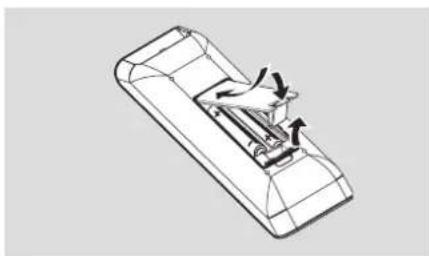
Step 1: Inserting batteries into the Remote Control
natural_image
Line drawing of a car interior with directional arrows indicating movement or force (no text or symbols)① Open the battery compartment.
② Insert two batteries type R03 or AAA, following the indications (+ -) inside the compartment.
3 Close the cover.
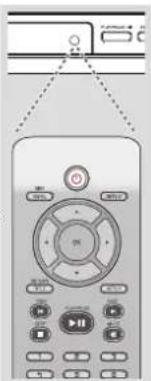
Using the Remote Control to operate the Player
Aim the Remote Control directly at the remote sensor (IR) on the front panel.
Do not put any objects between the Remote Control and the DVD player while operating the DVD player.
natural_image
Front and back view of a remote control device with buttons and a display (no visible text or symbols)CAUTION!
- Remove batteries if they are exhausted or if the Remote Control is not being used for a long time.
- Do not use old and new or different types of batteries in combination.
- Batteries contain chemical substances, so they should be disposed properly.
Step 2: Setting up the TV
IMPORTANT!
Make sure you have completed all the necessary connections. (See pages 9-10 "Connecting TV").
Turn on the TV and set to the correct video-in channel. You should see the DVD background screen on the TV.
② Usually these channels are between the lowest and highest channels and may be called FRONT, A/V IN, or VIDEO. See your TV manual for more details.
→Or, you may go to channel 1 on your TV, then press the Channel down button repeatedly until you see the Video In channel.
→Or, the TV Remote Control may have a button or switch that chooses different video modes.
→Or, set the TV to channel 3 or 4 if you are using an RF modulator.
3 If you are using external equipment, (e.g., audio system or receiver), turn it on and select the appropriate input source for the DVD player output. Refer to the equipment owner's manual for detail.
Getting Started
Setting up Progressive Scan feature (for Progressive Scan TV only)
The progressive scan display twice as many frames per second as interlaced scanning (ordinary normal TV system). With nearly double the number of lines, progressive scan offers higher picture resolution and quality.
IMPORTANT!
Before enabling the progressive scan feature, you must ensure:
1) Your TV can accept progressive signals, a progressive scan TV is required.
2) You have connected the DVD player to your TV using Y Pb Pr (see page 9.)
Turn on your TV.
2 Turn off your TV progressive scan mode or turn on interlaced mode (refer to your TV user manual.)
3 Press POWER (⏻) on the remote control to turn on the DVD player.
4 Select the correct Video Input channel. (See page 15). →The DVD background screen appears on the TV.
5 Press SETUP.
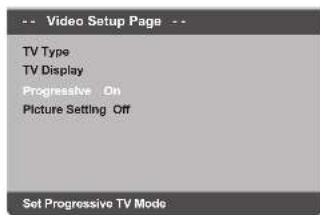
6 Press ▶ to select {VIDEO SETUP PAGE}.
text_image
-- Video Setup Page -- TV Type TV Display Progressive On Picture Setting Off Set Progressive TV Mode7 Select {PROGRESSIVE} to {ON}, then OK to confirm.
→The instruction menu appears on the TV.
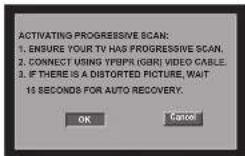
8 Press ◀ to highlight OK in the menu and press OK to confirm.
There will be a distorted picture on your TV at this state until you turn on the progressive scan mode on your TV.
9 Turn on your TV progressive scan mode (refer to your TV user manual.) →The below menu appears on the TV.

10 Press ◀ to highlight OK in the menu and press OK to confirm. →The set up is complete now and you can start enjoy the high quality picture.
To deactivate Progressive manually:
● Wait for 15 seconds for auto recovery.
OR
Press OPEN CLOSE ▲ on the DVD player to open the disc tray.
2 Press numeric keypad '1' on the remote control for few seconds.
→The DVD background screen appears on the TV.
Helpful Hint:
- There are some progressive scan TV and High-Definition TV sets that are not fully compatible with this DVD system, resulting in the unnatural picture when playing back a DVD VIDEO disc in the progressive scan mode. In such a case, turn off the progressive scan feature on both the DVD player and your TV set.
TIPS: The underlined option is the factory default setting.
Press ◀ to go back to the previous menu item. Press SETUP to exit the menu item.
Getting Started
Selecting the colour system that corresponds to your TV
This DVD player is compatible with both NTSC and PAL. In order for a DVD disc to play on this player, the colour system of the Disc, the TV and the DVD player should match.

text_image
-- Video Setup Page -- TV Type P A L TV Display Multi Progressive NTSC Picture Setting NTSC TVPress SETUP.
2 Press ▶ to select {VIDEO SETUP PAGE}.
3 Press ▲▼ to highlight {TV TYPE}, then press ▶.
4 Press ▲▼ to highlight one of the options below:
PAL – Select this if the connected TV is PAL system. It will change the video signal of a NTSC disc and output in PAL format.
NTSC – Select this if the connected TV is NTSC system. It will change the video signal of a PAL disc and output in NTSC format.
Multi – Select this if the connected TV is compatible with both NTSC and PAL (multi-system). The output format will be in accordance with the video signal of the disc.
5 Select an item and press OK.
→Follow the instructions shown on the TV to confirm the selection (if any).
Helpful Hints:
- Before changing the current TV Standard setting, ensure that your TV supports the 'selected TV Type' system. - If there is no proper picture on your TV, wait for 15 seconds for auto recovery.

text_image
CHANGING PAL TO NTSC: 1. ENSURE THAT YOUR TV SUPPORTS NTSC STANDARD. 2. IF THERE IS A DISTORTED PICTURE DISPLAYED ON THE TV, WAIT 15 SECONDS FOR AUTO RECOVERY. CANCEL OK CONFIRM AGAIN TO USE NEW TV TYPE SETTING. CANCEL OKTo reset to default TV colour system manually:
● Wait for 15 seconds for auto recovery.
OR
Press OPEN CLOSE ▲ on the DVD player to open the disc tray.
2 Press numeric keypad '3' on the remote control for few seconds.
→The DVD background screen appears on the TV.
TIPS: The underlined option is the factory default setting.
Press ◀ to go back to the previous menu item. Press SETUP to exit the menu item.
Getting Started
Step 3: Setting language preference
The language options are different depending on your country or region. It may not correspond to the illustrations shown on the user manual.
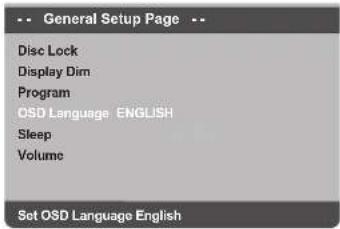
Setting the OSD Language
The On-screen language for the system menu will remain as you set it, regardless of various disc languages.
text_image
-- General Setup Page -- Disc Lock Display Dim Program OSD Language ENGLISH Sleep Volume Set OSD Language EnglishPress SETUP.
2 Press ▶ to select {GENERAL SETUP PAGE}.
3 Press ▲▼ to highlight {OSD LANGUAGE}, then press ▶.
4 Press ▲▼ to select a language and press OK.
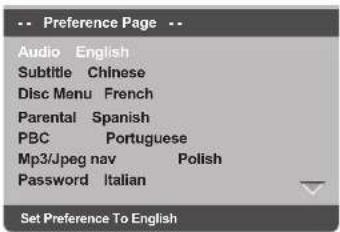
Setting the Audio, Subtitle and Disc menu language
You can choose your own preferred language or soundtrack from audio, subtitles and disc menu languages. If the language selected is not available on the disc, the disc's default language will be used instead.
text_image
-- Preference Page -- Audio English Subtitle Chinese Disc Menu French Parental Spanish PBC Portuguese Mp3/Jpeg nav Polish Password Italian Set Preference To EnglishPress STOP twice then, press SETUP.
2 Press ▶ to select {PREFERENCE PAGE}.
3 Press ▲▼ to highlight one of the options below at a time, then press ▶.
- 'Audio' (disc's soundtrack)
- 'Subtitle' (disc's subtitles)
- 'Disc Menu' (disc's menu)
4 Press ▲▼ to select a language and press OK.
If the language you want is not in the list, then select {OTHERS},
then use the numeric keypad (0-9) on the remote to enter the 4-digit language code 'XXXX' (see page 5 "Language Code") and press OK.
5 Repeat steps 3\~4 for other language settings.
TIPS: The underlined option is the factory default setting. Press ◀ to go back to the previous menu item. Press SETUP to exit the menu item.
Disc Operations
IMPORTANT!
- If the inhibit icon (ø) appears on the TV screen when a button is pressed, it means the function is not available on the current disc or at the current time.
- Depending on the DVD or VIDEO CD, some operations may be different or restricted.
- Do not push on the disc tray or put any objects other than disc on the disc tray. Doing so may cause the disc player malfunction.
playable Discs
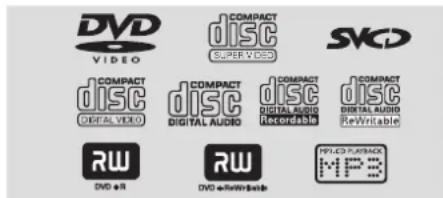
Your DVD Player will play:
– Digital Video Discs (DVDs)
- Video CDs (VCDs)
– Super Video CDs (SVCDs)
- Digital Video Discs +
Recordable[Rewritable] (DVD+R[W])
- Compact Discs (CDs)
- MP3 discs, picture (Kodak, JPEG) files on CD-R(W).
- JPEG/ISO 9660 format
– Maximum 30 characters display.
– Supported sampling frequencies : 32 kHz, 44.1 kHz, 48 kHz (MPEG-1) 16 kHz, 22.05 kHz, 24 kHz (MPEG-2)
– Supported Bit-rates : 32\~256 kbps (MPEG-1), 8\~160 kbps (MPEG-2) variable bitrates
- WMA files on CD-R(W).
– Supported Bit-rates : 32\~192 kbps
text_image
DVD VIDEO COMPACT DISC SUPER VIDEO SVCD COMPACT DISC DIGITAL VIDEO COMPACT DISC DIGITAL AUDIO COMPACT DISC DIGITAL AUDIO ReWritable RW DVD e-R RW DVD e-Revivable MPBRegion Codes
This DVD player is designed to support the Region Management System. Check the regional code number on the disc package. If the number does not match the player's region number (see table below), the player may be unable to playback the disc.
Helpful Hints:
- It may not be possible to play CD-R/RW or DVD-R/RW in all cases due to the type of disc or condition of the recording.
- If you are having trouble playing a certain disc, remove the disc and try a different one. Improperly formatted disc will not play on this DVD Player.
| Region | Discs that can be played (Example) | |
| U.S.A. and Canada regions |  |  |
| U.K and Europe regions |  |  |
| Asia Pacific, Taiwan, Korea |  |  |
| Australia, New Zealand, Latin America |  |  |
| Russia and India regions |  |  |
| China, Calcos Islands, Walls and Futuna Islands |  |  |
TIPS: The operating features described here might not be possible for certain discs. Always refer to the instructions supplied with the discs.
Disc Operations
Playing discs
Connect the power cords of the DVD player and TV (and any optional stereo or AV receiver) to a power outlet.
② Turn on the TV power and set to the correct Video In channel. (See page 15 "Setting up the TV").
3 Press STANDBY-ON to turn on the DVD player.
→The DVD background screen appears on the TV.
4 Press OPEN/CLOSE ▲ on the front of the DVD player.
- You can also hold down the STOP button on the remote control to open and close the disc tray.
5 Place a disc into the disc tray with the lable facing up, then press OPEN/CLOSE ▲.
→For double-sided discs, load the side you want to play facing up.
6 Playback may start automatically. If not press PLAY/PAUSE ▶II.
→If a disc menu appears on the TV, see page 21 "Using the Disc Menu".
→If the disc is locked by parental control, you must enter your six-digit password. (See page 33).
- For more playback features, see pages 20–25.
Basic playback controls
Unless otherwise stated, all operations described are based on Remote Control use.
Pausing playback
① During playback, press PLAY/PAUSE ▶II to pause playback and display a still picture.
→Sound will be muted.
2 To resume normal playback, press PLAY/PAUSE ▶II again.
Selecting track/chapter
- Press PREV ◀ / NEXT ▶ to go to the previous or next track/chapter.
●In STOP mode, press DISPLAY to display the disc information text line for title/chapter/track (example - 00/08).
Use alphanumeric keypad (0-9) to enter valid title/chapter/track number, then press OK. →The playback skips to the selected title/chapter/track.
Stopping playback
- Press STOP ■.
Helpful hints:
- Screen saver will start automatically if the disc playback is stopped/paused for 5 minutes. - The player will automatically switch to Power Standby mode if you do not press any buttons for 15 minutes after the disc has stopped playing.
TIPS: The operating features described here might not be possible for certain discs. Always refer to the instructions supplied with the discs.
Disc Operations
Selecting various repeat/shuffle functions
Repeat play mode
The repeat play options vary depending on the disc type.
While playing a disc, press REPEAT continuously to choose a repeat options.
For DVD
– Chapter (currently playing chapter)
– Title (currently playing title)
- All (entire disc)
– Shuffle (random playback)
- Off (cancel)
For Video CD, Audio CD
- Track (currently playing track)
- All (entire disc)
– Shuffle (random playback) - Off (cancel)
For MP3
- Repeat One (currently playing file)
- Repeat Folder (all files in selected folder)
– Folder (playing all files in one folder once) - Shuffle (all files in current folder at random playback)
— Single (currently playing file once)
For JPEG, DivX
In STOP mode,
- Repeat One (currently playing file)
- Repeat Folder (all files in selected folder)
– Folder (playing all files in one folder once)
- Shuffle (all files in current folder at random playback)
– Single (currently playing file once)
In PLAY mode,
- Repeat One (currently playing file)
- Repeat All (playing all files in one disc)
- Repeat Off (cancel)
- Shuffle (all files in current folder at random playback)
– Single (currently playing file once)
2 To cancel repeat playback, press STOP ■.
Helpful Hint:
- For VCD, repeat playback is not possible if the PBC mode is switched on.
Repeating a section within a chapter/track
① While playing a disc, press REPEAT A-B at your chosen starting point.
2 Press REPEAT A-B again at your chosen end point.
→The section A and B can be set only within the same chapter/track.
→The section will now repeat continuously.
3 To exit the sequence, press REPEAT A-B.
Disc Operations
Operations for video playback (DVD/VCD/SVCD)
Using the Disc Menu
Depending on the disc, a menu may appear on the TV screen once you load in the disc.
To select a playback feature or item
Use ◀▶ ▲▼ keys or numeric keypad (0-9) on the remote, then press OK to start playback.
To access or remove the menu
●Press DISC MENU on the remote.
Zooming in
This function allows you to enlarge the picture on the TV screen and to pan through the enlarged picture.
During playback, press ZOOM repeatedly to display the picture with different scales.
→ Use ◀▶ ▲▼ keys to pan through the enlarged picture.
→Playback will continue.
2 Press ZOOM repeatedly to return to the original size.
Resuming playback from the last stopped point
Resume playback of the last 5 discs is possible, even if the disc was ejected, the power switched off or the power being cut-off.
●Load one of the last 5 discs.
→ "LOADING" appears.
●During loading mode, press PLAY/PAUSE▶II and the disc will be played back from the last point.
To cancel resume mode
In stop mode, press STOP ■ again.
Helpful Hint:
- This function is not possible on CD/MP3 disc.
Slow Motion
Press ▲▼ during playback to select the required speed: 1/2, 1/4, 1/8 or 1/16 (forward {DVD/SVCD/VCD} or backward {DVD}).
→Sound will be muted.
② To return to normal speed, press PLAY/PAUSE ▶II.
Forward / Reverse Searching
1 Press ◀▶ during playback to select the required speed: 2X, 4X, 8X, 16X or 32X (backward or forward).
→Sound will be muted (DVD/VCD) or intermittent (CD).
2 To return to normal speed, press PLAY/PAUSE ▶II.
TIPS: The operating features described here might not be possible for certain discs. Always refer to the instructions supplied with the discs.
Disc Operations
OSD (On-Screen Display) (DVD/VCD/SVCD)
Using the OSD menu
OSD menu shows the disc playback information (for example, title or chapter number, elapsed playing time, audio/subtitle language), a number of operations can be done without interrupting disc playback.
●During playback, press DISPLAY. →A list of available disc information appears on the TV screen.

text_image
Menu Title 01/01 Chapter 09/12 Audio 2CH Chinese Subtitle Off Bitrate 61 Main 0:48:59 (DVD)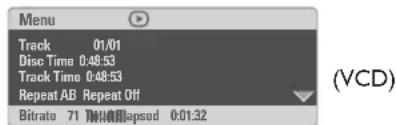
text_image
Menu Track 01/01 Disc Time 0:48:53 Track Time 0:48:53 Repeat AB Repeat Off Bitrate 71 T###lapsed 0:01:32 (VCD)Title/Chapter/Track selection
Press ▲▼ to highlight {Title} / {Chapter} or {Track}, then press ► to access.
2 Use the numeric keypad (0-9) to enter a valid number (e.g. 04/05).
3 Press OK to confirm.
→The playback skips to the selected title/chapter/track.
Time Search
Press ▲▼ to highlight {Time Disp.} (Time Display), then press ▶ to access. →The following display types appears on the TV, depending on the Disc in the player.
For DVD discs:
TT Elapsed - elapsed playing time of current Title;
TT Remain - remaining playing time of current Title;
CH Elapsed - elapsed playing time of current Chapter;
CH Remain - remaining playing time of current Chapter;
For VCD/SVCD discs:
Total Elapsed - elapsed playing time of current Disc;
Total Remain - remaining playing time of current Disc;
Single Elapsed - elapsed playing time of current Track;
Single Remain - remaining playing time of current Track;
2 Press ▲▼ to highlight {TT Time} / {CH Time} / {Disc Time} or {Track Time}, then press ▶ to access.
3 Use the numeric keypad (0-9) to input the valid time (e.g. 0:34:27).
→The playback skips to the chosen time.
TIPS: The operating features described here might not be possible for certain discs. Always refer to the instructions supplied with the discs.
Disc Operations
Audio/Subtitle
① Press ▲▼ to highlight {Audio} or {Subtitle}, then press ▶ to access. → Audio or Subtitle menu appears on the TV.
2 Press ▲▼ to select one language, then press OK to confirm. → Current audio or subtitle language will be changed to the selected language.
Angle
① Press ▲ ▼ to highlight {Angle}, then press ▶ to access.
2 Use the numeric keypad (0-9) to key in a valid number.
3 Press OK to confirm. →Playback will go to the selected angle.
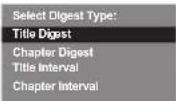
Preview Function
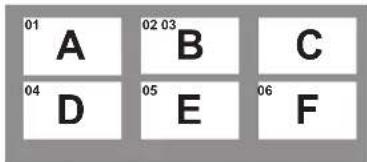
The preview function allows you to reduce the picture of 6 tracks enough to display in a full screen.
Press ▲▼ to highlight {Preview}, then press ▶ to access.
→The preview menu appears on the TV screen.
(DVD example)

(Video CD example)
2 Press ▲▼ to select the PREVIEW type, then press OK.
→The picture of each segment will appear on the screen.
text_image
01 A 02 03 B C 04 D 05 E 06 F(example for 6 thumbnail pictures display)
3 Press ▲▼◀▶ to select a track or input your selected track number using the numeric keypad (0-9), then press OK.
→ Playback will start automatically on the selected track.
TIPS: The operating features described here might not be possible for certain discs. Always refer to the instructions supplied with the discs.
Disc Operations
Special DVD Features
Playing a Title
Press DISC MENU.
→The disc menu appears on the TV screen.
2 Use ▲▼◀▶ keys or alphanumeric keypad
(0-9) to select a play option.
3 Press OK key to confirm.
Changing the Audio Language
For DVD
●Press AUDIO repeatedly to select different audio languages.
Changing the Audio Channel
For VCD
- Press AUDIO to select the available audio channels provided by the disc (MONO LEFT, MONO RIGHT, MIX-MONO, STEREO).
Subtitles
- Press SUBTITLE repeatedly to select different subtitle languages.
Special VCD & SVCD Features
Playback Control (PBC)
For VCD with Playback Control (PBC) feature (version 2.0 only)
- Press DISC MENU to toggle between 'PBC ON' and 'PBC OFF'. →If you select 'PBC ON', the disc menu (if available) will appear on the TV. →Use the PREV ◀ / NEXT ▶ or the numeric keypad (0-9) to select a play option.
●During playback, pressing RETURN/TITLE will return to the menu screen (if PBC is on).
If you want to skip the index menu and playback directly from the beginning,
●Press DISC MENU key on the remote control to switch to PBC off.
TIPS: The operating features described here might not be possible for certain discs. Always refer to the instructions supplied with the discs.
Disc Operations
Playing MP3/WMA/JPEG/Kodak Picture CD
IMPORTANT!
You have to turn on your TV and set to the correct Video In channel. (See page 15 "Setting up the TV").
General Operation
Load a disc.
→The disc reading time may exceed 30 seconds due to the complexity of the directory/file configuration.
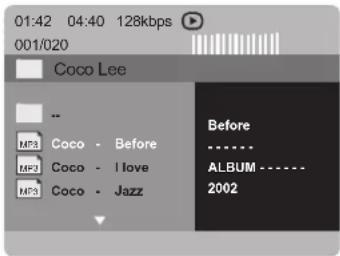
→The data disc menu appears on the TV screen.
text_image
01:42 04:40 128kbps 001/020 Coco Lee -- MP3 Coco - Before MP3 Coco - I love MP3 Coco - Jazz Before ---- ALBUM ---- 20022 Press ▲▼ to select the folder and press OK to open the folder.
3 Press ▲▼ to select a track/file.
4 Press PREV ◀ / NEXT ▶ to go to previous/next page.
5 Press OK to confirm.
Playback selection
During playback, you can;
- Press PREV ◀ / NEXT ▶ to select the previous/next track/file in the current folder.
- Press ◀ ▶▲▼ on the remote to rotate/flip the picture files.
- Press PLAY/PAUSE ▶II repeatedly to pause/resume playback.
Zoom picture (JPEG)
●During playback, press ZOOM repeatedly to display the picture with different scales.
●Use ▲▼◀▶ to view the zoomed picture.
Playback with multi-angles (JPEG)
During playback, press ▲▼◀▶ to rotate the picture on the TV screen.
▲: flip the picture vertically by 180°
▼: flip the picture horizontally by 180°
◄: rotate the picture anti-clockwise by 90°
▶: rotate the picture clockwise by 90°.
Helpful Hints:
- It may not be possible to play certain MP3/WMA/JPEG disc due to the configuration and characteristics of the disc or condition of the recording.
- It is normal to experience an occasional "skip" while listening to your MP3/WMA disc.
- For multi-session discs with different formats, only the first session will be available.
Preview Function (JPEG)
This function shows the content of the current folder or the whole disc.
① Press DISPLAY during playback. →12 thumbnail pictures will appear on the TV screen.

natural_image
Grid of grayscale microscopic images showing various surface textures and patterns (no text or symbols visible)2 Press PREV ◀ / NEXT ▶ to display the other pictures on the previous/next page.
3 Press ◀ ▶ ▲ ▼ on highlight one of the picture and press OK to start playback.
4 Press DISC MENU to return to Picture CD menu.
TIPS: The operating features described here might not be possible for certain discs. Always refer to the instructions supplied with the discs.
DVD Setup Menu Options
This DVD player setup is carried out via the TV, enabling you to customise the DVD player to suit your particular requirements.
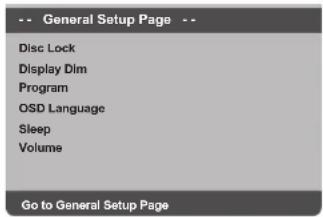
General Setup menu
In disc mode, press SETUP.
2 Press ◀▶ to select 'General Setup' icon.
3 Press OK to confirm.
text_image
-- General Setup Page -- Disc Lock Display Dim Program OSD Language Sleep Volume Go to General Setup PageLocking/Unlocking the disc for viewing
Not all discs are rated or coded by the disc maker. You can prevent a specific disc from playing by locking the disc. Up to 40 discs can be locked.
In 'GENERAL SETUP PAGE', press ▲▼ to highlight {DISC LOCK}, then press ▶.
LOCK
Select this to block the playback of the current disc. Subsequent access to a locked disc requires six-digit password. The default password is '136 900' (see page 36 "Changing the password").
UNLOCK
Select this to unlock the disc and allow future playback.
2 Press ▲ ▼ to select a setting, then press OK to confirm your selection.
Dimming player's display panel
You can select different levels of brightness for the display screen.
In 'GENERAL SETUP PAGE', press ▲▼ to highlight {DISPLAY DIM}, then press ▶.
100% – Select this for full brightness.
70% – Select this for medium brightness.
40% – Select this for dimming the display.
2 Press ▲▼ to select a setting, then press OK to confirm your selection.
Programming disc tracks (not for Picture CD/MP3/WMA)
You can play the contents of the disc in the order you want by programming the tracks to be played. Up to 20 tracks can be stored.
In 'GENERAL SETUP PAGE', press ▲▼ to highlight {PROGRAM}, then press ▶ to select {INPUT MENU}.
2 Press OK to confirm.

To input your favourite tracks/chapter
3 Use the numeric keypad (0-9) to enter a valid track/chapter number.
4 Use ◀▶ ▲▼ keys to move the cursor to the next position.
→If there are more than ten track/chapters, press NEXT ▶ to open the next page and proceed with programming or,
→ Use ◀▶ ▲▼ keys to highlight {NEXT} on the programme menu, then press OK.
5 Repeat steps 3\~4 to input another track/chapter number.
TIPS: The underlined option is the factory default setting.
Press ◀ to go back to the previous menu item. Press SETUP to exit the menu item.
DVD Setup Menu Options
If you want to remove a track
6 Use ◀▶ ▲▼ keys to move the cursor to the track you want to remove.
7 Press OK to remove this track from the programme menu.
To start programme playback
8 Use ▶▲▼ keys to highlight {START} on the programme menu, then press OK. →Playback will start with the selected tracks under the programmed sequence.
To exit programme playback
9 Use ◀▶ ▲▼ keys to highlight {EXIT} on the programme menu, then press OK.
OSD Language
This menu contains various language options for display language on the screen. For details, see page 18.
Sleep
Sleep function allows you to turn off the DVD Player automatically after a preset time.
In 'GENERAL SETUP PAGE', press ▲▼ to highlight {SLEEP}, then press ▶.
15 Mins
Turn off the DVD Player after 15 minutes.
30 Mins
Turn off the DVD Player after 30 minutes.
45 Mins
Turn off the DVD Player after 45 minutes.
60 Mins
Turn off the DVD Player after 60 minutes.
OFF
Turn off the sleep function.
2 Press ▲▼ to select a setting, then press OK to confirm your selection.
Volume
To increase or decrease the volume from changing value of 0 to 20 on the DVD player.
In 'GENERAL SETUP PAGE', press ▲▼ to highlight {VOLUME}, then press ▶.
2 Press ◀▶ to adjust the setting that best suit your personal preference.
3 Press OK to confirm.
TIPS: The underlined option is the factory default setting.
Press ◀ to go back to the previous menu item. Press SETUP to exit the menu item.
DVD Setup Menu Options
Audio Setup Menu
In disc mode, press SETUP.
2 Press ◀▶ to select 'Audio Setup' icon.
3 Press OK to confirm.

text_image
Audio Setup Page Analog Output Digital Audio Setup Pro Logic II Sound Mode Speaker Setup Night Mode Go to Audio Setup PageAnalog Output
This options allows you to set the stereo analog output of your DVD player.
In 'AUDIO SETUP PAGE', press ▲▼ to highlight {ANALOG OUTPUT}, then press ▶.
Stereo
Select this option when output delivers sound from only the two front speakers.
LT/RT
Select this option if your DVD player is connected to a Dolby Pro Logic decoder.
V SURR
Allows the DVD player to use virtual surround sound effects.
Multi Channel
Select this to enable Multi-channel output.
2 Press ▲▼ to select a setting, then press OK to confirm your selection.
Digital Audio Setup
The options included in Digital Audio Setup are: 'Digital Output' and 'LPCM Output'.
In 'AUDIO SETUP PAGE', press ▲▼ to highlight {DIGITAL AUDIO SETUP}, then press ▶.
2 Press the ▲▼ keys to highlight an option.
3 Enter its submenu by pressing ▶.
4 Press ▲▼ to select a setting, then press OK to confirm your selection.
Digital Output
Set the Digital output according to your optional audio equipment connection.
→Off: Turn off the digital output.
→ All: If you have connected your DIGITAL AUDIO OUT to a multi-channel decoder/receiver.
→PCM Only: Only if your receiver is not capable of decoding multi-channel audio.
Helpful hint:
- If DIGITAL OUTPUT is set to 'All', all audio settings except MUTE are invalid.
TIPS: The underlined option is the factory default setting.
Press ◀ to go back to the previous menu item. Press SETUP to exit the menu item.
DVD Setup Menu Options
LPCM Output
If you connect the DVD Player to a PCM compatible receiver via the digital terminals, such as coaxial or optical etc, you may need to adjust 'LPCM Output'. Discs are recorded at a certain sampling rate. The higher the sampling rate, the better the sound quality.
→ 48K: Playback a disc recorded at the sampling rate of 48kHz.
→96K: Playback a disc recorded at the sampling rate of 96kHz. This rate can only be achieved in Stereo-Classic (Flat) mode.
Pro Logic II
This options allows you to set the Pro Logic II output of your DVD player.
In 'AUDIO SETUP PAGE', press ▲▼ to highlight {PRO LOGIC II}, then press ▶.
Off
Select this option to turn off Dolby Pro Logic II output.
Music
Select this option to turn to music sound mode.
Movie
Select this option to turn to movie sound mode.
2 Press ▲▼ to select a setting, then press OK to confirm your selection.
Sound Mode
The options included in Sound Mode Setup are: '3D', 'Movie Mode' and 'Music Mode'.
In 'AUDIO SETUP PAGE', press ▲▼ to highlight {SOUND MODE}, then press ▶.
2 Press the ▲▼ keys to highlight an option.
3 Enter its submenu by pressing ▶.
4 Press ▲▼ to select a setting, then press OK to confirm your selection.
3D
This function provides a virtual surround sound experience using just two speakers.
→ Off, Living Room, Hall, Arena and Church
Movie Mode
Select a Sound Mode that matches the type of music you are playing. These preset Sound Modes adjust the frequency bands of the video to enhance your favourite movie sound track.
→ Off, Sci-Fic, Action, Drama and Concert
Music Mode
Select a Sound Mode that matches the type of music you are playing. These preset Sound Modes adjust the frequency bands of the audio to enhance your favourite music.
→ Off, Digital, Rock, Classic and Jazz
Speaker Setup
This menu contains setup options for your audio output which makes the speaker setup system reproduce high quality surround sound. For details, see page 37.
TIPS: The underlined option is the factory default setting.
Press ◀ to go back to the previous menu item. Press SETUP to exit the menu item.
DVD Setup Menu Options
Night Mode - turning on/off
In this mode, the high volume outputs are softened. It is useful for watching your favourite action movie without disturbing others at night.
In 'AUDIO SETUP PAGE', press ▲▼ to highlight {NIGHT MODE}, then press ▶.
ON
Select this to level out the volume. This feature is only available for movies with Dolby Digital mode.
OFF
Select this when you want to enjoy the surround sound with its full dynamic range.
2 Press ▲▼ to select a setting, then press OK to confirm your selection.
Video Setup Menu
In disc mode, press SETUP.
2 Press ◀▶ to select 'Video Setup' icon.
3 Press OK to confirm.

text_image
-- Video Setup Page -- TV Type TV Display Progressive Picture Setting Go To Video Setup PageTV Type
This menu contains the options for selecting the colour system that matches the connected TV. For details, see page 17.
TIPS: The underlined option is the factory default setting.
Press ◀ to go back to the previous menu item. Press SETUP to exit the menu item.
DVD Setup Menu Options
Setting the TV Display
Set the aspect ratio of the DVD Player according to the TV you have connected. The format you select must be available on the disc. If it is not, the setting for TV display will not affect the picture during playback.
In 'VIDEO SETUP PAGE', press ▲▼ to highlight {TV DISPLAY}, then press ▶.
2 Press ▲▼ to highlight one of the options below:
4:3 PAN SCAN -
Select this if you have a normal TV and want both sides of the picture to be trimmed your TV screen.

4:3 LETTER BOX -
Select this if you have a normal TV. In this case, a wide picture with black bands on the upper and low the TV screen will be displayed.
16:9 – Select this if you have a wide-screen TV.


3 Select an item and press OK.
Progressive - turning on/off
In the progressive scan mode, you can enjoy the high quality picture with less flickers. It only works when you have connected the DVD player's Y Pb Pr jacks to your TV that supports the progressive video input. Otherwise, a distorted picture will appear on the TV. For proper progressive scan set up, see page 16.
In 'VIDEO SETUP PAGE', press ▲▼ to highlight {PROGRESSIVE}, then press ▶.
OFF
To disable Progressive Scan function.
ON
To enable Progressive Scan function.
2 Press ▲▼ to select a setting, then press OK to confirm your selection.
→Follow the instructions shown on the TV to confirm the selection (if any). →If a distorted picture appears on the TV screen, wait for 15 seconds for auto recovery.
TIPS: The underlined option is the factory default setting.
Press ◀ to go back to the previous menu item. Press SETUP to exit the menu item.
DVD Setup Menu Options
Picture Setting
This DVD Player provides three predefined sets of picture colour settings and one personal setting which you can define yourself.
In 'VIDEO SETUP PAGE', press ▲▼ to highlight {PICTURE SETTING}, then press ▶.
STANDARD
Select this for standard picture setting.
VIVID
Select this to make the TV picture brighter.
COOL
Select this to make the TV picture softer.
PERSONAL
Select this to personalise your picture colour by adjusting the brightness, contrast, tint and colour (saturation).
2 Press ▲▼ to select a setting, then press OK to confirm your selection.
③ If you select {PERSONAL}, then proceed to steps ④\~⑦.
→The 'personal picture setup' menu appears.
Personal Picture Setup
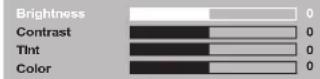
4 Press ▲▼ to highlight one of the following options.
BRIGHTNESS
Increase the value to brighten the picture or vice versa. Choose zero (0) for average setting.
CONTRAST
Increase the value to sharpen the picture or vice versa. Choose zero (0) to balance the contrast.
TINT
Increase the value to darken the picture or vice versa. Choose zero (0) for average setting.
COLOR
Increase the value to enhance the colour in your picture or vice versa. Choose zero (0) to balance the colour.
5 Press ◀▶ to adjust the setting that best suits your personal preference.
6 Repeat steps 4\~5 for adjusting other colour features.
7 Press OK to confirm.
TIPS: The underlined option is the factory default setting.
Press ◀ to go back to the previous menu item. Press SETUP to exit the menu item.
DVD Setup Menu Options
English
Preference Page
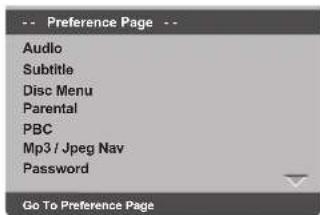
Press ■ twice to stop playback (if any), then press SETUP.
2 Press ◀▶ to select the 'Preference Page' icon.
3 Press OK to confirm.
text_image
-- Preference Page -- Audio Subtitle Disc Menu Parental PBC Mp3 / Jpeg Nav Password Go To Preference PageAudio, Subtitle, Disc Menu
These menus contain various language options for audio, subtitle and disc menu which may be recorded on the DVD. For details, see page 18.
Restricting playback by Parental Control
Some DVDs may have a parental level assigned to the complete disc or to certain scenes on the disc. This feature lets you set a playback limitation level. The rating levels are from 1 to 8 and are country dependent. You can prohibit the playing of certain discs that are not suitable for your children or have certain discs played with alternative scenes.
In 'PREFERENCE PAGE', press ▲▼ to highlight {PARENTAL}, then press ▶.

text_image
-- Preference Page -- Audio 1 KID SAFE Subtitle 2 G Disc Menu 3 PG Parental 4 PG 13 PBC 5 PGR Mp3 / Jpeg Nav 6 R Password 7 NC17 Set KID SAFETIPS: The underlined option is the factory default setting.
Press ◀ to go back to the previous menu item. Press SETUP to exit the menu item.
34
DVD Setup Menu Options
Restricting playback by Parental Control
2 Press ▲▼ to highlight a rating level for the disc inserted and press OK.
→To disable Parental controls and have all Discs play, select {8 ADULT}.
3 Use the numeric keypad (0-9) to enter the six-digit password (see page 36 "Changing the password").
→DVDs that are rated above the level you selected will not play unless you enter your six-digit password.
Helpful Hints:
– VCD, SVCD, CD have no level indication, so parental control function has no effect on these types of disc. This applies to most illegal DVD discs.
- Some DVDs are not encoded with a rating though the movie rating may be printed on the Disc cover. The rating level feature does not work for such Discs.
PBC
You can set the PBC to ON or OFF. This feature is available only on Video CD 2.0 with playback control (PBC) feature. For details, see page 25.
MP3/JPEG Menu - turning on/off
MP3/JPEG Navigator can be set only if the disc is recorded with menu. It allows you to select different display menus for easy navigation.
In 'PREFERENCE PAGE', press ▲▼ to highlight {MP3/JPEG NAV}, then press ▶.
WITHOUT MENU
Select this to display all the files contained in the MP3/Picture CD.
WITH MENU
Select this to display only the folder menu of the MP3/Picture CD.
2 Press ▲▼ to select a setting, then press OK to confirm your selection.
TIPS: The underlined option is the factory default setting.
Press ◀ to go back to the previous menu item. Press SETUP to exit the menu item.
DVD Setup Menu Options
Changing the Password
The same password is used for both Parental Control and Disc Lock. Enter your six-digit password when prompted on the screen. The default password is 136900.
In 'PREFERENCE PAGE', press ▲▼ to highlight {PASSWORD}, then press ▶ to select {CHANGE}.
2 Press OK and the menu appears.

text_image
Old Password New Password Confirm PWD OK3 Use the numeric keypad (0-9) to enter your old six-digit password.
→When doing this for the first time, key in '136900'. →If you forget your old six-digit password, key in '136900'.
4 Enter the new six-digit password.
5 Enter the new six-digit password a second time to confirm.
→The new six-digit password will now take effect.
6 Press OK to confirm.
Restoring to original settings
Setting the DEFAULT function will reset all options and your personal settings to the factory defaults, except your password for Parental Control and Disc Lock.
In 'PREFERENCE PAGE', press ▲▼ to highlight {DEFAULT}, then press ▶ to select {RESET}.
2 Press OK to confirm. →All settings will now reset to factory defaults.
TIPS: The underlined option is the factory default setting.
Press ◀ to go back to the previous menu item. Press SETUP to exit the menu item.
Sound and Volume Controls
Setting the speakers' channels
You can adjust the delay times (centre and surround only) and volume level for individual speakers. These adjustments let you optimise the sound according to your surroundings and setup.
IMPORTANT!
The speaker settings only available on Multi-channel audio outputs.
Press SETUP.
2 Press▶ repeatedly to select {AUDIO SETUP PAGE}.
3 Press ▲▼ to highlight {SPEAKER SETUP}, then press ▶.

text_image
Audio Setup Page -- Analog Output Digital Audio Setup Sound Mode Speaker Setup Night Mode Speaker Setup Page -- Front Speakers Large Center Speaker Small Rear Speakers Subwoofer Speakers Volume Speakers Delay4 Enter its submenu by pressing ▶.
5 Press ▲▼ to highlight one of the options below at a time, then press ▶.
{FRONT SPEAKERS, CENTER SPEAKER, REAR SPEAKERS}
OFF – when no speaker is connected. LARGE – when connected speakers can produce low frequency signals below 120Hz.
SMALL – when connected speakers cannot produce low frequency signals below 120Hz.
{SUBWOOFER}
ON – when a subwoofer is connected. OFF – when no subwoofer is connected.
{SPEAKER VOLUME} – Volume level setting for individual speakers (-6dB \~ +6dB).
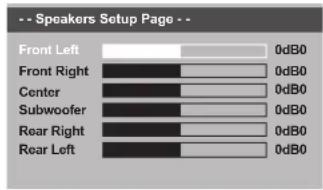
text_image
-- Speakers Setup Page -- Front Left 0dB0 Front Right 0dB0 Center 0dB0 Subwoofer 0dB0 Rear Right 0dB0 Rear Left 0dB0{SPEAKER DELAY} – Delay times setting in relation to the listening position/ distance for centre and surround speakers (1m \~ 10m).
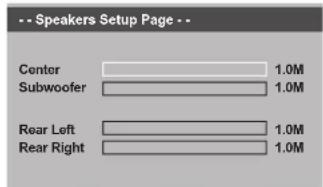
text_image
-- Speakers Setup Page -- Center 1.0M Subwoofer 1.0M Rear Left 1.0M Rear Right 1.0M6 Press ◀▶ to adjust the setting that best suit your surround sound needs.
7 Press OK to confirm.
Helpful Hints:
- Use the longer delay time settings when the rear speakers are closer to the listener than the front speakers.
- The test tone will be automatically generated to help you judge the sound level of each speaker.
TIPS: The underlined option is the factory default setting.
Press ◀ to go back to the previous menu item. Press SETUP to exit the menu item.
Troubleshooting
WARNING
Under no circumstances should you try to repair the system yourself, as this will invalidate the warranty. Do not open the system as there is a risk of electric shock.
If a fault occurs, first check the points listed below before taking the system for repair. If you are unable to remedy a problem by following these hints, consult your dealer or Philips for help.
Problem Solution
| No power – Check if the AC power cord is properly connected. | |
| – Press the STANDBY ON on the front of the DVD system to turn on the power. | |
| No picture – Refer to your TV's manual for correct Video In channel selection. Change the TV channel until you see the DVD screen. | |
| – Check if the TV is switched on. | |
| – If the progressive scan feature is activated but the connected TV does not support progressive signals or the cables are not connected accordingly, see page 16 for proper progressive scan set up or deactivate the progressive scan feature as below: | |
| 1) Tum off your TV progressive scan mode or turn on to interlaced mode. | |
| 2) Press OPEN/CLOSE to open the disc tray. | |
| 3) Press numeric keypad '1' on the remote control for few seconds. | |
| Distorted picture – Sometimes a small amount of picture distortion may appear depending on the disc being played back. This is not a malfunction. | |
| Completely distorted picture or – Connect DVD Player directly to the TV. black/white picture with DVD – Make sure the disc is compatible with the DVD/ Player. | |
| – Ensure that the DVD Player's TV Type is set to match that of the Disc and your TV. | |
| No sound or distorted sound – Adjust the volume. | |
| – Check that the speakers are connected correctly. | |
| No audio at digital output – Check the digital connections. | |
| – Check if your receiver can decode MPEG-2 and if not, please make sure the digital output is set to PCM. | |
| – Check if the audio format of the selected audio language matches your receiver capabilities. | |
Troubleshooting
Problem Solution
| Disc can’t be played | – The DVD+R/CD-R must be finalised.– Ensure the disc label is facing up.– Check if the disc is defective by trying another disc.– Region code incorrect. |
| Picture freezes momentarily – Check the disc for fingerprints/scratches and during playback clean with a soft cloth wiping from centre to edge. | |
| No return to start-up screen when – Reset the unit by switching the player off, then on disc is removed again. | |
| The player does not respond to – Aim the Remote Control directly at the sensor the Remote Control on the front of the player. | – Reduce the distance to the player.– Replace the batteries in the Remote Control.– Re-insert the batteries with their polarities (+/- signs) as indicated. |
| Buttons do not work – To completely reset the player, unplug the AC cord from the AC outlet for 5-10 seconds. | |
| Player does not respond to some – Operations may not be permitted by the disc.operating commands during playback. | Refer to the instructions of the disc jacket. |
| DVD Player cannot read CDs/DVDs | – Use a commonly available cleaning CD/DVD to clean the lens before sending the DVD Player for repair. |
| Menu items cannot be selected | – Press STOP twice before selecting System Menu.– Depending on the disc availability, some menu items cannot be selected. |
| Unable to select Progressive Scan on/off | – Check that the output of the video signal is switch to ‘YUV’. |
Visit us at www.philips.com/support for service support
Specifications
TV STANDARD (PAL/50Hz) (NTSC/60Hz)
Number of lines 625 525
Playback Multistandard (PAL/NTSC)
VIDEO PERFORMANCE
Video DAC 12 bit, 108MHz
YPbPr 0.7 Vpp — 75 ohm
Video Output 1Vpp — 75 ohm
VIDEO FORMAT
Digital Compression MPEG 2 for DVD, SVCD
MPEG 1 for VCD
DVD 50Hz 60Hz
Horiz. resolution 720 pixels 720 pixels
Vertical resolution 576 lines 480 lines
VCD
50Hz 60Hz
Horiz. resolution 352 pixels 352 pixels
Vertical resolution 288 lines 240 lines
AUDIO FORMAT
| Digital | MPEG/AC-3/PCM | compressed Digital16, 20, 24 bitsfs, 44.1, 48, 96 kHz |
| MP3(ISO 9660) | 96, 112, 128, 256kbps & variablebit rate fs, 32, 44.1,48 kHz |
Analog Sound Stereo
Dolby Surround compatible downmix from Dolby Digital multi-channel sound
Dolby Pro Logic II
3D sound for virtual 5.1 channel sound on 2 speakers
AUDIO PERFORMANCE
| DA Converter | 24 bit, 192 kHz | |
| DVD | fs 96 kHz | 4Hz- 44kHz |
| fs 48 kHz | 4Hz- 22kHz | |
| SVCD fs 48 kHz | 4Hz- 22kHz | |
| fs 44.1kHz | 4Hz- 20kHz | |
| CD/VCD | fs 44.1kHz | 4Hz- 20kHz |
| Signal-Noise (1kHz) | > 90 dB | |
| Dynamic range(1kHz) | > 80 dB | |
| Crosstalk (1kHz) | > 90 dB | |
| Distortion/noise (1kHz) | > 80 dB | |
| MPEG MP3 | MPEG Audio L3 | |
CONNECTIONS
YPbPr Output Cinch 3x
Video Output Cinch (yellow)
Audio Output(L+R) Cinch (white/red)
Digital Output 1 coaxial
IEC60958 for CDDA / LPCM
IEC61937 for MPEG 1/2,
Dolby Digital
6 channel analogue output
Audio Front L/R Cinch (white/red)
Audio Rear L/R Cinch (white/red)
Audio Centre Cinch (blue)
Audio Subwoofer Cinch (black)
CABINET
| Dimensions (w x h x d) | 360 x 37 x 235 mm |
| Weight | Approximately 2.0 kg |
POWER CONSUMPTION
| Power Supply Rating | 110-240V;50/60Hz |
| Power consumption | < 10 W |
| Power consumption in Standby mode | < 0.8 W |
Specifications subject to change without prior notice
Glossary
Analog: Sound that has not been turned into numbers. Analog sound varies, while digital sound has specific numerical values. These jacks send audio through two channels, the left and right.
Aspect ratio: The ratio of vertical and horizontal sizes of a displayed image. The horizontal vs. vertical ratio of conventional TVs. is 4:3, and that of wide-screens is 16:9.
AUDIO OUT Jacks: Jacks on the back of the DVD System that send audio to another system (TV, Stereo, etc.).
Bit Rate: The amount of data used to hold a given length of music; measured in kilobits per seconds, or kbps. Or, the speed at which you record. Generally, the higher the bit rate, or the higher the recording speed, the better the sound quality. However, higher bit rates use more space on a Disc.
Chapter: Sections of a picture or a music piece on a DVD that are smaller than titles. A title is composed of several chapters. Each chapter is assigned a chapter number enabling you to locate the chapter you want.
Component Video Out Jacks: Jacks on the back of the DVD System that send high-quality video to a TV that has Component Video In jacks (R/G/B, Y/Pb/Pr, etc.).
Disc menu: A screen display prepared for allowing selection of images, sounds, subtitles, multi-angles, etc recorded on a DVD.
Digital: Sound that has been converted into numerical values. Digital sound is available when you use the DIGITAL AUDIO OUT COAXIAL or OPTICAL jacks. These jacks send audio through multiple channels, instead of just two channels as analog does.
Dolby Digital: A surround sound system developed by Dolby Laboratories containing up to six channels of digital audio (front left and right, surround left and right, center and subwoofer).
DTS: Digital Theatre Systems. This is a surround sound system, but it is different from Dolby Digital. The formats were developed by different companies.
JPEG: A very common digital still picture format. A still-picture data compression system proposed by the Joint Photographic Expert Group, which features small decrease in image quality in spite of its high compression ratio.
MP3: A file format with a sound data compression system. "MP3" is the abbreviation of Motion Picture Experts Group 1 (or MPEG-1) Audio Layer 3. By using MP3 format, one CD-R or CD-RW can contain about 10 times as much data volume as a regular CD can.
Multichannel: DVD is specified to have each sound track constitute one sound field. Multichannel refers to a structure of sound tracks having three or more channels.
Parental Control: A function of the DVD to limit playback of the disc by the age of the users according to the limitation level in each country. The limitation varies from disc to disc; when it is activated, playback will be prohibited if the software's level is higher than the user-set level.
PCM (Pulse Code Modulation): A system for converting analog sound signal to digital signal for later processing, with no data compression used in conversion.
Playback control (PBC): Refers to the signal recorded on video CDs or SVCDs for controlling reproduction. By using menu screens recorded on a Video CD or SVCD that supports PBC, you can enjoy interactive-type software as well as software having a search function.
Progressive Scan: It displays all the horizontal lines of a picture at one time, as a signal frame. This system can convert the interlaced video from DVD into progressive format for connection to a progressive display. It dramatically increases the vertical resolution.
Region code: A system for allowing discs to be played back only in the region designated beforehand. This unit will only play discs that have compatible region codes. You can find the region code of your unit by looking on the product label. Some discs are compatible with more than one region (or ALL regions).
Surround: A system for creating realistic three-dimensional sound fields full of realism by arranging multiple speakers around the listener.
Title: The longest section of a picture or music feature on DVD, music, etc., in video software, or the entire album in audio software. Each title is assigned a title number enabling you to locate the title you want.
VIDEO OUT jack: Jack on the back of the DVD System that sends video to a TV.
WARRANTY
This APPARATUS IS covered under warranty against any defect arising out of faulty or defective material or workmanship for a period of 6 months from date of purchase.
Should a defect develop during the period of warranty, Philips India Limited undertakes to repair the apparatus free of charge through an Authorised Philips service Center. If the purchaser shifts his residence to other town, the warranty will be valid at the nearest Authorised Philips service Center.
This warranty is not valid in case:
I. The apparatus is not used according to this manual;
2. Defects are caused by improper or reckless use;
3. Any repair work are done by person other than Authorised Philips Service Center;
4. Any modification or alteration of any nature are made in the apparatus;
5. The serial number is tampered
6. This warranty form is not completed immediately after purchase.
Serial No.:
Bill No & Date of Purchase:
Purchaser's Name:
Location & Tel No:
Dealer's Name:
Location & Tel No:
Dealer's Stamp & Sign:
Philips India Limited
Registered Office : 7, Justice Chandra Madhab Road, Kolkata 700 020
Head Office : 2 ^nd Floor, Technopolis Knowledge Park, Nelco Complex, Mahakali Caves Road, Chakala, Andheri (East), Mumbai – 400093.
Maintenance Tips for your DVD Player:
• Always keep a Disc loaded in your DVD Player tray.
- Keep the player away from the dusty areas. Keep it covered with a dust cover.
- Clean your DVD Player Lens after every 20 discs played.
- Use the 2 brush Philips DVD Lens Cleaner SVC2520 for best results.
- Clean the CDs / VCD / DVD / MP3 CD before inserting in your DVD Player.
"For unlimited listening pleasure use
Philips earphones / headphones". Over 20 models to choose from
For any sales or service related queries:
Visit us on web at www.philips.com or
Call us on Toll Free Number : 1 600 22 44 22
Meet Philips at the Internet
http://www.philips.com/support

Be responsible Respect copyrights

DVP 3028
CLASS 1
LASER PRODUCT

sgpSL-0626/94-2_RC2