SRD-443 - Security Camera Hanwha - Free user manual and instructions
Find the device manual for free SRD-443 Hanwha in PDF.


| Product Type | Security Camera |
| Brand | Hanwha |
| Model | SRD-443 |
| Dimensions (W x H x D) | Approx. 130 x 100 x 80 mm |
| Weight | Approx. 450 g |
| Power Supply | DC 12V, 1A |
| Image Sensor | 1/2.8" Progressive CMOS |
| Resolution | 2 MP (1920 x 1080) |
| Lens | Fixed, 3.6 mm |
| Field of View | 90° (Horizontal) |
| Night Vision | Infrared LEDs, up to 20 m |
| Video Compression | H.265, H.264 |
| Frame Rate | 30 fps at 1080p |
| Motion Detection | Built-in, adjustable sensitivity |
| Audio | Built-in microphone |
| Storage | MicroSD card slot (up to 128 GB) |
| Interface | Ethernet (RJ-45) |
| Weather Rating | IP66 (outdoor) |
| Operating Temperature | -10°C to 50°C |
| Power Consumption | ≤ 5W |
| Mounting Type | Wall or Ceiling bracket included |
| Includes | Camera, power adapter, mounting screws, manual |
| Spare Parts Availability | Contact Hanwha support |
| Repairability | Limited; professional service recommended |
Frequently Asked Questions - SRD-443 Hanwha
User questions about SRD-443 Hanwha
0 question about this device. Answer the ones you know or ask your own.
Ask a new question about this device
Download the instructions for your Security Camera in PDF format for free! Find your manual SRD-443 - Hanwha and take your electronic device back in hand. On this page are published all the documents necessary for the use of your device. SRD-443 by Hanwha.
USER MANUAL SRD-443 Hanwha
©2013 Samsung Techwin Co., Ltd. All rights reserved.
Trademark

SAMSUNG TECHWIN is the registered logo of Samsung Techwin Co., Ltd.
The name of this product is the registered trademark of Samsung Techwin Co., Ltd.
Other trademarks mentioned in this manual are the registered trademark of their respective company.
Restriction
Samsung Techwin Co., Ltd shall reserve the copyright of this document. Under no circumstances, this document shall be reproduced, distributed or changed, partially or wholly, without formal authorization of Samsung Techwin.
Disclaimer
Samsung Techwin makes the best to verify the integrity and correctness of the contents in this document, but no formal guarantee shall be provided. Use of this document and the subsequent results shall be entirely on the user's own responsibility. Samsung Techwin reserves the right to change the contents of this document without prior notice.
◆ Design and specifications are subject to change without prior notice.
The default administrator ID is "admin", and the password must be set when the user log in at the first time.
Set password for your wireless network if you use the product with a wireless router. Being not protected with password or using the default wireless router password may expose your video data to potential threat.
To prevent from your personal information being exposed, please change your password every 3 months. Note that the security and other related issues caused by careless management of password shall be in the charge of the user.
importTAnT SAfeTy inSTruCTionS
Read these operating instructions carefully before using the unit.
Follow all the safety instructions listed below.
Keep these operating instructions handy for future reference.
1) Read these instructions.
2) Keep these instructions.
3) Heed all warnings.
4) Follow all instructions.
5) Do not use this apparatus near water.
6) Clean only with dry cloth.
7) Do not block any ventilation openings, Install in accordance with the manufacturer's instructions.
8) Do not install near any heat sources such as radiators, heat registers, stoves, or other apparatus (including amplifiers) that produce heat.
9) Do not defeat the safety purpose of the polarized or grounding-type plug. A polarized plug has two blades with one wider than the other. A grounding type plug has two blades and a third grounding prong. The wide blade or the third prong are provided for your safety. if the provided plug does not fit into your outlet, consult an electrician for replacement of the obsolete outlet.
10) Protect the power cord from being walked on or pinched particularly at plugs, convenience receptacles, and the point where they exit from the apparatus.
11) Only use attachments/accessories specified by the manufacturer.
12) Use only with the cart, stand, tripod, bracket, or table specified by the manufacturer, or sold with the apparatus. When a cart is used, use caution when moving the cart/apparatus combination to avoid injury from tip-over.
13) Unplug this apparatus during lightning storms or when unused for long periods of time.
14) Refer all servicing to qualified service personnel. Servicing is required when the apparatus has been damaged in any way, such as power-supply cord or plug is damaged, liquid has been spilled or objects have fallen into the apparatus, the apparatus has been exposed to rain or moisture, does not operate normally, or has been dropped.
natural_image
Silhouette of a person pushing a ladder inside a circle (no text or symbols)Before STArT
This user manual provides Information for using the DVR such as brief introduction, part names, functions, connection to other equipment, menu setup, etc.
You have to keep in mind the following notices :
• SAMSUNG retains the copyright on this manual.
- This manual cannot be copied without SAMSUNG's prior written approval.
- We are not liable for any or all losses to the product incurred by your use of non-standard product or violation of instructions mentioned in this manual.
- Prior to opening the case, please consult a qualified technician first. Whenever this is needed power must be removed from the unit.
- Before installing an additional HDD or connecting an external storage device (USB memory or USB HDD) to this DVR, check the compatibility. Consult your provider for the compatibility list.
Warning
Battery
It is essential that when changing the battery in the unit, the replacement battery must be of the same type otherwise there may be a possibility of an explosion.
The following are the specifications of the battery you are using now.
• Normal voltage : 3V
• Normal capacity : 170mAh
• Continuous standard load : 0.2mA
• Operating temperature: -20^ +85^
$$ (- 4 ^ {\circ} \mathrm{F} \sim + 1 8 5 ^ {\circ} \mathrm{F}) $$
CALIFORNIA USA ONLY
This Perchlorate warning applies only to primary CR (Manganese Dioxide) Lithium coin cells in the product sold or distributed ONLY in California USA. "Perchlorate Material - special handling may apply, See www.dtsc.ca.gov/hazardouswaste/perchlorate."
Caution
- Connect the power cord into a grounded outlet.
- The Mains plug is used as a disconnect device and shall stay readily operable at any time.
- Batteries shall not be exposed to excessive heat such as sunshine, fire or the like.
- Risk of Explosion if Battery is replaced by an Incorrect Type. Dispose of Used Batteries According to the Instructions.
System Shutdown
Turning off the power while the product is in operation, or undertaking improper actions may cause damage or malfunction to the hard drive or the product.
Please turn off power by pressing the [POWER] button on the remote control or right-click to display the context sensitive menu and select
For a safe power disconnection, select
Operating Temperature
The guaranteed operating temperature range of this product is 0^ C \~ 40^ C ( 32^ F \~ 104^ F).
This product may not work properly if you run right after a long period of storage at a temperature below the guaranteed one.
Prior to using a device that has been stored for a long period in low temperatures, allow the product to stand at room temperature for a period.
Especially for the built-in HDD in the product, its guaranteed temperature range is 5^ C \~ 55^ C ( 41^ F \~ 131^ F). Likewise, the hard drive may not work at a temperature below the guaranteed one.
Security Precautions
The default administrator ID is “admin”, and the password must be set when the user log in at the first time. Set password for your wireless network if you use the product with a wireless router. Being not protected with password or using the default wireless router password may expose your video data to potential threat.
To prevent from your personal information being exposed, please change your password every 3 months.
Note that the security and other related issues caused by careless management of password shall be in the charge of the user.
overview
3
3 Important Safety Instructions
3 Before Start
5 Contents
7 Features
9 Part Names and Functions (Front)
10 Part Names and Functions (Rear)
11 Remote Control
ConneCTing wiTh oTher deviCe
12
12 Installation
12 Checking the installation environment
13 Connecting the Video, Audio, and Monitor
13 Connecting the USB
14 Connecting the Alarm Input/Output
14 Connecting the RS-485 Device
15 Connecting the Network
Live
17
17 Getting Started
19 Live Screen Configuration
23 Live Mode
25 Spot Out
25 Zoom
26 Audio ON/OFF
26 Freeze
26 Event Monitoring
uSing The dvr
28
28 System Setup
38 Setting the Device
45 Setting the Recording
48 Setting the Event
51 Backup
52 Network Configuration
63 Controlling a PTZ device
SeArCh & pLAy

65 Search
68 Playback
weB viewer

70 Introducing Web Viewer
71 Connecting Web Viewer(Windows)
72 Using Live Viewer(Windows)
78 Using Search Viewer
82 Viewer Setup
93 About
94 Connecting Web Viewer(Mac)
95 Using Live Viewer(Mac)
97 Mobile Viewer
BACKup viewer

98 SEC Backup Viewer
100 Product Specification
102 Product Overview
103 Default Setting
106 Troubleshooting
109 Open Source License Report on the Product
Appendix

The DVR employs H.264 video encoding for 4 channel inputs and audio encoding for 1 channel while simultaneously supports hard disc recording and playback.
These DVRs also supports network connectivity, providing remote monitoring from a remote PC transferring video and audio data.
- Provides a convenient User Interface
• Supports CIF(S)/2CIF(M)/4CIF(L) recording formats - With the network specific codec, network transfer enabled regardless of the recording conditions
• De-interlacing processor for better picture quality
• Display of HDD information and status by using HDD SMART
• Hard Disk overwrite function
• Mass storage hard disk backup through high-speed USB 2.0
• Simultaneous Record and Playback of 4 channel video data
• Various Search Modes (Time, Event, Backup, Motion Detection)
• Various Recording Modes (Time Lapse, Event, Scheduled Recording) - Alarm Interface
• Remote Monitoring function by Network Viewer, Smart Viewer and Mobile Viewer
Standards Approvals
FC CE

This equipment has been tested and found to comply with the limits for a Class A digital device, pursuant to part 15 of the FCC Rules. These limits are designed to provide reasonable protection against harmful interference when the equipment is operated in a commercial environment.
This equipment generates, uses, and can radiate radio frequency energy and, if not installed and used in accordance with the instruction manual, may cause harmful interference to radio communications. Operation of this equipment in a residential area is likely to cause harmful interference in which case the user will be required to correct the interference at his own expense.
Package Contents
Please unwrap the product, and place the product on a flat place or in the place to be installed. Check if the main unit and all the following accessories are included in the product package.
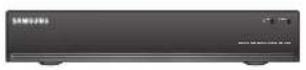 | 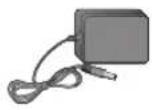 | 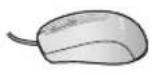 |
| DVR Power Cable | Mouse | |
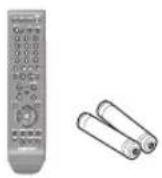 | 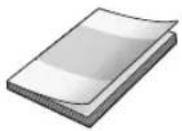 | 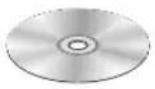 |
| Remote Control / Battery (AAA x 2) Quick Manual User Manual CD | ||
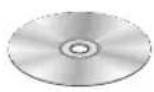 | ||
| Network Viewer Software | ||
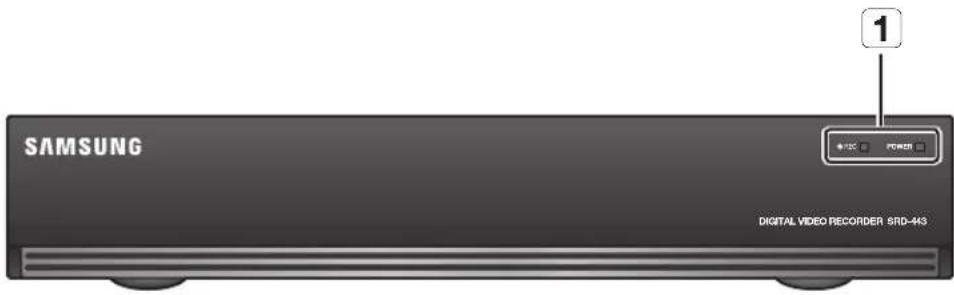
text_image
SAMSUNG DIGITAL VIDEO RECORDER SRD-443 1| Part Names Functions | ||
| 1 | LED Indicator | Power LED : Displays the power ON/OFF status. |
| REC : Lights on when recording is in progress. | ||
pArT nAmeS And funCTionS (reAr)
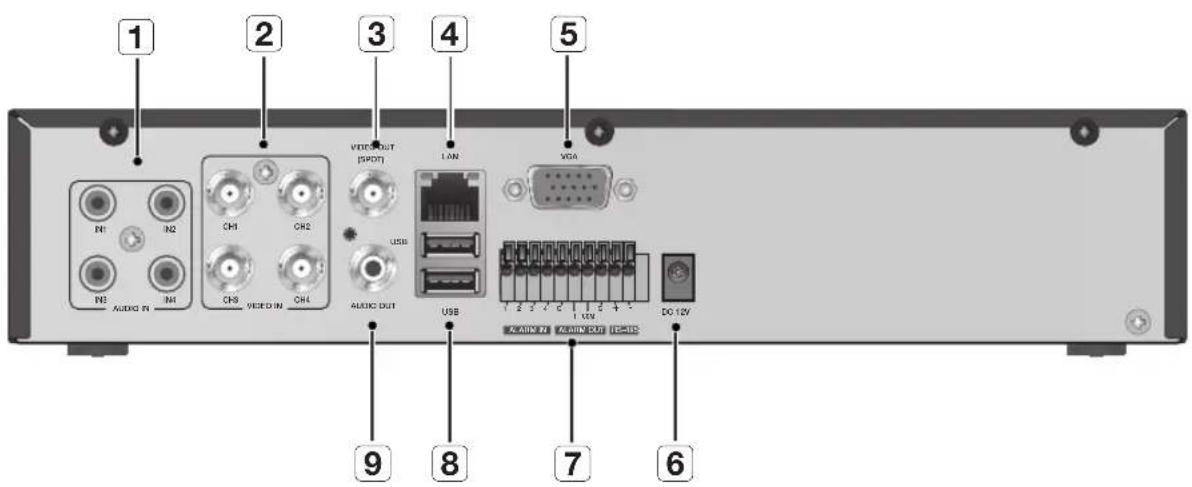
text_image
1 2 3 4 5 VDDOUT [SPDT] LAN VDA IN1 IN2 CH1 CH2 IN3 IN4 CH3 VDD OUT CH4 AUDIO IN AUDIO OUT USB USB A-AMN IN A-AMN-OUT I2-I3 1 2 3 4 5 6 1 2 3 4 5 6 1 2 3 4 5 6 1 2 3 4 5 6 DO 12V 9 8 7 6| Part Names Functions | |
| 1 | AUDIO IN (1~4) Input ports (RCA jacks) for the audio signal. |
| 2 | VIDEO IN Input port for the composite video signal. |
| 3 | VIDEO OUT(SPOT) BNC type of output port for the composite video signal. |
| 4 | LAN NETWORK connector port. |
| 5 | VGA Output port for VGA video signal. |
| 6 | DC 12V DVR power input port. |
| 7 | ALARM IN 1~4, G : Alarm Input port. |
| ALARM OUT 1, COM : Alarm Output port. | |
| RS-485 Used to establish RS-485 communications. | |
| 8 | USB USB connector port. |
| 9 | AUDIO OUT Output port (RCA jack) for the audio signal. |

If you want to change the default output to VGA mode when the live screen is displayed with the beep after the system booting, press the remote control buttons in sequence: [FREEZE] → [VIEW] → [RETURN (●)] → [FREEZE] → [VIEW] → [RETURN (●)]. The DVR will switch to VGA mode with the beep after rebooting.
For more information about monitor output, refer to "Video Output". (Page 43)
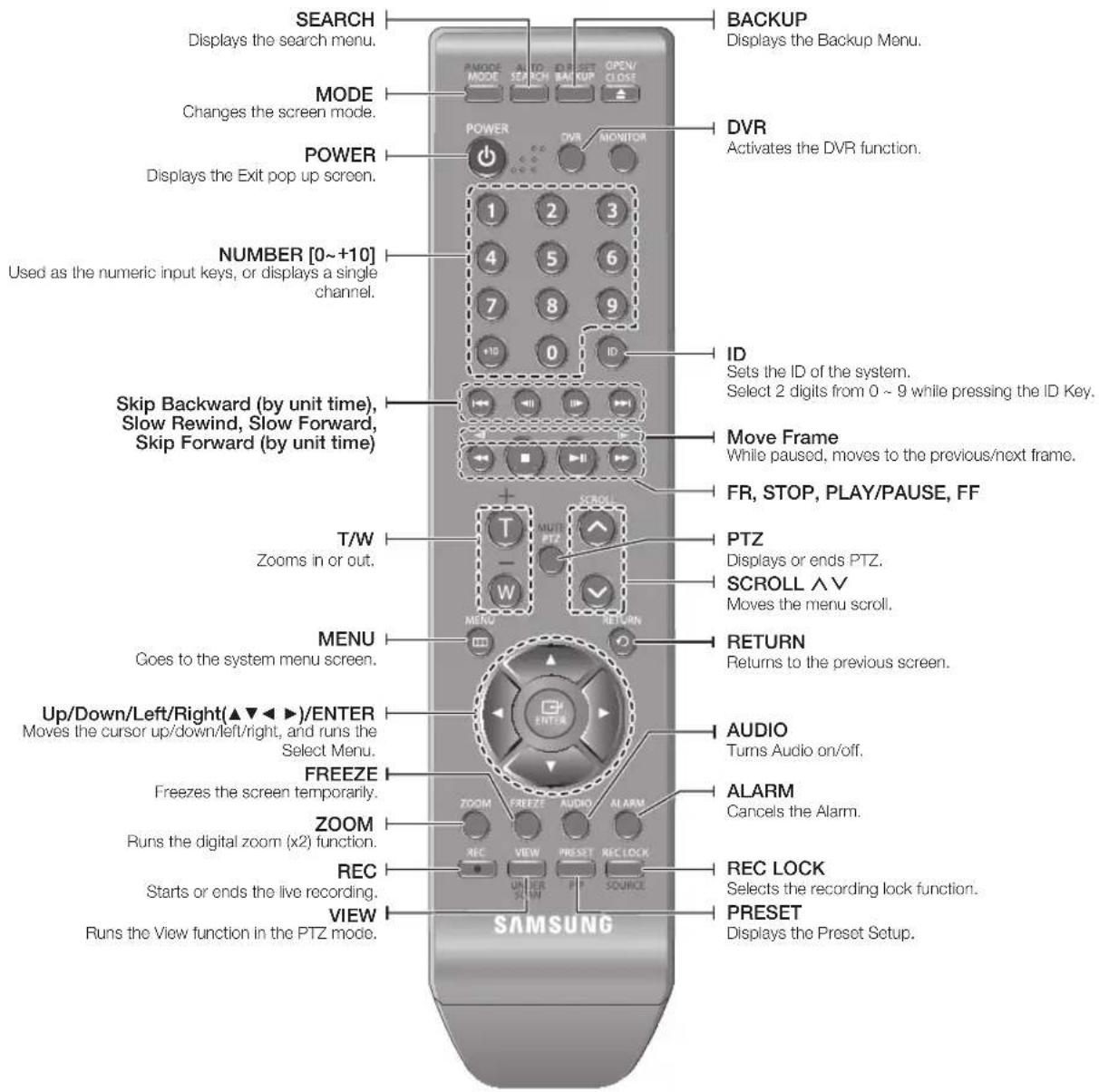
text_image
SEARCH Displays the search menu. MODE Changes the screen mode. POWER Displays the Exit pop up screen. NUMBER [0~+10] Used as the numeric input keys, or displays a single channel. Skip Backward (by unit time), Slow Rewind, Slow Forward, Skip Forward (by unit time) T/W Zooms in or out. MENU Goes to the system menu screen. Up/Down/Left/Right(▲▼◄►)/ENTER Moves the cursor up/down/left/right, and runs the Select Menu. FREEZE Freezes the screen temporarily. ZOOM Runs the digital zoom (x2) function. REC Starts or ends the live recording. VIEW Runs the View function in the PTZ mode. BACKUP Displays the Backup Menu. DVR Activates the DVR function. ID Sets the ID of the system. Select 2 digits from 0 ~ 9 while pressing the ID Key. Move Frame While paused, moves to the previous/next frame. FR, STOP, PLAY/PAUSE, FF PTZ Displays or ends PTZ. SCROLL ∧ V Moves the menu scroll. RETURN Returns to the previous screen. AUDIO Turns Audio on/off. ALARM Cancels the Alarm. REC LOCK Selects the recording lock function. PRESET Displays the Preset Setup. SAMSUNGUsing the Numeric buttons
- Press any button among 1 to 4.
- Move to the selected channel number.
Changing the Remote Control ID
- Press the ID button of the remote control and check the ID displayed on the DVR screen. The factory default ID of the remote control is 00.
- Enter 2 digits of your selection in order, while pressing the system [ID] button.
- When ID input is done, press the system [ID] button again to check the setting.

If you want to change the remote control ID to 08: Press 0 and 8 in order while the system [ID] button is pressed. Remote control's ID and DVR's ID should be matched for proper operation. Refer to "Remote Devices". (Page 42)
connecting with other device
inSTALLATION
Please take note of the followings before using this product.
• Do not use the product outdoor.
- Do not spill water or liquid in the connection part of the product.
- Do not impose the system to excessive shock or force.
• Do not pull out the power plug forcefully.
• Do not disassemble the product on your own.
- Do not exceed the rated input/output range.
• Use a certified power cord only.
- For the product with an input ground, use a grounded power plug.
CheCKing The inSTALLATION environmentT
Samsung Digital Video Recorder ("DVR" hereinafter) is a state-of-art security device, and contains mass storage hard disk(s) and critical circuits inside.
When the temperature rises inside the product, the product may breakdown and the product life be shortened.
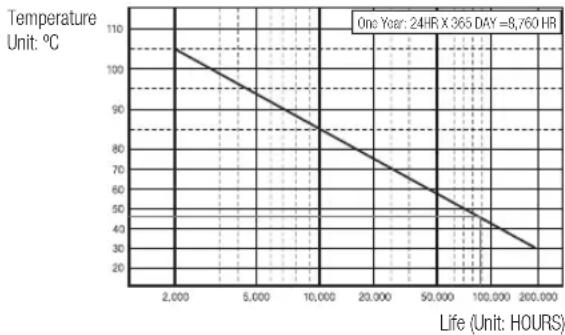
line
| Life (Hours) | Temperature (°C) | | ------------ | ---------------- | | 2,000 | 105 | | 5,000 | 95 | | 10,000 | 85 | | 20,000 | 75 | | 50,000 | 65 | | 100,000 | 55 | | 200,000 | 35 |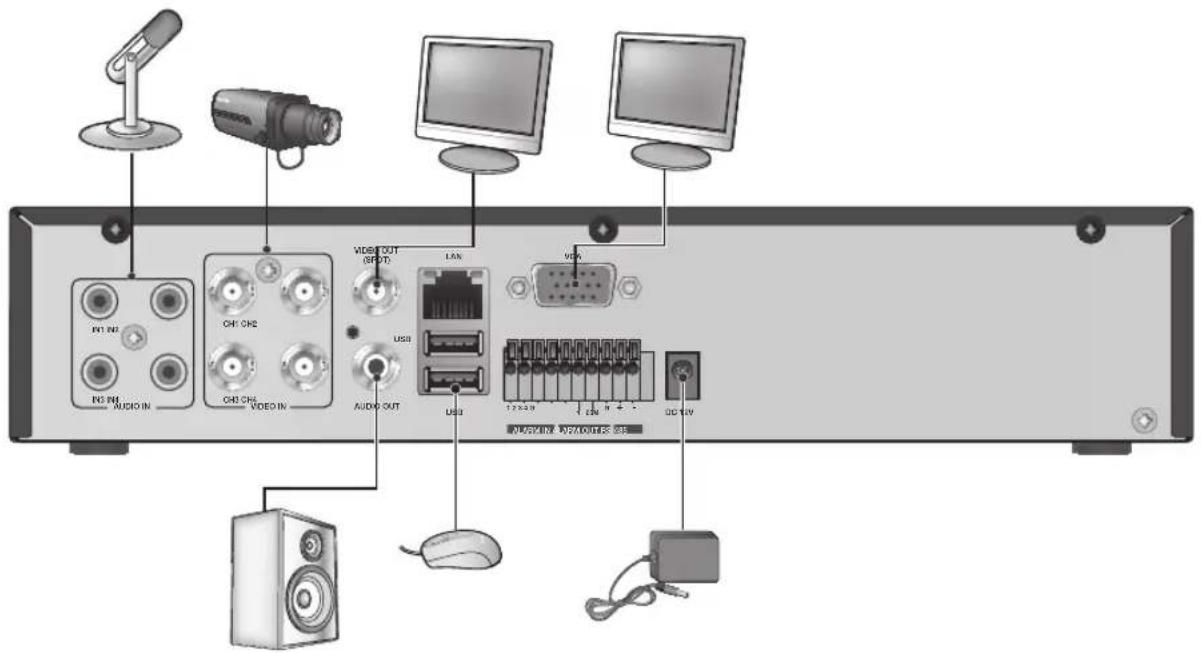
text_image
Diagram of a computer rack-mounted audio equipment with labeled ports and connectors including speakers, headphones, monitors, and audio output devices.
■Only one mouse port is available.
CONNECTING THE USB
- By factory default, two USB ports are provided for external connection.
- You can connect a USB HDD, USB memory or mouse to the USB port.
- If a USB HDD is connected to the system, recognition and settings are available in "Menu > Setting the Device > Storage Device". (Page 40)
- This product supports hot-plugging, which connects/removes the USB device during the system operation.

If you use the USB device for Backup purposes, format it with FAT32 on PC if it is not formatted on the DVR.
connecting with other device
CONNECTING THE ALARM INPUT/OUTPUT
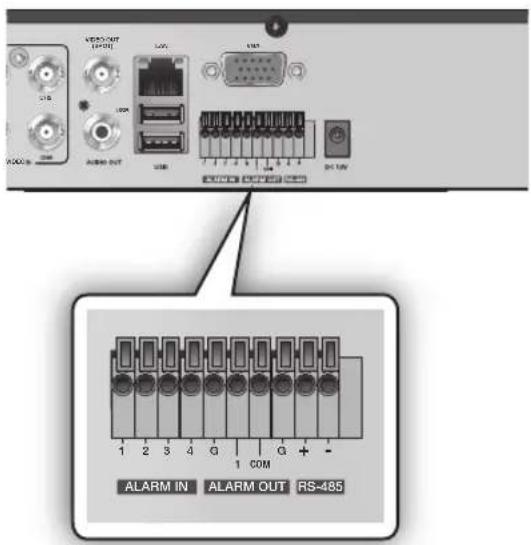
Connecting the alarm input signal
Connection port for the alarm input signal.
Connect one strand of the sensor signal line to one of 4 strands of the alarm input port, and connect the other strand to the [G] port.
Connecting the alarm output signal
Connection port for the alarm output signal.
Connect one strand of the sensor signal line to the alarm output port and connect the other to the [COM] port.
• ALARM IN : 5mA sink
• ALARM OUT : 24V DC 1A, 125VAC/0.5A
text_image
VEROUT (4000) USB USB VDD VDD VDD VDD VDD VDD VDD VDD VDD VDD VDD VDD VDD VDD VDD VDD VDD VDD VDD VDD VDD VDD VDD VDD VDD VDD VDD VDD VDD VDD VDD VDD VDD VDDCONNECTING THE RS-485 DEVICE
Connect the rear [RS-485 +, -] port to the PTZ camera or system keyboard.

■You can connect and control the PTZ camera which supports the RS485 communication.
■Check if the RS-485 device is compatible with the product first.
■Pay attention not to change the polarity (+/-) of the RS-485 device when connecting it.
- Depending on camera's type, connection polarity can be different.
For further information, refer to the respective PTZ Camera's documentation.

text_image
VDD200 (27/9) LAN USA USB ACB OUT USB 1 COM RS-485 1 2 3 4 G 1 G + - ALARM IN ALARM OUT RS-485Connecting to Network through Ethernet (10/100BaseT)
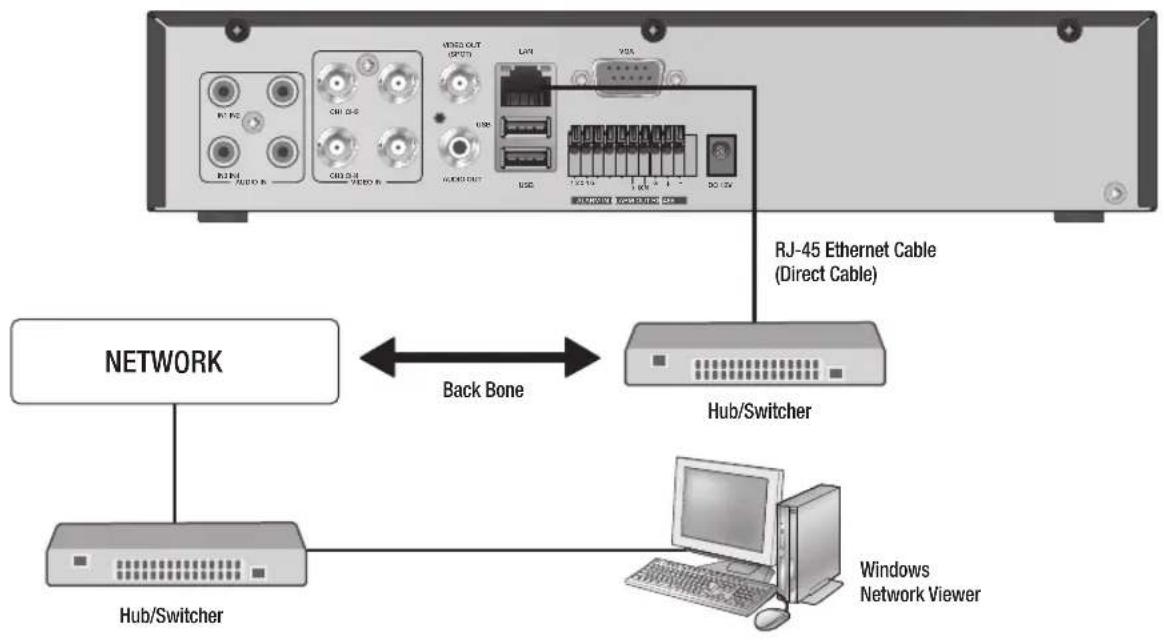
flowchart
graph TD
    A["RF-45 Ethernet Cable (Direct Cable)"] --> B["RJ-45 Ethernet Cable (Direct Cable)"]
    B --> C["Hub/Switcher"]
    C --> D["Windows Network Viewer"]
    E["NETWORK"] --> F["Back Bone"]
    G["Hub/Switcher"] --> H["Back Bone"]
    I["User"] --> J["User"]
    K["USB"] --> L["USB"]
    M["USB"] --> N["USB"]
    O["USB"] --> P["USB"]
    Q["USB"] --> R["USB"]
Connecting to the Network using the router
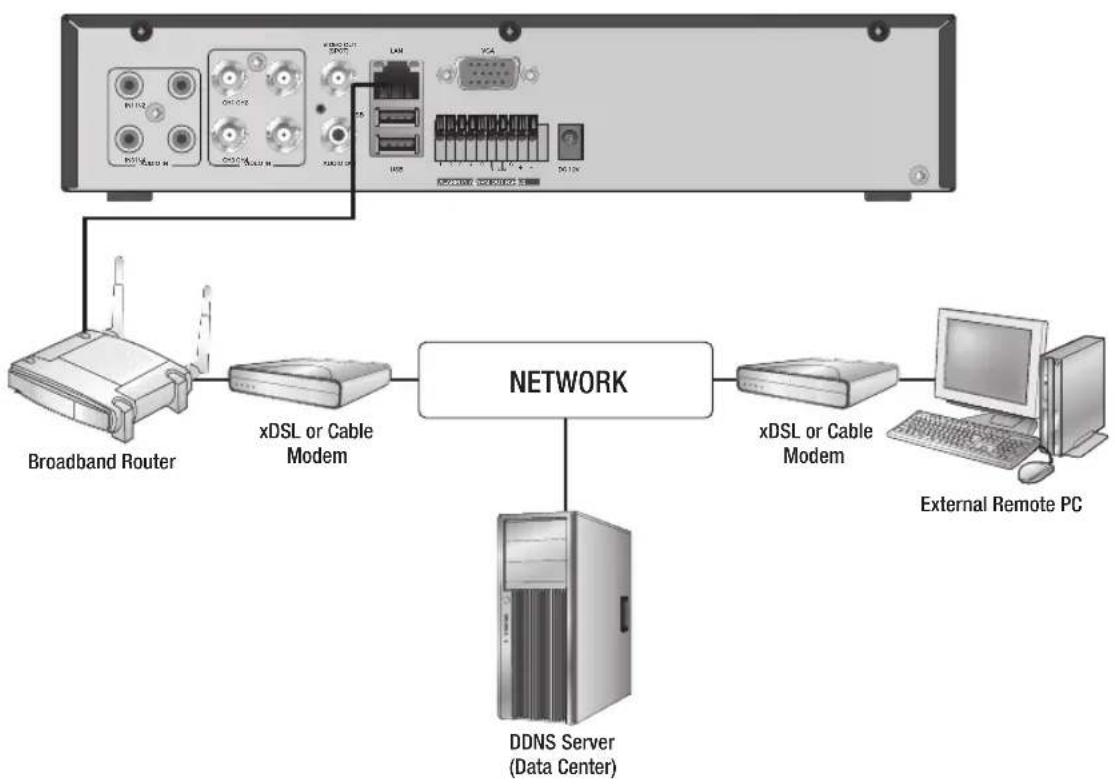
flowchart
graph TD
    A["Broadband Router"] --> B["xDSL or Cable Modem"]
    B --> C["NETWORK"]
    C --> D["DDNS Server (Data Center)"]
    D --> E["xDSL or Cable Modem"]
    E --> F["External Remote PC"]
    A --> G["USB"]
    G --> H["LAM"]
    H --> I["VCA"]
    I --> J["DC12K"]
    J --> K["PC"]
connecting with other device
Connecting to Network through ADSL
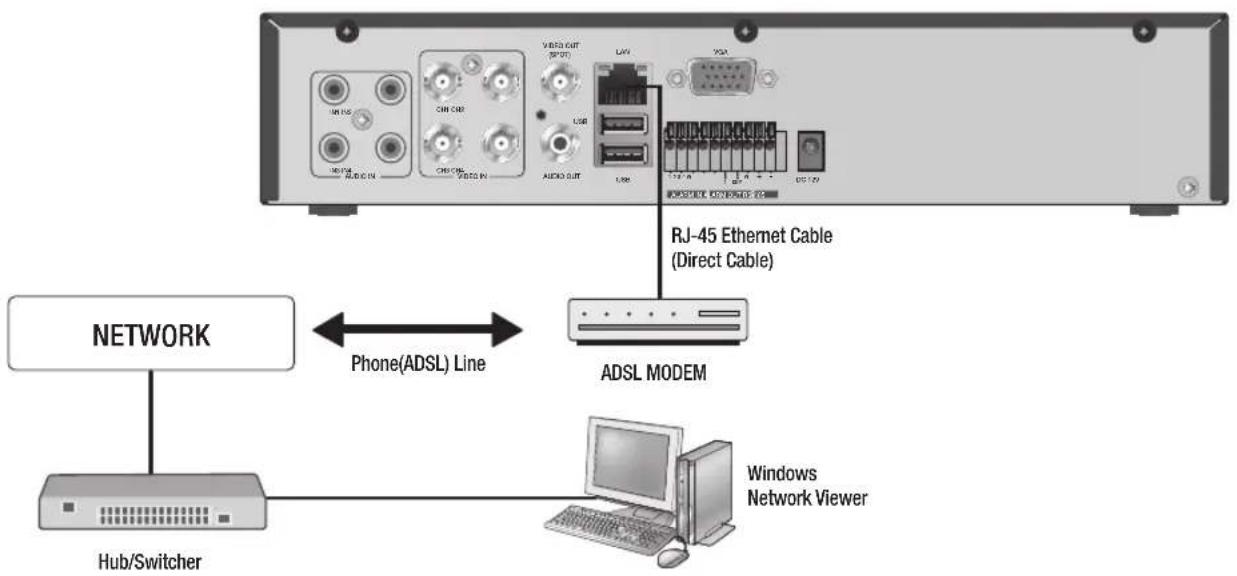
flowchart
graph TD
    A["RF Device"] -->|RJ-45 Ethernet Cable (Direct Cable)| B["ADSL MODEM"]
    B -->|Phone(ADSL) Line| C["Hub/Switcher"]
    C --> D["Windows Network Viewer"]
    style A fill:#f9f,stroke:#333
    style B fill:#ccf,stroke:#333
    style C fill:#cfc,stroke:#333
    style D fill:#fcc,stroke:#333
GETTING STARTED
Starting the system
- Connect the power cable of the DVR to the wall outlet.

- It takes about 10 seconds to display the start screen after booting.
-
You will see the initialization screen. The initialization process will last about 1 minute. If a new HDD is installed, the initialization process may take longer.
-
The live screen appears with a beep.
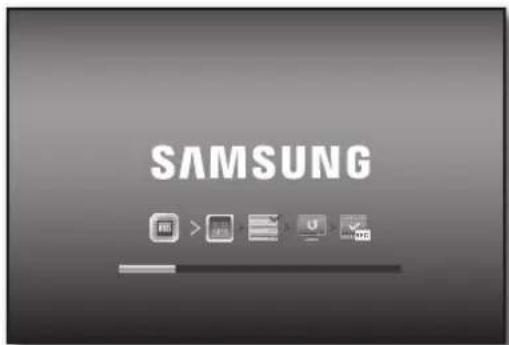
text_image
SAMSUNG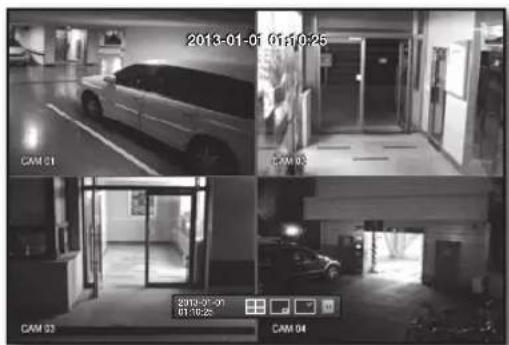
text_image
2013-01-01 01:10:25 CAM 01 CAM 02 CAM 03 2013-01-20 01:10:25 CAM 04Shutting Down the System
You can shut down the system only if you have logged into the DVR. You require permission to shut down the system if you are not logged in as admin.
-
Press the [POWER] button on the remote control or right-click to display the context sensitive menu and select
. -
The "Shutdown" confirmation window appears.
-
Use the arrow keys on the remote control to move to
and press the [ENTER] button or click . The system will shut down. -
Disconnecting the power cable for power off and reconnecting the power cable to restart.
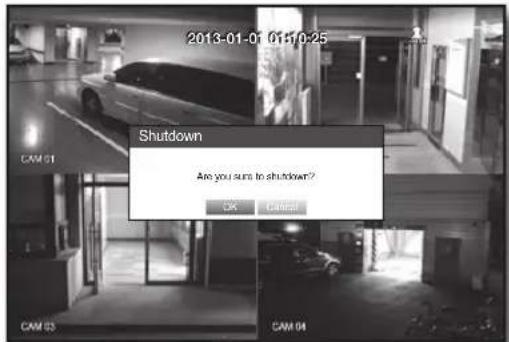
text_image
2013-01-01 01:10:25 Shutdown Are you sure to shutdown? OK Cancel
■For the permission management, refer to "Permission Management > Setting Permissions". (Page 33)
Login
To access a DVR or restricted menu, you should have logged in to the DVR.
- In live mode, right-click any area of the screen.
You will see the context sensitive menu as in the right figure.
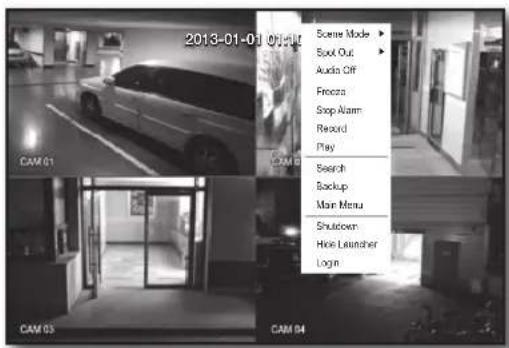
text_image
2013-01-01 0:04 CAM 01 CAM 03 CAM 04 Scene Mode Foot Out Audio Off Freeza Stop Alarm Record Play Search Backup Main Menu Shutdown Hide Launcher Login- Click
.
The login dialog appears.
You can also see the login dialog to access a desired menu by pressing the [MENU] button on the remote control.
■The login dialog will also appear if you press a menu button on the remote control of the DVR when the corresponding menu requires logging in.
■After logged in, press [RETURN] on the remote control to display the logout dialog.
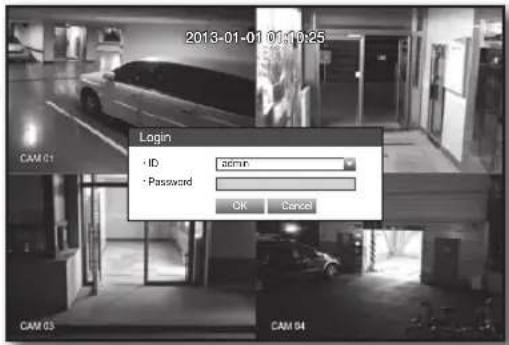
text_image
2013-01-01 01:10:25 Login • ID admin • Password OK Cancel
The default administrator ID is "admin", and the password must be set when the user log in at the first time.
- Set password for your wireless network if you use the product with a wireless router. Being not protected with password or using the default wireless router password may expose your video data to potential threat.
■ To prevent from your personal information being exposed, please change your password every 3 months.
Note that the security and other related issues caused by careless management of password shall be in the charge of the user.

■For the restricted permission, refer to "Permission Management > Setting Permissions". (Page 33)
Locking All Buttons
This will restrict access to all buttons available in the DVR.
-
In Live mode, press the remote control buttons in the order of [STOP (■)] → [FREEZE] → [STOP (■)] → [FREEZE] → [MENU].
-
In the lock condition, press any button to display a dialog where you are prompted to enter the password for unlocking the buttons.
The button lock will be released if you enter the admin password.
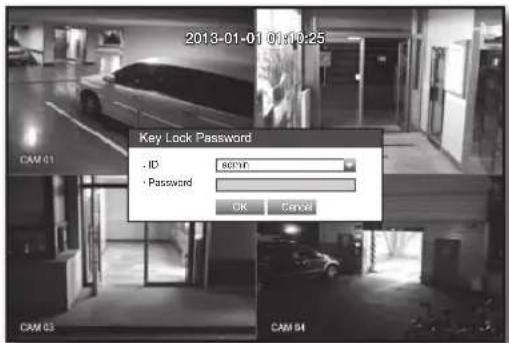
text_image
2013-01-01 01:10:25 Key Lock Password . IDIcons on the Live Screen
You can check the status or operation of the DVR with the icons on the live screen.
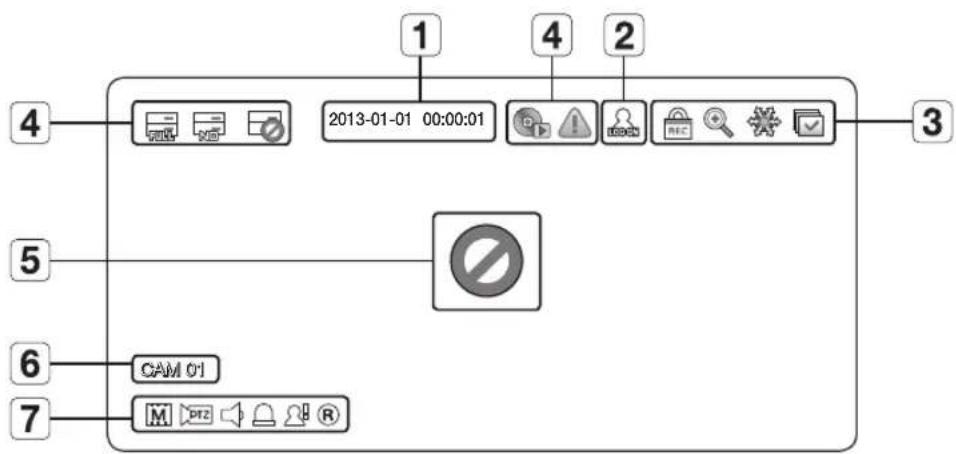
flowchart
graph TD
    A["4"] --> B["2013-01-01 00:00:01"]
    B --> C["1"]
    B --> D["2"]
    B --> E["3"]
    F["5"] --> G["No"]
    H["6"] --> I["CAM 01"]
    J["7"] --> K["M"]
    style G stroke:#000,stroke-width:2px
    style I stroke:#000,stroke-width:2px
    style K stroke:#000,stroke-width:2px
| Name Description | |||
| 1 | Current Date, Time | Displays the current time and date. | |
| 2 | Login Information | When you are logged in, the “LOG ON” icon will be displayed. | |
| 3 | Screen Mode | Displayed if the zoom function is activated. | |
| Displayed if you press the Pause button. | |||
| Displayed in Auto Sequence mode where all channels are switched at the specific time interval. | |||
| This icon is displayed if a user with restricted access to the Record button tries to make manual recording.■Only the user with the applicable permission can release (stop) the recording. | |||
| 4 | System Operation | Displayed if the HDD is full and the DVR has an insufficient space to record. | |
| Displayed if no HDD is installed or the existing HDD should be replaced. | |||
| Displayed if the HDD needs a technical examination. | |||
| Displayed while the backup is in process or if the backup data is played. | |||
| Displayed if the firmware can be updated via the network. | |||
| 5 | Video Input Status | Displayed if no input is entered in the condition that the camera is set to<ON>. | |
| Nothing will be displayed on the screen if the camera is set to<OFF>. | |||
| 6 | Camera Name/ Channel | Displays the camera name and the changed channel, if any. | |
| 7 | Camera Operation | Displays the resolution of the recording screen. (Page 46) | |
| Displayed in PTZ setting, and highlighted yellow if PTZ is in operation. | |||
| Displays AUDIO ON/MUTE.Not displayed in video mode if deactivated. | |||
| If the sensor is set to<ON>, the input signal will be displayed on the screen of the connected channel. | |||
| Displayed if a motion detected in the condition that the motion detection is set to<ON>. | |||
| Displays the current record mode from Record/Event/Schedule. | |||
Error Information
- If the internal HDD is not connected, the "NO HDD"(☐) message will appear; if there occurs a problem, you will see the "HDD FAIL"(☐) message in the top left corner. In this case, make sure you contact the service center for assistance as this may cause a failure of recording, playback or backup.

■If you see the No HDD, HDD FAIL icons on the screen, contact the service center for more details.
Live Screen Menu
In addition to the buttons the remote control, you can access a desired menu by right-clicking the mouse any area in live mode.
The context sensitive menu that appears by right-clicking the screen may differ, depending on the login/logout, screen split mode and DVR operation mode.

■Menu items of Search, Record, Backup, Shutdown can be deactivated, depending on the user permission.
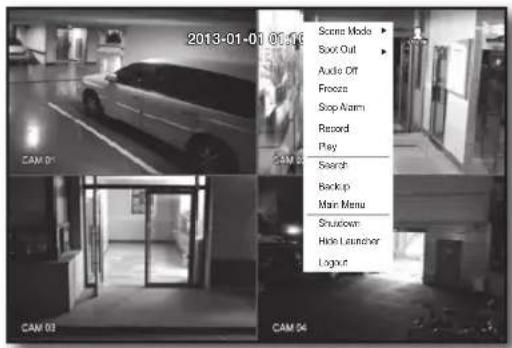
text_image
2013-01-01 00:16 Score Mode Start Out Audio Off Freeze Stop Alarm Record Play Search Backup Main Menu Shutdown Hide Launcher Logout< Split Mode Menu >
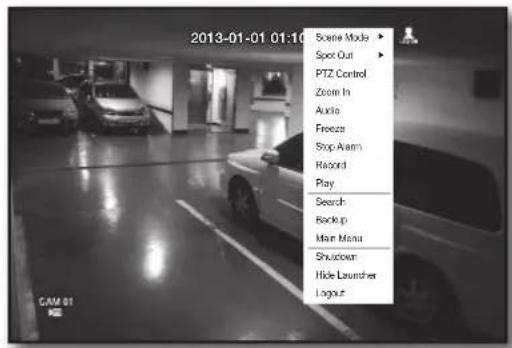
text_image
2013-01-01 01:16 Scene Mode Spot Out PTZ Control Zoom In Audio Freeze Stop-Airm Record Play Search Backup Main Menu Shutdown Hide Launcher Logout< Single Mode Menu >
Split Mode Menu
The context sensitive menu in split mode differs, depending on the login/logout status.
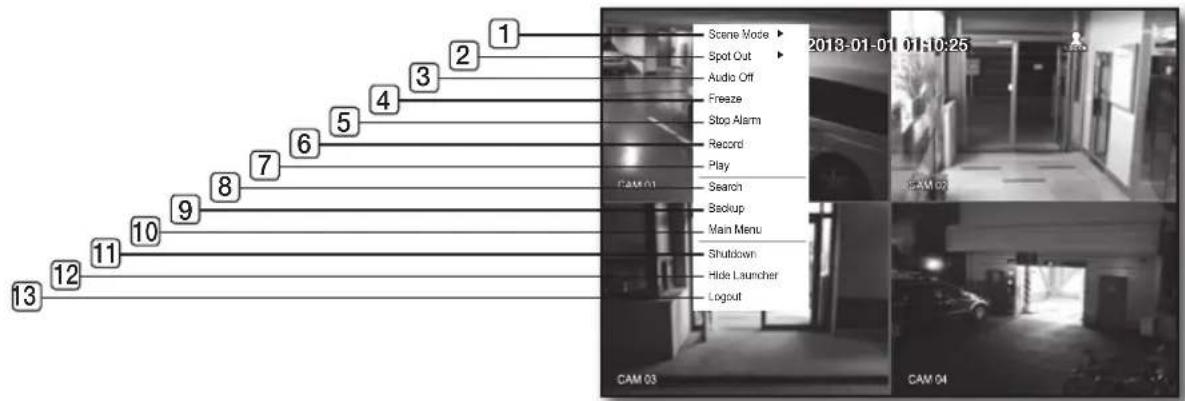
text_image
1 2 3 4 5 6 7 8 9 10 11 12 13 Scene Mode ▶ 2013-01-01 01:10:25 Spot Out Audio Off Freeze Stop Alarm Record Play CAM 01 Search Backup Main Menu Shutdown Hide Launcher Logout CAM 03 CAM 04| Menu Description | ||
| 1 | Scene Mode | Refer to “Live Mode”. (Page 23) |
| 2 | Spot Out | Refer to “Spot Out”. (Page 25) |
| 3 | Audio On/Off | Refer to “Audio ON/OFF”. (Page 26) |
| 4 | Freeze | Refer to “Freeze”. (Page 26) |
| 5 | Stop Alarm | Stop the alarm output, deactivate the event icon and release the auto sequencing. Refer to “Event Monitoring”. (Page 26) |
| 6 | Record/Stop Starts/stops the standard recording. | |
| 7 | Play | Refer to “Search & Play > Play”. (Page 68) |
| 8 | Search | Refer to “Search & Play > Search”. (Page 65) |
| 9 | Backup | Refer to “Using the DVR > Setting the Backup”. (Page 51) |
| 10 | Main Menu | Accesses the main menu. Refer to the Using the DVR section. (Page 28) |
| 11 | Shutdown | Turns down the DVR. |
| 12 | Show/Hide Launcher | Shows or hides the launcher. Refer to “View the Launcher Menu”. (Page 22) |
| 13 | Login/Logout You can log in or out. | |
Single Mode Menu
The single mode menu is available only in Single Mode.
The context sensitive menu for the One Channel mode, in Split mode is different from that of the Single mode.
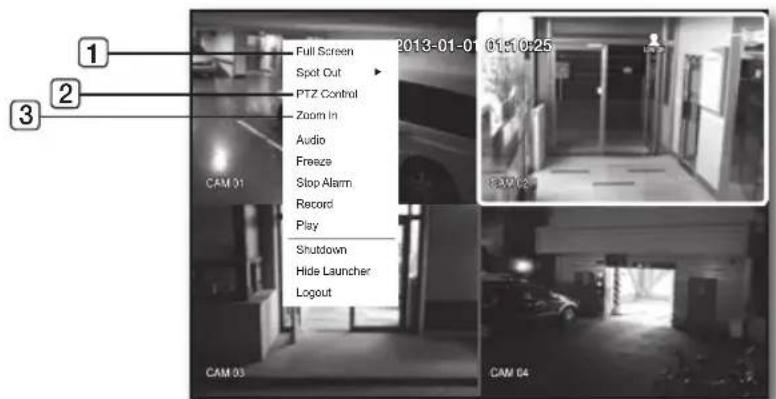
text_image
Full Screen Spot Out PTZ Control Zoom In Audio Freeze Stop Alarm Record Play Shutdown Hide Launcher Logout CAM 01 CAM 03 CAM 04 2013-01-01 01:50:25| Menu Description | ||
| 1 | Full Screen | Select and click a desired channel in Split mode to switch to the full screen of the selected channel. |
| 2 | PTZ Control | Accesses the PTZ Control menu.The PTZ menu will be active on Live screen if you select a single channel. (Page 63) |
| 3 | Zoom In | Enlarges the selected image. (Page 25) |
view the Launcher menu
The Launcher menu appears on the bottom of the live screen.
- In Live mode, right-click to display the context menu and select
. - Move the cursor to the bottom and click a desired item in the Launcher menu.

If no input is entered for 10 seconds, the menu will disappear.
■The Launcher menu can be accessed only by using the mouse.

text_image
2013-01-01 01:10:25 CAM 01 CAM 02 CAM 03 3013-01-01 01:10:25 CAM 04
text_image
2013-01-01 01:10:25 1 2 3 4 5 6 7 8 9 10| Menu Description | ||
| 1 | Date/Time | Displays the current time and date.The indication of AM/PM is displayed if you set 12 hours for the time format in "System > Date/Time/Language > Time". (Page 28) |
| 2 | Screen Mode Press this button to switch the screen mode in sequence. | |
| 3 | Menu Expansion Button Click to display the hidden menu to the right. | |
| 4 | Audio Turns ON/MUTE the sound of the selected channel. | |
| 5 | Zoom Enlarges the selected area. This is available only in Single Live mode. | |
| 6 | PTZ Runs the PTZ Control launcher. | |
| 7 | Alarm Stops the alarm if it's activated. | |
| 8 | Freeze Freezes the Live screen temporarily. | |
| 9 | Play Enters Play mode if a file to play exist, and if not, enters Search mode. | |
| 10 | Record Start/End recording the Live screen. | |
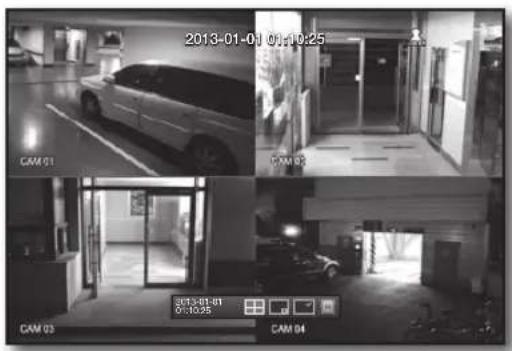
Displays 4 live video images in 3 different modes.
Switching the screen mode
To switch the split mode, select a screen mode in the launcher menu, or right-click to select a screen mode in the context menu.
Press the [MODE] button on the remote control to switch the mode in the sequence of the launcher menu items.

flowchart
graph LR
    A["CH1CH2\nCH5CH4"] --> B["C=2\nC=1"]
    B --> C["CH1"]
4-split mode PIP Auto Sequence
Switching the screen automatically
With SRD-443 you can display 4 live single screens in sequence.
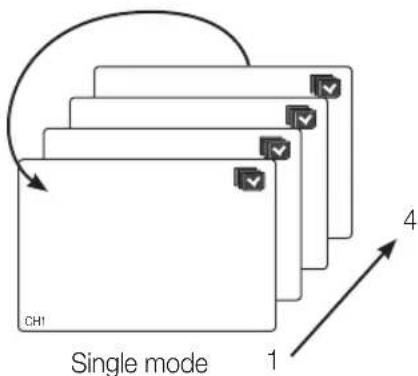
flowchart
graph TD
    A["CH1"] --> B["Single mode"]
    B --> C["1"]
    B --> D["4"]

In Single mode, If you have set
Channel Setting
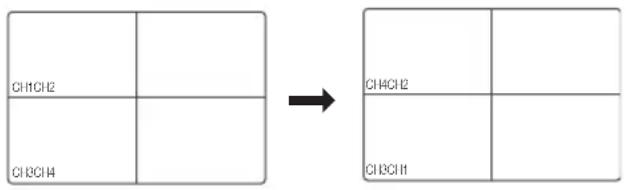
You can display the channel in a desired area of a split screen.
-
Click a camera name to display a channel list where you can select a different channel.
-
Select a desired channel and click it.
The current channel will be switched to the selected one.
Use the cursor to select a channel to move, and drag and drop it to a desired channel; this can also change the channel position.
■Ex : if switching CH 1 to CH 4
flowchart
graph LR
    A["2x2 Grid"] --> B["1x2 Grid"]
    style A fill:#f9f,stroke:#333
    style B fill:#bbf,stroke:#333
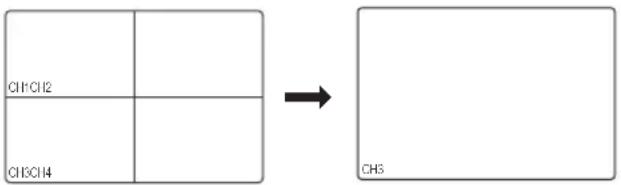
Switching to Single Mode
When in split mode, select and double-click a desired channel to switch to its Single mode.
Press the number corresponding to a desired channel the remote control to switch to its Single mode.
Refer to "Remote Control > Using the numeric buttons". (Page 11)
Ex : If double-clicking CH 3 or pressing the number "3" on the remote control.
flowchart
graph LR
    A["2x2 Grid"] --> B["1x2 Grid"]
    style A fill:#f9f,stroke:#333
    style B fill:#bbf,stroke:#333
The Spot Out monitoring is independent of the Live mode, which monitors a specific channel through the Spot Out port.
Selecting a Spot Out mode
If an event occurs such as sensor, motion or alarm from the Spot Out port in connection with a monitor, you can select a output screen mode.
- In Live mode, right-click any area on the screen. The Live menu appears.
- Click
. Supports the Spot output in Single screen with Auto Sequence mode.
If the monitor is connected to the Spot port, the event that occurred from the selected channel will be output on the monitor.
For the Spot Out port of a model, refer to "Part Names and Functions (Rear)". (Page 10)
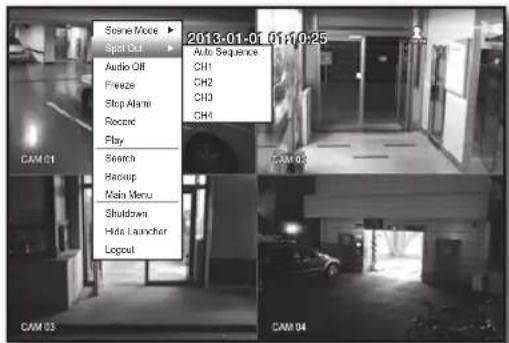
text_image
Scene Mode Spot Out Audio Off Freeze Stop Alarm Recute Play Search Backup Main Menu Shutdown Hota Launcher Logout 2013-01-01 01:10:25 Auto Sequence CH1 CH2 CH3 CH4 CAM 01 CAM 03 CAM 04< Multichannel Live Menu >
ZOOM
This is available only in Single Live mode. In Single mode, select a desired area and use the Zoom function to enlarge it twice.
- Select
in the right-click menu. Press the [ZOOM] button on the remote control, or simply click < 🔒> in the launcher menu. The zoom box appears. - Use the direction keys, or drag and drop to specify an area to enlarge.
- Press the [ENTER] button, or double-click the selected area to enlarge it twice. In the enlarged image, use the direction buttons (▲▼◀▶) on the remote control to move the enlarged area.
- Press the [ZOOM] button on the remote control, or simply click < 🔒 > in the launcher menu to release the zoom.
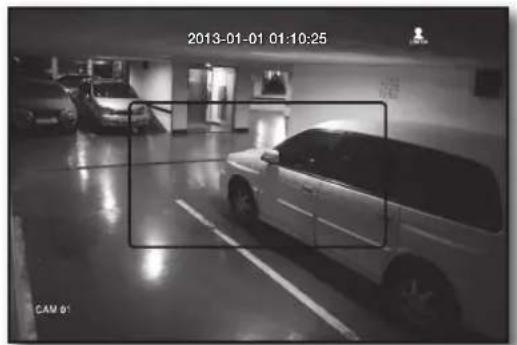
text_image
2013-01-01 01:10:25 CAM 81
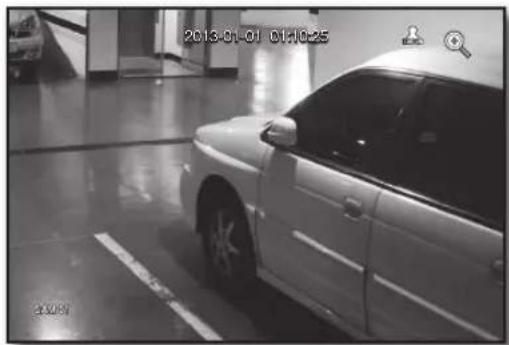
natural_image
Black-and-white photo of a white car parked in a garage, no visible text or symbols on the vehicle or surroundings.AUDIO ON/OFF
You can turn the sound on/off in Live mode.
AUDIO ON/OFF in Single mode
Click the audio icon (播放) on the screen, or press the [AUDIO] button on the remote control to turn it on/off.

Only the channel where
FREEZE
This is available only in Live mode, this pauses playing the Live image temporarily.
- Press the [FREEZE] button the remote control, or click < Freeze > in the launcher menu. The playback of the image is stopped temporarily.
- Press the [FREEZE] button again, or click < Freeze >. This will release the freeze.
EVENT MONITORING
This will display the channel in sync with a specific event (Sensor/Motion/Video Loss) if it occurs.
In "Monitor > Event Display", set the event monitoring to ON/OFF and specify the event display time. (Page 44)
- If multiple events occur simultaneously, the screen will switch to a split mode. - 2\~4 events : 4-split mode
- If the second event occurs within the set time of
, the first event will last until the second one is terminated. (Page 43)
■Ex : If you set
Event occurrence 5 seconds
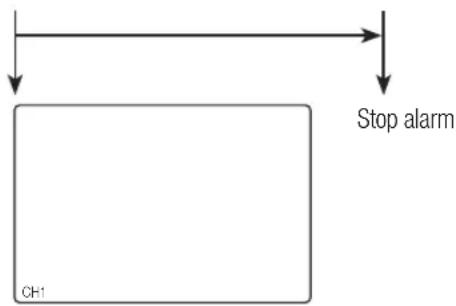
text_image
Stop alarm CH1Ex : If you set
Event occurrence 4 seconds 9 seconds
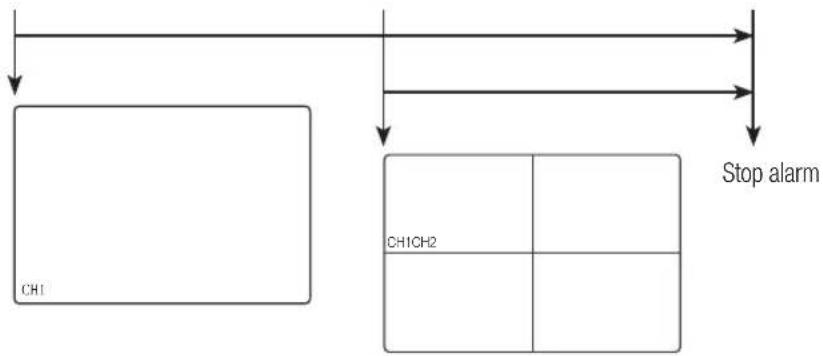
flowchart
graph TD
    A["CH1"] --> B["Stop alarm"]
    C["CH1CH2"] --> B
    B --> D["Stop alarm"]
M
■Press the [ALARM] button to reset the alarm settings and to release the event mode.
■If an alarm activates in the condition you have set the event record, and pre/post alarm times, the event record will be performed.
using the DVR
You can setup the system properties, devices, and options for recording, event, backup and network.
SYSTEM SETUP
You can setup Date/Time/Language, Permission, System Properties and Log.
Date/Time/Language
You can check and setup the current Date/Time and time related properties, as well as the language used for the interface on the screen.
Setting the Date/Time/Language
Set the Date/Time/Language
Using the mouse may help make setup easier.
- Press the [MENU] button on the remote control. ■If not logged in, it prompts with login window. Refer to "Login". (Page 18)
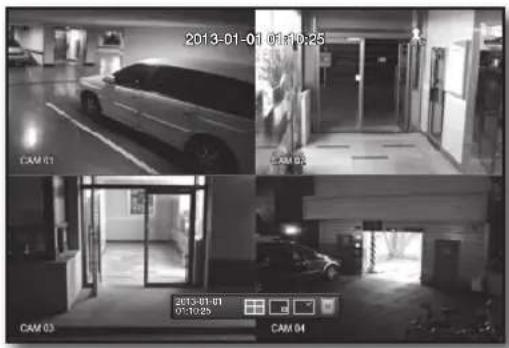
text_image
2013-01-01 01:10:25 CAM 01 CAM 02 CAM 03 2013-01-01 01:10:25 CAM 04-
Use the left/right buttons (◀▶) to select the
. System property setup menu is selected. -
Use the up/down buttons (▲▼) to select
and press the [ENTER] button. -
Select
. A dialog to setup Date, Time and Language. -
Use direction buttons (▲▼◀▶) to select an item to set and make your changes.
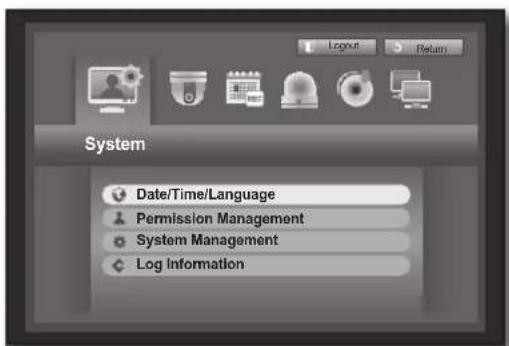
text_image
System Date/Time/Language Permission Management System Management Log Information- Date : Sets the date that will appear on the screen. You can select the date format.
- Time : Sets the time and its format that will appear on the screen. Select either one from <24 Hours, 12 Hours (AM/PM)>.
- Time Zone : Sets the time zone of your area based on the Greenwich Mean Time (GMT).
■ GMT (Greenwich Mean Time) is standard World Time and the basis of world time zone.
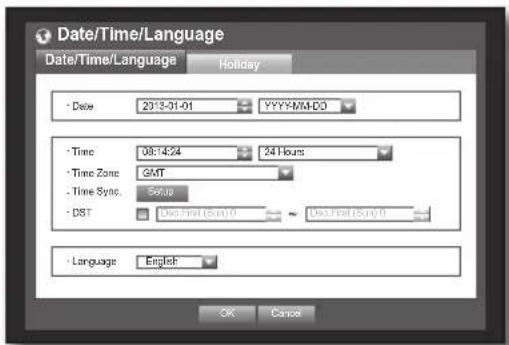
text_image
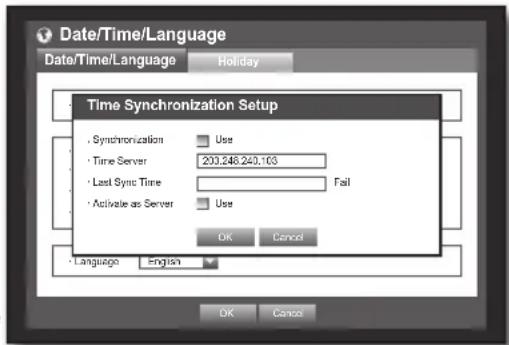
Date/Time/Language Date/Time/Language Holiday - Date 2013-31-01 YYYYMM-DD - Time 08:4:24 24 hours - Time Zone GMT - Time Sync. Setup - DST Dec.Final (Sun) 0 Dec.Final (Sun) 0 - Language English OK Cancel- Time Sync. : You can set the DVR's current time synchronized to a selected
- Time Server : Enter an IP or URL address of the time server.
- Last Sync Time : Displays the most recent synchronization time from the selected time server.
-
Activate as Server : Set to
-
DST : Set up Daylight Saving Time with its period to make the time earlier than the GMT of its time zone by 1 hour during the set period.
- Language : Select your language. Sets the language for the interface.
English, French, German, Spanish, Italian, Chinese(Simplified), Russian, Korean, Polish, Japanese, Dutch, Portuguese, Turkish, Czech, Danish, Swedish, Thai, Romanian, Serbian, Croatian, Hungarian, Greek, Chinese (Traditional), Finnish and Norwegian are available.
text_image
Date/Time/Language Date/Time/Language Holiday Time Synchronization Setup • Synchronization Use • Time Server 203,248,243,163 • Last Sync Time Fail • Activate as Server Use OK Cancel • Language English OK Cancel- When the Date/Time/Language setup is done, press
.

- You can also use numeric buttons on the remote control to enter values for Date, Time and other numeric fields.
Setting Holiday
You can set specific dates to Holidays according to your preferences.
Holidays are applied to
Using the mouse may help make setup easier.
- Use the up/down buttons (▲▼) in
window to select , and press the [ENTER] button. - Select
.
A calendar for Holiday setup appears.
- Use the left/right <◀▶> buttons to select year or month, and press the [ENTER] button.
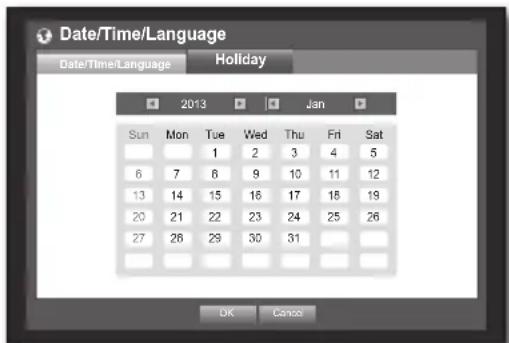
text_image
Date/Time/Language Date/Time/Language Holiday 2013 Jan Sun Mon Tue Wed Thu Fri Sat 6 7 8 9 10 11 12 13 14 15 16 17 18 19 20 21 22 23 24 25 26 27 28 29 30 31 DK Canzo- Use direction buttons (▲▼◀▶) to select a desired date, and press the [ENTER] button.
You will see the "Setting Holiday" screen.
Ex : Select January 14th and check on <1/14> only to make every January 14th a holiday. Check both on <1/14> and
- When the Holiday setup is done, press
.
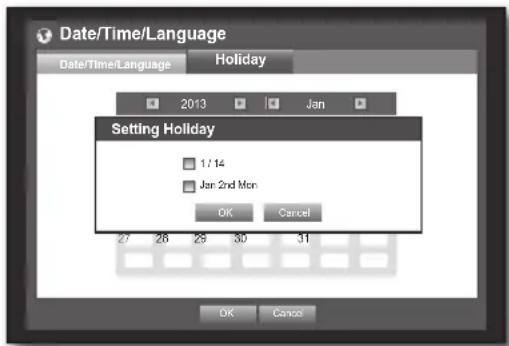
text_image
Date/Time/Language Date/Time/Language Holiday 2013 Jan Setting Holiday 1/14 Jan 2nd Mon OK Cancel 27 28 29 30 31 OK CancelUsing the Calendar
Using the mouse may help make setup easier.
① Select year and month.
Select the left/right <◀▶> key on the left/right side of year/month and press [ENTER] button to adjust by 1 year/month.
② Use direction buttons to select a date and press [ENTER] button.
■ A date with recorded data to be searched will appear in yellow in the System Log, Event Log, Time Search and Event Search.
Permission Management
You can set permissions of each user over the DVR's specific function and settings.
Setting the Administrator
You can set and change Administrator's ID and password. The administrator can use and set all menu items and functions. Using the mouse may help make setup easier.
- Use the up/down buttons (▲▼) in
window to move to , and press [ENTER] button. - Select
. A dialog for Admin ID and Password input appears. - Use direction buttons (▲▼◀▶) to move to a desired item, and set the ID and password.

- The default administrator ID is "admin", and the password must be set when the user log in at the first time.
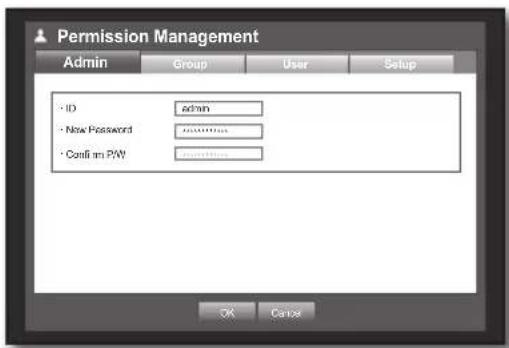
text_image
Permission Management Admin Group User Setup - ID adults - New Password ******** - Confirm PW ******** OK Cancel■ To prevent from your personal information being exposed, please change your password every 3 months.
Note that the security and other related issues caused by careless management of password shall be in the charge of the user.
- When the administrator setup is done, press
.
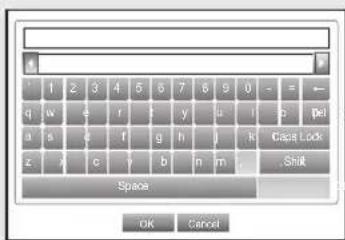
Using Virtual Keyboard
① For alphanumeric inputs, the virtual keyboard window appears.
② Use direction buttons (▲▼◀▶) to move to a desired character, and press the [ENTER] button.
③ In the upper text input box of the virtual keyboard, there displays a list of candidate words containing the selected character.
④ Select a word from the list, or use the keyboard to enter the whole word.
If there are many of candidate words, use <#, > buttons to move between them forward and backward.
⑤ Select
Entered word is applied.
- For upper case letters, use
button. - For special characters, use
button.
■ Using the virtual keyboard is the same to a normal keyboard use in your region. - You can enter the ID with case-insensitive alphanumeric characters only.
- For the password, use alphabets and special characters excluding < and <
■You can use number buttons on the remote control.
text_image
1 2 3 4 5 6 7 8 9 0 - = ← q w e r y u f b Del a s e f g h i k Capg Lock z x c y b n m Shift Space OK CancelSetting the Group
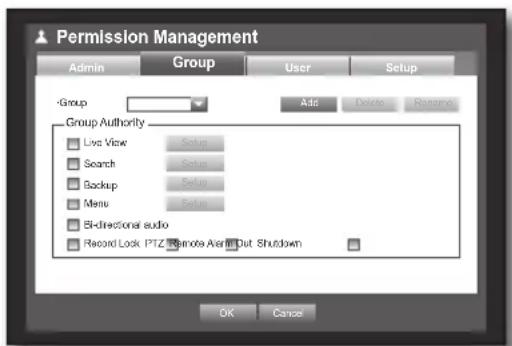
You can create user groups and setup permissions for those user groups.
You can register a user for each group in
Using the mouse may help make setup easier.
-
Use the up/down buttons (▲▼) in
window to move to , and press [ENTER] button. -
Select
. A window for , , , and setup appears. -
Use direction buttons (▲▼◀▶) to move to a desired item, and set the value.
- Add, Delete, Rename : You can add, delete, rename a group or modify the permissions given to the group.
text_image
Permission Management Admin Group User Setup -Group Add Den Rename Group Authority Live View Setup Search Setup Backup Setup Menu Setup B1-directional audio Record Lock PTZ Remote Audio Out Shutdown OK CancelThe virtual keyboard appears when
- Add : When you first run the DVR with the admin account, only the admin account exists. Add has already been deactivated. Select to display the virtual keyboard. Enter a group name. You can add up to 10 groups.
- Delete : Deletes a user group that is already registered. Selecting Delete will delete all user accounts belonging to that group.
- Rename : Renames a group that is already registered. Select
to display the virtual keyboard. - For entering a group name, refer to "Using Virtual Keyboard". (Page 30)
- Group Authority : Sets permissions to access menu items of each group. Users of a group can access checked functions.
- When the group setup is done, press
.
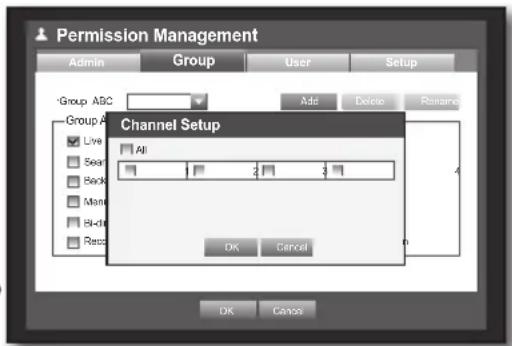
To set the group authority
You can set the permissions of the group users to access the menu according to the channel.
- Select a menu to which the group permission is assigned. The menu where the group permission is assigned will be displayed in the Live menu when a group user logs in.
• Live View : You can set the permission to access the Live screen according to the channel.
- Search : You can set the permission to access the Search menu according to the channel.
- Backup : You can set the permission to access the Backup menu according to the channel.
- Menu : You can set menus accessible with a specific permission.
Group users can access the permitted menus only.
Select a menu to display the Menu Permission screen
text_image
Permission Management Admin Group User Setup Group ABC Add Delete Remains Channel Setup All Back Main 84-96 OK Cancel OK Cancel- Bi-directional audio: You will be given permission to use two-way audio features.
-
Record Lock, PTZ, Remote Alarm Out, Shutdown : Select an item so that the item will be added to the permissions.
-
Select
.
Select and assign a group user so that the user can access the specified menu.
To restrict the user permissions
If the admin restricts all permissions of an added group, the users belonging to that group can access only the default minimum menus and can change the user's own password only.
-
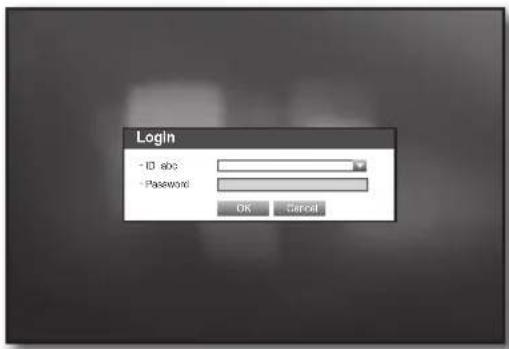
Start the DVR. If all permissions are restricted, only the Login dialog should appear.
-
Log in with a registered user ID.
text_image
Login - ID abc - Password OK Cancel- Right-click any area on the screen. If all permissions are restricted, only the accessible context menus should appear.
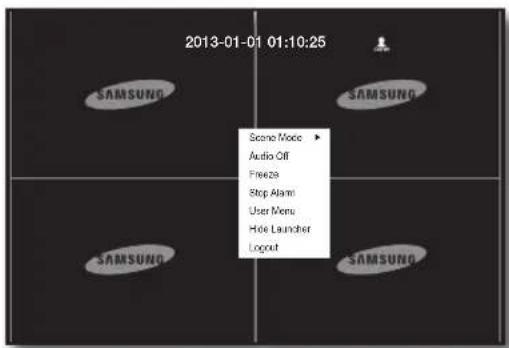
text_image
2013-01-01 01:10:25 SAMSUNG SAMSUNG Scene Mode ▶ Audio Off Freeze Stop Alarm User Menu Hole Launcher LayoutTo change the user password
If you log in with a user account that is restricted to access the menu, you can change your own password only.
- Log in with your account.
- Select
. The Permission Management setup screen appears. - Select
. The Password setup dialog appears. - Enter a new password.
- Select
. You change to the password will be applied.
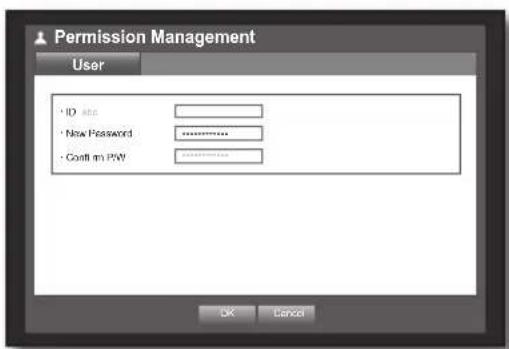
text_image
Permission Management User • ID abc • New Password ******** • Confirm my P/W ******** OK CancelSetting the User
Users can be added only if a group was created in
Using the mouse may help make setup easier.
- Use the up/down buttons (▲▼) in
window to move to , and press [ENTER] button. - Select
.
A window for Add User appears.
- Use direction buttons (▲▼◀▶) to select
from the window.
A window for "Add User" appears.
You can configure the Network Viewer settings including name, ID, viewer, Select Group and password.
Result of the user setup appears in the
To change the user property, use "Edit User".
The "Edit User" window appears when you select a desired item to be changed in the
- Viewer: If you select
■ Refer to "Connecting Web Viewer". (Page 71)
For more information about use of Network Viewer, refer to the Network Viewer's user guide. (Page 8)
- When the user setup is done, press
.
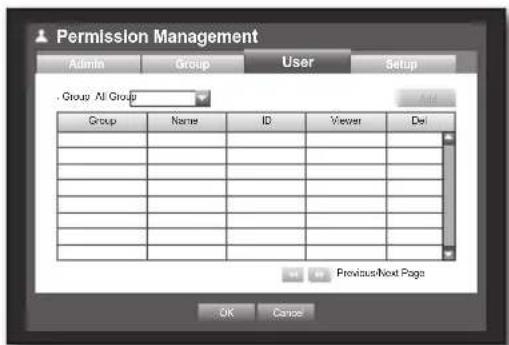
text_image
Permission Management Admin Group User Setup . Group All Group Group Name ID Viewer Del Cancel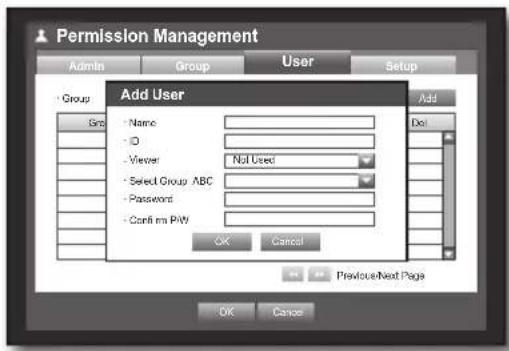
text_image
Permission Management Admin Group User Setup Group Name ID Viewer Not Used Select Group ABC Passwords Confirm PiW Add Del OK Cancel Previous/Next Page OK CancelSetting Permissions
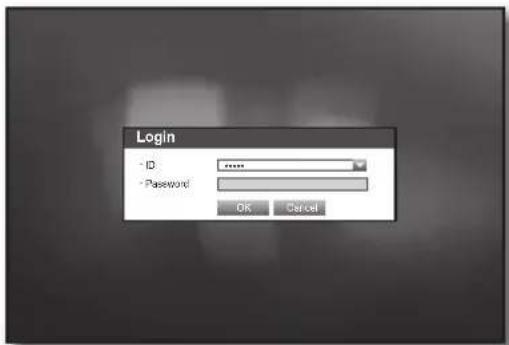
You can set restricted access for all general users. Items with restrictions will require logging in for use.
Using the mouse may help make setup easier.
- Use the up/down buttons (▲▼) in
window to move to , and press [ENTER] button. - Select
.
The Restricted Access, Restriction on Network Access, Auto Log out, Manual Input of ID setup screen appear.
- Use direction buttons (▲▼◀▶) to move to a desired item, and set the value.
- Restricted Access: All menu items allowed for a user can be set with restricted access.
- Checked (☑) : Restricted
- Not checked (☐): Accessible
If it is not checked (☐) in
If it is checked (☑) in
- Restriction on Network Access: Restricts remote access from a
- All Network : Restricts all access instances via Network Viewer and Web Viewer.
- Web Viewer : Restricts access via the Web Viewer.
• Auto Log outA user will be automatically logged out if there is no operation on DVR for over set period of time.
using the DVR
- Manual Input of ID : Prompts you to enter the user ID manually for the login process.
-
Checked (☑): Encloses the registered user IDs with the [*] symbols.
Use the virtual keyboard to enter the user ID. -
When the permission setup is done, press
.
text_image
Login - ID: ****** - Password: OK CancelSystem Management
You can check the system version, update to a newer version, as well as data backup and initialization.
Checking the System Information
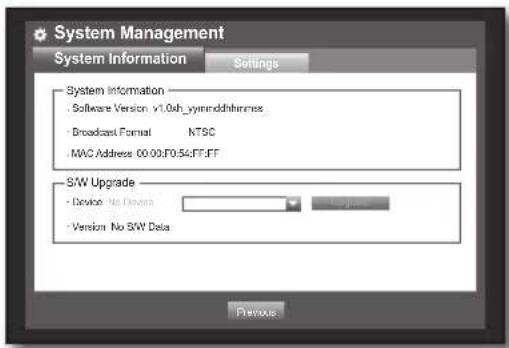
You can check the current system version, broadcasting system, MAC address. You can update the system. Using the mouse may help make setup easier.
- Use the up/down buttons (▲▼) in
window to move to , and press [ENTER] button. - Check the Version, Broadcast Format, and MAC Address.
- System Information: Shows the current system's information.
The values can not be changed by a user.
• S/W Upgrade : Updates the DVR's software.
Ex: If you connect to a storage device that has upgradable software installed, and return to the
text_image
System Management System Information Settings System Information • Software Version v1.0zh_yyerrddhhnnrms • Broadcast Format NTSC • MAC Address 00:00:F0:5k:FF:FF S/W Upgrade • Device No Devices • Version No SW Data Previous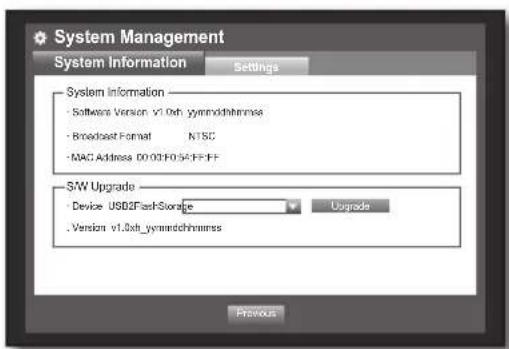
text_image
System Management System Information Settings System Information - Software Version v1.0zh_ymmndchmnms - Broadcast Format NTSC - NAG Address D0.03F0.56FFFF SW Upgrade - Device USB2FlashStorage - Version v1.0zh_ymmndchmnms Upgrade Previous- Updating the Software
- Connect a device storing the software to be updated. (It may take about 10 seconds to recognize the device.)
■ Upgradeable devices include USB memory and network device.
■ To update the network, the current DVR should have been connected to the network.
Upgrade via the proxy server may not be enabled due to the restricted access.
text_image
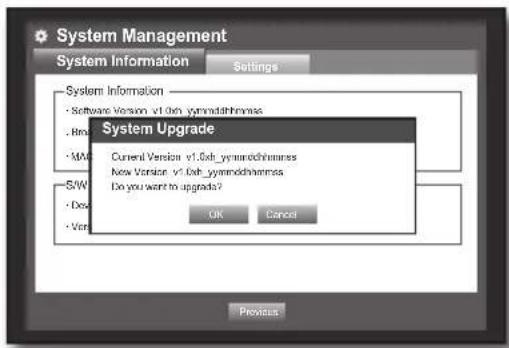
System Management System Information Settings System Information - Software Version v1.0ch_yymmoddhnrmms - New Version v1.0ch_yymmoddhnrmms - MW - Do - Vsn System Upgrade Current Version v1.0ch_yymmoddhnrmms New Version v1.0ch_yymmoddhnrmms Do you want to upgrade? OK Cancel Previous- Select
from window. - Select
. - When the recognized device appears, select
.
The .
- Press
in the "System Upgrade" window.
■While updating, it shows the progress.
- Updating progresses with 3 steps as shown in the figure.
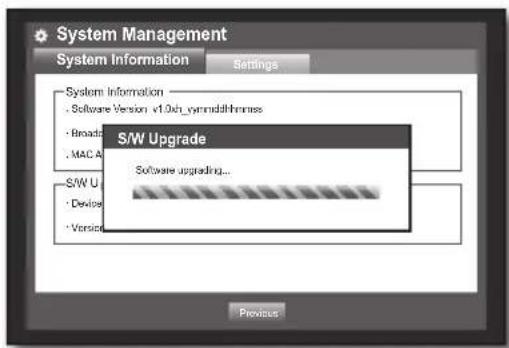
text_image
System Management System Information Settings System Information - Software Version v1.0xh_ynmidathframes - Broads - MAC A S/W Upgrade Software upgrading... S/W U - Devices - Version Previous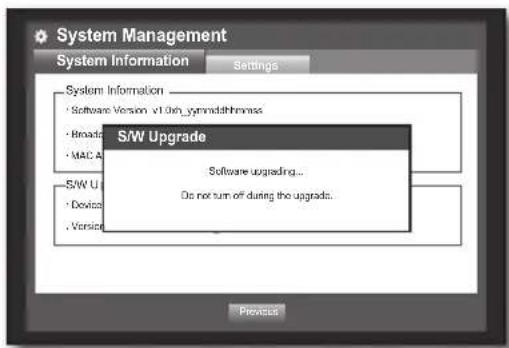
text_image
System Management System Information Settings System Information • Software Version v1.0m_gymniddhhmmss • Broadcast • MAC A S/W Upgrade Software upgrading... Do not turn off during the upgrades. S/W U • Devices • Version Previous- When the updating is done, it automatically restarts. Do not turn the power off until it finishes restarting.

If "Upgrade Failed" appears, retry from the step 4. When you experience continued failure, consult the service center for assistance.
- When you perform S/W update remotely using Smart Viewer, it may take a max of 3 minutes to complete the update since Smart Viewer popped up a confirmation message. This is to guarantee that the DVR set operates stably. For a faster update, use the USB cable to connect to the DVR set.

text_image
SAMSUNGSettings
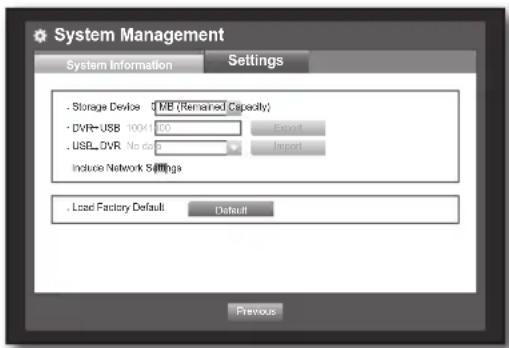
You can copy and import the DVR settings by using a storage media.
Using the mouse may help make setup easier.
- Use the up/down buttons (▲▼) in
window to move to , and press [ENTER] button. - Select
. A window of storage device and load factory default appears. - Use direction buttons (▲▼◀▶) to move to a desired item, and export or import settings data to a storage device.
• Storage Device : Shows the connected storage device.
- Export : Exports DVR settings to the connected storage device.
- Import : Imports DVR settings from the storage device and applies to the DVR.
If
- Load Factory Default : If
is selected, a confirmation dialog for "Load Factory Default" prompts. Press to initialize the system to the factory default. - To move to the previous menu, press
.
text_image
System Management System Information Settings Storage Device: USB (Remained Cepodily) • DVR-USB 10041.100 • USB_DVR No data Include Network Settings Load Factory Default Default Previous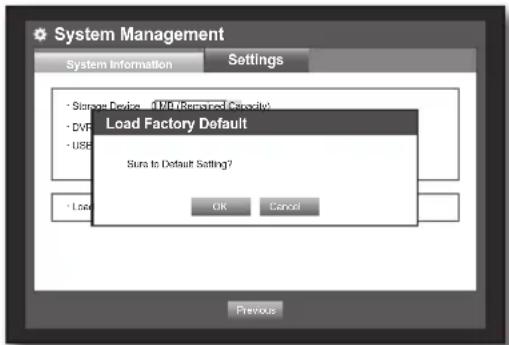
text_image
System Management System Information Settings Load Factory Default Starts to Default Setting? OK Cancel PreviousLog Information
You can browse logs on the system and events.
System Log
System Log shows log and timestamp on every system start up, system shutdown, and changes on system settings.
Using the mouse may help make setup easier.
- Use the up/down buttons (▲▼) in
window to move to , and press [ENTER] button. - Select
.
■ Refer to "Using the Calendar". (Page 29)
Click on the calendar < to display the calendar window.
- Type : When there are too many logs, you can display logs of the desired format by selecting the type.
- Use direction buttons (▲▼◀▶) to move to a desired item, and press
.
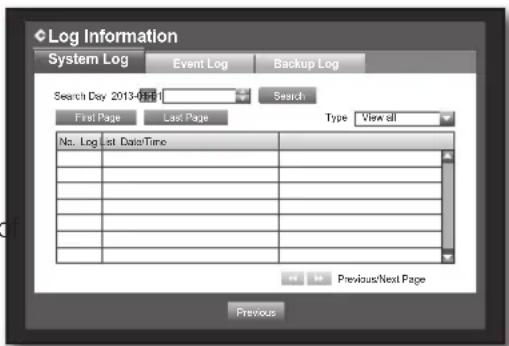
text_image
Log Information System Log Event Log Backup Log Search Day 2013-08-01 Search First Page Last Page Type View All No. Log Last Date/Time Previous/Next Page PreviousEvent Log
Event log shows recorded events on alarms, motion detections and video loss.
It also shows the log and its timestamp.
Using the mouse may help make setup easier.
-
Use the up/down buttons (▲▼) in
window to move to , and press [ENTER] button. -
Select
. -
Use direction buttons (▲▼◀▶) to move to the desired item.
-
Set Search Day, Channel and Type and the press
.
■ Refer to "Using the Calendar". (Page 29)
Click on the calendar <=> to display the calendar window.
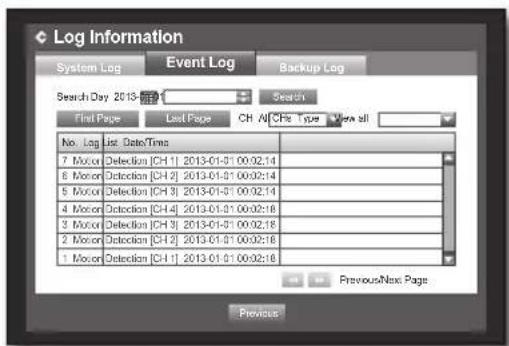
text_image
Log Information System Log Event Log Backup Log Search Day 2013-01-01 Search First Page Last Page CH All CPs Type View all No. Log List Date/Time 7 Motor Detection [CH-1] 2013-01-31 00:02:14 8 Motor Detection [CH-2] 2013-01-31 00:02:14 5 Motor Detection [CH-3] 2013-01-31 00:02:14 4 Motor Detection [CH-4] 2013-01-31 00:02:16 3 Motor Detection [CH-5] 2013-01-31 00:02:16 2 Motor Detection [CH-6] 2013-01-31 00:02:16 1 Motor Detection [CH-7] 2013-01-31 00:02:16 Previous Next Page PreviousBackup Log
You can find out who backed up and the details (backup time, channel, device to use, file format, etc.).
Using the mouse may help make setup easier.
-
In the
window, press the up/down (▲▼) button to move to and press the [ENTER] button. -
Select
. -
Use the four direction buttons (▲▼◀ ▶) to move to a desired item.
-
Specify a search term and select
in the right corner.
Backup details for the search term will be listed.
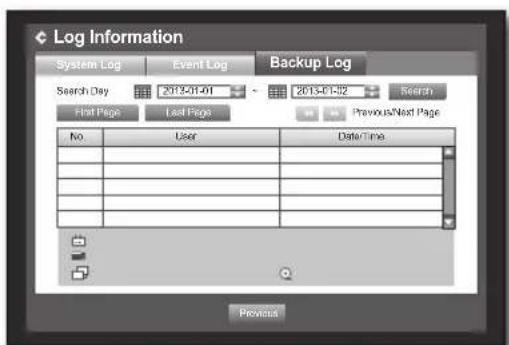
text_image
Log Information System Log Event Log Backup Log Search Day 2013-01-01 2013-01-32 Search First Page Last Page Previous/Next Page No User Data Time PreviousSETTING THE DEVICE
You can setup Camera, Storage Device, Remote Device and Monitor.
Camera
Setting the Camera
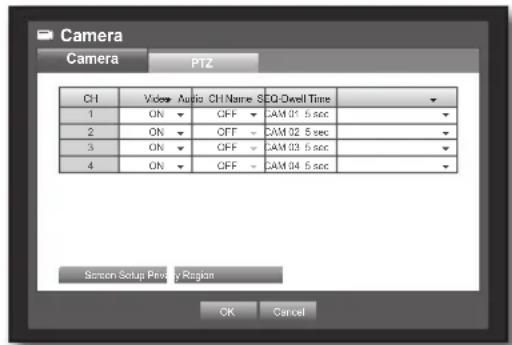
You can set Video, Audio, Channel Name and Dwell Time of a Camera.
Using the mouse may help make setup easier.
- Press the [MENU] button on the remote control.
- Use the left/right button (◀▶) to select
. Device setting menu is selected. - Use the up/down buttons (▲▼) to move to
, and press [ENTER] button.
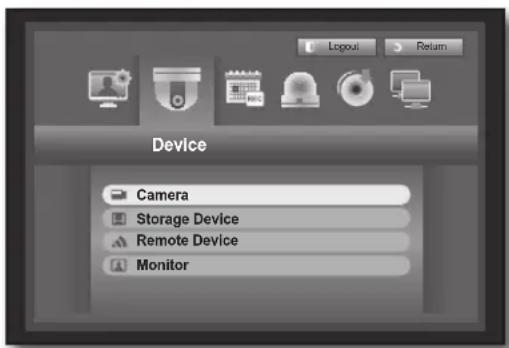
text_image
Device Camera Storage Device Remote Device Monitor-
Select
. You will see a window where you can configure the camera settings including Video, Audio, CH Name, SEQ-Dwell Time. -
Use direction buttons (▲▼◀▶) to move to a desired item, and set the value.
- Video
-
-
- For privacy protection, it does not display the video while the recording continues.
-
text_image
Camera PTZ CH Video Audio CH Name SEQ-Dwell Time 1 ON ▼ OFF ▼ CAM 01 5 sec 2 ON ▼ OFF ▼ CAM 02 5 sec 3 ON ▼ OFF ▼ CAM 03 5 sec 4 ON ▼ OFF ▼ CAM 04 5 sec Screen Setup Pricing Region OK Cancel- Audio
- If set to
, you can turn the audio of the channel ON/OFF on the Live screen. - If set to
, the channel's audio is off on the Live screen and not recorded.
- CH Name : Up to 15 characters including blanks are allowed. (The first character should not be empty.) - Refer to "Using Virtual Keyboard". (Page 30)
- SEQ-Dwell Time : You can set the dwell time between channels for the Live screen and Spot Out.
- If set to
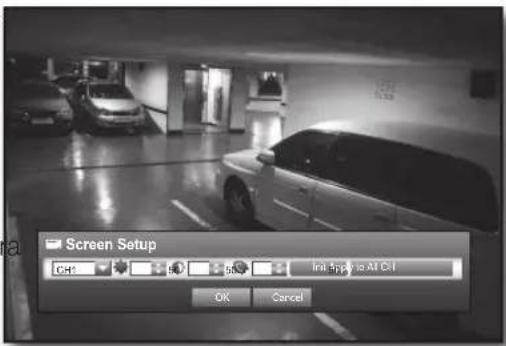
- Screen Setup: The video appeared on the screen may vary depending on the channel's camera, configure the DVR display to your preferences.
Select a channel and adjust the <(Brightness)>, <(Contrast)>, and <(Color)> of the selected channel.
- Press the
- Privacy Region: You can specify a certain area of the camera video to be protected for your privacy.
- When the camera setup is done, press
.
text_image
Screen Setup CH2 Init 5p to AM CT OK CancelTo set the privacy zone
① Select
② When "Privacy Region" window appears, select a channel for detection and set the area of privacy zone.
- To set the area in "Privacy Region" window
In the "Privacy Region" window, select desired region from <□□□□□□>
- Privacy Region
You can specify up to 4 privacy zones for each channel, which can be identified by the color.
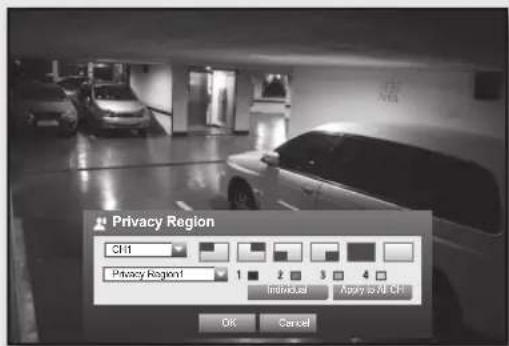
text_image
Privacy Region CI1 Privacy Region1 1 2 3 4 Individual Apply to All CI1 OK Cancel1 ■ Purple 2 ■ Green 3 ■ Blue 4 ■ Yellow
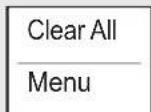
- To set the area using
When selected
- Clear All : Selected cell is removed from the Privacy Region.
- Menu : After selecting individual motion areas, move to the "Privacy Region" window.
If selected, selected motion area is applied to all channels.
③ When completing the privacy zone settings, click
Setting the PTZ
To use Camera's PTZ functions, ID and protocols of each camera and DVR should be matched.
For other settings, refer to the "Remote Devices" settings. (Page 42)
Using the mouse may help make setup easier.
- Use the up/down buttons (▲▼) in
window to move to , and press [ENTER] button. - Select
. A window of PTZ settings appears. - Use direction buttons (▲▼◀▶) to move to a desired item, and select it.
- ID : Set the ID of the connected camera of each channel. You can easily setup by using the numeric buttons on the remote control.
- Protocol : Set the protocol of the connected camera of each channel.
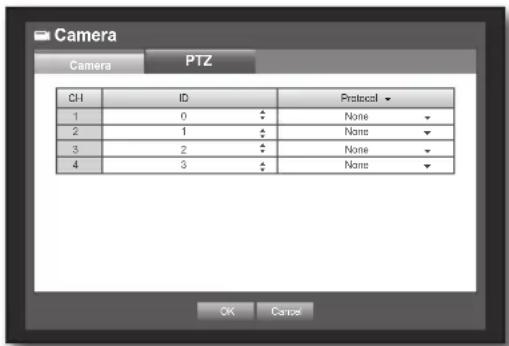
text_image
Camera PTZ CH ID Protocol 1 0 None 2 1 None 3 2 None 4 3 None OK Cancel
- You can check the camera's ID and protocol if you turn the camera off and on after connecting it to the DVR. (Page 64)
- When the PTZ setup is done, press
.
Storage Device
You can check information on storage devices.
Confirming Devices
You can check storage devices and their free space, usage as well as status.
Devices available are HDD, and USB devices (Memory, HDD).
Using the mouse may help make setup easier.
- Use the up/down buttons (▲▼) in
window to move to , and press [ENTER] button. - Select
.
• No.: Shows the assigned number of the internal HDD.
- Used/Total : Shows the used/total capacity of the storage device.
• Used : Sets the storage device's usage.
- USB memory is used for backup purpose only.
- Status/Management : Shows the current status of the HDD, as in Normal/Check/Replace.
- Normal : Available to use
- Check : Available to use but recommended to replace
-
Replace : Requires immediate replacement.
-
To move to the previous menu, press
.
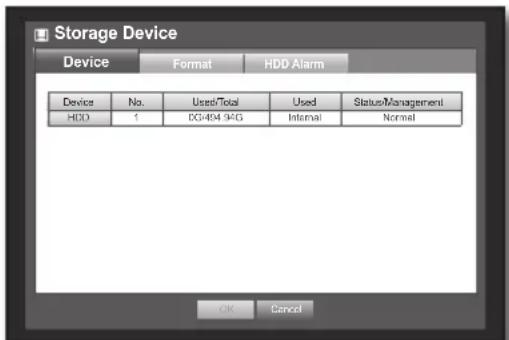
text_image
Storage Device Device Format HDD Alarm Devices No. Used/Total Used Status/Management HDD 1 DC454.9-0 Internal Normal OK CancelFormatting
You can format a storage device.
Using the mouse may help make setup easier.
- Use the up/down buttons (▲▼) in
window to move to , and press [ENTER] button. - Select
. A window for selection of device for formatting appears. -
Use direction buttons (▲▼◀▶) to select a device to be formatted.
-
Select
on the bottom of the screen. Press on the "Manage" confirmation window will start formatting the selected device. -
When the formatting is done, press
.

■ Even when formatted, used HDD space will not be 0 GB due to the space reserved by the system required for operating.
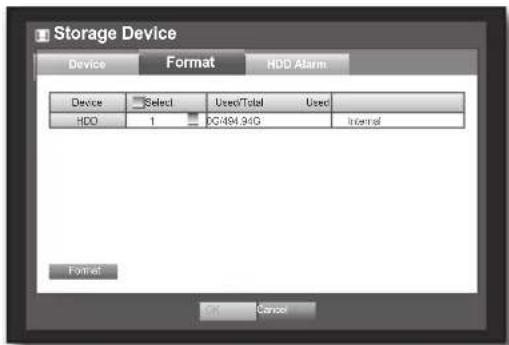
text_image
Storage Device Device Format HDD Alarm Device Select Used/Total Used HDD 1 DC484.94G Internal Format OK Cancel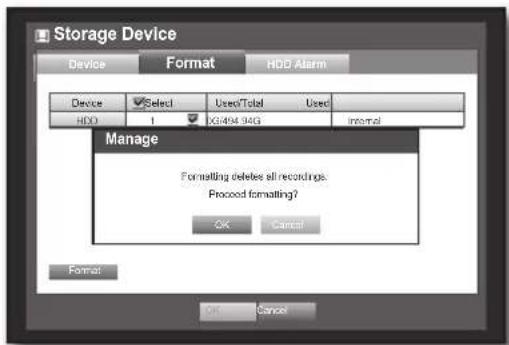
text_image
Storage Device Device Format HDD Alarm Device Select Used/Total Used HDD 1 XG4M 94G Internal Manage Formatting deletes all recordings. Proceed formatting? OK Cancel Format OK CancelHDD Alarm
You can set alarm settings for HDD defects such as Check Alarm Output Port, Replace Alarm Output Port, and its duration.
Using the mouse may help make setup easier.
- Use the up/down buttons (▲▼) in
window to move to , and press [ENTER] button. - Select
. A window for setting HDD check and replace output ports and their durations appears. - Use direction buttons (▲▼◀▶) to move to the desired item.
- Alarm
- Alarm signal will output through the alarm out port on the rear side when selected <1>.
- If
was selected, a beep will sound. -
If
was selected, both beep sound and alarm signal through rear side ports will output. -
Check Alarm Output Port : If HDD generates check alarm, the alarm signal will output to the specified alarm output port.
- Replace Alarm Output Port : If HDD generates replace alarm, the alarm signal will output to the specified alarm output port.
• Duration : Sets the alarm duration for the alarm signal and beep sound.
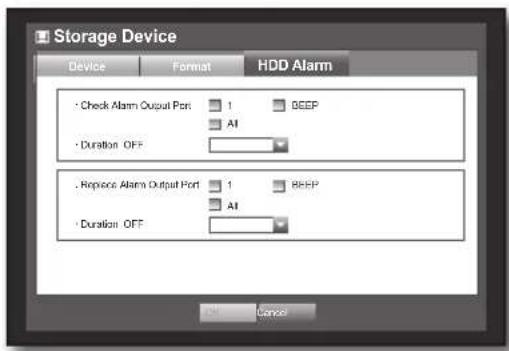
text_image
Storage Device Device Format HDD Alarm Check Alarm Output Port 1 BEEP AI Duration OFF Replace Alarm Output Port 1 BEEP AI Duration OFF OK Cancel
(☐) appears on the Live screen.
( ) appears on the Live screen.
- When the HDD Alarm setup is done, press
.
Remote Devices
You can set the RS-485 communication for use of PTZ Camera and system keyboard with the DVR.
Using the mouse may help make setup easier.
-
Use the up/down buttons (▲▼) in
window to move to , and press [ENTER] button. -
Use direction buttons (▲▼◀▶) to move to the desired item, and press [ENTER] button.
-
Set the values of each communication setup of the remote device.
- Baudrate : Baud rate settings of the DVR, PTZ camera and system keyboard should be matched for proper operations.
- Specify the system keyboard and remote control ID, and click
.
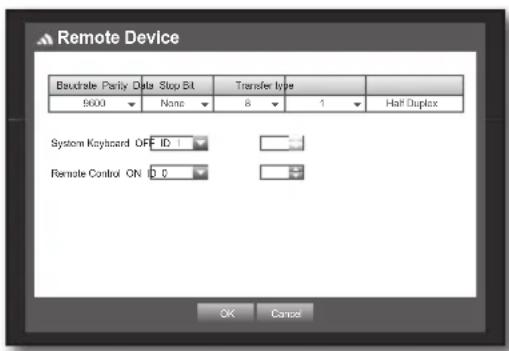
text_image
Remote Device Baudrate Parity Data Stop Bit Transfer Type 9600 None 8 1 Half Duplex System Keyboard OFF ID 1 Remote Control ON ID 0 OK Cancel
For changing the remote control's ID, refer to "Changing the Remote Control ID". (Page 11)
You can select which item(s) to be displayed on the screen.
Setting the Monitor
Using the mouse may help make setup easier.
- Use the up/down buttons (▲▼) in
window to move to , and press [ENTER] button. - Select
. - Use direction buttons (▲▼◀▶) to move to a desired item, and set the value.
- Event Display: Sets the dwell time of the event channel display on the monitor when an event occurs.
If selected
- Display : Displays only checked items on the monitor screen.
• Video Output : You can set the video output mode.
- Auto : The default is set to Composite. (In VGA mode, the "SAMSUNG" logo will be displayed) If a VGA source is connected, the source from the VGA will be displayed as main. (In Composite mode, the spot screen will be displayed)
The monitor distributor is not supported.
To switch to VGA mode, turn off the DVR set and connect the VGA jack. (The VGA monitor will turn on)
- VGA : The main video mode will switch to VGA after the DVR set reboots; the composite source will be displayed on the spot screen.
-
Composite : The main video mode will switch to Composite after the DVR set reboots. In VGA mode, the "SAMSUNG" logo will be displayed.
-
When the monitor setup is done, press
.
If you want to change the default output to VGA mode when the live screen is displayed with the beep after the system booting, press the remote control buttons in sequence: [FREEZE] → [VIEW] → [RETURN (●)] → [FREEZE] → [VIEW] → [RETURN (●)]. The DVR will switch to VGA mode with the beep after rebooting.
Setting Display position
Some monitors many not display information (camera name, icon, time information, etc.) about the DVR, depending on the condition. Then, you can change the display position of the data.
- In the
window, press the up/down (▲▼) button to move to and press the [ENTER] button. - Select the
item. - Select
in the bottom. You will move to the window. - Use the four direction buttons or the number buttons on the remote control to adjust the data position.
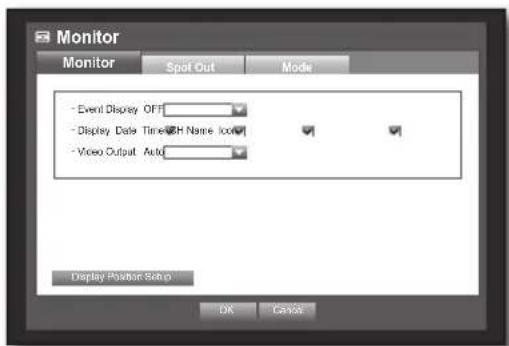
text_image
Monitor Monitor Spot Out Mode - Event Display OFF - Display Date Time With Name Icon - Video Output Auto Display Position Setup: OK Cancel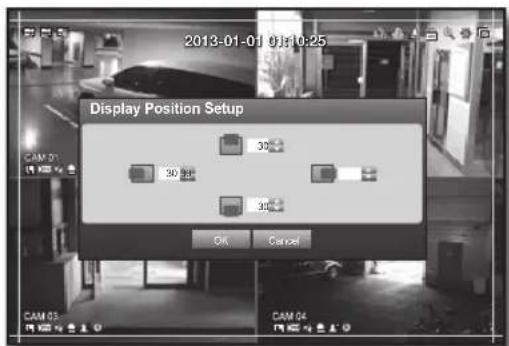
text_image
2013-01-01 01:16:25 Display Position Setup CAM 01 30 30 OK Cancel CAM 02 CAM 04Setting the Spot Out
You can set the DVR to output information / video apart from the monitor out.
Using the mouse may help make setup easier.
-
Use the up/down buttons (▲▼) in
window to move to , and press [ENTER] button. -
Select
.
■ The number of Spot Out terminals differs according to the model.
- Use direction buttons (▲▼◀▶) to move to a desired item, and set the value.
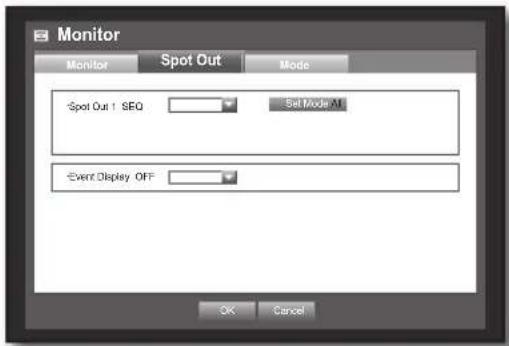
text_image
Monitor Monitor Spot Out Mode Spot Out 1 SEQ Set Model M Event Display OFF OK Cancel- Spot Out 1: You can select between Auto Sequence, and Single.
- Set Mode: A window for "Set Spot Out" appears and you can set the channel for it.
You can set the dwell time between the screen switching in "Setting the Device > Camera > SEQ-Dwell Time". (Page 39)
- Event Display: Specify the time to display on the spot output of the channel where an event took place. If selected
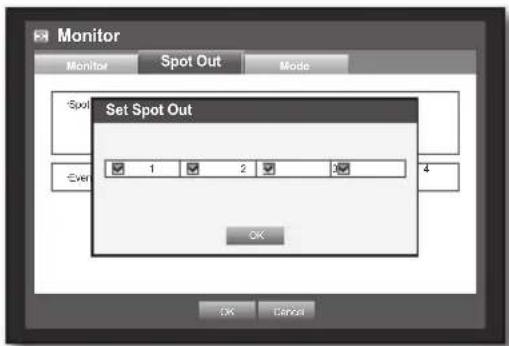
text_image
Monitor Monitor Spot Out Mode Spot Set Spot Out Over 1 2 4 OK Cancel
- You can setup using the mouse right button in Live screen. Refer to "Spot Out". (Page 25)
- When the Spot Out is done, press
.
Setting the Screen Mode
You can configure the Live screen and Split Screens.
Using the mouse may help make setup easier.
-
Use the up/down buttons (▲▼) in
window to move to , and press [ENTER] button. -
Select
. -
Use direction buttons (▲▼◀▶) to move to a desired item, and set the value.
• Live Screen : Select split modes for the Live screen. 4-split screens are included by default.
- Play Screen: Select split modes for the playback screen. Single screen and 4-split screen are provided by default.
- When the screen mode setup is done, press
.
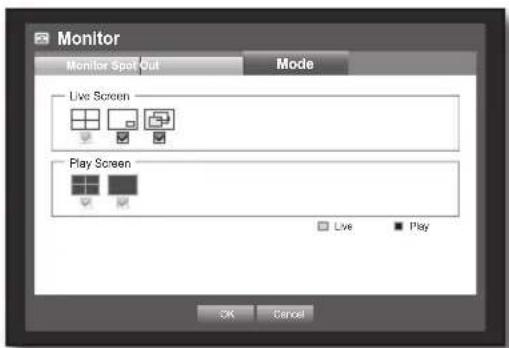
text_image
Monitor Monitor Spot Out Mode Live Screen Play Screen Live Play OK CancelYou can setup scheduled recording, event recording and other recording related settings.
Recording Schedule
Make your reservation on a date and time to schedule the recording on specified time.
Using the mouse may help make setup easier.
- Press the [MENU] button on the remote control.
- Use the left/right button (◀▶) to select
. Record menu is selected. - Use the up/down buttons (▲▼) to move to
, and press [ENTER] button.
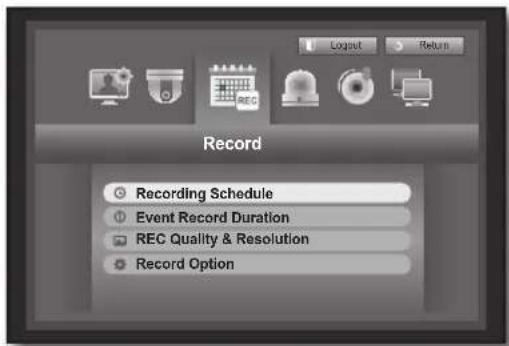
text_image
Record Recording Schedule Event Record Duration REC Quality & Resolution Record Option-
Select
. A window of scheduled recording setup appears. -
Use direction buttons (▲▼◀▶) to move to a desired item, and set the value.
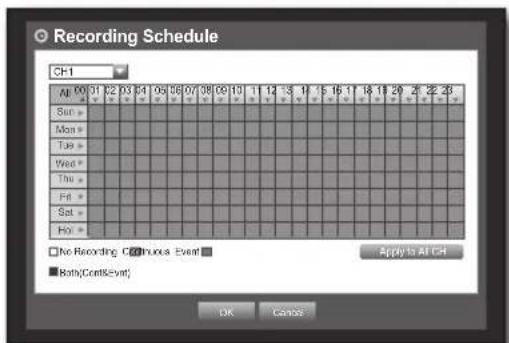
text_image
Recording Schedule CH1 All 00 31 32 03 04 05 06 07 08 09 10 11 12 13 14 15 16 17 18 19 20 21 22 23 Sun = Mon = Tue = Wed = Thu = Fri = Sat = Ho = No Recording Confucius Event Apply to All CH Both(Cont&Event) OK Cancel- Apply to All CH : If selected
- When the recording schedule setup is done, press
.
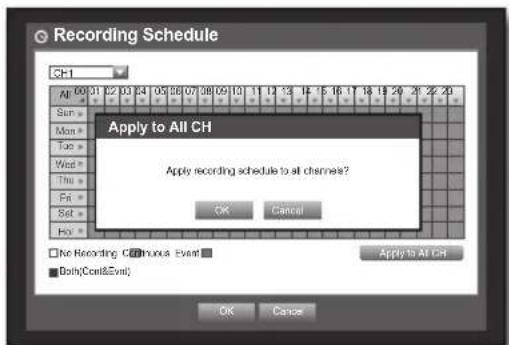
text_image
Recording Schedule CH: Apply to All CH Apply recording schedule to all channels? OK Cancel No Recording Continuous Event ■Both(Cont&Exit) Apply to All CH OK CancelRecording Color Tags
| Color Function Description | |
| White No Recording No schedule / event recording | |
| Orange Continuous Scheduled recording only | |
| Blue Event Event recording only | |
| Green Both(Cont&Evnt) Both scheduled / event recordings | |
Each press of a selected cell will cycle through
Event Record Duration
You can set the beginning and ending point of a recording on an event. Using the mouse may help make setup easier.
- Use the up/down buttons (▲▼) in
window to move to , and press [ENTER] button. - Use direction buttons (▲▼◀▶) to move to a desired item, and set the value.
- Pre Event: The recording of an event will start at a pre-determined time prior to the actual occurrence of the event. If it is set to 5 seconds, the recording begins from 5 seconds before the event.
- POST Event : The recording will continue for a pre-determined time after the actual end of an event. If it is set to 5 seconds, the recording ends in 5 seconds after an event.
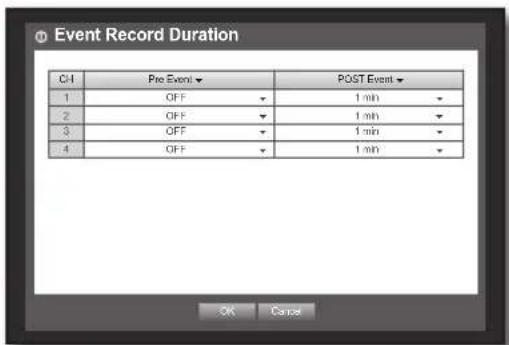
text_image
Event Record Duration C/I Pre Event POST Event 1 OFF 1 min 2 OFF 1 min 3 OFF 1 min 4 OFF 1 min OK Cancel- When the event recording duration setup is done, press
.
REC Quality / Resolution
You can set resolution, fps and quality of recordings by channel, and by recording type of standard / event. For more information about the resolution, refer to the "Product Specification" section. (Page 100)
Setting Standard Recording Properties
You can set each channel's resolution, quality and fps for normal recordings.
Using the mouse may help make setup easier.
- Use the up/down buttons (▲▼) in
window to move to , and press [ENTER] button. - Select
. - When the recording setup is done, press
.
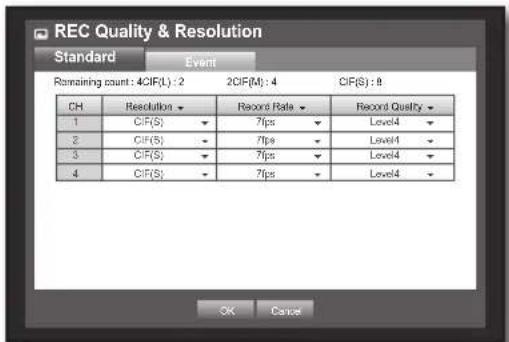
text_image
REC Quality & Resolution Standard Event Remaining count: 4CIF(L): 2 2CIF(M): 4 CIF(S): 8 CH Resolution Record Rate Record Quality 1 CIF(S) 7fps Level4 2 CIF(S) 7fps Level4 3 CIF(S) 7fps Level4 4 CIF(S) 7fps Level4 OK CancelSetting Event Recording Properties
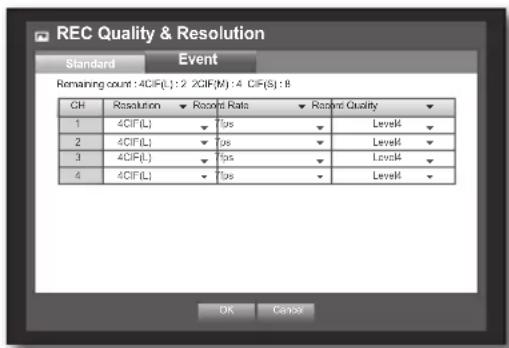
You can set each channel's resolution, quality and fps for event recordings.
Using the mouse may help make setup easier.
- Use the up/down buttons (▲▼) in
window to move to , and press [ENTER] button. - Select
. Event recording setup window appears. - Use direction buttons (▲▼◀▶) to move to a desired item, and select it.
• Resolution : Sets the resolution of the recorded screen.
- Record Rate : Image Per Second, means the frames recorded per a second.
• Record Quality : Sets the recording quality.
text_image
REC Quality & Resolution Standard Event Remaining count: 4CIF(L): 2 X3IF(M): 4 CIF(S): 8 CH Resolution Record Rates Reserve Quality 1 4CIF(L) 70s Levels4 2 4CIF(L) 70s Levels4 3 4CIF(L) 70s Levels4 4 4CIF(L) 70s Levels4 OK Canox
- The estimated total remaining count means the total number of remaining recordings for both standard and event recordings.
-
You cannot increase the remaining count if the current remaining count has reached zero or there is no available remaining count from any other page. If this is the case, reduce the remaining count for the current page, or do so for the same channel on any other page.
-
When the Event recording setup is done, press
.
Record Option
Specify whether to stop recording or overwrite the HDD if the HDD is full.
Using the mouse may help make setup easier.
- Use the up/down buttons (▲▼) in
window to move to , and press [ENTER] button. - Use direction buttons (▲▼◀▶) to move to a desired item, and set the value.
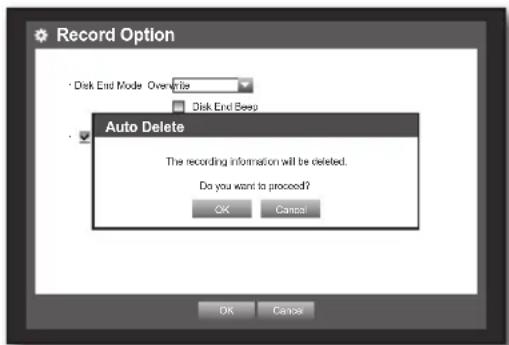
- Disk End Mode : If selected
, recording will continue despite the HDD full while overwriting the oldest. If selected , the recording will stop when the HDD is full. - Disk End Beep : If selected
, the button is activated. If you check it, the beep will sound on the disk full and the recording stops. - Auto Delete : If you check it, Record Period setup is activated. If you specify the auto deletion period, the recording data before the period will be deleted automatically.
This option will be enabled only if Disk End Mode is set to "Overwrite".
text_image
Record Option Disk End Mode: Overwrite Disk End Beep Auto Delete The recording information will be deleted. Do you want to proceed? OK Cancel OK Cancel- When the recording option setup is done, press
.
SETTING THE EVENT
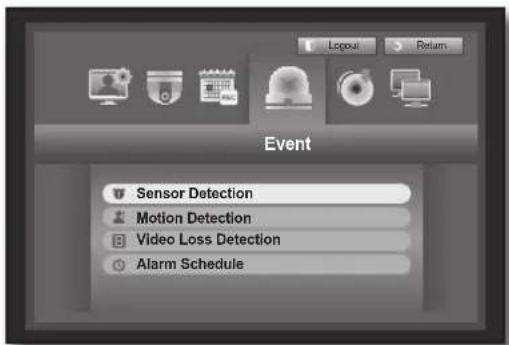
You can set recording options for sensor, motion, and video loss event.
Sensor Detection
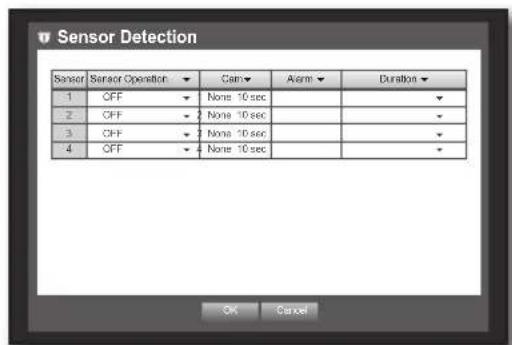
You can set the sensor's operating condition and connected camera, as well as alarm output and its duration. Using the mouse may help make setup easier.
- Press the [MENU] button on the remote control.
- Use the left/right button (◀▶) to select
. Event setting menu is selected.
text_image
Event Sensor Detection Motion Detection Video Loss Detection Alarm Schedule-
Use the up/down buttons (▲▼) to move to
, and press [ENTER] button. A window of sensor detection setup appears. -
Use direction buttons (▲▼◀▶) to move to a desired item, and set the value.
• Sensor Operation : Sets the operation mode of sensors.
-
-
-
text_image
Sensor Detection Sensor Sensor Operation Cam Alarm Duration 1 OFF None 10 sec 2 OFF None 10 sec 3 OFF None 10 sec 4 OFF None 10 sec OK Cancel- Cam : Select a channel to be connected to the sensor. If selected camera, "Cam Preset setup" window appears. Select a channel and setup the preset.
■Preset setup can be done in PTZ mode. Refer to "Preset Setting". (page 64)
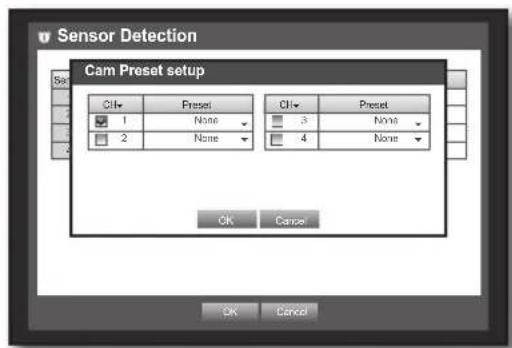
text_image
Sensor Detection Cam Preset setup OK Cancel 1 None 2 None Ctrl Preset 3 None 4 None OK Cancel• Alarm : Sets the alarm output method.
- For further information on alarm output, refer to "HDD Alarm > Alarm". (Page 41)
- Duration : Sets the duration of alarm signal and alarm sound.
5. When the sensor detection setup is done, press
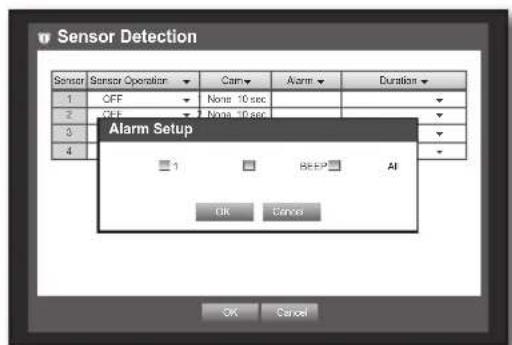
text_image
Sensor Detection Sensor Sensor Operation Cam Alarm Duration 1 OFF None 10 sec 2 OFF None 10 sec 3 Alarm Setup 1 BEPP AI OK Cancel OK CancelYou can set target detection region and motion, as well as the alarm signal output. When the motion detection region is set, it detects motion within the area.
Using the mouse may help make setup easier.
- Use the up/down buttons (▲▼) in
window to move to , and press [ENTER] button. A window of motion detection area setup appears. - Use direction buttons (▲▼◀▶) to move to a desired item, and set the value.
• Mode : Sets whether to activate motion detection.
- Sensitivity: Sets the sensitivity level of the motion detection.
• Alarm : Sets the alarm output method.
- For further information on alarm output, refer to "HDD Alarm > Alarm". (Page 41)
• Alarm Duration : Sets the duration of alarm signal and alarm sound.
- When the motion detection setup is done, press
.
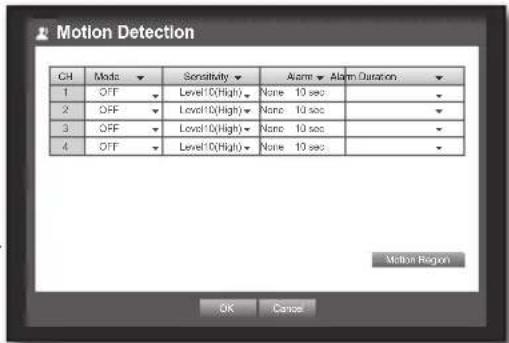
text_image
Motion Detection CH Mode Sensitivity Alarm ▼ Alarm Duration ▼ 1 OFF Level 0(High) None 10 sec ▼ 2 OFF Level 10(High) None 10 sec ▼ 3 OFF Level 10(High) None 10 sec ▼ 4 OFF Level 10(High) None 10 sec ▼ Motion Region OK CancelSetting the Motion Detection Area
①Select
②When "Motion Region" window appears, select a channel for detection and set the area of motion detection.
• To set the area in "Motion Region" window
In the "Motion Region" window, select desired region from <.
• To set the area using
In the "Motion Region" window, you can select cells individually by using
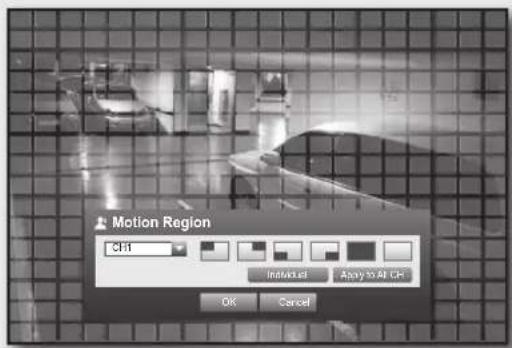
text_image
Motion Region CH1 Install it Apply to All CHI OK CancelWhen selected
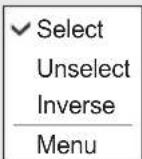
- Select : Selected cell is set to be a part of motion detection area.
- Unselect : Selected cell is removed from the motion detection area.
- Inverse : Unselected cells are set to be the motion detection area.
- Menu : After selecting individual motion areas, move to the "Motion Region" window.
If selected
③When the motion detection setup is done, press
Video Loss Detection
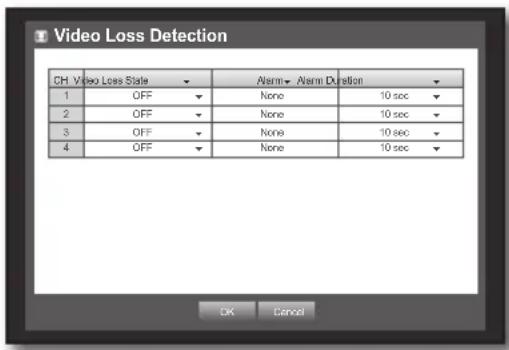
You can set the alarm to be generated on a camera disconnection, which causes a video loss.
Using the mouse may help make setup easier.
- Use the up/down buttons (▲▼) in
window to move to
A window of video loss detection area setup appears.
- Use direction buttons (▲▼◀▶) to move to a desired item, and set the value.
• Video Loss State : Sets whether to activate video loss detection.
• Alarm : Sets the alarm output method.
- For further information on alarm output, refer to "HDD Alarm > Alarm". (Page 41)
• Alarm Duration : Sets the duration of alarm signal and alarm sound.
- When the video loss detection setup is done, press
.
text_image
Video Loss Detection CH Video Loss State ▼ 1 OFF ▼ None 10 sec ▼ 2 OFF ▼ None 10 sec ▼ 3 OFF ▼ None 10 sec ▼ 4 OFF ▼ None 10 sec ▼ OK CancelAlarm Schedule
You can set the conditions and operating hours for scheduled alarms.
Using the mouse may help make setup easier.
-
Use the up/down buttons (▲▼) in
window to move to , and press [ENTER] button. -
A window of
settings appears. -
Alarm : Sets the alarm output method.
- For further information on alarm output, refer to "HDD Alarm > Alarm". (Page 41)
-
-
- Event Sync : Marked in Blue, generates alarm only when an event occurs.
- Apply to All Alarm : Applies the configured schedule to all alarms.

- When the alarm is generated on the scheduled time, you can stop the alarm by canceling the schedule.
- When the Alarm Schedule setup is done, press
.
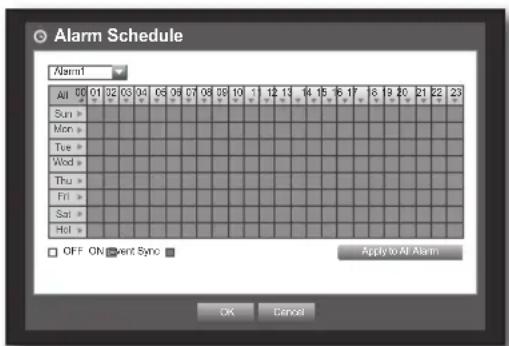
text_image
Alarm Schedule Alarm1 All 00 01 02 03 04 05 06 07 08 09 10 11 12 13 14 15 16 17 18 19 20 21 22 23 Sun > Mon > Tue > Wed > Thu > Fri > Sat > Hot > OFF ON Event Sync Apply to All Alarm OK Cancel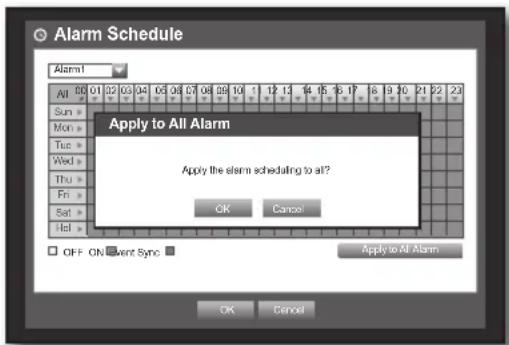
text_image
Alarm Schedule Alarm1 All 08 01 02 03 04 05 06 07 08 09 10 11 12 13 14 15 16 17 18 19 20 21 22 23 Sun Mon Tue Wed Thu Fri Sat Tel Apply to All Alarm Apply the alarm scheduling to all? OK Cancel OFF ON Event Sync Apply to All Alarm OK CancelYou can check the backup device and set the backup schedule by channel or by time.
The product only supports external HDD of USB memory and USB type. (Page 100)
Setting the Backup
You can backup the desired data to a connected device.
Using the mouse may help make setup easier.
- Press the [MENU] button on the remote control.
- Use the left/right button (◀▶) to select
. Backup menu is selected.
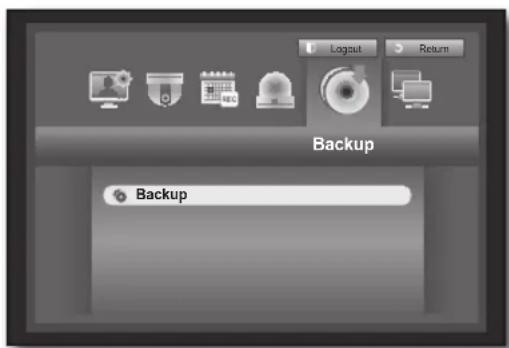
text_image
Backup Backup- Press the [ENTER] button.
A backup window appears.
You can directly access it from the "Live screen menu". (Page 20)
-
Use direction buttons (▲▼◀▶) to move to a desired item, and set the value.
-
Backup Range : Sets the
and time for the backup. -
Channel : Sets the channel to backup. You can select multiple channels.
• Device : Select a backup device from the recognized devices.
• Type : Sets the backup data format. -
DVR : Saved data can be played back only by the DVR.
- AVI : You can set recording options when sensor, motion, image loss detection or tampering event occurs.
If you need to install a codec in Windows, run the x264_dvr.exe file in the codec folder that is created when you back up an AVI file.
- SEC : Saves data in the Samsung's proprietary format with built-in viewer, which supports immediate playback on a PC.
- File Name : You can set the back file name.
■ Refer to "Using Virtual Keyboard". (Page 30) - Check capacity : Shows the size of the selected backup data, used and available capacity of the selected backup device.
- Checking will be stopped if the backup size exceeds 200% of the available capacity.
-
Overlap : Shows a list of overlapping data on a same time according to the number of data. It appears when one channel has multiple data on a certain time point due to changing of time or time zone settings, etc.
■ Refer to time and time zone of "Setting the Date/Time/Language". (Page 28) -
When the backup setup is done, press
.
If no available device is recognized for backup,

■The application may slow down during the backup.
- You can switch to the menu screen during the backup in operation, but playback of data is not available.
If backup has failed, select "Device > Storage Device" and check the free space of the HDD and check also if the HDD is properly connected.

- Pressing the
It provides networked monitoring of Live screen from a remote place, and supports mail forwarding function with events. You can configure the network environment which enables such functions.
Connection Mode
You can set the network connection route and protocol.
Setting the Connection
Sets the protocol and environment of the network.
Using the mouse may help make setup easier.
- Press the [MENU] button on the remote control.
- Use the left/right button (◀▶) to select
. Network menu is selected. - Use the up/down buttons (▲▼) to move to
, and press [ENTER] button.
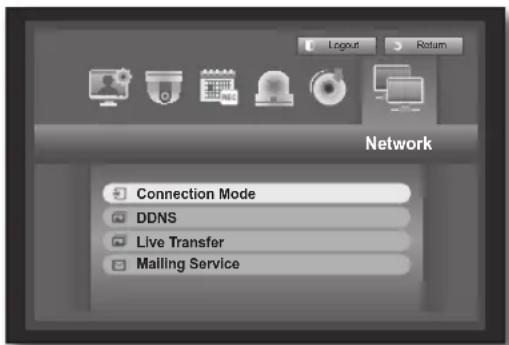
text_image
Network Connection Mode DDNS Live Transfer Mailing Service- Select
.
A window of connection mode setup appears.
-
Use direction buttons (▲▼◀▶) to move to a desired item, and set the value.
-
Connection Mode: Sets the network connection mode.
- Bandwidth : Sets the maximum data flow to be transferred. (Upload speed)
Options will vary depending on the selected connection mode.
- For
, : Select one from 50 kbps \~ 2Mbps, and Unlimited. - For
, select one from 50 kbps \~ 600 kbps.
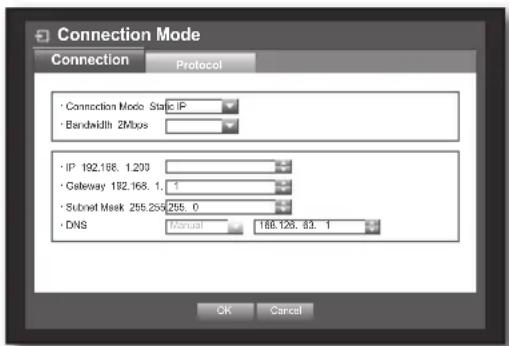
text_image
Connection Mode Connection Protocol • Connection Mode State: IP • Bandwidth 2Mbps • IP 192.168. 1.200 • Gateway 192.168. 1. 1 • Subnet Mask 255.255.255. 0 • DNS Manual 188.126. 83. 1 OK Cancel• IP, Gateway, Subnet Mask, and DNS
- For
- For
- For
- User ID, Password : In case you selected ADSL, provide the "User ID" and its "Password".
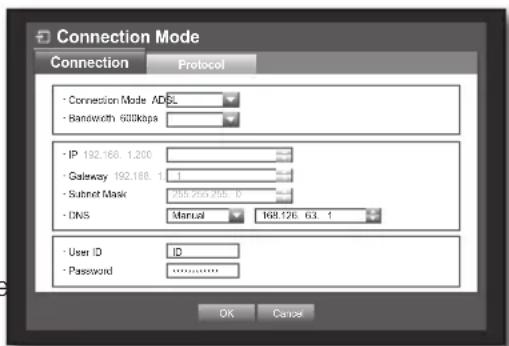
text_image
Connection Mode Connection Protocol - Connection Mode ADSL - Bandwidth 600kapa - IP 192.168.1.200 - Gateway 192.168.1.1 - Subnet Mask 705 204 206.0 - DNS Manual 168.126 63.1 - User ID ID - Password ******** OK Cancel
DNS server for
- When the connection setup is done, press
.
Setting the Protocol
- Use the up/down buttons (▲▼) in
window to move to , and press [ENTER] button. - Select
. - Use direction buttons (▲▼◀▶) to move to a desired item, and set the value.
- Protocol Type : Select the protocol type between TCP and UDP.
If selected UDP, selections of Port (TCP), Port (UDP), and Unicast/Multicast are activated.
- If setting the connection mode to ADSL, you cannot select UDP for the protocol type.
- Port(TCP): Initially, < 4520 4524> is set. It increases / decreases by 5.
- TCP: It has better stability and lower speed when compared to UDP, and recommended for internet environments.
- Port(UDP) : Initially, <8000\~8160> is set. It increases / decreases by 160.
- UDP: It has less stability and faster speed when compared to TCP, and recommended for local area network (LAN) environments.
- Unicast/Multicast : Select one between Unicast and Multicast. If selected Multicast, Multicast IP and TTL are activated.
- Unicast : Transfers data (UDP, TCP) individually to each connecting client.
- Multicast : Multiple client can receive the data (only in UDP) without putting additional traffic load to the network.
• Multicast IP : User can directly input.
- TTL : Select from 0 \~ 255. Initial value for the TTL is set to <5>.
- Webviewer Port : Enter the port number for the Web Viewer. Initially, it is set to <80>.
- Multi Browser Support : The Web Viewer can be used with a browser that supports the Silverlight. The multi viewer can be used only if the HTTP port is set to 80, protocol type is TCP and device ports range within 4505-4530.
This is for the Siliverlight's security purposes.

As UDP protocol may cause a packet loss on the network, it is recommended to use TCP protocols.
If you select UDP protocols and set port forwarding in the IP router, ending up with an unstable network connection, configure the DMZ settings in the IP router as necessary.
- When the protocol setup is done, press
.
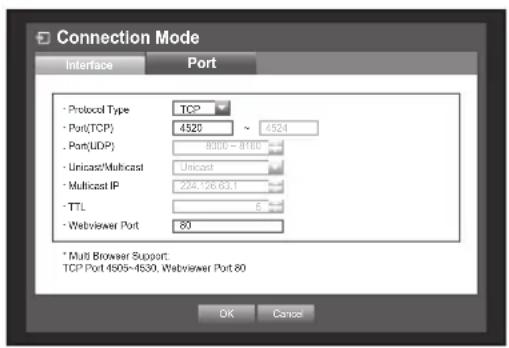
text_image
Connection Mode Interface Port - Protocol Type TCP - Port(TCP) 4520 ~ 4524 - Port(UDP) 8000~8160 - Unicast/Multicast Unicast - Multicast IP 224.126.63.1 - TTL 5 - Webviewer Port 80 * Multi Browser Support: TCP Port 4505~4530, Webviewer Port 80 OK CancelNotification

In a multi-browser environment, the web port should be set to 80 (private port). Select one between 4505 and 4530 for RTSP
• Network Overview
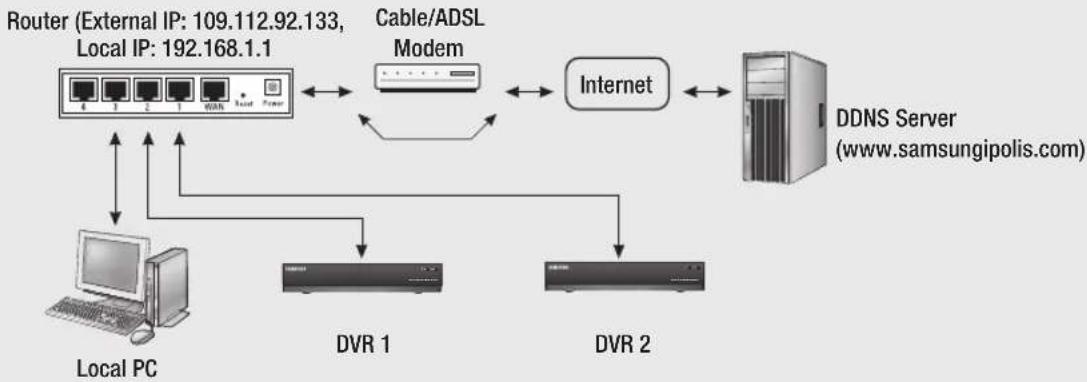
flowchart
graph TD
    A["Router (External IP: 109.112.92.133, Local IP: 192.168.1.1"] --> B["Cable/ADSL Modem"]
    B <--> C["Internet"]
    C <--> D["DDNS Server (www.samsungipolis.com)"]
    D --> E["DVR 1"]
    D --> F["DVR 2"]
    E <--> G["Local PC"]
    F <--> G
| System | DVR 1 DVR 2 | |||
| WEB RTSP WEB RTSP | ||||
| IP 192.168.1 | 200 | 192.168.1.200 | 192.168.1.202 | 192.168.1.202 |
| Protocol TCP TCP TCP TCP | ||||
| Private Port 80 45 | 20~4524 | 81 4525~4529 | ||
| Public Port 80 45 | 20~4524 | 81 4525~4529 | ||
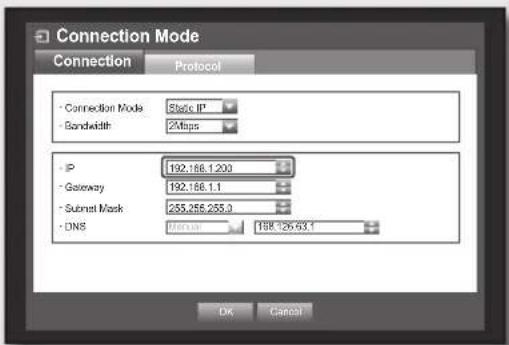
text_image
Connection Mode Connection Protocol • Connection Mode Static IP • Bandwidth 2Maps • • Gateway 192.186.1.200 • Gateway 192.186.1.1 • Subnet Mask 255.256.255.3 • DNS 198.126.43.1 OK Cancel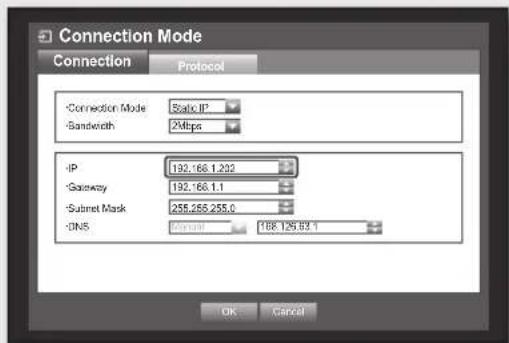
text_image
Connection Mode Connection Protocol -Connection Mode Saltc IP -Sandwidth 24fps IP 192.168.1.202 -Gateway 192.168.1.1 -Subset Mask 255.255.255.0 -DNS Annual 168.125.93.1 OK Cancel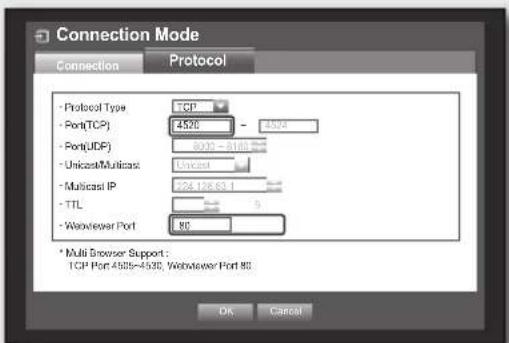
text_image
Connection Mode Connection Protocol - Protocol Type: TCP - Port(TCP) 4520 - 2624 - Port(UDP) 80.17 - 31.89 - Unicast/Multicast: Unicast - Multicast IP 26.126.63.1 - TTL 5 - Webserver Port 80 * Multi Browser Support : TCP Port 4505~4530, Webserver Port 80 OK Cancel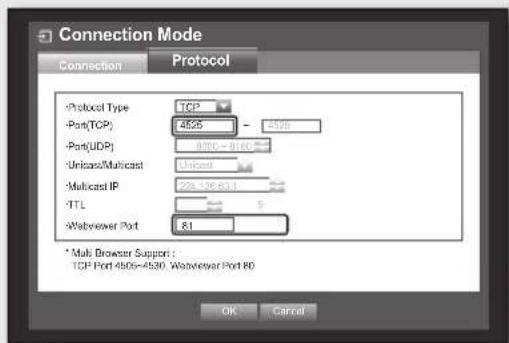
text_image
Connection Mode Connection Protocol -Protocol Type TCP -Port(TCP) 4526 - 2526 -Port(UDP) 876 - 1140 -Unicast/Malicast Unicast -Malicast IP 22,136.631 -TTL 5 -Wabviewer Port 81 * Multi Browser Support : TCP Port 450s-4530, Webviewer Port 80 OK Cancel• 1st Set Port Forwarding Setting
Port Forwarding is 4520\~4524 (4520, 4521, 4522, 4523, 4524)
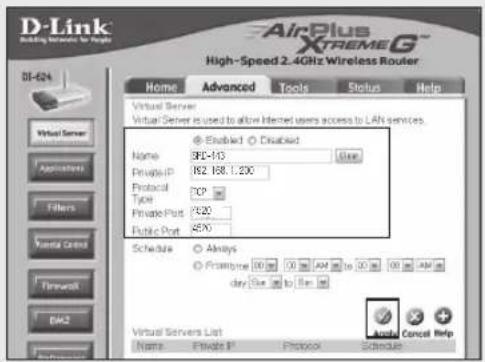
text_image
D-Link Building Services for RLS AirPlus XTMEG High-Speed 2.4GHz Wireless Router 01-624 Home Advanced Tools Status Help Virtual Server Virtual Server is used to allow limited users access to LAN services. ● Enabled ● Disabled Name: BPC-H3 Close Private IP: 82.168.1.200 Protocol TCP Type: Private Port: 720 Public Port: 870 Schedule ○ Always ○ Fromfree 00% 00% AM to 50% 00% AM day One to 5am Virtual Servers List Name Private IP Protocol Schedule Apply Cancel HelpPort Forwarding is 80
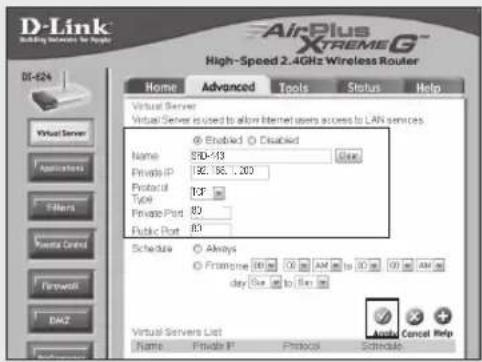
text_image
D-Link Building Server to Hosts AirPlus XTMEG High-Speed 2.4GHz Wireless Router Home Advanced Tools Status Help Virtual Server Virtual Server is used to allow internet users access to LAN services. ● Enabled ● Disabled Name STD-13 Open Private IP 96.185.1.200 Protocol TCP Type Private Port 80 Public Port 80 Schedule ○ Always ○ Fromome 00 AM to 00 AM day One to Next Virtual Servers List Name Private IP Protocol Schedule Auto Cancel Help• 2nd Set Port Forwarding Setting
Port Forwarding is 4525\~4529 (4525, 4526, 4527, 4528, 4529)
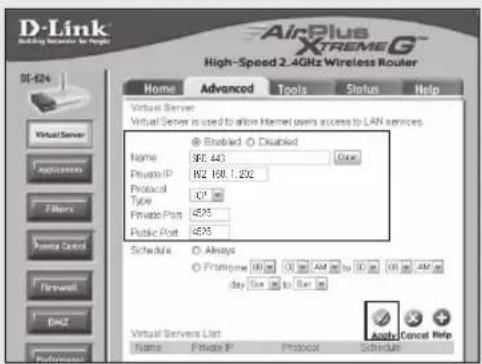
text_image
D-Link Building Servers for High AirPlus XTMEG High-Speed 2.4GHz Wireless Router Home Advanced Tools Status Help Virtual Server Virtual Server is used to allow Internet users access to LAN services. ● Enabled ○ Disabled Name $60,443 Close Private IP 192,188,1,232 Protocol 300 Type 405 Private Port 405 Public Port 405 Schedule ○ Always ○ FromTime 00 AM to 00 AM day: 00 to 00 Virtual Servers List Name Private IP Protocol Schedule Adobe Cancel HelpPort Forwarding is 81
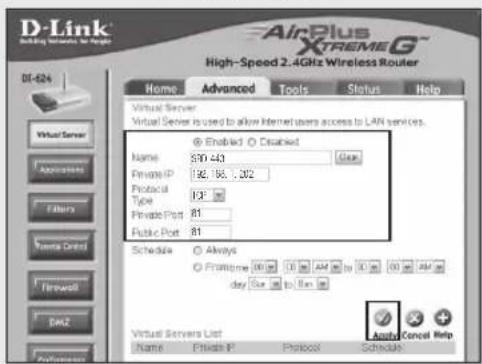
text_image
D-Link Building Services for High AirPlus XTMEG High-Speed 2.4GHz Wireless Router 01-624 Home Advanced Tools Status Help Virtual Server Virtual Server is used to allow Internet users access to LAN services. Name $70.43 Clear Private IP 196.98.1,02 Protocol 13P Type Private Port 81 Public Port 81 Schedule Always Frontline 00 01 AM to 02 03 AM day Our to Bin Virtual Servers List Name Private IP Protocol Schedule Audio Cancel Help
text_image
Customize Your Settings - Windows Internet Explorer http://109.112.92.133:80 Customize Your Settings
text_image
Customize Your Settings - Windows Internet Explorer http://109.112.92.133.81 Customize Your SettingsConnecting and Setting the Network
Networking may differ from the connection method, check your environment before setting the connection mode.
When no router is used
- Static IP mode
- Internet connection : Static IP ADSL, leased line, and LAN environments allows connection between the DVR and remote user.
- DVR Network Settings : Set the
- Consult your network manager for IP, Gateway and Subnet Mask.
• Dynamic IP (DHCP) mode
- Internet connection : Connect the DVR directly to a cable modem, DHCP ADSL modem or FTTH network.
- DVR Network Settings : Set the
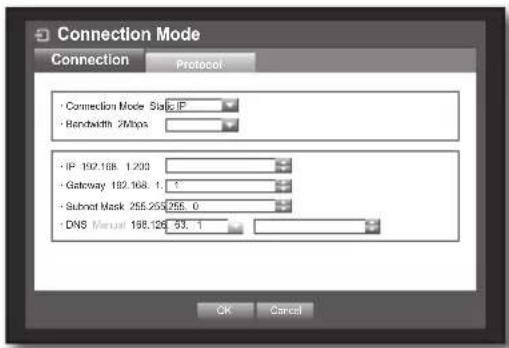
text_image
Connection Mode Connection Protocol • Connection Mode Size: IP • Bandwidth 2Mbps • IP 192.168.1.203 • Gateway 192.168.1.1 • Subnet Mask 255.255.255.0 • DNS Manual 198.126.53.1 OK Cancel• ADSL (PPPoE: ID and password certification)
- Internet connection : An ADSL modem is directly connected to the DVR, where the ADSL connection requires user ID and password.
- DVR Network Settings : Set the
- ADSL
If you don't know the ID and password, consult your ADSL service provider.
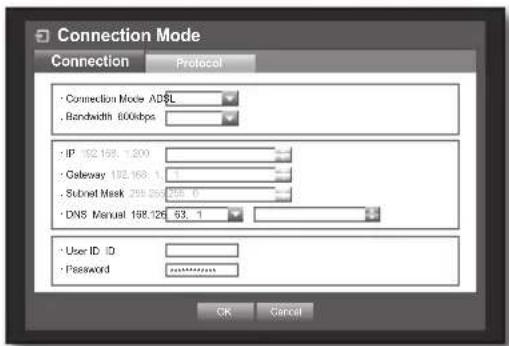
text_image
Connection Mode Connection Protocol • Connection Mode ADSL . Bandwidth 600kbps • IP 182 188, 1,200 • Gateway 182,168,1,1 • Subnet Mask 295,280,256,6 • DNS Manual 188,126,53,1 • User ID ID • Password OK CancelWhen a router is used
To avoid IP address conflict with the DVR's static IP, check followings :
• Setting the DVR with a static IP
- Internet connection : You can connect the DVR to a router which is connected to an ADSL/Cable modem or a router in a Local Area Network (LAN) environment.
- Setting the DVR Network
- Set the
in menu of the connected DVR to . - Check whether the set IP address is in the static IP range provided by the Broadband Router, IP, Gateway, and Subnet Mask : Consult your network manager.
- Check whether the set IP address is in the static IP range provided by the Broadband Router.
If a DHCP server is configured with starting address (192.168.0.100) and end address (192.168.0.200), you should set the IP address out of the configured DHCP range (192.168.0.2 \~ 192.168.0.99 and 192.168.0.201 \~ 192.168.0.254).
- Check the Gateway address and subnet mask are equal to those set in the Broadband Router.
- Setting the DHCP IP Address of the Broadband Router
- To access the Broadband Router's configurations, open a web browser on the local PC that is connected to the Broadband Router and enter the router's address (ex: http://192.168.1.1).
- At this stage, make the local PC's windows network configurations to the below example: Ex) IP : 192.168.1.2
Subnet Mask : 255.255.255.0
- Once connected to the Broadband Router, it prompts with password. While entering nothing to the User Name field, enter "admin" into the password field and press
to access the router configurations. - Access the router's DHCP configuration menu and set its DHCP server activation, and provide the start and end address.
Set the start address (192.168.0.100) and end address (192.168.0.200).
■ Above steps may differ from the router devices depending on the manufacturer.
- Setting Router's Port Forwarding
- Set the protocol to
. - External Port Range : Enter the TCP Port set in the
menu of the connected DVR. If more than one DVRs are connected to the router, the TCP port can be different. - Internal PC IP Address : Enter the IP address set to the
in menu of the connected DVR. - Internal Port Range : Set the same to the "External Port Range".
■ Above steps may differ from the router devices depending on the manufacturer.
Port forwarding is required when you want to access the DVR connected to the router from outside of the router's network.
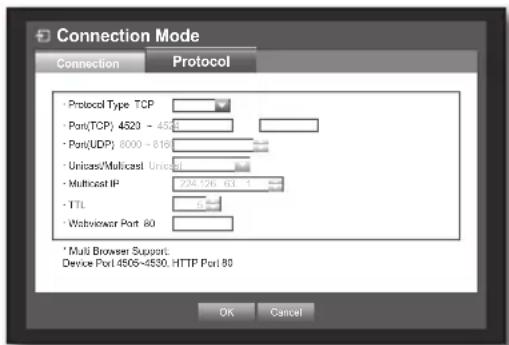
text_image
Connection Mode Connection Protocol - Protocol Type TCP - Port(TCP): 4520 - 4535 - Port(UDP): 8000 - 8169 - Unicast/Multicast: UniProt - Multicast IP - TTL - Webserver Port: 80 * Multi Browser Support. Device Port 4506~4530. HTTP Port 80 OK CancelDDNS
You can set the DDNS site for a remote user's network connection.
Using the mouse may help make setup easier.
-
Use the up/down buttons (▲▼) in
window to move to , and press [ENTER] button. DDNS Setup screen appears. -
Use the virtual keyboard to enter the
.
■ Refer to "Using Virtual Keyboard". (Page 30)
If selected
If selected
- DDNS Site : Set whether to use DDNS or not, and select the DDNS site if enabled.
• Server Name : Enter the server name of the selected DDNS site.
• Product ID : Enter the product ID which was registered to the DDNS site.
- Quick Connect : Appears if the
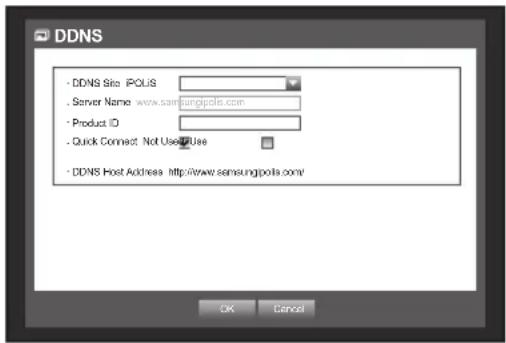
text_image
DDNS - DDNS Site: IPOLIS . Server Name: www.samsungipolis.com - Product ID - Quick Connect: Not Use/Use - DDNS Host Address: http://www.samsungipolis.com/ OK Cancel
If the quick connect setup has been cancelled while progressing, it is automatically set to
- When the DDNS setup is done, press
.
DDNS Setting
DDNS is a short form of Dynamic Domain Naming System.
DNS (Domain Name System) is a service that routes a domain name consisting of user friendly characters (ex : www.google.com) to an IP address consisting of numbers (64.233.189.104).
DDNS (Dynamic DNS) is a service that registers a domain name and the floating IP address with the DDNS server so that the domain name can be routed to the IP address even if the IP is changed in a dynamic IP system.
- Setting DDNS in the DVR
Set
• DDNS Settings of the Router
Select the corresponding menu for the network transfer protocol of the router.
• SETTING UP SAMSUNG iPOLiS DDNS
Go to Your PC
- Open your browser and go to http://www.samsungipolis.com and click
. - You first need to create an account. Click
. - Follow the account registration instructions on the website.
- After completing the account registration, login to your account.
- Add your DVR to your account. Click
. - Create a name(Product ID) for your DVR. Use 4 to 20 alphanumeric characters without spaces. Select classification, model number of the DVR and click
. - After registration, you should see your product in the list.
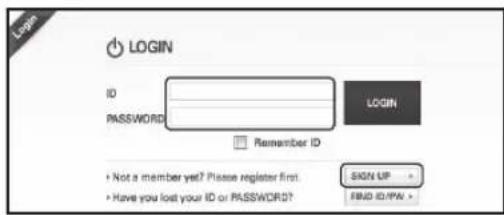
text_image
LOGI LOGIN ID PASSWORD Remember ID • Not a member yet? Please register first. • Have you lost your ID or PASSWORD? LOGIN UP FIND ID/PW >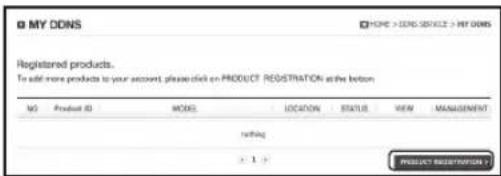
text_image
My DDNS HOME > DDNS SERVICE > MY DDNS Registered products. To add more products to your account, please click on PRODUCT REGISTRATION as the button. NO Product ID MODE LOCATION STATUS VIEW MANAGEMENT nothing + 1 - PRODUCT REGISTRATION >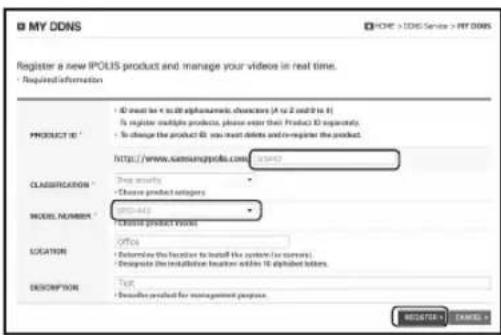
text_image
MY DDNS Register a new IPOLIS product and manage your videos in real time. - Required information PRODUCT NO * 1. 4D must be 4 to all alphanumeric characters (A or B) with it Is register multiple products, please enter their Product ID separately. - So change the product ID, you must delete and re-register the product. http://www.samsungipolis.com (SAMS) CLASSIFICATION * Free security * Choose product categories MODEL NUMBER * OPOLIS CREATE PROJECT CODE LOCATION * Office • Extend the location to install the system for owners. • Designate the installation location within 16 alphabet letters. DESCRIPTION: Text • Describe product for management purposes. REGISTER > CAMES >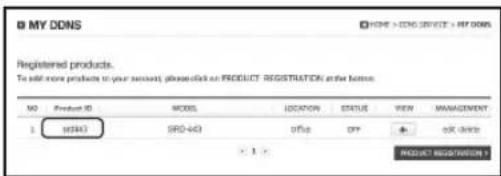
text_image
MY DDNS HOME > ECON SERVICE > MY DDNS Registered products. To add more products to your account, please click an PRODUCT REGISTRATION on the form. NO Product ID MODEL LOCATION STATUS VIEW MANAGEMENT 1 MS443 SRD-443 Offs Off + OK Delete → 1 → PRODUCT REGISTRATION +Go back to DVR
-
From network tab, click on
. -
Under DDNS Site, select
.
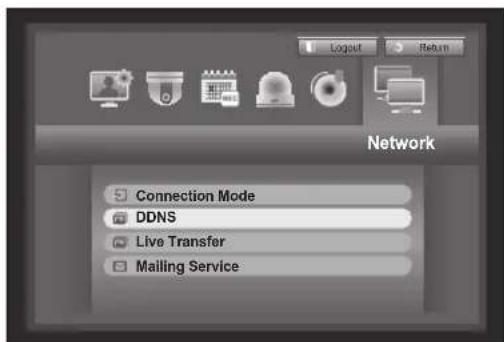
text_image
Logost Return Network Connection Mode DDNS Live Transfer Mailing Service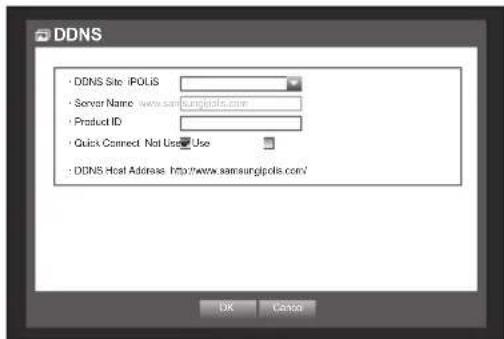
text_image
DDNS • DDNS Site: iPOLIS • Server Name: www.samsungipolis.com • Product ID: • Quick Connect: Not Use Use • DDNS Host Address: http://www.samsungipolis.com/ OK Cancelusing the DVR
- Under Product ID, enter the product ID you created on the Samsung iPOLiS website.
Under Quick Connect, select
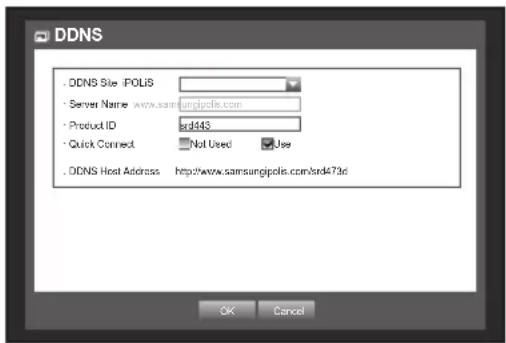
text_image
DDNS - DDNS Size: IPOLIS - Server Name: www.samsungipolis.com - Product ID: card43 - Quick Connect: Not Used: Use . DDNS Host Address: http://www.samsungipolis.com/ard473d OK Cancel
If the connection was not successful, your router may not be supporting UPNP.
For more information on enabling UPNP on your router, please see Router manual.
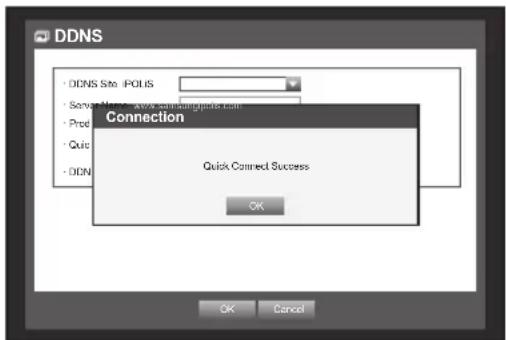
text_image
DDNS • DDNS Site: IPOLIS • Server http://www.wjdb.org/ind.com • Prod • Quick • DDN Connection Quick Connect Success OK OK CancelLive Transfer
Sets the quality of the image that is transferred from the DVR to the network.
Using the mouse may help make setup easier.
- In the
setting window, press the up/down (▲▼) button to move to and press the [ENTER] button.
The Live Transfer window appears.
-
Use the direction buttons (▲▼◀▶) to move to a desired item and set the value.
-
When the live transfer is done, press
.
- The resolution is fixed to CIF, and you can specify the transfer quality only.
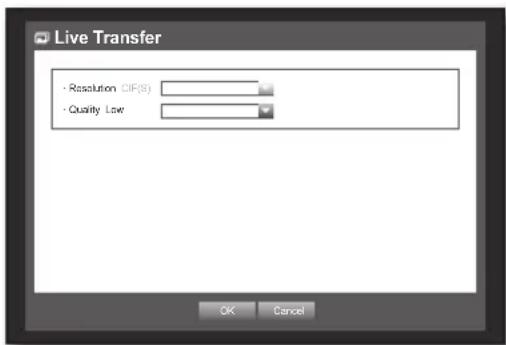
text_image
Live Transfer • Resolution CIF(S) • Quality Low OK CancelYou can send an e-mail to a DVR-registered user at a specific time interval, or if an event occurs.

If an event occurs with a channel where the camera's video is set to
SMTP Setting
Sets the SMTP mail server.
Using the mouse may help make setup easier.
- In the
setting window, press the up/down (▲▼) button to move to and press the [ENTER] button. - Select
. You will see the SMTP setting window. -
Use direction buttons (▲▼◀▶) to move to a desired item and set the value.
-
ServerType : Displays the connected server type.
• Server : Enter a server to connect to.
• Port : Sets the communication port.
• Use Authentication : Check this if the SMTP server uses user authentication.
The account input box will be activated.
- User : Enter a user to use authentication when connecting to the SMTP server.
- Password : Enter the password of the SMTP server user.
- Secure Transfer : Select one from
and - Sender : Use the virtual keyboard to provide the email address.
■ Refer to "Using Virtual Keyboard". (Page 30)
• TEST : Conducts the test on the server settings.
4. When the SMTP setting is done, press
Event Setting
You can set the interval and type of the event that will be sent to the user.
Using the mouse may help make setup easier.
-
In the
setting window, press the up/down (▲▼) button to move to and press the [ENTER] button. -
Select
. -
Use direction buttons (▲▼◀▶) to move to a desired item and set the value.
• Event Interval : Set the event interval.
If a series of events occurs, the e-mail will be sent at the specified interval, not on each event.
- Use Event Transfer : Select an event type to send if an event occurs. If the selected event occurs, the e-mail will be sent to the group that has the recipient authority.
- When the event setting is done, press
.
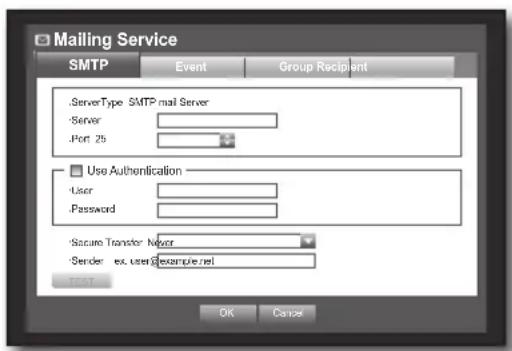
text_image
Mailing Service SMTP Event Group Recipient .ServerType SMTP-mail Server Server Port 25 Use Authentication User Password Secure Transfer Node Sender ex. user@example.net OK Cancel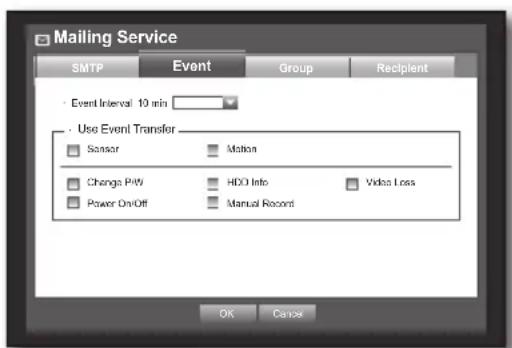
text_image
Mailing Service SMTP Event Group Recipient Event Interval 10 min Use Event Transfer Sensor Motion Change PiW HDD Info Video Loss Power On/Off Manual Record OK CancelGroup Setting
You can set the group to whom the e-mail is sent, and specify the permission for each group.
You can add recipients for each group in the
The recipient is set separately from the DVR user group.
Using the mouse may help make setup easier.
-
In the
setting window, press the up/down (▲▼) button to move to and press the [ENTER] button. -
Select
. -
Use direction buttons (▲▼◀▶) to move to a desired item and set the value.
- Add : Select
■ Refer to "Using Virtual Keyboard". (Page 30)
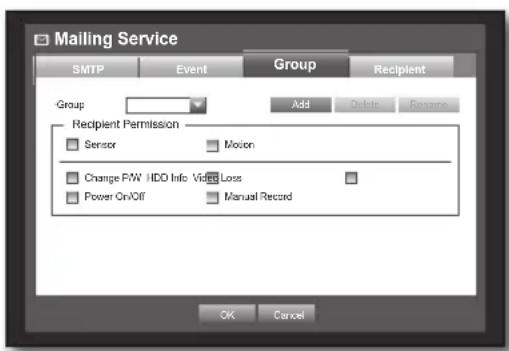
text_image
Mailing Service SMTP Event Group Recipient Group Add Delete Customize Recipient Permission Sensor Motion Change F/W HDD Info Video Loss Power On/Off Manual Record OK Cancel- Delete : Deletes the selected group.
- Rename: You can reset the recipient permission of an existing group.
-
Recipient Permission : Set the permission of the recipient group.
-
When the group setting is done, press
.
Recipient Setting
You can add/remove a recipient(s) to/from the specified group and edit the group if necessary.
Using the mouse may help make setup easier.
-
In the
setting window, press the up/down (▲▼) button to move to and press the [ENTER] button. -
Select
. -
Use direction buttons (▲▼◀▶) to move to a desired item and set the value.
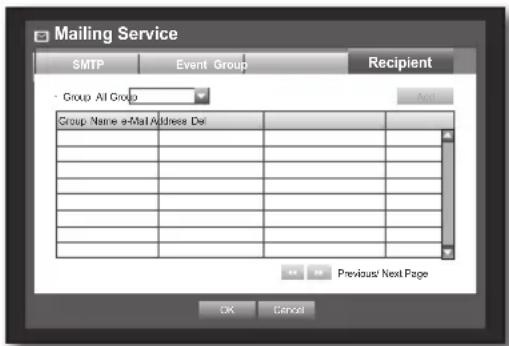
text_image
Mailing Service SMTP Event Group Recipient - Group All Group Group Name e-Mail Address Del Previous Next Page OK Cancel- Add: You can select a recipient name, e-mail address or group.
You should have created a group in the
- For inputting the recipient name and email address, refer to "Using Virtual Keyboard". (Page 30)
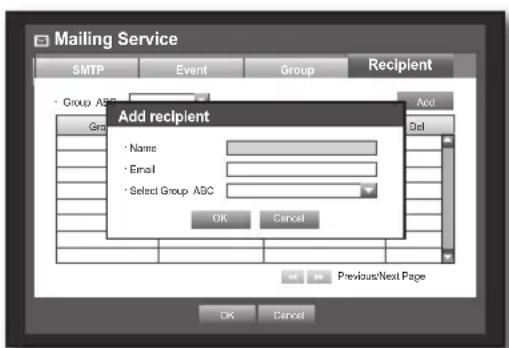
text_image
Mailing Service SMTP Event Group Recipient - Group ASC Add Name Email Select Group ASC Add Del OK Cancel Previous/Next Page OK Cancel- When the recipient setting is done, press
.
The DVR enables you to adjust the settings of a PTZ camera as well as an ordinary one to your preference.
PTZ Device
The PTZ device can be activated only if a channel in connection with the PTZ camera is selected.
Getting started with PTZ
The PTZ camera is available, only if a channel is selected, in the following way :
■ Using the remote control buttons Press the [PTZ] button on the remote control.
■ Using the launcher menu Click PTZ < PTZ > to display the live launcher.
■Using the right-click menu in Live mode
Right-click any area on the screen to display the context menu, and select
■ Using icons on the live screen Click the PTZ < PTZ > icon on the live screen.

■ The PTZ function is available only if the PTZ camera is connected so that the PTZ icon is displayed on the screen.
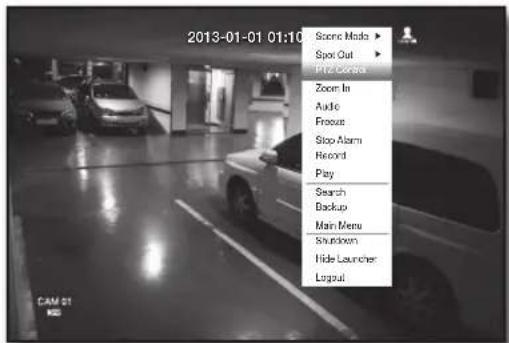
text_image
2013-01-01 01:10 Scene Mode ▶ Spot Out ▶ Play Color Zoom In Audio Frouse Stop Alarm Record Play Search Backup Main Menu Shutdown Hide Launcher Logout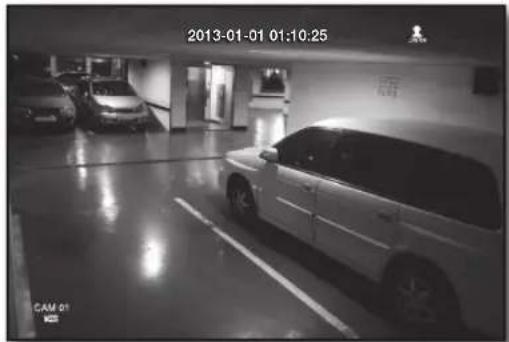
natural_image
Black-and-white photo of a car parked in a parking garage, with no visible text or symbols on the vehicle or background.Using the PTZ camera
You can use one camera to perform all functions of PAN, TILT and ZOOM for monitoring multiple places and set the preset to your preference in a desired mode.
- Launch the
menu. As the PTZ < PTZ > icon on the bottom right corner turns yellow, you access the "PTZ Control" mode to display the "PTZ Control" menu.

- Be sure to configure PTZ working environments before operation, since the PTZ Working(Active) mark can be appeared to be activated even when PTZ is not operative.
- Use the PTZ wheel in the launcher menu to adjust the monitoring area, or use the direction buttons (▲▼◀▶) on the remote control to move the camera to a desired place.
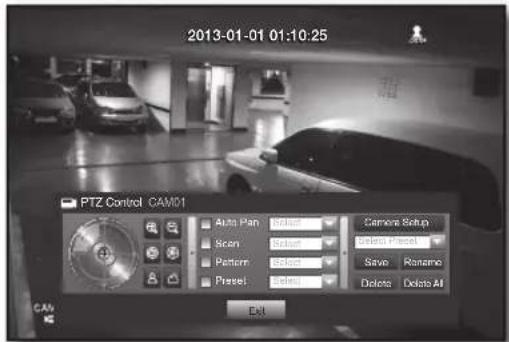
text_image
2013-01-01 01:10:25 PTZ Control CAM01 Auto Pan Select Camera Setup Scan Select Select Preset Pencil Select Save Ranzano Prreset Select Delete Delete All Exit- PTZ Wheel : Clicking a nearer point to the center will move in that direction slowly; clicking a farther point from the center will move fast.
- Keep clicking left to rotate the lens counter clockwise; keep clicking right to rotate the lens clockwise.
- Zoom You can use the Zoom function of the PTZ camera.
• IRIS: Adjusts the intensity of radiation incoming to the iris.
• Focus ): Enables you to adjust the focus manually.
• Auto Pan : The camera automatically runs between the two points that you selected.
- Scan : The camera moves to the preset points in the specified sequence. If multiple presets are specified, the PTZ camera will automatically move to all of the preset points one at a time.
using the DVR
• Pattern : Makes the PTZ camera remember and follow the past route.
The functions of Auto Pan, Scan and Pattern are supported in the protocols of Samsung, Panasonic and Pelco, and are different in terms of the name and setting, depending on the protocols of Samsung, Panasonic and Pelco. (Panasonic : Auto Pan, Sequence, Sort / Pelco : Auto Pan, Frame Scan (Scan), Pattern)

Before entering the PTZ device control mode, set the values of the PTZ device in the
Preset Setting
A preset is a set of specific target points of a PTZ camera, and up to 20 presets per a camera can be stored. Using the mouse may help make setup easier.
-
In PTZ Control mode, use the direction buttons to adjust the camera in a desired direction.
-
Select the
key. The virtual keyboard for inputting the preset will appear.
■ Refer to "Using Virtual Keyboard". (Page 30)
• Save : You can save the preset settings.
- Rename: You can change the settings of the existing presets.
- Delete : Deletes the selected preset.
- Delete All : Deletes all existing presets.

If you replace the camera of the channel that stores the preset list with a new one, you should reset the preset accordingly.
- Press
.
The preset will be saved as a name that you entered.
Camera Setting
A PTZ camera has its own menu system. Optimize the PTZ camera according to the DVR.
Using the mouse may help make setup easier.
- Connect the PTZ camera to the DVR and run the PTZ camera again to display the camera's protocol setting window.
- Check the protocol ID of the camera.
In "Device > Setting the PTZ", enter the PTZ camera ID in the ID input box of the channel that is connected to the PTZ camera. (Page 40)
- Select
in the PTZ Control menu.
The camera-specific menu appears.
- You can configure the settings of only those cameras that support the protocols of Samsung, Pelco D/P, AD and Panasonic.
If you are setting Auto Pan or Pattern in the camera menu, press and hold the appropriate button for a certain time so that the button operation can be different from that in normal PTZ setting.
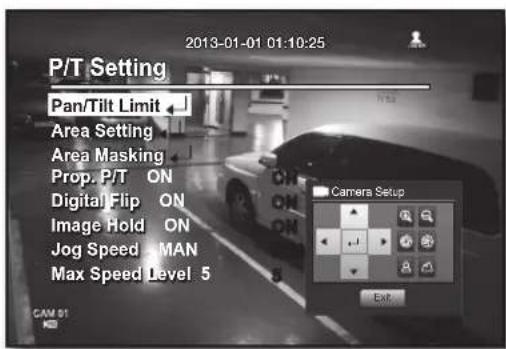
text_image
2013-01-01 01:10:25 P/T Setting Pan/Tilt Limit ↓ Area Setting Area Masking Prop. P/T ON Digital Flip ON Image Hold ON Jog Speed MAN Max Speed Level 5 Camera Setup Exitsearch & play
SEARCH
You can perform the search for recorded data by the time or by the search criteria such as an event. You can access the
- In Live mode, right-click any area of the screen. The Live menu appears.
-
Select
. Or, press the [SEARCH] button on the remote control. -
The Search menu appears.
-
The search can be restricted by the Auto Delete function. Refer to "Setting the Recording > Record Option". (Page 47)

- Overlapped data: It only appears if there exists overlapped data on a certain time, produced due to the change of DVR's time setup. The latest data comes first, from
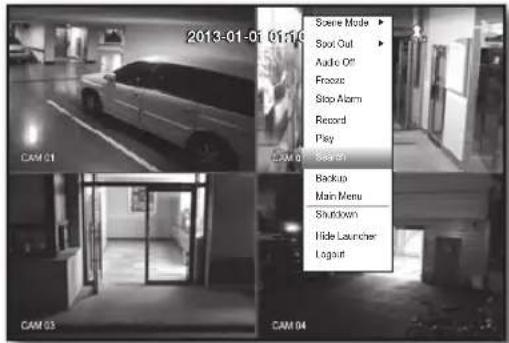
text_image
2013-01-01 01:15 Scene Mode Sool Out Audio Off Froces Stop Alarm Record Play Sawn Backup Main Menu Shutdown Hide Launcher Logout CAM 01 CAM 02 CAM 03 CAM 04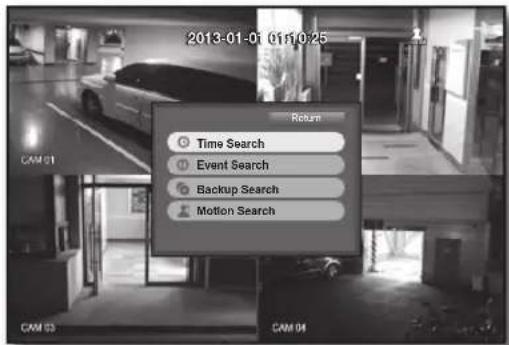
text_image
2013-01-01 01:11:02:5 CAM 01 Return Time Search Event Search Backup Search Motion SearchTime Search
You can search for recorded data of a desired time.
As the time to display may be different depending on the time zone and the DST standard time, the time of data recorded in the same time can be displayed differently depending on time zone and DST settings.
Using the mouse may help make setup easier.
- Select
- Select a date to search.
■ Refer to "Using the Calendar". (Page 29)
- The record data on the specific date will be listed. The display bar is different according to the data type. So check the data type for the color in the left pane.
-
Use direction buttons (▲▼◀▶) to set the search criteria and press the [ENTER] button.
-
Go to First : Move to the earliest recording date.
- Go to Last: Move to the latest recording date.
- Time : Enter a time to perform the search or use the up/down button <◆> to select one.
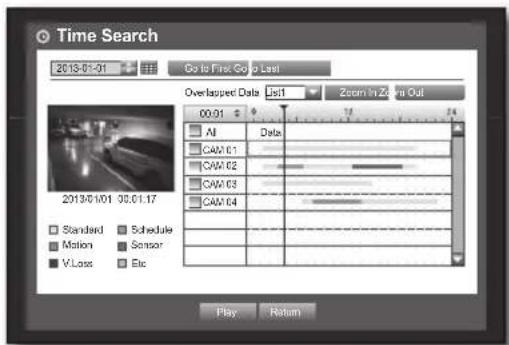
text_image
Time Search 2013/01-01 Go to First Go to Last Overlapped Data List Zoom in Zone Out 00:01 19 24 AI Data CAM 61 CAM 62 CAM 63 CAM 64 Standard Schedule Motion Sensor V Loss Etc Play Returnsearch & play
- Zoom In : The map enlarges in detail. It will switch in the sequence of 24 hours - 16 hours - 8 hour - 4 hours.
- Zoom Out: The map will switch in the reverse order of the detailed mode above.
It will switch in the sequence of 4 hours - 8 hour - 16 hours - 24 hours.
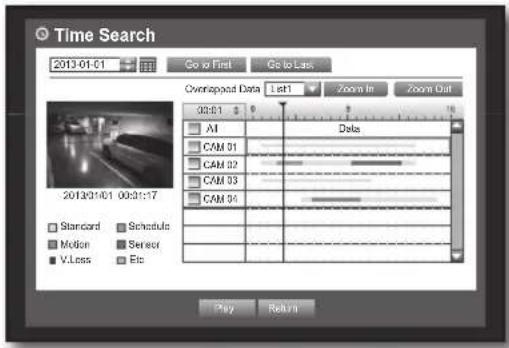
text_image
Time Search 2013-01-01 Go to First Go to Last Overlapped Data Last1 Zoom In Zoom Out 03:21 AI Delta CAM 01 CAM 02 CAM 03 CAM 04 2013/01/01 00:31:17 Standard Schedule Motion Sensor V.Loss Etc Play Return
■Double-click a desired time to zoom it in/out.
- Preview : Click
- If the selected channel does not contain any recorded data, it will be marked black.
- Select a data item and click
.
The screen switches to the data playback mode.
Event Search
You can search for events by the channel and play them.
Using the mouse may help make setup easier.
- Select
in the menu. - Use direction buttons (▲▼◀▶) to set the search criteria and press the [ENTER] button.
All record events on a specific date will be found. (Normal/ Schedule recording included)
- Date/Time Preview : If you select a data item in the list, the still image of the selected data will be displayed in the left preview pane.
• Event : Displays the type of the event that occurred. - Select a data item and click
. The screen switches to the event data playback mode.
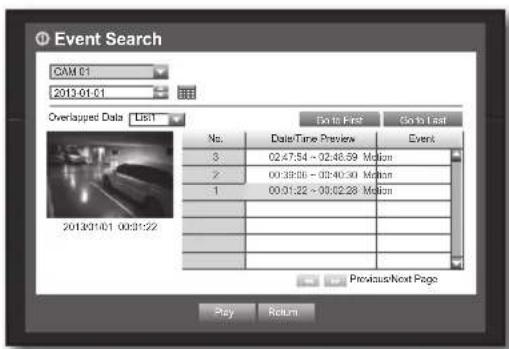
text_image
Event Search CAM 01 2013-01-01 Overlapped Data USB1 Go to First Go to Last No. Date/Time Preview Event 3 02:47:54 - 02:48:59 Motion 2 00:38:56 - 02:40:30 Motion 1 00:01:22 - 00:02:28 Motion Previous/Next Page Play ReturnBackup Search
Searches for backup data in the connected backup device.
Only data in the format of DVR is included in the search.
Refer to
Using the mouse may help make setup easier.
- Select
in the menu. - Use direction buttons (▲▼◀▶) to set the search criteria and press the [ENTER] button.
• Record Period : Displays the record period.
• Channel : Displays the recorded channel.
• Play Start Time : Select a time that you start playing.
- Select a data item and click
.
The screen switches to the backup data playback mode.
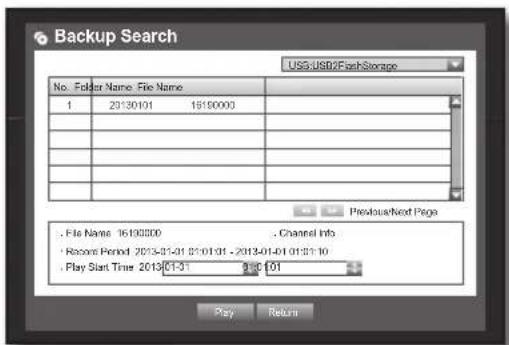
text_image
Backup Search US$ USB/FlashStorage No. Folder Name: File Name: 1 23130101 16190000 . . . . . . . . . . . . . . . . . . . . . . . . . . . . . . . . . . . . . . . . . . . . . . . . . . . . . . . . . . . . . . . . . . . . . . . . . . . . . . . . . . . . . . . . . . . . . . . . . . . . . . . . . . . . . . . . . . . . . . . . . . . . . . . . . . . . . . . Play Return Prelocalhost Page . File Name: 16190000 . Channel Info • Record Period: 2013-01-01 02:01:01 - 2013-01-01 01:01:10 • Play Start Time: 2013-01-01 9:30:01If a motion is detected in each channel, you can set a desired area to perform the search.
You can use the mouse to select the related items.
-
Select
in the menu. -
Use direction buttons (▲▼◀▶) to set the search criteria and press the [ENTER] button.
If you set the motion area to
• Motion Region : Select an area to perform the search.
- All Area : Searches for all areas of the selected channel.
- Current Area : Searches for the motion area for each channel specified in "Motion Detection > Setting the Motion Detection Area". (Page 49)
- Manual Area : You can set the motion area manually.
- Setup : The Setup button will be activated only if you have set the motion area to Manual. Press this button to display the area setting window.
- Date/Time : The Date/Time will be automatically set by the hour, and the end time will be automatically set to one hour later than the start time if it is set.
- Preview : Select a data item in the list to display the still image of the item.
- Select a data item and click
. The screen switches to the motion data playback mode.
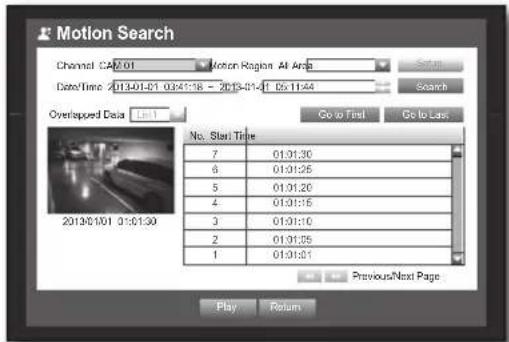
text_image
Motion Search Channel: CA2.01 Motion Region: All Area Date/Time: 2013-01-01 03:47:18 - 2013-01-01 05:11:44 Search Search Overlapped Data Co to Find Co to Last No. Start Time 7 01:01:30 6 01:01:25 5 01:01:20 4 01:01:15 3 01:01:10 2 01:01:05 1 01:01:01 Previous/Next Page Play Return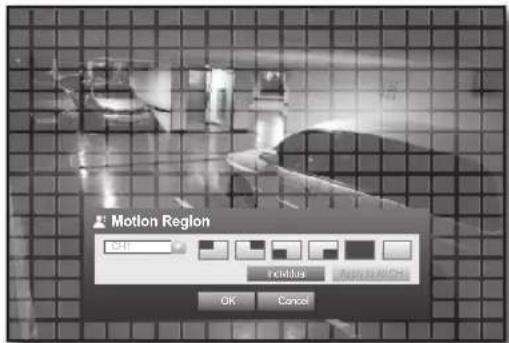
text_image
Motion Region OK CancelPLAYBACK
Play
You can play data stored in the HDD and backup a desired portion of the data.
Using the mouse may help make setup easier.
-
In Live mode, click
in the right-click menu or <▶> in the launcher menu, or press the Play button on the remote control. -
Use the up/down button (▲▼) to select a menu.
■ For data search, refer to
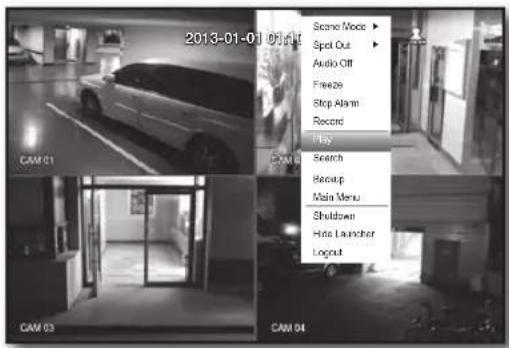
text_image
2013-01-01 01:45 Scene Movie Spot Out Audio Off Freeze Stop Alarm Record Has Search Backup Main Menu Shutdown Has Launcher Logout CAM 01 CAM 03 CAM 04- Select a data item and click
in the Search menu. The selected data is played and the play launcher appears on the screen.
If there is an existing data,
- Playback Information : Displays the date and time of the current data in the top corner.
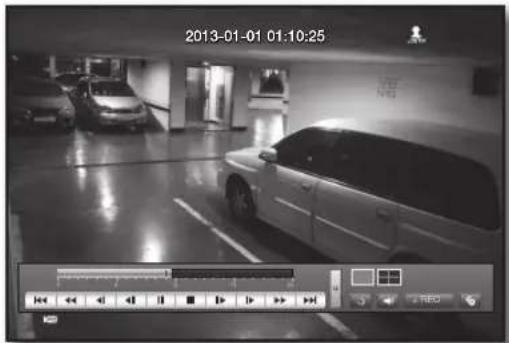
text_image
2013-01-01 01:10:25- Backup : Click > to set the current time to the start time of backup; you can specify a backup area using the mouse (yellow triangle).
Click < ▶ again to set the current time to the end time of the backup and the "Backup Range" window appears.
- Type : Supports formats of DVR and SEC. Refer to a list of formats in "Setting the Backup". (Page 51)
- Device : Select a backup device. - Check Capacity : Enables you to check the capacity of the selected storage device.
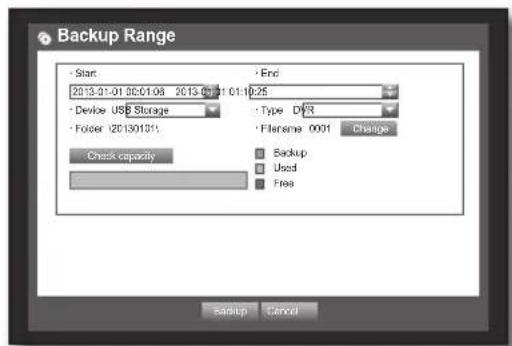
text_image
Backup Range Start 2013-01-01 00:01:06 2013-01-01 01:06 Device USB Storage Folder (20130131) Check capacity End 25 Type DVR Filename 0001 Change Backup Used Free Backup Cancel- If you want to return to the Live screen in Play mode, click < ■ > in the launcher menu or press the [■] button on the remote control.
Using the Playback Button
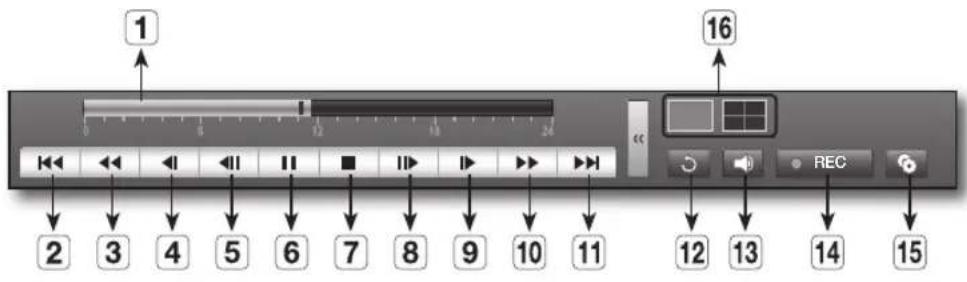
text_image
1 2 3 4 5 6 7 8 9 10 11 12 13 14 15 16 REC| Part Names Functions | |
| 1 | Play Timeline Indicates the current playback point, and can be used to move. |
| 2 | Skip Backward Moves backward by unit time. |
| 3 | Backward Fast Play Used for quick backward playback. |
| 4 | Backward Slow Play Used for backward frame-by-frame search while in PAUSE. |
| 5 | Step Backward Moves backward by one frame at a time. |
| 6 | Pause Stops playing the current video temporarily. |
| 7 | Stop Stops playback and moves to the live screen. |
| 8 | Step Forward Moves forward by one frame at a time. |
| 9 | Forward Slow Play Ensured to play forward up to 4 channels simultaneously at a low speed.In a split mode, the real time playback may not be supported, depending on the record quality, resolution and number of channels. And some frame rates may be supported. |
| 10 | Forward Fast Play Used for quick forward playback. |
| 11 | Skip Forward Moves forward by unit time. |
| 12 | Return Return to the search setup screen. |
| 13 | Audio Sets Audio ON/OFF.If using both web view and DVR set simultaneously, the audio signal will be output from the DVR set. |
| 14 | REC Records all channels in Live mode. |
| 15 | Partial Backup Begins backup of the selected section of the video being played, with the specified starting/ending point. |
| 16 | Mode Switch Click a desired playback mode or press [MODE] to switch the screen mode in sequence. |
INTRODUCING WEB VIEWER
What is Web Viewer?
Web Viewer allows remote access to your DVRs. You have access to live video, archived video, PTZ control (if configured), etc.
PRODUCT FEATURES
• Remote connection using the browser
• PTZ camera control enabled
• Supports 1, 4 camera viewing formats (maximum of 4 cameras in the list).
- Gets JPEG, BMP format images to print and save to "Print or Save JPEG, BMP format images".
- Record video in AVI format-compatible with popular media players. (needed the H.264 codec)
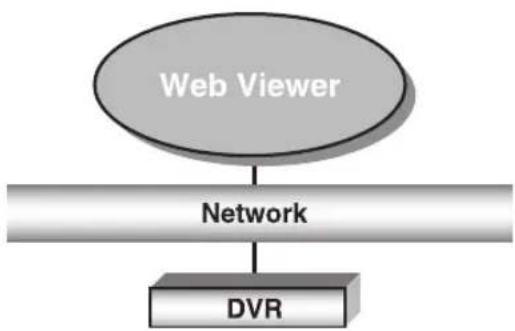
flowchart
graph TD
    A["Web Viewer"] --> B["Network"]
    B --> C["DVR"]
SYSTEM REQUIREMENTS
The following lists the minimum suggested hardware and operating system requirements needed to run the Web Viewer.
| OS | Windows XP ProfessionalWindows Vista Home Basic / PremiumWindows 7Mac OS 10.6 and later versions |
| Web Browser | - Windows OS : Internet Explorer 7.0 or higher, Firefox 3.6 or higher,Chrome 12 or higher- Mac OS : Safari 5 or higher, Firefox 3.6 or higher. |
| CPU Intel Pentium 4.2 GHz | |
| Memory 512 MB | |
| Monitor High Color 16-bit | 1024 x 768 |
| HDD | 50 MB(Installation space required)* Additional HDD space required for recording.Recorded file size will vary depending on recording quality settings. |
- Open your web browser and type the IP address or URL of DVR into the URL address box.

The basic URL of the DVR is as following in case of MAC address :
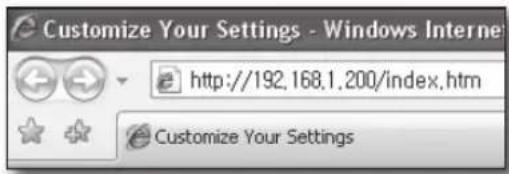
text_image
Customize Your Settings - Windows Internet http://192.168.1.200/index.htm Customize Your Settings- http://www.samsungipolis.com/Product ID (registered at the iPOLiS web site)
-
You can also use registered URL which setups up in the Setup menu of your DVR.
-
Set the Admin ID and password same to those of the DVR Admin.
For general users, enter the DVR user ID and password.

text_image
Login • ID admin • Password ••••• OK
- The default administrator ID is "admin", and the password must be set when the user log in at the first time.
- Set password for your wireless network if you use the product with a wireless router. Being not protected with password or using the default wireless router password may expose your video data to potential threat.
- To prevent from your personal information being exposed, please change your password every 3 months. Note that the security and other related issues caused by careless management of password shall be in the charge of the user.

- It allows up to 4 simultaneous access including the Admin and general users.
■It does not allow multiple login of the Admin user. - Password of the Admin and general users can be changed in
menu of the DVR. - Normal users should have set
under to "Use" before connecting to the Web Viewer. (Page 33) -
All settings are applied by the DVR's settings.
-
Click
.
Downloading Active-X control may take several minutes according to the security settings on your PC.
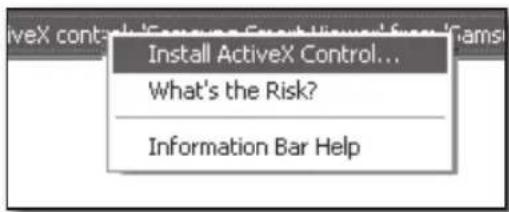
text_image
ActiveX control... Install ActiveX Control... What's the Risk? Information Bar Help- Click
.
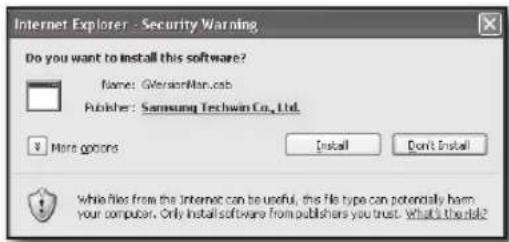
text_image
Internet Explorer - Security Warning Do you want to install this software? Name: GversionMan.cob Publisher: Samsung Techwin Co., Ltd. More options Install Don't Install who files from the Internet can be useful, this file type can potentially harm your computer. Only install software from publishers you trust. What's the risk?- You may have "Windows Security Alert" that attempts to block this with the Windows Firewall. In that case, click
to start Web Viewer. - Installation is complete. Now you can see the main screen of Live Viewer.
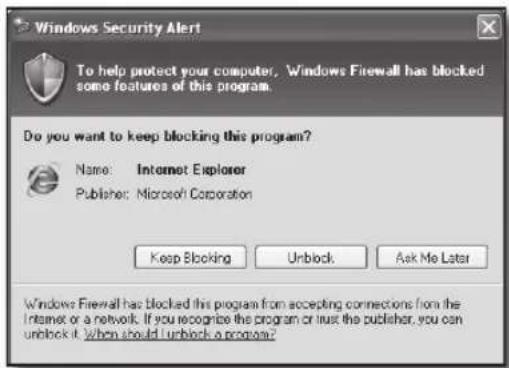
text_image
Windows Security Alert To help protect your computer, Windows Firewall has blocked some features of this program. Do you want to keep blocking this program? Name: Internet Explorer Publisher: Microsoft Corporation Keep Blocking Unblock Ask Me Later Windows Firewall has blocked this program from accepting connections from the Internet or a network. If you recognize the program or trust the publisher, you can unlock it. When should I unlock a program?USING LIVE VIEWER (Windows)
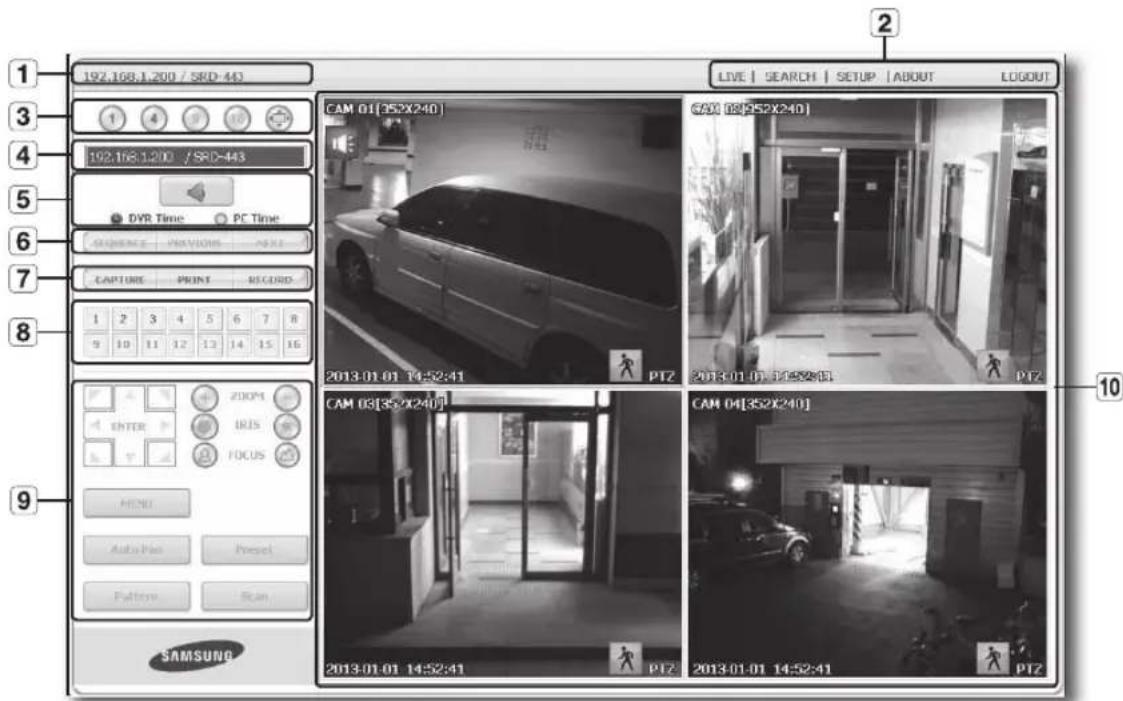
text_image
192.168.1.200 / SRD-44 1 2 3 4 5 6 7 8 9 1 2 3 4 5 6 7 8 9 10 11 12 13 14 15 16 CAM 01[352X240] CAM 02[352X240] CAM 03[352X240] CAM 04[352X240] LIVE | SEARCH | SETUP | ABOUT | LOGOUT 2013-01-01 14:52:41 PTZ 2013-01-01 14:52:41 PTZ 2013-01-01 14:52:41 PTZ Auto Plus Reset Future Scan SAMSUNDThe Live Viewer screen consists of following :
1 This displays the IP address and the model name of the connected DVR.
2 These menus consist of
③ These buttons are used for the screen split and full screen mode.
4 Shows the IP address and model name of the connected DVR.
⑤ Select to turn the sound on/off.
Select
6 These buttons are used for sequence and changing the screen channel.
7 These buttons are used for capture, print, and save the image.
8 Shows the channel of the connected DVR.
9 These buttons are used for PTZ related functions.
10 This displays the screen for connected camera with DVR.

■The resolution is set to 1024X768 pixels.
The initial split-screen mode is set according to the number of channels connected to DVR. You can change the split-screen mode by clicking buttons for split-screen modes.
OSD INFORMATION DISPLAY
① The channel number, video size, and IP address of the connected DVR are displayed.
② This icon will appear if the audio signal is currently being output.
③ The current date and time will be displayed according to the selected time information display setting
4 Alarm icon appears when alarm is issued.
It disappears when pressed the [ALARM] button of the DVR.
⑤ Motion icon appears when motion is detected. It disappears when pressed the [ALARM] button of the DVR.
⑥ It displays whether the PTZ controls are active.
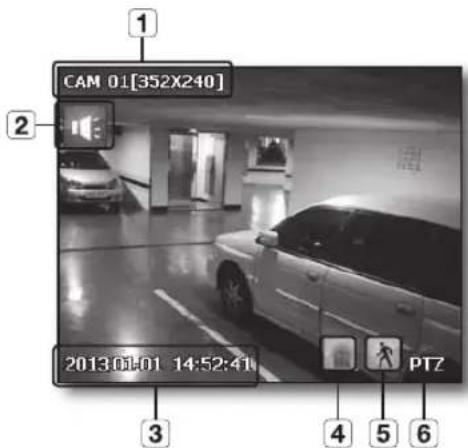
text_image
CAM 01[352X240] 2013.01.01 14:52:41 PTZ
If you have set PTZ cameras for the DVR, "PTZ" is displayed on the screen. Select a PTZ camera channel and use the [PTZ] button for camera control.
SPLIT-SCREEN
You can change the split mode by clicking each number icon.
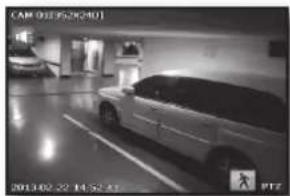
natural_image
Interior view of a car garage with parked cars and parking area, no visible text or symbols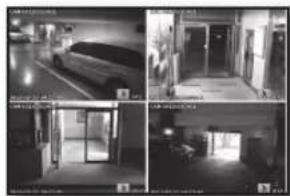
natural_image
Four-panel black-and-white photo collage showing a car parked at night, with no visible text or symbols.SINGLE MODE QUAD MODE
- Click◀> button.
The screen displays the selected camera connected to the DVR in "SINGLE MODE".
- Click <> button.
The screen displays the selected camera connected to the DVR in "QUAD MODE".
- Click <> button.
Switch the 1-split or 4-split mode to Full Screen mode.
Double clicking on the screen or pressing any button of the keyboard returns to the previous mode.
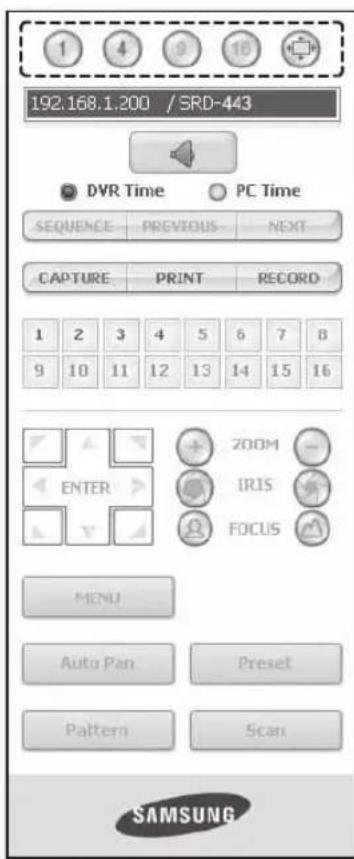
text_image
192.168.1.200 / SRD-443 DVTR Time PC Time SEQUENCE PREVIOUS NEXT CAPTURE PRINT RECORD 1 2 3 4 5 6 7 8 9 10 11 12 13 14 15 16 ZOOM - ENTER IRIS FOCUS MENU Auto Pan Preset Pattern Scan SAMSUNGCONNECTED DVR
This displays the IP address and the status of the connecting DVR.

■ Connection failure message
No Response : Appears when the DVR does not respond.
Access Denied : Appears when the maximum number of users is exceeded.
■ The number of simultaneous connections are limited to 4.
Setting the display of the OSD time information
Select
• DVR Time : Based on the time of the connected DVR
- PC Time : Based on the time of the PC currently running the Web Viewer.
• Audio : Sound On/Off
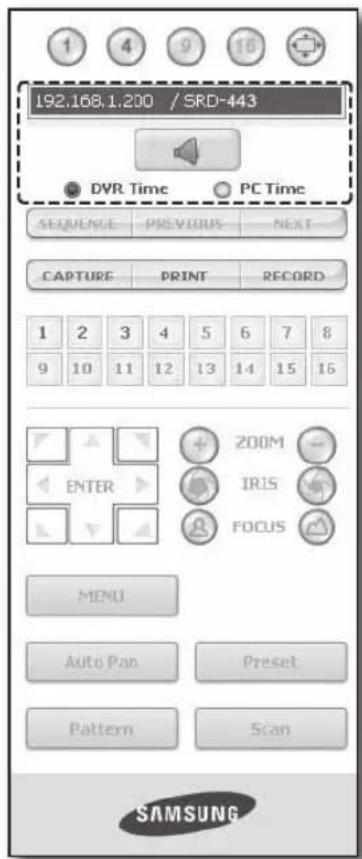
text_image
192.168.1.200 / SRD-443 DVR Time PC Time SEQUENCE PREVIOUS NEXT CAPTURE PRINT RECORD 1 2 3 4 5 6 7 8 9 10 11 12 13 14 15 16 ENTER ZOOM IRIS FOCUS MENU Auto Pan Preset Pattern Scan SAMSUNGCHANGING THE LIVE SCREEN MODE
In the 4-split screen mode, "SEQUENCE", "PREVIOUS" and "NEXT" buttons will be deactivated.
- SEQUENCE: When this button is clicked, screens are switched at a preset interval.
In SINGLE MODE, the channel numbers are sequentially switched from 1 to 4.
■Preset interval (10 seconds)
- PREVIOUS: When this button is clicked, the previous screen appears.
- NEXT: When this button is clicked, the next screen appears. In SINGLE MODE, the channel numbers are sequentially switched from 1 to 4.
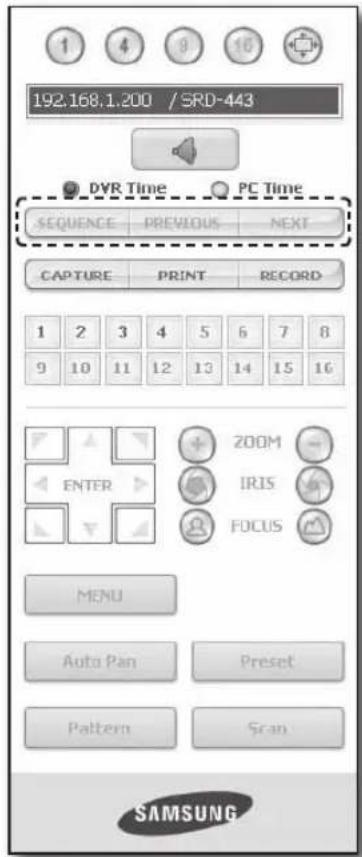
text_image
192.168.1.200 / SRD-443 DYR Time PC Time SEQUENCE PREVIOUS NEXT CAPTURE PRINT RECORD 1 2 3 4 5 6 7 8 9 10 11 12 13 14 15 16 ZOOM ENTER IRIS FOCUS MENU Auto Pan Preset Pattern Scan SAMSUNGSAVIng the IIVe Screen on the Pc
- cAPture : Saves the current screen into a BMP or JPEG file.

The default saving path is "C:\Program Files\Samsung\Dvr Web Viewer\SnapShot\Live". To change the saving path, click
- The file is automatically named as following: "IP address_Port number_YYYYMMDD_HHMMSS_camera number_index" Ex) 192.168.1.200_554_20110414_093118_01_00
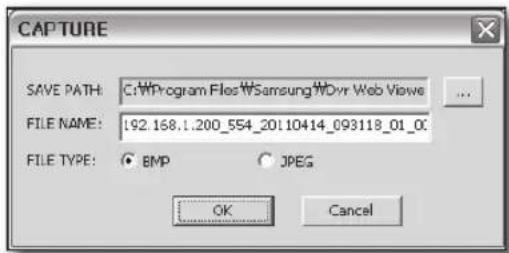
text_image
CAPTURE SAVE PATH: C:\Program Files\Samsung\MDvr Web Views FILE NAME: 192.168.1.200_554_20110414_093118_01_00 FILE TYPE: BMP JPEG OK Cancel- Print: Prints out the selected screen out of the currently displayed live screens. It also prints the IP address, time, camera number and the current event status together.
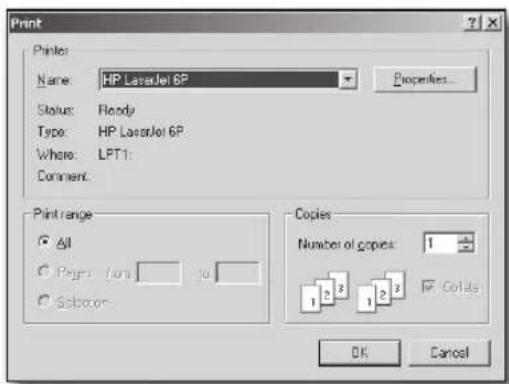
text_image
Print Prints: Name: HP LaserJet 8P Status: Bloody Type: HP LaserJet 6P Where: LPT1: Comment: Print range All Pages: 100 Subcoon... Copies Number of copies: 1 1 2 1 2 3 Colate OK Cancel- record: Saves the current image on the screen and saves it as a avi video file.

■ To record it, it is required at least 1GB of available space.
The default saving path is "C:\Program Files\Samsung\Dvr Web Viewer\VideoClip\Live". To change the saving path, click
The file is automatically named as following: "IP address_Port number_YYYYMMDD_HHMMSS_camera number_index" Ex) 192.168.1.200_554_20110406_070455_01_00
■ For AVI Save, you need the H.264 codec for playing saved files.
- HDD Minimum Free Size : During the recording, if there is no more capacity available in the HDD than set free space will prompt with a popup message : "Cannot record due to insufficient disc space in the HDD".
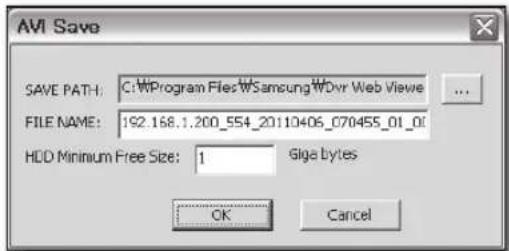
text_image
AVI Save SAVE PATH: C:\Program Files\Samsung\WDvr Web Viewe FILE NAME: 192.168.1.200_554_20110406_070455_01_01 HDD Minimum Free Size: 1 Giga bytes OK CancelchAngIng the IIVe Screen chAnnel
- Blue numbers: The channel connected to the current live screen
- Gray numbers : The channel not connected to the current live screen
If you select 4-split mode, the channel button for each of cameras 1 \~ 4 will turn blue.
text_image
1 2 3 4 5 6 7 8 9 10 11 12 13 14 15 16uSIng PtZ cAMerA
Click the direction buttons to control the camera.
text_image
ENTER
You can zoom in or out an image by using the ZOOM button.
You can adjust the entering light amount by using the IRIS button.

You can adjust the focus by using the FOCUS button.
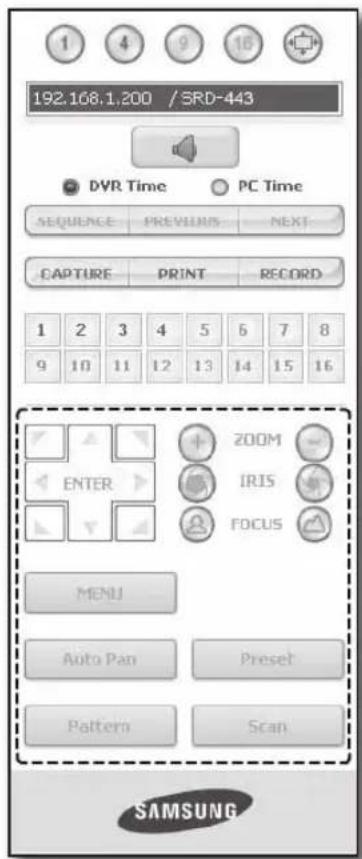
text_image
192.168.1,200 / SRD-443 DVTR Time PC Time SEQUENCE PREVIOUS NEXT CAPTURE PRINT RECORD 1 2 3 4 5 6 7 8 9 10 11 12 13 14 15 16 ENTER ZOOM IRIS FOCUS MENU Auto Pan Preset Pattern Scan SAMSUNG- Menu: Appears the camera menu screen.
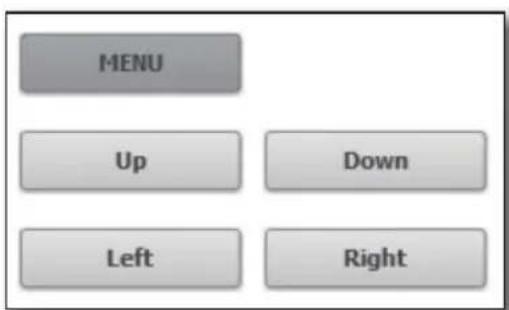
text_image
MENU Up Down Left Right- Preset: Moves the lens direction to a preset direction.
- If you click a preset, the camera moves to the selected preset's position.
- You can delete the selected preset or all presets.
- You can save a new preset number and name.

■You can save presets up to 20.
- Auto Pan: Moves the camera lens direction between 2 points set for the camera.
- Scan: Moves the camera lens direction between 2 preset points of the camera.
- Pattern: You can set camera various movement patterns such as zoom, move, etc. so that a camera automatically moves according to the pattern.

■While the DVR controls a PTZ camera, Web Viewer cannot control the camera.
■ Camera menu setup is only available for camera supporting the function.
■ Each function of PTZ is same to that of the DVR.
■Pan/Tilt of the Smart dome camera is manipulated automatically to center the camera to the mouse clicked point.
If you drag the mouse using the left button on a certain point, Pan/Tilt of the Smart dome camera is manipulated automatically to center the camera to the middle point between the dragging start and end position. Upward dragging will zoom out, while downward dragging will zoom in.
■Tilt of Power PTZ operates properly within 45°.
■ Power and Pan Tilt functions are only available for camera supporting the functions. Ex : Samsung SCP-2371
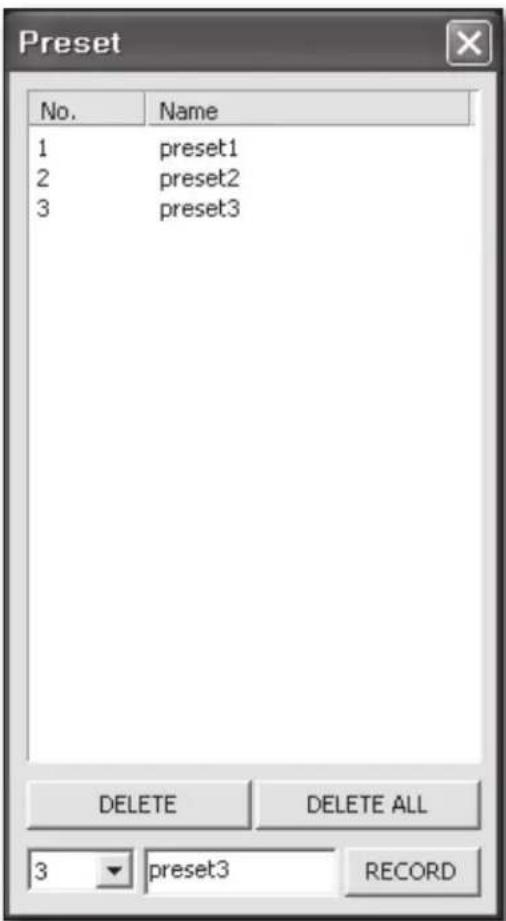
text_image
Preset No. Name 1 preset1 2 preset2 3 preset3 DELETE DELETE ALL 3 preset3 RECORDuSIng SeArch VleWer
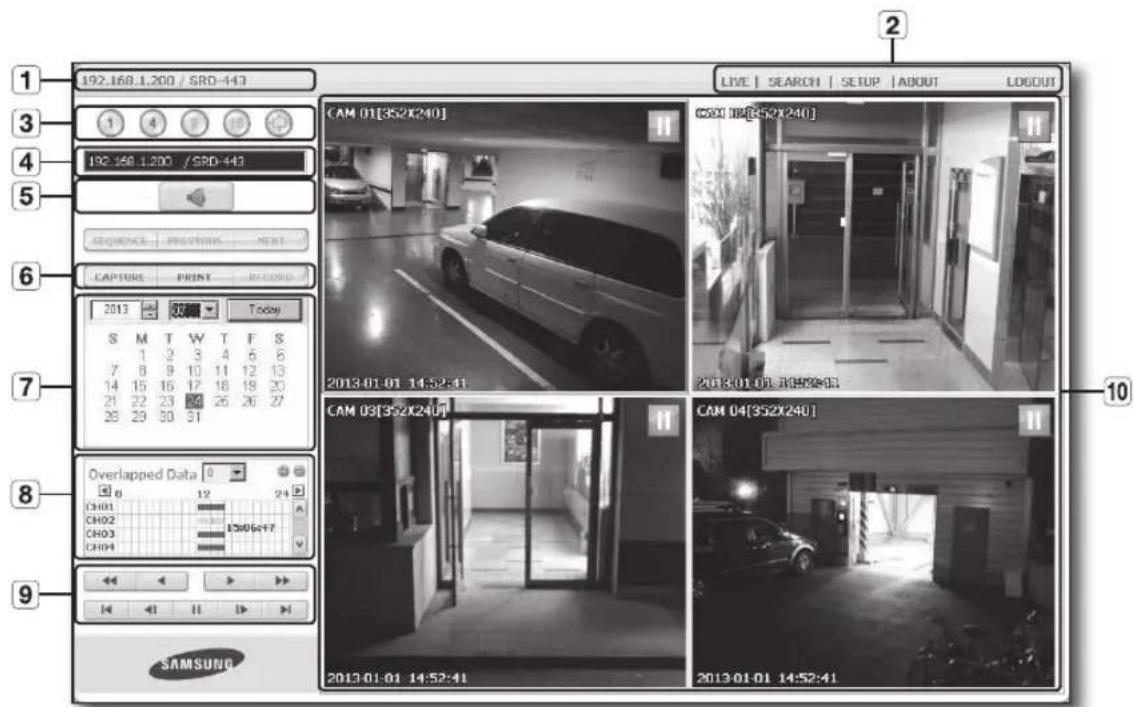
text_image
192.168.1.200 / SRD-143 1 4 7 10 192.168.1.200 / SRD-143 CAM 01[352X240] CAM 02[352X240] CAM 03[352X240] CAM 04[352X240] 192.168.1.200 / SRD-143 1 4 7 10 192.168.1.200 / SRD-143 CAM 01[352X240] CAM 02[352X240] CAM 03[352X240] CAM 04[352XThe Search Viewer screen consists of following :
1 This displays the IP address and the model name of the connected DVR.
② There are 4 tabs available:
3 Switch to a split mode.
4 Shows the IP address and model name of the connected DVR.
⑤ Select to turn the sound on/off.
6 These buttons are used for capture, print, and save the image.
7 This displays a calendar at which you can search the recorded video.
8 This displays a timeline at which you can search the recorded video by the time.
9 These buttons are used for controlling playback.
[10] This displays the screen for playback of recorded video.

During the DVR backup, you may have a trouble accessing CMS & Web Search.
SPIIt-Screen
You can change the split mode by clicking each number icon.
natural_image
Black-and-white photo of a car parked in a parking garage, no visible text or symbols on the vehicle or background.
natural_image
Four-panel black-and-white photo collage showing a car in a lot, a doorway with a dark interior, and a doorway with a street light (no visible text or symbols)SINGLE MODE QUAD MODE
- Click<1> button.
The screen displays the selected camera connected to the DVR in "Single Mode". - Click◀> button.
The screen displays the selected camera connected to the DVR in "QuAd Mode".
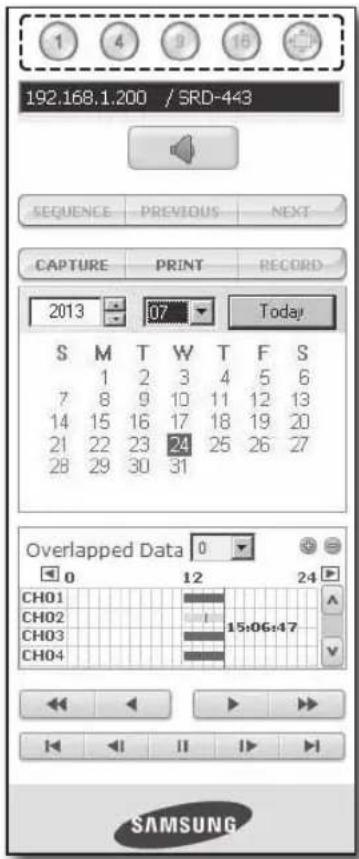
text_image
192.168.1.200 / SRD-443 SEQUENCE PREVIOUS NEXT CAPTURE PRINT RECORD 2013 07 Today S M T W T F S 1 2 3 4 5 6 7 8 9 10 11 12 13 14 15 16 17 18 19 20 21 22 23 24 25 26 27 28 29 30 31 Overlapped Data 0 0 12 24 CH01 CH02 CH03 CH04 15:06:47 SAMSUNGconnected dVr
The IP of the connected DVR will be displayed. Select to turn the sound on/off.

■ Connection failure message
No Response : Appears when the DVR does not respond.
Access Denied : Appears when the maximum number of users is exceeded.
■The number of simultaneous connection is limited to 2.
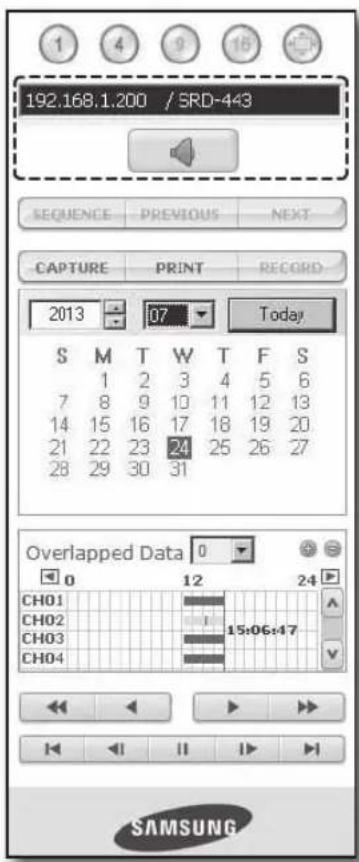
text_image
192.168.1.200 / SRD-443 SEQUENCE PREVIOUS NEXT CAPTURE PRINT RECORD 2013 07 Today S M T W T F S 1 2 3 4 5 6 7 8 9 10 11 12 13 14 15 16 17 18 19 20 21 22 23 24 25 26 27 28 29 30 31 Overlapped Data 0 0 12 24 CH01 CH02 CH03 CH04 15:06:47 SAMSUNGSAVIng the IIVe Screen on the Pc
- cAPture : Saves the current screen into a BMP or JPEG file.

The default saving path is "C:\Program Files\Samsung\Dvr Web Viewer\SnapShot\Search". To change the saving path, click
- The file is automatically named as following: "IP address_Port number_YYYYMMDD_HHMMSS_camera number_index"
Ex) 192.168.1.200_554_20110414_093118_01_00
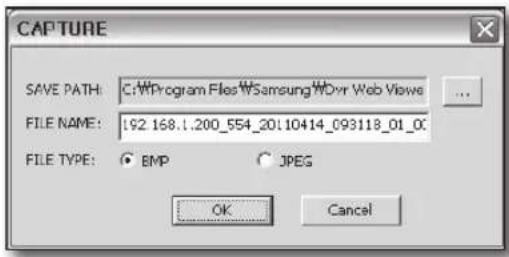
text_image
CAPTURE SAVE PATH: C:\Program Files\Samsung\MDvr Web Views FILE NAME: 192.168.1.200_554_20110414_093118_01_00 FILE TYPE: BMP JPEG OK Cancel- Print: Print out the current screen. It also prints IP address, time, camera number and current event state.
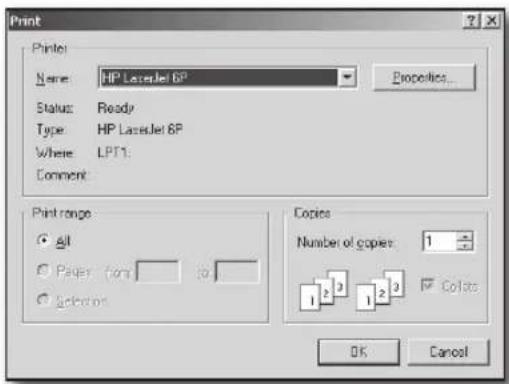
text_image
Print Printer Name: HP LazeJet 6P Status: Ready Type: HP LazeJet 6P Where: LPT1. Comment: Print range: All Page: From Selection Copies Number of copies: 1 1 2 3 1 2 3 Colors OK Cancel- record : While in playback, press this button saves the video data of the selected channel as an AVI file. (It is saved in the designated folder on your PC.) To stop recording, click this button again.
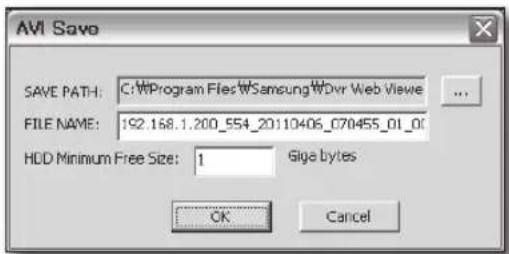
text_image
AVI Save SAVE PATH: C:\Program Files\WSamsung\WDvr Web Viewie ... FILE NAME: 192.168.1.200_554_20110406_070455_01_01 HDD Minimum Free Size: 1 Giga bytes OK Cancel
■ To record it, it is required at least 1GB of available space.
The default saving path is "C:\Program Files\Samsung\Dvr Web Viewer\VideoClip\Search". To change the saving path, click
The file is automatically named as following: "IP address_Port number_YYYYMMDD_HHMMSS_camera number_index"
Ex) 192.168.1.200_554_20110406_070455_01_00
■ For AVI save, you need the H.264 codec for playing saved files.
SEARCHING THE RECORDED VIDEO IN THE CALENDAR
If the video data has been recorded on a date, the date is distinguished in green. If you click the date, the recorded video information is displayed in the time line. When you click
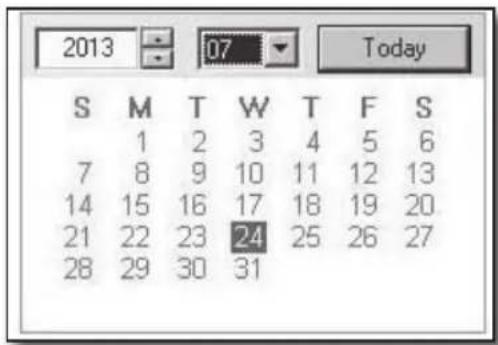
text_image
2013 07 Today S M T W T F S 1 2 3 4 5 6 7 8 9 10 11 12 13 14 15 16 17 18 19 20 21 22 23 24 25 26 27 28 29 30 31SEARCHING THE RECORDED VIDEO IN THE TIMELINE
It displays the recorded video data status on the DVR after a date is selected. The normal mode displays the time ranging from 0 to 24 Hours while the extension mode displays the time every 2 hours.
[Normal Mode]
- If you click <> button, it changes to the extension mode.
• Each time line represents 1 hour.
[Extension Mode]
- If you click <> button, it changes to the normal mode.
• Each time line represents 5 minutes.
![Hanwha SRD-443 - [Extension Mode] - 1](/content/2026/06/1203577/images/cb6428ed2aa593552955b747159b6bc114aa3addd2d85d8d5498063dc2d0d4ee.jpg)
■The channels are ranging from CH01 to CH04.
![Hanwha SRD-443 - [Extension Mode] - 2](/content/2026/06/1203577/images/1d7661a7e98af06586ddf03c822e3a43393e766cebd646b07d3e6d2949b8e27a.jpg)
text_image
0 12 24 CH01 CH02 19:45:18 CH03 CH04![Hanwha SRD-443 - [Extension Mode] - 3](/content/2026/06/1203577/images/44f53b54fa0b6c6485170a3eca0ad64c5c680075ad76c497174f31f7f27504d7.jpg)
text_image
CH01 CH02 CH03 CH04 19:45:18 20 21![Hanwha SRD-443 - [Extension Mode] - 4](/content/2026/06/1203577/images/ad8af952cc2be9de210962d162b9cf5800bdf7eca045d7dc40a2703cb8ec6113.jpg)
text_image
192.168.1.200 / SRD-443 SEQUENCE PREVIOUS NEXT CAPTURE PRINT RECORD 2013 07 Today S M T W T F S 1 2 3 4 5 6 7 8 9 10 11 12 13 14 15 16 17 18 19 20 21 22 23 24 25 26 27 23 29 30 31 Overlapped Data 0 CH01 CH02 CH03 CH04 15:06:47 SAMSUNG1 Fast Backward : Play the video reversely. (at x2 \~ x64)
2 Reverse Play : Performs Reverse Play.
③ Play : Performs playback.
④ Fast Forward : Play the video forward. (at x2 \~ x64)
⑤ Go to First: Moves the beginning time of recorded video in the time line.
6 Step Backward : Performs one step reverseplay by one frame.
7 Pause: Stops the playback temporarily.
8 Step Forward: Performs one step forward by one frame.
9 Go to Last: Moves the last time of recorded video in the time line.
![Hanwha SRD-443 - [Extension Mode] - 5](/content/2026/06/1203577/images/6779a2588fb6333ba5da2cded9f802e8bc8cbcd7f507c28535eb4aad37c33ff2.jpg)
- Only the admin account can play the audio signal during the playback. If using both web view and DVR set simultaneously, the audio signal will be output from the DVR set.
![Hanwha SRD-443 - [Extension Mode] - 6](/content/2026/06/1203577/images/3f871f2c456b5af2610e97005009f1b9b6c382eee2e94f1e40fbd1fdf28ab6ce.jpg)
text_image
192.168.1.200 / SRD-4:3 SEQUENCE PREVIOUS NEXT CAPTURE PRINT RECORD 2013 07 Today S M T W T F S 1 2 3 4 5 6 7 8 9 10 11 12 13 14 15 16 17 18 19 20 21 22 23 24 25 26 27 28 29 30 31 Overlapped Data 0 0 12 2:4 CH01 CH02 CH03 CH04 15:06:47 SAMSUNGVIEWER SETUP
You can configure the DVR settings remotely on the network. To configure the DVR settings, click
System
You can configure the various settings of the DVR system.
Date/Time/Language
For more information, refer to
- Select
in the System menu. - Configure the DVR settings according to your system environment.
- Date/Time
Set the date and time.
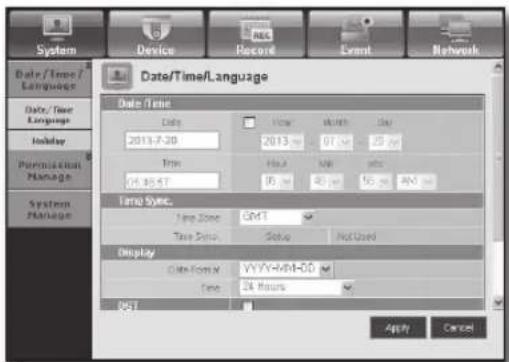
text_image
System Device Record Event Network Date/Time/Language Date Time Date 2013-7-28 2013 pm 07 pm 25 pm Time 06:30:47 06 pm 25 pm 15 pm 40 pm Time Sync. Time Zone GMT Time Data Setup Not Used Display DataForm X: VY/Y+MM-DD Time 24 Hours DST Apply Cancel• Time Synchronization Setup
Set the time synchronization.
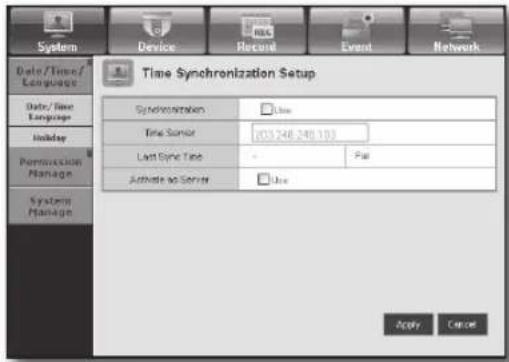
text_image
System Device Record Event Network Date/Time/ Language Date/New Language Holiday Permutation Manage Systems Manage Time Synchronization Setup Synchronization Line Time Sensor 003246.248.183 Last Sync Time - - Active to Sensor Line Apply Cancel- Display
Date Format : Set the date type.
Time : Select a time format to display on the screen.
• DST (Daylight Saving Time)
DST is displayed an hour ahead of the standard time of the time zone.
- Language
Select a preferred language for the DVR.
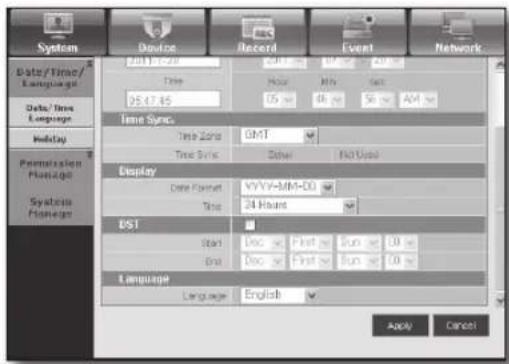
text_image
System Device Record Event Network Data/Time/Language Date/Time Language 95.47.85 Time Sync Time Sync GMT Time Sync Other No Speed Display Date Format VYVY-MM-DD Time 24 Hours BST Start Doc First Run 01 sec End Doc First Run 01 sec Language Language English Apply CancelHoliday
You can set specific dates to Holidays according to your preferences.
For more information, refer to
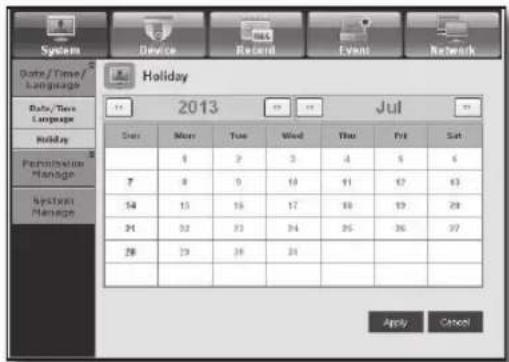
text_image
System Dayte Record Event Network Date/Time/ Language Baby/Tree Language Holiday Penetration Manage System Manage Holiday 2013 Jul Day Fri Sat 8 9 10 11 12 13 14 15 16 17 18 19 20 21 22 23 24 25 26 27 28 29 30 Apply CancelPermission Management
For more information, refer to
- Admin
You can change the admin ID or the password.
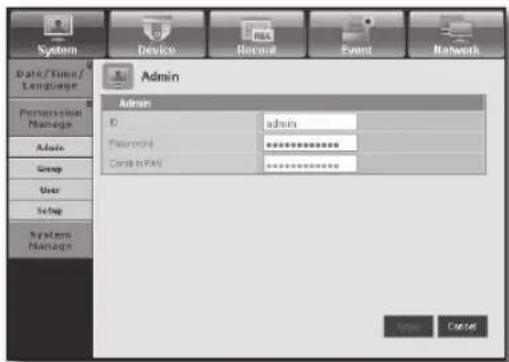
text_image
System Device Record Event Network Data/Time/ Language Admin Admin ID admin Password ****** Ctrl to PAY ****** Apply Cancel- Group
Users are classified into groups and the permission can be set according to the group.
■First of all, add a group.
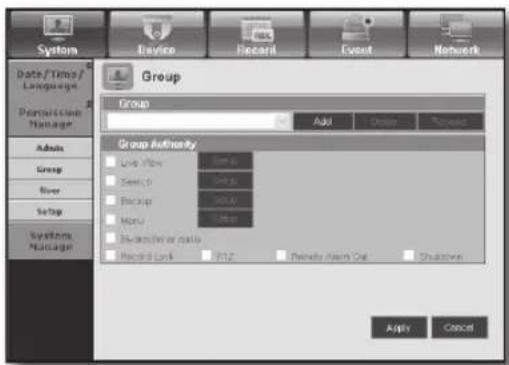
text_image
System Eavlico Record1 Event Network Date/Time/ Language Personnel Manage Adults Group River Setup Systems Manage Group Group Authority Live Flow Send it Connect Send it Backup Send it Menu Send it Resource or ratio Record Link F12 Send to Alert Out Shutdowns Apply Cancel- User
You can add, change or remove a user or users.
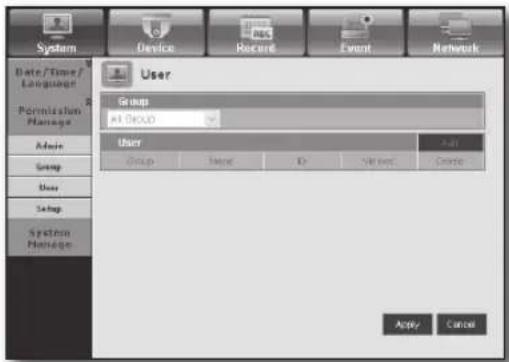
text_image
System Device Record Event Network Date/Time/ Language Permission Manage Admin Group User Setup System Manage User Group Name ID Ver here Apply Cancel- Setup
You can set the user permission.
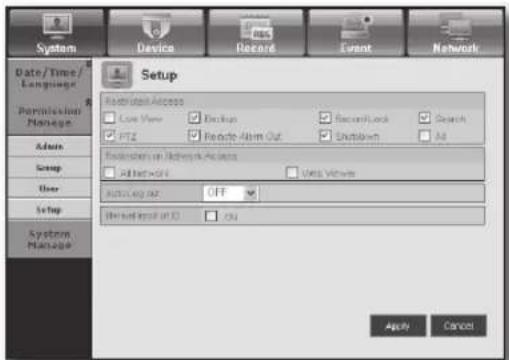
text_image
System Device Record Event Network Date/Time/ Language Perimeter Manage Admin Setup User Setup System Manage Setup Access Core View Backup RecordLock Search PTZ Remote Alarm Out Shutdown All Extension on Network Access Adjust >0% OFF Units Vehicles Auto Log OK OFF Reserved Input ID: 001 Apply CancelSystem Management
For more information, refer to
• System Information
You can see information of the current system.
Check the software version, broadcast format and MAC address.
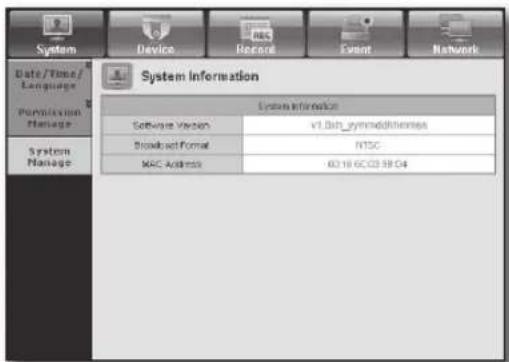
text_image
System Information Software Version: v1.dat_symmodihemess Broadcast Format: NTSC MAC Address: 60.18.6CC3.58.04Device
You can check a list of devices that are connected to the DVR and configure the necessary settings.
Click
For more information, refer to "Setting the Device". (Page 38)
Camera
- Camera
You can configure the settings of the camera that is connected to the DVR.
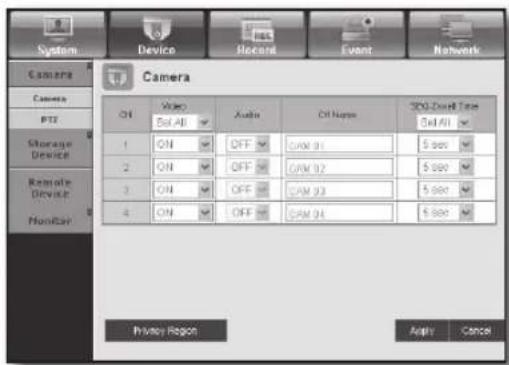
text_image
System Device Record Event Network Camera Camera PTZ Storage Device Remote Device Monitor Camera ON Video Bal AB Audio Off Name CAM 31 CAM 32 CAM 33 CAM 34 CAM 35 CAM 36 CAM 37 CAM 38 CAM 39 CAM 40 CAM 41 CAM 42 CAM 43 CAM 44 CAM 45 CAM 46 CAM 47 CAM 48 CAM 49 CAM 50 CAM 51 CAM 52 CAM 53 CAM 54 CAM 55 CAM 56 CAM 57 CAM 58 CAM 59 CAM 60 CAM 61 CAM 62 CAM 63 CAM 64 CAM 65 CAM 66 CAM 67 CAM 68 CAM 69 CAM 70 CAM 71 CAM 72 CAM 73 CAM 74 CAM 75 CAM 76 CAM 77 CAM 78 CAM 79 CAM 80 CAM 81 CAM 82 CAM 83 CAM 84 CAM 85 CAM 86 CAM 87 CAM 88 CAM 89 CAM 90 CAM 91 CAM 92 CAM 93 CAM 94 CAM 95 CAM 96 CAM 97 CAM 98 CAM 99 CAM 100 Primary Region Apply Cancel- Privacy Region
You can specify a certain area of the camera video to be protected for your privacy.
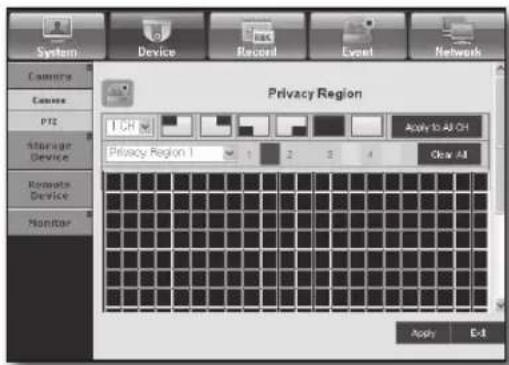
text_image
System Device Record Event Network Camera Camera PTZ Storage Device Remote Device Monitor Privacy Region 1 CH Apply to All CH Privacy Region 1 1 2 3 4 Close All Apply E-4• PTZ
You can configure the settings of the PTZ camera that is connected to the DVR.
Set the ID and protocol.
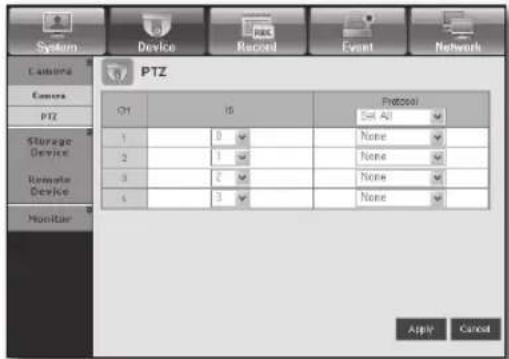
text_image
System Device Record Event Network Camera PTZ PTZ Storage Device Remote Device Monitor PTZ 0 1 2 3 4 5 6 7 8 9 None None None None Apply CancelStorage Device
You can check and change the settings of the storage device.
- Device
You will see a list of storage devices that are connected to the DVR.
You can check the type, used/total, usage and status of the device.
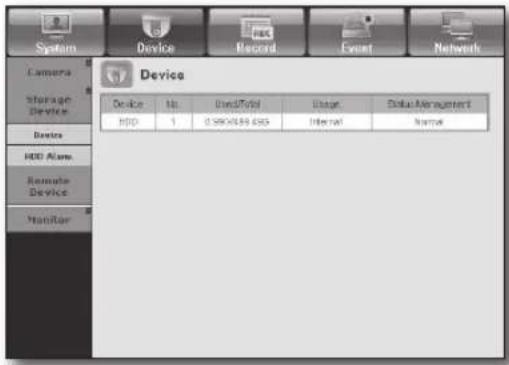
text_image
System Camera Storage Device Hardware HDD Alone Remote Device Monitor Device Ms. Used/Total User Status Management hpp 1 0.990/88.635 Interval Name- HDD Alarm
You can set the alarm output channel and the alarm duration for an error.
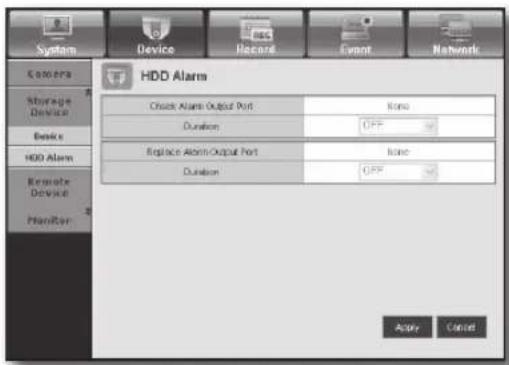
text_image
System Device Record Event Network Camera Storage Device Basic HDD Alarm Remote Device PlanRan HDD Alarm Clock Alarm Output Port None Duration OFF Replace Alarm Output Port None Duration OFF Apply CancelRemote Device
You can see a list of remote devices including PTZ cameras and system keyboards that are connected to the RS-485 port of the DVR and configure the necessary settings.
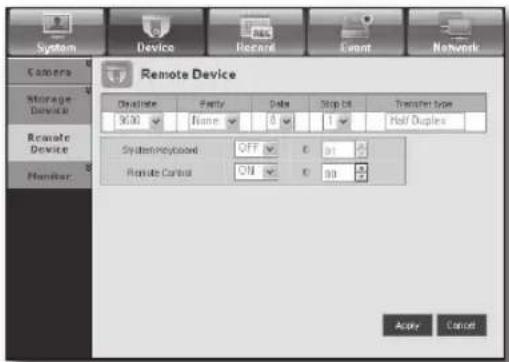
text_image
System Device Record Event Network Camera Storage Device Remote Device Member Remote Device Coordinate Party Delta Stop bit Transfer Type 900 Name 0 1 Half/Doubles System/mycled OFF C 91 Remote Control Off C 80 Apply CancelMonitor
- Monitor
You can configure the monitoring screen settings and set the output system.
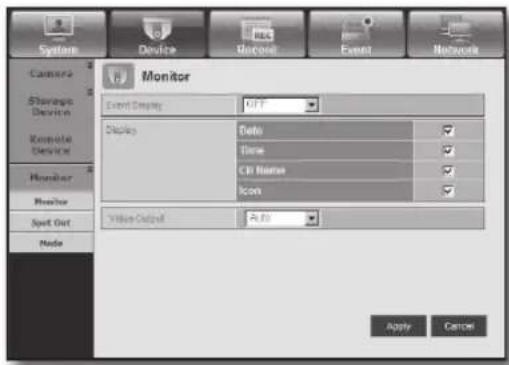
text_image
System Device Record Event Network Camera Storage Device Remote Device Monitor Monitor Spot Out Node Monitor Event Display OFF Display Data None CD Name Icon Value Output Auto Apply Cancel- Spot Out
With the monitor connected via the SPOT port, if there occurs an event such as Sensor, Motion, or Alarm, you can select a video output mode for external monitoring.
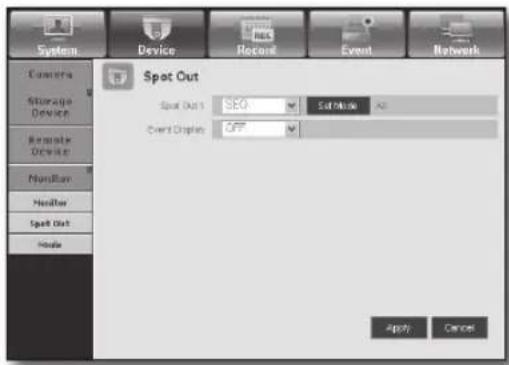
text_image
System Device Record Event Network Camera Storage Device Remote Device Monitor Header Spot Out Node Spot Out SEQ Set Mode OFF Apply Cancel- Mode
You can switch between live mode and play mode.
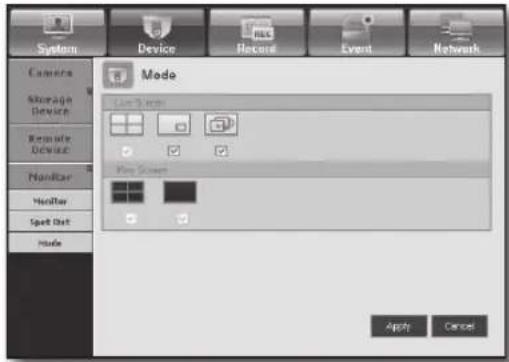
text_image
System Device Record Event Network Camera Storage Device Remote Device Monitor Handler Spot Out Mode Mode Live Sorts Play Screen Apply CancelRecord
For more information, refer to
Recording Schedule
If you set a recording schedule for a specific date and time, the recording will start at that specific time.
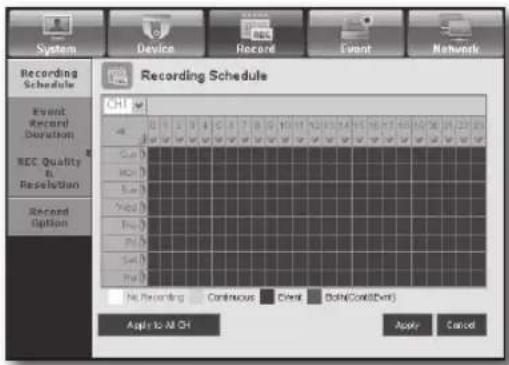
text_image
System Device Record Event Network Recording Schedule Record Record Duration REC Quality in Resolution Record Option CHI No Recording Continuous Event Begin(Contin) Apply to All CH Apply Cancel- Apply to All CH : Click
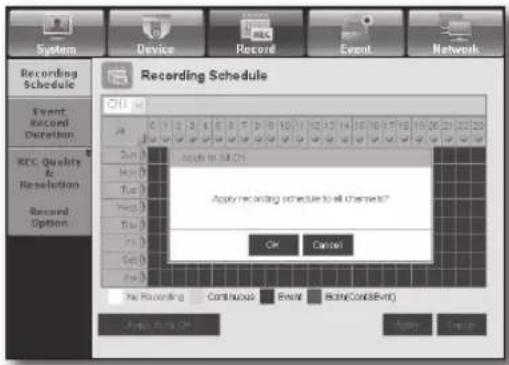
text_image
System Device Record Event Network Recording Schedule Event Record Decryption REC Quality & Resolution Record Option Recording Schedule Date: 01/01/2023 Apply to ALL Apply recording schedule to all channels? OK Cancel One Recording Continuous Event BSN(Continued) Apply Back Up Apply CancelEvent Record Duration
You can set the start and end times of recording that will be activated if an event occurs.
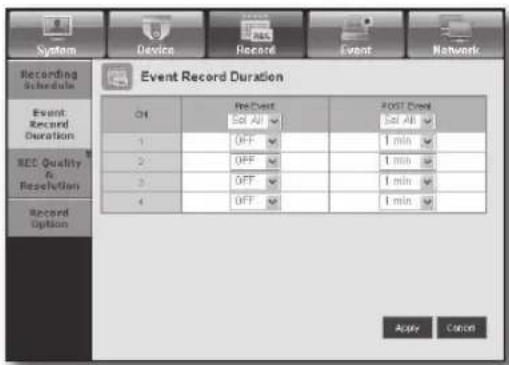
text_image
System Device Record Event Network Recording Schedules Event Record Duration CH Record Est All OFF OKT Even Est All 1 min 2 OFF 1 min 3 OFF 1 min 4 OFF 1 min Apply CancelREC Quality & Resolution
- Standard/Event
You can set the resolution, frame rate and recording quality for each channel.
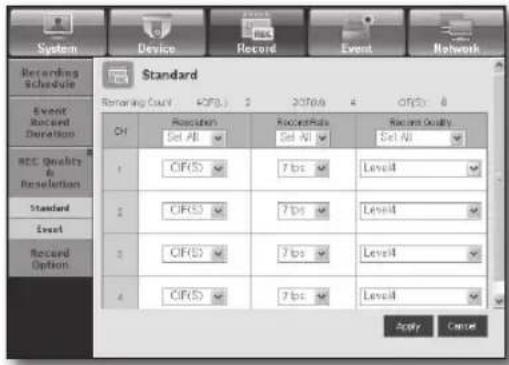
text_image
System Device Record Event Network Recording Schedule Standard Event Record Duration CH CF(S) 7 bps Level4 RCC Quality & Resolution 1 CF(S) 7 bps Level4 Standard CF(S) 7 bps Level4 Event CF(S) 7 bps Level4 Record Option CF(S) 7 bps Level4 Apply CancelRecord Option
You can set the Disk End Mode.
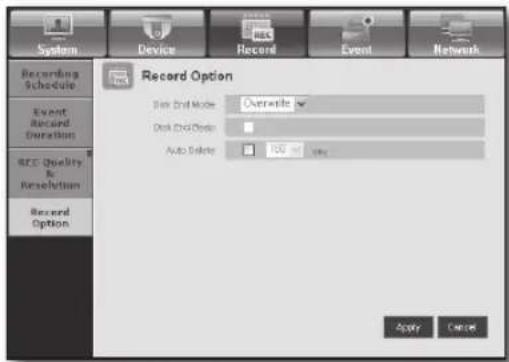
text_image
System Device Record Event Network Recording Schedule Record Duration Record Options Record Option Record Option Disk End Mode: Continuous Disk End Close: Auto Selector: 100 mm Apply CancelEvent
For more information, refer to
Sensor Detection
You can set the sensor operation mode and the synchronized camera as well as the alarm output type and the duration.
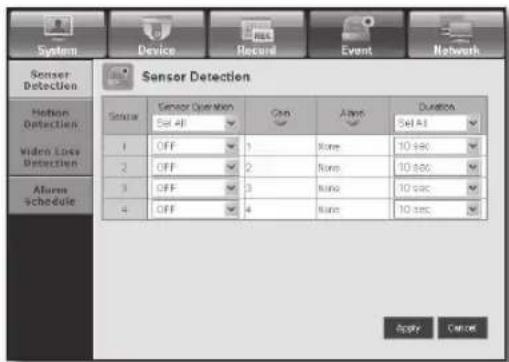
text_image
Sensor Detection Sensor Operation Gain Amount Duration Set All 1 OFF 1 None 10 sec 2 OFF 2 None 10 sec 3 OFF 3 None 10 sec 4 OFF 4 None 10 sec Apply CancelMotion Detection
You can set the motion detection mode and the sensitivity as well as the alarm output type and the duration.
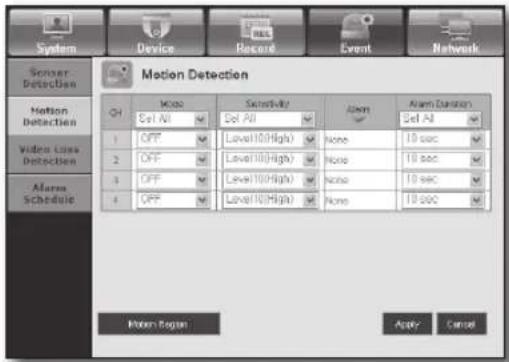
text_image
System Device Record Event Network Sensor Detection Motion Detection Video Class Detection Alarms Schedule Motion Detection Mode Set All Selectivity Set All Alarm Alarm Duration Set All 1 OFF Level(100High) None 10 sec 2 OFF Level(100High) None 10 sec 3 OFF Level(100High) None 10 sec 4 OFF Level(100High) None 10 sec Motion Region Apply Cancel- Motion Region
Set the target motion detection area
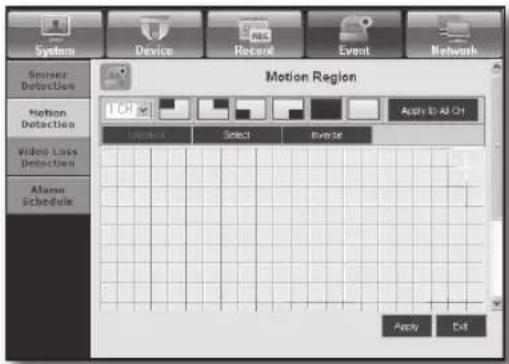
text_image
System Device Record Event Network Sensor Detection Motion Detection Video Loss Detection Alarm Schedule Motion Region 1 CH Apply to All CH Logistics Select Rivering Apply ExitVideo Loss Detection
You can set the alarm output time if a video loss occurs.
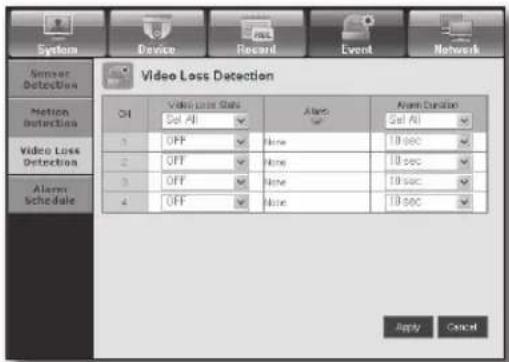
text_image
Sensor Detection Video Loss Detection Motion Detection 1 OFF None 18 sec 2 OFF None 18 sec 3 OFF None 18 sec 4 OFF None 18 sec Alarm Schedule Alarm Duration Set All Apply CancelAlarm Schedule
You can schedule the alarm output according to the day of the week and the time.
The default setting is Event Sync, which activates the alarm only if an event occurs.
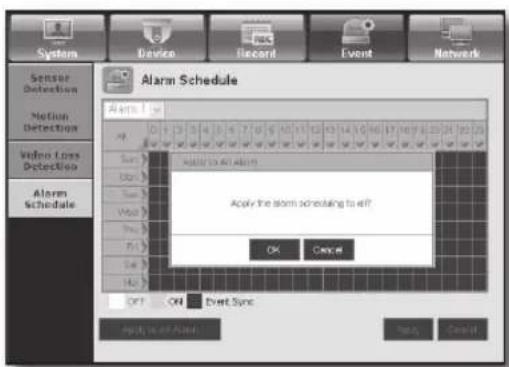
text_image
System Device Record Event Network Sensor Detection Motion Detection Video Loss Detection Alarm Schedule Alarm Schedule Apply the alarm scheduling to eff OK Cancel Off Off Event Sync Apply to off Power Tags CancelNetwork
For more information, refer to
Connection
A remote user can access the DVR via the network to check the current mode and the IP address.
- Connection
You can set the network connection route.
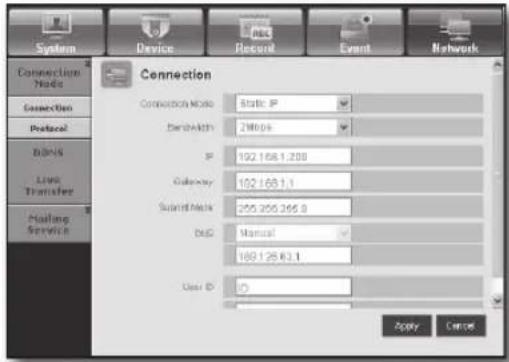
text_image
Connection Connectors Mode: Static IP Serial Link: 21604 IP: 192.158.1.200 Binaryity: 192.158.1.1 Serial Link: 205.205.265.9 DNS: Manual 189.126.63.1 User ID: Apply Cancel- Protocol
You can configure the protocol related settings.
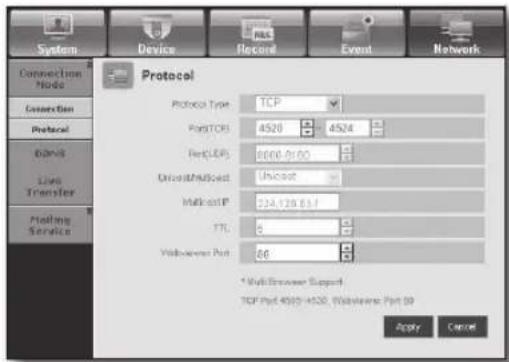
text_image
System Device Record Event Network Connection Mode Connection Protocol Bench List Transfer Routing Service Protocol Type: TCP PortTCP: 4528 4524 PortURL: 0000-0100 Unsolid/NullConst: Unicast Multicell P: 324,126.63.7 TTL: 8 MailServer Port: 66 * MultiBrowser Support TCP Port: 4528-4528, MailServer Port: 59 Apply CancelDDNS
You can check the DDNS settings.
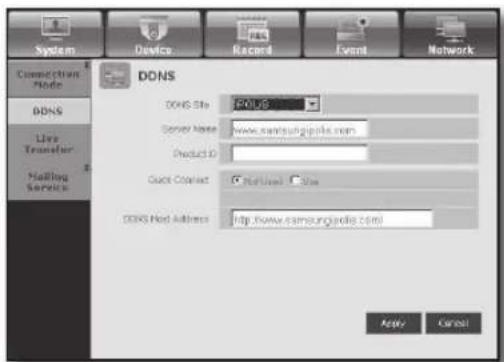
text_image
System Device Record Event Network Connection Mode DDNS Live Transfer Handling Services DDNS Site: R401.05 Server Name: www.samsungjogda.com Product ID: Quick Contact: Web User: Size DDNS Head Address: http://www.samsungjogda.com Apply CancelLive Transfer
A remote user can set the images of the DVR.
• Live Transfer
You can specify the quality of the image data that a remote user will receive.
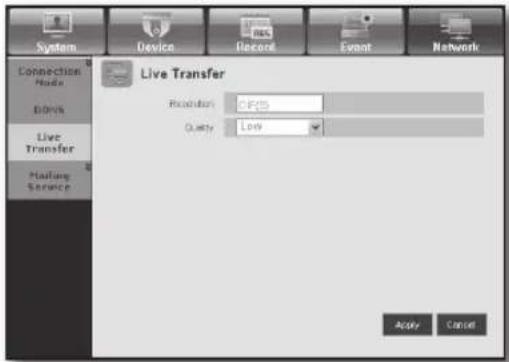
text_image
System Device Record Event Network Connection Mode Block Live Transfer Routing Service Live Transfer Resolution: 0.0000 Quality: Low Apply CancelMailing Service
You can specify the SMTP server that sends a mail if an event occurs and set the recipient group and users.
- SMTP
You can set the server that sends mails and specify if you use the authentication process.
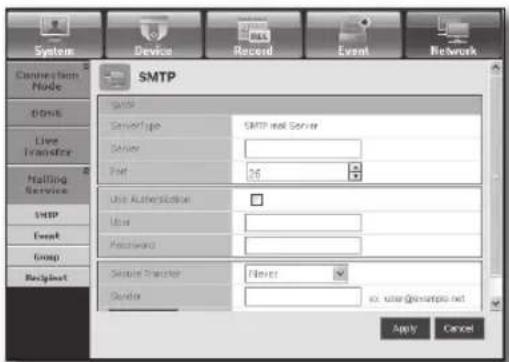
text_image
System Device Record Event Network Controller Item Node DNS Live Transfer Nailing Service SMTP Event Group Recipient SMTP Service Type: SMTP and Server Server: Port: 26 Use Authentication: User: Password: Sendir Transfer: Folder: ac user @sentips.net Apply CancelEvent
You can set the event interval and specify which events the server sends mails for.
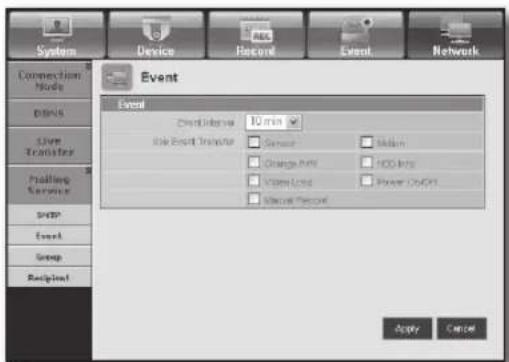
text_image
System Device Record Event Network Connection Mode DIPs Store Transfer Profiling Service SNP Event Group Recipient Event Event Direct Instance 10 min Role Event Transfer Sensor Medium Orange Anti HDD Inks Green Loss Power DnO2 Manual Record Apply Cancel- Group
You can add a group to receive the mail if an event occurs and set the permission to receive the event mail for each group.
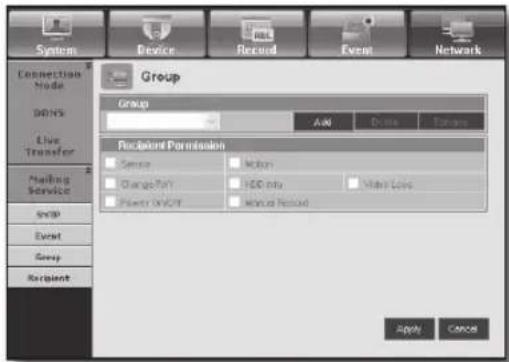
text_image
System Device Record Event Network Connection Node DOINS Live Transfer Nailing Service SHP Dset Group Recipient Group A#G Drive Options Puclear Poridation Service Motion Change Part HDD Info Make Loss Power On/OFF Make Recircul Apply Cancel- Recipient
You can add a user or users who will receive the mail.
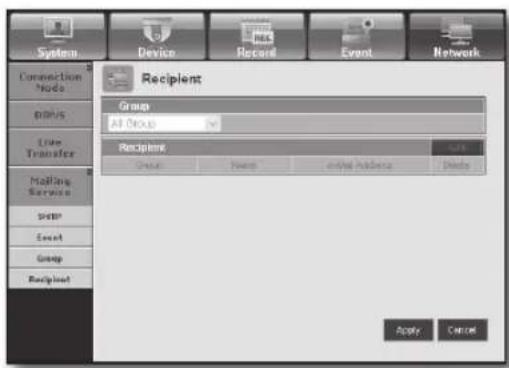
text_image
System Device Record Event Network Connection Mode PASS Line Transfer Routing Service Start Event Group Recipient Recipient Group Name and/or Audience Delete Apply CancelABOUT
Click
Displays the model name of connected DVR and the version of Web Viewer.
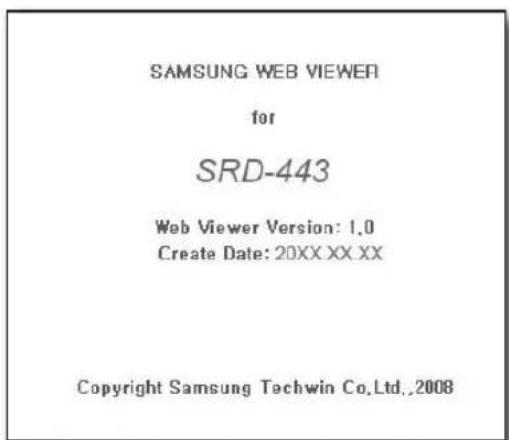
text_image
SAMSUNG WEB VIEWER for SRD-443 Web Viewer Version: 1.0 Create Date: 20XX XX XX Copyright Samsung Techwin Co.,Ltd.,2008CONNECTING WEB VIEWER (Mac)
Safari on MAC.
If you want to use SRD-Series DVR Web Viewer with Safari Browser on a Mac, please refer to this user guide and install Multi Viewer with firmware upgrade if necessary.
• Mac OS versions available : 10.6 or later version
• Silverlight : 5 or later
- Safari : 5 or later
- Click [Click now to Install] to display the installation screen as shown.

text_image
Microsoft To view this content, please install Microsoft® Silverlight® Click now to install QUICK DOWNLOAD / 30 SECOND INSTALL- Double-click the [Silverlight.pkg] icon to display the Silverlight plug-in installation screen as shown.
text_image
Shenlight.jpg- Click [Continue] to start installing Silverlight plug-in. When done, you will see the screen as below.
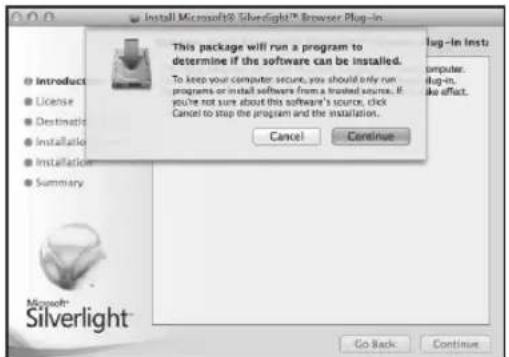
text_image
Install Microsoft® Silverlight™ Browser Plug-in This package will run a program to determine if the software can be installed. To keep your computer secure, you should only run programs or install software from a trusted source. If you're not sure about this software's source, click Cancel to stop the program and the installation. Cancel Cancel lug-In Inst: computer. plug-in. do effect. Microsoft Silverlight Go Back Continue- Click [Close] to exit from the Silverlight plug-in installation screen.
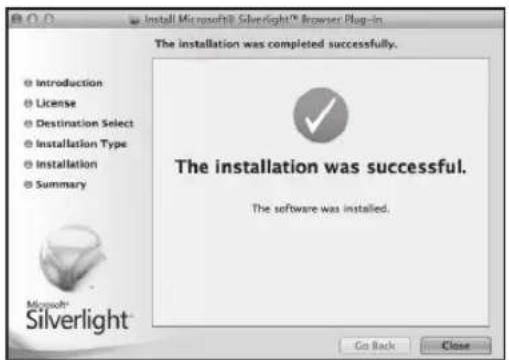
text_image
Install Microsoft® Silverlight® Browser Plug-in The installation was completed successfully. The installation was successful. The software was installed. Go Back Close• If Microsoft Silverlight plug-in is already installed
- Use a web browser to connect to the DVR.
- If Silverlight plug-in is already installed, you will see the login screen as shown.
- If the login screen does not appear, check if the DVR set is connected properly with a valid IP address.
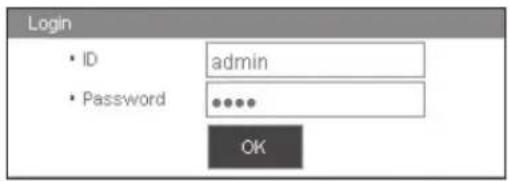
text_image
Login • ID admin • Password ••••• OK
If automatic proxy is activated and an invalid DNS server is specified while configuring network, the Internet access may not be available.
- For more details on using the Web Viewer, please refer to "Connecting Web Viewer (Windows)". (Page 71)
USING LIVE VIEWER (Mac)
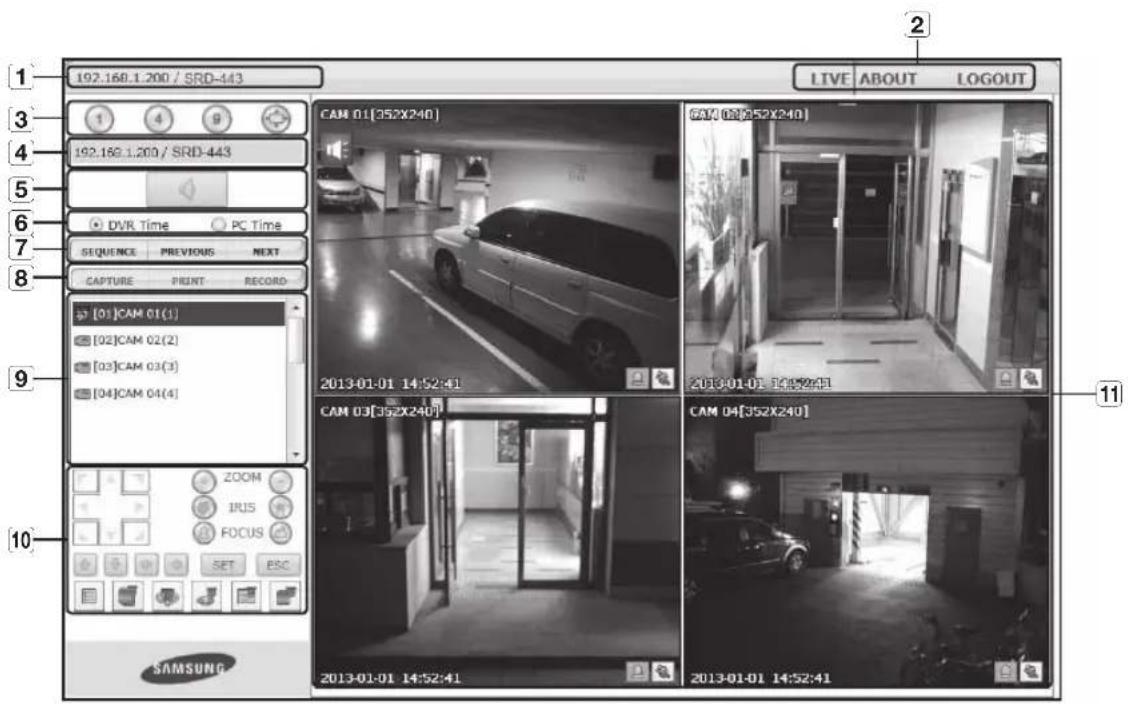
text_image
1 192.160.1.200 / SRD-443 LIVE ABOUT LOGOUT CAM 01[352X240] CAM 02[352X240] CAM 03[352X240] CAM 04[352X240] 1 2 3 4 192.160.1.200 / SRD-443 1 2 3 4 5 6 DVTR Time PC Time SEQUENCE PREVIOUS NEXT CAPTURE PRINT RECORD [01]CAM 01(1) [02]CAM 02(2) [03]CAM 03(3) [04]CAM 04(4) ZOOM IRUS FOCUS SET ESC SAMSUNG CAM 01[352X240] CAM 02[352X240] CAM 03[352X240] CAM 04[352X240] 11The Live Viewer screen consists of following :
| Menu Functions | ||
| 1 | Name, Address | Displays a connected DVR's IP address and model name. |
| 2 | Menu Selection | Consists of,,andmenu. |
| 3 | Split Mode Selection | These buttons are used for the screen split and full screen mode.Supports up to a maximum of 9 channels due to performance constraints of Silverlight |
| 4 | Name, Address | Displays a connected DVR's IP address and model name. |
| 5 | Audio | Sets the sound connected to each channel to ON/OFF. |
| 6 | DVR Time, PC Time | Selectorfor the OSD time information display setting of the Live Viewer. |
| 7 | Change Channel | Switches into previous/next channel or perform Auto Sequence.Click Auto Sequence button to display the Time Interval Selection menu. |
| 8 | CAPTURE | Saves current video for selected channel in designated path. |
| Prints current video image for selected channel through designated printer. | ||
| RECORD | Starts and stops recording.If you cannot play the file recorded from the web, please install the H.264 CODEC.ex) MAC: perian_1.2.3.dmg (http://perian.org) | |
| 9 | Channel | Indicates connected DVR's channels. |
| 10 | PTZ | Controls connect PTZ camera(s). |
| 11 | Display Pane | Displays the video of camera connected to DVR. |
What is Mobile Viewer?
Mobile Viewer is management software that enables you to connect to DVR (Digital Video Recorder) remotely and control the video playback and PTZ operations (if configured) in real time.
Key Features
• Remote access via Smart phone
- Voice Recognition
• 1-split and 4-split modes supported in Live Viewer
• Supports single channel search function
- Switch channels using the touch-sensitive LCD panel
- PTZ camera operations supported (complies with the protocol of the connected DVR)
• Up to 16 channels supported
Compatible Smartphone
This application is optimized for
• iOS v5.1, v6.0, v6.1 (iPhone 4/5, iPad 3/4)
• Android OS v2.3, v4.0, v4.1 (Galaxy S2/S3, Galaxy Note)

■ For more information, refer to the user manual. (http://www.samsungcctv.com)
text_image
SAMSUNG iPOLiS mobile Android OS Version 2.X Created Date 20xx. xx. xx Copyright © : Samsung Techwin This software uses FFMpeg under LGPL v2.1.SEC BACKUP VIEWER
You can play a file that is backed up in the format of SEC.
Backup in SEC format produces backup data file, library file and self-executable viewer file.
If you run the backup file viewer, the backup data file will be automatically played.
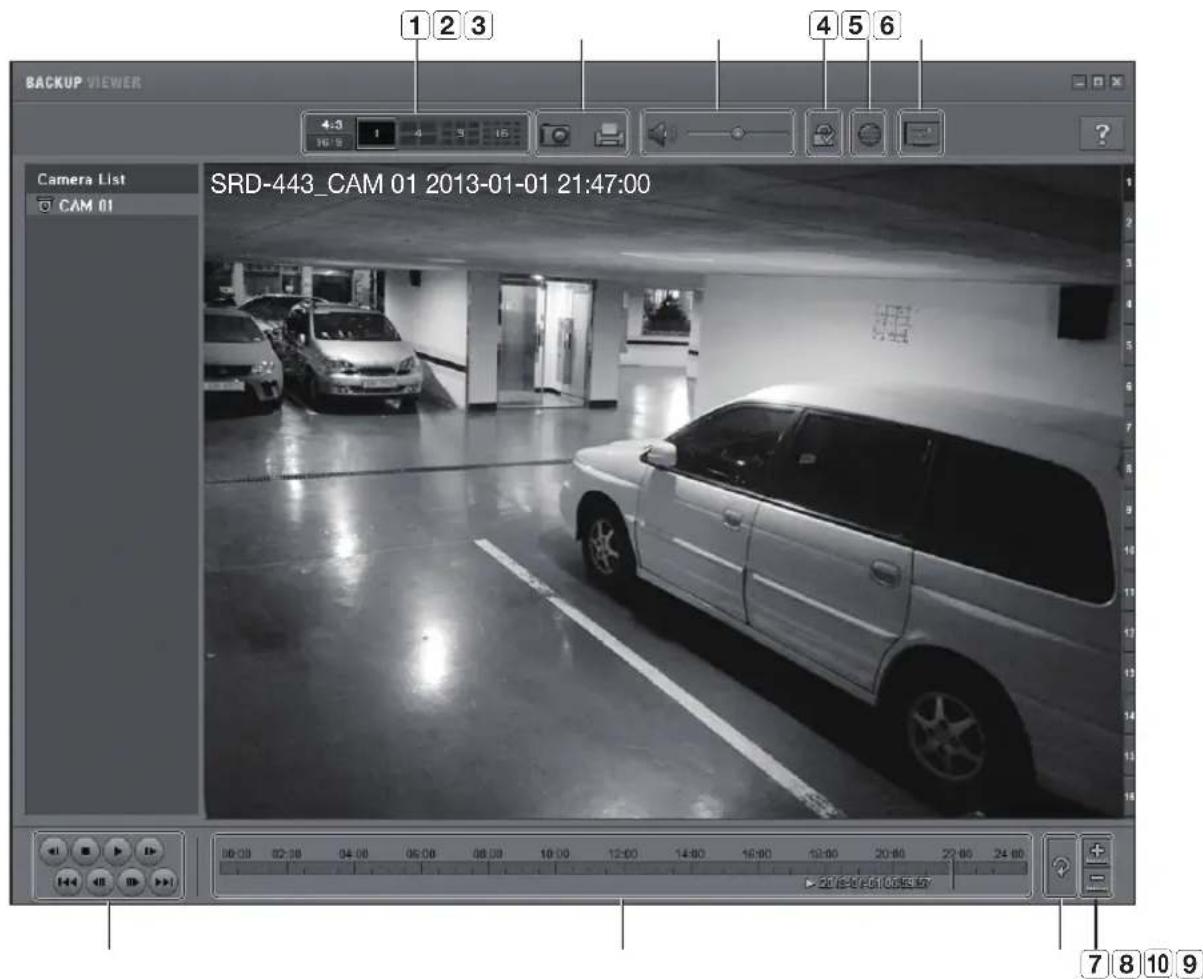
text_image
BACKUP VIEWER Camera List CAM 01 SRD-443_CAM 01 2013-01-01 21:47:00 7 8 10 9Recommended System Requirements
PCs with a lower specification than the recommended below may not fully support forward/backward and high-speed playback.
• OS : Windows XP professional, Windows Vista, Windows 7
• CPU : Intel i5 2.8GHz or faster
• RAM : DDR PC-3200 1G or more
• VGA : Geforce 6200 or higher
| Part Names Functions | |||
| 1 | Split Screen |  | Set the screen's aspect ratio to be displayed. |
 | The screen switches to the selected split screen mode. Split screen function is not supported during the CD/DVD backup. | ||
| 2 | Screen Printout |  | Saves the current video's image as in an image file. Supports jpeg file format. |
 | Prints out the current screen. You should have installed the appropriate printer driver before you can print out the screen. | ||
| 3 | Audio |  | A toggle button. Each time you press this button, the audio output will toggle between activated and deactivated. |
 | You can adjust the volume level from 0 to 100. | ||
| 4 | Watermark | [Y2HY] | Press the button to enable file tampering detection, to detect data file forging. |
| 5 | Deinterlace You can enable the De-interlace function. | ||
| 6 | Show OSD | Check the OSD checkbox to display the OSD information on the backup playback screen.Information such as backup date, day of the week, time, model name, and channel number will be displayed on the screen. | |
| 7 | Enlarge / Reduce Timeline | Collapses the time range that is displayed on the range bar of the storage time. You can collapse the range bar until the overall range is shortened to 24 hours. | |
| Enlarges the time range that is displayed on the range bar of the storage time. You can enlarge the range bar until the overall range is extended to 1 minute. | |||
| 8 | Restore Timeline Restores the timeline to the default. | ||
| 9 | Display of storage time range | Displays the time range of a stored video file.You can move the gridline of the range bar to select a time point to play. | |
| 10 | Playback Control You can adjust the video playback of the timeline. | ||

If it has a high recording rate and is played at high speed playback of 16x or higher speed in the backup viewer, actual playback speed may not reach the set playback speed.
Product SPecIFlcAtlon
| Item Details | ||
| Video | Inputs 4 composite video 0.5-1 Vpp, 75 ohm | |
| Resolution 720x480 NTSC, 720x576 PAL | ||
| Live | Frame rate 120fps NTSC, 100fps PAL | |
| Resolution 720x480 NTSC, 720x576 PAL | ||
| Multi Screen display 1, 4, SEQUENCE, PIP | ||
| Performance | ||
| Operating System Embedded Linux | ||
| Recording | Compression H.264 | |
| Record Rate | NTSC: Up to 30fps @ 704x480 / PAL: Up to 25fps @ 704x576: 4CIF(L) | |
| NTSC: Up to 60fps @ 704x240 / PAL: Up to 50fps @ 704x288: 2CIF(M) | ||
| NTSC: Up to 120fps @ 352x240 / PAL: Up to 100fps @ 352x288: CIF(S) | ||
| Mode | NTSC: Manual, Schedule (Continuous/Event), Event (Pre/Post) | |
| PAL: Manual, Schedule (Continuous/Event), Event (Pre/Post) | ||
| Overwrite modes Selectable (Stop/Continuous) | ||
| Pre-Alarm Up to 5sec. | ||
| Post-Alarm Up to 6 hour. (5, 10, 20, 30 sec, 1, 3, 5, 10, 20 min, 1, 2, 3, 4, 5, 6 hour) | ||
| Search & Playback | Search mode | Date/time, Event, Back up, Motion |
| Playback function Fast Forward/Backward, Slow Forward/Backward, Step Forward/Backward | ||
| Network | Transmission speed | 100 / 120fps |
| Bandwidth | Up to (4)Mbps, Unlimited(4M)/2/1.5/1 Mbps/800/600/500/400/300/200/100/50 kbps | |
| Bandwidth control | Automatic | |
| Stream H.264(CIF) | ||
| Maximum No. of remote users | Search(2) / Live Unicast(4) / Live Multicast(20) | |
| Protocol support | TCP/IP, DHCP, PPPoE, SMTP, NTP, HTTP, DDNS, RTP, RTSP | |
| Monitoring Webviewer, CMS(Smart viewer) | ||
| Smartphone | Smartphone | Support |
| Protocol support | RTP, RTSP, HTTP, CGI | |
| Remote users Maximum | Live(1) | |
| Storage | Internal HDD Up to 1 SATA | HDD |
| External HDD - | ||
| DVD Writer (Back-up) - | ||
| USB (Back-up) 2 USB Ports | ||
| File Forma (Back-up) BU(DVR Player), EXE(Include Player), AVI | ||
| Security | Password Protection 1 Admin, 10 Group, 10 User per 1 Group | |
| Data Authentication Watermark | ||
| Interface | ||
| Monitors | VGA | Analog RGB 1024x768 resolution(Main Composite or VGA selected in booting.) |
| HDMI - | ||
| Main Composite BNC, 1 Vp-p, 75 ohm | ||
| Spot Composite - | ||
| Loop Outputs - | ||
| Audio | Inputs/Output 4 Line in / 1 | line out |
| Compression G.711 | ||
| Sampling rate 8KHz | ||
| Alarm | Inputs/Outputs | Terminal 4 inputs (NO/NC) / Terminal 1 relay outputs (NO/NC), Rating: 24V DC 1A, 125VAC/0.5A |
| Remote notification Notification via e-mail | ||
| Connections | Ethernet | 1 RJ45 10/100 Base-T |
| Serial interface | RS-485 for PTZ, System Keyboard | |
| USB | USB 2.0, 2 ports (Rear) | |
| e-SATA | - | |
| Application Supoort Mouse | Remote Controller | |
| Protocol support | Samsung-E/Samsung-T/Pelco-D/ Pelco-P/Panasonic/Phillips/AD/DIAMOND/ ERNA/KALATEL/VCL TP/VICON/ELMO | |
| General | ||
| Electrical | Input Voltage/Current | DC12V, 2A, AC 100~240V, 50~60Hz |
| Power consumption Max. | 19.6W (with 1x HDD) | |
| Environmental | Operating Temperature/ Humidity | 0°C ~ +40°C (+32°F ~ +104°F) / 20% ~ 85%RH |
| Mechanical | Dimension (W x H x D) H (leg not included) | W315 x H52 x D223.5mm (12.4 x 2.05 x 8.8 inch) |
| Weight (With hard disks) | 1.53kg | |
| Rack mount kit | - | |
| Lauguage | English, French, German, Spanish, Italian, Chinese(Simplified), Russian, Korean, Polish, Japanese, Dutch, Portuguese, Turkish, Czech, Danish, Swedish, Thai, Romanian, Serbian, Croatian, Hungarian, Greek, Chinese (Traditional), Finnish and Norwegian | |
Product oVerVleW
unit : mm (inches)

text_image
Front panel diagram of a rack-mounted industrial control unit with labeled components and status indicators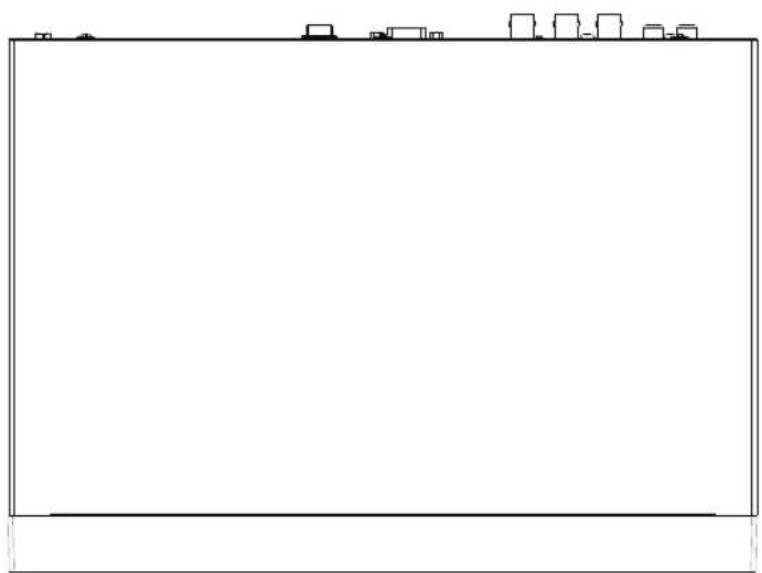
natural_image
Empty rectangular frame with small rectangular blocks and a horizontal line at the top (no text or symbols)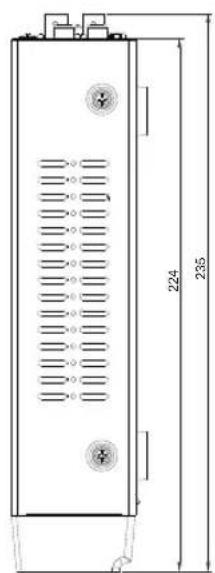
text_image
224 235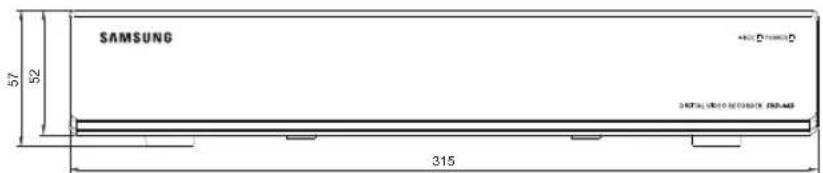
text_image
SAMSUNG +80 D 315 57 52 315 DIGITAL VOLTAGE SWITCH (VOL-40)deFAult Setting
This returns the factory default settings.
The settings are made as follows;
• Use System/Load Factory Default in MENU
The default administrator ID is "admin", and the password must be set when the user log in at the first time.
To prevent from your personal information being exposed, please change your password every 3 months. Note that the security and other related issues caused by careless management of password shall be in the charge of the user.
| Category Details Factory Default | ||||
| System Settings | Date/Time/Language Date/Time/Language | Date YYYY-MM-DD | ||
| Time Format 24 hours | ||||
| Time Zone GMT | ||||
| Time Synchronize OFF | ||||
| DST OFF | ||||
| Language English | ||||
| Permission Management | Admin ID admin | |||
| Setting | Restricted Access | Backup/Record Lock/ Search/PTZ/Remote Alarm Out/Shutdown | ||
| Auto Logout | OFF | |||
| System Management | System Information | Broadcast Format | NTSC/PAL | |
| Device | Camera | Camera | Video | ON |
| Audio | OFF | |||
| CH Name | CAM 01 ~ CAM 04 | |||
| SEQ-Dwell Time | 5sec | |||
| PTZ | ID | Camera No. | ||
| Protocol | None | |||
| Screen Setup | Brightness | 50 | ||
| Contrast 50 | ||||
| Color | 50 | |||
| Storage Device | HDD Alarm | Check Alarm Output Port | OFF | |
| Duration | OFF | |||
| Replace Alarm Output Port | OFF | |||
| Duration | OFF | |||
| Device | Remote Device | Baudrate 9600 | ||
| Parity None | ||||
| Data 8 | ||||
| Stop bit 1 | ||||
| Transfer Type Half Duplex | ||||
| System Keyboard OFF | ||||
| Remote Control ON(00) | ||||
| Monitor | Monitor | Event Display OFF | ||
| Display All | ||||
| Video Output Auto | ||||
| Display Position Setup 30 | ||||
| Spot Out | Spot Out 1 CH1 ~ CH4 | |||
| Event Display OFF | ||||
| Mode | Live Mode ALL | |||
| Play Mode ALL | ||||
| Recording | Recording Schedule | CH1 ~ CH4 | Both(Cont&Evnt) | |
| Event Record Duration | PRE Event | OFF | ||
| POST Event | 1 min | |||
| REC Quality/Resolution | Normal Recording | Resolution | CIF(S) | |
| Frame Rate | 7 fps | |||
| Record Quality | Level 4 | |||
| Event | Resolution 4CIF(L) | |||
| Frame Rate | 7 fps | |||
| Record Quality | Level 4 | |||
| Record Option | Disk End Mode | Setup | Overwrite | |
| Disk End Beep | OFF | |||
| Auto Delete | OFF | |||
| Event | Sensor Detection | Sensor Operation OFF | ||
| Camera Camera | No. | |||
| Alarm None | ||||
| Duration 10 sec | ||||
| Motion Detection | Mode OFF | |||
| Sensitivity Level10(high) | ||||
| Alarm None | ||||
| Duration 10 sec | ||||
| Motion Region All Area | ||||
| Video Loss Detection | Video Loss State OFF | |||
| Alarm None | ||||
| Duration 10 sec | ||||
| Alarm Schedule | Alarm1 Event Sync | |||
| Network | Connection Mode | Connection | Connection Mode Static | P |
| Bandwidth 2Mbps | ||||
| IP 192.168.1.200 | ||||
| Gateway 192.168.1.1 | ||||
| Subnet Mask 255.255.255.0 | ||||
| DNS 168.126.63.1 | ||||
| Protocol | Protocol Type TCP | |||
| Port (TCP) | 4520~4524 | |||
| Webviewer Port | 80 | |||
| DDNS | DDNS Site | OFF | ||
| Live Transfer | Resolution | CIF(S) | ||
| Quality | Low | |||
| Mailing Service | SMTP | Server | OFF | |
| Port | 25 | |||
| Use Authentication | OFF | |||
| Secure Transfer Never | ||||
| Event | Event Interval | 10 min | ||
| Use Event Transfer | OFF | |||
| Group | Group | OFF | ||
| Recipient Permission | OFF | |||
troubleShooting
| Symptom Countermeasures | |
| The system does not turn on and the indicator on the front panel does not work at all. | Check if the power supply system is properly connected.Check the system for the input voltage from the power source.If the problem persists even after you have taken the above actions, check the power supplier and replace it with a new one if necessary. |
| Some channels display just a black screen even if they receive video sources. | Check if the camera connected to the system properly displays the image. Sometimes, this problem may occur on a camera that is not properly connected to the video source.Check if the camera is properly supplied with power.Sometimes, this problem may occur on a channel with weak video signal from a video distributor that is connected to multiple systems. In this case, input the video source of the camera directly into the DVR. This may find the cause and solve the problem. |
| If I press the [REC] button on the remote control, the REC indicator does not flash, nor the player start recording. | Check if there is a free space on the HDD for the recording.Check if the record mode is set to ON in the record mode setting. |
| The screen displays the logo image repeatedly. | This may occur from a problem with the main board, or the related software is corrupt.Contact the nearest service center for more information. |
| The Channel button does not work on the Live screen. | The Channel button does not work if the current screen is in the event monitoring mode.In the event monitoring screen, press the [ALARM] button to exit the screen and select a channel. |
| The cursor will not move to the Start button when I start the calendar search. | Check if the channel and the date that you want to play are marked with the V symbol.Both channel and date should be checked before you can start playing with the Start button. |
| When the alarm sounds, I press the [ALARM] button to release the alarm but it does not work. | Press the [MENU] button to release the alarm in the following way:1) To release the event monitoring mode : Monitoring Mode - set the duration of the event monitoring to Off.2) To release the alarm sound : Event Record Mode - Alarm (Motion Detection/Video Loss) - deactivate the alarm sound.3) To release the event : Event Record Mode - Alarm (Motion Detection/Video Loss) - set the mode to Off. |
| No response is made even if I press the [PTZ] button on the Live screen. | Menu → Camera→ Check if the current protocols and other settings in the PTZ device are properly configured according to the PTZ camera. |
| I've found that the DVR does not recognize as many disks as installed when I have connected multiple external HDDs to the DVR. | It takes time for the DVR to recognize multiple external HDDs. Try again in a moment and if the problem (of failure to recognize as many HDDs as connected) persists, it may occur due to a mechanical error of the HDD installed. Try again with a different HDD. |
| A message of “Need to reset date/time.” Is displayed on the screen. | This message is displayed if there occurs a problem with the time setting of the internal clock or an error in the clock itself. Contact the retailer or the service center for more information. |
| The time bar is not displayed in Search mode. | The timeline can switch between normal and extension mode. In extension mode, the time bar may not be displayed in the current timeline. Switch to normal mode or use the left or right button to navigate through the time bar. |
| The “NO HDD” icon and an error message are displayed. | Check the HDD for connection. If the problem persists in a normal condition, contact the nearest service center to have the HDD checked by the service personnel. |
| I have connected an external storage device (external SATA HDD) to the DVR but the DVR seems not to recognize it. | See the compatibility list of external storage devices to check if the connected device is supported by the DVR. For the compatibility list, contact the retailer where you purchased the DVR. |
| If I press the ESC key in full screen mode of the WebViewer, the system does not switch to a normal split mode. | Press the ALT+TAB keys to select ‘ACTIVE MOVIE’ and press the ESC key again. The system will switch to a normal split mode. |
| I found it difficult to configure the network settings if using the default search, backup and router settings. | For more information, refer to the user manual.If you want to check the basics of the product for a quick start, refer to the quick start guide (backup, search). |
| I forgot the password. | Contact the DVR administrator for help. |
| Backup data is just not played by the PC or DVR. | When you are backing up data, you have choices about the player either: PC or DVR. Make your selection before proceeding.If you are using the PC to play the data, the format of the backup file should be either AVI or SEC.If you are using the DVR for this purpose, formatting backup files should be done by the DVR. |
| My player does not switch to Live mode while in playback. | Press the Stop [■] button on the remote control, or click the [■] icon on the launcher to switch to Live mode. |
| Recording does not work. | ·If your player does not display a Live image at all, that indicates recording does not work so first check if you see an image on the screen.·Recording does not work if the recording settings are not properly configured.1) Manual Record: Press the [REC] button on the remote control to start recording.2) Scheduled Record: Specify a desired time in Menu - Record - Recording Schedule. Recording will start at the specified time.-Record: Recording will proceed in any conditions at the specified time.-Record: When an event occurs, recording will perform only if the event is of alarm, motion detection and video loss. If there is no event found, recording will not perform.-Record: If there is no event found, Continuous recording will perform. Whereas, if an event occurs, Event recording will perform. |
| The image quality of the recording data is not good. | ·Increase the resolution and quality level in Menu - Record - Quality / Resolution.1) Resolution: Select a bigger size when specifying the recording size. (4CIF> 2CIF>CIF)The recording image in the CIF format shows a deteriorated quality as it is enlarged from a small-sized image.2) Record Quality: Specify a bigger level for the recording quality.·If you increase the resolution and the recording quality, the data size increases accordingly. So the HDD will be filled faster. Overwriting will overwrite the existing data so recording will proceed at a shorter interval. |
The software included in this product contains copyrighted software that is licensed under the GPL/LGPL. You may obtain the complete Corresponding Source code from us for a period of three years after our last shipment of this product by sending email to help.cctv@samsung.com If you want to obtain the complete Corresponding Source code in the physical medium such as CD-ROM, the cost of physically performing source distribution might be charged.
- GPL Software : linux kernel, Sysvinit, dosfstools, wget, msmtp, busybox, cdrtools, dvd+rw-tools, iconv, smartctl, uboot, minicom, openssl, bash, lm_sensors
• LGPL Software : glibc, vmstat, inetutils
- OpenSSL License : OpenSSL
GNU GENERAL PUBLIC LICENSE
Version 2, June 1991
Copyright (C) 1989, 1991 Free Software Foundation, Inc.
51 Franklin Street, Fifth Floor, Boston, MA 02110-1301, USA
Everyone is permitted to copy and distribute verbatim copies of this license document, but changing it is not allowed.
Preamble
The licenses for most software are designed to take away your freedom to share and change it. By contrast, the GNU General Public License is intended to guarantee your freedom to share and change free software to make sure the software is free for all its users. This General Public License applies to most of the Free Software Foundation's software and to any other program whose authors commit to using it. (Some other Free Software Foundation software is covered by the GNU Lesser General Public License instead.) You can apply it to your programs, too.
When we speak of free software, we are referring to freedom, not price. Our General Public Licenses are designed to make sure that you have the freedom to distribute copies of free software (and charge for this service if you wish), that you receive source code or can get it if you want it, that you can change the software or use pieces of it in new free programs; and that you know you can do these things.
To protect your rights, we need to make restrictions that forbid anyone to deny you these rights or to ask you to surrender the rights. These restrictions translate to certain responsibilities for you if you distribute copies of the software, or if you modify it.
For example, if you distribute copies of such a program, whether gratis or for a fee, you must give the recipients all the rights that you have. You must make sure that they, too, receive or can get the source code. And you must show them these terms so they know their rights.
We protect your rights with two steps:
(1) copyright the software, and (2) offer you this license which gives you legal permission to copy, distribute and/or modify the software.
Also, for each author's protection and ours, we want to make certain that everyone understands that there is no warranty for this free software. If the software is modified by someone else and passed on, we want its recipients to know that what they have is not the original, so that any problems introduced by others will not reflect on the original authors' reputations.
Finally, any free program is threatened constantly by software patents. We wish to avoid the danger that redistributors of a free program will individually obtain patent licenses, in effect making the program proprietary. To prevent this, we have made it clear that any patent must be licensed for everyone's free use or not licensed at all. The precise terms and conditions for copying, distribution and modification follow.
terMS And conditionS For coPYIng, dIStributlon And ModIFlcAtlon
Version 2, June 1991
Copyright (C) 1989, 1991 Free Software Foundation, Inc. 51 Franklin S
- This License applies to any program or other work which contains a notice placed by the copyright holder saying it may be distributed under the terms of this General Public License. The "Program", below, refers to any such program or work, and a "work based on the Program" means either the Program or any derivative work under copyright law: that is to say, a work containing the Program or a portion of it, either verbatim or with modifications and/or translated into another language. (Hereinafter, translation is included without limitation in the term "modification".) Each licensee is addressed as "you".
Activities other than copying, distribution and modification are not covered by this License; they are outside its scope. The act of running the Program is not restricted, and the output from the Program is covered only if its contents constitute a work based on the Program
(independent of having been made by running the Program). Whether that is true depends on what the Program does.
- You may copy and distribute verbatim copies of the Program's source code as you receive it, in any medium, provided that you conspicuously and appropriately publish on each copy an appropriate copyright notice and disclaimer of warranty; keep intact all the notices that refer to this License and to the absence of any warranty; and give any other recipients of the Program a copy of this License along with the Program.
You may charge a fee for the physical act of transferring a copy, and you may at your option offer warranty protection in exchange for a fee.
- You may modify your copy or copies of the Program or any portion of it, thus forming a work based on the Program, and copy and distribute such modifications or work under the terms of Section 1 above, provided that you also meet all of these conditions:
a) You must cause the modified files to carry prominent notices stating that you changed the files and the date of any change.
b) You must cause any work that you distribute or publish, that in whole or in part contains or is derived from the Program or any part thereof, to be licensed as a whole at no charge to all third parties under the terms of this License.
c) If the modified program normally reads commands interactively when run, you must cause it, when started running for such interactive use in the most ordinary way, to print or display an announcement including an appropriate copyright notice and a notice that there is no warranty (or else, saying that you provide a warranty) and that users may redistribute the program under these conditions, and telling the user how to view a copy of this License. (Exception: if the Program itself is interactive but does not normally print such an announcement, your work based on the Program is not required to print an announcement.)
These requirements apply to the modified work as a whole. If identifiable sections of that work are not derived from the Program, and can be reasonably considered independent and separate works in themselves, then this License, and its terms, do not apply to those sections when you distribute them as separate works. But when you distribute the same sections as part of a whole which is a work based on the Program, the distribution of the whole must be on the terms of this License, whose permissions for other licensees extend to the entire whole, and thus to each and every part regardless of who wrote it.
Thus, it is not the intent of this section to claim rights or contest your rights to work written entirely by you; rather, the intent is to exercise the right to control the distribution of derivative or collective works based on the Program.
In addition, mere aggregation of another work not based on the Program with the Program (or with a work based on the Program) on a volume of a storage or distribution medium does not bring the other work under the scope of this License.
- You may copy and distribute the Program (or a work based on it, under Section 2) in object code or executable form under the terms of Sections 1 and 2 above provided that you also do one of the following:
a) Accompany it with the complete corresponding machine-readable source code, which must be distributed under the terms of Sections 1 and 2 above on a medium customarily used for software interchange; or,
b) Accompany it with a written offer, valid for at least three years, to give any third party, for a charge no more than your cost of physically performing source distribution, a complete machine-readable copy of the corresponding source code, to be distributed under the terms of Sections 1 and 2 above on a medium customarily used for software interchange; or,
c) Accompany it with the information you received as to the offer to distribute corresponding source code. (This alternative is allowed only for noncommercial distribution and only if you received the program in object code or executable form with such an offer, in accord with Subsection b above.)
The source code for a work means the preferred form of the work for making modifications to it. For an executable work, complete source code means all the source code for all modules it contains, plus any associated interface definition files, plus the scripts used to control
compilation and installation of the executable. However, as a special exception, the source code distributed need not include anything that is normally distributed (in either source or binary form) with the major components (compiler, kernel, and so on) of the operating system on which the executable runs, unless that component itself accompanies the executable.
If distribution of executable or object code is made by offering access to copy from a designated place, then offering equivalent access to copy the source code from the same place counts as distribution of the source code, even though third parties are not compelled to copy the source along with the object code.
-
You may not copy, modify, sublicense, or distribute the Program except as expressly provided under this License. Any attempt otherwise to copy, modify, sublicense or distribute the Program is void, and will automatically terminate your rights under this License. However, parties who have received copies, or rights, from you under this License will not have their licenses terminated so long as such parties remain in full compliance.
-
You are not required to accept this License, since you have not signed it. However, nothing else grants you permission to modify or distribute the Program or its derivative works. These actions are prohibited by law if you do not accept this License. Therefore, by modifying or distributing the Program (or any work based on the Program), you indicate your acceptance of this License to do so, and all its terms and conditions for copying, distributing or modifying the Program or works based on it.
-
Each time you redistribute the Program (or any work based on the Program), the recipient automatically receives a license from the original licensor to copy, distribute or modify the Program subject to these terms and conditions. You may not impose any further restrictions on the recipients' exercise of the rights granted herein. You are not responsible for enforcing compliance by third parties to this License.
-
If, as a consequence of a court judgment or allegation of patent infringement or for any other reason (not limited to patent issues), conditions are imposed on you (whether by court order, agreement or otherwise) that contradict the conditions of this License, they do not excuse you from the conditions of this License. If you cannot distribute so as to satisfy simultaneously your obligations under this License and any other pertinent obligations, then as a consequence you may not distribute the Program at all. For example, if a patent license would not permit royalty-free redistribution of the Program by all those who receive copies directly or indirectly through you, then the only way you could satisfy both it and this License would be to refrain entirely from distribution of the Program.
If any portion of this section is held invalid or unenforceable under any particular circumstance, the balance of the section is intended to apply and the section as a whole is intended to apply in other circumstances. It is not the purpose of this section to induce you to infringe any patents or other property right claims or to contest validity of any such claims; this section has the sole purpose of protecting the integrity of the free software distribution system, which is implemented by public license practices. Many people have made generous contributions to the wide range of software distributed through that system in reliance on consistent application of that system; it is up to the author/donor to decide if he or she is willing to distribute software through any other system and a licensee cannot impose that choice.
This section is intended to make thoroughly clear what is believed to be a consequence of the rest of this License.
-
If the distribution and/or use of the Program is restricted in certain countries either by patents or by copyrighted interfaces, the original copyright holder who places the Program under this License may add an explicit geographical distribution limitation excluding those countries, so that distribution is permitted only in or among countries not thus excluded. In such case, this License incorporates the limitation as if written in the body of this License.
-
The Free Software Foundation may publish revised and/or new versions of the General Public License from time to time. Such new versions will be similar in spirit to the present version, but may differ in detail to address new problems or concerns.
Each version is given a distinguishing version number. If the Program specifies a version number of this License which applies to it and “any later version”, you have the option of following the terms and conditions either of that version or of any later version published by the Free Software Foundation. If the Program does not specify a version number of this License, you may choose any version ever published by the Free Software Foundation.
- If you wish to incorporate parts of the Program into other free programs whose distribution conditions are different, write to the author to ask for permission. For software which is copyrighted by the Free Software Foundation, write to the Free Software Foundation; we sometimes make exceptions for this. Our decision will be guided by the two goals of preserving the free status of all derivatives of our free software and of promoting the sharing and reuse of software generally.
NO WARRANTY
-
BECAUSE THE PROGRAM IS LICENSED FREE OF CHARGE, THERE IS NO WARRANTY FOR THE PROGRAM, TO THE EXTENT PERMITTED BY APPLICABLE LAW. EXCEPT WHEN OTHERWISE STATED IN WRITING THE COPYRIGHT HOLDERS AND/OR OTHER PARTIES PROVIDE THE PROGRAM "AS IS" WITHOUT WARRANTY OF ANY KIND, EITHER EXPRESSED OR IMPLIED, INCLUDING, BUT NOT LIMITED TO, THE IMPLIED WARRANTIES OF MERCHANTABILITY AND FITNESS FOR A PARTICULAR PURPOSE. THE ENTIRE RISK AS TO THE QUALITY AND PERFORMANCE OF THE PROGRAM IS WITH YOU, SHOULD THE PROGRAM PROVE DEFECTIVE, YOU ASSUME THE COST OF ALL NECESSARY SERVICING, REPAIR OR CORRECTION.
-
IN NO EVENT UNLESS REQUIRED BY APPLICABLE LAW OR AGREED TO IN WRITING WILL ANY COPYRIGHT HOLDER, OR ANY OTHER PARTY WHO MAY MODIFY AND/OR REDISTRIBUTE THE PROGRAM AS PERMITTED ABOVE, BE LIABLE TO YOU FOR DAMAGES, INCLUDING ANY GENERAL, SPECIAL, INCIDENTAL OR CONSEQUENTIAL DAMAGES ARISING OUT OF THE USE OR INABILITY TO USE THE PROGRAM (INCLUDING BUT NOT LIMITED TO LOSS OF DATA OR DATA BEING RENDERED INACCURATE OR LOSSES SUSTAINED BY YOU OR THIRD PARTIES OR A FAILURE OF THE PROGRAM TO OPERATE WITH ANY OTHER PROGRAMS), EVEN IF SUCH HOLDER OR OTHER PARTY HAS BEEN ADVISED OF THE POSSIBILITY OF SUCH DAMAGES.
END OF TERMS AND CONDITIONS
How to Apply These Terms to Your New Programs
If you develop a new program, and you want it to be of the greatest possible use to the public, the best way to achieve this is to make it free software which everyone can redistribute and change under these terms.
To do so, attach the following notices to the program. It is safest to attach them to the start of each source file to most effectively convey the exclusion of warranty; and each file should have at least the "copyright" line and a pointer to where the full notice is found. one line to give the program's name and an idea of what it does.
Copyright (C) yyyy name of author
This program is free software; you can redistribute it and/or modify it under the terms of the GNU General Public License as published by the Free Software Foundation; either version 2 of the License, or (at your option) any later version.
This program is distributed in the hope that it will be useful, but WITHOUT ANY WARRANTY; without even the implied warranty of MERCHANTABILITY or FITNESS FOR A PARTICULAR PURPOSE. See the GNU General Public License for more details.
You should have received a copy of the GNU General Public License along with this program; if not, write to the Free Software Foundation, Inc., 51 Franklin Street, Fifth Floor, Boston, MA 02110-1301, USA.
Also add information on how to contact you by electronic and paper mail. If the program is interactive, make it output a short notice like this when it starts in an interactive mode:
Gnomovision version 69, Copyright (C) year name of author Gnomovision comes with ABSOLUTELY NO WARRANTY; for details type 'show w'. This is free software, and you are welcome to redistribute it under certain conditions; type 'show c' for details.
The hypothetical commands 'show w' and 'show c' should show the appropriate parts of the General Public License. Of course, the commands you use may be called something other than 'show w' and 'show c'; they could even be mouse-clicks or menu items--whatever suits your program.
You should also get your employer (if you work as a programmer) or your school, if any, to sign a "copyright disclaimer" for the program, if necessary. Here is a sample; alter the names:
Yoyodyne, Inc., hereby disclaims all copyright interest in the program 'Gnomovision' (which makes passes at compilers) written by James Hacker.
signature of Ty Coon, 1 April 1989 Ty Coon, President of Vice This General Public License does not permit incorporating your program into proprietary programs. If your program is a subroutine library, you may consider it more useful to permit linking proprietary applications with the library. If this is what you want to do, use the GNU Lesser General Public License instead of this License.
GNU GENERAL PUBLIC LICENSE
Version 3, 29 June 2007
Copyright © 2007 Free Software Foundation, Inc. http://fsf.org/ Everyone is permitted to copy and distribute verbatim copies of this license document, but changing it is not allowed.
Preamble
The GNU General Public License is a free, copyleft license for software and other kinds of works.
The licenses for most software and other practical works are designed to take away your freedom to share and change the works. By contrast, the GNU General Public License is intended to guarantee your freedom to share and change all versions of a program--to make sure it remains free software for all its users. We, the Free Software Foundation, use the GNU General Public License for most of our software; it applies also to any other work released this way by its authors. You can apply it to your programs, too.
When we speak of free software, we are referring to freedom, not price. Our General Public Licenses are designed to make sure that you have the freedom to distribute copies of free software (and charge for them if you wish), that you receive source code or can get it if you want it, that you can change the software or use pieces of it in new free programs, and that you know you can do these things.
To protect your rights, we need to prevent others from denying you these rights or asking you to surrender the rights. Therefore, you have certain responsibilities if you distribute copies of the software, or if you modify it: responsibilities to respect the freedom of others.
For example, if you distribute copies of such a program, whether gratis or for a fee, you must pass on to the recipients the same freedoms that you received. You must make sure that they, too, receive or can get the source code. And you must show them these terms so they know their rights.
Developers that use the GNU GPL protect your rights with two steps: (1) assert copyright on the software, and (2) offer you this License giving you legal permission to copy, distribute and/or modify it.
For the developers' and authors' protection, the GPL clearly explains that there is no warranty for this free software. For both users' and authors' sake, the GPL requires that modified versions be marked as changed, so that their problems will not be attributed erroneously to authors of previous versions.
Some devices are designed to deny users access to install or run modified versions of the software inside them, although the manufacturer can do so. This is fundamentally incompatible with the aim of protecting users' freedom to change the software. The systematic pattern of such abuse occurs in the area of products for individuals to use, which is precisely where it is most unacceptable. Therefore, we have designed this version of the GPL to prohibit the practice for those products. If such problems arise substantially in other domains, we stand ready to extend this provision to those domains in future versions of the GPL, as needed to protect the freedom of users.
Finally, every program is threatened constantly by software patents. States should not allow patents to restrict development and use of software on general-purpose computers, but in those that do, we wish to avoid the special danger that patents applied to a free program could make it effectively proprietary. To prevent this, the GPL assures that patents cannot be used to render the program non-free.
The precise terms and conditions for copying, distribution and modification follow.
TERMS AND CONDITIONS
0. Definitions.
"This License" refers to version 3 of the GNU General Public License.
"Copyright" also means copyright-like laws that apply to other kinds of works, such as semiconductor masks.
"The Program" refers to any copyrightable work licensed under this License. Each licensee is addressed as "you". "Licensees" and "recipients" may be individuals or organizations.
To “modify” a work means to copy from or adapt all or part of the work in a fashion requiring copyright permission, other than the making of an exact copy. The resulting work is called a “modified version” of the earlier work or a work “based on” the earlier work.
A “covered work” means either the unmodified Program or a work based on the Program.
To “propagate” a work means to do anything with it that, without permission, would make you directly or secondarily liable for infringement under applicable copyright law, except executing it on a computer or modifying a private copy. Propagation includes copying, distribution (with or without modification), making available to the public, and in some countries other activities as well.
To “convey” a work means any kind of propagation that enables other parties to make or receive copies. Mere interaction with a user through a computer network, with no transfer of a copy, is not conveying.
An interactive user interface displays “Appropriate Legal Notices” to the extent that it includes a convenient and prominently visible feature that (1) displays an appropriate copyright notice, and (2) tells the user that there is no warranty for the work (except to the extent that warranties are provided), that licensees may convey the work under this License, and how to view a copy of this License. If the interface presents a list of user commands or options, such as a menu, a prominent item in the list meets this criterion.
1. Source Code.
The “source code” for a work means the preferred form of the work for making modifications to it. “Object code” means any non-source form of a work.
A “Standard Interface” means an interface that either is an official standard defined by a recognized standards body, or, in the case of interfaces specified for a particular programming language, one that is widely used among developers working in that language.
The "System Libraries" of an executable work include anything, other than the work as a whole, that (a) is included in the normal form of packaging a Major Component, but which is not part of that Major Component, and (b) serves only to enable use of the work with that Major Component, or to implement a Standard Interface for which an implementation is available to the public in source code form. A "Major Component", in this context, means a major essential component (kemel, window system, and so on) of the specific operating system (if any) on which the executable work runs, or a compiler used to produce the work, or an object code interpreter used to run it.
The “Corresponding Source” for a work in object code form means all the source code needed to generate, install, and (for an executable work) run the object code and to modify the work, including scripts to control those activities. However, it does not include the work’s System Libraries, or general-purpose tools or generally available free programs which are used unmodified in performing those activities but which are not part of the work. For example, Corresponding Source includes interface definition files associated with source files for the work, and the source code for shared libraries and dynamically linked subprograms that the work is specifically designed to require, such as by intimate data communication or control flow between those subprograms and other parts of the work.
The Corresponding Source need not include anything that users can regenerate automatically from other parts of the Corresponding Source.
The Corresponding Source for a work in source code form is that same work.
2. Basic Permissions.
All rights granted under this License are granted for the term of copyright on the Program, and are irrevocable provided the stated conditions are met. This License explicitly affirms your unlimited permission to run the unmodified Program. The output from running a covered work is covered by this License only if the output, given its content, constitutes a covered work. This License acknowledges your rights of fair use or other equivalent, as provided by copyright law.
You may make, run and propagate covered works that you do not convey, without conditions so long as your license otherwise remains in force. You may convey covered works to others for the sole purpose of having them make modifications exclusively for you, or provide you with facilities for running those works, provided that you comply with the terms of this License in conveying all material for which you do not control copyright. Those thus making or running the covered works for you must do so exclusively on your behalf, under your direction and control, on terms that prohibit them from making any copies of your copyrighted material outside their relationship with you.
Conveying under any other circumstances is permitted solely under the conditions stated below. Sublicensing is not allowed; section 10 makes it unnecessary.
3. Protecting Users' Legal Rights From Anti-Circumvention Law.
No covered work shall be deemed part of an effective technological measure under any applicable law fulfilling obligations under article 11 of the WIPO copyright treaty adopted on 20 December 1996, or similar laws prohibiting or restricting circumvention of such measures.
When you convey a covered work, you waive any legal power to forbid circumvention of technological measures to the extent such circumvention is effected by exercising rights under this License with respect to the covered work, and you disclaim any intention to limit operation or modification of the work as a means of enforcing, against the work's users, your or third parties' legal rights to forbid circumvention of technological measures.
4. Conveying Verbatim Copies.
You may convey verbatim copies of the Program's source code as you receive it, in any medium, provided that you conspicuously and appropriately publish on each copy an appropriate copyright notice; keep intact all notices stating that this License and any non-permissive terms added in accord with section 7 apply to the code; keep intact all notices of the absence of any warranty; and give all recipients a copy of this License along with the Program.
You may charge any price or no price for each copy that you convey, and you may offer support or warranty protection for a fee.
5. Conveying Modified Source Versions.
You may convey a work based on the Program, or the modifications to produce it from the Program, in the form of source code under the terms of section 4, provided that you also meet all of these conditions:
a) The work must carry prominent notices stating that you modified it, and giving a relevant date.
b) The work must carry prominent notices stating that it is released under this License and any conditions added under section 7. This requirement modifies the requirement in section 4 to "keep intact all notices".
c) You must license the entire work, as a whole, under this License to anyone who comes into possession of a copy. This License will therefore apply, along with any applicable section 7 additional terms, to the whole of the work, and all its parts, regardless of how they are packaged. This License gives no permission to license the work in any other way, but it does not invalidate such permission if you have separately received it.
d) If the work has interactive user interfaces, each must display Appropriate Legal Notices; however, if the Program has interactive interfaces that do not display Appropriate Legal Notices, your work need not make them do so.
A compilation of a covered work with other separate and independent works, which are not by their nature extensions of the covered work, and which are not combined with it such as to form a larger program, in or on a volume of a storage or distribution medium, is called an "aggregate" if the compilation and its resulting copyright are not used to limit the access or legal rights of the compilation's users beyond what the individual works permit. Inclusion of a covered work in an aggregate does not cause this License to apply to the other parts of the aggregate.
6. Conveying Non-Source Forms.
You may convey a covered work in object code form under the terms of sections 4 and 5, provided that you also convey the machine-readable Corresponding Source under the terms of this License, in one of these ways:
a) Convey the object code in, or embodied in, a physical product (including a physical distribution medium), accompanied by the Corresponding Source fixed on a durable physical medium customarily used for software interchange.
b) Convey the object code in, or embodied in, a physical product (including a physical distribution medium), accompanied by a written offer, valid for at least three years and valid for as long as you offer spare parts or customer support for that product model, to give anyone who possesses the object code either (1) a copy of the Corresponding Source for all the software in the product that is covered by this License, on a durable physical medium customarily used for software interchange, for a price no more than your reasonable cost of physically performing this conveying of source, or (2) access to copy the Corresponding Source from a network server at no charge.
c) Convey individual copies of the object code with a copy of the written offer to provide the Corresponding Source. This alternative is allowed only occasionally and noncommercially, and only if you received the object code with such an offer, in accord with subsection 6b.
d) Convey the object code by offering access from a designated place (gratis or for a charge), and offer equivalent access to the Corresponding Source in the same way through the same place at no further charge. You need not require recipients to copy the
Corresponding Source along with the object code. If the place to copy the object code is a network server, the Corresponding Source may be on a different server (operated by you or a third party) that supports equivalent copying facilities, provided you maintain clear directions next to the object code saying where to find the Corresponding Source. Regardless of what server hosts the Corresponding Source, you remain obligated to ensure that it is available for as long as needed to satisfy these requirements.
e) Convey the object code using peer-to-peer transmission, provided you inform other peers where the object code and Corresponding Source of the work are being offered to the general public at no charge under subsection 6d.
A separable portion of the object code, whose source code is excluded from the Corresponding Source as a System Library, need not be included in conveying the object code work.
A "User Product" is either (1) a "consumer product", which means any tangible personal property which is normally used for personal, family, or household purposes, or (2) anything designed or sold for incorporation into a dwelling. In determining whether a product is a consumer product, doubtful cases shall be resolved in favor of coverage. For a particular product received by a particular user, "normally used" refers to a typical or common use of that class of product, regardless of the status of the particular user or of the way in which the particular user actually uses, or expects or is expected to use, the product. A product is a consumer product regardless of whether the product has substantial commercial, industrial or non-consumer uses, unless such uses represent the only significant mode of use of the product.
"Installation Information" for a User Product means any methods, procedures, authorization keys, or other information required to install and execute modified versions of a covered work in that User Product from a modified version of its Corresponding Source. The information must suffice to ensure that the continued functioning of the modified object code is in no case prevented or interfered with solely because modification has been made.
If you convey an object code work under this section in, or with, or specifically for use in, a User Product, and the conveying occurs as part of a transaction in which the right of possession and use of the User Product is transferred to the recipient in perpetuity or for a fixed term (regardless of how the transaction is characterized), the Corresponding Source conveyed under this section must be accompanied by the Installation Information. But this requirement does not apply if neither you nor any third party retains the ability to install modified object code on the User Product (for example, the work has been installed in ROM).
The requirement to provide Installation Information does not include a requirement to continue to provide support service, warranty, or updates for a work that has been modified or installed by the recipient, or for the User Product in which it has been modified or installed. Access to a network may be denied when the modification itself materially and adversely affects the operation of the network or violates the rules and protocols for communication across the network.
Corresponding Source conveyed, and Installation Information provided, in accord with this section must be in a format that is publicly documented (and with an implementation available to the public in source code form), and must require no special password or key for unpacking, reading or copying.
7. Additional Terms.
"Additional permissions" are terms that supplement the terms of this License by making exceptions from one or more of its conditions. Additional permissions that are applicable to the entire Program shall be treated as though they were included in this License, to the extent that they are valid under applicable law. If additional permissions apply only to part of the Program, that part may be used separately under those permissions, but the entire Program remains governed by this License without regard to the additional permissions.
When you convey a copy of a covered work, you may at your option remove any additional permissions from that copy, or from any part of it. (Additional permissions may be written to require their own removal in certain cases when you modify the work.) You may place additional permissions on material, added by you to a covered work, for which you have or can give appropriate copyright permission.
Notwithstanding any other provision of this License, for material you add to a covered work, you may (if authorized by the copyright holders of that material) supplement the terms of this License with terms:
a) Disclaiming warranty or limiting liability differently from the terms of sections 15 and 16 of this License; or
b) Requiring preservation of specified reasonable legal notices or author attributions in that material or in the Appropriate Legal Notices displayed by works containing it; or
c) Prohibiting misrepresentation of the origin of that material, or
requiring that modified versions of such material be marked in reasonable ways as different from the original version; or
d) Limiting the use for publicity purposes of names of licensors or authors of the material; or
e) Declining to grant rights under trademark law for use of some trade names, trademarks, or service marks; or
f) Requiring indemnification of licensors and authors of that material by anyone who conveys the material (or modified versions of it) with contractual assumptions of liability to the recipient, for any liability that these contractual assumptions directly impose on those licensors and authors.
All other non-permissive additional terms are considered “further restrictions” within the meaning of section 10. If the Program as you received it, or any part of it, contains a notice stating that it is governed by this License along with a term that is a further restriction, you may remove that term. If a license document contains a further restriction but permits relicensing or conveying under this License, you may add to a covered work material governed by the terms of that license document, provided that the further restriction does not survive such relicensing or conveying.
If you add terms to a covered work in accord with this section, you must place, in the relevant source files, a statement of the additional terms that apply to those files, or a notice indicating where to find the applicable terms.
Additional terms, permissive or non-permissive, may be stated in the form of a separately written license, or stated as exceptions; the above requirements apply either way.
8. Termination.
You may not propagate or modify a covered work except as expressly provided under this License. Any attempt otherwise to propagate or modify it is void, and will automatically terminate your rights under this License (including any patent licenses granted under the third paragraph of section 11).
However, if you cease all violation of this License, then your license from a particular copyright holder is reinstated (a) provisionally, unless and until the copyright holder explicitly and finally terminates your license, and (b) permanently, if the copyright holder fails to notify you of the violation by some reasonable means prior to 60 days after the cessation.
Moreover, your license from a particular copyright holder is reinstated permanently if the copyright holder notifies you of the violation by some reasonable means, this is the first time you have received notice of violation of this License (for any work) from that copyright holder, and you cure the violation prior to 30 days after your receipt of the notice.
Termination of your rights under this section does not terminate the licenses of parties who have received copies or rights from you under this License. If your rights have been terminated and not permanently reinstated, you do not qualify to receive new licenses for the same material under section 10.
9. Acceptance Not Required for Having Copies.
You are not required to accept this License in order to receive or run a copy of the Program. Ancillary propagation of a covered work occurring solely as a consequence of using peer-to-peer transmission to receive a copy likewise does not require acceptance. However, nothing other than this License grants you permission to propagate or modify any covered work. These actions infringe copyright if you do not accept this License. Therefore, by modifying or propagating a covered work, you indicate your acceptance of this License to do so.
10. Automatic Licensing of Downstream Recipients.
Each time you convey a covered work, the recipient automatically receives a license from the original licensors, to run, modify and propagate that work, subject to this License. You are not responsible for enforcing compliance by third parties with this License.
An “entity transaction” is a transaction transferring control of an organization, or substantially all assets of one, or subdividing an organization, or merging organizations. If propagation of a covered work results from an entity transaction, each party to that transaction who receives a copy of the work also receives whatever licenses to the work the party’s predecessor in interest had or could give under the previous paragraph, plus a right to possession of the Corresponding Source of the work from the predecessor in interest, if the predecessor has it or can get it with reasonable efforts.
You may not impose any further restrictions on the exercise of the rights granted or affirmed under this License. For example, you may not impose a license fee, royalty, or other charge for exercise of rights granted under this License, and you may not initiate litigation (including a cross-claim or counterclaim in a lawsuit) alleging that any patent claim is infringed by making, using, selling, offering for sale, or importing the Program or any portion of it.
11. Patents.
A “contributor” is a copyright holder who authorizes use under this License of the Program or a work on which the Program is based. The work thus licensed is called the contributor’s “contributor version”.
A contributor's “essential patent claims” are all patent claims owned or controlled by the contributor, whether already acquired or hereafter acquired, that would be infringed by some manner, permitted by this License, of making, using, or selling its contributor version, but do not include claims that would be infringed only as a consequence of further modification of the contributor version. For purposes of this definition, “control” includes the right to grant patent sublicenses in a manner consistent with the requirements of this License.
Each contributor grants you a non-exclusive, worldwide, royalty-free patent license under the contributor's essential patent claims, to make, use, sell, offer for sale, import and otherwise run, modify and propagate the contents of its contributor version.
In the following three paragraphs, a “patent license” is any express agreement or commitment, however denominated, not to enforce a patent (such as an express permission to practice a patent or covenant not to sue for patent infringement). To “grant” such a patent license to a party means to make such an agreement or commitment not to enforce a patent against the party.
If you convey a covered work, knowingly relying on a patent license, and the Corresponding Source of the work is not available for anyone to copy, free of charge and under the terms of this License, through a publicly available network server or other readily accessible means, then you must either (1) cause the Corresponding Source to be so available, or (2) arrange to deprive yourself of the benefit of the patent license for this particular work, or (3) arrange, in a manner consistent with the requirements of this License, to extend the patent license to downstream recipients. "Knowingly relying" means you have actual knowledge that, but for the patent license, your conveying the covered work in a country, or your recipient's use of the covered work in a country, would infringe one or more identifiable patents in that country that you have reason to believe are valid.
If, pursuant to or in connection with a single transaction or arrangement, you convey, or propagate by procuring conveyance of, a covered work, and grant a patent license to some of the parties receiving the covered work authorizing them to use, propagate, modify or convey a specific copy of the covered work, then the patent license you grant is automatically extended to all recipients of the covered work and works based on it.
A patent license is “discriminatory” if it does not include within the scope of its coverage, prohibits the exercise of, or is conditioned on the non-exercise of one or more of the rights that are specifically granted under this License. You may not convey a covered work if you are a party to an arrangement with a third party that is in the business of distributing software, under which you make payment to the third party based on the extent of your activity of conveying the work, and under which the third party grants, to any of the parties who would receive the covered work from you, a discriminatory patent license (a) in connection with copies of the covered work conveyed by you (or copies made from those copies), or (b) primarily for and in connection with specific products or compilations that contain the covered work, unless you entered into that arrangement, or that patent license was granted, prior to 28 March 2007.
Nothing in this License shall be construed as excluding or limiting any implied license or other defenses to infringement that may otherwise be available to you under applicable patent law.
12. No Surrender of Others' Freedom.
If conditions are imposed on you (whether by court order, agreement or otherwise) that contradict the conditions of this License, they do not excuse you from the conditions of this License. If you cannot convey a covered work so as to satisfy simultaneously your obligations under this License and any other pertinent obligations, then as a consequence you may not convey it at all. For example, if you agree to terms that obligate you to collect a royalty for further conveying from those to whom you convey the Program, the only way you could satisfy both those terms and this License would be to refrain entirely from conveying the Program.
13. Use with the GNU Affero General Public License.
Notwithstanding any other provision of this License, you have permission to link or combine any covered work with a work licensed under version 3 of the GNU Affero General Public License into a single combined work, and to convey the resulting work. The terms of this
License will continue to apply to the part which is the covered work, but the special requirements of the GNU Affero General Public License, section 13, concerning interaction through a network will apply to the combination as such.
14. Revised Versions of this License.
The Free Software Foundation may publish revised and/or new versions of the GNU General Public License from time to time. Such new versions will be similar in spirit to the present version, but may differ in detail to address new problems or concerns.
Each version is given a distinguishing version number. If the Program specifies that a certain numbered version of the GNU General Public License “or any later version” applies to it, you have the option of following the terms and conditions either of that numbered version or of any later version published by the Free Software Foundation. If the Program does not specify a version number of the GNU General Public License, you may choose any version ever published by the Free Software Foundation.
If the Program specifies that a proxy can decide which future versions of the GNU General Public License can be used, that proxy's public statement of acceptance of a version permanently authorizes you to choose that version for the Program.
Later license versions may give you additional or different permissions. However, no additional obligations are imposed on any author or copyright holder as a result of your choosing to follow a later version.
15. Disclaimer of Warranty.
THERE IS NO WARRANTY FOR THE PROGRAM, TO THE EXTENT PERMITTED BY APPLICABLE LAW. EXCEPT WHEN OTHERWISE STATED IN WRITING THE COPYRIGHT HOLDERS AND/OR OTHER PARTIES PROVIDE THE PROGRAM "AS IS" WITHOUT WARRANTY OF ANY KIND, EITHER EXPRESSED OR IMPLIED, INCLUDING, BUT NOT LIMITED TO, THE IMPLIED WARRANTIES OF MERCHANTABILITY AND FITNESS FOR A PARTICULAR PURPOSE. THE ENTIRE RISK AS TO THE QUALITY AND PERFORMANCE OF THE PROGRAM IS WITH YOU. SHOULD THE PROGRAM PROVE DEFECTIVE, YOU ASSUME THE COST OF ALL NECESSARY SERVICING, REPAIR OR CORRECTION.
16. Limitation of Liability.
IN NO EVENT UNLESS REQUIRED BY APPLICABLE LAW OR AGREED TO IN WRITING WILL ANY COPYRIGHT HOLDER, OR ANY OTHER PARTY WHO MODIFIES AND/OR CONVEYS THE PROGRAM AS PERMITTED ABOVE, BE LIABLE TO YOU FOR DAMAGES, INCLUDING ANY GENERAL, SPECIAL, INCIDENTAL OR CONSEQUENTIAL DAMAGES ARISING OUT OF THE USE OR INABILITY TO USE THE PROGRAM (INCLUDING BUT NOT LIMITED TO LOSS OF DATA OR DATA BEING RENDERED INACCURATE OR LOSSES SUSTAINED BY YOU OR THIRD PARTIES OR A FAILURE OF THE PROGRAM TO OPERATE WITH ANY OTHER PROGRAMS), EVEN IF SUCH HOLDER OR OTHER PARTY HAS BEEN ADVISED OF THE POSSIBILITY OF SUCH DAMAGES.
17. Interpretation of Sections 15 and 16.
If the disclaimer of warranty and limitation of liability provided above cannot be given local legal effect according to their terms, reviewing courts shall apply local law that most closely approximates an absolute waiver of all civil liability in connection with the Program, unless a warranty or assumption of liability accompanies a copy of the Program in return for a fee.
END OF TERMS AND CONDITIONS
GNU LESSER GENERAL PUBLIC LICENSE
Version 2.1, February 1999
Copyright (C) 1991, 1999 Free Software Foundation, Inc.
51 Franklin Street, Fifth Floor, Boston, MA 02110-1301 USA
Everyone is permitted to copy and distribute verbatim copies of this license document, but changing it is not allowed.
[This is the first released version of the Lesser GPL. It also counts as the successor of the GNU Library Public License, version 2, hence the version number 2.1.]
Preamble
The licenses for most software are designed to take away your freedom to share and change it. By contrast, the GNU General Public Licenses are intended to guarantee your freedom to share and change free software to make sure the software is free for all its users.
This license, the Lesser General Public License, applies to some
specially designated software packages--typically libraries--of the Free Software Foundation and other authors who decide to use it. You can use it too, but we suggest you first think carefully about whether this license or the ordinary General Public License is the better strategy to use in any particular case, based on the explanations below.
When we speak of free software, we are referring to freedom of use, not price. Our General Public Licenses are designed to make sure that you have the freedom to distribute copies of free software (and charge for this service if you wish); that you receive source code or can get it if you want it; that you can change the software and use pieces of it in new free programs; and that you are informed that you can do these things.
To protect your rights, we need to make restrictions that forbid distributors to deny you these rights or to ask you to surrender these rights. These restrictions translate to certain responsibilities for you if you distribute copies of the library or if you modify it.
For example, if you distribute copies of the library, whether gratis or for a fee, you must give the recipients all the rights that we gave you. You must make sure that they, too, receive or can get the source code. If you link other code with the library, you must provide complete object files to the recipients, so that they can relink them with the library after making changes to the library and recompiling it. And you must show them these terms so they know their rights.
We protect your rights with a two-step method: (1) we copyright the library, and (2) we offer you this license, which gives you legal permission to copy, distribute and/or modify the library.
To protect each distributor, we want to make it very clear that there is no warranty for the free library. Also, if the library is modified by someone else and passed on, the recipients should know that what they have is not the original version, so that the original author's reputation will not be affected by problems that might be introduced by others.
Finally, software patents pose a constant threat to the existence of any free program. We wish to make sure that a company cannot effectively restrict the users of a free program by obtaining a restrictive license from a patent holder. Therefore, we insist that any patent license obtained for a version of the library must be consistent with the full freedom of use specified in this license.
Most GNU software, including some libraries, is covered by the ordinary GNU General Public License. This license, the GNU Lesser General Public License, applies to certain designated libraries, and is quite different from the ordinary General Public License. We use this license for certain libraries in order to permit linking those libraries into non-free programs.
When a program is linked with a library, whether statically or using a shared library, the combination of the two is legally speaking a combined work, a derivative of the original library. The ordinary General Public License therefore permits such linking only if the entire combination fits its criteria of freedom. The Lesser General Public License permits more lax criteria for linking other code with the library.
We call this license the “Lesser” General Public License because it does Less to protect the user’s freedom than the ordinary General Public License. It also provides other free software developers Less of an advantage over competing non-free programs. These disadvantages are the reason we use the ordinary General Public License for many libraries. However, the Lesser license provides advantages in certain special circumstances.
For example, on rare occasions, there may be a special need to encourage the widest possible use of a certain library, so that it becomes a de-facto standard. To achieve this, non-free programs must be allowed to use the library. A more frequent case is that a free library does the same job as widely used non-free libraries. In this case, there is little to gain by limiting the free library to free software only, so we use the Lesser General Public License.
In other cases, permission to use a particular library in non-free programs enables a greater number of people to use a large body of free software. For example, permission to use the GNU C Library in non-free programs enables many more people to use the whole GNU operating system, as well as its variant, the GNU/Linux operating system.
Although the Lesser General Public License is Less protective of the users' freedom, it does ensure that the user of a program that is linked with the Library has the freedom and the wherewithal to run that program using a modified version of the Library.
The precise terms and conditions for copying, distribution and modification follow. Pay close attention to the difference between a "work based on the library" and a "work that uses the library". The former contains code derived from the library, whereas the latter must be combined with the library in order to run.
TERMS AND CONDITIONS FOR COPYING, DISTRIBUTION AND MODIFICATION
- This License Agreement applies to any software library or other program which contains a notice placed by the copyright holder or other authorized party saying it may be distributed under the terms of
this Lesser General Public License (also called "this License"). Each licensee is addressed as "you".
A “library” means a collection of software functions and/or data prepared so as to be conveniently linked with application programs (which use some of those functions and data) to form executables.
The "Library", below, refers to any such software library or work which has been distributed under these terms. A "work based on the Library" means either the Library or any derivative work under copyright law: that is to say, a work containing the Library or a portion of it, either verbatim or with modifications and/or translated straightforwardly into another language. (Hereinafter, translation is included without limitation in the term "modification".)
"Source code" for a work means the preferred form of the work for making modifications to it. For a library, complete source code means all the source code for all modules it contains, plus any associated interface definition files, plus the scripts used to control compilation and installation of the library.
Activities other than copying, distribution and modification are not covered by this License; they are outside its scope. The act of running a program using the Library is not restricted, and output from such a program is covered only if its contents constitute a work based on the Library (independent of the use of the Library in a tool for writing it). Whether that is true depends on what the Library does and what the program that uses the Library does.
-
You may copy and distribute verbatim copies of the Library's complete source code as you receive it, in any medium, provided that you conspicuously and appropriately publish on each copy an appropriate copyright notice and disclaimer of warranty; keep intact all the notices that refer to this License and to the absence of any warranty; and distribute a copy of this License along with the Library. You may charge a fee for the physical act of transferring a copy, and you may at your option offer warranty protection in exchange for a fee.
-
You may modify your copy or copies of the Library or any portion of it, thus forming a work based on the Library, and copy and distribute such modifications or work under the terms of Section 1 above, provided that you also meet all of these conditions:
a) The modified work must itself be a software library.
b) You must cause the files modified to carry prominent notices stating that you changed the files and the date of any change.
c) You must cause the whole of the work to be licensed at no charge to all third parties under the terms of this License.
d) If a facility in the modified Library refers to a function or a table of data to be supplied by an application program that uses the facility, other than as an argument passed when the facility is invoked, then you must make a good faith effort to ensure that, in the event an application does not supply such function or table, the facility still operates, and performs whatever part of its purpose remains meaningful.
(For example, a function in a library to compute square roots has a purpose that is entirely well-defined independent of the application. Therefore, Subsection 2d requires that any application-supplied function or table used by this function must be optional: if the application does not supply it, the square root function must still compute square roots.)
These requirements apply to the modified work as a whole. If identifiable sections of that work are not derived from the Library, and can be reasonably considered independent and separate works in themselves, then this License, and its terms, do not apply to those sections when you distribute them as separate works. But when you distribute the same sections as part of a whole which is a work based on the Library, the distribution of the whole must be on the terms of this License, whose permissions for other licensees extend to the entire whole, and thus to each and every part regardless of who wrote it.
Thus, it is not the intent of this section to claim rights or contest your rights to work written entirely by you; rather, the intent is to exercise the right to control the distribution of derivative or collective works based on the Library.
In addition, mere aggregation of another work not based on the Library with the Library (or with a work based on the Library) on a volume of a storage or distribution medium does not bring the other work under the scope of this License.
- You may opt to apply the terms of the ordinary GNU General Public License instead of this License to a given copy of the Library. To do this, you must alter all the notices that refer to this License, so that they refer to the ordinary GNU General Public License, version 2, instead of to this License. (If a newer version than version 2 of the ordinary GNU General Public License has appeared, then you can specify that version instead if you wish.) Do not make any other change in these notices.
Once this change is made in a given copy, it is irreversible for that copy, so the ordinary GNU General Public License applies to all subsequent copies and derivative works made from that copy.
This option is useful when you wish to copy part of the code of the Library into a program that is not a library.
- You may copy and distribute the Library (or a portion or derivative of it, under Section 2) in object code or executable form under the terms of Sections 1 and 2 above provided that you accompany it with the complete corresponding machine-readable source code, which must be distributed under the terms of Sections 1 and 2 above on a medium customarily used for software interchange.
If distribution of object code is made by offering access to copy from a designated place, then offering equivalent access to copy the source code from the same place satisfies the requirement to distribute the source code, even though third parties are not compelled to copy the source along with the object code.
- A program that contains no derivative of any portion of the Library, but is designed to work with the Library by being compiled or linked with it, is called a "work that uses the Library". Such a work, in isolation, is not a derivative work of the Library, and therefore falls outside the scope of this License.
However, linking a "work that uses the Library" with the Library creates an executable that is a derivative of the Library (because it contains portions of the Library), rather than a "work that uses the library". The executable is therefore covered by this License. Section 6 states terms for distribution of such executables.
When a “work that uses the Library” uses material from a header file that is part of the Library, the object code for the work may be a derivative work of the Library even though the source code is not. Whether this is true is especially significant if the work can be linked without the Library, or if the work is itself a library. The threshold for this to be true is not precisely defined by law.
If such an object file uses only numerical parameters, data structure layouts and accessors, and small macros and small inline functions (ten lines or less in length), then the use of the object file is unrestricted, regardless of whether it is legally a derivative work. (Executables containing this object code plus portions of the Library will still fall under Section 6.)
Otherwise, if the work is a derivative of the Library, you may distribute the object code for the work under the terms of Section 6. Any executables containing that work also fall under Section 6, whether or not they are linked directly with the Library itself.
- As an exception to the Sections above, you may also combine or link a "work that uses the Library" with the Library to produce a work containing portions of the Library, and distribute that work under terms of your choice, provided that the terms permit modification of the work for the customer's own use and reverse engineering for debugging such modifications.
You must give prominent notice with each copy of the work that the Library is used in it and that the Library and its use are covered by this License. You must supply a copy of this License. If the work during execution displays copyright notices, you must include the copyright notice for the Library among them, as well as a reference directing the user to the copy of this License. Also, you must do one of these things:
a) Accompany the work with the complete corresponding machine-readable source code for the Library including whatever changes were used in the work (which must be distributed under Sections 1 and 2 above); and, if the work is an executable linked with the Library, with the complete machine readable "work that uses the Library", as object code and/or source code, so that the user can modify the Library and then relink to produce a modified executable containing the modified Library. (It is understood that the user who changes the contents of definitions files in the Library will not necessarily be able to recompile the application to use the modified definitions.)
b) Use a suitable shared library mechanism for linking with the Library. A suitable mechanism is one that (1) uses at run time a copy of the library already present on the user's computer system, rather than copying library functions into the executable, and (2) will operate properly with a modified version of the library, if the user installs one, as long as the modified version is interface-compatible with the version that the work was made with.
c) Accompany the work with a written offer, valid for at least three years, to give the same user the materials specified in Subsection 6a, above, for a charge no more than the cost of performing this distribution.
d) If distribution of the work is made by offering access to copy from a designated place, offer equivalent access to copy the above specified materials from the same place.
e) Verify that the user has already received a copy of these materials or that you have already sent this user a copy.
For an executable, the required form of the "work that uses the Library" must include any data and utility programs needed for reproducing the executable from it. However, as a special exception, the materials to be distributed need not include anything that is normally distributed (in either source or binary form) with the major components (compiler, kernel, and so on) of the operating system on which the executable runs, unless that component itself accompanies the executable.
It may happen that this requirement contradicts the license restrictions of other proprietary libraries that do not normally accompany the operating system. Such a contradiction means you cannot use both them and the Library together in an executable that you distribute.
- You may place library facilities that are a work based on the Library side-by-side in a single library together with other library facilities not covered by this License, and distribute such a combined library, provided that the separate distribution of the work based on the Library and of the other library facilities is otherwise permitted, and provided that you do these two things:
a) Accompany the combined library with a copy of the same work based on the Library, uncombined with any other library facilities. This must be distributed under the terms of the Sections above.
b) Give prominent notice with the combined library of the fact that part of it is a work based on the Library, and explaining where to find the accompanying uncombined form of the same work.
-
You may not copy, modify, sublicense, link with, or distribute the Library except as expressly provided under this License. Any attempt otherwise to copy, modify, sublicense, link with, or distribute the Library is void, and will automatically terminate your rights under this License. However, parties who have received copies, or rights, from you under this License will not have their licenses terminated so long as such parties remain in full compliance.
-
You are not required to accept this License, since you have not signed it. However, nothing else grants you permission to modify or distribute the Library or its derivative works. These actions are prohibited by law if you do not accept this License. Therefore, by modifying or distributing the Library (or any work based on the Library), you indicate your acceptance of this License to do so, and all its terms and conditions for copying, distributing or modifying the Library or works based on it.
-
Each time you redistribute the Library (or any work based on the Library), the recipient automatically receives a license from the original licensor to copy, distribute, link with or modify the Library subject to these terms and conditions. You may not impose any further restrictions on the recipients' exercise of the rights granted herein. You are not responsible for enforcing compliance by third parties with this License.
-
If, as a consequence of a court judgment or allegation of patent infringement or for any other reason (not limited to patent issues), conditions are imposed on you (whether by court order, agreement or otherwise) that contradict the conditions of this License, they do not excuse you from the conditions of this License. If you cannot distribute so as to satisfy simultaneously your obligations under this License and any other pertinent obligations, then as a consequence you may not distribute the Library at all. For example, if a patent license would not permit royalty free redistribution of the Library by all those who receive copies directly or indirectly through you, then the only way you could satisfy both it and this License would be to refrain entirely from distribution of the Library.
If any portion of this section is held invalid or unenforceable under any particular circumstance, the balance of the section is intended to apply, and the section as a whole is intended to apply in other circumstances.
It is not the purpose of this section to induce you to infringe any patents or other property right claims or to contest validity of any such claims; this section has the sole purpose of protecting the integrity of the free software distribution system which is implemented by public license practices. Many people have made generous contributions to the wide range of software distributed through that system in reliance on consistent application of that system; it is up to the author/donor to decide if he or she is willing to distribute software through any other system and a licensee cannot impose that choice.
This section is intended to make thoroughly clear what is believed to be a consequence of the rest of this License.
-
If the distribution and/or use of the Library is restricted in certain countries either by patents or by copyrighted interfaces, the original copyright holder who places the Library under this License may add an explicit geographical distribution limitation excluding those countries, so that distribution is permitted only in or among countries not thus excluded. In such case, this License incorporates the limitation as if written in the body of this License.
-
The Free Software Foundation may publish revised and/or new versions of the Lesser General Public License from time to time. Such new versions will be similar in spirit to the present version, but may differ in detail to address new problems or concerns.
Each version is given a distinguishing version number. If the Library specifies a version number of this License which applies to it and “any later version”, you have the option of following the terms and conditions either of that version or of any later version published by the Free Software Foundation. If the Library does not specify a license version number, you may choose any version ever published by the Free Software Foundation.
- If you wish to incorporate parts of the Library into other free programs whose distribution conditions are incompatible with these, write to the author to ask for permission. For software which is copyrighted by the Free Software Foundation, write to the Free Software Foundation; we sometimes make exceptions for this. Our decision will be guided by the two goals of preserving the free status of all derivatives of our free software and of promoting the sharing and reuse of software generally.
NO WARRANTY
-
BECAUSE THE LIBRARY IS LICENSED FREE OF CHARGE, THERE IS NO WARRANTY FOR THE LIBRARY, TO THE EXTENT PERMITTED BY APPLICABLE LAW. EXCEPT WHEN OTHERWISE STATED IN WRITING THE COPYRIGHT HOLDERS AND/OR OTHER PARTIES PROVIDE THE LIBRARY "AS IS" WITHOUT WARRANTY OF ANY KIND, EITHER EXPRESSED OR IMPLIED, INCLUDING, BUT NOT LIMITED TO, THE IMPLIED WARRANTIES OF MERCHANTABILITY AND FITNESS FOR A PARTICULAR PURPOSE. THE ENTIRE RISK AS TO THE QUALITY AND PERFORMANCE OF THE LIBRARY IS WITH YOU. SHOULD THE LIBRARY PROVE DEFECTIVE, YOU ASSUME THE COST OF ALL NECESSARY SERVICING, REPAIR OR CORRECTION.
-
IN NO EVENT UNLESS REQUIRED BY APPLICABLE LAW OR AGREED TO IN WRITING WILL ANY COPYRIGHT HOLDER, OR ANY OTHER PARTY WHO MAY MODIFY AND/OR REDISTRIBUTE THE LIBRARY AS PERMITTED ABOVE, BE LIABLE TO YOU FOR DAMAGES, INCLUDING ANY GENERAL, SPECIAL, INCIDENTAL OR CONSEQUENTIAL DAMAGES ARISING OUT OF THE USE OR INABILITY TO USE THE LIBRARY (INCLUDING BUT NOT LIMITED TO LOSS OF DATA OR DATA BEING RENDERED INACCURATE OR LOSSES SUSTAINED BY YOU OR THIRD PARTIES OR A FAILURE OF THE LIBRARY TO OPERATE WITH ANY OTHER SOFTWARE), EVEN IF SUCH HOLDER OR OTHER PARTY HAS BEEN ADVISED OF THE POSSIBILITY OF SUCH DAMAGES.
END OF TERMS AND CONDITIONS
How to Apply These Terms to Your New Libraries
If you develop a new library, and you want it to be of the greatest possible use to the public, we recommend making it free software that everyone can redistribute and change. You can do so by permitting redistribution under these terms (or, alternatively, under the terms of the ordinary General Public License).
To apply these terms, attach the following notices to the library. It is safest to attach them to the start of each source file to most effectively convey the exclusion of warranty; and each file should have at least the "copyright" line and a pointer to where the full notice is found. one line to give the library's name and an idea of what it does.
Copyright (C) year name of author
This library is free software; you can redistribute it and/or modify it under the terms of the GNU Lesser General Public License as published by the Free Software Foundation; either version 2.1 of the License, or (at your option) any later version.
This library is distributed in the hope that it will be useful, but WITHOUT ANY WARRANTY; without even the implied warranty of MERCHANTABILITY or FITNESS FOR A PARTICULAR PURPOSE. See the GNU Lesser General Public License for more details.
You should have received a copy of the GNU Lesser General Public License along with this library; if not, write to the Free Software Foundation, Inc., 51 Franklin Street, Fifth Floor, Boston, MA 02110-1301 USA Also add information on how to contact you by electronic and paper mail.
You should also get your employer (if you work as a programmer) or your school, if any, to sign a "copyright disclaimer" for the library, if necessary. Here is a sample; alter the names:
Yoyodyne, Inc., hereby disclaims all copyright interest in the library 'Frob' (a library for tweaking knobs) written by James Random Hacker. signature of Ty Coon, 1 April 1990 Ty Coon, President of Vice.
OpenSSL LICENSE
Copyright (c) 1998-2006 The OpenSSL Project. All rights reserved. Redistribution and use in source and binary forms, with or without modification, are permitted provided that the following conditions are met:
- Redistributions of source code must retain the above copyright notice, this list of conditions and the following disclaimer.
- Redistributions in binary form must reproduce the above copyright notice, this list of conditions and the following disclaimer in the
documentation and/or other materials provided with the distribution.
- All advertising materials mentioning features or use of this software must display the following acknowledgment: "This product includes software developed by the OpenSSL Project for use in the OpenSSL Toolkit. (http://www.openssl.org/)"
- The names "OpenSSL Toolkit" and "OpenSSL Project" must not be used to endorse or promote products derived from this software without prior written permission. For written permission, please contact openssl-core@openssl.org.
- Products derived from this software may not be called "OpenSSL" nor may "OpenSSL" appear in their names without prior written permission of the OpenSSL Project.
- Redistributions of any form whatsoever must retain the following acknowledgment: "This product includes software developed by the OpenSSL Project for use in the OpenSSL Toolkit (http://www.openssl.org/)"
THIS SOFTWARE IS PROVIDED BY THE OpenSSL PROJECT "AS IS" AND ANY EXPRESSED OR
IMPLIED WARRANTIES, INCLUDING, BUT NOT LIMITED TO, THE IMPLIED WARRANTIES OF MERCHANTABILITY AND FITNESS FOR A PARTICULAR PURPOSE ARE DISCLAIMED. IN NO EVENT SHALL THE OpenSSL PROJECT OR ITS CONTRIBUTORS BE LIABLE FOR ANY DIRECT, INDIRECT, INCIDENTAL, SPECIAL, EXEMPLARY, OR CONSEQUENTIAL DAMAGES (INCLUDING, BUT NOT LIMITED TO, PROCUREMENT OF SUBSTITUTE GOODS OR SERVICES; LOSS OF USE, DATA, OR PROFITS; OR BUSINESS INTERRUPTION) HOWEVER CAUSED AND ON ANY THEORY OF LIABILITY, WHETHER IN CONTRACT, STRICT LIABILITY, OR TORT (INCLUDING NEGLIGENCE OR OTHERWISE) ARISING IN ANY WAY OUT OF THE USE OF THIS SOFTWARE, EVEN IF ADVISED OF THE POSSIBILITY OF SUCH DAMAGE. This product includes cryptographic software written by Eric Young (eay@cryptsoft.com). This product includes software written by Tim Hudson (tjh@cryptsoft.com).
Original SSLeay License
Copyright (C) 1995-1998 Eric Young (eay@cryptsoft.com) All rights reserved. This package is an SSL implementation written by Eric Young (eay@cryptsoft.com). The implementation was written so as to conform with Netscapes SSL. This library is free for commercial and non-commercial use as long as the following conditions are aheared to. The following conditions apply to all code found in this distribution, be it the RC4, RSA, lhash, DES, etc., code; not just the SSL code. The SSL documentation included with this distribution is covered by the same copyright terms except that the holder is Tim Hudson (tjh@cryptsoft.com).
Copyright remains Eric Young's, and as such any Copyright notices in the code are not to be removed.
If this package is used in a product, Eric Young should be given attribution as the author of the parts of the library used. This can be in the form of a textual message at program startup or in documentation (online or textual) provided with the package. Redistribution and use in source and binary forms, with or without modification, are permitted provided that the following conditions are met:
- Redistributions of source code must retain the copyright notice, this list of conditions and the following disclaimer.
- Redistributions in binary form must reproduce the above copyright notice, this list of conditions and the following disclaimer in the documentation and/or other materials provided with the distribution.
- All advertising materials mentioning features or use of this software must display the following acknowledgement: "This product includes cryptographic software written by Eric Young (eay@cryptsoft.com)" The word 'cryptographic' can be left out if the routines from the library being used are not cryptographic related :-).
- If you include any Windows specific code (or a derivative thereof) from the apps directory (application code) you must include an acknowledgement: "This product includes software written by Tim Hudson (tjh@cryptsoft.com)"
THIS SOFTWARE IS PROVIDED BY ERIC YOUNG "AS IS" AND ANY EXPRESS OR IMPLIED WARRANTIES, INCLUDING, BUT NOT LIMITED TO, THE IMPLIED WARRANTIES OF MERCHANTABILITY AND FITNESS FOR A PARTICULAR PURPOSE ARE DISCLAIMED. IN NO EVENT SHALL THE AUTHOR OR CONTRIBUTORS BE LIABLE FOR ANY DIRECT, INDIRECT, INCIDENTAL, SPECIAL, EXEMPLARY, OR CONSEQUENTIAL DAMAGES (INCLUDING, BUT NOT LIMITED TO, PROCUREMENT OF SUBSTITUTE GOODS OR SERVICES; LOSS OF USE, DATA, OR PROFITS; OR BUSINESS INTERRUPTION) HOWEVER CAUSED AND ON ANY THEORY OF LIABILITY, WHETHER IN CONTRACT, STRICT LIABILITY, OR TORT (INCLUDING NEGLIGENCE OR OTHERWISE) ARISING IN ANY WAY OUT OF THE USE OF THIS SOFTWARE, EVEN IF ADVISED OF THE POSSIBILITY OF SUCH DAMAGE. The licence and distribution terms for any publicly available version or derivative of this code cannot be changed. i.e. this code cannot simply be copied and put under another distribution licence [including the GNU Public Licence.

natural_image
Simple line drawing of a trash bin with crossed lines indicating no waste or prohibition (no text or symbols)Correct Disposal of This Product (Waste Electrical & Electronic Equipment)
(Applicable in the European Union and other European countries with separate collection systems)
This marking on the product, accessories or literature indicates that the product and its electronic accessories (e.g. charger, headset, USB cable) should not be disposed of with other household waste at the end of their working life. To prevent possible harm to the environment or human health from uncontrolled waste disposal, please separate these items from other types of waste and recycle them responsibly to promote the sustainable reuse of material resources.
Household users should contact either the retailer where they purchased this product, or their local government office, for details of where and how they can take these items for environmentally safe recycling.
Business users should contact their supplier and check the terms and conditions of the purchase contract. This product and its electronic accessories should not be mixed with other commercial wastes for disposal.

Correct disposal of batteries in this product
(Applicable in the European Union and other European countries with separate battery return systems.)
This marking on the battery, manual or packaging indicates that the batteries in this product should not be disposed of with other household waste at the end of their working life. Where marked, the chemical symbols Hg, Cd or Pb indicate that the battery contains mercury, cadmium or lead above the reference levels in EC Directive 2006/66. If batteries are not properly disposed of, these substances can cause harm to human health or the environment.
To protect natural resources and to promote material reuse, please separate batteries from other types of waste and recycle them through your local, free battery return system.
SAMSUNG
SALES NETWORK
SAMSUNG TECHWIN CO., LTD.
Samsungtechwin R&D Center, 701, Sampyeong-dong, Bundang-gu, Seongnam-si, Gyeonggi-do, Korea, 463-400
TEL: +82-70-7147-8740\~60 FAX: +82-31-8018-3745
100 Challenger Rd. Suite 700 Ridgefield Park, NJ 07660
Toll Free : +1-877-213-1222 Direct : +1-201-325-6920
Samsung House, 1000 Hillswood Drive, Hillswood Business Park
Chertsey, Surrey, UNITED KINGDOM KT16 OPS
Web Viewer allows remote access to your DVRs. You have access to live video, archived video, PTZ control (if configured), etc.
PRODUCT FEATURES
• Remote connection using the browser
• PTZ camera control enabled
• Supports 1, 4 camera viewing formats (maximum of 4 cameras in the list).
- Gets JPEG, BMP format images to print and save to "Print or Save JPEG, BMP format images".
- Record video in AVI format-compatible with popular media players. (needed the H.264 codec)
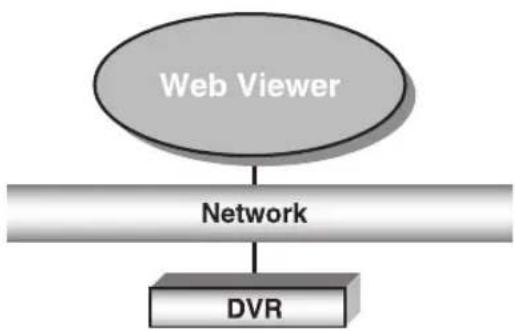
flowchart
graph TD
    A["Web Viewer"] --> B["Network"]
    B --> C["DVR"]
SYSTEM REQUIREMENTS
The following lists the minimum suggested hardware and operating system requirements needed to run the Web Viewer.
| OS | Windows XP ProfessionalWindows Vista Home Basic / PremiumWindows 7Mac OS 10.6 and later versions |
| Web Browser | - Windows OS : Internet Explorer 7.0 or higher, Firefox 3.6 or higher,Chrome 12 or higher- Mac OS : Safari 5 or higher, Firefox 3.6 or higher. |
| CPU Intel Pentium 4.2 GHz | |
| Memory 512 MB | |
| Monitor High Color 16-bit | 1024 x 768 |
| HDD | 50 MB(Installation space required)* Additional HDD space required for recording.Recorded file size will vary depending on recording quality settings. |
- Open your web browser and type the IP address or URL of DVR into the URL address box.

The basic URL of the DVR is as following in case of MAC address :
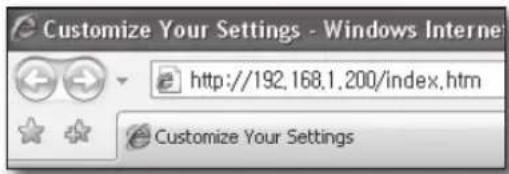
text_image
Customize Your Settings - Windows Internet http://192.168.1.200/index.htm Customize Your Settings- http://www.samsungipolis.com/Product ID (registered at the iPOLiS web site)
-
You can also use registered URL which setups up in the Setup menu of your DVR.
-
Set the Admin ID and password same to those of the DVR Admin.
For general users, enter the DVR user ID and password.
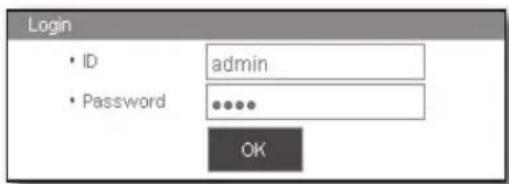
text_image
Login • ID admin • Password ••••• OK
- The default administrator ID is "admin", and the password must be set when the user log in at the first time.
- Set password for your wireless network if you use the product with a wireless router. Being not protected with password or using the default wireless router password may expose your video data to potential threat.
- To prevent from your personal information being exposed, please change your password every 3 months. Note that the security and other related issues caused by careless management of password shall be in the charge of the user.

- It allows up to 4 simultaneous access including the Admin and general users.
■It does not allow multiple login of the Admin user. - Password of the Admin and general users can be changed in
menu of the DVR. - Normal users should have set
under to "Use" before connecting to the Web Viewer. (Page 33) -
All settings are applied by the DVR's settings.
-
Click
.
Downloading Active-X control may take several minutes according to the security settings on your PC.
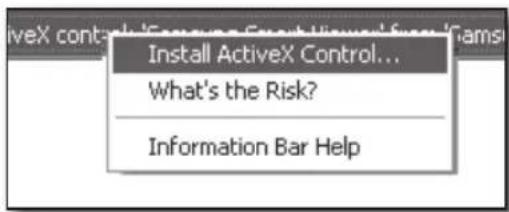
text_image
ActiveX control... Install ActiveX Control... What's the Risk? Information Bar Help- Click
.
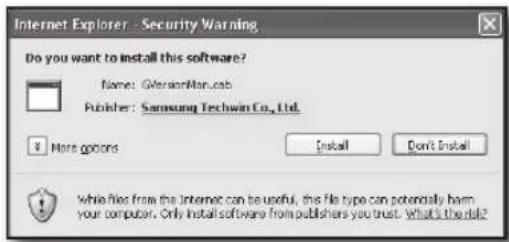
text_image
Internet Explorer - Security Warning Do you want to install this software? Name: GversionMan.cob Publisher: Samsung Techwin Co., Ltd. More options Install Don't Install who files from the Internet can be useful, this file type can potentially harm your computer. Only install software from publishers you trust. What's the risk?- You may have "Windows Security Alert" that attempts to block this with the Windows Firewall. In that case, click
to start Web Viewer. - Installation is complete. Now you can see the main screen of Live Viewer.
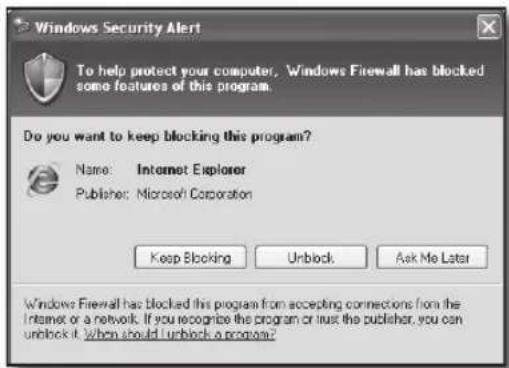
text_image
Windows Security Alert To help protect your computer, Windows Firewall has blocked some features of this program. Do you want to keep blocking this program? Name: Internet Explorer Publisher: Microsoft Corporation Keep Blocking Unblock Ask Me Later Windows Firewall has blocked this program from accepting connections from the Internet or a network. If you recognize the program or trust the publisher, you can unlock it. When should I unlock a program?USING LIVE VIEWER (Windows)
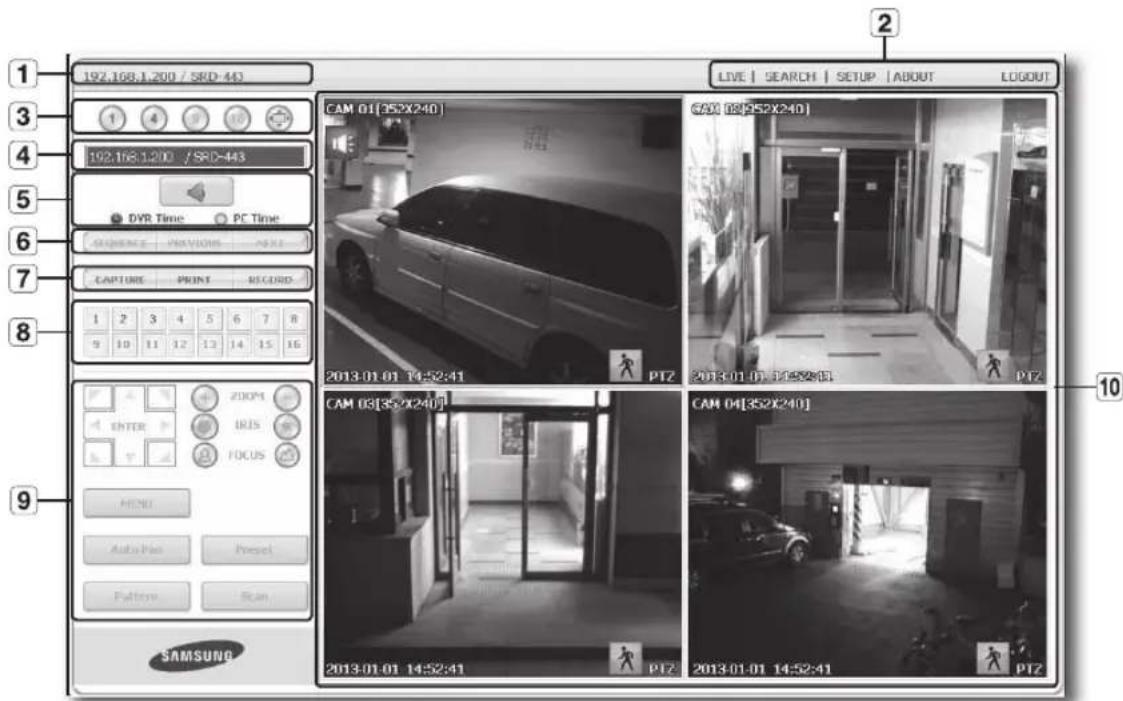
text_image
192.168.1.200 / SRD-44 1 2 3 4 5 6 7 8 9 1 2 3 4 5 6 7 8 9 10 11 12 13 14 15 16 CAM 01[352X240] CAM 02[352X240] CAM 03[352X240] CAM 04[352X240] LIVE | SEARCH | SETUP | ABOUT | LOGOUT 2013-01-01 14:52:41 PTZ 2013-01-01 14:52:41 PTZ 2013-01-01 14:52:41 PTZ Auto Plus Reset Future Scan SAMSUNDThe Live Viewer screen consists of following :
1 This displays the IP address and the model name of the connected DVR.
2 These menus consist of
③ These buttons are used for the screen split and full screen mode.
4 Shows the IP address and model name of the connected DVR.
⑤ Select to turn the sound on/off.
Select
6 These buttons are used for sequence and changing the screen channel.
7 These buttons are used for capture, print, and save the image.
8 Shows the channel of the connected DVR.
9 These buttons are used for PTZ related functions.
10 This displays the screen for connected camera with DVR.

■The resolution is set to 1024X768 pixels.
The initial split-screen mode is set according to the number of channels connected to DVR. You can change the split-screen mode by clicking buttons for split-screen modes.
OSD INFORMATION DISPLAY
① The channel number, video size, and IP address of the connected DVR are displayed.
② This icon will appear if the audio signal is currently being output.
③ The current date and time will be displayed according to the selected time information display setting
4 Alarm icon appears when alarm is issued.
It disappears when pressed the [ALARM] button of the DVR.
⑤ Motion icon appears when motion is detected. It disappears when pressed the [ALARM] button of the DVR.
⑥ It displays whether the PTZ controls are active.
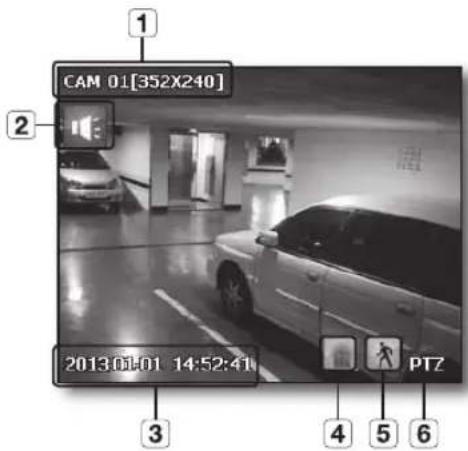
text_image
CAM 01[352X240] 2013.01.01 14:52:41 PTZ
If you have set PTZ cameras for the DVR, "PTZ" is displayed on the screen. Select a PTZ camera channel and use the [PTZ] button for camera control.
SPLIT-SCREEN
You can change the split mode by clicking each number icon.
natural_image
Interior view of a car garage with parked cars and parking area, no visible text or symbols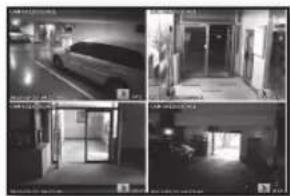
natural_image
Four-panel black-and-white photo collage showing a car parked at night, with no visible text or symbols.SINGLE MODE QUAD MODE
- Click◀> button.
The screen displays the selected camera connected to the DVR in "SINGLE MODE".
- Click <> button.
The screen displays the selected camera connected to the DVR in "QUAD MODE".
- Click <> button.
Switch the 1-split or 4-split mode to Full Screen mode.
Double clicking on the screen or pressing any button of the keyboard returns to the previous mode.
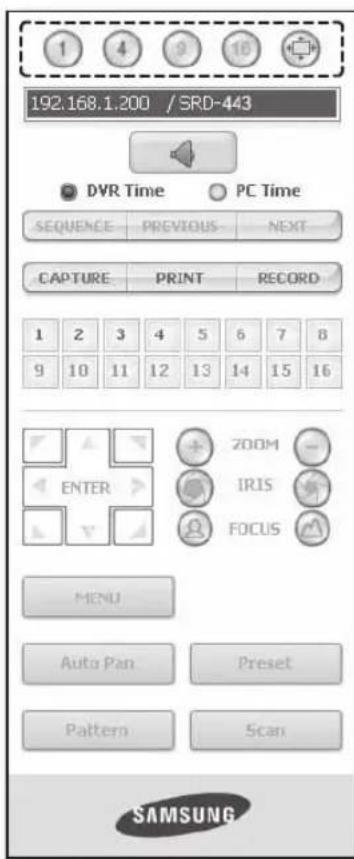
text_image
192.168.1.200 / SRD-443 DVTR Time PC Time SEQUENCE PREVIOUS NEXT CAPTURE PRINT RECORD 1 2 3 4 5 6 7 8 9 10 11 12 13 14 15 16 ZOOM - ENTER IRIS FOCUS MENU Auto Pan Preset Pattern Scan SAMSUNGCONNECTED DVR
This displays the IP address and the status of the connecting DVR.

■ Connection failure message
No Response : Appears when the DVR does not respond.
Access Denied : Appears when the maximum number of users is exceeded.
■ The number of simultaneous connections are limited to 4.
Setting the display of the OSD time information
Select
• DVR Time : Based on the time of the connected DVR
- PC Time : Based on the time of the PC currently running the Web Viewer.
• Audio : Sound On/Off
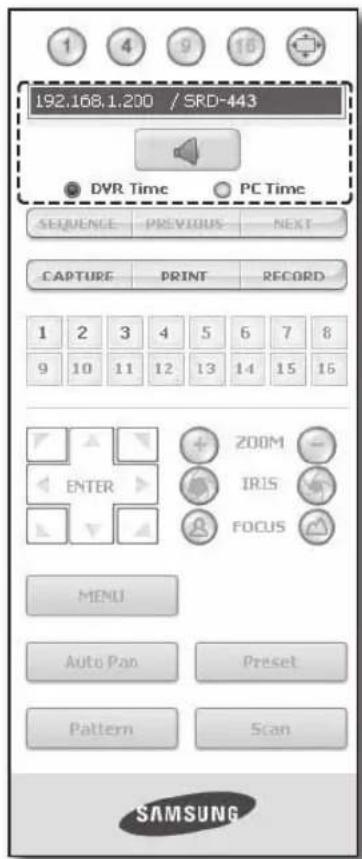
text_image
192.168,1.200 / SRD-443 DVTR Time PC Time SEQUENCE PREVIOUS NEXT CAPTURE PRINT RECORD 1 2 3 4 5 6 7 8 9 10 11 12 13 14 15 16 ENTER ZOOM IRIS FOCUS MENU Auto Pan Preset Pattern Scan SAMSUNGCHANGING THE LIVE SCREEN MODE
In the 4-split screen mode, "SEQUENCE", "PREVIOUS" and "NEXT" buttons will be deactivated.
- SEQUENCE: When this button is clicked, screens are switched at a preset interval.
In SINGLE MODE, the channel numbers are sequentially switched from 1 to 4.
■Preset interval (10 seconds)
- PREVIOUS: When this button is clicked, the previous screen appears.
- NEXT: When this button is clicked, the next screen appears. In SINGLE MODE, the channel numbers are sequentially switched from 1 to 4.
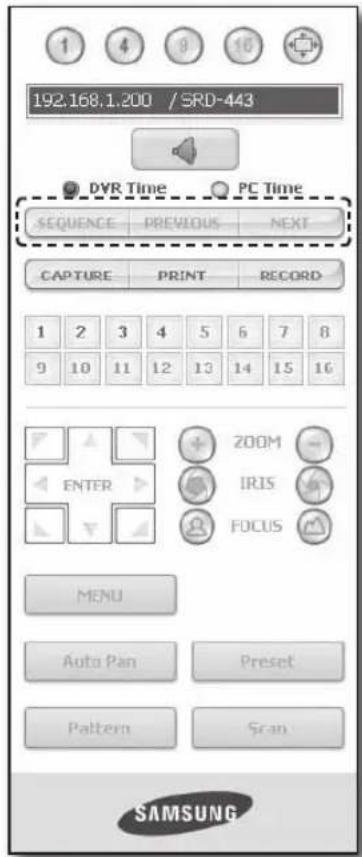
text_image
192.168.1.200 / SRD-443 DYR Time PC Time SEQUENCE PREVIOUS NEXT CAPTURE PRINT RECORD 1 2 3 4 5 6 7 8 9 10 11 12 13 14 15 16 200M ENTER IRIS FOCUS MENU Auto Pan Preset Pattern Scan SAMSUNGSAVIng the IIVe Screen on the Pc
- cAPture : Saves the current screen into a BMP or JPEG file.

The default saving path is "C:\Program Files\Samsung\Dvr Web Viewer\SnapShot\Live". To change the saving path, click
- The file is automatically named as following: "IP address_Port number_YYYYMMDD_HHMMSS_camera number_index" Ex) 192.168.1.200_554_20110414_093118_01_00
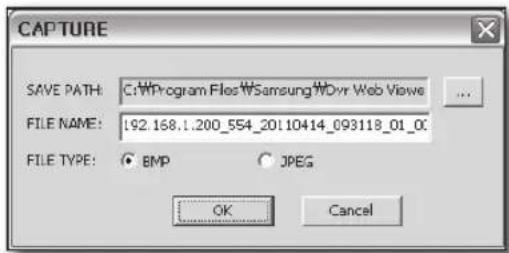
text_image
CAPTURE SAVE PATH: C:\Program Files\Samsung\MDvr Web Views FILE NAME: 192.168.1.200_554_20110414_093118_01_00 FILE TYPE: BMP JPEG OK Cancel- Print : Prints out the selected screen out of the currently displayed live screens. It also prints the IP address, time, camera number and the current event status together.
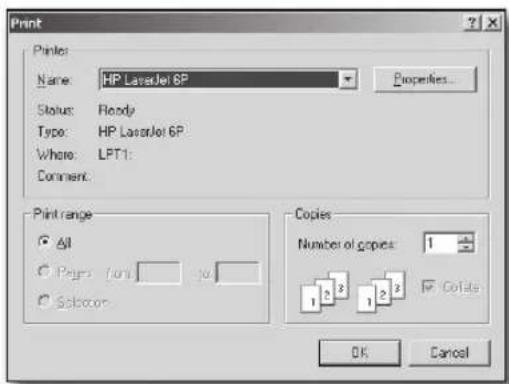
text_image
Print Prints: Name: HP LaserJet 8P Status: Bloody Type: HP LaserJet 6P Where: LPT1: Comment: Print range All Pages: 100 Subcoon... Copies Number of copies: 1 1 2 1 2 3 Colate OK Cancel- record: Saves the current image on the screen and saves it as a avi video file.

■ To record it, it is required at least 1GB of available space.
The default saving path is "C:\Program Files\Samsung\Dvr Web Viewer\VideoClip\Live". To change the saving path, click
The file is automatically named as following: "IP address_Port number_YYYYMMDD_HHMMSS_camera number_index" Ex) 192.168.1.200_554_20110406_070455_01_00
■ For AVI Save, you need the H.264 codec for playing saved files.
- HDD Minimum Free Size : During the recording, if there is no more capacity available in the HDD than set free space will prompt with a popup message : "Cannot record due to insufficient disc space in the HDD".
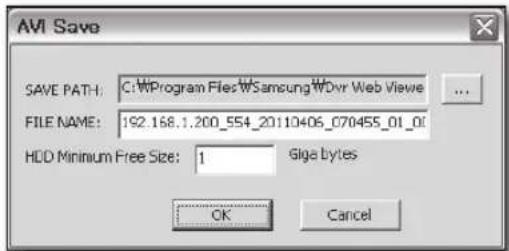
text_image
AVI Save SAVE PATH: C:\Program Files\Samsung\WDvr Web Viewe FILE NAME: 192.168.1.200_554_20110406_070455_01_01 HDD Minimum Free Size: 1 Giga bytes OK CancelchAngIng the IIVe Screen chAnnel
- Blue numbers: The channel connected to the current live screen
- Gray numbers : The channel not connected to the current live screen
If you select 4-split mode, the channel button for each of cameras 1 \~ 4 will turn blue.
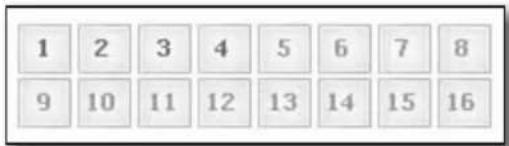
text_image
1 2 3 4 5 6 7 8 9 10 11 12 13 14 15 16uSIng PtZ cAMerA
Click the direction buttons to control the camera.
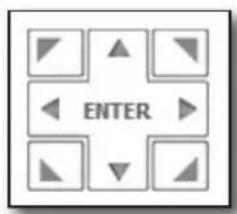
text_image
ENTER
You can zoom in or out an image by using the ZOOM button.
You can adjust the entering light amount by using the IRIS button.

You can adjust the focus by using the FOCUS button.
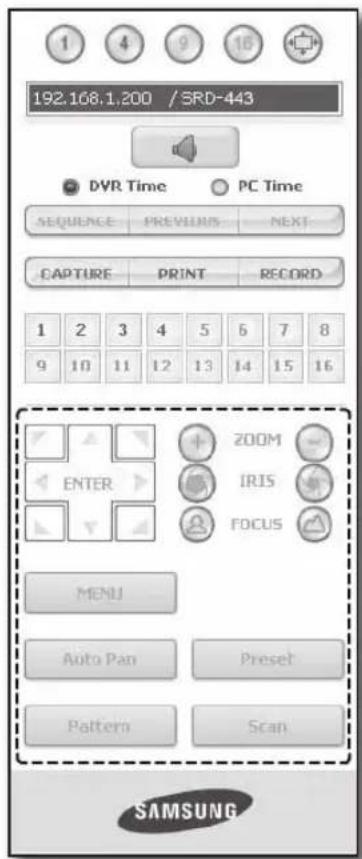
text_image
192.168.1,200 / SRD-443 DVTR Time PC Time SEQUENCE PREVIOUS NEXT CAPTURE PRINT RECORD 1 2 3 4 5 6 7 8 9 10 11 12 13 14 15 16 ENTER ZOOM IRIS FOCUS MENU Auto Pan Preset Pattern Scan SAMSUNG- Menu: Appears the camera menu screen.
text_image
MENU Up Down Left Right- Preset: Moves the lens direction to a preset direction.
- If you click a preset, the camera moves to the selected preset's position.
- You can delete the selected preset or all presets.
- You can save a new preset number and name.

■You can save presets up to 20.
- Auto Pan: Moves the camera lens direction between 2 points set for the camera.
- Scan: Moves the camera lens direction between 2 preset points of the camera.
- Pattern: You can set camera various movement patterns such as zoom, move, etc. so that a camera automatically moves according to the pattern.

■While the DVR controls a PTZ camera, Web Viewer cannot control the camera.
■ Camera menu setup is only available for camera supporting the function.
■ Each function of PTZ is same to that of the DVR.
■Pan/Tilt of the Smart dome camera is manipulated automatically to center the camera to the mouse clicked point.
If you drag the mouse using the left button on a certain point, Pan/Tilt of the Smart dome camera is manipulated automatically to center the camera to the middle point between the dragging start and end position. Upward dragging will zoom out, while downward dragging will zoom in.
■Tilt of Power PTZ operates properly within 45°.
■ Power and Pan Tilt functions are only available for camera supporting the functions. Ex : Samsung SCP-2371
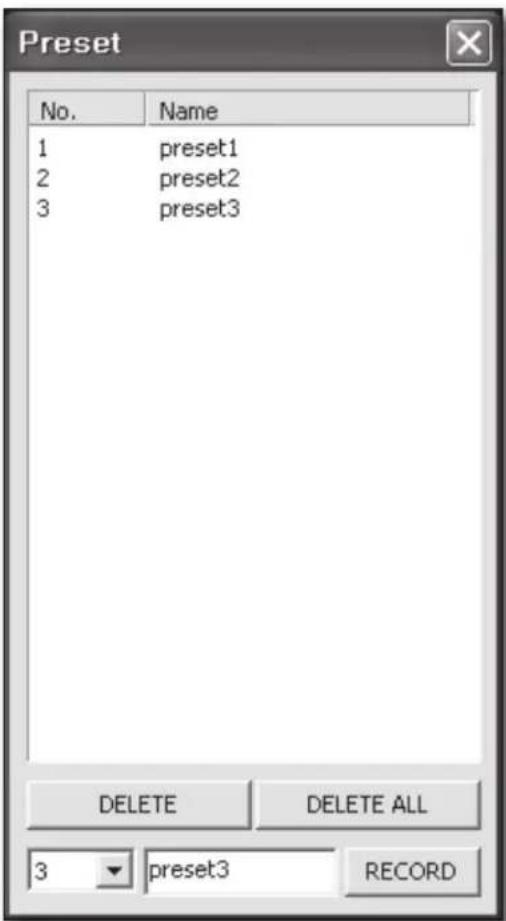
text_image
Preset No. Name 1 preset1 2 preset2 3 preset3 DELETE DELETE ALL 3 preset3 RECORDuSIng SeArch VleWer
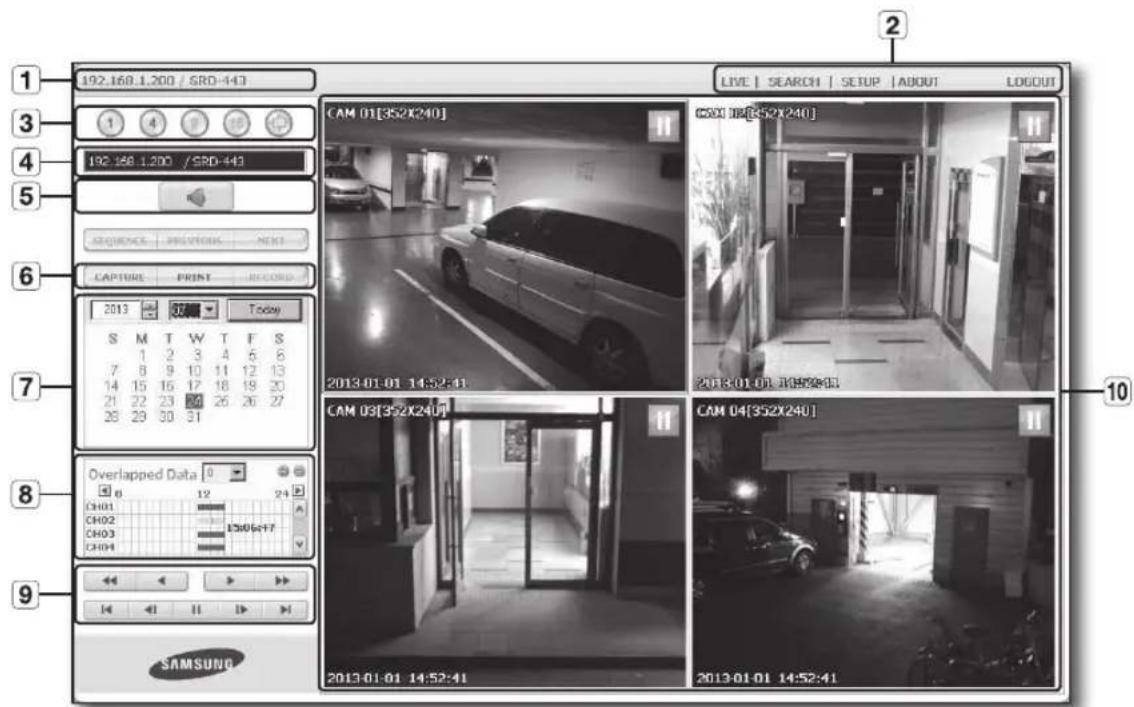
text_image
192.168.1.200 / SRD-143 1 4 7 10 192.168.1.200 / SRD-143 CAM 01[352X240] CAM 02[352X240] CAM 03[352X240] CAM 04[352X240] 192.168.1.200 / SRD-143 1 4 7 10 192.168.1.200 / SRD-143 CAM 01[352X240] CAM 02[352X240] CAM 03[352X240] CAM 04[352XThe Search Viewer screen consists of following :
1 This displays the IP address and the model name of the connected DVR.
② There are 4 tabs available:
3 Switch to a split mode.
4 Shows the IP address and model name of the connected DVR.
⑤ Select to turn the sound on/off.
6 These buttons are used for capture, print, and save the image.
7 This displays a calendar at which you can search the recorded video.
8 This displays a timeline at which you can search the recorded video by the time.
9 These buttons are used for controlling playback.
[10] This displays the screen for playback of recorded video.

During the DVR backup, you may have a trouble accessing CMS & Web Search.
SPIIt-Screen
You can change the split mode by clicking each number icon.
natural_image
Black-and-white photo of a car parked in a parking garage, no visible text or symbols on the vehicle or background.
natural_image
Four-panel black-and-white photo collage showing a car in a lot, a doorway with a dark interior, and a doorway with a street light (no visible text or symbols)SINGLE MODE QUAD MODE
- Click<1> button.
The screen displays the selected camera connected to the DVR in "Single Mode". - Click◀> button.
The screen displays the selected camera connected to the DVR in "QuAd Mode".
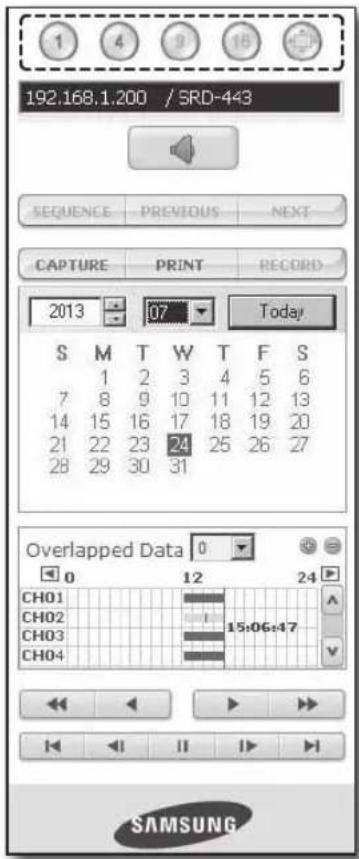
text_image
192.168.1.200 / SRD-443 SEQUENCE PREVIOUS NEXT CAPTURE PRINT RECORD 2013 07 Today S M T W T F S 1 2 3 4 5 6 7 8 9 10 11 12 13 14 15 16 17 18 19 20 21 22 23 24 25 26 27 28 29 30 31 Overlapped Data 0 0 12 24 CH01 CH02 CH03 CH04 15:06:47 SAMSUNGconnected dVr
The IP of the connected DVR will be displayed. Select to turn the sound on/off.

■ Connection failure message
No Response : Appears when the DVR does not respond.
Access Denied : Appears when the maximum number of users is exceeded.
■The number of simultaneous connection is limited to 2.
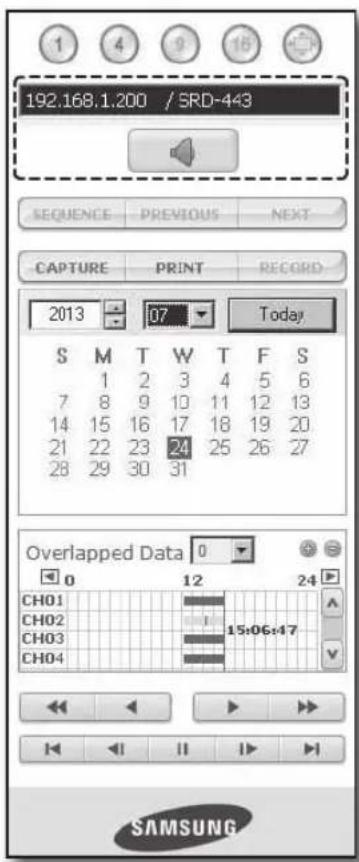
text_image
192.168.1.200 / SRD-443 SEQUENCE PREVIOUS NEXT CAPTURE PRINT RECORD 2013 07 Today S M T W T F S 1 2 3 4 5 6 7 8 9 10 11 12 13 14 15 16 17 18 19 20 21 22 23 24 25 26 27 28 29 30 31 Overlapped Data 0 0 12 24 CH01 CH02 CH03 CH04 15:06:47 SAMSUNGSAVIng the IIVe Screen on the Pc
- cAPture : Saves the current screen into a BMP or JPEG file.

The default saving path is "C:\Program Files\Samsung\Dvr Web Viewer\SnapShot\Search". To change the saving path, click
- The file is automatically named as following: "IP address_Port number_YYYYMMDD_HHMMSS_camera number_index"
Ex) 192.168.1.200_554_20110414_093118_01_00
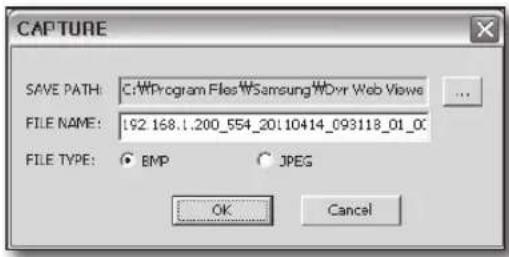
text_image
CAPTURE SAVE PATH: C:\Program Files\Samsung\MDvr Web Views FILE NAME: 192.168.1.200_554_20110414_093118_01_00 FILE TYPE: BMP JPEG OK Cancel- Print: Print out the current screen. It also prints IP address, time, camera number and current event state.
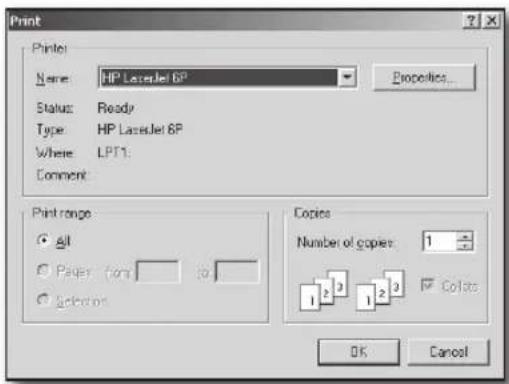
text_image
Print Printer Name: HP LazeJet 6P Status: Ready Type: HP LazeJet 6P Where: LPT1. Comment: Print range: All Page: From Selection Copies Number of copies: 1 1 2 3 1 2 3 Colors OK Cancel- record : While in playback, press this button saves the video data of the selected channel as an AVI file. (It is saved in the designated folder on your PC.) To stop recording, click this button again.
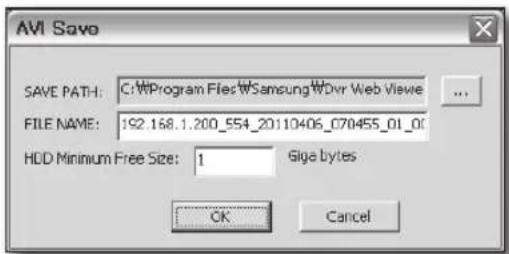
text_image
AVI Save SAVE PATH: C:\Program Files\WSamsung\WDvr Web Viewie ... FILE NAME: 192.168.1.200_554_20110406_070455_01_01 HDD Minimum Free Size: 1 Giga bytes OK Cancel
■ To record it, it is required at least 1GB of available space.
The default saving path is "C:\Program Files\Samsung\Dvr Web Viewer\VideoClip\Search". To change the saving path, click
The file is automatically named as following: "IP address_Port number_YYYYMMDD_HHMMSS_camera number_index"
Ex) 192.168.1.200_554_20110406_070455_01_00
■ For AVI save, you need the H.264 codec for playing saved files.
SEARCHING THE RECORDED VIDEO IN THE CALENDAR
If the video data has been recorded on a date, the date is distinguished in green. If you click the date, the recorded video information is displayed in the time line. When you click
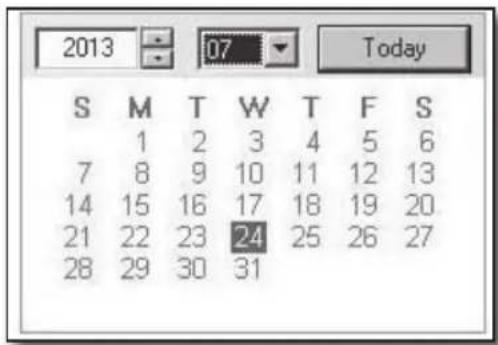
text_image
2013 07 Today S M T W T F S 1 2 3 4 5 6 7 8 9 10 11 12 13 14 15 16 17 18 19 20 21 22 23 24 25 26 27 28 29 30 31SEARCHING THE RECORDED VIDEO IN THE TIMELINE
It displays the recorded video data status on the DVR after a date is selected. The normal mode displays the time ranging from 0 to 24 Hours while the extension mode displays the time every 2 hours.
[Normal Mode]
- If you click <> button, it changes to the extension mode.
• Each time line represents 1 hour.
[Extension Mode]
- If you click <> button, it changes to the normal mode.
• Each time line represents 5 minutes.
![Hanwha SRD-443 - [Extension Mode] - 1](/content/2026/06/1203577/images/4df536592011ead6dd4a16277e1bf7725fc3f638dd2308d3d0e82207f8e9e49f.jpg)
■The channels are ranging from CH01 to CH04.
![Hanwha SRD-443 - [Extension Mode] - 2](/content/2026/06/1203577/images/1ba0fe55b4e0f4252717cb1e911b74f102eda4bceb5af3e370ab6a773a4c894f.jpg)
text_image
0 12 24 CH01 CH02 19:45:18 CH03 CH04![Hanwha SRD-443 - [Extension Mode] - 3](/content/2026/06/1203577/images/5f0b248043c20ea2fb9213e545db9dc1461bc50f10fa6c174c477a4a8c72f79a.jpg)
text_image
CH01 CH02 CH03 CH04 19:45:18 20 21![Hanwha SRD-443 - [Extension Mode] - 4](/content/2026/06/1203577/images/2609b6bcccbb18dac917c8a96b3c7969ccf4cf82f9c0d588f285575fbbecb83e.jpg)
text_image
192.168.1.200 / SRD-443 SEQUENCE PREVIOUS NEXT CAPTURE PRINT RECORD 2013 07 Today S M T W T F S 1 2 3 4 5 6 7 8 9 10 11 12 13 14 15 16 17 18 19 20 21 22 23 24 25 26 27 23 29 30 31 Overlapped Data 0 CH01 CH02 CH03 CH04 15:06:47 SAMSUNG1 Fast Backward : Play the video reversely. (at x2 \~ x64)
2 Reverse Play : Performs Reverse Play.
③ Play : Performs playback.
④ Fast Forward : Play the video forward. (at x2 \~ x64)
⑤ Go to First: Moves the beginning time of recorded video in the time line.
6 Step Backward : Performs one step reverseplay by one frame.
7 Pause: Stops the playback temporarily.
8 Step Forward: Performs one step forward by one frame.
9 Go to Last: Moves the last time of recorded video in the time line.
![Hanwha SRD-443 - [Extension Mode] - 5](/content/2026/06/1203577/images/c9a15e06b91b52e64beb59322fca3e30c3956567d6d4477a772c3f5dc81386d8.jpg)
- Only the admin account can play the audio signal during the playback. If using both web view and DVR set simultaneously, the audio signal will be output from the DVR set.
![Hanwha SRD-443 - [Extension Mode] - 6](/content/2026/06/1203577/images/d5f36903fa54d66ffc864379a38f759797981a71f42ed42ea06447a57a0c3400.jpg)
text_image
192.168.1.200 / SRD-4:3 SEQUENCE PREVIOUS NEXT CAPTURE PRINT RECORD 2013 07 Today S M T W T F S 1 2 3 4 5 6 7 8 9 10 11 12 13 14 15 16 17 18 19 20 21 22 23 24 25 26 27 28 29 30 31 Overlapped Data 0 0 12 2:4 CH01 CH02 CH03 CH04 15:06:47 SAMSUNGVIEWER SETUP
You can configure the DVR settings remotely on the network. To configure the DVR settings, click
System
You can configure the various settings of the DVR system.
Date/Time/Language
For more information, refer to
- Select
in the System menu. - Configure the DVR settings according to your system environment.
- Date/Time
Set the date and time.
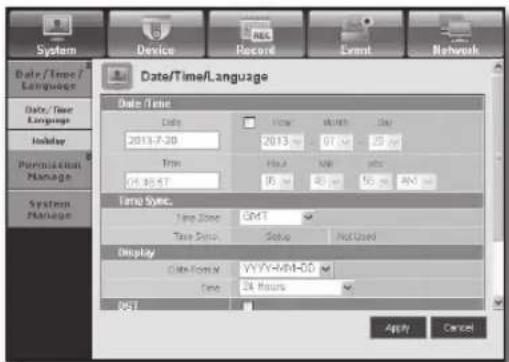
text_image
System Device Record Event Network Date/Time/Language Date Time Date 2013-7-28 2013 pm 07 pm 25 pm Time 06:30:47 06 pm 25 pm 15 pm 40 pm Time Sync. Time Zone GMT Time Data Setup Not Used Display DataForm X: VY/Y+MM-DD Time 24 Hours DST Apply Cancel• Time Synchronization Setup
Set the time synchronization.
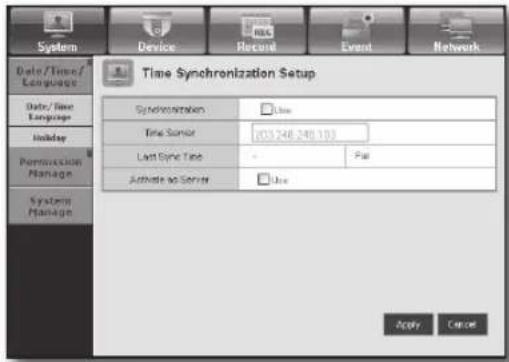
text_image
System Device Record Event Network Date/Time/ Language Date/New Language Holiday Permutation Manage Systems Manage Time Synchronization Setup Synchronization Line Time Sensor 003246.248.183 Last Sync Time - - Active to Sensor Line Apply Cancel- Display
Date Format : Set the date type.
Time : Select a time format to display on the screen.
• DST (Daylight Saving Time)
DST is displayed an hour ahead of the standard time of the time zone.
- Language
Select a preferred language for the DVR.
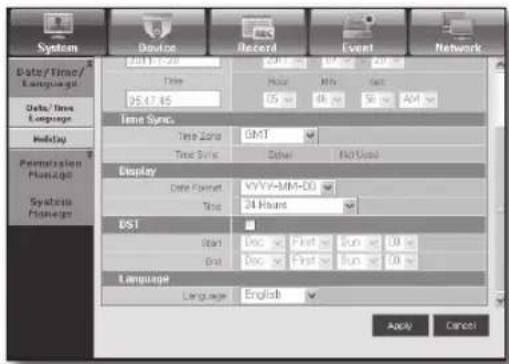
text_image
System Device Record Event Network Data/Time/Language Date/Time Language 95.47.85 Time Sync Time Sync GMT Time Sync Other No Speed Display Date Format VYVY-MM-DD Time 24 Hours BST Start Doc First Run 01 sec End Doc First Run 01 sec Language Language English Apply CancelHoliday
You can set specific dates to Holidays according to your preferences.
For more information, refer to
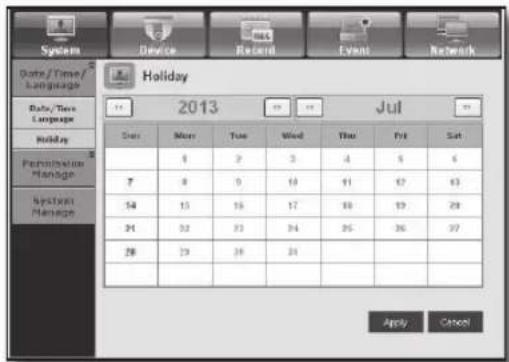
text_image
System Dayte Record Event Network Date/Time/ Language Baby/Tree Language Holiday Penetration Manage System Manage Holiday 2013 Jul Day Fri Sat 8 9 10 11 12 13 14 15 16 17 18 19 20 21 22 23 24 25 26 27 28 29 30 Apply CancelPermission Management
For more information, refer to
- Admin
You can change the admin ID or the password.
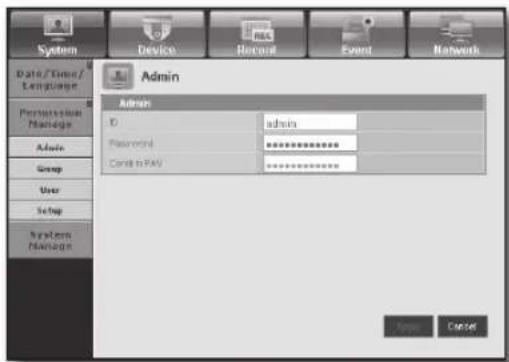
text_image
System Device Record Event Network Data/Time/ Language Admin Admin ID admin Password ****** Ctrl to PAY ****** Apply Cancel- Group
Users are classified into groups and the permission can be set according to the group.
■First of all, add a group.
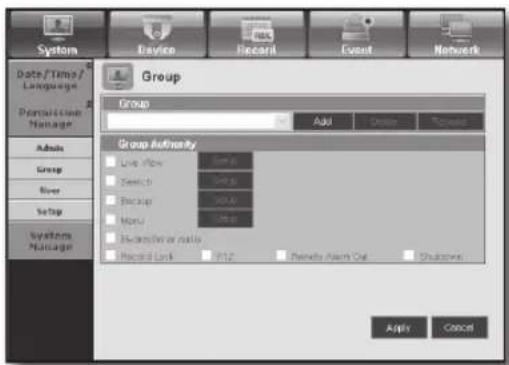
text_image
System Eavlico Record1 Event Network Date/Time/ Language Personnel Manage Adults Group River Setup Systems Manage Group Group Authority Live Flow Send it Connect Send it Backup Send it Menu Send it Resource or ratio Record Link F12 Send to Alert Out Shutdowns Apply Cancel- User
You can add, change or remove a user or users.
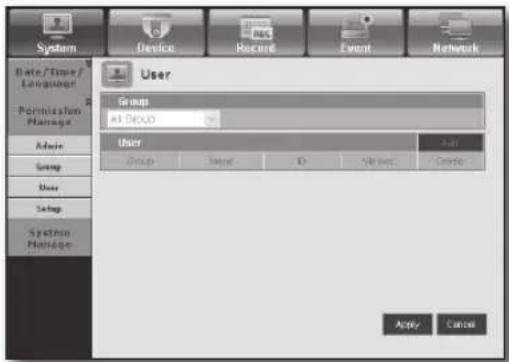
text_image
System Device Record Event Network Date/Time/ Language Permission Manage Admin Group User Setup System Manage User Group Name ID Ver here Apply Cancel- Setup
You can set the user permission.
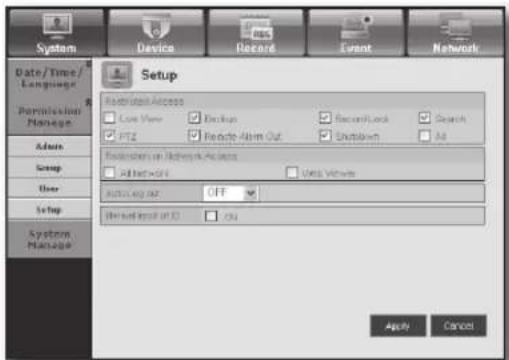
text_image
System Device Record Event Network Date/Time/ Language Perimeter Manage Admin Setup User Setup System Manage Setup Access Core View Backup RecordLock Search PTZ Remote Alarm Out Shutdown All Extension on Network Access Adjust Next > 0.1 Units Vehicle Auto Log OK OFF Reserved Input ID: OK Apply CancelSystem Management
For more information, refer to
• System Information
You can see information of the current system.
Check the software version, broadcast format and MAC address.
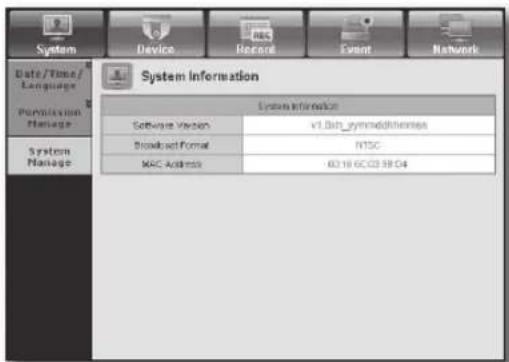
text_image
System Information Software Version: v1.dat_symmodihemess Broadcast Format: NTSC MAC Address: 60.18.6CC3.58.04Device
You can check a list of devices that are connected to the DVR and configure the necessary settings.
Click
For more information, refer to "Setting the Device". (Page 38)
Camera
- Camera
You can configure the settings of the camera that is connected to the DVR.
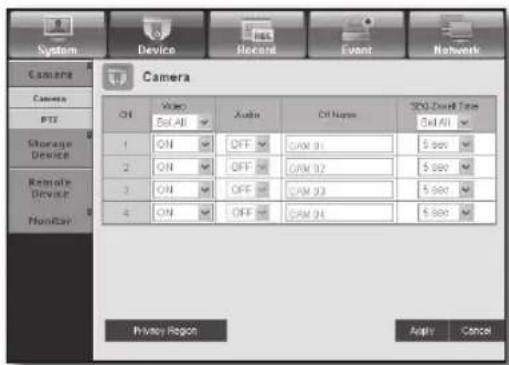
text_image
System Device Record Event Network Camera Camera PTZ Storage Device Remote Device Monitor Camera ON Video Bal AB Audio Off Name CAM 31 CAM 32 CAM 33 CAM 34 CAM 35 CAM 36 CAM 37 CAM 38 CAM 39 CAM 40 CAM 41 CAM 42 CAM 43 CAM 44 CAM 45 CAM 46 CAM 47 CAM 48 CAM 49 CAM 50 CAM 51 CAM 52 CAM 53 CAM 54 CAM 55 CAM 56 CAM 57 CAM 58 CAM 59 CAM 60 CAM 61 CAM 62 CAM 63 CAM 64 CAM 65 CAM 66 CAM 67 CAM 68 CAM 69 CAM 70 CAM 71 CAM 72 CAM 73 CAM 74 CAM 75 CAM 76 CAM 77 CAM 78 CAM 79 CAM 80 CAM 81 CAM 82 CAM 83 CAM 84 CAM 85 CAM 86 CAM 87 CAM 88 CAM 89 CAM 90 CAM 91 CAM 92 CAM 93 CAM 94 CAM 95 CAM 96 CAM 97 CAM 98 CAM 99 CAM 100 Primary Region Apply Cancel- Privacy Region
You can specify a certain area of the camera video to be protected for your privacy.
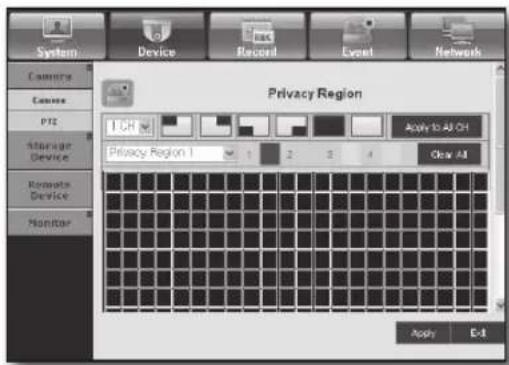
text_image
System Device Record Event Network Camera Camera PTZ Storage Device Remote Device Monitor Privacy Region 1 CH Apply to All CH Privacy Region 1 1 2 3 4 Close All Apply E-4• PTZ
You can configure the settings of the PTZ camera that is connected to the DVR.
Set the ID and protocol.
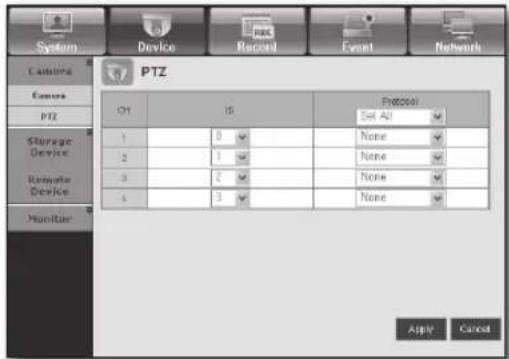
text_image
System Device Record Event Network Camera PTZ PTZ Storage Device Remote Device Monitor PTZ 0 1 2 3 4 5 6 7 8 9 None None None None Apply CancelStorage Device
You can check and change the settings of the storage device.
- Device
You will see a list of storage devices that are connected to the DVR.
You can check the type, used/total, usage and status of the device.
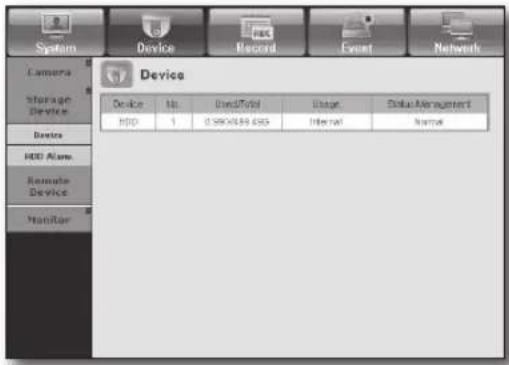
text_image
System Camera Storage Device Davets HDD Alone Remote Device Monitor Device Ms. Used/Total User Status Management hpp 1 0.990/88.635 Interval Name- HDD Alarm
You can set the alarm output channel and the alarm duration for an error.
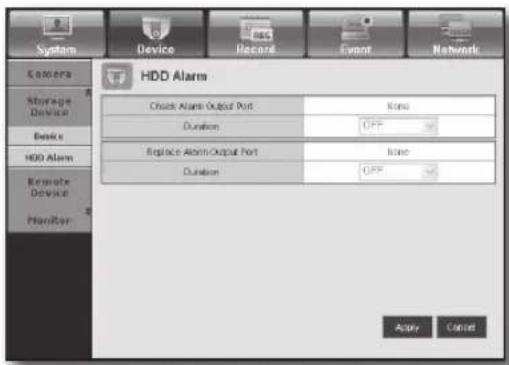
text_image
System Device Record Event Network Camera Storage Device Basic HDD Alarm Remote Device PlanRan HDD Alarm Clock Alarm Output Port None Duration OFF Replace Alarm Output Port None Duration OFF Apply CancelRemote Device
You can see a list of remote devices including PTZ cameras and system keyboards that are connected to the RS-485 port of the DVR and configure the necessary settings.
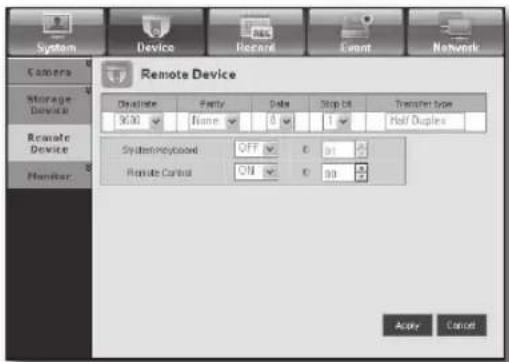
text_image
System Device Record Event Network Camera Storage Device Remote Device Member Remote Device Coordinate Party Data Stop bit Transfer Type 900 Name 0 1 Half/Doubles System/mycled OFF C 91 Remote Control Off C 80 Apply CancelMonitor
- Monitor
You can configure the monitoring screen settings and set the output system.
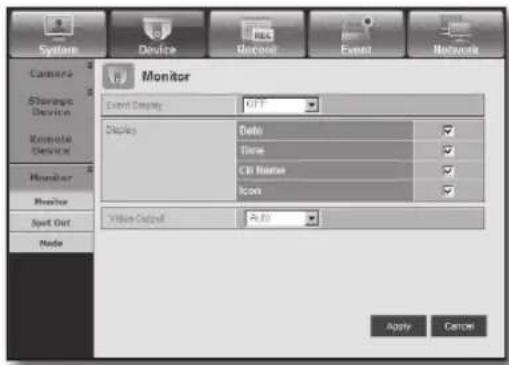
text_image
System Device Record Event Network Camera Storage Device Remote Device Monitor Monitor Spot Out Node Monitor Event Display OFF Display Data None CD Name Icon Value Output Auto Apply Cancel- Spot Out
With the monitor connected via the SPOT port, if there occurs an event such as Sensor, Motion, or Alarm, you can select a video output mode for external monitoring.
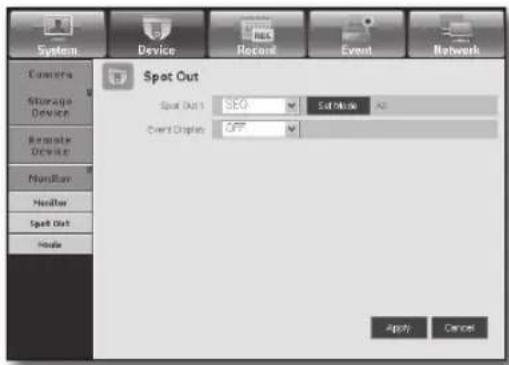
text_image
System Device Record Event Network Camera Storage Device Remote Device Monitor Header Spot Out Node Spot Out SEQ Set Motion OFF Apply Cancel- Mode
You can switch between live mode and play mode.
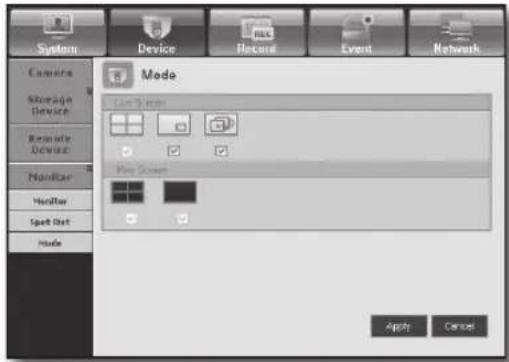
text_image
System Device Record Event Network Camera Storage Device Remote Device Monitor Handler Spot Out Mode Mode Live Sorts Play Screen Apply CancelRecord
For more information, refer to
Recording Schedule
If you set a recording schedule for a specific date and time, the recording will start at that specific time.
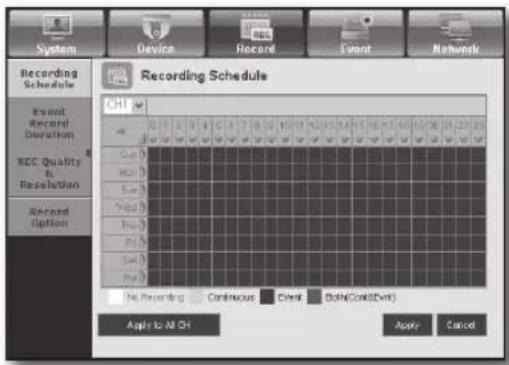
text_image
System Device Record Event Network Recording Schedule Record Record Duration REC Quality in Resolution Record Option CHI No Recording Continuous Event Begin(Contin) Apply to All CH Apply Cancel- Apply to All CH : Click
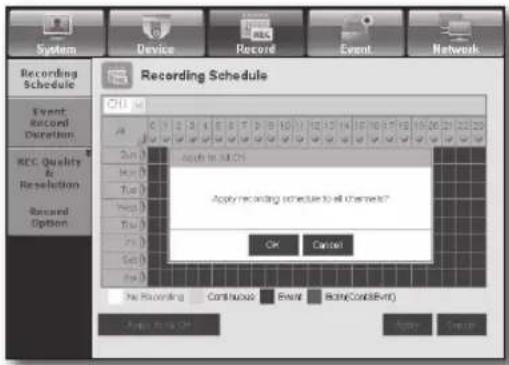
text_image
System Device Record Event Network Recording Schedule Event Record Decryption REC Quality & Resolution Record Option Recording Schedule Date: 01/01/2023 Apply to ALL Apply recording schedule to all channels? OK Cancel One Recording Continuous Event BSN(Continued) Apply Back Up Apply CancelEvent Record Duration
You can set the start and end times of recording that will be activated if an event occurs.
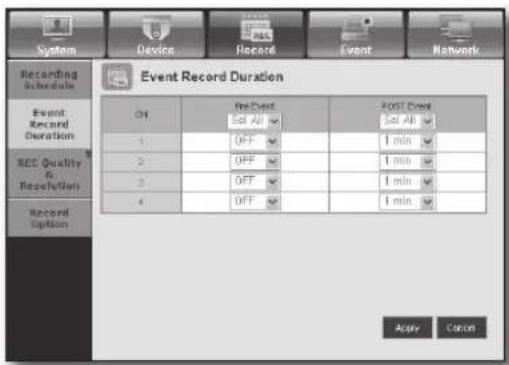
text_image
System Device Record Event Network Recording Schedules Event Record Duration CH Record Est All OFF 1 min 2 OFF 1 min 3 OFF 1 min 4 OFF 1 min Apply CancelREC Quality & Resolution
- Standard/Event
You can set the resolution, frame rate and recording quality for each channel.
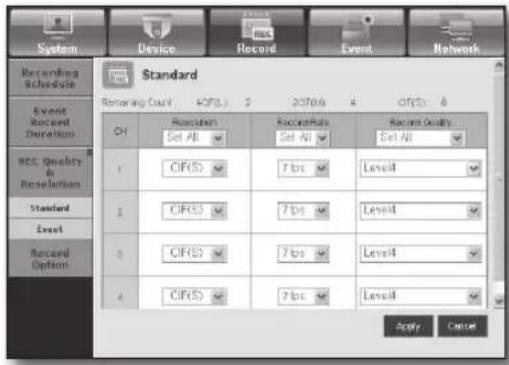
text_image
System Device Record Event Network Recording Schedule Standard Event Record Duration CH CF(S) 7 bps Level4 RCC Quality & Resolution 1 CF(S) 7 bps Level4 Standard CF(S) 7 bps Level4 Event CF(S) 7 bps Level4 Record Option CF(S) 7 bps Level4 Apply CancelRecord Option
You can set the Disk End Mode.
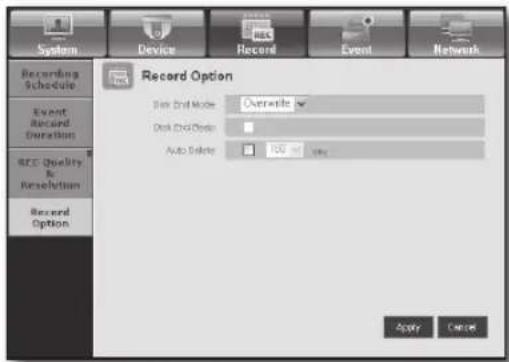
text_image
System Device Record Event Network Recording Schedule Record Duration Record Options Record Option Record Option Disk End Mode: Continuous Disk End Close: Auto Selector: 100 mm Apply CancelEvent
For more information, refer to
Sensor Detection
You can set the sensor operation mode and the synchronized camera as well as the alarm output type and the duration.
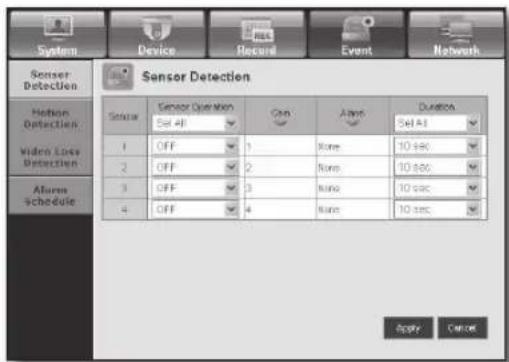
text_image
Sensor Detection Sensor Operation Gain Amount Duration Set All 1 OFF 1 None 10 sec 2 OFF 2 None 10 sec 3 OFF 3 None 10 sec 4 OFF 4 None 10 sec Apply CancelMotion Detection
You can set the motion detection mode and the sensitivity as well as the alarm output type and the duration.
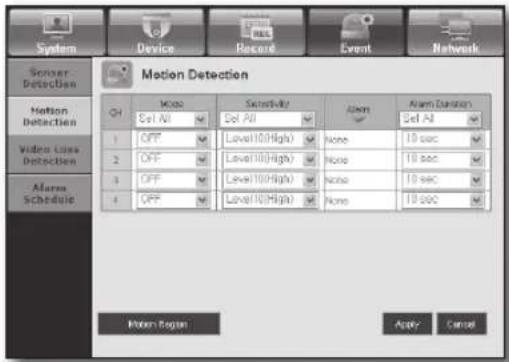
text_image
System Device Record Event Network Sensor Detection Motion Detection Video Class Detection Alarms Schedule Motion Detection Mode Set All Selectivity Set All Alarm Alarm Duration Set All 1 OFF Level(100High) None 10 sec 2 OFF Level(100High) None 10 sec 3 OFF Level(100High) None 10 sec 4 OFF Level(100High) None 10 sec Motion Region Apply Cancel- Motion Region
Set the target motion detection area
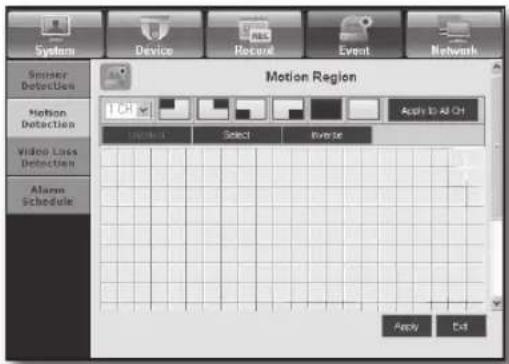
text_image
System Device Record Event Network Sensor Detection Motion Detection Video Loss Detection Alarm Schedule Motion Region 1 CH Apply to All CH Logistics Select Rivering Apply ExitVideo Loss Detection
You can set the alarm output time if a video loss occurs.
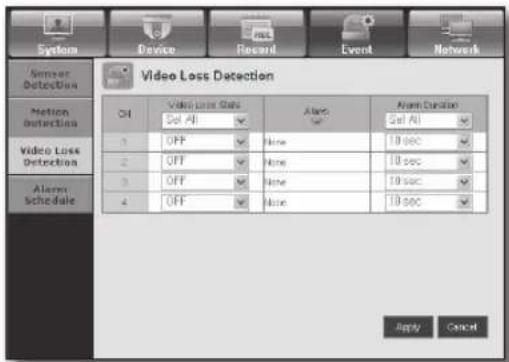
text_image
Sensor Detection Video Loss Detection Motion Detection 1 OFF None 18 sec 2 OFF None 18 sec 3 OFF None 18 sec 4 OFF None 18 sec Alarm Schedule Alarm Duration Set All Apply CancelAlarm Schedule
You can schedule the alarm output according to the day of the week and the time.
The default setting is Event Sync, which activates the alarm only if an event occurs.
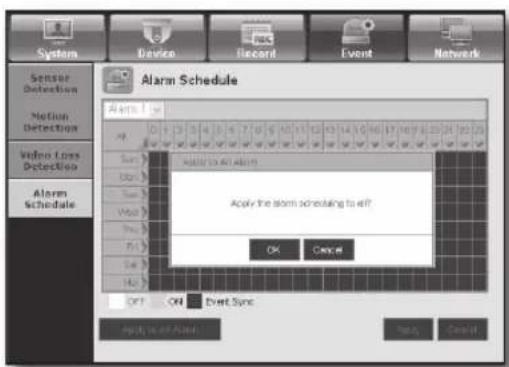
text_image
System Device Record Event Network Sensor Detection Motion Detection Video Loss Detection Alarm Schedule Alarm Schedule Apply the alarm scheduling to eff OK Cancel Off Off Event Sync Apply to off Power Tags CancelNetwork
For more information, refer to
Connection
A remote user can access the DVR via the network to check the current mode and the IP address.
- Connection
You can set the network connection route.
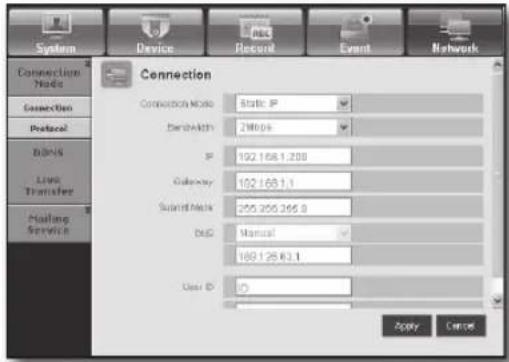
text_image
Connection Connectors Mode: Static IP Serial Link: 21604 IP: 192.158.1.200 Binaryity: 192.158.1.1 Serial Link: 205.205.265.9 DNS: Manual 189.126.63.1 User ID: Apply Cancel- Protocol
You can configure the protocol related settings.
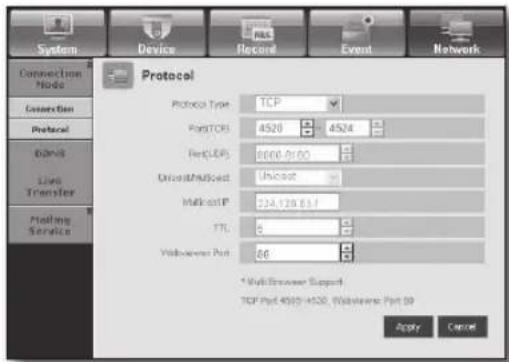
text_image
System Device Record Event Network Connection Mode Connection Protocol Bench List Transfer Routing Service Protocol Type: TCP PortTCP: 4528 4524 PortURL: 0000-0100 Unicast/Nullicast: Unicast Multicast: 324,126.634 TTL: 8 Webserver Port: 66 * Webserver Support TCP Port: 4528-4528, Webserver Port 59 Apply CancelDDNS
You can check the DDNS settings.
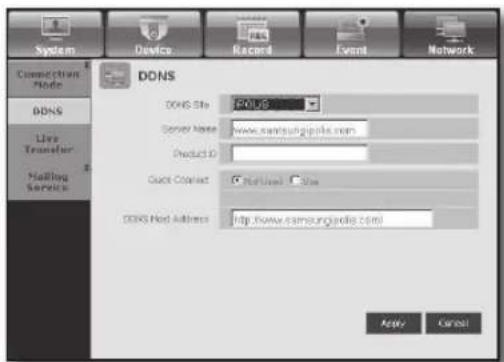
text_image
System Device Record Event Network Connection Mode DDNS Live Transfer Handling Services DDNS Site: R401.05 Server Name: www.samsungjogda.com Product ID: Quick Contact: Web User: Size DDNS Head Address: http://www.samsungjogda.com Apply CancelLive Transfer
A remote user can set the images of the DVR.
• Live Transfer
You can specify the quality of the image data that a remote user will receive.
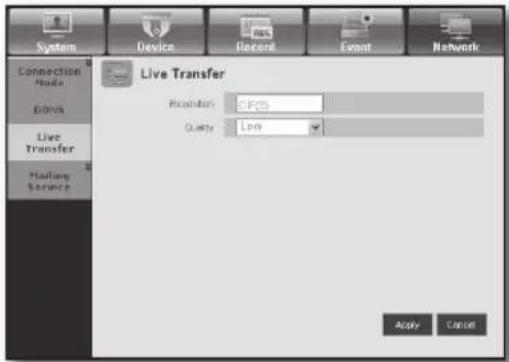
text_image
System Device Record Event Network Connection Mode Block Live Transfer Routing Service Live Transfer Resolution: 0.0000 Quality: Low Apply CancelMailing Service
You can specify the SMTP server that sends a mail if an event occurs and set the recipient group and users.
- SMTP
You can set the server that sends mails and specify if you use the authentication process.
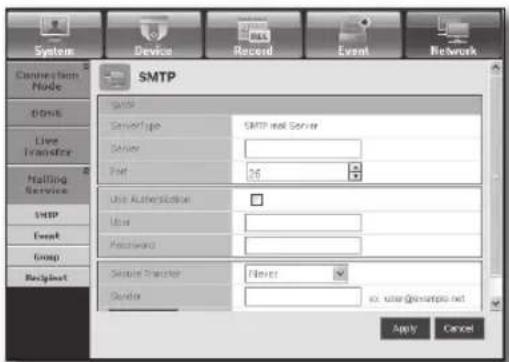
text_image
System Device Record Event Network Controller Item Node DNS Live Transfer Nailing Service SMTP Event Group Recipient SMTP Service Type: SMTP and Server Server: Port: 26 Use Authentication: User: Password: Sendir Transfer: Folder: ac user @sentips.net Apply CancelEvent
You can set the event interval and specify which events the server sends mails for.
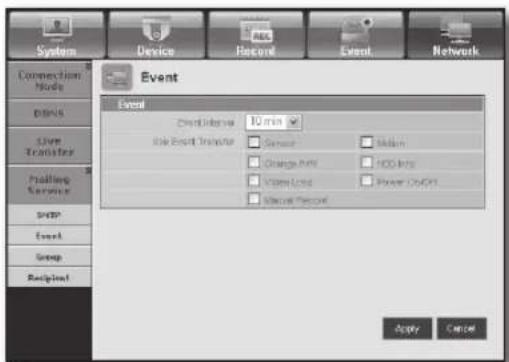
text_image
System Device Record Event Network Connection Mode DIPs Store Transfer Profiling Service SNP Event Group Recipient Event Event Direct Instance 10 min Role Event Transfer Sensor Medium Orange Anti HDD Inks Green Loss Power DnO2 Manual Record Apply Cancel- Group
You can add a group to receive the mail if an event occurs and set the permission to receive the event mail for each group.
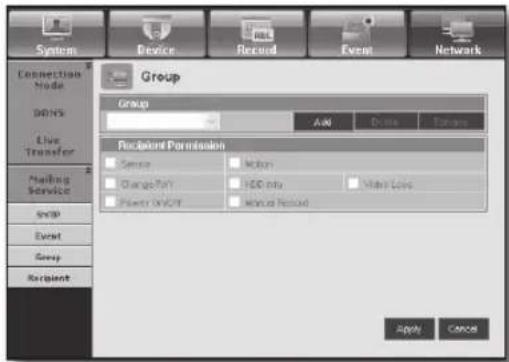
text_image
System Device Record Event Network Connection Node DOINS Live Transfer Nailing Service SHP Dset Group Recipient Group A## Drive Returns Puclear Poridation Service Motion Change Part HDD Info Make Loss Power ON/OFF Make Recused Apply Cancel- Recipient
You can add a user or users who will receive the mail.
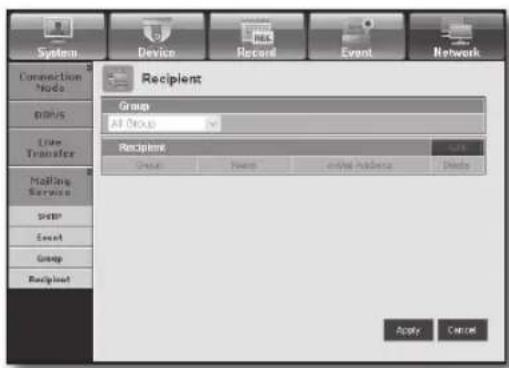
text_image
System Device Record Event Network Connection Mode Points Line Transfer Routing Service Start Event Group Recipient Recipient Group Name and/or Audience Delete Apply CancelABOUT
Click
Displays the model name of connected DVR and the version of Web Viewer.
text_image
SAMSUNG WEB VIEWER for SRD-443 Web Viewer Version: 1.0 Create Date: 20XX XX XX Copyright Samsung Techwin Co.,Ltd.,2008CONNECTING WEB VIEWER (Mac)
Safari on MAC.
If you want to use SRD-Series DVR Web Viewer with Safari Browser on a Mac, please refer to this user guide and install Multi Viewer with firmware upgrade if necessary.
• Mac OS versions available : 10.6 or later version
• Silverlight : 5 or later
- Safari : 5 or later
- Click [Click now to Install] to display the installation screen as shown.
text_image
Microsoft To view this content, please install Microsoft® Silverlight® Click now to install QUICK DOWNLOAD / 30 SECOND INSTALL- Double-click the [Silverlight.pkg] icon to display the Silverlight plug-in installation screen as shown.
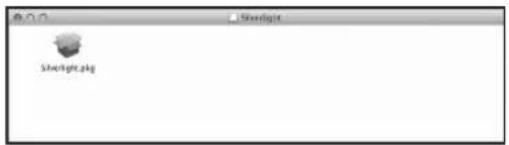
text_image
Shenlight.jpg- Click [Continue] to start installing Silverlight plug-in. When done, you will see the screen as below.
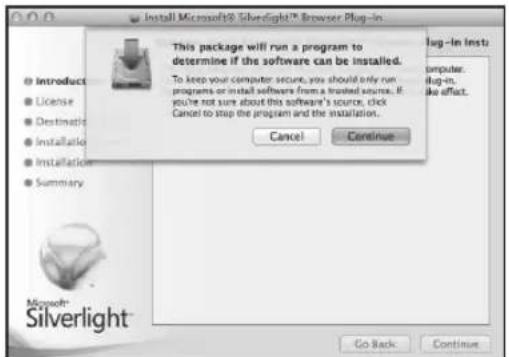
text_image
Install Microsoft® Silverlight™ Browser Plug-in This package will run a program to determine if the software can be installed. To keep your computer secure, you should only run programs or install software from a trusted source. If you're not sure about this software's source, click Cancel to stop the program and the installation. Cancel Cancel lug-In Inst: computer. plug-in. do effect. Microsoft Silverlight Go Back Continue- Click [Close] to exit from the Silverlight plug-in installation screen.
text_image
Install Microsoft® Silverlight® Browser Plug-in The installation was completed successfully. The installation was successful. The software was installed. Go Back Close• If Microsoft Silverlight plug-in is already installed
- Use a web browser to connect to the DVR.
- If Silverlight plug-in is already installed, you will see the login screen as shown.
- If the login screen does not appear, check if the DVR set is connected properly with a valid IP address.
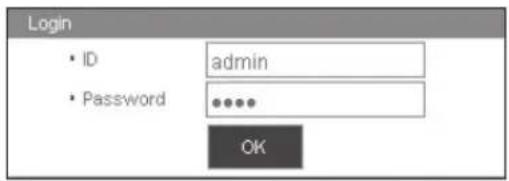
text_image
Login • ID admin • Password ••••• OK
If automatic proxy is activated and an invalid DNS server is specified while configuring network, the Internet access may not be available.
- For more details on using the Web Viewer, please refer to "Connecting Web Viewer (Windows)". (Page 71)
USING LIVE VIEWER (Mac)
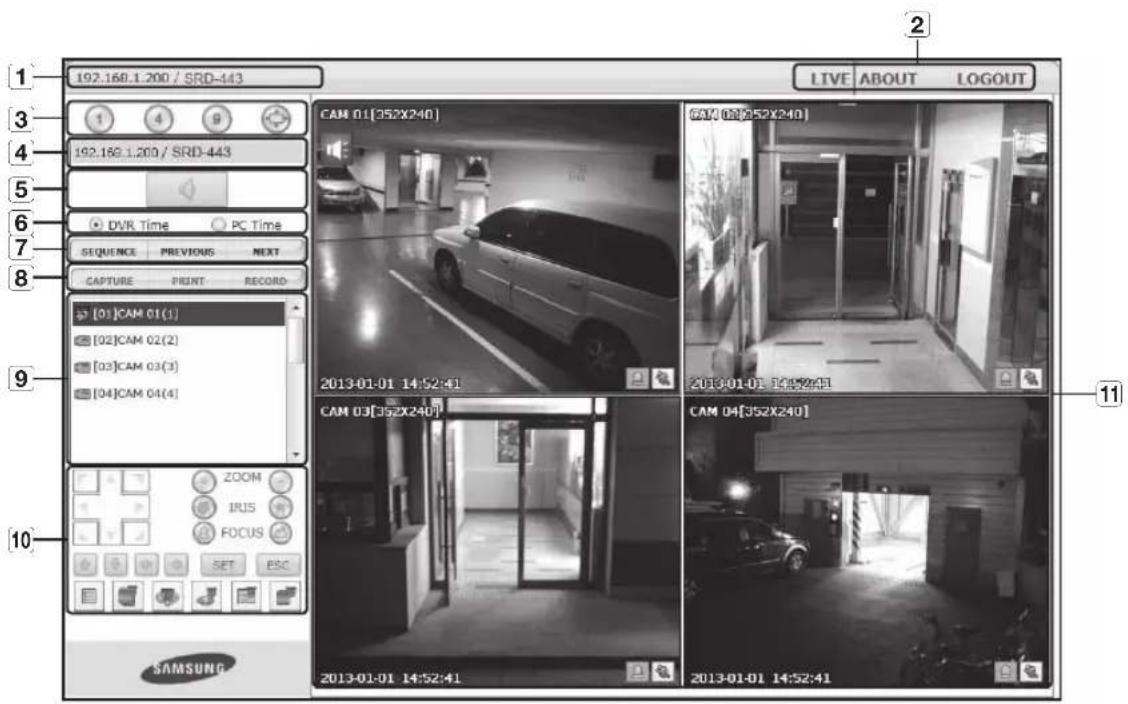
text_image
1 192.160.1.200 / SRD-443 LIVE ABOUT LOGOUT CAM 01[352X240] CAM 02[352X240] CAM 03[352X240] CAM 04[352X240] 1 2 3 4 192.160.1.200 / SRD-443 1 2 3 4 5 6 DVTR Time PC Time SEQUENCE PREVIOUS NEXT CAPTURE PRINT RECORD [01]CAM 01(1) [02]CAM 02(2) [03]CAM 03(3) [04]CAM 04(4) ZOOM IRUS FOCUS SET ESC SAMSUNG CAM 01[352X240] CAM 02[352X240] CAM 03[352X240] CAM 04[352X240] 11The Live Viewer screen consists of following :
| Menu Functions | ||
| 1 | Name, Address | Displays a connected DVR's IP address and model name. |
| 2 | Menu Selection | Consists of,,andmenu. |
| 3 | Split Mode Selection | These buttons are used for the screen split and full screen mode.Supports up to a maximum of 9 channels due to performance constraints of Silverlight |
| 4 | Name, Address | Displays a connected DVR's IP address and model name. |
| 5 | Audio | Sets the sound connected to each channel to ON/OFF. |
| 6 | DVR Time, PC Time | Selectorfor the OSD time information display setting of the Live Viewer. |
| 7 | Change Channel | Switches into previous/next channel or perform Auto Sequence.Click Auto Sequence button to display the Time Interval Selection menu. |
| 8 | CAPTURE | Saves current video for selected channel in designated path. |
| Prints current video image for selected channel through designated printer. | ||
| RECORD | Starts and stops recording.If you cannot play the file recorded from the web, please install the H.264 CODEC.ex) MAC: perian_1.2.3.dmg (http://perian.org) | |
| 9 | Channel | Indicates connected DVR's channels. |
| 10 | PTZ | Controls connect PTZ camera(s). |
| 11 | Display Pane | Displays the video of camera connected to DVR. |
What is Mobile Viewer?
Mobile Viewer is management software that enables you to connect to DVR (Digital Video Recorder) remotely and control the video playback and PTZ operations (if configured) in real time.
Key Features
• Remote access via Smart phone
- Voice Recognition
• 1-split and 4-split modes supported in Live Viewer
• Supports single channel search function
- Switch channels using the touch-sensitive LCD panel
- PTZ camera operations supported (complies with the protocol of the connected DVR)
• Up to 16 channels supported
Compatible Smartphone
This application is optimized for
• iOS v5.1, v6.0, v6.1 (iPhone 4/5, iPad 3/4)
• Android OS v2.3, v4.0, v4.1 (Galaxy S2/S3, Galaxy Note)

■ For more information, refer to the user manual. (http://www.samsungcctv.com)
text_image
SAMSUNG iPOLiS mobile Android OS Version 2.X Created Date 20xx. xx. xx Copyright © : Samsung Techwin This software uses FFMpeg under LGPL v2.1.SEC BACKUP VIEWER
You can play a file that is backed up in the format of SEC.
Backup in SEC format produces backup data file, library file and self-executable viewer file.
If you run the backup file viewer, the backup data file will be automatically played.
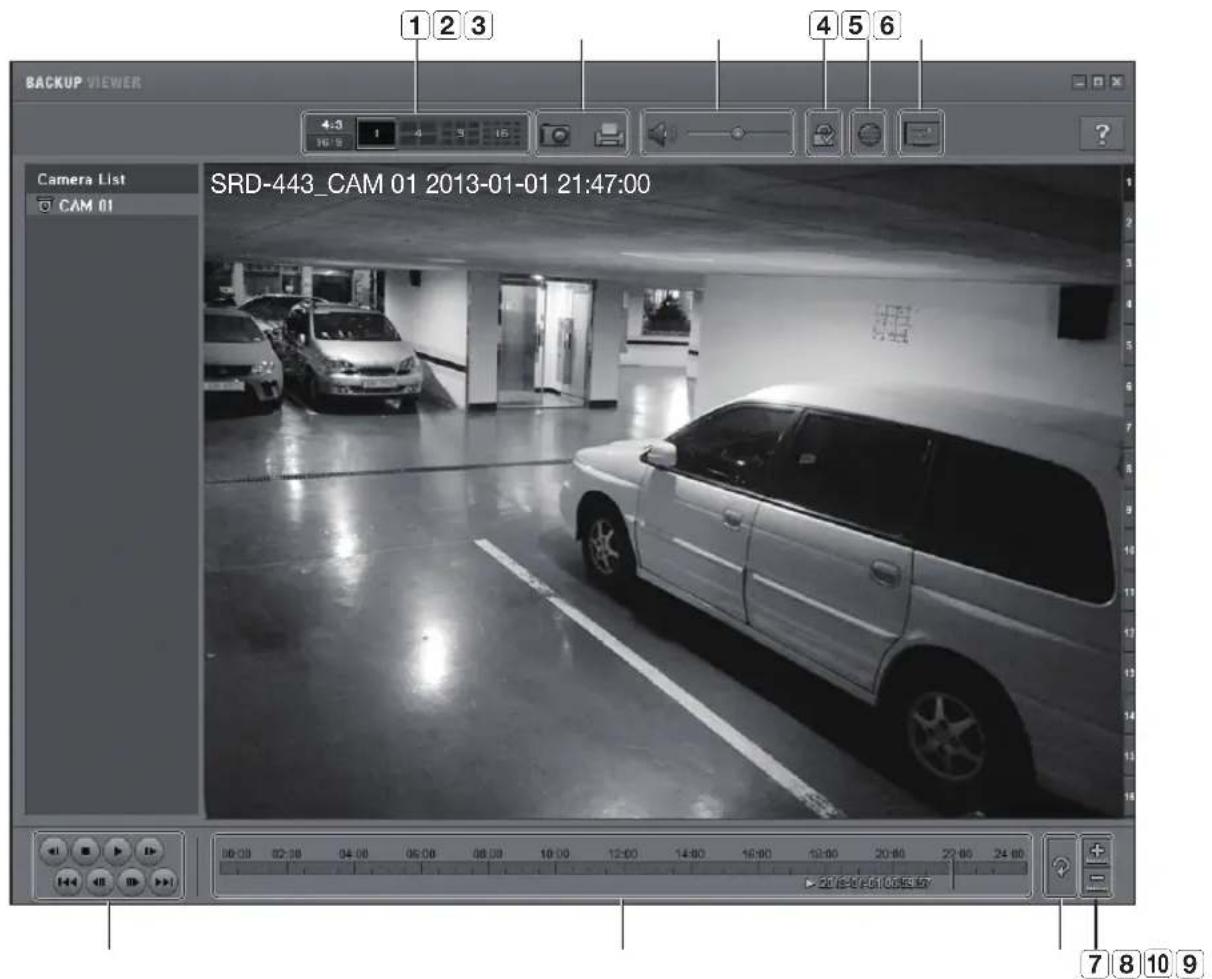
text_image
BACKUP VIEWER Camera List CAM 01 SRD-443_CAM 01 2013-01-01 21:47:00 1 2 3 4 5 6 7 8 9Recommended System Requirements
PCs with a lower specification than the recommended below may not fully support forward/backward and high-speed playback.
• OS : Windows XP professional, Windows Vista, Windows 7
• CPU : Intel i5 2.8GHz or faster
• RAM : DDR PC-3200 1G or more
• VGA : Geforce 6200 or higher
| Part Names Functions | |||
| 1 | Split Screen | | Set the screen's aspect ratio to be displayed. |
| [γD3W] | The screen switches to the selected split screen mode.▪ Split screen function is not supported during the CD/DVD backup. | ||
| 2 | Screen Printout | [8x76] | Saves the current video's image as in an image file. Supports jpeg file format. |
| Prints out the current screen. You should have installed the appropriate printer driver before you can print out the screen. | ||
| 3 | Audio |  | A toggle button. Each time you press this button, the audio output will toggle between activated and deactivated. |
 | You can adjust the volume level from 0 to 100. | ||
| 4 | Watermark |  | Press the button to enable file tampering detection, to detect data file forging. |
| 5 | Deinterlace You can enable the De-interlace function. | ||
| 6 | Show OSD | Check the OSD checkbox to display the OSD information on the backup playback screen.Information such as backup date, day of the week, time, model name, and channel number will be displayed on the screen. | |
| 7 | Enlarge / Reduce Timeline | Collapses the time range that is displayed on the range bar of the storage time. You can collapse the range bar until the overall range is shortened to 24 hours. | |
| Enlarges the time range that is displayed on the range bar of the storage time. You can enlarge the range bar until the overall range is extended to 1 minute. | |||
| 8 | Restore Timeline Restores the timeline to the default. | ||
| 9 | Display of storage time range | Displays the time range of a stored video file.You can move the gridline of the range bar to select a time point to play. | |
| 10 | Playback Control You can adjust the video playback of the timeline. | ||

If it has a high recording rate and is played at high speed playback of 16x or higher speed in the backup viewer, actual playback speed may not reach the set playback speed.
Product SPecIFlcAtlon
| Item Details | ||
| Video | Inputs 4 composite video 0.5-1 Vpp, 75 ohm | |
| Resolution 720x480 NTSC, 720x576 PAL | ||
| Live | Frame rate 120fps NTSC, 100fps PAL | |
| Resolution 720x480 NTSC, 720x576 PAL | ||
| Multi Screen display 1, 4, SEQUENCE, PIP | ||
| Performance | ||
| Operating System Embedded Linux | ||
| Recording | Compression H.264 | |
| Record Rate | NTSC: Up to 30fps @ 704x480 / PAL: Up to 25fps @ 704x576: 4CIF(L) | |
| NTSC: Up to 60fps @ 704x240 / PAL: Up to 50fps @ 704x288: 2CIF(M) | ||
| NTSC: Up to 120fps @ 352x240 / PAL: Up to 100fps @ 352x288: CIF(S) | ||
| Mode | NTSC: Manual, Schedule (Continuous/Event), Event (Pre/Post) | |
| PAL: Manual, Schedule (Continuous/Event), Event (Pre/Post) | ||
| Overwrite modes Selectable (Stop/Continuous) | ||
| Pre-Alarm Up to 5sec. | ||
| Post-Alarm Up to 6 hour. (5, 10, 20, 30 sec, 1, 3, 5, 10, 20 min, 1, 2, 3, 4, 5, 6 hour) | ||
| Search & Playback | Search mode | Date/time, Event, Back up, Motion |
| Playback function Fast Forward/Backward, Slow Forward/Backward, Step Forward/Backward | ||
| Network | Transmission speed | 100 / 120fps |
| Bandwidth | Up to (4)Mbps, Unlimited(4M)/2/1.5/1 Mbps/800/600/500/400/300/200/100/50 kbps | |
| Bandwidth control | Automatic | |
| Stream H.264(CIF) | ||
| Maximum No. of remote users | Search(2) / Live Unicast(4) / Live Multicast(20) | |
| Protocol support | TCP/IP, DHCP, PPPoE, SMTP, NTP, HTTP, DDNS, RTP, RTSP | |
| Monitoring Webviewer, CMS(Smart viewer) | ||
| Smartphone | Smartphone | Support |
| Protocol support | RTP, RTSP, HTTP, CGI | |
| Remote users Maximum | Live(1) | |
| Storage | Internal HDD Up to 1 SATA | HDD |
| External HDD - | ||
| DVD Writer (Back-up) - | ||
| USB (Back-up) 2 USB Ports | ||
| File Forma (Back-up) BU(DVR Player), EXE(Include Player), AVI | ||
| Security | Password Protection 1 Admin, 10 Group, 10 User per 1 Group | |
| Data Authentication Watermark | ||
| Interface | ||
| Monitors | VGA | Analog RGB 1024x768 resolution(Main Composite or VGA selected in booting.) |
| HDMI - | ||
| Main Composite BNC, 1 Vp-p, 75 ohm | ||
| Spot Composite - | ||
| Loop Outputs - | ||
| Audio | Inputs/Output 4 Line in / 1 | line out |
| Compression G.711 | ||
| Sampling rate 8KHz | ||
| Alarm | Inputs/Outputs | Terminal 4 inputs (NO/NC) / Terminal 1 relay outputs (NO/NC), Rating: 24V DC 1A, 125VAC/0.5A |
| Remote notification Notification via e-mail | ||
| Connections | Ethernet | 1 RJ45 10/100 Base-T |
| Serial interface | RS-485 for PTZ, System Keyboard | |
| USB | USB 2.0, 2 ports (Rear) | |
| e-SATA | - | |
| Application Supoort Mouse | Remote Controller | |
| Protocol support | Samsung-E/Samsung-T/Pelco-D/ Pelco-P/Panasonic/Phillips/AD/DIAMOND/ ERNA/KALATEL/VCL TP/VICON/ELMO | |
| General | ||
| Electrical | Input Voltage/Current | DC12V, 2A, AC 100~240V, 50~60Hz |
| Power consumption Max. | 19.6W (with 1x HDD) | |
| Environmental | Operating Temperature/ Humidity | 0°C ~ +40°C (+32°F ~ +104°F) / 20% ~ 85%RH |
| Mechanical | Dimension (W x H x D) H (leg not included) | W315 x H52 x D223.5mm (12.4 x 2.05 x 8.8 inch) |
| Weight (With hard disks) | 1.53kg | |
| Rack mount kit | - | |
| Lauguage | English, French, German, Spanish, Italian, Chinese(Simplified), Russian, Korean, Polish, Japanese, Dutch, Portuguese, Turkish, Czech, Danish, Swedish, Thai, Romanian, Serbian, Croatian, Hungarian, Greek, Chinese (Traditional), Finnish and Norwegian | |
Product oVerVleW
unit : mm (inches)

text_image
Front panel diagram of a rack-mounted industrial control unit with labeled components and status indicators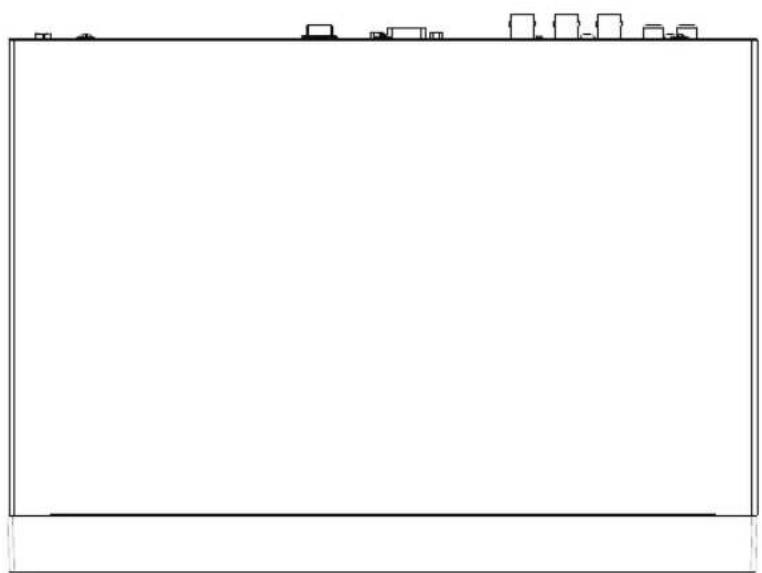
natural_image
Empty rectangular frame with small rectangular blocks and a horizontal line at the top (no text or symbols)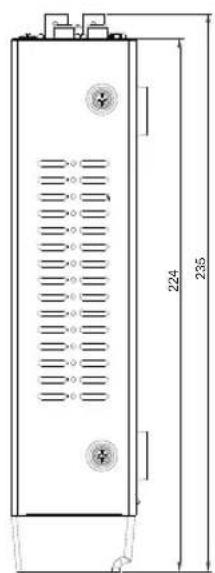
text_image
224 235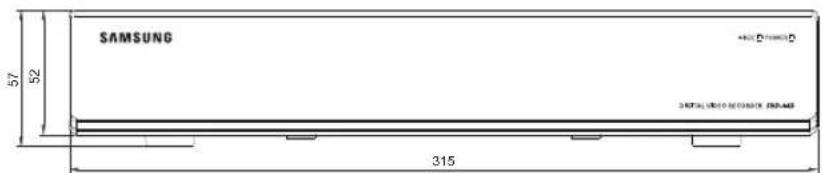
text_image
SAMSUNG +80 D 315 57 52 DIGITAL VOLTAGE SWITCH (VOL-40)deFAult Setting
This returns the factory default settings.
The settings are made as follows;
• Use System/Load Factory Default in MENU
The default administrator ID is "admin", and the password must be set when the user log in at the first time.
To prevent from your personal information being exposed, please change your password every 3 months. Note that the security and other related issues caused by careless management of password shall be in the charge of the user.
| Category Details Factory Default | ||||
| System Settings | Date/Time/Language Date/Time/Language | Date YYYY-MM-DD | ||
| Time Format 24 hours | ||||
| Time Zone GMT | ||||
| Time Synchronize OFF | ||||
| DST OFF | ||||
| Language English | ||||
| Permission Management | Admin ID admin | |||
| Setting | Restricted Access | Backup/Record Lock/ Search/PTZ/Remote Alarm Out/Shutdown | ||
| Auto Logout | OFF | |||
| System Management | System Information | Broadcast Format | NTSC/PAL | |
| Device | Camera | Camera | Video | ON |
| Audio | OFF | |||
| CH Name | CAM 01 ~ CAM 04 | |||
| SEQ-Dwell Time | 5sec | |||
| PTZ | ID | Camera No. | ||
| Protocol | None | |||
| Screen Setup | Brightness | 50 | ||
| Contrast 50 | ||||
| Color | 50 | |||
| Storage Device | HDD Alarm | Check Alarm Output Port | OFF | |
| Duration | OFF | |||
| Replace Alarm Output Port | OFF | |||
| Duration | OFF | |||
| Device | Remote Device | Baudrate 9600 | ||
| Parity None | ||||
| Data 8 | ||||
| Stop bit 1 | ||||
| Transfer Type Half Duplex | ||||
| System Keyboard OFF | ||||
| Remote Control ON(00) | ||||
| Monitor | Monitor | Event Display OFF | ||
| Display All | ||||
| Video Output Auto | ||||
| Display Position Setup 30 | ||||
| Spot Out | Spot Out 1 CH1 ~ CH4 | |||
| Event Display OFF | ||||
| Mode | Live Mode ALL | |||
| Play Mode ALL | ||||
| Recording | Recording Schedule | CH1 ~ CH4 | Both(Cont&Evnt) | |
| Event Record Duration | PRE Event | OFF | ||
| POST Event | 1 min | |||
| REC Quality/Resolution | Normal Recording | Resolution | CIF(S) | |
| Frame Rate | 7 fps | |||
| Record Quality | Level 4 | |||
| Event | Resolution 4CIF(L) | |||
| Frame Rate | 7 fps | |||
| Record Quality | Level 4 | |||
| Record Option | Disk End Mode | Setup | Overwrite | |
| Disk End Beep | OFF | |||
| Auto Delete | OFF | |||
| Event | Sensor Detection | Sensor Operation OFF | ||
| Camera Camera | No. | |||
| Alarm None | ||||
| Duration 10 sec | ||||
| Motion Detection | Mode OFF | |||
| Sensitivity Level10(high) | ||||
| Alarm None | ||||
| Duration 10 sec | ||||
| Motion Region All Area | ||||
| Video Loss Detection | Video Loss State OFF | |||
| Alarm None | ||||
| Duration 10 sec | ||||
| Alarm Schedule | Alarm1 Event Sync | |||
| Network | Connection Mode | Connection | Connection Mode Static | P |
| Bandwidth 2Mbps | ||||
| IP 192.168.1.200 | ||||
| Gateway 192.168.1.1 | ||||
| Subnet Mask 255.255.255.0 | ||||
| DNS 168.126.63.1 | ||||
| Protocol | Protocol Type TCP | |||
| Port (TCP) | 4520~4524 | |||
| Webviewer Port | 80 | |||
| DDNS | DDNS Site | OFF | ||
| Live Transfer | Resolution | CIF(S) | ||
| Quality | Low | |||
| Mailing Service | SMTP | Server | OFF | |
| Port | 25 | |||
| Use Authentication | OFF | |||
| Secure Transfer Never | ||||
| Event | Event Interval | 10 min | ||
| Use Event Transfer | OFF | |||
| Group | Group | OFF | ||
| Recipient Permission | OFF | |||
troubleShooting
| Symptom Countermeasures | |
| The system does not turn on and the indicator on the front panel does not work at all. | Check if the power supply system is properly connected.Check the system for the input voltage from the power source.If the problem persists even after you have taken the above actions, check the power supplier and replace it with a new one if necessary. |
| Some channels display just a black screen even if they receive video sources. | Check if the camera connected to the system properly displays the image. Sometimes, this problem may occur on a camera that is not properly connected to the video source.Check if the camera is properly supplied with power.Sometimes, this problem may occur on a channel with weak video signal from a video distributor that is connected to multiple systems. In this case, input the video source of the camera directly into the DVR. This may find the cause and solve the problem. |
| If I press the [REC] button on the remote control, the REC indicator does not flash, nor the player start recording. | Check if there is a free space on the HDD for the recording.Check if the record mode is set to ON in the record mode setting. |
| The screen displays the logo image repeatedly. | This may occur from a problem with the main board, or the related software is corrupt.Contact the nearest service center for more information. |
| The Channel button does not work on the Live screen. | The Channel button does not work if the current screen is in the event monitoring mode.In the event monitoring screen, press the [ALARM] button to exit the screen and select a channel. |
| The cursor will not move to the Start button when I start the calendar search. | Check if the channel and the date that you want to play are marked with the V symbol.Both channel and date should be checked before you can start playing with the Start button. |
| When the alarm sounds, I press the [ALARM] button to release the alarm but it does not work. | Press the [MENU] button to release the alarm in the following way:1) To release the event monitoring mode : Monitoring Mode - set the duration of the event monitoring to Off.2) To release the alarm sound : Event Record Mode - Alarm (Motion Detection/Video Loss) - deactivate the alarm sound.3) To release the event : Event Record Mode - Alarm (Motion Detection/Video Loss) - set the mode to Off. |
| No response is made even if I press the [PTZ] button on the Live screen. | Menu → Camera→ Check if the current protocols and other settings in the PTZ device are properly configured according to the PTZ camera. |
| I've found that the DVR does not recognize as many disks as installed when I have connected multiple external HDDs to the DVR. | It takes time for the DVR to recognize multiple external HDDs. Try again in a moment and if the problem (of failure to recognize as many HDDs as connected) persists, it may occur due to a mechanical error of the HDD installed. Try again with a different HDD. |
| A message of “Need to reset date/time.” Is displayed on the screen. | This message is displayed if there occurs a problem with the time setting of the internal clock or an error in the clock itself. Contact the retailer or the service center for more information. |
| The time bar is not displayed in Search mode. | The timeline can switch between normal and extension mode. In extension mode, the time bar may not be displayed in the current timeline. Switch to normal mode or use the left or right button to navigate through the time bar. |
| The “NO HDD” icon and an error message are displayed. | Check the HDD for connection. If the problem persists in a normal condition, contact the nearest service center to have the HDD checked by the service personnel. |
| I have connected an external storage device (external SATA HDD) to the DVR but the DVR seems not to recognize it. | See the compatibility list of external storage devices to check if the connected device is supported by the DVR. For the compatibility list, contact the retailer where you purchased the DVR. |
| If I press the ESC key in full screen mode of the WebViewer, the system does not switch to a normal split mode. | Press the ALT+TAB keys to select ‘ACTIVE MOVIE’ and press the ESC key again. The system will switch to a normal split mode. |
| I found it difficult to configure the network settings if using the default search, backup and router settings. | For more information, refer to the user manual.If you want to check the basics of the product for a quick start, refer to the quick start guide (backup, search). |
| I forgot the password. | Contact the DVR administrator for help. |
| Backup data is just not played by the PC or DVR. | When you are backing up data, you have choices about the player either: PC or DVR. Make your selection before proceeding.If you are using the PC to play the data, the format of the backup file should be either AVI or SEC.If you are using the DVR for this purpose, formatting backup files should be done by the DVR. |
| My player does not switch to Live mode while in playback. | Press the Stop [■] button on the remote control, or click the [■] icon on the launcher to switch to Live mode. |
| Recording does not work. | ·If your player does not display a Live image at all, that indicates recording does not work so first check if you see an image on the screen.·Recording does not work if the recording settings are not properly configured.1) Manual Record: Press the [REC] button on the remote control to start recording.2) Scheduled Record: Specify a desired time in Menu - Record - Recording Schedule. Recording will start at the specified time.-Record: Recording will proceed in any conditions at the specified time.-Record: When an event occurs, recording will perform only if the event is of alarm, motion detection and video loss. If there is no event found, recording will not perform.-Record: If there is no event found, Continuous recording will perform. Whereas, if an event occurs, Event recording will perform. |
| The image quality of the recording data is not good. | ·Increase the resolution and quality level in Menu - Record - Quality / Resolution.1) Resolution: Select a bigger size when specifying the recording size. (4CIF> 2CIF>CIF)The recording image in the CIF format shows a deteriorated quality as it is enlarged from a small-sized image.2) Record Quality: Specify a bigger level for the recording quality.·If you increase the resolution and the recording quality, the data size increases accordingly. So the HDD will be filled faster. Overwriting will overwrite the existing data so recording will proceed at a shorter interval. |
The software included in this product contains copyrighted software that is licensed under the GPL/LGPL. You may obtain the complete Corresponding Source code from us for a period of three years after our last shipment of this product by sending email to help.cctv@samsung.com If you want to obtain the complete Corresponding Source code in the physical medium such as CD-ROM, the cost of physically performing source distribution might be charged.
- GPL Software : linux kernel, Sysvinit, dosfstools, wget, msmtp, busybox, cdrtools, dvd+rw-tools, iconv, smartctl, uboot, minicom, openssl, bash, lm_sensors
• LGPL Software : glibc, vmstat, inetutils
- OpenSSL License : OpenSSL
GNU GENERAL PUBLIC LICENSE
Version 2, June 1991
Copyright (C) 1989, 1991 Free Software Foundation, Inc.
51 Franklin Street, Fifth Floor, Boston, MA 02110-1301, USA
Everyone is permitted to copy and distribute verbatim copies of this license document, but changing it is not allowed.
Preamble
The licenses for most software are designed to take away your freedom to share and change it. By contrast, the GNU General Public License is intended to guarantee your freedom to share and change free software to make sure the software is free for all its users. This General Public License applies to most of the Free Software Foundation's software and to any other program whose authors commit to using it. (Some other Free Software Foundation software is covered by the GNU Lesser General Public License instead.) You can apply it to your programs, too.
When we speak of free software, we are referring to freedom, not price. Our General Public Licenses are designed to make sure that you have the freedom to distribute copies of free software (and charge for this service if you wish), that you receive source code or can get it if you want it, that you can change the software or use pieces of it in new free programs; and that you know you can do these things.
To protect your rights, we need to make restrictions that forbid anyone to deny you these rights or to ask you to surrender the rights. These restrictions translate to certain responsibilities for you if you distribute copies of the software, or if you modify it.
For example, if you distribute copies of such a program, whether gratis or for a fee, you must give the recipients all the rights that you have. You must make sure that they, too, receive or can get the source code. And you must show them these terms so they know their rights.
We protect your rights with two steps:
(1) copyright the software, and (2) offer you this license which gives you legal permission to copy, distribute and/or modify the software.
Also, for each author's protection and ours, we want to make certain that everyone understands that there is no warranty for this free software. If the software is modified by someone else and passed on, we want its recipients to know that what they have is not the original, so that any problems introduced by others will not reflect on the original authors' reputations.
Finally, any free program is threatened constantly by software patents. We wish to avoid the danger that redistributors of a free program will individually obtain patent licenses, in effect making the program proprietary. To prevent this, we have made it clear that any patent must be licensed for everyone's free use or not licensed at all. The precise terms and conditions for copying, distribution and modification follow.
terMS And conditionS For coPYIng, dIStributlon And ModIFlcAtlon
Version 2, June 1991
Copyright (C) 1989, 1991 Free Software Foundation, Inc. 51 Franklin S
- This License applies to any program or other work which contains a notice placed by the copyright holder saying it may be distributed under the terms of this General Public License. The "Program", below, refers to any such program or work, and a "work based on the Program" means either the Program or any derivative work under copyright law: that is to say, a work containing the Program or a portion of it, either verbatim or with modifications and/or translated into another language. (Hereinafter, translation is included without limitation in the term "modification".) Each licensee is addressed as "you".
Activities other than copying, distribution and modification are not covered by this License; they are outside its scope. The act of running the Program is not restricted, and the output from the Program is covered only if its contents constitute a work based on the Program
(independent of having been made by running the Program). Whether that is true depends on what the Program does.
- You may copy and distribute verbatim copies of the Program's source code as you receive it, in any medium, provided that you conspicuously and appropriately publish on each copy an appropriate copyright notice and disclaimer of warranty; keep intact all the notices that refer to this License and to the absence of any warranty; and give any other recipients of the Program a copy of this License along with the Program.
You may charge a fee for the physical act of transferring a copy, and you may at your option offer warranty protection in exchange for a fee.
- You may modify your copy or copies of the Program or any portion of it, thus forming a work based on the Program, and copy and distribute such modifications or work under the terms of Section 1 above, provided that you also meet all of these conditions:
a) You must cause the modified files to carry prominent notices stating that you changed the files and the date of any change.
b) You must cause any work that you distribute or publish, that in whole or in part contains or is derived from the Program or any part thereof, to be licensed as a whole at no charge to all third parties under the terms of this License.
c) If the modified program normally reads commands interactively when run, you must cause it, when started running for such interactive use in the most ordinary way, to print or display an announcement including an appropriate copyright notice and a notice that there is no warranty (or else, saying that you provide a warranty) and that users may redistribute the program under these conditions, and telling the user how to view a copy of this License. (Exception: if the Program itself is interactive but does not normally print such an announcement, your work based on the Program is not required to print an announcement.)
These requirements apply to the modified work as a whole. If identifiable sections of that work are not derived from the Program, and can be reasonably considered independent and separate works in themselves, then this License, and its terms, do not apply to those sections when you distribute them as separate works. But when you distribute the same sections as part of a whole which is a work based on the Program, the distribution of the whole must be on the terms of this License, whose permissions for other licensees extend to the entire whole, and thus to each and every part regardless of who wrote it.
Thus, it is not the intent of this section to claim rights or contest your rights to work written entirely by you; rather, the intent is to exercise the right to control the distribution of derivative or collective works based on the Program.
In addition, mere aggregation of another work not based on the Program with the Program (or with a work based on the Program) on a volume of a storage or distribution medium does not bring the other work under the scope of this License.
- You may copy and distribute the Program (or a work based on it, under Section 2) in object code or executable form under the terms of Sections 1 and 2 above provided that you also do one of the following:
a) Accompany it with the complete corresponding machine-readable source code, which must be distributed under the terms of Sections 1 and 2 above on a medium customarily used for software interchange; or,
b) Accompany it with a written offer, valid for at least three years, to give any third party, for a charge no more than your cost of physically performing source distribution, a complete machine-readable copy of the corresponding source code, to be distributed under the terms of Sections 1 and 2 above on a medium customarily used for software interchange; or,
c) Accompany it with the information you received as to the offer to distribute corresponding source code. (This alternative is allowed only for noncommercial distribution and only if you received the program in object code or executable form with such an offer, in accord with Subsection b above.)
The source code for a work means the preferred form of the work for making modifications to it. For an executable work, complete source code means all the source code for all modules it contains, plus any associated interface definition files, plus the scripts used to control
compilation and installation of the executable. However, as a special exception, the source code distributed need not include anything that is normally distributed (in either source or binary form) with the major components (compiler, kernel, and so on) of the operating system on which the executable runs, unless that component itself accompanies the executable.
If distribution of executable or object code is made by offering access to copy from a designated place, then offering equivalent access to copy the source code from the same place counts as distribution of the source code, even though third parties are not compelled to copy the source along with the object code.
-
You may not copy, modify, sublicense, or distribute the Program except as expressly provided under this License. Any attempt otherwise to copy, modify, sublicense or distribute the Program is void, and will automatically terminate your rights under this License. However, parties who have received copies, or rights, from you under this License will not have their licenses terminated so long as such parties remain in full compliance.
-
You are not required to accept this License, since you have not signed it. However, nothing else grants you permission to modify or distribute the Program or its derivative works. These actions are prohibited by law if you do not accept this License. Therefore, by modifying or distributing the Program (or any work based on the Program), you indicate your acceptance of this License to do so, and all its terms and conditions for copying, distributing or modifying the Program or works based on it.
-
Each time you redistribute the Program (or any work based on the Program), the recipient automatically receives a license from the original licensor to copy, distribute or modify the Program subject to these terms and conditions. You may not impose any further restrictions on the recipients' exercise of the rights granted herein. You are not responsible for enforcing compliance by third parties to this License.
-
If, as a consequence of a court judgment or allegation of patent infringement or for any other reason (not limited to patent issues), conditions are imposed on you (whether by court order, agreement or otherwise) that contradict the conditions of this License, they do not excuse you from the conditions of this License. If you cannot distribute so as to satisfy simultaneously your obligations under this License and any other pertinent obligations, then as a consequence you may not distribute the Program at all. For example, if a patent license would not permit royalty-free redistribution of the Program by all those who receive copies directly or indirectly through you, then the only way you could satisfy both it and this License would be to refrain entirely from distribution of the Program.
If any portion of this section is held invalid or unenforceable under any particular circumstance, the balance of the section is intended to apply and the section as a whole is intended to apply in other circumstances. It is not the purpose of this section to induce you to infringe any patents or other property right claims or to contest validity of any such claims; this section has the sole purpose of protecting the integrity of the free software distribution system, which is implemented by public license practices. Many people have made generous contributions to the wide range of software distributed through that system in reliance on consistent application of that system; it is up to the author/donor to decide if he or she is willing to distribute software through any other system and a licensee cannot impose that choice.
This section is intended to make thoroughly clear what is believed to be a consequence of the rest of this License.
-
If the distribution and/or use of the Program is restricted in certain countries either by patents or by copyrighted interfaces, the original copyright holder who places the Program under this License may add an explicit geographical distribution limitation excluding those countries, so that distribution is permitted only in or among countries not thus excluded. In such case, this License incorporates the limitation as if written in the body of this License.
-
The Free Software Foundation may publish revised and/or new versions of the General Public License from time to time. Such new versions will be similar in spirit to the present version, but may differ in detail to address new problems or concerns.
Each version is given a distinguishing version number. If the Program specifies a version number of this License which applies to it and “any later version”, you have the option of following the terms and conditions either of that version or of any later version published by the Free Software Foundation. If the Program does not specify a version number of this License, you may choose any version ever published by the Free Software Foundation.
- If you wish to incorporate parts of the Program into other free programs whose distribution conditions are different, write to the author to ask for permission. For software which is copyrighted by the Free Software Foundation, write to the Free Software Foundation; we sometimes make exceptions for this. Our decision will be guided by the two goals of preserving the free status of all derivatives of our free software and of promoting the sharing and reuse of software generally.
NO WARRANTY
-
BECAUSE THE PROGRAM IS LICENSED FREE OF CHARGE, THERE IS NO WARRANTY FOR THE PROGRAM, TO THE EXTENT PERMITTED BY APPLICABLE LAW. EXCEPT WHEN OTHERWISE STATED IN WRITING THE COPYRIGHT HOLDERS AND/OR OTHER PARTIES PROVIDE THE PROGRAM "AS IS" WITHOUT WARRANTY OF ANY KIND, EITHER EXPRESSED OR IMPLIED, INCLUDING, BUT NOT LIMITED TO, THE IMPLIED WARRANTIES OF MERCHANTABILITY AND FITNESS FOR A PARTICULAR PURPOSE. THE ENTIRE RISK AS TO THE QUALITY AND PERFORMANCE OF THE PROGRAM IS WITH YOU, SHOULD THE PROGRAM PROVE DEFECTIVE, YOU ASSUME THE COST OF ALL NECESSARY SERVICING, REPAIR OR CORRECTION.
-
IN NO EVENT UNLESS REQUIRED BY APPLICABLE LAW OR AGREED TO IN WRITING WILL ANY COPYRIGHT HOLDER, OR ANY OTHER PARTY WHO MAY MODIFY AND/OR REDISTRIBUTE THE PROGRAM AS PERMITTED ABOVE, BE LIABLE TO YOU FOR DAMAGES, INCLUDING ANY GENERAL, SPECIAL, INCIDENTAL OR CONSEQUENTIAL DAMAGES ARISING OUT OF THE USE OR INABILITY TO USE THE PROGRAM (INCLUDING BUT NOT LIMITED TO LOSS OF DATA OR DATA BEING RENDERED INACCURATE OR LOSSES SUSTAINED BY YOU OR THIRD PARTIES OR A FAILURE OF THE PROGRAM TO OPERATE WITH ANY OTHER PROGRAMS), EVEN IF SUCH HOLDER OR OTHER PARTY HAS BEEN ADVISED OF THE POSSIBILITY OF SUCH DAMAGES.
END OF TERMS AND CONDITIONS
How to Apply These Terms to Your New Programs
If you develop a new program, and you want it to be of the greatest possible use to the public, the best way to achieve this is to make it free software which everyone can redistribute and change under these terms.
To do so, attach the following notices to the program. It is safest to attach them to the start of each source file to most effectively convey the exclusion of warranty; and each file should have at least the "copyright" line and a pointer to where the full notice is found. one line to give the program's name and an idea of what it does.
Copyright (C) yyyy name of author
This program is free software; you can redistribute it and/or modify it under the terms of the GNU General Public License as published by the Free Software Foundation; either version 2 of the License, or (at your option) any later version.
This program is distributed in the hope that it will be useful, but WITHOUT ANY WARRANTY; without even the implied warranty of MERCHANTABILITY or FITNESS FOR A PARTICULAR PURPOSE. See the GNU General Public License for more details.
You should have received a copy of the GNU General Public License along with this program; if not, write to the Free Software Foundation, Inc., 51 Franklin Street, Fifth Floor, Boston, MA 02110-1301, USA.
Also add information on how to contact you by electronic and paper mail. If the program is interactive, make it output a short notice like this when it starts in an interactive mode:
Gnomovision version 69, Copyright (C) year name of author Gnomovision comes with ABSOLUTELY NO WARRANTY; for details type 'show w'. This is free software, and you are welcome to redistribute it under certain conditions; type 'show c' for details.
The hypothetical commands 'show w' and 'show c' should show the appropriate parts of the General Public License. Of course, the commands you use may be called something other than 'show w' and 'show c'; they could even be mouse-clicks or menu items--whatever suits your program.
You should also get your employer (if you work as a programmer) or your school, if any, to sign a "copyright disclaimer" for the program, if necessary. Here is a sample; alter the names:
Yoyodyne, Inc., hereby disclaims all copyright interest in the program 'Gnomovision' (which makes passes at compilers) written by James Hacker.
signature of Ty Coon, 1 April 1989 Ty Coon, President of Vice This General Public License does not permit incorporating your program into proprietary programs. If your program is a subroutine library, you may consider it more useful to permit linking proprietary applications with the library. If this is what you want to do, use the GNU Lesser General Public License instead of this License.
GNU GENERAL PUBLIC LICENSE
Version 3, 29 June 2007
Copyright © 2007 Free Software Foundation, Inc. http://fsf.org/ Everyone is permitted to copy and distribute verbatim copies of this license document, but changing it is not allowed.
Preamble
The GNU General Public License is a free, copyleft license for software and other kinds of works.
The licenses for most software and other practical works are designed to take away your freedom to share and change the works. By contrast, the GNU General Public License is intended to guarantee your freedom to share and change all versions of a program--to make sure it remains free software for all its users. We, the Free Software Foundation, use the GNU General Public License for most of our software; it applies also to any other work released this way by its authors. You can apply it to your programs, too.
When we speak of free software, we are referring to freedom, not price. Our General Public Licenses are designed to make sure that you have the freedom to distribute copies of free software (and charge for them if you wish), that you receive source code or can get it if you want it, that you can change the software or use pieces of it in new free programs, and that you know you can do these things.
To protect your rights, we need to prevent others from denying you these rights or asking you to surrender the rights. Therefore, you have certain responsibilities if you distribute copies of the software, or if you modify it: responsibilities to respect the freedom of others.
For example, if you distribute copies of such a program, whether gratis or for a fee, you must pass on to the recipients the same freedoms that you received. You must make sure that they, too, receive or can get the source code. And you must show them these terms so they know their rights.
Developers that use the GNU GPL protect your rights with two steps: (1) assert copyright on the software, and (2) offer you this License giving you legal permission to copy, distribute and/or modify it.
For the developers' and authors' protection, the GPL clearly explains that there is no warranty for this free software. For both users' and authors' sake, the GPL requires that modified versions be marked as changed, so that their problems will not be attributed erroneously to authors of previous versions.
Some devices are designed to deny users access to install or run modified versions of the software inside them, although the manufacturer can do so. This is fundamentally incompatible with the aim of protecting users' freedom to change the software. The systematic pattern of such abuse occurs in the area of products for individuals to use, which is precisely where it is most unacceptable. Therefore, we have designed this version of the GPL to prohibit the practice for those products. If such problems arise substantially in other domains, we stand ready to extend this provision to those domains in future versions of the GPL, as needed to protect the freedom of users.
Finally, every program is threatened constantly by software patents. States should not allow patents to restrict development and use of software on general-purpose computers, but in those that do, we wish to avoid the special danger that patents applied to a free program could make it effectively proprietary. To prevent this, the GPL assures that patents cannot be used to render the program non-free.
The precise terms and conditions for copying, distribution and modification follow.
TERMS AND CONDITIONS
0. Definitions.
"This License" refers to version 3 of the GNU General Public License.
"Copyright" also means copyright-like laws that apply to other kinds of works, such as semiconductor masks.
"The Program" refers to any copyrightable work licensed under this License. Each licensee is addressed as "you". "Licensees" and "recipients" may be individuals or organizations.
To “modify” a work means to copy from or adapt all or part of the work in a fashion requiring copyright permission, other than the making of an exact copy. The resulting work is called a “modified version” of the earlier work or a work “based on” the earlier work.
A “covered work” means either the unmodified Program or a work based on the Program.
To “propagate” a work means to do anything with it that, without permission, would make you directly or secondarily liable for infringement under applicable copyright law, except executing it on a computer or modifying a private copy. Propagation includes copying, distribution (with or without modification), making available to the public, and in some countries other activities as well.
To “convey” a work means any kind of propagation that enables other parties to make or receive copies. Mere interaction with a user through a computer network, with no transfer of a copy, is not conveying.
An interactive user interface displays “Appropriate Legal Notices” to the extent that it includes a convenient and prominently visible feature that (1) displays an appropriate copyright notice, and (2) tells the user that there is no warranty for the work (except to the extent that warranties are provided), that licensees may convey the work under this License, and how to view a copy of this License. If the interface presents a list of user commands or options, such as a menu, a prominent item in the list meets this criterion.
1. Source Code.
The “source code” for a work means the preferred form of the work for making modifications to it. “Object code” means any non-source form of a work.
A “Standard Interface” means an interface that either is an official standard defined by a recognized standards body, or, in the case of interfaces specified for a particular programming language, one that is widely used among developers working in that language.
The "System Libraries" of an executable work include anything, other than the work as a whole, that (a) is included in the normal form of packaging a Major Component, but which is not part of that Major Component, and (b) serves only to enable use of the work with that Major Component, or to implement a Standard Interface for which an implementation is available to the public in source code form. A "Major Component", in this context, means a major essential component (kemel, window system, and so on) of the specific operating system (if any) on which the executable work runs, or a compiler used to produce the work, or an object code interpreter used to run it.
The “Corresponding Source” for a work in object code form means all the source code needed to generate, install, and (for an executable work) run the object code and to modify the work, including scripts to control those activities. However, it does not include the work’s System Libraries, or general-purpose tools or generally available free programs which are used unmodified in performing those activities but which are not part of the work. For example, Corresponding Source includes interface definition files associated with source files for the work, and the source code for shared libraries and dynamically linked subprograms that the work is specifically designed to require, such as by intimate data communication or control flow between those subprograms and other parts of the work.
The Corresponding Source need not include anything that users can regenerate automatically from other parts of the Corresponding Source.
The Corresponding Source for a work in source code form is that same work.
2. Basic Permissions.
All rights granted under this License are granted for the term of copyright on the Program, and are irrevocable provided the stated conditions are met. This License explicitly affirms your unlimited permission to run the unmodified Program. The output from running a covered work is covered by this License only if the output, given its content, constitutes a covered work. This License acknowledges your rights of fair use or other equivalent, as provided by copyright law.
You may make, run and propagate covered works that you do not convey, without conditions so long as your license otherwise remains in force. You may convey covered works to others for the sole purpose of having them make modifications exclusively for you, or provide you with facilities for running those works, provided that you comply with the terms of this License in conveying all material for which you do not control copyright. Those thus making or running the covered works for you must do so exclusively on your behalf, under your direction and control, on terms that prohibit them from making any copies of your copyrighted material outside their relationship with you.
Conveying under any other circumstances is permitted solely under the conditions stated below. Sublicensing is not allowed; section 10 makes it unnecessary.
3. Protecting Users' Legal Rights From Anti-Circumvention Law.
No covered work shall be deemed part of an effective technological measure under any applicable law fulfilling obligations under article 11 of the WIPO copyright treaty adopted on 20 December 1996, or similar laws prohibiting or restricting circumvention of such measures.
When you convey a covered work, you waive any legal power to forbid circumvention of technological measures to the extent such circumvention is effected by exercising rights under this License with respect to the covered work, and you disclaim any intention to limit operation or modification of the work as a means of enforcing, against the work's users, your or third parties' legal rights to forbid circumvention of technological measures.
4. Conveying Verbatim Copies.
You may convey verbatim copies of the Program's source code as you receive it, in any medium, provided that you conspicuously and appropriately publish on each copy an appropriate copyright notice; keep intact all notices stating that this License and any non-permissive terms added in accord with section 7 apply to the code; keep intact all notices of the absence of any warranty; and give all recipients a copy of this License along with the Program.
You may charge any price or no price for each copy that you convey, and you may offer support or warranty protection for a fee.
5. Conveying Modified Source Versions.
You may convey a work based on the Program, or the modifications to produce it from the Program, in the form of source code under the terms of section 4, provided that you also meet all of these conditions:
a) The work must carry prominent notices stating that you modified it, and giving a relevant date.
b) The work must carry prominent notices stating that it is released under this License and any conditions added under section 7. This requirement modifies the requirement in section 4 to "keep intact all notices".
c) You must license the entire work, as a whole, under this License to anyone who comes into possession of a copy. This License will therefore apply, along with any applicable section 7 additional terms, to the whole of the work, and all its parts, regardless of how they are packaged. This License gives no permission to license the work in any other way, but it does not invalidate such permission if you have separately received it.
d) If the work has interactive user interfaces, each must display Appropriate Legal Notices; however, if the Program has interactive interfaces that do not display Appropriate Legal Notices, your work need not make them do so.
A compilation of a covered work with other separate and independent works, which are not by their nature extensions of the covered work, and which are not combined with it such as to form a larger program, in or on a volume of a storage or distribution medium, is called an "aggregate" if the compilation and its resulting copyright are not used to limit the access or legal rights of the compilation's users beyond what the individual works permit. Inclusion of a covered work in an aggregate does not cause this License to apply to the other parts of the aggregate.
6. Conveying Non-Source Forms.
You may convey a covered work in object code form under the terms of sections 4 and 5, provided that you also convey the machine-readable Corresponding Source under the terms of this License, in one of these ways:
a) Convey the object code in, or embodied in, a physical product (including a physical distribution medium), accompanied by the Corresponding Source fixed on a durable physical medium customarily used for software interchange.
b) Convey the object code in, or embodied in, a physical product (including a physical distribution medium), accompanied by a written offer, valid for at least three years and valid for as long as you offer spare parts or customer support for that product model, to give anyone who possesses the object code either (1) a copy of the Corresponding Source for all the software in the product that is covered by this License, on a durable physical medium customarily used for software interchange, for a price no more than your reasonable cost of physically performing this conveying of source, or (2) access to copy the Corresponding Source from a network server at no charge.
c) Convey individual copies of the object code with a copy of the written offer to provide the Corresponding Source. This alternative is allowed only occasionally and noncommercially, and only if you received the object code with such an offer, in accord with subsection 6b.
d) Convey the object code by offering access from a designated place (gratis or for a charge), and offer equivalent access to the Corresponding Source in the same way through the same place at no further charge. You need not require recipients to copy the
Corresponding Source along with the object code. If the place to copy the object code is a network server, the Corresponding Source may be on a different server (operated by you or a third party) that supports equivalent copying facilities, provided you maintain clear directions next to the object code saying where to find the Corresponding Source. Regardless of what server hosts the Corresponding Source, you remain obligated to ensure that it is available for as long as needed to satisfy these requirements.
e) Convey the object code using peer-to-peer transmission, provided you inform other peers where the object code and Corresponding Source of the work are being offered to the general public at no charge under subsection 6d.
A separable portion of the object code, whose source code is excluded from the Corresponding Source as a System Library, need not be included in conveying the object code work.
A "User Product" is either (1) a "consumer product", which means any tangible personal property which is normally used for personal, family, or household purposes, or (2) anything designed or sold for incorporation into a dwelling. In determining whether a product is a consumer product, doubtful cases shall be resolved in favor of coverage. For a particular product received by a particular user, "normally used" refers to a typical or common use of that class of product, regardless of the status of the particular user or of the way in which the particular user actually uses, or expects or is expected to use, the product. A product is a consumer product regardless of whether the product has substantial commercial, industrial or non-consumer uses, unless such uses represent the only significant mode of use of the product.
"Installation Information" for a User Product means any methods, procedures, authorization keys, or other information required to install and execute modified versions of a covered work in that User Product from a modified version of its Corresponding Source. The information must suffice to ensure that the continued functioning of the modified object code is in no case prevented or interfered with solely because modification has been made.
If you convey an object code work under this section in, or with, or specifically for use in, a User Product, and the conveying occurs as part of a transaction in which the right of possession and use of the User Product is transferred to the recipient in perpetuity or for a fixed term (regardless of how the transaction is characterized), the Corresponding Source conveyed under this section must be accompanied by the Installation Information. But this requirement does not apply if neither you nor any third party retains the ability to install modified object code on the User Product (for example, the work has been installed in ROM).
The requirement to provide Installation Information does not include a requirement to continue to provide support service, warranty, or updates for a work that has been modified or installed by the recipient, or for the User Product in which it has been modified or installed. Access to a network may be denied when the modification itself materially and adversely affects the operation of the network or violates the rules and protocols for communication across the network.
Corresponding Source conveyed, and Installation Information provided, in accord with this section must be in a format that is publicly documented (and with an implementation available to the public in source code form), and must require no special password or key for unpacking, reading or copying.
7. Additional Terms.
"Additional permissions" are terms that supplement the terms of this License by making exceptions from one or more of its conditions. Additional permissions that are applicable to the entire Program shall be treated as though they were included in this License, to the extent that they are valid under applicable law. If additional permissions apply only to part of the Program, that part may be used separately under those permissions, but the entire Program remains governed by this License without regard to the additional permissions.
When you convey a copy of a covered work, you may at your option remove any additional permissions from that copy, or from any part of it. (Additional permissions may be written to require their own removal in certain cases when you modify the work.) You may place additional permissions on material, added by you to a covered work, for which you have or can give appropriate copyright permission.
Notwithstanding any other provision of this License, for material you add to a covered work, you may (if authorized by the copyright holders of that material) supplement the terms of this License with terms:
a) Disclaiming warranty or limiting liability differently from the terms of sections 15 and 16 of this License; or
b) Requiring preservation of specified reasonable legal notices or author attributions in that material or in the Appropriate Legal Notices displayed by works containing it; or
c) Prohibiting misrepresentation of the origin of that material, or
requiring that modified versions of such material be marked in reasonable ways as different from the original version; or
d) Limiting the use for publicity purposes of names of licensors or authors of the material; or
e) Declining to grant rights under trademark law for use of some trade names, trademarks, or service marks; or
f) Requiring indemnification of licensors and authors of that material by anyone who conveys the material (or modified versions of it) with contractual assumptions of liability to the recipient, for any liability that these contractual assumptions directly impose on those licensors and authors.
All other non-permissive additional terms are considered “further restrictions” within the meaning of section 10. If the Program as you received it, or any part of it, contains a notice stating that it is governed by this License along with a term that is a further restriction, you may remove that term. If a license document contains a further restriction but permits relicensing or conveying under this License, you may add to a covered work material governed by the terms of that license document, provided that the further restriction does not survive such relicensing or conveying.
If you add terms to a covered work in accord with this section, you must place, in the relevant source files, a statement of the additional terms that apply to those files, or a notice indicating where to find the applicable terms.
Additional terms, permissive or non-permissive, may be stated in the form of a separately written license, or stated as exceptions; the above requirements apply either way.
8. Termination.
You may not propagate or modify a covered work except as expressly provided under this License. Any attempt otherwise to propagate or modify it is void, and will automatically terminate your rights under this License (including any patent licenses granted under the third paragraph of section 11).
However, if you cease all violation of this License, then your license from a particular copyright holder is reinstated (a) provisionally, unless and until the copyright holder explicitly and finally terminates your license, and (b) permanently, if the copyright holder fails to notify you of the violation by some reasonable means prior to 60 days after the cessation.
Moreover, your license from a particular copyright holder is reinstated permanently if the copyright holder notifies you of the violation by some reasonable means, this is the first time you have received notice of violation of this License (for any work) from that copyright holder, and you cure the violation prior to 30 days after your receipt of the notice.
Termination of your rights under this section does not terminate the licenses of parties who have received copies or rights from you under this License. If your rights have been terminated and not permanently reinstated, you do not qualify to receive new licenses for the same material under section 10.
9. Acceptance Not Required for Having Copies.
You are not required to accept this License in order to receive or run a copy of the Program. Ancillary propagation of a covered work occurring solely as a consequence of using peer-to-peer transmission to receive a copy likewise does not require acceptance. However, nothing other than this License grants you permission to propagate or modify any covered work. These actions infringe copyright if you do not accept this License. Therefore, by modifying or propagating a covered work, you indicate your acceptance of this License to do so.
10. Automatic Licensing of Downstream Recipients.
Each time you convey a covered work, the recipient automatically receives a license from the original licensors, to run, modify and propagate that work, subject to this License. You are not responsible for enforcing compliance by third parties with this License.
An “entity transaction” is a transaction transferring control of an organization, or substantially all assets of one, or subdividing an organization, or merging organizations. If propagation of a covered work results from an entity transaction, each party to that transaction who receives a copy of the work also receives whatever licenses to the work the party’s predecessor in interest had or could give under the previous paragraph, plus a right to possession of the Corresponding Source of the work from the predecessor in interest, if the predecessor has it or can get it with reasonable efforts.
You may not impose any further restrictions on the exercise of the rights granted or affirmed under this License. For example, you may not impose a license fee, royalty, or other charge for exercise of rights granted under this License, and you may not initiate litigation (including a cross-claim or counterclaim in a lawsuit) alleging that any patent claim is infringed by making, using, selling, offering for sale, or importing the Program or any portion of it.
11. Patents.
A “contributor” is a copyright holder who authorizes use under this License of the Program or a work on which the Program is based. The work thus licensed is called the contributor’s “contributor version”.
A contributor's “essential patent claims” are all patent claims owned or controlled by the contributor, whether already acquired or hereafter acquired, that would be infringed by some manner, permitted by this License, of making, using, or selling its contributor version, but do not include claims that would be infringed only as a consequence of further modification of the contributor version. For purposes of this definition, “control” includes the right to grant patent sublicenses in a manner consistent with the requirements of this License.
Each contributor grants you a non-exclusive, worldwide, royalty-free patent license under the contributor's essential patent claims, to make, use, sell, offer for sale, import and otherwise run, modify and propagate the contents of its contributor version.
In the following three paragraphs, a “patent license” is any express agreement or commitment, however denominated, not to enforce a patent (such as an express permission to practice a patent or covenant not to sue for patent infringement). To “grant” such a patent license to a party means to make such an agreement or commitment not to enforce a patent against the party.
If you convey a covered work, knowingly relying on a patent license, and the Corresponding Source of the work is not available for anyone to copy, free of charge and under the terms of this License, through a publicly available network server or other readily accessible means, then you must either (1) cause the Corresponding Source to be so available, or (2) arrange to deprive yourself of the benefit of the patent license for this particular work, or (3) arrange, in a manner consistent with the requirements of this License, to extend the patent license to downstream recipients. "Knowingly relying" means you have actual knowledge that, but for the patent license, your conveying the covered work in a country, or your recipient's use of the covered work in a country, would infringe one or more identifiable patents in that country that you have reason to believe are valid.
If, pursuant to or in connection with a single transaction or arrangement, you convey, or propagate by procuring conveyance of, a covered work, and grant a patent license to some of the parties receiving the covered work authorizing them to use, propagate, modify or convey a specific copy of the covered work, then the patent license you grant is automatically extended to all recipients of the covered work and works based on it.
A patent license is “discriminatory” if it does not include within the scope of its coverage, prohibits the exercise of, or is conditioned on the non-exercise of one or more of the rights that are specifically granted under this License. You may not convey a covered work if you are a party to an arrangement with a third party that is in the business of distributing software, under which you make payment to the third party based on the extent of your activity of conveying the work, and under which the third party grants, to any of the parties who would receive the covered work from you, a discriminatory patent license (a) in connection with copies of the covered work conveyed by you (or copies made from those copies), or (b) primarily for and in connection with specific products or compilations that contain the covered work, unless you entered into that arrangement, or that patent license was granted, prior to 28 March 2007.
Nothing in this License shall be construed as excluding or limiting any implied license or other defenses to infringement that may otherwise be available to you under applicable patent law.
12. No Surrender of Others' Freedom.
If conditions are imposed on you (whether by court order, agreement or otherwise) that contradict the conditions of this License, they do not excuse you from the conditions of this License. If you cannot convey a covered work so as to satisfy simultaneously your obligations under this License and any other pertinent obligations, then as a consequence you may not convey it at all. For example, if you agree to terms that obligate you to collect a royalty for further conveying from those to whom you convey the Program, the only way you could satisfy both those terms and this License would be to refrain entirely from conveying the Program.
13. Use with the GNU Affero General Public License.
Notwithstanding any other provision of this License, you have permission to link or combine any covered work with a work licensed under version 3 of the GNU Affero General Public License into a single combined work, and to convey the resulting work. The terms of this
License will continue to apply to the part which is the covered work, but the special requirements of the GNU Affero General Public License, section 13, concerning interaction through a network will apply to the combination as such.
14. Revised Versions of this License.
The Free Software Foundation may publish revised and/or new versions of the GNU General Public License from time to time. Such new versions will be similar in spirit to the present version, but may differ in detail to address new problems or concerns.
Each version is given a distinguishing version number. If the Program specifies that a certain numbered version of the GNU General Public License “or any later version” applies to it, you have the option of following the terms and conditions either of that numbered version or of any later version published by the Free Software Foundation. If the Program does not specify a version number of the GNU General Public License, you may choose any version ever published by the Free Software Foundation.
If the Program specifies that a proxy can decide which future versions of the GNU General Public License can be used, that proxy's public statement of acceptance of a version permanently authorizes you to choose that version for the Program.
Later license versions may give you additional or different permissions. However, no additional obligations are imposed on any author or copyright holder as a result of your choosing to follow a later version.
15. Disclaimer of Warranty.
THERE IS NO WARRANTY FOR THE PROGRAM, TO THE EXTENT PERMITTED BY APPLICABLE LAW. EXCEPT WHEN OTHERWISE STATED IN WRITING THE COPYRIGHT HOLDERS AND/OR OTHER PARTIES PROVIDE THE PROGRAM "AS IS" WITHOUT WARRANTY OF ANY KIND, EITHER EXPRESSED OR IMPLIED, INCLUDING, BUT NOT LIMITED TO, THE IMPLIED WARRANTIES OF MERCHANTABILITY AND FITNESS FOR A PARTICULAR PURPOSE. THE ENTIRE RISK AS TO THE QUALITY AND PERFORMANCE OF THE PROGRAM IS WITH YOU. SHOULD THE PROGRAM PROVE DEFECTIVE, YOU ASSUME THE COST OF ALL NECESSARY SERVICING, REPAIR OR CORRECTION.
16. Limitation of Liability.
IN NO EVENT UNLESS REQUIRED BY APPLICABLE LAW OR AGREED TO IN WRITING WILL ANY COPYRIGHT HOLDER, OR ANY OTHER PARTY WHO MODIFIES AND/OR CONVEYS THE PROGRAM AS PERMITTED ABOVE, BE LIABLE TO YOU FOR DAMAGES, INCLUDING ANY GENERAL, SPECIAL, INCIDENTAL OR CONSEQUENTIAL DAMAGES ARISING OUT OF THE USE OR INABILITY TO USE THE PROGRAM (INCLUDING BUT NOT LIMITED TO LOSS OF DATA OR DATA BEING RENDERED INACCURATE OR LOSSES SUSTAINED BY YOU OR THIRD PARTIES OR A FAILURE OF THE PROGRAM TO OPERATE WITH ANY OTHER PROGRAMS), EVEN IF SUCH HOLDER OR OTHER PARTY HAS BEEN ADVISED OF THE POSSIBILITY OF SUCH DAMAGES.
17. Interpretation of Sections 15 and 16.
If the disclaimer of warranty and limitation of liability provided above cannot be given local legal effect according to their terms, reviewing courts shall apply local law that most closely approximates an absolute waiver of all civil liability in connection with the Program, unless a warranty or assumption of liability accompanies a copy of the Program in return for a fee.
END OF TERMS AND CONDITIONS
GNU LESSER GENERAL PUBLIC LICENSE
Version 2.1, February 1999
Copyright (C) 1991, 1999 Free Software Foundation, Inc.
51 Franklin Street, Fifth Floor, Boston, MA 02110-1301 USA
Everyone is permitted to copy and distribute verbatim copies of this license document, but changing it is not allowed.
[This is the first released version of the Lesser GPL. It also counts as the successor of the GNU Library Public License, version 2, hence the version number 2.1.]
Preamble
The licenses for most software are designed to take away your freedom to share and change it. By contrast, the GNU General Public Licenses are intended to guarantee your freedom to share and change free software to make sure the software is free for all its users.
This license, the Lesser General Public License, applies to some
specially designated software packages--typically libraries--of the Free Software Foundation and other authors who decide to use it. You can use it too, but we suggest you first think carefully about whether this license or the ordinary General Public License is the better strategy to use in any particular case, based on the explanations below.
When we speak of free software, we are referring to freedom of use, not price. Our General Public Licenses are designed to make sure that you have the freedom to distribute copies of free software (and charge for this service if you wish); that you receive source code or can get it if you want it; that you can change the software and use pieces of it in new free programs; and that you are informed that you can do these things.
To protect your rights, we need to make restrictions that forbid distributors to deny you these rights or to ask you to surrender these rights. These restrictions translate to certain responsibilities for you if you distribute copies of the library or if you modify it.
For example, if you distribute copies of the library, whether gratis or for a fee, you must give the recipients all the rights that we gave you. You must make sure that they, too, receive or can get the source code. If you link other code with the library, you must provide complete object files to the recipients, so that they can relink them with the library after making changes to the library and recompiling it. And you must show them these terms so they know their rights.
We protect your rights with a two-step method: (1) we copyright the library, and (2) we offer you this license, which gives you legal permission to copy, distribute and/or modify the library.
To protect each distributor, we want to make it very clear that there is no warranty for the free library. Also, if the library is modified by someone else and passed on, the recipients should know that what they have is not the original version, so that the original author's reputation will not be affected by problems that might be introduced by others.
Finally, software patents pose a constant threat to the existence of any free program. We wish to make sure that a company cannot effectively restrict the users of a free program by obtaining a restrictive license from a patent holder. Therefore, we insist that any patent license obtained for a version of the library must be consistent with the full freedom of use specified in this license.
Most GNU software, including some libraries, is covered by the ordinary GNU General Public License. This license, the GNU Lesser General Public License, applies to certain designated libraries, and is quite different from the ordinary General Public License. We use this license for certain libraries in order to permit linking those libraries into non-free programs.
When a program is linked with a library, whether statically or using a shared library, the combination of the two is legally speaking a combined work, a derivative of the original library. The ordinary General Public License therefore permits such linking only if the entire combination fits its criteria of freedom. The Lesser General Public License permits more lax criteria for linking other code with the library.
We call this license the “Lesser” General Public License because it does Less to protect the user’s freedom than the ordinary General Public License. It also provides other free software developers Less of an advantage over competing non-free programs. These disadvantages are the reason we use the ordinary General Public License for many libraries. However, the Lesser license provides advantages in certain special circumstances.
For example, on rare occasions, there may be a special need to encourage the widest possible use of a certain library, so that it becomes a de-facto standard. To achieve this, non-free programs must be allowed to use the library. A more frequent case is that a free library does the same job as widely used non-free libraries. In this case, there is little to gain by limiting the free library to free software only, so we use the Lesser General Public License.
In other cases, permission to use a particular library in non-free programs enables a greater number of people to use a large body of free software. For example, permission to use the GNU C Library in non-free programs enables many more people to use the whole GNU operating system, as well as its variant, the GNU/Linux operating system.
Although the Lesser General Public License is Less protective of the users' freedom, it does ensure that the user of a program that is linked with the Library has the freedom and the wherewithal to run that program using a modified version of the Library.
The precise terms and conditions for copying, distribution and modification follow. Pay close attention to the difference between a "work based on the library" and a "work that uses the library". The former contains code derived from the library, whereas the latter must be combined with the library in order to run.
TERMS AND CONDITIONS FOR COPYING, DISTRIBUTION AND MODIFICATION
- This License Agreement applies to any software library or other program which contains a notice placed by the copyright holder or other authorized party saying it may be distributed under the terms of
this Lesser General Public License (also called "this License"). Each licensee is addressed as "you".
A “library” means a collection of software functions and/or data prepared so as to be conveniently linked with application programs (which use some of those functions and data) to form executables.
The "Library", below, refers to any such software library or work which has been distributed under these terms. A "work based on the Library" means either the Library or any derivative work under copyright law: that is to say, a work containing the Library or a portion of it, either verbatim or with modifications and/or translated straightforwardly into another language. (Hereinafter, translation is included without limitation in the term "modification".)
"Source code" for a work means the preferred form of the work for making modifications to it. For a library, complete source code means all the source code for all modules it contains, plus any associated interface definition files, plus the scripts used to control compilation and installation of the library.
Activities other than copying, distribution and modification are not covered by this License; they are outside its scope. The act of running a program using the Library is not restricted, and output from such a program is covered only if its contents constitute a work based on the Library (independent of the use of the Library in a tool for writing it). Whether that is true depends on what the Library does and what the program that uses the Library does.
-
You may copy and distribute verbatim copies of the Library's complete source code as you receive it, in any medium, provided that you conspicuously and appropriately publish on each copy an appropriate copyright notice and disclaimer of warranty; keep intact all the notices that refer to this License and to the absence of any warranty; and distribute a copy of this License along with the Library. You may charge a fee for the physical act of transferring a copy, and you may at your option offer warranty protection in exchange for a fee.
-
You may modify your copy or copies of the Library or any portion of it, thus forming a work based on the Library, and copy and distribute such modifications or work under the terms of Section 1 above, provided that you also meet all of these conditions:
a) The modified work must itself be a software library.
b) You must cause the files modified to carry prominent notices stating that you changed the files and the date of any change.
c) You must cause the whole of the work to be licensed at no charge to all third parties under the terms of this License.
d) If a facility in the modified Library refers to a function or a table of data to be supplied by an application program that uses the facility, other than as an argument passed when the facility is invoked, then you must make a good faith effort to ensure that, in the event an application does not supply such function or table, the facility still operates, and performs whatever part of its purpose remains meaningful.
(For example, a function in a library to compute square roots has a purpose that is entirely well-defined independent of the application. Therefore, Subsection 2d requires that any application-supplied function or table used by this function must be optional: if the application does not supply it, the square root function must still compute square roots.)
These requirements apply to the modified work as a whole. If identifiable sections of that work are not derived from the Library, and can be reasonably considered independent and separate works in themselves, then this License, and its terms, do not apply to those sections when you distribute them as separate works. But when you distribute the same sections as part of a whole which is a work based on the Library, the distribution of the whole must be on the terms of this License, whose permissions for other licensees extend to the entire whole, and thus to each and every part regardless of who wrote it.
Thus, it is not the intent of this section to claim rights or contest your rights to work written entirely by you; rather, the intent is to exercise the right to control the distribution of derivative or collective works based on the Library.
In addition, mere aggregation of another work not based on the Library with the Library (or with a work based on the Library) on a volume of a storage or distribution medium does not bring the other work under the scope of this License.
- You may opt to apply the terms of the ordinary GNU General Public License instead of this License to a given copy of the Library. To do this, you must alter all the notices that refer to this License, so that they refer to the ordinary GNU General Public License, version 2, instead of to this License. (If a newer version than version 2 of the ordinary GNU General Public License has appeared, then you can specify that version instead if you wish.) Do not make any other change in these notices.
Once this change is made in a given copy, it is irreversible for that copy, so the ordinary GNU General Public License applies to all subsequent copies and derivative works made from that copy.
This option is useful when you wish to copy part of the code of the Library into a program that is not a library.
- You may copy and distribute the Library (or a portion or derivative of it, under Section 2) in object code or executable form under the terms of Sections 1 and 2 above provided that you accompany it with the complete corresponding machine-readable source code, which must be distributed under the terms of Sections 1 and 2 above on a medium customarily used for software interchange.
If distribution of object code is made by offering access to copy from a designated place, then offering equivalent access to copy the source code from the same place satisfies the requirement to distribute the source code, even though third parties are not compelled to copy the source along with the object code.
- A program that contains no derivative of any portion of the Library, but is designed to work with the Library by being compiled or linked with it, is called a "work that uses the Library". Such a work, in isolation, is not a derivative work of the Library, and therefore falls outside the scope of this License.
However, linking a "work that uses the Library" with the Library creates an executable that is a derivative of the Library (because it contains portions of the Library), rather than a "work that uses the library". The executable is therefore covered by this License. Section 6 states terms for distribution of such executables.
When a “work that uses the Library” uses material from a header file that is part of the Library, the object code for the work may be a derivative work of the Library even though the source code is not. Whether this is true is especially significant if the work can be linked without the Library, or if the work is itself a library. The threshold for this to be true is not precisely defined by law.
If such an object file uses only numerical parameters, data structure layouts and accessors, and small macros and small inline functions (ten lines or less in length), then the use of the object file is unrestricted, regardless of whether it is legally a derivative work. (Executables containing this object code plus portions of the Library will still fall under Section 6.)
Otherwise, if the work is a derivative of the Library, you may distribute the object code for the work under the terms of Section 6. Any executables containing that work also fall under Section 6, whether or not they are linked directly with the Library itself.
- As an exception to the Sections above, you may also combine or link a "work that uses the Library" with the Library to produce a work containing portions of the Library, and distribute that work under terms of your choice, provided that the terms permit modification of the work for the customer's own use and reverse engineering for debugging such modifications.
You must give prominent notice with each copy of the work that the Library is used in it and that the Library and its use are covered by this License. You must supply a copy of this License. If the work during execution displays copyright notices, you must include the copyright notice for the Library among them, as well as a reference directing the user to the copy of this License. Also, you must do one of these things:
a) Accompany the work with the complete corresponding machine-readable source code for the Library including whatever changes were used in the work (which must be distributed under Sections 1 and 2 above); and, if the work is an executable linked with the Library, with the complete machine readable "work that uses the Library", as object code and/or source code, so that the user can modify the Library and then relink to produce a modified executable containing the modified Library. (It is understood that the user who changes the contents of definitions files in the Library will not necessarily be able to recompile the application to use the modified definitions.)
b) Use a suitable shared library mechanism for linking with the Library. A suitable mechanism is one that (1) uses at run time a copy of the library already present on the user's computer system, rather than copying library functions into the executable, and (2) will operate properly with a modified version of the library, if the user installs one, as long as the modified version is interface-compatible with the version that the work was made with.
c) Accompany the work with a written offer, valid for at least three years, to give the same user the materials specified in Subsection 6a, above, for a charge no more than the cost of performing this distribution.
d) If distribution of the work is made by offering access to copy from a designated place, offer equivalent access to copy the above specified materials from the same place.
e) Verify that the user has already received a copy of these materials or that you have already sent this user a copy.
For an executable, the required form of the "work that uses the Library" must include any data and utility programs needed for reproducing the executable from it. However, as a special exception, the materials to be distributed need not include anything that is normally distributed (in either source or binary form) with the major components (compiler, kernel, and so on) of the operating system on which the executable runs, unless that component itself accompanies the executable.
It may happen that this requirement contradicts the license restrictions of other proprietary libraries that do not normally accompany the operating system. Such a contradiction means you cannot use both them and the Library together in an executable that you distribute.
- You may place library facilities that are a work based on the Library side-by-side in a single library together with other library facilities not covered by this License, and distribute such a combined library, provided that the separate distribution of the work based on the Library and of the other library facilities is otherwise permitted, and provided that you do these two things:
a) Accompany the combined library with a copy of the same work based on the Library, uncombined with any other library facilities. This must be distributed under the terms of the Sections above.
b) Give prominent notice with the combined library of the fact that part of it is a work based on the Library, and explaining where to find the accompanying uncombined form of the same work.
-
You may not copy, modify, sublicense, link with, or distribute the Library except as expressly provided under this License. Any attempt otherwise to copy, modify, sublicense, link with, or distribute the Library is void, and will automatically terminate your rights under this License. However, parties who have received copies, or rights, from you under this License will not have their licenses terminated so long as such parties remain in full compliance.
-
You are not required to accept this License, since you have not signed it. However, nothing else grants you permission to modify or distribute the Library or its derivative works. These actions are prohibited by law if you do not accept this License. Therefore, by modifying or distributing the Library (or any work based on the Library), you indicate your acceptance of this License to do so, and all its terms and conditions for copying, distributing or modifying the Library or works based on it.
-
Each time you redistribute the Library (or any work based on the Library), the recipient automatically receives a license from the original licensor to copy, distribute, link with or modify the Library subject to these terms and conditions. You may not impose any further restrictions on the recipients' exercise of the rights granted herein. You are not responsible for enforcing compliance by third parties with this License.
-
If, as a consequence of a court judgment or allegation of patent infringement or for any other reason (not limited to patent issues), conditions are imposed on you (whether by court order, agreement or otherwise) that contradict the conditions of this License, they do not excuse you from the conditions of this License. If you cannot distribute so as to satisfy simultaneously your obligations under this License and any other pertinent obligations, then as a consequence you may not distribute the Library at all. For example, if a patent license would not permit royalty free redistribution of the Library by all those who receive copies directly or indirectly through you, then the only way you could satisfy both it and this License would be to refrain entirely from distribution of the Library.
If any portion of this section is held invalid or unenforceable under any particular circumstance, the balance of the section is intended to apply, and the section as a whole is intended to apply in other circumstances.
It is not the purpose of this section to induce you to infringe any patents or other property right claims or to contest validity of any such claims; this section has the sole purpose of protecting the integrity of the free software distribution system which is implemented by public license practices. Many people have made generous contributions to the wide range of software distributed through that system in reliance on consistent application of that system; it is up to the author/donor to decide if he or she is willing to distribute software through any other system and a licensee cannot impose that choice.
This section is intended to make thoroughly clear what is believed to be a consequence of the rest of this License.
-
If the distribution and/or use of the Library is restricted in certain countries either by patents or by copyrighted interfaces, the original copyright holder who places the Library under this License may add an explicit geographical distribution limitation excluding those countries, so that distribution is permitted only in or among countries not thus excluded. In such case, this License incorporates the limitation as if written in the body of this License.
-
The Free Software Foundation may publish revised and/or new versions of the Lesser General Public License from time to time. Such new versions will be similar in spirit to the present version, but may differ in detail to address new problems or concerns.
Each version is given a distinguishing version number. If the Library specifies a version number of this License which applies to it and “any later version”, you have the option of following the terms and conditions either of that version or of any later version published by the Free Software Foundation. If the Library does not specify a license version number, you may choose any version ever published by the Free Software Foundation.
- If you wish to incorporate parts of the Library into other free programs whose distribution conditions are incompatible with these, write to the author to ask for permission. For software which is copyrighted by the Free Software Foundation, write to the Free Software Foundation; we sometimes make exceptions for this. Our decision will be guided by the two goals of preserving the free status of all derivatives of our free software and of promoting the sharing and reuse of software generally.
NO WARRANTY
-
BECAUSE THE LIBRARY IS LICENSED FREE OF CHARGE, THERE IS NO WARRANTY FOR THE LIBRARY, TO THE EXTENT PERMITTED BY APPLICABLE LAW. EXCEPT WHEN OTHERWISE STATED IN WRITING THE COPYRIGHT HOLDERS AND/OR OTHER PARTIES PROVIDE THE LIBRARY "AS IS" WITHOUT WARRANTY OF ANY KIND, EITHER EXPRESSED OR IMPLIED, INCLUDING, BUT NOT LIMITED TO, THE IMPLIED WARRANTIES OF MERCHANTABILITY AND FITNESS FOR A PARTICULAR PURPOSE. THE ENTIRE RISK AS TO THE QUALITY AND PERFORMANCE OF THE LIBRARY IS WITH YOU. SHOULD THE LIBRARY PROVE DEFECTIVE, YOU ASSUME THE COST OF ALL NECESSARY SERVICING, REPAIR OR CORRECTION.
-
IN NO EVENT UNLESS REQUIRED BY APPLICABLE LAW OR AGREED TO IN WRITING WILL ANY COPYRIGHT HOLDER, OR ANY OTHER PARTY WHO MAY MODIFY AND/OR REDISTRIBUTE THE LIBRARY AS PERMITTED ABOVE, BE LIABLE TO YOU FOR DAMAGES, INCLUDING ANY GENERAL, SPECIAL, INCIDENTAL OR CONSEQUENTIAL DAMAGES ARISING OUT OF THE USE OR INABILITY TO USE THE LIBRARY (INCLUDING BUT NOT LIMITED TO LOSS OF DATA OR DATA BEING RENDERED INACCURATE OR LOSSES SUSTAINED BY YOU OR THIRD PARTIES OR A FAILURE OF THE LIBRARY TO OPERATE WITH ANY OTHER SOFTWARE), EVEN IF SUCH HOLDER OR OTHER PARTY HAS BEEN ADVISED OF THE POSSIBILITY OF SUCH DAMAGES.
END OF TERMS AND CONDITIONS
How to Apply These Terms to Your New Libraries
If you develop a new library, and you want it to be of the greatest possible use to the public, we recommend making it free software that everyone can redistribute and change. You can do so by permitting redistribution under these terms (or, alternatively, under the terms of the ordinary General Public License).
To apply these terms, attach the following notices to the library. It is safest to attach them to the start of each source file to most effectively convey the exclusion of warranty; and each file should have at least the "copyright" line and a pointer to where the full notice is found. one line to give the library's name and an idea of what it does.
Copyright (C) year name of author
This library is free software; you can redistribute it and/or modify it under the terms of the GNU Lesser General Public License as published by the Free Software Foundation; either version 2.1 of the License, or (at your option) any later version.
This library is distributed in the hope that it will be useful, but WITHOUT ANY WARRANTY; without even the implied warranty of MERCHANTABILITY or FITNESS FOR A PARTICULAR PURPOSE. See the GNU Lesser General Public License for more details.
You should have received a copy of the GNU Lesser General Public License along with this library; if not, write to the Free Software Foundation, Inc., 51 Franklin Street, Fifth Floor, Boston, MA 02110-1301 USA Also add information on how to contact you by electronic and paper mail.
You should also get your employer (if you work as a programmer) or your school, if any, to sign a "copyright disclaimer" for the library, if necessary. Here is a sample; alter the names:
Yoyodyne, Inc., hereby disclaims all copyright interest in the library 'Frob' (a library for tweaking knobs) written by James Random Hacker. signature of Ty Coon, 1 April 1990 Ty Coon, President of Vice.
OpenSSL LICENSE
Copyright (c) 1998-2006 The OpenSSL Project. All rights reserved. Redistribution and use in source and binary forms, with or without modification, are permitted provided that the following conditions are met:
- Redistributions of source code must retain the above copyright notice, this list of conditions and the following disclaimer.
- Redistributions in binary form must reproduce the above copyright notice, this list of conditions and the following disclaimer in the
documentation and/or other materials provided with the distribution.
- All advertising materials mentioning features or use of this software must display the following acknowledgment: "This product includes software developed by the OpenSSL Project for use in the OpenSSL Toolkit. (http://www.openssl.org/)"
- The names "OpenSSL Toolkit" and "OpenSSL Project" must not be used to endorse or promote products derived from this software without prior written permission. For written permission, please contact openssl-core@openssl.org.
- Products derived from this software may not be called "OpenSSL" nor may "OpenSSL" appear in their names without prior written permission of the OpenSSL Project.
- Redistributions of any form whatsoever must retain the following acknowledgment: "This product includes software developed by the OpenSSL Project for use in the OpenSSL Toolkit (http://www.openssl.org/)"
THIS SOFTWARE IS PROVIDED BY THE OpenSSL PROJECT "AS IS" AND ANY EXPRESSED OR
IMPLIED WARRANTIES, INCLUDING, BUT NOT LIMITED TO, THE IMPLIED WARRANTIES OF MERCHANTABILITY AND FITNESS FOR A PARTICULAR PURPOSE ARE DISCLAIMED. IN NO EVENT SHALL THE OpenSSL PROJECT OR ITS CONTRIBUTORS BE LIABLE FOR ANY DIRECT, INDIRECT, INCIDENTAL, SPECIAL, EXEMPLARY, OR CONSEQUENTIAL DAMAGES (INCLUDING, BUT NOT LIMITED TO, PROCUREMENT OF SUBSTITUTE GOODS OR SERVICES; LOSS OF USE, DATA, OR PROFITS; OR BUSINESS INTERRUPTION) HOWEVER CAUSED AND ON ANY THEORY OF LIABILITY, WHETHER IN CONTRACT, STRICT LIABILITY, OR TORT (INCLUDING NEGLIGENCE OR OTHERWISE) ARISING IN ANY WAY OUT OF THE USE OF THIS SOFTWARE, EVEN IF ADVISED OF THE POSSIBILITY OF SUCH DAMAGE. This product includes cryptographic software written by Eric Young (eay@cryptsoft.com). This product includes software written by Tim Hudson (tjh@cryptsoft.com).
Original SSLeay License
Copyright (C) 1995-1998 Eric Young (eay@cryptsoft.com) All rights reserved. This package is an SSL implementation written by Eric Young (eay@cryptsoft.com). The implementation was written so as to conform with Netscapes SSL. This library is free for commercial and non-commercial use as long as the following conditions are aheared to. The following conditions apply to all code found in this distribution, be it the RC4, RSA, lhash, DES, etc., code; not just the SSL code. The SSL documentation included with this distribution is covered by the same copyright terms except that the holder is Tim Hudson (tjh@cryptsoft.com).
Copyright remains Eric Young's, and as such any Copyright notices in the code are not to be removed.
If this package is used in a product, Eric Young should be given attribution as the author of the parts of the library used. This can be in the form of a textual message at program startup or in documentation (online or textual) provided with the package. Redistribution and use in source and binary forms, with or without modification, are permitted provided that the following conditions are met:
- Redistributions of source code must retain the copyright notice, this list of conditions and the following disclaimer.
- Redistributions in binary form must reproduce the above copyright notice, this list of conditions and the following disclaimer in the documentation and/or other materials provided with the distribution.
- All advertising materials mentioning features or use of this software must display the following acknowledgement: "This product includes cryptographic software written by Eric Young (eay@cryptsoft.com)" The word 'cryptographic' can be left out if the routines from the library being used are not cryptographic related :-).
- If you include any Windows specific code (or a derivative thereof) from the apps directory (application code) you must include an acknowledgement: "This product includes software written by Tim Hudson (tjh@cryptsoft.com)"
THIS SOFTWARE IS PROVIDED BY ERIC YOUNG "AS IS" AND ANY EXPRESS OR IMPLIED WARRANTIES, INCLUDING, BUT NOT LIMITED TO, THE IMPLIED WARRANTIES OF MERCHANTABILITY AND FITNESS FOR A PARTICULAR PURPOSE ARE DISCLAIMED. IN NO EVENT SHALL THE AUTHOR OR CONTRIBUTORS BE LIABLE FOR ANY DIRECT, INDIRECT, INCIDENTAL, SPECIAL, EXEMPLARY, OR CONSEQUENTIAL DAMAGES (INCLUDING, BUT NOT LIMITED TO, PROCUREMENT OF SUBSTITUTE GOODS OR SERVICES; LOSS OF USE, DATA, OR PROFITS; OR BUSINESS INTERRUPTION) HOWEVER CAUSED AND ON ANY THEORY OF LIABILITY, WHETHER IN CONTRACT, STRICT LIABILITY, OR TORT (INCLUDING NEGLIGENCE OR OTHERWISE) ARISING IN ANY WAY OUT OF THE USE OF THIS SOFTWARE, EVEN IF ADVISED OF THE POSSIBILITY OF SUCH DAMAGE. The licence and distribution terms for any publicly available version or derivative of this code cannot be changed. i.e. this code cannot simply be copied and put under another distribution licence [including the GNU Public Licence.

natural_image
Simple line drawing of a trash bin with crossed lines indicating no waste or restriction (no text or symbols)Correct Disposal of This Product (Waste Electrical & Electronic Equipment)
(Applicable in the European Union and other European countries with separate collection systems)
This marking on the product, accessories or literature indicates that the product and its electronic accessories (e.g. charger, headset, USB cable) should not be disposed of with other household waste at the end of their working life. To prevent possible harm to the environment or human health from uncontrolled waste disposal, please separate these items from other types of waste and recycle them responsibly to promote the sustainable reuse of material resources.
Household users should contact either the retailer where they purchased this product, or their local government office, for details of where and how they can take these items for environmentally safe recycling.
Business users should contact their supplier and check the terms and conditions of the purchase contract. This product and its electronic accessories should not be mixed with other commercial wastes for disposal.

Correct disposal of batteries in this product
(Applicable in the European Union and other European countries with separate battery return systems.)
This marking on the battery, manual or packaging indicates that the batteries in this product should not be disposed of with other household waste at the end of their working life. Where marked, the chemical symbols Hg, Cd or Pb indicate that the battery contains mercury, cadmium or lead above the reference levels in EC Directive 2006/66. If batteries are not properly disposed of, these substances can cause harm to human health or the environment.
To protect natural resources and to promote material reuse, please separate batteries from other types of waste and recycle them through your local, free battery return system.
SAMSUNG
SALES NETWORK
SAMSUNG TECHWIN CO., LTD.
Samsungtechwin R&D Center, 701, Sampyeong-dong, Bundang-gu, Seongnam-si, Gyeonggi-do, Korea, 463-400
TEL: +82-70-7147-8740\~60 FAX: +82-31-8018-3745
100 Challenger Rd. Suite 700 Ridgefield Park, NJ 07660
Toll Free : +1-877-213-1222 Direct : +1-201-325-6920
Fax: +1-201-373-0124
www.samsungcctvusa.com
SAMSUNG TECHWIN EUROPE LTD.
Samsung House, 1000 Hillswood Drive, Hillswood Business Park
Chertsey, Surrey, UNITED KINGDOM KT16 OPS