
DWS750JE - Refrigerator DE DIETRICH - Free user manual and instructions
Find the device manual for free DWS750JE DE DIETRICH in PDF.


| Product type | Wine cellar |
| Brand | DE DIETRICH |
| Model | DWS750JE |
| Height (mm) | 1225 |
| Width (mm) | 560 |
| Depth (mm) | 550 |
| Net capacity (L) | 218 |
| Bottle capacity | 64 |
| Energy consumption (kWh/24h) | 0.619 |
| Energy consumption (kWh/year) | 226 |
| Climate class | SN, N, ST, T |
| Temperature range upper compartment | +6°C to +11°C |
| Temperature range lower compartment | +12°C to +18°C |
| Electrical supply | See rating plate (230 V ~ 50 Hz) |
| Earth connection | Required |
| Refrigerant | Hydrocarbons |
| Defrost | Automatic |
| Interior lighting | Special bulb (replacement by after-sales service) |
| Open door alarm | Yes, after 5 minutes |
| Ventilation | AIRLIGHT (automatic) |
| UV protection of door | Opaque double glazing anti-UV |
| Removable shelves | Yes, max load 30 kg |
| Sliding drawer | Yes, with dividers |
| Cleaning | Warm water and mild detergent |
| Condenser maintenance | Regular brushing or vacuuming |
| After-sales service | Use original parts |
Frequently Asked Questions - DWS750JE DE DIETRICH
User questions about DWS750JE DE DIETRICH
0 question about this device. Answer the ones you know or ask your own.
Ask a new question about this device
Download the instructions for your Refrigerator in PDF format for free! Find your manual DWS750JE - DE DIETRICH and take your electronic device back in hand. On this page are published all the documents necessary for the use of your device. DWS750JE by DE DIETRICH.
USER MANUAL DWS750JE DE DIETRICH
natural_image
Modern interior living room with large glass windows, a modern chair, and a kitchen appliance (no visible text or symbols)Chére Cliente, Cher Client,
natural_image
Line drawing of an open refrigerator with shelves and grilles, showing internal compartments (no text or symbols)Porte-bouteilles
natural_image
Technical line drawing of a mechanical conveyor system with rollers and levers (no text or symbols)natural_image
Line drawing of a window with a bottle placed on a tiled wall (no text or symbols)natural_image
Technical line drawing of a wire cage-like structure with internal components (no text or symbols)natural_image
Technical line drawing of a mechanical component with internal flow arrows (no text or symbols)
Attention :
natural_image
Diagram showing a hand holding scissors inside a circular frame, with arrows indicating rotation or movement (no text or symbols)natural_image
Technical line drawing of a mechanical component with a handle and circular base (no text or symbols)natural_image
Technical line drawing of a mechanical assembly with a hand operating a component (no text or symbols)
natural_image
Technical line drawing of a mechanical assembly with a downward arrow indicating motion (no text or symbols)Informations techniques
natural_image
Diagram showing a mechanical assembly with an arrow indicating rotation, no text or symbols presentnatural_image
Line drawing of a refrigerator with hand holding a tool, showing internal shelves and directional arrows (no text or symbols)natural_image
Diagram of a door with a curved handle and directional arrows, showing a hand holding a tool near the blade (no text or symbols present)
natural_image
Technical line drawing of a door frame with a wall-mounted bracket (no text or symbols)

Important information concerning your personal safety and information on how to avoid damaging the appliance.

General information and tips

Environmental information
The symbol 📋 on the product or on its packaging indicates that this product may not be treated as household waste. Instead it shall be handed over to the applicable collection point for the recycling of electrical and electronic equipment. By ensuring this product is disposed of correctly, you will help prevent potential negative consequences for the environment and human health, which could otherwise be caused by inappropriate waste handling of this product. For more detailed information about recycling of this product, please contact your local city office, your household waste disposal service or the shop where you purchased the product.

Safety Information
It is most important that this instruction book should be retained with the appliance for future reference.
Should the appliance be sold or transferred to another owner, or should you move house and leave the appliance, always ensure that the book is supplied with the appliance in order that the new owner can be acquainted with the functioning of the appliance and the relevant warnings.
If this appliance featuring magnetic door seals is to replace an older appliance having a spring lock (latch) on the door or lid, be sure to make that spring lock unusable before you discard the old appliance. This will prevent it from becoming a death-trap for a child. These warnings are provided in the interest of safety. You must read them carefully before installing or using the appliance.
General Safety
- This appliance is designed to be operated by adults. Children should not be allowed to tamper with the controls or play with the product.
- It is dangerous to alter the specifications or modify this product in any way.
- Before any cleaning or maintenance work is carried out, be sure to switch off and unplug the appliance.
- This appliance is heavy. Care should be taken when moving it.
- Ice lollies can cause frost burns if consumed straight from the appliance.
- Take utmost care when handling your appliance so as not to cause any damages to the cooling unit with consequent possible fluid leakages.
-
The appliance must not be located close to radiators or gas cookers.
-
Avoid prolonged exposure of the appliance to direct sunlight.
- There must be adequate ventilation round the back of the appliance and any damage to the refrigerant circuit must be avoided.
- For freezers only (except built-in models): an ideal location is the cellar or basement.
- Do not use other electrical appliances (such as ice cream makers) inside of refrigerating appliances.
Service/Repair
- Any electrical work required to install this appliance should be carried out by a qualified electrician or competent person
- This product should be serviced by an authorized Service Centre, and only genuine spare parts should be used.
- Under no circumstances should you attempt to repair the appliance yourself. Repairs carried out by inexperienced persons may cause injury or more serious malfunctioning. Refer to your local Service Centre, and always insist on genuine spare parts.
- This appliance contains hydrocarbons in its cooling unit; maintenance and recharging must therefore only be carried out by authorized technicians.
Use
- The domestic refrigerators and freezers are designed to be used specifically for the storage of edible food-stuffs only.
- Best performance is obtained with ambient temperature between +18°C and +43°C (class T); +18°C and +38°C (class ST); +16°C and +32°C (class N); +10°C and +32°C (class SN). The class of your appliance is shown on its rating plate.
Warning: when the ambient temperature is not included within the range indicated for the class of this appliance, the following instructions must be observed: when the ambient temperature drops below the minimum level, the storage temperature in the freezer compartment cannot be guaranteed; therefore it is advisable to use the food stored as soon as possible.
- Frozen food must not be re-frozen once it has been thawed out.
- Manufacturers' storage recommendations should be strictly adhered to. Refer to relevant instructions.
- The inner lining of the appliance consists of channels through which the refrigerant passes. If these should be punctured this would damage the appliance beyond repair and cause food loss. DO NOT USE SHARP INSTRUMENTS to scrape off frost or ice. Frost may be removed by using the scraper provided. Under no circumstances should solid ice be forced off the liner. Solid ice should be allowed to thaw when defrosting the appliance.
- Do not place carbonated or fizzy drinks in the freezer as it creates pressure on the container, which may cause it to explode, resulting in damage to the appliance. Do not use a mechanical device or any artificial means to speed up the thawing process other than those recommended by the manufacturer. Never use metal objects for cleaning your appliance as it may get damaged.
Installation
- During normal operation, the condenser and compressor at the back of the appliance heat up considerably. For safety reasons, minimum ventilation must be as shown in the instructions.
Attention: keep ventilation openings clear of obstruction.
- Care must be taken to ensure that the appliance does not stand on the electrical supply cable.
Important: if the supply cord is damaged, it must be replaced by a special cord or assembly available from the manufacturer or its service agent.
- If the appliance is transported horizontally, it is possible that the oil contained in the compressor flows in the refrigerant circuit. It is advisable to wait at least two hours before connecting the appliance to allow the oil to flow back in the compressor.
- There are working parts in this product which heat up. Always ensure that there is adequate ventilation as a failure to do this will result in component failure and possible food loss. See installation instructions.
- Parts which heat up should not be exposed. Wherever possible the back of the product should be against a wall.

Environment Protection
This appliance does not contain gasses which could damage the ozone layer, in either its refrigerant circuit or insulation materials. The appliance shall not be discarded together with the urban refuse and rubbish. Avoid damaging the cooling unit, especially at the rear near the heat exchanger. Information on your local disposal sites may be obtained from municipal authorities. The materials used on this appliance marked by the symbol are 🌐 recyclable.
Safety information 14
Genaral Safety 14
Service/Repair 14
Use 14
Installation 15
Environment Protection 16
Use 16
Cleaning the interior 16
Control panel 17
Display 17
Operation 18
Wine arrangement 18
Temperature regulation 18
Acoustic alarm with door open 18
Inside accessories 18
Shelves 19
Bottle holder 19
Air circulation 19
Maintenance ....20
Defrosting 20
Cleaning 20
Lamp replacement safety instructions ....20
Lighting lamps 20
Something not working 21
Technical Specifications 22
Customer Service and Spare parts ....22
Electrical Connections 23
Installation 24
Assembly of the handle 25
i Use
Cleaning the interior
Before using the appliance for the first time, wash the interior and all internal accessories with luke-warm water and some neutral soap so as to remove the typical smell of a brand-new product, then dry thoroughly.
Do not use detergents or abrasive powders, as these will damage the finish.
Control panel
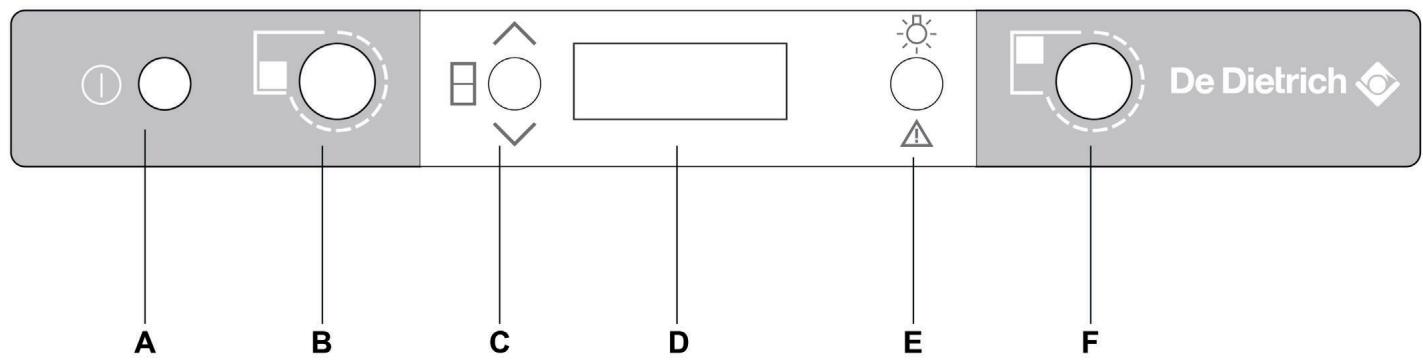
A - Appliance On/Off key
B - Bottom compartment temperature adjustment knob
C - Compartment selection key
D - Temperature display
E - Door open alarm reset and light switching on key (symbols if provided for)
F - Top compartment temperature adjustment knob
DISPLAY
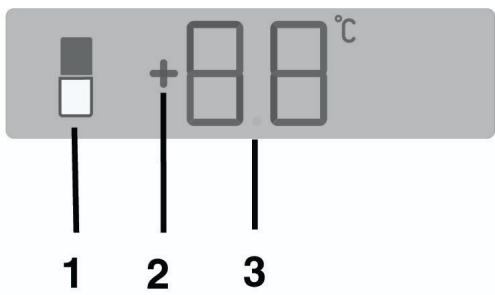
- Selected compartment indicator
- Positive temperature indicator
- Temperature indicator
Operation
After inserting the plug in the socket, if the display is not lit press the appliance On key (A).

Use
The wine refrigerator is divided into two compartments with differentiated temperatures.
Wine arrangement
Top Compartment:
the temperature can be adjusted between +6 and +12°C. This compartment is ideal for wines, especially new reds and whites, to be consumed immediately.
Bottom Compartment:
the temperature can be adjusted between +12 and +18°C. This compartment is ideal for storing and refining red or white wines for long periods.
The temperatures of this compartment are suitable for storing aged and full-bodied wines.
Lay the bottles down in such a way that the corks do not dry.
Keep the wine in the dark.
The oven door is in anti-UV darkened double glass to protect the wine from the light in case the refrigerator is located in a well-lit place.
Avoid switching the appliance light on too often or for too long. Wine keeps better in the dark.
Handle the bottles with care, to avoid agitating the wine.
Follow the recommendations and advice received at the time of purchase or given in the technical documentation regarding the quality, duration and optimum storage temperature of the wine.
Storage advice
The storage time for wine depends on ageing, the type of grapes, alcoholic content and level of fructose and tannin contained in it. At the time of purchase, check if the wine is already aged or if it will improve over time.
Recommended storage temperatures:
- for champagne and sparkling wines, between 6 and 8°C
- for white wines, between 10 and 12°C
- for rose' and light red wines, between 12 and 16°C
- aged red wines, 14 -1 6°C
When placing various bottles on top of each other, make sure they do not touch the refrigerator cooling plate.
Temperature regulation
Select the compartment by pressing the key (C)
Set the temperature by turning the knob (B or F depending on the compartment to be adjusted). The correct position must in any case be determined bearing in mind that the inside temperature depends on these factors:
- Room temperature
• How often the doors are opened
• The quantity of bottles stored
• The position of the appliance
Extinction
Acoustic alarm with door open
An acoustic alarm sounds when the door remains open for about 5 minutes.
Door open alarm status is indicated by:
- the symbol (1) flashing;
- the display lighting up red;
- the buzzer sounding.
To stop the acoustic alarm, press the key (E).
The acoustic signal goes off - when normal conditions are restored (door closed).
Inside accessories
Shelves
The shelves can be removed for cleaning..
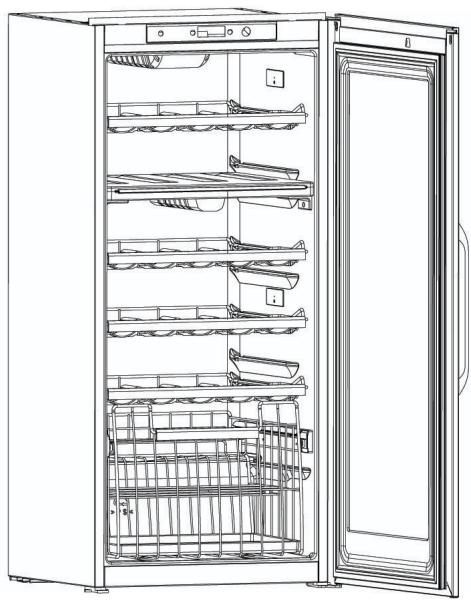
natural_image
Line drawing of an open refrigerator with shelves and grilles, showing internal compartments (no text or symbols)Bottle holder
Remove the shelf and insert it between the two guides
The maximum possible weight on the bottle shelves is 30 kg..
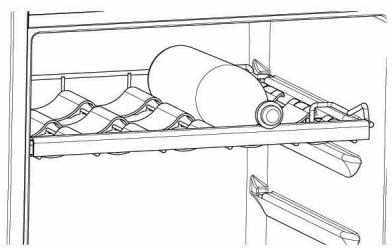
natural_image
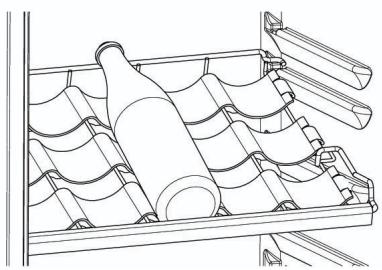
Technical line drawing of a mechanical conveyor system with rollers and levers (no text or symbols)The shelf can be arranged between guides 100 m apart to favour display of the bottles.
natural_image
Line drawing of a window with a bottle placed on a tiled wall (no text or symbols)The bottom compartment is arranged with a sliding drawer to be used for placing the bottles upright.
The drawer has two dividers that adapt to bottles of different diameters.

natural_image
Technical line drawing of a wireframe cage or container structure (no text or symbols)Air circulation
The refrigerator compartment has a special AIRLIGHT fan which is automatically activated in function of the appliance thermostat setting and ambient conditions.

natural_image
Technical line drawing of a mechanical component with internal flow arrows (no text or symbols)
Important:
Unplug the appliance before carrying out any operation.

Important
This appliance contains hydrocarbons in the refrigerant circuit; therefore maintenance and recharging must only be carried out by personnel authorised by the manufacturer.
Defrosting
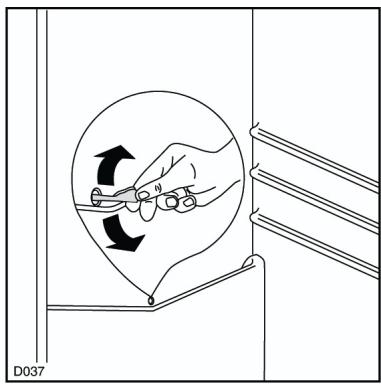
Defrosting in the refrigerator compartment occurs automatically. The defrost water is run into a bowl located at the back of the appliance, above the compressor, where it evaporates. Make sure to periodically clean the defrost water drain hole, using the special “cleaner”.
Cleaning
Clean the inside, removing the shelves and bottle holders, with lukewarm
water and a mild detergent. Periodically clean the defrost water drain hole, using the special “cleaner”. Periodically clean the condenser and motor compressor with a brush or vacuum cleaner. This operation will improve operation, with consequent energy saving. During periods when the appliance is not being used, take the following precautions:
- unplug the appliance;
- defrost and clean the inside and all the accessories;
- leave the door ajar to prevent the formation of unpleasant odours.

Important:
Never use metal objects to clean the appliance.
natural_image
Diagram showing a hand holding scissors inside a circular frame, with arrows indicating rotation or movement (no text or symbols)Lamp replacement safety instructions
For safety reasons this appliance is provided with special lamps specifically tested and certified for the foreseen use.
They can only be replaced with lamps of the same type and having the same characteristics.
Replacement lamps must be requested only from the manufacturer or its authorised customer service.
Do not use non-certified normal lamps.
Lighting lamps
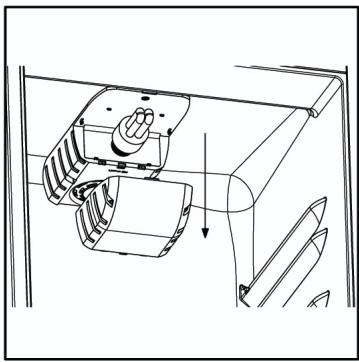
To replace the top lamp, remove the transparent cover by pressing it inwards with a tool (e.g. screwdriver) to free the rear side hookings. At the same time, free the middle hook and slide off the cover in the direction of the arrows.

natural_image
Technical line drawing of a mechanical component with a screwdriver and housing (no text or symbols)To replace the bottom lamp, remove the transparent cover by pressing the front hooking with a tool (e.g. screwdriver) and at the same time pull in the direction of the arrow.
natural_image
Line drawing of a mechanical device with a hand operating the component (no text or symbols)
natural_image
Technical line drawing of a mechanical assembly with a downward arrow indicating motion (no text or symbols)Important: If you call out an engineer to a fault listed below, or to repair a fault caused by incorrect use or installation a charge will be made, even if the appliance is under guarantee.
Before contacting your local Service Force Centre, check the following points:
| Symptom | Solution |
| No power to the appliance | Check there is power at the socket.Check there is not a power cut by checking the household lights.Check the fuse has not blown. |
| The light does not come on | Ensure that the bulb is correctly fitted.Replace the bulb if it has blown.Check the door light switch is not jammed. |
| The temperature in the fridge | Check the electronic control in the fridge is in the correct setting relative to ambient conditions.Check the ambient temperature is within the appliances operating limits, please refer to the installation section in this instruction book.Relocate the appliance if necessary. |
| The compressor runs continuously | Check if the electronic control knob gives the correct temperature control. See “Setting the temperature”.Check that the door is closed.Large quantities of food have recently been placed in the cabinet and/or door is frequently opened.Check that air ventilation is not obstructed. |
| Noise | Refer to normal operating sounds. |
| Water under the salad crispers | Check the drain hole is not blocked. (see Maintenance and Cleaning). |
If, after the above checks, there is still a fault, call your local Service Force Centre. In guarantee customers should ensure that the above checks have been made as the engineer will make a charge if the fault is not a mechanical or electrical breakdown. Please note that proof of purchase is required for any inguarantee service calls.
Technical Specifications
| Net Fridge Capacity lt.Bottle capacity | 21864 |
| Energy Consumption kWh/24h | 0,619 |
| Energy Consumption kWh/year | |
| Dimensions mm | 226 |
| High (mm) | 1225 |
| Width (mm) | 560 |
| Depth (mm) | 550 |
The technical infomation are situated in the rating plate on the internal left side of the appliance.
Customer Service and Spare Parts
If the appliance is not functioning properly, check that:
- the plug is firmly in the wall socket and the mains power switch is on;
- there is an electricity supply (find out by plugging in another appliance);
- If there are water drops on the bottom of the cabinet, check that the defrost water drain opening is not obstructed (see "Defrosting" section).
- If your appliance is still not working properly after making the above checks, contact the nearest service centre.
- If the power cable is damaged, it must be replaced with a special cable or assembly available from the manufacturer or the technical assistance service.
If the power cable is damaged, it must be replaced with a special cable or assembly available from the manufacturer or the technical assistance service.
To obtain fast service, it is essential that when you apply for it you specify the model and serial number of your appliance which can be found on the guarantee certificate or on the rating plate located inside the appliance, on the bottom left-hand side.
Take utmost care when handling your appliance so as not to cause any damages to the cooling unit with consequent possible fluid leakages.
- During normal operation, the condenser and compressor at the back of the appliance heat up considerably. Always ensure that there is adequate ventilation as a failure to do this will result in component failure and possible food loss. See installation instructions.
- Important: if the supply cord is damaged, it must be replaced by a special cord or assembly available from the manufacturer or its service agent.
Positioning
- Unpack the cabinet and check that it is in good condition and free of any transport damage.
- Place the refrigerator away from direct sunlight and heat sources.
- Avoid prolonged exposure of the appliance to direct sunlight.
- For safety reasons, minimum ventilation must be as shown in Fig.

Attention: keep ventilation openings clear of obstruction.
- It is necessary that the niche is provided with a conduct of ventilation having the following dimensions:
Depth 50 mm
Width 540 mm
The climate classification can be found on the rating plate, which is located inside the cabinet on the left hand wall.
The following table shows which ambient temperature is correct for each climate classification:
| Climate classification | for an ambient temperature of |
| SN | +10 to +32°C |
| N | +16 to +32°C |
| ST | +18 to +38°C |
| T | +18 to +43°C |
Electrical connection
Before plugging in, ensure that the voltage and frequency shown on the serial number plate correspond to your domestic power supply.
Voltage can vary by ±6% of the rated voltage.
For operation with different voltages, a suitably sized autotransformer must be used.

Important
The appliance must be earthed.
The power supply cable plug is provided with a contact for this purpose.
If the domestic power supply socket is not earthed. connect the appliance to a separate earth in compliance with current regulations, consulting a specialist technician.
The Manufacturer declines all responsibility if the above safety precautions are not observed.

This appliance complies with the following E.E.C. Directives:
- 87/308 EEC of 2/6/87 relative to radio interference suppression.
- 73/23 EEC of 19.2.73 (Low Voltage Directive) and subsequent modifications.
- 89/336 EEC of 3.5.89 (Electromagnetic Compatibility Directive) and subsequent modifications.

Attention!
It must be possible to disconnect the appliance from the mains power supply; the plug must therefore be easily accessible after installation.
Dimensions of the recess
Height of housing mm 1225
Depth of housing mm 550
Width of housing mm 560

It is necessary that the cabinet has a ventilation recess with the following dimensions:
Depth 50 mm
Width 540 mm

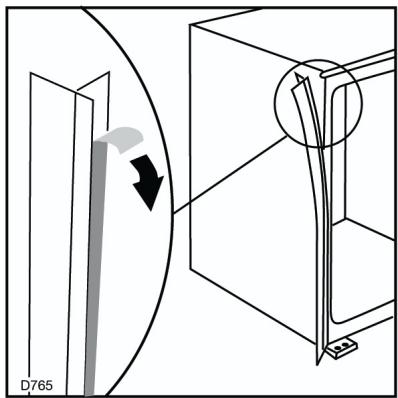
Press in the joint covers as indicated in the figure
natural_image
Technical diagram showing a mechanical assembly with an arrow indicating direction, no text or symbols presentAppliance insert

natural_image
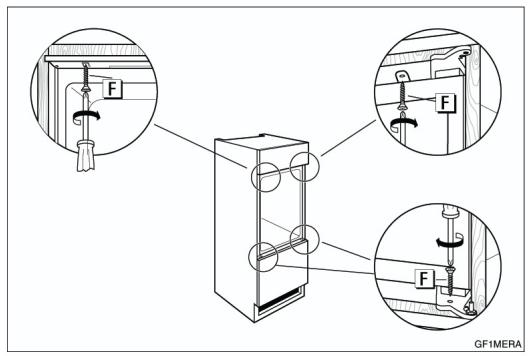
Line drawing of a refrigerator with hand holding a tool, showing internal shelves and directional arrows (no text or symbols)Fix the appliance with the screw
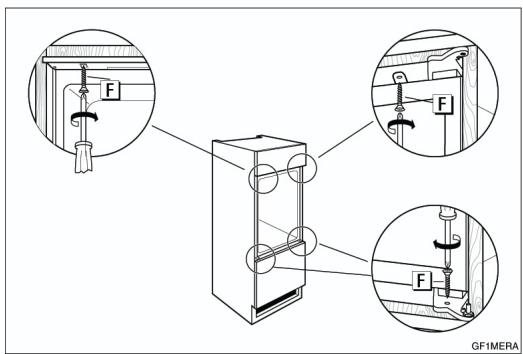
Fix the covers on the screws


natural_image
Diagram of a door with a curved handle and directional arrows, showing a hand holding a tool near the blade (no text or symbols present)
natural_image
Technical line drawing of a door frame with a wall-mounted bracket and two arrows indicating internal components (no text or symbols present)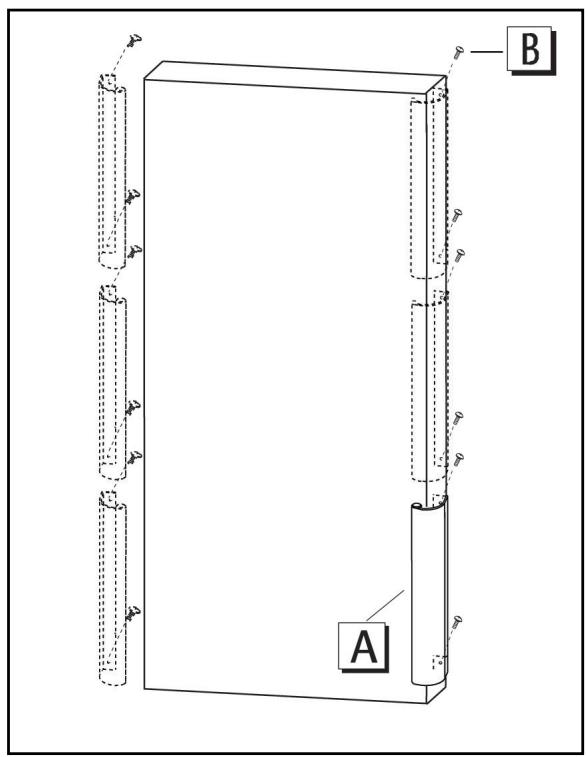

natural_image
Line drawing of an open refrigerator with shelves and grilles, showing internal compartments (no text or symbols)Flessenrek
natural_image
Technical line drawing of a mechanical conveyor system with rollers and levers (no text or symbols)natural_image
Line drawing of a window with a bottle placed on a tiled wall (no text or symbols)natural_image
Technical line drawing of a wire cage-like structure with internal components (no text or symbols)Luchtcirculatie
natural_image
Technical line drawing of a mechanical component with internal flow arrows (no text or symbols)
Belangrijk:
natural_image
Diagram showing a hand holding scissors inside a circular frame, with arrows indicating motion direction (no text or symbols)natural_image
Technical line drawing of a mechanical component with a screwdriver and housing (no text or symbols)natural_image
Technical line drawing of a mechanical assembly with a hand operating a component (no text or symbols)
natural_image
Technical line drawing of a mechanical assembly with a downward arrow indicating motion (no text or symbols)Technische Gegevens
natural_image
Diagram showing a mechanical assembly with an arrow indicating rotation, no text or symbols presentnatural_image
Line drawing of a refrigerator with hand holding a tool, showing internal shelves and directional arrows (no text or symbols)natural_image
Diagram of a door with a curved handle and directional arrows, showing a hand holding a tool near the blade (no text or symbols present)
natural_image
Technical line drawing of a door frame with a wall-mounted bracket and two arrows indicating internal components (no text or symbols present)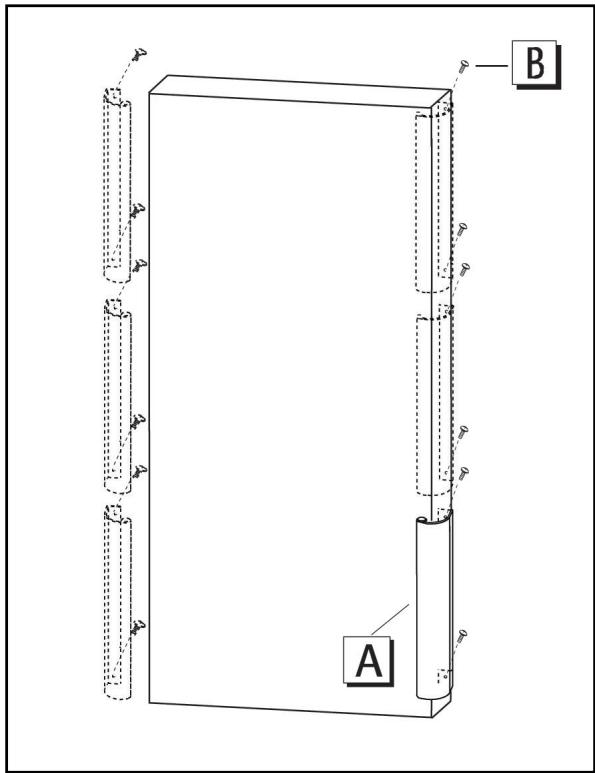

natural_image
Line drawing of an open refrigerator with shelves and grilles, showing internal compartments (no text or symbols)
natural_image
Line drawing of a wireframe shopping cart with no text or symbolsLuftzirkulation
natural_image
Technical line drawing of a mechanical conveyor system with rollers and levers (no text or symbols)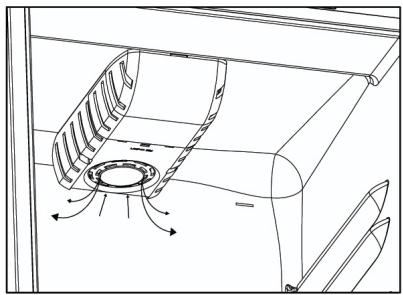
natural_image
Technical line drawing of a mechanical component with internal flow arrows (no text or symbols)natural_image
Line drawing of a window with a bottle placed on top, no text or symbols present
Achtung:
natural_image
Diagram showing a hand holding scissors inside a circular frame, with arrows indicating rotation or movement (no text or symbols)natural_image
Technical line drawing of a mechanical component with a screwdriver and internal parts (no text or symbols)natural_image
Technical line drawing of a mechanical assembly with no visible text or symbols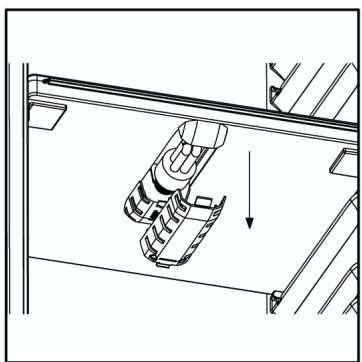
natural_image
Technical line drawing of a mechanical assembly with a downward arrow indicating motion (no text or symbols)Technische daten
natural_image
Diagram showing a mechanical assembly with an arrow indicating direction, no text or symbols presentGerät einschieben

natural_image
Line drawing of a refrigerator with hand holding a tool, showing internal shelves and directional arrows (no text or symbols)Gerät festschrauben
natural_image
Diagram of a door with a curved handle and directional arrows, showing a hand holding a tool near the blade (no text or symbols present)
natural_image
Technical line drawing of a door frame with a wall-mounted bracket (no text or symbols)
natural_image
Line drawing of an open refrigerator with shelves and grilles, showing internal compartments (no text or symbols)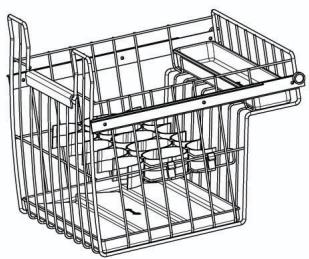
natural_image
Line drawing of a wireframe shopping cart with no text or symbolsnatural_image
Technical line drawing of a mechanical conveyor system with rollers and levers (no text or symbols)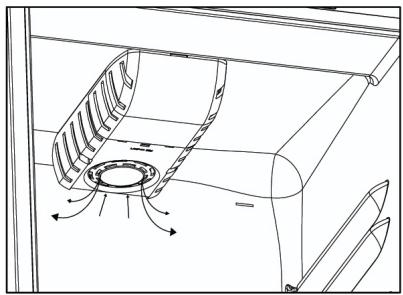
natural_image
Technical line drawing of a mechanical component with internal flow arrows (no text or symbols)natural_image
Line drawing of a window with a bottle placed on top, no text or symbols present
Atención:
natural_image
Diagram showing a hand holding scissors inside a circular frame, with arrows indicating rotation or movement (no text or symbols)natural_image
Technical line drawing of a mechanical component with a screwdriver and housing (no text or symbols)natural_image
Technical line drawing of a mechanical assembly with no visible text or symbols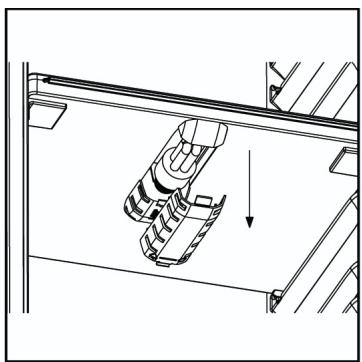
natural_image
Technical line drawing of a mechanical assembly with a hand operating a component (no text or symbols)natural_image
Technical diagram showing a mechanical assembly with an arrow indicating direction, no text or symbols presentnatural_image
Diagram of a refrigerator with hand holding a tool, showing airflow direction and part number PL09 (no text or symbols on the diagram itself)natural_image
Diagram of a door with a curved handle and directional arrows, showing a hand holding a tool near the blade (no text or symbols present)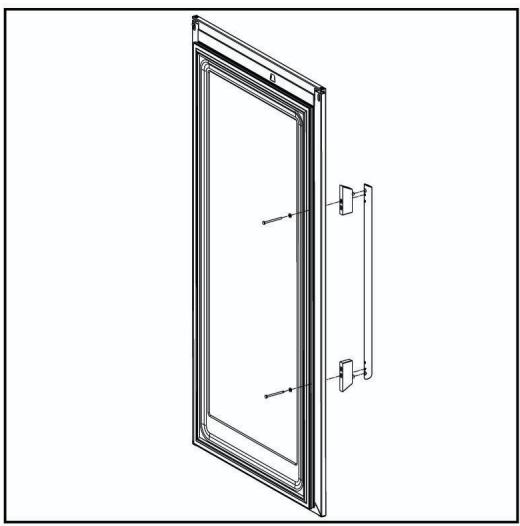
natural_image
Technical line drawing of a door frame with a wall-mounted bracket (no text or symbols)
Advertências
natural_image
Line drawing of an open refrigerator with shelves and grilles, showing internal compartments (no text or symbols)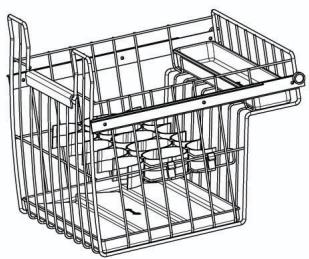
natural_image
Line drawing of a wireframe shopping cart with no text or symbolsRecirculação do ar
natural_image
Technical line drawing of a mechanical conveyor system with rollers and levers (no text or symbols)
natural_image
Technical line drawing of a mechanical component with internal flow arrows (no text or symbols)natural_image
Line drawing of a window with a bottle placed on top, no text or symbols present
Atenção:
natural_image
Diagram showing a hand holding scissors inside a circular frame, with arrows indicating rotation or movement (no text or symbols)natural_image
Technical line drawing of a mechanical component with a screwdriver and housing (no text or symbols)natural_image
Technical line drawing of a mechanical assembly with no visible text or symbols
natural_image
Technical line drawing of a mechanical assembly with a hand operating a component (no text or symbols)natural_image
Technical diagram showing a mechanical assembly with an arrow indicating direction, no text or symbols presentnatural_image
Diagram of a refrigerator with hand holding a tool, showing airflow direction and part number PL09 (no text or symbols on the diagram itself)Fixe o aparelho

natural_image
Diagram of a door with a curved handle and directional arrows, showing a hand holding a tool near the blade (no text or symbols present)
natural_image
Technical line drawing of a door frame with a wall-mounted bracket and two arrows indicating internal components (no text or symbols present)
Brandt UK Ltd
Intec Four, Wade Road, Basingstoke, Hampshire RG24 8NE
Brochures and Stockist information : 08707 505 503
All other departments : 01256 308 000
Service fax : 01256 346 877
Sales Order Processing fax : 01256 843 024
Marketing and Home Economist fax : 01256 325 888
Distributor in Ireland :
Quality Electrical Distributors Ltd
143b Slaney Close, Dublin Industrial Estate , Glasnevin, Dublin 11


- Porte-bouteilles
- Attention :
- Safety Information
- General Safety
- Service/Repair
- Use
- Installation
- Attention: keep ventilation openings clear of obstruction.
- Environment Protection
- Safety information 14
- Use 16
- Maintenance ....20
- Something not working 21
- i Use
- Cleaning the interior
- Control panel
- DISPLAY
- Operation
- Wine arrangement
- Top Compartment:
- Bottom Compartment:
- Keep the wine in the dark.
- Storage advice
- Recommended storage temperatures:
- Temperature regulation
- Extinction
- Acoustic alarm with door open
- Inside accessories
- Shelves
- Bottle holder
- Air circulation
- Important:
- Important
- Defrosting
- Cleaning
- Lamp replacement safety instructions
- Lighting lamps
- Customer Service and Spare Parts
- Positioning
- Electrical connection
- The appliance must be earthed.
- Attention!
- Dimensions of the recess
- Flessenrek
- Luchtcirculatie
- Belangrijk:
- Technische Gegevens
- Luftzirkulation
- Achtung:
- Atención:
- Advertências
- Recirculação do ar
- Atenção:
Brand : DE DIETRICH
Model : DWS750JE
Category : Refrigerator