
EOK68600X - Built-in oven AEG-ELECTROLUX - Free user manual and instructions
Find the device manual for free EOK68600X AEG-ELECTROLUX in PDF.


| Product type | Built-in oven |
| Brand | AEG-ELECTROLUX |
| Model | EOK68600X |
| Dimensions (H x W x D) | 59.5 x 59.5 x 56.8 cm |
| Weight | ~50 kg |
| Power supply | 220-240 V, 50/60 Hz, 3.0 kW |
| Number of functions | 11 (conventional, bottom heat, grill, turbo, defrost, etc.) |
| Interior light | Yes, removable bulb (300°C max) |
| Child safety | Yes, touch lock |
| Automatic shut-off | Yes, depending on temperature (5.5 to 12.5 h) |
| Cleaning | Water cleaning function (steam) |
| Door | Removable, removable inner glass |
| Supplied accessories | Rack, baking tray |
| Control type | Touch, electronic with clock |
| Display | Digital clock, temperature and time indicators |
| Energy consumption | Energy class A (typical) |
Frequently Asked Questions - EOK68600X AEG-ELECTROLUX
User questions about EOK68600X AEG-ELECTROLUX
0 question about this device. Answer the ones you know or ask your own.
Ask a new question about this device
Download the instructions for your Built-in oven in PDF format for free! Find your manual EOK68600X - AEG-ELECTROLUX and take your electronic device back in hand. On this page are published all the documents necessary for the use of your device. EOK68600X by AEG-ELECTROLUX.
USER MANUAL EOK68600X AEG-ELECTROLUX
Built in electric oven
Four intégré
Inbouwoven
Einbaubackofen
Horno integrado
EN Contents
| Safety information | 02 | Oven safety cut-out | 14 |
| Product Description | 03 | Water Cleaning function | 14 |
| Control panel | 04 | Care and cleaning | 15 |
| Oven functions | 05 | Environment concerns | 16 |
| Before using for the first time | 06 | What to do if... | 17 |
| Using the oven | 06 | Technical data | 17 |
| Cooking tables | 10 | Installation | 18 |
| Child lock function | 14 | Subject to change without notice | |
! Safety information
In the interest of your safety and to ensure the correct use, before installing and first using the appliance, read this user manual carefully, including its hints and warnings. To avoid unnecessary mistakes and accidents, it is important to ensure that all people using the appliance are thoroughly familiar with its operation and safety features. Save these instructions and make sure that they remain with the appliance if it is moved or sold, so that everyone using it through its life will be properly informed on appliance use and safety.
Correct use
- The oven must not be operated with the door open.
- The manufacturer will not be held responsible if this oven is used for anything other than domestic purposes.
- Only use the oven when it is installed within kitchen units.
- Do not store oils, fats or inflammable materials inside the oven, as it could be dangerous if the oven is switched on.
- Do not lean or sit on the open door of the oven as it could damage the door and be dangerous for you.
- Do not cover the bottom of the oven with aluminium foil, as it could affect cooking and damage the interior enamelling of the oven.
- To use the oven, insert the tray or rack supplied onto the side guides inside the oven. The trays and racks are fitted with
a system to facilitate partial extraction and make handling easier.
- Do not put containers or food on the floor of the oven. Always use the trays and grids.
- Do not spill water on the floor of the oven while it is working as this could damage the enamel.
- While using the oven, open the door as little as possible to reduce electricity consumption.
- Use protective gloves if you need to work inside the hot oven.
- To cool the oven, open the door to allow ventilation and odours to escape from inside.
- In recipes with a high liquid content, it is normal for condensation to form on the oven door.
Child safety
- The appliance is not intended for use by young children or infirm persons without supervision. Young children should be supervised to ensure they do not play with the appliance.
- Do not allow children to approach the oven while it is in use, as high temperatures can be reached.
Installation
-
Check your oven for any transport damage. Never connect a damaged machine. If your oven is damaged contact your supplier.
-
All packaging must be removed before use.
- Any electrical work required to install this appliance must be carried out by a qualified and competent person.
- For safety reasons it is dangerous to alter the specifications or attempt to modify this product in any way.
- Never use the oven if the electrical supply cable is damaged; or if the control panel,
work top or plinth area are damaged such that the inside of the appliance is freely accessible. Contact your local Service Force centre, in order to avoid hazard.
- All sides of the oven must never be drilled to prevent damage to hydraulic and electric components.

Warning! For electrical connection carefully follow the instructions given in specific paragraphs.
Product description
General Overview
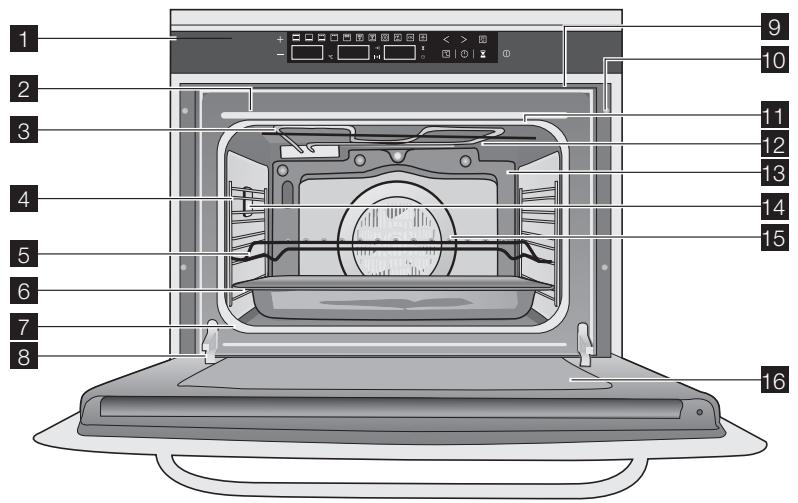
1 Control Panel
2 Oven Seal
3 Grill Element
4 Chrome Support
5 Grid
6 Tray
7 Hinge
8 Door
9 Air Outlet
Fixing to Unit
11 Grill Screen
12 Smoke Outlet
13 Rear Panel
14 Light
15 Fan
16 Large Interior Glass Door
Control panel
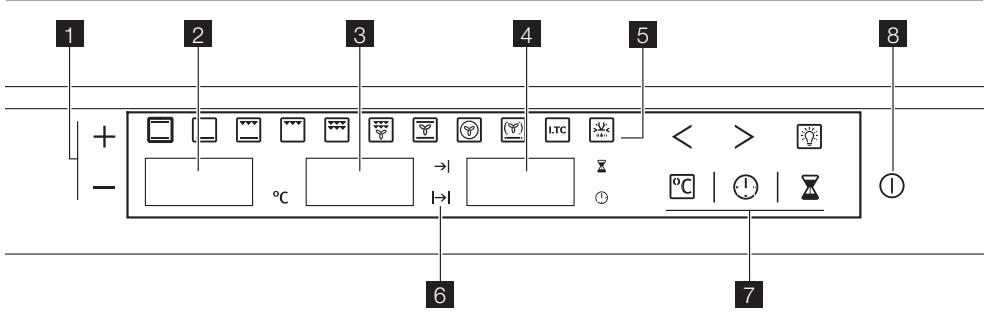
1 Increase/Decrease Buttons
2 Temperature display
Time display
Time functions display
5 Oven functions
6 Indicator lights
7 Function buttons
8 On/Off button
The oven will only work if the time of day has been set. However, the oven can also be operated without any programme.
| Buttons | Function |
| ① | To switch appliance on or off |
| < > | To Select oven functions |
| + - | To set temperature and time values or defrosting level |
| °C | To set temperature values |
| ① | To select clock functions |
| X | To set minute minder |
| To switch light on or off |
| Indicator lights | ||
| °C | Oven temperature | Flashes when setting temperature is carried out. |
| |→| | Cooking duration | Illuminates when a programmed cooking duration is set and will start flashing when the cooking time is over. |
| →| | End of cooking | Illuminates when a programmed end of cooking is set and will start flashing when the cooking time is over. |
| ∑ | Minute minder | Illuminates when the minute minder alarm is set. |
| ① | Time of day | Flashes when setting the time of day is carried out |
Oven functions
| Conventional | It is used for sponges and cakes where the heat received must be uniform to achieve a spongy texture. | |
| Lower element | Heat only from beneath. Suitable for heating dishes and raising pastry and similar. | |
| Grill and Lower element | Special for roasts. It can be used for any piece, whatever its size. | |
| Single Grill | For preparing dishes with superficial roasting. It allows the outer layer to be browned without affecting the inside of the food. Ideal for flat food, such as steaks, ribs, fish, toast. | |
| Dual Grill | Allows greater surfaces to be prepared, than with the grill, together with higher power reducing the time required for browning of the food. | |
| Dual Grill with fan | Allows uniform roasting at the same time as surface browning. Ideal for grills. Special for large volume pieces, such as poultry game etc. It is recommended to put the item on a rack with a tray beneath to collect the stock and juices. | |
| Conventional with fan | Suitable for roasts and cakes. The fan spreads the heat evenly throughout the inside of the oven to reduce cooking time and temperature. | |
| Turbo | The fan distributes the heat produced by an element located at the rear of the oven. Due to the uniform heat distribution, it allows roasting and baking to take place at two heights at the same time. | |
| Lower element with fan | Ideal for baking pizzas, pies, and fruit tarts or sponges. | |
| LTC | Low temperature cooking | Designed to cook casseroles, stews, etc, in the traditional way, and for all recipes specifying long cooking times and low heat. For the best results, we recommend using covered casserole pans with lids, first making sure that they can be used in the oven. |
| Defrosting | For defrosting e.g. gateaux and flans, butter, bread, fruit or other frozen foods. |

Caution!
While using the Grill, Dual Grill or Dual Grill with fan, the door must be kept closed.
Recommendations for Defrosting Food
The defrost function works by means of a 2-level system of hot air. HI is for meats in general and LO is for fish, cakes, pastries and bread. When selecting the defrost function, select HI or LO on the temperature display by pressing on the temperature button 0 and then the + buttons.
-
Unpackaged food should be placed on the oven tray or on a dish.
-
Defrost large pieces of meat or fish by placing them over the grid with a tray underneath to collect any liquid.
- Meat and fish do not need to be completely thawed before cooking. Condiments can be added once the surface is soft.
- Food should always be cooked after defrosting.
- Do not refreeze defrosted food.
See the following chart for defrosting times and temperature levels
| FOOD | LO LEVEL | HI LEVEL | ||
| Weight | Time | Weight | Time | |
| Bread | 1/2 Kg | 35 min | ||
| Cake | 1/2 Kg | 25 min | ||
| Fish | 1/2 Kg | 30 min | ||
| Fish | 1 Kg | 40 min | ||
| Chicken | 1 Kg | 75 min | ||
| Chicken | 1,5 Kg | 90 min | ||
| Rib steak | 1/2 Kg | 40 min | ||
| Minced meat | 1/2 Kg | 60 min | ||
| Minced meat | 1 Kg | 120 min | ||
Before using for the first time
Carefully read this Instruction Manual to achieve the best results from your oven.
Due to the manufacturing process there may be residues of grease and other substances. To eliminate these, proceed as follows:
- Remove all the packaging material, including the protective plastic, if included.
-
Select the 或 功能 at 200^ for one hour. To do so, consult the feature list provided with this manual.
-
To cool the oven open the door to allow ventilation and odours to escape from inside.
- After cooling, clean the oven and the accessories.
During the first use, fumes and odours may occur and the kitchen should therefore be well ventilated.
Using the oven

In the event of a power failure, all the settings (time of day, programme setting or programme in operation) will be cancelled.
When the power is restored, the numbers in the display will flash, and the clock/timer has to be reset.

Caution!
The electronic clock features TouchControl technology. To operate, simply touch the glass control symbols with your fingertip.
The touch control sensitivity continuously adapts to changing conditions. Ensure that the glass front of the control panel is clean and free of any obstacles when turning on the oven.
If the clock does not respond correctly when you touch the glass, you will need to turn off the oven for a few seconds and then turn it back on. By doing this, the buttons adjust automatically and will react once more to fingertip control.
Setting the Electronic Clock
When turning your oven on, you will see the clock flashing 12:00. Set the clock by touching the + symbols on the glass. You will hear 2 beeps confirming the time has been set.
If you want to change the time, turn the oven off. Touch the clock button ① until the indicator flashes ①.
Change the time by touching the + - buttons. The two beeps you hear after that will confirm the new time has been set.
Manual operation
After setting the clock, the oven is ready for use:
1 Press the On button ①.
2 Press < > to select the desired cooking function.
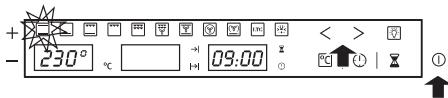
3 The temperature display will show the preset temperature for that cooking function.
Press on the temperature button to change it. Select the desired temperature by pressing on the + - buttons.

4 The top oven cavity will start to heat up. Functions 10000000000000000000000000000000000000000000000000000000000000000000000000000000000000000000000000000 will start the fast preheating function for a few minutes. The oven will beep when it reaches the selected temperature.

Caution! this preheating function turns on the turbo motor at the back of the top oven cavity.
5 During oven heating, the temperature degree symbol on the temperature display will flash to show that the food is being heated.

6 Press on the Off button to stop cooking.

Caution! When cooking has finished, you will notice that oven cooling feature will work until the temperature inside the oven has been suitably lowered.
Oven Lighting
The inside light will go on:
- When the oven door is open. If the door is not closed after a certain time, the light will turn off to reduce power consumption.
- When any cooking function is selected. The light will turn off after a certain time.
If you want to turn the light on during cooking, just touch the Oven Light button. If you want to turn off the light press the the Oven Light button

Electronic clock functions
| Electronic programmer functions | |
| Cooking Duration |→| | This function allows you to programme cooking time length, after which the oven will turn off automatically. Programming Cooking Time: 1 Press on the clock button ➀. The symbol ➔I will light up. 2 Select the cooking time by pressing the or buttons. 3 Two consecutive beeps will then sound and the display will show the remaining cooking time. The symbol ➔I will flash slowly to indicate that the oven will switch itself automatically. 4 Select a cooking function and temperature. 5 Once the cooking time is complete, the oven will turn off, an alarm will sound and the ➔I symbol will flash more quickly. 6 Press on any button on the control panel to stop the alarm. You can change the programmed time whenever you want by touching the clock button ➁ and then on the + - buttons. The two beeps you hear after that will confirm the new time has been set. |
| End of cooking →| | This function allows you to programme the time for cooking to stop, after which the oven will turn off automatically. Programming the Cooking Stop Time: 1 Press on the clock button ➀ several times until the symbol ➔I lights up. 2 Select the cooking stop time by pressing the + - buttons. 3 Two consecutive beeps will then sound and the display will show the remaining cooking time. The ➔I symbol will flash slowly to indicate that the oven will switch itself automatically. 4 Select a cooking function and temperature. 5 Once it is the set time, the oven will turn off, an alarm will sound and the ➔I symbol will flash more quickly. 6 Press on any button on the control panel to stop the alarm. You can change the programmed cooking stop time at any moment by pressing on the clock button ➀ until the ➔I symbol flashes and then by pressing on the + - buttons. The two beeps you hear after that will confirm the new time has been set. You can use this function even if you are already cooking with the oven. If this is the case, follow all of the above instructions except No. 4. |
| Cooking duration and End of cooking time combined | This function allows both cooking time length and the stop time to be programmed. With this function, the oven switches on automatically at the set time and operates for the cooking time it has been programmed for. It switches itself off automatically at the entered stop time. 1 Press on the clock button Ⓞ. The symbol ➔ will light up. 2 Select the cooking time by pressing the + - buttons. 3 Two consecutive beeps will then sound, and the display will show the remaining cooking time. The ➔ symbol will flash slowly. 4 Press on the clock button Ⓞ several times until the symbol ➔ lights up. 5 Select the cooking stop time by pressing the + - buttons. 6 This will be confirmed by two beeps. The current time will show on the display and the ➔ symbol will remain lit. 7 Select a cooking function and temperature. 8 The oven will remain off, with the ➔ symbol lit and the ➔ symbol flashing slowly. The clock will show the current time and the inside light will remain off. The oven is now programmed. 9 When it is time to start cooking, the oven will switch on and will operate for the programmed cooking time. The time function display will show the remaining cooking time. 10 Once the set time is reached, the oven will turn off, an alarm will sound and the ➔ and ➔ symbols will flash. 11 Press on any button on the control panel to stop the alarm. If you wish to change the cooking stop time while cooking is in progress, press on the clock button until the ➔ symbol flashes. You can then change the cooking stop time by pressing on the + - buttons. The two beeps you hear after that will confirm the new time has been set. |
| Minute minder ✘ | A beep will go sound when the set time has finished, whether the oven is on or off. Programming the Minute Minder: 1 Press on the minute minder button ✘ . The symbol ✘ lights up. 2 Select the length of time after which you want the alarm to sound by pressing on the + - buttons. 3 You will then hear two beeps; the display will show the time left before the alarm sounds and the symbol ✘ will flash slowly, indicating that the timer has been set. 4 Once the programmed time has passed, an alarm will sound and the symbol ✘ will begin to flash more quickly. 5 Press on any button on the control panel to stop the alarm. You can change the programmed time whenever you want by touching the minute minder button ✘ until the symbol ✘ flashes, and then touching the + - buttons. The two beeps you hear after that will confirm the new time has been set. |
Cooking Tables
The Cooking Tables show examples of temperature ranges and approximate cooking times. The cooking mode depends on the model.
For the best results we recommend the oven to be preheated with the function or l for 10 minutes.
| Starters | Weight (Kg) | Tray Position | Cooking Mode | Temperat. (℃) | Time (min) | Receptacle |
| Baked rice | 1,0 | Lower | 180-200 | 25-30 | Shallow oven dish | |
| 170-190 | 20-25 | |||||
| Pasty | 1,2 | Intermediate | 170-190 | 45-50 | Tray | |
| 160-180 | 30-35 | |||||
| Vegetable Pastry | 1,0 | Intermediate | 190-210 | 25-30 | Shallow dish | |
| 180-200 | 25-30 | |||||
| Lower | 170-190 | 35-40 | ||||
| Vegetable Pie | 1,0 | Intermediate | 190-210 | 55-60 | Shallow dish | |
| 170-190 | 45-50 | |||||
| Baked potatoes | 1,0 | Lower | 180-200 | 55-60 | Tray | |
| 180-200 | 40-45 | |||||
| Pizza | 0,6 | Intermediate | 190-210 | 15-20 | Grid | |
| 170-190 | 10-15 | |||||
| Quiche | 0,8 | Intermediate | 180-200 | 40-45 | Quiche Mould | |
| 160-180 | 35-40 | |||||
| 170-190 | 40-45 | |||||
| Stuffed tomatoes | 0,8 | Intermediate | 170-190 | 10-12 | Tray | |
| 160-180 | 10-12 | |||||
| Lasagne | 1,0 | Intermediate | 180-200 | 8-10 | Shallow dish | |
| MEAT | Weight (Kg) | Tray Position | Cooking Mode | Temperat. (℃) | Time (min) | Receptacle |
| Suckling Pig | 1,4 | Intermediate | 190-210 | 70-75 | Tray | |
| 170-190 | 70-75 | |||||
| Rabbit | 1,2 | Intermediate | 180-200 | 55-60 | Tray | |
| 170-190 | 45-50 | |||||
| 170-190 | 30-35 | |||||
| Lamb | 1,0 | Intermediate | 190-210 | 50-55 | Tray | |
| 170-190 | 45-50 | |||||
| 180-200 | 50-55 | |||||
| Salted Pork Loin | 0,6 | Intermediate | 170-190 | 35-40 | Tray | |
| 170-190 | 40-45 | |||||
| Chicken | 1,2 | Lower | 190-210 | 50-55 | Tray | |
| 170-190 | 45-50 | |||||
| Roast-beef | 0,6 | Intermediate | 190-210 | 30-35 | Tray | |
| 180-200 | 25-30 | |||||
| 190-210 | 30-35 | |||||
| Fillet Steak Pastry | 1,0 | Intermediate | 180-200 | 35-40 | Tray | |
| 160-180 | 30-35 | |||||
| Brochettes | 0,3 | Higher | 180-200 | 10-12 | Grid | |
| Sausages | 0,6 | Higher | 190-210 | 10-15 | Grid | |
| FISH | Weight (Kg) | Tray Position | Cooking Mode | Temperat. (℃) | Time (min) | Receptacle |
| Red Bream | 1,0 | Intermediate | 180-200 | 25-30 | Tray | |
| 170-190 | 20-25 | |||||
| Salted Dorado | 1,0 | Intermediate | 190-210 | 25-30 | Tray | |
| 180-200 | 25-30 | |||||
| Sole | 1,0 | Intermediate | 170-190 | 15-20 | Tray | |
| 160-180 | 10-15 | |||||
| Sea-bass | 1,0 | Intermediate | 190-210 | 20-25 | Tray | |
| 180-200 | 10-15 | |||||
| Hake | 1,1 | Intermediate | 190-210 | 25-30 | Tray | |
| 180-200 | 20-25 | |||||
| Fish Pie | 1,1 | Intermediate | 190-210 | 60-65 | Casserole dish | |
| 190-210 | 60-65 | |||||
| Salmon in greased paper | 1,0 | Intermediate | 180-200 | 20-25 | Tray | |
| 170-190 | 15-20 | |||||
| Trout | 1,1 | Intermediate | 190-210 | 20-25 | Tray | |
| 180-200 | 15-20 | |||||
| Fillet of Fish | 1,0 | Higher | 170-190 | 15-20 | Grid | |
| Sardines | 1,0 | Higher | 180-200 | 10-15 | Grid | |
| CAKES AND DESSERTS | Weight (Kg) | Tray Position | Cooking Mode | Temperat. (℃) | Time (min) | Receptacle |
| Sponge Cake | 0,5 | Intermediate | 150-170 | 35-40 | Cake Mould | |
| 170-190 | 30-35 | |||||
| 160-180 | 30-35 | |||||
| Swiss Roll | 0,5 | Intermediate | 170-190 | 10-15 | Tray | |
| 160-180 | 10-15 | |||||
| Flan | 0,8 | Intermediate | 160-180 | 55-60 | Bread Mould | |
| 150-170 | 50-55 | |||||
| Biscuits | 1,0 | Intermediate | 160-180 | 20-25 | Tray | |
| 150-170 | 20-25 | |||||
| Vol-au-vents | 0,3 | Intermediate | 170-190 | 20-25 | Tray | |
| 160-180 | 15-20 | |||||
| Cup Cakes | 0,7 | Intermediate | 160-180 | 20-25 | Tray | |
| 160-180 | 20-25 | |||||
| Baked Apples | 0,5 | Intermediate | 180-200 | 30-35 | Tray | |
| 170-190 | 20-25 | |||||
| Meringue | 0,35 | Intermediate | 100-120 | 70-75 | Tray | |
| 100-120 | 60-65 | |||||
| Baked bananas | 0,5 | Intermediate | 180-200 | 20-25 | Casserole dish | |
| 170-190 | 15-20 | |||||
| Plum-Cake | 0,6 | Intermediate | 170-190 | 55-60 | Cake Mould | |
| 160-180 | 50-55 | |||||
| Apple Pie | 0,8 | Intermediate | 170-190 | 45-50 | Tray | |
| 160-180 | 40-45 | |||||
| Cheesecake | 0,8 | Intermediate | 180-200 | 40-45 | Cheesecake Mould | |
| 170-190 | 40-45 |
Child lock function
This function locks the oven, preventing small children from playing with it.
To turn on the function, press on the ① and ② buttons until you hear a long beep.
The oven is now locked.

If the oven is Off the word SAFE appears on the time display.
When the oven is on all the buttons keys are locked except the off button ①.
To switch off the child lock, touch the ① and ⑨ buttons simultaneously until you hear a long beep and SAFE goes out in the display.
Oven safety cut-out
If not switched off after a certain time, or if the temperature is not modified, the oven switches off automatically.
The oven switches itself off when the oven temperature is:
50-120°C after 12,5 hours
120-200°C after 8,5 hours
200-250°C after 5,5 hours
Press any button for using the appliance after a safety cut out.
The safety cut-out is cancelled if the clock function DURATION or END is set.
Water Cleaning function
About this function
In order to keep you appliance working properly it should be regularly cleaned to prevent any build up of food, deposits or greases.
This function can help to make the cleaning process easier and more convenient for you.
How it works
By using heat, Steam and few drops of washing up liquid food deposit are loosened and softened enough to make their removal much easier-eliminating the need to scrub the enamel and avoid any scratches on the surface.
How to use:
- Remove all internal components (side shelves support/grids/pans) before use.
- Put 500ml approximately of water with a few drops of washing up liquid added
into a large absorbent sponge which is placed on the base of the oven cavity.
- If the oven cavity is heavily soiled, you may want to leave the solution to soak for a short time.
- Close the oven door.
- Select the "Bottom" function at a temperature of 220^ .
- Select with the Timer a period of 5 minutes.
- After the cycle is finished please wait 15 minutes before opening the door.
- Make sure that the appliance is switched off.
- Use the large absorbent sponge to remove any excess of water from the base of the cavity.
- You can now clean the inside of the oven.
- Make sure at the end to dry all the inside and the surround of the appliance, particularly the door seals.
Care and Cleaning

Caution!
Before carrying out any work, the appliance must be disconnected from the mains electricity supply.
Cleaning the Inside of the Oven
- The inside of the oven should be cleaned to remove food and grease deposits, which can give off smoke or odours and cause stains to appear.
- With the oven cold and for enamelled surfaces (e.g. the floor of the oven) use a nylon brush or sponge with warm soapy water. If using special oven cleaning products, use only on enamelled surfaces and follow the manufacturer's instructions.

Caution!
Do not clean the inside of your oven with a steam or pressurised water jet. Do not use either metallic scouring pads or any material that could scratch the enamel.
Cleaning the Oven Exterior and Accessories
Clean the outside of the oven and the accessories with warm soapy water or with a mild detergent.

Caution!
Never use metallic scouring pads or commercial or scouring powders that could scratch the enamel. For stainless steel surfaces, proceed with care and only use sponges or cloths that cannot scratch them.
To clean the outside of the oven do not attempt to remove the controls, as for this, the oven has to be first removed from the kitchen unit.
Cleaning the Large Interior Glass Door

Warning!
Be careful: the oven door closes when the interior glass is removed.
- Open the oven door.
- Pull the glass upwards from the bottom (A).
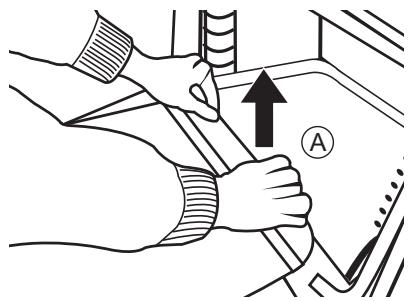
- The interior glass is now free. Remove it.
- Clean the interior glass and the inside of the oven door.
- Insert the supports on the interior glass into the grooves at the top of the door (B).
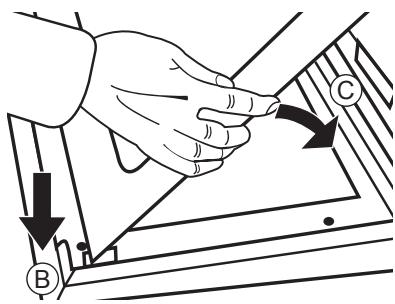
- Lower the glass into the door (C).
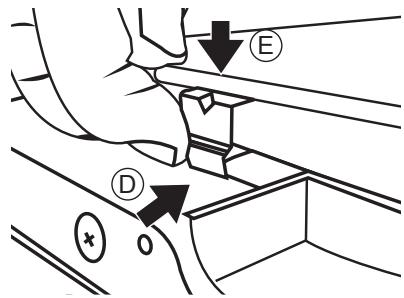
- The glass is fixed to the door by pressing the two lower supports (D) while pushing the glass into the door (E).
Changing the oven bulb

Caution!
To change the bulb, first ensure that the oven is disconnected from the power supply.
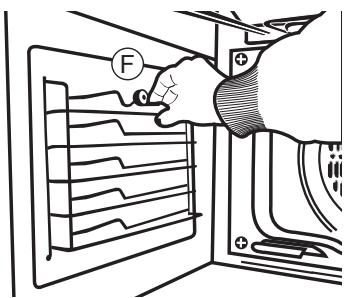
- Ease out the chrome supports, releasing them from the bolt (F).
- Loosen the lens from the lamp holder with the help of the appropriate tool. Exchange the bulb.
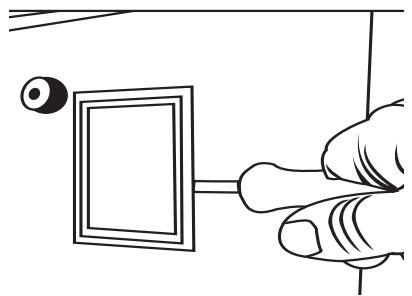
- Replace the lens, making sure it fits in the correct position without forcing it.
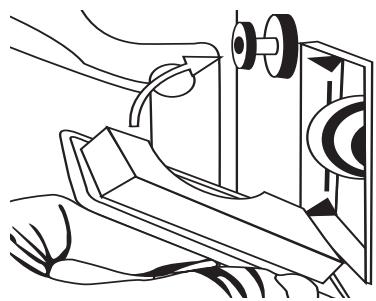
The replacement bulb must be temperature resistant to 300^ . These can be ordered from the Technical Service Department.
Enviroments concerns
The symbol on the product or on its packaging indicates that this product may not be treated as household waste. Instead it shall be handed over to the applicable collection point for the recycling of electrical and electronic equipment. By ensuring this product is disposed of correctly, you will help prevent potential negative consequences for the environment and human health, which could otherwise be
caused by inappropriate waste handling of this product. Please contact your local city office, your household waste disposal service or the shop where you purchased the product
Ecological Packaging
The packaging materials are completely recyclable and can be used again. Check with your local authority on the regulations for disposing of this material.
What to do if...
If the appliance is not working correctly, please check the following before contacting the Electrolux Service Centre.
| Problem | Solution |
| The oven does not work. | Check the connection to the electrical circuit. Check the fuses and current limiter of your installation. Ensure the clock is in the manual or programmed mode. Check the position of the function and temperature selectors. |
| The inside light of the oven does not work. | Change the bulb. Check its assembly in accordance with the instruction manual. |
| Smoke is given off while the oven is working. | This is normal during its first use. Periodically clean the oven. Reduce the amount of grease or oil added to the tray. Do not use higher temperature settings than those in the cooking tables. |
| Expected cooking results are not achieved. | Review the cooking tables to obtain guidance on the working of your oven. |
| Steam and condensation settle on the food and in the oven cavity. | When the cooking process is completed, do not leave the dishes standing in the oven for longer than 15-20 minutes. |
| The oven fan is noisy. | Check that shelves and bakeware are not vibrating in contact with the oven back panel. |
| The display shows "12.00". | Set the time of day (see chapter "Setting the time of day"). |

Warning!
If, despite these recommendations, the problem continues, contact our Technical Assistance Service.
Technical Data
If the equipment does not work, please contact the Technical Service Department and advise them of the problem, indicating:
1 Serial number (S-No)
2 Appliance model. (Model)
3 Product number (PNC)
You will find this information on the rating plate on the lower part of the oven when the door is opened.
The item that you have bought meets the European directives on electrical material safety (73/23/CEE) and electromagnetic compatibility (89/336/CEE).
Installation
This information is intended for the installer, as the person responsible for assembly and electrical connection. If you install the oven yourself, the manufacturer will not be held responsible for any possible damage.
Installation must only be performed by a fully qualified electrician who must ensure regulations laid down for installation are observed.
Before Installation. Comments
- To unpack the oven, pull the tab located on the lower part of the box.
- A niche is required in the kitchen unit as per the dimensions shown on the figure, providing a minimum depth of 580~mm . (See figures 1 and 2 describing oven fitting on the page 90-91).
- To fit multifunction ovens in their locations, the back part of the unit, must not have any projections (reinforcements, pipes, sockets, etc).
- The adhesive used for the plastic covering of kitchen furniture must be able to withstand temperatures up to 85^ C .
Electrical Connection. Legal Requirements
The installer must check that:
- The voltage and cycles of the mains supply correspond to that indicated on the rating plate.
-
The electrical installation can stand the maximum power indicated on the rating plate.
-
The connection diagram is shown in the following figure:
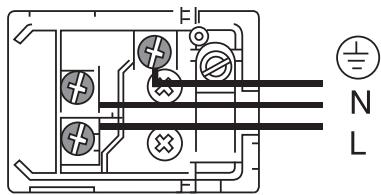
230 V 1~
3 × 1,5 ~mm^2 T 150
- The electrical connection has adequate earthing in accordance with regulations in force.
- The connection must be carried out with an omnipolar switch, of an adequate size for the current drawn. There must be a minimum aperture between contacts of 3 mm to enable disconnection in the case of emergency, cleaning or bulb exchange. Under no circumstances must the earth wire pass through this switch. After connecting the electricity, check that all the electrical parts of the oven are working.
Installing the Oven
For all ovens and after carrying out the electrical connection,
1 Introduce the oven into the kitchen unit, taking care not to trap the cable.
2 Fix the oven to the unit by means of the 2 screws supplied via the holes that can be seen when the door is opened.
3 Check that the oven housing is not in contact with the sides of the unit and that there is at least 2mm separating the neighbouring units.
FR Sommaire
- EN Contents
- ! Safety information
- Correct use
- Child safety
- Installation
- Product description
- General Overview
- Control panel
- Oven functions
- Caution!
- Recommendations for Defrosting Food
- Before using for the first time
- Using the oven
- Setting the Electronic Clock
- Manual operation
- Oven Lighting
- Electronic clock functions
- Cooking Tables
- Child lock function
- Oven safety cut-out
- Water Cleaning function
- About this function
- How it works
- How to use:
- Care and Cleaning
- Cleaning the Inside of the Oven
- Cleaning the Oven Exterior and Accessories
- Cleaning the Large Interior Glass Door
- Warning!
- Changing the oven bulb
- Enviroments concerns
- Ecological Packaging
- What to do if...
- Technical Data
- Before Installation. Comments
- Electrical Connection. Legal Requirements
- Installing the Oven
- FR Sommaire
Brand : AEG-ELECTROLUX
Model : EOK68600X
Category : Built-in oven