YDP-162/142 - Digital piano YAMAHA - Free user manual and instructions
Find the device manual for free YDP-162/142 YAMAHA in PDF.


| Product Type | Digital Piano |
| Brand | YAMAHA |
| Model | YDP-162/142 |
| Number of Keys | 88 (GH - Graded Hammer Standard weighted keyboard) |
| Maximum Polyphony | 128 notes |
| Number of Tones | 20 voices (including grand piano, electric piano, organ, strings) |
| Speakers | 2 × 12 W (6 W + 6 W) with 2 × 12 cm speakers |
| Connectivity | USB TO HOST, Headphone jacks (2), Pedal jack |
| Built-in Functions | Metronome, MIDI recording, Dual (layering), Split, Reverb, Chorus, Transpose |
| Dimensions (W × D × H) | Approx. 1357 × 423 × 860 mm (with music rest) |
| Weight | Approx. 38 kg |
| Power Supply | YAMAHA PA-150 AC adapter (12 V, 1.5 A) |
| Power Consumption | 13 W |
| Included Accessories | Music rest, sustain pedal (FC5 or FC3), AC adapter, owner's manual |
| Maintenance and Cleaning | Use a soft, dry cloth. Do not use solvents, abrasive products, or sprays. |
| Safety | Do not expose to humidity, rain, or extreme temperatures. Unplug before cleaning. Use the supplied adapter. |
| Spare Parts and Repairability | Contact an authorized Yamaha dealer or after-sales service. See list of distributors in the manual. |
| General Information | Serial number located under the instrument. Keep the manual as proof of purchase. Follow WEEE directive for recycling. |
| Warranty | 2 years (parts and labor) in the European Union |
| Country of Manufacture | Indonesia |
Frequently Asked Questions - YDP-162/142 YAMAHA
User questions about YDP-162/142 YAMAHA
0 question about this device. Answer the ones you know or ask your own.
Ask a new question about this device
Download the instructions for your Digital piano in PDF format for free! Find your manual YDP-162/142 - YAMAHA and take your electronic device back in hand. On this page are published all the documents necessary for the use of your device. YDP-162/142 by YAMAHA.
USER MANUAL YDP-162/142 YAMAHA
For information on assembling the keyboard stand, refer to the instructions at the end of this manual.
About the Manuals. 7
Included Accessories 7
Panel Controls and Terminals 8
Basic Operations
Setting Up 9
Key Cover 9
Music Rest 9
Turning the Power On 10
Auto Power Off 11
Using Headphones. 11
Playing the Piano 12
Setting the Volume 12
Intelligent Acoustic Control (I.A.C.) 12
Using the Pedals 13
Using the Damper Resonance 13
Using the Metronome. 14
Changing the Touch Sensitivity. 15
Maintenance 15
Advanced Operations
Playing Various Musical Instrument Sounds (Voices) 16
Selecting a Voice. 16
Listening to the Demo Songs 17
Adding Variations to the Sound (Reverb). 18
Transposing the Pitch in Semitones 19
Fine-tuning the Pitch 19
Layering Two Voices (Dual mode) 20
Playing Duo 21
SongPlaybackandPractice. 22
Listening to 50 Preset Songs 22
Practicing a One-Hand Part 23
Playing from the top of the bar including
a rest or blank. 23
Recording Your Performance 24
Recording Your Performance. 24
Changing the Initial Settings of the Recorded Song.....25
Deleting Recorded Data. 25
Backing up Data and Initializing the Settings 26
Data Maintained When Power is Turned Off 26
Saving the User Song data to a computer 26
Transferring SMF Files Between a Computer and this Instrument. 26
Initializing the Settings. 26
Appendix
Troubleshooting 27
Keyboard Stand Assembly 28
Specifications 32
Index 33
SPECIALMESSAGESECTION
This product utilizes batteries or an external power supply (adapter). DO NOT connect this product to any power supply or adapter other than one described in the manual, on the name plate, or specifically recommended by Yamaha.
WARNING: Do not place this product in a position where anyone could walk on, trip over, or roll anything over power or connecting cords of any kind. The use of an extension cord is not recommended! If you must use an extension cord, the minimum wire size for a 25' cord (or less) is 18 AWG. NOTE: The smaller the AWG number, the larger the current handling capacity. For longer extension cords, consult a local electrician. This product should be used only with the components supplied or; a cart, rack, or stand that is recommended by Yamaha. If a cart, etc., is used, please observe all safety markings and instructions that accompany the accessory product.
SPECIFICATIONS SUBJECT TO CHANGE:
The information contained in this manual is believed to be correct at the time of printing. However, Yamaha reserves the right to change or modify any of the specifications without notice or obligation to update existing units.
This product, either alone or in combination with an amplifier and headphones or speaker/s, may be capable of producing sound levels that could cause permanent hearing loss. DO NOT operate for long periods of time at a high volume level or at a level that is uncomfortable. If you experience any hearing loss or ringing in the ears, you should consult an audiologist.
IMPORTANT: The louder the sound, the shorter the time period before damage occurs.
Some Yamaha products may have benches and / or accessory mounting fixtures that are either supplied with the product or as optional accessories. Some of these items are designed to be dealer assembled or installed. Please make sure that benches are stable and any optional fixtures (where applicable) are well secured BEFORE using.
Benches supplied by Yamaha are designed for seating only. No other uses are recommended.
NOTICE:
Service charges incurred due to a lack of knowledge relating to how a function or effect works (when the unit is operating as designed) are not covered by the manufacturer's warranty, and are therefore the owners responsibility. Please study this manual carefully and consult your dealer before requesting service.
ENVIRONMENTAL ISSUES:
Yamaha strives to produce products that are both user safe and environmentally friendly. We sincerely believe that our products and the production methods used to produce them, meet these goals. In keeping with both the letter and the spirit of the law, we want you to be aware of the following:
Battery Notice:
This product MAY contain a small non-rechargeable battery which (if applicable) is soldered in place. The average life span of this type of battery is approximately five years. When replacement becomes necessary, contact a qualified service representative to perform the replacement.
This product may also use "household" type batteries. Some of these may be rechargeable. Make sure that the battery being charged is a rechargeable type and that the charger is intended for the battery being charged.
When installing batteries, never mix old batteries with new ones, and never mix different types of batteries. Batteries MUST be installed correctly. Mismatches or incorrect installation may result in overheating and battery case rupture.
Warning:
Do not attempt to disassemble, or incinerate any battery. Keep all batteries away from children. Dispose of used batteries promptly and as regulated by the laws in your area. Note: Check with any retailer of household type batteries in your area for battery disposal information.
Disposal Notice:
Should this product become damaged beyond repair, or for some reason its useful life is considered to be at an end, please observe all local, state, and federal regulations that relate to the disposal of products that contain lead, batteries, plastics, etc. If your dealer is unable to assist you, please contact Yamaha directly.
NAME PLATE LOCATION:
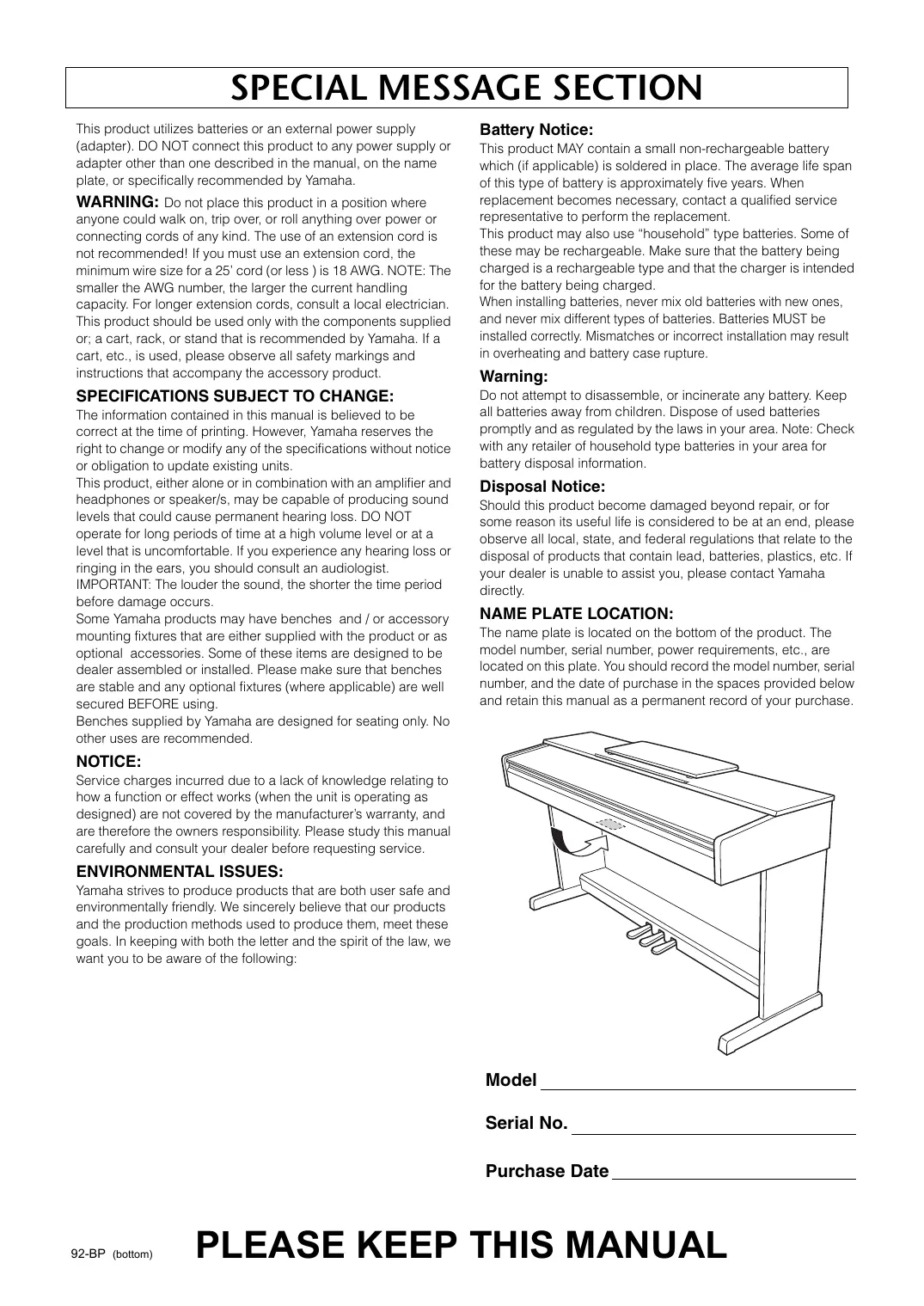
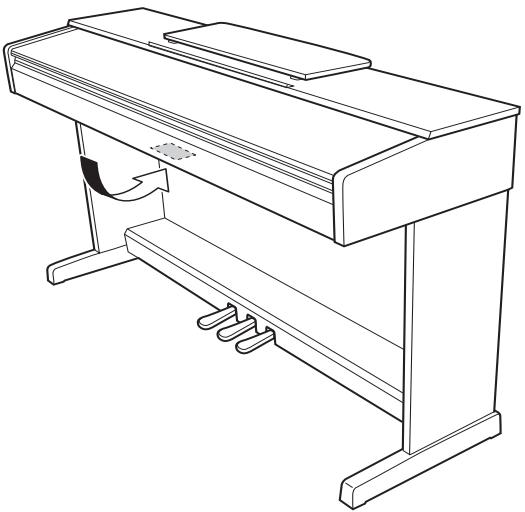
The name plate is located on the bottom of the product. The model number, serial number, power requirements, etc., are located on this plate. You should record the model number, serial number, and the date of purchase in the spaces provided below and retain this manual as a permanent record of your purchase.
Model
Serial No.
Purchase Date
FCC INFORMATION (U.S.A.)
- IMPORTANT NOTICE: DO NOT MODIFY THIS UNIT! This product, when installed as indicated in the instructions contained in this manual, meets FCC requirements. Modifications not expressly approved by Yamaha may void your authority, granted by the FCC, to use the product.
- IMPORTANT: When connecting this product to accessories and/or another product use only high quality shielded cables. Cable/s supplied with this product MUST be used. Follow all installation instructions. Failure to follow instructions could void your FCC authorization to use this product in the USA.
- NOTE: This product has been tested and found to comply with the requirements listed in FCC Regulations, Part 15 for Class "B" digital devices. Compliance with these requirements provides a reasonable level of assurance that your use of this product in a residential environment will not result in harmful interference with other electronic devices. This equipment generates/uses radio frequencies and, if not installed and used according to the instructions found in the users manual, may cause interference harmful to the operation of other electronic devices.
Compliance with FCC regulations does not guarantee that interference will not occur in all installations. If this product is found to be the source of interference, which can be determined by turning the unit "OFF" and "ON", please try to eliminate the problem by using one of the following measures:
Relocate either this product or the device that is being affected by the interference.
Utilize power outlets that are on different branch (circuit breaker or fuse) circuits or install AC line filter/s.
In the case of radio or TV interference, relocate/reorient the antenna. If the antenna lead-in is 300 ohm ribbon lead, change the lead-in to co-axial type cable.
If these corrective measures do not produce satisfactory results, please contact the local retailer authorized to distribute this type of product. If you can not locate the appropriate retailer, please contact Yamaha Corporation of America, Electronic Service Division, 6600 Orangethorpe Ave, Buena Park, CA90620
The above statements apply ONLY to those products distributed by Yamaha Corporation of America or its subsidiaries.
- This applies only to products distributed by YAMAHA CORPORATION OF AMERICA.
(class B)
COMPLIANCE INFORMATION STATEMENT (DECLARATION OF CONFORMITY PROCEDURE)
Responsible Party : Yamaha Corporation of America
Address: 6600 Orangethorpe Ave., Buena Park, Calif. 90620
Telephone:714-522-9011
Type of Equipment : Digital Piano
Model Name: YDP-162, YDP-142
This device complies with Part 15 of the FCC Rules.
Operation is subject to the following two conditions:
1) this device may not cause harmful interference, and
2) this device must accept any interference received including interference that may cause undesired operation.
See user manual instructions if interference to radio reception is suspected.
OBSERVERA!
Please keep this manual in a safe and handy place for future reference.

WARNING
Always follow the basic precautions listed below to avoid the possibility of serious injury or even death from electrical shock, short-circuiting, damages, fire or other hazards. These precautions include, but are not limited to, the following:
Power supply/AC power adaptor
- Do not place the power cord near heat sources such as heaters or radiators. Also, do not excessively bend or otherwise damage the cord, or place heavy objects on it.
- Only use the voltage specified as correct for the instrument. The required voltage is printed on the name plate of the instrument.
- Use the specified adaptor (page 32) only. Using the wrong adaptor can result in damage to the instrument or overheating.
- Check the electric plug periodically and remove any dirt or dust which may have accumulated on it.
Do not open
- This instrument contains no user-serviceable parts. Do not open the instrument or attempt to disassemble or modify the internal components in any way. If it should appear to be malfunctioning, discontinue use immediately and have it inspected by qualified Yamaha service personnel.
Water warning
- Do not expose the instrument to rain, use it near water or in damp or wet conditions, place on it any containers (such as vases, bottles or glasses) containing liquids which might spill into any openings. If any liquid such as water seeps into the instrument, turn off the power immediately and unplug the power cord from the AC outlet. Then have the instrument inspected by qualified Yamaha service personnel.
- Never insert or remove an electric plug with wet hands.
Fire warning
- Do not put burning items, such as candles, on the unit. A burning item may fall over and cause a fire.
If you notice any abnormality
-
When one of the following problems occur, immediately turn off the power switch and disconnect the electric plug from the outlet. Then have the device inspected by Yamaha service personnel.
-
The power cord or plug becomes frayed or damaged.
- It emits unusual smells or smoke.
- Some object has been dropped into the instrument.
- There is a sudden loss of sound during use of the instrument.

CAUTION
Always follow the basic precautions listed below to avoid the possibility of physical injury to you or others, or damage to the instrument or other property. These precautions include, but are not limited to, the following:
Power supply/AC power adaptor
- Do not connect the instrument to an electrical outlet using a multiple-connector. Doing so can result in lower sound quality, or possibly cause overheating in the outlet.
- When removing the electric plug from the instrument or an outlet, always hold the plug itself and not the cord. Pulling by the cord can damage it.
- Remove the electric plug from the outlet when the instrument is not to be used for extended periods of time, or during electrical storms.
Assembly
- Read carefully the attached documentation explaining the assembly process. Failure to assemble the instrument in the proper sequence might result in damage to the instrument or even injury.
Location
- Do not place the instrument in an unstable position where it might accidentally fall over.
- When transporting or moving the instrument, always use two or more people. Attempting to lift the instrument by yourself may damage your back, result in other injury, or cause damage to the instrument itself.
- Before moving the instrument, remove all connected cables, to prevent damage to the cables or injury to anyone who might trip over them.
- When setting up the product, make sure that the AC outlet you are using is easily accessible. If some trouble or malfunction occurs, immediately turn off the power switch and disconnect the plug from the outlet. Even when the power switch is turned off, electricity is still flowing to the product at the minimum level. When you are not using the product for a long time, make sure to unplug the power cord from the wall AC outlet.
- Use only the stand specified for the instrument. When attaching the stand or rack, use the provided screws only. Failure to do so could cause damage to the internal components or result in the instrument falling over.
Connections
- Before connecting the instrument to other electronic components, turn off the power for all components. Before turning the power on or off for all components, set all volume levels to minimum.
- Be sure to set the volumes of all components at their minimum levels and gradually raise the volume controls while playing the instrument to set the desired listening level.
Handling caution
- Do not insert a finger or hand in any gaps on the key cover or instrument. Also take care that the key cover does not pinch your finger.
- Never insert or drop paper, metallic, or other objects into the gaps on the key cover, panel or keyboard. This could cause physical injury to you or others, damage to the instrument or other property, or operational failure.
-
Do not rest your weight on, or place heavy objects on the instrument, and do not use excessive force on the buttons, switches or connectors.
-
Do not use the instrument/device or headphones for a long period of time at a high or uncomfortable volume level, since this can cause permanent hearing loss. If you experience any hearing loss or ringing in the ears, consult a physician.
Using the bench (If included)
- Do not place the bench in an unstable position where it might accidentally fall over.
- Do not play carelessly with or stand on the bench. Using it as a tool or stepladder or for any other purpose might result in accident or injury.
- Only one person should sit on the bench at a time, in order to prevent the possibility of accident or injury.
- If the bench screws become loose due to extensive long-term use, tighten them periodically using the included tool.
- Keep special watch over any small children so that they don't fall off the rear of the bench. Since the bench does not have a backrest, unsupervised use may result in accident or injury.
Yamaha cannot be held responsible for damage caused by improper use or modifications to the instrument, or data that is lost or destroyed.
Always turn the power off when the instrument is not in use.
Even when the [ ] (Standby/On) switch is in standby status (power lamp is off), electricity is still flowing to the instrument at the minimum level.
When you are not using the instrument for a long time, make sure you unplug the power cord from the wall AC outlet.
NOTICE
To avoid the possibility of malfunction/ damage to the product, damage to data, or damage to other property, follow the notices below.
■ Handling and Maintenance
- Do not use the instrument in the vicinity of a TV, radio, stereo equipment, mobile phone, or other electric devices. Otherwise, the instrument, TV, or radio may generate noise. When you use the instrument along with the application on your iPhone/iPad, we recommend that you set "Airplane Mode" to "ON" on your iPhone/iPad in order to avoid noise caused by communication.
- Do not expose the instrument to excessive dust or vibrations, or extreme cold or heat (such as in direct sunlight, near a heater, or in a car during the day) to prevent the possibility of panel disfiguration, damage to the internal components or unstable operation. (Verified operating temperature range: 5^ - 40^ , or 41^ - 104^ .)
- Do not place vinyl, plastic or rubber objects on the instrument, since this might discolor the panel or keyboard.
- In the case of a model with a polished finish, bumping the surface of the instrument with metal, porcelain, or other hard objects can cause the finish to crack or peel. Use caution.
- During extreme changes in temperature or humidity, condensation may occur and water may collect on the surface of the instrument. If water is left, the wooden parts may absorb the water and be damaged. Make sure to wipe any water off immediately with a soft cloth.
Saving data
- Saved data may be lost due to malfunction or incorrect operation. Save important data to external device such as a computer (see online manual, Computer-related Operations; page 7).
Information
About copyrights
- Copying of the commercially available musical data including but not limited to MIDI data and/or audio data is strictly prohibited except for your personal use.
This product incorporates and bundles computer programs and contents in which Yamaha owns copyrights or with respect to which it has license to use others' copyrights. Such copyrighted materials include, without limitation, all computer software, style files, MIDI files, WAVE data, musical scores and sound recordings. Any unauthorized use of such programs and contents outside of personal use is not permitted under relevant laws. Any violation of copyright has legal consequences. DON'T MAKE, DISTRIBUTE OR USE ILLEGAL COPIES.
■ About functions/data bundled with the instrument
- Some of the preset songs have been edited for length or arrangement, and may not be exactly the same as the original.
■ About this manual
- The illustrations as shown in this manual are for instructional purposes only, and may appear somewhat different from those on your instrument.
- The company names and product names in this manual are the trademarks or registered trademarks of their respective companies.
Thank you for choosing the Yamaha ARIUS.
In order to make the most of the performance potential and features of the instrument, please read the manuals thoroughly, and keep them in a handy place for later reference.
About the Manuals
This instrument has the following manuals.
Included Manuals

Owner's Manual (this book)
Explains how to use the instrument.

Quick Operation Guide (separate sheet)
Shows in chart form the functions assigned to the buttons and the keyboard for quick understanding.
Online Manuals (PDF)

Computer-related Operations
Includes instructions on connecting this instrument to a computer, and operations related to transferring song data, as well as MIDI functions such as MIDI channel and Local Control settings.

MIDI Reference
Contains the MIDI Data Format and MIDI Implementation chart.

MIDI Basics (only in English, French and German)
Contains basic explanations about MIDI.
To obtain these manuals, access the Yamaha Downloads website, select your country, enter "YDP-142" or "YDP-162" in the Model Name box, then click [SEARCH].
Yamaha Downloads
http://download.yamaha.com/
Included Accessories
Owner's Manual (this book)
Quick Operation Guide (separate sheet)
"50 Greats for the Piano" (music book)
Online Member Product Registration*1
AC power adaptor*2
Power cord (YDP-162 only)
Bench*2
1 You will need the PRODUCT ID on the sheet in order to fill out the User Registration form.
2 May not be included depending on your particular area. Please check with your Yamaha dealer.
The illustrations are taken from the YDP-142.
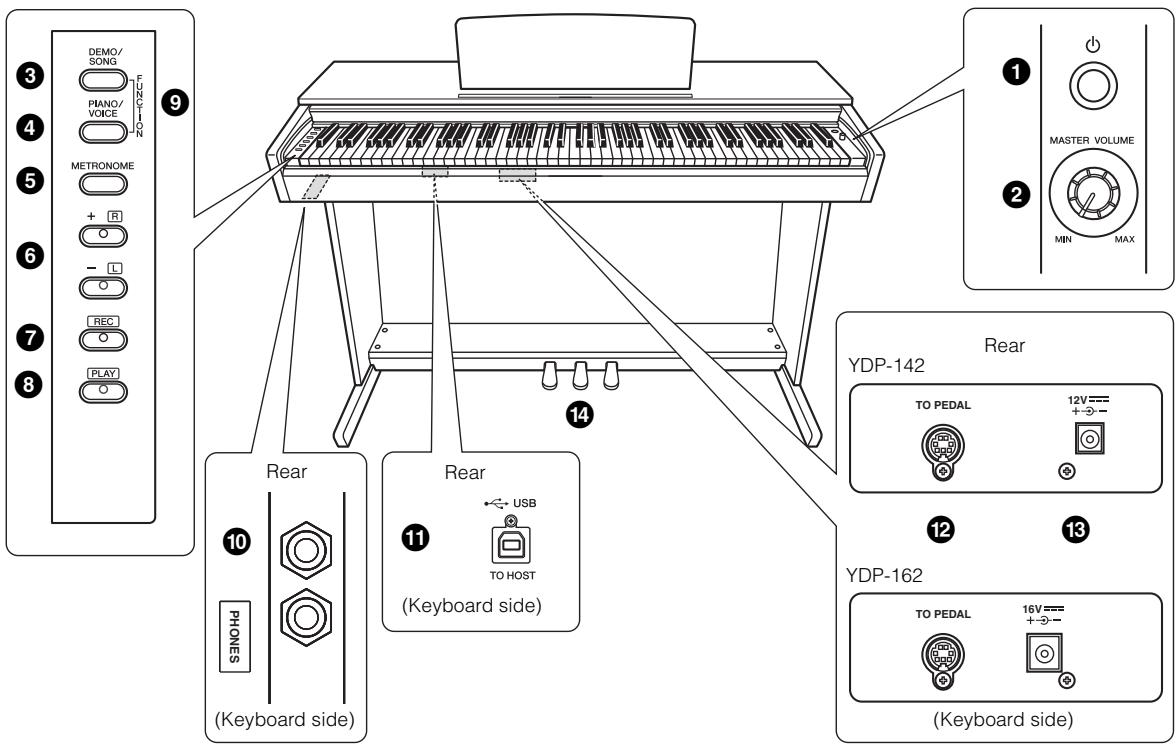
[ ] (Standby/On) switch.... page 10
For turning the power on or setting to standby.
[MASTER VOLUME] knob... page 12
For adjusting the volume of the entire sound.
[DEMO/SONG] button pages 17, 22
For playing the Demo Songs and the Preset Songs.
4 [PIANO/VOICE] button.......pages 16, 18, 20
For selecting a single Voice, two Voices for layering or a Reverb Type.
[METRONOME] button.. page 14
For starting or stopping the metronome.
[+R] ,[-L] buttons.......pages 16, 19, 23
-
In general, these are for selecting the next or previous Voice.
-
During Song playback, these are for selecting the next or previous Song, and (while holding down [PLAY]) turning on/off the right-hand and left-hand Parts individually.
-
During Metronome playback, these are for increasing or decreasing the Tempo.
[REC] button.. page 24
For recording your keyboard performance.
[PLAY] button... page 25
For playing back the recorded performance.
[FUNCTION] page 19
Simultaneously holding these two buttons and pressing the specified key sets will set the MIDl or Transpose parameters.
[PHONES] jacks... page 11
For connecting a set of standard stereo headphones.
[USB TO HOST] terminal
For connecting to a computer. For details, refer to "Computer-related Operations" (page 7).
NOTICE
Use an AB type USB cable of less than 3 meters. USB 3.0 cables cannot be used.
[TO PEDAL] jack... page 30
For connecting the Pedal Cord.
DC IN jack.... page 10
For connecting the power adaptor.
14 Pedals.. page 13
For controlling expression and sustain, just as on an acoustic piano.
Key Cover
To open the key cover:
Lift the cover slightly, then push and slide it to the end.
To close the key cover:
Slide the cover toward you and gently lower the cover over the keys.
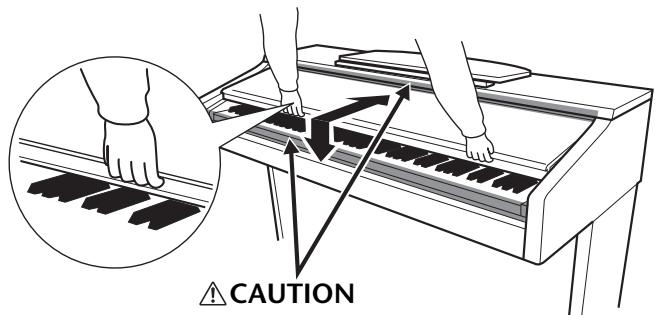
Be careful to avoid catching your fingers when opening or closing the cover.
CAUTION
- Hold the cover with both hands when opening or closing it. Do not release it until it is fully opened or closed. Be careful to avoid catching fingers (yours or others, especially children's) between the cover and main unit.
- Do not place objects, such as a piece of metal or paper, on top of the key cover. Small objects placed on the key cover may fall inside the unit when the cover is opened and may be nearly impossible to remove. This could cause electric shock, short circuit, fire or other serious damage to the instrument.
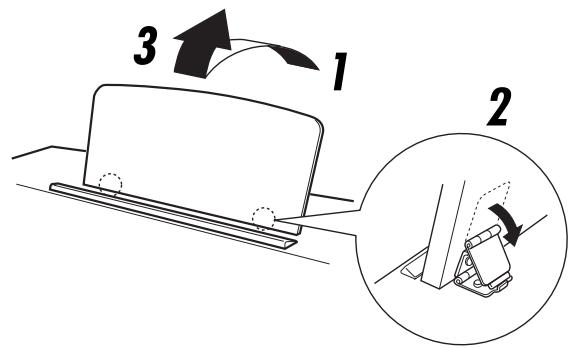
Music Rest
To raise the music rest:
1 Pull the music rest up and toward yourself as far as it will go.
2 Flip down the two metal supports at the left and right on the rear of the music rest.
3 Lower the music rest so that it rests on the metal supports.
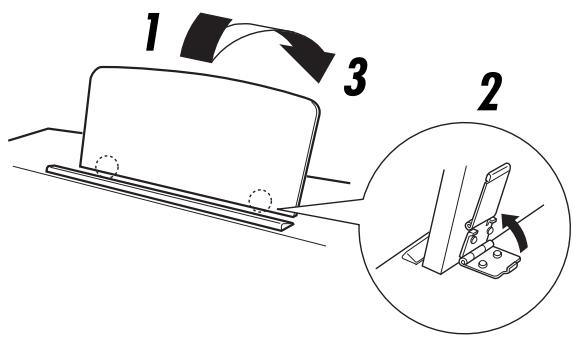
To lower the music rest:
1 Pull the music rest toward yourself as far as it will go.
2 Raise the two metal supports (at the rear of the music rest).
3 Gently lower the music rest backward until it is all the way down.
CAUTION
- Do not try to use the music rest in a half-raised position. When lowering the music rest, do not release your hands from the music rest until it is all the way down.
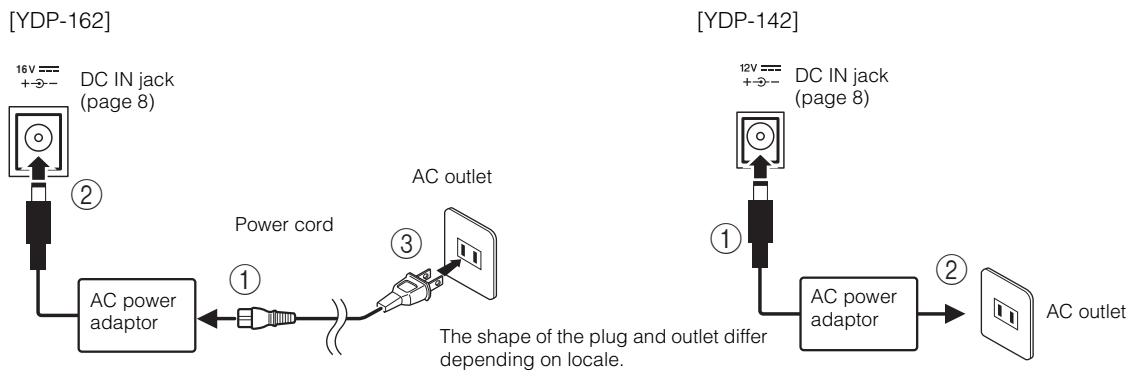
Turning the Power On
1 Connect the plugs of the AC power adaptor in the order shown in the illustration.
WARNING
Use the specified adaptor (page 32) only. The use of other adaptors may result in irreparable damage to both the adaptor and the instrument.
CAUTION
Remove the AC plug from the AC outlet when the instrument is not to be used for extended periods of time, or during electrical storms.
NOTE
Follow this procedure in reverse order when disconnecting the power adaptor.
2 Press the [] (Standby/On) switch to turn the power on.
![YAMAHA YDP-162/142 - Press the [] (Standby/On) switch to turn the power on. - 1](/content/2025/01/115289/images/fe0935527237d2c31b7fa8eb16408cd5196794142b1629b640782cee2ee17059.jpg)
Power indicator
If you close the key cover without turning the power to standby, the power indicator remains lit, indicating that the power is still on.
When you're ready to turn the power to standby, press the [ ] (Standby/On) switch again for a second. The power indicator turns off.
CAUTION
Even when the [ ] (Standby/On) switch is in the standby status, electricity is still flowing to the instrument at a minimum level. When not using the instrument for an extended period of time, be sure to unplug the power cord from the wall AC outlet.
Auto Power Off
To prevent unnecessary power consumption, this instrument features an Auto Power Off function that automatically turns the power off if the instrument is not operated for approximately 30 minutes. If you do not want to use the Auto Power Off function, disable the function as described below. The setting (disabled or enabled) is retained even if the power is turned off.
NOTE
Default setting:
Enable
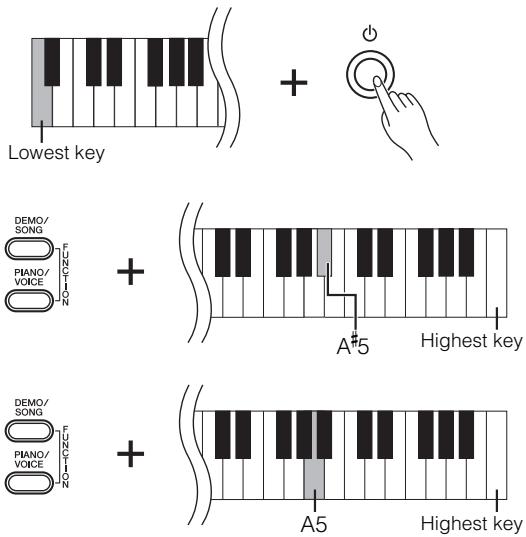
Disabling Auto Power Off
Turn the power of the instrument off. Then, while holding down the lowest key, press the [ ] (Standby/On) switch to turn on the power again so that the [REC] indicator flashes three times, indicating that the Auto Power Off function has been disabled.
You can also disable the Auto Power Off function without turning the power off, by simultaneously holding down [DEMO/SONG] and [PIANO/VOICE] and pressing the A#5 key.
Re-enabling Auto Power Off
To enable the Auto Power Off function again, simultaneously hold down [DEMO/SONG] and [PIANO/VOICE] and press the A5 key.
Using Headphones
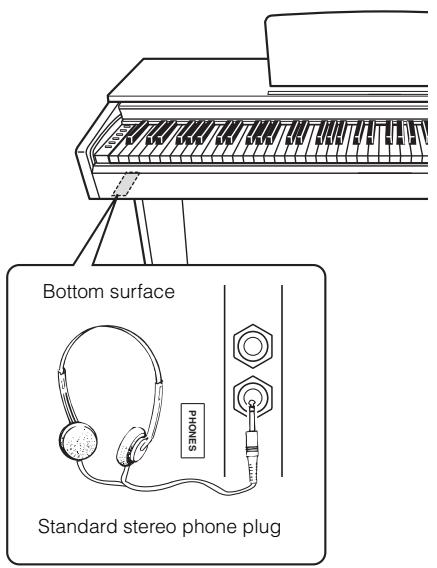
Since this instrument is equipped with two [PHONES] jacks, you can connect two sets of standard stereo headphones. If you are using only one set of headphones, insert a plug into either jack, which automatically shuts off the speakers.
CAUTION
Do not use headphones at a high volume for an extended period of time; doing so may cause hearing loss.
Using the headphone hanger (for YDP-162 only)
You can hang the headphones on this instrument. Refer to "Keyboard Stand Assembly" on page 28 for instructions on installing the headphone hanger.
NOTICE
Do not hang anything other than the headphones on the hanger.
Doing so may damage this instrument or the hanger.
Playing the Piano
Setting the Volume
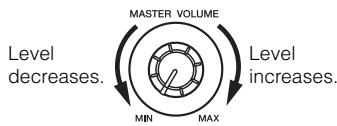
When you start playing, use the [MASTER VOLUME] knob to adjust the volume of the entire keyboard sound.
CAUTION
Do not use this instrument at a high volume level for a long period of time, or your hearing may be damaged.
Intelligent Acoustic Control (I.A.C.)
With this function, the sound quality of this instrument is automatically adjusted and controlled according to the overall volume. Even when the volume is low, this lets you hear both low sounds and high sounds clearly.
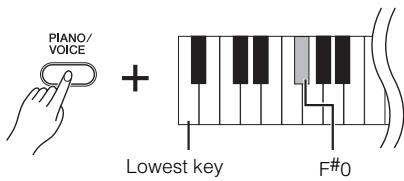
To turn on I.A.C.:
While holding down [PIANO/VOICE], press the F#0 key.
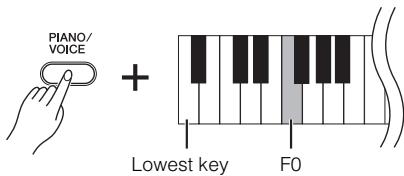
To turn off I.A.C.:
While holding down [PIANO/VOICE], press the F0 key.
To adjust I.A.C. Depth:
While holding down [PIANO/VOICE] press one of the A-1 - D#0 keys.
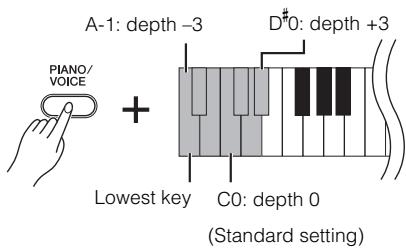
The higher the value, the more clearly that low and high sounds are heard at lower volume levels.
Using the Pedals
Damper Pedal (Right)
Pressing this pedal will sustain notes longer. Releasing this pedal immediately stops (damps) any sustained notes. This pedal also features a "half-pedal" function that creates partial sustain effects, depending on how far down you press the pedal.
Sostenuto Pedal (Center)
Pressing this pedal while holding the notes will sustain the pressed notes (as if the Damper Pedal had been pressed), but all subsequently played notes will not be sustained. This makes it possible to sustain a chord or single low note, for example, while the other notes are played "staccato."
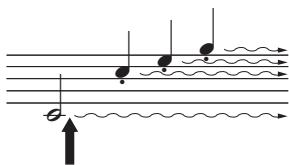
When you press the damper pedal here, this note and the notes you play before you release the pedal sustain longer.
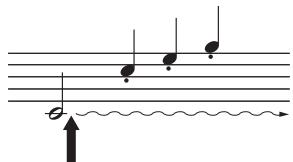
When you press the sostenuto pedal here while holding the note, the note will sustain as long as you hold the pedal.
Soft Pedal (Left)
Pressing this pedal will reduce the volume and slightly change the timbre of the notes. The notes played before this pedal is pressed are not affected. When you select the Jazz Organ Voice, pressing the left pedal switches between fast/slow rotation of the rotary speaker (page 16).
NOTE
If the damper pedal doesn't work, make sure that the pedal cord is properly plugged into the main unit (page 30).
Half-pedal function
This function allows you to vary the sustain length depending on how far the pedal is pressed. The farther down you press the pedal, the more the sound sustains. For example, if you press the damper pedal and all notes you are playing sound a bit murky and loud with too much sustain, you can release the pedal half way or higher to decrease the sustain (murkiness).
NOTE
While the sostenuto pedal is held, the organ and strings Voices sound continuously without decay after the notes have been released.
Using the Damper Resonance
The Damper Resonance effect simulates the sustain sound of the damper pedal on a grand piano, as if you were pressing the damper pedal and playing the keyboard. This effect is applied to the entire sound of the instrument.
To turn on the Damper Resonance:
While holding [PIANO/VOICE], press the G#2 key.
To turn off the Damper Resonance:
While holding [PIANO/VOICE], press the G2 key.
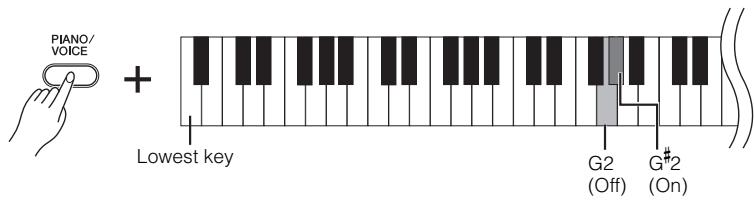
Default setting: On
Using the Metronome
The metronome feature is convenient for practicing with an accurate tempo.
1 Press [METRONOME] to start the Metronome.
2 Press [METRONOME] to stop the Metronome.
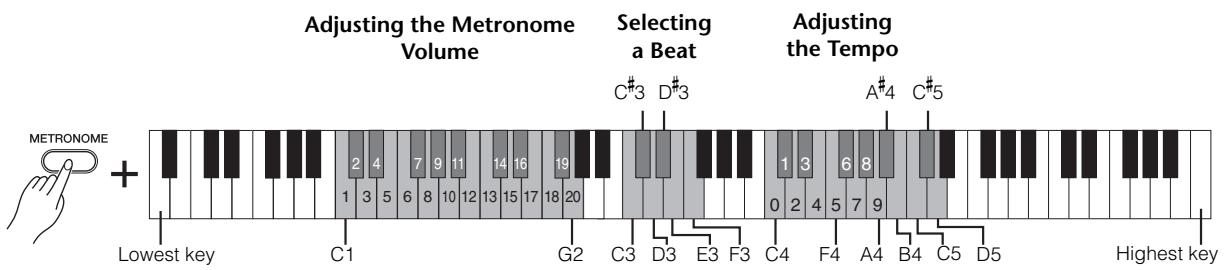
Selecting a Beat
While holding down [METRONOME], press one of the C3-F3 keys.
| Key | Beat |
| C3 | 0 |
| C#3 | 2 |
| D3 | 3 |
| D#3 | 4 |
| E3 | 5 |
| F3 | 6 |
Adjusting the Tempo
The Metronome tempo can be set from 5 to 280 beats per minute.
To increase or decrease the value by 1:
While the metronome is playing, press [+R] to increase or [-L] to decrease. Alternatively, press and hold down [METRONOME], and press the C#5 key to increase or B4 key to decrease.
To increase or decrease the value by 10:
While holding down [METRONOME], press the D5 key to increase or the A#4 key to decrease.
To specify a three-digit value:
While holding down [METRONOME], press the relevant C4-A4 keys one by one in order. For example to specify "95," press the C4 (0), A4 (9) and F4 (5) keys in order.
Resetting the value to the default (120)
While holding down [METRONOME], press the [+R] and [-L] simultaneously, or press the C5 (default) key.
Adjusting the Volume
While holding down [METRONOME], press one of the keys between C1 and G2 to set the volume of the metronome. Pressing a higher key results in higher volume, while pressing a lower key results in lower volume.
Default setting: 0 (C3)
Setting range:
C1 (1) G2 (20)
Default setting:
D2 (15)
Changing the Touch Sensitivity
You can specify the Touch Sensitivity (how the sound responds to the way you play the keys).
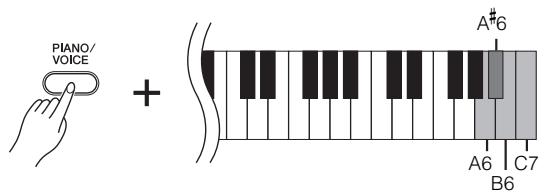
While holding down [PIANO/VOICE], press one of the A6-C7 keys.
NOTE
This setting is disabled with some Voices, such as an organ sound.
Default setting:
B6 (Medium)
| Key | Touch Sensitivity | Description |
| A6 | Fixed | The volume level does not change at all regardless of whether you play the keyboard soft or hard. |
| A#6 | Soft | The volume level does not change much when you play the keyboard soft or hard. |
| B6 | Medium | This is the standard piano touch response. |
| C7 | Hard | The volume level changes very widely from pianissimo to fortissimo to facilitate dynamic and dramatic expression. You have to hit the keys hard to produce a loud sound. |
Maintenance
To keep your ARIUS in optimum condition, we recommend that you periodically follow the maintenance points below.
Instrument and Bench Maintenance
- When cleaning the instrument, use a soft, dry or slightly damp cloth.
NOTICE
Do not use paint thinners, solvents, cleaning fluids, or chemical-impregnated wiping cloths.
- In the case of a model with a polished finish, gently remove dust and dirt with a soft cloth. Do not wipe too hard since small particles of dirt can scratch the instrument's finish.
To keep the surface polished, apply commercially available piano polisher to a soft cloth and wipe the instrument's surface with it. Then, polish it with a separate cloth. Before using any piano polisher, make sure to read the instructions for proper usage.
- Tighten the screws of the instrument and bench periodically.
Pedal Cleaning
As with an acoustic piano, pedals may become tarnished over years of use. When this occurs, polish the pedal with a compound designed for piano pedals. Before using the compound, make sure to read the instructions for proper usage.
Tuning
Unlike an acoustic piano, this instrument does not need to be tuned by an expert (although the pitch can be user-adjusted to match other instruments). This is because the pitch of digital instruments is always maintained perfectly.
When transporting
You can load this instrument onto a truck, either fully assembled or disassembled. When doing so, do not lean the instrument (especially the keyboard unit) against a wall, and make sure to lay it horizontally in the truck. When transporting by truck, do not subject the instrument to excessive vibration or shock. If you transport the instrument fully assembled, make sure to check all the screws then tighten them as necessary.
Playing Various Musical Instrument Sounds (Voices)
Selecting a Voice
To select "Grand Piano 1":
Simply press [PIANO/VOICE].
To select another Voice:
After pressing [PIANO/VOICE], press [+R] or [-L] to select the next or previous Voice.
To select a specific Voice:
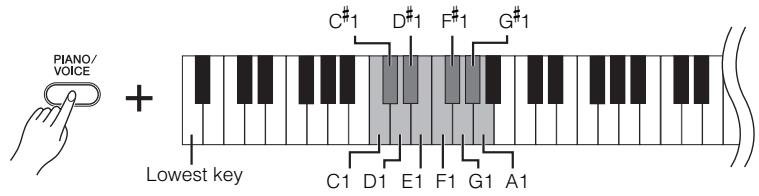
While holding down [PIANO/VOICE], press one of the C1-A1 keys. For details on which Voice is assigned to each key, see the list below.
NOTE
To hear the characteristics of the Voices, play back the Demo Songs (page 17).
Voice List
| Key | Voice Name | Voice description |
| C1 | Grand Piano 1 | This sound was sampled from a full concert grand piano. It uses different samples depending on the strength of your playing and produces smoother tonal changes. Suitable not only for classical compositions but also for piano pieces of any style. |
| C#1 | Grand Piano 2 | Warm and soft piano sound. Good for playing ballads. |
| D1 | Grand Piano 3 | Spacious and clear piano with bright reverb. Good for popular music. |
| D#1 | E.Piano 1 | An electronic piano sound created by FM synthesis. Good for standard popular music. |
| E1 | E.Piano 2 | The sound of an electric piano using hammer-struck metallic “tines.” Soft tone when played lightly, and an aggressive tone when played hard. |
| F1 | Harpsichord | The definitive instrument for baroque music. Since harpsichord uses plucked strings, there is no touch response. There is, however, a characteristic additional sound when the keys are released. |
| F#1 | Vibraphone | Vibraphone played with relatively soft mallets. The tone becomes more metallic the harder you play. |
| G1 | Pipe Organ | This is a typical pipe organ sound (8 feet + 4 feet + 2 feet). Good for sacred music from the Baroque period. |
| G#1 | Jazz Organ | The sound of a “tonewheel” type electric organ. Often heard in jazz and rock music. The rotary speed of the rotary speaker effect can be switched by using the left pedal. |
| A1 | Strings | Stereo-sampled, large-scale strings ensemble with realistic reverb. Try combining this Voice with piano in the Dual mode. |
Listening to the Demo Songs
Special individual Demo Songs are provided for all of the instrument Voices.
Press [DEMO/SONG] to start playback.
The [PLAY] lamp lights up, and the Demo Song for the current Voice starts.
Starting with the selected song, the playback of the Demo Songs will continue. After the last demo song, the sequence then returns to the first Demo Song and repeats until you stop it.
To change the Demo Song during playback:
Press the [+R] or [-L] to change to the next or previous Demo Song. To change to a specific Demo Song, press and hold down the [DEMO/SONG], then press one of the C1 - A1 keys.
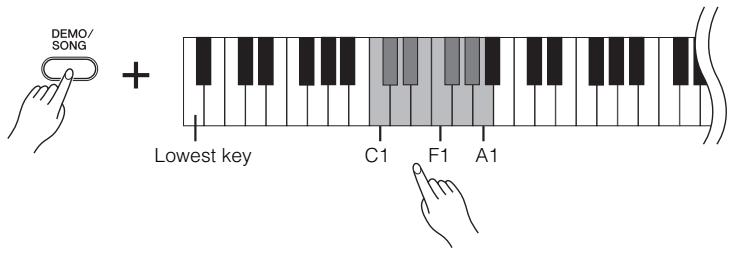
2 Press [DEMO/SONG] or [PLAY] to stop playback.
The [PLAY] lamp turns off.
Demo Song List
| Key | Voice Name | Title | Composer |
| C1 | Grand Piano 1 | Mazurka No.5 op.7-1 | F. F. Chopin |
| C#1 | Grand Piano 2 | Von fremden Landern und Menchen, Kinderszenen op.15-1 | R. Schumann |
| D1 | Grand Piano 3 | Original | Original |
| D#1 | E.Piano 1 | Original | Original |
| E1 | E.Piano 2 | Original | Original |
| F1 | Harpsichord | Concerto a cembalo obbligato, 2 violini, viola e continuo No.7, BWV.1058 | J. S. Bach |
| F#1 | Vibraphone | Original | Original |
| G1 | Pipe Organ | Herr Christ, der ein'ge Gottes-Sohn, BWV.601 | J.S.Bach |
| G#1 | Jazz Organ | Original | Original |
| A1 | Strings | Original | Original |
The Demo Songs excluding original Songs are short rearranged excerpts from the original compositions. The original Demo Songs are Yamaha originals (@2012 Yamaha Corporation).
NOTE
If you want to change the playback tempo, see page 14.
Adding Variations to the Sound (Reverb)
This instrument features several Reverb Types that add extra depth and expression to the sound to create a realistic acoustic ambience. The appropriate Reverb Type and Depth are called up automatically when you select each of the Voices and Songs. This is why the Reverb Type need not be selected; however, you can change it if desired.
To select a Reverb Type:
While holding down [PIANO/VOICE], press one of the C2-E2 keys.
[REVERB] in Dual Mode
An optimum reverb type for the combination of Voices is assigned automatically.
![YAMAHA YDP-162/142 - [REVERB] in Dual Mode - 1](/content/2025/01/115289/images/491c155444d9a8b66556285005a908d7d13d45f403c3bdbc5bb4d47f7f6c58f3.jpg)
Reverb Type List
| Key | Reverb Type | Description |
| C2 | Room | Adds a continuous reverb effect to the sound, similar to the acoustic reverberation you would hear in a room. |
| C#2 | Hall1 | For a “bigger” reverb sound, use the Hall1 setting. This effect simulates the natural reverberation of a small-size concert hall. |
| D2 | Hall2 | For a truly spacious reverb sound, use the Hall2 setting. This effect simulates the natural reverberation of a large concert hall. |
| D#2 | Stage | Simulates the reverb of a stage environment. |
| E2 | Off | No effect is applied. |
To adjust Reverb Depth:
While holding down [PIANO/VOICE], press one of the C3-G#4 keys. The Depth value increases as you press higher keys.
While holding down [PIANO/VOICE], press the A4 key to set the Reverb Depth to the most suitable value for the current Voice.
Reverb Depth range:
0 (no effect) - 20 (maximum depth)
Transposing the Pitch in Semitones
You can shift the pitch of the entire keyboard up or down in semitones in order to facilitate playing in difficult key signatures, or to easily match the pitch of the keyboard to the range of a singer or other instruments. For example, if “+5” is selected, playing key C produces pitch F, letting you play a song of F major as though it were in C major.
To transpose the pitch down:
While holding down [DEMO/SONG] and [PIANO/VOLUME], press a key between F#2 (-6) and B2 (-1).
To transpose the pitch up:
While holding down [DEMO/SONG] and [PIANO/VOLUME], press a key between C#3 (+1) and F#3 (+6).
To restore the normal pitch:
While holding down [DEMO/SONG] and [PIANO/VOICE], press the C3 key.
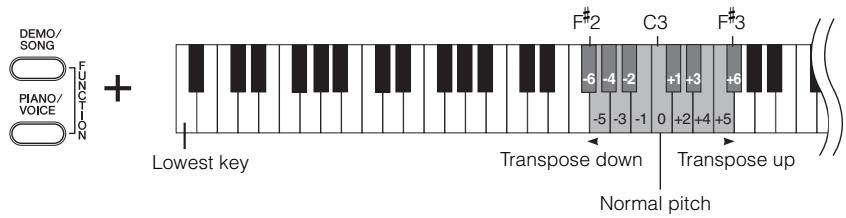
Fine-tuning the Pitch
You can fine-tune the pitch of the entire instrument in about 0.2 Hz steps. This lets you match the keyboard pitch finely to that of other instruments or CD music.
To tune up (in about 0.2Hz steps):
Press and hold down the [DEMO/SONG] and [PIANO/VOICE] simultaneously, and press [+R] .
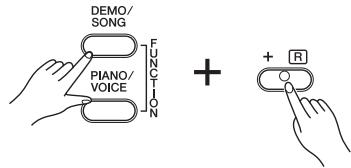
To tune down (in about 0.2Hz steps):
Press and hold down the [DEMO/SONG] and [PIANO/VOICE] simultaneously, and press [-L] .
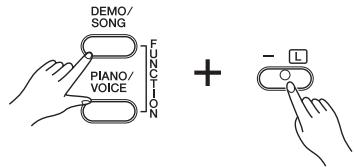
To set the pitch to 442.0Hz
Press and hold down the [DEMO/SONG] and [PIANO/VOICE] simultaneously, and press the A0 key.
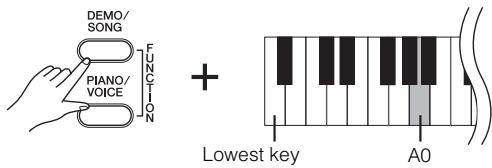
To restore default pitch:
Press and hold down the [DEMO/SONG] and [PIANO/VOLUME] simultaneously, and press [+R] and [-L] simultaneously.
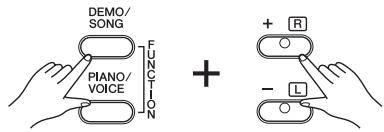
Hz (Hertz):
This unit of measurement refers to the frequency of a sound and represents the number of times a sound wave vibrates in a second.
Setting range:
414.8-466.8Hz
Default Setting:
A3 = 440.0 Hz
Layering Two Voices (Dual mode)
You can layer two Voices and play them simultaneously to create a more richly textured sound.
1 Engage the Dual mode.
While holding down [PIANO/VOICE], simultaneously hold down two keys between C1 and A1 to select the two desired Voices. For information on which Voices are assigned to the keys, refer to "Voice List" (page 16).
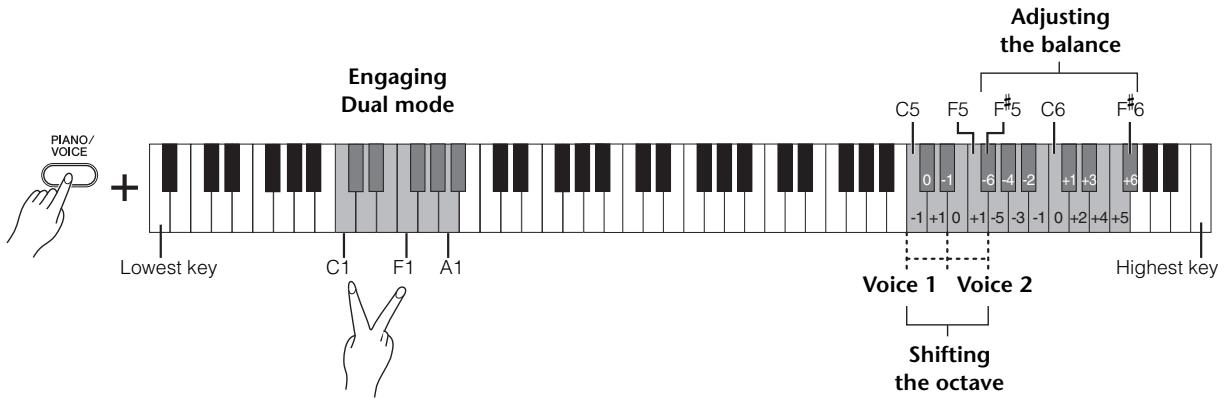
The Voice assigned to the lower key will be designated as Voice 1, and the Voice assigned to the higher key will be designated as Voice 2. You cannot assign the same Voice to both Voice 1 and Voice 2 simultaneously in Dual mode.
To shift the Octave for each Voice:
While holding down [PIANO/VOICE], press one of the C5-F5 keys.
To adjust the Balance between two Voices:
While holding down [PIANO/VOICE], press one of the F#5-F#6 keys. A setting of "0" produces an equal balance between two Voices. Settings below "0" increase the volume of Voice 2 while settings above "0" increase the volume of Voice1, in relation to the other.
2 To exit from Dual mode, press [PIANO/VOICE].
NOTE
The Dual and Duo modes (page 21) cannot be engaged at the same time.
Playing Duo
This function allows two different players to play the instrument, one on the left and the other on the right, over the same octave range.
While holding down [PIANO/VOICE], press [+R] and [-L] simultaneously to engage Duo.
The keyboard is divided into two sections, with the E3 key as the Split Point.
![YAMAHA YDP-162/142 - While holding down [PIANO/VOICE], press [+R] and [-L] simultaneously to engage Duo. - 1](/content/2025/01/115289/images/7dc031b1c4cd67ee2dff2651fd7f7a4e9a66b321a94e44a2ac7e1ed7b68fec2e.jpg)
NOTE Since Duo is designed for twoplayer piano performance (unlike the similar Dual function), different Voices cannot be assigned to the Right Voice and Left Voice.
![YAMAHA YDP-162/142 - While holding down [PIANO/VOICE], press [+R] and [-L] simultaneously to engage Duo. - 2](/content/2025/01/115289/images/ba5398d31132b5e1f0c0fb5f7a0339c796ffd2bf8e5435cd69bc1e6ec47edc3a.jpg)
2 One person should play the left section of the keyboard while the other plays the right.
To shift the Octave for each Voice:
Same operation as in Dual (page 20).
To adjust the volume balance between two keyboard sections:
Same operation as in Dual (page 20).
Pedal function in Duo
- Damper Pedal: Applies Sustain to the right section.
- Sostenuto Pedal: Applies Sustain to both sections.
- Soft Pedal: Applies Sustain to the left section.
3 To exit from Duo, simultaneously hold down [PIANO/VOICE] and press [+R] and [-L] .
NOTE
The Split Point cannot be changed from E3.
NOTE
If the keyboard is in Dual, engaging Duo will exit from Dual. The Voice 1 is used as the Voice of the entire keyboard.
SongPlayback and Practice
Listening to 50 Preset Songs
In addition to the Demo Songs, Preset Songs are provided for your listening pleasure.
1 Find the number of the Song that you want to play back from the included “50 greats for the Piano.”
The number of each piano Preset Song is assigned to the C2-C#6 keys.
2 While holding down [DEMO/SONG], press one of the C2-C#6 keys to start playback.
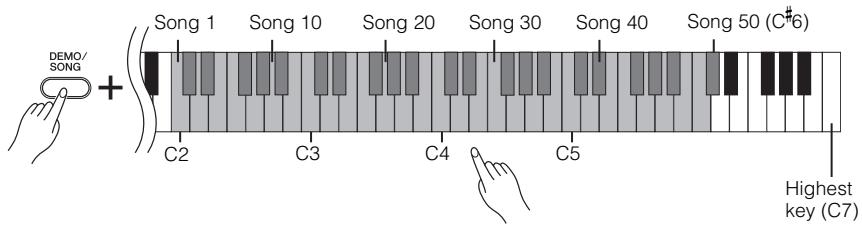
The [PLAY], [+R] and [-L] lamps light, and playback continues the sequence: starting with the selected song, the playback of the Preset Songs will continue. After the last Preset Song, the sequence then returns to the first Preset Song and repeats until you stop it.
To change the Preset Song during playback:
Press [+R] or [-L] to change to the next or previous Preset Song.
To change the tempo during playback:
Press [METRONOME] to start the Metronome, then press [+R] or [-L] to increase or decrease the Tempo value by 1. Other instructions are same as those of the Metronome Tempo (page 14).
To play back from the beginning of the Song at the desired tempo for practice:
During playback, press [+R] and [-L] simultaneously to jump to the playback position at the beginning of the Song then continue playback at the last specified tempo.
3 Press [DEMO/SONG] or [PLAY] to stop playback.
The [PLAY], [+R] and [-L] lamps turn off.
NOTE
You can play the keyboard along with the preset Song. You can also change the Voice playing on the keyboard.
NOTE
You can import additional Songs by loading SMF files from a computer. For details, refer to the Computer-related Operations manual (page 7).
Practicing a One-Hand Part
All the Songs except for the Demo (page 17) let you turn on or off the left-hand and right-hand Parts individually. By turning off [+R] , for example, you can practice the right-hand Part while the left-hand Part is playing back, and vice versa.
1 Select a Preset Song (page 22) or the User Song (page 24).
2 While holding down [PLAY], press [+R] or [-L] to turn the Part on/off.
Pressing the same button repeatedly while holding down [PLAY] toggles playback on and off. The lamp of the button lights to indicate that the corresponding Part is on.
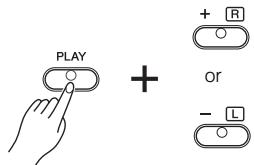
Lamp lights when Part is on.
3 Practice the Part which is turned off.
To change the Tempo:
If desired, you can change the tempo for your practice convenience. For details, refer to page 14.
4 Press [PLAY] to stop playback.
Playing from the top of the bar including a rest or blank
This Quick Play feature enables you to specify whether a Song should play back immediately from the very first note, or play back any silence or rests that exist before the first note.
To turn on Quick Play:
Hold down [DEMO/SONG] and press the A#-1 key to enable immediate playback from the first note or first pedal operation.
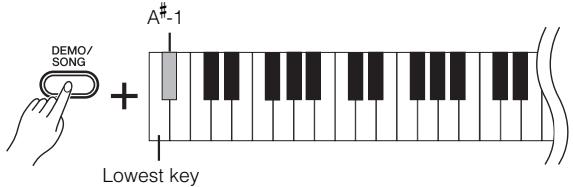
To turn off Quick Play:
Hold down [DEMO/SONG] and press the lowest key (A-1) to play from the top of the first measure (including a rest or blank).

NOTE
Selecting another Song will reset the on/off status.
NOTE
Default setting: On
Recording Your Performance
This instrument lets you record your keyboard performance as the User Song. Up to two Parts (left-hand and right-hand) can be recorded separately.
Recording Your Performance
1 Select the desired Voice and other parameters, such as beat, for recording.
For instructions on selecting a Voice, refer to page 16. If necessary, set other parameters, such as beat and effects, in this step.
2 While holding down [REC], press [+R] or [-L] to engage Record Ready mode for the Part you want to record.
If you do not intend to record right- and left-hand Parts separately, record the entire performance to either Part.
![YAMAHA YDP-162/142 - While holding down [REC], press [+R] or [-L] to engage Record Ready mode for the Part you want to record. - 1](/content/2025/01/115289/images/3ec1709fd10b60df6731c3b21863a55b2fcb529c887ace45ac75adcadcd8bb89.jpg)
Recording the right-hand Part ([+R])
![YAMAHA YDP-162/142 - While holding down [REC], press [+R] or [-L] to engage Record Ready mode for the Part you want to record. - 2](/content/2025/01/115289/images/ef525c2e22c5ab24bf2fdab9b714574f1cbfc2dbdddbbfab60962349dbac5690.jpg)
Recording the left-hand Part ([-L])
After a while, the [REC] lamp and the selected Part lamp will flash at the current tempo.
To exit from Record Ready mode:
Simply press [REC].
If data has already been recorded to the other Part:
The data in this Part will be played back while recording.
3 Play the keyboard or press [PLAY] to start recording.
The [REC] lamp lights up while the Recording Part lamp flashes at the current tempo.
4 Press either [REC] or [PLAY] to stop recording.
The [REC], [PLAY], [+R] and [-L] lamps flash, indicating that the recorded data is being stored. After the Save operation is completed, the lamps will turn off, indicating that the Record operation has been completed.
Recording Capacity
This instrument can record up to 100KB (approximately 11,000 notes).
NOTE
You can use the Metronome while recording; however, the Metronome sound will not be recorded.
NOTICE
If a Part contains data, the Part lamp lights. Note that the Recording operation will replace already-recorded data with the new data.
NOTE
If the keyboard is in the Duo mode (page 21), the data will be recorded to each Part. The Part for recording cannot be specified.
NOTICE
Never turn off the power while the recorded data is being stored (while the lamps are flashing). Otherwise, all recorded data will be lost.
5 If desired, record the other Part by repeating Steps 1-4.
6 To hear the recorded Song, press [PLAY] to start playback.
Press [PLAY] again to stop playback.
NOTE
The recorded Song data can be saved to computer as a Standard MIDl file (SMF). For details, refer to the Computer-related Operations manual (page 7).
Changing the Initial Settings of the Recorded Song
The settings of the following parameters can be changed after the Record operation is completed.
- For individual Parts: Voice, Dual Voices, Reverb Depth
- For the entire Song: Tempo, Reverb Type
1 Make the settings of the above parameters.
2 While holding down [REC], press the desired Part button to engage Record Ready mode.
In this status, do not press [PLAY] again or any key. Otherwise, the originally recorded performance data will be deleted.
3 Press [REC] + [PLAY] again to exit from Record Ready mode.
删除 Recorded Data
To delete the entire Song:
While holding down [REC], press [DEMO/SONG].
The [+] and [-L] lamps flash.
To exit from this status, press [-L].
2 Press [+R] to delete the data of the entire Song.
The [REC], [PLAY], [+R] and [-L] lamps flash.
After the operation is completed, all lamps turn off.
To delete a specific Part:
While holding down [REC], press [+R] or [-L] (depending on the Part you want to delete) to engage Record Ready mode.
The [REC] and the selected Part ([+R] or [-L]) lamps flash.
2 Press [PLAY] to start recording without playing the keyboard.
The selected Part ([+R] or [-L]) lamp flashes.
3 Press [REC] or [PLAY] to stop recording.
All data recorded for the selected Part will be deleted, and the lamp turns off.
Backing up Data and Initializing the Settings
Data Maintained When Power is Turned Off
The following settings and data are maintained even if you turn the power off.
- Metronome Volume
- Metronome Beat
- Touch Sensitivity
- Tuning
- Intelligent Acoustic Control Depth
- Intelligent Acoustic Control On/Off
- Auto Power Off Enable/Disable
- User Song data
- Song data (SMF Files) loaded from a computer
Saving the User Song data to a computer
Among the data listed above, only the User Song data can be transferred to a computer and saved as a SMF file. For details, refer to "Computer-related Operations" on the website (page 7).
NOTICE
Saved data may be lost due to malfunction or incorrect operation. Save important data to an external device such as a computer.
Transferring SMF Files Between a Computer and this Instrument
With Musicsoft Downloader (available for free downloading), up to 10 SMF files can be transferred from the computer to the internal memory of this instrument, and vice versa. For details, refer to the "Computer-related Operations" downloadable from Yamaha Manual Library (page 7).
■ Initializing the Settings
With this operation, all data (with the exception of the Songs) will be reset to the factory default settings.
To do this, simultaneously hold down the C7 (the highest) key and turn on the power.
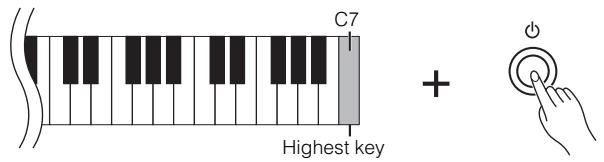
NOTICE
Never turn off the power while the Initialize operation is being executed (that is, while the [REC] and [PLAY] lamps are flashing).
NOTE
If this instrument somehow becomes disabled or malfunctions, turn off the power then execute Initialization.
Troubleshooting
| Problem | Possible Cause and Solution |
| Power suddenly and unexpectedly turns off. | This is normal and the Auto Power Off function may have been activated (page 11). If desired, disable the Auto Power Off function. |
| The instrument does not turn on. | Securely insert the adaptor plug into the socket on this instrument, and the adaptor plug into a proper AC outlet (page 10). |
| A click or pop is heard when the power is turned on or off. | This is normal when electrical current is being applied to the instrument. |
| Noise is heard from the speakers or headphones. | The noise may be due to interference caused by the use of a mobile phone in close proximity to this instrument. Turn off the mobile phone, or move it further away from this instrument. |
| Noise is heard from the instrument's speakers or headphones when using the instrument with the application on iPhone/iPad. | When you use the instrument along with the application on your iPhone/iPad, we recommend that you set "Airplane Mode" to "ON" on your iPhone/iPad in order to avoid noise caused by communication. |
| The overall volume is low, or no sound is heard. | The Master Volume is set too low. Set it to an appropriate level using the [MASTER VOLUME] knob (page 12). |
| Make sure a pair of headphones is not connected to the headphones jack (page 11). | |
| Make sure that Local Control is On. For details, refer to the "MIDI Reference" (page 7). | |
| Pedals do not function. | The pedal cord may not be securely connected to the [TO PEDAL] jack. Be sure to insert the pedal cord all the way until the metal part of the cord plug disappears from view (page 30). |
| The damper pedal does not function as expected. | The damper pedal was pressed when the power was turned on. This is not a malfunction; release the pedal and press it again to reset the function. |
Keyboard Stand Assembly
The illustrations here are taken from the YDP-142.
CAUTION
- Be careful not to confuse parts, and be sure to install all parts in the correct direction. Please assemble in accordance with the sequence given below.
Assembly should be carried out by at least two persons. - Assemble the stand on a hard and flat floor with ample space.
- Be sure to use the included screws only, and insert screws of the correct size in the correct hole locations. Use of incorrect screws can cause damage or malfunction of the product.
- Be sure to tighten up all screws upon completing assembly of each unit.
- To disassemble, reverse the assembly sequence given below.
Have a Phillips-head (+) screwdriver ready

Remove all parts from the package and make sure you have all of the items.
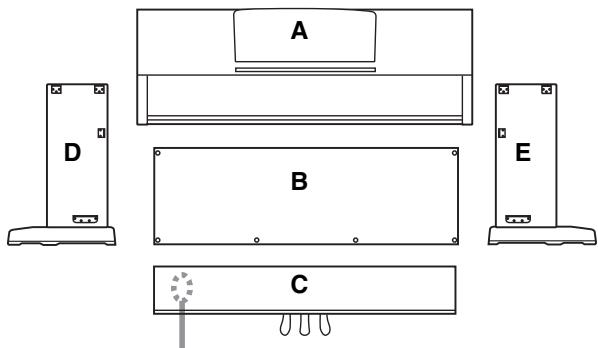
Bundled pedal cord inside
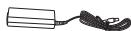
AC power adaptor (YDP-162)

Power cord (YDP-162)

AC power adaptor (YDP-142)
- The adaptor may not be included, or may look different from the illustration above, depending on your particular area. Please check with your Yamaha dealer.
Assembly Parts
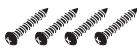
16× 20 mm long screws × 4
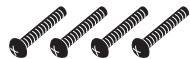
6×16mm short screws×4
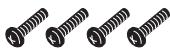
4× 12 mm thin screws × 2

4 4× 20 mm tapping screws × 4
Cord holders × 2


Headphone hanger set (YDP-162 only)
4 × 10 ~mm thin screws

Headphone hanger

1 Attach (finger-tighten) C to D and E.
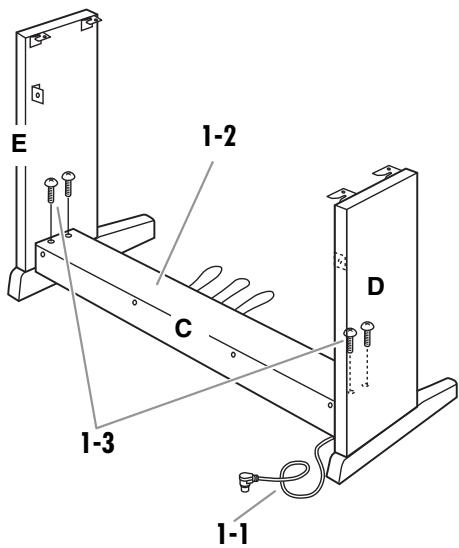
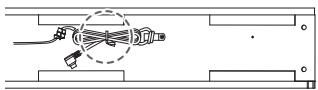
1-1 Untie and straighten out the bundled pedal cord. Don't discard the vinyl tie. You will need it later in step 6.
1-2 Align D and E with each end of C.
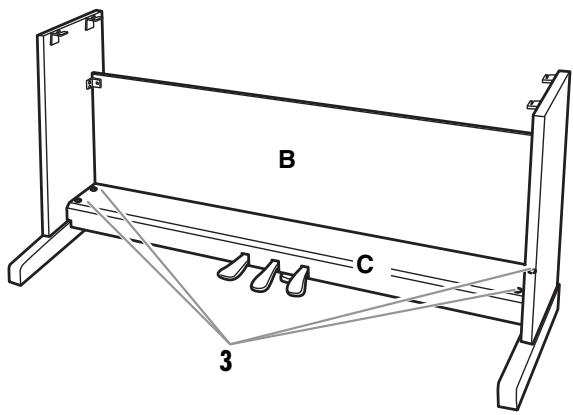
1-3 Attach D and E to C by finger-tightening the long screws ① (6 × 20mm).
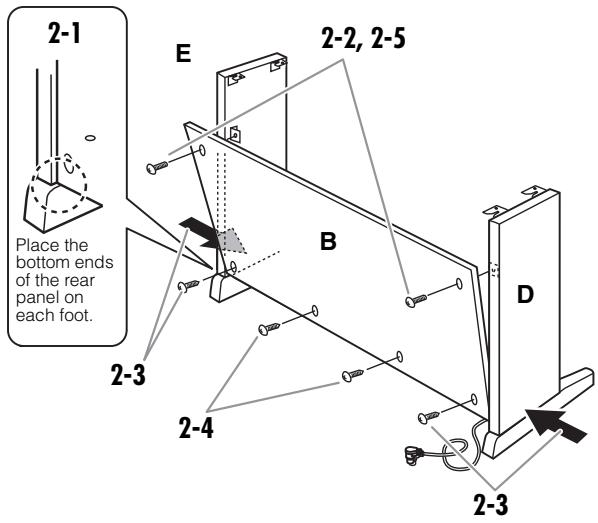
2 Attach B.
Depending on the model of digital piano you purchased, the surface color of one side of B may be different from the other side. In this case, position B so that the side of the surface color similar to D and E faces the player.
2-1 Place the lower side of B on each foot of D and E, then attach the upper side to D and E.
2-2 Attach the top of B to D and E by finger-tightening the thin screws (4 × 12mm).
2-3 While pushing the lower part of D and E from outside, secure the bottom ends of B using two tapping screws (4 × 20mm).
2-4 Insert the other two tapping screws ④ (4× 20mm) into the other two screw holes to secure B.
2-5 Securely tighten the screws on the top of B that were attached in Step 2-2.
3 Secure C.
Securely tighten the screws on C that were attached in Step 1-3.
4 Mount A.
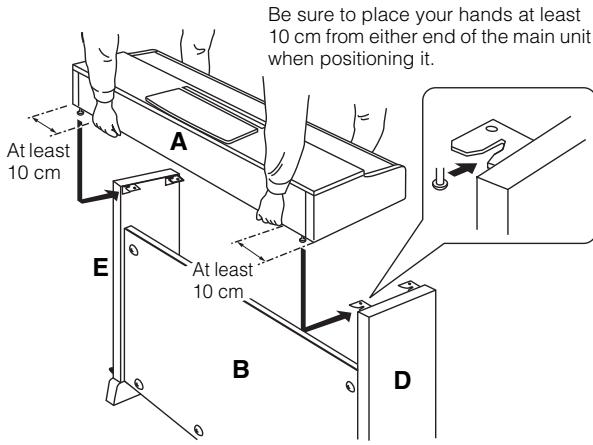
CAUTION
- Fingers can become pinched between the main unit and the rear or side panels, be extra careful so as not to drop the main unit.
- Do not hold the keyboard in any position other than the position shown in the illustration.
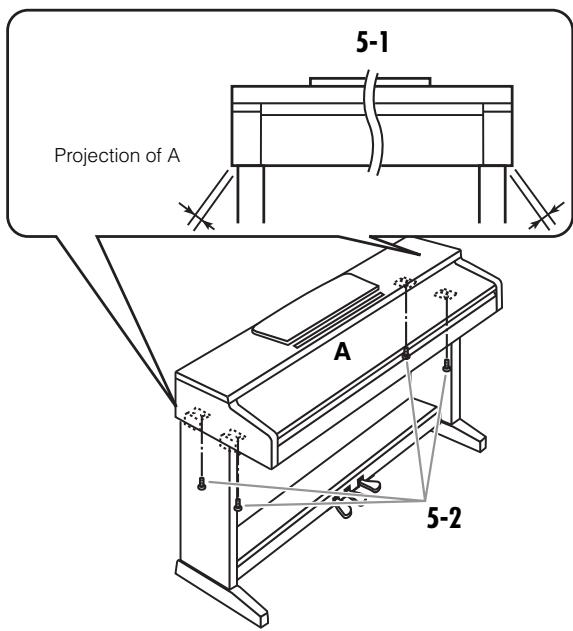
5 Secure A.
5-1 Adjust the position of A so that the left and right ends of A will project beyond D and E equally when seen from the front.
5-2 Secure A by tightening the short screws ② (6× 16mm) from the front.
6 Connect the pedal cord and the AC power adaptor.
6-1 Insert the pedal cord plug to the pedal connector from the rear.
6-2 Attach the cord holders to the rear panel as shown, then clip the cord into the holders.
6-3 Use a vinyl tie to take up any slack in the pedal cord.
6-4 Insert the DC plug of the AC power adaptor into the DC IN jack.
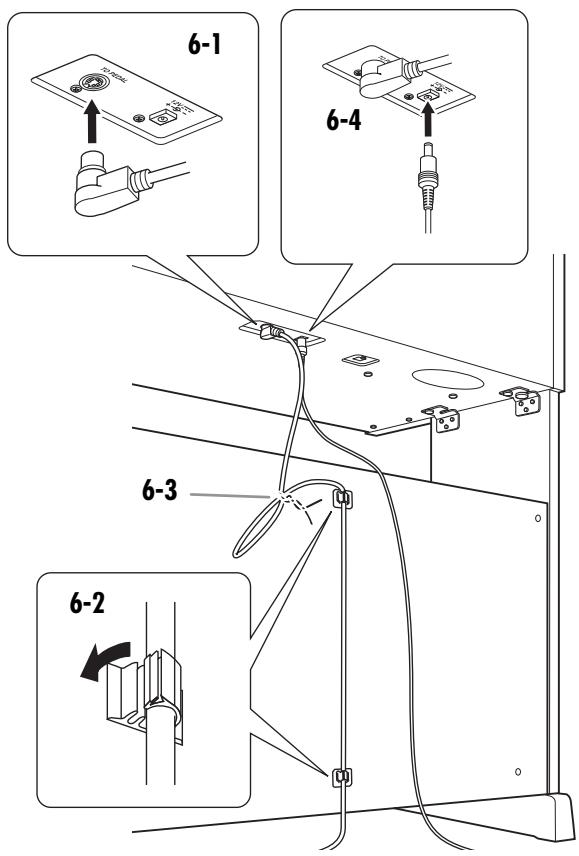
Connecting the pedal cord
Insert the pedal cord securely until the metal part of the cord plug disappears from view. Otherwise, the pedal may not function properly.
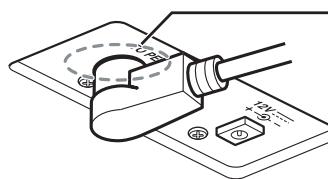
Insert the cord all the way until the metal part of the plug disappears from view.
7 Set the adjuster.
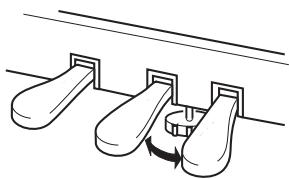
Rotate the adjuster until it comes in firm contact with the floor surface.
8 Attach the headphone hanger. (YDP-162 only)
Use the included two screws (4 x 10 mm) to attach the hanger as shown in the illustration.
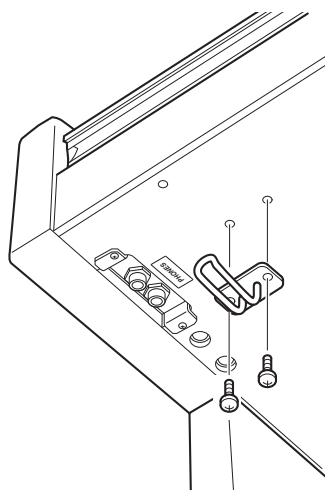
After completing the assembly, please check the following.
- Are there any parts left over?
Review the assembly procedure and correct any errors. -
Is this instrument clear of doors and other movable fixtures?
Move the instrument to an appropriate location. -
Does this instrument make a rattling noise when you shake it?
Tighten all screws. - Does the pedal box rattle or give way when you step on the pedals?
Turn the adjuster so that it is set firmly against the floor. - Are the pedal and power cords inserted securely into the sockets?
Check the connection. - If the main unit creaks or is otherwise unsteady when you play on the keyboard, refer to the assembly diagrams and retighten all screws.
When moving the instrument after assembly, always hold the bottom of the main unit.
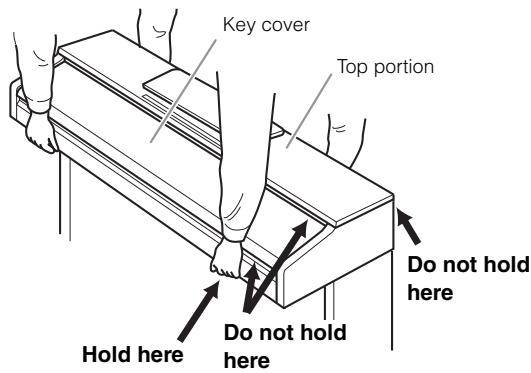
CAUTION
Do not hold the key cover or top portion. Improper handling can result in damage to the instrument or personal injury.
Specifications
| YDP-162 | YDP-142 | |||
| Size/Weight | Width | 1357 mm (53-7/16") | ||
| Height[For models with polished finish] | Without Music Rest | 845 mm (33-1/4") [847 mm (33-3/8")] | 815 mm (32-1/16") | |
| With Music Rest | 999 mm (39-5/16") [1001 mm (39-7/16")] | 969 mm (38-1/8") | ||
| Depth [For models with polished finish] | 422 mm (16-5/8")[423 mm (16-5/8")] | 422 mm (16-5/8") | ||
| Weight [For models with polished finish] | 42 kg (92 lbs., 10 oz) [45 kg (99 lbs., 3 oz)] | 38 kg (83 lbs., 12 oz) | ||
| Control Interface | Keyboard | Number of Keys | 88 | |
| Type | GH(Graded Hammer)keyboard with Synthetic ivory keytops | GHS(Graded Hammer Standard)keyboard with matte black keytops | ||
| Touch Sensitivity | Hard/Medium/Soft/Fixed | |||
| Pedal | Number of Pedals | 3 | ||
| Half Pedal | Yes | |||
| Functions | Damper, Sostenuto, Soft | |||
| Panel | Language | English | ||
| Cabine | Key Cover | Sliding | ||
| Music Rest | Yes | |||
| Voices | Tone Genera-tion | Tone Generating Technology | Pure CF Sound Engine | |
| Polyphony | Number of Polyphony (Max.) | 128 | ||
| Preset | Number of Voices | 10 | ||
| Effects | Types | Reverb | Yes | |
| Damper Resonance | Yes | |||
| Intelligent Acoustic Control(IAC) | Yes | |||
| Functions | Dual | Yes | ||
| Duo | Yes | |||
| Songs | Preset | Number of Preset Songs | 10 Demo Songs, 50 Piano Preset Songs | |
| Recording | Number of Songs | 1 | ||
| Number of Tracks | 2 | |||
| Data Capacity | One song approx. 100 KB (approx.11,000 notes) | |||
| CompatibleData Format | Playback | Standard MIDI File (SMF) Format 0 & 1 | ||
| Recording | Standard MIDI File (SMF) Format 0 | |||
| Functions | Overall Con-trols | Metronome | Yes | |
| Tempo Range | 5 - 280 | |||
| Transpose | -6 - 0 - +6 | |||
| Tuning | Yes | |||
| Storage and Connectivity | Storage | Internal Memory | User song : One song approx. 100 KBLoading song data from a computer : Up to 10 songs; Total maximum size approx. 900 KB | |
| Connectivity | Headphones | × 2 | ||
| USB TO HOST | Yes | |||
| Sound System | Amplifiers | 20 W x 2 | 6 Wx2 | |
| Speakers | Oval (12 cm x 6 cm) x 2 | |||
| Acoustic Optimizer | Yes | |||
| Power Supply | Power Supply | AC power adaptor : PA-300C or an equivalent | AC power adaptor : Users within U.S or Europe:PA-150 or an equivalent recommended byYamahaOthers: PA-5D, PA-150 or an equivalent | |
| Power Consumption | 13 W (when using the PA-300C) | 9 W (when using the PA-150) | ||
| Auto Power Off Function | Yes (approx. 30 minutes) | |||
| Accessories | Owner's Manual, 50 greats for the Piano (Music Book), Quick Operation Guide, Bench (included oroptional depending on locale), Online Member Product Registration | |||
| AC power adaptor : PA-300C or an equivalent,Power cord(included or optional depending on locale) | AC power adaptor: PA-150 or an equivalent(included or optional depending on locale) | |||
| Options(May not be available depending on your locale.) | HPE-150 headphones | |||
| AC power adaptor PA-300C or an equivalent | AC power adaptorUsers within U.S or Europe: PA-150 or an equivai-lentOthers: PA-5D, PA-150 or an equivalent | |||
- Specifications and descriptions in this owner's manual are for information purposes only. Yamaha Corp. reserves the right to change or modify products or specifications at any time without prior notice. Since specifications, equipment or options may not be the same in every locale, please check with your Yamaha dealer.
Index
Numerics
50 Preset Songs 22
A
AC power adaptor 7
Accessories 7
Assembly 28
Auto Power Off 11
B
Beat 14
C
Computer-related Operations 7
D
Damper Pedal 13
Damper Resonance 13
Delete 25
Demo Song List 17
Demo Songs 17
Dual mode 20
Duo 21
H
Half-pedal 13
Headphones 11
Hz (Hertz) 19
1
Initializing 26
Intelligent Acoustic Control (I.A.C.) 12
K
Key Cover 9
Keyboard Stand 28
L
Left-hand Part 23
M
Maintenance 15
Manuals 7
Metronome 14
MIDI Basics 7
MIDI Reference 7
0
Octave 20
Online Manuals (PDF) 7
P
Panel Controls and Terminals 8
PEDAL 30
Pedals 13
Pitch 19
Power 10
Power indicator 10
Practice 23
Preset Songs 22
Q
Quick Operation Guide 7
Quick Play 23
R
Recording 24
Reverb 18
Reverb Depth 18
Reverb Type 18
Reverb Type List 18
Right-hand Part 23
s
Soft Pedal 13
Sostenuto Pedal 13
Specifications 32
T
Tempo 14
Touch Sensitivity 15
Transpose 19
Troubleshooting 27
Tuning 15, 19
U
USB TO HOST 8
User Song 24
V
Voice 16
Voice List 16
Volume 12, 14
The model number, serial number, power requirements, etc., may be found on or near the name plate, which is at the bottom of the unit. You should note this serial number in the space provided below and retain this manual as a permanent record of your purchase to aid identification in the event of theft.
Model No.
Serial No.
(bottom_en_01)
Information for Users on Collection and Disposal of Old Equipment

This symbol on the products, packaging, and/or accompanying documents means that used electrical and electronic products should not be mixed with general household waste.
For proper treatment, recovery and recycling of old products, please take them to applicable collection points, in accordance with your national legislation and the Directives 2002/96/EC.
By disposing of these products correctly, you will help to save valuable resources and prevent any potential negative effects on human health and the environment which could otherwise arise from inappropriate waste handling.
For more information about collection and recycling of old products, please contact your local municipality, your waste disposal service or the point of sale where you purchased the items.
[For business users in the European Union]
If you wish to discard electrical and electronic equipment, please contact your dealer or supplier for further information.
[Information on Disposal in other Countries outside the European Union]
This symbol is only valid in the European Union. If you wish to discard these items, please contact your local authorities or dealer and ask for the correct method of disposal.
(weee_eu_en_01)
Important Notice: Guarantee Information for customers in European Economic Area (EEA) and Switzerland
| Important Notice: Guarantee Information for customers in EEA* and Switzerland For detailed guarantee information about this Yamaha product, and Pan-EEA* and Switzerland warranty service, please either visit the website address below (Printable file is available at our website) or contact the Yamaha representative office for your country. * EEA: European Economic Area | English |
| Wichtiger Hinweis: Garantie-Information für Kunden in der EER* und der Schweiz Für{nahere Garantie-Information über这点y Product von Yamaha, sowie über den Pan-EWR* und Schweizer Garantieservice, besuchen Sieitte entweder die folgenden angegebene Internetadresseeinee duffrachige Version befindet sich auf unserer Webeite), oder wenden Sie sich an den fur Ihr Land zuständigen Yamaha-Vertrieb. *EWR:Europäischer Wirtschaftswirksam | Deutsch |
| Remarque importantes: informations de garantie pour les clients de l'EEA et la SuissePour des informations plus détaillées sur la garantie de ce produit Yamaha et sur le service de garantie applicable dans l'ensemble de IEEA ainsi qu'en Suisse, consultez notre site Web à l'adressee ci-dessous (le fichier imprimable est disponible sur notre site Web) ou contactez directement Yamaha dans vos pays de résidence. * EEE: Espace Economique Européen | Français |
| Belangrike mededeling: Garantie-informatie voor klanten in de EER* en ZwitserlandVoor gegetalleindeerde garantie-informatie over dit Yamaha-product en de garantieservice in heel de EER* en Zwitserland, gaat u naar de onderstaande website (u vinden afrdukbaarbestand op once website) of neamt u contact op met de vertegenwoordig van Yamaha in uw land. * EER:Europese Economische Rumme | Nederland |
| Avisio importante: information sobre la garantia para los clientes del EEE* y SuizaPara una informacion detallada sobre este produco Yamaha y sobre el soporte de garantia en la zona EEE* y Suiza, visite la direction web que se incluye más bajo (la version delarchivo para imprintir esta disponible en nuestro situ web) o pongase en contacto con el representante de Yamaha en su pays. * EEE: Espacio Economico Europeo | Español |
| Avvisio importante: informazioni sulla garanzia per i clienti residenti nell'EEA* e in SvizzeraPer informazioni dettaglale sulla garanzia relative a quello prodotto Yamaha e Fassistenza in garanzia nei paesi EEA* e in Svizzera, potete consultrare il site Web all'indirizzo riportato di seguito (é disponibile il file in formato stampabile) oppure contattare l'ufficio di rappresentanza locale della Yamaha. * EEA:Area Economica Europa | Italiano |
| Avisio importante: informacoes sobre as garantas para clients da AEE* e da SuizaPorobera uma informacao poramorfenizada sobre este produco da Yamaha y sobre o serviceo de garantia na EEE* e na Suiza, visite o site a seguir (o arquivos para impressao estadisponivol no nosso site) ou entre em contacto com o escrétio de representation da Yamaha no seu pais. * AEE:Area Economica Europa | Portugues |
| Σημαντίκη Σημειώς Πλυροφορείς ευγύσης για τούς πελάτε στόν ΕΟΧ* και ΕλβείτιΓιλειρορείς Πλυροφορείς ευγύσης σχέτας μο το τρόν προύν της γ ammonia και τη καύλουη ευγύσης σα δες τις χύρες τοῦ ΕΟΧ και τη ΕλβείτιΓιλειρορείς (Ekturnuωμη μρρριενλδαδαδαμιστιντον τοῦ Εθιαδιλδαμιστιντον στήν Εαύροσισεια ηις γ ammonia στήν χύροσισα. * * EOO: Eupmuαίος Εκόνορικός Xūpóos | ΕλνηνίκιΣΕλνηνίκιΣΕλνηνίκιΣΕλνηνίκιΣΕλνηνίκιΣΕλνηνίκιΣΕλνηνίκιΣΕλνηνίκιΣΕλνηνίκιΣΕλνηνίκιΣΕλνηνίκιΣΕλνηνίκιΣ |
| Viktigt: Garantienformation kunder kunder I EES-omradetoch SchweizFörder aldarad information omenna Yamahaprodukt samt garantiservice i hela EES-omradet* och Schweiz kan du antingen besök nedanstännde webbaddress (en utskriftsvänig fil finns på webplatsen) ellterkontakte Yamahas officiella représentant i ditt land. * EES:Europiska Ekonomiska Samarbetssomradet | Svenska |
| Viktig merknad: Garantinformason kunder i EOS* og SvletsDetalajert garantinformason ommette Yamahaprodukt samt garantiservice i hela EOS-omradet* og Svlets kan fás entven ved besoke nettadressen nedenfor (utskriftsvensjon finnesàhare netto)Eller kontakte tlakette Yamahas officiella représentant i ditt land. * EES:Europiska Ekonomiska Samarbetssomradet | Norsk |
| Vigtig oplysning: Garantioplynsinger til kunder i EEO* og SchweizDe danke finde detaljerde garantioplynsinger om ditte Yamahaprodukt od den failles garantiserviceordering for EOO* (og Schweiz) ve atbesoge det websted, der er angivet nedordenfor (derfindes en fil, somkan udskrudes, ellver ved atakte Yamahas nationale represeationskontorl i det land, hvor De bor. * EOO: Det Europaeiske OKonomiska Omrade | Dansk |
| Tärkeil imloutus: Takututiedot Europan talousalueen (ETA)* ja Sveitsin asiakaille | Suomi |
| Tämä: Yamahay-toucteen teena/eta-ETA-alueen ja Sveitsin tukatau koskevat ykstysikohaitaiset tiedot saatte alla olevasta nettiositteesta. (Tulostettava tiedosto siatavissa sivustollamme.) Voltaire myös ottaa yhteyttā paikalliseen Yamahay-educastajaan. *ETA:Europan talousalue | Slovenska |
| Wažne: Warunki garancjyn obowiajuzjae w EOG* i SzwajcariAby dowiedzieć是我国atakew gwarancjynego w calym EOG* i Szwajcari, nałoź odwedzic wskazana ponijez strone internetotwuy (PIK gotawy do wydruku znajdujie są nauszne strone internetoweij) lub skontaktowac są z prestedstawiecltem firmy Yamahay w swoim kruij. * EOG -Europiski Obszar Gospodarczy | Polski |
| Dulžite oznámieni: Zárcuñí informrace pro zákaznikiy v EHO* a ve ŠvycarskuPodrobné zárcuñí informace o toto produktu Yamaha a zárcuñín servisuv cellem EHO* a ve Švycarsku naleznete na nihe uvedene webové adrese (soubor k tskju je dostupny na našichwebovych strankách) nebo směze obrát in naistoupeni fiyaryama ve své zemi. * EHO:Evropäski hospodárský prostor | Česky |
| Fontos figelmeztetés: Garancia-informação az EGT terletenet é Sváčjban szamáraJelen: Yamahay termekre vanatkoz részlétes garancia-informação, valamint a EGT*-re é Sváčjaterkijed garanciáls zolgăltatas tektinketben keresse fel webhellyunket az alabbi cimen (a webhelyen nyomathathofäjt is taftali), vagy pedig lópez kapsolatiba az orszagabán mückódo yama hcpkviseleti iródalv. * EGT:Europái Gazdasági Térseg | Eesti keel |
| Oluine markus: Garantiiteave Europon Majunduspirkkona (EMP)* j Šveitsi klientideleTäspase teabe saamisels geleve Yamaha toto angelung kungog yamaega, yamaiga, yamaiga, yamaiga, yamaiga, yamaiga, yamaiga, yamaiga, yamaiga, yamaiga, yamaiga, yamaiga, yamaiga, yamaiga, yamaiga, yamaiga, yamaiga, yamaiga, yamaiga, yamaiga, yamaiga, yamaiga, yamaiga, yamaiga, yamaiga, yamaiga, yamauga, yamaiga, yamaiga, yamaiga, yamaiga, yamaiga, yamaiga, yamaiga, yamaiga, yamaiga, yamaiga, yamaiga, yamaiga, yamaiga, yamaiga, yamaiga, yamaiga, yamaiga, yamaiga, yamaiga, yamaiga, yamaiga, yamaiga, yamaiga, yamaiga, yamaanga, yamaiga, yamaiga, yamaiga, yamaiga, yamaiga, yamaiga, yamaiga, yamaiga, yamaiga, yamaiga, yamaiga, yamaiga, yamaiga, yamaiga, yamaiga, yamaiga, yamaiga, yamaiga, yamaiga, yamaiga, yamaiga, yamaiga, yamaiga, yamaiga, yamaaga, yamaiga, yamaiga, yamaiga, yamaiga, yamaiga, yamaiga, yamaiga, yamaiga, yamaiga, yamaiga, yamaiga, yamaiga, yamaiga, yamaiga, yamaiga, yamaiga, yamaiga, yamaiga, yamaiga, yamaiga, yamaiga, yamaiga, yamaiga, yamaiga, yamaqa, yamaiga, yamaiga, yamaiga, yamaiga, yamaiga, yamaiga, yamaiga, yamaiga, yamaiga, yamaiga, yamaiga, yamaiga, yamaiga, yamaiga, yamaiga, yamaiga, yamaiga, yamaiga, yamaiga, yamaiga, yamaiga, yamaiga, yamaiga, yamaiga, yamaga, yamaiga, yamaiga, yamaiga, yamaiga, yamaiga, yamaiga, yamaiga, yamaiga, yamaiga, yamaiga, yamaiga, yamaiga, yamaiga, yamaiga, yamaiga, yamaiga, yamaiga, yamaiga, yamaiga, yamaiga, yamaiga, yamaiga, yamaiga, yamaiga, yamaea, yamaiga, yamaiga, yamaiga, yamaiga, yamaiga, yamaiga, yamaiga, yamaiga, yamaiga, yamaiga, yamaiga, yamaiga, yamaiga, yamaiga, yamaiga, yamaiga, yamaiga, yamaiga, yamaiga, yamaiga, yamaiga, yamaiga, yamaiga, yamaiga, yamaisa, yamaiga, yamaiga, yamaiga, yamaiga, yamaiga, yamaiga, yamaiga, yamaiga, yamaiga, yamaiga, yamaiga, yamaiga, yamaiga, yamaiga, yamaiga, yamaiga, yamaiga, yamaiga, yamaiga, yamaiga, yamaiga, yamaiga, yamaiga, yamaiga, yamaima, yamaiga, yamaiga, yamaiga, yamaiga, yamaiga, yamaiga, yamaiga, yamaiga, yamaiga, yamaiga, yamaiga, yamaiga, yamaiga, yamaiga, yamaiga, yamaiga, yamaiga, yamaiga, yamaiga, yamaiga, yamaiga, yamaiga, yamaiga, yamaiga, yamaaca, yamaiga, yamaiga, yamaiga, yamaiga, yamaiga, yamaiga, yamaiga, yamaiga, yamaiga, yamaiga, yamaiga, yamaiga, yamaiga, yamaiga, yamaiga, yamaiga, yamaiga, yamaiga, yamaiga, yamaiga, yamaiga, yamaiga, yamaiga, yamaiga, yamaPGA, yamaiga, yamaiga, yamaiga, yamaiga, yamaiga, yamaiga, yamaiga, yamaiga, yamaiga, yamaiga, yamaiga, yamaiga, yamaiga, yamaiga, yamaiga, yamaiga, yamaiga, yamaiga, yamaiga, yamaiga, yamaiga, yamaiga, yamaiga, yamaiga, yama#aig, yamaiga, yamaiga, yamaiga, yamaiga, yamaiga, yamaiga, yamaiga, yamaiga, yamaiga, yamaiga, yamaiga, yamaiga, yamaiga, yamaiga, yamaiga, yamaiga, yamaiga, yamaiga, yamaiga, yamaiga, yamaiga, yamaiga, yamaiga, yamaiga, yamaarga, yamaiga, yamaiga, yamaiga, yamaiga, yamaiga, yamaiga, yamaiga, yamaiga, yamaiga, yamaiga, yamaiga, yamaiga, yamaiga, yamaiga, yamaiga, yamaiga, yamaiga, yamaiga, yamaiga, yamaiga, yamaiga, yamaiga, yamaiga, yamaiga, yamaoga, yamaiga, yamaiga, yamaiga, yamaiga, yamaiga, yamaiga, yamaiga, yamaiga, yamaiga, yamaiga, yamaiga, yamaiga, yamaiga, yamaiga, yamaiga, yamaiga, yamaiga, yamaiga, yamaiga, yamaiga, yamaiga, yamaiga, yamaiga, yamaiga, yamaira, yamaira, yamaira, yamaira, yamaira, yamaira, yamaira, yamaira, yamaira, yamaira, yamaira, yamaira, yamaira, yamaira, yamaira, yamaira, yamaira, yamaira, yamaira, yamaira, yamaira, yamaira, yamaira, yamaira, yamaira, yamaIRA, yamaira, yamaira, yamaira, yamaira, yamaira, yamaira, yamaira, yamaira, yamaira, yamaira, yamaira, yamaira, yamaira, yamaira, yamaira, yamaira, yamaira, yamaira, yamaira, yamaira, yamaira, yamaira, yamaira, yamaira, yamairga, yamaira, yamaira, yamaira, yamaira, yamaira, yamaira, yamaira, yamaira, yamaira, yamaira, yamaira, yamaira, yamaira, yamaira, yamaira, yamaira, yamaira, yamaira, yamaira, yamaira, yamaira, yamaira, yamaira, yamaira, yamairing, yamaira, yamaira, yamaira, yamaira, yamaira, yamaira, yamaira, yamaira, yamaira, yamaira, yamaira, yamaira, yamaira, yamaira, yamaira, yamaira, yamaira, yamaira, yamaira, yamaira, yamaira, yamaira, yamaira, yamaira, yamaaira, yamaira, yamaira, yamaira, yamaira, yamaira, yamaira, yamaira, yamaira, yamaira, yamaira, yamaira, yamaira, yamaira, yamaira, yamaira, yamaira, yamaira, yamaira, yamaira, yamaira, yamaira, yamaira, yamaira, yamaira, yamairas, yamaira, yamaira, yamaira, yamaira, yamaira, yamaira, yamaira, yamaira, yamaira, yamaira, yamaira, yamaira, yamaira, yamaira, yamaira, yamaira, yamaira, yamaira, yamaira, yamaira, yamaira, yamaira, yamaira, yamaira, yamaIR, yamaira, yamaira, yamaira, yamaira, yamaira, yamaira, yamaira, yamaira, yamaira, yamaira, yamaira, yamaira, yamaira, yamaira, yamaira, yamaira, yamaira, yamaira, yamaira, yamaira, yamaira, yamaira, yamaira, yamaira, yamairal, yamaira, yamaira, yamaira, yamaira, yamaira, yamaira, yamaira, yamaira, yamaira, yamaira, yamaira, yamaira, yamaira, yamaira, yamaira, yamaira, yamaira, yamaira, yamaira, yamaira, yamaira, yamaira, yamaira, yamaira, yamairla, yamaira, yamaira, yamaira, yamaira, yamaira, yamaira, yamaira, yamaira, yamaira, yamaira, yamaira, yamaira, yamaira, yamaira, yamaira, yamaira, yamaira, yamaira, yamaira, yamaira, yamaira, yamaira, yamaira, yamaira, yamaila, yamaira, yamaira, yamaira, yamaira, yamaira, yamaira, yamaira, yamaira, yamaira, yamaira, yamaira, yamaira, yamaira, yamaira, yamaira, yamaira, yamaira, yamaira, yamaira, yamaira, yamaira, yamaira, yamaira, yamaira, yamaırma, yamaira, yamaira, yamaira, yamaira, yamaira, yamaira, yamaira, yamaira, yamaira, yamaira, yamaira, yamaira, yamaira, yamaira, yamaira, yamaira, yamaira, yamaira, yamaira, yamaira, yamaira, yamaira, yamaira, yamaira, yamairma, yamaira, yamaira, yamaira, yamaira, yamaira, yamaira, yamaira, yamaira, yamaira, yamaira, yamaira, yamaira, yamaira, yamaira, yamaira, yamaira, yamaira, yamaira, yamaira, yamaira, yamaira, yamaira, yamaira, yamaira, yama-raia, yamaira, yamaira, yamaira, yamaira, yamaira, yamaira, yamaira, yamaira, yamaira, yamaira, yamaira, yamaira, yamaira, yamaira, yamaira, yamaira, yamaira, yamaira, yamaira, yamaira, yamaira, yamaira, yamaira, yamaira, yamaarta, yamaira, yamaira, yamaira, yamaira, yamaira, yamaira, yamaira, yamaira, yamaira, yamaira, yamaira, yamaira, yamaira, yamaira, yamaira, yamaira, yamaira, yamaira, yamaira, yamaira, yamaira, yamaira, yamaira, yamaira, yamaarna, yamaira, yamaira, yamaira, yamaira, yamaira, yamaira, yamaira, yamaira, yamaira, yamaira, yamaira, yamaira, yamaira, yamaira, yamaira, yamaira, yamaira, yamaira, yamaira, yamaira, yamaira, yamaira, yamaira, yamaira, yamairoa, yamaira, yamaira, yamaira, yamaira, yamaira, yamaira, yamaira, yamaira, yamaira, yamaira, yamaira, yamaira, yamaira, yamaira, yamaira, yamaira, yamaira, yamaira, yamaira, yamaira, yamaira, yamaira, yamaira, yamaira, yomaRaia | Lithiuromann |
| Notificare important: Informazione per clienti din SEE* si ElveitaPentru informazione per clienti din SEE* si IlveitaSau contacti biroul representanjiYamaha din Jura dummenevoastra. * SEE: Spajul Economic European | Limba românn |
http://europe.yamaha.com/warranty/
For details of products, please contact your nearest Yamaha representative or the authorized distributor listed below.
Yamaha Canada Music Ltd.
135 Milner Avenue, Scarborough, Ontario,
M1S 3R1, Canada
Tel: 416-298-1311
U.S.A.
Yamaha Corporation of America
6600 Orangethorpe Ave., Buena Park, Calif. 90620,
U.S.A.
Tel: 714-522-9011
CENTRAL & SOUTH AMERICA
MEXICO
Yamaha De Mexico, S.A. de C.V.
Ay. Insurgentes Sur 1647 "Prisma Insurgentes".
Col. San Jose Insurgentes, Del Benito Juarez
Cor. San Jose Insgustes, Del. Benito Juarez, 03900, Mexico.D.F.
Tel: 55-5804-0600
BRAZIL
PANAMA AND OTHER LATIN
AMERICAN COUNTRIES/
CARIBBEAN COUNTRIES
Yamaha Music Latin America, S.A.
Torre Banco General, Piso 7, Urbanizacion Marbella,
Sherbourne Drive, Tilbrook, Milton Keynes,
MK7 8BL, England
Tel: 01908-366700
GERMANY
Yamaha Music Europe GmbH
Siemensstraße 22-34, 25462 Rellingen, Germany
Tel: 04101-3030
Branch Switzerland in Zurich
Seefeldstrasse 94, 8008 Zurich, Switzerland
Tel: 044-387-8080
AUSTRIA
Yamaha Music Europe GmbH Branch Austria
Schleiergasse 20, A-1100 Wien, Austria
Tel: 01-60203900
CZECH REPUBLIC/HUNGARY/
ROMANIA/SLOVAKIA/SLOVENIA
Yamaha Music Europe GmbH
Branch Austria (Central Eastern Europe Office)
Schleiergasse 20, A-1100 Wien, Austria
Tel: 01-602039025
POLAND/LITHUANIA/LATVIA/ESTONIA
Yamaha Music Europe GmbH
Branch Poland Office
Yamaha Music Europe GmbH, Branch Italy
Viale Italia 88, 20020 Lainate (Milano), Italy
Tel: 02-935-771
SPAIN/PORTUGAL
Yamaha Music Europe GmbH Ibérica, Sucursal
en España
Ctra.de la Coruna km.17,200,28230
Las Rozas (Madrid), Spain
Tel: 91-639-8888
GREECE
Philippines Nakas S.A. The Music House
147 Skiathou Street, 112-55 Athens, Greece
Tel: 01-228 2160
SWEDEN
Yamaha Music Europe GmbH Germany filial
Scandinavia
J. A. Wettergrens Gata 1, Box 30053
S-400 43 Göteborg, Sweden
Tel:031893400
DENMARK
Yamaha Music Europe GmbH, Tyskland - filial
Denmark
Generatorvej 6A, DK-2730 Herlev, Denmark
Tel: 44 92 49 00
FINLAND
F-Musiikki Oy
Kluuvikatu 6, P.O. Box 260,
SF-00101 Helsinki, Finland
Tel: 09 618511
NORWAY
Yamaha Music Europe GmbH Germany -
Norwegian Branch
Grini Næringspark 1, N-1345 Østerås, Norway
Tel: 67 16 77 70
ICELAND
Skifan HF
Skeifan 17 P.O.Box 8120JS-128 Revkiayik, Iceland
Tel: 525 5000
RUSSIA
Yamaha Music (Russia)
Room 37, bld. 7, Kievskaya street, Moscow,
121059, Russia
Tel: 495 626 5005
OTHER EUROPEAN COUNTRIES
Yamaha Music Europe GmbH
Siemensstraße 22-34, 25462 Rellingen, Germany
Tel: +49-4101-3030
AFRICA
Yamaha Corporation,
Asia-Pacific Sales & Marketing Group
Nakazawa-cho 10-1, Naka-ku, Hamamatsu,
Japan 430-8650
Tel: +81-53-460-2313
MIDDLE EAST
TURKEY/CYPRUS
Yamaha Music Europe GmbH
Siemensstraße 22-34, 25462 Rellingen, Germany
Tel: 04101-3030
OTHER COUNTRIES
Yamaha Music Gulf FZE
LOB 16-513, P.O.Box 17328, Jubel Ali.
Dubai, United Arab Emirates
Tel:+971-4-881-5868
ASIA
THE PEOPLE'S REPUBLIC OF CHINA
Yamaha Music & Electronics (China) Co., Ltd.
2F, Yunhedasha, 1818 Xinzha-lu, Jingan-qu,
Shanghai, China
Tel: 021-6247-2211
HONG KONG
Tom Lee Music Co., Ltd.
11/F., Silvercord Tower 1, 30 Canton Road,
Tsimshatsui, Kowloon, Hong Kong
Tel: 2737-7688
INDIA
Yamaha Music India Pvt. Ltd.
Spazedge building, Ground Floor, Tower A, Sector
47, Gurgaon- Sohna Road, Gurgaon, Haryana, India
Tel: 0124-485-3300
INDONESIA
PT. Yamaha Musik Indonesia (Distributor)
PT. Nusantik
Gedung Yamaha Music Center, Jalan Jend. Gatot
SubROTO Kav. 4, Jakarta 12930, Indonesia
Tel: 021-520-2577
KOREA
Yamaha Music Korea Ltd.
8F, 9F, Dongsung Bldg. 158-9 Samsung-Dong,
Kangnam-Gu, Seoul, Korea
Tel: 02-3467-3300
MALAYSIA
Yamaha Music (Malaysia) Sdn., Bhd.
Lot 8, Jalan Perbandaran, 47301 Kelana Jaya,
Petaling Jaya, Selangor, Malaysia
Tel: 03-78030900
PHILIPPINES
Yupangco Music Corporation
339 Gil J. Puyat Avenue, P.O. Box 885 MCPO,
Makati, Metro Manila, Philippines
Tel: 819-7551
SINGAPORE
Yamaha Music (Asia) PRIVATE LIMITED
Blk 202 Hougang Street 21, #02-00,
Singapore 530202, Singapore
Tel: 6747-4374
TAIWAN
Yamaha KHS Music Co., Ltd.
3F, #6, Sec.2, Nan Jing E. Rd. Taipei.
Taiwan 104, R.O.C.
Tel: 02-2511-8688
THAILAND
Siam Music Yamaha Co., Ltd.
4, 6, 15 and 16th floor, Siam Motors Building,
891/1 Rama 1 Road, Wangmai,
Pathumwan, Bangkok 10330, Thailand
Tel: 02-215-2622
OTHER ASIAN COUNTRIES
Yamaha Corporation,
Asia-Pacific Sales & Marketing Group
Nakazawa-cho 10-1, Naka-ku, Hamamatsu,
Japan 430-8650
Tel: +81-53-460-2313
OCEANIA
AUSTRALIA
Yamaha Music Australia Pty. Ltd.
Level 1, 99 Queensbridge Street, Southbank.
Victoria 3006, Australia
Tel: 3-9693-5111
NEW ZEALAND
Music Works LTD
P.O.BOX 6246 Wellesley, Auckland 4680
New Zealand
Tel: 9-634-0099
COUNTRIES AND TRUST
TERRITORIES IN PACIFIC OCEAN
Yamaha Corporation,
Asia-Pacific Sales & Marketing Group
Nakazawa-cho 10-1, Naka-ku, Hamamatsu,
Japan 430-8650
Tel: +81-53-460-2313