USER MANUAL PSR-E323 YAMAHA
How to use this manual
Before using the PSR-E323/YPT-320, be sure to read the "PRECAUTIONS" section on pages 4–5.
Follow the instructions described in “Setting Up,” then try out the simple operations in “Quick Guide.”
“Reference” provides detailed descriptions and procedures for getting the most out of the instrument.
After you've read the manual, keep it safe and handy for future reference.
Data List
The Data List contains MIDI related information. The Data List is available for downloading from the
Yamaha Manual Library at: http://www.yamaha.co.jp/manual/
SPECIAL MESSAGE SECTION
This product utilizes batteries or an external power supply (adapter). DO NOT connect this product to any power supply or adapter other than one described in the manual, on the name plate, or specifically recommended by Yamaha.
This product should be used only with the components supplied or; a cart, rack, or stand that is recommended by Yamaha. If a cart, etc., is used, please observe all safety markings and instructions that accompany the accessory product.
SPECIFICATIONS SUBJECT TO CHANGE:
The information contained in this manual is believed to be correct at the time of printing. However, Yamaha reserves the right to change or modify any of the specifications without notice or obligation to update existing units.
This product, either alone or in combination with an amplifier and headphones or speaker/s, may be capable of producing sound levels that could cause permanent hearing loss. DO NOT operate for long periods of time at a high volume level or at a level that is uncomfortable. If you experience any hearing loss or ringing in the ears, you should consult an audiologist.
IMPORTANT: The louder the sound, the shorter the time period before damage occurs.
NOTICE:
Service charges incurred due to a lack of knowledge relating to how a function or effect works (when the unit is operating as designed) are not covered by the manufacturer's warranty, and are therefore the owners responsibility. Please study this manual carefully and consult your dealer before requesting service.
ENVIRONMENTAL ISSUES:
Yamaha strives to produce products that are both user safe and environmentally friendly. We sincerely believe that our products and the production methods used to produce them, meet these goals. In keeping with both the letter and the spirit of the law, we want you to be aware of the following:
Battery Notice:
This product MAY contain a small non-rechargeable battery which (if applicable) is soldered in place. The average life span of this type of battery is approximately five years. When replacement becomes necessary, contact a qualified service representative to perform the replacement.
This product may also use “household” type batteries. Some of these may be rechargeable. Make sure that the battery being charged is a rechargeable type and that the charger is intended for the battery being charged.
When installing batteries, do not mix batteries with new, or with batteries of a different type. Batteries MUST be installed correctly. Mismatches or incorrect installation may result in overheating and battery case rupture.
Warning:
Do not attempt to disassemble, or incinerate any battery. Keep all batteries away from children. Dispose of used batteries promptly and as regulated by the laws in your area. Note: Check with any retailer of household type batteries in your area for battery disposal information.
Disposal Notice:
Should this product become damaged beyond repair, or for some reason its useful life is considered to be at an end, please observe all local, state, and federal regulations that relate to the disposal of products that contain lead, batteries, plastics, etc. If your dealer is unable to assist you, please contact Yamaha directly.
NAME PLATE LOCATION:
The name plate is located on the bottom of the product. The model number, serial number, power requirements, etc., are located on this plate. You should record the model number, serial number, and the date of purchase in the spaces provided below and retain this manual as a permanent record of your purchase.
Model
Serial No.
Purchase Date
PLEASE KEEP THIS MANUAL
92-BP (bottom)
1. IMPORTANT NOTICE: DO NOT MODIFY THIS UNIT!
This product, when installed as indicated in the instructions contained in this manual, meets FCC requirements. Modifications not expressly approved by Yamaha may void your authority, granted by the FCC, to use the product.
-
IMPORTANT: When connecting this product to accessories and/or another product use only high quality shielded cables. Cable/s supplied with this product MUST be used. Follow all installation instructions. Failure to follow instructions could void your FCC authorization to use this product in the USA.
-
NOTE: This product has been tested and found to comply with the requirements listed in FCC Regulations, Part 15 for Class "B" digital devices. Compliance with these requirements provides a reasonable level of assurance that your use of this product in a residential environment will not result in harmful interference with other electronic devices. This equipment generates/uses radio frequencies and, if not installed and used according to the instructions found in the users manual, may cause interference harmful to the operation of
other electronic devices. Compliance with FCC regulations does not guarantee that interference will not occur in all installations. If this product is found to be the source of interference, which can be determined by turning the unit "OFF" and "ON", please try to eliminate the problem by using one of the following measures:
Relocate either this product or the device that is being affected by the interference.
Utilize power outlets that are on different branch (circuit breaker or fuse) circuits or install AC line filter/s.
In the case of radio or TV interference, relocate/reorient the antenna. If the antenna lead-in is 300 ohm ribbon lead, change the lead-in to co-axial type cable.
If these corrective measures do not produce satisfactory results, please contact the local retailer authorized to distribute this type of product. If you can not locate the appropriate retailer, please contact Yamaha Corporation of America, Electronic Service Division, 6600 Orangethorpe Ave, Buena Park, CA90620
The above statements apply ONLY to those products distributed by Yamaha Corporation of America or its subsidiaries.
* This applies only to products distributed by YAMAHA CORPORATION OF AMERICA.
(class B)
PRECAUTIONS
PLEASE READ CAREFULLY BEFORE PROCEEDING
* Please keep this manual in a safe place for future reference.

WARNING
Always follow the basic precautions listed below to avoid the possibility of serious injury or even death from electrical shock, short-circuiting, damages, fire or other hazards. These precautions include, but are not limited to, the following:
Power supply/AC power adaptor
- Only use the voltage specified as correct for the instrument. The required voltage is printed on the name plate of the instrument.
- Use the specified adaptor (PA-130 or an equivalent recommended by Yamaha) only. Using the wrong adaptor can result in damage to the instrument or overheating.
- Check the electric plug periodically and remove any dirt or dust which may have accumulated on it.
- Do not place the AC adaptor cord near heat sources such as heaters or radiators, and do not excessively bend or otherwise damage the cord, place heavy objects on it, or place it in a position where anyone could walk on, trip over, or roll anything over it.
Do not open
- Do not open the instrument or attempt to disassemble the internal parts or modify them in any way. The instrument contains no user-serviceable parts. If it should appear to be malfunctioning, discontinue use immediately and have it inspected by qualified Yamaha service personnel.
Water warning
- Do not expose the instrument to rain, use it near water or in damp or wet conditions, or place containers on it containing liquids which might spill into any openings. If any liquid such as water seeps into the instrument, turn off the power immediately and unplug the power cord from the AC outlet. Then have the instrument inspected by qualified Yamaha service personnel.
- Never insert or remove an electric plug with wet hands.
Fire warning
- Do not put burning items, such as candles, on the unit. A burning item may fall over and cause a fire.
If you notice any abnormality
- If the AC adaptor cord or plug becomes frayed or damaged, or if there is a sudden loss of sound during use of the instrument, or if any unusual smells or smoke should appear to be caused by it, immediately turn off the power switch, disconnect the adaptor plug from the outlet, and have the instrument inspected by qualified Yamaha service personnel.

CAUTION
Always follow the basic precautions listed below to avoid the possibility of physical injury to you or others, or damage to the instrument or other property. These precautions include, but are not limited to, the following:
Power supply/AC power adaptor
- When removing the electric plug from the instrument or an outlet, always hold the plug itself and not the cord.
- Unplug the AC power adaptor when not using the instrument, or during electrical storms.
- Do not connect the instrument to an electrical outlet using a multiple-connector. Doing so can result in lower sound quality, or possibly cause overheating in the outlet.
Battery
- Always make sure all batteries are inserted in conformity with the +/- polarity markings. Failure to do so might result in overheating, fire, or battery fluid leakage.
- Always replace all batteries at the same time. Do not use new batteries together with old ones. Also, do not mix battery types, such as alkaline batteries with manganese batteries, or batteries from different makers, or different types of batteries from the same maker, since this can cause overheating, fire, or battery fluid leakage.
- Do not dispose of batteries in fire.
- Do not attempt to recharge batteries that are not intended to be charged.
- When the batteries run out, or if the instrument is not to be used for a long time, remove the batteries from the instrument to prevent possible leakage of the battery fluid.
- Keep batteries away from children.
- If the batteries do leak, avoid contact with the leaked fluid. If the battery fluid should come in contact with your eyes, mouth, or skin, wash immediately with water and consult a doctor. Battery fluid is corrosive and may possibly cause loss of sight or chemical burns.
Location
- Do not expose the instrument to excessive dust or vibrations, or extreme cold or heat (such as in direct sunlight, near a heater, or in a car during the day) to prevent the possibility of panel disfiguration or damage to the internal components.
- Do not use the instrument in the vicinity of a TV, radio, stereo equipment, mobile phone, or other electric devices. Otherwise, the instrument, TV, or radio may generate noise.
- Do not place the instrument in an unstable position where it might accidentally fall over.
- Before moving the instrument, remove all connected adaptor and other cables.
- When setting up the product, make sure that the AC outlet you are using is easily accessible. If some trouble or malfunction occurs, immediately turn off the power switch and disconnect the plug from the outlet. Even when the power switch is turned off, electricity is still flowing to the product at the minimum level. When you are not using the product for a long time, make sure to unplug the power cord from the wall AC outlet.
- Use only the stand specified for the instrument. When attaching the stand or rack, use the provided screws only. Failure to do so could cause damage to the internal components or result in the instrument falling over.
Connections
- Before connecting the instrument to other electronic components, turn off the power for all components. Before turning the power on or off for all components, set all volume levels to minimum. Also, be sure to set the volumes of all components at their minimum levels and gradually raise the volume controls while playing the instrument to set the desired listening level.
Maintenance
- When cleaning the instrument, use a soft, dry cloth. Do not use paint thinners, solvents, cleaning fluids, or chemical-impregnated wiping cloths.
Handling caution
- Do not insert a finger or hand in any gaps on the instrument.
- Never insert or drop paper, metallic, or other objects into the gaps on the panel or keyboard. If this happens, turn off the power immediately and unplug the power cord from the AC outlet. Then have the instrument inspected by qualified Yamaha service personnel.
- Do not place vinyl, plastic or rubber objects on the instrument, since this might discolor the panel or keyboard.
- Do not rest your weight on, or place heavy objects on the instrument, and do not use excessive force on the buttons, switches or connectors.
- Do not use the instrument/device or headphones for a long period of time at a high or uncomfortable volume level, since this can cause permanent hearing loss. If you experience any hearing loss or ringing in the ears, consult a physician.
Saving data
Saving and backing up your data
- Some data items (page 41) are automatically saved as backup data in the internal memory even if you turn the power off.
Saved data may be lost due to malfunction or incorrect operation. Save important data to external device such as a computer.
Yamaha cannot be held responsible for damage caused by improper use or modifications to the instrument, or data that is lost or destroyed.
Always turn the power off when the instrument is not in use.
When using a power adaptor, even when the power switch is in the “STANDBY” position, electricity is still flowing to the instrument at the minimum level. When you are not using the instrument for a long time, make sure you unplug the AC power adaptor from the wall AC outlet.
Make sure to discard used batteries according to local regulations.
The illustrations and LCD screens as shown in this owner's manual are for instructional purposes only, and may appear somewhat different from those on your instrument.
● COPYRIGHT NOTICE
This product incorporates and bundles computer programs and contents in which Yamaha owns copyrights or with respect to which it has license to use others' copyrights. Such copyrighted materials include, without limitation, all computer software, style files, MIDI files, WAVE data, musical scores and sound recordings. Any unauthorized use of such programs and contents outside of personal use is not permitted under relevant laws. Any violation of copyright has legal consequences. DON'T MAKE, DISTRIBUTE OR USE ILLEGAL COPIES.
Copying of the commercially available musical data including but not limited to MIDI data and/or audio data is strictly prohibited except for your personal use.
- Trademarks
- Windows is the registered trademarks of Microsoft® Corporation.
- The company names and product names in this Owner's Manual are the trademarks or registered trademarks of their respective companies.

GM System Level 1: “GM System Level 1” is an addition to the MIDI standard which ensures that any GM-compatible music data can be accurately played by any GM-compatible tone generator, regardless of manufacturer. The GM mark is affixed to all software and hardware products that support GM System Level.

XGlite: As its name implies, “XGlite” is a simplified version of Yamaha’s high-quality XG tone generation format. Naturally, you can play back any XG song data using an XGlite tone generator. However, keep in mind that some songs may play back differently compared to the original data, due to the reduced set of control parameters and effects.

Style File: The Style File Format combines all of Yamaha's auto accompaniment know-how into a single unified format.

Stereo Sampled Piano: The instrument has a special Portable Grand Piano Voice—created by state-of-the-art stereo sampling technology and using Yamaha’s sophisticated AWM (Advanced Wave memory) tone generation system.

Yamaha Education Suite 5: The instrument features the new Yamaha Education Suite—a set of learning tools that utilize the latest technology to make studying and practicing music more fun and fulfilling than ever before!

Touch Response: The exceptionally natural Touch Response feature, with a convenient front panel on/off switch, gives you maximum expressive level control over the voices.
Supplied Accessories
The PSR-E323/YPT-320 package includes the following items. Please check that you have them all.
- Music rest
- Owner's manual (this book)
• My Yamaha Product User Registration
* The PRODUCT ID on the sheet will be needed when you fill out the User Registration form.
What You Can Do With the PSR-E323/YPT-320
Playing
Changing Voices
▶ pages 12, 13
The instrument Voice that sounds when you play the keyboard can be changed to violin, flute, harp, or any of an extensive range of voices. You can also restore the piano settings with a simple press of a button.
Adding Reverb to the sound
▶page 43
The reverb effects add a warm ambience to the sound, simulating the complex reflections of actual performance spaces, such as a concert hall or small club.
Play along with the Styles
▶page 18
You can select from 100 different styles (auto accompaniment) for playing along on the keyboard—giving you the equivalent of a full backing band, covering a wide variety of styles from waltzes to 8-beat to euro-trance ... and much more.
Play Using the Music Database
▶page 36
Simply selecting your favorite style such as rock or jazz from the Music Database calls up the appropriate Voice and Styles that matches the selected style.
Practicing
Practicing and mastering Songs
▶pages 28, 31, 35
You can practice the preset Songs using these lesson functions: “Keys to Success” (page 28), “Listening, Timing, Waiting” (page 31) and “Phrase Repeat” (page 35). Keys to Success helps familiarize you with playing a specific Song, while Listening, Timing, Waiting helps you to learn how to play correct notes with the correct timing. Finally, Phrase Repeat lets you repeatedly practice a specified phrase in the Song. Keys to Success is ideal for customers using the keyboard instrument for the first time.
Listening
Listening to the Songs
▶page 16
The instrument contains a wide variety of 102 preset songs.
Recording
▶page 37
You can record up to five of your own performances as User Songs.
Formats and functions .... 5
Supplied Accessories....5
Setting Up
Setting Up 8
Power Requirements 8
Audio Connections —
Headphones and External Equipment......9
Connecting a footswitch....9
Turn on the power....9
Using the music rest 9
Removing the protective film....9
Panel Controls and Terminals 10
Front Panel 10
Rear Panel....10
Quick Guide
Changing the Voices 12
Try playing a variety of instrument Voices .... 12
Playing the Grand Piano Voice 13
Using the Metronome....14
Playing the Drum Kit Voice 15
Playing Songs 16
Select and Listen to a Specific Song 16
Play with a Style 18
Play along with the styles....19
Changing the tempo of the Style....22
Pattern Variation (Sections) 23
Playing chords along with score of the Song .....24
Chords 25
Reference
Basic Operation and Displays 26
Basic Operation 26
Display 27
Song Lesson 28
Keys to Success 28
Listening Timing Waiting 31
Phrase Repeat....35
Play Using the Music Database 36
Recording to a specified track....38
Initialization 41
Initialization 41
Voice Settings 42
Adding Harmony.... 42
Adding Reverb.... 43
Adding Chorus.... 43
Adding Panel Sustain 44
Touch Response Sensitivity 44
Playing Two Voices Simultaneously—Dual...... 45
Playing Different Voices with the Left and Right Hands—Split.... 46
Setting the Split Point 47
Adjusting the Voice volume 47
Setting the Metronome Beats per Measure, and the Length of Each Beat 48
Setting the Metronome Volume 48
Octave 49
Transpose 49
Tuning 50
One Touch Setting 50
Song settings 51
Mute 51
A-B Repeat....51
Song Volume 52
Tap Start....52
Changing the Melody Voice 52
Style (Auto Accompaniment) Functions 53
Starting Style playback.... 53
Adjusting the Style Volume 53
Looking up Chords Using the Chord Dictionary ..... 54
Registering Style Files.... 55
Function Settings 56
Select the item and change the value 56
About MIDI 58
What is MIDI? 58
Transferring Performance Data To and From Another Instrument....58
Transferring data between the PSR-E323/YPT-320 and a computer....60
Appendix
Troubleshooting 63
Voice List....64
Maximum Polyphony 64
Drum Kit List....68
Style List....70
Music Database List ....71
Song List 72
Effect Type List....73
Specifications 74
Index 75
Be sure to do the following operations BEFORE turning on the power.
Power Requirements
Although the instrument will run either from an optional AC adaptor or batteries, Yamaha recommends use of an AC adaptor whenever possible. An AC adaptor is more environmentally friendly than batteries and does not deplete resources.
■ Using an AC Power Adaptor
① Make sure that the power of the instrument is off (the backlit display is off).
WARNING
- Use the specified adaptor (PA-130, or an equivalent recommended by Yamaha) only. The use of other adaptors may result in irreparable damage to both the adaptor and the instrument.
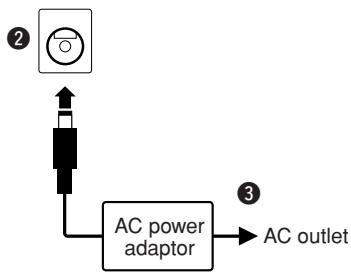
② Connect the AC power adaptor to the power supply jack.
③ Plug the AC adaptor into an AC outlet.
CAUTION
- Unplug the AC Power Adaptor when not using the instrument, or during electrical storms.
flowchart
graph TD
    A["Device ②"] --> B["AC power adaptor"]
    B --> C["AC outlet"]
    style A fill:#f9f,stroke:#333
    style C fill:#ccf,stroke:#333
■ Using Batteries
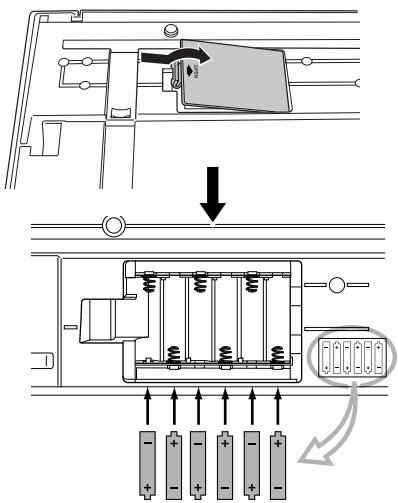
① Open the battery compartment cover located on the instrument’s bottom panel.
② Insert the six new alkaline batteries, being careful to follow the polarity markings on the side of the compartment.
③ Replace the compartment cover, making sure that it locks firmly in place.
CAUTION
- Never connect or disconnect the AC power adaptor when the batteries are installed in the instrument and the power is on. Doing so will turn the power off, possibly resulting in loss of the data being transferred and the data currently in the transfer destination during transferring or recording a data.
text_image
Diagram showing electrical component assembly with battery and switch connections, including a directional arrow indicating process.
For battery operation the instrument requires six 1.5V "AA" size, LR6 or equivalent batteries. (Alkaline batteries are recommended.) When battery power becomes too low for proper operation, the volume may be reduced, the sound may be distorted, and other problems may occur. When this happens, make sure to replace all batteries, following the precautions listed below.
If necessary, also make sure to save all important User data (see page 62), since custom panel settings are lost when the batteries are removed.
CAUTION
- Use alkaline batteries for this instrument. Other types of batteries (including rechargeable batteries) may have sudden drops of power when battery power becomes low, possibly resulting in loss of data in the flash memory.
- Make sure to install the batteries with the proper orientation, maintaining the correct polarity (as shown). Incorrect battery installation may result in heat, fire and/or leaking of corrosive chemicals.
- When the batteries run down, replace them with a complete set of six new batteries. NEVER mix old and new batteries. Do not use different kinds of batteries (e.g. alkaline and manganese) at the same time.
- If the instrument is not to be in use for a long time, remove the batteries from it, in order to prevent possible fluid leakage from the battery.
- Please use the power adaptor when transferring data to flash memory. Batteries (including rechargeable types) can be drained rapidly by this type of operation. If the batteries do become drained during a data transfer, both the data being transferred and the data currently in the transfer destination will be lost.
Make all necessary connections BEFORE turning the power on.
Audio Connections — Headphones and External Equipment
natural_image
Line drawing of a pair of headphones connected by a cable (no text or symbols)
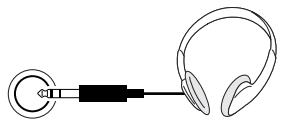
You can connect the PHONES/OUTPUT jack to a set of headphones, keyboard amplifier, stereo system, mixer, tape recorder, or other line-level audio device to send the instrument's output signal to that device.
The internal speakers are automatically shut off when a plug is inserted into this jack. The PHONES/OUTPUT jack also functions as an external output.

CAUTION
- Avoid listening with the headphones at high volume for long periods of time; doing so may not only result in ear fatigue, it may be damaging to your hearing.

CAUTION
- To prevent damage to the speakers, set the volume of the external devices at the minimum setting and turn power off the devices before connecting them. Failure to observe these precautions may result in electric shock or equipment damage. Also, be sure to set the volumes of all devices at their minimum levels and gradually raise the volume controls while playing the instrument to set the desired listening level.
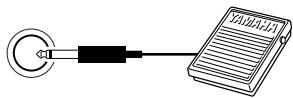
The sustain function lets you produce a natural sustain as you play by pressing an optional footswitch. Plug the Yamaha FC4 or FC5 footswitch into the SUSTAIN jack and use it to switch sustain on and off.
NOTE
- Make sure that the footswitch plug is properly connected to the SUSTAIN jack before turning on the power.
- Do not press the footswitch while turning the power on. Doing this changes the recognized polarity of the footswitch, resulting in reversed footswitch operation.
Turn on the power
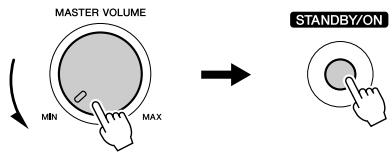
Turn down the volume by turning the [MASTER VOLUME] control to the left and press the [STANDBY/ON] switch to turn on the power. While playing the keyboard, adjust the volume level by using the [MASTER VOLUME] control. Pressing the [STANDBY/ON] switch again turns the power off.
text_image
MASTER VOLUME
MIN
MAX
STANDBY/ON

CAUTION
- When using a power adaptor, even when the power is off, a small amount of electricity is still being consumed by the instrument. When you are not using the instrument for a long time, make sure to unplug the AC power adaptor from the wall AC outlet, and/or remove the batteries from the instrument.
Using the music rest
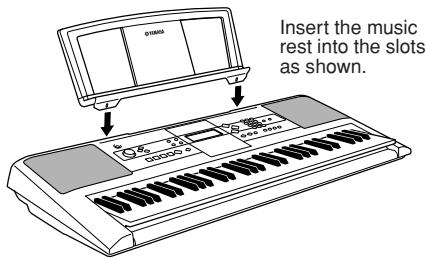
text_image
Insert the music
rest into the slots
as shown.
Removing the protective film
Remove the transparent protective film that was applied to the display prior to shipment from the factory.
Panel Controls and Terminals
Front Panel
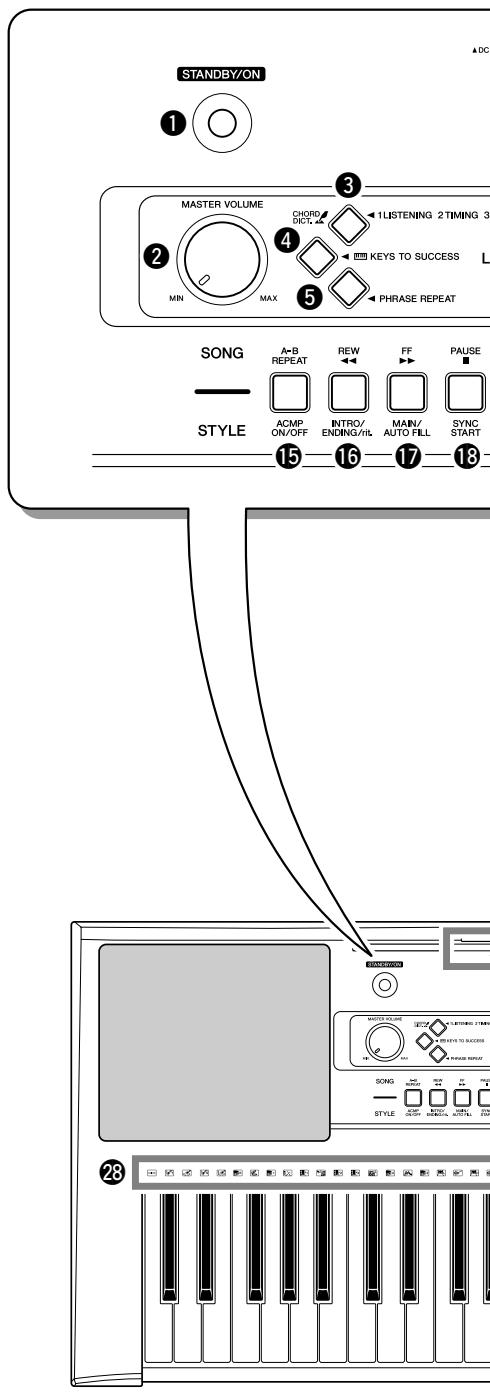
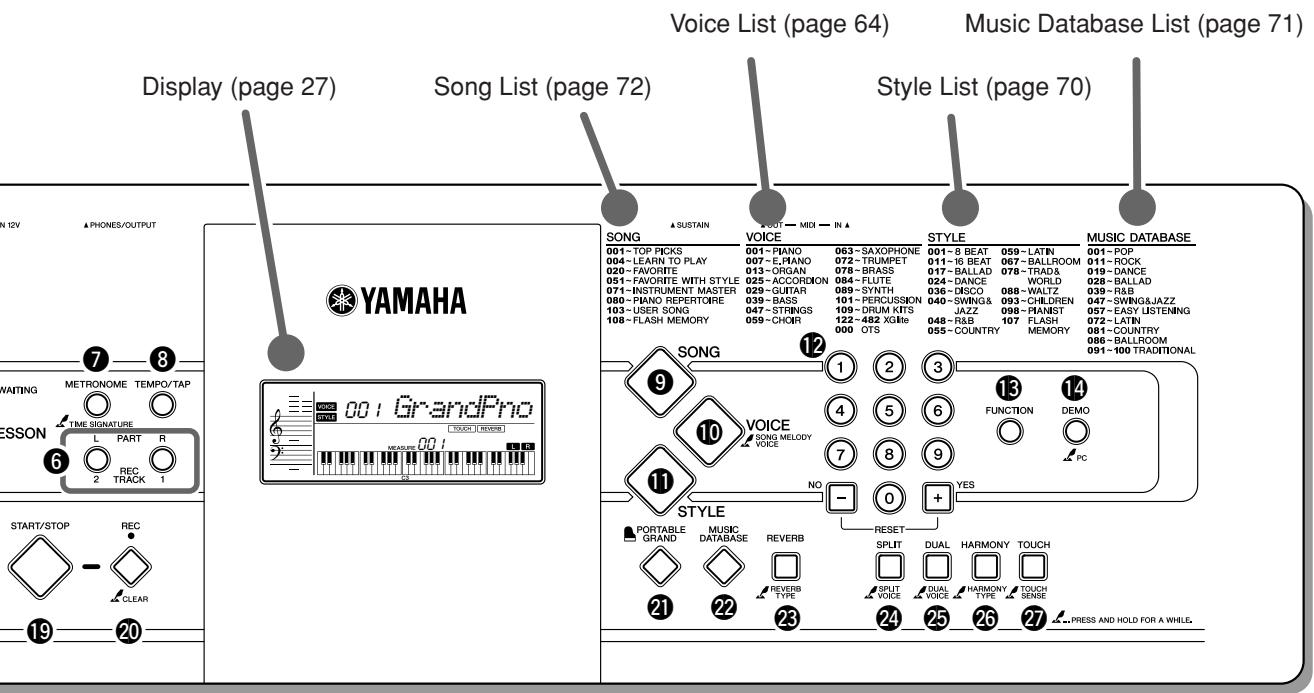
① [STANDBY/ON] switch......page 9
② [MASTER VOLUME] control ...... pages 9
③ [1 LISTENING 2 TIMING 3 WAITING] button .... pages 32
4 [KEYS TO SUCCESS] button...... pages 28
⑤ [PHRASE REPEAT] button ...... pages 35
When the lesson mode
6 PART
[L] button ...... page 32
[R] button......page 32
When the recording mode
⑥ [REC TRACK 2] button......page 39
[REC TRACK 1] button......page 39
⑦ [METRONOME] button......page 14, 48
⑧ [TEMPO/TAP] button......page 22, 52, 53
⑨ [SONG] button......pages 16
⑩ [VOICE] button ...... pages 12
⑪ [STYLE] button......pages 19
⑫ Number buttons [0]–[9], [+/YES], [-/NO] ...... page 26
⑬ [FUNCTION] button......pages 56
⑭ [DEMO] button......page 17
When the Song mode
⑮ [A-B REPEAT] button......page 51
⑯ [REW] button......page 17
⑰ [FF] button ...... page 17
18 [PAUSE] button......page 17
When the Style mode
⑮ [ACMP ON/OFF] button ...... page 20
16 [INTRO/ENDING/rit.] button......page 23
⑰ [MAIN/AUTO FILL] button......page 23
⑬ [SYNC START] button......page 19, 53
⑲ [START/STOP] button ...... page 17
20 [REC] button......page 37
21 [PORTABLE GRAND] button......page 13
22 [MUSIC DATABASE] button......page 36
23 [REVERB] button ...... page 43
24 [SPLIT] button ...... page 46
25 [DUAL] button......page 45
26 [HARMONY] button......page 42
27 [TOUCH] button......page 44
28 Drum Kit......page 15
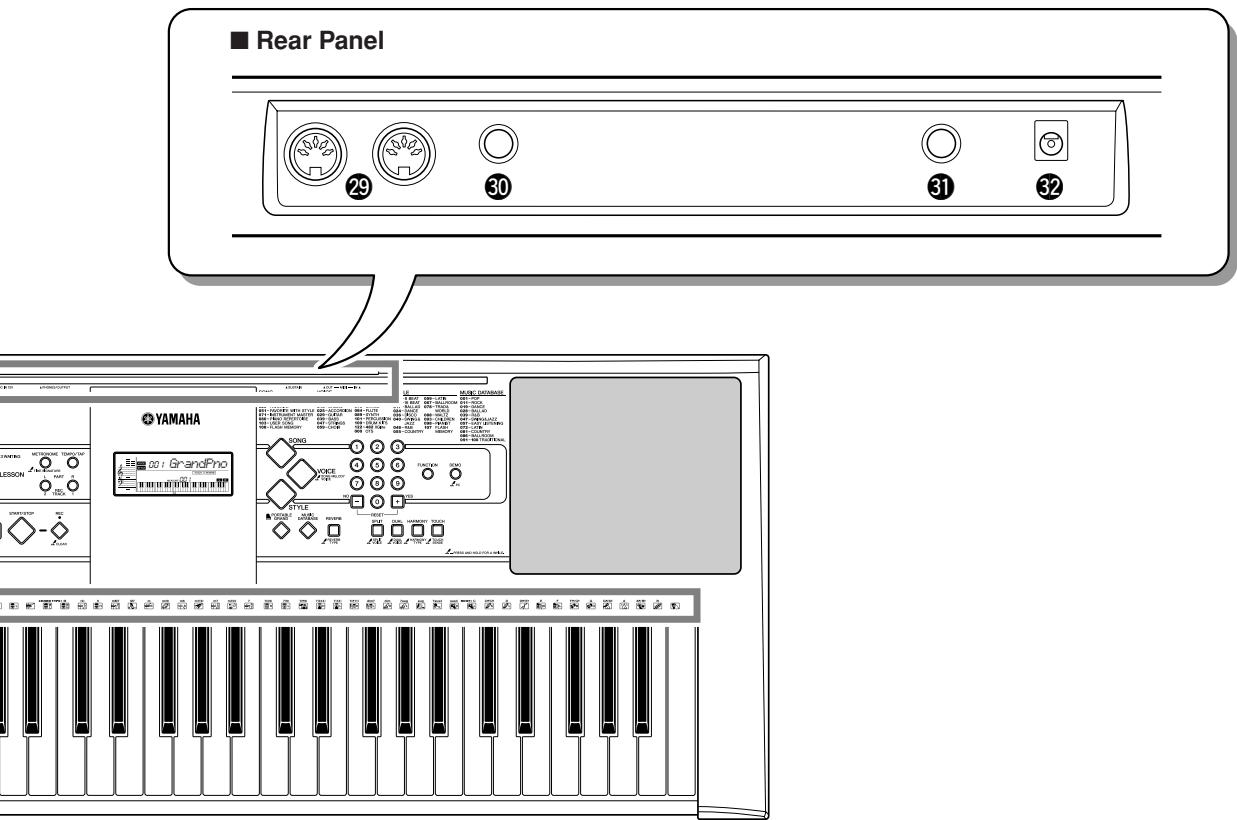
■ Rear Panel
29 MIDI IN/OUT terminals ...... page 58
30 SUSTAIN jack......page 9
③1 PHONES/OUTPUT jack......page 9
③2 DC IN 12V jack......page 8
■ Front Panel
text_image
STANDBY/ON
1
3
MASTER VOLUME
CHORD
DCT.
4
1LISTENING 2 TIMING 3
MIN
MAX
5
PHRASE REPEAT
SONG
A>B
REPEAT
REW
FF
PAUSE
STYLE
ACMP
ON/OFF
INTRO/
ENDING/HIL
MAIN/
AUTO FILL
SYNC
START
15
16
17
18
STOCKBOX
23
text_image
Display (page 27)
Song List (page 72)
Style List (page 70)
SONG
SONG
VOICE
STYLE
MUSIC DATABASE
001-TOP PICKS
004-LEARN TO PLAY
020-FAVORITE
051-FAVORITE WITH STYLE
071-INSTRUMENT MASTER
080-PIANO REPERTOIRE
103-USER SONG
108-FLASH MEMORY
001-Piano
007-E,PIANO
013-ORGAN
025-ACCORDON
029-GUTAR
039-BASS
047-STRINGS
059-CHOR
063-SAXOPHONE
072-TRUMPET
078-BRASS
084-FLUTE
089-SYNTH
101-PERCUSSION
109-DRUM KITS
122-482 XGite
000 OTS
001-8 BEAT
011-16 BEAT
017-BALLAD
024-DANCE
036-DECO
040-SWING&
JAZZ
048-R&B
055-COUNTRY
059-LATIN
067-BALLROOM
078-TRAD&
WORLD
088-WALTZ
093-CHILDREN
107 FLASH
MEMORY
091-POP
101-ROCK
109-DANCE
128-BALLAD
139-R&B
147-SWING&JAZZ
157-EASY LISTENING
167-LATIN
176-COUNTRY
186-BALLROOM
191-100 TRADITIONAL
SONG
9
VOICE
10 SONG MELODY
11 STYLE
PORTABLE GRAND
MUSIC DATABASE REVERB
21 22 23 24 25 26 27 PRESS AND HOLD FOR A WHILE.
YAMAHA
text_image
■ Rear Panel
29 30 31 32
YAMAHA
00: GrandPho
LESSON
STYLE
20000000000000000000000000000000000000000000000000000000000000000000000000000000000000000
RARE YEAR-END
29
30
31
32
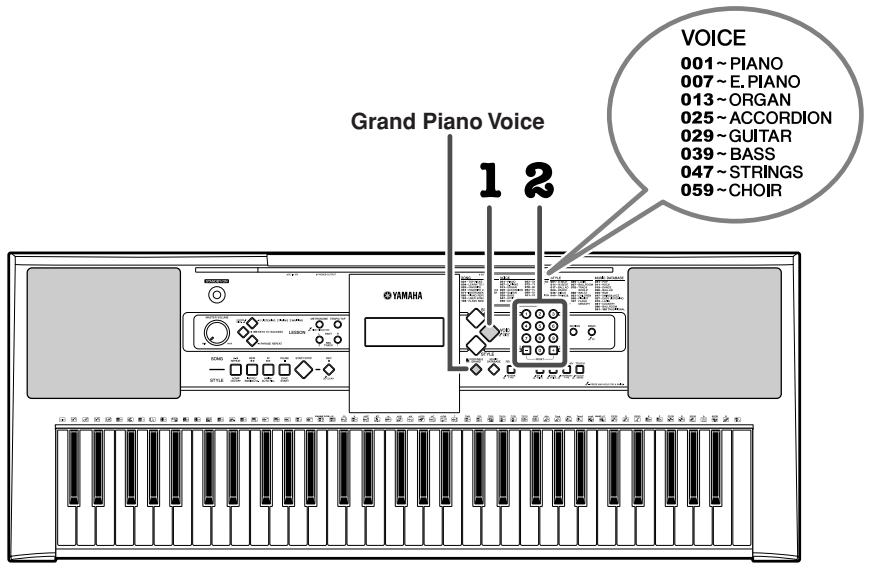
Changing the Voices
This instrument features a variety of realistic, built-in voices. The grand piano Voice is automatically selected whenever the power is turned on, but you can easily change this guitar, drum, or any of an extensive range of voices.
text_image
Grand Piano Voice
VOICE
001~PIANO
007~E.PIANO
013~ORGAN
025~ACCORDION
029~GUITAR
039~BASS
047~STRINGS
059~CHOIR
Try playing a variety of instrument Voices
The Voice number and name are displayed.
![YAMAHA PSR-E323 - Press the [VOICE] button. - 1](/content/2025/01/115058/images/4b9b25aa5e4367a63e8173499b7ef4d74f979953f9503242e20c380327a9ce03.jpg)
text_image
SONG
VOICE
SONG MELODY
VOICE
STYLE
Voice number
Voice name
VOICE 001 GrandPhoto
STYLE
TOUCH REVERB
MEASURE 001
C3
2 Select a Voice.
Select the desired Voice by using the number buttons [0]–[9], [+], [-].
Refer to the Voice List on page 64.
text_image
1 2 3
4 5 6
7 8 9
NO - 0 + YES
RESET

text_image
084 Flute The Voice shown here
becomes the Main Voice
for the instrument.
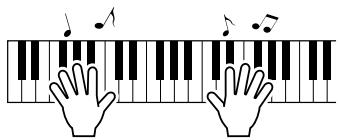
3 Play the keyboard.
text_image
Illustration showing two hands typing on a piano keyboard with musical notes above them
Try selecting and playing different Voices.
Playing the Grand Piano Voice
When you simply want to play a piano Voice, all you have to do is press one convenient button.
The Voice “Grand Piano” will automatically be selected as the Main Voice.
![YAMAHA PSR-E323 - Press the [PORTABLE GRAND] button. - 1](/content/2025/01/115058/images/e55a5d2ed27fd39e7a075007352b24d7d6f51418724fac516f438d58d8abdb1f.jpg)
![YAMAHA PSR-E323 - Press the [PORTABLE GRAND] button. - 2](/content/2025/01/115058/images/26e2825f07189468afdaeb24859bdd751f9ab8ea6c9e524a2780357d75e5b4c0.jpg)
text_image
Metronome
YAMAHA
Percussion and
drum icons
Using the Metronome
The instrument features a built-in metronome (a device that keeps an accurate tempo) that is convenient for practicing.
Press the [METRONOME] button to start the metronome. To stop the metronome, press the [METRONOME] button again.
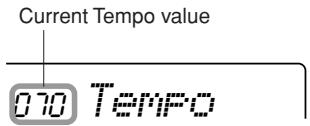
If you want to adjust the metronome tempo, press the [TEMPO/TAP] button to call up the Tempo setting in the display, then press the [+] button to raise the tempo, or press the [-] button to lower it. You can also set the tempo using the number buttons on the front panel.

- You can set the time signature (page 48).
text_image
Current Tempo value
070 Tempo
Playing the Drum Kit Voice
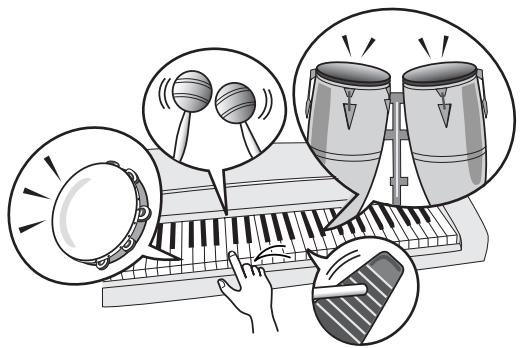
When Voice number 109 (Drum Kit) is selected in step 2 on page 13, you can play different percussion sounds directly from the keyboard.
To check which percussion sounds are assigned to each key when you select Voice number 109, look at the icons printed above the keys. You can select and play the desired Drum Kit from 12 preset Drum Kits (Voice number 109–121). Details on the instruments and key assignments of each Drum Kit can be found in the Drum Kit List on page 68.
natural_image
Illustration of a piano keyboard with decorative icons and musical instruments (no text or symbols)
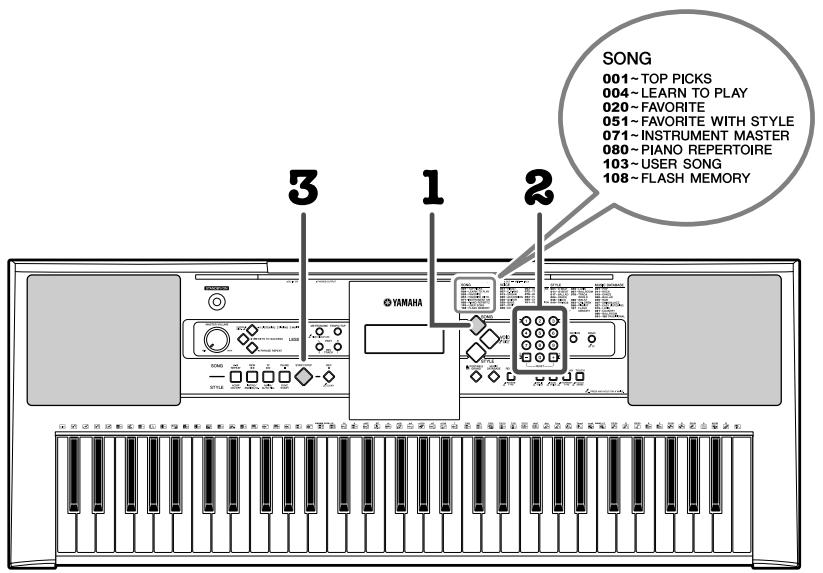
This instrument has 102 built-in Songs. For this instrument, the term “Song” refers to the data that makes up a piece of music.
Listening to a Song.
text_image
SONG
001~TOP PICKS
004~LEARN TO PLAY
020~FAVORITE
051~FAVORITE WITH STYLE
071~INSTRUMENT MASTER
080~PIANO REPERTOIRE
103~USER SONG
108~FLASH MEMORY
Select and Listen to a Specific Song
The Song number and name are displayed.
Song number “004” is automatically selected whenever the power is turned ON.
![YAMAHA PSR-E323 - Press the [SONG] button. - 1](/content/2025/01/115058/images/de82c0e6e4ecce1609f1d35a57e3c387696185326c85d143a95b84b61c7a3e8c.jpg)
- When you want to select the Song number 001–003, use the number buttons [0]–[9], [+], [-].
![YAMAHA PSR-E323 - Press the [SONG] button. - 2](/content/2025/01/115058/images/064350413636f6c3edc90a0e3feecfb67a20c63e5b130acdd7e778546a5a0bdb.jpg)
text_image
SONG
VOICE
SONG MELODY VOICE
STYLE
![YAMAHA PSR-E323 - Press the [SONG] button. - 3](/content/2025/01/115058/images/e93beb72b833c8bb8c1e9e506ed15aa92a6e92ae8106699f425bc65f92395920.jpg)
text_image
Song number
Song name
SONG 004 Elise 1
TOUCH REVERB
MEASURE -01 L R
C3
The songs are organized by category. For details, see page 72.
2 Select a Song.
Select the desired song by using the number buttons [0]–[9], [+], [-].
Refer to the Song List on page 72.
text_image
1
2
3
4
5
6
7
8
9
NO
-
0
+
YES
RESET

- You can play Songs recorded from the instrument or transferred from a computer. The procedure for playing these Songs is the same as that of the built-in Songs.
The Song will begin playing.
You can stop playback at any time by pressing the [START/STOP] button.
![YAMAHA PSR-E323 - Press the [START/STOP] button. - 1](/content/2025/01/115058/images/7e9bddf29c57a032dfa50344f41a4a4d871547a3968aeb3a2941651d7af06eb7.jpg)
- Songs can be played at any tempo you desire—fast or slow (page 22).
![YAMAHA PSR-E323 - Press the [START/STOP] button. - 2](/content/2025/01/115058/images/79a3f602d82223fa61f8d6f3471c0d54cb773c71114788d884d7ae9e404aa265.jpg)
● Rewind/Fast-forward/Pause
SONG


[REW] button ...... Fast-reverses the Song if pressed during playback (no sound is heard during fast reverse). Decreases the measure number if pressed while playback is stopped.
[FF] button.... Fast-forwards the Song if pressed during playback. Increases the measure number if pressed while playback is stopped.
[PAUSE] button ...... Temporarily stops playback. Press this button a second time to resume playback from the point at which it was stopped.
Press the [DEMO] button to play Songs 001, 002, 003, in sequence, and playback will continue repeatedly starting again from the first Song 001. You can stop playback at any time by pressing the [DEMO] button.
![YAMAHA PSR-E323 - ● Using the [DEMO] button - 1](/content/2025/01/115058/images/e6efcc8fdb4253c12fd2c2149c0464f14f9e25b1dc6adb6cf2398c5a9bc093a0.jpg)
Play with a Style
Styles are rhythm/accompaniment patterns and are played by the auto accompaniment feature. You can select from a wide variety of rhythmic types—rock, blues, Euro trance, and many, many more. Here we’ll learn how to select and play Styles using chords. While you play, you can automatically add specially created intros and endings, as well as variations in the rhythm/chord patterns, for more dynamic, professional-sounding performances.
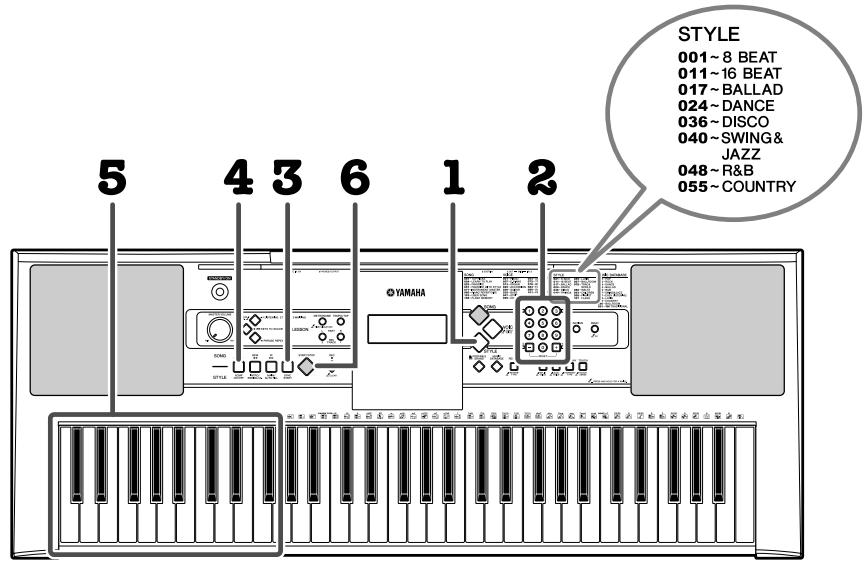
text_image
STYLE
001~8 BEAT
011~16 BEAT
017~BALLAD
024~DANCE
036~DISCO
040~SWING &
JAZZ
048~R&B
055~COUNTRY
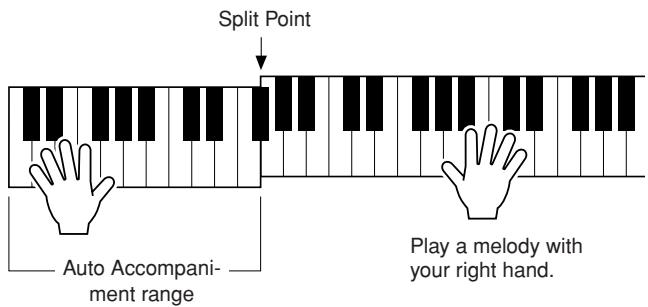
text_image
Split Point
Auto Accompani-
ment range
Play a melody with
your right hand.
Try playing chords with your left hand.
Select the "String Ensemble" Voice as the melody Voice, referring to step 2 on page 12.
Play along with the styles
The Style number and name are displayed.
![YAMAHA PSR-E323 - Press the [STYLE] button. - 1](/content/2025/01/115058/images/05d56a4c1600b35a27488e1e2049c4bf255389f43104947ca34a742fc1eac8eb.jpg)
text_image
SONG
VOICE
SONG MELODY
VOICE
STYLE
Style number
Style name
STYLE 00: 8Bt.Modrm
TOUCH REVERB
MEASURE 00:
C3
NOTE
- You can also select commercially available Style Files. To do this load the Style Files from the computer to the instrument, and then register the style data starting with to style number 107. (Refer to the information on transferring data on page 61 and registering styles on page 55.) If the Style File has not been registered, "No Data" will be displayed when selecting style number 107.
2 Select a Style.
Select the desired Style by using the number buttons [0]–[9], [+], [-].
Refer to the Style List on page 70.
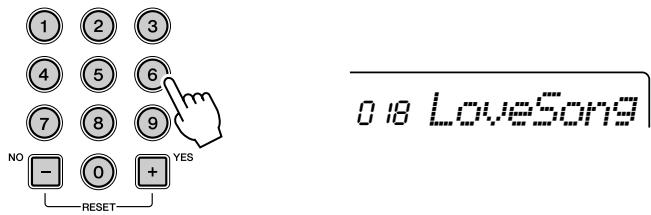
text_image
1 2 3
4 5 6
7 8 9
NO - 0 + YES
RESET
0.18 LoveSong
NOTE
- Since the Pianist category Styles (098–106) have no rhythm parts, no sound will be produced if you start rhythm-only playback. To use these Styles, turn on the auto accompaniment and play the keyboard as described on pages 20 (The bass and chord accompaniment parts will sound.)
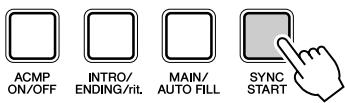
3 Turn SYNC START on.
Press the [SYNC START] button.
STYLE
text_image
ACMP
ON/OFF
INTRO/
ENDING/rit.
MAIN/
AUTO FILL
SYNC
START
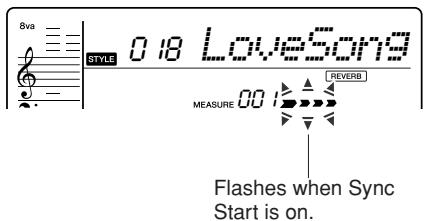
text_image
8va
STYLE 018 LoveSong9
REVERB
MEASURE 001
Flashes when Sync
Start is on.
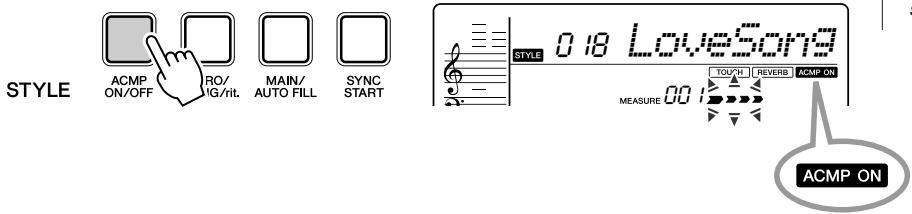
4 Turn auto accompaniment on.
Press the [ACMP ON/OFF] button.
Press the [ACMP ON/OFF] button again to turn the auto accompaniment off.
text_image
STYLE
ACMP
ON/OFF
RO/
1G/rit.
MAIN/
AUTO FILL
SYNC
START
STYLE 0.18 LoveSong
TOUCH REVERB ACMP ON
MEASURE 001
ACMP ON

- If you press the [START/STOP] button while the auto accompaniment is off, only the rhythm (percussion) parts will start.
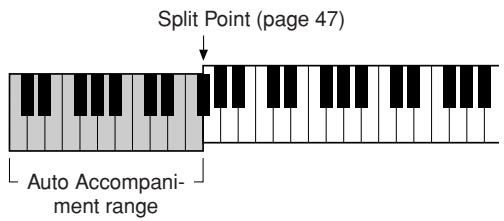
● When auto accompaniment is on ...
The keys to the left of the Split Point (54; F#2) will play only chords.
This is known as the “Auto Accompaniment range.”
text_image
Split Point (page 47)
Auto Accompani-
ment range
Appears when auto accompaniment is on
5 Start playing along on the keyboard.
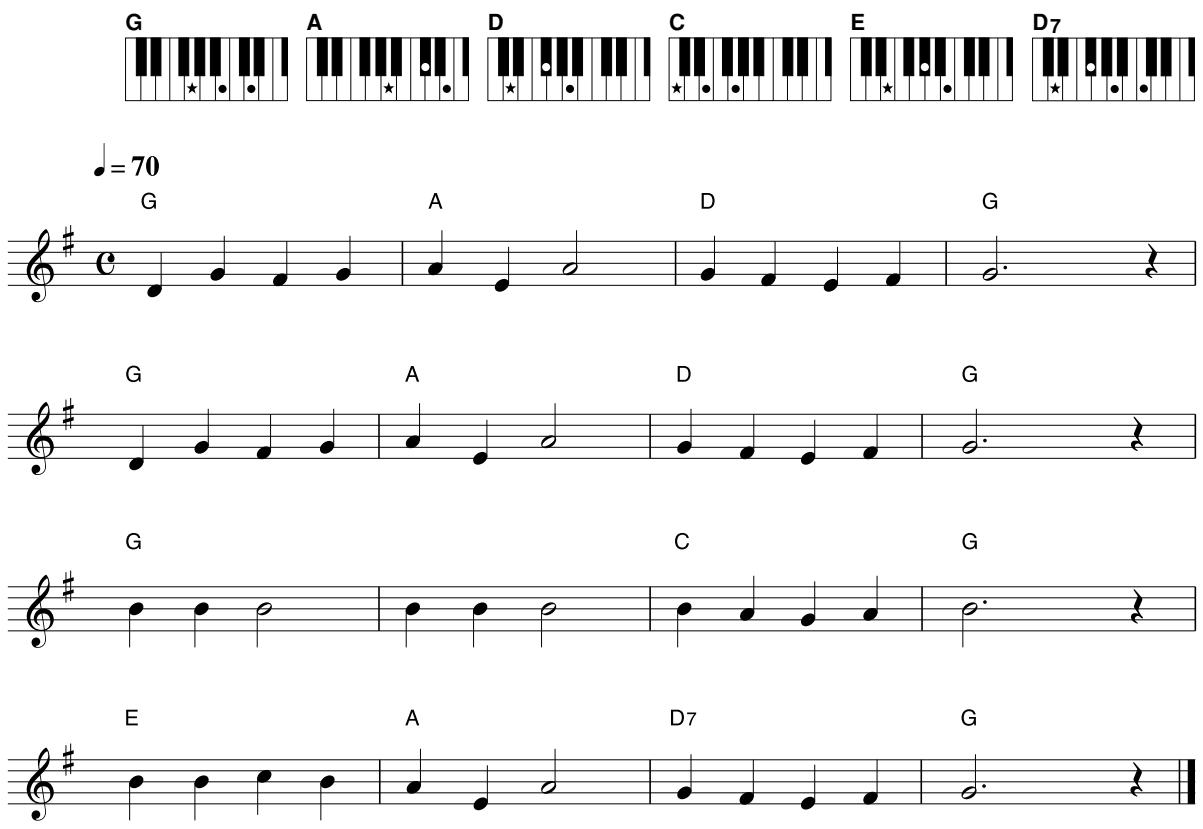
Style playback will begin as soon as you play a chord in the accompaniment range of the keyboard. In this case, try out the Song “Aura Lee” on the next page for practice purpose. For information on how to enter chords, see page 24.

text_image
Split Point
Auto Accompani-
ment range
6 Stop playing.
Playback will stop as soon as you press the [START/STOP] button.
Practice
— Aura Lee —
Recommended Style: 018 Love Song
Recommended Voice: 047 String Ensemble
Composer: G. Poulton
text_image
G
A
D
C
E
D7
= 70
G
A
D
G
G
A
D
G
G
C
G
E
A
D7
G
Changing the tempo of the Style
Styles can be played at any tempo you desire—fast or slow.
text_image
1
2
YAMAHA
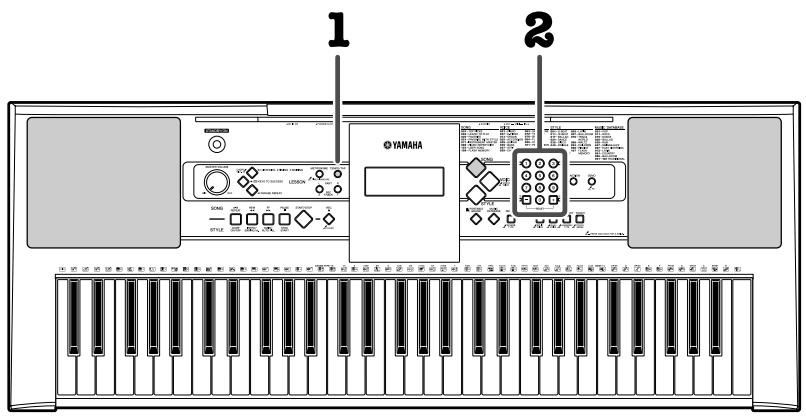
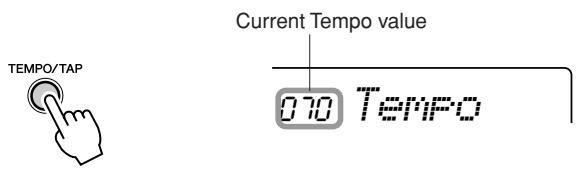
1 Press the [TEMPO/TAP] button to call up the Tempo setting in the display after selecting a Style.
text_image
TEMPO/TAP
Current Tempo value
070 Tempo
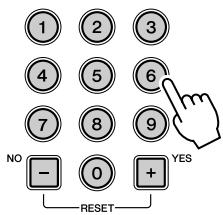
2 Set the Tempo by using the number buttons [0]–[9], [+], [-].
text_image
1 2 3
4 5 6
7 8 9
NO - 0 + YES
RESET

- Press the [+] and [-] buttons simultaneously to instantly reset the value to the default tempo of a Style.
Pattern Variation (Sections)
The instrument features a wide variety of Style “sections” (patterns) that allows you to vary the arrangement of the accompaniment to match the Song you are playing.

text_image
Intro
This is the beginning of the Song.
Main
This is the main part of the Song.
Ending
This is the end of the Song.
Fill in
This is the transition between main patterns.
Adding an Intro
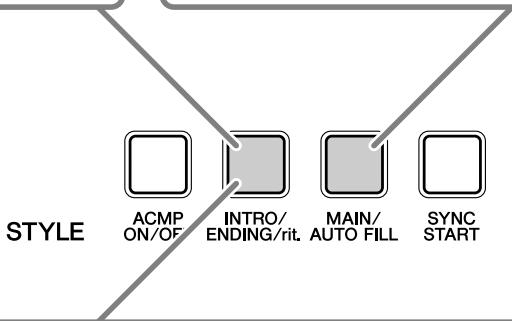
Pressing the [INTRO/ENDING/rit.] button before playing back the Style automatically adds a short introduction before starting the actual (Main) rhythm.
When the intro finishes playing, Style playback shifts to the main section.
Switching Main Patterns
There are two variations on the basic pattern (A and B). These are alternately selected each time the [MAIN/AUTO FILL] button is pressed. The main accompaniment pattern plays, and repeats indefinitely until another section's button is pressed.
Adding a Fill-in
A Fill-in pattern is automatically added before changing to section A or B.
flowchart
graph LR
    A["ACMP ON/OFF"] --> B["INTRO/ ENDING/rit."]
    B --> C["MAIN/ AUTO FILL"]
    C --> D["SYNC START"]
Adding an Ending
Press the [INTRO/ENDING/rit.] button to begin playing an ending section. Playback will stop when the ending has played all the way through.

If you press the [INTRO/ENDING/rit.] button a second time (while the ending is playing) the ending will play ritardando (the tempo will gradually get slower).
Playing chords along with score of the Song
Below is an example of a melody score with chord indications.

text_image
Chord
G
A
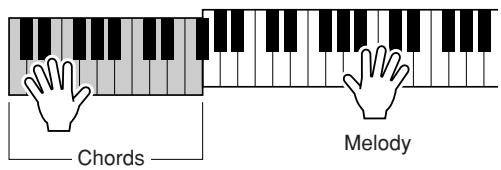
Play the melody on the staff with your right hand, and chords with your left hand. Find the appropriate chords on the next page and play them as illustrated.
text_image
Chords
Melody
- Chord names
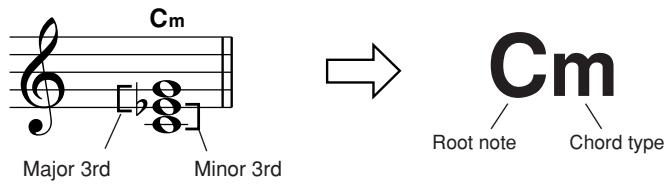
From the chord name, you can tell at a glance what type of chord it is and which notes make up the chord. Understanding the basic structure of chords is very useful—once you’re familiar with this, you’ll be quickly and easily play chords by looking at the names that appear above the notation.
text_image
Cm
Major 3rd Minor 3rd
→ Cm
Root note Chord type
Taking the chord above as an example, the lowest note of this triad is called the “root note.” This is the central note sound, and it supports or anchors the rest of the notes chord. Upper case letters (including sharps or flats) at the left of the chord name shows root note. The chord name is determined by a root note and chord type like as major or minor, and so on.
Chords
For users who are new to chords, this chart features common chords. Since there are many useful chords and many different ways to use them musically, refer to commercially available chord books for further details.
★ indicates the root note.
| Major | Minor | Seventh | Minor Seventh | Major Seventh |
C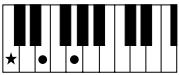 | Cm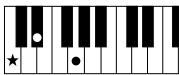 | C_7 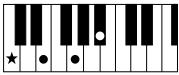 | Cm_7 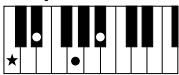 | CM_7 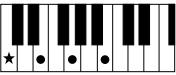 |
D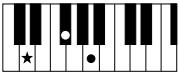 | Dm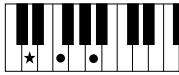 | D_7 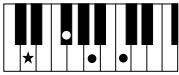 | Dm_7 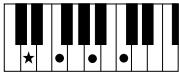 | DM_7 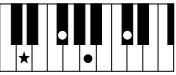 |
E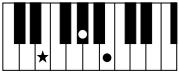 | Em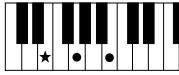 | E_7 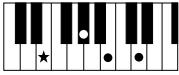 | Em_7 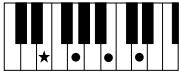 | EM_7 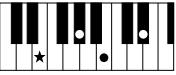 |
F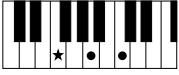 | Fm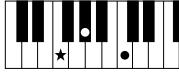 | F_7 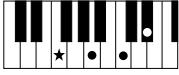 | Fm_7 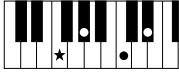 | FM_7 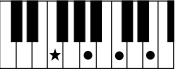 |
G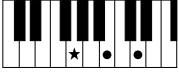 | Gm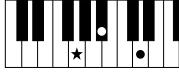 | G_7 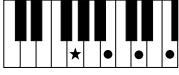 | Gm_7 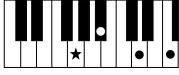 | GM_7 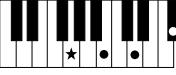 |
A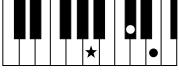 | Am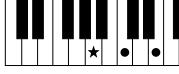 | A_7 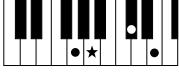 | Am_7 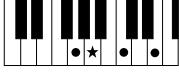 | AM_7 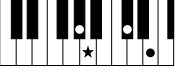 |
B | Bm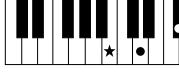 | B_7 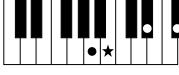 | Bm_7 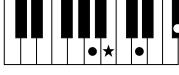 | BM_7 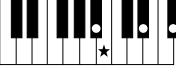 |
- Inversions can be used as well as in “root” position—with the following exceptions: m7, m7b5, 6, m6, sus4, aug, dim7, 7b5, 6(9), sus2
- Inversion of the 7sus4 and m7(11) chords are not recognized if the notes are omitted.
- sus2 chords are indicated by the root name only.
● Easy Chords
This method lets you easily play chords in the accompaniment range of the keyboard using only one, two, or three fingers.
For root "C"
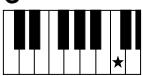
• To play a major chord
Press the root note (★)
of the chord.
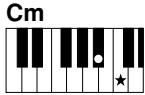
• To play a minor chord
Press the root note together with the nearest black key to the left of it.
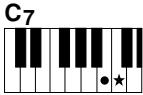
• To play a seventh chord
Press the root note together with the nearest white key to the left of it.
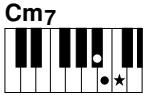
- To play a minor seventh chord Press the root note together with the nearest white and black keys to the left of it (three keys altogether).
Basic Operation
Press a button to select a basic function: Voice, Song or Style.

text_image
3 Start a function.
Display
(page 27)
1 Select a basic
function.
2 Select an item or
value.
STANDEV/ON
4 PHONES/OUTPUT
YAMAHA
SONG
001-TOP PICKS
004-LEARN TO P
026-FAVORITE
051-FAVORITE W
071-INSTRUMENT
080-PANO REPE
SONG
001-GrandPro
TYPE
001-S BEAT
059-LATN
001-POP
047-BALLROOM
017-BALLAD
036-BALLAD
046-DISCO
063-SAXOPHONE
072-TRUMPET
089-SWINDA
093-CHILDREN
101-PERCUSION
000 OTS
035-C NITRY
045-THIART
055-THIART
065-WALTZ
072-LATIN
086-BALLROOM
091-100 TRADITIONAL
MUSIC DATABASE
FUNCTION
DEMO
PC
AUDIO TOUCH
TOMO
REVERB
PORTABLE MUSIK
GRAND DATABASE REVERB
TYPE
001-TOP PICKS
004-LEARN TO P
026-FAVORITE
051-FAVORITE W
071-INSTRUMENT
080-PANO REPE
SONG
001-GrandPro
TYPE
001-S BEAT
059-LATN
017-BALLAD
036-BALLAD
046-DISCO
063-SAXOPHONE
072-TRUMPET
089-SWINDA
101-PERCUSION
101-THIART
102-THILKOTCH
103-THILKOTCH
104-THILKOTCH
105-THILKOTCH
106-THILKOTCH
107-THILKOTCH
108-THILKOTCH
109-THILKOTCH
110-THILKOTCH
111-THILKOTCH
112-THILKOTCH
113-THILKOTCH
114-THILKOTCH
115-THILKOTCH
116-THILKOTCH
117-THILKOTCH
118-THILKOTCH
119-THILKOTCH
120-THILKOTCH
121-THILKOTCH
122-THILKOTCH
123-THILKOTCH
124-THILKOTCH
125-THILKOTCH
126-THILKOTCH
127-THILKOTCH
128-THILKOTCH
129-THILKOTCH
130-THILKOTCH
131-THILKOTCH
132-THILKOTCH
133-THILKOTCH
134-THILKOTCH
135-THILKOTCH
136-THILKOTCH
137-THILKOTCH
138-THILKOTCH
139-THILKOTCH
Press the [SONG] button to access the SONG functions (printed above the buttons), and press the [STYLE] button to access the STYLE functions (printed below).
● The “Press & Hold” Symbol

Buttons having this indication can be used to call up an alternate function when the relevant button is pressed and held.
Hold down this button until the function calls up.
The number buttons can be used to directly enter a Song, Style or Voice number or parameter value. For numbers that start with one or two zeroes, the first zeroes can be omitted.
Example:
Selecting Voice 002, Bright Piano.
![YAMAHA PSR-E323 - ● Number buttons [0]–[9] - 1](/content/2025/01/115058/images/cc5a482bb7b07933ea32ce50d699c6cc263ec1aca992d0b3586597bdd4507c57.jpg)
text_image
1
2
3
4
5
6
7
8
9
NO
-
0
+
YES
RESET
Press number buttons [0], [0], [2].
Press the [+] button briefly to increase the value by 1, or press the [-] button briefly to decrease the value by 1. Press and hold either button to continuously increase or decrease the value in the corresponding direction.
![YAMAHA PSR-E323 - ● [+], [-] buttons - 1](/content/2025/01/115058/images/6cae1cbee0b24a58a146eb902fbb015edbd72f86abaa7b97df8ed7410ddb0ae7.jpg)
text_image
Press briefly to decrease.
NO
-
0
+
YES
RESET
Press briefly to increase.
Display
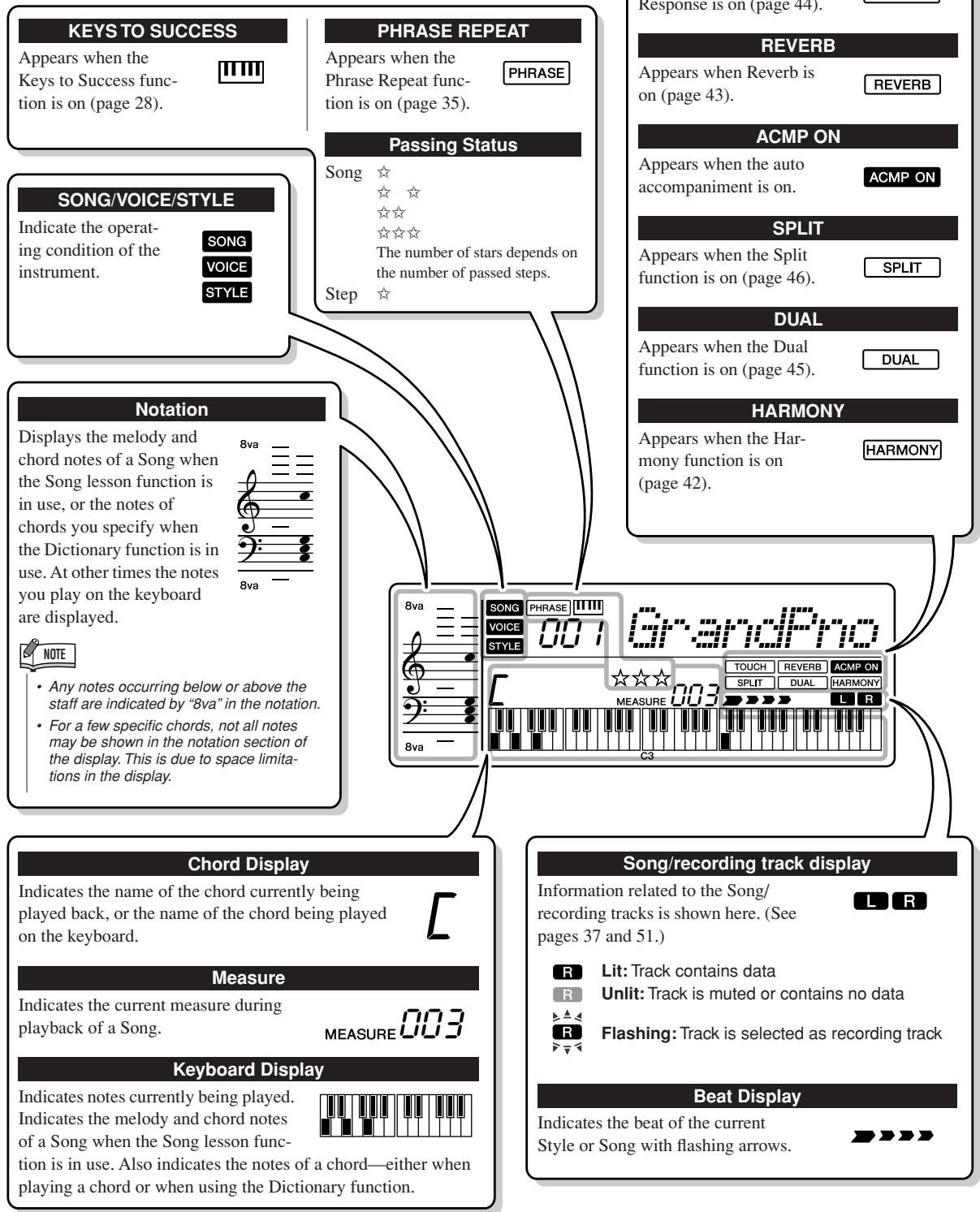
The Main display shows all of the current basic settings for Song, Style and Voice. It also includes a range of indicators that show the on/off status for various functions.
flowchart
graph TD
    A["KEYS TO SUCCESS"] --> B["PHRASE REPEAT"]
    B --> C["PASSING STATUS"]
    C --> D["NOTATION"]
    D --> E["Chord Display"]
    E --> F["Measure"]
    F --> G["Keyboard Display"]
    G --> H["Beat Display"]

    subgraph Key Details
        I["Appears when the Keys to Success function is on (page 28)."]
        J["SONG/VOICE/STYLE"]
        K["Note: Indicate the operating condition of the instrument."]
        L["8va"]
        M["8va"]
        N["8va"]
        O["8va"]
        P["8va"]
        Q["8va"]
        R["8va"]
        S["8va"]
        T["8va"]
        U["8va"]
        V["8va"]
        W["8va"]
        X["8va"]
        Y["8va"]
        Z["8va"]
        AA["8va"]
        AB["8va"]
        AC["8va"]
        AD["8va"]
        AE["8va"]
        AF["8va"]
        AG["8va"]
        AH["8va"]
    end

    subgraph Phrase Repeats
        AI["Appears when the Phrase Repeat function is on (page 35)."]
        AJ["PHRASE"]
        AK["Song ☆ ☆ ☆ ☆ ☆ ☆ ☆ ☆ ☆ ☆ ☆ ☆ ☆ ☆ ☆ ☆ ☆ ☆ ☆ ☆ ☆ ☆ ☆ ☆ ☆ ☆ ☆ ☆ ☆ ☆ ☆ ☆ ☆ ☆ ☆ ☆ ☆ ☆ ☆ ☆ ☆ ☆ ☆ ☆ ☆ ☆ ☆ ☆ ☆ ☆ ☆ ☆ ☆ ☆ ☆ ☆ ☆ ☆ ☆ ☆ ☆ ☆ ☆ ☆ ☆ ☆ ☆ ☆ ☆ ☆ ☆ ☆ ☆ ☆ ☆ ☆ ☆ ☆ ☆ ☆ ☆ ☆ ☆ ☆ ☆ ☆ ☆ ☆ ☆ ☆ ☆ ☆ ☆ ☆ ☆ ☆ ☆ ☆ ☆ ☆☆"]
    end

    subgraph Response Details
        AR["Response is on (page 44)."]
        AS["REVERB"]
        AT["ACMP ON"]
        AU["SPLIT"]
        AV["DUAL"]
        AW["HARMONY"]
    end

    subgraph Chord Settings
        AX["Any notes occurring below or above the staff are indicated by "8va" in the notation."]
        AY["For a few specific chords, not all notes may be shown in the notation section of the display. This is due to space limitations in the display."]
    end

    subgraph Song/Recorded Track Displays
        AZ["Sound Record with GrandPro"]
        BA["Sound Record with ACMP ON"]
        BB["Sound Record with HARMONY"]
        BC["Sound Record with Flashing Arrow"]
    end

    subgraph Song/Recording Tracks
        BD["Information related to the Song/ recording tracks is shown here. (See pages 37 and 51.)"]
        BE["Lit: Track contains data"]
        BF["Unlit: Track is muted or contains no data"]
        BG["Flashing: Track is selected as recording track"]

    end

    subgraph Beat Display
        BH["Beat the beat of the current Style or Song with flashing arrows."]
    end

    style A fill:#f9f,stroke:#333
    style B fill:#ccf,stroke:#333
    style C fill:#cfc,stroke:#333
    style D fill:#fcc,stroke:#333
    style E fill:#cff,stroke:#333
    style F fill:#ffc,stroke:#333
    style G fill:#cfc,stroke:#333
    style H fill:#fcc,stroke:#333
    style I fill:#fff,stroke:#333
    style AJ fill:#fff,stroke:#333
    style AK fill:#fff,stroke:#333
    style AL fill:#fff,stroke:#333
    style AM fill:#fff,stroke:#333
    style AN fill:#fff,stroke:#333
    style AO fill:#fff,stroke:#333
    style AP fill:#fff,stroke:#333
    style AQ fill:#fff,stroke:#333
    style AR fill:#fff,stroke:#333
    style AS fill:#fff,stroke:#333
    style AT fill:#fff,stroke:#333
    style AU fill:#fff,stroke:#333
    style AV fill:#fff,stroke:#333
    style AW fill:#fff,stroke:#333
    style AX fill:#fff,stroke:#333
    style AY fill:#fff,stroke:#333
    style AZ fill:#fff,stroke:#333
    style BB fill:#fff,stroke:#333
    style BC fill:#fff,stroke:#333
    style AD fill:#fff,stroke:#333
    style AE fill:#fff,stroke:#333
    style AF fill:#fff,stroke:#333
    style AG fill:#fff,stroke:#333
    style AH fill:#fff,stroke:#333
You can practice the preset Songs using these lesson functions: "Keys to Success," "Listening, Timing, Waiting" and "Phrase Repeat." Keys to Success helps you master a Song, whereas Listening, Timing, Waiting helps you first master the timing then playing the correct notes. Phrase Repeat lets you select and repeatedly practice a specific phrase in the Song. If you're using a keyboard instrument for the first time, we suggest you start with Keys to Success.
Keys to Success
In the “Keys to Success” mode, you can practice individual phrases in the Song (as “Steps”), letting you effectively master the Song by mastering each phrase separately. Each time you finish a specific Step, your score is shown in the display. Passing one Step (with a score of 60 or better) lets you go on to next one automatically. All preset Songs other than 001–003 can be used with this mode, especially the “LEARN TO PLAY” category Songs (004–019).
1 Select a song for your lesson.
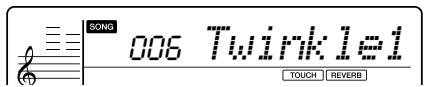
For this example we'll select song “006 Twinkle Twinkle Little Star(Basic)” from the “LEARN TO PLAY” category. For instructions on how to select a Song, see page 16.
text_image
SONG
006 Twink1e1
TOUCH REVERB
2 Turn Keys to Success on.
Pressing the [KEYS TO SUCCESS] button turns the Keys to Success feature on, and a Step of the Song is automatically selected for your practice. The currently selected Step number and the lesson parts are shown in the display.
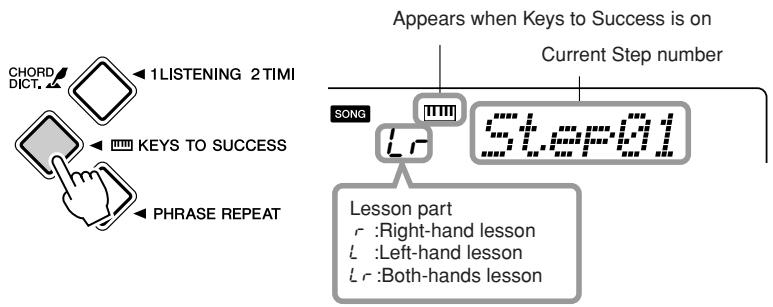
text_image
CHORD
DICT.
1 LISTENING 2 TIMI
KEYS TO SUCCESS
PHRASE REPEAT
Appears when Keys to Success is on
Current Step number
SONG
Lr
STEP1
Lesson part
r :Right-hand lesson
L :Left-hand lesson
Lr :Both-hands lesson
You can refer to the music score in the Song Book (free downloadable scores). To obtain the Song Book, complete the user registration at the following website:
http://music.yamaha.com/registration/

- Song numbers 001 to 003 cannot be used for the Lesson feature. If you select these songs, "NoLesson" is shown in the display.

- The total number of steps varies depending on the Song.

• Each lesson part varies depending on the Steps.
3 Start the Lesson.
Press the [START/STOP] button to start Lesson. After the lead-in, Step 01 of the song starts automatically, and the appropriate notes appear in the display.
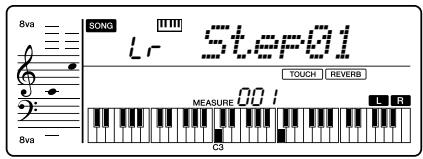
text_image
8va
SONG
lr
Step01
TOUCH
REVERB
MEASURE 00:1
C3
L R
You can start playing along on the keyboard as soon as the lead-in finishes. The score marker and keyboard marker in the display will indicate the notes to play.
Each time you have practiced all the way through a Step, your performance will be evaluated and your score (from 0–100) is shown in the display.
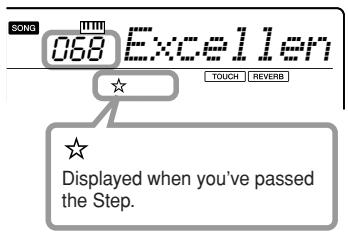
text_image
SONG
068
Excellent
☆
TOUCH REVERB
☆
Displayed when you've passed the Step.
| Score of 0–59 | Try the same Step again. The same Step begins automatically. |
| Score of 60–100 | You passed! The next Step begins automatically. |
You can select another Step as desired by using the [+]/[-] buttons.
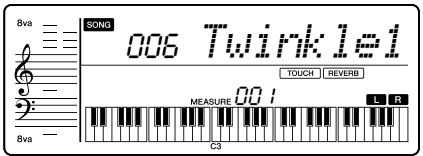
All songs have a finishing step, and in that step, you will practice all the way thorough the song which you have selected as a lesson Song in the step 1. When you pass all Steps, the Keys to Success mode will automatically be turned off and playback stops.
text_image
SONG 006 Twinkle1
TOUCH REVERB
MEASURE 001 L R
C3
4 Stop Lesson.
You can stop the Lesson at any time by pressing the [KEYS TO SUCCESS] button.
NOTE
- In some Steps, the lead-in may run a little slower than normal because a ritardando or fermata section is placed before the Step.
NOTE
- You can practice the specified phrase using the Lesson modes "1 Listening," "2 Timing" or "3 Waiting" described on page 31. In these Lesson modes with the Keys to Success function, however, it is not possible to pass the Step. When you want to turn off these Lesson modes, press the [1 LISTENING 2 TIMING 3 WAITING] button a number of times to select off ("Step number" will appear in the display).
NOTE
- If the specified part is both hands, you cannot pass the Step until you play both hands, even if you play one of the hands well. Only a message such as “L-part is Nice” appears in the display.
NOTE
- When you want to select another Song during a lesson, press the [SONG] button to call up the currently selected Song name in the display (for three seconds), then select the Song as required using the [+]/[-] buttons or number buttons while the Song name appears. When you select the new Song, the lowest number Step not yet passed of the Song will automatically be selected for the Lesson.
Entering and Clearing the Passing Status
- Entering
Passing status will automatically be entered and shown in the display when the Step or Song is selected. You can recognize at a glance whether or not you've passed the selected Step or Song.
When Step is selected
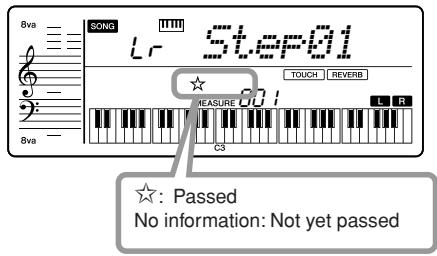
text_image
8va
SONG
Step01
LE
8va
TOUCH REVERB
C3
Measure 01
L A
☆: Passed
No information: Not yet passed
When Song is selected
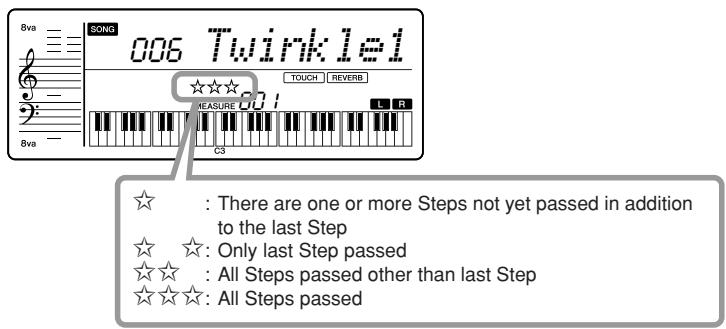
text_image
SONG
006 Twinkle1
8va
TOUCH REVERB
8va
REASURE 007 L R
☆: There are one or more Steps not yet passed in addition to the last Step
☆: Only last Step passed
☆: All Steps passed other than last Step
☆: All Steps passed
- Clearing
You can clear existing passing status entries. Select the desired Song or Step for clearing the passing status and hold the [KEYS TO SUCCESS] button for longer than three seconds. After the passing status has been cleared, a “Cleared” message will appear on the display. Once the operation has been completed, no information will appear even when selecting the Song or Step.
KEYS TO SUCCESS
Hold for longer than three seconds
Clawed
NOTE
- You cannot clear any entries during the Song or Step playback. If a Song or Step is currently being played back, stop playback first.
NOTE
- Deleting the Song recording will delete all Step passing status entries as well.
Listening Timing Waiting
You can select any Song you like and use it for a left-hand, right-hand, or both-hands lesson. Song Lesson lets you learn how to play Songs in three easy steps. Songs that can be used with the Lesson feature include Songs transferred from a computer to flash memory (SMF Format 0 only; see page 60). The procedure for transferring songs are described on page 61.
The lesson modes:
1 Listening ...... Listen and learn the melody or rhythm of a selected Song.
2 Timing...... Learn to play the notes at the correct timing along with the Song.
3 Waiting...... Learn to play the correct notes.
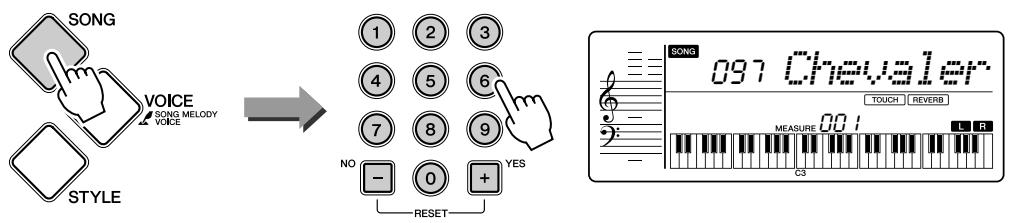
1 Select the desired Song for your lesson.
For instructions on how to select a Song, see page 16. If you want to practice a Song you've transferred from a computer, select one of the Songs beginning from Song number 108.

- User Songs cannot be used for the lesson.
text_image
SONG
VOICE MEODY
SONG
STYLE
1 2 3
4 5 6
7 8 9
NO - 0 + YES
RESET
SONG 097 Chevaler
TOUCH REVERB
MEASURE 001 C3
The instrument includes 102 built in Songs. Some Songs (as shown below) are intended for use as right-hand lessons, and cannot be used for left-hand or both-hands lessons.
● Songs for right-hand lesson
Song numbers: 020–050, 071–076, 079
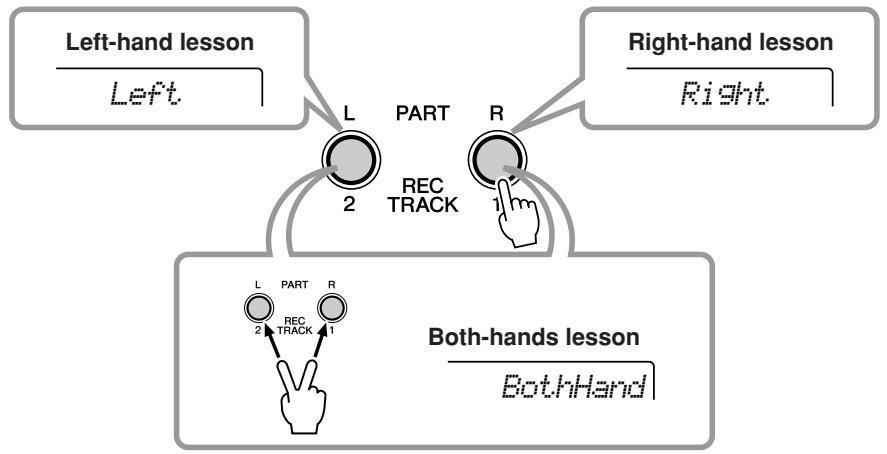
2 Select the part you want to practice.
Press the [R] button for a right-hand lesson, [L] button for a left-hand lesson, or press both the [R] and [L] buttons simultaneously for a both-hands lesson. The selected part is displayed.
flowchart
graph TD
    A["Left-hand lesson\nLeft"] --> B["L"]
    C["Right-hand lesson\nRight"] --> D["R"]
    B --> E["PART\nREC TRACK"]
    D --> F["PART\nREC TRACK"]
    E --> G["2"]
    F --> H["1"]
    I["Both-hands lesson\nBothHand"] --> J["PART\nREC TRACK"]
    J --> K["1"]
A “No LPart” message is shown in the display if you select the left part in one of the Songs intended for right-hand lesson, which do not have left part data. These Songs cannot be used for left-hand or both-hands lessons.
$$
\text { No LPart. }
$$

- For songs transferred from a computer, the "No LPart" indication does not appear, even when there is no left hand part in the song.
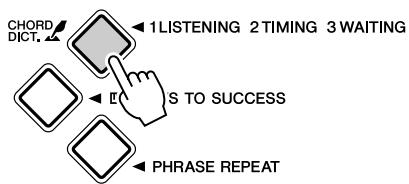
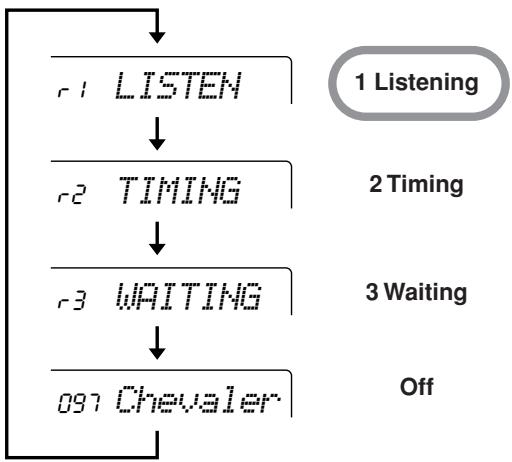
3 Select the lesson mode.
Each time the [1 LISTENING 2 TIMING 3 WAITING] button is pressed the lesson modes are selected in sequence: 1 Listening → 2 Timing → 3 Waiting → Off → 1 Listening ...etc. The currently selected lesson mode is shown in the display.
For this example select “1 Listening”.

- When the melody Voice of the Song is changed, the key position shown in the display may be shifted (in octave units), depending on the Voice selected.
flowchart
graph TD
    A["CHORD DIFF."] --> B["1 LISTENING 2 TIMING 3 WAITING"]
    B --> C["Is TO SUCCESS"]
    C --> D["PHRASE REPEAT"]
flowchart
graph TD
    A["r1 LISTEN"] --> B["r2 TIMING"]
    B --> C["r3 WAITING"]
    C --> D["097 Chevaler"]
    E["1 Listening"] --> F["2 Timing"]
    G["3 Waiting"] --> H["Off"]
4 Start Lesson.
Song playback will begin automatically when you select Lesson mode, and the appropriate notes appear in the display.

- You cannot use Dual or Split Voices during lessons.
- The Split Point is fixed and it cannot be changed. For the left-hand lesson, it is fixed at 59 or B2; for the left-hand chord lesson, it is fixed at 54 or F#2.
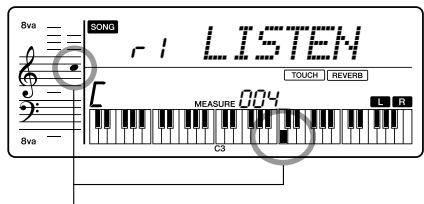
1 Listening
There's no need to play the keyboard in this mode. The model melody/chords (in other words, the musical material you should learn) of the part you selected will sound. Listen to it carefully and learn it well.
text_image
8va
SONG
LISTEN
TOUCH REVERB
C3
8va
004
16
MEASURE 004
The notation and key positions of the model melody are shown in the display.

Lesson “2 Timing” will begin as soon as you press the [1 LISTENING 2 TIMING 3 WAITING] button.
2 Timing
In this mode, try playing the notes with the correct timing. Simply concentrate on playing each note in time with the rhythmic accompaniment. The correct notes sound even if you play wrong notes as long as you play in time with the rhythm. Play the notes shown in the display.
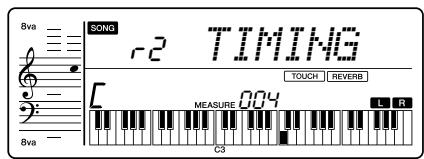
text_image
8va
SONG r2 TIMING
TOUCH REVERB
E MEASURE 004 L R
C3

Lesson “3 Waiting” will begin as soon as you press the [1 LISTENING 2 TIMING 3 WAITING] button.
3 Waiting
In this mode, try playing the correct notes. The notes you should play appear in the score and the keyboard on the display. The Song pauses until you play the right note.
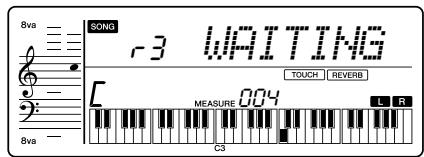
text_image
8va
SONG
r3 WAITING
TOUCH REVERB
E MEASURE 004 L R
C3
You can select Lesson modes by pressing the [1 LISTENING 2 TIMING 3 WAITING] button respectively.
5 Stop the Lesson mode.
You can stop the Lesson mode at any time by pressing the [START/STOP] button.
Grade
When the lesson Song has played all the way through in Lesson mode 2 Timing or 3 Waiting, your performance will be evaluated in four levels: OK, Good, Very Good, or Excellent.
OK
Good
Very Good!
Excellent!
Phrase Repeat
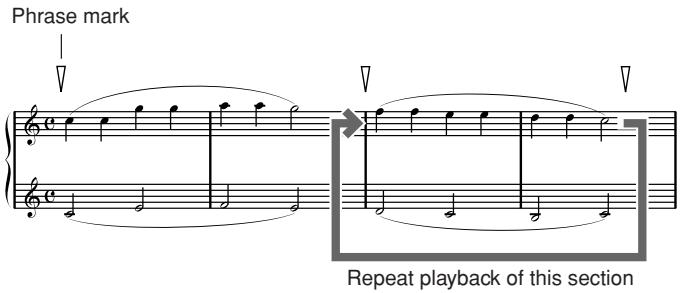
This function allows you to repeatedly practice difficult phrases, by selecting a phrase and repeatedly play it back. You can also mute one of the parts, and practice just the other part repeatedly. The specified phrase can also be practiced along with the Lesson modes “1 Listening,” “2 Timing” or “3 Waiting” described on page 31.
text_image
Phrase mark
Repeat playback of this section
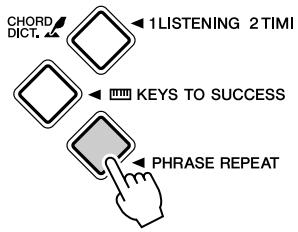
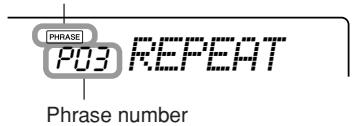
Play the Song and press the [PHRASE REPEAT] button at the phrase you want to repeat. The appropriate phrase number will appear in the display and, after a lead-in, repeat playback will start. Use the [+] or [-] buttons to select any phrase number in the Song, and stop repeat playback by pressing the [PHRASE REPEAT] button. The Phrase Repeat mode will be canceled and normal playback of the Song will continue.
flowchart
graph TD
    A["CHORD\nDICT."] --> B["1LISTENING 2 TIMI"]
    C["KEYS TO SUCCESS"] --> D["PHRASE REPEAT"]
    E[" "] --> F[" "]
    style A fill:#f9f,stroke:#333
    style C fill:#f9f,stroke:#333
    style E fill:#ccf,stroke:#333
Appears when the Phrase Repeat function is on
text_image
PHRASE
P03 REPEAT
Phrase number
Changing the playback section
You can specify an extended section for repeating (including multiple phrases) by specifying a beginning phrase (point A) and ending phrase (point B), using the [A-B REPEAT] button. You can do this either during playback or while playback is stopped.
Press the [A-B REPEAT] button at the beginning phrase of the section you want to repeat (point A), use the [+]/[-] buttons to select the subsequent phrases you wish to include in the repeat, then press the [A-B REPEAT] button a second time. This specifies the last phrase selected as the end phrase (point B) for Phrase Repeat playback. “REPEAT” will appear on the display and the specified A-B section of the Song will now play repeatedly. (If playback is stopped, press the [START/STOP] button to start.)
Stop A-B Repeat playback by pressing the [PHRASE REPEAT] button. "REPEAT" will appear on the display and the currently selected phrase will playback repeatedly.
NOTE
- When you want to turn the Phrase Repeat function on, please make sure that the Keys to Success mode is off, since Phrase Repeat is not available in the Keys to Success mode.
- When you want to change the Song, first turn off the Phrase Repeat function then select the Song.
NOTE
- If you use Phrase Repeat function with the Lesson modes “1 Listening,” “2 Timing” or “3 Waiting”, the evaluation function of these lesson modes are not available. When you want to turn these lesson modes off, press the [1 LISTENING 2 TIMING 3 WAITING] button a number of times to select off (“Phrase number” will appear in the display).
NOTE
- Specifying only Point A results in repeat playback between Point A and the end of the Song.
Play Using the Music Database
You want to play music in your favorite style, but you're not sure how to select the best voice and style for the type of music you want to play ... simply select the appropriate style from the Music Database. The panel settings will automatically be adjusted for the ideal combination of sounds and style!
![YAMAHA PSR-E323 - Press the [MUSIC DATABASE] button. - 1](/content/2025/01/115058/images/fad2a6e9e5b79a6b75a8b4a340f603ad7d05292f3ea96abf91a7beeca5615462.jpg)
001 HIV Fever
A Music Database name will appear in the display.
2 Select a Music Database.
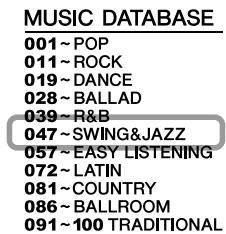
Referring to the Music Database category list printed on the panel, select a music database that matches the image of the song you intend to play. For example, select one from the “SWING&JAZZ” category (047–056) if you want to play jazz.
text_image
1 2 3
4 5 6
7 8 9
NO - 0 + YES
RESET
text_image
MUSIC DATABASE
001~POP
011~ROCK
019~DANCE
028~BALLAD
039~R&B
047~SWING&JAZZ
057~EASY LISTENING
072~LATIN
081~COUNTRY
086~BALLROOM
091~100 TRADITIONAL
05: MoonLit.
3 Play the chords with your left hand and melody with your right.
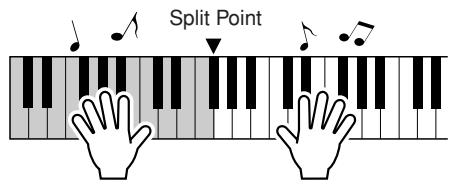
The jazz style will start playing when you play a left-hand chord to the left of the split point (page 47). Refer to page 25 for information about playing chords.
text_image
Split Point
Press the [START/STOP] button to stop playback.
You can record up to five of your own performances as User Songs (User 1–5: Song numbers 103–107). Think of each User Song as a kind of basket or drawer for storing your recording. Remember that you can also record a Style (containing chord changes) along with your own performance.
![YAMAHA PSR-E323 - Press the [REC] button. - 1](/content/2025/01/115058/images/45980da9931a757e5c014c95e017b855a8c304ec0b767afc6cf6a23cd1eadc3b.jpg)
text_image
REC
CLEAR
R-EC User 1
TOUCH REVERB
MEASURE 00 L R
C3
The lowest-numbered unrecorded User Song (Song numbers 103–107) available for recording is displayed. If you want to select the Song you will be recording, select the desired Song number by using the [+] and [-] buttons.
Flashes
![YAMAHA PSR-E323 - Press the [REC] button. - 2](/content/2025/01/115058/images/effcd03e09dfe3186a4f657e6d1c922508867c7021fa79eaea50ce63f64d1817.jpg)
- A total of approximately 10,000 notes or 5,500 chord changes can be recorded to the five User Songs.
![YAMAHA PSR-E323 - Press the [REC] button. - 3](/content/2025/01/115058/images/5f3542cb86f171a0f3ab1e72a9e0edb862bfb3cc72ab26371af2aaa60884fb7d.jpg)
- Accompaniment cannot be turned on or off once the [REC] button is pressed.
After you've selected the desired User Song for recording, you can select a Style to be recorded as well. To do this, press the [STYLE] button and select the Style number while the ACMP indication is on.
You can turn off the Record mode by pressing the [REC] button again (L and R stop flashing).
2 Start recording.
When you play the keyboard, recording will begin.
text_image
Split Point
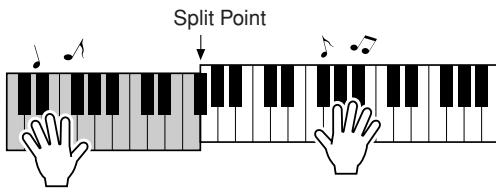
By playing keys to the left of the Split Point when the Auto Accompaniment is set to on, the Style starts sounding and is recorded with your performance.
When Auto Accompaniment is set to off, only your keyboard performance is recorded.
CAUTION
- If all User Songs (Song numbers 103–107) contain recorded data, Song 103 will automatically be selected. In this case, you will record over and erase any previous data in Song 103, so be careful that you won't be erasing any material you want to keep!
3 Stop recording.
Pressing the [START/STOP] button stops recording and writes the data to the User Song. (A “Writing!” message is shown.)
To playback the newly recorded performance, press the [START/STOP] button.
- In order to record with the Style, turn the Auto Accompaniment to on (see Step 4 on page 20), and then record according to the instructions.
ACMP ON (The "ACMP ON" lights.)
- In order to record only your performance, turn the Auto Accompaniment to off and record according to the normal steps.
ACMP ON (The "ACMP ON" is unlit.)
CAUTION
- Never attempt to turn the power off when a “Writing!” message is shown in the display. Doing so can damage the flash memory and result in a loss of data.
NOTE
- Use the Musicsoft Downloader to backup the User Songs to a computer (page 60).
Recording to a specified track
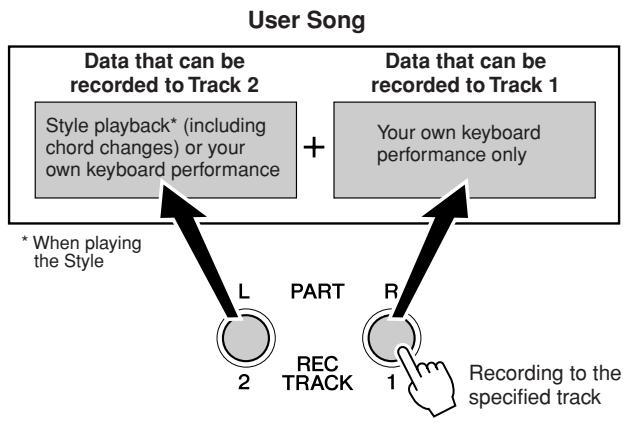
The User Songs are organized into two tracks: Track 1 and Track 2. You can specify the track you want to record to.
About track recording
If you start recording by specifying a track, the track will be overwritten (existing data in the track is deleted and replaced with the new recording).
flowchart
graph TD
    A["User Song"] --> B["Data that can be recorded to Track 2"]
    A --> C["Data that can be recorded to Track 1"]
    B --> D["Style playback* (including chord changes) or your own keyboard performance"]
    C --> E["Your own keyboard performance only"]
    D --> F["L: When playing the Style"]
    E --> G["R: Recording to the specified track"]
    F --> H["PART: Rec TRACK 2"]
    G --> I["RE: 1"]
Only your keyboard performance can be recorded to Track 1. Either a Style or your performance can be recorded to Track 2, resulting in a User Song like that depicted below.
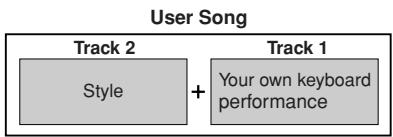
flowchart
graph LR
    A["Track 2"] --> B["Style"]
    C["Track 1"] --> D["Your own keyboard performance"]
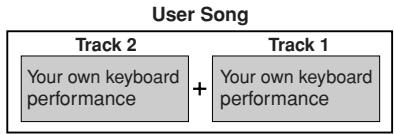
flowchart
graph LR
    A["User Song"] --> B["Track 2"]
    A --> C["Track 1"]
    B --> D["Your own keyboard performance"]
    C --> E["Your own keyboard performance"]
    D --> F["+"]
    E --> F
NOTE
- Record following the steps in the previous page, and your performance will be recorded to Track 1 and the Style (if you are playing one) will be recorded to Track 2.
NOTE
- You cannot record the Reverb Level, metronome click, or the Transpose and Tuning settings.
- The settings and buttons below cannot be changed, or if changed, the new settings cannot be recorded if entered during the recording process.
ACMP ON/OFF, split point, reverb type, chorus type, harmony type, [FUNCTION] button, [PORTABLE GRAND] button.
Specifying track recording
1 Turn ACMP (auto accompaniment) on or off, depending on what you want to record.
If you want to record Style playback, turn ACMP on. If you want to record only your own keyboard performance, turn ACMP off.
2 Specify the track you want to record.
Specify the track 2 when you want to record the Style.
When you want to record your own keyboard performance, you can specify either track.
● Recording to Track 1
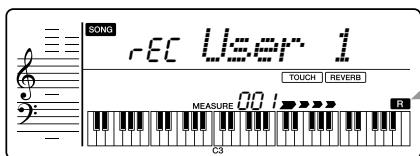
While holding the [REC] button, press the [REC TRACK 1] button.

- Keep in mind that both Tracks 1 and 2 will be overwritten with new data if you record without specifying the tracks.
- The both “L” and “R” flashes, this indicates that you have specified Track 1 when the Auto Accompaniment is on. If you want to record your own performance, press the [TRACK 2] button to stop the “L” flashing. If you want to record a Style, press the [REC] button to cancel the recording, and repeat the procedure from the beginning.
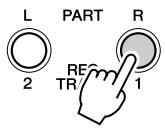
Press simultaneously
text_image
SONG
r-EC User 1
TOUCH REVERB
MEASURE 001 R
C3
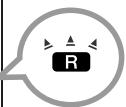
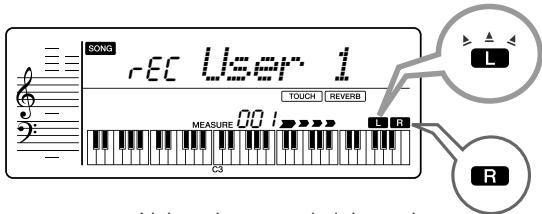
Flashes when track 1 is selected for recording.
● Recording to Track 2
While holding the [REC] button, press the [REC TRACK 2] button.
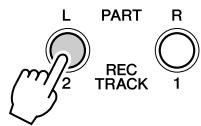
Press simultaneously
text_image
SONG
r-EC User 1
TOUCH REVERB
L
MEASURE 00:1 > > > > L N
C3
R
Flashes when track 2 is selected for recording.
Lights when recorded data exists.
Turns off when there is no recorded data, or when Mute is set to on (page 51) to turn off playback of the track.
-EC User 3
If you want to record Style playback to Track 2, press the [STYLE] button and select the desired Style.
4 Start recording
Perform steps 2 and 3 on pages 37–38.
By playing keys to the left of the Split Point when the Auto Accompaniment is set to on, the Style starts sounding and is recorded. Only your performance is recorded by playing the keyboard (any key is OK) when the Auto Accompaniment is set to off.

- If you want to record only the rhythm (percussion) part, press the [START/STOP] button to play just the rhythm, then add the section change by pressing the [INTO/ENDING/rit.] button or [MAIN/AUTO FILL] button.
- You can record a new track while listening to a previously recorded track (the track indication will appear). You can also mute recorded tracks (the track will disappear) while recording a new track by pressing the desired track button.
Deleting User Songs
Deleting an entire User Song.

- You cannot delete a specific track from a User Song.
1 Press the [SONG] button and select the User Song you want to delete by using the number buttons [0]–[9], [+], [-].
103 User 1
2 Press and hold the [REC] button for longer than a second.
The Song Delete display appears.
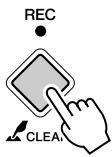
Hold for longer than a second.
yes CIRUser1
You can cancel the delete operation by pressing the [-/NO] button.
3 Press the [+/YES] button.
A confirmation message will appear on the display.
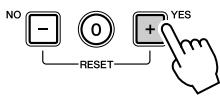
YES Sure?
You can cancel the delete operation by pressing the [-/NO] button.
4 Press the [+/YES] button to delete the Song.
“Writing!” message will appear while the track is being deleted.
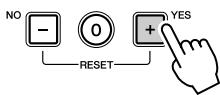
Writing!
Initialization
This function erases all backup data in the instrument's flash memory and restores the initial default settings. The following initialization procedures are provided.
Turn the power on by pressing the [STANDBY/ON] switch while holding the highest white key on the keyboard. The backed up data will be erased and the default values restored.
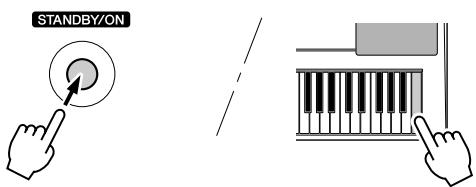
text_image
STANDBY/ON
Initialization does not delete the files transferred from the computer. If you want to delete the files, see “Deleting Files” below.
● Parameters that are saved in backup:
- User Songs
- Style number 107
- Touch Response on/off setting
• Passing status of Song and Step
- The following Function settings: Tuning, Split Point, Touch Sensitivity, Style Volume, Song Volume, Metronome Volume, Demo Cancel, Panel Sustain
Although the above parameters are always backed up, and are maintained even when the power is turned off, they will be completely erased by the initialization. You can save the settings as backup data to your computer, by using the Musicsoft Downloader (MSD) software. Refer to the section “Transferring a backup file from the PSR-E323/YPT-320 to a computer” on page 62.
Deleting Files
To clear Song data and Style data that has been transferred to the internal flash memory from a computer, simultaneously hold down the highest white key and the three highest black keys on the keyboard and turn the power on by pressing the [STANDBY/ON] switch.
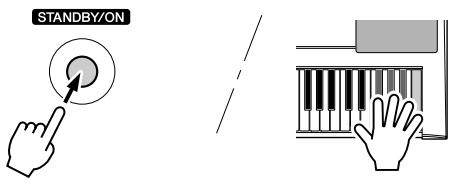
text_image
STANDBY/ON
/ /
CAUTION
- When you execute the Initialization, backup parameters will be cleared.
CAUTION
- When you delete the files, Song data and Style data you have purchased and downloaded will also be cleared. Make sure to save your important data by transferring to a computer using Musicsoft Downloader (page 62).
Adding Harmony
This feature adds harmony notes as well as tremolo or echo effects to the Main Voice.
1 Press the [HARMONY] button to turn harmony on.
When you don't want to add harmony notes, press the [HARMONY] button again to turn Harmony off.
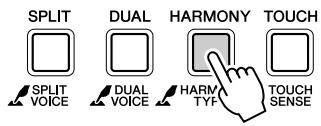
text_image
SPLIT
DUAL
HARMONY
TOUCH
SPLIT VOICE
DUAL VOICE
HARM TYF
TOUCH SENSE
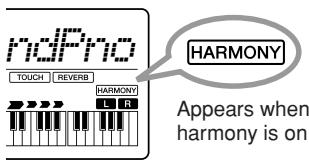
text_image
ndPro
TOUCH REVERB
HARMONY
L R
HARMONY
Appears when harmony is on.

- When you press the [HARMONY] button to turn this feature on, the appropriate Harmony type for the currently selected Main Voice is automatically selected.
2 Press and hold the [HARMONY] button for longer than a second.
“HarmType” appears in the display for a few seconds, followed by the Harmony Type.
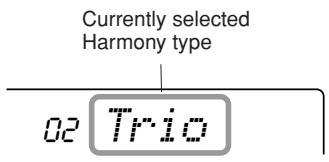
text_image
Currently selected
Harmony type
02 Trio

- You can also access the Harmony Type setting display by pressing the [FUNCTION] button several times.
- Harmony will be turned off if the Chord Dictionary function is used.
3 Select a desired Harmony Type by using the number buttons [0]–[9], [+], [-].
Refer to the Harmony Type list on page 73. Try playing the keyboard with the harmony function. The effect and operation of each Harmony Type is different—refer to the section “How to sound each Harmony Type” below as well as the Harmony Type List for details.
● How to sound each Harmony Type
- Harmony type 01–05
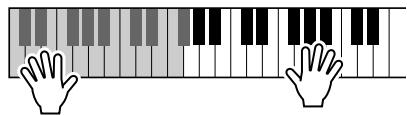
text_image
Illustration of a piano keyboard with two hands typing on the keys, indicating finger placement or note-taking.
Press the right-hand keys while playing chords in the auto accompaniment range of the keyboard when the Auto Accompaniment is on (page 20).
• Harmony type 06–12 (Trill)
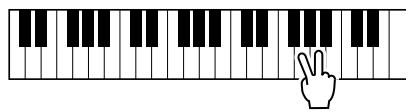
text_image
Illustration of a hand pressing a finger on a piano keyboard with keys and a peace sign
Hold down two keys.
• Harmony type 13–19 (Tremolo)
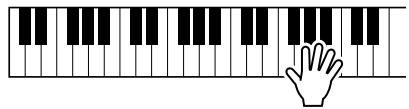
text_image
Illustration of a hand pressing a key on a piano keyboard, symbolizing the right-hand finger.
Keep holding down the keys.
• Harmony type 20–26 (Echo)
text_image
Piano keyboard diagram with a hand pointing to the key finger on the fretboard
Keep holding down the keys.
You can adjust the Harmony Volume in the Function Settings (page 56).

- The harmony notes can be added only to the Main Voice, not to Dual or Split Voices.
- The keys left of the Split Point of the keyboard produce no harmony notes when the auto accompaniment is on (ACMP ON is lit).
Adding Reverb
Reverb adds the ambience of a room or concert hall to the sound that you play on the keyboard.
To add Reverb
Press the [REVERB] button to turn Reverb on. Reverb is normally on. You can check how the selected Reverb Type sounds by playing the keyboard. To turn Reverb off, press the [REVERB] button again.
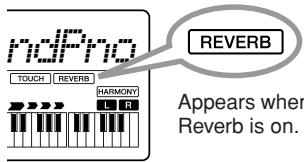
text_image
ndPro
TOUCH REVERB
REVERB
HARMONY
L R
Appears when
Reverb is on.
Select a Reverb Type
The ideal type is automatically selected whenever you select a Song or Style, but you can select any of the available Reverb Types.
1 Press and hold the [REVERB] button for longer than a second. “REVERB” appears in the display for a few seconds, followed by the Reverb Type.
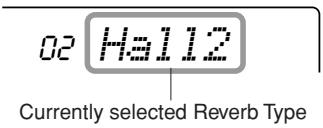
text_image
02 Ha112
Currently selected Reverb Type
2 Select the desired Reverb Type by using the number buttons [0]–[9], [+], [-].
Refer to the Reverb Type list on page 73 for details.
You can adjust the Reverb depth in the Function Settings (page 56).

- You can also access the Reverb Type setting display by pressing the [FUNCTION] button several times.
Adding Chorus
This effect makes the Voice sound richer, warmer and more spacious. The best-suited Chorus type is automatically selected whenever you select a Voice; however, you can select any of the available types.
1 Press the [FUNCTION] button a number of times until the “Chorus” appears.
“Chorus” appears in the display for a few seconds, followed by the Chorus Type.
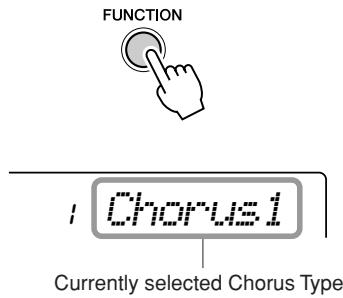
text_image
FUNCTION
Chorus1
Currently selected Chorus Type
2 Select a desired Chorus Type by using the number buttons [0]–[9], [+], [-].
Refer to the Chorus Type list on page 73 for details.
You can adjust the Chorus depth independently for the Main, Dual and Split Voices in the Function Settings (page 56).
Adding Panel Sustain
This function adds a fixed sustain to the keyboard Voices.
1 Press the [FUNCTION] button a number of times until the “Sustain” item appears.
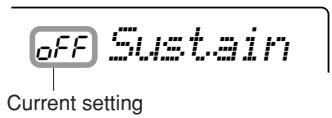
text_image
OFF Sustain
Current setting
2 Press the [+] button to turn the Panel Sustain on.
Panel Sustain will be added to the notes you play on the keyboard when the Panel Sustain is on. To turn it off, press the [-] button.
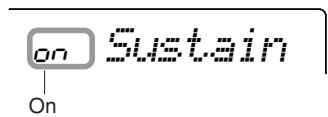
text_image
on Sustain
On

- See the section "Connecting a footswitch" on page 9 for information on applying sustain with the optional footswitch.
Touch Response Sensitivity
Touch Response
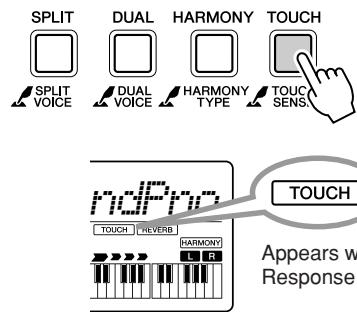
text_image
SPLIT
DUAL
HARMONY
TOUCH
SPLIT VOICE
DUAL VOICE
HARMONY TYPE
TOUCH SENS.
ndPro
TOUCH
REVERB
HARMONY
TOUCH
TOUCH
Appears w Response
Press the [TOUCH] button to turn Touch Response on. When Touch Response is on, you can control the volume of notes according to how hard you play the keys. Touch Response is normally on. Press the [TOUCH] button again to turn the Touch Response off. When Touch Response is off, the same volume will be produced no matter how hard you play the keys.

- The Touch Response function cannot be used for some Voices (such as organ), even if the Touch Response icon appears in the display.
Setting the Touch Sensitivity
When Touch Response is on, you can adjust the sensitivity of the keyboard in response to keyboard dynamics in three steps. Higher values produce greater (easier) volume variation in response to keyboard dynamics—in other words, greater sensitivity.
1 Press and hold the [TOUCH] button for longer than a second.
“TouchSns” appears in the display for a few seconds, followed by the current Touch Sensitivity value.
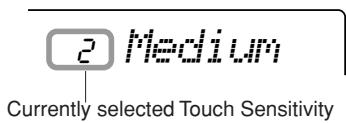
text_image
2 Medium
Currently selected Touch Sensitivity
2 Select a Touch Sensitivity setting between 1 and 3 by using the number buttons [0]–[9], [+], [-].
Playing Two Voices Simultaneously—Dual
You can select a second Voice which will play in addition to the Main Voice selected on the previous page. This second Voice is known as the Dual Voice.
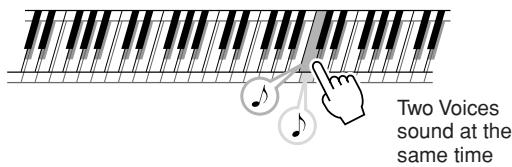
text_image
Two Voices
sound at the
same time
Play the Dual Voice
Press the [DUAL] button to turn the Dual function on.
When Dual is on, you can play a Dual Voice in a layer with the Main Voice.
To turn the Dual Voice off and play only the Main Voice, press the [DUAL] button again.
text_image
SPLIT
DUAL
HARMONY
TOUCH
SPLIT VOICE
DUAL VOICE
HARMONY TYPE
TOUCH SENSE

text_image
ta
TOUCH | REVERB
DUAL
DUAL
Appears when Dual is on.
Selecting a Dual Voice
The best-suited Dual Voice is automatically selected whenever you turn Dual on, but you can select any of the available Dual Voices.
1 Press and hold the [DUAL] button for longer than a second.
“D. Voice” appears in the display for a few seconds, then the Dual Voice will appear.
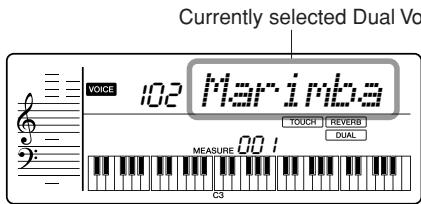
text_image
Currently selected Dual Vo
VOICE 102 Marimba
TOUCH REVERB
DUAL
MEASURE 001
C3

- You can also access the Dual Voice setting display by pressing the [FUNCTION] button several times, then selecting Dual Voice.
2 Select a Dual Voice.
Select the desired Dual Voice by using the number buttons [0]–[9], [+], [-].
Refer to the Voice List on page 64.
Playing Different Voices with the Left and Right Hands—Split
In the Split mode you can play different Voices to the left and right of the keyboard “Split Point.” The main and Dual Voices can be played to the right of the Split Point, while the Voice played to the left of the Split Point is known as the “Split Voice”
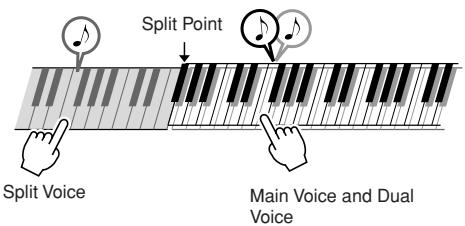
text_image
Split Point
Split Voice
Main Voice and Dual Voice
Play the Split Voice
Press the [SPLIT] button to turn the Split function on.
When Split is on you can play a Split Voice to the left of the Split Point.
When you don't want to play a Split Voice, press the [SPLIT] button to turn Split off.
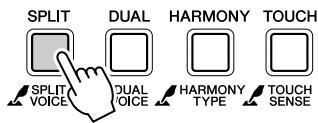
text_image
SPLIT
DUAL
HARMONY
TOUCH
SPLIT VOICE
DUAL VOICE
HARMONY TYPE
TOUCH SENSE
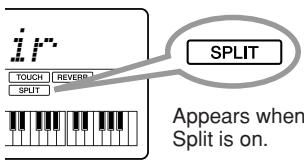
text_image
ir
TOUCH REVERD
SPLIT
SPLIT
Appears when
Split is on.

- The Split Point setting can be changed as required (page 47).
Select a Split Voice
You can select a different Split Voice by following the procedure outlined below.
1 Press and hold the [SPLIT] button for longer than a second.
“S. Voice” appears in the display for a few seconds, then the Split Voice will appear.
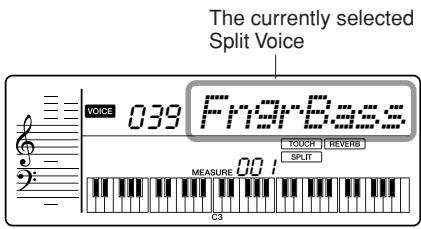
text_image
The currently selected
Split Voice
VOICE 039 Frag-Bass
TOUCH REVERB
SPLIT
MEASURE 001
C3

- You can also access the Split Voice setting display by pressing the [FUNCTION] button several times, then selecting the Split Voice.
2 Select a Split Voice
Select the desired Split Voice by using the number buttons [0]–[9], [+], [-].
Refer to the Voice List on page 64.
Setting the Split Point
The Split Point setting can be changed as desired.
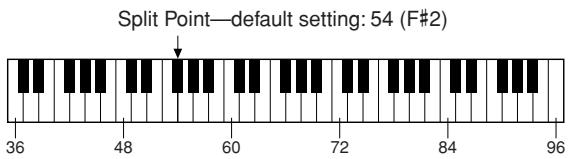
other
| Split Point | Frequency |
| ----------- | --------- |
| 54 | 54 |
The initial default Split Point is key number 54 (the F#2 key), but you can change it to another key. When you change the Split Point, the auto accompaniment range also changes.
1 Press the [FUNCTION] button a number of times until "SplitPnt" appears.
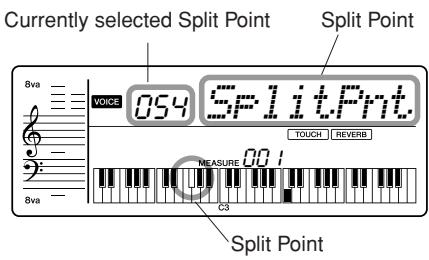
text_image
Currently selected Split Point
Split Point
054 SplitPoint
TOUCH REVERB
MEASURE 001
C3
Split Point
2 Set the Split Point by using the number buttons [0]–[9], [+], [-].

- Press the [+] and [-] buttons simultaneously to instantly reset the value to its default setting (54 or F#2).
Adjusting the Voice volume
The Voice volume can be individually adjusted for the Main, Dual, and Split Voices.
1 Press the [FUNCTION] button a number of times until the required Voice volume item appears.
Select “M.Volume” for Main Voice volume, “D.Volume” for Dual Voice volume, or “S.Volume” for Split Voice volume.
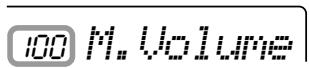
2 Set the Voice volume by using the number buttons [0]–[9], [+], [-].

- Press the [+] and [-] buttons simultaneously to instantly reset the value to its default setting. The default setting varies depending on the Voice.
Setting the Metronome Beats per Measure, and the Length of Each Beat
In this example we'll set up a 3/4 time signature.
1 Press and hold the [METRONOME] button for longer than a second to select the number of beats per measure function “TimeSigN”.
Hold for longer than a second.
Number of beats per measure.
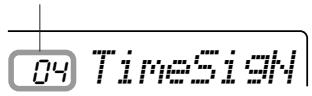
2 Use the number buttons [0]–[9], [+], [-] to select the number of beats per measure.
A chime will sound on the first beat of each measure while the other beats will click. All beats will simply click with no chime at the beginning of each measure if you set this parameter to “00”.
The available range is from 0 through 60. Select 3 for this example.

- The metronome time signature will synchronize to a style or song that is playing, so these parameters cannot be changed while a style or song is playing.
3 Press the [FUNCTION] button a number of times to select the beat length function "TimeSigD".
The currently selected beat length will be displayed.
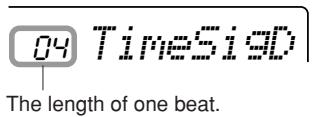
text_image
04 TimeSigD
The length of one beat.
4 Use the [+] , [-] to select the beat length. Select the required length for each beat: 2, 4, 8, or 16 (half note, quarter note, eighth note, or 16^th note). Select 4 for this example.
Setting the Metronome Volume
1 Press the [FUNCTION] button a number of times until “MetroVol” appears.
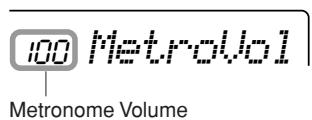
text_image
100 MetroVol
Metronome Volume
2 Set the metronome volume by using the number buttons [0]–[9], [+], [-].
Octave
The pitch of a note can be shifted upward or downward in steps of an octave for the Main, Dual, and Split Voices.
1 Press the [FUNCTION] button a number of times until the required Voice octave item appears.
Select “M. Octave” for Main Voice octave, “D. Octave” for Dual Voice octave, “S. Octave” for Split Voice octave.
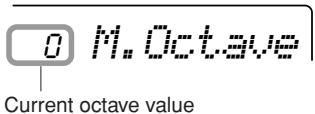
text_image
0 M.Oct.ave
Current octave value
2 Set the octave by using the number buttons [0]–[9], [+], [-].

- Press the [+] and [-] buttons simultaneously to instantly reset the value to its default setting (0).
Transpose
The instrument's Transpose function makes it possible to shift the pitch of the entire keyboard up or down in semitone intervals to facilitate playing in difficult key signatures, and to let you easily match the pitch of the keyboard to the range of a singer or other instruments. For example, if you set the transposition amount to “5,” playing key C produces pitch F. In this way, you can play a song as though it were in C major, and the instrument will transpose it to the key of F.
1 Press the [FUNCTION] button a number of times until the “Transpos” appears.
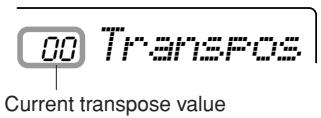
text_image
00 TransPos
Current transpose value
2 Use the number buttons [0]–[9], [+], [-] to set the Transpose value between -12 and +12 as required.

- The pitch of the Drum Kits Voices (Voice numbers 109–121) cannot be changed.
- Press the [+] and [-] buttons simultaneously to instantly reset the value to its default setting (00).
Tuning
You can fine tune the pitch of the entire instrument. The overall tuning of the instrument can be shifted up or down by a maximum of 100 cents in 1-cent increments (100 cents = 1 semitone).
1 Press the [FUNCTION] button a number of times until “Tuning” appears.
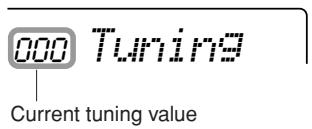
text_image
000 Tuning
Current tuning value
2 Use the number buttons [0]–[9], [+] and [-] to set the Tuning value between -100 and +100 as required.

- The pitch of the Drum Kits Voices (Voice numbers 109–121) cannot be changed.
- Press the [+] and [-] buttons simultaneously to instantly reset the value to its default setting (000).
One Touch Setting
Sometimes selecting the ideal Voice to play with a Song or Style can be confusing. The One Touch Setting feature automatically selects the most suitable Voice for you when you select a Style or Song. Simply select Voice number “000” to activate this feature.
1 Press the [VOICE] button, and then select Voice number "000" by using the number buttons [0]–[9], [+], [-].
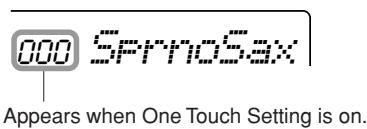
text_image
000 SPRNOSox
Appears when One Touch Setting is on.
This turns the One Touch Setting feature on. One Touch Setting will be turned off if you select any other Voice number.
Mute
The Song is made up by several tracks.
You can mute Track 1 or Track 2 during Song playback. You can turn the left- and right-hand parts on or off as desired, allowing you to listen to the corresponding part (the part that is turned on), or practice the corresponding part (the part that is turned off) on the keyboard.
- Track 1 can be muted by pressing the [REC TRACK 1] button during Song playback.
- Track 2 or style track can be muted by pressing the [REC TRACK 2] button during Song play-back.
You can cancel the mute function by pressing the corresponding track buttons, [TRACK 1] or [TRACK 2] again during Song playback, or by selecting any other Song.
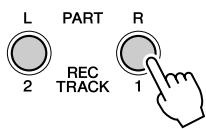
Pressing one of the Track buttons [TRACK 1] or [TRACK 2] will mute the corresponding track during Song playback.
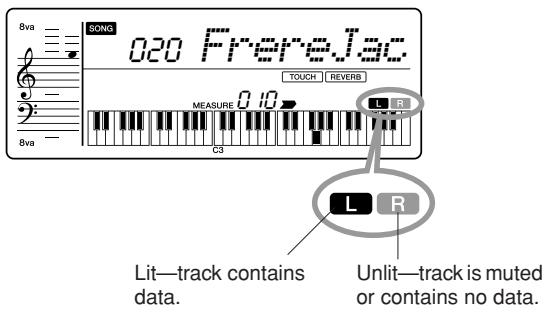
text_image
8va
SONG
020 FrereJac
TOUCH REVERB
MEASURE 0.10
C3
L R
Lit—track contains
data.
Unlit—track is muted
or contains no data.
A-B Repeat
This function lets you specify a section of a Song—“A” is the start point and “B” is the end point—for repeat playback.
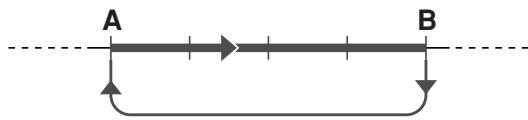
flowchart
graph LR
    A["A"] --> B["B"]
    B --> A
Repeat playback of this section
1 Play the Song and press the [A-B REPEAT] button at the beginning of the section you want to repeat (the "A" point), then press the [A-B REPEAT] button a second time at the end of the section you want to repeat (the "B" point). The specified A-B section of the Song will now play repeatedly.
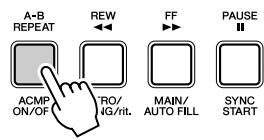
text_image
A-B
REPEAT
REW
FF
FAUSE
ACMP
ON/OF
TRO/
IG/rit.
MAIN/
AUTO FILL
SYNC
START
A-b REPEAT
NOTE
- The repeat start and end points can be specified in one-measure increments.
- You can also set the A-B Repeat function when the Song is stopped. Simply use the [REW] and [FF] buttons to select the desired measures, pressing the [A-B REPEAT] button for each point, then start playback.
- If you want to set the start point “A” at the very beginning of the Song press the [A-B REPEAT] button before starting playback of the Song.
You can stop repeat playback at any time by pressing the [A-B REPEAT] button.
An “oFF REPEAT” message appears on the display. The A-B REPEAT mode will be canceled and normal playback of the Song will continue.
NOTE
- The A-B Repeat function will be canceled when you select another Song or Style mode.
Song Volume
This procedure allows you to adjust the balance between Song playback and the notes you play on the keyboard by setting the volume of the playback sound.
1 Press the [SONG] button.
2 Press the [FUNCTION] button a number of times until “SongVol” appears.
Current Song Volume
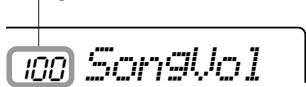
3 Set the Song Volume by pressing the number buttons [0]–[9], [+], [-].

- Press the [+] and [-] buttons simultaneously to instantly reset the value to its default setting (100).
Tap Start
Set the Tempo by using the number buttons [0]–[9], [+], [-].
After selecting a song, you can set the Tempo by simply tapping the [TEMPO/TAP] button at the required tempo—four times for time signatures in 4, and three times for time signatures in 3.
You can change the Tempo during Song play-back by pressing the [TEMPO/TAP] button just twice.

Changing the Melody Voice
You can change a Song's melody Voice to any other Voice you prefer.

- You cannot change the melody Voice of a User Song.
1 Select the Song and play it.
Refer to the section “Playing Songs” on page 16.
2 Select a desired Voice by using the number buttons [0]–[9], [+], [-].
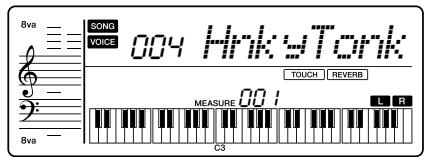
text_image
8va
SONG
VOICE 004 Hnky-Tonk
TOUCH REVERB
8va
MEASURE 001 L R
C3
The selected Voice sounds when you play the keyboard.
If a Song has played through and stopped during this procedure, press the [START/STOP] button to start playback again.
3 Press and hold the [VOICE] button for longer than a second.
“SONG MELODY VOICE” appears in the display for a few seconds, indicating that the Voice selected in Step 2 has replaced the Song’s original melody Voice.
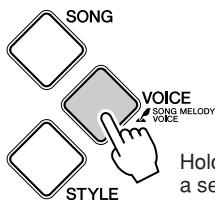
text_image
SONG
VOICE
SONG MEODY
VOICE
STYLE
Hold
a se
Hold for longer than a second.
Style (Auto Accompaniment) Functions
Starting Style playback
The following two methods can be used to start Style playback. In either case you will need to press the [ACMP ON/OFF] button to turn auto accompaniment on before actually starting Style playback.
■ Synchro Start (Chord Start)
Press the [SYNC START] button and the beat arrows will begin flashing, indicating that the Sync Start “standby” mode has been engaged. The bass and chords will begin playing as soon as you play a chord in the accompaniment range of the keyboard.
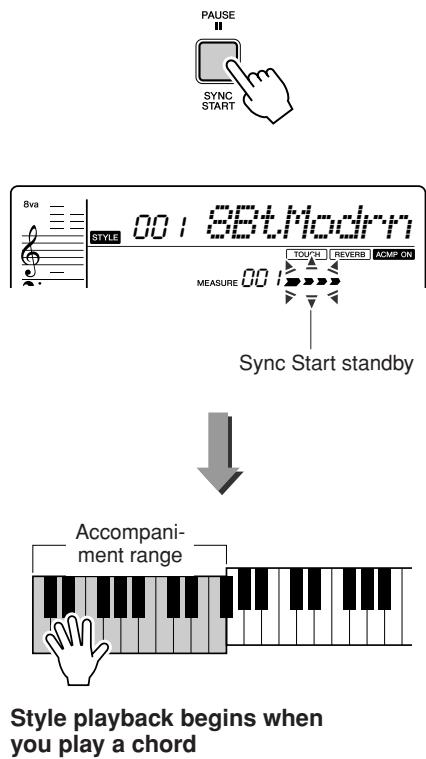
text_image
PAUSE
SYNC START
8va
STYLE 00: 8Bt.Modr
MEASURE 00:
TOUCH REVERB COMPON
Sync Start standby
Accompani-
ment range
Style playback begins when
you play a chord
The Sync Start “standby” mode will be cancelled when Style playback starts.

- If you press the [SYNC START] button during Style playback, playback will stop immediately and the Sync Start standby mode will be engaged (beat arrows will flash).
Tap Start
You can supply a count-in at any tempo you like to start playback. Simply tap the [TEMPO/TAP] button at any tempo—4 times for time signatures in 4, and 3 times for time signatures in 3—and the selected Style rhythm will begin playing at the tapped tempo.
The bass and chords will begin playing as soon as you play a chord in the accompaniment range of the keyboard.
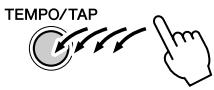
Adjusting the Style Volume
This procedure allows you to adjust the balance between Style playback and the notes you play on the keyboard by setting the volume of the playback sound.
1 Press the [STYLE] button.
2 Press the [FUNCTION] button a number of times until the “StyleVol” appears.
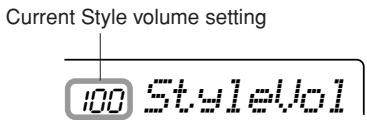
text_image
Current Style volume setting
100 StyleVol
3 Set the Style volume by using the number buttons [0]–[9], [+], [-].

- Press the [+] and [-] buttons simultaneously to instantly reset the value to its default setting (100).
Looking up Chords Using the Chord Dictionary
The Dictionary function is essentially a built-in “chord dictionary” that shows you the individual notes of chords. It is ideal when you know the name of a certain chord and want to quickly learn how to play it.
1 Press and hold the [1 LISTENING 2 TIMING 3 WAITING] button for longer than a second.
“Dict.” will appear in the display.
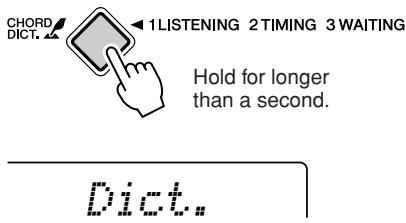
text_image
CHORD
DICT.
1LISTENING 2TIMING 3WAITING
Hold for longer
than a second.
Dict.
2 As an example, we'll learn how to play a GM7 (G major seventh) chord. Press the “G” key in the section of the keyboard labeled “ROOT▶.” (The note doesn't sound.) The root note you set is shown in the display.
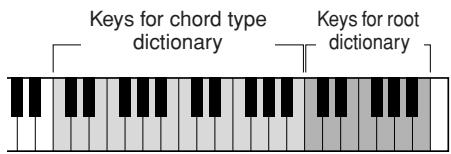
text_image
Keys for chord type
dictionary
Keys for root
dictionary
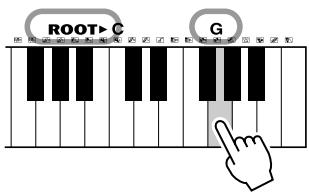
text_image
ROOT→C
G
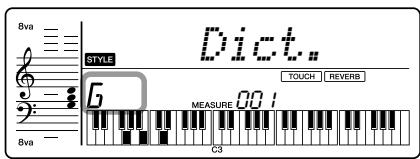
text_image
8va
STYLE
Dict.
TOUCH REVERB
6
MEASURE 001
C3
3 Press the “M7” (major seventh) key in the section of the keyboard labeled “CHORD TYPE▶.” (The note doesn’t sound.)
The notes you should play for the specified chord (root note and chord type) are shown in the display, both as notation and in the keyboard diagram.
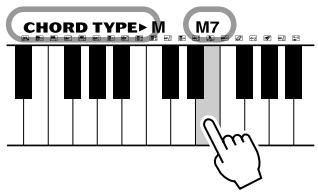
text_image
CHORD TYPE M
M7
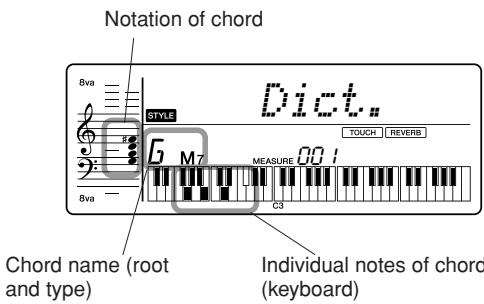
text_image
Notation of chord
8va
STYLE
Dict.
TOUCH REVERB
6 M7
MEASURE 001
C3
8va
Chord name (root
and type)
Individual notes of chord
(keyboard)
To call up possible inversions of the chord, press the [+]/[-] buttons.
NOTE
- Major chords are usually indicated by the root name only. For example, the indication “C” in a score refers to a “C Major” chord. To look up the fingering for a major chord press the root key and then the M chord type key.
- These chords are not shown in the Chord Dictionary function: 6(9), M7(9), M7(#11), b5, M7b5, M7aug, m7(11), mM7(9), mM7b5, 7b5, sus2
4 Try playing a chord in the auto accompaniment section of the keyboard, checking the indications in the display.
When you've played the chord properly, a bell sound signals your success and the chord name in the display flashes.
Registering Style Files
This instrument features 106 internal styles, but other styles, such as those which can be obtained from the internet (only styles with the “.sty” suffix), can be registered into style number 107 and used in the same way as the internal styles.
In order to use the style file register function, the file must already have been transferred from the computer to the instrument. The procedure for transferring files from a computer to the instrument is described on page 60 (“Transferring data between the PSR-E323/YPT-320 and a computer”).
The procedure described below registers a style file that has already been transferred from a computer to the instrument into style number 107.
1 Press the [FUNCTION] button as many time as necessary to select the style file load function “StyleReg”.
2.1.1.1
After about 2 seconds the name of a registerable style file will appear in the display. If multiple loadable style files have been transferred to the instrument, you can use the [+] and [-] buttons to select the other files in sequence.
2 Execute the register operation.
With the name of the style file you want to register shown in the display, press the number [0] button.
3 A confirmation message for the register operation will appear. Press the [+/YES] button to actually register the file.
The [FUNCTION] button gives you access to a variety of operations related to adjusting or enhancing the sound and making settings for connection to external devices.
Select the item and change the value
There are 34 different items that can be set.
Each time the [FUNCTION] button is pressed 34 function items are displayed in sequence. The description and display sample is provided on the Function Setting List on page 56–57.
FUNCTION
![YAMAHA PSR-E323 - Press the [FUNCTION] button a number of times until desired item appears. - 1](/content/2025/01/115058/images/b8d0fb79bff312fdce7c54d837b4a5cad68f8aac0c2ef96bc03bfc09bcbb113d.jpg)
![YAMAHA PSR-E323 - Press the [FUNCTION] button a number of times until desired item appears. - 2](/content/2025/01/115058/images/daae29a677a1f2dadc577af4f64ae81138c3e7a301be2e8d439b366f7a9a4fd1.jpg)
text_image
100 StyleVol
Value Function item
![YAMAHA PSR-E323 - Set the value by using the number buttons [0]–[9], [+], [-]. - 1](/content/2025/01/115058/images/c0c92d532ba2001603390fc0a3980be87532b2384e6e0f73983c99db61203d05.jpg)
text_image
1 2 3
4 5 6
7 8 9
- 0 +
NO
RESET
For on/off settings or the PC Mode setting, use [+]/[-] buttons.
![YAMAHA PSR-E323 - Set the value by using the number buttons [0]–[9], [+], [-]. - 2](/content/2025/01/115058/images/9bc1c2474c327de6f11f683c189ae721e1398e2d3fa1d8564d576ffbf6e51b4b.jpg)
- Press the [+] and [-] buttons simultaneously to instantly reset the numeric parameter to its default setting.
● Function Setting List
| Item | Display | Range/settings | Description |
| Style Volume | StyleVol | 000–127 | Determines the volume of the Style. |
| Song Volume | SongVol | 000–127 | Determines the volume of the Song. |
| Transpose | TransPos | -12–00–12 | Determines the pitch of the instrument by semitone increments. |
| Tuning | Tuning | -100–000–100 | Sets the pitch of the instrument's sound in 1-cent increments. |
| Split Point | SplitPnt | 000–127(C-2–G8) | Determines the highest key for the Split Voice and sets the Split “point”—in other words, the key that separates the Split (lower) and Main (upper) Voices. The Split Point setting and Accompaniment Split Point setting are automatically set to the same value. |
| Touch Sensitivity | TouchSns | 1 (Soft)2 (Medium)3 (Hard) | When Touch Response is on, this determines the sensitivity of the feature. |
| Style Register | StyleReg | 001-nnn | Select and register a style file from flash files that are loaded from computer. |
| Main Voice Volume | M.Volume | 000–127 | Determines the volume of the Main Voice. |
| Main Voice Octave | M.Octave | -2–0–2 | Determines the octave range for the Main Voice. |
| Main Voice Chorus Send Level | M.Chorus | 000–127 | Determines how much of the Main Voice's signal is sent to the Chorus effect. |
| Dual Voice | D. Voice | 001-482 | Selects the Dual Voice. |
| Dual Voice Volume | D. Volume | 000-127 | Determines the volume of the Dual Voice. |
| Dual Voice Octave | D. Octave | -2-0-2 | Determines the octave range for the Dual Voice. |
| Dual Voice Chorus Send Level | D. Chorus | 000-127 | Determines how much of the Dual Voice's signal is sent to the Chorus effect. |
| Split Voice | S. Voice | 001-482 | Selects the Split Voice. |
| Split Voice Volume | S. Volume | 000-127 | Determines the volume of the Split Voice. |
| Split Voice Octave | S. Octave | -2-0-2 | Determines the octave range for the Split Voice. |
| Split Voice Chorus Send Level | S. Chorus | 000-127 | Determines how much of the Split Voice's signal is sent to the Chorus effect. |
| Reverb Type | Reverb | 01-10 | Determines the Reverb type, including off (10). Refer to the Reverb Type list on page 73. |
| Reverb Level | RevLevel | 000-127 | Determines how much of the Voice's signal is sent to the Reverb effect. |
| Chorus Type | Chorus | 1-5 | Determines the Chorus Type, including off (05). Refer to the Chorus Type list on page 73. |
| Panel Sustain | Sustain | ON/OFF | Determines whether or not Panel Sustain is always applied to the Main/Dual/Split Voices. Panel Sustain is applied continuously when ON, or not applied when OFF. |
| Harmony Type | HarmType | 01-26 | Determines the Harmony Type. Refer to the Harmony Type list on page 73. |
| Harmony Volume | HarmVol | 000-127 | Determines the volume of the Harmony effect when Harmony type 1-5 is selected. |
| PC Mode | PC mode | OFF/PC1/PC2 | Optimizes the MIDI settings when you connect to a computer (page 59). |
| Local On/Off | Local | ON/OFF | Determines whether the instrument's keyboard controls the internal tone generator (ON) or not (OFF). |
| External Clock | ExtClock | ON/OFF | Determines whether the instrument synchronizes to the internal clock (OFF) or an external clock (ON). |
| Initial Setup Send | InitSend | YES/NO | Lets you send the data of the panel settings to a computer. Use the [+] button to transmit the data. |
| Time Signature Numerator | TimeSign | 00-60 | Determines the time signature of the Metronome. |
| Time Signature Denominator | TimeSigD | Half note, Quarter note, Eighth note, Sixteenth note | Sets the length of each metronome beat. |
| Metronome Volume | MetroVol | 000-127 | Determines the volume of the Metronome. |
| Lesson Track (R) | R-Part | 01-16 | Determines the guide track number for your right hand lesson. The setting is only effective for Songs in SMF format 0 transferred from a computer. Refer to the section "Using Transferred Songs for Lessons" on page 62. |
| Lesson Track (L) | L-Part | 01-16 | Determines the guide track number for your left hand lesson. The setting is only effective for Songs in SMF format 0 transferred from a computer. Refer to the section "Using Transferred Songs for Lessons" on page 62 |
| Demo Cancel | D-Cancel | ON/OFF | Determines whether Demo cancel is enabled or not. When this is set to ON, the Demo Song will not play, even if the [DEMO] button is pressed. |
The instrument features a MIDI terminals that can be connected to other MIDI instruments and devices for expanded musical functionality.
What is MIDI?
MIDI (Musical Instrument Digital Interface) is a world-standard interface for communication between electronic musical instruments and music devices. When MIDI-equipped instruments are connected via a MIDI cable, it becomes possible to transfer performance and setting data between them for significantly enhanced performance and production potential.


CAUTION
- Connect the PSR-E323/YPT-320 to external equipment only after turning off power for all devices. Then, turn on the power, first to the PSR-E323/YPT-320, then to the connected external equipment. Reverse this order when you turn the power off.

- MIDI cables (sold separately) must be used for connecting to MIDI devices. They can be bought at music stores, etc.
By connecting the PSR-E323/YPT-320 to other MIDI devices or a computer, the performance data of the instrument can be used on those other MIDI devices or computer, and also the performance data from other MIDI devices and computer can be received and sounded with the PSR-E323/YPT-320.
A Yamaha UX16 or similar USB-MIDI interface (sold separately) will be necessary for MIDI connection between the PSR-E323/YPT-320 and a USB-equipped computer.
Make sure to purchase a Yamaha UX16 or a quality USB-MIDI interface at a musical instrument store, computer store or electrical appliance store.
If you use the UX16 interface, install the driver supplied with the interface on your computer.

- Preset Song data cannot be transmitted from the instrument by the Song Out function.
- When the instrument is connected with another MIDI device, it transmits/receives performance data.

flowchart
graph LR
    A["PSR-E323/YPT-320"] -->|MIDI OUT| B["Data Bus"]
    B -->|MIDI IN| C["MIDI Device"]
    C -->|MIDI OUT| D["Data Bus"]
    D -->|MIDI IN| E["Data Bus"]
    E -->|MIDI OUT| F["Data Bus"]
- When the instrument is connected with a computer, it transmits/receives performance data.
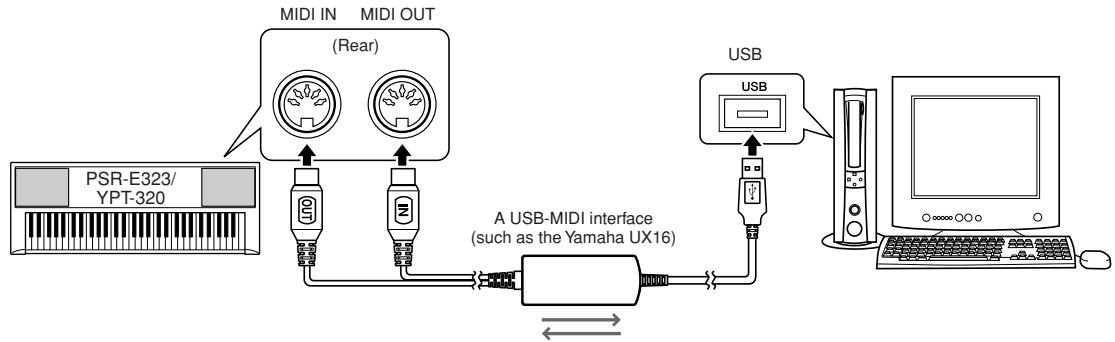
flowchart
graph TD
    A["PSR-E323/YPT-320"] --> B["MIDI IN (Rear)"]
    A --> C["MIDI OUT (Rear)"]
    B --> D["A USB-MIDI interface (such as the Yamaha UX16)"]
    C --> D
    D --> E["USB"]
    E --> F["Computer"]
    style A fill:#f9f,stroke:#333
    style E fill:#ccf,stroke:#333
■ MIDI settings
These settings should be made when transmitting/receiving performance data to a connected MIDI device or computer.
Local Settings
Local Control determines whether or not notes played on the instrument are sounded by its internal tone generator system; the internal tone generator is active when local control is on, and inactive when local control is off.
• On
This is the normal setting in which notes played on the instrument's keyboard are sounded by the internal tone generator system. Data received via the instrument's MIDI terminal will also be played by the internal tone generator.
- Off
With this setting the instrument itself produces no sound (keyboard performance, Harmony, or Style playback), but the performance data is transmitted via the MIDI terminal. Data received via the instrument's MIDI terminal will also be played by the internal tone generator.
You can set the Local Control in the Function Settings (page 56).

- If you can't get any sound out of the instrument, Local Control may be the most likely cause. Playing the keyboard results in no sound when Local is set to OFF.
External Clock Settings
These settings determine whether the instrument is synchronized to its own internal clock (OFF), or to a clock signal from an external device (ON).
• On
The instrument's time based functions will be synchronized to the clock from an external device connected to the MIDI terminal.
- Off
The instrument uses its own internal clock (default).
You can set the External Clock in the Function Settings (page 56).

- If External Clock is ON and no clock signal is being received from an external device, the Song, Style, and metronome functions will not start.
PC Mode
The PC settings instantly reconfigure all important MIDI settings (as shown below). The selections are PC1, PC2 and OFF.

- Song Out, Style Out and Keyboard Out can only be changed by the PC setting. They cannot be set independently.
- User Songs can be used with Song Out.
● The chart of PC Settings
| PC1 | PC2* | OFF |
| LOCAL | Off | Off | On |
| EXTERNAL CLOCK | On | Off | Off |
| SONG OUT** | Off | Off | On |
| STYLE OUT*** | Off | Off | On |
| KEYBOARD OUT**** | Off | On | On |
Digital Music Notebook is a major new multimedia platform for music tuition and performance. Visit the website below for more information on the latest version of Digital Music Notebook and how to install it.
* Set the PC mode to PC2 when using Digital Music Notebook.
www.digitalmusicnotebook.com
** Determines whether Song data is transmitted (ON) via MIDI or not (OFF) during Song playback.
*** Determines whether Style data is transmitted (ON) via MIDI or not (OFF) during Style playback.
**** Determines whether keyboard performance data of the instrument is transmitted (ON) or not (OFF).
1 Press and hold the [DEMO] button for longer than a second to call up the PC Mode.
DEMO

Hold for longer than a second.
off PC node
2 Select PC1, PC2, or OFF by using the [+] , [-] buttons.
Remote Control of MIDI Devices
You can also use this instrument as a remote control device for the Digital Music Notebook application on your computer (via the MIDI connection) — controlling playback, stop and transport functions from the panel.
● Remote control keys
PSR-E323/YPT-320: To use the remote control functions, simultaneously hold down the lowest two keys on the keyboard (C1 and C#1) and press the appropriate key (shown below).
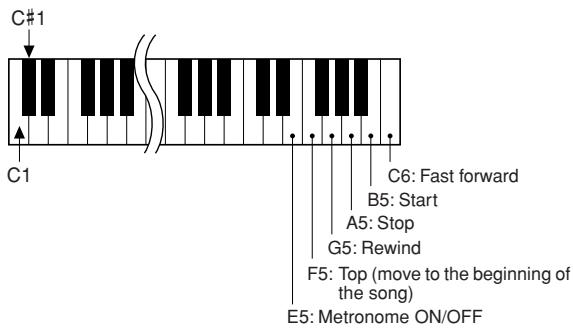
text_image
C#1
C1
C6: Fast forward
B5: Start
A5: Stop
G5: Rewind
F5: Top (move to the beginning of
the song)
E5: Metronome ON/OFF

- Remote control of MIDI devices will function independently of the PC2 mode.
PSR-E323/YPT-320 Panel Setting Transmission (Initial Send)
Sends the PSR-E323/YPT-320 panel settings to an external MIDI device.
When recording a PSR-E323/YPT-320 performance to an external sequencer or similar equipment, you can use this function to send the current PSR-E323/YPT-320 panel settings so that when the sequence is played back the original panel settings are automatically restored. You can set Initial Send in the Function settings (page 56).
Transferring data between the PSR-E323/YPT-320 and a computer
The PSR-E323/YPT-320 includes 102 preset Songs and 106 Styles, but you can load other Songs and Styles from your computer and use them in the same way as the preset Songs and Styles as long as the loaded Song is SMF format 0* or the loaded Style is SFF (Style File Format). Loaded Song data will be stored to Song numbers beginning with 108 and one of the loaded style/s can be registered as the 107th style. In order to perform the operations described in this section you will need to use a computer connected to the Internet to download the free Musicsoft Downloader application.
* The SMF (Standard MIDI File) format is one of the most common and widely compatible sequence formats used for storing sequence data. Most commercially available MIDI sequence data is provided in SMF Format 0.
Installing Musicsoft Downloader
You can download the “Musicsoft Downloader” application from the following website. Make sure that your computer has an Internet connection.
http://music.yamaha.com/download/

- Visit the Yamaha website for more information on the latest version of Musicsoft Downloader (version 5.4.0 or higher) and how to install it.
● The minimum computer requirements for Musicsoft Downloader operation are as follows:
- OS : Windows 2000/XP/Vista
* Only 32-bit is supported.
- CPU : 233 MHz or higher; Intel® Pentium®/Celeron® processor family (500 MHz or more is recommended)
- Memory : 64 MB or more (256 MB or more is recommended)
- Hard Disk : at least 128 MB of free space (at least 512 MB of free space is recommended)
- Display : 800 x 600 HighColor (16-bit)
- Other : Microsoft® Internet Explorer®5.5 or higher
Connecting a personal computer
After installing the Musicsoft Downloader application on your computer, connect the PSR-E323/YPT-320 as described below.
A Yamaha UX16 or similar USB-MIDI interface (sold separately) will be necessary for MIDI connection between the PSR-E323/YPT-320 and a USB-equipped computer.
Make sure to purchase a Yamaha UX16 or a quality USB-MIDI interface at a musical instrument store, computer store or electrical appliance store.
If you use the UX16 interface, install the driver supplied with the interface on your computer.
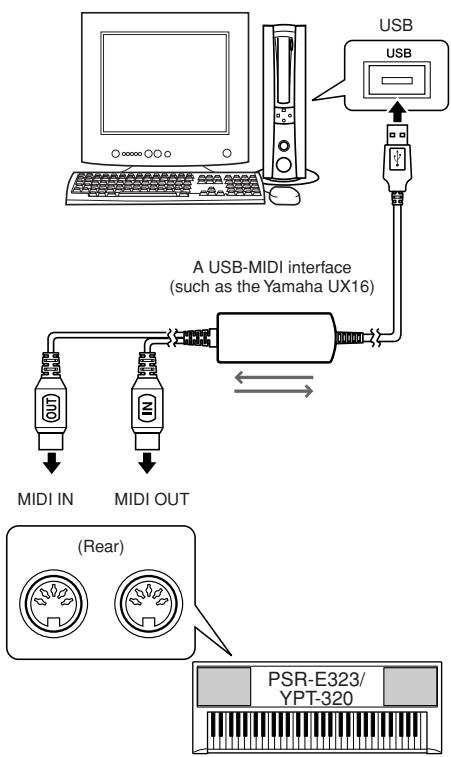
flowchart
graph TD
    A["Computer with HDMI IN"] --> B["MIDI IN"]
    A --> C["MIDI OUT"]
    D["USB"] --> E["USB"]
    E --> F["USB"]
    G["PSR-E323/YPT-320"] --> H["(Rear)"]
    style A fill:#f9f,stroke:#333
    style G fill:#ccf,stroke:#333
    style D fill:#cfc,stroke:#333
Transferring a file from a computer
You can transmit Song files and Style Files from your computer to the Flash Memory on your instrument. Move the file from the computer to “Flash Memory” under “Electronic Musical Instruments” via the Musicsoft Downloader. For details about how to transmit Song file and Style File, refer to the Online help topic “Transferring Data Between the Computer and Instrument (for unprotected data)” of the Musicsoft Downloader.
● Data that can be loaded to the PSR-E323/YPT-320 from a computer
- Songs : 99 Songs max (Song numbers 108-)
• Data : 373 kilobytes
- Data Format : SMF Format 0 and 1
- File : 09PK3.BUP (Backup file)
: ***.mid (MIDI Song)
: ***.sty (Style File)
NOTE
- The Musicsoft Downloader application may not be able to access the instrument in the following cases:
•During Style playback
•During Song playback
CAUTION
- Use the power adaptor when transferring data. The data can be corrupted if the batteries fail during the transfer.
- Never turn the power off and never plug/unplug the AC power adaptor during data transmission. Not only will the data fail to be transferred and saved, but operation of the flash memory may become unstable and its contents may disappear completely when the power is turned on or off.
NOTE
- Close the window to exit from the Musicsoft Downloader and re-enable control of the instrument.
Transferring a backup file from the PSR-E323/YPT-320 to a computer
You can transfer backup data (page 41) other than “Passing status of Song and Step” to a computer as a “backup file” by using Musicsoft Downloader. Move the file from “System Drive” under “Electronic Musical Instruments” to the computer via the Musicsoft Downloader. For details about how to transmit backup files, refer to the Online help topic “Transferring Data Between the Computer and Instrument (for unprotected data)” of the Musicsoft Downloader.
● Data that can be transferred to a computer from the PSR-E323/YPT-320
- Backup file (09PK3.BUP: backup data containing five User Songs)
- Songs transferred from a computer

- Preset Song data cannot be transmitted from the PSR-E323/YPT-320.
CAUTION
- The backup data, including the five User Songs is transmitted/received as a single file. As a result, all backup data (including the five Songs) will be overwritten every time you transmit or receive. Keep this in mind when transferring data.
- Do not rename the backup file on the computer. If you do so, it will not be recognized when transferred to the instrument.
● Erasing Transferred Song Data from the PSR-E323/YPT-320 Memory
To erase all Songs transferred from the computer, use “flash clear” function on page 41.
To erase specific Songs transferred from the computer, use the Delete function on Musicsoft Downloader.
● Using Transferred Songs for Lessons
In order to use Songs (only SMF format 0) transferred from a computer for lessons it is necessary to specify which channels are to be played back as the right-hand and left-hand parts. Refer to the “Lesson Track (R)” or “Lesson Track (L)” in the Function Setting List on page 57. The procedure for setting the “guide track” is as follows: Select a transferred Song you want to use for lessons. Press the [FUNCTION] button a number of times until the “R-Part” or “L-Part” appears in the display, and then use the number buttons [0]–[9], [+], [-] to select the channel you want to play back as the specified right- or left-hand part. We recommend that you select channel 1 for the right-hand part and channel 2 for the left-hand part.
| Problem | Possible Cause and Solution |
| When the instrument is turned on or off, a popping sound is temporarily produced. | This is normal and indicates that the instrument is receiving electrical power. |
| When using a mobile phone, noise is produced. | Using a mobile phone in close proximity to the instrument may produce interference. To prevent this, turn off the mobile phone or use it further away from the instrument. |
| There is no sound even when the keyboard is played or when a Song or Style is being played back. | Check that nothing is connected to the PHONES/OUTPUT jack on the rear panel. When a set of headphones is plugged into this jack, no sound is output. |
| Check the Local Control on/off. (See page 59.) |
| Not all of the voices seem to sound, or the sound seems to be cut off. | The instrument is polyphonic up to a maximum of 32 notes — including Dual voice, Split Voice, auto accompaniment, song, and Metronome. Notes exceeding this limit will not sound. |
| Playing keys in the right hand area of the keyboard does not produce any sound. | When using the Dictionary function (page 54), the keys in the right hand area are used only for entering the chord root and type. |
| · The volume is too soft.· The sound quality is poor.· The rhythm stops unexpectedly or will not play.· The recorded data of the Song, etc. does not play correctly.· The LCD display suddenly goes dark, and all panel settings are reset. | The batteries are low or dead. Replace all six batteries with completely new ones, or use the optional AC adaptor. |
| The Style or Song does not play back when the [START/STOP] button is pressed. | Is External Clock set to ON? Make sure External Clock is set to OFF; refer to “External Clock Settings” on page 59. |
| The Style does not sound properly. | Make sure that the Style Volume (page 53) is set to an appropriate level. |
| Is the Split Point set at an appropriate key for the cords you are playing? Set the Split Point at an appropriate key (page 47). Is the “ACMP ON” indicator showing in the display? If it is not showing press the [ACMP ON/OFF] button so that it does show. |
| · The auto accompaniment will sometimes not change when related chords are played in sequence (e.g. some minor chords followed by the minor seventh).· Two-note fingerings will produce a chord based on the previously played chord.· Playing two same root keys in the adjacent octaves produces accompaniment based only on the root. |
| No rhythm accompaniment plays when the [START/STOP] button is pressed after selecting Style number 098-106 (Pianist). | This is not a malfunction. Style number 098-106 (Pianist) have no rhythm parts, so no rhythm will play. The other parts will begin playing when you play a chord in the accompaniment range of the keyboard if auto accompaniment is turned on. |
| The footswitch (for sustain) seems to produce the opposite effect. For example, pressing the footswitch cuts off the sound and releasing it sustains the sounds. | The polarity of the footswitch is reversed. Make sure that the footswitch plug is properly connected to the SUSTAIN jack before turning on the power. |
| The sound of the voice changes from note to note. | This is normal. The AWM tone generation method uses multiple recordings (samples) of an instrument across the range of the keyboard; thus, the actual sound of the voice may be slightly different from note to note. |
| The ACMP ON indicator does not appear when the [ACMP ON/OFF] button is pressed. | Always press the [STYLE] button first when you are going to use any style-related function. |
| The harmony doesn’t sound. | The method of sounding the harmony effect (01-26) differs depending on the selected type. For Types 01-05, turn the Auto Accompaniment on and play it by pressing a chord in the auto accompaniment section of the keyboard, then play some keys in the right-hand side to get the harmony effect. For Types 06-26, turning the Auto Accompaniment on or off has no effect. However, it is necessary to play two notes simultaneously for Types 06-12. |
■ Maximum Polyphony
The instrument has 32-note maximum polyphony. This means that it can play a maximum of up to 32 notes at once, regardless of what functions are used. Auto accompaniment uses a number of the available notes, so when auto accompaniment is used the total number of available notes for playing on the keyboard is correspondingly reduced. The same applies to the Split Voice and Song functions. If the maximum polyphony is exceeded, earlier played notes will be cut off and the most recent notes have priority (last note priority).

- The Voice List includes MIDI program change numbers for each voice. Use these program change numbers when playing the instrument via MIDI from an external device.
- Program Numbers 001 to 128 directly relate to MIDI Program Change Numbers 000 to 127. That is, Program Numbers and Program Change Numbers differ by a value of 1. Remember to take this into consideration.
- Some voices may sound continuously or have a long decay after the notes have been released while the sustain pedal (footswitch) is held.
Panel Voice List
| Voice No. | Bank Select | MIDI Program Change# (1-128) | Voice Name |
| MSB (0-127) | LSB (0-127) |
| PIANO |
| 001 | 0 | 112 | 1 | Grand Piano |
| 002 | 0 | 112 | 2 | Bright Piano |
| 003 | 0 | 112 | 7 | Harpsichord |
| 004 | 0 | 112 | 4 | Honky-tonk Piano |
| 005 | 0 | 112 | 3 | MIDI Grand Piano |
| 006 | 0 | 113 | 3 | CP 80 |
| E.PIANO |
| 007 | 0 | 114 | 5 | Cool! Galaxy Electric Piano |
| 008 | 0 | 113 | 6 | Hyper Tines |
| 009 | 0 | 112 | 5 | Funky Electric Piano |
| 010 | 0 | 112 | 6 | DX Modern Electric Piano |
| 011 | 0 | 114 | 6 | Venus Electric Piano |
| 012 | 0 | 112 | 8 | Clavi |
| ORGAN |
| 013 | 0 | 112 | 17 | Jazz Organ 1 |
| 014 | 0 | 113 | 17 | Jazz Organ 2 |
| 015 | 0 | 112 | 19 | Rock Organ |
| 016 | 0 | 114 | 19 | Purple Organ |
| 017 | 0 | 112 | 18 | Click Organ |
| 018 | 0 | 116 | 17 | Bright Organ |
| 019 | 0 | 127 | 19 | Theater Organ |
| 020 | 0 | 121 | 20 | 16'+2' Organ |
| 021 | 0 | 120 | 20 | 16'+4' Organ |
| 022 | 0 | 113 | 20 | Chapel Organ |
| 023 | 0 | 112 | 20 | Church Organ |
| 024 | 0 | 112 | 21 | Reed Organ |
| ACCORDION |
| 025 | 0 | 112 | 22 | Musette Accordion |
| 026 | 0 | 113 | 22 | Traditional Accordion |
| 027 | 0 | 113 | 24 | Bandoneon |
| 028 | 0 | 112 | 23 | Harmonica |
| GUITAR |
| 029 | 0 | 112 | 25 | Classical Guitar |
| 030 | 0 | 112 | 26 | Folk Guitar |
| 031 | 0 | 112 | 27 | Jazz Guitar |
| 032 | 0 | 117 | 28 | 60's Clean Guitar |
| 033 | 0 | 113 | 26 | 12Strings Guitar |
| 034 | 0 | 112 | 28 | Clean Guitar |
| 035 | 0 | 113 | 27 | Octave Guitar |
| 036 | 0 | 112 | 29 | Muted Guitar |
| 037 | 0 | 112 | 30 | Overdriven Guitar |
| 038 | 0 | 112 | 31 | Distortion Guitar |
| BASS |
| 039 | 0 | 112 | 34 | Finger Bass |
| 040 | 0 | 112 | 33 | Acoustic Bass |
| 041 | 0 | 112 | 35 | Pick Bass |
| 042 | 0 | 112 | 36 | Fretless Bass |
| 043 | 0 | 112 | 37 | Slap Bass |
| 044 | 0 | 112 | 39 | Synth Bass |
| 045 | 0 | 113 | 39 | Hi-Q Bass |
| 046 | 0 | 113 | 40 | Dance Bass |
| Voice No. | Bank Select | MIDI Program Change# (1-128) | Voice Name |
| MSB (0-127) | LSB (0-127) |
| STRINGS |
| 047 | 0 | 112 | 49 | String Ensemble |
| 048 | 0 | 112 | 50 | Chamber Strings |
| 049 | 0 | 113 | 50 | Slow Strings |
| 050 | 0 | 112 | 45 | Tremolo Strings |
| 051 | 0 | 112 | 51 | Synth Strings |
| 052 | 0 | 112 | 46 | Pizzicato Strings |
| 053 | 0 | 112 | 41 | Violin |
| 054 | 0 | 112 | 43 | Cello |
| 055 | 0 | 112 | 44 | Contrabass |
| 056 | 0 | 112 | 47 | Harp |
| 057 | 0 | 112 | 106 | Banjo |
| 058 | 0 | 112 | 56 | Orchestra Hit |
| CHOIR |
| 059 | 0 | 112 | 53 | Choir |
| 060 | 0 | 113 | 53 | Vocal Ensemble |
| 061 | 0 | 112 | 55 | Air Choir |
| 062 | 0 | 112 | 54 | Vox Humana |
| SAXOPHONE |
| 063 | 0 | 112 | 67 | Tenor Sax |
| 064 | 0 | 112 | 66 | Alto Sax |
| 065 | 0 | 112 | 65 | Soprano Sax |
| 066 | 0 | 112 | 68 | Baritone Sax |
| 067 | 0 | 114 | 67 | Breathy Tenor Sax |
| 068 | 0 | 112 | 72 | Clarinet |
| 069 | 0 | 112 | 69 | Oboe |
| 070 | 0 | 112 | 70 | English Horn |
| 071 | 0 | 112 | 71 | Bassoon |
| TRUMPET |
| 072 | 0 | 112 | 57 | Trumpet |
| 073 | 0 | 112 | 58 | Trombone |
| 074 | 0 | 113 | 58 | Trombone Section |
| 075 | 0 | 112 | 60 | Muted Trumpet |
| 076 | 0 | 112 | 61 | French Horn |
| 077 | 0 | 112 | 59 | Tuba |
| BRASS |
| 078 | 0 | 112 | 62 | Brass Section |
| 079 | 0 | 113 | 62 | Big Band Brass |
| 080 | 0 | 113 | 63 | 80's Brass |
| 081 | 0 | 119 | 62 | Mellow Horns |
| 082 | 0 | 114 | 63 | Techno Brass |
| 083 | 0 | 112 | 63 | Synth Brass |
| FLUTE |
| 084 | 0 | 112 | 74 | Flute |
| 085 | 0 | 112 | 73 | Piccolo |
| 086 | 0 | 112 | 76 | Pan Flute |
| 087 | 0 | 112 | 75 | Recorder |
| 088 | 0 | 112 | 80 | Ocarina |
| SYNTH |
| 089 | 0 | 112 | 81 | Square Lead |
| 090 | 0 | 112 | 82 | Sawtooth Lead |
| 091 | 0 | 115 | 82 | Analogon |
| 092 | 0 | 119 | 82 | Fargo |
| 093 | 0 | 112 | 99 | Star Dust |
| 094 | 0 | 112 | 86 | Voice Lead |
| 095 | 0 | 112 | 101 | Brightness |
| 096 | 0 | 112 | 92 | Xenon Pad |
| 097 | 0 | 112 | 95 | Equinox |
| 098 | 0 | 112 | 89 | Fantasia |
| 099 | 0 | 113 | 90 | Dark Moon |
| 100 | 0 | 113 | 101 | Bell Pad |
| PERCUSSION |
| 101 | 0 | 112 | 12 | Vibraphone |
| 102 | 0 | 112 | 13 | Marimba |
| 103 | 0 | 112 | 14 | Xylophone |
| 104 | 0 | 112 | 115 | Steel Drums |
| 105 | 0 | 112 | 9 | Celesta |
| 106 | 0 | 112 | 11 | Music Box |
| 107 | 0 | 112 | 15 | Tubular Bells |
| 108 | 0 | 112 | 48 | Timpani |
| DRUM KITS |
| 109 | 127 | 0 | 1 | Standard Kit 1 |
| 110 | 127 | 0 | 2 | Standard Kit 2 |
| 111 | 127 | 0 | 9 | Room Kit |
| 112 | 127 | 0 | 17 | Rock Kit |
| 113 | 127 | 0 | 25 | Electronic Kit |
| 114 | 127 | 0 | 26 | Analog Kit |
| 115 | 127 | 0 | 113 | Dance Kit |
| 116 | 127 | 0 | 33 | Jazz Kit |
| 117 | 127 | 0 | 41 | Brush Kit |
| 118 | 127 | 0 | 49 | Symphony Kit |
| 119 | 126 | 0 | 1 | SFX Kit 1 |
| 120 | 126 | 0 | 2 | SFX Kit 2 |
| 121 | 126 | 0 | 113 | Sound Effect Kit |
● XGlite Voice/XGlite Optional Voice* List
| Voice No. | Bank Select | MIDI Program Change# (1-128) | Voice Name |
| MSB (0-127) | LSB (0-127) |
| PIANO |
| 122 | 0 | 0 | 1 | Grand Piano |
| 123 | 0 | 1 | 1 | Grand Piano KSP |
| 124 | 0 | 40 | 1 | Piano Strings |
| 125 | 0 | 41 | 1 | Dream |
| 126 | 0 | 0 | 2 | Bright Piano |
| 127 | 0 | 1 | 2 | Bright Piano KSP |
| 128 | 0 | 0 | 3 | Electric Grand Piano |
| 129 | 0 | 1 | 3 | Electric Grand Piano KSP |
| 130 | 0 | 32 | 3 | Detuned CP80 |
| 131 | 0 | 0 | 4 | Honky-tonk Piano |
| 132 | 0 | 1 | 4 | Honky-tonk Piano KSP |
| 133 | 0 | 0 | 5 | Electric Piano 1 |
| 134 | 0 | 1 | 5 | Electric Piano 1 KSP |
| 135 | 0 | 32 | 5 | Chorus Electric Piano 1 |
| 136 | 0 | 0 | 6 | Electric Piano 2 |
| 137 | 0 | 1 | 6 | Electric Piano 2 KSP |
| *138 | 0 | 32 | 6 | Chorus Electric Piano 2 |
| 139 | 0 | 41 | 6 | DX + Analog Electric Piano |
| 140 | 0 | 0 | 7 | Harpsichord |
| 141 | 0 | 1 | 7 | Harpsichord KSP |
| 142 | 0 | 35 | 7 | Harpsichord 2 |
| 143 | 0 | 0 | 8 | Clavi |
| 144 | 0 | 1 | 8 | Clavi KSP |
| CHROMATIC |
| 145 | 0 | 0 | 9 | Celesta |
| 146 | 0 | 0 | 10 | Glockenspiel |
| 147 | 0 | 0 | 11 | Music Box |
| 148 | 0 | 64 | 11 | Orgel |
| 149 | 0 | 0 | 12 | Vibraphone |
| 150 | 0 | 1 | 12 | Vibraphone KSP |
| 151 | 0 | 0 | 13 | Marimba |
| Voice No. | Bank Select | MIDI Program Change# (1-128) | Voice Name |
| MSB (0-127) | LSB (0-127) |
| 152 | 0 | 1 | 13 | Marimba KSP |
| 153 | 0 | 64 | 13 | Sine Marimba |
| 154 | 0 | 97 | 13 | Balimba |
| 155 | 0 | 98 | 13 | Log Drums |
| 156 | 0 | 0 | 14 | Xylophone |
| 157 | 0 | 0 | 15 | Tubular Bells |
| 158 | 0 | 96 | 15 | Church Bells |
| 159 | 0 | 97 | 15 | Carillon |
| 160 | 0 | 0 | 16 | Dulcimer |
| 161 | 0 | 35 | 16 | Dulcimer 2 |
| 162 | 0 | 96 | 16 | Cimbalom |
| 163 | 0 | 97 | 16 | Santur |
| ORGAN |
| 164 | 0 | 0 | 17 | Drawbar Organ |
| 165 | 0 | 32 | 17 | Detuned Drawbar Organ |
| 166 | 0 | 33 | 17 | 60's Drawbar Organ 1 |
| 167 | 0 | 34 | 17 | 60's Drawbar Organ 2 |
| 168 | 0 | 35 | 17 | 70's Drawbar Organ 1 |
| 169 | 0 | 37 | 17 | 60's Drawbar Organ 3 |
| 170 | 0 | 40 | 17 | 16+2'2/3 |
| 171 | 0 | 64 | 17 | Organ Bass |
| 172 | 0 | 65 | 17 | 70's Drawbar Organ 2 |
| 173 | 0 | 66 | 17 | Cheezy Organ |
| 174 | 0 | 67 | 17 | Drawbar Organ 2 |
| 175 | 0 | 0 | 18 | Percussive Organ |
| 176 | 0 | 24 | 18 | 70's Percussive Organ |
| 177 | 0 | 32 | 18 | Detuned Percussive Organ |
| 178 | 0 | 33 | 18 | Light Organ |
| 179 | 0 | 37 | 18 | Percussive Organ 2 |
| 180 | 0 | 0 | 19 | Rock Organ |
| 181 | 0 | 64 | 19 | Rotary Organ |
| 182 | 0 | 65 | 19 | Slow Rotary |
| 183 | 0 | 66 | 19 | Fast Rotary |
| 184 | 0 | 0 | 20 | Church Organ |
| 185 | 0 | 32 | 20 | Church Organ 3 |
| 186 | 0 | 35 | 20 | Church Organ 2 |
| 187 | 0 | 40 | 20 | Notre Dame |
| 188 | 0 | 64 | 20 | Organ Flute |
| 189 | 0 | 65 | 20 | Tremolo Organ Flute |
| 190 | 0 | 0 | 21 | Reed Organ |
| 191 | 0 | 40 | 21 | Puff Organ |
| 192 | 0 | 0 | 22 | Accordion |
| 193 | 0 | 0 | 23 | Harmonica |
| 194 | 0 | 32 | 23 | Harmonica 2 |
| 195 | 0 | 0 | 24 | Tango Accordion |
| 196 | 0 | 64 | 24 | Tango Accordion 2 |
| GUITAR |
| 197 | 0 | 0 | 25 | Nylon Guitar |
| 198 | 0 | 43 | 25 | Velocity Guitar Harmonics |
| 199 | 0 | 96 | 25 | Ukulele |
| 200 | 0 | 0 | 26 | Steel Guitar |
| 201 | 0 | 35 | 26 | 12-string Guitar |
| 202 | 0 | 40 | 26 | Nylon & Steel Guitar |
| 203 | 0 | 41 | 26 | Steel Guitar with Body Sound |
| 204 | 0 | 96 | 26 | Mandolin |
| 205 | 0 | 0 | 27 | Jazz Guitar |
| 206 | 0 | 32 | 27 | Jazz Amp |
| 207 | 0 | 0 | 28 | Clean Guitar |
| 208 | 0 | 32 | 28 | Chorus Guitar |
| 209 | 0 | 0 | 29 | Muted Guitar |
| 210 | 0 | 40 | 29 | Funk Guitar |
| 211 | 0 | 41 | 29 | Muted Steel Guitar |
| 212 | 0 | 45 | 29 | Jazz Man |
| 213 | 0 | 0 | 30 | Overdriven Guitar |
| 214 | 0 | 43 | 30 | Guitar Pinch |
| 215 | 0 | 0 | 31 | Distortion Guitar |
| 216 | 0 | 40 | 31 | Feedback Guitar |
| 217 | 0 | 41 | 31 | Feedback Guitar 2 |
| 218 | 0 | 0 | 32 | Guitar Harmonics |
| 219 | 0 | 65 | 32 | Guitar Feedback |
| 220 | 0 | 66 | 32 | Guitar Harmonics 2 |
| BASS |
| 221 | 0 | 0 | 33 | Acoustic Bass |
| 222 | 0 | 40 | 33 | Jazz Rhythm |
| 223 | 0 | 45 | 33 | Velocity Crossfade Upright Bass |
| 224 | 0 | 0 | 34 | Finger Bass |
| 225 | 0 | 18 | 34 | Finger Dark |
| 226 | 0 | 40 | 34 | Bass & Distorted Electric Guitar |
| 227 | 0 | 43 | 34 | Finger Slap Bass |
| 228 | 0 | 45 | 34 | Finger Bass 2 |
| 229 | 0 | 65 | 34 | Modulated Bass |
| 230 | 0 | 0 | 35 | Pick Bass |
| 231 | 0 | 28 | 35 | Muted Pick Bass |
| 232 | 0 | 0 | 36 | Fretless Bass |
| 233 | 0 | 32 | 36 | Fretless Bass 2 |
| 234 | 0 | 33 | 36 | Fretless Bass 3 |
| 235 | 0 | 34 | 36 | Fretless Bass 4 |
| 236 | 0 | 0 | 37 | Slap Bass 1 |
| 237 | 0 | 32 | 37 | Punch Thumb Bass |
| 238 | 0 | 0 | 38 | Slap Bass 2 |
| 239 | 0 | 43 | 38 | Velocity Switch Slap |
| 240 | 0 | 0 | 39 | Synth Bass 1 |
| 241 | 0 | 40 | 39 | Techno Synth Bass |
| 242 | 0 | 0 | 40 | Synth Bass 2 |
| 243 | 0 | 6 | 40 | Mellow Synth Bass |
| 244 | 0 | 12 | 40 | Sequenced Bass |
| 245 | 0 | 18 | 40 | Click Synth Bass |
| 246 | 0 | 19 | 40 | Synth Bass 2 Dark |
| *247 | 0 | 40 | 40 | Modular Synth Bass |
| 248 | 0 | 41 | 40 | DX Bass |
| STRINGS |
| 249 | 0 | 0 | 41 | Violin |
| 250 | 0 | 8 | 41 | Slow Violin |
| 251 | 0 | 0 | 42 | Viola |
| 252 | 0 | 0 | 43 | Cello |
| 253 | 0 | 0 | 44 | Contrabass |
| 254 | 0 | 0 | 45 | Tremolo Strings |
| 255 | 0 | 8 | 45 | Slow Tremolo Strings |
| 256 | 0 | 40 | 45 | Suspense Strings |
| 257 | 0 | 0 | 46 | Pizzicato Strings |
| 258 | 0 | 0 | 47 | Orchestral Harp |
| 259 | 0 | 40 | 47 | Yang Chin |
| 260 | 0 | 0 | 48 | Timpani |
| ENSEMBLE |
| 261 | 0 | 0 | 49 | Strings 1 |
| 262 | 0 | 3 | 49 | Stereo Strings |
| 263 | 0 | 8 | 49 | Slow Strings |
| 264 | 0 | 35 | 49 | 60's Strings |
| 265 | 0 | 40 | 49 | Orchestra |
| 266 | 0 | 41 | 49 | Orchestra 2 |
| 267 | 0 | 42 | 49 | Tremolo Orchestra |
| 268 | 0 | 45 | 49 | Velocity Strings |
| 269 | 0 | 0 | 50 | Strings 2 |
| 270 | 0 | 3 | 50 | Stereo Slow Strings |
| 271 | 0 | 8 | 50 | Legato Strings |
| 272 | 0 | 40 | 50 | Warm Strings |
| 273 | 0 | 41 | 50 | Kingdom |
| 274 | 0 | 0 | 51 | Synth Strings 1 |
| 275 | 0 | 0 | 52 | Synth Strings 2 |
| 276 | 0 | 0 | 53 | Choir Aahs |
| 277 | 0 | 3 | 53 | Stereo Choir |
| 278 | 0 | 32 | 53 | Mellow Choir |
| 279 | 0 | 40 | 53 | Choir Strings |
| 280 | 0 | 0 | 54 | Voice Oohs |
| 281 | 0 | 0 | 55 | Synth Voice |
| 282 | 0 | 40 | 55 | Synth Voice 2 |
| 283 | 0 | 41 | 55 | Choral |
| 284 | 0 | 64 | 55 | Analog Voice |
| 285 | 0 | 0 | 56 | Orchestra Hit |
| 286 | 0 | 35 | 56 | Orchestra Hit 2 |
| Voice No. | Bank Select | MIDI Program Change# (1-128) | Voice Name |
| MSB (0-127) | LSB (0-127) |
| 287 | 0 | 64 | 56 | Impact |
| BRASS |
| 288 | 0 | 0 | 57 | Trumpet |
| 289 | 0 | 32 | 57 | Warm Trumpet |
| 290 | 0 | 0 | 58 | Trombone |
| 291 | 0 | 18 | 58 | Trombone 2 |
| 292 | 0 | 0 | 59 | Tuba |
| 293 | 0 | 0 | 60 | Muted Trumpet |
| 294 | 0 | 0 | 61 | French Horn |
| 295 | 0 | 6 | 61 | French Horn Solo |
| 296 | 0 | 32 | 61 | French Horn 2 |
| 297 | 0 | 37 | 61 | Horn Orchestra |
| 298 | 0 | 0 | 62 | Brass Section |
| 299 | 0 | 35 | 62 | Trumpet & Trombone Section |
| 300 | 0 | 0 | 63 | Synth Brass 1 |
| 301 | 0 | 20 | 63 | Resonant Synth Brass |
| 302 | 0 | 0 | 64 | Synth Brass 2 |
| 303 | 0 | 18 | 64 | Soft Brass |
| 304 | 0 | 41 | 64 | Choir Brass |
| REED |
| 305 | 0 | 0 | 65 | Soprano Sax |
| 306 | 0 | 0 | 66 | Alto Sax |
| 307 | 0 | 40 | 66 | Sax Section |
| 308 | 0 | 0 | 67 | Tenor Sax |
| 309 | 0 | 40 | 67 | Breathy Tenor Sax |
| 310 | 0 | 0 | 68 | Baritone Sax |
| 311 | 0 | 0 | 69 | Oboe |
| 312 | 0 | 0 | 70 | English Horn |
| 313 | 0 | 0 | 71 | Bassoon |
| 314 | 0 | 0 | 72 | Clarinet |
| PIPE |
| 315 | 0 | 0 | 73 | Piccolo |
| 316 | 0 | 0 | 74 | Flute |
| 317 | 0 | 0 | 75 | Recorder |
| 318 | 0 | 0 | 76 | Pan Flute |
| 319 | 0 | 0 | 77 | Blown Bottle |
| 320 | 0 | 0 | 78 | Shakuhachi |
| 321 | 0 | 0 | 79 | Whistle |
| 322 | 0 | 0 | 80 | Ocarina |
| SYNTH LEAD |
| 323 | 0 | 0 | 81 | Square Lead |
| 324 | 0 | 6 | 81 | Square Lead 2 |
| 325 | 0 | 8 | 81 | LM Square |
| 326 | 0 | 18 | 81 | Hollow |
| 327 | 0 | 19 | 81 | Shroud |
| 328 | 0 | 64 | 81 | Mellow |
| 329 | 0 | 65 | 81 | Solo Sine |
| 330 | 0 | 66 | 81 | Sine Lead |
| 331 | 0 | 0 | 82 | Sawtooth Lead |
| 332 | 0 | 6 | 82 | Sawtooth Lead 2 |
| 333 | 0 | 8 | 82 | Thick Sawtooth |
| 334 | 0 | 18 | 82 | Dynamic Sawtooth |
| 335 | 0 | 19 | 82 | Digital Sawtooth |
| 336 | 0 | 20 | 82 | Big Lead |
| 337 | 0 | 96 | 82 | Sequenced Analog |
| 338 | 0 | 0 | 83 | Calliope Lead |
| 339 | 0 | 65 | 83 | Pure Lead |
| 340 | 0 | 0 | 84 | Chiff Lead |
| 341 | 0 | 0 | 85 | Charang Lead |
| 342 | 0 | 64 | 85 | Distorted Lead |
| 343 | 0 | 0 | 86 | Voice Lead |
| 344 | 0 | 0 | 87 | Fifths Lead |
| 345 | 0 | 35 | 87 | Big Five |
| 346 | 0 | 0 | 88 | Bass & Lead |
| 347 | 0 | 16 | 88 | Big & Low |
| 348 | 0 | 64 | 88 | Fat & Perky |
| 349 | 0 | 65 | 88 | Soft Whirl |
| SYNTH PAD |
| 350 | 0 | 0 | 89 | New Age Pad |
| 351 | 0 | 64 | 89 | Fantasy |
| 352 | 0 | 0 | 90 | Warm Pad |
| 353 | 0 | 0 | 91 | Poly Synth Pad |
| 354 | 0 | 0 | 92 | Choir Pad |
| 355 | 0 | 66 | 92 | Itopia |
| 356 | 0 | 0 | 93 | Bowed Pad |
| 357 | 0 | 0 | 94 | Metallic Pad |
| 358 | 0 | 0 | 95 | Halo Pad |
| 359 | 0 | 0 | 96 | Sweep Pad |
| SYNTH EFFECTS |
| 360 | 0 | 0 | 97 | Rain |
| 361 | 0 | 65 | 97 | African Wind |
| 362 | 0 | 66 | 97 | Carib |
| 363 | 0 | 0 | 98 | Sound Track |
| 364 | 0 | 27 | 98 | Prologue |
| 365 | 0 | 0 | 99 | Crystal |
| 366 | 0 | 12 | 99 | Synth Drum Comp |
| 367 | 0 | 14 | 99 | Popcorn |
| 368 | 0 | 18 | 99 | Tiny Bells |
| 369 | 0 | 35 | 99 | Round Glockenspiel |
| 370 | 0 | 40 | 99 | Glockenspiel Chimes |
| 371 | 0 | 41 | 99 | Clear Bells |
| 372 | 0 | 42 | 99 | Chorus Bells |
| 373 | 0 | 65 | 99 | Soft Crystal |
| 374 | 0 | 70 | 99 | Air Bells |
| 375 | 0 | 71 | 99 | Bell Harp |
| 376 | 0 | 72 | 99 | Gamelimba |
| 377 | 0 | 0 | 100 | Atmosphere |
| 378 | 0 | 18 | 100 | Warm Atmosphere |
| 379 | 0 | 19 | 100 | Hollow Release |
| 380 | 0 | 40 | 100 | Nylon Electric Piano |
| 381 | 0 | 64 | 100 | Nylon Harp |
| 382 | 0 | 65 | 100 | Harp Vox |
| 383 | 0 | 66 | 100 | Atmosphere Pad |
| 384 | 0 | 0 | 101 | Brightness |
| 385 | 0 | 0 | 102 | Goblins |
| 386 | 0 | 64 | 102 | Goblins Synth |
| 387 | 0 | 65 | 102 | Creeper |
| 388 | 0 | 67 | 102 | Ritual |
| 389 | 0 | 68 | 102 | To Heaven |
| 390 | 0 | 70 | 102 | Night |
| 391 | 0 | 71 | 102 | Glisten |
| 392 | 0 | 96 | 102 | Bell Choir |
| 393 | 0 | 0 | 103 | Echoes |
| 394 | 0 | 0 | 104 | Sci-Fi |
| WORLD |
| 395 | 0 | 0 | 105 | Sitar |
| 396 | 0 | 32 | 105 | Detuned Sitar |
| 397 | 0 | 35 | 105 | Sitar 2 |
| 398 | 0 | 97 | 105 | Tamboura |
| 399 | 0 | 0 | 106 | Banjo |
| 400 | 0 | 28 | 106 | Muted Banjo |
| 401 | 0 | 96 | 106 | Rabab |
| 402 | 0 | 97 | 106 | Gopichant |
| 403 | 0 | 98 | 106 | Oud |
| 404 | 0 | 0 | 107 | Shamisen |
| 405 | 0 | 0 | 108 | Koto |
| 406 | 0 | 96 | 108 | Taisho-kin |
| 407 | 0 | 97 | 108 | Kanoon |
| 408 | 0 | 0 | 109 | Kalimba |
| 409 | 0 | 0 | 110 | Bagpipe |
| 410 | 0 | 0 | 111 | Fiddle |
| 411 | 0 | 0 | 112 | Shanai |
| PERCUSSIVE |
| 412 | 0 | 0 | 113 | Tinkle Bell |
| 413 | 0 | 96 | 113 | Bonang |
| 414 | 0 | 97 | 113 | Altair |
| 415 | 0 | 98 | 113 | Gamelan Gongs |
| 416 | 0 | 99 | 113 | Stereo Gamelan Gongs |
| 417 | 0 | 100 | 113 | Rama Cymbal |
| 418 | 0 | 0 | 114 | Agogo |
| Voice No. | Bank Select | MIDI Program Change# (1-128) | Voice Name |
| MSB (0-127) | LSB (0-127) |
| 419 | 0 | 0 | 115 | Steel Drums |
| 420 | 0 | 97 | 115 | Glass Percussion |
| 421 | 0 | 98 | 115 | Thai Bells |
| 422 | 0 | 0 | 116 | Woodblock |
| 423 | 0 | 96 | 116 | Castanets |
| 424 | 0 | 0 | 117 | Taiko Drum |
| 425 | 0 | 96 | 117 | Gran Cassa |
| 426 | 0 | 0 | 118 | Melodic Tom |
| 427 | 0 | 64 | 118 | Melodic Tom 2 |
| 428 | 0 | 65 | 118 | Real Tom |
| 429 | 0 | 66 | 118 | Rock Tom |
| 430 | 0 | 0 | 119 | Synth Drum |
| 431 | 0 | 64 | 119 | Analog Tom |
| 432 | 0 | 65 | 119 | Electronic Percussion |
| 433 | 0 | 0 | 120 | Reverse Cymbal |
| SOUND EFFECTS |
| 434 | 0 | 0 | 121 | Fret Noise |
| 435 | 0 | 0 | 122 | Breath Noise |
| 436 | 0 | 0 | 123 | Seashore |
| 437 | 0 | 0 | 124 | Bird Tweet |
| 438 | 0 | 0 | 125 | Telephone Ring |
| 439 | 0 | 0 | 126 | Helicopter |
| 440 | 0 | 0 | 127 | Applause |
| 441 | 0 | 0 | 128 | Gunshot |
| 442 | 64 | 0 | 1 | Cutting Noise |
| 443 | 64 | 0 | 2 | Cutting Noise 2 |
| 444 | 64 | 0 | 4 | String Slap |
| 445 | 64 | 0 | 17 | Flute Key Click |
| 446 | 64 | 0 | 33 | Shower |
| 447 | 64 | 0 | 34 | Thunder |
| 448 | 64 | 0 | 35 | Wind |
| 449 | 64 | 0 | 36 | Stream |
| 450 | 64 | 0 | 37 | Bubble |
| 451 | 64 | 0 | 38 | Feed |
| 452 | 64 | 0 | 49 | Dog |
| 453 | 64 | 0 | 50 | Horse |
| 454 | 64 | 0 | 51 | Bird Tweet 2 |
| 455 | 64 | 0 | 56 | Maou |
| 456 | 64 | 0 | 65 | Phone Call |
| 457 | 64 | 0 | 66 | Door Squeak |
| 458 | 64 | 0 | 67 | Door Slam |
| 459 | 64 | 0 | 68 | Scratch Cut |
| 460 | 64 | 0 | 69 | Scratch Split |
| 461 | 64 | 0 | 70 | Wind Chime |
| 462 | 64 | 0 | 71 | Telephone Ring 2 |
| 463 | 64 | 0 | 81 | Car Engine Ignition |
| 464 | 64 | 0 | 82 | Car Tires Squeal |
| 465 | 64 | 0 | 83 | Car Passing |
| 466 | 64 | 0 | 84 | Car Crash |
| 467 | 64 | 0 | 85 | Siren |
| 468 | 64 | 0 | 86 | Train |
| 469 | 64 | 0 | 87 | Jet Plane |
| 470 | 64 | 0 | 88 | Starship |
| 471 | 64 | 0 | 89 | Burst |
| 472 | 64 | 0 | 90 | Roller Coaster |
| 473 | 64 | 0 | 91 | Submarine |
| 474 | 64 | 0 | 97 | Laugh |
| 475 | 64 | 0 | 98 | Scream |
| 476 | 64 | 0 | 99 | Punch |
| 477 | 64 | 0 | 100 | Heartbeat |
| 478 | 64 | 0 | 101 | Footsteps |
| 479 | 64 | 0 | 113 | Machine Gun |
| 480 | 64 | 0 | 114 | Laser Gun |
| 481 | 64 | 0 | 115 | Explosion |
| 482 | 64 | 0 | 116 | Firework |
The voice number with an asterisk (*) is XGlite optional voice.
- “” indicates that the drum sound is the same as “Standard Kit 1”.
• Each percussion voice uses one note.
- The MIDI Note # and Note are actually one octave lower than keyboard Note # and Note. For example, in “109: Standard Kit 1”, the “Seq Click H” (Note# 36/Note C1) corresponds to (Note# 24/Note C0).
- Key Off: Keys marked "O" stop sounding the instant they are released.
- Voices with the same Alternate Note Number (*1 ... 4) cannot be played simultaneously. (They are designed to be played alternately with each other.)
| C1 | C#1 |
| D1 | D#1 |
| E1 | |
| F1 | F#1 |
| G1 | G#1 |
| A1 | A#1 |
| B1 | |
| C2 | C#2 |
| D2 | D#2 |
| E2 | |
| F2 | F#2 |
| G2 | G#2 |
| A2 | A#2 |
| B2 | |
| C3 | C#3 |
| D3 | D#3 |
| E3 | |
| F3 | F#3 |
| G3 | G#3 |
| A3 | A#3 |
| B3 | |
| C4 | C#4 |
| D4 | D#4 |
| E4 | |
| F4 | F#4 |
| G4 | G#4 |
| A4 | A#4 |
| B4 | |
| C5 | C#5 |
| D5 | D#5 |
| E5 | |
| F5 | F#5 |
| G5 | G#5 |
| A5 | A#5 |
| B5 | |
| C6 | |
| Voice No. | 109 | 110 | 111 | 112 | 113 |
| MSB(0-127) / LSB(0-127) / PC(1-128) | 127/0/1 | 127/0/2 | 127/0/9 | 127/0/17 | 127/0/25 |
| Keyboard | MIDI | Key Off | Alternate Group | Standard Kit 1 | Standard Kit 2 | Room Kit | Rock Kit | Electronic Kit |
| Note# | Note | Note# | Note | | | | | | | |
| 25 | C# 0 | 13 | C# -1 | | 3 | Surdo Mute | | | | |
| 26 | D 0 | 14 | D -1 | | 3 | Surdo Open | | | | |
| 27 | D# 0 | 15 | D# -1 | | | Hi Q | | | | |
| 28 | E 0 | 16 | E -1 | | | Whip Slap | | | | |
| 29 | F 0 | 17 | F -1 | | 4 | Scratch Push | | | | |
| 30 | F# 0 | 18 | F# -1 | | 4 | Scratch Pull | | | | |
| 31 | G 0 | 19 | G -1 | | | Finger Snap | | | | |
| 32 | G# 0 | 20 | G# -1 | | | Click Noise | | | | |
| 33 | A 0 | 21 | A -1 | | | Metronome Click | | | | |
| 34 | A# 0 | 22 | A# -1 | | | Metronome Bell | | | | |
| 35 | B 0 | 23 | B -1 | | | Seq Click L | | | | |
| 36 | C 1 | 24 | C 0 | | | Seq Click H | | | | |
| 37 | C# 1 | 25 | C# 0 | | | Brush Tap | | | | |
| 38 | D 1 | 26 | D 0 | O | | Brush Swirl | | | | |
| 39 | D# 1 | 27 | D# 0 | | | Brush Slap | | | | |
| 40 | E 1 | 28 | E 0 | O | | Brush Tap Swirl | | | | Reverse Cymbal |
| 41 | F 1 | 29 | F 0 | O | | Snare Roll | | | | |
| 42 | F# 1 | 30 | F# 0 | | | Castanet | | | | Hi Q 2 |
| 43 | G 1 | 31 | G 0 | | | Snare H Soft | Snare H Soft 2 | | SD Rock H | Snare L |
| 44 | G# 1 | 32 | G# 0 | | | Sticks | | | | |
| 45 | A 1 | 33 | A 0 | | | Bass Drum Soft | | | | Bass Drum H |
| 46 | A# 1 | 34 | A# 0 | | | Open Rim Shot | Open Rim Shot 2 | | | |
| 47 | B 1 | 35 | B 0 | | | Bass Drum Hard | | | Bass Drum H | BD Rock |
| 48 | C 2 | 36 | C 1 | | | Bass Drum | Bass Drum 2 | | BD Rock | BD Gate |
| 49 | C# 2 | 37 | C# 1 | | | Side Stick | | | | |
| 50 | D 2 | 38 | D 1 | | | Snare M | Snare M 2 | SD Room L | SD Rock L | SD Rock L |
| 51 | D# 2 | 39 | D# 1 | | | Hand Clap | | | | |
| 52 | E 2 | 40 | E 1 | | | Snare H Hard | Snare H Hard 2 | SD Room H | SD Rock Rim | SD Rock H |
| 53 | F 2 | 41 | F 1 | | | Floor Tom L | | Room Tom 1 | Rock Tom 1 | E Tom 1 |
| 54 | F# 2 | 42 | F# 1 | | 1 | Hi-Hat Closed | | | | |
| 55 | G 2 | 43 | G 1 | | | Floor Tom H | | Room Tom 2 | Rock Tom 2 | E Tom 2 |
| 56 | G# 2 | 44 | G# 1 | | 1 | Hi-Hat Pedal | | | | |
| 57 | A 2 | 45 | A 1 | | | Low Tom | | Room Tom 3 | Rock Tom 3 | E Tom 3 |
| 58 | A# 2 | 46 | A# 1 | | 1 | Hi-Hat Open | | | | |
| 59 | B 2 | 47 | B 1 | | | Mid Tom L | | Room Tom 4 | Rock Tom 4 | E Tom 4 |
| 60 | C 3 | 48 | C 2 | | | Mid Tom H | | Room Tom 5 | Rock Tom 5 | E Tom 5 |
| 61 | C# 3 | 49 | C# 2 | | | Crash Cymbal 1 | | | | |
| 62 | D 3 | 50 | D 2 | | | High Tom | | Room Tom 6 | Rock Tom 6 | E Tom 6 |
| 63 | D# 3 | 51 | D# 2 | | | Ride Cymbal 1 | | | | |
| 64 | E 3 | 52 | E 2 | | | Chinese Cymbal | | | | |
| 65 | F 3 | 53 | F 2 | | | Ride Cymbal Cup | | | | |
| 66 | F# 3 | 54 | F# 2 | | | Tambourine | | | | |
| 67 | G 3 | 55 | G 2 | | | Splash Cymbal | | | | |
| 68 | G# 3 | 56 | G# 2 | | | Cowbell | | | | |
| 69 | A 3 | 57 | A 2 | | | Crash Cymbal 2 | | | | |
| 70 | A# 3 | 58 | A# 2 | | | Vibraslap | | | | |
| 71 | B 3 | 59 | B 2 | | | Ride Cymbal 2 | | | | |
| 72 | C 4 | 60 | C 3 | | | Bongo H | | | | |
| 73 | C# 4 | 61 | C# 3 | | | Bongo L | | | | |
| 74 | D 4 | 62 | D 3 | | | Conga H Mute | | | | |
| 75 | D# 4 | 63 | D# 3 | | | Conga H Open | | | | |
| 76 | E 4 | 64 | E 3 | | | Conga L | | | | |
| 77 | F 4 | 65 | F 3 | | | Timbale H | | | | |
| 78 | F# 4 | 66 | F# 3 | | | Timbale L | | | | |
| 79 | G 4 | 67 | G 3 | | | Agogo H | | | | |
| 80 | G# 4 | 68 | G# 3 | | | Agogo L | | | | |
| 81 | A 4 | 69 | A 3 | | | Cabasa | | | | |
| 82 | A# 4 | 70 | A# 3 | | | Maracas | | | | |
| 83 | B 4 | 71 | B 3 | O | | Samba Whistle H | | | | |
| 84 | C 5 | 72 | C 4 | O | | Samba Whistle L | | | | |
| 85 | C# 5 | 73 | C# 4 | | | Guiro Short | | | | |
| 86 | D 5 | 74 | D 4 | O | | Guiro Long | | | | |
| 87 | D# 5 | 75 | D# 4 | | | Claves | | | | |
| 88 | E 5 | 76 | E 4 | | | Wood Block H | | | | |
| 89 | F 5 | 77 | F 4 | | | Wood Block L | | | | |
| 90 | F# 5 | 78 | F# 4 | | | Cuica Mute | | | | Scratch Push |
| 91 | G 5 | 79 | G 4 | | | Cuica Open | | | | Scratch Pull |
| 92 | G# 5 | 80 | G# 4 | | 2 | Triangle Mute | | | | |
| 93 | A 5 | 81 | A 4 | | 2 | Triangle Open | | | | |
| 94 | A# 5 | 82 | A# 4 | | | Shaker | | | | |
| 95 | B 5 | 83 | B 4 | | | Jingle Bell | | | | |
| 96 | C 6 | 84 | C 5 | | | Bell Tree | | | | |
| 97 | C# 6 | 85 | C# 5 | | | | | | | |
| 98 | D 6 | 86 | D 5 | | | | | | | |
| 99 | D# 6 | 87 | D# 5 | | | | | | | |
| 100 | E 6 | 88 | E 5 | | | | | | | |
| 101 | F 6 | 89 | F 5 | | | | | | | |
| 102 | F# 6 | 90 | F# 5 | | | | | | | |
| 103 | G 6 | 91 | G 5 | | | | | | | |
| 114 | 115 | 116 | 117 | 118 | 119 | 120 | 121 |
| 127/0/26 | 127/0/28 | 127/0/33 | 127/0/41 | 127/0/49 | 126/0/1 | 126/0/2 | 126/0/113 |
| Analog Kit | Dance Kit | Jazz Kit | Brush Kit | Symphony Kit | SFX Kit 1 | SFX Kit 2 | Sound Effect Kit |
| | | | | | | |
| | | | | | | |
| | | | | | | |
| | | | | | | |
| | | | | | | |
| | | | | | | |
| | | | | | | |
| | | | | | | |
| | | | | | | |
| | | | | | | |
| | | | | | | Drum Loop |
| | | | | | |
| | | | | | |
| | | | | | |
| Reverse Cymbal | Reverse Cymbal | | | | | |
| | | | | | |
| Hi Q 2 | Hi Q 2 | | | | | |
| SD Rock H | AnSD Snappy | SD Jazz H Light | Brush Slap L | | | |
| | | | | | |
| Bass Drum H | AnBD Dance-1 | | | Bass Drum L | | |
| AnSD OpenRim | | | | | |
| BD Analog L | AnBD Dance-2 | | | Gran Cassa | | |
| BD Analog H | AnBD Dance-3 | BD Jazz | BD Jazz | Gran Cassa Mute | Cutting Noise | Phone Call | Heartbeat |
| Analog Side Stick | Analog Side Stick | | | | Cutting Noise 2 | Door Squeak | Footsteps |
| Analog Snare 1 | AnSD Q | SD Jazz L | Brush Slap | Marching Sn M | | Door Slam | Door Squeak |
| | | | | String Slap | Scratch Cut | Door Slam |
| Analog Snare 2 | AnSD Ana+Acoustic | SD Jazz M | Brush Tap | Marching Sn H | | Scratch | Applause |
| Analog Tom 1 | Analog Tom 1 | Jazz Tom 1 | Brush Tom 1 | Jazz Tom 1 | | Wind Chime | Camera |
| Analog HH Closed 1 | Analog HH Closed 3 | | | | | Telephone Ring 2 | Horn |
| Analog Tom 2 | Analog Tom 2 | Jazz Tom 2 | Brush Tom 2 | Jazz Tom 2 | | | Hiccup |
| Analog HH Closed 2 | Analog HH Closed 4 | | | | | | Cuckoo Clock |
| Analog Tom 3 | Analog Tom 3 | Jazz Tom 3 | Brush Tom 3 | Jazz Tom 3 | | | Stream |
| Analog HH Open | Analog HH Open 2 | | | | | | Frog |
| Analog Tom 4 | Analog Tom 4 | Jazz Tom 4 | Brush Tom 4 | Jazz Tom 4 | | | Rooster |
| Analog Tom 5 | Analog Tom 5 | Jazz Tom 5 | Brush Tom 5 | Jazz Tom 5 | | | Dog |
| Analog Cymbal | Analog Cymbal | | | Hand Cym. L | | | Cat |
| Analog Tom 6 | Analog Tom 6 | Jazz Tom 6 | Brush Tom 6 | Jazz Tom 6 | | | Owl |
| | | | Hand Cym.Short L | | | Horse Gallop |
| | | | | Flute Key Click | Car Engine Ignition | Horse Neigh |
| | | | | | Car Tires Squeal | Cow |
| | | | | | Car Passing | Lion |
| | | | | | Car Crash | Scratch |
| Analog Cowbell | Analog Cowbell | | | | | Siren | Yo! |
| | | | Hand Cym. H | | Train | Go! |
| | | | | | Jet Plane | Get up! |
| | | | Hand Cym.Short H | | Starship | Whoow! |
| | | | | | Burst | Huuaah! |
| | | | | | Roller Coaster |
| Analog Conga H | Analog Conga H | | | | | Submarine |
| Analog Conga M | Analog Conga M | | | | | |
| Analog Conga L | Analog Conga L | | | | | |
| | | | | | |
| | | | | | |
| | | | | Shower | Laugh |
| | | | | Thunder | Scream |
| | | | | | |
| | | | | Wind | Punch |
| | | | | Stream | Heartbeat |
| | | | | Bubble | Footsteps | Uh!+Hit |
| | | | | Feed | |
| | | | | | |
| Analog Claves | Analog Claves | | | | | |
| | | | | | |
| | | | | | |
| Scratch Push | Scratch Push | | | | | |
| Scratch Pull | Scratch Pull | | | | | |
| | | | | | |
| | | | | | |
| | | | | | |
| | | | | Dog | Machine Gun |
| | | | | Horse | Laser Gun | Applause 1 |
| | | | | Bird Tweet 2 | Explosion | Applause 2 |
| | | | | | Firework | Applause 3 |
| | | | | | | Applause 4 |
| | | | | | | |
| | | | | | | |
| | | | | Maou | | |
| Style No. | Style Name |
| 8 Beat |
| 001 | 8BeatModern |
| 002 | 60'sGtrPop |
| 003 | 8BeatAdria |
| 004 | 60's8Beat |
| 005 | 8Beat |
| 006 | OffBeat |
| 007 | 60'sRock |
| 008 | HardRock |
| 009 | RockShuffle |
| 010 | 8BeatRock |
| 16 Beat |
| 011 | 16Beat |
| 012 | PopShuffle |
| 013 | GuitarPop |
| 014 | 16BtUptempo |
| 015 | KoolShuffle |
| 016 | HipHopLight |
| Ballad |
| 017 | PianoBallad |
| 018 | LoveSong |
| 019 | 6/8ModernEP |
| 020 | 6/8SlowRock |
| 021 | OrganBallad |
| 022 | PopBallad |
| 023 | 16BeatBallad |
| Dance |
| 024 | EuroTrance |
| 025 | Ibiza |
| 026 | SwingHouse |
| 027 | Clubdance |
| 028 | ClubLatin |
| 029 | Garage1 |
| 030 | Garage2 |
| 031 | TechnoParty |
| 032 | UKPop |
| 033 | HipHopGroove |
| 034 | HipShuffle |
| 035 | HipHopPop |
| Disco |
| 036 | 70'sDisco |
| 037 | LatinDisco |
| 038 | SaturdayNight |
| 039 | DiscoHands |
| Style No. | Style Name |
| Swing & Jazz |
| 040 | BigBandFast |
| 041 | BigBandBallad |
| 042 | JazzClub |
| 043 | Swing1 |
| 044 | Swing2 |
| 045 | Five/Four |
| 046 | Dixieland |
| 047 | Ragtime |
| R & B |
| 048 | Soul |
| 049 | DetroitPop |
| 050 | 6/8Soul |
| 051 | CrocoTwist |
| 052 | Rock&Roll |
| 053 | ComboBoogie |
| 054 | 6/8Blues |
| Country |
| 055 | CountryPop |
| 056 | CountrySwing |
| 057 | Country2/4 |
| 058 | Bluegrass |
| Latin |
| 059 | BrazilianSamba |
| 060 | BossaNova |
| 061 | Forro |
| 062 | Tijuana |
| 063 | Mambo |
| 064 | Salsa |
| 065 | Beguine |
| 066 | Reggae |
| Ballroom |
| 067 | VienneseWaltz |
| 068 | EnglishWaltz |
| 069 | Slowfox |
| 070 | Foxtrot |
| 071 | Quickstep |
| 072 | Tango |
| 073 | Pasodoble |
| 074 | Samba |
| 075 | ChaChaCha |
| 076 | Rumba |
| 077 | Jive |
| Style No. | Style Name |
| Trad&World |
| 078 | USMarch |
| 079 | 6/8March |
| 080 | GermanMarch |
| 081 | PolkaPop |
| 082 | OberPolka |
| 083 | Tarantella |
| 084 | Showtune |
| 085 | ChristmasSwing |
| 086 | ChristmasWaltz |
| 087 | ScottishReel |
| Waltz |
| 088 | SwingWaltz |
| 089 | JazzWaltz |
| 090 | CountryWaltz |
| 091 | OberWalzer |
| 092 | Musette |
| Children |
| 093 | Learning2/4 |
| 094 | Learning4/4 |
| 095 | Learning6/8 |
| 096 | Fun 3/4 |
| 097 | Fun 4/4 |
| Pianist |
| 098 | Stride |
| 099 | PianoSwing |
| 100 | PianoBoogie |
| 101 | Arpeggio |
| 102 | Habanera |
| 103 | SlowRock |
| 104 | 8BeatPianoBallad |
| 105 | 6/8PianoMarch |
| 106 | PianoWaltz |
| MDB No. | MDB Name |
| POP |
| 1 | AlvFever |
| 2 | DayPdise |
| 3 | GoMyWay |
| 4 | HowDeep! |
| 5 | HurryLuv |
| 6 | Imagine |
| 7 | JustCall |
| 8 | SultanSw |
| 9 | WhitePle |
| 10 | YesterPf |
| ROCK |
| 11 | JumpRock |
| 12 | PickUpPc |
| 13 | RdRiverR |
| 14 | SatsfyGt |
| 15 | Sheriff |
| 16 | SmokeWtr |
| 17 | TwistAgn |
| 18 | VenusPop |
| DANCE |
| 19 | 2 of Us |
| 20 | B Leave |
| 21 | Back St |
| 22 | Crockett |
| 23 | FunkyTwn |
| 24 | KillSoft |
| 25 | Nine PM |
| 26 | SingBack |
| 27 | StrandD |
| BALLAD |
| 28 | AdelineB |
| 29 | CatMemry |
| 30 | ElvGhett |
| 31 | Feeling |
| 32 | Mn Rivr |
| 33 | OnMyMnd |
| 34 | OverRbow |
| 35 | ReleseMe |
| 36 | SavingLv |
| 37 | SmokyEye |
| 38 | WhisprSx |
| MDB No. | MDB Name |
| R & B |
| 39 | AmazingG |
| 40 | BoogiePf |
| 41 | Clock Rk |
| 42 | CU later |
| 43 | HappyDay |
| 44 | RisingSn |
| 45 | ShookUp |
| 46 | TeddyBer |
| SWING & JAZZ |
| 47 | ChooChoo |
| 48 | HighMoon |
| 49 | InMood |
| 50 | MistySax |
| 51 | MoonLit |
| 52 | New York |
| 53 | SaintMch |
| 54 | ShearJz |
| 55 | TstHoney |
| 56 | USPatrol |
| EASY LISTENING |
| 57 | Close2U |
| 58 | Entrtain |
| 59 | LuvStory |
| 60 | MyPrince |
| 61 | PupetStr |
| 62 | Raindrop |
| 63 | R'ticGtr |
| 64 | SingRain |
| 65 | SmallWld |
| 66 | SpkSoft |
| 67 | StrangeN |
| 68 | TimeGoes |
| 69 | WhteXmas |
| 70 | WishStar |
| 71 | WondrWld |
| LATIN |
| 72 | BambaLa |
| 73 | BeHappy! |
| 74 | CopaLola |
| 75 | DayNight |
| 76 | Ipanema |
| MDB No. | MDB Name |
| 77 | MuchoTrp |
| 78 | Sunshine |
| 79 | Tico Org |
| 80 | TrbWave |
| COUNTRY |
| 81 | BoxerFlt |
| 82 | CntryRds |
| 83 | Jambala |
| 84 | TopWorld |
| 85 | YlwRose |
| BALLROOM |
| 86 | BrazilBr |
| 87 | CherryTp |
| 88 | DanubeWv |
| 89 | TangoAc |
| 90 | Tea4Two |
| TRADITIONAL |
| 91 | CampRace |
| 92 | CielPari |
| 93 | GrndClok |
| 94 | JinglBel |
| 95 | MickMrch |
| 96 | Showbiz |
| 97 | StarMrch |
| 98 | WashPost |
| 99 | XmasWalz |
| 100 | YankDood |
Top Picks
These demonstration songs showcase the various sounds of the instrument.
Learn to Play
Each of these songs has two variations: an easy one which even beginners can practice with ease, and another more challenging version.
Favorite
We've collected various folk songs from around the world which have been handed down from through the generations, as well as famous classical pieces. Try playing the melody of these songs with your right hand.
Favorite with Style
Enjoy performing a piece with Style accompaniment (automatic accompaniment data). (Keys to Success is designed so that you master playing the melody with your right hand first, and then learn the roots of the chords with your left hand.)
Instrument Master
These songs feature solo instruments other than piano—letting you enjoy playing other instrumental voices along with orchestral accompaniment.
Piano Repertoire
These included famous pieces from around the world along with well-known piano pieces. Enjoy the beautiful, resonant piano sound as you play solo or along with orchestral backing.
| No. | Song Name |
| Top Picks |
| 001 | Demo 1 (Yamaha Original) |
| 002 | Demo 2 (Yamaha Original) |
| 003 | Demo 3 (Yamaha Original) |
| Learn to Play |
| 004 | Für Elise (Basic) (L. v. Beethoven) |
| 005 | Für Elise (Advanced) (L. v. Beethoven) |
| 006 | Twinkle Twinkle Little Star (Basic) (Traditional) |
| 007 | Twinkle Twinkle Little Star (Advanced) (Traditional) |
| 008 | Turkish March (Basic) (W.A. Mozart) |
| 009 | Turkish March (Advanced) (W.A. Mozart) |
| 010 | Ode to Joy (Basic) (L. v. Beethoven) |
| 011 | Ode to Joy (Advanced) (L. v. Beethoven) |
| 012 | The Entertainer (Basic) (S. Joplin) |
| 013 | The Entertainer (Advanced) (S. Joplin) |
| 014 | Londonderry Air (Basic) (Traditional) |
| 015 | Londonderry Air (Advanced) (Traditional) |
| 016 | The Last Rose of Summer (Basic) (Traditional) |
| 017 | The Last Rose of Summer (Advanced) (Traditional) |
| 018 | Amazing Grace (Basic) (Traditional) |
| 019 | Amazing Grace (Advanced) (Traditional) |
| Favorite |
| 020 | Frère Jacques (Traditional) |
| 021 | Der Froschgesang (Traditional) |
| 022 | Aura Lee (Traditional) |
| 023 | London Bridge (Traditional) |
| 024 | Sur le pont d'Avignon (Traditional) |
| 025 | Nedelka (Traditional) |
| 026 | Aloha Oe (Q. Liliuokalani) |
| 027 | Sippin' Cider Through a Straw (Traditional) |
| 028 | Old Folks at Home (S. C. Foster) |
| 029 | Bury Me Not on the Lone Prairie (Traditional) |
| 030 | Cielito Lindo (Traditional) |
| 031 | Santa Lucia (A. Longo) |
| 032 | If You're Happy and You Know It (Traditional) |
| 033 | Beautiful Dreamer (S. C. Foster) |
| No. | Song Name |
| 034 | Greensleeves (Traditional) |
| 035 | Kalinka (Traditional) |
| 036 | Holdilia Cook (Traditional) |
| 037 | Ring de Banjo (S. C. Foster) |
| 038 | La Cucaracha (Traditional) |
| 039 | Funiculi Funicula (L. Denza) |
| 040 | Largo (From the New World) (A. Dvořák) |
| 041 | Brahms’ Lullaby (J. Brahms) |
| 042 | Liebesträume Nr.3 (F. Liszt) |
| 043 | Pomp and Circumstance (E. Elgar) |
| 044 | Chanson du Toreador (G. Bizet) |
| 045 | Jupiter, the Bringer of Jollity (G. Holst) |
| 046 | The Polovetsian Dances (A. Borodin) |
| 047 | Die Moldau (B. Smetana) |
| 048 | Salut d’Amour Op.12 (E. Elgar) |
| 049 | Humoresques (A. Dvořák) |
| 050 | Symphony No.9 (from the New World - 4th movement) (A. Dvořák) |
| Favorite with Style |
| 051 | O du lieber Augustin (Traditional) |
| 052 | Mary Had a Little Lamb (Traditional) |
| 053 | When Irish Eyes Are Smiling (E. R. Ball) |
| 054 | Little Brown Jug (Traditional) |
| 055 | Ten Little Indians (Traditional) |
| 056 | On Top of Old Smoky (Traditional) |
| 057 | My Darling Clementine (Traditional) |
| 058 | Oh! Susanna (S. C. Foster) |
| 059 | Red River Valley (Traditional) |
| 060 | Turkey in the Straw (Traditional) |
| 061 | Muffin Man (R. A. King) |
| 062 | Pop Goes the Weasel (Traditional) |
| 063 | Grandfather’s Clock (H. C. Work) |
| 064 | Camptown Races (S. C. Foster) |
| 065 | When the Saints Go Marching In (Traditional) |
| 066 | Yankee Doodle (Traditional) |
| 067 | Battle Hymn of the Republic (Traditional) |
| 068 | I’ve Been Working on the Railroad (Traditional) |
| 069 | American Patrol (F. W. Meacham) |
| No. | Song Name |
| 070 | Down by the Riverside (Traditional) |
| Instrument Master |
| 071 | Sicilienne/Fauré (G. Fauré) |
| 072 | Swan Lake (P. I. Tchaikovsky) |
| 073 | Grand March (Aida) (G. Verdi) |
| 074 | Serenade for Strings in C major, Op.48 (P. I. Tchaikovsky) |
| 075 | Pizzicato Polka (J. Strauss II) |
| 076 | Romance de Amor (Traditional) |
| 077 | Menuett BWV. Anh.114 (J. S. Bach) |
| 078 | Ave Verum Corpus (W. A. Mozart) |
| 079 | Radetzky Marsch (J. Strauss I) |
| Piano Repertoire |
| 080 | Wenn ich ein Vöglein wär (Traditional) |
| 081 | Die Lorelei (F. Silcher) |
| 082 | Home Sweet Home (H. R. Bishop) |
| 083 | Scarborough Fair (Traditional) |
| 084 | My Old Kentucky Home (Traditional) |
| 085 | Loch Lomond (Traditional) |
| 086 | Silent Night (F. Gruber) |
| 087 | Deck the Halls (Traditional) |
| 088 | O Christmas Tree (Traditional) |
| 089 | Sonata Pathétique 2nd Adagio Cantabile (L. v. Beethoven) |
| 090 | Ave Maria/J. S. Bach - Gounod (J. S. Bach / C. F. Gounod) |
| 091 | Jesus bleibet meine Freude (J. S. Bach) |
| 092 | Prelude Op.28-15 “Raindrop” (F. Chopin) |
| 093 | Nocturne op.9-2 (F. Chopin) |
| 094 | Etude op.10-3 “Chanson de L’adieu” (F. Chopin) |
| 095 | Romanze (Serenade K.525) (W. A. Mozart) |
| 096 | Arabesque (J. F. Burgmüller) |
| 097 | La Chevaleresque (J. F. Burgmüller) |
| 098 | Für Elise (L. v. Beethoven) |
| 099 | Turkish March (W.A. Mozart) |
| 100 | 24 Preludes op.28-7 (F. Chopin) |
| 101 | Annie Laurie (Traditional) |
| 102 | Jeanie with the Light Brown Hair (S. C. Foster) |
- Some songs have been edited for length or for ease in learning, and may not be exactly the same as the original.
- A song book (free downloadable scores) is available that includes scores for all internal songs (excepting Songs 1–3). To obtain the Song Book, complete the user registration at the following website.
http://music.yamaha.com/registration/
● Harmony Types
| No. | Harmony Type | Description |
| 01 | Duet | If you want to sound one of the harmony types 01–05, play keys to the right side of the Split Point while playing chords in the left side of the keyboard after turning Auto Accompa-niment on. One, two or three notes of harmony are automatically added to the note you play. When playing back a Song that includes chord data, harmony is applied whichever keys are played. |
| 02 | Trio |
| 03 | Block |
| 04 | Country |
| 05 | Octave |
| 06 | Trill 1/4 note | | If you keep holding down two different notes, the notes alternate (in a trill) continuously. |
| 07 | Trill 1/6 note |  |
| 08 | Trill 1/8 note | |
| 09 | Trill 1/12 note |  |
| 10 | Trill 1/16 note | |
| 11 | Trill 1/24 note |  |
| 12 | Trill 1/32 note | |
| 13 | Tremolo 1/4 note |  | If you keep holding down a single note, the note is repeated continuously.(The repeat speed differs depending on the selected type.) |
| 14 | Tremolo 1/6 note | |
| 15 | Tremolo 1/8 note |  |
| 16 | Tremolo 1/12 note | |
| 17 | Tremolo 1/16 note |  |
| 18 | Tremolo 1/24 note | |
| 19 | Tremolo 1/32 note |  |
| 20 | Echo 1/4 note | | If you keep holding down a note, echo is applied to the note played.(The echo speed differs depending on the selected type.) |
| 21 | Echo 1/6 note | 3 |
| 22 | Echo 1/8 note |  |
| 23 | Echo 1/12 note | 3 |
| 24 | Echo 1/16 note |  |
| 25 | Echo 1/24 note | 3 |
| 26 | Echo 1/32 note | |

| No. | Reverb Type | Description |
| 01–03 | Hall 1–3 | Concert hall reverb. |
| 04–05 | Room 1–2 | Small room reverb. |
| 06–07 | Stage 1–2 | Reverb for solo instruments. |
| 08–09 | Plate 1–2 | Simulated steel plate reverb. |
| 10 | Off | No effect. |
| No. | Chorus Type | Description |
| 1–2 | Chorus 1–2 | Conventional chorus program with rich, warm chorusing. |
| 3–4 | Flanger 1–2 | This produces a rich, animated wavering effect in the sound. |
| 5 | Off | No effect. |
Keyboards
- 61 standard-size keys (C1–C6), with Touch Response
Display
- LCD display (backlit)
Setup
- STANDBY/ON
- MASTER VOLUME: MIN-MAX
Panel Controls
- [L]/[REC TRACK 2], [R]/[REC TRACK 1],
[1 LISTENING 2 TIMING 3 WAITING], [KEYS TO SUCCESS],
[PHRASE REPEAT], [A-B REPEAT]/[ACMP ON/OFF], [REW]/
[INTRO/ENDING/rit.], [FF]/[MAIN/AUTO FILL], [TEMPO/TAP],
[REC], [PAUSE]/[SYNC START], [START/STOP], [SONG],
[STYLE], [VOICE], [FUNCTION], [PORTABLE GRAND], [MUSIC
DATABASE], [REVERB], [DEMO], [METRONOME], [SPLIT],
[DUAL], [HARMONY], [TOUCH], number buttons [0]–[9],
[+/YES], [-/ NO]
Voice
- 108 panel voices + 12 drum kits + 1 sound effect kit + 359 XGlite voices + 2 XGlite optional voices
- Polyphony: 32
- DUAL
- SPLIT
Style
• 106 preset Styles + flash memory
- Style Control:
ACMP ON/OFF, SYNC START, START/STOP, INTRO/ENDING/rit., MAIN/AUTO FILL
- Fingering: Multi fingering
- Style Volume
- Style Register
Education Feature
- Chord Dictionary
- KEYS TO SUCCESS
• 1 LISTENING, 2 TIMING, 3 WAITING
- Phrase Repeat
Function
- Style Volume, Song Volume, Transpose, Tuning, Split Point, Touch Sensitivity, Style Register, Main voice (Volume, Octave, Chorus Send Level), Dual voice (Voice, Volume, Octave, Chorus Send Level), Split voice (Voice, Volume, Octave, Chorus Send Level), Reverb Type, Reverb level, Chorus Type, Panel Sustain, Harmony Type, Harmony Volume, PC mode (PC1/PC2/Off), Local On/Off, External Clock, Initial Setup Send, Time Signature (Numerator, Denominator), Metronome Volume, Lesson Track (R), Lesson Track (L), Demo Cancel
Effects
- Reverb: 9 types
- Chorus: 4 types
- Harmony: 26 types
Song
• 102 Preset Songs + 5 User Songs + Flash Memory
- Song Clear
- Song Volume
Music Database
• 100
Recording
- Song
User Song: 5 Songs
Recording Tracks: 1, 2
MIDI
- Local On/Off
- Initial Setup Send
- External Clock
- PC mode
Auxiliary jacks
- PHONES/OUTPUT, DC IN 12V, MIDI IN/OUT, SUSTAIN
Amplifier
- 2.5W + 2.5W
Speakers
- 12cm x 2
Power Consumption
• 10W (When using PA-130 power adaptor)
Power Supply
- Adaptor: Yamaha PA-130 or an equivalent
- Batteries: Six "AA" size, LR6 or equivalent batteries
Dimensions (W x D x H)
- 945 x 369 x 132 mm
$$
(3 7 - 3 / 1 6" \times 1 4 - 1 / 2" \times 5 - 3 / 1 6")
$$
Weight
• 4.9kg (10 lbs. 13 oz.) (not including batteries)
Supplied Accessories
- Music Rest
- Owner's Manual
• My Yamaha Product User Registration
Optional Accessories
• AC Power Adaptor: Yamaha PA-130 or an equivalent
• USB-MIDI Interface: UX16
- Footswitch: FC4/FC5
- Keyboard Stand: L-2C/L-2L
• Headphones: HPE-150/HPE-30
* Specifications and descriptions in this owner's manual are for information purposes only. Yamaha Corp. reserves the right to change or modify products or specifications at any time without prior notice. Since specifications, equipment or options may not be the same in every locale, please check with your Yamaha dealer.
0-9, +, - 26
1LISTENING 2TIMING 3WAITING .... 31
A
AB Repeat 51
AC Power Adaptor 8
ACMP ON/OFF 20
Auto Accompaniment 18,20
Auto accompaniment range 18,20
B
Backup 41,62
Backup File 62
Battery 8
Beat Display 27
C
Cancel 40
Chord 24–25
Chord Dictionary 54
Chord Display 27
Chorus 43
Chorus Send Level (Main, Dual and Split) .... 43, 56–57
Chorus Type List 73
Computer 58
D
DC IN 12V 8
Delete (File) 41
Delete (User Song) 40
Demo 17
Display 27
Drum Kit 15
Drum Kit List 68
Dual 45
E
Ending 23
External Clock 57,59
F
FF 17
Flash Memory 61
Footswitch (Sustain jack) 9
Function 56
Function Setting List 56–57
G
Grade 34
H
Harmony 42
Harmony Type List 73
Harmony Volume 57
|
Initial Send 57
Initialization 41
Intro 23
K
Keyboard Display 27
KEYS TO SUCCESS 28
L
Left 32
Lesson 28,32-34
Lesson track R/L for transferred songs 57, 62
Listening 33
Local 57,59
M
Main/Auto fill 23
Master Volume Control 9
Measure 27
Melody Voice 52
Metronome 14,48
Metronome Volume 48
MIDI 58
MIDI IN/OUT 58
Music Database 36
Music Rest 9
Mute 51
N
NO 40
Notation 27
Number buttons 26
0
Octave (Dual) 57
Octave (Main) 56
Octave (Split) 57
One Touch Setting 50
Option 74
P
Part 32
Passing Status 27,30
Pause 17
PC setting 59
PHONES/OUTPUT 9
Phrase 35
Phrase Repeat 28,35
Press and Hold for a while 26
R
Recording 37-39
Remote Control 60
Reverb 43
Reverb Level 57
Reverb Type List 73
Rew 17
Rhythm 18
Right 32
rit.(ritardando) 23
Root 25,54
S
Save data to computer 62
Section 23
SMF Format 0 60
Song 16,51
Song List 72
Song Volume 52
Split 46
Split Point 46-47
STANDBY/ON 9
START/STOP 17
Step 28
Style 18,53
Style File 55,61
Style Volume 53
Supplied Accessories 5,74
Sustain (Footswitch) 9
Sustain (Panel) 44
Synchro Start 19,53
T
Tempo 22
TEMPO/TAP 22
Time Signature 48
Timing 33
Touch Response 44
Touch sensitivity 44
Track 27,38,51
Track Rec 38-39
Transfer 60
Transpose 49
Tuning 50
U
User Song 38
V
Voice 12,42
Voice List 64
Volume (Song) 52
Volume (Style) 53
Volume (Voice) 47
W
Waiting 33
X
XGlite 5
Y
YES 40
Limited Warranty
90 DAYS LABOR
1 YEAR PARTS
Yamaha Corporation of America, hereafter referred to as Yamaha, warrants to the original consumer of a product included in the categories listed below, that the product will be free of defects in materials and/or workmanship for the periods indicated. This warranty is applicable to all models included in the following series of products:
PSR, YPT SERIES OF DIGITAL KEYBOARDS
If during the first 90 days that immediately follows the purchase date, your new Yamaha product covered by this warranty is found to have a defect in material and/or workmanship, Yamaha and/or its authorized representative will repair such defect without charge for parts or labor.
If parts should be required after this 90 day period but within the one year period that immediately follows the purchase date, Yamaha will, subject to the terms of this warranty, supply these parts without charge. However, charges for labor, and/or any miscellaneous expenses incurred are the consumers responsibility. Yamaha reserves the right to utilize reconditioned parts in repairing these products and/or to use reconditioned units as warranty replacements.
THIS WARRANTY IS THE ONLY EXPRESS WARRANTY WHICH YAMAHA MAKES IN CONNECTION WITH THESE PRODUCTS. ANY IMPLIED WARRANTY APPLICABLE TO THE PRODUCT, INCLUDING THE WARRANTY OF MERCHANT ABILITY IS LIMITED TO THE DURATION OF THE EXPRESS WARRANTY. YAMAHA EXCLUDES AND SHALL NOT BE LIABLE IN ANY EVENT FOR INCIDENTAL OR CONSEQUENTIAL DAMAGES.
Some states do not allow limitations that relate to implied warranties and/or the exclusion of incidental or consequential damages. Therefore, these limitations and exclusions may not apply to you.
This warranty gives you specific legal rights. You may also have other rights which vary from state to state.
CONSUMERS RESPONSIBILITIES
If warranty service should be required, it is necessary that the consumer assume certain responsibilities:
- Contact the Customer Service Department of the retailer selling the product, or any retail outlet authorized by Yamaha to sell the product for assistance. You may also contact Yamaha directly at the address provided below.
- Deliver the unit to be serviced under warranty to: the retailer selling the product, an authorized service center, or to Yamaha with an explanation of the problem. Please be prepared to provide proof purchase date (sales receipt, credit card copy, etc.) when requesting service and/or parts under warranty.
- Shipping and/or insurance costs are the consumers responsibility.* Units shipped for service should be packed securely.
*Repaired units will be returned PREPAID if warranty service is required within the first 90 days.
IMPORTANT: Do NOT ship anything to ANY location without prior authorization. A Return Authorization (RA) will be issued that has a tracking number assigned that will expedite the servicing of your unit and provide a tracking system if needed.
- Your owners manual contains important safety and operating instructions. It is your responsibility to be aware of the contents of this manual and to follow all safety precautions.
EXCLUSIONS
This warranty does not apply to units whose trade name, trademark, and/or ID numbers have been altered, defaced, exchanged removed, or to failures and/or damages that may occur as a result of:
- Neglect, abuse, abnormal strain, modification or exposure to extremes in temperature or humidity.
- Improper repair or maintenance by any person who is not a service representative of a retail outlet authorized by Yamaha to sell the product, an authorized service center, or an authorized service representative of Yamaha.
- This warranty is applicable only to units sold by retailers authorized by Yamaha to sell these products in the U.S.A., the District of Columbia, and Puerto Rico. This warranty is not applicable in other possessions or territories of the U.S.A. or in any other country.
Please record the model and serial number of the product you have purchased in the spaces provided below.
Model
Serial #
Sales Slip #_
Purchased from
Date_
(Retailer)
YAMAHA CORPORATION OF AMERICA
Electronic Service Division
6600 Orangethorpe Avenue
Buena Park, CA 90620
KEEP THIS DOCUMENT FOR YOUR RECORDS. DO NOT MAIL!
For details of products, please contact your nearest Yamaha representative or the authorized distributor listed below.
Yamaha Canada Music Ltd.
135 Milner Avenue, Scarborough, Ontario,
M1S 3R1, Canada
Tel: 416-298-1311
U.S.A.
Yamaha Corporation of America
6600 Orangethorpe Ave., Buena Park, Calif. 90620,
U.S.A
Tel: 714-522-9011
CENTRAL & SOUTH AMERICA
MEXICO
PANAMA AND OTHER LATIN
AMERICAN COUNTRIES/
CARIBBEAN COUNTRIES
Yamaha Music Latin America, S.A.
Sherbourne Drive, Tilbrook, Milton Keynes,
MK7 8BL, England
Tel: 01908-366700
GERMANY
Yamaha Music Europe GmbH
Siemensstraße 22-34, 25462 Rellingen, Germany
Tel: 04101-3030
Branch Switzerland in Zürich
Seefeldstrasse 94, 8008 Zürich, Switzerland
Tel: 01-383 3990
AUSTRIA
Yamaha Music Europe GmbH Branch Austria
Schleiergasse 20, A-1100 Wien, Austria
Tel: 01-60203900
CZECH REPUBLIC/SLOVAKIA/
HUNGARY/SLOVENIA
Yamaha Music Europe GmbH Branch Austria
Schleiergasse 20, A-1100 Wien, Austria
Tel: 01-602039025
POLAND
Yamaha Music Europe GmbH
147 Skiathou Street, 112-55 Athens, Greece
Tel: 01-228 2160
SWEDEN
Yamaha Scandinavia AB
J. A. Wettergrens Gata 1, Box 30053
S-400 43 Göteborg, Sweden
Tel: 031 89 34 00
DENMARK
YS Copenhagen Liaison Office
Generatorvej 6A, DK-2730 Herlev, Denmark
Tel: 44 92 49 00
FINLAND
F-Musiikki Oy
Kluuvikatu 6, P.O. Box 260,
SF-00101 Helsinki, Finland
Tel: 09 618511
NORWAY
Yamaha Music (Russia)
Office 4015, entrance 2, 21/5 Kuznetskii
Most street, Moscow, 107996, Russia
Tel: 495 626 0660
OTHER EUROPEAN COUNTRIES
Yamaha Music Europe GmbH
Siemensstraße 22-34, 25462 Rellingen, Germany
Tel: +49-4101-3030
AFRICA
Yamaha Corporation,
Asia-Pacific Music Marketing Group
Nakazawa-cho 10-1, Naka-ku, Hamamatsu,
Japan 430-8650
Tel: +81-53-460-2312
MIDDLE EAST
TURKEY/CYPRUS
Yamaha Music Europe GmbH
Siemensstraße 22-34, 25462 Rellingen, Germany
Tel: 04101-3030
OTHER COUNTRIES
Yamaha Music Gulf FZE
LOB 16-513, P.O.Box 17328, Jubel Ali,
Dubai, United Arab Emirates
Tel: +971-4-881-5868
ASIA
THE PEOPLE'S REPUBLIC OF CHINA
Yamaha Music & Electronics (China) Co., Ltd.
2F, Yunhedasha, 1818 Xinzha-lu, Jingan-qu,
Shanghai, China
Tel: 021-6247-2211
HONG KONG
Tom Lee Music Co., Ltd.
11/F., Silvercord Tower 1, 30 Canton Road,
Tsimshatsui, Kowloon, Hong Kong
Tel: 2737-7688
INDIA
Yamaha Music India Pvt. Ltd.
5F Ambience Corporate Tower Ambience Mall Complex
Ambience Island, NH-8, Gurgaon-122001, Haryana, India
Tel: 0124-466-5551
INDONESIA
PT. Yamaha Music Indonesia (Distributor)
PT. Nusantik
Gedung Yamaha Music Center, Jalan Jend. Gatot
Subroto Kav. 4, Jakarta 12930, Indonesia
Tel: 21-520-2577
KOREA
Yamaha Music Korea Ltd.
8F, 9F, Dongsung Bldg. 158-9 Samsung-Dong,
Kangnam-Gu, Seoul, Korea
Tel: 080-004-0022
MALAYSIA
Yamaha Music Malaysia, Sdn., Bhd.
Lot 8, Jalan Perbandaran, 47301 Kelana Jaya,
Petaling Jaya, Selangor, Malaysia
Tel: 3-78030900
PHILIPPINES
Yupangco Music Corporation
339 Gil J. Puyat Avenue, P.O. Box 885 MCPO,
Makati, Metro Manila, Philippines
Tel: 819-7551
SINGAPORE
Yamaha Music Asia Pte., Ltd.
03-11 A-Z Building
140 Paya Lebor Road, Singapore 409015
Tel: 747-4374
TAIWAN
Yamaha KHS Music Co., Ltd.
3F, #6, Sec.2, Nan Jing E. Rd. Taipei.
Taiwan 104, R.O.C.
Tel: 02-2511-8688
THAILAND
Siam Music Yamaha Co., Ltd.
4, 6, 15 and 16^th floor, Siam Motors Building,
891/1 Rama 1 Road, Wangmai,
Pathumwan, Bangkok 10330, Thailand
Tel: 02-215-2626
OTHER ASIAN COUNTRIES
Yamaha Corporation,
Asia-Pacific Music Marketing Group
Nakazawa-cho 10-1, Naka-ku, Hamamatsu,
Japan 430-8650
Tel: +81-53-460-2317
OCEANIA
AUSTRALIA
Yamaha Music Australia Pty. Ltd.
Level 1, 99 Queensbridge Street, Southbank,
Victoria 3006, Australia
Tel: 3-9693-5111
NEW ZEALAND
Music Works LTD
P.O.BOX 6246 Wellesley, Auckland 4680,
New Zealand
Tel: 9-634-0099
COUNTRIES AND TRUST
TERRITORIES IN PACIFIC OCEAN
Yamaha Corporation,
Asia-Pacific Music Marketing Group
Nakazawa-cho 10-1, Naka-ku, Hamamatsu,
Japan 430-8650
Tel: +81-53-460-2312

YAMAHA
Yamaha Home Keyboards Home Page http://music.yamaha.com/homekeyboard/
Yamaha Manual Library
http://www.yamaha.co.jp/manual/
U.R.G., Digital Musical Instruments Division
© 2009 Yamaha Corporation