ASYHT02550 - Hedge trimmers Cocraft - Free user manual and instructions
Find the device manual for free ASYHT02550 Cocraft in PDF.


User questions about ASYHT02550 Cocraft
0 question about this device. Answer the ones you know or ask your own.
Ask a new question about this device
Download the instructions for your Hedge trimmers in PDF format for free! Find your manual ASYHT02550 - Cocraft and take your electronic device back in hand. On this page are published all the documents necessary for the use of your device. ASYHT02550 by Cocraft.
USER MANUAL ASYHT02550 Cocraft
Read the entire instruction manual carefully and make sure that you fully understand it before you use the equipment. Keep the manual for future reference.
Viktig information:
natural_image
Blue and black Coicraft LHC HT16 electric shaver device with a wireframe technical sketch below (no text or symbols on the device itself)Art.no Model
31-9459
ASYHT02550
Ver. 20180115
Original instructions
Bruksanvisning i original
Originalbruksanvisning
Postal 10 - 13 Market Place
Kingston Upon Thames
Surrey
KT1 1JZ
DEUTSCHLAND
Kundeservice Hotline: 040 2999 78111
E-Mail: kundenservice@clasohlson.de
Please read the entire instruction manual before use and then save it for future reference. We reserve the right for any errors in text or images and any necessary changes made to technical data. In the event of technical problems or other queries, please contact our Customer Services.
Safety
General Power Tool Safety Warnings

Warning: Read all safety warnings and all instructions. Failure to follow warnings and instructions may result in electric shock, fire and/or serious injury.
Save all warnings and instructions for future reference.
The term “power tool” in the warnings refers to your mains-operated (corded) power tool or battery-operated (cordless) power tool.
1) Work area safety
a) Keep work area clean and well lit. Cluttered or dark areas invite accidents.
b) Do not operate power tools in explosive atmospheres, such as in the presence of flammable liquids, gases or dust. Power tools create sparks which may ignite the dust or fumes.
c) Keep children and bystanders away while operating a power tool. Distractions can cause you to lose control.
2) Electrical safety
a) Power tool plugs must match the outlet. Never modify the plug in any way. Do not use any adapter plugs with earthed (grounded) power tools. Unmodified plugs and matching outlets will reduce risk of electric shock.
b) Avoid body contact with grounded surfaces, such as pipes, radiators, ranges and refrigerators. There is an increased risk of electric shock if your body is earthed or grounded.
c) Do not expose power tools to rain or wet conditions. Water entering a power tool will increase the risk of electric shock.
d) Do not abuse the cord. Never use the cord for carrying, pulling or unplugging the power tool. Keep cord away from heat, oil, sharp edges or moving parts. Damaged or entangled cords increase the risk of electric shock.
e) When operating a power tool outdoors, use an extension cord suitable for outdoor use. Use of a cord suitable for outdoor use reduces the risk of electric shock.
f) If operating a power tool in a damp location is unavoidable, use a residual current device (RCD) protected supply. Use of an RCD reduces the risk of electric shock.
3) Personal safety
a) Stay alert, watch what you are doing and use common sense when operating a power tool. Do not use a power tool while you are tired or under the influence of drugs, alcohol or medication. A moment of inattention while operating power tools may result in serious personal injury.
b) Use personal protective equipment. Always wear eye protection.
Protective equipment such as dust mask, non-skid safety shoes, hard hat, or hearing protection used for appropriate conditions will reduce personal injuries.
c) Prevent unintentional starting. Ensure the switch is in the off-position before connecting to power source and/or battery pack, picking up or carrying the tool. Carrying power tools with your finger on the switch or energising power tools that have the switch on invites accidents.
d) Remove any adjusting key or wrench before turning the power tool on. A wrench or a key left attached to a rotating part of the power tool may result in personal injury.
e) Do not overreach. Keep proper footing and balance at all times. This enables better control of the power tool in unexpected situations.
f) Dress properly. Do not wear loose clothing or jewellery. Keep your hair, clothing and gloves away from moving parts. Loose clothes, jewellery or long hair can be caught in moving parts.
g) If devices are provided for the connection of dust extraction and collection facilities, ensure these are connected and properly used. Use of dust collection can reduce dust-related hazards.
4) Power tool use and care
a) Do not force the power tool. Use the correct power tool for your application. The correct power tool will do the job better and safer at the rate for which it was designed.
b) Do not use the power tool if the switch does not turn it on and off. Any power tool that cannot be controlled with the switch is dangerous and must be repaired.
c) Disconnect the plug from the power source and/or the battery pack from the power tool before making any adjustments, changing accessories, or storing power tools. Such preventive safety measures reduce the risk of starting the power tool accidentally.
d) Store idle power tools out of the reach of children and do not allow persons unfamiliar with the power tool or these instructions to operate the power tool. Power tools are dangerous in the hands of untrained users.
e) Maintain power tools. Check for misalignment or binding of moving parts, breakage of parts and any other condition that may affect the power tool's operation. If damaged, have the power tool repaired before use. Many accidents are caused by poorly maintained power tools.
f) Keep cutting tools sharp and clean. Properly maintained cutting tools with sharp cutting edges are less likely to bind and are easier to control.
g) Use the power tool, accessories and tool bits etc. in accordance with these instructions, taking into account the working conditions and the work to be performed. Use of the power tool for operations different from those intended could result in a hazardous situation.
5) Battery tool use and care
a) Recharge only with the charger specified by the manufacturer. A charger that is suitable for one type of battery pack may create a risk of fire when used with another battery pack.
b) Use power tools only with specifically designated battery packs. Use of any other battery packs may create a risk of injury and fire.
c) When battery pack is not in use, keep it away from other metal objects, like paper clips, coins, keys, nails, screws or other small metal objects, that can make a connection from one terminal to another. Shorting the battery terminals together may cause burns or a fire.
d) Under abusive conditions, liquid may be ejected from the battery; avoid contact. If contact accidentally occurs, flush with water. If liquid contacts eyes, additionally seek medical help. Liquid ejected from the battery may cause irritation or burns.
6) Service
a) Repairs and service should only be performed by qualified persons, and only with original spare parts. This guarantees the safety of the electrical hand tool.
Additional safety rules for hedge trimmers
- This product must not be used by anyone (including children) suffering from physical or mental impairment. This product should not be used by anyone that has not read the instruction manual unless they have been instructed in its use by someone who will take responsibility for their safety.
- Keep all bodily parts away from the cutting blades. Do not remove debris from the blades or hold onto any material that you are cutting whilst the trimmer blades are in motion. Remove the battery before dislodging any debris. One moment of carelessness can result in serious personal injury.
- Never allow children to play with the product.
- Turn off the hedge trimmer and carry it by the handle when moving it short distances. Always have the blade guard in place when storing or transporting the hedge trimmer. Correct use of the hedge trimmer will reduce the likelihood of personal injury caused by the cutting blades.
- Make sure that there are no foreign objects like fencing wire, etc. in the hedge/bush that you wish to trim.
- The blades will continue in motion for a few seconds after the power has been turned off.
Warning: Do not touch the blades while they are in motion.
- Always switch off the hedge trimmer and have the blade guard mounted in place whenever moving or transporting it.
• Always hold the hedge trimmer with both hands during use.
Safety symbols

Read the entire instruction manual.

Do not expose the power tool to rain.

Safety helmet, eye protection and ear protection must be worn.
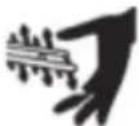
Keep all bodily parts away from the hedge trimmer blades during start and while using the power tool.

Safety gloves must be worn.
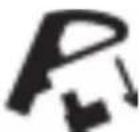
Note: Remove the battery from the power tool before any care or maintenance is performed.

Safety shoes must be worn.
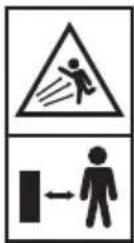
Beware of falling objects. Keep bystanders away.
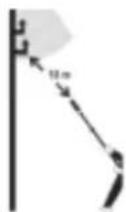
A safe distance of 10 m from highvoltage cables must always be maintained.
Product description
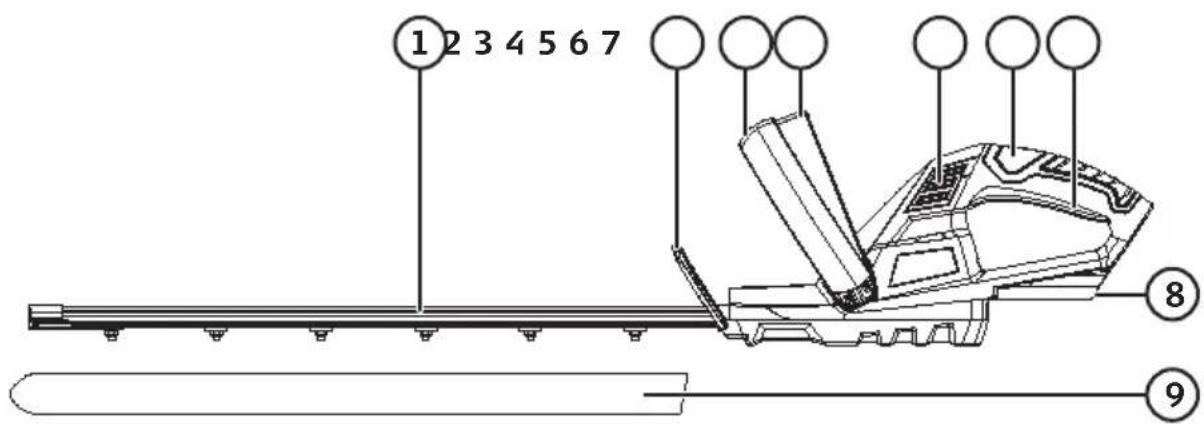
-
Blades
-
Front handle protection
-
Front handle
-
Safety lock switch
-
Motor housing ventilation slits
-
Rear handle
- Power trigger
- Battery connection
- Blade guard
Overload protection and other safety features
The battery has a number of safety features that prevent damage to the hedge trimmer and battery during use.
- During brief moments of high loads, the overload protection may switch the hedge trimmer off. This protection resets automatically. Release the power switch, wait a few seconds, ensure that there is no load and restart the hedge trimmer. The hedge trimmer should now function normally again.
- Under high loads for extended periods, the overheating protection may switch the hedge trimmer off. This feature is self-resetting but the hedge trimmer cannot be restarted until it has returned to a safe operating temperature. Let the hedge trimmer battery cool before trying to restart it. Adverse temperatures can occur in direct sunlight and should therefore be avoided.
- The battery has a low-voltage protection device, which operates when the battery becomes discharged. The low-voltage protection device turns off the hedge trimmer automatically and the battery then needs to be recharged.
Instructions for use

Warning
- Always keep the work area tidy so you can move freely without the risk of tripping over obstacles.
- Make sure that there are no loose branches which could become caught in the trimmer.
- Make sure that you are wearing all required safety gear before starting.
- Make sure that all parts of the hedge trimmer are intact, accounted for and undamaged.
- Make sure that the blades are sharp and lubricated.
- Keep the motor housing ventilation slots free from debris.
- Ensure that the safety lock switch (4) and power trigger (7) are easily depressed and do not stick or function abnormally in any way.
- Ensure that both handles are clean and easily gripped.
Consider the following points when using the trimmer
- Make sure that there are no hidden obstacles (metal poles/wire fences) in the area to be trimmed.
• Max branch diam: 15 mm. - Hold the trimmer firmly; maintain a steady stance and do not lean out too far. Be extra careful when using a ladder.
- Move the trimmer along in a slow and steady motion.
- The double-sided blade enables trimming in both directions or in a pendulum action from side to side.
-
For even trimming on the sides, it is better to cut in the direction of growth, from the bottom up.
-
If you trim from the top down, the thinner twigs will bend out and there is a risk of holes or thin patches appearing in your hedge.
- In order to ensure a straight top edge, you can stretch a length of string over the hedge as a guide.
Start
- Ensure that the blade guard is removed.
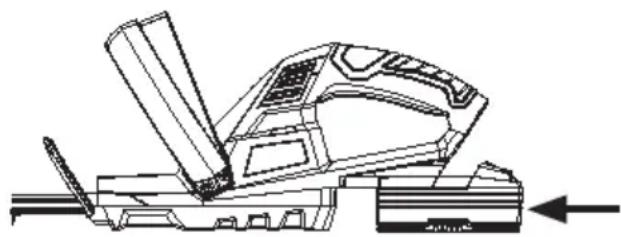
- Insert the battery making sure that it clicks securely into place.
- Hold both the safety lock switch and power trigger pressed in. The trimmer should now start.
- The trimmer will stop automatically if the safety lock switch or the power trigger is released.
natural_image
Technical line drawing of a mechanical device with no visible text or symbolsi
- Both the safety lock and power switch must be held in to keep the motor in continuous operation.
- Sparks may sometimes be noticed inside the motor housing when the motor is turned off. This is completely normal.
Care and maintenance

Warning
• Always remove the battery before performing any service or maintenance.
- Wear protective gloves when handling or cleaning the blades.
- Regularly check that the on/off switch and safety lock are undamaged and work correctly.
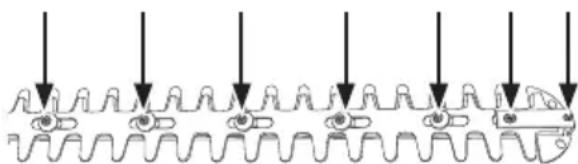
- Check regularly and lubricate the blades with appropriate lubricant and make sure that the screws in the blades are tightened.
natural_image
Pure mechanical diagram showing a chain of springs or springs with downward arrows indicating motion (no text or symbols)- Lubricate the blades with an appropriate lubricant if they are not to be used for a long time.
- Clean the exterior of the trimmer using a damp cloth. Use only mild cleaning agents, never solvents or corrosive chemicals.
- Remove all dirt, especially from around the motor housing ventilation slits.
- Whenever the trimmer is not to be used for a long time, it should be stored in a dry, dust-free environment, out of children's reach.
- Do not store the battery in temperatures below zero.
- Always keep the blade sheath on when the hedge trimmer is not in use.
Troubleshooting guide
| The trimmer does not start. | Discharged or incorrectly inserted battery. Charge the battery and ensure that it is properly fitted to the trimmer. |
| The trimmer is sluggish and/or cuts out. | The blades are damaged. Check the blades.Too much force applied. Decrease the applied force.The battery might be overheated. Read the Overload protection and other safety features section. |
| Poor battery operating time. | The battery is not fully charged. A few charging cycles where the battery is charged 100% might be needed before it reaches full capacity.The battery needs replacing. |
| The battery does not charge. | The battery is not correctly inserted into the charger.The battery or charger contacts are dirty. Disconnect the charger from the power supply and clean the contacts.The mains lead is not securely plugged into the wall socket.Check that the wall socket is energised.The charger or mains lead is damaged.The battery needs replacing. |
Responsible disposal
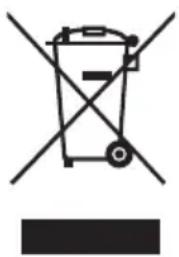
This symbol indicates that this product should not be disposed of with general household waste. This applies throughout the entire EU. In order to prevent any harm to the environment or health hazards caused by incorrect waste disposal, the product must be handed in for recycling so that the material can be disposed of in a responsible manner. When recycling the product, take it to your local collection facility or contact the place of purchase. They will ensure that the product is disposed of in an environmentally sound manner.
natural_image
Symbol of a trash bin crossed with no visible text or labelsSpecifications
No-load speed 1400 strokes/min
Blade length 550 mm
Cutting capacity 14 mm
Weight excluding battery 2 kg
Noise emission LpA = 75.1 dB(A), K = 3 dB(A)
LwA = 90.0 dB(A), K = 3 dB (A)
Vibration value 1.89 m/s ^2 , K = 1.5 m/s ^2
Vibration
- The measurement of the vibration emission level (triaxial vector sum) and the noise level values declared in this instruction manual have been carried out in accordance with a standardised test method described in EN 50636-2-91 and can be used for comparing one power tool with another.
- The measurement method may also be used for a preliminary assessment of vibration exposure.
- The declared vibration emission level applies when the power tool is used in accordance with this instruction manual. If however, the power tool is used for other purposes and with other accessories or has not been properly maintained, the vibration emission level could increase significantly over the total working period.
- For an exact assessment of the vibration exposure, the times when the tool is switched off or running idle should also be taken into account. This significantly reduces the vibration exposure over the total working period. Decide upon safety measures to protect the operator from the effects of vibration during all types of use.
Häcksax
Art.nr 31-9459 Modell ASYHT02550
natural_image
Technical line drawing of a mechanical device with no visible text or symbolsi
natural_image
Pure mechanical component diagram without any text, numbers, or symbolsnatural_image
Symbol of a trash bin crossed with no text or labels, accompanied by a solid black rectangle below (no text or symbols present)Specifikationer
Varvtal 1400 v/min
Svärdlängd 550 mm
Grenkapacitet 14 mm
LwA = 90,0 dB(A), K = 3 dB(A)
Vibration 1,89 m/s ^2 , K = 1,5 m/s ^2
Vibration
natural_image
Technical line drawing of a mechanical device with no visible text or symbolsi
natural_image
Pure mechanical component diagram without any text, numbers, or symbolsnatural_image
Symbol of a trash bin crossed with no text or labels, accompanied by a solid black rectangle below (no text or symbols present)Spesifikasjoner
Turtall 1400 o/min
Lengde sverd 550 mm
LwA = 90,0 dB(A), K = 3 dB(A)
natural_image
Technical line drawing of a mechanical device with no visible text or symbolsnatural_image
Pure mechanical component diagram without any text, numbers, or symbolsnatural_image
Symbol of a trash bin crossed with no text or labels, accompanied by a black rectangular block below (no readable text or symbols)Tekniset tiedot
LwA = 90,0 dB(A), K = 3 dB(A)
natural_image
Technical line drawing of a mechanical device with no visible text or symbols
natural_image
Pure mechanical component diagram without any text, numbers, or symbolsnatural_image
Symbol of a trash bin with crossed lines indicating no waste or discharge, and a solid black rectangle below (no text or labels)Technische Daten
Drehzahl 1400 /min
Schwertlänge 550 mm
LwA = 90,0 dB(A), K = 3 dB(A)
Declaration of Conformity
Declares that this product complies with the requirements of the following directives and standards
Machinery Directive 2006/42/EC
EN 60745-1:2009/
A11: 2010
EN 60745-2-15: 2009/
A1: 2010
AFPSGS2014:01PAK
EMC Directive 2014/30/EU
EN: 55014-1: 2006
+A2: 2011
EN: 55014-2: 2015
Henrik Alfredsson
Technical Manager
Insjön, Sweden, 2018-01-15
CLAS OHLSON AB, SE-793 85 INSJÖN, SWEDEN
LXC
LITHIUM XROSS CONNECT