
XONAR ESSENCE ST, XONAR ESSENCE STX - Soundcard ASUS - Free user manual and instructions
Find the device manual for free XONAR ESSENCE ST, XONAR ESSENCE STX ASUS in PDF.
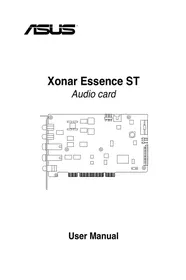


| Brand | ASUS |
| Model | Xonar Essence ST / STX |
| Category | Internal sound card |
| Product type | High-fidelity sound card for PC |
| Dimensions (STX) | 17.0 x 10.7 cm (half-height format) |
| Weight (STX) | Approximately 140 g |
| Power supply | Via PCI Express slot (ST) or PCIe x1 (STX) |
| Signal-to-noise ratio (SNR) | 124 dB (playback), 118 dB (recording) |
| Maximum sampling frequency | 192 kHz / 24-bit |
| Digital-to-analog converter (DAC) | Burr-Brown PCM1792A (ST) or PCM1796 (STX) |
| Analog-to-digital converter (ADC) | Burr-Brown PCM4220 (ST) or PCM4202 (STX) |
| Audio outputs | 2 x stereo RCA, 1 x optical S/PDIF, 1 x amplified 6.35 mm headphone jack |
| Audio inputs | 1 x stereo RCA line-in, 1 x 6.35 mm microphone input, 1 x optical S/PDIF input |
| Built-in headphone amplifier | Yes, compatible with high-impedance headphones (up to 600 Ω) |
| Supported audio technologies | Dolby Virtual Speaker, Dolby Headphone, DS3D GX 2.5, EAX 5.0, ASIO 2.0 |
| Dolby Virtual Speaker (DVS) modes | DH1 (deadened room), DH2 (livelier room), DH3 (large room) |
| Included software | ASUS drivers, Xonar control panel, DSP modes |
| Compatible operating systems | Windows 7, 8, 10 (specific drivers) |
| Maintenance and cleaning | Dust the connectors with dry air, avoid moisture |
| Spare parts and repairability | Replaceable capacitors, socketed DAC and operational amplifier (op-amp) |
| Safety | Turn off the computer before installation, avoid electrostatic discharge |
| Warranty | 2 years (depending on country) |
Frequently Asked Questions - XONAR ESSENCE ST, XONAR ESSENCE STX ASUS
User questions about XONAR ESSENCE ST, XONAR ESSENCE STX ASUS
0 question about this device. Answer the ones you know or ask your own.
Ask a new question about this device
Download the instructions for your Soundcard in PDF format for free! Find your manual XONAR ESSENCE ST, XONAR ESSENCE STX - ASUS and take your electronic device back in hand. On this page are published all the documents necessary for the use of your device. XONAR ESSENCE ST, XONAR ESSENCE STX by ASUS.
USER MANUAL XONAR ESSENCE ST, XONAR ESSENCE STX ASUS
Copyright © 2012 ASUSTeK COMPUTER INC. All Rights Reserved.
No part of this manual, including the products and software described in it, may be reproduced, transmitted, transcribed, stored in a retrieval system, or translated into any language in any form or by any means, except documentation kept by the purchaser for backup purposes, without the express written permission of ASUSTeK COMPUTER INC. ("ASUS").
Product warranty or service will not be extended if: (1) the product is repaired, modified or altered, unless such repair, modification of alteration is authorized in writing by ASUS; or (2) the serial number of the product is defaced or missing.
ASUS PROVIDES THIS MANUAL "AS IS" WITHOUT WARRANTY OF ANY KIND, Either EXPRESS OR IMPLIED, INCLUDING BUT NOT LIMITED TO THE IMPLIED WARRANTYES OR CONDITIONS OF MERCHANTABILITY OR FITNESS FOR A PARTICULAR PURPOSE. IN NO EVENT SHALL ASUS, ITS DIRECTORS, OFFICERS, EMPLOYEES OR AGENTS BE LIABLE FOR ANY INDIRECT, SPECIAL, INCIDENTAL, OR CONSEQUENTIAL DAMAGES (INCLUDING DAMAGES FOR LOSS OF PROFITS, LOSS OF BUSINESS, LOSS OF USE OR DATA, INTERUPTION OF BUSINESS AND THE LIKE), EVEN IF ASUS HAS BEEN ADVISED OF THE POSSIBILITY OF SUCH DAMAGES ARISING FROM ANY DEFECT OR ERROR IN THIS MANUAL OR PRODUCT.
SPECIFICATIONS AND INFORMATION CONTAINED IN THIS MANUAL ARE FURNISHED FOR INFORMATIONAL USE ONLY, AND ARE SUBJECT TO CHANGE AT ANY TIME WITHOUT NOTICE, AND SHOULD NOT BE CONSTRUED AS A COMMITMENT BY ASUS. ASUS ASSUMES NO RESPONSIBILITY OR LIABILITY FOR ANY ERRORS OR INACCURACIES THAT MAY APPEAR IN THIS MANUAL, INCLUDING THE PRODUCTS AND SOFTWARE DESCRIBED IN IT.
Products and corporate names appearing in this manual may or may not be registered trademarks or copyrights of their respective companies, and are used only for identification or explanation and to the owners' benefit, without intent to infringe.
Contents
Notices. V Safety information vi Trademarks vi License vi About this guide vii
Chapter 1: Product introduction
Package contents 1 System requirements 1 Specifications summary 2 Xonar Essence ST card layout 5
Chapter 2: Getting started
Before you proceed 7 Installing the audio card 7 Connecting to a TV tuner card 8 Installing the audio card driver 9
Chapter 3: Connecting speakers and peripherals
Connecting digital speaker systems (Home Theater) 10 Connecting stereo headphones 11 Connecting 2/2.1 channel speakers 12 Connecting a microphone 13 Connecting Line-In audio sources 14
Chapter 4: Xonar Audio Center
Xonar Audio Center 15
Main Setting 17 Mixer/Volume 25 Effects 28 Karaoke 30 FlexBass 31 Smart Volume Normalization 32 DS3D GX and DSP Modes 34 VocalFX 36
Appendix: Troubleshooting and FAQs
Troubleshooting 39
Frequently Asked Questions (FAQs) 41
ASUS Contact information 45
Notices
Federal Communications Commission Statement
This device complies with Part 15 of the FCC Rules. Operation is subject to the following two conditions:
This device may not cause harmful interference. - This device must accept any interference received including interference that may cause undesired operation.
This equipment has been tested and found to comply with the limits for a Class B digital device, pursuant to Part 15 of the FCC Rules. These limits are designed to provide reasonable protection against harmful interference in a residential installation. This equipment generates, uses and can radiate radio frequency energy and, if not installed and used in accordance with manufacturer's instructions, may cause harmful interference to radio communications. However, there is no guarantee that interference will not occur in a particular installation. If this equipment does cause harmful interference to radio or television reception, which can be determined by turning the equipment off and on, the user is encouraged to try to correct the interference by one or more of the following measures:
Reorient or relocate the receiving antenna. - Increase the separation between the equipment and receiver. - Connect the equipment to an outlet on a circuit different from that to which the receiver is connected. - Consult the dealer or an experienced radio/TV technician for help.
Canadian Department of Communications Statement
This digital apparatus does not exceed the Class B limits for radio noise emissions from digital apparatus set out in the Radio Interference Regulations of the Canadian Department of Communications.
This class B digital apparatus complies with Canadian ICES-003.
Australia statement notice
From 1 January 2012, updated warranties apply to all ASUS products consistent with the Australian Consumer Law. For the latest product warranty details, please visit http://support.asus.com. Our goods come with guarantees that cannot be excluded under the Australian Consumer Law. You are entitled to a replacement or refund for a major failure and compensation for any other reasonably foreseeable loss or damage. You are also entitled to have the goods repaired or replaced if the goods fail to be of acceptable quality and the failure does not amount to a major failure.
If you require assistance, please call ASUS Customer Service at 1300 2787 88 or visit us at http://support.asus.com.
Safety information
- Before installing the device on a motherboard, carefully read all the manuals that came with the package.
- To prevent electrical shock hazard or short circuits, switch off the power supply before installing the device on a motherboard or connecting any signal cables to the device. If the device is broken, do not try to fix it by yourself. Contact a qualified service technician or your retailer.
- Before using the product, make sure all cables are correctly connected. If you detect any damage, contact your dealer immediately.
- To avoid short circuit, keep paper clips, screws, and staples away from connectors, sockets and circuitry.
- Avoid dust, humidity, and temperature extremes. Do not place the product in any area where it may be exposed to moisture.
- Place the product on a stable surface. If you encounter technical problems with the product, contact a qualified service technician or your retailer.

This symbol of the crossed out wheeled bin indicates that the product (electrical and electronic equipment) should not be placed in municipal waste. Check local regulations for disposal of electronic products.
Trademarks
Xonar and ASUS logo are trademarks of ASUSTek Computer Inc. "Dolby" and "Dolby Digital Live", "Dolby Pro Logic IIx", "Dolby Virtual Speaker", "Dolby Headphone" are trademarks of Dolby Laboratories. EAX and A3D are trademarks of Creative Technology Ltd. Microsoft, DirectX3D, Windows are trademarks of Microsoft Corporation. Other company and product names may be trademarks of the respective companies with which they are associated. ASIO is a trademark and software of Steinberg Media Technologies GmbH
License
Dolby Master Studio driver is manufactured under license from Dolby Laboratories.
About this guide
This user guide contains the information you need when installing and configuring the motherboard.
How this guide is organized
This guide contains the following parts:
Chapter 1: Product introduction
This chapter describes the features of the Xonar Essense ST.
Chapter 2: Getting Started
This chapter discusses how to install the audio card and its driver.
Chapter 3: Connecting speakers and peripherals
This chapter discusses how to connect the speakers and peripherals to the audio card.
Chapter 4: Xonar Audio Center
This chapter provides information on the Xonar Audio Center, the graphical user interface (GUI) of the audio card driver.
Where to find more information
Refer to the following sources for additional information and for product and software updates.
- ASUS websites
The ASUS website provides updated information on ASUS hardware and software products. Refer to the ASUS contact information.
- Optional documentation
Your product package may include optional documentation, such as warranty flyers, that may have been added by your dealer. These documents are not part of the standard package.
Conventions used in this guide
To ensure that you perform certain tasks properly, take note of the following symbols used throughout this manual.

DANGER/WARNING: Information to prevent injury to yourself when trying to complete a task.

CAUTION: Information to prevent damage to the components when trying to complete a task.

IMPORTANT: Instructions that you MUST follow to complete a task.

NOTE: Tips and additional information to help you complete a task.
Package contents
- ASUS Xonar Essence ST PCI audio card 3.5mm-to-RCA cable x1 3.5mm-to-6.3mm adapter x1 S/PDIF TOSLINK optical adapter x1 Support CD Audio Precision Test Report

If any of the above items is damaged or missing, contact your retailer.
System requirements
One PCI slot for the audio card - Microsoft® Windows® Vista (32/64bit) / XP (32/64bit) / MCE2005 Intel Pentium 4 1.4 GHz or AMD Athlon 1400 CPU or faster CPU 256 MB (or above) DRAM system memory - 60 MB available HDD space for driver installation package - CD-ROM drive (or DVD-ROM drive) for software installation - High-quality headphones, powered analog speakers, or a Dolby Digital decoder, to enjoy ultra-high fidelity sound
Specifications summary
| ITEM | DESCRIPTION |
| Audio Performance | |
| Output Signal-to-Noise Ratio (A-Weighted): | 124dB for Front-out 117dB for Headphone-out at 600ohms |
| Input Signal-to-Noise Ratio (A-Weighted): | 118dB |
| Output Total Harmonic Distortion + Noise at 1kHz (-3dB) : | 0.0003% (-110dB) for Front-out 0.001% (-100dB) for Headphone-out |
| Input Total Harmonic Distortion + Noise at 1kHz (-3dB) : | 0.0002% (-113dB) for Line-In |
| Frequency Response (-3dB, 24-bit/96kHz format): | <10Hz to 80KHz |
| Output/Input Full-Scale Voltage | 2 Vrms (5.65 VP-p) |
| Headphone Impedance | Optimized for 32~600ohms |
| Main Chipset | |
| Audio Processor | ASUS AV100 High-Definition Sound Processor (Maximum 192KHz/24bit) |
| 24-bit D-A Converter of Digital Sources: | Texas Instruments PCMI792A*1 for Front-Out (127dB SNR, 192kHz/24bit) |
| High Fidelity Headphone Amplifier | Texas Instruments 6120A2*1 (120dB SNR, 100dB THD+N @ Vcc± 12V, RL=600ohms, f =1kHz) |
| 24-bit A-D Converter for Analog Inputs: | Cirrus-Logic CS5381*1 (120dB SNR, Maximum 192kHz/24bit) |
| Sample Rate and Resolution | |
| Analog Playback Sample Rate and Resolution | 44.1K/48K/96K/192kHz @ 16/24bit |
| Analog Recording Sample Rate and Resolution | 44.1K/48K/96K/192kHz @ 16/24bit |
| S/PDIF Digital Output | 44.1K/48K/96K/192kHz @ 16/24bit, Dolby Digital |
(continued on the next page)
| ITEM | DESCRIPTION |
| I/O Ports | |
| Analog Output Jack: | RCA jack *2 (Front R/ Front L)6.30mm jack *1 (Headphone out) |
| Analog Input Jack: | 6.30mm jack *1 (Shared by Line-In/Mic-In) |
| Digital S/PDIF Output: | High bandwidth Coaxial/TOSLINK combo port supports 192kHz/24bit |
| Other line-level analog input (for TV Tuner or CD-ROM): | Aux-In (4-pin header on the card) |
| Front Panel: | Shared by Headphone out/ 2 channels out/Microphone in |
| Driver Features | |
| Operating System | Windows® Vista (32/64-bit) / XP (32/64-bit) / MCE2005 |
| Dolby® Digital Live | Dolby® Digital Live encodes any audio signal on PC in real-time to Dolby Digital (AC3) 5.1 surround sounds to your home theater environment through one signal S/PDIF connection. |
| Dolby® Headphone | Dolby® Headphone technology allows users to listen to music, watch movies, or play games with the dramatic |
| Dolby® Virtual Speaker | Dolby® Virtual Speaker technology simulates a highly realistic 5.1-speaker surround sound listening environment from as few as two speakers. |
| Dolby® Pro-Logic II | Dolby® Pro-Logic II is the well-known technology to process any native stereo or 5.1-channel audio into a 6.1 channel output, creating a seamless, natural surround soundfield. |
| DirectSound3D Game EXtensions 2.0 & 1.0 (DS3D GX 2.0) | DS3D GX 2.5 supports EAX gaming sound effects and DirectX3D hardware enhanced functions for more games on Windows Vista/XP. (DirectX/DirectSound 3D compatible)DS3D GX 2.5 adds the latest VocalFX voice effects for online gaming or chatting. |
(continued on the next page)
| ITEM | DESCRIPTION |
| VocalFXTM | Xonar Essence ST provides VocalFX, the latest vocal effect technologies for gaming and VoIP, including:VoiceEX: produces vivid environmental reverberation for your voice to others in EAX games.Local VoiceEX: enables yourself to hear the vivid environmental reverberation by your speakersChatEX: emulates different background environment effects when you chat online |
| Smart Volume NormalizerTM | Normalizes the volume of all audio sources into a constant level and also enhances your 3D sound listening range and advantages in gaming. |
| Karaoke Functions | Music Key-Shifting, Vocal Cancellation, and Microphone Echo effects like professional Karaoke machine |
| FlexBassTM | Professional Bass Management/Enhancement system |
| Year 3D™ Virtual Speaker Shifter | Virtual 7.1 speaker positioning |
| Other Effects | 10-band Equalier/27 Environment Effects |
| 3D Gaming Sound Engines/APIs | DirectSound3D® GX 2.5 & 1.0, EAX®2.0&1.0, DirectX® HW, DirectX SW, OpenAL generic modes, 128 3D sounds processing capability |
| ASIO 2.0 Driver Support | Supports 44.1K/48K/96K/192KHz @16/24bit with very low latency |
*Specifications are subject to change without notice.
Xonar Essence ST card layout
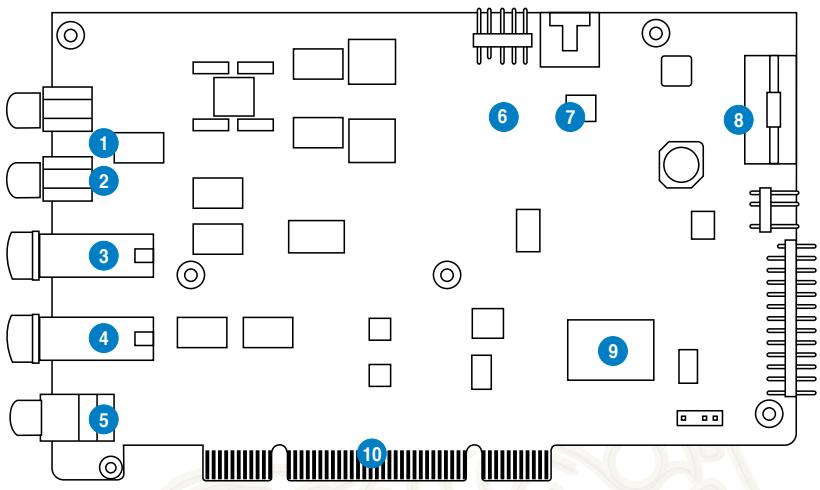

Front Right Out port
Connect the Right audio cable (red) from your 2/2.1 channel speakers to this port. For multi-channel speaker systems, connect to the Front Right In port on the powered speakers.

Front Left Out port
Connect the Left audio cable (white) from your 2/2.1 channel speakers to this port. For multi-channel speaker systems, connect to the Front Left In port on the powered speakers.

Headphone Out port
Connect your headphones to this port.

DO NOT connect your speakers to the headphone out port. The possible high driving power may cause damage to your speakers. - Before connecting your headphone, adjust the headphone impedance settings in the Xonar Essence ST Audio Center to match your headphone impedance. This is to prevent damage to your headphone.

Microphone In port
Connect your external PC microphone to this port for voice input. It has a built-in high-quality Microphone pre-amplifier.
Line In port
Through an Ultra-high fidelity 118dB SNR A-D converter, connect analog devices like MP3 players, CD players, music synthesizers, and other line-level sound sources to this 6.3mm port for audio recording or processing.

SP/DIF Out port
Coaxial and optical TOSLINK combo digital output port. Connect to an external digital decoder or digital speaker systems, Home Theater systems, AV receivers for outputting digital audio including PCM, Dolby Digital, DTS, and WMA-Pro.

Front panel audio header
Connect one end of the front panel audio cable to the front panel audio header on the Xonar Essence ST card, and the other end to the chassis-mounted front panel audio I/O module.

Aux Input Header
Usually connects to the Analog Audio output of a TV tuner card or other sound source inside your computer. To monitor your TV tuner card's audio from this Aux-In, you must enable the "monitor" function for Aux-In in the Xonar Essence ST Audio Center's recording mixer.

Power connector
Connects to the power cable of your power supply unit.
Before you proceed
Read the following notes and precautions before you install the audio card.

- Disable the onboard audio device in the BIOS settings or uninstall any other sound cards on your computer.
- For BIOS setting or uninstallation of other sound cards, refer to the user manuals of your motherboard and sound cards.

- Turn off your computer and disconnect all peripherals connected to it. Unplug the computer's power cord from the power outlet.
- To avoid static electricity, use a grounded wrist strap or touch a safely grounded object such as the metal part or the rear panel of your computer.
Installing the audio card
To install the audio card:
- Remove the chassis cover of your computer.
- Remove the metal bracket of a PCI slot at the rear panel of your computer.
- Carefully insert the audio card into the PCI slot. Ensure that the audio card sits properly in place.
- Secure the audio card with the screw you removed from the PCI slot's metal bracket.
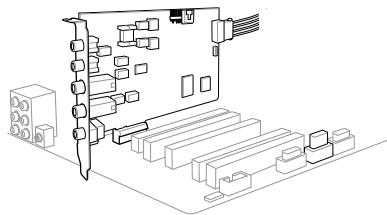
- Connect the power cable of your power supply unit (PSU) to the power connector of the audio card.

Ensure that the power cable is connected properly. Otherwise, the audio card will not work.
- Replace the chassis cover. 7 Plug the computer's power cord into a power outlet.
- Turn on your computer.
Connecting to a TV tuner card
If you have a traditional PCI TV tuner card on your computer, you may need to connect it to the Xonar Essence ST card to send the tuner card's sound to your PC speakers.
To connect to a TV tuner card:
- Secure the PCI TV tuner card into the rear panel with a screw.
- Connect the audio output header from the TV tuner card to the Aux-In header of the audio card.

For optimum TV audio quality, Xonar HDAV uses ADC recording to digitize the signal and loop it back for DAC playback. Select Aux-In as the recording source in the Xonar Essence ST Center's recording mixer and enable the monitoring button to pass this signal to the audio output. Using this setup, you can even turn on sound effects such as Pro-Logic IIx to expand the stereo TV audio to 5.1 or 7.1 channel surround sound. This gives you a better TV audio quality on your computer compared to that of your TV.
Installing the audio card driver

Ensure that you have installed the VGA card driver before installing the Xonar Essence ST driver. Otherwise, driver installation error may occur.
To install the audio card driver:
- After you have installed the Xonar Essence ST card, turn on your computer. Windows® automatically detects the HDAV card and searches for device drivers. When prompted for the drivers, click Cancel.
- Insert the support CD into the optical drive. If Autorun is enabled in your system, the setup starts automatically. If not, run setup.exe from your support CD.
- Follow the onscreen instructions to complete the installation.
- When the installation is complete, you are prompted to restart your computer. Select Yes, I want to restart my computer now or No, I will restart my computer later.
- Click Finish.
Connecting digital speaker systems (Home Theater)
The Xonar Essence ST supports Dolby Digital Live and DTS Interactive technologies, which transcode any audio, including games and music, into industry-standard Dolby Digital or DTS 5.1 surround bit-streams. This makes playback through your home theater system possible, creating an immersive and impressive cinema surround sound experience. A single digital cable connection can carry high-quality Dolby Digital or DTS 5.1 digital audio from any of your PC audio sources to any digital speakers or AV Receivers with Dolby Digital or DTS 5.1 decoding capabilities.
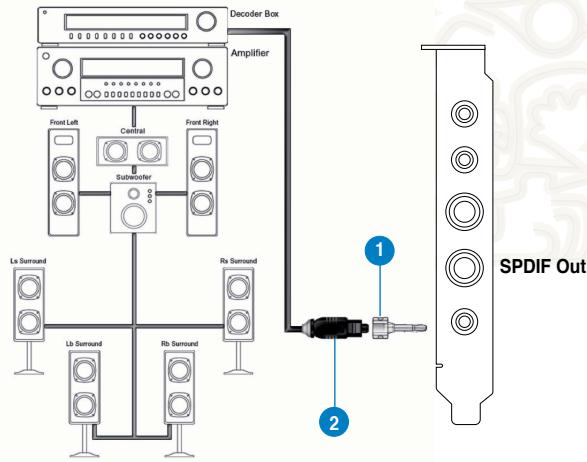
Optical adapter
Plug the optical TOSLINK adapter into the S/PDIF-Out combo connector.
2 Optical cable
Connect your decoder's S/PDIF-In port to the optical adapter with the TOSLINK optical cable.

You can also use a coaxial cable for a S/PDIF connection. Just plug the coaxial RCA male connector to the S/PDIF-Out combo jack and connect the other end into the coaxial S/PDIF input on your decoder.
Connecting stereo headphones
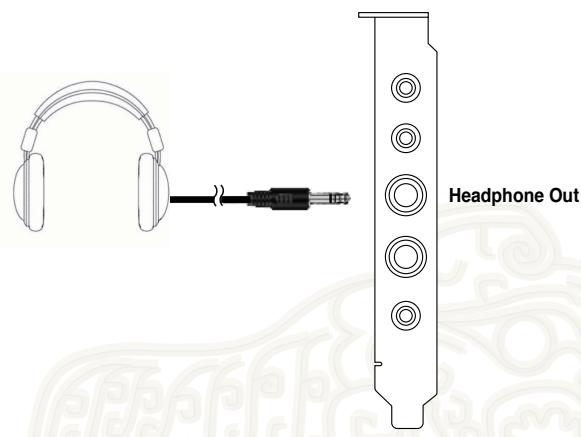
The Headphone Out port has a built-in high-quality amplifier for headphones. Connect your stereo headphones to the headphone output ports on the Xonar Essence ST card.
Connecting 2/2.1 channel speakers
2 Speakers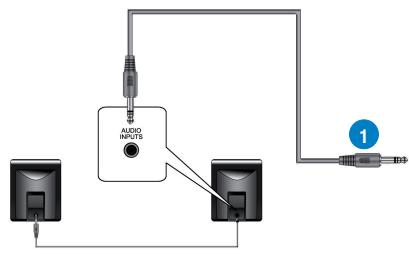
2.1 Speakers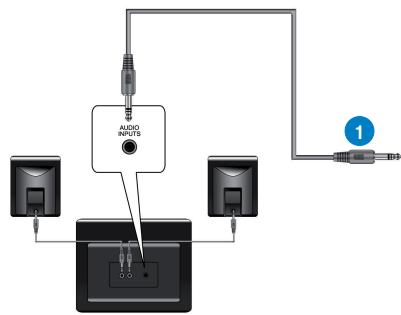
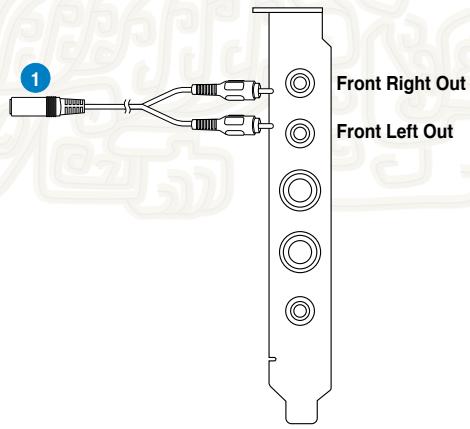

Front Left/Right Out
The Left/Right Front Out ports have a built-in high-quality amplifier to drive headphones. Connect the 2/2.1 speaker set's 3.5mm plug to the bundled RCA-to-3.5mm Y cable, and then connect the Left/Right ends to the Front Left/Right Out ports on the Xonar Essence ST card.
Connecting a microphone

Front Left/Right Out port/Headphone port
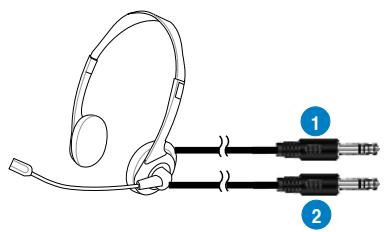
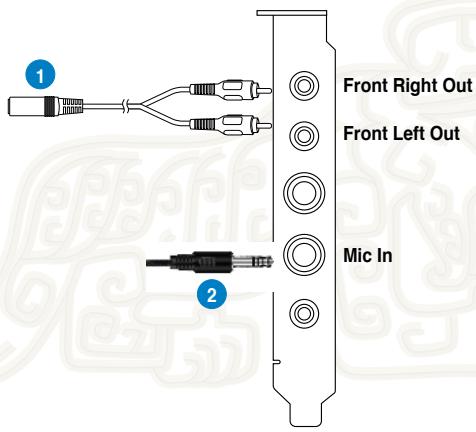
Connect the headphone's 3.5mm plug to the bundled RCA-to-3.5mm Y cable, and then connect the Left/Right ends to the Front Left/Right Out ports on the Xonar Essence ST card.

Microphone Input port
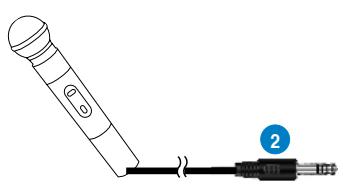
Connect your external PC microphone to this port by using the bundled 6.3mm-to-3.5mm adapter for voice communication, recording, or karaoke.
Connecting Line-In audio sources
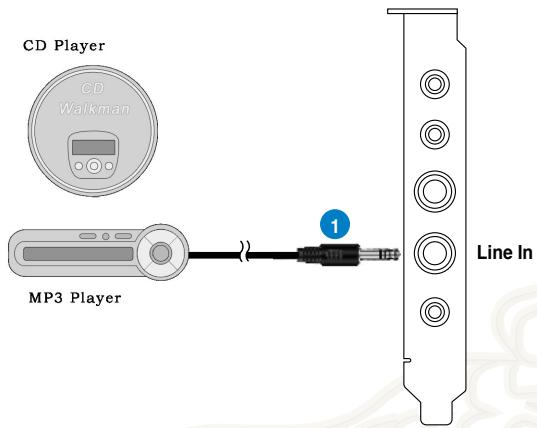

Line Input Jack
Connect the CD/MP3 Player or any other Line level analog audio sources to this Line-In port by using the bundled 6.3mm-to-3.5mm adapter for sound recording or real-time Dolby/DTS sound processing through the Monitoring path. Refer to the Mixer section of the driver's user manual.
Xonar Audio Center
The Xonar Audio Center, the graphic user interface (GUI) of the Xonar Essence ST, allows you to control the functions and features of the Xonar Essence ST.
To launch the Xonar Audio Center, double-click the Xonar Audio Center icon on the taskbar.


If the icon is not shown on the taskbar, click Start > All Programs > ASUS Xonar Essence ST Audio > Xonar Essence ST Audio Center to launch the Xonar Audio Center.
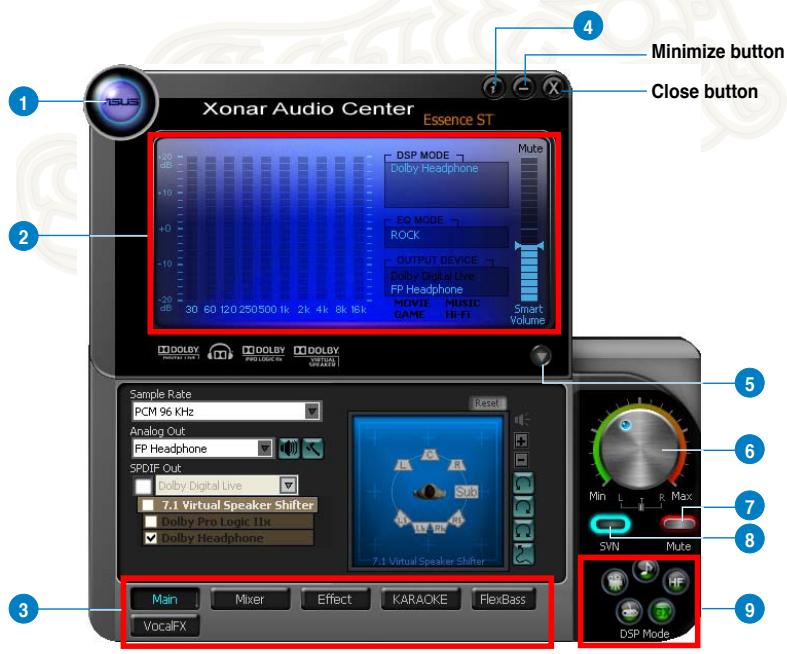
Support link
Click this button to go to the ASUS website at www.asus.com.

Display Area
The display area shows the 10-band signal meter, volume level, and the status of the Dolby/DTS technologies, EQ, and DSP modes. Note: this area just displays information, but is not used to alter settings.

Setting Menu Panel
This panel gives access to settings tabs, including Main Settings, Mixer/volume, Effects, Karaoke, FlexBass, and VocalFX.

Information icon
Click this icon to launch the driver information window.

Menu Open/Close
Click this button to display more settings.

Master Volume
This rotary knob controls the master playback volume. Drag the small circle inside it to change the volume level.

Mute Button
Click this button to mute audio playback. It displays a red light when playback is muted.

SVN Button
Click this button to enable the "Smart Volume Normalization" feature for constant volume from all playback sources. It displays a blue light when enabled.

DSP Mode
These 4 buttons give access to quick sound effects combinations for Music, Games, DVD Video, and effect-free (Hi-Fi) modes.

By default, DSP Mode is OFF.
Main Setting
Sample Rate
The sample rate determines the number of audio samples per second that the Digital-to-Analog Converters (DAC) and S/PDIF digital interface will output. The Xonar Essence ST card can support sample rates up to 192KHz (44.1K, 48K, 96K, 192KHz). Usually audio CDs and MP3 files are 44.1KHz; DVD-Video uses 48KHz; DVD-Audio or other HD media may contain 96KHz or 192KHz high-definition audio content. Select the corresponding sample rate for your playback sources to get the best audio fidelity. Even if your setting differs from the audio source's sample rate, the Xonar Essence ST engine will process super high fidelity sample-rate-conversions with a double floating-point filter, which can reduce total harmonic distortion (THD + N) by -140dB.
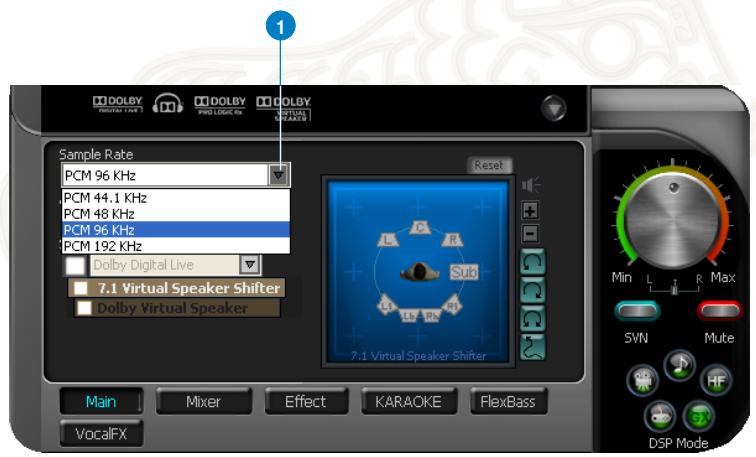

Sample Rate
Select the sample rate that corresponds to (or exceeds that of) your playback sources, for optimal audio fidelity. The Xonar Essence ST card supports sample rates up to 192KHz (44.1K, 48K, 96K, 192KHz). Typical values:
Audio CD, MP3, WMA, Wave files are 44.1KHz; The audio of DVD-Video is 48KHz; DVD-Audio or other HD media may contain 96KHz or 192KHz high-definition audio content.
Analog Out mode
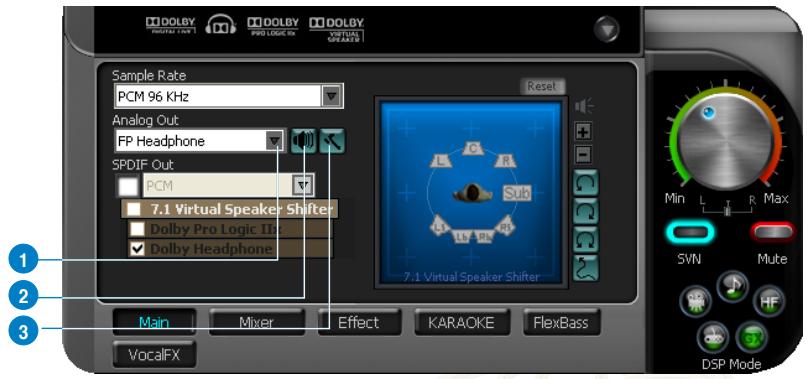
1 Analog Out
The Analog Out settings are used to match your actual speaker setting, such as headphones and 2/2.1 speakers. Xonar Essence ST will play the channels and process the 3D/Dolby sound accordingly. Select the correct speaker type for your connected speakers.
2 Speaker Test
Click this button to show the speaker test window in the right pane. Click the Play button to test each speaker one by one or click each speaker manually to test.
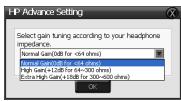
HP Advanced Setting
Click this button to select the gain tuning according to your headphone impedance. The setting is also available for FP Headphone.
SPDIF Out/DDL
Xonar Essence ST is capable of outputting Dolby Digital Live, which is a real-time encoder that transcodes any audio, including games and music, into industry-standard Dolby Digital bit-streams on-the-fly. This is ideal for playback through a home theater system, creating an impressive cinema surround sound experience. It enables a single digital connection to carry high quality Dolby Digital surround audio from your PC to digital speakers and AV Receivers.
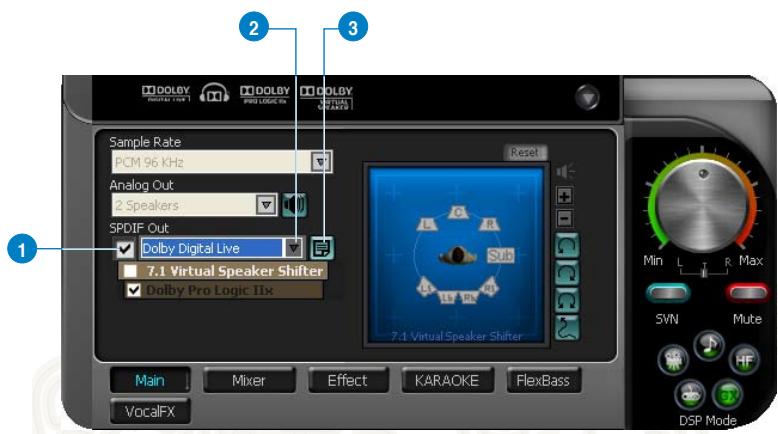
1 S/PDIF Out enable/disable
Tick this checkbox to enable S/PDIF output.
2 S/PDIF Output Formats/Functions
From the dropdown list, select one of these formats:
- PCM (Pulse Code Modulation, which is a typical raw audio data format.)
- Dolby Digital Live real-time 5.1ch encoding
3 Dobly Digital Live advanced upmixing option
This advanced setting will automatically upmix stereo (2ch) content to 5.1 channel surround with Dolby Pro-Logic II when using Dolby Digital Live output.

Audio Channels (For Windows® Vista / Windows® 7 only)
This setting only appears in Windows® Vista / Windows® 7. Windows® Vista / Windows® 7 delivers the audio channels to the audio driver according to this setting, no matter what the original audio content is or how many channels they have. Hence, you need to set this in accordance with your audio content before audio playback. This setting is synchronized with Windows® Vista/7's system speaker configuration and changing this setting during playback stops the audio playback program. You may have to restart the program after changing this setting.

Close all running applications before changing this setting.
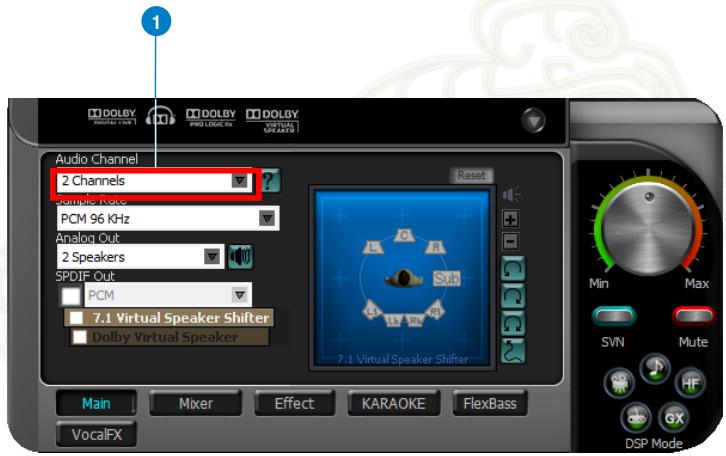

Audio Channels
Recommended settings:
- MP3, WMA, AAC, CD, VCD, 2D games => 2 channels DVD-Video with Dolby Digital or DTS 5.1 => 6 channels DVD-Video with Dolby Digital EX or DTS ES => 8 channels
- 3D games => 8 channels
7.1 Virtual Speaker Shifter
The 7.1 Virtual Speaker Shifter has the following major features:
- Expanding/upmixing audio to 7.1-channel surround sound
- Virtualizing 7.1 surround sound over any set of speakers
- Shiftable virtual speaker positioning allows you to adjust the best sound field easily without moving physical speakers and wires
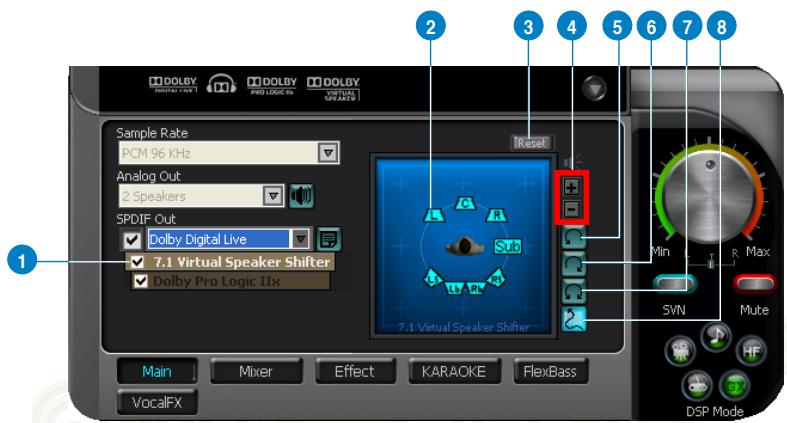
1 Shifter enable/disable
Tick this checkbox to enable the 7.1 Virtual Speaker Shifter. Click the textbar to switch the right window to the Speaker Shifter page for manual adjustments.

Settings will be retained even when a different Analog Output is selected.
Drag speaker or listener
You can drag each speaker or listener to a different position "virtually" using only your mouse. The Xonar Xense card will process the sound and reposition the virtual speakers real-time. The Subwoofer has no directional sounds, and hence can be moved only closer to or further away from the listener.
3 Reset
Reset all Speaker Shifter settings to the default settings.
4 Increase/decrease volume
Click + to increase volume (move speakers closer); click - to decrease volume (move speakers further away)
5 Counterclockwise
Click to rotate all speakers, except Subwoofer, counterclockwise
6 Clockwise
Click to rotate all speakers, except Subwoofer, clockwise.
7 Manual Rotation
Manually drag and rotate all speakers, except Subwoofer.
8 Manual Drag Mode
This is the default mode that allows you to manually drag each speaker or the listener with your mouse.
Dolby Pro-Logic IIx
Dolby Pro-Logic IIx is a 7.1 surround upmixing technology and is widely used in home theater systems, TVs, game consoles, and car audio systems. It can expand stereo audio, such as MP3, CD, and TV programs into immersive 5.1 or 7.1-channel surround.
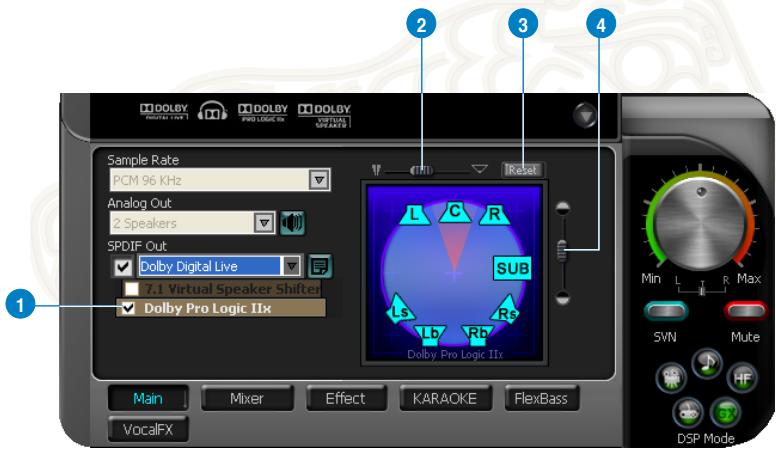
1 Dolby Pro-Logic IIx enable/disable
Tick this checkbox to enable Dolby Pro-Logic IIx. Click the textbar to switch the right window to the Pro-Logic IIx page for manual adjustments.
2 Center Width
This parameter is used to set the spread of the center, mainly for the vocal signals of songs and music. Drag the scroll bar to the left to centralize the vocal signal. Drag to the right side to widen the vocal sound range.
3 Reset
Reset all settings to the default settings.
4 Dimension
The dimension parameter fades sounds to the front or rear of the listener.
Dolby Headphone
Dolby Headphone creates a stunning multi-channel surround experience over ordinary stereo headphones for playing 3D games, watching 5.1 DVD movies, and listening to music. Dolby Headphone produces surround sound cues so realistic that you will believe you are listening over speakers in a well-controlled studio. Dolby Headphone can also improve listening comfort and reduce "listener fatigue" from long listening over headphones.
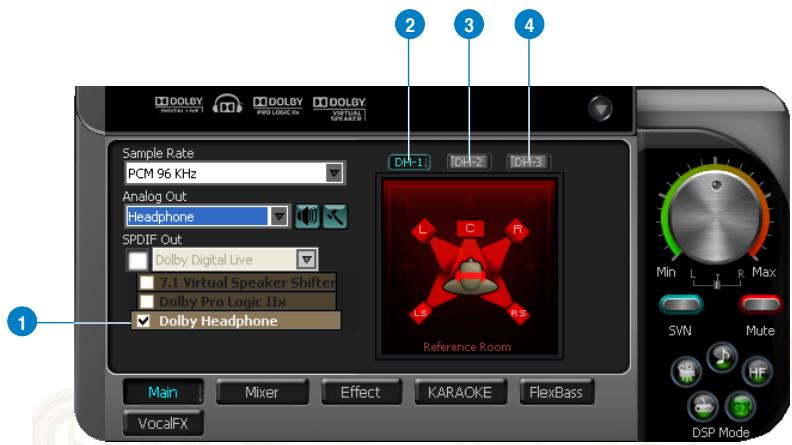

Dolby Headphone enable/disable
Tick this checkbox to enable Dolby Headphone. Click the textbar to switch the right window to Dolby Headphone page for manual adjusting.

7.1 Virtual Speaker Shifter and Dolby Pro-Logic IIx can be selected only when Dolby Headphone is enabled.

Dolby Headphone (DH) provides three room filters that may be used with any type of audio. They differ in the sense of the "spatial dimension" they impart.
Dolby Virtual Speaker technology simulates a 5.1-speaker surround sound listening environment from as few as two speakers. Dolby Virtual Speaker also creates a wider two-channel environment during playback of stereo CDs and MP3 content, and when combined with Dolby Pro Logic® II processing, delivers a virtual 5.1-channel surround listening experience from any high-quality stereo source.
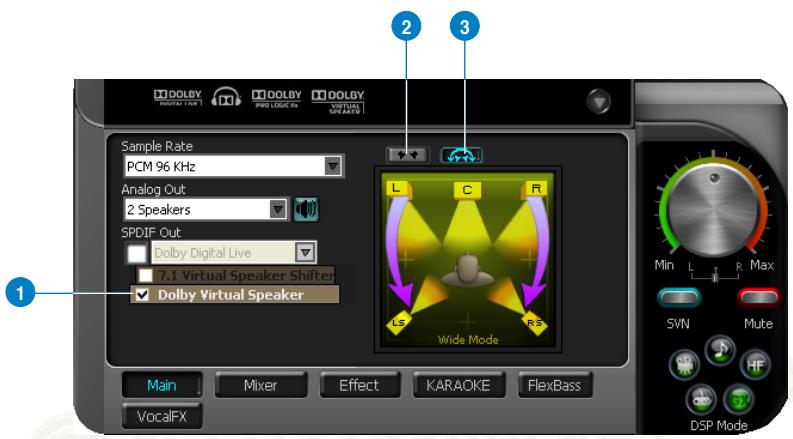

Dolby Virtual Speaker enable/disable
Tick this checkbox to enable Dolby Virtual Speaker. Click the text bar to switch the right window to a Dolby Virtual Speaker page for manual adjusting.

Reference Mode
Dolby Virtual Speaker provides two modes of virtualization: Reference Mode and Wide Mode.
Reference mode virtualizes the missing speakers as shown below.
Reference Mode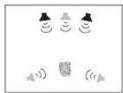

Wide Mode
Wide mode virtualizes the necessary speakers and enhances the surround experience as shown below.
Wide Mode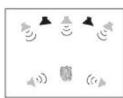
Mixer/Volume
The Mixer feature is designed to control the volume for playback and recording on the Xonar Essence ST. In addition, the Xonar Essence ST also provides a high-quality digital monitoring function for hearing the recorded audio from the speakers. You can also process the input signals with all playback sound effects such as Dolby and DTS technologies.
Playback Volume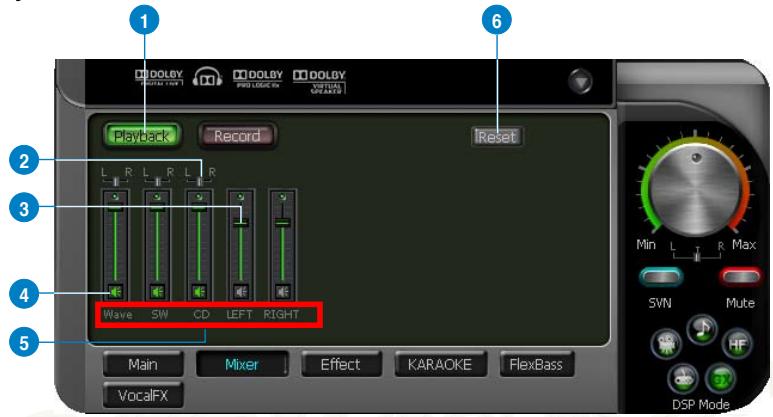
1 Playback volume tab
Click this button to show the playback volume page.
2 Left / Right balance
The horizontal slider controls the volume between the left and right channels.
3 Volume slider
Drag this slider down to decrease the volume. Drag it up to increase the volume. The tool-tip displays percentage increments.
Mute button
Click this button to mute the audio channel. Click this button again to restore the audio output.
5 Source / path name including:
WAVE: All digital audio sources except MIDI files - SW: Software Synthesizer; control the playback volume of the MIDI files - CD: CD-ROM digital playback (CD-DA) volume control - LEFT, RIGHT: the volume control for each speaker/channel

Windows® Vista does not support WAVE, Synthesizer and CD-In volume controls.
6 Reset
Reset all volume controls to the default settings
Recording/Monitoring Volume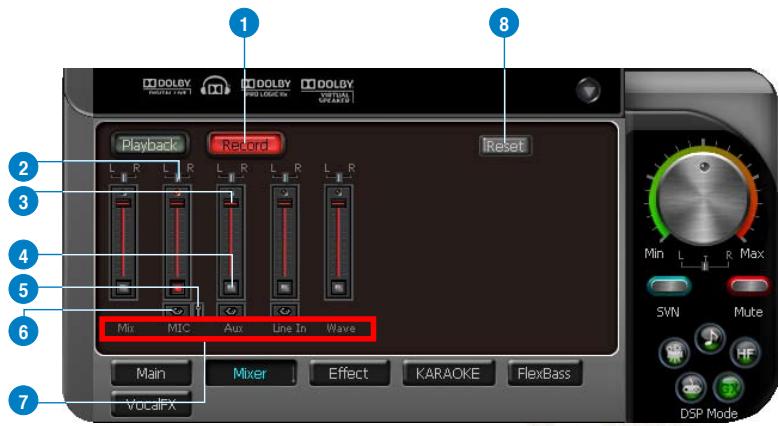
1 Recording Volume Tab
Click this button to show the recording volume page.
2 Left/Right balance
This horizontal slider controls the volume between the left and right channels.
3 Recording volume slider
Drag this slider down to decrease the recording volume. Drag up to increase the recording volume. The tool-tip displays percentage increments.
4 Recording Selector button
Click this button to select the path/source you are going to record. The recording function on Windows is a one-path selector. Hence, you can select only one default recording source at a time. You may have to restart the recorder program if you switch to a different source.

On Windows® Vista, some programs may allow you to select the recording device/path in the recording programs themselves.
5 Microphone-In Advanced Setting
Click this button to open the advanced settings for the Microphone-In.
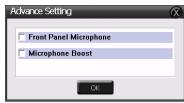
Enabling "Microphone Boost" increases the volume gain to boost the microphone input signals. If you connect your microphone to the front panel audio module, enable "Front Panel Microphone". For a typical low-cost PC microphone, we recommend that you enable this function.

Monitoring button
Click this button to monitor and loopback recording audio to output speakers. The recording volume will affect the monitoring signals from the speaker output. The audio will be mixed into the streams from your PC and all DSP effects will be applied to the source and the output. A typical application is to apply Dolby Pro-Logic IIx 7.1-ch spreading to your TV audio, CD, MP3, or stereo game console audio from a gaming device such as Wii, XBOX360, and PS2/PS3/PSP. To apply Dolby Virtual Speaker is suitable for a two-speaker setup.

When the monitoring function is enabled, audio output from HDMI output is disabled.

Source / path name
This shows the source name for each volume control slider:
S/PDIF-In: S/PDIF digital input source. - Mix: Stereo Mix which will record MIC, AUX, and digital WAVE audio you are playing on your PC. - Aux: Recording from Aux-In for typically TV-tuner card audio or other sound sources. - Line-In: Recording from Line-in jack for external audio devices. WAVE: Recording from digital wave audio you are playing on your PC.

Windows Vista does not support WAVE recording.

Reset
Click to reset all volume controls to the default settings.
Effects
Environment Effects
Use environment effects to create realistic listening experiences that mimic different environments. There are a total of 27 environment options that can be applied to all 2D sound sources such as music.
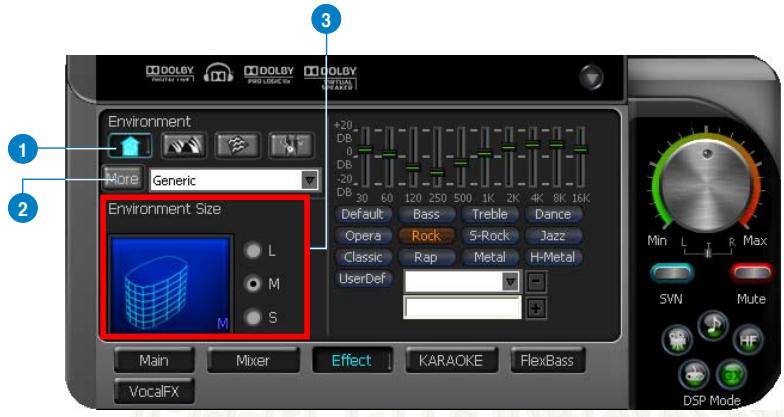
1 Default environments
These four buttons activate Bathroom, Concert hall, Underwater, and Music Pub environments.
2 More options
Click this button to view more environment effects in the dropdown list, which contains 23 more options.
3 Environment size
There are three size settings for each environment: Large, Medium, and Small.
10-Band Equalizer
The equalizer modifies the audio output for different frequencies, and is used to compensate for deficiencies in your speakers/sound systems. There are 12 default patterns and you can also customize your own settings.
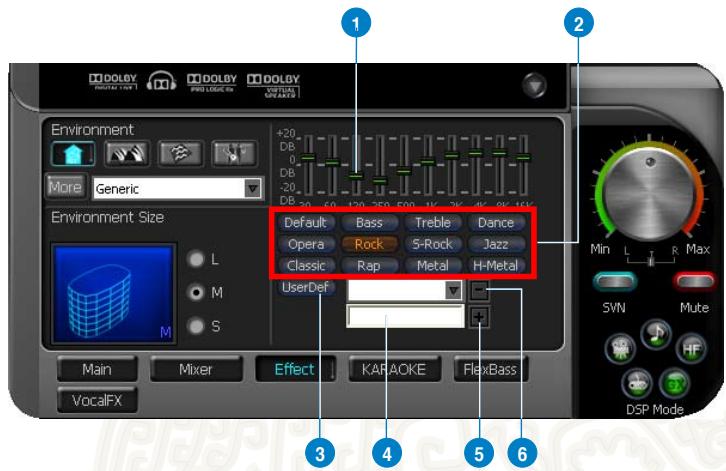
1 Default equalizer options
Click an equalizer pattern from the 12 available equalizer patterns.
Equalizer slider
Adjust the gain for each band (30~16KHz)
3 User Defined
Click this button to view your existing customized equalizer setting.
Save name
Key in a name for your own "User Defined" equalizer setting.
5 Add / save
Click this "+" button to save your customized equalizer setting.
6 Delete
Click this “-” button to delete a customized setting from the list.
Karaoke
The Xonar Essence ST provides powerful features for Karaoke, including Key-Shifting, Vocal Cancellation, and Microphone Echo. Key-Shifting changes the pitch of Karaoke background music, and Vocal Cancellation reduces the original vocal in songs and keep the music and symphony for karaoke.
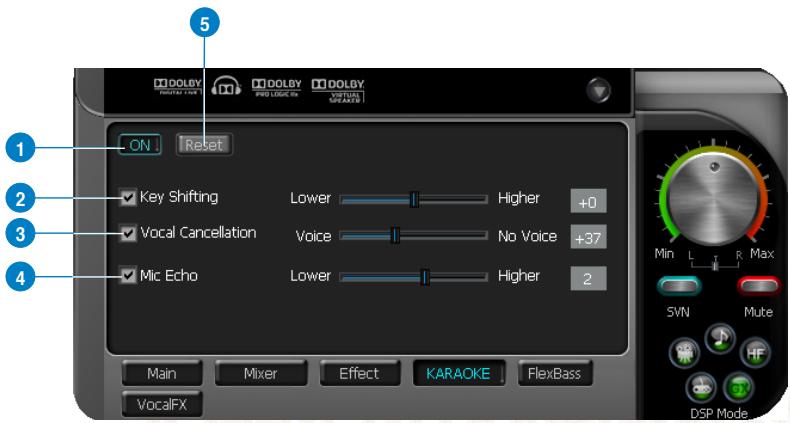
1 On/Off
Click the switch to turn on or off the karaoke functions.
2 Key-Shifting
Tick this checkbox to enable or disable the key shifting feature for music playback from 4 semitones below, to 4 semitones above.
3 Vocal Cancellation
Tick this checkbox to enable or disable the vocal cancellation function and adjust the voice cancellation level from 0 to +100. +100 eliminates most original vocals. The default value is 50.
4 Mic Echo
Select the Mic Echo function and adjust the gain for echo signals (30~16KHz).
5 Reset
Reset all settings to defaults.
FlexBass
FlexBass, an advanced bass management and enhancement technology, allows you to select each satellite speaker's type for optimal sound performance from the speakers. The Speaker types are:
Small: common speaker that cannot produce low frequencies. Large: wide-band speakers that can produce low frequencies well.
FlexBass comes with an adjustable crossover frequency for the boundary of the bass signals. It filters out the bass signals from small speaker channels and redirects them all to the subwoofer or Large speakers.
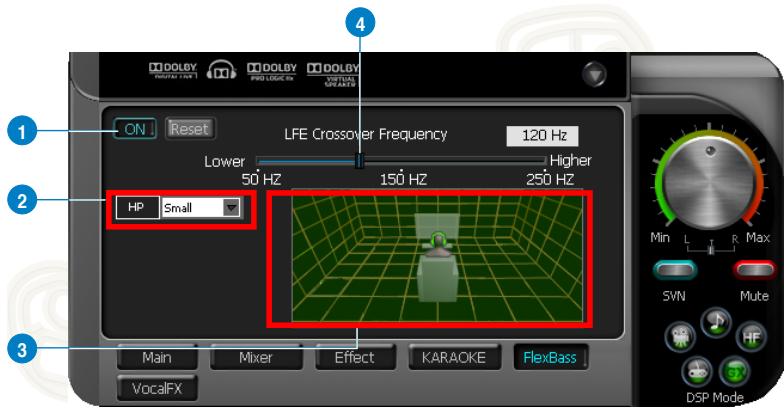
On/Off
Click this switch to turn on or off all FlexBass functions.
2 Small / Large speaker option
Select the speaker type that you connected. If your speaker type cannot perform low-frequency signals (bass), select "Small" speaker type and Xonar Essence ST filters out the bass signals and sends them to the subwoofer channel. If those speakers are full-range, you can select the "Large" speaker type.

Usually, low-cost computer's 2-channel speakers are small-type speakers. Common 2.1 speakers with a subwoofer are categorized as Large speakers because the subwoofer redirects the bass signals inside the two channels to the subwoofer speaker automatically.

Picture for Small/Large speaker
Small/large speakers are identified by their colors:
- Orange: large speakers
- Green: small speakers

LFE Crossover Frequency
Adjusts the cut-off frequency (20~250Hz) for LFE (low-frequency effects) signals. Xonar Essence ST filters out the bass signals below the crossover frequency from small speaker channels and forwards them to the subwoofer. The higher the crossover frequency, the more bass signals are subtracted.
Smart Volume Normalization
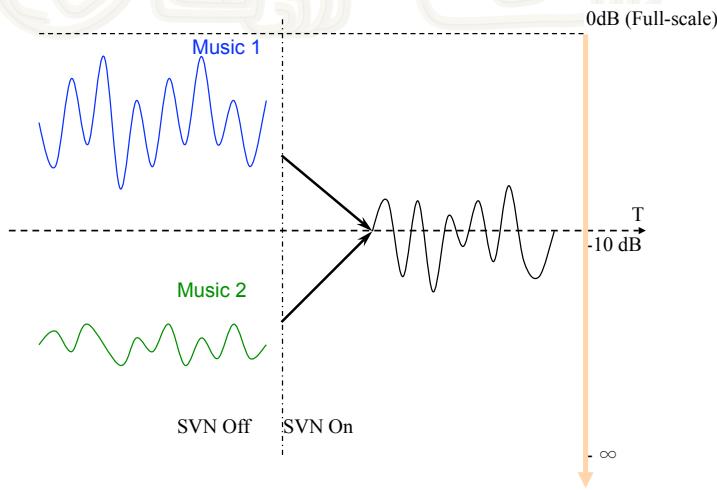
Smart Volume NormalizationTM (SVN) automatically keeps all music or video/ TV audio output at a constant level to reduce manual adjustment inherent with sound sources of different loudness. It allows you to listen to various content, like MP3, TV program, DVD video and even games at a consistent sound level. The following graph shows how signals 1 and 2 adjust to the same level (for example, 10dB below full scale) after you turn on SVN. Please note that lower volume music 2 becomes louder when you turn on SVN while higher volume music 1 becomes quieter.
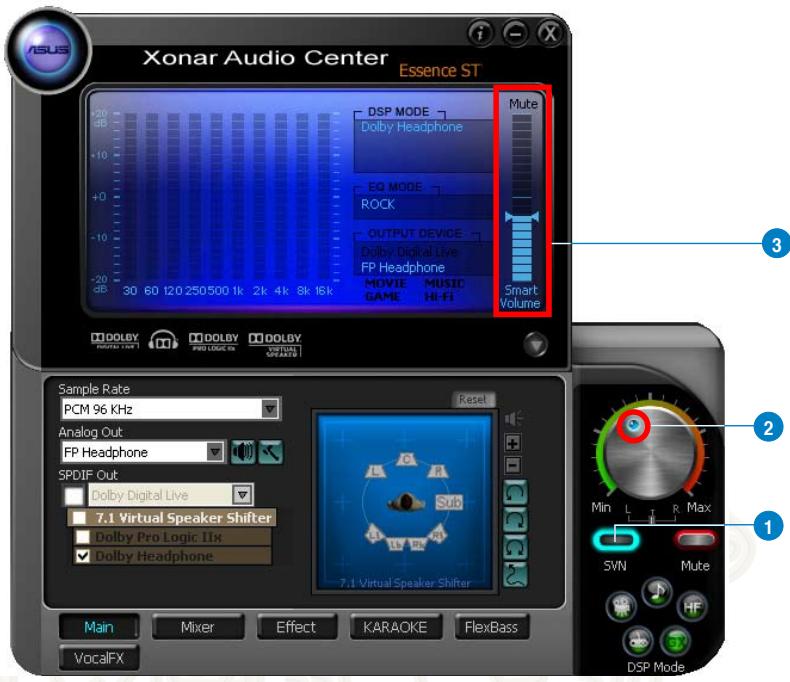

SVN On/Off
Click this button to enable SVN. When enabled, this button is illuminated by a blue light.

SVN blue light
When SVN is enabled, the master volume knob is illuminated by a blue light. It is illuminated by a red light if the volume is muted.

SVN display
When SVN is enabled, "Smart Volume" lights up to display the volume level.
Xonar Essence ST introduces an innovative technology - DirectX Sound 3D Game Extensions v1.0 (DS3D GX 1.0)- to restore DirectX Sound 3D Hardware acceleration mode and its subsidiary EAX effects on Windows® Vista for 3D games. Unlike some proprietary API like OpenAL, DS3D GX does not require games to support OpenAL API. All existing games compatible with Microsoft DirectX and DirectX Sound 2D/3D are supported with DS3D GX technology. Before you start EAX and DS3D HW games, enable DS3D GX on the Xonar Audio Center, and disable the feature after playing.
Supports latest DS3D GX 2.0 for gaming on Windows® Vista and Windows® XP
DS3D GX 2.0 not only revives EAX and DirectX4 effects, but also allows you to run EAX HD 5.0 games on both Windows® XP and Vista. It provides the best compatibility with existing DirectX games. GX2.0 also adds innovative VocalFX voice effects for existing EAX games or VOIP applications.
Besides the abundant sound effects described above, the Xonar Essence ST also provides quick Digital Sound Processing modes that are configured for typical applications including Music, Movies, and Games over different output speaker types. In addition, Xonar Essence ST also offers a Hi-Fi mode for hi-fidelity playback without any effect processing to keep the original audio fidelity. Every time you turn on Hi-Fi mode, Xonar HDAV 1 clears all sound effects. Use Hi-Fi mode for audio quality tests (using RMAA software or another machine-based measurement). Use the DSP mode button as the quick setup if you do not wish to know the details of the effect setup.

No sound effects are applied to high-definition 96KHz/192KHz content.
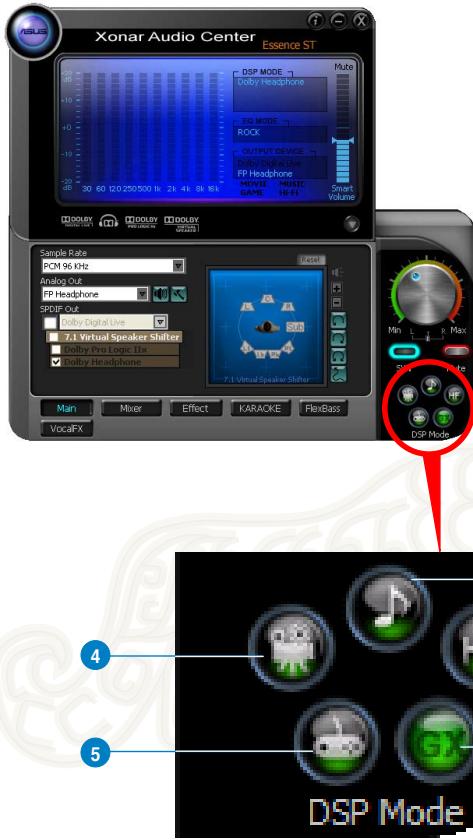
1 GX Mode
DirectSound 3D Game Extensions mode to support EAX and DirectX3D Hardware extensions for lots of DirectX/ DirectX3D games on Windows® Vista.
Hi-Fi Mode
This mode is set for Hi-Fidelity playback, where all effects are cleared to keep the original digital data and analog output quality as high as possible.
Music Mode
This mode is set for Music playback.
4 Movie Mode
This mode is set for DVD Movie playback.
5 Game Mode
This mode is set for Games.
VocalFX
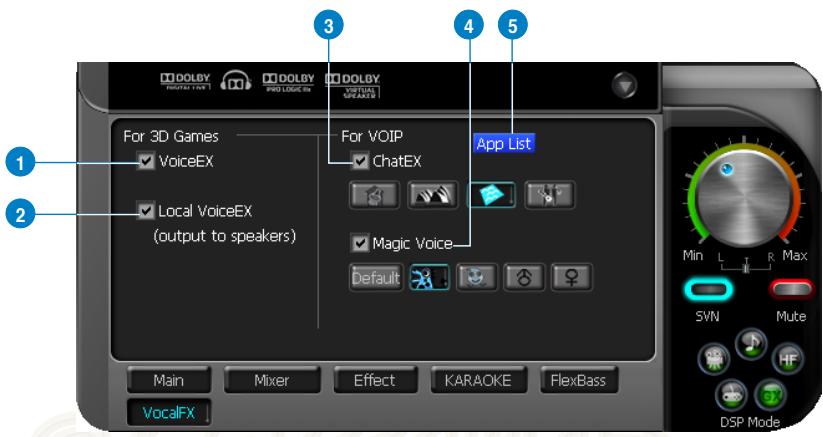
VocalFX is an innovative voice processing technology that can immerse your voice in a realistic game landscape (VoiceEX) or imitate background scenes while chatting online (ChatEX). It also allows you to change your voice pitch to disguise who you are (Magic Voice).
VoiceEX
It produces realistic and dynamic environmental reverberation for your voice in 3D gaming communication.
Local VoiceEX
It produces realistic and dynamic environmental reverberation for your voice in 3D gaming communication.

You can hear your voice from the speakers.
ChatEX
It emulates different background environment effects while you chat online.
Magic Voice
Changes your voice pitch to different types for disguising your real voice or just for fun while chatting online.
5 App List
You can add a VOIP application to the VOIP application list.
For 3D Games
- Tick the VoiceEX and Local VoiceEX checkboxes.
- Ensure that you and your team members can talk to each other in the game.
For VOIP
- Click App List.
- If you do not see your VOIP application in the list, click Add.

Ensure that you have installed the latest version of Skype or MSN Messenger.
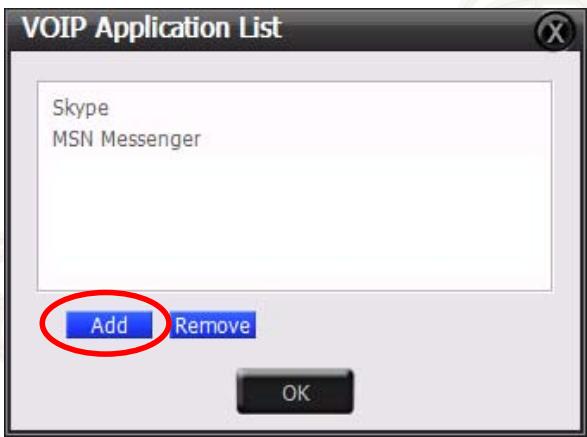
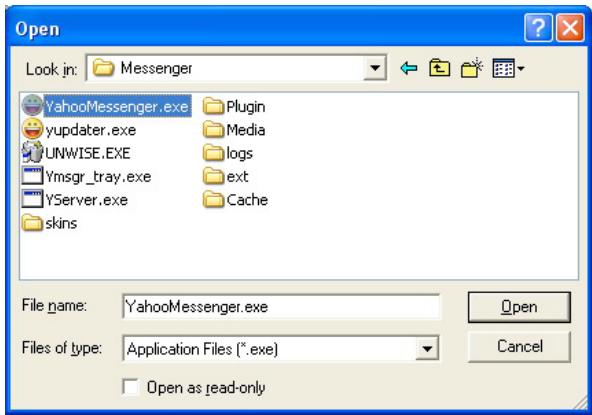
- Navigate to the application, then click Open.
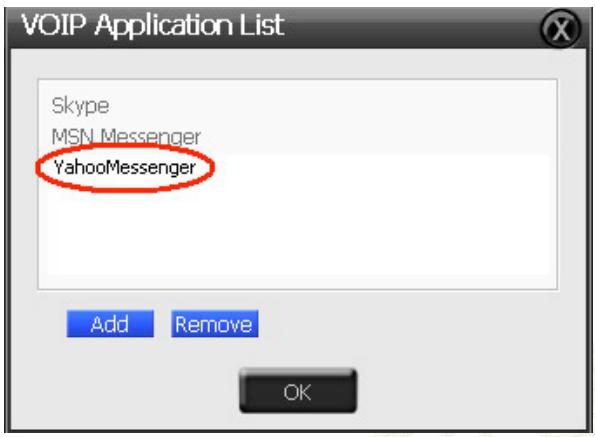
- Your VOIP application will be added to the list.
- Tick the ChatEX and Magic Voice checkboxes to chat online.

When you select any of the VocalFX functions, this message appears:
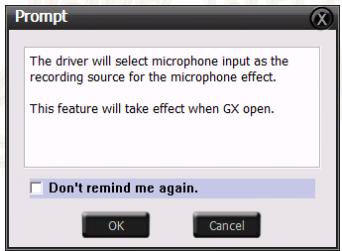
This message indicates that the recording device is set to microphone. Ensure that the GX function is enabled. Click OK to accept, or Cancel if you want to enable it later. Tick the 'Don't remind me again' checkbox if you do not want to see this message again.
Troubleshooting
I cannot install the audio card driver on my computer.
- Ensure that you have properly plugged the audio card in the PCI slot on your motherboard.
- Check that the Windows® hardware device manager has discovered a multimedia audio device. If no device is found, please try scanning for new hardware. Try rebooting your computer.
- Remove the card, plug it into another PCI slot, and try again.
I cannot find the Xonar Essence ST Audio Center.
- Ensure that you have installed the driver.
- Locate the Xonar Essence ST Audio Center icon on the taskbar, then double-click the icon to launch the Xonar Essence ST Audio Center utility.
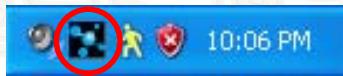
- If the icon is not displayed on the taskbar, click Start > All Programs > ASUS Xonar Essence ST Audio > Xonar Essence Audio Center to launch the Xonar Essence ST Audio Center. Try installing the driver again.
I cannot hear any sound from my analog speakers.
- Ensure that the power cable of your power supply unit is properly connected to the power connector of the audio card.
- Ensure that you have connected the speakers properly and that the speakers are turned on.
- Ensure that the device master volume or that the software player is not on mute mode on the Xonar Essence ST Audio Center.
- Check if you are using a Dolby Digital Live encoder through the S/PDIF output. If this is the case, the analog output is muted to get rid of any interference between your digital speaker system and analog speakers or headphones.
Try rebooting your computer.
I cannot hear any sound from the S/PDIF output.
- Ensure that you have enabled S/PDIF output in the Xonar Essence ST Audio Center.
- Ensure that you have connected the correct S/PDIF output jack on the card to the decoder's (AV receiver) S/PDIF input jack.
- You may need to select the correct input and mode of your decoder or AV receiver. For Dolby Digital output, double-check that the AV receiver is in that decoding mode. If you are using 192KHz PCM output, ensure your decoder can support 192KHz decoding. Try changing it to 44.1K or 48KHz first.
I cannot hear audio input (Mic, Line-in, or AUX) from my speakers.
- Go to the Mixer recording page in the Xonar Essence ST Audio Center and select the correct input as the recording source. If you are using Windows® Vista, go to the system audio control panel to ensure that the current default recording/input device is correct.
- Remember to turn on the digital monitoring button for that recording source.
I cannot hear the TV tuner audio from my speakers.
If you are using a traditional TV tuner card that has an analog audio output, connect it to the Aux-In header on the audio card. - Select Aux-In as the recording source and remember to turn on the digital monitoring button on the recording mixer page. - If you are using a TV tuner card which has a digital audio output instead of an analog output, check that the sound is not muted and whether other applications can play sound out. If you still have problems, read the TV tuner card's software user manual.
I found no sound effects when playing 96K or 192KHz sound sources.
- Currently, Xonar Essence ST effects including Dolby, supports common 44.1K, 48KHz sound sources processing and provides high-definition audio (96K/192KHz) in hi-fidelity playback. This is also usually the behavior that professional audiophiles and musicians prefer.
- If you still want to add effects to your audio, you can use sound editing software such as Ableton Live, Cakewalk, CoolEdit, or Soundforge to convert the sounds into 48KHz files.
- Note that the frequency meter on the Xonar Essence ST Audio Center panel will not take effect when the playback source is using either a 96KHz or 192KHz sample rate to prevent any processing distortion.
Frequently Asked Questions (FAQs)
Does the Xonar Essence ST card support Windows Vista?
Yes, the Xonar Essence ST driver package supports Windows® Vista 32/64 bit and most key features are available. In addition, Xonar Essence ST supports unique DS3D GX on Windows® Vista, which can recover DirectX3D hardware and EAX gaming sound effects on Windows® Vista for many existing DirectX games.
Why does the Xonar Essence ST support Dolby technology?
Dolby is the ONLY brand and technology recognized by the CE industry and available on a wide range of audio equipment. Xonar includes these features to make your PC a powerful media and entertainment center.
Why is Xonar Essence ST the best audio card for HTPC and multi-channel speakers?
The Xonar Essence ST supports Dolby Digital Live, which allows a single digital connection to your AV receiver to carry Dolby Digital audio. In addition, Xonar Essence ST also provides Dolby Pro-Logic IIx to upmix TV and other music to multi-channel surround sound in Home Theater environments. Xonar Essence ST also has an Ultra High Fidelity SNR at 192K/24bit, which delivers a high quality audio through an analog connection to your home theater system or high-end multi-channel speakers.
Does the Xonar Essence ST support EAX on Windows® Vista?
Yes, Xonar Essence ST supports EAX2.0 on both Windows® XP and Vista through the innovative DirectX3D Game EXtensions v1.0 (DS3D GX 1.0) technology.
Why do I need Dolby for PC games?
- Dolby Digital and Pro-Logic IIx are available on the latest game consoles, like XBOX360, PS3, and Wii. Dolby provides the best gaming sound experience and compatibility with home theater or TV systems.
- Dolby Headphone and Dolby Virtual Speaker are the best 3D sound positioning, spatial modeling and 5.1-channel virtualization technology for regular stereo headphones, speaker headphones and speakers.
What are the most important benefits of the Xonar Essence ST for musicians?
- Ultimate Fidelity: Xonar Essence ST has the highest quality of audio in/out for the cleanest sound production.
- Duplex HD: Supports audio sampling rates up to 24bit/192KHz for all inputs and outputs. ASIO 2.0: Xonar Essence ST includes an ASIO 2.0 driver for low-latency low-distortion music creation application.
Will PCM sound output through S/PDIF be limited to 2 channels even with different analog output channels?
The S/PDIF protocol specification (IEC-60958) only carries 2-channel PCM data or non-PCM AC3/DTS data. Hence, when a user selects PCM output for S/PDIF, the Xonar sound card always delivers 2-channel PCM data through the S/PDIF output port. For attaining 5.1 channel surround sound, you can select Dolby Digital Live encoding output from the S/PDIF out menu, which allows the Xonar Essence ST to deliver 5.1 surround sound for DVD movies, and even stereo music.
When I selected "Digital Output device" as the default audio playback device on Windows® Vista, the sound effects and UI controls do not work.
For Xonar sound cards on Windows® Vista, there are usually two audio devices: Speakers and Digital Out Device such as S/PDIF.
Speakers is the default device. Use this device to fully control the sound effects on the Xonar Audio Center, the driver's GUI.
Digital Out Device is designed as a pass-through audio path to play stereo Hi-Fidelity audio contents or encoded audio formats such as Dolby Digital and DTS Digital Surround bit-stream from DVD or Blu-ray disc titles. The driver does not process all the audio data that passes through this digital device.
In most software DVD players' audio settings, you could choose "Use S/PDIF output" or "HDMI" for HDMI output, such as on HDAV1.3. The player then passes the audio through the "Digital Output Device" automatically. Some devices require onboard audio to be disabled first. In this case, you do not even need to change the system default audio device. In most scenarios, we suggest that you keep the settings in "Speakers" to enjoy the complete features of the Xonar sound card. You could actually still get LPCM audio data monitoring from S/PDIF-Out port as analog Front channel output in this situation.
ASUS Contact information
ASUSTeK COMPUTER INC. (Asia Pacific)
Address 4F, No. 150, Li-Te Road, Peitou, Taipei, Taiwan 11259
Software download support.asus.com*
ASUS COMPUTER INTERNATIONAL (America)
Address 800 Corporate Way, Fremont, CA 94539, USA
Telephone +15029550883
Fax +15029338713
Website www.asus.com
Software download support.asus.com*
ASUS COMPUTER GmbH (Germany and Austria)
Address Harkort Str. 25, D40880 Ratingen, Germany
Telephone +49210295990
Fax +492102959911
Online contact www.asus.com.de/sales
Technical Support
Telephone +49210295990
Fax +492102959911
Online support www.asus.com.de/support
- Available on this site is an online Technical Inquiry Form that you can fill out to contact technical support.


- COPYRIGHT © 2012 ASUSTEK COMPUTER INC. ALL RIGHTS RESERVED
- CONTENTS
- CHAPTER 1: PRODUCT INTRODUCTION
- CHAPTER 2: GETTING STARTED
- CHAPTER 3: CONNECTING SPEAKERS AND PERIPHERALS
- CHAPTER 4: XONAR AUDIO CENTER
- APPENDIX: TROUBLESHOOTING AND FAQS
- NOTICES
- FEDERAL COMMUNICATIONS COMMISSION STATEMENT
- CANADIAN DEPARTMENT OF COMMUNICATIONS STATEMENT
- AUSTRALIA STATEMENT NOTICE
- SAFETY INFORMATION
- TRADEMARKS
- LICENSE
- ABOUT THIS GUIDE
- HOW THIS GUIDE IS ORGANIZED
- WHERE TO FIND MORE INFORMATION
- CONVENTIONS USED IN THIS GUIDE
- PACKAGE CONTENTS
- SYSTEM REQUIREMENTS
- SPECIFICATIONS SUMMARY
- XONAR ESSENCE ST CARD LAYOUT
- FRONT RIGHT OUT PORT
- FRONT LEFT OUT PORT
- HEADPHONE OUT PORT
- MICROPHONE IN PORT
- LINE IN PORT
- SP/DIF OUT PORT
- FRONT PANEL AUDIO HEADER
- AUX INPUT HEADER
- POWER CONNECTOR
- BEFORE YOU PROCEED
- INSTALLING THE AUDIO CARD
- TO INSTALL THE AUDIO CARD
- CONNECTING TO A TV TUNER CARD
- TO CONNECT TO A TV TUNER CARD
- INSTALLING THE AUDIO CARD DRIVER
- TO INSTALL THE AUDIO CARD DRIVER
- CONNECTING DIGITAL SPEAKER SYSTEMS (HOME THEATER)
- OPTICAL ADAPTER
- OPTICAL CABLE
- CONNECTING STEREO HEADPHONES
- CONNECTING 2/2.1 CHANNEL SPEAKERS
- FRONT LEFT/RIGHT OUT
- CONNECTING A MICROPHONE
- FRONT LEFT/RIGHT OUT PORT/HEADPHONE PORT
- MICROPHONE INPUT PORT
- CONNECTING LINE-IN AUDIO SOURCES
- LINE INPUT JACK
- XONAR AUDIO CENTER
- SUPPORT LINK
- DISPLAY AREA
- SETTING MENU PANEL
- INFORMATION ICON
- MENU OPEN/CLOSE
- MASTER VOLUME
- MUTE BUTTON
- SVN BUTTON
- DSP MODE
- MAIN SETTING
- SAMPLE RATE
- ANALOG OUT MODE
- ANALOG OUT
- SPEAKER TEST
- HP ADVANCED SETTING
- SPDIF OUT/DDL
- S/PDIF OUT ENABLE/DISABLE
- S/PDIF OUTPUT FORMATS/FUNCTIONS
- DOBLY DIGITAL LIVE ADVANCED UPMIXING OPTION
- AUDIO CHANNELS (FOR WINDOWS® VISTA / WINDOWS® 7 ONLY)
- AUDIO CHANNELS
- VIRTUAL SPEAKER SHIFTER
- SHIFTER ENABLE/DISABLE
- DRAG SPEAKER OR LISTENER
- RESET
- INCREASE/DECREASE VOLUME
- COUNTERCLOCKWISE
- CLOCKWISE
- MANUAL ROTATION
- MANUAL DRAG MODE
- DOLBY PRO-LOGIC IIX
- DOLBY PRO-LOGIC IIX ENABLE/DISABLE
- CENTER WIDTH
- DIMENSION
- DOLBY HEADPHONE
- DOLBY HEADPHONE ENABLE/DISABLE
- DOLBY VIRTUAL SPEAKER ENABLE/DISABLE
- REFERENCE MODE
- WIDE MODE
- MIXER/VOLUME
- PLAYBACK VOLUME TAB
- LEFT / RIGHT BALANCE
- VOLUME SLIDER
- SOURCE / PATH NAME INCLUDING
- MONITORING BUTTON
- SOURCE / PATH NAME
- EFFECTS
- ENVIRONMENT EFFECTS
- DEFAULT ENVIRONMENTS
- MORE OPTIONS
- ENVIRONMENT SIZE
- BAND EQUALIZER
- KARAOKE
- ON/OFF
- KEY-SHIFTING
- VOCAL CANCELLATION
- MIC ECHO
- FLEXBASS
- SMALL / LARGE SPEAKER OPTION
- PICTURE FOR SMALL/LARGE SPEAKER
- LFE CROSSOVER FREQUENCY
- SMART VOLUME NORMALIZATION
- SVN ON/OFF
- SVN BLUE LIGHT
- SVN DISPLAY
- SUPPORTS LATEST DS3D GX 2.0 FOR GAMING ON WINDOWS® VISTA AND WINDOWS® XP
- GX MODE
- HI-FI MODE
- MUSIC MODE
- MOVIE MODE
- GAME MODE
- VOCALFX
- VOICEEX
- LOCAL VOICEEX
- CHATEX
- MAGIC VOICE
- APP LIST
- FOR 3D GAMES
- FOR VOIP
- TROUBLESHOOTING
- I CANNOT FIND THE XONAR ESSENCE ST AUDIO CENTER
- I CANNOT HEAR ANY SOUND FROM MY ANALOG SPEAKERS
- I CANNOT HEAR ANY SOUND FROM THE S/PDIF OUTPUT
- I CANNOT HEAR AUDIO INPUT (MIC, LINE-IN, OR AUX) FROM MY SPEAKERS
- I CANNOT HEAR THE TV TUNER AUDIO FROM MY SPEAKERS
- I FOUND NO SOUND EFFECTS WHEN PLAYING 96K OR 192KHZ SOUND SOURCES
- FREQUENTLY ASKED QUESTIONS (FAQS)
- WHY DOES THE XONAR ESSENCE ST SUPPORT DOLBY TECHNOLOGY
- WHY IS XONAR ESSENCE ST THE BEST AUDIO CARD FOR HTPC AND MULTI-CHANNEL SPEAKERS
- DOES THE XONAR ESSENCE ST SUPPORT EAX ON WINDOWS® VISTA
- WHY DO I NEED DOLBY FOR PC GAMES
- WHAT ARE THE MOST IMPORTANT BENEFITS OF THE XONAR ESSENCE ST FOR MUSICIANS
- WILL PCM SOUND OUTPUT THROUGH S/PDIF BE LIMITED TO 2 CHANNELS EVEN WITH DIFFERENT ANALOG OUTPUT CHANNELS
- WHEN I SELECTED "DIGITAL OUTPUT DEVICE" AS THE DEFAULT AUDIO PLAYBACK DEVICE ON WINDOWS® VISTA, THE SOUND EFFECTS AND UI CONTROLS DO NOT WORK
- ASUS CONTACT INFORMATION
- ASUSTEK COMPUTER INC. (ASIA PACIFIC)
- ASUS COMPUTER INTERNATIONAL (AMERICA)
- ASUS COMPUTER GMBH (GERMANY AND AUSTRIA)
- TECHNICAL SUPPORT
Brand : ASUS
Model : XONAR ESSENCE ST, XONAR ESSENCE STX
Category : Soundcard