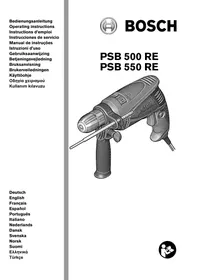
USER MANUAL PSB 500 RE BOSCH
Dr. Egbert Schneider Senior Vice President Engineering
Dr. Eckerhard Strötgen Head of Product Certification

25.04.2007, Robert Bosch GmbH, Power Tools Division D-70745 Leinfelden-Echterdingen
WARNING
Read all safety warnings and all instructions. Failure to follow the
warnings and instructions may result in electric shock, fire and/or serious injury.
Save all warnings and instructions for future reference.
The term "power tool" in the warnings refers to your mains-operated (corded) power tool or battery-operated (cordless) power tool.
1) Work area safety
a) Keep work area clean and well lit. Cluttered or dark areas invite accidents. b) Do not operate power tools in explosive atmospheres, such as in the presence of flammable liquids, gases or dust. Power tools create sparks which may ignite the dust or fumes. c) Keep children and bystanders away while operating a power tool. Distractions can cause you to lose control.
2) Electrical safety
a) Power tool plugs must match the outlet. Never modify the plug in any way. Do not use any adapter plugs with earthed (grounded) power tools. Unmodified plugs and matching outlets will reduce risk of electric shock. b) Avoid body contact with earthed or grounded surfaces, such as pipes, radiators, ranges and refrigerators. There is an increased risk of electric shock if your body is earthed or grounded. c) Do not expose power tools to rain or wet conditions. Water entering a power tool will increase the risk of electric shock. d) Do not abuse the cord. Never use the cord for carrying, pulling or unplugging the power tool. Keep cord away from heat, oil, sharp edges and moving parts. Damaged or entangled cords increase the risk of electric shock. e) When operating a power tool outdoors, use an extension cord suitable for outdoor use. Use of a cord suitable for outdoor use reduces the risk of electric shock. f) If operating a power tool in a damp location is unavoidable, use a residual current device (RCD) protected supply. Use of an RCD reduces the risk of electric shock.
3) Personal safety
a) Stay alert, watch what you are doing and use common sense when operating a power tool. Do not use a power tool while you are tired or under the influence of drugs, alcohol or medication. A moment of inattention while operating power tools may result in serious personal injury.
b) Use personal protective equipment. Always wear eye protection. Protective equipment such as dust mask, non-skid safety shoes, hard hat, or hearing protection used for appropriate conditions will reduce personal injuries. c) Prevent unintentional starting. Ensure the switch is in the off-position before connecting to power source and/or battery pack, picking up or carrying the tool. Carrying power tools with your finger on the switch or energising power tools that have the switch on invites accidents. d) Remove any adjusting key or wrench before turning the power tool on. A wrench or a key left attached to a rotating part of the power tool may result in personal injury. e) Do not overreach. Keep proper footing and balance at all times. This enables better control of the power tool in unexpected situations. f) Dress properly. Do not wear loose clothing or jewellery. Keep your hair, clothing and gloves away from moving parts. Loose clothes, jewellery or long hair can be caught in moving parts. g) If devices are provided for the connection of dust extraction and collection facilities, ensure these are connected and properly used. Use of dust collection can reduce dust-related hazards.
a) Do not force the power tool. Use the correct power tool for your application. The correct power tool will do the job better and safer at the rate for which it was designed. b) Do not use the power tool if the switch does not turn it on and off. Any power tool that cannot be controlled with the switch is dangerous and must be repaired. c) Disconnect the plug from the power source and/or the battery pack from the power tool before making any adjustments, changing accessories, or storing power tools. Such preventive safety measures reduce the risk of starting the power tool accidentally. d) Store idle power tools out of the reach of children and do not allow persons unfamiliar with the power tool or these instructions to operate the power tool. Power tools are dangerous in the hands of untrained users. e) Maintain power tools. Check for misalignment or binding of moving parts, breakage of parts and any other condition that may affect the power tool's operation. If damaged, have the power tool repaired before use. Many accidents are caused by poorly maintained power tools.
f) Keep cutting tools sharp and clean. Properly maintained cutting tools with sharp cutting edges are less likely to bind and are easier to control. g) Use the power tool, accessories and tool bits etc. in accordance with these instructions, taking into account the working conditions and the work to be performed. Use of the power tool for operations different from those intended could result in a hazardous situation.
5) Service a) Have your power tool serviced by a qualified repair person using only identical replacement parts. This will ensure that the safety of the power tool is maintained.
Machine-specific Safety Warnings
Wear hearing protection when using impact drills. The influence of noise can lead to loss of hearing. Always use the auxiliary handle supplied with the machine. Loss of control can cause personal injury. - Use appropriate detectors to determine if utility lines are hidden in the work area or call the local utility company for assistance. Contact with electric lines can lead to fire and electric shock. Damaging a gas line can lead to explosion. Penetrating a water line causes property damage or may cause an electric shock. - Switch off the power tool immediately when the tool insert jams. Be prepared for high reaction torque that can cause kickback. The tool insert jams when:
- the power tool is subject to overload or
- it becomes wedged in the workpiece.
Hold the power tool only by the insulated gripping surfaces when performing an operation where the cutting tool may contact hidden wiring or its own power cord. Contact with a "live" wire will also make exposed metal parts of the power tool "live" and shock the operator. - When working with the machine, always hold it firmly with both hands and provide for a secure stance. The power tool is guided more secure with both hands. - Secure the workpiece. A workpiece clamped with clamping devices or in a vice is held more secure than by hand. Do not work materials containing asbestos.
Asbestos is considered carcinogenic.
Take protective measures when dust can develop during working that is harmful to one's health, combustible or explosive. Example: Some dusts are regarded as carcinogenic. Wear a dust mask and work with dust/chip extraction when connectable. - Keep your workplace clean. Blends of materials are particularly dangerous. Dust from light alloys can burn or explode. Always wait until the machine has come to a complete stop before placing it down. The tool insert can jam and lead to loss of control over the power tool. - Never use the machine with a damaged cable. Do not touch the damaged cable and pull the mains plug when the cable is damaged while working. Damaged cables increase the risk of an electric shock.
Functional Description

Read all safety warnings and all instructions. Failure to follow the warnings and instructions may result in electric shock, fire and/or serious injury.
Intended Use
The machine is intended for impact drilling in brick, concrete and stone as well as for drilling in wood, metal and plastic. Machines with electronic control and right/left rotation are also suitable for screwdriving and thread-cutting.
Product Features
The numbering of the product features refers to the illustration of the machine on the graphics page.
1 Keyless chuck 2 Front sleeve 3 Rear sleeve 4 "Drilling/Impact Drilling" selector switch 5 Lock-on button for On/Off switch 6 On/Off switch 7 Rotational direction switch 8 Button for depth stop adjustment 9 Wing bolt for adjustment of auxiliary handle
10 Auxiliary handle*
11 Depth stop 12 Universal bit holder 13 Screwdriver bit*
The accessories illustrated or described are not included as standard delivery.
Technical Data
| Impact Drill | PSB 500 RE | PSB 550 RE |
| Article number | | 3 603 A26 0.. | 3 603 A26 0.. |
| Rated power input | W | 500 | 550 |
| Output power | W | 228 | 270 |
| No-load speed | rpm | 50 – 3000 | 50 – 3000 |
| Rated speed | rpm | 2380 | 2246 |
| Impact rate | bpm | 48000 | 48000 |
| Rated torque | Nm | 0.9 | 1.2 |
| Torque at max. output power | Nm | 7.5 | 7.5 |
| Right/left rotation | | ● | ● |
| Spindle collar dia. | mm | 43 | 43 |
| Max. drilling dia. | | | |
| - Concrete | mm | 13 | 13 |
| - Steel | mm | 10 | 10 |
| - Wood | mm | 20 | 20 |
| Chuck clamping range | mm | 2.0 – 13 | 2.0 – 13 |
| Weight according to EPTA-Procedure 01/2003 | kg | 1.5 | 1.5 |
| Protection class | | ☐/II | ☐/II |
The values given are valid for nominal voltages [U] of 230/240 V. For lower voltage and models for specific countries, these values can vary. Please observe the article number on the type plate of your machine. The trade names of the individual machines may vary.
We declare under our sole responsibility that this product is in conformity with the following standards or standardization documents: EN 60745 according to the provisions of the directives 89/336/EEC, 98/37/EC.
Dr. Egbert Schneider Senior Vice President Engineering
Dr. Eckerhard Strötgen Head of Product Certification
ppa. Maee i.v. Nogcu
25.04.2007, Robert Bosch GmbH, Power Tools Division D-70745 Leinfelden-Echterdingen
Measured values determined according to EN 60745.
Typically the A-weighted noise levels of the product are: Sound pressure level 97 dB(A); Sound power level 108 dB(A). Uncertainty K = 3 dB.
Wear hearing protection!
Vibration total values (triax vector sum) determined according to EN 60745:
Drilling into metal: Vibration emission value ah = 4.7 m/s2 , Uncertainty K = 1.5 m/s2
Impact drilling into concrete: Vibration emission value ah = 24.2 m/s2 , Uncertainty K = 2.0 m/s2
Screwdriving: Vibration emission value ah < 2.5 m/s2 , Uncertainty K = 1.5 m/s2 .
WARNING The vibration emission level given in this information sheet has been measured in accordance with a standardised test given in EN 60745 and may be used to compare one tool with another.
The vibration emission level will vary because of the ways in which a power tool can be used and may increase above the level given in this information sheet. This could lead to a significant underestimate of exposure when the tool is used regularly in such a way.
Note: To be accurate, an estimation of the level of exposure to vibration experienced during a given period of work should also take into account the times when the tool is switched off and when it is running but not actually doing the job. This may significantly reduce the exposure level over the total working period.
Assembly
Before any work on the machine itself, pull the mains plug.
Operate your machine only with the auxiliary handle 10.
The auxiliary handle 10 can be set to any position for a secure and low-fatigue working posture.
Turn the wing bolt for adjustment of the auxiliary handle 9 in anticlockwise direction and set the auxiliary handle 10 to the required position. Then tighten the wing bolt 9 again in clockwise direction.
The required drilling depth X can be set with the depth stop 11.
Press the button for the depth stop adjustment 8 and insert the depth stop into the auxiliary handle 10.
The knurled surface of the depth stop 11 must face upward.
Pull out the depth stop until the distance between the tip of the drill bit and the tip of the depth stop corresponds to the desired drilling depth X.
Keyless Chuck
Hold the rear sleeve 3 of the keyless chuck 1 tight and turn the front sleeve 2 in rotation direction 0, until the tool can be inserted. Insert the tool.
Hold the rear sleeve 3 of the keyless chuck 1 tight and firmly turn the front sleeve 2 in rotation direction by hand.
When working with screwdriver bits 13, a universal bit holder 12 should always be used. Use only screwdriver bits that fit the screw head.
For driving screws, always position the "Drilling/Impact Drilling" selector switch 4 to the "Drilling" symbol.
Replacing the Drill Chuck
For power tools without spindle lock, the drill chuck must be replaced by an authorized after-sales service agent for Bosch power tools.

The drill chuck must be tightened with a tightening torque of approx. 6-8 Nm.
Operation
Starting Operation
Observe correct mains voltage! The voltage of the power source must agree with the voltage specified on the nameplate of the machine. Power tools marked with 230 V can also be operated with 220 V.
The rotational direction switch 7 is used to reverse the rotational direction of the machine. However, this is not possible with the On/Off switch 6 actuated.
Right Rotation: For drilling and driving in screws, push the rotational direction switch 7 left to the stop.
Left Rotation: For loosening and unscrewing screws and nuts, press the rotational direction switch 7 through to the right stop.
Setting the Operating Mode

Drilling and Screwdriving
Set the selector switch 4 to the "Drilling" symbol.

Impact Drilling
Set the selector switch 4 to the "Impact drilling" symbol.
The selector switch 4 engages noticeably and can also be actuated with the machine running.
Switching On and Off
To start the machine, press the On/Off switch 6 and keep it depressed.
To lock the pressed On/Off switch 6, press the lock-on button 5.
To switch off the machine, release the On/Off switch 6 or when it is locked with the lock-on button 5, briefly press the On/Off switch 6 and then release it.
Adjusting the Speed/Impact Frequency
The speed/impact rate of the switched on power tool can be variably adjusted, depending on how far the On/Off switch 6 is pressed.
Light pressure on the On/Off switch 6 results in low speed/impact rate. Further pressure on the switch increases the speed/impact rate.
Operating Instructions
Apply the power tool to the screw/nut only when it is switched off. Rotating tool inserts can slip off.
After longer periods of working at low speed, allow the machine to cool down by running it for approx. 3 minutes at maximum speed with no load.
Maintenance and Service
Maintenance and Cleaning
Before any work on the machine itself, pull the mains plug. For safe and proper working, always keep the machine and ventilation slots clean.
If the machine should fail despite the care taken in manufacturing and testing procedures, repair should be carried out by an after-sales service centre for Bosch power tools.
In all correspondence and spare parts order, please always include the 10-digit article number given on the type plate of the machine.
WARNING! Important instructions for connecting a new 3-pin plug to the 2-wire cable.
The wires in the cable are coloured according to the following code:

Do not connect the blue or brown wire to the earth terminal of the plug.
Important: If for any reason the moulded plug is removed from the cable of this power tool, it must be disposed of safely.
Service and Customer Assistance
Exploded views and information on spare parts can be found under:
www.bosch-pt.com
Great Britain
Robert Bosch Ltd. (B.S.C.)
P.O.Box 98
Broadwater Park
North Orbital Road
Denham-Uxbridge
MIDDLESEX UB 9 5HJ
Service: +44 (0) 18 95 / 83 87 82
Advice line: +44 (0) 1895 / 838791
Fax: +44 (0) 18 95 / 83 87 89
Ireland
Origo Ltd.
Unit 23 Magna Drive
Magna Business Park
City West
Dublin 24
Service: +353 (0)1 / 4666700
Fax: +353 (0)1 / 466 68 88
Australia and New Zealand
Robert Bosch Australia Pty. Ltd.
RBAU/SPT
1555 Centre Road
P.O. Box 66
3168 Clayton/Victoria
+61 (0)1 / 3 00 30 70 44
Fax: +61 (0)1 / 3 00 30 70 45
www.bosch.com.au
Disposal
The machine, accessories and packaging should be sorted for environmental-friendly recycling.
Only for EC countries:

Do not dispose of power tools into household waste!
According to the European Guideline 2002/96/EC for Waste Electrical and Electronic Equipment and its implementation into national law, power tools
that are no longer usable must be collected separately and disposed of in an environmentally correct manner.
Subject to change without notice.
Dr. Egbert Schneider Senior Vice President Engineering
Dr. Eckerhard Strötgen Head of Product Certification
ppa. Maee i.v. Nogcu
25.04.2007, Robert Bosch GmbH, Power Tools Division D-70745 Leinfelden-Echterdingen
Robert Bosch France S.A.S.
Service Après-vente/Outillage
Dr. Egbert Schneider Senior Vice President Engineering
Dr. Eckerhard Strötgen Head of Product Certification
ppa. Maee i.v. Nogcu
25.04.2007, Robert Bosch GmbH, Power Tools Division D-70745 Leinfelden-Echterdingen
Dr. Egbert Schneider Senior Vice President Engineering
Dr. Eckerhard Ströttgen Head of Product Certification
ppa. Maee i.v. Nogcu
25.04.2007, Robert Bosch GmbH, Power Tools Division D-70745 Leinfelden-Echterdingen
Dr. Egbert Schneider Senior Vice President Engineering
Dr. Eckerhard Ströttgen Head of Product Certification
ppa. Maee i.v. Nogcu
25.04.2007, Robert Bosch GmbH, Power Tools Division D-70745 Leinfelden-Echterdingen
Dr. Egbert Schneider Senior Vice President Engineering
Dr. Eckerhard Ströttgen Head of Product Certification
ppa. Maee i.v. Nogcu
25.04.2007, Robert Bosch GmbH, Power Tools Division D-70745 Leinfelden-Echterdingen
Dr. Egbert Schneider Senior Vice President Engineering
Dr. Eckerhard Strötgen Head of Product Certification
ppa. Maee i.v. Nogcu
25.04.2007, Robert Bosch GmbH, Power Tools Division D-70745 Leinfelden-Echterdingen
Dr. Egbert Schneider Senior Vice President Engineering
Dr. Eckerhard Strötgen Head of Product Certification
Dr. Egbert Schneider Senior Vice President Engineering
Dr. Eckerhard Strötgen Head of Product Certification
25.04.2007, Robert Bosch GmbH, Power Tools Division D-70745 Leinfelden-Echterdingen
Dr. Egbert Schneider Senior Vice President Engineering
Dr. Eckerhard Strötgen Head of Product Certification
25.04.2007, Robert Bosch GmbH, Power Tools Division D-70745 Leinfelden-Echterdingen
Noise/vibration information
Safety warnings for power tools
WARNING
Always observe the safety instructions.
Failure to observe the safety instructions may result in electric shock, fire, and/or serious injury.
Dr. Egbert Schneider Senior Vice President Engineering
Dr. Eckerhard Strötgen
Head of Product
Certification

i.v. Moju
25.04.2007, Robert Bosch GmbH, Power Tools Division D-70745 Leinfelden-Echterdingen
Only for EU countries:

Do not dispose of power tools in household waste!
Dr. Egbert Schneider Senior Vice President Engineering
Dr. Eckerhard Strötgen Head of Product Certification
ppa. Maee i.v. Nogcu
25.04.2007, Robert Bosch GmbH, Power Tools Division D-70745 Leinfelden-Echterdingen
Bosch San. ve Tic. A.S.
Ahi Evran Cad. No:1 Kat:22
Polaris Plaza
80670 Maslak/Istanbul
Customer Consultant: . . . . . . +90 (0)2 12 / 3 35 06 66
Customer Service Line: . . . . . . +90 (0)2 12 / 3 35 07 52
Liquidation
Power Tools Division
70745 Leinfelden-Echterdingen
www.bosch-pt.com
2609002311(2007.06)O/77