MMP3780 - Mp3 player MEMOREX - Free user manual and instructions
Find the device manual for free MMP3780 MEMOREX in PDF.


| Product Type | Digital Audio Player (MP3 Player) |
| Brand | Memorex |
| Model | MMP3780 |
| Dimensions (approx) | 90 x 40 x 10 mm (3.5 x 1.6 x 0.4 in) |
| Weight (approx) | 40 g (1.4 oz) with battery |
| Display | LCD screen (monochrome, backlit) |
| Internal Storage | Flash memory (capacity varies by version) |
| Audio Formats Supported | MP3, WMA |
| Power Source | Built-in rechargeable lithium-ion battery |
| Battery Capacity | Approx. 500 mAh |
| Charging Method | USB cable (computer or USB charger) |
| Charging Time | Approx. 2-3 hours |
| Playback Time | Up to 15 hours (audio) |
| Connectivity | USB 2.0 (mini-B), 3.5 mm headphone jack |
| Controls | Play/Pause, Volume, Next/Previous, Menu, Hold switch |
| Additional Features | FM radio, voice recording, equalizer presets |
| Operating System Compatibility | Windows XP/Vista/7, Mac OS X |
| Care Instructions | Keep dry; clean with soft, dry cloth; avoid extreme temperatures |
| Safety Warnings | Do not disassemble; use only approved chargers; avoid long exposure to heat |
| Spare Parts Availability | Limited (battery and cable may be replaced by service centers) |
| Reparability | Low (internal battery replacement possible but requires opening) |
| Warranty | 1 year (check local terms) |
Frequently Asked Questions - MMP3780 MEMOREX
User questions about MMP3780 MEMOREX
0 question about this device. Answer the ones you know or ask your own.
Ask a new question about this device
Download the instructions for your Mp3 player in PDF format for free! Find your manual MMP3780 - MEMOREX and take your electronic device back in hand. On this page are published all the documents necessary for the use of your device. MMP3780 by MEMOREX.
USER MANUAL MMP3780 MEMOREX
Is it live or is it Memorex?TM
MMP3780
Digital Audio Player
natural_image
Illustration of a digital camera with control panel and buttons (no text or symbols)Before operating this product, please read these instructions completely. Antes de operar este producto, lea este instructivo en su totalidad.
PRECAUTIONS
COPYRIGHT:
- Distributing copies of MP3, WMA with DRM or WAV tracks without permission is a violation of international copyright laws.
SAFETY:
- Vibration experienced during walking or exercising will not affect the player. However, dropping the player or dropping a heavy object on the player may result in damage or sound distortion.
- Avoid spilling any liquid onto or into the player.
- Do not leave the player in a location near heat sources; in a location subject to direct sunlight, excessive dust, sand, moisture, rain or mechanical shock; on an unlevel surface; or in a car with the windows closed during periods of excessive heat.
ROAD SAFETY:
- Do not use headphones while driving, cycling or operating any motorized vehicle. It may create a traffic hazard and it is illegal in some areas. It can be potentially dangerous to play your headset at a high volume while walking, especially at pedestrian crossings. You should exercise extreme caution or discontinue use in potentially hazardous situations.
FCC WARNING:
- This equipment may generate or use radio frequency energy. Changes or modifications to this equipment may cause harmful interference unless the modifications are expressly approved in the instruction manual. The user could lose the authority to operate this equipment if an unauthorized change or modification is made.
This Class B digital apparatus complies with Canadian ICES-003.
This device complies with Part 15 of the FCC rules. Operation is subject to the following two conditions: 1) This device may not cause interference, and 2) This device must accept any interference received, including interference that may cause undesired operation.
Warning: Changes or modifications to this unit not expressly approved by the party responsible for compliance could void the user's authority to operate the equipment.
NOTE: This equipment has been tested and found to comply with the limits for a Class B digital device, pursuant to Part 15 of the FCC Rules. These limits are designed to provide reasonable protection against harmful interference in a residential installation. This equipment generates, uses and can radiate radio frequency energy and, if not installed and used in accordance with the instructions, may cause harmful interference to radio communications.
However, there is no guarantee that interference will not occur in a particular installation. If this equipment does cause harmful interference to radio or television reception, which can be determined by turning the equipment off and on, the user is encouraged to try to correct the interference by one or more of the following measures:
- Reorient or relocate the receiving antenna.
- Increase the separation between the equipment and receiver.
- Connect the equipment into an outlet on a circuit different from that to which the receiver is connected.
- Consult the dealer or an experienced radio/TV technician for help.
Shield cable must be used with this unit to ensure compliance with class B FCC limits.

text_image
Tested To Comply With FCC Standards FOR HOME OR OFFICE USEDear Customer:
Selecting fine audio equipment such as the unit you've just purchased is only the start of your musical enjoyment. Now it's time to consider how you can maximize the fun and excitement your equipment offers. This manufacturer and the Electronic Industries Association's Consumer Electronics Group want you to get the most out of your equipment by playing it at a safe level. One that lets the sound come through loud and clear without annoying blaring or distortion and, most importantly, without affecting your sensitive hearing.
Sound can be deceiving. Over time your hearing “comfort level” adapts to higher volumes of sound. So what sounds “normal” can actually be loud and harmful to your hearing. Guard against this by setting your equipment at a safe level BEFORE your hearing adapts.
To establish a safe level:
- Start your volume control at a low setting.
- Slowly increase the sound until you can hear it comfortably and clearly, and without distortion.
Once you have established a comfortable sound level:
- Set the dial and leave it there.
Taking a minute to do this now will help to prevent hearing damage or loss in the future. After all, we want you listening for a lifetime.
We Want You Listening For A Lifetime
Used wisely, your new sound equipment will provide a lifetime of fun and enjoyment. Since hearing damage from loud noise is often undetectable until it is too late, this manufacturer and the Electronic Industries Association's Consumer Electronics Group recommend you avoid prolonged exposure to excessive noise. This list of sound levels is included for your protection.
Decibel
Level Example
30 Quiet library, soft whispers
40 Living room, refrigerator, bedroom away from traffic
50 Light traffic, normal conversation, quiet office
60 Air conditioner at 20 feet, sewing machine
70 Vacuum cleaner, hair dryer, noisy restaurant
80 Average city traffic, garbage disposals, alarm clock at two feet
THE FOLLOWING NOISES CAN BE DANGEROUS UNDER CONSTANT EXPOSURE:
90 Subway, motorcycle, truck traffic, lawn mower
100 Garbage truck, chain saw, pneumatic drill
120 Rock band concert in front of speakers, thunderclap
140 Gunshot blast, jet engine
180 Rocket launching pad
Information courtesy of the Deafness Research Foundation.
text_image
We Want You LISTENING For A Lifetime
text_image
EIA EST. 1924LOCATION OF CONTROLS
text_image
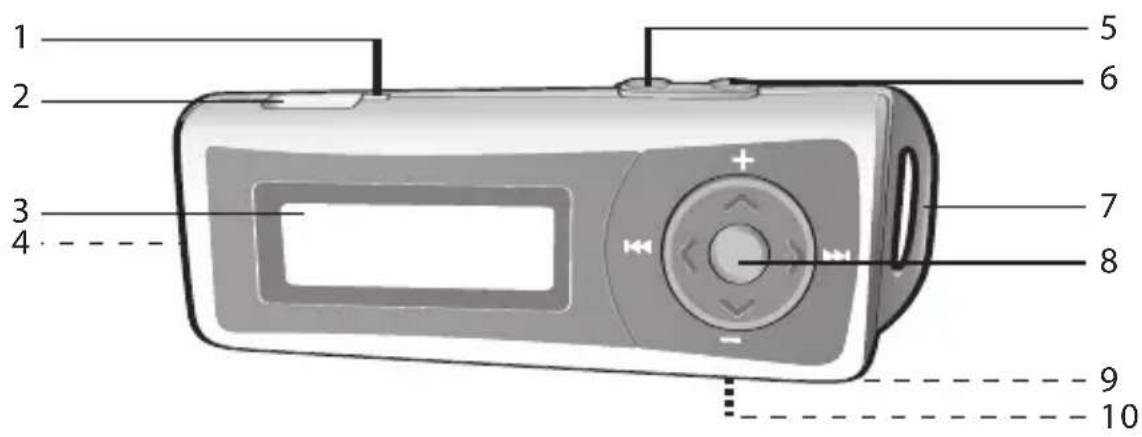
1 2 3 4 5 6 7 8 9 10- MIC (Microphone)
- USB Jack
(USB CABLE PART NO. 337-01000-E050*)
- Display
- Battery Compartment (Rear of Unit)
- Stop ■/Power Off Button
- Play/Pause ▶II/Power On button
- Headphones Hangstrap Hole**
- Navigation Control: (clockwise)
Navigation ▲/Volume +
Navigation ▶/Skip/Search ▶
Navigation ▼/Volume -
Navigation ◀/Skip/Search ◀
Menu/Enter (center)
- Headphones Jack**
(Bottom of Unit)
(HEADPHONES PART NO.
261-32201-E001*)
- LOCK Switch
(Bottom of Unit)
*Consumer Replaceable Part (See page 36 to order.)
**The headphones included with this unit come with a necklace and a detachable hangstrap.
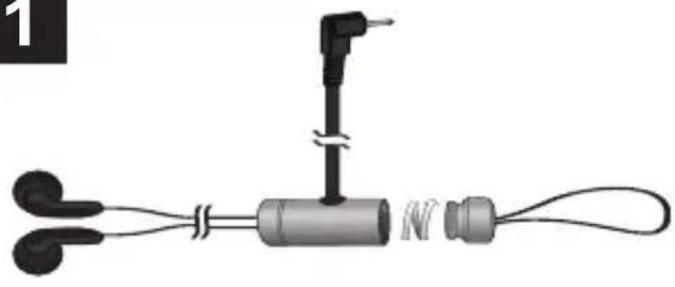
USING THE NECKLACE STRAP
1
natural_image
Diagram of a wireless ear adapter with attached microphone and cable, showing no text or symbolsUnscrew the detachable hangstrap from the headphones/necklace.
2
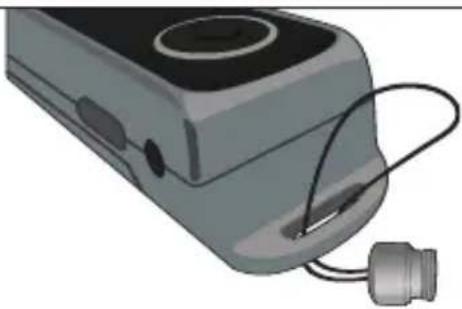
natural_image
Illustration of a gray electronic device with a connector and cable (no text or symbols)Insert the cord through the hangstrap hole.
3
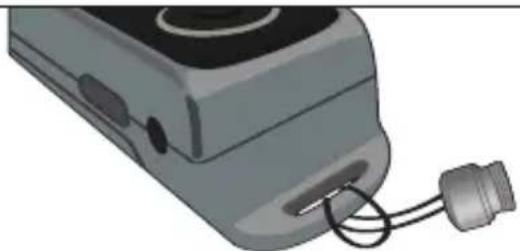
natural_image
Illustration of a mechanical device with a cable and connector (no text or symbols visible)Loop the cord around the locking piece and pull until tightened. Screw the detachable hangstrap back onto the headphones/necklace.
BATTERY INSTALLATION
When the bars in the battery indicator (in the display) become low (see Figure 1), replace the battery as follows.
- Disconnect the headphone plug from the Headphones jack on the bottom of the unit. Then, remove the Battery Compartment cover on the rear of the unit by sliding it out.
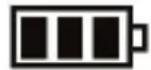
FULL 50% EMPTY

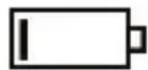
Figure 1
-
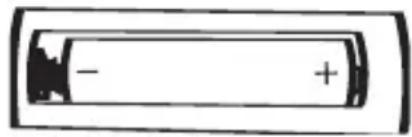
Insert one (1) "AAA" battery, following the polarity indicated in the Battery Compartment, as shown in Figure 2. An alkaline battery is recommended for the longest playing time.
-
Slide the Battery Compartment cover back onto the rear of the unit.
natural_image
Simple line drawing of a battery with negative and positive terminals (no text or symbols)Figure 2
BATTERY PRECAUTIONS
Follow these precautions when using a battery in this device:
- Use only the size and type of battery specified.
- Be sure to follow the correct polarity when installing the battery as indicated. Reversed batteries may cause damage to the device.
- If the device is not to be used for a long period of time, remove the battery to prevent damage or injury from possible battery leakage.
- Do not try to recharge batteries not intended to be recharged; they can overheat and rupture. (Follow battery manufacturer's directions.)
DOWNLOADING AND TRANSFERRING FILES
This unit is compatible with the following Operating Systems: Windows ME, 2000 and XP or Mac 9.2X
Please refer to the following pages to learn how to: transfer files, convert music on an audio CD into MP3 or WMA format using Windows Media Player 10, transfer MP3/WMA files and WMA files with DRM 9 using Windows Media Player 10, and safely remove your unit from the computer.
NOTE: Visit www.Microsoft.com to download the corresponding Windows Media Player for your computer.
DOWNLOADING AND TRANSFERRING FILES (CONT.)
TRANSFERRING FILES
You can download digital music files from the Internet or use encoding software to convert music that you have on an audio CD into MP3 or WMA format. Once these files are stored on your computer you can easily copy them to your player.
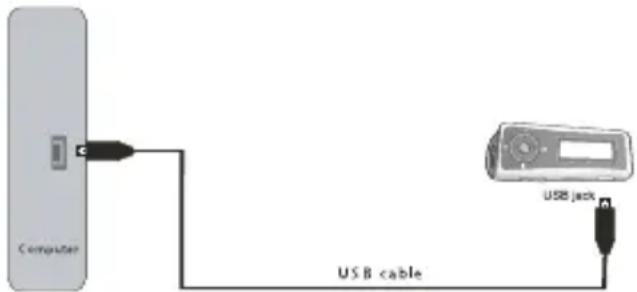
For Windows XP, if you have Windows Media Player 10, you can transfer music files (MP3, WMA, WMA files with DRM 9) to the player through the "Sync" function of Windows Media Player 10. Connect your computer to the USB port on your computer using the USB cable. "Removable Disk" will appear in your "My Computer" folder which indicates the player is connected. Then, follow the procedure on page 12 to transfer music files to the player.
text_image
Computer USB jack USB cableFor Windows ME, Windows 2000 or Windows XP (without Windows Media Player 10), transfer music files as follows:
- Connect your player to the USB port on your computer using the USB cable as shown above.
- A "Removable Disk" window will automatically pop-up on your computer screen.
- To add more files and songs to your player, simply drag and drop MP3 or WMA files/folders from anywhere on your computer into the "Removable Disk" window.
IMPORTANT: A WMA file with DRM 9 will not play back if you directly drag and drop it into the "Removable Disk" window. You must use Windows Media Player 9 or 10 to transfer copy-protected files as described on page 12.
DOWNLOADING AND TRANSFERRING FILES (CONT.)
TRANSFERRING AUDIO FILES TO YOUR DIGITAL AUDIO PLAYER USING A MACINTOSH COMPUTER
Make sure to use a Macintosh computer with an operating system of 9.2X to transfer audio files.
- Turn on your computer.
- Turn on your digital audio player.
- Connect the smaller end of the cable to the USB jack on the player and the larger end of the cable to the USB port on your Macintosh.
- Your computer will automatically recognize your player and mount a hard disk icon onto your desktop.
- Locate the folder where your audio files are stored on your computer's hard drive. Simply drag and drop the audio files onto the mounted hard disk drive icon of your digital audio player located on your desktop.
- After you have finished your transfer, put away the digital audio player hard disk icon(s) by dragging it to the Trash icon or Control-click its icon and choose Eject from the File menu or select Eject from the File drop-down menu located at the top of your screen. You can also use the keyboard shortcuts by selecting the digital audio player hard disk icon and pressing the Command-E keys.
- Your player is ready to play the files you transferred.
DOWNLOADING AND TRANSFERRING FILES (CONT.)
For Windows XP, you can also utilize Windows Media Player 10 software to convert music on an audio CD into MP3 or WMA format as follows:
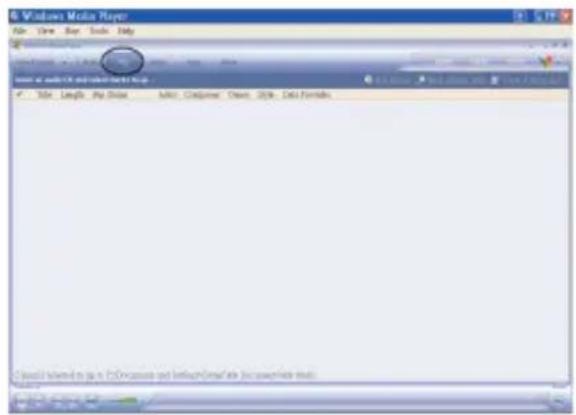
- Open the Windows Media Player 10 Browser, then click on the "Rip" icon on the top tool bar. Insert a Music CD into the CD-Rom drive of your computer.
NOTE: For Windows ME and Windows 2000, please use the corresponding Windows Media Player for your computer to convert music on an audio CD into MP3 or WMA format.
text_image
Windows Media Player File Edit View Tools Help 12.5.17 Show or add PC and download new Web ✓ Table Length Play Solar Add: Compressor Clos: 00% Data Formats C:\Users\Internet to play PC\Documents and link\Email's access via mail-
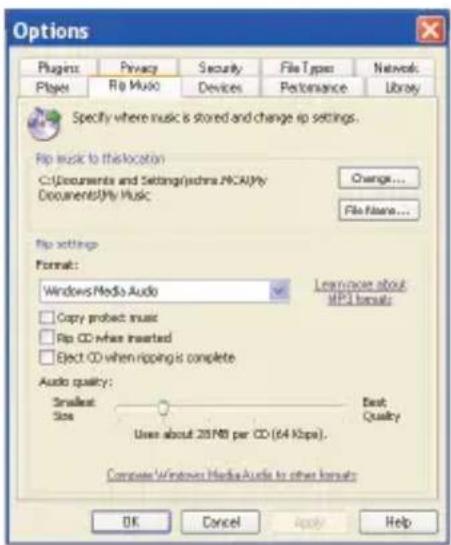
Click on the "Tools" menu option at the top menu bar, then click on "Options"; the Option setting menu will appear. Click on Rip Music and set the Rip Music to the desired location on your computer. Then, set the desired format for the newly ripped music (MP3 format or Windows Media Audio format). Adjust the audio quality as desired. When finished, click "OK" to confirm the settings.
-
Click on the "Rip Music" icon to start ripping the music to your computer.
-
When the music tracks are ripped; connect the player to your computer. Open the "Removable Disk" window and open the ripped music location window.
text_image
Options Plugins Privacy Security File Types Networks Player Rip Music Devices Pastenance Library Specify where music is stored and change ip settings. Rip music to this location C:\Documents and Settings\schra.MCA\My Documents\5\My Music Change... File Files... Flip settings Format: Windows Media Audio Learn more about MP3 formats: Copy project music Rip CD when inserted Elect CD when ripping is complete Audio quality: Smallest Size Best Quality User about 20 MB per CD (64 Kbps). Compute Windows Media Audio to other formats OK Cancel Apply Help-
To add the transferred/ripped music files/songs to your player simply drag and drop the MP3 and/or WMA files into the "Removable Disk" window.
-
When the files are finished loading into the player, you can follow the "Safely Remove Hardware" procedure as shown on page 13.
DOWNLOADING AND TRANSFERRING FILES (CONT.)
TRANSFERRING MP3/WMA FILES AND WMA FILES WITH DRM 9 USING WINDOWS MEDIA PLAYER 10 (FOR WINDOWS XP ONLY)
To transfer MP3 files/WMA files/WMA files with DRM 9 to the player, follow the procedure described below using Windows Media Player 10. Before beginning the procedure please turn the unit on and connect the unit to the computer as previously described.
- Open the "Windows Media Player Browser 10" and click on "Sync".
- Click on the "Sync List" pull-down menu to locate the music files you wish to download. Then make sure to tick the box next to the files.
- Select the Portable Device ("Removable Disk") that you want to copy to from the right side drop-down menu. Click "Start Sync" to start transferring music files to the player.
- After finished transferring all the desired files to your unit, you can remove your unit from the computer.
NOTE:
- For WMA files with DRM 9, you can use Windows Media Player 9 or 10 to transfer files to your player.
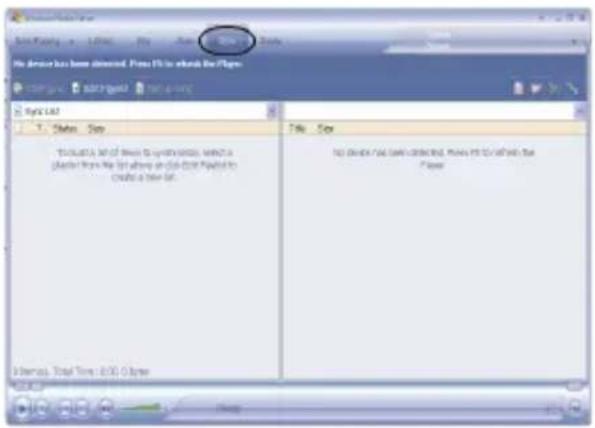
text_image
No device has been deleted. Files are also available for images File Edit View Insert Tools Help File List Status Stop This is the last file from the system, which is a character from the list allowing an edit tool to create a new list. Title: Size No change or can change existing file. Files are also available for images Enter on total time: 0:00 GMTs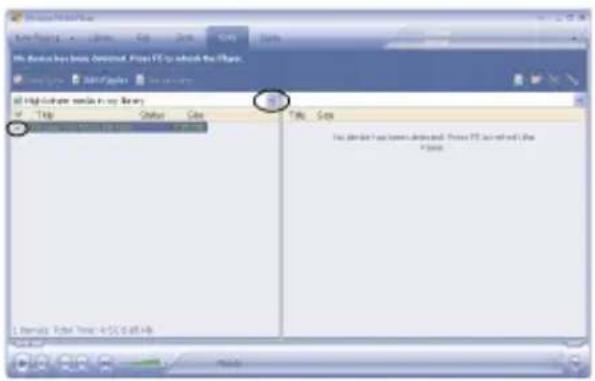
text_image
My Book has been created. Files PC to which the Image. All High-Source material in my library Title: 100% Other: 100% Copy: 100% Copy Copy My Book has been created. Files PC is not with the Image. Libraries: Total Time is 45% off help.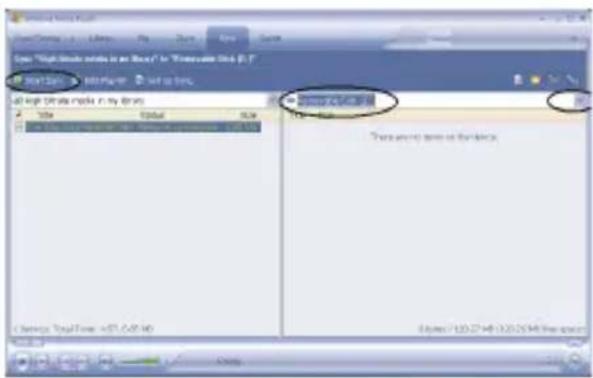
text_image
View: "High volume media is at Book" in Timescale Std. P.F All high volume media (C:\My Drive) Title: Total Subtitle: 100% Transaction type in accordance Chemically TopTime: +57.6836 Open: 120.2748-320.5947 For spaceSAFELY REMOVE HARDWARE
SAFELY REMOVING YOUR PLAYER FROM THE COMPUTER (FOR WINDOWS ME OR 2000)
NOTE: To avoid damage to your player or data loss, always follow the procedure listed below before disconnecting your player from the USB port on your computer.
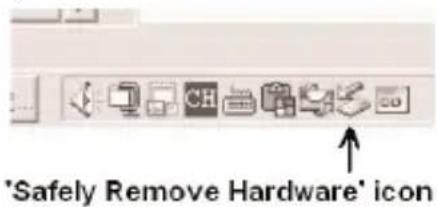
Using your mouse, double click the "Safely Remove Hardware" icon on the task bar.
text_image
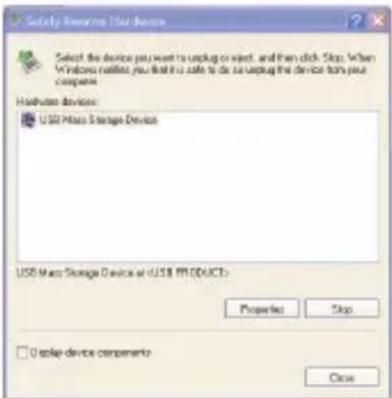
'Safely Remove Hardware' iconFrom the "Safely Remove Hardware" window (shown lower right), select "USB Mass Storage Device" and click the "Stop" button. The "Stop a Hardware Device" window will pop-up. Click "OK". When the "Safe to Remove Hardware" window is displayed, you may remove the player from the USB cable or remove the USB cable from the computer.
NOTE:
- If the "Safely Remove Hardware" icon is not displayed on the task bar, please double-click on My Computer. Right-click on "Removable Disk" and left-click on "Eject". Then it is safe to remove the player from the computer.
- If you are using Windows XP and the Windows Media Player 10 software is already installed, then you do not need to follow the above "Safely Remove Hardware" procedure.
text_image
Select the device you want to upkup or reject, and then click. Stop, when Windows will replace, you that it is safe to do so upkup the device from your computer. Hiushion devices: USB Max Storage Device USB Max Storage Device at (USB PRODUCTS): Properties Stop □ Update device components CloseOPERATION
text_image
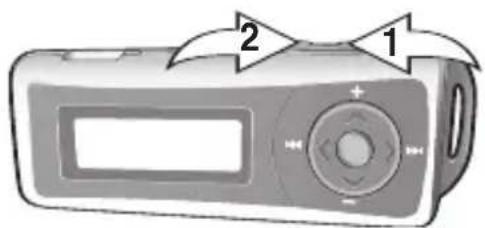
Diagram of a device with labeled parts 1 and 2, showing control buttons and display screenTurn the unit on by pressing the Play/Pause ▶Power On button ①; the Memorex start screen will appear in the display temporarily. Then the Music Player menu will appear and the MP3/WMA track's information will appear in the display. To turn the unit off, press and hold the Stop ■/Power Off button ②; "Continue Holding To Power Off" will appear in the display. Do not release the Stop ■/Power Off button ② until the unit turns off.
LOCK SWITCH
1
natural_image
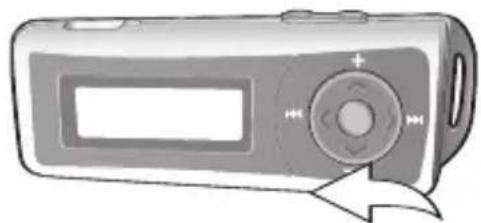
Illustration of a digital camera with control knob and scroll arrow (no text or symbols)With the unit on, slide the LOCK switch to the Lock position (right); a small Lock icon will appear in the display and no buttons will function. This is useful when you do not want the track changed by accidentally pressing a button. Slide the LOCK switch to the Unlock position (left) to cancel the Lock function.
NOTE: It will take several seconds to several minutes to update the player's library or the music files depending on the number of songs that you transferred to the player. When done, the Music Player menu will appear in the display.
OPERATION (CONTINUED)
TO LISTEN TO MP3s/WMAs
1
natural_image
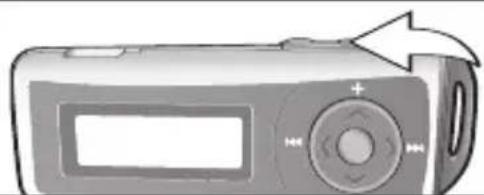
Illustration of a digital camera with an arrow indicating rotation (no text or symbols)Turn the unit on by pressing the Play/Pause ▶II/Power On button; the Memorex start screen will appear in the display temporarily. Then the Music Player menu will appear and the MP3/WMA track's information will appear in the display.
2
text_image
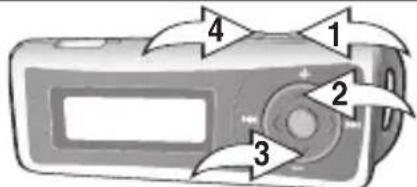
1 2 3 4Press the Play/Pause ▶II/Power On button ① to start playback. Press the Navigation ▲/Volume + ② or ▼/- ③ buttons to increase or decrease the volume. To stop playback, press the Stop ■/Power Off button ④.
3
natural_image
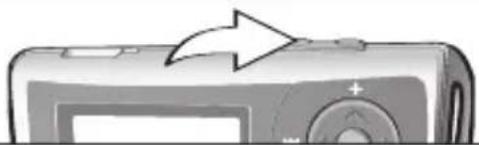
Illustration of a digital camera with an arrow pointing to the top portion (no text or symbols)To turn the unit off, press and hold the Stop ■/Power Off button; "Continue Holding To Power Off" will appear in the display. Do not release the Stop ■/Power Off button until the unit turns off.
NOTE:
• See pages 8-12 for information on uploading MP3 and WMA files to this unit.
OPERATION (CONTINUED)
TO PAUSE PLAYBACK
1
natural_image
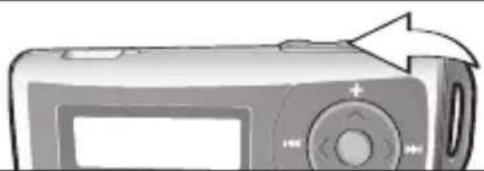
Illustration of a digital camera with an arrow indicating direction (no text or symbols)During playback, if you wish to pause the file momentarily, press the Play/Pause ▶II/Power On button; playback will pause and the timer will stop counting.
2
natural_image
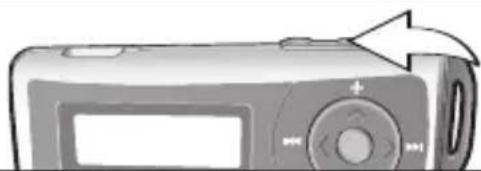
Illustration of a digital camera with control panel and buttons (no text or symbols)Press the Play/Pause ▶II/Power On button again to resume playback; the sound will return and the timer will start counting again.
TO SELECT/BROWSE THROUGH THE FILES
1
text_image
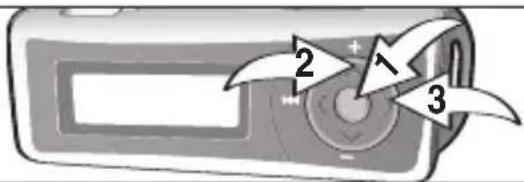
Diagram of a digital camera with labeled parts 2, 3, and an arrow indicating direction or movement.Press the Menu/Enter button ①; the Main menu will appear. Scroll to Navigation by pressing the Navigation ▲/Volume + or ▼/- ② button then press the Menu/Enter button ①. Select the desired folder/file by pressing the Navigation ▶/Skip/Search ▶ or ◀/◀◀ ③ button then press the Menu/Enter button ①.
NOTE: If you want to browse the music files by folder, you must "drag and drop" the music folder(s) as described on page 9.
2
text_image
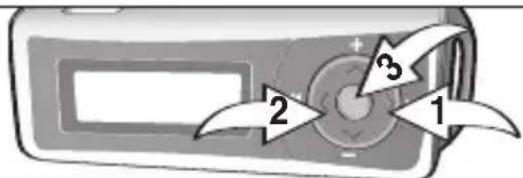
Diagram of a device with numbered arrows indicating directional flow or movement, labeled 1 to 3.Select the desired option from the pop-up menu: Play (to begin playback), Enter (to continue browsing within the sub-folders and/or files) or Cancel (to cancel your selection) by pressing the Navigation ▶/Skip/Search ▶ ① or ◀/◀ ② button then press the Menu/Enter button ③. NOTE: In the last sub-folder, the "Enter" option will change to a "Delete" option. If you select "Delete", you can then select "Yes", "No" or "Cancel" by pressing the Navigation ▶/Skip/Search ▶ or ◀/◀ button then press the Menu/Enter button.
OPERATION (CONTINUED)
FORWARD/REVERSE SKIP
1
text_image
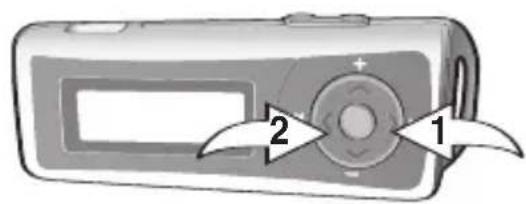
Diagram of a digital camera with labeled parts 1 and 2, showing control panel and buttonsDuring playback, press the Navigation ▶/Skip/Search ▶ button ① to advance the player to the beginning of the next file. Press the Navigation ▶/Skip/Search ▶ button ① repeatedly to advance the player to higher-numbered files.
During playback, press the Navigation ◀/Skip/Search ◀ button ② to move the player back to the beginning of the currently playing file. Press the Navigation ◀/Skip/Search ◀ button ② repeatedly to move the player back to lower-numbered files.
HIGH-SPEED MUSIC SEARCH
1
text_image
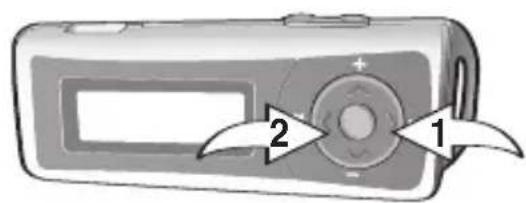
Diagram of a digital camera with labeled parts 1 and 2, showing screen control and buttonsDuring playback, press and hold the Navigation ▶/Skip/Search ▶▶ ① or ◀/◀◀ ② button to move the player forward or backward within a file to locate a specific musical passage. The player will move forward or backward at high speed as long as the button is held. When you release the button, normal playback will resume.
OPERATION (CONTINUED)
TO CREATE A VOICE RECORDING
1
text_image
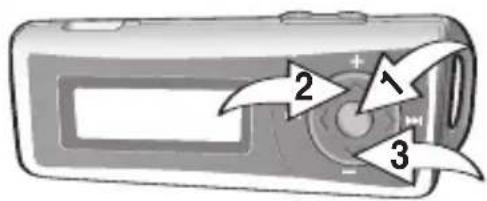
Diagram of a cylindrical device with labeled parts 1, 2, and 3 indicating directional flow or movement.Press the Menu/Enter button ①; the Main menu will appear. Scroll to Record by pressing the Navigation ▲/Volume + ② or ▼/- ③ button then press the Menu/Enter button ①.
2
natural_image
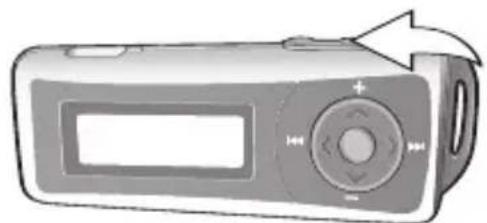
Illustration of a portable electronic device with control buttons and an arrow indicating rotation (no text or symbols)Speak into the microphone and the player will create a voice recording. Press the Play/Pause ▶II/Power On button to pause recording, and press again to resume recording.
3
natural_image
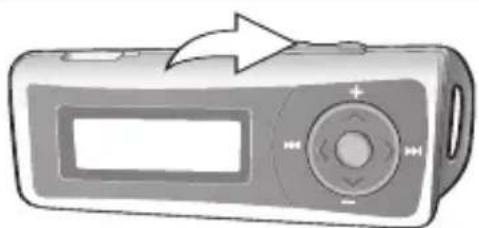
Illustration of a handheld electronic device with a screen and control buttons (no text or symbols)Press the Stop ■/Power Off button to stop recording and go to the Voice Player menu.
NOTES:
• See the next page for how to access the voice recordings you have created.
• See page 25 for how to view the Recorder settings.
OPERATION (CONTINUED)
TO LISTEN TO A RECORDING
text_image
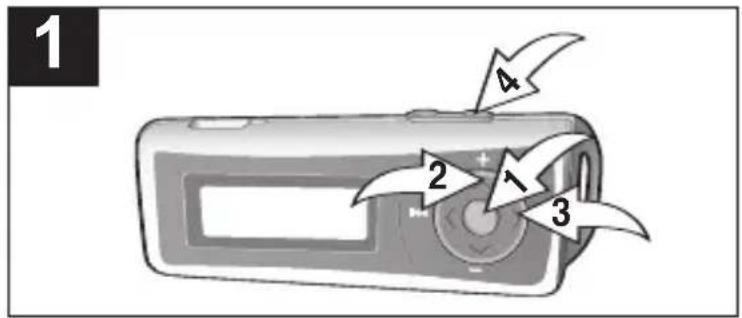
1 2 3 4Press the Menu/Enter button ①; the Main menu will appear. Scroll to Voice by pressing the Navigation ▲/Volume + or ▼/- ② button then press the Menu/Enter button ①. Select the desired recording by pressing the Navigation ▶/Skip/Search ▶ or ◀/◀ ③ button then press the Play/Pause ▶II/Power On button ④. NOTE: You can also select/browse through the recordings as described on page 16 by selecting the VOICE folder.
OPERATION (CONTINUED)
SETTING THE EQUALIZER
1
text_image
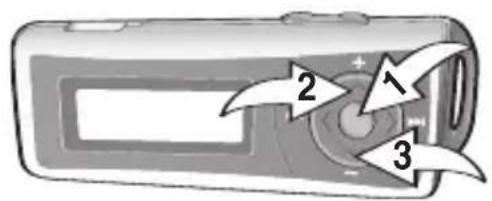
Diagram of a battery with labeled parts and directional arrows indicating flow or movementPress the Menu/Enter button ①; the Main menu will appear. Scroll to Settings by pressing the Navigation ▲/Volume + ② or ▼/- ③ button then press the Menu/Enter button ①.
2
text_image
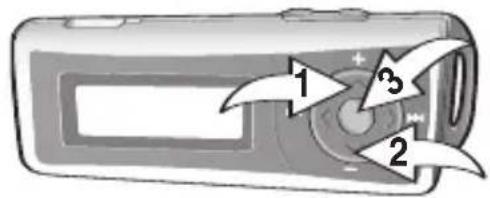
1 2 3Scroll to Equalizer by pressing the Navigation ▲/Volume + ① or ▼/- ② button then press the Menu/Enter button ③.
3

text_image
Diagram of a digital camera with numbered arrows indicating directional flow or movement around the screenSelect a desired EQ setting (Normal, XBass, Rock, Jazz, Classical or Pop) by pressing the Navigation ▶/Skip/Search ▶① or ◀/◀② button then press the Menu/Enter button ③.
4

natural_image
Illustration of a digital camera with an arrow pointing to the button (no text or symbols present)Press and hold the Menu/Enter button to return to the Music/Voice Player menu.
NOTE: Also, if no button has been pressed for approx. 10 seconds, the unit will automatically return to the Music/Voice Player menu.
OPERATION (CONTINUED)
SETTING THE PLAY MODE
1
text_image
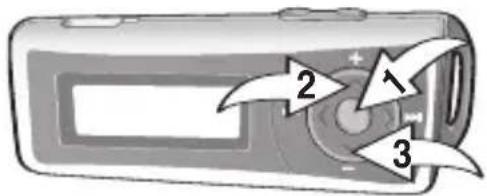
Diagram of a digital camera with labeled parts and directional arrows indicating motion or signal flowPress the Menu/Enter button ①; the Main menu will appear. Scroll to Settings by pressing the Navigation ▲/Volume + ② or ▼/- ③ button then press the Menu/Enter button ①.
2
text_image
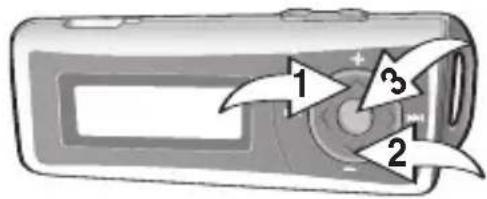
1 2 3Scroll to Play Mode by pressing the Navigation ▲/Volume + ① or ▼/- ② button then press the Menu/Enter button ③.
3
text_image
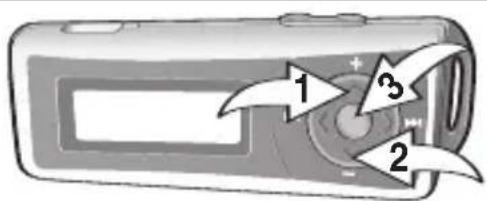
Diagram of a digital camera with labeled parts 1, 2, and 3 indicating components or functions.Select the desired Play mode by pressing the Navigation ▲/Volume + ① or ▼/- ② button then press the Menu/Enter button ③.
Normal: Normal playback
Repeat Track: Repeats the current track
Repeat All: Repeats all of the files
Intro: Plays the first 15 seconds of each
file once and then stops*
Shuffle: Randomly plays the files once and then stops*
Shuffle Repeat: Randomly plays all the files repeatedly*
* Not available while in Voice Player mode.
4
natural_image
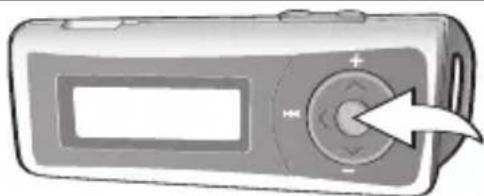
Illustration of a digital camera with an arrow pointing to the button (no text or symbols present)Press and hold the Menu/Enter button to return to the Music/Voice Player menu.
NOTE: Also, if no button has been pressed for approx. 10 seconds, the unit will automatically return to the Music/Voice Player menu.
OPERATION (CONTINUED)
SETTING THE CONTRAST
1
text_image
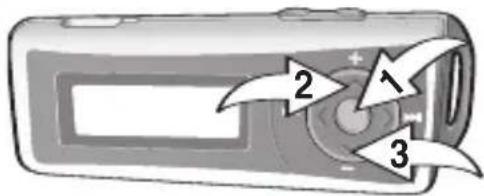
2 3Press the Menu/Enter button ①; the Main menu will appear. Scroll to Settings by pressing the Navigation ▲/Volume + ② or ▼/- ③ button then press the Menu/Enter button ①.
2
text_image
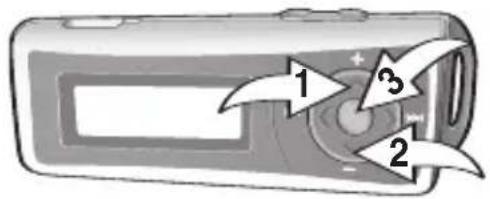
1 2 3Scroll to Contrast by pressing the Navigation ▲/Volume + ① or ▼/- ② button then press the Menu/Enter button ③.
3
text_image
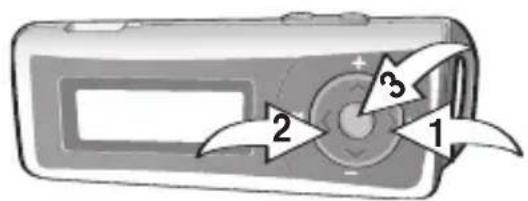
Diagram of a device with numbered arrows indicating directional flow or movement, labeled 1 to 3.To decrease/increase the contrast, press the Navigation ▶/Skip/Search ▶ or ◀/◀ ② button then press the Menu/Enter button ③.
4
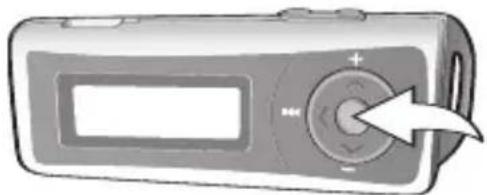
natural_image
Illustration of a digital camera with a rotary knob and indicator lights (no text or symbols)Press and hold the Menu/Enter button to return to the Music/Voice Player menu.
NOTE: Also, if no button has been pressed for approx. 10 seconds, the unit will automatically return to the Music/Voice Player menu.
OPERATION (CONTINUED)
SETTING THE BACKLIGHT
1
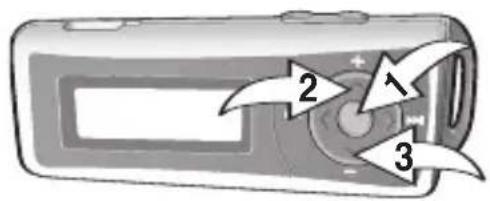
text_image
Diagram of a digital camera with numbered arrows indicating directional movement or operationPress the Menu/Enter button ①; the Main menu will appear. Scroll to Settings by pressing the Navigation ▲/Volume + ② or ▼/- ③ button then press the Menu/Enter button ①.
2
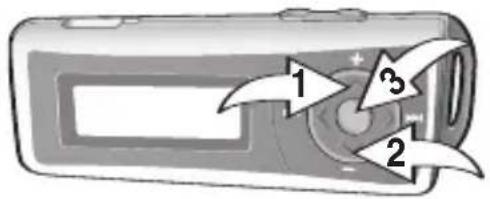
text_image
1 2 3Scroll to Backlight by pressing the Navigation ▲/Volume + ① or ▼/- ② button then press the Menu/Enter button ③.
3
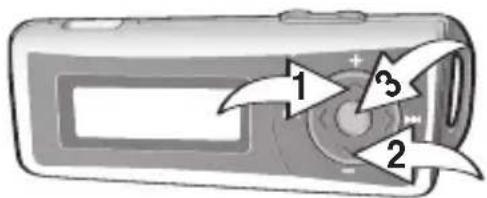
text_image
Diagram of a cylindrical battery with labeled parts and directional arrows indicating flow or movementSelect the desired Backlight time (time the backlight will stay on after a button is pressed—Disable, 3 sec., 5 sec., 10 sec., 15 sec. or On) by pressing the Navigation ▲/Volume + ① or ▼/- ② button then press the Menu/Enter button ③.
4
natural_image
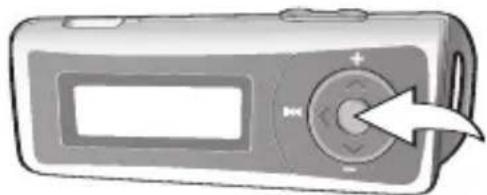
Illustration of a digital camera with an arrow pointing to the button (no text or symbols present)Press and hold the Menu/Enter button to return to the Music/Voice Player menu.
NOTE: Also, if no button has been pressed for approx. 10 seconds, the unit will automatically return to the Music/Voice Player menu.
OPERATION (CONTINUED)
SETTING THE POWER SAVINGS
1
text_image
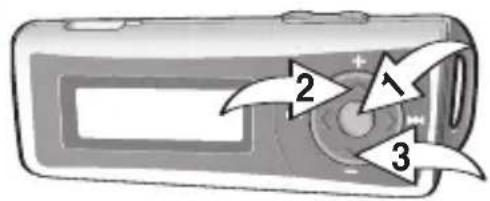
Diagram of a digital camera with labeled parts and directional arrows indicating motion or signal flowPress the Menu/Enter button ①; the Main menu will appear. Scroll to Settings by pressing the Navigation ▲/Volume + ② or ▼/- ③ button then press the Menu/Enter button ①.
2
text_image
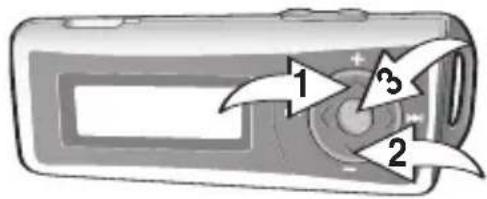
Diagram of a digital camera with labeled parts 1, 2, and 3 indicating directional arrows or components.Scroll to Power Savings by pressing the Navigation ▲/Volume + ① or ▼/- ② button then press the Menu/Enter button ③.
3
text_image
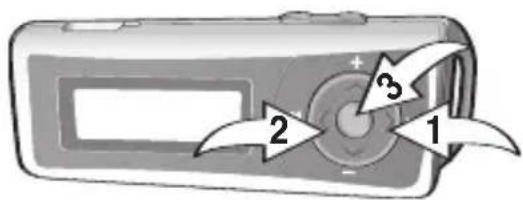
1 2 3Select the desired Power Savings (time the unit will stay on before turning off due to inactivity-Disable [ Off ], 1 min, 2 mins, 5 mins or 10 mins) by pressing the Navigation ▶/Skip/Search ▶▶① or ◀/◀② button then press the Menu/Enter button ③.
NOTE: Select Disable to disable this feature and not have the unit enter the Power Savings mode.
4
natural_image
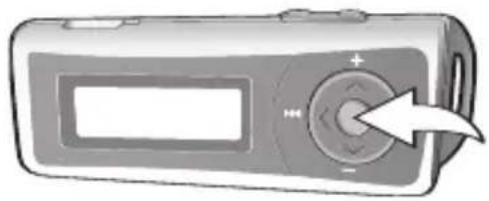
Illustration of a digital camera with an open button and a curved arrow pointing to the left side (no text or symbols)Press and hold the Menu/Enter button to return to the Music/Voice Player menu.
NOTE: Also, if no button has been pressed for approx. 10 seconds, the unit will automatically return to the Music/Voice Player menu.
OPERATION (CONTINUED)
VIEWING THE RECORD SETTINGS
1
text_image
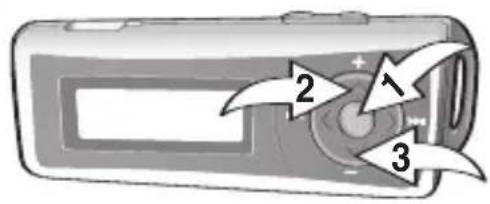
2 3Press the Menu/Enter button ①; the Main menu will appear. Scroll to Settings by pressing the Navigation ▲/Volume + ② or ▼/- ③ button then press the Menu/Enter button ①.
2
text_image
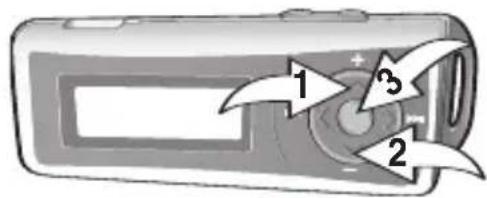
1 2 3Scroll to Record Settings by pressing the Navigation ▲/Volume + ① or ▼/- ② button then press the Menu/Enter button ③.
3
text_image
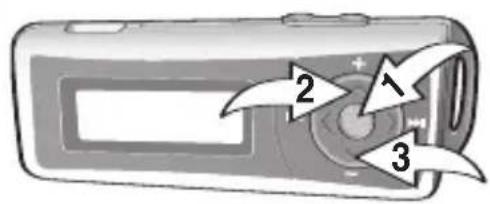
Diagram of a digital camera with numbered arrows indicating directional flow or movement, labeled 1, 2, and 3.Press the Menu/Enter button ① to view the Rate (8000 Hz, 11025Hz, 16000Hz, 22050Hz, 32000Hz).
Scroll to Exit by pressing the Navigation ▲/Volume + ② or ▼/- ③ button then press the Menu/Enter button ①.
4
natural_image
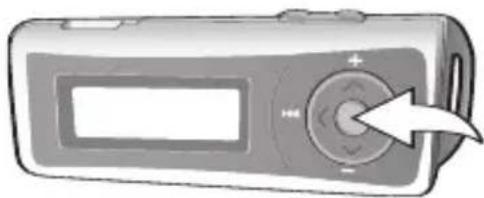
Illustration of a digital camera with an open control knob and a curved arrow pointing to the left button (no text or symbols present)After exiting the Record settings, press and hold the Menu/Enter button to return to the Music/Voice Player menu.
NOTE: Also, if no button has been pressed for approx. 10 seconds, the unit will automatically return to the Music/Voice Player menu.
OPERATION (CONTINUED)
TO RESTORE THE DEFAULT SETTINGS
1
text_image
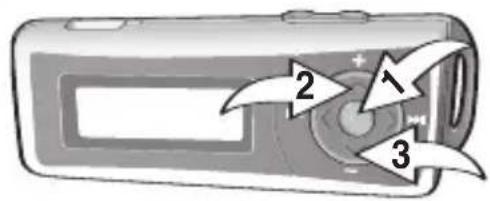
Diagram of a digital camera with labeled parts 1, 2, and 3 indicating directional arrows or components.Press the Menu/Enter button ①; the Main menu will appear. Scroll to Settings by pressing the Navigation ▲/Volume + ② or ▼/- ③ button then press the Menu/Enter button ①.
2
text_image
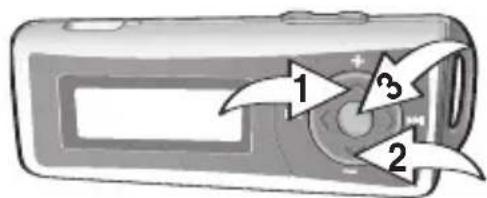
Diagram of a digital camera with labeled parts 1, 2, and 3 indicating directional arrows or components.Scroll to Load Default by pressing the Navigation ▲/Volume + ① or ▼/- ② button then press the Menu/Enter button ③.
NOTE: The unit will restore the default settings immediately after you press the Menu/Enter button.
3
natural_image
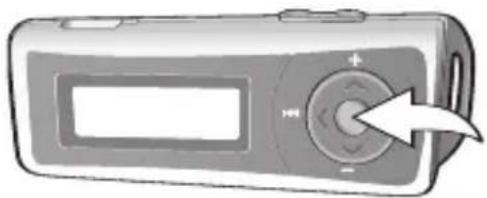
Illustration of a digital camera with an arrow pointing to the button (no text or symbols present)Press and hold the Menu/Enter button to return to the Music/Voice Player menu.
NOTE: Also, if no button has been pressed for approx. 10 seconds, the unit will automatically return to the Music/Voice Player menu.
OPERATION (CONTINUED)
SETTING THE LANGUAGE
1
text_image
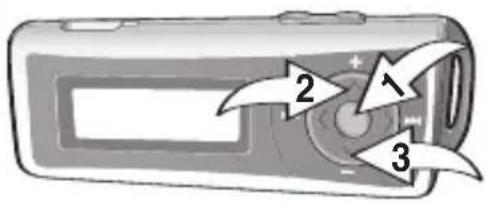
Diagram of a digital camera with labeled parts and directional arrows indicating motion or movementPress the Menu/Enter button ①; the Main menu will appear. Scroll to Settings by pressing the Navigation ▲/Volume + ② or ▼/- ③ button then press the Menu/Enter button ①.
2
text_image
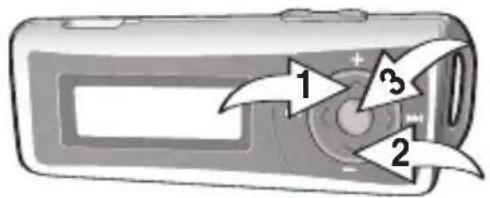
Diagram of a cylindrical device with labeled components and directional arrows indicating flow or movement.Scroll to Language by pressing the Navigation ▲/Volume + ① or ▼/- ② button then press the Menu/Enter button ③.
3
text_image
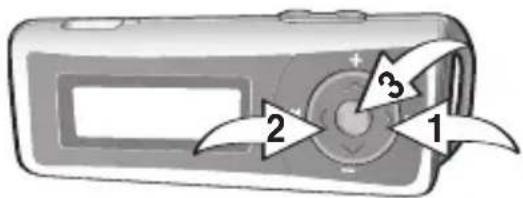
1 2 3Select a desired Language (English or Spanish) by pressing the Navigation ▶/Skip/Search ▶ ① or ◀/◀ ② button then press the Menu/Enter button ③.
4
natural_image
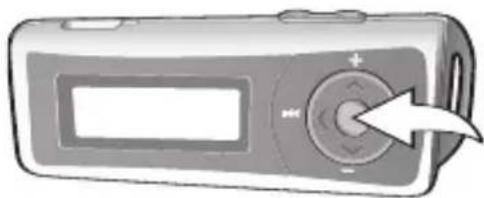
Illustration of a digital camera with an arrow pointing to the button (no text or symbols present)Press and hold the Menu/Enter button to return to the Music/Voice Player menu.
NOTE: Also, if no button has been pressed for approx. 10 seconds, the unit will automatically return to the Music/Voice Player menu.
OPERATION (CONTINUED)
SETTING THE SLEEP TIME
1
text_image
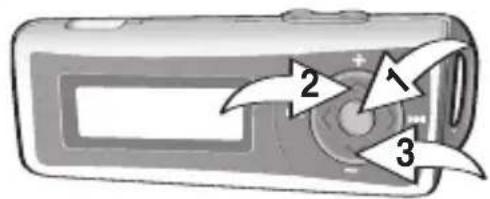
Diagram of a digital camera with labeled parts and directional arrows indicating motion or signal flow.Press the Menu/Enter button ①; the Main menu will appear. Scroll to Utilities by pressing the Navigation ▲/Volume + ② or ▼/- ③ button then press the Menu/Enter button ①.
2
text_image
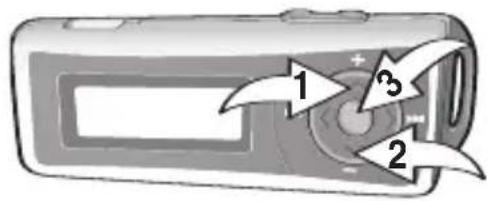
1 2 3Scroll to Sleep Time by pressing the Navigation ▲/Volume + ① or ▼/- ② button then press the Menu/Enter button ③.
3
text_image
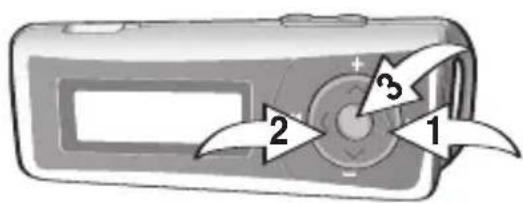
Diagram of a digital camera with numbered labels pointing to the screen and buttonsSelect the desired Sleep Time (after the set amount of time, the unit will automatically turn itself off-Off, 15 min, 30 min, 45 min, 60 min, 90 min, 120 min) by pressing the Navigation ▶/Skip/Search ▶ or ◀/◀◀ ② button then press the Menu/Enter button ③.
4
natural_image
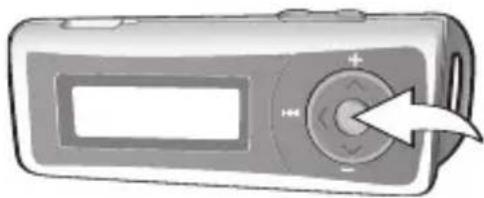
Illustration of a digital camera with an arrow pointing to the left button (no text or symbols present)Press and hold the Menu/Enter button to return to the Music/Voice Player menu.
NOTE: Also, if no button has been pressed for approx. 10 seconds, the unit will automatically return to the Music/Voice Player menu.
OPERATION (CONTINUED)
USING THE STOPWATCH
1
text_image
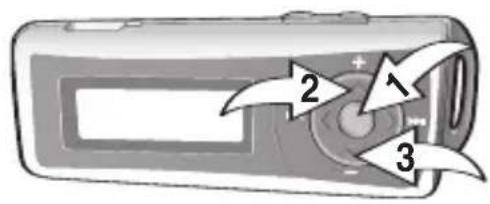
Diagram of a digital camera with labeled parts and directional arrows indicating motion or flowPress the Menu/Enter button ①; the Main menu will appear. Scroll to Utilities by pressing the Navigation ▲/Volume + ② or ▼/- ③ button then press the Menu/Enter button ①.
2
text_image
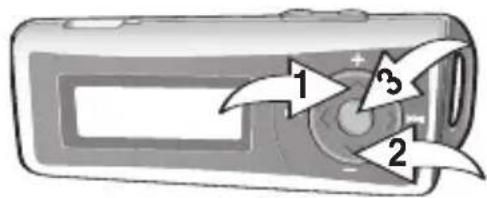
1 2 3Scroll to Stopwatch by pressing the Navigation ▲/Volume + ① or ▼/- ② button button then press the Menu/Enter button ③.
3
text_image
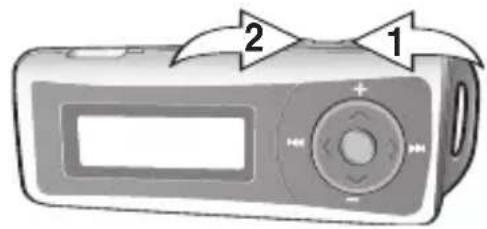
Diagram of a digital camera with labeled parts 1 and 2, showing control buttons and display screenPress the Play/Pause ▶II/Power On button ① to start the stopwatch. Press again to pause the stopwatch, and press yet again to resume the stopwatch.
Press the Stop ■/Power Off button ② to stop the stopwatch. Press yet again to clear the stopwatch.
4
natural_image
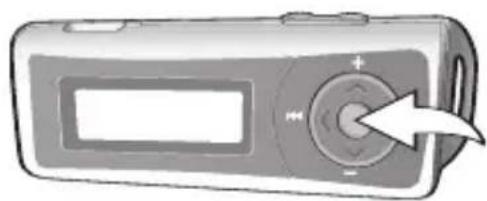
Illustration of a digital camera with an arrow pointing to the button (no text or symbols present)Press and hold the Menu/Enter button to return to the Music/Voice Player menu.
NOTE: Also, if no button has been pressed for approx. 10 seconds, the unit will automatically return to the Music/Voice Player menu.
OPERATION (CONTINUED)
TO VIEW THE SYSTEM INFO (ABOUT)
1
text_image
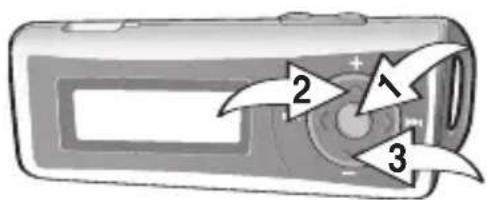
Diagram of a battery with labeled parts 1, 2, and 3 indicating internal components or functions.Press the Menu/Enter button ①; the Main menu will appear. Scroll to About by pressing the Navigation ▲/Volume + ② or ▼/- ③ button then press the Menu/Enter button ①.
2
text_image
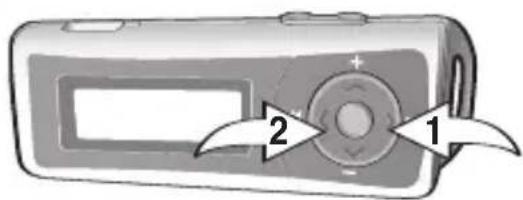
Diagram of a digital camera with labeled parts 1 and 2, showing control panel and buttonsScroll between Model, Version, Int. (Internal) Media and Free (Space) by pressing the Navigation ▶/Skip/Search ▶ or ◀/◀ ② button.
3
natural_image
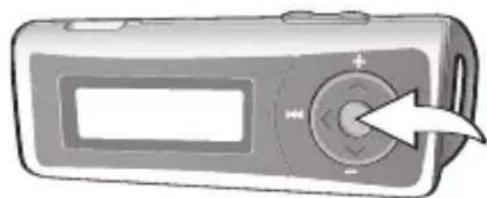
Illustration of a digital camera with an arrow pointing to the button (no text or symbols present)Press and hold the Menu/Enter button to return to the Music/Voice Player menu.
NOTE: Also, if no button has been pressed for approx. 10 seconds, the unit will automatically return to the Music/Voice Player menu.
TROUBLESHOOTING GUIDE
If you experience a problem with this unit, check the chart below before calling for service.
| SYMPTOM CAUSE SOLUTION | ||
| Unit will not Battery is low turn on. | low/empty. Replace battery. | |
| Unit is not turned on. | Press Play/Pause ▶II/Power On button to turn the unit on. | |
| No sound. Headphones | are not Insert headphones inserted. | |
| Volume is set too Raise low. Navigation | the volume using the ▲/Volume + button. | |
| The MP3 or WMA files are corrupted. files. | Download uncorrupted | |
| No files are in the Upload files to the unit as player. described on pages 8-12. | ||
| The computer is not recognizing the not secure player. Computer is not | The player is Make sure player is securely connected. securely connected. | |
| Supported OS: Windows ME, compatible. | 2000, XP and Mac OS 9.2X | |
| WMA files with DRM can’t playback. | Incorrect downloading methods. | See page 12 to download WMA files with DRM. |
TROUBLESHOOTING GUIDE (CONTINUED)
| SYMPTOM CAUSE SOLUTION | ||
| No buttons work. | The Lock feature is Deactivate Lock feature as activated. described on page 14. | |
| Unit needs to be reset Reset unit and/or or firmware needs to be updated. page 34. | update firmware, see | |
| Unit acting erratically. Unit needs to be reset Reset unit and/or or firmware needs to be updated. page 34. | update firmware, see | |
FORMATTING THE PLAYER
Formatting the Player
WARNING! Do not format this player unless it stops working and you are instructed to do so by technical support personnel.
- Use the USB cable to connect the player and the computer.
- Double click on My Computer, then right click "Removable Disk" and left click on "Format".
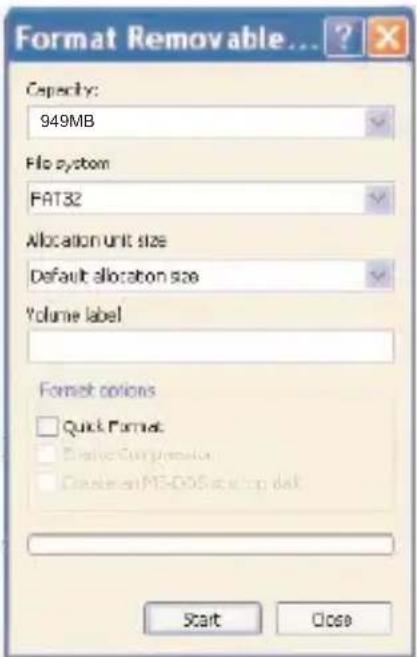
- For "Removable Disk", at the "Format" window, select "FAT 32" from the file system pull-down menu, then click "Start" to format the unit (see figure right).
NOTE: Make sure you have selected "FAT 32" at the file system pull-down menu; otherwise, after formatting, the
text_image
Format Removable... Capacity: 949MB File system FAT32 Allocation unit size Default allocation size Volume label Format options □ Quick Format □ Active Compression □ Cleaned MS-DOS startup data Start Closeplayer will not work properly. Then, click OK to confirm and the player will start to format. When finished, click "Close" to close the Format window.
UPDATING THE FIRMWARE
WARNING! Do not update the firmware unless you are experiencing problems with your digital audio device. Incorrect or faulty firmware installation will cause the player to stop functioning.
You can download the updated firmware at www.memorexelectronics.com.
RESETTING THE UNIT
To reset the unit, remove the battery for a few seconds and then replace it. This will reset the unit but all the default settings (i.e. Play mode, Equalizer, Contrast, Power Savings, etc.) will be saved in the unit.
SPECIFICATIONS
Audio Frequency Range 20Hz – 20KHz
Headphones Output 5mW, 32ohm (Max. Vol)
S/N Ratio 85db (MP3)
File Support MP3 MPEG 1/2/2.5 Layer 3
WMA Windows Media Audio (WMA file
with DRM9)
Bit Rate 32kbps–320kbps (MP3)
32kbps-192kbps (WMA)
General Dimension 1.4 (W) x 3.2 (H) x 0.8 (D) inches
Weight 0.8 ounces (without battery)
USB USB 2.0
LCD Full Graphic with Backlight
Built-in Memory 1 GB
Max. Playtime Approx. 8 hours
Supported OS Win ME, 2000, XP and Mac OS 9.2X
Operating Temperature 23°F to 104°F
Battery 1 x AAA battery
Specifications are subject to change without notice.
FOR FIRMWARE UPGRADE, PLEASE VISIT OUR WEBSITE AT WWW.MEMOREXELECTRONICS.COM TO CHECK IF THERE IS NEW FIRMWARE AVAILABLE.
FOR ADDITIONAL SET-UP OR OPERATING ASSISTANCE, PLEASE VISIT OUR WEBSITE AT
WWW.MEMOREXELECTRONICS.COM
OR CONTACT CUSTOMER SERVICE AT (954) 660-7100.
PLEASE KEEP ALL PACKAGING MATERIAL FOR AT LEAST 90 DAYS IN CASE YOU NEED TO RETURN THIS PRODUCT TO YOUR PLACE OF PURCHASE OR TO MEMOREX.
FOR CONSUMER REPLACEABLE PART(S), SEE PART NUMBER(S) ON PAGE 5 AND THEN CONTACT FOX INTERNATIONAL AT 1-800-321-6993.
PRECAUCIONES
DERECHO DE AUTOR:
text_image
Tested To Comply With FCC Standards FOR HOME OR OFFICE USEEstimado Cliente:
natural_image
Diagram of a handheld electronic device with earbuds and connector (no text or symbols)natural_image
Illustration of a gray electronic device with a connector and cable (no text or symbols)natural_image
Illustration of a mechanical device with a cable and connector (no text or symbols visible)natural_image
Simple line drawing of a battery with negative and positive terminals (no text or symbols)Figura 2
text_image
Windows Media Player File Edit Buy Tools Help Name: cml@cmcl.com Search Engine Title: Langle, Play Shift Add: Componee, Change, Style, Data Formulas Class1 intended to use C:\Documents and Settings\Current Settingstext_image
Options Plugins Privacy Security File Type Network Player Rip Music Devices Personance Library Specify where music is stored and change ip settings. Rip music to this location C:\Documents and Settings\jschra.NCAI\My Documents\IPy Music Change... File Name... Flip settings Format: Windows Media Audio Copy project music Rip CD when inserted Eject CD when ripping is complete Audio quality: Smallest Size User about 25MB per CD (64 Kbps). Best Quality Compute Windows Media Audio to other formats OK Cancel Apply HelpDESCARGAR Y TRANSFERIR ARCHIVOS (CONT.)
TRANSFERIR ARCHIVOS MP3/WMA Y ARCHIVOS WMA CON DRM 9 USANDO EL REPRODUCTOR DE WINDOWS MEDIA 10 (SÓLO PARA WINDOWS XP)
text_image
No device has been deleted. Files is not about the Player File Edit View Insert Help Type: 100% Status: Stop To default, let us return to within this, which's character from the list above an old file. Included to create a new list. Title: Stop No change or can change existing. Please press any other file Name: Internal Total Time: 6:30 Open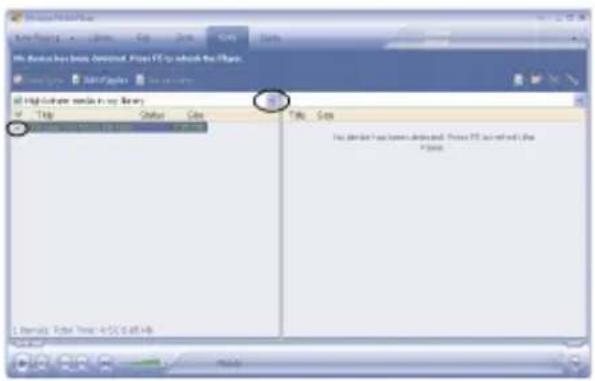
text_image
My Book has been created. Files PC to which the Image. All High-Source material in my library Title: 100% Other: 100% Copy: 100% Copy Copy My Book has been created. Files PC is not with the Image. Libraries: Total Time is 45% off help.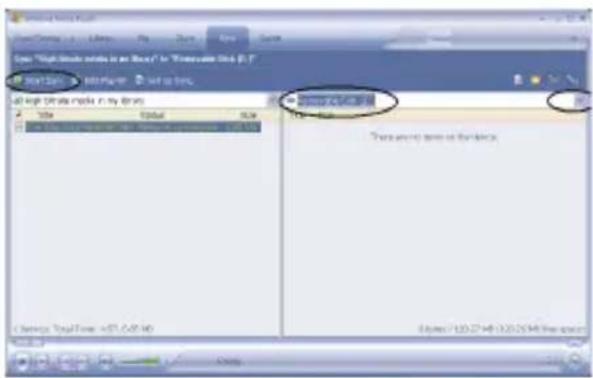
text_image
View: "High volume media is at Book" in Timescale Std. P.F All high volume media (C:\My Drive) Title: Total Subtitle: 100% Transaction type in accordance Chemically TopTime: +57.6836 Open: 120.2748-320.5947 For spacetext_image
Screenshot of a software toolbar with icons for file operations, desktops, and editing toolstext_image
Safety Remove Max device Select the device you want to uplug or project, and then click: Stop, When Windows notifies you that it is safe to do so uplug the device from your computer. Hashute devices: USB Max Storage Device USB Max Storage Device atOPERACIÓN
ENCENDER O APAGAR LA UNIDAD
1