
MK-F500 - Kitchen appliance PANASONIC - Free user manual and instructions
Find the device manual for free MK-F500 PANASONIC in PDF.
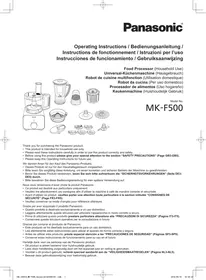


| Product type | Multi-function food processor |
| Brand | Panasonic |
| Model | MK-F500 |
| Power supply | 220-240 V ~ 50-60 Hz, 180-200 W |
| Dimensions (H x W x D) with bowl | 435 x 264 x 265 mm |
| Dimensions with blender | 406 x 264 x 265 mm |
| Dimensions with dry mill | 298 x 264 x 265 mm |
| Weight with bowl | 3.1 kg |
| Weight with blender | 2.8 kg |
| Weight with dry mill | 2.6 kg |
| Bowl capacity | 2.5 L (max operating: 1.5 L liquids, 600 g solids) |
| Blender capacity | 1 L |
| Dry mill capacity | 50 g (coffee beans) |
| Main functions | Chop, slice, knead, whisk, grate, slice (thick/fine), grind (coarse/fine), julienne, citrus press, blend, dry grind, salad drain |
| Included accessories | Metal blade, grating disc, kneading blade, whisk, salad drain, blade holder, chopping blades (coarse/fine), slicing blades (thick/fine), julienne blade, citrus press, blender unit, dry mill unit, brush/spatula, storage box |
| Dishwasher safe parts | Bowl and bowl lid |
| Safety | Safety lock (pin and lever), overload protection circuit breaker |
| Noise level | 88 dB(A) |
| Operating time / rest (food processor) | 2 min ON / 4 min OFF |
| Operating time / rest (blender) | 2 min ON / 2 min OFF |
| Operating time / rest (dry mill) | 1 min ON / 2 min OFF |
| Warranty | Consult Panasonic customer service |
Frequently Asked Questions - MK-F500 PANASONIC
User questions about MK-F500 PANASONIC
0 question about this device. Answer the ones you know or ask your own.
Ask a new question about this device
Download the instructions for your Kitchen appliance in PDF format for free! Find your manual MK-F500 - PANASONIC and take your electronic device back in hand. On this page are published all the documents necessary for the use of your device. MK-F500 by PANASONIC.
USER MANUAL MK-F500 PANASONIC
Food Processor (Household Use)
Thank you for purchasing the Panasonic product.
- This product is intended for household use only.
- Please read these instructions carefully in order to use this product correctly and safely.
- Before using this product, please give your special attention to the section "SAFETY PRECAUTIONS" (Page GB3-GB5).
- Please keep these Operating Instructions for future use.
SAFETY PRECAUTIONS . GB3-GB5
IMPORTANT INFORMATION. GB6
ELECTRICAL REQUIREMENT . GB7
PART NAMES. GB8 - GB9
CIRCUIT BREAKER PROTECTION . GB9
SAFETY LOCK. GB10
DISASSEMBLY . GB10
FOOD PROCESSOR
(i) INTRODUCTION. GB11 (ii) KNIFE BLADE, KNEADING BLADE, WHIPPING BLADE, GRATING BLADE. GB11 - GB13
- Preparation of Ingredients
- How to Use
(iii) SLICING BLADES · SHREDDING BLADES · JULIENNE BLADE .GB14 - GB15
- Preparation of Ingredients
- How to Use
(iv) SALAD DRAINER . GB16
- Preparation of Ingredients
- How to Use
(v) CITRUS PRESS. GB17
- Preparation of Ingredients
- How to Use
BLENDER
(i) INTRODUCTION. GB18 (ii) BLENDER . GB18
- Preparation of Ingredients
- How to Use
DRY MILL
(i) DRY MILL. GB19 - Preparation of Ingredients - How to Use
AFTER USE .GB20 - GB21 TROUBLESHOOTING
SPECIFICATIONS . GB23
SAFETY PRECAUTIONS (Make sure to follow these instructions)
In order to prevent accidents or injuries to the user, other people and damage to property, please follow the instructions below.
The following indication indicates the degree of damage caused by incorrect operation.

WARNING
Indicates serious injury or death.

CAUTION
Indicates risk of injury or property damage.
The symbols are classified and explained as follows.

This symbol indicates prohibition.

This symbol indicates requirement that must be followed.

WARNING

- Do not damage the Cord or the Plug.
(It may cause electric shock, or fire caused by short circuit.)
- Do not use the appliance if the Cord or the Plug is damaged or the Plug is loosely connected to the outlet.
(It may cause electric shock, or fire caused by short circuit.)
If the Cord is damaged, it must be replaced by the manufacturer, its service center or similarly qualified persons in order to avoid a hazard.
- Do not plug or unplug the Plug with wet hands.
(It may cause electric shock.)
- Do not exceed outlet voltage or use an alternate current other than that specified on the appliance.
(It may cause electric shock or fire.)
- Make sure the voltage supplied to the appliance is the same as your local supply.
- Plugging other devices into the same outlet may cause over-heating.
- Do not immerse the Motor Housing in water or splash it with water.
(It may cause electric shock, or fire caused by short circuit.)
- Do not dismantle, repair or modify the appliance.
(It may cause fire, electric shock or injury.)
Please contact your service center for repairing.
- Do not insert any objects into the vent or the gap.
(It may cause electric shock or malfunction.)
- Especially metal objects such as pins or wires.
- Do not replace any parts of appliance with non-genuine spare parts.
(It may cause injury, electric shock or fire.)
- Do not try to remove the Lid when the appliance is still operating.
(It may cause injury.)
- Do not use hot water (over 60°C) for cleaning purpose or fire to dry the appliance.
(It may cause burning or malfunction.)
WARNING

- Do not place hot ingredients (over 60°C) into the Bowl or the Blender Jug. (It may cause injury or malfunction.)
- Do not operate without the Blender Lid in place correctly for the Blender Jug.
(It may cause injury.)
- Do not put your finger or utensils such as spoon, fork etc. into the Bowl or the Blender Jug during operation.
(It may cause injury, electric shock, or fire caused by short circuit.)
- Do not push the Safety Pin and Safety Lever with any instruments, stick etc. as the appliance might be on.
(It may cause injury.)

This appliance shall not be used by children.
Keep the appliance and its cord out of reach of children. Appliances can be used by persons with reduced physical, sensory or mental capabilities or lack of experience and knowledge if they have been given supervision or instruction concerning use of the appliance in a safe way and if they understand the hazards involved.
Children shall not play with the appliance.
(It may cause burning, injury or electric shock.)
- Insert the Plug firmly.
(Otherwise it may cause electric shock and fire caused by the heat that may generate around the Plug.)
Clean the Plug regularly.
(A soiled Plug may cause insufficient insulation due to moisture, and may cause fire.)
- When abnormal operation or breaking down occurs, discontinue the appliance operation immediately and unplug.
(It may cause smoke, fire or electric shock.)
e.g. during abnormal operation or breaking down.
- The Plug and the Cord becomes abnormally hot.
- The Cord is damaged or there has been a power failure.
- The Motor Housing is deformed or abnormally hot. → Please unplug the appliance immediately and contact the service centre for advice or a repair.
- Make sure to hold the Plug when unplugging the Plug, i.e. never pull on the Cord.
(Otherwise it may cause electric shock, or fire caused by short circuit.)
- Be careful if hot liquid is poured into the Bowl or Blender Jug as it can be ejected out of the appliance due to a sudden steaming.
(It may cause burning.)
CAUTION

- Do not leave the appliance unattended when it is in operation.
(It may cause fire or burns.)
- When leaving the appliance unattended, turn the power off.
- Do not use the appliance in the following places:
- Any uneven surface, on non-heat resistant carpet or table cloth etc. (It may cause fire or injury.)
- In a location where there is risk of the appliance being splashed with water, or near a heat source.
(It may cause electric shock or current leakage.)
- Do not process more than the maximum capacity marked on each container respectively. Follow the recommended ingredient amount for processing. (It may cause injury.)
- Do not continue operation for a long time. It is recommended to rest the appliance after a certain operating time.
(It may cause burns.)
| Function | Operating Time (minutes) | Rest Time (minutes) |
| Food Processor | 2 | 4 |
| Blender | 2 | 2 |
| Dry Mill | 1 | 2 |
- With exception for the stated "Ingredient Preparations" in this Operating Instruction.

- Always disconnect the appliance from the supply if it is left unattended and before assembling, disassembling or cleaning.
(Otherwise it may cause electric shock, or fire caused by current leakage.)
- Remove the Bowl, the Blender Jug and the Mill Container before lifting the Motor Housing from the table.
(It may cause injury.)
- Switch off the appliance and disconnect it from power supply before changing accessories or approaching parts that are moving during operation.
(It may cause injury.)
- When carrying the appliance, be sure to hold the Motor Housing with both hands. Do not carry it by holding only the Bowl, Blender Jug, or Mill Container.
(It may cause injury.)
- If the Blender Cutting Blade gets stuck, switch off the Blender, then unplug. Do not insert your finger into the Blender Jug. Use a rubber spatula to remove the ingredients that are blocking the Blender Cutting Blade.
(It may cause injury.)
- Care should be taken when handling the sharp cutting blades, emptying the Bowl or Blender Jug, and cleaning. (e.g., Knife Blade, Slicing Blades, etc.)
(It may cause injury.)
IMPORTANT INFORMATION
- Do not place the appliance in the following places.
- In a location where the appliance is exposed to excessive moisture, temperature, or direct sunlight.
(It may cause malfunction.)
- Any high or low temperature location such as fridge, freezer, microwave, or oven.
(It may cause malfunction or breakage.)
- Do not process hard ingredients (e.g., hard meat, meat with bones) or viscous material.
(It may cause malfunction.)
Prohibited Ingredients:
| Attachments | Description |
| Knife Blade | Hard ingredients, viscous ingredients, e.g. coffee beans, dried soyabean, frozen food, dried squid, and etc. |
| Slicing Blades, Shredding Blades and Julienne Blade | Ingredients with high hard fiber concentrations, viscous ingredients, ingredients that are too soft, e.g. hard vegetables, frozen food, ham, turmeric, ginger, lettuce, tomato, peach, chocolate and etc. |
| Kneading Blade | Ingredients not suited for dough making, e.g. meat, vegetables, nuts, sauscs, spreads. |
| Whipping Blade | Any other ingredients aside from egg whites and fresh cream. |
| Grating Blade | Viscous ingredients, ingredients with high hard fiber concentrations, ingredients that are too small and thin, e.g. yam, celery, leek, pine nuts, and etc. |
| Salad Drainer | Large chunky ingredients, ingredients that are soft and fragile, e.g. large carrot or potato chunks, tomato, tofu, pasta, noodle, and etc. |
| Citrus Press | Any other ingredients aside from citrus fruits, e.g. apple, kiwi and etc. |
| Blender | Hard ingredients, highly sticky ingredients, ingredients with low water content, e.g. turmeric, dried soyabean, frozen food, meat, fish, boiled potatoes, or just ice cubes. |
| Dry Mill | Hard nuts, dried fruit, ingredients with high hard fiber concentration, moist ingredients, liquids, e.g. various nuts, raisins, meat, vegetables, boiled egg, turmeric, and etc. |
Before Use:
Always operate the appliance on a clean, dry, flat, hard, and smooth surface, and clean the Rubber Foot (P.GB8) before use to ensure that the Rubber Foot suction is at optimum performance.
Electrical Requirement (For UK market only)
FOR YOUR SAFETY PLEASE READ THE FOLLOWING TEXT CAREFULLY.
This appliance is supplied with a moulded three-pin mains plug for your safety and convenience. A 13-amp fuse is fitted in this plug. Should the fuse need to be replaced, please ensure that the replacement fuse has a rating of 13-amp and that it is approved by ASTA or BSI to BS1362.
Check for the ASTA mark or the BSI mark on the body of the fuse. If the plug contains a removable fuse cover, you must ensure that it is refitted when the fuse is replaced. If you lose the fuse cover, the plug must not be used until a replacement cover is obtained.
A replacement fuse cover can be purchased from your local Panasonic Dealer.
If the fitted moulded plug is unsuitable for the socket outlet in your home, then the fuse should be removed and the plug cut off and disposed of safely.
There is a danger of severe electrical shock if the cut off plug is inserted into any 13-amp socket.
How to replace the fuse
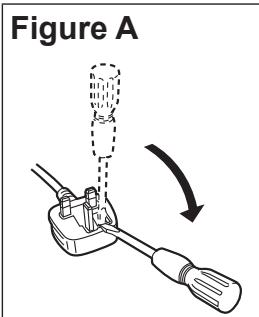
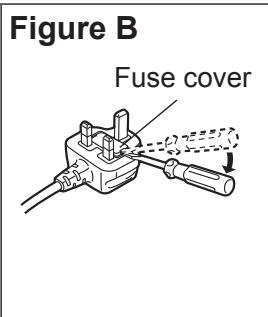
The location of the fuse differs according to the type of AC mains plug (figures A and B).
Confirm the AC mains plug fitted and follow the instructions below.
Illustrations may differ from actual AC mains plug. Open the fuse cover with a screwdriver and replace the fuse and close or attach the fuse cover.
Food Processor
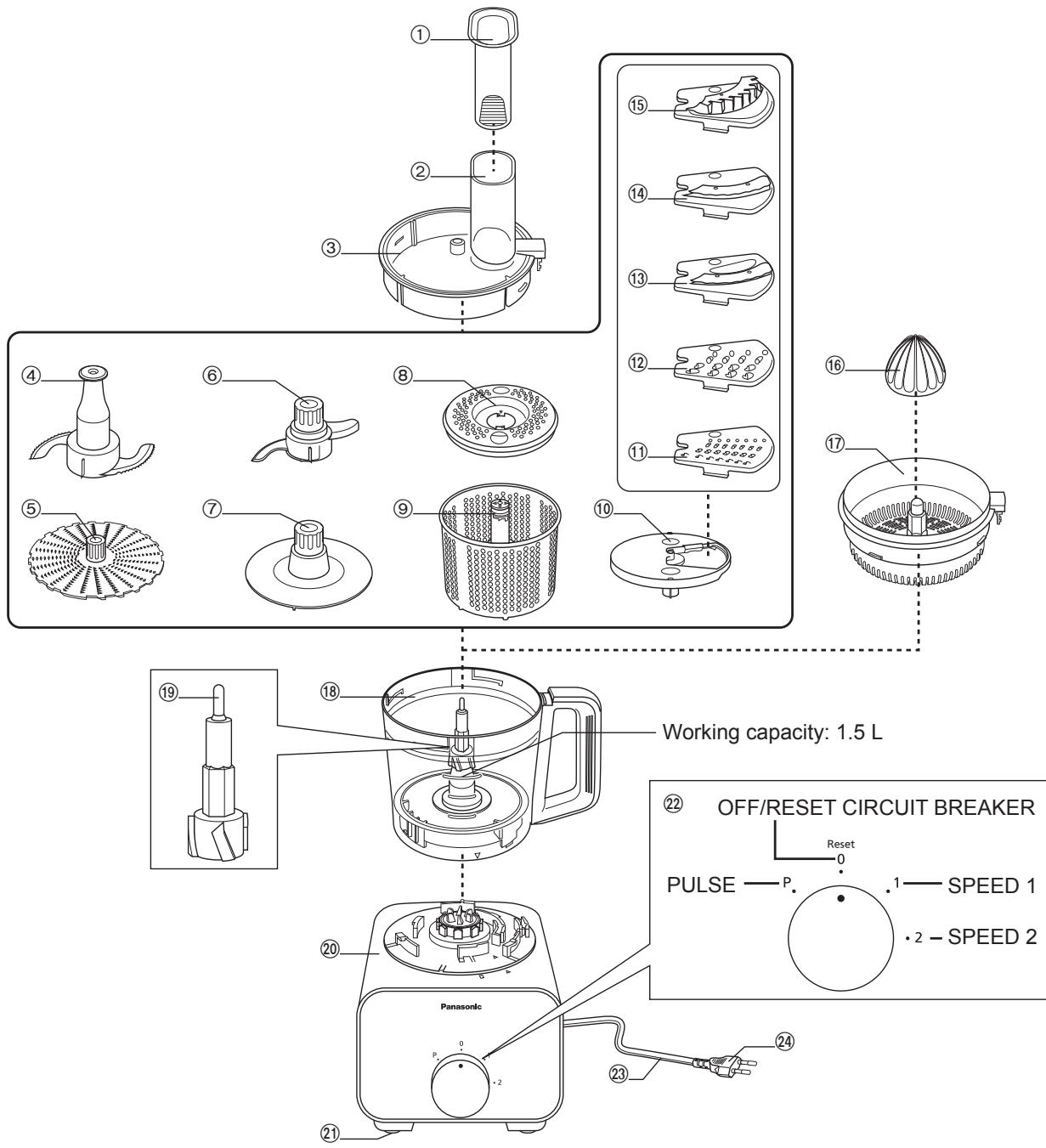
- Food Pusher
- Feeding Tube
- Bowl Lid
- Knife Blade
- Grating Blade
- Kneading Blade
- Whipping Blade
- Drainer Cover
- Salad Drainer
- Blade Stand
- Fine Shredding Blade
- Coarse Shredding Blade
- Thin Slicing Blade
- Thick Slicing Blade
- Julienne Blade
- Citrus Cone
- Citrus Strainer
- Bowl
- Drive Shaft
- Motor Housing
- Rubber Foot
- Rotary Switch
- Cord
- *Plug
*The shape of the Plug may vary from illustration.
GB8
PART NAMES
Blender, Dry Mill & Accessories
English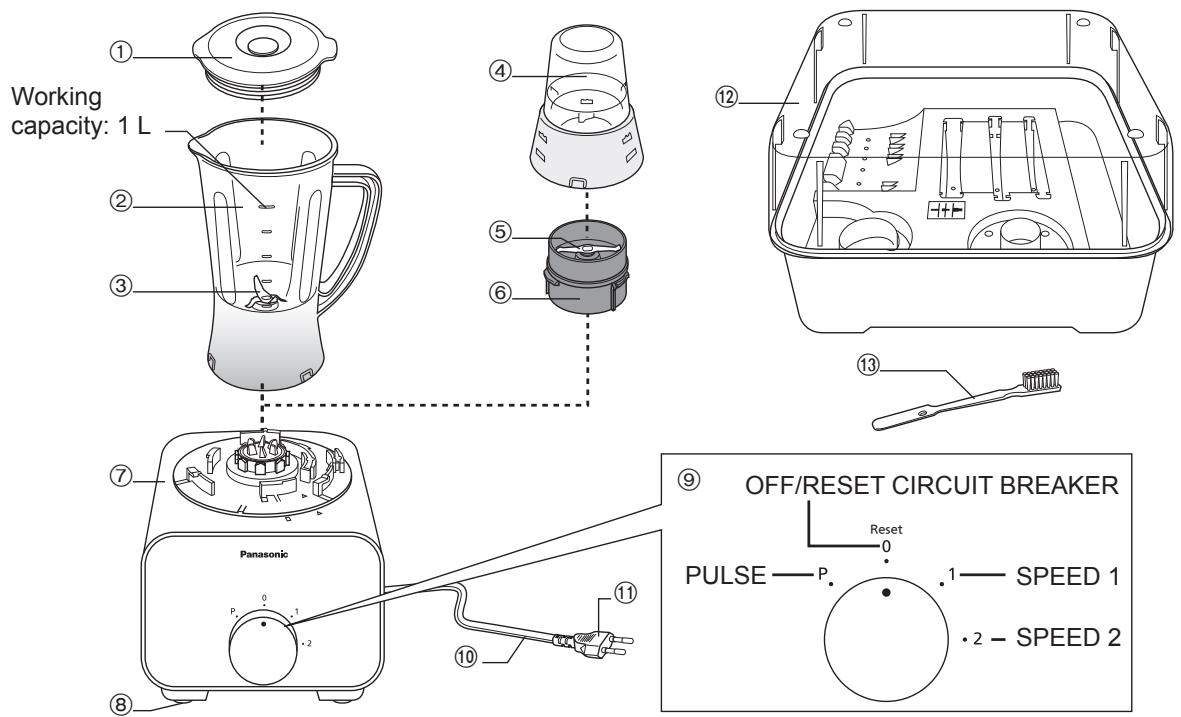
1. Blender Lid 2. Blender Jug 3. Blender Cutting Blade 4. Mill Container 5. Mill Cutting Blade
- Mill Container Base
- Motor Housing
- Rubber Foot
- Rotary Switch
- Cord
- *Plug
- Storage Case Unit
- Brush
*The shape of the Plug may vary from illustration.
CIRCUIT BREAKER PROTECTION
This appliance has the Circuit Breaker function to stop the motor when motor is overloaded.
When the Circuit Breaker stops the motor due to overloading, turn off the Rotary Switch to OFF position "0" and follow the instruction below:
- Reduce the ingredients to less than half and resume operation.
- If it still does not start, turn off the Rotary Switch to OFF position "0" again and resume operation.
- If all else fails, please contact your nearest service centre.
SAFETY LOCK
The Safety Pin is designed to prevent the appliance from switching on when
- The Bowl Lid or Citrus Strainer and the Bowl are not fully locked to each other.
- The Bowl, Blender Jug or Mill Container are not fully locked to the Motor Housing.
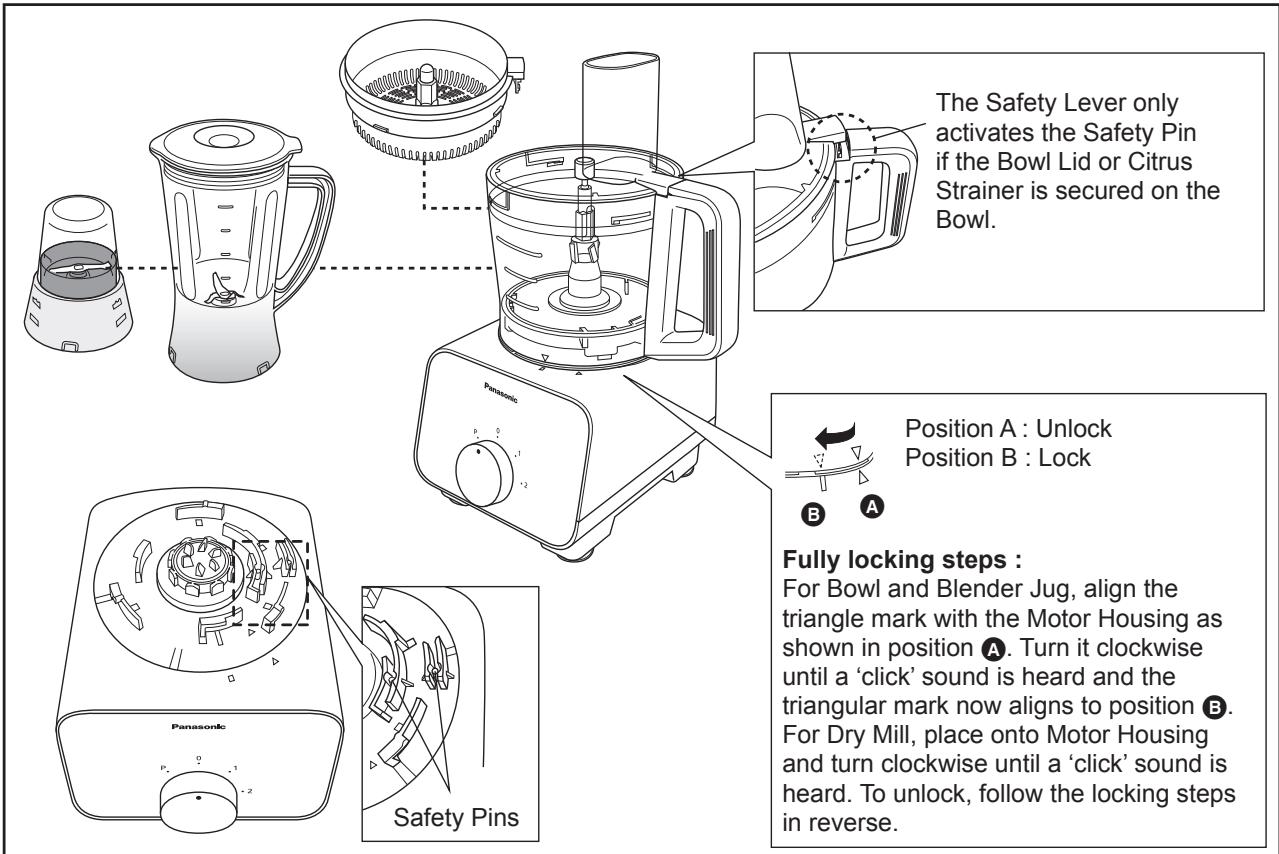
Note:
- Do not push the Safety Pin and Safety Lever with any instrument, stick, etc.
- Do not pour liquids or ingredients at the Safety Pin and Safety Lever area.
- Keep the Safety Pin and Safety Lever area clean to avoid foreign particles accumulating on the area.
Actions above will ensure the Safety Pin and Safety Lever function properly. If not followed, it will damage the parts related to the Safety Pin and Safety Lever.
DISASSEMBLY
Disassembly from Packaged Condition
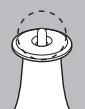
1. Rotate the Bowl Lid anticlockwise and lift it up from the Bowl.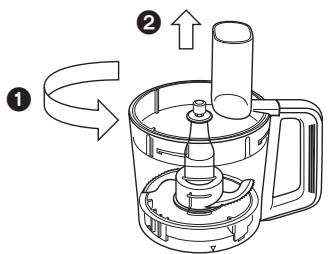
2. Hold the top of the Knife Blade and lift it up to remove it from the Bowl.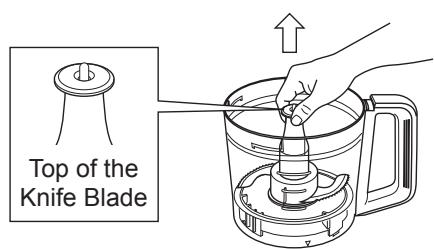
Note:
Beware of the sharp edges of the Knife Blade when removing it from the Bowl.
FOOD PROCESSOR - INTRODUCTION
It is highly recommended to clean all attachments and accessories and dry them well before using the appliance for the first time. Refer to page GB20 - GB21 for the cleaning method. Unplug when assembling the unit. Before plugging in, ensure that the Rotary Switch is in the OFF position "0". Please refer to page GB21 under 'Storing' on how to re-position the Motor Housing.
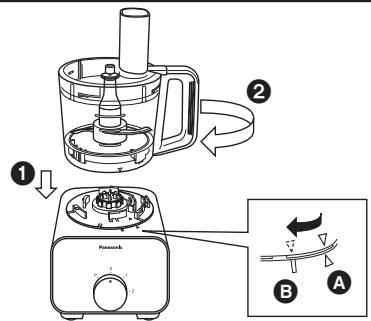
- Place the Bowl on top of the Motor Housing until the mark aligns as shown in A.
- Turn the Bowl clockwise until a 'click' sound is heard. Ensure that the triangle mark on the Bowl is aligned with the rectangle mark on the Motor Housing as seen in [6].
To disassemble, follow the assembly steps in reverse.
FOOD PROCESSOR - KNIFE BLADE • KNEADING BLADE • WHIPPING BLADE • GRATING BLADE
Ingredient Preparations for Knife Blade
| Function | Ingredient | Speed | Quantity | Operating Time (approx.) | Preparation Method |
| Mince | Meat | 2 | 50 ~ 400 g | 5 ~ 50 sec | Remove all skin, bones, and tendons, cut into 2 ~ 3 cm cubes. |
| Fish | 50 ~ 500 g | 3 ~ 20 sec | |||
| Chop | Onion | 1 (Intermittent) | 150 ~ 500 g | 4 ~ 15 times | Peel skin, cut into 2 ~ 3 cm cubes. |
| Garlic | 2 | 5 ~ 500 g | 10 ~ 30 sec | Peel skin. | |
| Carrot | 50 ~ 450 g | 10 ~ 30 sec | Peel skin, cut into 2 ~ 3 cm cubes. | ||
| Italian Parsley | 5 ~ 70 g | 10 ~ 40 sec | Remove stalk. | ||
| Mushroom | 30 ~ 250 g | 3 ~ 15 sec | Cut into 2 ~ 3 cm cubes. | ||
| Crush | Parmesan Cheese | 2 | 10 ~ 200 g | 10 ~ 60 sec | Cut into 2 ~ 3 cm cubes. |
| Mash | Boiled Potato | PULSE | 100 ~ 400 g | 3 ~ 15 times | Cut into 2 ~ 3 cm cubes. Do not over process. |
| Frozen | Frozen Banana | 2 | 250 ~ 450 g | 30 ~ 180 sec | 1 ~ 2 cm width, half frozen condition, i.e. toothpick can pierce. |
| Ice Crush | Ice Cubes | 2 | ~ 10 pcs | ~ 20 sec | 2 ~ 3 cm ice cubes. |
| Grind | Peanuts | 2 | 10 ~ 200 g | 15 ~ 30 sec | Remove peanut shell and skin. |
| Paste | Roasted Peanuts | 2 | 100 ~ 400 g | 5 ~ 10 min | Remove peanut shell and skin. |
| Crumb | Soft White Bread | 2 | 10 ~ 200 g | 15 ~ 60 sec | Slice soft bread into 6 to 8 pieces. |
FOOD PROCESSOR - KNIFE BLADE • KNEADING BLADE • WHIPPING BLADE • GRATING BLADE
Ingredient Preparations for Knife Blade
| Function | Ingredient | Speed | Max Single Use | Operating Time (approx.) | Preparation Method |
| Knead (for confectionary) | Flour | 2 | ~300 g | ~120 sec | Use for making confectionery such as sweets and cakes. |
| Juice Make | Fruit, Liquid etc. | 2 | ~1,500 mL | ~120 sec | Cut into 2 ~ 3 cm cubes. Process solids first. Fill liquid till total not exceeding 1,500 mL. Do not add more than 10 pcs of ice cubes during processing. |
| Soup Make | Boiled Vegetable, Liquid etc. | 2 | ~1,500 mL | ~120 sec | Cut into 2 ~ 3 cm cubes. Process solids first. Fill liquid till total not exceeding 1,500 mL. |
Ingredient Preparations for Kneading Blade
| Function | Ingredient | Speed | Max Single Use | Operating Time (approx.) | Preparation Method |
| Knead (for bread) | Bread Flour | 2 | 300 g | ~ 120 sec | Mix yeast with water and add during the processing of dough (adding yeast directly before processing may result in flaking and premature rising). If dough mix still appears flaky after initial processing, add 1 tsp of water into the mix. When large vibrations occur due to dough mix wrapping around the Drive Shaft, add 1 tbsp of flour. Do not reprocess the dough after the process is complete, if the dough is not satisfactory, knead by hand. |
| Liquid | 160 ~ 200 mL |
Ingredient Preparations for Whipping Blade
| Function | Ingredient | Speed | Max Single Use | Operating Time (approx.) | Preparation Method |
| Whip | Egg White | 2 | 2 ~ 6 pcs | 50 sec ~ 90 sec | Separate the egg white from the yolk for a smooth meringue. |
| Cream | 100 ~ 300 mL | 15 sec ~ 2 min | Use fresh cream of fat content 35% or higher at 5 °C. |
Ingredient Preparations for Grating Blade
| Function | Ingredient | Speed | Max Single Use | Operating Time (approx.) | Preparation Method | |
| Grate | Carrot | 2 | 200 g | - | Cut into 2 ~ 3 cm cubes. | |
| Apple | 200 g | |||||
| Cucumber | 200 g | |||||
FOOD PROCESSOR - KNIFE BLADE • KNEADING BLADE • WHIPPING BLADE • GRATING BLADE
How to Use : Knife Blade • Kneading Blade • Whipping Blade • Grating Blade
1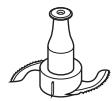

or
or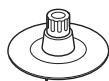
or
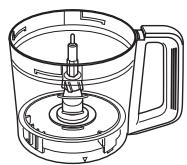
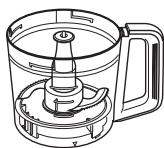
Place the Knife Blade (Kneading Blade or Whipping Blade or Grating Blade) into the Bowl.
Note:
For the Knife Blade, ensure that the Drive Shaft is protruding from the Knife Blade after insertion.
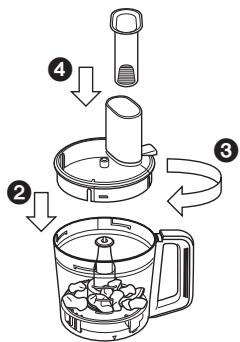
Put the ingredients into the Bowl. Place the Bowl Lid on top of the Bowl and turn it clockwise until a 'click' sound is heard. Insert the Food Pusher into the Feeding Tube. Attach the Bowl assembly onto the Motor Housing as seen on page GB11.
Note:
For the Grating Blade, place the ingredients on top of the blade and spread them out evenly.
Plug in the plug into the socket and turn the Rotary Switch to select the speed required (refer to "Preparation of Ingredients" on pages GB11-GB12).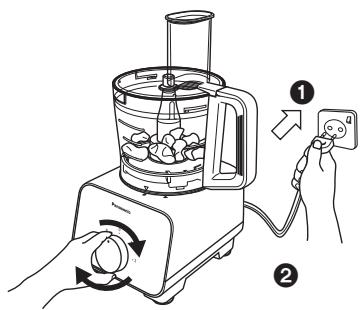
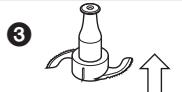
After the processing is completed, return the Rotary Switch to OFF position "0" and unplug from the socket. Remove the Knife Blade from the Bowl before removing the processed ingredients.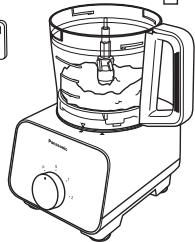
Note:
- Always ensure that the Knife Blade is inserted before adding ingredients into the Bowl.
- Do not exceed the stated amount of ingredients for kneading as abnormal vibration may occur.
- Do not insert hot ingredients into the Bowl for processing. Always ensure that the ingredients are sufficiently cooled before inserting, e.g., boiled potato.
- For Juice Make, fill in the solid ingredients first into the Bowl, followed by the liquid ingredients until the total volume does not exceed 1,500 mL.
- When processing liquid ingredients together with ice cubes, put the ice cubes not more than 10 pcs (approx. 170 g).
- Do not exceed the stated amount of ingredients for the Kneading Blade as abnormal vibration may occur.
- Do not over process the whipping cream, it may break down to form clumps of butter.
- Using different brands of whipping cream will have varying results. It is recommended to process until the cream is sufficiently whipped.
- Depending on the speed and amount of ingredients used, there will be significant vibrations present. In that case, hold down the Bowl Lid with both hands to support it during its operation.
- For kneading, do not reprocess after the dough has formed the first time.
- High amounts of butter and sugar in the dough may cause abnormal vibration when using the Kneading Blade.
- Using flour other than bread flour on the Kneading Blade may cause abnormal vibration. Before processing, remove 1 to 2 tbsp of water from the total amount stated and add the water little by little during processing if necessary.
FOOD PROCESSOR - SLICING BLADES, SHREDDING BLADES, JULIENNE BLADE
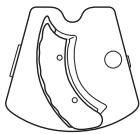
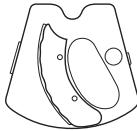
Slicing Blades (Thick / Thin) - used for slicing ingredients
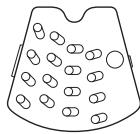
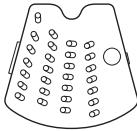
Shredding Blades (Coarse / Fine) - used for shredding and grating ingredients.
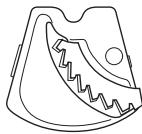
Julienne Blade
- used for making french fries and shredding ingredients.
Ingredient Preparations for Slicing Blades (Thick / Thin)
| Function | Ingredient | Speed | Max Single Use | Operating Time (approx.) | Preparation Method | |
| Slice | Cucumber | 2 | 700 g | - | Cut ingredient till it is small enough to fit into the Feeding Tube. | |
| Onion | 700 g | |||||
| Carrot | 600 g | |||||
| Potato | 600 g | |||||
| Cabbage | 400 g | |||||
Ingredient Preparations for Shredding Blades (Coarse / Fine)
| Function | Ingredient | Speed | Max Single Use | Operating Time (approx.) | Preparation Method | |
| Shred | Cucumber | 2 | 500 g | - | Cut ingredient till it is small enough to fit into the Feeding Tube. | |
| Carrot | 500 g | |||||
| Potato | 650 g | |||||
| Cheese | 500 g | Cut ingredient till it is small enough to fit into the Feeding Tube. Do not use hard ingredients such as Parmesan. | ||||
Ingredient Preparations for Julienne Blade
| Function | Ingredient | Speed | Max Single Use | Operating Time (approx.) | Preparation Method | |
| French Fry | Potato | 2 | 800 g | - | Cut ingredient till it is small enough to fit into the Feeding Tube. | |
| Shredd | Cabbage | 500 g | ||||
FOOD PROCESSOR - SLICING BLADES, SHREDDING BLADES, JULIENNE BLADE
How to Use: Slicing Blades (Thick / Thin), Shredding Blades (Coarse / Fine), Julienne Blade
1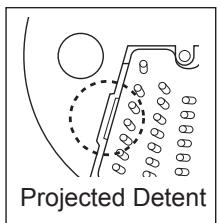
Finger Holes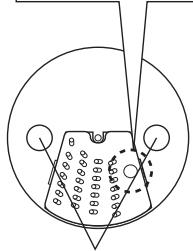
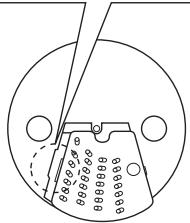
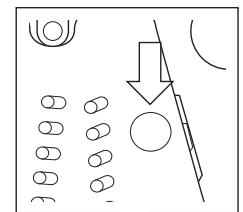
Fit the projected detent of the desired blade onto the Blade Stand and ensure it is seated properly. Push down on the dimple on the blade as seen above until a 'snap' sound is heard.
Note:
- Beware of the sharp edges on the blades while inserting into the Blade Stand.
- To remove the blade, turn over the Blade Stand and push down on the reverse side of the dimple on the blade.
2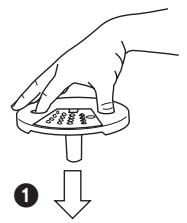
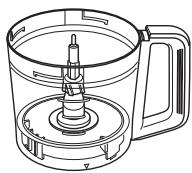
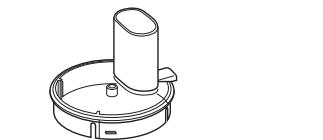
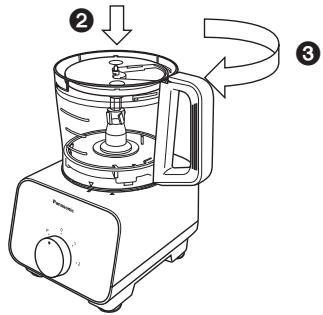
Insert finger and thumb into the finger holes to grip the Blade Stand. Place the assembled Blade Stand into the Bowl. Attach the Bowl to the Motor Housing as seen in page GB10, then place the Blade Stand into the Bowl. Place the Bowl Lid on top of the Bowl and turn it clockwise until a 'click' sound is heard.
Note:
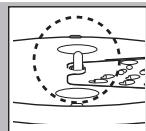
Ensure that the Drive Shaft is protruding from the Blade Stand after insertion.
3 2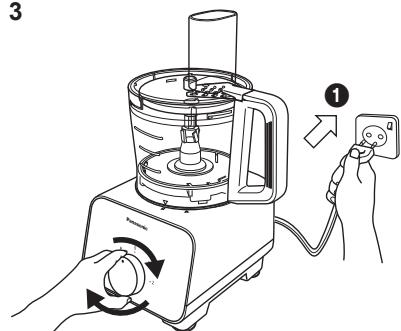
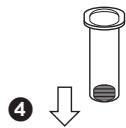
3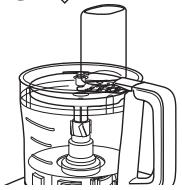
Plug-in the plug into the socket and turn the Rotary Switch to select the speed required (refer to the "Preparation of Ingredients" at page GB14). Insert the ingredients into the Feeding Tube and push down with the Food Pusher.
4 1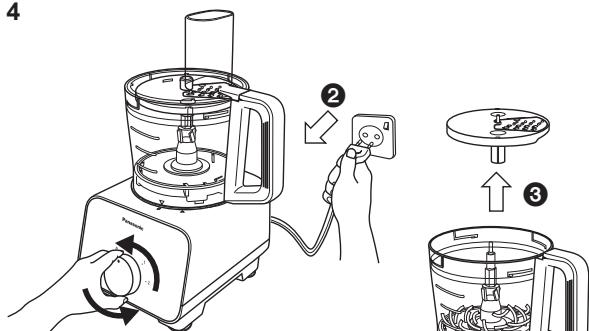
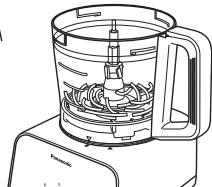
After the processing is completed, return the Rotary Switch to OFF position "0" and unplug from the socket. Remove the Blade Stand from the Bowl before removing the processed ingredients.
Note:
- When using long and narrow ingredients, place it against the front wall of the feeding tube as indicated in Figure 1, for support while in operation to avoid uneven processing.
- Dispose of any remaining lumps of unprocessed ingredients.
- Align high fibre ingredients as indicated in Figure 2 for a consistent processing result.
Front Wall Figure 1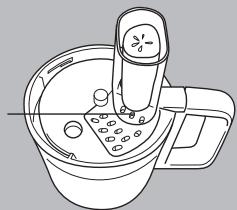
Figure 2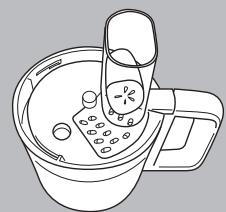
FOOD PROCESSOR - SALAD DRAINER
Ingredient Preparations for Salad Drainer
| Function | Ingredient | Speed | Max Single Use | Operating Time (approx.) | Preparation Method |
| Drainer | Lettuce Leaves | 1 | 100 g | 20 ~ 40 sec | Cut into 3 ~ 5 cm slices. |
| Cabbage | 200 g | 20 ~ 50 sec | Shredded into 1 ~ 3 mm. |
How to Use: Salad Drainer After inserting the Salad Drainer into the Bowl, insert the ingredients into the Salad Drainer. Place the Drainer Cover on top of the Salad Drainer until the mark aligns as shown in A. Turn the Drainer Cover anticlockwise until the mark aligns as shown in B.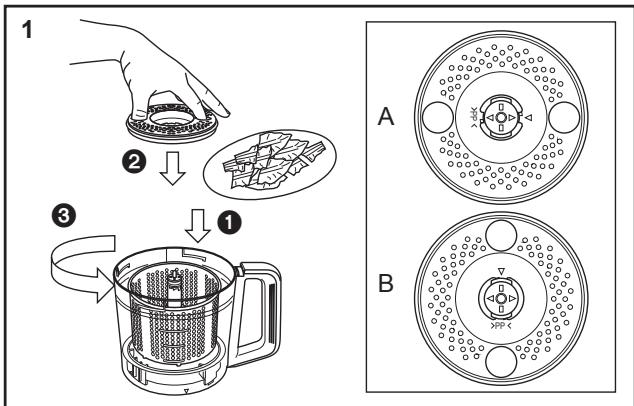
Note: Place the Bowl Lid on top of the Bowl and turn it clockwise until a 'click' sound is heard. Attach the Bowl assembly onto the Motor Housing as seen in page GB11.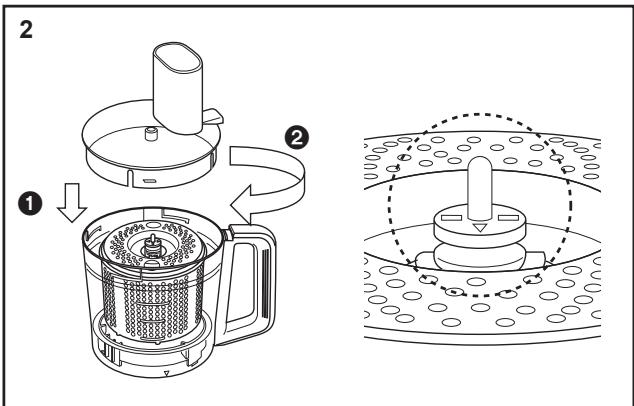
Ensure that the Drive Shaft is protruding from the Salad Drainer after insertion.
Plug-in the plug into the socket and turn the Rotary Switch to select the speed required.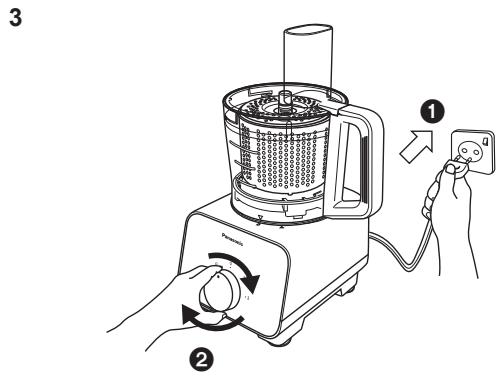
After the processing is completed, return the Rotary Switch to OFF position "0" and unplug from the socket. Remove the Salad Drainer from the Bowl.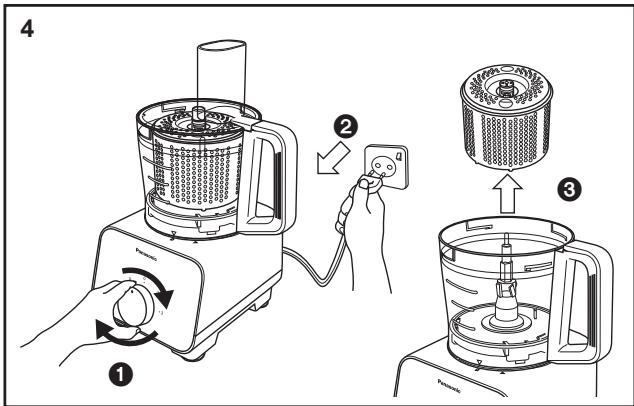
Note:
Maximum working capacity of the Salad Drainer: 200g or until the maximum height of the Salad Drainer is reached, whichever comes first. - Prohibited ingredients: refer to page GB6. - Ensure that the ingredients are spread evenly around the Salad Drainer before processing. - Always ensure that the Drainer Cover is attached onto the Salad Drainer before operation, otherwise the ingredients might come out and tear around the Bowl. - Depending on the speed and amount of ingredients used, there will be significant vibrations present. In that case, hold down on the Bowl Lid to support it during its operation.
FOOD PROCESSOR - CITRUS PRESS -
Ingredient Preparations for Citrus Press
| Function | Ingredient | Speed | Max Single Use | Operating Time (approx.) | Preparation Method |
| Squeeze | Citrus Fruit | 1 | 1000 mL | - | Cut fruit into halves. |
English
How to Use: Citrus Press
1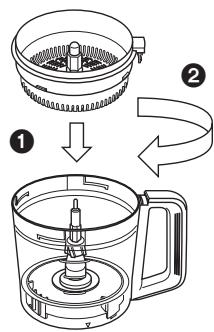
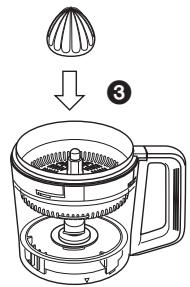
Place the Citrus Strainer onto the Bowl. Turn it clockwise until a 'click' sound is heard. Attach the Citrus Cone onto the Drive Shaft.
2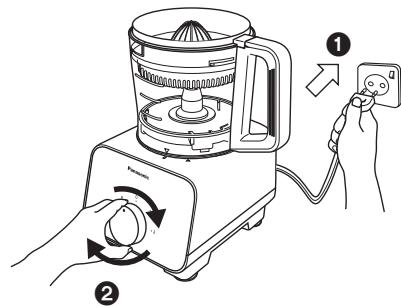
Attach the Bowl assembly onto the Motor Housing as seen on page GB11. Plug the plug into the socket and turn the Rotary Switch to select the speed required.
3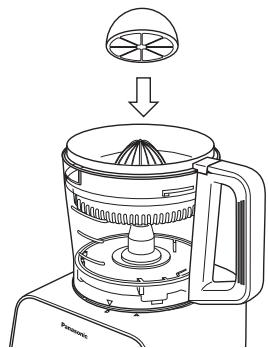
Place the half cut fruit with the cut side on top of the Citrus Cone and press down firmly to extract juice.
4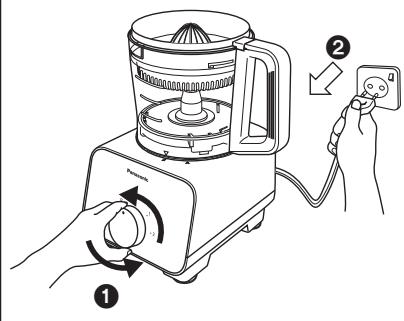
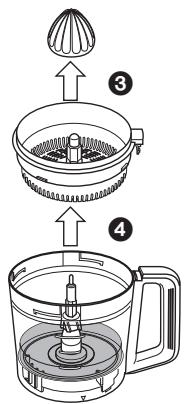
After the processing is completed, return the Rotary Switch to the OFF position "0" and unplug from the socket. Remove the Citrus Press attachment from the Bowl before pouring the extracted juice out.
Note:
- Always ensure that the Citrus Cone is placed onto the Citrus Strainer before usage.
- Stop the processing periodically to remove the pulp remaining on the Citrus Strainer to ease the juice extraction process.
- It is not recommended to operate the Citrus Press at speed 2.
- Avoid touching the Citrus Cone while it is turning.
BLENDER
Introduction
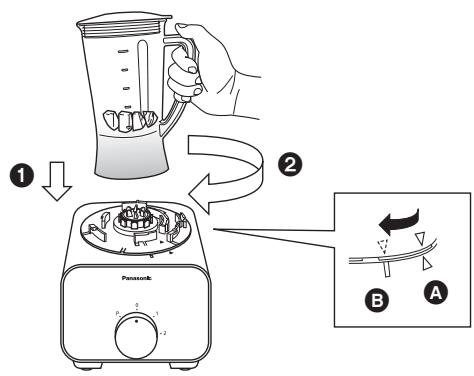
- Place the Blender Jug on top of the Motor Housing. Ensure that the triangle mark on the Blender Jug is aligned with the triangle mark on the Motor Housing as seen in Position A.
- Turn the Blender Jug clockwise until a 'click' sound is heard. Ensure that the triangle mark on the Blender Jug is aligned with the rectangle mark on the Motor Housing as seen in .
To disassemble, follow the assembly steps in reverse.
Ingredient Preparations for Blender
| Function | Ingredient | Speed | Max Single Use | Operating Time (approx.) | Preparation Method |
| Liquidize | Fruit, Vegetable | 2 | 1,000 mL | ~ 2 min | Cut into 1 cm cubes. |
How to Use: Blender. Insert ingredients into the Blender Jug and close with the Blender Lid. Attach the Blender Unit onto the Motor Housing as seen above. Plug-in the plug into the socket and turn the Rotary Switch to select the speed required.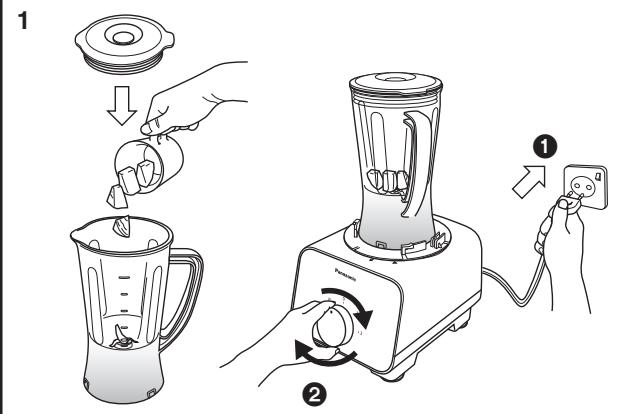
After the processing is completed, return the Rotary Switch to OFF position "0" and unplug from the socket. Remove the Blender Unit from the Motor Housing and proceed to remove the ingredients.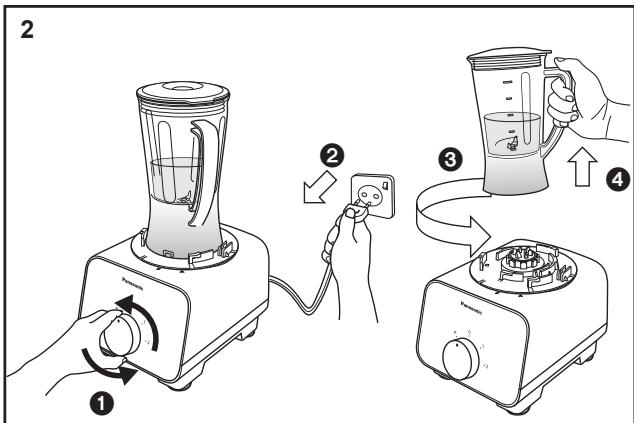
Note:
Maximum working capacity: 1 L. - Prohibited ingredients for Blender Jug: refer to page GB6. - It is not recommended to blend hard and viscous ingredients. However, if necessary, cut the hard ingredients into small pieces (e.g. cut carrot into 1cm3 cubes) and fill the Blender Jug with the ingredients not exceeding half its rated capacity. - Do not fill exceeding the maximum level and reduce ingredients when appliance makes abnormal sound or vibration during operation. - Add in soft ingredients (fruits, vegetables) into the Blender Jug before adding in other ingredients. - If the Cutting Blade gets stuck, switch off immediately and unplug. Do not attempt to proceed to unstuck the ingredients with your fingers, use an object like a rubber spatula instead. - During blending, there is a possibility that the ingredients will splash out of the Blender Lid hole. In the event that it splashes out, wipe it off with a dry cloth. - Do not operate exceeding the rated operation duration (2 min ON, 2 min OFF).
DRY MILL
Ingredient Preparations for Dry Mill
| Function | Ingredient | Speed | Max Single Use | Operating Time (approx.) | Preparation Method |
| Grind | Coffee Bean | 2 | Till Max Level | ~ 60 sec | - |
| Pepper |
How to Use: Dry Mill
1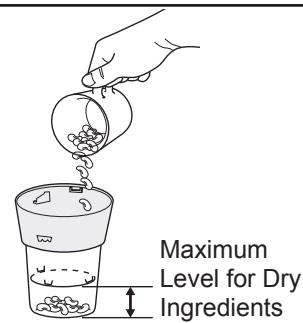
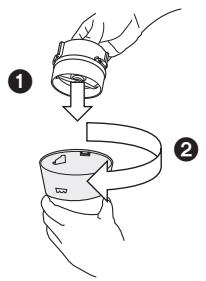
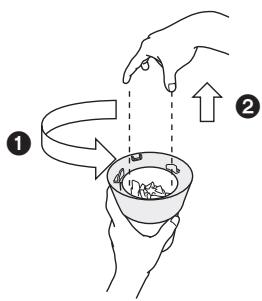
Turn the Mill Container upside down and fill in the ingredients without exceeding the maximum level indicated. Place the Mill Container Base into the Mill Container and turn it clockwise until a 'click' sound is heard.
Make sure the ribs on the outer surface of the Mill Container Base and the inner surface of the Mill Container are hooked firmly.
2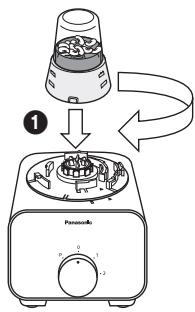
3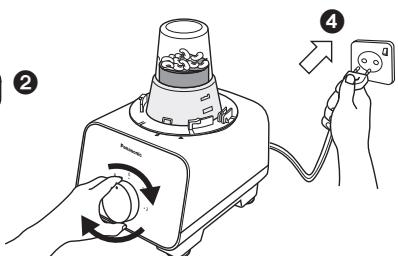
Attach the Dry Mill Unit onto the Motor Housing. Turn the Dry Mill Unit clockwise until a 'click' sound is heard. Plug in the plug into the socket and turn the Rotary Switch to select the speed required.
3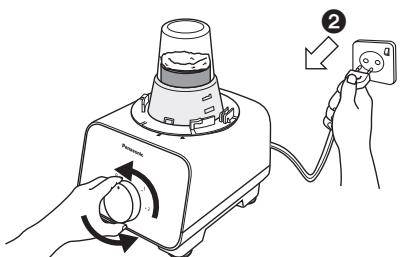
4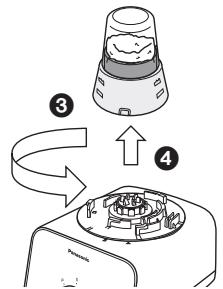
After the processing is completed, return the Rotary Switch to the OFF position "0" and unplug from the socket. Remove the Dry Mill Unit from the Motor Housing and proceed to remove the ingredients.
Turn the Mill Container Base anticlockwise to unlock and lift it up from the Mill Container.
Note:
- While removing the ingredients, be careful of the Cutting Blade.
- Do not operate exceeding the rated operation duration (1 min ON, 2 min OFF).
- Prohibited ingredients: refer to page GB6.
- Do not operate the unit with empty Dry Mill.
- Do not fill exceeding the maximum level and reduce ingredients when the appliance makes an abnormal sound or vibrates during operation.
AFTER USE
Cleaning
Pre-wash
The pre-wash enables easier cleaning. It can be used for the Knife Blade and Blender Unit. To pre-wash, simply follow the steps below.
1 Food Processor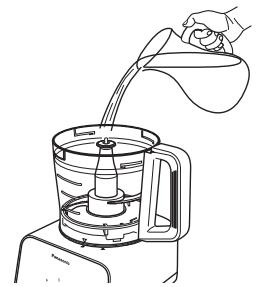
Blender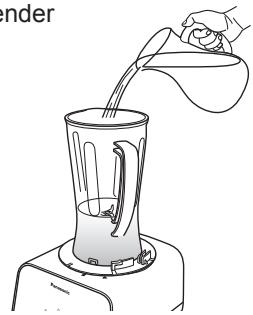
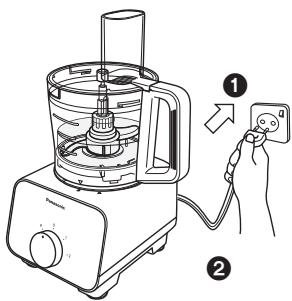
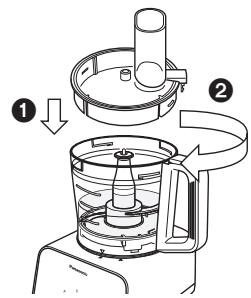
Put the used attachment inside the Bowl, fill the Bowl with water until the attachment is submerged in water (max. 500 mL). Place the Bowl Cover on top of the Bowl and turn it clockwise until a 'click' sound is heard.
For the Blender Unit, fill 500 mL of water into the Blender Jug and cover with the Blender Lid. Plug-in the plug into the socket.
2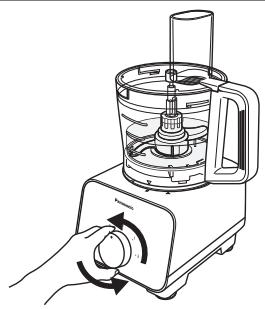
Food Processor: Turn the Rotary Switch to "PULSE" 5~10 times.
Blender: Turn the Rotary Switch to select speed 2 and operate for 10~20 seconds.
3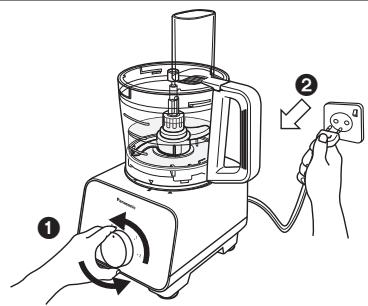
Return the Rotary Switch to OFF position "0" and unplug from the socket. Remove the attachments and proceed for cleaning.
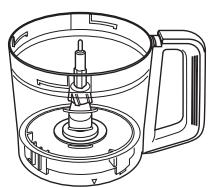
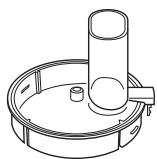
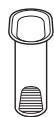
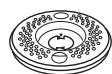


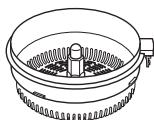
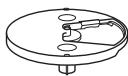
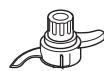
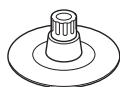
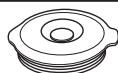
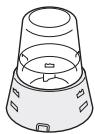
Wash these items by rinsing them under running water. Use neutral kitchen detergent if necessary. Proceed to wipe them dry with a clean cloth.
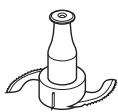


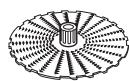
Wash these items by rinsing them under running water, and clean carefully with a brush. Use neutral kitchen detergent if necessary.
Note:
- These items are extremely sharp and should be handled with extra care while cleaning.
Avoid hitting these items on hard objects during the cleaning process.
- The Mill Container Base must not be washed, use Brush to clean.
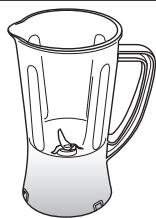

AFTER USE
Motor Housing / Rubber Foot
Wipe off any dirt or stains with a clean damp cloth.
Note:
- Ensure that the power cord is unplugged before cleaning the Motor Housing.
- Do not wash the Motor Housing under running water.
- Never use corrosive liquids (e.g. alcohol, thinner, etc) to clean the Motor Housing.
Cleaning with a Dishwasher
The Bowl and Bowl Lid of this appliance are dishwasher safe.
Note:
- Do not place these items near the dishwasher heater area as high temperatures may damage the parts.
Storing
Ensure all attachments and the Bowl are removed from the Motor Housing prior to storage.
1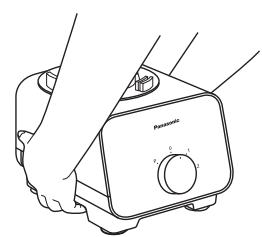
Release Lever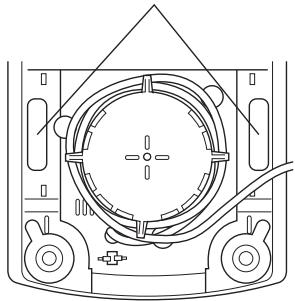
2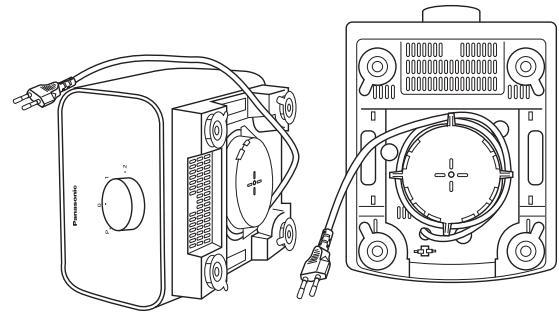
To release the Rubber Foot suction of the Motor Housing, press on the release lever located at the bottom side of the Motor Housing at the same time as seen in the above picture and lift up.
Tilt the Motor Housing on its side, and proceed to wind up the Power Cord around the Cord Winding Area partially, leaving the Plug at the sides.
3 (i)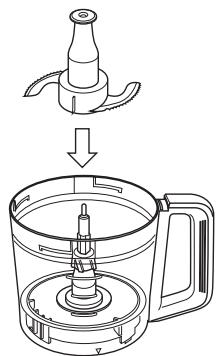
(ii)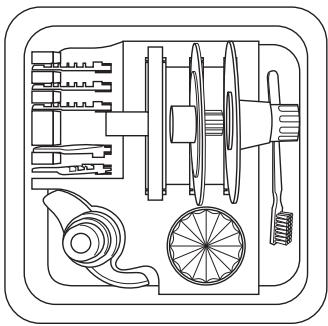
(iii)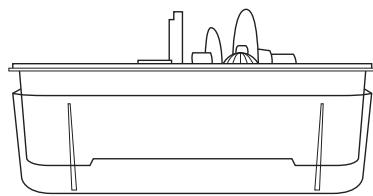
(i) Store the Knife Blade inside the Bowl. The Storage Case Unit is included to store the other attachments. Store the attachments in place as per packaging condition.
(ii) List of attachments in Storage Case Unit: Kneading Blade, Citrus Cone, Thick Slicing Blade, Thin Slicing Blade, Fine Shredding Blade, Coarse Shredding Blade, Julienne Blade, Blade Stand, Grating Blade, Whipping Blade and Brush.
(iii) Place the Storage Case Lid beneath the Storage Case to collect the drained water from the washed attachments
Note:
- Dispose of the flexible plastic cover after opening the Storage Case.
TROUBLESHOOTING
Please check the following points before arranging for service.
| Problem | Cause and Action |
| The appliance does not turn on. | ●The plug is loose in the outlet. ●Plug in firmly into the outlet. |
| The appliance does not operate even when the Rotary Switch is activated. | ●The Bowl, Blender Unit or Dry Mill Unit is not properly locked onto the Motor Housing. ●Ensure that the triangle mark on the attachments are aligned with the rectangular mark on the Motor Housing as seen in page GB10. ●The Bowl Lid or Citrus Strainer is not fully locked onto the Bowl. ●Fully secure the Bowl Lid or Citrus Strainer onto the Bowl. ●The ingredients are jammed. ●Remove the ingredients carefully and ensure that the amount used is as stated. |
| The appliance suddenly stops during operation. | ●The circuit breaker protection is activated. (Refer to page GB9) ●Too much ingredients were inserted. ●Remove the excess ingredients and ensure that the amount used is as stated. ●Large chunks or hard ingredients were used. ●Ensure that the ingredients are cut into the stated sizes. Do not use hard ingredients such as frozen foods or highly dense solids. ●The safety lock was triggered. (Refer to page GB10) ●Abnormal vibration during operation may offset the safety lock engagement. ●Ensure that the ingredients used and the amount are as stated. ●Lock the Bowl Lid or Citrus Strainer onto the Bowl firmly, and ensure that the Bowl, Blender Unit, or Dry Mill Unit is locked firmly onto the Motor Housing. |
| There is abnormal vibration and noise during operation. | ●The Rubber Feet and/or the work top are not clean. ●Wipe off any dirt or stains with a clean damp cloth. The Rubber Foot is only effective when placed on a clean, smooth and flat surface. ●The ingredients used for processing is either too much or too hard. ●Ensure that the ingredients used are as stated, reduce the ingredients if it is over the stated amount. |
| The texture and consistency of the processed ingredients did not turn out well. | ●Some ingredients might be too difficult to process raw, e.g.pumpkin. ●Precook might be necessary to soften the ingredients before processing, i.e. until a fork can easily pierce. ●Ingredient size is not according to the preparation method. ●Prepare accordingly to follow the size stated. ●Processing certain ingredients at the same time may result in lumps remaining for Frozen function. ●The maximum ingredient amount and processing duration are meant to serve as a guideline, lesser ingredient amount and different ingredients will affect the performance. ●Process the ingredients with a suitable duration till the desired texture and consistency. |
SPECIFICATIONS
| Model No. | MK-F500 | |
| Function | Food Processor | Blender & Dry Mill |
| Power Supply | 220 - 240 V ~ 50 - 60 Hz | |
| Rated Consumption | 180 - 200 W | |
| Switch | Rotary Switch | |
| Operation Rating | 2 minutes ON, 4 minutes OFF | Blender: 2 minutes ON, 2 minutes OFF Dry Mill: 1 minute ON, 2 minutes OFF |
| With exception for the stated on “Ingredient Preparations” page. | ||
| Dimension (Approx.)(HxWxD) | 435 x 264 x 265 mm | Blender: 406 x 264 x 265 mm Dry Mill: 298 x 264 x 265 mm |
| Mass (Approx.) | 3.1 kg | Blender: 2.8 kg Dry Mill: 2.6 kg |
| Capacity (Approx.) | Container Capacity: 2.5 L Maximum working capacity: Liquids only = 1.5 L Solids only = 600 g | Blender: 1 L Dry Mill: 50 g (Coffee Beans) |
| With exception for the stated on “Ingredient Preparations” page. | ||
| Attachment & Accessories | Knife Blade, Grating Blade, Knearing Blade, Whipping Blade, Salad Drainer, Blade Stand, Shredding Blades (Coarse & Fine), Slicing Blades (Thick & Thin), Julienne Blade, Citrus Press, and Storage Case Unit | Blender Unit, Dry Mill Unit |
| Common Accessories | Brush with Spatula | |
| Dishwasher Safe Items | Bowl and Bowl Lid | |
| Airborne Acoustical Noise | 88 (dB (A) re. 1 pW) | 88 (dB (A) re. 1 pW) |
English
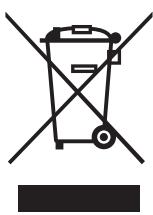
Disposal of Old Equipment
Only for European Union and countries with recycling systems
This symbol on the products, packaging, and/or accompanying documents means that used electrical and electronic products must not be mixed with general household waste.
For proper treatment, recovery and recycling of old products, please take them to applicable collection points in accordance with your national legislation.
By disposing of them correctly, you will help to save valuable resources and prevent any potential negative effects on human health and the environment.
For more information about collection and recycling, please contact your local municipality. Penalties may be applicable for incorrect disposal of this waste, in accordance with national legislation.
TABLE OF CONTENTS
Page
Ingredient Preparations for Blender
Therefore, m = 3/11
(i) INTRODUCTION. FR10
(ii) KNIFE BLADE • KNEADING BLADE • WHISKING BLADE • GRATING BLADE FR10 - FR12
(i) INTRODUCTION. FR17
(ii) MIXER FR17
Panasonic Test and Development Kitchen
Panasonic Consumer Electronics U.K.
A Division of Panasonic U.K. Ltd
Willoughby Road, Bracknell, Berks, RG12 8FP
Representative in EU :
Panasonic Marketing Europe GmbH
Panasonic Testing Centre
Winsberging 15, 22525 Hamburg, Germany
Panasonic Manufacturing Malaysia Berhad.
No. 3, Jalan Sesiku 15/2, Section 15, Shah Alam Industrial Site, 40200 Shah Alam, Selangor Darul Ehsan, Malaysia.
http://www.panasonic.com
Printed in Malaysia
© Panasonic Manufacturing Malaysia Berhad 2016
UZ50G155
F0416-0
E1
- BLENDER
- DRY MILL
- SAFETY PRECAUTIONS (MAKE SURE TO FOLLOW THESE INSTRUCTIONS)
- WARNING
- CAUTION
- THE SYMBOLS ARE CLASSIFIED AND EXPLAINED AS FOLLOWS
- IMPORTANT INFORMATION
- BEFORE USE
- ELECTRICAL REQUIREMENT (FOR UK MARKET ONLY)
- FOR YOUR SAFETY PLEASE READ THE FOLLOWING TEXT CAREFULLY
- HOW TO REPLACE THE FUSE
- PART NAMES
- BLENDER, DRY MILL & ACCESSORIES
- CIRCUIT BREAKER PROTECTION
- SAFETY LOCK
- NOTE
- DISASSEMBLY
- FOOD PROCESSOR - INTRODUCTION
- FOOD PROCESSOR - KNIFE BLADE • KNEADING BLADE • WHIPPING BLADE • GRATING BLADE
- FOOD PROCESSOR - SLICING BLADES, SHREDDING BLADES, JULIENNE BLADE
- FOOD PROCESSOR - SALAD DRAINER
- FOOD PROCESSOR - CITRUS PRESS
- HOW TO USE: CITRUS PRESS
- INTRODUCTION
- HOW TO USE: DRY MILL
- AFTER USE
- CLEANING
- PRE-WASH
- MOTOR HOUSING / RUBBER FOOT
- CLEANING WITH A DISHWASHER
- STORING
- TROUBLESHOOTING
- SPECIFICATIONS
- DISPOSAL OF OLD EQUIPMENT
- ONLY FOR EUROPEAN UNION AND COUNTRIES WITH RECYCLING SYSTEMS
- TABLE OF CONTENTS
Brand : PANASONIC
Model : MK-F500
Category : Kitchen appliance