IT-1000-023 - Screwdriver Tyco - Free user manual and instructions
Find the device manual for free IT-1000-023 Tyco in PDF.


User questions about IT-1000-023 Tyco
0 question about this device. Answer the ones you know or ask your own.
Ask a new question about this device
Download the instructions for your Screwdriver in PDF format for free! Find your manual IT-1000-023 - Tyco and take your electronic device back in hand. On this page are published all the documents necessary for the use of your device. IT-1000-023 by Tyco.
USER MANUAL IT-1000-023 Tyco
natural_image
Line drawing of a handheld electric drill press with attached cable (no text or symbols)Read through carefully and understand these instructions before use. Diese Anleitung vor Benutzung des Werkzeugs sorgfältig durchlesen und verstehen. Lire soigneusement et bien assimiler ces instructions avant usage. Prima dell'uso leggere attentamente e comprendere queste istruzioni. Deze gebruiksaanwijzing s.v.p. voor gebruik zorgvuldig doorlezen. Leer cuidadosamente y comprender estas instrucciones antes del uso. Antes de usar, leia com cuidado para assimilar estas instruções. Διαβάστε προσεκτικά και κατανοήσετε αυτές τις οδηγίες πριν τη χρήση.
Handling instructions Bedienungsanleitung Mode d'emploi Istruzioni per l'uso Gebruiksaanwijzing Instrucciones de manejo Instruções de uso Οδηγίες χειρισμού
1
2
3
4
5
natural_image
Line drawing of a hand operating a mechanical device with a circular arrow indicating rotation (no text or symbols)6
7
8
9
10
11
12
13
14
natural_image
Line drawing of hands using a screwdriver to adjust or install a mechanical component (no text or symbols present)15
| Symbols⚠ WARNINGThe following show symbols used for the machine. Be sure that you understand their meaning before use. | Symbole⚠ WARNUNGDie folgenden Symbole werden für diese Maschine verwendet. Achten Sie darauf, diese vor der Verwendung zu verstehen. | Symboles⚠ AVERTISSEMENTLes symboles suivants sont utilisés pour l’outil. Bien se familiariser avec leur signification avant d’utiliser l’outil. | Simboli⚠ AVVERTENZADi seguito mostriamo i simboli usati per la macchina. Assicurarsi di comprenderne il significato prima dell’uso. | |
 | Read all safety warnings and all instructions.Failure to follow the warnings and instructions may result in electric shock, fire and/or serious injury. | Lesen Sie sämtliche Sicherheitshinweise und Anweisungen durch.Wenn die Warnungen und Anweisungen nicht befolgt werden, kann es zu Stromschlag, Brand und/oder ernsthaftenVerletzungen kommen. | Lire tous les avertissements de sécurité et toutes les instructions.Tout manquement à observer ces avertissements et instructions peut engendrer des chocs électriques, des incendies et/ou des blessures graves. | Leggere tutti gli avvertimenti di sicurezza e tutte le istruzioni.La mancata osservanza degli avvertimenti e delle istruzioni potrebbe essere causa di scosse elettriche, incendi e/o gravi lesioni. |
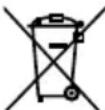 | Only for EU countriesDo not dispose of electric tools together with household waste material!In observance of European Directive 2002/96/EC on waste electrical and electronic equipment and its implementation in accordance with national law, electric tools that have reached the end of their life must be collected separately and returned to an environmentally compatible recycling facility. | Nur für EU-LänderWerfen Sie Elektrowerkzeuge nicht in den Hausmüll!Gemäss Europäischer Richtlinie 2002/96/EG über Elektro- und Elektronik-Altgeräte und Umsetzung in nationales Recht müssen verbrauchte Elektrowerkzeuge getrennt gesammelt und einer umweltgerechten Wiederververitung zugeführt werden. | Pour les pays européens uniquementNe pas jeter les appareils électriques dans les ordures ménagères!Conformément à la directive européenne 2002/96/EG relative aux déchets d’équipements électriques ou électroniques (DEEE), et à sa transposition dans la législation nationale, les appareils électriques doivent être collectés à part et être soumis à un recyclage respectueux de l’environnement. | Solo per Paesi UENon gettare le apparecchiature elettriche tra i rifiuti domestici.Secondo la Direttiva Europea 2002/96/CE sui rifiuti di apparecchiature elettriche ed elettroniche e la sua attuazione in conformità alle norme nazionali, le apparecchiature elettriche esauste devono essere raccolte separatamente, al fine di essere reimpiegate in modo eco-compatibile. |
| Symbolen⚠ WAARSCHUWINGHieronder staan symbolen afgebeeld die van toepassing zijn op deze machine. U moet de betekenis hiervan begrijpen voor gebruik. | Símbolos⚠ ADVERTENCIAA continuación se muestran los símbolos usados para la máquina. Asegúrese de comprender su significado antes del uso. | Símbolos⚠ AVISOA seguir aparecem os símbolos utilizados pela máquina. Assimile bem seus significados antes do uso. | Σύμβολα⚠ ΠΡΟΣΟΧΗΤα παρακάτω δείχνουν τα σύμβολα που χρησιμοποιόνται στο μηχάνημα. Βεβαιωθείτε ότι κατανοείτε τη σημασίας τους πριν τη χρήση. | |
 | Lees alle waarschuwingen en instructies aandachtig door.Nalating om de waarschuwingen en instructies op te volgen kan in een elektrische schok, brand en/of ernstig letsel resulteren. | Lea todas las instrucciones y advertencias de seguridad.Si no se siguen las advertencias e instrucciones, podría producirse una descarga eléctrica, un incendio y/o daños graves. | Leia todas as instruções e avisos de segurança.Se não seguir todas as instruções e os avisos, pode provocar um choque eléctrico, incêndio e/ou ferimentos graves. | Διαβάζετε όλες τις προειδοποιήσεις ασφαλείας και όλες τις οδηγίες.Η μη τήρηση των προειδοποιήσεων και οδηγιών μπορεί να προκαλέσει ηλεκτροπληξία, πυρκαγιά καή σοβαρό τραυματισμό. |
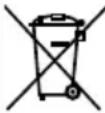 | Alleen voor EU-landen Geef elektrisch gereedschap niet met het huisvuil mee!Volgens de Europese richtlijn 2002/96/EG inzake oude elektrische en elektronische apparaten en de toepassing daarvan binnen de nationale wetgeving, dient gebruikt elektrisch gereedschap gescheiden te worden ingezameld en te worden afgevoerd naar een recycle bedrijf dat voldoet aan de geldende milieu-eisen. | Sólo para países de la Unión Europea¡No deseche los aparatos eléctricos junto con los residuos domésticos!De conformidad con la Directiva Europea 2002/96/CE sobre residuos de aparatos eléctricos y electrónicos y su aplicación de acuerdo con la legislación nacional, las herramientas eléctricas cuya vida útil haya llegado a su fin se deberán recoger por separado y trasladar a una planta de reciclaje que cumpla con las exigencias ecológicas. | Apenas para países da UE Não deite ferramentas eléctricas no lixo doméstico!De acordo com a directiva europeia 2002/96/CE sobre ferramentas eléctricas e electrónicas usadas e a transposición para as leis nacionais, as ferramentas eléctricas usadas devem ser recolhidas em separado e encaminhadas a uma instalação de reciclagem dos materiais ecológica. | Μόνο για τις χώρες της ΕΕ Μην πετάτε τα ηλεκτρικά εργαλεία στον κάδο οικιακών απορριμμάτων!Σύμφωνα με την ευρωπαϊκή οδηγία 2002/96/ΕΚ περί ηλεκτρικών και ηλεκτρονικών συσκευών και την ενσωμάτωσή της στο εθνικό δίκαιο, τα ηλεκτρικά εργαλεία πρέπει να συλλέγονται ξεχωριστά και να επιστρέφονται για ανακύκλωση με τρόπο φιλικό προς το περιβάλλον. |
GENERAL POWER TOOL SAFETY WARNINGS
WARNING
Read all safety warnings and all instructions.
Failure to follow the warnings and instructions may result in electric shock, fire and/or serious injury.
Save all warnings and instructions for future reference.
The term "power tool" in the warnings refers to your mains-operated (corded) power tool or battery-operated (cordless) power tool.
1) Work area safety
a) Keep work area clean and well lit.
Cluttered or dark areas invite accidents.
b) Do not operate power tools in explosive atmospheres, such as in the presence of flammable liquids, gases or dust.
Power tools create sparks which may ignite the dust or fumes.
c) Keep children and bystanders away while operating a power tool.
Distractions can cause you to lose control.
2) Electrical safety
a) Power tool plugs must match the outlet.
Never modify the plug in any way.
Do not use any adapter plugs with earthed (grounded) power tools.
Unmodified plugs and matching outlets will reduce risk of electric shock.
b) Avoid body contact with earthed or grounded surfaces, such as pipes, radiators, ranges and refrigerators.
There is an increased risk of electric shock if your body is earthed or grounded.
c) Do not expose power tools to rain or wet conditions.
Water entering a power tool will increase the risk of electric shock.
d) Do not abuse the cord. Never use the cord for carrying, pulling or unplugging the power tool. Keep cord away from heat, oil, sharp edges or moving parts.
Damaged or entangled cords increase the risk of electric shock.
e) When operating a power tool outdoors, use an extension cord suitable for outdoor use.
Use of a cord suitable for outdoor use reduces the risk of electric shock.
f) If operating a power tool in a damp location is unavoidable, use a residual current device (RCD) protected supply.
Use of an RCD reduces the risk of electric shock.
3) Personal safety
a) Stay alert, watch what you are doing and use common sense when operating a power tool. Do not use a power tool while you are tired or under the influence of drugs, alcohol or medication.
A moment of inattention while operating power tools may result in serious personal injury.
b) Use personal protective equipment. Always wear eye protection.
Protective equipment such as dust mask, non-skid safety shoes, hard hat, or hearing protection used for appropriate conditions will reduce personal injuries.
c) Prevent unintentional starting. Ensure the switch is in the off-position before connecting to power source and/or battery pack, picking up or carrying the tool.
Carrying power tools with your finger on the switch or energising power tools that have the switch on invites accidents.
d) Remove any adjusting key or wrench before turning the power tool on.
A wrench or a key left attached to a rotating part of the power tool may result in personal injury.
e) Do not overreach. Keep proper footing and balance at all times.
This enables better control of the power tool in unexpected situations.
f) Dress properly. Do not wear loose clothing or jewellery. Keep your hair, clothing and gloves away from moving parts.
Loose clothes, jewellery or long hair can be caught in moving parts.
g) If devices are provided for the connection of dust extraction and collection facilities, ensure these are connected and properly used.
Use of dust collection can reduce dust related hazards.
4) Power tool use and care
a) Do not force the power tool. Use the correct power tool for your application.
The correct power tool will do the job better and safer at the rate for which it was designed.
b) Do not use the power tool if the switch does not turn it on and off.
Any power tool that cannot be controlled with the switch is dangerous and must be repaired.
c) Disconnect the plug from the power source and/or the battery pack from the power tool before making any adjustments, changing accessories, or storing power tools.
Such preventive safety measures reduce the risk of starting the power tool accidentally.
d) Store idle power tools out of the reach of children and do not allow persons unfamiliar with the power tool or these instructions to operate the power tool.
Power tools are dangerous in the hands of untrained users.
e) Maintain power tools. Check for misalignment or binding of moving parts, breakage of parts and any other condition that may affect the power tools operation.
If damaged, have the power tool repaired before use.
Many accidents are caused by poorly maintained power tools.
f) Keep cutting tools sharp and clean.
Properly maintained cutting tools with sharp cutting edges are less likely to bind and are easier to control.
g) Use the power tool, accessories and tool bits etc. in accordance with these instructions, taking into account the working conditions and the work to be performed.
Use of the power tool for operations different from those intended could result in a hazardous situation.
5) Battery tool use and care
a) Recharge only with the charger specified by the manufacturer.
A charger that is suitable for one type of battery pack may create a risk of fire when used with another battery pack.
b) Use power tools only with specifically designated battery packs.
Use of any other battery packs may create a risk of injury and fire.
c) When battery pack is not in use, keep it away from other metal objects like paper clips, coins, keys, nails, screws, or other small metal objects that can make a connection from one terminal to another.
Shorting the battery terminals together may cause burns or a fire.
d) Under abusive conditions, liquid may be ejected from the battery; avoid contact. If contact accidentally occurs, flush with water. If liquid contacts eyes, additionally seek medical help.
Liquid ejected from the battery may cause irritation or burns.
6) Service
a) Have your power tool serviced by a qualified repair person using only identical replacement parts.
This will ensure that the safety of the power tool is maintained.
PRECAUTION
Keep children and infirm persons away.
When not in use, tools should be stored out of reach of children and infirm persons.
PRECAUTIONS FOR CORDLESS IMPACT WRENCH
-
This is a portable tool for tightening and loosening bolts and nuts. Use it only for these operation.
-
Use the earplugs if using for a long time.
-
One-hand operation is extremely dangerous; hold the unit firmly with both hands when operating.
-
Check that the socket is not cracked or broken. Broken or cracked sockets are dangerous. Check the socket before using it.
-
Secure the socket with the socket pin and the ring. If the socket pin or ring securing the socket is damaged, the socket may come off from the impact wrench, which is quite dangerous. Do not use socket pins or rings that are deformed, worn out, cracked, or in any other way damaged. Always make sure to install the socket pin and ring in the correct position.
-
Check the tightening torque.
The appropriate torque for tightening a bolt depends on the material the bolt is made of, its dimensions, grade, etc.
Also, the tightening torque generated by this impact wrench depends on the materials and dimensions of the bolt, how long the impact wrench is applied for the way in which the socket is installed, etc.
Also the torque when the battery has just been charged and when it is about to run out are slightly different. Use a torque wrench to check that the bolt has been tightened with the appropriate torque.
-
Stop the impact wrench before switching the direction of rotation. Always release the switch and wait for impact wrench to stop before switching the direction of rotation.
-
Never touch the turning part.
Do not allow the turning socket section to get near your hands or any other part of your body. You could be cut or caught in the socket. Also, be careful not to touch the socket after using continuously it for a long time. It gets quite hot and could burn you.
- Never let the impact wrench turn without a load when using the universal joint.
If the socket turns without being connected to a load, the universal joint causes the socket to turn wildly.
You could get hurt or the movement of the socket could shake the impact wrench so much as to make you drop it.
- Always charge the battery at a temperature of 0 - 40°C.
A temperature of less than 0^ C will result in over charging which is dangerous. The battery cannot be charged at a temperature greater than 40^ C. The most suitable temperature for charging is that of 20 – 25^ C.
- Do not use the charger continuously.
When one charging is completed, leave the charger for about 15 minutes before the next charging of battery.
-
Do not allow foreign matter to enter the hole for connecting the rechargeable battery.
-
Never disassemble the rechargeable battery and charger.
-
Never short-circuit the rechargeable battery. Short-circuiting the battery will cause a great electric current and overheat. It results in burn or damage to the battery.
-
Do not dispose of the battery in fire. If the battery burnt, it may explode.
-
Do not insert object into the air ventilation slots of the charger. Inserting metal objects or inflammables into the charger air ventilation slots will result in electrical shock hazard or damaged charger.
-
Bring the battery to the shop from which it was purchased as soon as the post-charging battery life becomes too short for practical use. Do not dispose of the exhausted battery.
-
Using an exhausted battery will damage the charger.
SPECIFICATIONS
Cordless Impact Wrench
| Model IT-1000-023 | |
| Voltage 12 V | |
| No-Load speed 0 – 2600 min | -1 |
| Capacity (Ordinary bolt) | M6 – M14 |
| Tightening torque (Maximum) | 160 N·m |
| Rechargeable battery EB1226HL: Ni-MH, 2.6 Ah | |
| Weight 1.6 kg | |
Charger
| Model UC14YFA | |
| Charging voltage 7.2 – 14.4 V | |
| Charging time 65 min. | |
| Weight 0.6 kg |
All charge times are approximate. Actual charge time may vary.
BATTERY REMOVAL/INSTALLATION
1. Battery removal
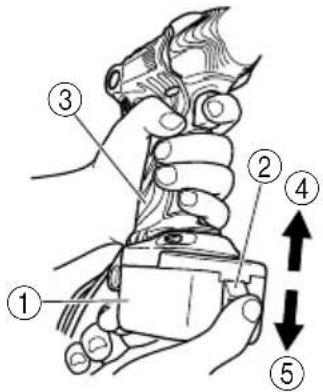
Hold the handle ③ tightly and push the battery latch ② to remove the battery ① (See Fig. 1).
CAUTION
Never short-circuit the battery.
2. Battery installation
Insert the battery ① while observing its polarities (See Fig. 1).
CHARGING
Before using the impact driver or impact wrench, charge the battery as follows.
1. Connect the charger's power cord to a receptacle
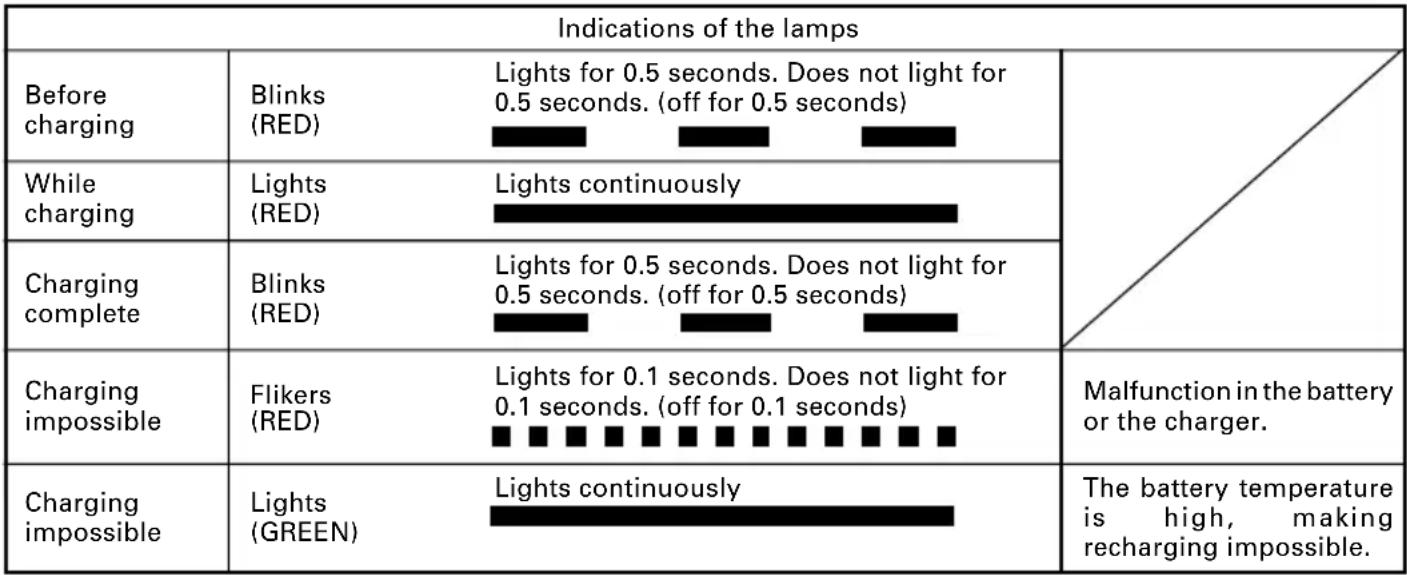
When the power cord is connected, the charger's pilot lamp will blink in red (At 1-second intervals).
2. Insert the battery into the charger
Insert the battery firmly, until it contacts the bottom of the charger compartment.
CAUTION
○If the battery is inserted in the reverse direction, not only recharging will become impossible, but it may also cause problems in the charger such as deformed recharging terminal.
3. Charging
When inserting a battery in the charger, charging will commence and the pilot lamp will light up continuously in red.
When the battery becomes fully recharged, the pilot lamp will blink in red (At 1-second intervals) (See Table 1).
(1) Pilot lamp indication
The indications of the pilot lamp will be as shown in Table 1, according to the condition of the charger or the rechargeable battery.
Table 1
 |
(2) Regarding the temperatures of the rechargeable battery
The temperatures for rechargeable batteries are as shown in the table below, and batteries that have become hot should be cooled for a while before being recharged.
Table 2 Recharging ranges of batteries
| Rechargeable batteries which | Temperatures at the battery can be recharged |
| Ni-Cd batteries -5^ – 60^ | |
| Ni-MH batteries 0^ – 45^ |
4. Disconnect the charger's power cord from the receptacle
5. Hold the charger firmly and pull out the battery NOTE
Be sure to pull out the battery from the charger after use, and then keep it.
CAUTION
○If the battery is charged while it is heated because it has been left for a long time in a location subject to direct sunlight or because the battery has just been used, the pilot lamp of the charger lights up green. In such a case, first let the battery cool, then start charging.
When the pilot lamp flikers in red quickly (at 0.2-second intervals), check for and take out any foreign objects in the charger's battery installation hole. If there are no foreign objects, it is probable that the battery or charger is malfunctioning. Take it to your Authorized Service Center.
○Since the built-in micro computer takes about 3 seconds to confirm that the battery being charged with UC14YFA is taken out, wait for a minimum of 3 seconds before reinserting it to continue charging. If the battery is reinserted within 3 seconds, the battery may not be properly charged.
Regarding electric discharge in case of new batteries, etc.
As the internal chemical substance of new batteries and batteries that have not been used for an extended period is not activated, the electric discharge might be low when using them the first and second time. This is a temporary phenomenon, and normal time required for recharging will be restored by recharging the batteries 2 – 3 times.
How to make the batteries perform longer
(1) Recharge the batteries before they become completely exhausted.
When you feel that the power of the tool becomes weaker, stop using the tool and recharge its battery. If you continue to use the tool and exhaust the electric current, the battery may be damaged and its life will become shorter.
(2) Avoid recharging at high temperatures.
A rechargeable battery will be hot immediately after use. If such a battery is recharged immediately after use, its internal chemical substance will deteriorate, and the battery life will be shortened. Leave the battery and recharge it after it has cooled for a while.
PRIOR TO OPERATION
1. Preparing and checking the work environment
Make sure that the work site meets all the conditions laid forth in the precautions.
2. Checking the battery
Make sure that the battery is installed firmly. If it is at all loose it could come off and cause an accident.
3. Selecting the socket matched to the bolt
Be sure to use a socket which is matched to the bolt to be tightened. Using an improper socket will not only result in insufficient tightening but also in damage to the socket or nut.
A worn or deformed hex. or square-holed socket will not give an adequate tightness for fitting to the nut or anvil, consequently resulting in loss of tightening torque.
Pay attention to wear of socket hole, and replace before further wear has developed.
4. Installing a socket
Select the socket to be used.
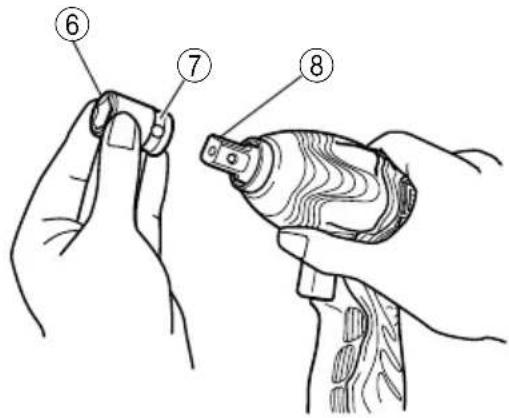
●Plunger type (Fig. 2)
Align the plunger located in the square part of the anvil ⑧ with the hole in the hex. socket ⑥. Then push the plunger, and mount the hex. socket ⑥ on the anvil ⑧. Check that the plunger is fully engaged in the hole. When removing the socket ⑥, reverse the sequence.
CAUTION
Please use the designated attachments which are listed in the operations manual. Accidents or injuries could result from not doing so.
○Make sure to firmly install the socket in the anvil. If the socket is not firmly installed it might come out and cause injuries.
HOW TO USE
CAUTION
○When using the light equipped hook, pay sufficient attention so that the main equipment does not fall. If the tool falls, there is a risk of accident.
☐Do not attach the tip tool except phillips bit to the tool main unit when carrying the tool main unit with the light equipped hook suspended from a waist belt. Injury may result if you carry the equipment suspended from the waist belt with sharp tipped components such as drill bit attached.
1. Using the light equipped hook
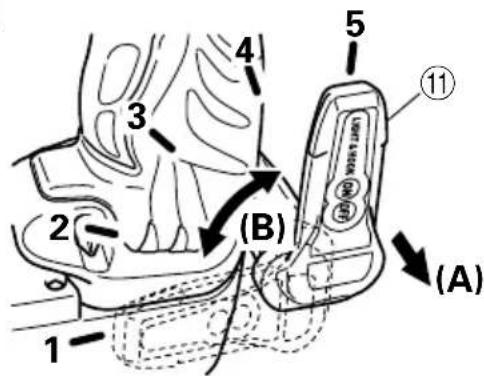
The light equipped hook can be installed on the right or left side and the angle can be adjusted in 5 steps between 0^ and 80^ .
(1) Operating the hook
(a) Pull out the hook ⑪ toward you in the direction of arrow (A) and turn in the direction of arrow (B) (Fig. 4).
(b) The angle can be adjusted in 5 steps ( 0^ , 20^ , 40^ , 60^ , 80^ ).
Adjust the angle of the hook to the desired position for use.
(2) Switching the hook position
CAUTION
Incomplete installation of the hook may result in bodily injury when used.
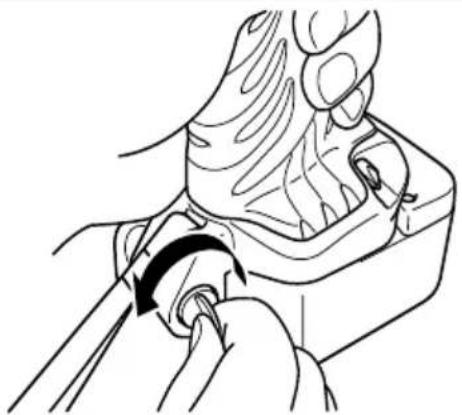
(a) Securely hold the main unit and remove the screw using a slotted head screwdriver or a coin (Fig. 5).
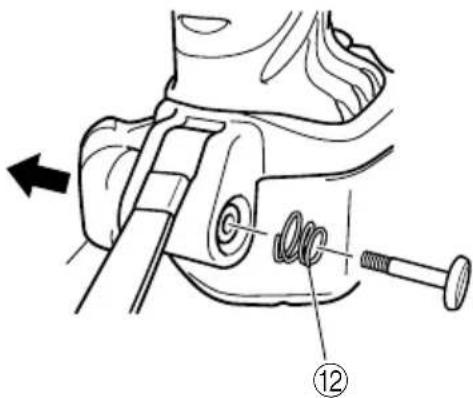
(b) Remove the hook ⑪ and spring ⑫ (Fig. 6).
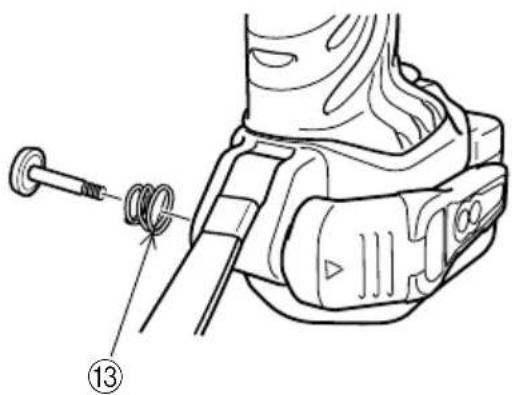
(c) Install the hook ⑪ and spring ⑫ on the other side and securely fasten with screw (Fig. 7).
NOTE
Pay attention to the spring ⑫ orientation. Install the spring ⑫ with larger diameter ⑬ away from you (Fig. 7).
(3) Using as an auxiliary light
(a) Press the switch ⑭ to turn off the light.
If forgotten, the light will turn off automatically after 15 minutes.
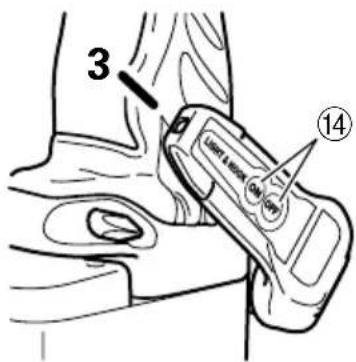
(b) The direction of the light can be adjusted within the range of hook positions 1 - 5 (Fig. 8).
○Lighting time
AAAA manganese batteries: approx. 15 hrs.
AAAA alkali batteries: approx. 30 hrs.
CAUTION
Do not look directly into the light.
Such actions could result in eye injury.
(4) Replacing the batteries
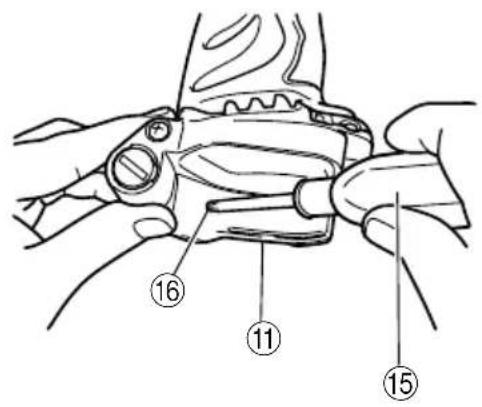
(a) Loosen the hook screw ⑯ with a phillips-head screwdriver (No. 1) ⑮ (Fig. 9).
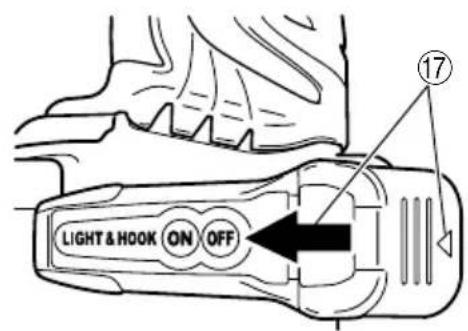
Remove the hook cover ⑱ by pushing in the direction of the arrow (Fig. 10).
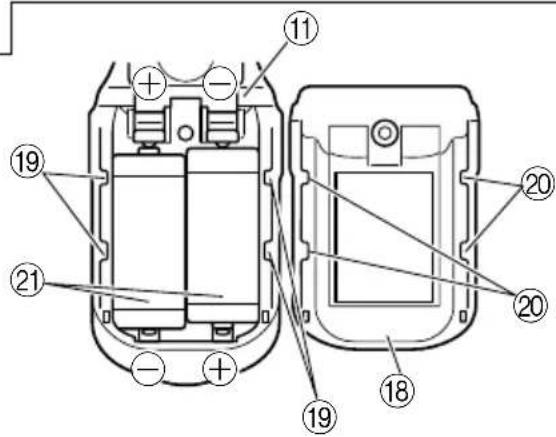
(b) Remove the old batteries and insert the new batteries. Align with the hook indications and position the plus (+) and minus (−) terminals correctly (Fig. 11).
(c) Align the indentation in the hook ⑪ main body with the protuberance of the hook cover ⑱, press the hook cover ⑱ in the direction opposite to that of the arrow ⑰ shown in Fig. 10 and then tighten the screw.
Use commercially available AAAA batteries (1.5 V) ②1.
NOTE
Do not tighten the screw excessively. Such action could strip the screw threads.
CAUTION
○Failure to observe the following can result in battery leakage, rust or malfunction.
Position the plus (+) and minus (−) terminals correctly. Replace both batteries at the same time. Do not mix old and new batteries.
Remove exhausted batteries from the hook immediately.
○Do not discard batteries together with normal trash and do not throw batteries into fire.
○Store batteries out of the reach of children.
○Use batteries correctly in accordance with the battery specifications and indications.
2. Check the rotational direction
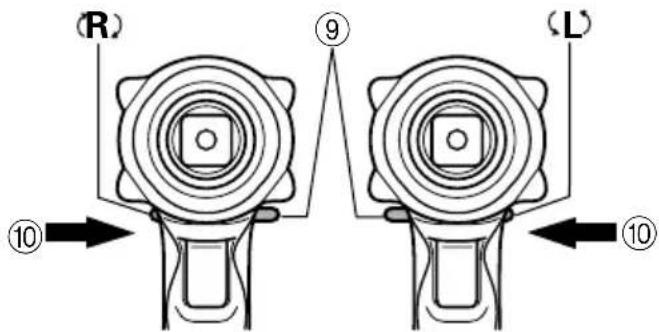
The bit rotates clockwise (viewed from the rear side) by pushing the R-side of the push button ⑩.
The L-side of the push button is pushed to turn the bit counterclockwise (See Fig. 3) (The (L) and (R) marks are provided on the body).
CAUTION
The push button cannot be switched while the impact driver is turning. To switch the push button, stop the impact driver, then set the push button.
3. Switch operation
○When the trigger switch is depressed, the tool rotates.
When the trigger is released, the tool stops.
☐The rotational speed can be controlled by varying the amount that the trigger switch is pulled. Speed is low when the trigger switch is pulled slightly and increases as the trigger switch is pulled more.
OPERATIONAL CAUTIONS
1. Resting the unit after continuous work
After use for continuous bolt-tightening work, rest the unit for 15 minutes or so when replacing the battery. The temperature of the motor, switch, etc., will rise if the work is started again immediately after battery replacement, eventually resulting in burnout.
NOTE
Do not touch the protector, as it gets very hot during continuous work.
2. Cautions on use of the speed control switch
This switch has a built-in, electronic circuit which steplessly varies the rotation speed. Consequently, when the switch trigger is pulled only slightly (low speed rotation) and the motor is stopped while continuously driving in screws, the components of the electronic circuit parts may overheat and be damaged.
3. Use a tightening time suitable for the screw
The appropriate torque for a screw differs according to the material and size of the screw, and the material being screwed etc., so please use a tightening time suitable for the screw. In particular, if a long tightening time is used in the case of screws smaller than M8, there is a danger of the screw breaking, so please confirm the tightening time and the tightening torque beforehand.
4. Work at a tightening torque suitable for the bolt under impact
The optimum tightening torque for nuts or bolts differs with material and size of the nuts or bolts. An excessively large tightening torque for a small bolt may stretch or break the bolt. The tightening torque increases in proportion to the operation time. Use the correct operating time for the bolt.
5. Holding the tool
Hold the impact wrench firmly with both hands. In this case hold the wrench in line with the bolt.
It is not necessary to push the wrench very hard. Hold the wrench with a force just sufficient to counteract the impact force.
6. Confirm the tightening torque
The following factors contribute to a reduction of the tightening torque. So confirm the actual tightening torque needed by screwing up some bolts before the job with a hand torque wrench. Factors affecting the tightening torque are as follows.
(1) Voltage
When the discharge margin is reached, voltage decreases and tightening torque is lowered.
(2) Operating time
The tightening torque increases when the operating time increases. But the tightening torque does not increase above a certain value even if the tool is driven for a long time.
(3) Diameter of bolt
The tightening torque differs with the diameter of the bolt. Generally a larger diameter bolt requires larger tightening torque.
(4) Tightening conditions
The tightening torque differs according to the torque ratio; class, and length of bolts even when bolts with the same size threads are used. The tightening torque also differs according to the condition of the surface of workpiece through which the bolts are to be tightened. When the bolt and nut turn together, torque is greatly reduced.
(5) Using optional parts
The tightening torque is reduced a little when an extension bar, universal joint or a long socket is used.
(6) Clearance of the socket
A worn or deformed hex. or a square-holed socket will not give an adequate tightness to the fitting between the nut or anvil, consequently resulting in loss of tightening torque.
Using an improper socket which does not match to the bolt will result in an insufficient tightening torque.
MAINTENANCE AND INSPECTION
1. Inspecting the socket
A worn or deformed hex. or a square-holed socket will not give an adequate tightness to the fitting between the nut or anvil, consequently resulting in loss of tightening torque. Pay attention to wear of a socket holes periodically, and replace with a new one if needed.
2. Inspecting the mounting screws
Regularly inspect all mounting screws and ensure that they are properly tightened. Should any of the screws be loose, retighten them immediately. Failure to do so may result in serious hazard.
3. Maintenance of the motor
The motor unit winding is the very "heart" of the power tool.
Exercise due care to ensure the winding does not become damaged and/or wet with oil or water.
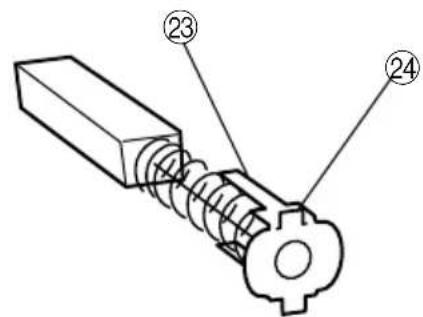
4. Inspecting the carbon brushes (Fig. 12)
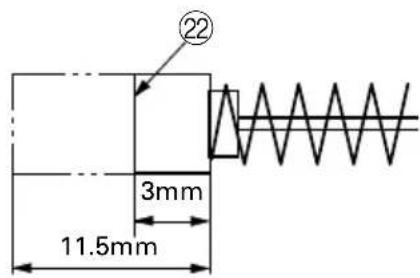
The motor employs carbon brushes which are consumable parts. Since and excessively worn carbon brush can result in motor trouble, replace the carbon brush with new ones when it becomes worn to or near the “wear limit” ②. In addition, always keep carbon brushes clean and ensure that they slide freely within the brush holders.
NOTE
When replacing the carbon brush with a new one, be sure to use the Carbon Brush Code No. 999054 supplied by Tyco.
5. Replacing carbon brushes
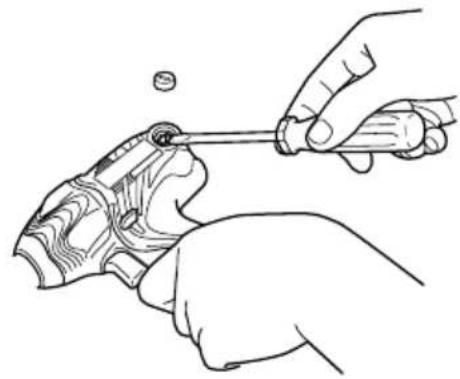
Take out the carbon brush by first removing the brush cap and then hooking the protrusion of the carbon brush ② with a slotted head screw driver, etc., as shown in Fig. 14.
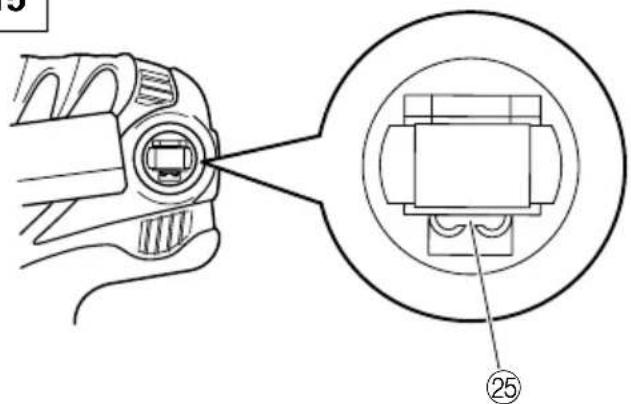
When installing the carbon brush, choose the direction so that the nail of the carbon brush ② agrees with the contact portion outside the brush tube ⑤. Then push it in with a finger as illustrated in Fig. 15. Lastly, install the brush cap.
CAUTION
Be absolutely sure to insert the nail of the carbon brush into the contact portion outside the brush tube. (You can insert whichever one of the two nails provided.)
Caution must be exercised since any error in this operation can result in the deformed nail of the carbon brush and may cause motor trouble at an early stage.
6. Cleaning of the outside
When the impact driver and impact wrench are stained, wipe with a soft dry cloth or a cloth moistened with soapy water. Do not use chloric solvents, gasoline or paint thinner, as they melt plastics.
7. Storage
Store the impact driver and impact wrench in a place in which the temperature is less than 40^ C, and out of reach of children.
8. Service parts list
CAUTION
Repair, modification and inspection of Tyco's products must be carried out by Authorized Service Center.
This Parts List will be helpful if presented with the tool to the Authorized Service Center when requesting repair or other maintenance.
In the operation and maintenance of power tools, the safety regulations and standards prescribed in each country must be observed.
MODIFICATIONS
Tyco's products are constantly being improved and modified to incorporate the latest technological advancements.
Accordingly, some parts may be changed without prior notice.
NOTE
Due to Tyco's continuing program of research and development, the specifications herein are subject to change without prior notice.
Information concerning airborne noise and vibration
The measured values were determined according to EN50144.
The typical A-weighted sound pressure level: 97dB
The typical A-weighted sound power level: 110 dB
Wear ear protection.
The typical weighted root mean square acceleration value: 8.8 m/s ^2
| English | Nederlands | ||
| GUARANTEE CERTIFICATE1Model No.2Serial No.3Date of Purchase4Customer Name and Address5Dealer Name and Address(Please stamp dealer name and address) | GARANTIEBEWIJS1Modelnummer2Serienummer3Datum van aankoop4Naam en adres van de gebruiker5Naam en adres van de handelaar(Stempel a.u.b. naam en adres vande de handelaar) | ||
| Deutsch | Español | ||
| GARANTIESCHEIN1Modell-Nr.2Serien-Nr.3Kaufdaturn4Name und Anschrift des Kunden5Name und Anschrift des Händlers(Bitte mit Namen und Anschrift des Handlers abstempeln) | CERTIFICADO DE GARANTIA1Número de modelo2Número de serie3Fecha de adquisición4Nombre y dirección del cliente5Nombre y dirección del distribudor(Se ruega poner el sello del distribudor con su nombre y dirección) | ||
| Français Português | |||
| CERTIFICAT DE GARANTIE1No. de modèle2No. de série3Date d'achat4Nom et adresse du client5Nom et adresse du revendeur(Cachet portant le nom et l'adresse du revendeur) | CERTIFICADO DE GARANTIA1Número do modelo2Número do série3Data de compra4Nome e morada do cliente5Nome e morada do distribuidor(Por favor, carímbe o nome e morada do distribuidor) | ||
| Italiano Ελληνικά | |||
| CERTIFICATO DI GARANZIA1Modello2N° di serie3Data di acquisto4Nome e indirizzo dell'acquirente5Nome e indirizzo del rivenditore(Si prega di apporre il timbro con questi dati) | ΠΙΣΤΟΠΟΙΗΤΙΚΟ ΕΓΓΥΗΣΗΣ1Αρ. Μοντέλου2Αύξων Αρ.3Ημερομηνία αγοράς4Όνομα και διεύθυνση πελάτη5Όνομα και διεύθυνση μεταπωλητή(Παρακαλούμε να χρησιμοποιηθεί σφραγίδα) | ||
tyco | Electronics
| 1 | |
| 2 | |
| 3 | |
| 4 | |
| 5 |
natural_image
Line drawing of a quill pen in an inkwell (no text or symbols)| English | Nederlands | ||
| EC DECLARATION OF CONFORMITYWe declare under our sole responsibility that this product is in conformity with standards or standardized documents EN60745, EN60335, EN55014 and EN61000 in accordance with Council Directives 2004/108/EC, 2006/95/EC and 98/37/EC. This product also complies with the essential requirements of 2006/42/EC to be applied from 29 December 2009.This declaration is applicable to the product affixed CE marking. | EC VERKLARING VAN CONFORMITEITWij verklaren onder eigen verantwoordelijkheid dat dit produkt conform de richtlijnen of gestandardiseerde documenten EN60745, EN60335, EN55014 en EN61000 voldoet aan de eisen van EEG Bepalingen 2004/108/EC, 2006/95/EC en 98/37/EC. Dit product voldoet ook aan de essentiële vereisten van 2006/42/EC die gelden vanaf 29 December 2009.Deze verklaring is van toepassing op produkten voorzien van de CE-markeringen. | ||
| Deutsch | Español | ||
| ERKLÄRUNG ZUR KONFORMITÄT MIT CE-REGELNWir erklären mit alleiniger Verantwortung, daß dieses Produkt den Standards oder standardisierten Dokumenten EN60745, EN60335, EN55014 und EN61000 in Ubereinstimmung mit den Direktiven des Europarats 2004/108/CE, 2006/95/CE und 98/37/CE entspricht. Dieses Produkt hält auch die wesentlichen Anforderungen von 2006/42/CE ein, die ab 29. Dezember 2009 gelten werden.Diese Erklärung gilt für Produkte, die die CE-Markierung tragen. | DECLARACIÓN DE CONFORMIDAD DE LA CEDeclaramos bajo nuestra única responsabilidad que este producto está de acuerdo con las normas o con los documentos de normalización EN60745, EN60335, EN55014 y EN61000, según indican las Directrices del Consejo 2004/108/CE, 2006/95/CE y 98/37/CE. Este producto también cumple los requisitos esenciales de 2006/42/CE aplicables a partir del 29 de Diciembre de 2009.Esta declaración se aplica a los productos con marcas de la CE. | ||
| Français | Português | ||
| DECLARATION DE CONFORMITE CENous déclarons sous notre seule et entière responsabilité que ce produit est conforme aux normes ou documents normalisés EN60745, EN60335, EN55014 et EN61000 en accord avec les Directives 2004/108/CE, 2006/95/CE et 98/37/CE du Conseil. Ce produit est également conforme aux exigences essentielles de 2006/42/CE applicables à compter du 29 Décembre 2009.Cette déclaration s'applique aux produits désignés CE. | DECLARAÇÃO DE CONFORMIDADE CEDeclaramos, sob nossa única e inteira responsabilidade, que este produto está de acordo com as normas ou documentos normativos EN60745, EN60335, EN55014 e EN61000, em conformidade com as Diretrizes 2004/108/CE, 2006/95/CE e 98/37/CE do Conselho. Este produto também está em conformidade com os requisitos essenciais da 2006/42/CE, a serem aplicados a partir de 29 de Dezembro de 2009.Esta declaração se aplica aos produtos designados CE. | ||
| Italiano | Ελληνικά | ||
| DICHIARAZIONE DI CONFORMITÀ CESi dichiara sotto nostra responsabilità che questo prodotto è conforme agli standard o ai documenti standardizzati EN60745, EN60335, EN55014 e EN61000 conforme alle direttive 2004/108/CE, 2006/95/CE e 98/37/CE del concilio. Questo prodotto è conforme anche ai requisiti 2006/42/CE vigenti a partire dal 29 Dicembre 2009.Questa dichiarazione è applicabile ai prodotti cui sono applicati i marchi CE. | ΕΚ ΔΗΛΩΣΗ ΕΝΑΡΜΟΝΙΣΜΟΥΔηλώνουμε με απόλυτη υπευθυνότητα ότι αυτό το προϊόν είναι εναρμονιςμένο με τα πρότυπα ή τα έγραφα προτύπων EN60745, EN60335, EN55014 και EN61000 cεςμμφωνία με τις Οδηγίες του Συμβουλίου 2004/108/EK, 2006/95/EK και 98/37/EK. Αυτό το προϊόν είναι επίσηςςύμφωνο με τις βασικές απαιτήσεις του 2006/42/EK που εφαρμόζονται από τις 29 Δεκεμβρίου 2009.Αυτή η δήλωςη ιςχύει στο προϊόν με το σημάδι CE. | ||
| Tyco Electronic Raychem GmbHFinsinger Feld 1D-85521 OttobrunnGermany | CE31. 3. 2009R. SendrowskiManaging Director | ||