
EW-DS11 - Electric toothbrush PANASONIC - Free user manual and instructions
Find the device manual for free EW-DS11 PANASONIC in PDF.
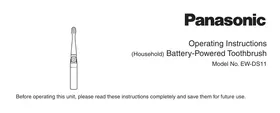



| Product type | Electric toothbrush |
| Brand | Panasonic |
| Model | EW-DS11 |
| Power source | 1 AAA alkaline battery (LR03) (not included) |
| Battery life | Approximately 90 days (1 use of 2 min/day) |
| Noise level | 37 dB (A) |
| Usage | Household use only |
| Brush head type | Double edge: inverted V bristles (interdental) and extra fine bristles (tooth/gum) |
| Brush head replacement | Every 3 months recommended (replacement model: WEW0957-W, white) |
| Included accessories | 1 double-edge brush head, 1 cap |
| Cleaning | Main unit and brush washable under running water (max 40°C for unit, 80°C for brush) |
| Safety | Keep out of reach of young children; consult a dentist if you have periodontal disease; do not use abrasive toothpaste |
| Dimensions (approximate) | Height approx. 18 cm (with head) |
| Weight (approximate) | Approx. 50 g (with battery) |
| Warranty | Consult the manual for details |
Frequently Asked Questions - EW-DS11 PANASONIC
User questions about EW-DS11 PANASONIC
0 question about this device. Answer the ones you know or ask your own.
Ask a new question about this device
Download the instructions for your Electric toothbrush in PDF format for free! Find your manual EW-DS11 - PANASONIC and take your electronic device back in hand. On this page are published all the documents necessary for the use of your device. EW-DS11 by PANASONIC.
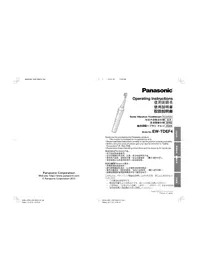
USER MANUAL EW-DS11 PANASONIC
Operating Instructions
(Household) Battery-Powered Toothbrush
Model No. EW-DS11
Before operating this unit, please read these instructions completely and save them for future use.
| English | 4 | Italiano | 42 | Polski | 78 |
| Deutsch | 16 | Español | 54 | Česky | 91 |
| Français | 29 | Dansk | 66 | Magyar | 103 |

Thank you for choosing a Panasonic Battery-Powered Toothbrush. Please read all instructions before use.
Safety Precautions
Warning
- Keep out of the reach of toddlers and infants.
- Failure to do so may result in accidents or accidental ingestion of the accessories or removable small parts.
Caution
• People who have severe periodontal disease should consult a doctor before use. Failure to do so may cause damage to teeth and gums. - Do not use the brush in combination with toothpaste that contains a lot of abrasive, such as toothpaste for removing tar or for whitening. - Do not force the bristles hard against the teeth or gums, or apply the bristles to one area for prolonged periods. - Do not apply the solid part of the brush head to teeth. • Toddlers, infants, people who are unable to operate
and people with weak oral senses should not use this appliance.
- If you have oral health problems such as teeth undergoing treatment or unstable dentures, avoid using the brush on those parts as doing so may cause damage to teeth and gums.
- Never modify, disassemble, or repair the appliance yourself as doing so may cause unexpected accidents or trouble.
- Clean using a mild detergent.
- Never use thinners, benzine, or alcohol to clean the toothbrush since it may cause malfunction or cracking/discolouration of the parts.
This appliance is not intended for use by persons (including children) with reduced physical, sensory or mental capabilities, or lack of experience and knowledge, unless they have been given supervision or instruction concerning use of the appliance by a person responsible for their safety. Children should be supervised to ensure that they do not play with the appliance.
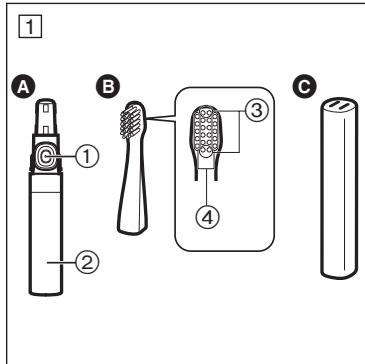
Parts identification (Fig. 1)
A Main unit
① Power switch [0/1] ② Battery cover
Attachments
B Dual-Edged Brush (x1)
③ Inverted V-shaped bristles for interdentium ④ Extra fine bristles for between teeth and gums
© Cap
Attaching and removing the cap
Attach and remove the cap straight. (Fig. 2)
Attaching the brush head
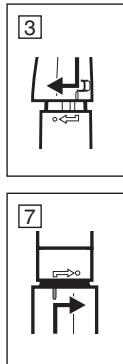
- Align the mark on the brush head with the mark on the main unit, and rotate it in the direction of the arrow until it clicks. (Fig. 3)
- Inserting the brush head without aligning the mark on the brush head with the mark on the main unit may damage the brush head or the main unit.
- Tightening it too strongly may cause deformation and damage of the main unit and the brush head.
Removing the brush head
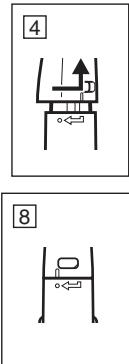
- Rotate the brush head and align the marks. (Fig. 4)
- Pull to remove the brush.
- Pulling the brush head while it is fastened may damage the brush head or the main unit. - When toothpaste gets hard and makes it difficult to remove the brush head, put it in water or warm water for a while and then remove.
Replacing the battery
When the battery is low, there is less vibration and a weaker brushed feeling. Please replace the alkaline battery with a new one.
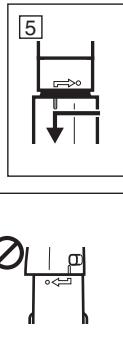
- Remove the battery cover by rotating it. (Fig. 5)
- Insert an alkaline AAA (LR03) alkaline battery. (Fig. 6)
- It is possible to use the appliance for approximately 90 days using a Panasonic alkaline AAA (LR03) alkaline battery (using the appliance once a day for 2 minutes).
- Attach the battery cover by rotating it. (Fig. 7)
Notes
- Batteries are not supplied. Please purchase separately.
- Before replacing the alkaline battery, ensure the unit is thoroughly dry to prevent water drops entering the main unit.
- Always use alkaline batteries. Use of non-alkaline batteries may result in a drastically reduced operating time.
- Do not use rechargeable batteries. • We recommend that you use a Panasonic AAA (LR03) alkaline battery. • Always follow the cautions printed on the battery.
- Check the polarities (+ and -) of the battery and install it correctly. Remove the battery when not using the appliance for an extended period of time.
- Please dispose of used battery appropriately.
- Do not disassemble the battery or throw it into a fire. Do not short-circuit the battery.
Using the toothbrush
- Remove the cap. (Fig. 2)
- Confirm that the brush is fixed firmly. (Fig. 8)
- Place the toothbrush in your mouth.
- When using the toothbrush, especially with toothpaste applied, place the brush head in the mouth before operating to prevent splattering.
- Press the power switch firmly to operate the toothbrush.
- Press the power switch firmly. If you press the power switch lightly, the toothbrush may operate only while you are pressing.
- Press the power switch with the ball of the finger.
- Do not press with a fingernail. Doing so may tear the rubber of the power switch.
- Brush your teeth by moving the main unit by hand.
- Brush by moving the toothbrush in the same way as when you brush by hand. Just applying the toothbrush to teeth cannot fully remove plaque, so it is recommended that you move the toothbrush. - Do not apply the brush head to teeth or gums too strongly.
- When finished brushing, stop the motion by
pressing the power switch firmly.
- In order to prevent splattering of saliva, etc., stop operation of the toothbrush while it is still in the mouth.
Tips on usage
Boundary between the tooth surfaces or teeth and gums
- Press the bristles at a 45° angle.
- Place the brush so that the inverted V-shaped bristles for interdentium can fit the hard to reach spaces between teeth.
- Place the brush so that the minute side bristles can fit in between the teeth and gums.
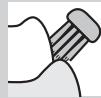
Tips on usage
At the back of the front teeth or misaligned teeth
- Press the brush vertically.
- Place the brush according to the angle of the teeth.
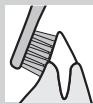
Bite (back teeth)
- Apply the brush to the teeth at an angle of 90° from the top.
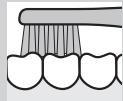
Notes
- Do not use for any purpose other than dental care.
- Do not drop or handle roughly.
- Please be careful not to get hair products, hand cream, etc. on the main unit because it may ruin the appearance.
After use
Washing the brush
Wash the brush under running water.
- Do not wash with water hotter than 80 °C.
- Do not pull the bristles of the brush. (Doing so may cause bristles to come out.) - Shake well to remove water after washing.
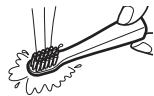
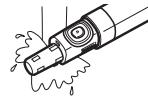
Washing the main unit
- Make sure that the battery cover is closed.
- Wash the main unit under running water.
- Do not wash with water hotter than 40 °C.
- Do not immerse the main unit under water. (Otherwise water may get inside.)
Washing the cap
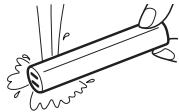
Wash the cap under running water.
- Do not wash with water hotter than 40 °C.
Note
- Shake the cap and brush head well to drain off water, and dry using a dry towel, etc. After this, put the cap on the main unit. Leaving them wet may dirty or damage the pouch or bag.
Changing the brush head (Sold separately)
Replacing the brush every 3 months is recommended.
If the bristles are bent to one side or worn, the toothbrush is not very effective for brushing.
| Part number | Replacement brush head for EW-DS11 | Quantity |
| WEW0957-W (White) | 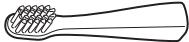 | 2 |
- Only replacement brush heads for EW-DS11 can be used.
Specifications
| Model No. | EW-DS11 |
| Power source | AAA (LR03) alkaline battery x 1 (sold separately) |
| Airborne Acoustical Noise | 37 (dB (A) re 1 pW) |
This product is intended for household use only.
Information on Disposal for Users of Waste Electrical & Electronic Equipment (private households)
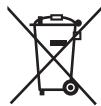
This symbol on the products and/or accompanying documents means that used electrical and electronic products should not be mixed with general household waste.
For proper treatment, recovery and recycling, please take these products to designated collection points, where they
will be accepted on a free of charge basis.
Alternatively, in some countries you may be able to return your products to your local retailer upon the
purchase of an equivalent new product.
Disposing of this product correctly will help to save valuable resources and prevent any potential negative effects on human health and the environment which could otherwise arise from inappropriate waste handling. Please contact your local authority for further details of your nearest designated collection point. Penalties may be applicable for incorrect disposal of this waste, in accordance with national legislation.
For business users in the European Union
If you wish to discard electrical and electronic equipment, please contact your dealer or supplier for further information.
Information on Disposal in other Countries outside the European Union
This symbol is only valid in the European Union. If you wish to discard this product, please contact your local authorities or dealer and ask for the correct method of disposal.
Notes
Note
Remarks
Remark
Note
Note
Mordisco (posterior teeth)
Notes
Washing the cap
Note
Usage tips
Molars
Remarks
Cleaning the cap
Rinse the cap under running water.
Note
Remarks
Warning
Usage tips
Molars (back teeth)
Remarks
Washing the cap
Note
Other
Washing the cap
Note
- SAFETY PRECAUTIONS
- WARNING
- CAUTION
- PARTS IDENTIFICATION (FIG. 1)
- A MAIN UNIT
- ATTACHMENTS
- ATTACHING AND REMOVING THE CAP
- ATTACHING THE BRUSH HEAD
- REMOVING THE BRUSH HEAD
- REPLACING THE BATTERY
- NOTES
- USING THE TOOTHBRUSH
- TIPS ON USAGE
- BOUNDARY BETWEEN THE TOOTH SURFACES OR TEETH AND GUMS
- AT THE BACK OF THE FRONT TEETH OR MISALIGNED TEETH
- BITE (BACK TEETH)
- AFTER USE
- WASHING THE BRUSH
- WASHING THE MAIN UNIT
- WASHING THE CAP
- NOTE
- CHANGING THE BRUSH HEAD (SOLD SEPARATELY)
- SPECIFICATIONS
- FOR BUSINESS USERS IN THE EUROPEAN UNION
- INFORMATION ON DISPOSAL IN OTHER COUNTRIES OUTSIDE THE EUROPEAN UNION
- REMARKS
- REMARK
- MORDISCO (POSTERIOR TEETH)
- USAGE TIPS
- MOLARS
- CLEANING THE CAP
- MOLARS (BACK TEETH)
- OTHER
Brand : PANASONIC
Model : EW-DS11
Category : Electric toothbrush