
KD-DV4207 - Car stereo JVC - Free user manual and instructions
Find the device manual for free KD-DV4207 JVC in PDF.


| Product Type | Car Stereo with DVD/CD/MP3/WMA Playback |
| Brand | JVC |
| Model | KD-DV4207 |
| Installation Dimensions (W × H × D) | 182 mm × 52 mm × 158 mm |
| Panel Dimensions (W × H × D) | 188 mm × 58 mm × 11 mm |
| Weight | 1.6 kg (excluding accessories) |
| Power Supply | DC 14.4 V (11 V to 16 V allowable), Negative ground |
| Maximum Power Output | 50 W per channel (Front/Rear) |
| Continuous Power Output (RMS) | 19 W per channel into 4 Ω, 40 Hz – 20 kHz, ≤0.8% THD |
| Tuner Frequency Range | FM: 87.5 – 108.0 MHz (FM1/FM2), 65.00 – 74.00 MHz (FM3); AM: 522 – 1620 kHz (MW), 144 – 279 kHz (LW) |
| Disc Playback Compatibility | DVD Video, VCD, CD, CD-R/RW, DVD-R/RW, +R/+RW (Video mode), MP3/WMA |
| Detachable Control Panel | Yes, with theft protection |
| RDS Features | AF, REG, PTY, TA, Network-Tracking, Programme Search |
| External Device Connectivity | CD changer, DAB tuner, iPod/D. player via KS-PD100/500, Aux input via KS-U57/U58 |
| Audio Outputs | Speaker outputs (Front/Rear), LINE OUT (2.0 V/20 kΩ), Digital Optical Out (PCM, Dolby Digital, DTS, MPEG) |
| Video Output | Composite video (1 Vp-p/75 Ω), PAL color system |
| Equalizer Presets | ROCK, CLASSIC, POPS, HIP HOP, JAZZ, USER (custom) |
| Maintenance | Clean connectors with alcohol, avoid moisture, handle discs by edges |
| Safety Features | Parking brake interlock for video, volume attenuation (ATT), TA standby volume preset |
| Region Code | 5 (for DVD Video) |
| Operating Temperature | 0 °C to +40 °C |
Frequently Asked Questions - KD-DV4207 JVC
User questions about KD-DV4207 JVC
0 question about this device. Answer the ones you know or ask your own.
Ask a new question about this device
Download the instructions for your Car stereo in PDF format for free! Find your manual KD-DV4207 - JVC and take your electronic device back in hand. On this page are published all the documents necessary for the use of your device. KD-DV4207 by JVC.
USER MANUAL KD-DV4207 JVC
natural_image
Diagram showing a device with an internal panel connected to a rectangular device (no text or symbols present)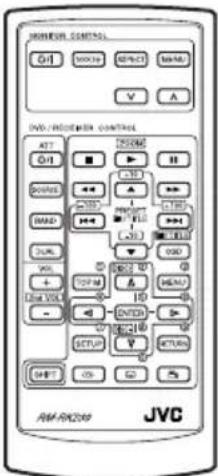
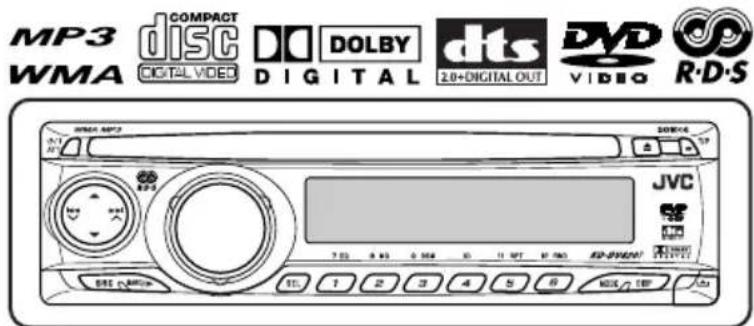
For canceling the display demonstration, see page 5.
For installation and connections, refer to the separate manual.
natural_image
Abstract geometric pattern with diagonal black and white stripes (no text or symbols)Thank you for purchasing a JVC product.
Please read all instructions carefully before operation, to ensure your complete understanding and to obtain the best possible performance from the unit.
IMPORTANT FOR LASER PRODUCTS
- CLASS 1 LASER PRODUCT
- CAUTION: Do not open the top cover. There are no user serviceable parts inside the unit; leave all servicing to qualified service personnel.
- CAUTION: Visible and invisible laser radiation when open and interlock failed or defeated. Avoid direct exposure to beam.
- REPRODUCTION OF LABEL: CAUTION LABEL, PLACED OUTSIDE THE UNIT.
This product incorporates copyright protection technology that is protected by U.S. patents and other intellectual property rights. Use of this copyright protection technology must be authorized by Macrovision, and is intended for home and other limited viewing uses only unless otherwise authorized by Macrovision. Reverse engineering or disassembly is prohibited.
How to reset your unit
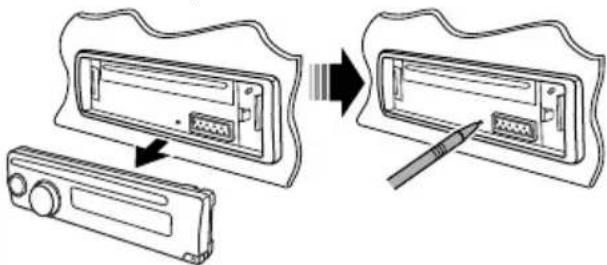
- Your preset adjustments will also be erased.
How to forcibly eject a disc
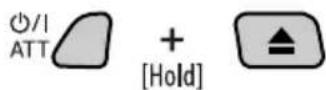
- If this does not work, reset your unit.
- Be careful not to drop the disc when it ejects.
How to use functions mode
If you press MODE, the unit goes into functions mode, then the number buttons and ▲/▼ buttons work as different function buttons.
![MODE [Within 5 seconds...] 7 EQ 8 NO 9 SSM 11 RPT 12 RND 1 2 3 5 6](/content/2026/05/1046311/images/df782f9d6bc9e593da573afb4cedefeb194becc9a87769262575025a1942f098.jpg)
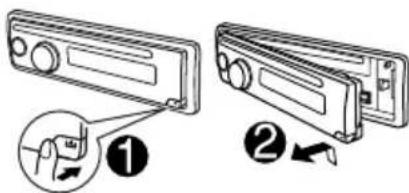
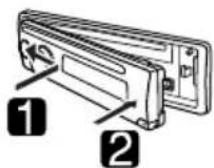
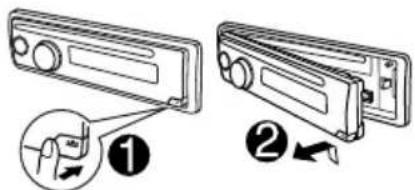
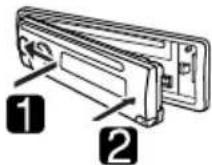
How to detach/attach the control panel
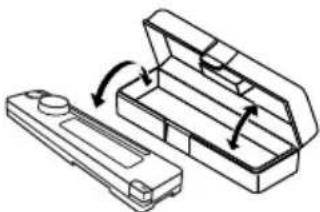
natural_image
Technical line drawing of a mechanical component with an open lid and internal structure, showing rotational motion (no text or symbols)Detaching...
Attaching...
WARNINGS:
To prevent accidents and damage
- DO NOT install any unit in locations where;
- it may obstruct the steering wheel and gearshift lever operations.
- it may obstruct the operation of safety devices such as air bags.
- it may obstruct visibility.
- DO NOT operate the unit while driving.
- If you need to operate the unit while driving, be sure to look ahead carefully.
- The driver must not watch the monitor while driving.
If the parking brake is not engaged, "DRIVER MUST NOT WATCH THE MONITOR WHILE DRIVING." appears on the monitor, and no playback picture will be shown.
- This warning appears only when the parking brake wire is connected to the parking brake system built in the car (refer to the Installation/Connection Manual).
For safety...
- Do not raise the volume level too much, as this will block outside sounds, making driving dangerous.
- Stop the car before performing any complicated operations.
Temperature inside the car...
If you have parked the car for a long time in hot or cold weather, wait until the temperature in the car becomes normal before operating the unit.
CONTENTS
Introduction 4
OPERATIONS
Basic operations
• Control panel 6
- Remote controller (RM-RK230) 7
Listening to the radio 9
Searching for FM RDS programme — PTY search .... 10
Disc operations 12
■ EXTERNAL DEVICES
Listening to the CD changer 18
Listening to the DAB tuner 19
Listening to the iPod®/D. player 20
Listening to the other external components 21
SETTINGS
Selecting a preset sound mode — C-EQ ..... 22
General settings — PSM 23
DVD setup menu 25
Maintenance 28
More about this unit 29
Troubleshooting 31
Specifications 34
Introduction
| Disc type | Playable | Implayable | XNO |
 | DVD Video, Dual Disc (DVD side only), DVD-R*/-RW, +R/+RWRecorded in DVD-Video format only and in PAL color system | DVD Audio, Dual Disc (non-DVD side), DVD-RAM, DVD-ROM, DVD-R/-RW, +R/+RWRecorded in DVD-VR format | |
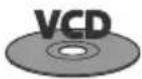 | Video CDCD-R/-RW | SVCD (Super Video CD) | |
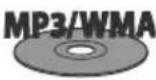 | DVD-R/-RW, +R/+RW, DVD-ROMCompliant to UDF bridge format | — | |
| CD-R/-RWCompliant to ISO 9660 level 1, ISO 9660 level 2, Romeo, Joliet | — | ||
 | Audio CD, CD TextCD-R/-RWCompliant to CD-DA format | CD-ROM, CD-I (CD-I Ready), Photo CD | |
- It is possible to play back finalized +R/+RW (Video mode only) discs. However, the use of +R double layer disc on this unit is not recommended.
* DVD-R recorded in multi-border format is also playable (except for dual layer discs).
Caution for DualDisc playback
The Non-DVD side of a “DualDisc” does not comply with the “Compact Disc Digital Audio” standard. Therefore, the use of Non-DVD side of a DualDisc on this product may not be recommended.
Caution on volume setting
Discs produce very little noise compared with other sources. Lower the volume before playing a disc to avoid damaging the speakers by the sudden increase of the output level.
Note on Region Code:
DVD players and DVD Video discs have their own Region Code numbers. This unit can only play back DVD discs whose Region Code numbers include "5."
Examples:



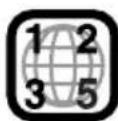
If you insert a DVD Video disc of an incorrect Region Code
"REGION CODE ERROR!" appears on the monitor.
Before operating the unit — Cancel the display demonstration and set the clock
• See also page 23.
![1 3 4 [Turn] Q/I ATT T/P JVC 7 EQ 6 NO 9 BSM 10 11 RPT 12 RND SRC BAND/ SEL 1 2 3 4 5 6 MODE DISP 2 [Hold], 5 When the power is turned off: Check the current clock time](/content/2026/05/1046311/images/f29852218f4491a1cdbadfcd969f2dbc22b76b9d680ff98f8aba1cee5accc627.jpg)
When the power is turned off: Check the current clock time When the power is turned on: Change the display information
① Turn on the power.
② Enter the PSM settings.
3 4 Cancel the display demonstrations
Select "DEMO," then "DEMO OFF."
Set the clock
Select "CLOCK H" (hour), then adjust the hour.
Select "CLOCK M" (minute), then adjust the minute.
Select "24H/12H," then "24H" (hour) or "12H" (hour).
5 Finish the procedure.
Basic operations — Control panel
• FM/AM/DAB: Search for station/service.
• DISC: Select chapter/track.
- IPOD/D.PLAYER: Select track.
• DISC: Select folder.
Also functions as +10/−10 buttons after pressing MODE to skip 10 chapters/tracks at a time.
- IPOD/D.PLAYER: Enter the main menu/Pause or stop playback/Confirm selection.
• DAB: Select service.
- Turn on the power.
- Turn off the power [Hold].
- Attenuate the sound (if the power is on).
Activate/deactivate TA
Standby Reception.
Hold to enter RDS programme search.
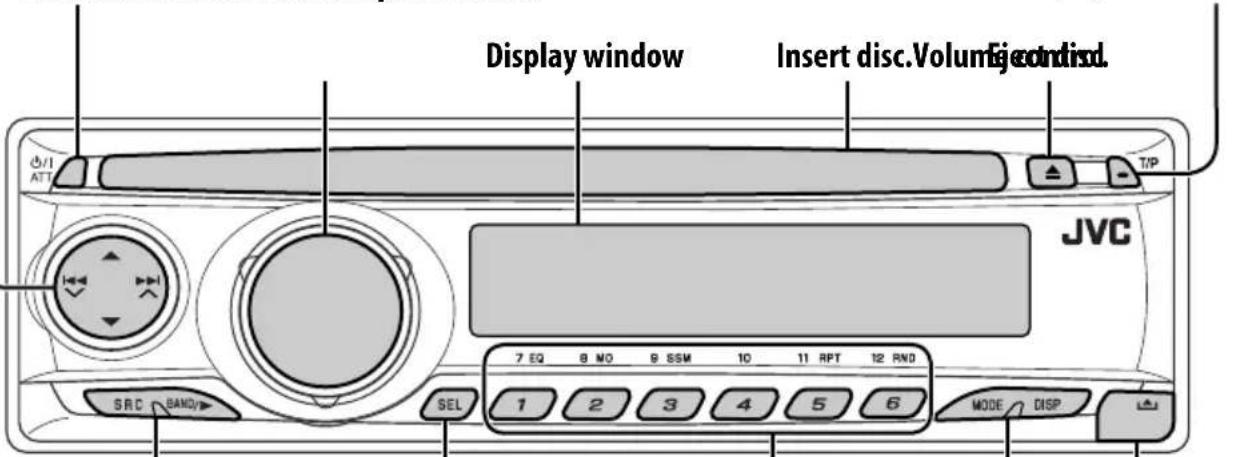
Adjust the sound mode.
Hold to enter the PSM settings.
• FM/AM/DAB: Select preset station/service.
• DISC: Select chapter/title/folder/track/disc (for CD changer).
Detach the panel.
Select the source.
FM/AM → DAB* → DISC* → CD-CH*/IPOD*/
D.PLAYER* (or EXT IN) → (back to the beginning)
* You cannot select these sources if they are not ready.
• FM/AM/DAB: Select the bands.
• DISC: Start playback.
MODE
Enter functions mode.
Press MODE, then one of the following buttons (within 5 seconds)...
EQ: Select the sound mode.
MO: Turn on/off monaural reception.
SSM: Automatic station presetting.
RPT: Select repeat play.
RND: Select random play.
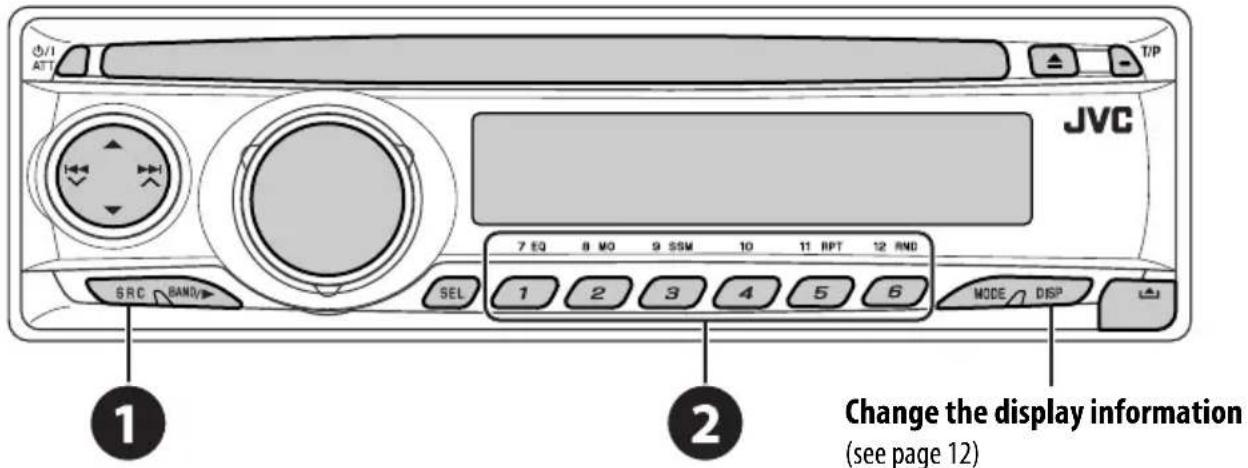
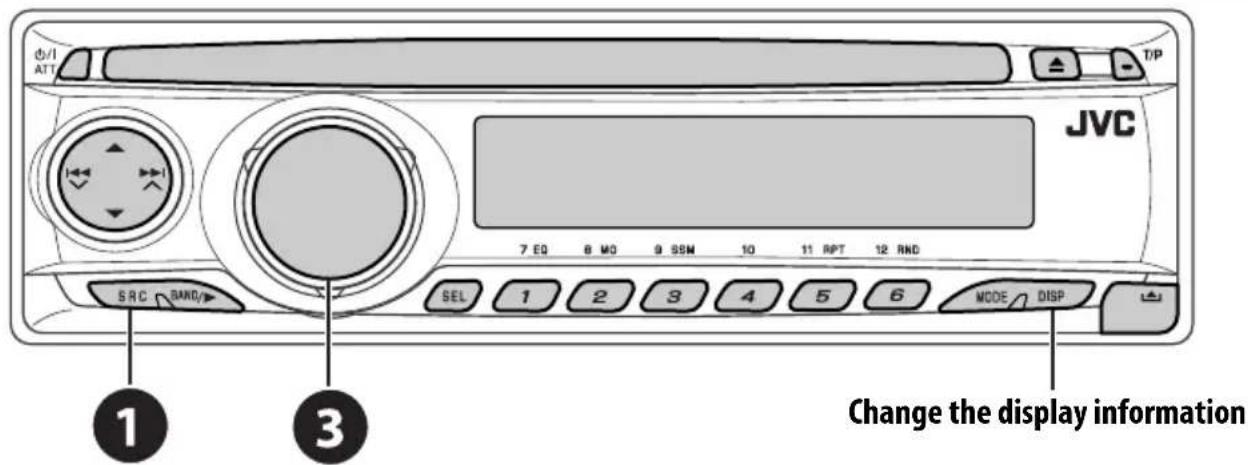
Change the display information.
Display window
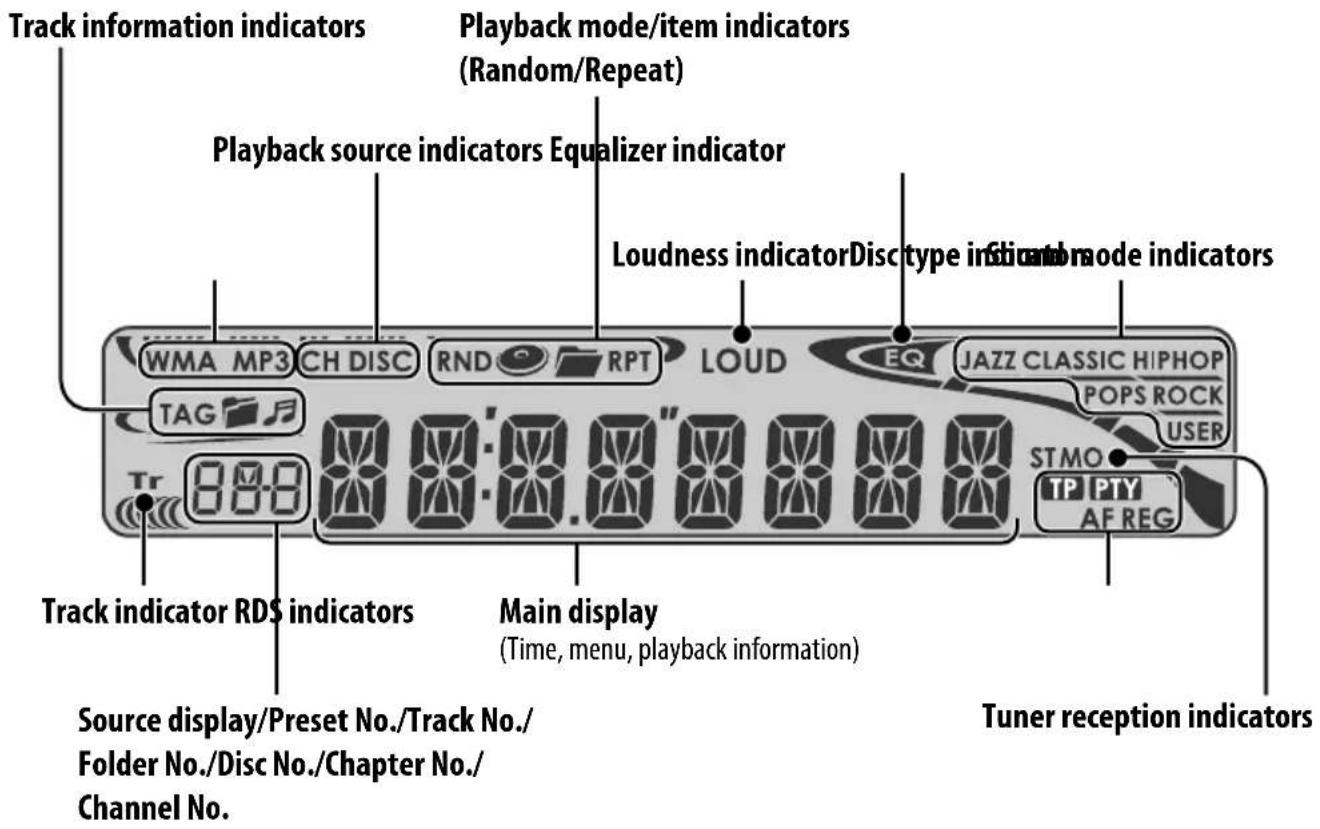
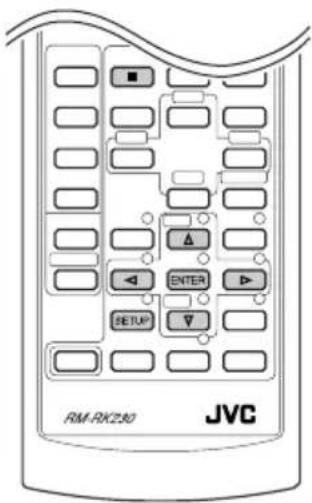
Basic operations — Remote controller (RM-RK230)
Installing the lithium coin battery (CR2025)
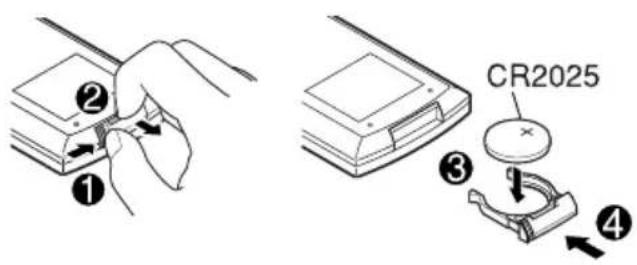
Before using the remote controller:
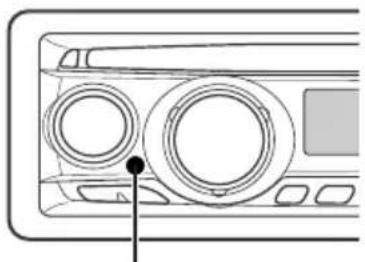
- Aim the remote controller directly at the remote sensor on the unit.
- DO NOT expose the remote sensor to bright light (direct sunlight or artificial lighting).
natural_image
Line drawing of a car front panel with circular ventricles and a small button (no text or symbols)Remote sensor
Warning: To prevent accidents and damage
- Do not install any battery other than CR2025 or its equivalent.
- Store the battery in a place where children cannot reach.
- Do not recharge, short, disassemble, heat the battery, or dispose of it in a fire.
- Do not leave the battery with other metallic materials.
- Do not poke the battery with tweezers or similar tools.
- Wrap the battery with tape and insulate when throwing away or saving it.
Continued on the next page
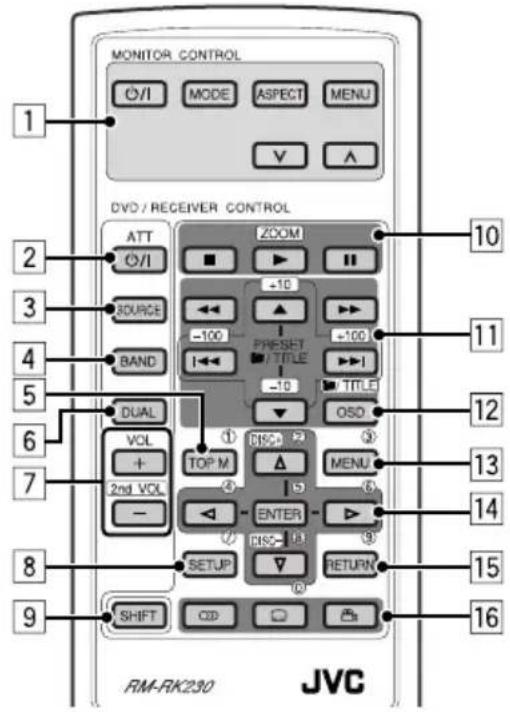
MONITOR CONTROL
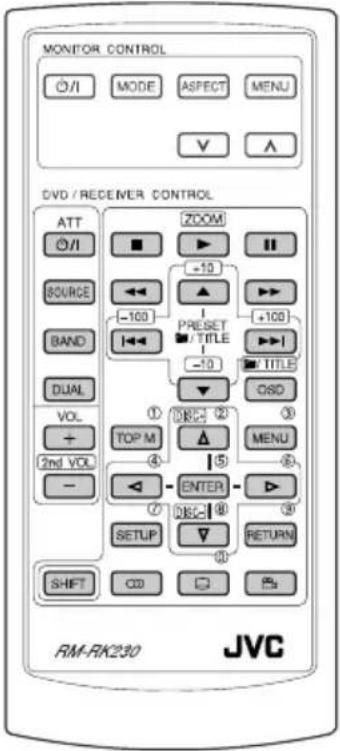
1 Monitor control buttons
- Used for a JVC monitor—KV-MR9010 or KV-MH6510.
DVD/RECEIVER CONTROL
2 Turns on/off the power.
- Attenuates the sound if the power is on.
3 Selects the source.
4 Selects the FM/AM/DAB bands.
5*1 • DVD: Shows the DVD disc menu.
• VCD: Starts PBC playback.
6 Not applicable for this unit.
7 Adjusts the volume level.
- 2nd VOL: Not applicable for this unit.
8 ^*1 Enters DVD setup menu.
9 SHIFT button
10 ■ (stop), ▶ (play), ■ (pause)
- ▶ (play) also function as ZOOM button when pressed with SHIFT button (see page 14).
- Not applicable for CD changer/iPod/D. player operations.
11\*2 For advanced disc operations:
• /TITLE ▲ / ▼
DVD: Selects the titles.
MP3/WMA: Selects the folders if included.
- |◀◀ / ▶▶|: Reverse skip/forward skip.
- ◀◀/▶▶: Reverse search/forward search (not applicable for CD changer operations).
For FM/AM tuner operations:
- PRESET ▲ / ▼
Changes the preset stations.
• |◀◀/▶▶|
- Searches for the stations if pressed briefly.
- Manual searches if pressed and held.
For DAB tuner operations:
- PRESET ▲ / ▼
Changes the preset services.
• |◀◀/▶▶|
- Changes the services if pressed briefly.
- Searches the ensembles if pressed and held.
For iPod/D. player operations:
• ▲ / ▼
▼: Pauses/stops or resumes playback.
▲: Enters the main menu.
(Now ▲/▼/|◀◀ / ▶▶▶ work as the menu selecting buttons.)*3
- |◀◀ / ▶▶| (in menu selecting mode)
- Selects an item if pressed briefly. (Then, press ▼ to confirm the selection.)
- Skips 10 items at a time if pressed and held.
12 • Shows the on-screen bar.
- Also function as the /TITLE button when pressed with SHIFT button (see pages 14 and 15).
13*1 • DVD: Shows the DVD disc menu.
• VCD: Starts PBC playback.
14*1 • Makes selection/settings.
- DISC +/- buttons: Changes discs when the source is "CD-CH."
15*1 RETURN button
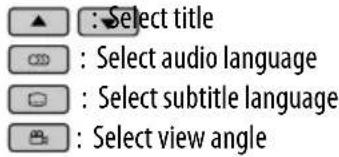
16 • DVD: Selects audio language ( ○○○), subtitles (□□□), angle ( ).
• VCD: Selects audio channel ( 🐎 ).
*1 Functions as number buttons when pressed with SHIFT button.
- FM/AM/DAB: Selects preset stations/services.
- DISC: Selects chapter/title/folder/track.
*2 Functions as +10/-10/+100/-100 buttons when pressed with SHIFT button.
*3 ▲: Returns to the previous menu.
▼: Confirms the selection.
Listening to the radio
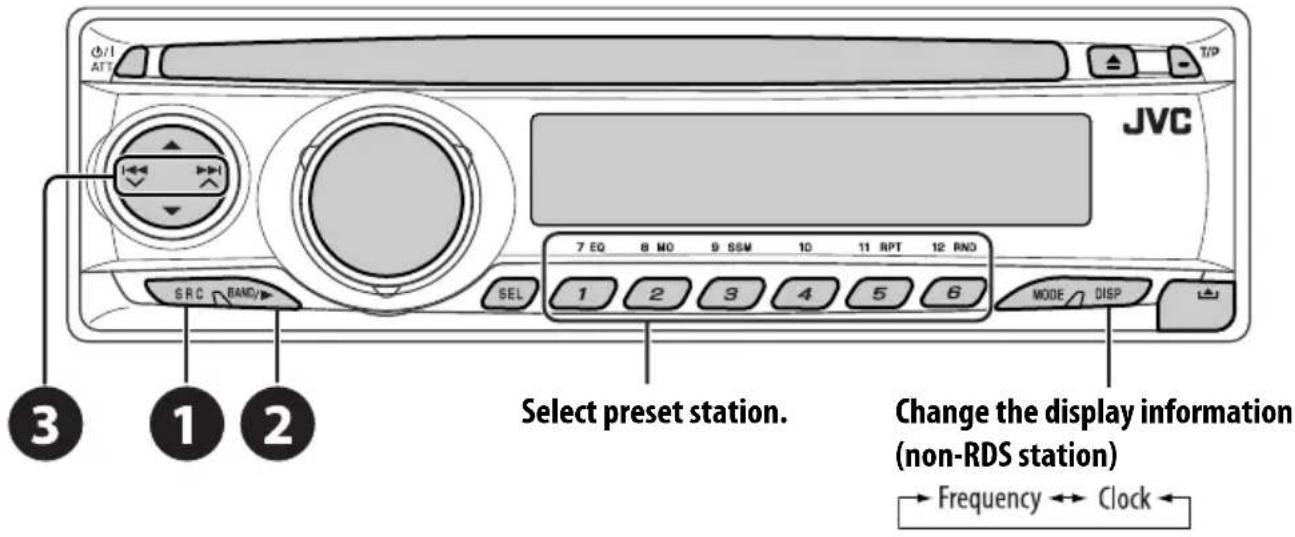
① Select "FM/AM."
② Select the bands.

③ Search for a station to listen—Auto Search.
- Manual Search: Hold either one of the buttons until "M" flashes on the display, then press it repeatedly.
Lights up when receiving an FM stereo broadcast with sufficient signal strength.

Note:
FM1 and FM2: 87.5 MHz - 108.0 MHz
FM3: 65.00 MHz - 74.00 MHz
When an FM stereo broadcast is hard to receive

flowchart
graph LR
    A["8 MO"] --> B["2"]
    B --> C["MONO"]
    C --> D["MONO OFF (Canceled)"]
Reception improves, but stereo effect will be lost.
• MO indicator lights up.
FM station automatic presetting —SSM (Strong-station Sequential Memory)
You can preset six stations for each band.

3
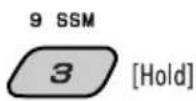
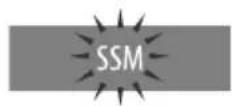
Local FM stations with the strongest signals are searched and stored automatically in the FM band.
Manual presetting
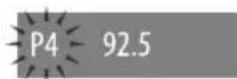
Ex.: Storing FM station of 92.5 MHz into preset number 4 of the FM1 band.


Searching for FM RDS programme — PTY search
![1 [Hold] JVC 7 EQ 8 MO 9 SSM 10 11 RPT 12 AND 1 2 3 4 5 6 MODE DISP 3 2 Change the display information Station → Station name (PS) frequency Clock ← PTY ←](/content/2026/05/1046311/images/fcaf9f9138d647a490529a3d64f9f08305587e505b9b93bd1c971bcdd20de4a3.jpg)
① Activate PTY Search.
② Select one of the PTY codes (programme types).
See the following for details.
③ Start searching.
If there is a station broadcasting a programme of the same PTY code as you have selected, that station is tuned in.
Preset PTY codes in the number buttons (1 to 6):
| 1 | 2 | 3 | 4 | 5 | 6 |
| POP M | ROCK M | EASY M | CLASSICS | AFFAIRS | VARIED |
PTY codes (available with the control dial): NEWS, AFFAIRS, INFO, SPORT, EDUCATE, DRAMA, CULTURE, SCIENCE, VARIED, POP M (music), ROCK M (music), EASY M (music), LIGHT M (music), CLASSICS, OTHER M (music), WEATHER, FINANCE, CHILDREN, SOCIAL, RELIGION, PHONE IN, TRAVEL, LEISURE, JAZZ, COUNTRY, NATION M (music), OLDIES, FOLK M (music), DOCUMENT
Storing your favorite programme types
You can store your favorite PTY codes into the number buttons.
1 Select a PTY code (see left column).
2 Select a preset number.
![7 EQ 8 MO 9 SSM 10 11 RPT 12 RND 1 2 3 4 5 6 [Hold]](/content/2026/05/1046311/images/af8bb703256fa25abe91dd66cd1e0ab26c616f011b62e4921166a3a352dda18b.jpg)
3 Repeat steps 1 and 2 for storing other PTY codes.
4 T/P
Activating/deactivating TA/PTY Standby Reception
| TA Standby Reception Indicator | PTY Standby Reception Indicator | ||
| Pressto activate. | TP | See page 23. | PTY |
| The unit temporarily will switch to Traffic Announcement (TA), if available, from any source other than AM.The volume changes to the preset TA volume level if the current level is lower than the preset level (see page 23). | Lights up The unit temporarily will switch to your favorite PTY programme from any source other than AM. | Lights up | |
| Not yet activated. Tune in to another station providing the RDS signals. | Flashes Not yet activated. Tune in to another station providing the RDS signals. | Flashes | |
| Pressto deactivate. | Goes off Select “OFF” for the PTY code (see page 23). | Goes off | |
Tracing the same programme—Network-Tracking Reception
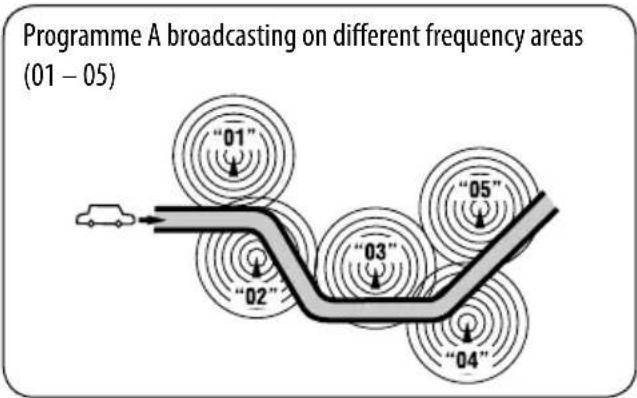
When driving in an area where FM reception is not sufficient enough, this unit automatically tunes in to another FM RDS station of the same network, possibly broadcasting the same programme with stronger signals (see the illustration on the right).
When shipped from the factory, Network-Tracking Reception is activated.
To change the Network-Tracking Reception setting, see "AF-REG" on page 23.
- When the DAB tuner is connected, refer to "Tracing the same programme—Alternative Frequency Reception" on page 19.
flowchart
graph TD
    A["Car"] --> B["01"]
    B --> C["02"]
    C --> D["03"]
    D --> E["04"]
    E --> F["05"]
    style A fill:#f9f,stroke:#333
    style B fill:#ccf,stroke:#333
    style C fill:#cfc,stroke:#333
    style D fill:#fcc,stroke:#333
    style E fill:#cff,stroke:#333
    style F fill:#ffc,stroke:#333
Automatic station selection—Programme Search
Usually when you press the number buttons, the preset station is tuned in.
If the signals from the RDS preset station are not sufficient for good reception, this unit, using the AF data, tunes in to another frequency broadcasting the same programme as the original preset station is broadcasting.
- The unit takes some time to tune in to another station using programme search.
• See also page 24.
Disc operations
Before performing any operations...
Turn on the monitor for playing a DVD or VCD. If you turn on the monitor, you can also control playback of other discs by referring to the monitor screen. (See pages 15 – 17.)
The disc type is automatically detected, and playback starts automatically (for DVD: automatic start depends on its internal program).
If the current disc does not have any disc menu (when playback stops), all tracks will be played repeatedly until you change the source or eject the disc.
If “☒” appears on the monitor when pressing a button, the unit cannot accept the operation you have tried to do.
- In some cases, without showing “ ⊗,” operations will not be accepted.
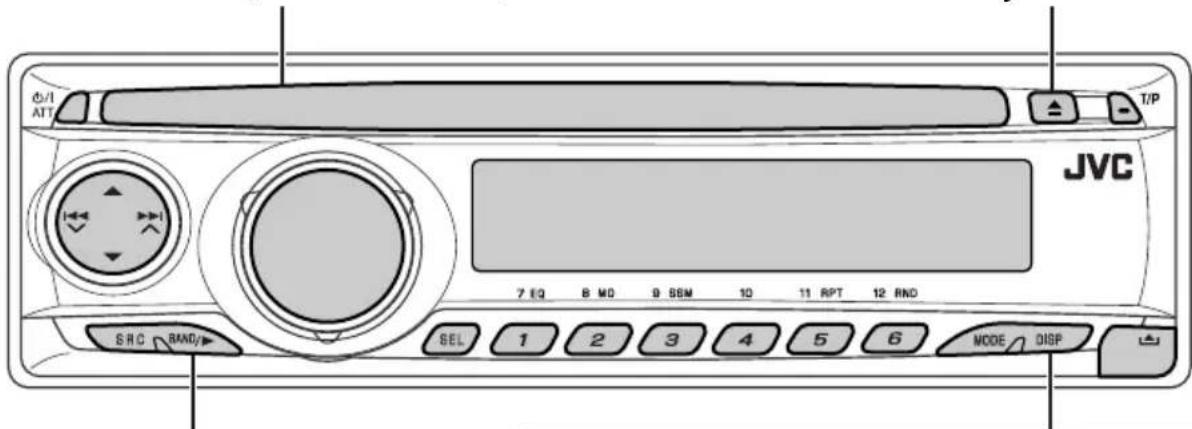
Insert disc.
Playback starts automatically with most of the discs.
Eject disc.
Start playback if necessary.
Prohibiting disc ejection
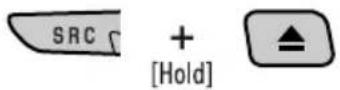
To cancel the prohibition, repeat the same procedure.
*1 If the file does not have Tag information or "TAG DISP" is set to "TAG OFF" (see page 24), folder name and file name appear. TAG indicator will not light up.
*2 "NO NAME" appears for an audio CD.
Change the display information

flowchart
graph LR
    A["DVD"] --> B["Elapsed"]
    B --> C["Clock"]
    C --> D["Current title and chapter number"]
    B --> E["playing time"]

flowchart
graph LR
    A["VCD"] --> B["Elapsed playing time and Current track number"]
    B --> C["Clock and Current track number"]
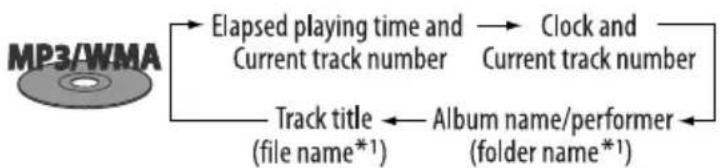
flowchart
graph TD
    A["MP3/WMA"] --> B["Elapsed playing time and Current track number"]
    B --> C["Clock and Current track number"]
    C --> D["Album name/performer (folder name*1)"]
    D --> E["Track title (file name*1)"]
    E --> D

Operations using the control panel
Pressing (or holding) the following buttons allows you to...
 |  |  (Number buttons) (Number buttons) | |
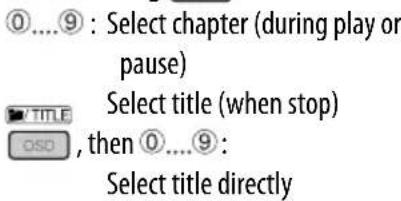
 | Press: Select chapterHold: Reverse /fast-forward chapter* | — | During stop: Locate titleDuring play/pause: Locate chapter |
 | Press: Select trackHold: Reverse /fast-forward track* | — | Locate particular track directly (PBC not in use) |
 | Select track Select folder Locate particular folder directly | ||
 | Press: Select trackHold: Reverse /fast-forward track* | — | Locate particular track directly |
* Search speed changes to >on the monitor.
After pressing MODE, press the following buttons to...
| Disc type | 11 RPT5 | 12 RND6 | |
 | Skip 10 chapters (during play or pause) | CHP RPT:Repeat current chapterTIT RPT:Repeat current title | — |
 | Skip 10 tracks (PBC not in use) TRK RPT: | Repeat current track (PBC not in use) | DISC RND:Randomly play all tracks (PBC not in use) |
 | Skip 10 tracks (within the same folder) | TRK RPT:Repeat current trackFLDR RPT:Repeat current folder | FLDR RND:Randomly play all tracks of current folder, then tracks of next foldersDISC RND:Randomly play all tracks |
 | Skip 10 tracks TRK RPT: | Repeat current track | DISC RND:Randomly play all tracks |
- To cancel repeat play or random play, select "RPT OFF" or "RND OFF."
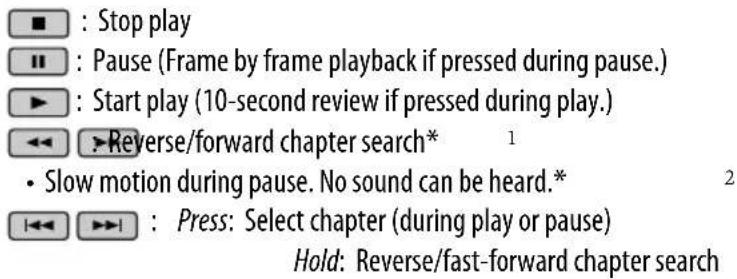
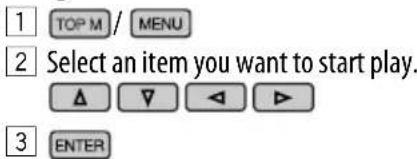
Using menu driven features...
While holding 3
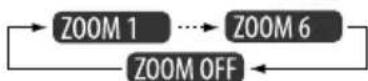
To enlarge the view (Zoom in)...
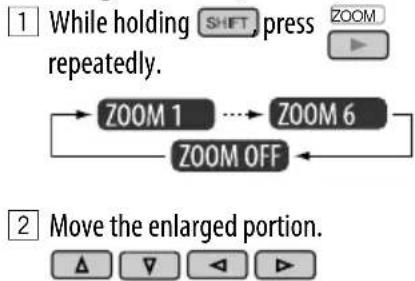
flowchart
graph TD
    A["While holding SHIFT press repeatedly."] --> B["ZOOM 1"]
    B --> C["ZOOM 6"]
    C --> D["ZOOM OFF"]
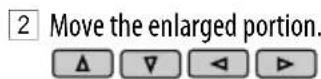
    D --> E["Move the enlarged portion."]
• To cancel zoom, select "ZOOM OFF."
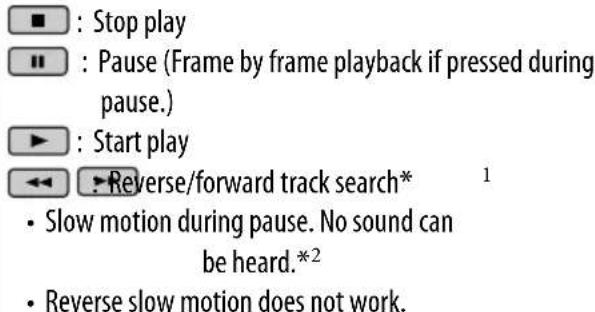

Hold: Reverse/fast-forward track search While holding SHIFT, press ZOOM repeatedly.
: Select audio channel (ST: stereo, L: left, R: Right)
While holding SHIFT ...\*3

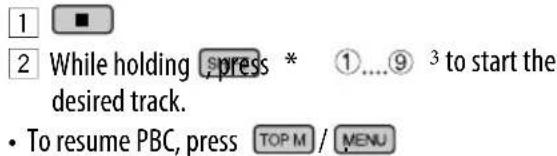
Canceling the PBC playback...
To enlarge the view (Zoom in)...

- To cancel zoom, select "ZOOM OFF."

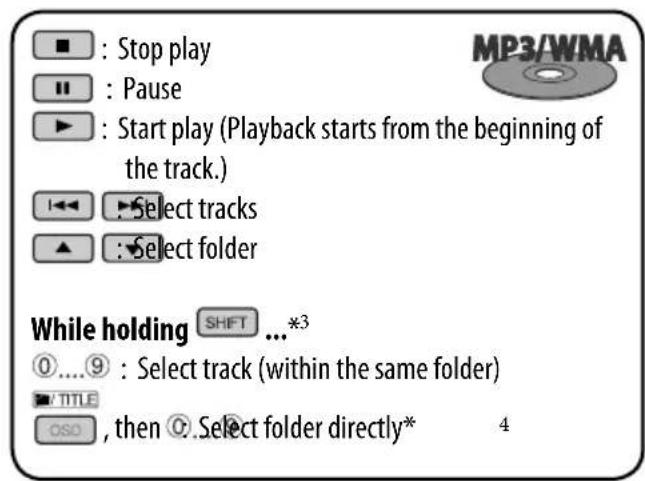
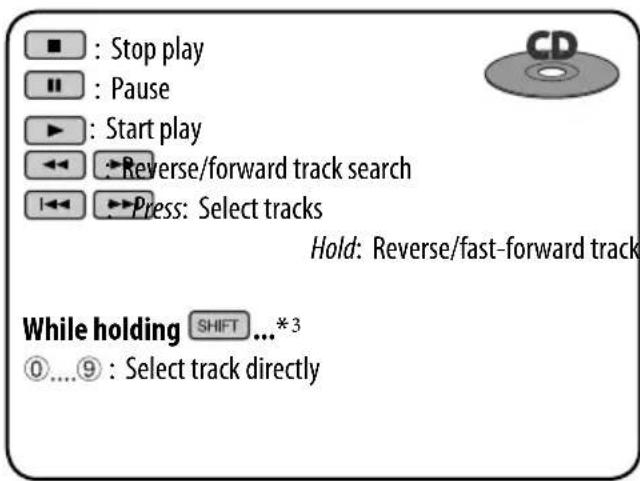
*1 Search speed changes to ×2 ⇒ ×5 ⇒ ×10 ⇒ ×20 ⇒ ×60 on the monitor if pressed repeatedly.
*2 Slow motion speed changes to ▶1/32 → ▶1/16 → ▶1/8 → ▶1/4 → ▶1/2 on the monitor if pressed repeatedly.
*3 For selecting numbers greater than 9 or 99, press +10 or +100, then follow by ①....⑨
*4 To use direct folder access on MP3/WMA discs, it is required that folders are assigned with 2-digit numbers at the beginning of their folder names—01, 02, 03, and so on.
Operations using the on-screen bar
These operations are possible on the monitor using the remote controller.
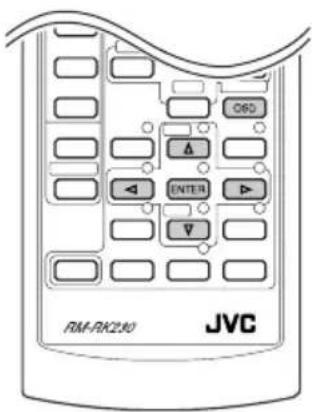
1 Show the on-screen bar (see page 16).
(once) for MP3/WMA/CD (twice) for DVD/VCD
② Select an item.

③ Make a selection.
ENTER
If pop-up menu appears...

- For entering time/numbers, see the following.
4 Remove the on-screen bar.
OSD
Entering time/numbers
• To select numbers 0 - 9:
While holding SHIFT, press ①....⑨
• To select numbers greater than 9:
While holding SHIFT, press .+ Then, press ①....⑨.
• After entering the numbers, press ENTER.
• To reduce numbers, use -10.
• To correct a misentry, use ▶.
Ex.: Time search
- DVD: _:_:_:_
To enter 1 (hours): 02 (minutes): 00 (seconds), press 1, 0, 2, 0, then 0.
• VCD (PBC not in use): __:__
To enter 64 (minutes): 00 (seconds), press 6, 4, 0, then 0.
Continued on the next page
On-screen bar
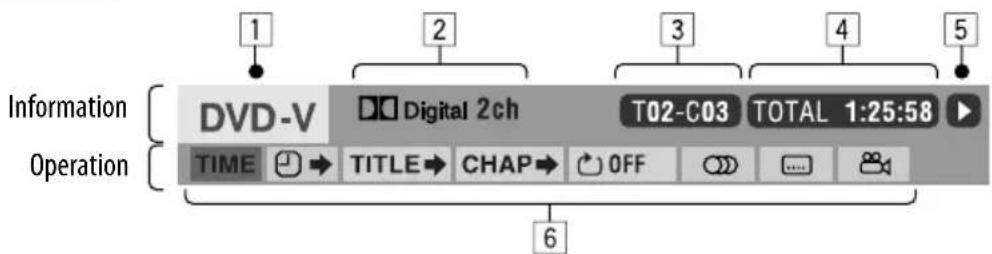
1 Disc type
2 DVD/DTS audio CD: Audio signal format type
VCD: PBC
3 Playback information
T02-C03 Current title/chapter
TRACK 01 Current track
4 Time indication
TOTAL Elapsed playing time of the disc (For DVD, elapsed playing time of the current title.)
T. REM DVD: Remaining title time
VCD: Remaining disc time
TIME Elapsed playing time of the current chapter/track
REM Remaining time of the current chapter/track
5 Playback status
Play
Forward/reverse search
Forward/reverse slow-motion
Pause
Stop
6 Operation icons
TIME Change the time indication (see 4)
Time Search (Enter the elapsed playing time of the current title or of the disc.)
TITLE→ Title Search (by its number)
CHAP→ Chapter Search (by its number)
TRACK→ Track Search (by its number)
Change the audio language or audio channel
Change the subtitle language
Change the view angle
OFF DVD: Repeat play
REPEAT VCD/MP3/WMA/CD: Repeat play
INTRO Intro play
RANDOM Random play

Repeat play*1

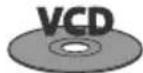
(PBC not in use)
Repeat play*1

Random play ^*1

Intro play*2


Repeat play ^*1 :

Random play ^*1 :

Intro play ^*2 :

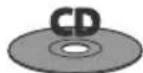
Repeat play*1

Random play*1

Intro play*2

*1 For repeat play/random play, see also page 13.
*2 Plays the beginning 15 seconds of...
INTRO TRACK (INTRO): All tracks of the current disc.
INTRO FOLDER: First tracks of all folders of the current disc.
Operations using the control/list screen (MP3/WMA/CD)
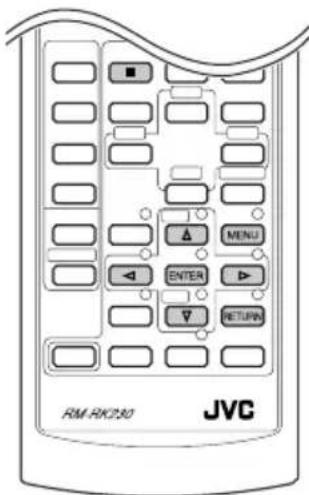
These operations are possible on the monitor using the remote controller.
- Folder selection/information is only for MP3/WMA discs.
Control screen
The control screen automatically appears when you insert a disc.
① Select "Folder" column or "Track" column on the control screen.

② Select a folder or track to start playing.
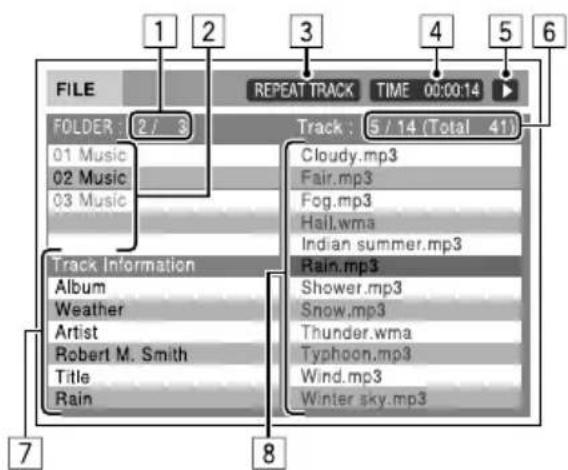
Ex.: MP3/WMA disc
1 Current folder number/total folder number
2 Folder list with the current folder selected
3 Selected playback mode
4 Elapsed playing time of the current track
5 Operation mode icon (▶, ■, □, ▶▶, ◀◀)
6 Current track number/total number of tracks in the current folder (total number of tracks on the disc)
7 Track information
8 Track list with the current track selected
Folder/track list screen
Before playing, you can display the folder list/track list to confirm the contents and start playing a track.
1 Display the folder/track list while stop.
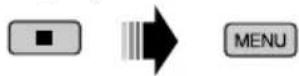
② Select an item from the list.
- MP3/WMA: Track list of the selected folder appears.
• To go back to the previous screen, press RETURN.
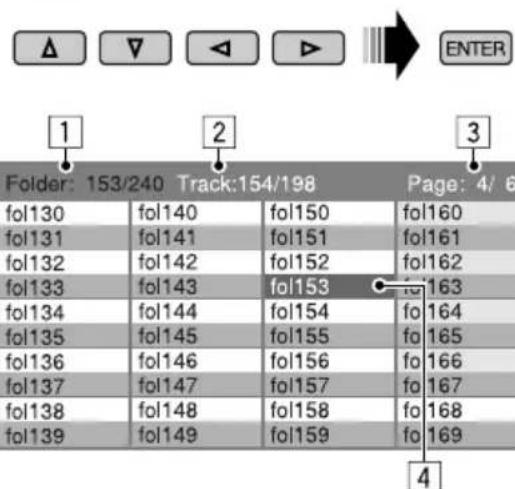
Ex.: Folder list
1 Current folder number/total folder number
2 Current track number/total number of tracks in the current folder or in disc (CD)
3 Current page/total number of the pages included in the list
4 Current folder/track (highlighted bar)
Listening to the CD changer
It is recommended to use a JVC MP3-compatible CD changer with your unit.
- You can only play conventional CD (including CD Text) and MP3 discs.
① Select "CD-CH."
② Select a disc to start playing.
Press: For selecting disc number 1 - 6.
Hold: For selecting disc number 7 - 12.
 | Press: Select trackHold: Reverse/fast-forward track |
 | MP3: Select folders |
After pressing , press the following buttons to...
 | Skip 10 tracks (MP3: within the same folder) |
11 RPT | TRK RPT: Repeat current trackFLDR RPT: MP3: Repeat all tracks of current folderDISC RPT: Repeat all tracks of the current disc |
12 RND | FLDR RND: MP3: Randomly play all tracks of the current folder, then tracks of the next folderDISC RND: Randomly play all tracks of current discMAG RND: Randomly play all tracks of the inserted discs |
- To cancel repeat play or random play, select "RPT OFF" or "RND OFF."
Listening to the DAB tuner
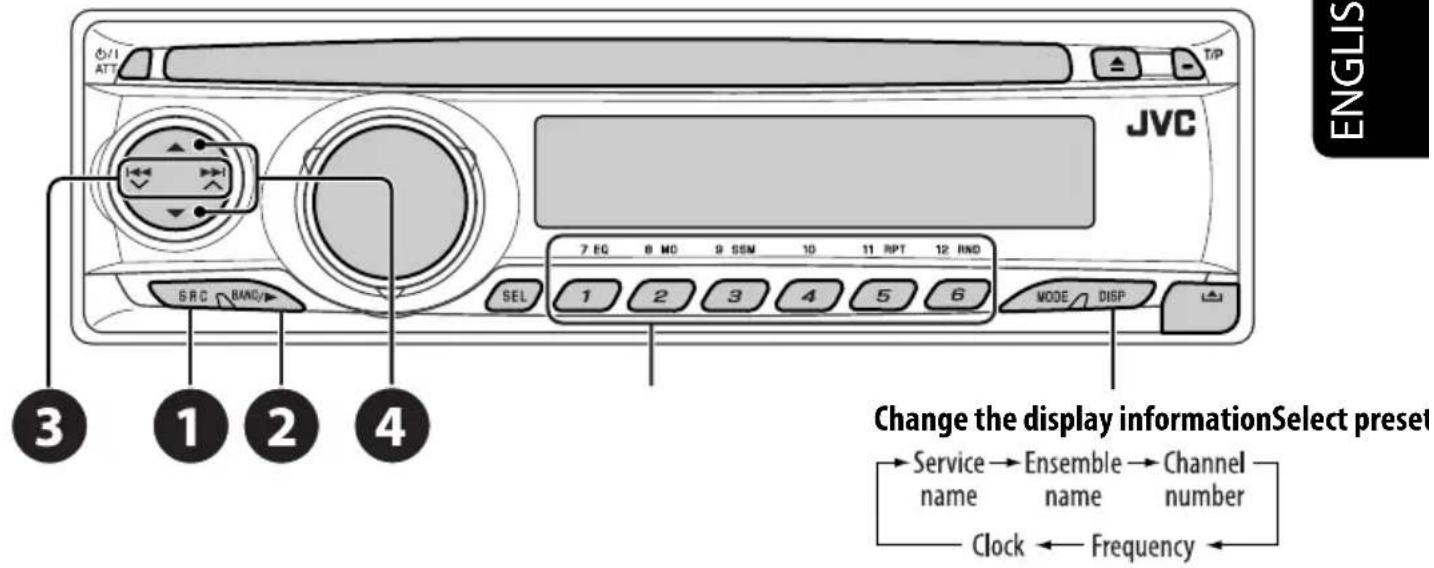
① Select "DAB."
② Select the bands.

③ Searching for an ensemble.
- Manual Search: Hold either one of the buttons until "M" flashes on the display, then press it repeatedly.
4 Select a service (either primary or secondary) to listen to.
Storing DAB services in memory
While listening to a DAB service...
![7 EQ 8 MO 9 SSM 10 11 RPT 12 RND 1 2 3 4 5 6 [Hold]](/content/2026/05/1046311/images/d65323ca27bb3fcccf366862a51b355dcf60026d26f2cb0aa0d3225f9d85ea1e.jpg)
Activating/deactivating TA/PTY Standby Reception
- Operations are exactly the same as explained on page 11 for FM RDS stations.
- You cannot store PTY codes separately for the DAB tuner and for the FM tuner.
Tracing the same programme—Alternative Frequency Reception
• While receiving a DAB service:
When driving in an area where a service cannot be received, this unit automatically tunes in to another ensemble or FM RDS station, broadcasting the same programme.
• While receiving an FM RDS station:
When driving in an area where a DAB service is broadcasting the same programme as the FM RDS station is broadcasting, this unit automatically tunes in to the DAB service.
When shipped from the factory, Alternative Frequency Reception is activated.
To deactivate the Alternative Frequency Reception, see page 24.
Listening to the iPod®/D. player
Before operating, connect the interface adapter (KS-PD100 or KS-PD500) to the CD changer jack of this unit.
Preparations:
Make sure “CHANGER” is selected for the external input setting, see page 24.
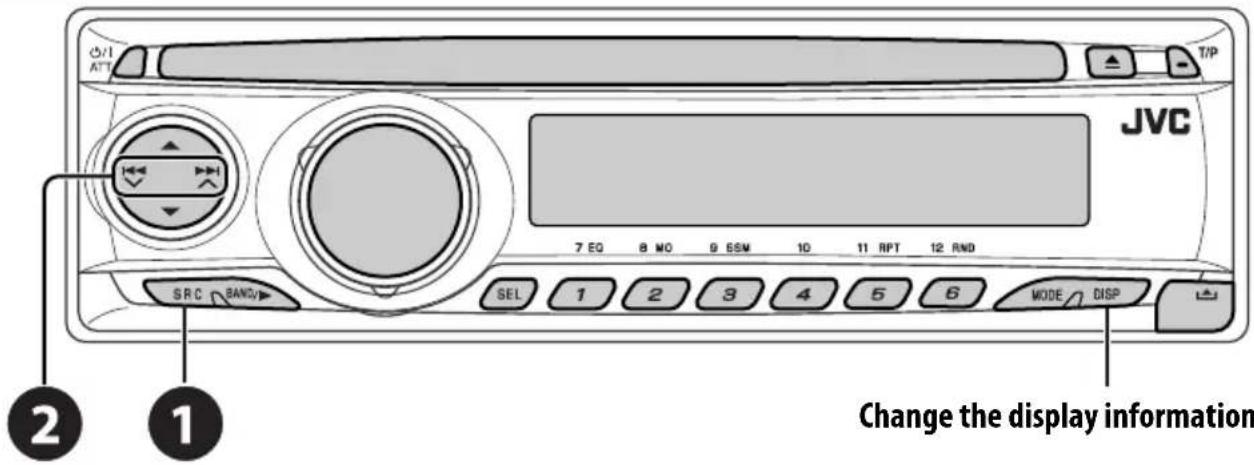
① Select "IPOD" or "D. PLAYER."
② Select a song to start playing.
Selecting a track from the menu
1 Enter the main menu.
- This mode will be canceled if no operations are done for about 5 seconds.
2 Select the desired menu.
For iPod: PLAYLIST ↔ ARTISTS ↔ ALBUMS ↔ SONGS ↔ GENRES ↔ COMPOSER ↔ (back to the beginning) For D. player: PLAYLIST ↔ ARTIST ↔ ALBUM ↔ GENRE ↔ TRACK ↔ (back to the beginning)
3 Confirm the selection.
• To move back to the previous menu, press ▲.
- If a track is selected, playback starts automatically. - Holding ▼|◀◀/▶▶| can skip 10 items at a time.
 | Pause/stop playback• To resume playback, press it again. |
 | Press: Select tracksHold: Reverse/fast-forward track |
After pressing press the following buttons to...
11 RPT | ONE RPT:Functions the same as “Repeat One” or “Repeat Mode → One.”ALL RPT:Functions the same as “Repeat All” or “Repeat Mode → All.” |
12 RND | ALBM RND*:Functions the same as “Shuffle Albums” of the iPod.SONG RND/RND ON:Functions the same as “Shuffle Songs” or “Random Play → On.” |
- To cancel repeat play or random play, select "RPT OFF" or "RND OFF."
* iPod: Only if you select "ALL" in "ALBUMS" of the main "MENU."
Listening to the other external components
You can connect an external component to the CD changer jack on the rear using the Line Input Adapter—KS-U57 (not supplied) or AUX Input Adapter—KS-U58 (not supplied).
Preparations:
Make sure "EXT IN" is selected for the external input setting, see page 24.
① Select "EXT IN."
② Turn on the connected component and start playing the source.
③ Adjust the volume.
4 Adjust the sound as you want (see page 22).
Concept diagram of the external device connection
- For connection, see Installation/Connection manual (separate volume).
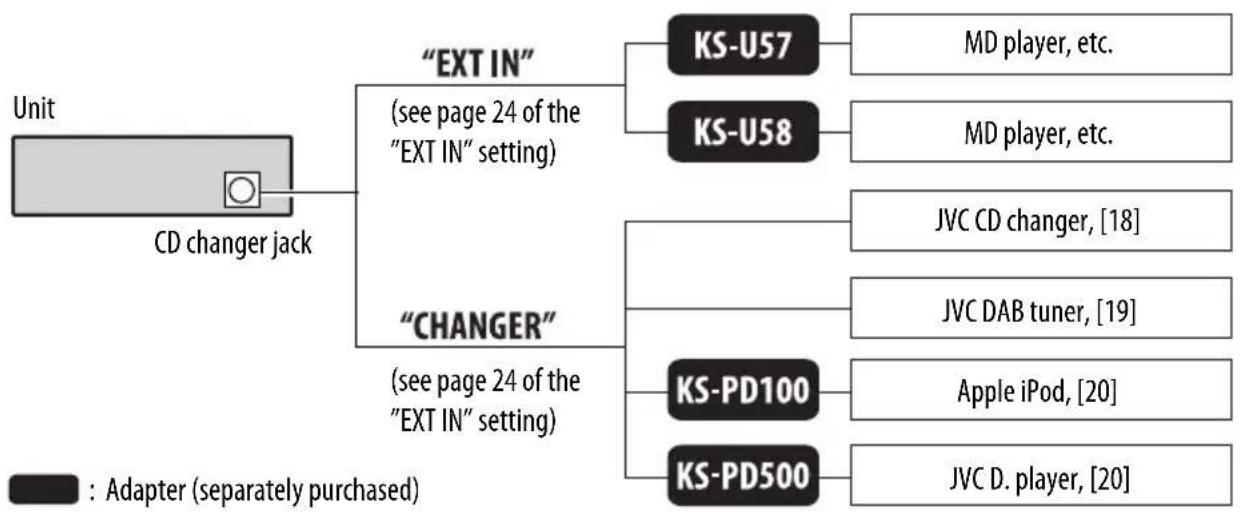
flowchart
graph TD
    A["Unit"] --> B["EXT IN"]
    B --> C["KS-U57"]
    B --> D["KS-U58"]
    C --> E["MD player, etc."]
    D --> F["MD player, etc."]
    G["CHANGER"] --> H["JVC CD changer, [18"]]
    G --> I["JVC DAB tuner, [19"]]
    G --> J["KS-PD100"]
    G --> K["Apple iPod, [20"]]
    G --> L["KS-PD500"]
    M[": Adapter (separately purchased)"] --> N["..."]
Selecting a preset sound mode — C-EQ
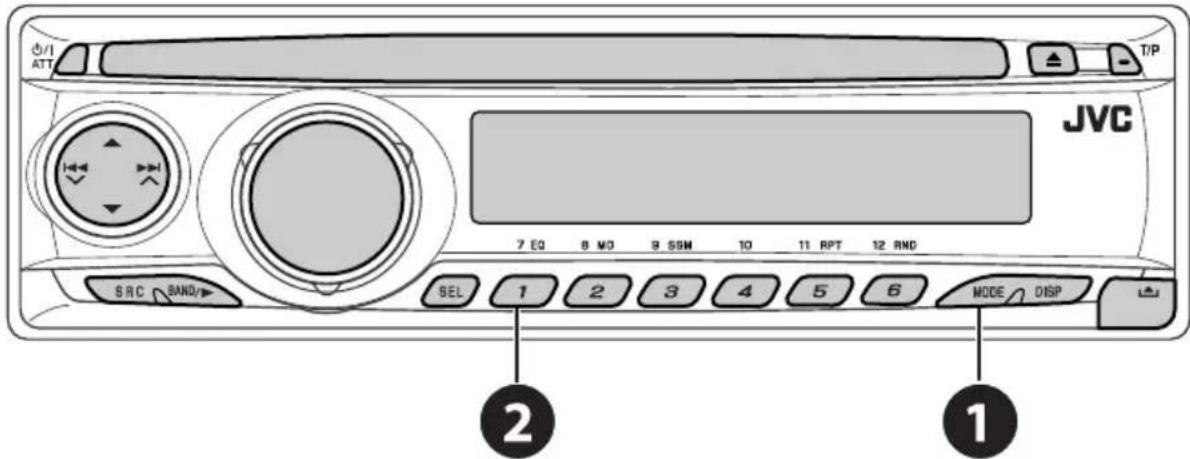
① Enter functions mode.
② Select a preset sound mode.
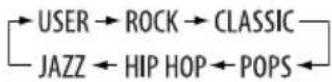
| Indication (For) | BAS TRE LOUD(bass) (treble) (loudness) | |
| USER (Flat sound) 00 00 OFF | ||
| ROCK (Rock or disco music) | +03 +01 ON | |
| CLASSIC (Classical music) +01 -02 OFF | ||
| POPS (Light music) +04 +01 OFF | ||
| HIP HOP(Funk or rap music) | +02 00 ON | |
| JAZZ (Jazz music) | +02 +03 OFF | |
Adjusting the sound
1
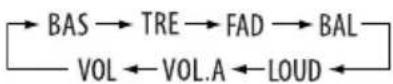
2 Adjust the level.

| BAS*1 (bass)Adjust the bass. | -06 to +06 |
| TRE*1 (treble)Adjust the treble. | -06 to +06 |
| FAD*2 (fader)Adjust the front and rear speaker balance. | R06 to F06 |
| BAL (balance)Adjust the left and right speaker balance. | L06 to R06 |
| LOUD*1 (loudness)Boost low and high frequencies to produce a well-balanced sound at low volume level. | LOUD ON or LOUD OFF |
| VOL.A*3 (volume adjust)Adjust and store auto-adjustment volume level for each source, comparing to the FM volume level. | -05 to +05 |
| VOL (volume)Adjust the volume. | 00 to 30(or 50)*4 |
*1 When you adjust the bass, treble, or loudness, the adjustment you have made is stored for the currently selected sound mode (C-EQ) including "USER."
*2 If you are using a two-speaker system, set the fader level to "00."
*3 You cannot make an adjustment for FM. "FIX" appears.
*4 Depending on the amplifier gain control setting. (See page 24 for details.)
General settings — PSM
You can change PSM (Preferred Setting Mode) items listed in the table that follows.
1 Enter the PSM settings.
[Hold]
2 Select a PSM item.
3 Select or adjust the selected PSM item.

[Turn]
4 Repeat steps 2 and 3 to adjust other PSM items if necessary.
5 Finish the procedure.
| Indication Item | Setting, [reference page] | |
| DEMODisplay demonstration | • DEMO ON [Initial] | : Display demonstration will be activated automatically if no operation is done for about 20 seconds, [5]. |
| • DEMO OFF | : Cancels. | |
| CLOCK HHour adjustment | 0 – 23 (1 – 12)[Initial: 0 (0:00)] | : See also page 5 for setting. |
| CLOCK MMinute adjustment | 00 – 59[Initial: 00 (0:00)] | : See also page 5 for setting. |
| 24H/12HTime display mode | • 12H• 24H [Initial] | : See also page 5 for setting. |
| CLK ADJClock adjustment | • AUTO [Initial] | : The built-in clock is automatically adjusted using the CT (clock time) data in the RDS signal. |
| • OFF | : Cancels. | |
| AF-REG*1Alternative frequency/regionalization reception | • AF [Initial] | : When the currently received signals become weak, the unit switches to another station or service (the programme may differ from the one currently received), [11, 19]. |
| • AF REG | : When the currently received signals become weak, the unit switches to another station broadcasting the same programme. | |
| • OFF | : Cancels (not selectable when “DAB AF” is set to “AF ON”). | |
| PTY-STBYPTY standby | OFF [Initial], PTY codes (see page 10) | : Activates PTY Standby Reception with one of the PTY codes, [11, 19]. |
| TA VOLTraffic announcement volume | VOL 15 [Initial] : VOL 00 – VOL 30 or 50*2, [11]. | |
| P-SEARCH*1Programme search | • ON• OFF [Initial] | : Activates Programme Search, [11].: Cancels. |
| DAB AF*3Alternative frequency reception | • AF ON [Initial]• AF OFF | : Traces the programme among DAB services and FM RDS stations, [19].: Cancels. |
| DIMMER • ON | : Dims the display illumination.: Cancels. | |
| TELTelephone muting | • MUTING 1/MUTING 2• OFF [Initial] | : Select either one which mutes the playback sounds while using a cellular phone.: Cancels. |
| SCROLL^*4 | • ONCE [Initial]• AUTO• OFF | : Scrolls the track information once.: Repeats scrolling (5-second intervals).: Cancels. (Holding DISP can scroll the display regardless of the setting.) |
| EXT IN*5External input | • CHANGER[Initial]• EXT IN | : To use a JVC CD changer, [18], JVC DAB tuner, [19], or an Apple iPod/a JVC D. player, [20].: To use any other external component than the above, [21]. |
| TAG DISPTag display | • TAG ON [Initial]• TAG OFF | : Shows the tag while playing MP3/WMA tracks.: Cancels. |
| AMP GAINAmplifier gain control | • LOW PWR• HIGH PWR[Initial] | : VOL 00 – VOL 30 (Select if the maximum power of each speaker is less than 50 W to prevent the speaker from being damaged.): VOL 00 – VOL 50 |
| IF BANDIntermediate frequency filter | • AUTO [Initial]• WIDE | : Increases the tuner selectivity to reduce interference noises between adjacent stations. (Stereo effect may be lost.): Subject to interference noises from adjacent stations, but sound quality will not be degraded and the stereo effect will remain. |
*1 Only for RDS FM preset stations.
^*2 Depending on the “AMP GAIN” setting.
*3 Displayed only when DAB tuner is connected.
*4 Some characters or symbols will not be shown correctly (or will be blanked) on the display.
*5 Displayed only when one of the following sources is selected—FM, AM, or DISC.
DVD setup menu
These operations are possible on the monitor using the remote controller.
① Enter the DVD setup menu while stop.
② Select a menu.
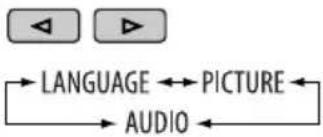
flowchart
graph LR
    A["◀"] --> B["→ LANGUAGE ←→ PICTURE ←"]
    C["▶"] --> D["→ AUDIO ←"]
③ Select an item you want to set up.
4 Select an option.
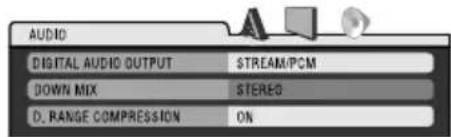
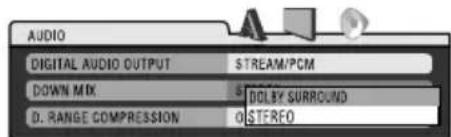
To return to normal screen
SETUP
| Menu Item Setting | ||
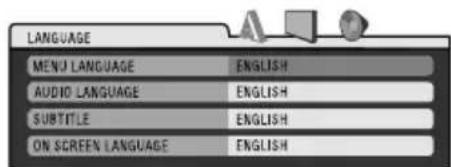
| LANGUAGE | MENU LANGUAGE | Select the initial disc menu language. Refer also to “Language codes” on page 27. |
| AUDIO LANGUAGE | Select the initial audio language. Refer also to “Language codes” on page 27. | |
| SUBTITLE | Select the initial subtitle language or remove the subtitle (OFF). Refer also to “Language codes” on page 27. | |
| ON SCREEN LANGUAGE | Select the language for the on screen display. | |
| PICTURE | MONITOR TYPE | Select the monitor type to watch a wide screen picture on your monitor. |
| 16:94:3 LETTER BOX4:3 PAN SCAN | ||
| OSD POSITION | Select the on-screen bar position on the monitor.• 1: Higher position• 2: Lower position (Guidance below the DVD setup menu will disappear.) | |
| Menu Item Setting | ||
| AUDIO | DIGITAL AUDIO OUTPUT | Select the signal format to be emitted through the DIGITAL OUT (Optical) terminal.•PCM ONLY: Select for an amplifier or a decoder incompatible with Dolby Digital, DTS, MPEG Audio, or connecting to a recording device.•DOLBY DIGITAL/PCM: Select for an amplifier or a decoder compatible with Dolby Digital.•STREAM/PCM: Select for an amplifier or a decoder compatible with Dolby Digital, DTS, and MPEG Audio. |
| DOWN MIX When playing back a multi-channel disc, this setting affects the signals reproduced through the LINE OUT jacks (and through the DIGITAL OUT terminal when “PCM ONLY” is selected for “DIGITAL AUDIO OUTPUT”).•DOLBY SURROUND: Select to enjoy multi-channel surround audio by connecting an amplifier compatible with Dolby Surround.•STEREO: Normally select this. | ||
| D. RANGE COMPRESSION | You can enjoy a powerful sound at low or middle volume levels while playing a Dolby Digital software.•AUTO: Select to apply the effect to multi-channel encoded software (excluding 1-channel and 2-channel software).•ON: Select to always use this function. | |
Output signals through the DIGITAL OUT terminal
Output signals are different depending on the “DIGITAL AUDIO OUTPUT” setting on the setup menu (see above).
| DIGITAL AUDIO OUTPUT | Output Signals | ||
| STREAM/PCM DOLBY DIGITAL/PCM PCM ONLY | |||
| DVD 48 kHz, 16/20/24 bits Linear PCM | 48 kHz, 16 bits stereo Linear PCM | ||
| 96 kHz, Linear PCM | |||
| with DTS DTS bitstream 48 kHz, 16 bits stereo Linear PCM | |||
| with Dolby Digital | Dolby Digital bitstream | 48 kHz, 16 bits stereo Linear PCM | |
| with MPEG Audio MPEG bitstream | 48 kHz, 16 bits Linear PCM | ||
| Audio CD, Video CD | 44.1 kHz, 16 bits stereo Linear PCM/48 kHz, 16 bits stereo Linear PCM | ||
| Audio CD with DTS | DTS bitstream 44.1 kHz, 16 bits stereo Linear PCM | ||
| MP3/WMA | 32/44.1/48 kHz, 16 bits Linear PCM | ||
Language codes
| Code Language Code Language Code Language Code Language | |||||||
| AA Afar GL Galician MK Macedonian SO Somali | |||||||
| AB | Abkhazian GN | Guarani ML | Malayalam SQ | Albanian | |||
| AF Afrikaans GU Gujarati MN Mongolian SR Serbian | |||||||
| AM | Ameharic | HA | Hausa | MO | Moldavian | SS | Siswati |
| AR | Arabic | HI | Hindi | MR | Marathi | ST | Sesotho |
| AS | Assamese | HR | Croatian | MS | Malay (MAY) | SU | Sundanese |
| AY | Aymara | HU | Hungarian | MT | Maltese | SW | Swahili |
| AZ | Azerbaijani | HY | Armenian | MY | Burmese | TA | Tamil |
| BA | Bashkir | IA | Interlingua | NA | Nauru | TE | Telugu |
| BE | Byelorussian | IE | Interlingue | NE | Nepali | TG | Tajik |
| BG | Bulgarian | IK | Inupiak | NO | Norwegian | TH | Thai |
| BH | Bihari | IN | Indonesian | OC | Occitan | TI | Tigrinya |
| BI | Bislama | IS | Icelandic | OM | (Afan) Oromo | TK | Turkmen |
| BN | Bengali, Bangla | IW | Hebrew | OR | Oriya | TL | Tagalog |
| BO | Tibetan | JI | Yiddish | PA | Panjabi | TN | Setswana |
| BR | Breton | JW | Javanese | PL | Polish | TO | Tonga |
| CA | Catalan | KA | Georgian | PS | Pashto, Pushto | TR | Turkish |
| CO | Corsican | KK | Kazakh | PT | Portuguese | TS | Tsonga |
| CS | Czech | KL | Greenlandic | QU | Quechua | TT | Tatar |
| CY | Welsh | KM | Cambodian | RM | Rhaeto-Romance | TW | Twi |
| DZ | Bhutani | KN | Kannada | RN | Kirundi | UK | Ukrainian |
| EL | Greek | KO | Korean (KOR) | RO | Rumanian | UR | Urdu |
| EO | Esperanto | KS | Kashmiri | RW | Kinyarwanda | UZ | Uzbek |
| ET | Estonian | KU | Kurdish | SA | Sanskrit | VI | Vietnamese |
| EU | Basque | KY | Kirghiz | SD | Sindhi | VO | Volapuk |
| FA | Persian | LA | Latin | SG | Sangho | WO | Wolof |
| FI | Finnish | LN | Lingala | SH | Serbo-Croatian | XH | Xhosa |
| FJ | Fiji | LO | Laothian | SI | Singhalese | YO | Yoruba |
| FO | Faroese | LT | Lithuanian | SK | Slovak | ZU | Zulu |
| FY | Frisian | LV | Latvian, Lettish | SL | Slovenian | ||
| GA Irish | MG | Malagasy SM Samoan | |||||
| GD | Scots Gaelic | MI | Maori | SN | Shona | ||
Maintenance
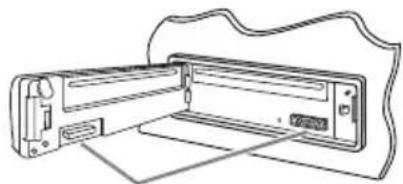
How to clean the connectors
Frequent detachment will deteriorate the connectors.
To minimize this possibility, periodically wipe the connectors with a cotton swab or cloth moistened with alcohol, being careful not to damage the connectors.
natural_image
Line drawing of a device with a rectangular panel and a curved handle (no text or symbols)Connector
Moisture condensation
Moisture may condense on the lens inside the DVD/CD player in the following cases:
• After starting the heater in the car.
• If it becomes very humid inside the car.
Should this occur, the DVD/CD player may malfunction. In this case, eject the disc and leave the unit turned on for a few hours until the moisture evaporates.
How to handle discs
When removing a disc from
Center holder
its case, press down the center holder of the case and lift the disc out, holding it by the edges.
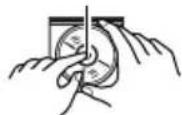
• Always hold the disc by the edges. Do not touch its recording surface.
When storing a disc into its case, gently insert the disc around the center holder (with the printed surface facing up).
• Make sure to store discs into the cases after use.
To keep discs clean
A dirty disc may not play correctly. If a disc does become dirty, wipe it with a soft cloth in a straight line from center to edge.
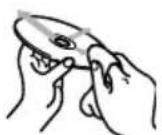
- Do not use any solvent (for example, conventional record cleaner, spray, thinner, benzine, etc.) to clean discs.
To play new discs
New discs may have some rough spots around the inner and outer edges. If such a disc is used, this unit may reject the disc.
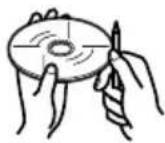
To remove these rough spots, rub the edges with a pencil or ball-point pen, etc.
Do not use the following discs:
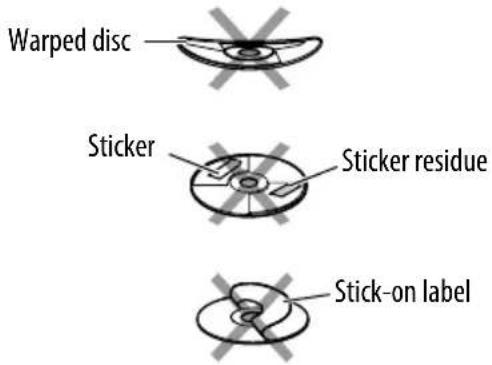
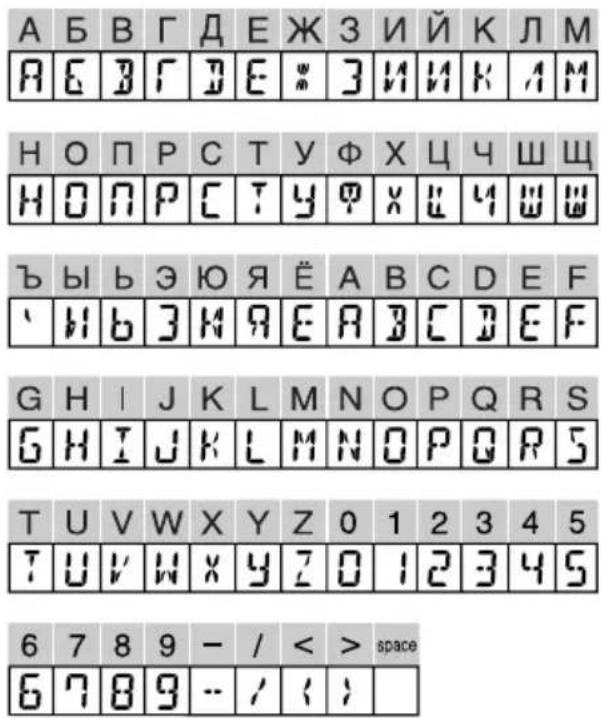
Available characters on the display
Available characters □ Display indications
More about this unit
General
Turning on the power
- By pressing SRC on the unit, you can also turn on the power. If the source is ready, playback starts.
Turning off the power
- If you turn off the power while listening to a disc, disc play will start automatically, next time you turn on the power.
FM/AM/RDS
Storing stations in memory
• During SSM search...
– Received stations are preset in No. 1 (lowest frequency) to No. 6 (highest frequency).
- When SSM is over, the station stored in No. 1 will be automatically tuned in.
- When storing stations, the previously preset stations are erased and stations are stored newly.
FM RDS operations
- Network-Tracking Reception requires two types of RDS signals—PI (Programme Identification) and AF (Alternative Frequency) to work correctly. Without receiving these data correctly, Network-Tracking Reception will not operate correctly.
- If a Traffic Announcement is received by TA Standby Reception, the volume level automatically changes to the preset level (TA VOL) if the current level is lower than the preset level.
- TA Standby Reception and PTY Standby Reception will be temporarily canceled while listening to an AM station.
- When Alternative Frequency Reception is activated (with AF selected), Network-Tracking Reception is also activated automatically. On the other hand, Network-Tracking Reception cannot be deactivated without deactivating Alternative Frequency Reception. (See page 24.)
- If you want to know more about RDS, visit «http://www.rds.org.uk».
Disc
General
- In this manual, words “track” and “file” are interchangeably used when referring to MP3/WMA files and their file names.
• This unit can also playback 8 cm discs. - This unit can only playback audio CD (CD-DA) files if different type of files are recorded in the same disc.
Inserting a disc
- When a disc is inserted upside down, the disc automatically ejects.
Ejecting a disc
- If the ejected disc is not removed within 15 seconds, the disc is automatically inserted again into the loading slot to protect it from dust. (Disc will not play this time.)
Playing a Recordable/Rewritable disc
- This unit can recognize a total of 3 500 files (250 folder per disc; 999 files per folder).
- Use only "finalized" discs.
- This unit can play back multi-session discs; however, unclosed sessions will be skipped while playing.
- This unit can show the names of albums, artists (performer), and Tag (Version 1.0, 1.1, 2.2, 2.3, or 2.4) for the files.
- This unit may be unable to play back some discs or files due to their characteristics or recording conditions.
- Rewritable discs may require a longer readout time.
Playing an MP3/WMA disc
- The maximum number of characters for folder and file names is 25 characters; 64 characters for MP3/WMA tag information.
- This unit can play back files with the extension code <.mp3> or <.wma> (regardless of the letter case—upper/lower).
- This unit can display only one-byte characters. No other characters can be correctly displayed.
- This unit can play back files recorded in VBR (variable bit rate).
Files recorded in VBR have a discrepancy in elapsed time indication.
- This unit cannot play back the following files:
- MP3 files encoded with MP3i and MP3 PRO format.
- MP3 files encoded with Layer 1/2.
– WMA files encoded with lossless, professional, and voice format. - WMA files which are not based upon Windows Media® Audio.
- WMA files copy-protected with DRM.
- Files which have the data such as WAVE, ATRAC3, etc.
Changing the source
- If you change the source, playback also stops (without ejecting the disc).
Next time you select “DISC” for the playback source, disc play starts from where it has been stopped previously.
For MP3/WMA disc, playback starts from the beginning of the last playing track.
DAB
- Only the primary DAB service can be preset even when you store a secondary service.
- A previously preset DAB service is erased when a new DAB service is stored in the same preset number.
iPod ^® or D. player
- When you turn on this unit, the iPod or D. player is charged through this unit.
-
While the iPod or D. player is connected, all operations from the iPod or D. player are disabled. Perform all operations from this unit.
-
The text information may not be displayed correctly.
- If the text information includes more than 8 characters, it scrolls on the display (see also page 24). This unit can display up to 40 characters.
Notice:
When operating an iPod or a D. player, some operations may not be performed correctly or as intended. In this case, visit the following JVC web site:
For iPod users: http://www.jvc.co.jp/english/car/support/ks-pd100/index.html
For D. player users: http://www.jvc.co.jp/english/car/support/ks-pd500/index.html
General settings—PSM
- If you change the “AMP GAIN” setting from “HIGH PWR” to “LOW PWR” while the volume level is set higher than “VOL 30,” the unit automatically changes the volume level to “VOL 30.”
DVD setup menu
- When the language you have selected is not recorded on a disc, the original language is automatically used as the initial language. In addition, for some discs, the initial languages settings will not work as you set due to their internal disc programming.
- When you select “16:9” for a picture whose aspect ratio is 4:3, the picture slightly changes due to the process for converting the picture width.
- Even if “4:3 PAN SCAN” is selected, the screen size may become “4:3 LETTER BOX” for some DVDs.
On-screen guide icons
During playback, the following guide icons may appear for a while on the monitor.
DVD: Appears at the beginning of a scene containing:
: Multi-subtitle languages
: Multi-audio languages
: Multi-angle views
: Playback
II: Pause
: DVD/VCD: Forward slow motion
: DVD: Reverse slow motion
: Forward search
: Reverse search
About sounds reproduced through the rear terminals
- Through the analog terminals (Speaker out/LINE OUT): 2-channel signal is emitted. When playing a multi-channel encoded disc, multi-channel signals are downmixed. (AUDIO—DOWN MIX: see page 26.)
- Through DIGITAL OUT (optical): Digital signals (Linear PCM, Dolby Digital, DTS, MPEG Audio) are emitted through this terminal. (For more details, see page 26.)
To reproduce multi-channel sounds such as Dolby Digital and DTS, connect an amplifier or a decoder compatible with these multi-channel sources to this terminal, and set “DIGITAL AUDIO OUTPUT” correctly. (See page 26.)
Troubleshooting
What appears to be trouble is not always serious. Check the following points before calling a service center.
| Symptom Remedy/Cause | |
| General | Sound cannot be heard from the speakers.Adjust the volume to the optimum level.Check the cords and connections. |
| The unit does not work at all. Reset the unit (see page 2). | |
| FM/AM/RDS | SSM automatic presetting does not work. Store stations manually. |
| Static noise while listening to the radio. Connect the aerial firmly. |
Symptom Remedy/Cause
| Disc playback | • Disc cannot be played back. Insert the disc correctly. | |
| • Disc can be neither played back nor ejected. • Unlock the disc (see page 12). • Eject the disc forcibly (see page 2). | ||
| • Recordable/Rewritable discs cannot be played back. • Tracks on the Recordable/Rewritable discs cannot be skipped. | • Insert a finalized disc. • Finalize the discs with the component which you used for recording. | |
| • Disc cannot be recognized. Eject the disc forcibly (see page 2). | ||
| • “NO DISC” appears on the display. Insert the disc correctly. | ||
| • Sound and pictures are sometimes interrupted or distorted. | • Stop playback while driving on rough roads. • Change the disc. • Check the cords and connections. | |
| • No playback picture (DVD/VCD) appears on the monitor. | Parking brake wire is not connected properly. (See Installation/Connection Manual.) | |
| • No picture appears on the monitor at all. • Connect the video cord correctly. • Select a correct input on the monitor. | ||
| • The left and right edges of the picture are missing on the monitor. | Select “4:3 LETTER BOX” (see page 25). | |
| MP3/WMA playback | • Disc cannot be played back. • Change the disc. | • Record tracks using a compliant application in the appropriate discs (see page 4). • Add the extension code <.mp3> or <.wma> to the file names. |
| • Noise is generated. Skip to another track or change the disc. (Do not add the extension code <.mp3> or <.wma> to non-MP3/WMA tracks.) | ||
| • Longer readout time is required. Readout time varies due to the complexity of the folder/file configuration. Do not use too many hierarchies and folders. | ||
| • Tracks cannot playback as you have intended them to play. | Playback order is determined when files are recorded. | |
| • Elapsed playing time is not correct. This sometimes occurs during playback. This is caused by how the tracks are recorded. | ||
| • “NO FILES” appears on the display. Insert a disc that contains tracks of appropriate formats. | ||
| • Correct characters are not displayed (e.g. album name). | This unit can only display letters (upper case), cyrillic alphabets, numbers, and a limited number of symbols (see page 28). | |
| Symptom Remedy/Cause | ||
| CD changer | “NO DISC” appears on the display. Insert a disc into the magazine. | |
| “NO MAG” appears on the display. Insert the magazine. | ||
| “RESET 8” appears on the display. Connect this unit and the CD changer correctly and press the reset button of the CD changer. | ||
| “RESET 1” – “RESET 7” appears on the display. Press the reset button of the CD changer. | ||
| The CD changer does not work at all. Reset the unit (see page 2). | ||
| DAB | “NO DAB” appears on the display. Move to an area with stronger signals. | |
| “RESET 08” appears on the display. Connect this unit and the DAB tuner correctly and reset the unit (see page 2). | ||
| The DAB tuner does not work at all. Reconnect this unit and the DAB tuner correctly. Then, reset the unit (see page 2). | ||
| “ANT NG” appears on the display. Check the cords and connections. | ||
| iPod/D. player playback | The iPod or D. player does not turn on or does not work. | Check the connecting cable and its connection.Change the battery.Update the firmware version. |
| Buttons do not work as intended. The functions of the buttons have been changed. Press MODE before performing the operation. | ||
| The sound is distorted. Deactivate the equalizer either on the unit or the iPod/D. player. | ||
| “NO IPOD” or “NO DP” appears on the display. | Check the connecting cable and its connection. | |
| Playback stops. The headphones are disconnected during playback. Restart the playback operation (see page 20). | ||
| No sound can be heard when connecting an iPod nano. | Disconnect the headphones from the iPod nano. | |
| No sound can be heard.“ERROR 01” appears on the display when connecting a D. player. | Disconnect the adapter from the D. player. Then, connect it again. | |
| “NO FILES” or “NO TRACK” appears on the display. | No tracks are stored. Import tracks to the iPod or D. player. | |
| “RESET 1” – “RESET 7” appears on the display. Disconnect the adapter from both the unit and iPod/D. player. Then, connect it again. | ||
| “RESET 8” appears on the display. Check the connection between the adapter and this unit. | ||
| The iPod’s or D. player’s controls do not work after disconnecting from this unit. | Reset the iPod or D. player. | |
Specifications
| AUDIO AMPLIFIER SECTION | Maximum Power Output: Front/Rear: 50 W per channel | ||
| Continuous Power Output (RMS): | Front/Rear: 19 W per channel into 4 Ω | 40 Hz to20 000 Hz at no more than 0.8% totalharmonic distortion | |
| Load Impedance: 4 Ω (4 Ω to 8 Ω allowance) | |||
| Tone Control Range: Bass/Treble: ±10 dB at 100 Hz/±10 dB at 10 kHz | |||
| Frequency Response: 40 Hz to 20 000 Hz | |||
| Signal-to-Noise Ratio: 70 dB | |||
| Audio Output Level: Digital | (DIGITAL OUT: Optical): Signal wave length: 660 nm | ||
| Output level: -21 dBm to -15 dBm | |||
| Line-Out Level/Impedance: 2.0 V/20 kΩ load (full scale) | |||
| Output Impedance: 1 kΩ | |||
| Color System: PAL | |||
| Video Output (composite): 1 Vp-p/75 Ω | |||
| Other Terminals: CD changer | |||
| TUNER SECTION | Frequency Range: FM1 /FM2: 87.5 MHz to 108.0 MHz | ||
| FM3: 65.00 MHz to 74.00 MHz | |||
| AM: (MW) 522 kHz to 1 620 kHz (LW) 144 kHz to 279 kHz | |||
| FM Tuner | Usable Sensitivity: | 11.3 dBf (1.0 μV/75 Ω) | |
| 50 dB Quieting Sensitivity: | 16.3 dBf (1.8 μV/75 Ω) | ||
| Alternate Channel Selectivity (400 kHz): | 65 dB | ||
| Frequency Response: | 40 Hz to 15 000 Hz | ||
| Stereo Separation: | 30 dB | ||
| MW Tuner | Sensitivity/Selectivity: | 20 μV/35 dB | |
| LW Tuner | Sensitivity: | 50 μV | |
| DVD/CD PLAYER SECTION | Signal Detection System: Non-contact optical pickup (semiconductor laser) | ||
| Number of Channels: 2 channels (stereo) | |||
| Frequency Response: DVD, fs=48 kHz: 16 Hz to 22 000 Hz | |||
| VCD/CD/MP3/WMA: 16 Hz to 20 000 Hz | |||
| Dynamic Range: 96 dB | |||
| Signal-to-Noise Ratio: 98 dB | |||
| Wow and Flutter: Less than measurable limit | |||
| MP3: Bit Rate: 32 kbps – 320 kbps | |||
| WMA: Bit Rate: 32 kbps – 192 kbps | |||
| GENERAL | Power Requirement: Operating Voltage: DC 14.4 V (11 V to 16 V allowance) | ||
| Grounding System: Negative ground | |||
| Allowable Operating Temperature: 0°C to +40°C | |||
| Dimensions (W × H × D): | Installation Size (approx.): | 182 mm × 52 mm × 158 mm | |
| Panel Size (approx.): | 188 mm × 58 mm × 11 mm | ||
| Mass (approx.): | 1.6 kg (excluding accessories) | ||
Design and specifications are subject to change without notice.
- Manufactured under license from Dolby Laboratories. Dolby and the double-D symbol are trademarks of Dolby Laboratories.
- "DTS" and "DTS 2.0 + Digital Out" are trademarks of Digital Theater Systems, Inc.
- "DVD Logo" is a trademark of DVD Format/Logo Licensing Corporation registered in the US, Japan and other countries.
- Microsoft and Windows Media are either registered trademarks or trademarks of Microsoft Corporation in the United States and/or other countries.
- iPod is a trademark of Apple Computer, Inc., registered in the U.S. and other countries.
natural_image
Technical line drawing of a mechanical assembly with an open box and a side view showing internal components (no text or symbols)Отсоединение...
Подключение...
ПРЕДУПРЕЖДЕНИЯ:
natural_image
Line drawing of a front panel with circular gauges and control buttons (no text or symbols)natural_image
Line drawing of a device with a rectangular panel and cable, no text or symbols presentРазъем
Конденсация влаги
| G | H | I | J | K | L | M | N | O | P | Q | R | S |
| G | H | I | J | K | L | M | N | O | P | Q | R | S |
| T | U | V | W | X | Y | Z | 0 | 1 | 2 | 3 | 4 | 5 |
| T | U | V | W | X | Y | Z | 0 | 1 | 2 | 3 | 4 | 5 |
| 6 | 7 | 8 | 9 | - | / | < | > | промежуток |
| 6 | 7 | 8 | 9 | -- | / | { | } |
Having TROUBLE with operation?
Please reset your unit
Refer to page of How to reset your unit
- IMPORTANT FOR LASER PRODUCTS
- How to use functions mode
- WARNINGS:
- To prevent accidents and damage
- For safety...
- Temperature inside the car...
- CONTENTS
- OPERATIONS
- ■ EXTERNAL DEVICES
- SETTINGS
- Introduction
- Caution for DualDisc playback
- Caution on volume setting
- Note on Region Code:
- If you insert a DVD Video disc of an incorrect Region Code
- Before operating the unit — Cancel the display demonstration and set the clock
- Set the clock
- Basic operations — Control panel
- Display window
- Basic operations — Remote controller (RM-RK230)
- Installing the lithium coin battery (CR2025)
- Before using the remote controller:
- Warning: To prevent accidents and damage
- MONITOR CONTROL
- DVD/RECEIVER CONTROL
- 11\*2 For advanced disc operations:
- For FM/AM tuner operations:
- For DAB tuner operations:
- For iPod/D. player operations:
- Listening to the radio
- When an FM stereo broadcast is hard to receive
- FM station automatic presetting —SSM (Strong-station Sequential Memory)
- Manual presetting
- Searching for FM RDS programme — PTY search
- Storing your favorite programme types
- Activating/deactivating TA/PTY Standby Reception
- Tracing the same programme—Network-Tracking Reception
- Automatic station selection—Programme Search
- Disc operations
- Before performing any operations...
- Prohibiting disc ejection
- Operations using the control panel
- Using menu driven features...
- While holding 3
- To enlarge the view (Zoom in)...
- While holding SHIFT ...\*3
- Canceling the PBC playback...
- Operations using the on-screen bar
- Entering time/numbers
- On-screen bar
- Operations using the control/list screen (MP3/WMA/CD)
- Control screen
- Folder/track list screen
- Listening to the CD changer
- Listening to the DAB tuner
- Storing DAB services in memory
- Tracing the same programme—Alternative Frequency Reception
- Listening to the iPod®/D. player
- Preparations:
- Selecting a track from the menu
- Listening to the other external components
- Concept diagram of the external device connection
- Selecting a preset sound mode — C-EQ
- Adjusting the sound
- General settings — PSM
- DVD setup menu
- Output signals through the DIGITAL OUT terminal
- Maintenance
- How to clean the connectors
- Moisture condensation
- How to handle discs
- To keep discs clean
- To play new discs
- Available characters on the display
- More about this unit
- General
- Turning on the power
- Turning off the power
- FM/AM/RDS
- Storing stations in memory
- FM RDS operations
- Disc
- Inserting a disc
- Ejecting a disc
- Playing a Recordable/Rewritable disc
- Playing an MP3/WMA disc
- Changing the source
- DAB
- iPod ® or D. player
- Notice:
- General settings—PSM
- On-screen guide icons
- About sounds reproduced through the rear terminals
- Troubleshooting
- ПРЕДУПРЕЖДЕНИЯ:
- Конденсация влаги
- Having TROUBLE with operation?
- Please reset your unit
Brand : JVC
Model : KD-DV4207
Category : Car stereo