HPS 1500 - Receiver RCF - Free user manual and instructions
Find the device manual for free HPS 1500 RCF in PDF.


| Type | Wireless Receiver |
| Brand | RCF |
| Model | HPS 1500 |
| Frequency Range | UHF 470–960 MHz (region-dependent) |
| Number of Channels | 100 |
| Audio Outputs | XLR balanced, 1/4" jack unbalanced, headphone output |
| Power Supply | 12–16 V DC or mains adapter (100–240 V AC) |
| Dimensions (W x H x D) | 19" (483 mm) x 1U (44 mm) x 200 mm |
| Weight | 2.5 kg |
| Display | LCD with frequency and channel info |
| Antenna Type | Removable BNC (2 x 1/2 wave) |
| Squelch Control | Adjustable |
| Frequency Stability | ±0.001% |
| Audio Frequency Response | 40 Hz – 18 kHz |
| Signal-to-Noise Ratio | >105 dB A-weighted |
| Total Harmonic Distortion | <0.5% at 1 kHz |
| Operating Temperature | 0°C to 40°C |
| Maintenance | Clean with a soft dry cloth; do not use solvents |
| Safety Precautions | Keep away from liquids and heat sources; use only supplied power supply |
| Spare Parts & Repairability | Contact RCF service center for replacement parts |
Frequently Asked Questions - HPS 1500 RCF
User questions about HPS 1500 RCF
0 question about this device. Answer the ones you know or ask your own.
Ask a new question about this device
Download the instructions for your Receiver in PDF format for free! Find your manual HPS 1500 - RCF and take your electronic device back in hand. On this page are published all the documents necessary for the use of your device. HPS 1500 by RCF.
USER MANUAL HPS 1500 RCF
SAFETY PRECAUTIONS page 12
DESCRIPTION page 14
UNPACKING AND INSTALLATION ____ page 14
FRONT PANEL ____ page 15
REAR PANEL ____ page 16
OPERATION MODES ____ page 17
• STEREO MODE ____ page 17
• MONO MODE ____ page 18
• BRIDGE MODE ____ page 18
SPEAKON CONNECTOR WIRING (amplifier outputs) ____ page 19
COOLING REQUIREMENTS ____ page 19
SPECIFICATIONS ____ page 19
IMPORTANTE
| stereo | 2 x 1400 W @ 2 Ω | |
| 2 x 1100 W @ 4 Ω | 2 x 750 W @ 4 Ω | |
| 2 x 700 W @ 8 Ω | 2 x 450 W @ 8 Ω | |
| "a ponte" | 2800 W @ 4 Ω | |
| 2200 W @ 8 Ω 1500 W @ 8 Ω | ||
Before connecting and using this product, please read this instruction manual carefully and keep it on hand for future reference.
The manual is to be considered an integral part of this product and must accompany it when it change ownership as a reference for correct installation and use as well as for the safety precautions.
RCF S.p.A. will not assume any responsibility for the incorrect installation and / or use of this product.

WARNING: To prevent the risk of fire or electric shock, never expose this product to rain or humidity.
SAFETY PRECAUTIONS
- All the precautions, in particular the safety ones, must be read with special attention, as they provide important information.
- POWER SUPPLY FROM MAINS
a. The mains voltage is sufficiently high to involve a risk of electrocution: never install or connect this product when it is powered.
b. Before powering up, make sure that all the connections have been made correctly and the voltage of your mains corresponds to the voltage shown on the rating plate on the unit, if not, please contact your RCF dealer.
c. The metallic parts of the unit are earthed by means of the power cable.
An apparatus with CLASS I construction shall be connected to a mains socket outlet with a protective earthing connection.
d. Protect the power cable from damage; make sure it is positioned in a way that it cannot be stepped on or crushed by objects.
e. To prevent the risk of electric shock, never open the product: there are no parts inside that the user needs to access.
- Make sure that no objects or liquids can get into this product, as this may cause a short circuit. This apparatus shall not be exposed to dripping or splashing. No objects filled with liquid, such as vases, shall be placed on this apparatus. No naked sources (such as lighted candles) should be placed on this apparatus.
- Never attempt to carry out any operations, modifications or repairs that are not expressly described in this manual.
Contact your authorized service centre or qualified personnel should any of the following occur:
• The product does not function (or functions in an anomalous way).
• The power supply cable has been damaged.
- Objects or liquids have got in the unit
• The product has been subject to a heavy impact.
- If this product is not used for a long period, disconnect the power cable.
- If this product begins emitting any strange odours or smoke, switch it off immediately and disconnect the power supply cable.
-
The amplifier output signal voltage can be sufficiently high to involve a risk of electrocution: never connect loudspeakers when this amplified is switched on.
-
Do not connect this product to any equipment or accessories not foreseen.
For suspended installation, only use the dedicated anchoring points and do not try to hang this product by using elements that are unsuitable or not specific for this purpose.
Also check the suitability of the support surface to which the product is anchored (wall, ceiling, structure, etc.), and the components used for attachment (screw anchors, screws, brackets not supplied by RCF etc.), which must guarantee the security of the system / installation over time, also considering, for example, the mechanical vibrations normally generated by transducers. To prevent the risk of falling equipment, do not stack multiple units of this product unless this possibility is specified in the user manual.
- RCF S.p.A. strongly recommends this product is only installed by professional qualified installers (or specialised firms) who can ensure correct installation and certify it according to the regulations in force.
The entire audio system must comply with the current standards and regulations regarding electrical systems.
- Supports and trolleys
The equipment should be only used on trolleys or supports, where necessary, that are recommended by the manufacturer. The equipment / support / trolley assembly must be moved with extreme caution. Sudden stops, excessive pushing force and uneven floors may cause the assembly to overturn.
-
There are numerous mechanical and electrical factors to be considered when installing a professional audio system (in addition to those which are strictly acoustic, such as sound pressure, angles of coverage, frequency response, etc.).
-
Hearing loss
Exposure to high sound levels can cause permanent hearing loss. The acoustic pressure level that leads to hearing loss is different from person to person and depends on the duration of exposure. To prevent potentially dangerous exposure to high levels of acoustic pressure, anyone who is exposed to these levels should use adequate protection devices. When a transducer capable of producing high sound levels is being used, it is therefore necessary to wear ear plugs or protective earphones.
See the technical specifications in loudspeaker instruction manuals to know their maximum sound pressure levels.
-
To prevent the occurrence of noise on line signal cables, use balanced screened cables only and avoid putting them close to:
-
Equipment that produces high-intensity electromagnetic fields (for example, high power transformers)
- Mains cables
-
Loudspeaker lines.
-
Do not obstruct the ventilation grilles of the unit. Place this product far from any heat sources and always ensure adequate air circulation around the ventilation grilles.
-
Do not overload this product for a long time.
-
Never force the control elements (keys, knobs, etc.).
-
Do not use solvents, alcohol, benzene or other volatile substances for cleaning the external parts of this product.
RCF S.p.A. thanks you for purchasing this product, which has been designed to guarantee reliability and high performances.
DESCRIPTION
HPS 2500 and HPS 1500 are 2 channel power amplifiers designed for professional use in touring racks and installed sound systems.
The HP 2500 model delivers up to 2 × 1400 W RMS @ 2 (2800 W RMS bridged @ 4 ); the HP 1500 model delivers up to 2 × 750 W RMS @ 4 (1500 W RMS bridged @ 8 ).
MAIN FEATURES:
• Fast response and low distortion
• Easy to configure in stereo / mono / bridge modes
• Extensive protective circuits ensure high reliability and operating safety
• Front panel signal / clip / protect LED indicators
• Minimum load impedance (stereo / mono): 2 Ω (HP 2500), 4 Ω (HP 1500)
• XLR input connectors
• SPEAKON output connectors
• 2 unit 19" rack
- Switchable limiter
UNPACKING AND INSTALLATION
Check the carton box and its contents to see if there is any sign of damage (should the amplifier be damaged, immediately inform your local distributor / dealer and the forwarder).
It is always advisable to keep the packing materials, even if the amplifier has arrived in good condition.
Each HPS amplifier occupies 2 units of a standard 19" rack.
Four holes for rack mounting are on the front panel ears. Rear mounting ears give additional support (especially important in mobile sound systems).
THE AMPLIFIER SHOULD NOT BE INSTALLED IN A PLACE WITH:
• Too high temperature, dust or excessive humidity.
• Fog machine outputs oriented towards the amplifier.
• Exhaust air ventilators.
• Permanent vibrations.
• High-intensity electromagnetic fields (due to transformers, transmitters, etc.).
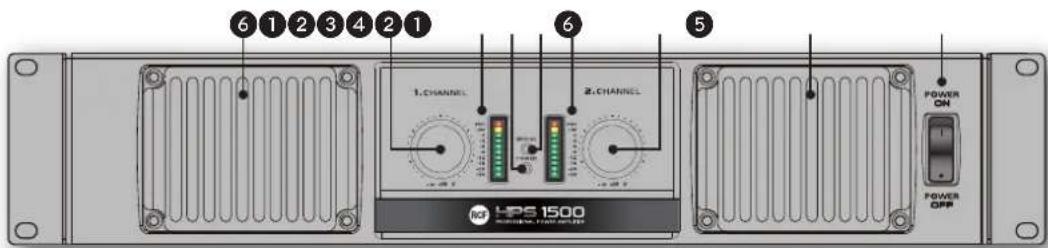
FRONT PANEL
text_image
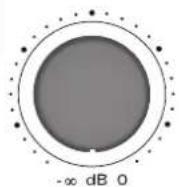
6 1 2 3 4 2 1 1.CHANNEL 2.CHANNEL HPS.1500 POWER ON POWER OFF① Channel level control (one per channel).
It is a 41 step control to adjust the output level of the respective amplifier channel. Turn clockwise to increase the output level (0 dB = max. level); turn counterclockwise to decrease.
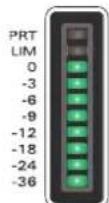
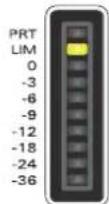
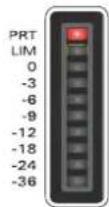
② LED bar (one per channel)
a. 8 step signal level meter
(-36 dB, -24 dB, -18 dB, -12 dB, -9 dB, -6 dB, 0 dB).
b. Clip / limiter LED
When lit, it indicates the clipping point and the internal limiter intervention on the respective channel. If it stays lit continuously, the input signal level is excessive.
c. Protection LED
When lit, it indicates the internal protection intervention
(due to overload, short-circuit, thermal drift, fault).
The respective channel is muted.
The normal operation will be automatically restored as soon as the problem is solved.
③ Power LED
When lit, it indicates that the amplifier is switched on and operating.
4 Bridge LED
When lit, it indicates that the amplifier is set to the 'bridge' mode.
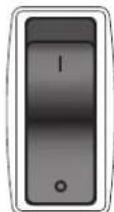
5 Power switch (I = ON; 0 = OFF)
No: amplifier soft-start limits start-up surges.
6 Air intakes with grilles and filters
Do not obstruct these air intakes!
i Filters are necessary to prevent dust from entering the amplifier. The grilles are removable for easy filter cleaning. The fan's variable speed control ensures the proper ventilation (according to the internal temperature) and low noise operation.
POWER

BRIDGE

POWER ON
POWER
OFF
REAR PANEL
text_image
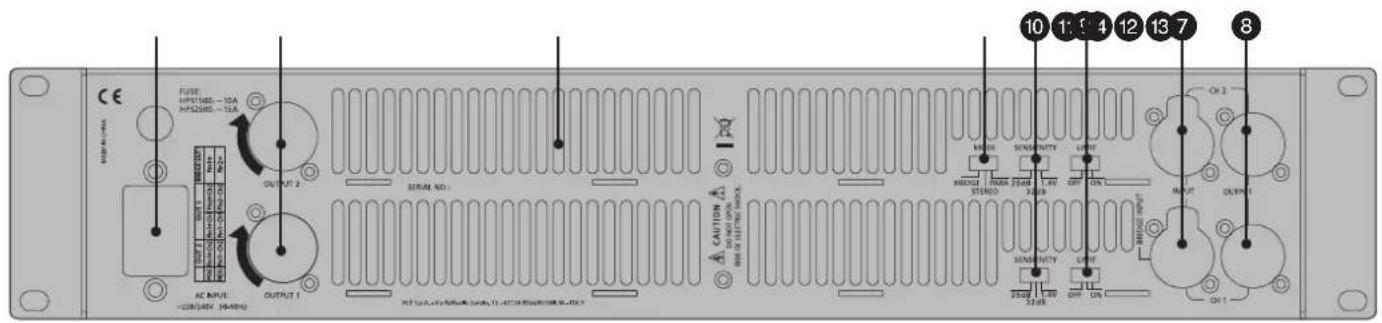
CE FUBE UPST100 - 10A HPST200 - 10A OUTPUT 2 AC INPUT -228(45V 39-40Hz) OUTPUT 1 SERUM NO. CAUTION SINCENTRY RANGE STEREO LAV OFF ON SINCENTRY RANGE 32.0V OFF ON MOUT OUTPUT 10 1: 9 4 12 13 7 On 1 On 17 Balanced audio input (one per channel, female XLR connector)
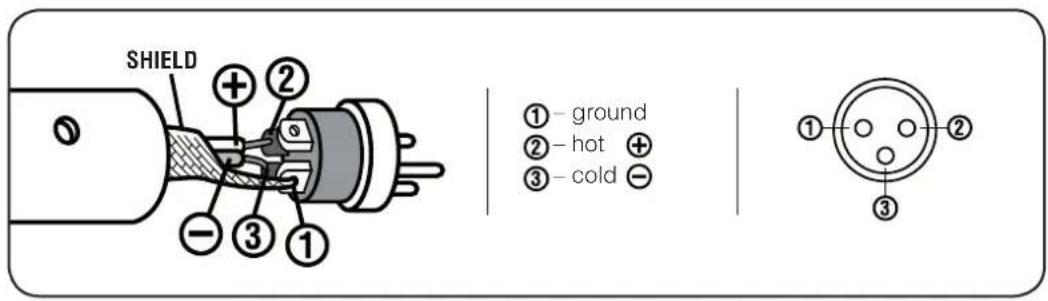
Cable male XLR (balanced) wiring:
text_image
SHIELD ① - ground ② - hot + ③ - cold -8 Balanced parallel audio output (one per channel, male XLR connector)
This output provides a copy of the signal present on the respective channel input and it is useful to link other amplifiers.
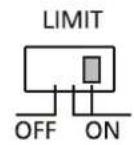
9 Internal limiter on / off switch (one per channel)
ON: the internal limiter ensures the proper amplifier channel operation (even if the input signal is too high) and protects loudspeakers against potentially damaging distorted output signals.
OFF: the internal limiter is disables in the respective channel.
SENSITIVITY
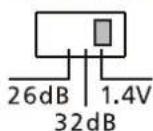
10 Input sensitivity / voltage gain selector (one per channel)
Available options are: 1.4 V (input sensitivity), 32 dB / 26 dB (voltage gain).
Use this switch to match the amplifier input sensitivity / voltage gain to other connected equipments.
- 1.4 V: this setting set to 1.4 V the input level required to get the maximum power output from the amplifier (use this setting for standard operation, with no 'system controllers').
- 32 dB: the amplifier voltage gain is fixed to 32 dB (output / input ratio will always be 32 dB, no matter what the input and the rated output power of the amplifier are).
• 26 dB: the amplifier voltage gain is fixed to 26 dB.
'System controllers' are sometimes used in high power sound systems. In these systems, controllers are set according to loudspeaker specifications and drive amplifiers in a way to get the best results. Yet, the optimum controller operation is achieved only when all system amplifiers are 'gain matched'; one controller can be used to drive multiple amplifiers. For instance, if all amplifiers are set to 26 dB, a 0 dB input signal will have a 26 dB gain in all amplifier outputs (any increase / decrease in an amplifier will be accurately repeated by any other amplifier in that system).
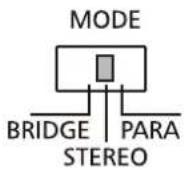
11 Amplifier mode selector
Before turning the amplifier on, set the amplifier mode selector to the right position among BRIDGE, STEREO and PARA (mono). See the section 'Operation modes'.
12 Amplifier output to loudspeakers (SPEAKON connector, one per channel)
In stereo and mono modes, both outputs can be connected; in 'bridge' mode, connect the output 1 only. See the section 'Operation modes'.
13 Power cable input
Connect the power cable only to a mains socket outlet with a protective earthing connection.
14 Openings for heated air exit.
Do not obstruct these openings!
OPERATION MODES
- STEREO MODE
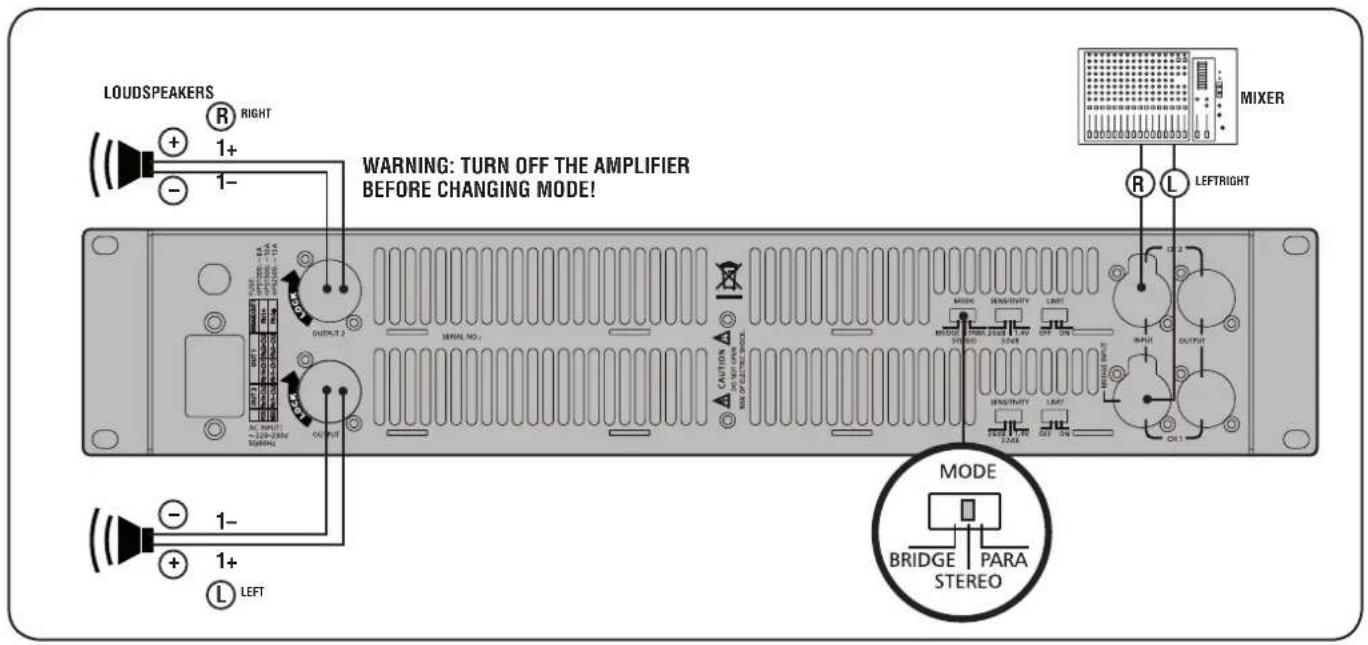
Ensure the amplifier is switched off, then set the MODE selector to STEREO.
In stereo mode, the 2 channels operate independently and each front panel level control affects the respective output.
Minimum nominal load impedance is: 2 Ω per output (HPS 2500) / 4 Ω per output (HPS 1500).
Loudspeakers can be connected to either the SPEAKON output 1 (left channel) or 2 (right channel).
text_image
LOUDSPEAKERS RIGHT 1+ - 1- WARNING: TURN OFF THE AMPLIFIER BEFORE CHANGING MODE! MIXER R L LEFTRIGHT MODE BRIDGE PARA STEREO AC INPUT ~32A/28Hz 50MHz OUTPUT CAUTION DC N/A MAX OF CLETRON 32A/B 32A/B 32A/B 32A/B 32A/B 32A/B 32A/B 32A/B 32A/B 32A/B 32A/B 32A/B 32A/B 32A/B 32A/B 32A/B 32A/B 32A/B 32A/B 32A/B 32A/C 32A/C 32A/C 32A/C 32A/C 32A/C 32A/C 32A/C 32A/C 32A/C 32A/C 32A/C 32A/C 32A/C 32A/C 32A/C 32A/C 32A/C 32A/C 32A/C 32A / 1 - 1- 1+ L LEFTi As alternative wiring, the amplifier output 2 is also available on the SPEAKON connector of the output 1 (pins: 2+ positive, 2- negative).
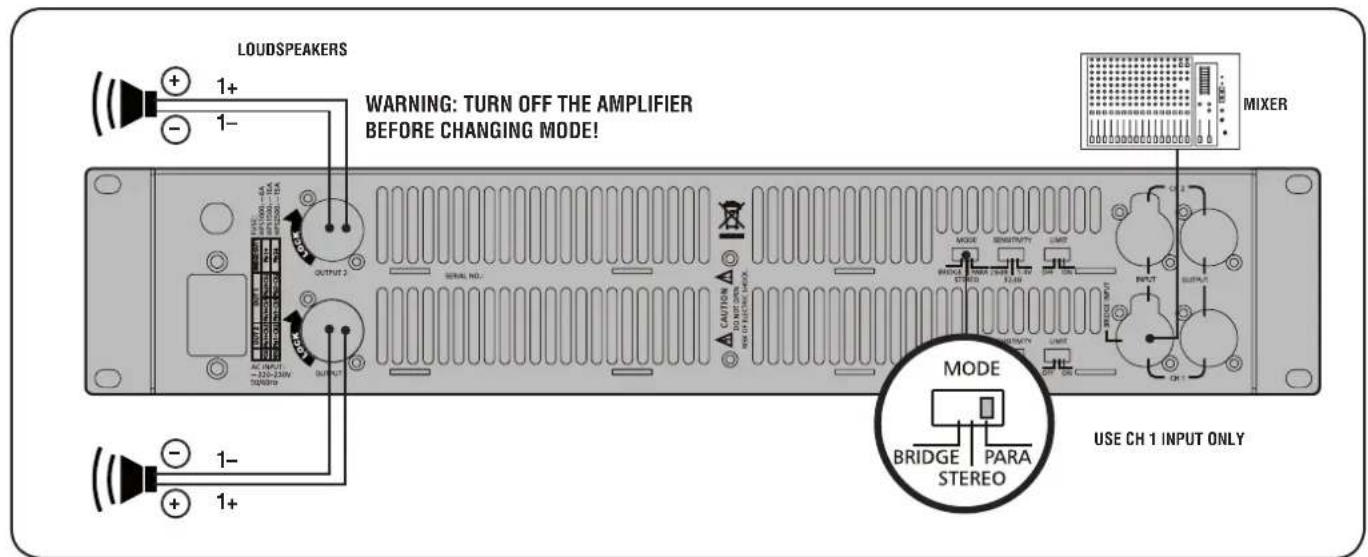
- MONO MODE
Ensure the amplifier is switched off, then set the MODE selector to PARA.
In mono mode, both channels are linked to input 1 (therefore receiving the same signal).
Each front panel level control affects the respective output, allowing you to set (if necessary) different levels.
Minimum nominal load impedance is: 2 Ω per output (HPS 2500) / 4 Ω per output (HPS 1500).
Loudspeakers can be connected to either the SPEAKON output 1 or 2.
Note that only the amp. inputs are connected in parallel. This is NOT an output parallel mono mode. Never connect either positive or negative output terminals in parallel!
text_image
LOUDSPEAKERS WARNING: TURN OFF THE AMPLIFIER BEFORE CHANGING MODE! MIXER MODE BRIDGE PARA STEREO USE CH 1 INPUT ONLYi As alternative wiring, the amplifier output 2 is also available on the SPEAKON connector of the output 1 (pins: 2+ positive, 2- negative).
• BRIDGE MODE
Ensure the amplifier is switched off, then set the MODE selector to BRIDGE.
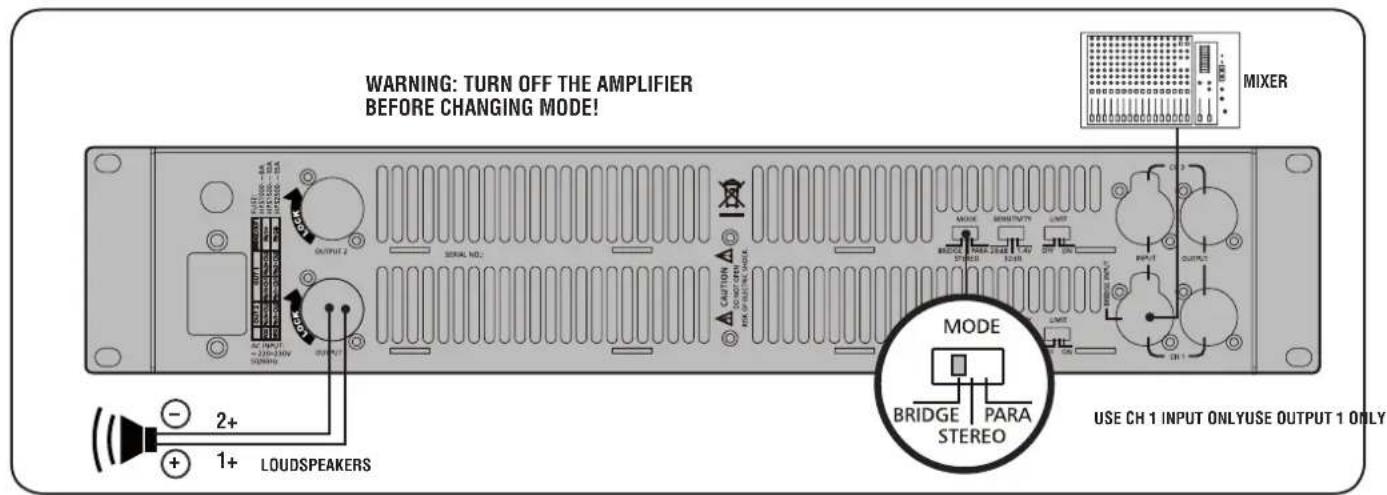
In 'bridge' mode (mono), both amplifier channels work with the same input signal, but with
inverse phases. The result is a doubling of the output voltage in order to get a double power (on a double impedance load).
Both level controls (on the front panel) must be set to the same value (it is advisable to set them to the max. level: 0 dB).
Only the input CH1 is to be used; only the amplifier output 1 is to be connected (pay attention to the SPEAKON pins: 1+ positive, 2+ negative).
Minimum nominal load impedance is: 4 Ω (HPS 2500) / 8 Ω (HPS 1500).
text_image
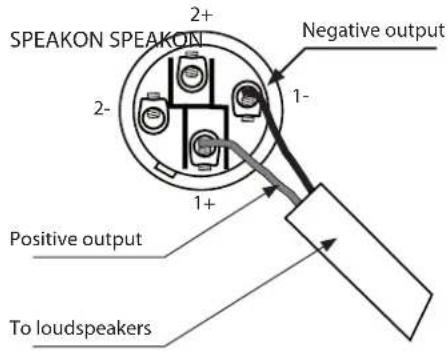
WARNING: TURN OFF THE AMPLIFIER BEFORE CHANGING MODE! MIXER MODE BRIDGE PARA STEREO USE CH 1 INPUT ONLYUSE OUTPUT 1 ONLY 2+ 1+ LOUDSPEAKERSSPEAKON CONNECTOR WIRING (amplifier outputs)
STEREO / MONO MODE BRIDGE MODE
text_image
SPEAKON SPEAKON 2+ 2- 1+ 1- Negative output Positive output To loudspeakers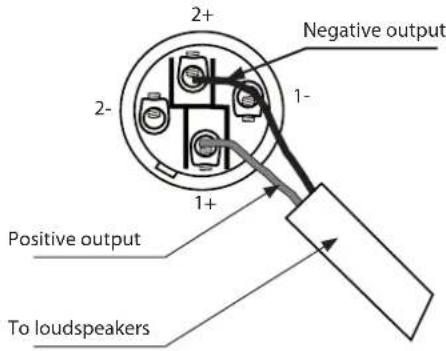
text_image
2+ Negative output 2- 1- Positive output 1+ To loudspeakersCOOLING REQUIREMENTS
HPS amplifiers have a forced air cooling system to maintain a low operating temperature.
Make sure there is enough space around the front of all amplifiers (to allow air to enter) and around to allow the heated air to exit. If amplifiers are rack-mounted, do not use doors or covers on the front and the rear of the rack cabinet(s).
SPECIFICATIONS
HPS 2500 HPS 1500
Power output RMS, bridged
| stereo | 2 x 1400 W @ 2 Ω | |
| 2 x 1100 W @ 4 Ω | 2 x 750 W @ 4 Ω | |
| 2 x 700 W @ 8 Ω | 2 x 450 W @ 8 Ω | |
| bridged | 2800 W @ 4 Ω | |
| 2200 W @ 8 Ω | 1500 W @ 8 Ω |
Frequency response 20 Hz ÷ 20 kHz +/- 0,25 dB
THD @ 1 kHz ____0.05 %, 1 dB below clip
Damping factor @ 8 Ω ____ > 500
Slew rate 50 V / μs
Signal / noise ratio 106 dB
Input sensitivity (/ voltage gain) 1.4 V (/ 32 - 26 dB)
Input impedance____20 kΩ (balanced), 10 kΩ (unbalanced)
Cooling ____ Temp., DC, RFI, short-circuit
Operation voltage 220 ÷ 240 V (50 / 60 Hz)
Dimensions (w, h, d) ____ 482 mm, 88 mm, 420 mm (2 unit rack)
Net weight 19 kg 17 kg