
DPS 604X - Receiver RCF - Free user manual and instructions
Find the device manual for free DPS 604X RCF in PDF.


| Product Type | 4-Channel Power Amplifier (Class D) |
| Brand | RCF |
| Model | DPS 604X |
| Dimensions (W x H x D) | 483 mm x 44 mm x 281 mm (1U, 19" rack) |
| Weight | 4.5 kg |
| Operating Voltage | 115/230 V, 50/60 Hz (model dependent) |
| RMS Output Power (per channel) | 4 x 80 W @ 8 Ω, 4 x 150 W @ 4 Ω, 4 x 230 W @ 2 Ω |
| Bridged Output Power | 2 x 300 W @ 8 Ω, 2 x 400 W @ 4 Ω |
| Frequency Response | 20 Hz - 24 kHz (+0.5/-3 dB) @ 4 Ω |
| Total Harmonic Distortion | 0.1% |
| Signal/Noise Ratio | >95 dB |
| Amplifier Voltage Gain | 28 ±0.5 dB |
| Damping Factor | >200 |
| Crosstalk | <70 dB |
| Input Impedance | 20 kΩ (balanced), 10 kΩ (unbalanced) |
| Input Sensitivity | 0.9-1.1 V (0 ±1 dBV) |
| Protections | Short circuit, open circuit, thermal, ultrasonic, RF, reactive/mismatched loads, internal fuses |
| Operation Modes | 8 modes including independent, linked, bridged, and internal crossover for subwoofers |
| Cooling | Forced air cooling; ensure unobstructed ventilation |
| Connectors | Euroblock for inputs and speaker outputs |
| Safety | Class I construction; earthing via power cord; no user-serviceable parts |
| Maintenance | Clean with dry cloth; do not use solvents; keep ventilation grilles clear |
Frequently Asked Questions - DPS 604X RCF
User questions about DPS 604X RCF
0 question about this device. Answer the ones you know or ask your own.
Ask a new question about this device
Download the instructions for your Receiver in PDF format for free! Find your manual DPS 604X - RCF and take your electronic device back in hand. On this page are published all the documents necessary for the use of your device. DPS 604X by RCF.
USER MANUAL DPS 604X RCF
USER MANUAL MANUALE D'USO
DPS 604X
- FOUR-CHANNEL POWER AMPLIFIER
- AMPLIFICATORE A QUATTRO CANALI
TABLE OF CONTENTS INDICE

ENGLISH
SAFETY PRECAUTIONS 4
DESCRIPTION 6
UNPACKING AND INSTALLATION 6
FRONT PANEL 7
REAR PANEL 8
OPERATION MODES 10
COOLING REQUIREMENTS 14
SPECIFICATIONS 14
ITALIANO
AVVERTENZE PER LA SICUREZZA 16
DESCRIZIONE 18
Before connecting and using this product, please read this instruction manual carefully and keep it on hand for future reference.
The manual is to be considered an integral part of this product and must accompany it when it changes ownership as a reference for correct installation and use as well as for the safety precautions.
RCF S.p.A. will not assume any responsibility for the incorrect installation and / or use of this product.
WARNING: To prevent the risk of fire or electric shock, never expose this product to rain or humidity.
This device is intended for indoor use only.
SAFETY PRECAUTIONS
- All the precautions, in particular the safety ones, must be read with special attention, as they provide important information.
2. POWER SUPPLY FROM MAINS
- The mains voltage is sufficiently high to involve a risk of electrocution: never install or connect this product when its power cord is plugged in.
- Before powering up, make sure that all the connections have been made correctly and the voltage of your mains corresponds to the voltage shown on the rating plate on the unit, if not, please contact your RCF dealer.
- The metallic parts of the unit are earthed by means of the power cord. An apparatus with CLASS I construction shall be connected to a mains socket outlet with a protective earthing connection.
- Protect the power cord from damage. Make sure it is positioned in a way that it cannot be stepped on or crushed by objects.
- To prevent the risk of electric shock, never open this product: there are no parts inside that the user needs to access.
-
The mains plug is used as the disconnect device and it shall remain readily operable.
-
Make sure that no objects or liquids can get into this product, as this may cause a short circuit.
This apparatus shall not be exposed to dripping or splashing. No objects filled with liquid (such as vases) and no naked sources (such as lighted candles) shall be placed on this apparatus.
- Never attempt to carry out any operations, modifications or repairs that are not expressly described in this manual.
Contact your authorized service centre or qualified personnel should any of the following occur:
- The product does not function (or functions in an anomalous way).
- The power cord has been damaged.
- Objects or liquids have got into the product.
-
The product has been subject to a heavy impact.
-
If this product is not used for a long period, disconnect its power cord from mains.
-
If this product begins emitting any strange odours or smoke, switch it off immediately and disconnect its power cord.
-
The terminals marked with the symbol ⚠️ are HAZARDOUS LIVE and their connection is to be made by an INSTRUCTED PERSON or the use of ready-made cables is required.
IMPORTANT

WARNING

- Do not connect this product to any equipment or accessories not foreseen.
For suspended installation, only use the dedicated anchoring points and do not try to hang this product by using elements that are unsuitable or not specific for this purpose.
Also check the suitability of the support surface to which the product is anchored (wall, ceiling, structure, etc.), and the components used for attachment (screw anchors, screws, brackets not supplied by RCF etc.), which must guarantee the security of the system / installation over time, also considering, for example, the mechanical vibrations normally generated by transducers.
To prevent the risk of falling equipment, do not stack multiple units of this product unless this possibility is specified in this user manual.
- RCF S.p.A. strongly recommends this product is only installed by professional qualified installers (or specialised firms) who can ensure correct installation and certify it according to the regulations in force.
The entire audio system must comply with the current standards and regulations regarding electrical systems.
- Supports and trolleys
The equipment should be only used on trolleys or supports, where necessary, that are recommended by the manufacturer. The equipment / support / trolley assembly must be moved with extreme caution.
Sudden stops, excessive pushing force and uneven floors may cause the assembly to overturn.
-
Mechanical and electrical factors need to be considered when installing a professional audio system (in addition to those which are strictly acoustic, such as sound pressure, angles of coverage, frequency response, etc.).
-
Hearing loss
Exposure to high sound levels can cause permanent hearing loss. The acoustic pressure level that leads to hearing loss is different from person to person and depends on the duration of exposure. To prevent potentially dangerous exposure to high levels of acoustic pressure, anyone who is exposed to these levels should use adequate protection devices. When a transducer capable of producing high sound levels is being used, it is therefore necessary to wear ear plugs or protective earphones.
See the technical specifications in loudspeaker instruction manuals to know their maximum sound pressure levels.
-
Do not obstruct the ventilation grilles of the unit. Situate this product far from any heat sources and always ensure adequate air circulation around the ventilation grilles.
-
Do not overload amplifiers. Check that amplifier outputs are not shorted.
-
Never force the control elements (keys, knobs, etc.).
-
Do not use solvents, alcohol, benzene or other volatile substances for cleaning the external parts of this product. Use a dry cloth.
NOTES ABOUT AUDIO SIGNAL CABLES
To prevent the occurrence of noise on microphone / line signal cables, use screened cables only and avoid putting them close to:
- Equipment that produces high-intensity electromagnetic fields.
- Mains cables.
- Loudspeaker lines.
RCF S.P.A. THANKS YOU FOR PURCHASING THIS PRODUCT, WHICH HAS BEEN MADE TO GUARANTEE RELIABILITY AND HIGH PERFORMANCE.
DESCRIPTION

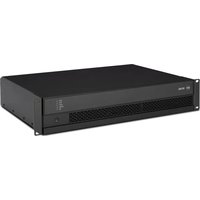
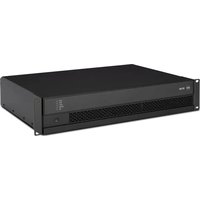
DPS 604X is a 4-channel class D power amplifier designed for professional use in installed sound systems.
It is compact (19" rack - 1 unit) and lightweight.
Its nominal output power is 230 W RMS @ 2 Ω per each of the four channels (2 x 400 W RMS bridged @ 4 Ω).
MAIN FEATURES:
- Fast response and low distortion.
- Eight different operation modes, two of which with internal crossover.
- Extensive protective circuits ensure high reliability and operating safety.
- Euroblock connectors for both audio inputs and speaker outputs.
UNPACKING AND INSTALLATION

Check the carton box and its contents to see if there is any sign of damage (should the amplifier be damaged, immediately inform your local distributor / dealer and the forwarder). It is always advisable to keep the packing materials, even if the amplifier has arrived in good condition.
Input and output cables are not included.
Each amplifier needs 1 unit of a standard 19" rack cabinet.
THE AMPLIFIER SHOULD NOT BE INSTALLED IN A PLACE WITH:
- Too high temperature, dust or excessive humidity.
- Fog machine outputs oriented towards the amplifier.
- Exhaust air ventilators.
- Permanent vibrations.
- High-intensity electromagnetic fields (due to transformers, transmitters, etc.).
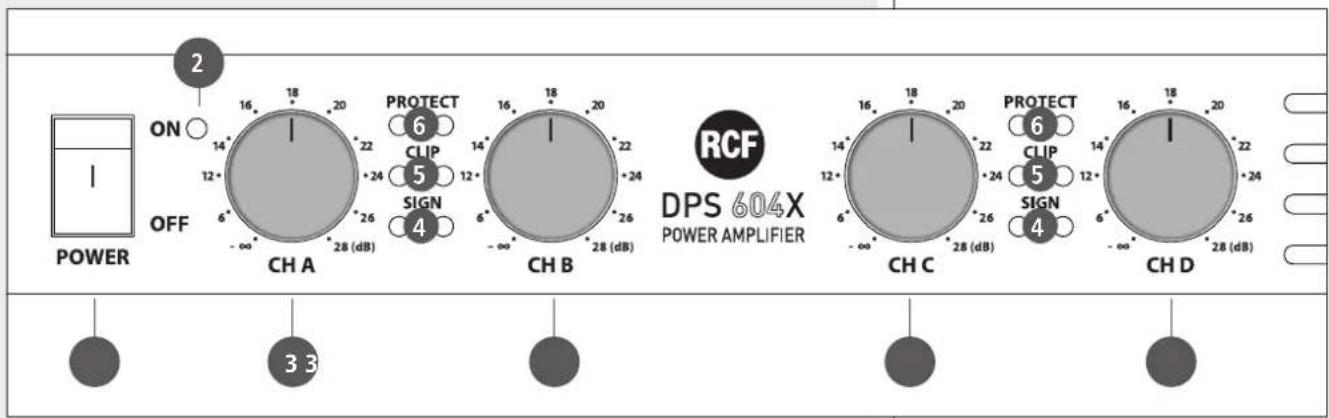
1 POWER switch: it switches the amplifier on / off.
Before switching the amplifier on, check all cables and turn fully counterclockwise all the four channel level controls 3.
2 POWER LED: when lit, the amplifier is switched on.
3 Controls (one per channel) to adjust the output level of the respective amplifier channels.
Turn clockwise to increase the output level (28 dB = max. level), turn counterclockwise to decrease.
Set the control of an unused channel to - (fully counterclockwise).
IF CHANNELS A AND B ARE BRIDGED, USE THE CHANNEL A CONTROL ONLY. IF CHANNELS C AND D ARE BRIDGED, USE THE CHANNEL C CONTROL ONLY.
4 SIGNAL LED: when lit, it indicates the signal presence at the respective channel input.
5 CLIP LED: clipping indicator, this LED lights up when the signal distortion of its respective channel exceeds 0.5%. When lit, the signal level is too high and it is necessary to decrease the respective volume (turn counterclockwise the control 3).
6 PROTECT LED: protection indicator, the respective channel speaker output is muted. Make sure the vent grill 19 is not obstructed and there is enough room for the amplifier proper ventilation. Check the speaker cable as well.

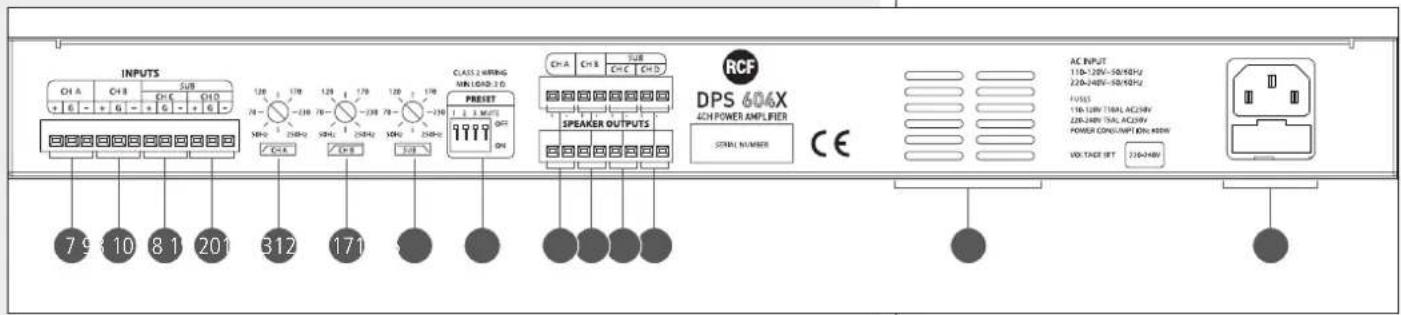
INPUT EUROBLOCK CONNECTORS
AUDIO INPUTS CAN BE CONNECTED TO THE EUROBLOCK SOCKETS BY USING THE SUPPLIED FEMALE CONNECTORS.
BALANCED CONNECTION PINS: + (HOT), - (COLD), G (GROUND).
UNBALANCED CONNECTION PINS: + (HOT), G (GROUND).
7 CHANNEL A BALANCED AUDIO INPUT
8 CHANNEL B BALANCED AUDIO INPUT
Do not connect this input when channels A and B are bridged.
9 CHANNEL C BALANCED AUDIO INPUT
10 CHANNEL D BALANCED AUDIO INPUT
Do not connect this input when channels C and D are bridged.
INTERNAL CROSSOVER
THE INTERNAL CROSSOVER IS INSERTED IN MODES 7 AND 8 ONLY.
IT HAS TWO HI-PASS FILTERS (CHANNELS A AND B) AND A LOW-PASS FILTER FOR SUBWOOFERS.
THE CUTOFF FREQUENCIES CAN BE SET IN THE RANGE FROM 50 Hz TO 250 Hz.
11 CHANNEL A HI-PASS FILTER CUTOFF FREQUENCY SELECTOR
12 CHANNEL B HI-PASS FILTER CUTOFF FREQUENCY SELECTOR
13 SUBWOOFER (ch. C-D) LOW-PASS FILTER CUTOFF FREQUENCY SELECTOR
14 PRESET DIP SWITCHES FOR OPERATION MODE SELECTION
Important: make sure the amplifier is turned off before setting these dip-switches.


| MODE | PRESETDIP SWITCHES | DESCRIPTION | USEDINPUTS | |||
| 1 2 | 3 MUTE | |||||
| 1 | off | off | off | off | CHA-B-C-D: all indipendent. | A B C D |
| 2 | ON | off | off | off | CHA-B-C-D: all linked. | A |
| 3 | off | ON | off | off | CHA-B: bridged. CH C-D: bridged. | A C |
| 4 | ON | ON | off | off | CHA-B: linked. CH C-D: linked. | A C |
| 5 | off | off | ON | off | CHA-B: independent. CH C-D: bridged. | A B C |
| 6 | ON | off | ON | off | CHA-B: linked. CH C-D: bridged. | A C |
| 7 | off | ON | ON | off | CHA-B: independent. CH C-D: bridged.The internal crossover is inserted. SUB input: C | A B(SUB: C) |
| 8 | ON | ON | ON | off | CHA-B: independent. CH C-D: bridged.The internal crossover is inserted. SUB input: A+B | A B |
| MUTE | --- | --- | --- | ON | The amplifier is muted / disabled. | |
The upper and the lower terminals are linked together (internally, in parallel), so these can be used interchangeably (or both, when connecting more speakers to each channel). Pins: + positive, - negative.
When channels A-B are bridged (mode 3), A+ is the positive and B+ is the negative. When channels C-D are bridged (modes 3, 5, 6, 7, 8), C+ is the positive and D+ is the negative.
The speaker impedance must not be lower than:
- 2 Ω, on independent or linked channels
- 4 Ω, when two channels are bridged.

CHANNEL A SPEAKER OUTPUTS

CHANNEL B SPEAKER OUTPUTS

CHANNEL C SPEAKER OUTPUTS

CHANNEL D SPEAKER OUTPUTS

VENT GRILL
Make sure it is not obstructed and there is enough room for a proper ventilation of the amplifier.

POWER CORD INPUT WITH FUSE
Connect the power cord only to a mains socket outlet with a protective earthing connection.
The fuse must match that indicated on the rear panel silk screen.

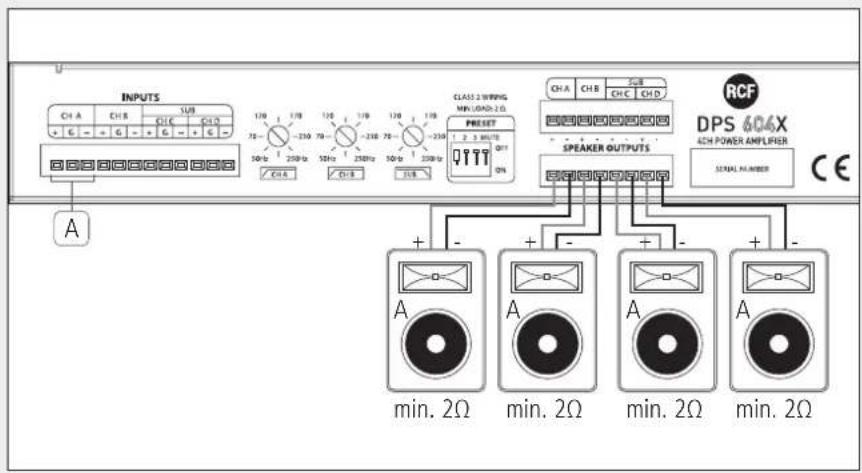
MODE 1: FOUR INDIPENDENT CHANNELS
All the four channels are completely independent (each channel input is only sent to its respective speaker output).
Each front panel level control only affects its respective speaker output.
Minimum load impedance is 2 Ω per speaker output.
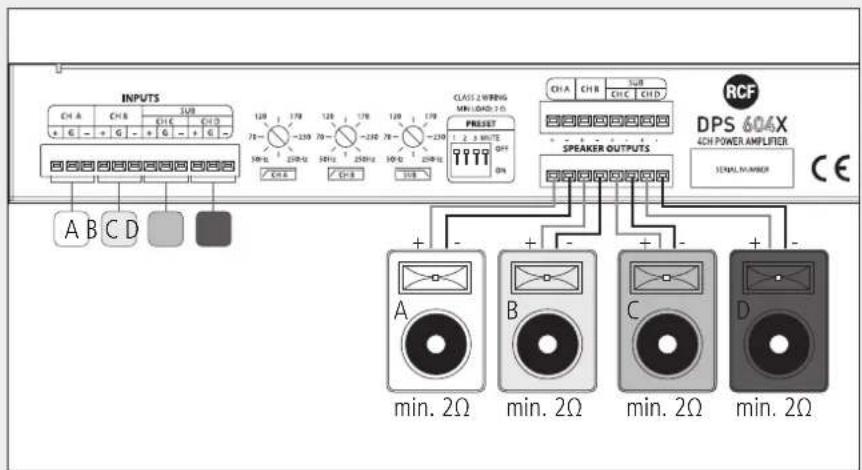
MODE 2: FOUR LINKED CHANNELS
Channel A input signal is sent to all the four speaker outputs.
Each front panel level control affects its respective speaker output.
Minimum load impedance is 2 Ω per speaker output.
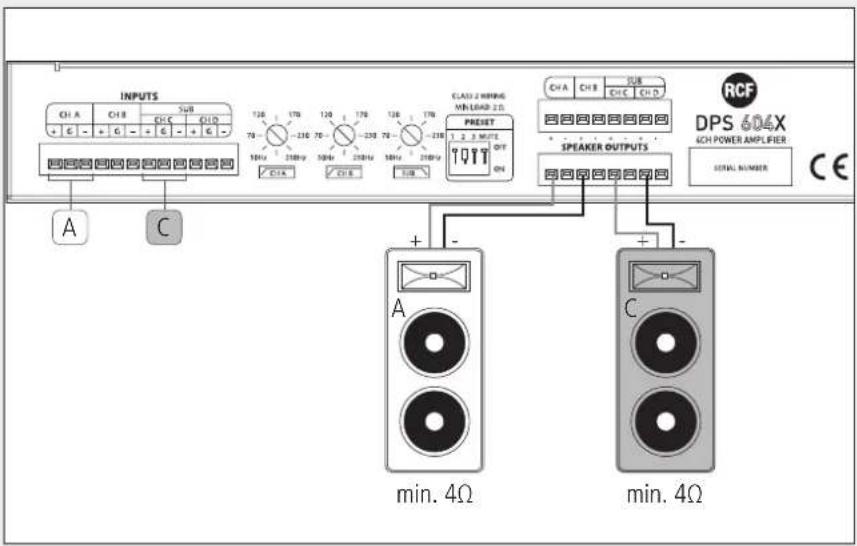
MODE 3: A-B BRIDGED, C-D BRIDGED
All channels are bridged (two pairs): the result is a doubling of the output voltage in order to get a double power (on a double impedance load).
Each pair works with the same input signal:
channel A input for A-B channels
channel C input for C-D channels.
The output levels are adjusted by the channel A and C front panel controls (turn fully counterclockwise the channel B and D controls).
Minimum load impedance is 4 Ω per speaker output.
Pay attention to the speaker wiring:
- channels A-B bridged: A+ is the positive and B+ is the negative
- channels C-D bridged: C+ is the positive and D+ is the negative.
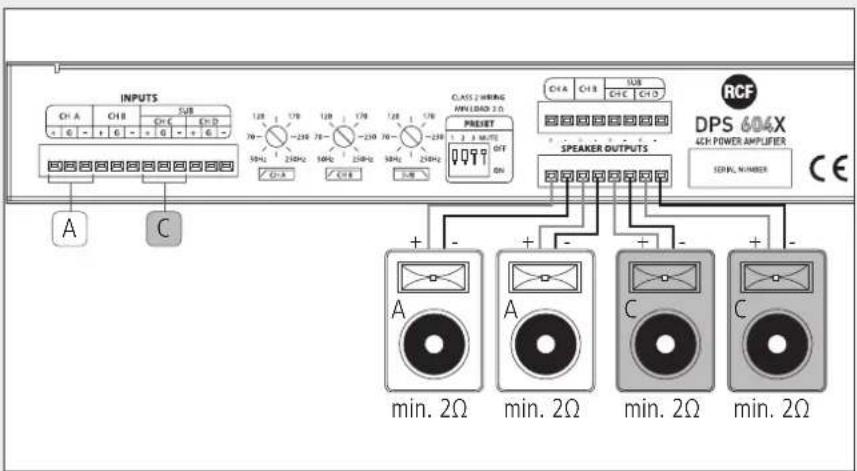
MODE 4: A-B LINKED, C-D LINKED
- Channel A input signal is sent to both speakers outputs of channels A and B.
- Channel C input signal is sent to both speakers outputs of channels C and D.
Each front panel level control affects its respective speaker output.
Minimum load impedance is 2 Ω per speaker output.
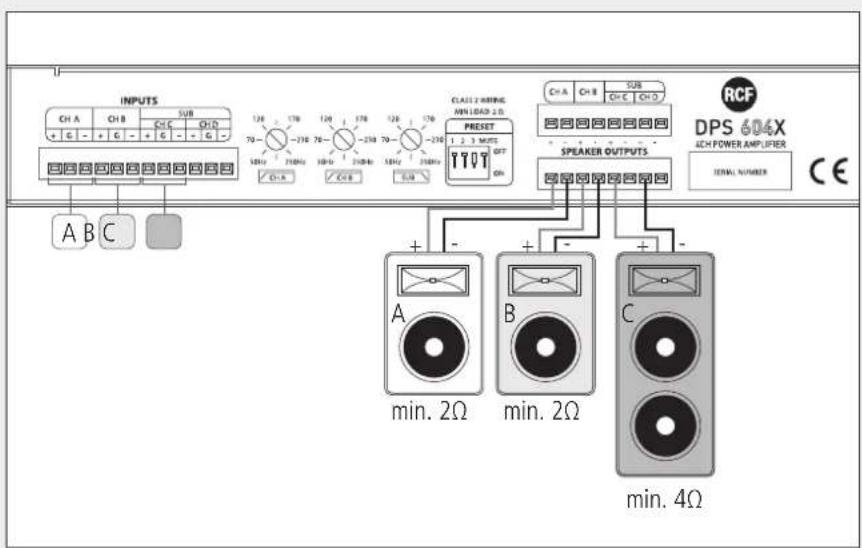
MODE 5: A-B INDEPENDENT, C-D BRIDGED
CHANNELS A and B are completely independent and each of their front panel level controls affects its respective speaker output only. Minimum load impedance is 2 Ω per speaker output.
CHANNELS C and D are bridged with a common input signal (channel C input). The result is a doubling of the output voltage in order to get a double power (on a double impedance load). The output level is adjusted only by the channel C front panel control (turn fully counterclockwise the channel D control). Minimum load impedance is 4 Ω.
Pay attention to the speaker wiring: C+ is the positive and D+ is the negative.
MODE 6: A-B LINKED, C-D BRIDGED
Like the mode 5, but CHANNELS A and B are linked. Channel A input signal is sent to both speakers outputs of channels A and B. Each of their front panel level controls affects its respective speaker output only. Minimum load impedance is 2 Ω per speaker output.
CHANNELS C and D are bridged with a common input signal (channel C input), see mode 5. Minimum load impedance is 4 Ω.
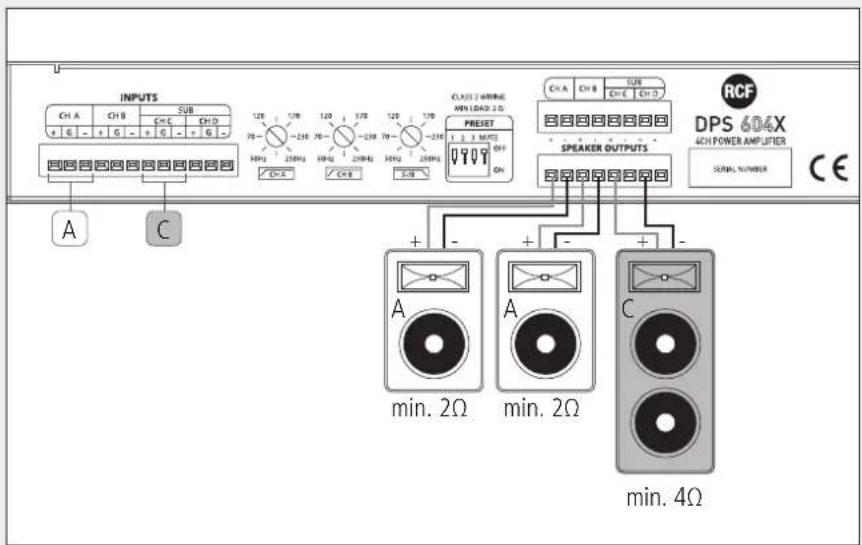
MODE 7: A-B INDEPENDENT, C-D BRIDGED (FOR SUBWOOFERS) INTERNAL CROSSOVER INSERTED, SUB INPUT: CHANNEL C
CHANNELS A and B are completely independent and each of their front panel level controls affects its respective speaker output only. Both CH A and CH B hi-pass filters are inserted. Minimum load impedance is 2 Ω per speaker output.
CHANNELS C and D are bridged with a common input signal (channel C input) to subwoofers.
The result is a doubling of the output voltage in order to get a double power (on a double impedance load). The output level is adjusted only by the channel C front panel control (turn fully counterclockwise the channel D control). The SUB low-pass filter is inserted. Subwoofer minimum impedance is 4 Ω.
Pay attention to the subwoofer wiring: C+ is the positive and D+ is the negative.
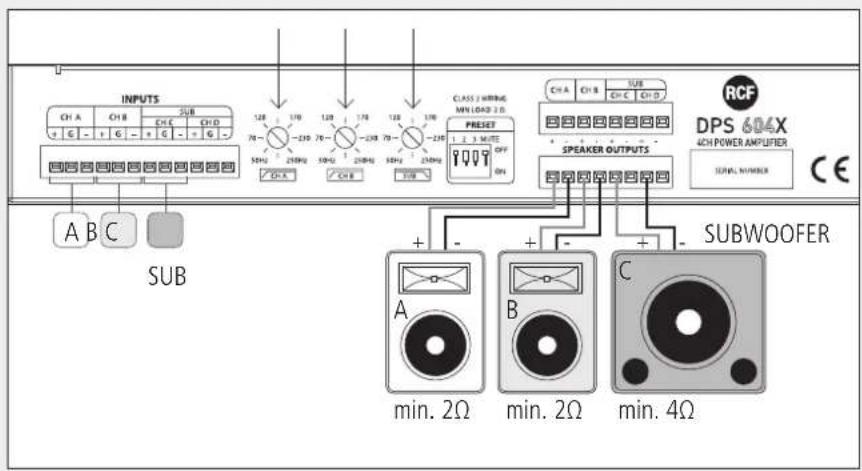
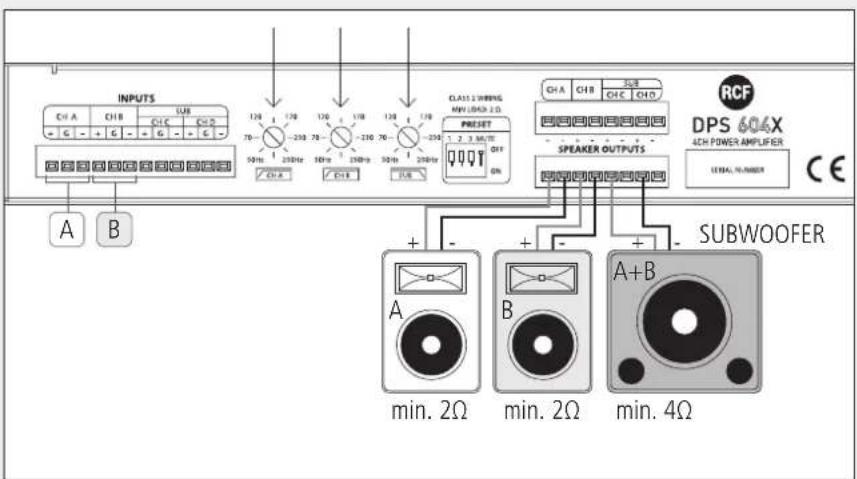
MODE 8: A-B INDEPENDENT, C-D BRIDGED (FOR SUBWOOFERS) INTERNAL CROSSOVER INSERTED, SUB INPUT: CHANNELS A+B
Like the mode 7, but the common signal sent to subwoofers is the sum of channels A and B.
All crossover filters are inserted.
CHANNELS A and B: minimum load impedance is 2 Ω per speaker output.
CHANNELS C and D: subwoofer minimum impedance is 4 Ω.
Pay attention to the subwoofer wiring: C+ is the positive and D+ is the negative.
COOLING REQUIREMENTS

DPS 604X has a forced air cooling system to maintain a low operating temperature. Make sure there is enough room in the front (and all around) of all amplifiers. As amplifiers are rack-mounted, do not use doors or covers on the front and the rear of rack cabinets.
SPECIFICATIONS

| RMS OUTPUT POWER (single channels) | 4 x 80 W @ 8 Ω4 x 150 W @ 4 Ω4 x 230 W @ 2 Ω |
| RATED OUTPUT POWER (bridged outputs) | 2 x 300 W @ 8 Ω2 x 400 W @ 4 Ω |
| Frequency response | 20 Hz ÷ 14.1 kHz (+0/-3 dB) @ 2 Ω20 Hz ÷ 24 kHz (+0.5/-3 dB) @ 4 Ω20 Hz ÷ 33 kHz (+1.5/-3 dB) @ 8 Ω |
| Total harmonic distortion 0.1% | |
| Signal / noise ratio >95 dB | |
| Amplifier voltage gain 28 ±0.5 dB | |
| Damping factor >200 | |
| Crosstalk < 70 dB | |
| Input impedance 20 kΩ (balanced), 10 kΩ (unbalanced) | |
| Input sensitivity 0.9-1.1 V (0±1dBV) | |
| Protections | Short circuit, open circuit, thermal drift, ultrasonic, RF protection, reactive or mismatched loads, internal fuses. |
| Connectors Euroblock | |
| Operating voltage 115 / 230 V (according to the model), 50/60 Hz | |
| Dimensions (w, h, d) 483 mm, 44 mm, 281 mm (1U – 19" rack) | |
| Net weight 4.5 kg | |
AVVERTENZE PER LA SICUREZZA

IMPORTANTE
15 USCITE DIFFUSORI ACUSTICI CANALE A
16 USCITE DIFFUSORI ACUSTICI CANALE B
17 USCITE DIFFUSORI ACUSTICI CANALE C
18 USCITE DIFFUSORI ACUSTICI CANALE D
MODO 3: DUE COPPIE DI CANALI MESSE A PONTE (A-B, C-D)
MODO 4: CANALI A-B UNITI, CANALI C-D UNITI
MODO 5: CANALI A-B INDIPENDENTI, CANALI C-D A PONTE
MODO 6: CANALI A-B UNITI, CANALI C-D A PONTE
Except possible errors and omissions.
RCF S.p.A. reserves the right to make modifications without prior notice.
www.rcf.it

- USER MANUAL MANUALE D'USO
- DPS 604X
- TABLE OF CONTENTS INDICE
- ENGLISH
- ITALIANO
- SAFETY PRECAUTIONS
- POWER SUPPLY FROM MAINS
- IMPORTANT
- WARNING
- NOTES ABOUT AUDIO SIGNAL CABLES
- DESCRIPTION
- MAIN FEATURES:
- UNPACKING AND INSTALLATION
- THE AMPLIFIER SHOULD NOT BE INSTALLED IN A PLACE WITH:
- INPUT EUROBLOCK CONNECTORS
- CHANNEL A BALANCED AUDIO INPUT
- CHANNEL B BALANCED AUDIO INPUT
- CHANNEL C BALANCED AUDIO INPUT
- CHANNEL D BALANCED AUDIO INPUT
- INTERNAL CROSSOVER
- CHANNEL A HI-PASS FILTER CUTOFF FREQUENCY SELECTOR
- CHANNEL B HI-PASS FILTER CUTOFF FREQUENCY SELECTOR
- SUBWOOFER (ch. C-D) LOW-PASS FILTER CUTOFF FREQUENCY SELECTOR
- PRESET DIP SWITCHES FOR OPERATION MODE SELECTION
- CHANNEL A SPEAKER OUTPUTS
- CHANNEL B SPEAKER OUTPUTS
- CHANNEL C SPEAKER OUTPUTS
- CHANNEL D SPEAKER OUTPUTS
- VENT GRILL
- POWER CORD INPUT WITH FUSE
- MODE 1: FOUR INDIPENDENT CHANNELS
- MODE 2: FOUR LINKED CHANNELS
- MODE 3: A-B BRIDGED, C-D BRIDGED
- MODE 4: A-B LINKED, C-D LINKED
- MODE 5: A-B INDEPENDENT, C-D BRIDGED
- MODE 6: A-B LINKED, C-D BRIDGED
- MODE 7: A-B INDEPENDENT, C-D BRIDGED (FOR SUBWOOFERS) INTERNAL CROSSOVER INSERTED, SUB INPUT: CHANNEL C
- MODE 8: A-B INDEPENDENT, C-D BRIDGED (FOR SUBWOOFERS) INTERNAL CROSSOVER INSERTED, SUB INPUT: CHANNELS A+B
- COOLING REQUIREMENTS
- SPECIFICATIONS
- AVVERTENZE PER LA SICUREZZA
- IMPORTANTE
- USCITE DIFFUSORI ACUSTICI CANALE A
- USCITE DIFFUSORI ACUSTICI CANALE B
- USCITE DIFFUSORI ACUSTICI CANALE C
- USCITE DIFFUSORI ACUSTICI CANALE D
- MODO 3: DUE COPPIE DI CANALI MESSE A PONTE (A-B, C-D)
- MODO 4: CANALI A-B UNITI, CANALI C-D UNITI
- MODO 5: CANALI A-B INDIPENDENTI, CANALI C-D A PONTE
- MODO 6: CANALI A-B UNITI, CANALI C-D A PONTE
Brand : RCF
Model : DPS 604X
Category : Receiver