DS 30022 - Chauffe-eau instantané et chauffe-eau SIEMENS - Free user manual and instructions
Find the device manual for free DS 30022 SIEMENS in PDF.


| Product Type | Instantaneous Water Heater |
| Brand | Siemens |
| Model | DS 30022 |
| Power Rating | 3.5 kW (adjustable) |
| Voltage | 220-240 V / 50-60 Hz |
| Current | 16 A |
| Dimensions (H x W x D) | 300 x 200 x 100 mm |
| Weight | 2.5 kg |
| Water Connection | G 1/2" |
| Water Pressure | 0.2 – 10 bar |
| Temperature Range | 30 – 60 °C |
| Protection Class | IP24 |
| Safety Features | Electronic temperature limiter, anti-scald safety |
| Control Type | Electronic push-button with LED display |
| Installation | Wall-mounted, vertical or horizontal |
| Material | ABS plastic housing, copper heating element |
| Energy Efficiency | Energy class A |
| Included Accessories | Installation kit, hose, shower head (optional) |
Frequently Asked Questions - DS 30022 SIEMENS
User questions about DS 30022 SIEMENS
0 question about this device. Answer the ones you know or ask your own.
Ask a new question about this device
Download the instructions for your Chauffe-eau instantané et chauffe-eau in PDF format for free! Find your manual DS 30022 - SIEMENS and take your electronic device back in hand. On this page are published all the documents necessary for the use of your device. DS 30022 by SIEMENS.
USER MANUAL DS 30022 SIEMENS
natural_image
3D rendering of a cylindrical water tank with a side-mounted control unit and vertical dashed line indicating depth (no text or symbols)Montage- und
Gebrauchsanleitung
Installation and
operating instructions
Sicherheitshinweise
natural_image
Illustration of an open book with a curved arrow pointing right, no text or symbols present
natural_image
Illustration of a cylindrical tank with a side-mounted sensor or meter, mounted on three legs (no text or symbols visible)12
natural_image
Diagram of a cylindrical object with a dashed line and a shaded central component, no text or symbols present.III.
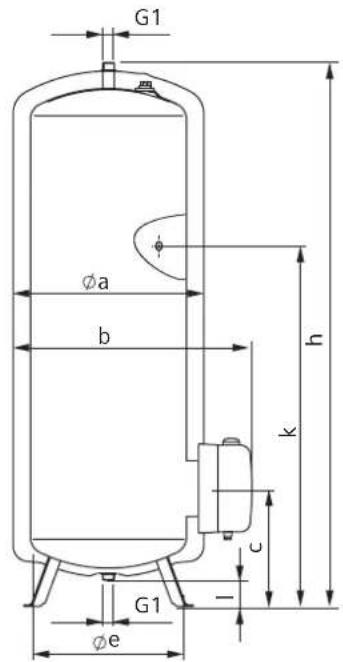
| DS20022 DS30022 DS40022 | |||
| a | [mm] 5 | 50 650 700 | |
| b | [mm] 6 | 90 790 840 | |
| c | [mm] 3 | 40 365 375 | |
| e | [mm] 4 | 30 490 540 | |
| l | [mm] 7 | 5 75 75 | |
| k | [mm] 1 | 035 1 040 1 | 60 |
| h ± 10 | [mm] 1 | 545 1 560 1 | 30 |
IV.
flowchart
graph TD
    A["6"] --> B["Valve"]
    B --> C["1"]
    C --> D["R"]
    D --> E["2"]
    D --> F["3"]
    F --> G["4"]
    G --> H["7"]
    G --> I["8"]
    G --> J["4"]
    J --> K["1"]
    K --> L["0"]
    K --> M["7"]
    N["5"] --> O["9"]
    P["11"] --> Q["11"]
V.
A
B
b2 4h
4 kW / 4 kW
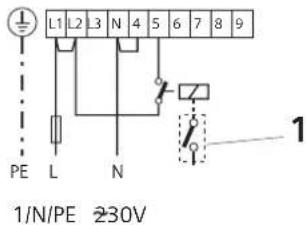
6 kW / 6 kW
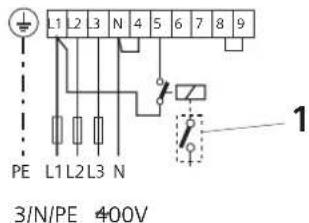
6 kW / 6 kW
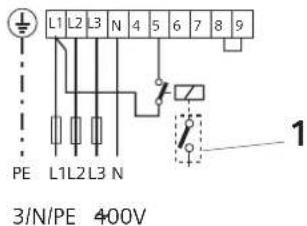
4 kW / 6 kW
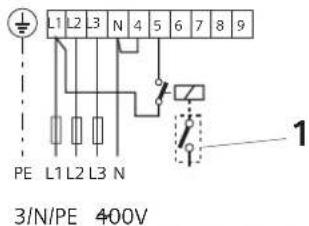
b2
8h
2 kW / 4 kW
4 kW / 6 kW
3 kW / 6 kW
2 kW / 6 kW
C
VI.
BZ 31420
BZ 31320
VII.
Safety information
This appliance is intended for domestic use or for household-based, non-commercial applications. Household-based applications include, e.g. usage in employees catering facilities for shops, offices, agricultural and other commercial operations, as well as usage by guests of guest houses, small hotels and similar residential establishments.
■Install and operate the appliance as described in the text and illustrations. We do not accept liability for damage resulting from failure to heed these instructions.
This appliance is intended for use up to a maximum altitude of 2 000 m above sea level.
The appliance may only be installed and stored in a frost-free room (due to residual water).

Risk of electric shock! Switch off the mains voltage supply immediately if a fault occurs. Immediately shut off the cold water supply to the appliance should it leak.
■Installation and initial start-up may only be carried out by a qualified professional in accordance with these instructions!
■ Maintenance work must be carried out by a qualified professional pursuant to recognised national regulations required by law (e. g. IEC 60 364-7-701).
Apart from the recognised national regulations required by law (e. g. IEC 60 364-7-701, DIN 1988), connection conditions issued by the power supply and water companies must be observed.
The (Class I) appliance must be permanently connected to installed pipes. The conductor cross-section must comply with the installed appliance power.
Caution: Earthed water pipes may give the appearance of a connected protective earth.
To guarantee compliance to relevant safety regulations, an all-pole separator must be fitted during installation. The contact opening must be at least 3 mm.
■ Disconnect the electrical connection cable from the supply and shut off the water supply before connecting the appliance!
■The floor-standing water heater must be secured to the ground!
During the heating process, expansion water must drip out of the safety valve outlet.
Supplied stickers: "For reasons of safety, water must come out of the outlet pipe during the heating period! Do not block!" – attach the stickers to the outlet pipe in a clearly visible position.
The safety valve prevents excessive pressure from developing in the floor-standing water heater during the heating process. Expansion water must be able to drain off via the safety valve.
Do not block the outlet pipe!
The size of the outlet pipe must suit the fully opened safety valve. The blow-off opening of the safety valve must remain open to the atmosphere.
The blow-off pipe of the safety group must be installed with a constant decline in a frost-free environment. Regular maintenance and operation of the safety valve are required to remove deposits and to ensure that the safety valve is not blocked.
■The installation instructions of the safety group must be followed.
■ Only a prototype-tested diaphragm safety valve may be installed.
A shutoff valve must not be installed between the safety valve and floor-standing water heater.
The safety valve must be operated regularly to verify its function and to descale the valve.
This appliance can be used by children aged 8 years and older as well as by persons with diminished bodily, sensory or mental perception, or those who lack knowledge or experience, if they are monitored or have received instruction concerning use and comprehend the possible dangers that can result. Children may not play with the appliance. Cleaning and maintenance by the user may not be performed by unsupervised children.
- Keep children away from the appliance.
■Please monitor children to ensure that they do not play with the appliance.
The mixer and the warm water pipe may be hot. Please inform and instruct children appropriately.
- Do not use aggressive or abrasive cleaning detergents!
- Do not use a steam cleaner.

DANGER Scalding! Hot water may escape during draining.
If the appliance needs to be drained for maintenance or to protect the whole installation when there is a risk of frost, proceed as follows:
- Close the shut-off valve in the cold water line.
- Open the hot water taps on all draw-off points.
- Drain the appliance using the drain valve.
Congratulations on purchasing this Siemens appliance. You have acquired a top-quality product, which will give you a lot of enjoyment.
Please read this installation and operating instruction manual carefully, then act accordingly! Store for future reference.
Installation instructions
Install the floor-standing water heater as described in the illustrated section. Observe the instructions in the text.
The illustrations can be found in the centre of the instruction manual.
Installation
For economic reasons the installation location should be near the most frequently used tap connection.
Description of the appliance
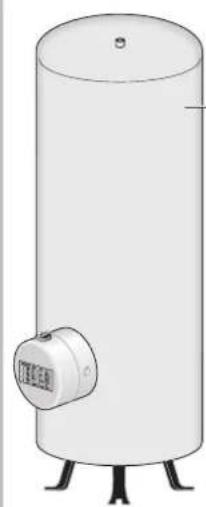
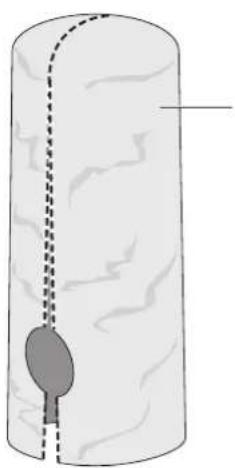
The interior of the steel tank has been specially enamelled to prevent corrosion and has been fitted with a protective anode. The exterior has been directly insulated with foam which cannot be removed. Cover the appliance with the supplied protective jacket only when the installation work is complete.
The universal flange enables electrical connections for single or double circuit operation. Circulation pipes should be avoided on account of the high heat losses. The circulation connection is located where the thermal insulation is noticeably indented.

Parts supplied
1 Floor-standing water heater
2 Protective jacket

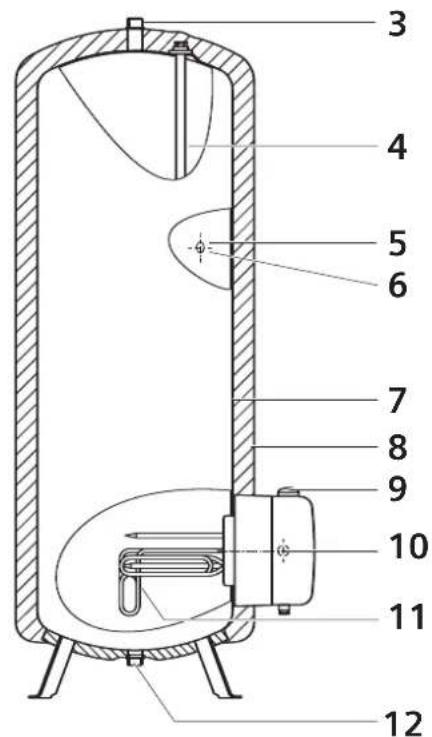
Appliance design
3 Hot-water outlet
4 Protective anode
5 Circulation connection piece
6 Mark for circulation connection piece
7 Steel tank, enamelled interior
8 Thermal insulation
9 Temperature selector switch
10 Push-button
11 Heating flange
12 Cold-water inlet

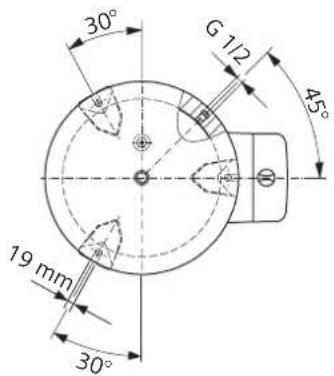
Dimensions

Water connection
■ Comply with DIN 1988 and the regulations issued by the water company.
Materials for cold-water and hot-water pipes
Water pipe made of steel, copper or plastic.
If plastic pipes are used, only install pipe systems made of crosslinked polyethylene (high-density polyethylene) according to DIN 16893 series 2 (20 bar), checked in accordance with DVGW work sheets W 531 and W 532 with the corresponding DVGW mark of conformity.
Information regarding the suitability and quality of other plastic pipes without the above-mentioned design approval information can only be provided by the pipe manufacturer.
Copper pipes are recommended if there is a risk of corrosion.
If using copper and steel materials, they must be joined in the following sequence, as seen from the flow of direction: Copper comes after steel.
This will avoid corrosion by local cell formation.
Stipulated combinations:
– Cold-water pipe made of copper: hot-water pipe made of copper or plastic
– Cold-water pipe made of steel: hot-water pipe made of steel, copper or plastic
– Cold-water pipe made of plastic: hot-water pipe made of steel, copper or plastic
Pressure reducing valve
The floor-standing water heater is designed to operate at pressures not exceeding 6 bar. A pressure reducing valve must be situated in the cold-water pipe if the water mains pressure exceeds 5 bar. If the water mains pressure exceeds 10 bar, a second pressure reducing valve must be connected in series.
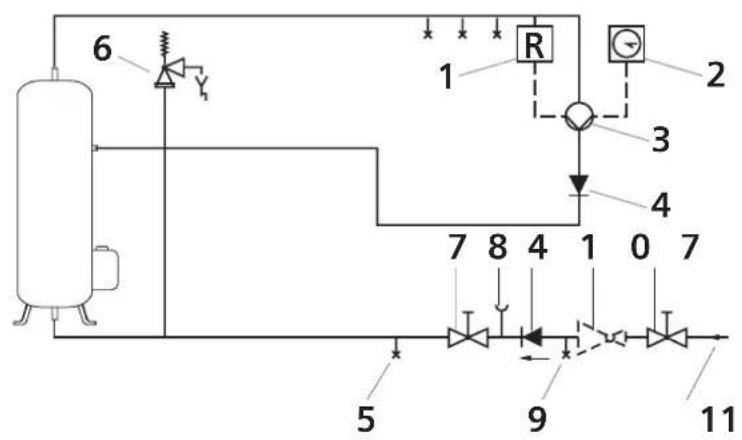
Installation example (Fig. IV.)
1 Thermostat
2 Time switch
3 Circulation pump
4 Non-return valve
5 Outlet valve
6 Safety valve
7 Through-way shutoff valve
8 Test connection piece for manometer
9 Test valve
10 Pressure reducing valve (only when water pipe pressure exceeds 5 bar)
11 Cold-water inlet
The fittings and safety devices indicated in the diagram must be used for the installation and they must be fitted in the sequence shown (see DIN 1988 or local regulations).
For easier installation we recommend the use of our compact safety valve units.
If a central battery (thermostat battery) is used, a device must be fitted directly to the hot-water outlet of the floor-standing water heater, in order to measure the cut-out temperature.

Electrical connection
Electrical installation must only be carried out by an electrician from the power supply company.
The power supply must only be connected after the water supply. Connections must be carried out according to the circuit and terminal diagrams. The ratings permitted by the power supply company for primary/rapid heating, as well as the heating duration, must be observed. The internal circuitry must not be altered. The rating plate, norms, regulations and guidelines must be observed.
■Floor-standing water heaters have special connections on the terminal strip for control cables and contactors.
The protective conductor terminal is identified by the protective conductor sign.
An all-pole disconnecting device with a min. 3 mm gap construction must be fitted by the installation company.

Attention!
The appliance must not be connected by a two-pole-and-earthing-pin plug.
Connection work
■Remove switchroom cap.
■Push power cable and control lead through the cable inlet and connect in accordance with the circuit diagram.
■Connect the protective conductor to the protective conductorterminal.
■Tighten the screwed connections of the cable inlets.
Place the rating stickers in the position marked on the ratingplate.
■Fit the switchroom cap.
Rated voltage
| Supply-voltage 1/N/PE | 230V~ | 3/N/PE400V~ | ||
| Primary heating | ||||
| 8 h 2 kW | 2 kW 3 | kW 4 k | W | |
| 4 h 4 kW | 4 kW 6 | kW 6 k | W | |
| Rapid heating | 4 kW 6 kW | |||
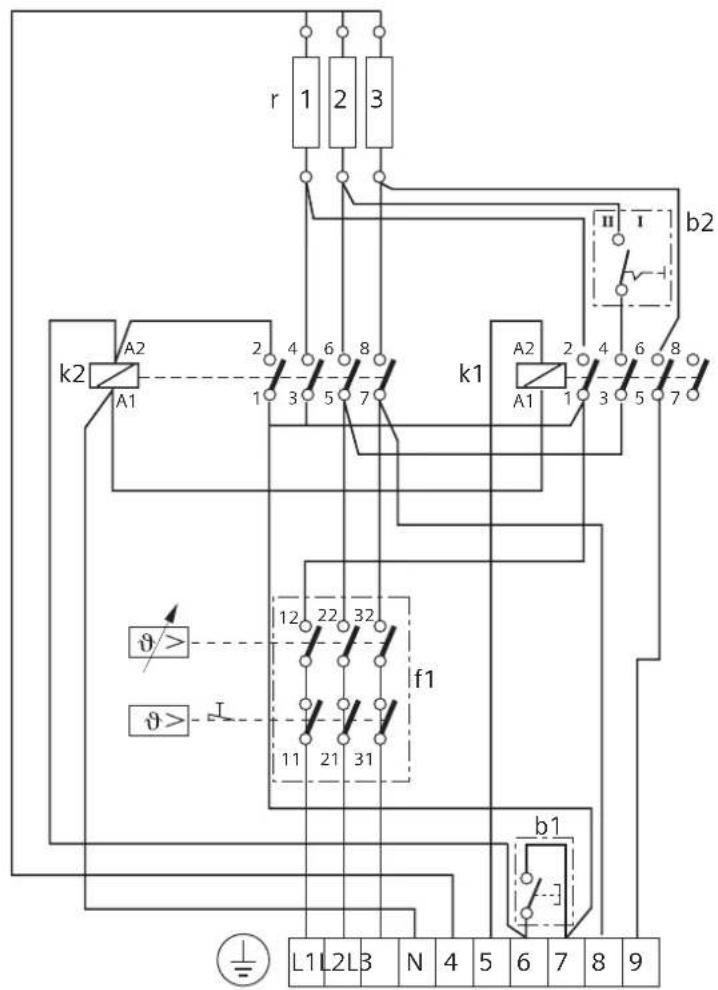
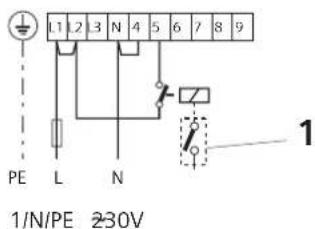
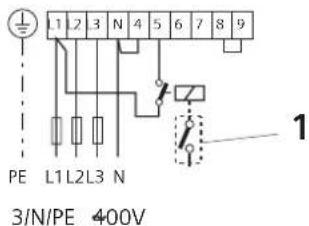
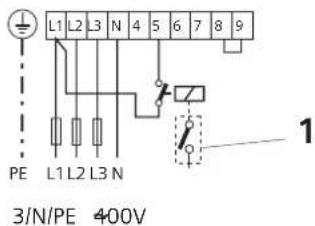
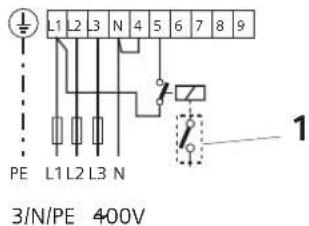
Circuit diagram (Fig. A)
Mandatory circuit diagram inside the appliance.
Subject to change without notice.
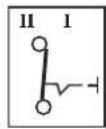
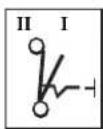
Switch b2 has been preset at the factory to position "I" (heating duration 8 hours).
b1 Push-button for rapid heating
b2 Selector switch for primary heating
k1 Contactor
k2 Contactor
1 Power supply company contact
When operating without a controller from the power supply company, place a bridge between L1 and 5.
Depending on the power supply company, the period in which off-peak power is supplied may be restricted.
Primary heating can therefore be set with selector switch b2, so that the floor-standing water heater heats up in either 4 or 8 hours.
If the power supply company does not permit peak-rate heating, the push-button must be covered with the plastic cap situated in the switchroom.
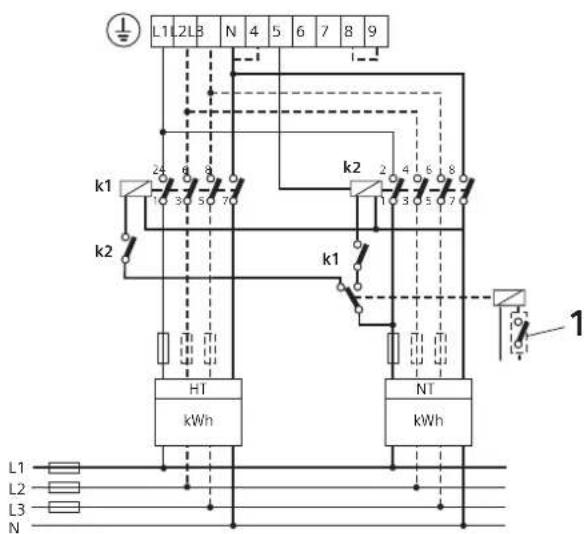
Dual meter measurement (comply with phase coincidence) (Fig. C)
1 Power supply company contact
k1 Contactor
k2 Contactor
1/N/PE - 230 V\~: without broken lines
3/N/PE - 400 V\~: with broken lines
Technical data
| DS20022 DS30 | 022 DS40022 | |||
| Design | sealed (pressurised) | |||
| Capacity | [I] 200 300 400 | |||
| Rated pressure | [MPa (bar)] 0 | 6 (6) | 0.6 (6) | 0.6 (6) |
| Weight empty | [kg] | 55 | 68 | 85 |
| Class of protection accord. to VDE | I | |||
| Degree of protection accord. to VDE | IP X4 | |||
| Mark of conformity | ΦE Λ DIN AGI CE | |||
| Cold-water connection | G1A | |||
| Hot-water connection | G1A | |||
| Circulation connection | G1/2A | |||
| Flow rate max. | [I/min] | 30 | 38 | 45 |
| Rated voltage | [V~] | 230/400 | 230/400 | 230/400 |
| Tank material | steel, interior specially enamelled | |||
| Energy efficiency class | C | C | D | |
| Hot water heating energy efficiency | [%] | 38.7 | 38.8 | 38.6 |
| Load profile | XL | XL | XXL | |
| Annual energy consumption | [kWh] | 4332 | 4316 | 5586 |
| Daily energy consumption | [kWh] | 19.920 | 19.828 | 25.438 |
| Sound power level | [dB] | 15 | 15 | 15 |
| Mixed water quantities V40 according to the European Guideline 814/2013 | [I] 317 490 617 | |||
| Mixed water quantities at 40 °C (15 °C/65 °C) according to EN60379 | [I] 397 590 780 | |||
Operating instructions
Please read and observe the detailed safety instructions at the start of these instructions!
■ Important: The appliance may never be exposed to frost!

Risk of electric shock!
Switch off the mains voltage supply immediately if a fault occurs.
Immediately shut off the cold water supply to the appliance should it leak.
Your new appliance
This floor-standing water heater enables you to heat up as much drinking water as required to approximately 60 °C and store it for household use.
On request a qualified professional will increase the maximum adjustable temperature to approx. 80 °C.
Several tap connections can be supplied with hot-water. The mixers can always supply cold-water.
Our products are environment-friendly, can be recycled and conserve energy.

How to operate the floor-standing water heater
Adjustments are facilitated by the control panel on the appliance. The control panel indicates the various settings, temperatures, volumes of water and how many baths or showers may be taken.
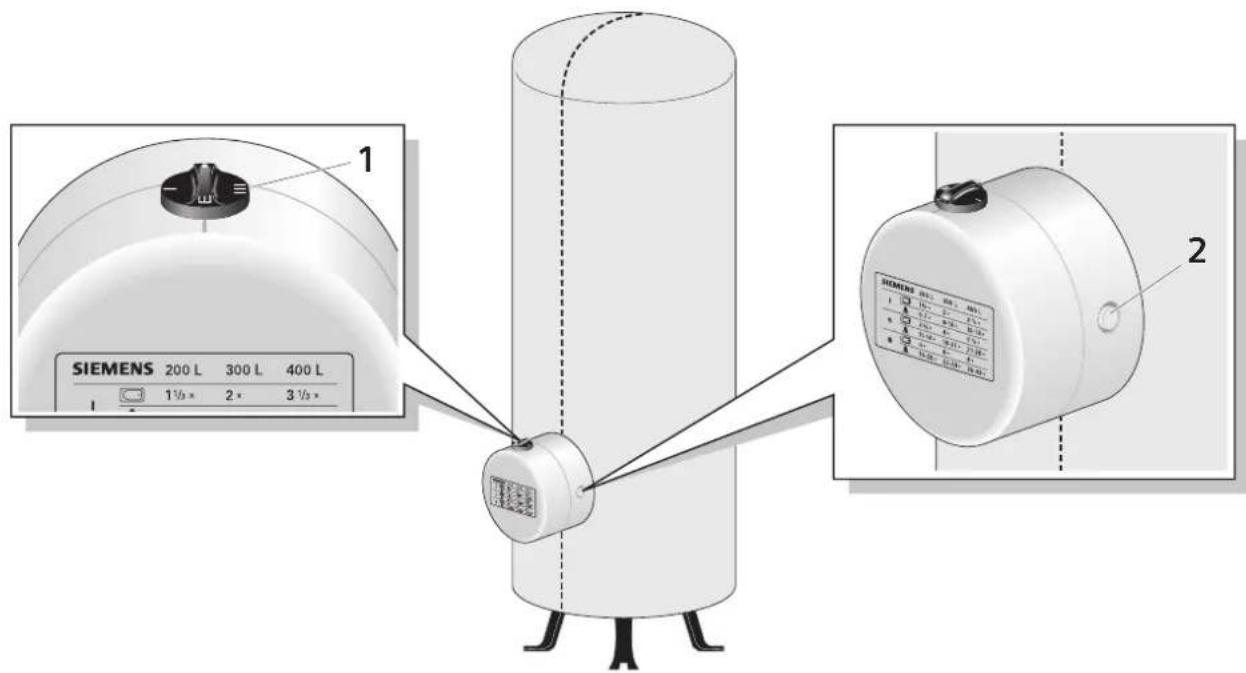
■Preselect the required temperature with temperature selectorswitch1.
Position
• Cold and anti-freezing protection
I The water is heated to approx. 38 °C.
E Energy conservation position. The water is heated to approx.60°C. The selector switch will click into place at position "E".
III Setting for hot-water and when large amounts of hot-water are required. The water is heated to approx. 80 °C. (this setting only by qualified professional)
During the heating process, expansion water drips out of the safety valve.
- Rotate the temperature selector switch 1 to position “•” to switch off the heating.
Operation during the off-peak period (off-peak power)
This is the most cost-effective mode of operation.
Set the required water temperature with the temperature selector switch 1.
The power supply company activates off-peak power by means of a signal in the power system. Primary heating then switches on automatically.
You will then have hot-water during the day.
Additional operation during the peak period
If the volume of hot-water provided during the night is insufficient, water can also be heated during the peak period:
■Press push-button 2.
The water is heated to the temperature set on the temperature selector switch 1. When the selected temperature has been reached, the peak-rate heating automatically switches off.
■ Set a higher temperature with the temperature selector switch 1 if you frequently need to reheat water during the peak period.
As a result, you will have a larger volume of mixed water.
- Rotate the temperature selector switch 1 to position “•” if the floor-standing water heater will not be heated for a prolonged period.
This setting protects the appliance from freezing.
This does not apply to the fittings and pipes in the cold-water inlet!
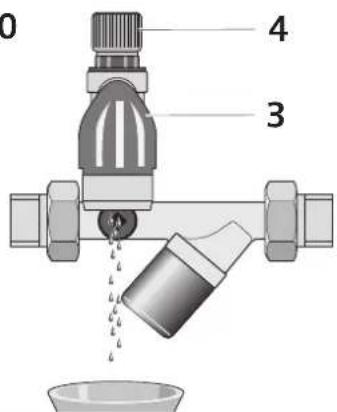
Checking the safety valve
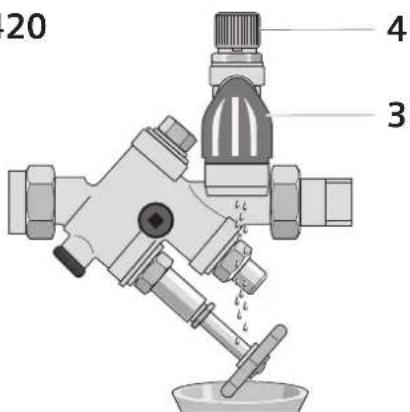
During the heating process, expansion water must drip out of the safety valve outlet 3.
For reasons of safety the outlet must not be blocked.
- Check that the safety valve is functioning properly at least once a month.
- Rotate ventilation screw 4 until the valve opens and a powerful jet of water comes out of the outlet 3.
- Close the valve again with the ventilation screw.
If the safety valve does not function as described, rotate the temperature selector switch to position “•” and contact a qualified professional.
Saving energy
The appliance operates particularly economically at low temperatures. Therefore, only set the temperature which you require.
The floor-standing water heater operates most economically in position "E" (approx. 60 °C), even when large amounts of hot-water are required. At higher water temperatures, the appliance calcifies at an increased rate, resulting in greater heat losses!
Decalcifying
- Inspect the fittings regularly for lime scale deposits and descale with commercially available descaling agents.
■Actuate the safety valve regularly to remove the lime scale (see "Checking the safety valve").
The level of lime scale deposited from the water is increased or reduced at higher temperatures depending on the local water quality (hardness level I/II/III; soft, medium or hard). It is deposited on the interior of the water tank and on the heating element as boiler scale and influences the service life of the appliance.
The appliance must therefore be checked and decalcified regularly by a qualified professional.
Please schedule your first and/or next maintenance visit (inspection of the protection anode and descaling) with your qualified specialist.
Maintenance work may only be carried out by a qualified professional. Improper repairs may put the user in extreme danger.
Cleaning
■Simply wipe the appliance with a damp cloth.
Do not use acidic or abrasive cleaning materials.
Customer Service
In the event of a malfunction, unplug the appliance from the power supply (pull out the fuse or activate the circuit breaker) and contact customer service.
Details can be obtained from a Siemens customer service centre regarding your nearest customer service centre or authorised repair shop.
We ask you to always provide the E-No. and the FD-No. of your appliance when calling in a customer service engineer.
Maintenance instructions

Maintenance work must only be carried out by a qualified professional, pursuant to VD E0700 or localregulations.
■The appliance must be isolated from the power supply in all poles.
Decalcifying
Do not use a decalcifying pump. This would decalcify the heating flange but would damage the protective anode and the interior wall of the tank.
Procedure:
■ Disconnect the floor-standing water heater from the power supply.
■ Remove the switchroom cap.
■ Disconnect the heating flange and remove.
■ Decalcify the heating flange.
■Remove loose pieces of lime from the floor-standing waterheater.
■Fit the heating flange and connect in accordance with the circuit diagram.
■ Fit the switchroom cap.
Checking the protective anode
The protective anode must be removed prior to checking.
It is situated next to the hot-water outlet nozzle and is covered by the thermal insulation (recognizable by a protrusion).
■ Unzip the protective jacket. Cut out the thermal insulation with a knife.
■ Screw out the protective anode and check.
If the protective anode is used up, it must be replaced with a new one.
If there is insufficient space to install a pole anode, install a chain anode.
The protective anode must have a good metallic conduction with the floor-standing water heater. Cover the screwed connection of the anode with the piece of thermal insulation material which was previously cut out.
■Zip up the protective jacket.
Note: The protective anode, located in the floor-standing water heater, must be checked for the first time after two years and replaced if necessary. The qualified professional is familiar with the local water quality and will specify when the next maintenance check should be carried out.
Safety valve
■Vent the safety valve until the full water jet is flowing out.
■ Close the safety valve after carrying out the check.

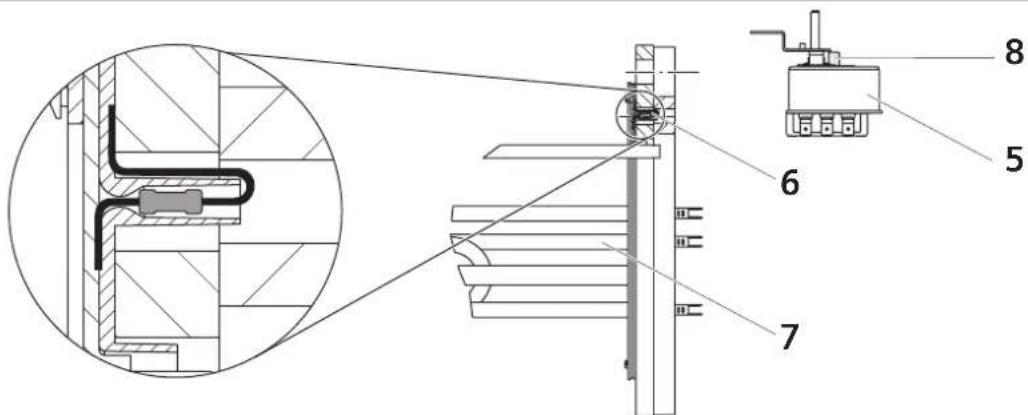
Safety equipment
5 Thermal cut-out
6 Corrosion protection anode resistor
7 Heating flange
8 Reset button
The thermostat and thermal cut-out are located together in the heating flange. If the thermal cutout disconnects the appliance due to a malfunction, the whole unit must always be replaced. The cause of the malfunction must be eliminated by a qualified professional.
The heating flange is connected with the tank via the corrosion protection anode resistor. The corrosion protection anode resistor serves to equalise electrical potential differences and prevents current-related corrosion to the heating elements. The anode resistor is not to be damaged or removed during servicing (for mounting position, refer to figure).
Disposal
This appliance is labelled in accordance with European Directive 2012/19/EU concerning used electrical and electronic appliances (waste electrical and electronic equipment – WEEE).
The guideline determines the framework for the return and recycling of used appliances as applicable throughout the EU.
Please ask your specialist retailer about current disposal facilities.
Guarantee
The guarantee conditions for this appliance are as defined by our representative in the country in which it is sold.
Details regarding these conditions can be obtained from the dealer from whom the appliance was purchased. The bill of sale or receipt must be produced when making any claim under the terms of this guarantee.
Subject to change without notice.
Kundendienst – Customer Service
European Trade Center Building, 5th floor
1784 Sofia
Tel.: 02 892 90 47
Fax: 02 878 79 72
mailto:informacia.servis-bg@bshg.com
www.siemens-home.bg
CH Schweiz, Suisse, Svizzera, Switzerland
BSH Hausgeräte AG
Central Branch Service
17 km E.O. Athinon-Lamias &
Potamou 20
14564 Kifisia
Unit 1 & 2, 3rd Floor
North Block, Skyway House
3 Sham Mong Road
Tai Kok Tsui, Kowloon
Hong Kong
Tel.: 2565 6151
Fax: 2565 6681
mailto:siemens.hk.service@bshg.com
www.siemens-home.com.hk
HR Hrvatska, Croatia
BSH kućni uređaji d.o.o.
Kneza Branimira 22
10000 Zagreb
Tel.: 01 640 36 09
Fax: 01 640 36 03
mailto:informacije.servis-hr@bshg.com
www.siemens-home.com/hr
LU Luxembourg
www.siemens-home.com/lu
ME Crna Gora, Montenegro
Elektronika komerc
UI. Slobode 17
84000 Bijelo Polje
Tel./Fax: 050 432 575
Mobil: 069 324 812
mailto:ekobosch.servis@t-com.me
MK Macedonia, Makedonija
GORENEC
Jane Sandanski 69 lok. 3
1000 Skopje
Tel.: 022 454 600
Mobil:070 697 463
mailto:gorenec@yahoo.com
PH Philippines
Häfele Philippines, Incorporated
Levi Mariano Avenue, Brgy. Ususan,
Taguig City 1632
Metro Manila
Tel.: 0842 3353
Fax: 0571 3662
mailto:siemens-home@hafele.com.ph
PL Polska, Poland
2034/11-15 Ital Thai Building,
1st Floor, New Petchburi Road
Bangkapi, Huaykwang,
Bangkok, 10310
Tel.: 02 769 7970
Fax: 02 769 7971
Service Call Center
Tel.: 02 351 8995
Spareparts
Tel.: 02 769 7975
www.siemens-home.com/th
TR Türkiye, Turkey
BSH Ev Aletleri Sanayi
ve Ticaret A. S.
Fatih Sultan Mehmet Mahallesi
Balkan Caddesi No: 51
34771 Ümraniye, Istanbul
Tel.: 0 216 444 6688*
Fax: 0 216 528 9188
mailto:careline.turkey@bshg.com
www.siemens-home.com/tr