
MFC-J4625DW - Imprimante multifonction BROTHER - Notice d'utilisation et mode d'emploi gratuit
Retrouvez gratuitement la notice de l'appareil MFC-J4625DW BROTHER au format PDF.


| Type de produit | Imprimante multifonction jet d'encre |
| Dimensions (L x P x H) | Environ 500 x 400 x 250 mm |
| Poids | Environ 12 kg |
| Alimentation | 220-240 V AC, 50/60 Hz |
| Fonctions principales | Impression, copie, numérisation, télécopie |
| Technologie d'impression | Jet d'encre 4 couleurs (CMJN) |
| Résolution d'impression max. | Jusqu'à 6000 x 1200 dpi |
| Formats de papier supportés | A4, A5, A3, Legal, Ledger, Photo, Enveloppes |
| Capacité du bac papier | Jusqu'à 100 feuilles (bac standard) |
| Chargeur automatique de documents (ADF) | 20 feuilles |
| Écran tactile | Écran LCD tactile couleur 3,7" (93,4 mm) |
| Connectivité | Wi-Fi 802.11b/g/n, USB 2.0, NFC |
| Impression mobile | Brother iPrint&Scan, AirPrint, Google Cloud Print |
| Entretien et nettoyage | Nettoyage de la vitre du scanner et de la bande de verre; vérification et alignement de la tête d'impression |
| Sécurité | Verrouillage du panneau, restrictions réseau |
| Pièces détachées et réparabilité | Cartouches d'encre remplaçables (LC223/LC225/LC227); maintenance par centre agréé |
| Informations générales | Marque : Brother, Modèle : MFC-J4625DW, Fabriqué au Vietnam |
FOIRE AUX QUESTIONS - MFC-J4625DW BROTHER
Questions des utilisateurs sur MFC-J4625DW BROTHER
0 question sur cet appareil. Repondez a celles que vous connaissez ou posez la votre.
Poser une nouvelle question sur cet appareil
Téléchargez la notice de votre Imprimante multifonction au format PDF gratuitement ! Retrouvez votre notice MFC-J4625DW - BROTHER et reprennez votre appareil électronique en main. Sur cette page sont publiés tous les documents nécessaires à l'utilisation de votre appareil MFC-J4625DW de la marque BROTHER.
MODE D'EMPLOI MFC-J4625DW BROTHER
Basic User's Guide
MFC-J4620DW
MFC-J4625DW
If you must contact Customer Service
Please complete this information for future reference:
Model Number: MFC-J4620DW and MFC-J4625DW (Circle your model number)
Serial Number: 1
Date of Purchase:
Place of Purchase:
1 The serial number is on the back of the unit. Retain this User's Guide with your sales receipt as a permanent record of your purchase, in the event of theft, fire or warranty service.
Register your product on-line at
http://www.brother.com/registration
You can use the following features!
Mobile Connect
Use Brother iPrint&Scan to print and scan images and files from mobile devices.
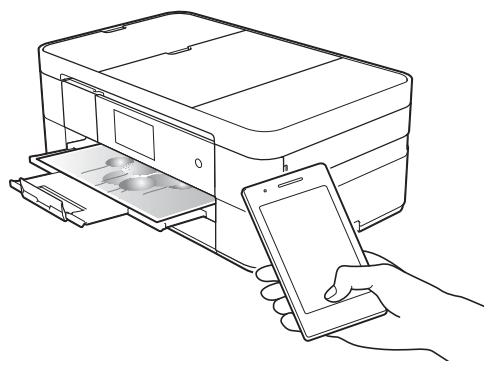
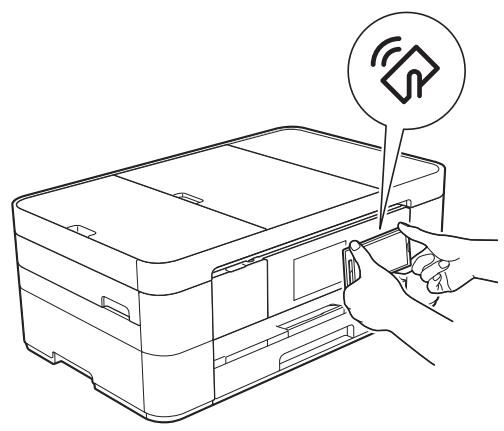
If your Android™ device supports Near Field Communication (NFC), print and scan just by touching your device to the NFC logo on the control panel.
(See Mobile Print/Scan Guide for Brother iPrint&Scan at solutions.brother.com/manuals.)
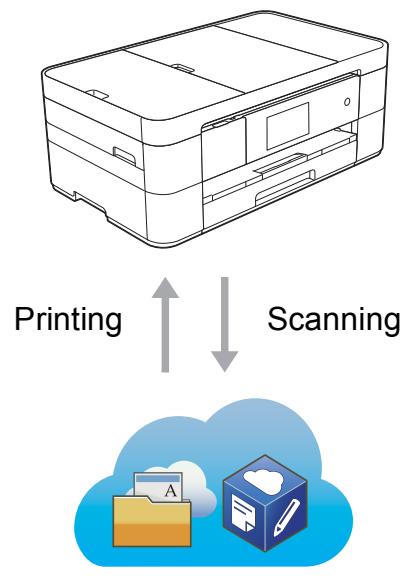
Web Connect / Brother Apps
Scan and upload images and files to popular web services directly from your machine. Capture and convert information directly from your machine without your computer.
(See Web Connect Guide at solutions.brother.com/manuals.)
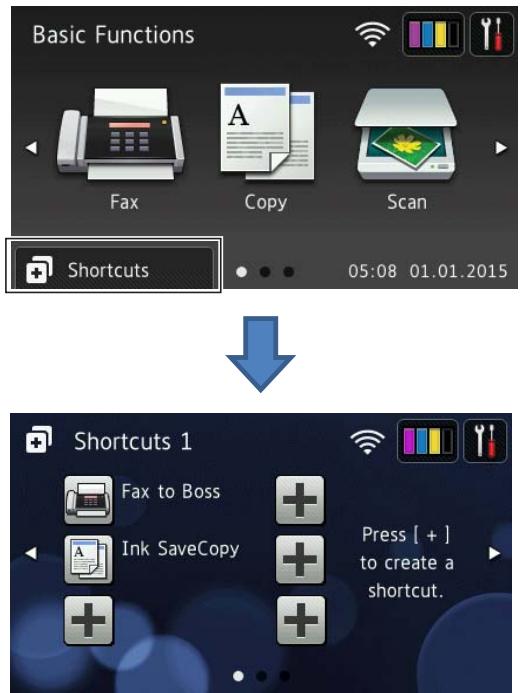
Add Shortcuts
Save your most frequently-used settings as Shortcuts.
(See Online User's Guide at solutions.brother.com/manuals.)
User's Guides and where to find them
| Which Guide? | What's in it? | Where is it? |
| Product Safety Guide | Read this Guide first. Please read the Safety Instructions before you set up your machine. See this Guide for trademarks and legal limitations. | Printed / In the box |
| Quick Setup Guide | Follow the instructions for setting up your machine, and installing the drivers and software for the operating system and connection type you are using. | Printed / In the box |
| Basic User's Guide | Learn the basic Fax, Copy, Scan and PhotoCapture Center operations and basic machine maintenance. See troubleshooting tips. | Printed / In the box |
| Online User's Guide | This HTML (Web) guide includes the contents of the Basic User's Guide, and additional information about the machine's settings and operations, security features, troubleshooting tips, and maintenance instructions. In addition to information about the PC-Print, Scan, Copy, Fax (MFC models only), and PhotoCapture Center and Brother ControlCenter operations, useful information is included about using the machine on a network. | HTML / CD-ROM (Windows®) / Brother Solution Center 1 (Macintosh) |
| Web Connect Guide | This Guide provides useful information about accessing Internet services from the Brother machine, as well as downloading images, printing data and uploading files directly to Internet services. | PDF file / Brother Solutions Center 1 |
| AirPrint Guide | This Guide provides information for using AirPrint to print from OS X v10.7.x or later and your iPhone, iPod touch, iPad, or other iOS device to your Brother machine without installing a printer driver. | PDF file / Brother Solutions Center 1 |
| Google Cloud Print Guide | This Guide provides details on how to use Google Cloud PrintTM services for printing over the Internet. | PDF file / Brother Solutions Center 1 |
| Mobile Print/Scan Guide for Brother iPrint&Scan | This Guide provides useful information about printing from your mobile device and scanning from your Brother machine to your mobile device when connected to a Wi-Fi® network. | PDF file / Brother Solutions Center 1 |
The Online User's Guide helps you get the most out of your machine.
Quicker navigation!
Search box
- Navigation index in a separate pane
Comprehensive!
- All topics in one guide
Simplified layout!
- Provides step-by-step instructions
- Summarizes the feature at the top of the page
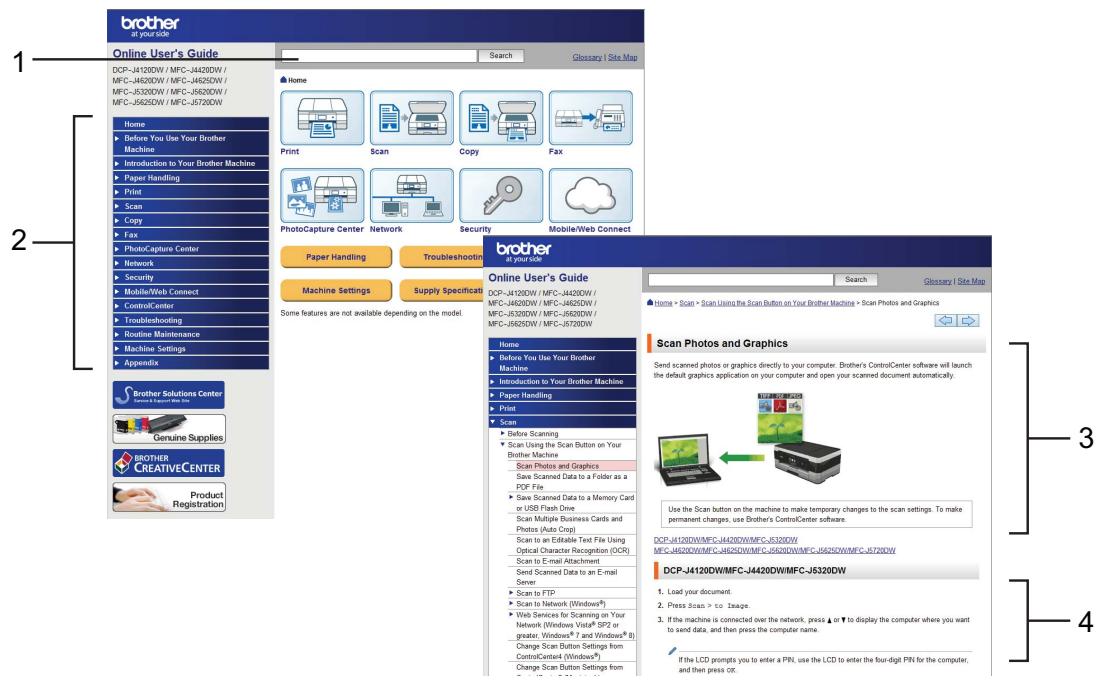
1 Search Box
2 Navigation Index
3 Feature Summary
4 Step-by-Step Instructions
Where can I find the Online User's Guide?
(Windows®)
Click (Start) > All Programs > Brother > Brother Utilities > MFC-XXXX (Where XXXX is your model name.) > Support > User's Guides.
(Windows® 8)
Tap or click (Brother Utilities) > MFC-XXXX (Where XXXX is your model name.) > Support > User's Guides.
(Macintosh or other options)
Visit Brother Solutions Center: solutions.brother.com/manuals.
If you have questions or problems, please take a look at your model's FAQs.
■ Provides several ways to search
- Displays related questions for additional information
Receives regular updates based on customer feedback
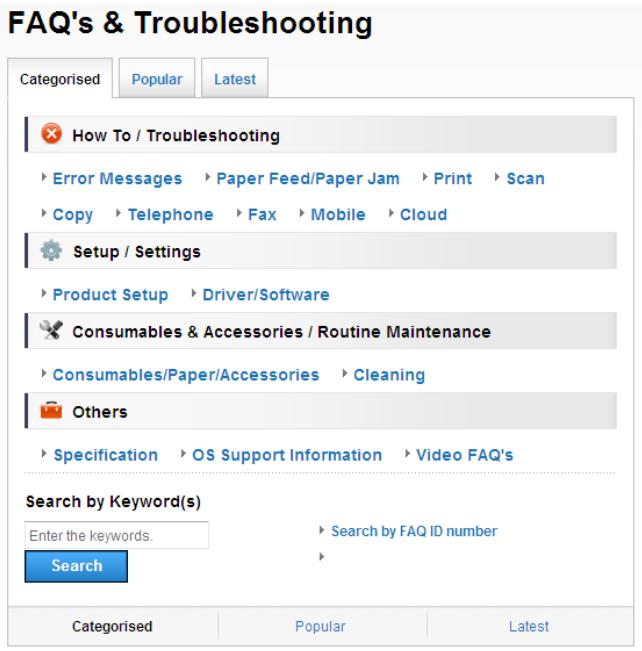
- The FAQ home page will vary depending on your model.
Where can I find these FAQs?

Brother Solutions Center http://support.brother.com
Table of Contents
1 General information. 1
How to use the documentation .... 1
Symbols and conventions 1
About Brother Utilities
(Windows®) 1
Control panel overview 2
3.7"(93.4 mm) Touchscreen
LCD 4
Entering Text 8
2 Loading paper 9
Before loading paper. 9
Loading paper in the paper tray..... 9
Loading paper in the manual
feed slot 11
Paper settings 14
Set Paper Size and Type 14
Check Paper setting. 15
Recommended print media. 15
Handling and using print
media 15
3 Loading documents 16
How to load documents 16
Using the ADF 16
Using the scanner glass 17
4 Printing from a computer. 18
How to print a document 18
5 Copying 19
How to copy 19
Stop copying 19
Copy options overview 19
Paper Type 20
Paper Size 20
6 Scanning to a computer... 21
Before scanning 21
How to scan a document as a
PDF file using ControlCenter4
(Windows®) 21
How to scan a document as a
PDF file using the Touchscreen.... 22
7 Printing and scanning with Near Field Communication (NFC) 23
How to print with NFC 23
How to scan with NFC 23
8 Printing photos from a memory card or USB flash drive 24
PhotoCapture Center operations
(PHOTO mode) 24
How to print images 24
View Photos 24
PhotoCapture Center print settings
overview 25
9 Telephone services and external devices 26
Telephone services overview 26
Voicemail 26
Voice over Internet Protocol
(VoIP) 26
Connecting an external telephone
answering device (TAD) 26
External and extension
telephones 26
10 Sending a fax 27
How to send a fax 27
Stop faxing 28
How to store numbers 28
Storing a pause 28
Storing Address Book
numbers 28
How to set your Station ID 29
11 Receiving a fax 30
Receive Modes 30
Choose the Receive Mode. 30
Using Receive Modes 31
Receive Mode settings 32
Ring Delay 32
F/T Ring Time
(Fax/Tel mode only) 32
A Routine maintenance.....33
How to clean and check the
machine 33
Cleaning the scanner glass..... 33
Checking the print quality. 33
Checking the print alignment .... 35
B Troubleshooting 36
Identifying the problem 36
Error and maintenance
messages 36
Error animations. 46
Transferring your faxes or Fax
Journal report. 46
Document jam 47
Printer jam or paper jam 48
Troubleshooting for Wireless
LAN setup 54
Wireless LAN report. 54
If you are having difficulty with
your machine 55
Dial Tone detection 65
Telephone Line Interference or
VoIP System 65
Machine Information 66
Checking the serial number 66
Checking the firmware
version 66
Reset operations overview. 66
How to reset the machine 67
C Index 68
Supplies 71
1
General information
How to use the documentation
Thank you for buying a Brother product! Reading the documentation will help you make the most of your machine.
Symbols and conventions
The following symbols and conventions are used throughout the documentation.
Bold
Bold typeface identifies buttons on your computer screen.
Italics
Italicized typeface emphasizes an important point or refers you to a related topic.
Courier New
Text in the Courier New font identifies messages displayed on the machine's Touchscreen LCD.
IMPORTANT
IMPORTANT indicates a potentially hazardous situation which, if not avoided, may result in damage to property or loss of product functionality.
NOTE
NOTE specifies the operating environment, conditions for installation, or special conditions of use.
About Brother Utilities (Windows®)
Brother Utilities is an application launcher that offers convenient access to all Brother applications installed on your device.
1 (Windows XP, Windows Vista, Windows 7, Windows Server 2003, Windows Server 2008 and Windows Server 2008 R2)
Click (Start) > All Programs >
Brother, and (Brother Utilities).
(Windows® 8 and Windows Server® 2012)
Tap or click (Brother Utilities) either on the Start screen or the desktop.
(Windows® 8.1 and
Windows Server® 2012 R2)
Move your mouse to the lower left
corner of the Start screen and click (if you are using a touch-based device, swipe up from the bottom of the Start screen to bring up the Apps screen). When the Apps screen appears, tap or click (Brother Utilities).
2 Select your machine.
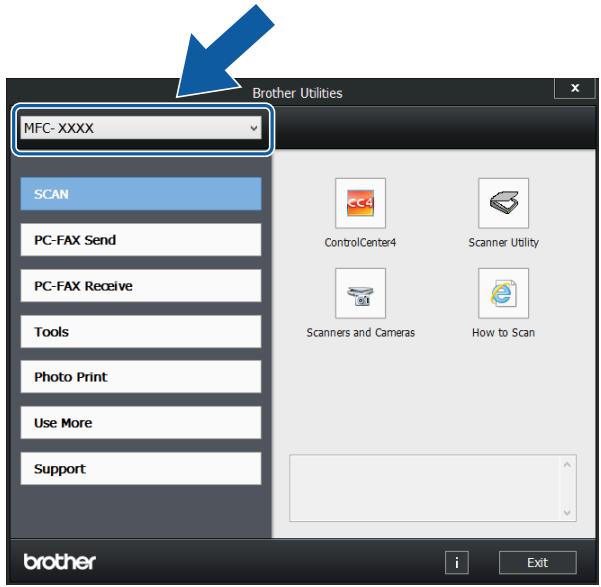
3 Choose the operation you want.
Control panel overview
The MFC-J4620DW and MFC-J4625DW have the same 3.7"(93.4 mm) Touchscreen LCD and Touchpanel.
MFC-J4620DW
Basic Functions
Fax

Copy

Scan

Shortcuts


05:08 01.01.2015
NOTE
Most of the illustrations in this User's Guide show the MFC-J4620DW.
1 3.7"(93.4 mm) Touchscreen LCD (Liquid Crystal Display)
Access the menus and options you want by pressing them as they are displayed on the Touchscreen LCD.
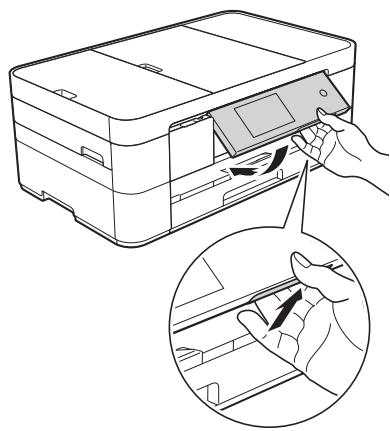
You can adjust the angle of the Touchscreen LCD and Touchpanel by lifting it. To lower this control panel, press the release button that is located behind it, as shown in the illustration.
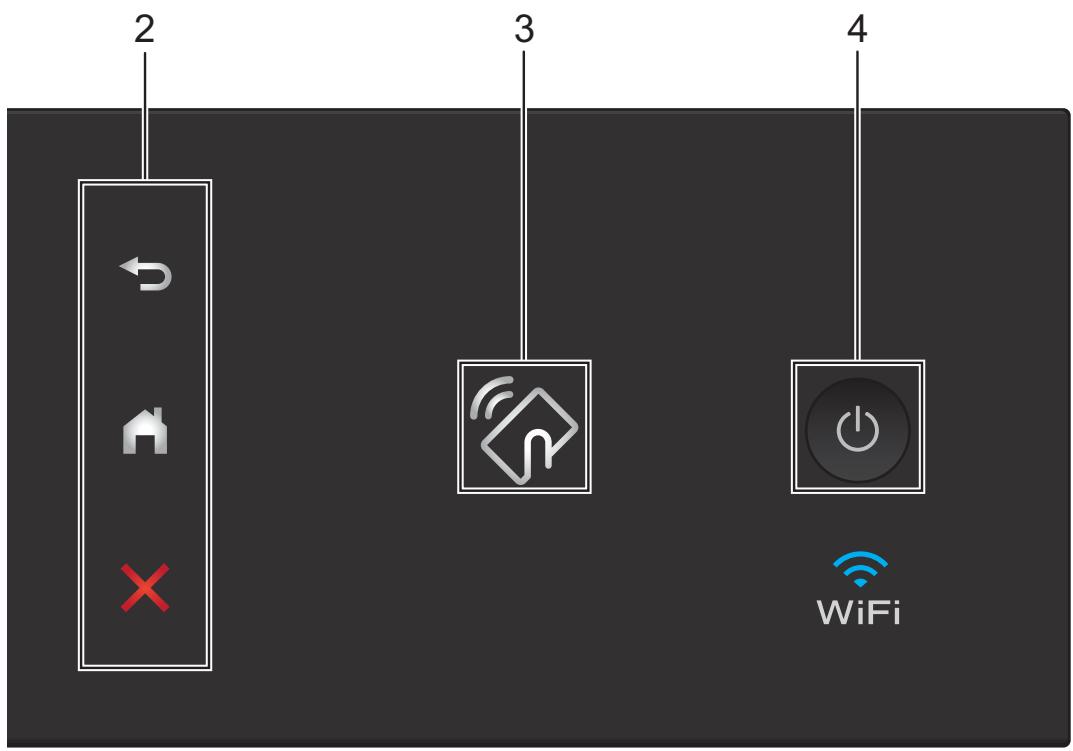
2 Touchpanel:

Back
Press to go back to the previous menu level.

Home
Press to return to the Home screen. By default it displays the date and time, but you can change the default settings.

Cancel
Press to cancel an operation when lit.
3 NFC (Near Field Communication) logo
The NFC logo light on the right side of the control panel is on when NFC is set to On.
(To turn off the NFC feature, press

All Settings > Network > NFC > Off. The NFC logo light goes off.)
If your Android™ device supports the NFC standard, you can print and scan to your device by touching it to the NFC logo.
You must download and install Brother iPrint&Scan to your Android™ device to use this feature.
(See Printing and scanning with Near Field Communication (NFC) on page 23.)


Power On/Off
Press

to turn the machine on.
Press and hold down to turn the machine off. The Touchscreen LCD displays Shutting Down and stays on for a few seconds before turning off.
If you have connected an external telephone on TAD, it is always available for use.
If you turn the machine off using , it still periodically cleans the print head to maintain print quality. To prolong the life of the print head, provide better ink efficiency, and maintain print quality, keep your machine connected to the power at all times.
3.7"(93.4 mm) Touchscreen LCD
Select from three types of screens to set the Home screen: Basic Functions screen, More screens and Shortcuts screens. When the Basic Functions screen is displayed, swipe left or right or press or to display the More screens. Press + to display the Shortcut screens.
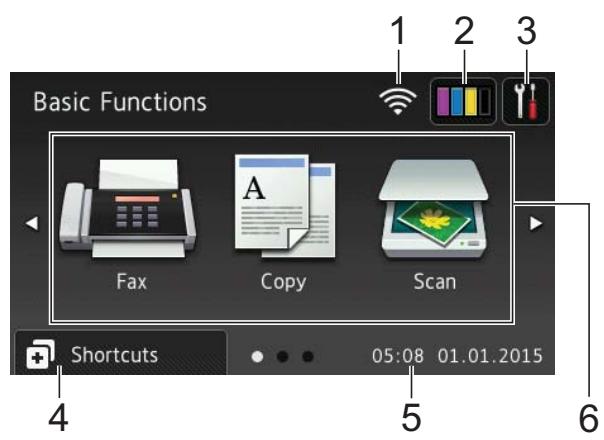
Basic Functions screen
The Basic Functions screen displays the date and time and provides access to the Fax, Copy and Scan modes.
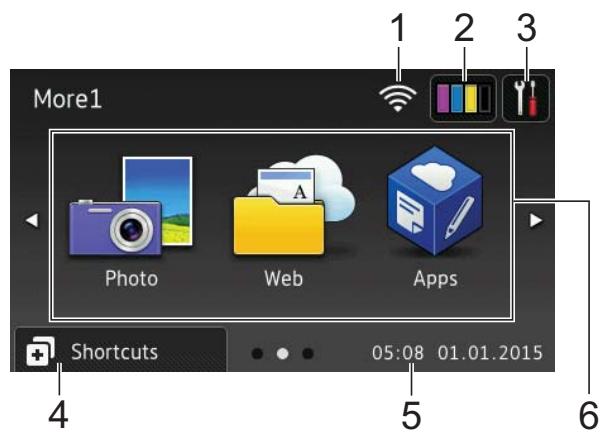
More screens
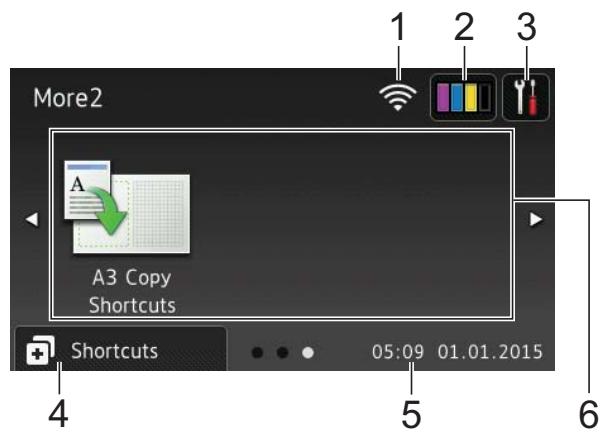
The More screens display the date and time and provides access to additional features, such as Photo, Web, Apps and A3 Copy Shortcuts.
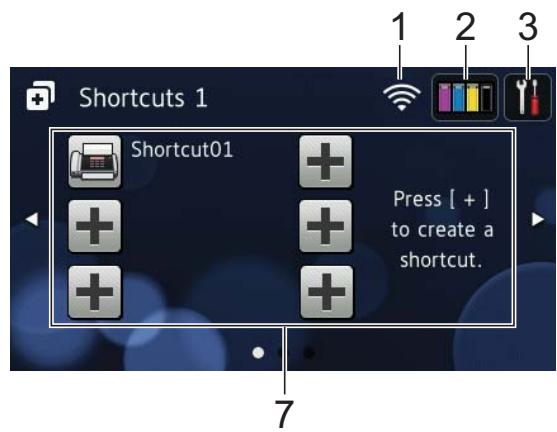
Shortcut screens
You can save certain settings as a Shortcut so you can quickly send a fax, copy, scan and use Web Connect services. (See Online User's Guide.)
1 Wireless Status
A four-level indicator on the Ready Mode screen displays the current wireless signal strength when using a wireless connection.

WhenWiFi appears on the
Touchscreen, press it to configure your wireless settings. For more information, see Quick Setup Guide.
2 Ink
Displays the available ink volume. Press to access the Ink menu.
When the ink cartridge is near the end of its life or having a problem, an error icon is displayed on the ink colour.
(See Online User's Guide.)
3 Settings
Press to access the settings.
(See Settings screen on page 7.)
4 + Shortcuts
Press to access the Shortcuts screens.
5 Date & Time
Displays the date and time that has been set in the machine.
6 Modes:
Press to access Fax mode.

Press to access Copy mode.
Press to access Scan mode.

Press to access Photo mode.

Press to connect the Brother machine to an Internet service.
For details, see Web Connect Guide.

Press to connect the Brother machine to the Brother Apps menu.

Use this preset shortcut to copy on A3 or Ledger size.
(See Online User's Guide.)
7 +Add Shortcut
Create Shortcuts for frequently-used operations, such as sending a fax, copying, scanning and using Web Connect.
Three Shortcuts screens are available with space for up to six Shortcuts on each screen.
For more information, see Online User's Guide.
NOTE
When one of the Shortcuts screens is set as the Home screen, press
, displayed at the bottom of the screen to access the Basic Functions screen.
8 Stored Faxes:
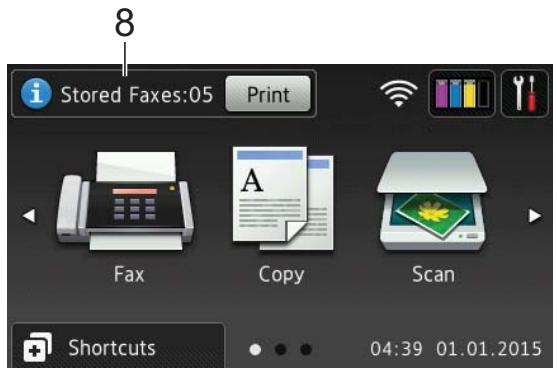
When Fax Preview is set to Off, Stored Faxes displays how many received faxes are in the machine's memory.
Press Print to print the faxes.
9 New Fax(es):
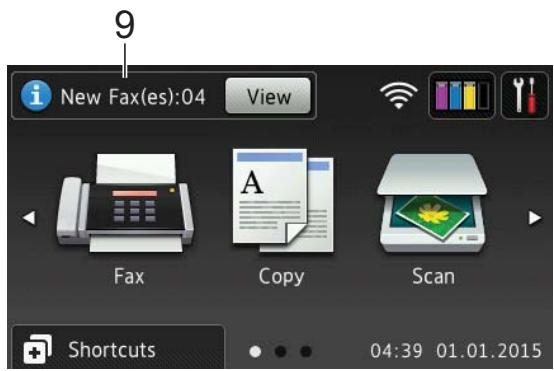
When Fax Preview is set to On, New Fax(es) displays how many new faxes you have received and stored in the machine's memory.
Press View to view the faxes on the Touchscreen.
10 Warning icon

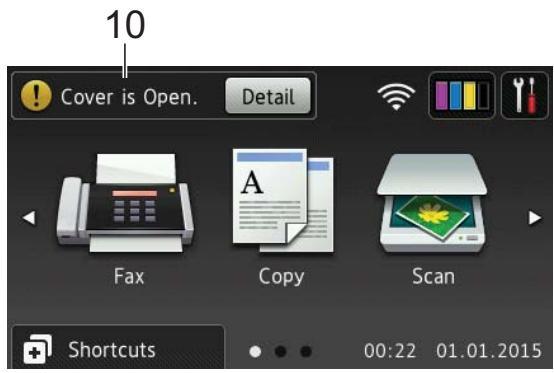
The warning icon! appears when there is an error or maintenance message; press Detail to view it, and then press
to return to Ready mode.
(See Error and maintenance messages on page 36.)
NOTE
- This product adopts the font of ARPHIC TECHNOLOGY CO.,LTD.
- MascotCapsule UI Framework and MascotCapsule Tangiblet developed by HI CORPORATION are used. MascotCapsule is a registered trademark of HI CORPORATION in Japan.

Settings screen
When you press , the Touchscreen LCD displays the machine's status.
This screen provides access to all the machine's settings.
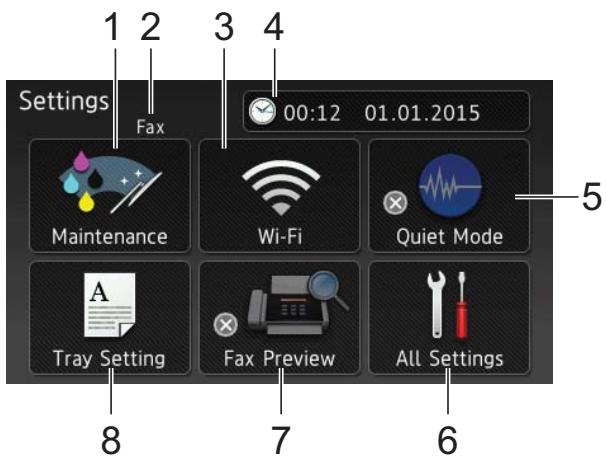
1 Maintenance
Press to access the Maintenance menu.
Check and improve the print quality, clean the print head and check the available ink volume. You can also use the
Maintenance solution menu to solve a recurring paper jam error.
2 Receive Mode
Displays the current Receive Mode:
Fax (Fax Only)
Fax/Tel
External TAD
Manual
3 Wi-Fi
Press to set up a wireless network connection.
A four-level indicator on the screen displays the current wireless signal strength if you are using a wireless connection.
4 Date & Time
Displays the date and time that has been set in the machine.
Press to access the Date & Time menu.
5 Quiet Mode
Displays the Quiet Mode setting. Press to access the Quiet Mode menu.
When this menu is set to On, is displayed on the Home screen. The machine's printing noise has been reduced.
For more information, see Online User's Guide.
6 All Settings
Press to access the Settings menu.
7 Fax Preview
Displays the Fax Preview setting.
Press to access the Fax Preview menu.
8 Tray Setting
Press to access the Tray Setting menu to change the paper size and paper type.
Entering Text
When you must enter text into the machine, a keyboard appears on the Touchscreen.
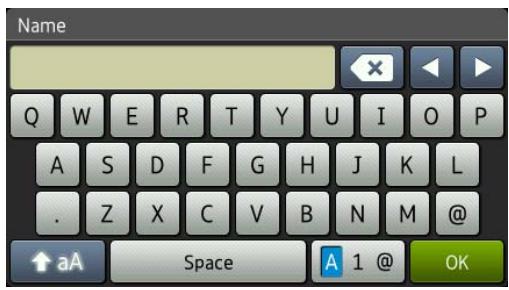
Press A 1 @ to cycle between letters, numbers and special characters.
NOTE
To change between lowercase or
uppercase, press aA
Inserting spaces
To enter a space, press Space or you can press to move the cursor.
NOTE
The characters that are available may differ depending on your country.
Making corrections
If you entered an incorrect character and want to change it, press to move the cursor to highlight the incorrect character, and then press × . Enter the correct character. You can also use the cursor to go back and insert characters.
To erase all the characters, press repeatedly.
2
Loading paper
Before loading paper
Load only one size of paper and one type of paper in the paper tray at a time.
- When loading a different paper size in the tray, you must also change the paper size setting in the machine. (See Set Paper Size and Type on page 14.)
If the Check Paper setting is set to On, the machine displays a message asking if you want to change the paper type and paper size when you pull the paper tray out of the machine. Change the paper size and paper type settings if needed, according to the instructions on the Touchscreen. (See Check Paper setting on page 15.)
We explain how to load paper for each tray:
Paper tray. See page 9.
Manual feed slot. See page 11.
Loading paper in the paper tray
Paper size and loading orientation
The paper size determines the orientation when loading paper in the paper tray.
| Paper tray | |
| A4 ◆Letter ◆Executive ◆ | Landscape orientation |
| A5A6Photo 2LIndex cardEnvelope | Portrait orientation |
| PhotoPhoto L | Portrait orientation |
See the details in this chapter.
For information about other paper sizes, see Online User's Guide.
When using A4, Letter or Executive size paper:
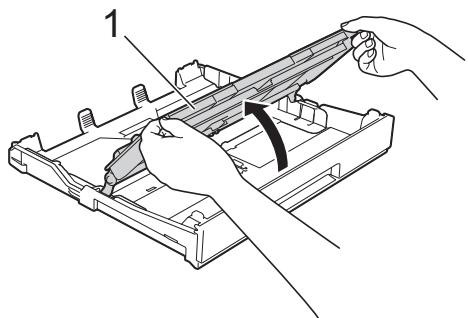
Pull the paper tray completely out of the machine.
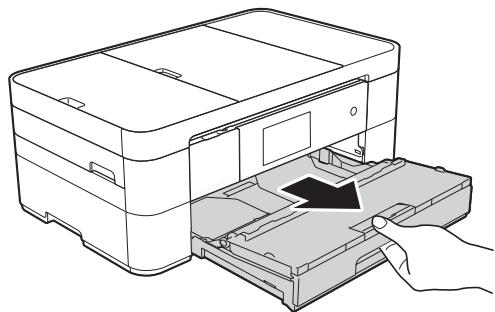
2 Open the output paper tray cover (1).
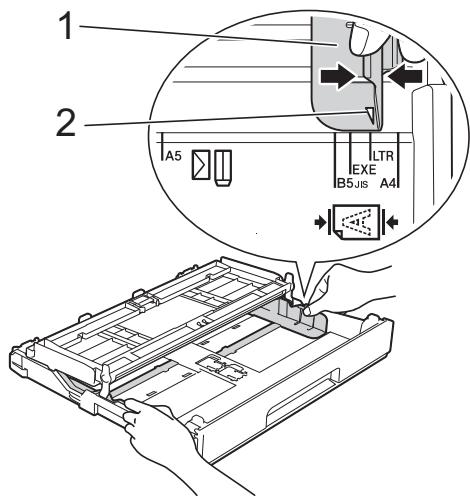
Gently press and slide the paper guides (1) to fit the paper size. Make sure the triangular mark (2) on the paper guide (1) lines up with the mark for the paper size you are using.
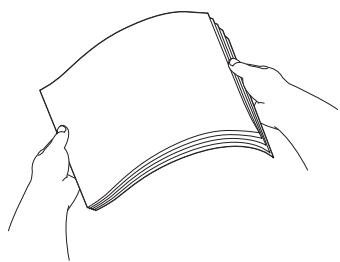
4 Fan the stack of paper well to avoid paper jams and misfeeds.
NOTE
Always make sure the paper is not curled.
Load paper in the paper tray with the printing surface face down. Check that the paper is flat in the tray.
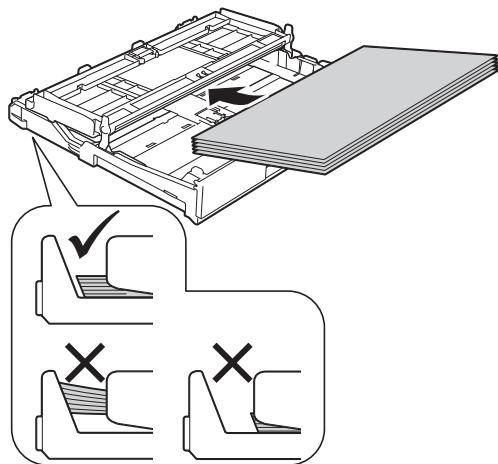
Landscape orientation
Gently adjust the paper guides (1) to fit the paper.
Make sure the paper guides touch the sides of the paper.
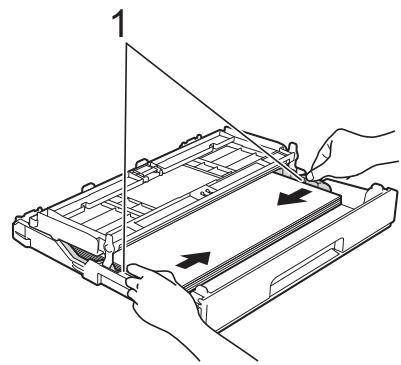
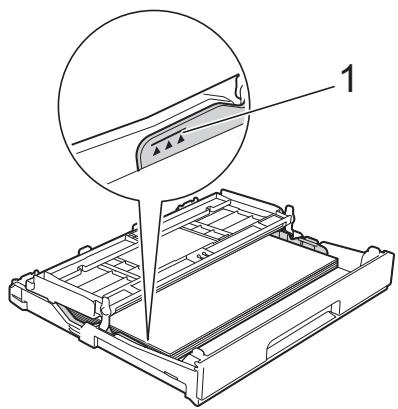
7 Check that the paper is flat in the tray and below the maximum paper mark (1).
Overfilling the paper tray may cause paper jams.
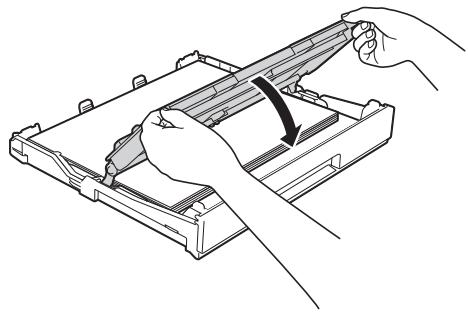
8 Close the output paper tray cover.
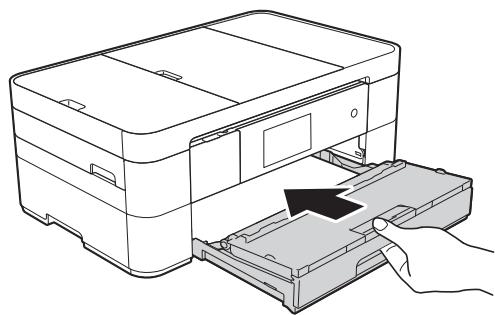
9 Slowly push the paper tray completely into the machine.
Pull out the paper support (1) until it locks into place, and then unfold the paper support flap (2).
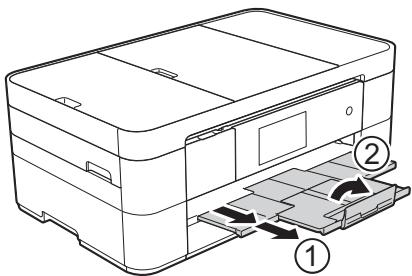
11 Change the paper size setting in the machine's menu, if needed.
(See Set Paper Size and Type on page 14.)
Loading paper in the manual feed slot
Use the manual feed slot to load special print media, one sheet at a time.
The manual feed slot cannot be used for printing faxes.
Paper size and loading orientation
The paper size determines the orientation when loading paper in the manual feed slot.
| Manual feed slot | |
| A4 Letter Executive | Landscape orientation |
| A3 ◆ Ledger ◆ Legal A5 A6 Photo Photo L Photo 2L Index card Envelope | Portrait orientation |
See the details in this chapter.
For information about other paper sizes, see Online User's Guide.
When using A3 or Ledger size paper:
1 Open the manual feed slot cover.
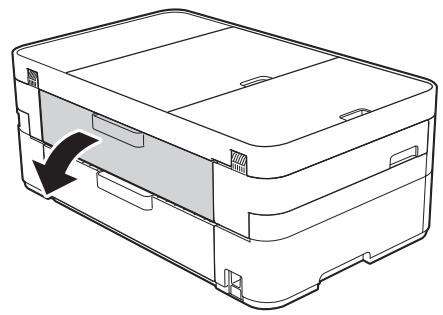
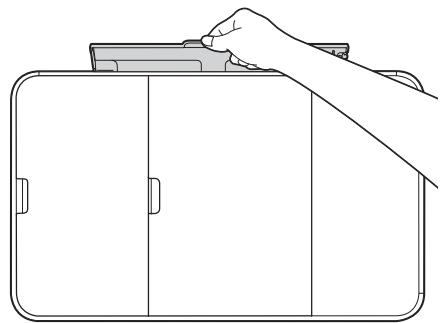
2 Slide the manual feed slot paper guides to fit the paper width that you are using.
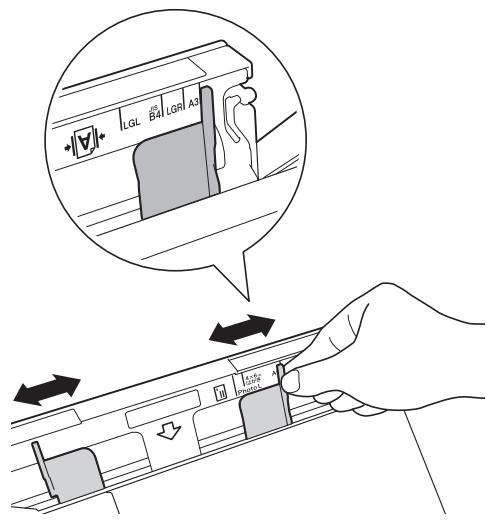
3 Load only one sheet of paper in the manual feed slot with the printing surface face up.
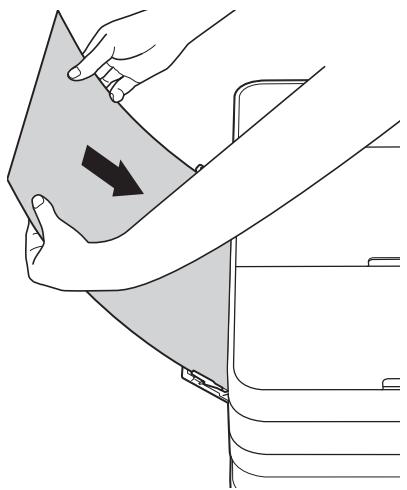
Portrait orientation
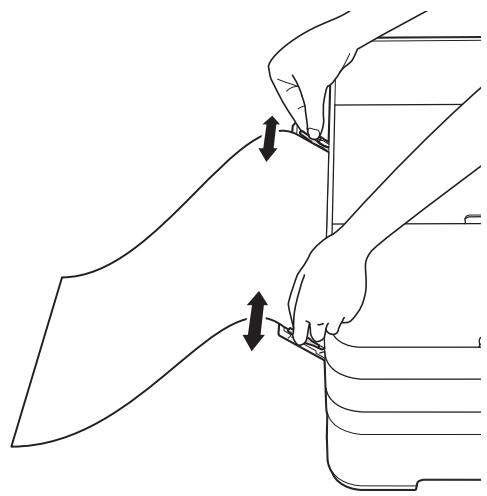
4 Using both hands, gently adjust the manual feed slot paper guides to fit the paper.
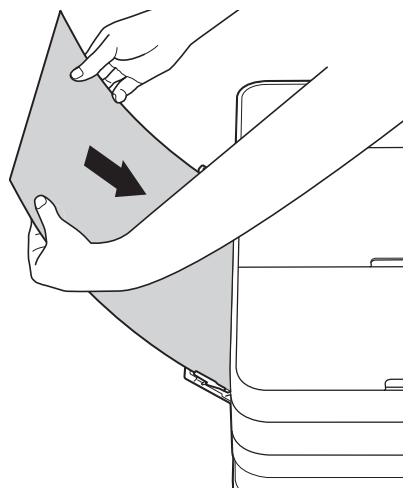
Using both hands, load one sheet of paper in the manual feed slot until the front edge touches the paper feed rollers. Let go of the paper when you hear the machine pull it in a short distance. The Touchscreen displays Manual Feed Slot ready.
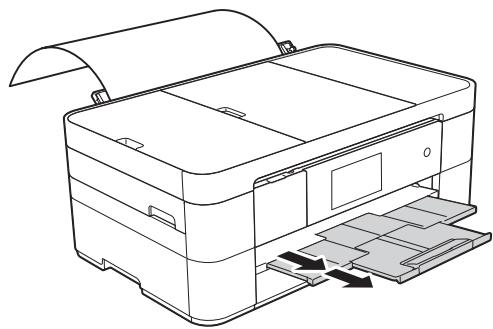
Pull out the paper support until it locks into place.
NOTE
- If the data does not fit on one sheet, the Touchscreen will prompt you to load another sheet of paper. Place another sheet of paper in the manual feed slot, and then press OK on the Touchscreen.
- If you are using paper that is longer than A4 or Letter size or envelopes that are longer than the tray length, close the paper support flap.
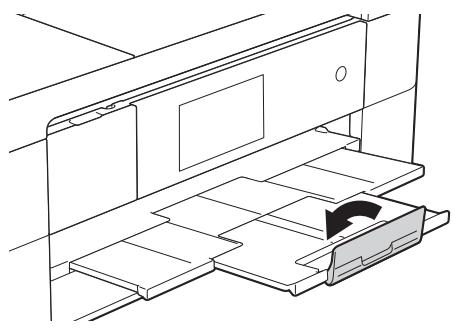
Paper settings
Set Paper Size and Type
Paper Type
To get the best print quality, set the machine for the type of paper you are using.
1 Press

(Settings).

Press Tray Setting.

Press Paper Type.

Press Plain Paper, Inkjet Paper, Brother BP71 or Other Glossy.
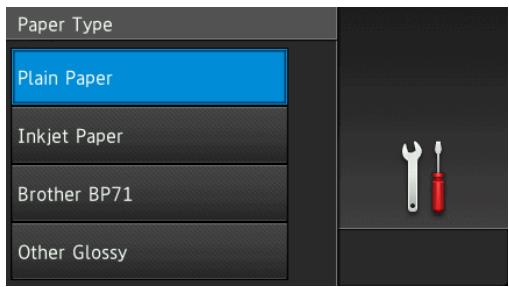

Press

NOTE
The machine ejects paper with the printed surface face up onto the paper tray at the front of the machine. When using glossy paper, remove each sheet at once to prevent smudging or paper jams.
Paper Size
You can use the following sizes of paper for copies: A4, A5, A3, Photo (10 × 15 cm), Ledger, Letter and Legal and the following sizes for printing faxes: A4 or Letter. When loading a different size of paper in the machine, you must change the paper size setting so your machine can fit an incoming fax on the page.

Press

(Settings).

Press Tray Setting.

Press Paper Size.

Swipe up or down or press or to display the paper size options, and then press the option you want.
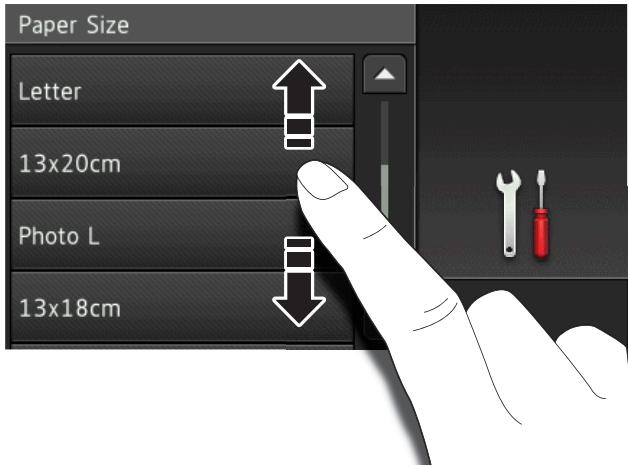

Press

NOTE
When you copy using A3, Legal or Ledger size paper, set the paper size option in Copy mode.
Check Paper setting
If the Check Paper setting is set to On, the machine displays a message asking if you want to change the paper type and paper size setting. This message will appear each time you pull the tray out of the machine. The default setting is On.
1 Press (Settings).
Press All Settings.
3 Swipe up or down or press or to display General Setup.
4 Press General Setup.
5 Swipe up or down or press or to display Check Paper.
Press Check Paper.
7 Press Off (or On).
8 Press
Recommended print media
To get the best print quality, we recommend using the Brother paper in the table.
If Brother paper is not available in your country, we recommend testing various papers before purchasing large quantities.
Brother paper
| Paper Type | Item |
| A3 Plain | BP60PA3 |
| A3 Glossy Photo | BP71GA3 |
| A3 Inkjet (Matte) | BP60MA3 |
| A4 Plain | BP60PA |
| A4 Glossy Photo | BP71GA4 |
| A4 Inkjet (Matte) | BP60MA |
| 10 × 15 cm Glossy Photo | BP71GP |
Handling and using print media
IMPORTANT
DO NOT use the following kinds of paper:
- Damaged, curled, wrinkled, or irregularly shaped paper
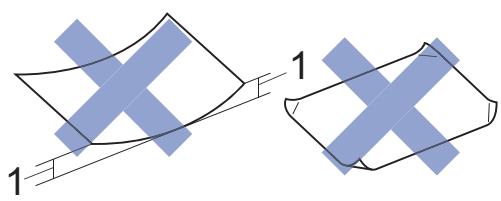
1 2 mm or greater curl may cause jams to occur.
- Extremely shiny or highly textured paper
- Paper that cannot be arranged uniformly when stacked
- Short grain paper
3
Loading documents
How to load documents
You can send a fax, make copies, or scan from the automatic document feeder (ADF) and from the scanner glass.
Using the ADF
The ADF can hold up to 20 pages and feed each sheet individually. Use paper that is within the sizes and weights shown in the table. Always fan the edges of the pages before placing them in the ADF.
Document Sizes and Weights
Length: 148 to 355.6 mm
Width: 148 to 215.9mm
Paper weight: 64 to 90g / m^2
How to load documents
IMPORTANT
- DO NOT pull on the document while it is feeding.
DO NOT use paper that is curled, wrinkled, folded, ripped, stapled, paper clipped, glued or taped. - DO NOT use cardboard, newspaper or fabric.
DO NOT leave thick documents on the scanner glass. If you do this, the ADF may jam.
Make sure documents written with ink or modified with correction fluid are completely dry.
1 Lift up and unfold the ADF document support (1).
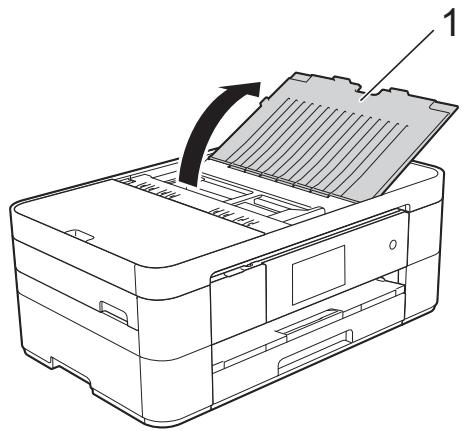
Fan the pages well.
3 Adjust the paper guides (1) to fit the width of your documents.
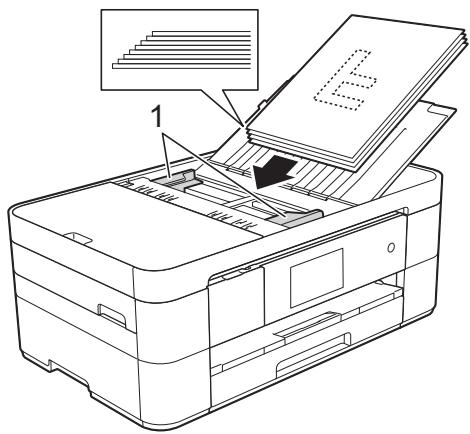
Place your documents face down, top edge first in the ADF underneath the guides until you feel them touch the feed rollers.
The Touchscreen displays ADF Ready.
Using the scanner glass
Use the scanner glass to fax, copy, or scan single pages or pages of a book.
Document Sizes Supported
Length: Up to 297 mm
Width: Up to 215.9 mm
Weight: Up to 2 kg
How to load documents
NOTE
To use the scanner glass, the ADF must be empty.
1 Lift the document cover.
Place the document face down in the upper left corner of the scanner glass, aligned with the arrow.
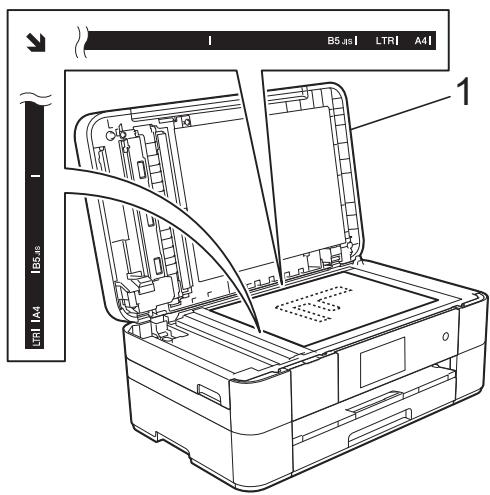
1 Document Cover
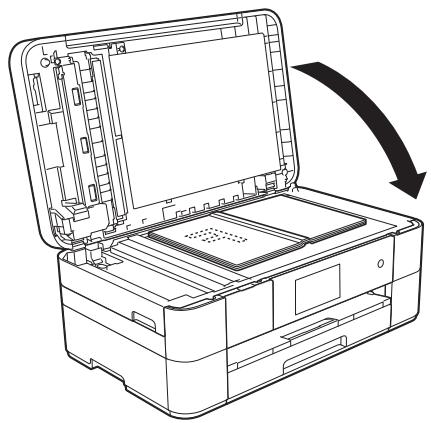
3 Close the document cover.
IMPORTANT
If you are scanning a book or thick document, DO NOT slam or press on the document cover.
4
Printing from a computer
How to print a document
The machine can receive and print data from your computer. Before you can print from a computer, you must install the printer driver.
(See Online User's Guide.)
Install the Brother printer driver from the CD-ROM or Brother Solutions Center. (See Quick Setup Guide.)
2 From your application, select the Print command.
3 Select the name of your machine in the Print dialog box and click Properties or Preferences, depending on the application you are using.
4 Select the settings you want to change in the Properties dialog box. Commonly used settings include:
Media Type
Print Quality
Paper Size
Orientation
Colour / Greyscale
Ink Save Mode
Scaling
2-sided / Booklet
5 Click OK.
6 Click Print (or OK depending on the application you are using) to begin printing.
5 Copying
How to copy
1 Do one of the following to load your document:
- Place the document face down in the ADF.
(See Using the ADF on page 16.)
- Place the document face down on the scanner glass.
(See Using the scanner glass on page 17.)
Press (Copy).
The Touchscreen displays:
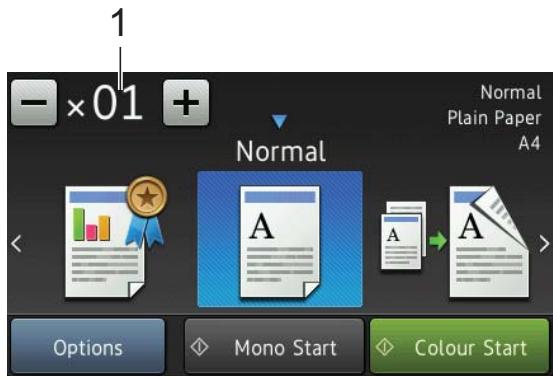
1 No. of Copies
Enter the number of copies:
Press - or + on the Touchscreen.
Press the displayed number of copies on the Touchscreen, and then enter the number of copies you want.
Press OK.
3 If you want more than one copy, enter the number (up to 99).
Press Mono Start or Colour Start.
Stop copying
To stop copying, press

Copy options overview
To change the copy options, press Copy, and then press Options. Swipe up or down or press or to scroll through the copy settings. When the setting you want is displayed, press it and choose your option. When you have finished changing options, press OK.
For more information about changing the following copy options, see page 20.
Paper Type
Paper Size
For details about changing the following copy options, see Online User's Guide.
Quality
Enlarge/Reduce
Page Layout
2 in 1 (ID)
Stack/Sort
Density
■ Ink Save Mode
Thin Paper Copy
Book Copy
Watermark Copy
Remove Background Colour
2-sided Copy
Paper Type
If you are copying on a special type of paper, set the machine for the type of paper you are using to get the best print quality.
1 Load your document.
Press (Copy).
3 Enter the number of copies you want.
4 Press Options.
5 Swipe up or down or press or to display Paper Type.
Press Paper Type.
Press Plain Paper, Inkjet Paper, Brother BP71 or Other Glossy.
Press OK.
Press Mono Start or Colour Start.
Paper Size
If you are copying on paper other than A4 size, you must change the Paper Size setting. You can copy only on A4, A5, A3, Photo (10× 15cm) , Letter, Legal or Ledger paper.
1 Load your document.
Press (Copy).
3 Enter the number of copies you want.
4 Press Options.
5 Swipe up or down or press or to display Paper Size.
Press Paper Size.
7 Swipe up or down or press or to display A4, A5, A3, 10x15cm, Letter, Legal or Ledger, and then press the option you want to set.
NOTE
- If you select A3, Legal or Ledger, the precautions for loading paper appear. Read the information on the Touchscreen, and confirm by pressing OK.
- If you are using the manual feed slot, insert only one sheet of paper at a time. (See Loading paper in the manual feed slot on page 11.)
Press OK.
Press Mono Start or Colour Start.
6
Scanning to a computer
Before scanning
To use the machine as a scanner, install a scanner driver. If the machine is on a network, configure it with a TCP/IP address.
Install the scanner drivers from the CD-ROM. (See Quick Setup Guide.)
- Configure the machine with a TCP/IP address if network scanning does not work.
(See Online User's Guide.)
How to scan a document as a PDF file using ControlCenter4 (Windows®)
(For detailed information, see Online User's Guide.)
NOTE
- The screens on your PC may vary depending on your model.
- This section is based on using the Advanced Mode of ControlCenter4.
ControlCenter4 is a software utility that lets you access the applications you use most often without having to manually launch specific applications.

Load your document. (See How to load documents on page 16.)

Click the ccu (ControlCenter4) icon in the task tray, and then click Open.

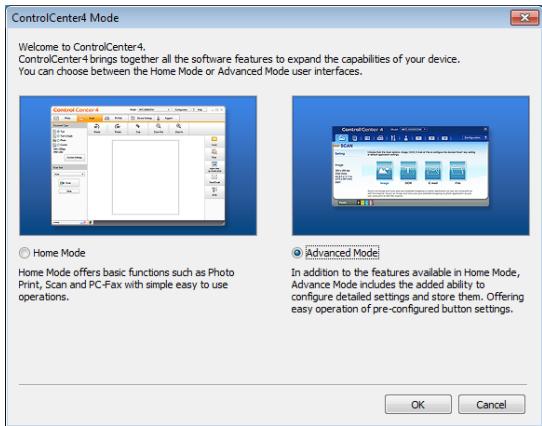
If the ControlCenter4 Mode screen appears, click Advanced Mode, and then click OK.

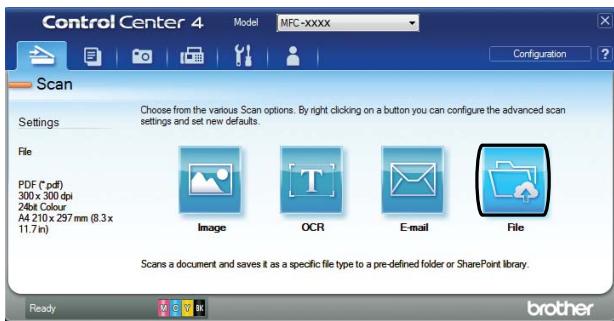
Select your machine from the Model drop-down list at the top of the screen.

Click the Scan tab. Then click File.
The configuration dialog box appears. Change the default settings if needed.
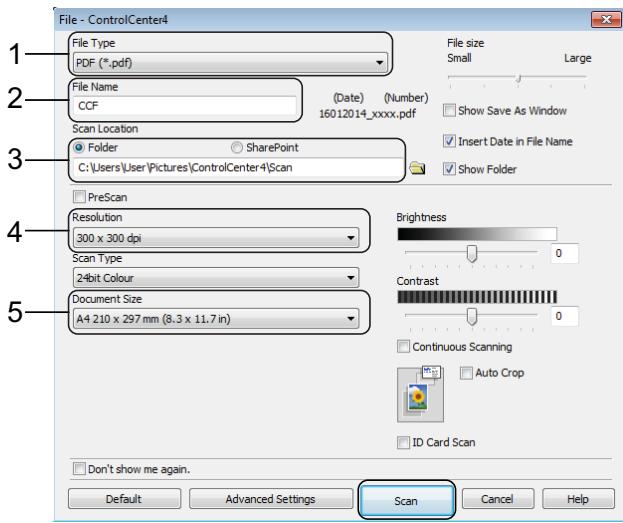
1 Select PDF (.pdf) from the File Type drop-down list.
2 Type a file name for the document.
3 Click Folder. You can save the file to the default folder, or select your preferred folder by clicking the

(Browse) button.
4 Select a scanning resolution from the Resolution drop-down list.
5 Select the document size from the Document Size drop-down list.
Click Scan.
The machine starts scanning. The folder where the file is saved opens automatically.
How to scan a document as a PDF file using the Touchscreen
1 Load your document. (See How to load documents on page 16.)
Press (Scan).
3 Swipe left or right to display to File.
4 Press to File.

is highlighted and appears in the
centre of the Touchscreen.
Press OK.
If the machine is connected to a network, press the PC Name.
Do one of the following:
To use the default settings, go to step 10.
To change the default settings, go to step 6.
6 Press Options.
7 Press Scan Settings, and then press Set at Device.
Choose the settings for Scan Type, Resolution, File Type, Scan Size and Remove Background Colour if required.
9 Press OK.
Press Start. The machine starts scanning.
NOTE
The following scan modes are available:
toOCR
to File
to Image
to Media
to E-mail
to E-mail Server
to FTP
to Network
to Web
- WS Scan1 (Web Services Scan)
1 Windows® users only. (Includes Windows Vista® SP2 or later, Windows® 7 and Windows® 8) (See Online User's Guide.)
7
Printing and scanning with Near Field Communication (NFC)
How to print with NFC
If your Android™ device supports the NFC feature, you can print photos, PDF files, text files, web pages and email messages from your device by touching it to the NFC logo on the right side of the control panel.
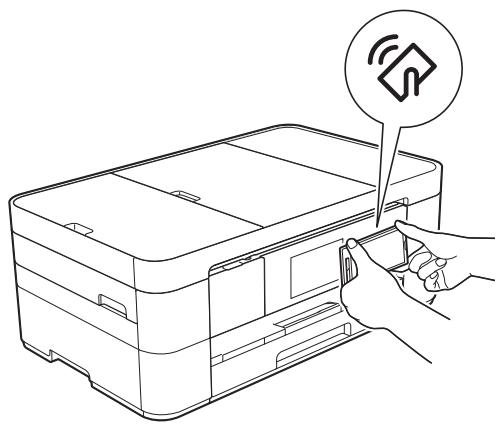
Before you can print using the NFC feature, you must download and install Brother iPrint&Scan on your Android™ device.
(For more information, see Mobile Print/Scan Guide for Brother iPrint&Scan: For Android™ Devices.)
How to scan with NFC
If your Android™ device supports the NFC feature, you can scan photos and documents to your device by touching it to the NFC logo on the right side of the control panel.
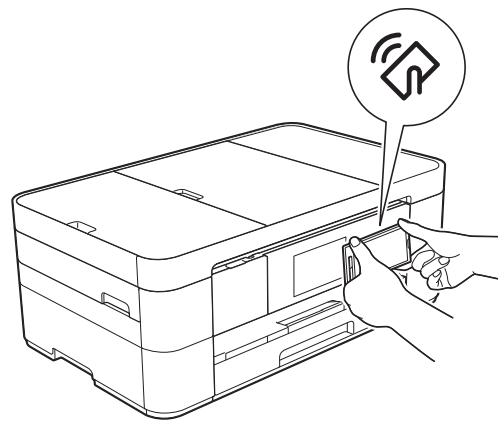
Before you can scan using the NFC feature, you must download and install Brother iPrint&Scan on your Android™ device.
(For more information, see Mobile Print/Scan Guide for Brother iPrint&Scan: For Android™ Devices.)
NOTE
NFC allows for simplified transactions, data exchange and wireless connections between two devices that are in close range of each other.
8
Printing photos from a memory card or USB flash drive
PhotoCapture Center operations (PHOTO mode)
Even if your machine is not connected to a computer, you can print photos directly from digital camera media or a USB flash drive.
How to print images
View Photos
You can preview your photos on the Touchscreen before you print them. If your photos are large files there may be a delay before each photo appears.
IMPORTANT
DO NOT insert more than one media card in the machine at the same time. Doing this may damage the machine.
1 Open the media slot cover.
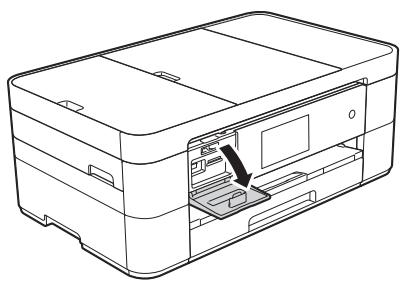
Put the memory card or USB flash drive in the correct slot.
Press Photo.
4 Swipe left or right to display View Photos.
Press View Photos. Press OK.
6 Do one of the following:
To choose the photos you want to print, or to print multiple copies of an image, go to step ⑦.
To print all the photos, press Print All. Press Yes to confirm. Go to step 10.
7 Swipe left or right or press or to display the photo you want to print, and then press it.
8 Enter the number of copies:
Press - or + on the Touchscreen.
Press the number of copies to display the dial pad on the Touchscreen, and then use it to enter the number of copies. Press OK.
Press OK.
Repeat steps 7 and 8 until you have selected all the photos you want to print.
10 Press OK.
11 Read and confirm the displayed list of options.
12 Press Print Settings to change the paper type and paper size.
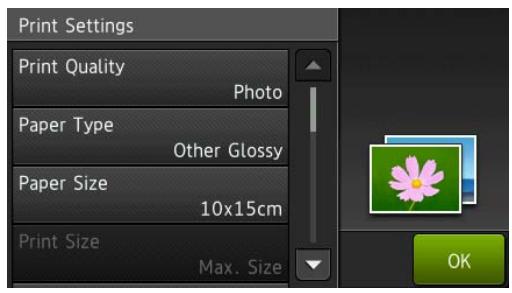
Swipe up or down or press or to display Paper Type and press it, and then press the option you want.
Swipe up or down or press or to display Paper Size and press it, and then press the option you want.
Change other print settings if needed. When finished, press OK.
13 Press Start.
Wait until the message on the Touchscreen disappears after printing, and then remove the memory card or USB flash drive from the media slot.
PhotoCapture Center print settings overview
You can temporarily change the print settings for the next print.
The machine returns to its default settings after printing.
NOTE
You can save the print settings you use most often by setting them as the default.
(See Online User's Guide.)
9
Telephone services and external devices
Telephone services overview
You can use a range of services and connections with your Brother machine. For more information or advice on setup, see Online User's Guide.
Voicemail
If you have a voicemail service on the telephone line that your Brother machine is connected to, they may conflict with one another when receiving incoming faxes. If using this service, we suggest setting the Brother machine's Receive Mode to Manual. (See Choose the Receive Mode on page 30.)
Voice over Internet Protocol (VoIP)
VoIP is a type of phone system that uses an Internet connection instead of a traditional telephone line. Your machine may not work with some VoIP systems. If you have questions about how to connect your machine to the VoIP system, contact your VoIP provider.
Connecting an external telephone answering device (TAD)
You may choose to connect an external answering device to your Brother machine. To receive faxes successfully, you must connect it correctly. Connect your external TAD to the T-piece connector on the Brother line cable supplied with your machine. When recording an outgoing message on your external TAD, we recommend recording 5 seconds of silence at the beginning of your message, and limiting your speaking to 20 seconds. Set your machine's Receive Mode to External TAD.
External and extension telephones
You can connect a separate phone into the T-piece connector on your Brother line cable supplied with your machine. If you answer a fax call on an extension or external telephone, you can make your machine receive the fax by pressing * 5 1. If the machine answers a voice call and fast double rings for you to take over, press # 5 1 to take the call on an extension telephone.
10
Sending a fax
How to send a fax
1 Do one of the following:
- Place the document face down in the ADF. (See Using the ADF on page 16.)
- Place your document face down on the scanner glass. (See Using the scanner glass on page 17.)
NOTE
- To send faxes with multiple pages, use the ADF.
- If you send a mono fax from the ADF when the memory is full, it will be sent in real time.
- You can use the scanner glass to fax pages of a book one at a time. The documents can be up to A4 or Letter size.
2 Do one of the following:
When Fax Preview is set to Off, press (Fax).
When Fax Preview is set to On, press

(Fax) and then

(Sending Faxes).
The Touchscreen displays:
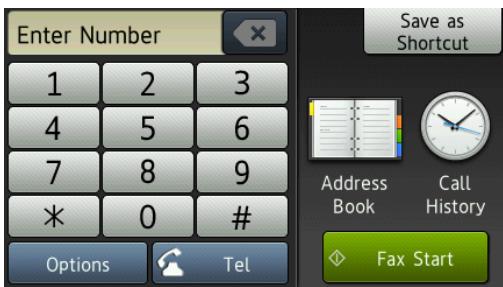
3 To change the fax-sending settings, press Options.
Swipe up or down or press or to scroll through the fax settings. When the setting you want is displayed, press it and choose your new option. When finished changing options, press OK.
For more advanced fax-sending operations and settings, see Online User's Guide.
Fax Resolution
Contrast
Glass Scan Size
Colour Fax Transmission
Preview Outgoing Fax
Faxing at the end of a call
■ Broadcasting
Real Time Transmission
Overseas Mode
Delayed Fax
■ Batch Transmission
Cancelling Waiting Jobs
Set New Default
Factory Reset
■ Polled Transmit
Transmission Verification Report
4 Enter the fax number.
Using the dial pad on the Touchscreen
Using (Address Book)
Address Book
Using (Call History)
Redial
Outgoing Call
■ Caller ID history
NOTE
- To preview a fax message before sending it, set Preview to On.
(See Online User's Guide.)
If your network supports the LDAP protocol you can search for fax numbers and email addresses on your server.
(See Online User's Guide.)
Press Fax Start.
Faxing from the ADF
The machine starts scanning the document to be sent.
Faxing from the scanner glass
If you select Mono in Colour Setting (default setting), the machine starts scanning the first page. Go to step 6.
If you select Colour in Colour Setting, the Touchscreen asks if you want to send a colour fax. Press Yes (Colour fax) to confirm. The machine dials and sends the page.
6 When the Touchscreen displays Next Page?, do one of the following:
To send a single page, press No. The machine sends the document.
To send more than one page, press Yes and go to step ⑦.
7 Place the next page on the scanner glass.
Press OK.
The machine scans the page. (Repeat steps ⑥ and ⑦ for each additional page.)
Stop faxing
To stop faxing, press X.
How to store numbers
Store fax and telephone numbers in your machine's Address Book or create Groups of fax recipients so you can broadcast a fax to many people at once.
NOTE
If you lose electrical power, stored Address Book numbers will not be lost.
Storing a pause
When storing Address Book numbers, you can insert one or more 3.5 second pauses by pressing Pause on the Touchscreen.
Storing Address Book numbers
Store up to 100 Addresses with a name; each name can have two numbers.
Press (Fax).

Press

(Address Book).

Press Edit.

Press Add New Address.

Press Name.

Enter the name (up to 16 characters) using the Touchscreen.
Press OK.
(See Entering Text on page 8.)

Press Address 1.

Enter the first fax or telephone number (up to 20 digits) using the Touchscreen. Press OK.
NOTE
- Be sure to include the area code when entering a fax or telephone number. Depending on the country, the Caller ID names and history may not be displayed correctly if the area code is not registered with the fax or telephone number.
If you downloaded the Internet Fax (I-Fax) feature:
To store an email address to use with Internet Fax (I-Fax) or Scan to E-mail
server, press and enter the email address, and then press OK.

To store a second fax or telephone number, press Address 2.
Enter the fax or telephone number (up to 20 digits) using the Touchscreen. Press OK.

Press OK to confirm.

Do one of the following:
To store another Address Book number, repeat steps ③ to ⑩.
When finished, press
How to set your Station ID
Set your machine's Station ID so that the date and time appear on each fax you send.

Press

(Settings).

Press All Settings.

Swipe up or down or press or to display Initial Setup.
Press Initial Setup.

Press Station ID.

Press Fax.

Enter your fax number (up to 20 digits) using the Touchscreen, and then press OK.

Press Name.

Enter your name (up to 20 characters) using the Touchscreen, and then press OK. (See Entering Text on page 8.)

Press
11
Receiving a fax
Receive Modes
You must choose a Receive Mode depending on the external devices and telephone services you have on your line.
Choose the Receive Mode
By default, your machine will automatically receive any faxes that are sent to it. The diagram below will help you choose the correct mode.
(See Using Receive Modes on page 31.)
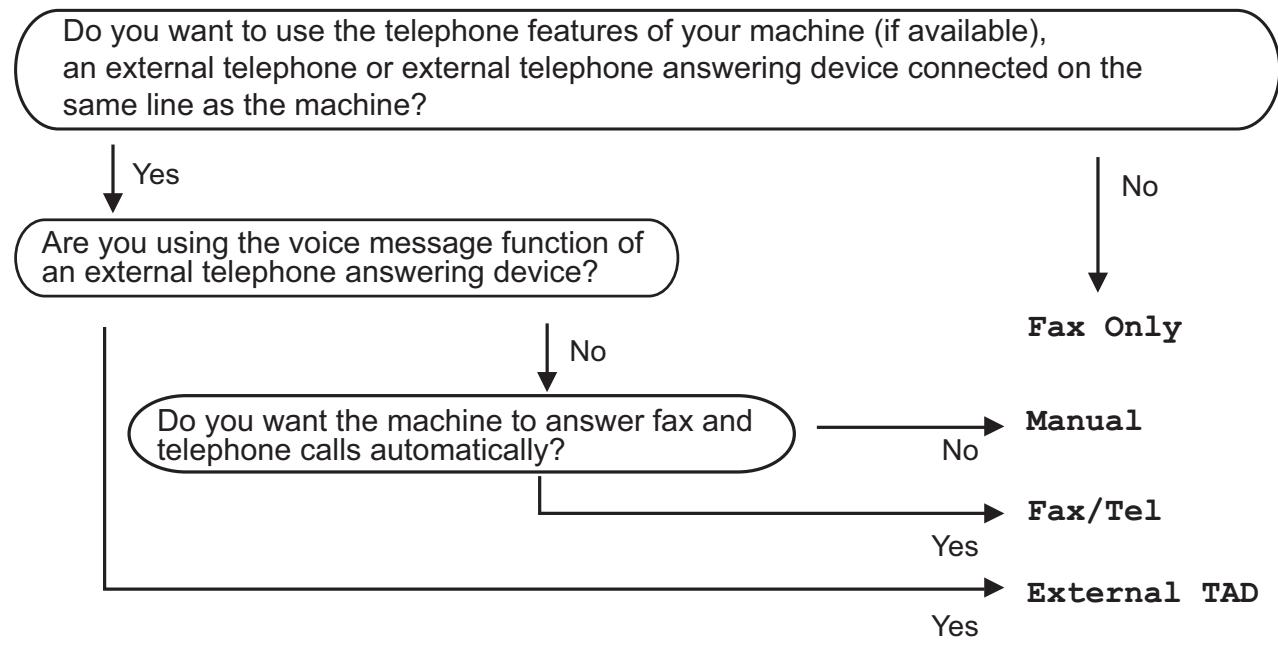
To set the Receive Mode follow the instructions:

1 Press
(Settings).
Press All Settings.
3 Swipe up or down or press or to display Fax.
4 Press Fax.
5 Swipe up or down or press or to display Setup Receive.
Press Setup Receive.
7 Swipe up or down or press or to display Receive Mode.
Press Receive Mode.
NOTE
If the option to change the receive mode is unavailable, make sure the BT Call Sign feature is set to Off. (See Online User's Guide.)
Press Fax Only, Fax/Tel, External TAD or Manual.
10 Press
Using Receive Modes
Some Receive Modes answer automatically (Fax Only and Fax/Tel). You may want to change the Ring Delay before using these modes. (See Ring Delay on page 32.)
Fax Only
Fax Only mode will automatically answer every call as a fax call.
Fax/Tel
Fax/Tel mode helps you manage incoming calls by recognising whether they are fax or voice calls and dealing with them in one of the following ways:
Faxes will be automatically received.
■ Voice calls will start the F/T Ring to tell you to pick up the line. The F/T Ring is a fast double-ring made by your machine.
(See F/T Ring Time (Fax/Tel mode only) on page 32.)
(See Ring Delay on page 32.)
Manual
Manual mode turns off all automatic answering functions unless you are using the BT Call Sign feature.
To receive a fax in Manual mode, lift the handset of an external telephone. When you hear fax tones (short repeating beeps), press Fax Start and choose Receive. You can also use the Fax Detect feature to receive faxes by lifting a handset on the same line as the machine.
(See Online User's Guide.)
External TAD
External TAD mode lets an external answering device manage your incoming calls. Incoming calls will be dealt with in one of the following ways:
Faxes will be automatically received.
Voice callers can record a message on the external TAD.
To connect your External TAD, see Online User's Guide.
Receive Mode settings
Ring Delay
Ring Delay sets the number of times the machine rings before it answers in Fax Only or Fax/Tel mode. If you have external or extension telephones on the same line as the machine, choose the maximum number of rings.
(See Online User's Guide.)
1 Press (Settings).
Press All Settings.
3 Swipe up or down or press or to display Fax.
4 Press Fax.
5 Swipe up or down or press or to display Setup Receive.
Press Setup Receive.
7 Swipe up or down or press or to display Ring Delay.
Press Ring Delay.
9 Swipe up or down or press or to display the options, and then press the number of times the machine will ring before it answers.
If you select 0, the machine will answer immediately and the line will not ring at all.
10 Press A.
F/T Ring Time (Fax/Tel mode only)
When your machine receives a call, you and your caller will hear the normal telephone ring. The number of rings is set in the ring delay setting.
If the call is a fax, then your machine will receive it. However, if it is a voice call then the machine will sound the F/T Ring (a fast double-ring) for the time you have set in the F/T Ring Time setting. If you hear the F/T Ring, it means that you have a voice caller on the line.
Because the F/T Ring is made by the machine, extension and external telephones will not ring. However, you can still answer the call on any telephone by using a remote code.
(See Online User's Guide.)
Press (Settings).
Press All Settings.
3 Swipe up or down or press or to display Fax.
Press Fax.
5 Swipe up or down or press or to display Setup Receive.
Press Setup Receive.
7 Swipe up or down or press or to display F/T Ring Time.
Press F/T Ring Time.
9 Press 20, 30, 40 or 70 seconds.
10 Press
NOTE
Even if the caller hangs up during the fast double-ring, the machine will continue to ring for the set time.
A
Routine maintenance
How to clean and check the machine
Cleaning the scanner glass
1 Unplug the machine from the electrical socket.
2 Lift the document cover (1). Clean the scanner glass (2) and the white plastic (3) with a soft lint-free cloth moistened with a non-flammable glass cleaner.
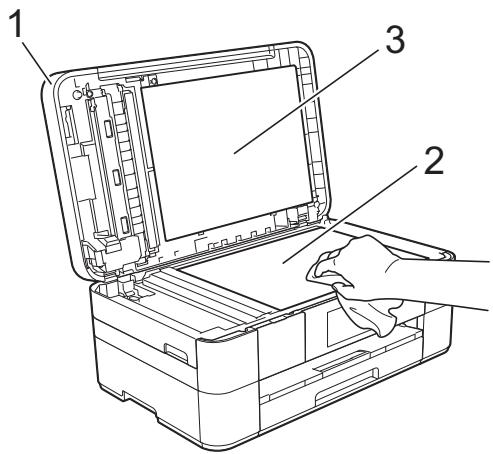
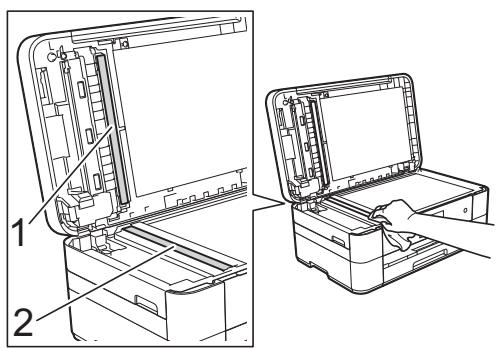
In the ADF unit, clean the white bar (1) and the glass strip (2) with a lint-free cloth moistened with a non-flammable glass cleaner.
Checking the print quality
If faded or streaked colours and text appear on your printouts, some of the print head nozzles may be clogged. Check this by printing the Print Quality Check Sheet and looking at the nozzle check pattern.

Press
NOTE
You can also press

and then press
Maintenance.

Press Improve Print Quality.

Press Check Print Quality.

Following the instructions on the Touchscreen, load A4 or Letter size plain paper in the paper tray, and then press OK. The machine prints the Print Quality Check Sheet.

Check the quality of the four colour blocks on the sheet.
The Touchscreen displays a message asking about the print quality. Do one of the following:
If all lines are clear and visible, press No to finish the Print Quality check, and then go to step 10.
If you can see missing short lines as shown in the illustration, press Yes.

OK

Poor
The Touchscreen displays a message asking you to check the print quality of each colour. Following the instructions on the Touchscreen, press 1, 2, 3 or 4 to select the example most similar to the Print Quality Check Sheet for each colour.
If you press number 2, 3, or 4, the Touchscreen prompts you to start cleaning. Press Start.
9 After the cleaning procedure is finished, press Yes, and return to step 4.
10 Press
If you clean the print head at least five times and the print has not improved, try installing a new Brother Original Innobella replacement ink cartridge for each problem colour. Try cleaning the print head up to five more times. If the print has not improved, contact Brother customer service or your local Brother dealer.
IMPORTANT
DO NOT touch the print head. Touching the print head may cause permanent damage and may void the print head's warranty.
NOTE
When a print head nozzle is clogged, the printed sample looks like this.
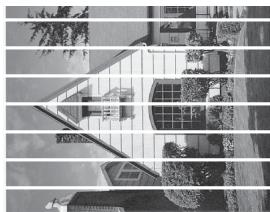
Letter, A4 and Executive
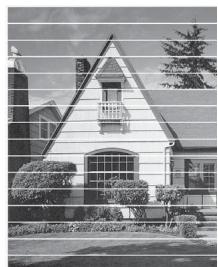
A3, Ledger, Legal, A5, A6, envelopes, Photo (10× 15cm) Photo L (89× 127mm) Photo 2L (13× 18~cm) and Index Card (127× 203mm)
After the print head nozzle is cleaned, the horizontal lines are gone.
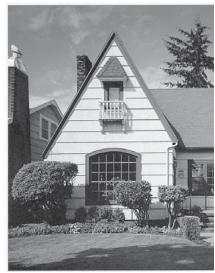
Checking the print alignment
If your printed text becomes blurred or images become faded, you may need to adjust the print alignment after transporting the machine.
1 Press
NOTE
You can also press Maintenance.

and then
Press Improve Print Quality.
3 Press Alignment.
4 Press Next.
5 Swipe up or down or press or to display the paper size that needs a print alignment adjustment, and then press it.
6 Press Basic alignment or Advanced alignment.
Following the instructions on the Touchscreen, load plain paper of the selected size in the paper tray or manual feed slot, and then press Start. The machine prints the Alignment Check Sheet.
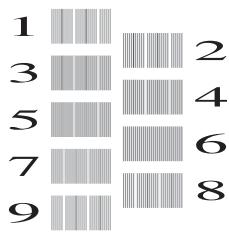
8 For the "A" pattern, swipe up or down or press or to display the number of the test print that has the least visible vertical stripes (1-9), and then press it. Then press OK. In the example, number 6 is the best choice.
9 Do one of the following:
If you selected Basic alignment, repeat step ⑧ for patterns B to H.
If you selected Advanced alignment, repeat step ⑧ for patterns B to Z.
NOTE


When the print alignment is not adjusted correctly, text looks blurry.
After the print alignment is adjusted correctly, text looks sharp.
10 Press
NOTE
For more information about cleaning and checking the machine, see Online User's Guide.
B
Troubleshooting
If you think there is a problem with your machine, check each of the items below first and follow the troubleshooting tips.
You can correct most problems yourself. If you need additional help, the Brother Solutions Center offers the latest FAQs and troubleshooting tips.
Visit http://support.brother.com.
Identifying the problem
First, check the following.
The machine's power cord is connected correctly and the machine's power switch is turned on.
All of the protective parts have been removed.
Paper is loaded correctly in the paper tray.
- The interface cables are securely connected to the machine and the computer, or the wireless connection is set up on both the machine and your computer.
Touchscreen Messages
(See Error and maintenance messages on page 36.)
If you did not solve the problem with the above checks: See If you are having difficulty with your machine on page 55.
Error and maintenance messages
As with any sophisticated office product, errors may occur and supplies must be replaced. If this happens, your machine identifies the error or required routine maintenance and displays the appropriate message. The most common error and maintenance messages are shown in the table.
If the Touchscreen displays errors and your Android™ device supports the NFC feature, touch your device to the NFC logo on the right side of the control panel to access the Brother Solutions Center and browse the latest FAQs from your device. (Your mobile telephone provider's message and data rates may apply to your use of this function.)
Make sure the NFC setting of your machine and Android™ device is set to On.
| Error Message | Cause | Action |
| B&W 1-sided Print Only Replace ink. | One or more of the colour ink cartridges have reached the end of their life.You can use the machine in monochrome mode for approximately four weeks depending on the number of pages you print.While this message appears on the Touchscreen, each operation works in the following way:■ PrintingIf the media type is set to Plain Paper in the Basic tab and Greyscale is chosen in the Advanced tab of the printer driver, you can use the machine as a monochrome printer.2-sided printing is not available when this message appears.■ CopyingIf the paper type is set to Plain Paper you can make copies in monochrome.2-sided copying is not available when this message appears.■ FaxingIf the paper type is set to Plain Paper or Inkjet Paper, the machine will receive and print the faxes in monochrome.If a sending machine has a colour fax, the machine's "handshake" will ask that the fax be sent as monochrome. | Replace the ink cartridges.(See Online User's Guide.)NOTEThe machine will stop all print operations, you cannot use the machine until a new ink cartridge is installed in the following cases:· If you unplug the machine or take out the ink cartridge.(Windows®) If you select Slow Drying Paper in the Basic tab of the printer driver.(Macintosh) If you select Slow Drying Paper in the Print Settings drop-down list of the printer driver. |
| BT Call Sign On (U.K. only) | BT Call Sign is set to ON. You cannot change the Receive Mode from Manual to another mode. | Set BT Call Sign to OFF.(See Online User's Guide.) |
| Cannot Detect | You installed a new ink cartridge too quickly and the machine did not detect it. | Take out the new ink cartridge and reinstall it slowly and firmly until the cartridge lever lifts.(See Online User's Guide.) |
| An ink cartridge is not installed correctly. | ||
| A used ink cartridge was reinstalled. | Remove the used ink cartridge and install a new one. | |
| If you are using non Brother Original ink, the machine may not detect the ink cartridge. | Replace the cartridge with a Brother Original ink cartridge. If the error message remains, contact Brother customer service or your local Brother dealer. | |
| The ink cartridge must be replaced. | Replace the ink cartridge with a new, genuine Brother ink cartridge. | |
| The new ink cartridge has an air bubble. | Slowly turn the ink cartridge so that the ink supply port is pointing downward, and then reinstall the cartridge. | |
| The wrong Brother model ink cartridge was installed. | Check the model numbers of the ink cartridges and install the correct ink cartridges. (See Supplies on page 71.) | |
| Cannot Detect Ink Volume | If you are using non Brother Original ink, the machine may not detect the ink volume. | Replace the cartridge with a Brother Original ink cartridge. If the error message remains, contact Brother customer service or your local Brother dealer. |
| Cannot Print Replace ink. | One or more of the ink cartridges have reached the end of their life. The machine will stop all print operations. While memory is available, monochrome faxes will be stored in the memory. If a sending machine has a colour fax, the machine's "handshake" will ask that the fax be sent as monochrome. | Replace the ink cartridges.(See Online User's Guide.) |
| Comm.Error | Poor telephone line quality caused a communication error. | If the problem continues, call the telephone company and ask them to check your telephone line. |
| Connection Failed | You tried to poll a fax machine that is not in Polled Waiting mode. | Check the other fax machine's polling setup. |
| Current Tray Settings | This message is displayed when the Check Paper setting to confirm the paper type and size is enabled. | To not display this confirmation message, set the Check Paper setting to Off. (See Check Paper setting on page 15.) |
| Data Remaining in Memory | Print data is left in the machine's memory. | Press X. The machine will cancel the job and clear it from the memory. Try to print again. |
| Disconnected | The other person or other person's fax machine stopped the call. | Try to send or receive again. If calls are stopped repeatedly and you are using a VoIP (Voice over IP) system, try changing the Compatibility to Basic (for VoIP). (See Telephone Line Interference or VoIP System on page 65.) |
| Document Jam/too Long | The document was not inserted or fed correctly, or the document scanned from the ADF was too long. | (See Using the ADF on page 16.) (See Document jam on page 47.) |
| High Temperature | The room temperature is too high. | After lowering the room temperature, allow the machine to cool down to room temperature. Try again when the machine has cooled down. |
| Hub is Unusable. | A hub or USB flash drive with hub has been connected to the USB direct interface. | Hubs, including USB flash drives with built-in hubs, are not supported. Unplug the device from the USB direct interface. |
| Image Too Long | The proportions of your photo are irregular so effects could not be added. | Choose a regularly proportioned image. |
| Image Too Small | The size of your photo is too small to trim. | Choose a larger image. |
| Ink Absorber Pad Full | The ink absorber box or flushing box is full. These components are periodic maintenance items that may require replacement after a period of time to ensure optimum performance from your Brother machine. Because these components are periodic maintenance items, the replacement is not covered under the warranty. The need to replace these items and the time period before replacement is dependent on the number of purges and flushes required to clean the ink system. These boxes acquire amounts of ink during the different purging and flushing operations. The number of times a machine purges and flushes for cleaning varies depending on different situations. For example, frequently powering the machine on and off will cause numerous cleaning cycles since the machine automatically cleans itself upon power up. The use of non-Brother ink may cause frequent cleanings because non-Brother ink could cause poor print quality, which is resolved by cleaning. The more cleaning the machine requires, the faster these boxes will fill up. | The ink absorber box or flushing box must be replaced. Contact Brother customer service or your local Brother Authorised Service Centre to have your machine serviced. Other reasons for cleaning are:1 After a paper jam has been cleared, the machine automatically cleans itself before the next received fax page is printed.2 The machine automatically cleans itself after sitting idle for more than 30 days (infrequent use).3 The machine automatically cleans itself after ink cartridges of the same colour have been replaced 12 times. |
| Note Repairs resulting from the use of non-Brother supplies may not be covered under the stated product warranty. | ||
| Ink Absorber Pad NearFull | The ink absorber box or flushing box is nearly full. | The ink absorber box or flushing box must be replaced soon.Contact Brother customer service or your local Brother dealer. |
| Ink Low | One or more of the ink cartridges are near the end of their life. If one of the colour ink cartridges is near the end of its life and someone is sending you a colour fax, your machine's "handshake" will ask that the fax be sent as monochrome. If the sending machine has the ability to convert it, the colour fax will be printed at your machine as a monochrome fax. | Order a new ink cartridge. You can continue printing until the Touchscreen displaysCannot Print.(See Online User's Guide.) |
| Low Temperature | The room temperature is too low. | After increasing the room temperature, allow the machine to warm up to room temperature. Try again when the machine has warmed up. |
| Media Error | The memory card is either corrupted, incorrectly formatted, or there is a problem with the memory card. | Remove the memory card from the media drive (slot) of the machine and format it correctly. |
| Put the card firmly into the slot again to make sure it is in the correct position. If the error remains, check the media drive (slot) of the machine by inserting a working memory card. | ||
| Media is Full. | The memory card or USB flash drive you are using already contains 999 files. | Your machine can save to your memory card or USB flash drive only if it contains less than 999 files. Delete unused files and try again. |
| The memory card or USB flash drive you are using does not have enough free space to scan the documents. | Press ✦.Delete unused files from your memory card or USB flash drive to make some free space, and then try again. | |
| No Caller ID | There is no incoming call history. You did not receive calls or you have not subscribed to the Caller ID service from your telephone company. | If you want to use the Caller ID feature, call your telephone company. (See Online User's Guide.) |
| No Ink Cartridge | An ink cartridge is not installed correctly. | Take out the new ink cartridge and re-install it slowly and firmly until the cartridge lever lifts. (See Online User's Guide.) |
| No Paper Fed | The machine is out of paper, or paper is not correctly loaded in the paper tray. | Do one of the following: ■ Refill the paper tray, and then press OK on the Touchscreen. ■ Remove and reload the paper, then press OK on the Touchscreen. (See Before loading paper on page 9.) |
| The paper tray was not fully inserted. | Remove the paper tray and reinstall it until it locks into place, and then press OK on the Touchscreen. | |
| The paper was not inserted in the centre position of the manual feed slot. | Remove the paper and re-insert it in the centre of the manual feed slot, and then press OK on the Touchscreen. (See Loading paper in the manual feed slot on page 11.) | |
| The Jam Clear Cover is not closed correctly. | Make sure the Jam Clear Cover is closed evenly at both ends. (See Printer jam or paper jam on page 48.) | |
| Paper dust has accumulated on the surface of the paper pick-up rollers. | Clean the paper pick-up rollers. (See Online User's Guide.) | |
| The paper is jammed in the machine. | Remove the jammed paper by following the steps. (See Printer jam or paper jam on page 48.) | |
| If this error occurs often during 2-sided copying or 2-sided printing, the paper feed rollers may be stained with ink. Clean the paper feed rollers. (See Online User's Guide.) | ||
| Out of Fax Memory | The fax memory is full. | Do one of the following: ■ Clear the data from the memory. To gain extra memory, you can turn off Memory Receive. (See Online User's Guide.) ■ Print the faxes that are in the memory. (See Online User's Guide.) |
| Out of Memory | The machine's memory is full. | If a fax-sending or copy operation is in process: ■ Press ✘ or Quit or Close and wait until the other operations that are in process finish, and then try again. ■ Press Send Now to send the pages scanned so far. ■ Press Partial Print to copy the pages scanned so far. ■ Clear the data in the memory. To gain extra memory, you can turn off Memory Receive. (See Online User's Guide.) ■ Print the faxes that are in the memory. (See Online User's Guide.) |
| Paper Jam [Front] | The paper is jammed in the machine. | Remove the jammed paper by following the steps. (See Printer jam or paper jam on page 48.) |
| Paper Jam [Front,Rear] | Make sure the paper guides are set to the correct paper size. | |
| Paper Jam [Rear] | If there is a repeat paper jam, try another paper jam operation. (See Additional paper jam clear operations on page 53.) | |
| Paper Tray not detected | The paper tray is not completely inserted. | Slowly push the paper tray completely into the machine. |
| Jammed paper or a foreign object has prevented the paper tray from being inserted properly. | Pull the paper tray out of the machine and remove the paper or foreign object. If you cannot find or remove the jammed paper, follow the steps. (See Printer jam or paper jam on page 48.) Slowly push the paper tray completely into the machine. | |
| Touchscreen | The Touchscreen was pressed before the power on initialization was completed. | Make sure that nothing is touching or resting on the Touchscreen, especially when plugging in the machine. |
| Initialisation Failed | ||
| Debris may be stuck between the lower part of the Touchscreen and its frame. | Insert a piece of stiff paper between the lower part of the Touchscreen and its frame and slide it back and forth to push out the debris. | |
| Unable to Clean XX Unable to Initialize XX Unable to Print XX | The machine has a mechanical problem. —OR— A foreign object, such as a paper clip or a piece of ripped paper, is in the machine. | Open the scanner cover and remove any foreign objects and paper scraps from inside the machine. If the error message continues, disconnect the machine from the power for several minutes, and then reconnect it. You can try additional paper jam clear operations. (See Additional paper jam clear operations on page 53.) (The machine can be turned off without losing faxes stored in the memory. (See Transferring your faxes or Fax Journal report on page 46.)) |
| Unable to Scan XX | The machine has a mechanical problem. | Disconnect the machine from the power for several minutes, and then reconnect it. The machine can be turned off without losing faxes stored in the memory. (See Transferring your faxes or Fax Journal report on page 46.) |
| Unusable Device Disconnect device from front connector & turn machine off & then on | A broken device has been connected to the USB direct interface. | Unplug the device from the USB direct interface, and then press to turn the machine off and then on again. |
| Unusable Device Please disconnect USB device. | A USB device or USB flash drive that is not supported has been connected to the USB direct interface. | Unplug the device from the USB direct interface. Turn the machine off and then on again. |
| Wrong Ink Colour | An ink cartridge has been installed in the wrong position. | Check which ink cartridges are not matched by colour to their ink cartridge positions and move them to their correct positions. |
| Wrong Paper | The paper size setting does not match the size of paper in the tray. | 1 Check that the paper size you choose on the Touchscreen matches the size of the paper in the tray. (See Set Paper Size and Type on page 14.) 2 Make sure you load the paper in the proper orientation, and set the paper guides to the indicators for your paper size. (See Before loading paper on page 9.) 3 After you have checked the paper size and the paper orientation, press OK on the Touchscreen. |
| The paper orientation is incorrect for the paper size. | ||
| You did not set the paper guides in the tray to the indicators for the paper size you are using. | ||
| If you are printing from your computer, make sure the paper size you choose in the printer driver matches the size of paper in the tray. (See Online User's Guide.) | ||
Error animations
Error animations display step-by-step instructions when paper gets jammed. You can read the steps at your own pace by pressing to see the next step and to go back a step.
Transferring your taxes or Fax Journal report
If the Touchscreen displays:
■ Unable to Clean XX
■ Unable to Initialize XX
■ Unable to Print XX
■ Unable to Scan XX
We recommend transferring your faxes to another fax machine or to your PC.
(See Transferring taxes to another fax machine on page 46.)
(See Transferring taxes to your PC on page 46.)
Transfer the Fax Journal report to see if there are any faxes you must transfer.
(See Transferring the Fax Journal report to another fax machine on page 47.)
Transferring faxes to another fax machine
If you have not set up your Station ID, you cannot enter fax transfer mode.
(See How to set your Station ID on page 29.)
Press to temporarily interrupt the error.
Press (Settings).
Press All Settings.
4 Swipe up or down or press or to display Service.
Press Service.
Press Data Transfer.
Press Fax Transfer.
8 Do one of the following:
If the Touchscreen displays No Data, there are no faxes in the machine's memory.
Press Close, and then press
Enter the fax number where faxes will be forwarded.
Press Fax Start.
Transferring taxes to your PC
Transfer taxes from your machine's memory to your PC.
Press to temporarily interrupt the error.
Make sure you have installed MFL-Pro Suite on your PC, and then turn on PC-FAX Receive on the PC. Do one of the following:
(Windows® XP, Windows Vista® and Windows® 7)
From (Start), select All Programs, Brother, Brother Utilities, MFC-XXXX, PC-FAX Receive, and select Receive. (Where XXX is your model name.)
(Windows® 8)
Click (Brother Utilities), and then click the drop-down list and select your model name (if not already selected). Click PC-FAX Receive in the left navigation bar, and then click Receive.
Make sure you have set PC-Fax Receive on the machine. (See Online User's Guide.) If faxes are in the machine's memory when you set up PC-Fax Receive, the Touchscreen displays a message asking if you want to transfer the faxes to your PC.
4 Do one of the following:
To transfer all faxes to your PC, press Yes. If Fax Preview is set to Off, the Touchscreen displays a message asking if you also want to turn on the backup print option.
To exit and leave the faxes in the machine's memory, press No.
Press
Transferring the Fax Journal report to another fax machine
If you have not set up your Station ID, you cannot enter fax transfer mode. (See How to set your Station ID on page 29.)
Press to temporarily interrupt the error.
Press (Settings).
Press All Settings.
4 Swipe up or down or press or to display Service.
Press Service.
Press Data Transfer.
Press Report Transfer.
8 Enter the fax number where the Fax Journal report will be forwarded.
Press Fax Start.
Document jam
Documents can jam in the ADF if they are not inserted or fed correctly, or if they are too long. Follow the steps to clear a document jam.
Document is jammed in the top of the ADF
1 Take out any paper from the ADF that is not jammed.
2 Open the ADF cover.
3 Remove the jammed document by pulling it upward.
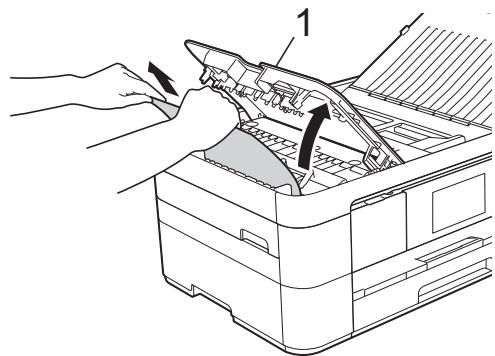
1 ADF cover
4 Close the ADF cover.
Press X.
IMPORTANT
To avoid document jams, close the ADF cover correctly by pushing it gently in the centre.
Document is jammed inside the ADF
1 Take any paper that is not jammed out of the ADF.
2 Lift the document cover.
Pull the jammed document out to the left.
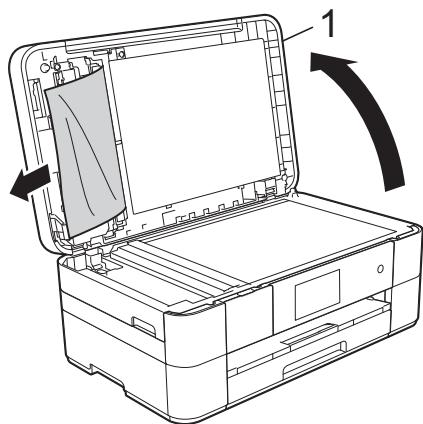
1 Document Cover
4 Close the document cover.
Press X.
Small document is jammed in the ADF
1 Lift the document cover.
2 Insert a piece of stiff paper, such as cardstock, into the ADF to push any small paper scraps through.
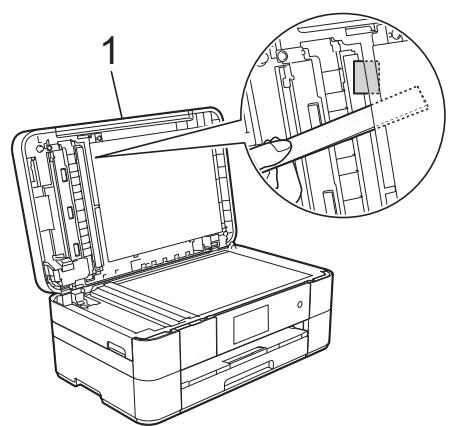
1 Document Cover
3 Close the document cover.
4 Press X.
Printer jam or paper jam
Follow these steps to locate and remove the jammed paper if the Touchscreen displays:
Paper Jam [Front] or Paper Jam [Front,Rear]
NOTE
If the Touchscreen displays Paper Jam [Rear], see page 51.
Unplug the machine from the electrical socket.
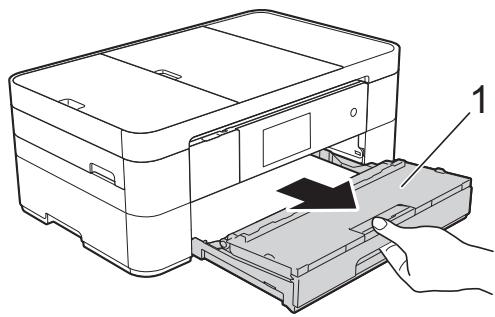
Pull the paper tray (1) completely out of the machine.
Pull out the jammed paper (1).
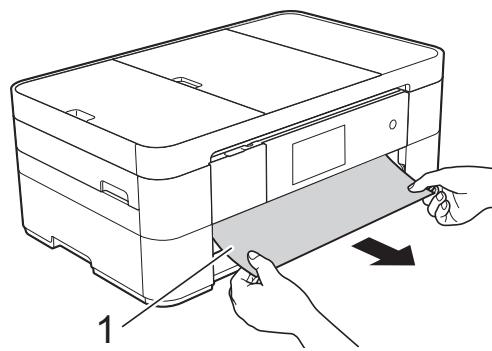
4 Lift the Jam Clear Flap, and remove the jammed paper.
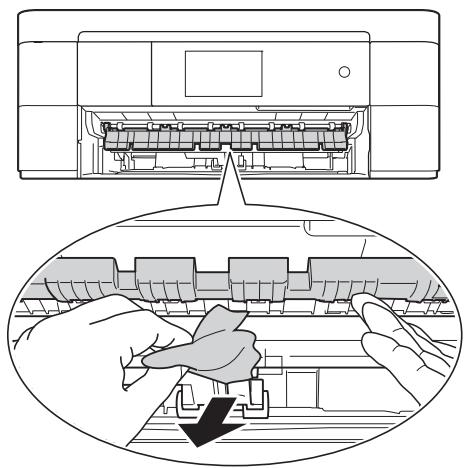
Make sure you look carefully inside the machine above and below the Jam Clear Flap for scraps of paper.
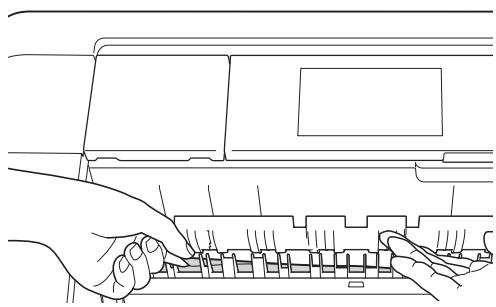
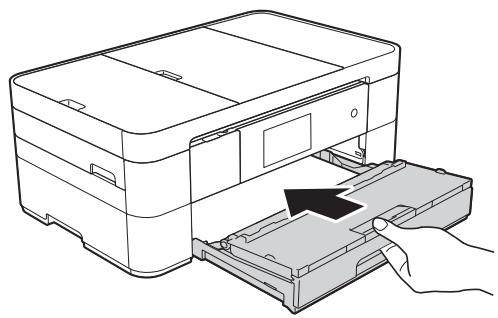
Put the paper tray firmly back in the machine.
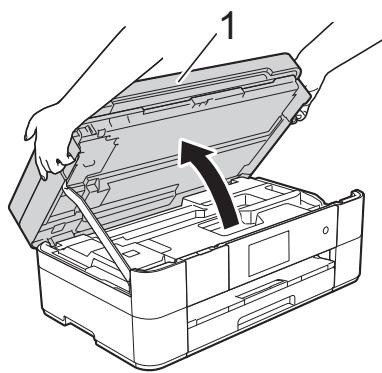
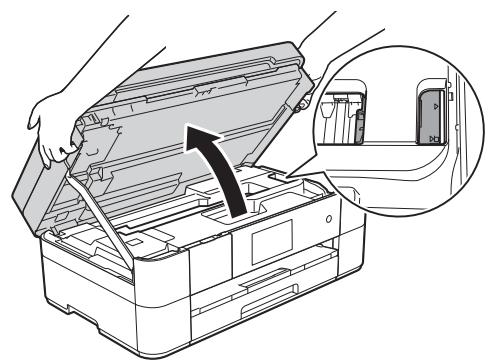
Using both hands, use the finger holds on each side of the machine to lift the scanner cover (1) into the open position.
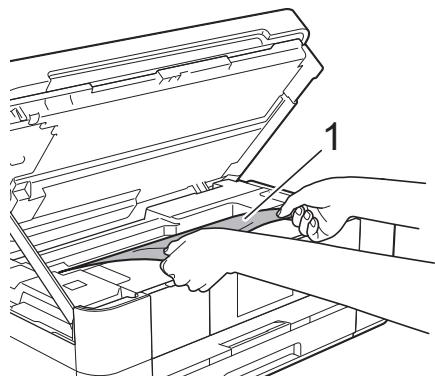
Slowly pull the jammed paper (1) out of the machine.
9 Move the print head (if necessary) to reach any paper remaining in this area. Make sure no jammed paper is left in the corners of the machine (1) and (2).
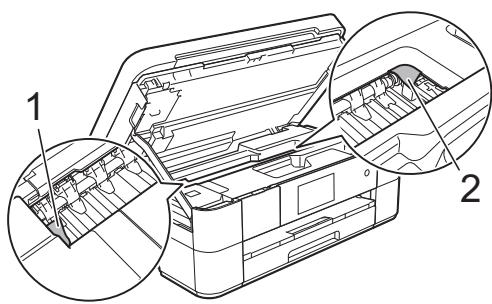
IMPORTANT
- If paper is jammed under the print head, unplug the machine from the power source, and then move the print head to reach the paper.
- If the print head is in the right corner as shown in the illustration, you cannot move the print head. Reconnect the power cord. Hold down until the print head moves to the centre. Then unplug the machine from the power source and remove the paper.
- If ink gets onto your skin, immediately wash with soap and plenty of water.
Gently close the scanner cover using the finger holds on each side.
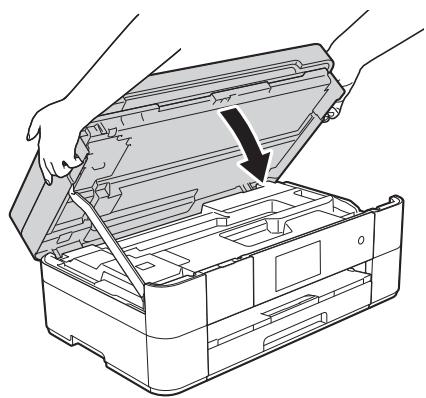
Do one of the following:
If the Touchscreen displays Paper Jam [Front], go to step 15.
■ If the Touchscreen displays Paper Jam [Front, Rear], go to step 11.
11 Open the Jam Clear Cover (1) at the back of the machine.
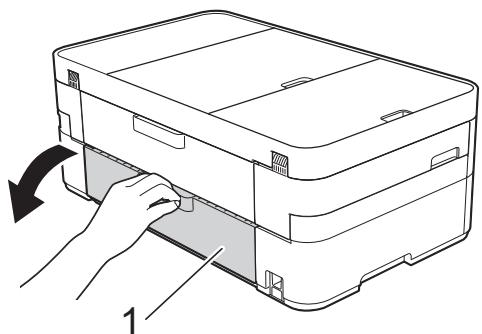
12 Open the inside cover (1).
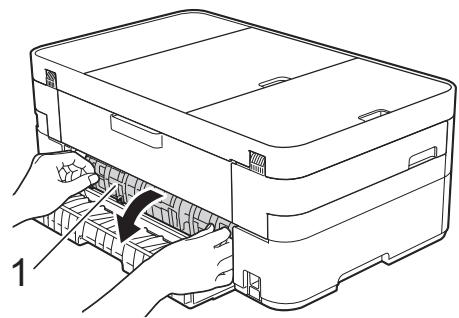
13 Make sure you look carefully inside for jammed paper. If there is any jammed paper, slowly pull it out of the machine.
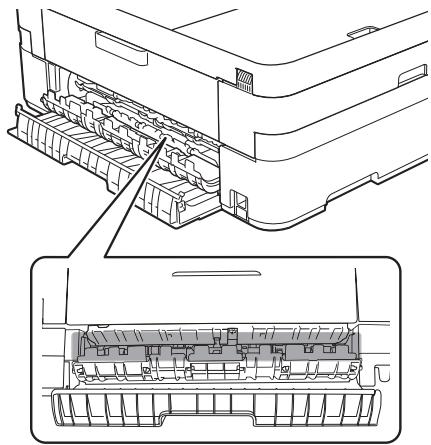
14 Close the inside cover and Jam Clear Cover. Make sure the covers are closed completely.
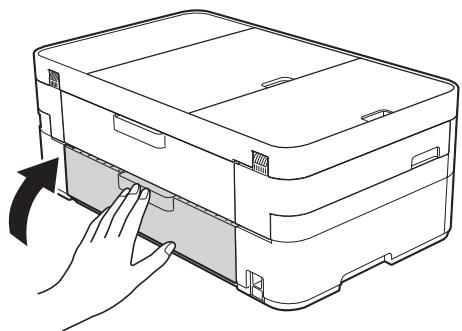
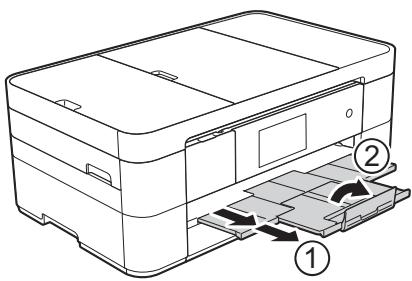
Pull out the paper support (1) until it locks into place, and then unfold the paper support flap (2).
16 Reconnect the power cord.
If the Touchscreen displays Paper Jam [Rear], follow these steps:
Unplug the machine from the AC power outlet.
2 Open the Jam Clear Cover (1) at the back of the machine.
![BROTHER MFC-J4625DW - If the Touchscreen displays Paper Jam [Rear], follow these steps: - 1](/content/2025/01/74782/images/9eaa7e90b6583d4975feacacbf11f0a60a759f138aa090373649da75f5920dc2.jpg)
3 Open the inside cover (1).
![BROTHER MFC-J4625DW - If the Touchscreen displays Paper Jam [Rear], follow these steps: - 2](/content/2025/01/74782/images/ecba5d534bb8baae95352dd4bdbffe339d38cac9b3b0da342db28eb902fbee45.jpg)
Pull the jammed paper out of the machine.
![BROTHER MFC-J4625DW - If the Touchscreen displays Paper Jam [Rear], follow these steps: - 3](/content/2025/01/74782/images/76f82b5b8db007f6c38c714b4f4e1f2aad6448b290ac4c3fb222b9058524fb66.jpg)
5 Close the inside cover and Jam Clear Cover. Make sure the covers are closed properly.
![BROTHER MFC-J4625DW - If the Touchscreen displays Paper Jam [Rear], follow these steps: - 4](/content/2025/01/74782/images/f077794f08b787222f1e3b7f601f3de217c25ea8e801abc4c7ad1d93999f9dc4.jpg)
Using both hands, use the finger holds on each side of the machine to lift the scanner cover (1) into the open position.
![BROTHER MFC-J4625DW - If the Touchscreen displays Paper Jam [Rear], follow these steps: - 5](/content/2025/01/74782/images/edfddd20ed224f1314d13e574b211c5c56b74719b8431ed1ac9a9f9deadd3a15.jpg)
Slowly pull the jammed paper (1) out of the machine.
![BROTHER MFC-J4625DW - If the Touchscreen displays Paper Jam [Rear], follow these steps: - 6](/content/2025/01/74782/images/e8c3ad8521c6d68412228117bb1fee58af743d5accfb967aa15c301c6044badf.jpg)
8 Move the print head (if necessary) to reach any paper remaining in this area. Make sure no jammed paper is left in the corners of the machine (1) and (2).
![BROTHER MFC-J4625DW - If the Touchscreen displays Paper Jam [Rear], follow these steps: - 7](/content/2025/01/74782/images/1814a2ec312a1d8d13400c8166a3cd13f98826da41a9c6c5137ca9daa42a662a.jpg)
IMPORTANT
- If paper is jammed under the print head, unplug the machine from the power source, and then move the print head to reach the paper.
- If the print head is in the right corner as shown in the illustration, you cannot move the print head. Reconnect the power cord. Hold down until the print head moves to the centre. Then unplug the machine from the power source and remove the paper.
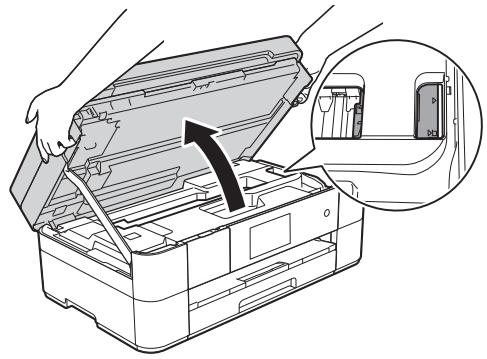
- If ink gets onto your skin, immediately wash with soap and plenty of water.
Gently close the scanner cover using the finger holds on each side.
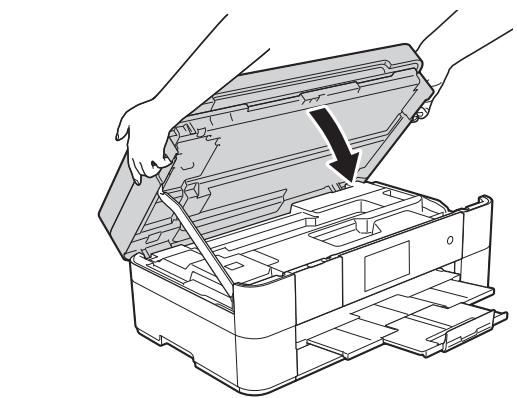
10 Reconnect the power cord.
NOTE
If there is a repeat paper jam, a small scrap of paper may be stuck in the machine. (See Additional paper jam clear operations on page 53.)
Additional paper jam clear operations
If you experience paper jams repeatedly (3 times or more), the Touchscreen displays a message asking if you want to remove paper scraps from the machine.
Press Yes to return to the Home screen.
2 Press (Settings).
3 Press Maintenance.
4 Press Remove Paper Scaps.
5 Follow the instructions on the Touchscreen to locate and remove the jammed paper.
NOTE
During the procedure, you must load the Maintenance sheet (included with your machine) in Landscape position in the manual feed slot. (If you do not have the Maintenance sheet, use one sheet of A4 or Letter size thick paper, such as glossy paper.)
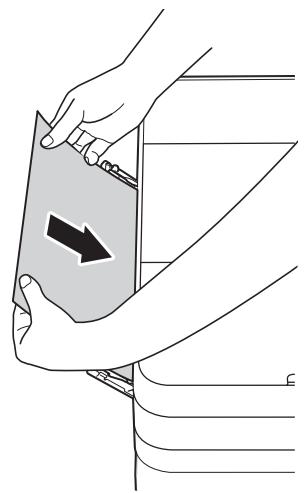
Troubleshooting for Wireless LAN setup
Wireless LAN report
After you configure the wireless LAN settings of the machine, a wireless LAN report will be printed automatically.
If the printed report shows that the connection failed, check the error code on the printed report and refer to the following instructions.
| Error code | Recommended Solutions |
| TS-01 | The wireless setting is not activated, change the wireless setting to ON. ■ If a network cable is connected to your machine, disconnect it and change your machine's wireless setting to ON. |
| TS-02 | Your wireless access point/rodert cannot be detected. Please try the following: ■ Check that you are selecting the correct SSID (network name) and are entering the correct network key. ■ Check that your wireless access point/rodert is not using additional security settings, such as MAC address filtering. ■ Try moving the device closer to your wireless access point/rodert. After it is connected to the network, you should be able to move it back to its previous location. |
| TS-04 | Unsupported authentication/encryption method has been detected on your wireless access point/rodert. ■ Your wireless access point/rodert is using an authentication/encryption method that is not supported by the device. Check that you are selecting the correct SSID (network name). |
| TS-05 | The specified SSID and network key are incorrect. ■ Check that you are selecting the correct SSID (network name) and are entering the correct network key. |
| TS-06 | The specified wireless security information is incorrect. ■ Check the authentication/encryption method that you are selecting and make sure you are entering the correct network key. |
| TS-07 | The machine cannot detect a wireless access point/rodert that has WPS or AOSSTM enabled. ■ If you would like to configure your wireless settings using WPS or AOSSTM, you must set up WPS or AOSSTM on both your machine and the wireless access point/rodert. Confirm your wireless access point/rodert supports WPS or AOSSTM and try starting again. |
| TS-08 | Two or more wireless access points with WPS or AOSSTM enabled are detected. ■ Try starting again after a few minutes to avoid interference from other access points. |
If you are having difficulty with your machine
IMPORTANT
Using non-Brother supplies may affect the print quality, hardware performance, and machine reliability.
If you think there is a problem with your machine, check the following tables of troubleshooting tips. You can correct most problems by yourself.
If you need additional help, the Brother Solutions Center offers the latest FAQs and troubleshooting tips.
Visit http://support.brother.com.
NOTE
For technical help, contact Brother customer support.
Printing Difficulties
| Difficulty | Suggestions |
| The headers or footers appear when the document is displayed on the screen but they do not show up when it is printed. | There is an unprintable area on the top and bottom of the page. Adjust the top and bottom margins in your document to allow for this. (See Online User's Guide.) |
| Print speed is too slow. | Try changing the printer driver setting. The highest resolution needs longer data processing, sending and printing time. Try the other quality settings in the printer driver as follows: (Windows®) Click Colour Settings on the Advanced tab, and make sure you clear Colour Enhancement. (Macintosh) Choose Color Settings, click Advanced Color Settings, and make sure you clear Color Enhancement. |
| Turn the Borderless feature off. Borderless printing is slower than normal printing. (See Online User's Guide.) |
Print Quality Difficulties
| Difficulty | Suggestions |
| Poor print quality. | Check the print quality. (See Checking the print quality on page 33.) |
| Make sure that the Media Type setting in the printer driver or the Paper Type setting in the machine's menu matches the type of paper you are using. (See Set Paper Size and Type on page 14.) (See Online User's Guide.) | |
| Make sure that your ink cartridges are fresh. The following may cause ink to clog: ■ The expiration date written on the cartridge package has passed. (Brother Original cartridges stay usable for up to two years if kept in their original packaging.) ■ The ink cartridge has been in your machine for over six months. ■ The ink cartridge may not have been stored correctly before use. | |
| Make sure you are using Brother Original Innobella ink. Brother does not recommend the use of cartridges other than Brother Original cartridges or the refilling of used cartridges with ink from other sources. | |
| Make sure you are using one of the recommended types of paper. (See Online User's Guide.) | |
| The recommended environment for your machine is between 20 °C to 33 °C. | |
| White horizontal lines appear in text or graphics. | Check the print quality. (See Checking the print quality on page 33.) |
| Make sure you are using Brother Original Innobella ink. | |
| Try using the recommended types of paper. (See Online User's Guide.) | |
| To prolong print head life, provide the best ink cartridge economy and maintain print quality, we do not recommend frequently unplugging the machine and/or leaving the machine unplugged for extended periods of time. We recommend using to power down the machine. Using allows minimal power to the machine, resulting in periodic, but less frequent cleaning of the print head. | |
| A4, Letter and Executive | |
| A3, Ledger, Legal, A5, A6, envelopes, Photo (10 × 15 cm), Photo L (89 × 127 mm), Photo 2L (13 × 18 cm) and Index Card (127 × 203 mm) | |
| The machine prints blank pages. | Check the print quality. (See Checking the print quality on page 33.) |
| Make sure you are using Brother Original Innobella ink. | |
| To prolong print head life, provide the best ink cartridge economy and maintain print quality, we do not recommend frequently unplugging the machine and/or leaving the machine unplugged for extended periods of time. We recommend using to power down the machine. Using allows minimal power to the machine, resulting in periodic, but less frequent cleaning of the print head. | |
| Characters and lines are blurred. | Check the printing alignment. (See Checking the print alignment on page 35.) |
| Printed text or images are skewed. | Make sure the paper is loaded correctly in the paper tray and the paper guides are adjusted correctly. (See Before loading paper on page 9.) |
| Make sure the Jam Clear Cover is closed correctly. | |
| Smudge or stain at the top centre of the printed page. | Make sure the paper is not too thick or curled. (See Online User's Guide.) |
| Printing appears dirty or ink seems to run. | Make sure you are using the recommended types of paper. (See Online User's Guide.)Do not handle the paper until the ink is dry. |
| Make sure the printing surface is face down in the paper tray. | |
| Make sure you are using Brother Original Innobella ink. | |
| If you are using photo paper, make sure that you have set the correct paper type. If you are printing a photo from your PC, set the Media Type in the printer driver. | |
| Ink is smudged or wet when using glossy photo paper. | Be sure to check the front and back of the paper. Place the glossy surface (printing surface) face down. (See Set Paper Size and Type on page 14.) |
| If you use glossy photo paper, make sure that the paper type setting is correct. | |
| Printouts appear dirty or the paper jams when using A3 paper. | (PC print for Windows®)Select Slow Drying Paper in the Basic tab of the printer driver. |
| (PC print for Macintosh)Select Print Settings from the drop-down list and then check Slow Drying Paper of the printer driver. | |
| (Copy)Adjust the copy density to make copies lighter. (See Online User's Guide.) | |
| Stains appear on the reverse side or at the bottom of the page. | Make sure the printer platen is not dirty with ink. (See Online User's Guide.) |
| Make sure you are using Brother Original Innobella ink. | |
| Make sure you are using the paper support flap. (See Before loading paper on page 9.) | |
| Make sure the paper feed rollers are not dirty with ink. (See Online User's Guide.) | |
| The machine prints dense lines on the page. | (Windows®)Select Reverse Order in the Basic tab of the printer driver. |
| The printouts are wrinkled. | (Windows®) In the printer driver Advanced tab, click Colour Settings and clear Bi-Directional Printing. (Macintosh) In the printer driver, choose Print Settings, click Advanced, choose Other Print Options and clear Bi-Directional Printing. |
| Make sure you are using Brother Original Innobella ink. |
Paper Handling Difficulties
| Difficulties | Suggestions |
| Photo paper does not feed correctly. | When you print on Brother Photo paper, load one extra sheet of the same photo paper in the paper tray. An extra sheet has been included in the paper package for this purpose. |
| Machine feeds multiple pages. | Do the following: (See Before loading paper on page 9.) ■ Make sure the paper is loaded correctly in the paper tray. ■ Remove all the paper from the tray and fan the stack of paper well, then put it back in the tray. ■ Make sure you do not push the paper in too far. |
| Make sure the Jam Clear Cover is closed correctly. (See Printer jam or paper jam on page 48.) | |
| Make sure the Base Pad in the paper tray is not dirty. (See Online User's Guide.) | |
| There is a paper jam. | Remove the jammed paper by following the steps. (See Printer jam or paper jam on page 48.) Make sure the paper guides are set to the correct paper size. |
| Paper jam reoccurs. | If there is a repeat paper jam, a small piece of paper may be stuck in the machine. Make sure paper is not still jammed in the machine. (See Additional paper jam clear operations on page 53.) |
Printing Received Faxes
| Difficulty | Suggestions |
| ■ Condensed print ■ Horizontal streaks ■ Top and bottom sentences are cut off ■ Missing lines | This is usually caused by a poor telephone connection. Make a copy; if your copy looks good, you probably had a bad connection with static or interference on the telephone line. Ask the other party to re-send the fax. |
| Vertical black lines when receiving. | The sender's scanner may be dirty. Ask the sender to make a copy to see if the problem is with the sending machine. Try receiving from another fax machine. |
| Left and right margins are cut off or a single page is printed on two pages. | If the received faxes are divided and printed on two pages or if you get an extra blank page, your paper size setting may not be correct for the paper you are using. (See Set Paper Size and Type on page 14.) |
| Turn on Auto Reduction. (See Online User's Guide.) |
Telephone Line or Connections
| Difficulty | Suggestions |
| Dialling does not work. (No dial tone) | Check all line cord connections. Make sure the telephone line cord is plugged into the telephone wall socket and the LINE socket inside the machine. |
| Change the Tone/Pulse setting. (See Online User's Guide.) | |
| If an external phone is connected to the machine, send a manual fax by lifting the handset of the external telephone and dialling the number using the external telephone. Wait to hear the fax receiving tones before sending fax. | |
| If there is no dial tone, connect a known-working telephone and telephone line cord to the socket. Then lift the external telephone's handset and listen for a dial tone. If there is still no dial tone, ask your telephone company to check the line and/or wall socket. | |
| The machine does not answer when called. | Make sure the machine is in the correct Receive Mode for your setup. (See Choose the Receive Mode on page 30.) Check for a dial tone. If possible, call your machine to hear it answer. If there is still no answer, check the telephone line cord connection. If there is no ringing when you call your machine, ask your telephone company to check the line. |
Receiving Faxes
| Difficulty | Suggestions |
| Cannot receive a fax. | Check all line cord connections. Make sure the telephone line cord is plugged into the telephone wall socket and the LINE socket inside the machine. If you subscribe to DSL or VoIP services, contact your service provider for connection instructions. If you have problems due to possible interference on the telephone line, you can change the compatibility setting. (See Telephone Line Interference or VoIP System on page 65.) |
| Make sure the machine is in the correct Receive Mode. This is determined by the external devices and telephone subscriber services you have on the same line as the Brother machine. (See Choose the Receive Mode on page 30.) If you have a dedicated fax line and want your Brother machine to automatically answer all incoming faxes, select Fax Only mode. If your Brother machine shares a line with an external answering machine, select External TAD mode. In External TAD mode, your Brother machine will automatically receive incoming faxes and voice callers will be able to leave a message on your answering machine. If your Brother machine shares a line with other telephones and you want it to automatically answer all incoming faxes, select Fax/Tel mode. In Fax/Tel mode, your Brother machine will automatically receive faxes and produce a fast double-ring to alert you to answer voice calls. If you do not want your Brother machine to automatically answer incoming faxes, select Manual mode. In Manual mode, you must answer every incoming call and activate the machine to receive faxes. | |
| Another device or service at your location may be answering the call before your Brother machine answers. To test this, lower the Ring Delay setting: ■ If the Receive Mode is set to Fax Only or Fax/Tel, reduce the Ring Delay to 1 ring. (See Ring Delay on page 32.) ■ If the Receive Mode is set to External TAD, reduce the number of rings programmed on your answering machine to 2. ■ If the Receive Mode is set to Manual, DO NOT adjust the Ring Delay setting. Have someone send you a test fax: ■ If you received the test fax successfully, your machine is operating correctly. Remember to reset your Ring Delay or answering machine setting back to your original setting. If receiving problems recur after resetting the Ring Delay, then a person, device, or subscriber service is answering the fax call before the machine has a chance to answer. ■ If you were not able to receive the fax, then another device or subscriber service may be interfering with your fax reception or there may be a problem with your fax line. | |
| Cannot receive a fax. (continued) | If you are using a telephone answering machine (External TAD mode) on the same line as the Brother machine, make sure your answering machine is set up correctly. (See Online User's Guide.) 1 Connect the external TAD correctly. (See Online User's Guide.) 2 Set your answering machine to answer in one or two rings. 3 Record the outgoing message on your answering machine. ■ Record five seconds of silence at the beginning of your outgoing message. ■ Limit your speaking to 20 seconds. ■ End your outgoing message with your Remote Activation Code for people sending manual faxes. For example: “After the beep, leave a message or press * 5 1 and Start to send a fax.” 4 Set your answering machine to answer calls. 5 Set your Brother machine's Receive Mode to External TAD. (See Choose the Receive Mode on page 30.) |
| Make sure your Brother machine's Fax Detect feature is turned On. Fax Detect is a feature that allows you to receive a fax even if you have answered the call on an external or extension telephone. (See Online User's Guide.) | |
| If you often get transmission errors due to possible interference on the telephone line, try changing the Compatibility setting to Basic (for VoIP). (See Telephone Line Interference or VoIP System on page 65.) | |
| If you connect your machine to a PBX or ISDN line, set the menu setting of Telephone Line Type to your telephone line type. (See Online User's Guide.) |
Sending Faxes
| Difficulty | Suggestions |
| Cannot send a fax. | Check all line cord connections. Make sure the telephone line cord is plugged into the telephone wall socket and the LINE socket inside the machine. |
| Print the Transmission Verification Report and check for an error.(See Online User's Guide.) | |
| Ask the other party to check that the receiving machine has paper. | |
| Poor fax send quality. | Try changing your resolution to Fine or S.Fine. Make a copy to check your machine's scanner operation. If the copy quality is poor, clean the scanner.(See Cleaning the scanner glass on page 33.) |
| Transmission Verification Report says RESULT:ERROR. | There is probably temporary noise or static on the line. Try sending the fax again. If you send a PC FAX message and get RESULT:ERROR on the Transmission Verification Report, your machine may be out of memory. To gain extra memory, you can turn off Memory Receive, print fax messages from the machine's memory or cancel a Delayed Fax or Polling Job. (See Online User's Guide.)If the problem continues, ask the telephone company to check your telephone line. |
| If you often get transmission errors due to possible interference on the telephone line, try changing the machine's Compatibility setting to Basic (for VoIP). (See Telephone Line Interference or VoIP System on page 65.) | |
| If you connect your machine to PBX or ISDN, set the menu setting of Telephone Line Type to your telephone line type. (See Online User's Guide.) | |
| Vertical black lines when sending. | Black vertical lines on faxes you send are typically caused by dirt or correction fluid on the glass strip. Clean the glass strip. (See Cleaning the scanner glass on page 33.) |
Handling Incoming Calls
| Difficulty | Suggestions |
| The machine “hears” a voice as a CNG Tone. | If Fax Detect is set to On, your machine is more sensitive to sounds. It may mistakenly interpret certain voices or music on the line as a fax machine calling and respond with fax-receiving tones. Deactivate the machine by pressing ✚. Try avoiding this problem by turning Fax Detect to Off. (See Online User's Guide.) |
| Sending a fax call to the machine. | If you answered on an extension or external telephone, press your Remote Activation Code (the factory default is * 5 1). If you answered on an external telephone, press Fax Start, and then press Receive to receive the fax. When your machine answers, hang up. |
| Custom features on a single line. | If you have Call Waiting, Call Waiting/Caller ID, Caller ID, Voice Mail, an answering machine, an alarm system or other custom feature on a single telephone line with your machine, it may create a problem sending or receiving faxes. For example: If you subscribe to Call Waiting or another custom service and its signal comes through the line while your machine is sending or receiving a fax, the signal can temporarily interrupt the fax. Brother's ECM (Error Correction Mode) feature should help overcome this problem. This condition is related to the telephone system industry and is common to all devices that send and receive information on a single, shared line with custom features. If avoiding a slight interruption is crucial to your business, we recommend using a separate telephone line with no custom features. |
Copying Difficulties
| Difficulty | Suggestions |
| Vertical black lines or streaks appear in copies. | Black vertical lines on copies are typically caused by dirt or correction fluid on the glass strip. Clean the glass strip, scanner glass, and the white bar and white plastic above them. (See Cleaning the scanner glass on page 33.) |
| Black marks or spots appear in copies. | Black marks or spots on copies are typically caused by dirt or correction fluid on the scanner glass. Clean the scanner glass and white plastic above it. (See Cleaning the scanner glass on page 33.) |
| Poor copy results when using the ADF. | Try using the scanner glass. (See Using the scanner glass on page 17.) |
| Fit to Page does not work correctly. | Make sure your source document is not skewed. Reposition the document and try again. |
Scanning Difficulties
| Difficulty | Suggestions |
| Poor scanning results when using the ADF. | Clean the white bar and the glass strip underneath it. (See Cleaning the scanner glass on page 33.) |
| Vertical black lines appear in the scanned data. | Try using the scanner glass. (See Using the scanner glass on page 17.) |
PhotoCapture Center Difficulties
| Difficulty | Suggestions |
| Removable Disk does not work correctly. | 1 Take out the memory card or USB flash drive and put it back in again. 2 If you have tried “Eject” from within Windows®, take out the memory card or USB flash drive before you continue. 3 If an error message appears when you try to eject the memory card or USB flash drive, it means the card is being accessed. Wait a while, and then try again. 4 If all of the above do not work, turn off your PC and machine, and then turn them on again. |
| Part of my photo is missing when printed. | Make sure that Borderless printing and Cropping are turned off. (See Online User's Guide.) |
Software Difficulties
| Difficulty | Suggestions |
| Cannot install software or print. | (Windows®) Run the Repair MFL-Pro Suite program on the CD-ROM. This program will repair and reinstall the software. |
Network Difficulties
| Difficulty | Suggestions |
| Cannot print over the network. | Make sure that your machine is powered on and is online and in the Ready mode. Print a Network Configuration Report (see Online User's Guide) and check the current Network settings printed in this list. Reconnect the LAN cable to the hub to verify that the cabling and network connections are good. If you are using a wireless connection or are having network problems, see Online User's Guide. |
| The network scanning feature does not work. | It is necessary to configure the third-party Security/Firewall Software to allow Network scanning. Add port 54925 for Network scanning. (See Online User's Guide.) |
| The network PC-Fax Receive feature does not work. | (Windows®) It is necessary to set the third-party Security/Firewall Software to allow PC-FAX Rx. Add port 54926 for Network PC-FAX Rx. (See Online User's Guide.) |
| The Brother software cannot be installed. | (Windows®) Allow network access to the following programs if your security software displays an alert message during MFL-Pro Suite installation. (Macintosh) If you are using a firewall function of anti-spyware or antivirus security software, temporarily disable it and then install the Brother software. |
| Cannot connect to wireless network. | Investigate the problem using the WLAN Report. Press , All Settings, and then swipe up or down or press ▲ or ▼ to display Print Reports. Press Print Reports. Swipe up or down or press ▲ or ▼ to display WLAN Report, and then press WLAN Report. (See Online User's Guide.) |
Dial Tone detection
When sending a fax, by default your machine will wait for a fixed amount of time before it starts to dial the number. By changing the Dial Tone setting to Detection, you can make your machine dial as soon as it detects a dial tone. This setting can save a small amount of time when sending a fax to many different numbers. If you change the setting and start having problems when dialling, you should change it back to the No Detection setting.

Press

(Settings).

Press All Settings.

Swipe up or down or press or to display Initial Setup.

Press Initial Setup.

Swipe up or down or press or to display Dial Tone.

Press Dial Tone.

Press Detection or No Detection.

Press
Telephone Line Interference or VoIP System
If you are having problems sending or receiving a fax due to possible interference on the telephone line, or if you are using a VoIP system, we recommend that you change the modem speed to minimize errors in fax operations.

Press

(Settings).

Press All Settings.

Swipe up or down or press or to display Initial Setup.

Press Initial Setup.

Swipe up or down or press or to display Compatibility.

Press Compatibility.

Press Normal or Basic (for VoIP).
Basic(for VoIP) reduces the modem speed to 9,600 bps and turns off colour fax receiving and Error Correction Mode (ECM), except for colour fax-sending. Unless interference is a recurring problem on your telephone line, you may prefer to use it only when needed.
To improve compatibility with most VoIP services, Brother recommends changing the compatibility setting to Basic (for VoIP).
Normal sets the modem speed at 14,400 bps.

Press
NOTE
VoIP (Voice over IP) is a type of phone system that uses an Internet connection, rather than a traditional phone line.
Machine Information
Checking the serial number
You can see the machine's serial number on the Touchscreen.
Press (Settings).
Press All Settings.
3 Swipe up or down or press or to display Machine Info.
4 Press Machine Info.
Press Serial No. Your machine's serial number will appear on the Touchscreen.
6 Press
Checking the firmware version
You can see the machine's firmware version on the Touchscreen.
1 Press (Settings).
Press All Settings.
3 Swipe up or down or press or to display Machine Info.
4 Press Machine Info.
Press Firmware Version.
6 Press Main Version. Your machine's firmware version will appear on the Touchscreen.
7 Press A.
Reset operations overview
The following reset operations are available:
1 Machine Reset
You can reset all the machine's settings that you have changed, such as the date and time, telephone line type and Ring Delay.
2 Network
You can reset the print server back to its default factory settings, such as the password and IP address information.
3 Address Book & Fax
Address Book & Fax resets the following settings:
Address Book
(Address Book and Setup Groups)
■ Programmed fax jobs in the memory (Polled Transmit, Delayed Fax and Delayed Batch Transmission)
Station ID
(Name and Number)
Remote Fax Options (Fax Forwarding)
Report settings
(Transmission Verification Report, Address Book and Fax Journal)
History
(Caller ID history and Outgoing Call)
Faxes in memory
4 All Settings
You can restore all settings to the factory default.
Brother strongly recommends performing this procedure before handing over or disposing of the machine.
NOTE
Unplug the interface cable before you choose Network or All Settings.
How to reset the machine
Press (Settings).
Press All Settings.
3 Swipe up or down or press or to display Initial Setup.
4 Press Initial Setup.
5 Swipe up or down or press or to display Reset.
6 Press Reset.
7 Press the option you want to reset.
Press Yes to confirm.
Press Yes for two seconds to reboot the machine.
C
Index
A
Address Book setting up 28
ADF (automatic document feeder) 16
Automatic fax receive .30
C
Cleaning
scanner 33
Control panel overview .2
ControlCenter See Online User's Guide.
Copy paper size .20 paper type .20 using scanner glass .17
Custom telephone features on a single line .62
D
Dialling a pause 28
Document loading 16, 17
E
Envelopes 9,11
Error messages on Touchscreen 36
F
Fax, from PC
See Online User's Guide.
Fax, stand-alone
receiving 30
difficulties 59, 60
F/T Ring Time, setting 32
Ring Delay, setting 32
telephone line interference or VoIP system 65
sending 27
difficulties 61
telephone line interference or VoIP system 65
Fax/Tel mode
Ring Delay 32
J
Jams document 47 paper 48
L
LCD (Liquid Crystal Display) 2
M
Manual receive 30
Manual feed slot 11
N
Network Printing See Online User's Guide. Scanning See Online User's Guide. NFC (Near Field Communication) 23 printing 23 scanning 23
P
Paper
Check Paper setting 15
loading 9
size of document 16
type 14
PhotoCapture Center
from PC
See Online User's Guide.
Preview photos 24
difficulties 55
paper jams 48
Printing
See Online User's Guide.
R
Receive Mode
External TAD 30
Fax Only 30
Fax/Tel 30
Manual 30
Ring Delay, setting 32
S
Scanning
See Online User's Guide.
Serial Number
how to find . See inside front cover
Supplies 71
T
TAD (telephone answering device),
external 30
Receive Mode 30
Telephone line
difficulties 59
interference or VoIP system 65
Text, entering 8
Transferring your taxes or
Fax Journal report 46
Troubleshooting
document jam 47
error and maintenance messages on
Touchscreen 36
if you are having difficulty
copying 63
document jam 47
incoming calls 62
Network 64
paper handling 58
PhotoCapture Center 63
print quality 56
printing 55
printing received taxes 59
receivingfaxes 60
scanning 63
software 63
telephone line or connections 59
paper jam 48
wireless LAN setup
Wireless LAN report 54
W
Wireless Network
See Quick Setup Guide and Online User's Guide.
Supplies
Ink
Service Life of Ink Cartridge
The machine uses individual Black, Yellow, Cyan and Magenta ink cartridges that are separate from the print head assembly.
The first time you install a set of ink cartridges the machine will use an amount of ink to fill the ink delivery tubes for high quality printouts. This process will only happen once. After this process is complete the cartridges provided with your machine will have a lower yield than regular capacity cartridges (65%). With all following ink cartridges you can print the specified number of pages.
Replacement Supplies
Black, Yellow, Cyan, and Magenta - Approximately 1,200 pages
Black, Yellow, Cyan and Magenta - Approximately 550 pages
1 Approx. cartridge yield is declared in accordance with ISO/IEC 24711.
For more information about the replacement supplies, visit http://www.brother.com/pageyield.
What is Innobella?
Innobella is a range of genuine supplies offered by Brother. The name "Innobella" derives from the words "Innovation" and "Bella" (meaning "Beautiful" in Italian) and is a representation of the "innovative" technology providing you with "beautiful" and "long lasting" print results.
When you print photo images, Brother recommends Innobella glossy photo paper (BP71 series) for high quality. Brilliant prints are made easier with Innobella Ink and paper.


BROTHER
CREATIVECENTER

If you're using Windows®, double-click the Brother CreativeCenter icon on your desktop to access our FREE website designed as a resource to help you easily create and print customized materials for business and home use with photos, text and creative touch.
Mac users can access Brother CreativeCenter at this web address: http://www.brother.com/creativecenter
brother
Visit us on the World Wide Web http://www.brother.com
These machines are approved for use in the country of purchase only. Local Brother companies or their dealers will support only machines purchased in their own countries.
- Basic User's Guide
- If you must contact Customer Service
- You can use the following features!
- Mobile Connect
- Web Connect / Brother Apps
- Add Shortcuts
- User's Guides and where to find them
- The Online User's Guide helps you get the most out of your machine.
- If you have questions or problems, please take a look at your model's FAQs.
- Table of Contents
- General information. 1
- Loading paper 9
- Loading documents 16
- Printing from a computer. 18
- Copying 19
- Scanning to a computer... 21
- Printing and scanning with Near Field Communication (NFC) 23
- Printing photos from a memory card or USB flash drive 24
- Telephone services and external devices 26
- Sending a fax 27
- Receiving a fax 30
- A Routine maintenance.....33
- B Troubleshooting 36
- C Index 68
- Supplies 71
- 1
- General information
- How to use the documentation
- Symbols and conventions
- Bold
- Italics
- Courier New
- IMPORTANT
- NOTE
- About Brother Utilities (Windows®)
- Control panel overview
- 3.7"(93.4 mm) Touchscreen LCD (Liquid Crystal Display)
- Touchpanel:
- Back
- Home
- Cancel
- NFC (Near Field Communication) logo
- Power On/Off
- 3.7"(93.4 mm) Touchscreen LCD
- Wireless Status
- Ink
- Settings
- + Shortcuts
- Date & Time
- Modes:
- +Add Shortcut
- Stored Faxes:
- New Fax(es):
- Warning icon
- Settings screen
- Maintenance
- Receive Mode
- Wi-Fi
- Date & Time
- Quiet Mode
- All Settings
- Fax Preview
- Tray Setting
- Entering Text
- Inserting spaces
- Making corrections
- 2
- Loading paper
- Before loading paper
- Loading paper in the paper tray
- Paper size and loading orientation
- When using A4, Letter or Executive size paper:
- Loading paper in the manual feed slot
- When using A3 or Ledger size paper:
- Open the manual feed slot cover.
- Slide the manual feed slot paper guides to fit the paper width that you are using.
- Paper settings
- Set Paper Size and Type
- Paper Type
- Paper Size
- Check Paper setting
- Recommended print media
- Brother paper
- Handling and using print media
- 3
- Loading documents
- How to load documents
- Using the ADF
- Document Sizes and Weights
- Using the scanner glass
- Document Sizes Supported
- 4
- Printing from a computer
- How to print a document
- Copying
- How to copy
- No. of Copies
- Stop copying
- Copy options overview
- 6
- Scanning to a computer
- Before scanning
- How to scan a document as a PDF file using ControlCenter4 (Windows®)
- Click Scan.
- How to scan a document as a PDF file using the Touchscreen
- Press OK.
- Printing and scanning with Near Field Communication (NFC)
- How to print with NFC
- How to scan with NFC
- 8
- Printing photos from a memory card or USB flash drive
- PhotoCapture Center operations (PHOTO mode)
- How to print images
- View Photos
- PhotoCapture Center print settings overview
- 9
- Telephone services and external devices
- Telephone services overview
- Voicemail
- Voice over Internet Protocol (VoIP)
- Connecting an external telephone answering device (TAD)
- External and extension telephones
- 10
- Sending a fax
- How to send a fax
- Do one of the following:
- Do one of the following:
- The Touchscreen displays:
- To change the fax-sending settings, press Options.
- Using the dial pad on the Touchscreen
- Using (Address Book)
- Using (Call History)
- Faxing from the ADF
- Faxing from the scanner glass
- Stop faxing
- How to store numbers
- Storing a pause
- Storing Address Book numbers
- How to set your Station ID
- 11
- Receiving a fax
- Receive Modes
- Choose the Receive Mode
- Using Receive Modes
- Fax Only
- Fax/Tel
- Manual
- External TAD
- Receive Mode settings
- Ring Delay
- F/T Ring Time (Fax/Tel mode only)
- A
- Routine maintenance
- How to clean and check the machine
- Cleaning the scanner glass
- Checking the print quality
- Checking the print alignment
- B
- Troubleshooting
- Identifying the problem
- Error and maintenance messages
- Error animations
- Transferring your taxes or Fax Journal report
- Transferring faxes to another fax machine
- Transferring taxes to your PC
- Transferring the Fax Journal report to another fax machine
- Document jam
- Document is jammed in the top of the ADF
- ADF cover
- Document is jammed inside the ADF
- Document Cover
- Small document is jammed in the ADF
- Printer jam or paper jam
- If the Touchscreen displays Paper Jam [Rear], follow these steps:
- Additional paper jam clear operations
- Troubleshooting for Wireless LAN setup
- Wireless LAN report
- If you are having difficulty with your machine
- Dial Tone detection
- Telephone Line Interference or VoIP System
- Machine Information
- Checking the serial number
- Checking the firmware version
- Reset operations overview
- How to reset the machine
- C
- Index
- D
- E
- F
- J
- L
- M
- N
- P
- R
- S
- T
- W
- Supplies
- Ink
- Service Life of Ink Cartridge
- Replacement Supplies
- What is Innobella?
- BROTHER
- CREATIVECENTER
Marque : BROTHER
Modèle : MFC-J4625DW
Catégorie : Imprimante multifonction