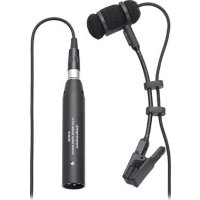
PRO35 - Microphone AUDIO TECHNICA - Notice d'utilisation et mode d'emploi gratuit
Retrouvez gratuitement la notice de l'appareil PRO35 AUDIO TECHNICA au format PDF.


| Type de produit | Microphone condensateur à électret |
| Marque | Audio-Technica |
| Modèle | PRO35 |
| Directivité | Cardioïde |
| Réponse en fréquence | 50 - 15 000 Hz |
| Filtre passe-haut | 80 Hz, 18 dB/octave |
| Sensibilité | -45 dB (5,6 mV) re 1V à 1 Pa |
| Impédance | 250 ohms |
| Niveau sonore maximal | 145 dB SPL (1 kHz, 1% THD) |
| Rapport signal/bruit | 64 dB (à 1 kHz, 1 Pa) |
| Alimentation fantôme requise | 11 - 52V CC, 2 mA |
| Poids (microphone) | 0,3 oz (8 g) |
| Poids (module) | 2,9 oz (81 g) |
| Dimensions (microphone) | 25,0 mm long, 10,2 mm diamètre |
| Dimensions (module) | 92,9 mm long, 18,9 mm diamètre |
| Connecteur de sortie | XLRM 3 broches intégré |
| Câble fourni | 1,8 m, blindé 2 conducteurs avec connecteur TA3F |
| Accessoires inclus | Support UniMount® AT8418, module AT8538, pochette |
| Applications recommandées | Saxophone, toms, cuivres, percussions |
| Entretien | Éviter exposition prolongée au soleil ou >43°C, éviter humidité extrême |
| Sécurité | Utiliser avec alimentation fantôme 11-52V CC, ne pas exposer à l'eau |
| Réparabilité | Pièces détachées disponibles sur demande auprès du fabricant |
| Garantie | Consulter la garantie constructeur |
FOIRE AUX QUESTIONS - PRO35 AUDIO TECHNICA
Questions des utilisateurs sur PRO35 AUDIO TECHNICA
0 question sur cet appareil. Repondez a celles que vous connaissez ou posez la votre.
Poser une nouvelle question sur cet appareil
Téléchargez la notice de votre Microphone au format PDF gratuitement ! Retrouvez votre notice PRO35 - AUDIO TECHNICA et reprennez votre appareil électronique en main. Sur cette page sont publiés tous les documents nécessaires à l'utilisation de votre appareil PRO35 de la marque AUDIO TECHNICA.
MODE D'EMPLOI PRO35 AUDIO TECHNICA
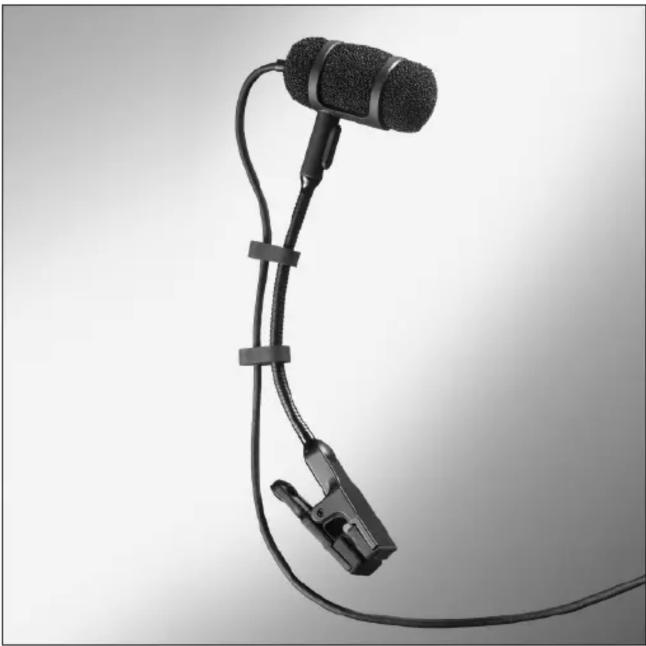
- Ideal for sax, toms, brass and percussion
• Excels in high-SPL applications - Perfect for active stage performances
- Extended frequency response captures subtle nuances of the performance
- UniMount® clip permits accurate positioning, provides shock resistance and protects element
- Corrosion-resistant contacts from gold-plated XLRM-type connector
- Cardioid polar pattern reduces pickup of sounds from the sides and rear, improving isolation of desired sound source
The PRO 35 is intended for use in professional applications where remote power is available. It requires 11V to 52V DC phantom power, which may be provided by a mixer or console, or by a separate, in-line source such as the Audio-Technica AT8801 single-channel or CP8506 four-channel phantom power supplies.
An integral 80 Hz high-pass filter provides easy switching from a flat frequency response to a low-end roll-off. The roll-off position reduces the pickup of low-frequency ambient noise (such as traffic, air-handling systems, etc.), room reverberation and mechanically coupled vibrations.
Output from the power module's XLRM-type connector is low impedance (Lo-Z) balanced. The signal appears across Pins 2 and 3; Pin 1 is ground (shield). Output phase is "Pin 2 hot" – positive acoustic pressure produces positive voltage at Pin 2.
To avoid phase cancellation and poor sound, all mic cables must be wired consistently: Pin 1-to-Pin 1, etc.
Avoid leaving the microphone in the open sun or in areas where temperatures exceed 110° F ( 43° C) for extended periods. Extremely high humidity should also be avoided.
PRO 35 SPECIFICATIONS†
| ELEMENT | Fixed-charge back plate permanently polarized condenser |
| POLAR PATTERN | Cardioid |
| FREQUENCY RESPONSE | 50-15,000 Hz |
| LOW FREQUENCY ROLL-OFF | 80 Hz, 18 dB/octave |
| OPEN CIRCUIT SENSITIVITY | -45 dB (5.6 mV) re 1V at 1 Pa* |
| IMPEDANCE | 250 ohms |
| MAXIMUM INPUT SOUND LEVEL | 145 dB SPL, 1 kHz at 1% THD |
| DYNAMIC RANGE (typical) | 115 dB, 1 kHz at Max SPL |
| SIGNAL-TO-NOISE RATIO | 64 dB,1 kHz at 1 Pa* |
| PHANTOM POWER REQUIREMENTS | 11-52V DC, 2 mA typical |
| SWITCH | Flat, roll-off |
| WEIGHT (less cable and accessories) | |
| MICROPHONE | 0.3 oz (8 g) |
| POWER MODULE | 2.9 oz (81 g) |
| DIMENSIONS | |
| MICROPHONE | 0.98" (25.0 mm) long,0.40" (10.2 mm) diameter |
| POWER MODULE | 3.66" (92.9 mm) long,0.74" (18.9 mm) diameter |
| OUTPUT CONNECTOR(power module) | Integral 3-pin XLRM-type |
| CABLE | 6.0' (1.8 m) long (permanently attached to microphone),0.10" (2.6 mm) diameter,2-conductor, shielded cable with TA3F-type connector |
| ACCESSORIES FURNISHED | AT8418 UniMount® microphone instrument mount; AT8538 power module; soft protective pouch |
† In the interest of standards development, A.T.U.S. offers full details on its test methods to other industry professionals on request.
*1 Pascal = 10 dynes/cm 2 = 10 microbars = 94 dB SPL
Typical, A-weighted, using Audio Precision System One. Specifications are subject to change without notice.
CE


audio-technica®
Audio-Technica U.S., Inc., 1221 Commerce Drive, Stow, Ohio 44224
Audio-Technica Limited, Old Lane, Leeds LS1 1 8AG England
www.audio-technica.com
P51764 ©2005 Audio-Technica U.S., Inc. Printed in Japan

Marque : AUDIO TECHNICA
Modèle : PRO35
Catégorie : Microphone