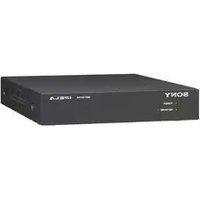
SLV-X842ML - Magnétoscope SONY - Notice d'utilisation et mode d'emploi gratuit
Retrouvez gratuitement la notice de l'appareil SLV-X842ML SONY au format PDF.


| Type de produit | Magnétoscope VHS |
| Caractéristiques techniques principales | Lecture et enregistrement VHS, compatibilité avec les cassettes VHS-C via adaptateur |
| Alimentation électrique | AC 220-240V, 50/60Hz |
| Dimensions approximatives | 360 x 270 x 90 mm |
| Poids | 3,2 kg |
| Compatibilités | Compatible avec les cassettes VHS et VHS-C (avec adaptateur) |
| Fonctions principales | Lecture, enregistrement, programmation d'enregistrement, fonction de lecture rapide |
| Entretien et nettoyage | Nettoyage régulier de la tête de lecture recommandé, utilisation de cassettes de nettoyage |
| Pièces détachées et réparabilité | Disponibilité limitée des pièces détachées, réparation recommandée par un professionnel |
| Sécurité | Ne pas exposer à l'humidité, ne pas ouvrir le boîtier, respecter les consignes de sécurité électrique |
| Informations générales utiles | Vérifier la compatibilité avec votre téléviseur, consulter le manuel d'utilisation pour les réglages |
FOIRE AUX QUESTIONS - SLV-X842ML SONY
Questions des utilisateurs sur SLV-X842ML SONY
0 question sur cet appareil. Repondez a celles que vous connaissez ou posez la votre.
Poser une nouvelle question sur cet appareil
Téléchargez la notice de votre Magnétoscope au format PDF gratuitement ! Retrouvez votre notice SLV-X842ML - SONY et reprennez votre appareil électronique en main. Sur cette page sont publiés tous les documents nécessaires à l'utilisation de votre appareil SLV-X842ML de la marque SONY.
MODE D'EMPLOI SLV-X842ML SONY
To prevent fire or shock hazard, do not expose the unit to rain or moisture.
To avoid electrical shock, do not open the cabinet. Refer servicing to qualified personnel only.
Precautions
Safety
- The SLV-X842/X842ML/X821MKII operates on 110-240 V AC, 50/60Hz.
- If anything falls into the cabinet, unplug the unit and have it checked by qualified personnel before operating it any further.
- The unit is not disconnected from the mains as long as it is connected to the mains outlet, even if the unit itself has been turned off.
- Unplug the unit from the mains outlet if you do not intend to use it for an extended period of time. To disconnect the cord, pull it out by the plug, never by the cord.
Installing
- Allow adequate air circulation to prevent internal heat buildup.
- Do not place the unit on surfaces (rugs, blankets, etc.) or near materials (curtains, draperies) that may block the ventilation slots.
- Do not install the unit near heat sources such as radiators or air ducts, or in a place subject to direct sunlight, excessive dust, mechanical vibration or shock.
- Do not install the unit in an inclined position. It is designed to be operated in a horizontal position only.
- Keep the unit and cassettes away from equipment with strong magnets, such as microwave ovens or large loudspeakers.
- Do not place heavy objects on the unit.
- If the unit is brought directly from a cold to a warm location, moisture may condense inside the VCR and cause damage to the video head and tape. When you first install the unit, or when you move it from a cold to a warm location, wait for about one hour before operating the unit.
Caution
Television programs, films, video tapes and other materials may be copyrighted. Unauthorized recording of such material may be contrary to the provisions of the copyright laws. Also, use of this recorder with cable television transmission may require authorization from the cable television transmitter and/or program owner.
Table of contents
4 Welcome!
4 Checking your model name
Getting Started
5 Step 1: Unpacking
6 Step 2: Setting up the remote commander
7 Step 3: Connecting the VCR
8 Step 4: Channel setup map and chart
11 Step 5: Tuning the TV to your VCR
13 Step 6: Setting up the VCR sequentially (EASY SET UP)
15 Setting the clock manually
17 Tuning the VCR to TV channels manually
24 Setting up G-CODE manually
26 Changing the program positions of the stations
Basic Operations
27 Playing a tape
30 Recording TV programs
35 Recording TV programs using G-CODE
37 Setting the timer manually
39 Checking/changing/cancelling timer settings
40 Additional instructions about timer recording
Additional Operations
41 Playing/searching at various speeds
42 Adjusting the picture
43 Searching using the index function
44 Game play
45 Looking at menu options
Editing
46 Editing with another VCR
48 Audio dubbing
Additional Information
50 Troubleshooting
52 Specifications
53 Index to parts and controls
56 Index
Welcome!
Thank you for purchasing the Sony Video Cassette Recorder (VCR). Here are some of the features you'll enjoy with your VCR:
- EASY SET UP that guides you through necessary VCR setups sequentially through the TV screen
- Adaptive Picture Control (APC) that automatically optimizes recording and playback performance
- Dual Mode Shuttle (DMS) ring for easy playback and search operations
-
G-CODE* system that lets you quickly and easily preset the VCR to record programs
-
G-CODE is a trademark applied for by Gemstar Development Corp. G-CODE system is manufactured under licence from Gemstar Development Corporation.
Note
- The G-CODE used in this VCR is for Singapore, Malaysia, Hong Kong, Macao, etc. and cannot be used in areas such as U.S.A., Canada, Japan, Korea, Taiwan, and U.K.
Compatible color systems
- This VCR is designed to record and play back using the PAL (B/G, D/K, and I), MESECAM (B/G, D/K, and K1), or NTSC (M) color system. Recording of video sources based on other color systems cannot be guaranteed.
Checking your model name
The instructions in this manual are for the following three models. Check your model number by looking at the rear panel of your VCR. SLV-X842ML is used for the illustrations purposes. Any difference in operation is clearly indicated in the text, for example, "SLV-X842ML only."
Types of differences
| Feature | Model | X842/X842ML | X821MKII |
| Recieving stereo and bilingual programs in NICAM system | ● | - | |
| Recieving stereo and bilingual programs in ZWEITON system | ● | - |
Step 1
Unpacking
Check that you have the following items:
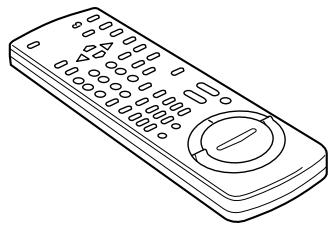
- Remote commander
R6 (size AA) batteries

Aerial cable

Audio/video cable

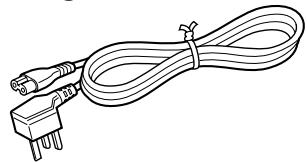
- Mains lead

(SLV-X842ML only)
Use this type of mains lead in Hong Kong.
- Plug adaptor (SLV-X842/ X821MKII only)
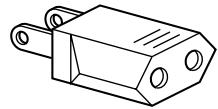
Step 2
Setting up the remote commander
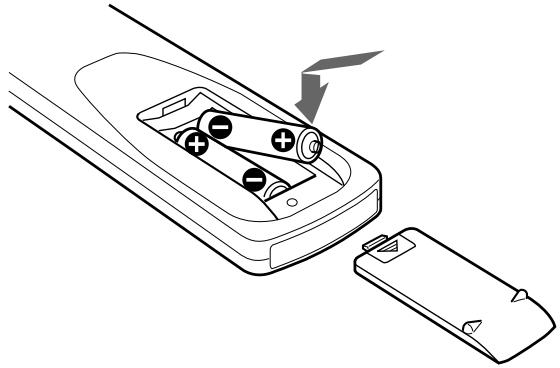
Insert two R6 (size AA) batteries by matching the + and - on the batteries to the diagram inside the battery compartment.
Using the remote commander
You can use this remote commander to operate this VCR and a Sony TV. Buttons on the remote commander marked with a dot () can be used to operate your TV.
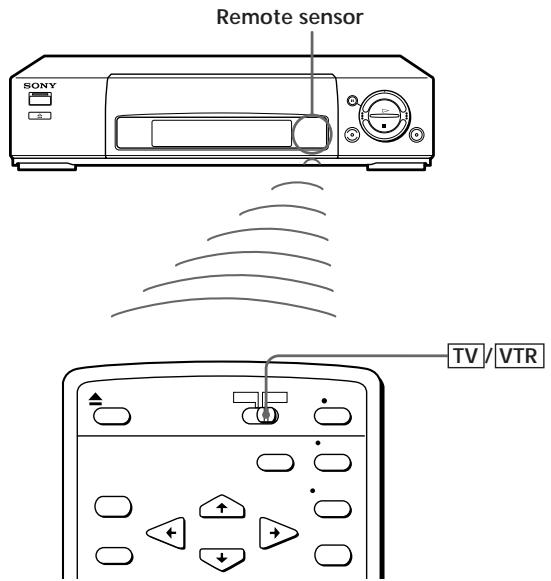
| To operate | Set TV / VTR to |
| the VCR | VTR and point at the remote sensor on the VCR |
| a Sony TV | TV and point at the remote sensor on the TV |
Notes
- The TV/VIDEO button selects the TV input either from the aerial in or line in. This button does not control the VCR input.
- With normal use, the batteries should last for approximately three to six months.
- If you do not use the remote commander for an extended period of time, remove the batteries to avoid possible damage from battery leakage.
- Do not use a new battery with an old one.
- Do not use different types of batteries.
Step 3
Connecting the VCR
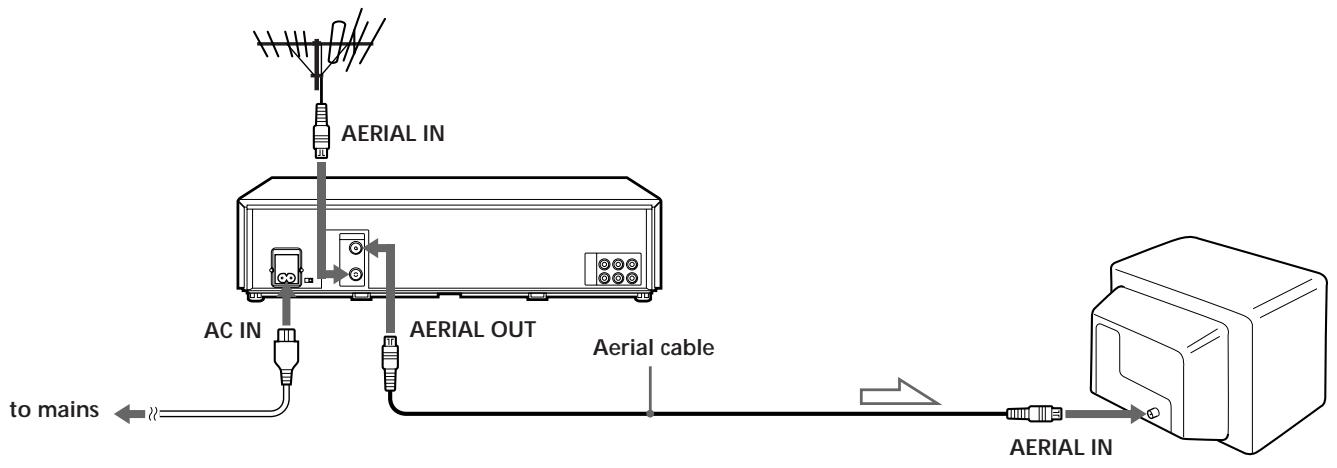

Signal flow
1
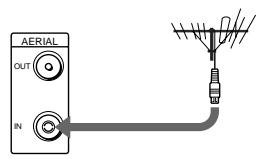
Disconnect the aerial input cable from your TV and connect it to AERIAL IN of the VCR.
2
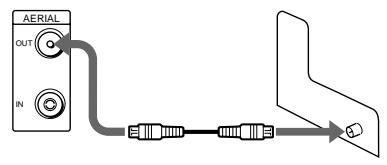
Connect AERIAL OUT of the VCR and the aerial input of your TV using the supplied aerial cable.
3
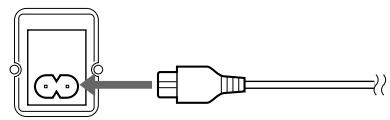
Connect AC IN of the VCR and the mains supply using the mains lead.
You've completed the basic hookup to watch and record TV programs.
Additional connections
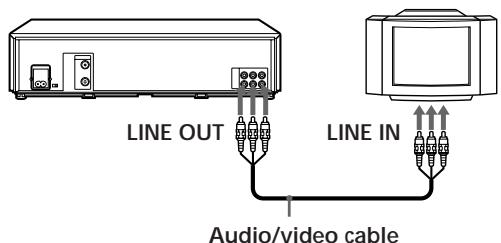
To a TV that has audio/video input jacks
This additional connection can improve picture and sound quality.
Connect to the TV as shown on the right.
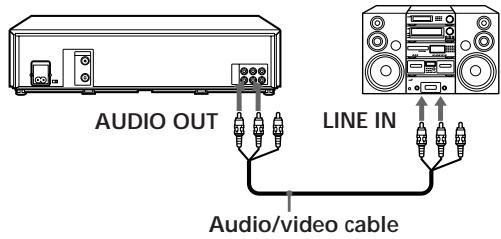
To a stereo system
You can improve sound quality by connecting to a stereo system as shown on the right.
Step 4 Channel setup map and chart
About color systems
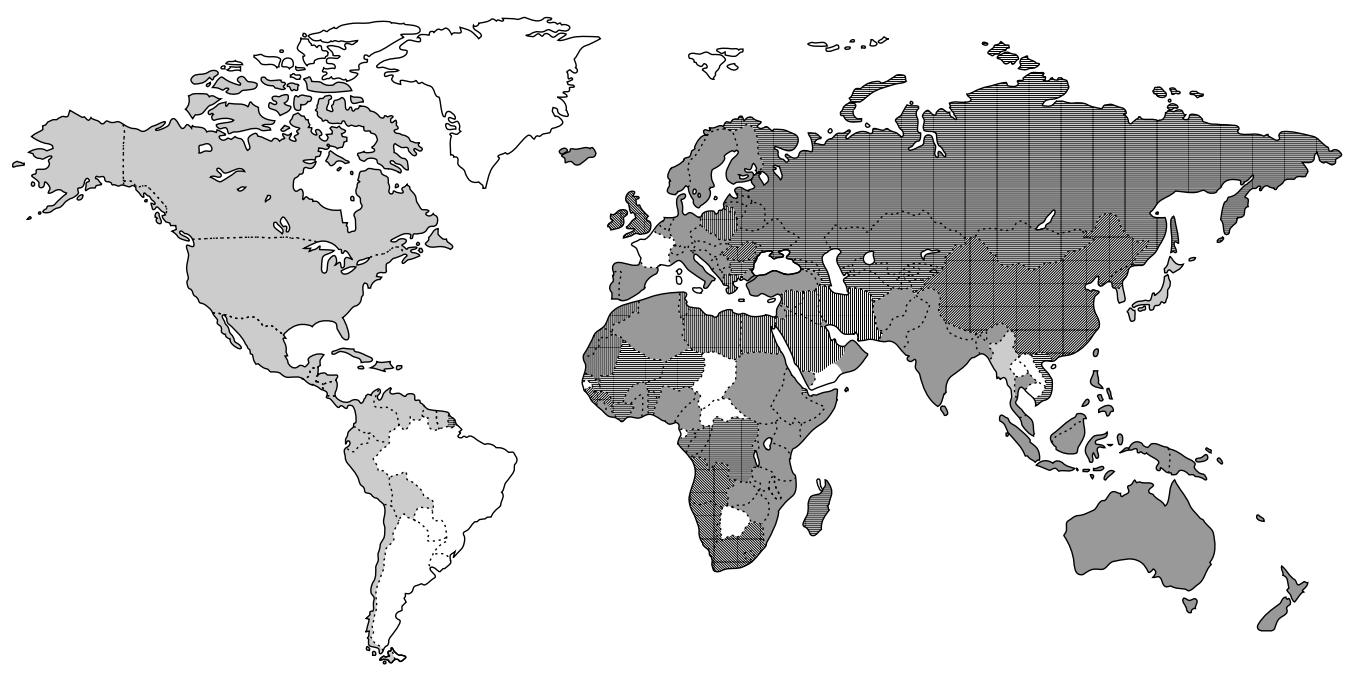
Different countries use different color systems and TV systems. These systems handle such things as video playback and recording differently. Using your VCR in a country that is on a color system not supported by this VCR may cause problems such as playback without sound, a vertically rolling picture, etc.
Refer to the map above and the chart on the next page to determine which countries use which color and TV systems. This VCR is compatible with most of the existing color systems (NTSC, PAL, and MESECAM) and TV systems (B/G, D/K, I, and M) except for those used in France, Brazil, Argentina, and Uruguay.
If you have made TV-VCR connections using the aerial cable, complete the following steps for your TV:
- Set the NTSC PB switch to match your TV color sytem (see page 10).
- Set the TV system using the RF CH SET button on the VCR (see "Tuning the TV to your VCR" on page 11).
This unit displays the color system in the VCR display window.
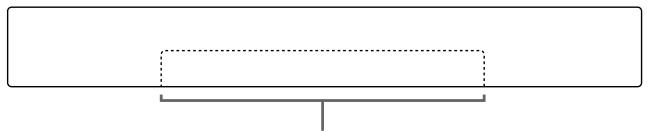
Color system indicator
Channel setup chart
| Map pattern | Color system and TV system | Area | Channels* VL | VH | U | TV SYSTEM (Set by the RF CH SET button) |
| PAL B/G | Western Europe | 2 - 4 S01 - S05** S1 - S7** | 5 - 12 S8 - S41** | 21 - 69 | G | |
| Turkey Kuwait U.A.E. Oman Jordan | 2 - 4 | 5 - 12 | 21 - 69 | |||
| Australia | 0 - 5, 5A | 6 - 11 | 28 - 69 | |||
| Indonesia | 1A, 2, 3 | 4 - 11 | - | |||
| PAL I | U.K. Hong Kong | - | - | 21 - 68 | I | |
| Ireland | A - C | D - J | - | |||
| South Africa | - | 4 - 13 | 21 - 68 | |||
| PAL D/K | China | 1 - 5 | 6 - 12 | 13 - 56 | K | |
| MESECAM B/G | Saudi Arabia Iran Iraq Libya Egypt Morocco Greece Syria | 2 - 4 | 5 - 12 | 21 - 69 | G | |
| MESECAM D/K | East Europe Russia | 1 - 5 | 6 - 12 | 21 - 60 | K | |
| MESECAM K1 | Zaire Senegal Niger New Caledonia Tahiti French Guiana | - | K4 - K9 | - | K | |
| NTSC 3.58 | USA | 2 - 6 A5 - A1** A - E** | 7 - 13 F - W** W+1 - W+28** | 14 - 78 W+29 - W+58** | M | |
| Japan | 1 - 3 M1 - M7** | 4 - 12 M8 - M10** S1 - S41** | 13 - 62 |
- VL = VHF low band, VH = VHF high band, U = UHF band
** CATV channels
Note
- The factory-preset RF output channel (which appears in the display window) is 32, and the adjustable RF output channel range is 28 to 55 (the corresponding channels are different depending on the area (see pages 20 to 23)). (See pages 11 and 12.)
Setting the NTSC PB switch to match your TV system
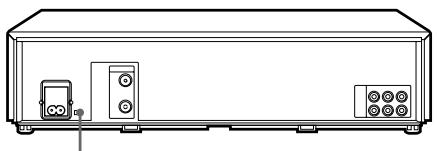
NTSC PB switch
You have to set the NTSC PB switch on the rear of the VCR according to your TV system to display the on-screen menus when there is no video signal input, and play back a tape recorded in the NTSC 3.58 system properly.
Set the NTSC PB switch following the table below.
| If your TV is compatible with | Set the NTSC PB switch to |
| PAL, SECAM, or MESECAM | ON PAL TV |
| NTSC 4.43 | NTSC 4.43 |
| NTSC 3.58 | NTSC 3.58 |
Tip
- If you are not sure of your TV's color system, refer to the map and chart on pages 8 and 9.
Notes
- If a video signal is input to the VCR (via the line input, tuner, or playback), the on-screen menus will appear on your TV regardless of the NTSC PB switch setting.
- If your TV is compatible with the SECAM system, the on-screen menus may be displayed in black and white.
Step 5
Tuning the TV to your VCR
If you have connected the VCR to your TV using the audio/video cable, skip this step.
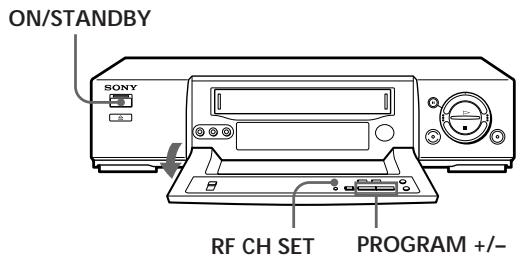
Press ON/STANDBY to turn on the VCR.
Press RF CH SET on the VCR.
The factory-preset RF channel appears in the display window. The VCR signal is output through this channel to the TV.

3 Turn on your TV and select a program position for video playback.
4 RF Press RF CH SET.
The TV system indicator appears in the display window.

If the displayed TV system doesn't match your TV, select the correct TV system by pressing PROGRAM + / - according to the following table. If you don't know your TV system, please refer to the "Channel setup map and chart" on pages 8 and 9.
If your TV color system is PAL
| If your TV system is | Select TV system |
| I | I |
| D/K | K |
| B/G | G |
If your TV color system is NTSC
| Select TV system |
| M |
Tune the TV to the same channel as that shown in the display window so that a gray screen appears on the TV screen.
Refer to your TV manual for tuning instructions.
If the gray screen does not appear clearly, see "To obtain a clear gray screen" on the next page.
(continued)
| Step 5 | Tuning the TV to your VCR (continued) |
| RF CH SET ◎ | Press RF CH SET. You have now tuned your TV to the VCR. Whenever you play a tape, set the TV to the program position selected in step 3 above. |
Note
- If you set the wrong TV system, you may have no sound or sound may be distorted.
To check to see if the TV tuning is correct
Select the program position for video playback on the TV and press PROGRAM + / - . If the TV screen changes to a different program each time you press PROGRAM + / - , the TV tuning is correct.
To obtain a clear gray screen
If the gray screen does not appear clearly in step 4 above, go to step 5 to finish this procedure once. Then start again from step 2. After pressing RF CH SET in step 2, press PROGRAM + / - while the RF channel is displayed, so that another RF channel (between 28 and 55) appears (see page 20 for reference). Then tune the TV to the new RF channel until a clear gray screen appears.
Step 6
Setting up the VCR sequentially (EASY SET UP)
Before using the VCR for the first time, set up the VCR using the EASY SET UP function. With this function, you can set the language, TV channels, and clock guided by the sequence indicated on the TV screen.
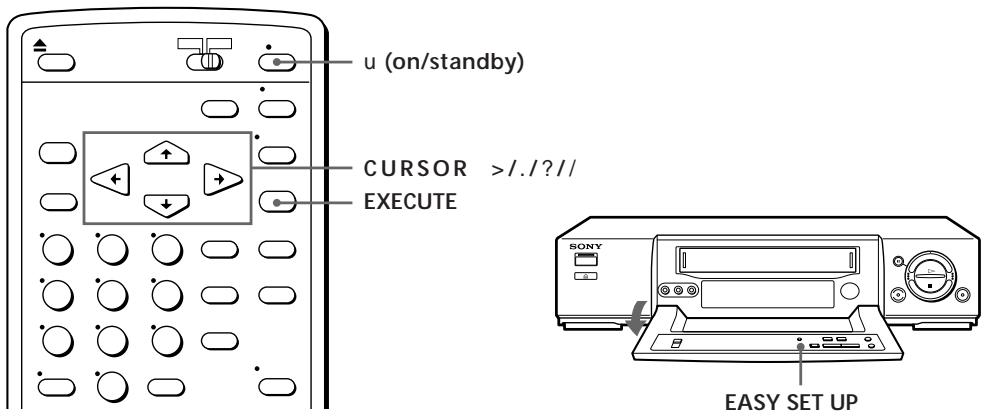
1 Press u (on/standby) to turn on the VCR.
2 Turn on your TV, and select a program position for video playback.
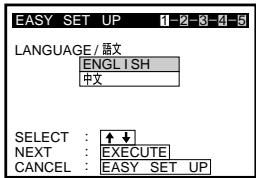
3 EASY SET UP on the VCR. SET UP The language select menu appears on the TV screen.
To cancel starting the EASY SET UP function, press EASY SET UP.
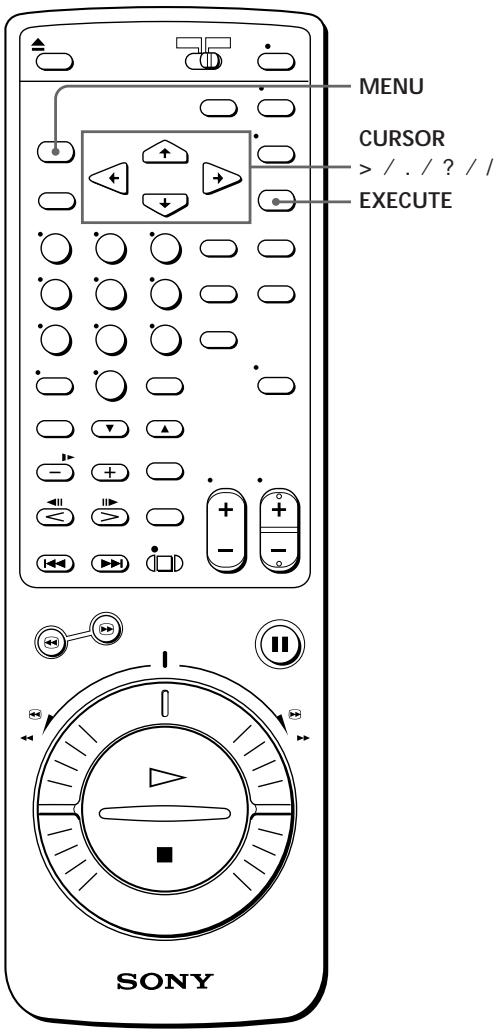
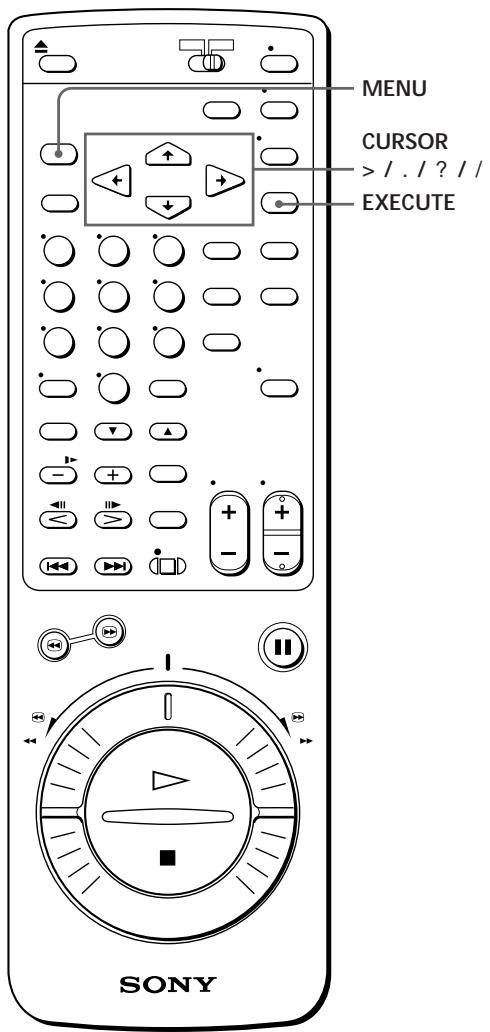
4 Press CURSOR >1 to highlight the desired on-screen display language, then press EXECUTE.
The AUTO TUNER PRESET menu appears on the TV screen.

(continued)
| Step 6 | Setting up the VCR sequentially (EASY SET UP) (continued) | |
| 5 | CURSOR EXECUTE | Press CURSOR >l. to highlight the desired system, then press EXECUTE. The VCR starts searching for all the receivable channels in your area and preset the located channels in numerical order. When all the channels are preset, the following screen appears. Even if various TV systems coexist in your area, the AUTO TUNER PRESET function picks up most of the channels on the TV systems other than the one you selected. But you need to manually reset the proper TV system for the unmatched channels. See “Resetting the TV system” on page 19. If necessary, you can add or disable the channels manually. See “Tuning the VCR to TV channels manually” on page 17. |
| 6 | CURSOR | Using CURSOR >l./?//, set the G-CODE guide channels, and change the program positions of the stations. If not necessary, skip this step. The setting procedures are the same as those described in “Setting up G-CODE manually” on page 24 and “Changing the program positions of the stations” on page 26. |
| 7 | EXECUTE | Press EXECUTE. The CLOCK SET menu appears. |
| 8 | CURSOR | Using CURSOR >l./?//, set the date and clock. The setting procedures are the same as described in “Setting the clock manually” on page 15. |
| 9 | EXECUTE | Press EXECUTE to finish the EASY SET UP operation. |
| Notes ·Do not exit EASY SET UP while AUTO TUNER PRESET is presetting channels. If you do so, repeat the EASY SET UP operation from the beginning. ·The channel numbers appearing after AUTO TUNER PRESET may not be the same as your local channel numbers. This is because this VCR's channel search system is based on the fixed TV system with the widest channel coverage. In this case, you can apply your local channel numbers to the program positions. See “Changing the program positions of the stations” on page 26. ·If the received channel is on cable TV, “C” appears on the left of the channel in step 5 in most areas. However, this won't be applied in some areas. See pages 20 to 23 for reference. | ||
Setting the clock manually
Tip
- To change the digits during setting, press CURSOR ? to return to the item to be changed, and select the digits using CURSOR >
Note
- The menu disappears automatically if you don't proceed for more than a few minutes.
You must set the time and date on the VCR to be able to use the timer recording features properly. You can set the VCR clock using the menu.
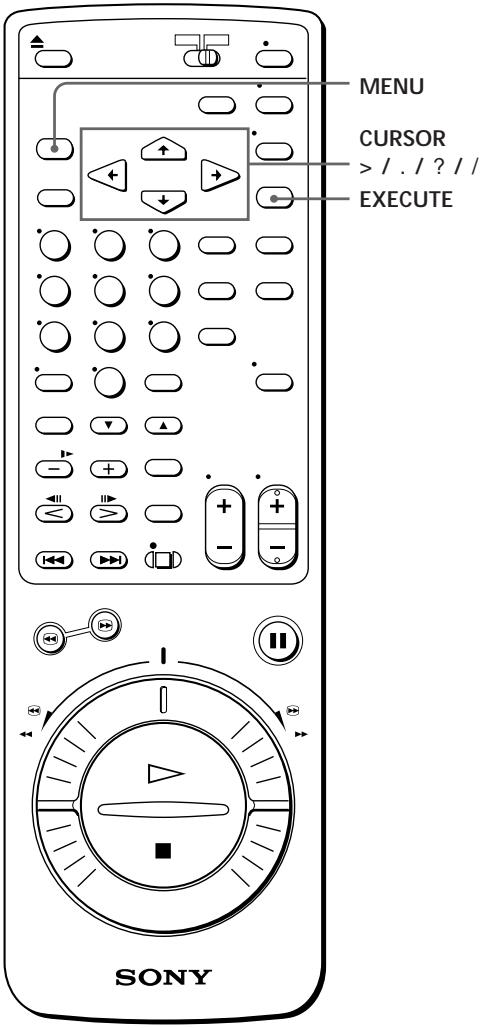
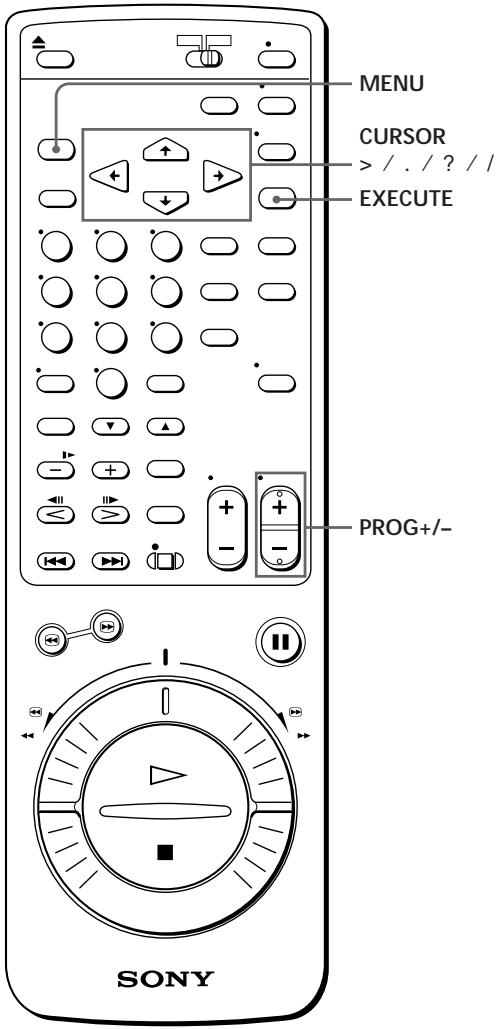
1 Press MENU.
The main MENU appears on the TV screen.
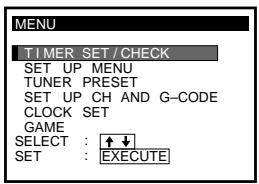
2 Press CURSOR > . to move the cursor (I) to CLOCK SET, then press EXECUTE.
The CLOCK SET menu appears.
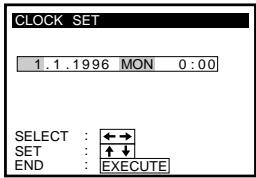
3 Press CURSOR > / to set the day.
The day of the week is set automatically.
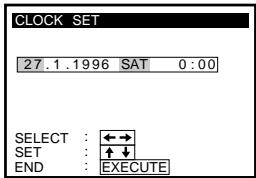
4 Press CURSOR / to highlight the month and set the month using CURSOR >
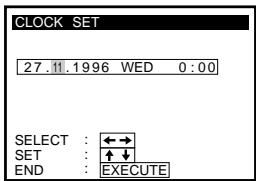
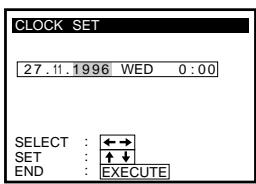
5 Press CURSOR / to highlight the year and set the year using CURSOR >
(continued)
Setting the clock manually (continued)
6 Press CURSOR / to highlight the hours and set the hours using CURSOR >
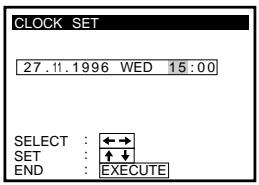
7 Press CURSOR / to highlight the minutes and set the minutes using CURSOR >
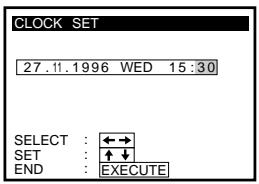
8 Press EXECUTE to start the clock.
Tuning the VCR to TV channels manually
Notes
- The menu disappears automatically if you don't proceed for more than a few minutes.
- Even if you choose CATV in step 3, normal channels may be tuned in, and vice versa depending on the area. See pages 20 to 23 for reference.
- The channel numbers besides CHANNEL SET may not be the same as those in your area. This is because this VCR's channel search system is based on the fixed TV system that has the widest channel coverage. If necessary, apply your local channel numbers to the program positions. See "Changing the program positions of the stations" on page 26.
You may have preset the receivable channels in your area in the EASY SET UP procedure (page 14). But if:
- some channels could not be preset automatically, preset them manually. See “Presetting channels manually” on this page.
- there are unwanted channels among the preset ones, disable the channels. See “Disabling unwanted program positions” on page 19.
- you live in the area where various TV systems coexist, and have channels that don't match the TV system you selected in AUTO TUNER PRESET in the EASY SET UP procedure, reset the TV system for those channels. See "Resetting the TV system" on page 19. If the channels don't match the TV system, the sound may be distorted or noisy, or the color TV program may become black and white, etc.
Presetting channels manually
1 Press MENU.
The main MENU appears on the TV screen.
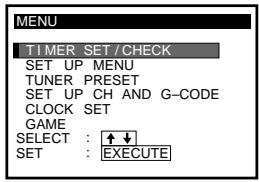
2 Press CURSOR > / . to move the cursor (I) to TUNER PRESET, then press EXECUTE. The TUNER PRESET menu appears.
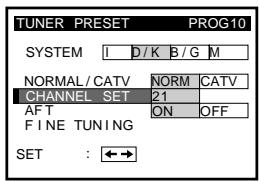
3 Press CURSOR >/.?// to move the cursor (I) to NORMAL/ CATV, then highlight NORM.
To preset CATV channels, highlight CATV.
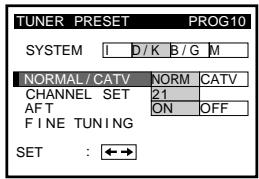
4 Press CURSOR > to move the cursor (I) to CHANNEL SET.
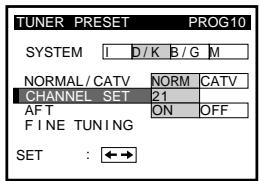
(continued)
Tuning the VCR to TV channels manually (continued)
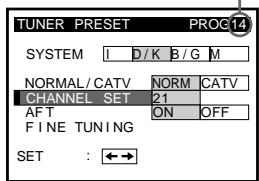
5 Press PROG + / - to select the program position.
Selected program position
6 Press CURSOR / to start tuning.
The VCR starts searching for a channel and displays the first one it finds on the TV screen. Press CURSOR ?// repeatedly until the channel you want is displayed.
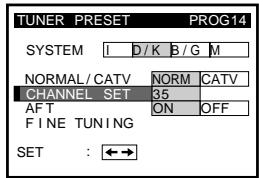
The channels are scanned in the order shown in the table beginning on page 20 to 23.
If you know the number of the channel you want, press the program number buttons. For example, for channel 5, first press "0" and then press "5."
7 If the TV sound is distorted or noisy, or the color TV program becomes black and white, etc., press CURSOR >/.?// to move the cursor (I) to SYSTEM, then highlight I, D/K, B/G, or M whichever is applicable in your area.
Refer to the "Channel setup map and chart" on pages 8 and 9, and "Resetting the TV system" on page 19.
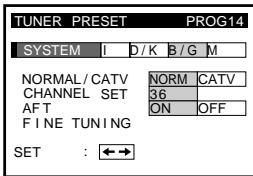
8 To allocate another channel to another program position, repeat steps 5 and 6.
9 Press EXECUTE to store all the allocated channels.
Disabling unwanted program positions
After tuning the TV channels, you can disable unused program positions. The disabled positions will be skipped later when you press the PROG + / - buttons.
1 Press MENU, then select TUNER PRESET and press EXECUTE.
2 Select CHANNEL SET.
3 Press PROG + / - until the program position you want to disable appears beside "PROG" on the TV screen.
4 Press program number button "0" twice to display the number "0" beside CHANNEL SET.
5 Repeat steps 3 and 4 for other positions you want to disable.
6 Press EXECUTE.
Resetting the TV system (only for areas where various TV systems coexist)
If the sound is distorted or noisy, or the color TV program becomes black and white, etc., that channel may not be matched to the proper TV system. In this case, try the following steps.
1 Press MENU, then select TUNER PRESET and press EXECUTE.
2 Press PROG + / - to select the program position that has the channel with above described conditions.
3 Select SYSTEM and select the TV system on which you can obtain the best sound and picture.
4 Repeat steps 2 and 3 for other positions you want to preset the TV system to.
5 Press EXECUTE.
If the picture is not clear
Normally, the Auto Fine Tuning (AFT) function automatically tunes in channels clearly. If, however, the picture is not clear, you may also use the manual tuning function.
1 Press PROG + / - to select the program position for which you cannot obtain a clear picture.
2 Press MENU, then select TUNER PRESET and press EXECUTE.
3 Select FINE TUNING. The fine tuning meter appears.
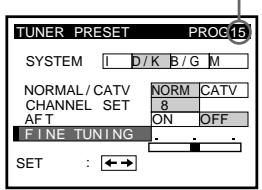
Selected program position
4 Press CURSOR ?// to get a clearer picture, then press EXECUTE. Note that the AFT (Auto Fine Tuning) setting switches to OFF.
Tuning the VCR to TV channels manually (continued)
Channel numbers in the CHANNEL SET field and the corresponding channels
Note
- There may be a case that the same area channel may appear repeatedly as the other channel number in the CHANNEL SET field.
| TV system | B/G | ||||
| Country | Western Europe | Australia | New Zealand | Morocco | Indonesia |
| Channel number in the CHANNEL SET field | Corresponding channels | ||||
| 1 | AS0 | 1 | 1A | ||
| 2 | E2 | ||||
| 3 | E3 | 1 | 2 | 2A | |
| 4 | E4 | 2 | 3 | 3A | |
| 5 | E5 | 6 | 4 | 4A | |
| 6 | E6 | 7 | 5 | M6 | 5A |
| 7 | E7 | 8 | 6 | M7 | 6A |
| 8 | E8 | 9 | 7 | M8 | 7A |
| 9 | E9 | 9A | 8 | M9 | 8A |
| 10 | E10 | 10 | 9 | M10 | 9A |
| 11 | E11 | 11 | 10 | 10A | |
| 12 | E12 | 11 | 11A | ||
| 13 | |||||
| 14 | |||||
| 15 | 3 | ||||
| 16 | 4 | ||||
| 17 | |||||
| 18 | |||||
| 19 | |||||
| 20 | |||||
| 21 | E21 | ||||
| 22 | E22 | ||||
| 23 | E23 | ||||
| 24 | E24 | ||||
| 25 | E25 | ||||
| 26 | E26 | ||||
| 27 | E27 | ||||
| 28 | E28 | 28 | |||
| 29 | E29 | 29 | |||
| 30 | E30 | 30 | |||
| 31 | E31 | 31, 32 | |||
| 32 | E32 | 33 | |||
| 33 | E33 | 34 | |||
| 34 | E34 | 35 | |||
| 35 | E35 | 36 | |||
| 36 | E36 | 37 | |||
| 37 | E37 | 38 | |||
| 38 | E38 | 39, 40 | |||
| 39 | E39 | 41 | |||
| 40 | E40 | 42 | |||
| 41 | E41 | 43 | |||
| 42 | E42 | 44 | |||
| 43 | E43 | 45 | |||
| 44 | E44 | 46 | |||
| 45 | E45 | 47, 48 | |||
| 46 | E46 | 49 | |||
| 47 | E47 | 50 | |||
| 48 | E48 | 51 | |||
| 49 | E49 | 52 | |||
| 50 | E50 | 53 | |||
| 51 | E51 | 54 | |||
| 52 | E52 | 55, 56 | |||
| 53 | E53 | 57 | |||
| 54 | E54 | 58 | |||
| 55 | E55 | 59 | |||
| 56 | E56 | 60 | |||
| 57 | E57 | 61 | |||
| TV system | B/G | ||||
| Country | Western Europe | Australia | New Zealand | Morocco | Indonesia |
| Channel number in the CHANNEL SET field | Corresponding channels | ||||
| 58 | E58 | 62 | |||
| 59 | E59 | 63, 64 | |||
| 60 | E60 | 65 | |||
| 61 | E61 | 66 | |||
| 62 | E62 | 67 | |||
| 63 | E63 | 68 | |||
| 64 | E64 | 69 | |||
| 65 | E65 | ||||
| 66 | E66 | ||||
| 67 | E67 | ||||
| 68 | E68 | ||||
| 69 | E69 | ||||
| C1 | S1 | 5 | |||
| C2 | S2 | ||||
| C3 | S3 | ||||
| C4 | S4 | ||||
| C5 | S5 | ||||
| C6 | S6 | 5A | |||
| C7 | S7 | ||||
| C8 | S8 | ||||
| C9 | S9 | M4 | |||
| C10 | S10 | M5 | |||
| C11 | S11 | ||||
| C12 | S12 | ||||
| C13 | S13 | ||||
| C14 | S14 | ||||
| C15 | S15 | ||||
| C16 | S16 | ||||
| C17 | S17 | ||||
| C18 | S18 | ||||
| C19 | S19 | ||||
| C20 | S20 | ||||
| C21 | S21 | ||||
| C22 | S22 | ||||
| C23 | S23 | ||||
| C24 | S24 | ||||
| C25 | S25 | ||||
| C26 | S26 | ||||
| C27 | S27 | ||||
| C28 | S28 | ||||
| C29 | S29 | ||||
| C30 | S30 | ||||
| C31 | S31 | ||||
| C32 | S32 | ||||
| C33 | S33 | ||||
| C34 | S34 | ||||
| C35 | S35 | ||||
| C36 | S36 | ||||
| C37 | S37 | ||||
| C38 | S38 | ||||
| C39 | S39 | ||||
| C40 | S40 | ||||
| C41 | S41 | ||||
| C42 | S01 | ||||
| C43 | S02 | ||||
| C44 | S03 | ||||
| C45 | S04 | ||||
| C46 | S05 | ||||
Tuning the VCR to TV channels manually (continued)
| TV system | D/K | I | M | ||||
| Country | East Europe | China | UK/Hong Kong | Ireland | South Africa | U.S.A. | Japan |
| Channel number in the CHANNEL SET field | Corresponding channels | ||||||
| 1 | A | ||||||
| 2 | R1 | 1 | |||||
| 3 | 2 | B | 2, C2 | ||||
| 4 | 3 | C | 3 | ||||
| 5 | R6 | 7 | D | 4 | 7 | J-5 | |
| 6 | R7 | 8 | E | 5 | 8 | J-6 | |
| 7 | 9 | J-7 | |||||
| 8 | |||||||
| 9 | 12 | J-10 | |||||
| 10 | 13 | J-11 | |||||
| 11 | J | J-12 | |||||
| 12 | R12 | J | 10 | K | S1 | ||
| 13 | R2 | ||||||
| 14 | R3 | 4 | 5 | ||||
| 15 | R4 | 5 | |||||
| 16 | R5 | ||||||
| 17 | R8 | 9 | F | 6 | 10 | J-8 | |
| 18 | R9 | 10 | G | 7 | 11 | J-9 | |
| 19 | R10 | 11 | H | 8 | |||
| 20 | R11 | 12 | I | 9 | |||
| 21 | R21 | 13 | B21 | 21 | 14, W+29, W+30 | J13 | |
| 22 | R22 | 14 | B22 | 22 | 15, 16, W+31 | J14, J15 | |
| 23 | R23 | 15 | B23 | 23 | 17, W+32 | J16 | |
| 24 | R24 | 16 | B24 | 24 | 18, W+33, W+34 | J17 | |
| 25 | R25 | 17 | B25 | 25 | 19, 20, W+35 | J18, J19 | |
| 26 | R26 | 18 | B26 | 26 | 21, W+36 | J20 | |
| The shadow in the table shows the adjustable RF output channel range. (See page 12 for reference.) | 27 | R27 | 19 | B27 | 27 | 22, W+37, W+38 | |
| 28 | R28 | 20 | B28 | 28 | 23, 24, W+39 | ||
| 29 | R29 | 21 | B29 | 29 | 25, W+40 | ||
| 30 | R30 | 22 | B30 | 30 | 26, W+41, W+42 | ||
| 31 | R31 | 23 | B31 | 31 | 27, 28, W+43 | ||
| The factory-preset RF output channel (See page 11 for reference.) | 32 | R32 | 24 | B32 | 32 | 29, W+44 | |
| 33 | R33 | B33 | 33 | 30, W+45, W+46 | |||
| 34 | R34 | B34 | 34 | 31, 32, W+47 | |||
| 35 | R35 | B35 | 35 | 33, W+48 | |||
| 36 | R36 | B36 | 36 | 34, W+49, W+50 | |||
| 37 | R37 | B37 | 37 | 35, 36, W+51 | |||
| 38 | R38 | 25 | B38 | 38 | 37, W+52 | ||
| 39 | R39 | 26 | B39 | 39 | 38, W+53, W+54 | ||
| 40 | R40 | 27 | B40 | 40 | 39, 40, W+55 | ||
| 41 | R41 | 28 | B41 | 41 | 41, W+56 | ||
| 42 | R42 | 29 | B42 | 42 | 42, W+57, W+58 | ||
| 43 | R43 | 30 | B43 | 43 | 43, 44 | ||
| 44 | R44 | 31 | B44 | 44 | 45 | ||
| 45 | R45 | 32 | B45 | 45 | 46 | ||
| 46 | R46 | 33 | B46 | 46 | 47, 48 | ||
| 47 | R47 | 34 | B47 | 47 | 49 | ||
| 48 | R48 | 35 | B48 | 48 | 50 | ||
| 49 | R49 | 36 | B49 | 49 | 51, 52 | ||
| 50 | R50 | 37 | B50 | 50 | 53 | ||
| 51 | R51 | 38 | B51 | 51 | 54 | ||
| 52 | R52 | 39 | B52 | 52 | 55, 56 | ||
| 53 | R53 | 40 | B53 | 53 | 57 | ||
| 54 | R54 | 41 | B54 | 54 | 58 | ||
| 55 | R55 | 42 | B55 | 55 | 59, 60 | ||
| 56 | R56 | 43 | B56 | 56 | 61 | ||
| 57 | R57 | 44 | B57 | 57 | 62 | ||
| TV system | D/K | I | M | ||||
| Country | East Europe | China | UK/Hong Kong | Ireland | South Africa | U.S.A. | Japan |
| Channel number in the CHANNEL SET field | Corresponding channels | ||||||
| 58 | R58 | 45 | B58 | 58 | 63, 64 | J62 | |
| 59 | R59 | 46 | B59 | 59 | 65 | ||
| 60 | R60 | 47 | B60 | 60 | 66 | ||
| 61 | 48 | B61 | 61 | 67, 68 | |||
| 62 | 49 | B62 | 62 | 69 | |||
| 63 | 50 | B63 | 63 | 70 | |||
| 64 | 51 | B64 | 64 | 71, 72 | |||
| 65 | 52 | B65 | 65 | 73 | |||
| 66 | 53 | B66 | 66 | 74 | |||
| 67 | 54 | B67 | 67 | 75, 76 | |||
| 68 | 55 | B68 | 68 | 77 | |||
| 69 | 56 | B69 | 78 | ||||
| C1 | A-3 | J-3 | |||||
| C2 | A-2, A-1 | M1, M2 | |||||
| C3 | A | M3 | |||||
| C4 | B | M4 | |||||
| C5 | C | M5 | |||||
| C6 | D | M6 | |||||
| C7 | E | M7 | |||||
| C8 | F, G | M8, M9 | |||||
| C9 | H | M10 | |||||
| C10 | 6 | I | J-4 | ||||
| C11 | 11 | L | S2 | ||||
| C12 | (12) | M, N | S3 | ||||
| C13 | 13 | O | S4 | ||||
| C14 | P | S5, S6 | |||||
| C15 | Q | S7 | |||||
| C16 | R | S8 | |||||
| C17 | S | S9 | |||||
| C18 | T, U | S10, S11 | |||||
| C19 | V | S12 | |||||
| C20 | W | S13 | |||||
| C21 | W+1, W+2 | S14, S15 | |||||
| C22 | W+3 | S16 | |||||
| C23 | W+4 | S17 | |||||
| C24 | W+5, W+6 | S18, S19 | |||||
| C25 | W+7 | S20 | |||||
| C26 | W+8 | S21 | |||||
| C27 | W+9, W+10 | S22, S23 | |||||
| C28 | W+11 | S24 | |||||
| C29 | W+12 | S25 | |||||
| C30 | W+13, W+14 | S26, S27 | |||||
| C31 | W+15 | S28 | |||||
| C32 | W+16 | S29 | |||||
| C33 | W+17, W+18 | S30, S31 | |||||
| C34 | W+19 | S32 | |||||
| C35 | W+20 | S33 | |||||
| C36 | W+21, W+22 | S34, S35 | |||||
| C37 | W+23 | S36 | |||||
| C38 | W+24 | S37 | |||||
| C39 | W+25, W+26 | S38, S39 | |||||
| C40 | W+27 | S40 | |||||
| C41 | W+28 | S41 | |||||
| C42 | 4, 4A | ||||||
| C43 | |||||||
| C44 | 6 | ||||||
| C45 | A-5 | J-1 | |||||
| C46 | A-4 | J-2 | |||||
Setting up G-CODE manually
Notes
- The menu disappears automatically if you don't proceed for more than a few minutes.
- The G-CODE used in this VCR is for Singapore, Malaysia, Hong Kong, Macao, etc. and cannot be used in areas such as U.S.A., Canada, Japan, Korea, Taiwan, and U.K.
- If the preset channel is on cable TV, "C" appears on the left of the channel in step 2 in most areas. However, this won't be applied in some areas. See pages 20 to 23 for reference.
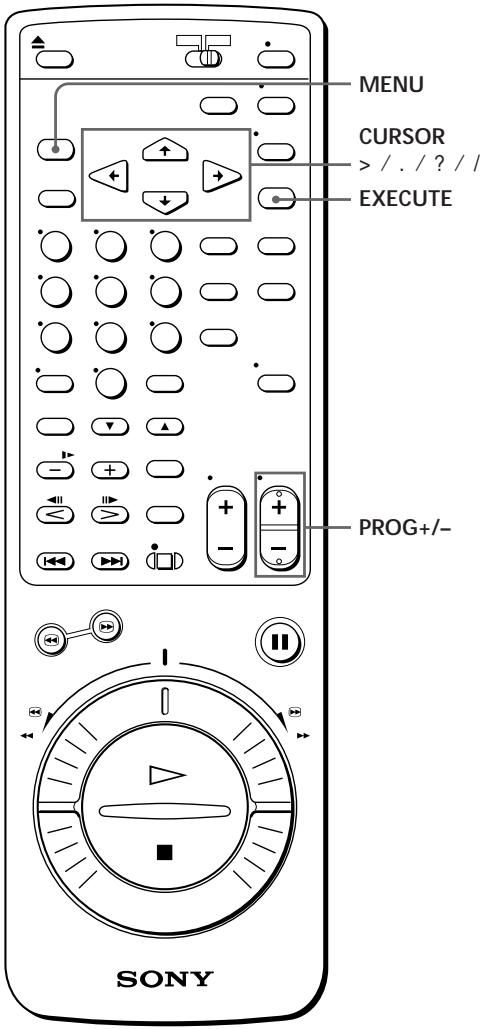
G-CODE is a feature in Sony VCRs that simplifies the task of programming the VCR to make timer recordings. Use the on-screen display to coordinate the program position of each channel with the guide channel (the number that's assigned to each TV station in advance). To get the guide channel numbers, look in the program guide for your area that features G-CODE numbers.
Setting the guide channels
1 Press MENU.
The main MENU appears on the TV screen.
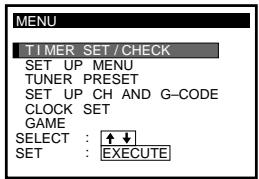
2 Press CURSOR > /. to move the cursor (I) to SET UP CH AND G-CODE, then press EXECUTE.
The SET UP CH AND G-CODE menu appears.
The preset channels are displayed on the screen. "---" in the GUIDE CH column means that the guide channel has not been preset.
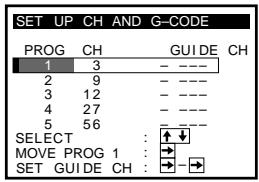
3 Press CURSOR > . to move the cursor (I) to the row on which you want to set the guide channel.
To display program positions 6 to 50, press CURSOR > . repeatedly.
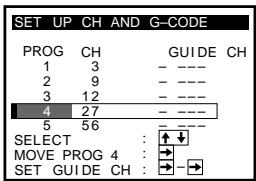
4 Press CURSOR / to highlight the TV channel and guide channel.
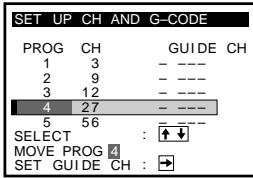
5 Press CURSOR / to highlight the guide channel only.
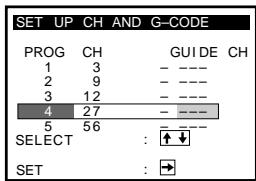
Notes
- If you inadvertently entered a guide channel number, press CURSOR > / . repeatedly to reset the "GUIDE CH" column to "...". "... appears between 1 and 255.
- The VCR does not allow entering the guide channel number, if the same number has been set.
- If you leave the GUIDE CH column blank (---), the VCR will record the signal through LINE IN when recording with G-CODE.
Note
- When you record a satellite broadcast using G-CODE, you need to select the desired channel on the satellite tuner manually.
6 Press CURSOR > . to select the guide channel number assigned in the program guide.
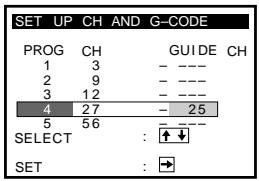
7 Press CURSOR / to confirm the setting. The cursor (I) appears in the leftmost column.
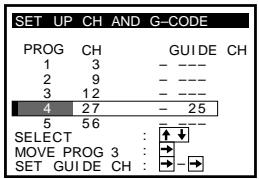
8 To set the guide channel of another station, repeat steps 3 to 7. If you want to change the program positions of the stations, proceed to step 2 of "Changing the program positions of the stations" on page 26.
9 When you've finished, press EXECUTE to exit.
Setting up G-CODE for satellite broadcasts
When your satellite tuner is connected via the AERIAL IN connector, first you have to set the program position for each satellite channel using the TUNER PRESET menu. Then set the guide channel number for each satellite channel using the SET UP CH AND G-CODE menu.
1 Turn on the satellite tuner.
2 Press MENU, then select TUNER PRESET and press EXECUTE.
3 Press PROG + / - to select a program position you want to use for watching a satellite channel.
4 Select CHANNEL SET, then press CURSOR / to tune the VCR to the satellite tuner.
The channel number displayed beside CHANNEL SET is used for receiving all satellite broadcasts from the satellite tuner.
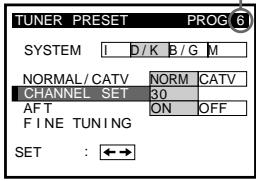
Selected program position
5 Press PROG + / - to select another program position for another satellite channel, and press the program number buttons to enter the same channel number as the one displayed in step 4. Repeat this step for all satellite channels.
6 Set the guide channel number for each program position assigned to the satellite channel, following the procedures in "Setting the guide channels" on pages 24 and this page.
Changing the program positions of the stations
After setting the channels and G-CODE guide channels, you can change the program positions which are automatically assigned, as you like.
1 Press MENU.
The main MENU appears on the TV screen.
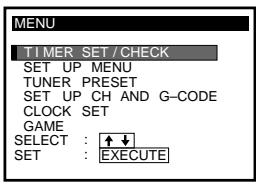
2 Press CURSOR > . to move the cursor (I) to SET UP CH AND G-CODE, then press EXECUTE.
The SET UP CH AND G-CODE menu appears.
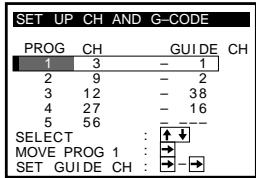
3 Press CURSOR > . to move the cursor (I) to the row on which you want to change the program position, then press CURSOR /
The TV channel and guide channel are highlighted.
To display other pages for program positions 6 to 50, press CURSOR > . repeatedly.
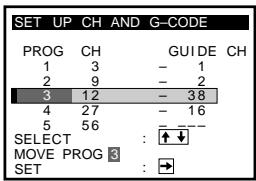
4 Press CURSOR > . until the channel and guide channel row moves to the desired program position, then press CURSOR ?.
The two rows exchange the positions.
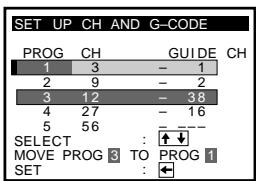
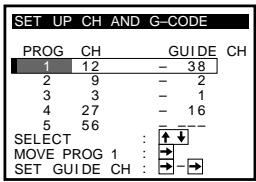
5 To change the program position of another station, repeat steps 3 and 4.
6 When you've finished, press EXECUTE to exit.
Basic Operations Playing a tape
Tip
- For further information on searching and playback functions, see "Playing/ searching at various speeds" on page 41.
Note
- Tapes recorded in LP mode can be played back on this VCR, while playback picture quality in modes other than normal forward speed is not guaranteed.
This section shows you how to play back a video tape.
1 Turn on your TV and tune in to the VCR:
- If the TV is connected to the VCR using the audio/video cable, set the TV to video input.
- If the TV is connected to the VCR using only the aerial cable, set the TV to the program position for the VCR.
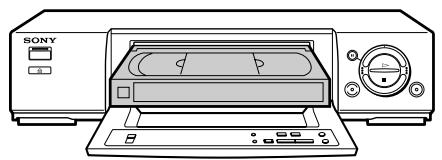
2 Open the drop down panel and insert a tape.
The VCR turns on automatically. The tape starts playing automatically if its safety tab has been removed. (See page 34.)
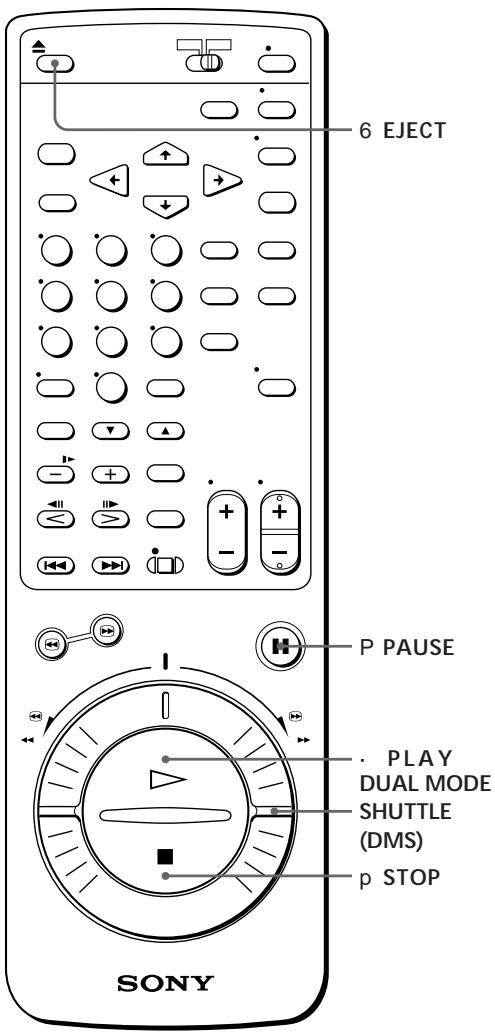
3 Press · PLAY to start playing.
When the tape reaches the end, the VCR automatically rewrites it to the beginning. (The power remains on.)
Additional tasks
| To | Press |
| Stop play | p STOP |
| Pause play | P PAUSE |
| Resume play after pause | P PAUSE or · PLAY |
| Search forward | Turn the DUAL MODE SHUTTLE (DMS) ring to # during playback |
| Search backward | Turn the DMS ring to 3 during playback |
| Fast-forward the tape | Turn the DMS ring to ) FF during stop |
| Rewind the tape | Turn the DMS ring to 0 REW during stop |
| Eject the tape | 6 EJECT |
Playing a tape (continued)
Note
Depending on your TV, the following may occur while playing an NTSC-recorded tape:
- the picture becomes black and white
- the picture shakes.
- no picture appears on the TV screen
- black streaks appear horizontally on the TV screen
- the color density increases or decreases
- the display does not appear properly during search forward or search backward.
Notes
- The remaining tape length will not appear while playing an NTSC-recorded tape.
- The display won't appear during still mode or slow-motion playback.
- When you insert a short tape such as E-30 or a nonstandard commercially available tape, the remaining tape length may not be correct.
Notes
- When a tape is reinserted, the counter returns to "0H00M00S."
- The counter will not work on tape portions with no recording.
- If a tape has portions recorded in both PAL and NTSC systems, the time counter reading will not be correct. This discrepancy is due to the difference between the counting cycles of the two video systems.
To set the color system
If streaks appear during playback, set the COLOR SYSTEM switch on the VCR to conform to the system that the tape was recorded in. (The normal setting is AUTO.) You can check the present color system in the display window. Refer to the page 8.
| When your tape was recorded in | Set COLOR SYSTEM to |
| PAL | PAL/MESECAM |
| NTSC | NTSC |
| MESECAM | PAL/MESECAM |
Displaying the remaining tape length and time counter
Press DISPLAY to turn the display on or off.
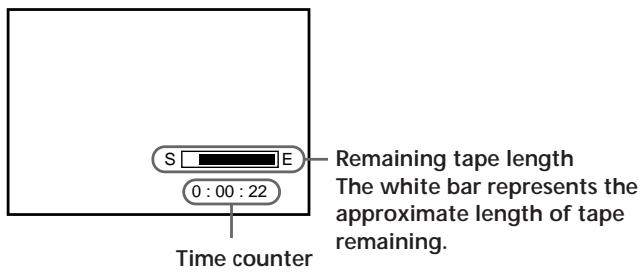
Using the time counter
At the point on a tape that you want to find later, press COUNTER RESET to reset the counter to "0H00M00S." When you rewind or advance the tape to this point, refer to the counter.
Notes
- When you play a tape recorded in monaural, the sound is heard in monaural regardless of the AUDIO MONITOR setting.
- To play a tape in stereo, you must use the AUDIO OUT connection.
- If AUDIO MIX in the SET UP MENU is set to ON, the AUDIO MONITOR button doesn't work.
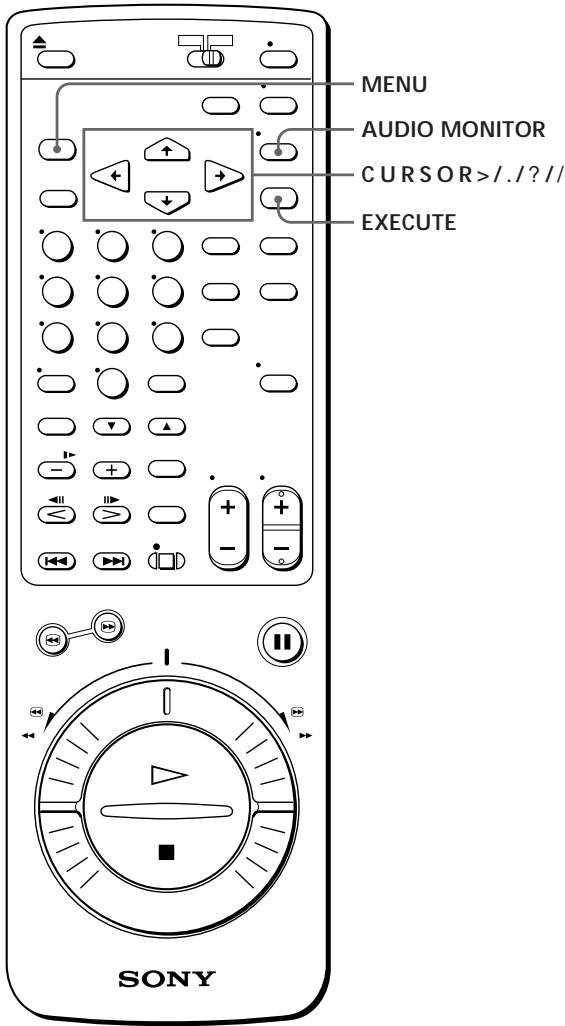
Playing stereo and bilingual programs
Press AUDIO MONITOR to select the desired sound. Each press of the button changes the display on the VCR and TV screen.
| To listen to a | Press AUDIO MONITOR until | ||
| Stereo tape | Bilingual tape | The TV screen shows | The display window indicator shows |
| Stereo | Main and sub sounds | “STEREO” | “STEREO” |
| Left channel | Main sound | “LCH” | “MAIN/L” |
| Right channel | Sub sound | “RCH” | “SUB/R” |
| Standard sound (monaural) | Standard sound | No indication | No indication |
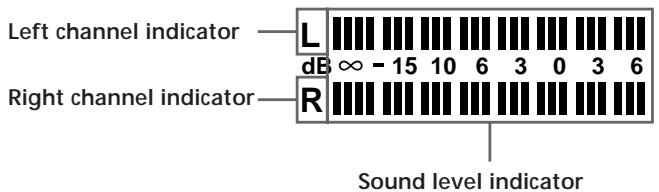
To check audio channel and sound level
You can check the audio channel and sound level visually with the indicators in the display window.
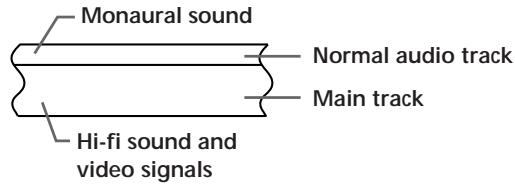
How sound is recorded on a video tape
This VCR records sound onto two different tracks. High-fidelity sound (usually stereo) is recorded onto the main track along with the picture. Monaural sound is recorded onto the normal audio track along the edge of the tape.
To listen to hi-fi and normal audio at the same time
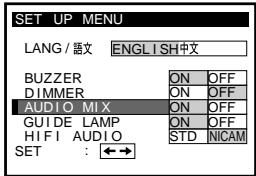
1 Press MENU and select SET UP MENU.
ex.SLV-X842/X842ML
2 Set AUDIO MIX to ON using CURSOR > / . / ? / / .
The AUDIO MONITOR button becomes inoperative, and the sound you hear is mixed.
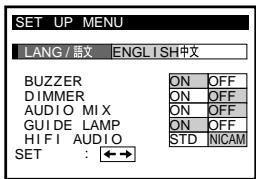
3 Press EXECUTE to store the setting. After playing the tape, reset AUDIO MIX to OFF.
ex.SLV-X842/X842ML
Recording TV programs
Tips
- To select program positions, you can also use the program number buttons on the remote commander. For two-digit numbers, press the ? (ten's digit) button followed by the program number buttons.
- To cut out an unwanted scene while recording, press P PAUSE, turn the DUAL MODE SHUTTLE ring on the VCR to rewind the tape to the beginning of the unwanted scene, then press P PAUSE to resume recording.
Information about the tape and VCR status will appear on the TV screen, but it won't be recorded on the tape. (continued)
This section shows you how to record TV programs in the most basic way: manual recording. With manual recording, you start the VCR recording when the program begins, then stop it when the program ends. The VCR also provides the following ways of recording:
- Manually start recording, then stop it automatically—“Recording using the quick timer” (page 32)
- Automatically start and stop recording—"Setting the timer manually" (page 37)
- Automatically start and stop recording by simply entering the "G-CODE" number—"Recording TV programs using G-CODE" (page 35)
1 Turn on your TV and tune in to the VCR:
- If the TV is connected to the VCR using the audio/video cable, set the TV to video input.
- If the TV is connected to the VCR using only the aerial cable, set the TV to the program position for the VCR.
2 Open the drop down panel and insert a tape with its safety tab in place.
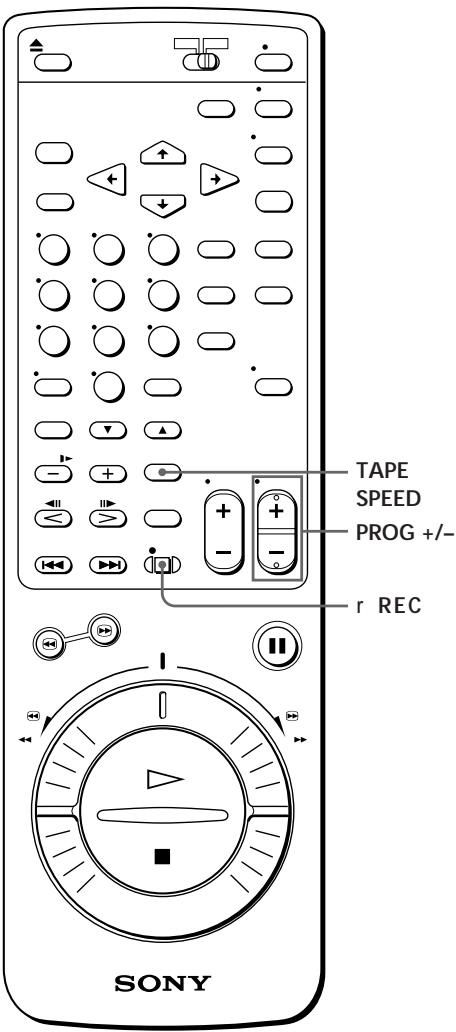
3 Select the desired program position by pressing PROG + / -

4 Select the tape speed by pressing TAPE SPEED.
- For PAL/MESECAM, select either SP or LP.
- For NTSC, select either SP or EP.
See "To select tape speeds" on the next page.

5 Start recording by pressing rREC.
When the tape reaches the end, the VCR automatically rewrites it to the beginning.
To stop recording
Press p STOP.
Tips (continued)
- If you don't want to watch TV while recording, you can turn off the TV.
To record a video source from LINE 1 or LINE 2, press INPUT SELECT to display "L1" or "L2."
Notes
- If you insert a tape with its safety tab removed, the VCR starts playing it automatically. To record on this tape, cover the tab hole with adhesive tape.
- If you've inserted a tape with its safety tab removed, the VCR ejects it when you press r REC.
- The VCR automatically selects either the NTSC, PAL, or MESECAM color system when recording TV broadcasts.
To select tape speeds
PAL color system
When recording, select either SP (Standard Play) or LP (Long Play). LP provides twice as much recording time as SP. However, SP provides better picture quality. You can mix SP and LP on the same tape. When playing back, the VCR automatically detects the tape speed. See the table below for the maximum recording/playback time in each speed.
| Tape type | Maximum recording/playback time | |
| SP | LP | |
| E-300 | 5 hrs. | 10 hrs. |
| E-240 | 4 hrs. | 8 hrs. |
| E-180 | 3 hrs. | 6 hrs. |
| E-120 | 2 hrs. | 4 hrs. |
| E-60 | 1 hr. | 2 hrs. |
NTSC color system
When recording, select either SP (Standard Play) or EP (Extended Play). EP provides three times as much recording time as long as SP. However, SP provides better picture quality. You can mix SP and EP on the same tape. When playing back, the VCR automatically detects the tape speed. See the table below for the maximum recording/playback time for each speed.
| Tape type | Maximum recording/playback time | |
| SP | EP | |
| T-160 | 2 hrs. 40 min. | 8 hrs. |
| T-120 | 2 hrs. | 6 hrs. |
| T-60 | 1 hr. | 3 hrs. |
| T-30 | 30 min. | 1 hr. 30 min. |
Recording TV programs (continued)
Recording using the quick timer
The quick timer enables you to record for a specified period of time in intervals of 30 minutes. Once you specify the recording time, the VCR automatically stops recording. Before you begin, check that the clock is set correctly.
After you start recording, press QUICK TIMER on the VCR until the desired duration appears in the display window. The TIMER indicator on the VCR lights up. Each press increases the recording duration in increments of 30 minutes as shown below.

The recording duration decreases minute by minute to 0:00, then the VCR turns off automatically.
To stop recording
To stop quick-timer recording while the VCR is recording a program, press p STOP.
To extend the recording duration while recording
Press QUICK TIMER until the desired duration appears in the display window.
Watching a TV program while recording another
You can watch a TV program and record another at the same time. Select the desired program position on the TV.
Recording stereo and bilingual programs in NICAM system (SLV-X842/X842ML only)
This VCR receives and records stereo and bilingual programs based on the NICAM system. When NICAM broadcasts are received, the NICAM indicator appears in the display window; when stereo programs are received, the STEREO indicator appears in the display window; when bilingual programs are received, the MAIN/L indicator appears in the display window.
1 Press MENU.
The main MENU appears on the TV screen.
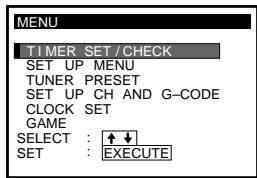
2 Press CURSOR > / . to move the cursor (I) to SET UP MENU, then press EXECUTE.
The SET UP MENU appears.
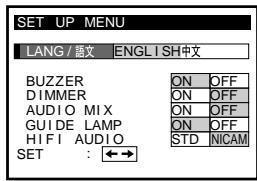
3 Press CURSOR >/.?// to move the cursor (I) to HIFI AUDIO, then highlight NICAM.
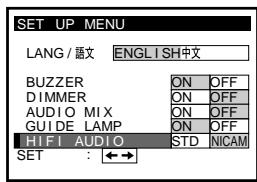
4 Press EXECUTE to store the setting.
Using the NICAM setting, NICAM broadcasts are recorded as in the following table.
| Track | Sound recorded | |
| Stereo | Bilingual | |
| Hi-fi audio Left channel | Left channel | Main |
| Hi-fi audio Right channel | Right channel | Sub |
| Normal audio (monaural) | Standard (usually the mixed sound of left and right channels) | Standard (usually the main sound) |
Tip
- When you set HIFI AUDIO to NICAM, the stereo or bilingual sound is recorded on the hi-fi audio track and the standard sound is recorded on the normal audio track. (See page 29.)
Recording TV programs (continued)
Note
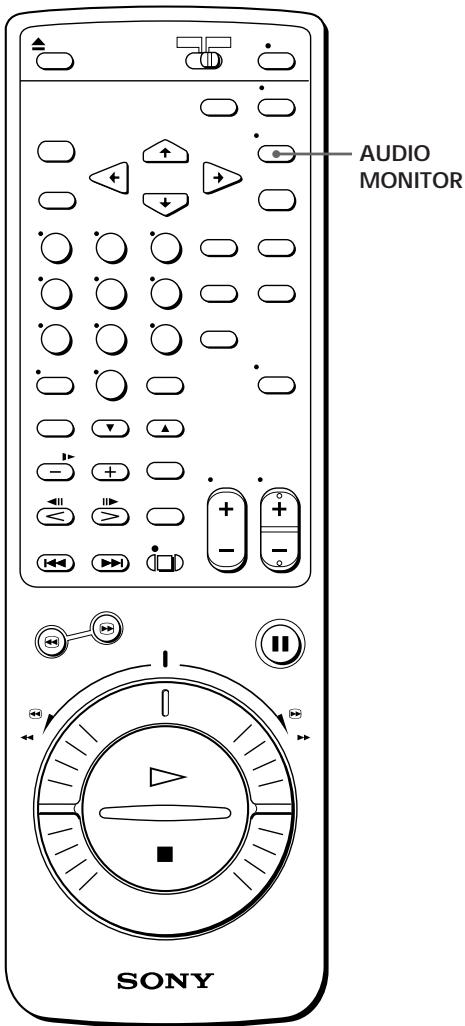
- The AUDIO MONITOR button doesn't work while receiving stereo programs in ZWEITON system.
Recording stereo and bilingual programs in ZWEITON (German stereo) system (SLV-X842/X842ML only)
This VCR automatically receives and records stereo and bilingual programs based on the ZWEITON system only when the SYSTEM (I, D/K, B/G, or M) option in the TUNER PRESET menu is set to B/G. When stereo programs are received, the STEREO indicator appears in the display window; when bilingual programs are received, the MAIN/L indicator appears in the display window.
To monitor bilingual programs while recording Press AUDIO MONITOR to select the desired sound.
| To listen to | Press AUDIO MONITOR until | |
| The TV screen shows | The display window shows | |
| Main sound | “MAIN” | “MAIN/L” |
| Sub sound | “SUB” | “SUB/R” |
| Main and sub sounds | “MAIN/SUB” | “MAIN/L, SUB/R” |
Recording stereo and bilingual programs for SLV-X821MKII
This VCR can only record stereo and bilingual programs through the line input. When stereo or bilingual sound is input through the line input, "STEREO" appears on the screen and in the display window. You cannot select the sound to listen.
Saving a recording
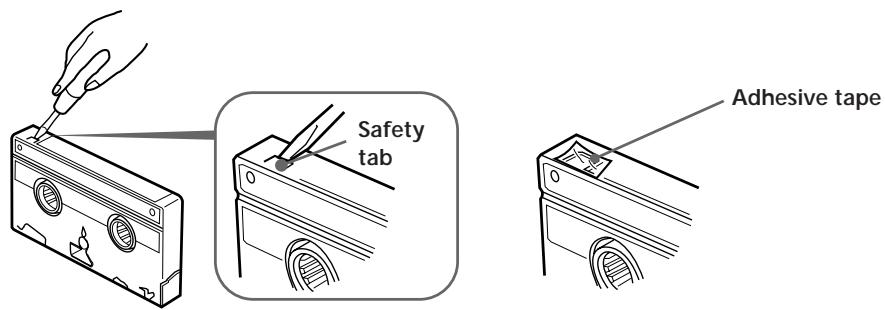
Video tapes have a safety tab to protect against accidental recording. To prevent accidental erasure of a recording, break off the safety tab with a screwdriver or other tool. A tape with its safety tab removed is ejected if you try to record on it.
To record on a tape with its safety tab removed, cover the tab hole with adhesive tape.
Recording TV programs using G-CODE
Notes
- To record NTSC signals in EP mode, set the tape speed to LP.
- The G-CODE used in this VCR is for Singapore, Malaysia, Hong Kong, Macao, etc. and cannot be used in areas such as U.S.A., Canada, Japan, Korea, Taiwan, and U.K.
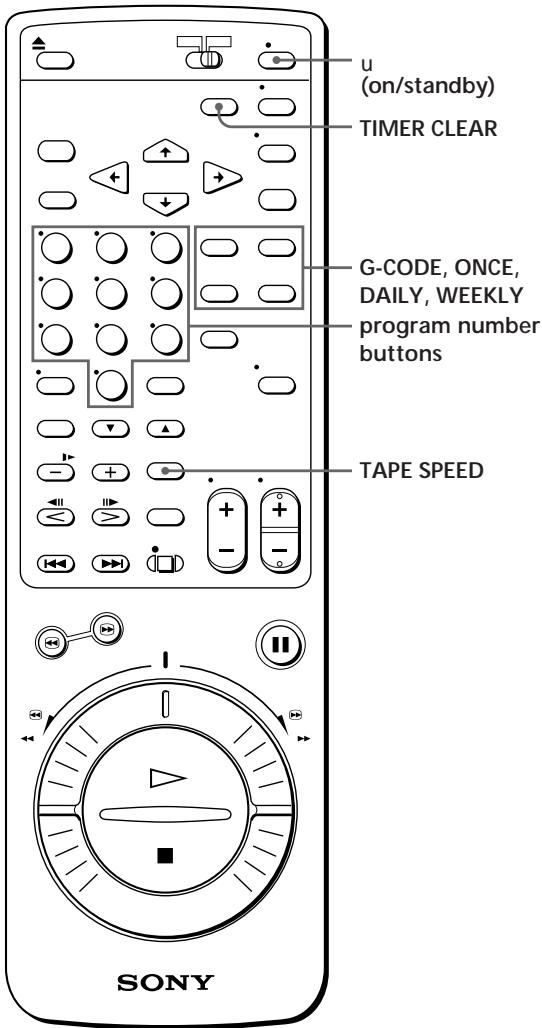
The G-CODE feature of this VCR simplifies the task of making timer recordings. Using G-CODE, you can make all the necessary settings by just entering the desired program's 9-digit code, which is available in your local program guide. To take advantage of this feature, you must first set up your VCR and assign program positions to the various guide channels. For details, see "Setting up G-CODE manually" on page 24.
Before you start...
- Check that the clock is set correctly.
- Insert a tape with its safety tab in place. Make sure the tape is longer than the total recording time.
- Turn on your TV and tune in to the VCR.
1 Press G-CODE.
The G-CODE menu appears on the TV screen.
If the clock needs to be set, "PLEASE SET THE CLOCK" appears on the screen and the VCR automatically enters the clock setting mode.
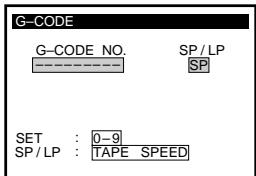
2 Use the number buttons to enter the desired program's G-CODE number.
If you make a mistake, press TIMER CLEAR and enter the correct number.
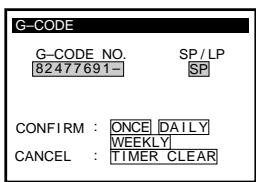
3 Select the tape speed, SP or LP, by pressing TAPE SPEED.
See "To select tape speeds" on page 31.
(continued)
Recording TV programs using G-CODE (continued)
Tip
- To exit from the G-CODE mode, press G-CODE before pressing ONCE, DAILY, or WEEKLY in step 4.
Notes
-
You cannot set G-CODE in the following cases:
-
when the VCR is turned off
-
while recording using the timer or quick timer.
-
The timer will not accept settings in the following cases:
-
when you select DAILY for a Saturday or Sunday program
- when you select DAILY or WEEKLY for a program more than seven days ahead
-
when you enter the G-CODE number of a program that has already ended.
-
If the VCR doesn't accept the setting, check the G-CODE number again and enter the proper number starting from step 1.
- If the power is interrupted for more than one hour while the VCR is standing by for recording, the timer settings are cleared. Reset the timer.
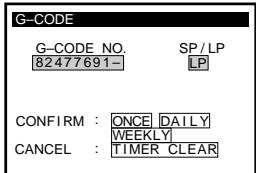
4 Press ONCE, DAILY or WEEKLY according to the following table.
| To record the program | Press |
| Only once | ONCE |
| Monday to Friday at the same scheduled time | DAILY |
| Every week at the same scheduled time | WEEKLY |
The recording information appears on the TV screen: date, program start and stop times, program position number and tape speed.
Check that the information is correct. If it is not, press TIMER CLEAR to cancel the setting.
If you set the wrong G-CODE number, the VCR sounds short beeps.
To preset another timer setting, repeat steps 1 to 4.
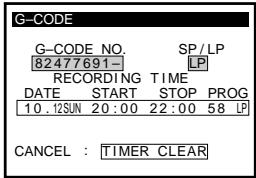
5 Press u (on/standby) to turn off the VCR.
The TIMER indicator on the VCR lights up. The VCR turns off and enters timer recording standby mode automatically.
The VCR automatically turns on and starts recording at the start time, and turns off at the stop time.
To stop recording
To stop while the VCR is recording a program, press p STOP.
To record satellite broadcasts using G-CODE
If you connect the satellite tuner and the VCR, you can record satellite programs using G-CODE.
1 Turn on the satellite tuner.
2 On the satellite tuner, select the satellite program you want to make a timer setting for.
3 Follow the steps in "Recording TV programs using G-CODE" above. Keep the satellite tuner turned on until the VCR finishes the timer recording.
Setting the timer manually
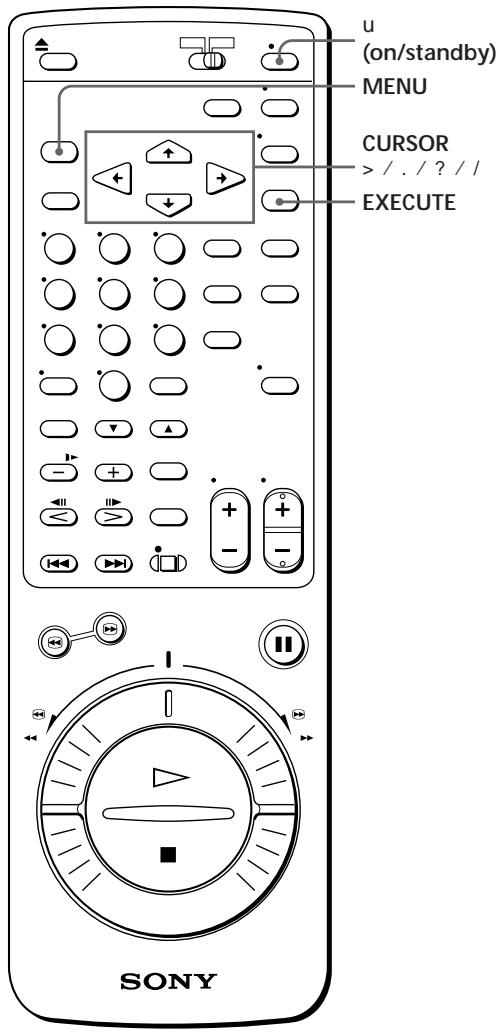
This section shows you how to let the VCR automatically start and stop recording TV programs. You can preset up to eight programs within a one month time frame.
Before you start...
- Check that the VCR's clock is set correctly.
- Insert a tape with its safety tab in place. Make sure the tape is longer than the total recording time.
- Turn on your TV and tune in to the VCR.
1 Press MENU.
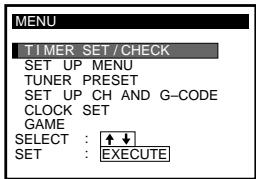
2 Press CURSOR >1 to move the cursor (l) to TIMER SET/CHECK, then press EXECUTE. The TIMER SET/CHECK menu appears. If the clock needs to be set, "PLEASE SET THE CLOCK" appears on the screen and the VCR automatically enters the clock setting mode.
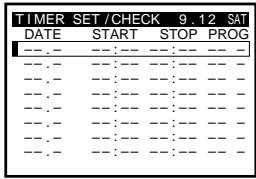
3 Set the date to start recording.
1 Press CURSOR / to highlight the date.
Make sure today's date is displayed.
If it isn't, adjust the clock.
2 Press CURSOR > to set the date. The day of the week is set automatically.
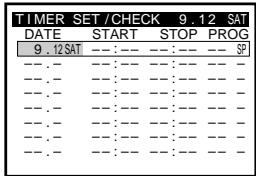
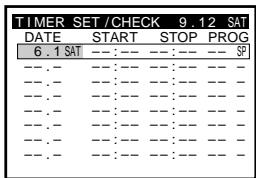
4 Set the time to start recording.
1 Press CURSOR / to highlight the hour under "START," then press CURSOR > . to set the hour.
2 Press CURSOR / to highlight the minutes under "START," then press CURSOR > . to set the minutes.
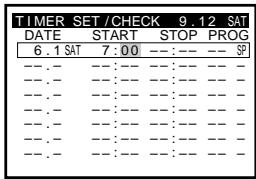
5 Press CURSOR /, then set the time to stop recording in the same way.
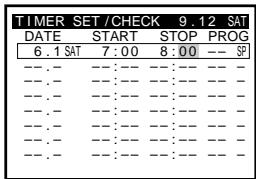
(continued)
Setting the timer manually (continued)
Tips
- To set the program position, you can also use the PROG + / - or program number buttons.
- To record a video source from LINE 1 or LINE 2, press INPUT SELECT to display "L1" or "L2."
Tip
- To set the recording tape speed, you can also use TAPE SPEED.
Note
- To record NTSC signals in EP mode, set the tape speed to LP.
Tip
- To change the digits during setting, press CURSOR ? to return to the item to be changed, and select the digits using CURSOR >
Note
- If the power is interrupted for more than one hour while the VCR is standing by for recording, the timer settings are cleared. Reset the timer.
6 Press CURSOR/, then select the program position by pressing CURSOR > / .
| TIMER SET/CHECK 9.12 SAT | |||
| DATE | START | STOP | PROG |
| 6.1 SAT | 7:00 | 8:00 | 6 SP |
| ---- | ---- | ---- | ---- |
| ---- | ---- | ---- | ---- |
| ---- | ---- | ---- | ---- |
| ---- | ---- | ---- | ---- |
| ---- | ---- | ---- | ---- |
| ---- | ---- | ---- | ---- |
7 Press CURSOR /, then select the tape speed, SP or LP, by pressing CURSOR >/..
See "To select tape speeds" on page 31.
| TIMER SET/CHECK 9.12 SAT | |||
| DATE | START | STOP | PROG |
| 6.1 SAT | 7:00 | 8:00 | 6 SP |
| ---- | ---- | ---- | ---- |
| ---- | ---- | ---- | ---- |
| ---- | ---- | ---- | ---- |
| ---- | ---- | ---- | ---- |
| ---- | ---- | ---- | ---- |
| ---- | ---- | ---- | ---- |
8 To confirm your program, press CURSOR /.
The cursor (I) appears in the leftmost column.
To preset another timer setting, move the cursor to the next line using
CURSOR, and repeat steps 3 to 8.
| TIMER SET/CHECK 9.12 SAT | |||
| DATE | START | STOP | PROG |
| 6.1 SAT | 7:00 | 8:00 | 6 SP |
| ---- | ---- | ---- | ---- |
| ---- | ---- | ---- | ---- |
| ---- | ---- | ---- | ---- |
| ---- | ---- | ---- | ---- |
| ---- | ---- | ---- | ---- |
| ---- | ---- | ---- | ---- |
9 After making the desired timer settings, press EXECUTE.
10 Press u (on/standby) to turn off the VCR.
The TIMER indicator on the VCR lights up. The VCR turns off and enters timer recording standby mode automatically.
The VCR automatically turns on and starts recording at the start time, and turns off at the stop time.
To stop recording
To stop while the VCR is recording a program, press p STOP.
Daily/weekly recording
Daily recording records the same program every day of the week; weekly recording records the same program on the same day, every week.
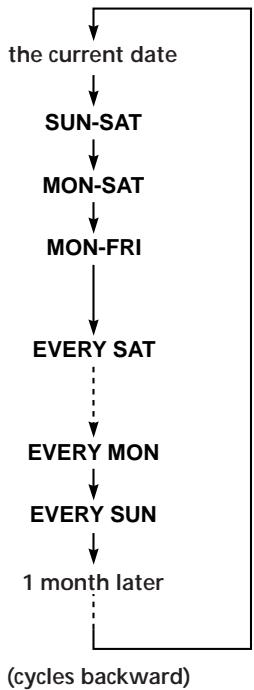
When you set the date to start recording in step 3 above, press CURSOR . until the desired day appears. Each time you press the button, the indication changes as shown on the left.
Checking/changing/ cancelling timer settings
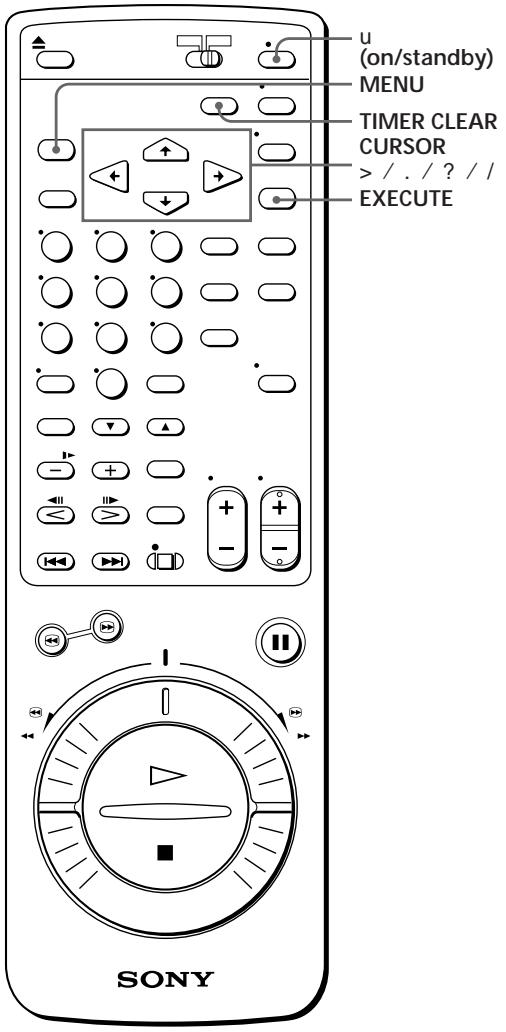
This section shows you how to check, change and cancel the timer settings after you've stored them in the VCR.
Before you start...
- Turn on your TV and tune in to the VCR.
1 Press u (on/standby) to turn on the VCR.
2 Press MENU and select TIMER SET/ CHECK.
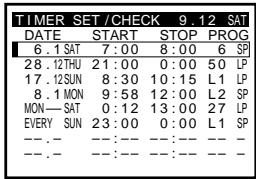
3 Check the timer settings in the list.
- If you don't want to change or cancel the settings, press u (on/standby) to return to recording standby.
- If you want to change or cancel the settings, press CURSOR > . to move the cursor (I) to the setting you want to change or cancel.
4 Change or cancel the timer setting:
- To change the setting, press CURSOR ?// to highlight the item you want to change, and reset it using CURSOR > .. Then, press CURSOR / repeatedly until the cursor appears in the leftmost column.
- To cancel the setting, press TIMER CLEAR.
5 Press EXECUTE.
The VCR returns to the original screen. If there are any other timer settings left in the TIMER SET/CHECK menu, press u (on/standby) to return to recording standby.
To check the timer settings during timer recording
Press MENU and select TIMER SET/CHECK. After checking, press EXECUTE to turn off the display.
Additional instructions about timer recording
This section gives additional information about timer recording which you need after you have stored timer settings in the VCR.
To use the VCR while recording
You can do the following tasks during timer recording.
| To | Press |
| Reset the counter to “0H00M00S” | COUNTER RESET |
| Display tape information on the TV screen | DISPLAY |
| Check the timer settings | MENU and select TIMER SET/ CHECK |
| Watch another TV program | See “Watching a TV program while recording another” on page 32. |
Using the VCR before timer recording begins
Press u (on/standby). The TIMER indicator on the VCR goes off and the VCR is ready for use.
After using the VCR, press u (on/standby) again to turn on the TIMER indicator on the VCR. Remember to reset the VCR to stand by for recording before the time you've set the VCR to start recording, or the timer setting will be cancelled.
When the timer settings overlap
The VCR will not record overlapping programs. If any of your timer settings overlap, change the settings.
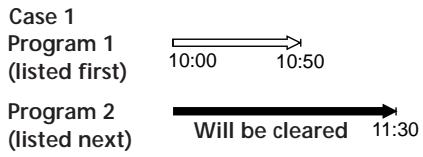
Case 1: If you preset two programs to start recording at the same time...
The program listed first in the TIMER SET/CHECK menu has priority over the other programs. The timer settings of lower priority programs will be erased from the list when the first program begins recording.
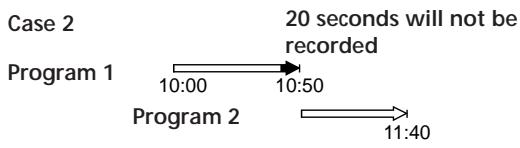
Case 2: If you preset program 2 to start recording at the same time you preset program 1 to finish recording...
The last 20 seconds of program 1 will not be recorded because the VCR will enter recording pause for program 2 before program 1 is finished.
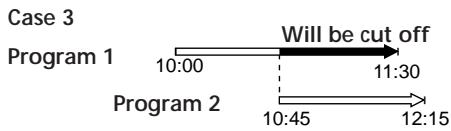
Case 3: If you preset program 2 to start recording before program 1 is finished recording...
Program 2 will start recording before program 1 has finished.
Additional Operations Playing/searching at various speeds
Tip
- Adjust the picture using /4 TRACKING NORMAL/ SLOW STILL ADJUST if:
- streaks appear while playing in slow motion
- bands appear on the top or bottom while pausing
- the picture shakes while pausing.
Notes
- If you use these functions in the LP mode, noise may appear or there may be no color.
- When you view the picture of an NTSC-recorded tape in EP mode during fast-forward or rewind, "LP" may be displayed momentarily.
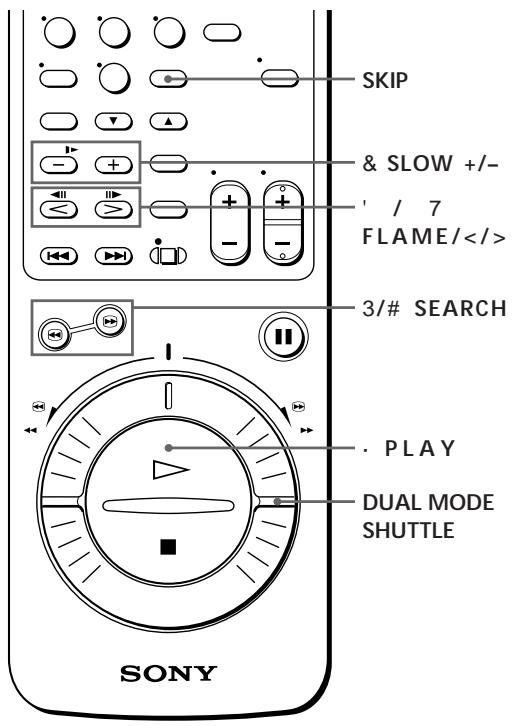
You can play back a tape at various speeds: high-speed, slow motion and so on. These options are also useful for searching for a specific point during playback. The sound is muted during these operations.
| Playback options | Operation | To resume normal playback |
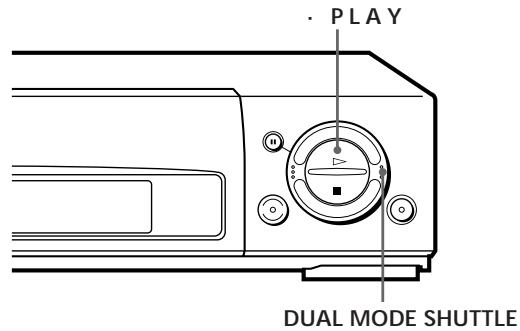
| Playing at various speeds: | During playback, turn the DUAL MODE SHUTTLE ring right or left to: | Release the ring. |
| One-fifth the normal speed | 1/5 | |
| The normal speed | 1 | |
| Twice the normal speed | ×2 | |
| High speed | # or 3 | |
| Fast-forwarding/ Rewinding | During stop, turn the DUAL MODE SHUTTLE ring to) FF or to 0 REW and release. | Press · PLAY. |
| Viewing the picture during fast-forward or rewind | During fast-forward, turn the DUAL MODE SHUTTLE ring to) FF . During rewind, turn the ring to 0 REW. | To return to the previous mode, release the ring. |
| Locking in a high-speed picture | During playback or pause, press # SEARCH or 3 SEARCH. To change direction, press < (backward) or > (forward). | Press · PLAY. |
| Locking in a slow-motion picture | During playback or pause, press & SLOW +/- . You can increase the playback speed with the + button and decrease the speed with the - button. To change direction, press < (backward) or > (forward). | Press · PLAY. |
| Playing frame by frame | During pause, press 7 FRAME to advance the picture one frame or ' FRAME to reverse the picture one frame. Keep pressing the button to advance or reverse one frame every one second. | Press · PLAY. |
| Playing in reverse | During playback, press <. | Press · PLAY. |
| Skipping a scene | During playback, press SKIP. Pressing once skips about 30 seconds. | The VCR automatically resumes normal playback. |
| Rewind and restart play | During stop, press · PLAY on the VCR while holding the DUAL MODE SHUTTLE ring on the VCR at the 0 REW position. | —— |
Adjusting the picture
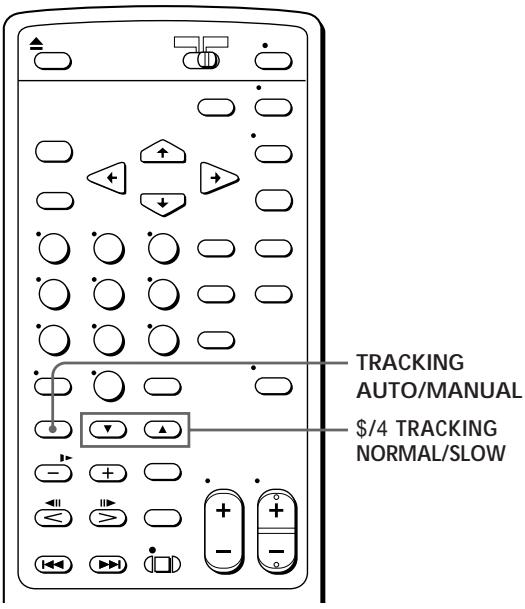
The VCR automatically adjusts the picture for the best possible playback or recording. If, however, you find the automatic adjustment unsatisfactory, you can adjust the picture manually.
Adjusting the tracking
Though the VCR automatically adjusts the tracking when playing a tape (the AUTO TRACKING indicator flashes in the display window, then lights steadily), distortion may occur if the tape was recorded in poor condition. If so, manually adjust the tracking condition.
Press /4 TRACKING NORMAL/SLOW to display the tracking meter. The distortion should disappear as you press one of the two buttons. If you cannot get a clear picture with manual adjustment, press TRACKING AUTO/MANUAL to return to automatic adjustment.
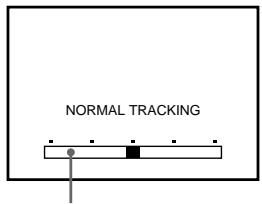
Tracking meter
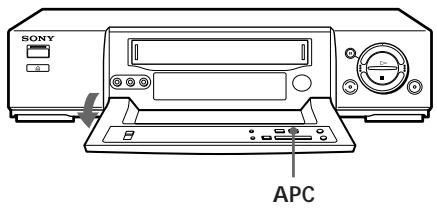
About Adaptive Picture Control (APC)
Adaptive Picture Control (APC) automatically improves recording and playback quality by adjusting the VCR to the condition of the video heads and tape. To maintain better picture quality, press APC on the VCR so the APC indicator in the display window lights.
APC
To use APC during playback
The APC function automatically works on all types of tapes, including rental tapes. You can play a tape using the APC function even if the tape was not recorded with it.
To use APC while recording
Whenever you insert a tape and first start recording, the VCR adjusts to the tape using the APC function (the APC indicator flashes rapidly). This adjustment is retained until the tape is ejected. There is a short delay before the VCR actually starts recording while the VCR analyzes the tape.
If you want to start recording precisely the first time you record, set the VCR to recording pause mode (the APC indicator flashes slowly) and press r REC to let the VCR analyze the tape. When the APC indicator stops flashing, press P PAUSE to start recording. Recording begins immediately.
To deactivate the APC
Press APC on the VCR. The APC indicator in the display window goes off.
Notes
- Tapes recorded using the APC function are played back normally on VCRs that do not have the APC function.
- Press P PAUSE to start recording after the APC indicator stops flashing. If you start recording before the APC indicator stops flashing, the APC function is cancelled.
Searching using the index function
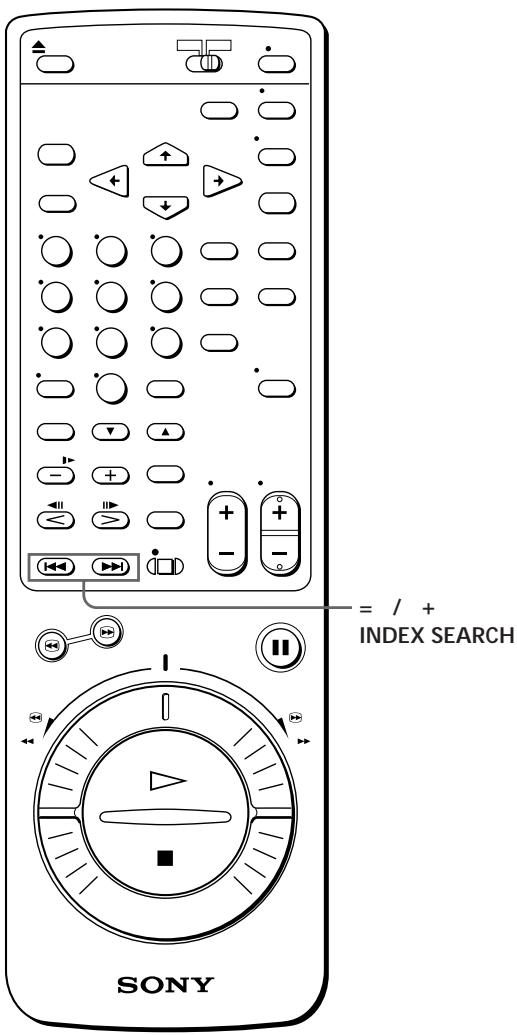
The VCR automatically marks an index signal at the point where recording starts (with the exception of when you start recording from recording pause). Use this as a reference to find the beginning of the recording. Since the index number indicates the relative position from the current position, specify how many index signals ahead or behind the specific index signal is from the current position.
1 Open the drop down panel and insert an indexed tape into the VCR.
2 Press = /+ INDEX SEARCH repeatedly until the index number you want appears on the TV screen:
- To locate succeeding programs, press + INDEX SEARCH.
- To locate preceding programs, press = INDEX SEARCH. The VCR starts searching and the index number on the TV screen counts down to zero. Playback starts automatically from that point.
Game play
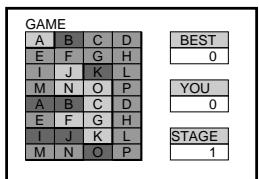
Notes
- Long game play sessions consume much battery power from the remote commander, and reduce battery life.
- Due to discrepancies between television systems, the size of the game screen may differ between PAL and NTSC monitors.
One special feature that will add lots of enjoyment to the basic VCR concept of recording and playback is this video game, The Tile Game.
The object
The object of the game is to collect as many points as possible by removing tiles in pairs.
The game has a total of 255 stages, each stage becoming slightly more difficult. Clear each stage by removing all the tiles on the screen.
Rules
- To remove the tiles, select pairs of matching tiles.
- You cannot select a tile if it is bordered with the tiles of the same color on both the left and right sides.
The hidden tiles
The tiles may be arranged in layers up to three.
If the tiles are arranged in three layers, the surface layer is red. The hidden middle and bottom layers are blue and gray respectively. If the tiles are arranged in two layers the surface one is blue and the hidden one is gray. If the tiles don't have any hidden layers, the tiles are gray. The hidden tile reveals itself after you remove the one above it. You have to remove all the tiles to complete the stage (game), including the hidden ones.
Collecting points
Your present score is shown under "YOU." Your score is the total of the present stage points and all the former stages you've cleared in the game. The present stage number is shown under "STAGE."
The highest score ever achieved is saved in the VCR memory and shown under "BEST."
Playing the game
1 Press MENU.
2 Select GAME and press EXECUTE.
The first stage appears on the TV screen.
3 Press CURSOR >/. / ?// to move the arrow on the screen to a desired tile, and then press EXECUTE to select the tile.
The selected tile is highlighted.
If it is not highlighted, the tile must be bordered with the tiles of the same color on both the left and right sides.
To deselect the tile, place the arrow on the tile and press EXECUTE again.
4 Select a matching tile in the same way.
The tiles will be removed from the screen, and you will receive one point.
5 Repeat steps 3 and 4.
When all the tiles are removed, press EXECUTE to go to the next stage.
To exit the game
Press MENU.
Looking at menu options
The SET UP MENU provides you with various options to set up and customize your VCR. See the table below for the available menu choices. Initial settings are indicated in bold letters.
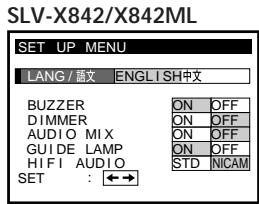
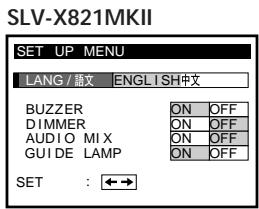
Menu choices
| Menu option | Set this option to |
| LANG/語文 | • ENGLISH to set the on-screen language to English. • 中文 to set the on-screen language to Chinese. |
| BUZZER | • ON to output a beep sound when an illogical operation is made. • OFF to deactivate it. |
| DIMMER | • ON to dim the VCR display. • OFF to brighten it. |
| AUDIO MIX | • ON to listen to the hi-fi and normal audio tracks at the same time. The AUDIO MONITOR button becomes inoperable. • OFF to select the sound using the AUDIO MONITOR button. For details, see page 34. |
| GUIDE LAMP | • ON to illuminate the DMS ring, r REC button, and TIMER indicator on the VCR. • OFF to turn them off. |
| HIFI AUDIO (SLV-X842/X842ML only) | • STD to record standard sound on a hi-fi audio track. • NICAM to record NICAM broadcasts on a hi-fi audio track. For details, see page 33. |
Editing
Editing with another VCR
This section shows you how to edit to or from another VCR or camcorder. You can make a copy of a tape using this VCR for recording or playback.
How to hook up to record on this VCR
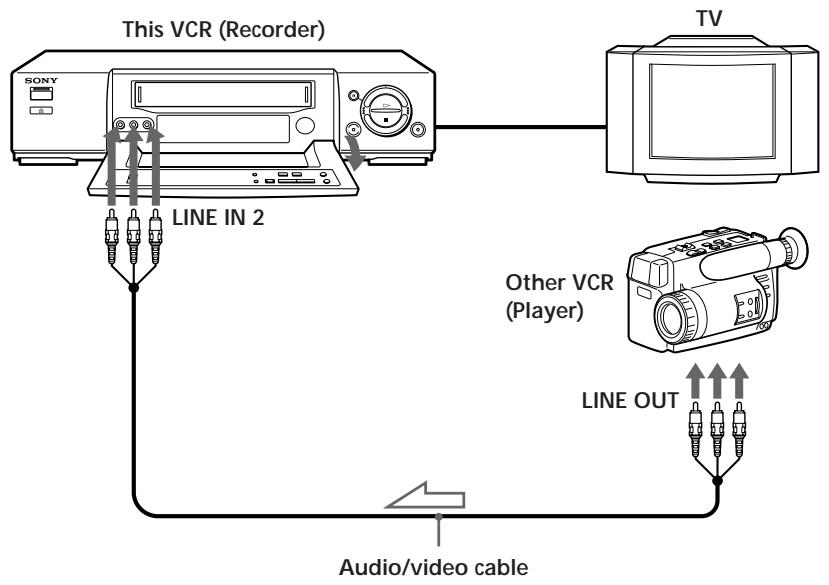
Signal flow
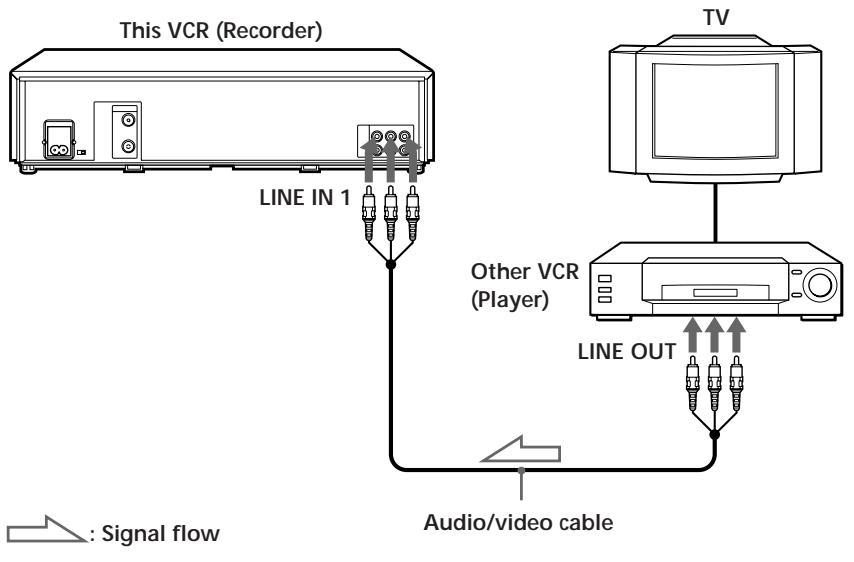
Tips
- Make sure you connect the plugs to jacks of the same color.
- If the other VCR is a monaural type, leave the red plugs unconnected.
Tips
- Make sure you connect the plugs to jacks of the same color.
- If the other VCR is a monaural type, leave the red plugs unconnected.
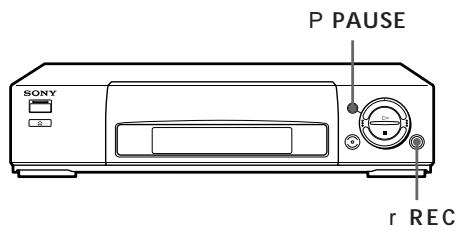
Tips
- To make your editing more precise, use the pause buttons on both VCRs.
- To cut out unwanted scenes while editing, press P PAUSE on this VCR when an unwanted scene begins. When it ends, press P PAUSE again to resume recording (Assemble Editing).
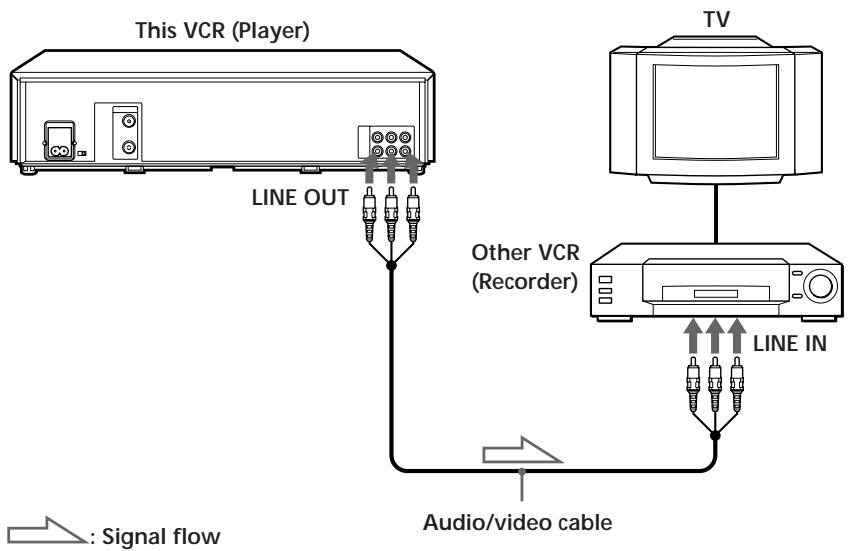
How to hook up to record on another VCR
Operation (when recording on this VCR)
Before you start ...
- Press INPUT SELECT to display "L1" or "L2" in the display window.
- Press TAPE SPEED to select the recording tape speed (SP/LP for PAL/MESECAM system or SP/EP for NTSC system).
1 Insert a source tape with its safety tab removed into the other (playback) VCR. Search for the point to start playback and set it to playback pause.
2 Open the drop down panel and insert a tape with its safety tab into this (recording) VCR. Search for the point to start recording and press P PAUSE.
3 Press r REC on this VCR and set it to recording pause.
4 To start editing, press the P PAUSE buttons on both VCRs to release the VCRs from pause.
For best results, press the pause button on the other VCR before pressing P PAUSE on this VCR.
To stop editing
Press the STOP buttons on both VCRs.
Audio dubbing
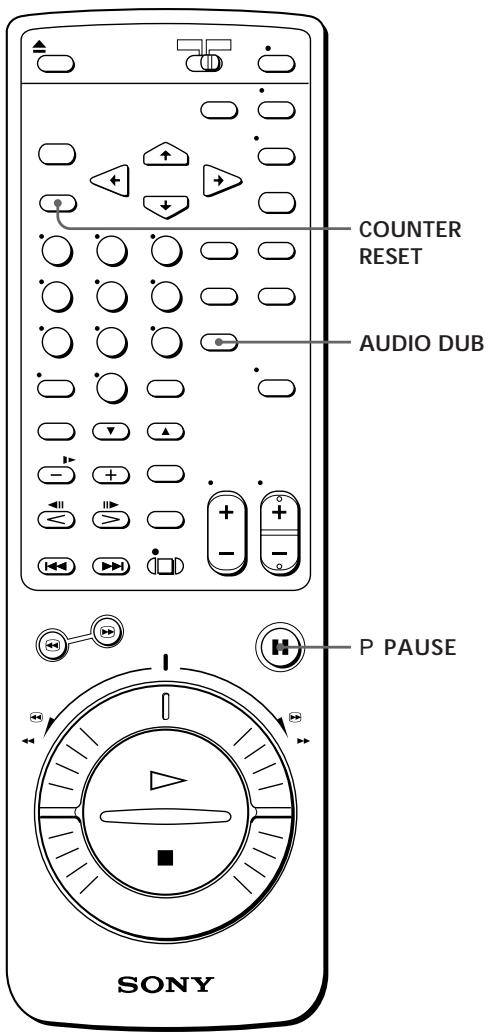
Note
- You must be in playback pause mode before pressing AUDIO DUB. (If you are in recording pause mode, you cannot use the audio dubbing function.)
You can add music and songs on the normal audio track. The monaural sound previously recorded is replaced while the original picture and hi-fi sound on the main track are retained. (See page 29.)
How to hook up
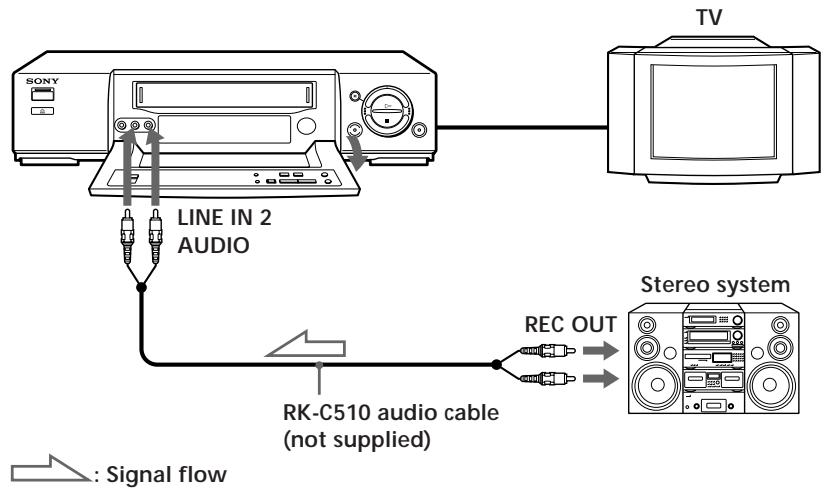
Audio dubbing from a stereo system
Before you start editing
- Connect audio source equipment to the LINE IN 2 AUDIO jacks of this VCR.
- Press INPUT SELECT to display "L2" in the display window.
1 Play a recording source. Search for the point to start playback and set it to playback pause.
2 Open the drop down panel and insert the prerecorded tape into this VCR.
Search for the end of the section you want to dub new sound to and press P PAUSE.
Make sure that the tape has its safety tab in place so that you can dub new sound onto it.
3 Press COUNTER RESET to reset the counter to "0H00M00S."
4 Rewind the tape to the beginning of the section.
This VCR pauses.
5 Press AUDIO DUB.
The A-DUB indicator lights up in the display window.

6 To start editing, press P PAUSE on this VCR and release the pause mode of the stereo system at the same time. When the counter of this VCR reaches "0H00M00S," audio dubbing stops automatically.
To stop editing
Press the p STOP buttons on this VCR and the stereo system.
Tip
- To listen to the sounds recorded on the hi-fi audio and normal audio tracks at the same time, set AUDIO MIX to ON using the SET UP MENU option. (See page 29.)
Listening to the dubbing sound
When audio-dubbing, you have choice of listening to the dubbing sound. To do so, press AUDIO MONITOR. (See page 34)
Additional Information Troubleshooting
| Symptom | Remedy | |
| Power | The ON/STANDBY switch does not function. | Connect the mains lead securely. |
| Clock | The clock has stopped and “---” lights in the display window. | The clock stops if the VCR is disconnected from the mains for more than an hour. Reset the clock (and timer). |
| Playback | The playback picture does not appear on the TV screen. | Make sure the TV is set to the program position for the VCR. If you are using a monitor, set it to video input. |
| The picture is not clear. | Adjust the tracking with the TRACKING NORMAL/SLOW buttons. Make sure the COLOR SYSTEM switch is set to the position corresponding to the color system with which the tape was recorded. Make sure the NTSC PB switch is set to the correct position to match the TV system of your TV. The video heads are dirty (see below). Clean the video heads using the Sony V-25CL video head cleaning cassette. If this cleaning cassette is not available in your area, have the heads cleaned at your nearest Sony service facility (a standard service charge will be required). Do not use a commercially available wet-type cleaning cassette, as it may damage the video heads. The video heads may have to be replaced. Consult your nearest Sony service facility for more information. | |
| The picture rolls vertically during picture search. | Adjust the vertical hold control on the TV or monitor. | |
| The picture has no sound. | The tape is defective. Use a new tape. | |
| The sound is unstable or has an echo. | When you play a tape with the same sound recorded on both the hi-fi and normal sound tracks, make sure the AUDIO MIX option in the SET UP MENU is set to OFF. |
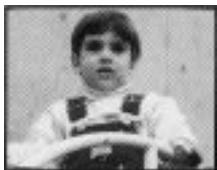
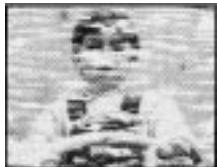
Symptoms caused by contaminated video heads
Normal picture
- Rough picture
Unclear picture
- No picture (or black & white screen appears)

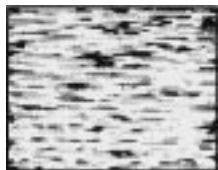
initial
terminal
| Symptom | Remedy | |
| Recording | A TV program does not appear on the TV screen. | ·If the TV is connected to the VCR using only the aerial cable, make sure the TV is set to the program position for the VCR. If you are using a monitor, set it to video input. |
| TV reception is poor. | ·Adjust the TV aerial. ·Make sure the SYSTEM (I, D/K, B/G, or M) option in the TUNER PRESET menu is set to the system in your area. | |
| The tape is ejected when you press the r REC button. | ·Check that the safety tab has not been removed. | |
| Nothing happens when you press the r REC button. | ·Make sure the tape is not at its end. ·Select the correct source with the INPUT SELECT button. Select a program position when recording TV programs; select “L1” or “L2” when recording from other equipment. | |
| Timer recording | The timer does not operate. | ·Check that the clock is set. The clock and timer stop if the VCR is disconnected from the mains for more than one hour. ·Make sure a tape has been inserted. ·Check that the safety tab has not been removed. ·Make sure the tape is not at its end. ·Make sure a program has been set for timer recording. |
| Others | A tape cannot be inserted. | ·Check that a tape isn’t already in the tape compartment. |
| The remote commander does not function. | ·Make sure you are pointing the remote commander at the remote sensor on the VCR. ·Replace all the batteries in the remote commander with new ones if they are weak. | |
| The tracking indicator does not appear on the screen. | ·The recording condition of the tape is very poor and tracking cannot be adjusted. | |
| The unit is dirty. | ·Clean with a dry soft cloth, or a soft cloth slightly moistened with a mild detergent solution. Do not use any type of solvent, such as alcohol or benzine. |
If you have any questions or problems concerning your unit, please consult your nearest Sony service facility.
Specifications
System
Channel coverage
VHF R1-R12,E2-E12,NZ1
UHF E21-E69,R21-R69
CATV S01-S05,S1-S41
RF output signal
UHF channels 28-55
Aerial out
75-ohm asymmetrical aerial socket
Inputs and outputs
LINE IN 1
VIDEO IN, Phono jack (1)
Input signal: 1 Vp-p, 75 ohms, unbalanced, sync negative AUDIO IN, Phono jack (2)
Input level: 327 mVrms
Input impedance: more than 47 kilohms
LINE IN 2
VIDEO IN, Phono jack (1)
Input signal: 1 Vp-p, 75 ohms, unbalanced, sync negative
AUDIO IN, Phono jack (2)
Input level: 327 mVrms
Input impedance: more than 47 kilohms
LINE OUT
VIDEO OUT, Phono jack (1)
Output signal: 1Vp-p, 75 ohms, unbalanced, sync negative
AUDIO OUT: Phono jack (2)
Rated output level: 327 mVrms
Load impedance: more than 47 kilohms
Output impedance: less than 10 kilohms
General
Power requirements 110 - 240 V AC, 50/60 Hz
Power consumption 27 W (SLV-X842/X842ML only) 25 W (SLV-X821MKII only)
Operating temperature 5 °C to 40 °C
Storage temperature -20°C to 60°C
Dimensions Approx. 430× 103× 323mm (w / h / d) including projecting parts and controls
Mass
Approx. 5.0Kg
Supplied accessories
Remote commander (1)
R6 (size AA) batteries (2)
Aerial cable (1)
Audio/video cable (1)
Mains lead (2-pin type) (1)
(SLV-X842ML only)
Mains lead (3-pin type) (1)
(SLV-X842/X821MKII only) Plug adaptor (1)
Design and specifications are subject to change without notice.
Index to parts and controls
Refer to the pages indicated in () for details.
Front panel, with drop down panel opened
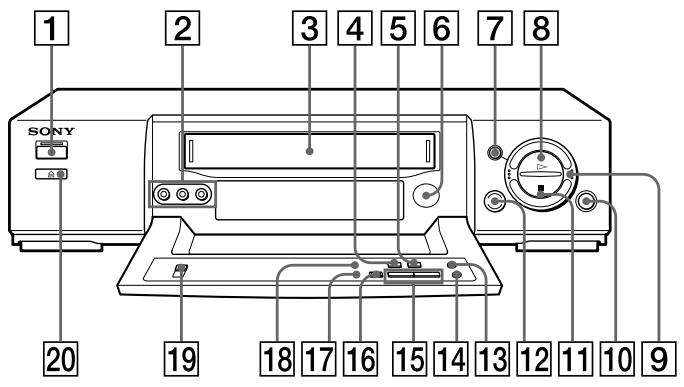
1 ON/STANDBY switch/indicator (11)
2 LINE IN 2 jacks (46)
3 Tape compartment
4 AUDIO DUB button (48)
5 APC button (42)
6 Remote sensor (6)
7 P PAUSE button (47, 49)
8 · PLAY button (41)
9 DUAL MODE SHUTTLE ring (27, 41)
0 rREC (recording) button/indicator (47)
! i p STOP button (47, 49)
^TM TIMER indicator (36, 38)
! £ QUICK TIMER button (32)
! TAPE SPEED button
PROGRAM + / - buttons (11)
! § INPUT SELECT button
! EASY SET UP button (13)
! RF CH SET button (11)
! a COLOR SYSTEM switch (28)
@ EJECT button
Index to parts and controls (continued)
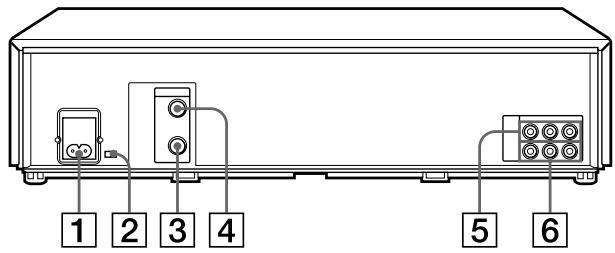
Rear panel
1 AC IN connector (7)
2 NTSC PB switch (10)
3 AERIAL IN connector (7)
4 AERIAL OUT connector (7)
5 LINE IN 1 jacks (46)
6 LINE OUT jacks (7, 47)
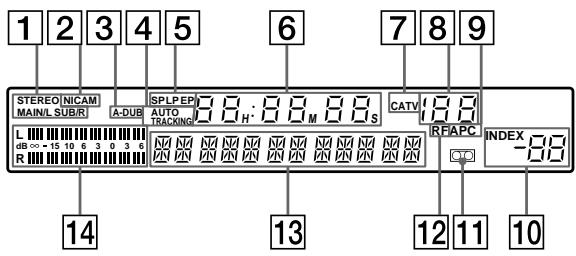
Display window
1 Sound indicators (29)
2 NICAM indicator (SLV-X842/X842ML only) (33)
3 A-DUB (audio dubbing) indicator (48)
4 AUTO TRACKING indicator (42)
5 Tape speed indicators (30)
6 Linear time counter/clock (28)
7 CATV indicator
8 RF channel/line/program position indicator (11, 30, 47, 48)
9 APC indicator (42)
0 Index search indicator (43)
! Tape indicator
^TM RF indicator (11)
! £ Color system/TV system indicators (8)
! Audio channel/sound level indicator (29)
Remote commander

1 6EJECTbutton (27)
2 Menu buttons (13, 15)
MENUButton
CURSOR > / . / ? / / buttons
EXECUTE button
3 COUNTER RESET button (28)
4 Program number buttons (18, 30, 35)
5 ? (ten's digit) button (30)
6 TRACKING buttons (41, 42) AUTO/MANUAL button /4 TRACKING NORMAL/SLOW STILL ADJUST buttons
7 & SLOW + / - buttons (41)
8 /7 FRAME /</> buttons (41)
9 = / + INDEX SEARCH
buttons (43)
0 3/# SEARCH buttons (27,41)
! i· PLAY button (27, 41)
^TM p STOP button (27, 41)
!£ remote control switch (6)
!u(on/standby)button (36,38,39,40)
TIMER CLEAR button (39)
! TV/VIDEO button (only for TV) (6)
! AUDIO MONITOR button (34)
! • G-CODE buttons (36)
G-CODE button
ONCE button
DAILY button
WEEKLY button
! a AUDIO DUB button (48)
@° DISPLAY button (28)
@jSKIPbutton(41)
@TAPE SPEED button (30, 35, 38, 47)
@INPUT SELECT button (31, 38, 47, 48)
@ PROG (program) + / - buttons (18, 19, 30)
@ VOL (volume) + / - button (only for TV)
@ P PAUSE button (27, 42)
@ r REC button (30, 42)
@DUAL MODE SHUTTLE ring (27,41)
Index
A, B
Accessories supplied 5
Adjusting
picture 41, 42
tracking 42
Aerial hookup 7
AFT (Auto Fine Tuning) 19
APC(Adaptive Picture
Control) 42
Audio dubbing 48
Audio track 29
C
Cancelling timer settings 39
Changing timer settings 39
Cleaning the video heads 50
Clock setting 14, 15
Color system compatible color systems 4,8 setting 10,28
Connecting audio/video input jacks 7,46,47
the VCR and your TV 7
to a stereo system 7,48
to a TV with audio/video
input jacks 7,46,47
Counter 28
D
Dubbing. See Editing
E,F
EASY SET UP 13
Editing 46
EP mode 31
G
Game play 44
G-CODE
recording 35
setting 14,24
Guide channel
setting 14,24
Guide lamp 45
H
Hi-fi audio track 29
I, J, K
Index
searching 43
L
LP mode 31
M
Menu
options 45
Monitoring
during playback 29
during recording 34
N, O
NICAM broadcasts 33
Normal audio track 29
NTSC recorded tape 28
P
Playback 27
at various speeds 27, 41
skip 41
slow motion 41
Program position
changing program
positions 26
disabling program
positions 19
for VCR playback 11
tuning 14,17
0
Quick timer 32
R
Recording 30
bilingual programs 33, 34
saving 34
stereo programs 33, 34
while watching another
program 32
Remote commander 6
RF channel 11
s
Safety tab 34
Searching
at various speeds 27, 41
using the index function 43
SP mode 31
T, U, V, W, X, Y
Timer recording 35, 37
cancelling timer settings 39
changing timer settings 39
checking timer settings 39
daily/weekly recording 36, 38
quick timer 32
using G-CODE 35
Tracking adjustment. See Adjusting
Tuning
Auto fine tuning (AFT) 19
the TV to the VCR 11
the VCR to TV channels 14, 17
Z
ZWEITON broadcasts 34
Video Cassette Recorder
Operating Instructions
EN
J
C
SLV-X842/X842ML/X821MKII AC110 240V 50/60Hz
EASY SETUP
G
EASY SETUP
APC
G-CODE* G
- G-CODE Gemstar Development Corp. Gemstar Development Corporation
G-CODE
G-CODE
PAL(B/G D/K I) MESECAM (B/G D/
K K1) NTSC (M)
SLV-X842 SLV-X842ML SLV-X821MKII
SLV-
X842ML
SLV-X842ML
X842/X842ML X821MKII
NICAM
ZWEITON
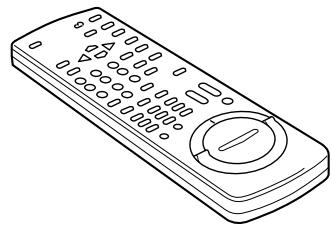

3 R6 sizeAA)



SLV-X842ML
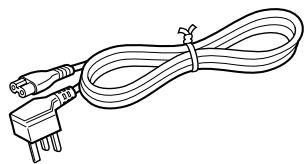

SLV-X842/X821MKII
2
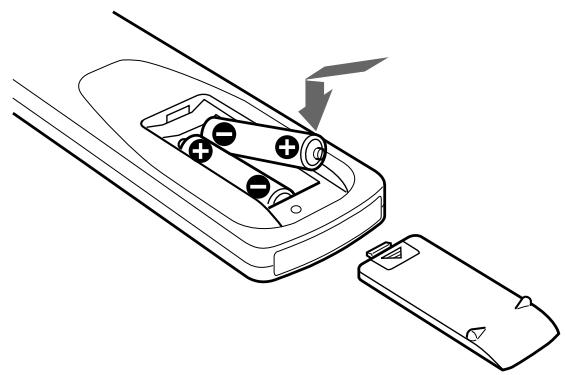
3 R6 size AA
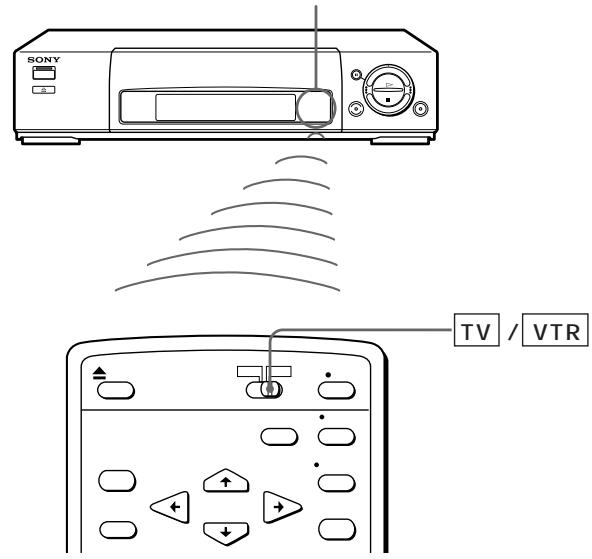
| TV / VTR |
| VTR |
| TV |
TV/VIDEO
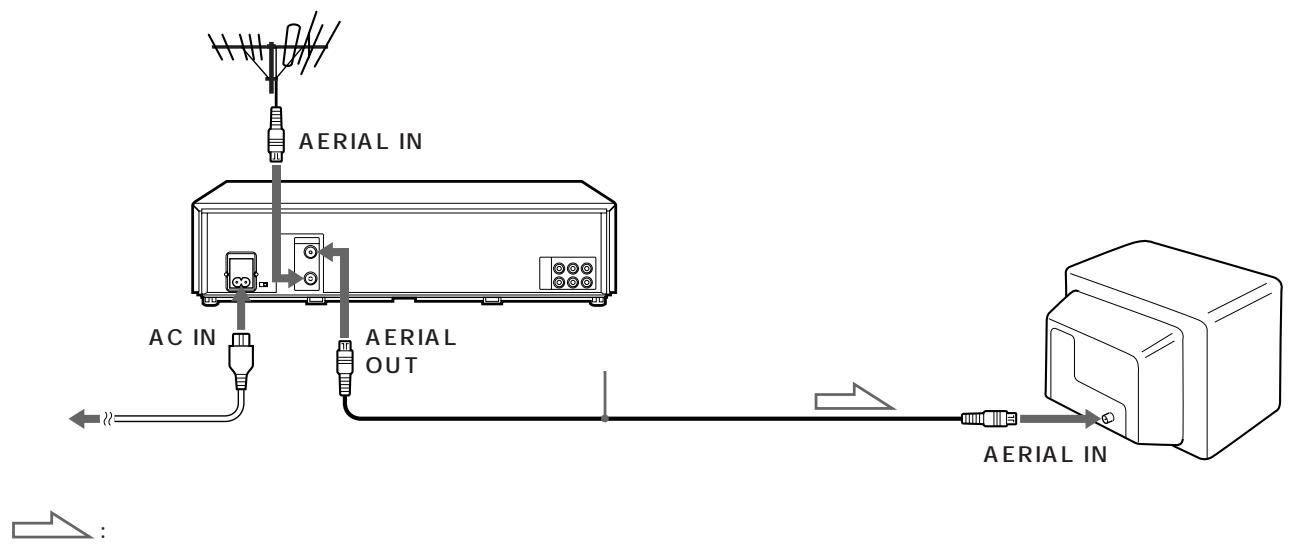
3
1
AERIAL IN
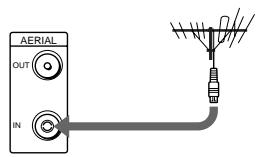
2
AERIAL OUT
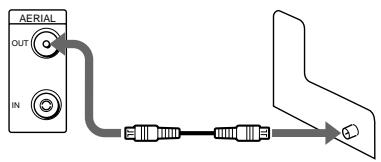
3
AC IN
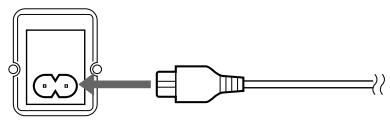
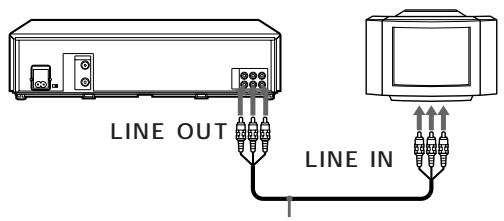
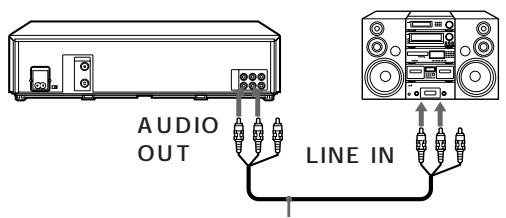
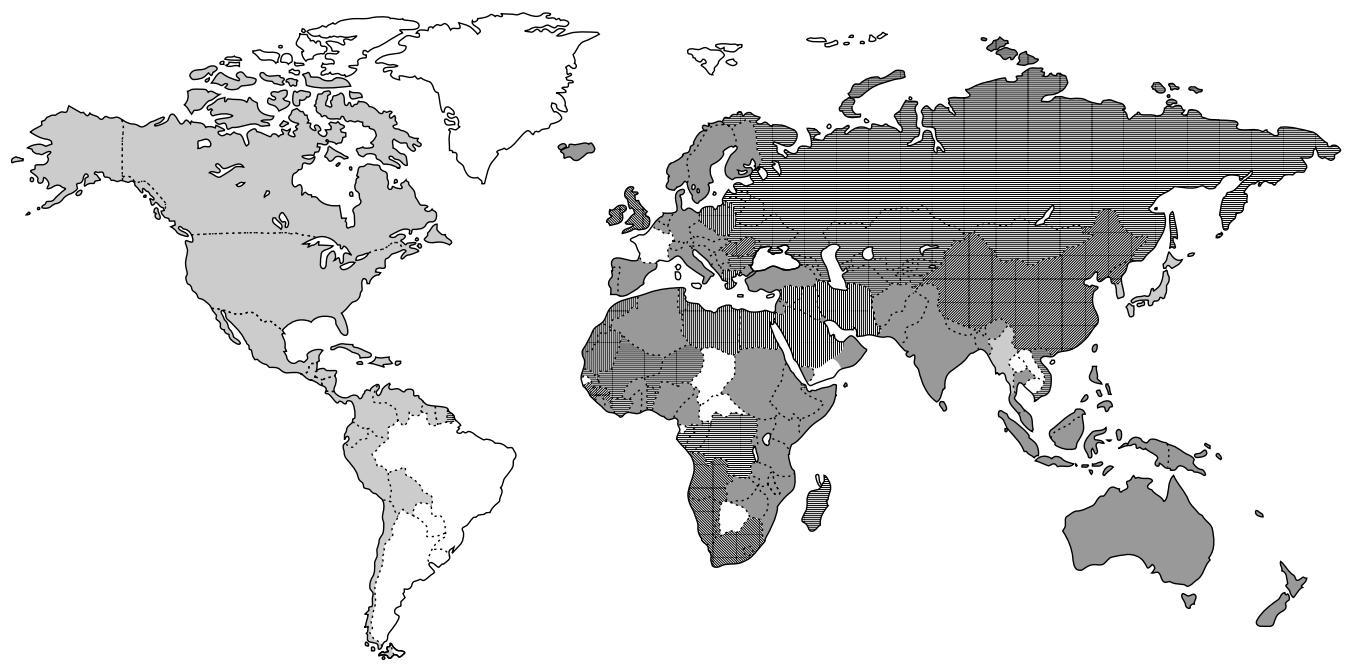
4
NTSC PAL MESECAM
B/G D/K I M
NTSCPB
10
11
RFCHSET
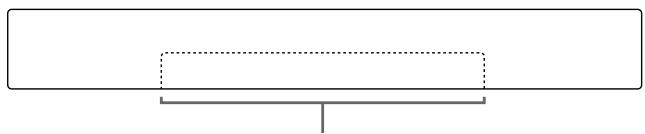
| * | (RF CH SET) | ||||||
| VL | VH | U | |||||
| PAL B/G | 2 4S01 S05**S1 S7** | 5 12S8 S41** | 21 69 | G | |||
| 2 4 | 5 12 | 21 69 | |||||
| 0 5 5A | 6 11 | 28 69 | |||||
| 1A 2 3 | 4 11 | ||||||
| PAL I | 21 68 | I | |||||
| A C | D J | ||||||
| 4 13 | 21 68 | ||||||
| PAL D/K | 1 5 | 6 12 | 13 56 | K | |||
| MESECAM B/G | 2 4 | 5 12 | 21 69 | G | |||
| MESECAM D/K | 1 5 | 6 12 | 21 60 | K | |||
| MESECAM K1 | K4 K9 | K | |||||
| NTSC 3.58 | 2 6A5 A1**A E** | 7 13F W**W+1 W+28** | 14 78W+29 W+58** | ||||
| 1 3M1 M7** | 4 12M8 M10**S1 S41** | 13 62 | |||||
| * VL=VHF** CATV | VH=VHF | U=UHF | |||||
| RF | 32 | 28 55 | |||||
| 11 12 | 20 23 | ||||||
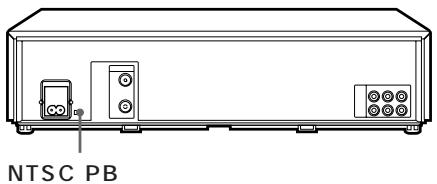
NTSCPB
NTSC3.58
NTSCPB
| NTSC PB | |
| PAL SECAM MESECAM | ON PAL TV |
| NTSC 4.43 | NTSC 4.43 |
| NTSC 3.58 | NTSC 3.58 |
8 9
NTSCPB
SECAM
5
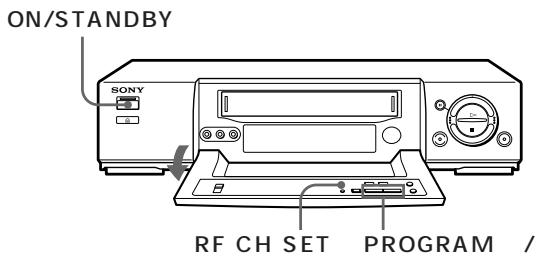
1
ON/STANDBY

ON/STANDBY
2
RF CH SET

RF CH SET
RF

3
4
RF CH SET

RF CH SET

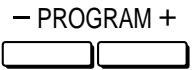
89
PAL
NTSC
1
D/K K
B/G G
RF
PROGRAM + /
M
| 5 | ||
| 5 | RF CH SET | RF CH SET |
| 3 | ||
PROGRAM
4
/
2 RF CH SET
RF 2855
5
RF
20
2
PROGRAM
RF
EASYSETUP
EASY SET UP
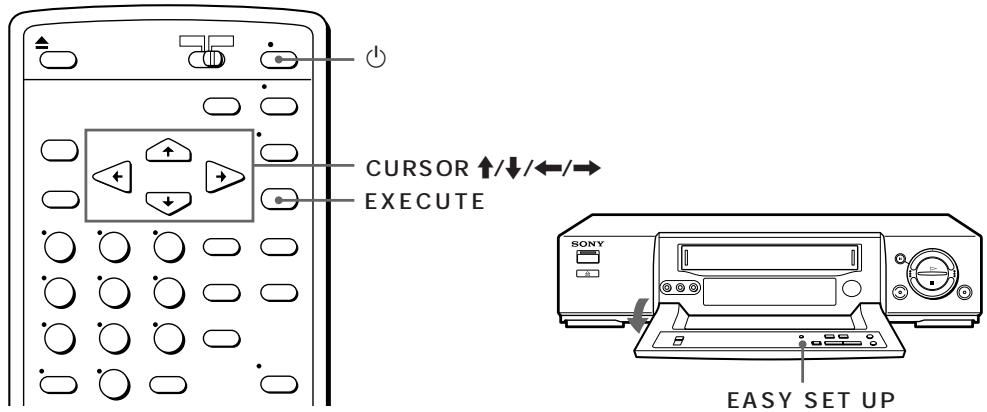
1

2
3
4


EASY SET UP
LANGUAGE
1
EASY SETUP
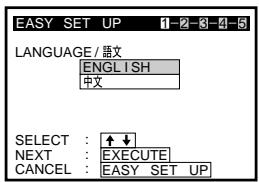
CURSOR↑/↓
ENGLISH
EXECUTE
AUTO TUNER PRESET
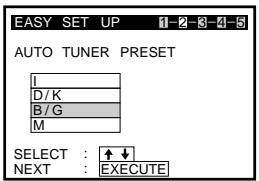

6
EASY SETUP
5
CURSOR / EXECUTE
EXECUTE

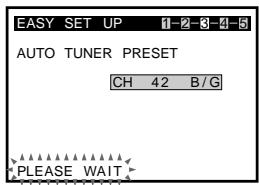
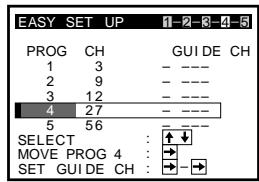
19
17
6
CURSOR ↑/↓/←/→
G
G
24
26
EXECUTE

7
EXECUTE
CLOCK SET
8
CURSOR ↑/↓/←/→
15
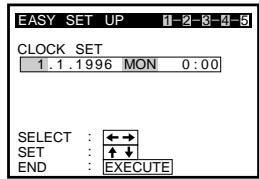
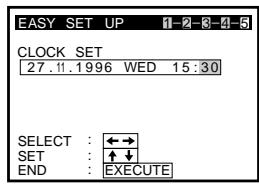
9
EXECUTE

14-J
EXECUTE
EASY SETUP
UP
EASY SETUP
EASY
5
26
20 23
C
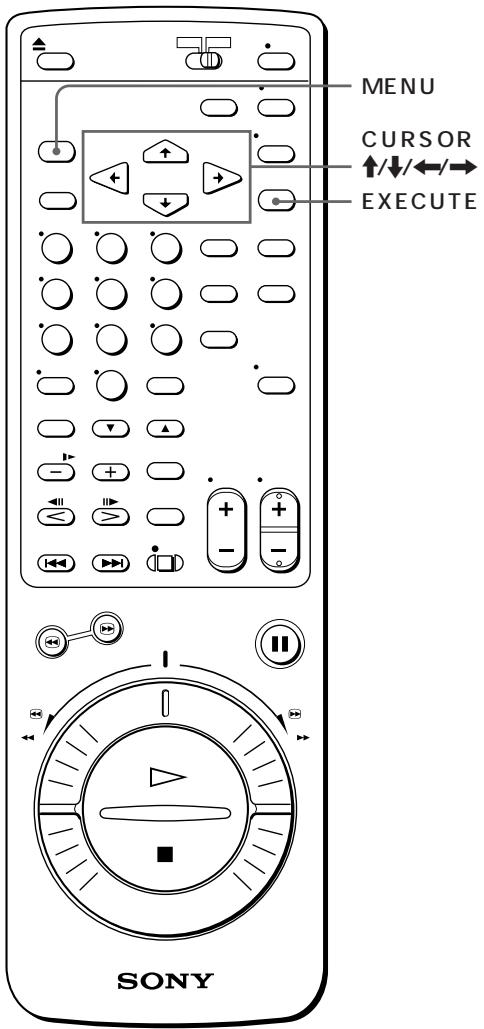
23
1 MENU
MENU
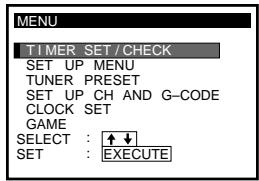
2 CURSOR↑/↓
EXECUTE
CLOCK SET
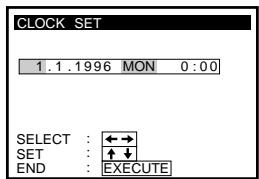
3 CURSOR↑↓
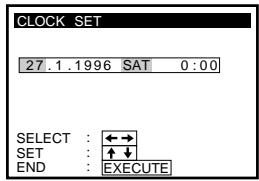
4 CURSOR
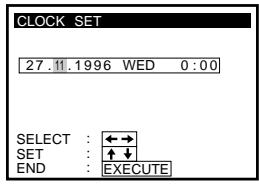
5 CURSOR
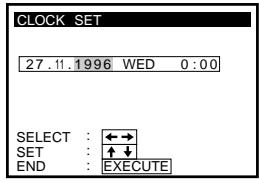
CLOCK SET
CURSOR ↑/↓
CURSOR ↑/↓
6 CURSOR
CURSOR ↑/↓
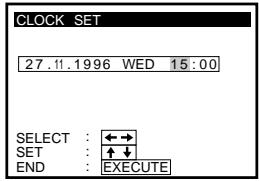
7 CURSOR
CURSOR ↑/↓
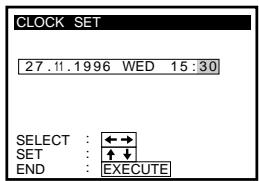
8 EXECUTE
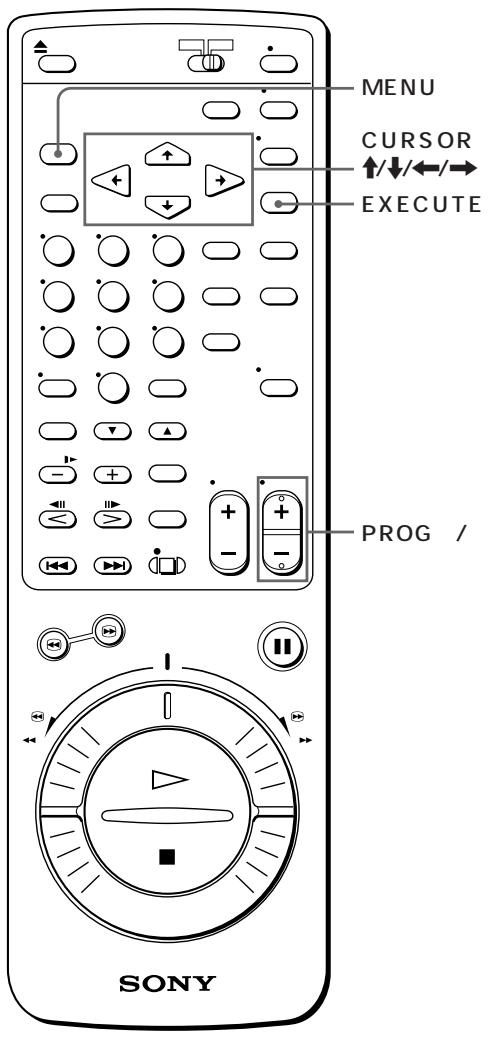
19
2 3
3 CATV
NORM
23
20
CHANNEL SET
EASYSETUP
AUTOTUNER PRESET
19
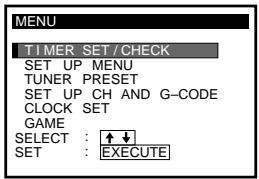
1 MENU
MENU
2 CURSOR↑/↓
EXECUTE
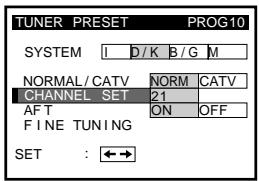
TUNER PRESET
3 CURSOR↑/↓/←/→
CATV
TUNER PRESET
NORMAL/NORM
CATV
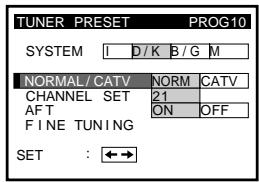
4 CURSOR ↑/↓
CHANNEL SET
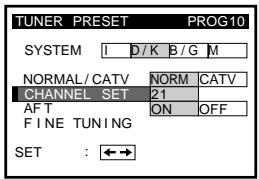
5 PROG /
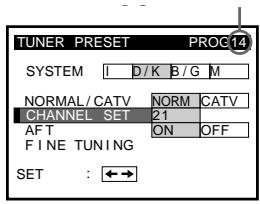
6 CURSOR


20 23
5 0 5
7

ID/K B/G M

89
19
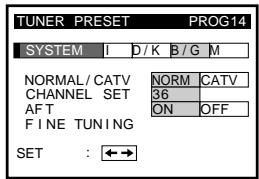
8
56
9 EXECUTE
PROG
1 MENU TUNER PRESET EXECUTE
2 CHANNEL SET
3 PROG /
PROG
40 2 CHANNEL SET O
5 34
6 EXECUTE
1 MENU TUNER PRESET EXECUTE
2 PROG /
3 SYSTEM
4 23
5 EXECUTE
AFT
1 PROG /
2 MENU TUNER PRESET EXECUTE
3 FINE TUNING
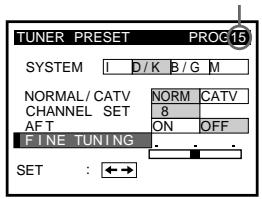
4 CURSOR / EXECUTE AFT
| B/G | |||||
| 1 | AS0 | 1 | 1A | ||
| 2 | E2 | ||||
| 3 | E3 | 1 | 2 | 2A | |
| 4 | E4 | 2 | 3 | 3A | |
| 5 | E5 | 6 | 4 | 4A | |
| 6 | E6 | 7 | 5 | M6 | 5A |
| 7 | E7 | 8 | 6 | M7 | 6A |
| 8 | E8 | 9 | 7 | M8 | 7A |
| 9 | E9 | 9A | 8 | M9 | 8A |
| 10 | E10 | 10 | 9 | M10 | 9A |
| 11 | E11 | 11 | 10 | 10A | |
| 12 | E12 | 11 | 11A | ||
| 13 | |||||
| 14 | |||||
| 15 | 3 | ||||
| 16 | 4 | ||||
| 17 | |||||
| 18 | |||||
| 19 | |||||
| 20 | |||||
| 21 | E21 | ||||
| 22 | E22 | ||||
| 23 | E23 | ||||
| 24 | E24 | ||||
| 25 | E25 | ||||
| 26 | E26 | ||||
| 27 | E27 | ||||
| RF | 28 | E28 | 28 | ||
| 29 | E29 | 29 | |||
| 30 | E30 | 30 | |||
| 31 | E31 | 31,32 | |||
| 32 | E32 | 33 | |||
| 33 | E33 | 34 | |||
| 34 | E34 | 35 | |||
| 35 | E35 | 36 | |||
| 36 | E36 | 37 | |||
| 37 | E37 | 38 | |||
| 38 | E38 | 39,40 | |||
| 39 | E39 | 41 | |||
| 40 | E40 | 42 | |||
| 41 | E41 | 43 | |||
| 42 | E42 | 44 | |||
| 43 | E43 | 45 | |||
| 44 | E44 | 46 | |||
| 45 | E45 | 47,48 | |||
| 46 | E46 | 49 | |||
| 47 | E47 | 50 | |||
| 48 | E48 | 51 | |||
| 49 | E49 | 52 | |||
| 50 | E50 | 53 | |||
| 51 | E51 | 54 | |||
| 52 | E52 | 55,56 | |||
| 53 | E53 | 57 | |||
| 54 | E54 | 58 | |||
| 55 | E55 | 59 | |||
| 56 | E56 | 60 | |||
| 57 | E57 | 61 | |||
| B/G | |||||
| 58 | E58 | 62 | |||
| 59 | E59 | 63,64 | |||
| 60 | E60 | 65 | |||
| 61 | E61 | 66 | |||
| 62 | E62 | 67 | |||
| 63 | E63 | 68 | |||
| 64 | E64 | 69 | |||
| 65 | E65 | ||||
| 66 | E66 | ||||
| 67 | E67 | ||||
| 68 | E68 | ||||
| 69 | E69 | ||||
| C1 | S1 | 5 | |||
| C2 | S2 | ||||
| C3 | S3 | ||||
| C4 | S4 | ||||
| C5 | S5 | ||||
| C6 | S6 | 5A | |||
| C7 | S7 | ||||
| C8 | S8 | ||||
| C9 | S9 | M4 | |||
| C10 | S10 | M5 | |||
| C11 | S11 | ||||
| C12 | S12 | ||||
| C13 | S13 | ||||
| C14 | S14 | ||||
| C15 | S15 | ||||
| C16 | S16 | ||||
| C17 | S17 | ||||
| C18 | S18 | ||||
| C19 | S19 | ||||
| C20 | S20 | ||||
| C21 | S21 | ||||
| C22 | S22 | ||||
| C23 | S23 | ||||
| C24 | S24 | ||||
| C25 | S25 | ||||
| C26 | S26 | ||||
| C27 | S27 | ||||
| C28 | S28 | ||||
| C29 | S29 | ||||
| C30 | S30 | ||||
| C31 | S31 | ||||
| C32 | S32 | ||||
| C33 | S33 | ||||
| C34 | S34 | ||||
| C35 | S35 | ||||
| C36 | S36 | ||||
| C37 | S37 | ||||
| C38 | S38 | ||||
| C39 | S39 | ||||
| C40 | S40 | ||||
| C41 | S41 | ||||
| C42 | S01 | ||||
| C43 | S02 | ||||
| C44 | S03 | ||||
| C45 | S04 | ||||
| C46 | S05 | ||||
RF 12 RF 11
| D/K | I | M | |||||
| / | |||||||
| 1 | A | ||||||
| 2 | R1 | 1 | |||||
| 3 | 2 | B | 2, C2 | ||||
| 4 | 3 | C | 3 | ||||
| 5 | R6 | 7 | D | 4 | 7 | J-5 | |
| 6 | R7 | 8 | E | 5 | 8 | J-6 | |
| 7 | 9 | J-7 | |||||
| 8 | |||||||
| 9 | 12 | J-10 | |||||
| 10 | 13 | J-11 | |||||
| 11 | J | J-12 | |||||
| 12 | R12 | J | 10 | K | S1 | ||
| 13 | R2 | ||||||
| 14 | R3 | 4 | 5 | ||||
| 15 | R4 | 5 | |||||
| 16 | R5 | ||||||
| 17 | R8 | 9 | F | 6 | 10 | J-8 | |
| 18 | R9 | 10 | G | 7 | 11 | J-9 | |
| 19 | R10 | 11 | H | 8 | |||
| 20 | R11 | 12 | I | 9 | |||
| 21 | R21 | 13 | B21 | 21 | 14, W+29, W+30 | J13 | |
| 22 | R22 | 14 | B22 | 22 | 15, 16, W+31 | J14, J15 | |
| 23 | R23 | 15 | B23 | 23 | 17, W+32 | J16 | |
| 24 | R24 | 16 | B24 | 24 | 18, W+33, W+34 | J17 | |
| 25 | R25 | 17 | B25 | 25 | 19, 20, W+35 | J18, J19 | |
| 26 | R26 | 18 | B26 | 26 | 21, W+36 | J20 | |
| 27 | R27 | 19 | B27 | 27 | 22, W+37, W+38 | J21 | |
| 12 | R28 | 20 | B28 | 28 | 23, 24, W+39 | J22, J23 | |
| 29 | R29 | 21 | B29 | 29 | 25, W+40 | J24 | |
| 30 | R30 | 22 | B30 | 30 | 26, W+41, W+42 | J25 | |
| 31 | R31 | 23 | B31 | 31 | 27, 28, W+43 | J26, J27 | |
| 32 | R32 | 24 | B32 | 32 | 29, W+44 | J28 | |
| 33 | R33 | B33 | 33 | 30, W+45, W+46 | J29 | ||
| 34 | R34 | B34 | 34 | 31, 32, W+47 | J30, J31 | ||
| 35 | R35 | B35 | 35 | 33, W+48 | J32 | ||
| 36 | R36 | B36 | 36 | 34, W+49, W+50 | J33 | ||
| 37 | R37 | B37 | 37 | 35, 36, W+51 | J34, J35 | ||
| 38 | R38 | 25 | B38 | 38 | 37, W+52 | J36 | |
| 39 | R39 | 26 | B39 | 39 | 38, W+53, W+54 | J37 | |
| 40 | R40 | 27 | B40 | 40 | 39, 40, W+55 | J38, J39 | |
| 41 | R41 | 28 | B41 | 41 | 41, W+56 | J40 | |
| 42 | R42 | 29 | B42 | 42 | 42, W+57, W+58 | J41 | |
| 43 | R43 | 30 | B43 | 43 | 43, 44 | J42, J43 | |
| 44 | R44 | 31 | B44 | 44 | 45 | J44 | |
| 45 | R45 | 32 | B45 | 45 | 46 | J45 | |
| 46 | R46 | 33 | B46 | 46 | 47, 48 | J46, J47 | |
| 47 | R47 | 34 | B47 | 47 | 49 | J48 | |
| 48 | R48 | 35 | B48 | 48 | 50 | J49 | |
| 49 | R49 | 36 | B49 | 49 | 51, 52 | J50, J51 | |
| 50 | R50 | 37 | B50 | 50 | 53 | J52 | |
| 51 | R51 | 38 | B51 | 51 | 54 | J53 | |
| 52 | R52 | 39 | B52 | 52 | 55, 56 | J54, J55 | |
| 53 | R53 | 40 | B53 | 53 | 57 | J56 | |
| 54 | R54 | 41 | B54 | 54 | 58 | J57 | |
| 55 | R55 | 42 | B55 | 55 | 59, 60 | J58, J59 | |
| 56 | R56 | 43 | B56 | 56 | 61 | J60 | |
| 57 | R57 | 44 | B57 | 57 | 62 | J61 | |
| D/K | I | M | |||||
| / | |||||||
| 58 | R58 | 45 | B58 | 58 | 63,64 | J62 | |
| 59 | R59 | 46 | B59 | 59 | 65 | ||
| 60 | R60 | 47 | B60 | 60 | 66 | ||
| 61 | 48 | B61 | 61 | 67,68 | |||
| 62 | 49 | B62 | 62 | 69 | |||
| 63 | 50 | B63 | 63 | 70 | |||
| 64 | 51 | B64 | 64 | 71,72 | |||
| 65 | 52 | B65 | 65 | 73 | |||
| 66 | 53 | B66 | 66 | 74 | |||
| 67 | 54 | B67 | 67 | 75,76 | |||
| 68 | 55 | B68 | 68 | 77 | |||
| 69 | 56 | B69 | 78 | ||||
| C1 | A-3 | J-3 | |||||
| C2 | A-2, A-1 | M1, M2 | |||||
| C3 | A | M3 | |||||
| C4 | B | M4 | |||||
| C5 | C | M5 | |||||
| C6 | D | M6 | |||||
| C7 | E | M7 | |||||
| C8 | F, G | M8, M9 | |||||
| C9 | H | M10 | |||||
| C10 | 6 | I | J-4 | ||||
| C11 | 11 | L | S2 | ||||
| C12 | 12 | M, N | S3 | ||||
| C13 | 13 | O | S4 | ||||
| C14 | P | S5, S6 | |||||
| C15 | Q | S7 | |||||
| C16 | R | S8 | |||||
| C17 | S | S9 | |||||
| C18 | T, U | S10, S11 | |||||
| C19 | V | S12 | |||||
| C20 | W | S13 | |||||
| C21 | W+1, W+2 | S14, S15 | |||||
| C22 | W+3 | S16 | |||||
| C23 | W+4 | S17 | |||||
| C24 | W+5, W+6 | S18, S19 | |||||
| C25 | W+7 | S20 | |||||
| C26 | W+8 | S21 | |||||
| C27 | W+9, W+10 | S22, S23 | |||||
| C28 | W+11 | S24 | |||||
| C29 | W+12 | S25 | |||||
| C30 | W+13, W+14 | S26, S27 | |||||
| C31 | W+15 | S28 | |||||
| C32 | W+16 | S29 | |||||
| C33 | W+17, W+18 | S30, S31 | |||||
| C34 | W+19 | S32 | |||||
| C35 | W+20 | S33 | |||||
| C36 | W+21, W+22 | S34, S35 | |||||
| C37 | W+23 | S36 | |||||
| C38 | W+24 | S37 | |||||
| C39 | W+25, W+26 | S38, S39 | |||||
| C40 | W+27 | S40 | |||||
| C41 | W+28 | S41 | |||||
| C42 | 4, 4A | ||||||
| C43 | |||||||
| C44 | 6 | ||||||
| C45 | A-5 | J-1 | |||||
| C46 | A-4 | J-2 | |||||
G
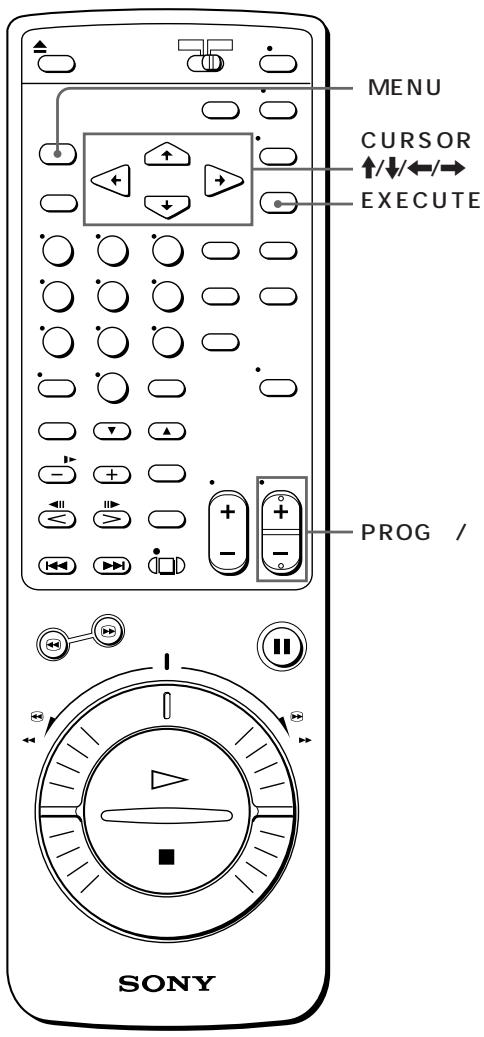
2 3
G
2
C
20 23
G
1 MENU
MENU
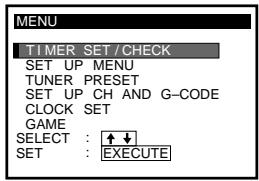
CODE
G
2 CURSOR↑/↓
SETUPCHANDG-CODE

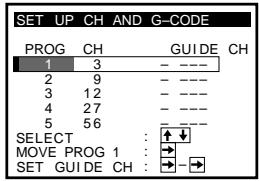
3 CURSOR↑/↓
PROG
6 50
CURSOR ↑/↓
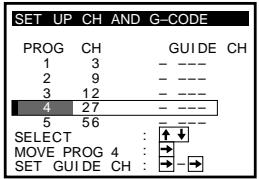
4 CURSOR
GUIDE CH
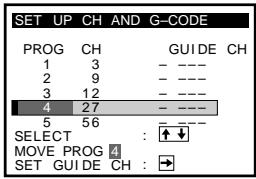
1
5 CURSOR
SETUPCHANDG- EXECUTE
GUIDE CH

CH
GUIDE CH
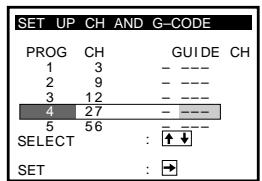

GUIDE CH
--- 1 255
CURSOR↑/
1
GUIDE CH
--
G
LINE IN
6 CURSOR↑/↓
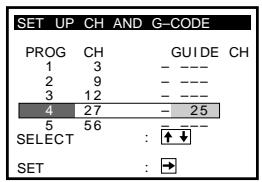
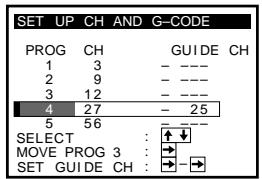
9
8
37
26
2
EXECUTE
G-CODE G
AERIAL IN
TUNER
PRESET
SETUPCHANDG-CODE
G
1
2 MENU
TUNER PRESET
EXECUTE
3 PROG /
4 CHANNEL SET
CURSOR
CHANNEL SET
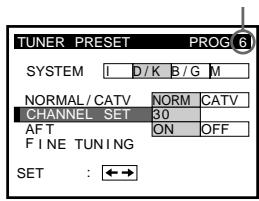
6
5 PROG /
4
24
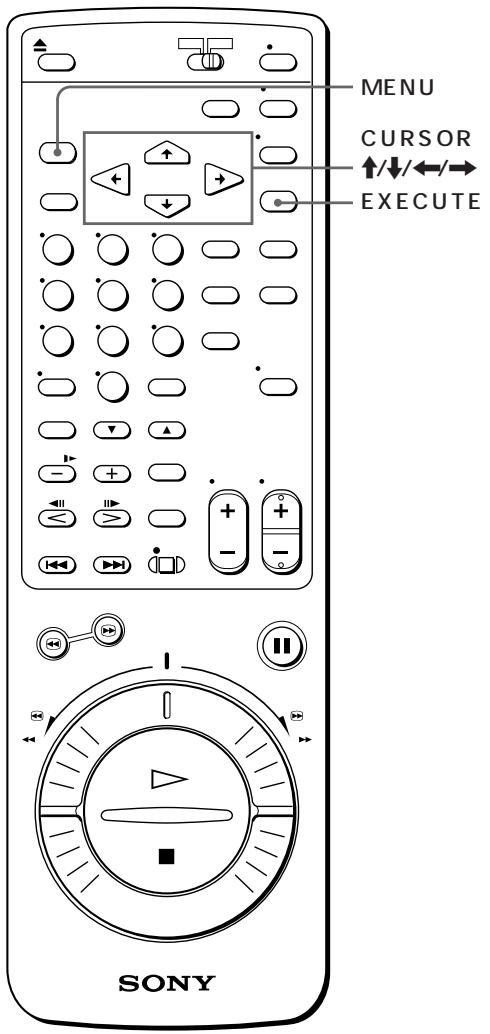
1 MENU
MENU
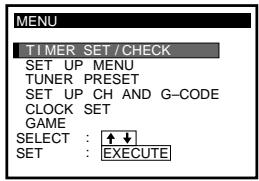
CODE
G
2 CURSOR↑/↓
SETUPCHANDG- EXECUTE
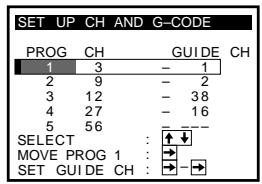
SETUPCHANDG-CODE
3 CURSOR↑/↓

6 50
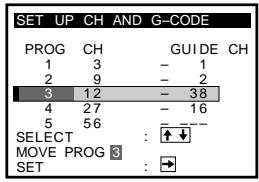
CURSOR ↑/↓
4 CURSOR↑/↓
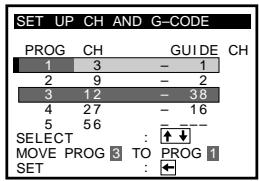
CURSOR
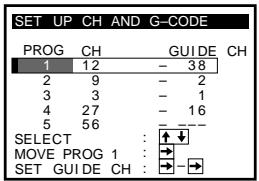
EXECUTE
5
34
6
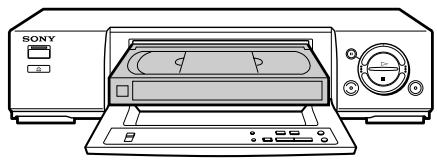
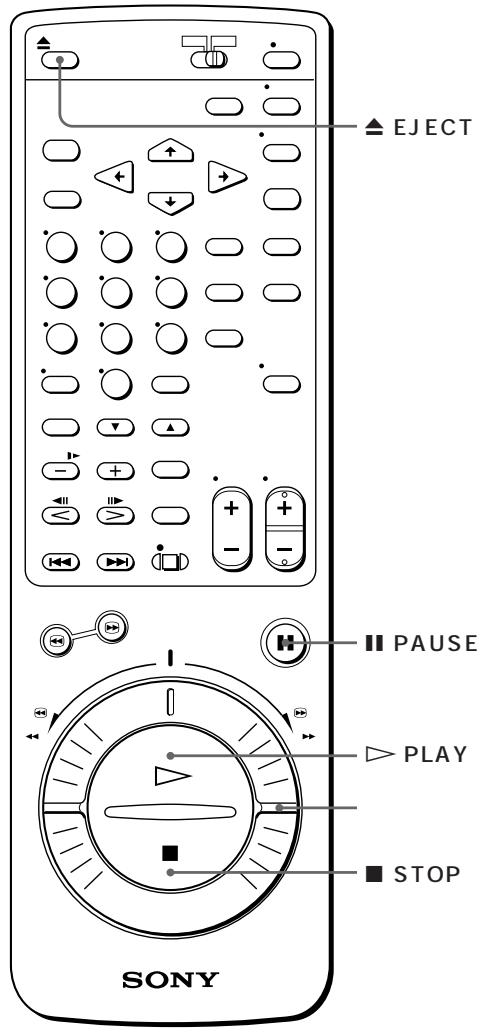
41
LP
1
2
34
3 PLAY
STOP
PAUSE
PAUSE PLAY



EJECT
COLOR SYSTEM
AUTO
8
NTSC
| COLOR SYSTEM | |
| PAL | PAL/MESECAM |
| NTSC | NTSC |
| MESECAM | PAL/MESECAM |
NTSC
DISPLAY
E-30
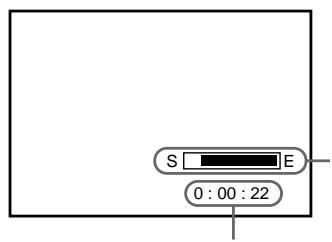
OHOOOOS
COUNTER RESET
OHOOMOOS
PAL NTSC
AUDIO MONITOR
AUDIO OUT
SETUP MENU AUDIOMIX ON
AUDIO MONITOR
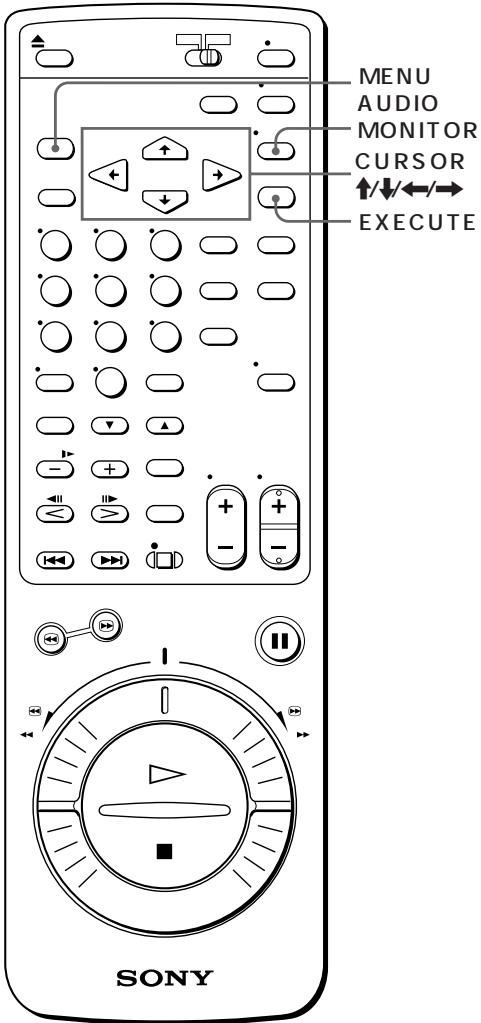
| AUDIO MONITOR | |
| STEREO | STEREO |
| LCH | MAIN/L |
| RCH | SUB/R |
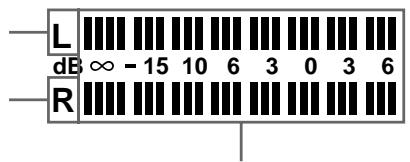
2
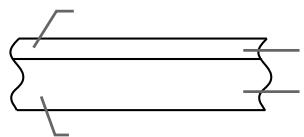
1 MENU
SETUP MENU
2 CURSOR / / /
MIX
ON
AUDIO MONITOR
SLV-X842/X842ML
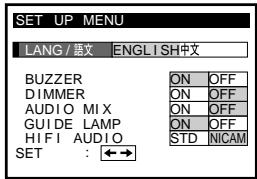
SLV-X842/X842ML
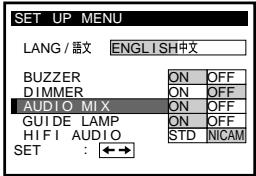
AUDIO MIX OFF
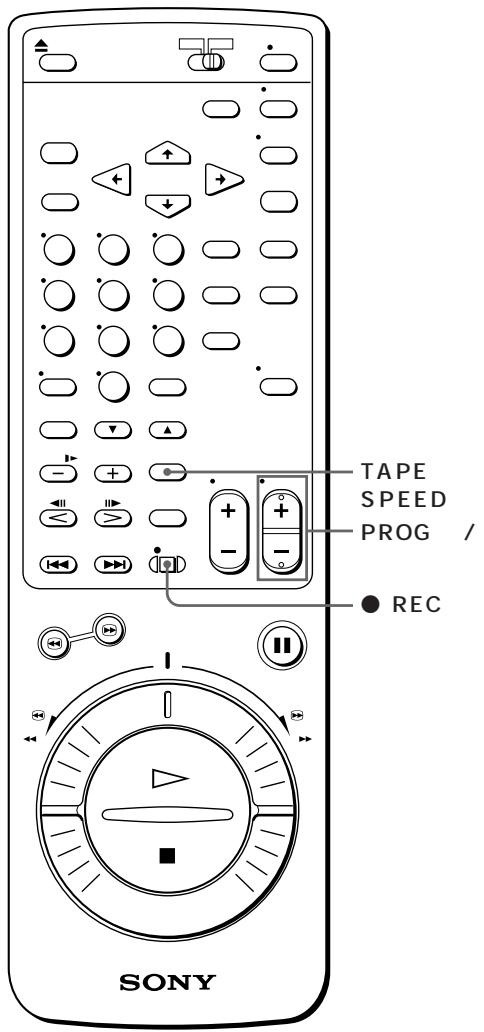
2
-- 2
PAUSE
PAUSE
32
37
G-CODE G
G
35
1
2
3
PROG /

4
TAPE SPEED
PAL/MESECAM
SP LP
NTSC
SP EP

5
REC

STOP
LINE1 LINE2
INPUT SELECT
L1 L2
PAL
SP LP
SP
LP SP
SP
1
SP LP
REC
NTSC PAL MESECAM
| SP | LP | |
| E-300 | 5 | 10 |
| E-240 | 4 | 8 |
| E-180 | 3 | 6 |
| E-120 | 2 | 4 |
| E-60 | 1 | 2 |
NTSC
SP EP
SP
EP SP 3
SP
1
SP EP
| SP | EP | |||
| T-160 | 2 | 40 | 8 | |
| T-120 | 2 | 6 | ||
| T-60 | 1 | 3 | ||
| T-30 | 30 | 1 | 30 | |
30
QUICK TIMER
TIMER
30

0:00
STOP
QUICK TIMER
NICAM SLV-X842/X842ML
N I C A M N I C A M N I C A M
STEREO
MAIN/L
1 MENU
MENU
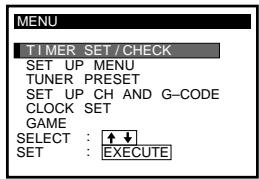
2 CURSOR↑/↓
EXECUTE
SETUP MENU
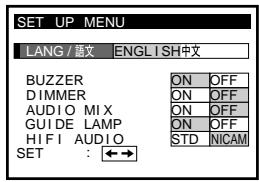
3 CURSOR / / /
NICAM
SETUP MENU
HIFI AUDIO
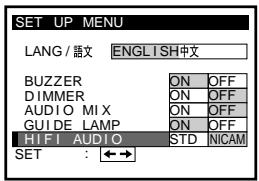
4 EXECUTE
N I C A M N I C A M
- HIFI AUDIO NICAM
29
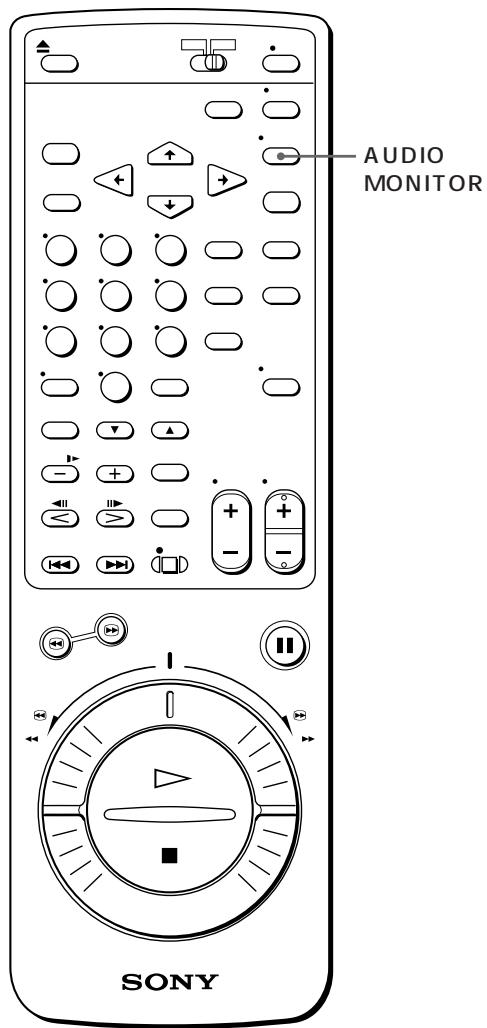
AUDIO MONITOR ZWEITON
ZWEITON
SLV-X842/X842ML
TUNER PRESET
I D/K B/G M B/G
SYSTEM
ZWEITON
STEREO
MAIN/L
AUDIO MONITOR
| AUDIO MONITOR | |
| MAIN | MAIN/L |
| SUB | SUB/R |
| MAIN/SUB | MAIN/L SUB/R |
SLV-X821MKII
SLV-X821MKII
STEREO
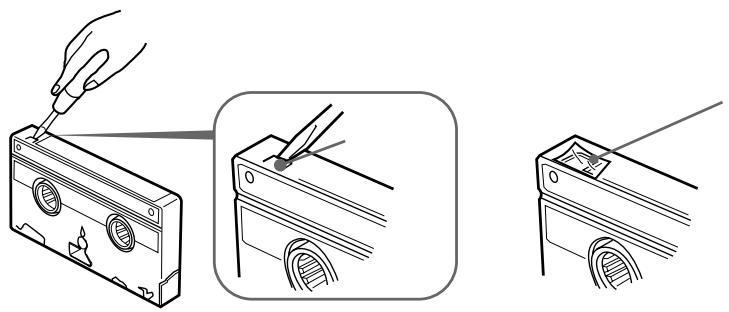
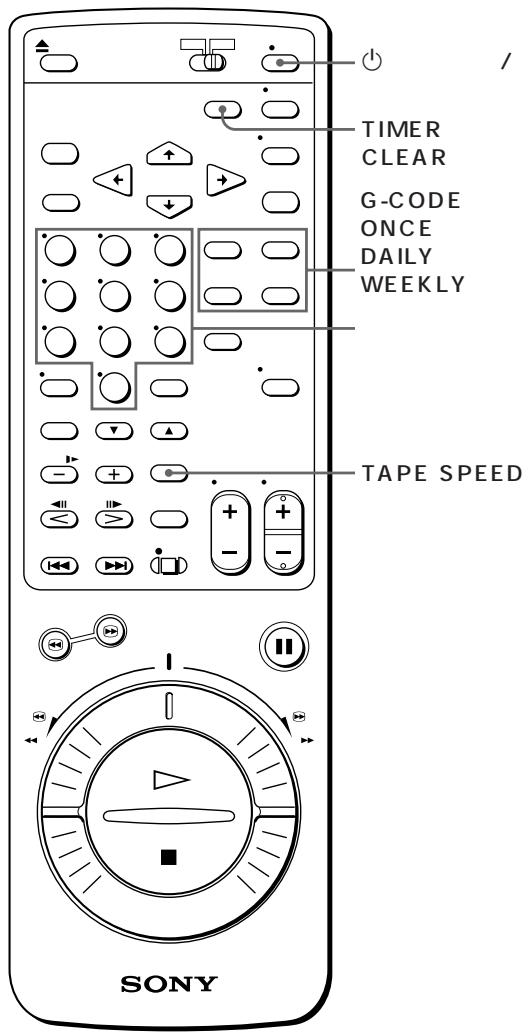
G
NTSC
EP
LP
G
G-CODE G
G
9
guide channel
24
G
1 G-CODE
G-CODE G
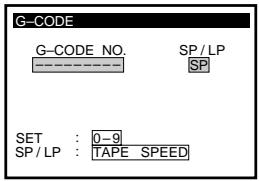
2
PLEASE SET THE CLOCK
G-CODE
TIMER CLEAR
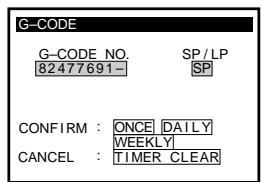
3
TAPE SPEED
SP LP
31
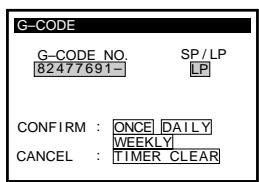
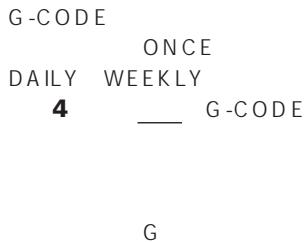
G
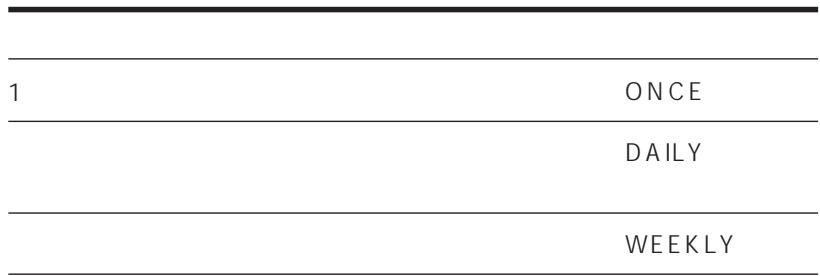
4 ONCE DAILY WEEKLY
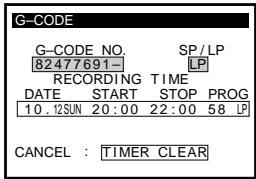
TIMER CLEAR
G-CODE
DAILY
1
DAILY
WEEKLY
CODE
G CODE
G-CODE
G-
1
1
1
14
5
TIMER
STOP
G
1
2
3
G
G
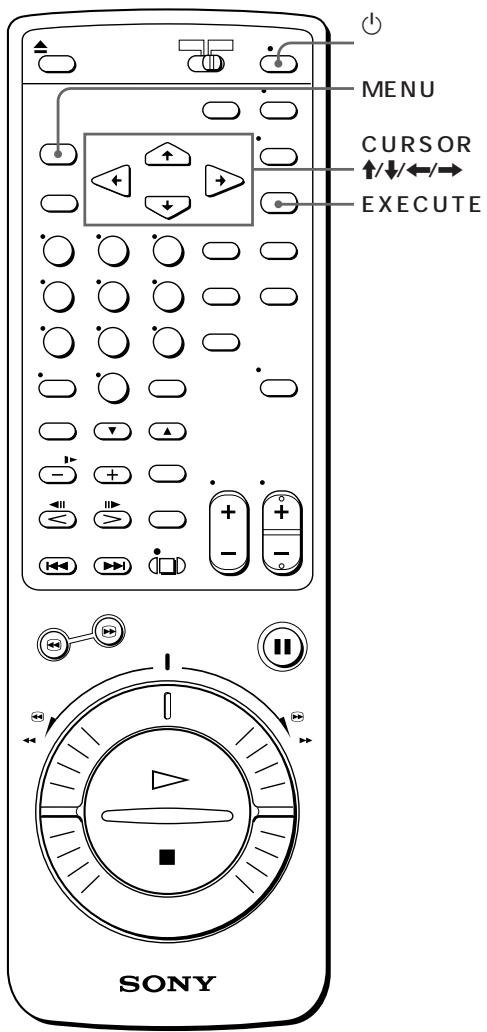
1 MENU
2 CURSOR↑/↓ TIMER SET/CHECK EXECUTE
TIMER SET/CHECK
PLEASE SET THE CLOCK
3 1 CURSOR DATE
2 CURSOR ↑/↓
4 1 CURSOR START ↑/↓
2 CURSOR
START CURSOR
5 CURSOR
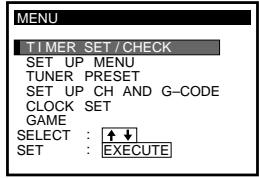
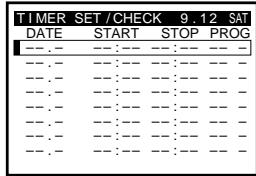
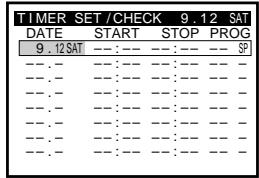

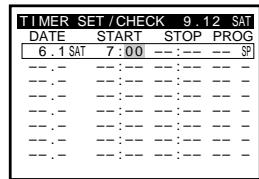
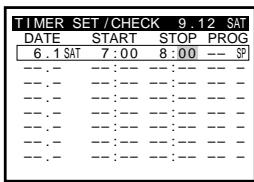
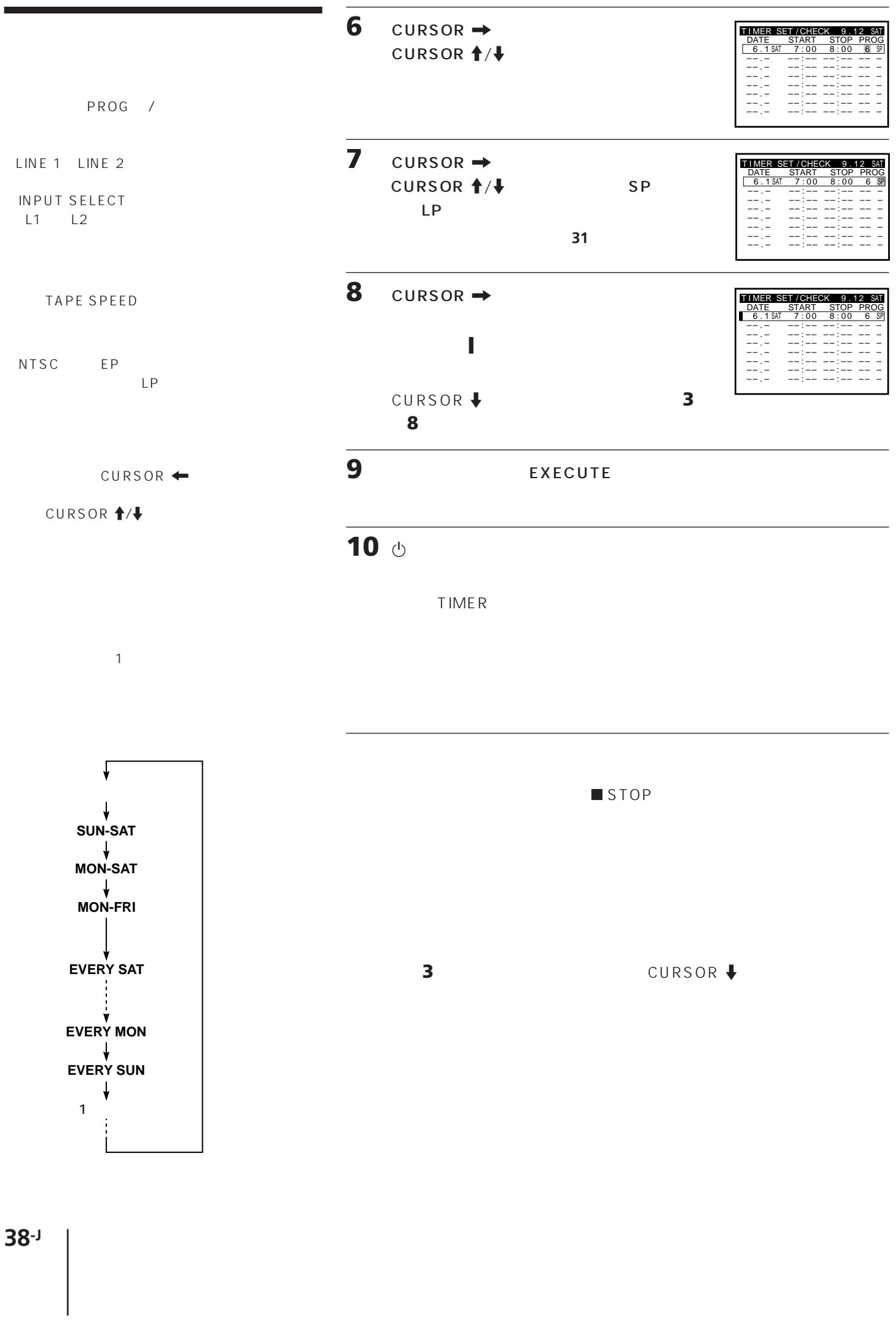
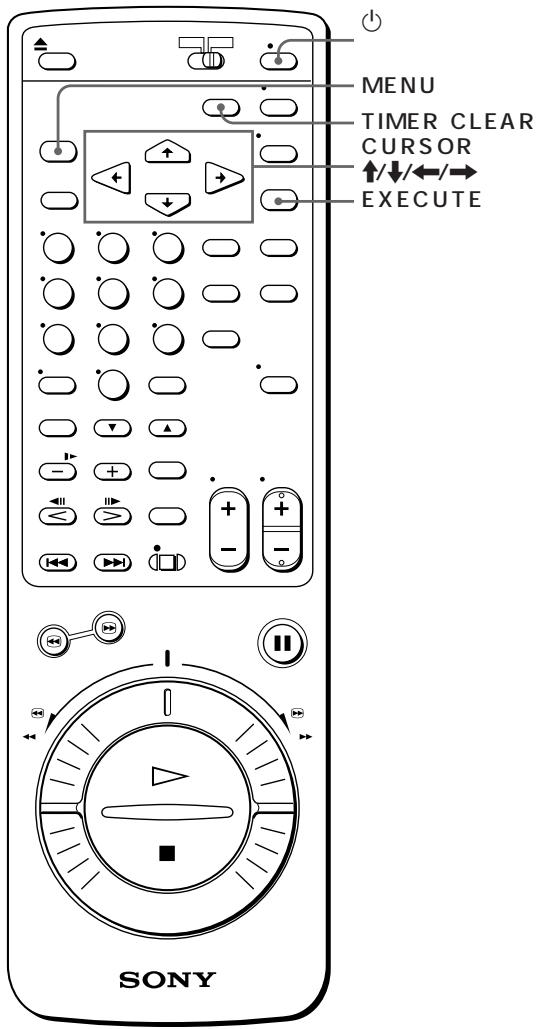
1 0(
2 MENU TIMER SET/
CHECK
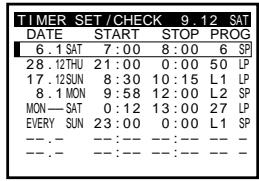
3


4
CURSOR /
CURSOR

CURSOR
TIMER CLEAR
5 EXECUTE
TIMER SET/CHECK
MENU
TIMER SET/CHECK
EXECUTE
| OHOOMOOS | COUNTER RESET | |
| DISPLAY | ||
| MENUSBET/CHECK | TIMER | |
| 32 | ||
| 1 | TIMER |
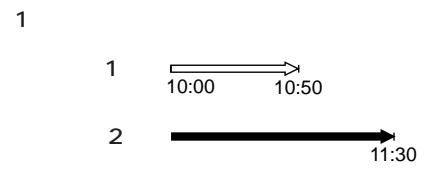

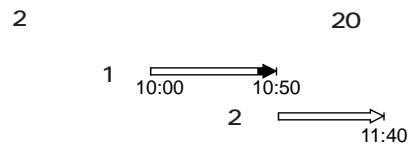

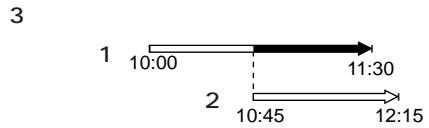

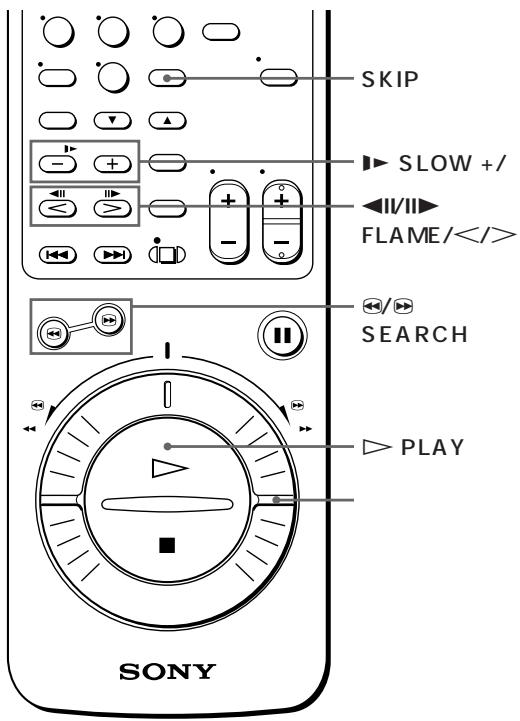
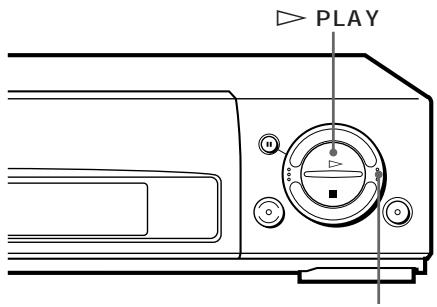
/ TRACKING NORMAL/SLOW STILL ADJUST

LP NTSC EP
LP
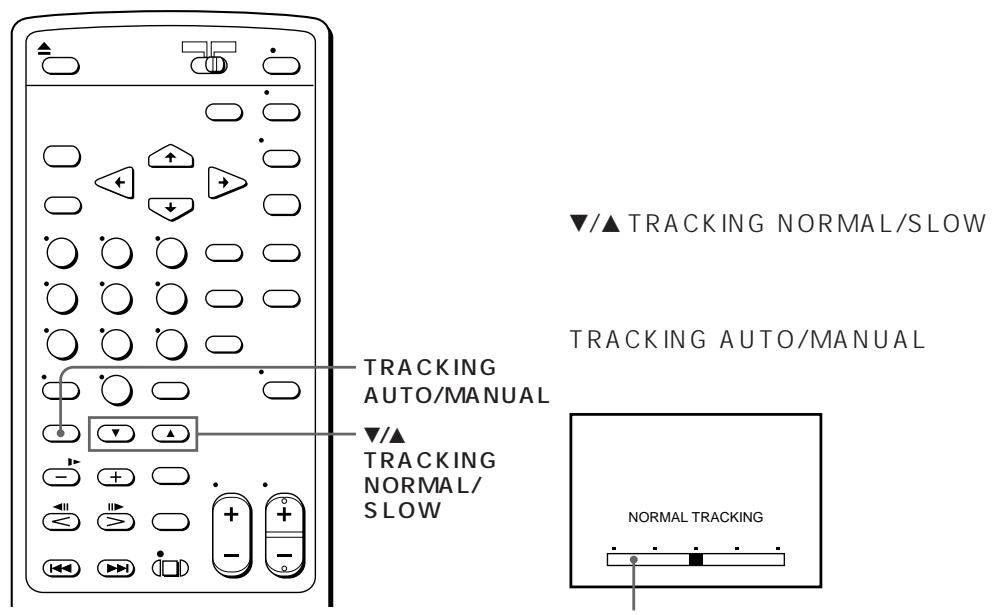
AUTO TRACKING
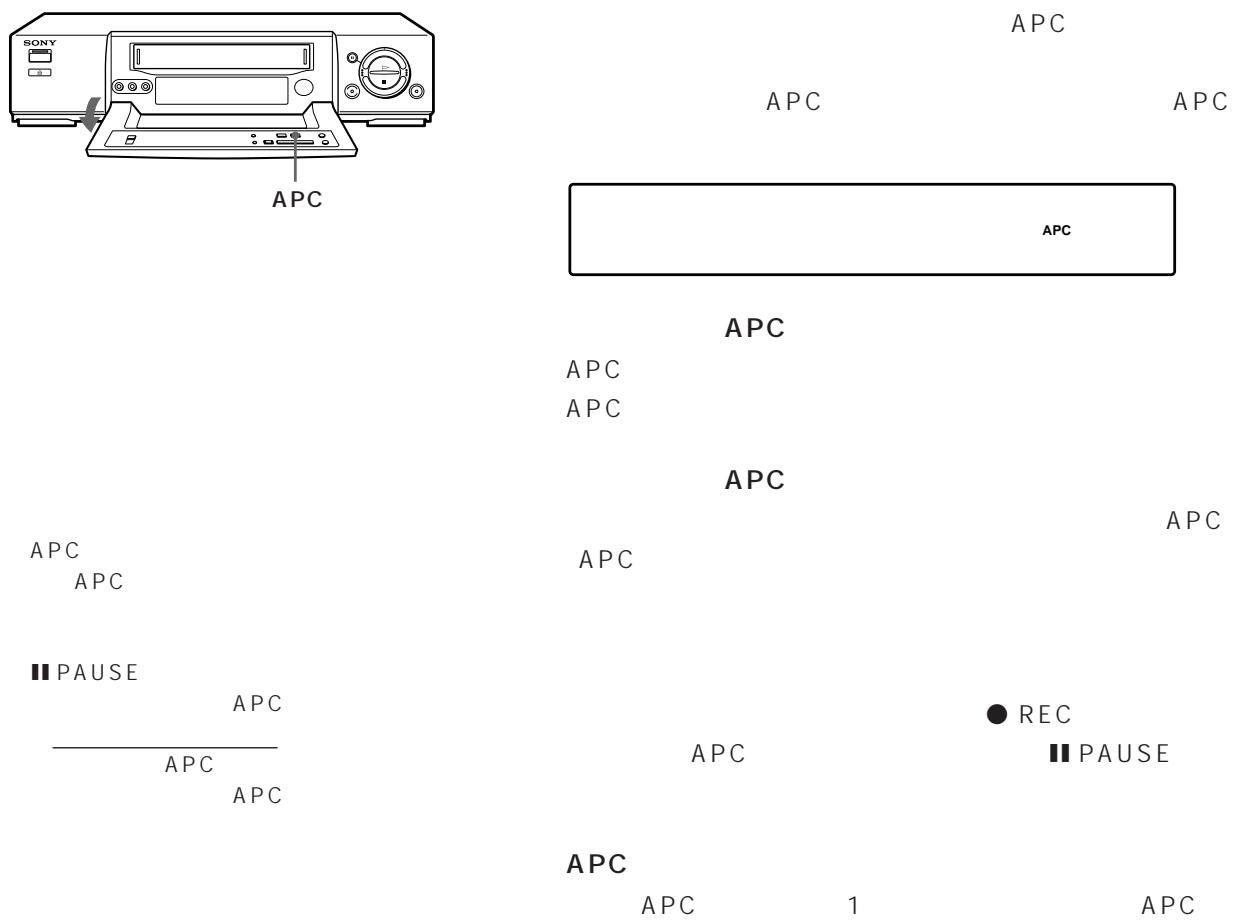
APC
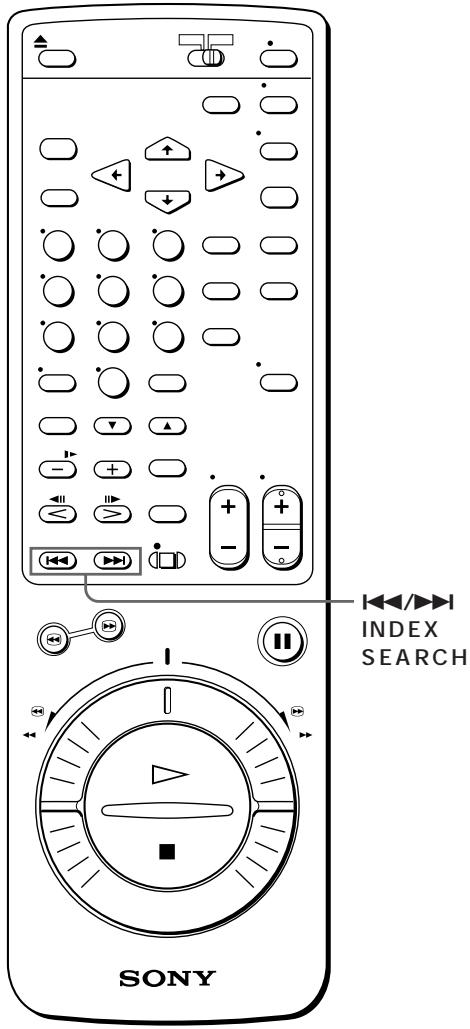
1
2
SEARCH
INDEX SEARCH
INDEX SEARCH
0
0
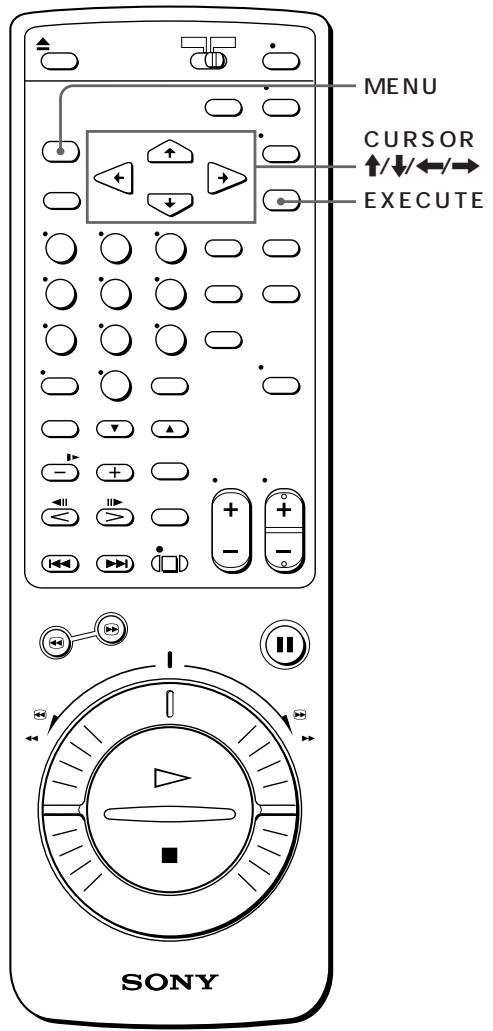
255
3
2
1
YOU
STAGE
BEST
PAL NTSC
1 MENU
2 GAME
EXECUTE
1
3 CURSO
EXECUTE
EXECUTE
4
2
1
5
34
EXECUTE
3
2
3
MENU
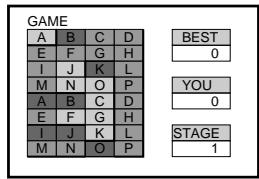
1
SLV-X842/X842ML
| SET UP MENU | |
| LANG/語文 | ENGLISH中文 |
| BUZZER | ON OFF |
| DIMMER | ON OFF |
| AUDIO MIX | ON OFF |
| GUIDE LAMP | ON OFF |
| HI FI AUDIO | STD NICAM |
| SET :←→ | |
SLV-X821MKII
| SET UP MENU | |
| LANG/語文 | ENGLISH中文 |
| BUZZER | ON OFF |
| DIMMER | ON OFF |
| AUDIO MIX | ON OFF |
| GUIDE LAMP | ON OFF |
| SET :←→ | |
| LANG | ENGLISH | |
| BUZZER | ON | |
| OFF | ||
| DIMMER | ON | |
| OFF | ||
| AUDIO MIX | ON | AUDIO MONITOR |
| OFF | AUDIO MONITOR | |
| 34 | ||
| GUIDE LAMP | ON | ●REC |
| TIMER | ||
| OFF | ||
| HIFI AUDIO (SLV-X842/X842 ML) | STD | |
| NICAM | NICAM | |
| 33 | ||
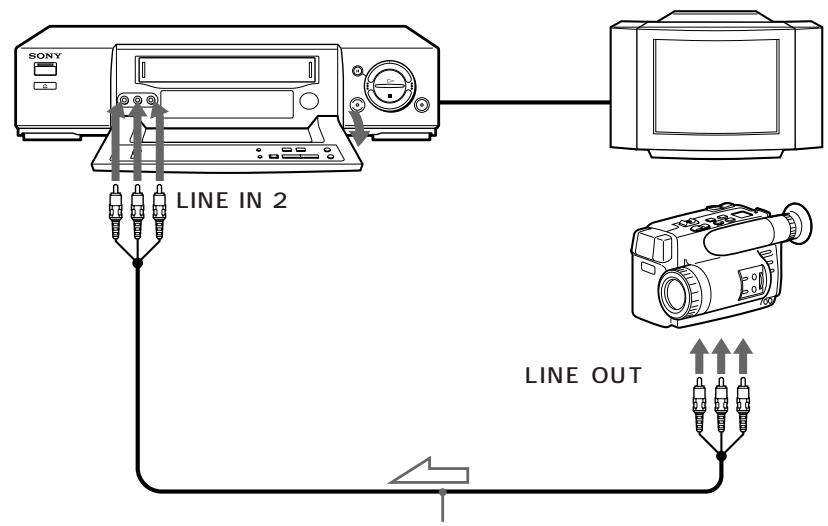
:
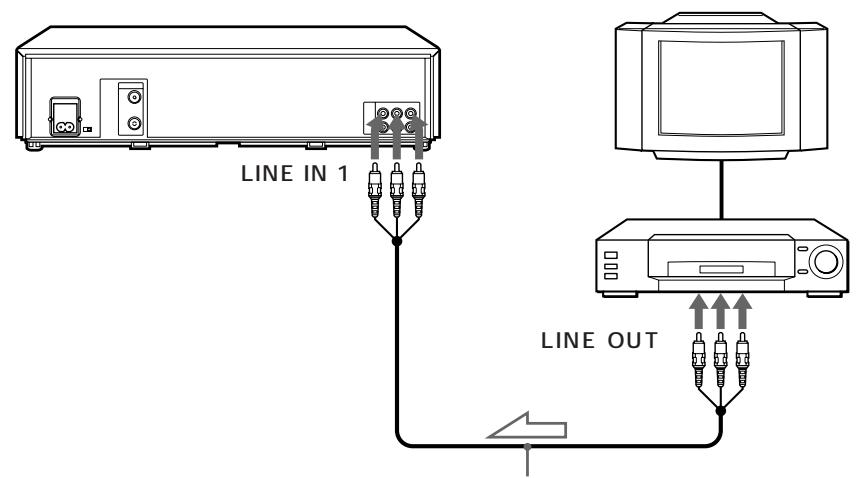
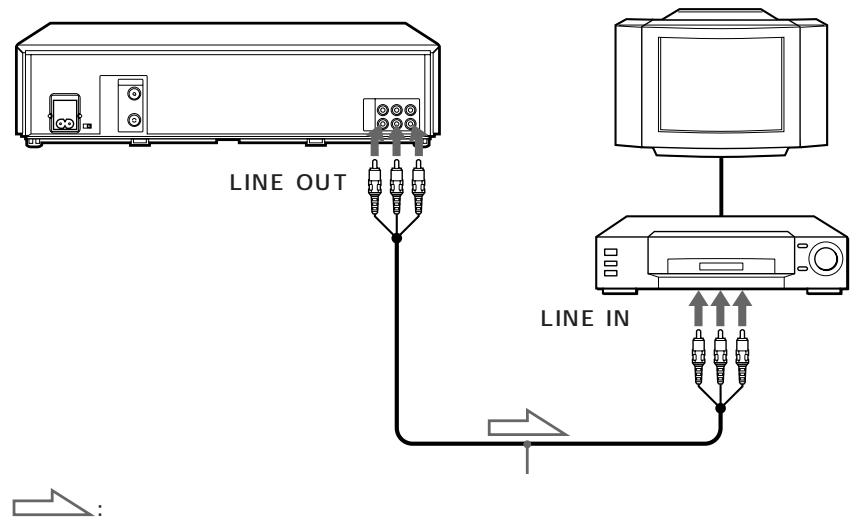
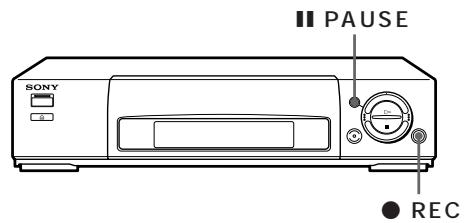
INPUT SELECT
L1 L2
TAPE SPEED
PAL
MESECAM
NTSC
SP EP
1
2
II PAUSE
II PAUSE
PAUSE 1
3
REC
4
II PAUSE
II PAUSE
II PAUSE
STOP
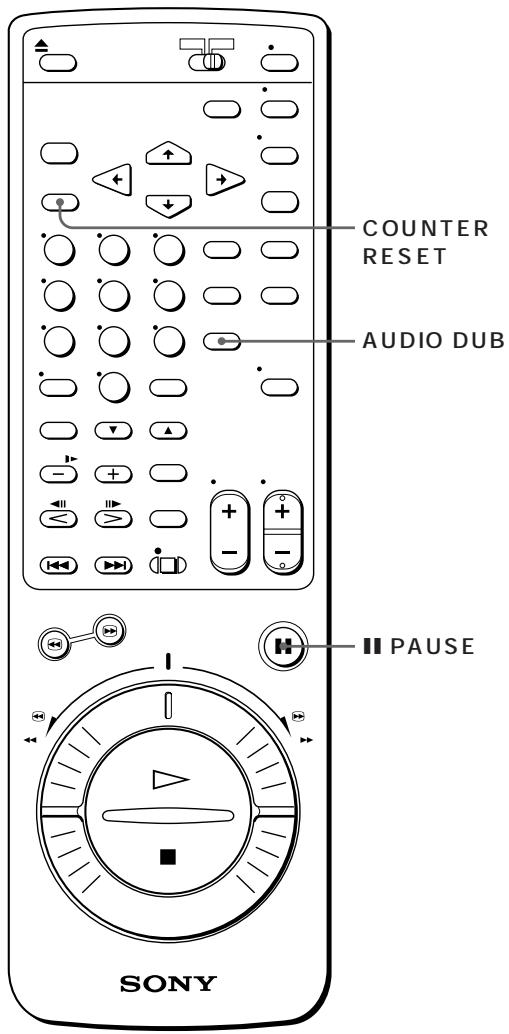
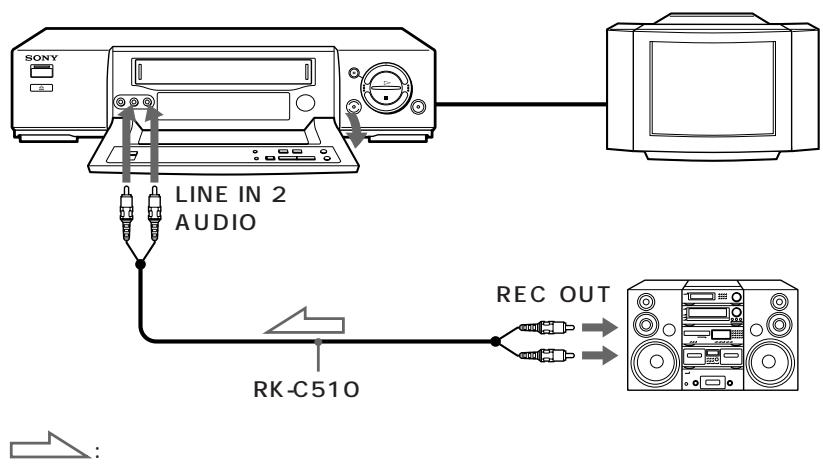
LINE IN 2 AUDIO INPUT SELECT L2
1
2
3
COUNTER RESET
II PAUSE
4
5
AUDIO DUB
A-DUB

AUDIO DUB
6 PAUSE
OHOOOOS
STOP
SETUP
MENU
AUDIO MIX ON
29
AUDIO MONITOR
34
?
ON/STANDBY
:--
1
1
TRACKING NORMAL/SLOW
COLOR SYSTEM
NTSCPB
V-25CL
SETUP MENU
AUDIO MIX OFF
TUNER PRESET
SYSTEM I D/K B/G M
REC
REC
INPUT SELECT
L1 L2
1
2
VHF R1 R12,E2 E12,NZ1
UHF E21 E69,R21 R69
CATV S01 S05,S1 S41
RF
UHF 2855
75
110 240VAC 50/60Hz
27W SLV-X842/X842ML
25W SLV-X821MKII
5C 40C
20C 60C
430×103×323mm
5.0Kg
LINE IN 1
VIDEO IN 1
:1Vp-p 75
AUDIO IN 2
327mVrms
47k
LINE IN 2
VIDEO IN 1
:1Vp-p 75
AUDIO IN 2
327mVms
47k
LINE OUT
VIDEO OUT 1
:1Vp-p 75
AUDIO OUT 2
327mVms
47k
10k
1
3 R6 size AA 2
1
1
2 1
SLV-X842ML
3 1
SLV-X842/X821MKII
1
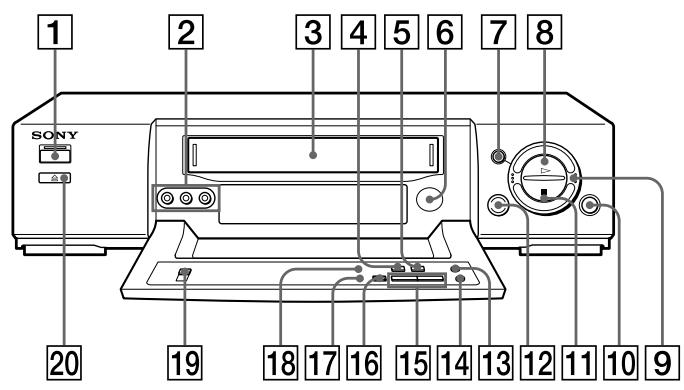
1 ON/STANDBY
11
LINEIN2
2 46
3
4 AUDIO DUB
48
5 APC
42
6
7 PAUSE
47 49
8 PLAY
41
9 27 41
10 REC
47

STOP
47 49
12 TIMER
36 38
13 QUICK TIMER
32
14 TAPE SPEED
15 PROGRAM
11
16 INPUT SELECT
17 EASYSETUP
13
18 RFCHSETRF
1
19 COLOR SYSTEM
28
20 EJECT
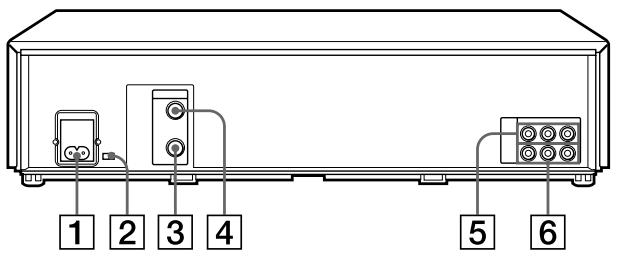
1 ACIN 7
2 NTSCPB NTSC 10
3 AERIAL IN 7
4 AERIAL OUT 7
LINEIN1 46
LINEOUT 747
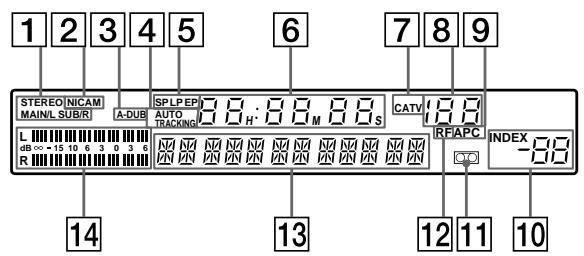
1 29
2 NICAM SLV-X842/X842ML 33
3 A-DUB 48
4 AUTO TRACKING 42
5 30
6 28
7 CATV
8 RF 11 30 47 48
9 APC 42
10 43
11
12 RF RF 11
13 8
14 29
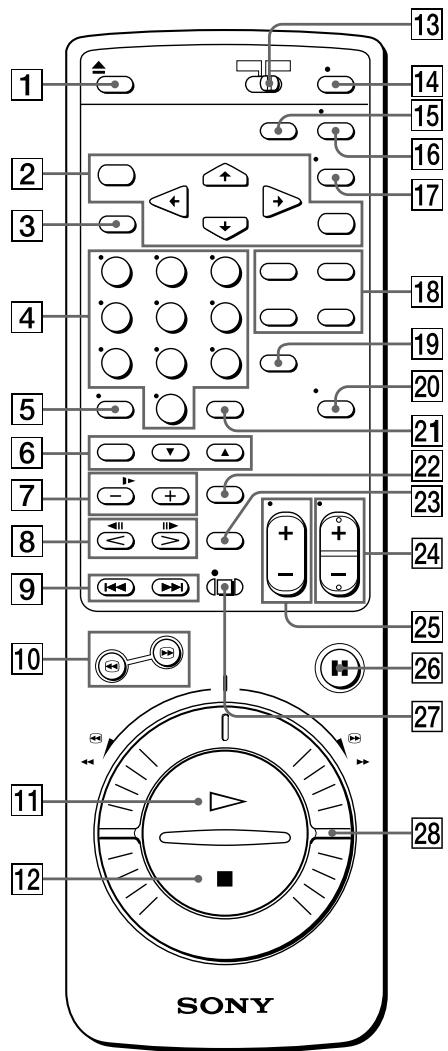
1 EJECT 27
2
13 15
MENU

EXECUTE
3 COUNTER RESET
28
4
18 30 35
5 --- 2
30
6 TRACKING
41 42
AUTO/MANUAL
/ TRACKING NORMAL/ SLOW STILL ADJUST
7 SLOW
41
8 / / FRAME/</>
41
9 INDEX SEARCH
43
10 SEARCH
27,41
11 PLAY 27
41
12 STOP 27
41
13 TV VTR
14
36 38 39 40
15 TIMER CLEAR
39
16 TV/VIDEO
6
17 AUDIO MONITOR
34
18 G-CODE G
36
G-CODE
ONCE 1
DAILY
WEEKLY
19 AUDIO DUB
48
20 DISPLAY
28
21SKIP
41
22 TAPE SPEED
30 35 38 47
23 INPUT SELECT
31 38 47 48
24 PROG /
18 19
30
25 VOL /
26 PAUSE
27 42
27 REC
30 42
28 27 41
6
AFT 19