MG100E14586BHLP - Lave-linge séchant FAGOR - Notice d'utilisation et mode d'emploi gratuit
Retrouvez gratuitement la notice de l'appareil MG100E14586BHLP FAGOR au format PDF.

| Type de produit | Lave-linge séchant |
| Marque | Fagor |
| Modèle | MG100E14586BHLP |
| Capacité de lavage | 10 kg |
| Capacité de séchage | 6 kg |
| Vitesse d'essorage maximale | 1400 tr/min |
| Dimensions (L x P x H) | 600 x 577 x 847 mm |
| Poids net | 60 kg |
| Tension nominale | 220-240 V ~ 50 Hz |
| Puissance nominale | 2000 W |
| Puissance de séchage | 1600 W |
| Pression d'eau | 0,03 - 1,0 MPa |
| Classe de protection | IPX4 |
| Niveau sonore lavage | 62 dB(A) |
| Niveau sonore essorage | 76 dB(A) |
| Programmes de lavage | Mix, Coton, Anti-allergie, Laine, Baby Care, Chemises, Literie, Eco 40-60, 20°C, Lavage rapide, Séchage, Doudoune, Rinçage+Essorage, Essorage, Nettoyage tambour, M-Smart, Vapeur |
| Fonctions spéciales | Départ différé (jusqu'à 24h), Sécurité enfants, Ajout de linge en cours, Arrêt cuve pleine, Eclairage tambour |
| Séchage | Automatique et minuté (30-240 min) |
| Entretien et nettoyage | Nettoyage tambour, Nettoyage canal de séchage, Filtre pompe, Filtre arrivée d'eau |
| Réparabilité | Pièces détachées disponibles via service après-vente |
FOIRE AUX QUESTIONS - MG100E14586BHLP FAGOR
Questions des utilisateurs sur MG100E14586BHLP FAGOR
0 question sur cet appareil. Repondez a celles que vous connaissez ou posez la votre.
Poser une nouvelle question sur cet appareil
Téléchargez la notice de votre Lave-linge séchant au format PDF gratuitement ! Retrouvez votre notice MG100E14586BHLP - FAGOR et reprennez votre appareil électronique en main. Sur cette page sont publiés tous les documents nécessaires à l'utilisation de votre appareil MG100E14586BHLP de la marque FAGOR.
MODE D'EMPLOI MG100E14586BHLP FAGOR
Amica
Model:
MG100-E14586BHLP
xy
Welcome to Your New washer-dryer!
Congratulations on your selection of a new Amica brand washer-dryer for your laundry needs. We are confident you will enjoy the superior performance and reliability.
Please do not hesitate to contact our Customer Service department if you have any questions or comments with your new washer-dryer.
Thank you for choosing Amica brand washer-dryer.
Safety instructions. 2-3-4-5
Safety instructions
Disposal
Installation. 6-7-8-9-10-11-12
Unpacking,
Carrying the appliance
What's included
Removing the transport bolts
Choosing the Right Location
Levelling the appliance
Connecting the water supplies and electricity
Technical date
Description of the appliance. 13-14
Control panel
Display
Preparing and sorting laundry. 15-16-17
Preparing the laundry
Preparing the laundry for drying
Sorting the laundry according to colour and degree of soiling
Sorting laundry according to their care label specifications
Various cycles and functions. 18-19-20-21-22
Table of wash cycles
M-Smart wash cycle
Drying program
Drying channel cleaning
Special wash cycles
Delay end
Child lock
Add clothes during the program is running
Cancelling the buzzer
Load balancing system
Downlight
How to use the appliance. 23-24-25
Before loading your first load of laundry
Daily use
Preparing the laundry
How to use the washing machine
Care and maintenance.26-27-28
Cutting off water and electricity supplies
Cleaning the appliance's exterior
Cleaning the drum
Dscaling the washer
Caring for the door and drum of your appliance
Checking the water inlet hose
Cleaning the detergent dispenser
Cleaning the mesh filter in the water supply hose
Cleaning the drain pump
Troubleshooting. 29-30-31-32
When properly cared for, your new appliance has been designed to be safe and reliable. Read and understand all safety instructions before using the appliance. Keep them nearby for future reference. These safety instructions will reduce the risk of fire, electric shock, serious injury or death to persons. When using the appliance, basic safety instructions must be followed, including those in the following pages. The manufacturer declines any liability for failure to observe these safety instructions, for inappropriate use of the appliance or incorrect setting of controls.
PERMITTED USE
1 This appliance is intended to be used in household and similar applications such as: staff kitchen areas in shops, offices and other working environments; farm houses; by clients in hotels, motels, bed & breakfast and other residential environments.
1 Children from 8 years old and above and persons with reduced physical, sensory or mental capabilities or lack of experience and knowledge can use this appliance only if they are supervised or have been given instructions on safe use and understand the hazards involved.
1 This appliance is not for professional use. Do not use the appliance outdoors.
1 Do not load the appliance above the maximum capacity (5kg of dry cloth) indicated in the table of wash cycle.
1 The appliance is not intended to be operated by means of an external switching device, such as a timer, or separate remote controlled system.
1 Do not wash articles that have been previously cleaned, washed, soaked, or spotted with gasoline, dry cleaning solvents, other flammable or explosive substances as they give off vapors that could ignite or explode.
1 Do not add gasoline, dry cleaning solvents, or other flammable or explosive substances to the wash water. These substances give off vapors that could ignite or explode.
1 Fabric softeners, or similar products, should be used as specified by the fabric softener instructions.
1 Do not machine wash fiberglass materials (such as curtains and windows coverings that use fiberglass materials). Small particles may remain in the washer and stick to fabrics in subsequent wash loads causing skin irritation.
1 Do not dry unwashed items in the tumble dryer.
1 Items that have been soiled with substances such as cooking oil, acetone, alcohol, petrol, kerosene, spot removers should be washed in hot water with an extra amount of detergent before being dried in the tumble dryer.
1 Items such as foam rubber (latex foam) or similar elastomers, shower caps, waterproof textiles, rubber backed articles and clothes or pillows fitted with foam rubber pads should not be dried in the tumble dryer.
1 The final part of a tumble dryer cycle occurs without heat (cool down cycle) to ensure that the items are left at a temperature that ensure that the items will not be damaged.
1 Never stop a tumble dryer before the end of the dryer cycle unless all items are quickly removed and spread out so that the heat is dissipated.
1 During the drying phase, the door tends to get quite hot.
1 Never open the door when drying.
1 Do not use the appliance to dry clothes that have been washed with flammable solvents (e.g. trichloroethylene).
1Oil-affected items can ignite spontaneously, especially when exposed to heat sources such as a washer dryer. The items become warm, causing an oxidation reaction in the oil. Oxidation creates heat. If the heat cannot escape, items can become hot enough to catch fire. Piling, stacking or storing oil-affected items can prevent heat from escaping and so create a fire hazard.
1 If it is unavailable that fabrics contain vegetable or cooking oil or have been contaminated by hair care products be placed in a washer dryer they should first be washed in hot water with extra detergent – this will reduce, but not eliminate, the hazard.
1 Remove all objects from packets such as lighters and matches.
1 Due to the use of the condensation principle in drying, please keep the connected water tap open during the drying process.
1 Make sure there is no water in the drum before opening the door.
1 Never wash the carpet in the appliance.
1 Exercise caution when pumping out hot detergent solution.
1 Do not fill water during washing cycle manually.
1 Please close the loading door correctly, if it is difficult to close it, please check if the laundry is caught in the door.
1 Water may reach very high temperatures during the wash cycle.
1 Do not temper with the controls.
1 Never open the door forcibly or use it as a step.
1 Do not allow anyone to climb, lean or hang on any part of the appliance including any protruding components such as the appliance door or a pullout shelf.
1 Never put small appliance, such as microwave oven; and/or jar cooker, on the machine.
1 Keep the machine away from the flaming equipment, such as candle; cooking stove; liquefied gas container etc.
1 Never put the pressure containers on the machine.
1 Always follow the fabric care instructions recommended by clothing manufacturer.
1 Check the water inlet hose connections on a regular basis to ensure that they are tight and not leaking.
1 Do not operate the appliance if parts are missing or broken.
1 Do not operate the appliance until you are sure that:
- The appliance has been installed according to the installation instructions.
- All water, drain, power and grounding connections are in compliance with all local regulations and/or other applicable regulations and requirements.
INSTALLATION
1 The appliance must be handled and installed by two or more persons - risk of injury. Use protective gloves to unpack and install - risk of cuts.
1 Keep children away from the installation site.
1 After unpacking the appliance, make sure that it has not been damaged during transport. In the event of problems, contact the dealer or your nearest After-Sales Service.
1 During installation, make sure the appliance does not damage the power cable - risk of fire or electric shock.
1 When moving, do not lift the appliance by the knobs or detergent drawer, without lifting it by the worktop or top lid; during transport, never rest the door on the trolley.
1 The appliance is fitted with transport bolts to prevent any possible damage to the interior during transport. Before using the machine, it is imperative that the transport bolts are removed. After their removal, cover the open transport bolt holes with the four cover caps.
1 The appliance must be installed and operated in a room with the drain.
1 Keep the environment dry and vented.
1 Never put the machine over the opening of an uncovered drainage.
1 Do not install the appliance where it may be exposed to extreme conditions, such as: poor ventilation, temperatures below 5^ or above 35^ .
1 Do not expose the appliance in the place with causticity or explosibility gas.(e.g. dust, steam and gas, etc.)
1 Do not install the appliance in a bathroom or a room very wet.
1 The appliance should not be installed in an outdoor environment, not even where the area is sheltered, because it may be very dangerous to leave it exposed to damp, rain and thunderstorms.
1 When installing the appliance make sure that the four feet are stable and resting on the floor, adjusting them as required, and check that the appliance is perfectly to level using a spirit level.
1 The appliance must not be installed behind a lockable door, a sliding door or a door with a hinge on the opposite side to that of the appliance, in such way that a full opening of the appliance door is restricted.
1 The appliance must be disconnected from the power supply before any installation operation - risk of electric shock.
1 Installation, including water supply (if any) and electrical connections and repairs must be carried out by a qualified technician.
1 Connect the water inlet hose(s) to the water supply in accordance with the regulations of your local water company.
1 Use only the new water inlet hose(s) supplied with the appliance to connect the appliance to water supply. The old water inlet hose(s) should not be reused.
1 The supply water pressure must be in the 0.03 - 1.0MPa range.
1 Make sure that the ventilation openings in the base of the appliance (if available on your model) are not obstructed by a carpet or other material.
1 After installation of the appliance, wait a few hours before starting it so that it acclimates to the environmental conditions of the room.
1 Once installed, packaging waste (plastic, Styrofoam parts etc.) must be stored out of reach of children - risk of suffocation.
1 Only activate the appliance when the installation has been completed.
ELECTRICAL WARNING
1 It must be possible to disconnect the appliance from the power supply by unplugging it if plug is accessible, or by a multi-pole switch installed upstream of the socket in accordance with the wiring rules and the appliance must be earthed in conformity with national electrical safety standards. 1When the appliance is installed, the mains socket must be within easy reach.
1 When heating, the maximum current of the appliance is 10A, so please make sure that the power supply system (voltage, current and the cable) is applicable to the load of the applied appliance.
1 In order to ensure your safety, you must plug the cable into a socket which connected to earth. And please check your socket to make sure that it is connected with reliable earth correctly.
1 Do not use extension leads, multiple sockets or adapters.
1The electrical components must not be accessible to the user after installation.
1 Do not operate the appliance when you are wet or barefoot.
1Do not operate the appliance if it has a damaged power cable or plug, if it is not working properly, or if it has been damaged or dropped.
1 If the supply cord is damaged, it must be replaced with an identical one by the manufacturer, its service agent or similarly qualified persons in order to avoid a hazard - risk of electric shock.
1 Disconnect the power cord by grasping the plug, not the cord.
CLEANING AND MAINTENANCE
1 WARNING! Ensure that the appliance is switched off and disconnected from the power supply and turn off the water tap before performing any maintenance operation; never use steam cleaning equipment - risk of electric shock.
1 Use caution when draining hot water from the drum such as during pump maintenance.
SERVICE
1 Do not repair or replace any part of the appliance or attempt any service unless specifically stated in the user manual. Use only authorized After-sales Service. Self or non-professional repair may lead to dangerous incident resulting in live or health threatening and/or significant property damage.
1 In the event of fault and/or malfunction, turn off the appliance, close the water tap and do not tamper with the machine. Immediately contact the Customer Service Centre and only use original spare parts. Failure to observe these instructions may jeopardise appliance safety.
1 Certain internal parts are intentionally not grounded and may present a risk of electric shock during servicing. Service personnel - Do not contact the following parts while the appliance is energized: inlet valve(s), drain pump, heat sink of the motor controller, PCBs.
1 Always unplug the appliance from the power supply before attempting any service. Disconnect the power cord by grasping the plug, not the cord.
1 Before the appliance is removed from service or discarded, remove the door to prevent children from playing or hiding inside. Also remove the power cord/plug.
CHILDREN
1 Very young children (0-3 years) should be kept away from the appliance. Young children (3-8 years) should be kept away from the appliance unless continuously supervised. Children from 8 years old and above can use this appliance only if they are supervised or have been given instructions on safe use and understand the hazards involved.
1 Do not allow children and pets to play on or in the appliance.
1 Close supervision of children is necessary when the appliance is used near children.
1 Make sure to utilize all child lock/safety function of the appliance, and be sure to turn the appliance Off when not in use.
1 Cleaning and user maintenance must not be carried out by children without supervision.
1 Keep all laundry aids (including detergent, bleach, fabric softener, etc.) out of the reach of children.
1 To reduce the risk of poisoning or chemical burns, keep all cleaning products out of the reach of children.
1 Keep pets away from the appliance.
- WARNING! The company denies all liability if and when these norms are not respected.
DISPOSAL OF PACKAGE MATERIALS
The packaging material is 100% recyclable and is marked with the recycle symbol .
The various parts of packaging must therefore be disposed of responsibly and in full compliance with local authority regulations governing waste disposal.
DISPOSAL OF HOUSEHOLD APPLIANCES
This appliance is manufacture with recyclable or reusable materials. Dispose of it in accordance with local waste disposal regulations. For further information on the treatment, recovery and recycling of household electrical appliances, contact your local authority, the collection service for household waste or the store where you purchased the appliance. This appliance is marked in compliance with European Directive 2012/19/EU. Waste Electrical and Electronic Equipment (WEEE). By ensuring this product is disposed of correctly, you will help prevent negative consequences for the environment and human health.
The symbol on the product or on the accompanying documentation indicates that it should not be treated as domestic waste but must be taken to an appropriate collection center for the recycling of electrical and electronic equipment.
1 This user manual should be kept in a safe place for future reference. If the washer is sold, transferred or moved, make sure that the user manual remains with the machine so that the new owner is able to familiarize himself/herself with its operation and features.
1 Read these instructions carefully, they contain vital information relating to the safe installation and operation of the appliance.
Follow these instructions carefully to ensure proper installation of the appliance and to prevent accidents when doing laundry.
Unpacking
- Remove the appliance from its packing.
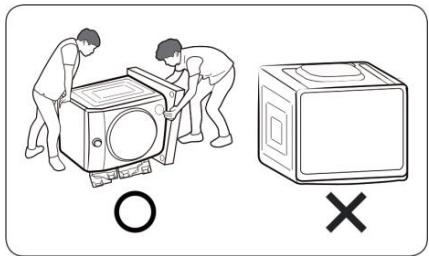
- To remove the cushion bottom of the packing materials, do not tip the appliance over on its front side. When you lay the appliance down to remove the carton base, protect the side of the appliance and lay it down carefully. Never lay the appliance on its back or front.
- Make sure that the appliance has not been damaged during shipping. Make sure you have received all of the items shown on the next page ("What's included"). If the appliance was damaged during shipping, or you do not have all of the items. If it has been damaged, contact the retailer and do not proceed any further with the installation process.
1 WARNING
Packing materials can be dangerous to children. Keep all packing material (plastic bags, polystyrene, etc.) well out of children's reach.
Carrying the appliance
1 Don't do it by yourself alone.
Tilt the appliance backward. One person stands behind the appliance and holds the protruding part of the top plate, while the other person holds the bottom of the appliance in front.
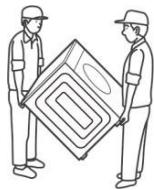
1 To prevent personal injury or strain, wear protective gloves whenever lifting or carrying the unit.
1 When moving the appliance, do not allow the front of the appliance to contact the trolley frame.
What's included
Description of the parts
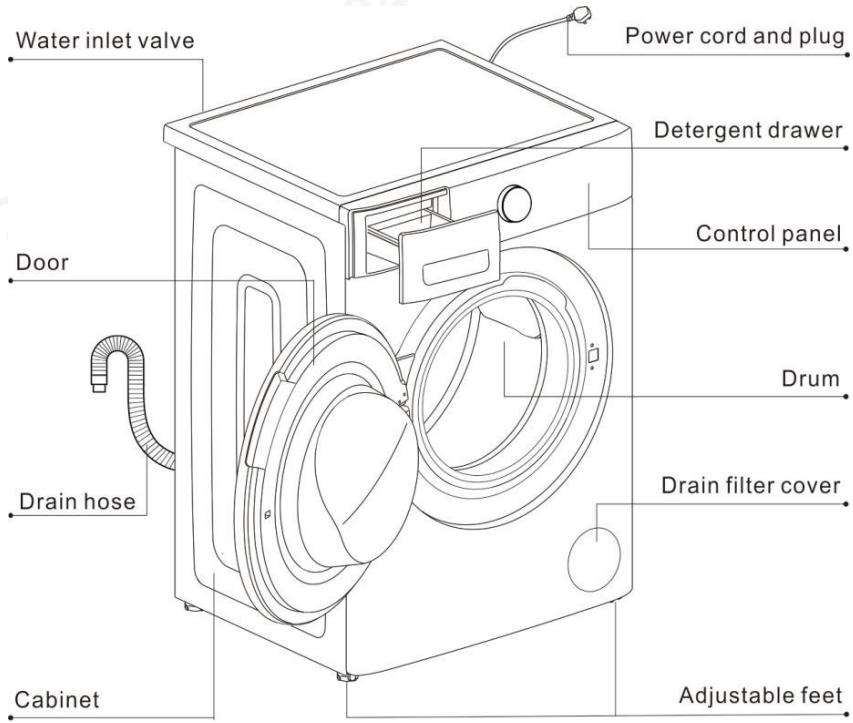
- Accessories
| User manual | Water inlet hose | Wrench | Cover caps |
| 1copy | 1pcs | 1 pcs | 4pcs |
Removing the transport bolts
1 CAUTION
DAMAGE TO THE APPLIANCE OR INJURY POSSIBLE
- The appliance is secured for transport with transport bolts. Transport bolts that are not removed can damage the drum during operation of the washer, the appliance will vibrate, and it will be much noisier during spin cycles if the transport bolts are not removed before use. Be sure to remove all 4 transport bolts completely before first use. Keep the transport bolts. If a pedestal was purchased with the appliance, it must be installed first, prior to removing the transport bolts. Please consult the pedestal installation instructions.
-
In order to prevent transport damage during later transport, be sure to re-install the bolts before transport.
-
Undo the four transport bolts A by the wrench (supplied) and remove them.
- Remove the four spacer tubes B. During the removal of the bolts occasionally spacer tubes fall inside the machine, these can be remove by tilting the machine forward and recovering them from the floor or inside the base of the machine.
- Cover the open transport bolt holes with the four cover caps C which will find in the plastic bag containing the accessories.
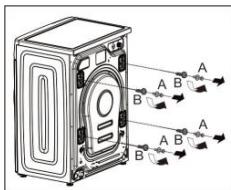
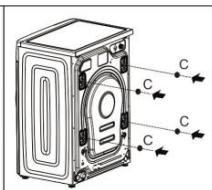
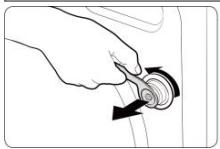
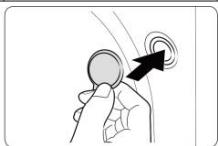
Keep all the parts in safe place: you will need them again if the washer needs to be moved to another location.
NOTE
-
Transport the washer for the prevention of breakage as below:
-
The transport bolts are reinstalled.
- The power cord is secured to the back of the washer.
Choosing the right location
- Locations requirement
- The machine should be installed on the solid and flat floor, never put the machine on the soft carpet or on the wood floor. Do not install the machine on the homemade plinth, if the installation location cannot be changed, the plinth must be improved as required, such as enlarge the size, secure with brackets. Never put the machine on the separate brackets. It is possible the machine moves a little by the factors of overloading, situation of the plinth (wet) and so on, so it will on risk the machine falls down from the plinth after working for a period of time.
- Keep the environment dry and vented.
- The appliance must be installed and operated in a room with the drain
- Never put small appliance, such as microwave oven; and/or jar cooker, on the machine.
- Keep the machine away from the flaming equipment, such as candle; cooking stove; liquefied gas container etc.
- Never put the pressure containers on the machine.
- Never put the machine over the opening of an uncovered drainage.
- Clearance requirement
- Install the appliance with easy access to the power plug and socket.
Install the appliance where there is enough space around it.
(a) 3cm or more above
(b) 5cm or more behind
(c) 5cm or more on the left side
(d) 5cm or more on the right side
(e) 70cm or more
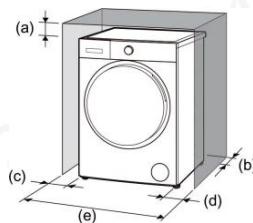
1 CAUTION: Do not let metallic portions of the appliance come into contact with metal sinks or other appliances.
Leveling the Appliance
Importance of leveling the appliance
The appliance uses high spin speeds to remove water at the end of the wash cycle. It is important that the appliance is level and that the appliance feet press with equal pressure against the floor. This will help assure the quietest, most vibration-free use of the appliance.
Follow these steps:
- Install the appliance on a level and solid surfaces. Preferably in a corner of a room.
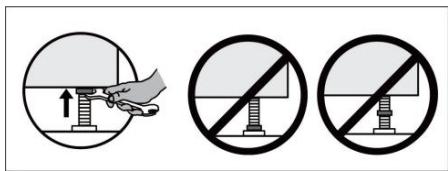
- If the floor is uneven (or out of level), adjust the appliance feet as required to level the appliance. Do not place anything under the appliance feet to help level the appliance.
- Extend the appliance feet no more than is necessary. The more the feet are extended, the more vibration the appliance will experience. Start with the appliance feet turned all the way in and adjust each foot as necessary.
- Use a bubble level (no supplied) to check the top of the appliance to make sure it is level side to side and front to rear.
- Press down on each corner of the appliance top to make sure the appliance doesn't "wobble". There should be no "give" or movement. All the appliance feet should press equally against the floor. This is just as important as the appliance being level to prevent vibration.
- When the appliance is level and does not wobble, lock the appliance feet in place by tightening the locknuts against the washer bottom. Be sure to do this without changing the height of the foot (hold the foot while tightening the locknut)
Procedure for adjusting the appliance feet:
- After determining which the appliance feet need to be extended, have someone lift up on the appliance slightly to take pressure off the foot to be adjusted.
- Turn the appliance foot to extend it downward as far as necessary to raise the corner of the appliance the correct amount to level the appliance.
- When the height of the foot is correct, use the wrench (supplied) to tighten the locknut against the appliance bottom to lock the foot in place.
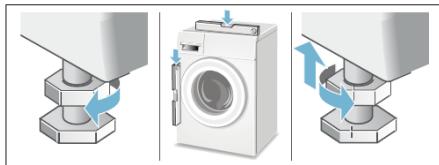
Connection the water supplies and electricity
Connecting the water inlet hose
- Connect one end of the water inlet hose to a cold water tap and tighten by hand (see figure). Before performing the connection, allow the water to run freely until it is perfectly clear.
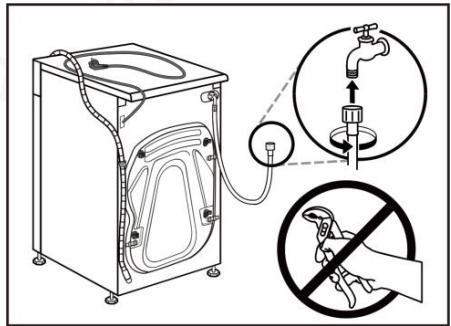
- Connect the other end of the water inlet hose to the water inlet valve on the rear of the appliance and tighten by hand.
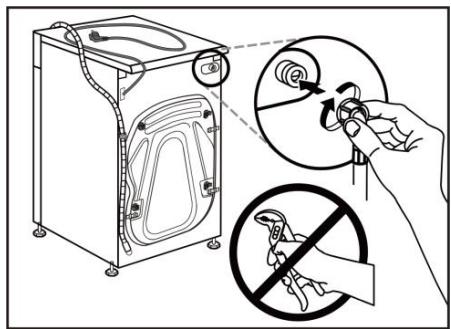
- Turn on the tap slowly and make sure there are no leaks.
1 Do not twist, squash, modify or cut the hose.
1 Tighten the end of the hose firmly by hand.
1 The supply water pressure must be in the 0.03-1.0MPa range. If the water pressure exceeds this value, please fit a pressure reducing valve.
1 If the hose is not long enough, contact a specialized shop or an authorized technician.
1 Never use second-hand water inlet hose.
1 Use the new water inlet hose supplied with the appliance
Connecting the drain hose
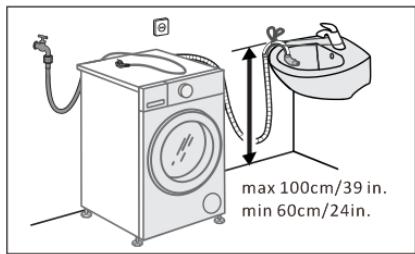
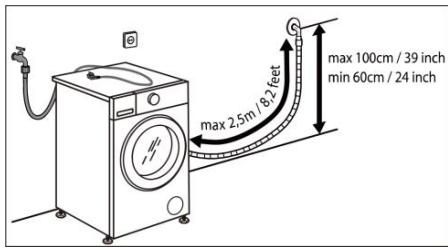
Height of drain point
Height difference between the floor and drainage point: min. 60cm(24 in.) and max. 100cm(39 in.).
Types of drainage hookups
Standpipe
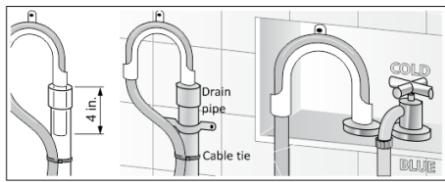
Attach the drain hose to the elbow (no supplied, available from our Customer Service Department).
Position the elbow on the drain hose 4'' (100mm) from end of the hose as shown. Insert this section of the drain hose into the drain pipe, if the hose is pushed down too far, this may cause the washer to self-syphon ie. continuously empty as it is filling.
Secure the elbow and hose with a cable tie to keep the hose from coming out of the drain pipe during use.
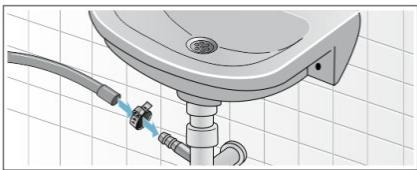
Sink siphon
Secure the drain hose to the sink siphon using a 0.9-1.6 in.(20-44mm) hose clip (available from a hardware store).
Wash Basin
1WARNING
SCALDING
When washing at high temperatures, there is a risk of scalding if you touch hot suds, e.g. when pumping out hot suds into a wash basin.
Do not reach into the hot suds.
Notice: Appliance damage/ damage to textiles
If the end of the drain hose touches the discharged water (water drained from washer), it (the discharged water) can be sucked back into the washer and may damage the appliance or textiles.
Make sure that:
There is no stopper in the sink drain.
- The end of the drain hose does touch the discharge water.
- The sink drain is free flowing and not partially clogged.
- Attach the drain hose securely to the wash basin.
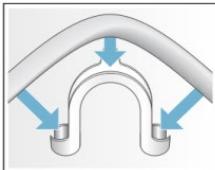
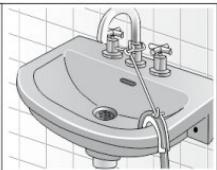
1 Do not twist, pull out or bend the drain hose.
1 Secure the drain hose with the cable tie to the drain pipe, wash basin, etc., so the hose does not pull out from the force of the water.
1 We advise against the use of drain hose extensions; in case of absolute need, the extension must have the same diameter as the original hose and must not exceed 250cms in length.
Electric connection
Before plugging the washer into the mains socket, make sure that:
- The socket is earthed and in compliance with the applicable law.
- The socket is able to sustain the appliance's maximum power load indicated on the Technical Date Plate fixed on the machine.
- The supply voltage is included within the values indicated on the Technical Date Plate fixed on the washer.
- When heating, the maximum current of the washer is 10A, so please make sure that the power supply system (voltage, current and the cable) is applicable to the load of the applied appliance.
- The socket is compatible with the washer's plug. If this is not the case, replace the socket or the plug by a qualified electrician.
1 WARNING---THIS APPLIANCE MUST BE EARTHED. THE FOLLOWING OPERATIONS SHOULD BE CARRIED OUT BY A QUALIFIED ELECTRICIAN.
Replace the supply cable:
If the supply cord is damaged, it must be replaced with an identical one by the manufacturer, its service agent or similarly qualified persons in order to avoid a hazard - risk of electric shock.
Disposing of the plug:
Ensure that before disposing of the plug itself, you make the pins unusable so that it cannot be accidentally inserted into a socket.
Disposing of the appliance:
When disposing of the washer please remove the plug by cutting the mains cable as close as possible to the plug body and dispose of the plug as described above.
1 The appliance is not intended to be operated by means of an external switching device, Such as a timer, or separate remote controlled system.
1 When the appliance is installed, the mains socket must be within easy reach.
1 Do not use extension cables, multiple sockets or adapters.
1 To remove the plug from the socket, grasp the plug firmly and pull it out. Do not pull at the cable.
1The electrical components must not be accessible to the user after installation.
1 Do not connect the machine to electrical socket while your hands are wet or damp.
1 Do not operate this appliance when you are wet or barefoot.
1Do not operate this appliance if it has a damaged power cable or plug, if it is not working properly, or if it has been damaged or dropped.
1. WARNING! The company denies all liability if and when these norms are not respected.
Technical date
| Model | MG100-E14586B HLPxy |
| Rated washing capacity (kg) | 10.0 |
| Rated drying capacity (kg) | 6.0 |
| Rated voltage | 220-240V |
| Rated frequency | 50Hz |
| Rated drying power (W) | 1600 |
| Rated power (W) | 2000 |
| Washing noise level (dB) | 62 |
| Spinning noise level (dB) | 76 |
| Spin speed (rpm) | 1400 |
| Water pressure (MPa) | 0.03 - 1.0 |
| Waterproof grade | IPX4 |
| Net weight (kg) | 60 |
| Outer dimension (WxDxH mm) | 600 X 577 X 847 |
Description of the appliance
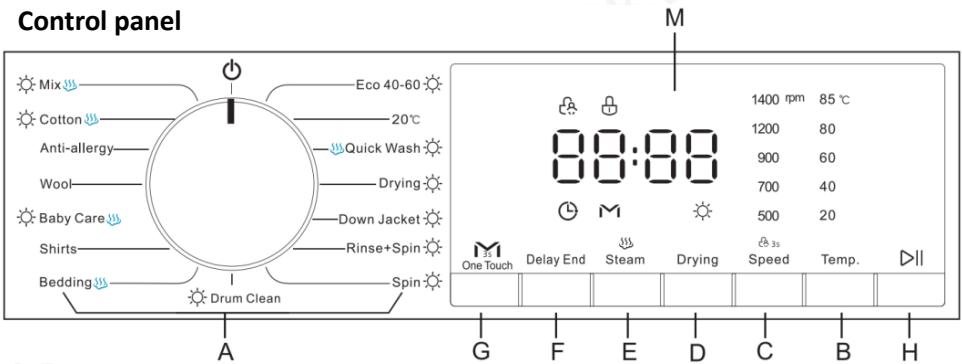
A---WASH CYCLE SELECTOR knob: Used to set the desired wash cycle (see "Table of wash cycles").
- OFF position : Turn the Linear mark on the wash cycle selector knob under the symbol “ 山 ” to turn off the machine. If the machine is turned off during a wash cycle, this wash cycle will be cancelled.
B---TEMP. button: Press to change the water temperature for the current cycle. There are five temperature values on the display. When a temperature value is selected, the corresponding temperature value indicator light will be lit on the display.
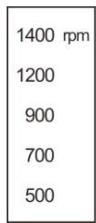
C---SPEED button: Press to change the spinning speed for the current cycle. There are five spinning speed values on the display. When a spinning speed value is selected, the corresponding spinning speed value indicator light will be lit on the display.
- CHILD LOCK function : When the cycle is running, long press the SPEED button for 3 seconds to set or cancel the Child lock function.
For a detailed description, see Various cycles and functions.
Cancelling the buzzer:
Press and hold the SPEED button and ONE TOUCH button together at the same time for at least 3 seconds, you can turn off the buzzer that sounds during the washing cycle running.
For a detailed description, see Various cycles and functions.
D---DRYING button: Press to set the drying type or drying time as needed, and the drying type or drying time appears on digital display.
Some programs have no drying function.
- Drying channel cleaning program: Long press this button for 3 seconds, the machine will enters the "Drying channel cleaning" program
For a detailed description, see Various cycles and functions.
E---STEAM button: Press to set the STEAM wash cycle.
For a detailed description, see Various cycles and functions.
F---DELAY END button: Press to set the program end (Delay end) time.
For a detailed description, see Various cycles and functions.
G--ONE TOUCH button: Press to set the ONE TOUCH wash cycle.
For a detailed description, see Various cycles and functions.
H---START/PAUSE button: Long press the button to start or pause a wash cycle.
- Add clothes during the program is running:
Once the cycle has begun, if you want to pause the wash cycle, please long press the button again. If the DOOR LOCK indicator light is off, the door may be opened, you can add or take out laundry.
To start the wash cycle from the point at which it was interrupted, press the button again.
For a detailed description, see Various cycles and functions.
Description of the appliance
M---Display
The display is useful when programming the machine and provides a great deal of information.
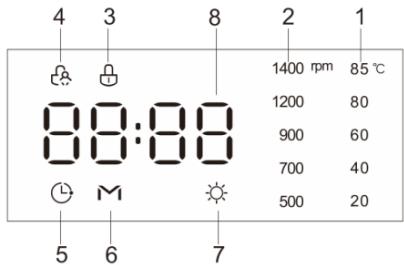
1---Temperature indicator
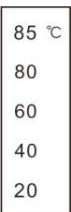
When a program is selected, the default temperature value indicator light of this program will be lit on the display.
You can change the temperature value by pressing the TEMP. button. There are five temperature values indicator lights on the display. When a temperature value is selected, the corresponding temperature value indicator light will be
lit on the display. If all temperature value indicator lights are off, it indicates the appliance using only cold water without utilized the heater in this program.
2---SPINNING SPEED indicator
When a program is selected, the default spinning speed value indicator light of this program will be lit on the display.
You can change the spinning speed value by pressing the SPEED button. There are five spinning speed values indicator lights on the display. When a
spinning speed value is selected, the corresponding spinning speed value indicator light will be lit on the display. If all spinning speed value indicator lights are off, it indicates the appliance does not spin after the final drain process in this program.
3---DOOR LOCK indicator
The lit indicator light indicates that the door is locked. To prevent any damage, wait until the indicator light turns off before opening the door.
To open the door while a cycle is in progress, press the START/PAUSE button, if the DOOR LOCK indicator light is off, the door may be opened.
4---CHILD LOCK indicator
The lit indicator light indicates the CHILD LOCK function is activated, the control panel is locked.

5---DELAY END indicator
The lit indicator light indicates the DELAY

END function is activated. The countdown
to the end of the selected wash cycle will appear on the digital display.
6---ONE TOUCH indicator
The lit indicator light indicates the One Touch wash program is selected. There are three ways to set the One Touch wash program.
7---DRYING FUNCTION indicator
When the indicator light is lit, it means that drying function has been set or carrying the drying cycle.

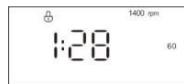
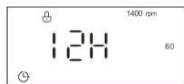
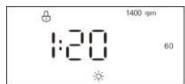
8---DIGITAL DISPLAY
1) Remaining time of the wash cycle
2) Delay end time
3) Drying time
4)Rinse count
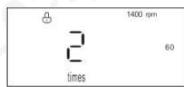
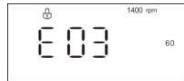
5) Fault code
Preparing the laundry
Notice: Damage to the appliance/fabric
Foreign objects (e.g. coins, paper-clips, needles,
Description of the appliance
nails) may damage the laundry or components in the appliance.
Therefore, note the following tips when preparing your laundry:
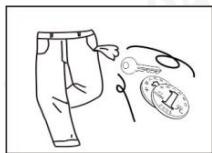
- Remove any loose items or metal objects, such as safety pins, paper clips, etc. from the laundry.
-
Brush sand, coins, etc. out of pocket and cuffs.
-
Close zips and button up cushion covers, duvet covers, etc.
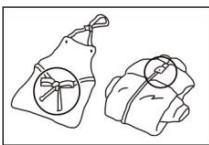
- Remove curtain in runners, or secure them in a net bag.
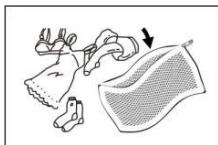
- Particularly delicate items; such as tights or lace
curtains, or smaller items, such as tiny socks or handkerchiefs, should only be washed in a net bag or pillow case.
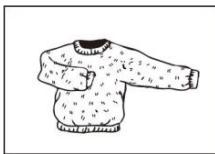
- Some items are best turned inside out. These included knitwear, trousers, T-shirts and sweatshirts.
- Make sure that the wire-cup bras are machine washable.
! Make sure that wire-cup bras in a pillow case which can be securely closed with a zip or button. If the wire works itself out of the cup it may fall through the holes of the drum and cause extensive damage.
Preparing the laundry for drying
-
Only tumble-dry textiles which have been washed, rinsed and spun.
-
Remove as much water as possible from the laundry. Do not press the SPEED button for reducing the spin speed.
- In order to ensure uniform drying, sort the items according to fabric type and degree of drying required.
- Items which require ironing do not have to be ironed immediately after being tumble-dried. It is a good idea to fold or roll them together for a while, so that any remaining moisture is evenly distributed.
- When washing laundry to be tumble-dried, use the correct amount of detergent and textile care products as specified in the manufacturer's instructions.
The following textiles should not be tumble-dried: Laundry marked with the care symbol:
= Do not tumble-dry
- Wollens or items containing wool. Risk of shrinking!
- Delicate fabric (silk, synthetic net curtains). Risk of creasing!
- Items containing foam rubber or similar material.
- Items which have been treated with inflammable solvents, such as stain removes, petrol, paint thinkers. Explosion hazard!
- Items still containing hair lacquer or similar substances. Dangerous vapors!
- Dripping-wet laundry. Waste of energy!
Preparing and sorting the laundry
Sorting the laundry according to colour and degree of soiling
Sort laundry items according to color, degree of soiling and recommended wash temperature range.
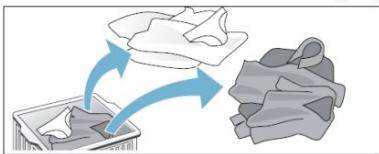
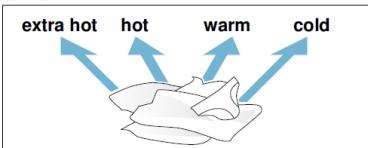
- Items of clothing can become discoloured.
- Never wash new multi-coloured items together with other items.
- Wash white items separately from colored items. Otherwise, white items may tend to become grey.
Degree of soiling
Light soiling
No visible soiling or stains, but may have absorbed some odor. This could include light weight summer clothes such as T-shirts, shirts, or blouses worn only once. Also to freshen bed linen or guest towels
Normal soiling
Visible soiling and/or a few light stains. This could include clothing such as T-shirts, shirts, or blouses that have been sweated in or worn several times. Also tea towels, hand towels or bed linen used for up to one week or more. Curtains without stains that have not been washed for up to a half year.
- Heavy soiling
Visible soiling and stains. This could include kitchen towels, fabric napkins, baby bibs, children's outer clothing or footballjerseys and
shirts stained with grass or dirt. It could also include working clothes such as overalls and jeans and other clothing worn for outside work and activities.
Preparing and sorting the laundry
Sorting laundry according to their care label specifications
The symbols on labels of your garments will help you in choosing the suitable wash program, the right temperature, wash cycles, and ironing methods. Don't forget to give a glance to these useful indications!
| Wash type | Machine wash, normal/cotton | Machine wash, permanent press | Machine wash, delicate/gentle | Hand wash only | Do not wash | Do not wring |
| Water Temp. | Water temperature 30℃ | Water temperature 40℃ | Water temperature 50℃ | Water temperature 60℃ | Water temperature 70℃ | Water temperature 95℃ |
| Water temperature 30℃ | Water temperature 40℃ | Water temperature 50℃ | Water temperature 60℃ | Water temperature 70℃ | Water temperature 95℃ | |
| Bleach | Any bleach | Non chlorine bleach | chlorine bleach | Do not bleach | ||
| Tumble Dry type | Normal/Cotton Heavy duty | Permanent Press/Wrinkle resistant | Delicate/Gentle | Do not tumble dry | ||
| Tumble dry temp. | High heat | Medium heat | Low heat | No heat | ||
| Dry type | Hang to dry | Drip dry | Dry flat | Dry in the shade | ||
| Iron | High heat | Medium heat | Low heat | Do not Iron | ||
| Dryclean | Any solvent | Perchloroethylene solvent | Petroleum solvent | Do not dryclean |
Various cycles and functions
Table of wash cycle
| Wash cycle | Temp. ℃ (Max) | Max.Load(kg) | Specification | Kind of detergent | |||
| Washing | Dry-ing | Detergents | Softe-ner | ||||
| Universal | Special | ||||||
| Mix | 60 | 10 | 5 | For washing lightly to normally soiled mixed load of cotton and synthetic fabrics, white and colored items | L/P | --- | O |
| Cotton | 60 | 10 | 5 | For daily items of cotton, linen and cotton blends, Energy efficiency test | L/P | --- | O |
| Anti-allergy | 85 | 3 | --- | For clothes that need to remove mites and allergens. | L/P | --- | O |
| Wool | 40 | 1 | --- | For machine washable wool and wool blend clothes | --- | L | O |
| Baby Care | 85 | 5 | 5 | For kid's wear | L/P | --- | O |
| Shirts | 60 | 3 | --- | For shirts and women's blouses | L/P | L | O |
| Bedding | 60 | 10 | --- | For large items such as blankets, curtains and bedspreads | L/P | --- | O |
| Eco 40-60 | 40 | 10 | 5 | Energy efficiency test program | L/P | --- | O |
| 20°C | 20 | 2 | --- | For small amount of clothes that are easy to fade, the washer using only cold water without utilized the washer's heater in this program | L/P | --- | O |
| Quick wash | 40 | 1 | 1 | For small amount or lightly soiled garments that you want to finish washing quickly | L/P | --- | O |
| Drying | --- | --- | 5 | For drying wet cotton fabric | --- | --- | --- |
| Down Jacket | 40 | 2 | 2 | For down jacket which can be washed by machine | --- | L | O |
| Rinse +Spin | --- | 10 | 5 | Combines a rinse and spin for loads requiring an additional rinse cycle. Also use for loads that require rinsing only | --- | --- | O |
| Spin | --- | 10 | 5 | This cycle uses a spin to shorten drying times for heavy fabrics or special-care items washed by hand | --- | --- | --- |
| Drum clean | 85 | --- | --- | Clean the drum by removing dirt and bacteria from the drum. Make sure the drum is empty | --- | --- | --- |
| M-Smart | 40 | 5 | --- | Special cycle which can be started simply by pressing the ONE-TOUCH button | L/P | --- | O |
L=gel-/liquid detergent P=Powder detergent O=Optional ----No
If using liquid detergent, it is not recommended to activate the time delay.
We recommend by using: Laundry powder 20^ to 80^
Wool detergent 20^ to 40^
Please follow the dosage recommendation on the powder or liquid detergent package.
Various cycles
M-Smart wash cycle
M-Smart wash cycle can intelligently detect the weight of laundry and match different washing time and temperature to realize intelligent washing.
"u" is displayed in the detection stage after the cycle is started, and the M-Smart wash cycle can be entered by the following three methods.
- When the appliance is OFF, press and hold the ONE-TOUCH button for at least 3 seconds, the appliance will run the M-Smart wash cycle directly, with the M-Smart indicator light lit.
- When the appliance is ON, press and hold ONE-TOUCH button for at least 3 seconds, the appliance will run the M-Smart wash cycle directly, with the M-Smart indicator light lit.
- When the appliance is ON, short press the ONE-TOUCH button, the M-Smart indicator light Is lit, and then press the START/PAUSE button, the appliance runs the M-Smart wash cycle.
Drying program
How to set the drying program?
1、To set the program of " Washing + Drying"
Only part of the washing program can add drying function.
First, load the laundry into the drum, close the door, turn the Wash cycle Selector knob to select the desired wash program (except for the Drying program), and press the Dry button to select the two drying modes as follows:
-----Automatic drying: Press the Drying button continuously to adjust the drying time that is displayed on the panel, and when "RuTo" is displayed, the automatic drying mode is activated, the drying time can be automatically adjusted according to the amount and humidity of clothes.
----Timed drying: Press the Dry button to set the drying time. Press the Drying button, the digital display screen will display the timing drying time (30-60-90-120-150-180-210-240),
select an appropriate the timing drying time and enter the timing drying mode. Then, press the Start/Pause button, the machine starts running the
Washing + Drying program, with the drying program
automatically activated at the end of the washing program.
2、To set the Drying Only program
The Drying Only program is suitable for drying clothes of cotton. Do not dry clothes that are prone to deformation or shrinkage. When the Drying Only program is set, before drying, it is recommended to run a single spin cycle for the clothes to be dried.
- First, load the laundry in the drum, close the door, turn Wash cycle Selector knob to select the Drying program only, and then press the Drying button continuously, so as to select the mode of Auto drying or Time drying (as described above).
- Then, press the START/PAUSE button to start the Drying Only program..
3. To set the down jacket drying program
"Washing+Drying" program should be used to dry down jackets. Please select "Down Jacket" program + "Automatic Drying (R0 E0)" mode". Please do not choose Drying only mode for down jacket drying. In order to achieve better drying effect, it is recommended to dry single down jacket once.
Precautions for drying program
- If there is too much moisture in the clothes, the machine will automatically extend the drying time, and it is normal to display "0:20" for too long.
- When the drying program is running, the faucet must be turned on, because the water is required for cooling and dehumidification during drying program.
- The longest drying time is set according to different models.
- In order to prevent the wrinkle of laundry caused by excessive drying, the drying time can be set a little less at first, and then the drying time can be added according to the drying effect.
- Before running the Drying Only program, it is recommended to run a spinning cycle firstly.
- If necessary, please untie the nodules of clothes after spinning, and then put them into the drum for drying.
- For larger or thicker clothes, drying may be uneven in some positions of clothes. Please add drying time according to drying effect after finishing drying cycle.
- Wool fabrics are not suitable for drying.
- Do not dry clothes that are liable to deformation or shrinkage.
- Some programs have no drying function.
Drying channel cleaning
After setting the wash cycle and option, before start, long press this button for 3 seconds, the machine will enters the "Drying channel cleaning" program, the digital display shows the running time of the "Drying channel cleaning" program (0.05), and then run the Drying channel cleaning program after pressing "Start/Pause" button.
The Drying channel cleaning program can automatically remove the lint gathered in the drying channel and improve the drying efficiency.
This program is only used to remove the lint in the drying channel. Do not add any clothes in the drum.
Steam
A cycle designed for cotton clothes that are not easy to fade.
- Steam treatment can reduce the wrinkle of clothes, make the clothes reach the ideal humidity level, reach the most relaxed state, and make ironing easier.
- Steam treatment can get rid of the peculiar smell on clothes
Special wash cycles
Baby care: a cycle designed for dirt typical of children's garments in that it effectively removes any traces of residual detergent.
Down Jacket: a cycle to wash single downs (the weight of which should not exceed 2.0kg ), cushions or clothes padded with goose down such as puffy jacket, use this special wash cycle. We recommend that down are placed in the drum with their edges folded inwards (see figure) and that no more than 3/4 of the total volume of the drum is used. To achieve the best results, we recommend that a liquid detergent is used and placed inside the detergent dispenser drawer.
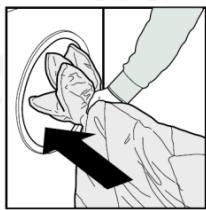
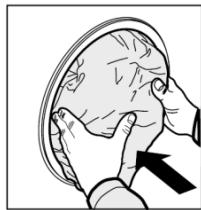
Wool: a cycle designed for wool fabrics.
- Before washing, please confirm that the clothes have the washing label of "machine washable".
After the procedure is completed, please take out the clothes quickly, shape and dry them to avoid deformation caused by being placed in the drum for too long. - To prevent clothes from being damaged, the water temperature should not exceed 40^ .
- For best results and to reduce the damage of clothes, Please use special detergent for wool and do not exceed 1.0kg of laundry.
Various functions
Delay end
Press DELAY END button to set the program end (Delay end) time in one hour increments to a maximum of 24 h (hours). After selecting the desired washing program but before pressing the START/PAUSE button, press the DELAY END button until the desired time is displayed, e.g. 8h, with the DELAY END indicator light lit.
NOTICE: The cycle duration is included in the set Delay End time.
Here is an example of a 1hr: 30 min cycle time and an 8 h Delay end time.
8 h is displayed and count down (approximately 6 h: 30 min) until the washing cycle begins (at 1hr: 30 min) then the cycle duration 1: 30 is displayed and began. Total time approximately is 8 hours.
The way to cancel Delay End function:
- Turn the wash cycle selector knob to reset the wash cycle. The DELAY END indicator light () goes out.
NOTICE:
- Delay End function cannot be set in some wash cycle.
- The actual end time of the wash cycle may be different from the set Delay End time depending on the water supply pressure, drainage, clothing type, water temperature and other conditions.
Child lock
- Setting the Child lock function can avoid children's mis-operation and external interference to the washing procedure.
- During operation, long press the SPEED button for 3 seconds to set or cancel the Child lock function.
- After the Child lock function is set, the Child lock indicator light is lit, the door cannot be opened, the control panel is locked, all buttons on control panel do not respond, and wash cycle selector knob on control panel (except the Linear mark on the wash cycle selector knob under the symbol "O") do not respond too. You can only turn off the machine by turn the wash cycle selector knob, when the Linear mark on the wash cycle selector knob under the symbol "O", the machine will be turned off and stop running. If the machine is turn off, the Child lock function will be cancelled.
- After the Child lock function is set, you can turn off the machine by turning the wash cycle selector knob. When the machine is turned on again, the machine directly run the program before turning off the machine.
Add clothes during the program is running
When the program is running, long press the START/PAUSE button to pause the machine, if the DOOR LOCK indicator light goes out, the door may be opened, you can add or take out laundry. After the operation is completed, close the door, long press the START/PAUSE button again, and the machine continues to run from the point at which it was interrupted.
NOTICE:
If the water level or water temperature in the drum is too high, the door lock indicator light is lit, the door cannot be opened and cannot add or take out clothes during the program is running.
Various cycles and functions
Cancelling the buzzer
Press and hold the SPEED button and ONE TOUCH button together at the same time for at least 3 seconds, you can turn off the buzzer that sounds during the washing cycle running.
To activate the buzzer setting
Do the same operation as you did for cancelling. The buzzer setting is activated after one beep.
Load balancing system
The appliance has an automatic detection system for eccentric load. In the process of spinning, if the clothes are unevenly distributed, the appliance will level and adjust the clothes until the clothes are evenly distributed before spinning. If the clothes cannot be evenly distributed within the specified time, the appliance will not spin to avoid severe vibration of the machine. At this time, you need to check whether the clothes are knotted or entangled, and select the "Spin" program after reorganizing the clothes. When washing less clothes, such as a pair of jeans, a sweater, a bath towel, etc., the machine may not complete the spinning process due to balance protection. Please wash the large and small clothes together as much as possible to make the clothes easier to release evenly and complete the spinning process smoothly.
NOTICE:
Due to the different types and materials of the laundry, the automatic adjustment and balance system of the appliance may level and adjust the clothes for many times to prolong the spinning time. This is a normal phenomenon, not a machine failure.
Downlight
- Downlight is always on during program or function setting.
- When the program is suspended, the backlight can be lit by opening the machine door.
- When the program is running, the backlight will automatically light up with the change of washing stage.
- Touching any button other than the power button can also illuminate the backlight.
How to use the appliance
Before loading your first load of laundry
Your new appliance was tested before leaving the factory. This process involves running various wash cycles. As a result, a small amount of water may remain in the tub and drainage system. Run a Drum Clean cycle with no laundry and no detergent to clean the system before your first load of laundry.
Daily use
Preparing the laundry
EMPTYPOCKETS
- Coins, paper clips, etc. could damage the load and the washing machine components.
- Tissues will break down during the wash cycle and the fragments will have to be subsequently removed by hand.
CLOSE ALL ZIPPERS, BUTTONS, AND HOOKS. TIE ALL RIBBONS OR BELTS
- Insert the smaller garments (e.g. nylon hosiery, belts, etc.) and garments with hooks (e.g. braziers) into a fabric bag or a pillowcase with zipper. Remove any rings from curtains, or else place the curtains inside a fabric bag together with the rings.
FABRIC TYPE/SYMBOL ON THE WASH LABEL
- Cottons, mixed fibres, easy care/synthetics, wool, hand wash items.
Color
Separate colored and white items. Wash new colored articles separate.
Size
Wash items of different sizes in the same wash load, to improve washing efficiency and distribution of the articles in the drum.
Delicates
Wash delicate items separately; they require gentle treatment.
How to use the appliance
1. Load laundry
Open the door and load the laundry. Load the articles one at a time loosely into the drum, without overfilling. Observe the load sizes given in the "Table of wash cycle", Overloading the machine will result in unsatisfactory washing results and creased laundry.
2. Close door
Make sure that no laundry gets stuck between door glass and rubber seal. Close the door so that you can hear it click shut.
3. Open the tap
Make sure that the appliance is connected to the water mains. Open the tap.
4. Set the desired program
Select the required program with WASH CYCLE SELECTOR knob. The duration of the wash cycle is shown on the display. The washing machine automatically displays the default temperature and spin speed settings possible for the selected program. Adjust the temperature and/or spin speed setting if needed with the relative buttons.
- Change temperature, if needed
Press the TEMP. button to progressively lower the temperature setting until cold wash has been set (all temperature value indicator light go out on the display). Pressing the button again sets the highest possible setting.
- Change spin speed, if needed
Press the SPEED button to progressively decrease the spinning speed until the spin cycle is turned off (all spinning speed value indicator light go out on the display). Pressing the button again sets the highest possible setting.
- Select options, if needed
Press the button(s) to select the option; the corresponding option indicator light is on.
Press the button(s) again to cancel the option, the corresponding option indicator light goes out.
How to use the appliance
!If the selected option is incompatible with the program set, the incompatibility will be signaled by a buzzer and the corresponding option indicator light will flash.
If the selected option is incompatible with another previously set option, only the most recent selection will remain active.
5. Add detergent
Pull out the detergent dispenser and add detergent (and additives/softener) into the relative compartments as described below.
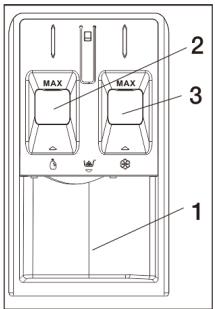
Compartment 1: Powder washing detergent
Compartment 2: Liquid washing detergent The liquid detergent must not exceed the "MAX" level.
Compartment 3:
Additives (Softener. etc.) The fabric softener must not exceed the "MAX" level.
Observe the dosing recommendations on the detergent pack.
Correct dosing of detergent/additives is important, because:
It optimizes the cleaning result.
- It avoids irritating residues of surplus detergent in your laundry.
- It saves money by avoiding waste of surplus detergent.
- It protects the washer by avoiding calcification of components.
It respects the environment by avoiding unnecessary environmental burden.
! Do not use hand washing detergents because these create too much foam.
! Use powder detergent for white cotton garments, for pre-washing, and for washing at temperatures over 60^ .
! Follow the instructions given on the detergent packing.
6. Delaying the end of a program
- To set a program to end at a later time, see the section "Control panel / DELAY END".
7. Start program
- Press the START/PAUSE button. The relative indicator light is lit, the door locks and the DOOR LOCK indicator light is lit.
- To avoid overflow, do not open the detergent dispenser during a running program anymore.
- The remaining program duration can vary. Factors like unbalance in the wash load, or foam formation, can have an effect on the program duration.
8. Change the settings of a running program, if needed
You can still change the settings while a program is running. The changes will be applied, provided the respective program phase has no finished yet.
To change the settings of a running program:
- Press START/PAUSE button put the running program on pause.
- Change your settings.
- Press START/PAUSE button again to continue the program.
If you have changed the program, do not add detergent for the new program.
To prevent that a running program is changed by accident (for instance by children), use the CHILD LOCK function (see section "Control panel / SPEED").
Pause a running program and open the door, if needed
Press START/PAUSE button to pause a running program.
If the water level and/or temperature in the drum are/is not high, the DOOR LOCK indicator light turns off. You can open the door, for example to add more laundry, or to remove laundry which was loaded by mistake. Press START/PAUSE button again to proceed with the program.
-
Cancelling a running program, if needed
-
Turn the Linear mark on the wash cycle selector knob under the symbol “ 山 ” to turn off the appliance.
- If the water level and/or temperature are/is low enough, the door is unlocked and can be opened.
- The door remains locked if there is higher water level in the drum. To unlock the door, firstly turn the wash cycle selector knob to select the Spin program, then press the SPEED button to set the Spin program off (all spinning speed value indicator light go out on the display).
-
Press START/PAUSE button to run Spin program. The water is pumped out from the drum during the cycle. The door unlocks at the end of the program.
-
Switch off the appliance after program End
-
At the end of the cycle, the message "End" is shown on the digital display.
- The door can only be opened when the DOOR LOCK indicator light goes out.
- Check that the DOOR LOCK indicator light is off, then open the door and take out the laundry.
- Turn the Linear mark on the wash cycle selector knob under the symbol “ ” to turn off the appliance.
- Turn off the tap.
Leave the door ajar to let the interior of the appliance to dry.
Your appliance is designed to give you years of service. Observe the following instructions to maintain and protect your appliance and keep it in top operating condition.
1WARNING
RISK OF ELECTRIC SHOCK HAZARD
- To avoid risk of electric shock always disconnect the appliance from the power outlet prior to cleaning.
- Never clean the appliance with a pressure washer.
Cutting off the water and electricity supplies
- Turn off the water tap after every wash cycle. This will limit wear on the hydraulic system inside the appliance and help to prevent leaks.
- Unplug the appliance when cleaning it and during all maintenance work.
Cleaning the appliance's exterior
1WARNING
RISK OF EXPLOSION
To avoid risk of explosion never clean the appliance with flammable solvents.
Clean the appliance's exterior surface when required as follows:
- Use hot soapy water or a mild (non-abrasive) cleaning agent.
- Rub the exterior surface of the appliance dry with a soft towel.
- Remove residue immediately.
- Do not use high pressure spray.
Cleaning the drum
Metallic debris left in the drum can product rust spots on the drum. Never use steel wool to try to remove these. Use a chlorine-free cleaning agent and follow the manufacturer's instructions.
Dscaling the appliance
Provided that you use correct amounts of detergent with you wash loads, descending is not necessary. If descending the appliance drum does become necessary, please follow the descending product manufacturer's instructions.
Small amounts of descending agent can be used to remove white spots on the washer drum caused by lime or mineral deposits or small amounts of rust caused by metal objects left in the drum.
NOTICE: Descaling agents contain acids which may attack parts of the appliance and may discolor the laundry.
Caring for the door and drum of your appliance
Always leave the porthole door ajar in order to prevent unpleasant odours from forming.
Checking the water inlet hose
Check the water inlet hose at least once a year. If there are any cracks, it should be replaced immediately, during the wash cycle, water pressure is very strong and a cracked water inlet hose could easily spilt open.
1 Never use second-hand water inlet hose.
Cleaning the detergent dispenser
If there is a buildup of residual detergent or additives, or if the softener compartment is not rinsed out well enough, it may be helpful to clean the dispenser.
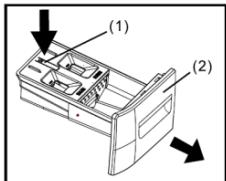
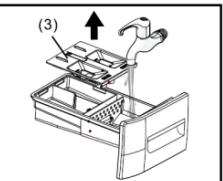
- Open the detergent dispenser tray fully. Press down on the drawer catch (1) and pull the the tray (2) from the appliance housing.
- Remove the liquid detergent cover (3) by grasping it and pulling it upwards from the detergent dispenser tray.
- Clean the liquid detergent cover and the detergent dispenser tray by holding it under runing water. Lightly wipe away any remaining detergent residue.
- Attach the liquid detergent cover and slide the detergent dispenser tray back in place and close the tray securely.
Tip: Do not operate the appliance without the detergent dispenser tray in place. Always keep the tray completely closed.
Cleaning the mesh filter in the water inlet hose and the water inlet valve
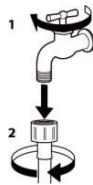
- Close water tap and unscrew the water inlet hose.
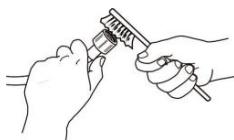
- Clean the mesh filter at the hose's end carefully with a fine brush.
- Now unscrew the water inlet hose on the back of the appliance by hand. Pull out the mesh filter from the water inlet valve on the back of the appliance with pliers and carefully clean it.
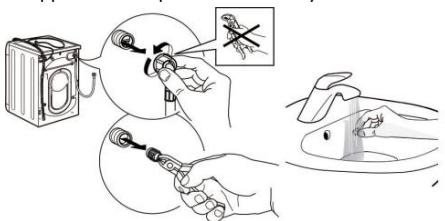
- Insert the mesh filter again. Connect the water inlet hose to the water tap and the appliance again. Do not use a tool to connect the inlet hose. Open the water tap and check that all connections are tight.
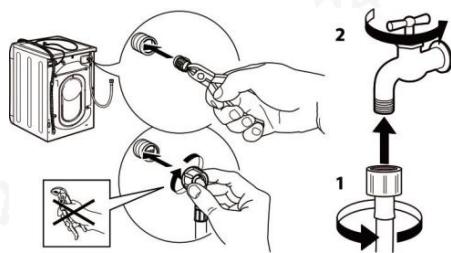
Cleaning the drain pump
1WARNING
RISK OF SCALDING
Risk of hot water injury to skin!
You are responsible for ensuring all safety precautions are followed when draining water from the appliance and/or manually opening the appliance door.
It may be necessary to clean the appliance drain pump if the appliance fails to drain (sound of the water being pumped from the appliance cannot be heard when the appliance should be draining and other nearby drains, such as a sink, are draining properly).
The appliance pump can become blocked by loose debris (a good reason to check the drum and remove any visible debris after each load). Fabrics that give off large amounts of fluff may also cause blockage.
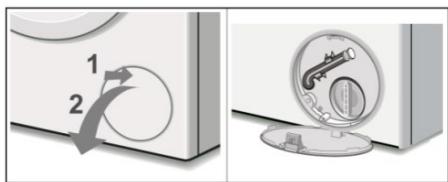
To access the appliance drain pump, the service cover must first be opened (see steps below). With the service cover opened, proceed as follows:
- If the appliance has not been drained, try to drain it now. firstly turn the wash cycle selector knob to select the Spin program, press the SPEED button to set the Spin program off (all spinning speed value indicator light go out on the display), then press the START/PAUSE D|I button. Wait a few moments to let the pump drain the water from the drum. If the pump is totally blocked, the water will be unable to drain and the cycle will end.
- Shut off the tap so that no more water flows in and has to be drained. Switch the appliance off. Unplug the power plug.
- Open the drain filter cover.
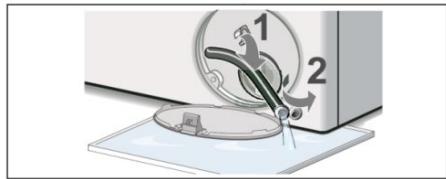
- Use the pull-out drain hose located in the pump access opening to drain the remaining water into a suitable container (up to 5.3U.S.gallon/20 liters of water may be drained). Pull the sealing cap from the hose and lay the hose over the side of the container and allow the water to finish draining from the drum. When finished, replace the sealing cap into the end of the hose and restore the hose to its storage location.
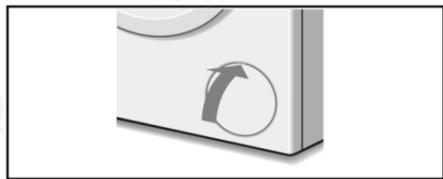
- Turn the pump cover counterclockwise to remove it. A small amount of residual water may flow out when the cover is removed. Clean the interior of the pump housing, removing any debris or foreign objects. Check to be sure the impeller where at the back of the pump housing can now turn freely. Remove any lint, debris or detergent residue from the threads of the pump cover and the pump cover housing. Reinstall the pump cover by screwing tightly into position. Handle must be vertically.
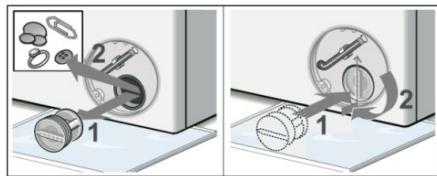
- Close the drain filter cover. Wipe up any spilled water.
Your appliance could occasionally fail to work. Before contacting the service center, make sure that the problem cannot be solved easily using the following list.
| Problem | Possible cause / solutions |
| There are color spots and oil stains in the drum | The appliance requires a service wash. Run a “Drum Clean” wash cycle with no detergent and no laundry. |
| The machine smells | Due to the use of rubber parts, the machine will have rubber smell at the beginning of use, but the rubber smell will gradually disappear during use. |
| The door cannot be opened | The safety protection function is in operation, and the water temperature and/or water level are/is too high. Whether the program has ended normally and whether there is power failure. Is the child lock function activated? Turn off the child lock function. Whether to select the delay end function? Turn off the delay end function. |
| The machine leaks from the dispenser | The dispenser drawer is blocked with detergent and requires cleaning. The water pressure is too high and requires turning down – turn down the tap on the water supply pipe slightly and try again. The appliance is tilting forwards – It must be level when in its final position. |
| The machine leaks (other than dispenser) | The water inlet hose is loose, check both the cabinet and tap ends. The inlet hose is tight but still leaks, if so replace the rubber washers, or the water inlet hose is missing the rubber washer. The drain hose is not fixed in properly. In case of water leakage inside the machine, please turn off the power supply and contact the after-sales department for maintenance |
| The machine does not swtich on | The appliance is not plugged into the socket fully, or not enough to make contact. There is not power to the socket, or the fuse has blown in the mains plug. |
| The wash cycle does not start | The door is not closed properly. The POWER button has not been pressed. The START/PAUSE button has not been pressed. The water tap has not been turned on to allow water to flow into appliance. A Delay end function has been set. |
| The machine does not fill with water, the detergent cannot flow into the drum or “E02” appears in the display | The water inlet hose is kinked, twisted and bent. The water inlet hose is not connected to the water supply. The water pressure is too low. The water tap has not been turned on to allow water to flow into the machine. There is no water supply to the house. The mesh filter in the water inlet hose and/or water inlet valve are/is blocked. The faucet and/or water supply pipe are/is frozen. The delay end function is selected so that the machine does not enter water The START/PAUSE button has not been pressed. There is enough water in the drum already. |
| Discharge the water when the program is started | This is not a fault. Please do not open the door to pour the water directly into the drum before the program runs, otherwise the machine may discharge the water which has been poured into the drum when the program is started, |
| The water level is too low when the machine is washing | ● This is not a fault. The water consumption in wash cycle of this appliance is relatively little, the water level in wash cycle is lower than other type washing machine normally. |
| Make up water during wash cycle operation | ● If the water level drops, the machine will make up water automatically. ● When the amount of washing clothes is too large, the appliance may make up water automatically several times during wash cycle operation. |
| There is too much foam in drum or the foam overflow from detergent dispenser | ● The detergent is not suitable for machine washing (it should display the text “for washing machines” or “hand and machine wash” or the like). ● Too much detergent was used – less detergent is required in soft water. |
| The high-speed spinning needs to be repeated many times | ● Due to the different types and materials of the laundry, the load balancing system of the appliance may wobbling and dispersing the clothes for many times to prolong the spinning time. This is a normal phenomenon, not a machine failure. |
| The machine does not spin | ● The Spin Speed is turn off by pressing the SPEED button to set all spinning speed value indicator light go out on the display. |
| The machine vibrates a lot during the spin cycle | ● The feet have not been adjusted, enabling the machine to rock. ● New Installation – Either the Transit Bolts including the plastic spacer, or the Polystyrene Packaging have not been removed when installing the machine. ● The appliance is trapped between cabinets and/or walls. ● The load is in a slight out of balance condition and the appliance is spinning, but at a lower speed. |
| The spin effect is not ideal. | ● When washing less clothes, such as a pair of jeans, a sweater, a bath towel, etc., the machine may not complete the spinning process due to balance protection. ● If the load is in a slight out of balance condition and the appliance is spinning, but at a lower speed, not at the default spin speed of the cycle or the spin speed setting for the cycle. |
| The machine does not drain, drains slow or “E03” appears in the display | ● The top of the drain hose is too high – It must be fitted at a height between 65 and 100 cm from the floor. ● The pump filter is blocked. ● The drain hose is kinked, twisted or bended. ● The drain hose is blocked or frozen. |
| The program time stops counting down before entering high-speed spinning process | ● This is not a fault. The load balancing system of the appliance wobbling and dispersing the clothes in the drum for a long time to achieve balance and complete high-speed spinning; In the process of wobbling and dispersing, the program time stops counting down before the appliance entering high-speed spinning process. |
| The program takes too long | ● Program times will vary due to water pressure, the incoming water temperature and if the wash load goes out of balance. This will increase the program times accordingly (see “The high-speed spinning needs to be repeated many times”). |
| The machine is noisy | ● There will always be some motor, pump and drum noise during spin. ● The washing machine touches other objects. ● The foreign matters such as hairpins or metal objects fall in drum or tub. |
| The machine continuously fills with water and continually drains away | • The top of the drain hose is too low - It must be fitted at a height between 65 and 100 cm from the floor (see “Installation”) • The end of the drain hose has been pushed too far down the standpipe, the hose elbow should be fitted 4' (100mm) from the end of the drain hose. • The end of the drain hose is submerged in the discharged water. |
| The discharged water flows back into the appliance | • If the end of the drain hose touches the discharged water (water drained from washer), it (the discharged water) can be sucked back into the appliance and may damage the appliance or textiles. |
| The local part of the control panel is heated | • This is the slight heating effect of the electronic components on the computer board on the back of the control panel. |
| After drying, there are water drops on the door and drum | • During drying, the door may be stained with water drops, please wipe off the water drops. • Do you put in too much or too thick clothes. |
| The drying effect is poor and uneven. | • Are clothes that are not easy to dry (such as thick cotton fabrics) and fabric that are easy to dry (such as synthetic fabrics) are dried together? • Do you put too much clothes for drying? • When only running the “Drying” program, do you separate the dehydrated and entangled clothes be putting them in drum? • Due to different types and quantities of clothes, uneven drying may occur, For uneven drying, please add regular drying. • Is the faucet turned off during drying? • Is the filter of the drain pump blocked during drying? • Is the drain hose bent, twisted or blocked during drying? |
| General | • Your appliance contains sensors that monitor progress during the wash cycle (eg: Water level, Temperature, Out of balance loads, Wash time/progress). Normally, if your appliance successfully completes the cycle, there is unlikely to be anything wrong! |
In case of the following faults, the fault state will be detected by the microcomputer system, with the buzzer sounds issued and the following fault codes display in the control panel:
| Fault codes | Fault type | Possible cause / solutions |
| E02 | No inlet water | · Check whether the faucet is turned on? Whether the water supply is cut off? Whether mesh filter in the water inlet hose and the water inlet valve are blocked? and whether the water inlet hose of the appliance is frozen? Eliminate the above fault causes. if the fault code still exists, please contact the service center for repair. |
| E03 | Abnormal water drainage | · Clean the pump filter. · Check whether the drain hose is bent, twisted or blocked? Eliminate the above fault causes. If the fault code still exists, please contact the service center for repair. |
| U4 | Door lock malfunction | · The door is not closed in place, and the door lock does not work normally. Close the door again, turn the wash cycle selector knob to the “OFF” position ↓ to turn off the power supply, and then turn the wash cycle selector knob to select any wash program and press the START/PAUSE D| button to restart the program. Eliminate this fault causes. If the fault code still exists, please contact the service center for repair. · If the fault code displays and cannot open the door, door lock may be failure, please contact the service center for repair. |
| H | The temperature in the drum is high | · Press the START/PAUSE D| button to suspend the appliance operation and wait for several minutes. When the temperature in the drum drops to a safe range and the fault code on the display is removed, press the START/PAUSE D| button to continue the rest of the program. If the fault code still exists, please contact the service center for repair. |
| EXX | Other faults | · Turn the wash cycle selector knob to the “OFF” position ↓ to turn off the power supply, unplug the power cord, and contact the service center for repair as soon as possible. |
Note: Be sure to check the fault cause and eliminate the fault before pressing the START/PAUSE button again. If the fault code is removed, the appliance will continue to run, and if the fault code still exists, please unplug the power cord and call our customer service center for help as soon as possible.
Remember, you will be charged for a service call for problems caused by incorrect installation, as indicated on pages 6 to 12.
Not emptying contents from pockets may cause pump or drain hose blockages, or may damage the machine. Do not wash items which do not have a wash label, or wash items that are not intended as machine washable.
Supplier's name or trade mark(a), (d):xxxx
Supplier's model identifier(a):xxxx
| Parameter | Value | Parameter | Value | ||
| Rated capacity (kg) | Rated capacity (°) | 6,0 | Dimensions in cm (a),(d) | Height | |
| Rated washing capacity (b) | 10,0 | Width | |||
| Depth | |||||
| Energy Efficiency Index | EEIw (b) | 51.9 | Energy efficiency class | EEIw (°) | A(e) |
| EEIw0 (°) | 66.9 | EEIw0 (°) | d(e) | ||
| Washing efficiency index | Iw (b) | 1,031 | Rinsing effectiveness (g/kg dry textile) | IR (°) | 5,0 |
| Jw (°) | 1,031 | JR (°) | 5,0 | ||
| Energy consumption in kWh per cycle, for the washing cycle of the household washer-dryer, using the eco 40-60 programme at a combination of full and partial loads. Actual energy consumption will depend on how the appliance is used | 0,513 | Energy consumption in kWh per cycle, for the wash and dry cycle of the household washer-dryer at a combination of full and half loads. Actual energy consumption will depend on how the appliance is used | 3,074 | ||
| Water consumption in litre per cycle, for the eco 40-60 programme at a combination of full and partial loads. Actual water consumption will depend on how the appliance is used and on the hardness of the water. | 51 | Water consumption in litre per cycle, for the wash and dry cycle of the household washer-dryer at a combination of full and half loads. Actual water consumption will depend on how the appliance is used and on the hardness of the water. | 89 | ||
| Maximum temperature inside the treated textile (°C for the washing cycle of the household washer-dryer, using the eco 40-60 programme | Rated capacity | 35 | Maximum temperature inside the treated textile (°C) for the washing cycle of the household washer-dryer, using the wash and dry cycle. | Rated capacity | 30 |
| Half | 30 | Half | 20 | ||
| Quarter | 20 | ||||
| Spin speed (rpm)(°) | Rated washing | 1400 | Weighted remaining moisture content(%) (°) | 62.5 | |
| Half | 1400 | ||||
| Quarter | 1400 | ||||
| Eco 40-60 Programme duration (h:min) | Rated washing | 3:59 | Spin-drying efficiency class (°) | C(e) | |
| Half | 3:00 | ||||
| Quarter | 2:50 | ||||
| Airborne acoustical noise emissions in the spinning phase for the eco 40-60 washing cycle at rated washing capacity(dB(A) re 1 pW) | 76 | Wash and dry cycle duration (h:min) | Rated capacity | 7:30 | |
| Half | 5:30 | ||||
| Type | free-standing | Airborne acoustical noise emissions class for the eco 40-60 programme at rated washing capacity | B(e) | ||
| Off-mode (W) (if applicable) | 0,50 | Standby mode (W) (if applicable) | 0,50 | ||
| Delay start (W) (if applicable) | 4,00 | Networked standby (W) (if applicable) | - | ||
| Minimum duration of the guarantee offered by the supplier (°), (°): 6months | |||||
| This product has been designed to release silver ions during the washing cycle | NO | ||||
| Additional information(a),(d): Weblink to the supplier's website, where the information in point 9 of Annex II to Regulation (EU) 2019/2023 (1)(b) is found: (°) this item shall not be considered relevant for the purposes of Article 2(6) of Regulation (EU)2017/1369. (°) for the eco 40-60 programme. (°) for the wash and dry cycle. (°) changes to this item shall not be considered relevant for the purposes of paragraph 4 of Article 4 of Regulation (EU) 2017/1369. (°) if the product database automatically generates the definitive content of this cell, the supplier shall not enter these data. | |||||
Entry method for new standard energy efficiency (EN60456:2016 + FprAA:2020)
Eco 40-60, (Parameters are not adjusted by default)
| 10kg BLDC | 20 °C | Cotton | Wool | Quick wash |
| Rated capacity / kg | 2 | 10 | 1 | 1 |
| Program duration ( h:min ) | 0:39 | 0:57 | 0:50 | 0:15 |
| Energy consumption ( Kwh/cycle ) | 0.26 | 1.27 | 0.22 | 0.11 |
| Water consumption ( L/cycle ) | 60 | 75 | 65 | 45 |
| Max temperature / °C | 20 | 55 | 35 | 35 |
| RMC | 75% | 70% | 85% | 75% |
| Spinning speed / rpm | 700 | 900 | 500 | 700 |
- The Eco 40-60 program is able to clean normally soiled cotton laundry declared to be washable at 40^ or 60^ , together in the same cycle, and that this program is used to assess the compliance with the EU eco-design legislation;
- The most efficient programs in terms of energy consumption are generally those that perform at lower temperatures and long duration;
- That noise and remaining moisture content are influenced by the spinning speed: the higher the spinning speed in the spinning phase, the higher the noise and the lower the remaining moisture content;
The values given for programs other than the Eco40-60 program and the wash and dry cycle are indicative only.
| PARAMETER | UNIT | VALUE |
| Rated capacity for the washing cycle, at 0,5 kg intervals (c) | kg | 10,0 |
| Rated capacity for the wash and dry cycle, at 0,5 kg intervals (c) | kg | 6,0 |
| Energy consumption of the eco 40-60 programme at rated capacity (EW,full) | kWh/cycle | 0.920 |
| Energy consumption of the eco 40-60 programme at half rated capacity (EW,1/2) | kWh/cycle | 0.580 |
| Energy consumption of the eco 40-60 programme at quarter rated capacity (EW,1/4) | kWh/cycle | 0.203 |
| Weighted energy consumption of the eco 40-60 programme (EW) | kWh/cycle | 0.513 |
| Standard energy consumption of the eco 40-60 programme (SCEw) | kWh/cycle | 0,988 |
| Energy Efficiency Index of the washing cycle (EEIw) | — | 51.9 |
| Energy consumption of the wash and dry cycle at rated capacity (EWD,full) | kWh/cycle | 3.661 |
| Energy consumption of the wash and dry cycle at half rated capacity (EWD,1/2) | kWh/cycle | 2.193 |
| Weighted energy consumption of the wash and dry cycle (EWD) | kWh/cycle | 3.074 |
| Standard energy consumption of the wash and dry cycle (SCEwD) | kWh/cycle | 4.594 |
| Energy Efficiency Index of the wash and dry cycle (EEIwD) | — | 66.9 |
| Water consumption of the eco 40-60 programme at rated capacity (WW,full) | L/cycle | 74.0 |
| Water consumption of the eco 40-60 programme at half rated capacity (WW,1/2) | L/cycle | 49.0 |
| Water consumption of the eco 40-60 programme at quarter rated capacity (WW,1/4) | L/cycle | 36.0 |
| Weighted water consumption of the washing cycle (Ww) | L/cycle | 51 |
| Water consumption of the wash and dry cycle at rated capacity (WWD,full) | L/cycle | 100.0 |
| Water consumption of the wash and dry cycle at half rated capacity (WWD,1/2) | L/cycle | 72.0 |
| Weighted water consumption the wash and dry cycle (WWD) | L/cycle | 89 |
| Washing efficiency index of the eco 40-60 programme at rated capacity (lw) | — | 1,031 |
| Washing efficiency index of the eco 40-60 programme at half rated capacity (lw) | — | 1,031 |
| Washing efficiency index of the eco 40-60 programme at quarter rated capacity (lw) | — | 1,031 |
| Washing efficiency index of the wash and dry cycle at rated capacity (Jw) | — | 1,031 |
| Washing efficiency index of the wash and dry cycle at half rated capacity (Jw) | — | 1,031 |
| Rinsing effectiveness of the eco 40-60 programme at rated capacity (Ir) | g/kg | 5,0 |
| Rinsing effectiveness of the eco 40-60 programme at half rated capacity (Ir) | g/kg | 5,0 |
| Rinsing effectiveness of the eco 40-60 programme at quarter rated capacity (Ir) | g/kg | 5,0 |
| Rinsing effectiveness of the wash and dry cycle at rated capacity (Jr) | g/kg | 5,0 |
| Rinsing effectiveness of the wash and dry cycle at half rated capacity (Jr) | g/kg | 5,0 |
| Programme duration of the eco 40-60 programme at rated capacity (tw) | h:min | 3:59 |
| Programme duration of the eco 40-60 programme at half rated capacity (tw) | h:min | 3:00 |
| Programme duration of the eco 40-60 programme at quarter rated capacity (tw) | h:min | 2:50 |
| Programme duration of the wash and dry cycle at rated capacity (twD) | h:min | 7:30 |
| Programme duration of the wash and dry cycle at half rated capacity (twD) | h:min | 5:30 |
| Temperature reached for minimum 5 min inside the load during the eco 40-60 programme at rated capacity (T) | °C | 35 |
| Temperature reached for minimum 5 min inside the load during the eco 40-60 programme at half rated capacity (T) | °C | 30 |
| Temperature reached for minimum 5 min inside the load during the eco 40-60 programme at quarter rated capacity (T) | °C | 20 |
| Temperature reached for minimum 5 min inside the load in the washing cycle during wash and dry cycle at rated capacity (T) | °C | 30 |
Product fiche
| Temperature reached for minimum 5 min inside the load in the washing cycle during wash and dry cycle at half rated capacity (T) | °C | 20 |
| Spin speed in the spinning phase of the eco 40-60 programme at rated capacity (S) | rpm | 1400 |
| Spin speed in the spinning phase of the eco 40-60 programme at half rated capacity (S) | rpm | 1400 |
| Spin speed in the spinning phase of the eco 40-60 programme at quarter rated capacity (S) | rpm | 1400 |
| Weighted remaining moisture content after washing (D) | % | 59,9 |
| Final moisture content after drying | % | 2,8 |
| Airborne acoustical noise emissions during eco 40-60 programme (spinning phase) | dB(A) re 1 Pw | 76 |
| Power consumption in 'off mode' (Po) (if applicable) | W | 0,50 |
| Power consumption in 'standby mode' (Psm) (if applicable) | W | 0.5 |
| Does 'standby mode' include the display of information? | — | No |
| Power consumption in 'standby mode' (Psm) in condition of networked standby (if applicable) | W | — |
| Power consumption in 'delay start' (Pds) (if applicable) | W | 4,00 |

- Amica
- Welcome to Your New washer-dryer!
- PERMITTED USE
- INSTALLATION
- ELECTRICAL WARNING
- CLEANING AND MAINTENANCE
- SERVICE
- CHILDREN
- DISPOSAL OF PACKAGE MATERIALS
- DISPOSAL OF HOUSEHOLD APPLIANCES
- Unpacking
- WARNING
- Carrying the appliance
- What's included
- Description of the parts
- - Accessories
- Removing the transport bolts
- CAUTION
- DAMAGE TO THE APPLIANCE OR INJURY POSSIBLE
- NOTE
- Choosing the right location
- - Locations requirement
- - Clearance requirement
- Leveling the Appliance
- Importance of leveling the appliance
- Follow these steps:
- Procedure for adjusting the appliance feet:
- Connection the water supplies and electricity
- Connecting the water inlet hose
- Connecting the drain hose
- Height of drain point
- Types of drainage hookups
- Standpipe
- Wash Basin
- 1WARNING
- SCALDING
- Notice: Appliance damage/ damage to textiles
- Electric connection
- WARNING---THIS APPLIANCE MUST BE EARTHED. THE FOLLOWING OPERATIONS SHOULD BE CARRIED OUT BY A QUALIFIED ELECTRICIAN.
- Replace the supply cable:
- Disposing of the plug:
- Disposing of the appliance:
- Description of the appliance
- M---Display
- 1---Temperature indicator
- 2---SPINNING SPEED indicator
- 3---DOOR LOCK indicator
- 4---CHILD LOCK indicator
- 5---DELAY END indicator
- 6---ONE TOUCH indicator
- 7---DRYING FUNCTION indicator
- 8---DIGITAL DISPLAY
- Preparing the laundry
- Preparing the laundry for drying
- Preparing and sorting the laundry
- Sorting the laundry according to colour and degree of soiling
- Degree of soiling
- Light soiling
- Normal soiling
- - Heavy soiling
- Sorting laundry according to their care label specifications
- Various cycles and functions
- Various cycles
- M-Smart wash cycle
- Drying program
- How to set the drying program?
- 1、To set the program of " Washing + Drying"
- 2、To set the Drying Only program
- To set the down jacket drying program
- Precautions for drying program
- Drying channel cleaning
- Steam
- Special wash cycles
- Various functions
- Delay end
- NOTICE:
- Child lock
- Add clothes during the program is running
- Cancelling the buzzer
- To activate the buzzer setting
- Load balancing system
- Downlight
- How to use the appliance
- Before loading your first load of laundry
- Daily use
- EMPTYPOCKETS
- CLOSE ALL ZIPPERS, BUTTONS, AND HOOKS. TIE ALL RIBBONS OR BELTS
- FABRIC TYPE/SYMBOL ON THE WASH LABEL
- Load laundry
- Close door
- Open the tap
- Set the desired program
- - Change temperature, if needed
- - Change spin speed, if needed
- - Select options, if needed
- Add detergent
- Compartment 1: Powder washing detergent
- Compartment 3:
- Delaying the end of a program
- Start program
- Change the settings of a running program, if needed
- RISK OF ELECTRIC SHOCK HAZARD
- Cutting off the water and electricity supplies
- Cleaning the appliance's exterior
- RISK OF EXPLOSION
- Cleaning the drum
- Dscaling the appliance
- Caring for the door and drum of your appliance
- Checking the water inlet hose
- Cleaning the detergent dispenser
- Cleaning the mesh filter in the water inlet hose and the water inlet valve
- Cleaning the drain pump
- RISK OF SCALDING
- Product fiche
Marque : FAGOR
Modèle : MG100E14586BHLP
Catégorie : Lave-linge séchant