
BCMS598S19X - BCMS598S19X - Four électrique GORENJE - Notice d'utilisation et mode d'emploi gratuit
Retrouvez gratuitement la notice de l'appareil BCMS598S19X - BCMS598S19X GORENJE au format PDF.


| Type de produit | Four électrique combiné vapeur et micro-ondes encastrable |
| Marque | GORENJE |
| Modèle | BCMS598S19X |
| Type d'installation | Encastrable |
| Capacité du réservoir d'eau | 1,3 litres (max) |
| Systèmes de cuisson | Chaleur tournante, chaleur tournante + vapeur, vapeur, micro-ondes, gril, gril + ventilateur, sole + chaleur tournante, sole + ventilateur, chaleur voûte + sole, éco chaleur tournante, rôtissage automatique, sous-vide |
| Puissance micro-ondes maximale | 1000 W |
| Plage de température | 30 °C à 230 °C |
| Fonctions spéciales | Cuisson automatique (Auto), mode professionnel (Pro), cuisson multiphase, injection de vapeur, mode Shabbat, mode sous-vide, maintien au chaud, réchauffage, régénération, préchauffage rapide |
| Nettoyage et entretien | Programme de nettoyage vapeur (Steam Clean), détartrage automatique, nettoyage du filtre en mousse |
| Éclairage intérieur | Ampoule halogène G9, 230 V, 25 W |
| Sécurité | Verrouillage enfant, arrêt automatique, sécurité micro-ondes (porte endommagée), protection contre les surchauffes |
| Consommation énergétique | Classe A+ (estimée) |
| Dimensions (L x H x P) | Environ 60 x 45 x 55 cm |
| Poids | Environ 35 kg |
| Tension / Fréquence | 230 V / 50 Hz |
| Accessoires fournis | Plat en verre, grille, lèchefrite, plateau perforé pour vapeur, porte-plat, produit détartrant, bandelette test dureté de l'eau |
FOIRE AUX QUESTIONS - BCMS598S19X - BCMS598S19X GORENJE
Questions des utilisateurs sur BCMS598S19X - BCMS598S19X GORENJE
0 question sur cet appareil. Repondez a celles que vous connaissez ou posez la votre.
Poser une nouvelle question sur cet appareil
Téléchargez la notice de votre Four électrique au format PDF gratuitement ! Retrouvez votre notice BCMS598S19X - BCMS598S19X - GORENJE et reprennez votre appareil électronique en main. Sur cette page sont publiés tous les documents nécessaires à l'utilisation de votre appareil BCMS598S19X - BCMS598S19X de la marque GORENJE.
MODE D'EMPLOI BCMS598S19X - BCMS598S19X GORENJE
DÉTAILLÉES
INSTRUCTIONS POUR
L'UTILISATION DU FOUR
COMBINÉ VAPEUR ET
MICRO-ONDES
gorenje
Nous vous remercions de la confiance que vous nous accordez en achetant notre appareil.
Ce manuel d'instructions détaillé est fourni pour vous permettre de vous familiariser le plus rapidement possible avec votre nouvel appareil.
Assurez-vous d'avoir reçu un appareil non endommagé.
Si vous constatez un dommage dû au transport, veuillez en informer votre revendeur ou l'entrepôt régional qui vous a fourni l'appareil.
Le numéro de téléphone se trouve sur la facture ou sur le bon de livraison.
Les instructions d'installation et de raccordement sont fournies sur une feuille séparée.
Les instructions d'utilisation sont également disponibles sur notre site Web :
www.gorenje.com / < http://www.gorenje.com />
| 4 IMPORTANT SAFETY INSTRUCTIONS 9 Before connecting the appliance | WARNING |
| 10 COMBINED STEAM OVEN AND MICROWAVE OVEN 14 Control unit 16 Information on the appliance - data plate (depending on the model) | INTRODUCTION |
| 17 BEFORE THE FIRST USE 17 Steam cooking 18 Filling the water tank 19 Microwave function | INITIAL PREPARATION OF THE APPLIANCE |
| 20 FIRST USE 21 Testing water hardness | |
| 22 SELECTING THE MAIN MENUS FOR BAKING AND SETTINGS 23 A) Baking by selecting the type of food (auto; automatic mode) 25 B) Baking by selecting the mode of operation (professional mode and steam mode) 33 C) Storing your own programme (my mode) 34 D) Steam cooking (Steam - quick access to steam programs) 37 E) Cooking with microwaves | SETTINGS AND BAKING |
| 38 START THE COOKING PROCESS 38 END OF COOKING AND SWITCHING OFF THE OVEN 39 SELECTING ADDITIONAL FEATURES 41 SELECTING GENERAL SETTINGS 43 DESCRIPTIONS OF SYSTEMS (COOKING MODES) AND COOKING TABLES | |
| 67 MAINTENANCE & CLEANING 68 Conventional oven cleaning 69 Steam cleaning program (steam clean) 70 Cleaning the steam system 71 Cleaning the filter foam 72 Removing and cleaning the wire guides 73 Replacing the bulb | CLEANING AND MAINTENANCE |
| 74 TROUBLESHOOTING TABLE ............................. 75 DISPOSAL | PROBLEM SOLVING |
LISEZ ATTENTIVEMENT LES INSTRUCTIONS ET CONSERVEZ-LES POUR RÉFÉRENCE FUTURE.
Cet appareil peut être utilisé par des enfants âgés de 8 ans et plus et des personnes ayant des capacités physiques, sensorielles ou mentales réduites ou manquant d'expérience et de connaissances, si elles ont été supervisées ou ont reçu des instructions concernant l'utilisation de l'appareil en toute sécurité et comprennent les dangers encourus. Les enfants ne doivent pas jouer avec l'appareil. Le nettoyage et l'entretien par l'utilisateur ne doivent pas être effectués par des enfants sans surveillance.
AVERTISSEMENT : L'appareil et ses parties accessibles deviennent chauds pendant l'utilisation. Il faut faire attention d'éviter de toucher les éléments chauffants. Les enfants de moins de 8 ans doivent être tenus à distance, sauf s'ils sont sous surveillance continue.
AVERTISSEMENT : Les parties accessibles peuvent devenir chaudes pendant l'utilisation. Les jeunes enfants doivent être tenus à distance.
Pendant l'utilisation, l'appareil devient chaud. Il faut faire attention d'éviter de toucher les éléments chauffants à l'intérieur du four.
Utilisez uniquement la sonde de température recommandée pour ce four.
AVERTISSEMENT : Assurez-vous que l'appareil est éteint avant de remplacer l'ampoule pour éviter tout risque de choc électrique.
N'utilisez pas de nettoyants abrasifs agressifs ni de grattoirs métalliques tranchants pour nettoyer la vitre de la porte du four / la vitre des couvercles articulés de la table de cuisson (selon le cas), car ils peuvent rayer la surface, ce qui peut entraîner le bris du verre.
N'utilisez pas de nettoyeurs vapeur ou de nettoyeurs haute pression pour nettoyer l'appareil, car cela peut provoquer un choc électrique.
L'appareil n'est pas destiné à être contrôlé par des minuteries externes ou des systèmes de commande spéciaux.
Des moyens de déconnexion doivent être incorporés dans le câblage fixe conformément aux règles de câblage.
Si le cordon d'alimentation est endommagé, il doit être remplacé par le fabricant, son service après-vente ou des personnes qualifiées similaires afin d'éviter tout danger.
L'appareil ne doit pas être installé derrière une porte décorative afin d'éviter toute surchauffe.
L'appareil est destiné à un usage domestique. Ne l'utilisez pas à d'autres fins, comme le chauffage d'une pièce, le séchage d'animaux domestiques ou d'autres animaux, de papier, de tissus, d'herbes, etc. Cela peut entraîner des blessures ou un risque d'incendie.
L'appareil ne peut être raccordé au réseau électrique que par un technicien de service agréé ou un expert. Toute altération de l'appareil ou réparation non professionnelle peut entraîner un risque de blessure grave ou de dommage au produit.
Si les cordons d'alimentation d'autres appareils situés à proximité de cet appareil sont coincés dans la porte du four, ils peuvent être endommagés, ce qui peut à son tour provoquer un court-circuit. Par conséquent, maintenez les cordons d'alimentation des autres appareils à une distance sûre.
Ne tapissez pas les parois du four avec du papier d'aluminium et ne placez pas de plaques de cuisson ou d'autres ustensiles sur le fond du four. Le papier d'aluminium empêcherait la circulation de l'air dans le four, gênerait la cuisson et abîmerait l'émail.
La porte du four devient très chaude pendant le fonctionnement. Une troisième vitre est installée pour une protection supplémentaire, réduisant la température de la surface extérieure (uniquement sur certains modèles).
Les charnières de la porte du four peuvent être endommagées en cas de charge excessive. Ne placez pas de casseroles lourdes sur la porte ouverte et ne vous appuyez pas sur la porte ouverte lors du nettoyage de la cavité du four. Ne montez jamais sur la porte ouverte et ne laissez pas les enfants s'asseoir dessus.
Ne soulevez pas l'appareil en le tenant par la poignée de la porte.
Le fonctionnement de l'appareil est sûr avec ou sans les supports de grille.
Assurez-vous que les évents ne sont jamais couverts ou obstrués de quelque manière que ce soit.
Utilisation sûre et correcte du four vapeur
Laissez l'appareil à température ambiante pendant un certain temps avant de le brancher sur le secteur afin de permettre à tous les composants de s'adapter à la température ambiante. Si le four est stocké à une température proche ou inférieure au point de congélation, certains composants, en particulier les pompes, peuvent être endommagés.
L'appareil ne doit pas fonctionner dans un environnement où la température est inférieure à 5 °C. En dessous de cette température, l'appareil peut ne pas fonctionner correctement. Si l'appareil est allumé dans de telles conditions, la pompe pourrait être endommagée.
Si l'appareil ne fonctionne pas correctement, débranchez-le du secteur.
Ne rangez pas d'objets dans le four qui pourraient présenter un danger lorsque le four est allumé.
N'utilisez pas d'eau distillée qui ne convient pas à la consommation (par exemple, l'eau distillée pour batteries, à laquelle de l'acide est ajouté).
Lorsque vous ouvrez la porte du four (avec les systèmes vapeur) après la fin ou pendant la cuisson vapeur, assurez-vous d'ouvrir la porte en position complètement ouverte ; sinon, la vapeur de la cavité du four pourrait affecter négativement le fonctionnement du panneau de commande.
Une fois la cuisson vapeur terminée, il reste de la vapeur résiduelle dans le four. Ouvrez la porte du four avec précaution, car il y a un risque de brûlure par la vapeur. Nettoyez le four une fois qu'il a refroidi à température ambiante.
Après le processus de cuisson, l'eau restante dans le système vapeur est renvoyée dans le réservoir d'eau. Par conséquent, l'eau qui s'y trouve peut être chaude. Soyez prudent lors de la vidange du réservoir d'eau.
Pour éviter l'accumulation de tartre, laissez la porte du four ouverte après la cuisson afin de permettre à la cavité du four de refroidir à température ambiante.
Il est déconseillé d'ouvrir la porte pendant le cycle vapeur, car cela augmenterait la consommation d'énergie et la formation de condensat.
Utilisation sûre du four à micro-ondes
AVERTISSEMENT : Lorsque l'appareil est utilisé en mode combiné, les enfants ne doivent utiliser le four que sous la surveillance d'un adulte en raison des températures générées.
AVERTISSEMENT : Si la porte ou les joints de porte sont endommagés, le four ne doit pas être utilisé tant qu'il n'a pas été réparé par une personne compétente.
AVERTISSEMENT : Il est dangereux pour toute personne autre qu'une personne compétente d'effectuer une opération d'entretien ou de réparation qui implique le retrait d'un capot protégeant contre l'exposition aux micro-ondes.
AVERTISSEMENT : Les liquides et autres aliments ne doivent pas être chauffés dans des récipients scellés car ils risquent d'exploser.
Cet appareil est destiné à être utilisé dans des applications domestiques et similaires telles que :
- les coins cuisine du personnel dans les magasins, bureaux et autres environnements de travail ;
- les fermes ;
- par les clients dans les hôtels, motels et autres environnements résidentiels ;
- les environnements de type chambre d'hôtes.
Utilisez uniquement des ustensiles adaptés à une utilisation dans les fours à micro-ondes.
Les récipients métalliques pour aliments et boissons ne sont pas autorisés pendant la cuisson au micro-ondes.
Lors du chauffage d'aliments dans des récipients en plastique ou en papier, surveillez le four car ces emballages peuvent s'enflammer.
Le chauffage au micro-ondes de boissons peut provoquer une ébullition éruptive retardée ; par conséquent, il faut être prudent lors de la manipulation du récipient. Pour éviter une ébullition éruptive, placez un objet non métallique (par exemple une cuillère en bois, en verre ou en plastique) dans le récipient avant de commencer à chauffer la boisson.
Le contenu des biberons et des pots de nourriture pour bébé doit être remué ou agité et la température vérifiée avant consommation, afin d'éviter les brûlures.
Les œufs dans leur coquille et les œufs durs entiers ne doivent pas être chauffés au micro-ondes car ils peuvent exploser, même après la fin du chauffage.
Si de la fumée est observée, éteignez ou débranchez l'appareil et maintenez la porte fermée afin d'étouffer les flammes.
Le four à micro-ondes est destiné à chauffer des aliments et des boissons. Le séchage d'aliments ou de vêtements et le chauffage de coussins chauffants, de chaussons, d'éponges, de chiffons humides et autres peuvent entraîner un risque de blessure, d'inflammation ou d'incendie.
Le four doit être nettoyé régulièrement et tout dépôt d'aliments doit être enlevé.
Le non-respect de la propreté du four peut entraîner une détérioration de la surface qui pourrait nuire à la durée de vie de l'appareil et éventuellement créer une situation dangereuse.
L'appareil doit être utilisé avec la porte de l'armoire ouverte.
Respectez la distance minimale entre le bord supérieur du four et l'objet le plus proche au-dessus de lui.
Le four à micro-ondes est destiné à chauffer des aliments et des boissons. Le séchage d'aliments ou de vêtements et le chauffage de coussins chauffants, de chaussons, d'éponges, de chiffons humides, etc. peuvent entraîner des blessures, une inflammation ou un incendie.
Utilisez toujours des maniques pour retirer les plats du four. Certaines casseroles, poêles ou plateaux absorbent la chaleur des aliments et deviennent donc très chauds.
Assurez-vous d'utiliser uniquement des ustensiles de cuisine adaptés à un four à micro-ondes. N'utilisez pas d'ustensiles en acier ou avec des rebords dorés ou argentés.
Ne laissez aucun accessoire ou ustensile dans votre four lorsqu'il est éteint. Pour éviter tout dommage, ne mettez pas en marche un four vide.
N'utilisez pas de récipients en porcelaine, en céramique ou en argile s'ils présentent des pores dans le matériau ou si l'intérieur n'est pas émaillé. Une fois chauffés, l'humidité qui pénétrerait dans ces pores pourrait provoquer des fissures. Utilisez uniquement des ustensiles de cuisine destinés à un four à micro-ondes.
Lisez et respectez toujours les instructions de chauffage au micro-ondes indiquées sur l'emballage des aliments.
Soyez prudent lors du chauffage d'aliments contenant de l'alcool, car un mélange combustible d'alcool et d'air peut se former à l'intérieur du four. Ouvrez la porte avec précaution.
Lors de l'utilisation du micro-ondes ou des fonctions combinées micro-ondes et convection, l'utilisation d'ustensiles métalliques, de fourchettes, de cuillères, de couteaux ou d'attaches métalliques pour aliments surgelés n'est pas recommandée. Après le chauffage, remuez les aliments ou laissez-les reposer jusqu'à ce que la chaleur soit répartie uniformément.
AVANT DE BRANCHER L'APPAREIL

Lisez attentivement le mode d'emploi avant de brancher l'appareil. Les réparations ou toute réclamation sous garantie résultant d'un branchement ou d'une utilisation incorrects de l'appareil ne seront pas couvertes par la garantie.
FOUR COMBINÉ VAPEUR ET MICRO-ONDES
(DESCRIPTION DU FOUR ET DE L'ÉQUIPEMENT - SELON LE MODÈLE)
La figure représente l'un des modèles d'appareils encastrables. Comme les appareils pour lesquels ces instructions ont été rédigées peuvent avoir un équipement différent, certaines fonctions ou certains équipements décrits dans le manuel peuvent ne pas être présents sur votre appareil.
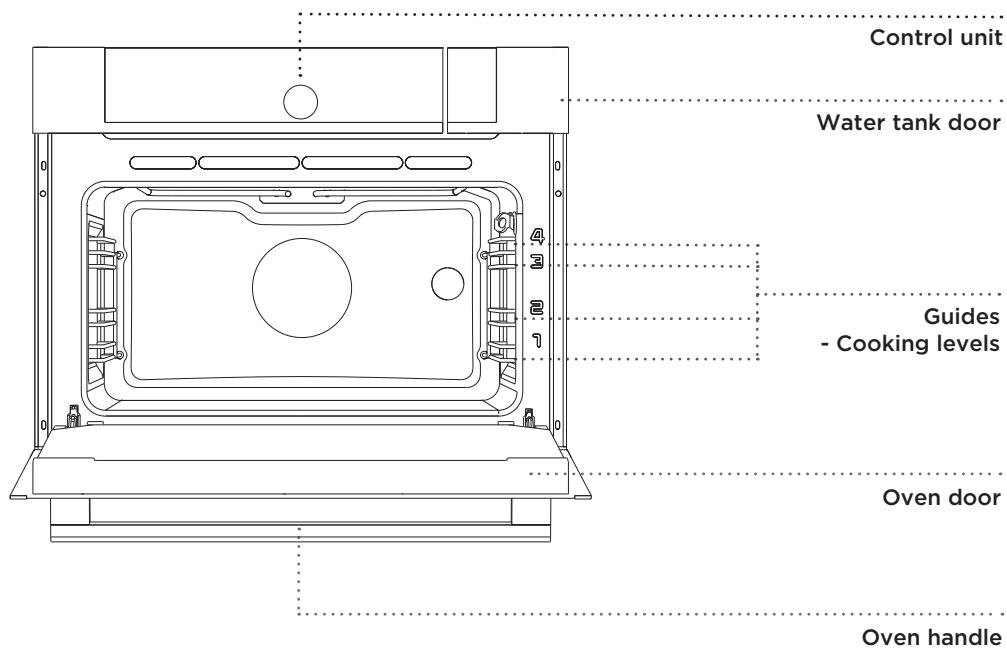
GUIDES-FILS
Les guides-fils permettent de préparer les aliments sur 4 niveaux (veuillez noter que les niveaux/guides sont comptés de bas en haut).
Les guides 3 et 4 sont destinés au gril, et le guide 1 est utilisé avec les systèmes micro-ondes lorsque les aliments sont préparés dans un plat en verre.
INTERRUPTEUR DE PORTE DU FOUR
Les interrupteurs désactivent le chauffage du four, le ventilateur et les micro-ondes lorsque la porte du four est ouverte pendant la cuisson. Lorsque la porte est fermée, les interrupteurs réactivent les éléments chauffants et les micro-ondes.
VENTILATEUR DE REFROIDISSEMENT
L'appareil est équipé d'un ventilateur de refroidissement qui refroidit le boîtier et le panneau de commande de l'appareil.
FONCTIONNEMENT PROLONGÉ DU VENTILATEUR DE REFROIDISSEMENT
Après l'extinction du four, le ventilateur de refroidissement continue de fonctionner pendant un court moment afin de refroidir le four. (La durée de fonctionnement prolongé du ventilateur dépend de la température au centre du four).
ÉQUIPEMENT ET ACCESSOIRES DU FOUR (selon le modèle)

LE PLAT DE CUISSON EN VERRE est utilisé pour la cuisson avec tous les systèmes du four et pour la cuisson aux micro-ondes. Il peut également servir de plat de service.

N'utilisez pas la grille, la lèchefrite profonde, le kit vapeur ou toute autre pièce métallique avec les systèmes qui incluent le fonctionnement par micro-ondes !

La GRILLE est utilisée pour griller ou comme support pour une poêle, une plaque de cuisson ou un plat avec les aliments.
Il y a un verrou de sécurité sur la grille.
Par conséquent, soulevez légèrement la grille à l'avant lors de son retrait du four.

La PLAQUE DE CUISSON PEU PROFONDE est utilisée pour la pâtisserie et les gâteaux.
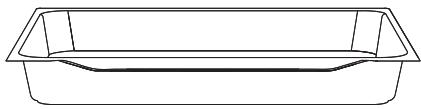
La LÈCHEFRITE PROFONDE est utilisée pour rôtir la viande et cuire des pâtisseries humides. Elle peut également servir de plat d'égouttage.
Ne placez jamais la lèchefrite profonde sur le premier guide pendant la cuisson, sauf lors du grillage et si vous utilisez uniquement la lèchefrite comme plat d'égouttage.
Comme les accessoires de cuisson chauffent, leur forme peut changer. Cela n'affecte pas leur fonctionnalité et leur forme d'origine sera rétablie lorsqu'ils refroidissent.
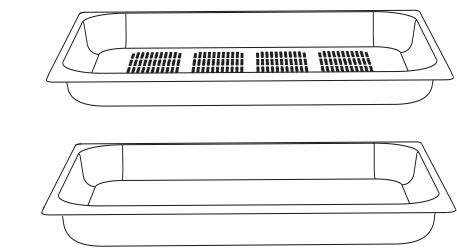
KIT VAPEUR (INOX) est utilisé pour la cuisson à la vapeur. Placez la plaque perforée au niveau intermédiaire et la plaque d'égouttage un niveau en dessous.
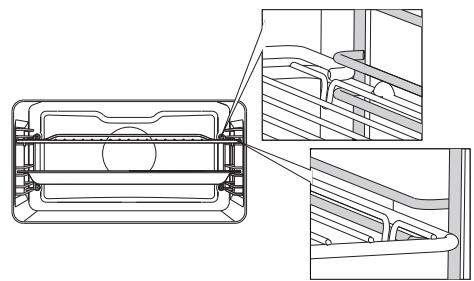
La grille ou la plaque doit toujours être insérée dans la rainure entre les deux profils de fil.
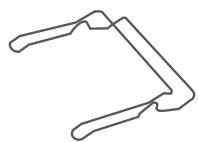
LE SUPPORT DE PLAQUE DE CUISSON facilite le retrait des plaques chaudes du four après la cuisson.
AGENT DÉTARTRANT ou nettoyage du système vapeur.
BANDE DE TEST PAPIER pour vérifier la dureté de l'eau.
UNITÉ DE COMMANDE
(selon le modèle)
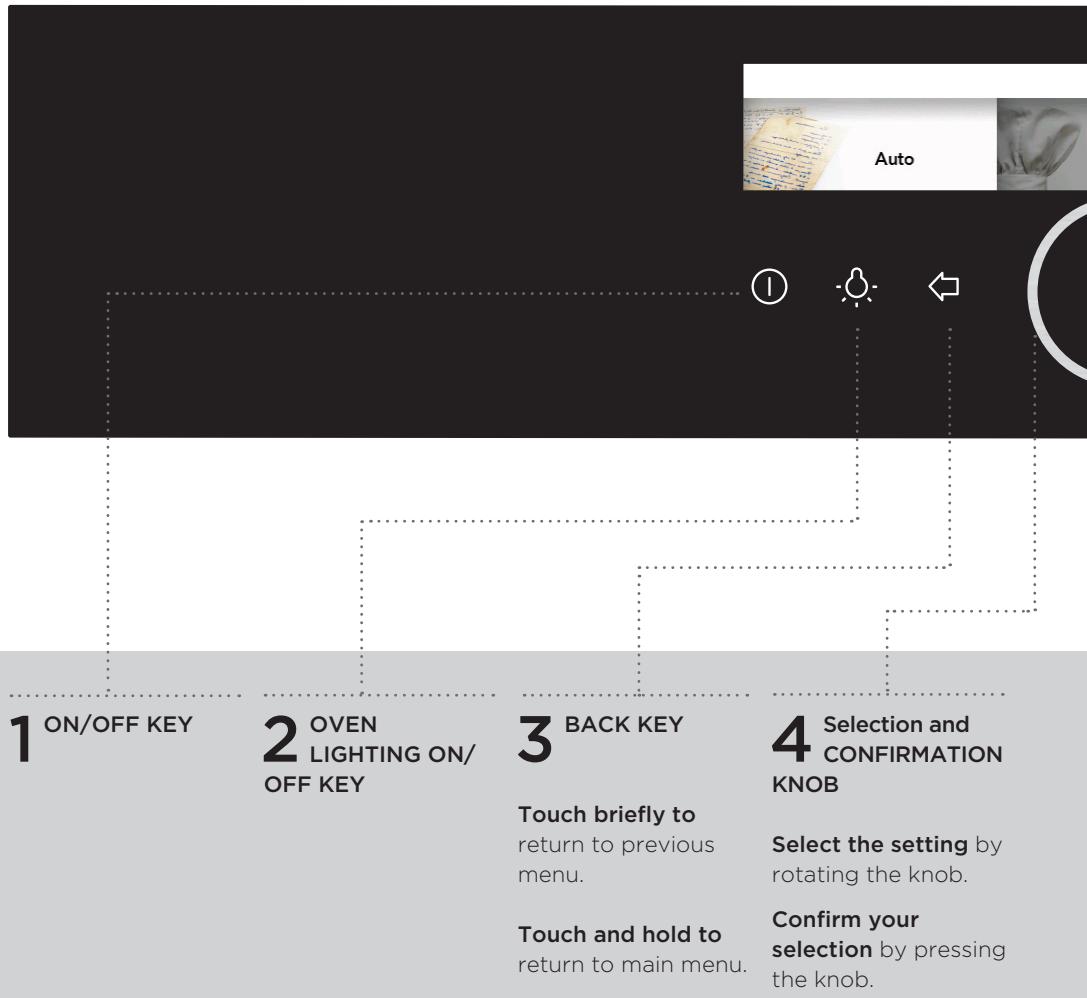
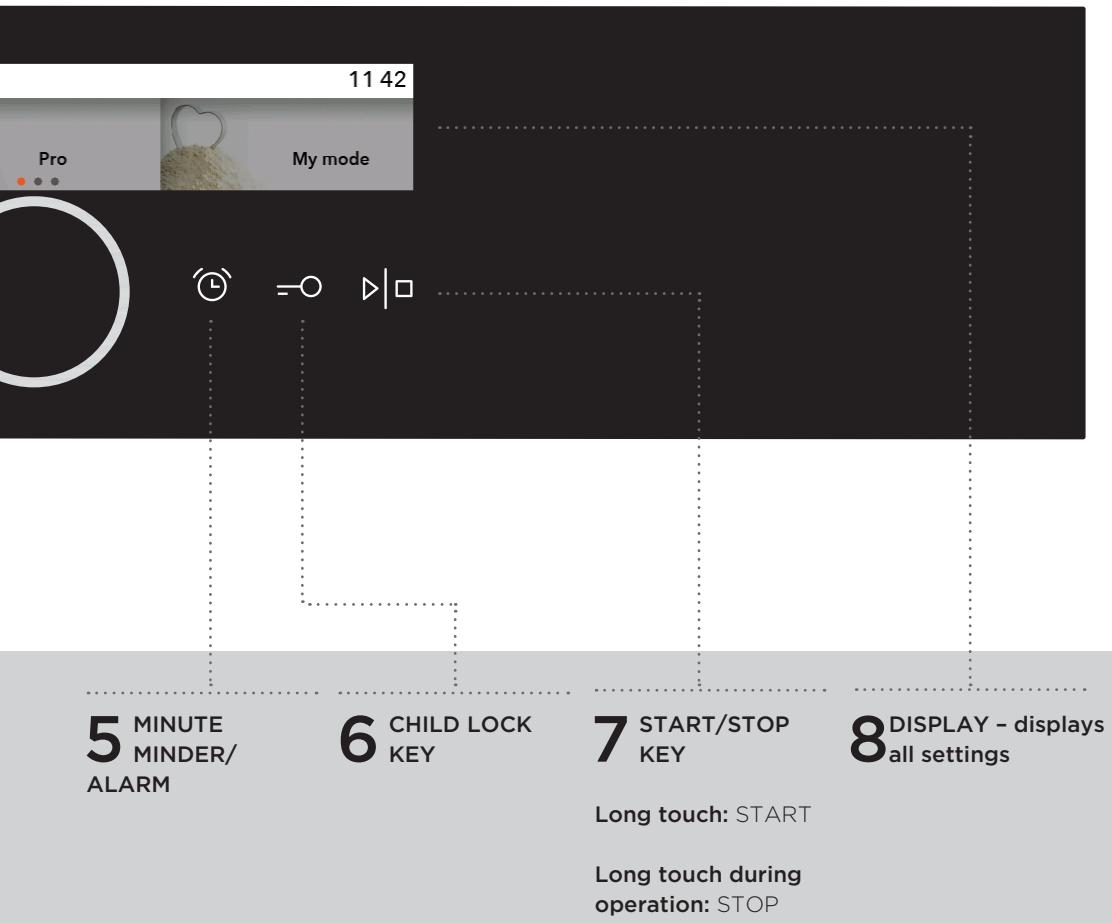
REMARQUE :
Les touches répondront mieux si vous les touchez avec une plus grande surface de votre doigt. Chaque pression sur une touche sera confirmée par un bref signal sonore.
INFORMATIONS SUR L'APPAREIL - PLAQUE SIGNALÉTIQUE (SELON LE MODÈLE)

A Numéro de série B Code C Type D Marque E Modèle F Données techniques G Symboles de conformité
La plaque signalétique indiquant les informations de base sur l'appareil se trouve sur le bord du four et est visible lorsque la porte du four est ouverte.
AVANT LA PREMIÈRE UTILISATION
Avant la première utilisation, retirez tous les composants, y compris tout équipement de transport, du four. Nettoyez tous les accessoires et ustensiles avec de l'eau chaude et un détergent ordinaire. N'utilisez pas de nettoyants abrasifs.
Avant d'utiliser le four pour la première fois, faites-le chauffer sans aliments, en mode "chaleur voûte et sole", à une température de 200 °C pendant environ une heure. L'odeur caractéristique d'un "appareil neuf" se dégagera. Ventilez abondamment la pièce lors de la première utilisation.
CUISSON À LA VAPEUR
Saine et naturelle, la cuisson à la vapeur préserve toute la saveur des aliments. Cette méthode de cuisson ne dégage aucune odeur.
Voici les avantages de la cuisson à la vapeur :
La cuisson (braisage, rôtissage) commence avant que la température à l'intérieur du four n'atteigne 100 °C. La cuisson lente (braisage, rôtissage) est également possible à des températures plus basses.
C'est sain : les vitamines et les minéraux sont bien préservés car seule une petite partie d'entre eux se dissout dans l'eau de condensation qui touche les aliments.
Il n'est pas nécessaire d'ajouter de la matière grasse pendant la cuisson. La vapeur préserve le goût des aliments. Elle n'ajoute ni odeurs, ni goût de grill ou de poêle. De plus, elle n'enlève rien car les aliments ne sont pas dilués dans l'eau.
La vapeur ne propage ni saveur ni odeur ; par conséquent, la viande ou le poisson peuvent être cuits avec des légumes.
La vapeur convient également pour blanchir, décongeler, réchauffer ou maintenir les aliments au chaud.
REMPLISSAGE DU RÉSERVOIR D'EAU
Le RÉSERVOIR D'EAU permet une alimentation en eau indépendante du four à vapeur. Le volume du réservoir est d'environ 1,3 litre (niveau d'eau maximal - voir le repère). Cette quantité d'eau suffit pour environ 3 heures de cuisson avec le cycle de vapeur le plus long (air chaud avec vapeur sur le système "élevé").

Nettoyez le réservoir d'eau avant la première utilisation.

Remplissez toujours le réservoir d'eau avec de l'eau propre et froide du robinet, de l'eau en bouteille sans additifs ou de l'eau distillée adaptée à la cuisson. L'eau versée dans le réservoir doit être à une température de 20°C (+/- 10°C).
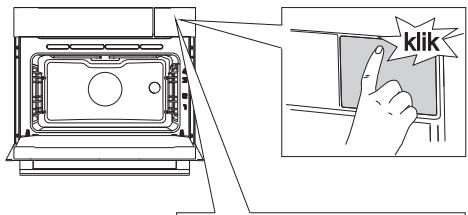
1 Appuyez (à l'endroit où se trouve l'autocollant) pour ouvrir la porte du réservoir.

L'autocollant peut être retiré plus tard.
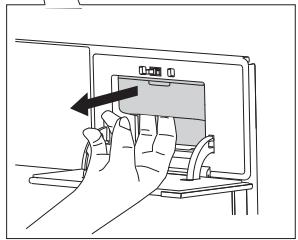
2 Retirez le réservoir d'eau du boîtier en tirant sur la partie en retrait.
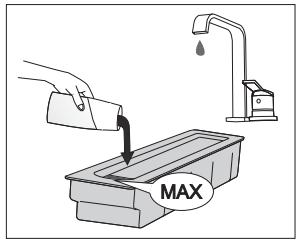
3 Ouvrez le couvercle. Lavez le réservoir avec de l'eau. Remontez le réservoir. Avant utilisation, ajoutez de l'eau fraîche jusqu'au repère MAX sur le réservoir.
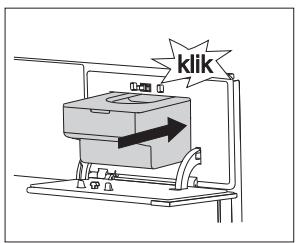
Repoussez le réservoir d'eau dans le boîtier jusqu'à la position finale (jusqu'à ce que vous entendiez un clic court). Ensuite, appuyez sur la porte du réservoir pour la fermer.
Après la cuisson, l'eau restante dans le système de vapeur est pompée de nouveau dans le réservoir d'eau. Le couvercle et le réservoir d'eau peuvent être lavés avec des nettoyants liquides standard non abrasifs ou au lave-vaisselle.
FONCTION MICRO-ONDES
Les micro-ondes sont utilisées pour cuire, rôtir et décongeler les aliments. Elles permettent une cuisson rapide et efficace sans modifier la couleur ou la forme des aliments.
Les micro-ondes sont un type de rayonnement électromagnétique. Ce rayonnement est couramment présent dans notre environnement sous forme d'ondes radioélectriques, de lumière ou de rayons infrarouges. Leur fréquence est de l'ordre de 2 450 MHz.
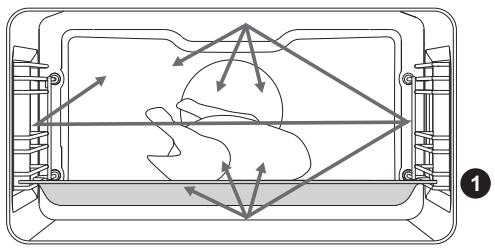
Leur comportement :
- Elles sont réfléchies par les métaux.
- Elles traversent tous les autres matériaux.
- Elles sont absorbées par les molécules d'eau, de graisse et de sucre.
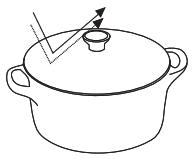
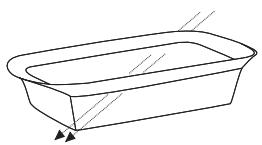
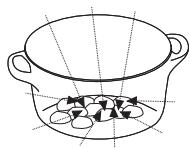
Lorsque les aliments sont exposés aux micro-ondes, les molécules commencent à se déplacer rapidement, générant ainsi de la chaleur.
Les micro-ondes pénètrent environ 2,5 centimètres de profondeur dans les aliments. Si l'aliment est plus épais, le cœur de l'aliment sera cuit par conduction, comme en cuisson conventionnelle.

Ne jamais utiliser ou activer un système à micro-ondes si le four est vide.
SÉLECTION DE LA LANGUE
Lors de la première connexion de l'appareil à l'alimentation électrique ou après une longue période de déconnexion, veuillez régler la langue souhaitée. La langue par défaut est l'anglais.

Confirmez chaque réglage en appuyant sur le BOUTON.

Tournez le BOUTON et sélectionnez la langue souhaitée. Confirmez votre sélection.
RÉGLAGE DE LA DATE

En appuyant sur le BOUTON, réglez le JOUR, le MOIS et l'ANNÉE. Tournez le bouton et confirmez votre sélection avec une coche.
RÉGLAGE DE L'HORLOGE

Tournez le BOUTON et réglez l'HORLOGE. Confirmez votre sélection avec une coche.

Le four fonctionne également si vous ne réglez pas l'heure, mais dans ce cas, il n'est pas possible de régler les fonctions de minuterie (voir le chapitre SÉLECTION DES FONCTIONS DE MINUTERIE).
Après quelques minutes d'inactivité, l'appareil passe en mode Veille.
MODIFICATION DES RÉGLAGES DE L'HORLOGE
Vous pouvez modifier l'heure lorsqu'aucune fonction de minuterie n'est activée (voir le chapitre SÉLECTION DES RÉGLAGES GÉNÉRAUX).
TEST DE LA DURETÉ DE L'EAU
Le test de la dureté de l'eau doit être effectué avant la première utilisation.
Une bande apparaîtra à l'écran avec le message "Eau très dure".

La dureté maximale de l'eau est réglée par défaut en usine.

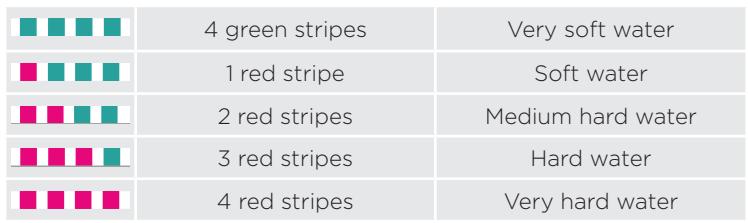
Trempez la bandelette de test (fournie avec l'appareil) dans l'eau pendant une (1) seconde. Attendez une minute et observez le nombre de bandes sur le papier. Saisissez le nombre de bandes dans l'appareil. Tournez le BOUTON et confirmez.
MODIFICATION DU RÉGLAGE DE LA DURETÉ DE L'EAU
La dureté de l'eau peut également être réglée dans le menu CHOIX DES RÉGLAGES GÉNÉRAUX.

Un réglage incorrect du niveau de dureté de l'eau pourrait affecter le fonctionnement et la durée de vie de l'appareil.
SÉLECTION DES MENUS PRINCIPAUX POUR LA CUISSON ET LES RÉGLAGES
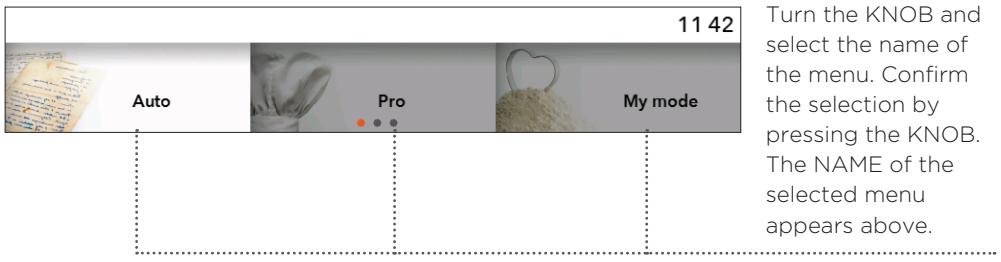

Confirmez chaque réglage en appuyant sur le BOUTON.
A) Auto
Dans ce mode, sélectionnez d'abord le type de plat, puis l'aliment choisi avec le réglage automatique de la quantité, du degré de cuisson et de la fin de l'opération.
Le programme propose une variété de recettes prédéfinies, testées par des chefs et des experts en nutrition.
B) Pro
Ce mode propose une sélection de plats avec des valeurs préréglées en usine, que vous pouvez modifier.
C) Mon mode
Ce mode vous permet de préparer des plats selon vos souhaits, en utilisant à chaque fois les mêmes étapes et réglages. Vous pouvez enregistrer vos réglages dans la mémoire du four et les rappeler la prochaine fois que vous voulez les utiliser.
D) Vapeur
C'est une méthode de cuisson naturelle qui préserve toute la saveur des aliments.
E) Micro-ondes
Ce mode convient à la cuisson, au rôtissage et à la décongélation des aliments.
A) CUISSON PAR SÉLECTION DU TYPE D'ALIMENT (mode auto ; automatique)
Confirmez chaque réglage en appuyant sur le BOUTON.

Confirmez chaque réglage en appuyant sur le BOUTON.

Tournez la molette et sélectionnez Auto. Confirmez votre sélection en appuyant sur la molette.

Sélectionnez le type de plat et l'aliment choisi. Confirmez votre sélection.
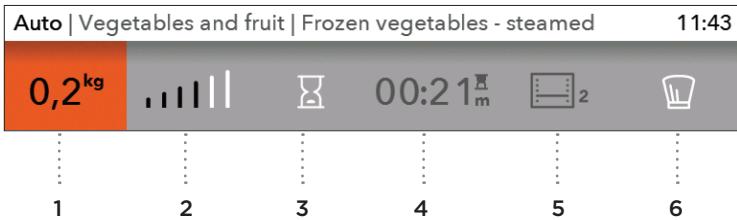
Les valeurs prédéfinies sont affichées. Vous pouvez modifier la quantité, le niveau de cuisson et le départ différé (fin de cuisson).
1 quantité, 2 niveau de cuisson, 3 départ différé, 4 durée de cuisson, 5 système de cuisson et niveau recommandé, 6 mode professionnel (Pro)

Si dans le mode automatique le symbole est sélectionné, le programme passe en
mode professionnel (Pro) (voir le chapitre CUISSON PAR SÉLECTION DU MODE).
Touchez la touche DÉPART/ARRÊT pour démarrer le processus de cuisson.
L'écran affiche tous les réglages sélectionnés.
PRÉCHAUFFAGE
Les procédures de cuisson pour certains plats en mode Auto incluent également la fonction de préchauffage. Lorsque vous sélectionnez l'aliment, la notification suivante apparaîtra : "Le programme sélectionné inclut la fonction de préchauffage." (Confirmez votre sélection avec la molette.) "Préchauffage démarré." N'insérez pas encore les aliments. La température réelle et la température réglée alterneront sur l'écran.
Lorsque la température sélectionnée est atteinte, le processus de préchauffage s'arrête et un signal acoustique est émis. La notification suivante apparaîtra sur l'écran : "Préchauffage terminé." Ouvrez la porte et insérez les aliments. Le programme reprend ensuite le processus de cuisson avec les réglages sélectionnés.

Lorsque la fonction de préchauffage est réglée, la fonction de départ différé ne peut pas être utilisée.
B) CUISSON PAR SÉLECTION DU MODE DE
FONCTIONNEMENT
(mode professionnel et mode vapeur)

Confirmez chaque réglage en appuyant sur le bouton.

Tournez le bouton et sélectionnez Pro. Confirmez votre sélection.
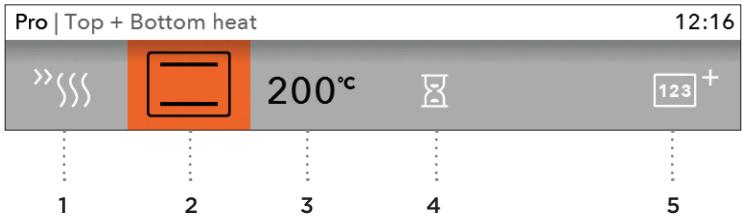
Sélectionnez vos propres réglages de base.
RÉGLAGES DE BASE
1 préchauffage 2 système (voir tableau SYSTÈMES DE CUISSON) 3 température dans le four
RÉGLAGES SUPPLÉMENTAIRES
4 durée de cuisson (voir chapitre FONCTIONS MINUTEUR - DURÉE) 5 cuisson multiphase (voir chapitre Cuisson multiphase) 6 (injection de vapeur) (voir chapitre INJECTION DE VAPEUR)
PRÉCHAUFFAGE
Utilisez la fonction de préchauffage si vous souhaitez chauffer le four à la température souhaitée le plus rapidement possible. Lorsque ce symbole est sélectionné, la fonction de préchauffage est activée et une notification apparaît : "Préchauffage démarré." N'insérez pas encore les aliments. La température réelle et la température réglée alternent sur l'écran.
Lorsque la température sélectionnée est atteinte, le processus de préchauffage s'arrête et un signal acoustique est émis.
La notification suivante apparaît à l'écran : "Préchauffage terminé." Ouvrez la porte et insérez les aliments. Le programme reprend ensuite le processus de cuisson avec les réglages sélectionnés.

Lorsque la fonction de préchauffage est réglée, la fonction de départ différé ne peut pas être utilisée.
SYSTÈMES DE CUISSON (selon le modèle)
| SYSTEM | DESCRIPTION | PRESET TEMPERATURE (℃) | MIN - MAX TEMPERATURE (℃) |
| OVEN SYSTEMS | |||
| TOP + BOTTOM HEAT The heaters in the bottom and in the ceiling of the oven cavity will radiate heat evenly into the oven interior. Pastry or meat can only be baked/roasted at a single height level. | 200 | 30-230 | |
| TOP HEAT Only the heater on the oven cavity ceiling will radiate heat. Use this heater to brown the upper side of the dish. | 150 | 30-230 | |
| BOTTOM HEAT Only the heater on the bottom of the oven cavity will radiate heat. Use this heater to brown the lower side of the dish. | 160 | 30-230 | |
| SMALL GRILL Only grill heater, a part of the large grill set, will operate. Use this heater to grill a few open sandwiches or beer sausages, or for toasting bread. | 230 | 30-230 | |
| LARGE GRILL The upper heater and the grill heater will operate. The heat is radiated directly by the grill heater installed in the oven ceiling. To boost the heating effect, the upper heater is activated as well. This system is used for grilling a smaller amount of open sandwiches or beer sausages, and for toasting bread. | 230 | 30-230 | |
| LARGE GRILL + FAN Grill heater and the fan will operate. This combination is used to grill meat and to roast larger chunks of meat or poultry at a single height level. It is also appropriate for dishes au gratin and for browning to a crispy crust. | 170 | 30-230 | |
| HOT AIR + BOTTOM HEAT Bottom heater, round heater, and the fan will operate. This is used to bake pizza, moist pastry, fruitcakes, leavened dough and shortcrust on several levels simultaneously. | 200 | 30-230 | |
| HOT AIR Round heater and the fan will operate. The fan installed in the back wall of the oven cavity makes sure the hot air constantly circulates around the roast or pastry. This mode is used for roasting meat and baking pastry at several levels simultaneously. | 180 | 30-230 | |
| eco | ECO HOT AIR1 In this mode, power consumption during the cooking process is optimized. This mode is used for roasting meat and baking pastry. | 180 | 120-230 |
| BOTTOM HEAT + FAN This is used for baking leavened but low-rising pastry and for preserving fruit and vegetables. | 180 | 30-230 | |
| SYSTEM | DESCRIPTION | PRESET TEMPERATURE (°C) | MIN-MAX TEMPERATURE (°C) |
| OVEN SYSTEMS | |||
| A | ROASTING In the Auto Roast mode/system, the upper heater will operate in combination with the grill heater and the round heater. It is used for roasting all types of meat. | 180 | 30-230 |
1) Il est utilisé pour déterminer la classe d'efficacité énergétique conformément à la norme EN 60350-1.
Dans ce mode, la température réelle dans le four n'est pas affichée en raison d'un algorithme de fonctionnement spécial de l'appareil et de l'utilisation de la chaleur résiduelle.
| SYSTEM | DESCRIPTION STEAM | PRESET TEMPERATURE (°C) | MIN-MAX TEMPERATURE (°C) |
| HOT AIR WITH STEAM This system is used for cooking and defrosting. It allows quick and efficient cooking without changing the colour or shape of the food. Three options are available: | 160 | 30-230 | |
| HIGH: cooking escalopes, steaks, and smaller chunks of meat | |||
| MEDIUM: reheating cool/frozen meals, cooking fish fillets and vegetables au gratin | |||
| LOW: cooking large chunks of meat (roast, whole chicken), baking risen dough (bread and rolls), cooking lasagne etc. | |||
| STEAM Use this for all types of meat, stews, vegetables, pies, cakes, bread, and dishes au gratin (i.e. food that require longer cooking time). | 100 | 30-100 | |
| SOUS VIDE is a slow cooking procedure with food vacuum sealed and cooked at a specific temperature that is accurately maintained. The sous vide method is suitable for cooking meat, fish, and all types of fruit and vegetables. Food cooked in this way is juicy and it develops a fuller flavour. | 50 | 30-95 | |
| COOKING SYSTEMS | DESCRIPTION MICROWAVE | PRESET TEMPERATURE (°C) | POWER (W) |
| ≈ | MICROWAVE Microwaves are used for cooking and defrosting. They allow quick and efficient cooking without changing the colour or shape of the food. | - | 1000 |
| HOT AIR + MICROWAVE Use this for all types of meat, stews, vegetables and dishes au gratin (i.e. food that require longer cooking time). | 160 | 600 | |
| GRILL + FAN + MICROWAVE Use this combination for smaller chunks of meat, fish and vegetables. It allows fast cooking and the food will have a nicely browned crispy crust. | 200 | 600 |
| POWER LEVEL | USE |
| 1000 W | • Quickly reheating beverages, water and dishes containing a large volume of liquid. • Cooking dishes with high water content (soups, sauces etc.). |
| 750 W | • Cooking fresh or frozen vegetables. |
| 600 W | • Melting chocolate. • Cooking fish and seafood; reheating on two levels. • Cooking dried beans at low heat. • Reheating and cooking of delicate egg-based dishes. |
| 360 W | • Low-heat cooking of dairy products or jams. |
| 180 W | • Manual defrosting; softening butter or ice cream. |
| 90 W | • Defrosting cream-filled pastry. |
Appuyez sur le bouton START/STOP pour démarrer le processus de cuisson.
L'écran affiche tous les réglages sélectionnés.

Le symbole ° C clignote à l'écran jusqu'à ce que la température réglée soit atteinte. Un signal sonore retentit. Pendant le processus, vous ne pouvez pas modifier les systèmes de cuisson.
FONCTIONS DE MINUTERIE - DURÉE
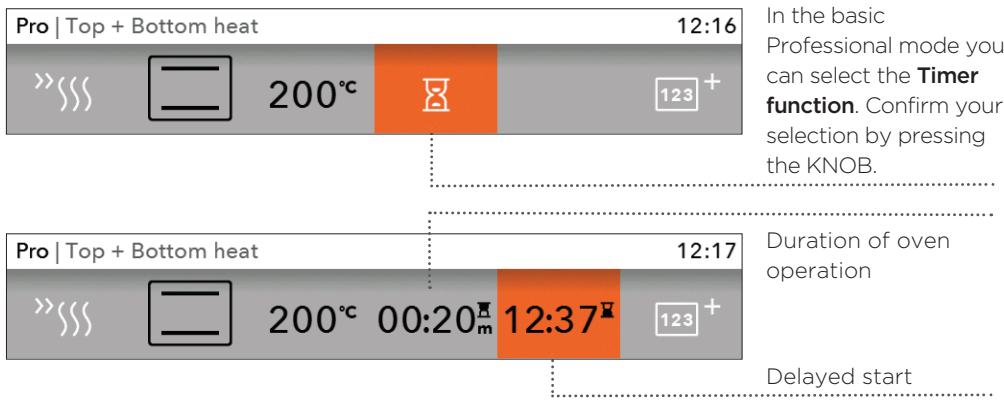

Réglage du temps de cuisson
Dans ce mode, vous pouvez définir la durée de fonctionnement du four. Réglez le temps de cuisson souhaité et confirmez la sélection (le temps de cuisson maximal est de 10 heures). L'heure de fin affichée est ajustée en conséquence. Appuyez sur START pour démarrer le processus de cuisson. L'écran affiche tous les réglages sélectionnés. Désactivez toutes les fonctions de minuterie en réglant le temps sélectionné sur 0.

Réglage du départ différé
- La mise en marche différée n'est pas possible sur les systèmes petit gril, grand gril et gril avec ventilateur.
Dans ce mode, vous pouvez spécifier la durée du processus de cuisson (temps de cuisson) et l'heure à laquelle vous souhaitez que le processus de cuisson s'arrête (heure de fin) (le délai peut être réglé sur 24 heures). Assurez-vous que l'horloge est réglée avec précision sur l'heure actuelle.
Exemple :
Heure actuelle : 12:00
Temps de cuisson : 2 heures
Fin de la cuisson : 18:00
Tout d'abord, réglez le TEMPS DE CUISSON (2 heures). La somme de l'heure actuelle et du temps de cuisson est automatiquement affichée (14:00). Ensuite, sélectionnez HEURE DE FIN et réglez la minuterie (18:00).
Appuyez sur START pour démarrer le processus de cuisson. La minuterie attendra l'heure de début du processus de cuisson. L'écran affiche le message :
Départ différé. La cuisson démarrera à 16h00.

Lorsque le temps programmé est écoulé, le four s'arrête automatiquement (fin de cuisson). Un
signal sonore bref est émis et le menu Fin s'affiche.
Après quelques minutes d'inactivité, l'appareil passe en mode veille.
CUISSON MULTIPHASE
Ce mode permet de combiner trois méthodes de préparation différentes et successives en un seul processus de cuisson.
En sélectionnant différents réglages, vous pouvez préparer des plats exactement comme vous le souhaitez.
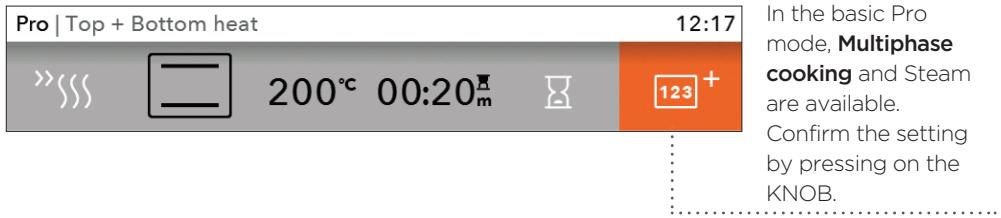


L'étape 1 est déjà sélectionnée si vous avez réglé les fonctions de minuterie au préalable.

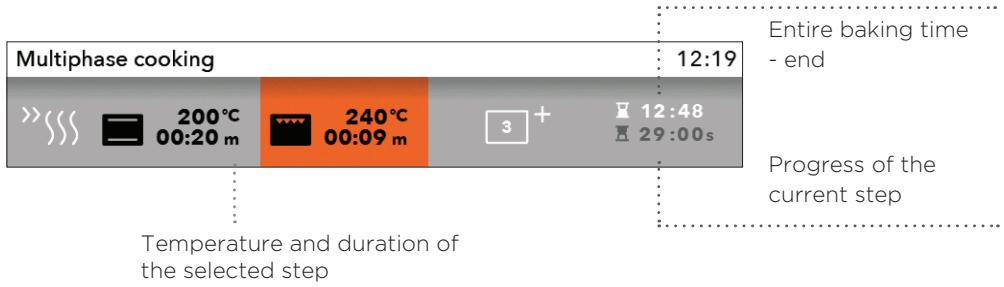
En touchant la touche DÉPART, le four commence à fonctionner selon l'étape 1. (La barre de progression en bas de l'écran indique l'étape en cours du processus de cuisson). Lorsqu'un certain temps s'écoule, l'étape 2 est activée, puis l'étape 3 si elle a été sélectionnée.

Si vous souhaitez annuler l'une des étapes pendant le fonctionnement, tournez le BOUTON, sélectionnez l'étape et annulez-la en confirmant avec une CROIX. Vous ne pouvez le faire que pour les étapes qui n'ont pas encore été lancées.
INJECTION DE VAPEUR
L'injection de vapeur est recommandée lors de la cuisson :
- viande (vers la fin de la cuisson) : la viande sera plus juteuse et plus tendre, et il n'est pas nécessaire de l'arroser. Viandes : bœuf, veau, porc, gibier, volaille, agneau, poisson, saucisses ;
- pain et petits pains : utilisez la vapeur pendant les 5 à 10 premières minutes de cuisson. La croûte sera croustillante et bien dorée ;
- soufflés de légumes et de fruits, lasagnes, plats de féculents, puddings ;
- Légumes, en particulier pommes de terre, chou-fleur, brocoli, carottes, courgettes et aubergines.
L'injection de vapeur est possible en mode professionnel lors de la sélection du temps de cuisson. Le temps de cuisson doit être suffisamment long pour permettre l'injection de vapeur.

Le temps de cuisson total ne peut pas être inférieur à 10 minutes.

Pour l'injection de vapeur, sélectionnez le symbole ^+. Confirmez le réglage en appuyant sur le bouton.

Tournez le BOUTON et sélectionnez une fonction. - Cuisson multiphase (voir chapitre CUISSON MULTIPHASE.) - Intensité d'injection de vapeur en trois niveaux
A) INJECTION DE VAPEUR PAR ÉTAPES
Réglez les étapes (voir chapitre CUISSON MULTIPHASE). Sélectionnez le symbole + pour l'injection de vapeur. Le système calculera automatiquement les injections de vapeur individuelles en fonction du temps de cuisson total. Touchez la touche DÉMARRAGE/ARRÊT pour démarrer le four.
B) INJECTION DIRECTE DE VAPEUR
L'injection directe de vapeur a lieu pendant le processus de cuisson. Sélectionnez le symbole. Un avertissement apparaît : "Voulez-vous injecter de la vapeur ?" Le symbole clignote jusqu'à la fin du processus. L'injection directe de vapeur peut être répétée en trois étapes ; ensuite, le symbole de vapeur disparaît.
C) ENREGISTREMENT DE VOTRE PROPRE PROGRAMME (MON MODE)
Lorsque le processus de cuisson est terminé, le menu "Terminer" apparaît. Sélectionnez le symbole pour enregistrer vos réglages dans la mémoire du four.


Sélectionnez le champ avec des astérisques pour lequel vous choisirez un nouveau nom de recette.

Vous pouvez enregistrer jusqu'à 12 recettes en mémoire.

Tournez le BOUTON et confirmez chaque caractère pour saisir le nom. Si nécessaire, supprimez un caractère avec la flèche ; enregistrez le nom avec la coche.

Vous pouvez retrouver vos recettes préférées en choisissant Mon mode dans le menu principal. Confirmez votre sélection avec le BOUTON.

Les valeurs prédéfinies sont affichées et vous pouvez les modifier si nécessaire.
Lorsque le programme est terminé, le menu Fin apparaît. Si vous avez effectué des modifications, vous pouvez les enregistrer en sélectionnant le symbole 0+. Sélectionnez une recette portant le même nom. Le message "Le programme sera écrasé" s'affiche à l'écran.
- Confirmez la sélection pour enregistrer la recette sous le même nom ou sous un nouveau nom.
- Vous pouvez également annuler votre sélection. Un écran apparaîtra sur lequel vous pourrez sélectionner un nouveau champ et enregistrer la nouvelle recette.
D) CUISSON VAPEUR
(Vapeur - accès rapide aux programmes vapeur)

Confirmez chaque réglage en appuyant sur le BOUTON.

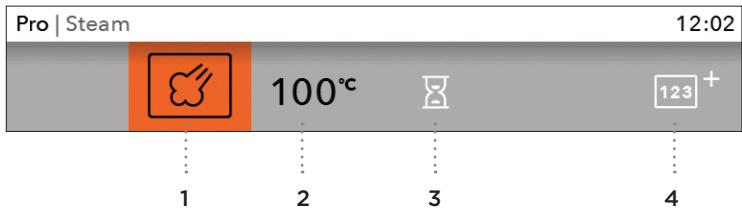
Choisissez vos propres réglages de base.
1 Système 2 Température du four 3 Durée de cuisson 4 Cuisson multiphase (voir chapitre CUISSON MULTIPHASE)

Utilisez la fonction de préchauffage si vous souhaitez chauffer le four à la température souhaitée le plus rapidement possible.
Remplissez le réservoir d'eau avec de l'eau fraîche jusqu'au repère MAX. Utilisez le CUISEUR VAPEUR pour cuire les légumes, le poisson, la viande et les pommes de terre - lorsqu'ils ne sont pas cuits dans une sauce. Placez le cuiseur vapeur sur le 2ème niveau.
SOUS VIDE (CUISSON VAPEUR)
Assaisonnez les aliments et scellez-les dans un sac en plastique adapté à la mise sous vide et à la cuisson sous vide. Placez le sac scellé contenant les aliments sur le plateau perforé et placez-le sur la grille du milieu.


Tournez le BOUTON et sélectionnez Sous-vide.

Choisissez la température et la durée de cuisson.
Cuire les aliments pendant une longue période à basse température (voir le tableau de cuisson).
Après la cuisson, retirer les aliments du sachet. Pour une saveur plus intense, les aliments peuvent être rapidement saisis dans de l'huile chaude.
| Dish | Thickness (cm) | Temperature icon (°C) | Cooking time (minutes) |
| MEAT | |||
| Beef steak, medium | 3 | 60 | 150-180 |
| Beef steak, well done | 3 | 70 | 140-170 |
| Pork steak, medium | 3 | 65 | 70-100 |
| Pork steak, well done | 3 | 70 | 70-100 |
| Lamb steak, medium | 2 | 60 | 90-120 |
| Lamb steak, well done | 2 | 70 | 70-100 |
| Veal steak, medium | 3 | 60 | 90-120 |
| Veal steak, well done | 3 | 70 | 70-100 |
| Boneless chicken breast | 3 | 65 | 90-120 |
| Boneless duck breast | 3 | 65 | 120-150 |
| Boneless turkey breast | 5 | 65 | 180-210 |
| Fish fillet | 1 | 55 | 40-60 |
| Fish steak | 2 | 55 | 40-60 |
| Shrimps | / | 60 | 30-40 |
| Octopus, tentacles | / | 85 | 180-240 |
| Scallops | / | 60 | 40-60 |
| Carrots, chopped/sliced | 1 | 85 | 90-120 |
| Potatoes, cubed | 2 | 85 | 100-130 |
| Asparagus | / | 85 | 50-70 |
| Eggplant / aubergines | 1 | 85 | 50-70 |
| Fruit, chunks | / | 70 | 90-120 |
E) CUISSON AUX MICRO-ONDES

Confirmer chaque réglage en appuyant sur le BOUTON.

Tourner le BOUTON et sélectionner Micro-ondes.
Confirmer en appuyant sur le BOUTON.
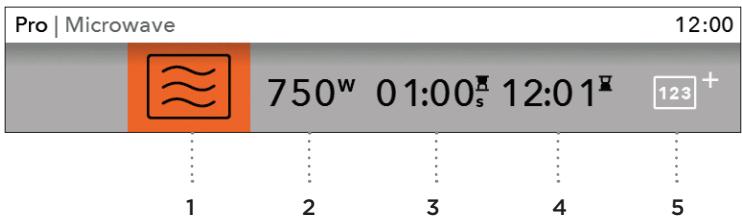
Sélectionner les réglages en tournant le BOUTON et en appuyant dessus pour confirmer.
1 Système micro-ondes 2 Puissance de fonctionnement / température (pour les systèmes combinés) 3 Durée de cuisson 4 Départ différé 5 Mode étape (voir section CUISSON MULTIPHASE)
Dans les systèmes micro-ondes, vous ne pouvez pas utiliser la fonction de départ différé.
Toucher la touche DÉPART/ARRÊT pour démarrer le fonctionnement du four.
Les réglages sélectionnés et le temps de décompte s'affichent sur l'écran.

Si vous avez sélectionné un système combiné avec micro-ondes, le symbole ° C clignote jusqu'à ce que la température soit atteinte.
DÉMARRER LE PROCESSUS DE CUISSON
La touche DÉPART/ARRÊT clignote avant le début du processus de cuisson.
Démarrer le processus de cuisson en touchant la touche DÉPART/ARRÊT.
Appuyez sur le bouton et tournez-le pour modifier les réglages actuels pendant la cuisson.


"O" Si vous ouvrez la porte pendant le fonctionnement, le processus de cuisson s'arrête. Il reprend lorsque vous refermez la porte. Cela doit être fait dans un délai maximal de 3 minutes ; sinon, l'opération est interrompue et "Terminé" s'affiche à l'écran.
FIN DE LA CUISSON ET ARRÊT DU FOUR
Pour faire une pause dans le processus de cuisson, appuyez sur la touche DÉMARRAGE/ARRÊT.

Tournez le bouton et le menu Terminé apparaît avec les symboles.

Terminé
Sélectionnez l'icône et terminez le processus de cuisson. L'écran affiche le menu principal.

Ajouter la durée
Vous pouvez prolonger la durée de cuisson en sélectionnant l'icône.
Vous pouvez déterminer une nouvelle heure de fin de cuisson (voir le chapitre FONCTIONS DE MINUTERIE - DURÉE).

Gratin
Choisissez ce symbole pour faire dorer la couche supérieure du plat après la cuisson.

Ajouter aux favoris
Vous pouvez mémoriser les réglages sélectionnés dans la mémoire du four et les réutiliser la prochaine fois.

Après l'utilisation du four, il peut rester de l'eau dans le canal de condensation.
(sous la porte). Essuyez la rainure avec une éponge ou un chiffon.
SÉLECTION DES FONCTIONS SUPPLÉMENTAIRES
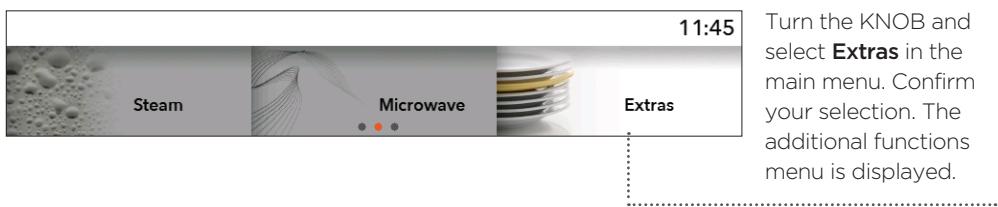

Certaines fonctions ne sont pas disponibles avec certains systèmes ; un signal acoustique retentit dans ce cas.
Nettoyage à la vapeur (steam-clean)
Ce programme facilite l'élimination des taches à l'intérieur du four.
(Voir le chapitre NETTOYAGE ET ENTRETIEN.)
Décongélation
Dans ce mode, l'air circule sans que les résistances fonctionnent.
Seul le ventilateur fonctionne.
Il est utilisé pour la décongélation lente des aliments surgelés (gâteaux, pâtisseries, pain et petits pains, et fruits surgelés).
En sélectionnant le symbole, réglez le type d'aliment, le poids, et l'heure de début et de fin de la décongélation.
À mi-temps de la décongélation, les morceaux doivent être retournés, remués et séparés s'ils étaient congelés ensemble.
Réchauffage
Le réchauffage peut être utilisé pour maintenir au chaud les aliments déjà cuits. Sélectionnez le symbole pour régler la température, et l'heure de début et de fin du réchauffage.
Chauffe-assiettes
Utilisez cette fonction pour préchauffer votre vaisselle (assiettes, tasses) avant d'y servir des aliments afin de les garder chauds plus longtemps. En sélectionnant le symbole, vous pouvez régler la température ainsi que l'heure de début et de fin du processus de chauffage.
Régénération
Ce mode de cuisson peut être utilisé pour réchauffer des aliments déjà cuits. Comme les aliments sont réchauffés à la vapeur, ils ne perdent pas leur qualité.
La saveur et la texture sont conservées comme si les aliments venaient d'être cuits. Plusieurs plats peuvent être régénérés en même temps.
- Avec cette fonction, vous pouvez sélectionner le début et la fin du processus de régénération.
Préchauffage rapide
Utilisez cette fonction si vous souhaitez chauffer le four à la température souhaitée le plus rapidement possible. Ne convient pas à la cuisson des aliments. Lorsque le four atteint la température réglée, le processus de chauffage est terminé et le four est prêt à fonctionner dans le programme sélectionné.
Chabbat
Dans ce mode, réglez la température entre 85 et 180 °C et réglez la durée (jusqu'à 74 heures) pour les activités du Chabbat. Appuyez sur START pour démarrer le compte à rebours. Une lumière s'allume dans le four. Tous les sons et toutes les opérations sont désactivés, à l'exception de la touche ON/OFF. Après la fin, vous pouvez enregistrer vos réglages.

En cas de coupure de courant, le mode Chabbat est annulé et le four revient à sa position de départ.

Avertissement : le fabricant n'est pas responsable d'une mauvaise utilisation du mode Chabbat.
Sous vide
Il est utilisé pour une cuisson lente sous vide, à la vapeur. Cuire lentement les aliments scellés sous vide à basse température. Les aliments développeront une saveur plus complète et davantage de vitamines et de minéraux seront conservés.

Tournez la MOLETTE pour afficher le menu Fin avec un affichage de symboles.
SÉLECTION DES RÉGLAGES GÉNÉRAUX


En tournant la molette, vous pouvez naviguer dans le menu. Confirmez chaque sélection en appuyant sur la molette.
Général
Langue - sélectionnez la langue dans laquelle vous souhaitez que le texte soit affiché.
Date - réglez la date lors de la première connexion de l'appareil au secteur ou si l'appareil a été débranché du secteur pendant une période prolongée (plus d'une semaine). Réglez le jour, le mois et l'année.
Heure - l'heure de la journée doit être réglée lors de la première connexion de l'appareil au secteur ou si l'appareil a été débranché du secteur pendant une période prolongée (plus d'une semaine). Réglez l'HORLOGE - heure. Dans le champ Heure, vous pouvez également sélectionner l'affichage de l'horloge numérique ou analogique.
Son - le volume du signal sonore ne peut être réglé que lorsqu'aucune fonction de minuterie n'est activée (seule l'heure de la journée est affichée).
Volume - vous pouvez choisir parmi trois niveaux de volume différents.
Son des touches - vous pouvez l'activer ou le désactiver.
Son au démarrage/arrêt - vous pouvez l'activer ou le désactiver.
Affichage
Dans ce menu, vous pouvez régler :
Luminosité - vous pouvez régler trois niveaux différents.
Mode nuit - réglez la période pendant laquelle vous souhaitez que l'affichage soit atténué.
Appareil en mode veille - l'affichage s'éteint automatiquement après 1 heure.
Réglages de cuisson
Réglages de mon four à micro-ondes
Intensité du programme par défaut
Vapeur
- Procédure de détartrage.
- Dureté de l'eau
Système
Informations sur l'appareil
Réglages d'usine
Éclairage du four en fonctionnement - l'éclairage est éteint lorsque vous ouvrez la porte pendant le processus de cuisson.
Éclairage du four - l'éclairage du four est activé automatiquement lorsque vous ouvrez la porte ou allumez le four. Lorsque le processus de cuisson est terminé, la lumière reste allumée pendant environ 1 minute. Vous pouvez allumer ou éteindre la lumière en appuyant sur le bouton d'éclairage.

SÉCURITÉ ENFANTS
Elle est activée en touchant la touche SÉCURITÉ ENFANTS. Le message « Sécurité enfants ACTIVÉE » s'affiche. Touchez à nouveau la touche pour désactiver la sécurité enfants.
Si la sécurité enfants est activée sans fonction de minuterie engagée (seule l'horloge est affichée), le four ne fonctionnera pas. Si la sécurité enfants est activée après qu'une fonction de minuterie a été réglée, le four fonctionnera normalement ; cependant, il ne sera pas possible de modifier les réglages. Lorsque la sécurité enfants est activée, les systèmes ou fonctions supplémentaires ne peuvent pas être modifiés. Le seul changement possible est de mettre fin au processus de cuisson. La sécurité enfants restera active après l'extinction du four. Pour sélectionner un nouveau système, la sécurité enfants doit d'abord être désactivée.

RÉGLAGE DE LA MINUTERIE
La minuterie peut être utilisée séparément, indépendamment du fonctionnement du four. Elle est activée en appuyant sur la touche. Le réglage maximal est de 24 heures. Lorsque le temps réglé est écoulé, un signal acoustique retentit, qui peut être désactivé en appuyant sur n'importe quelle touche ou s'éteint automatiquement après une minute.

Après une coupure de courant ou après l'extinction de l'appareil, tous les réglages supplémentaires resteront mémorisés.
DESCRIPTION DES SYSTÈMES (MODES DE CUISSON) ET TABLEAUX DE CUISSON
Si l'aliment souhaité ne figure pas dans le tableau de cuisson, recherchez des informations pour un aliment similaire. Les informations affichées s'appliquent à une cuisson sur un seul niveau.
Une plage de température suggérée est indiquée. Commencez par un réglage de température plus bas et augmentez-le si vous constatez que les aliments ne sont pas suffisamment dorés.
Les temps de cuisson sont des estimations approximatives et peuvent varier selon certaines conditions.
Ne préchauffez le four que si la recette ou les tableaux de ce manuel d'instructions l'exigent. Chauffer un four vide consomme beaucoup d'énergie. Par conséquent, cuire plusieurs types de pâtisseries ou plusieurs pizzas successivement permettra d'économiser beaucoup d'énergie car le four aura déjà été préchauffé.
Lorsque vous utilisez du papier sulfurisé, assurez-vous qu'il résiste aux températures élevées.
Lors de la cuisson de gros morceaux de viande ou de pâtisseries, beaucoup de vapeur sera générée à l'intérieur du four, ce qui peut se condenser sur la porte du four. C'est un phénomène normal qui n'affecte pas le fonctionnement de l'appareil. Après la cuisson, essuyez la porte et la vitre de la porte.
Éteignez le four environ 10 minutes avant la fin de la cuisson pour économiser de l'énergie en utilisant la chaleur accumulée.
Ne refroidissez pas les aliments dans un four fermé pour éviter la condensation (buée).

Le symbole * signifie que le four doit être préchauffé avec le système de cuisson sélectionné.
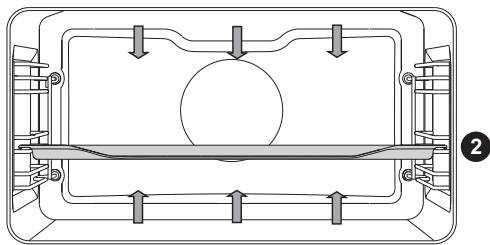
Les résistances situées en bas et en haut de la cavité du four diffusent la chaleur uniformément à l'intérieur du four.
Rôtissage de la viande
Utilisez des plats ou des plaques en émail, en verre trempé, en terre cuite ou en fonte.
Les plaques en acier inoxydable ne conviennent pas car elles réfléchissent fortement la chaleur.
Pendant la cuisson au four, veillez à fournir suffisamment d'humidité pour éviter que la viande ne brûle.
Retournez la viande pendant la cuisson au four.
Si vous couvrez le rôti, il restera plus juteux.
| Type of food | Weight (g) | Guide (from the bottom) | Temperature (°C) | Cooking time (min) |
| MEAT | ||||
| Pork roast | 1500 | 1 | 180-200 | 90-120 |
| Pork shoulder | 1500 | 1 | 180-200 | 110-140 |
| Pork roulade | 1500 | 2 | 180-200 | 90-110 |
| Roast beef | 1500 | 1 | 170-190 | 120-150 |
| Veal roulade | 1500 | 2 | 180-200 | 80-100 |
| Lamb sirloin | 1500 | 1 | 180-200 | 60-80 |
| Rabbit loin | 1000 | 2 | 180-200 | 50-70 |
| Deer shank | 1500 | 1 | 180-200 | 90-120 |
| Meat rolls | / | 2 | 180-200 | 15-30 |
| FISH | ||||
| Braised fish | 200 g/piece | 2 | 190-210 | 40-50 |
Cuisson de la pâtisserie
Utilisez uniquement un niveau et des plaques ou plateaux de cuisson de couleur sombre. Sur des plaques ou plateaux de couleur claire, le brunissement de la pâtisserie sera moins bon, car ces équipements réfléchissent la chaleur. Placez toujours les plaques de cuisson sur la grille. Si vous utilisez la plaque de cuisson fournie, retirez la grille. Le temps de cuisson sera plus court si le four est préchauffé.
| Type of food | Guide (from the bottom) | Temperature (°C) | Cooking time (min) |
| PASTRY | |||
| White bread, 1 kg * | 2 | 220 | 10-15 |
| 180-190 | 30-40 | ||
| Buckwheat bread, 1 kg * | 2 | 180-190 | 50-60 |
| Whole grain bread, 1 kg * | 2 | 180-190 | 50-60 |
| Rye bread, 1 kg * | 2 | 180-190 | 50-60 |
| Spelt bread, 1 kg * | 2 | 180-190 | 50-60 |
| Sweet soufflé | 2 | 170-190 | 40-50 |
| Bread rolls * | 2 | 190-210 | 20-30 |
| Walnut cake | 1 | 170-180 | 50-60 |
| Sponge cake * | 1 | 160-170 | 30-40 |
| Macarons (meringue pastry) | 2 | 130-150 | 15-25 |
| Vegetable rolls | 2 | 190-200 | 25-35 |
| Fruit rolls | 2 | 190-200 | 25-35 |
| Small pastries made with yeast dough | 2 | 200-210 | 20-30 |
| Cabbage pirozhki * | 2 | 190-200 | 25-35 |
| Fruitcake | 1 | 130-150 | 80-100 |
| Meringue cookies | 2 | 80-90 | 110-130 |
| Jelly-filled rolls (Buchtel) | 2 | 170-180 | 30-40 |
| Tip | Use |
| Is the cake done? | ·Pierce the cake at the top with a wooden toothpick or skewer. If there are no traces on the pick or the skewer when pulled out, the cake is done. |
| Did the cake collapse? | ·Check the recipe. ·Next time, use less liquid. ·Note the mixing time when using small mixers, blenders etc. |
| The cake is too light at the bottom? | ·Use a dark-coloured baking sheet or tray. ·Place the baking sheet one guide lower and switch on the lower heater towards the end of the cooking progress. |
| Cake with moist stuffing is underdone? | ·Increase temperature and extend baking time. |

N'insérez pas la plaque de cuisson profonde dans le premier guide.
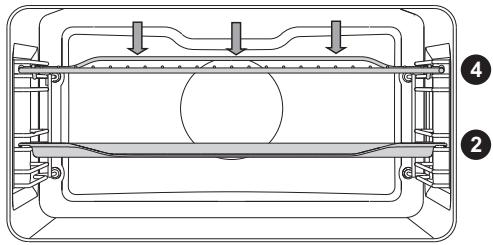
Lors de la cuisson au gril avec le grand gril, le chauffage supérieur et le chauffage du gril installé sur le plafond de la cavité du four fonctionneront.
Lors de la cuisson au gril avec le petit gril, seul le chauffage du gril (une partie de l'ensemble du grand gril) fonctionnera.
Température maximale autorisée : 230°C
Préchauffez le chauffage infrarouge (gril) pendant cinq minutes. Surveillez le processus de cuisson à tout moment. La viande peut brûler rapidement en raison de la température élevée !
La cuisson au gril avec le chauffage du gril convient pour une cuisson croustillante et pauvre en matières grasses de saucisses, de morceaux de viande et de poisson (steaks, escalopes, darnes de saumon, etc.) ou de pain grillé.
Lorsque vous grillez directement sur la grille, enduisez-la d'huile pour éviter que la viande n'y colle et insérez-la dans le 4ème guide. Insérez la lèchefrite dans le 1er ou le 2ème guide.
Lorsque vous grillez dans un plat, fournissez suffisamment d'humidité pour éviter que la viande ne brûle. Retournez la viande pendant la cuisson au gril.
Après chaque cuisson au gril, nettoyez le four et les accessoires.
Tableau de cuisson au gril - petit gril
| Type of food | Weight (g) | Guide (from the bottom) | Temperature (℃) | Cooking time (min) |
| MEAT | ||||
| Beefsteak, rare | 180 g/piece | 3 | 230 | 20-25 |
| Pork neck fillet | 150 g/piece | 3 | 230 | 25-30 |
| Cutlets/chops | 280 g/piece | 3 | 230 | 30-35 |
| Grill sausages | 70 g/piece | 3 | 230 | 20-25 |
| TOASTED BREAD | ||||
| Toast | / | 3 | 230 | 5-10 |
| Open sandwiches | / | 3 | 230 | 5-10 |
Tableau de cuisson au gril - grand gril
| Type of food | Weight (g) | Guide (from the bottom) | Temperature (°C) | Cooking time (min) |
| MEAT | ||||
| Beefsteak, rare | 180 g/piece | 3 | 230 | 10-15 |
| Beefsteak, well done | 180 g/piece | 3 | 230 | 15-20 |
| Pork neck fillet | 150 g/piece | 3 | 230 | 15-20 |
| Cutlets/chops | 280 g/piece | 3 | 230 | 20-25 |
| Veal escalope | 140 g/piece | 3 | 230 | 15-20 |
| Grill sausages | 70 g/piece | 3 | 230 | 10-20 |
| Spam (Leberkäse) | 150 g/piece | 3 | 230 | 15-20 |
| FISH | ||||
| Salmon steaks/fillets | 200 g/piece | 3 | 230 | 15-20 |
| TOASTED BREAD | ||||
| 6 slices of bread | / | 3 | 230 | 1-4 |
| Open sandwiches | / | 3 | 230 | 2-5 |
Lorsque vous faites griller dans un plat de cuisson, assurez-vous qu'il y a suffisamment de liquide dans le plat pour éviter que les aliments ne brûlent. Retournez la viande pendant la cuisson.
Pour cuire des truites, séchez-les avec du papier absorbant. Assaisonnez l'intérieur, enduisez l'extérieur d'huile et placez-les sur la grille. Ne retournez pas le poisson pendant la cuisson au gril.

Gardez toujours la porte du four fermée lorsque vous utilisez le gril (infrarouge).
Le gril, la grille et les autres accessoires du four deviennent très chauds pendant la cuisson au gril. Utilisez donc des gants de cuisine et des pinces à viande.
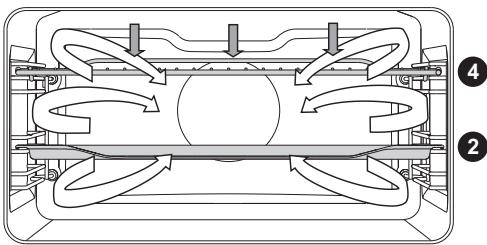
Dans ce mode de fonctionnement, le gril et le ventilateur fonctionnent simultanément. Convient pour griller de la viande, du poisson et des légumes.
(Voir les descriptions et conseils pour Grand gril et Petit gril.)
| Type of food | Weight (g) | Guide (from the bottom) | Temperature (℃) | Cooking time (min) |
| MEAT | ||||
| Duck | 2000 | 1 | 180-200 | 90-110 |
| Pork roast | 1500 | 1 | 170-190 | 90-120 |
| Pork shoulder | 1500 | 1 | 160-180 | 100-130 |
| Half of chicken | 700 | 1 | 190-210 | 50-60 |
| Chicken | 1500 | 1 | 200-220 | 60-80 |
| Meat loaf | 1500 | 1 | 160-180 | 70-90 |
| FISH | ||||
| Trout | 200 g/piece | 2 | 200-220 | 20-30 |
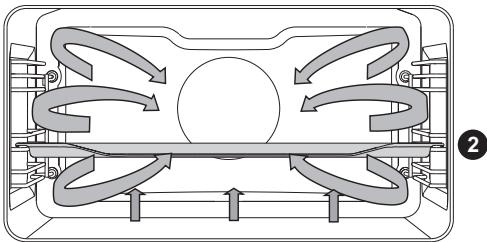
La résistance inférieure, la résistance circulaire et le ventilateur à air chaud fonctionnent. Convient pour cuire des pizzas, des tartes aux pommes et des gâteaux aux fruits.
(Voir les descriptions et conseils pour CHALEUR SUPÉRIEURE ET INFÉRIEURE.)
| Type of food | Guide (from the bottom) | Temperature (℃) | Cooking time (min) |
| Cheesecake, short crust | 2 | 160-170 | 60-70 |
| Pizza * | 2 | 220-230 | 10-15 |
| Quiche Lorraine, shortcrust | 1 | 200-210 | 50-60 |
| Apple strudel, phyllo dough | 2 | 180-190 | 50-60 |
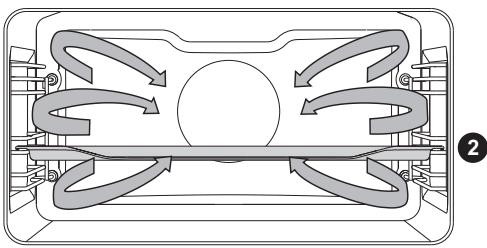
La résistance circulaire et le ventilateur fonctionnent. Le ventilateur installé dans la paroi arrière de la cavité du four assure une circulation constante de l'air chaud autour du rôti ou de la pâtisserie.
Rôtissage de la viande :
Utilisez des plats ou des plaques en émail, en verre trempé, en terre cuite ou en fonte. Les plaques en acier inoxydable ne conviennent pas car elles réfléchissent fortement la chaleur.
Pendant le rôtissage, apportez suffisamment d'humidité pour éviter que la viande ne brûle. Retournez la viande pendant la cuisson. Si vous couvrez le rôti, il restera plus juteux.
| Type of food | Weight (g) | Guide (from the bottom) | Temperature (℃) | Cooking time (min) |
| MEAT | ||||
| Pork roast, including skin | 1500 | 1 | 170-190 | 90-120 |
| Chicken, whole | 1500 | 2 | 180-200 | 70-90 |
| Duck | 2000 | 1 | 170-190 | 120-150 |
| Chicken breast | 1000 | 2 | 190-210 | 50-60 |
| Stuffed chicken | 1500 | 1 | 190-210 | 110-130 |
Cuisson des pâtisseries
Il est recommandé de préchauffer le four.
Les petites pâtisseries peuvent être cuites dans des plaques basses sur plusieurs niveaux (2e et 3e).
Gardez à l'esprit qu'avec différentes plaques de cuisson, le temps de cuisson peut varier.
Vous devrez peut-être retirer la plaque supérieure plus tôt que celle du dessous.
Placez toujours les moules sur la grille ; si vous utilisez la plaque de cuisson fournie, retirez la grille.
Les petites pâtisseries doivent avoir la même épaisseur pour obtenir un brunissement uniforme.
| Type of food | Guide (from the bottom) | Temperature (℃) | Cooking time (min) |
| PASTRY | |||
| Sponge cake | 1 | 160-170 | 30-40 |
| Crumble cake | 2 | 170-180 | 25-35 |
| Plum cake | 1 | 160-170 | 30-40 |
| Sponge roll * | 2 | 170-180 | 15-25 |
| Fruit cake, short crust | 1 | 170-180 | 50-70 |
| Challah (braided yeast bun) | 2 | 170-180 | 35-50 |
| Apple strudel | 2 | 180-190 | 50-60 |
| Pizza * | 2 | 210-220 | 15-20 |
| Biscuits, short crust * | 2 | 160-170 | 15-25 |
| Biscuits, pressed * | 2 | 150-160 | 20-30 |
| Small cakes * | 2 | 150-160 | 20-30 |
| Cookies, leavened | 2 | 180-190 | 20-35 |
| Cookies, phyllo dough | 2 | 180-190 | 20-30 |
| Cream-filled pastry | 2 | 190-200 | 25-45 |
| FROZEN PRODUCTS | |||
| Apple and cottage cheese strudel | 2 | 180-190 | 55-70 |
| Pizza | 2 | 190-200 | 20-35 |
| Fried potatoes, oven-ready | 2 | 210-220 | 25-40 |
| Croquettes, oven-baked | 2 | 210-220 | 20-35 |

N'insérez pas la plaque à pâtisserie profonde dans le premier guide.
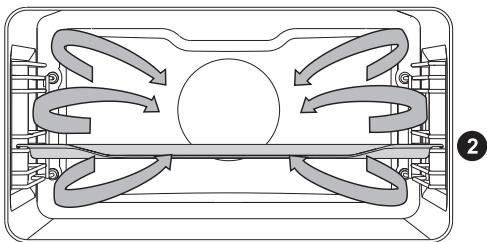
Le chauffage circulaire et le ventilateur fonctionneront. Le ventilateur installé sur la paroi arrière de la cavité du four assure une circulation constante de l'air chaud autour de la viande, des légumes ou des pâtisseries.
| Type of food | Guide (from the bottom) | Temperature (℃) | Cooking time (min) |
| MEAT | |||
| Pork roast, 1 kg | 1 | 200-210 | 110-130 |
| Pork roast, 2 kg | 1 | 200-210 | 130-150 |
| Beef roast, 1 kg | 1 | 210-220 | 100-120 |
| FISH | |||
| Whole fish, 200 g/piece | 2 | 200-210 | 40-50 |
| Fish fillet, 100 g/piece | 2 | 210-220 | 25-35 |
| PASTRY | |||
| Pressed cookies | 2 | 180-190 | 20-30 |
| Small cupcakes | 2 | 190-200 | 30-35 |
| Sponge roll | 2 | 200-210 | 15-25 |
| Fruit cake, short crust | 1 | 190-200 | 55-65 |
| DISHES AU GRATIN | |||
| Potatoes au gratin | 2 | 190-200 | 40-50 |
| Lasagne | 2 | 200-210 | 45-55 |
| FROZEN PRODUCTS | |||
| Pommes frites, 1 kg | 2 | 230-230 | 35-45 |
| Chicken medallions, 0.7 kg | 2 | 220-230 | 30-40 |
| Fish sticks, 0.6 kg | 2 | 220-230 | 30-40 |

N'insérez pas la plaque à pâtisserie profonde dans le premier guide.

Ce mode est utilisé pour cuire des pâtisseries levées mais peu gonflées et pour conserver des fruits et légumes. Utilisez le deuxième guide en partant du bas et une plaque de cuisson assez peu profonde pour permettre à l'air chaud de circuler sur le dessus du plat.
CONSERVATION
Préparez les aliments à conserver et les bocaux comme d'habitude. Utilisez des bocaux avec un joint en caoutchouc et un couvercle en verre. N'utilisez pas de bocaux avec des couvercles filetés ou métalliques, ni de boîtes métalliques. Assurez-vous que les bocaux sont de taille égale, remplis du même contenu et bien fermés.
Versez 1 litre d'eau chaude dans la plaque profonde (environ 70 °C) et placez 6 bocaux d'un litre dans la plaque. Placez la plaque dans le four sur le deuxième guide.
Pendant la conservation, surveillez les aliments et faites cuire jusqu'à ce que le liquide dans les bocaux commence à frémir - lorsque des bulles apparaissent dans le premier bocal.
| Type of food | Guide (from the bottom) | Temperatu- re (℃) | Cooking time (min) | Tempera- ture at the start of simmering | Resting time in the oven (min) |
| FRUIT | |||||
| Strawberries (6×1 l) | 2 | 180 | 40-60 | switch off | 20-30 |
| Stone fruits (6×1 l) | 2 | 180 | 40-60 | switch off | 20-30 |
| Fruit mush (6×1 l) | 2 | 180 | 40-60 | switch off | 20-30 |
| VEGETABLE | |||||
| Pickled gherkins (6×1 l) | 2 | 180 | 40-60 | switch off | 20-30 |
| Beans/carrots (6×1 l) | 2 | 180 | 40-60 | 120 ℃, 60 min | 20-30 |
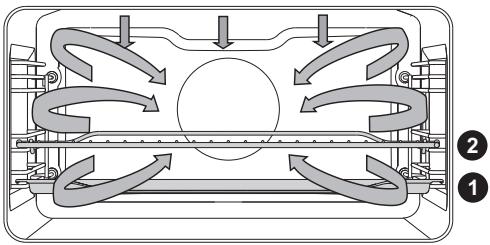
En mode Rôtissage automatique, le chauffage supérieur fonctionnera en combinaison avec le chauffage du gril et le chauffage circulaire. Il est utilisé pour rôtir tous les types de viande.
Lorsque vous rôtissez directement sur la grille, enduisez-la d'huile pour éviter que la viande n'y colle et insérez-la dans le 2e guide. Insérez la lèchefrite dans le 1er ou le 2e. Lorsque vous rôtissez la viande dans la plaque, insérez la plaque dans le 1er guide.
Réglez le système de cuisson et la température, ainsi que la température finale du plat.
| Type of food | Weight (g) | Guide (from the bottom) | Temperature (℃) | Cooking time (min) |
| Beef tenderloin | 1000 | 2 | 170-190 | 60-80 |
| Chicken, whole | 1500 | 2 | 180-200 | 65-85 |
| Turkey | 4000 | 2 | 170-190 | 150-180 |
| Pork roast | 1500 | 2 | 170-190 | 100-120 |
| Meat loaf | 1000 | 2 | 170-190 | 50-65 |
| Veal | 1000 | 2 | 170-190 | 70-90 |
| Lamb | 1000 | 2 | 180-200 | 50-70 |
| Venison | 1000 | 2 | 180-200 | 60-90 |
| Whole fish | 1000 | 2 | 170-190 | 40-50 |
| Chicken thighs | 1000 | 2 | 190-210 | 45-55 |
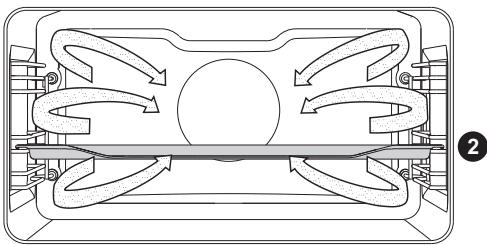
L'eau du générateur de vapeur entre dans la cavité du four sous forme de vapeur. De plus, le chauffage circulaire avec ventilateur fonctionne pour assurer une circulation continue de l'air chaud et de la vapeur.

Remplissez le réservoir d'eau avec de l'eau fraîche.
| Type of food | Weight (g) | Guide (from the bottom) | Steam intensity | Tempera-ture (℃) | Cooking time (min) |
| Beef/leg | 1000 | 1 | 1 | 170-190 | 80-110 |
| Beef/tenderloin | 1000 | 1 | 2 | 180-200 | 50-70 |
| Veal/leg | 1000 | 1 | 1 | 180-200 | 80-110 |
| Lamb | 1000 | 1 | 1 | 180-200 | 60-90 |
| Poultry, whole | 1500 | 1 | 1 | 180-200 | 65-85 |
| Poultry/breast | 1000 | 2 | 3 | 180-200 | 50-60 |
| Pork/fillet | 1000 | 1 | 2 | 180-200 | 50-70 |
| Fish | 200 g/ piece | 2 | 2 | 190-210 | 25-35 |
| Potatoes | 1000 | 2 | 1 | 190-210 | 45-60 |
| Potatoes with broccoli | 1000 | 2 | 2 | 180-200 | 35-50 |
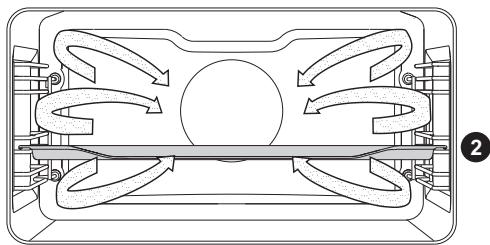
L'eau du générateur de vapeur entre dans la cavité du four sous forme de vapeur.

Remplissez le réservoir d'eau avec de l'eau fraîche.
Viande
| Type of food | Weight (g) | Guide (from the bottom) | Temperature (°C) | Cooking time (min) |
| Sauerkraut and sausage | 700 | 2 | 100 | 30-40 |
| Beef steak | 1000 | 2 | 100 | 40-50 |
| Chicken breast | 1000 | 2 | 100 | 20-30 |
| Shrimps | 1000 | 2 | 100 | 20-30 |
| Fish fillet | 500 | 2 | 80 | 15-20 |
| Fish steak | 500 | 2 | 80 | 20-25 |
| Whole fish | 400 | 2 | 100 | 20-30 |
| Mussels | 1000 | 2 | 100 | 15-20 |
| Frankfurter sausage | 1000 | 2 | 85 | 10-15 |
Légumes
| Type of food | Weight (g) | Ratio food:liquid | Guide (from the bottom) | Tempera- ture (°C) | Cooking time (min) |
| String beans | 500 | / | 2 | 100 | 55-65 |
| Beans - seeds | 500 | 1:2 | 2 | 100 | 90-100 |
| Peas | 500 | / | 2 | 100 | 20-25 |
| Cauliflower over - whole | 500 | / | 2 | 100 | 25-35 |
| Cauliflower over - chopped | 500 | / | 2 | 100 | 15-25 |
| Broccoli - whole | 500 | / | 2 | 100 | 20-30 |
| Broccoli - chopped | 500 | / | 2 | 100 | 15-25 |
| Carrot - whole | 500 | / | 2 | 100 | 25-35 |
| Carrot - diced | 500 | / | 2 | 100 | 20-30 |
| Corn | 500 | / | 2 | 100 | 25-35 |
| Chickpeas | 500 | 1:2 | 2 | 100 | 85-95 |
| Fennel | 500 | / | 2 | 100 | 15-25 |
| Kohlrabi | 500 | / | 2 | 100 | 25-35 |
| Red beets - whole | 500 | / | 2 | 100 | 65-75 |
| Bell peppers | 500 | / | 2 | 100 | 15-20 |
| Radicchio | 500 | / | 2 | 100 | 15-20 |
| Brussels sprout | 500 | / | 2 | 100 | 20-30 |
| Asparagus | 500 | / | 2 | 100 | 15-25 |
| Spinach | 500 | / | 2 | 100 | 10-15 |
| Swiss chard | 500 | / | 2 | 100 | 15-20 |
| Mixed vegetables | 1000 | / | 2 | 100 | 25-35 |
| Cabbage | 500 | / | 2 | 100 | 35-45 |
| Chinese cabbage | 500 | / | 2 | 100 | 30-40 |
| Eggplant / aubergines | 500 | / | 2 | 100 | 10-20 |
| Courgettes | 500 | / | 2 | 100 | 10-20 |
| Potatoes, whole | 500 | / | 2 | 100 | 30-40 |
| Potatoes, sliced | 500 | / | 2 | 100 | 25-35 |
Pâtes/riz/céréales
| Type of food | Weight (g) | Ratio food:liquid | Guide (from the bottom) | Tempera-ture (℃) | Cooking time (min) |
| White rice | 200 | 1:2 | 2 | 100 | 25-35 |
| Brown rice | 200 | 1:2 | 2 | 100 | 55-65 |
| Risotto | Recipe | 1:2 | 2 | 100 | 30-40 |
| Pasta | 200 | 1:2 | 2 | 100 | 15-25 |
| Whole grain pasta | 200 | 1:2 | 2 | 100 | 15-25 |
| Millet | 250 | 1:1 | 2 | 100 | 25-35 |
| Gnocchi | 500 | / | 2 | 100 | 15-25 |
| Dumplings | 500 | / | 2 | 100 | 15-25 |
| Tortellini | 500 | / | 2 | 100 | 20-30 |
| Couscous | 500 | 1:1 | 2 | 100 | 15-20 |
| Ravioli | 500 | / | 2 | 100 | 15-20 |
Desserts
| Type of food | Weight (g) | Ratio food:liquid | Guide (from the bottom) | Tempera- ture (°C) | Cooking time (min) |
| Melting chocolate * | 200 | / | 2 | 50 | 20-30 |
| Soaking/dissolving gelatin * | 1 pack | / | 2 | 50 | 15-20 |
| Rice pudding | Recipe | 1:4 | 2 | 100 | 30-40 |
| Leavened dough | Recipe | / | 2 | 40 | 25-35 |
| Crème caramel | Recipe | / | 2 | 100 | 40-50 |
- Couvrez le récipient avec un couvercle ou du papier d'aluminium
Plats aux œufs
| Type of food | Weight (g) | Guide (from the bottom) | Temperature (°C) | Cooking time (min) |
| Soft-boiled eggs | 200 | 2 | 100 | 10-15 |
| Hard-boiled eggs | 200 | 2 | 100 | 15-20 |
| Poached eggs | 200 | 2 | 100 | 13-17 |
| Scrambled eggs | 200 | 2 | 100 | 10-15 |
| Omelette with bacon | Recipe | 2 | 100 | 15-20 |
Fruits
| Type of food | Weight (g) | Guide (from the bottom) | Temperature (°C) | Cooking time (min) |
| Apple slices | 500 | 2 | 100 | 5-15 |
| Apricot slices | 500 | 2 | 100 | 5-15 |
| Cherries | 500 | 2 | 100 | 10-15 |
| Gooseberries | 500 | 2 | 100 | 5-15 |
| Pear - chunks | 500 | 2 | 100 | 5-15 |
| Plums | 500 | 2 | 100 | 5-15 |
| Rhubarb | 500 | 2 | 100 | 5-15 |
| Nectarines | 500 | 2 | 100 | 5-10 |
Décongélation
| Type of food | Weight (g) | Guide (from the bottom) | Temperature (℃) | Defrosting time (min) |
| Frozen meat | 500 | 2 | 50 | 40-50 |
| Frozen poultry | 1500 | 2 | 50 | 50-60 |
| Frozen fish, 200 g / piece | 1000 | 2 | 50 | 35-45 |
| Frozen fruit | 500 | 2 | 50 | 10-20 |
| Frozen ready-made meals | 1000 | 2 | 60 | 45-60 |

Pour sécher l'intérieur du four, réglez l'air chaud et le chauffage inférieur à 170 °C pendant 15 minutes.
Après la fin du programme, laissez la porte du four ouverte pendant au moins deux minutes pour laisser sortir la vapeur et permettre à l'intérieur de l'appareil de sécher.
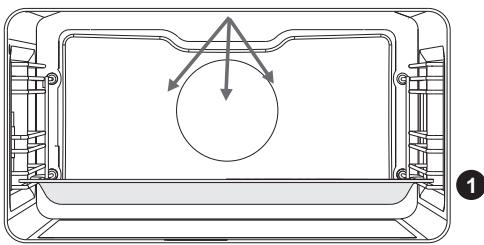
Les micro-ondes sont utilisées pour la cuisson et la décongélation.
Niveaux de puissance : 90, 180, 360, 600, 750, 100 W.
Placez le plat de cuisson en verre sur le premier guide.
Décongélation
| Type of food | Weight (g) | Power (W) | Defrosting time (min) |
| MEAT | |||
| Minced meat ** | 500 | 90 | 35-45 |
| Meat in pieces ** | 500 | 90 | 20-30 |
| Steaks ** | 500 | 90 | 20-30 |
| Whole pieces of meat ** | 1000 | 90 | 70-80 |
| Poultry portions ** | 500 | 90 | 25-35 |
| Whole fish ** | 200 | 90 | 15-20 |
| PASTRY | |||
| Bread ** | 1000 | 90 | 20-25 |
| Bread rolls ** | 500 | 90 | 10-15 |
| Walnut cake ** | 500 | 90 | 15-25 |
| Fruit cake ** | 500 | 90 | 15-25 |
| FRUIT AND VEGETABLE | |||
| Fruit | 500 | 90 | 15-25 |
| Vegetable | 500 | 90 | 20-30 |
** Retournez à mi-cuisson. Séparez les morceaux. Après la fin du processus, laissez les aliments à température ambiante pendant 10 à 20 minutes pour permettre une répartition uniforme de la chaleur dans les aliments.
Réchauffage
| Type of food | Weight (g) | Power (W) | Defrosting time (min) |
| FOOD | |||
| Steaks | 300 g | 600 | 3-5 |
| Whole fish | 200 g | 600 | 3-5 |
| Mixed vegetable * | 500 g | 600 | 3-5 |
| Side dishes * | 500 g | 600 | 3-5 |
| Sauces * | 500 g | 600 | 2-4 |
| Soups/stews * | 5 dl | 750 | 2-4 |
| Pizza | 500 g | 600 | 2-4 |
| Chicken medallions | 500 g | 600 | 2-4 |
| Open sandwiches | / | 600 | 2-4 |
| Popcorn | 90 g | 1000 | 2-4 |
| Melting chocolate | 100 g | 600 | 2-4 |
| Butter softening | 250 g | 180 | 2-4 |
| Baby bottle | 2 dl | 360 | 3-4 |
| Baby food | 4 dl | 180 | 2-3 |
| BEVERAGE | |||
| Water | 2 dl | 1000 | 1-2 |
| Coffee | 2 dl | 1000 | 1-2 |
| Mulled wine | 2 dl | 1000 | 1-2 |
| Milk | 2 dl | 1000 | 1-2 |
- Remuez les aliments plusieurs fois pendant le réchauffage.
Cuisson
Lors de la cuisson de la viande et des légumes, nous recommandons d'utiliser un plat en verre avec couvercle. Placez le plat en verre sur le plateau de cuisson en verre au premier niveau.
| Type of food | Weight (g) | Power (W) | Cooking time (min) |
| MEAT | |||
| Chicken thighs ** | 1000 | 600 | 20-30 |
| Chicken wings ** | 1000 | 600 | 15-25 |
| Chicken braised in sauce * | 500 | 1000 | 15-25 |
| Chicken - whole ** | 1500 | 600 | 45-60 |
| Pork roast ** | 1000 | 600 | 45-60 |
| Pork chops ** | 500 | 750 | 25-35 |
| Steaks ** | 500 | 1000 | 10-20 |
| Meat loaf | 700 | 600 | 25-35 |
| Meatballs * | 1000 | 1000 | 10-20 |
| Fish ** | 200 | 600 | 15-20 |
| DESSERTS | |||
| Chocolate soufflé | 6 | 360 | 12-17 |
| Cheese soufflé | glass baking dish | 750 | 15-20 |
| Fruit purée | glass baking dish | 750 | 12-17 |
| Custard creams | glass baking dish | 360 | 23-28 |
| Type of food | Weight (g) | Water addition | Power (W) | Cooking time (min) |
| VEGETABLE | ||||
| Potatoe | 500 | 1 tablespoons/100 g | 1000 | 13-18 |
| Eggplant / aubergines | 500 | 1 tablespoons/100 g | 600 | 13-18 |
| Courgettes | 500 | 1 tablespoons/100 g | 360 | 10-15 |
| Carrots | 500 | 1 tablespoons/100 g | 1000 | 10-15 |
| Onions | 200 | 1 tablespoons/100 g | 1000 | 5-10 |
| String beans | 500 | 1 tablespoons/100 g | 750 | 10-15 |
| Broccoli | 1000 | 1 tablespoons/100 g | 750 | 10-15 |
| Bell peppers | 500 | 1 tablespoons/100 g | 1000 | 8-13 |
| Cauliflower | 1000 | 1 tablespoons/100 g | 750 | 18-23 |
| Leeks | 200 | 1 tablespoons/100 g | 1000 | 10-15 |
| Brussels sprout | 500 | 1 tablespoons/100 g | 1000 | 10-15 |
| Button mushrooms / Champignons | 500 | 1 tablespoons/100 g | 1000 | 10-15 |
| Asparagus | 500 | 1 tablespoons/100 g | 750 | 5-10 |
| Peas | 500 | 1 tablespoons/100 g | 750 | 25-30 |
| Cabbage | 500 | 1 tablespoons/100 g | 750 | 15-20 |
| SIDE DISHES | ||||
| Rice | 200 | Ratio food to liquit 1:2 | 750 | 15-20 |
| Pasta | 200 | Ratio food to liquit 1:2 | 750 | 10-15 |
| Whole grain pasta | 200 | Ratio food to liquit 1:2 | 1000 | 10-15 |
| Oatmeal | 500 | Ratio food to liquit 1:2 | 1000 | 5-10 |
| Brown rice | 200 | Ratio food to liquit 1:2 | 750 | 25-30 |
| Risotto | 500 | Ratio food to liquit 1:2 | 750 | 20-25 |
| Couscous | 250 | Ratio food to liquit 1:2 | 1000 | 3-8 |
| Polenta | 250 | Ratio food to liquit 1:3 | 1000 | 5-10 |
| Millet | 250 | Ratio food to liquit 1:3 | 1000 | 10-15 |
| Type of food | Weight (g) | Power (W) | Cooking time (min) |
| FROZEN PRODUCTS | |||
| Meat loaf | 700 | 600 | 35-45 |
| Chicken - whole ** | 1500 | 600 | 55-65 |
| Pork roast ** | 1000 | 600 | 50-60 |
| Chicken medallions ** | 500 | 750 | 10-15 |
| Mixed vegetable * | 500 | 750 | 10-20 |
| Fish ** | 200 | 600 | 10-15 |
- Remuez les aliments plusieurs fois pendant le réchauffage. ** Retournez à mi-cuisson.
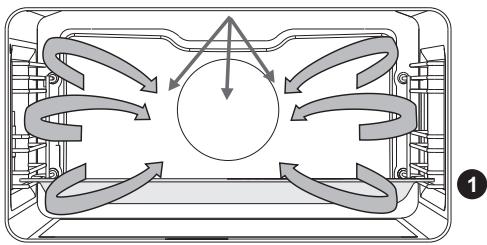
Dans ce mode de cuisson, les aliments sont cuits avec une combinaison de micro-ondes et de grill.
Niveaux de puissance : 90, 180, 360, 600 W
Placez le plat de cuisson en verre sur le premier guide.
| Type of food | Weight (g) | Power (W) | Temperature (°C) | Cooking time (min) |
| Poultry | 1000 | 360 | 200-220 | 35-45 |
| Poultry | Half | 360 | 190-200 | 25-35 |
| Chicken thighs | 1000 | 600 | 190-200 | 20-30 |
| Duck | 1500 | 360 | 190-200 | 45-60 |
| Poultry wings | 500 | 600 | 190-200 | 15-20 |
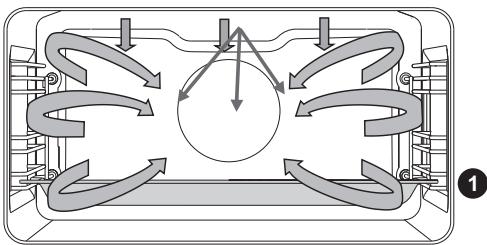
Ce système utilise une combinaison de micro-ondes et de grill avec ventilateur pour réduire le temps de cuisson.
Niveaux de puissance : 90, 180, 360, 600 W.
Placez la plaque de cuisson sur la première glissière.
| Type of food | Weight (g) | Power (W) | Temperature (°C) | Cooking time (min) |
| MEAT | ||||
| Veal roast | 1500 | 360 | 180-190 | 70-90 |
| Lamb ribs | 1500 | 360 | 180-190 | 50-60 |
| Meat loaf | 1000 | 360 | 180-190 | 40-50 |
| Poultry breast | 500 | 360 | 180-200 | 25-35 |
| Duck breast | 1000 | 360 | 200-210 | 25-35 |
| Pork roast | 1500 | 600 | 180-190 | 60-80 |
| Roasted beef | 1500 | 600 | 180-190 | 60-80 |
| Chicken, whole | 1500 | 360 | 200-210 | 45-60 |
| Chicken, half | 1500 | 360 | 200-210 | 35-45 |
| Chicken thighs | 1000 | 360 | 200-210 | 35-45 |
| PASTRY | ||||
| Strudel - sweet | / | 600 | 180-200 | 15-20 |
| VEGETABLE | ||||
| Cannelloni | / | 600 | 180-200 | 15-20 |
| Ukrainian cabbage rolls | / | 750 | 180-200 | 25-35 |
| Potatoes au gratin | 800 | 600 | 180-200 | 25-35 |

Lors de l'utilisation de systèmes à micro-ondes, n'utilisez pas d'ustensiles ou de récipients en métal.
Ne préchauffez pas le four.

Avant de commencer le nettoyage de l'appareil, débranchez-le de l'alimentation électrique et laissez-le refroidir.
Le nettoyage et l'entretien de l'appareil ne doivent pas être effectués par des enfants sans surveillance appropriée !
Surfaces en aluminium
Les surfaces en aluminium doivent être nettoyées avec des détergents liquides non abrasifs destinés à ces matériaux.
Appliquez le détergent sur un chiffon humide, nettoyez la surface et rincez à l'eau.
N'appliquez pas le nettoyant directement sur la surface.
N'utilisez pas de nettoyants abrasifs ou d'éponges abrasives.
Remarque : La surface ne doit pas entrer en contact avec des sprays de nettoyage pour four ; cela peut causer des dommages visibles et permanents.
Panneaux avant en acier inoxydable
(selon le modèle)
Nettoyez la surface avec un nettoyant doux (eau savonneuse) et une éponge douce non abrasive.
Pour éviter d'endommager la surface, n'utilisez pas de nettoyants abrasifs ou à base de solvants.
Surfaces laquées et plastiques
(selon le modèle)
N'utilisez jamais de nettoyants abrasifs ni d'éponges abrasives, de nettoyants à base d'alcool ou d'alcool pur pour nettoyer les boutons, les poignées de porte, les étiquettes et la plaque signalétique.
Éliminez immédiatement les taches à l'aide d'un chiffon doux et de détergents liquides. Vous pouvez également utiliser les nettoyants spécialement conçus pour ce type de surfaces ; dans ce cas, suivez les instructions du fabricant.
Les surfaces en aluminium ne doivent jamais entrer en contact avec les sprays de nettoyage pour four, car cela provoquerait des dommages visibles et permanents.
Porte de l'appareil
La porte est fixée à l'appareil et ne peut pas être retirée. De plus, la porte ne doit pas être démontée ni modifiée.
NETTOYAGE CONVENTIONNEL DU FOUR
Vous pouvez utiliser la procédure de nettoyage standard pour éliminer les saletés tenaces dans le four (à l'aide de nettoyants ou d'un spray pour four). Après un tel nettoyage, rincez soigneusement les résidus de nettoyant.
Nettoyez le four et les accessoires après chaque utilisation pour empêcher les saletés de brûler sur la surface. Le moyen le plus simple d'éliminer la graisse est d'utiliser de l'eau savonneuse tiède pendant que le four est encore chaud.
Pour les saletés et les crasses tenaces, utilisez des nettoyants pour four conventionnels. Rincez soigneusement le four à l'eau claire pour éliminer tout résidu de nettoyant. N'utilisez jamais de nettoyants agressifs, de nettoyants abrasifs, d'éponges abrasives, de détachants ou de produits antirouille, etc.
Nettoyez les accessoires (plaques de cuisson, grilles, etc.) avec de l'eau chaude et du détergent.
Le four, la cavité du four et les plaques de cuisson sont recouverts d'un émail spécial pour une surface lisse et résistante. Ce revêtement spécial facilite le nettoyage à température ambiante.
PROGRAMME DE NETTOYAGE VAPEUR (STEAM CLEAN)
Avant de lancer le programme de nettoyage, retirez tous les gros morceaux de saleté et de résidus alimentaires de la cavité du four.
Remplissez le réservoir d'eau et réglez le programme de nettoyage à la vapeur.

Dans le menu principal, sélectionnez Extras puis Nettoyage vapeur.
Confirmez votre sélection en appuyant sur le BOUTON.

Appuyez sur la touche DÉPART.
Lorsque le programme est terminé, attendez que le four ait suffisamment refroidi pour pouvoir essuyer l'intérieur du four en toute sécurité.
Lorsque le programme est terminé, les taches sur les parois en émail du four seront ramollies, ce qui facilite le nettoyage.
Essuyez les taches avec un chiffon humide.

Si le processus de nettoyage n'aboutit pas (en cas de saleté particulièrement tenace), répétez l'opération.

Utilisez le programme de nettoyage après que le four a complètement refroidi.
NETTOYAGE DU SYSTÈME VAPEUR
Le nettoyage dépend du niveau de dureté de l'eau.
| Water hardness | °N | Estimated use of water in litres before descaling is required | Number of coloured stripes on the test strip |
| Soft | 0-3 dH | 50 | 4 green stripes |
| Slightly hard | 3-7 dH | 40 | 1 red stripe |
| Medium hard | 7-14 dH | 35 | 2 red stripes |
| Hard | 14-21 dH | 30 | 3 red stripes |
| Very hard | >21 dH | 25 | 4 red stripes |
Nous recommandons d'utiliser l'agent détartrant car il donne des résultats de qualité pour le processus de nettoyage du système vapeur.
Le message suivant apparaîtra à l'écran : "Veuillez lancer la procédure de détartrage." Les messages à l'écran vous guideront tout au long de la procédure de détartrage.
- Ajoutez l'agent détartrant dans le réservoir d'eau.
- La procédure de détartrage est en cours.
- Procédure de détartrage terminée. Veuillez retirer le liquide, rincer le réservoir d'eau et ajouter de l'eau fraîche pour le processus de rinçage. 4. Processus de rinçage terminé. Nettoyez le réservoir et essuyez le four. Nettoyez également la mousse filtrante (voir le chapitre NETTOYAGE DE LA MOUSSE FILTRANTE).
NETTOYAGE DE LA MOUSSE FILTRANTE

Chaque fois que vous nettoyez le réservoir d'eau ou détartrez l'appareil, nettoyez également la mousse filtrante.
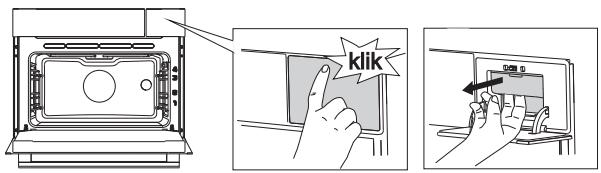
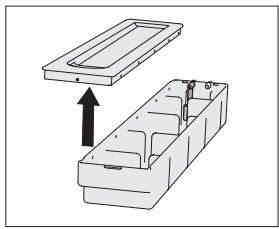
1 Ouvrez le couvercle du réservoir d'eau.
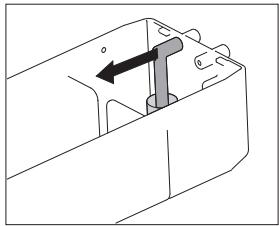
2 Retirez le tuyau d'arrivée de son support.
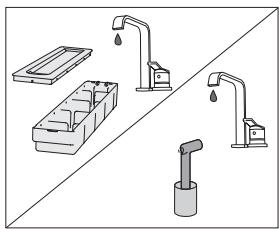
3 Nettoyez le tuyau d'arrivée avec la mousse filtrante sous l'eau courante. Rincez la mousse jusqu'à ce qu'elle ne présente plus d'impuretés visibles. Vous garantirez ainsi le bon fonctionnement de l'appareil et préserverez la fraîcheur et l'odeur des aliments.
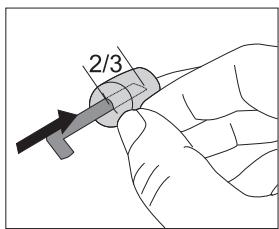
Si la mousse filtrante est détachée du tuyau d'arrivée, replacez-la en insérant le tuyau jusqu'aux deux tiers de la longueur totale de la mousse.
RETRAIT ET NETTOYAGE DES GRILLES DE GUIDAGE
Utilisez uniquement des nettoyants conventionnels pour nettoyer les grilles.
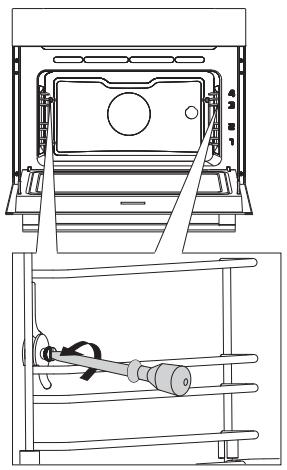
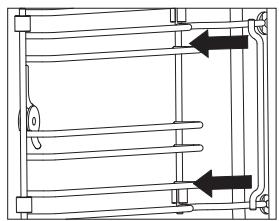
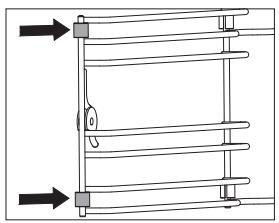
1 Desserrez la vis. Utilisez un tournevis.
2 Retirez les grilles des trous de la paroi arrière.
Veillez à ne pas perdre les entretoises fixées sur les grilles de guidage. Replacez les entretoises après le nettoyage ; sinon, des étincelles peuvent apparaître.

Après le nettoyage, resserrez les vis des grilles avec un tournevis.
Lors du remplacement des grilles de guidage, assurez-vous de les monter du même côté qu'elles étaient installées avant le retrait.
REMPLACEMENT DE L'AMPOULE
L'ampoule est un consommable et n'est donc pas couverte par la garantie. Avant de changer l'ampoule, retirez les grilles, la lèchefrite et les guides.
Utilisez un tournevis cruciforme (Phillips).
(Lampe halogène : G9, 230 V, 25 W)
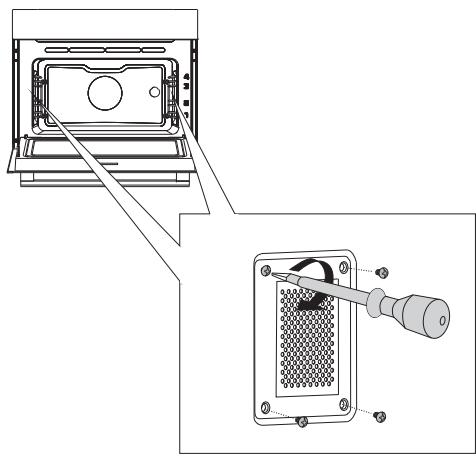
1 Dévissez les quatre vis du couvercle. Retirez le couvercle et le verre.
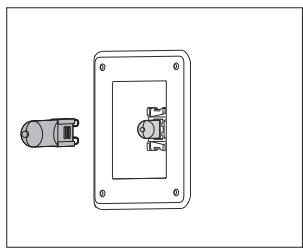
2 Retirez l'ampoule halogène et remplacez-la par une neuve.
Utilisez une protection pour éviter les coupures.

Un joint est présent sur le couvercle ; il ne doit pas être retiré. Veillez à ce que le joint ne se détache pas du couvercle. Le joint doit s'adapter correctement à la paroi de la cavité du four.

Revissez fermement les vis du couvercle à l'aide d'un tournevis ; sinon, des étincelles peuvent apparaître.
TABLEAU DE DÉPANNAGE
| Problem/error | Solution |
| There is no response of the sensors; the display is frozen. | Disconnect the appliance from the power mains for a few minutes (undo the fuse or switch off the main switch); then, reconnect the appliance and switch it on. |
| The main fuse in your home trips often. | Call a service technician. |
| The oven lighting does not work. | The process of changing the light bulb is described in the chapter Cleaning and Maintenance. |
| The pastry is underdone. | Did you choose the right temperature and heating system? Is the oven door closed? |
| Error code is displayed: ERRXX ... * XX denotes the number/ code of the error. | There is an error in the electronic module operation. Disconnect the appliance from the power mains for a few minutes. Then, reconnect it and set the time of day. If the error is still indicated, call a service technician. |
| Water is not pumped into the steam system. | Check the water level in the water tank. Not enough water in the water tank Make sure the tubes on the back of the water tank and the holes are not clogged. |
| Sparks appear in the oven. | Make sure all covers of the lights are fastened and that all spacers are fitted on the wire guides. Make sure the guides are correctly placed in the appliance. |
Si les problèmes persistent malgré le respect des conseils ci-dessus, faites appel à un technicien agréé. Toute réparation ou réclamation au titre de la garantie résultant d'un branchement ou d'une utilisation incorrects de l'appareil ne sera pas couverte par la garantie. Dans ce cas, l'utilisateur prendra en charge les frais de réparation.

Avant la réparation, débranchez l'appareil du secteur (en retirant le fusible ou en débranchant la fiche de la prise murale).
L'emballage est constitué de matériaux respectueux de l'environnement, recyclables, éliminables ou destructibles sans danger pour l'environnement. À cette fin, les matériaux d'emballage sont étiquetés de manière appropriée.
Le symbole apposé sur le produit ou son emballage indique que le produit ne doit pas être traité comme un déchet ménager normal. Le produit doit être déposé dans un centre de collecte agréé pour le traitement des déchets d'équipements électriques et électroniques.
Une élimination correcte du produit contribuera à prévenir les effets négatifs sur l'environnement et la santé humaine qui pourraient survenir en cas de mise au rebut incorrecte. Pour des informations détaillées sur l'élimination et le traitement du produit, veuillez contacter la municipalité compétente en matière de gestion des déchets, votre service d'élimination des déchets ou le magasin où vous avez acheté le produit.
Nous nous réservons le droit de modifier les instructions d'utilisation et de corriger d'éventuelles erreurs.

- DÉTAILLÉES
- INSTRUCTIONS POUR
- NOUS VOUS REMERCIONS DE LA CONFIANCE QUE VOUS NOUS ACCORDEZ EN ACHETANT NOTRE APPAREIL
- LISEZ ATTENTIVEMENT LES INSTRUCTIONS ET CONSERVEZ-LES POUR RÉFÉRENCE FUTURE
- UTILISATION SÛRE ET CORRECTE DU FOUR VAPEUR
- UTILISATION SÛRE DU FOUR À MICRO-ONDES
- AVANT DE BRANCHER L'APPAREIL
- FOUR COMBINÉ VAPEUR ET MICRO-ONDES
- (DESCRIPTION DU FOUR ET DE L'ÉQUIPEMENT - SELON LE MODÈLE)
- GUIDES-FILS
- INTERRUPTEUR DE PORTE DU FOUR
- VENTILATEUR DE REFROIDISSEMENT
- FONCTIONNEMENT PROLONGÉ DU VENTILATEUR DE REFROIDISSEMENT
- ÉQUIPEMENT ET ACCESSOIRES DU FOUR (SELON LE MODÈLE)
- UNITÉ DE COMMANDE
- REMARQUE
- INFORMATIONS SUR L'APPAREIL - PLAQUE SIGNALÉTIQUE (SELON LE MODÈLE)
- AVANT LA PREMIÈRE UTILISATION
- CUISSON À LA VAPEUR
- VOICI LES AVANTAGES DE LA CUISSON À LA VAPEUR
- REMPLISSAGE DU RÉSERVOIR D'EAU
- FONCTION MICRO-ONDES
- SÉLECTION DE LA LANGUE
- RÉGLAGE DE LA DATE
- RÉGLAGE DE L'HORLOGE
- MODIFICATION DES RÉGLAGES DE L'HORLOGE
- TEST DE LA DURETÉ DE L'EAU
- MODIFICATION DU RÉGLAGE DE LA DURETÉ DE L'EAU
- SÉLECTION DES MENUS PRINCIPAUX POUR LA CUISSON ET LES RÉGLAGES
- AUTO
- PRO
- MON MODE
- VAPEUR
- MICRO-ONDES
- CUISSON PAR SÉLECTION DU TYPE D'ALIMENT (MODE AUTO ; AUTOMATIQUE)
- CONFIRMEZ CHAQUE RÉGLAGE EN APPUYANT SUR LE BOUTON
- PRÉCHAUFFAGE
- CUISSON PAR SÉLECTION DU MODE DE
- FONCTIONNEMENT
- RÉGLAGES DE BASE
- RÉGLAGES SUPPLÉMENTAIRES
- FONCTIONS DE MINUTERIE - DURÉE
- RÉGLAGE DU TEMPS DE CUISSON
- RÉGLAGE DU DÉPART DIFFÉRÉ
- CUISSON MULTIPHASE
- INJECTION DE VAPEUR
- INJECTION DE VAPEUR PAR ÉTAPES
- INJECTION DIRECTE DE VAPEUR
- ENREGISTREMENT DE VOTRE PROPRE PROGRAMME (MON MODE)
- CUISSON VAPEUR
- SOUS VIDE (CUISSON VAPEUR)
- CUISSON AUX MICRO-ONDES
- DÉMARRER LE PROCESSUS DE CUISSON
- FIN DE LA CUISSON ET ARRÊT DU FOUR
- TERMINÉ
- AJOUTER LA DURÉE
- GRATIN
- AJOUTER AUX FAVORIS
- SÉLECTION DES FONCTIONS SUPPLÉMENTAIRES
- NETTOYAGE À LA VAPEUR (STEAM-CLEAN)
- DÉCONGÉLATION
- RÉCHAUFFAGE
- CHAUFFE-ASSIETTES
- RÉGÉNÉRATION
- PRÉCHAUFFAGE RAPIDE
- CHABBAT
- SOUS VIDE
- SÉLECTION DES RÉGLAGES GÉNÉRAUX
- GÉNÉRAL
- AFFICHAGE
- RÉGLAGES DE CUISSON
- SYSTÈME
- INFORMATIONS SUR L'APPAREIL
- RÉGLAGES D'USINE
- SÉCURITÉ ENFANTS
- RÉGLAGE DE LA MINUTERIE
- DESCRIPTION DES SYSTÈMES (MODES DE CUISSON) ET TABLEAUX DE CUISSON
- RÔTISSAGE DE LA VIANDE
- CUISSON DE LA PÂTISSERIE
- CUISSON DES PÂTISSERIES
- CONSERVATION
- CUISSON
- SURFACES EN ALUMINIUM
- PANNEAUX AVANT EN ACIER INOXYDABLE
- SURFACES LAQUÉES ET PLASTIQUES
- PORTE DE L'APPAREIL
- NETTOYAGE CONVENTIONNEL DU FOUR
- PROGRAMME DE NETTOYAGE VAPEUR (STEAM CLEAN)
- NETTOYAGE DU SYSTÈME VAPEUR
- NETTOYAGE DE LA MOUSSE FILTRANTE
- RETRAIT ET NETTOYAGE DES GRILLES DE GUIDAGE
- REMPLACEMENT DE L'AMPOULE
- TABLEAU DE DÉPANNAGE
Marque : GORENJE
Modèle : BCMS598S19X - BCMS598S19X
Catégorie : Four électrique