
HIML 95225 SXE - Plaque de cuisson BEKO - Notice d'utilisation et mode d'emploi gratuit
Retrouvez gratuitement la notice de l'appareil HIML 95225 SXE BEKO au format PDF.


| Type de produit | Plaque de cuisson à gaz encastrable |
| Marque | BEKO |
| Modèle | HIML 95225 SXE |
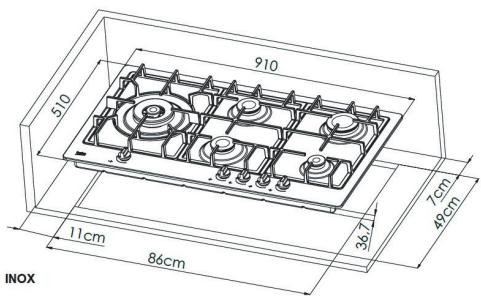
| Dimensions extérieures (H x L x P) | 97 x 910 x 510 mm |
| Dimensions d’encastrement (L x P) | 860 x 490 mm |
| Alimentation électrique | 220-240 V ~ 50-60 Hz |
| Type de gaz | Gaz naturel G20 (20 mbar) ou GPL G30/G31 (28-30/37 mbar) convertissable |
| Nombre de brûleurs | 5 |
| Brûleur auxiliaire | 1 kW |
| Brûleurs normaux (x2) | 1,75 kW chacun |
| Brûleur rapide | 3 kW |
| Brûleur wok | 4,2 kW (gaz naturel) / 4,0 kW (GPL) |
| Consommation totale de gaz | 11,70 kW (gaz naturel) / 11,50 kW (GPL) |
| Efficacité énergétique du plan | 55,1 % |
| Sécurité | Dispositif de coupure de gaz (thermocouple), allumage électronique à étincelle |
| Matériau de la surface | Inox |
| Accessoires inclus | Adaptateur pour cafetière, adaptateur pour wok |
| Entretien | Nettoyer avec un chiffon doux et humide ; ne pas utiliser de produits abrasifs |
| Sécurité enfant | Surfaces chaudes ; ne pas laisser les enfants sans surveillance |
| Longueur du câble d’alimentation | Max. 1,5 m |
| Réparabilité | Pièces détachées disponibles (injecteurs, têtes de brûleur, etc.) |
FOIRE AUX QUESTIONS - HIML 95225 SXE BEKO
Questions des utilisateurs sur HIML 95225 SXE BEKO
0 question sur cet appareil. Repondez a celles que vous connaissez ou posez la votre.
Poser une nouvelle question sur cet appareil
Téléchargez la notice de votre Plaque de cuisson au format PDF gratuitement ! Retrouvez votre notice HIML 95225 SXE - BEKO et reprennez votre appareil électronique en main. Sur cette page sont publiés tous les documents nécessaires à l'utilisation de votre appareil HIML 95225 SXE de la marque BEKO.
MODE D'EMPLOI HIML 95225 SXE BEKO
Table de cuisson encastrable
Manuel d'utilisation
HIML 95225 SXE
FR IT
01M-8860873200-0219-01
beko
Veuillez lire ce manuel en premier !
Cher client,
Merci d'avoir acheté un produit Beko. Nous espérons que vous obtiendrez les meilleurs résultats de votre produit, fabriqué avec une technologie de haute qualité et de pointe. Par conséquent, veuillez lire attentivement l'intégralité de ce manuel d'utilisation et tous les autres documents d'accompagnement avant d'utiliser le produit, et conservez-le comme référence pour une utilisation future. Si vous remettez le produit à quelqu'un d'autre, transmettez également le manuel d'utilisation. Suivez tous les avertissements et informations contenus dans le manuel d'utilisation.
N'oubliez pas que ce manuel d'utilisation s'applique également à plusieurs autres modèles. Les différences entre les modèles sont explicitement décrites dans le manuel.
Signification des symboles
Les symboles suivants sont utilisés dans les différentes sections de ce manuel :
| i | Important information and useful hints about usage. |
| ! | WARNING:Warnings for dangerous situations concerning the safety of life and property. |
| Warning for electric shock. |
| Warning for hot surfaces. |
| Warning: Fire risk |

Ce produit a été fabriqué dans des installations respectueuses de l'environnement.
SOMMAIRE
FRANÇAIS 04-26
ITALIEN 27-52
1
Instructions importantes et avertissements pour la sécurité et l'environnement
Cette section contient des consignes de sécurité qui vous aideront à vous protéger contre les risques de blessures ou de dommages matériels.
Le non-respect de ces instructions annulera toute garantie.
1.1 Sécurité générale
- Cet appareil peut être utilisé par des enfants âgés de 8 ans et plus et par des personnes ayant des capacités physiques, sensorielles ou mentales réduites ou manquant d'expérience et de connaissances, à condition qu'ils soient supervisés ou qu'ils aient reçu des instructions concernant l'utilisation de l'appareil en toute sécurité et qu'ils comprennent les risques encourus. Les enfants ne doivent pas jouer avec l'appareil. Le nettoyage et l'entretien ne doivent pas être effectués par des enfants sans surveillance.
- Les procédures d'installation et de réparation doivent toujours être effectuées par des agents de service agréés. Le fabricant ne pourra être tenu responsable des dommages résultant de procédures effectuées par des personnes non autorisées, ce qui peut également annuler la garantie. Avant l'installation, lisez attentivement les instructions.
- Ne faites pas fonctionner l'appareil s'il est défectueux ou présente des dommages visibles.
- Assurez-vous que les boutons de fonction de l'appareil sont éteints après chaque utilisation.
- Si la plaque de verre de la table de cuisson est cassée : éteignez immédiatement tous les brûleurs et éléments chauffants électriques, et débranchez l'appareil de l'alimentation électrique. Ne touchez pas la surface de l'appareil. N'utilisez pas l'appareil.
1.2 Sécurité lors du travail avec le gaz
- Tous travaux sur les équipements et systèmes à gaz ne peuvent être effectués que par des personnes qualifiées et autorisées, enregistrées auprès de Gas Safe.
- Si vous devez utiliser votre produit avec un autre type de gaz, vous devez consulter le service agréé pour la procédure de conversion correspondante.
- Avant l'installation, assurez-vous que les conditions de distribution locales (nature du gaz et pression du gaz) et le réglage de l'appareil sont compatibles.
Instructions importantes et avertissements pour la sécurité et l'environnement
- Cet appareil n'est pas raccordé à un dispositif d'évacuation des produits de combustion. Il doit être installé et raccordé conformément aux réglementations d'installation en vigueur. Une attention particulière doit être accordée aux exigences pertinentes concernant la ventilation.
- ATTENTION : L'utilisation d'un appareil de cuisson au gaz entraîne la production de chaleur et d'humidité dans la pièce où il est installé. Assurez-vous que la cuisine est bien ventilée : gardez les ouvertures de ventilation naturelle ouvertes ou installez un dispositif de ventilation mécanique (hotte aspirante mécanique). Une utilisation intensive et prolongée de l'appareil peut nécessiter une ventilation supplémentaire, par exemple en augmentant le niveau de la ventilation mécanique si elle est présente.
- Une utilisation intensive et prolongée du produit (1 heure ou plus) peut nécessiter une ventilation supplémentaire (par exemple, augmenter la vitesse de l'aspirateur, s'il est présent, ou ouvrir les fenêtres).
- Les appareils et systèmes à gaz doivent être vérifiés régulièrement pour assurer leur bon fonctionnement. Le détendeur, le tuyau et son collier doivent être vérifiés régulièrement et remplacés dans les délais recommandés par le fabricant ou lorsque cela est nécessaire.
- Nettoyez régulièrement les brûleurs à gaz. Les flammes doivent être bleues et brûler uniformément.
- Une bonne combustion est requise dans les appareils à gaz. En cas de combustion incomplète, du monoxyde de carbone (CO) peut se développer. Le monoxyde de carbone est un gaz incolore, inodore et très toxique, qui a un effet mortel même à très petites doses.
- Renseignez-vous auprès de votre fournisseur de gaz local sur les numéros de téléphone d'urgence en cas de fuite de gaz et sur les mesures de sécurité à prendre.
Que faire en cas d'odeur de gaz
- N'utilisez pas de flamme nue et ne fumez pas. N'actionnez aucun bouton électrique (par exemple, interrupteur de lampe, sonnette, etc.). N'utilisez pas de téléphones fixes ou mobiles. Risque d'explosion et d'intoxication !
- Ouvrez les portes et les fenêtres.
1
Instructions importantes et avertissements pour la sécurité et l'environnement
- Fermez toutes les vannes des appareils à gaz et le compteur de gaz au niveau du robinet principal, sauf s'il se trouve dans un espace confiné ou une cave.
- Vérifiez l'étanchéité de tous les tuyaux et raccords. Si vous sentez encore une odeur de gaz, quittez les lieux.
- Prévenez les voisins.
- Appelez les pompiers. Utilisez un téléphone à l'extérieur de la maison.
- Ne rentrez pas dans la propriété tant qu'on ne vous a pas dit qu'il est sûr de le faire.
1.3 Sécurité électrique
- Si le produit présente un défaut, il ne doit pas être utilisé tant qu'il n'a pas été réparé par un agent de service agréé. Il y a un risque de choc électrique !
- Branchez le produit uniquement sur une prise/une ligne mise à la terre avec la tension et la protection spécifiées dans les "Caractéristiques techniques". Faites effectuer l'installation de mise à la terre par un électricien qualifié lors de l'utilisation du produit avec ou sans transformateur. Le fabricant ne pourra être tenu responsable des problèmes survenant en raison d'une mise à la terre non conforme aux réglementations locales.
- Ne lavez jamais le produit en y projetant ou en versant de l'eau ! Il y a un risque de choc électrique !
- Ne touchez jamais la prise avec des mains mouillées ! Ne débranchez jamais en tirant sur le câble, tirez toujours en tenant la prise.
- Le produit doit être débranché lors de l'installation, de l'entretien, du nettoyage et des procédures de réparation.
- Si le câble d'alimentation du produit est endommagé, il doit être remplacé par le fabricant, son service après-vente ou des personnes qualifiées afin d'éviter tout danger.
- L'appareil doit être installé de manière à pouvoir être complètement déconnecté du secteur. La séparation doit être assurée par un interrupteur intégré à l'installation électrique fixe, conformément aux règles de construction.
- Tout travail sur les équipements et systèmes électriques ne doit être effectué que par des personnes autorisées et qualifiées.
- En cas de dommage, éteignez le produit et débranchez-le du secteur. Pour ce faire, coupez le fusible à la maison.
1
Instructions et avertissements importants pour la sécurité et l'environnement
- Assurez-vous que le calibre du fusible est compatible avec le produit.
1.4 Sécurité du produit
- L'appareil et ses parties accessibles deviennent chauds pendant l'utilisation. Il faut faire attention à ne pas toucher les éléments chauffants. Les enfants de moins de 8 ans doivent être tenus à l'écart, sauf s'ils sont surveillés en continu.
- N'utilisez jamais le produit lorsque votre jugement ou votre coordination sont altérés par la consommation d'alcool et/ou de drogues.
- Soyez prudent lorsque vous utilisez des boissons alcoolisées dans vos plats. L'alcool s'évapore à haute température et peut provoquer un incendie car il peut s'enflammer au contact de surfaces chaudes.
- Ne placez pas de matériaux inflammables à proximité du produit car les côtés peuvent devenir chauds pendant l'utilisation.
- Gardez toutes les fentes de ventilation dégagées de toute obstruction.
- N'utilisez pas de nettoyeur vapeur pour nettoyer l'appareil, car cela pourrait provoquer un choc électrique.
- Une cuisson sans surveillance sur une table de cuisson avec de la graisse ou de l'huile peut être dangereuse et provoquer un incendie. N'essayez JAMAIS d'éteindre un feu avec de l'eau, mais éteignez l'appareil puis couvrez les flammes, par exemple avec un couvercle ou une couverture anti-feu.
- Danger d'incendie : ne rangez pas d'objets sur les surfaces de cuisson.
- Si la surface est fissurée, éteignez l'appareil pour éviter tout risque de choc électrique.
- ATTENTION : En cas de bris de la vitre de la plaque de cuisson : coupez immédiatement tous les brûleurs et tout élément chauffant électrique, et isolez l'appareil de l'alimentation électrique. Ne touchez pas la surface de l'appareil. N'utilisez pas l'appareil.
Prévention contre les risques d'incendie possibles !
- Assurez-vous que toutes les connexions électriques sont sûres et serrées pour éviter tout risque d'arc électrique.
- N'utilisez pas de câbles endommagés ou de rallonges.
- Assurez-vous que du liquide ou de l'humidité ne peut pas atteindre le point de connexion électrique.
- Pour éviter les fuites de gaz, assurez-vous que la connexion de gaz est étanche.
1
Instructions et avertissements importants pour la sécurité et l'environnement
1.5 Utilisation prévue
- Ce produit est conçu pour un usage domestique. Une utilisation commerciale annulera la garantie.
- ATTENTION : Cet appareil est destiné uniquement à la cuisson. Il ne doit pas être utilisé à d'autres fins, par exemple pour chauffer une pièce.
- Le fabricant ne pourra être tenu responsable de tout dommage causé par une utilisation inappropriée ou des erreurs de manipulation.
- Ce produit est un appareil encastrable. Il est de classe 3. Il ne convient pas à une utilisation comme table de cuisson posée sur un plan de travail.
1.6 Sécurité des enfants
- Les parties accessibles peuvent devenir chaudes pendant l'utilisation. Les jeunes enfants doivent être tenus à l'écart.
- Les matériaux d'emballage sont dangereux pour les enfants. Tenez les matériaux d'emballage hors de portée des enfants. Veuillez éliminer toutes les parties de l'emballage conformément aux normes environnementales.
- Les produits électriques et/ou à gaz sont dangereux pour les enfants. Tenez les enfants éloignés du produit lorsqu'il fonctionne et ne les laissez pas jouer avec le produit.
- Ne placez aucun objet au-dessus de l'appareil que les enfants pourraient atteindre.
1.7 Conformité à la directive DEEE et élimination du produit en fin de vie :
Ce produit est conforme à la directive européenne DEEE (2012/19/UE). Ce produit porte un symbole de classification pour les déchets d'équipements électriques et électroniques (DEEE).
Ce produit a été fabriqué avec des pièces et des matériaux de haute qualité qui peuvent être réutilisés et sont adaptés au recyclage. Ne jetez pas le produit en fin de vie avec les déchets ménagers normaux et autres déchets. Apportez-le au centre de collecte pour le recyclage des équipements électriques et électroniques. Veuillez consulter les autorités locales pour connaître ces centres de collecte.
1.8 Conformité à la directive RoHS :
Le produit que vous avez acheté est conforme à la directive européenne RoHS (2011/65/UE). Il ne contient pas de substances nocives et interdites spécifiées dans la directive.
1.9 Informations sur l'emballage

Les matériaux d'emballage du produit sont fabriqués à partir de matériaux recyclables conformément à nos réglementations nationales sur l'environnement. Ne jetez pas les matériaux d'emballage avec les déchets ménagers ou autres. Déposez-les aux points de collecte des matériaux d'emballage désignés par les autorités locales.
2.1 Vue d'ensemble
Support de casserole
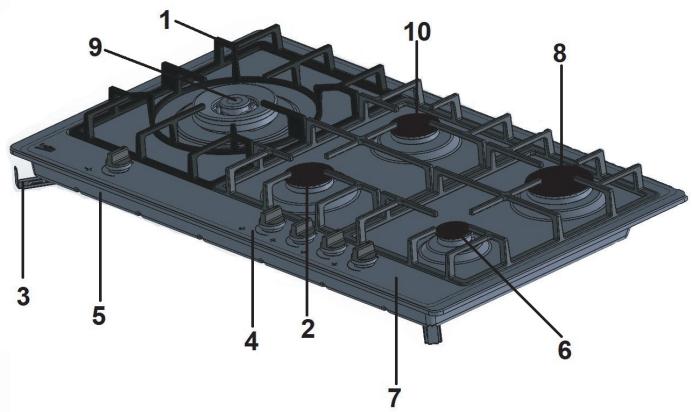
- Brûleur normal
- Pince d'assemblage
- Panneau de commande
- Couvercle de base
- Couvercle de base
- Brûleur auxiliaire
- Brûleur rapide
- Brûleur rapide
- Brûleur wok
- Brûleur normal
2.2 Panneau de commande
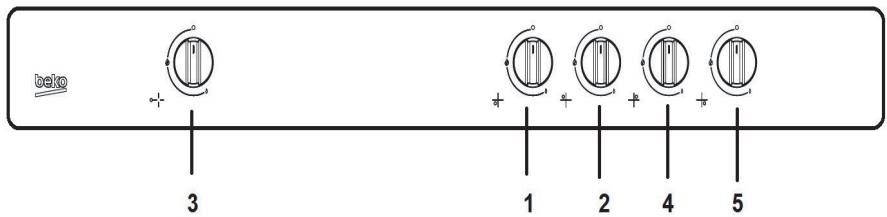
- Brûleur normal avant gauche
- Brûleur normal arrière gauche
- Brûleur wok central
- Brûleur rapide arrière droit
- Brûleur auxiliaire avant droit
2.3 Contenu de l'emballage

Les accessoires fournis peuvent varier selon le modèle du produit. Tous les accessoires décrits dans le manuel d'utilisation peuvent ne pas être présents sur votre produit.
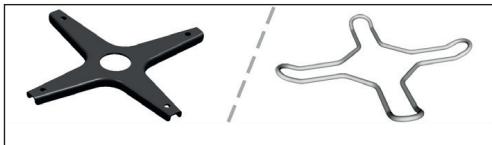
2.3.1 Adaptateur pour cafetière
Utilisé pour les cafetières.
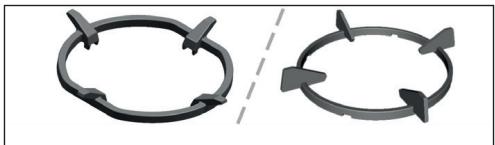
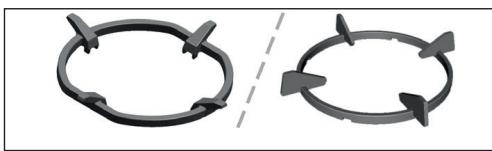
2.3.2 Adaptateur pour wok
Utilisé pour supporter une poêle wok à fond rond.
2.4 Caractéristiques techniques
| Inox | |
| HIML 95225 SXE | |
| Burners | 5 Gas Burner |
| Voltage / frequency | 220-240 V ~ 50-60Hz |
| Cable type / section | H05V2V2-F 3 x 0,75 mm2 |
| Cable length | max. 1.5 m |
| Category of gas product | II 2H3+ |
| Gas type / pressure | NG G20-20 mbar |
| Converting the gas type / pressure optional | G30-28...30mbar / G31-37mbar |
| Rear left / Normal burner | 1,75 kW |
| Front left / Normal burner | 1,75 kW |
| Left / Wok burner | 4.2 kW(NG), 4.0kW(LPG) |
| Front right / Auxiliary burner | 1 kW |
| Rear right / Rapid burner | 3 kW |
| Total gas consumption | 11,70 kW (NG), 11,50 kW (LPG) |
| Gas consumption NG G20 - 20 mbar LPG G30-28....30 mbar / G31-37mbar | - 836 g/h |
| External dimensions (height / width / depth) | 97x910x510 mm |
| Installation dimensions (width / depth) | 860 mm/490 mm |

Les caractéristiques techniques peuvent être modifiées sans préavis afin d'améliorer la qualité du produit.

Les figures de ce manuel sont schématiques et peuvent ne pas correspondre exactement à votre produit.

Les valeurs indiquées sur les étiquettes du produit ou dans la documentation qui l'accompagne sont obtenues en laboratoire conformément aux normes en vigueur. Selon les conditions d'utilisation et d'environnement du produit, ces valeurs peuvent varier.
2.4.1 Tableau des injecteurs
| Hob zone | Auxiliary burner 1 kW | Normal burner 1.75 kW | Rapid burner 3 kW | Wok burner (4.2 kW) | Wok burner (4 kW) |
| Gas type / Gas pressure | |||||
| NG G20-20 mbar | 0,72 mm | 0,97 mm | 1,15 mm | 1,53 mm | - |
| LPG G30-28....30 mbar/G31-37 mbar | 0,50 mm | 0,65 mm | 0,87 mm | - | 1,01 mm |
Le produit doit être installé par une personne qualifiée conformément à la réglementation en vigueur. Le fabricant ne saurait être tenu responsable des dommages résultant de procédures effectuées par des personnes non autorisées, ce qui pourrait également annuler la garantie.

La préparation de l'emplacement et l'installation électrique et gaz du produit relèvent de la responsabilité du client.

AVERTISSEMENT : Le produit doit être installé conformément à toutes les réglementations locales en matière de gaz et/ou d'électricité.

AVERTISSEMENT : Avant l'installation, vérifiez visuellement que le produit ne présente aucun défaut. Si c'est le cas, ne le faites pas installer. Les produits endommagés présentent des risques pour votre sécurité.
3.1 Avant l'installation
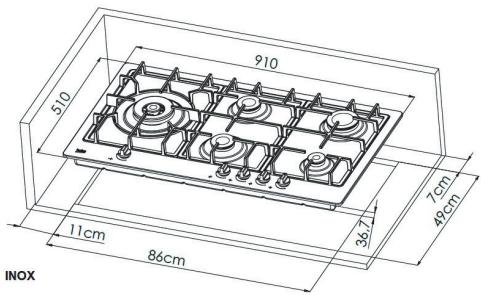
La table de cuisson est conçue pour être installée dans des plans de travail disponibles dans le commerce. Une distance de sécurité doit être respectée entre l'appareil et les murs et meubles de cuisine. Voir la figure (valeurs en mm).
- (*) Si une hotte aspirante doit être installée au-dessus de la cuisinière, reportez-vous aux instructions du fabricant de la hotte concernant la hauteur d'installation (min 650 mm).
- Retirez les matériaux d'emballage et les verrous de transport.
- Les surfaces, stratifiés synthétiques et adhésifs utilisés doivent être résistants à la chaleur (100 °C minimum).
- Le plan de travail doit être aligné et fixé horizontalement.
- Découpez l'ouverture pour la table de cuisson dans le plan de travail selon les dimensions d'installation.
3.2 Ventilation de la pièce
Toutes les pièces nécessitent une fenêtre ouvrable, ou équivalent, et certaines pièces nécessiteront également une ventilation permanente.
L'air de combustion est prélevé dans l'air ambiant et les gaz d'échappement sont émis directement dans la pièce.
Une bonne ventilation de la pièce est essentielle pour un fonctionnement sûr de votre appareil. Si la pièce où l'appareil est installé ne possède pas de porte ou de fenêtre ouvrant directement sur l'extérieur, il doit absolument y avoir une ouverture de ventilation fixe dans la pièce. La ventilation fixe doit être non réglable et non fermable. Sur les portes ou fenêtres ouvrant directement sur l'extérieur, il doit y avoir une ouverture de ventilation dont les dimensions sont spécifiées en fonction de la puissance totale en gaz de l'appareil (comme indiqué ci-dessous). Vous trouverez la correspondance entre la puissance en gaz et l'ouverture de ventilation dans le tableau ci-dessous.
| Total gas con-sump- tion (kW) | min. Ventilation opening (cm2) |
| 0-2 | 100 |
| 2-3 | 120 |
| 3-4 | 175 |
| 4-6 | 300 |
| 6-8 | 400 |
| 8-10 | 500 |
| 10-11.5 | 600 |
| 11.5-13 | 700 |
| 13-15.5 | 800 |
| 15.5-17 | 900 |
| 17-19 | 1000 |
| 19-24 | 1250 |
Si les portes ou fenêtres ouvrant directement sur l'extérieur ne comportent pas d'ouvertures correspondant à l'ouverture de ventilation spécifiée selon la puissance totale en gaz du produit, il doit absolument y avoir une ouverture de ventilation fixe dans la pièce. L'ouverture de ventilation fixe doit également être conforme aux valeurs du tableau puissance en gaz - ouverture de ventilation. Il doit y avoir un dégagement minimum de 10 mm sur le bord inférieur de la porte - ouvrant vers l'intérieur - dans la pièce où le produit est installé. Vous devez vous assurer que des éléments tels que tapis, revêtements de sol, etc. ne recouvrent pas ce dégagement lorsque la porte est fermée.
La cuisinière peut être placée dans une cuisine, une cuisine/salle à manger ou une chambre-salon, mais pas dans une pièce contenant une baignoire ou une douche. La cuisinière ne doit pas être installée dans une chambre-salon de moins de 20 m³. N'installez pas cet appareil dans une pièce située sous le niveau du sol, sauf si elle est ouverte au niveau du sol sur au moins un côté.
3.2.1 Installation et raccordement
Le produit doit être installé conformément à toutes les réglementations locales en matière de gaz et d'électricité.
3.3 Raccordement électrique
Connectez le produit à une prise de courant mise à la terre / une ligne protégée par un fusible de capacité appropriée comme indiqué dans le tableau « Caractéristiques techniques ». Faites effectuer l'installation de mise à la terre par un électricien qualifié lors de l'utilisation du produit avec ou sans transformateur.
Le fabricant ne pourra être tenu responsable des dommages résultant de l'utilisation du produit sans installation de mise à la terre conformément aux réglementations locales.

AVERTISSEMENT : Le produit doit être connecté à l'alimentation secteur uniquement par une personne autorisée et qualifiée. La période de garantie du produit ne commence qu'après une installation correcte. Le fabricant ne pourra être tenu responsable des dommages résultant de procédures effectuées par des personnes non autorisées.

AVERTISSEMENT : Le câble d'alimentation ne doit pas être pincé, plié ou coincé, ni entrer en contact avec des parties chaudes du produit. Un câble d'alimentation endommagé doit être remplacé par un électricien qualifié. Sinon, il y a un risque de choc électrique, de court-circuit ou d'incendie !
- Le raccordement doit être conforme aux réglementations nationales.
- Les données d'alimentation secteur doivent correspondre aux données indiquées sur la plaque signalétique du produit. La plaque signalétique se trouve à l'arrière du boîtier du produit.
- Le câble d'alimentation de votre produit doit être conforme aux valeurs indiquées dans le tableau « Caractéristiques techniques ».
| 4 | WARNING: Before starting any work on the electrical installation, disconnect the product from the mains supply. There is the risk of electric shock! |
| i | Power cable plug must be within easy reach after installation (do not route it above the hob). |
Branchez le câble d'alimentation sur la prise de courant.
3.4 Raccordement du gaz
|  | WARNING: Product can be con- nected to gas supply system only by an authorised and qualified person or technician with licence. Risk of explosion or toxication due to unprofessional repairs! Manufacturer shall not be held re- sponsible for damages arising from procedures carried out by unauthor- ised or unlicensed persons. |
| ! | WARNING: Before starting any work on the gas installation, disconnect the gas supply. There is the risk of explosion! |
Les conditions et valeurs de réglage du gaz sont indiquées sur les étiquettes (ou sur la plaque signalétique).
| i | The gas type of your product is stated on type label placed bottom of hob. |
Le tuyau flexible doit être installé de manière à ne pas entrer en contact avec une partie mobile de l'élément de cuisine (par exemple un tiroir) et à ne pas passer dans un espace susceptible de devenir encombré.
3.4.1 Raccordement du tuyau de gaz pour gaz naturel (GN)
- L'installation de gaz naturel doit être préparée avant l'installation du produit.
- Il doit y avoir un tuyau (il est conseillé de l'acheter auprès d'un installateur agréé), conforme aux normes locales de gaz, à la sortie de l'installation pour le raccordement au gaz naturel de votre produit, et l'extrémité de ce tuyau doit être fermée par un bouchon obturateur. Le représentant du service après-vente retirera le bouchon lors du raccordement et connectera votre produit au moyen d'un dispositif de raccordement droit (raccord).
- Assurez-vous que le robinet de gaz naturel est facilement accessible.
- Si vous devez utiliser votre produit plus tard avec un autre type de gaz, vous devez consulter le service après-vente agréé pour la procédure de conversion correspondante.
3.4.2 Raccordement du tuyau de gaz pour GPL
- Faites raccorder votre produit de manière à ce qu'il soit proche du raccordement de gaz et qu'il ne fuie pas.
- Le tuyau en plastique utilisé ne doit pas dépasser 125 cm.
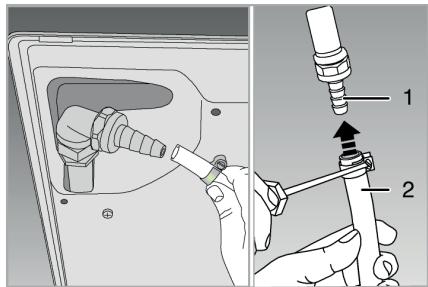
- Installez le collier sur le tuyau. Trempez une extrémité du tuyau (diamètre intérieur de 15 mm) dans de l'eau bouillante pendant une minute pour le ramollir.
- Ensuite, enfoncez complètement l'extrémité ramollie du tuyau sur l'embout conique de votre appareil. Enfin, serrez le collier à l'aide d'un tournevis.
- Répétez la même procédure pour l'autre extrémité du tuyau et terminez le raccordement à la bouteille de gaz.
- N'oubliez jamais de vérifier l'étanchéité du gaz.
AVERTISSEMENT : Risque d'explosion et d'asphyxie ! Ne conservez pas les bouteilles de GPL à l'intérieur de la maison.
- Si vous souhaitez utiliser votre appareil ultérieurement avec un autre type de gaz, vous devez consulter le service après-vente agréé pour la procédure de conversion correspondante.
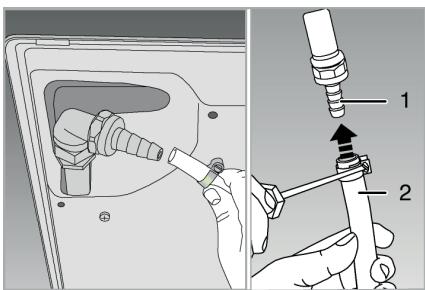
- Embout de tuyau GPL
- Tuyau en plastique
3.5 Contrôle d'étanchéité au point de raccordement
- Assurez-vous que tous les boutons de l'appareil sont éteints. Vérifiez que l'alimentation en gaz est ouverte. Préparez une mousse savonneuse et appliquez-la sur le point de raccordement du tuyau pour contrôler l'étanchéité.
- La partie savonneuse moussera en cas de fuite de gaz. Dans ce cas, inspectez à nouveau le raccordement de gaz.

N'utilisez jamais d'allumette ou de briquet pour contrôler l'étanchéité du gaz.
3.5.1 S'il y a un four encastré installé sous la table de cuisson ;
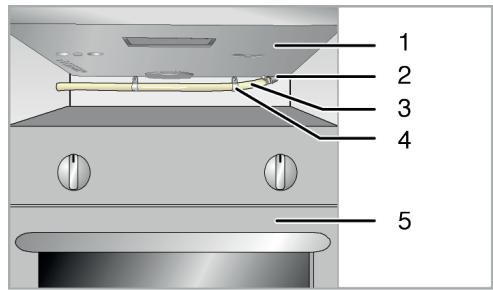
- Le tuyau de gaz doit être acheminé de manière à ne pas toucher le four, les arêtes vives ou les coins sous la table de cuisson, et à ne pas être plié ou tordu.
- Si vous effectuez le raccordement du gaz du côté gauche, vu de votre position, fixez le tuyau avec des colliers.
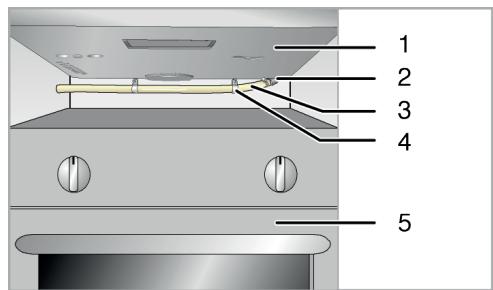
- Vue de dessous
- Embout du tuyau
- Tuyau
- Collier
- Four
3 Installation
3.6 Installation du produit
- Retirez les brûleurs, les chapeaux de brûleurs et les grilles de la table de cuisson du produit.
- Retournez la table de cuisson et placez-la sur une surface plane.
- Afin d'éviter que des corps étrangers et des liquides ne s'infiltrent entre la table de cuisson et le plan de travail, appliquez le mastic fourni dans l'emballage sur les contours du boîtier inférieur de la table de cuisson, en veillant à ce que le mastic ne se chevauche pas.
- Remplissez les coins en formant des plis aux angles comme illustré sur la figure. Formez autant de plis que nécessaire pour combler l'espace dans les coins.
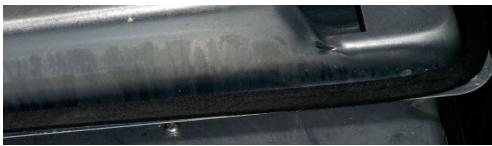

Assurez-vous que les sections de plinthe sur le boîtier inférieur de la table de cuisson sont remplies de mastic.
- Retournez à nouveau la table de cuisson, alignez-la et placez-la sur le plan de travail.
- Vous pouvez fixer votre table de cuisson au plan de travail à l'aide des brides et des vis fournies.
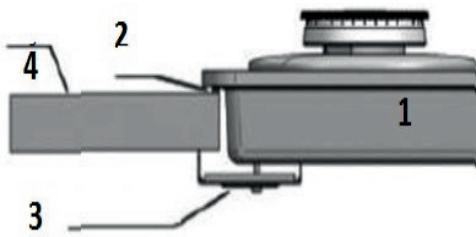
- Hob
- Putty
- Installation clamp
- Counter
The thickness of the counter must be at least 40 mm.

When installing the hob onto a cabinet, a shelf must be installed in order to separate the cabinet from the hob as illustrated in the above figure. This is not required when installing onto a built-under oven.
For example, if it is possible to touch the bottom of the product since it is installed onto a drawer, this section must be covered with a wooden plate.
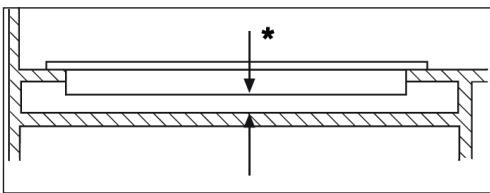
min. 25 mm
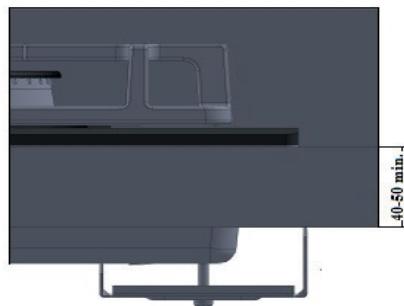
For counters with a thickness of 40–50 mm, install the clamps as shown below.
You must leave a ventilation opening on the remaining part in order to provide ventilation at the lower part of the hob. In addition to being necessary for component temperatures, this process is also compulsory for the TC burner to take in air from the bottom. It can be "100 cm² at least".

The flame must be blue and have a regular shape. If the flame is yellowish, check if the burner cap is seated securely or clean the burner.
3 Installation
3.6.1 Rear view (connection holes)
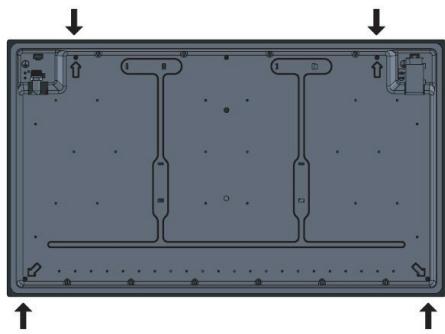
Place the burner plates, burner plate caps, and grills back to their seating after installation.

WARNING: Making connections to different holes is not a good practice in terms of safety since it can damage the gas and electrical system.

AVERTISSEMENT : Les cuisinières contiennent des composants à gaz et électriques. Par conséquent, la cuisinière ne doit être fixée au meuble que par l'orifice de raccordement indiqué dans ce manuel, en utilisant les fixations et vis fournies, comme indiqué dans le manuel. Sinon, cela présente un danger pour la vie et la sécurité des biens.
3.7 Contrôle final
- Ouvrez l'alimentation en gaz.
- Vérifiez que les installations de gaz sont bien fixées et étanches.
- Allumez les brûleurs et vérifiez l'apparence de la flamme.

La flamme doit être bleue et avoir une forme régulière. Si la flamme est jaunâtre, vérifiez que le chapeau du brûleur est bien en place ou nettoyez le brûleur.
Conversion du gaz

AVERTISSEMENT : Avant toute intervention sur l'installation de gaz, coupez l'alimentation en gaz. Il y a un risque d'explosion.
Pour utiliser le produit avec un autre type de gaz, remplacez tous les injecteurs de gaz et réglez la combustion des robinets de gaz en position veille.
Remplacement de l'injecteur de gaz du brûleur
- Retirez le chapeau et la tête du brûleur.
- Tournez les injecteurs de gaz dans le sens inverse des aiguilles d'une montre pour les retirer.
- Installez de nouveaux injecteurs de gaz.
- Vérifiez toutes les connexions pour vous assurer qu'elles sont sûres et étanches.

L'emplacement des nouveaux injecteurs est indiqué sur l'emballage. Vous pouvez également vous référer au tableau.
4.1 Conseils pour économiser l'énergie
Les informations suivantes vous aideront à utiliser votre appareil de manière écologique et à économiser de l'énergie :
- Décongelez les plats surgelés avant de les cuire.
- Utilisez des casseroles avec couvercle pour la cuisson. Sans couvercle, la consommation d'énergie peut augmenter de 4 fois.
- Sélectionnez le brûleur adapté à la taille du fond de la casserole utilisée. Choisissez toujours la taille de casserole appropriée à vos plats. Les casseroles plus grandes nécessitent plus d'énergie.
4.2 Première utilisation
4.2.1 Premier nettoyage de l'appareil
| i | The surface might get damaged by some detergents or cleaning materials. Do not use aggressive detergents, cleaning powders/creams or any sharp objects during cleaning. Do not use harsh abrasive cleaners or sharp metal scrapers to clean the oven door glass since they can scratch the surface, which may result in shattering of the glass. |
- Retirez tous les matériaux d'emballage.
- Essuyez les surfaces de l'appareil avec un chiffon humide ou une éponge, puis séchez avec un chiffon.
5.1 Informations générales sur la cuisson
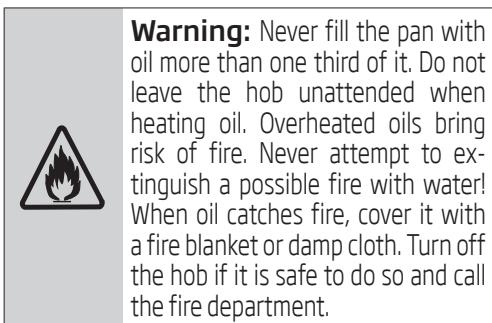
- Avant de faire frire des aliments, séchez-les toujours bien et placez-les délicatement dans l'huile chaude. Assurez-vous que les aliments surgelés sont complètement décongelés avant de les faire frire.
- Ne couvrez pas le récipient utilisé pour chauffer l'huile.
- Placez les poêles et casseroles de manière à ce que leurs poignées ne soient pas au-dessus de la table de cuisson pour éviter qu'elles ne chauffent. Ne placez pas de récipients déséquilibrés ou facilement inclinables sur la table de cuisson.
- Ne placez pas de récipients vides ou de casseroles vides sur les zones de cuisson allumées. Ils pourraient être endommagés.
- Faire fonctionner une zone de cuisson sans récipient ou casserole dessus endommagera le produit. Éteignez les zones de cuisson après la cuisson.
- Comme la surface du produit peut être chaude, ne placez pas de récipients en plastique ou en aluminium dessus.
- Ces récipients ne doivent pas non plus être utilisés pour conserver des aliments.
- Utilisez uniquement des casseroles ou des récipients à fond plat.
- Mettez une quantité appropriée d'aliments dans les casseroles et les poêles. Ainsi, vous éviterez tout nettoyage inutile en empêchant les plats de déborder.
- Ne placez pas les couvercles des casseroles ou des poêles sur les zones de cuisson.
- Placez les casseroles de manière à ce qu'elles soient centrées sur la zone de cuisson. Lorsque vous souhaitez déplacer la casserole vers une autre zone de cuisson, soulevez-la et placez-la sur la zone souhaitée au lieu de la faire glisser.
5.1.1 Cuisson au gaz
- La taille du récipient et la flamme doivent correspondre. Ajustez les flammes de gaz pour qu'elles ne dépassent pas le fond du récipient et centrez le récipient sur le support de casserole.
5.2 Utilisation des foyers
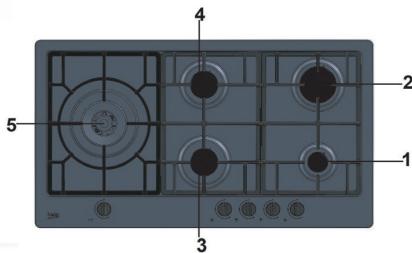
- Brûleur auxiliaire 12-16 cm
- Brûleur rapide 18-24 cm
- Brûleur normal 16-18 cm
- Brûleur normal 16-18 cm
- Brûleur wok 22-26 cm : liste des diamètres de casseroles recommandés pour les brûleurs correspondants.
Le symbole de grande flamme indique la puissance de cuisson maximale et le symbole de petite flamme indique la puissance de cuisson minimale. En position arrêt (en haut), le gaz n'est pas fourni aux brûleurs.

AVERTISSEMENT : N'utilisez pas de casseroles dépassant les dimensions indiquées ci-dessus. L'utilisation de casseroles plus grandes présente un risque d'intoxication au monoxyde de carbone, de surchauffe des surfaces adjacentes et des boutons de commande. L'utilisation de casseroles plus petites présente un risque de brûlure par la flamme.
L'utilisation de protections de plaque de cuisson inappropriées peut provoquer des accidents.
5.2.1 Allumage des brûleurs à gaz
- Maintenez le bouton du brûleur enfoncé.
- Tournez-le dans le sens inverse des aiguilles d'une montre jusqu'au symbole de grande flamme. » Le gaz s'enflamme grâce à l'étincelle créée.
- Réglez-le à la puissance de cuisson souhaitée.
5.2.2 Extinction des brûleurs à gaz
Tournez le bouton de la zone de maintien au chaud en position arrêt (en haut).
5.2.3 Système de sécurité d'arrêt du gaz (sur les modèles avec composant thermique)
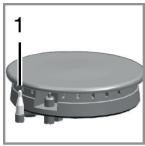
Pour parer à l'extinction due à des débordements de liquide sur les brûleurs, le mécanisme de sécurité se déclenche et coupe le gaz.
- Sécurité d'arrêt du gaz
- Poussez le bouton vers l'intérieur et tournez-le dans le sens inverse des aiguilles d'une montre pour allumer.
- Après l'allumage du gaz, maintenez le bouton enfoncé pendant 3 à 5 secondes supplémentaires pour activer le système de sécurité.
- Si le gaz ne s'allume pas après avoir enfoncé et relâché le bouton, répétez la même procédure en maintenant le bouton enfoncé pendant 15 secondes.

AVERTISSEMENT : Relâchez le bouton si le brûleur ne s'allume pas dans les 15 secondes. Attendez au moins 1 minute avant de réessayer. Il y a un risque d'accumulation de gaz et d'explosion !
5.2.4 Brûleur wok
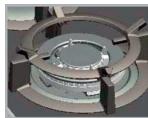
Les brûleurs wok vous aident à cuisiner plus rapidement. Le wok, particulièrement utilisé dans la cuisine asiatique, est une sorte de poêle profonde et plate en tôle, utilisée pour cuire
des légumes hachés et de la viande à feu vif en peu de temps.
Comme les aliments sont cuits à feu vif et en très peu de temps dans ces poêles qui conduisent la chaleur rapidement et uniformément, la valeur nutritionnelle des aliments est préservée et les légumes restent croquants.
Vous pouvez également utiliser le brûleur wok pour des casseroles ordinaires.
Si vous souhaitez utiliser une casserole ordinaire sur le brûleur wok, vous devez retirer le support de poêle wok de la table de cuisson.
6.1 Informations générales
La durée de vie du produit sera prolongée et la probabilité de problèmes diminuera si le produit est nettoyé à intervalles réguliers.
Débranchez le produit de l'alimentation secteur avant de commencer les travaux d'entretien et de nettoyage.
Il y a un risque de choc électrique !
Laissez le produit refroidir avant de le nettoyer.
Les surfaces chaudes peuvent provoquer des brûlures !
Nettoyez soigneusement le produit après chaque utilisation. Ainsi, vous pourrez éliminer plus facilement les résidus de cuisson, évitant qu'ils ne brûlent lors de la prochaine utilisation de l'appareil.
- Aucun produit de nettoyage spécial n'est requis pour nettoyer le produit. Utilisez de l'eau tiède avec du liquide vaisselle, un chiffon doux ou une éponge pour nettoyer le produit, puis essuyez-le avec un chiffon sec.
- Assurez-vous toujours que tout excès de liquide est soigneusement essuyé après le nettoyage et que tout déversement est immédiatement séché.
- N'utilisez pas de produits de nettoyage contenant de l'acide ou du chlorure pour nettoyer les surfaces en inox et la poignée. Utilisez un chiffon doux avec un détergent liquide (non abrasif) pour essuyer ces parties, en veillant à frotter dans une seule direction.

La surface pourrait être endommagée par certains détergents ou matériaux de nettoyage.
N'utilisez pas de détergents agressifs, de poudres ou crèmes à récurer, ni d'objets pointus lors du nettoyage.
N'utilisez pas de nettoyants abrasifs agressifs ni de grattoirs métalliques pointus pour nettoyer la vitre de la porte du four, car ils pourraient rayer la surface, ce qui pourrait entraîner le bris du verre.

N'utilisez pas de nettoyeurs vapeur pour nettoyer l'appareil, car cela pourrait provoquer un choc électrique.
6.2 Nettoyage de la table de cuisson
6.2.1 Nettoyage du brûleur
- Retirez les grilles, les têtes de brûleur et les chapeaux de brûleur et nettoyez-les avec un chiffon doux et humide.
- Nettoyez la saleté dans la chambre du brûleur et sur l'injecteur avec un chiffon doux et humide, puis essuyez-les avec un chiffon sec.
- Utilisez du stéarate de potassium (savon mou) disponible dans le commerce pour la saleté tenace sur les têtes de brûleur.
- Nettoyez la plaque du brûleur de la table de cuisson.
- Assurez-vous que les têtes de brûleur sont installées à leur place correcte et bien serrées. Une installation incorrecte entraînera une fuite de gaz, un raté d'allumage ou une combustion irrégulière.
- Lors de la mise en place des supports de casserole, veillez à positionner les pieds des supports de manière à ce que les brûleurs soient centrés.
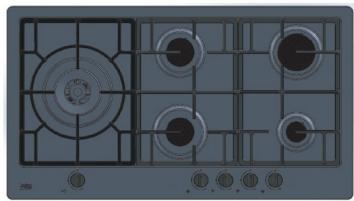

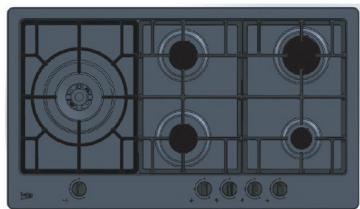

6 Entretien et soin

En cas de débordement, éteignez immédiatement le brûleur. Retirez les casseroles et les supports de casserole. Nettoyez la matière débordée avec un chiffon sec et absorbant. Veillez à ne pas laisser de liquide pénétrer dans les brûleurs. Nettoyez également l'intérieur des brûleurs si du liquide y est entré. Ne réutilisez pas la table de cuisson avant de l'avoir nettoyée.
6.2.2 Assemblage des pièces du brûleur wok
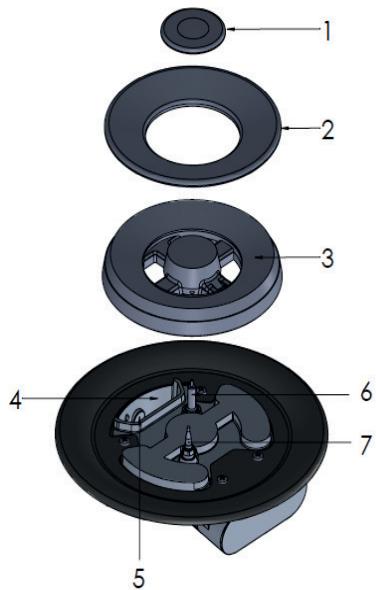
- Chapeau de brûleur intérieur
- Chapeau de brûleur extérieur
- Tête de brûleur
- Chambre de brûleur
- Injecteur
- Fiche (sur les produits avec allumeur)
- Élément thermique (sur les produits avec élément thermique)
Assemblez toutes les pièces dans l'ordre après avoir nettoyé le brûleur.
- Placez la tête de brûleur sur la chambre de brûleur de manière à ce qu'elle passe à travers le trou de la fiche (6).
- Placez les chapeaux de brûleur sur les têtes de brûleur.
6.2.3 Assemblage des pièces du brûleur
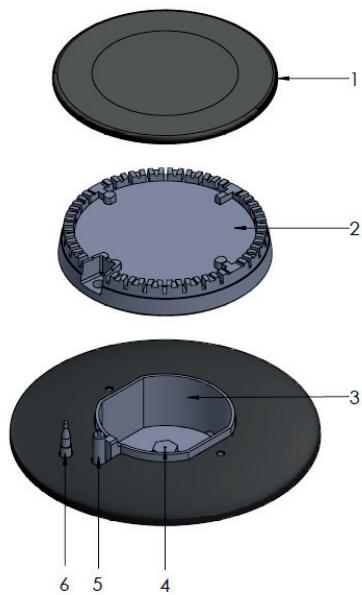
- Chapeau de brûleur
- Tête de brûleur
- Chambre de brûleur
- Injecteur
- Bouchon (sur les produits avec allumeur)
- Élément thermique (sur les produits avec élément thermique)
Assemblez toutes les pièces dans l'ordre après avoir nettoyé le brûleur.
- Placez la tête de brûleur sur la chambre de brûleur de manière à ce qu'elle passe à travers le trou du bouchon (5).
- Placez le chapeau de brûleur sur la tête de brûleur.
6 Entretien et maintenance
6.2.4 Surfaces en vitrocéramique
Essuyez la surface en vitrocéramique avec un chiffon imbibé d'eau froide, de manière à ne laisser aucun agent de nettoyage dessus. Séchez avec un chiffon doux et sec. Les résidus peuvent endommager la surface en vitrocéramique lors de la prochaine utilisation de la table de cuisson.
Les résidus séchés sur la surface en vitrocéramique ne doivent en aucun cas être grattés avec des lames à crochet, de la laine d'acier ou des outils similaires.
Éliminez les taches de calcaire (taches jaunes) avec une petite quantité de détartrant tel que du vinaigre ou du jus de citron. Vous pouvez également utiliser des produits appropriés disponibles dans le commerce.
Si la surface est très sale, appliquez le produit de nettoyage sur une éponge et attendez qu'il soit bien absorbé. Ensuite, nettoyez la surface de la table de cuisson avec un chiffon humide.
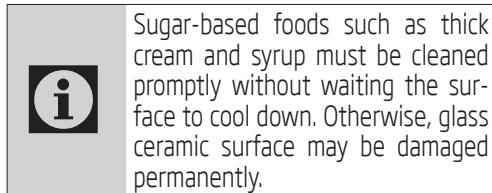
Une légère décoloration peut apparaître sur les revêtements ou autres surfaces avec le temps. Cela n'affectera pas le fonctionnement du produit.
La décoloration et les taches sur la surface en vitrocéramique sont normales et ne constituent pas un défaut.
6.3 Nettoyage du bandeau de commande
Nettoyez le bandeau de commande et les boutons avec un chiffon humide, puis essuyez-les.

Ne retirez pas les boutons de commande pour nettoyer le bandeau. Le bandeau pourrait être endommagé !
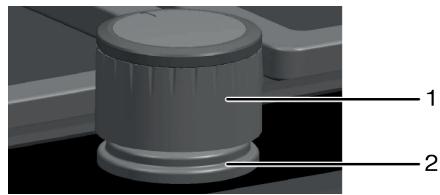
- Bouton
- Joint d'étanchéité

Ne retirez pas les joints d'étanchéité sous les boutons pour le nettoyage.
6.4 Transport futur
- Si vous avez conservé l'emballage d'origine du produit, transportez-le dans cet emballage. Suivez les instructions sur l'emballage. Si vous n'avez pas l'emballage d'origine, emballez le produit dans du papier bulle ou un carton épais et fixez-le solidement avec du ruban adhésif.
- Fixez solidement les chapeaux de brûleur, les têtes de brûleur et les grilles avec du ruban adhésif.

Vérifiez l'aspect général de votre produit pour détecter tout dommage éventuel survenu pendant le transport.
7 Dépannage
Un bruit de cliquetis se fait entendre pendant que le produit chauffe et refroidit.
- Lorsque les pièces métalliques sont chauffées, elles peuvent se dilater et faire du bruit. >> Ce n'est pas une panne.
Il n'y a pas d'étincelle d'allumage.
- Le courant est coupé. >> Vérifiez les fusibles dans la boîte à fusibles.
Le produit produit des étincelles en continu.
- Les fluides effluents ont pu pénétrer dans le mécanisme d'allumage sous les boutons de commande. >> Débranchez le produit et attendez qu'il refroidisse.
Il n'y a pas de gaz.
- La vanne principale de gaz est fermée. >> Ouvrez la vanne de gaz.
- Le tuyau est incliné. >> Installez correctement le tuyau de gaz.
Les brûleurs ne brûlent pas correctement ou pas du tout.
- Les brûleurs sont sales. >>> Nettoyez les composants du brûleur.
- Les brûleurs sont mouillés. >>> Séchez les pièces du brûleur.
- Le chapeau du brûleur n'est pas correctement positionné. >> Positionnez correctement le chapeau du brûleur.
- La vanne principale de gaz est fermée. >> Ouvrez la vanne de gaz.
- La bouteille de gaz est vide (en cas d'utilisation de GPL). >>> Remplacez la bouteille de gaz.
- Le bouton du brûleur n'a pas été maintenu enfoncé assez longtemps lors de l'allumage. >>> Allumez le brûleur en appuyant et en maintenant pendant au moins 3 à 5 secondes.

Si vous ne parvenez pas à résoudre le problème après avoir suivi les instructions de cette section, contactez le centre d'appels. N'essayez jamais de réparer vous-même un produit défectueux.
7 Dépannage
| Brand | BEKO | ||
| Hob Type | Built-in Gas Hob | ||
| Model | Inox | ||
| Symbol | Value | Unit | |
| Number of the gas burners | 5 | % | |
| Energy efficiency of the rear right burner | EE gas-powered burner | 55,3 | % |
| Energy efficiency of the front right burner | EE gas-powered burner | - | % |
| Energy efficiency of the front left burner | EE gas-powered burner | 56,2 | % |
| Energy efficiency of the rear left burner | EE gas-powered burner | 56,2 | % |
| Energy efficiency of the left burner | EE gas-powered burner | 52,8 | % |
| Energy efficiency for the gas-powed hob | EE gas-powered burner | 55,1 | % |
Conformément à la directive 2009/125/CE relative à l'écoconception des produits liés à l'énergie, les informations produit ci-dessous sont fournies en parallèle avec le règlement (UE) n° 66/2014 de la Commission européenne concernant les exigences d'écoconception pour les tables de cuisson domestiques.
Afin de préciser les caractéristiques du produit, les mesures et les calculs sont spécifiés avec la norme ci-dessous, conformément aux exigences d'écoconception.
EN 30-2
Lisez d'abord ce manuel d'utilisation !
Chère cliente, cher client,
Merci d'avoir choisi un produit Beko. Nous espérons que vous obtiendrez les meilleurs résultats de ce produit, fabriqué avec une technologie de haute qualité et de pointe. Par conséquent, lisez attentivement l'intégralité de ce manuel d'utilisation et tous les autres documents joints avant d'utiliser le produit, et conservez-les pour référence future. Si vous transmettez le produit à d'autres personnes, donnez-leur également ce manuel d'utilisation. Suivez tous les avertissements et informations du manuel d'utilisation.
N'oubliez pas que ce manuel d'utilisation peut également s'appliquer à de nombreux autres modèles. Les différences entre les modèles seront identifiées dans le manuel.
Explication des symboles
Les symboles suivants sont utilisés dans tout ce manuel d'utilisation :
| i | Informazioni importanti o suggerimenti utili sull'utilizzo. |
| ! | Avvertenze per situazioni pericolose per vita e propietà. |
| 4 | Avvertenza per shock elettrico. |
| 5 | Avvertenze per superfici calde. |
| Avvertenze per rischio di incendio. |

Ce produit est fabriqué avec la technologie la plus récente dans des conditions respectueuses de l'environnement.
1
Instructions importantes pour la sécurité et l'environnement
Cette section contient des instructions de sécurité qui permettent de prévenir tout danger de blessure corporelle ou de dommage matériel. Le non-respect de ces instructions annule la garantie accordée.
1.1 Sécurité générale
- Cet appareil peut être utilisé par des enfants âgés de plus de 8 ans et par des personnes ayant des capacités physiques, sensorielles ou mentales réduites ou manquant d'expérience et de connaissances, à condition qu'ils soient supervisés ou qu'ils aient reçu des instructions concernant l'utilisation de l'appareil en toute sécurité et qu'ils comprennent les risques encourus.
- Les enfants ne doivent pas jouer avec l'appareil. Le nettoyage et l'entretien ne doivent pas être effectués par des enfants sans surveillance.
- Les procédures d'installation et de réparation doivent toujours être effectuées par des agents de service agréés. Le fabricant ne sera pas tenu responsable des dommages résultant de procédures effectuées par des personnes non autorisées.
Cela annulera également la garantie. Lisez attentivement les instructions avant l'installation.
Ne mettez pas l'appareil en marche s'il est défectueux ou présente des dommages visibles. - Vérifiez que les boutons de commande de l'appareil sont éteints. - Si la plaque en verre de la table de cuisson est fissurée : éteignez immédiatement tous les brûleurs et éléments chauffants électriques et débranchez l'appareil de la source d'alimentation. Ne touchez pas la surface de l'appareil. N'utilisez pas l'appareil.
1.2 Précautions lors de l'utilisation du gaz
- Toutes les interventions sur les appareils et systèmes à gaz ne peuvent être effectuées que par du personnel qualifié et autorisé, enregistré auprès de Gas Safe.
- S'il est nécessaire d'utiliser le produit avec un type de gaz différent, consultez l'agent de service agréé pour la procédure de conversion correspondante.
1
Instructions importantes pour la sécurité et l'environnement
- Avant l'installation, assurez-vous que les conditions de distribution locales (type de gaz et pression du gaz) et les réglages de l'appareil sont compatibles.
- Cet appareil n'est pas raccordé à un dispositif d'évacuation des produits de combustion. Il doit être installé et raccordé conformément aux réglementations d'installation en vigueur. Une attention particulière doit être accordée aux exigences pertinentes en matière de ventilation ; voir la section « Avant l'installation ».
- ATTENTION : L'utilisation de cuisinières à gaz produit de la chaleur et de l'humidité dans la pièce où elles sont installées. Assurez-vous que la cuisine est bien ventilée : maintenez les ouvertures de ventilation naturelles ouvertes ou installez un dispositif de ventilation mécanique (hotte aspirante). Une utilisation intensive et prolongée de l'appareil peut nécessiter une ventilation supplémentaire, par exemple en augmentant le niveau de ventilation mécanique si elle est présente.
Utiliser le produit de manière intensive pendant des périodes prolongées (1 heure et plus) nécessite une ventilation supplémentaire (par exemple, augmenter le niveau de vitesse d'aspiration, si présent, ou ouvrir les fenêtres). Les appareils et systèmes à gaz doivent être contrôlés régulièrement pour un fonctionnement correct. Le régulateur, le flexible et son collier de serrage doivent être contrôlés régulièrement et remplacés selon les périodes recommandées par le fabricant ou lorsque nécessaire. - Nettoyer régulièrement les brûleurs à gaz. Les flammes doivent être bleues et brûler de manière uniforme. - Une bonne combustion est nécessaire dans les appareils à gaz. En cas de combustion incomplète, du monoxyde de carbone (CO) peut se développer. Le monoxyde de carbone n'a ni couleur, ni odeur, et est un gaz très toxique qui a des effets mortels même à petites doses.
Instructions importantes pour la sécurité et l'environnement
Demander des informations sur les numéros de téléphone d'urgence pour le gaz et sur les mesures de sécurité en cas d'odeur de gaz à votre fournisseur local de gaz.
Que faire lorsque vous sentez une odeur de gaz
- Ne pas utiliser de flammes nues ni fumer. Ne pas actionner les interrupteurs électriques (par exemple, lumières, sonnette d'entrée, etc.). Ne pas utiliser de téléphone fixe ou portable. Risque d'explosion et d'intoxication !
- Ouvrir les portes et les fenêtres.
- Fermer toutes les vannes sur les appareils et les compteurs de gaz au niveau de la vanne de contrôle principale, sauf si elle est située dans un espace confiné ou en cave.
- Vérifier tous les tuyaux et les raccordements pour vérifier leur étanchéité. Si vous sentez encore une odeur de gaz, quitter l'habitation.
- Prévenir les voisins.
- Appeler les pompiers. Utiliser un téléphone à l'extérieur de l'habitation. Ne pas rentrer tant que vous n'avez pas reçu de communication sur la sécurité.
1.3 Sécurité électrique
- En cas de panne du produit, ne pas l'utiliser à moins qu'il ne soit réparé par un agent autorisé pour l'assistance. Il y a un risque de choc électrique !
- Brancher le produit uniquement sur une prise mise à la terre / ligne avec tension et protection selon les spécifications indiquées dans "Spécifications techniques". Faire effectuer la mise à la terre par un électricien qualifié lorsque vous utilisez le produit avec un transformateur. Notre entreprise ne sera pas responsable des problèmes résultant de l'utilisation du produit sans mise à la terre conforme aux réglementations locales. Ne jamais laver l'appareil en projetant ou en versant de l'eau dessus ! Il y a un risque de choc électrique !
- Ne jamais toucher la fiche avec les mains mouillées ! Ne jamais débrancher l'appareil en tirant sur le câble, mais toujours en saisissant et en tirant la fiche.
- Débrancher le produit du réseau pendant les procédures d'installation, de maintenance, de nettoyage et de réparation.
Instructions importantes pour la sécurité et l'environnement
- Si le câble d'alimentation du produit est endommagé, il doit être remplacé par le fabricant, son agent de service ou une personne de qualification similaire, afin d'éviter tout danger.
- L'appareil doit être installé de manière à pouvoir être complètement débranché du réseau. La séparation doit être assurée par un interrupteur intégré à l'installation électrique fixe, conformément aux réglementations de construction.
- Toutes les interventions sur les appareils et systèmes électriques ne peuvent être effectuées que par du personnel qualifié et autorisé.
- En cas de dommage, éteignez le produit et débranchez-le du réseau. Pour ce faire, désactivez le fusible domestique.
- Assurez-vous que le courant du fusible est compatible avec le produit.
1.4 Sécurité du produit
- La machine et ses parties accessibles deviennent très chaudes pendant l'utilisation. Faites attention à ne pas toucher les éléments chauffants. Les enfants de moins de 8 ans doivent être tenus à l'écart à moins d'être sous surveillance continue. N'utilisez jamais le produit lorsque le jugement et la coordination sont altérés par l'alcool et/ou les drogues.
- Soyez prudent lorsque vous utilisez des boissons alcoolisées dans les plats. L'alcool s'évapore à haute température et peut provoquer des incendies car il s'enflamme au contact de surfaces chaudes. Ne placez pas de matériaux inflammables à proximité du produit car les côtés peuvent devenir chauds pendant l'utilisation.
- Gardez toutes les ouvertures de ventilation libres de toute obstruction. N'utilisez pas de nettoyeurs à vapeur pour nettoyer l'appareil car cela pourrait provoquer un choc électrique.
Instructions importantes pour la sécurité et l'environnement
- La cuisson sans surveillance d'huiles ou de graisses sur la table de cuisson peut être dangereuse et provoquer des incendies. N'essayez JAMAIS d'éteindre le feu avec de l'eau, mais éteignez l'appareil puis couvrez la flamme, par exemple avec un couvercle ou une couverture ignifuge.
- Risque d'incendie : ne pas stocker d'objets sur les surfaces de cuisson. Si la surface est endommagée, éteindre l'appareil pour éviter tout risque de choc électrique. ATTENTION : En cas de bris de la vitre de la plaque, éteindre immédiatement tous les brûleurs et tous les éléments chauffants électriques, puis débrancher l'appareil du réseau électrique. Ne pas toucher la surface de l'appareil. Ne pas utiliser l'appareil.
Éviter tout risque d'incendie !
- S'assurer que toutes les connexions électriques sont fixes et serrées pour éviter tout risque d'arc électrique. Ne pas utiliser de câbles endommagés ou de rallonges.
S'assurer qu'il n'y a ni liquide ni humidité sur la prise lors du branchement à l'appareil. - Pour éviter les fuites de gaz, s'assurer que le raccordement est étanche.
1.5 Usage prévu
- L'appareil est destiné uniquement à un usage domestique. L'usage commercial n'est pas autorisé. ATTENTION : Cet appareil sert uniquement à cuisiner. Il ne doit pas être utilisé à d'autres fins, par exemple pour chauffer une pièce.
- Le fabricant n'est pas responsable des dommages causés par une utilisation ou une manipulation incorrecte.
- Ceci est un produit intégré. Classe 3. Il n'est pas adapté pour être utilisé comme table de cuisson posée.
Instructions importantes pour la sécurité et l'environnement
1.6 Sécurité des enfants
Les parties accessibles peuvent devenir chaudes pendant l'utilisation. Les enfants doivent être tenus à l'écart. - Les matériaux d'emballage sont dangereux pour les enfants. Tenir les matériaux d'emballage hors de portée des enfants. Éliminer toutes les parties de l'emballage conformément aux normes environnementales. Les appareils électriques et/ou à gaz sont dangereux pour les enfants. Tenir les enfants éloignés de l'appareil lorsqu'il est en cours d'utilisation et ne pas les laisser jouer avec le produit. Ne pas placer sur l'appareil tout objet pouvant être atteint par les enfants.
1.7 Conformité à la directive DEEE et élimination des déchets :
Cet appareil est conforme à la directive UE DEEE (2012/19/UE). Cet appareil porte le symbole de classification des déchets d'équipements électriques et électroniques (DEEE).
Cet appareil a été fabriqué avec des pièces et des matériaux de haute qualité qui peuvent être réutilisés et sont adaptés au recyclage. Ne pas éliminer les déchets de l'appareil avec les déchets ménagers ordinaires.
mélanges et autres déchets en fin de vie. Le déposer dans un centre de collecte pour le recyclage des appareils électriques et électroniques. Consulter les autorités locales pour connaître l'emplacement de ces centres de collecte.
1.8 Conformité à la directive RoHS :
L'appareil acheté est conforme à la directive européenne RoHS (2011/65/UE). Il ne contient pas de matières dangereuses ou interdites spécifiées dans la directive.
1.9 Informations sur l'emballage

L'emballage du produit est fait de matériaux recyclables conformément à la réglementation nationale. Ne pas jeter les matériaux d'emballage avec les déchets ménagers
ou autres déchets. Les déposer aux points de collecte pour matériaux d'emballage prévus par les autorités locales.
2.1 Vue d'ensemble
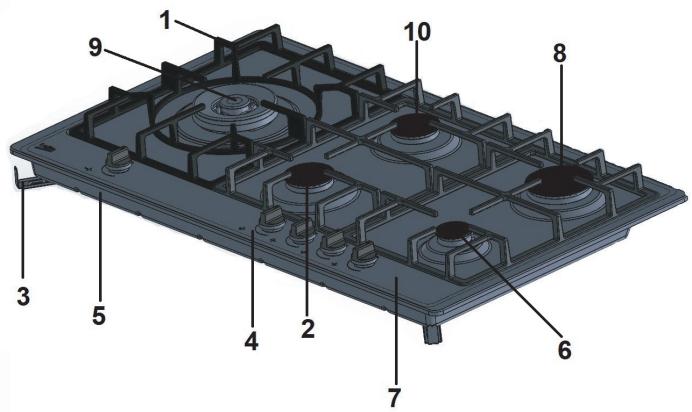
- Support de casserole
- Brûleur normal
- Pince de montage
- Panneau de commande
- Couvercle de base
- Brûleur auxiliaire
- Plaque de brûleur
- Brûleur rapide
- Brûleur wok
- Brûleur normal
2.2 Panneau de commande
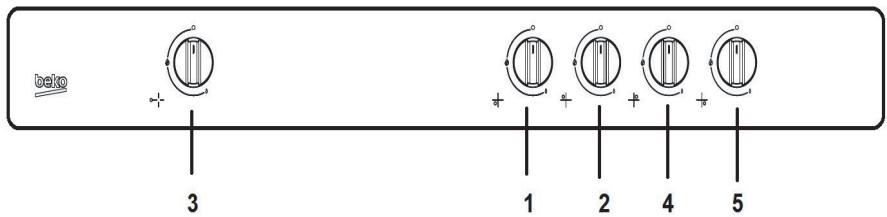
- Brûleur normal avant gauche
- Brûleur normal arrière gauche
- Brûleur wok central
- Brûleur rapide arrière droit
- Brûleur auxiliaire avant droit
2.3 Contenu de l'emballage

Les accessoires fournis peuvent varier selon le modèle du produit. Tous les accessoires décrits dans le manuel d'utilisation peuvent ne pas être inclus avec le produit acheté.
2.3.1 Adaptateur pour cafetière
Utilisé pour les cafetières.
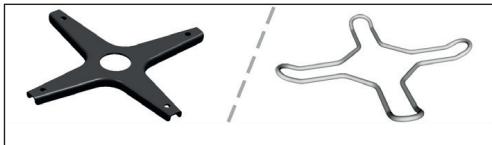
2.3.2 Adaptateur wok
Utilisé comme logement du wok à fond rond.
2.4 Spécifications techniques
| Inox | |
| HIML 95225 SXE | |
| Brucitori | 5 bruciatori a gas |
| Tensione / frequenza | 220-240 V ~ 50-60Hz |
| Tipo /sezione cavo | H05V2V2-F 3 x 0,75 mm2 |
| Lunghezza cavo | max. 1,5 m |
| Categoria di prodotto a gas | Cat II 2H3+ |
| Tipodi gas / pressione | Gas metano G20-20 mbar |
| Conversione del tipo di gas / pressione opzionale | G30-28...30mbar / G31-37mbar |
| Sinistra posteriore / Bruciatore normale | 1,75 kW |
| Sinistra anteriore / Bruciatore normale | 1,75 kW |
| Sinistra / Bruciatore wok | 4,2 kW(Gas metano), 4,0kWGPL) |
| Destra anteriore / Bruciatore ausiliario | 1 kW |
| Destra posteriore / Bruciatore rapido | 3 kW |
| Consumo totale gas | 11,70 kW (Gas metano), 11,50 kW (GPL) |
| Consumo di gas Gas metano G20 - 20 mbar GPL G30-28....30 mbar / G31-37mbar | - 836 g/h |
| Dimensioni esterne (altezza / larghezza / profondità) | 97x910x510 mm |
| Dimensioni installazione (larghezza / profondità) | 860 mm/490 mm |

Les spécifications techniques peuvent être modifiées sans préavis pour améliorer la qualité du produit.

Les figures de ce manuel sont schématiques et peuvent ne pas correspondre exactement au produit.

Les valeurs déclarées sur les étiquettes du produit ou dans la documentation qui l'accompagne sont obtenues dans des conditions de laboratoire selon les normes relatives. Ces valeurs peuvent varier en fonction des conditions de fonctionnement et environnementales du produit.
2.4.1 Tableau des injecteurs
| Zona di cottura | Bruciatore ausiliario 1 kW | Bruciatore normale 1,75 kW | Bruciatore rapido 3 kW | Bruciatore wok (4,2 kW) | Bruciatore wok (4 kW) |
| Tipo di gas / Pressio- ne del gas | |||||
| Gas metano G20-20 mbar | 0,72 mm | 0,97 mm | 1,15 mm | 1,53 mm | - |
| GPL G30-28....30 mbar/G31-37 mbar | 0,50 mm | 0,65 mm | 0,87 mm | - | 1,01 mm |
3 Installation
Le produit doit être installé par un personnel qualifié conformément aux réglementations en vigueur. Le fabricant ne sera pas considéré comme responsable des dommages résultant de procédures exécutées par des personnes non autorisées. Cela annulera également la garantie.
| i | La preparazione della posizione e l'installazione elettrica e del gas per il prodotto sono responsabilità del cliente. |
| PERICOLO: Il prodotto deve esse- re installato secondo i regolamenti locali per il gas e/o elettrici. |
| PERICOLO: Prima dell'installazione, controlling visamente se il prodotto presente difetti. Se è così, non installarlo. Prodotti danneggiati provocano rischi per la sicurezza. |
3.1 Avant l'installation
La table de cuisson est conçue pour être installée dans des plans de travail du commerce. Laisser une distance de sécurité entre l'appareil et les murs et les meubles de la cuisine. Voir la figure (valeurs en mm).
- () Si la hotte doit être installée au-dessus de la table de cuisson, voir les instructions du fabricant de la hotte concernant la hauteur d'installation (min 650 mm).
- Retirer les matériaux d'emballage et les cales de transport. Les surfaces, les stratifiés synthétiques et les adhésifs utilisés doivent être résistants à la chaleur (100°C minimum).
- Le plan de travail doit être aligné et fixé de manière horizontale.
- Découper dans le plan de travail l'ouverture pour la table de cuisson selon les dimensions d'encastrement.
3.2 Ventilation de la pièce
Toutes les pièces nécessitent une fenêtre ouvrable ou équivalent, et certaines pièces nécessitent également une ouverture fixe.
L'air de combustion est prélevé dans l'air ambiant et les gaz d'échappement sont évacués directement dans la pièce.
Une bonne ventilation de la pièce est essentielle pour un fonctionnement sûr de l'appareil. Si la pièce où l'appareil est installé ne dispose pas d'une fenêtre ou d'une porte donnant sur l'extérieur, il faut installer une ouverture de ventilation fixe dans la pièce. La ventilation fixe ne doit être ni réglable ni fermable.
Les portes et fenêtres donnant directement sur l'extérieur doivent être équipées d'une ouverture de ventilation dont les dimensions sont spécifiées en fonction du débit de gaz total de l'appareil (comme indiqué ci-dessous). Les valeurs correspondantes de débit de gaz et d'ouverture de ventilation sont indiquées dans le tableau suivant.
| Consumo totale gas (kW) | Apertura di ventilazione min. (cm2) |
| 0-2 | 100 |
| 2-3 | 120 |
| 3-4 | 175 |
| 4-6 | 300 |
| 6-8 | 400 |
| 8-10 | 500 |
| 10-11.5 | 600 |
| 11.5-13 | 700 |
| 13-15.5 | 800 |
| 15.5-17 | 900 |
| 17-19 | 1000 |
| 19-24 | 1250 |
Si les portes et fenêtres donnant directement sur l'extérieur ne sont pas équipées d'ouvertures correspondant à l'ouverture de ventilation spécifiée selon le débit total de gaz du produit, il est nécessaire d'installer une ouverture de ventilation fixe dans la pièce. L'ouverture de ventilation fixe doit également respecter les valeurs du tableau débit de gaz / ouverture de ventilation. Il doit y avoir un espace minimal de 10 mm sur le bord inférieur de la porte qui s'ouvre vers l'intérieur de la pièce lorsque le produit est installé. S'assurer que des éléments tels que tapis, revêtements de sol, etc. ne couvrent pas cet espace lorsque la porte est fermée.
L'appareil peut être placé dans une cuisine, une cuisine/salle à manger ou une pièce unique, mais pas dans une pièce contenant une baignoire ou une douche. La table de cuisson ne doit pas être installée dans une pièce unique de moins de 20 m³.
Ne pas installer cet appareil dans une pièce souterraine à moins qu'elle ne soit ouverte à l'air sur au moins un côté.
3.2.1 Installation et raccordement
Le produit doit être installé conformément aux réglementations locales en matière de gaz et/ou d'électricité.
3.3 Raccordement électrique
Brancher le produit sur une prise mise à la terre / une ligne protégée par un fusible de capacité adaptée, comme indiqué dans le tableau "Caractéristiques techniques". Faire effectuer la mise à la terre par un électricien qualifié lors de l'utilisation du produit avec ou sans transformateur. Notre société ne sera pas responsable des dommages résultant de l'utilisation du produit ou de son installation de mise à la terre non conforme aux réglementations locales.

DANGER : Le produit doit être raccordé au réseau électrique uniquement par une personne autorisée et qualifiée. La période de garantie de l'appareil ne commence qu'après une installation correcte.
Le fabricant ne sera pas tenu responsable des dommages résultant de procédures exécutées par des personnes non autorisées.

DANGER : Le câble d'alimentation ne doit pas être écrasé, plié ou bloqué, ni entrer en contact avec les parties chaudes de l'appareil. Un câble d'alimentation endommagé doit être remplacé par un électricien qualifié. Sinon, il y a un risque de choc électrique, de court-circuit ou d'incendie !
3 Installation
- Le raccordement doit être conforme aux réglementations nationales.
- Les données d'alimentation secteur doivent correspondre aux données spécifiées sur l'étiquette du type de produit. L'étiquette du type se trouve sur le boîtier arrière du produit.
- Le câble d'alimentation du produit doit être conforme aux valeurs du tableau "Spécifications techniques".
| 41 | PERICOLO: Prima di cominciare un lavoro sull'installazione elettrica, scollegare il prodotto dall'alimentazione di rete. C'e il rischio di shock elettrico! |
| i | Il cavo di alimentazione deve essere facilemente raggiungibile dopo l'in-stallazione (non farlo correre sopra al piano cottura). |
Insérez le câble d'alimentation dans la prise.
3.4 Raccordement du gaz
| PERICOLO: Il prodotto può essere collegato alsystema di alimentazione del gas solo da una persona autorizzata e qualificata o da un technician in possesso di una licenza. Rischio di esplosioni o intossicazione a causa di riparazioni non professionali! Il produttore non sare considerato responsable dei danni derivanti da procedure eseguite da personne non autorizzate o non fornite di licenza. |
| PERICOLO: Prima di cominciare un lavoro sull'installazione del gas, scollegare l'alimentazione del gas. C'e il rischio di esplosione! |
Les conditions de réglage et les valeurs du gaz figurent sur les étiquettes (ou sur l'étiquette du type).

Le type de gaz du produit acheté est indiqué sur l'étiquette du type d'appareil située au fond de la table de cuisson.
Le tuyau flexible doit être monté de manière à ne pas pouvoir entrer en contact avec une partie mobile de l'unité d'habitation (par exemple un tiroir) et à ne pas traverser un espace susceptible d'être encombré.
3.4.1 Raccordement du tuyau flexible de gaz pour gaz méthane
- L'installation avec du gaz naturel doit être préparée avant d'installer le produit.
- Un tuyau doit être présent (il est recommandé de l'acheter auprès d'un installateur agréé et qu'il soit conforme aux normes locales sur le gaz) à la sortie de l'installation pour le raccordement du gaz naturel du produit, et l'extrémité de ce tuyau doit être fermée par un bouchon. Le représentant du service après-vente retire le bouchon lors du raccordement et connecte le produit au moyen d'un dispositif de raccordement direct (accouplement).
- Assurez-vous que la vanne de gaz naturel est immédiatement accessible.
- S'il est nécessaire d'utiliser le produit avec un type de gaz différent, consultez l'agent agréé pour l'assistance afin de connaître la procédure de conversion correspondante.
3.4.2 Raccordement du tuyau flexible de gaz pour GPL
- Placez le produit de manière à ce qu'il soit proche du raccordement de gaz et qu'il ne présente pas de fuites.
- Le tuyau flexible en plastique utilisé ne doit pas dépasser 125 cm de longueur.
- Installez le collier de serrage sur le tuyau. Trempez une extrémité du tuyau flexible (diamètre intérieur de 15 mm) dans de l'eau bouillante pendant une minute pour l'assouplir.
- Ensuite, faites glisser cette extrémité du tuyau flexible sur l'embout du tuyau du produit. Enfin, serrez le collier avec un tournevis. Répétez cette procédure pour l'autre extrémité du tuyau flexible et terminez le raccordement de la bouteille de gaz.
- Vérifiez toujours qu'il n'y a pas de fuites de gaz.

DANGER : Risque d'explosion et d'asphyxie ! Ne conservez pas de bouteilles de GPL à l'intérieur de la maison.
- S'il est nécessaire d'utiliser le produit avec un type de gaz différent, consultez l'agent agréé pour l'assistance afin de connaître la procédure de conversion correspondante.
- Embout du tuyau flexible de GPL
- Tuyau en plastique
3.5 Contrôle des fuites au point de raccordement
- Assurez-vous que toutes les manettes du produit sont éteintes. Assurez-vous que l'alimentation en gaz est ouverte. Préparez une solution savonneuse et appliquez-la sur le point de raccordement du tuyau flexible pour vérifier qu'il n'y a pas de fuites de gaz.
- La partie savonnée moussera s'il y a une fuite de gaz. Dans ce cas, vérifiez à nouveau le raccordement du gaz.

Ne pas utiliser de briquet ou de flamme pour vérifier qu'il n'y a pas de fuites de gaz.
3.5.1 Si la cuisinière est équipée d'un four encastré ;
- Le tuyau flexible de gaz doit être positionné de manière à ne pas toucher le four, les angles ou les bords non arrondis de l'appareil, et de manière à ne pas se plier ou se tordre.
- Fixer le tuyau flexible avec des colliers si le raccordement du gaz est effectué du côté gauche.
- Vue de dessous
- Extrémité du tuyau flexible
- Tuyau flexible
- Collier
- Four
3 Installation
3.6 Installation du produit
- Retirer les brûleurs, les couvercles de brûleurs et la grille de la cuisinière de l'appareil.
- En retournant la cuisinière à l'envers, la poser sur une surface plane.
- Pour éviter que des corps étrangers et des liquides ne pénètrent entre la cuisinière et le plan de travail, appliquer le mastic fourni dans l'emballage sur le pourtour du logement inférieur de la cuisinière, en veillant à ce que le mastic ne se chevauche pas.
- Remplir les angles en formant des plis aux angles eux-mêmes, comme illustré sur la figure. Former les plis selon les besoins pour remplir le vide dans les angles.
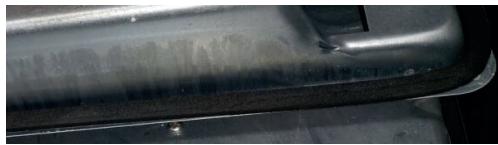

Assurez-vous que les découpes marginales sur le logement inférieur de la table de cuisson soient remplies de mastic.
- En retournant à nouveau la table de cuisson, l'aligner et la placer sur le plan de travail.
- Fixer la table de cuisson au plan de travail à l'aide des brides et des vis fournies.
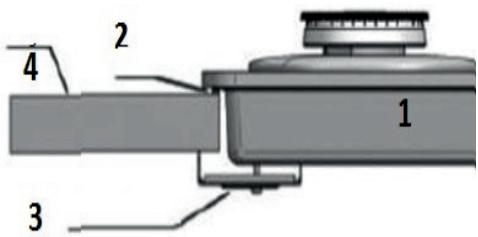
- Table de cuisson
- Mastic
- Bride de fixation
- Plan de travail
L'épaisseur du plan de travail ne doit pas être inférieure à 40 mm.

Lors de l'installation de la table de cuisson sur un meuble, il faut installer une étagère pour séparer le meuble de la table de cuisson, comme illustré sur la figure ci-dessus. Cela n'est pas nécessaire lors de l'installation sur un four encastrable.
Par exemple, s'il est possible de toucher le fond du produit installé au-dessus d'un tiroir, cette section doit être recouverte d'une plaque en bois.
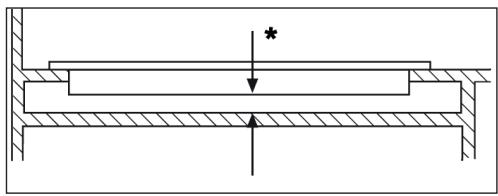
min. 25 mm
Pour les plans de travail d'une épaisseur de 40 à 50 mm, installer les brides comme indiqué ci-dessous.
Laisser une ouverture de ventilation sur la partie restante pour permettre la ventilation de la partie inférieure de la table de cuisson. Outre le fait d'être nécessaire pour la température des composants, ce passage est également obligatoire pour que le brûleur TC aspire l'air par le fond. Il peut être "d'au moins 100 cm²".

La flamme doit être bleue et avoir une forme régulière. Si la flamme tend vers le jaune, vérifier que le couvercle du brûleur est positionné de manière sûre ou nettoyer le brûleur.
3.6.1 Vue arrière (trous de raccordement)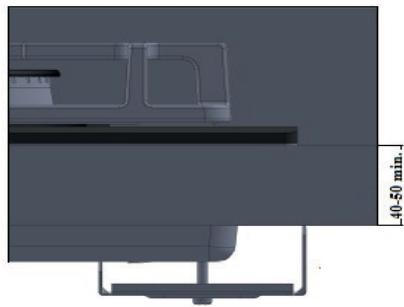
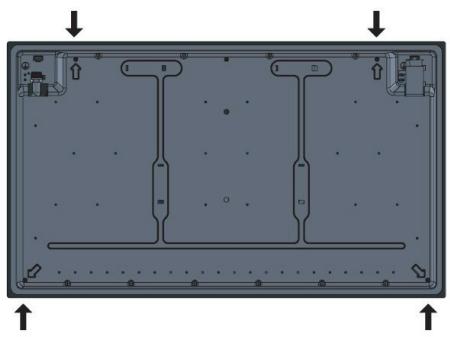
Positionner les plaques des brûleurs, les couvercles correspondants et les grilles à leur place après l'installation.

DANGER : Effectuer les raccordements à des trous différents n'est pas une bonne pratique en termes de sécurité, car cela pourrait endommager le système à gaz et électrique.

DANGER : Il y a des composants électriques et à gaz sur la table de cuisson. Par conséquent, seul le trou de raccordement indiqué dans ce manuel doit être utilisé pour fixer l'unité, comme décrit dans le manuel, en utilisant les dispositifs de fixation et les vis fournis. Dans le cas contraire, il y a un danger pour la vie et pour le logement lui-même.
3.7 Contrôle final
- Ouvrir l'alimentation en gaz.
- Contrôler les installations de gaz pour un montage et une étanchéité sûrs.
- Allumer les brûleurs et contrôler l'aspect de la flamme.

La flamme doit être bleue et avoir une forme régulière. Si la flamme tend vers le jaune, vérifier que le couvercle du brûleur est positionné de manière sûre ou nettoyer le brûleur.
Conversion gaz

AVERTISSEMENT : Avant tout travail concernant l'installation du gaz, veuillez couper l'alimentation en gaz. Il y a un risque d'explosion !
Pour utiliser le produit avec un autre type de gaz, remplacer tous les injecteurs de gaz et régler la combustion des robinets de gaz en mode veille.
Remplacer l'injecteur de gaz du brûleur
- Retirer le couvercle et la tête du brûleur.
- Tourner les injecteurs de gaz dans le sens antihoraire pour les retirer.
- Installer les nouveaux injecteurs de gaz.
- Vérifier toutes les fixations afin qu'elles soient bien en place.

La position des nouveaux injecteurs est indiquée sur l'emballage. Se référer également au tableau.
4.1 Conseils pour économiser l'énergie
Les informations suivantes aident à utiliser l'appareil de manière écologique et à économiser de l'énergie :
- Décongeler les aliments surgelés avant de les cuire.
- Utiliser des casseroles/poêles avec couvercles pour la cuisson. En l'absence de couvercle, la consommation d'énergie peut être multipliée par 4.
- Sélectionner le brûleur adapté à la taille du fond de la casserole à utiliser. Toujours sélectionner la taille correcte de la casserole pour les plats. Les casseroles plus grandes nécessitent plus d'énergie.
4.2 Première utilisation
4.2.1 Premier nettoyage de l'appareil
| i | La superficie più danneggiarsi a causa di alcuni detergenti o materi di pulizia.Non usare detergenti aggressivi, polveri/creme pulenti o oggetti taglienti durante la pulizia.Non usare detergenti molto abrasivi o raschietti in metallo tagliente per la pulizia dello sportello delorno, poché potrebbero graffiare la superficie e distruggere il vetro. |
- Retirer tous les matériaux d'emballage.
- Nettoyer les surfaces de l'appareil avec un chiffon ou une éponge humides, puis les sécher avec un chiffon.
5 Comment utiliser la table de cuisson
5.1 Informations générales sur la cuisson
- Avant de faire frire les aliments, toujours bien les sécher et les déposer délicatement dans l'huile chaude. S'assurer que les aliments surgelés sont complètement décongelés avant de les faire frire. Ne pas couvrir le récipient utilisé lors de la friture.
- Placer les casseroles et poêles de manière à ce que les manches ne soient pas au-dessus de la table de cuisson pour éviter qu'ils ne chauffent. Ne pas placer de récipients déséquilibrés ou qui s'inclinent facilement sur la table de cuisson. Ne pas placer de récipients ou poêles vides sur les zones de cuisson allumées. Ils pourraient s'endommager.
- L'utilisation d'une zone de cuisson avec un récipient ou une poêle dessus provoque des dommages à l'appareil. Éteindre les zones de cuisson lorsque la cuisson est terminée.
- Comme la surface de l'appareil peut être chaude, ne pas placer de récipients en plastique ou en aluminium dessus.
- Ces récipients ne doivent pas non plus être utilisés pour conserver les aliments.
- Utiliser uniquement des poêles ou des récipients à fond plat.
- Mettre la quantité appropriée d'aliments dans les casseroles et poêles. Ainsi, aucune opération de nettoyage inutile ne sera nécessaire, et les débordements seront évités.
Ne pas placer de couvercles de casseroles ou de poêles sur les zones de cuisson. - Placer les poêles de manière à ce qu'elles soient au centre de la zone de cuisson. Lorsque vous souhaitez déplacer la poêle sur une autre zone de cuisson, soulevez-la et placez-la sur la zone choisie, ne la faites pas glisser.
5.1.1 Cuisson au gaz
- La taille du récipient et la flamme doivent correspondre. Régler la flamme du gaz de manière à ce qu'elle ne dépasse pas le fond du récipient et centrer le récipient sur le support.
5.2 Utilisation de la table de cuisson
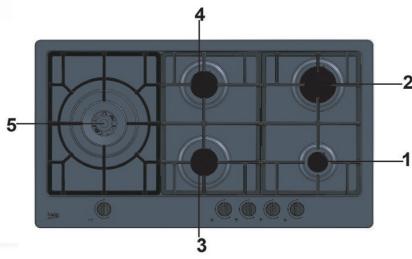
- Brûleur auxiliaire 12-16 cm
- Brûleur rapide 18-24 cm
- Brûleur normal 16-18 cm
- Brûleur normal 16-18 cm
- Brûleur wok 22-26 cm est le diamètre recommandé pour les casseroles à utiliser sur les brûleurs correspondants.
Le symbole de la grande flamme indique la puissance de cuisson maximale et le symbole de la petite flamme indique la cuisson la plus basse. En position arrêt (supérieure), le gaz n'est pas envoyé aux brûleurs.
L'utilisation de protections de plan de cuisson inadéquates peut provoquer des accidents.
5.2.1 Allumage des brûleurs à gaz
- Maintenir enfoncée la manette du brûleur.
- La tourner dans le sens inverse des aiguilles d'une montre jusqu'au symbole de la grande flamme. Le gaz s'allume grâce à l'étincelle qui se crée. 3. Régler selon la puissance de cuisson souhaitée.
5.2.2 Extinction des brûleurs à gaz
Amener la manette de la zone de maintien au chaud en position arrêt (supérieure).
5.2.3 Système de sécurité de coupure du gaz (sur les modèles avec composant thermique)
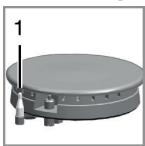
En cas de débordement de liquides sur les brûleurs, un mécanisme de sécurité se déclenche et le gaz est coupé.
- Coupure de sécurité du gaz
- Appuyer sur la manette et la tourner dans le sens inverse des aiguilles d'une montre pour allumer.
- Lorsque le gaz s'allume, maintenir la manette enfoncée pendant 3 à 5 secondes environ pour activer le système de sécurité.
- Si le gaz ne s'allume pas après avoir appuyé et relâché la manette, répéter la même procédure en maintenant la manette enfoncée pendant 15 secondes.

DANGER : Relâcher la manette si le brûleur ne s'est pas allumé dans les 15 secondes.
Attendre au moins 1 minute avant de réessayer. Il y a un risque d'accumulation de gaz et d'explosion !
5.2.4 Brûleur wok
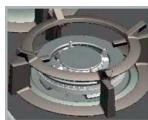
Les brûleurs wok aident à cuisiner plus rapidement. Le wok, particulièrement utilisé dans la cuisine asiatique, est un type de casserole profonde et à fond plat faite de feuilles de
métal, utilisée pour cuire des légumes et des viandes hachées à feu vif et en peu de temps.
Comme les aliments sont cuits à feu vif et en peu de temps dans ces casseroles qui conduisent la chaleur rapidement et uniformément, la valeur nutritionnelle des aliments est préservée et les légumes restent croquants.
On peut utiliser le brûleur wok aussi pour les casseroles normales.
Si l'on souhaite utiliser des casseroles normales sur un brûleur wok, il faut retirer le support de casserole pour wok de la table de cuisson.
6.1 Informations générales
La durée de vie de l'appareil s'allonge et les problèmes fréquents diminuent si celui-ci est nettoyé à intervalles réguliers.
| PERICOLO: Scollegare l'appa- recchio dalla rete elettrica prima di avviare i lavori di manutenzione e pulizia. C'e il rischio di shock elettrico! |
| PERICOLO: Far raffreddare l'apparecchio prima di pulirlo. Le superfici calde possono provocare uszion! |
- Nettoyer complètement l'appareil après chaque usage. De cette manière, il sera possible d'éliminer les résidus de cuisson plus facilement, évitant ainsi qu'ils ne brûlent lors de l'utilisation suivante de l'appareil.
- Aucun agent de nettoyage spécial n'est nécessaire pour le nettoyage de l'appareil. Utiliser de l'eau chaude avec du détergent liquide, un chiffon doux ou une éponge pour nettoyer l'appareil et sécher avec un chiffon sec. S'assurer toujours que le liquide en excès soit complètement séché après le nettoyage et que toutes les éclaboussures soient immédiatement essuyées. Ne pas utiliser d'agents de nettoyage contenant de l'acide ou du chlorure pour nettoyer les surfaces et la poignée en acier inoxydable. Utiliser un chiffon doux avec un détergent liquide (non abrasif) pour nettoyer ces pièces, en veillant à nettoyer dans une seule direction.
| i | La superficie più danneggiarsi a causa di alcuni detergenti o materiali di pulizia.Non usare detergenti aggressivi, polveri/creme pulenti o oggetti taglienti durante la pulizia.Non usare detergenti molto abrasivi o raschietti in metallo tagliente per la pulizia dello sportello delorno, poiché potrebbero graffiare la superficie e distruggere il vetro. |
| i | Non usare pulitori a vapore per pulire l'apparecchio poiché ciò potrebberprovocare uno shock elettrico. |
6.2 Nettoyage de la table de cuisson
6.2.1 Nettoyage des brûleurs
- Retirer les porte-casseroles, les têtes de brûleurs et les couvercles de brûleurs et les nettoyer avec un chiffon doux et humide.
- Nettoyer la saleté présente dans les chambres des brûleurs et sur les injecteurs avec un chiffon doux et humide, puis sécher avec un chiffon sec.
- Utiliser du stéarate de potassium (savon liquide) disponible dans le commerce pour la saleté tenace sur les têtes de brûleurs.
- Nettoyer la plaque des brûleurs de la table de cuisson.
- S'assurer que les têtes de brûleurs sont positionnées correctement et les installer. Une installation incorrecte entraîne des fuites de gaz, une mauvaise distribution et une flamme irrégulière.
- Lors de l'installation des porte-casseroles, veiller à les positionner de manière à ce que les brûleurs soient au centre.
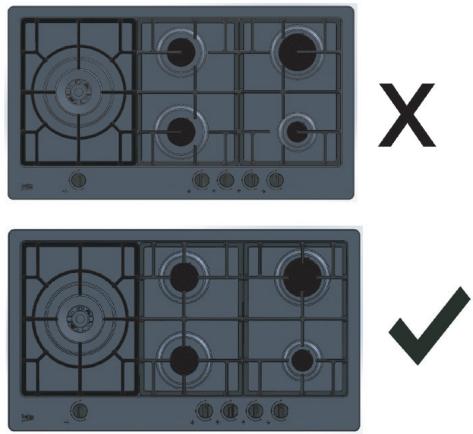

En cas de débordement, éteindre immédiatement les brûleurs. Retirer les casseroles et les porte-casseroles. Nettoyer le matériau débordé avec un chiffon sec et absorbant. Ne pas laisser entrer de liquides dans les brûleurs. Nettoyer l'intérieur des brûleurs en cas de pénétration de liquides. Ne pas réactiver la table de cuisson sans l'avoir d'abord nettoyée.
6.2.2 Assembler les parties du brûleur wok
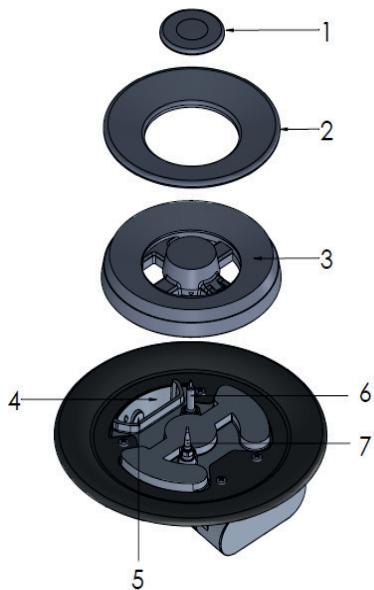
- Couvercle du brûleur interne
- Couvercle du brûleur externe
- Tête du brûleur
- Chambre du brûleur
- Injecteur
- Bougie (sur les produits avec allumeur)
- Thermocouple (sur les produits avec thermocouple)
Assembler toutes les pièces dans l'ordre après avoir nettoyé le brûleur.
- Positionner la tête du brûleur sur la chambre du brûleur de manière à ce qu'elle passe à travers le trou de la bougie (6).
- Positionner le couvercle des brûleurs sur les têtes des brûleurs.
6.2.3 Assembler les pièces du brûleur
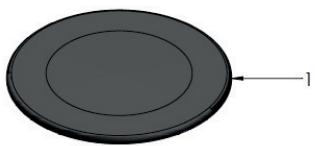
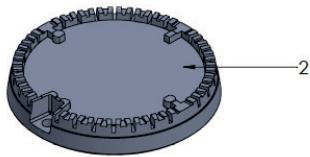
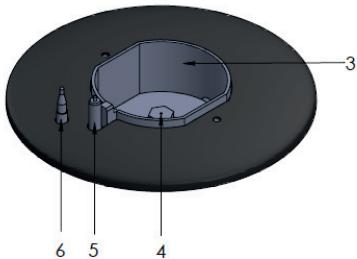
- Couvercle du brûleur
- Tête du brûleur
- Chambre du brûleur
- Injecteur
- Bougie (sur les produits avec allumeur)
- Thermocouple (sur les produits avec thermocouple)
Assembler toutes les pièces dans l'ordre après avoir nettoyé le brûleur.
- Positionner la tête du brûleur sur la chambre du brûleur de manière à ce qu'elle passe à travers le trou de la bougie (5).
- Positionner le couvercle du brûleur sur la tête du brûleur.
6.2.4 Surfaces en vitrocéramique
Nettoyer la surface en vitrocéramique à l'aide d'un chiffon humidifié avec de l'eau froide afin de ne laisser aucun agent de nettoyage sur celle-ci. Sécher avec un chiffon doux et sec. Les résidus peuvent endommager la surface en vitrocéramique lors de la prochaine utilisation de la table de cuisson.
Les résidus secs sur la surface en vitrocéramique ne doivent en aucun cas être grattés avec des lames crochues, de la laine d'acier ou des instruments similaires.
Enlever les taches de calcaire (taches jaunes) avec une petite quantité de détartrant comme du vinaigre ou du jus de citron. Il est également possible d'utiliser des produits adaptés disponibles dans le commerce.
Si la surface est très sale, appliquer le produit de nettoyage sur une éponge et attendre qu'il soit bien absorbé. Nettoyer ensuite la surface de la table de cuisson avec un chiffon humide.

Les aliments à base de sucre comme les crèmes épaisses et les sirops doivent être nettoyés immédiatement après refroidissement de la surface. Sinon, la surface en vitrocéramique pourrait être endommagée de façon permanente.
Avec le temps, une légère décoloration peut apparaître sur les revêtements ou les autres surfaces. Cela n'affecte pas le fonctionnement du produit.
La décoloration et les taches sur la surface en vitrocéramique sont une condition normale, pas un défaut.
6 Nettoyage et entretien
6.3 Nettoyage du panneau de commande
Nettoyer le panneau de commande et les boutons avec un chiffon humide, puis les sécher.

Ne pas retirer les touches/boutons pour nettoyer le panneau de commande. Le panneau de commande pourrait être endommagé !
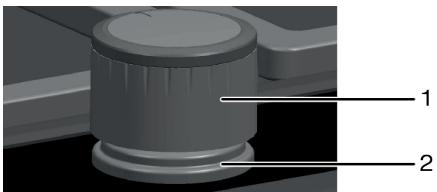
- Bouton
- Joint

Ne pas retirer les joints des boutons pour le nettoyage.
6.4 Transport futur :
- Si le carton d'origine du produit a été conservé, le transporter dans celui-ci. Suivre ensuite les instructions affichées. Si vous n'avez pas le carton d'origine, emballer le produit dans du papier à bulles ou dans un carton épais et le fixer avec du ruban adhésif. Fixer les couvercles et les supports de casseroles avec du ruban adhésif.

Vérifier l'aspect général du produit pour détecter tout dommage éventuel survenu pendant le transport.
7 Recherche et résolution des problèmes
L'appareil émet des bruits métalliques pendant le chauffage et le refroidissement.
- Lorsque les pièces métalliques chauffent, elles peuvent se dilater et provoquer des bruits. >>> Ce n'est pas une panne.
Pas d'étincelle d'allumage.
- Courant absent. >> Vérifier les fusibles dans la boîte à fusibles.
L'appareil émet des étincelles à répétition.
- Des liquides ont pu pénétrer dans le mécanisme d'allumage sous les boutons de commande. >>> Débrancher l'appareil et attendre qu'il refroidisse.
Pas de gaz.
- La vanne principale du gaz est fermée. >>>> Ouvrir la vanne du gaz.
- Le tuyau de gaz est plié. >>> Installer correctement le tuyau de gaz.
Les brûleurs ne fonctionnent pas bien ou pas du tout.
- Les brûleurs sont sales. >>>> Nettoyer les composants des brûleurs.
- Les brûleurs sont mouillés. >>>> Sécher les composants des brûleurs.
- Le couvercle du brûleur n'est pas positionné de manière sûre. >>>> Positionner correctement le couvercle du brûleur.
- La vanne principale du gaz est fermée. >>>> Ouvrir la vanne du gaz.
- La bouteille de gaz est vide (en cas d'utilisation de GPL). Remplacer la bouteille de gaz.
- Le bouton du brûleur n'a pas été enfoncé suffisamment lors de l'allumage. >>> Allumer le brûleur en maintenant enfoncé pendant au moins 3 à 5 secondes.

Consulter le service après-vente si le problème persiste malgré les solutions proposées dans cette section. Ne jamais essayer de réparer soi-même un appareil défectueux.
7 Recherche et résolution des problèmes
| Marca | BEKO | ||
| Tipo di piano cottura | Piano cottura a gas incassato | ||
| Modello | Inox | ||
| Simbolo | Valore | Unità | |
| Numero dei bruciatori a gas | 5 | % | |
| Efficienza energetica del bruciatore destro posteriore | bruciatore a gas EE | 55,3 | % |
| Efficienza energetica del bruciatore destro anteriore | bruciatore a gas EE | - | % |
| Efficienza energetica del bruciatore sinistro anteriore | bruciatore a gas EE | 56,2 | % |
| Efficienza energetica del bruciatore sinistro posteriore | bruciatore a gas EE | 56,2 | % |
| Efficienza energetica del bruciatore sinistro anteriore | bruciatore a gas EE | 52,8 | % |
| Efficienza energetica del piano cottura a gas | bruciatore a gas EE | 55,1 | % |
Conformément aux exigences de la conception écocompatible des produits liés à l'énergie de la directive n° 2009/125/CE, les informations produit suivantes sont fournies en parallèle avec le règlement de la Commission européenne n° (UE) 66/2014, conformément aux exigences de la conception écocompatible des cuisinières domestiques.
Afin de spécifier les caractéristiques du produit, les mesures et les calculs sont effectués selon les normes suivantes, conformément aux exigences de la conception écocompatible.
It 30-2



- TABLE DE CUISSON ENCASTRABLE
- MANUEL D'UTILISATION
- VEUILLEZ LIRE CE MANUEL EN PREMIER
- SIGNIFICATION DES SYMBOLES
- SOMMAIRE
- INSTRUCTIONS IMPORTANTES ET AVERTISSEMENTS POUR LA SÉCURITÉ ET L'ENVIRONNEMENT
- SÉCURITÉ GÉNÉRALE
- SÉCURITÉ LORS DU TRAVAIL AVEC LE GAZ
- QUE FAIRE EN CAS D'ODEUR DE GAZ
- SÉCURITÉ ÉLECTRIQUE
- INSTRUCTIONS ET AVERTISSEMENTS IMPORTANTS POUR LA SÉCURITÉ ET L'ENVIRONNEMENT
- SÉCURITÉ DU PRODUIT
- UTILISATION PRÉVUE
- SÉCURITÉ DES ENFANTS
- CONFORMITÉ À LA DIRECTIVE DEEE ET ÉLIMINATION DU PRODUIT EN FIN DE VIE
- CONFORMITÉ À LA DIRECTIVE ROHS
- INFORMATIONS SUR L'EMBALLAGE
- SUPPORT DE CASSEROLE
- PANNEAU DE COMMANDE
- CONTENU DE L'EMBALLAGE
- ADAPTATEUR POUR CAFETIÈRE
- ADAPTATEUR POUR WOK
- AVANT L'INSTALLATION
- VENTILATION DE LA PIÈCE
- INSTALLATION ET RACCORDEMENT
- RACCORDEMENT ÉLECTRIQUE
- RACCORDEMENT DU GAZ
- RACCORDEMENT DU TUYAU DE GAZ POUR GAZ NATUREL (GN)
- RACCORDEMENT DU TUYAU DE GAZ POUR GPL
- CONTRÔLE D'ÉTANCHÉITÉ AU POINT DE RACCORDEMENT
- S'IL Y A UN FOUR ENCASTRÉ INSTALLÉ SOUS LA TABLE DE CUISSON
- INSTALLATION
- INSTALLATION DU PRODUIT
- REAR VIEW (CONNECTION HOLES)
- CONTRÔLE FINAL
- CONVERSION DU GAZ
- REMPLACEMENT DE L'INJECTEUR DE GAZ DU BRÛLEUR
- CONSEILS POUR ÉCONOMISER L'ÉNERGIE
- PREMIÈRE UTILISATION
- PREMIER NETTOYAGE DE L'APPAREIL
- INFORMATIONS GÉNÉRALES SUR LA CUISSON
- CUISSON AU GAZ
- UTILISATION DES FOYERS
- ALLUMAGE DES BRÛLEURS À GAZ
- EXTINCTION DES BRÛLEURS À GAZ
- SYSTÈME DE SÉCURITÉ D'ARRÊT DU GAZ (SUR LES MODÈLES AVEC COMPOSANT THERMIQUE)
- BRÛLEUR WOK
- INFORMATIONS GÉNÉRALES
- NETTOYAGE DE LA TABLE DE CUISSON
- NETTOYAGE DU BRÛLEUR
- ENTRETIEN ET SOIN
- ASSEMBLAGE DES PIÈCES DU BRÛLEUR WOK
- ASSEMBLAGE DES PIÈCES DU BRÛLEUR
- ENTRETIEN ET MAINTENANCE
- SURFACES EN VITROCÉRAMIQUE
- NETTOYAGE DU BANDEAU DE COMMANDE
- TRANSPORT FUTUR
- DÉPANNAGE
- UN BRUIT DE CLIQUETIS SE FAIT ENTENDRE PENDANT QUE LE PRODUIT CHAUFFE ET REFROIDIT
- IL N'Y A PAS D'ÉTINCELLE D'ALLUMAGE
- LE PRODUIT PRODUIT DES ÉTINCELLES EN CONTINU
- IL N'Y A PAS DE GAZ
- LES BRÛLEURS NE BRÛLENT PAS CORRECTEMENT OU PAS DU TOUT
- LISEZ D'ABORD CE MANUEL D'UTILISATION
- CHÈRE CLIENTE, CHER CLIENT
- EXPLICATION DES SYMBOLES
- INSTRUCTIONS IMPORTANTES POUR LA SÉCURITÉ ET L'ENVIRONNEMENT
- PRÉCAUTIONS LORS DE L'UTILISATION DU GAZ
- ÉVITER TOUT RISQUE D'INCENDIE
- USAGE PRÉVU
- CONFORMITÉ À LA DIRECTIVE DEEE ET ÉLIMINATION DES DÉCHETS
- VUE D'ENSEMBLE
- ADAPTATEUR WOK
- RACCORDEMENT DU TUYAU FLEXIBLE DE GAZ POUR GAZ MÉTHANE
- RACCORDEMENT DU TUYAU FLEXIBLE DE GAZ POUR GPL
- CONTRÔLE DES FUITES AU POINT DE RACCORDEMENT
- SI LA CUISINIÈRE EST ÉQUIPÉE D'UN FOUR ENCASTRÉ
- CONVERSION GAZ
- REMPLACER L'INJECTEUR DE GAZ DU BRÛLEUR
- COMMENT UTILISER LA TABLE DE CUISSON
- UTILISATION DE LA TABLE DE CUISSON
- SYSTÈME DE SÉCURITÉ DE COUPURE DU GAZ (SUR LES MODÈLES AVEC COMPOSANT THERMIQUE)
- NETTOYAGE DES BRÛLEURS
- ASSEMBLER LES PARTIES DU BRÛLEUR WOK
- ASSEMBLER LES PIÈCES DU BRÛLEUR
- NETTOYAGE ET ENTRETIEN
- NETTOYAGE DU PANNEAU DE COMMANDE
- RECHERCHE ET RÉSOLUTION DES PROBLÈMES
- L'APPAREIL ÉMET DES BRUITS MÉTALLIQUES PENDANT LE CHAUFFAGE ET LE REFROIDISSEMENT
- PAS D'ÉTINCELLE D'ALLUMAGE
- L'APPAREIL ÉMET DES ÉTINCELLES À RÉPÉTITION
- PAS DE GAZ
- LES BRÛLEURS NE FONCTIONNENT PAS BIEN OU PAS DU TOUT
Marque : BEKO
Modèle : HIML 95225 SXE
Catégorie : Plaque de cuisson